Part 3 — DIVISION IV. THE “GALLOWS” LITERATURE OF THE STREETS. Public Executions, Dying Speeches. Confessions, and Copy of Verses. (continued 4)
Reading edition
C. Phillips, Printer, Market Street, Brighton.
BARBAROUS MURDER OF A CHILD BY A SCHOOLMISTRESS.

A child murder has been committed at Park Horner, in the parish of Hampreston, under circumstances of the most shocking barbarity. At the Coroner’s inquest it was given in evidence that the child had been beaten on the head with a heavy flint stone, and its tongue cut completely out at the root. It was found wrapped up in another part of a drawer where the body was discovered. The inquiry lasted four hours and a-half, and resulted, in the first instance, in a verdict, “That the child was born alive and murdered by someone.” The Coroner pointed out that the evidence was conclusive against Emma Pitt, the national school-mistress, who was the mother of the child; and he expressed his surprise that such a verdict should have been returned. The Jury after reconsidering their previous finding, returned a verdict of “Wilful murder against Emma Pitt.”

We have read of sad and dreadful deeds Of mothers cruel and unkind, But in the annals of history Such as this we seldom find; In the parish of Hampreston, This deed was done we hear, Near to the town of Wimborne, In the county of Dorsetshire. This Emma Pitt was a schoolmistress, Her child she killed we see, Oh mothers, did you ever hear, Of such barbarity. With a large flint stone she beat its head When such cruelty she’d done, From the tender roof of the infant’s mouth She cut away it’s tongue; Sad and wicked, cruel wretch, Hard was her flinty heart, The infant’s tongue from the body was Wrapped in another part. The murderess placed in a drawer, And it there, alas! was found, The news of this dreadful murder, Soon spread for miles around; And first upon the inquest, She expected to get free, Although she was the author Of this dreadful tragedy. A schoolmistress too, how sad to tell, Well known for miles around, Who had many children under care, In and near to Wimborne town. Oh, what a sad example, To children she did set, There was never such a cruel wretch, As the barbarous Emma Pitt. She committed is for murder, Soon her trial will take place, And if she is found guilty, How sad will be her case. If she has a woman’s feelings, She surely will go wild, She in such a barbarous manner killed Her tender infant child. The hour is approaching, The moments near at hand, When before a Judge and Jury, This monster soon must stand; And if she is found guilty, She her deserts will get, And mother’s, miles round Wimborne, Will remember Emma Pitt.
H. Disley, Printer, 57, High Street, St. Giles.
FAREWELL TO THE WORLD OF RICHARD BISHOP, Who now lies under sentence of Death in Maidstone Gaol, For the Murder of Alfred Cartwright.

In Maidstone Gaol, I am lamenting, I am borne down with grief and pain, I for my deeds am now repenting, I shall Sydenham never see again; I have been tried for wilful murder, No power on earth can me now save, I am doomed to die, my time’s approaching, And I must lie in a silent grave. Now I, alas! must die for murder, Oh, how awful is my doom, Richard Bishop, one and twenty, In youth and vigour, health and bloom. Alfred Cartwright was my neighbour, We both at Forest Hill did dwell, Alfred, servant was at the Swiss Cottage, Where he was respected well; I went with others to annoy him, It was upon that fatal night, Ere he returned from his day’s labour. Unto his home and loving wife. I never did intend to kill him, Why should I my neighbour slay, He never gave me any reason, To take his youthful life away? I was given in charge, and in a passion, I drew the awful, deadly knife, And plunged it in poor Alfred’s body, And there deprived him of his life. The solemn funeral of my victim, Caused consternation miles around, Thousands flocked from every quarter, The funeral dirge did mournful sound; Poor Alfred, to his grave respected, Proceeded by a solemn band, And I must die upon the gallows, A wicked and degraded man. Farewell, vain world, I now must leave you, Farewell, my friends and neighbours all, Around Forest Hill no more you’ll see me, The hangman’s voice on me does call; Saying, Richard Bishop, now be ready, To die upon the fatal tree, Oh, aged only one and twenty, What a dreadful sight to see. Poor Alfred’s friends, will you forgive me, His father, mother, tender wife, I him did kill, his blood did spill, And I pay a forfeit with my life? And God, look down from heaven upon me, Forgive the crime that I have done. I see grim death standing before me, Saying, Richard Bishop’s glass is run. Oh, pray, young men, by me take warning, Remember me and what I done, Ponder, yes, oh! and consider, Let passion you not overcome; I did the deed in the heighth of passion, I had no animosity. Little thought my tender parents, I should die upon a gallows tree. When the Judge did pass the awful sentence Saying, Richard Bishop, you must die, For the murder of young Alfred Cartwright, On Maidstone’s tree so awful high; Oh think, dear friends, what was my feelings, Sad and wretched and forlorn, Doomed at the age of one and twenty, To die a dreadful death of scorn.
H. Disley, Printer, 57, High street, St. Giles, London.
LAMENTATION OF J. MAPP, Who now lies under Sentence of Death in Shrewsbury Gaol, for the Murder of Catherine Lewis.
On Monday, March 23, at the Shrewsbury Assizes, John Mapp, a labourer, was placed at the bar, charged with the wilful murder of Catherine Lewis, on the 22nd of December, 1867, at the parish of Longden.
Jane Richards deposed that after leaving chapel she accompanied deceased and John Mapp as far as Wood Farm, where she left them together going down Long lane.
Edward Lewis, the father of the deceased, deposed to Mrs. Hutchins bringing him his daughter’s hat covered with blood. I at once started in search through several fields till I saw a hovel. There were marks at the door as if something had been dragged along, and on entering saw the body of my child in a little bin, covered with straw and loose litter.
Mr. Harris, surgeon: I made a post mortem examination of deceased. I found a shawl tied round her neck, and about eight inches shoved tightly into her mouth. There were five incisions on the right side of the throat, finishing in one deep wound on the left. The windpipe was cut through. I attribute her death to loss of blood and suffocation.
Edward Jones, police-constable, produced a brooch belonging to deceased, which was found on the prisoner when he took him into custody.
John Aston, a waggoner, deposed to finding the hat of the deceased in a holly bush.
Mrs. Davies: I reside at Longden. I knew the deceased. The brooch produced is the one she wore.
The counsel for the prisoner then proceeded to address the Jury for the defence, and the counsel for the prosecution having replied,
The Judge then summed up, and the Jury without retiring from the box returned a verdict of Guilty. The usual Sentence of Death was then pronounced upon the prisoner.
John Mapp, in Shrewsbury, does now bewail, Doomed to die for murder in a dreary gaol; Such a dreadful murder, as you may see, Which we may compare to the Alton tragedy. In Shrewsbury Gaol, now in grief do lie, John Mapp, the murderer, condemned to die. The cruel monster was not afraid, To kill a youthful and innocent maid. Little Catherine Lewis on a Sunday night, Mapp, without a reason, deprived of life. Returning home from chapel, he embraced her fast, ’Twas the twenty-second of December last; He cut and mangled her, took her from the road, And her murdered body in the hovel throwed. Oh! how could any one so vile engage, To kill a child but nine years of age; Her clothes he scattered over ditch and field, For which he finds now his fate is sealed. The child was missed—news spread far and wide, John Mapp was questioned, he the deed denied, He prevaricated—untruths did state, And he must meet his untimely fate. Little Kitty’s brooch that was found on Mapp, And he took her ribbon from her Sunday hat; He had a heart harder far than steel, He was quite composed, working in the field. Mapp was apprehended and sent to gaol, And in a dungeon does now bewail; On the tree a forfeit he must pay, his life, His murdered victim haunts him day and night. Now Mapp is cast and condemned to die, Although the murder he does now deny; The jury found him guilty, the case was clear, And his last moments are drawing near. How sad and dreadful it is to state, The horrid murders that have been of late; In every quarter both far and near, Such atrocious deeds before this no one did hear. Little Catherine Lewis, as I unfold, Was but a little more than nine years old, Innocent and charming, pious and kind, Sweet disposition, and amiable mind. What motive could the horrid murderer have, To send the child to an early grave? It was not for lucre, he could nothing gain, To cause such horror, such grief and pain. When he appears on the fatal tree, Not a a spark of pity will there be for he; He must die a murderer, nothing can him save, Aged thirty-five, lie in a murderer’s grave.
H. Disley, Printer, 57, High Street, St. Giles, London.
LAMENTATION OF H. LINGLEY.
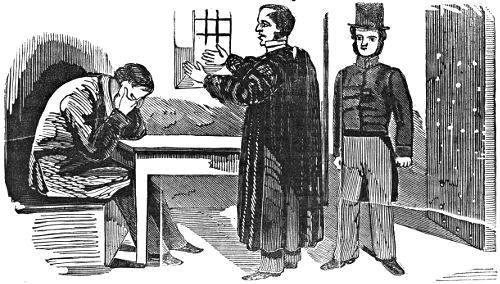
Within a dungeon in Norwich gaol, One Hubbard Lingley in grief bewails, His own kind uncle he did kill and slay, On a Friday morning in the month of May. For that cruel murder he’s doomed to die On Norwich fatal sad gallows high. He is doomed to suffer as I relate On the very tree where Rush met his fate In health, in vigour, in youth and bloom, The murderer Lingley must meet his doom. In the morning early at four o’clock He fired a sad and dreadful shot Which caused his uncle’s fatal death wound Where he fell bleeding upon the ground. A kind good uncle as may be seen To his wicked nephew he had been; Reared him up tenderly and used him well, And in his cottage with him to dwell. But he resolved he his blood would spill His uncle Benjamin he wished to kill; On Friday morn, the seventeenth of May, The nephew did his kind uncle slay. Early in the morning, at four o’clock, To attract his uncle he fired a shot And by that spot received the fatal wound. The murderer flew and left him on the ground Some labouring men who were passers by, Saw the murdered in his blood to lie; Suspicion did on his nephew fall, And innocent blood did for vengeance call. Many excuses did Lingley make, Not having courage to meet his fate; He before a jury for the deed was tried, And condemned to suffer on the gallows high. Hubbard Lingley thought when his uncle died His place to him would not be denied; So he was determined to kill and slay, His uncle dear the seventeenth day of May. He is doomed to die, nothing can him save, By the side of Rush in a murderer’s grave; His bones will moulder till the Judgment day, How could he take his uncle’s life away? At Norwich castle he was tried and cast And his last moments approaching fast; The hangman anxious does now await To terminate Hubbard Lingley’s fate. Oh! all young men a warning take Think and consider ere it is too late; How could he dare lift his murderous hand. Base, vile, ungrateful, and cruel man.
H. Disley, Printer, 57, High-street, St. Giles.
TRIAL, CHARACTER, CONFESSION, BEHAVIOUR, & EXECUTION OF ALICE HOLT, In front of Chester Gaol, this day, for the Wicked Murder of her own Mother.
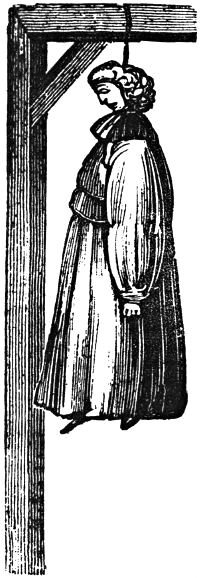
This day the extreme sentence of the law was carried into effect on Alice Holt, at Chester Gaol, for the murder of her mother by poison. The evidence at the trial showed that prisoner, her mother, and a man named Holt, with whom she cohabited, lived together at Stockport. In February last the deceased, Mary Bailey, was taken ill, and the prisoner insured her life for £26, at a premium of 6d. per week. She induced a woman named Betty Wood to personate her mother before the doctor, telling her that the agent said “Any one would do.” The proposal was accepted by the Wesleyan Assurance Society, and from that time the mother became worse. Prisoner called in the parish surgeon and the infirmary visiting officer, both of whom were ignorant of the other’s visits, and complained of their medicine not being given. On the 25th and 26th the prisoner bought some arsenic—a quarter of a pound each time—which she put in a jug with some boiling water, and sprinkled about the room where her mother lay to kill vermin. The night of the 26th deceased had some brandy-and-water, and complained of “grounds” being at the bottom. Prisoner said, “You ought to have drunk grounds and all.” Mary Bailey died in the morning with all the symptoms of arsenical poison, and was buried. The personation came to the ears of the office, and the body was disinterred, when it was found perfectly fresh, but “saturated with arsenic,” of which no less than 160 grains were found in the stomach and adjacent parts.
The unfortunate woman was not tried at the Summer Assizes, in consequence of her being in the family-way. The child has since been adopted by Holt’s uncle, the only person who has visited her since during her imprisonment. She has been sullen, and strongly protested her innocence.
CONFESSION.
On Sunday, the prisoner made the following statement:—On the Monday before mother died, I brought the insurance paper home, insuring my mother’s life for £26, and mine for £28. He then proposed I should get some charcoal and put it under mother’s bed alight, when she was asleep, and she would never wake more. On Wednesday night Holt and I never went to bed. He said it would be a great releasement if she was in her grave, and he would buy some stretchnine (strychnine) if I would give it her. I said, “Thou’lt be found out.” He said, “They cannot find it out by that.” I said, “Thou hast brought me to destruction, and now thou wants to bring me to the gallows.” He then beat me. In the beer of which I spoke, I saw, after my mother had drank it, a quantity of blue arsenic grounds. I said, “Thou hast given my mother arsenic.” He said, “If thou tell aught, I will have thee up for defrauding the insurance,” and said, “Nobody will believe but what thou hast done it thyself.” This was the only arsenic my mother ever had.—Another statement was afterwards made by the prisoner.
THE EXECUTION
Took place this morning. When near the drop her courage failed her, and she was half dragged, half carried to the scaffold. On the platform she fell on her knees, and moaned piteously, “The Lord have mercy upon me,” which she continued to do whilst Calcraft pulled the bolt. The drop fell, and the culprit was launched into eternity before a great many people, particularly women-folks.
COPY OF VERSES.
A dreadful case of murder, Such as we seldom hear, Committed was at Stockport, In the County of Cheshire. Where a mother, named Mary Bailey, They did so cruelly slaughter, By poison administered all in her beer By her own daughter. The daughter insured the life of the mother, For twenty-six pounds at her death, Then she and the man that she lived with Determined to take away her breath. And when Betty Wood represented the mother, She did’nt act with propriety, For the poor mother lost her life, And they all swindled the Society. Now that the old gal’s life’s insured, Holt to the daughter did say, Better in the grave she were immured, And the money will make us so gay. Now that you have got me in the family way, And from me my virtue you’ve wrung, You’ll never be happy a day, Till on the gallows I’m hung. She laid a plan to murder her, As we now see so clear, To put a quantity of arsenic Into her poor mother’s beer. To see her lay in agony, Upon that dreadful night, With a dreadful dose of arsenic, Oh, it was a dreadful sight. She lived but just six hours, Then the poor woman did die, And this base murdering wretch, The dreadful deed did deny. On the man Holt she laid the blame, Vowed he did her mother slay, Holt on her did the same, Saying she took the mother’s life away. The father of her unborn infant, Whom she vowed to love most dear, And when confined in prison, She was overcome with fear, She made a rambling statement ’Bout the arsenic in the beer Laid all the blame on Holt and Betty Wood Expecting for to get clear. But there’s no doubt the base wretch Did her poor mother slay. For which on Chester’s scaffold, Her life did forfeit pay, So all young women a warning take, By this poor wretch you see, A hanging for the mother’s sake On Chester’s fatal tree,
W. Smith, Printer, Chester.
CRUEL AND INHUMAN MURDER Of a little Boy, by his Father. COMMITTAL OF THE PRISONER.
On Monday morning a cruel and inhuman murder was committed by the father on a child aged six years, in Neal’s passage, Seven Dials. The father has been separated from his wife for some time, and the boy had been brought up by its maternal grandmother, a poor old woman. The child being an unusally intelligent and nice-looking boy was a great favourite with the grandmother and an aunt who lived in the same room. It appears the mother had been living with another man as his wife, and the father also had formed an illicit connection with another woman. The poor boy had consequently become a source of trouble to both of them, although the merest trifle was required for its maintenance.
On Sunday evening the father (Jeffery) called at the grandmother’s for the boy. She asked him what he wanted with the child, but he became very violent, ordered the child to dress himself, and swore that “he would do for her and the child too,” if she did not mind. Jeffrey then went to his sister, in White Lion street, taking the child with him, and asked for a bed. He was accommodated with one, and went to bed with the boy; but at two o’clock in the morning he rose, and took the child away. He could not have walked many yards away—for Neal’s passage, where the body of the deceased was found, is close at hand. The child was found suspended from a projecting beam or bracket in a cellar to which all the residents had access for water, &c. Horrible as it seems, it is apparent from the condition of the body, that the cruel father tied its hands behind, and had literally enacted the part of executioner of his own child, holding its legs, and forcing down its body to complete the strangulation of the poor boy. The child remained in this position till about half-past six o’clock, when it was seen by a girl who had occasion to go to the cellar, and who gave the alarm. Dr. Harvey, the parish surgeon, attended directly, and pronounced the child to have been dead about three or four hours.
Dr. Lankester, the coroner, held an adjourned inquest on Wednesday, and there being no further evidence the jury returned a verdict of wilful murder by hanging and suffocation of Richard A. Jefferey, by his father, John R. Jefferey. The prisoner was examined at Bow street yesterday, and committed to Newgate.
You kindest fathers, tender mothers, To this sad tale, oh! list awhile, Hark you, sisters, too, and brothers, To a murder on the Seven Dials; Such a crime indeed,—no never! Its baseness I can scarce reveal, In Neal’s Passage, Earl Street, Seven Dials, In St. Giles’s-in-the-fields. In all your troubles and your trials, You never knew, as I reveal, Such a murder, on the Seven Dials, In St. Giles’s-in-the-fields. In Earl Street lived a wretch named Jefferys, Who a tailor was by trade we find, A sad, a base, and cruel villain, Wickedness ran in his mind; A child, the villain ought to cherish, His offspring which he should adore, Seventeen weeks ago he left him, At his old Grandmother’s door. His little boy named Richard Arthur, By the wretched father, we are told, Was cruelly and basely murdered,— The child was only seven years old; The villain took him to a cellar, Resolved his offspring to destroy, Tied his little hands behind him, And hanged the pretty smiling boy. Vengeance against the boy he threaten’d Determin’d for to take his life, And to commit the dreadful action, He often did produce a knife; ’Twas his only child, he had no other, A rogue in grain, devoid of fear, He’d been separated from the mother Of the little boy for three long years. The grandmother, his mother’s mother, Her little grandchild long did keep, Receiving nothing from the father, For the space of seventeen long weeks, And then the villain did demand him, He clandestinely took him away, That fatal evening he determined Was his little boy to slay. Then he to the cellar took him,— His heart was harder far than steel, The wicked, base, inhuman monster, His actions no one can reveal. His only chlld, to hold beside him, With rope he bound his little hands, When behind his back he placed them, He in the cellar did him hang. He flew, but Justice close pursued him, And taken he has been we see; When tried, no doubt, they’ll find him guilty, And he’ll be hanged on Newgate’s tree; Hanging is too good for such a villain, He who would his flesh and blood destroy, The child, we are told, was six years old, A pretty little prattling boy. We all have got our cares and trials, And unto fate compelled to yield, This deed was done on the Seven Dials. In St. Giles’s-in-the-fields.
H. DISLEY, Printer, 57, High street, St. Giles, London.
LAMENTATION & CONFESSION OF J. R. JEFFERY Who now lies under sentence of death, for the wilful murder of his little boy.

Within a dreary cell I lie, A wretched murderer, condemned to die For the murder of my darling boy, Whose precious life I did destroy. I am doomed to die, my glass is run, For the murder of my darling son. John Richard Jeffery, it is my name, Why did I do that deed of shame? I confess my crime, but do declare, No ill feeling to my child did bear. From my wife I long had parted been, Which disturbed my mind, as may be seen; And Satan’s doubts they filled my mind, Which led me to this dreadful crime. I could not bear the child to see, It seemed to increase my misery, While thinking of my absent wife, I form’d a plan to take his life. At his grandmother’s he found a home, And with fiendish thoughts I’m asham’d to own; Quick dress that child, to her did say, For I was determined the boy to slay. Poor little boy, it seemed filled with fear, And cried, don’t dress me granny dear; Don’t let father take me away, With you, dear granny, I’d rather stay. But to his wishes I paid no heed But left with the child, as you may read; Then proceeded in the dead of night, To a lonely spot to take his life. To a dismal cellar I took the helpless child, The thoughts of which now drives me wild; Poor boy, he fainted with affright, And in that state I took his life. With a handkerchief I bound his hands, And to the cistern I did him hang; Poor innocent, unconscious quite, Knew not his father had took his life. When this fearful act the hand had done, From the fearful scene away did run; With stricken conscience, like the murderer Cain, But peace of mind could not obtain. I strove to forget it for a time, But my murdered boy so haunted my mind, I gave myself up, as you may read, To make some atonement for the deed. I soon upon the drop must stand, A guilty and heart-broken man; My darling boy I shall no more behold, Have mercy, God, on my guilty soul!
H. Disley, Printer, 57, High Street, St. Giles.
MURDER OF A WIFE AT ASHBURNHAM, NEAR HASTINGS.
A shocking murder of a wife was committed on Sunday, at Ashburnham, a village near Hastings. Near the village is a quantity of land called Gardener’s Farm, which is farmed by an old man named Stubberfield and his son Jeremiah. The son, who is married, has a separate residence about sixty yards from that of his parent. There were living in the same house with the son, his wife Matilda, their son, Mary Deeprose (a companion to Mrs Stubberfield), and several farm labourers and servants. The boy, eight years old, who occupied the same room with his parents, states that early on Sunday morning he saw his father kneeling upon his mother, and squeezing her throat. Hearing his mother say, “Oh!” feebly, as is in pain, he said to his father, “Your hurting mother.” “You hold your tongue,” replied the father, “I’m only tickling her.” The boy again made a similar remark, upon which the father said that if he didn’t hold his tongue he would “see to him.” Stubberfield then dressed himself, and having kissed his wife and child, went down stairs. The boy immediately aroused the other inmates of the house, who were soon in the bedroom of the murdered woman. The police were sent for, and in a short time, some two hundred persons were scouring the neighbourhood in search of Stubberfield, and it was not till the afternoon he was discovered, and then he was making his way towards home. He had secreted himself in a pit, and tried to drown himself, but could not do so, for he always floated on the top of the water.
A dreadful deed, as you may read, I am going to unfold, A base and cruel murder, That will make your blood run cold; At a village called Ashburnham, A few miles from Hastings town, Where the family of the Stubberfields Was known for miles round. Jeremiah Stubberfield killed his wife, At Ashburnham, we see, Which caused many a tear both far and near, The Sussex tragedy. There lived old Farmer Stubberfield, An aged, wealthy sire, At Gardner’s Farm, and near him lived, His son, named Jeremiah; Who had a wife, Matilda, Virtuous, good, and kind, Who had a son, and her companion, Labourers and servants, too, we find. On Sunday morn, the twenty-third of May, The little boy, but eight years old, Saw his father squeeze his mother’s throat, Most awful to unfold; He called unto his father, While trembling with fear, Saying, oh, cruel father, You are killing mother dear. The murderer kissed his wife and child, After that he did slay, Then placed his coat upon his arm, And from the farm did stray; The servants and the labourers, Went to the fatal bed, And there beheld Matilda Quite cold, and lying dead. They did pursue the murderer, They in numbers went along, Searched the hedges and the ditches, Dragged the rivers and the ponds; But late on Sunday afternoon, As they in numbers on did stray, They saw him wandering to his home, Where his murdered wife did lay. He says he dearly loved her, A kind, good, and tender wife, Oh, whatever could possess him, To take away her life; It has caused great excitement, Far round the country, A farmer’s son the murder done,— The Sussex tragedy. To end this dreadful tale of woe, Confined within a gaol, Lies Jeremiah Stubberfield, In anguish to bewail; He loved his wife, far more than life, He her corpse sweet kisses gave, He has brought his aged parents, In sorrow to the grave.
H. Disley, Printer, 57, High street, St. Giles, London.
LAMENTATION & FAREWELL TO THE WORLD OF JOHN FLETCHER AND ANN LAWRENCE

Who now lies under Sentence of Death at Maidstone Gaol.

A poor unhappy man and woman, Does in agony bewail, Sentenced to die, alas for murder! In separate cells, in Maidstone gaol. Ann Lawrence aged eight-and-twenty, For the wilful murder of her child, And John Fletcher, only twenty, For the dreadful murder of James Boyle. In agony, now lies lamenting, John Fletcher, who is frenzy wild, In Chatham prison killed the warder, And Ann Lawrence her own darling child. Ann Lawrence is a married woman, Who with a man named Highams did dwell; He also had a wife still living, Highams and Lawrence lived at Tunbridge Wells, They lived unhappy, often quarrelled, Faults on both sides we may see, Ann Lawrence in a fit of frenzy, Overpowered with jealousy. Determined was to kill her offspring, Revengeful, shocking to unfold, To aggravate her own paramour, Her little boy but four years old; At Tunbridge Wells she basely murder’d. Wickedness ran in her mind, When her child she’d slain, said with disdain, The innocent child was killed by Highams. The little boy named Jeremiah, Looked in his mother’s face with tears When her little boy she did destroy, Aged only four years; Her counsel for her pleaded clever To free her every way he tried, When the Judge the sentence passed upon her, The dreadful murder she denied. John Fletcher who must die beside her, A convict was for seven years, He in Chatham prison killed the warder, To give the blow he was prepared, He says the warder did illuse him, And tantalized him day by day, And in a fit of desperation, He with a hammer did him slay. At Maidstone they were tried and sentenc’d To die a murderer’s death of scorn, In youth and health they are lamenting, In grief and agony forlorn; The awful moments are approaching, And there is nothing can them save, They soon must leave this world of sorrow, And sleep within a murderer’s grave. Oh male and female curb your passions, Think and consider ere too late, Passion, jealousy, and vengence, Has caused those wretched person’s fate; Let their fate be an example, Oh! pray be guided one and all, Think of John Fletcher and Ann Lawrence, Remember what caused their downfall. Passion, jealousy, and vengeance, Was the cause, we plainly see, Of bringing John Fletcher and Ann Lawrence To die on Maidstone’s dismal tree.
Disley, Printer, High street, St. Giles, London.
EXECUTION OF MICHAEL BARRETT,
Who was executed this morning at the Old Bailey, for the wilful murder of Sarah Ann Hodgkinson, one of the sufferers at the Clerkenwell Explosion.
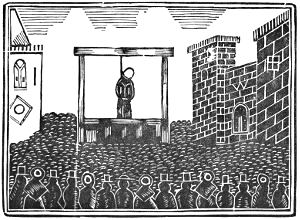
This morning the unfortunate Fenian convict, Michael Barrett, suffered the extreme penalty of the law at the Old Bailey. The prisoner has been attended by the Rev. Mr. Hussey, a Roman Catholic priest, who has remained with him a considerable time every day. He was very taciturn, and although he was no doubt aware of the efforts that were being made to obtain a reprieve, it was a noticeable fact that he never attempted to declare his innocence. Down to recently he used to attend the service in the prison regularly, but after Mr. Hussey had been with him he entirely refrained from doing so. He has not been visited by any one since his conviction. All his relations appear to reside in Ireland, and he does not seem to have had any connexions or friends in this country.
The sheriffs of the prison arrived at an early hour, and immediately proceeded to the condemned cell, where they found the prisoner in devotional exercises with the Rev. Mr. Hussey. He declared himself ready to die, and seemed to consider himself a martyr. The time having arrived, Calcraft, the executioner, was introduced to the prisoner, who immediately commenced pinioning him, which operation having been gone through, the prisoner thanked the governor and other officials of the prison for their kindness towards him. The procession was then formed, and slowly took its way towards the scene of execution. The prisoner ascended the scaffold with a firm step. Everything having been prepared, the cap was drawn over his eyes and the rope adjusted, the bolt was drawn, and he appeared to struggle but slightly before life was extinct.
COPY OF VERSES.
Adieu, vain world, I now must leave you, Here I cannot longer dwell, I have been tried, and I am sentenced To die for the deed in Clerkenwell; Oh! that dreadful sad explosion, Which did so much destruction cause, Brought me to the tree at Newgate, My sufferings sure no one knows. I must leave this world of sorrow, On earth I must no longer dwell, Sentenced to be hanged for murder, For the sad affair in Clerkenwell. Alas! my name is Michael Barrett, Born and brought up in Erin’s isle, I did adore my native country, Wheron I oft did sweetly smile; Oh yes, my own dear native Erin, Behold me on the fatal tree, A miserable malefactor, In a murderer’s grave I soon shall be. A traitor did swear hard against me, A wretch, Mullany known by name, Worse by far than any other, And many persons know the same; Only one amongst the prisoners, And that poor one, alas! was me, Poor unhappy Michael Barrett, Condemned to die upon a tree. I twice have been respited, I did not expect to die, But I must go in grief and woe, On Newgate’s tree so high; That I should gain my liberty, Some thousands did believe, But, oh, alas! all hope is passed. And I have been deceived. Farewell, my friends, I’m doomed to leave you, With you I can no longer stay, Let not my departure grieve you, I die upon the twenty-sixth of May, On the fatal tree at Newgate, For the affair at Clerkenwell, Called a Fenian, Michael Barrett, Friends and kindred, farewell! I see the hangman now before me, Standing on the fatal drop, In the prime of life and vigour, Hard is Michael Barrett’s lot: Only one of all the number, All the rest, alas! but me, Acquitted was, but Michael Barrett Dies on Newgate’s fatal tree. A last adieu, vain world, I leave you, I am going to the silent bourne, Lovely Erin, I grieve for you But I never shall return; Approaching is the Tuesday morning, I am summonsed far away, Erin, remember Michael Barrett, Who died upon the twenty-sixth of May.
EXECUTION OF ALLEN, GOULD, & LARKIN,
At the New Bailey Prison, Manchester, on Saturday, November 23rd, charged with the Wilful Murder of Sergeant Brett, at Manchester, on September 18th, 1867.
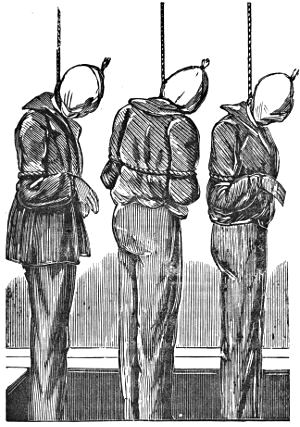
This morning, Saturday, November 23rd, the three unfortunate convicts, Gould, Allen, and Larkin, suffered the extreme penalty of the law at the New Bailey prison, Manchester. Since their condemnation the culprits have behaved in a most exemplary manner, and have paid great attention to the Rev. gentlemen who attended them. They continued to declare their innocence to the last, and appeared to think themselves martyrs to a grand cause, and appeared quite ready for the event. The mob was very great, but not so large as it might have been, but for the precautions taken by the authorities, who had erected barricades about every thirty yards, and so prevented the great pressure that would have been. The prisoners were astir at an early hour, and partook of the holy communion, and at the appointed time. Calcraft, the executioner, was introduced, when the operation of pinioning was gone through. The prisoners the meanwhile showed wonderful confidence, and appeared to be the least concerned. They all shook hands together and affectionately embraced one another, and declared themselves ready. The mournful procession was then formed, and at once proceeded towards the scaffold, where on their appearance there was a slight manifestation of applause. Everything having been prepared, the ropes adjusted, the signal was given, and the unhappy men were launched into eternity. The prisoners appeared to die very easy.
You true friends of liberty, and sons of the Emerald Isle, Attend with an ear of sympathy to what I now relate, And to my sad story, I’d have you to list awhile, Its of those poor unhappy men who now have met their fate; Its Allen, Larkin, and Gould I mean, who of treason have convicted been, Coupled with the crime of murder, for which we all deplore, To the scaffold were condemned we see through struggling for liberty, Of that poor unhappy country, the poor old shamrock shore. Now its well known that Irishmen have oft upon the battle field, Nobly fought our battles, against old England’s foes. And with the hearts of lions have forced her enemies to yield; But to friends they are warm-hearted, as all the world well knows. Its but for their rights they crave, old Ireland’s honour for to save, That has led to this calamity, for which we all deplore, But by treachery they were betrayed, and these poor men have the forfeit paid, And Allen, Gould, and Larkin, alas! are now no more. It was at Manchester, as I now state, they sought their comrades to liberate, And where is the man in such a state, would not have done the same? Those poor men they were taken, for whom many hearts are aching, For there is no one in reason their conduct can well blame. It was in the midst of that strife, that poor Brett he lost his life, That has caused the sons of Ireland most deeply to deplore, And through that sad unhappy day, there’s many a pitying heart will say, Poor Allen, Gould, and Larkin, alas! are now no more. These men they were convicted, and by the judge was sentenced, And for murder and treason they were condemned to die, And left to meet their fate to the gaze of all spectators, Tho’ that their lives would be spared it was the country’s cry. To God I recommend them, in his mercy to defend them, May their souls shine in glory upon that blessed shore, Safe within his keeping where there will be no weeping, Now Allen, Gould, and Larkin, alas! are now no more.
H. Disley, Printer, 57, High Street, St. Giles, London.
The Last Moments and Confession OF WM. SHEWARD.
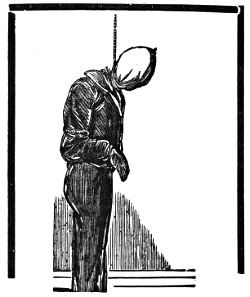
On Tuesday, April 20, the last dread sentence of the law was carried out in the case of Wm. Sheward convicted at the last Norwich Assizes for the murder of his wife. The culprit died without any very painful struggles. He showed a considerable amount ef nerve, although he trembled a good deal at the drop, to which he had to be carried on account of his rheumatism. In the prisoner’s confession he stated that he killed his wife in June, 1851, and that he afterwards mutilated the body. He placed the head in a saucepan, and put it on the fire to keep the stench away. He then broke it up, and distributed it about Thorpe. He then put the hands and feet in the same saucepan, in hopes they might boil away. Carried portions of the body away in a pail and threw them in different parts of the city. The long hair on my return from Thorpe, he cut with a pair of scissors in small pieces and they blew away as he walked. The blankets, where there was any blood he cut in small pieces, and distributed them about the city, and made off with anything that had the appearance of blood about them. The prisoner also stated that he never saw or knew his present wife until June 21, 1852, twelve months after the occurrence.—The confession was taken in the presence of a magistrate, and the governor and chaplain.
I am a sad and wretched man, Borne down in care and woe, I am doomed to die for a murder done Near eighteen years ago; A dreadful deed, as you may read, I long kept in my breast, I’had no comfort day or night, Until I did confess. With the dreadful knife I slew my wife, And her body round did throw, Now I must die for a murder done, Near eighteen years ago. I her body into pieces cut, And scattered it around, Here and there, I scarce knew where, I placed it on the ground. I now must die for that foul deed, And in a murderer’s grave lie low, I did her kill, her blood I spilled, Near eighteen years ago. I boiled her head, how sad to tell, I was mad without a doubt, I threw it in the different parts, I placed it round about; Kept the secret eighteen years, Within my guilty breast, And till the same I did divulge, I day nor night could rest. For eighteen years, in grief and tears, I passed many a dreary night, I had not one moment’s happiness, Since I killed my own dear wife; At length I did confess the deed, For which I now must die, For a murder eighteen years ago— The which I don’t deny. There was letters sent from different parts, To say my wife did live, To save me from the gallows, But none would they believe; I could not from Justice flee, I do deserve my fate, No pen can write, or tongue can tell, My sad and wretched fate. My moments they do swiftly pass, I soon shall sleep below, I done that dreadful awful deed, Near eighteen years ago; I cut and mangled that poor soul, My heart was flinty steel, Her limbs and body strewed about, In hedges, lanes, and fields.
H. Disley, Printer, 57, High street, St. Giles, London.—W.C.
THE EXECUTION OF JOHN DEVINE, In front of Newgate, for the Murder of JOSEPH DUCK, at Marylebone.
THE EXECUTION.
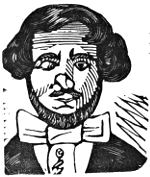
On Monday morning, at Eight o’clock, John Devine suffered the extreme penalty of the law, in front of Newgate. Not so much excitement was created as we have noticed on similar occasions, although a very large concourse of persons had assembled to witness the shocking spectacle. In fact, we might say every available spot was occupied by both male and female, all of whom were anxious to get a “good place,” to see the wretched culprit on the drop. Precisely at the appointed time the sheriffs, with their usual attendants, arrived at the prison, and, after the necessary ceremonies had been observed, of demanding the body of the prisoner to be delivered into their custody, they were conducted to the waiting room. The executioner then commenced pinioning the arms, which operation he quickly dispatched. During the awful preparations the unhappy prisoner appeared to feel his sad position deeply.
At length the arrangements having been completed, the bell of the prison commenced tolling and the chaplain read in a distinct tone the burial service for the dead. When the bell commenced tolling, a movement was heard from without, and the words “Hats off” and “Silence” were distinctly heard, from which time no sound, excepting the sighs of the unhappy prisoner, interrupted the chaplain as the procession moved along the subterranean passage. The prisoner, on arriving at the scaffold, hastily glanced around at the immense concourse of persons assembled. After which he was placed in the proper position for Calcraft to adjust the ropes. The executioner having drawn the cap over his face retired from the scaffold, and the signal having been given the bolt was withdrawn, and the unhappy criminal was launched into eternity.
CONFESSION OF THE CULPRIT.
On Thursday the unhappy criminal was visited by the worthy chaplain, to whom he made a confession, and fully admitted the justice of his sentence.
COPY OF VERSES.
Young Devine was a graceless youth, And bold in every sin, In early years with petty thefts, His life he did begin. But God whose vengeance never sleeps, Though he delays the blow, Can in a single moment lay The prosperous villain low. One night was in the King’s Head, Joseph Duck he did meet, Whom he then robbed of all he had, And cruelly did him beat. Suspicion fell on young Devine, So well they knew his face, Imprisoned, tried, condemned to die, So he now has run his race. Of gambling and theft pray beware, Let me beseech you in time, Lest you like me should be cut off, Whilst you are in your prime. It was these that caused me to run, From virtuous paths astray, Deaf to advice and every good, I sought destruction’s way. The 10th day of March last, I went to the King’s Head, And there I met an aged man, Joseph Duck he was named. I cruelly did him use, And on the ground him cast, He cried for help, but no one came, So now he has breathed his last. Those deeds I mournfully repent, But now it is too late, The day is past, the die is cast, And fixed is my fate. Young men be taught by this dreadful fate, Avoid the paths I have trod, And teach yourselves in early years, To love and fear your God.
LIFE, TRIAL, CONFESSION, AND EXECUTION OF MARTIN BROWN, FOR THE DIABOLICAL MURDER ON NEWMARKET HILL NEAR, LEWES.
The facts of this deliberate and cruel murder must be fresh in the minds of all persons. The deceased was a labourer (in the employ of Mr Hodson, farmer, at Kingston, near Lewes), and lived in a cottage on Newmarket Hill, about a mile and a half from the village. Martin Brown worked for the same employer, and lodged with the deceased and his family, and left about six weeks before the murder, but continued in the same service, lodging with the farm bailiff, named Wickham. The deceased was paid fortnightly, and on the 9th of October he left home for Kingston, to receive the wages of himself and two sons, boys; and he was paid £2 11s. He was also paid 24s. by another son at Kingston, and he had 5s. 3d. in his tobacco-box when he left home, at half-past six o’clock in the evening. He never returned; and early the next morning he was found dead on the hill, about a quarter of a mile from his home. His pockets were then empty. It was discovered that he had been shot through the back—three small bullets were taken from the body—and that he had been severely beaten about the head with some heavy instrument, but after death had taken place. The trigger of a gun and a small piece of gun-stock were found close to the body, and in a copse not far from the spot there was subsequently found a broken gun-stock, to which the pieces found close to the body accurately fitted. This gun-stock belonged to a gun which the prisoner had purchased three weeks before the murder; and which he took out on the night of the murder, stating that he was going to take it to his brother at Brighton, and should not be back till the next day. He returned, however, the same evening, and in less time than it was possible for him to go to Brighton and get back again; and on the following evening,—the murder was freely talked of, and prisoner was even suspected,—he absconded.
He was apprehended by Mr Superintendent Crowhurst, at Maidstone, where he had enlisted under the name of Reuben Harvey.
He was tried at the Sussex Winter Assizes, found guilty, and sentenced to death.
THE EXECUTION.
The execution took place this morning, at eight o’clock, It was the first execution at Lewes since the passing of the recent act of Parliament; which is carried out in private, within the prison walls. Shortly before eight o’clock, the black flag was hoisted, and the prison-bell began to toll. All the arrangements being completed, Calcraft began the process of pinioning the condemned man, who appeared to be quite calm. At eight o’clock, the mournful and melancholy procession began to move towards the gallows; the culprit walked slowly, but firm, and having arrived at the foot of the gallows, he mounted the steps on to the top of the platform, and placed himself on the trap-door, under the fatal beam; Calcraft then put over his head the cap, and placing the rope round his neck, he then shook hands with him, and instantly the bolt was withdrawn, and the unhappy man was launched into eternity. After a few short struggles, life was extinct. After hanging an hour, the body was cut down, and buried within the precincts of the prison.
COPY OF VERSES ON THE CONFESSION OF MARTIN BROWN.
I am a wild and wicked youth, And my name is Martin Brown, I was brought up by honest parents, I once did dwell in Brighton town; And for a horrid and cruel murder, I am condemned, as you may see, It’s for the murder of poor old Baldey, I shall be hanged upon a tree. Poor and honest David Baldey, In a lonely spot his cottage stands, For many years did happy dwell there, Has fallen by a murderous hand: Poor Baldey, he was much respected, In Kingston and for miles around, They little thought on Hodson’s farm, Of such a villain as Martin Brown. ’Twas a fatal day I did waylay, Poor Old Baldey on Newmarket Hill, I with my gun did shoot him through, His harmless blood I did there spill. And then his pockets soon I rifled, And took from him all his gold, I left him dead where he was found, A sight most shocking to behold. My victim then, I from him fled, But the eye of God did on me frown, Oh, what a wretch I must have been, To strike the poor old shepherd down; I for a soldier soon enlisted, When I arrived in Maidstone town, But justice soon did overtake me, In Maidstone barracks I was found. My wicked career now is run, I’m taken, and in irons bound, In a dismal cell in Lewes gaol To wait my trial, young Martin Brown. My guilt I strongly did deny, Until my strength it did give way, My guilty conscience, I must confess I took poor Baldey’s life away. ’Twas at the Assizes I took my trial, For two long days at the bar did stand. The jury they did find me Guilty, For murdering of this poor old man. So sad a crime, and so revolting, The judge did say there could not be, The sentence is, that you be hanged, Young Martin Brown, upon a tree. My parents, when they heard my doom, Their eyes with tears did fall like rain, When death was passed on Martin Brown, It filled their hearts with grief and pain. In my dismal cell I am now lamenting, Strange visions they do appear to me, My troubled mind, both night and day, My victim’s blood I often see. Now to this world I bid adieu, For on the gallows I must die, To meet my God I must prepare, My sentence just I can’t deny; And when my history you do read, It will make your very blood to chill, And for ages will not be forgotten, The Murder on Newmarket Hill.
C. Phillips, cheap and expeditioius Printing Office, Market Street, Brighton.
EXECUTION OF ALEXANDER MACKAY For the Wilful Murder of Mrs. Grossmith.
This morning the unfortunate convict, Alexander Mackay, suffered the extreme penalty of the law at Newgate, for the murder of Mrs. Grossmith, at Norton Folgate.
This is the second execution that has been carried out in private, under the provisions of the recent statute, and it, of course, necessitated the making of a great many alterations with regard to the details. It was at first proposed that the scaffold should be erected in one of the yards adjoining the scaffold, upon the level; but, although the original plan was adhered to, it was decided that the scaffold should not be on a level, and the culprit, as was the case before, had to reach the drop by ascending a ladder.
It is due to the prisoner to state that he seems to have conducted himself very well since his condemnation, and as far as outward appearance can be relied upon, he seems to have felt severe remorse for his crime. He was visited last week by his father, his brother-in-law, and two sisters, and these interviews, as may be readily imagined, were of a most painful character.
The sheriffs of the prison having arrived, immediately proceeded to the condemned cell. The executioner was shortly afterwards introduced to the prisoner, who immediately commenced pinioning him. During this very trying operation, the wretched criminal only once he exclaimed, “May the Lord have mercy on my soul!” Everything having been completed, the prisoner thanked the chaplain and officers of the prison for their kindness towards him. The procession was formed, and slowly took its way towards the scaffold, which the prisoner ascended with a firm step; the rope was then speedily adjusted, the bolt was drawn, and the wretched man after a few struggles ceased to exist.
The bell of St. Sepulchre tolled as the prisoner left his cell; and immediately on the drop falling a black flag was raised, announcing that the last dread sentence of the law had been carried into effect.
COPY OF VERSES.
My dying moments are approaching, Inside of Newgate’s gaol I die, Nothing now, alas! can save me, I see the hangman standing by; A dreadful murder I committed, Upon the fatal eighth of May; At No. 11, Artillery Passage, My own kind mistress I did slay. Barbarously I did her murder, I cruelly her blood did spill, With a rolling pin and bar of iron, I did Mrs. Grossmith kill. Farewell my parents, friends and kindred, Adieu! a last and fond adieu! Your unhappy son, that deed has done, Don’t let it bring disgrace on you; The day I killed my dearest mistress, Sudden, in anger, spleen, and rage, Upon the floor, I shed her gore, I die now eighteen years of age. My master was away on business, My mistress offended me, I seized the rollig pin and iron, Killed Mrs. Grossmith, then did flee, I knew, alas! that I was undone, I knew not where to hide my face, I went away some miles from London, Covered with shame and great disgrace. Justice closely did pursue me, In agony I did bewail, In Woolwich I was apprehended. And sent from thence to Maidstone Gaol; Although I was an unknown murderer, I did not feel the least surprised, When by a photograph description, I in the gaol was recognised. Then, oh dear, sad was my feelings, What pain and anguish filled my breast, I found that Justice overtook me, And I did the deed confess; The dreadful sufferings I endured, I sufficient cannot unto you state, From Maidstone Gaol I was conveyed, To a prison cell in Newgate. I was tried for the dreadful murder, The Jury they convicted me, The Judge he passed the dreadful sentence, Which was to die on the gallows tree; I left the Bar in grief and sorrow, Went to my cell for to deplore, Inside the Gaol I die to-morrow, Where no one ever died before. My dying moments are approaching, The authorities me do surround, The hangman by me is preparing, My limbs by him will soon be bound; No one but those inside a prison, A poor unhappy youth can see, Young and old pray take a warning, And while you live remember me.
Printed by Talyor, Brick Lane, Spitalfields, London.
SHOCKING MURDER OF A WIFE AND SIX CHILDREN.

On Monday morning last, a terrible tragedy took place in Hosier-lane, City, in which a man named Duggin, his wife, and six children were found poisoned. On Saturday evening Duggin returned from his work, and he then looked rather sad, and his wife told a female neighbour that her husband had been dismissed his employment, and they had also received notice to leave their lodgings at 12 o’clock on Monday. On Sunday evening Duggin took his wife and children out for a walk, and on his return went to the Wheatsheaf-tavern, Hosier-lane, and asked the landlord for a quart of ale. He then left, and was not seen again until half-past 4. o’clock on Monday morning, when a man saw him drop a letter in the Hospital pillar letter-box, and then walked towards his home. Two hours afterwards the police received a letter signed James Duggin, stating that he had murdered seven persons, and that he was about to destroy his own life. In it he said the police would be able to obtain further particulars of his brother at Sheffield. Constables were immediately despatched to 15, Hosier-lane, where they found the writer of the letter lying dead upon a bed in a room by himself. In another room they found lying on a bed, a boy aged 4, and a girl aged 3, lying upon the arms of the dead body of the mother. At the foot of the bed was the dead body of a girl aged 12, and on another bed lay the dead body of another child.

Attend you feeling parents dear, While I relate a sad affair; Which has fill’d all around with grief and pain It did occur in Hosier Lane. On Monday, June the 28th, These crimes was done as I now state, How horrible it is to tell, Eight human persons by poison fell. In London city it does appear, Walter James Duggin lived we hear, And seemed to live most happily, With his dear wife and family. They happy lived, until of late, He appear’d in a sad desponding state, At something he seem’d much annoy’d At his master’s, where he is employed. He was discharged, and that we find, It preyed upon his anxious mind, Lest they should want, that fatal day, His wife and children he did slay. Last Sunday evening, as we hear, To the Wheatsheaf he did repair, Then homewards went, as we may read, For to commit this horrid deed. To the police he did a letter send, That he was about this life to end, And that he had poisoned, he did declare His wife, and his six children dear. To Hosier Lane in haste they flew, And found it was alas, too true, They found him stretched upon the bed, His troubles o’er—was cold and dead. They searched the premises around, And they the deadly poison found; And the shocking sight, as you may hear, Caused in many an eye a tear. They found upon another bed, The ill-fated mother, she was dead, While two pretty children we are told, In her outstretched arms she did enfold, It is supposed this wretched pair, First poisoned their six children dear, Then took the fatal draught themselves, Their state of mind no tongue can tell. Of such an heartrending affair, I trust we never more may hear, Such deeds they make the blood run cold, May God forgive their sinful souls. This wholesale poisoning has caused much pain It did take place in Hosier Lane.
H. Disley, Printer, 57, High Street, St. Giles.
EXECUTION F. HINSON, Who suffered the extreme penalty of the law, at the Old Bailey, this morning, Monday, December, 13th, 1869, for the Wilful Murder of Maria Death.
This morning Frederick Hinson suffered the extreme penalty of the law at the Old Bailey, for the murder of Maria Death.
The prisoner previous to his trial behaved in a most sullen manner, scarcely heeding anything that was said to him. It is satisfactory to state that since his condemnation the conduct of the unhappy man underwent a total change for the better, and he began to realize the awful condition in which he was placed, and his callous demeanour was changed into one of deep dejection. The prisoner has been assiduously attended by the chaplain of the prison, and to such a state of religious feeling had he been brought, that he fully acknowledged the justice of his sentence. He has frequently alluded to his great affection for the unfortunate woman, and his regret at having sent her before her maker totally unprepared. Since his condemnation, the prisoner has been visited by his children, and also his father, the final parting from whom was of the most affecting character, and will not be forgotten by those who witnessed it.
The sheriffs arrived at an early hour, and immediately proceeded to the condemned cell, where they found the prisoner earnestly engaged in his religious duties with the chaplain of the prison. The time had now arrived for the prisoner to be pinioned, the operation of which was quickly performed, and the wretched man having thanked the chaplain, the governor, and other officials for their kindness towards him, the procession was then formed, and slowly took its way to the scene of execution. The cap and rope having been adjusted, the bolt was drawn, and the wretched man ceased to exist. Simultaneously with the drop falling, a black flag was hoisted at one corner of the prison, announcing that the last dread sentence of the law had been carried into effect.
Young men and maidens pay attention, You married and you single all, List to my sad lamentation, And pity, pity my downfall; For those double Wood Green murders, I alas am doom’d to die, How can I meet my heavenly father, Or dare to him for mercy cry. So all young men I pray take warning, Your passions curb, ’ere ’tis too late, My dying prayer do not be scorning, Think of Frederick Hinson’s wretched fate. At Wood Green I was respected, With all around in peace did dwell, Now broken-hearted and dejected, I pine within a gloomy cell. With Maria Death I lived contented, ’Till Boyd he caused her for to stray, And by the tales that he invented, He affection stole from me away. When I found she was false-hearted, Jealousy fill’d my mind, ’tis true, I grieved from her for to be parted, For I loved her, and our offspring too; Poor darling orphans, let none upbraid them, When my soul is gone, I know not where, That God above from harm may save them. Shall be my last, my earnest prayer. When at the station on her did gaze there, In company with that treacherous man, One kindly word from her would saved her And stay’d alas my murderous hand; But she braved my anger, and in madness, Recall the dead I never can, I saw her fall, and gazed in sadness, A guilty and heartbroken man. Now for my crimes I was convicted, And the dreadful sentence on me pass’d, Condemn’d by some, by many pity’d, And in a dreary cell was cast; The Judge said on passing sentence, Frederick Hinson you must prepare, Ask God to grant you true repentance, And bend to him in heartfelt prayer. My days are spent in lamentation, My sleepless nights were spent in prayer, My mind was filled with agitation, For Maria’s shade was always there. But I trust her soul is now in heaven, But a little time she’s gone before, This sinful world I must be leaving, And so my sad end will deplore. A last farewell, I must be going, To meet with my offended God, My state of mind there is no knowing, My soul’s bow’d down with deeds of blood. Now once again I pray take warning; For me the fatal bell does toll, My dying prayer do not be scorning, May the Lord have mercy on my soul.
H. Disley, Printer, 57, High-street, St. Giles.
Execution of J. Rutterford, At Bury St. Edmunds, for the MURDER of J. HIGHT.
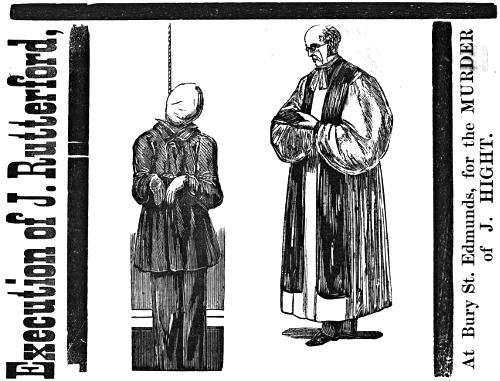
This morning, at the county prison, Bury St. Edmunds, James Rutterford underwent the last dread sentence of the law, for the wilful and deliberate murder of John Hight, a gamekeeper, in the employ of Maharajah Dhuleep Singh, at Eriswell, Suffolk, on the 31st of December last. The prisoner, since his condemnation, has displayed a perfect indifference as to his awful situation, and when spoken to about the murder, always tried to avoid it. He has been constantly attended by the worthy chaplain, and has paid particular attention to what he said, but in a quiet surly mood. The prisoner was visited last week by a government inspector, for the purpose of examining the neck of the prisoner, the gaol surgeon having reported that he had a malformation, which might cause an unusual degree of suffering on death being inflicted by strangulation. The inspector came to the conclusion that there was nothing in the neck of the convict to prevent his being hanged in the usual manner.
The sheriffs arrived at an early hour, and immediately proceeded to the condemned cell, where they found the prisoner earnestly engaged in his religious duties, with the worthy chaplain of the prison. The time had now arrived for the prisoner to be pinioned, the operation of which was quickly performed, and the wretched man thanked the parson, the governor, and other officials for their kindness towards him. The procession was formed, and slowly took its way to the scene of execution. The cap and rope having been adjusted, the bolt was drawn, and the wretched man soon ceased to exist. Simultaneously with the drop falling, a black flag was hoisted at one corner of the prison, announcing that the last dread sentence of the law had been carried into effect.
You Suffolk lads of each degree, And all young men of each degree, And when my mournful tale you hear, For my sad end shed a silent tear. Upon the dreadful scaffold high, A murderer’s death I am doom’d to die. James Rutterford it is my name, I now must end my life in shame; Repentance, alas! it is too late, I must prepare to meet my fate. My parents reared me tenderly, And good advice they gave to me; If to my dear mother I did attend, I should not have met a murderer’s end. On the 31st of December last, Oh would I could recall the past, With Heffer I went in search of game, Which led to that deed I dread to name. When poor John Hight, on that fatal day, To the plantation came that way, I owed him no spite, I tell you true, It was but his duty he did do. I know you Rutter, poor John Hight said, Those words filled my mind with dread, To secure my safety, I did him kill, And his precious blood on the ground did spill. As Heffer says, I then struck him down, And covered him with deadly wounds, I stopp’d his mouth I do declare, For his dying groans I could not bear. And then I dragg’d him in his gore, His mangled body then covered o’er, As my mate said, it was a sickening sight But the eye of God brought my crime to light. Of that deed alone I am to blame, Heffer is innocent, I declare the same, With my dying breath, I do him forgive, And trust he a better life may live. Since I have taken poor Hight’s life, I cannot rest by day or night, His form is ever before my eyes, And for vengeance on his murderer cries. That my sentence it is just, I own, Farewell to friends, farewell to home, How can I meet my offended God, With my soul bow’d down with guilt and blood.

“This man was to have been hung, but they let him off because they thought it would hurt him, good Christians.”—MSS. Note attached to our copy of the above by the intended Printer and Publisher.
THE HEROES OF THE GUILLOTINE AND GALLOWS, OR, THE AWFUL ADVENTURES OF Askern, Smith and Calcraft, the Three Rival Hangmen
Of York Castle, Stafford Gaol and Newgate;
And SANSON, the Executioner of Paris,
With his Cabinet of Murderer’s Curiosities.
FULL OF ASTONISHING DISCLOSURES
Concerning their Private and Public Lives, and Startling Incidents before and after the performance of their dreadful office.
LONDON:—FREDERICK FARRAH, 282, STRAND, W.C. And all Booksellers.
PRICE ONE PENNY.
THE HEROES OF THE GALLOWS AND GUILLOTINE.
“One murder makes a villain, a million a hero.”
The above words of our illustrious bard may well be re-applied to the professional manipulators of the gallows and the guillotine, in England and France. In both countries, said to be the head of European civilization, the executioner seems to be a beloved and venerated object, and regarded as a hero worthy of the support of majesty and power, while smaller and less pretending kingdoms around are, one by one, abolishing his hideous and useless office.
It is a most striking and instructive anomaly, and worthy of the statesman, the philanthropist, the Christian, and all who wish for the moral progress of society, to consider and seriously examine the seeds of evil it is sowing broadcast among the human family. France is a huge nation of contradictions, never to be thoroughly understood, and England is now, in a threefold sense, her sister! Every since their first sanguinary revolution some classes of the French people have fondly hugged the guillotine as a national toy of great worth, and petted three generations of Sansons as their most excellent scientific headsmen; they have also at every execution followed the criminal sitting in a cart, bound and bare-necked, on his coffin, beside his confessor, and gloated with open mouths and staring eyeballs upon the descending blade and the head rolling into the basket of sawdust; and have dipped their handkerchiefs in the bloodsplashes that appeared to fall beyond the bounds of the gibbet. Other classes, of which judges and juries are made, have tried murderers of the most demoniac nature, and to the amazement of the whole woard, by the fiction of “extenuating circumstances” appended to their verdicts, have saved them from capital punishment and consigned them to the galleys; in violation of their own consciences and oaths and the law, which sustains the guillotine as an engine of terror and example!
In our own country within the last few months we have witnessed the passing of a law abolishing public executions, on account of the demoralization that always attended their exhibition in the public highway, and which was complained of for many years by the virtuous and good of every class, who could discern the evils they generated and their inefficiency for either terror or example!
But oh! most singular inconsistency, with the passing of that law, and the substitution of private strangling within the prison-yard, the last tatters of the old worn-out argument in favour of executions as a terror to evil-doers and an example to embryo-offenders, are completely torn away, and yet England at this time nurses three rival hangmen in her official lap for performing her secret hanging business! The three worthies are Askern, of York Castle, Smith, of Stafford-gaol, and Calcraft, of Newgate, in London. Three heroes of the gallows—three professional stranglers—yes, “three servants of the law,” England can now boast of, against France’s single hero of the guillotine to hang up their fellow sinners for a terror and an example! Let us now enquire of the advocates of death punishments how secret executions can terrify or afford an example in the eyes of those they are intended to influence, when they are permitted no longer to witness them?
It needs not a waste of words to prove clearly, that what was before a barbarous and demoralising exhibition, and an inefficient preventative of crime, is now a useless operation and a ghastly tragedy for sickening and torturing all those whom the law compels or the authorities permit to be personal spectators. As the daily and weekly papers published since Calcraft’s and Smith’s joint essays with the first private strangling machine at Maidstone, have proved, murders and other sanguinary offences tending to the same end, do not in the least decrease; but on contrary, the graphic accounts of the first private execution, and the form and action of the new method that were afterwards given in every morning and evening journal, served only to entertain and amuse the lovers of horrors, and were followed by a repetition of capital crimes in several places, as if no such punishment awaited the perpetrators of them. And so will it be after the second trial of the new system, on the boy Mackay, at Newgate, for the Norton Forgate murder, until society to its lowest depths is more moralised and humanised; and a more exacting retribution is enforced against the hardened classes, whom no law of capital punishment will now terrify into submission.
As the Star’s special reporter’s description is worth preserving in its entirety, both for what it says, and for what it does not say. in favour of our argument, at its conclusion, we shall transcribe it into this part of our book:
The first execution within the prison walls, and in presence only of a limited number of spectators, in accordanoe with the new Act of Parliament for the better regulation of capital punishment, took place on Tuesday morning, August 13th, at Maidstone Gaol. The culprit who suffered sentence was Thomas Wells, late a porter in the employ of the London, Chatham, and Dover Railway Company, who was left for death after the last assizes for the murder of Mr. Walsh, the station-master at Dover. In the course of his duties Mr. Walsh had occasion to find fault with Wells, who took reproof in very ill part, and revenged himself on the first available opportunity on the unfortunate station-master by shooting him dead as he sat alone at his work in his office. The alarm was raised, and Wells was found hiding close at hand. The proofs of his crime were so positive that he scarcely attempted to deny it, and on his trial he was at once found guilty and condemned to death. The reports which from time to time have appeared in the public prints since his condemnation have described the young man—he was little more than eighteen years of age—as sincerely penitent, and these reports are borne out by the prison officers, who seemed to have been much impressed by his quiet and decorous conduct.
The curious in such matters will note as an odd coincidence the fact that Maidstone—a town so notorious for its anti-capital punishment feeling, that lawyers will tell you it is most difficult to get a jury to return an adverse verdict against a prisoner on trial for his life—should have been the first place in which the arrangements of the death sentence under the new law should have been carried out. Whether in pursuance of this feeling the inhabitants wilfully ignored the tragedy which was about to be enacted in the immediate outskirts of their town, or whether they were indifferent to it, or whether the exact period of the execution has been hidden from them, it is impossible to say; but it is certain that, amongst the people freely scattered about the broad and handsome streets on Wednesday evening, there was not the slightest indication that anything unusual was to take place among them the following day. A travelling menagerie, which had pitched its tent close by the borders of the canal, was thronged with delighted gazers, among whom the private-soldier element was strongly represented. The local volunteers, headed by their band, were attended in their march by many of the youthful population, and a still larger gathering followed the band of the militia regiment, and grouped round them as they played in front of their headquarters, the Mitre Hotel. But in none of the crowds, composed as they were of townspeople—old and young, male and female—did one hear the best allusion, either in earnestness or ribaldry, to the criminal who was spending his last hours within a few hundred yards of the place where this gaity was beingcarried on, and to whose ears, deafen them how he might, abstract his senses how he would, the clangour of the drums must have been painfully audible. Nor was there any remarkable difference yesterday morning. It had been expected that a large majority of the shops would remain closed until after the execution, which was fixed to take place at half-past ten, but the shutters were taken down at the usual hour, men proceeded to their usual avocations, and there was not the smallest sign—not even that most ordinary sign of men and women conversing in knots and groups—of anything unusual being about to happen, until one reached the immediate neighbourhood of the gaol, and there, on the far side of the broad road running round by the court-house, was a thin fringe of humanity, some fifty persons in all, in one long line, looking towards the great gate of the gaol, and talking among themselves. Emphatically a “bad lot” this, tramps out on hopping excursions, beggars, a female gipsy or two—men and women, too, the lowest scum of the population, and a dozen eager-eyed, wolfish, cunning-looking blackguard boys. They gape and stare, though there is nothing for them to look at as yet; the gaol-gate is closed, and there is no one in the immediate neighbourhood, so they take stock of the flagstaff, on which, in accordance with official injunctions, the “black flag” is to be run up at the moment of the execution, and find matter for comment in the exit from the gaol of certain stonemasons who have been at work inside the prison walls.
At half-past nine exactly a four-wheeled cab drives rapidly up the street, and pulls up at the door of the New Inn, immediately opposite the Court house. The cab door and the inn door open simultaneously; from the former descends a man, who inters the inn, the door of which is again immediately closed upon him, while the cab drives off. In two minutes this man emerges from the inn and makes for the gaol. He is an elderly man, with white hair and white beard, broad and thick-set, and dressed in black, with a peculiar tall hat, and carries a small carpet bag in his hand. This is Calcraft, the hangman. As it were intuitively the little crowd becomes aware of this, a whisper runs round among it that the bag contains his “tackle” of pinioning straps, &c., and the blackguard boys, excited beyond bearing, spring to their feet and start in pursuit. The man, taking no notice and looking doggedly before him, crosses the road, and getting close to the gaol railings, half slinks, half shambles along till he reaches the gate which opens at his approach and closes behind him. Five minutes afterwards another man issues from the inn and makes for the gaol—a tall, thin, wiry man, with a keen eye, with his cheeks and part of his forehead closely shaved, dressed in a velveteen shooting coat, loose trousers, and billycock hat, and looking like an acrobat who had donned his private clothes over his professional costume. The little crowd does not know this man, though he is almost as notorious as the other. He is Smith, of Dudley, the hangman of the Birmingham district, who hanged Palmer, and who occasionally assists Calcraft on great occasions.
At ten o’clock the representatives of the press, who have been provided by the authorities with proper credentials, are admitted into the prison, and are first ushered into the round-house, a building in the debtors’ division, where the turnkeys on duty pass the night. It is fitted with a desk and benches, is glazed on all sides, and overlooks the front court and several of the exercise yards. Several of the warders are here, and from them one learns that the prisoner passed a quiet night, sleeping from half-past ten till half-past four, but that the extraordinary equanimity which he had hitherto displayed is failing him now, and that he is beginning to “break down.” This conversation is carried on in a low whisper; the silence of the place is singularly oppressive; and this, combined with the knowledge of what one is about immediately to witness, renders this period one of the most painful suspense. There are five hundred prisoners within the gaol, but one might as well be in the City of the Dead for all one hears of them, the only sound, the jingling of the warders’ keys, grating on the ear. A little excitement is caused by the hurried entrance of a warder from the direction in which the prisoner is known to be, and his equally hurried disappearance bearing some brandy in a tumbler, but the silence sets in afresh, and one is reduced to watching two little knots in the fore court. One of these consists of the under-sheriff (who is deeply affected), the medical officer, and a nonchalant person in a wideawake hat, who is said to be the governor, but who takes no part in the proceedings, and who is poking up the ground with his walking-stick in a very degagé manner. The other knot is formed of Calcraft, his assistant, and two of the warders who are chatting together. At twenty-five minutes past ten the party—consisting of four reporters of the London journals, six from various local papers, a carpenter who is in attendance lest his service should be required in connection with the arrangements of the drop, and a warder in plain clothes who has been sitting up all night with the prisoner—is summoned from the round-house and ushered into a narrow vaulted ante-room, whence, after five minutes’ delay, they are led through a narrow passage into the presence of the gallows.
There it stands, erected under a shed at the further end of a small yard some thirty feet square, the old square gallows formed of two uprights and one crosebeam, and whose form has been familiar to us from woodcuts and description for years, only in this instance it is painted buff instead of the ordinary dead black. The uprights across have iron supports fixed into the wall, and in the crossbeam there is a hook, immediate under which stands Thomas Wells, with the rope round his neck. There is no built scaffold; the drop on which the prisoner stands is flush with the ground, and the public (if the little representative party can be so called) is placed behind a barrier breast-high, yet so close to the prisoner that they can see every movement of his face, and hear every word he utters. He looks a mere youth, short, yet strongly built. He is dressed in his railway porter’s uniform of velveteen, with the company’s initials in red on the collar, and in his waistcoat, just above his pinioned hand, wears a small flower. He evidently knows little of anything of what is going on around him. He is absorbed in prayer—his face, of a livid hue, is upturned, and his eyes are looking upwards. Standing by him, the chaplain, the Rev. W. C. F. Sugden Frazer, reads, in a voice broken with emotion, the burial service. Suddenly the prisoner begins, in a low, thick, trembling voice, to sing a hymn—one, as we afterwards learn, which he has been recently repeating in his cell—and continues to sing it after Calcraft has pulled the cap over his face, and the chaplain has shaken hands with him—is singing it when, at a signal from his superior, Smith pulls the bolt, and then, with a sickening rattle, the drop falls, Calcraft standing behind, and, as it were, guiding the falling figure. In our belief, life was not wholly extinct for three or four minutes after the falling of the drop. It is usual on these occasions to speak of the movements of the limbs as being “merely muscular,” in this instance there was scarcely any muscular contortion, but there were undoubtedly deep respirations and other undeniable evidence that asphyxia did not immediately happen.
Such is the history of the first private execution in England. Anticipated with just horror by those who were compelled to be present, it was carried out with every decency and all decorum, in a manner calculated to give the least pain to those whose duty it was to witness it. The presence of the representatives of the press at a private execution is a guarantee to the public, whose delegates they are, that the sentence of the law which has been passed upon a certain criminal is duly carried out. But there is no occasion to inflict upon them, as was the case at Newgate, the horror of witnessing the pinioning, the procession, and all the awful details of the scaffold. These, thanks to the visiting justices and to the under-sheriff of Kent, Mr. Furley, of Ashford, were spared at Maidstone, and will, it is to be hoped, be spared in future. Meanwhile, so far as this one instance affords means of judging, IS THE EXECUTION UNDER THE NEW LAW MORE IMPRESSIVE THAN UNDER THE OLD? We answer, decidedly, in the affirmative. The applause or censure of the mob, the desire to “die game” before his friends, had, it is acknowledged, the worst influence on the prisoner, and the solemn stillness of the little yard, with its handful of spectators, must have been IMPRESSIVE in the most awful degree, while a peaceful provincial town is left to its usual avocations, entirely free from the influx of pestilent blackguardism, drunkenness, and obscenity which always attended a public hanging.
For the moral purpose of our theme, there are but three items worth noticing in the above account; they are 1st.—The black flag, hoisted as a terror and example to the “bad lot” of “tramps out on hopping excursion, beggars, a female gipsy or two, men and women, the lowest scum of the population, and a dozen eager-eyed, wolfish, cunning-looking boys!” 2nd.—The officials and representatives of the press who “anticipated with just HORROR” the coming scene at which they “were compelled to be present, and then when it is enacted as the primary National Play for the time being, staring at the prisoner in his “railway porter’s uniform of velveteen,” roped to the fatal beam, with a faded flower “in his waistcoat, just above his pinioned hands,” absorbed in prayer—his face of a livid hue, upturned, and his eyes looking upwards; at the same time singing a hymn “in a low, thick, trembling voice,” “after Calcraft has pulled the cap over his face,” and the Chaplain, who had been reading “in a voice broken with emotion, the burial service,” “has shaken hands with him;” and then listening to the “SICKENING RATTLE” in the criminal’s throat, mixed with the whirring sound of the collapsing machinery, as “Smith pulls the bolt,” and “the drop falls,” while “Calcraft is standing behind, and, as it were, guiding the falling figure” into the newly-dug pit below; and 3rd—the summing-up question and answer of the reporter, after making one of a group at this disgusting performance. “Is the execution under the new law more impressive than under the old?” “We answer decidedly in the affirmative. The applause or censure of the mob, the desire to ‘die game’ before his friends, had, it is acknowledged, the worst influence on the prisoner, and the solemn stillness of the little yard, with its handful of spectators, must have been impressive in the most awful degree.”
Impressive upon whom let us here ask? Not upon the “bad lot” contemplating the black flag! The very class who needed some wholesome impression of fear, and who never realised it at public hangings, were shut out and left to indulge their idle fancies and curious promptings—a kind of pleasure to them! If it were impressive upon the “gentlemen of England,” and the representatives of the press, while looking upon a drama so horrible, we should imagine that it was in a sense different from that for which capital punishments were enacted; unless we were to believe that, notwithstanding their high refinement, they were susceptible of murderous emotions.
Then there remains only what the conclusion of the report seems to point at, that it was impressive upon the dying criminal, thus leaving only one poor miserable pretence for sustaining the existence of the gallows as a moral preventative, and a wholesome example. Of what use to society is the transitory impression of an agonised wretch about to die unobserved by the world? None whatever, and therefore the advocates of death punishments must soon give way to those of our opinion, that the gallows is an effete institution, unfit for its purpose; and that solitary confinement and hard labour for life would not only be a greater and more deterring punishment, but a security against prematurely hurrying into eternity, as in days of old, innocent persons, wrongly convicted through some vile perjury of the wicked, mistaken identity, or imperfectly unravelled circumstances.
Amongst the earliest converts, we expect soon to number the reporter of the above quoted narrative, and most of his literary brethren. For promoting the cause of abolition, we have issued this pamphlet, and although we notice the awful adventures of the heroes of the gallows and guillotine in our progress, we have no wish to pander to the taste of the illiterate and depraved, but to point a moral that shall leave a trace of some good impression behind.
As we have placed Askern foremost in our list of modern living British hangmen, the most unknown and least experienced, we shall first give a short biographical notice of his life and professional career.
Except in the performance of their dreadful office, and the associations it brings them into, before and after every execution, there is nothing in their private antecedents and habits above the common run of men of their class. No extraordinary genius has ever been manifested by either of our gallows-heroes, beyond the horrible calling which fate has marked out for them. But under the irresistable spell of an evil destiny, they are compelled by fate to perform deeds which all other men shudder at, although they know their legal necessity; and in their endeavours to become proficient in their strangling art, so as to earn the praise of their official superiors, and the admiration of the multitude, they stand out from the rest of society with more than ordinary prominence, and in that respect are regarded as the chief of remarkable public characters. From the most reliable information current amongst the old friends and associates of Askern about York and adjacent districts, also from officials of the castle, which is now used as a gaol, a career of abject poverty, want of employment, ill-luck in almost every one of his undertakings, and a too-fast life whenever his chequered destiny placed money, in small sums at a time, within his power, led him into temptation, and from that temptation came the commission of a deed which consigned him a prisoner to York Castle, from the sombre scenes of which he never emerged, except as a convict, whom evil fate had long marked for her own! In charity, we throw a veil over his particular offence, as our object is only to here show cause and effect, and warn the yet pure and innocent from evil courses.
It was while a convicted prisoner and when an execution was pending without any hangman to do the “job,” after an unsuccessful application to Calcraft of London, who was then fully engaged, that an offer of pardon was made to him on condition that he performed the office on the doomed man.
Moved by the love of liberty, which like life is said to be sweet to everyone, and promises of remuneration and perquisites, Askern accepted without much hesitation the office of public executioner, and to qualify himself in his new and ominous business, he diligently employed his time (as all others in the same line have done before him) in tying and knotting several lengths of rope after the hangman’s fashion, and testing their tightening effects upon an effigy suspended to a rope stretched across the private room where he lodged. To acquire speed and precision in the tying of a hangman’s “noose,” also in the “turning off and cutting down” without the least blundering and rousing the execrations of the depraved mobs which generally assemble to view such ghastly sights, many trials he had to make upon the suspended figure to fit him for the work of the scaffold.
At length the fatal morning came for his first practical essay on the neck of a human being over the top of the castle wall, and in the presence of a vast hideous-looking concourse of people, who hissed at the culprit when he appeared; and strange inconsistency, also hooted the man who was employed to execute the bidding of justice on the object of their detestation!
Askern, at a scene so horribie and new to him, trembled, and would have rushed at once from the scaffold the very moment he had stepped upon it, if he had possessed the power and freedom to do so; but alas! for him there was no chance, his apprenticeship to the strangling trade must be fulfilled according to the prescribed conditions previously mentioned.
Therefore, nerveless as he felt, and ready to sink into the death-trap beneath, amongst the machinery of the drop, he had to summon up all the courage and fortitude which draughts of intoxicating liquor then plentifully supplied to him, could instil into his drooping frame.
At one bound he approached the pinioned wretch, roughly seized him, placed him under the cross-beam of the gallows quickly, with blanched features and trembling hands, hurriedly pulled the white cap down over his livid face, placed the rope over his neck, and drew the noose most scientifically as he thought, in the true Calcraft style, and as his preceding lessons had taught him; but, lo, and behold! a turnkey had no sooner hastened down and drawn the bolt that lets fall the flooring on which the murderer stands, and sets him swinging in the air, than the culprit’s awful convulsions and desperate struggles to clutch the rope and free himself from the tortures he was suffering, showed the ghastly fact, that his first attempt did not succeed, and that the yelling multitude around and below, all horror-stricken at the sickening spectacle, were clamoring against the unfortunate servant of the law! Speedily he had to release the quivering half-strangled wretch, and do his work of hanging over again, ere death terminated the writhings of the doomed man, and at the same time quieted the unearthly cries of the heaving and seething crowds of men and women who had come from various distances, near and far, to behold the great National Show!