LIST OF ABBREVIATIONS USED IN THIS DICTIONARY.
Reading edition
aor.aorist.geol.geology.perh.perhaps.
abbrev.abbreviation.geom.geometry.pers.person.
abl.ablative.ger.gerundive.pfx.prefix.
acc.according.gram.grammar.phil., philos.philosophy.
accus.accusative.gun.gunnery.philol.philology.
adj.adjective.her.heraldry.phon.phonetics.
adv.adverb.hist.history.phot.photography.
agri.agriculture.hort.horticulture.phrenol.phrenology.
alg.algebra.hum.humorous.phys.physics.
anat.anatomy.i.e.that is.physiol.physiology.
app.apparently.imit.imitative.pl.plural.
arch.archaic.imper.imperative.poet.poetical.
archit.architecture.impers.impersonal.pol. econ.political economy.
arith.arithmetic.indic.indicative.poss.possessive.
astrol.astrology.infin.infinitive. Pr.Bk.Book of Common
astron.astronomy.inten.intensive.Prayer.
attrib.attributive.interj.interjection.pr.p.present participle.
augm.augmentative.interrog.interrogative.prep.preposition.
B.Bible.jew.jewellery.pres.present.
biol.biology.lit.literally.print.printing.
book-k.book-keeping.mach.machinery.priv.privative.
bot.botany.masc.masculine.prob.probably.
c. (circa)about.math.mathematics.Prof.Professor.
c., cent.century.mech.mechanics. pron.pronoun;
carp.carpentry.med.medicine.pronounced;
cf.compare.metaph.metaphysics.pronunciation.
chem.chemistry.mil.military.prop.properly.
cog.cognate.Milt.Milton.pros.prosody.
coll., colloq.colloquially.min.mineralogy.prov.provincial.
comp.comparative.mod.modern.q.v.which see.
conch.conchology.Mt.Mount.R.C.Roman Catholic.
conj.conjunction.mus.music.recip.reciprocal.
conn.connected.myth.mythology.redup.reduplication.
contr.contracted.n., ns.noun, nouns.refl.reflexive.
cook.cookery.nat. hist.natural history.rel.related; relative.
corr.corruption.naut.nautical.rhet.rhetoric.
crystal.crystallography.neg.negative.sculp.sculpture.
dat.dative.neut.neuter.Shak.Shakespeare.
demons.demonstrative.n.pl.noun plural.sig.signifying.
der.derivation.n.sing.noun singular.sing.singular.
dial.dialect, dialectal.N.T.New Testament.spec.specifically.
Dict.Dictionary.obs.obsolete.Spens.Spenser.
dim.diminutive.opp.opposed.subj.subjunctive.
dub.doubtful.opt.optics.suff.suffix.
eccles.ecclesiastical history.orig.originally.superl.superlative.
e.g.for example.ornith.ornithology.surg.surgery.
elect.electricity.O.S.old style.term.termination.
entom.entomology.O.T.Old Testament.teleg.telegraphy.
esp.especially.p., part.participle.Tenn.Tennyson.
ety.etymology.p.adj.participial adjective.Test.Testament.
fem.feminine.paint.painting.theat.theatre; theatricals.
fig.figuratively.paleog.paleography.theol.theology.
fol.followed; following.paleon.paleontology.trig.trigonometry.
fort.fortification.palm.palmistry.ult.ultimately.
freq.frequentative.pa.p.past participle.v.i.verb intransitive.
fut.future.pass.passive.voc.vocative.
gen.genitive.pa.t.past tense.v.t.verb transitive.
gener.generally.path.pathology.vul.vulgar.
geog.geography.perf.perfect.zool.zoology.
Amer.American.Fris.Frisian.Norw.Norwegian.
Ar.Arabic.Gael.Gaelic.O. Fr.Old French.
A.S.Anglo-Saxon.Ger.German.Pers.Persian.
Austr.Australian.Goth.Gothic.Peruv.Peruvian.
Bav.Bavarian.Gr.Greek.Pol.Polish.
Beng.Bengali.Heb.Hebrew.Port.Portuguese.
Bohem.Bohemian.Hind.Hindustani.Prov.Provençal.
Braz.Brazilian.Hung.Hungarian.Rom.Romance.
Bret.Breton.Ice.Icelandic.Russ.Russian
Carib.Caribbean.Ind.Indian.Sans.Sanskrit.
Celt.Celtic.Ion.Ionic.Scand.Scandinavian.
Chal.Chaldean.Ir.Irish.Scot.Scottish.
Chin.Chinese.It.Italian.Singh.Singhalese.
Corn.Cornish.Jap.Japanese.Slav.Slavonic.
Dan.Danish.Jav.Javanese.Sp.Spanish.
Dut.Dutch.L.Latin.Sw.Swedish.
Egypt.Egyptian.Lith.Lithuanian.Teut.Teutonic.
Eng.English.L. L.Low or Late Latin.Turk.Turkish.
Finn.Finnish.M. E.Middle English.U.S.United States.
Flem.Flemish.Mex.Mexican.W.Welsh.
Fr.French.Norm.Norman.
CHAMBERS'S TWENTIETH CENTURY DICTIONARY.
the fourteenth letter and eleventh consonant of our alphabet, a nasal-dental: (chem.) the symbol for nitrogen: (math.) an indefinite constant whole number, esp. the degree of a quantic or an equation: as a numeral, formerly, N=90, and (N)=90,000.
Na, nä, a Scotch form of no.
Nab, nab, v.t. to seize suddenly:—pr.p. nab′bing; pa.p. nabbed. [Sw. nappa; Dan. nappe, to catch.]
Nab, nab, n. a hill-top: the projecting cavity fixed to the jamb of a door to receive the latch or bolt: (obs.) a hat. [For knab=knap.]
Nabatæan, nab-a-tē′an, adj. of or pertaining to a once powerful Arab people who formerly dwelt on the east and south-east of Palestine, identified by some with the Nebaioth of Isa. lx. 7, the Nabathites of 1 Maccab. v. 25.—Also Nabathē′an.
Nabk, nabk, n. one of the plants in the crown of thorns (Zizyphus Spina-Christi). [Prob. Ar.]
Nabob, nā′bob, n. a deputy or governor under the Mogul Empire: a European who has enriched himself in the East: any man of great wealth. [Corr. of Hind. nawwâb, a deputy, from Ar. nawwāb, pl. (used as sing.) of nāib, a deputy.]
Nacarat, nak′a-rat, n. a light-red colour, scarlet: a fabric of this colour. [Fr.]
Nacket, nak′et, n. (Scot.) a small cake, luncheon.
Nacre, nā′kr, n. mother-of-pearl.—adj. iridescent.—adj. Nā′creous, consisting of nacre: having a pearly lustre. [Fr.,—Ar. nakīr, hollowed.]
Nadir, nā′dir, n. the point of the heavens diametrically opposite to the zenith: the lowest point of anything. [Fr.,—Ar. nazīr, from nazara, to be like.]
Nævus, nē′vus, n. a birth-mark: a congenital growth strictly on a part of the skin, whether a pigmentary nævus or mole, or a vascular naevus or overgrowth of capillary blood-vessels—also Mother-spot or Birth-mark—also Næve, Neve:—pl. Næ′vī.—adjs. Næ′void, Næ′vous, Næ′vose. [L.]
Nag, nag, n. a horse, but particularly a small one—(Scot.) Naig: (Shak.) a jade. [M. E. nagge—Mid. Dut. negge, negghe (mod. Dut. negge); cf. Neigh.]
Nag, nag, v.t. to worry or annoy continually: to tease or vex: to find fault with constantly:—pr.p. nag′ging; pa.p. nagged.—n. Nag′ger. [Cf. Gnaw.]
Naga, nä′ga, n. the name of deified serpents in Hindu mythology.
Nagari. See Deva-nagari.
Naiad, nā′yad, n. a water-nymph or a goddess, presiding over rivers and springs:—pl. Nai′ades. [L. and Gr. naias, naiados, from naein, to flow.]
Naiant, nā′yant, adj. floating: (her.) swimming, as a fish placed horizontally across a shield. [L. nans, nantis, pr.p. of natāre, to swim.]
Naïf, nä-ēf′, Naïve, nä-ēv′, adj. with natural or unaffected simplicity, esp. in thought, manners, or speech: artless: ingenuous.—adv. Naïve′ly.—n. Naïveté (nä-ēv-tā′), natural simplicity and unreservedness of thought, manner, or speech. [Fr. naïf, fem, naïve—L. nativus, native—nasci, natus, to be born.]
Nail, nāl, n. one of the flattened, elastic, horny plates placed as protective coverings on the dorsal surface of the terminal phalanges of the fingers and toes: the claw of a bird or other animal: a thin pointed piece of metal for fastening wood: a measure of length (2¼ inches):—v.t. to fasten with nails: to make certain: to confirm, pin down, hold fast: to catch or secure through promptitude; to trip up or expose.—ns. Nail′-brush, a small brush for cleaning the nails; Nail′er, one whose trade is to make nails; Nail′ery, a place where nails are made.—adj. Nail′-head′ed, having a head like that of a nail: formed like nail-heads, said of ornamental marks on cloth and on certain kinds of mouldings (dog-tooth).—n. Nail′-rod, a strip cut from an iron plate to be made into nails: a trade name for a strong kind of manufactured tobacco.—Nail to the counter, to expose publicly as false, from the habit of nailing a counterfeit coin to a shop counter.—Drive a nail in one's coffin (see Coffin); Hit the nail on the head, to touch the exact point; On the nail, on the spot: immediately: without delay. [A.S. nægel; Ger. nagel.]
Nainsell, nān′sel, n. own self—Highland Scotch.
Nainsook, nān′sōōk, n. a kind of muslin like jaconet, both plain and striped. [Hind.]
Naissant, nās′sant, adj. (her.) rising or coming forth, as an animal newly born or about to be born. [Fr., pr.p. of naître—L. nasci, natus, to be born.]
Naïve. See Naïf.
Naked, nā′ked, adj. without clothes: uncovered: open to view: unconcealed: evident: unarmed: defenceless: unprovided: without addition or ornament: simple: artless: (bot.) without the usual covering.—adv. Nā′kedly.—n. Nā′kedness.—Naked eye, the eye unassisted by glasses of any kind; Naked lady, the meadow-saffron.—Stark naked, entirely naked. [A.S. nacod; Ger. nackt.]
Naker, nā′ker, n. a kettledrum. [O. Fr.,—Ar.]
Nam, nam, n. an obsolete law term for distraint.—n. Namā′tion. [A.S. niman, pa.t. nam, to take.]
Namby-pamby, nam′bi-pam′bi, n. silly talking or writing.—adj. sentimental, affectedly pretty.—v.t. to coddle. [H. Carey's nickname for Ambrose Philips (1671-1749), from his childish odes to children.]
Name, nām, n. that by which a person or a thing is known or called: a designation: that which is said of a person: reputed character: reputation: fame: celebrity: remembrance: a race or family: appearance, not reality: authority: behalf: assumed character of another: (gram.) a noun.—v.t. to give a name to: to designate: to speak of or to call by name: to mention for a post or office: to nominate: to mention formally by name a person in the House of Commons as guilty of disorderly conduct.—adjs. Nam′able, Name′able; Name′less, without a name: undistinguished: indescribable; Name′worthy, distinguished.—adv. Name′lessly.—n. Name′lessness.—adv. Name′ly, by name: that is to say.—ns. Name′-plate, a plate of metal having on it the name of a person, usually affixed to a door or a gate; Nam′er; Name′sake, one bearing the same name as another for his sake.—Name the day, to fix a day, esp. for a marriage.—Call names, to nickname; Christian name (see Christian); In name of, on behalf of: by the authority of; Proper name, a name given to a particular person, place, or thing; Take a name in vain, to use a name lightly or profanely. [A.S. nama; Ger. name; L. nomen.]
Nancy, nan′si, n. an effeminate young man, often a 'Miss Nancy.'—Nancy Pretty, a corruption of none so pretty, the Saxifraga umbrosa.
Nandine, nan′din, n. a small West African paradoxure, with spotted sides.
Nandu, Nandoo, nan′dōō, n. the South American ostrich.
Nanism, nā′nizm, n. dwarfishness.—n. Nanisā′tion, the artificial dwarfing of trees.—adj. Nā′noid. [Fr.,—L.,—Gr. nanos, a dwarf.]
Nankeen, nan-kēn′, n. a buff-coloured cotton cloth first made at Nankin in China: (pl.) clothes, esp. breeches, made of nankeen.—Also Nankin′.
Nanny, nan′i, n. a female goat.—Also Nann′y-goat.
Nap, nap, n. a short sleep.—v.i. to take a short sleep: to feel drowsy and secure:—pr.p. nap′ping; pa.p. napped.—Catch napping, to come upon unprepared. [A.S. hnappian; cf. Ger. nicken, to nod.]
Nap, nap, n. the woolly substance on the surface of cloth: the downy covering of plants.—v.t. to raise a nap on.—ns. Nap′-mē′ter, a machine for testing the wearing strength of cloth; Nap′piness.—adj. Nap′py. [M. E. noppe: the same as knop.]
Nap, nap, n. a game of cards—Napoleon (q.v.).
Nap, nap, v.t. to seize, to take hold of, steal.
Nape, nāp, n. the back upper part of the neck, perhaps so called from the knob or projecting point of the neck behind. [Knap, knob.]
Napery, nā′per-i, n. linen, esp. for the table: table-cloths, napkins, &c. [O. Fr.,—Low L. naparia—napa, a cloth—L. mappa, a napkin.]
Naphtha, naf′tha, or nap′tha, n. a clear, inflammable liquid distilled from petroleum, wood, coal-tar, &c.: rock-oil.—n. Naph′thalene, a grayish-white, inflammable substance obtained by the distillation of coal-tar.—adj. Naphthal′ic, pertaining to, or derived from, naphthalene.—v.t. Naph′thalise.—ns. Naph′thol, Naphthyl′amine. [L.,—Gr.,—Ar. naft.]
Napierian, nā-pē′ri-an, adj. pertaining to John Napier of Merchiston (1550-1617), the inventor of logarithms.—Napier's bones, or rods, an invention of Napier's for performing mechanically the operations of multiplication and division, by means of sets of rods.
Napiform, nāp′i-form, adj. shaped like a turnip: large and round above and slender below.—adj. Napifō′lious, with leaves like the turnip. [L. napus, a turnip.]
Napkin, nap′kin, n. a cloth for wiping the hands: a handkerchief.—n. Nap′kin-ring, a ring in which a table-napkin is rolled. [Dim. of Fr. nappe.]
Napless, nap′les, adj. without nap: threadbare.
Naples-yellow, nā′plz-yel′lō, n. a light-yellow pigment consisting of antimoniate of lead, originally made in Italy by a secret process.
Napoleon, na-pō′lē-on, n. a French gold coin worth 20 francs, or about 15s. 10½d.: a French modification of the game of euchre, each player receiving five cards and playing for himself: a kind of rich iced cake.—adj. Napoleon′ic, relating to Napoleon I. or III., the Great or the Little.—ns. Napō′leonism; Napō′leonist.—Go nap, to declare all five tricks—success rewarded by double payment all round.
Nappy, nap′i, adj. heady, strong: tipsy.—n. strong ale. [Prob. from nap, a sleep.]
Nappy, nap′i, adj. (Scot.) brittle. [Cf. Knap.]
Napron, nap′ron, n. (Spens.) an apron.
Narcissus, nar-sis′us, n. a genus of plants of the Amaryllis family, comprising the daffodils. [L.,—Gr. narkissos—narkē, torpor.]
Narcolepsy, nar′kō-lep-si, n. a nervous disorder marked by frequent short attacks of irresistible drowsiness.
Narcotic, nar-kot′ik, adj. having power to produce torpor, sleep, or deadness.—n. a medicine producing sleep or stupor.—n. Narcō′sis, the stupefying effect of a narcotic.—adv. Narcot′ically.—n. Nar′cotine, one of the organic bases or alkaloids occurring in opium.—v.t. Nar′cotise.—n. Nar′cotism, the influence of narcotics, or the effects produced by their use. [Fr.,—Gr. narkē, torpor.]
Nard, närd, n. an aromatic plant usually called Spikenard: an ointment prepared from it.—adj. Nard′ine. [Fr.,—L. nardus—Gr. nardos—Pers. nard—Sans. nalada, from Sans. nal, to smell.]
Nardoo, när-dōō′, n. an Australian cryptogamic plant whose spore-cases are eaten by the natives.
Nardus, när′dus, n. a genus of grasses, having but one species, Nardus stricta, mat-grass.
Narghile, när′gi-le, n. an Eastern tobacco-pipe, in which the smoke is passed through water.—Also Nar′gile, Nar′gileh, Nar′gili. [Pers.]
Naris, nā′ris, n. a nostril:—pl. Nā′res.—adjs. Nar′ial, Nar′ine.—n. Nar′icorn, the horny nasal sheath of the beak of some birds.—adj. Nar′iform. [L.]
Narrate, na-rāt′, or nar′-, v.t. to tell, to give an account of.—adj. Narr′able, capable of being told.—n. Narrā′tion, act of telling: that which is told: an orderly account of what has happened.—adj. Narr′ative, narrating: giving an account of any occurrence: inclined to narration: story-telling.—n. that which is narrated: a continued account of any occurrence: story.—adv. Narr′atively.—n. Narrā′tor, one who narrates: one who tells or states facts, &c.—adj. Narr′atory, like narrative: consisting of narrative. [Fr.,—L. narrāre, -ātum—gnārus, knowing.]
Narre, när, adj. (Spens.) an older form of near.
Narrow, nar′ō, adj. of little breadth: of small extent from side to side: limited: contracted in mind: bigoted: not liberal: selfish: within a small distance: almost too small: close: accurate: careful.—n. (oftener used in the pl.) a narrow passage, channel, or strait.—v.t. to make narrow: to contract or confine.—v.i. to become narrow: to reduce the number of stitches in knitting.—adj. Narr′ow-gauge, denoting a railroad of less width than 4 ft. 8½ in.—n. Narr′owing, the act of making less in breadth: the state of being contracted: the part of anything which is made narrower.—adv. Narr′owly.—adj. Narr′ow-mind′ed, of a narrow or illiberal mind.—ns. Narr′ow-mind′edness; Narr′owness.—adjs. Narr′ow-pry′ing (Shak.), scrutinising closely, inquisitive; Narr′ow-souled, illiberal.—Narrow cloth, cloth, esp. woollen, of less than 54 inches in width; Narrow work, in mining, the making of passages, air-shafts, &c. [A.S. nearu; not conn. with near, but prob. with nerve, snare.]
Narthex, nar′theks, n. a former genus of umbelliferous plants, now included in Ferula: a portico or lobby in an early Christian or Oriental church or basilica. [L.,—Gr., narthēx.]
Narwhal, när′hwal, Narwal, när′wal, n. the sea-unicorn, a mammal of the whale family with one large projecting tusk. [Dan. narhval—Ice. náhvalr, 'corpse-whale,' from the creature's pallid colour (Ice. nár, corpse).]
Nary, ner′i, a provincial corruption of ne'er a, never a.
Nas, nas, an obsolete corruption of ne has; of ne was.
Nasal, nā′zal, adj. belonging to the nose: affected by, or sounded through, the nose.—n. a letter or sound uttered through the nose: the nose-piece in a helmet.—n. Nasalisā′tion, the act of uttering with a nasal sound.—v.i. Nā′salise, to render nasal, as a sound: to insert a nasal letter into.—n. Nasal′ity.—adv. Nā′sally, by or through the nose.—adjs. Nā′sicorn, having a horn on the nose, as a rhinoceros; Nā′siform, nose-shaped.—n. Nā′sion, the median point of the naso-frontal suture.—adjs. Nasobā′sal, pertaining to the nose and base of the skull; Nasoc′ular, pertaining to the nose and eye, nasorbital; Nasofron′tal, pertaining to the nasal bone and the frontal bone; Nasolā′bial, pertaining to the nose and the upper lip; Nasolac′rymal, pertaining to the nose and to tears, as the duct which carries tears from the eyes to the nose; Nasopal′atine, pertaining to the nose and to the palate or palate-bones. [Fr.,—L. nasus, the nose.]
Nasard, naz′ard, n. a mutation-stop in organ-building.—Also Nas′arde.
Nascent, nas′ent, adj. springing up: arising: beginning to exist or to grow.—n. Nas′cency, the beginning of production: birth or origin. [L. nascens, -entis, pr.p. of nasci, natus, to be born.]
Naseberry, nāz′ber-i, n. an American tropical tree.—Also Nees′berry, Nis′berry. [Sp. níspero—L. mespilus, medlar.]
Nasturtium, nas-tur′shi-um, n. the water-cress. [L., nasus, the nose, torquēre, tortum, to twist.]
Nasty, nas′ti, adj. dirty: filthy: obscene: disagreeable to the taste or smell: difficult to deal with: ill-natured: nauseous.—adv. Nas′tily.—n. Nas′tiness. [Old form nasky, soft; cf. prov. Swed. snaskig, nasty, Low Ger. nask, nasty.]
Nasute, nā-sūt′, adj. having a long snout: keen-scented.
Natal, nā′tal, adj. pertaining to the nates or buttocks.—n.pl. Nā′tes, the buttocks.—adj. Nat′iform. [L. natis, the rump.]
Natal, nā′tal, adj. pertaining to birth: native: presiding over birthdays.—adj. Natali′tial, pertaining to a birthday.—n. Natal′ity, birth-rate. [Fr.,—L. natalis—nasci, natus, to be born.]
Natant, nā′tant, adj. floating on the surface, as leaves of water-plants: (her.) in a horizontal position, as if swimming.—n. Natā′tion, swimming.—n.pl. Natatō′res, the swimming-birds.—adj. Natatō′rial, swimming: adapted to swim.—n. Natatō′rium, a swimming-school.—adj. Nā′tatory, pertaining to swimming: having the habit of swimming. [L. natans, -antis, pr.p. of natāre, inten. of nāre, to swim.]
Natch, nach, n. (prov.) the rump.
Natch, nach, n. a provincial form of notch.
Nathless, nath′les, adj. not the less: nevertheless.—Also Nathe′less. [A.S. ná thý læs, not the less.]
Nathmore, nath′mōr, adv. (Spens.) not or never the more.—Also Nath′moe. [A.S. ná thý mára.]
Nation, nā′shun, n. a body of people born of the same stock: the people inhabiting the same country, or under the same government: a race: a great number: a division of students in a university for voting purposes at Aberdeen and Glasgow. [Fr.,—L. nation-em,—nasci, natus, to be born.]
National, nash′un-al, adj. pertaining to a nation: public: general: attached to one's own country.—n. Nationalisā′tion, the act of nationalising, as of railways, private property, &c.: the state of being nationalised.—v.t. Nat′ionalise, to make national: to make a nation of.—ns. Nat′ionalism; Nat′ionalist, one who strives after national unity or independence, esp. as in Ireland for more or less separation from Great Britain: an advocate of nationalism: National′ity, birth or membership in a particular country: separate existence as a nation: a nation, race of people: national character.—adv. Nat′ionally.—n. Nat′ionalness.—National air, anthem, the popular song by which a people's patriotic feelings are expressed; National Church, the church established by law in a country; National Convention, the sovereign assembly which sat from Sept. 21, 1792, to Oct. 26, 1795, after the abolition of monarchy in France; National debt, money borrowed by the government of a country and not yet paid; National flag, or ensign, the principal flag of a country; National guard, a force which took part in the French Revolution, first formed in 1789.
Native, nā′tiv, adj. arising or appearing by birth: produced by nature: pertaining to the time or place of birth: belonging by birth, hereditary, natural, original: occurring uncombined with other substances, as metals.—n. one born in any place: an original inhabitant: (pl.) oysters raised in artificial beds.—adv. Nā′tively.—ns. Nā′tiveness; Nā′tivism, the belief that the mind possesses some ideas or forms of thought that are inborn, and not derived from sensation: the disposition to favour the natives of a country in preference to immigrants; Nā′tivist.—adj. Nativis′tic.—n. Nativ′ity, state or fact of being born: time, place, and manner of birth: the birth of Christ, hence the festival of His birth, Christmas—also a picture representing His birth: state or place of being produced: a horoscope.—Native rock, stone not yet quarried. [Fr.,—L. nativus—nasci, natus, to be born.]
Natrix, nā′triks, n. a genus of colubrine snakes. [L.,—natāre, to swim.]
Natrolite, nat′ro-līt, n. one of the most common of the group of minerals known as Zeolites.
Natron, nā′trun, n. native carbonate of sodium, or mineral alkali, the nitre of the Bible.—n. Natrom′eter, an instrument for measuring the quantity of soda in salts of potash and soda. [Fr.,—L. nitrum—Gr. nitron.]
Natter, nat′ėr, v.t. and v.i. (prov.) to find fault.—adjs. Natt′ered, Natt′ery, peevish.
Natterjack, nat′ėr-jak, n. a common European toad. [Cf. Adder.]
Nattes, nats, n.pl. surface decoration or diaper resembling plaited or interlaced work. [Fr.]
Natty, nat′i, adj. trim, tidy, neat, spruce.—adv. Natt′ily.—n. Natt′iness. [Allied to neat.]
Natural, nat′ū-ral, adj. pertaining to, produced by, or according to nature: inborn: not far-fetched: not acquired: tender: unaffected: in a state of nature, unregenerate: (math.) having 1 as the base of the system, of a function or number: illegitimate: (mus.) according to the usual diatonic scale.—n. an idiot: (mus.) a character () which removes the effect of a preceding sharp or flat: a white key in keyboard musical instruments.—adj. Nat′ural-born, native.—n.pl. Naturā′lia, the sexual organs.—n. Naturalisā′tion.—v.t. Nat′uralise, to make natural or easy: to adapt to a different climate or to different conditions of life: to grant the privileges of natural-born subjects to.—ns. Nat′uralism, mere state of nature: a close following of nature, without idealisation, in painting, sculpture, fiction, &c.: the belief that natural religion is of itself sufficient; Nat′uralist, one who studies nature, more particularly zoology and botany: a believer in naturalism.—adj. Naturalist′ic, pertaining to, or in accordance with, nature: belonging to the doctrines of naturalism.—adv. Nat′urally.—n. Nat′uralness.—Natural history, originally the description of all that is in nature, now used of the sciences that deal with the earth and its productions—botany, zoology, and mineralogy, esp. zoology; Natural law, the sense of right and wrong which arises from the constitution of the mind of man, as distinguished from the results of revelation or legislation; Natural numbers, the numbers 1, 2, 3, and upwards; Natural order, in botany, an order or division belonging to the natural system of classification, based on a consideration of all the organs of the plant; Natural philosophy, the science of nature, of the physical properties of bodies: physics; Natural scale, a scale of music written without sharps or flats; Natural science, the science of nature, as distinguished from that of mind (mental and moral science), and from pure science (mathematics); Natural selection, a supposed operation of the laws of nature, the result of which is the 'survival of the fittest,' as if brought about by intelligent design; Natural system, a classification of plants and animals according to real differences in structure; Natural theology, or Natural religion, the body of theological truths discoverable by reason without revelation.

Nature, nā′tūr, n. the power which creates and which regulates the material world: the power of growth: the established order of things, the universe: the qualities of anything which make it what it is: constitution: species: conformity to nature, truth, or reality: inborn mind, character, instinct, or disposition: vital power, as of man or animal: course of life: nakedness: a primitive undomesticated condition.—adj. Nā′tured, having a certain temper or disposition: used in compounds, as good-natured.—ns. Nā′ture-dē′ity, a deity personifying some force of physical nature; Nā′ture-myth, a myth symbolising natural phenomena; Nā′ture-print′ing, the process of printing in colours from plates that have been impressed with some object of nature, as a plant, leaf, &c.; Nā′ture-wor′ship, Nā′turism, worship of the powers of nature.—n. Nā′turist.—adj. Naturist′ic.—Debt of nature, death; Ease, or Relieve, nature, to evacuate the bowels. [Fr.,—L. natura—nasci, natus, to be born.]
Naught, nawt, n. no-whit, nothing.—adv. in no degree.—adj. of no value or account: worthless: bad.—Be naught, an obsolete form of malediction; Come to naught, to come to nothing, to fail; Set at naught, to treat as of no account, to despise. [Another form of nought. A.S. náht, náwiht—ná, not, wiht, a whit.]
Naughty, nawt′i, adj. bad in conduct or speech: mischievous: perverse: disagreeable.—adv. Naught′ily.—n. Naught′iness.
Naumachy, naw′ma-ki, n. a sea-fight: a show representing a sea-fight.—Also Naumach′ia. [Gr. naus, a ship, machē, a fight.]
Nauplius, naw′pli-us, n. a stage of development of low Crustaceans, as cirripeds, &c.:—pl. Nau′plii.—adjs. Nau′pliiform, Nau′plioid. [L., a kind of shell-fish—Gr. Nauplios, a son of Poseidon, naus, a ship, plein, to sail.]
Nauropometer, naw-rō-pom′e-tėr, n. an instrument for measuring a ship's heeling or inclination at sea. [Gr. naus, a ship, hropē, inclination, metron, measure.]
Nauscopy, naw′skop-i, n. the art of sighting ships at great distances. [Gr. naus, a ship, skopein, to see.]
Nausea, naw′she-a, n. sea-sickness: any sickness of the stomach, with a tendency to vomit: loathing.—adj. Nau′seant, producing nausea.—n. a substance having this quality.—v.i. Nau′seāte, to feel nausea or disgust.—v.t. to loathe: to strike with disgust.—n. Nauseā′tion.—adjs. Nau′seātive, causing nausea or loathing; Nau′seous, producing nausea: disgusting: loathsome.—adv. Nau′seously.—n. Nau′seousness. [L.,—Gr. nausia, sea-sickness—naus, a ship.]
Nautch, nawch, n. a kind of ballet-dance performed by professional dancers known as Nautch′-girls in India: any form of stage entertainment with dancing. [Hind. nāch, dance.]
Nautical, naw′tik-al, adj. of or pertaining to ships, to sailors, or to navigation: naval: marine.—adv. Nau′tically.—Nautical almanac, an almanac giving information specially useful to sailors; Nautical mile, one-sixtieth of a degree measured at the Equator (=about 2025 yards). [L. nauticus—Gr. nautikos—naus; cog. with L. navis, a ship.]
Nautilus, naw′ti-lus, n. a Cephalopod found in the southern seas, once believed to sail by means of the expanded tentacular arms: a kind of diving-bell sinking or rising by means of condensed air:—pl. Nau′tiluses, or Nau′tili.—adjs. Nau′tiliform, Nau′tiloid.—Paper nautilus, any species of Argonauta. [L.,—Gr. nautilos, a sailor.]
Naval, nā′val, adj. pertaining to ships: consisting of, or possessing, ships: marine: nautical: belonging to the navy.—Naval brigade, a body of seamen so arranged as to be able to serve on land; Naval officer, an officer on board a man-of-war: a custom-house officer of high rank in the United States; Naval tactics, the science and methods of managing and moving squadrons of ships. [Fr.,—L. navalis—navis, a ship.]
Nave, nāv, n. the middle or main body of a church, distinct from the aisles or wings.—n. Nā′varch, a Greek admiral. [Fr. nef—L. navis, a ship.]
Nave, nāv, n. the hub or piece of wood, &c., in the centre of a wheel, through which the axle passes.—v.t. to form as a nave. [A.S. nafu, nave; cf. Dut. naaf, Ger. nabe.]
Navel, nāv′l, n. the mark or depression in the centre of the lower part of the abdomen, at first a small projection.—n. Nāv′el-string, the umbilical cord. [A.S. nafela, dim. of nafu, nave.]
Navew, nā′vū, n. the wild turnip.
Navicular, nav-ik′ū-lar, adj. pertaining to small ships or boats: (bot.) boat-shaped: scaphoid.—n. a bone in man and animals, so called from its shape.—n. Navic′ula, an incense-boat.—Navicular disease, an inflammation, often rheumatic, of the small bone—the navicular—in horses, below which passes the strong flexor tendon of the foot. [L. navicularis—navicula, dim. of navis, a ship.]
Navigate, nav′i-gāt, v.t. to steer or manage a ship in sailing: to sail upon.—v.i. to go in a vessel or ship: to sail.—ns. Navigabil′ity, Nav′igableness.—adj. Nav′igable, that may be passed by ships or vessels.—adv. Nav′igably.—ns. Navigā′tion, the act, science, or art of sailing ships: shipping generally: a canal or artificial waterway; Nav′igator, one who navigates or sails: one who directs the course of a ship.—Navigation laws, the laws passed from time to time to regulate the management and privileges of ships, and the conditions under which they may sail or carry on trade.—Aerial navigation, the management of balloons in motion; Inland navigation, the passing of boats, &c., along rivers and canals. [L. navigāre, -ātum—navis, a ship, agĕre, to drive.]
Navvy, nav′i, n. a labourer—originally a labourer on a navigation or canal: a machine for digging out earth, &c.—called also French navvy:—pl. Navv′ies. [A contr. of navigator.]
Navy, nā′vi, n. a fleet of ships: the whole of the ships-of-war of a nation: the officers and men belonging to the warships of a nation.—ns. Nā′vy-list, a list of the officers and ships of a navy, published from time to time; Nā′vy-yard, a government dockyard. [O. Fr. navie—L. navis, a ship.]
Nawab, na-wab′, n. a nabob.
Nay, nā, adv. no: not only so, but: yet more: in point of fact.—n. a denial: a vote against.—n. Nay′ward (Shak.), tendency to denial: the negative side. [M. E. nay, nai—Ice. nei, Dan. nei; cog. with no.]
Nayword, nā′wurd, n. (Shak.) a proverbial reproach, a byword, a watchword.
Nazarene, naz′ar-ēn, n. an inhabitant of Nazareth, in Galilee: a follower of Jesus of Nazareth, originally used of Christians in contempt: one belonging to the early Christian sect of the Nazarenes, which existed from the 1st to the 4th cent. A.D.—Also Nazarē′an. [From Nazareth, the town.]
Nazarite, naz′ar-īt, n. a Jew who vowed to abstain from strong drink, &c.—also Naz′irite.—n. Naz′aritism, the vow and practice of a Nazarite. [Heb. nāzar, to consecrate.]
Naze, nāz, n. a headland or cape. [Scand., as in Dan. næs; a doublet of ness.]
Nazir, na-zēr′, n. a native official in an Anglo-Indian court who serves summonses, &c. [Ar.]
Ne, ne, adv. not: never. [A.S. ne; cf. Nay.]
Neaf, nēf, n. the fist—(Scot.) Neive. [M. E. nefe—Ice. hnefi, nefi; cf. Sw. näfve, the fist.]
Neal, nēl, v.t. to temper by heat.—v.i. to be tempered by heat. [Cf. Anneal.]
Nealogy, nē-al′o-ji, n. the description of the morphological correlations of the early adolescent stages of an animal.—adj. Nealog′ic. [Gr. neos, young, logia—legein, to speak.]
Neanderthaloid, nē-an′dėr-tal-oid, adj. like the low type of skull found in 1857 in a cave in the Neanderthal, a valley between Düsseldorf and Elberfeld.
Neap, nēp, adj. low, applied to the lowest tides.—n. a neap-tide: the lowest point of the tide.—adj. Neaped, left aground from one high tide to another. [A.S. nép, orig. hnép; Dan. knap, Ice. neppr, scanty.]
Neapolitan, nē-a-pol′i-tan, adj. pertaining to the city of Naples or its inhabitants.—n. a native or inhabitant of Naples.—Neapolitan ice, a combination of two different ices. [L. Neapolitanus—Gr. Neapolis, Naples—neos, new, polis, city.]
Near, nēr, adj. nigh: not far away in place or time: close in kin or friendship: dear: following or imitating anything closely: close, narrow, so as barely to escape: short, as a road: greedy, stingy: on the left in riding or driving.—adv. at a little distance: almost: closely,—prep. close to.—v.t. and v.i. to approach: to come nearer.—adjs. Near′-by, adjacent; Near′-hand (Scot.), near—also adv. nearly.—adv. Near′ly, at no great distance: closely: intimately: pressingly: almost: stingily.—n. Near′ness, the state of being near: closeness: intimacy: close alliance: stinginess.—adj. Near′-sight′ed, seeing distinctly only when near, myopic, short-sighted.—n. Near′-sight′edness.—Near point, the nearest point the eye can focus. [A.S. neár, comp. of neáh, nigh; Ice. nær; Ger. näher.]
Nearctic, nē-ark′tik, adj. of or pertaining to the northern part of the New World—embracing temperate and arctic North America.
Neat, nēt, adj. belonging to the bovine genus.—n. black-cattle: an ox or cow.—ns. Neat′-herd, one who herds, or has the care of, neat or cattle; Neat′-house, a building for the shelter of neat-cattle.—Neat's-foot oil, an oil obtained from the feet of oxen; Neat's leather, leather made of the hides of neat-cattle. [A.S. neát, cattle, a beast—neótan, niótan, to use; cf. Scot. nowt, black-cattle.]
Neat, nēt, adj. trim: tidy: clean: well-shaped: without mixture or adulteration: finished, adroit, clever, skilful.—adj. Neat′-hand′ed, dexterous.—adv. Neat′ly.—n. Neat′ness. [Fr. net—L. nitidus, shining—nìtēre, to shine.]
Neb, neb, n. the beak of a bird: the nose: the sharp point of anything.—adj. Nebb′y (Scot.), saucy. [A.S. nebb, the face; cog. with Dut. neb, beak.]
Nebbuk, neb′uk, n. a shrub, Zizyphus Spina-Christi, one of the thorns of Christ's crown.
Nebel, neb′el, n. a Hebrew stringed instrument.
Neb-neb, neb′-neb, n. the dried pods of a species of acacia found in Africa, which are much used in Egypt for tanning—called also Bablah.
Nebris, neb′ris, n. a fawn-skin worn in imitation of Bacchus by his priests and votaries.
Nebula, neb′ū-la, n. a little cloud: a faint, misty appearance in the heavens produced either by a group of stars too distant to be seen singly, or by diffused gaseous matter:—pl. Neb′ulæ.—adjs. Neb′ular, pertaining to nebulæ: like nebulæ; Nebulé (neb-ū-lā′), curved in and out (her.); Neb′ulose, Neb′ulous, misty, hazy, vague: relating to, or having the appearance of, a nebula.—ns. Nebulos′ity, Neb′ulousness.—Nebular hypothesis, the theory of Laplace and Sir W. Herschel that nebulæ form the earliest stage in the formation of stars and planets. [L.; Gr. nephelē, cloud, mist.]
Necessary, nes′es-sar-i, adj. that must be: that cannot be otherwise: unavoidable: indispensable: under compulsion: not free.—n. that which cannot be left out or done without (food, &c.)—used chiefly in pl.: a privy.—ns. Necessā′rian, one who holds the doctrine of necessity; Necessā′rianism, the doctrine that the will is not free, but subject to causes without, which determine its action.—adv. Nec′essarily.—n. Nec′essariness, the state or quality of being necessary.—Necessary truths, such as cannot but be true. [Fr.,—L. necessarius.]
Necessity, ne-ses′i-ti, n. state or quality of being necessary: that which is necessary or unavoidable: compulsion: great need: poverty.—ns. Necessitā′rian; Necessitā′rianism, necessarianism.—v.t. Necess′itāte, to make necessary: to render unavoidable: to compel.—n. Necessitā′tion.—adjs. Necess′itied (Shak.), in a state of want; Necess′itous, in necessity: very poor: destitute.—adv. Necess′itously.—n. Necess′itousness.—Natural necessity, the condition of being necessary according to the laws of nature; Logical or Mathematical, according to those of human intelligence; Moral, according to those of moral law; Works of necessity, work so necessary as to be allowable on the Sabbath. [L. necessitas.]
Neck, nek, n. the part of an animal's body between the head and trunk: anything that resembles the neck: a long narrow part or corner: (fig.) life: the flesh of the neck and adjoining parts.—v.t. to break the neck or cut off the head.—ns. Neck′atee, a neckerchief; Neck′-band, the part of a shirt encircling the neck; Neck′-bear′ing, that part of a shaft which rotates in the bearing proper, a journal; Neck′beef, the coarse flesh of the neck of cattle; Neck′cloth, a piece of folded cloth worn round the neck by men as a band or cravat, the ends hanging down often of lace.—adj. Necked, having a neck of a certain kind.—ns. Neck′erchief, a kerchief for the neck; Neck′lace, a lace or string of beads or precious stones worn on the neck by women; Neck′let, a simple form of necklace; Neck′-mould, a small moulding surrounding a column at the junction of the shaft and capital; Neck′-piece, the part of a suit of armour that protects the neck: an ornamental frill round the neck of a gown; Neck′tie, a tie or cloth for the neck; Neck′verse, the verse (usually Ps. li. 1) in early times placed before a prisoner claiming benefit-of-clergy, in order to test his ability to read, which, if he could do, he was burned in the hand and set free (see Benefit).—n. Stiff′neck (see Stiff).—Neck and crop, completely; Neck and neck, exactly equal: side by side; Neck or nothing, risking everything.—Harden the neck, to grow more obstinate; Tread on the neck of, to oppress or tyrannise over. [A.S. hnecca; Ger. nacken.]
Necrolatry, nek-rol′a-tri, n. worship of the dead.—ns. Necrobiō′sis, degeneration of living tissue; Necrog′rapher, one who writes an obituary notice.—adjs. Necrolog′ic, -al, pertaining to necrology.—ns. Necrol′ogist, one who gives an account of deaths; Necrol′ogy, an account of those who have died, esp. of the members of some society: a register of deaths; Nec′romancer, one who practises necromancy: a sorcerer; Nec′romancy, the art of revealing future events by calling up and questioning the spirits of the dead: enchantment.—adjs. Necroman′tic, -al, pertaining to necromancy: performed by necromancy.—adv. Necroman′tically.—adj. Necroph′agous, feeding on carrion.—ns. Necroph′ilism, a morbid love for the dead; Necrophō′bia, a morbid horror of corpses.—adj. Necroph′orous, carrying away and burying dead bodies, esp. of beetles of the genus Necrophorus.—n. Necrop′olis, a cemetery.—adjs. Necroscop′ic, -al.—n. Nec′roscopy, a post-mortem examination, autopsy—also Nec′ropsy.—adjs. Necrosed′, Necrō′tic.—ns. Necrō′sis, the mortification of bone: (bot.) a disease of plants marked by small black spots; Necrot′omist; Necrot′omy, dissection of dead bodies. [Gr. nekros, dead.]
Nectar, nek′tar, n. the name given by Homer, Hesiod, Pindar, &c. to the beverage of the gods, giving life and beauty: a delicious beverage: the honey of the glands of plants.—adjs. Nectā′real, Nectā′rean, pertaining to, or resembling, nectar: delicious; Nec′tared, imbued with nectar: mingled or abounding with nectar; Nectā′reous, Nec′tarous, pertaining to, containing, or resembling nectar: delicious.—adv. Nectā′reously, in a nectareous manner.—n. Nectā′reousness, the quality of being nectareous.—adjs. Nectā′rial; Nectarif′erous, producing nectar or honey: having a nectary; Nec′tarine, sweet as nectar.—n. a variety of peach with a smooth fruit.—n. Nec′tary, the part of a flower which secretes the nectar or honey. [L.,—Gr. nektar; ety. dub.]
Nectocalyx, nek′to-kā-liks, n. the swimming-bell of a medusa:—pl. Nectocā′lyces.
Neddy, ned′i, n. a donkey. [From Ned=Edward.]
Née, nā, adj. born: placed before a married woman's maiden-name, to show her own family, as Rebecca Crawley, née Sharp. [Fr., fem. of né, pa.p. of naître, to be born—L. nasci, natus, to be born.]
Need, nēd, n. want of something which one cannot do without: necessity: a state that requires relief: want of the means of living.—v.t. to have occasion for: to want.—ns. Need′-be, a necessity; Need′er; Need′fire, fire produced by friction, to which a certain virtue is superstitiously attached: a beacon generally.—adj. Need′ful, full of need: having need: needy: necessary: requisite.—adv. Need′fully.—n. Need′fulness.—adv. Need′ily.—n. Need′iness.—adj. Need′less (Shak.), having no need: not needed: unnecessary.—adv. Need′lessly.—n. Need′lessness.—adv. Need′ly (Shak.), necessarily.—n. Need′ment, something needed.—adv. Needs, of necessity: indispensably—often used with must, as 'needs must.'—adj. Need′y, very poor: requisite.—n. Need′yhood.—The needful (slang), ready money. [A.S. néd, niéd, nýd; Dut. nood, Ger. noth.]
Needle, nēd′l, n. a small, sharp-pointed steel instrument, with an eye for a thread—(Shak.) Neeld, Neele: any slender, pointed instrument like a needle, as the magnet or movable bar of a compass, or for knitting, etching, &c.: anything sharp and pointed, like a pinnacle of rock, &c.: an aciform crystal: a temporary support used by builders to sustain while repairing, being a strong beam resting on props: the long, narrow, needle-like leaf of a pine-tree.—v.t. to form into a shape like a needle, as crystals: to work with a needle.—v.i. to become of the shape of needles, as crystals.—ns. Need′le-book, a number of pieces of cloth, leather, &c. arranged like a book, for holding needles; Need′le-case, a case for holding needles; Need′le-fish, a pipe-fish: a garfish or belonid; Need′leful, as much thread as fills a needle; Need′le-gun, a gun or rifle loaded at the breech, the cartridge of which is exploded by the impact of a needle or spike at its base.—adjs. Need′le-point′ed, pointed like a needle: without a barb, as a fish-hook; Need′le-shaped, shaped like a needle: applied to the long, slender, sharp-pointed leaves of pines, firs, and other trees.—ns. Need′le-tel′egraph, a telegraph the receiver of which gives its messages by the deflections of a magnetic needle; Need′lewoman, a woman who makes her living by her needle, a seamstress; Need′lework, work done with a needle: the business of a seamstress.—adj. Need′ly, thorny. [A.S. nǽdl; Ger. nadel; cog. with Ger. nähen, to sew, L. nēre, to spin.]
Neep, a Scotch form of turnip.
Ne'er, nār, adv. contr. of never.—adj. and n. Ne'er′-do-well, past all well-doing: one who is good for nothing.
Neese, nēz, v.i. an old form of sneeze.—n. Nees′ing, sneezing.
Nef, nef, n. a cadenas.
Nefandous, nē-fan′dus, adj. bad to execration, abominable. [L.,—ne, not, fandus, fāri, to speak.]
Nefarious, nē-fā′ri-us, adj. impious: extremely wicked: villainous.—adv. Nefā′riously.—n. Nefā′riousness.—adj. Nēfast′, abominable. [L. nefarius, contrary to divine law—ne, not, fas, divine law, prob. from fāri, to speak.]
Negation, ne-gā′shun, n. act of saying no: denial: (logic) the absence of certain qualities in anything. [Fr.,—L. negation-em-—negāre, -ātum, to say no—nec, not, aio, I say yes.]
Negative, neg′a-tiv, adj. that denies or refuses—opp. to Affirmative: implying absence: that stops, hinders, neutralises—opp. to Positive: in photography, exhibiting the reverse, as dark for light, light for dark: (logic) denying the connection between a subject and a predicate: (algebra) noting a quantity to be subtracted.—n. a word or statement by which something is denied: the right or act of saying 'no,' or of refusing assent: the side of a question or the decision which denies what is affirmed: in photography, an image on glass or other medium, in which the lights and shades are the opposite of those in nature, used for printing positive impressions from on paper, &c.: (gram.) a word that denies.—v.t. to prove the contrary: to reject by vote.—adv. Neg′atively.—ns. Neg′ativeness, Neg′ativism, Negativ′ity.—adj. Neg′atory, expressing denial.—Negative bath, a silver solution in which photographic negatives are placed to be sensitised; Negative electricity, electricity with a relatively low potential, electricity such as is developed by rubbing resinous bodies with flannel, opposite to that obtained by rubbing glass; Negative quantity (math.), a quantity with a minus sign ( - ) before it, indicating that it is either to be subtracted, or reckoned in an opposite direction from some other with a plus sign; Negative sign, the sign ( - or minus) of subtraction. [L. negativus—negāre, to deny.]
Negātur, v. it is denied. [L., 3d pers. sing. pres. ind. pass. of negāre, to deny.]
Neglect, neg-lekt′, v.t. to treat carelessly, pass by without notice: to omit by carelessness.—n. disregard: slight: omission.—adj. Neglect′able, that may be neglected.—ns. Neglect′edness; Neglect′er.—adj. Neglect′ful, careless: accustomed to omit or neglect things: slighting.—adv. Neglect′fully.—n. Neglect′fulness.—adj. Neglect′ible.—adv. Neglect′ingly, carelessly: heedlessly. [L. negligĕre, neglectum—nec, not, legĕre, to gather.]
Negligée, neg-li-zhā′, n. easy undress: a plain, loose gown: a necklace, usually of red coral.—adj. carelessly or unceremoniously dressed: careless. [Fr., fem. of négligé—négliger, to neglect.]
Negligence, neg′li-jens, n. fact or quality of being negligent: want of proper care: habitual neglect: a single act of carelessness or neglect, a slight: carelessness about dress, manner, &c.: omission of duty, esp. such care for the interests of others as the law may require—(Shak.) Neglec′tion.—adj. Neg′ligent, neglecting: careless: inattentive: disregarding ceremony or fashion.—adv. Neg′ligently.—adj. Neg′ligible.—adv. Neg′ligibly. [Fr.,—L. negligentia—negligens, -entis, pr.p. of negligĕre, to neglect.]
Negotiable, ne-gō′shi-a-bl, adj. that may be transacted: that can be transferred to another with the same rights as belonged to the original holder, as a bill of exchange.—n. Negotiabil′ity.
Negotiate, ne-gō′shi-āt, v.i. to carry on business: to bargain: to hold intercourse for the purpose of mutual arrangement.—v.t. to arrange for by agreement: to manage: to transfer to another with all the rights of the original holder: to pass, as a bill: to sell.—ns. Negotiā′tion, act of negotiating: the treating with another on business; Negō′tiator; Negō′tiatrix.—adj. Negotiā′tory, of or pertaining to negotiation. [L. negotiāri, -ātus—negotium, business—nec, not, otium, leisure.]
Negrito, ne-grē′to, n. the Spanish name for certain tribes of negro-like diminutive people in the interior of some of the Philippine Islands—also Aëtas or Itas: in a wider sense, the Papuans and all the Melanesian peoples of Polynesia.
Negro, nē′grō, n. one of the black-skinned woolly-haired race in the Soudan and central parts of Africa, also their descendants in America.—adj. of or pertaining to the race of black men:—fem. Nē′gress.—ns. Nē′gro-corn, the name given in the West Indies to the plant durra or Indian millet; Nē′grohead, tobacco soaked in molasses and pressed into cakes, so called from its blackness.—adj. Nē′groid.—n. Nē′grōism, any peculiarity of speech noticeable among negroes, esp. in the southern United States. [Sp. negro—L. niger, black.]
Negus, nē′gus, n. a beverage of either port or sherry with hot water, sweetened and spiced. [Said to be so called from Colonel Negus, its first maker, in the reign of Queen Anne.]
Negus, nē′gus, n. the title of the kings of Abyssinia.
Neif, nēf, n. (Shak.) the fist.
Neigh, nā, v.i. to utter the cry of a horse:—pr.p. neigh′ing; pa.t. and pa.p. neighed (nād).—n. the cry of a horse—(Scot.) Nich′er. [A.S. hnǽgan; Ice. hneggja.]
Neighbour, nä′bur, n. a person who dwells, sits, or stands near another: one who is on friendly terms with another.—adj. (B.) neighbouring.—v.i. to live near each other.—v.t. to be near to.—n. Neigh′bourhood, state of being neighbours, kindly feeling: adjoining district or the people living in it: a district generally, esp. with reference to its inhabitants.—adj. Neigh′bouring, being near: adjoining.—n. Neigh′bourliness.—adjs. Neigh′bourly, like or becoming a neighbour: friendly: social—also adv.; Neigh′bour-stained (Shak.), stained with neighbours' blood. [A.S. neáhbúr, neáhgebúr—A.S. neáh, near, gebúr or búr, a farmer.]
Neist, nēst, a dialectic form of next.
Neither, nē′thėr, or nī′thėr, adj. and pron. not either.—conj. not either: and not: nor yet.—adv. not at all: in no case. [A.S. náther, náwther, abbrev. of náhwæther—ne, not, áhwæther, áwther, either.]
Neivie-nick-nack, nē′vi-nik′-nak, n. a Scotch children's game of guessing in which hand a thing is held while the holder repeats a rhyme beginning with these words.
Nelumbo, nē-lum′bō, n. a genus of water-lilies including the Egyptian Bean of Pythagoras, and the Hindu Lotus.—Also Nelum′bium. [Ceylon name.]
Nemalite, nem′a-līt, n. a fibrous hydrate of magnesia. [Gr. nēma, a thread, lithos, a stone.]
Nemathecium, nem-a-thē′si-um, n. a wart-like elevation on the surface of the thallus of certain florideous algæ. [Gr. nēma, a thread, thēkion, thēkē, case.]
Nemathelminthes, nem-a-thel-min′thez, n.pl. a name applied to the thread-worms or nematodes (as Ascaris, Guinea-worm, Trichina), to the somewhat distinct Gordiidæ or hair-eels, and to the more remotely allied Acanthocephala or Echinorhynchus.—Also Nemathelmin′tha.—adjs. Nemathel′minth, -ic. [Gr. nēma, a thread, helmins, -minthos, worm.]
Nematocerous, nem-a-tos′e-rus, adj. having long thready antennæ, as a dipterous insect. [Gr. nēma, a thread, keras, a horn.]
Nematocyst, nem′a-tō-sist, n. a cnida, one of the offensive organs of Cœlenterates, as jellyfish. [Gr. nēma, a thread, kystis, a bladder.]
Nematoid, nem′a-toid, adj. thread-like—also Nem′atode.—n.pl. Nematoi′dea, a class of Vermes, with mouth, alimentary canal, and separate sexes, usually parasitic. [Gr. nēma, thread, eidos, form.]
Nemean, nē′mē-an, adj. pertaining to Nemea, a valley of Argolis in the Peloponnesus, famous for its public games held in the second and fourth of each Olympiad.
Nemertea, nē-mer′tē-a, n.pl. a class of Vermes, mostly marine, unsegmented, covered with cilia, often brightly coloured, with protrusile proboscis, and usually distinct sexes.—adj. Nemer′tean. [Gr. Nēmertēs, a nereid's name.]
Nemesis, nem′e-sis, n. (myth.) the goddess of vengeance: retributive justice.—adj. Nemes′ic. [Gr.,—nemein, to distribute.]
Nemo, nē′mo, n. nobody: a nobody. [L.]
Nemocerous, nē-mos′e-rus, adj. having filamentous antennæ.
Nemoral, nem′o-ral, adj. pertaining to a wood or grove.—n. Nemoph′ilist.—adjs. Nemoph′ilous, fond of woods, inhabiting woods; Nem′orose, growing in woodland; Nem′orous, woody. [L. nemus, -ŏris, a grove.]
Nempt, nemt (Spens.), named, called.
Nenuphar, nen′ū-far, n. the great white water-lily. [Fr.,—Ar.]
Neo-Catholic, nē-ō-kath′o-lik, adj. pertaining to the short-lived school of liberal Catholicism that followed Lamennais, Lacordaire, and Montalembert about 1830: pertaining to a small party within the Anglican Church, who think they have outgrown Keble and Pusey and the great Caroline divines, and are more noisy than intelligent in their avowal of preference for Roman doctrine, ritual, and discipline.
Neo-Christian, nē-ō-kris′tyan, adj. and n. of or pertaining to so-called Neo-Christianity, which merely means old Rationalism.
Neocomian, nē-ō-kō′mi-an, adj. and n. (geol.) of or pertaining to the lower division of the Cretaceous system, including the Lower Greensand and the Wealden of English geologists. [Græcised from Neuchâtel, near which is its typical region; Gr. neos, new, kōmē, a village.]
Neocosmic, nē-ō-koz′mik, adj. pertaining to the present condition of the universe, esp. its races of men. [Gr. neos, new, kosmos, the universe.]
Neocracy, nē-ok′ra-si, n. government by upstarts.
Neogamist, nē-og′a-mist, n. a person recently married.
Neogrammarian, nē-ō-gra-mā′ri-an, n. one of the more recent school in the study of Indo-European grammar and philology, who attach vast importance to phonetic change, and the laws governing it.—adj. Neogrammat′ical.
Neohellenism, nē-ō-hel′en-izm, n. the modern Hellenism inspired by the ancient: the devotion to ancient Greek ideals in literature and art, esp. in the Italian Renaissance.
Neo-Kantian, nē-ō-kan′ti-an, adj. pertaining to the philosophy of Kant as taught by his successors.
Neo-Latin, nē-ō-lat′in, n. Latin as written by modern writers: new Latin, as in the Romance languages sprung from the Latin.
Neolite, nē′ō-līt, n. a dark-green silicate of aluminium and magnesium. [Gr. neos, new, lithos, a stone.]
Neolithic, nē-ō-lith′ik, adj. applied to the more recent implements of the stone age—opp. to Palæolithic. [Gr. neos, new, lithos, a stone.]
Neology, nē-ol′o-ji, n. the introduction of new words, or new senses of old words, into a language: (theol.) new doctrines, esp. German rationalism.—n. Neolō′gian.—adjs. Neolog′ic, -al, pertaining to neology: using new words.—adv. Neolog′ically.—v.i. Neol′ogise, to introduce new words or doctrines.—ns. Neol′ogism, a new word, phrase, or doctrine: the use of old words in a new sense; Neol′ogist, one who introduces new words or senses: one who introduces new doctrines in theology.—adjs. Neologis′tic, -al. [Gr. neos, new, logos, word.]
Neonomianism, nē-ō-nō′mi-an-izm, n. the doctrine that the gospel is a new law, and that faith has abrogated the old moral obedience.—n. Neonō′mian. [Gr. neos, new, nomos, law.]
Neonomous, nē-on′o-mus, adj. having a greatly modified biological structure, specialised according to recent conditions of environment. [Gr. neos, new, nomos, law.]
Neontology, nē-on-tol′o-ji, n. the science and description of extant, as apart from extinct, animals.—n. Neontol′ogist. [Gr. neos, new, on, ontos, being, logia—legein, to speak.]
Neo-paganism, nē-ō-pā′gan-izm, n. a revival of paganism, or its spirit—a euphemism for mere animalism.—v.t. Neo-pā′ganīse, to imbue with this spirit.
Neophobia, nē-ō-fō′bi-a, n. dread of novelty. [Gr. neos, new, phobia—phebesthai, to fear.]
Neophron, nē′ō-fron, n. a genus of vultures, having horizontal nostrils. [Gr.,—neos, new, phren, mind.]
Neophyte, nē′ō-fīt, n. a new convert, one newly baptised or admitted to the priesthood, or to a monastery, a novice: a tyro or beginner.—adj. newly admitted or entered on office.—n. Nē′ophytism. [L. neophytus—Gr. neos, new, phytos, grown—phyein, to produce.]
Neoplasm, nē′ō-plazm, n. a morbid new growth or formation of tissue.—adj. Neoplas′tic.
Neoplatonism, nē-ō-plā′to-nizm, n. a system of philosophy combining Platonic and Oriental elements, originating with Ammonius Saccas at Alexandria in the 3d century, developed by Plotinus, Porphyry, Proclus, &c.—adj. Neoplaton′ic.—n. Neoplā′tonist.
Neoteric, -al, nē-ō-ter′ik, -al, adj. of recent origin, modern.—v.i. Neot′erise.—n. Neot′erism, the introduction of new things, esp. new words. [Gr.,—neōteros, comp. of neos, new.]
Neotic, nē-ot′ik, adj. addressed to the understanding.
Neotropical, nē-ō-trop′i-kal, adj. applied to the part of the New World including tropical and South America and the adjacent islands.
Neozoic, nē-ō-zō′ik, adj. denoting all rocks from the Trias down to the most recent formations, as opposed to Palæozoic. [Gr. neos, new, zoē, life.]
Nep, nep, n. (prov.) a knot in a fibre of cotton.
Nepenthes, ne-pen′thēz, n. (med.) a drug that relieves pain—also Nepen′the: a genus of plants having a cup or pitcher attached to the leaf, often filled with a sweetish liquid, the pitcher-plant. [Gr.,—nē, neg., penthos, grief.]
Nephalism, nef′a-lizm, n. total abstinence from alcoholic drinks.—n. Neph′alist, a bigoted teetotaler. [Gr. nēphalios, sober; nēphein, to be sober.]
Nepheline, nef′e-lin, n. a rock-forming mineral, colourless, usually crystallising in hexagonal prisms, occurring in various volcanic rocks, as in certain basalts. [Gr. nephelē, a cloud.]
Nepheloid, nef′e-loid, adj. cloudy, turbid.—ns. Nephelom′eter, a supposititious instrument for measuring cloudiness; Neph′eloscope, an apparatus for illustrating the formation of cloud; Neph′elosphere, an atmosphere of cloud surrounding a planet, &c. [Gr. nephelē, cloud.]
Nephew, nev′ū, or nef′ū, n. the son of a brother or sister: (orig.) a grandson (so in New Test.):—fem. Niece. [O. Fr. neveu—L. nepos, nepotis, grandson, nephew; A.S. nefa, Ger. neffe, nephew.]
Nephralgia, ne-fral′ji-a, n. pain or disease of the kidneys—also Nephral′gy.—ns. Neph′rite, a mineral usually called Jade, an old charm against kidney disease; Nephrit′ic, a medicine for the cure of diseases of the kidneys.—adjs. Nephrit′ic, -al, pertaining to the kidneys: affected with a disease of the kidneys: relieving diseases of the kidneys.—ns. Nephrī′tis, inflammation of the kidneys; Neph′rocele, hernia of the kidney; Nephrog′raphy, a description of the kidneys.—adj. Neph′roid, kidney-shaped.—ns. Nephrol′ogy, scientific knowledge of the kidneys; Nephrot′omy, the operation of excising the kidneys. [Gr. nephros, a kidney, algos, pain.]
Nepotism, nep′o-tizm, n. undue favouritism to one's relations, as in the bestowal of patronage.—adjs. Nepot′ic, Nepō′tious.—n. Nep′otist, one who practises nepotism. [L. nepos, nepotis, a grandson.]
Neptune, nep′tūn, n. (Rom. myth.) the god of the sea, identified with the Greek Poseidon, represented with a trident in his hand: (astron.) the outermost planet of the solar system, discovered in 1846.—adj. Neptū′nian, pertaining to the sea: (geol.) formed by water: applied to stratified rocks or to those due mainly to the agency of water, as opposed to Plutonic or Igneous.—n. Nep′tūnist, one who holds the Neptunian theory in geology—also adj. [L. Neptunus.]
Nereid, nē′rē-id, n. (Gr. myth.) a sea-nymph, one of the daughters of the sea-god Nereus, who attended Neptune riding on sea-horses: (zool.) a genus of marine worms like long myriapods.—ns. Nē′rēis, a nereid; Nē′rēite, a fossil annelid related to the nereids. [L.,—Gr.]
Nerine, nē-rī′nē, n. a genus of ornamental South African plants of the Amaryllis family, with scarlet or rose-coloured flowers.—The Guernsey Lily is the Nerine Sarniensis.
Nerite, nē′rīt, n. a gasteropod of the genus Nerita or the family Neritidæ.—adj. Neritā′cean.
Nerium, nē′ri-um, n. a genus of Mediterranean shrubs, with fragrant and showy pink, white, or yellowish flowers, the oleander.
Nero, nē′ro, n. the last emperor of the family of the Cæsars, at Rome (54-68 A.D.): any cruel and wicked tyrant.—adj. Nerō′nian.
Nero-antico, nā-rō-an-tē′ko, n. a deep-black marble found in Roman ruins. [It.]
Nerve, nėrv, n. bodily strength, firmness, courage: (anat.) one of the fibres which convey sensation from all parts of the body to the brain: (bot.) one of the fibres or ribs in the leaves of plants: a trade term for a non-porous quality of cork, slightly charred: (pl.) hysterical nervousness.—v.t. to give strength or vigour to: to arm with force.—adj. Nerv′al.—ns. Nervā′tion, the arrangement or distribution of nerves, esp. those of leaves; Nerve′-cell, any cell forming part of the nervous system, esp. one of those by means of which nerve-fibres are connected with each other; Nerve′-cen′tre, a collection of nerve-cells from which nerves branch out.—adj. Nerved, furnished with nerves, or with nerves of a special character, as 'strong-nerved.'—n. Nerve′-fī′bre, one of the essential thread-like units of which a nerve is composed.—adj. Nerve′less, without strength.—n. Nerve′lessness.—adj. Nerv′ine, acting on the nerves: quieting nervous excitement.—n. a medicine that soothes nervous excitement.—adjs. Nerv′ous, having nerve: sinewy: strong, vigorous, showing strength and vigour: pertaining to the nerves: having the nerves easily excited or weak; Nerv′ous, Nervose′, Nerved (bot.) having parallel fibres or veins.—adv. Nerv′ously.—n. Nerv′ousness.—adj. Nerv′ūlar.—ns. Nerv′ūle, a small nerve, a small vein of an insect's wing—also Nervulet, Veinlet, Venule; Nerv′ure, one of the nerves or veins of leaves: one of the horny tubes or divisions which expand the wings of insects: one of the ribs in a groined vault: a projecting moulding.—adj. Nerv′y, strong, vigorous.—Nervous system (anat.), the brain, spinal cord, and nerves collectively: the whole of the nerves and nerve-centres of the body considered as related to each other, and fitted to act together. [Fr.,—L. nervus; Gr. neuron, a sinew.]
Nescience, nesh′ens, n. want of knowledge.—adj. Nesc′ient. [L. nescientia—nescīre, to be ignorant—ne, not, scīre, to know.]
Nesh, nesh, adj. (prov.) soft, crumbly: tender.—v.t. Nesh′en, to make tender.
Neshamah, nesh′a-mä, n. the highest degree of the soul in the cabbalistic system.
Nesiote, nē′si-ōt, adj. insular. [Gr. nēsos, an island.]
Neski, nes′ki, n. the cursive hand generally used in Arabic.—Also Nesh′ki. [Ar.]
Nesogæan, nē-sō-jē′an, adj. pertaining to Nesogæa—Polynesia or Oceania, New Zealand excepted, with regard to the distribution of its animals. [Gr. nēsos, an island, gaia, the earth.]
Ness, nes, n. a promontory or headland. [A.S. næss; a doublet of naze, prob. conn. with nose.]
Nest, nest, n. the bed formed by a bird for hatching her young: the place in which the eggs of any animal are laid and hatched: a comfortable residence: a number of persons haunting one place for a bad purpose: the place itself: a number of baskets or boxes each fitting inside the next larger.—v.t. to form a nest for.—v.i. to build and occupy a nest.—n. Nest′-egg, an egg left in the nest to keep the hen from forsaking it: something laid up as the beginning of an accumulation.—Feather one's nest, to provide for one's self, esp. from other people's property of which one has had charge. [A.S. nest; Ger. nest, L. nīdus.]
Nestle, nes′l, v.i. to lie close or snug as in a nest: to settle comfortably.—v.t. to cherish, as a bird does her young.—adj. Nest′ling, being in the nest, newly hatched.—n. act of making a nest: a young bird in the nest—also Nest′ler. [A.S. nestlian—nest.]
Nestor, nes′tor, n. a Greek hero at Troy, remarkable for eloquence and wisdom gained through long life and varied experience: any one who possesses those qualities, a counsellor, adviser.—adj. Nestō′rian.
Nestorian, nes-tō′ri-an, adj. pertaining to the Christological doctrine of Nestorius, patriarch of Constantinople from 428 to his condemnation and deposition at the general council of Ephesus in 431; he held the true divinity and humanity of Christ, but denied their union in a single self-conscious personality, that union being merely moral or sympathetic—thus the personality was broken up into a duality.—n. a follower of Nestorius.—n. Nestō′rianism.
Net, net, n. an open fabric of twine, &c., knotted into meshes for catching birds, fishes, &c.: anything like a net for keeping out insects, &c.: a meshed bag for holding a woman's hair: machine-made lace of various kinds: a snare: a difficulty.—adj. made of netting or resembling it, reticulate: caught in a net.—v.t. to form into network: to take with a net: to protect with a net, to veil.—v.i. to form network:—pr.p. net′ting; pa.t. and pa.p. net′ted.—ns. Net′-fish, any fish, like the herring, caught in nets—opp. to Trawl-fish and Line-fish; Net′-fish′ery, a place for net-fishing, the business of such fishing; Net′-fish′ing, the method or the industry of fishing with nets.—p.adj. Net′ted, made into a net, reticulated: caught in a net.—ns. Net′ting, act or process of forming network: a piece of network: any network of ropes or wire, esp. for use on shipboard; Net′ting-need′le, a kind of shuttle used in netting.—adjs. Net′ty, like a net; Net′-veined, in entomology, having a great number of veins or nervures like a network on the surface, as in the wings of many Orthoptera; Net′-winged, having net-veined wings.—n. Net′work, any work showing cross lines or open spaces like the meshes of a net. [A.S. net, nett; Dut. net, Ger. netz.]
Net, Nett, net, adj. clear of all charges or deductions—opp. to Gross: lowest, subject to no further deductions.—v.t. to produce as clear profit:—pr.p. net′ting; pa.t. and pa.p. net′ted. [Neat.]
Nethelesse, neth′les, adv.=Nathless.
Nether, neth′ėr, adj. beneath another, lower: infernal.—n. Neth′erlander, an inhabitant of Holland.—adj. Neth′erlandish, Dutch.—n.pl. Neth′erlings, stockings.—adjs. Neth′ermore, lower; Neth′ermost, lowest.—n.pl. Neth′erstocks (Shak.), short stockings or half-hose for the leg, as distinguished from trunk hose for the thigh.—advs. Neth′erward, -s, downward. [A.S. neothera, a comp. adj. due to adv. nither, downward; Ger. nieder, low.]
Nethinim, neth′in-im, n.pl. (B.) servants of the old Jewish temple, set apart to assist the Levites. [Heb.]
Netsuke, net′su-kā, n. a small toggle or button, carved or inlaid, on Japanese pipe-cases, pouches, &c.
Nettle, net′l, n. a common plant covered with hairs which sting sharply.—v.t. to fret, as a nettle does the skin: to irritate.—ns. Nett′le-cloth, thick japanned cotton cloth used for leather; Nett′le-fish, a jelly-fish, sea-nettle; Nett′lerash, a kind of fever characterised by a rash or eruption on the skin; Nett′le-tree, a genus of trees, with simple and generally serrated leaves, the fruit a fleshy, globose, one-celled drupe; Nett′le-wort, any plant of the nettle family. [A.S. netele; Ger. nessel.]
Nettling, net′ling, n. the joining of two ropes, end to end, without seam: the tying in pairs of yarns in a ropewalk to prevent tangling. [Knittle.]
Neume, nūm, n. a succession of notes to be sung to one syllable, a sequence: an old sign for a tone or a phrase. [O. Fr.,—Gr. pneuma, breath.]
Neural, nū′ral, adj. pertaining to the nerves—also Neur′ic.—ns. Neuric′ity, nerve-force; Neuril′ity, the function of the nervous system—that of conducting stimuli.—Neural arch, the arch of a vertebra protecting the spinal cord. [Gr. neuron, a nerve.]
Neuralgia, nū-ral′ji-a, n. pain of a purely nervous character, occurring in paroxysms, usually unaccompanied by inflammation, fever, or any appreciable change of structure in the affected part—(obs.) Neural′gy.—adjs. Neural′gic, Neural′giform. [Gr. neuron, nerve, algos, pain.]
Neurasthenia, nū-ras-the-nī′a, n. nervous debility.—adj. Neurasthen′ic—also n. one suffering from this. [Gr. neuron, a nerve, astheneia, weakness.]
Neuration, nū-rā′shun, n. Same as Nervation.
Neurilemma, nū-ri-lem′a, n. the external sheath of a nerve-fibre.
Neuritis, nū-rī′tis, n. inflammation of a nerve.
Neurohypnology, nū-rō-hip-nol′o-ji, n. the study of hypnotism: the means employed for inducing the hypnotic state.—ns. Neurohypnol′ogist; Neurohyp′notism, hypnotism. [Gr. neuron, nerve, hypnos, sleep, logia, discourse.]
Neurology, nū-rol′o-ji, n. the science of the nerves.—adj. Neurolog′ical.—n. Neurol′ogist, a writer on neurology. [Gr. neuron, nerve, logia, science.]
Neuron, nū′ron, n. the cerebro-spinal axis in its entirety: a nervure of an insect's wing.
Neuropath, nū′ro-path, n. one who takes nervous conditions solely or mostly into account in his pathology.—adjs. Neuropath′ic, -al.—adv. Neuropath′ically.—ns. Neuropathol′ogy, the sum of knowledge of the diseases of the nervous system; Neurop′athy, nervous disease generally. [Gr. neuron, nerve, pathos, suffering.]
Neuroptera, nū-rop′tėr-a, n.pl. an order of insects which have generally four wings marked with a network of many nerves:—sing. Neurop′teron; also Neurop′ter, Neurop′teran.—adjs. Neurop′teral, Neurop′terous, nerve-winged. [Gr. neuron, nerve, ptera, pl. of pteron, a wing.]
Neurose, nū′rōs, adj. nerved: having many nervures or veins, of an insect's wing, &c.
Neurotic, nū-rot′ik, adj. relating to, or seated in, the nerves.—n. a disease of the nerves: a medicine useful for diseases of the nerves.—adj. Neurō′sal.—n. Neurō′sis, a nervous disease, esp. without lesion of parts, as epilepsy, &c.
Neurotomy, nū-rot′om-i, n. the cutting or dissection of a nerve.—adj. Neurotom′ical. [Gr. neuron, a nerve, tomē, cutting.]
Neurotonic, nū-ro-ton′ik, n. a medicine intended to strengthen the nervous system.
Neuter, nū′tėr, adj. neither: taking no part with either side: (gram.) neither masculine nor feminine: neither active nor passive: (bot.) without stamens or pistils: (zool.) without sex.—n. one taking no part in a contest: (bot.) a plant having neither stamens nor pistils: (zool.) a sexless animal, esp. the working bee. [L., 'neither'—ne, not, uter, either.]
Neutral, nū′tral, adj. being neuter, indifferent: taking no part on either side: unbiassed: neither very good nor very bad, of no decided character: having no decided colour, bluish or grayish: (chem.) neither acid nor alkaline.—n. a person or nation that takes no part in a contest.—n. Neutralisā′tion.—v.t. Neu′tralise, to declare by convention any nation permanently neutral or neutral during certain hostilities: to make inert: to render of no effect.—ns. Neu′traliser; Neutral′ity, state of taking no part on either of two sides: those who are neutral.—adv. Neu′trally.—Neutral tint, a dull grayish colour; Neutral vowel, the vowel-sound heard in but, firm, her, &c., and commonly in unaccented syllables.—Armed neutrality, the condition of a neutral power ready to repel aggression from either belligerent. [L. neutralis—neuter, neither.]
Névé, nā-vā′, n. the same as firn or glacier snow. [Fr.,—L. nix, nivis, snow.]
Nevel, nev′el, v.t. (Scot.) to beat with the fists.
Never, nev′ėr, adv. not ever: at no time: in no degree: not.—adv. Nev′ermore, at no future time.—conj. Nevertheless′, notwithstanding: in spite of that (earlier Natheless).—adv. Neverthemore′ (Spens.), none the more. [A.S. nǽfre—ne, not, ǽfre, ever.]
New, nū, adj. lately made: having happened lately: recent, modern: not before seen or known: strange, different: recently commenced: changed for the better: not of an ancient family: as at first: unaccustomed: fresh from anything: uncultivated or only recently cultivated.—adjs. New′born (Shak.), recently born; New′come, recently arrived.—n. New′-com′er, one who has lately come.—v.t. New′-create′ (Shak.), to create for the first time.—adjs. New′-fash′ioned, made in a new way or fashion: lately come into fashion; New′-fledged, having just got feathers; New′ish, somewhat new: nearly new.—adv. New′ly.—adj. New′-made (Shak.), recently made.—v.t. New′-mod′el, to model or form anew.—n. the Parliamentary army as remodelled by Cromwell after the second battle of Newbury, which gained a conclusive victory at Naseby (1645).—n. New′ness.—adj. New′-sad (Shak.), recently made sad.—New birth (see Regeneration); New chum, a new arrival from the old country in Australia; New Church, New Jerusalem Church, the Swedenborgian Church; New Covenant (see Covenant); New departure (see Departure); New Englander, a native or resident in any of the New England states; New Jerusalem, the heavenly city; New Learning (see Renaissance); New Light, a member of a relatively more advanced religious school—applied esp. to the party within the 18th-century Scottish Secession Church which adopted Voluntary views of the relations of Church and State, also sometimes to the Socinianising party in the Church of Scotland in the 18th century, &c.; New Red Sandstone (geol.), the name formerly given to the great series of red sandstones which occur between the Carboniferous and Jurassic systems; New style (see Style); New woman, a name humorously applied to such modern women as rebel against the conventional restrictions of their sex, and ape men in their freedom, education, pursuits, amusements, clothing, manners, and sometimes morals; New World, North and South America; New-year's Day, the first day of the new year. [A.S. níwe, neówe; Ger. neu, Ir. nuadh, L. novus, Gr. neos.]
Newel, nū′el, n. (archit.) the upright column about which the steps of a circular staircase wind. [O. Fr. nual (Fr. noyau), stone of fruit—Low L. nucalis, like a nut—L. nux, nucis, a nut.]
Newel, nū′el, n. (Spens.) a new thing: a novelty.
Newfangled, nū-fang′gld, adj. fond of new things: newly devised, novel.—adv. Newfang′ledly.—ns. Newfang′ledness, Newfang′leness. [Corr. from M. E. newefangel—newe (A.S. níwe), new, fangel (A.S. fangen—fón), ready to catch.]
Newfoundland, nū-fownd′land, n. a large dog of great intelligence, a strong swimmer, black without any white markings, first brought from Newfoundland.
Newgate, nū′gāt, n. a famous prison in London.—Newgate Calendar, a list of Newgate prisoners, with their crimes; Newgate frill, or fringe, a beard under the chin and jaw.
Newmarket, nū′mar-ket, n. a card-game for any number of persons, on a table on which duplicates of certain cards have been placed face up: a close-fitting coat, originally a riding-coat, a long close-fitting coat for women.
News, nūz, n.sing. something heard of that is new: recent account: first information of something that has just happened or of something not formerly known: intelligence.—v.t. to report.—ns. News′agent, one who deals in newspapers; News′boy, News′man, a boy or man who delivers or sells newspapers; News′-house, a printing-office for newspapers only; News′letter, an occasional letter or printed sheet containing news, the predecessor of the regular newspaper; News′monger, one who deals in news: one who spends much time in hearing and telling news; News′paper, a paper published periodically for circulating news, &c.—the first English newspaper was published in 1622; News′paperdom; News′paperism.—adj. News′papery, superficial.—ns. News′room, a room where newspapers, magazines, &c. lie to be read; News′vender, a seller of newspapers; News′-writ′er, a reporter or writer of news.—adj. News′y, gossipy. [Late M. E., an imit. of Fr. nouvelles.]
Newt, nūt, n. a genus of amphibious animals like small lizards. [Formed with initial n, borrowed from the article an, from ewt—A.S. efeta.]
Newtonian, nū-tō′ni-an, adj. relating to, formed, or discovered by Sir Isaac Newton, the celebrated philosopher (1642-1727)—also Newton′ic.—Newtonian telescope, a form of reflecting telescope.
Next, nekst, adj. (superl. of Nigh) nearest in place, time, &c.—adv. nearest or immediately after.—prep. nearest to.—n. Next′ness.—Next door to (see Door); Next to nothing, almost nothing at all. [A.S. néhst, superl. of néh, neáh, near; Ger. nächst.]
Nexus, nek′sus, n. a tie, connecting principle, bond: (Rom. law) a person who had contracted a nexum or obligation of such a kind that, if he failed to pay, his creditor could compel him to serve until the debt was paid. [L.—nectĕre, to bind.]
Nib, nib, n. something small and pointed: a point, esp. of a pen: the bill of a bird: the handle of a scythe-snath.—v.t. to furnish with a nib: to point.—adj. Nibbed, having a nib. [Neb.]
Nibble, nib′l, v.t. to bite by small bits: to eat by little at a time.—v.i. to bite gently: to find fault.—n. act of nibbling: a little bit.—ns. Nibb′ler; Nibb′ling.—adv. Nibb′lingly. [Freq. of nip.]
Nibelungen, nē′bel-ōōng-en, n.pl. a supernatural race in German mythology guarding a treasure wrested from them by Siegfried, the hero of the Nibelungenlied, an epic of c. 1190-1210.
Niblick, nib′lik, n. a golf-club with cup-shaped head.
Nice, nīs, adj. foolishly simple: over-particular: hard to please: fastidious: marking or taking notice of very small differences: done with great care and exactness, accurate: easily injured: delicate: dainty: agreeable: delightful.—adv. Nice′ly.—ns. Nice′ness, quality of being nice: exactness: scrupulousness: pleasantness; Nic′ety, quality of being nice: delicate management: exactness of treatment: fineness of perception: fastidiousness: that which is delicate to the taste: a delicacy.—To a nicety, with great exactness. [O. Fr. nice, foolish, simple—L. nescius, ignorant—ne, not, scīre, to know.]
Nicene, nī′sēn, adj. pertaining to the town of Nice or Nicæa, in Bithynia, Asia Minor, where an ecumenical council was held in 325 for the purpose of defining the questions raised in the Arian controversy—it promulgated the Nicene Creed. A second council, the seventh general council, held here in 787, condemned the Iconoclasts.
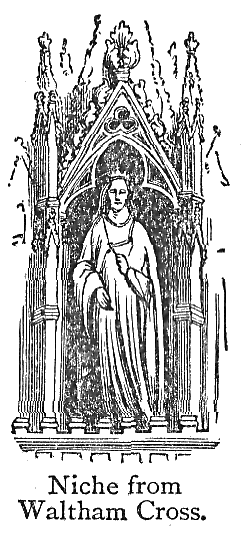
Niche, nich, n. a recess in a wall for a statue, vase, &c.: a person's proper place or condition in life or public estimation, one's appointed or appropriate place.—v.t. to place in a niche.—adj. Niched, placed in a niche. [Fr.,—It. nicchia, a niche, nicchio, a shell—L. mytilus, mitulus, a sea-mussel.]
Nick, nik, n. a notch cut into something: a score for keeping an account: the precise moment of time: a lucky throw at hazard.—v.t. to cut in notches: to hit the precise time: to strike as if making a nick: to cheat: catch in the act: to cut short: (Scot.) to cut with a single snip, as of shears: to make a cut with the pick in the face of coal to facilitate blasting or wedging.—adj. Nick′-eared, crop-eared.—n. Nick′er, one who, or that which, nicks: a woodpecker: a street-ruffian in the early part of the 18th century.—Nick a horse's tail, to make a cut at the root of the tail, making the horse carry it higher. [Another spelling of nock, old form of notch.]
Nick, nik, n. the devil, esp. Old Nick. [Prob. a corr. of St Nicholas, or from A.S. nicor, a water-spirit; Ice. nykr, Ger. nix, nixe.]
Nickel, nik′el, n. a grayish-white metal related to cobalt, very malleable and ductile.—v.t. to plate with nickel.—ns. Nick′elage, Nick′elure, the art of nickel-plating.—adjs. Nick′elic, Nick′elous; Nickelif′erous, containing nickel.—ns. Nick′eline, Nic′colite, native nickel arsenide.—v.t. Nick′elise, to plate with nickel.—ns. Nick′el-plat′ing, the plating of metals with nickel; Nick′el-sil′ver, German silver (see German). [Sw. koppar-nickel (Ger. kupfernickel), koppar, copper, nickel, a word corresponding to Ger. nickel, the devil (cf. Cobalt and Kobold), or to Ice. hnikill, a lump.]
Nicker, nik′ėr, v.i. to neigh: to snigger.—n. a neigh: a loud laugh—(obs.) Nich′er.
Nicknack, nik′nak, n. a trifle—dim. Nick′nacket.—n. Nick′nackery. [Same as Knick-knack.]
Nickname, nik′nām, n. a name given in contempt or sportive familiarity.—v.t. to give a nickname to. [M. E. neke-name, with intrusive initial n from eke-name, surname; from eke and name.]
Nicotine, nik′o-tin, n. a poisonous, volatile, alkaloid base, obtained from tobacco.—adj. Nicō′tian, pertaining to tobacco, from Jean Nicot (1530-1600), the benefactor who introduced it into France in 1560.—n. a smoker of tobacco.—n.pl. Nicotiā′na, the literature of tobacco.—n. Nic′otinism, a morbid state induced by excessive misuse of tobacco.
Nictate, nik′tāt, v.i. to wink—also Nic′titate.—ns. Nic′tātion, Nictitā′tion.—Nictitating membrane, a thin movable membrane covering the eyes of birds. [L. nictāre, -ātum.]
Nidder, nid′ėr, v.t. (Scot.) to keep under: to pinch with cold or hunger: to molest.
Niddle-noddle, nid′l-nod′l, adj. vacillating.—v.i. to wag the head.
Niderling, nid′ėr-ling, n. a wicked fellow—also Nid′ering, Nith′ing.—n. Nidd′ering, a noodle.
Nidge, nij, v.t. to dress the face of (a stone) with a sharp-pointed hammer.
Nidging, nij′ing, adj. trifling.—n. Nidg′et, a fool.
Nidification, nid-i-fi-kā′shun, n. the act or art of building a nest, and the hatching and rearing of the young.—adj. Nidament′al, pertaining to nests or what protects eggs.—n. Nidament′um, an egg-case.—vs.i. Nid′ificate, Nid′ify.—adjs. Nid′ulant, Nid′ulate, lying free in a cup-shaped body, or in pulp.—n. Nidulā′tion, nest-building. [L. nidus, a nest, facĕre, to make.]
Nidor, nī′dor, n. odour, esp. of cooked food.—adjs. Nī′dorose, Nī′dorous, Nī′dose. [L.]
Nidus, nī′dus, n. a place, esp. in an animal body, in which a germ lodges and begins to develop. [L.]
Niece, nēs, n. (fem. of Nephew) the daughter of a brother or sister: (orig.) a granddaughter. [O. Fr.,—Low L. nepta—L. neptis, a granddaughter, niece.]
Niello, ni-el′lo, n. a method of ornamenting silver or gold plates by engraving the surface, and filling up the lines with a black composition, to give clearness and effect to the incised design: a work produced by this method: an impression taken from the engraved surface before the incised lines have been filled up: the compound used in niello-work.—v.t. to decorate with niello.—n. Niell′ure, the process, also the work done. [It. niello—Low L. nigellum, a black enamel—L. nigellus, dim. of niger, black.]
Niersteiner, nēr′stī-ner, n. a variety of Rhine wine, named from Nierstein, near Mainz.
Niffer, nif′ėr, v.t. (Scot.) to barter.—n. an exchange.
Niffle, nif′l, v.t. (prov.) to pilfer.—n. Niff′naff, a trifle.—adj. Niff′naffy, fastidious.
Niflheim, nifl′hīm, n. (Scand. myth.) a region of mist, ruled over by Hel.
Nifty, nif′ti, adj. (slang) stylish.
Nigella, nī-jel′a, n. a genus of ranunculaceous plants, with finely dissected leaves, and whitish, blue, or yellow flowers, often almost concealed by their leafy involucres—Nigella damascena, called Love-in-a-mist, Devil-in-a-bush, and Ragged Lady.
Niggard, nig′ard, n. a person who is unwilling to spend or give away: a miser.—adjs. Nigg′ard, Nigg′ardly, having the qualities of a niggard: miserly; Nigg′ardish, rather niggardly.—n. Nigg′ardliness, meanness in giving or spending—(Spens.) Nigg′ardise.—adv. Nigg′ardly. [Ice. hnöggr, stingy; Ger. genau, close.]
Nigger, nig′ėr, n. a black man, a negro: a native of the East Indies or one of the Australian aborigines: a black caterpillar: a Cornish holothurian.—v.t. to exhaust soil by cropping it year by year without manure.—n. Nigg′erdom, niggers collectively.—adjs. Nigg′erish, Nigg′ery.—ns. Nigg′er-kill′er, a scorpion; Nigg′erling, a little nigger.
Niggle, nig′l, v.i. to trifle, busy one's self with petty matters: to cramp.—v.t. to fill with excessive detail: to befool.—n. small cramped handwriting.—ns. Nigg′ler, one who trifles; Nigg′ling, fussiness, finicking work.—adj. mean: fussy. [Freq. of nig, which may be a variant of nick.]
Nigh, nī, adj. near: not distant in place or time: not far off in degree, kindred, &c.: close.—adv. nearly: almost.—prep. near to: not distant from.—adv. Nigh′ly, nearly: within a little.—n. Nigh′ness, the state or quality of being nigh: nearness. [A.S. néah, néh; Dut. na, Ger. nahe.]
Night, nīt, n. the end of the day: the time from sunset to sunrise: darkness: ignorance, affliction, or sorrow: death.—ns. Night′-bell, a bell for use at night—of a physician, &c.; Night′-bird, a bird that flies only at night, esp. the owl: the nightingale, as singing at night; Night′-blind′ness, inability to see in a dim light, nyctalopia; Night′-brawl′er, one who raises disturbances in the night; Night′cap, a cap worn at night in bed (so Night′dress, -shirt, &c.): a dram taken before going to bed: a cap drawn over the face before hanging; Night′-cart, a cart used to remove the contents of privies before daylight; Night′-chair, a night-stool; Night′-churr, or -jar, the British species of goat-sucker, so called from the sound of its cry.—n.pl. Night′-clothes, garments worn in bed.—ns. Night′-crow, a bird that cries in the night; Night′-dog (Shak.), a dog that hunts in the night.—adj. Night′ed, benighted: (Shak.) darkened, clouded.—ns. Night′fall, the fall or beginning of the night: the close of the day: evening; Night′faring, travelling by night; Night′fire, a fire burning in the night: a will-o'-the-wisp; Night′-fish′ery, a mode of fishing by night, or a place where this is done; Night′-fly, a moth that flies at night; Night′-foe, one who makes his attack by night; Night′-foss′icker, one who robs a digging by night.—adj. Night′-foun′dered, lost in the night.—ns. Night′-fowl, a night-bird; Night′-glass, a spy-glass with concentrating lenses for use at night; Night′-gown, a long loose robe for sleeping in, for men or women; a loose gown for wearing in the house; Night′-hag, a witch supposed to be abroad at night; Night′-hawk, a species of migratory goat-sucker, common in America; Night′-her′on, a heron of nocturnal habit; Night′-house, a tavern allowed to be open during the night; Night′-hunt′er, a degraded woman who prowls about the streets at night for her prey; Night′-lamp, or -light, a light left burning all night.—adj. Night′less, having no night.—n. Night′-line, a fishing-line set overnight.—adj. and adv. Night′long, lasting all night.—adj. Night′ly, done by night: done every night.—adv. by night: every night.—ns. Night′-man, a night-watchman or scavenger; Night′-owl, an owl of exclusively nocturnal habits: one who sits up very late; Night′-pal′sy, a numbness of the lower limbs, incidental to women; Night′piece, a picture or literary description of a night-scene: a painting to be seen best by artificial light; Night′-por′ter, a porter in attendance during the night at hotels, railway stations, &c.; Night′-rail, a night-gown: a 17th-century form of head-dress; Night′-rav′en (Shak.), a bird that cries at night, supposed to be of ill-omen; Night′-rest, the repose of the night; Night′-rule (Shak.), a frolic at night.—adv. Nights (obs.), by night.—ns. Night′-school, a school held at night, esp. for those at work during the day; Night′-sea′son, the time of night; Night′shade, a name of several plants of the genus Solanum, having narcotic properties, often found in damp shady woods; Night′-shriek, a cry in the night; Night′-side, the dark, mysterious, or gloomy side of anything; Night′-sing′er, any bird like the nightingale, esp. the Irish sedge-warbler; Night′-soil, the contents of privies, cesspools, &c., generally carried away at night; Night′-spell, a charm against accidents by night; Night′-steed, one of the horses in the chariot of Night; Night′-stool, a close-stool for use in a bedroom; Night′-tā′per, a night-light burning slowly.—n.pl. Night′-terr′ors, the sudden starting from sleep of children in a state of fright.—p.adj. Night′-trip′ping (Shak.), tripping about in the night.—ns. Night′-wak′ing, watching in the night; Night′-walk, a walk in the night; Night′-walk′er, one who walks in his sleep at night, a somnambulist: one who walks about at night for bad purposes, esp. a prostitute; Night′-walk′ing, walking in one's sleep, somnambulism: roving about at night with evil designs; Night′-wan′derer, one who wanders by night.—adjs. Night′-war′bling, singing in the night; Night′ward, toward night.—ns. Night′-watch, a watch or guard at night: time of watch in the night; Night′-watch′man, one who acts as a watch during the night; Night′-work, work done at night. [A.S. niht; Ger. nacht, L. nox.]
Nightingale, nīt′in-gāl, n. a small sylviine bird, of the Passerine family, widely distributed in the Old World, celebrated for the rich love-song of the male heard chiefly at night. [A.S. nihtegale—niht, night, galan, to sing; Ger. nachtigall.]
Nightingale, nīt′in-gāl, n. a kind of flannel scarf with sleeves, worn by invalids when sitting up in bed. [From the famous Crimean hospital nurse, Florence Nightingale, born 1820.]
Nightmare, nīt′mār, n. a dreadful dream accompanied with pressure on the breast, and a feeling of powerlessness to move or speak—personified as an incubus or evil-spirit.—adj. Night′marish. [A.S. niht, night, mara, a nightmare; cf. Old High Ger. mara, incubus, Ice. mara, nightmare.]
Nigrescent, nī-gres′ent, adj. growing black or dark: approaching to blackness.—n. Nigresc′ence. [L., nigrescĕre, to grow black—niger, black.]
Nigrite, nig′rīt, n. an insulating composition consisting of the impure residuum obtained in the distillation of paraffin. [L. niger, black.]
Nigritian, ni-grish′an, adj. pertaining to Nigritia, Upper Guinea, Senegambia, and the Soudan region generally, the home of the true negroes.—n. a native of this region, a negro.
Nigritude, nig′ri-tūd, n. blackness. [L. nigritudo—niger, black.]
Nigrosine, nig′rō-sin, n. a coal-tar colour prepared from the hydrochloride of violaniline. [L. niger, black.]
Nihil, nī′hil, n. nothing.—ns. Nī′hilism, belief in nothing, extreme scepticism: in Russia, a revolutionary socialistic movement aiming at the overturn of all the existing institutions of society in order to build it up anew on different principles; Nī′hilist, one who professes Nihilism.—adj. Nihilist′ic.—ns. Nihil′ity, nothingness; Nil, nothing. [L.]
Nike, nī′kē, n. the goddess of victory. [Gr.]
Nilgau. See Nyl-ghau.
Nill, nil, v.t. (Spens.) to refuse, to reject.—v.i. to be unwilling. [A.S. nillan—ne, not, willan, to will.]
Nilometer, nī-lom′e-tėr, n. a gauge for measuring the height of water in the river Nile: any river-gauge—also Nī′loscope.—adj. Nilot′ic.
Nim, nim, v.t. to steal, pilfer. [A.S. niman, to take.]
Nimble, nim′bl, adj. light and quick in motion: active: swift.—adjs. Nim′ble-fing′ered, skilful with the fingers, thievish; Nim′ble-foot′ed, swift of foot.—ns. Nim′bleness, Nim′bless (Spens.), quickness of motion either in body or mind.—adj. Nim′ble-wit′ted, quick-witted.—adv. Nim′bly. [M. E. nimel—A.S. niman, to catch; cf. Ger. nehmen.]
Nimbus, nim′bus, n. the raincloud: (paint.) the disc or halo, generally circular or semicircular, which encircles the head of the sacred person represented.—adj. Nimbif′erous, bringing clouds. [L.]
Nimiety, ni-mī′e-ti, n. (rare) state of being too much. [L. nimietas—nimis, too much.]
Niminy-piminy, nim′i-ni-pim′i-ni, adj. affectedly fine or delicate.—n. affected delicacy. [Imit.]
Nimrod, nim′rod, n. the founder of Babel (see Gen. x. 8-10): any great hunter.
Nincompoop, nin′kom-poop, n. a simpleton. [Corr. of L. non compos (mentis), not of sound mind.]
Nine, nīn, adj. and n. eight and one.—n. Nine′-eyes, a popular name for the young lampreys found in rivers.—adj. Nine′fold, nine times folded or repeated.—ns. Nine′holes, a game in which a ball is to be bowled into nine holes in the ground or a board; Nine′pins, a game at bowls, a form of skittles, so called from nine pins being set up to be knocked down by a ball.—adj. Nine′-score, nine times twenty.—n. the number of nine times twenty.—adj. and n. Nine′teen, nine and ten.—adj. Nine′teenth, the ninth after the tenth: being one of nineteen equal parts.—n. a nineteenth part.—adj. Nine′tieth, the last of ninety: next after the eighty-ninth.—n. a ninetieth part.—adj. and n. Nine′ty, nine tens.—adj. Ninth, the last of nine: next after the eighth.—n. one of nine equal parts.—adv. Ninth′ly, in the ninth place.—Nine days' wonder (see Wonder); Nine men's morris (see Morris); Nine worthies, Hector, Alexander the Great, Julius Cæsar, Joshua, David, Judas Maccabæus, Arthur, Charlemagne, Godfrey of Bouillon; The nine, the nine muses (see Muse); To the nines, to perfection, fully, elaborately. [A.S. nigon; Dut. negen, L. novem, Gr. ennea, Sans. navan.]
Ninny, nin′i, n. a simpleton.—Also Ninn′y-hamm′er. [It. ninno, child; Sp. niño, infant.]
Niobe, nī′o-bē, n. daughter of Tantalus, and wife of Amphion, king of Thebes. Proud of her many children, she gloried over Latona, who had but two, Artemis and Apollo. But these killed them all, on which the weeping mother was turned into stone by Zeus.—adj. Niobē′an.
Niobium, nī-ō′bi-um, n. a rare metal, steel-gray in colour, discovered in the mineral Tantalite—sometimes called Columbium.
Nip, nip, n. a sip, esp. of spirits—also Nip′per (U.S.).—v.i. to take a dram.—n. Nip′perkin, a small measure of liquor. [Dut. nippen, to sip.]
Nip, nip, v.t. to pinch: to press between two surfaces: to cut off the edge: to check the growth or vigour of: to destroy: to bite, sting, satirise:—pr.p. nip′ping; pa.t. and pa.p. nipped.—n. a pinch: a seizing or closing in upon: a cutting off the end: a blast: destruction by frost: (min.) a more or less gradual thinning out of a stratum: (naut.) a short turn in a rope, the part of a rope at the place bound by the seizing or caught by jambing.—ns. Nip′-cheese, a stingy fellow: (naut.) the purser's steward; Nip′per, he who, or that which, nips: one of various tools or implements like pincers: one of a pair of automatically locking handcuffs: a chela or great claw, as of a crab: the young bluefish: a boy who attends on navvies: (obs.) a thief: one of the four fore-teeth of a horse: (pl.) small pincers.—v.t. to seize (two ropes) together.—adv. Nip′pingly.—Nip in the bud, to cut off in the earliest stage. [From root of knife; Dut. knijpen, Ger. kneipen, to pinch.]
Nipperty-tipperty, nip′ėr-ti-tip′ėr-ti, adj. (Scot.) silly, frivolous.
Nipple, nip′l, n. the pap by which milk is drawn from the breasts of females: a teat: a small projection with an orifice, as the nipple of a gun.—v.t. to furnish with a nipple.—ns. Nipp′le-shield, a defence for the nipple worn by nursing women; Nipp′le-wort, a small, yellow-flowered plant of remedial use. [A dim. of neb or nib.]
Nippy, nip′i, adj. (Scot.) sharp in taste: curt: parsimonious.
Nipter, nip′tėr, n. the ecclesiastical ceremony of washing the feet—the same as maundy. [Gr. niptēr, a basin—niptein, to wash.]
Nirles, Nirls, nirlz, n. herpes.
Nirvana, nir-vä′na, n. the cessation of individual existence—the state to which a Buddhist aspires as the best attainable. [Sans., 'a blowing out.']
Nis, nis (Spens.), is not. [A contr. of ne is.]
Nis, nis, n. a hobgoblin. [Same as Nix.]
Nisan, nī′san, n. the name given after the Captivity to the Jewish month Abib. [Heb.]
Nisi, nī′sī, conj. unless, placed after the words 'decree' or 'rule,' to indicate that the decree or rule will be made absolute unless, after a time, some condition referred to be fulfilled.—Nisi prius, the name usually given in England to the sittings of juries in civil cases—from the first two words of the old Latin writ summoning the juries to appear at Westminster unless, before the day appointed, the judges shall have come to the county.
Nisus, nī′sus, n. effort, attempt.—Nisus formativus (biol.), formative effort. [L.]
Nit, nit, n. the egg of a louse or other small insect.—adj. Nit′ty, full of nits. [A.S. hnitu; Ger. niss.]
Nithing, nī′thing, adj. wicked, mean.—n. a wicked man. [A.S. níthing; Ger. neiding.]
Nithsdale, niths′dāl, n. a hood which can be drawn over the face. [From the Jacobite Earl of Nithsdale who escaped from the Tower in women's clothes brought in by his wife, in 1716.]
Nitid, nit′id, adj. shining: gay.—n. Nī′tency, brightness. [L. nitidus—nitēre, to shine.]
Nitre, nī′tėr, n. the nitrate of potash—also called Saltpetre.—n. Nī′trāte, a salt of nitric acid.—adjs. Nī′trāted, combined with nitric acid; Nī′tric, pertaining to, formed from, or containing or resembling nitre.—n. Nī′tric ac′id, an acid got by distilling a mixture of sulphuric acid and nitrate of sodium—it acts powerfully on metals, and is known by the name of Aqua-fortis.—adj. Nitrif′erous, nitre-bearing.—n. Nitrificā′tion.—v.t. Nī′trify, to convert into nitre.—v.i. to become nitre:—pr.p. nī′trifying; pa.t. and pa.p. nī′trified.—ns. Nī′trite, a salt of nitrous acid; Nī′tro-ben′zol, a yellow oily fluid, obtained by treating benzol with warm fuming nitric acid—used in perfumery and known as Essence of mirbane; Nī′tro-glyc′erine, a powerfully explosive compound produced by the action of nitric and sulphuric acids on glycerine—sometimes used in minute doses as a medicine.—adjs. Nitrose′, Nī′trous, resembling, or containing, nitre.—n. Nī′trous ox′ide, a combination of oxygen and nitrogen, called also Laughing gas, which causes, when breathed, insensibility to pain.—adj. Nī′try, of or producing nitre.—Cubic nitre, nitrate of soda, so called because it crystallises in cubes. [Fr.,—L. nitrum—Gr. nitron, natron, potash, soda—Ar. nitrún, natrún.]
Nitrogen, nī′tro-jen, n. a gas forming nearly four-fifths of common air, a necessary constituent of every organised body, so called from its being an essential constituent of nitre.—adjs. Nitrogen′ic, Nitrog′enous.—v.t. Nitrog′enise, to impregnate with nitrogen.—n. Nitrom′eter, an apparatus for estimating nitrogen in some of its combinations. [Gr. nitron, and gennaein, to generate.]
Nitter, nit′ėr, n. a bot-fly, the horse-bot.
Nittings, nit′ingz, n.pl. small particles of coal or refuse of any ore.
Nival, nī′val, adj. snowy, growing among snow.—adj. Niv′eous, snowy, white.—n. Nivôse (nē-vōz′), the 4th month of the French revolutionary calendar, Dec. 21-Jan. 19. [L. niveus—nix, nivis, snow.]
Nix, niks, n. (Teut. myth.) a water-spirit, mostly malignant.—Also Nix′ie, Nix′y. [Ger. nix; cf. Nicker.]
Nix, niks, n. nothing: (U.S.) in the postal service, anything unmailable because addressed to places which are not post-offices or to post-offices not existing in the States, &c., indicated in the address—usually in pl. [Ger. nichts, nothing.]
Nix, niks, interj. a roughs' street-cry of warning at the policeman, &c.
Nizam, ni-zam′, n. the title of the sovereign of Hyderabad in India, first used in 1713: sing. and pl. the Turkish regulars, or one of them. [Hind., contr. of Nizam-ul-Mulk=Regulator of the state.]
No, nō, adv. the word of refusal or denial: not at all: never: not so: not.—n. a denial: a vote against or in the negative:—pl. Noes (nōz).—adj. not any: not one: none.—advs. Nō′way, in no way, manner, or degree—also Nō′ways; Nō′wise, in no way, manner, or degree.—No account, worthless; No doubt, surely; No go (see Go); No joke, not a trifling matter. [A.S. ná, compounded of ne, not, and á ever; nay, the neg. of aye, is Scand.]
Noachian, nō-ā′ki-an, adj. pertaining to the patriarch Noah, or to his time—also Noach′ic.—Noah's ark, a child's toy in imitation of the ark of Noah and its inhabitants.
Nob, nob, n. the head: a knobstick.—One for his nob, a blow on the head in boxing: a point at cribbage by holding the knave of trumps. [Knob.]
Nob, nob, n. a superior sort of person.—adv. Nob′bily.—adj. Nob′by, smart, fashionable: good, capital. [A contr. of nobleman.]
Nobble, nob′l, v.t. (slang) to get hold of dishonestly, to steal: to baffle or circumvent dexterously: to injure, destroy the chances of, as a racer.—n. Nobb′ler, a finishing-stroke: a thimble-rigger's confederate: a dram of spirits.
Nobility, no-bil′i-ti, n. the quality of being noble: high rank: dignity: excellence: greatness of mind or character: antiquity of family: descent from noble ancestors: the persons holding the rank of nobles.—adj. Nobil′iary, pertaining to the nobility.—v.t. Nobil′itate, to ennoble.—n. Nobilitā′tion.
Noble, nō′bl, adj. illustrious: high in rank or character: of high birth: magnificent: generous: excellent.—n. a person of exalted rank: a peer: an obsolete gold coin=6s. 8d. sterling.—n. Nō′bleman, a man who is noble or of rank: a peer: one above a commoner.—adj. Nō′ble-mind′ed, having a noble mind.—ns. Nōble-mind′edness; Nō′bleness, the quality of being noble: excellence in quality: dignity: greatness by birth or character: ingenuousness: worth; Nobless′, Noblesse′ (Spens.), nobility: greatness: the nobility collectively; Nō′blewoman, the fem. of Nobleman.—adv. Nō′bly.—Noble art, boxing; Noble metals (see Metal).—Most noble, the style of a duke. [Fr.,—L. nobilis, obs. gnobilis—noscĕre (gnoscĕre), to know.]
Nobody, nō′bod-i, n. no body or person: no one: a person of no account, one not in fashionable society.
Nocake, nō′kāk, n. meal made of parched corn, once much used by North American Indians on the march. [Amer. Ind. nookik, meal.]
Nocent, nō′sent, adj. (obs.) hurtful: guilty.—n. one who is hurtful or guilty.—adv. Nō′cently. [L. nocēre, to hurt.]
Nock, nok, n. the forward upper end of a sail that sets with a boom: a notch, esp. that on the butt-end of an arrow for the string. [Cf. Notch.]
Noctambulation, nok-tam-bū-lā′shun, n. walking in sleep.—ns. Noctam′bulism, sleep-walking; Noctam′bulist, one who walks in his sleep. [L. nox, noctis, night, ambulāre, -ātum, to walk.]
Noctilio, nok-til′i-ō, n. a genus of American bats.
Noctiluca, nok-ti-lū′ka, n. a phosphorescent marine Infusorian, abundant around the British coasts, one of the chief causes of the phosphorescence of the waves.—adjs. Noctilū′cent, Noctilū′cid, Noctilū′cous, shining in the dark. [L. nox, noctis, night, lucēre, to shine.]
Noctivagant, nok-tiv′a-gant, adj. wandering in the night.—n. Noctivagā′tion.—adj. Noctiv′agous. [L. nox, noctis, night, vagāri, to wander.]
Noctograph, nok′to-graf, n. a writing-frame for the blind: an instrument for recording the presence of a night-watchman on his beat.—n. Nocturn′ograph, an instrument for recording work done in factories, &c., during the night. [L. nox, Gr. graphein, to write.]
Noctua, nok′tū-a, n. a generic name variously used—giving name to the Noctū′idæ, a large family of nocturnal lepidopterous insects, strong-bodied moths.—n. Noc′tuid.—adjs. Noctū′idous; Noc′tuiform; Noc′tuoid.
Noctuary, nok′tū-ā-ri, n. an account kept of the events or thoughts of night.
Noctule, nok′tūl, n. a vespertilionine bat. [Fr.,—L. nox, noctis, night.]
Nocturn, nok′turn, n. in the early church, a service of psalms and prayers at midnight or at daybreak: a portion of the psalter used at nocturns. [Fr. nocturne—L. nocturnus—nox, noctis, night.]
Nocturnal, nok-tur′nal, adj. pertaining to night: happening by night: nightly.—n. an instrument for observations in the night.—adv. Noctur′nally.
Nocturne, nok′turn, n. a painting showing a scene by night: a piece of music of a dreamy character suitable to evening or night thoughts: a serenade: a reverie. [Fr.; cf. Nocturn.]
Nocuous, nok′ū-us, adj. hurtful.—adv. Noc′uously. [L. nocuus—nocēre, to hurt.]
Nod, nod, v.i. to give a quick forward motion of the head: to bend the head in assent: to salute by a quick motion of the head: to let the head drop in weariness.—v.t. to incline: to signify by a nod:—pr.p. nod′ding; pa.t. and pa.p. nod′ded.—n. a bending forward of the head quickly: a slight bow: a command.—ns. Nod′der; Nod′ding.—adj. inclining the head quickly: indicating by a nod: acknowledged by a nod merely, as a nodding acquaintance: (bot.) having the flower looking downwards.—Land of Nod, the state of sleep. [M. E. nodden, not in A.S.; but cf. Old High Ger. hnōton, to shake, prov. Ger. notteln, to wag.]
Noddle, nod′l, n. properly, the projecting part at the back of the head: the head.—v.i. to nod repeatedly. [A variant of knot; cf. Old Dut. knodde, a knob, Ger. knoten, a knot.]
Noddy, nod′i, n. one whose head nods from weakness: a stupid fellow: a sea-fowl—easily taken: a four-wheeled carriage with a door at the back: an upright flat spring with a weight on the top, forming an inverted pendulum, indicating the vibration of any body to which it is attached. [Nod.]
Node, nōd, n. a knot: a knob: a knot or entanglement: (astron.) one of the two points in which the orbit of a planet intersects the plane of the ecliptic: (bot.) the joint of a stem: the plot of a piece in poetry: (math.) a point at which a curve cuts itself, and through which more than one tangent to the curve can be drawn: a similar point on a surface, where there is more than one tangent-plane.—adjs. Nod′al, pertaining to nodes; Nodāt′ed, knotted.—ns. Nodā′tion, the act of making knots: the state of being knotted; Node′-coup′le, a pair of points on a surface at which one plane is tangent; Node′-cusp, a peculiar kind of curve formed by the union of a node, a cusp, an inflection, and a bitangent.—adjs. Nod′ical, pertaining to the nodes: from a node round to the same node again; Nodif′erous (bot.), bearing nodes; Nō′diform; Nod′ose, full of knots: having knots or swelling joints: knotty.—n. Nodos′ity.—adjs. Nod′ular, of or like a nodule; Nod′ulāted, having nodules.—ns. Nod′ule, Nod′ulus, a little knot: a small lump.—adjs. Nod′uled, having nodules or little knots or lumps; Nodulif′erous; Nod′uliform; Nod′ulose, Nod′ulous (bot.), having nodules or small knots: knotty.—ns. Nod′ulus:—pl. Nod′ulī; Nō′dus:—pl. Nō′dī. [L. nodus (for gnodus), allied to Knot.]
Noël, nō′el, n. Christmas.—Same as Nowel (q.v.).
Noematic, -al, nō-ē-mat′ik, -al, adj. intellectual—also Noet′ic, -al.—adv. Noemat′ically.—n.pl. Noem′ics, intellectual science. [Gr. noēma—noein, to perceive.]
Noetian, nō-ē′shi-an, adj. pertaining to Noë′tus or Noë′tianism, a form of Patripassianism taught by Noëtus of Smyrna about 200 A.D.
Nog, nog, n. a mug, small pot: a kind of strong ale.
Nog, nog, n. a tree nail driven through the heels of the shores, to secure them: one of the pins in the lever of a clutch-coupling: a piece of wood in an inner wall: a cog in mining.
Noggin, nog′in, n. a small mug or wooden cup, or its contents, a dram suitable for one person. [Ir. noigin, Gael. noigean.]
Nogging, nog′ging, n. a partition of wooden posts with the spaces between filled up with bricks: brick-building filling up the spaces between the wooden posts of a partition.
Nohow, nō′how, adv. not in any way, not at all: (coll.) out of one's ordinary way, out of sorts.
Noiance, noi′ans, n. (Shak.). Same as Annoyance.
Noils, noilz, n.pl. short pieces of wool separated from the longer fibres by combing.
Noint, noint, v.t. (Shak.). Same as Anoint.
Noise, noiz, n. sound of any kind: any over-loud or excessive sound, din: frequent or public talk: (Shak.) report: a musical band.—v.t. to spread by rumour.—v.i. to sound loud.—adjs. Noise′ful, noisy; Noise′less, without noise: silent.—adv. Noise′lessly.—n. Noise′lessness.—Make a noise in the world, to attract great notoriety. [Fr. noise, quarrel; prob. from L. nausea, disgust; but possibly from L. noxa, hurt—nocēre, to hurt.]
Noisette, nwo-zet′, n. a variety of rose. [Fr.]
Noisome, noi′sum, adj. injurious to health: disgusting to sight or smell.—adv. Noi′somely.—n. Noi′someness. [M. E. noy, annoyance. Cf. Annoy.]
Noisy, noiz′i, adj. making a loud noise or sound: attended with noise: clamorous: turbulent.—adv. Nois′ily.—n. Nois′iness.
Nokes, nōks, n. a simpleton.
Nolens volens, nōlens vol′ens, unwilling (or) willing: willy-nilly.—n. Noli-me-tangere (nō′lī-mē-tan′je-rē), the wild cucumber: lupus of the nose: a picture showing Jesus appearing to Mary Magdalene, as in John xx.—Nolle prosequi (nol′e pros′e-kwī), a term used in English law to indicate that the plaintiff does not intend to go on with his action. [L. nolle, to be unwilling, velle, to be willing, tangĕre, to touch, prosequi, to prosecute.]
Noll, nol, n. the head.
Nom, nong, n. name.—Nom de plume, 'pen-name:' the signature assumed by an author instead of his own name—not a Fr. phrase, but one of Eng. manufacture from Fr. nom, a name, de, of, plume, a pen.
Nomad, Nomade, nom′ad, n. one of a tribe that wanders about in quest of game, or of pasture for their flocks.—adj. Nomad′ic, of or for the feeding of cattle: pastoral: pertaining to the life of nomads: wandering: unsettled: rude.—adv. Nomad′ically.—v.i. Nom′adise, to lead a nomadic or vagabond life.—n. Nom′adism, the state of being nomadic: habits of nomads. [Gr. nomas, nomados—nomos, pasture—nemein, to drive to pasture.]
Nomancy, nō′man-si, n. divination from the letters in a name.
No-man's-land, nō′-manz-land, n. a region to which no one possesses a recognised claim.
Nomarch, nom′ärk, n. the ruler of a Nome, or division of a province, as in modern Greece.—n. Nom′archy, the district governed by a nomarch. [Gr. nomos, district, archē, rule.]
Nombril, nom′bril, n. (her.) the navel-point.
Nome, nōm, n. See Nomarch.
Nomen, nō′men, n. a name, esp. of the gens or clan, as Caius Julius Cæsar. [L.]
Nomenclator, nō′men-klā-tor, n. one who gives names to things:—fem. Nō′menclatress.—adjs. Nomenclatō′rial, Nō′menclātory, Nō′menclātūral.—n. Nō′menclāture, a system of naming: a list of names: a calling by name: the peculiar terms of a science. [L.,—nomen, a name, calāre, to call.]
Nomial, nō′mi-al, n. (alg.) a single name or term.
Nomic, nom′ik, adj. customary, applied to the common mode of spelling—opp. to Glossic and Phonetic. [Gr. nomos, custom.]
Nominal, nom′in-al, adj. pertaining to a name: existing only in name: having a name.—ns. Nom′inalism, the doctrine that general terms have no corresponding reality either in or out of the mind, being mere words; Nom′inalist, one of a sect of philosophers who held the doctrine of nominalism.—adj. Nominalist′ic, pertaining to nominalism.—adv. Nom′inally. [L. nominalis—nomen, -ĭnis, a name.]
Nominate, nom′in-āt, v.t. to name: to mention by name: to appoint: to propose by name, as for an office or for an appointment.—adv. Nom′inātely, by name.—ns. Nom′inātion, the act or power of nominating: state of being nominated; Nom′inātion-game, in billiards, a game in which the player has to name beforehand what stroke he is leading.—adjs. Nominātī′val; Nom′inātive, naming: (gram.) applied to the case of the subject.—n. the naming case, the case in which the subject is expressed.—adv. Nom′inātively.—n. Nom′inātor, one who nominates.—Nominative absolute, a grammatical construction in which we have a subject (noun or pronoun) combined with a participle, but not connected with a finite verb or governed by any other words, as 'All being well, I will come.' [L. nomināre, -ātum, to name—nomen.]
Nominee, nom-in-ē′, n. one who is nominated by another: one on whose life an annuity or lease depends: one to whom the holder of a copyhold estate surrenders his interest.
Nomistic, nō-mis′tik, adj. pertaining to laws founded on a sacred book. [Gr. nomos, a law.]
Nomocracy, nō-mok′ra-si, n. a government according to a code of laws. [Gr. nomos, law, kratia—kratein, to rule.]
Nomogeny, nō-moj′e-ni, n. the origination of life according to natural law, not miracle—opp. to Thaumatogeny. [Gr. nomos, law, geneia—genēs, producing.]
Nomography, nō-mog′ra-fi, n. the art of drawing up laws in proper form.—n. Nomog′rapher, one versed in this art. [Gr. nomos, law, graphein, to write.]
Nomology, no-mol′ō-ji, n. the science of the laws of the mind.—adj. Nomolog′ical.—n. Nomol′ogist. [Gr. nomos, law, logia, discourse—legein, to speak.]
Nomos, nom′os, n. in modern Greece, a nome.
Nomothetic, nom-ō-thet′ik, adj. legislative: founded on a system of laws, or by a lawgiver. [Gr. nomothetēs, a lawgiver, one of a body of heliasts or jurors in ancient Athens, charged with the decision as to any proposed change in legislation.]
Non, non, adv. not, a Latin word used as a prefix, as in ns. Non-abil′ity, want of ability; Non-accept′ance, want of acceptance: refusal to accept; Non-ac′cess (law), absence of opportunity for marital commerce; Non-acquaint′ance, want of acquaintance; Non-acquiesc′ence, refusal of acquiescence; Non-admiss′ion, refusal of admission: failure to be admitted; Non-alienā′tion, state of not being alienated: failure to alienate; Non-appear′ance, failure or neglect to appear, esp. in a court of law; Non-arrī′val, failure to arrive; Non-attend′ance, a failure to attend: absence; Non-atten′tion, inattention; Non′-claim, a failure to make claim within the time limited by law; Non-com′batant, any one connected with an army who is there for some other purpose than that of fighting, as a surgeon, &c.: a civilian in time of war.—adjs. Non-commiss′ioned, not having a commission, as an officer in the army below the rank of commissioned officer—abbrev. Non-com′.; Non-commit′tal, unwilling to commit one's self to any particular opinion or course of conduct, free from any declared preference or pledge.—ns. Non-commū′nicant, one who abstains from joining in holy communion, or who has not yet communicated; Non-commūn′ion; Non-complī′ance, neglect or failure of compliance.—adj. Non-comply′ing.—n. Non-concur′rence, refusal to concur.—adj. Non-conduct′ing, not conducting or transmitting: not allowing a fluid or a force to pass along, as glass does not conduct electricity.—n. Non-conduct′or, a substance which does not conduct or transmit certain properties or conditions, as heat or electricity.—adj. Nonconform′ing, not conforming, esp. to an established church.—n. and adj. Nonconform′ist, one who does not conform: esp. one who refused to conform or subscribe to the Act of Uniformity in 1662—abbrev. Non-con′.—n. Nonconform′ity, want of conformity, esp. to the established church.—adj. Non-contā′gious, not infectious.—ns. Non′-content, one not content: in House of Lords, one giving a negative vote; Non-deliv′ery, failure or neglect to deliver.—adj. Non-effect′ive, not efficient or serviceable: unfitted for service.—n. a member of a force who is not able, for some reason, to take part in active service.—adj. Non-effic′ient, not up to the mark required for service.—n. a soldier who has not yet undergone the full number of drills.—n. Non-ē′go, in metaphysics, the not-I, the object as opposed to the subject, whatever is not the conscious self.—adjs. Non-egois′tical; Non-elas′tic, not elastic; Non-ēlect′, not elect.—n. one not predestined to salvation.—n. Non-ēlec′tion, state of not being elected.—adjs. Non-elec′tric, -al, not conducting the electric fluid; Non-emphat′ic; Non-empir′ical, not empirical, not presented in experience; Non-epis′copal.—n. Non-episcopā′lian.—adj. Non-essen′tial, not essential: not absolutely required.—n. something that may be done without.—n. Non-exist′ence, negation of existence: a thing that has no existence.—adj. Non-exist′ent.—n. Non-exportā′tion.—adj. Non-for′feiting, of a life insurance policy not forfeited by reason of non-payment.—ns. Non-fulfil′ment; Non-importā′tion.—adj. Non-import′ing.—ns. Non-interven′tion, a policy of systematic non-interference by one country with the affairs of other nations; Non-intru′sion, in Scottish Church history, the principle that a patron should not force an unacceptable clergyman on an unwilling congregation; Non-intru′sionist.—adj. Non-iss′uable, not capable of being issued: not admitting of issue being taken on it.—n. Non-join′der (law), the omitting to join all the parties to the action or suit.—adj. Nonjur′ing, not swearing allegiance.—n. Nonjur′or, one of the clergy in England and Scotland who would not swear allegiance to William and Mary in 1689, holding themselves still bound by the oath they had taken to the deposed king, James II.—adjs. Non-lū′minous; Non-manufact′uring; Non-marr′ying, not readily disposed to marry; Non-metal′lic, not consisting of metal: not like the metals; Non-mor′al, involving no moral considerations; Non-nat′ural, not natural: forced or strained.—n. in ancient medicine, anything not considered of the essence of man, but necessary to his well-being, as air, food, sleep, rest, &c.—ns. Non-obē′dience; Non-observ′ance, neglect or failure to observe; Non-pay′ment, neglect or failure to pay; Non-perform′ance, neglect or failure to perform.—adjs. Non-placent′al; Non-pon′derous.—n. Non-produc′tion.—adj. Non-profess′ional, not done by a professional man, amateur: not proper to be done by a professional man, as unbecoming conduct in a physician, &c.—ns. Non-profic′ient, one who has made no progress in the art or study in which he is engaged; Non-regard′ance, want of due regard; Non-res′idence, failure to reside, or the fact of not residing at a certain place, where one's official or social duties require one to reside.—adj. Non-res′ident, not residing within the range of one's responsibilities.—n. one who does not do so, as a landlord, clergyman, &c.—n. Non-resist′ance, the principle of not offering opposition: passive or ready obedience.—adjs. Non-resist′ant, Non-resist′ing; Non-sex′ual, sexless, asexual; Non-socī′ety, not belonging to a society, esp. of a workman not attached to a trades-union, or of a place in which such men are employed.—n. Non-solū′tion.—adjs. Non-sol′vent; Non-submis′sive.—n. Non′suit, a legal term in England, which means that where a plaintiff in a jury trial finds he will lose his case, owing to some defect or accident, he is allowed to be nonsuited, instead of allowing a verdict and judgment to go for the defendant.—v.t. to record that a plaintiff drops his suit.—n. Non′-term, a vacation between two terms of a law-court.—adj. Non-un′ion (see Non-society).—ns. Non-ū′sager (see Usage); Non-ū′ser (law), neglect of official duty: omission to take advantage of an easement, &c.—adj. Non-vī′able, not viable, of a fœtus too young for independent life.