LIST OF ABBREVIATIONS USED IN THIS DICTIONARY. (continued 8)
Reading edition
Ploughshare, plow′shār, n. the part of a plough which shears or cuts the ground in the bottom of the furrow. [Plough, and A.S. scear, a share of a plough, a shearing—sceran, to cut.]
Plouter, plow′tėr, v.i. to paddle in water.—n. (Scot.) a paddling or dabbling in water.
Plover, pluv′ėr, n. a well-known wading bird. [Fr. pluvier—L. pluvia, rain.]
Plow, plow. Old spelling of plough.
Ploy, ploi, n. employment: (Scot.) a frolic. [Employ.]
Pluck, pluk, v.t. to pull off or away: to snatch: to strip, as a fowl of its feathers: (slang) to reject an examinee as inefficient.—n. a single act of plucking.—n. Pluck′er.—Pluck off (Shak.), to abate from the rank; Pluck up, to pull out by the roots: to summon up, as courage. [A.S. pluccian; akin to Dut. plukken, Ger. pflücken.]
Pluck, pluk, n. the heart, liver, and lungs of an animal—hence heart, courage, spirit.—adjs. Plucked, Pluck′y, having pluck or spirit.—adv. Pluck′ily.—n. Pluck′iness.
Pluffy, pluf′i, adj. puffy: blown out.—n. Pluff (Scot.), a puff of smoke or dust.—v.t. to throw out such.
Plug, plug, n. a block or peg used to stop a hole: a bung: a stopper: a branch from a water-pipe to supply a hose: a flat cake of tobacco: any worn-out or useless article: (slang) a silk hat.—v.t. to stop with a plug: to drive plugs into:—pr.p. plug′ging; pa.t. and pa.p. plugged.—ns. Plug′ger, one who, or that which, plugs, esp. a dentist's instrument for filling a hollow tooth; Plug′ging, the act of stopping with a plug: the material of which a plug is made; Plug′-ug′ly, a street ruffian.—Fire plug, a contrivance by means of which a hose can be fixed to a water-main in case of fire. [Dut. plug, a bung, a peg (Sw. plugg, a peg, Ger. pflock); most prob. Celt., as in Ir., Gael., and W. ploc.]
Plum, plum, n. a well-known stone fruit of various colours, of the natural order Rosaceæ: the tree producing it: the best part of all: a sum of £100,000, a handsome fortune.—ns. Plum′-cake, a cake containing raisins, currants, &c.; Plum′-duff, a flour-pudding boiled with raisins.—adj. Plum′my, full of plums: desirable.—ns. Plum′-porr′idge, an antiquated dish, of porridge with plums, raisins, &c.; Plum′-pudd′ing, a national English dish made of flour and suet, with raisins, currants, and various spices. [A.S. plúme—L. prunum—Gr. prounon.]
Plumage, plōōm′āj, n. the whole feathers of a bird. [Fr.,—plume, a feather.]
Plumb, plum, n. a mass of lead or other material, hung on a string, to show the perpendicular position: the perpendicular direction or position.—adj. perpendicular.—adv. perpendicularly.—v.t. to adjust by a plumb-line: to make perpendicular: to sound the depth of, as water by a plumb-line.—n. Plumb′-bob, a conoid-shaped metal weight at the end of a plumb-line.—adjs. Plum′bēan, Plum′bēous, consisting of, or resembling, lead: stupid; Plumb′ic, pertaining to, or obtained from, lead; Plumbif′erous, producing lead.—n. Plumb′ing, the art of casting and working in lead, &c.—adj. Plumb′less, incapable of being sounded.—ns. Plumb′-line, a line to which a mass of lead is attached to show the perpendicular: a plummet; Plumb′-rule, a narrow board with a plumb-line fastened to the top, used to determine a perpendicular. [Fr. plomb—L. plumbum, lead.]
Plumbagineæ, plum-ba-jin′ē-ē, n.pl. a natural order of oxogenous plants found on seashores and salt-marshes.
Plumbago, plum-bā′go, n. a mineral composed of carbon, iron, and other materials, used for pencils, &c., popularly called 'blacklead:' graphite: a genus of plants with blue or violet flowers.—adj. Plumbag′inous. [L. plumbum, lead.]
Plumber, plum′ėr, n. one who works in lead, esp. one who fits into buildings the tanks, pipes, and fittings for conveying water, gas, and sewage.—ns. Plumb′er-block, a metal frame or case for holding the end of a revolving shaft: a pillow-block; Plumb′ery, articles of lead: the business of a plumber: a place for plumbing.
Plume, plōōm, n. a feather: a tuft of feathers: a feather worn as an ornament: a crest: a token of honour: a prize in a contest.—v.t. to dress the feathers of, as a bird: to adorn with plumes: to strip of feathers: to boast (used reflexively).—ns. Plumassier (plōō-ma-sēr′), one who prepares or deals in plumes; Plume′-bird, a term sometimes given to the Epimachidæ or long-tailed birds-of-Paradise.—adjs. Plumed, adorned with feathers; Plume′less.—n. Plume′let, a down-feather, a plumule: anything resembling a small plume.—adj. Plume′-plucked, stripped of plumes: (Shak.) humbled.—n. Plum′ery, a display of plumes.—adjs. Plumig′erous, plumaged; Plu′miped, having feathered feet.—n. Plu′mist, a feather-dresser.—adjs. Plu′mose, Plu′mous, feathery: plume-like; Plu′my, covered or adorned with plumes. [O. Fr.,—L. pluma, a small soft feather.]
Plummer, Plummery. See Plumber, Plumbery.
Plummet, plum′et, n. a weight of lead hung at a string, used for ascertaining the direction of the earth's attraction, and for sounding depths: a plumb-line. [O. Fr. plomet, dim. of plom, lead.]
Plump, plump, adv. falling straight downward (like lead): heavily: suddenly.—adj. downright: unqualified.—v.i. to fall or sink suddenly: to give all one's votes to one candidate where there are more than one to be elected.—v.t. to cause to fall suddenly.—n. (Scot.) a sudden downfall of rain.—n. Plump′er, a vote given to one candidate only when more than one are to be elected: one who so votes: (slang) a downright lie.—adv. Plump′ly, fully, without reserve. [Plumb.]
Plump, plump, adj. fat and rounded: sleek: in good condition.—v.i. to grow fat or plump: to swell.—v.t. to make plump: to fatten.—ns. Plump′er, a ball kept in the mouth to give the cheeks a rounded appearance; Plump′ness.—adj. Plump′y (Shak.), plump, fat. [Teut.; Dut. plomp, lumpish, Ger. plump.]
Plump, plump, n. a cluster: a clump (of persons or things).
Plumularia, plōō-mū-lā′ri-a, n. a genus of hydrozoa, belonging to the division hydroidea.—adj. Plumulā′rian. [L. plumula, a little feather.]
Plumule, plōō′mūl, n. (bot.) the first bud of a plant growing from seed, springing from between the cotyledons or seed leaves: a soft feather: a feathery scale on a butterfly's wing.—Also Plum′ula. [L. plumula, dim. of pluma, a feather.]
Plunder, plun′dėr, v.t. to seize the goods of another by force: to pillage.—n. that which is seized by force: booty: (U.S.) household goods.—ns. Plun′derage, the stealing of goods on board ship; Plun′derer.—adj. Plun′derous. [Ger. plündern, to pillage—plunder, trash, baggage; akin to Low Ger. plunnen, rags.]
Plunge, plunj, v.t. to cast suddenly into water or other fluid: to force suddenly (into): to immerse.—v.i. to sink suddenly into any fluid: to dive: to pitch suddenly forward and throw up the hind-legs, as a horse: to rush into any danger: (slang) to gamble recklessly.—n. act of plunging: act of rushing headlong, as a horse.—n. Plung′er, one who plunges: a diver: a long solid cylinder used as a forcer in pumps: (mil.) a cavalry-man: one who bets heavily.—adj. Plung′ing, rushing headlong: aimed from higher ground, as fire upon an enemy.—n. the putting or sinking under water, or other fluid: the act of a horse trying to throw its rider.—Plunge bath, a bath large enough to allow the whole body under water. [O. Fr. plonger—L. plumbum, lead.]
Pluperfect, plōō′pėr-fekt, adj. (gram.) noting that an action happened before some other past action referred to. [A corr. of L. plus-quam-perfectum, (lit.) more than or before perfect.]
Plural, plōō′ral, adj. containing or expressing more than one.—n. (gram.) the form denoting more than one.—n. Pluralisā′tion.—v.t. Plu′ralise, to make plural.—v.i. to hold two or more benefices simultaneously.—ns. Plu′ralism, the state of being plural: the holding by one person of more than one office at once, esp. applied to ecclesiastical livings; Plu′ralist, one who holds more than one office at one time; Plural′ity, the state of being plural: a number consisting of more than one: the majority: the holding of more than one benefice at one time: the living held by a pluralist.—adv. Plu′rally. [Fr.,—L. pluralis—plus, pluris, more.]
Pluriliteral, plōō-ri-lit′ėr-al, adj. containing more letters than three.
Plurilocular, plōō-ri-lok′ū-lar, adj. multilocular.
Pluriparous, plōō-rip′a-rus, adj. having several young at a birth.—n. Plurip′ara, one who has borne two or more children.
Pluripresence, plōō-ri-prez′ens, n. presence in more places than one. [L. plus, more, præsentia, presence.]
Plurisy, plōōr′i-si, n. (Shak.) superabundance. [L. plus, pluris, more.]
Plus, plus, adj. more: to be added: positive.—n. the sign (+) prefixed to positive quantities, and set between quantities or numbers to be added together: the sign of addition—opp. to Minus. [L. plus, more.]
Plush, plush, n. a variety of cloth woven like velvet, but differing from it in having a longer and more open pile.—adj. Plush′y, of or resembling plush. [Fr. peluche, through Low L., from L. pilus, hair. See Pile, a hairy surface.]
Plutocracy, plōō-tok′ra-si, n. government by the wealthy.—n. Plu′tocrat.—adj. Plutocrat′ic.—ns. Plutol′ogist; Plutol′ogy, the science of wealth: political economy. [Gr. ploutokratia—ploutos, wealth, kratia—kratein, to rule.]
Plutonian, plōō-tō′ni-an, adj. infernal: dark: (geol.) formed by the agency of heat at a depth below the surface of the earth, as granite—also Pluton′ic.—ns. Plu′tonism; Plu′tonist.—Plutonic action, the action of volcanic fires under the surface; Plutonic rocks, rocks formed under the surface by the action of fire, as granite, porphyry, &c.; Plutonic theory, the theory that the present state of the earth's crust is the result of the action of fire—opp. to Neptunian theory. [L.,—Gr. Ploutōnios—Ploutōn, Pluto, the god of the nether world.]
Pluvial, plōō′vi-al, adj. pertaining to rain: rainy.—ns. Plu′viograph, a self-recording rain-gauge; Pluviom′eter, an instrument for measuring the amount of rain that falls.—adjs. Pluviomet′ric, -al; Plu′vious, rainy. [Fr.,—pluvialis—pluvia, rain.]
Ply, plī, v.t. to work at steadily: to use diligently: to urge: to address with importunity.—v.i. to work steadily: to go in haste: to make regular passages, as a boat, between two ports: (naut.) to make way against the wind:—pa.t. and pa.p. plied.—n. a fold: bent: direction.—n. Ply′er. [O. Fr. plier, to fold—L. plicāre, to bend.]
Plyers. Same as Pliers.
Plymouth Brethren, plim′uth breth′ren, n.pl. a rigid religious sect, originating at Plymouth about 1830, out of a reaction against High Church principles and against a dead formalism associated with unevangelical doctrine.—n. Plym′outhism.
Pneuma, nū′ma, n. breath: spirit, soul. [Gr.]
Pneumatic, -al, nū-mat′ik, -al, adj. relating to air: consisting of air: moved by air or wind.—n. (coll.) a bicycle fitted with pneumatic tires.—adv. Pneumat′ically.—n.sing. Pneumat′ics, the science which treats of air and other elastic fluids or gases.—adj. Pneumatolog′ical.—ns. Pneumatol′ogist, one versed in pneumatology; Pneumatol′ogy, the science of elastic fluids: pneumatics: the branch of philosophy which treats of spirits or mind: (theol.) the doctrine of the Holy Spirit; Pneumatom′eter, Pneumom′eter, an instrument for measuring the quantity of air inhaled into the lungs at a single inspiration.—adj. Pneumogas′tric, pertaining to the lungs and the stomach.—n. Pneumō′nia, inflammation of the tissues of the lungs—also Pneu′monī′tis.—adj. Pneumon′ic, pertaining to the lungs.—n. a medicine for lung diseases.—Pneumatic despatch, a method of sending letters, telegrams, and small parcels through tubes by means of compressed air; Pneumatic railway, a railway along which the carriages are driven by compressed air; Pneumatic trough, a trough of wood or iron, filled with water and used for collecting gases for experiment or examination; Pneumatic tire, a flexible air-inflated tube used as a tire on cycles, &c. [L.,—Gr. pneumatikos—pneum-a, -atos, wind, air—pnein, to blow, to breathe.]
Pnyx, niks, n. in ancient Athens, the public place of meeting for deliberation on political affairs: the assembly. [Gr.,—pyknos, crowded.]
Poaceæ, pō-ā′sē-ē, n.pl. a division of the order Gramineæ, the grasses.—n. Pō′a, a genus of grasses. [Gr. poa, grass.]
Poach, pōch, v.t. to dress eggs by breaking them into boiling water. [Perh. Fr. pocher, to put in a pocket—poche, pouch.]
Poach, pōch, v.i. to intrude on another's preserves in order to steal game.—v.t. to steal game.—ns. Poach′er, one who poaches or steals game: the widgeon, from its habit of stealing the prey of other ducks; Poach′ing. [O. Fr. pocher, orig. to pocket—poche, pouch.]
Poach, pōch, v.t. to stab: poke: to tread on, and make slushy.—n. Poach′iness.—adj. Poach′y, wet and soft. [O. Fr. pocher, to poke.]
Pochard, pō′chard, n. a genus of diving ducks which are marine during the greater part of the year. [Poacher, the widgeon.]
Pock, pok, n. a small elevation of the skin containing matter, as in smallpox.—adjs. Pocked, Pock′y, infected with, or marked by, smallpox.—ns. Pock′mark, Pock′pit, the mark, pit, or scar left by a pock.—adj. Pock′pitted. [A.S. poc, a pustule; Ger. pocke, Dut. pok. The correct pl. form was pocks, erroneously pox, and treated as singular.]
Pocket, pok′et, n. a little pouch or bag, esp. one attached to a dress or to a billiard table: any cavity in which anything can lie: in mining, an irregular cavity filled with veinstone and ore: money, as being carried in the pocket: a bag of wool, &c., containing about 168 lb.—v.t. to put in the pocket: to take stealthily: to conceal:—pr.p. pock′eting; pa.t. and pa.p. pock′eted.—ns. Pock′et-book, a note-book: a book for holding papers or money carried in the pocket: a book for frequent perusal, to be carried in the pocket; Pock′et-bor′ough (see Borough); Pock′et-cloth, a pocket-handkerchief; Pock′etful, as much as a pocket will hold; Pock′et-glass, a small looking-glass for the pocket; Pock′et-hand′kerchief, a handkerchief carried in the pocket; Pock′et-hole, the opening into a pocket; Pock′et-knife, a knife with one or more blades folding into the handle for carrying in the pocket; Pock′et-mon′ey, money carried for occasional expenses; Pock′et-pick′ing, act or practice of picking the pocket; Pock′et-pis′tol, a pistol carried in the pocket: a small travelling flask for liquor.—Pocket an insult, affront, &c., to submit to or put up with it; Pocket edition, a small portable edition of a standard book.—In pocket, in possession of money; Out of pocket, to lose money by a transaction; Pick a person's pocket, to steal from his pocket. [Fr. pochette, dim. of poche, pouch.]
Pockmanty, pok-man′ti, n. (Scot.) portmanteau.
Pococurante, pō-kō-kōō-ran′te, n. a careless or inattentive person.—ns. Pococurant′ism, carelessness: inaccuracy; Pococurant′ist. [It. poco, little, curare, to care.]
Poculiform, pok′ū-li-form, adj. cup-shaped. [L. poculum, cup.]
Pod, pod, n. the covering of the seed of plants, as the pea or bean: a shoal of fishes.—v.i. to fill, as a pod: to produce pods:—pr.p. pod′ding; pa.t. and pa.p. pod′ded. [Allied to pad, anything stuffed.]
Podagra, pō-dag′ra, n. gout in the feet.—adjs. Pod′agral, Podag′ric, -al, Pod′agrous, gouty.—n. Podal′gia, pain, esp. neuralgia, in the foot. [Gr. pous, podos, the foot, agra, a catching.]
Podargus, pō-dar′gus, n. a genus of arboreal and nocturnal birds allied to the true Goatsuckers. [Gr. pous, the foot, argos, swift.]
Podesta, pō-des′tä, n. a chief magistrate in the medieval Italian republics: an inferior municipal judge. [It.,—L. potestas, power.]
Podgy, poj′i, adj. short and fat: thick.
Podium, pō′di-um, n. a continuous pedestal, a stylobate: (anat.) a foot: (bot.) a support, as a foot-stalk.—adj. Pō′dial.—ns. Podis′mus, spasm of the muscles of the foot; Pō′dite, a limb of a crustacean when ambulatory.—adj. Podit′ic.
Podocarpus, pod-ō-kär′pus, n. a genus of tropical coniferous trees. [Gr. pous, podos, foot, karpos, fruit.]
Podophthalma, pod-of-thal′ma, n.pl. a name often applied to a section of Crustacea. [Gr. pous, foot, ophthalmos, the eye.]
Podophyllum, pod-ō-fil′um, n. a genus of plants of the barberry family, the fruit edible, other parts actively cathartic.—n. Podophyll′in, the resin obtained by means of rectified spirit from its root.—adj. Podophyll′ous, having compressed leaf-like locomotive organs. [Gr. pous, podos, foot, phyllon, leaf.]
Podura, pō-dū′ra, n. a genus of apterous insects—spring-tails, snow-fleas. [Gr. pous, foot, oura, tail.]
Poe, pō′e, n. the parson-bird of New Zealand.
Poem, pō′em, n. a composition in verse: a composition of high beauty of thought or language, although not in verse.—adj. Poemat′ic, relating to a poem. [Fr. poème—L. poema—Gr. poiēma, poiein, to make.]
Pœnology. See Penology.
Poephagous, pō-ef′a-gus, adj. eating grass.
Poesy, pō′e-si, n. the art of composing poems: poetry: a poem: poetical compositions. [Fr. poésie—L. poesis—Gr. poiēsis—poiein, to make.]
Poet, pō′et, n. the author of a poem: one skilled in making poetry: one with a strong imagination:—fem. Pō′etess.—ns. Pō′etaster, a petty poet: a writer of contemptible verses; Pō′etastry.—adjs. Poet′ic, -al, pertaining or suitable to a poet or to poetry: expressed in poetry: marked by poetic language: imaginative.—adv. Poet′ically, in a poetic manner.—n.sing. Poet′ics, the branch of criticism which relates to poetry.—n. Poet′icule, a petty poet.—v.i. Pō′etise, to write as a poet: to make verses.—ns. Pō′et-lau′reate (see Laureate); Pō′etress (Spens.), a poetess; Pō′etry, the art of expressing in melodious words the thoughts which are the creations of feeling and imagination: utterance in song: metrical composition.—Poetic justice, ideal administration of reward and punishment; Poetic license, a departing from strict fact or rule by a poet for the sake of effect. [Fr. poète—L. poeta—Gr. poiētēs—poiein, to make.]
Pogge, pog, n. the armed bullhead.
Poh, pō, interj. exclamation of contempt.
Poignant, poin′ant, adj. stinging, pricking: sharp: penetrating: acutely painful: satirical: pungent.—n. Poign′ancy, state of being poignant.—adv. Poign′antly. [O. Fr. poignant, poindre—L. pungĕre, to sting.]
Poind, poind, v.t. (Scot.) to seize.—n. Poind′ing (Scots law), the seizing and selling of a debtor's goods under process of law, or under the warrant of a heritable security. [Pound.]
Point, point, n. anything coming to a sharp end: the mark made by a sharp instrument: (geom.) that which has position but not length, breadth, or thickness: a mark showing the divisions of a sentence: (mus.) a dot at the right hand of a note to lengthen it by one-half: needle-point lace: a very small space: a moment of time: a small affair: a single thing: a single assertion: the precise thing to be considered: anything intended: exact place: degree: the unit of count in a game: (print.) a unit of measurement for type-bodies: an advantage: that which stings, as the point of an epigram: an imaginary relish, in 'potatoes and point:' a lively turn of thought: that which awakens attention: a peculiarity, characteristic: (cricket) the fielder standing at the immediate right of the batsman, and slightly in advance: a signal given by a trumpet: (pl.) chief or excellent features, as of a horse, &c.: the switch or movable rails which allow a train to pass from one line to another.—v.t. to give a point to: to sharpen: to aim: to direct one's attention: to punctuate, as a sentence: to fill the joints of with mortar, as a wall.—v.i. to direct the finger, the eye, or the mind towards an object: to show game by looking, as a dog.—adj. Point′ed, having a sharp point: sharp: intended for some particular person: personal: keen: telling: (archit.) having sharply-pointed arches, Gothic.—adv. Point′edly.—ns. Point′edness; Point′er, that which points: a dog trained to point out game; Point′ing, the act of sharpening: the marking of divisions in writing by points or marks: act of filling the crevices of a wall with mortar; Point′ing-stock, a thing to be pointed at, a laughing-stock; Point′-lace, a fine kind of lace wrought with the needle.—adj. Point′less, having no point: blunt: dull: wanting keenness or smartness; Points′man, a man who has charge of the points or switches on a railway; Point′-sys′tem, a standard system of sizes for type-bodies, one point being .0138 inch.—Point for point, exactly: all particulars; Point of order, a question raised in a deliberative society as to whether proceedings are according to the rules; Point of view, the position from which one looks at anything; Point out (B.), to assign; Points of the compass, the points north, south, east, and west, along with the twenty-eight smaller divisions, marked on the card of the mariner's compass.—At all points, completely; At, or On, the point of, just about to; Cardinal point (see Cardinal); Carry one's point, to gain what one contends for in controversy; From point to point, from one particular to another; Give points to, to give odds to: to give an advantageous hint on any subject; In point, apposite; In point of, with regard to; Make a point of, to attach special importance to; Stand upon points, to be over-scrupulous; Strain a point, to go beyond proper limits; To the point, appropriate. [O. Fr.,—L. punctum—pungĕre, to prick.]
Point-blank, point′-blangk′, adj. aimed directly at the mark: direct.—adv. directly.—Point-blank shot, a shot fired in a horizontal line towards an object. [Fr. point-blanc, white point.]
Point-device, Point-devise, point′-de-vīs′, n. (orig.) a lace worked with devices: anything uncommonly nice and exact.—adj. (arch.) scrupulously neat. [Fr. point, lace, devisé, with a device.]
Pointel, poin′tel, n. a sharp instrument: any sharp-pointed thing. [O. Fr.,—Low L. punctillum, a little point.]
Poise, poiz, v.t. to balance: to make of equal weight: to examine.—v.i. to hang in suspense.—n. weight: state of balance: equilibrium: a weight which balances another: a regulating power: the weight used in steelyards.—n. Pois′er, one who, or that which, poises. [O. Fr. poiser (Fr. peser)—L. pensāre, inten. of pendĕre, to hang.]
Poison, poi′zn, n. any substance which, introduced into the living organism, tends to destroy its life or impair its health: anything malignant or infectious: that which taints or destroys moral purity.—v.t. to infect or to kill with poison: to taint: to mar: to embitter: to corrupt.—adj. Poi′sonable.—ns. Poi′soner; Poi′son-fang, one of two large tubular teeth in the upper jaw of venomous serpents, through which poison passes from glands at their roots when the animal bites; Poi′son-gland, a gland which secretes poison; Poi′son-ī′vy, a shrub-vine of North America, causing a cutaneous eruption; Poi′son-nut, the nux vomica.—adj. Poi′sonous, having the quality of poison: destructive: impairing soundness or purity.—adv. Poi′sonously.—n. Poi′sonousness. [Fr.,—L. potio, a draught—potāre, to drink.]
Poitrel, poi′trel, n. armour to protect the horse's breast. [O. Fr. poitral—L. pectorale, a breast-plate—pectus, the breast.]
Poitrine, poi′trin, n. the breast-plate of a knight.
Pokal, pō′kal, n. an ornamental drinking-vessel.
Poke, pōk, n. a bag: a pouch.—A pig in a poke, a blind bargain, as of a pig bought without being seen. [Prob. Celt., as Ir. poc, a bag.]
Poke, pōk, v.t. to thrust or push against with something pointed: to search for with a long instrument: to thrust at with the horns.—v.i. to grope or feel, as in the dark.—n. act of pushing or thrusting: a thrust: a bonnet having a projecting front worn earlier in the century—also Poke′-bonn′et.—ns. Pō′ker, an iron rod for poking or stirring the fire; Po′ker-draw′ing, a design burnt into lime-tree or other wood with 'pokers,' which rather resembled plumbers' soldering irons.—adj. Pō′kerish, like a poker: stiff.—adv. Pō′kerishly.—adj. Pō′king, drudging, servile.—n. Pō′king-stick, a small stick or rod of steel formerly used for adjusting the plaits of ruffs.—adj. Pō′ky, stupid: dull: confined, with little room: poor, shabby.—Poke fun at, to ridicule, make fun of. [Ir. poc, a blow, Gael. puc, to push.]
Poker, pō′kėr, n. a bugbear.—adj. Pō′kerish, causing terror: uncanny.—Old Poker, the devil.
Poker, pō′kėr, n. a round game at cards, first played in America about 1835. [Ety. uncertain.]
Polabian, pō-lā′bi-an, n. one of an ancient Slavic race, belonging to the same group as the Poles, occupying the basin of the lower Elbe.
Polacca, po-lak′a, n. a species of vessel used in the Mediterranean, with three masts and a jib-boom; the fore and main masts being of one piece, and the mizzen-mast with a top and topmast. [It., 'a Polish vessel.']
Polack, pōl′ak, n. (Shak.) a Pole.—Also Pol′ander.
Polar, pō′lar, adj. pertaining to, or situated near, either of the poles: pertaining to the magnetic poles: having a common meeting-point.—n. (geom.) the line joining the points of contact, of tangents drawn to meet a curve from a point called the pole of the line.—ns.pl. Pōlar-co-or′dinates, co-ordinates defining a point by means of a radius vector and the angle which it makes with a fixed line through the origin; Pō′lar-for′ces, forces that act in pairs and in different directions, as in magnetism.—n. Polarim′eter, the polariscope.—adj. Polarī′sable, capable of polarisation.—ns. Polarisā′tion (opt.), a particular modification of rays of light, by the action of certain media or surfaces, so that they cannot be reflected or refracted again in certain directions: state of having polarity; Polar′iscope, an instrument for polarising light, and analysing its properties.—v.t. Pō′larise, to give polarity to.—ns. Pō′lariser, that which polarises or gives polarity to; Polar′ity, state of having two opposite poles: a condition in certain bodies according to which their properties arrange themselves so as to have opposite powers in opposite directions, as in a magnet with its two poles.—Polar bear, a large white bear found in the Arctic regions; Polar circle, a parallel of latitude encircling each of the poles at a distance of 23° 28′ from the pole—the north polar being called the arctic, the south the antarctic, circle; Polar lights, the aurora borealis or australis. [L. polaris—polus, a pole.]
Polder, pōl′dėr, n. in the Netherlands, land below the level of the sea or nearest river, which, originally a morass or lake, has been drained and brought under cultivation: a morass. [Prob. cog. with pool.]
Pole, pōl, n. that on which anything turns, as a pivot or axis: one of the ends of the axis of a sphere, esp. of the earth: (physics) one of the two points of a body in which the attractive or repulsive energy is concentrated, as in a magnet: (geom.) a point from which a pencil of rays radiates (see Polar).—n. Pole′-star, a star at or near the pole of the heavens: a guide or director.—Poles of the heavens, the two points in the heavens opposite to the poles of the earth—called also Celestial poles. [Fr.,—L. polus—Gr. polos—pelein, to be in motion.]
Pole, pōl, n. a pale or pile: a long piece of wood: an instrument for measuring: a measure of length, 5½ yards: in square measure, 30¼ yards.—v.t. to push or stir with a pole.—v.i. to use a pole.—adj. Pole′-clipt (Shak.), hedged in with poles.—Under bare poles, with all sails furled. [A.S. pál (Ger. pfahl)—L. palus, a stake.]
Pole, pōl, n. a native of Poland.
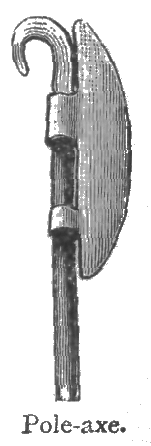
Pole-axe, pōl′-aks, n. a battle-axe consisting of an axe-head on a long handle: an axe used by sailors for cutting away rigging of ships. [Orig. pollax, from poll, the head, and axe.]
Polecat, pōl′kat, n. a kind of weasel, which emits a stink—called also the Fitchet and Foumart. [M. E. polcat; prob. Fr. poule, hen, and cat.]
Polemarch, pol′e-mark, n. a title of several officials in ancient Greek states.
Polemic, -al, po-lem′ik, -al, adj. given to disputing: controversial.—n. one who disputes: one who speaks or writes in opposition to another: a controversy.—adv. Polem′ically.—n.sing. Polem′ics, contest or controversy: (theol.) the history of ecclesiastical controversy.—n. Pol′emoscope, a perspective glass so constructed as to give views of objects not lying directly before the eye. [Gr. polemos, war.]
Polemoniaceæ, pol-e-mō-ni-ā′sē-ē, n.pl. a natural order of plants—the phlox family.
Polenta, po-len′ta, n. an Italian dish, the chief ingredients of which are maize, meal, and salt. [It.,—L. polenta, peeled barley.]
Poley, pō′li, adj. without horns: polled. [Prov. Eng.]
Polianthes, pol-i-an′thēz, n. a small genus of ornamental plants of the amaryllis family—the tuberose. [Gr. polios, white, anthos, a flower.]
Police, pō-lēs′, n. the system of regulations of a city, town, or district for the preservation of order and enforcement of law: the internal government of a state: (short for Police′-force) the civil officers employed to preserve order, &c.—v.t. to guard or maintain order in: to put in order.—n.pl. Police′-commiss′ioners, a body of men appointed to regulate the appointments and duties of the police.—ns. Police′-inspect′or, a superior officer of police who has charge of a department, next in rank to a superintendent; Police′-mag′istrate, one who presides in a police court; Police′man, a member of a police-force; Police′-off′ice, -stā′tion, the headquarters of the police of a district, used also as a temporary place of confinement; Police′-off′icer, -con′stable, a policeman; Police′-rate, a tax levied for the support of the police.—Police court, a court for trying small offences brought before it by the police. [Fr.,—L. politia—Gr. politeia, the condition of a state—politēs, a citizen—polis, a city.]
Policy, pol′i-si, n. the art or manner of regulating or guiding conduct: the method and forms according to which the government and business of a country are carried on: a system of administration guided more by interest than by principle: dexterity of management: prudence: cunning: in Scotland, (esp. in pl.) the pleasure-grounds around a mansion. [O. Fr. policie (Fr. police)—L. politia—Gr. politeia.]
Policy, pol′i-si, n. a warrant for money in the funds: a writing containing a contract of insurance: a kind of gambling by betting on the numbers to be drawn in a lottery.—n. Pol′icy-hold′er, one who holds a policy or contract of insurance. [Fr. police, a policy—L. polyptychum, a register—Gr. polyptychon—polys, many, ptyx, ptychos, fold.]
Poling, pō′ling, n. act of using a pole for any purpose.
Polish, pō′lish, adj. relating to Poland or to its people.
Polish, pol′ish, v.t. to make smooth and glossy by rubbing: to refine: to make elegant.—v.i. to become smooth and glossy.—n. a smooth, glossy surface: refinement of manners: anything used to produce a polish.—adjs. Pol′ishable; Pol′ished, made smooth by rubbing: trained to act with great fineness and exactness: refined: polite.—ns. Pol′isher, one who, or that which, polishes; Pol′ishing-paste, polishing material made in the form of paste; Pol′ishing-pow′der, polishing material made in the form of powder, as whiting, diamond-dust, &c.; Pol′ishing-slate, a mineral used for polishing glass, marble, and metals, composed chiefly of silica, with a little alumina, lime, oxide of iron, and water; Pol′ishment. [O. Fr. polir, polissant—L. polīre, to make to shine.]
Polite, pō-līt′, adj. polished: smooth: refined: well-bred: obliging.—adv. Polite′ly.—ns. Polite′ness, state or quality of being polite: refinement of manners: good-breeding; Politesse′, politeness. [L. politus, pa.p. of polīre.]
Politic, pōl′i-tik, adj. pertaining to policy: well-devised: judicious in management: skilled in political affairs: prudent: discreet: cunning: (Shak.) concerned with politics.—adj. Polit′ical, pertaining to polity or government: pertaining to nations, or to parties in a nation who differ in their views of how it ought to be governed: derived from government.—adv. Polit′ically.—ns. Polit′icaster (Milt.), a petty politician; Politic′ian, one versed in or devoted to politics: a man of artifice and cunning.—adj. (Milt.) politic.—adv. Pol′iticly.—n.sing. Pol′itics, the art or science of government: the management of a political party: political affairs or opinions.—adj. Pol′itique (Bacon), political, civil.—n. Pol′ity, the constitution of the government of a state or an institution: civil constitution: a body of people arranged under a system of government.—Political economy, the science which treats of the production, distribution, and consumption of wealth; Political science, the science or study of government, as to its principles, aims, methods, &c.—Body politic, the whole body of a people, as constituting a state. [Fr. politique—Gr. politikos—politēs, a citizen.]
Polka, pōl′ka, n. a dance of Bohemian origin, invented in 1830, and introduced into England in 1843—also its tune: a knitted jacket worn by women.—v.i. Polk, to dance a polka. [Bohem. pulka, half, from the half-step prevalent in it; or from Slav. polka, a Polish woman.]
Poll, pol, v.t. (Spens.) to exact from, to plunder.
Poll, pol, n. a familiar name, often of a parrot. [Contr. of Polly, a form of Molly=Mary.]
Poll, pōl, n. the round part of the head, esp. the back of it: a register of heads or persons: the entry of the names of electors who vote for civil officers, such as members of Parliament: an election of civil officers: the place where the votes are taken.—v.t. to remove the top: to cut: to clip: to lop, as the branches of a tree: to enter one's name in a register: to bring to the poll as a voter: to give or to receive a vote.—v.i. to give a vote.—ns. Poll′archy, government by the mob or masses; Poll′-book, a register of voters; Poll′-clerk, a clerk who assists at the polling of voters.—adj. Polled, deprived of a poll: lopped: cropped, hence bald: having cast the horns, hence wanting horns.—ns. Poll′er, one who polls; Poll′-man, one who takes the ordinary university degree, without honours; Poll′-tax, a tax by the poll or head—i.e. on each person.—At the head of the poll, having the greatest number of votes at an election. [Old Dut. polle, bol, a ball, top—Ice. kollr, top, head.]
Pollack, pol′ak, n. a common fish on British coasts, belonging to the cod, haddock, and whiting group.—Also Poll′ock. [Celt., as in Gael. pollag, a whiting.]
Pollan, pol′an, n. a fresh-water fish of the family Salmonidæ, a native of lakes in Ireland.
Pollard, pol′ard, n. a tree having the whole crown cut off, leaving it to send out new branches from the top of the stem: an animal without horns: a coarse kind of bran from wheat.—v.t. to make a pollard of. [Cf. Poll, the head.]
Pollaxe. Same as Poleaxe.
Pollen, pol′en, n. the fertilising powder contained in the anthers of flowers: the male or fecundating element in flowers.—v.t. to cover with pollen.—adj. Pollenā′rious, consisting of pollen.—v.t. Poll′enise, to supply with pollen.—n. Poll′en-tube, the tube by which the fecundating element is conveyed to the ovule.—adj. Poll′inar, covered with a fine dust like pollen.—v.t. Poll′inate, to convey pollen to the stigma of.—n. Pollinā′tion, the transferring or supplying of pollen to the stigma of a flower, esp. by aid of insects or other external agents.—adj. Pollinif′erous, bearing pollen.—n. Pollin′ium, an agglutinated mass of pollen grains.—adjs. Polliniv′orous, feeding upon pollen; Poll′inose, covered with a powdery substance like pollen. [L., fine flour.]
Pollent, pol′ent, adj. powerful: strong. [L. pollens, -entis, pr.p. of pollēre, to be strong.]
Pollex, pol′eks, n. the thumb or the great-toe:—pl. Pollices (pol′i-sēz).—adj. Poll′ical. [L., the thumb.]
Pollicitation, po-lis-i-tā′shun, n. a promise, a paper containing such: a promise without mutuality.
Polliwig, pol′i-wig, n. a tadpole.—Also Poll′ywig.
Pollusion, pol-lū′shun, n. (Shak.) for allusion.
Pollute, pol-lūt′, v.t. to soil: to defile: to make foul: to taint: to corrupt: to profane: to violate.—adj. defiled.—adj. Pollut′ed.—adv. Pollut′edly.—ns. Pollut′edness; Pollut′er; Pollū′tion, act of polluting: state of being polluted: defilement. [L. polluĕre, pollutus—pol, towards, luĕre, to wash.]
Pollux, pol′uks, n. (myth.) the twin brother of Castor: a star in the constellation of the twins. [L.]
Polly. See Poll (2).
Polo, pō′lo, n. an equestrian game, which may be shortly described as hockey on horseback—of Oriental origin and high antiquity.
Polo, pō′lo, n. a Spanish gipsy dance.
Polonaise, pō-lō-nāz′, n. a light kind of gown looped up at the sides to show an ornamented petticoat: a short overcoat bordered with fur: a Polish national dance of slow movement in ¾ time, during which the dancers march or promenade: music for such a dance. [Fr., 'Polish.']
Polony, po-lō′ni, n. a dry sausage made of meat partly cooked. [Prob. a corr. of Bologna sausage.]
Polt, pōlt, n. a blow.
Poltroon, pol-trōōn′, n. an idle, lazy fellow: a coward: a dastard: one without spirit.—adj. base, vile, contemptible.—n. Poltroon′ery, laziness: cowardice: want of spirit. [Fr. poltron—It. poltro (for polstro), lazy—Ger. polster, a bolster.]
Polverine, pol′vėr-in, n. the calcined ashes of a Levantine and Syrian plant, used in glass-making. [It. polverino—L. pulvis, pulvĕris, dust.]
Polyacoustic, pol-i-a-kowst′ik, adj. multiplying or magnifying sound.—n. an instrument for effecting this.
Polyact, pol′i-akt, adj. having numerous rays.—Also Polyac′tinal.
Polyad, pol′i-ad, n. (chem.) an element whose valence is greater than two.
Polyadelph, pol′i-a-delf, n. a plant having its stamens united in three or more bundles by the filaments.—n.pl. Polyadel′phia, the 18th class in the Linnæan system.—adjs. Polyadel′phian, Polyadel′phous.
Polyandria, pol-i-an′dri-a, n. a class of plants in the Linnæan system, having more than twenty stamens inserted on the receptacle.—adjs. Polyan′drian, Polyan′drous.—n. Polyan′dry, the social usage of some races in certain stages of civilisation in which the woman normally forms a union with several husbands. [Gr. polys, many, anēr, andros, a man.]
Polyanthus, pol-i-an′thus, n. a kind of primrose much prized and cultivated by florists:—pl. Polyan′thuses.—n. Polyan′thea, a note-book for keeping choice quotations. [Gr. polys, many, anthos, a flower.]
Polyarchy, pol′i-ar-ki, n. government by many persons of whatever class.—n. Pol′yarchist. [Gr. polys, many, archein, to rule.]
Polyatomic, pol-i-a-tom′ik, adj. (chem.) noting elements or radicals with an equivalency greater than two: with more than one atom in the molecule.
Polyautography, pol-i-aw-tog′ra-fi, n. the art of multiplying copies of one's own handwriting.
Polybasic, pol-i-bā′sik, adj. (chem.) capable of combining with more than two univalent bases.
Polycarpic, pol-i-kar′pik, adj. fruiting many times or year after year.
Polycarpous, pol-i-kar′pus, adj. having the fruit composed of two or more distinct carpels.
Polychord, pol′i-kord, adj. having many chords.
Polychrestic, pol-i-kres′tik, adj. admitting of use in various ways.—n. Pol′ychresty.
Polychroite, pol-i-krō′īt, n. safranine.
Polychromatic, pol-i-krō-mat′ik, adj. many-coloured—also Polychrō′mic.—adj. Pol′ychrome, having, or tinted with, several or many colours.—n. Pol′ychromy, decoration or execution in many colours, esp. of statuary or buildings.
Polycladous, pol-i-klā′dus, adj. much-branched.—n. Pol′yclādy, the production of a number of branches where there is normally but one.
Polycotyledon, pol-i-kot-i-lē′don, n. a plant whose embryo has more than two cotyledons or seed-lobes.—adj. Polycotylē′donous.
Polycracy, pō-lik′rā-si, n. government by many rulers.
Polycrotic, pol-i-krot′ik, adj. having several beats—of pulses.
Polydactyl, pol-i-dak′til, adj. having many digits.—n. a polydactyl animal.—n. Polydac′tylism, the condition of having many digits.—adj. Polydac′tylous.
Polydipsia, pol-i-dip′si-a, n. excessive thirst. [Gr. polys, much, dipsa, thirst.]
Polyergic, pol-i-er′jik, adj. acting in many ways.
Polyfoil, pol′i-foil, n. an opening or ornament consisting of several combined foliations, a combination of more than five foils.—Also adj.
Polygalaceæ, pol-i-gā-lā′sē-ē, n.pl. an order of polypetalous plants—the milkwort family.
Polygamy, pō-lig′a-mi, n. the practice of having more than one wife at the same time.—n.pl. Polygā′mia, the 23d class in the Linnæan system, embracing plants in which the stamens and pistils are separate in some flowers and associated in others.—adj. Polygā′mian.—n. Polyg′amist.—adj. Polyg′amous, relating to polygamy: (bot.) a term applied to plants which bear both unisexual and hermaphrodite flowers, either on the same or on different individual plants. [Gr.,—polys, many, gamos, marriage.]
Polygastric, pol-i-gas′trik, adj. having, or appearing to have, many stomachs, as an animalcule.—Also Polygas′trian.
Polygenesis, pol-i-jen′e-sis, n. origin from many separate germs: the theory that organisms sprang from different cells.—adjs. Polygenet′ic, Polygen′ic, Polyg′enous.—ns. Polyg′enism; Polyg′enist; Polyg′eny, the multiple genesis of man.
Polyglot, pol′i-glot, adj. having or containing many languages.—n. a collection of versions in different languages of the same work, esp. a Bible of this kind: one who understands many languages.—adjs. Polyglot′tic, Polyglot′tous. [Gr. polys, many, glōtta, the tongue.]
Polygon, pol′i-gon, n. a plane figure bound by a number of straight lines: a figure of many angles.—adjs. Polyg′onal, Polyg′onous. [L.,—Gr. polygōnon—polys, many, gōnia, a corner.]
Polygonum, po-lig′o-num, n. a kind of plant with many joints, as the bistort, knotweed, &c.—n.pl. Polygonā′ceæ, an order of apetalous plants, mostly herbs—the buckwheat family. [Gr. polys, many, gonu, a knee.]
Polygram, pol′i-gram, n. a figure consisting of many lines.—adj. Polygrammat′ic.
Polygraph, pol′i-graf, n. an instrument for multiplying copies of a writing: a collection of different books.—adjs. Polygraph′ic, -al.—n. Polyg′raphy, voluminous writing: art of writing in various ciphers.
Polygyny, pō-lij′i-ni, n. polygamy.—n. Pol′ygyn, a plant of the order Polygyn′ia (pl.), the 12th order in the first 13 classes of the Linnæan artificial system of plants, embracing those having flowers with more than twelve styles.—adjs. Polygyn′ian, Polygyn′ic, Polyg′ynous. [Gr. polys, many, gynē, woman.]
Polyhedron, pol-i-hē′dron, n. a solid body with many bases or sides.—adjs. Polyhē′dral, Polyhē′drical, Polyhē′drous. [Gr. polys, many, hedra, a base.]
Polyhistor, pol-i-his′tor, n. a person of great and varied learning.
Polyhymnia, pol-i-him′ni-a, n. the muse of the sublime hymn. [Gr. polys, many, hymnos, a hymn.]
Polymathy, pō-lim′a-thi, n. knowledge of many arts and sciences.—n. Pol′ymath, a person possessing this.—adj. Polymath′ic.—n. Polym′athist.
Polymerism, pō-lim′ėr-ism, n. a particular form of isomerism, the property possessed by several compounds of having similar percentage composition but different molecular weights. [Gr. polys, many, meros, part.]
Polymorphous, pol-i-mor′fus, adj. having many forms: varying in appearance: taking on many changes—also Polymor′phic.—ns. Pol′ymorph, an organism showing polymorphism: a substance that crystallises in two or more systems; Polymor′phism, the property of being polymorphous. [Gr. polys, many, morphē, form.]
Polynesian, pol-i-nē′zi-an, adj. pertaining to Polynesia, the numerous groups of islands in the Pacific within or near the tropics.—n. a native of Polynesia. [Gr. polys, many, nēsos, an island.]
Polynomial, pol-i-nō′mi-al, n. an algebraic quantity of many names or terms—same as multinomial—also Pol′ynome.—adj. of many names or terms.—n. Polynō′mialism. [Gr. polys, many, L. nomen, a name.]
Polyonymous, pol-i-on′i-mus, adj. having many names.—n. Pol′yonym, a name consisting of several terms.—adjs. Polyon′ymal; Polyonym′ic, of more than two terms.—ns. Polyon′ymist; Polyon′ymy, multiplicity of names for the same object.
Polyopia, pol-i-ō′pi-a, n. multiple vision.—Also Pol′yopy.
Polyoptrum, pol-i-op′trum, n. a glass through which objects appear multiplied but diminished.—Also Polyop′tron.
Polyorama, pol-i-ō-ra′ma, n. an optical apparatus presenting many views.
Polyp, Polype, pol′ip, n. a name usually applied to an animal like the fresh-water hydra, having a tubular body, and a wreath of many tentacles round the mouth: something with many feet or roots: a pedunculated tumour attached to the surface of a mucous membrane—in the nose, &c.—also Pol′ypus:—pl. Polypes (pol′ips), Polypi (pol′i-pī).—ns. Pol′ypary, the horny or chitonous outer covering of a colony of polyps; Pol′ypide, an individual zoöid of a polyzoarium or compound polyzoan; Polyp′idom, an aggregate of polypites or polypides; Pol′ypier, one individual of a compound polyp: a polypidom, polypary, or polyp-stock.—adj. Pol′ypous. [Gr. polypous—polys, many, pous, foot.]
Polypetalous, pol-i-pet′al-us, adj. with many petals. [Gr. polys, many, petalon, a leaf.]
Polyphagous, pō-lif′a-gus, adj. eating many different kinds of food.
Polypharmacy, pol-i-fär′ma-si n. the prescribing of too many medicines.
Polyphlœsbœan, pol-i-fles-bē′an, adj. loud-roaring. [Homer's frequent description of the sea, polys, much, phloisbos, noise.]
Polyphonic, pol-i-fon′ik, adj. capable of being read in more than one way: noting a musical composition of two or more parts, each with an independent melody of its own.—ns. Pol′yphōnism, Polyph′ony; Pol′yphōnist, a ventriloquist: a contrapuntist. [Gr. polys, many, phōnē, a voice.]
Polyphyletic, pol-i-fī-let′ik, adj. pertaining to many tribes or families: pertaining to the theory that animals are derived from several sources.
Polyphyllous, pol-i-fil′us, adj. many-leafed.
Polyplastic, pol-i-plas′tik, adj. having or assuming many forms.
Polypode, pol′i-pōd, n. an animal with many feet. [Gr. polypous—polys, many, pous, podos, a foot.]
Polypodium, pol-i-pō′di-um, n. a genus of ferns with spore-cases on the back of the frond, distinct, ring-shaped, in roundish sori, destitute of indusium.—n. Pol′ypody, a fern of the genus Polypodium, having the seed-clusters round, and on each side of the midrib. [Gr. polys, many, pous, a foot.]
Polyporous, pō-lip′ō-rus, adj. having many pores.
Polyporus, pō-lip′or-us, n. a large genus of pore-bearing fungus, which grows on trees, from which amadou is prepared. [Gr. polys, many, poros, a passage.]
Polypterus, pō-lip′te-rus, n. a genus of Ganoid fishes of one species, in the Nile and elsewhere. [Gr. polys, many, pteron, a wing.]
Polyrhizous, pol-i-rī′zus, adj. possessing numerous rootlets.—Also Polyrhī′zal.
Polyscope, pol′i-skōp, n. a multiplying lens: (surg.) an instrument for throwing light into cavities of the body.
Polysepalous, pol-i-sep′a-lus, adj. having the sepals separate from each other.
Polysperm, pol′i-sperm, n. a tree whose fruit contains many seeds.—adjs. Polysper′mal, Polysper′mous, containing many seeds.
Polysporous, pol-i-spō′rus, adj. producing many spores.
Polystigmous, pol-i-stig′mus, adj. having many carpels.
Polystome, pol′i-stōm, n. an animal with many mouths.—adj. Polystom′atous.
Polystyle, pol′i-stīl, adj. having many columns.—adj. Polysty′lous.
Polysyllable, pol′i-sil-a-bl, n. a word of many or of more than three syllables.—adjs. Polysyllab′ic, -al.—ns. Polysyllab′icism, Polysyll′abism.
Polysyllogism, pol-i-sil′ō-jizm, n. a combination of syllogisms.—adj. Polysyllogis′tic.
Polysymmetrical, pol-i-si-met′ri-kal, adj. divisible into exactly similar halves by more than one plane.—adv. Polysymmet′rically.—n. Polysym′metry.
Polysyndeton, pol-i-sin′de-ton, n. (rhet.) figurative repetition of connectives or conjunctions.
Polysynthetic, -al, pol-i-sin-thet′ik, -al, adj. made up of many separate elements: formed by the combination of many simple words, as words in the native languages of America.—n. Polysyn′thesis.—adv. Polysynthet′ically.—ns. Polysynthet′icism, Polysyn′thetism, the character of being polysynthetic.
Polytechnic, -al, pol-i-tek′nik, -al, adj. comprehending many arts.—n. an exhibition of objects illustrating many arts: an institution in which many arts are taught.—ns. Polytech′nics, the science of the mechanical arts; Polytech′nique, or Polytechnic school, an industrial school in which the technical sciences that rest in great part upon a mathematical basis, such as engineering, architecture, &c., are taught. [Gr. polys, many, technē, an art.]
Polythalamous, pol-i-thal′a-mus, adj. having many cells or chambers.
Polytheism, pol′i-thē-izm, n. the doctrine of a plurality of gods.—v.i. Pol′ytheise, to adhere to, or conform to, polytheism.—n. Pol′ytheist, a believer in many gods.—adjs. Polytheist′ic, -al.—adv. Polytheist′ically. [Gr. polys, many, theos, a god.]
Polytocous, pō-lit′ō-kus, adj. producing many or several at a birth.
Polytrichum, pō-lit′ri-kum, n. a genus of mosses, widely distributed in north temperate and arctic countries.—adj. Polyt′richous, very hairy, densely ciliate. [Gr. polys, many, thrix, thrichos, hair.]
Polytype, pol′i-tīp, n. a cast or fac-simile of an engraving, matter in type, &c., produced by pressing a wood-cut or other plate into semi-fluid metal.—v.t. to reproduce by polytypage—also adj.—n. Pol′ytypage, stereotyping by the above method.
Polyzoa, pol-i-zō′a, n.pl. a class of animals forming a crust on stones, shells, &c. under water:—sing. Polyzō′an, Polyzō′on.—adjs. Pol′yzoan, Polyzoā′rial.—ns. Polyzoā′rium, a compound polyzoan; Polyzō′ary, the polypary or polypidom of a polyzoan.—adjs. Polyzō′ic, filled with imaginary animals, zoolatrous; Polyzō′öid, consisting of many zoöids. [Gr. polys, many, zōon, an animal.]
Polyzonal, pol-i-zō′nal, adj. composed of many zones or belts.
Pomade, po-mād′, n. a preparation of fine inodorous fat, such as lard or suet, used instead of liquid oil for the hair—also Pomā′tum.—v.t. to anoint with pomade. [Fr. pommade—It. pomada, pommata, lip-salve—L. pomum, an apple.]
Pomander, pō-man′dėr, n. (Shak.) a perfumed ball, or box containing perfumes, formerly supposed to ward off infection. [O. Fr. pomme d'ambre, apple of amber.]
Pome, pōm, n. an apple or a fruit like an apple: a small globe of silver or the like, filled with hot water, on which in cold weather the priest at mass warms his numbed hands.—n. Pom′ace, the substance of apples or similar fruit: fish-scrap.—n.pl. Pomā′ceæ, a suborder of Rosaceæ—the apple family—also Pome′æ.—adj. Pomā′ceous, relating to, consisting of, or resembling apples: like pomace.—ns. Pome′-cit′ron, a variety of apple; Pom′eroy, the king-apple; Pome′-wa′ter (Shak.), a sweet, juicy apple; Pomicul′ture, pomology.—adjs. Pomif′erous (bot.), pome-bearing, applied to all plants producing the larger fruits, as distinguished from berry-bearing; Pomolog′ical.—ns. Pomol′ogist; Pomol′ogy, the science of garden-fruits. [L. pomum, an apple.]
Pomegranate, pom′gran-āt, n. a fruit much cultivated in warm countries, as large as a medium-sized orange, having a thick leathery rind filled with numerous seeds. [O. Fr. pome grenate—L. pomum, an apple, granatum, having many grains.]
Pomeranian, pom-e-rā′ni-an, adj. pertaining to Pomerania in northern Prussia.—Pomeranian, or Spitz, dog, a cross from the Eskimo dog, about the size of a spaniel, with a sharp-pointed face and an abundant white, creamy, or black coat.
Pomfret-cake, pom′fret-kāk, n. a liquorice-cake. [Pontefract in Yorkshire.]
Pommel, pum′el, n. a knob or ball: the knob on a sword-hilt: the high part of a saddle-bow.—v.t. to beat as with a pommel, or with anything thick or heavy: to beat soundly: to bruise:—pr.p. pomm′elling; pa.t. and pa.p. pomm′elled.—adjs. Pomm′eled, Pomm′elled (her.), having a rounded knob ending in a smaller one; Pomm′etty, ending in a small knob, esp. of a cross—also Pomm′elé. [O. Fr. pomel (Fr. pommeau)—L. pomum, an apple.]
Pomona, pom-ō′na, n. the goddess of fruit and garden produce. [L.—pomum, fruit, apple.]
Pom-pom, pom-pom, n. the name given to a one-pounder quick-firing shell gun, from its sound.
Pomp, pomp, n. a splendid procession: great show or display: ceremony: splendour: ostentation: grandeur.—adv. Pompō′so (mus.), in a dignified style.—adj. Pomp′ous, displaying pomp or grandeur: grand: magnificent: dignified: boastful, self-important.—adv. Pomp′ously.—ns. Pomp′ousness, Pompos′ity. [Fr. pompe—L. pompa—Gr. pompē—pempein, to send.]
Pompadour, pom′pa-dōōr, n. an 18th-century head-dress, a fashion of dressing women's hair by brushing it up from the forehead and rolling it over a cushion: a corsage with low square neck: a pattern for silk, with leaves and flowers pink, blue, and gold. [Marquise de Pompadour, 1721-64.]
Pompeian, pom-pē′an, adj. pertaining to Pompeii, a city buried by an eruption of Mount Vesuvius in 79 A.D., excavated since 1755.—n. Pompei′an-red, a red colour like that on the walls of Pompeian houses.
Pompelmoose, pom′pel-mōōs, n. the shaddock.—Also Pom′pelmous, Pom′pelo, Pum′elo.
Pompholyx, pom′fō-liks, n. a vesicular eruption chiefly on the palms and soles. [Gr.,—pomphos, a blister.]
Pompion=Pumpion.
Pompon, pom′pon, n. a tuft of feathers, &c., for a hat, the coloured woollen ball on the front of a shako. [Fr.]
Ponceau, pon-sō′, n. a corn-poppy: corn-poppy colour.
Ponceau, pon-sō′, n. a small bridge or culvert. [Fr.]
Poncho, pon′chō, n. a cloak worn by South American Indians, a blanket with a hole in the middle for the head: camlet or strong worsted.
Pond, pond, v.i. (Spens.) to ponder.
Pond, pond, n. a pool of standing water.—v.t. to make into a pond.—v.i. to collect into a pond.—ns. Pon′dage, the amount of water in a pond; Pond′-lil′y, a plant of the aquatic genus Nymphæa; Pond′-tur′tle, a terrapin, a mud turtle; Pond′weed, a common aquatic herb. [From A.S. pyndan, to shut in, thus a doublet of pound, an enclosure.]
Ponder, pon′dėr, v.t. to weigh in the mind: to think over: to consider.—v.i. to think (with on and over).—ns. Ponderabil′ity, Pon′derableness.—adjs. Pon′derable, that may be weighed: having sensible weight; Pon′deral, ascertained by weight.—ns. Pon′derance, Ponderā′tion, weight; Pon′derer, one who ponders.—adv. Pon′deringly.—ns. Pon′derling, a thing of little weight; Pon′derment, the act of pondering.—adj. Pon′derous, weighty: massive: forcible: important: clumsy or unwieldy by reason of weight.—adv. Pon′derously.—ns. Pon′derousness, Ponderos′ity, weight: heaviness: heavy matter. [L. ponderāre—pondus, pondĕris, a weight.]
Pone, pōn, n. (U.S.) bread made from Indian corn.
Ponent, pō′nent, adj. (Milt.) western.
Ponerology, pon-ē-rol′ō-ji, n. (theol.) the doctrine of wickedness. [Gr. ponēros, bad.]
Pongee, pon-jē′, n. a soft kind of silk, woven in China from the cocoons of a wild silkworm. [Chin.]
Pongo, pong′gō, n. a large anthropoid ape of Borneo.
Poniard, pon′yard, n. a small dagger for stabbing.—v.t. to stab with a poniard. [Fr. poignard—poing, fist (It. pugno)—L. pugnus.]
Ponk, pongk, n. (Spens., Shak.) a nocturnal spirit. [A false reading for pouke=Puck.]
Pons, ponz, n. (anat.) a part connecting two parts.—adjs. Pon′tic, Pon′tile, relating to the pons of the brain.—Pons asinōrum, the asses' bridge, a name given to Euclid, i. 5. [L., a bridge.]
Pontage, pont′āj, n. a toll paid on bridges: a tax for repairing bridges. [Low L. pontagium—L. pons, pontis, a bridge.]
Pontic, pon′tik, adj. pertaining to the Pontus, Euxine, or Black Sea, or the regions round it.
Pontiff, pon′tif, n. (R.C.) a bishop, esp. the pope—originally an ancient Roman high-priest, the Pon′tifex.—adjs. Pontif′ic, -al, of or belonging to a pontiff or to a bishop, esp. the pope: splendid: magnificent.—n. Pontif′ical, an office-book of ecclesiastical ceremonies proper to a bishop.—adv. Pontif′ically.—n.pl. Pontif′icals, the dress of a priest, bishop, or pope.—n. Pontif′icate, the dignity of a pontiff or high-priest: the office and dignity or reign of a pope.—v.i. to perform the duties of a pontiff.—n. Pon′tifice (Milt.), bridge-work, a bridge.—Pontifical mass, mass celebrated by a bishop while wearing his full vestments. [Fr. pontife—L. pontifex, pontificis—pons, pont-is, a bridge, facĕre, to make.]
Pontil, pon′til, n. an iron rod used in glass-making for revolving the glass while soft.—Also Pontee′, Pon′ty. [Fr.,—point, a point.]
Pontinal, pon′ti-nal, adj. bridging.—n. a bone of the skull of some fishes.
Pontlevis, pont-lev′is, n. a drawbridge. [Fr.]
Pontoon, pon-tōōn′, n. a flat kind of boat used in forming a bridge for the passage of an army: a bridge of boats: a lighter or barge used for loading or unloading ships—also Pon′ton.—ns. Pontonier′, Pontonnier′, one who has charge of a pontoon; Pontoon′-bridge, a platform or roadway supported upon pontoons. [Fr. ponton—L. pons, a bridge.]
Pony, pō′ni, n. a small horse—one less than 13 hands high: (slang) £25: a key or translation of the writings of an author: a small glass of beer.—v.t. to use a crib in translating.—ns. Pō′ny-carr′iage, a small carriage drawn by one or more ponies; Pō′ny-en′gine, a small engine used for shunting wagons, &c.—Jerusalem pony, an ass. [Prob. Gael. poniadh.]
Pood, pōōd, n. a Russian weight, 36 lb. avoirdupois.
Poodle, pōō′dl, n. one of a breed of small curly-haired pet dogs, intelligent and affectionate. [Ger. pudel; Low Ger. pudeln, to waddle.]
Pooh, pōō, interj. of disdain.—v.t. Pooh′-pooh, to express contempt for: to sneer at. [Imit.]
Pool, pōōl, n. a small body of water: a deep part of a stream of water.—n. Pool′er, a stick for stirring a tan-vat. [A.S. pól (Dut. poel, Ger. pfuhl)—Celt., as Ir. and Gael. poll, W. pwll.]
Pool, pōōl, n. the receptacle for the stakes in certain games: the stakes themselves: a set of players at quadrille, &c.: a game played on a billiard-table with six pockets by two or more persons.—v.t. to put into a common fund for redistribution.—v.i. to form a pool. [Fr. poule, orig. a hen—L. pullus, a young animal.]
Poon, pōōn, n. name of a tree of India and Burma, very commonly used in the East Indies, particularly in shipbuilding, for planks and spars.—n. Poon′-wood, the wood of the tree.
Poonac, pōō′nak, n. the cake left after expressing oil from coco-nut pulp.
Poop, pōōp, n. the hinder part of a ship: a deck above the ordinary deck in the after part of a ship.—v.t. to strike the stern, break in the stern of. [Fr. poupe—L. puppis, the poop.]
Poor, pōōr, adj. having little or nothing: without means: needy: spiritless: depressed: (B.) humble: contrite: wanting in appearance: lean: wanting in strength: weak: wanting in value: inferior: wanting in fertility: sterile: wanting in fitness, beauty, or dignity: trifling: paltry: dear (endearingly).—ns. Poor′house, a house established at the public expense for sheltering the poor: an almshouse; Poor′john (Shak.), a coarse kind of fish, the hake when salted.—n.pl. Poor′-laws, laws providing for the support of the poor.—adv. Poor′ly.—ns. Poor′ness; Poor′-rate, a rate or tax for the support of the poor; Poor′-Rob′in, an almanac; Poor's′-box, a box for receiving contributions to the poor.—adj. Poor′-spir′ited, cowardly: mean.—ns. Poor′-spir′itedness, cowardice; Poor's′-roll (Scots law), the list of poor persons who are litigants, but unable to pay the expenses of litigation, and therefore are allowed to sue in formâ pauperis.—Poor man of mutton (Scot.), cold mutton broiled, esp. the shoulder; Poor man's herb, the hedge-hyssop; Poor Will, a common American bird of the genus Phalænoptilus.—The poor, poor people collectively: those depending on public or private charity. [O. Fr. poure, povre (Fr. pauvre)—L. pauper, poor.]
Poortith, pōōr′tith, n. (Scot.) poverty.
Pop, pop, v.i. to make a sharp, quick sound: to dart: to move quickly: to propose marriage.—v.t. to cause to make a sudden report: to thrust suddenly: to bring suddenly into notice: (slang) to pawn:—pr.p. pop′ping; pa.t. and pa.p. popped.—n. a sharp, quick sound or report: an effervescent beverage: (slang) a pistol.—adv. suddenly.—adj. coming without warning.—v.t. Pop′-corn, to parch maize till it bursts open.—n. corn so prepared.—n.pl. Pop′-eyes, prominent eyes.—ns. Pop′-gun, a tube and rammer for shooting pellets, which makes a noise by the expansion of compressed air; Pop′per, anything that makes a popping sound; Pop′-shop, a pawnshop; Pop′-weed, a name for the bladderwort.—Pop off, to disappear all at once; Pop the question, to make an offer of marriage. [Imit.]
Pope, pōp, n. the bishop of Rome, head of the R.C. Church: a priest of the Eastern Church: the autocratic head of any church or organisation.—ns. Pope′dom, office, dignity, or jurisdiction of the pope; Pope′hood, Pope′ship, the condition of being pope; Pope′ling, a little pope; Pop′ery, the religion of which the pope is the head: Roman Catholicism; Pope's′-eye, the gland surrounded with fat in the middle of the thigh of an ox or a sheep; Pope's′-head, a long-handled brush; Pope's′-nose, the fleshy part of a bird's tail.—adj. Pop′ish, relating to the pope or to popery: taught by popery.—adv. Pop′ishly.—Pope Joan, a game at cards in which the eight of diamonds is removed. [A.S. pápa—L. papa, a father.]
Pope, pōp, n. a kind of perch. [Ety. obscure.]
Popinjay, pop′in-jā, n. a parrot: a mark like a parrot, put on a pole to be shot at: a fop or coxcomb. [O. Fr. papegai—Low L. papagallus—Late Gr. papagas, a parrot; prob. Eastern.]
Popjoying, pop′joi-ing, n. sport: amusement. [Perh. conn. with popinjay.]
Poplar, pop′lar, n. a tree common in the northern hemisphere, of rapid growth, and having diœcious flowers arranged in catkins, both male and female flowers with an oblique cup-shaped perianth. [O. Fr. poplier—L. pōpulus, poplar-tree.]
Poplin, pop′lin, n. a kind of cloth consisting of a warp of silk and a weft of worsted, the latter, being thicker than the former, giving a corded appearance. [Fr. popeline. Ety. unknown.]
Popliteal, pop-li-tē′al, adj. of or pertaining to the back of the knee.—Also Poplit′ic. [L. poples, poplitis, the hock.]
Poppet, pop′et, n. a puppet: a piece of timber used to support a vessel while being launched: one of the heads of a lathe. [Puppet.]
Popple, pop′l, v.i. to flow, to bob up and down.
Poppy, pop′i, n. a plant having large showy flowers, from one species of which opium is obtained.—adj. Popp′ied, covered or filled with poppies: listless, as the effects of opium.—ns. Popp′y-head, a carved ornament in wood, often finishing the end of a pew; Popp′y-oil, a fixed oil from the seeds of the opium-poppy. [A.S. popig—L. papaver, poppy.]
Populace, pop′ū-lās, n. the common people: those who are not distinguished by rank, education, office, &c. [Fr.,—It. popolazzo—L. populus, people.]
Popular, pop′ū-lar, adj. pertaining to the people: pleasing to, or prevailing among, the people: enjoying the favour of the people: easily understood: inferior: (Shak.) vulgar.—n. Popularisā′tion.—v.t. Pop′ularise, to make popular or suitable to the people: to spread among the people.—ns. Pop′ulariser; Popular′ity, Pop′ularness, quality or state of being popular or pleasing to the people: favour with the people: a desire to obtain favour with the people.—adv. Pop′ularly.—v.t. Pop′ulāte, to people: to furnish with inhabitants.—v.i. to increase in numbers.—adj. populous.—n. Populā′tion, act of populating: the number of the inhabitants of any place.—adj. Pop′ulous, full of people: numerously inhabited: (Shak.) numerous.—adv. Pop′ulously.—n. Pop′ulousness. [Fr. populaire—L. popularis—populus, the people.]
Poral, pō′ral. See Pore.
Porbeagle, por-bē′gl, n. a kind of tope or mackerel-shark. [Fr. porc, a hog + Eng. beagle.]
Porcate, por′kāt, adj. ridged.
Porcelain, pors′lān, n. a fine earthenware, white, thin, semi-transparent, first made in China: china-ware.—adj. of the nature of porcelain.—adjs. Por′celānous, Porcellā′neous, Por′cellānous.—n. Por′cellanite, a very hard, impure, jaspideous rock.—Cast, or Fusible, porcelain, a milky glass made of silica and cryolite with oxide of zinc; Egg-shell porcelain, an extremely thin and translucent porcelain; False porcelain, a name given to the artificial or soft-paste porcelain; Frit porcelain, a name given to artificial soft-paste English porcelain, from its vitreous nature; Tender porcelain, a ware imitating hard-paste or natural porcelain. [O. Fr. porcelaine—It. porcellana, the Venus' shell—L. porcella, a young sow—porcus, a pig.]
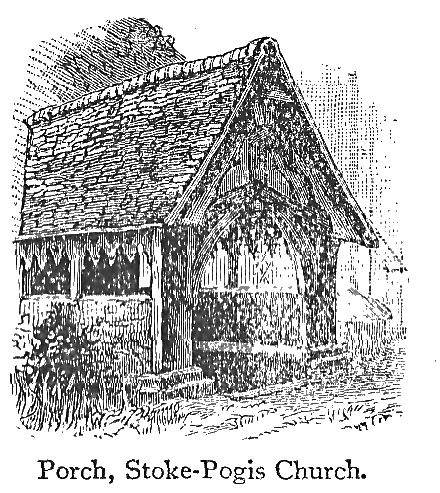
Porch, pōrch, n. a building forming an enclosure or protection for a doorway: a portico at the entrance of churches and other buildings: the public porch on the agora of Athens where Zeno the Stoic taught: (fig.) the Stoic philosophy. [O. Fr. porche (It. portico)—L. porticus—porta, a gate.]
Porcine, por′sīn, adj. pertaining to or resembling swine: swinish. [L. porcinus—porcus, a swine.]
Porcupine, por′kū-pīn, n. one of the largest of rodent quadrupeds, covered with spines or quills. [O. Fr. porc espin—L. porcus, a pig, spina, a spine.]
Pore, pōr, n. a minute passage in the skin for the perspiration: an opening between the molecules of a body.—adjs. Pō′ral, of or pertaining to pores; Pō′riform, in the form of a pore.—ns. Pō′riness, Poros′ity, Pō′rousness, quality of being porous—opp. to Density.—adjs. Pō′rose, containing pores; Pō′rous, Pō′ry, having pores: that can be penetrated by fluid.—adv. Pō′rously. [Fr.,—L. porus—Gr. poros, a passage.]
Pore, pōr, v.i. to look with steady attention on: to study closely.—n. Pō′rer. [Peer, to peep.]
Porgy, Porgie, por′ji, n. a fish of the genus Pagrus.
Porifera, pō-rif′e-ra, n.pl. sponges:—sing. Por′ifer.—adjs. Porif′eral, Porif′erous. [L. porus, a pore, ferre, to bear.]
Porism, por′ism, n. a proposition affirming the possibility of finding such conditions as will render a certain problem capable of innumerable solutions.—adjs. Porismat′ic, -al; Poris′tic, -al, reducing a determinate problem to an indeterminate. [Gr. porizein, to procure—poros, a way.]
Pork, pōrk, n. the flesh of swine: (Milt.) a stupid fellow.—ns. Pork′-butch′er, one who kills pigs; Pork′-chop, a slice from a pig's rib; Pork′er, a young hog: a pig fed for pork; Pork′ling, a young pig; Pork′-pie, a pie made of pastry and minced pork.—adj. Pork′y, fat.—Pork-pie hat, a hat somewhat like a pie in shape worn by men and women about the middle of the 19th century. [Fr. porc—L. porcus, a hog.]
Pornocracy, pōr-nok′rā-si, n. the influence of courtezans—applied esp. to the dominant influence of certain profligate women over the Papal court in the earlier half of the 10th century.—ns. Por′nograph, an obscene picture or writing; Pornog′rapher, a writer of such.—adj. Pornograph′ic.—n. Pornog′raphy, the discussion of prostitution: obscene writing. [Gr. pornē, a whore, kratein, to rule.]
Porosis, pō-rō′sis, n. formation of callus, the knitting together of broken bones.
Porotype, pō′rō-tīp, n. a copy of an engraved print made by placing it on chemically prepared paper and subjecting to the action of a gas. [Gr. poros, a pore, typos, an impression.]
Porpentine, por′pen-tīn, n. (Shak.) a porcupine.
Porpess, Porpesse, por′pes, n. Same as Porpoise.
Porphyrio, por-fir′i-ō, n. a genus of Rallidæ, the hyacinthine gallinules.
Porphyrogenitus, por-fir-ō-jen′i-tus, n. a title given to the Byzantine emperor, Constantine VII. (912-959), meaning 'born in the purple.'—n. Porphyrogen′itism, the Byzantine principle of the first son born after his father's accession succeeding to the throne. [Gr. porphyra, purple, gennain, to beget.]
Porphyry, por′fir-i, n. a very hard, variegated rock, of a purple and white colour, used in sculpture (porfido rosso antico): an igneous rock having a ground-mass enclosing crystals of feldspar or quartz.—v.t. Por′phyrise, to cause to resemble porphyry: to make of a spotted appearance.—n. Por′phyrite, one of the crystalline igneous rocks, which consists principally of plagioclase.—adjs. Porphyrit′ic, Porphyrā′ceous, resembling or consisting of porphyry.—n. Por′phyroid, a crystalline and schistose rock containing porphyritic crystals of feldspar. [Through Fr. and L. from Gr. porphyrites—porphyra, purple.]
Porpoise, por′pus, n. a genus of Cetecea in the family Delphinidæ, 4 to 8 feet long, gregarious, affording oil and leather—anciently Por′pess. [O. Fr. porpeis—L. porcus, a hog, piscis, a fish.]
Porporino, por-pō-rē′nō, n. an old alloy of quicksilver, tin, and sulphur, used in place of gold. [It.]
Porraceous, po-rā′shus, adj. greenish like the leek. [L. porrum, a leek.]
Porrection, po-rek′shun, n. the action of delivering as by outstretched hands.—adj. Porrect′, extended forward. [L., porrigĕre, to stretch out.]
Porridge, por′ij, n. a kind of pudding usually made by slowly stirring oatmeal amongst boiling water: a kind of broth, made by boiling vegetables in water. [Through O. Fr., from Low L. porrata—L. porrum, a leek. The affix -idge (= -age) arose through confusion with pottage.]
Porrigo, po-rī′gō, n. a general name for various skin diseases.—adj. Porrig′inous. [L.]
Porringer, por′in-jėr, n. a small dish for porridge: (Shak.) a head-dress shaped like such a dish.—Also Porr′enger. [From porrige=porridge, with inserted n as in passenger.]
Port, pōrt, n. the larboard or left side of a ship.—v.t. to turn to the left, as the helm.—v.i. to turn to larboard or left. [Ety. dub.]
Port, pōrt, n. martial music on the bagpipes. [Gael.]
Port, pōrt, n. bearing: demeanour: carriage of the body.—v.t. to hold, as a musket, in a slanting direction upward across the body.—ns. Portabil′ity, Port′ableness, the state of being portable.—adj. Port′able, that may be carried: not bulky or heavy.—ns. Port′age, act of carrying: carriage: price of carriage: a space between two rivers, canals, &c., over which goods and boats have to be carried; Port′ance (Spens.), carriage, bearing.—adjs. Por′tāte (her.), in a position as if being carried; Por′tatile, portable; Por′tative, easily carried.—ns. Port′-cray′on, a metallic handle for holding a crayon; Porte′-bonheur′, a charm carried for luck; Porte′-cochère, a carriage entrance leading from the street into a building; Porte′-mon′naie, a small clasped pocket-book for holding money; Port′-fire, a slow-match or match-cord. [Fr.,—L. portāre, to carry.]
Port, pōrt, n. a harbour: a haven or safe station for vessels: a place from which vessels start, and at which they finish their voyages.—n. Port′-ad′miral, the admiral commanding at a naval port.—n.pl. Port′-charg′es, payments which a ship has to pay while in harbour.—n. Port′-ward′en, the officer in charge of a port: a harbour-master.—Port of call, a port where vessels can call for stores or repairs; Port of entry, a port where merchandise is allowed by law to enter.—Free port, a port where no duty has to be paid on landing goods. [A.S. port—L. portus; akin to L. porta, a gate.]
Port, pōrt, n. a gate or entrance, esp. of a walled town: an opening in the side of a ship for light or air: an opening through which guns can be fired: the lid of a porthole: a passage in a machine for oil, steam, &c.—n. Port′age (Shak.), an opening. [Fr. porte—L. porta, gate.]
Port, pōrt, n. a dark-red wine from Oporto, Portugal.
Porta, pōr′ta, n. the part of an organ where its vessels and ducts enter, esp. the transverse fissure of the liver: the foramen of Monro.
Portal, pōrt′al, n. a small gate: any entrance: (archit.) the arch over a gate: the lesser of two gates.—Portal circulation, the capillary transmission of venous blood from one organ to another in its passage to the heart; Portal system, the portal vein with its tributaries, &c.; Portal vein, the vein which conveys to the liver the venous blood from intestines, spleen, and stomach. [O. Fr. (Fr. portail)—Low L. portale—L. porta, a gate.]
Portcullis, pōrt-kul′is, n. a sliding door of cross timbers pointed with iron, hung over a gateway, so as to be let down in a moment to keep out an enemy: (her.) a lattice: one of the pursuivants of the English College of Heralds: an Elizabethan coin bearing a portcullis on the reverse.—v.t. to obstruct, as with a portcullis. [O. Fr. portecoulisse—porte, a gate, coulisse, a groove—L. colāre, to strain.]
Porte, pōrt, n. the Turkish government, so called from the 'High Gate,' or 'Sublime Porte,' the chief office of the Ottoman government.
Portend, por-tend′, v.t. to indicate the future by signs: to betoken: presage.—n. Por′tent, that which portends or foreshows: an evil omen.—adj. Portent′ous, serving to portend: foreshadowing ill: wonderful, dreadful, prodigious.—adv. Portent′ously. [L. portendĕre, portentum—pro, forth, tendĕre, to stretch.]
Porter, pōrt′ėr, n. a door-keeper or gate-keeper: one who waits at the door to receive messages:—fem. Port′eress, Port′ress.—n. Port′erage, the office or duty of a porter.—Porter's lodge, a house or an apartment near a gate for the use of the porter. [O. Fr. portier—Low L. portarius—L. porta, a gate.]
Porter, pōrt′ėr, n. one who carries burdens for hire: a dark-brown malt liquor, prob. because a favourite drink with London porters.—ns. Port′erage, carriage: charge made by a porter for carrying goods; Port′er-house, a restaurant; Port′erhouse-steak (U.S.), a choice cut of beef-steak next to the sirloin.—adv. Port′erly, like a porter: coarse. [O. Fr. porteur—L. portāre, to carry.]
Portfolio, pōrt-fō′li-ō, n. a portable case for loose papers, drawings, &c.: a collection of such papers: the office of a minister of state. [Sp. portafolio—L. portāre, to carry, folium, a leaf.]
Porthole, pōrt′hōl, n. a hole or opening in a ship's side for light and air, or for pointing a gun through. [Port, a gate, and hole.]
Portico, pōr′ti-kō, n. (archit.) a range of columns in the front of a building: a colonnade: a porch before the entrance to a building: the Stoic philosophy:—pl. Por′ticoes, Por′ticos.—adj. Por′ticoed, furnished with a portico. [It.,—L. porticus, a porch.]
Portière, por-tyār′, n. a curtain hung over the door or doorway of a room. [Fr.]
Portiforium, pōr-ti-fō′ri-um, n. a breviary:—pl. Portifō′ria.—Also Port′fory, Port′ous, Port′uary.
Portify, pōr′ti-fī, v.t. (hum.) to give one's self undue importance. [Port, the wine of that name, -fy, from L. facĕre, to make, from the saying, 'Claret would be port if it could.']
Portion, pōr′shun, n. a part: an allotment: fate: destiny: dividend: the part of an estate descending to an heir: a wife's fortune.—v.t. to divide into portions: to allot a share: to furnish with a portion.—adj. Por′tioned, having a portion or endowment.—ns. Por′tioner, one who portions or assigns shares: (Scots law) the occupier of a small feu or portion of land: one of two or more incumbents on a benefice at one time; Por′tionist, one who has an academical allowance: the incumbent of a benefice which has more than one rector or vicar.—adj. Por′tionless, having no portion, dowry, or property.—Marriage portion, a gift given by a parent or guardian to a bride on her marriage. [O. Fr.,—L. portio, portionis, akin to pars, a part.]
Portland vase. See Vase.
Portly, pōrt′li, adj. having a dignified port or mien: corpulent: (Shak.) swelling.—n. Port′liness, state of being portly. [Port, bearing.]
Portman, pōrt′man, n. an inhabitant of a port-town, or one of the Cinque Ports.—n. Port′-mote, a mote composed of such citizens.
Portmanteau, port-man′tō, n. a bag for carrying apparel, &c., on journeys: a hook on which to hang clothing.—Also Portman′tua (obs.). [Fr.,—porter, to carry, manteau, a cloak.]
Portoise, pōr′tiz, n. the gunwale of a boat.—Also Port′last.
Portrait, pōr′trāt, n. the likeness of a person, esp. of his face: a vivid description in words.—v.t. (obs.) to portray.—ns. Por′traitist, a portrait-painter; Por′traiture, a likeness: the drawing of portraits, or describing in words: a collection of pictures.—v.t. Portray (pōr-trā′), to paint or draw the likeness of: to describe in words: (obs.) to adorn.—ns. Portray′al, the act of portraying; Portray′er.—Composite portraits, a method of indicating the facial characteristics of a family or group of persons, while at the same time suppressing the peculiarities of individual members. [O. Fr. portrait, portraire—L. pro, forth, trahĕre, to draw.]
Portreeve, pōrt′rēv, n. once the name of the principal magistrate in a port-town, esp. in London. [A.S. portgeréfa—port, a port, geréfa, a reeve.]
Portuguese, pōr′tū-gēz, adj. of or pertaining to Portugal or to its inhabitants.—n. the people, a single inhabitant, or the language of Portugal.—Portuguese man-of-war, a species of Physalia.
Portulaceæ, pōr-tū-lā′sē-ē, n.pl. a natural order of exogenous plants, shrubby or herbaceous, generally succulent, mostly growing in dry places. [L. portulaca, purslane.]
Porzana, pōr-zā′na, n. an old name of the small European water-rail or crake.
Pos, poz, adj. (slang) an abbreviation of positive.
Posada, pō-sä′dä, n. an inn. [Sp.,—posar, to lodge.]
Posaune, pō-zow′ne, n. the trombone. [Ger.]
Pose, pōz, n. a position: an attitude, either natural or assumed.—v.i. to assume an attitude.—v.t. to put in a suitable attitude: to posit. [Fr.,—poser, to place—Low L. pausare, to cease—L. pausa, pause—Gr. pausis. Between Fr. poser and L. ponĕre, positum, there has been confusion, which has influenced the derivatives of both words.]
Pose, pōz, v.t. to puzzle: to perplex by questions: to bring to a stand.—ns. Pō′ser, one who, or that which, poses: a difficult question; Pō′sing.—adv. Pō′singly. [M. E. apposen, a corr. of oppose, which in the schools meant to 'argue against.']
Posé, po-zā′, adj. (her.) standing still.
Position, po-zish′un, n. place, situation: attitude: a place taken or to be taken by troops: state of affairs: the ground taken in argument or in a dispute: principle laid down: place in society: method of finding the value of an unknown quantity by assuming one or more values (single, when one is assumed; double, when two).—v.t. Posit (poz′it), to place in right position or relation: to lay down as something true or granted.—adj. Posi′tional.—Strategic position, a position taken up by troops to check the movements of an enemy. [Fr.,—L.—ponĕre, positum, to place.]
Positive, poz′i-tiv, adj. definitely placed or laid down: clearly expressed: really existing: actual: not admitting of any doubt or qualification: decisive: settled by distinct appointment: arbitrarily prescribed, laid down—opp. to Natural: too confident in opinion: fully assured: certain: (gram.) noting the simple form of an adjective—as Positive degree of comparison: (math.) greater than zero, to be added, as Positive quantity: (phot.) having the lights and shades in the picture the same as in the original, instead of being reversed: (electr.) having a relatively high potential—opp. to Negative (q.v.).—n. that which is placed or laid down: that which may be affirmed: reality: a positive picture—opp. to Negative.—adv. Pos′itively.—ns. Pos′itiveness, state or quality of being positive: certainty: confidence; Pos′itivism, actual or absolute knowledge; Pos′itivist, a believer in positivism.—Pos′itivism, Positive philosophy, the philosophical system originated by Comte (1798-1857)—its foundation the doctrine that man can have no knowledge of anything but phenomena, and that the knowledge of phenomena is relative, not absolute. [Fr.,—L. positivus, fixed by agreement—ponĕre, to place.]
Posnet, pos′net, n. a small basin. [O. Fr. pocenet.]
Posology, pō-sol′ō-ji, n. the science of quantity.—adjs. Posolog′ic, -al. [Gr. posos, how much, logia, discourse.]
Posse, pos′ē, n. power: possibility.—Posse comitatus, the power of the county: the body of men entitled to be called out by the sheriff to aid in enforcing the law. [L. posse, to be able.]
Possess, poz-zes′, v.t. to have or hold as an owner: to have the control of: to inform: to seize: to enter into and influence: to put (one's self) in possession (of): (Spens.) to achieve: (Shak.) put in possession of information, convince.—adj. Possessed′, influenced by some evil spirit, demented.—n. Posses′sion, act of possessing: the thing possessed: a country taken by conquest: property: state of being possessed, as by an evil spirit: madness.—adjs. Posses′sionary, Posses′sive, pertaining to or denoting possession.—n. Posses′sive (gram.), a pronoun denoting possession: the possessive case.—adv. Posses′sively.—n. Posses′sor, one who possesses: owner: proprietor: occupant.—adj. Posses′sory, relating to a possessor or possession: having possession.—Give possession, to put in another's power or occupancy; Take possession, to assume ownership; Writ of possession, a process directing a sheriff to put a person in possession of property recovered in ejectment. [Fr.,—L. possidēre, possessum.]
Posset, pos′et, n. a dietetic preparation, made by curdling milk with some acidulous liquor, such as wine, ale, or vinegar.—v.t. (Shak.) to curdle.—Posset cup, a large cup or covered bowl for posset. [Prob. Ir. pusoid, a posset; cf. W. posel.]
Possible, pos′i-bl, adj. that may be or happen: that may be done: not contrary to the nature of things.—n. Possibil′ity, state of being possible: that which is possible: a contingency.—adv. Poss′ibly. [Fr.,—L. possibilis—posse, to be able.]
Possum, pos′um, n. Same as Opossum.
Post, pōst, n. a piece of timber fixed in the ground, generally as a support to something else: a pillar.—v.t. to fix on or to a post, or to any conspicuous position, in a public place: to expose to public reproach, to placard as having failed in an examination, &c.—n. Post′er, one who posts bills: a large printed bill or placard for posting.—From pillar to post (see Pillar). [A.S. post—L. postis, a doorpost—ponĕre, to place.]
Post, pōst, n. a fixed place, as a military station: a fixed place or stage on a road: an office: one who travels by stages, esp. carrying letters, &c.: a public letter-carrier: an established system of conveying letters: (Shak.) a post-horse: (Shak.) haste: a size of writing-paper, double that of common note-paper (so called from the water-mark, a postman's horn).—v.t. to set or station: to put in the post-office: (book-k.) to transfer from the journal to the ledger: to supply with necessary information, as to post up (cf. Well posted up).—v.i to travel with post-horses, or with speed.—adv. with posthorses: with speed.—ns. Post′age, the act of going by post: journey: money paid for conveyance of letters, &c., by post or mail; Post′age-stamp, an adhesive stamp for affixing to letters to show that the postal charge has been paid.—adj. Post′al, of or pertaining to the mail-service.—ns. Post′-bag, a mail-bag; Post′-bill, a way-bill of the letters sent from a post-office; Post′boy, a boy that rides posthorses, or who carries letters; Post′-card, a stamped card on which a message may be sent by post; Post′-chaise, Post′-char′iot, a chaise or carriage with four wheels let for hire for the conveyance of those who travel with posthorses.—v.i. Post′-chaise, to travel by post-chaise.—ns. Post′-day, the day on which the post or mail arrives or departs; Post′er, one who travels by post: (Shak.) a courier: one who travels expeditiously: a posthorse.—adj. Post′-free, delivered by the post without payment.—n. Posthaste′, haste in travelling like that of a post.—adj. speedy: immediate.—adv. with haste or speed.—ns. Post′-horn, a postman's horn: a horn blown by the driver of a mail-coach; Post′horse, a horse kept for posting; Post′house, a house where horses are kept for the use of parties posting: a post-office; Post′man, a post or courier: a letter-carrier; Post′mark, the mark or stamp put upon a letter at a post-office showing the time and place of reception and delivery; Post′master, the manager or superintendent of a post-office: one who supplies posthorses: at Merton College, Oxford, a scholar who is supported on the foundation; Post′master-Gen′eral, the minister who is the chief officer of the post-office department; Post′-off′ice, an office for receiving and transmitting letters by post: a department of the government which has charge of the reception and conveyance of letters.—adj. Post′-paid, having the postage paid, as a letter.—ns. Post′-time, the time for the despatch or for the delivery of letters; Post′-town, a town with a post-office.—Postal note, a note for a fixed designated sum issued by a postmaster, payable at any office; Postal order, an order issued by the postmaster authorising the holder to receive at some particular post-office payment of the sum marked on it. [Fr. poste—L. ponĕre, positum, to place.]
Post, pōst, adv. and prep. after, behind—in compounds as Post-abdominal, Post-anal, Post-axial, Post-brachial, Post-canonical, Post-clavicle, Post-embryonic, &c.—adj. Post′-class′ical, after those Greek and Latin writers styled classical, but before the medieval.—n. Post′-commun′ion, the part of the eucharistic office after the act of communion.—adj. succeeding communion.—v.t. Postdate′, to date after the real time.—n. a date on a letter later than the real date on which it was written.—adjs. Post′-dilū′vial, Post′-dilū′vian, being or happening after the deluge.—ns. Post′-dilū′vian, one who has lived since the deluge; Post′-en′try, an additional entry of merchandise at a custom-house.—adjs. Post′-exil′ic, Post′-exil′ian, after the time of the Babylonian captivity of the Jews.—ns. Post′-exist′ence, future existence; Post′fix, a letter, syllable, or word fixed to or put after another word, an affix.—v.t. Postfix′, to add to the end of another word.—adjs. Post′-glā′cial, after the glacial epoch; Post′-grad′uate, belonging to study pursued after graduation; Post′-merid′ian, coming after the sun has crossed the meridian: in the afternoon (written P.M.).—n. Post′-millenā′rian, one who believes in post-millennialism.—adj. Post′-millenn′ial.—n. Post′-millenn′ialism, the doctrine that the second coming of Christ will follow the millennium.—adj. Post′-mor′tem, after death.—n. a post-mortem examination.—adjs. Post′-nā′tal, after birth; Post′-nī′cene, after the first general council at Nicæa in 325 A.D.—n. Post′-note, a note issued by a bank, payable at some future time.—adj. Post′-nup′tial, being or happening after marriage.—ns. Post′-ō′bit, a bond or security given by heirs and others entitled to reversionary interests, whereby in consideration of a sum of money presently advanced, the debtor binds himself to pay a much larger sum after the death of some person, or of himself; Post′-posi′tion, the state of being put back or out of the regular place: (gram.) a word or particle placed after a word—opp. to a preposition, which is placed before.—adjs. Post′-pos′itive; Post′-remote′, more remote in subsequent time or order; Post′-ter′tiary, more recent than the Tertiary.—n. the most recent geological division. [L.]
Post-captain, pōst′-kap′tān, n. a captain in the British navy, so called in contradistinction to a commander because his name was 'posted' in the seniority list.
Poste restante, pōst res-tant′, n. a place in a post-office where letters are kept till called for. [Fr. poste, post-office, and pr.p. of rester, to remain.]
Posterior, pos-tē′ri-or, adj. coming after: later in time or in position: situated behind: hinder.—n. Posterior′ity, state of being posterior—opp. to Priority.—adv. Postē′riorly.—n.pl. Postē′riors, short for posterior parts: (hum.) the latter part, buttock.—n. Poster′ity, those coming after: succeeding generations: descendants: a race. [L., comp. of posterus, coming after—post, after.]
Postern, pōst′ėrn, n. a back door or gate: a small private door: (fort.) a covered passage between the main ditch and the outworks of a fort, usually closed by a gate.—adj. back: private. [O. Fr. posterne, posterle—L. posterula, a dim. from posterus.]
Posthumous, post′ū-mus, adj. born after the father's death: published after the death of the author.—adv. Post′humously. [L. posthumus, postumus, superl. of posterus, coming after—post, after.]
Postiche, pos-tēsh′, adj. added after the work is finished. [Fr.]
Postil, pos′til, n. a note in the margin of the Bible, so called because written after the text or other words: a marginal note: (R.C.) a homily read after the gospel.—v.t. and v.i. to make such notes.—n. Postil′la, a sermon or homily explanatory of the gospel in the mass: any sermon.—v.t. and v.i. Pos′tillate, to write or deliver a postil.—ns. Postillā′tion; Pos′tiller, one who comments: a preacher. [O. Fr. postille (It. postilla)—Low L. postilla—L. post illa (verba), after those (words).]
Postillion, pōs-til′yun, n. a postboy: one who guides posthorses, or horses in any carriage, riding on one of them. [Fr. postillon.]
Postliminy, post-lim′i-ni, n. the right by which persons or things taken in war by the enemy are restored to their former status upon their coming again under the power of the nation to which they belonged: the return of a prisoner, exile, &c. to his former status.—adjs. Postlim′inary, Postlimin′iary. [L. postliminium.]
Postpone, pōst-pōn′, v.t. to put off to a future time: to defer: to delay: to subordinate.—n. Postpone′ment, act of putting off to an after-time: temporary delay—also Postpō′nence (obs.). [L. postponĕre, -positum—post, after, ponĕre, to put.]
Post-prandial, pōst-pran′di-al, adj. after dinner. [L. post, after, prandium, a repast.]
Postscript, pōst′skript, n. a part added to a letter after the signature: an addition to a book after it is finished.—adj. Post′scriptal. [L., from post, after, scriptum, written, pa.p. of scribĕre, to write.]
Postulate, pos′tū-lāt, v.t. to assume without proof: to take for granted or without positive consent: (eccles.) to ask legitimate authority to admit a nominee by dispensation, when a canonical impediment is supposed to exist.—v.i. to make demands.—n. a position assumed as self-evident: (geom.) a self-evident problem: a petition: a condition for the accomplishment of anything.—ns. Pos′tulant, a candidate; Postulā′tion, the act of postulating: solicitation.—adjs. Pos′tulātory, supplicatory: assuming or assumed without proof as a postulate; Pos′tural. [L. postulāre, -ātum, to demand—poscĕre, to ask urgently.]
Posture, pos′tūr, n. the placing or position of the body, esp. of the parts of it with reference to each other: attitude: state or condition: disposition of mind.—v.t. to place in a particular manner.—v.i. to assume an affected manner.—ns. Pos′ture-mā′ker, Pos′ture-mas′ter, one who teaches or practises artificial postures of the body: an acrobat; Pos′turer, Pos′turist, an acrobat. [Fr.,—L. positura—ponĕre, positum, to place.]
Posy, pō′zi, n. a verse of poetry, esp. a motto or an inscription on a ring: a motto sent with a bouquet: a bouquet. [Poesy.]
Pot, pot, n. a metallic vessel for various purposes, esp. for cooking: a drinking vessel: an earthen vessel for plants: the quantity in a pot: (slang) a large sum of money, a prize.—v.t. to preserve in pots: to put in pots: to cook in a pot: to plant in a pot: to drain, as sugar, in a perforated cask: to shoot an enemy.—v.i. (Shak.) to tipple:—pr.p. pot′ting; pa.t. and pa.p. pot′ted.—n. Pot′-ale, refuse from a grain distillery.—adj. Pot′-bell′ied, having a prominent belly.—ns. Pot′-bell′y, a protuberant belly; Pot′-boil′er, a work in art or literature produced merely to secure the necessaries of life; Pot′-boy, a boy in a public-house who carries pots of ale to customers; Pot′-compan′ion, a comrade in drinking; Pot′-hang′er, a hook on which to hang a pot; Pot′-hat, a high-crowned felt hat, worn by men; Pot′-head, a stupid person; Pot′herb, any vegetable which is boiled and used as food.—n.pl. Pot′-holes, holes in the beds of rapid streams, made by an eddying current of water, which gives the stones a gyratory motion.—ns. Pot′-hook, a hook hung in a chimney for supporting a pot: a letter shaped like a pot-hook; Pot′-house, an ale-house; Pot′-hunt′er, one who hunts or fishes for profit; Pot′-lid, the cover of a pot; Pot′-liq′uor, a thin broth in which meat has been boiled; Pot′-luck, what may happen to be in the pot for a meal without special preparation; Pot′-man, a pot-companion: a pot-boy; Pot′-met′al, an alloy of copper and lead; Pot′-shop, a small public-house; Pot′-stick, a stick for stirring what is being cooked in a pot; Pot′stone, a massive variety of talc-schist, composed of a finely felted aggregate of talc, mica, and chlorite.—adj. Pot′-val′iant, brave owing to drink.—Potted meats, meats cooked, seasoned, and hermetically sealed in tins or jars.—Go to pot, to go to ruin, originally said of old metal, to go into the melting-pot; Keep the pot boiling, to procure the necessaries of life; Take pot-luck, to accept an invitation to a meal where no preparation for guests has been made. [M. E. pot, from the Celt., as Ir. pota, Gael. poit, W. pot.]
Potable, pō′ta-bl, adj. that may be drunk: liquid.—n. something drinkable.—n. Pō′tableness. [Fr.,—L. potabilis—pōtāre, to drink.]
Potamology, pot-a-mol′ō-ji, n. the scientific study of rivers.—n. Potamog′raphy.—adj. Potamolog′ical.
Potash, pot′ash, n. a powerful alkali, obtained from the ashes of plants—also Potass′.—n. Pot′ash-wa′ter, a kind of aerated water, which, when of full medicinal strength, contains fifteen grains of the bicarbonate of potash in each bottle—usually much less is put in. [Pot ashes.]
Potassa, pō-tas′a, n. [Latinised form of potash.]
Potassium, pō-tas′i-um, n. the metallic base of the alkali potash—it is of a bluish colour, and presents a strong metallic lustre. [Potassa.]
Potation, pō-tā′shun, n. act of drinking: a draught: the liquor drunk.—n. Potā′tor, a drinker.—adj. Pō′tātory. [L. potatio—pōtāre, -ātum, to drink.]
Potato, pō-tā′tō, n. one of the tubers of a plant almost universally cultivated for food in the temperate parts of the globe: the plant itself:—pl. Potā′toes.—ns. Potā′to-bee′tle, a North American beetle which commits fearful ravages among potatoes; Potā′to-bing (Scot.), a heap of potatoes to be preserved; Potā′to-bō′gle (Scot.), a scarecrow; Potā′to-disease′, -rot, a destructive disease of the potato caused by a parasitic fungus; Potā′to-fing′er (Shak.), a fat finger, used in contempt; Potā′to-fly, a dipterous insect of the same genus as the radish-fly, whose maggots are often abundant in bad potatoes in autumn.—Small potatoes (U.S.), anything petty or contemptible. [Sp. patata, batata, orig. Haytian.]
Potch, poch, v.i. (Shak.) to thrust, to push. [Fr. pocher; from root of poke.]
Potching-engine, poch′ing-en′jin, n. in paper-making, a machine in which washed rags are bleached.
Poteen, Potheen, po-tēn′, n. Irish whisky, esp. that illicitly distilled. [Ir. poitim, I drink.]
Potent, pō′tent, adj. strong: powerful in a physical or a moral sense: having great authority or influence.—n. a prince, potentate.—ns. Pō′tence, power: (her.) a marking of the shape of : in horology, the stud or counterbridge forming a step for the lower pivot of a verge (also Pō′tance); Pō′tency, power: authority: influence; Pō′tentate, one who possesses power: a prince.—adj. Pōten′tial, powerful, efficacious: existing in possibility, not in reality: (gram.) expressing power, possibility, liberty, or obligation.—n. anything that may be possible: a possibility: the name for a function in the mathematical theory of attractions: the power of a charge or current of electricity to do work.—n. Pōtential′ity.—adv. Pōten′tially.—n. Pōten′tiary, a person invested with power or influence.—v.t. Pōten′tiate, to give power to.—n. Pō′tentite, a blasting substance.—adv. Pō′tently.—n. Pō′tentness.—Potential energy, the power of doing work possessed by a body in virtue of the stresses which result from its position relatively to other bodies. [L. potens—potis, able, esse, to be.]

Potentilla, pō-ten-til′ä, n. a genus of plants of the natural order Rosaceæ, differing from Fragaria (strawberry) in the fruit having a dry instead of a succulent receptacle—well-known varieties are silver-weed and wild strawberry.
Pother, poth′ėr, n. bustle: confusion.—v.t. to puzzle: to perplex: to tease.—v.i. to make a pother. [Potter.]
Potiche, pō-tēsh′, n. a vase or jar of rounded form and short neck.—n. Potichomā′nia, the process of coating glass vessels on the inside with paper or linen decorations. [Fr.]
Potin, pō-tang′, n. an old compound of copper, zinc, lead, and tin. [Fr.]
Potion, pō′shun, n. a draught: a liquid medicine: a dose. [Fr.,—L. potio—pōtāre, to drink.]
Pot-pourri, pō-pōō-rē′, n. a ragout of meats, vegetables, &c.: a mixture of sweet-scented materials, chiefly dried flowers: medley of musical airs: a literary production composed of unconnected parts. [Fr. pot, pot, pourrir, to rot—L. putrēre, to putrefy.]
Potsherd, pot′shėrd, n. a piece of a broken pot—(obs.) Pot′-shard, Pot′-share. [Pot and A.S. sceard, a shred—sceran, to divide.]
Pottage, pot′āj, n. anything cooked in a pot: a thick soup of meat and vegetables: oatmeal porridge.—n. Pot′tinger, a pottage-maker. [Fr. potage—pot.]
Potter, pot′ėr, n. one who makes earthenware.—n. Pott′ery, earthenware vessels: a place where earthenware is manufactured: the business of a potter.—Potter's clay, clay used in the making of earthenware; Potter's field, a burial-place for strangers (Matt. xxvii. 7); Potter's wheel, a horizontal wheel on which clay vessels are shaped.
Potter, pot′ėr, v.i. to be fussily engaged about trifles: to loiter.—n. Pott′erer. [Prov. pote, to push.]
Potting, pot′ing, n. placing in a pot, as plants: preserving in a pot, as meats.
Pottle, pot′l, n. a little pot: a measure of four pints: a small basket for fruit.—adjs. Pott′le-bod′ied, having a body shaped like a pottle; Pott′le-deep, to the bottom of the tankard.—n. Pott′le-pot (Shak.), a drinking-vessel holding two quarts. [Pot.]
Pot-waller, pot′-wol′ėr, Pot-walloper, pot-wol′op-ėr, n. a pot-boiler: a voter in certain English boroughs where, before the Reform Bill of 1832, every one who boiled a pot—i.e. every male householder or lodger, was entitled to vote—also Pot′-wall′oner.—adj. Pot′-wall′oping. [Lit., 'pot-boiler,' the latter part of the word being from an Old Low Ger. wallen, to boil.]
Pouch, powch, n. a poke, pocket, or bag: the bag or sac of an animal.—v.t. to put into a pouch: to pocket, submit to.—adj. Pouched, having a pouch.—Pouched mouse, a genus of small, lean, long-tailed, agile rodents, with cheek-pouches; Pouched rat, a genus of plump, short-tailed rodents, with cheek-pouches which open externally. [O. Fr. poche; cf. Poke, a bag.]
Pouchong, pōō-shong′, n. a superior black tea.
Poudrette, pōō-dret′, n. manure of dried night-soil, charcoal, &c. [Fr.]
Pouffe, pōōf, n. in dressmaking, material gathered up into a kind of knot: a cushion stuffed so as to be very soft.—n. Pouf, plaited gauze attached to a head-dress, as in 18th century. [Fr.]
Poulaine, pōō-lān′, n. a long, pointed shoe. [O. Fr.]
Pouldred, powl′drd, adj. (Spens.) powdered.
Poulp, Poulpe, pōōlp, n. the octopus. [Fr.—L. polypus.]
Poult, pōlt, n. a little hen or fowl: a chicken.—ns. Poult′er (Shak.), Poult′erer, one who deals in fowls; Poult′-foot, a club-foot.—adj. Poult′-foot′ed (arch.), club-footed.—ns. Poult′ry, domestic fowls; Poult′ry-yard, a yard where poultry are confined and bred. [Fr. poulet, dim. of poule, fowl—L. pullus, the young of any animal.]
Poultice, pōl′tis, n. a soft composition of meal, bran, &c. applied to sores.—v.t. to put a poultice upon. [L. pultes, pl. of puls, pultis (Gr. poltos), porridge.]
Pounce, powns, v.i. to fall (upon) and seize with the claws: to dart suddenly (upon).—v.t. to ornament with small holes: to strike with the claws.—n. a hawk's claw: the paw of a lion or other animal.—adj. Pounced, furnished with talons. [Orig. to pierce, to stamp holes in for ornament; through Romance forms, from L. pungĕre, punctum.]
Pounce, powns, n. a fine powder for preparing a surface for writing on: coloured powder sprinkled over holes pricked in paper to form a pattern on paper underneath.—v.t. to sprinkle with pounce, as paper or a pattern.—ns. Pounce′-box, Poun′cet-box, a box with a perforated lid for sprinkling pounce. [Fr. ponce, pumice—L. pumex, pumicis, pumice-stone.]
Pound, pownd, n. long the unit of weight in the western and central states of Europe, differing, however, in value in all of them—a weight of 16 oz. avoirdupois for general goods, the troy-pound of 12 oz. being for bullion (the troy lb. is defined as 5760 grains, of which the lb. avoirdupois contains 7000): the pound sterling, a money of account: a sovereign or 20s., also represented in Scotland by a note (the Pound Scots is 1⁄12th of the pound sterling, or 1s. 8d.—of its twenty shillings each is worth an English penny): (Spens.) a balance.—v.t. (slang) to wager a pound on.—ns. Pound′age, a charge or tax made on each pound; Pound′al, a name sometimes used for the absolute foot pound second unit of force, which will produce in one pound a velocity of one foot per second, after acting for one second; Pound′-cake, a sweet cake whose ingredients are measured by weight; Pound′er, he who has, or that which weighs, many pounds—used only after a number, as a 12-pounder.—adj. Pound′-fool′ish, neglecting the care of large sums in attending to little ones. [A.S. pund—L. pondo, by weight, pondus, a weight—pendĕre, to weigh.]
Pound, pownd, v.t. to shut up or confine, as strayed animals.—n. an enclosure in which strayed animals are confined: a level part of a canal between two locks: a pound-net.—ns. Pound′age, a charge made for pounding stray cattle; Pound′-keep′er; Pound′-net, a kind of weir in fishing, forming a trap by an arrangement of nets (the wings, leader, and pocket, bowl, or pound). [A.S. pund, enclosure.]
Pound, pownd, v.t. to beat into fine pieces: to bruise: to bray with a pestle.—v.i. to walk with heavy steps.—n. Pound′er. [M. E. pounen—A.S. punian, to beat; -d excrescent.]
Pour, pōr, v.t. to cause to flow or fall in streams or drops: to throw with force: to send forth in great quantity: to give vent to: to utter.—v.i. to flow: to issue forth: to rush.—n. Pour′er. [Celt., as W. bwrw, to throw, Gael. purr, to push.]
Pourboire, pōōr-bwor′, n. drink-money: a bribe. [Fr. pour, for, boire, to drink.]
Pourparler, pōōr-pär′lā, n. a conference to arrange for some important transaction, as the formation of a treaty. [Fr. pour=L. pro, before, parler, to speak.]
Pourpoint, pōōr′point, n. a close-fitting men's quilted garment worn in the 14th century.
Pourtrahed, pōōr-trād′, adj. (Spens.) portrayed or drawn.
Pourtray. Same as Portray.
Pousse, pows, n. (Spens.) pulse, pease. [Pulse or pease.]
Pousse-café, pōōs′-ka-fā′, n. a cordial served after coffee.
Poussette, pōōs-set′, v.t. (Tenn.) to waltz round each other, as two couples in a contra-dance. [Fr. poussette, pouser, to push.]
Pout, powt, v.i. to push out the lips, in contempt or displeasure: to look sulky: to push out or be prominent.—n. a fit of sulkiness or ill-humour.—ns. Pout′er, one who pouts: a variety of pigeon, having its breast inflated; Pout′ing, childish sullenness.—adv. Pout′ingly, in a pouting or sullen manner. [Ety. dub.; cf. prov. Fr. pot, pout, lip, Fr. bouder, to pout; W. pwdu, pout.]
Poverty, pov′ėr-ti, n. the state of being poor: necessity: want: meanness: defect.—adjs. Pov′erty-strick′en, Pov′erty-struck, reduced to a state of poverty: in great suffering from poverty. [O. Fr. poverte (Fr. pauvreté)—L. paupertas, -tatis—pauper, poor.]
Powan, pow′an, n. (Scot.) the pollan, vendace, or Coregonus.
Powder, pow′dėr, n. dust: any substance in fine particles: gunpowder, a mixture of charcoal, sulphur, and saltpetre: hair-powder.—v.t. to reduce to powder: to sprinkle with powder: to salt by sprinkling.—v.i. to crumble into powder: to use powder for the hair.—n. Pow′der-box, a box for toilet-powder, &c.—adj. Pow′dered, reduced to powder: sprinkled with powder: salted.—ns. Pow′der-flask, Pow′der-horn, a flask or horn for carrying powder, fitted with a means of measuring the amount of each charge; Pow′dering-gown, a loose dressing-gown worn while the hair was being powdered; Pow′dering-tub, a vessel in which meat is salted: a vessel in which venereal disease is treated by sweating; Pow′der-mag′azine, a strongly built place where powder is stored; Pow′der-mill, a mill in which gunpowder is made; Pow′der-mine, an excavation filled with gunpowder for blasting rocks, &c.; Pow′der-monk′ey, a boy formerly employed to carry powder to the gunners on board a ship-of-war; Pow′der-room, the room in a ship where powder is kept.—adj. Pow′dery, resembling or sprinkled with powder: dusty: friable. [O. Fr. poudre—L. pulvis, pulveris, dust.]
Power, pow′ėr, n. that in a person or a thing which enables them to act on other persons or things: strength: energy: faculty of the mind: any agency: moving force of anything: right to command: rule: authority: influence: ability: capacity of suffering: a ruler: a divinity: the result of the continued multiplication of a quantity by itself any given number of times: (optics) magnifying strength: (obs.) a great many.—adjs. Pow′ered, having power; Pow′erful, having great power: mighty: intense: forcible: efficacious.—adv. Pow′erfully.—ns. Pow′erfulness; Pow′er-house, a house where mechanical power (esp. electric) is generated.—adj. Pow′erless, without power: weak: impotent.—adv. Pow′erlessly.—ns. Pow′erlessness; Pow′er-loom, a loom worked by some mechanical power, as water, steam, &c.—Power of attorney (see Attorney); Power of sale, a clause in securities and wills empowering property referred to to be sold on certain conditions; Powers, or Great Powers (see Great).—Absolute power, power subject to no control by law; Civil power, power of governing a state; Mechanical powers (see Mechanical). [O. Fr. poer (Fr. pouvoir)—Low L. pot-ĕre, to be able.]
Powsowdy, pow-sow′di, n. (Scot.) any mixture of heterogeneous kinds of food.—Also Powsow′die.
Powter, pow′tėr, n. a pigeon, the pouter.
Powwow, pow′wow, n. a Red Indian conjurer: a dance, feast, &c. before an expedition: any rowdy meeting.—v.i. to hold such a meeting: to deliberate: to perform conjurations.—Also Paw′waw.
Pox, poks, n. pustules: an eruptive disease. [Written for pocks, pl. of pock.]
Poynant, poin′ant, adj. (Spens.). Same as Poignant.
Pozzuolana. See Puzzolana.
Practice, prak′tis, n. the habit of doing anything: frequent use: state of being used: regular exercise for instruction: performance: method: medical treatment: exercise of any profession: a rule or method in arithmetic.—ns. Practicabil′ity, Prac′ticableness, quality of being practicable.—adj. Prac′ticable, that may be practised, used, or followed: passable, as a road.—adv. Prac′ticably.—adj. Prac′tical, that can be put in practice: useful: applying knowledge to some useful end: derived from practice.—ns. Practical′ity; Prac′tical-joke, a trick of an annoying kind played on any one; Prac′tical-knowl′edge, knowledge which results in action.—adv. Prac′tically, in a practical way: actually: by actual trial.—n. Prac′ticalness. [M. E. praktike—O. Fr. practique—Gr. praktikos, fit for doing—prassein, to do.]
Practick, Practic, prak′tik, adj. (Spens., Shak.) skilful, hence treacherous, deceitful.
Practise, prak′tis, v.t. to put into practice or to do habitually: to perform: to exercise, as a profession: to use or exercise: to teach by practice: to commit.—v.i. to have or to form a habit: to exercise any employment or profession: to try artifices.—n. Prac′tisant (Shak.), an agent.—adj. Prac′tised, skilled through practice.—n. Prac′tiser.—adj. Prac′tising, actively engaged in professional employment. [From practice.]