LIST OF ABBREVIATIONS USED IN THIS DICTIONARY. (continued 5)
Reading edition
Paraph, par′af, n. a mark or flourish under one's signature.—v.t. to append a paraph to, to sign with initials. [Paragraph.]
Paraphasia, par-a-fā′zi-a, n. a form of aphasia in which one word is substituted for another.
Paraphernalia, par-a-fėr-nāl′i-a, n.pl. ornaments of dress of any kind: trappings: that which a bride brings over and above her dowry: the clothes, jewels, &c. which a wife possesses beyond her dowry in her own right. [Late L. parapherna—Gr., from para, beyond, phernē, a dowry—pherein, to bring.]
Paraphimosis, par-a-fī-mō′sis, n. strangulation of the glans penis by constriction of the prepuce.
Paraphonia, par-a-fō′ni-a, n. in Byzantine music, a melodic progression by consonances (fourths and fifths): an abnormal condition of the voice: an alteration of the voice, as at puberty. [Gr. para, beside, phōnē, the voice.]
Paraphragm, par′a-fram, n. a kind of lateral diaphragm in Crustacea.—adj. Paraphrag′mal. [Gr. para, beside, phrassein, to fence.]
Paraphrase, par′a-frāz, n. a saying of the same thing in other words, often more fully and more clearly: an explanation of a passage: a loose or free translation: (Scot.) one of a certain number of Scripture passages turned into verse for use in the service of praise.—v.t. to say the same thing in other words: to render more fully: to interpret or translate freely.—v.i. to make a paraphrase.—n. Par′aphrast, one who paraphrases.—adjs. Paraphrast′ic, -al, of the nature of a paraphrase: more clear and ample than the original passage: free, loose, diffuse.—adv. Paraphrast′ically.—Paraphrastic conjugation, one composed of the verb sum (am) with participial forms of the verbs conjugated (amaturus sum, &c.). [Fr.,—L.,—Gr. paraphrasis—para, beside, phrasis, a speaking—phrazein, to speak.]
Paraphyllum, par-a-fil′um, n. (bot.) a small foliaceous organ between the leaves of some mosses. [Gr. para, beside, phyllon, a leaf.]
Paraphysis, pa-raf′i-sis, n. an erect sterile filament accompanying the sexual organs of some cryptogamous plants:—pl. Paraph′ysēs.
Paraplegia, par-a-plē′ji-a, n. a form of spinal paralysis in which voluntary motion and sensation are interrupted below the level of the affected part of the spinal cord, while reflex movements may be preserved and certain forms even increased.—adjs. Paraplec′tic, Paraplē′gic. [Gr. para, beside, plēssein, to strike.]
Parapleurum, par-a-plōō′rum, n. one of the pleura or sternal side-pieces in a beetle, &c.—Also Parapleu′ron. [Gr. para, beside, pleuron, side.]
Parapodium, par-a-pō′di-um, n. one of the jointless lateral appendages of an annelid:—pl. Parapō′dia. [Gr. para, beside, pous, podos, a foot.]
Parapophysis, par-a-pof′i-sis, n. the inferior or anterior process on the side of a vertebra—the superior or posterior one being a diapophysis.—adj. Parapophys′ial. [Gr. para, beside, apophysis, an offshoot.]
Parapsis, pa-rap′sis, n. (entom.) one of the two lateral parts of the mesoscutum of the thorax.—adj. Parap′sidal. [Gr. para, beside, hapsis, a loop.]
Parapsis, pa-rap′sis, n. a disordered sense of touch.—Also Parā′phia. [Gr. para, beside, hapsis, a touching.]
Parapterum, pa-rap′te-rum, n. (entom.) the third sclerite of each pleuron, or lateral segment of each thoracic somite—the first and second, the episternum, and the epimeron: in birds, the scapular and adjoining feathers of the wing.—adj. Parap′teral. [Gr. para, beside, pteron, a wing.]
Paraquito, par-a-kē′to, n. Same as Paroquet, Parrakeet.
Pararctalia, par-ark-tā′li-a, n. the northern temperate realm of the waters of the globe.—adj. Pararctā′lian.
Pararthria, pa-rär′thri-ä, n. disordered articulation of speech. [Gr. para, beside, arthron, a joint.]
Parasang, par′a-sang, n. a Persian measure of length, containing 30 stadia, equal to about 3¾ miles. [Gr. parasangēs—Pers. farsang.]
Parascenium, par-a-sē′ni-um, n. in the Greek theatre, one of the wings on either side of the proscenium:—pl. Parascē′nia. [Gr.]
Parasceve, par′a-sēv, n. the eve before the Jewish Sabbath when the preparations are made: sometimes applied to Good-Friday: (obs.) preparation.—adj. Parascenas′tic. [Gr. paraskeuē, preparation—para, beside, skeuē, equipment.]
Paraschematic, par-a-skē-mat′ik, adj. imitative. [Gr. para, beside, schēma, a scheme.]
Paraselene, par-a-se-lē′nē, n. a mock moon, seen in connection with a lunar rainbow (cf. Parahelion):—pl. Paraselē′næ.—adj. Paraselen′ic. [Gr. para, beside, selēnē, the moon.]
Parasite, par′a-sīt, n. one who frequents another's table: a hanger-on: a sycophant: (bot.) a plant growing upon and nourished by the juices of another: (zool.) an animal which lives on another—its host.—adjs. Parasit′ic, -al, like a parasite: fawning: acting as a sycophant: living on other plants or animals.—adv. Parasit′ically.—ns. Parasit′icalness; Parasit′icide, that which destroys parasites; Par′asitism; Parasitol′ogist; Parasitol′ogy. [Fr.,—L. parasītus—Gr. parasitos—para, beside, sitos, corn.]
Parasol, par′a-sol, n. a small umbrella used by women as a shade from the sun.—v.t. to shelter from the sun. [Fr.,—It. parasole—parare, to keep off—L. parāre, to prepare, sol, solis, the sun.]
Parasphenoid, par-a-sfē′noid, n. a bone which in some Vertebrata underlies the base of the skull from the basi-occipital to the presphenoidal region.—adj. lying under or alongside the sphenoid.
Parasynthesis, par-a-sin′the-sis, n. the principle of forming words by a combined process of derivation and composition with a particle.—adj. Parasynthet′ic.—n. Parasyn′theton, a word so formed:—pl. Parasyn′theta.
Parataxis, par-a-tak′sis, n. (gram.) the arrangement of clauses or propositions without connectives. [Gr.]
Parathesis, pa-rath′e-sis, n. (gram.) apposition: (philol.) the setting side by side of things of equivalent grade in the monosyllabic or isolating languages: (rhet.) a parenthetic notice of something to be afterwards explained: in the Eastern Church, a prayer of the bishop over converts or catechumens. [Gr.]
Paratonic, par-a-ton′ik, adj. retarding a plant's growth. [Gr. para, beside, teinein, to stretch.]
Paravail, par′a-vāl, adj. inferior: lowest, said of a feudal tenant: of least account—opp. to Paramount. [O. Fr. par aval, below—L. per, through, ad, to, vallem, a valley.]
Paravant, Paravaunt, par′a-vänt, adv. (Spens.) in front, first, beforehand. [O. Fr. paravant—par, through, avant, before—L. ab, from, ante, before.]
Parbake, pär′bāk, v.t. to bake partially. [Formed on analogy of parboil.]
Parboil, pär′boil, v.t. to boil slightly or in part—as if from part and boil.
Parbreak, pär′brāk, v.t. or v.i. (Spens.) to throw out, to vomit.—n. (Spens.) vomit. [Fr. par—L. per, through, and break.]
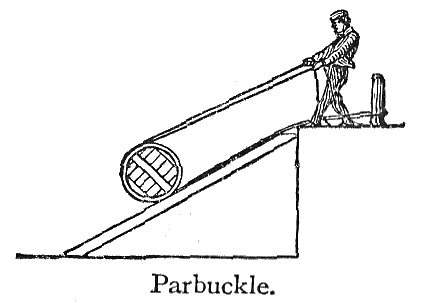
Parbuckle, pär′buk'l, n. a purchase made by looping a rope in the middle to aid in rolling casks up or down an incline, or in furling a sail by rolling the yards: a sling made by passing both ends of a rope through its bight.—v.t. to hoist or lower by a parbuckle:—pr.p. par′buckling; pa.p. par′buckled. [Prob. L. par, equal, and buckle.]
Parcæ, pär′sē, n.pl. the Fates.
Parcel, pär′sel, n. a little part: a portion: a quantity, as of single articles: a number forming a group or a lot: a package.—v.t. to divide into portions:—pr.p. par′celling; pa.t. and pa.p. par′celled.—n. Par′cel-bawd (Shak.), one partly a bawd.—adjs. Par′cel-beard′ed (Tenn.), partially bearded; Par′cel-gilt, partially gilded.—n. Par′cel-off′ice, a place where parcels are received for despatch and delivery.—Parcels post, that department of the post-office which takes charge of the forwarding and delivery of small parcels. [Fr. parcelle (It. particella)—L. particula, dim. of pars, partis, a part.]
Parcenary, par′se-nā-ri, n. co-heirship.—n. Par′cener, a co-heir.
Parch, pärch, v.t. to burn slightly: to scorch.—v.i. to be scorched: to become very dry.—adj. Parched, scorched.—adv. Parch′edly.—n. Parch′edness. [M. E. parchen, either a variety of per(s)chen=peris(c)hen, to kill, or from perchen, to pierce.]
Parchment, pärch′ment, n. the skin of a sheep or goat prepared for writing on.—Parchment paper, or Vegetable parchment (see Paper).—Virgin parchment, a fine kind of parchment made from the skins of new-born lambs or kids. [Fr. parchemin—L. pergamena (charta, paper)—from Gr. Pergamos.]
Pard, pärd, n. (slang) a partner, mate.
Pard, pärd, n. the panther: the leopard: in poetry, any spotted animal.—n. Pard′ale (Spens.). [L. pardus—Gr. pardos, the panther, the leopard.]
Pardieu, pär′dū, Pardi, Pardy, pär′di, adv. (Spens.) in truth: certainly. [Fr., by God—par—L. per, through, by, Dieu—L. deus, God.]
Pardon, pär′don, v.t. to forgive, said either of an offender or of a crime: to pass by without punishment or blame: to set free from punishment: to let off without doing something.—n. forgiveness, either of an offender or of his offence: remission of a penalty or punishment: a warrant declaring a pardon: a papal indulgence.—adj. Par′donable, that may be pardoned: excusable.—n. Par′donableness.—adv. Par′donably.—n. Par′doner, one who pardons: formerly, one licensed to sell papal indulgences.—p.adj. Par′doning, disposed to pardon: forgiving: exercising the right or power to pardon: conferring authority to grant pardon.—Pardon me, excuse me—used in apology and to soften a contradiction. [Fr. pardonner—Low L. perdonāre—L. per, through, away, donāre, to give.]
Pardy, pär′di, adv. A form of pardieu.
Pare, pār, v.t. to cut or shave off: to trim, or to remove by cutting: to diminish by littles.—n. Pār′er, one who, or that which, pares. [Fr. parer—L. parāre, to prepare.]
Paregoric, par-ē-gor′ik, adj. soothing, lessening pain.—n. a medicine that soothes pain: tincture of opium. [L.,—Gr. parēgorikos—parēgorein, to exhort.]
Pareil, par-el′, n. an equal. [Fr.,—L. par, equal.]
Pareira, pa-rā′ra, n. a tonic diuretic drug derived from various South and Central American plants. [Braz.]
Parella, pa-rel′la, n. a crustaceous lichen yielding archil, cudbear, and litmus.—Also Parelle′. [Fr. parelle.]
Parembole, pa-rem′bō-lē, n. (rhet.) an inserted phrase modifying or explaining the thought of the sentence—closer to the context than a parenthesis. [Gr.]
Parenchyma, pa-reng′ki-mä, n. the soft cellular tissue of glandular and other organs, as the pith in plants or the pulp in fruits.—adjs. Parench′ymal, Parenchym′atous, Parench′ymous. [Gr., para, beside, engchein, to pour in.]
Parenesis, pa-ren′e-sis, n. persuasion.—adjs. Parenet′ic, -al, hortatory. [Gr. parainesis, exhortation, para, beside, ainein, to praise.]
Parent, pār′ent, n. one who begets or brings forth: a father or a mother: one who, or that which, produces: an author: a cause.—n. Par′entage, descent from parents: birth: extraction: rank or character derived from one's parents or ancestors: relation of parents to their children.—adj. Parent′al, pertaining to, or becoming, parents: affectionate: tender.—adv. Parent′ally.—ns. Par′enthood, state of being a parent: duty or feelings of a parent; Parent′icide, one who kills a parent.—adj. Par′entless, without a parent. [Fr., 'kinsman'—L. parens, for pariens, -entis, pr.p. of parĕre, to bring forth.]
Parenthesis, pa-ren′the-sis, n. a word, phrase, or sentence put in or inserted in another which is grammatically complete without it: (pl.) the marks ( ) used to mark off a parenthesis:—pl. Paren′theses (-sēz).—v.i. Parenth′esise.—adjs. Parenthet′ic, -al, of the nature of a parenthesis: expressed in a parenthesis: using parentheses.—adv. Parenthet′ically. [Gr.,—para, beside, en, in, thesis, a placing—tithenai, to place.]
Parergon, pa-rėr′gon, n. a by-work, any work subsidiary to another. [Gr.,—para, beside, ergon, work.]
Paresis, par′e-sis, n. a diminished activity of function—a partial form of paralysis.—adj. Paret′ic. [Gr., parienai, to relax.]
Parfay, pär-fā′, interj. by or in faith. [Fr.]
Parfilage, pär′fi-lāj, n. the unravelling of woven fabrics, to save gold or silver threads. [Fr.]
Parfleche, pär-flesh′, n. rawhide of buffalo-skin stripped of hair and dried on a stretcher: a wallet, tent, &c. of such material. [Canadian Fr.,—Ind.]
Pargasite, pär′ga-sīt, n. a dark-green crystallised variety of amphibole or hornblende.
Parget, pär′jet, n. (Spens.) the plaster of a wall: paint.—v.t. to plaster: to paint.—ns. Par′geter; Par′geting, Parge′-work. [L. paries, parietis, a wall; or Low L. spargitāre, to sprinkle—L. spargĕre.]
Parhelion, par-hē′li-un, n. a bright light caused by refraction of light through ice crystals floating in the air, sometimes seen near the sun, and sometimes opposite to the sun, when it is called anthelion:—pl. Parhē′lia.—adjs. Parhel′ic, Parhelī′acal. [Gr. para, beside, hēlios, the sun.]
Pariah, pār′i-a, n. a member of a caste in southern India, lower than the four Brahminical castes: one who has lost his caste: an outcast. [Tamil.]
Parian, pā′ri-an, adj. pertaining to or found in the island of Paros, in the Ægean Sea.—n. an inhabitant of Paros: a fine porcelain for statuettes, resembling marble.—Parian marble, a fine marble found in Paros, much used by the ancients for statues.
Paridigitate, par-i-dij′i-tāt, adj. having an even number of digits.
Parietal, pa-rī′et-al, adj. pertaining to a wall or walls: (anat.) forming the sides: (bot.) growing from the inner lining of an organ, and not from the axis, as seeds in the ovary.—n. one of the bones of the skull. [L. parietalis—paries, parietis, a wall.]
Paring, pār′ing, n. act of trimming or cutting off: that which is pared off: rind: the cutting off of the surface of grass land for tillage.
Paripinnate, par-i-pin′āt, adj. (bot.) equally pinnate.
Parish, par′ish, n. a district under one pastor: an ecclesiastical district having officers of its own and supporting its own poor: the people of a parish.—adj. belonging or relating to a parish: employed or supported by the parish.—n. Parish′ioner, one who belongs to or is connected with a parish: a member of a parish church.—Parish clerk, the clerk or recording officer of a parish: the one who leads the responses in the service of the Church of England; Parish priest, a priest who has charge of a parish; Parish register, a book in which the births, marriages, and deaths of a parish are registered. [Fr. paroisse—L. parœcia—Gr. paroikia—paroikos, dwelling beside—para, beside, oikos, a dwelling.]
Parisian, par-iz′i-an, adj. of or pertaining to Paris.—n. a native or resident of Paris:—fem. Parisienne′.—Paris doll, a small figure dressed in the latest fashions, sent out by Paris modistes.
Parisyllabic, par-i-si-lab′ik, adj. having the same number of syllables.
Paritor, par′i-tor, n. Same as Apparitor.
Parity, par′i-ti, n. state of being equal in rank, position, quality, &c.: resemblance: analogy. [Fr. parité—L. paritas—par, equal.]
Park, pärk, n. an enclosed piece of land for a special purpose, as for wild beasts: a grass field: a tract of land surrounding a mansion: a piece of ground enclosed for recreation: (mil.) a space in an encampment occupied by the artillery; hence, a collection of artillery, or stores in an encampment.—v.t. to enclose: to bring together in a body, as artillery.—n. Park′er, the keeper of a park. [A.S. pearroc, prob. modified by Fr. parc.]
Parlance, pär′lans, n. speaking: conversation: peculiar manner of conversation.—adj. and adv. Parlan′do, declamatory in style: in recitative.—v.i. Parle (Shak.), to talk.—n. (Shak.) talk, conversation.—v.i. Par′ley, to speak with another: to confer on some important point: to treat with an enemy.—n. talk: a conference with an enemy in war. [Fr. parler—L. parabola—Gr. parabolē, a parable, word.]
Parliament, pär′li-ment, n. a meeting for deliberation: the supreme legislature of Great Britain, also of some of her colonies: in France, down to the Revolution, one of certain superior and final courts of judicature, in which also the edicts of the king were registered before becoming law.—adjs. Parliamentā′rian, adhering to the Parliament in opposition to Charles I.; Parliament′ary, pertaining to parliament: enacted or done by parliament: according to the rules and practices of legislative bodies.—Parliamentary agent, a person employed by private persons or societies for drafting bills or managing business to be brought before parliament; Parliamentary borough, a borough having the right of sending a member or members to parliament; Parliamentary train, a train which, by act of parliament, runs both ways along a line of railway, at least once each day, at the rate of one penny per mile.—Act of parliament, a statute that has passed through both the House of Commons and the House of Lords, and received the formal royal assent. [Fr. parlement—parler, to speak.]
Parlour, pär′lur, n. an ordinary family sitting-room: a room for receiving guests in.—n. Par′lour-board′er, a pupil at a boarding-school who enjoys particular privileges. [Fr., parloir—parler, to speak.]
Parlous, pär′lus, adj. perilous, venturesome, notable.—adv. Par′lously. [Perilous.]
Parmacety, par-mas-it′i, n. (Shak.) a corr. of spermaceti.
Parmesan, par-me-zan′, adj. pertaining to Parma.—n. Parmesan cheese.
Parnassus, par-nas′us, n. a mountain in Greece, sacred to Apollo and the Muses.—adj. Parnass′ian.—Grass of Parnassus, a plant with beautiful white or yellowish flowers.
Parnellism, pär′nel-izm, n. the plans and methods of agitation used by Charles Stewart Parnell (1846-91) for the purpose of promoting 'Home Rule' for Ireland.—n. Par′nellite, one of the followers of C. S. Parnell.—adj. of or pertaining to the nationalist movement led by Parnell.
Paroccipital, par-ok-sip′i-tal, adj. situated near the occiput.
Parochial, par-ō′ki-al, adj. of or relating to a parish: restricted or confined within narrow limits—of sentiments, tastes, &c.—v.t. Parō′chialise, to form into parishes.—n. Parō′chialism, a system of local government which makes the parish the unit—hence provincialism, narrowness of view.—adv. Parō′chially.—Parochial Board (in Scotland), the board in each parish which relieves the poor. [L. parochialis—parochia, a variant of parœcia.]
Parody, par′o-di, n. an imitation of a poem in which its words and ideas are so far changed as to produce a ridiculous effect.—v.t. to turn into parody, to make a parody of:—pa.p. par′odied.—adjs. Parod′ic, -al.—n. Par′odist, one who writes a parody. [L.,—Gr. parōdia—para, beside, ōdē, an ode.]
Parole, par-ōl′, n. word of mouth: (mil.) word of honour (esp. by a prisoner of war, to fulfil certain conditions): the daily password in a camp or garrison.—adj. given by word of mouth: oral—opp. to Documentary, as parole evidence. [Fr.,—L. parabola, a parable, saying.]
Paronomasia, par-ō-nō-mā′zhi-a, n. a rhetorical figure in which words similar in sound but different in meaning are set in opposition to each other: a play upon words—also Paronom′asy.—adjs. Paronomas′tic, -al.—ns. Par′onyme, Par′onym, a paronymous word—opp. to Homonym.—adj. Paron′ymous, formed by a slight change of word or name: derived from the same root: having the same sound, but different in spelling and meaning.—n. Paron′ymy, quality of being paronymous. [Gr. para, beside, onoma, name.]
Paroquet, Parroquet, par′o-ket, n. a small long-tailed tropical and subtropical parrot.—Also Parr′akeet. [Fr. perroquet—Pierrot, dim. of Pierre, Peter.]
Parosmia, pa-ros′mi-a, n. a perversion of the sense of smell. [Gr. para, beside, osmē, smell.]
Parotid, par-ot′id, n. the largest of the three pairs of salivary glands, situated immediately in front of the ear—also Parō′tis.—adj. Parot′ic, auricular, situated about the outer ear.—ns. Parotidī′tis, Parotī′tis, inflammation of the parotic gland. [L.,—Gr. parōtis, -idos—para, beside, ous, ōtos, ear.]
Paroxysm, par′oks-izm, n. a fit of acute pain occurring at intervals: a fit of passion: any sudden violent action.—adjs. Paroxys′mal, Paroxys′mic, pertaining to, or occurring in, paroxysms. [Fr.,—L.,—Gr. paroxysmos—para, beyond, oxys, sharp.]
Paroxytone, par-ok′si-tōn, adj. having the acute accent on the last syllable but one.—n. a word with an acute accent on the second last syllable.—v.t. to accent a word in this way.
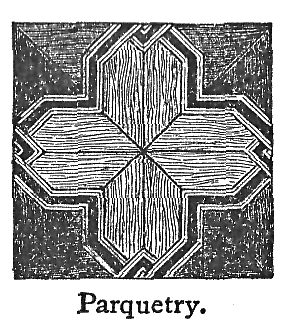
Parquet, pär-ket′, n. the part of the floor of a theatre, &c., behind the musicians' seats, but not under the gallery: the pit or the whole of the floor of a theatre: parquetry.—n. Par′quetry, woodwork inlaid with figures, for floors. [Fr. parquet, an inlaid floor, dim. of parc, an enclosure.]
Parr, pär, n. a young salmon.
Parrakeet, par′a-kēt, n. Same as Paroquet.
Parrhesia, pa-rē′si-a, n. boldness of speech. [Gr.]
Parricide, par′ri-sīd, n. the murder of one's own father or mother: the murder of a parent: the murder of any one to whom reverence is due.—adj. Parricid′al, pertaining to, or committing, parricide. [Fr.,—L. parricida (for patri-cida)—pater, patris, father, cædĕre, to slay.]
Parrot, par′rut, n. one of a family of tropical and subtropical birds, with brilliant plumage and a hooked bill, remarkable for their faculty of imitating the human voice: a repeater of the words of others.—v.t. and v.i. to repeat by rote.—ns. Par′rot-coal, a kind of coal which crepitates in burning; Par′roter; Par′rot-fish, a name applied to various fishes, from their colours or the shape of their jaws; Par′rotry, servile imitation. [Contr. of Fr. perroquet.]
Parry, par′i, v.t. to ward or keep off: to turn aside: to avoid:—pa.t. and pa.p. parr′ied.—n. a turning aside of a blow or a thrust: a defensive movement of any kind. [Fr. parer—L. parāre, to prepare, in Low L. to keep off.]
Parse, pärs, v.t. (gram.) to tell the parts of speech of a sentence and the relations of the various words to each other.—n. Pars′ing. [L. pars (orationis), a part of speech.]
Parsee, Parsi, pär′sē, n. one of the surviving remnant of Zoroastrianism which took refuge in India in the 7th century: a fire-worshipper.—n. Par′seeism. [Pers. Pārsī—Pārs, Persia.]
Parsimony, pär′si-mun-i, n. sparingness in the spending of money: frugality: niggardliness.—adj. Parsimō′nious, sparing in the use of money: frugal to excess: niggardly: covetous.—adv. Parsimō′niously.—n. Parsimō′niousness. [Fr.,—L. parsimonia, parcimonia—parcĕre, to spare.]
Parsley, pärs′li, n. a bright-green herb, with finely divided, strongly scented leaves, used in cookery. [Fr. persil—L. petroselinum—Gr. petroselinon—petros, a rock, selinon, a kind of parsley.]
Parsnip, Parsnep, pärs′nip, n. an edible plant with a carrot-like root. [O. Fr. pastenaque—L. pastinaca—pastinum, a dibble.]
Parson, pär′sn, n. the priest or incumbent of a parish: a clergyman: one who is licensed to preach.—n. Par′sonage, the residence of the minister of a parish: (orig.) the house, lands, tithes, &c. set apart for the support of the minister of a parish.—adjs. Parson′ic, Par′sonish, pertaining to or like a parson. [O. Fr. persone—L. persōna, a person.]
Part, pärt, n. something less than the whole: a portion: a quantity or number making up with others a larger quantity or number: a fraction: a member or essential part of a whole: a proportional quantity: one's share: interest: side or party: action: character taken by an actor in a play: (math.) a quantity which taken a certain number of times will equal a larger quantity: an exact divisor: (mus.) one of the melodies of a harmony: (pl.) qualities: talents.—v.t. to divide: to make into parts: to put or keep asunder.—v.i. to be separated: to be torn asunder: to have a part or share.—adj. Part′ed (Shak.), endowed with parts or abilities: (bot.) deeply cleft, as a leaf.—n. Part′er.—adv. Part′ly, in part: in some degree.—Part of speech (gram.), one of the various classes of words.—For my part, as far as concerns me; For the most part, commonly; In bad, or ill, part, unfavourably; In good part, favourably; Take part in, to share or to assist in; Take part with, to take one's side. [Fr.,—L. pars, partis.]
Partake, pär-tāk′, v.i. to take or have a part, either absolutely, or with of or in before the thing shared, as food, &c.: to have something of the nature or properties, &c.: to be admitted: (Shak.) to make common cause.—v.t. to have a part in: to share: (Shak.) to communicate:—pr.p. partā′king; pa.t. partook′; pa.p. partā′ken.—ns. Partā′ker, one who shares in along with others: a partner: an accomplice; Partā′king, a sharing: (law) a combination in an evil design. [Part and take.]
Partan, par′tan, n. (Scot.) a small edible sea-crab. [Gael.]
Parterre, par-ter′, n. an arrangement of flower-plots with spaces of turf or gravel between for walks: the pit of a theatre, esp. beneath the galleries. [Fr.,—L. per terram, along the ground.]
Parthenogenesis, pär-the-nō-jen′e-sis, n. reproduction without renewed impregnation by a male, as in aphids or plant-lice, &c.—also Parthenog′eny.—adjs. Parthenogenet′ic, Parthenog′enous. [Gr. parthenos, a virgin, genesis, production.]
Parthenon, pär′the-non, n. the temple of Athēnē Parthĕnos, on the Acropolis at Athens. [Gr. Parthenōn—parthenos, a virgin.]
Parthian, par′thi-an, adj. of or belonging to Parthia, in Persia.—A Parthian shot, a shot or blow given while pretending to fly, a parting shot.
Partial, pär′shal, adj. relating to a part only: not total or entire: inclined to favour one person or party: having a preference: (bot.) subordinate.—v.t. Par′tialise (Shak.), to render partial.—ns. Par′tialism, the doctrine of the Partialists; Par′tialist, one who holds that the atonement of Christ was made only for a part of mankind; Partial′ity, state or quality of being partial: liking for one thing more than for others.—adv. Par′tially.[Fr.,—Low L. partialis—L. pars, a part.]
Partible, pär′ti-bl, adj. that may be parted: separable.—n. Partibil′ity.
Partibus, par′ti-bus, n. in Scots law, a note on the margin of a summons, giving name and designation of the pursuer.—In partibus infidelium, a phrase applying formerly to bishops who were merely titular, without regular jurisdiction, their function to assist some other bishop or to act as delegates of the Pope where no hierarchy had as yet been established.
Participate, pär-tis′i-pāt, v.i. to partake: to have a share.—v.t. to receive a part or share of.—n. Pär′ticeps crim′inis, one who, although not present, helps in any way the commission of a crime, or who after the deed assists or hides the person who did it.—adjs. Partic′ipable, capable of being participated in or shared; Partic′ipant, participating: sharing.—n. a partaker.—adv. Partic′ipantly.—n. Participā′tion.—adj. Partic′ipātive, capable of participating.—n. Partic′ipātor, one who partakes with another: a sharer. [L. participāre, -ātum—pars, part, capĕre, to take.]
Participle, pär′ti-si-pl, n. a word having the value of an adjective but regularly formed from a verb.—adj. Particip′ial, having the nature of a participle: formed from a participle.—adv. Particip′ially.[L.,—participium—particeps—pars, a part, capĕre, to take.]
Particle, pär′ti-kl, n. a little part: a very small portion: (physics) the minutest part into which a body can be divided: an atom: (gram.) an indeclinable word, as a preposition, a conjunction, an interjection: a word that can only be used in composition, as wise in sidewise: (R.C. Church) a crumb of consecrated bread, also the 'smaller breads' used in the communion of the laity.—adj. Partic′ular, relating to a part of anything: pertaining to a single person or thing: individual: special: worthy of special attention: concerned with or marking things single or distinct: exact: nice in taste: precise.—n. a distinct or minute part: a single point: a single instance: (pl.) details.—n. Particularisā′tion.—v.t. Partic′ularise, to mention the particulars of: to enumerate in detail: to give a special description of.—v.i. to mention or attend to single things or minute details.—ns. Partic′ularism, attention to one's own interest or party: a particular or minute description: the doctrine that salvation is offered only to particular individuals, the elect, and not freely to the whole race on condition of faith; Partic′ularist, one who holds the doctrine of particularism.—adj. Particularist′ic.—n. Particular′ity, quality of being particular: minuteness of detail: a single act or case: a single or a minute circumstance: something peculiar or singular.—adv. Partic′ularly, in an especial manner: in a high degree: (B.) in detail.—n. Partic′ularness.—adj. Partic′ulāte, having the form of a small particle.—In particular, specially, distinctly. [Fr.,—L. particula, dim. of pars, partis, a part.]
Partim, part′im, adv. in part. [L.]
Parting, pärt′ing, adj. putting apart: separating: departing: given at parting.—n. the act of parting: a division: a point or a line of division: the division of the hair on the head in dressing it: (geol.) a division of a mineral into layers: a snapping or breaking under a great strain, as of a cable.—n. Part′ing-cup, a drinking-cup with two handles on opposite sides.
Partisan, pär′ti-zan, n. an adherent of a party or a faction: one who is too strongly devoted to his own party or sect to be able to understand or to judge fairly of others.—adj. adhering to a party.—n. Par′tisanship. [Fr. (It. partigiano),—L. partīri.]
Partisan, pär′ti-zan, n. a kind of halberd or long-handled weapon, common in the Middle Ages: a soldier armed with such a weapon. [O. Fr. pertuisane, which is perh. from Old High Ger. parta a battle-axe, seen in halberd.]
Partition, par-tish′un, n. act of parting or dividing: state of being divided: separate part: that which divides: a wall between apartments: the place where separation is made.—v.t. to divide into shares: to divide into parts by walls.—adjs. Par′tīte, divided into parts: (bot.) parted nearly to the base; Par′titive, parting: dividing: distributive.—n. (gram.) a word denoting a part or partition.—adv. Par′titively. [Fr.,—L. partitio—partīri, divide.]
Partlet, pärt′let, n. a ruff or band worn round the neck or shoulders by women: a hen, from its habit of ruffling the feathers round its neck. [Prob. O. Fr. Pertelote, a woman's name.]
Partner, pärt′nėr, n. a sharer: an associate: one engaged with another in business: one who plays on the same side in a game: one who dances with another: a husband or wife.—v.t. (Shak.) to join as a partner.—ns. Part′nership, state of being a partner: a contract between persons engaged in any business; Sleep′ing-part′ner, one who has money invested in a business, but takes no part in its management.
Partridge, pär′trij, n. a genus of gallinaceous birds preserved for game.—n. Par′tridge-wood, a hard variegated wood, from Brazil and the West Indies, used in cabinet-work. [Fr. perdrix—L. perdix, perdicis—Gr. perdix.]
Part-singing, pärt′-sing-ing, n. act or practice of singing different parts in harmony.—n. Part′-song, a song sung in parts.
Parture, pärt′ūr, n. (Spens.) departure.
Parturient, pär-tū′ri-ent, adj. bringing, or about to bring, forth young: fruitful.—n. Partūri′tion, act of bringing forth.—adj. Partū′ritive. [L. parturiens, -entis, pr.p. of parturīre—parĕre, to bring forth.]
Party, pär′ti, n. a part of a greater number of persons: a faction: a company met for a particular purpose, as a dinner party, a pleasure party, &c.: an assembly: one concerned in any affair: the person or persons on either side in a law-suit: (colloq.) a single individual spoken of: (mil.) a detachment of soldiers.—adj. belonging to a party and not to the whole: consisting of different parties, parts, or things: (her.) parted or divided.—adjs. Par′ti-coat′ed, having on a coat of various colours; Par′ti-col′oured, coloured differently at different parts.—ns. Par′tyism, devotion to party; Par′ty-ju′ry, a jury half of natives and half of aliens; Par′ty-man, a member of a party: a partisan; Par′ty-pol′itics, politics viewed from a party stand-point, or arranged to suit the views or interests of a party; Par′ty-spir′it, the unreasonable spirit shown by a party-man toward those who do not belong to his party.—adj. Par′ty-spir′ited.—ns. Par′ty-ver′dict, a joint verdict; Par′ty-wall, a wall between two adjoining properties, built half on one and half on the other: a wall separating one house from another. [O. Fr. partir—L. partīri, to divide—pars, a part.]
Parure, pa-rür′, n. a set of ornaments, &c. [Fr.]
Parvanimity, par-va-nim′i-ti, n. littleness of mind.
Parvenu, pär′ve-nū, n. an upstart: one newly risen into notice or power.—adj. like a parvenu. [Fr., pa.p. of parvenir—L. pervenīre, to arrive at—per, through, venīre, to come.]
Parvis, Parvise, pär′vis, n. a porch, or an enclosed space before a church: a room over a church porch used as a store, or schoolroom, or as an ecclesiastic's chamber. [O. Fr.,—Low L. paravisus, corr. of Gr. paradeisos; cf. Paradise.]
Pas, pä, n. a step, as in dancing or marching: a dance, as in 'Pas seul'=a dance by one person, 'Pas deux'=a dance of two persons.—Pas d'armes, a joust, a tilt, or a tourney.—Have the pas of one, to take precedence of him. [Fr.]
Pasch, pask, n. the Jewish Passover: Easter.—adj. Pasch′al, pertaining to the Passover, or to Easter.—ns. Pasch′al-can′dle, a large candle blessed and placed on the altar on the day before Easter; Pasch′al-flow′er (see Pasque); Pasch′al-lamb, the lamb slain and eaten at the Jewish Passover; Pasch′-egg, an Easter-egg.—Pasch of the Cross, Good-Friday; Paschal controversy, a long dispute in the early church about the proper time for celebrating Easter. [A.S. pascha—L.,—Gr.,—Heb. pesach, the Passover—pasach, to pass over.]
Pascuage, pas′kū-āj, n. the grazing or pasturing of cattle.—adjs. Pas′cūal, Pas′cūous. [L. pascuum, pasture—pascĕre, to feed.]
Pash, pash, v.t. (Shak.) to strike, to dash, to crush.—n. a blow. [Perh. imit.]
Pash, pash, n. (Shak.) the head, the face.
Pasha, Pacha, pash′ä, n. a title given to Turkish officers who are governors of provinces or hold high naval and military commands.—ns. Pash′alic, Pach′alic, the jurisdiction of a pasha. [Turk.,—Pers. pāshā, pādshāh.]
Pasigraphy, pa-sig′ra-fi, n. a system of language-signs universally intelligible.—adjs. Pasigraph′ic, -al.—n. Pas′ilaly, universal speech. [Gr. pas, all, graphein, to write.]
Pasque-flower, pask′-flow′ėr, n. one of several genera of anemone, blooming about Easter—also Campana and Dane-flower.
Pasquin, pas′kwin, n. a lampoon or satire—also Pas′quil.—v.t. and v.i. to lampoon or satirise—also Pas′quil.—ns. Pas′quilant, Pas′quiler, Pasquinā′der, a lampooner; Pasquināde′, a lampoon.—v.t. to lampoon. [Pasquino, a sarcastic tailor in Rome in the 15th century, near whose house a mutilated statue was dug up just after his death, on which lampoons were posted.]
Pass, pas, v.i. to pace or walk onward: to move from one place or state to another: to travel: to change: to circulate: to be regarded: to go by: to go unheeded or neglected: to elapse, as time: to be finished: to move away: to disappear: (B.) to pass away: to go through an examination or an inspection: to be approved: to meet with acceptance: to happen: to fall, as by inheritance: to flow through: to thrust, as with a sword: to run, as a road.—v.t. to go by, over, beyond, through, &c.: to spend: to omit: to disregard: to surpass: to enact, or to be enacted by: to cause to move: to send: to transfer: to give forth: to cause to go from one person or state to another: to approve: to undergo successfully: to give circulation to: (fencing) to thrust:—pa.p. passed and past.—n. a way through which one passes: a narrow passage, esp. over or through a range of mountains: a narrow defile: a passport: state or condition: a written permission to go out or in anywhere: a ticket: (fencing) a thrust: success in any examination or other test, a certificate of having reached a certain standard—without honours.—adj. Pass′able, that may be passed, travelled over, or navigated: that may bear inspection: that may be accepted or allowed to pass: a little above the common: tolerable.—n. Pass′ableness.—adv. Pass′ably.—ns. Pass′book, a book that passes between a trader and his customer, in which credit purchases are entered: a bank-book; Pass′-check, a ticket of admission to a place, or of readmission when one goes out intending to return; Pass′er, one who passes; Pass′er-by, one who passes by or near; Pass′key, a key enabling one to enter a house: a key for opening several locks.—adj. Pass′less, having no pass: impassable.—ns. Pass′man, one who gains a degree or pass without honours at a university; Pass′port, a warrant of protection and permission to travel; Pass′word (mil.), a private word by which a friend is distinguishable from a stranger, enabling one to pass or enter a camp, &c.—Pass muster, to go through an inspection without fault being found; Pass off, to impose fraudulently, to palm off; Pass on, to go forward: to proceed; Pass on, or upon, to come upon, to happen to: to give judgment or sentence upon: to practise artfully, to impose upon, to palm off; Pass over, or by, to go to the other side of: to cross, to go past without visiting or halting: to overlook, to disregard; Pass the time of day, to exchange any ordinary greeting of civility; Pass through, to undergo, experience.—Bring to pass, to cause to happen; Come to pass, to happen. [O. Fr. passer—It. passare—passus, a step.]
Passade, pa-sād′, n. (Shak.) a push or thrust with a sword: the motion of a horse turning backwards or forwards on the same spot of ground.—Also Passā′do.
Passage, pas′āj, n. act of passing: a moving from one place or state to another: a journey, as in a ship: course: time occupied in passing: means of passing in or out: a way: entrance: enactment of a law: right of passing: price paid for passing or for being conveyed between two places: occurrence, any incident or episode: a single clause or part of a book, &c.: a modulation in music: (B.) a mountain-pass: ford of a river: (zool.) migratory habits.—v.i. to cross: to walk sideways, of a horse.—Passage of arms, any feat of arms: a quarrel, esp. of words.—Bird of passage, a bird that passes from one climate to another at the change of the seasons.
Passamezzo. See Passy-measure.
Passant, pas′ant, adj. (her.) walking. [Fr.]
Passé, pas-sā′, adj. past one's best, faded, past the heyday of life: nearly out of date:—fem. Passée. [Fr., pa.p. of passer, to pass.]
Passementerie, pas-men-te-rē′, n. trimming for dresses, as beaded lace. [Fr.]
Passenger, pas′en-jėr, n. one who passes: one who travels in some public conveyance.—Passenger pigeon, a species of pigeon, a native of North America, having a small head and short bill, a very long, wedge-shaped tail, and long and pointed wings; Passenger train, a railway-train for the conveyance of passengers. [O. Fr. passagier (Fr. passager), with inserted n, as in messenger, nightingale.]
Passe-partout, pas′-par-tōō′, n. a means of passing anywhere: a master-key: a kind of simple picture-frame, usually of pasteboard, within which the picture is fixed by strips of paper pasted over the edges. [Fr., a 'master-key,' from passer, to pass, par, over, tout, all.]
Passepied, pas′pyā, n. a dance like the minuet, but quicker. [Fr.]
Passeres, pas′e-rez, n.pl. the name given by Cuvier to the order of birds otherwise called Insessores, comprising more than half of all the birds.—adj. Pass′erine, relating to the Passeres, an order of which the sparrow is the type. [L. passer, a sparrow.]
Passible, pas′i-bl, adj. susceptible of suffering, or of impressions from external agents.—ns. Passibil′ity, Pass′ibleness, the quality of being passible.—adv. Pass′ibly, in a passible manner. [L. passibilis—pati, passus, to suffer.]
Passim, pas′im, adv. here and there. [L.]
Passimeter, pa-sim′e-ter, n. a pocket pedometer.
Passing, pas′ing, adj. going by, through, or away: happening now: surpassing.—adv. exceedingly: very.—ns. Pass′ing-bell, a bell tolled immediately after a person's death, originally to invite prayers for the soul passing into eternity; Pass′ing-note (mus.), a smaller note marking a tone introduced between two others, to effect a smooth passage from the one to the other, but forming no essential part of the harmony.
Passion, pash′un, n. power of feeling pain or suffering: strong feeling or agitation of mind, esp. rage: ardent love: eager desire: state of the soul when receiving an impression: suffering or passive condition, as opposed to Action: the sufferings, esp. the death, of Christ: (pl.) excited conditions of mind.—ns. Passiflō′ra, a genus of climbing herbs or shrubs, the passion-flowers; Pass′ional, Pass′ionary, a book containing accounts of the sufferings of saints and martyrs.—adjs. Pass′ional, influenced by passion; Pass′ionate, moved by passion: showing strong and warm feeling: easily moved to anger: intense.—adv. Pass′ionately.—n. Pass′ionateness.—adj. Pass′ioned, moved by passion: expressing passion.—ns. Pass′ion-flow′er, a flower so called from a fancied resemblance to a crown of thorns, the emblem of Christ's passion; Pass′ionist (R.C.), one of a religious congregation devoted to the commemoration of the Passion of Christ by missions, &c.—adj. Pass′ionless, free from passion: not easily excited to anger.—n. Pass′ion-mū′sic, music to which words describing the sufferings and death of Christ are set.—adj. Pass′ion-pale (Tenn.), pale with passion.—ns. Pass′ion-play, a religious drama representing the sufferings and death of Christ; Pass′ion-Sun′day, the fifth Sunday in Lent; Pass′ion-week, name commonly given in England to Holy-week (as being the week of Christ's passion); but, according to proper rubrical usage, the week preceding Holy-week. [Fr.,—L. passio, passionis—passus, pa.p. of pati, to suffer.]
Passive, pas′iv, adj. suffering, unresisting: not acting: (gram.) expressing the suffering of an action by the subject of the verb.—adv. Pass′ively.—ns. Pass′iveness, Passiv′ity, inactivity: patience: tendency of a body to preserve a given state, either of motion or of rest. [Fr.,—L. passivus—pati, suffer.]
Passman. See Pass.
Passover, pas′ō-vėr, n. annual feast of the Jews, to commemorate the destroying angel passing over the houses of the Israelites when he slew the first-born of the Egyptians.—adj. pertaining to the Passover.
Passy-measure, pas′si-mezh′ūr, n. (Shak.) an old stately kind of dance, called also Passamezzo. [It. passamezzo—passare, to pass—passo—L. passus, a pace, mezzo—L. medius, the middle.]
Past, past, pa.p. of Pass.—adj. gone by: elapsed: ended: now retired from service: in time already passed.—prep. farther than: out of reach of: no longer capable of.—adv. by.—The past, that which has passed, esp. time.
Paste, pāst, n. a mass of anything made soft by wetting: flour and water forming dough for pies, &c.: a cement made of flour, water, &c.: a fine kind of glass for making artificial gems.—v.t. to fasten with paste.—n. Paste′board, a stiff board made of sheets of paper pasted together, &c.—adj. made of such, unsubstantial. [O. Fr. paste (Fr. pâte)—Late L. pasta—Gr. pastē, a mess of food—pastos, salted—passein, to sprinkle.]
Pastel, pas′tel, n. chalk mixed with other materials and various colours for crayons, a drawing made with such, also the art: woad.—n. Pas′telist.[Fr. pastel—It. pastello—L. pastillus, a small loaf—pascĕre, pastum, to feed.]
Pastern, pas′tėrn, n. the part of a horse's foot from the fetlock to the hoof, where the shackle is fastened. [O. Fr. pasturon (Fr. pâturon)—O. Fr. pasture, pasture, a tether for a horse.]
Pasteurism, pas-tėr′izm, n. the method of inoculation with the attenuated virus of certain diseases, esp. hydrophobia, as introduced by Louis Pasteur (1822-95).—adj. Pasteur′ian.—n. Pasteurisā′tion, a method of arresting the fermentation in beer, wine, &c. by heating to at least 140° F.—v.t. Pasteur′ise.
Pastiche, pas-tēsh′, n. a mixture of many parts of different kinds, used of music, painting, &c.: a work in literature or art in direct imitation of another's style.—Also Pastic′cio. [It. pasticcio.]
Pastil, pas′til, n. Same as Pastel.
Pastille, pas-tēl′, n. a small cone of charcoal and aromatic substances, burned either as incense, or as a means of diffusing an agreeable odour: a small aromatic confection: a paper tube containing a firework which causes a small wheel to rotate in burning: (art) the same as pastel—also Pas′til.—n. Pas′tillage.[Fr.,—L. pastillus, a small loaf.]
Pastime, pas′tīm, n. that which serves to pass away the time: amusement: recreation.
Pastor, pas′tur, n. one who has care of a flock: a shepherd: a clergyman.—adj. Pas′toral, relating to shepherds or to shepherd life: rustic: of or pertaining to the pastor of a church: addressed to the clergy of a diocese by their bishop.—n. a poem which describes the scenery and life of the country: a letter or an address by a pastor to his people, or by a bishop to his clergy: (mus.) a simple melody.—n. Pas′toralism, pastoral character.—adv. Pas′torally.—ns. Pas′torate, Pas′torship, the office of a pastor: the time during which one has been a pastor: the whole body of pastors in one church or district.—adj. Pas′torly, becoming a pastor.—Pastoral address, or letter (see Pastoral, n.); Pastoral charge, position of a pastor: the church, &c., over which a pastor is placed: an address to a newly ordained minister; Pastoral epistles, those in the New Test. to Timothy and Titus; Pastoral staff, a tall staff borne as an emblem of episcopal authority, headed like a shepherd's crook, or having a T-shaped head; Pastoral theology, that part of theology which treats of the duties of pastors; Pastoral work, the work of a pastor in visiting his people. [L., pascĕre, pastum, to feed.]
Pastor, pas′tur, n. a beautiful bird allied to the starlings, native to Western Asia.
Pastorale, pas-tō-rä′le, n. a variety of opera or cantata characterised by the idyllic or pastoral element: a vocal or instrumental piece intended to suggest pastoral life: one of the simple traditional open-air dramas still kept up among the Basques: one of the figures of a quadrille.—Also Pastourelle′.
Pastry, pās′tri, n. articles made of paste or dough: crust of pies, tarts, &c.: act or art of making articles of paste.—n. Pās′trycook, one who cooks or sells pastry. [Paste.]
Pasture, past′ūr, n. grass for grazing: ground covered with grass for grazing.—v.t. to feed on pasture: to supply with grass.—v.i. to feed on pasture: to graze.—adj. Past′ūrable, that can be pastured: fit for pasture.—ns. Past′ūrage, the business of feeding or grazing cattle: pasture-land: grass for feeding; Past′ūre-land, land appropriated to pasture.—adj. Past′ūreless, destitute of pasture. [O. Fr. pasture (Fr. pâture)—L. pastura—pascĕre, pastum, to feed.]
Pasty, pās′ti, adj. like paste.—n. a small pie of meat and crust baked without a dish.
Pat, pat, n. a light, quick blow, as with the hand.—v.t. to strike gently: to tap:—pr.p. pat′ting; pa.t. and pa.p. pat′ted.—Pat on the back, to mark approval by patting on the back, to patronise. [Imit.]
Pat, pat, n. a small, moulded lump of butter. [Celt., as Ir. pait, a lump.]
Pat, pat, adj. fitly: at the right time or place.—adv. Pat′ly, fitly, conveniently.—n. Pat′ness, fitness, appropriateness. [Pat, a light blow.]
Patagium, pat-ā-jī′um, n. the wing-membrane of a bat, &c.: the parachute of a flying squirrel, &c.: the fold of integument between the upper arm and the forearm of a bird: one of the scales affixed to the pronotum of lepidopterous insects—the tegula. [L., 'a gold edging.']
Patamar, pat′a-mär, n. a vessel on the Bombay coast, with arched keel, and great stem and stern rake.
Patavinity, pat-a-vin′i-ti, n. the style of Padua (L. Patavium), esp. the diction of Livy, a native of Patavium, hence provincialism generally.
Patch, pach, v.t. to mend by putting in a piece: to repair clumsily: to make up of pieces: to make hastily.—n. a piece sewed or put on to mend a defect: anything like a patch: a small piece of ground: a plot: (Shak.) a paltry fellow, a fool—properly a jester: (print.) an overlay to obtain a stronger impression: a small piece of black silk, &c., stuck by ladies on the face, to bring out the complexion by contrast—common in the 17th and 18th centuries.—adj. Patch′able.—ns. Patch′-box, a fancy box for holding the patches worn on the face, generally having a mirror inside the lid; Patch′er, one who patches; Patch′ery (Shak.), bungling work; Patch′work, work formed of patches or pieces sewed together: work patched up or clumsily executed.—adj. Patch′y, covered with patches: inharmonious, incongruous.—Not a patch on, not fit to be compared with. [Low Ger. patschen; prob. conn. with piece.]
Patchocke, pach′ok, n. (Spens.) a clown. [Patch.]
Patchouli, pa-chōō′li, n. a perfume got from the dried branches of the patchouli shrub, 2-3 ft. high: the plant itself.—Also Patchou′ly. [Tamil, patchei, gum, elei, a leaf.]
Pate, pāt, n. the crown of the head: the head.—adj. Pāt′ed, having a pate. [Through O. Fr., from Ger. platte, a plate; cf. Low L. platta, tonsure.]
Pâté, pä-tā′, n. pie: pasty.—Pâté de foie gras, pasty of fat goose liver: Strasburg pie. [Fr.]
Patella, pa-tel′la, n. a little dish or vase: the knee-pan: a genus of gasteropodous univalve molluscs: the limpet.—adjs. Patel′lar, pertaining to the patella or knee-cap; Patel′late or Patel′lulate; Patel′liform, of the form of a small dish or saucer. [L., dim. of patina, a pan.]
Paten, pat′en, n. the plate for the bread in the Eucharist. [Fr.,—L. patina, a plate—Gr. patanē.]
Patent, pā′tent, or pat′ent, adj. lying open: conspicuous: public: protected by a patent: (bot.) spreading: expanding.—n. an official document, open, and having the Great Seal of the government attached to it, conferring an exclusive right or privilege, as a title of nobility, or the sole right for a term of years to the proceeds of an invention: something invented and protected by a patent.—v.t. Pā′tent, to grant or secure by patent.—adj. Pā′tentable, capable of being patented.—ns. Pātentee′, one who holds a patent, or to whom a patent is granted—also Pā′tenter; Pā′tent-leath′er, a kind of leather to which a permanently polished surface is given by a process of japanning; Pā′tentor, one who grants or who secures a patent; Pā′tent-right, the exclusive right reserved by letters-patent.—n.pl. Pā′tent-rolls, the register of letters-patent issued in England.—Patent medicine, a medicine sold under the authority of letters-patent, any proprietary medicine generally on which stamp-duty is paid; Patent office, an office for the granting of patents for inventions; Patent outside, or inside, a newspaper printed on the outside or inside only, sold to a publisher who fills the other side with his own material, as local news, &c. [Fr.,—L. patens, -entis, pr.p. of patēre, to lie open.]
Patera, pat′e-rä, n. a round flat dish for receiving a sacrificial libation among the Romans: (archit.) the representation of such in bas-relief in friezes, &c.—often applied loosely to rosettes and other flat ornaments:—pl. Pat′eræ (-rē).—adj. Pat′eriform. [L.,—patēre, to lie open.]
Patercove, pat′ėr-kōv, n. Same as Patrico.
Paterero, pat-e-rā′ro, n.:—pl. Patere′roes (-rōz). Same as Pederero.
Paterfamilias, pā-tėr-fa-mil′i-as, n. the father or head of a family or household:—pl. Pātresfamil′ias. [L. pater, a father, familias, arch. form of familiæ, gen. of familia, a household.]
Paternal, pa-tėr′nal, adj. fatherly: showing the disposition of a father: derived from a father: hereditary.—n. Pater′nalism.—adv. Pater′nally.—n. Pater′nity, state of being a father: fatherhood: the relation of a father to his children: origination or authorship. [Fr. paternel—Low L. paternalis—L. paternus—pater (Gr. patēr), a father.]
Paternoster, pā′tėr-nos-tėr, or pat-ėr-nos′tėr, n. the Lord's Prayer: every eleventh bead in a R.C. rosary, at which, in telling their beads, the Lord's Prayer is repeated: the whole rosary: anything made of objects strung together like a rosary, esp. a fishing-line with hooks at intervals: (archit.) an ornament shaped like beads, used in astragals, &c. [L. Pater noster, 'Our Father,' the first two words of the Lord's Prayer in Latin.]
Path, päth, n. a way trodden out by the feet: track: road: course of action or conduct:—pl. Paths (päthz).—n. Path′finder, one who explores the route, a pioneer.—adj. Path′less, without a path: untrodden. [A.S. pæth, path; Ger. pfad, Gr. patos, L. pons, pontis, a bridge.]
Pathan, pa-than′, n. an Afghan proper, one of Afghan race settled in India.
Pathetic, -al, pa-thet′ik, -al, adj. showing passion: affecting the tender emotions: causing pity, grief, or sorrow: touching: (anat.) trochlear.—adj. Pathemat′ic, pertaining to emotion.—adv. Pathet′ically.—ns. Pathet′icalness; Path′etism, animal magnetism; Path′etist, one who practises this.—The pathetic, the style or manner fitted to excite emotion. [Gr. pathētikos, subject to suffering.]
Pathic, path′ik, adj. pertaining to disease.—ns. Pathogen′esis, Pathog′eny, mode of production or development of disease.—adjs. Pathogenet′ic, Pathogen′ic, Pathog′enous, producing disease.
Pathognomonic, pā-thog-nō-mon′ik. adj. characteristic of a disease.—n. Pathog′nomy. [Gr. pathos, suffering, gnōmōn, a judge.]
Pathology, pa-thol′o-ji, n. science of the nature, causes, and remedies of diseases: the whole of the morbid conditions in a disease.—adjs. Patholog′ic, -al.—adv. Patholog′ically.—ns. Pathol′ogist, one versed in pathology; Pathophō′bia, morbid dread of disease. [Fr.,—Gr. pathos, suffering, logos, discourse.]
Pathos, pā′thos, n. that in anything (as a word, a look, &c.) which touches the feelings or raises the tender emotions: the expression of deep feeling.—n. Pathom′etry, the distinction of suffering into different kinds. [Gr., from pathein, 2 aorist of paschein, to suffer, feel.]
Pathway, päth′wā, n. a path or way: a footpath: course of action.
Patibulary, pā-tib′ū-la-ri, adj. of or pertaining to a gibbet or gallows. [L. patibulum, a gibbet.]
Patience, pā′shens, n. quality of being patient or able calmly to endure: (Shak.) permission: a card-game, same as Solitaire (q.v.).—adj. Pā′tient, sustaining pain, &c., without repining: not easily provoked: not in a hurry: persevering: expecting with calmness: long-suffering.—n. one who bears or suffers: a person under medical treatment.—adv. Pā′tiently. [Fr.,—L. patentia—patiens—pati, to bear.]
Patin, Patine, pat′in, n. Same as Paten.
Patina, pat′i-na, n. a bowl, pan, patella: the encrustation which age gives to works of art: the peculiar varnish-like rust which covers ancient bronzes and medals.—adj. Pat′ināted.—n. Patinā′tion. [It.,—L. patina, a dish, a kind of cake.]
Patio, pat′i-ō, n. a courtyard connected with a house. [Sp.,—L. spatium, a space.]
Patly, Patness. See Pat (3).
Patois, pat′waw, n. a vulgar or provincial dialect. [Fr., orig. patrois—L. patriensis, indigenous—patria, one's native country.]
Patonce, pa-tons′, n. (her.) a cross whose four arms expand in curves from the centre, with floriated ends.—adj. Patoncée. [Fr.,—L. patēre, to expand.]
Patres conscripti, pā′tres kon-skrip′tī, n.pl. conscript fathers: the senators of ancient Rome. [L. patres, pl. of pater, a father, conscripti, pl. of conscriptus,—conscribĕre, to enrol.]
Patrial, pā′tri-al, adj. designating a race or nation.—n. a noun derived from the name of a country.
Patria potestas, pā′tri-ä pō-tes′tas, n. a father's control over his family, in ancient Rome, which was almost unlimited. [L.]
Patriarch, pā′tri-ärk, n. one who governs his family by paternal right: (B.) one of the early heads of families from Adam downwards to Abraham, Jacob, and his sons: in Eastern churches, a dignitary superior to an archbishop.—adjs. Patriarch′al, Patriarch′ic, belonging or subject to a patriarch: like a patriarch: of the nature of a patriarch.—ns. Pā′triarchalism, the condition of tribal government by a patriarch; Pā′triarchate, the office or jurisdiction of a patriarch or church dignitary: the residence of a patriarch; Pā′triarchism, government by a patriarch; Pā′triarchy, a community of related families under the authority of a patriarch. [O. Fr.,—L.,—Gr. patriarchēs—patēr, father, archē, beginning.]
Patrician, pa-trish′an, n. a nobleman in ancient Rome, being a descendant of one of the fathers or first Roman senators: a nobleman.—adj. pertaining to the ancient senators of Rome or to their descendants: of noble birth.—n. Patric′iate, the position or duties of a patrician: the patrician order. [L. patricius—pater, patris, a father.]
Patricide, pat′ri-sīd, n. the murder or the murderer of one's own father.—adj. Pat′ricīdal, relating to patricide or the murder of a father. [L. patricida—pater, patris, father, cædĕre, to kill.]
Patrico, pat′ri-kō, n. (slang) a gipsy or beggars' hedge-priest.—Also Pat′ercove.
Patrimony, pat′ri-mun-i, n. a right or estate inherited from a father or from one's ancestors: a church estate or revenue.—adj. Patrimō′nial, pertaining to a patrimony: inherited from ancestors.—adv. Patrimō′nially. [Fr. patrimoine—L. patrimonium, a paternal estate—pater, patris, a father.]
Patriot, pā′tri-ot, or pat′-, n. one who truly loves and serves his fatherland.—adj. devoted to one's country.—adj. Pātriot′ic, like a patriot: actuated by a love of one's country: directed to the public welfare.—adv. Pātriot′ically.—n. Pā′triotism, quality of being patriotic: love of one's country. [Fr.,—Low L.,—Gr. patriōtēs—patrios—patēr, a father.]
Patripassian, pā-tri-pas′i-an, n. a member of one of the earliest classes of anti-Trinitarian sectaries (2d century), who denied the distinction of three persons in one God, maintaining that the sufferings of the Son could be predicated of the Father. [L. pater, father, pati, passus, to suffer.]
Patristic, -al, pa-tris′tik, -al, adj. pertaining to the fathers of the Christian Church.—ns. Pā′trist, one versed in patristics; Patris′ticism, mode of thought, &c., of the fathers.—n.pl. Patris′tics, the knowledge of the fathers as a subject of study—sometimes Patrol′ogy. [Fr., coined from L. pater, patris, a father.]
Patrol, pa-trōl′, v.i. to go the rounds in a camp or garrison: to watch and protect.—v.t. to pass round as a sentry:—pr.p. patrōl′ling; pa.t. and pa.p. patrōlled′.—n. the marching round of a guard in the night: the guard or men who make a patrol: (also Patrōl′man) a policeman who walks about a certain beat for a specified time, such policemen collectively. [O. Fr. patrouille, a patrol, patrouiller, to march in the mud, through a form patouiller, from pate (mod. patte), the paw or foot of a beast, of Teut. origin, cf. Ger. patsche, little hand.]
Patron, pā′trun, n. a protector: one who countenances or encourages: one who has the right to appoint to any office, esp. to a living in the church: a guardian saint:—fem. Pā′troness.—v.t. to treat as a patron.—n. Pā′tronage, the support given by a patron: guardianship of saints: the right of bestowing offices, privileges, or church benefices.—v.t. (Shak.) to support.—adj. Pā′tronal.—n. Pātronisā′tion.—v.t. Pā′tronīse, to act as a patron toward: to give countenance or encouragement to: to assume the air of a patron towards.—n. Pā′tronīser.—adj. Pā′tronīsing.—adv. Pā′tronīsingly.—adj. Pā′tronless. [Fr.,—L. patronus—pater, patris, a father.]
Patronymic, -al, pat-rō-nim′ik, -al, adj. derived from the name of a father or an ancestor.—n. Patronym′ic, a name taken from one's father or ancestor. [Gr. patēr, a father, onoma, a name.]
Patroon, pā-trōōn′, n. one who received a grant of land under the old Dutch governments of New York and New Jersey.—n. Patroon′ship. [Dut.; cf. Patron.]
Patte, pat, n. a narrow band keeping a belt or sash in its place. [Fr.]
Patté, Pattée, pa-tā′, adj. (her.) spreading toward the extremity. [O. Fr. patte, a paw.]
Patten, pat′en, n. a wooden sole with an iron ring, worn under the shoe to keep it from the wet: the iron hoop attached to the boot in cases of hip-joint disease: the base of a pillar.—v.i. to go about on pattens.—adj. Patt′ened, provided with pattens. [O. Fr. patin, clog—patte.]
Patter, pat′ėr, v.i. to pat or strike often, as hailstones: to make the sound of short quick steps:—pr.p. patt′ering; pa.t. and pa.p. patt′ered. [A freq. of pat.]
Patter, pat′ėr, v.i. to repeat the Lord's Prayer: to pray: to repeat over and over again indistinctly, to mumble.—v.t. to repeat hurriedly, to mutter.—n. glib talk, chatter: the cant of a class.—ns. Patt′erer, one who sells articles on the street by speechifying; Patt′er-song, a comic song in which a great many words are sung or spoken very rapidly.—Patter flash, to talk the jargon of thieves. [Pater-noster.]
Pattern, pat′ėrn, n. a person or thing to be copied: a model: an example: style of ornamental work: anything to serve as a guide in forming objects: the distribution of shot in a target at which a gun is fired.—ns. Patt′ern-book, a book containing designs of lace, &c., or in which patterns of cloth, &c., are pasted; Patt′ern-box, in weaving, a box at each side of a loom containing the various shuttles that may be used; Patt′ern-card, a piece of cardboard on which specimens of cloth are fixed; Patt′ern-mak′er, one who makes the patterns for moulders in foundry-work; Patt′ern-shop, the place in which patterns for a factory are prepared; Patt′ern-wheel, the count-wheel in a clock movement. [Fr. patron, a protector, pattern.]
Pattle, pat′l, n. a paddle.
Patty, pat′i, n. a little pie:—pl. Patt′ies.—n. Patt′y-pan, a pan in which to bake these. [Fr. pâté.]
Patulous, pat′ū-lus, adj. spreading.
Paucity, paw′sit-i, n. fewness: smallness of number or quantity. [Fr.,—L. paucitas—paucus, few.]
Paul. Same as Pawl.
Pauldron, pawl′dron, n. a separable shoulder-plate in medieval armour. [O. Fr. espalleron—espalle, the shoulder.]
Paulician, paw-lish′an, n. a member of a Dualistic Eastern sect, founded about 660, professing peculiar reverence for Paul and his writings.
Pauline, paw′līn, adj. of or belonging to the Apostle Paul.—ns. Paul′inism, the teaching or theology of Paul; Paul′inist, a follower of Paul.
Paulo-post-future, paw′lō-pōst-fū′tūr, adj. and n. the future perfect tense in grammar.
Paunch, pawnsh, or pänsh, n. the belly: the first and largest stomach of a ruminant.—v.t. to eviscerate.—adj. Paunch′y, big-bellied. [O. Fr. panche (Fr. panse)—L. pantex, panticis.]
Pauper, paw′pėr, n. a very poor or destitute person: one supported by charity or by some public provision:—fem. Pau′peress.—n. Pauperisā′tion.—v.t. Pau′perise, to reduce to pauperism.—n. Pau′perism, state of being a pauper. [L.]
Pause, pawz, n. a ceasing: a temporary stop: cessation caused by doubt: suspense: a mark for suspending the voice: (mus.) a mark showing continuance of a note or rest.—v.i. to make a pause.—adjs. Paus′al; Pause′less.—adv. Pause′lessly.—n. Paus′er, one who pauses or deliberates.—adv. Paus′ingly, with pauses: by breaks: deliberately. [Fr.,—L. pausa—Gr. pausis, from pauein, to cause to cease.]
Pavan, pav′an, n. (Shak.) a slow dance, much practised in Spain: music for this dance.—Also Pav′en, Pav′in. [Fr.,—Sp. pavana, pavon—L. pavo, peacock; or It., for Padovana, pertaining to Padua.]
Pave, pāv, v.t. to lay down stone, &c., to form a level surface for walking on: to prepare, as a way or passage: to make easy and smooth in any way.—ns. Pā′vage, Pā′viage, money paid towards paving streets.—adj. Pāved—also Pā′ven.—ns. Pave′ment, a paved road, floor, or side-walk, or that with which it is paved; Pā′ver, Pā′vier, Pā′vior, Pā′viour, one who lays pavements; Pā′ving, the act of laying pavement: pavement.—adj. employed or spent for paving.—Pave the way, to prepare the way for. [Fr. paver—L. pavīre, to beat hard; cog. with Gr. paiein, to beat.]
Pavid, pav′id, adj. timid. [L. pavidus.]
Pavilion, pa-vil′yun, n. a tent: an ornamental building often turreted or domed: (mil.) a tent raised on posts: a canopy or covering: the outer ear: a flag or ensign carried at the gaff of the mizzenmast.—v.t. to furnish with pavilions: to shelter, as with a tent.—n. Pavil′ion-roof, a roof sloping equally on all sides. [Fr. pavillon—L. papilio, a butterfly, a tent.]
Pavise, pav′is, n. a shield for the whole body. [Fr.,—Low L. pavensis, prob. from Pavia in Italy.]
Pavon, pav′on, n. a small triangular flag attached to a lance. [L. pavo, a peacock.]
Pavonine, pav′o-nīn, adj. pertaining to the peacock: resembling the tail of a peacock or made of its feathers: iridescent—also Pavō′nian.—n. Pavōne′ (Spens.), the peacock. [L. pavoninus—pavo, pavonis, a peacock.]
Paw, paw, n. the foot of a beast of prey having claws: the hand, used in contempt.—v.i. to draw the forefoot along the ground like a horse.—v.t. to scrape with the forefoot: to handle with the paws: to handle roughly: to flatter.—adj. Pawed, having paws: broad-footed. [O. Fr. poe, powe, prob. Teut.; cf. Dut. poot, Ger. pfote. Perh. related to O. Fr. pate (cf. Patrol). But perh. Celt., as W. pawen, a paw.]
Pawky, pawk′i, adj. (Scot.) sly, arch, shrewd.
Pawl, pawl, n. a short bar lying against a toothed wheel to prevent a windlass, &c., from running back: a catch or click.—v.t. to stop by means of a pawl. [W. pawl, a stake, conn. with L. palus, a stake.]
Pawn, pawn, n. something given as security for the repayment of money or the performance of a promise: state of being pledged.—v.t. to give in pledge.—ns. Pawn′broker, a broker who lends money on pawns or pledges; Pawn′broking, the business of a pawnbroker; Pawnee′, one who takes anything in pawn; Pawn′er, one who gives a pawn or pledge as security for money borrowed; Pawn′shop, a shop of a pawnbroker; Pawn′ticket, a ticket marked with the name of the article, the amount advanced, &c., delivered to the person who has pawned anything.—At pawn, pledged, laid away. [O. Fr. pan, prob. from L. pannus, a cloth.]
Pawn, pawn, n. a common piece in chess. [O. Fr. paon, a foot-soldier—Low L. pedo, pedonis, a foot-soldier—L. pes, pedis, the foot.]
Pawn, pawn, n. a gallery.
Pawnee, paw′nē, n. one of a tribe of Indians in North America.—adj. belonging to this tribe.
Pax, paks, n. the kiss of peace (Rom. xvi. 16): a plaque or tablet used in giving the kiss of peace when the mass is celebrated by a high dignitary—a crucifix, a tablet with the image of Christ on the cross upon it, or a reliquary.—Pax vobis, Pax vobiscum, peace (be) with you. [L.]
Paxwax, paks′waks, n. the strong tendon in the neck of animals. [Orig. fax-wax—A.S. feax, fex, hair, weaxan, to grow.]
Pay, pā, v.t. to satisfy or set at rest: to discharge, as a debt or a duty: to requite with what is deserved: to reward: to punish: to give, render.—v.i. to recompense: to be worth one's trouble: to be profitable:—pa.t. and pa.p. paid.—n. that which satisfies: money given for service: salary, wages.—adj. Pay′able, that may be paid: that ought to be paid: due.—ns. Pay′-bill, a statement of moneys to be paid, to workmen, soldiers, &c.; Pay′-clerk, a clerk who pays wages; Pay′-day, a regular day for payment, as of wages; Pay′-dirt, -grav′el, gravel or sand containing enough gold to be worth working; Payee′, one to whom money is paid; Pay′er; Pay′-list, -roll, a list of persons entitled to pay, with the amounts due to each; Pay′master, the master who pays: an officer in the army or navy whose duty it is to pay soldiers, &c.; Pay′ment, the act of paying: the discharge of a debt by money or its equivalent in value: that which is paid: recompense: reward: punishment; Pay′-off′ice, the place where payments are made; Full′-pay, the whole amount of wages, &c., without deductions; Half′-pay (see Half).—Pay down, to pay in cash on the spot; Pay for, to make amends for: to bear the expense of; Pay off, to discharge: to take revenge upon: to requite: (naut.) to fall away to leeward; Pay out, to cause to run out, as rope; Pay round, to turn the ship's head; Pay the piper, to have all expenses to pay.—In the pay of, hired by. [Fr. payer—L. pacāre, to appease; cf. pax, peace.]
Pay, pā, v.t. (naut., and in the proverb 'the devil to pay') to smear with tar, pitch, &c. [Perh. through O. Fr. peier (Sp. empegar) from L. picāre, to pitch.]
Payne, pān, v.i. (Spens.) to take pains, exert one's self.
Paynim, Painim, pā′nim, n. a pagan: a heathen. [O. Fr. paienisme, paganism—L. paganismus—paganus, a pagan.]
Paynise, pā′nīz, v.t. to harden and preserve, as wood, by successive injections of solutions of calcium or barium sulphide followed by calcium sulphate. [Payne, inventor of the process.]
Paysage, pā′sāj, n. a landscape.—n. Pay′sāgist, a landscape-painter. [Fr.]
Payse, pāz, v.i. (Spens.) to poise, to balance.
Pea, pē, n. a climbing annual herb of the bean family, whose seeds are nutritious:—pl. Peas, a definite number; Pease, a quantity not numbered.—ns. Pea′-rī′fle, a rifle throwing a very small bullet; Peas′cod, Pease′cod, the pod or pericarp of the pea; Pea′-shoot′er, a small metal tube for blowing peas through; Pea′-stone, pisolite.—Egyptian pea, the chick-pea; French pea, the common garden pea: (pl.) canned peas made up in France; Split peas, peas stripped of their membraneous covering in a mill, used for making pea-soup, or ground into meal; Sweet pea, a climbing annual with large and fragrant flowers. [M. E. pese, pl. pesen and peses—A.S. pisa, pl. pisan—L. pisum, Gr. pison.]
Pea, pē, n. a pea-fowl. See Peacock.
Peace, pēs, n. a state of quiet: freedom from disturbance: freedom from war: friendliness: calm: rest: harmony: silence.—interj. silence: be silent: hist!—adj. Peace′able, disposed to peace: free from war or disturbance: quiet: tranquil.—n. Peace′ableness.—adv. Peace′ably.—n. Peace′-break′er, one who breaks or disturbs the peace of others.—adj. Peace′ful, full of peace: quiet: tranquil: calm: serene.—adv. Peace′fully.—n. Peace′fulness.—adj. Peace′less, without peace.—ns. Peace′lessness; Peace′maker, one who makes or produces peace; one who reconciles enemies; Peace′-off′ering, an offering bringing about peace: among the Jews, an offering to God, either in gratitude for past or petition for future mercies (see Lev. iii.; vii. 11-21): satisfaction to an offended person; Peace′-off′icer, an officer whose duty it is to preserve the peace: a police-officer.—adj. Peace′-part′ed (Shak.), dismissed from the world in peace.—n. Peace′-par′ty, a political party advocating the making or the preservation of peace; Peace′-pipe (see Calumet).—Peace establishment, the reduced military strength maintained in time of peace; Peace of God, the ancient cessation from suits between terms, and on Sundays and holy days.—Breach of the peace (see Breach); Hold one's peace, to be silent; Keep peace, abstain from breaking the peace of others; Kiss of peace (see Kiss); Letters of peace (see Pacify); Make one's peace with, to reconcile or to be reconciled with; Queen's, or King's, peace, the public peace, for the maintenance of which the sovereign as head of the executive is responsible; Swear the peace, to take oath before a magistrate that a certain person ought to be put under bond to keep the peace. [O. Fr. pais (Fr. paix)—L. pax, pacis, peace.]
Peach, pēch, v.i. to betray one's accomplice: to become informer.—n. Peach′er. [A corr. of impeach.]
Peach, pēch, n. a tree with a delicious, juicy fruit: the fruit of this tree.—ns. Peach′-bloss′om, a canary-yellow colour: pink with a yellowish tinge: a collector's name for a moth, the Thyatira batis; Peach′-brand′y, a spirit distilled from the fermented juice of the peach.—adj. Peach′-col′oured, of the colour of a peach-blossom: pale red.—ns. Peach′ery, a hothouse in which peaches are grown; Peach′-stone, the hard nut enclosing the seed within the fruit of the peach; Peach′-wa′ter, a flavouring extract used in cookery, prepared from the peach.—adj. Peach′y.—n. Peach′-yell′ows, a disease that attacks peach-trees in the eastern United States. [O. Fr. pesche (Fr. pêche, It. persica, pesca)—L. Persicum (malum), the Persian (apple).]
Peacock, pē′kok, n. a large gallinaceous bird of the pheasant kind, remarkable for the beauty of its plumage, esp. that of its tail:—fem. Pea′hen.—v.t. to cause to strut like a peacock.—v.i. to strut about proudly.—ns. Pea′chick, the young of the pea-fowl; Pea′cock-fish, a variegated labroid fish; Pea′-fowl, the peacock or peahen. [A.S. pawe—L. pavo—Gr. taōs—Pers. tāwus; and cock (q.v.).]
Peacod. Same as Peascod.
Pea-crab, pē′-krab, n. a genus of small crustaceans, which live within the mantle-lobes of mussels, oysters, &c.
Peag, pēg, n. polished shell-beads used as money among the North American Indians.—Also Peak (pēk).
Pea-green, pē′-grēn, adj. a shade of green like the colour of green peas.
Pea-jacket, pē′-jak′et, n. a coarse thick jacket worn esp. by seamen.—Also Pea′-coat. [Dut. pij (pron. pī), a coat of coarse thick cloth; jacket.]
Peak, pēk, n. a point: the pointed end of anything: the top of a mountain: (naut.) the upper outer corner of a sail extended by a gaff or yard, also the extremity of the gaff.—v.i. to rise upward in a peak: to look thin or sickly.—v.t. (naut.) to raise the point (of a gaff) more nearly perpendicular.—adjs. Peaked, pointed: ending in a point: having a thin or sickly look; Peak′ing, sickly, pining, sneaking; Peak′ish, having peaks: thin or sickly looking; Peak′y (Tenn.), having or showing peaks. [M. E. pec—Ir. peac, a sharp thing. Cf. Beak, Pike.]
Peal, pēl, n. a loud sound: a number of loud sounds one after another: a set of bells tuned to each other: a chime or carillon: the changes rung upon a set of bells.—v.i. to resound like a bell: to utter or give forth loud or solemn sounds.—v.t. to cause to sound loudly: to assail with noise: to celebrate. [For appeal; O. Fr. apel—apeler—L. appellāre, inten. of appellĕre, ap- (ad), to, pellĕre, to drive.]
Pea-maggot, pē′-mag′ut, n. the caterpillar of a small moth which lays its eggs in pods of peas.
Pean, pēn, n. one of the heraldic furs, differing from ermine only in the tinctures, the ground being sable and the spots of gold. [O. Fr. panne, a fur. Cf. Pane.]
Pean. See Pæan.
Pea-nut, or Ground-nut. See Ground.
Pear, pār, n. a common fruit of a somewhat conical shape, and very juicy to the taste: the tree on which it grows, allied to the apple.—adj. Pear′iform, Pear′-shaped, shaped like a pear—that is, thick and rounded at one end, and tapering to the other.—n. Pear′-tree. [A.S. pera or peru—L. pirum, a pear (whence also Fr. poire).]
Pear, pē′ar, n. (Spens.). Same as Peer.
Pearl, pėrl, n. a well-known shining gem, found in several kinds of shellfish, but most esp. in the mother-of-pearl oyster: anything round and clear: anything very precious: a jewel: a while speck or film on the eye: (print.) a size of type immediately above diamond, equal to 5 points (about 15 lines to the inch).—adj. made of, or belonging to, pearls.—v.t. to set or adorn with pearls: to make into small round grains.—v.i. to take a rounded form: to become like pearls.—adj. Pearlā′ceous, resembling pearls or mother-of-pearl: spotted with white.—ns. Pearl′-ash, a purer carbonate of potash, obtained by calcining potashes, so called from its pearly-white colour; Pearl′-bar′ley, barley after the skin has been ground off (prob. for 'pilled barley,' Fr. orge perlé); Pearl′-butt′on, a button made of mother-of-pearl; Pearl′-div′er, one who dives for pearls.—adj. Pearled, set with pearls: like pearls: having a border trimmed with narrow lace.—ns. Pearl′-edge, a thread edging, a border on some ribbons formed by projecting loops of the threads; Pearl′-eye, cataract.—adj. Pearl′-eyed, having a white speck on the eye.—ns. Pearl′-fish′er, one who fishes for pearls; Pearl′-fish′ery, the occupation of fishing for pearls, or the place where it is carried on; Pearl′-fish′ing; Pearl′-gray, a pale gray colour.—adj. of a pale gray colour, like the pearl.—ns. Pearl′iness, state of being pearly; Pearl′-nau′tilus, the pearly nautilus; Pearl′-oys′ter, the oyster which produces pearls; Pearl′-pow′der, a cosmetic for improving the appearance of the skin; Pearl′-white, a material made from fish-scales, used in making artificial pearls: a kind of cosmetic.—adj. Pearl′y, like a pearl, nacreous: yielding pearls: dotted with pearls: clear, transparent: having a pure sweet tone. [Fr. perle, acc. to Diez, prob. either a corr. of L. pirula, a dim. of pirum, a pear, or of L. pilula, dim. of pila, a ball.]
Pearling, pėrl′ing, n. lace made of silk or other kind of thread.—Also Pearl′in. [Ir. peirlin, fine linen.]
Pearling, pėrl′ing, n. the process of removing the outer coat of grain.
Pearmain, pār′mān, n. a name of several varieties of apple.
Peart, pērt, adj. lively: saucy: in good health and spirits.—adv. Peart′ly. [Pert.]
Peasant, pez′ant, n. a countryman: a rustic: one whose occupation is rural labour.—adj. of or relating to peasants, rustic, rural: rude.—n. Peas′antry, the body of peasants or tillers of the soil: rustics: labourers.—Peasant proprietor, a peasant who owns and works his own farm; Peasants' War, a popular insurrection in Germany, in 1525, stamped out with horrible cruelty. [O. Fr. paisant (Fr. paysan)—pays—L. pagus, a district.]
Pease, pēz, n. (Spens.) a blow.
Pease, pēz, indef. pl. of Pea.—ns. Pease′cod, Peas′cod, the pericarp of the pea: a peacod; Pease′-meal, Pease′-porr′idge, Pease′-soup or Pea′-soup, meal, porridge, soup, made from pease.
Peaseweep, pēz′wēp, n. (prov.) the pewit. [Imit.]
Peat, pēt, n. decayed vegetable matter like turf, cut out of boggy places, and when dried used for fuel.—ns. Peat′-bog, a district covered with peat: a place from which peat is dug—also Peat′-bed, Peat′-moor, Peat′-moss; Peat′-hag, a ditch whence peat has been dug; Peat′-reek, the smoke of peat, supposed to add a delicate flavour to whisky; Peat′-spade, a spade having a side wing at right angles for cutting peat in rectangular blocks.—adj. Peat′y, like peat: abounding in, or composed of, peat. [True form beat—M. E. beten, to mend a fire—A.S. bétan, to make better—bót, advantage.]
Peba, pē′ba, n. a South American armadillo.
Pebble, peb′l, n. a small roundish ball or stone: transparent and colourless rock-crystal used for glass in spectacles, a fine kind of glass: a large size of gunpowder.—v.t. to give (to leather) a rough appearance with small rounded prominences.—adjs. Pebb′led, Pebb′ly, full of pebbles.—ns. Pebb′le-pow′der, gunpowder consisting of large cubical grains, and burning slowly—also Cube-powder and Prismatic-powder; Pebb′le-ware, a kind of fine pottery made of various coloured clays mixed together; Pebb′ling, a way of graining leather with a ribbed or roughened appearance. [A.S. papol-(-stán), a pebble(-stone); akin to L. papula, a pustule.]
Pebrine, peb′rin, n. a destructive disease of silkworms.—adj. Peb′rinous. [Fr.]
Pecan, pē-kan′, n. a North American tree whose wood is chiefly used for fuel, also the nut it yields.
Peccable, pek′a-bl, adj. liable to sin.—ns. Peccabil′ity; Pecc′ancy, sinfulness: transgression.—adj. Pecc′ant, sinning: transgressing: guilty: morbid: offensive: bad.—adv. Pecc′antly. [L. peccabilis—peccāre, -ātum, to sin.]
Peccadillo, pek-a-dil′lo, n. a little or trifling sin: a petty fault:—pl. Peccadil′los, Peccadil′loes. [Sp. pecadillo, dim. of pecado—L. peccatum, a sin.]
Peccary, pek′ar-i, n. a hog-like quadruped of South America.
Peccavi, pe-kā′vī, I have sinned. [L. 1st pers. sing. perf. indic. act. of peccāre, I sin.]
Pech, Pegh, peh, v.i. (Scot.) to pant, to breathe hard. [Imit.]
Pecht, peht, n. a corruption of Pict.
Peck, pek, n. a measure of capacity for dry goods=2 gallons, or one-fourth of a bushel: a great amount. [M. E. pekke, prob. from peck, 'to pick up.']
Peck, pek, v.t. to strike with the beak: to pick up with the beak: to eat: to strike with anything pointed: to strike with repeated blows.—ns. Peck′er, that which pecks: a woodpecker: (slang) spirit, as in 'to keep one's pecker up'=to keep up one's spirits; Peck′ing, the sport of throwing pebbles at birds.—adj. Peck′ish, somewhat hungry. [Pick.]
Pecksniff, pek′snif, n. one who talks large about virtue and benevolence, while at heart a selfish and unprincipled hypocrite.—adj. Peck′sniffian.—n. Peck′sniffianism. [From Mr Pecksniff in Dickens's Martin Chuzzlewit.]
Pecten, pek′ten, n. a genus of molluscs, one species of which is the scallop—so called from the valves having ribs radiating from the umbo to the margin like a comb: a membrane on the eyes of birds.—adjs. Pectinā′ceous, like the scallops; Pec′tinal, of a comb: comb-like: having bones like the teeth of a comb; Pec′tināte, -d, having teeth like a comb: resembling the teeth of a comb.—adv. Pec′tinātely.—n. Pectinā′tion, the state of being pectinated—adjs. Pectinē′al, having a comb-like crest; Pec′tinibranchiate, having comb-like gills; Pec′tiniform, comb-like. [L. pecten, a comb.]
Pectic, pek′tik, adj. congealing, curdling.—ns. Pec′tin, Pec′tine, a soluble gelatinising substance obtained from pectose; Pec′tōse, a substance yielding pectin, contained in the fleshy pulp of unripe fruit. [Gr. pēktikos, congealing—pēgnynai, to make solid.]
Pectoral, pek′tō-ral, adj. relating to the breast or chest.—n. armour for the breast: an ornament worn on the breast, esp. the breastplate worn by the ancient Jewish high-priest, and the square of gold, embroidery, &c. formerly worn on the breast over the chasuble by bishops during mass: a pectoral cross: a pectoral fin: a medicine for the chest.—adv. Pec′torally.—n. Pectoril′oquy, the sound of the patient's voice heard through the stethoscope when applied to the chest in certain morbid conditions of the lungs.—Pectoral fins, the anterior paired fins of fishes; Pectoral theology, a name sometimes applied to the theology of those Christians who make much of experience and emotion, as themselves guides to a knowledge of divine truth—in Neander's phrase, 'Pectus est quod facit theologum.' [Fr.,—L. pectoralis—pectus, pectoris, the breast.]
Peculate, pek′ū-lāt, v.t. to take for one's own use money or property entrusted to one's care: to embezzle: to steal.—ns. Peculā′tion; Pec′ulātor. [L. peculāri, -ātus—pecūlium, private property, akin to pecunia, money.]
Peculiar, pē-kūl′yar, adj. one's own: belonging to no other: appropriate: particular: odd, uncommon, strange.—n. (obs.) private property: a parish or church exempt from the jurisdiction of the ordinary or bishop in whose diocese it is placed.—v.t. Pecul′iarise, to set apart.—n. Peculiar′ity, quality of being peculiar or singular: that which is found in one and in no other: that which marks a person off from others: individuality.—adv. Pecul′iarly.—n. Pecū′lium, private property, esp. that given by a father to a son, &c.—Peculiar people, the people of Israel: a sect of faith-healers, founded in London in 1838, who reject medical aid in cases of disease, and rely on anointing with oil by the elders, and on prayer, with patient nursing. [Fr.,—L. peculiaris—peculium, private property.]
Pecuniary, pē-kū′ni-ar-i, adj. relating to money: consisting of money.—adv. Pecū′niarily.—adj. Pecū′nious, rich. [Fr.,—L. pecuniarius—pecunia, money—pecu-, which appears in L. pecudes (pl.), cattle.]
Ped, ped, n. (Spens.) a basket, a hamper. [Pad.]
Pedagogue, ped′a-gog, n. a teacher: a pedant.—v.t. to teach.—adjs. Pedagog′ic, -al, relating to teaching: belonging to, or possessed by, a teacher of children.—ns. Pedagog′ics, Ped′agogism, Ped′agogy, the science of teaching: instruction: discipline. [Fr.,—L.,—Gr. paidagōgos—pais, paidos, a boy, agōgos, a leader—agein, to lead.]
Pedal, ped′al, adj. pertaining to a foot.—n. any part of a machine transmitting power from the foot: in musical instruments, a lever moved by the foot.—v.i. to work a pedal.—n. Pēdā′le, a foot-cloth in front of an altar: a collection of canons of general councils in the Greek Church.—adjs. Pēdā′lian, relating to the foot, or to a metrical foot; Ped′āte, divided like a foot: (bot.) having the side lobes of a divided leaf also divided into smaller parts, the midribs of which do not run to a common centre as in the palmate leaf.—adv. Ped′ātely.—adj. Pedat′ifid, divided in a pedate manner, but having the divisions connected at the base.—Combination pedal, a metal pedal in organs controlling several stops at once. [L. pedalis—pes, pedis, the foot.]
Pedant, ped′ant, n. one who makes a vain display of learning: a pretender to knowledge which he does not possess: (Shak.) a pedagogue.—adjs. Pedant′ic, -al, displaying knowledge for the sake of showing.—adv. Pedant′ically, in a pedantic manner.—ns. Pedant′icism, Ped′antism.—v.i. Ped′antise, to play the pedant.—ns. Pedantoc′racy, government by pedants; Ped′antry, acts, manners, or character of a pedant: vain display of learning: (Swift) the overrating of any kind of knowledge we pretend to. [Fr.,—It. pedante—L. pædagogans, -antis, teaching—pædagogus, a pedagogue.]
Peddle, ped′l, v.i. to travel about with a basket or bundle of goods, esp. of smallwares, for sale: to trifle.—v.t. to retail in small quantities.—ns. Pedd′ler, Ped′lar, Ped′ler, a hawker or travelling merchant; Pedd′lery, Ped′lary, the trade or tricks of a peddler: wares sold by a peddler.—adj. Pedd′ling, unimportant.—n. the trade or tricks of a peddler. [Peddar, pedder, one who carries wares in a ped or basket.]
Pederasty, ped′e-rast-i, n. unnatural commerce of males with males, esp. boys.—n. Ped′erast, one addicted to this vice.—adj. Pederast′ic. [Gr., pais, paidos, a boy, erastēs—eraein, to love.]
Pederero, ped-e-rē′rō, n. an old gun for discharging stones, pieces of iron, &c., also for firing salutes.
Pedesis, ped-ē′sis, n. the rapid oscillation of small particles in a liquid.
Pedestal, ped′es-tal, n. anything that serves as a foot or a support: the foot or base of a pillar, &c.: the fixed casting which holds the brasses, in which a shaft turns, called also Axle-guard or Pillow-block.—v.t. to place on a pedestal. [Sp.,—It. piedestallo—L. pes, pedis, the foot, It. stallo, a place.]
Pedestrian, pē-des′tri-an, adj. going on foot: performed on foot: pertaining to common people: vulgar.—n. one journeying on foot: an expert walker, one who practises feats of walking or running.—adj. Pēdes′trial, of or pertaining to the foot: pedestrian.—adv. Pēdes′trially.—v.t. Pēdes′trianise, to traverse on foot.—n. Pēdes′trianism, a going on foot: walking: the practice of a pedestrian. [L. pedestris—pes, pedis.]
Pedetentous, ped-ē-ten′tus, adj. proceeding slowly.
Pediatrics, ped-i-at′riks, n.pl. that branch of medical science which relates to children and their special diseases.—Also Ped′iatry. [Gr. pais, paidos, a child, iatrikos, relating to a physician.]
Pedicel, ped′i-sel, n. the little footstalk by which a single leaf or flower is fixed on the twig or on the cluster of which it forms a part—also Ped′icle.—n. Pedicellā′ria, a minute structure on the skin of sea-urchins and star-fish, like a stalk with a three or two bladed snapping forceps at the summit.—adjs. Ped′icellate, Pedic′ūlate, provided with a pedicel.—n. Ped′icle, a fetter for the foot. [Fr. pédicelle—L. pediculus, dim. of pes, pedis, the foot.]
Pediculus, pē-dik′ū-lus, n. a genus of lice, or an individual of it.—adjs. Pēdic′ular, Pēdic′ulous, lousy.—ns. Pēdiculā′tion, Pēdiculō′sis, lousiness.
Pedicure, ped′i-kūr, n. the treatment of corns, bunions, or the like: one who treats the feet.
Pediferous, pē-dif′e-rus, adj. footed—also Pēdig′erous.—adj. Ped′iform, foot-shaped.
Pedigree, ped′i-grē, n. a line of ancestors: a list, in order, of the ancestors from whom one has descended: lineage: genealogy.—adj. Ped′igreed, having a pedigree. [Skeat suggests Fr. pied de grue, crane's-foot, from its use in the drawing out of pedigrees.]
Pedimanous, pē-dim′a-nus, adj. having all four feet like hands—of the opossums and lemurs.—n. Ped′imane.
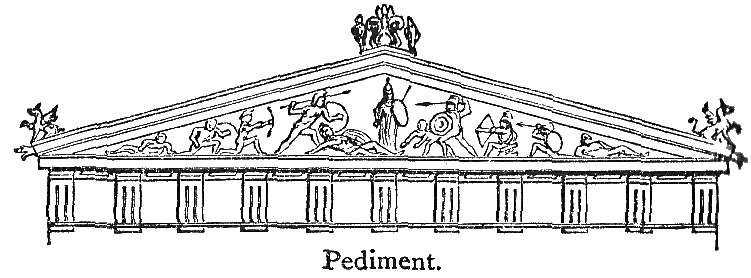
Pediment, ped′i-ment, n. (archit.) a triangular or circular ornament which crowns the fronts of buildings, and serves as a finish to the tops of doors, windows, porticoes, &c.—adjs. Pediment′al; Ped′imented, furnished with a pediment: like a pediment. [L. pedamentum—pes, pedis, the foot.]
Pedipalp, ped′i-palp, n. a maxillipalp or maxillary palpus.—adj. pertaining to the same.—n.pl. Pedipal′pi, an order of Arachnida.—adj. Pedipal′pous.
Pedlar. See Peddle.
Pedobaptism, pē-dō-bap′tizm, n. infant baptism.—n. Pedobap′tist, one who believes in infant baptism. [Gr. pais, paidos, a child, baptism.]
Pedometer, pē-dom′et-ėr, n. an instrument, somewhat like a watch, by which the number of the steps of a pedestrian are registered, from which the distance he has walked is measured.—adj. Pedomet′ric. [L. pes, pedis, a foot, Gr. metron, a measure.]
Pedomotor, ped-ō-mō′tor, n. a means for applying the foot as a driving power.—adj. Pedomō′tive.
Pedotrophy, pē-dot′rō-fi, n. the rearing of children.—adj. Pedotroph′ic.—n. Pedot′rophist. [Gr. pais, paidos, a child, trephein, to nourish.]
Pedum, pē′dum, n. a shepherd's crook. [L.]
Peduncle, pē-dung′kl, n. the stalk by which a cluster of flowers or leaves is joined to a twig or branch—sometimes same as pedicel—also Pedun′culus.—adjs. Pedun′cular, Pedun′culate, -d. [Fr. pedoncule—Low L. pedunculus—L. pes, pedis, the foot.]
Peece, pēs, n. (Shak.) a fabric, a fortified place.
Peeced, pēsd, adj. (Spens.) imperfect.
Peek, pēk, v.i. to peep.—n. Peek′aboo, a children's game, from the cry made when hiding one's eyes.
Peel, pēl, v.t. to strip off the skin or bark: to bare.—v.i. to come off as the skin: to lose the skin: (slang) to undress.—n. the skin, rind, or bark: (print.) a wooden pole with short cross-piece for carrying printed sheets to the poles on which they are to be dried: the wash or blade of an oar—not the loom: a mark () for cattle, for persons who cannot write, &c.—adj. Peeled, stripped of skin, rind, or bark: plundered.—ns. Peel′er, one who peels, a plunderer; Peel′ing, the act of stripping: that which is stripped off: (print.) the removing of the layers of a paper overlay, to get a lighter impression. [O. Fr. peler, to unskin—L. pilāre, to deprive of hair—pilus, a hair; or pellis, a skin.]

Peel, pēl, n. a small Border fortress.—Also Peel′-tow′er. [Pile.]
Peel, pēl, n. a baker's wooden shovel: a fire-shovel. [O. Fr. pele—L. pāla, a spade.]
Peel, pēl, v.t. to plunder: to pillage. [Pill (v.).]
Peeler, pēl′ėr, n. a policeman, from Sir R. Peel, who established the Irish police (1812-18) and improved those in Britain (1828-30).—n. Peel′ite, a follower of Peel in the reform of the Corn-laws in 1846.
Peen, pēn, n. the end of a hammer-head, usually shaped for indenting.—v.t. to strike with such. [Ger. pinne.]
Peenge, pēnj, v.i. (Scot.) to complain childishly.
Peep, pēp, v.i. to chirp, or cry as a chicken.—n. the cry of a young chicken. [Fr. piper—L. pipāre.]
Peep, pēp, v.i. to look through a narrow opening: to look out from concealment: to look slyly or cautiously: to begin to appear.—n. a sly look: a beginning to appear, a glimpse: a narrow view, a slit.—ns. Peep′er, one that peeps: a prying person: a chicken just breaking the shell: (slang) the eye; Peep′-hole, a hole through which one may look without being seen; Peep′-o'-day, the first appearance of light in the morning; Peep′-show, a small show viewed through a small hole, usually fitted with a magnifying-glass; Peep′-sight, a plate on the breach with a small hole through which a gunner takes his sight.—Peeping Tom, a prying fellow, esp. one who peeps in at windows; Peep-o'-day boys, a band of Protestants in the north of Ireland, in the end of the 18th century—opposed to the Catholic Defenders. [Same as above, Fr. piper, to chirp like a bird, then to beguile, whence peep=to look out slyly.]
Peer, pēr, n. an equal in rank, ability, character, &c.: an associate: a nobleman: a member of the House of Lords:—fem. Peer′ess.—n. Peer′age, the rank or dignity of a peer: the body of peers: a book containing a description of the history, connections, &c. of the different peers.—adj. Peer′less, having no peer or equal: matchless.—adv. Peer′lessly.—n. Peer′lessness.—House of Peers, the House of Lords; Spiritual peer, one of the bishops or archbishops qualified to sit as members of the House of Lords; Temporal peer, one of the members of the House of Lords, other than the bishops. [O. Fr. (Fr. pair),—L. par, paris, equal.]
Peer, pēr, v.i. to look narrowly or closely: to peep: to appear:—pa.t. and pa.p. peered.—adj. Peer′y, prying, sly. [M. E. piren—Low Ger. piren, orig. pliren, to draw the eyelids together.]
Peerie, Peery, pēr′i, n. a top spun with a string.
Peevers, pēv′ers, n. (Scot.) the game of hop-scotch.
Peevish, pēv′ish, adj. habitually fretful: easily annoyed: hard to please: showing ill-nature: childish.—adv. Peev′ishly.—n. Peev′ishness. [Prob. imit. of the puling of fretful infants.]
Peewit. Same as Pewit.
Peg, peg, n. a wooden pin for fastening boards, or the soles of shoes: one of the pins on which the strings of a musical instrument are stretched: a reason or excuse for action: a drink of soda-water with brandy, &c.: a degree or step.—v.t. to fasten with a peg: to keep up the market price by buying or selling at a fixed price: to make points during the game of cribbage before the show of hands.—v.i. to work with unremitting effort:—pr.p. peg′ging; pa.t. and pa.p. pegged.—ns. Peg′-fiched, an English game played with pegs or pointed sticks; Peg′-float, a machine for rasping away the ends of pegs inside shoes.—adj. Pegged, fashioned of, or furnished with, pegs.—ns. Peg′ging, the act of fastening with a peg: pegs collectively: a thrashing: determined perseverance in work; Peg′-leg, a wooden leg of the simplest form, or one who walks on such; Peg′-strip, a ribbon of wood cut to the width, &c., of a shoe-peg; Peg′-tank′ard, a drinking-vessel having each one's share marked off by a knob; Peg′-top, a child's plaything made to spin round by winding a string round it and then rapidly pulling it off: (pl.) a kind of trousers, wide at the top and narrow at the ankles.—adj. shaped like a top.—Peg away, to keep continually working.—Take down a peg, to take down, to humble. [Scand.; as in Dan. pig, a spike.]
Pegasus, peg′a-sus, n. a winged horse which arose from the blood of the Gorgon Medusa, when she was slain by Perseus: a genus of small fishes with large, wing-like, pectoral fins: one of the constellations in the northern sky.—adj. Pegasē′an.
Peggy, peg′i, n. one of several small warblers, the whitethroat, &c. [Peggy, from Peg=Meg—Margaret.]
Pegmatite, peg′ma-tīt, n. coarsely crystallised granite.—adj. Pegmatit′ic.
Pehlevi, pā′le-vē, n. an ancient West Iranian idiom during the period of the Sassanides, largely mixed with Semitic words, and poorer in inflections and terminations than Zend (235-640 A.D.): the characters used in writing this language.—adj. of or pertaining to, or written in, Pehlevi. [Pers.]
Peignoir, pēn-wär′, n. a loose wrapper worn by women during their toilet. [Fr.]
Peinct, pāngkt, v.t. (Spens.) to paint.
Peine, pān, n. a form of punishment by pressing to death—usually Peine forte et dure. [Fr.]
Peirastic, pī-ras′tik, adj. tentative.—n. Peiram′eter, an instrument for measuring the resistances of road-surface to traction. [Gr. peira, a trial.]
Peise, pāz, v.t. (Spens., Shak.) to poise, to weigh.—n. a weight. [Poise.]
Pejoration, pē-jō-rā′shun, n. a becoming worse: deterioration.—v.i. Pē′jorāte.—adj. and n. Pē′jorātive.—n. Pējor′ity. [L. pejor, worse, comp. of malus, bad.]
Pekan, pek′an, n. an American species of Marten—called also Wood-shock, Fisher, and Black-fox.
Pekoe, pē′kō, n. a scented black tea. [Chinese.]
Pelage, pel′āj, n. the hair or wool of a mammal. [Fr.]
Pelagian, pē-lā′ji-an, n. one who holds the views of Pelagius, a British monk of the 4th century, who denied original sin.—adj. pertaining to Pelagius.—n. Pelā′gianism, the doctrines of Pelagius.
Pelagic, pē-laj′ik, adj. inhabiting the deep sea, marine, oceanic. [Gr. pelagos, the sea.]
Pelargonium, pel-ar-gō′ni-um, n. a vast genus of beautiful flowering plants of order Geraniaceæ.—adj. Pēlar′gic, stork-like. [Gr. pelargos, stork, the beaked capsules resembling a stork's beak.]
Pelasgic, pē-las′jik, adj. pertaining to the Pelasgians or Pelasgi, a race spread over Greece in prehistoric times, to whom are ascribed many enormous remains built of unhewn stones, without cement—the so-called Pelasgic architecture. Also Pelas′gian.
Pêle-mêle. See Pell-mell, adv.
Pelerine, pel′ėr-in, n. a woman's tippet or cape with long ends coming down in front. [Fr., a tippet—pèlerin, a pilgrim—L. peregrinus, foreign.]
Pelf, pelf, n. riches (in a bad sense): money. [O. Fr. pelfre, booty; allied to pilfer.]
Pelican, pel′i-kan, n. a large water-fowl, having an enormous distensible gular pouch: an alembic with tubulated head from which two opposite and crooked beaks extend and enter again the body of the vessel—used for continuous distillation: a dentist's instrument: (her.) a pelican above her nest, with wings indorsed, wounding her breast with her beak in order to feed her young with her blood. [Low L. pelicanus—Gr. pelikan—pelekus, an axe.]
Pelike, pel′i-kē, n. a large vase like the hydria, double-handled. [Gr.]
Pelisse, pe-lēs′, n. a cloak of silk or other cloth, with sleeves, worn by ladies: a garment lined with fur, a dragoon's jacket with shaggy lining. [Fr.,—Low L. pellicea (vestis)—L. pellis, a skin.]
Pell, pel, n. a skin or hide: a roll of parchment. [O. Fr. pel (Fr. peau)—L. pellis, a skin or hide.]
Pellagra, pe-lā′gra, n. a loathsome skin disease supposed to be common in the rice-producing part of the north of Italy.—n. Pellā′grin, one afflicted with pellagra.—adj. Pellā′grous, like or afflicted with pellagra. [Gr. pella, skin, agra, seizure.]
Pellet, pel′et, n. a little ball, as of lint or wax: a small rounded boss: a small pill: a ball of shot.—adj. Pell′eted, consisting of pellets: pelted, as with bullets. [O. Fr. pelote—L. pila, a ball.]
Pellicle, pel′i-kl, n. a thin skin or film: the film or scum which gathers on liquors.—adj. Pellic′ular.
Pellitory, pel′i-tor-i, n. a genus of plants found most commonly on old walls and heaps of rubbish: the feverfew.—n. Pell′itory-of-Spain, a plant which grows in Algeria, the root of which causes in the hands first a sensation of extreme cold, then one of a burning heat. [L. parietaria, the wall-plant—parietarius—paries, parietis, a wall.]
Pell-mell, pel-mel′, adv. in great confusion: promiscuously: in a disorderly manner—also written Pêle-mêle.—n. Pell-mell′ (same as Pall-mall). [O. Fr. pesle-mesle (Fr. pêle-mêle), -mesle being from O. Fr. mesler (Fr. mêler), to mix—Low L. misculāre—L. miscēre; and pesle, a rhyming addition, perh. influenced by Fr. pelle, shovel.]
Pellucid, pe-lū′sid, adj. perfectly clear: letting light through: transparent.—ns. Pellūcid′ity, Pellū′cidness.—adv. Pellū′cidly. [Fr.,—L. pellucidus—per, perfectly, lucidus, clear—lucēre, to shine.]
Pelma, pel′ma, n. the sole of the foot.—n. Pelmat′ogram, the impression of the foot. [Gr.]
Pelopid, pel′ō-pid, adj. pertaining to Pelops.—n. one of his descendants.
Peloponnesian, pel-ō-po-nē′zi-an, adj. of or pertaining to the Peloponnesus or southern part of Greece.—n. an inhabitant or a native of the Peloponnesus.—Peloponnesian war, a war between Athens and Sparta (431-404 B.C.). [Gr. Pelops, an ancient Greek hero, nēsos, an island.]
Peloria, pē-lō′ri-a, n. the appearance of regularity in flowers normally irregular—also Pel′orism.—adjs. Pēlor′iate, Pēlor′ic. [Gr. pelōr, a monster.]
Pelt, pelt, n. a raw hide: the quarry or prey of a hawk all torn.—ns. Pelt′monger, a dealer in skins; Pelt′ry, the skins of animals with the fur on them: furs. [M. E. pelt, peltry—O. Fr. pelleterie—pelletier, a skinner—L. pellis, a skin.]
Pelt, pelt, v.t. to strike with something thrown: to cast.—v.i. to fall heavily, as rain.—n. a blow from something thrown.—ns. Pel′ter, a shower of missiles, a sharp storm of rain, &c.: a storm of anger; Pel′ting, an assault with a pellet, or with anything thrown. [Cf. Pellet.]
Pelta, pel′ta, n. a light buckler.—n. Pel′tast, a soldier armed with this.—adjs. Pel′tāte, -d, shield-shaped; Peltat′ifid, Pel′tiform. [L.,—Gr. peltē.]
Pelting, pel′ting, adj. (Shak.) paltry, contemptible.—adv. Pelt′ingly. [Paltry.]
Pelvis, pel′vis, n. the bony cavity at the lower end of the trunk, forming the lower part of the abdomen.—adjs. Pel′vic, of or pertaining to the pelvis; Pel′viform, openly cup-shaped.—ns. Pelvim′eter, an instrument for measuring the diameters of the pelvis; Pelvim′etry. [L. pelvis, a basin.]
Pemmican, Pemican, pem′i-kan, n. a North American Indian preparation, consisting of lean venison, dried, pounded, and pressed into cakes, now made of beef and used in Arctic expeditions, &c.
Pemphigus, pem′fi-gus, n. an affection of the skin with pustules.—adj. Pem′phigoid. [Gr.]
Pen, pen, v.t. to shut up: to confine in a small enclosure:—pr.p. pen′ning; pa.t. and pa.p. penned or pent.—n. a small enclosure: a fold for animals: a coop. [A.S. pennan, to shut up, in comp. on pennan, to unpen. Prop. to fasten with a pin.]
Pen, pen, n. one of the large feathers of the wing of a bird: an instrument used for writing, formerly made of the feather of a bird, but now of steel, &c.: style of writing: a female swan—opp. to Cob.—v.t. to write, to commit to paper:—pr.p. pen′ning; pa.t. and pa.p. penned.—adj. Pen′-and-ink′, written, literary: executed with pen and ink, as a drawing.—ns. Pen′-case, a holder for a pen or pens; Pen′craft, skill in penmanship: the art of composition; Pen′-driv′er, a clerk; Pen′ful, what one can write with one dip of ink; Pen′-hold′er, a holder for pens or nibs; Pen′-wī′per, a piece of cloth, leather, &c. for wiping pens after use; Pen′-wom′an, a female writer. [O. Fr. penne—L. penna, a feather.]
Penal, pē′nal, adj. pertaining to, incurring, or constituting punishment: used for punishment.—v.t. Pē′nalise, to lay under penalty.—adv. Pē′nally.—Penal laws, laws prohibiting certain actions under penalties; Penal servitude, hard labour in a prison as a punishment for crime—introduced in England in 1853 instead of transportation; Penal statute, a statute imposing a penalty or punishment for crime. [Fr.,—L. pœnalis—pœna, Gr. poinē, punishment.]
Penalty, pen′al-ti, n. punishment: suffering in person or property for wrong-doing or for breach of a law: a fine or loss which a person agrees to pay or bear in case of his non-fulfilment of some undertaking: a fine.—Under penalty of, so as to suffer, or (after a negative) without suffering the punishment of.
Penance, pen′ans, n. repentance: external acts performed to manifest sorrow for sin, to seek to atone for the sin and to avert the punishment which, even after the guilt has been remitted, may still remain due to the offence—also the sacrament by which absolution is conveyed (involving contrition, confession, and satisfaction): any instrument of self-punishment.—v.t. to impose penance on: to punish. [O. Fr.; cf. Penitence.]
Penang-lawyer, pe-nang′-law′yėr, n. a walking-stick made from the stem of a Penang palm. [Prob. a corr. of Penang liyar, the wild areca.]
Penannular, pē-nan′ū-lar, adj. shaped almost like a ring. [L. pæna, almost, annularis, annular.]
Penates, pē-nā′tēs, n.pl. the household gods of ancient Rome who presided over and were worshipped by each family. [L., from root pen- in L. penitus, within, penetralia, the inner part of anything.]
Pence, pens, n. plural of penny (q.v.).
Penchant, päng′shäng, n. inclination: decided taste: bias. [Fr., pr.p. of pencher, to incline, through a form pendicāre, from L. pendēre, to hang.]
Pencil, pen′sil, n. a small hair brush for laying on colours: any pointed instrument for writing or drawing without ink: a collection of rays of light converging to a point: the art of painting or drawing.—v.t. to write, sketch, or mark with a pencil: to paint or draw:—pr.p. pen′cilling; pa.t. and pa.p. pen′cilled.—ns. Pen′cil-case, a holder for a pencil; Pen′cil-com′pass, a compass having a pencil on one of its legs for use in drawing.—adjs. Pen′cilled, written or marked with a pencil: having pencils of rays: radiated: (bot.) marked with fine lines, as with a pencil; Pen′cilliform, having the form of a pencil, as of rays.—ns. Pen′cilling, the art of writing, sketching, or marking with a pencil: marks made with a pencil: fine lines on flowers or the feathers of birds: a sketch; Pen′cil-sketch, a sketch made with a pencil. [O. Fr. pincel (Fr. pinceau)—L. penicillum, a painter's brush, dim. of penis, a tail.]
Pend, pend, n. (obs.) an enclosure: (Scot.) a narrow close leading off a main street.
Pend, pend, v.i. to hang, as in a balance, to impend.—adj. Pend′ing, hanging: remaining undecided: not terminated.—prep. during.
Pendant, pen′dant, n. anything hanging, esp. for ornament: an earring: a lamp hanging from the roof: an ornament of wood or of stone hanging downwards from a roof: a long narrow flag, at the head of the principal mast in a royal ship: something attached to another thing of the same kind, an appendix, a companion picture, poem, &c.—ns. Pen′dence, Pen′dency, a hanging in suspense: state of being undecided.—adj. Pen′dent, hanging: projecting: supported above the ground or base: (bot.) hanging downwards, as a flower or a leaf.—n. Penden′tive (archit.), the triangular portion of a dome cut off between two supporting arches at right angles to each other.—adv. Pen′dently.—ns. Pen′dicle, an appendage: something attached to another, as a privilege, a small piece of ground for cultivation; Pen′dūlet, a pendant. [Fr. pendant, pr.p. of pendre, to hang—L. pendens, -entis—pr.p. of pendēre, to hang.]