LIST OF ABBREVIATIONS USED IN THIS DICTIONARY. (continued 6)
Reading edition
Pendragon, pen-drag′on, n. a chief leader: an ancient British chief.—n. Pendrag′onship. [W. pen, head, dragon, a chief.]
Pendulum, pen′dū-lum, n. any weight so hung from a fixed point as to swing freely: the swinging weight which regulates the movement of a clock: a lamp, &c., pendent from a ceiling: a guard-ring of a watch by which it is attached to a chain.—adj. Pen′dular, relating to a pendulum.—v.i. Pen′dulate, to swing, vibrate.—adjs. Pen′dulent, pendulous; Pen′duline, building a pendulous nest; Pen′dulous, hanging loosely: swinging freely, as the pensile nests of birds: (bot.) hanging downwards, as a flower on a curved stalk.—adv. Pen′dulously.—ns. Pen′dulousness, Pen′dulosity.—Pendulum wire, a kind of flat steel wire for clock pendulums.—Compensation pendulum, a pendulum so constructed that its rod is not altered in length by changes of temperature; Compound pendulum, every ordinary pendulum is compound, as differing from a Simple pendulum, which is a material point suspended by an ideal line; Invariable pendulum, a pendulum for carrying from station to station to be oscillated at each so as to fix the relative acceleration of gravity; Long and short pendulum, a pendulum for determining the absolute force of gravity by means of a bob suspended by a wire of varying length. [L., neut. of pendulus, hanging—pendēre, to hang.]
Peneian, pē-nē′yan, adj. relating to the river Peneus in the famous Vale of Tempe in Thessaly.
Penelopise, pē-nel′o-pīz, v.i. to act like Penelope, the wife of Ulysses, who undid at night the work she did by day, to gain time from her suitors.
Penetrate, pen′ē-trāt, v.t. to thrust into the inside: to pierce into: to affect the mind or feelings: to enter and to fill: to understand: to find out.—v.i. to make way: to pass inwards.—ns. Penetrabil′ity, Pen′etrableness.—adj. Pen′etrable, that may be penetrated or pierced by another body: capable of having impressions made upon the mind.—adv. Pen′etrably, so as to be penetrated—n.pl. Penetrā′lia, the inmost parts of a building: secrets: mysteries.—ns. Pen′etrance, Pen′etrancy, the quality of being penetrant.—adjs. Pen′etrant, subtle, penetrating; Pen′etrating, piercing or entering: sharp: subtle: acute: discerning.—adv. Pen′etratingly.—n. Penetrā′tion, the act or power of penetrating or entering: acuteness: discernment: the space-penetrating power of a telescope.—adj. Pen′etrative, tending to penetrate: piercing: sagacious: affecting the mind.—adv. Pen′etratively, in a penetrative manner.—n. Pen′etrativeness, the quality of being penetrative: penetrative power. [L. penetrāre, -ātum—penes, within.]
Pen-fish, pen′-fish, n. a sparoid fish of genus Calamus.
Penfold. Same as Pinfold.
Penguin, pen′gwin, n. an aquatic bird in the southern hemisphere, unable to fly, but very expert in diving—also Pin′guin.—n. Pen′guinery, a breeding-place of penguins. [Ety. dub.; a corr. of pen-wing, or from W. pen, head, gwen, white.]
Pen-gun, pen′-gun, n. a pop-gun.
Penicil, pen′i-sil, n. a brush of hairs: a pledget for wounds, &c.—adjs. Pen′icillate, Penicil′liform.—n. Penicil′lium, one of the blue-moulds.
Peninsula, pē-nin′sū-la, n. land so surrounded by water as to be almost an island.—adj. Penin′sular, pertaining to a peninsula: in the form of a peninsula: inhabiting a peninsula.—n. Peninsular′ity, state of being, or of inhabiting, a peninsula: narrow provincialism.—v.t. Penin′sulate, to form into a peninsula: to surround almost entirely with water.—Peninsular war, the war in Spain and Portugal, carried on by Great Britain against Napoleon's marshals (1804-1814).—The Peninsula, Spain and Portugal. [L.,—pæne, almost, insula, an island.]
Penis, pē′nis, n. the characteristic external male organ.—adj. Pē′nial. [L., a tail.]
Penistone, pen′i-stōn, n. a coarse frieze.—Penistone flags, a kind of sandstone for paving and building, brought from Penistone in Yorkshire.
Penitent, pen′i-tent, adj. suffering pain or sorrow for sin: contrite: repentant.—n. one who is sorry for sin: one who has confessed sin, and is undergoing penance.—ns. Pen′itence, Pen′itency, state of being penitent: sorrow for sin.—adj. Peniten′tial, pertaining to, or expressive of, penitence.—n. a book of rules relating to penance.—adv. Peniten′tially.—adj. Peniten′tiary, relating to penance: penitential.—n. a penitent: an office at the court of Rome for examining and issuing secret bulls, dispensations, &c.: a book for guidance in imposing penances: a place for the performance of penance: a house of correction and punishment for offenders.—adv. Pen′itently.—Penitential garment, a rough garment worn for penance; Penitential psalms, certain psalms suitable for being sung by penitents, as the 6th, 32d, 38th, 51st, 102d, 130th, 143d. [Fr.,—L. pœnitens, -entis—pœnitēre, to cause to repent.]
Penknife, pen′nīf, n. a small knife, originally for making and mending quill pens.
Penman, pen′man, n. a man skilled in the use of the pen: an author:—pl. Pen′men.—n. Pen′manship, the use of the pen: art or manner of writing.
Penna, pen′a, n. a feather, esp. one of the large feathers of the wings or tail.—adj. Pennā′ceous. [L.]
Pennal, pen′al, n. a freshman at a German university—so called from their pennales or pen-cases.—n. Penn′alism, a system of fagging once in vogue at German universities.
Pen-name, pen′-nām, n. a name, other than his real one, by which an author is known to the public: a nom de plume.
Pennant, pen′ant, n. a flag many times as long as it is wide: a streamer: a long narrow piece of bunting at the mast-heads of war-ships.—Also Penn′on. [Pennant is formed from pennon, with excrescent t; pennon is Fr. pennon—L. penna, a wing.]
Pennate, -d, pen′āt, -ed, adj. winged: (bot.) same as Pinnate.—adj. Pennatif′id (see Pinnatifid).—n. Penne (Spens.), a feather.—adj. Penned, having wings: winged: written with a pen.—n. Pen′ner, a case for holding pens: (her.) a representation of such carried at the girdle.—adjs. Pennif′erous, Pennig′erous, feathered; Pen′niform, like a feather in form. [L. pennatus—penna, wing.]
Pennill, pen′il, n. a kind of Welsh verse, in which the singer has to change words and measure according to the variations of his accompanist on the harp. [W. 'a verse,' pl. pennillion.]
Pennon, pen′on, n. a flag, a medieval knight-bachelor's ensign: a long narrow flag: a pinion or wing.—ns. Penn′oncelle, a small flag like a pennon; Penn′oncier, a knight-bachelor.—adj. Penn′oned, bearing a pennon. [Cf. Pennant.]
Penny, pen′i, n. a copper coin (bronze since 1860), originally silver=1⁄12 of a shilling, or four farthings: a small sum: money in general: (N.T.) a silver coin=7½d.: pound, in fourpenny, sixpenny, tenpenny nails=four, six, ten pound weight to the thousand:—pl. Pennies (pen′iz), denoting the number of coins; Pence (pens), the amount of pennies in value.—adjs. Penn′ied, possessed of a penny; Penn′iless, without a penny: without money: poor.—ns. Penn′ilessness; Penn′y-a-lin′er, one who writes for a public journal at so much a line: a writer for pay; Penn′y-a-lin′erism, hack-writing; Penn′y-dog, the tope or miller's dog, a kind of shark; Penn′y-post, a means of carrying a letter for a penny; Penn′y-rent, income; Penn′yweight, twenty-four grains of troy weight (the weight of a silver penny); Penn′y-wis′dom, prudence in petty matters.—adj. Penn′y-wise, saving small sums at the risk of larger: niggardly on improper occasions.—ns. Penn′y-worth, a penny's worth of anything: the amount that can be given for a penny: a good bargain—also Penn′'orth (coll.); Pē′ter's-pence, the name given to an old tribute offered to the Roman Pontiff, now a voluntary contribution.—Penny fee (Scot.), a small wage; Penny gaff (slang), a low-class theatre; Penny mail (Scot.), rent in money, not in kind: a small sum paid to the superior of land; Penny wedding, a wedding ceremonial in Scotland, at which the invited guests made contributions in money to pay the general expenses.—A pretty penny, a considerable sum of money; Turn an honest penny, to earn money honestly. [A.S. penig, oldest form pending, where pend=Eng. pawn, Ger. pfand, Dut. pand, a pledge, all which are from L. pannus, a rag, a piece of cloth.]
Pennyroyal, pen′i-roi-al, n. a species of mint, much in use in domestic medicine, in the form of a warm infusion, to promote perspiration and as an emmenagogue. [Corr. from old form pulial, which is traced through O. Fr. to L. puleium regium, the plant pennyroyal—pulex, a flea.]
Penology, Pænology, pē-nol′ō-ji, n. the study of punishment in its relation to crime: the management of prisons.—n. Penol′ogist. [Gr. poinē, punishment, logia, description.]
Pensée, pang-sā′, n. a thought. [Fr.]
Penseroso, pen-se-rō′so, adj. melancholy: thoughtful:—fem. Penserō′sa. [It.]
Pensile, pen′sīl, adj. hanging: suspended.—ns. Pen′sileness, Pensil′ity. [Fr.,—L.,—pendēre, hang.]
Pension, pen′shun, n. a stated allowance to a person for past services performed by himself or by some relative: a payment made to a person retired from service on account of age or weakness: a boarding-school or boarding-house on the Continent (pron. pong-siong′): a sum paid to a clergyman in place of tithes.—v.t. to grant a pension to.—adjs. Pen′sionable, entitled, or entitling, to a pension; Pen′sionary, receiving a pension: consisting of a pension.—n. one who receives a pension: the syndic or legal adviser of a Dutch town.—ns. Pen′sioner, one who receives a pension: a dependent: one who pays out of his own income for his commons, chambers, &c. at Cambridge University=an Oxford commoner; Pen′sionnaire.—Grand pensionary, the president of the States-general of Holland. [Fr.,—L. pension-em—pendĕre, pensum, to weigh, pay.]
Pensive, pen′siv, adj. thoughtful: reflecting: expressing thoughtfulness with sadness.—adj. Pen′sived (Shak.), thought over.—adv. Pen′sively.—n. Pen′siveness, state of being pensive: gloomy thoughtfulness: melancholy. [Fr. pensif—L. pensāre, to weigh—pendĕre, to weigh.]
Penstock, pen′stok, n. a trough conveying water to a water-wheel.
Pensum, pen′sum, n. an extra task given a scholar in punishment.
Pent, pa.t. and pa.p. of pen, to shut up.
Pentacapsular, pen-ta-kap′sū-lar, adj. having five capsules.
Pentachord, pen′ta-kord, n. a musical instrument with five strings: a diatonic series of five tones.
Pentacle, pent′a-kl, n. a figure formed by two equilateral triangles intersecting regularly so as to form a six-pointed star: properly a five-pointed object, the same as Pentagram (q.v.), a defence against demons.—adj. Pentac′ular. [O. Fr., but prob. not from Gr. pente, five, but O. Fr. pente, pendre, to hang. As applied to a magical figure prob. a corr. of pentangle, perh. pentacol—pendre, to hang, a, on, col, the neck.]
Pentacoccous, pen-ta-kok′us, adj. (bot.) having five grains or seeds.
Pentacrostic, pen-ta-kros′tik, adj. containing five acrostics of the same name.—n. a set of such verses.
Pentact, pen′takt, adj. five-rayed.—Also Pentac′tinal.
Pentad, pen′tad, n. the number five, a group of five things: a mean of temperature, &c., taken every five days.
Pentadactylous, pen-ta-dak′ti-lus, adj. having five digits—also Pentadac′tyl.—n. Pentadac′tylism.
Pentadelphous, pen-ta-del′fus, adj. (bot.) grouped together in five sets.
Pentaglot, pen′ta-glot, adj. of five tongues.—n. a work in five languages.
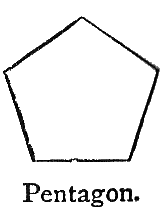
Pentagon, pen′ta-gon, n. (geom.) a plane figure having five angles and five sides: a fort with five bastions.—adj. Pentag′onal.—adv. Pentag′onally. [Gr. pentagōnon—pente, five, gōnia, angle.]
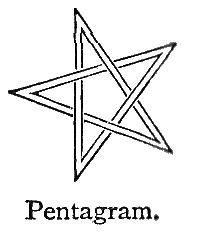
Pentagram, pen′ta-gram, n. a five-pointed star: a magic figure so called.—This is the proper pentacle.—adj. Pentagrammat′ic. [Gr. pente, five, gramma, a letter.]
Pentagraph=Pantograph.
Pentagynia, pent-a-jin′i-a, n. (bot.) a Linnæan order of plants, characterised by their flowers having five pistils.—n. Pent′agyn (bot.), a plant having five styles.—adjs. Pentagyn′ian, Pentag′ynous. [Gr. pente, five, gynē, a female.]
Pentahedron, pen-ta-hē′dron, n. (geom.) a solid figure bounded by five plane faces.—adj. Pentahē′dral. [Gr. pente, five, hedra, base.]
Pentalpha, pen-tal′fa, n. a five-pointed star: a pentacle. [Gr. pente, five, alpha.]
Pentameron, pen-tam′e-ron, n. a famous collection of fifty folk-tales (Naples 1637) written in the Neapolitan dialect by Giambattista Basile, supposed to be told during five days by ten old women, for the entertainment of a Moorish slave who has usurped the place of the rightful princess. [It. pentamerone.]
Pentamerous, pen-tam′ėr-us, adj. (bot.) consisting of or divided into five parts.—Pentamerus beds (geol.), a name applied to the upper and lower Llandovery rocks, full of the brachiopods called Pentamerus. [Gr. pente, five, meros, part.]
Pentameter, pen-tam′e-tėr, n. a verse of five measures or feet.—adj. having five feet.—Elegiac pentameter, a verse of six dactylic feet, the third and sixth with the first member only; Iambic pentameter, in English, heroic couplets and blank verse. [Gr. pentametros—pente, five, metron, a measure.]
Pentandria, pen-tan′dri-a, n. (bot.) a Linnæan order of plants, characterised by their flowers having five stamens.—n. Pentan′der, a plant of the class Pentandria.—adjs. Pentan′drian, Pentan′drous. [Gr. pente, five, anēr, andros, a man, a male.]
Pentangular, pen-tang′gū-lar, adj. having five angles.
Pentapetalous, pen-ta-pet′a-lus, adj. having five petals.
Pentaphyllous, pen-ta-fil′us, adj. having five leaves. [Gr. pente, five, phyllon, a leaf.]
Pentapody, pen-tap′o-di, n. a measure of five feet.
Pentapolis, pen-tap′o-lis, n. a group of five cities.—adj. Pentapol′itan, esp. of the ancient Pentapolis of Cyrenaica in northern Africa. [Gr. pente, five, polis, a city.]
Pentarchy, pen′tär-ki, n. government by five persons. [Gr. pente, five, archē, rule.]
Pentasepalous, pen-ta-sep′a-lus, adj. having five sepals.
Pentaspermous, pent-a-spėr′mus, adj. (bot.) containing five seeds. [Gr. pente, five, sperma, seed.]
Pentastich, pen′ta-stik, n. a composition of five verses.—adj. Pentas′tichous, five-ranked.
Pentastyle, pen′ta-stīl, adj. having five columns in front.—n. (archit.) a building with a portico of five columns. [Gr. pente, five, stylos, a pillar.]
Pentasyllabic, pen-ta-si-lab′ik, adj. having five syllables.
Pentateuch, pen′ta-tūk, n. a name used to denote the Jewish Thorah, the first five books of the Old Testament.—adj. Pen′tateuchal. [Gr. pente, five, teuchos, a book—teuchein, to prepare.]
Pentathlon, pen-tath′lon, n. a contest consisting of five exercises—wrestling, throwing the discus, spear-throwing, leaping, and running—also Pentath′lum.—n. Pentath′lēte, one who contests in the pentathlon. [Gr. pente, five, athlon, a contest.]
Pentatonic, pen-ta-ton′ik, adj. consisting of five tones.
Penteconter, pen′tē-kon-tėr, n. an ancient Greek ship having fifty oars.
Pentecost, pen′tē-kost, n. a Jewish festival held on the fiftieth day after the Passover, in commemoration of the giving of the law: the festival of Whitsuntide, held in remembrance of the descent of the Holy Ghost upon the assembled disciples at the feast of Pentecost.—adj. Pentecost′al.—n.pl. offerings formerly made to the parish priest at Whitsuntide. [Gr. pentēkostē (hēmera), the fiftieth (day).]
Pentegraph=Pantograph.
Pentelic, -an, pen-tel′ik, -an, adj. describing a kind of marble found at Mount Pentelicus near Athens.
Penteteric, pen-te-ter′ik, adj. occurring every five years. [Gr., pente, five, etos, a year.]
Penthemimeral, pen-thē-mim′e-ral, adj. belonging to a metrical group of 2½ feet. [Gr. pente, five, hēmi, half, meros, a part.]
Penthouse, pent′hows, n. a shed projecting from or adjoining a main building: a protection from the weather over a door or a window: anything resembling a penthouse.—v.t. to provide with a penthouse, shelter by means of a shed sloping from a wall, or anything similar. [A corr. of pentice, which is from Fr. appentis—L. appendicium, an appendage.]
Pentice, pen′tis, n. See Penthouse.
Pentile=Pantile.
Pentroof, pent′rōōf, n. a roof with a slope on one side only. [A hybrid word, from Fr. pente, a slope—pendre, to hang, and Eng. roof.]
Pentstemon, pent-stē′mon, n. a genus of perennial herbs of the order Scrophularineæ, common in California. [Gr. pente, five, stēmōn, warp, stamen.]
Pentzia, pent′si-a, n. a genus of South African shrubs, having yellow flowers in small heads, usually in corymbs.—The chief species is Pentzia virgata or the 'sheep-fodder bush.' [Named after C. J. Pentz, a student under Thunberg.]
Penult, pē-nult′, or pē′nult, Penult′ima, n. the syllable last but one.—adj. Penult′imāte, last but one.—n. the penult: the last member but one of any series. [L. penultima—pæne, almost, ultimus, last.]
Penumbra, pē-num′bra, n. a partial or lighter shadow round the perfect or darker shadow of an eclipse: the part of a picture where the light and shade blend into each other.—adjs. Penum′bral, Penum′brous. [L. pæne, almost, umbra, shade.]
Penury, pen′ū-ri, n. want: absence of means or resources: great poverty.—adj. Penū′rious, showing penury: not bountiful: too saving: sordid: miserly.—adv. Penū′riously.—n. Penū′riousness. [Fr.,—L. penuria; Gr. peina, hunger, penēs, poor.]
Peon, pē′on, n. a day-labourer, esp. in South America, one working off a debt by bondage: in India, a foot-soldier, a messenger, a native policeman.—ns. Pē′onage, Pē′onism, this kind of agricultural servitude. [Sp.,—Low L. pedo—L. pes, pedis, a foot.]
Peony, pē′o-ni, n. a genus of plants of the natural order Ranunculaceæ, with large showy flowers, carmine, in some white. [O. Fr. pione (Fr. pivoine)—L. pæonia, healing—Gr. Paiōn.]
People, pē′pl, n. persons generally: the men, women, and children of a country or a nation: the mass of persons as distinguished from the rulers, &c.: an indefinite number: inhabitants: the vulgar: the populace:—pl. Peoples (pē′plz), races, tribes.—v.t. to stock with people or inhabitants.—People's palace, an institution for the amusement, recreation, and association of the working-classes, as that in the East End of London, inaugurated in 1887.—Chosen people, the Israelites; Good people, or folk, a popular euphemistic name for the fairies; Peculiar people (see Peculiar); The people, the populace, the mass. [Fr. peuple—L. populus, prob. reduplicated from root of plebs, people.]
Peotomy, pē-ot′ō-mi, n. the amputation of the penis. [Gr. peos, the penis, temnein, to cut.]
Peperin, pep′e-rin, n. a volcanic tufa found in the Alban Hills near Rome. [It. peperino—pepe, pepper—L. piper, pepper.]
Pepita, pe-pē′ta, n. a nugget of gold. [Sp.]
Peplum, pep′lum, n. an upper robe worn by women in ancient Greece.—Also Pep′lus. [L.,—Gr. peplos.]
Pepo, pē′pō, n. a fruit like that of the gourd. [Gr.]
Pepper, pep′ėr, n. a pungent aromatic condiment consisting of the dried berries of the pepper-plant, entire or powdered: any plant of genus Piper: a plant of genus Capsicum, or one of its pods, whence Cayenne pepper.—v.t. to sprinkle with pepper: to hit or pelt with shot, &c.: to pelt thoroughly: to do for.—adj. Pepp′er-and-salt′, of a colour composed of a light ground dotted with fine spots of a dark colour, or of a dark ground with light spots.—ns. Pepp′er-box, a box with a perforated top for sprinkling pepper on food; Pepp′er-cake, a kind of spiced cake or gingerbread; Pepp′er-cast′er, the vessel, on a cruet-stand, from which pepper is sprinkled; Pepp′ercorn, the berry of the pepper plant: something of little value—Peppercorn rent, a nominal rent; Pepp′erer, one who sells pepper, a grocer; Pepp′er-gin′gerbread, hot-spiced gingerbread; Pepp′er-grass, any plant of genus Lepidium; Pepp′eriness; Pepp′ermint, a species of mint, aromatic and pungent like pepper: a liquor distilled from the plant: a lozenge flavoured with peppermint—Peppermint-drop, a confection so flavoured; Pepp′er-pot, a West Indian dish, of cassareep, together with flesh or dried fish and vegetables, esp. green okra and chillies: tripe shredded and stewed, with balls of dough and plenty of pepper; Pepp′er-tree, a shrub of the cashew family, native to South America, &c.—also Pepper shrub and Chili pepper; Pepp′erwort, the dittander.—adj. Pepp′ery, possessing the qualities of pepper: hot, choleric.—Æthiopian pepper, the produce of Xylopia Æthiopica; Benin pepper, of Cubeba Clusii; Guinea pepper, or Maleguetta pepper, of Amomum; Jamaica pepper, or Pimento, of species of Eugenia (Myrtaceæ); Long pepper, the fruit of Piper Longum; White pepper, the seed freed from the skin and fleshy part of the fruit by soaking in water and rubbing the dried fruit. [A.S. pipor—L. piper—Gr. peperi—Sans. pippala.]
Pepper's Ghost, pep′ėrs gōst, n. a device for associating on the same stage living persons and phantoms to act together—the phantom produced by a large sheet of unsilvered glass on the stage, practically invisible to the spectators, reflecting to them, along with a visible actor or actors, the appearance of another actor on an understage, himself invisible. [John H. Pepper (b. 1821), the improver and exhibitor of Henry Dircks' invention.]
Pepsin, Pepsine, pep′sin, n. one of the essential constituents of the gastric juice: the active agent in fermenting food in the stomach—a hydrolytic ferment.—adj. Pep′tic, relating to or promoting digestion: having a good digestion.—ns. Peptic′ity, eupepsia; Pep′tics, digestion considered as a science: the digestive organs; Pep′togen, a substance producing peptone, any preparation that facilitates digestion.—adjs. Peptogen′ic, Peptog′enous, Pepton′ic.—ns. Pep′tōne, one of a class of albumenoids formed by the action of the chemical ferment pepsin and hydrochloric acid, the latter first converting into a syntonin or acid protein, the former converting this syntonin into peptone—they are soluble in water, are not coagulated by boiling, and pass readily through an animal membrane, being therefore easily absorbed; Peptonisā′tion.—v.t. Pep′tonise, to convert into peptones.—n. Pep′tonoid, a substance like peptone: one of certain food preparations. [Fr.,—Gr. pepsis, digestion—peptein, to digest.]
Pepysian, pep′is-i-an, adj. pertaining to Samuel Pepys (1633-1703), his inimitable diary, or the collection of prints, books, ballads, &c. he bequeathed to Magdalene College, Cambridge.
Per, pėr, prep. through, by means of, according to.—Per annum, year by year: for each year; Per capita, by heads, implying equal rights to two or more persons; Per cent., per hundred; Per contra, on the contrary: as a set-off; Per diem, every day: day by day; Per mensem, monthly: by the month; Per saltum, at a single leap: all at once; Per se, by himself, &c.: essentially.
Peracute, per-a-kūt′, adj. very sharp or violent.
Peradventure, per-ad-vent′ūr, adv. by adventure: by chance: perhaps.—n. uncertainty: question.
Perambulate, per-am′bū-lāt, v.t. to walk through or over: to pass through for the purpose of surveying: to survey the boundaries of.—ns. Perambulā′tion, act of perambulating: a survey or inspection by travelling through: the district within which a person has the right of inspection; Peram′bulātor, one who perambulates: an instrument for measuring distances on roads: a light carriage for a child.—adj. Peram′bulātory. [L. perambulāre, -ātum—per, through, ambulāre, to walk.]
Percale, per-käl′, n. a closely woven French cambric.—n. Per′caline, a glossy cotton cloth. [Fr.]
Percase, per-kās′, adv. (Bacon) perchance, perhaps. [L. per, through, by, casus, a chance.]
Perceable, pėrs′a-bl, adj. (Spens.)=Pierceable.
Perceant, pėrs′ant, adj. piercing, penetrating.—v.t. Perc′en (Spens.), to pierce. [Fr. perçant, pr.p. of percer, to pierce.]
Perceive, per-sēv′, v.t. to become aware of through the senses: to get knowledge of by the mind: to see: to understand: to discern.—adj. Perceiv′able (same as Perceptible).—adv. Perceiv′ably (same as Perceptibly).—ns. Perceiv′er; Perceiv′ing (Bacon), perception. [O. Fr. percever—L. percipĕre, perceptum—per, perfectly, capĕre, to take.]
Percentage, per-sen′tāj, n. rate per hundred: an allowance of so much for every hundred.—adj. Percen′tile. [Cf. Cent.]
Percept, pėr′sept, n. that which is perceived by means of the senses.—n. Perceptibil′ity, quality of being perceptible.—adj. Percep′tible, that can be perceived: that may be known by the senses: discernible.—adv. Percep′tibly.—n. Percep′tion, act of perceiving: discernment: (phil.) the faculty of perceiving: the evidence of external objects by our senses.—adjs. Percep′tional; Percep′tive, having the power of perceiving or discerning.—ns. Percep′tiveness, the faculty or power of perceiving: readiness to perceive; Perceptiv′ity, character or quality of being perceptive: power of perceiving.—adj. Percep′tūal, of the nature of perception.
Perch, pėrch, n. a genus of fresh-water fishes.—adjs. Perch′-backed, shaped like a perch's back; Per′ciform, percoid; Per′cine, perciform; Per′coid, like the perch: pertaining to the perch family. [Fr. perche—L. perca—Gr. perkē, a perch, prob. conn. with perknos, spotted.]
Perch, pėrch, n. a rod on which birds roost: any high seat or position: a measure=5½ yards: a square measure=30¼ square yards: a pole joining the fore and hind gear of a spring carriage: a frame on which cloth is examined for flaws.—v.i. to sit or roost on a perch: to settle.—v.t. to place, as on a perch.—ns. Perch′er, a bird that perches on trees; Perch′ing, the examination of cloth stretched on a frame for burs, knots, or holes—also called Burling.—adj. insessorial.—ns. Perch′-plate, a plate or block above or below a carriage-reach, at the king-bolt; Perch′-pole, an acrobat's climbing-pole; Perch′-stay, one of the side-rods bracing the perch to the hind-axle. [Fr. perche—L. pertica, a rod.]
Perchance, per-chans′, adv. by chance: perhaps.
Percheron, per-she-rong′, n. a horse of the Percheron breed, large strong draught-horses, usually dapple-gray—also Norman and Norman Percheron.—adj. pertaining to the foregoing. [Fr.,—Perche, in southern Normandy.]
Perchloric, per-klō′rik, adj. pertaining to an acid, a syrupy liquid obtained by decomposing potassium perchlorate by means of sulphuric acid.—n. Perchlō′rate, a salt of perchloric acid.
Percipient, per-sip′i-ent, adj. perceiving: having the faculty of perception.—n. one who perceives or who has the power of perceiving.—ns. Percip′ience, Percip′iency.
Perclose, per-klōz′, n. an enclosed place: (archit.) a railing separating a tomb or chapel from the rest of the church: (her.) the lower half of a garter with the buckle.—Also Par′aclose, Parclose′. [O. Fr.,—L. præ, in front, claudĕre, clausum, to shut.]
Percoct, per-kokt′, adj. well-cooked. [L. percoctus, percoquĕre, to cook thoroughly.]
Percoid, per′koid. See Perch (1).
Percolate, pėr′kō-lāt, v.t. to strain through pores or small openings, as a liquid: to filter.—v.i. to pass or ooze through very small openings: to filter.—n. a filtered liquid.—ns. Percolā′tion, act of filtering; Per′colator, a filtering vessel. [L. percolāre,-ātum—per, through, colāre, to strain.]
Percurrent, per-kur′ent, adj. running through the whole length.—adj. Percur′sory, running over slightly or in haste (same as Cursory). [L. percurrens, pr.p. of percurrĕre, percursum, to run through.]
Percuss, per-kus′, v.t. to strike so as to shake: to tap for purposes of diagnosis.—adj. Percus′sant (her.), bent round and striking the side, as a lion's tail—also Percussed′.
Percussion, per-kush′un, n. the forcible striking of one body against another: collision, or the shock produced by it: impression of sound on the ear: (med.) the tapping upon the body to find the condition of an internal organ by the sounds: in the jargon of palmistry, the outer side of the hand.—adjs. Percuss′ional, Percuss′ive.—ns. Percuss′ion-bull′et, a bullet so formed as to explode on striking something: an explosive bullet; Percus′sion-cap, a cap of copper partly filled with a substance which explodes when struck, formerly used for firing rifles, &c.; Percus′sion-fuse, a fuse in a projectile set in action by concussion when the projectile strikes the object; Percus′sion-hamm′er, a small hammer for percussion in diagnosis; Percus′sion-lock, a kind of lock for a gun in which a hammer strikes upon a percussion-cap on the nipple, igniting the charge; Percus′sion-pow′der, powder which explodes on being struck, called also fulminating powder.—adv. Percuss′ively.—ns. Percuss′or; Percuteur′, an instrument for light percussion in neuralgia, &c.—adj. Percū′tient, striking or having power to strike.—n. that which strikes or has power to strike. [L. percussion-em—percutĕre, percussum—per, thoroughly, quatĕre, to shake.]
Percutaneous, per-kū-tā′nē-us, adj. done or applied through or by means of the skin.—adv. Percutā′neously. [L. per, through, cutis, the skin.]
Perdendo, per-den′dō, adj. (mus.) dying away.—Also Perden′dosi. [It.]
Perdie, Perdy, pėr′di, adv.=Pardieu.
Perdition, per-dish′un, n. utter loss or ruin: the utter loss of happiness in a future state.—n. Per′dita, a lost woman.—adj. Perdi′tionable. [Fr.,—L. perditio—perdĕre, perditum—per, entirely, dăre, to put.]
Perdu, Perdue, per-dū′, adj. lost to view: concealed: being on a forlorn hope or on a desperate enterprise: reckless.—n. (Shak.) one lying in concealment or ambush: one on a forlorn hope. [Fr., pa.p. of perdre, to lose—L. perdĕre, to destroy.]
Perduellion, per-dū-el′i-on, n. treason. [L.]
Perdurable, per′dū-ra-bl, adj. (Shak.) very durable, long continued.—ns. Perdurabil′ity, Perdū′rance, Perdurā′tion.—adv. Perdū′rably (Shak.), very durably: everlastingly.—v.i. Perdure′, to last for a very long time. [L. perdurāre—per, through, durāre, to last.]
Peregal, per′e-gal, adj. fully equal.—n. equal.
Peregrinate, per′ē-gri-nāt, v.i. to travel through the country: to travel about from place to place: to live in a foreign country.—adj. foreign.—ns. Peregrinā′tion, act of peregrinating or travelling about; Per′egrinātor, one who travels about.—adj. Per′egrine, foreign, not native: migratory, as a bird.—n. a foreigner resident in any country: a kind of falcon.—n. Peregrin′ity, foreignness. [L. peregrināri, -ātus—peregrinus, foreign.]
Pereion, pe-rī′on, n. the thorax in crustacea:—pl. Perei′a.—n. Perei′opod, one of the true thoracic limbs of a crustacean. [Gr. periiōn, pr.p. of periienai, to go about.]
Perelle, pe-rel′, n. Same as Parella.
Peremptory, per′emp-tō-ri, adj. preventing debate: authoritative: dogmatical: final, determinate: fully resolved or determined: that must be done.—adv. Per′emptorily.—n. Per′emptoriness. [Fr.,—L. peremptorius—perimĕre, peremptum—per, entirely, emĕre, to take.]
Perennial, pe-ren′i-al, adj. lasting through the year: perpetual: never failing: growing constantly: (bot.) lasting more than two years: of insects, living more than one year.—n. a plant which lives more than two years.—v.i. Perenn′ate, to live perennially.—n. Perennā′tion.—adv. Perenn′ially. [L. perennis—per, through, annus, a year.]
Perennibranchiate, pe-ren-i-brang′ki-āt, adj. having perennial branchiæ or gills.—Also Perenn′ibranch.
Perfect, pėr′fekt, adj. done thoroughly or completely: completed: without blemish, fault, or error: having neither too much nor too little: entire, very great: in the highest degree: possessing every moral excellence: completely skilled or acquainted: (gram.) expressing an act completed: (bot.) having both stamens and pistils, hermaphrodite.—v.t. (or per-fekt′) to make perfect: to finish: to teach fully, to make fully skilled in anything.—ns. Perfectā′tion (rare); Per′fecter; Perfect′i, a body of Catharists in the 12th and 13th centuries, of very strict lives; Perfectibil′ity, quality of being made perfect.—adj. Perfect′ible, that may be made perfect.—ns. Perfec′tion, state of being perfect: a perfect quality or acquirement: the highest state or degree; Perfec′tionism (or Perfectibil′ity), the belief that man in a state of grace may attain to a relative perfection or a state of living without sin in this life; Perfec′tionist, one who pretends to be perfect: one who thinks that moral perfection can be attained in this life: one of the Bible Communists or Free-lovers, a small American sect founded by J. H. Noyes (1811-86), which settled at Oneida in 1848, holding that the gospel if accepted secures freedom from sin.—adj. Perfect′ive, tending to make perfect.—advs. Perfect′ively, Per′fectly, in a perfect manner: completely: exactly: without fault.—n. Per′fectness, state or quality of being perfect: completeness: perfection: consummate excellence.—Perfect insect, the imago or completely developed form of an insect; Perfect metals (see Metal); Perfect number, a number equal to the sum of all its divisors, the number itself of course excepted, as 6 = 1 + 2 + 3, 28 = 1 + 2 + 4 + 7 + 14. [Fr.,—L. perfectus, pa.p. of perficĕre—per, thoroughly, facĕre, to do.]
Perfervid, per-fer′vid, adj. very fervid: very hot or eager.—n. Perfer′vidness.—Perfervidum ingenium, a very ardent disposition. [L. perfervidus, præfervidus—præ, before, fervidus, fervid.]
Perficient, pėr-fish′ent, adj. effectual.—n. one who does a lasting work, esp. who endows a charity.
Perfidious, per-fid′i-us, adj. faithless: unfaithful: basely violating trust: treacherous.—adv. Perfid′iously.—ns. Perfid′iousness, Per′fidy, treachery. [L. perfidiosus—perfidia, faithlessness.]
Perfoliate, -d, per-fō′li-āt, -ed, adj. (bot.) having the stem as it were passing through the blade—of a leaf: having the leaf round the stem at the base: (zool.) surrounded by a circle of hairs, &c., taxicorn. [L. per, through, folium, a leaf.]
Perforate, pėr′fō-rāt, v.t. to bore through: to pierce: to make a hole through.—adj. Per′forable, capable of being perforated.—n. Per′forans, the long flexor muscle of the toes, or the deep flexor muscle of the fingers.—adjs. Per′forant, perforating; Per′forate, -d (bot.), pierced with holes: having transparent dots, as the leaves of certain flowers.—n. Perforā′tion, act of boring through: a hole through or into anything.—adj. Per′forātive, having power to pierce.—ns. Per′forātor, one who bores, or an instrument for boring; Per′forātus, the short flexor of the toes, or the superficial flexor of the fingers. [L. perforāre, -ātum—per, through, forāre, to bore.]
Perforce, per-fōrs′, adv. by force: of necessity.
Perform, per-form′, v.t. to do thoroughly: to carry out: to achieve: to act, as on the stage.—v.i. to do: to act a part: to play, as on a musical instrument.—adj. Perfor′mable, capable of being performed: practicable.—ns. Perfor′mance, act of performing: a carrying out of something: something done, esp. of a public character: a piece of work: an exhibition in a theatre or a place of amusement: an act or action; Perfor′mer, one who performs, esp. one who makes a public exhibition of his skill: an actor, an actress, &c.—adj. Perfor′ming, doing: trained to perform tricks. [O. Fr. parfournir, par—L. per, through, fournir, to furnish.]
Perfume, pėr′fūm, or pėr-fūm′, n. sweet-smelling smoke: sweet scent: anything which yields a sweet odour.—v.t. (pėr-fūm′) to fill with a pleasant odour: to scent.—adj. Perfū′matory, yielding perfume.—ns. Per′fume-foun′tain, a small appliance for throwing a jet or spray of perfume; Perfū′mer, one who or that which perfumes: one who makes or sells perfumes; Perfū′mery, perfumes in general: the art of preparing perfumes; Per′fume-set, a set of articles for the toilet-table.—adj. Per′fūmy. [Fr. parfum—L. per, through, fumus, smoke.]
Perfunctory, per-fungk′tō-ri, adj. done merely as a duty to be passed over: performed carelessly or without interest: negligent: slight.—adv. Perfunc′torily, in a careless, half-hearted manner: without zeal or interest.—n. Perfunc′toriness, careless performance: half-heartedness. [L. perfunctorius—perfunctus, pa.p. of perfungi, to execute—per, thoroughly, fungi, to do.]
Perfuse, per-fūz′, v.t. to pour through or over.—n. Perfū′sion.—adj. Perfū′sive, sprinkling, or tending to sprinkle. [L. perfusus, poured over—per, through, fundĕre, to pour.]
Pergameneous, per-ga-mē′nē-us, adj. thin and parchment-like in texture.—adj. Pergamentā′ceous, parchment-like. [L. pergamena, parchment.]
Pergola, per′gō-la, n. an arbour, a balcony.—Also Per′gula. [It.,—L. pergula, a shed.]
Pergunnah, pėr-gun′a, n. a sub-division of a zillah or district in India.—Also Pargan′a. [Hind.]
Perhaps, per-haps′, adv. it may be: possibly.
Peri, pē′ri, n. in Persian mythology, a female elf or fairy, represented as descended from the fallen angels. [Fr. péri—Pers. parī, a fairy.]
Periagua, per-i-ä′gwä, n. a canoe hollowed out of a single trunk, a dug-out: a vessel made by cutting a canoe in two lengthwise and inserting a large plank: a large keelless flat-bottomed boat for shoal-water navigation, decked at the ends only, propelled by rowing, or by sails on two masts capable of being struck.—Also Pirogue′. [Sp. piragua.]
Periaktos, per-i-ak′tos, n. in the ancient Greek theatre a tall prism-shaped frame or screen at the side entrances, each carrying three scenes changed by turning the frames. [Gr.]
Perianth, per′i-anth, n. the floral envelope where the calyx and corolla are not easily distinguished. [Gr. peri, around, anthos, a flower.]
Periapt, per′i-apt, n. (Shak.) an amulet. [Gr. periapton, something hung round, peri, about, aptos—aptein, to fasten.]
Periaxial, per-i-ak′si-al, adj. surrounding an axis.
Periblast, per′i-blast, n. the protoplasm about the nucleus of a cell.—adj. Periblast′ic. [Gr. peri, about, blastos, a germ.]
Peribolos, pe-rib′o-los, n. a court enclosed by a wall, esp. one containing a temple or a church, the whole outer enclosure of sanctuary or refuge. [Gr. peribolos, encircling—peri, around, ballein, to throw.]
Pericardium, per-i-kär′di-um, n. (anat.) the bag or sac composed of two layers which surrounds the heart.—adjs. Pericar′diac, Pericar′dial, Pericar′dian.—n. Pericardī′tis, inflammation of the pericardium. [Late L.,—Gr. perikardion—peri, around, kardia, heart.]
Pericarp, per′i-kärp, n. (bot.) the covering, shell, or rind of fruits: a seed-vessel.—adj. Pericarp′ial. [Gr. perikarpion—peri, around, karpos, fruit.]
Pericentral, per-i-sen′tral, adj. surrounding a central body.—adj. Pericen′tric.
Perichondrium, per-i-kon′dri-um, n. the fibrous investment of cartilage. [Gr. peri, about, chondros, cartilage.]
Periclase, per′i-klāz, n. a rare mineral consisting of magnesia with a little iron protoxide. [Gr. peri, about, klasis, fracture.]
Periclean, per-i-klē′an, adj. of Pericles (died 429 B.C.) or the golden age of art and letters at Athens.
Pericope, pē-rik′ō-pē, n. an extract, esp. the selections from the epistles and gospels for the Sundays of the year. [Gr. peri, around, koptein, to cut.]
Pericranium, per-i-krā′ni-um, n. (anat.) the membrane that surrounds the cranium.—adj. Pericrā′nial.—n. Per′icrāny (obs.), the skull. [Late L.,—Gr. perikranion—peri, around, kranion, the skull.]
Periculum, pē-rik′ū-lum, n. (Scots law) a risk:—pl. Peric′ula. [L.]
Pericystitis, per-i-sis-tī′tis, n. inflammation around the bladder. [Gr. peri, around, kystis, the bladder.]
Peridental, per-i-den′tal, adj. surrounding the teeth.
Periderm, per′i-derm, n. the hard integument of some tubularian hydromedusans: (bot.) the outer bark.—adj. Per′idermal. [Gr. peri, about, derma, skin.]
Peridesmium, per-i-des′mi-um, n. (anat.) the areolar tissue round a ligament. [Gr. peri, around, desmos, a band.]
Peridium, pē-rid′i-um, n. the outer coat of a sporophore in angiocarpous fungi.—adj. Perid′ial.—n. Peridī′olum (bot.), an inner peridium inside of which the hymenium is formed. [Gr. pēridion, dim. of pēra, a wallet.]
Peridotite, per′i-dō-tīt, n. rock mainly composed of olivine.—n. Per′idot, chrysolite.—adj. Peridot′ic.
Peridrome, per′i-drōm, n. the space between the inner cell or chamber and the surrounding pillars in an ancient temple. [Gr. peridromos, running round—peri, around, dromos, a race.]
Periegesis, per-i-ē-jē′sis, n. a progress or journey through. [Gr.]
Perienteron, per-i-en′te-ron, n. the primitive perivisceral cavity.—adj. Perienter′ic. [Gr. peri, about, enteron, an intestine.]
Perifibrum, per-i-fī′brum, n. the membraneous covering of the spicules and fibre of sponges.
Periganglionic, per-i-gang-gli-on′ik, adj. surrounding a ganglion.
Perigastric, per-i-gas′trik, adj. surrounding the alimentary canal.
Perigee, per′i-jē, n. (astron.) the point of the moon's orbit at which it is nearest the earth—opp. to Apogee.—adjs. Perigē′al, Perigē′an. [Gr. peri, near, gē, the earth.]
Perigenesis, per-i-jen′e-sis, n. wave-generation, the dynamic theory of reproduction by a kind of wave-motion of plastidules.
Periglottis, per-i-glot′is, n. the epidermis of the tongue.—adj. Periglott′ic.
Perigone, per′i-gōn, n. (bot.) the same as Perianth—also Perigō′nium.—adj. Perigō′nial. [Gr. peri, about, gonē, seed.]
Perigraph, per′i-graf, n. an inaccurate delineation of anything.—adj. Perigraph′ic.
Perigynous, per-ij′i-nus, adj. (bot.) denoting flowers which have the petals and stamens growing on the calyx, or around the pistil.—n. Perigyn′ium. [Gr. peri, about, gynē, a female.]
Perihelion, per-i-hē′li-on, n. the point of the orbit of a planet or a comet at which it is nearest to the sun—opp. to Aphelion.—Also Perihē′lium. [Gr. peri, near, hēlios, the sun.]
Perihepatic, per-i-hē-pat′ik, adj. surrounding the liver.
Peril, per′il, n. danger: a source of danger: exposure to danger.—v.t. to expose to danger:—pr.p. per′illing; pa.t. and pa.p. per′illed.—adj. Per′ilous, full of peril: dangerous.—adv. Per′ilously.—n. Per′ilousness. [Fr. péril—L. periculum.]
Perilymph, per′i-limf, n. the fluid which surrounds the membraneous labyrinth of the ear.
Perimeter, pē-rim′e-tėr, n. (geom.) the circuit or boundary of any plane figure, or the sum of all its sides: an instrument for measuring the area over which a person can see distinctly.—adjs. Perimet′ric, -al, pertaining to the perimeter.—n. Perim′etry, the act of making perimetrical measurements. [Gr. perimetros—peri, around, metron, measure.]
Perimorph, per′i-morf, n. a mineral enclosing another.—adjs. Perimor′phic, Perimor′phous.
Perineum, Perinæum, per-i-nē′um, n. the lower part of the body between the genital organs and the rectum.—adj. Perinē′al. [L.,—Gr.]
Period, pē′ri-ud, n. the time in which anything is performed: (astron.) the time occupied by one of the heavenly bodies in making its revolution: a stated interval of time, at the end of which certain events begin again to go through the same course as before: a series of events: a series of years: length of duration: the time at which anything ends: conclusion: (gram.) a mark at the end of a sentence: (rhet.) a complete sentence.—v.t. (Shak.) to put an end to.—adjs. Period′ic, -al, pertaining to a period: happening by revolution: occurring at regular intervals: pertaining to periodicals.—ns. Period′ical, a magazine or other publication which appears in parts at regular periods; Period′icalist, one who writes in a periodical.—adv. Period′ically.—n. Periodic′ity, state of being periodic: tendency to happen over again at regular intervals of time.—Periodical literature, literature published in magazines, &c.; Periodic function, one whose operation being iterated a certain number of times restores the variable: a function having a period; Periodic inequality, a disturbance in the motion of a planet due to its position in its orbit relatively to another planet; Periodic law (chem.), a relation of elements according to their atomic weights. [Fr.,—L.,—Gr. periodos—peri, around, hodos, a way.]
Periophthalmus, per-i-of-thal′mus, n. a genus of acanthopterous fishes, allied to gobies, with protruding mobile eyes, pectoral fins that can be used as legs.
Periorbital, per-i-or′bi-tal, adj. pertaining to the orbit of the eye.
Periosteum, per-i-os′tē-um, n. a tough fibrous membrane which forms the outer coating of bones.—adjs. Perios′tēal, Perios′tēous; Periostit′ic.—n. Periostī′tis, inflammation of the periosteum. [Gr. periosteon—peri, around, osteon, a bone.]
Periotic, per-i-ō′tik, adj. surrounding the inner ear.—n. a periotic bone. [Gr. peri, about, ous, ōtos, the ear.]
Peripatetic, -al, per-i-pa-tet′ik, -al, adj. walking about: of or pertaining to the philosophy of Aristotle, who taught while walking up and down in the Lyceum at Athens.—n. Peripatet′ic, an adherent of the philosophy of Aristotle: one accustomed or obliged to walk: (pl.) instruction by lectures.—n. Peripatet′icism, the philosophy of Aristotle. [Gr. peripatētikos—peri, about, patein, to walk.]
Peripatus, pe-rip′ā-tus, n. a genus of myriapods.
Peripetia, per-i-pe-tī′a, n. the dénouement of a drama.
Periphery, pe-rif′ėr-i, n. (geom.) the circumference of a circle or of any closed figure: the outside of anything generally.—adjs. Periph′eral, Peripher′ic, -al. [L.—Gr. peri, around, pherein, to carry.]
Periphractic, per-i-frak′tik, adj. enclosed around. [Gr. peri, about, phrassein, to enclose.]
Periphrase, per′i-frāz, n. a round-about way of speaking: the use of more words than are necessary to express an idea: (rhet.) a figure employed to avoid a trite expression—also Periph′rasis.—v.t. or v.i. to use circumlocution.—adjs. Periphras′tic, -al, containing or expressed by periphrasis or circumlocution.—adv. Periphras′tically. [L.,—Gr. periphrasis—peri, about, phrasis, a speaking.]
Periplast, per′i-plast, n. the intercellular substance of an organ or tissue of the body.—adj. Periplast′ic.
Periplus, per′i-plus, n. a circumnavigation. [Gr. peri, around, ploos, plous, a voyage.]
Periptery, pe-rip′tėr-i, n. (archit.) a building surrounded by a wing or row of columns.—adjs. Perip′teral, having a periptery or range of columns all round, said of a temple, &c.; Perip′terous, feathered on all sides: peripteral. [Gr. peripteros—peri, about, pteron, a wing.]
Perirhinal, per-i-rī′nal, adj. surrounding the nose.
Periscii, pe-rish′i-ī, n.pl. the people within the polar circle, because their shadows, on some days in summer, move round in a complete circle, owing to the fact that on those days the sun does not set.—adj. Peris′cian. [Gr. periskios, throwing a shadow all round; peri, around, skia, a shadow.]
Periscope, per′i-skōp, n. an instrument like the altiscope, used in directing submarine boats.—adj. Periscop′ic. [Gr. peri, about, skopein, to see.]
Perish, per′ish, v.i. to pass away completely: to waste away: to decay: to lose life: to be destroyed: to be ruined or lost.—ns. Perishabil′ity, Per′ishableness, the quality of being liable to speedy decay or destruction.—adj. Per′ishable, that may perish: subject to speedy decay.—adv. Per′ishably.—v.i. Per′ishen (Spens.), to perish. [O. Fr. perir, pr.p. perissant—L. perīre, to perish—per, completely, īre, to go.]
Perisperm, per′i-spėrm, n. (bot.) that which is round a seed, the albumen.—adj. Perisper′mic. [Gr. peri, around, sperma, seed.]
Perispheric, -al, per-i-sfer′ik, -al, adj. globular.
Perispore, per′i-spōr, n. the outer covering of a spore.
Perissad, pe-ris′ad, n. (chem.) an atom whose valency is represented by an odd number—opp. to Artiad—also adj. [Gr. perissos, beyond the regular number.]
Perissodactyla, pe-ris-ō-dak′ti-la, n. one of the two divisions of the great mammalian order Ungulata, including the horse, tapir, and rhinoceros, distinguished by the third digit of each limb being symmetrical in itself, by the presence of an odd number of digits on the hind-foot, &c.—opp. to Artiodactyla.—adjs. Perissodac′tyl, Perissodac′tylate, Perissodactyl′ic, Perissodac′tylous. [Gr. perissos, beyond the regular number, daktylos, a finger.]
Perissology, per-i-sol′ō-ji, n. verbiage.—adj. Perissolog′ical, redundant in words.
Perissosyllabic, pe-ris-o-si-lab′ik, adj. having superfluous syllables.
Peristalith, pe-ris′ta-lith, n. a series of standing stones surrounding a barrow or burial-mound. [Gr. peri, around, histanai, to stand, lithos, a stone.]
Peristaltic, per-i-stalt′ik, adj. noting the involuntary muscular action of the alimentary canal, by which it forces its contents onwards.—n. Peristal′sis. [Gr. peristaltikos—peristellein, to wrap round—peri, around, stellein, to place.]
Peristeropod, pē-ris′te-rō-pod, adj. pigeon-toed—also n. [Gr. peristera, a pigeon, pous, podos, a foot.]
Peristome, per′i-stōm, n. the mouth-parts of echinoderms, &c.: the fringe of hair-like appendages round the rim of the capsule of a moss.
Peristyle, per′i-stīl, n. a range of columns round a building or round a square: a court, square, &c., with columns all round.—adj. Peristy′lar. [L. peristylium—Gr. peristylon, with pillars round the wall—peri, around, stylos, a column.]
Perithoracic, per-i-thō-ras′ik, adj. around the thorax.
Peritomous, pe-rit′ō-mus, adj. (min.) cleaving in more directions than one parallel to the axis, the faces being all similar. [Gr. peri, round, temnein, to cut.]
Peritoneum, Peritonæum, per-i-tō-nē′um, n. a serous membrane which encloses all the viscera lying in the abdominal and pelvic cavities.—adjs. Peritonē′al; Peritonit′ic.—n. Peritonī′tis, inflammation of the peritoneum. [Gr. peritoneion—peri, around, teinein, to stretch.]
Perityphlitis, per-i-tif-lī′tis, n. inflammation of the cæcum, appendix, and connective tissue, or of the peritoneum covering cæcum and appendix. [Gr. peri, round, typhlos, blind (the cæcum being the 'blind gut').]
Perivascular, per-i-vas′kū-lar, adj. surrounding a vascular structure.
Perivisceral, per-i-vis′e-ral, adj. surrounding viscera.
Periwig, per′i-wig, n. a peruke or small wig, usually shortened to Wig: an artificial head of hair.—v.t. to dress with a periwig.—adj. Per′iwig-pā′ted, wearing a periwig. [Old Dut. peruyk—Fr. perruque.]
Periwinkle, per′i-wingk-l, n. a creeping evergreen plant, growing in woods. [M. E. peruenke, through A.S. peruincæ, from L. pervinca, vincīre, to bind.]
Periwinkle, per′i-wingk-l, n. a small univalve mollusc: a small shellfish, abundant between tide-marks on the rocks, boiled and eaten as food. [Corrupted by confusion with preceding from A.S. pinewincla—wincle, a whelk; prov. Eng. pin-patch.]
Perjure, pėr′jōōr, v.t. to swear falsely (followed by a reciprocal pronoun): to cause to swear falsely.—v.i. to be false to one's oath.—n. (Shak.) a perjured person.—adj. Per′jured, having sworn falsely: being sworn falsely, as an oath.—n. Per′jurer.—adjs. Perju′rious, Per′jurous, guilty of perjury.—n. Per′jury, false swearing: the breaking of an oath: (law) the crime committed by one who, when giving evidence on oath as a witness in a court of justice, gives evidence which he knows to be false. [Fr.,—L. perjurāre—per-, jurāre, to swear.]
Perk, pėrk, adj. trim: spruce: jaunty: proud.—v.t. to make smart or trim.—v.i. to hold up the head with smartness: to toss or jerk the head.—adj. Perk′y (Tenn.), perk, trim. [W. perc, trim.]
Perk, pėrk, v.i. (prov.) to peer.—adj. Perk′ing, peering, inquisitive.
Perkin, per′kin, n. weak perry.
Perlaceous=Pearlaceous. See Pearl.
Perlite, pėr′līt, n. the name given to some vitreous rocks, as obsidian, which seem as if made up of little pearly or enamel-like spheroids.—adj. Perlit′ic.
Perlous, pėrl′us, adj. (Spens.). Same as Perilous.
Perlustrate, per-lus′trāt, v.t. to survey carefully.—n. Perlustrā′tion. [L. perlustrāre, -ātum.]
Permanent, pėr′ma-nent, adj. lasting: durable: not subject to change: not to be removed: (zool.) always present.—ns. Per′manence, Per′manency, state or quality of being permanent: continuance in the same state, position, &c.: unlikelihood of change: duration.—adv. Per′manently.—Permanent way, the finished road of a railway. [Fr.,—L. permanēre—per, through, manēre, to continue.]
Permanganate, per-man′gan-āt, n. a salt containing manganese.—adj. Permangan′ic.
Permeate, pėr′mē-āt, v.t. to pass through the pores of: to penetrate and fill the pores of.—n. Permēabil′ity.—adj. Per′mēable, that may be permeated or passed through: allowing the passage of liquids.—adv. Per′mēably.—n. Permēā′tion, act of permeating, or state of being permeated.—adj. Permēā′tive. [L. permeatus—per, through, meāre, to pass.]
Permian, per′mi-an, n. a group of strata forming the uppermost division of the Palezoic series.
Permiscible, per-mis′i-bl, adj. capable of being mixed.
Permit, per-mit′, v.t. to give leave to: to allow to be or to be done: to afford means: to give opportunity:—pr.p. permit′ting; pa.t. and pa.p. permit′ted.—n. (per′mit) a written permission, esp. from a custom-house officer to remove goods.—n. Permissibil′ity.—adj. Permiss′ible, that may be permitted: allowable.—adv. Permiss′ibly.—n. Permis′sion, act of permitting: liberty granted: allowance.—adj. Permiss′ive, granting permission or liberty: allowing: granted: not hindered.—adv. Permiss′ively, by permission, without prohibition.—ns. Permit′tance, permission; Permittēē′, one to whom permission is granted; Permit′ter, one who permits.—Permissive Bill, a measure embodying the principles of local option for the regulation of the liquor traffic; Permissive laws, laws that permit certain things without enforcing anything. [L. permittĕre, -missum, to let pass through—per, through, mittĕre, to send.]
Permutable, per-mū′ta-bl, adj. that may be changed one for another.—ns. Permū′tableness, Permutabil′ity.—adv. Permū′tably.—ns. Permū′tant; Permutā′tion, act of changing one thing for another: (math.) the arrangement of things or letters in every possible order.—v.t. Permute′. [L.,—permutāre—per, through, mutāre, to change.]
Pern, pėrn, n. a honey-buzzard.—Also Per′nis.
Pernicious, per-nish′us, adj. killing utterly: hurtful: destructive: highly injurious.—adv. Perni′ciously.—n. Perni′ciousness. [Fr.,—L. perniciosus—per, completely, nex, necis, death by violence.]
Pernickety, per-nik′e-ti, adj. easily troubled about trifles: (coll.) fastidious.—n. Pernick′etiness.
Pernoctation, pėr-nok-tā′shun, n. act of passing the whole night, esp. in prayer or watching: a watch all night. [L. per, through, nox, noctis, night.]
Perone, per′ō-nē, n. the fibula or small bone of the leg.—adjs. Perōnē′al; Perōnēōtib′ial, pertaining to the perone and the tibia.—n. a muscle from the fibula to the tibia in some marsupials: an anomalous muscle in man, constant in apes, between the inner side of the head of the fibula and the tibia.—n. Peronē′us, one of several fibular muscles. [Fr.,—Gr. peronē, the tongue of a buckle.]
Peropod, pē′rō-pod, adj. having rudimentary hind limbs, as serpents—also n. [Gr. pēros, maimed, pous, podos, a foot.]
Peroration, per-ō-rā′shun, n. the conclusion of a speech, usually summing up the points and enforcing the argument.—v.i. Per′orate, to make a peroration: (coll.) to make a speech. [Fr.,—L. peroratio—perorāre, to bring a speech to an end—per, through, orāre, to speak—os, oris, the mouth.]
Peroxide, per-ox′īd, n. an oxide having a larger proportion of oxygen than any other oxide of the same series.—n. Peroxidā′tion.—v.t. and v.i. Perox′idise.
Perpend, per-pend′, v.t. to weigh in the mind, to consider carefully. [L. perpendĕre—per, inten., pendĕre, to weigh.]
Perpend, per′pend, n. in building, a bond-stone or bonder.—Also Per′pend-stone, Per′pent-stone. [O. Fr. parpaigne, Fr. parpaing.]
Perpendicular, pėr-pen-dik′ū-lar, adj. exactly upright: extending in a straight line toward the centre of the earth: (geom.) at right angles to a given line or surface.—n. a perpendicular line or plane.—n. Perpendicular′ity, state of being perpendicular.—adv. Perpendic′ularly.—Perpendicular style, a style of Gothic architecture in England which succeeded the Decorated style, prevailing from the end of the 14th to the middle of the 16th century, contemporary with the Flamboyant style in France, marked by stiff and rectilinear lines, mostly vertical window-tracery, depressed or four-centre arch, fan-tracery vaulting, and panelled walls. [Fr.,—L. perpendicularis—perpendiculum, a plumb-line—per, through, pendĕre, to weigh.]
Perpetrate, pėr′pē-trāt, v.t. to perform or commit (usually in a bad sense): to produce (as a poor pun).—adj. Per′petrable.—ns. Perpetrā′tion, act of committing a crime: the thing perpetrated: an evil action; Per′petrātor. [L. perpetrāre, -ātum—per, thoroughly, patrāre, to perform.]
Perpetual, per-pet′ū-al, adj. never ceasing: everlasting: not temporary.—adv. Perpet′ually.—Perpetual curate, a curate of a parish where there was neither rector nor vicar, the tithes being in the hands of a layman—abolished in 1868, every incumbent not a rector now being a vicar; Perpetual motion, motion of a machine arising from forces within itself, constantly kept up without any force from without; Perpetual screw, an endless screw. [Fr. perpétuel—L. perpetuus, continuous.]
Perpetuate, per-pet′ū-āt, v.t. to make perpetual: to cause to last for ever or for a very long time: to preserve from extinction or oblivion.—adj. Perpet′ūable, capable of being perpetuated.—n. Perpet′uance, the act of making perpetual.—adjs. Perpet′uāte, -d, made perpetual: continued for an indefinite time.—n. Perpetuā′tion, act of perpetuating or preserving from oblivion: preservation for ever, or for a very long time; Perpetū′ity, state of being perpetual: endless time: duration for an indefinite period: something lasting for ever: the sum paid for a perpetual annuity: the annuity itself.
Perplex, per-pleks′, v.t. to make difficult to be understood: to embarrass: to puzzle: to tease with suspense or doubt.—n. (obs.) a difficulty.—adv. Perplex′edly.—n. Perplex′edness.—adj. Perplex′ing.—adv. Perplex′ingly.—n. Perplex′ity, state of being perplexed: confusion of mind arising from doubt, &c.: intricacy: embarrassment: doubt. [Fr.,—L. perplexus, entangled—per, completely, plexus, involved, pa.p. of plectĕre.]
Perquisite, pėr′kwi-zit, n. an allowance granted over and above the settled wages: a fee allowed by law to an officer for a specific service.—ns. Perquisi′tion, a strict search: diligent inquiry; Perquis′itor, the first purchaser of an estate. [L. perquisitum, from perquirĕre—per, thoroughly, quærĕre, to ask.]
Perradial, pėr-rā′di-al, adj. fundamentally radial.—n. Perrā′dius.
Perrier, per′i-ėr, n. a machine for hurling stones.
Perron, per′on, n. an external flight of steps giving access to the entrance-door of a building.
Perruque, Perruquier. See Peruke.
Perry, per′i, n. an agreeable beverage made by fermenting the juice of pears. [Fr. poiré, from poire, a pear—L. pirum.]
Persant, pėrs′ant, adj. (Spens.). Same as Perceant.
Perscrutation, per-skrōō-tā′shun, n. a thorough search through: a minute inquiry. [L. per, through, scrutāri, to search carefully.]
Perse, pers, adj. dark blue, bluish-gray.—n. a dark-blue colour, a cloth of such colour. [O. Fr. pers—L. persicum, a peach.]
Persecute, pėr′se-kūt, v.t. to pursue so as to injure or annoy: to follow after persistently: to annoy or punish, esp. for religious or political opinions.—ns. Persecū′tion, act or practice of persecuting: state of being persecuted: a time of general oppression on account of religious opinions; Per′secūtor:—fem. Per′secūtrix. [Fr.,—L. persequi, persecutus—per, thoroughly, sequi, to follow.]
Perseus, per′sūs, n. a fabled Greek hero, who slew the Gorgon Medusa, and rescued Andromeda from a sea-monster: a constellation in the northern sky. [Gr.]
Persevere, pėr-sē-vēr′, v.i. to persist in anything: to pursue anything steadily: to be constant: not to give over.—n. Persevē′rance, act or state of persevering: continued application to anything which one has begun: a going on till success is met with.—adj. Persevē′ring.—adv. Persevē′ringly.—Perseverance of saints, the Calvinistic doctrine that those who are effectually called by God cannot fall away so as to be finally lost. [Fr.,—L. perseverāre—perseverus, very strict—per, very, severus, strict.]
Persian, pėr′shi-an, adj. of, from, or relating to Persia, its inhabitants, or language.—n. a native of Persia: the language of Persia: (archit.) male figures used instead of columns to support an entablature—also Per′sic.—Persian apple, the peach; Persian berry, the fruit of several buckthorns; Persian blinds (see Persienne); Persian wheel, a large wheel for raising water, fixed vertically with a number of buckets at its circumference.
Persicot, per′si-kot, n. a cordial flavoured with kernels of peaches and apricots. [Fr.,—L. persicum, a peach.]
Persienne, per-si-en′, n. an Eastern cambric or muslin with coloured printed pattern: (pl.) Persian blinds, outside shutters of thin movable slats in a frame.
Persiflage, pėr′si-fläzh, n. a frivolous way of talking or treating any subject: banter.—adj. Per′siflant, bantering.—v.i. Per′siflāte (Thackeray).—n. Per′siflour (Carlyle). [Fr.,—persifler, to banter—L. per, through, Fr. siffler—L. sibilāre, to whistle, to hiss.]
Persimmon, Persimon, per-sim′on, n. the American date-plum. [Amer. Ind.]
Persist, per-sist′, v.i. to stand throughout to something begun: to continue in any course, esp. against opposition: to persevere.—ns. Persis′tence, Persis′tency, quality of being persistent: perseverance: obstinacy: duration, esp. of an effect after the exciting cause has been removed.—adj. Persis′tent, persisting: pushing on, esp. against opposition: tenacious: fixed: (bot.) remaining till or after the fruit is ripe, as a calyx.—advs. Persis′tently; Persis′tingly.—adj. Persis′tive (Shak.), persistent. [Fr.,—L. persistĕre—per, through, sistĕre, to cause to stand—stāre, to stand.]
Person, pėr′sun, n. character represented, as on the stage: character: an individual, sometimes used slightingly: a living soul: a human being: the outward appearance, &c.: bodily form: one of the three hypostases or individualities in the triune God: (gram.) a distinction in form, according as the subject of the verb is the person speaking, spoken to, or spoken of.—adj. Per′sonable, having a well-formed body or person: of good appearance.—n. Per′sonāge, a person: character represented: an individual of eminence: external appearance.—adj. Per′sonal, belonging to a person: having the nature or quality of a person: peculiar to a person or to his private concerns: pertaining to the external appearance: done in person: relating to one's own self: applied offensively to one's character: (gram.) denoting the person.—n. Personalisā′tion, personification.—v.t. Per′sonalise, to make personal.—ns. Per′sonalism, the character of being personal; Per′sonalist, one who writes personal notes; Personal′ity, that which distinguishes a person from a thing, or one person from another: individuality: a derogatory remark or reflection directly applied to a person—esp. in pl. Personal′ities.—adv. Per′sonally, in a personal or direct manner: in person: individually.—n. Per′sonalty (law), all the property which, when a man dies, goes to his executor or administrator, as distinguished from the realty, which goes to his heir-at-law.—v.t. Per′sonāte, to assume the likeness or character of: to represent: to counterfeit: to feign.—adj. (bot.) mask-like, as in the corollary of the snapdragon: larval, cucullate.—adj. Per′sonāted, impersonated, feigned, assumed.—ns. Personā′tion; Per′sonātor.—n. Personisā′tion.—v.t. Per′sonise, to personify.—n. Personnel′, the persons employed in any service, as distinguished from the materiel.—Personal estate, property, movable goods or property, as distinguished from freehold or real property, esp. in land; Personal exception (Scots law), a ground of objection which applies to an individual and prevents him from doing something which, but for his conduct or situation, he might do; Personal identity, the continued sameness of the individual person, through all changes both without and within, as testified by consciousness; Personal rights, rights which belong to the person as a living, reasonable being; Personal security, security or pledge given by a person, as distinguished from the delivery of some object of value as security; Personal service, delivery of a message or an order into a person's hands, as distinguished from delivery in any other indirect way; Personal transaction, something done by a person's own effort, not through the agency of another.—In person, by one's self, not by a representative. [Fr.,—L. persōna, a player's mask, perh. from persŏnāre, -ātum—per, through, sonāre, to sound.]
Persona, pėr-sō′na, n. a person.—Persona grata, a person who is acceptable to those to whom he is sent.—Dramatis personæ, the characters in a play or story. [L.]
Personify, per-son′i-fī, v.t. (rhet.) to treat, look on, or describe as a person: to ascribe to any inanimate object the qualities of a person: to be the embodiment of:—pa.t. and pa.p. person′ifīed.—n. Personificā′tion. [L. persona, a person, facĕre, to make.]
Perspective, per-spek′tiv, n. a view or a vista: the art of drawing objects on a plane surface, so as to give the picture the same appearance to the eye as the objects themselves: just proportion in all the parts: a telescope or field-glass: a picture in perspective.—adj. pertaining or according to perspective.—adv. Perspec′tively.—ns. Perspec′tograph, an instrument for indicating correctly the points and outlines of objects; Perspectog′raphy, the science of perspective, or of delineating it.—Perspective plane, the surface on which the picture of the objects to be represented in perspective is drawn.—In perspective, according to the laws of perspective. [Fr.,—L. perspicĕre, perspectum—per, through, specĕre, to look.]
Perspicacious, pėr-spi-kā′shus, adj. of clear or acute understanding: quick-sighted.—adv. Perspicā′ciously.—ns. Perspicā′ciousness; Perspicac′ity, state of being acute in discerning: keenness of sight or of understanding; Perspicū′ity, state of being perspicacious: clearness in expressing ideas so as to make them easily understood by others: freedom from obscurity.—adj. Perspic′ūous, that can be seen through: clear to the mind: easily understood: not obscure in any way: evident.—adv. Perspic′ūously.—n. Perspic′ūousness. [L. perspicax, perspicacis—perspicĕre, to see through.]
Perspire, per-spīr′, v.i. and v.t. to emit or to be emitted, as moisture, through the pores of the skin: to sweat.—n. Perspirabil′ity.—adj. Perspīr′able, capable of being perspired.—v.i. Per′spirāte (rare), to sweat.—n. Perspirā′tion, act of perspiring: that which is perspired: moisture given out through the pores of the skin: sweat.—adj. Perspīr′atory, pertaining to or causing perspiration. [L. perspirāre, -ātum—per, through, spirāre, to breathe.]
Perstringe, pėr-strinj′, v.t. to criticise.
Persuade, per-swād′, v.t. to influence successfully by argument, advice, &c.: to bring to any particular opinion: to cause to believe: to convince.—adj. Persuad′able.—n. Persuad′er.—adj. Persuā′sible, capable of being persuaded.—ns. Persuā′sibleness, Persuasibil′ity; Persuā′sion, act of persuading: state of being persuaded: settled opinion: a creed: a party adhering to a creed: (Spens.) an inducement.—adjs. Persuā′sive, Persuā′sory, having the power to persuade: influencing the mind or passions.—n. that which persuades or wins over.—adv. Persuā′sively.—n. Persuā′siveness. [Fr.,—L. persuadēre, -suasum—per, thoroughly, suadēre, to advise.]
Persue, pėrs′ū, n. (Spens.) a track.
Persulphate, pėr-sul′fāt, n. that sulphate of a metal which contains the relatively greater quantity of acid.
Pert, pėrt, adj. (obs.) open: evident: plain. [O. Fr. apert—L. aperīre, apertum, to open.]
Pert, pėrt, adj. forward: saucy: impertinent: too free in speech: (obs.) clever.—n. an impudent person.—adv. Pert′ly.—n. Pert′ness. [Perk.]
Pertain, per-tān′, v.i. to belong: to relate (with to).—ns. Per′tinence, Per′tinency, state of being pertinent or to the point: fitness for the matter on hand: suitableness: appositeness.—adj. Per′tinent, pertaining or related to a subject: being to the point: fitted for the matter on hand: fitting or appropriate: suitable: apposite.—adv. Per′tinently.—n. Per′tinentness. [O. Fr. partenir—L. pertinēre—per, thoroughly, tenēre, to hold.]
Pertinacious, pėr-ti-nā′shus, adj. thoroughly tenacious: holding obstinately to an opinion or a purpose: obstinate: unyielding.—adv. Pertinā′ciously.—ns. Pertinā′ciousness; Pertinac′ity, quality of being pertinacious or unyielding: obstinacy: resoluteness. [Fr.,—L. pertinax, -acis, holding fast—per, thoroughly, tenax, tenacious—tenēre, to hold.]
Perturb, per-turb′, v.t. to disturb greatly: to agitate—also Per′turbate.—adj. Pertur′bable, that can be agitated or confused.—ns. Pertur′bance, Perturbā′tion, act of perturbing or state of being perturbed: disquiet of mind: irregular action, esp. (astron.) the disturbance produced in the simple elliptic motion of one heavenly body about another by the action of a third body, or by the non-sphericity of the principal body; Pertur′bant, any disturbing thing.—adjs. Perturbā′tional; Pertur′bative.—n. Pertur′batory, the power of deflecting the divining-rod by magnetic influence.—p.adj. Perturbed′.—adv. Perturb′edly.—ns. Pertur′ber, Perturbā′tor:—fem. Per′turbātrix. [Fr.,—L. perturbāre, -ātum—per, thoroughly, turbāre, to disturb—turba, a crowd.]
Pertusion, pėr-tū′zhon, n. a hole made by a sharp instrument.—adjs. Pertū′sate, pierced at the apex; Pertuse′, -d, pierced with holes. [L. pertundĕre, -tusum—per, through, tundĕre, to strike.]
Pertussis, per-tus′is, n. whooping-cough.—adj. Pertuss′al.
Peruke, per-ūk′, or per′ūk, n. an artificial cap of hair: a periwig—also Perruque.—adj. Peruquēr′ian, of or pertaining to the making of wigs.—n. Perru′quier, a wigmaker. [Fr. perruque—It. parrucca (Sp. peluca)—L. pilus, hair.]
Peruse, per-ūz′, or per-ōōz′, v.t. to read attentively: to examine carefully or in detail.—ns. Perusal (per-ūz′al, or per-ōōz′al), the act of perusing: careful examination: study: reading; Perus′er. [Formed from L. per, thoroughly, uti, usum, to use.]
Peruvian, per-ōō′vi-an, adj. pertaining to Peru in South America.—n. a native of Peru.—Peruvian balsam, a fragrant bitterish liquid yielded by a South American tree, used for asthma and in making soaps; Peruvian bark, cinchona (q.v.).
Pervade, per-vād′, v.t. to go through or penetrate: to spread all over.—n. Pervā′sion.—adj. Pervā′sive, tending or having power to pervade. [L. pervadĕre, pervasum—per, through, vadĕre, to go.]
Perverse, per-vėrs′, adj. turned aside: obstinate in the wrong: stubborn: vexatious.—adv. Perverse′ly.—ns. Perverse′ness, Perver′sity, state or quality of being perverse: inclination to oppose: wickedness.—adj. Perver′sive, tending to pervert. [L. perversus, turned the wrong way.]
Pervert, per-vėrt′, v.t. to turn wrong or from the right course: to change from its true use: to corrupt: to turn from truth or virtue.—v.i. to go wrong or out of the right course.—n. (per′vert) one who has changed from a former position: an apostate.—ns. Perver′sion, the act of perverting: a diverting from the true object: a turning from truth or propriety: misapplication; Pervert′er.—adj. Pervert′ible, able to be perverted. [Fr. pervertir—L. pervertĕre—per, thoroughly, vertĕre, versum, to turn.]
Perveyaunce. Same as Purveyance.
Pervicacious, per-vi-kā′shus, adj. very obstinate.—ns. Pervicā′ciousness, Pervicac′ity.
Pervious, pėr′vi-us, adj. permeable, penetrable: open, perforate.—adv. Per′viously.—n. Per′viousness. [L. pervius—per, through, via, a way.]
Pesade, pe-zād′, n. the act or position of a saddle-horse in rearing. [Fr.]
Peseta, pe-sā′ta, n. a silver coin of Spain worth 9½d. [Sp., dim. of pesa, weight.]
Peshito, pe-shē′to, n. a translation of the Bible into Syriac, made in the second century.—Also Peshit′to. [Syriac, pĕshittá, the simple.]
Peshwa, pesh′wa, n. a chief or prince of the Mahrattas.—Also Peish′wah.
Pesky, pes′ki, adj. annoying.—adv. Pes′kily.
Peso, pā′so, n. a Spanish dollar. [Sp.,—L. pensum, pendĕre, to weigh.]
Pessary, pes′a-ri, n. an instrument worn in the vagina to remedy displacement of the womb. [Fr. pessaire—Low L. pessarium—Gr. pessos, a pebble.]
Pessimism, pes′i-mizm, n. the doctrine that on the whole the world is bad rather than good: a temper of mind that looks too much on the dark side of things: a depressing view of life.—v.i. Pess′imise.—n. Pess′imist, one who believes that everything is tending to the worst: one who looks too much on the dark side of things—opp. to Optimist.—adjs. Pessimis′tic, -al. [L. pessimus, worst.]
Pest, pest, n. a deadly disease: a plague: anything destructive: a troublesome person.—n. Pest′house, a hospital for persons afflicted with any contagious disease.—adj. Pestif′erous, contagious: pestilent: annoying.—adv. Pestif′erously.—n. Pest′ilence, any contagious deadly disease: anything that is hurtful to the morals.—adjs. Pest′ilent, producing pestilence: hurtful to health and life: mischievous: corrupt: troublesome; Pestilen′tial, of the nature of pestilence: producing pestilence: destructive.—advs. Pestilen′tially, Pest′ilently. [Fr. peste—L. pestis, a contagious disease.]
Pestalozzian, pes-ta-lot′si-an, adj. pertaining to graduated object-teaching as originated by Johann Heinrich Pestalozzi (1745-1827).
Pester, pes′tėr, v.t. to disturb, to annoy.—n. a bother.—n. Pes′terer, one who pesters.—adv. Pes′teringly.—n. Pes′terment, annoyance. [Short for impester, O. Fr. empestrer (Fr. empêtrer), to entangle, from in, in, Low L. pastorium, a foot-shackle—L. pastus, pa.p. of pascĕre, to feed.]
Pestle, pes′l, or pest′l, n. an instrument for pounding anything in a mortar.—v.t. and v.i. to pound with a pestle: to use a pestle. [O. Fr. pestel—L. pistillum, a pounder, pinsĕre, pistum, to pound.]
Pet, pet, n. any animal tame and fondled: a word of endearment often used to young children: a favourite child: a wilful young woman—also Peat.—adj. indulged: cherished: favourite.—v.t. to treat as a pet: to fondle:—pr.p. pet′ting; pa.t. and pa.p. pet′ted. [Celt., as Ir. peat, Gael. peata.]
Pet, pet, n. a sudden fit of peevishness or slight passion: ill-humour.—v.i. to be peevish, to sulk. [From the above word.]
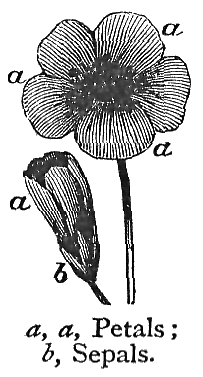
Petal, pet′al, n. a flower-leaf: a corolla leaf.—adjs. Pet′aled, Pet′aliform, Pet′alous, having petals or flower-leaves; Pet′aline, pertaining to or resembling a petal: attached to a petal.—n. Pet′alism, a method of ostracism practised in ancient Syracuse, the name being written on an olive-leaf.—adj. Pet′aloid, having the form of a petal—also Petaloi′deous. [Gr. petalon, a leaf.]
Petard, pē-tärd′, n. a kind of mortar filled with gunpowder, fixed to gates, barriers, &c., to break them down by explosion—(Shak.) Petar′: a paper bomb in pyrotechny.—ns. Petardeer′, Petardier′.—Hoist with one's own petard (see Hoist). [O. Fr.—péter, to crack or explode—L. pedĕre, cog. with Gr. perdein, Eng. fart.]
Petary, pē′tar-i, n. a peat-bog.
Petasus, pet′a-sus, n. a low broad-brimmed hat worn by heralds, &c., characteristic of Hermes. [Gr.]
Petaurist, pe-taw′rist, n. a flying opossum, Australian squirrel, &c.—adj. Petau′rine. [Gr.]
Petchary, pech′a-ri, n. the gray king-bird.
Petechiæ, pē-tek′i-ē, n.pl. purple spots on the skin.—adj. Petech′ial. [L. petigo, a scab.]
Peter, pē′tėr, v.i. in mining, to become exhausted (with out): (fig.) to lose power or value.
Peter, pē′tėr, v.i. to call for trumps at whist, by throwing away a higher card of a suit while holding a smaller.—n. this signal for trumps.
Peterel. Same as Petrel.
Petersham, pē′tėr-sham, n. a heavy greatcoat, also the rough-napped cloth, generally dark blue, of which it is made. [From Lord Petersham.]
Peter's-pence. See Penny.
Petiole, pet′i-ōl, n. the stalk which joins a leaf to the twig or branch: a footstalk—also Petī′olus.—adjs. Pet′iolar, -y, pertaining to, or growing upon, a petiole; Pet′iolāte, -d, Pet′ioled, growing on a petiole.—n. Pet′iolule, a little or partial petiole. [Fr.,—L. petiolus, a little foot—pes, pedis, a foot.]
Petit, pet′i, adj. small:—fem. Petite (pe-tēt′).—n. Pet′it-maî′tre, a dandy, a coxcomb generally. [Fr.]
Petition, pē-tish′un, n. a request generally from an inferior to a superior: a written request presented to a court of law, or to a body of legislators: a prayer: a supplication.—v.t. to present a petition to: to ask as a favour: to supplicate.—adj. Petit′ionary, offering or containing a petition: supplicatory.—ns. Petit′ioner, one who offers a petition or prayer; Petit′ioning, the act of presenting a petition: entreaty: solicitation; Petit′ionist.—adj. Pet′itory, petitioning.—Petitio principii, the fallacy of begging the question—a taking for granted in argument of that which has yet to be proved. [Fr.,—L. petitio—petĕre, petitum, to ask.]
Petrary, pe-trā′ri, n. an engine for hurling stones.
Petre. Same as Saltpetre.
Petrean, pē-trē′an, adj. pertaining to rock. [L. petræus—Gr. petraios—petra, a rock.]
Petrel, pet′rel, n. a long-winged dusky sea-bird, rarely landing except to lay its eggs, esp. the Stormy petrel, called by sailors 'Mother Carey's Chickens,' scarcely larger than a lark, the smallest web-footed bird known. [Fr.; from Matt. xiv. 29.]
Petrify, pet′ri-fī, v.t. to turn into stone: to make hard like a stone: to fix in amazement.—v.i. to become stone, or hard like stone:—pa.t. and pa.p. pet′rified.—n. Petres′cence.—adjs. Petres′cent, growing into or becoming stone; Petric′olous, inhabiting rocks.—n. Petrifac′tion, the act of turning into stone: the state of being turned into stone: that which is made stone: a fossil.—adjs. Petrifac′tive, Petrif′ic, changing animal or vegetable substances into stone; Pet′rifīable.—ns. Petrog′eny, the science of the origin of rocks; Pet′roglyph, a rock-carving.—adj. Petroglyph′ic.—ns. Petrog′lyphy, the art of writing on rocks or stones; Petrog′rapher, a student of petrography.—adjs. Petrograph′ic, -al.—adv. Petrograph′ically.—n. Petrog′raphy, the study of rocks: petrology.—adj. Petrolog′ical.—adv. Petrolog′ically.—ns. Petrol′ogist; Petrol′ogy, the science of the composition and classification of rocks.—adjs. Petrō′sal, of great hardness: petrous; Pē′trous, like stone: hard: rocky. [L. petra—Gr. petra, rock, L. facĕre, factum, to make.]
Petrine, pē′trin, adj. pertaining to, or written by, the Apostle Peter.—n. Pē′trinism, the Tübingen theory of F. C. Baur (1792-1860) and his school, of a doctrinal trend in primitive Christianity towards Judaism, ascribed to Peter and his party in opposition to Paulinism. [L. Petrinus—Petrus, Peter.]
Petroleum, pē-trō′lē-um, n. a liquid inflammable substance issuing or pumped up from the earth in various parts of the world.—ns. Pet′rol, a spirit obtained from petroleum; Petroleur (pā-tro-lār′), one of those Parisians who, with the help of petroleum, set fire to many of the public buildings of Paris in May 1871: an incendiary:—fem. Petroleuse′.—adj. Petrolif′erous, yielding petroleum. [L. petra, rock, oleum, oil.]
Petronel, pet′ro-nel, n. a large horse-pistol: a small carbine. [O. Fr. petrinal, the breast—L. pectus.]
Petted, pet′ed, adj. treated as a pet: indulged.—adj. Pett′ish, given to take the pet: peevish: fretful.—adv. Pett′ishly.—n. Pett′ishness.
Pettichaps, Petty-Chaps, pet′i-chaps, n. the garden warbler, the willow-warbler, chiff-chaff.
Petticoat, pet′i-kōt, n. a loose under-skirt worn by females and little boys: (coll.) a woman: a fisherman's loose canvas or oilcloth skirt: a bell-mouthed piece over the exhaust nozzles in the smoke-box of a locomotive, strengthening and equalising the draught through the boiler-tubes.—adj. feminine: female, as 'petticoat influence.'—n. Pett′icoat-affair′, an affair in which a woman is concerned.—n.pl. Pett′icoat-breech′es, a loose short breeches worn by men in the 17th century.—adj. Pett′icoated.—Petticoat government, government by women, either at home or in the state. [Petty + coat.]
Pettifogger, pet′i-fog-ėr, n. a lawyer who practises only in paltry cases.—v.i. Pett′ifog, to play the pettifogger.—n. Pett′ifoggery, mean tricks: quibbles.—adj. Pett′ifogging. [Petty, and obs. fog, to cheat (cf. Old Dut. focker).]
Pettitoes, pet′i-tōz, n.pl. the feet of a sucking pig: (Shak.) human feet. [Petty + toe.]
Pettle, pet′l, v.t. (Scot.) to indulge, pet.
Petto, pet′o, n. the breast. [It.,—L. pectus, breast.]
Petty, pet′i, adj. small: of less importance: lower in rank, power, &c.: inconsiderable, insignificant: contemptible.—adv. Pett′ily.—n. Pett′iness.—Petty cash, small sums of money received or paid; Petty larceny (see Larceny); Petty officer, a naval officer with rank corresponding to a non-commissioned officer in the army. [O. Fr. petit.]
Petulant, pet′ū-lant, adj. showing peevish impatience, irritation, or caprice: forward, impudent in manner.—ns. Pet′ulance, Pet′ulancy, sauciness: peevishness or impatience.—adv. Pet′ulantly. [L. petulans, -antis—obs. petulāre, dim. of petĕre, to fall upon.]
Petunia, pē-tū′ni-a, n. a Brazilian genus of ornamental plants of the nightshade family, with small undivided leaves and showy funnel-form flowers. [Amer. Ind. petun, tobacco.]
Pew, pū, n. an enclosed seat in a church.—ns. Pew′-fell′ow, companion; Pew′-hold′er, one who rents a pew in a church; Pew′-ō′pener, an attendant who opens pews in a church; Pew′-rent, rent paid for the use of a pew in church. [O. Fr. pui, a raised place—L. podium, a front seat in the amphitheatre—Gr. podion, orig. a footstool—pous, podos, foot.]
Pewit, pē′wit, n. the lapwing, a bird with a black head and crest, common in moors.—Also Pē′wet, Pee′wit. [Imit.; cf. Dut. piewit or kiewit.]
Pewter, pū′tėr, n. an alloy of four parts of tin and one of lead: sometimes tin with a little copper and antimony: a vessel made of pewter, esp. a beer-tankard: (slang) prize-money.—adj. made of pewter.—ns. Pew′terer, one who works in pewter; Pew′ter-mill, a lapidaries' polishing-wheel for amethyst, agate, &c.—adj. Pew′tery, belonging to pewter. [O. Fr. peutre (It. peltro), from a Teut. root, seen in Low Ger. spialter, Eng. spelter.]
Pfennig, pfen′ig, n. a German copper coin, the hundredth part of a mark.—Also Pfenn′ing.
Phacitis, fā-sī′tis, n. inflammation of the crystalline lens of the eye.—n. Phacocystī′tis, inflammation of the capsule of the crystalline lens of the eye.—adj. Phā′coid, lentil-shaped.—n. Phā′coscope. [Gr. phakos, a lentil.]
Phænogamous, Phenogamous, fē-nog′a-mus, adj. having manifest flowers, phanerogamous.—ns. Phæ′nogam, a phanerogamous plant; Phænogā′mia=Phanerogamia.—adj. Phænogam′ic. [Gr. phainein, to show, gamos, marriage.]
Phaeton, fā′e-ton, n. a kind of open pleasure-carriage on four wheels, drawn by one or two horses, from Phaëthon, son of Helios, the sun, whose chariot he attempted to drive: a tropic bird.—adj. Phaëton′ic.
Phagedena, Phagedæna, faj-e-dē′na, n. a sloughing ulcer, hospital gangrene.—adjs. Phagedē′nic, Phagedæ′nic. [Gr. phagein, to eat.]
Phagocyte, fag′o-sīt, n. a white or colourless blood-corpuscle—also called leucocyte—an active amœboid cell, which engulfs both nutritive and harmful particles.—adjs. Phagocyt′ic, -al.—ns. Phag′ocytism, the nature or function of a phagocyte; Phagocytō′sis, the destruction of microbes by phagocytes. [Gr. phagein, to eat, kytos, a vessel.]
Phalæna, fā-lē′na, n. the Linnæan genus including moths.—adj. Phalē′noid. [Gr. phalaina, a moth.]
Phalange, fā-lanj′, n. a phalanx of a digit: any of the joints of an insect's tarsus: a bundle of stamens joined by their filaments: a socialistic community in Fourier's dream of an ideal arrangement of society, consisting of 1800 persons living in a phalanstère—generally in pl., the usual sing. being Phā′lanx (q.v.).—adjs. Phalan′gal, Phalan′gēal, Phalan′gial, Phalan′gian; Phalan′giform; Phalanstē′rian.—ns. Phalanstē′rianism, Phalan′sterism; Phal′anstery, the dwelling of the phalange in the ideal social system of Fourier (1772-1837), a vast structure in the midst of a square league of cultivated land.
Phalanger, fā-lan′jer, n. a genus of small arboreal Australasian marsupials. [Fr.,—L. phalanx.]
Phalanx, fal′angks, or fā′-, n. a line of battle: a square battalion of heavy-armed infantry drawn up in ranks and files close and deep: any compact body of men: one of the small bones of the fingers and toes:—pl. Phalan′ges, or Phal′anxes. [L.,—Gr. phalangks.]
Phalarope, fal′a-rōp, n. a genus of wading birds, forming a sub-family of the snipes. [Gr. phalaris, a coot, pous, a foot.]
Phallus, fal′us, n. the symbol of generation which figures in the rites and ceremonies of most primitive peoples: (biol.) the organ of sex.—adj. Phall′ic.—ns. Phall′icism, Phall′ism, the phallic worship.—adj. Phall′oid. [L.,—Gr. phallos.]
Phanariot, fa-nar′i-ot, n. one of the Greeks inhabiting the Fanar quarter of Constantinople—in Turkish history mostly diplomatists, administrators, and bankers, also hospodars of Wallachia and Moldavia.—adj. Phanar′iot.—Also Fanar′iot.
Phanerogamous, fan-e-rog′a-mus, adj. having true flowers containing stamens and pistils—opp. to Cryptogamous—also Phanerogam′ic.—n. Phan′erogam, a phanerogamic plant. [Gr. phaneros, visible, gamos, marriage.]
Phantasm, fan′tazm, n. a vain, airy appearance: a fancied vision: an apparition or spectre—also Phantas′ma (Shak.):—pl. Phan′tasms, Phantas′mata.—adjs. Phantas′mal; Phantasmā′lian (rare).—n. Phantasmal′ity.—adv. Phantas′mally.—adjs. Phantasmat′ic, -al; Phantas′mic; Phantasmogenet′ic, begetting phantasms.—adv. Phantasmogenet′ically.—adj. Phantasmolog′ical, pertaining to phantasms as subjects of inquiry.—n. Phantasmol′ogy, the science of phantasms. [Gr. phantasma—phantazein, to make visible—phainein, to bring to light—pha-ein, to shine.]
Phantasmagoria, fan-taz-ma-gō′ri-a, n. a fantastic series of illusive images: a gathering of appearances or figures upon a flat surface by a magic-lantern.—adjs. Phantasmagō′rial, pertaining to or resembling a phantasmagoria; Phantasmagor′ic, -al. [Gr. phantasma, an appearance, agora, an assembly—ageirein, to gather.]
Phantastic, Phantasy. See Fantastic, Fantasy.—n. Phantā′siast, one of those Docetæ who believed Christ's body to have been a mere phantom.
Phantom, fan′tom, n. a phantasm.—adj. illusive, spectral.—adj. Phantomat′ic, relating to a phantom. [O. Fr. fantosme—Gr. phantasma.]
Pharaoh, fā′rō, n. a title of the kings of ancient Egypt.—adj. Pharaon′ic. [Heb.,—Egyptian.]
Phare, fär, n. a lighthouse.—Also Phā′ros. [Pharos.]
Pharisee, far′i-sē, n. one of a religious school among the Jews, marked by their strict observance of the law and of religious ordinances: any one more careful of the outward forms than of the spirit of religion, a formalist.—adjs. Pharisā′ic, -al, pertaining to, or like, the Pharisees: hypocritical.—adv. Pharisā′ically.—ns. Pharisā′icalness; Phar′isāism, Phar′iseeism, the practice and opinions of the Pharisees: strict observance of outward forms in religion without the spirit of it: hypocrisy. [Late L. pharisæus—Gr. pharisaios—Heb. pārūsh, separated from, parash, to separate.]
Pharmaceutic, -al, fär-ma-sū′tik, -al, adj. pertaining to the knowledge or art of preparing medicines.—adv. Pharmaceū′tically.—ns. Pharmaceū′tics, the science of preparing medicines; Pharmaceū′tist, one who practises pharmacy.
Pharmacopœia, fär-ma-kō-pē′ya, n. a book containing directions for the preparation of medicines: a collection of drugs.—adj. Pharmacopœ′ial. [Gr. pharmakon, a drug, poiein, to make.]
Pharmacy, fär′ma-si, n. a department of the medical art which consists in the collecting, preparing, preserving, and dispensing of medicines: the art of preparing and mixing medicines: a drug-store.—ns. Phar′macist, a druggist, one skilled in pharmacy; Pharmacognos′tics, the sum of knowledge about drugs; Pharmacog′raphy, a description of drugs; Pharmacol′ogist, one skilled in pharmacology; Pharmacol′ogy, pharmacy; Phar′macon, a drug; Pharmacop′olist, a dealer in drugs. [Fr. pharmacie—L.,—Gr. pharmakon, a drug.]
Pharo=Faro.
Pharos, fā′ros, n. a lighthouse or beacon, so named from the famous lighthouse on the island of Pharos in the Bay of Alexandria.—n. Pharol′ogy, the art or science of directing the course of ships by means of light-signals from the shore.
Pharynx, far′ingks, n. the cleft or cavity forming the upper part of the gullet, and lying behind the nose, mouth, and larynx:—pl. Phar′ynges, Phar′ynxes.—adjs. Pharyn′gēal; Pharyngit′ic, pertaining to pharyngitis.—n. Pharyngī′tis, inflammation of the mucous membrane of the pharynx.—adjs. Pharyngoglos′sal, pertaining to the pharynx and the tongue; -laryn′geal, to that and the larynx; -nā′sal, and the nose; -ō′ral, and the mouth.—ns. Pharyngog′raphy, a description of the pharynx; Pharyng′ōscope, an instrument for inspecting the pharynx; Pharyng′oscopy; Pharyngot′omy, the operation of making an incision into the pharynx to remove a tumour. [Late L.,—Gr. pharyngkx, the pharynx.]
Phase, fāz, n. aspect, appearance, at any stage: an era: the form in which an object or a question presents itself to the mind: the appearance at a given time of the illuminated surface exhibited by a planet—also Phā′sis:—pl. Phas′es.—adj. Phase′less, unchanging. [Gr. phasis—phaein, to shine.]
Phasma, fas′mä, n. a genus of gressorial orthopterous insects—walking-stick insects, spectre-insects (Phasma), and leaf-insects.
Pheasant, fez′ant, n. a gallinaceous bird abundant in Britain, and highly valued as food.—n. Pheas′antry, an enclosure for pheasants, where they may be bred and reared. [O. Fr. faisan—L. Phasiana (avis)—Gr. Phasianos, of Phasis, in Colchis.]
Pheer, fēr, n. (Shak.). Same as Fere, a mate.
Pheese, fēz, v.t. (Shak.) to beat, to drive off: to worry.—v.i. (U.S.) to worry.—n. worry—better Feeze.—n. Phees′ar, one of the mad host's words (Merry Wives, I. iii. 10).
Phelloplastics, fel-ō-plas′tiks, n. modelling in cork.—n. Phell′ogen, cork-meristem.—adj. Phellogenet′ic. [Gr. phellos, cork, plassein, to form.]
Phenacetin, fē-nas′e-tin, n. a drug prepared from carbolic acid, good against fevers, insomnia, &c.
Phenakistoscope, fen-a-kis′tō-skōp, n. an optical instrument which produces the appearances of objects in motion, as birds flying, &c.—n. Phen′akism (Bacon), deceit. [Gr. phenakistikos—phenakizein—phenax, a cheat.]
Phenix=Phœnix.
Phenogam=Phænogam.
Phenogamia=Phænogamia.
Phenol, fē′nol. n. phenyl alcohol or carbolic acid. [Fr.]
Phenology, Phænology, fē-nol′ō-ji, n. the branch of biology treating of animal or plant life and development as affected by climate.—adjs. Phenolog′ic, -al.—n. Phenol′ogist. [Phenomenology.]
Phenomenon, fē-nom′e-non, n. an appearance: the appearance which anything makes to our consciousness, as distinguished from what it is in itself: an observed result: a remarkable or unusual person, thing, or appearance:—pl. Phenom′ena.—adj. Phenom′enal, pertaining to a phenomenon: of the nature of a phenomenon: so strange as to excite great wonder: out of the common.—v.t. Phenom′enalise, to represent as a phenomenon.—ns. Phenom′enalism, the philosophical doctrine that the phenomenal and the real are identical—that phenomena are the only realities—also Externalism; Phenom′enalist, one who believes in phenomenalism; Phenomenal′ity, the character of being phenomenal.—adv. Phenom′enally.—v.t. Phenom′enise, to bring into the world of experience.—ns. Phenom′enism, the doctrines of the phenomenists; Phenom′enist, one who believes only what he observes, or phenomena, one who rejects necessary primary principles.—adj. Phenomenōlog′ical.—n. Phenomenol′ogy, a description of phenomena. [Gr. phainomenon—phainein, to show.]
Phenyl, fē′nil, n. an organic radical found esp. in carbolic acid, benzole, and aniline.—adjs. Phē′nic, Phenyl′ic. [Fr. phényle.]
Pheon, fē′on, n. (her.) the barbed iron head of a dart: the broad arrow marking property of the Crown.
Phew, fū, interj. an exclamation of disgust.
Phial, fī′al, n. a small glass vessel or bottle. [L. phiala—Gr. phialē, a vial.]
Phi Beta Kappa, fi bet-a kap-a, the oldest of the American college Greek letter societies. [From the initial letters of its motto—Philosophia biou kubernētēs, 'Philosophy is the guide of life.']
Philadelphian, fil-a-del′fi-an, n. one of a mystic sect emphasising 'brotherly love,' founded in London in 1652 under the influence of Boehme. [Gr. philein, to love, adelphos, a brother.]
Philander, fi-lan′dėr, v.i. to make love: to flirt or coquet.—n. a lover.—n. Philan′derer. [Gr. philandros, loving men—philos, dear—philein, to love, anēr, andros, a man.]
Philanthropy, fi-lan′thrō-pi, n. love of mankind, esp. as shown in good deeds and services to others: goodwill towards all men.—ns. Phil′anthrope, Philan′thropist, one who tries to benefit mankind.—adjs. Philanthrop′ic, -al, doing good to others, benevolent.—adv. Philanthrop′ically. [L.,—Gr. philanthrōpia—philos, loving, anthrōpos, a man.]
Philately, fi-lat′e-li, n. the study and collection of postage and revenue stamps and labels (also Timbrophily, Timbrology).—adj. Philatel′ic.—n. Philat′elist, one devoted to this pursuit. [Formed in 1865 from Gr. philos, loving, atelēs, free of tax, 'prepaid'—a-, neg., telos, tax.]
Philharmonic, fil-har-mon′ik, adj. loving music. [Gr. philos, loving, harmonia, harmony.]
Philhellenic, fil-he-len′ik, adj. loving Greece.—ns. Philhel′lene, Philhel′lenist, a supporter of Greece, esp. in 1821-32; Philhel′lenism, love of Greece. [Gr. philos, loving, Hellēn, a Greek.]
Philibeg, Philabeg. See Fillibeg.
Philippian, fi-lip′i-an, n. a native of Philippi in Macedonia—also adj.
Philippic, fil-ip′ik, n. one of the three orations of Demosthenes against Philip of Macedon, or of Cicero against Marc Antony: any discourse full of invective.—v.i. Phil′ippise, to utter such.
Philistine, fil′is-tin, n. one of the ancient inhabitants of south-western Palestine, enemies of the Israelites—also Philis′tian, and Philis′tim (Milt.): a name applied by German students to shopkeepers and others not connected with the university: an uncultured person.—n. Phil′istinism.
Phill-horse, fil′-hors, n.=Thill-horse, a shaft-horse.
Philogyny, fil-oj′i-ni, n. love of women.—n. Philog′ynist. [Gr. philos, loving, gynē, a woman.]
Philology, fi-lol′ō-ji, n. the science of language: the study of etymology, grammar, rhetoric, and literary criticism: (orig.) the knowledge which enabled men to study and explain the classical languages of Greece and Rome.—ns. Philol′oger, Philolō′gian, Philol′ogist, Phil′ologue, one versed in philology.—adjs. Philolog′ic, -al.—adv. Philolog′ically.—Comparative philology, study of languages by comparing their history, forms, and relationships with each other. [L.,—Gr. philologia—philologos, fond of words—philos, loving, logos, discourse.]
Philomath, fil′ō-math, n. a lover of learning.—adjs. Philomath′ic, -al.—n. Philom′athy, love of learning. [Gr. philomathēs, fond of learning—philos, loving, e-math-on, 2d aorist manthanein, to learn.]
Philomel, fil′ō-mel, n. the nightingale.—Also Philomē′la. [Gr. Philomela, daughter of Pandion, king of Athens, changed into a nightingale or swallow.]
Philomusical, fil-ō-mū′zi-cal, adj. fond of music.
Philopena, fil-ō-pē′na, n. a game in which each of two persons eats a twin kernel of a nut, and one pays a forfeit to the other on certain conditions: the gift made as a forfeit, or the twin kernels shared. [Ger. vielliebchen—viel, much, liebchen, sweetheart.]
Philopolemic, fil-ō-pō-lem′ik, adj. fond of war or of debate.
Philoprogenitiveness, fil-ō-prō-jen′i-tiv-nes, n. (phren.) the instinctive love of offspring. [Gr. philos, loving, L. progenies, progeny.]
Philosopher, fi-los′ō-fėr, n. a lover of wisdom: one versed in or devoted to philosophy: a metaphysician: one who acts calmly and rationally in all the affairs and changes of life—also Phil′osophe:—fem. Philos′ophess.—adjs. Philosoph′ic, -al, pertaining or according to philosophy: skilled in or given to philosophy: becoming a philosopher: rational: calm.—adv. Philosoph′ically.—v.i. Philos′ophise, to reason like a philosopher: to form philosophical theories.—ns. Philos′ophiser, a would-be philosopher; Philos′ophism, would-be philosophy; Philos′ophist.—adjs. Philosophist′ic, -al.—n. Philos′ophy, the science of being as being: the knowledge of the causes and laws of all phenomena: the collection of general laws or principles belonging to any department of knowledge: reasoning: a particular philosophical system: calmness of temper.—Philosopher's stone, an imaginary stone or mineral compound, long sought after by alchemists as a means of transforming other metals into gold.—Moral, and Natural, philosophy (see Moral, Natural). [Fr.,—L.,—Gr. philosophos—philos, a lover, sophos, wise.]
Philotechnic, -al, fil-ō-tek′nik, -al, adj. fond of the arts.
Philozoic, fil-ō-zō′ik, adj. fond of animals.
Philtre, Philter, fil′tėr, n. a charm or spell to excite love. [Fr. philtre—L. philtrum—Gr. philtron—philos, loving, -tron, denoting the agent.]
Phimosis, fī-mō′sis, n. stenosis of the preputial orifice.
Phisnomy, fis′no-mi, n. (Shak.) the face—a corr. of physiognomy.
Phiz, fiz, n. (humorous) the face.
Phlebitis, flē-bī′tis, n. inflammation of a vein.—ns. Phleb′olite, a calcareous concretion found in a vein; Phlebol′ogy, science of the veins; Phleb′orrhage, venous hemorrhage.—adjs. Phlebotom′ic, -al.—v.t. Phlebot′omise.—ns. Phlebot′omist; Phlebot′omy, act of letting blood. [Gr. phleps, phlebos, a vein.]
Phlegethontic, fleg-e-thon′tik, adj. pertaining to or resembling the river Phlegethon, a mythological river of the infernal regions, whose waves rolled torrents of fire, flowing into the lake of Acheron. [Gr. phlegethein—phlegein, to burn.]
Phlegm, flem, n. one of the four elements of which the ancients supposed the blood to be composed: the thick, slimy matter secreted in the throat, and discharged by coughing: sluggishness: indifference: calmness.—adj. Phlegmagogic (fleg-ma-goj′ik).—ns. Phleg′magogue, a medicine expelling phlegm; Phlegmā′sia, inflammation, esp. Phlegmasia dolens, puerperal tumid leg.—adjs. Phlegmat′ic, -al, abounding in or generating phlegm: cold: sluggish: not easily excited.—adv. Phlegmat′ically.—n. Phleg′mon, inflammation in the connective tissue.—adjs. Phleg′monoid; Phlegm′y. [Fr.,—L.,—Gr. phlegma, phlegmatos—phlegein, to burn.]
Phleme=Fleam.
Phleum, flē′um, n. a small genus of annual or perennial grasses—timothy, cat's-tail grass, herd's grass. [Gr. phleōs.]
Phlœum, flē′um, n. the cellular portion of bark next the epidermis—also Epiphlœum and Bast.—n. Phlō′ëm, the bast or liber portion of a vascular bundle. [Gr. phloios, bark.]
Phlogiston, flō-jis′ton, n. an imaginary element, believed in till nearly the end of the 18th century as forming part of every combustible body, which by its disengagement caused burning, or fire in action.—adj. Phlogis′tic (chem.), containing or resembling phlogiston: inflaming: (med.) inflammatory.—v.t. Phlogis′ticate, to combine phlogiston with. [Gr.]
Phlox, floks, n. a well-known garden plant, so called from its colour. [Gr.,—phlegein, to burn.]
Phlyctæna, Phlyctena, flik-tē′na, n. a small vesicle.—adjs. Phlyctē′nar; Phlyctē′noid; Phlyctē′nous.
Phobanthropy, fō-ban′thrō-pi, n. a morbid dread of mankind.
Phocine, fō′sin, adj. pertaining to the seal family.—n. Phō′ca, a seal.—adj. Phocā′cean, relating to the genus Phoca.—n. a seal of this genus.—n. Phocæ′na, a genus of delphinoid odontocete cetaceans—the true porpoises.—adjs. Phō′cal; Phocæ′nine, like a porpoise. [L. phoca—Gr. phōkē, a seal.]
Phœbus, fē′bus, n. the sun-god: the sun:—fem. Phœbe (fē′bē), the moon. [L.,—Gr. phoibos, bright, phæin, to shine.]
Phœnician, Phenician, fē-nish′an, adj. pertaining to Phœnicia, on the coast of Syria, to its people, language, or arts.—n. an inhabitant of Phœnicia: the language, a Semitic dialect, akin to Hebrew.
Phœnix, Phenix, fē′niks, n. a fabulous bird said to have existed for 500 years all alone in the wilderness, and, after burning itself on a funeral pile, to have risen from its own ashes—hence, the emblem of immortality: a paragon. [L.,—Gr. phoinix.]
Pholas, fō′las, n. a genus of stone-bearing bivalves, a piddock:—pl. Phō′lades.—n. Phō′ladite, a fossil pholad. [Gr.]
Phonate, fō′nāt, v.t. to utter vocal sounds.—n. Phonā′tion, emission of vocal sounds.—adj. Phō′natory, pertaining to phonation.—n. Phonau′tograph, an instrument for registering the vibrations of a sounding body.—adj. Phonautograph′ic.—adv. Phonautograph′ically.—n. Phonom′eter, an instrument for measuring the vibrations of a body.
Phonetic, -al, fō-net′ik, -al, adj. pertaining to, or in accordance with, the sound of the voice: representing elementary sounds: vocal.—adv. Phonet′ically.—n. Phonetic′ian, a student of phonetics.—v.t. Phonet′icise, to make phonetic.—ns. Phonet′icism, phonetic character or representation; Phonet′icist, one who advocates phonetic-spelling.—n.sing. Phonet′ics, the science of sounds, esp. of the human voice.—ns. Phonet′ic-spell′ing, spelling according to sound: the spelling of words as they are pronounced; Phonetisā′tion, art of representing sound by phonetic signs.—v.t. Phō′netise, to represent phonetically.—ns. Phō′netism, sound, pronunciation; Phō′netist, a student of phonetics.—adj. Phon′ic, pertaining to sound.—n.sing. Phon′ics, acoustics.—adj. Phonocamp′tic, reflecting or deflecting sound.—n. Phō′nolite, clinkstone. [Gr. phōnetikos—phōnē, a sound.]
Phonograph, fō′nō-graf, n. a character or mark used to represent a sound (also Phō′nogram): an instrument by which spoken words or other sounds can be recorded, and afterwards given out again almost in the original tones.—ns. Phonog′rapher, Phonog′raphist, one versed in phonography.—adjs. Phonograph′ic, -al.—adv. Phonograph′ically.—ns. Phonog′raphy, the art of representing each spoken sound by a distinct character: phonetic shorthand; Phō′nōscope, an apparatus for recording music as played, or for testing musical strings: a microphone. [Gr. phōnē, sound, graphein, to write.]
Phonology, fō-nol′ō-ji, n. the science of the sounds of the voice, the manner in which these are combined in any language: phonetics.—adj. Phonolog′ical.—n. Phonol′ogist, one versed in phonology. [Gr. phōnē, sound, logos, discourse.]
Phonotype, fō′nō-tīp, n. a type or sign representing a sound.—adjs. Phonotyp′ic, -al, of or belonging to a phonotype, or to phonotypy.—ns. Phō′notypist; Phō′notypy, the art of representing each of the elementary sounds by different types or distinct characters. [Gr. phōnē, sound, typos, type.]
Phorminx, for′mingks, n. a kind of cithara. [Gr.]
Phormium, for′mi-um, n. a genus of New Zealand plants of the lily family—New Zealand flax or flax-lily. [Gr. phormion, a plant.]
Phosphene, fos′fēn, n. a brilliant coloured spectrum seen when the finger is pressed into the internal corner of the eye. [Gr. phōs, light, phainein, to shine.]
Phosphorus, fos′fō-rus, n. the morning-star: a yellowish substance, like wax, inflammable and giving out light in the dark.—n. Phos′phate, a salt formed by the combination of phosphoric acid with a base.—adj. Phosphat′ic, of the nature of, or containing, a phosphate.—ns. Phos′phide, a compound formed of phosphorus and some other element, as copper or iron; Phos′phite, a salt of phosphorous acid; Phos′phor, the morning-star: (obs.) phosphorus.—v.t. Phos′phorate, to combine or impregnate with phosphorus.—n. Phos′phor-bronze, an alloy of copper, tin, and phosphorus.—v.i. Phosphoresce′, to shine in the dark like phosphorus.—n. Phosphoresc′ence.—adjs. Phosphoresc′ent, shining in the dark like phosphorus; Phosphor′ic, Phos′phorous, pertaining to or obtained from phosphorus.—ns. Phos′phorite, a massive radiated variety of apatite; Phos′phuret, a compound of phosphorus with a metal.—adj. Phos′phuretted, combined with phosphorus.—n. Phos′sy-jaw, phosphorous poisoning.—Phosphatic diathesis (med.), the condition in which there is a tendency in the urine to deposit white gravel. [L.,—Gr.,—phōsphoros, light-bearer—phōs, light, phoros, bearing, from pherein, to bear.]
Photo, fō′tō, n. a colloquial abbreviation of photograph.
Photochemistry, fō-tō-kem′is-tri, n. that branch of chemistry which treats of the chemical action of light.—adj. Photochem′ical.—n. Photochem′ist.
Photochromy, fō′tō-krō-mi, n. the art of reproducing colours by photography.—adj. Photochromat′ic.—n. Photochrō′motype, a photo-process picture printed in colours by any of the ordinary methods of typography in colours. [Gr. phōs, phōtos, light, chrōma, colour.]
Photo-engraving, fō′tō-en-grā′ving, n. a general term including all the various processes of mechanical engraving by the aid of photography.—The term Photog′lyphy is sometimes applied to photo-engraving by one process or other, often limited to photogravure.—adj. Photoglyph′ic.
Photogeny, fō-toj′e-ni, n. the art of taking pictures by the action of light on a chemically prepared ground.—adjs. Photogen′ic, Photog′enous.
Photography, fō-tog′ra-fi, n. the art of producing pictures by the action of light on chemically prepared surfaces.—n. Phō′tograph, a picture so produced.—v.t. to make a picture of by means of photography.—ns. Phōtog′rapher, Phōtog′raphist.—adj. Phōtograph′ic, -al.—adv. Phōtograph′ically. [Gr. phōs, light, graphein, to draw.]
Photogravure, fō′tō-grā-vūr, n. a method of producing by means of photography and the action of acids on a sensitised surface a kind of mezzo-engraving on metal. [Fr.,—Gr. phōs, light, Fr. gravure, engraving.]
Photolithography, fō-tō-li-thog′ra-fi, n. a method by which a photograph in line can be developed with ink so as to be transferred to stone as a lithograph.—n. Photolith′ograph, a print produced by photolithography.—v.t. to reproduce by this aid.—n. Photolithog′rapher.—adj. Photolithograph′ic. [Gr. phōs, phōtos, light, lithos, a stone, graphein, to write.]
Photology, fō-tol′ō-ji, n. the science of light.—adjs. Photolog′ic, -al.—n. Photol′ogist. [Gr. phōs, phōtos, light, logia—legein, to say.]
Photolysis, fō-tol′i-sis, n. (bot.) the movements of protoplasm under the influence of light. [Gr. phōs, phōtos, light, lysis—lyein, to unloose.]
Photomechanical, fō-tō-mē-kan′i-kal, adj. pertaining to the mechanical production of pictures by the aid of light, as in photo-engraving, &c.
Photometer, fō-tom′e-tėr, n. an instrument for measuring the intensity of light, esp. for comparing the amount of light coming from different sources.—adjs. Photomet′ric, -al.—n. Photom′etry, the measurement of the intensity of light. [Gr. phōs, phōtos, light, mētron, a measure.]
Photomicrography, fō-tō-mī-krog′ra-fi, n. the enlargement of microscopic objects by means of the microscope, and the projection of the enlarged image on a sensitive film.—ns. Photomī′crograph; Photomicrog′rapher.—adj. Photomicrograph′ic. [Gr. phōs, phōtos, light, mikros, little, graphein, to write.]
Photophobia, fō-tō-fō′bi-a, n. a dread of light.—adj. Photophob′ic.
Photophone, fō′tō-fōn, n. an apparatus for transmitting articulate speech to a distance along a beam of light. [Gr. phōs, phōtos, light, phōnē, sound.]
Photo-process, fō′tō-pros′es, n. any process by which is produced, by the agency of photography, a matrix from which prints can be made in ink—photogravure, photolithography, and photozincography.
Photopsia, fō-top′si-a, n. the condition of having the sensation of light without external cause.—Also Phō′topsy.
Photo-relief, fō′tō-re-lēf′, n. a process of producing plates by means of photography, from which impressions can be taken in an ordinary printing-press.
Photosculpture, fō-tō-skulp′tūr, n. the art of taking likenesses in the form of statuettes or medallions by the aid of photography.
Photosphere, fō′tō-sfēr, n. the luminous envelope round the sun's globe, which is the source of light. [Gr. phōs, phōtos, light, sphaira, a sphere.]
Phototherapy, fō-tō-ther′a-pi, n. the art of healing (of lupus, &c.) by means of light, electric or other, focussed on the diseased part. [Gr. phōs, phōtos, light, therapeuein, to heal.]
Phototype, fō′tō-tīp, n. a type or plate of the same nature as an engraved plate, produced from a photograph.—n. Phō′totypy. [Gr. phōs, phōtos, light, typos, type.]
Photo-xylography, fō-tō-zī-log′ra-fi, n. wood-engraving after an impression has been taken on the wood-block by photography. [Gr. phōs, phōtos light, xylon, a log of wood, graphein, to write.]
Photozincography, fō-tō-zing-kog′ra-fi, n. the process of engraving on zinc by taking an impression by photography and etching with acids.—n. Photozinc′ograph, a picture so produced.
Phrase, frāz, n. two or more words expressing a single idea by themselves, or showing the manner or style in which a person expresses himself: part of a sentence: a short pithy expression: phraseology: (mus.) a short clause or portion of a sentence.—v.t. to express in words: to style.—n. Phrase′-book, a book containing or explaining phrases.—adj. Phrase′less, incapable of being described.—ns. Phrase′-man, Phrase′-mong′er, a wordy speaker or writer; Phrā′seogram, Phrā′seograph, a combination of shorthand characters to represent a phrase or sentence.—adjs. Phraseolog′ic, -al, pertaining to phraseology: consisting of phrases.—adv. Phraseolog′ically.—ns. Phraseol′ogist, a maker or a collector of phrases; Phrāseol′ogy, style or manner of expression or arrangement of phrases: peculiarities of diction: a collection of phrases in a language; Phrā′ser, a mere maker or repeater of phrases.—adj. Phrā′sical.—n. Phrā′sing, the wording of a speech or passage: (mus.) the grouping and accentuation of the sounds in a melody. [Fr.,—L.,—Gr. phrasis—phrazein, to speak.]
Phratry, frā′tri, n. a clan: a brotherhood—also Phrā′tria.—adj. Phrā′tric. [Gr. phratēr, a brother.]
Phren, fren, n. the thinking principle, mind: the diaphragm:—pl. Phrenes.—ns. Phrēnal′gia, psychalgia; Phrenē′sis, delirium, frenzy.—adjs. Phrenet′ic, -al (also Frenet′ic, -al), having a disordered mind: frenzied: mad; Phreniat′ric, pertaining to the cure of mental diseases; Phren′ic, belonging to the diaphragm.—ns. Phren′ics, mental philosophy; Phren′ism, thought force.—adj. Phrenit′ic, affected with phrenitis.—ns. Phrenī′tis, inflammation of the brain; Phrenog′raphy, descriptive psychology; Phrenopath′ia, mental disease.—adj. Phrenopath′ic.—n. Phrenoplē′gia, sudden loss of mental power. [Gr. phrēn, the mind.]
Phrenology, frē-nol′ō-ji, n. the theory that the various faculties and powers of the mind are connected with certain parts of the brain, and can be known by an examination of the outer surface of the skull: the science by which character can be read by examining the skull.—adjs. Phrenolog′ic, -al.—adv. Phrenolog′ically.—n. Phrenol′ogist, one who believes or is versed in phrenology. [Gr. phrēn, phrenos, mind, logos, science.]
Phronesis, frō′-nē′sis, n. practical wisdom. [Gr.,—phrēn, mind.]
Phrygian, frij′i-an, adj. pertaining to Phrygia in Asia Minor, or to the Phrygians.—n. a native of Phrygia: a Montanist.—Phrygian cap, a conical cap with the top turned forward.
Phthalein, thal′e-in, n. one of a very important class of dye-yielding materials formed by the union of phenols with the anhydride of phthalic acid.—adj. Phthal′ic, pertaining to naphthalene.—n. Phthal′in, a colourless crystalline compound obtained by reducing phthalein.
Phthiriasis, thi-rī′a-sis, n. the lousy disease—morbus pediculosus. [L.,—Gr.]
Phthisis, thī′sis, n. consumption or wasting away of the lungs.—adjs. Phthis′ic, -al (tiz′ik, -al), pertaining to or having phthisis.—n. Phthisiology (tiz-i-ol′ō-ji), the sum of scientific knowledge about phthisis. [L.,—Gr. phthiein, to waste away.]
Phycology, fī-kol′ō-ji, n. the knowledge of algæ or sea-weeds.—n. Phycog′raphy, systematic description of algae.—adj. Phycolog′ic.—n. Phycol′ogist.
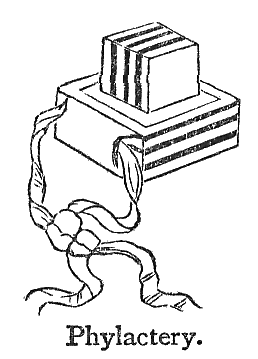
Phylactery, fi-lak′te-ri, n. a charm or amulet: among the Jews, a slip of parchment inscribed with certain passages of Scripture, worn on the left arm or forehead: among the early Christians, a case in which relics were preserved.—adjs. Phylacter′ic, -al. [L.,—Gr. phylaktērion, phylaktēr, a guard—phylassein, to guard.]
Phylarch, fī′lark, n. in ancient Greece, the chief of a tribe: in Athens, the commander of the cavalry of a tribe.—ns. Phy′larchy, the office of a phylarch; Phyle (fī′lē), a tribe or clan in ancient Greece.—adj. Phylet′ic, pertaining to a race or tribe: pertaining to a phylum of the animal kingdom.—n. Phylum (fī′lum), any primary division or sub-kingdom of the animal or vegetable kingdom:—pl. Phy′la.
Phyllite, fil′īt, n. clay-slate or argillaceous schist.—adj. Phyllit′ic. [Gr.,—phyllon, a leaf.]
Phyllium, fil′i-um, n. a genus of orthopterous insects of family Phasmidæ—leaf-insects or walking-leaves.
Phyllodium, fi-lō′di-um, n. a petiole which usurps the function of a leaf-blade.—adj. Phyllodin′eous.
Phylloid, fil′oid, adj. leaf-like—also Phylloi′deous.—ns. Phyl′lomancy, divination by leaves; Phyllomā′nia, abnormal production of leaves; Phyl′lome, foliage.—adj. Phyllom′ic.—n. Phyl′lomorphy, the reversion of floral organs, as sepals and bracts, to leaves—better Phyl′lody.
Phyllophagous, fi-lof′a-gus, adj. feeding on leaves.—n. a member of the Phylloph′aga, a tribe of hymenopterous insects—the saw-flies: a group of lamellicorn beetles which are leaf-eaters—the chafers.
Phyllophorous, fi-lof′ō-rus, adj. producing leaves: (zool.) having leaf-like organs.
Phyllopod, fil′ō-pod, adj. having foliaceous feet—also Phyllop′odous.—n. a crustacean of the order Phyllopoda.—adj. Phyllopod′iform.
Phyllorhine, fil′ō-rin, adj. having a nose-leaf.
Phyllostomatous, fil-ō-stom′a-tus, adj. leaf-nosed, as a bat.—n. Phyll′ostome, a leaf-nosed bat.—adj. Phyllos′tomine, leaf-nosed.
Phyllotaxis, fil-ō-tak′sis, n. the disposition of leaves on the stem.—Also Phyll′otaxy. [Gr. phyllon, a leaf, taxis, arrangement.]
Phylloxera, fil-ok-sē′ra, n. a genus of insects, belonging to a family nearly related to aphides and coccus insects, very destructive to vines. [Gr. phyllon, a leaf, xēros, dry.]
Phylogeny, fī-loj′e-ni, n. a biological term applied to the evolution or genealogical history of a race or tribe—also Phylogen′esis.—adv. Phylogenet′ically.—adjs. Phylogen′ic, Phylogenet′ic. [Gr. phylon, race, genesis, origin.]
Physalia, fī-sā′li-a, n. a genus of large oceanic hydrozoans—Portuguese man-of-war. [Gr. physallis, a plant, bladder—physa, bellows.]
Physalite, fis′a-līt, n. a coarse topaz.
Physeter, fi-sē′tėr, n. a sperm-whale.
Physic, fiz′ik, n. the science of medicine: the art of healing: a medicine: (orig.) natural philosophy, physics.—v.t. to give medicine to:—pr.p. phys′icking; pa.t. and pa.p. phys′icked.—ns. Physician (fi-zish′an), one skilled in the use of physic or the art of healing: one who prescribes remedies for diseases: a doctor.—ns. Physic′iancy, post or office of physician; Physic′ianship; Phys′ic-nut, Barbadoes or Purging nut, the seeds of Jatropha curcas.—Physic garden, a botanical garden. [O. Fr.,—Gr. physikē, natural—Gr. physis, nature.]
Physical, fiz′ik-al, adj. pertaining to nature or to natural objects: pertaining to material things: of or pertaining to natural philosophy: known to the senses: pertaining to the body.—n. Phys′icalist, one who thinks that human thought and action are determined by the physical organisation.—adv. Phys′ically.—ns. Phys′icism (-sizm), belief in the material or physical as opposed to the spiritual; Phys′icist (-sist), a student of nature: one versed in physics: a natural philosopher: one who believes that life is merely a form of physical energy.—Physical astronomy, an account of the causes of the motions of the heavenly bodies; Physical education, training of the bodily powers by exercise; Physical examination, an examination of the bodily state of a person; Physical force, force applied outwardly to the body, as distinguished from persuasion, &c.; Physical geography, an account of the state of the earth in its natural condition—its mountain-chains, ocean-currents, distribution of plants and animals, conditions of climate, &c.; Physical truth, the agreement of thought with what exists in nature; Physical world, the world of matter. [Gr. physikos—physis, nature.]