LIST OF ABBREVIATIONS USED IN THIS DICTIONARY. (continued 12)
Reading edition
Ragman-roll, rag′man-rōl, n. a parchment roll with pendent seals, any important document, esp. the collection of instruments by which the Scotch nobles subscribed allegiance to Edward I. of England, 1291-2-6, and at the parliament of Berwick: a vague story (cf. Rigmarole). [Prob. Ice. ragmenni, a craven—ragr, cowardly (A.S. earg), madhr, man.]
Ragnarök, rag′na-rōōk′, n. the end of the world when the gods (Odin, Thor, &c.) shall be overcome by their enemies and the world burnt up. [Ice. ragna rökr, twilight of the gods—rögn, régin, the gods, rökr, darkness; but orig. ragna rök, the history of the gods—rök, reason, judgment.]
Ragout, ra-gōō′, n. a stew of meat with kitchen herbs, the French equivalent of Irish stew: any spicy mixture or combination, even of persons. [Fr.,—ragoûter, to restore the appetite—L. re, again, Fr. à (=ad), to, goût—L. gustus, taste.]
Raguly, rag′ū-li, adj. (her.) ragged or notched at the edges.—Also Rag′uled.
Ragwort, rag′wurt, n. any one of several herbs of genus Senecio: a large coarse weed with a yellow flower.—Golden ragwort, a North American plant; Woolly ragwort, a plant from one to three feet high, found in the United States, and covered with hoary wool. [Rag, and A.S. wyrt, a plant.]
Rahu, rä′hōō, n. in Hindu mythology, the demon who causes eclipses of sun and moon.
Raible, rā′bl, v.t. and v.i. a Scotch form of rabble.
Raid, rād, n. a hostile or predatory invasion: a sudden onset: an irruption, as if for assault or seizure.—v.t. to make a sudden attack.—n. Raid′er, one who makes a raid.—Raid the market, to derange prices by a panic. [A.S. rád, a riding; Ice. reidh.]
Rail, rāl, n. a bar of timber or metal extending from one support to another, as in fences, staircases, &c.: one of those steel bars used on the permanent way of a railway, generally of that form known as the T-rail: a barrier: the railway as a means of travel or transport: (archit.) the horizontal part of a frame and panel: (naut.) the forecastle-rail, poop-rail, and top-rail are bars across the forecastle, &c.—v.t. to enclose with rails: to furnish with rails.—ns. Rail′-bend′er, a screw-press for straightening rails; Rail′-bor′er, a hand-drill for rails; Rail′-chair, an iron block by which the rails are secured to the sleepers; Rail′-clamp, a wedge for clamping a rail firmly; Rail′-coup′ling, a bar by which the opposite rails of a railway are connected at curves, switches, &c.; Rail′-guard, a guard-rail before a front wheel; Rail′ing, a fence of posts and rails: material for rails; Rail′-punch, a machine for punching holes in the webs of rails; Rail′road, Rail′way, a road or way laid with iron rails on which carriages run.—v.t. Rail′road (U.S.), to push forward fast.—ns. Rail′roader, one employed about a railway; Rail′road-worm, the apple maggot; Rail′-saw, a portable machine for sawing off metal rails; Rail′-split′ter (U.S.), one who splits logs into rails for a fence; Rail′way-car, a vehicle for the transportation of passengers and goods; Rail′way-carr′iage, a carriage for the conveyance of passengers; Rail′way-cross′ing, an intersection of railway-lines: an intersection of an ordinary road with a railroad; Rail′way-slide, a turn-table; Rail′way-stitch, a loose and rapid stitch in knitting or crochet-work; Rail′way-train (see Train).—Railway company, a stock company formed for the construction and working of a railway, usually organised by a legislative enactment.—Elevated railway, an elevated bridge-like structure used for railway purposes, to avoid obstruction of surface roadways; Military railway, a railway equipped for military service, the locomotives being armoured, and the carriages armour-plated and provided with portholes for rifles; Portable railway, a light railway made in detachable sections, and so suited for carrying easily from place to place. [Low Ger. regel, prob. through O. Fr. reille; cf. Ger. riegel, a bar. Some refer to L. regula through O. Fr. reille.]
Rail, rāl, v.i. to brawl: to use insolent language.—v.t. to scoff at, affect by railing.—n. Rail′er, one who rails: one who insults or defames by opprobrious language.—adj. Rail′ing, reproachful, insulting.—n. reproachful and insulting language.—adv. Rail′ingly, in a railing manner: scoffingly: insultingly.—n. Raillery (rāl′ėr-i, or ral′-), railing or mockery: banter: good-humoured irony. [Fr. railler—L. rallum, a hoe—radĕre, to scrape.]
Rail, rāl, n. a genus of wading-birds with a harsh cry.—n. Rail′-bird, the Carolina rail.—Golden rail, a rail snipe. [O. Fr. rasle (Fr. râle)—Old Dut. ratelen, to rattle.]
Rail, rāl, v.i. (Spens.) to flow or pour down.
Rail, rāl, n. a robe—now only in Night-rail.
Raiment, rā′ment, n. that in which one is dressed: clothing in general. [For arraiment. Cf. Array.]
Rain, rān, n. water from the clouds in drops: a shower: a fall of any substance through the atmosphere in the manner of rain.—v.i. to fall from the clouds: to drop like rain.—v.t. to pour like rain.—ns. Rain′band, a dark band in the solar spectrum; Rain′-bird, a bird, like the Rain′-crow, supposed to foretell rain by its cries and actions; Rain′bow, the brilliant-coloured bow or arch seen when rain is falling opposite the sun, called lunar rainbow when formed by the moon; Rain′bow-dart′er, the soldier-fish.—adjs. Rain′bowed, formed with, or like, a rainbow; Rain′bow-tint′ed, having tints like those of a rainbow: iridescent.—ns. Rain′bow-trout, a variety of the Californian salmon; Rain′-cham′ber, an attachment to a furnace in which the fumes of any metal are condensed; Rain′-chart, -map, a chart giving information as to the distribution of rain in any part of the world; Rain′-cloud, a cloud in meteorology called nimbus; Rain′drop, a drop of rain; Rain′fall, a fall of rain: the amount of water that falls in a given time in the form of rain; Rain′-gauge, an instrument for measuring the quantity of rain that falls; Rain′iness, the state of being rainy.—adj. Rain′less, without rain.—ns. Rain′-mak′er, -doc′tor, a sorcerer, as those of Africa, professing to bring rain; Rain′-pour, a heavy rainfall; Rain′-print, one of the small pits seen on the surfaces of some argillaceous rocks, and believed to be the impressions of raindrops.—adjs. Rain′-proof, -tight, impervious to rain.—ns. Rain′storm; Rain′-tree, the genisaro of South America; Rain′-wa′ter, water which falls in rain from the clouds.—adj. Rain′y, abounding with rain: showery.—Rain cats and dogs (see Cat).—A rainy day (fig.), a time of need or hardship: future want or need; The former and the latter rain, Palestine, the rain in spring and in autumn: rain in its season. [A.S. regn, rén, rain; Dut. and Ger. regen, Ice. regn.]
Raindeer. Same as Reindeer.
Raise, rāz, v.t. to cause to rise: to lift up: to hoist: to set upright: to originate or produce: to bring together: to cause to grow or breed: to produce: to give rise to: to exalt: to increase the strength of: to excite: to collect: muster: (Scot.) to rouse, inflame: to recall from death: to cause to swell, as dough: to extol: to bring up: to remove, take off, as a blockade: to collect, as to raise a company: to give rise to, as to raise a laugh.—n. an ascent, a cairn: (coll.) an enlargement, increase.—adj. Rais′able, capable of being raised.—ns. Rais′er, one who, or that which, raises a building, &c.: (archit.) the upright board on the front of a step in a flight of steps; Rais′ing, the act of lifting: the embossing of sheet-metal by hammering or stamping: the process of deepening colours in dyeing: that with which bread is raised; Rais′ing-bee, a gathering of neighbours to help in raising the frame of a house, &c.; Rais′ing-board, a ribbed board by which to raise the grain of leather; Rais′ing-gig, a machine for raising a nap on cloth; Rais′ing-piece, a piece of timber laid on a brick wall, or on a frame, to carry a beam or beams; Rais′ing-plate, a horizontal timber supporting the heels of rafters.—Raise a siege, to relinquish a siege, or cause this to be done; Raise bread, to make it light, as by yeast or leaven; Raise Cain, the devil, hell, the mischief, &c., to create confusion or riot; Raised beach (geol.), a terrace of gravel, &c., marking the margin of an ancient sea; Raised embroidery, that in which the pattern is raised in relief from the ground; Raised work, in lace-making, work having the edge or some other part of the pattern raised in relief; Raise money on, to get money by pawning something; Raise one's dander (see Dander); Raise the market upon (coll.), to charge more than the regular price; Raise the wind, to obtain money by any shift. [M. E. reisen—Ice. reisa, causal of rísa, to rise. Cf. Rise.]
Raisin, rā′zn, n. a dried ripe grape.—Raisin wine, wine made from dried grapes. [Fr.,—L. racemus, a bunch of grapes.]
Raison d'être, rā-zong′ dā′tr, n. reason or excuse for being: rational ground for existence.—adj. Raisonné (rā-zo-nā′), reasoned out, systematic, as in 'catalogue raisonné.' [Fr. raison, reason, de, of, être, to be.]
Rajah, Raja, rä′ja, n. a native prince or king in Hindustan.—ns. Raj (räj), rule; Ra′jahship, the dignity or principality of a rajah; Rajpoot, Rajput (räj-poot′), a member of various tribes in India, descended either from the old royal races of the Hindus or from the warrior caste. [Sans. rājan, a king, cog. with L. rex; Sans. putra, a son.]
Rake, rāk, n. an instrument with teeth or pins for smoothing earth, &c.: any tool consisting of a flat blade at right angles to a long handle.—v.t. to scrape with something toothed: to draw together: to gather with difficulty: to level with a rake: to search diligently: to pass over violently and swiftly: (naut.) to fire into, as a ship, lengthwise: to inter or hide, as by raking earth over a body.—v.i. to work with a rake: to search minutely.—ns. Rā′ker; Rā′king, the act or operation of using a rake: the space raked at once: the quantity collected at once with a rake: sharp criticism.—adj. such as to rake, as a raking fire.—Rake hell, to search even hell to find a person equally bad; Rake up, to cover with material raked or scraped together: to draw from oblivion, to revive. [A.S. raca, a rake; Ger. rechen, Ice. reka, a shovel.]
Rake, rāk, n. [Contr. of rakehell.]
Rake, rāk, n. (naut.) the projection of the stem and stern of a ship beyond the extremities of the keel: the inclination of a mast from the perpendicular.—v.i. to incline from the perpendicular or the horizontal.—v.t. to cause to incline or slope.—adj. Rā′kish, having a rake or inclination of the masts.—adv. Rā′kishly. [Scand., Sw. raka, to reach.]
Rake, rāk, n. a dissolute person: a libertine.—v.i. to lead a debauched life, esp. to make a practice of lechery.—n. Rake′hell, a rascal or villain: a debauchee.—adjs. Rake′hell, -y, dissolute.—ns. Rakehellō′nian, a rakehell; Rā′kery, dissoluteness; Rake′shame (Milt.), a base, dissolute wretch.—adj. Rā′kish, like a rake: dissolute: debauched.—adv. Rā′kishly.—n. Rā′kishness, dissoluteness: the state of being rakish or dissolute: dissolute practices. [Corr. of M. E. rakel, corr. into rakehell, shortened to rake; Scand., as Sw. rakkel, a vagabond, Ice. reikall, unsettled—reika, to wander.]
Rake, rāk, v.i. (prov.) to wander, to take a course, proceed: (hunting) of a hawk, to fly wide of the game: of a dog, to follow a wrong course.—Rake about (Scot.), to gad or wander about. [M. E. raken—A.S. racian, to run; confused with M. E. raiken—Ice. reika, to wander.]
Raki, rak′ē, n. a spirituous liquor used in the Levant and Greece.—Also Rak′ee. [Turk.]
Rakshas, -a, rak′shas, -ä, n. in Hindu mythology, one of a class of evil spirits or genii, generally hideous, frequenting cemeteries.
Râle, räl, n. (path.) an abnormal sound heard on auscultation of the lungs. [Fr.,—râler, to rattle—Low Ger. ratelen, to rattle.]
Rallentando, ral-len-tan′dō, adj. (mus.) becoming slower.—Also Rallenta′to, and abbrev. Rall. [It., rallentare, to slacken.]
Rallier, ral′i-ėr, n. one who rallies.
Rallus, ral′us, n. a genus containing the true rails, water-rails, and marsh-hens.—adjs. Rall′iform; Rall′ine. [Rail.]
Rally, ral′i, v.t. to gather again: to collect and arrange, as troops in confusion: to recover.—v.i. to reassemble, esp. after confusion: to recover wasted strength:—pa.t. and pa.p. rallied (ral′id).—n. act of rallying: a mêlée of pantomimists, as at the end of a transformation scene: recovery of order: recovery of prices: the return of the ball in tennis, playing frequently from one side to the other.—n. Rall′ying-point, a place or person at or about whom people come together for action. [O. Fr. rallier—L. re-, again, ad, to, ligāre, to bind. Cf. Ally.]
Rally, ral′i, v.t. to attack with raillery: to banter.—v.i. to exercise raillery:—pa.t. and pa.p. rall′ied.—n. satirical merriment.—adv. Rall′yingly. [Fr. railler. A variant of rail (v.i.).]
Ralph, ralf, n. (slang) the imp of mischief in a printing-house: a raven.
Ram, ram, n. a male sheep, a tup: (astron.) Aries (q.v.), one of the signs of the zodiac: an engine of war for battering, with a head like that of a ram: a hydraulic engine, called water-ram: a ship-of-war armed with a heavy iron beak for running down a hostile vessel.—v.t. to thrust with violence, as a ram with its head: to force together: to drive hard down:—pr.p. ram′ming; pa.t. and pa.p. rammed.—n. Ram′-head, an iron lever for raising great stones: a cuckold. [A.S. ram, rom; Ger. ramm.]
Ram, ram, adj. strong-scented: (used as a prefix) very.—n. Ram′-cat, a tom-cat.—adj. Ram′mish, strong-scented: lewd.—n. Ram′mishness.—adj. Ram′my. [Ice. ramr, strong, as Ice. ramliga, strongly.]
Ramadan, Ramadhan, ram-a-dan′, n. the ninth month of the Mohammedan year, throughout which the faithful are required to fast from dawn to sunset—prop. Ramazan′. [Ar.,—ramed, to be hot.]
Ramal. See Ramus.
Ramayana, rä-mä′ya-nä, n. one of the two great epic poems of ancient India—the history of Rama.
Rambade, ram′bād, n. the elevated platform built across the prow of a vessel for boarding. [Fr.]
Ramble, ram′bl, v.i. to go from place to place without object: to visit many places: to be desultory, as in discourse.—n. a roving about: an irregular excursion: a place in which to ramble.—n. Ram′bler.—adj. Ram′bling, moving about irregularly: desultory.—adv. Ram′blingly, in a rambling manner. [Freq. of M. E. ramen, to roam.]
Rambustious, ram-bus′tyus, adj. (slang) boisterous.
Rambutan, ram-bōō′tan, n. the edible fruit of a lofty Malaysian tree (Nephelium lappaceum).—Also Rambōō′tan, Rambost′an. [Malay.]
Ramé, ra-mā′, adj. (her.) attired. [O. Fr., 'branched.']
Rameal, rā′mē-al, adj.; Ramify, &c. See under Ramus.
Ramed, ramd, adj. framed on the stocks, and adjusted by the Ram′-line, a small rope or line used for setting the frames fair, helping to form the sheer of the ship, &c. [Fr. rame, a branch—L. ramus.]
Ramekin, ram′e-kin, n. toasted cheese and bread. [Fr. ramequin—Old Flem. rammeken.]
Rament, rā-ment′, n. (bot.) a bristle-shaped leaflet in the angle of a petiole:—pl. Rāmen′ta, loose foliaceous scales on plants, esp. on the petioles and leaves of ferns.—adj. Rāmentā′ceous (bot.), covered with ramenta. [L. ramenta, scrapings, pl. of ramentum—radĕre, to scrape.]
Ramfeezle, ram-fē′zl, v.t. (Scot.) to weary out.
Ramgunshock, ram-gun′shok, adj. (Scot.) rough.
Ramicorn, rā′mi-korn, n. the horny sheath of the side of the lower mandible in birds.—adj. possessing ramified antennæ. [L. ramus, branch, cornu, horn.]
Ramie, Ramee, ram′ē, n. China-grass, Bœhmeria nivea, or its fibre, long used in the East for ropes and cordage, and for cloth in China and Japan.—Also Rhea and China-grass. [Malay.]
Ramify, Ramification, &c. See under Ramus.
Ramilie, ram′il-ē, n. a name applied to various 18th-cent. articles or fashions of dress, in honour of Marlborough's victory over the French at Ramillies in Belgium in 1706—esp. to a form of cocked hat, and to a wig with a long plaited tail.
Ramism, rā′mizm, n. the system of logic of Peter Ramus (1515-72).
Ram-line, ram′-līn. See under Ramed.
Rammel, ram′el, n. refuse wood.—v.i. to turn to rubbish. [Through Fr. and Low L. forms from L. ramus, a branch.]
Rammer, ram′ėr, n. one who, or that which, rams or drives: an instrument used by founders and pavers for ramming, also by gunners.
Ramollescence, ram-o-les′ens, n. softening, mollifying.—n. Ramollisse′ment, a morbid softening of some organ or tissue of the body.
Ramoon, ra-mōōn′, n. a West Indian mulberry. [Sp.,—L. ramus, a branch.]
Ramose, rā′mōs, adj. branching, much-branched: (bot.) branched as a stem or root.—adv. Rā′mosely.—adj. Rā′mous, branched, branchy.
Ramp, ramp, v.i. to climb or creep up, as a plant: to leap or bound: to adapt a piece of iron to the woodwork of a gate.—n. a leap or bound: a gradual slope or inclined plane between one level and another: a concave bend at the top or cap of a railing, wall, or coping: a romp.—adj. Rampā′cious=Rampageous (q.v.).—ns. Rampā′dgeon, a furious fellow; Ram′pāge, or Rampāge′, a state of passion or excitement.—v.i. to storm or prance violently.—adj. Rampā′geous, unruly: boisterous: glaring.—ns. Rampā′geousness; Rampall′ian (Shak.), a mean wretch; Ramp′er, a ruffian who infests race-courses; Ramps′man (slang), a highway robber. [Fr. ramper, to creep, to clamber; from the Teut.; cf. Low Ger. rappen, to snatch, Ger. raffen.]

Rampant, ramp′ant, adj. overgrowing usual bounds: rank in growth: overleaping restraint: (her.) standing on the hind-legs.—n. Ramp′ancy, state of being rampant.—adv. Ramp′antly.—Rampant arch, an arch whose abutments are not on the same level.
Rampart, ram′part, n. that which defends from assault or danger: (fort.) a mound or wall surrounding a fortified place.—v.t. to fortify with ramparts, to strengthen. [O. Fr. rempart (orig. rempar)—remparer, to defend—re, again, em, to (=en), in, parer, to defend—L. parāre, to prepare.]
Rampick, ram′pik, n. any dead tree—also Ram′pike.—adj. Ram′picked. [Prob. ran, as in roan-tree, rantle-tree, and pick or pike.]
Rampion, ram′pi-on, n. a perennial plant with esculent root. [Prob. through It. and Low L. forms from L. rapum, rapa, a turnip.]
Rampire, ram′pīr, n.=Rampart.—adj. Ram′pired.
Rampler, ramp′lėr, n. (Scot.) a roving fellow.
Ramrod, ram′rod, n. a rod used in ramming down the charge in a gun.—n. Ram′rod-bay′onet.—adj. Ram′roddy, stiff like a ramrod.
Ramshackle, ram′shak′l, adj. tumble-down: ill-made: out of repair—also Ram′shackled.—n. (Scot.) a careless fellow.—adj. Ram′shackly. [Ice. ramskakkr, quite wrong—ramr, strong, very, skakkr, wry, unequal.]
Ramshackle, ram′shak′l, v.t.=Ransack.
Ramshorn, ramz′horn, n. a semicircular work of low profile in the ditch of a fortified place: an ammonite: a fossil cephalopod.
Ramskin, ram′skin, n. a cake made of dough mixed with grated cheese. [Prob. Ramekin.]
Ramsons, ram′zonz, n.pl. broad-leaved garlic. [A.S. hramsan (pl.), with pl. -s added.]
Ramstam, ram′stam, adj. reckless: (Scot.) forward.—adv. headlong.—n. a headstrong, giddy person. [Ram, intens. pfx., stam, a form of stamp.]
Ramus, rā′mus, n. a small spray or twig.—adjs. Rā′mal, Rā′meal, pertaining to a branch; Rā′mēous (bot.), belonging to, or growing on, a branch.—n. Ramificā′tion, division or separation into branches: a branch: a division or subdivision: (bot.) manner of producing branches.—adjs. Ram′ified, branched; Ramiflō′rous, flowering on the branches; Rā′miform (bot.), resembling a branch.—v.t. Ram′ify, to make or divide into branches.—v.i. to shoot into branches: to be divided or spread out:—pa.t. and pa.p. ram′ifīed.—adj. Ramip′arous, producing branches.—ns. Ram′ule, Ram′ulus, a small branch or artery.—adjs. Ramūlif′erous, Ram′ūlose, Ram′ūlous, having small branches.—n. Ramus′cūle, a branchlet. [L. ramus, a branch.]
Ran, pa.t. of run.
Rana, rā′na, n. the genus of the frogs.—n. Ranā′rium, a place where frogs are reared. [L., 'a frog.']
Rana, rä′nä, n. prince or chief in Rajputana. [Hind.]
Rance, rans, n. a prop, as for the support of a congreve-rocket. [O. Fr. ranche—L. ramex, -icis, a staff—ramus, a branch.]
Ranch, ranch, n. a stock farm in the west part of the United States.—v.i. to manage or work upon a ranch—also Ranche, Ranch′o.—ns. Ranch′er, Ranchero (ran-chā′rō), Ranch′man, one employed in ranching; Rancheria (ran-chā-rē′a), a herdsman's hut: a village of herdsmen: a settlement of Indians; Ranch′ing, the business of cattle-breeding. [Sp. rancho, prop. 'mess' or 'mess-room;' in Mexico, a herdsman's hut, a grazing-farm.]
Ranch, ransh, v.t. (Dryden) to tear, wound. [Wrench.]
Rancid, ran′sid, adj. partially decomposed (used of oil or any greasy substance): sour: disgusting.—adj. Rances′cent, becoming rancid.—adv. Ran′cidly.—ns. Ran′cidness, Rancid′ity, the quality of being rancid. [L. rancidus, putrid.]
Rancour, rang′kur, n. deep-seated enmity: spite: virulence: (Shak.) sourness.—adjs. (obs.) Ranck=Rank; Ran′corous, malicious: virulent.—adv. Ran′corously. [Fr.,—L. rancor, an old grudge—rancere, to be rancid.]
Rand, rand, n. a strip of flesh or of leather: one of the slips beneath the heel of the shoe, called the heel-rand: a margin, border, edge, of a stream: a territory, as the Rand in the Transvaal.—ns. Rand′ing-machine′, a machine for fitting rands to heel-blanks; Rand′ing-tool, a tool for cutting out rands for shoes. [A.S. rand, rond, border.]
Rand, rand, v.i. an old form of rant.
Randall-grass, ran′dal-gras, n. the meadow fescue.
Randan, ran′dan, n. a noise or uproar: a spree—in phrase, 'On the randan:' the finest part of the bran of wheat: a boat impelled by three oarsmen—also Randan gig. [Prob. from rand, a variant of rant.]
Randle-bar, ran′dl-bar, n. the horizontal bar in an open chimney on which cooking-vessels are hung.—Also Ran′dle-balk.
Randle-tree. See Rantle-tree.
Random, ran′dum, adj. done or uttered at haphazard: left to chance: aimless—(obs.) Ran′don.—n. something done without aim, chance—now only in phrase, At random, haphazard.—adv. Ran′domly, without direction: by chance. [O. Fr. randon, urgency, haste; from Teut.; Ger. rand, a brim.]
Randy, ran′di, n. a virago: (Scot.) a romping girl: a violent beggar. [Rand, rant.]
Ranee. See Rani.
Rang, rang, pa.t. of ring.
Range, rānj, v.t. to rank or set in a row: to place in proper order: to rove or pass over: to sail in a direction parallel to.—v.i. to be placed in order: to lie in a particular direction: to have range or direction: to rove at large: to beat about, as for game: to sail or pass near: to be on a level: to extend.—n. a row or rank: a class or order: a wandering: room for passing to and fro: space occupied by anything moving: capacity of mind: extent of acquirements: the horizontal distance to which a shot is carried: a space through which a body moves, as the range of a thermometer: the long cooking-stove of a kitchen: a fire-grate.—adj. Rangé (her.), arranged in order, said of small bearings set in a row fessewise.—n. Range′-find′er, an instrument for determining the range of an object by sight.—n.pl. Range′-lights, lights placed in line, usually at or near a lighthouse, so as to direct the course of a ship through a channel: lights on board ship so placed as to give a ready indication of changes of course to other vessels.—n. Rang′er, a rover: a dog that beats the ground: an officer who superintends a forest or park.—n.pl. Rang′ers, a body of mounted troops: a name sometimes taken by clubs of football players, &c.—ns. Rang′ership; Range′-stove, a portable cooking-range.—adj. Ran′gy, disposed to roam: roomy. [Fr. ranger, to range—rang, a rank.]
Rangia, ran′ji-a, n. a family of bivalves. [From Rang, a French conchologist.]
Rangifer, ran′ji-fer, n. a genus of Cervidæ, to which the reindeer belongs.—adjs. Ran′gerine, Rangif′erine. [O. Fr. rangier, a reindeer, most prob. the Ice. hreinn, reindeer, L. fera, a wild beast.]
Rani, Ranee, ran′ē, n. the wife of a rajah. [Hind. rānī—Sans. rājñi, queen, fem. of rājan.]
Ranidæ, ran′i-dē, n.pl. the largest family of batrachians, including about 250 species, of several genera.—adjs. Ran′iform, frog-like; Rā′nine, pertaining to frogs; Rāniv′orous, frog-eating. [L. rana, a frog.]
Rank, rangk, n. a row or line, esp. of soldiers standing side by side: class or order: grade or degree: station: high social position or standing.—v.t. to place in a line: to range in a particular class: to place methodically: to take rank over.—v.i. to be placed in a rank or class: to have a certain degree of distinction: to be admitted as a claim against the property of a bankrupt.—n. Rank′er, one who arranges or disposes in ranks: an officer who has risen from the ranks.—Rank and file, the whole body of common soldiers.—Take rank of, to have the right to take a higher place than; Take rank with, to take the same rank as; The ranks, the order of common soldiers. [O. Fr. renc (Fr. rang)—Old High Ger. hring or hrinc, Eng. ring.]
Rank, rangk, adj. growing high and luxuriantly: coarse from excessive growth: raised to a high degree: excessive: very fertile: strong-scented: strong-tasted: rancid: utter, as rank nonsense: coarse: indecent: (Shak.) ruttish: (slang) eager: (law) excessive: (mech.) cutting deeply.—adv. (Spens.) rankly, fiercely.—v.i. Rank′le, to be inflamed: to fester: to be a source of disquietude or excitement: to rage.—v.t. to irritate.—adv. Rank′ly, offensively: to an inordinate degree.—n. Rank′ness, exuberant growth: (Shak.) insolence.—adjs. Rank′-rī′ding, hard-riding; Rank′-scent′ed (Shak.), strong-scented: rancid. [A.S. ranc, fruitful, rank; Ice. rakkr, bold, Dan. rank, lank, slender.]
Ransack, ran′sak, v.t. to search thoroughly: to plunder: to pillage.—n. eager search.—n. Ran′sacker. [Scand. rannsaka—rann, a house, sak (sækja), Eng. seek.]
Ransom, ran′sum, n. price paid for redemption from captivity or punishment: release from captivity: atonement: expiation.—v.t. to redeem from captivity, punishment, or ownership: (Shak.) to set free for a price: (Shak.) to expiate.—adj. Ran′somable.—n. Ran′somer.—adj. Ran′somless, without ransom: incapable of being ransomed. [Fr. rançon—L. redemptio; cf. Redemption.]
Rant, rant, v.i. to use extravagant language: to be noisy in words: to be noisily merry.—n. empty declamation: bombast: (Scot.) a frolic.—ns. Rant′er, a noisy talker: a jovial fellow: a boisterous preacher: a byname for the Primitive Methodists: a nickname applied to the members of a sect of the Commonwealth time; Rant′erism.—adv. Rant′ingly, boisterously.—adj. Rant′ipole, wild.—n. a reckless fellow. [Old Dut. ranten, to rave; Low Ger. randen, Ger. ranzen.]
Rantle-tree, ran′tl-trē, n. (Scot.) a beam built into the gable of a cottage.
Ranula, ran′ū-la, n. a tumour on the tongue of cattle.—adj. Ran′ūlar. [L.]
Ranunculus, rā-nung′kū-lus, n. a genus of plants, including the crowfoot, buttercup, &c.:—pl. Rānun′culī, Rānun′culuses.—adj. Rānunculā′ceous, pertaining to, or resembling, plants of the order of which the ranunculus is the typical genus. [L., a dim. of rana, a frog.]
Ranz-des-vaches, rong′-dā-väsh′, n. a melody of the Swiss, played on the alpenhorn. [Swiss Fr., either 'the lowing of the cows' or 'the line of cows.' Vaches, pl. of vache—L. vacca, a cow; ranz, either Swiss dial. ranz (cf. Ger. ranzen), or for rangs, pl. of rang, a line.]
Rap, rap, n. a sharp blow: a knock, or a sound made by knocking: a counterfeit coin current in Ireland for a halfpenny in the time of George I.—hence, 'Not worth a rap.'—v.t. and v.i. to strike with a quick blow: to knock: to utter sharply, as to rap out a lie: to swear falsely:—pr.p. rap′ping; pa.t. and pa.p. rapped.—n. Rap′per, one who raps: a door-knocker. [Scand., as Dan. rap; imit.]
Rap, rap, v.t. to seize and carry off: to transport out of one's self: to affect with rapture:—pr.p. rap′ping; pa.p. rapped or rapt. [Scand., as Ice. hrapa, to rush headlong, cog. with Ger. raffen, to snatch.]
Rapacious, ra-pā′shus, adj. seizing by violence: given to plunder: ravenous: greedy of gain.—n. Rapā′ces, the beasts and birds of prey.—adv. Rapā′ciously.—ns. Rapā′ciousness, Rapac′ity, the quality of being rapacious: ravenousness: extortion. [L. rapax, rapacis—rapĕre, raptum, to seize and carry off.]
Rape, rāp, n. the act of seizing and carrying away by force: carnal knowledge of a woman without her consent.—adj. Rape′ful, given to violence or lust. [M. E. rapen, to haste, a variant of rappen, to seize, confused with L. rapĕre, to snatch.]
Rape, rāp, n. a division of the county of Sussex, greater than the hundred. [Ice. hreppr, district.]
Rape, rāp, n. a plant nearly allied to the turnip, cultivated for its herbage and oil-producing seeds: cole-seed.—ns. Rape′-cake, cake made of the refuse, after the oil has been expressed from the rape-seed; Rape′-oil, oil obtained from rape-seed; Rape′-seed, the seed of the rape, cole-seed. [Through Fr. from L. rapa, rapum, a turnip; cog. with Gr. rhapys.]
Rape, rāp, n. the stalk and skin of grapes.
Rap-full, rap′-fool, adj. full of wind—of sails when close-hauled.—n. a sail full of wind.
Raphaelesque, raf-ā-el-esk′, adj. in the manner of the great Italian painter Raphael, Raffaello Sanzio da Urbino (1483-1520).—ns. Raph′āelism, the principles of art of Raphael; Raph′āelite, one who follows the principles of Raphael; Raph′āelitism.
Raphania, raf-ā′ni-a, n. ergotism, a disease occurring in two forms, a spasmodic and a gangrenous, due to the use of rye, wheat, rice, &c., in which a poisonous fungus has developed.—n. Raph′anus, a genus of Cruciferæ, the radish family.
Raphe, rā′fē, n. (anat.) a seam-like union of two lateral halves, either a median septum of connective tissue or a longitudinal ridge: the fibro-vascular cord joining the hilum of an anatropous or amphitropous ovule or seed with the chalaza: a line or rib connecting the nodules on a diatom-valve. [Gr. rhaphē, a seam.]
Raphia, rā′fi-a, n. a genus of handsome pinnately-leaved palms. [Malagasy.]
Raphides, raf′i-dēz, n.pl. crystals found in the interior of the cells of plants:—sing. Rā′phis.—adjs. Rāphid′ian, Raphidif′erous. [Gr. rhaphis, rhaphidos, a needle—rhaptein, to sew.]
Raphigraph, raf′i-graf, n. a kind of typewriter for the blind, pricking characters in paper by needle-points. [Gr. rhaphis, a needle, graphein, to write.]
Rapid, rap′id, adj. hurrying along: very swift: speedy.—n. that part of a river where the current is most rapid (gen. in pl.).—n. Rapid′ity, quickness of motion or utterance: swiftness: velocity.—adv. Rap′idly.—n. Rap′idness. [Fr. rapide—L. rapidus—rapĕre, to seize.]
Rapidamente, ra-pē-dä-men′te, adv. (mus.) rapidly.—adv. Rap′ido, with rapidity. [It.]
Rapier, rā′pi-ėr, n. a light, highly tempered, edgeless, thrusting weapon, finely pointed, and about 3 feet in length, long the favourite weapon in duelling.—n. Rā′pier-fish, a swordfish. [Fr. rapière, prob. from Sp. raspadera—raspar, rapar, to rasp.]
Rapine, rap′in, n. act of seizing and carrying away forcibly: plunder: violence. [Fr.,—L. rapina—rapĕre, to seize.]
Raping, rā′ping, adj. (her.) tearing its prey: (obs.) transporting, ravishing.
Raploch, rap′loh, n. and adj. (Scot.) homespun.
Rapparee, rap-ar-ē′, n. a wild Irish plunderer: a vagabond. [Ir. rapaire, a robber.]
Rappee, ra-pē′, n. a coarse, strong-flavoured snuff. [Fr. râpé, rasped, grated—râper, to rasp.]
Rappel, ra-pel′, n. the beat of the drum to call soldiers to arms. [Fr.]
Rapper, rap′ėr, n. one who raps, esp. a spiritualistic medium: a swinging knocker for making signals at the mouth of a shaft: a loud oath or bold lie.—adj. Rap′ping (prov.), remarkably large.
Rapport, ra-pōr′, n. accord, as in the French phrase, 'en rapport,' in harmony. [Fr.]
Rapprochement, ra-prōsh′mong, n. reunion. [Fr.]
Rapscallion, rap-skal′yun, n. a rascal: a wretch. [Rascallion.]
Rapt, rapt, adj. raised to rapture: transported: ravished:—pa.t. and pa.p. of rap (2).—v.t. (obs.) to grasp or carry off.—n. Rap′tor, a ravisher. [Rap, to seize, influenced by L. rapĕre, to snatch.]
Raptores, rap-tō′rēz, n.pl. an order of birds of prey distinguished by a hooked bill and sharp claws, and including the vultures, falcons, and owls—also Raptatō′res.—adjs. Raptō′rial, seizing by violence, as a bird of prey; Raptō′rious. [L. raptor, a plunderer—rapĕre, to seize.]
Rapture, rap′tūr, n. a seizing and carrying away: extreme delight: transport: ecstasy.—adj. Rap′tūred.—n. Rap′tūrist (Spens.), one filled with rapture.—adj. Rap′tūrous, seizing and carrying away: ecstatic.—adv. Rap′tūrously.
Rara avis, rā′ra ā′vis, n. a rare bird: a remarkable person:—pl. Rā′ræ ā′ves. [L.]
Rare, rār, adj. (comp. Rā′rer; superl. Rā′rest) thin: not dense, as rarefied atmosphere: sparse: seldom met with: uncommon: excellent: especially good: extraordinary.—ns. Rāre′bit, an erroneous form of Welsh-rabbit; Rarefac′tion, act of rarefying: expansion of aëriform bodies.—adj. Rar′efiable, capable of being rarefied.—v.t. Rarefy (rar′e-fī, or rā′re-fī), to make rare, thin, or less dense: to expand a body.—v.i. to become less dense:—pa.t. and pa.p. rar′efied.—adv. Rāre′ly, seldom: remarkably well.—ns. Rāre′ness, tenuity: scarcity; Rarity (rar′i-ti), state of being rare: thinness: subtilty: something valued for its scarcity: uncommonness. [Fr.,—L. rārus.]
Rare, rār, adj. underdone—of meat. [A.S. hrēr.]
Raree-show, rar′ē-shō, n. a show carried about in a box: a peep-show. [A corr. of rarity-show.]
Rareripe, rār′rīp, adj. early ripe. [Rathripe.]
Ras, ras, n. the chief vizier in Abyssinia: a headland, cape. [Ar., 'head.']
Rasant, rā′zant, adj. (fort.) sweeping or flanking, applied to fire. [Fr.]
Rascal, ras′kal, n. a dishonest fellow: a knave, rogue, scamp.—adj. worthless: mean.—ns. Ras′caldom, the class of rascals; Ras′calism, Rascal′ity, mean trickery or dishonesty: fraud: villainy: the rabble.—adj. Ras′calliest (Shak., superl. of Rascally).—n. Rascall′ion, a rascal: one of the lowest people: a low, mean wretch.—adjs. Ras′cally, Ras′cal-like, mean: vile: base. [Fr. racaille, scum of the people, through Low L. forms from L. radĕre, rasum, to scrape.]
Rase, rāz, v.t. to scratch or blot out: to efface: to cancel: to level with the ground, demolish, or ruin (in this sense raze is generally used).—n. a slight wound.—ns. Rā′sing, in shipbuilding, the act of marking figures upon timber; Rā′sing-ī′ron, a caulking-iron for cleaning the pitch, &c., from a vessel's seams; Rā′sing-knife, an edged tool for making marks on timber, &c.; Rā′sion, a scraping: rasure; Rā′sure, act of scraping, shaving, or erasing: obliterating: an erasure. [Fr. raser—L. radĕre, rasum, to scrape.]
Rash, rash, adj. (comp. Rash′er; superl. Rash′est) hasty: headstrong: incautious.—adj. Rash′-embraced′ (Shak.), rashly undertaken.—ns. Rash′er, a thin slice of broiled bacon, perh. because quickly roasted; Rash′ling, a rash person.—adv. Rash′ly, precipitately.—n. Rash′ness. [Dan. and Sw. rask; Ger. rasch, rapid.]
Rash, rash, n. a slight eruption on the skin. [O. Fr. rasche (Fr. rache)—L. radĕre, to scratch.]
Rash, rash, v.t. (obs.) to tear, to lacerate. [Fr. arracher, to uproot.]
Raskolnik, ras-kol′nik, n. in Russia, a schismatic, a dissenter from the orthodox or Greek Church.
Rasorial, ra-sō′ri-al, adj. belonging to an order of birds which scrape the ground for their food, as the hen.—n.pl. Rasō′res, the Gallinæ. [Rase.]
Rasp, rasp, v.t. to rub with a coarse file: to utter in a grating manner.—v.i. to have a grating effect.—n. a coarse file.—ns. Rasp′atory, a surgeon's rasp; Rasp′er, that which rasps: (coll.) a difficult fence; Rasp′-house, a place where wood is reduced to powder for dyeing; Rasp′ing, a filing.—adj. exasperating.—adv. Rasp′ingly.—ns. Rasp′ing-machine′, a bark-cutting machine; Rasp′ing-mill; Rasp′-punch, a tool for cutting the teeth of rasps.—adj. Rasp′y, rough. [O. Fr. rasper (Fr. râper)—Old High Ger. raspōn, whence Ger. raspeln, to rasp.]
Raspberry, raz′ber-i, n. the fruit of several plants of genus Rubus, the plant producing it—also Rasp.—n. Rasp′berry-bush, the shrub which yields the raspberry.—Raspberry borer, the larvæ of one of the clear-winged sphinxes; Raspberry vinegar, a drink of raspberry juice, vinegar, and sugar.
Rastrum, ras′trum, n. a music-pen. [Rase.]
Rat, rat, n. an animal of the genus Mus, larger and more destructive than the mouse: a renegade, turncoat: a workman who accepts lower than the authorised wages, who declines to join in a strike, or who takes a striker's work: a roll of anything used to puff out the hair which is turned over it.—v.i. (coll.) to desert one's party and join their opponents for gain or power: to take lower than current wages, to refuse to join in a strike, to take a striker's place:—pr.p. rat′ting; pa.p. and pa.t. rat′ted.—ns. Rat′-catch′er, one whose business it is to catch rats; Rat′-catch′ing; Rat′-hole (print.), a pigeon-hole; Rat′-pit, an enclosure where rats are killed; Rat′-poi′son, a preparation of arsenic; Rat's′-bane, poison for rats: arsenious acid; Rat′-tail, an excrescence growing on a horse's leg.—adj. Rat′-tailed, having a tail like a rat.—ns. Rat′ter, a terrier which catches rats; Rat′tery, apostasy; Rat′ting, deserting one's principles: working for less than the usual prices: setting a dog to kill rats in a pit; Rat′-trap, a trap for catching rats.—Rat-tailed larva, the larva of certain syrphid flies.—Smell a rat, to have a suspicion. [A.S. ræt; Ger. ratte.]
Rata, rä′ta, n. a New Zealand tree related to various species of Ironwood, its wood once much used for making clubs, and valuable for shipbuilding.
Ratable, Rateable, rā′ta-bl, adj. See Rate.
Ratafia, rat-a-fē′a, n. a flavouring essence made with the essential oil of almonds: a fancy cake. [Fr.,—Malay araqtáfía, from Ar. ‛araq, Malay táfía, rum.]
Ratan, ra-tan′, n. Same as Rattan.
Ratany, rat′a-ni, n. a perennial procumbent shrub, yielding the medicinal ratany root. [Peruv.]
Rataplan, rat-a-plong′, n. the sound or rattle of the military drum, a tattoo. [Fr.; imit.]
Rat-a-tat, rat′-a-tat′, n. sound of repeated knocks, as of a drumstick.—Also Rat′-tat. [Imit.]
Ratch, rach, n. a rack or bar with teeth into which a click drops: the wheel which makes a clock strike: a white mark on the face of a horse.—v.t. to stretch: to streak.—v.i. to sail by tacks.—ns. Ratch′et, a bar acting on the teeth of a ratchet-wheel: a click or pall; Ratch′et-coup′ling, a device for uncoupling machinery in the event of a sudden stoppage; Ratch′et-drill, a tool for drilling holes, the bit mounted in a stock and rotated by a ratchet-wheel and lever; Ratch′et-jack, a form of screw-jack; Ratch′et-lē′ver, a lever fitted round a ratchet-wheel; Ratch′et-punch, a punch worked by means of a ratchet-lever; Ratch′et-wheel, a wheel having teeth against which a ratchet abuts, for changing a reciprocating into a rotatory motion, &c.; Ratch′et-wrench, a ratchet bed-key wrench.—adj. Ratch′ety, jerky.—n. Ratch′ment (archit.), a flying buttress springing from corner principals. [Rack.]
Ratchel, rach′el, n. (prov.) broken-stone, hard-pan.—Also Ratch′il.
Rate, rāt, n. a ratio or proportion: allowance: standard: value: price: the class of a ship and of seamen: movement, as fast or slow: a tax.—v.t. to calculate: to estimate: to settle the relative rank, scale, or position of.—v.i. to make an estimate: to be placed in a certain class: to ratify.—ns. Rātabil′ity, Rā′tableness, quality of being ratable.—adj. Rā′table, Rā′teable, that may be rated or set at a certain value: subject to taxation.—adv. Rā′tably.—ns. Rāte′-book, a book of valuations; Rāte′payer, one who pays a local tax.—adj. Rāte′paying, paying, or relating to, an assessed local tax.—ns. Rā′ter, one who makes an estimate; Rāte′-tithe, a tithe paid for sheep and cattle; Rā′ting, a fixing of rates: classification according to rank or grade.—At any rate, by any means; By no rate, by no means. [O. Fr.,—Low L. rata, rate—L. rēri, ratus, to think.]
Rate, rāt, v.t. to tax: to scold: to chide: to reprove. [M. E. raten, acc. to Skeat, from O. Fr. aretter, to impute—L. ad, to, reputāre, to count. Others explain as Scand., Sw. rata, to reject.]
Ratel, rā′tel, n. a genus of quadrupeds of the bear family, nearly allied to the gluttons, and very like the badgers. [Fr., dim. of rat.]
Rat-goose, rat′-gōōs, n. the brent or brant goose.
Rath, räth, adj. early, soon—also Rathe.—adv. Rath (arch.), early, soon.—adj. Rath′erest (Shak.), superl. of Rath.—adv. Rath′ly, suddenly.—adj. Rath′ripe, early ripe. [A.S. hræth, quickly; Ice. hradhr, swift, Mid. High Ger. hrad, quick.]
Rath, rath, n. a prehistoric hill-fort. [Ir.]
Rath, rät, n. a name given to some Indian rock-cut Buddhist temples.
Rath, rät, n. a Burmese state-carriage.
Rather, räth′ėr, adv. more willingly: in preference: especially: more so than otherwise: on the contrary: somewhat, in some degree: more properly: (coll.) considerably, very much.—adj. Rath′erish, to a slight degree, somewhat.—Rather better than, somewhat in excess of.—The rather, by so much the more. [A.S. hrathor, comp. of hrathe, early.]
Ratify, rat′i-fī, v.t. to approve and sanction: to settle:—pa.t. and pa.p. rat′ified.—ns. Ratificā′tion, act of ratifying or confirming: confirmation; Rat′ifier, one who, or that which, ratifies or sanctions. [Fr. ratifier—L. ratus, fixed by calculation—rēri, ratus, to think, facĕre, to make.]
Ratio, rā′shi-o, n. the relation or the proportion of one thing to another: reason, cause: (mus.) the relation between the vibration-numbers of two tones. [L. ratio, reason—rēri, ratus, to think.]
Ratiocinate, rash-i-os′i-nāt, v.i. to reason:—pr.p. ratioc′inating; pa.p. ratioc′inated.—n. Ratiocinā′tion, the process of reasoning: deduction from premises.—adjs. Ratioc′inātive, Ratioc′inātory. [L. ratiocināri, -ātus—ratio, reason.]
Ration, rā′shon, n. the quantity of provisions distributed to a soldier or sailor daily: an allowance.—n. Rā′tion-mon′ey, money paid as commutation for rations. [Fr.,—L. ratio.]
Rational, rash′on-al, adj. pertaining to the reason: endowed with reason: agreeable to reason: sane: intelligent: judicious: (arith., alg.) noting a quantity which can be exactly expressed by numbers.—n. Rationabil′ity, the possession of reason.—adj. Rat′ionable, reasonable.—ns. Rationā′le, a rational account of anything, with reasons for its existence: a theoretical explanation or solution; Rationalisā′tion, subjection to rational principles.—v.t. Rat′ionalise, to interpret like a rationalist: to think for one's self.—v.i. to rely entirely or unduly on reason.—ns. Rat′ionalism, the religious system or doctrines of a rationalist; Rat′ionalist, one who believes himself guided in his opinions solely by reason, independently of authority, esp. in regard to religion—denying supernatural revelation.—adjs. Rationalist′ic, -al, pertaining to, or in accordance with, the principles of rationalism.—adv. Rationalist′ically, in a rationalistic manner.—n. Rational′ity, quality of being rational: the possession or due exercise of reason: reasonableness.—adv. Rat′ionally, reasonably.—n. Rat′ionalness.—n.pl. Rat′ionals, dress for women convenient for bicycling, &c.—breeches instead of skirts.
Rational, rash′on-al, n. the breast-plate of the Jewish high-priest: a pectoral worn by a bishop. [L. rationale, a mistaken rendering in the Vulgate of the Gr. logion, oracle.]
Ratitæ, rā-tī′tē, n. a division of birds, including the ostriches, cassowaries, emus, and kiwis.—n. Rā′tite, Rat′itate, raft-breasted, as a bird.
Ratiuncule, rā-shi-ung′kūl, n. a ratio very near unity. [Dim. of L. ratio.]
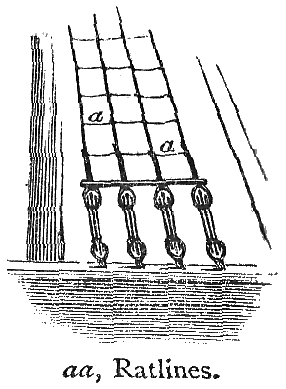
Ratline, Ratlin, rat′lin, n. one of the small lines or ropes traversing the shrouds and forming the steps of the rigging of ships—also Rat′ling, Ratt′ling.—n. Rat′line-stuff (naut.), a tarred rope from which ratlines are made. [Prob. rat-lines.]
Ratoon, ra-tōōn′, n. a new shoot from the root of a sugar-cane.—v.i. to send up new shoots from the root after cropping. [Hind. ratun.]
Rattan, rat-an′, n. a genus of palms having a smooth, reed-like stem several hundreds of feet in length: a walking-stick made of rattan: stems of rattan palm used as a raft. [Malay rótan.]
Rattan, ra-tan′, n. the continuous beat of a drum.
Ratteen, rat-tēn′, n. a thick woollen stuff. [Fr.]
Ratten, rat′n, v.t. to break or take away a workman's tools, &c., for disobeying the trades-union—the loss being ironically attributed to rats.
Rattinet, rat-ti-net′, n. a thin variety of ratteen.
Ratting. See Rat.
Rattle, rat′l, v.i. to clatter: to move along rapidly, with a clattering noise: to speak eagerly and noisily.—v.t. to cause to make a clatter: to stun with noise: to speak rapidly: to scold loudly.—n. a sharp noise rapidly repeated, as the death-rattle: a clatter: loud empty talk: loud scolding: a toy or instrument for rattling: a brisk jabberer: an annual meadow herb: a lousewort.—adjs. Ratt′le-brained, -head′ed, -pat′ed, noisy: giddy: unsteady.—ns. Ratt′le-mouse, a bat; Ratt′lepate, a noisy chatterer; Ratt′ler, a loud, inconsiderate talker: (coll.) a stunning blow: (coll.) an impudent lie; Ratt′lesnake, a poisonous snake having a number of hard, bony rings loosely jointed at the end of the tail, which make a rattling noise; Ratt′lesnake-grass, an American grass; Ratt′lesnake-mas′ter, -root, an American plant reputed to cure the bite of a rattlesnake; Ratt′lesnake-weed, a hawk-weed of the United States; Ratt′le-trap, a rickety vehicle; Ratt′lewort, a plant of genus Crotalaria; Ratt′ling, a clattering: railing.—adj. making a rattle: smart, lively: (coll.) strikingly great. [A.S. hrætele, hratele, a plant—from the rattling of the seeds in the capsules; Ger. rasseln, Dut. ratelen, to rattle.]
Rattling, rat′ling, n. Same as Ratline.
Raucity, raws′i-ti, n. hoarseness: harshness of sound.—adjs. Rauc′id, Raucous (raw′kus), hoarse.—adv. Rauc′ously. [L. raucus, hoarse.]
Raucle, rawk′l, adj. (Scot.) rough: fearless.
Raught, rawt (Spens.)—(obs.) pa.t. of reach.
Ravage, rav′āj, v.t. to lay waste: to destroy: to pillage.—n. devastation: ruin.—n. Rav′ager. [Fr.,—ravir, to carry off by force—L. rapĕre.]
Rave, rāv, v.i. to be mad: to be wild or raging, like a madman: to talk irrationally.—v.t. to utter wildly.—ns. Rā′ver, one who raves or is furious; Rā′ving, furious talk.—adj. delirious: distracted.—adv. Rā′vingly, in a raving manner: with frenzy: with distraction. [O. Fr. râver (Fr. rêver), to be delirious—L. rabies, madness.]
Rave, rāv, n. one of the side pieces of a wagon.
Rave, rāv, old pa.t. of rive.
Rave-hook, rāv′-hook, n. a ripping-iron.
Ravel, rav′el, v.t. to confuse, entangle: to untwist or unweave: to unravel (in this sense usually with out).—v.i. to be untwisted or unwoven: to become entangled: to search (with into):—pr.p. rav′elling; pa.t. and pa.p. rav′elled.—n. a ravelled thread.—adj. Rav′elled, denoting bread made from flour and bran.—ns. Rav′elling, a ravelled thread; Rav′elling-en′gine, a machine for tearing rags.—adv. Rav′elly.—n. Rav′elment, discord. [Dut. ravelen.]
Ravelin, rav′lin, n. a detached work with two embankments raised before the counterscarp. [Fr.,—It. rivellino.]
Raven, rā′vn, n. a kind of crow, noted for its croak and glossy black plumage.—adj. black, like a raven.—adj. Rā′ven-col′oured (Shak.).—ns. Rā′ven's-duck, fine hempen sail-cloth; Rā′venstone, a gallows. [A.S. hræfn; Ice. hrafn, Dut. raaf.]
Raven, Ravin (B.), rav′n, v.t. to obtain by violence: to devour with great eagerness or voracity.—v.i. to prey rapaciously.—n. prey: plunder.—ns. Rav′ener, a plunderer; Rav′ening (B.), eagerness for plunder.—adjs. Rav′enous, Rav′ined, voracious: devouring with rapacity: eager for prey or gratification.—adv. Rav′enously.—n. Rav′enousness. [O. Fr. ravine, plunder—L. rapina, plunder.]
Ravine, ra-vēn′, n. a long, deep hollow, worn away by a torrent: a deep, narrow mountain-pass. [Fr.,—L. rapina, rapine, violence.]
Ravish, rav′ish, v.t. to seize or carry away by violence: to rob: to have sexual intercourse with by force: to fill with ecstasy.—n. Rav′isher.—p.adj. Rav′ishing, delighting to rapture: transporting: ecstatic.—adv. Rav′ishingly, in a ravishing manner: with rapture.—n. Rav′ishment, act of ravishing: abduction: rape: ecstatic delight: rapture. [Fr. ravir—L. rapĕre.]
Raw, raw, adj. not altered from its natural state: not cooked or dressed: unbaked: not prepared or manufactured: not mixed: having the skin abraded: sore, as from abrasion of the skin: unfinished: immature: inexperienced: chilly and damp.—n. a galled place: an inveterate sore: hence (fig.) a point on which one is particularly sensitive.—adjs. Raw′bone (Spens.), Raw′boned, with little flesh on the bones: gaunt; Raw′-cold (Shak.), damp and cold.—ns. Raw′head, a spectre mentioned to frighten children; Raw′hide, an untanned skin: a whip made of twisted, untanned leather.—adj. Raw′ish, rather raw.—adv. Raw′ly.—ns. Raw′ness; Raw′-port, a porthole through which an oar can be worked in a small vessel. [A.S. hreáw; Dut. raauw, Ice. hrár, Ger. roh.]
Rax, raks, v.t. (Scot.) to reach out, hand. [Rack.]
Ray, rā, n. array.—v.t. to array—hence, ironically, (Shak.) to bedaub. [Array.]
Ray, rā, n. a line of light or heat: a beam or gleam of intellectual light: a radiating part of any structure: (bot.) the outer part of a flower-cluster.—v.t. to radiate: to furnish with rays.—v.i. to shine out.—adjs. Rayed, having rays; Ray′less, without rays: destitute of light. [Fr. raie—L. radius, a rod.]
Ray, rā, n. a popular name for such flat, cartilaginous fishes as the skate, thornback, and torpedo.—n. Ray′-oil, oil prepared from the livers of ray-fish. [Fr. raie—L. raia.]
Ray, rā, n. the scab—a disease of sheep.
Ray, rā, n. (mus.) the second note of the diatonic scale.
Rayah, rä′ya, n. a non-Mohammedan subject of Turkey who pays the capitation tax. [Ar. raiya—ra‛a, to pasture.]
Rayle, rāl, v.i. (Spens.). Same as Rail.
Rayne, rān, v.i. and n. (Spens.). Same as Rain.
Rayon, rā′on, n. (Spens.) a ray. [Fr.]
Rayonnant, rā′o-nant, adj. (her.) sending forth rays. [Fr., pr.p. of rayonner, to emit rays—rayon, a ray.]
Raze, rāz, n. (Shak.). Same as Race (3).
Raze, rāz, v.t. to lay level with the ground: to overthrow: to destroy. [Rase.]
Raze, rāz, n. a swinging fence in a water-course to prevent the passage of cattle.
Razee, ra-zē′, n. a ship-of-war cut down by reducing the number of decks. [Fr. rasé, cut down.]
Razor, rā′zor, n. a keen-edged implement for shaving: a tusk, as the razors of a boar.—adj Rā′zorable (Shak.), fit to be shaved.—ns. Rā′zor-back, a kind of baleen whale, also called Rorqual, Fin-back, or Finner: a hog whose back has the form of a ridge; Rā′zor-bill, a species of auk, common on the coasts of the northern Atlantic; Rā′zor-blade, -clam, -fish, -shell, a bivalve mollusc with an elongated, narrow shell; Rā′zor-hone, a hone for sharpening razors; Rā′zor-paste, a paste for spreading on a razor-strop; Rā′zor-strop, a strop for razors. [Fr. rasoir—L. radĕre, rasum, to scrape.]
Razure, rā′zhōōr, n. Same as Erasure.
Razzia, rat′si-a, n. a pillaging incursion—Algerian.
Re, rā, n. (mus.). Same as Ray.
Re, rē, n. a word used in the legal phrase In re, in the case (of). [L., abl. of res, thing, case.]
Reabsorb, rē-ab-sorb′, v.t. to absorb, suck in, or swallow up again.—n. Reabsorp′tion.
Reaccommodate, rē-a-kom′o-dāt, v.t. to readjust.
Reaccuse, rē-a-kūz′, v.t. to accuse again.
Reach, rēch, v.t. to stretch or extend: to attain or obtain by stretching out the hand: to hand over: to extend to: to arrive at: to get at: to gain.—v.i. to be extended: to mount up in quantity or number: to stretch out the hand: to try to obtain: to arrive.—n. act or power of reaching: extent of stretch: extent of force: penetration: artifice: contrivance: a straight portion of a stream between bends: (naut.) the distance traversed between tacks.—adj Reach′able, within reach.—ns. Reach′er, one who reaches; Reach′ing-post, in rope-making, a post fixed at the lower end of a rope-walk.—adjs Reach′less, unattainable; Reach′-me-down, ready-made.—Head reach, the distance to windward traversed by a vessel while tacking. [A.S. rǽcan; Ger. reichen, to reach.]
Reacquite, rē-a-kwīt′, v.t. to pay back: to requite.
React, rē-akt′, v.t. to act anew.—v.i. to return an impulse in the opposite direction: to act mutually on each other.—n. Reac′tion, action resisting other action: mutual action: backward tendency from revolution, reform, or progress.—adj Reac′tionary, for or implying reaction.—n. one who attempts to reverse political action.—n. Reac′tionist.—adj Reac′tive.—adv. Reac′tively.—ns. Reac′tiveness, Reactiv′ity.
Read, rēd, v.t. to utter aloud written or printed words: to peruse: to comprehend: to study, as to read law, science: to teach: to make out, from signs: to solve, as to read a dream: to interpret: to understand, as reading the stars: to note the indication of, as to read a barometer: impute by inference, as to read a meaning into a book.—v.i. to perform the act of reading: to practise much reading: to appear on reading: to advise: to speak: to acquire information: to utter the words of a book: (mus.) to render music at first sight: to put a certain expression upon it: to be suitable for perusal:—pa.t. and pa.p. read (red).—n. Read, a reading, perusal: (Spens.) counsel, a saying, an interpretation.—adj Read (red), versed in books: learned.—ns. Readabil′ity, Read′ableness.—adj Readable (rēd′a-bl), that may be read: worth reading: interesting: enabling to read.—adv. Read′ably.—ns. Read′er, one who reads: one whose office it is to read prayers in a church, or lectures in a university, &c.: one who reads or corrects proofs: one who reads much: a reading-book; Read′ership, the office of a reader.—adj. Read′ing, addicted to reading.—n. act of reading: perusal: study of books: public or formal recital: the way in which a passage reads: an interpretation of a passage or work: a version: noting an instrument, as the reading of a barometer.—ns. Read′ing-book, a book of exercises in reading; Read′ing-boy (print.), a reader's assistant; Read′ing-desk, a desk for holding a book or paper while it is read: a church-lectern; Read′ing-lamp, a form of lamp for use in reading; Read′ing-room, a room with papers, periodicals, &c., resorted to for reading.—Read between the lines, to detect a meaning not expressed; Read one's self in, in the Church of England, to read the Thirty-nine Articles and repeat the declaration of assent prescribed by law to a new incumbent.—Penny reading, an entertainment consisting of readings, &c., to which the admission is a penny. [A.S. rǽdan, to discern, read—rǽd, counsel; Ger. rathen, to advise.]
Readdress, rē-ad-dres′, v.t. to address again.
Readeption, rē-a-dep′shun, n. (Bacon) the act of regaining, recovery.—v.t. Readept′. [L. re-, again, adipisci, adeptus, to obtain.]
Readjourn, rē-ad-jurn′, v.t. to adjourn again.—n. Readjourn′ment.
Readjust, rē-ad-just′, v.t. to adjust or put in order again, or in a new way.—n. Readjust′ment.
Readmit, rē-ad-mit′, v.t. to admit again.—ns. Readmis′sion, act of readmitting: state of being readmitted; Readmit′tance, admittance or allowance to enter again.
Readorn, rē-a-dorn′, v.t. to decorate again.
Ready, red′i, adj. prepared at the moment: in proper time: prepared in mind: willing: not slow or awkward: dexterous: prompt: quick: present in hand: at hand: near: easy: on the point of: opportune: off-hand, as a ready retort.—n. a waiter's answer to a call: the position of a soldier's weapon after the order 'Make ready!' (slang) ready-money.—v.t. to dispose: to arrange.—adv. in a state of readiness or preparation.—adv. Read′ily.—n. Read′iness.—adj. Read′y-made, made and ready for use: not made to order.—ns. Read′y-mon′ey, cash payment; Read′y-pole, a bar across the chimney to support the pot-hook; Read′y-reck′oner, a book of tables giving the value of any number of things from the lowest monetary unit upwards: also the interest on any sum of money from a day upwards.—adj. Read′y-wit′ted, having ready wit: clever: sharp.—Make ready, to prepare. [A.S. rǽde—rídan, to ride; Scot. red, to put in order, Ger. be-reit, ready.]
Reaffirm, re-af-fėrm′, v.t. to affirm again.—n. Reaffirmā′tion.
Reafforest, rē-af-for′est, v.t. to convert anew into a forest.—n. Reafforestā′tion.
Reagent, rē-ā′jent, n. a substance that reacts on and detects the presence of other bodies: a test: one who exerts reflex influence.—n. Reā′gency.
Reaggravation, rē-ag-rav-ā′shun, n. the last monitory before the excommunication.
Reagree, rē-a-grē′, v.i. to become reconciled.
Reak, rēk, n. (obs.) a freak: a prank.
Real, rē′al, adj. actually existing: not counterfeit or assumed: true: genuine: sincere: authentic: (law) pertaining to things fixed, as lands or houses.—adj. Rē′alisable, that may be realised.—n. Realisā′tion, act of realising or state of being realised: a realising sense or feeling.—v.t. Rē′alise, to make real: to bring into being or act: to accomplish: to convert into real property or money: to obtain, as a possession: to feel strongly: to comprehend completely: to bring home to one's own experience.—n. Rē′aliser, one who realises.—p.adj. Rē′alising, serving to make real or bring home to one as a reality: conversion of property into money.—ns. Rē′alism, the medieval doctrine that general terms stand for real existences—opp. to Nominalism: the doctrine that in external perception the objects immediately known are real existences: the tendency in art to accept and to represent things as they really are—opp. to Idealism—a method of representation without idealisation, raised by modern French writers into a system, claiming a monopoly of truth in its artistic treatment of the facts of nature and life; Rē′alist, one who holds the doctrine of realism: one who believes in the existence of the external world.—adj. Rēalist′ic, pertaining to the realists or to realism: life-like.—adv. Rēalist′ically.—n. Rēal′ity, that which is real and not imaginary: truth: verity: (law) the fixed, permanent nature of real property.—adv. Rē′ally, in reality: actually: in truth.—ns. Rē′alness, the condition of being real; Rē′alty, land, with houses, trees, minerals, &c. thereon: the ownership of, or property in, lands—also Real estate.—Real presence (see Presence); Real school, a modern German preparatory, scientific, or technical school—the highest grade being the Real gymnasium, or first-class modern school, as opp. to the gymnasium proper, or classical school. [Low L. realis—L. res, a thing.]
Real, rē-al′, n. a Spanish coin, 100 of which=£1 sterling. [Sp.,—L. regalis, royal.]
Realgar, rē-al′gar, n. a native sulphuret of arsenic, a mineral consisting of about 70 parts of arsenic and 30 of sulphur, and of a brilliant red colour. [Fr.,—Ar. rahj-al-ghar, 'powder of the mine.']
Reallege, rē-al-lej′, v.t. to allege again.
Really, rē-a-lī′, v.t. (Spens.) to bring together again: to reform.—v.t. to arrange again.—n. Reallī′ance, a renewed alliance.
Realm, relm, n. a regal or royal jurisdiction: kingdom: province: country: dominion. [O. Fr. realme—Low L. regalimen—L. regalis, royal.]
Realty, rē′al-ti, n. fealty: royalty (see also Real, 1).
Ream, rēm, n. a quantity of paper consisting of 20 quires of 24 sheets. [O. Fr. raime (Fr. rame)—Sp. resma—Ar. rizma (pl. rizam), a bundle.]
Ream, rēm, v.i. (prov.) to cream: to froth.—n. Ream′iness.—adj. Ream′y.
Ream, rēm, v.t. to stretch: to enlarge by a rotatory cutter.—ns. Ream′er; Ream′ing-bit.
Reame, rēm, n. (Spens.) a realm.
Rean, rēn, n. a gutter. [Run.]
Reanimate, rē-an′i-māt, v.t. to restore to life: to infuse new life or spirit into: to revive.—n. Reanimā′tion.
Reannex, rē-an-neks′, v.t. to annex again, to reunite.—n. Reannexā′tion.
Reanoint, rē-an-oint′, v.t. to anoint anew.
Reanswer, rē-an′sėr, v.t. and v.i. (Shak.) to answer back, to react.
Reap, rēp, v.t. to cut down, as grain: to clear off a crop: to gather by effort: to receive as a reward: to obtain a harvest.—ns. Reap′er, Reap′man; Reap′ing-hook, a hook-shaped instrument, with a handle, for cutting grain: a sickle; Reap′ing-machine′, a machine for cutting grain, drawn by horses, &c.; Reap′-sil′ver, money paid by feudal tenants as a commutation for their services in reaping the crops. [A.S. rípan, to pluck; Goth. raupjan, Ger. raufen.]
Reapparel, rē-ap-par′el, v.t. to clothe again.
Reappear, rē-ap-pēr′, v.i. to appear again or a second time.—n. Reappear′ance, a second appearance.
Reapply, rē-ap-plī′, v.t. and v.i. to apply again.—n. Reapplicā′tion.
Reappoint, rē-ap-point′, v.t. to appoint again.—n. Reappoint′ment.
Reapportion, rē-ap-pōr′shun, v.t. to apportion again.—n. Reappor′tionment.
Reapproach, rē-ap-prōch′, v.t. and v.i. to approach again.
Rear, rēr, n. the back or hindmost part: the last part of an army or fleet.—ns. Rear′-ad′miral, an officer of the third rank, who commands the rear division of a fleet; Rear′dorse, an open fireplace, without a chimney, against the rear wall of a room; Rear′-front, the rear-rank of a body of troops when faced about; Rear′-guard, troops which protect the rear of an army; Rear′horse, an insect of the family Mantidæ; Rear′ing-bit, a bit to prevent a horse from lifting his head when rearing; Rear′ing-box, in fish-culture, a fish-breeder; Rear′-line, the last rank of a battalion, &c., drawn up in open order; Rear′most, last of all; Rear′-rank, the hindermost rank of a body of troops; Rear′ward, Rere′ward, (B.), the rear-guard, the part which comes last. [O. Fr. riere—L. retro, behind.]
Rear, rēr, v.t. to bring up to maturity: to educate: to erect: (Milt.) to lift upward, as steps: (Spens.) to carry off by force: to stir up.—v.i. to rise on the hind-legs, as a horse.—n. Rear′er, one who rears or raises: in coal-mines, a seam having an inclination of more than 30°. [A.S. rǽran, to raise, the causal of rísan, to rise.]
Rear, rēr, adj. early: underdone.—adjs. Rear′-boiled; Rear′-roast′ed. [Rare.]
Reargue, rē-ar′gū, v.t. to argue over again.—n. Rear′gument.
Rearmouse. Same as Reremouse.
Rearrange, rē-ar-rānj′, v.t. to arrange anew.—n. Rearrange′ment.
Reascend, rē-as-send′, v.t. and v.i. to ascend, mount, or climb again.—ns. Reascen′sion, Reascent′.
Reason, rē′zn, n. an idea which supports or justifies an act or belief: a motive: proof: excuse: cause: an explanation: the faculty of the mind by which man draws conclusions, and determines right and truth: the exercise of reason: just view of things: right conduct: propriety: justice: that which is conformable to reason: (logic) a premise placed after its conclusion.—v.i. to exercise the faculty of reason: to deduce inferences from premises: to argue: to debate: (B.) to converse.—v.t. to examine or discuss: to debate: to persuade by reasoning.—adj. Rea′sonable, endowed with reason: rational: acting according to reason: agreeable to reason: just: not excessive: moderate.—n. Rea′sonableness.—adv. Rea′sonably.—ns. Rea′soner; Rea′soning, act of reasoning: that which is offered in argument: course of argument.—adj. Rea′sonless.—n. Rea′son-piece, a wall plate.—By reason of, on account of: in consequence of; Principle of sufficient reason, the proposition that nothing happens without a sufficient reason why it should be as it is and not otherwise; Pure reason, reason absolutely independent of experience. [Fr. raison—L. ratio, rationis—rēri, ratus, to think.]
Reassemble, rē-as-sem′bl, v.t. and v.i. to assemble or collect again.—n. Reassem′blage.
Reassert, rē-as-sert′, v.t. to assert again.—n. Reasser′tion.
Reassess, rē-as-ses′, v.t. to assess again.—n. Reassess′ment.
Reassign, rē-as-sīn′, v.t. to assign again: to transfer back what has been assigned.—n. Reassign′ment.
Reassume, rē-as-sūm′, v.t. to assume or take again.—n. Reassump′tion.
Reassure, rē-a-shōōr′, v.t. to assure anew: to give confidence to: to confirm: to insure an insurer.—ns. Reassur′ance, repeated assurance: a second assurance against loss; Reassur′er.—adj. Reassur′ing.—adv. Reassur′ingly.
Reast, rēst, v.t. to dry or smoke (as meat). [Roast.]
Reata, Riata, rē-ä′ta, n. a rope of raw hide, used in America for catching animals. [Sp.,—L. re-, back, aptare, to fit on.]
Reattach, rē-at-tach′, v.t. to attach again.—n. Reattach′ment.
Reattain, rē-at-tān′, v.t. to attain again.
Reattempt, rē-at-temt′, v.t. to attempt again.
Réaumur's scale. See Thermometer.
Reave, rēv, v.t. to take away by violence:—pa.t. and pa.p. reft.—n. Reav′er. [A.S. reáfian, to rob—reáf, clothing, spoil; Ger. rauben, to rob.]
Reawake, rē-a-wāk′, v.i. to awake again.
Reballing, rē-bawl′ing, n. the catching of eels with earthworms fastened to a ball of lead.
Rebaptise, rē-bap-tīz′, v.t. to baptise again.—ns. Rebap′tiser; Rebap′tism, Rebaptisā′tion; Rebap′tist, one who baptises again: an anabaptist.
Rebate, rē-bāt′, v.t. (Shak.) to beat to obtuseness, to blunt: to beat back: to allow as discount.—n. Rēbāte′ment, deduction: diminution: narrowing: (her.) a shortening, as of one arm of a cross. [Fr. rebattre, to beat back—L. re-, back, battuĕre, to beat.]
Rebate, rē-bāt′, n. same as Rabate—also a hard freestone used in pavements: wood fastened to a handle in beating mortar.
Rebec, Rebeck, rē′bek, n. a musical instrument of the violin kind, with three strings played with a bow, introduced by the Moors into Spain. [O. Fr. rebec (Sp. rabel)—Ar. rabāba.]
Rebeccaite, rē-bek′a-īt, n. one of a set of rioters in South Wales, in 1843-44, who scoured the country by night, the leaders disguised in women's clothes, and threw down the toll-bars on the public roads; they were called 'Rebecca and her daughters,' from Gen. xxiv. 60.—n. Rebecc′aism.
Rebel, reb′el, n. one who rebels.—adj. rebellious.—v.i. (re-bel′) to renounce the authority of the laws and government to which one owes allegiance, or to take up arms and openly oppose them: to oppose any lawful authority:—pr.p. rebel′ling; pa.t. and pa.p. rebelled′.—n. Rebel′ler, one who rebels: a rebel.—adj. Reb′el-like (Shak.), like a rebel.—n. Rebell′ion, act of rebelling: open opposition to lawful authority: revolt: the Great Rebellion in England from 1642 to 1660: the American civil war of 1861-65.—adj. Rebell′ious, engaged in rebellion: characteristic of a rebel or rebellion: (of things) refractory.—adv. Rebell′iously, in a rebellious manner: in opposition to lawful authority.—n. Rebell′iousness.—adj. Reb′elly, rebellious. [Fr. rebelle—L. rebellis, insurgent—re-, again, bellum, war.]
Rebellow, rē-bel′ō, v.i. (Spens.) to bellow in return: to echo back a loud noise.
Rebind, rē-bīnd′, v.t. to bind anew.
Rebirth, rē-bėrth′, n. a new entrance into a living form, according to the doctrine of metempsychosis.
Rebite, rē-bīt′, v.t. to freshen worn lines in a plate.
Reboant, reb′ō-ant, adj. rebellowing: loudly resounding.—n. Reboā′tion. [L. reboans, -antis, pr.p. of reboāre—re-, again, boāre, to cry aloud.]
Reboil, rē-boil′, v.t. and v.i. to cause to boil again.
Reborn, rē-bawrn′, adj. endowed with fresh life.
Rebound, rē-bownd′, v.i. to bound or start back: to bound repeatedly: to recoil: to reverberate: to re-echo.—v.t. to repeat as an echo.—n. act of rebounding: recoil.
Rebrace, rē-brās′, v.t. to renew the strength of.
Rebuff, rē-buf′, n. a. beating back: sudden check: defeat: unexpected refusal.—v.t. to beat back: to check: to repel violently: to refuse. [O. Fr. rebuffe—It. rebuffo, a reproof—It. ri (—L. re-), back, buffare, to puff.]
Rebuild, rē-bild′, v.t. to build again: to renew.—n. Rebuild′er.
Rebuke, rē-būk′, v.t. to check with reproof: to chide or reprove: (B.) to chasten.—n. direct reproof: reprimand: reprobation: (B.) chastisement: a severe check.—adjs. Rebūk′able; Rebuke′ful.—adv. Rebuke′fully.—n. Rebūk′er.—adv. Rebūk′ingly. [O. Fr. rebouquer (Fr. reboucher), from re-, back, bouque (Fr. bouche), the mouth—L. bucca, the cheek.]
Rebullition, rē-bul-ish′un, n. a renewed effervescence. [L. rebullīre, to bubble up.]
Reburse, rē-bėrs′, v.t. to pay over again. [L. re-, again, bursa, purse.]
Rebus, rē′bus, n. an enigmatical representation of a name or thing by using pictorial devices for letters, syllables, or parts of words: a riddle: (her.) a coat of arms bearing an allusion to the name of the bearer:—pl. Rē′buses. [L., res, a thing—prob. from the device speaking to the beholder non verbis sed rebus.]
Rebut, rē-but′, v.t. to butt or drive back: to repel: to reject: (law) to oppose by argument or proof.—v.i. (law) to return an answer:—pr.p. rebut′ting; pa.t. and pa.p. rebut′ted.—adj. Rēbut′table.—ns. Rēbut′tal; Rēbut′ter, that which rebuts: a plaintiff's answer to a defendant's rejoinder. [O. Fr. rebuter, to repulse—L. re-, back, Mid. High Ger. bōzen, to beat.]
Recalcitrant, rē-kal′si-trant, adj. showing repugnance or opposition: refractory.—v.i. or (rarely) v.t. Recal′citrate, to show repugnance.—n. Recalcitrā′tion. [L. recalcitrans, -antis—re-, back, calcitrāre, -ātum, to kick—calx, calcis, the heel.]
Recalesce, rē-kal-es′, v.t. to show anew a state of glowing heat.—n. Recales′cence (phys.), a peculiar behaviour of iron when cooling from a white-heat. At 1000°, e.g., it glows more brilliantly for a short time. [L. re-, again, calescĕre, to grow hot.]
Recall, rē-kawl′, v.t. to call back: to command to return: to revoke: to call back to mind.—n. act of recalling or revoking: a signal to soldiers to return.—adj. Recall′able, capable of being recalled.—n. Recal′ment, revocation.
Recant, rē-kant′, v.t. to withdraw (a former declaration): to retract.—v.i. to revoke a former declaration: to unsay what has been said, esp. to declare one's renunciation of a religious belief which one formerly maintained.—ns. Rēcantā′tion, act of recanting: a declaration contradicting a former one; Rēcant′er.
Recapitulate, rē-ka-pit′ū-lāt, v.t. to go over again the chief points of anything.—n. Recapitūlā′tion, act of recapitulating: a summary of the main points of a preceding speech, treatise, &c.—adjs. Recapit′ūlātive; Recapit′ūlātory, repeating again: containing a recapitulation. [L. recapitulāre, -ātum—re-, again, capitulum—caput, head.]
Recaption, rē-kap′shun, n. reprisal: (law) taking back goods, wife, or children from one who has no right to detain them.
Recapture, rē-kap′tūr, v.t. to capture back or retake, esp. a prize from a captor.—n. act of retaking: a prize recaptured.—n. Recap′tor.
Recarburise, rē-kär′bū-rīz, v.t. to restore the carbon to metal from which it has been removed.—n. Recarbonisā′tion.
Recarnify, rē-kär′ni-fī, v.t. to convert again into flesh. [L. re-, again, carnify, to change into flesh.]
Recarry, rē-kar′i, v.t. to carry back or anew.—n. Recarr′iage.
Recast, rē-kast′, v.t. to cast or throw again: to cast or mould anew: to compute a second time.—n. a moulding or shaping anew, as of a book.
Recede, rē-sēd′, v.i. to go or fall back: to retreat: to bend or tend in a backward direction: to withdraw: to give up a claim.—v.t. to cede back, as to a former possessor.—adj. Reced′ing, sloping backward. [L. recedĕre, recessum—re-, back, cedĕre, to go.]
Receipt, rē-sēt′, n. act of receiving: place of receiving: power of holding: a written acknowledgment of anything received, a legal acknowledgment of money received in discharge of a debt or demand: that which is received: a recipe in cookery.—v.t. to give a receipt for: to sign: to discharge.—adj. Receipt′able, that may be receipted.—ns. Receipt′-book, a book containing receipts; Receipt′or, one who gives a receipt. [O. Fr. recete (Fr. recette)—L. recipere, receptum.]
Receive, rē-sēv′, v.t. to take what is offered: to accept: to embrace with the mind: to assent to: to allow: to give acceptance to: to give admittance to: to welcome or entertain: to hold or contain: (law) to take goods knowing them to be stolen: (B.) to bear with, to believe in.—v.i. to be a recipient: to hold a reception of visitors.—n. Receivabil′ity, Receiv′ableness, the quality of being receivable.—adj. Receiv′able, that may be received: a waiting payment, as bills receivable.—ns. Receiv′edness, the state or quality of being received or current; Receiv′er, one who receives: an officer who receives taxes: a person appointed by a court to hold and manage property which is under litigation, or receive the rents of land, &c.: one who receives stolen goods: (chem.) a vessel for receiving and holding the products of distillation, or for containing gases: the glass vessel of an air-pump in which the vacuum is formed: the receiving part of a telegraph, telephone, &c.; Receiv′er-gen′eral, an officer who receives the public revenue; Receiv′ership, the office of a receiver; Receiv′ing, the act of receiving; Receiv′ing-house, a depôt: a house where letters and parcels are left for transmission; Receiv′ing-in′strument, an appliance by which operators at two telegraph stations can communicate; Receiv′ing-off′ice, a branch post-office for receipt of letters, &c.; Receiv′ing-ship, a stationary ship for recruits for the navy. [O. Fr. recever (Fr. recevoir)—L. recipĕre, receptum—re-, back, capĕre, to take.]
Recelebrate, rē-sel′ē-brāt, v.t. to celebrate again.
Recency, rē′sen-si, n. newness. [Recent.]
Recension, rē-sen′shun, n. a critical revisal of a text: a text established by critical revision: a review.—n. Recen′sionist. [L. recensio—recensēre—re-, again, censēre, to value.]
Recent, rē′sent, adj. of late origin or occurrence: fresh: modern: (geol.) belonging to the present geological period.—adv. Rē′cently.—n. Rē′centness. [Fr.,—L. recens, recentis.]
Receptacle, rē-sep′ta-kl, n. that into which anything is received or in which it is contained: (bot.) the basis of a flower: (zool.) an organ that receives and holds a secretion.—n. Rē′cept, an idea taken into the mind from without.—adj. Receptac′ular (bot.), pertaining to or serving as a receptacle.—n. Receptibil′ity, receivability.—adj. Recept′ible, receivable.—ns. Recep′tion, the act of receiving: admission: state of being received: acceptance: a receiving officially: (Milt.) capacity for receiving: a receiving of guests for entertainment: welcome: treatment at first coming; Recep′tion-room.—adj. Recept′ive, having the quality of receiving or containing: (phil.) capable of receiving, or quick to receive, impressions.—ns. Recept′iveness; Receptiv′ity, quality of being receptive. [L. recipĕre, receptum, to receive.]
Recess, rē-ses′, n. a going back or withdrawing: retirement: seclusion: a period of remission of business: part of a room formed by a receding of the wall: a retired spot: a nook: a sinus or depressed par.—v.t. to make a recess in: to put into a recess.—adj. Recessed′, having a recess.—Recessed arch, one arch within another. [Recede.]
Recession, rē-sesh′un, n. act of receding: withdrawal: the state of being set back.—adjs. Reces′sional; Recess′ive.—adv. Recess′ively.—n. Recess′us, a recess.
Recession, rē-sesh′un, n. a ceding or giving back.
Rechabite, rek′a-bīt, n. one of the descendants of Jonadab, the son of Rechab, who abstained from drinking wine, in obedience to the injunction of their ancestor (Jer. xxxv. 6): a total abstainer from intoxicating drinks: a member of the Rechabite order of total abstainers.—n. Rech′abitism.
Réchauffé, rā-shō-fā′, n. a warmed-up dish: a fresh concoction of old literary material. [Fr.]
Recheat, rē-chēt′, n. (Shak.) a recall on the horn when the hounds have lost the scent, or at the end of the chase. [O. Fr. recet.]
Recherché, rē-sher′shā, adj. extremely nice: peculiar and refined: rare. [Fr.]
Rechlesse, rek′les, adj. Same as Reckless.
Rechristen, rē-kris′n, v.t. to name again.
Recidivate, rē-sid′i-vāt, v.i. to fall again: to backslide.—ns. Recidivā′tion; Recid′ivist (Fr. law), a relapsed criminal.—adj. Recid′ivous, liable to backslide. [Fr.,—L. recidīvus, falling back.]
Recipe, res′i-pē, n. a medical prescription: any formula for the preparation of a compound: a receipt:—pl. Recipes (res′i-pēz). [L., lit. 'take,' the first word of a medical prescription, imper. of recipĕre.]
Recipient, rē-sip′i-ent, adj. receiving.—n. one who receives, that which receives.—ns. Recip′ience, Recip′iency, a receiving: receptiveness. [L. recipiens, -entis, pr.p. of recipĕre, to receive.]
Reciprocal, rē-sip′rō-kal, adj. acting in return: mutual: alternating: interchangeable: giving and receiving.—n. that which is reciprocal: (math.) the quotient resulting from the division of unity by any given quantity.—n. Reciprocal′ity, the state or quality of being reciprocal: mutual return.—adv. Recip′rocally, mutually: interchangeably: inversely.—ns. Recip′rocalness; Recip′rocant (math.), a contravariant expressing a certain condition of tangency: a differential invariant.—adj. Recip′rocantive, relating to a reciprocant.—v.t. Recip′rocāte, to give and receive mutually: to requite: to interchange: to alternate.—v.i. to move backward and forward: (coll.) to make a return or response.—ns. Recip′rocating-en′gine, an engine in which the piston moves forward and backward in a straight line; Reciprocā′tion, interchange of acts: alternation.—adj. Recip′rocātive, acting reciprocally.—n. Reciproc′ity, mutual obligations: action and reaction: equality of commercial privileges.—adjs. Rec′iprock, Rec′iproque (Bacon), reciprocal; Recip′rocous (rare), turning back: reciprocal.—Reciprocal proportion is when, of four terms taken in order, the first has to the second the same ratio which the fourth has to the third; Reciprocal ratio, the ratio of the reciprocals of two quantities; Reciprocal terms, those that have the same signification and consequently are convertible; Reciprocating motion, by this the power is transmitted from one part of a machine to another. [L. reciprocus.]
Reciprocornous, rē-sip′rō-kor-nus, adj. having horns like a ram.
Recision, rē-sizh′un, n. the act of cutting off. [Fr.,—L.,—recidĕre, recisum, to cut off.]
Recite, rē-sīt′, v.t. to read aloud from paper, or repeat from memory: to narrate: to give the particulars of.—v.i. to rehearse in public.—ns. Recī′tal, act of reciting: rehearsal: that which is recited: a narration: a vocal or instrumental performance, as a piano recital: (law) that part of a deed which recites the circumstances; Recitation (res-i-tā′shun), act of reciting: a public reading: rehearsal; Recitā′tionist, a public reciter; Recitative (-tēv′), (mus.) a style of song resembling declamation, a kind of union of song and speech.—adj. in the style of recitative.—adv. Recitative′ly, in the manner of recitative.—ns. Recitati′vo (mus.), recitative; Recit′er; Recit′ing-note, a note in chanting on which several syllables are sung. [Fr. réciter—L. recitāre—L. re-, again, citāre, -ātum, to call.]
Reck, rek, v.t. to care for: to regard.—v.i. (usually with not, and fol. by of) care: heed.—adj. Reck′less, careless: heedless of consequences: rash.—adv. Reck′lessly.—ns. Reck′lessness; Reck′ling, a reckless person: the weakest in a litter: a helpless babe.—adj. stunted.—It recks (Milt.), it concerns. [A.S. récan, from a root seen in Old High Ger. ruoh, care, Ger. ruchlos, regardless.]
Reckon, rek′n, v.t. to count: to place in the number or rank of: to esteem: to think, believe.—v.i. to calculate: to charge to account: to make up accounts: to settle accounts (fol. by with): to count or rely (with on or upon): to have an impression: to think: to suppose.—ns. Reck′oner; Reck′oning, an account of time: settlement of accounts, &c.: charges for entertainment: standing as to rank: (naut.) a calculation of the ship's position: (B.) estimation: value.—Reckon for, to be answerable for; Reckon on, or upon, to count or depend upon; Reckon without his host (see Host).—Day of reckoning, the day when an account must be given and a settlement made: the judgment-day. [A.S. ge-recenian, to explain; Ger. rechnen.]
Reclaim, rē-klām′, v.t. to demand the return of: to regain: to bring back from a wild or barbarous state, or from error or vice: to bring into a state of cultivation: to bring into the desired condition: to make tame or gentle: to reform.—v.i. to cry out or exclaim: (Scots law) to appeal from the Lord Ordinary to the inner house of the Court of Session.—adj. Reclaim′able, that may be reclaimed or reformed.—adv. Reclaim′ably.—ns. Reclaim′ant, one who reclaims; Reclamā′tion, act of reclaiming: state of being reclaimed, as of waste land: demand: recovery. [Fr.,—L. re-, again, clamāre, to cry out.]
Reclasp, rē-klasp′, v.t. to clasp again.
Reclinate, rek′li-nāt, adj. reclined: (bot.) bent downward, so as to have the point lower than the base, as a leaf.—n. Reclinā′tion, the act of reclining or leaning: the angle which the plane of a dial makes with a vertical plane, the intersection being a horizontal line: an operation in surgery for the cure of cataract. [L. reclināre, -ātum, to recline.]
Recline, rē-klīn′, v.t. to lean or bend backwards: to lean to or on one side.—v.i. to lean: to rest or repose.—adjs. Recline′ (Milt.), leaning; Reclined′ (bot.), same as Reclinate.—n. Reclī′ner.—adj. Reclī′ning (bot.), bending away from the perpendicular: recumbent.—ns. Reclī′ning-board, a board on which persons recline to gain erectness to the figure; Reclī′ning-chair, an invalid's chair. [Fr.,—L. reclināre—re-, back, clināre, to bend.]
Reclose, rē-klōz′, v.t. to close again.
Reclothe, rē-klōth, v.t. to clothe again.
Recluse, rē-klōōs′, adj. secluded: retired: solitary.—n. one shut up or secluded: one who lives retired from the world: a religious devotee living in a single cell, generally attached to a monastery.—adv. Recluse′ly, in retirement or seclusion from society.—ns. Recluse′ness, seclusion from society: retirement; Reclu′sion, religious retirement or seclusion: the life of a recluse.—adj. Reclu′sive (Shak.), affording retirement or seclusion.—n. Reclu′sory, a recluse's cell. [Fr.,—L. reclusus, pa.p. of recludĕre, to open, shut away—re-, away, claudĕre, to shut.]
Recoct, rē-kokt′, v.t. to cook anew, to vamp up.—n. Recoc′tion.
Recognise, rek′og-nīz, v.t. to know again: to recollect: to acknowledge: to see the truth of.—adj. Rec′ognisable, that may be recognised or acknowledged.—adv. Rec′ognisably, in a recognisable manner.—ns. Recog′nisance, a recognition: an avowal: a profession: a legal obligation entered into before a magistrate to do, or not do, some particular act: to enter into recognisances; Rec′ogniser, one who recognises; Recogni′tion, act of recognising: state of being recognised: recollection: avowal: (Scots law) a return of the feu to the superior.—adjs. Recog′nitive, Recog′nitory. [L. recognoscĕre—re-, again, cognoscĕre, to know.]
Recoil, rē-koil′, v.t. to start back: to rebound: to return: to shrink from.—n. a starting or springing back: rebound: an escapement in which after each beat the escape-wheel recoils slightly.—n. Recoil′er, one who recoils.—adj. Recoil′ing.—adv. Recoil′ingly.—n. Recoil′ment. [Fr. reculer—L. re-, back, Fr. cul, the hinder part—L. culus.]
Recoin, rē-koin′, v.t. to coin over again.—ns. Recoin′age; Recoin′er.
Recollect, rē-kol-ekt′, v.t. to collect again.
Recollect, rek-ol-ekt′, v.t. to remember: to recover composure or resolution (with reflex. pron.).—n. Recollec′tion, act of recollecting or remembering: the power of recollecting: memory: that which is recollected: reminiscence.—adj. Recollec′tive, having the power of recollecting.
Recollect, rek′ol-ekt, n. a member of a congregation of a monastic order following a very strict rule—mostly of the Franciscan order forming a branch of the Observantines.—Also Rec′ollet.
Recombine, rē-kom-bīn′, v.t. to combine again.—n. Recombinā′tion.
Recomfort, rē-kum′furt, v.t. to comfort or console again: (Bacon) to give new strength.—adj. Recom′fortless (Spens.), comfortless.—n. Recom′forture (Shak.), restoration of comfort.
Recommence, rē-kom-ens′, v.t. to commence again.—n. Recommence′ment.
Recommend, rek-o-mend′, v.t. to commend to another: to bestow praise on: to introduce favourably: to give in charge: to commit, as in prayer: to advise.—adj. Recommend′able, that may be recommended: worthy of praise.—n. Recommend′ableness, the quality of being recommendable.—adv. Recommend′ably, so as to deserve recommendation.—n. Recommendā′tion, act of recommending: act of introducing with commendation: repute: letter of recommendation.—adj. Recommend′ātory, that recommends: commendatory.—n. Recommend′er, one who, or that which, recommends.
Recommit, rē-kom-it′, v.t. to commit again: particularly, to send back to a committee.—ns. Recommit′ment, Recommit′tal.
Recommunicate, rē-kom-ūn′i-kāt, v.t. and v.i. to communicate again.
Recompact, rē-kom-pakt′, v.t. to join anew.
Recompense, rek′om-pens, v.t. to return an equivalent for anything: to repay or requite: to reward: to compensate: to remunerate.—n. that which is returned as an equivalent: repayment: reward: compensation: remuneration.—n. Rec′ompenser. [Fr. récompenser—L. re-, again, compensāre, to compensate.]
Recompile, rē-kom-pīl′, v.t. to compile anew.—ns. Recompilā′tion, Recompile′ment, a new compilation.
Recomplete, rē-kom-plēt′, v.t. to complete anew.—n. Recomplē′tion.
Recompose, rē-kom-pōz′, v.t. to compose again or anew: to form anew: to soothe or quiet.—ns. Recompos′er; Recomposi′tion.
Reconcile, rek′on-sīl, v.t. to restore to friendship or union: to bring to agreement: to bring to contentment: to pacify: to make consistent: to adjust or compose.—adj. Rec′oncilable, that may be reconciled: that may be made to agree: consistent.—n. Rec′oncilableness, possibility of being reconciled: consistency: harmony.—adv. Rec′oncilably, in a reconcilable manner.—ns. Rec′onciler; Reconciliā′tion, Rec′oncilement, act of reconciling: state of being reconciled: renewal of friendship: propitiation: atonement: the bringing to agreement things at variance.—adj. Reconcil′iatory, serving or tending to reconcile. [Fr. réconcilier—L. re-, again, conciliāre, -ātum, to call together.]
Recondense, rē-kon-dens′, v.t. to condense again.—n. Recondensā′tion.
Recondite, rē-kon′dit, or rek′on-dīt, adj. secret: abstruse: profound.—ns. Recondite′ness; Recon′ditory, a storehouse. [L. recondĕre, -itum, to put away—re-, again, condĕre, to put together.]
Reconduct, rē-kon-dukt′, v.t. to conduct back or anew.
Reconfirm, rē-kon-fėrm′, v.t. to confirm again.
Reconjoin, rē-kon-join′, v.t. to join anew.
Reconnaissance, re-kon′i-sans, n. the act of reconnoitring: a survey or examination: the examination of a tract of country with a view to military or engineering operations.—Reconnaissance in force, an attack by a body of troops to discover the strength of the enemy. [Fr.]
Reconnoitre, rek-o-noi′tėr, v.t. to survey or examine: to survey with a view to military operations.—v.i. to make preliminary examination:—pa.t. and pa.p. reconnoi′tred.—n. a preliminary survey. [O. Fr. reconoistre (Fr. reconnaître)—L. recognoscĕre, to recognise.]
Reconquer, rē-kong′kėr, v.t. to conquer again: to recover: to regain.—n. Recon′quest.
Reconsecrate, rē-kon′sē-krāt, v.t. to consecrate anew.—n. Reconsecrā′tion.
Reconsider, rē-kon-sid′ėr, v.t. to consider again, as to reconsider a motion or vote: to review.—n. Reconsiderā′tion.
Reconsolate, rē-kon′sō-lāt, v.t. (obs.) to comfort again.
Reconsolidate, rē-kon-sol′i-dāt, v.t. to consolidate anew.—n. Reconsolidā′tion.
Reconstitute, rē-kon′sti-tūt, v.t. to construct anew.—adj. Reconstit′ūent.—n. Reconstitū′tion.
Reconstruct, rē-kon-strukt′, v.t. to construct again: to rebuild.—n. Reconstruc′tion.—adj. Reconstruc′tionary.—n. Reconstruc′tionist.—adj. Reconstruc′tive, able or tending to reconstruct.
Recontinue, rē-kon-tin′ū, v.t. and v.i. to continue anew.—n. Recontin′ūance.
Reconvalescence, rē-kon-val-es′ens, n. restoration to health.
Reconvene, rē-kon-vēn′, v.t. to convene or call together again.—v.i. to come together again.
Reconvent, rē-kon-vent′, v.t. to assemble together again.—n. Reconven′tion, a counter-action by a defendant against a plaintiff.
Reconvert, rē-kon-vėrt′, v.t. to convert again.—n. Reconver′sion.
Reconvey, rē-kon-vā′, v.t. to transfer back to a former owner, as an estate.—n. Reconvey′ance.
Record, rē-kord′, v.t. to write anything formally, to preserve evidence of it: to bear witness to: to register or enrol: to celebrate.—adj. Record′able, able to be recorded, worthy of record.—ns. Recordā′tion (Shak.), remembrance; Record′er, one who records or registers, esp. the rolls, &c., of a city: a judge of a city or borough court of quarter-sessions: an old musical instrument somewhat like a flageolet, but with the lower part wider than the upper, and a mouthpiece resembling the beak of a bird: a registering apparatus in telegraphy; Record′ership, the office of recorder, or the time of holding it. [O. Fr. recorder—L. recordāre, to call to mind—re-, again, cor, cordis, the heart.]
Record, rek′ord, n. a register: a formal writing of any fact or proceeding: a book of such writings: a witness, a memorial: memory, remembrance: anything entered in the rolls of a court, esp. the formal statements or pleadings of parties in a litigation.—n. Rec′ord-off′ice, a place where public records are kept.—Beat, or Break, the record, to outdo the highest achievement yet done; Close the record, an act of a Scottish judge after each party has said all he wishes to say by way of statement and answer; Public records, contemporary authenticated statements of the proceedings of the legislature, and the judgments of those higher courts of law known as Courts of Record; Trial by record, a common law mode of trial when a disputed former decision of the court is settled by producing the record.
Recount, rē-kownt′, v.t. to count again: to tell over again: to narrate the particulars of: to detail.—n. a second or repeated count.—ns. Recount′al, Recount′ment, relation in detail, recital. [O. Fr. reconter—re-, again, conter, to tell.]
Recoup, rē-kōōp′, v.t. to make good: to indemnify.—adj. Recoupé (her.), divided a second time.—n. Recoup′ment, reimbursement: (law) reduction of the plaintiff's damages by keeping out a part. [Fr. recouper, to cut again—re-, again, couper, to cut, coup, a stroke—Low L. colpus—L. colaphus.]
Recoure, rē-kōōr′, v.t. (Spens.) to recover.
Recourse, rē-kōrs′, n. a going to for aid or protection: access.—v.i. to return.—adj. Recourse′ful, returning. [Fr. recours—L. recursus—re-, back, currĕre, cursum, to run.]
Recover, rē-kuv′ėr, v.t. to cover again.
Recover, rē-kuv′ėr, v.t. to get possession of again: to make up for: to retrieve: to cure: to revive: to bring back to any former state: to rescue: to obtain as compensation: to obtain for injury or debt: to reconcile.—v.i. to regain health: to regain any former state: (law) to obtain a judgment.—n. recovery: the forward movement in rowing, after one stroke to take another.—n. Recoverabil′ity, the state of being recoverable.—adj. Recov′erable, that may be recovered or regained: capable of being brought to a former condition.—ns. Recov′erableness, the state of being recoverable: capability of being recovered; Recoveree′, one against whom a judgment is obtained in common recovery; Recov′erer, one who recovers; Recov′eror, one who recovers a judgment in common recovery; Recov′ery, the act of recovering: the act of regaining anything lost: restoration to health or to any former state: the power of recovering anything: (law) a verdict giving right to the recovery of debts or costs. [O. Fr. recovrer—L. recuperāre—re-, again, and Sabine cuprus, good; some suggest cupĕre, to desire.]
Recreant, rek′rē-ant, adj. cowardly: false: apostate: renegade.—n. a mean-spirited wretch: an apostate: a renegade.—n. Rec′rēancy, the quality of a recreant: a yielding, mean, cowardly spirit.—adv. Rec′rēantly. [O. Fr., pr.p. of recroire, to change belief—Low L. (se) re-credĕre, to own one's self beaten—L. re-, again, credĕre, to believe.]
Recreate, rek′rē-āt, v.t. to revive: to reanimate: to cheer or amuse: to refresh: to delight.—v.i. to take recreation.—n. Recreā′tion, the act of recreating or state of being recreated: refreshment after toil, sorrow, &c.: diversion: amusement: sport.—adjs. Recreā′tional, Rec′reātive, serving to recreate or refresh: giving relief in weariness, &c.: amusing.—adv. Rec′reātively, so as to afford recreation or diversion.—n. Rec′reātiveness, the quality of being refreshing or amusing.
Recrement, rek′rē-ment, n. superfluous matter: dross.—adjs. Recrement′al, Recrementi′tial, Recrementi′tious. [L. recrementum, dross.]
Recriminate, rē-krim′in-āt, v.t. to criminate or accuse in return.—v.i. to charge an accuser with a similar crime.—n. Recriminā′tion, the act of recriminating or returning one accusation by another: a countercharge or accusation.—adjs. Recrim′inātive, Recrim′inātory, recriminating or retorting accusations or charges.—n. Recrim′inātor, one who recriminates.
Recross, rē-kros′, v.t. to cross again.—adj. Recrossed′ (her.), having the ends crossed.
Recrucify, rē-krōōs′i-fī, v.t. to crucify anew.
Recrudescent, rē-krōō-des′ent, adj. growing sore or painful again.—v.i. Recrudesce′, to become raw again: to be renewed.—ns. Recrudes′cence, Recru′dency, Recrudes′cency, the state of becoming sore again: a state of relapse: (med.) increased activity after recovery: (bot.) the production of a fresh shoot from a ripened spike. [L. recrudescens, -entis, pr.p. of recrudescĕre, to become raw again—re-, again, crudescĕre, to become raw—crudis, crude.]
Recruit, rē-krōōt′, v.i. to obtain fresh supplies: to recover in health, &c.: to enlist new soldiers.—v.t. to repair: to supply: to supply with recruits.—n. the supply of any want: a substitute for something wanting: a newly enlisted soldier.—ns. Recruit′al, renewed supply; Recruit′er.—adj. Recruit′ing, obtaining new supplies: enlisting recruits.—n. the business of obtaining new supplies or enlisting new soldiers.—ns. Recruit′ing-ground, a place where recruits may be obtained; Recruit′ing-par′ty, a party of soldiers engaged in enlisting recruits; Recruit′ing-ser′geant, a sergeant who enlists recruits; Recruit′ment, the act, business, or employment of raising new supplies of men for an army. [O. Fr. recruter—re-, croître—L. recrescĕre—re-, again, crescĕre, to grow.]
Recrystallisation, rē-kris-tal-īz-ā′shun, n. the process of crystallising again.—v.t. and v.i. Rēcrys′tallise.
Recta, rek′ta, n.pl.—adj. Rec′tal. See Rectum.
Rectangle, rek′tang-gl, n. a four-sided figure with all its angles right angles and its opposite sides equal.—adjs. Rec′tangled, having right angles; Rectang′ūlar, right-angled.—n. Rectangūlar′ity, the state or quality of being right-angled.—adv. Rectang′ūlarly, with, or at, right angles.—n. Rectang′ūlarness.—Rectangular hyperbola, a hyperbola whose asymptotes are at right angles to one another; Rectangular solid, a solid whose axis is perpendicular to its base. [Fr.,—L. rectus, right, angulus, an angle.]
Rectify, rek′ti-fī, v.t. to make straight or right: to adjust: to correct or redress: to purify by repeated crystallisation or sublimation, or by distillations: (math.) to determine the length of a curve included between two limits: to prepare a sun-dial for an observation:—pa.t. and pa.p. rec′tified.—adj. Rectifī′able, that may be rectified or set right.—ns. Rectificā′tion, the act of rectifying or setting right: the process of refining any substance by repeated distillation: rectification of a globe, its adjustment preparatory to the solution of a proposed problem; Rec′tifier, one who corrects: one who refines a substance by repeated distillation.—Rectify the course of a vessel, to determine its true course from indications of the ship's compass, and allowing for magnetic variations, &c.; Rectify the globe, to bring the sun's place in the ecliptic on a globe to the brass meridian. [Fr.,—L. rectus, straight, facĕre, to make.]
Rectigrade, rek′ti-grād, adj. walking straight forward. [L. rectus, straight, gradi, to step.]
Rectilineal, rek-ti-lin′ē-al, adj. bounded by straight lines: straight—also Rectilin′ear.—adv. Rectilin′eally.—n. Rectilinear′ity, the state or quality of being right-lined.—adv. Rectilin′early, in a right line.—n. Rectilin′earness. [L. rectus, straight, linea, a line.]
Rectinerved, rek′ti-nervd, adj. (bot.) straight or parallel nerved.
Rection, rek′shun, n. (gram.) the influence of a word in regard to the number, case, &c. of another word in a sentence.
Rectipetality, rek-ti-pe-tal′i-ti, n. (bot.) the natural tendency of stems to grow in a straight line.
Rectirostral, rek′ti-ros′tral, adj. having a straight bill. [L. rectus, straight, rostrum, a beak.]
Rectiserial, rek-ti-sē′ri-al, adj. placed in a straight line: (bot.) arranged in one or more straight ranks.
Rectitis, rek′tī-tis, n. inflammation of the rectum.—adj. Rectit′ic.
Rectitude, rek′ti-tūd, n. uprightness: correctness of principle or practice: integrity: correctness. [Fr.,—L. rectitudo—rectus, straight.]
Recto, rek′tō, n. (print.) the right-hand page—opp. to Reverso or Verso: (law) a writ of right.
Rector, rek′tor, n. a ruler: in the Church of England, a clergyman who has the charge and cure of a parish where the tithes are not impropriate, and who accordingly has the whole right to the ecclesiastical dues therein: a common name for all incumbents in the Episcopal churches of the United States and (since 1890) Scotland: the head-master of a superior public school in Scotland, Germany, &c.: the chief elective officer of certain Scotch and French universities: the head of Lincoln and of Exeter Colleges, Oxford, &c.: (R.C.) an ecclesiastic in charge of a congregation, a college, or religious house, esp. the head of a Jesuit seminary.—adjs. Rec′toral, Rectō′rial, pertaining to a rector or to a rectory—ns. Rec′torate, Rec′torship; Rec′toress, a female rector: a governess; Rec′tory, the province or mansion of a rector.—Rector magnificus, the head of a German university.—Lay rector, a layman who enjoys the great tithes of a parish; Missionary rector (R.C.), a priest appointed to the charge of some important mission in England. [L.,—regĕre, rectum, to rule.]
Rectrix, rek′triks, n. one of the long tail-feathers of a bird, so called because used in steering the bird in its flight:—pl. Rectrices (rek′tri-sēz).
Rectum, rek′tum, n. the lowest part of the large intestine:—pl. Rec′ta.—adj. Rec′tal.—ns. Rec′toscope, a speculum for rectal examination; Rectot′omy, the operation for dividing a rectal stricture.—adjs. Rec′to-urē′thral, pertaining to the rectum and to the urethra; Rec′to-ū′terine, to the rectum and the uterus; Rec′to-vag′inal, to the rectum and the vagina; Rec′to-ves′ical, to the rectum and the bladder. [L. rectus, straight.]
Rectus, rek′tus, n. a muscle so called from the straightness of its course:—pl. Rec′ti.
Recubant, rek′ū-bant, adj. reclining, recumbent—n. Recubā′tion. [L. recubāre, -ātum, to lie back.]
Recuil, Recule, rē-kūl′ (Spens.). Same as Recoil.
Recultivate, rē-kul′ti-vāt, v.t. to cultivate again.—n. Recultivā′tion.
Recumbent, rē-kum′bent, adj. lying back: reclining: idle.—ns. Recum′bence, Recum′bency.—adv. Recum′bently. [L. recumbĕre—re-, back, cubāre, to lie down.]
Recuperative, rē-kū′pėr-a-tiv, adj. tending to recovery—also Recū′peratory.—adj. Rēcū′perable, recoverable.—v.t. Recū′perāte, to recover, to regain strength.—ns. Recuperā′tion, recovery, as of something lost; Recū′perātor, one who, or that which, recuperates. [L. recuperativus—recuperāre, to recover.]
Recur, rē-kur′, v.i. to return, resort: to happen at a stated interval:—pr.p. recur′ring; pa.t. and pa.p. recurred′.—ns. Recur′rence, Recur′rency, return.—adj. Recur′rent, returning at intervals: (anat.) running back in the opposite to a former direction: (entom.) turned back toward the base.—adv. Recur′rently.—Recurring decimal, a decimal in which after a certain point the digits are continually repeated—repeating, if but one recurring figure; circulating, if more than one. [Fr.,—L. recurrĕre—re-, back, currĕre, to run.]
Recure, rē-kūr′, v.t. to cure again: to recover—also n.—adjs. Recure′ful; Recure′less, incurable.
Recursant, rē-kur′sant, adj. (her.) turned backwards, of an animal with its back toward the spectator. [L. re-, back, cursans, -antis, pr.p. of cursāre, to run.]
Recurve, rē-kurv′, v.t. to curve or bend back—also Recur′vate.—ns. Recurvā′tion, Recur′vity, Recur′vature, the act of recurving: the state of being recurved: a bending backwards.—adjs. Recurved′; Recurviros′tral, having a recurved bill; Rēcur′vous, bent backward.
Recusant, rek′ū-zant, or rē-kū′zant, adj. obstinate in refusal, esp. to comply with the Anglican ritual.—n. a nonconformist: one who refuses to acknowledge the supremacy of the sovereign in religious matters.—ns. Rec′ūsance, Rec′ūsancy, state of being a recusant: nonconformity, or its tenets; Recusā′tion.—adj. Recū′sative. [Fr.,—L. recusans, pr.p. of recusāre—re-, against, causa, a cause.]
Recuse, rē-kūz′, v.t. (law) to reject.—adj. Recū′sative.
Recussion, rē-kush′un, n. the act of beating or striking back. [L. recutĕre, recussum, to beat back—re-, back, quatĕre, to shake.]
Red, red, adj. (comp. Red′der; superl. Red′dest) of a colour like blood: ultra-radical, revolutionary.—n. one of the primary colours, of several shades, as scarlet, pink, carmine, vermilion, &c.: a red cent, the smallest coin of the United States.—adjs. Red′-backed, having a red back; Red′-beaked, -billed, having a red beak or bill; Red′-bell′ied, having the under parts red.—n. Red′-bell′y, the United States slider, a terrapin: the Welsh torgoch, a char.—adj. Red′-belt′ed, having a red band or bands.—n. Red′-bird, the common European bullfinch: the United States grosbeak, also the tanager.—adj. Red′-blood′ed, having reddish blood.—ns. Red′-book, a book containing the names of all persons in the service of the state: the peerage; Red′breast, a favourite song-bird, so called from the red colour of its breast, the robin; Red′-bud, the Judas-tree of America; Red′-cabb′age, a variety of cabbage, with purplish heads, used for pickling; Red′-cap, a species of goldfinch, having a conical crest of red feathers on the top of the head: a ghost with long teeth who haunts some Scotch castles; Red′-cent, a copper cent; Red′-chalk, -clay (see Reddle); Red′-coat, a British soldier, so called from his red coat; Red′-cock (slang), an incendiary fire; Red′-cor′al, the most important kind of coral in commerce, found off the coasts of Algiers and Tunis and the Italian islands.—adj. Red′-corpus′cled, having red blood-discs.—n. Red′-Crag, a division of the Pliocene.—adjs. Red′-crest′ed, having a red crest; Red′-cross, wearing or distinguished by a cross of a red colour.—n. the badge and flag adopted by every society, of whatever nation, formed for the aid of the sick and wounded in time of war, recognised by the military authorities of its own nation, and enjoying certain privileges and immunities under the Convention of Geneva (1864).—n. Red′-deer, a species of deer which is reddish-brown in summer: the common stag.—v.t. Red′den, to make red.—v.i. to grow red: to blush.—adj. Red′dish, somewhat red: moderately red.—ns. Red′dishness; Red′-dog, the lowest grade of flour in high milling; Red′-drum, the southern red-fish, or red-bass, of the southern Atlantic coast of the United States; Red′-earth, the reddish loam frequently found in regions composed of limestones; Red′-eye, or Rudd, a fresh-water fish of the same genus as the roach, chub, and minnow.—adjs. Red′-faced (Shak.), having a red face; Red′-fig′ured, relating to an ancient Greek ceramic ware, in which a black glaze was painted over the surface so as to leave the design in the red of the body.—n. Red′-gum, strophulus, a skin disease usually occurring in infants about the time of teething, and consisting of minute red pimples with occasional red patches.—adjs. Red′-haired, Red′-head′ed, having red hair.—n. Red′-hand, a bloody hand: (her.) a sinister hand, erect, open, and 'couped,' the distinguishing badge of baronets.—adj. Red′-hand′ed, in the very act, as if with bloody hands.—n. Red′-head, a person with red hair: the pochard, a red-headed duck.—adj. Red′-hot, heated to redness.—ns. Red′-lac, the Japan wax-tree; Red′-latt′ice (Shak.), an alehouse window, then usually painted red; Red′-lead, a preparation of lead of a fine red colour, used in painting, &c.—adj. Red′-legged, having red legs or feet, as a bird.—n. Red′-legs, the European red-legged partridge: the turnstone: the red-shank: (bot.) the bistort.—adj. Red′-lett′er, having red letters: auspicious or fortunate, as a day, the holidays or saints' days being indicated by red letters in the old calendars.—n. Red′-liq′uor, a crude aluminium acetate, used as a mordant in calico-printing.—adjs. Red′-litt′en, showing a red light; Red′-looked (Shak.), having a red look.—adv. Red′ly.—adj. Red′-mad (prov.), quite mad.—n. Red′-met′al, one of several alloys of copper used in silver-ware: a Japanese alloy used in decorative metal-work.—adj. Red′-necked, having a red neck.—n. Red′ness.—adjs. Red′-nose, -nosed, having a red nose, like a habitual drunkard.—ns. Red′-oak, an oak with heavy and durable reddish wood, rising to ninety feet high in eastern North America; Red′-plague, a form of the plague marked by a red spot or bubo; Red′-poll, a small northern finch: the common European linnet: the North American palm-warbler.—adjs. Red′-polled; Red′-ribbed (Tenn.), having red ribs.—ns. Red′-root, a genus of plants of the natural order Rhamnaceæ—New Jersey Tea; Reds, or Red Republicans (see Republic); Red′-saun′ders, the sliced or rasped heart-wood of Pterocarpus santalinus, used for giving colour to alcoholic liquors &c.—v.i. Red′sear, to break when too hot.—ns. Red′seed, small crustaceans which float on the sea; Red′-shank, an aquatic bird of the snipe family, with legs of a bright-red colour: a name given in ridicule to the Scottish Highlanders, and to the Irish.—adj. Red′-short, noting iron that is brittle at red-heat.—ns. Red′-short′ness; Red′skin, a Red Indian; Red′-staff, a miller's straight-edge, used in dressing millstones; Red′start, a bird belonging to the family of the warblers, appearing in Britain as a summer bird of passage; Red′streak, an apple, so called from the colour of its skin; Red′-tail, the red-tailed buzzard, one of the commonest hawks of North America.—adj. Red′-tailed (Shak.), having a red tail.—ns. Red′-thrush, the red-wing; Red′-top, a kind of bent grass; Red′-wa′ter, a disease of cattle, named from the urine being reddened with the red globules of the blood.—adj. Red′-wat′-shod (Scot.), walking in blood over the shoes.—ns. Red′-weed, the common poppy; Red′-wing, a species of thrush well known in Britain as a winter bird of passage, having an exquisite, clear, flute-like song; Red′wood, a Californian timber-tree, growing to nearly three hundred feet high.—adj. Red′-wud (Scot.), stark mad.—Red-cross knight, a knight having on his shield a red cross; Red ensign, the British flag for all vessels not belonging to the navy, consisting of a plain red flag, having the canton filled by the Union-jack (before 1864 also the special flag of the Red Squadron); Red-gum tree, a species of Eucalyptus attaining the height of 200 feet; Red pheasant, a tragopan; Red snow, snow coloured by the minute alga Protococcus nivalis, found in large patches in arctic and alpine regions.—Indian red, a permanent red pigment, orig. a natural earth rich in oxide of iron, now prepared artificially.—Royal Red Cross, a decoration for nurses, instituted by Queen Victoria in 1883. [A.S. reád; Ger. roth, L. ruber, Gr. e-rythros, Gael. ruath.]
Red, red, v.t. to put in order, make tidy: to disentangle: (coll.) to separate two men in fighting.—ns. Red′der (Scot.), one who endeavours to settle a quarrel; Red′ding, the process of putting in order; Red′ding-comb, a large-toothed comb for dressing the hair; Red′ding-straik (Scot.), a stroke received in trying to separate fighters.
Red, Redd, red (Spens.), pa.t. of read, declared.
Redaction, rē-dak′shun, n. the act of arranging in systematic order, esp. literary materials: the digest so made: an editorial staff.—v.t. Redact′, to edit, work up into literary form.—n. Redact′or, an editor.—adj. Redactō′rial. [Fr.,—L. redactus, pa.p. of redigĕre, to bring back.]
Redan, rē-dan′, n. (fort.) the simplest form of fieldwork, consisting of two faces which form a salient angle towards the enemy, serving to cover a bridge or causeway—quite open at the gorge. [O. Fr. redan, redent—L. re-, back, dens, a tooth.]