LIST OF ABBREVIATIONS USED IN THIS DICTIONARY. (continued 14)
Reading edition
Rescore, rē-skōr′, v.t. to rearrange music for voices and instruments.
Rescribe, rē-skrīb′, v.t. to write again.—n. Rescrib′endāry, a papal official who determines what documents are to be copied and registered, &c.
Rescript, rē′skript, n. the official answer of a pope or an emperor to any legal question: an edict or decree.—n. Rescrip′tion, the answering of a letter.—adj. Rescrip′tive.—adv. Rescrip′tively. [Fr.,—L. rescriptum—re-, back, scribĕre, scriptum, to write.]
Rescue, res′kū, v.t. to free from danger or violence: to deliver: to liberate:—pr.p. res′cūing; pa.t. and pa.p. res′cūed.—n. the act of rescuing: deliverance from violence or danger: forcible release from arrest or imprisonment.—adj. Res′cuable.—ns. Res′cuer; Rescūssēē′, the party rescued; Rescus′sor, one who makes an unlawful rescue. [M. E. rescous, a rescue—O. Fr. rescousse—rescourre—L. re-, away, excutĕre, to shake out—ex, out, quatĕre, to shake.]
Rescue-grass, res′kū-gras, n. a species of brome-grass, native to South America.
Research, rē-sėrch′, n. a careful search: diligent examination or investigation: scrutiny.—v.i. to examine anew.—n. Research′er.—adj. Research′ful, inquisitive, prone to investigation.
Reseat, rē-sēt′, v.t. to furnish with new seats.
Réseau, rā-zō′, n. a fine meshed ground for lace-work.
Resection, rē-sek′shun, n. act of cutting off: removal of a bone's articular extremity.—v.t. Resect′, to cut off. [L. resecāre, re-, again, secāre, to cut.]
Reseda, rē-sē′da, n. a genus of polypetalous plants, the mignonette family.
Reseek, rē-sēk′, v.t. and v.i. to seek again.
Reseize, rē-sēz′, v.t. (Spens.) to seize again: to reinstate.—ns. Reseiz′er; Reseiz′ūre.
Resell, rē-sel′, v.t. to sell again.
Resemble, rē-zem′bl, v.t. to be similar to: to have the likeness of: to possess similar qualities or appearance: to compare: to make like.—adj. Resemblable, admitting of being compared.—n. Resem′blance, the state of resembling: similitude: likeness: similarity: that which is similar.—adj. Resem′blant.—n. Resem′bler.—adj. Resem′bling.—adv. Resem′blingly. [O. Fr. resembler (Fr. ressembler)—re-, again, sembler, to seem—L. simulāre, to make like—similis, like.]
Reseminate, rē-sem′i-nāt, v.t. to propagate again.
Resend, rē-send′, v.t. to send again or back.
Resent, rē-zent′, v.t. to take ill: to consider as an injury or affront: to be indignant at: to express indignation: to have a strong perception of: to perceive by the sense of smell—v.i. to be indignant.—n. Resent′er.—adj. Resent′ful, full of, or prone to, resentment.—advs. Resent′fully; Resent′ingly.—adj. Resent′ive.—n. Resent′ment, the act of resenting: displeasure: anger. [O. Fr. resentir, ressentir—L. re-, in return, sentīre, to feel.]
Reserve, rē-zėrv′, v.t. to keep back: to keep for future or other use: to retain, except: to keep safe.—n. that which is reserved: that which is kept for future use: a part of an army or a fleet reserved to assist those engaged in action: that which is kept back in the mind: mental concealment: absence of freedom in words or action: caution: that part of capital which is retained to meet average liabilities.—n. Reservā′tion, the act of reserving or keeping back: the withholding from a statement of a word or clause necessary to convey its real meaning: something withheld: safe keeping: a clause, proviso, or limitation by which something is reserved: (U.S.) a tract of public land reserved for some special purpose, as for Indians, schools, &c.: the practice of reserving part of the consecrated bread of the eucharist for the communion of the sick: the act of the pope to reserve to himself the right to nominate to certain benefices.—adj. Reserv′ative.—n. Reserv′atory.—n.pl. Reserves′, the reserve forces of a country, the men composing such.—n. Reser′vist, a soldier who belongs to the reserves.—Mental reservation, the act of reserving or holding back some word or clause which is necessary to convey fully the meaning really intended by the speaker—distinct from equivocation (L. equivocatio or amphibolia).—Without reserve, a phrase implying that a property will be sold absolutely, neither the vendor nor any one acting for him bidding it in. [O. Fr. reserver—L. reservāre—re-, back, servāre, to save.]
Reserved, rē-zėrvd′, adj. characterised by reserve: not free or frank in words or behaviour: shy: cold.—adv. Reser′vedly.—ns. Reser′vedness; Reser′ver.—Reserved case, a sin, the power to absolve from which is reserved to the pope, or his legate, &c.; Reserved list, formerly a list of officers on half-pay, who might be called upon in an emergency; Reserved power, a reservation made in deeds, &c.; Reserved powers (U.S.), powers pertaining to sovereignty, but not delegated to a representative body.
Reservoir, rez′ėr-vwor, n. a place where anything is kept in store: a place where water and other liquids are stored for use.—Also v.t. [Fr.]
Reset, rē-set′, v.t. and v.i. to set again.—n. printed matter set over again.—adj. Reset′table (Tenn.), that may be reset.
Reset, re-set′, v.t. (Scot.) to receive and hide, as stolen goods, or a criminal.—n. Reset′ter, one who receives and hides stolen goods. [Perh. receipt.]
Resettle, rē-set′l, v.t, and v.i. to settle again.—n. Resett′lement.
Reshape, rē-shāp′, v.t. to give a new shape to.
Reship, rē-ship′, v.t. to ship again.—n. Reship′ment, the act of reshipping: things reshipped.
Resiant, rez′i-ant, adj. (obs.) resident, always residing in a place.—n. Res′iance. [Doublet of resident.]
Reside, rē-zīd′, v.i. to remain sitting: to dwell permanently: to abide: to live: to inhere.—ns. Res′idence, act of dwelling in a place: place where one resides, a domicile: that in which anything permanently inheres: the settling of liquors; Res′idency, residence: the official dwelling of a government officer in India.—adj. Res′ident, dwelling in a place for some time: residing on one's own estate: residing in the place of one's duties: not migratory.—n. one who resides: a public minister at a foreign court.—n. Res′identer (Scot.).—adjs. Residen′tial, residing: having actual residence—(rare) Resident′al; Residen′tiary, residing, esp. of one bound to reside for a certain time every year at a cathedral church.—n. one who keeps a certain residence, esp. an ecclesiastic.—ns. Residen′tiaryship; Res′identship; Resī′der. [O. Fr.,—L. residēre—re-, back, sedēre, to sit.]
Residue, rez′i-dū, n. that which is left behind after a part is taken away: the remainder: the residuum of an estate after payment of debts and legacies.—adj. Resid′ual, remaining as residue.—n. that which remains after a subtraction, as the difference between one of a series of observed values and the mean of the series, &c.—ns. Resid′ual-air, that portion of air which cannot be expelled by the most violent efforts from the lungs; Resid′ual-charge, a charge of electricity spontaneously acquired by coated glass; Resid′ual-mag′netism, remanent magnetism; Resid′ual-quan′tity, a binomial connected with the sign - (minus).—adj. Resid′uary, pertaining to the residue: receiving the remainder, as residuary estate.—ns. Resid′uary-clause, that part of a will which disposes of whatever may be left after satisfying the other provisions of the will; Resid′uary-legatēē′, the legatee to whom is bequeathed the residuum.—v.t. Resid′uate, to find the residual of.—ns. Residuā′tion, the act of finding the residual; Resid′uent, a by-product left after the removal of a principal product.—adj. Resid′uous, residual.—n. Resid′ūum, that which is left after any process of purification: a residue. [O. Fr. residu—L. residuum—residēre, to remain behind.]
Resign, rē-sīn′, v.t. to sign again.
Resign, rē-zīn′, v.t. to yield up to another: to submit calmly: to relinquish: to entrust.—v.i. to submit one's self: to give up an office, &c.—n. Resignā′tion, act of giving up: state of being resigned or quietly submissive: acquiescence: patience: (Scots law) the form by which a vassal returns the feu into the hands of a superior.—p.adj. Resigned′, calmly submissive: uncomplaining.—adv. Resigned′ly, with submission.—ns. Resignēē′, the person to whom a thing is resigned; Resign′er; Resign′ment. [O. Fr.,—L. resignāre, -ātum, to annul—re-, sig. reversal, signāre—signum, a mark.]
Resile, rē-zīl′, v.i. to leap back: to fly from: to recoil, to recede:—pr.p. resīl′ing; pa.p. resīled′.—ns. Resile′ment; Resil′ience, Resil′iency, act of springing back or rebounding.—adj. Resil′ient, springing back or rebounding.—ns. Resili′tion; Resiluā′tion, renewed attack. [O. Fr.,—L. resilīre, to leap back—re-, back, salīre, to leap.]
Resin, rez′in, n. an amorphous substance that exudes from plants, supposed to be the product of oxidation of volatile oils secreted by the plant: the precipitate obtained from a vegetable tincture by treatment with water.—v.t. to coat with resin.—adj. Resinā′ceous, resinous.—n. Res′ināte, a salt of the acids obtained from turpentine.—adj. Resinif′erous, yielding resin.—n. Resinificā′tion, the process of treating with resin.—adj. Res′iniform.—vs.t. Res′inify, to change into resin; Res′inise, to treat with resin.—adjs. Res′ino-elec′tric, containing negative electricity; Res′inoid; Res′inous, having the qualities of, or resembling, resin.—adv. Res′inously.—n. Res′inousness.—adj. Res′iny, like resin.—Gum resins, the milky juices of certain plants solidified by exposure to air; Hard resins, at ordinary temperatures solid and brittle, easily pulverised, containing little or no essential oil (copal, lac, jalap, &c.); Soft resins, mouldable by the hand—some are viscous and semi-fluid balsams (turpentine, storax, Canada balsam, &c.). [Fr.,—L. resīna.]
Resinata, rez-i-nā′ta, n. the common white wine in Greece, its peculiar odour due to the resin of the wine.—v.t. Res′ināte.
Resipiscence, res-i-pis′ens, n. change to a better frame of mind.—adj. Resipis′cent, right-minded. [Fr.,—L. resipiscentia—resipiscĕre, to repent—re-, again, sapĕre, to be wise.]
Resist, rē-zist′, v.t. to strive against: to oppose.—v.i. to make opposition.—n. a composition applied to a surface to enable it to resist chemical action: a material, as a paste, applied to a fabric to prevent the action of a dye or mordant from affecting the parts not to be coloured.—ns. Resis′tal (obs.); Resis′tance, act of resisting: opposition: (mech.) the power of a body which acts in opposition to the impulse of another: (electr.) that property of a conductor in virtue of which the passage of a current through it is accompanied with a dissipation of energy; Resis′tance-box, a box containing one or more resistance-coils; Resis′tance-coil, a coil of wire which offers a resistance to the passage of a current of electricity; Resis′tant, one who, or that which, resists.—adjs. Resis′tant, Resis′tent, making resistance.—ns. Resis′ter; Resistibil′ity, Resis′tibleness.—adj. Resis′tible.—advs. Resis′tibly; Resis′tingly.—adj. Resis′tive.—adv. Resis′tively.—n. Resistiv′ity.—adj. Resist′less, irresistible: unresisting, unable to resist.—adv. Resist′lessly.—ns. Resist′lessness; Resist′-style, in calico printing, the process of dyeing in a pattern by the use of a resist; Resist′-work, calico printing, in which the pattern is produced by means of resist which preserves parts uncoloured. [Fr.,—L. resistĕre—re-, against, sistĕre, to make to stand.]
Resmooth, rē-smōōth′, v.t. to smooth again.
Resolder, rē-sol′dėr, v.t. to solder again.
Resoluble, rez′ō-lū-bl, adj. that may be resolved, soluble.—n. Res′olubleness.
Resolute, rez′ō-lūt, adj. resolved: determined: having a fixed purpose: constant in pursuing a purpose: bold.—n. a determined person.—adv. Res′olūtely.—n. Res′olūteness.
Resolution, rez-o-lū′shun, n. act of resolving: analysis: solution: state of being resolved: fixed determination: steadiness: that which is resolved: certainty: (mus.) the relieving of a discord by a following concord: a formal proposal put before a public assembly, or the formal determination of such on any matter: (math.) reduction, solution: (med.) the disappearance or dispersion of a tumour or inflammation.—n. Resolū′tioner, one of a party in Scotland who approved of the resolutions of the Commission of General Assembly (1650) admitting to take part in the struggle against Cromwell all persons except those excommunicate and hostile to the Covenant—opp. to the Protesters.—adj. Res′olūtive.—Resolution of forces, or of velocities, the application of the principle of the parallelogram of forces or velocities to the separation of a force or velocity into parts.
Resolve, rē-zolv′, v.t. to separate into parts: to analyse: to free from doubt or difficulty: to explain: to decide: to fix by resolution or formal declaration: (math.) to solve: (med.) to disperse, as a tumour: (mus.) to carry a discord into a concord.—v.i. to determine.—n. anything resolved or determined: resolution: fixed purpose.—n. Resolvabil′ity.—adj. Rosol′vable, that may be resolved or reduced to its elements.—n. Resol′vableness.—adv. Resol′vably.—adj. Resolved′, fixed in purpose.—adv. Resol′vedly, firmly: clearly.—n. Resol′vedness.—adj. Resol′vent, having power to resolve.—n. that which causes solution: (med.) a substance which resolves tumours: (math.) an equation upon whose solution the solution of a given problem depends.—n. Resol′ver. [Fr.,—L. resolvĕre, resolutum—re-, inten., solvĕre, to loose.]
Resonance, rez′ō-nans, n. act of resounding: the returning of sound by reflection or by the production of vibrations in other bodies: the sound discovered by means of auscultation—also Res′onancy.—n. Res′onance-box, a chamber in a musical instrument for increasing its sonority.—adj. Res′onant, returning sound: vibrating.—adv. Res′onantly.—v.i. Res′onāte, to resound.—n. Resonā′tor, a vessel for the analysis of complex sounds. [L. resonāre, re-, back, sonāre, to sound.]
Resorb, rē-sorb′, v.t. to reabsorb, to swallow up.—adj. Resorb′ent. [L. resorbĕre, to suck back.]
Resorcin, rē-sor′sin, n. a colourless crystalline phenol.—adj. Resor′cinal.—n. Resor′cinism. [Fr.]
Resorption, rē-sorp′shun, n. the disappearance of an organ by absorption.—adj. Resorp′tive.
Resort, rē-zort′, v.i. to go: to betake one's self: to have recourse: to apply.—n. act of resorting: a place much frequented: a haunt: resource: company.—n. Resort′er, a frequenter.—Last resort, the last means of relief, the final tribunal—the French dernier ressort. [Fr. ressortir—L. re-, back, sortīri, to cast lots—sors, sortis, a lot.]
Resound, rē-zownd′, v.t. to sound back: to echo: to praise or celebrate with sound: to spread the fame of.—v.i. to be sent back or echoed: to echo: to sound loudly: to be much mentioned.—ns. Resound′; Resound′er, a monotelephone.
Resource, re-sōrs′, n. a source of help: an expedient: (pl.) means of raising money: means of any kind: funds.—adj. Resource′ful, shifty.—n. Resource′fulness.—adj. Resource′less. [O. Fr. resource—resourdre—L. resurgĕre, to rise again.]
Resow, rē-sō′, v.t. to sow again.
Respeak, rē-spēk′, v.i. to speak again, echo.
Respect, rē-spekt′, v.t. to esteem for merit: to honour: to relate to: to regard unduly: to heed.—n. act of esteeming highly: regard: expression of esteem: deportment arising from esteem: relation: reference: point of view, any particular: (B.) good-will, also undue regard: partiality: reflection: decency: reputation.—n. Respectabil′ity, state or quality of being respectable.—adj. Respec′table, worthy of respect or regard: moderate in excellence or number: not mean or despicable: reputable: moderately well-to-do.—n. Respec′tableness.—adv. Respec′tably, moderately: pretty well.—adj. Respec′tant (her.), facing one another—said of figures of animals.—n. Respec′ter.—adj. Respect′ful, full of respect: marked by civility.—adv. Respect′fully.—n. Respect′fulness.—prep. Respec′ting, regarding: considering.—n. Respec′tion, respect.—adj. Respec′tive, having respect or reference to: relative: relating to a particular person or thing: particular.—adv. Respec′tively.—ns. Respec′tiveness; Respec′tivist (obs.), a captious critic.—adjs. Respect′less, regardless; Respec′tūous (obs.), causing respect: respectful.—Have respect of persons, unduly to favour certain persons, as for their wealth, &c.; In respect of, in comparison with; With respect to, with regard to. [O. Fr.,—L. respicĕre, respectum—re-, back, specĕre, to look.]
Respell, rē-spel′, v.t. to spell again, or in new form.
Resperse, rē-spers′, v.t. to sprinkle.—n. Resper′sion.
Respire, rē-spīr′, v.i. to breathe again and again: to breathe: to take rest.—v.t. to breathe out—in the higher animals there is an absorption of oxygen and a discharge of carbonic acid, also in plants.—n. Respīrabil′ity, quality of being respirable.—adj. Respīr′able, that may be breathed: fit for respiration.—n. Respīr′ableness; Respirā′tion, the function of breathing: relief from toil.—adjs. Respirā′tional; Respīr′ative.—ns. Res′pirātor, a network of fine wire for respiring or breathing through; Respiratō′rium, a gill-like organ used by certain insects to draw water from the air.—adj. Rēspi′ratory (or res′pi-rā-tō-ri), pertaining to, or serving for, respiration.—ns. Respīr′ing; Respirom′eter, an apparatus for supplying air to a diver under water.—Artificial respiration, respiration induced by artificial means. [Fr.,—L. respirāre—re-, sig. repetition, spirāre, -ātum, to breathe.]
Respite, res′pit, n. temporary cessation of anything: pause: interval of rest: (law) temporary suspension of the execution of a criminal.—v.t. to grant a respite to: to relieve by a pause: to delay.—adj. Res′piteless. [O. Fr. respit (Fr. répit)—L. respectus, respect.]
Resplendent, rē-splen′dent, adj. very splendid, shining brilliantly: very bright: (her.) issuing rays.—ns. Resplen′dence, Resplen′dency, state of being resplendent.—adv. Resplen′dently. [L. resplendēre—re-, inten., splendēre, to shine.]
Resplit, rē-split′, v.t. to split again.
Respond, rē-spond′, v.i. to answer or reply: to correspond to or suit: to be answerable: to make a liturgical response: to be liable for payment.—v.t. to satisfy.—n. a versicle, &c., occurring at intervals, as in the responses to the commandments in the Anglican service: (archit.) a pilaster, &c., in a wall for receiving the impost of an arch.—ns. Respon′dence, Respon′dency, act of responding: reply: (Spens.) correspondence.—adj. Respon′dent, answering: corresponding to expectation.—n. one who answers, esp. in a law-suit: one who refutes objections.—ns. Responden′tia, a loan on the cargo of a vessel; Respon′sal, a liturgical response: a proctor for a monastery; Response′, a reply: an oracular answer: the answer made by the congregation to the priest during divine service: reply to an objection in a formal disputation: a short anthem sung at intervals during a lection; Responsibil′ity, Respon′sibleness, state of being responsible: what one is responsible for: a trust.—adj. Respon′sible, liable to be called to account or render satisfaction: answerable: capable of discharging duty: able to pay.—adv. Respon′sibly.—n.pl. Respon′sions, the first of the three examinations for the B.A. degree at Oxford, familiarly called 'smalls.'—adj. Respon′sive, inclined to respond: answering: correspondent.—adv. Respon′sively.—n. Respon′siveness, the state of being responsive.—adj. Responsō′rial, responsive.—n. an office-book containing the responsories.—adj. Respon′sory, making answer.—n. a portion of a psalm sung between the missal lections: the answer of the people to the priest in church service: a response book.—n. Respon′sūre (obs.), response. [Fr.,—L. respondēre, responsum—re-, back, spondēre, to promise.]
Ressaut, res-awt′, n. (archit.) a projection of one part from another. [Fr.,—L. resilīre, to leap back.]
Rest, rest, n. cessation from motion or disturbance: peace: quiet: sleep: the final sleep, or death: place of rest, as an inn, &c.: repose: release: security: tranquillity: stay: that on which anything rests or is supported: a pause of the voice in reading: (mus.) an interval between tones, also its mark: in ancient armour, a projection from the cuirass to support the lance: a quick and continued returning of the ball at tennis: in the game of primero, the final stake made by the player.—v.i. to cease from action or labour: to be still: to repose: to sleep: to be dead: to be supported: to lean or trust: to be satisfied: to come to an end: to be undisturbed: to take rest: to lie: to trust: (law) to terminate voluntarily the adducing of evidence: to be in the power of, as 'it rests with you.'—v.t. to lay at rest: to quiet: to place on a support.—n. Rest′-cure, the treatment of exhaustion by isolation in bed.—adj. Rest′ful (Shak.), being at rest, quiet, giving rest.—adv. Rest′fully, in a state of rest.—ns. Rest′fulness, the state or quality of being restful: quietness; Rest′-house a house of rest for travellers in India, a dak-bungalow Rest′iness (obs.), sluggishness.—adj. Rest′ing-ow′ing (Scots law), indebted.—ns. Rest′ing-place, a place of security, or of rest, the grave: in building, a landing in a staircase; Rest′ing-spore, a spore which germinates after a period of dormancy; Rest′ing-stage, -state, a state of suspended activity, as of woody plants, bulbs; Rest′ing-while, a period of leisure.—At rest, applied to a body, means, having no velocity with respect to that on which the body stands. [A.S. rest, ræst; Ger. rast, Dut. rust.]
Rest, rest, n. that which remains after the separation of a part: remainder: others: balance of assets above liabilities.—v.i. to remain.—For the rest, as regards other matters. [Fr. reste—L. restāre, to remain—re-, back, stāre, to stand.]
Rest, rest, v.t. (coll.) to arrest.
Restant, res′tant, adj. remaining persistent.
Restate, rē-stāt′, v.t. to state again.—n. Restate′ment.
Restaur, res-tawr′, n. the remedy which assurers have against each other, or a person has against his guarantor. [Fr.]
Restaurant, res′tō-rang, or res′tō-rant, n. a house for the sale of refreshments: an eating-house.—n. Restaurateur (res-tō′ra-tėr), the keeper of a restaurant. [Fr.,—restaurer, to restore.]
Restem, rē-stem′, v.t. (Shak.) to force back against the current: to move back against, as a current.
Rest-harrow, rest′-har′ō, n. a half-shrubby plant with a spiny stem and tough, woody roots, common in ill-cleaned land: a small moth.
Restibrachium, res-ti-brā′ki-um, n. (anat.) the inferior peduncle of the cerebellum.—adj. Restibrā′chial.
Restiff, an obsolete form of restive.
Restiform, res′ti-form, adj. cord-like.—Restiform body, the inferior peduncle of the cerebellum. [L. restis, a net, forma, form.]
Restily, res′ti-li, adv. stubbornly, sluggishly.
Restinction, rē-stingk′shun, n. the act of extinguishing.—v.t. Resting′uish, to quench.
Restio, res′ti-ō, n. a genus of glumaceous plants.—n. Restioi′deæ.
Restipulate, rē-stip′ū-lāt, v.i. to stipulate anew.—n. Restipulā′tion.
Restitution, res-ti-tū′shun, n. act of restoring what was lost or taken away: indemnification: making good: (law) the restoration of what a party had gained by a judgment.—v.t. Res′titūte (obs.), to restore.—adj. Res′titūtive.—n. Res′titūtor. [L. restitutio—restituĕre, to set up again—re-, again, statuĕre, to make to stand.]
Restive, res′tiv, adj. unwilling to go forward: obstinate: jibbing back like a restive horse.—adv. Res′tively.—n. Res′tiveness. [O. Fr. restif—L. restāre, to rest.]
Restless, rest′les, adj. in continual motion: uneasy: passed in unquietness: seeking change or action: unsettled: turbulent.—adv. Rest′lessly.—n. Rest′lessness. [Rest, cessation from motion.]
Restore, rē-stōr′, v.t. to repair: to replace: to return: to bring back to its former state: to revive: to cure: to compensate: to mend: (mus.) to bring a note back to its original signification.—adj. Restōr′able, that may be restored to a former owner or condition.—ns. Restōr′ableness, the state or quality of being restorable; Restōrā′tion, act of restoring: replacement: recovery: revival: reparation: renewal: restoration of a building to its original design: (theol.) receiving of a sinner to the divine favour: the final recovery of all men: (palæont.) the proper adjustment of the bones of an extinct animal; Restōrā′tionist, one who holds the belief that after a purgation all wicked men and angels will be restored to the favour of God, a universalist.—adj. Restōr′ative, able or tending to restore, esp. to strength and vigour.—n. a medicine that restores.—adv. Restōr′atively.—ns. Restōre′ment; Restōr′er.—The Restoration, the re-establishment of the monarchy with the return of Charles II. in 1660. [Fr. restaurer—L. restaurāre, -ātum—re-, again, root stāre, to stand.]
Restrain, rē-strān′, v.t. to hold back: to check: to withhold, to forbid: to hinder: to limit.—adj. Restrain′able, capable of being restrained.—adv. Restrain′edly.—n. Restrain′er (phot.), a chemical used to retard the act of the developer in an overexposed plate, &c.—p.adj. Restrain′ing.—ns. Restrain′ment; Restraint′, act of restraining: state of being restrained: want of liberty: limitation: hinderance: reserve; Restraint′-bed, -chair, used for the insane. [O. Fr. restraindre—L. restringĕre, restrictum—re-, back, stringĕre, to draw tightly.]
Restrengthen, rē-strength′n, v.t. to strengthen anew.
Restriall, rē-strī′al, adj. (her.) divided barwise, palewise, and pilewise.
Restrict, rē-strikt′, v.t. to limit: to confine: to repress: to attach limitations.—adv. Restric′tedly.—n. Restric′tion, act of restricting: limitation: confinement.—adj. Restric′tive, having the power or tendency to restrict: astringent.—adv. Restric′tively.—n. Restric′tiveness, the state or quality of being restrictive. [Restrain.]
Restrike, rē-strīk′, v.t. to strike again, as a coin.
Restringe, rē-strinj′, v.t. to contract: to astringe.—ns. Restrin′gend, Restrin′gent, an astringent.
Resty, rest′i, adj. (Spens.) restive: (Milt.) disposed to rest, indolent.
Resublime, rē-sub-līm′, v.t. to sublime again.—n. Resublimā′tion.
Resudation, rē-sū-dā′shun, n. a sweating again.
Result, rē-zult′, v.i. to issue (with in): to follow as a consequence from facts: to rebound: to be the outcome: to terminate.—n. consequence: conclusion: decision: resolution, as the result of a council.—n. Resul′tance, act of resulting.—adj. Resul′tant, resulting from combination.—n. (phys.) a force compounded of two or more forces.—n. Resul′tāte (obs.), a result.—adjs. Result′ful, having results or effect; Resul′tive; Result′less, without result.—n. Result′lessness.—Resultant tone, a tone produced by the simultaneous sounding of two sustained tones; Resulting force, a motion which is the result of two or more motions combined. [Fr.,—L. resultāre—resilīre. Cf. Resilient.]
Resume, rē-zūm′, v.t. to take back what has been given: to take up again: to begin again after interruption.—adj. Resū′mable, liable to be taken back again, or taken up again. [L. resumĕre—re-, back, sumĕre, sumptum, to take.]
Résumé, rā-zū-mā′, n. a summing up: a summary.—v.t. Resume′. [Fr.,—L. resumĕre, to resume.]
Resummon, rē-sum′un, v.t. to summon again: to recover.—n. Resumm′ons, a second summons.
Resumption, rē-zump′shun, n. act of resuming or taking back again, as the resumption of a grant: the return to special payments.—adj. Resump′tive.—n. a restoring medicine.
Resupinate, rē-sū′pin-āt, adj. lying on the back: (bot.) inverted in position by a twisting of the stalk upside down—also Resūpine′.—n. Resupinā′tion. [L. resupinatus, pa.p. pass. of resupināre, to bend back—re-, back, supinus, bent backward.]
Resurge, rē-surj′, v.i. to rise again.—n. Resur′gence.—adj. Resur′gent, rising again or from the dead.—v.t. Resurrect′ (coll.), to restore to life.—n. Resurrec′tion, the rising again from the dead: the life thereafter: a restoration: body-snatching.—adj. Resurrec′tionary.—v.t. Resurrec′tionise.—ns. Resurrec′tionist, Resurrec′tion-man, one who steals bodies from the grave for dissection. [L. re-, again, surgĕre, surrectum, to rise.]
Resurprise, rē-sur-prīz′, n. a second surprise.
Resurvey, rē-sur-vā′, v.t. to survey again, to review.—n. a second or renewed survey.
Resuscitate, rē-sus′i-tāt, v.t. to revive, to revivify.—v.i. to revive: to awaken and come to life again.—adjs. Resus′citable; Resus′citant.—n. one who, or that which, resuscitates.—n. Resuscitā′tion, act of reviving from a state of apparent death: state of being revivified.—adj. Resus′citātive, tending to resuscitate: reviving: revivifying: reanimating.—n. Resus′citātor, one who resuscitates.—Resuscitative faculty, the reproductive faculty of the mind. [L. re-, again, suscitāre—sus-, sub-, from beneath, citāre, to put into quick motion—ciēre, to make to go.]
Ret, ret, v.t. to expose hemp, jute, &c. to moisture.
Retable, rē-tā′bl, n. a shelf behind the altar for the display of lights, vases of flowers, &c. [Fr.]
Retail, rē-tāl′, v.t. to sell or deal out in small parts: to sell in broken parts, or at second hand: to hand down by report.—adj. pertaining to retail.—ns. Rē′tail, the sale of goods in small quantities; Retail′er; Retail′ment. [Fr. retailler, to cut again—re-, again, tailler, to cut.]
Retaille, rė-ta-lyā′, adj. (her.) cut or divided twice.
Retain, rē-tān′, v.t. to keep in possession: to detain: to employ by a fee paid: to restrain: to keep up, as to retain a custom: to keep in mind.—adj. Retain′able, that may be retained.—ns. Retain′er, one who is retained or kept in service: a dependant, but higher than a servant: a sutler: a retaining fee; Retain′ership; Retain′ment.—Retaining fee, the advance fee paid to a lawyer to defend a cause; Retaining wall, a wall to prevent a bank from slipping down.—General retainer, a fee to secure a priority of claim on a counsel's services; Special retainer, a fee for a particular case. [Fr.,—L. retinēre—re-, back, tenēre, to hold.]
Retake, rē-tāk′, v.t. to take or receive again: to recapture.
Retaliate, rē-tal′i-āt, v.t. to return like for like: to repay.—v.i. to return like for like.—n. Retaliā′tion, act of retaliating: 'lex talionis:' retribution.—adjs. Retal′iātive, Retal′iātory, returning like for like. [L. retaliāre, -ātum—re-, in return, talio, -onis, like for like—talis, of such a kind.]
Retama, re-tä′mä, or re-tā′mä, n. a group of yellow-flowered shrubs, with rush-like branches.
Retard, rē-tärd′, v.t. to keep back: to delay: to defer.—adj. Retar′dant.—n. Retardā′tion, delay: hinderance: obstacle: (phys.) a continuous decrement in velocity: in acoustics, the distance by which one wave is behind another: (mus.) the act of diminishing the rate of speed: (teleg.) decrease in the speed of telegraph signalling.—adjs. Retar′dātive, tending or serving to retard; Retar′dātory.—ns. Retar′der; Retard′ment.—Retardation of mean solar time, the change of the sun's right ascension in a sidereal day. [Fr.,—L. retardāre—re-, inten., tardāre, to make slow—tardus, slow.]
Retch, rech, v.i. to try to vomit: to strain: to reach. [A.S. hrǽcan—hrǽc, a cough; Ice. hrækja.]
Retchless, rech′les, adj. (obs.) reckless.—adv. Retch′lessly.—n. Retch′lessness.
Rete, rē′tē, n. a network of blood-vessels, a plexus.—adjs. Retē′cious; Rē′tial.
Retection, rē-tek′shun, n. the act of disclosing something concealed.
Retell, rē-tel′, v.t. to tell again.
Retention, rē-ten′shun, n. act or power of retaining: memory: restraint: custody: preservation: (med.) power of retaining, inability to void: (Scots law) a lien, the right of withholding a debt until a debt due to the claimant is paid.—n. Retent′, that which is retained.—adj. Reten′tive, having power to retain.—adv. Reten′tively.—ns. Reten′tiveness, Retentiv′ity; Reten′tor, a muscle which serves to retain an organ in place.—Magnetic retentiveness, coercive force.
Retepore, rē′te-pōr, n. a coral of the genus Reteporidæ.
Retex, rē-teks′, v.t. to annul.
Retexture, rē-tekst′ūr, n. a second or new texture.
Retiary, rē′shi-ā-ri, adj. net-like: constructing a web to catch prey: provided with a net.—n. a gladiator who fights with a net—also Retiā′rius.—n.pl. Rē′tiāriæ, the spinning spiders. [L. retiarius—rete, a net.]
Reticence, ret′i-sens, n. concealment by silence: reserve in speech—also Ret′icency.—adj. Ret′icent, concealing by silence: reserved in speech. [Fr.,—L. reticēre—re-, tacēre, to be silent.]
Reticle, ret′i-kl, n. Same as Reticule.
Reticule, ret′i-kūl, Reticle, ret′i-kl, n. a little network bag: a lady's workbag: an attachment to a telescope consisting of a network of lines ruled on glass.—adj. Retic′ular, having the form of network: formed with interstices: (anat.) cellular.—ns. Reticulā′rē; Reticulā′ria, a genus of the myxomycetous fungi.—n.pl. Reticulariā′ceæ.—adjs. Reticulā′rian; Reticulā′rious.—adv. Retic′ularly.—adjs. Retic′ulary; Retic′ulāte, -d, netted: having the form or structure of a net: having veins crossing like network, as a reticulate leaf.—n. Reticulā′tion, a method of copying a painting by the help of threads stretched across a frame.—adj. Retic′ulōse, finely reticulate.—n. Retic′ulum, a network: the second stomach of a ruminant: a southern constellation.—Reticular cartilage, a cartilage in which the matrix is permeated with elastic fibres; Reticular layer of skin, the deeper part of the corium; Reticulated glass, ware made from glass, in which one set of coloured lines meets with another; Reticulated micrometer, a micrometer for an optical instrument with a reticule in the focus of an eyepiece; Reticulated moulding, a fillet interlaced in various ways; Reticulated work, masonry constructed with diamond-shaped stones. [L. reticulum—rete, net.]
Retiercé, rē-tyār′sā, adj. (her.) divided fesswise into three equal parts.
Retifera, rē-tif′er-a, n. the true limpet.
Retiform, rē′ti-form, adj. having the form or structure of a net. [L. rete, net, forma, form.]
Retina, ret′i-na, n. the innermost coating of the eye, consisting of a fine network of optic nerves.—adj. Ret′inal, pertaining to the retina of the eye.—n. Retinī′tis, inflammation of the retina. [Fr.,—L. rete, a net.]
Retinaculum, ret-i-nak′ū-lum, n. (anat.) a connecting band: one of the annular ligaments which hold the tendons close to the bones of the larger joints: (zool.) one of the retractor muscles of the proboscis of certain worms: (bot.) a small viscid gland.
Retinalite, rē-tin′a-līt, n. a green translucent variety of serpentine.
Retinerved, rē′ti-nėrvd, adj. netted, veined.
Retinite, ret′i-nīt, n. pitch-stone or obsidian.
Retinoid, ret′i-noid, adj. resin-like.
Retinol, ret′i-nol, n. a hydro-carbon oil used in printers' ink.
Retinophora, ret-i-nof′ō-ra, n. a cell of the embryonic eye of anthropods.
Retinoscopy, ret′in-ō-skō-pi, n. examination of the retina with an ophthalmoscope.
Retinospora, ret-in-os′pō-ra, n. a genus of coniferous trees, in use for lawn decoration.
Retinue, ret′i-nū, n. the body of retainers who follow a person of rank: a suite: a cortege. [Retain.]
Retinula, rē-tin′ū-la, n. (entom.) a group of pigmented cells.—adj. Retin′ular.
Retiped, rē′tip-ed, n. having reticulated tarsi.
Retiracy, rē-tīr′ā-si, n. retirement.
Retirade, ret-i-räd′, n. a retrenchment in the body of a bastion which a garrison may defend. [Fr.]
Retire, rē-tīr′, v.i. to draw back: to retreat: to recede: to go to bed.—v.t. to withdraw from circulation, as to retire a bill: to cause to retire.—n. a call sounded on a bugle: act of retiring: retreat: (obs.) a place of retreat.—n. Retī′ral, the act of taking up a bill when due.—adj. Retired′, withdrawn: secluded: private: withdrawn from business.—adv. Retired′ly.—ns. Retired′ness; Retire′ment, act of retiring or withdrawing from society or from public life, or of an army: state of being retired: solitude: privacy.—p.adj. Retir′ing, reserved: unobtrusive: retreating: modest: given to one who retires from a public office or service.—Retired list, a list of officers who are relieved from active service but receive a certain amount of pay. [O. Fr. retirer—re-, back, tirer, to draw.]
Retitelæ, ret-i-tē′lē, n.pl. a group of spiders which spin irregular webs.—n. Retitelā′rian.
Retold, rē-tōld′, pa.t. and pa.p. of retell.
Retorque, rē-tōrk′, v.t. (obs.) to turn back.
Retorsion, rē-tōr′shun, n. retaliation.
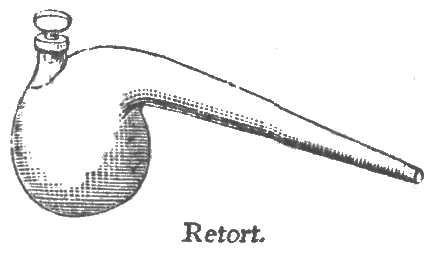
Retort, rē-tort′, v.t. to throw back: to return: to retaliate: to separate by means of a retort.—v.i. to make a sharp reply.—n. a ready and sharp reply: a witty answer: a vessel used in distillation, properly a spiral tube.—p.adj. Retor′ted (her.), interlaced.—ns. Retor′ter; Retor′tion.—adj. Retor′tive.—n. Retort′-seal′er, an instrument for removing the encrustation in coal-gas retorts. [Fr.,—L. retortum, pa.p. of retorquēre—re-, back, torquēre, to twist.]
Retoss, rē-tos′, v.t. to toss back.
Retouch, rē-tuch′, v.t. to improve, as a picture, by new touches.—n. the reapplication of the artist's hand to a work: (phot.) the act of finishing and correcting.—ns. Retouch′er; Retouch′ment.—Retouching frame, a desk formed of fine ground glass, used for retouching negatives.
Retour, rē-tōōr′, n. a returning: (Scots law) an extract from chancery of the service of an heir to his ancestor.—adj. Retoured′.
Retourn, rē-turn′, v.t. (Spens.) to turn back.
Retrace, rē-trās′, v.t. to trace back: to go back by the same course: to renew the outline of: to repeat.—adj. Retrace′able.
Retract, rē-trakt′, v.t. to retrace or draw back: to recall: to recant.—v.i. to take back what has been said or granted.—adjs. Retrac′table, Retrac′tible, capable of being retracted or recalled.—n. Retractā′tion.—p.adj. Retrac′ted (her.), couped by a line diagonal to the main direction: (bot.) bent back.—adj. Retrac′tile, that may be drawn back, as claws.—n. Retrac′tion, act of retracting or drawing back: recantation.—adj. Retrac′tive, able or ready to retract.—adv. Retrac′tively.—n. Retrac′tor, one who, or that which, retracts or draws back: in breech-loading firearms, a device for withdrawing a cartridge-shell from the barrel: (surg.) an instrument for holding apart the edges of a wound during operation: a bandage to protect the soft parts from injury by the saw: (zool.) a muscle serving to draw in any part. [Fr.,—L. retrahĕre, retractum—re-, back, trahĕre, to draw.]
Retrad, rē′trad, adv. (anat.) backward.
Retrahens, rē′trā-henz, n. (anat.) a muscle which draws the ear backward.—adj. Rē′trāhent.
Retrait, rē-trāt′, n. (Spens.) a picture, a portrait: aspect.—adj. retired. [O. Fr.,—retraire, to draw back, to take a portrait—L. retrahĕre—re-, back, trahĕre, to draw.]
Retral, rē′tral, adj. back, posterior.
Retranché, re-trong-shā′, adj. (her.) divided bend-wise twice or into three parts.
Retransfer, rē-trans-fėr′, v.t. to transfer back.—n. Retrans′fer.
Retransform, rē-trans-form′, v.t. to transform or change back again.—n. Retransformā′tion, a second or renewed transformation: a change back to a former state.
Retranslate, rē-trans-lāt′, v.t. to translate anew: to translate back into the original languages.—n. Retranslā′tion.
Retransmission, rē-trans-mish′un, n. a repeated transmission.—v.t. Rē′transmit.
Retrate, rē-trāt′, n. (Spens.)=retreat.
Retraverse, rē-trav′ėrs, v.t. to traverse again.
Retraxit, rē-trak′sit, n. (law) the open renunciation of a suit in court.
Retreat, rē-trēt′, n. a drawing back or retracing one's steps: retirement: place of privacy: withdrawal: a place of security: a shelter: (mil.) the act of retiring in order from before the enemy, or from an advanced position: the signal for retiring from an engagement or to quarters: a special season of religious meditation.—v.i. to draw back: to recede: to consider: to retire, esp. to a place of shelter: to retire before an enemy or from an advanced position: in fencing, to move back so as to avoid the point of the adversary's sword: to slope back, as a retreating forehead.—ns. Retreat′er; Retreat′ment. [O. Fr. retrete—L. retractus, pa.p. of retrahĕre.]
Retree, rē-trē′, n. in paper-making, broken or imperfect paper.
Retrench, rē-trensh′, v.t. to cut off or away: to render less: to curtail.—v.i. to live at less expense: to economise.—n. Retrench′ment, cutting off: lessening or abridging: reduction: economy: (fort.) a work within another for prolonging the defence. [O. Fr. retrencher (Fr. retrancher)—re-, off, trencher, to cut, which, acc. to Littré, is from L. truncāre, to cut off.]
Retrial, rē-trī′al, n. a repetition of trial.
Retribute, rē-trib′ūt, v.t. to give back: to make repayment of.—ns. Rētrib′ūter, -or; Retribū′tion, repayment: suitable return: reward or punishment: retaliation.—adjs. Rētrib′ūtive, repaying: rewarding or punishing suitably; Rētrib′ūtory. [L. retributio—retribuĕre, to give back—re-, back, tribuĕre, to give.]
Retrieve, rē-trēv′, v.t. to recover: to recall or bring back: to bring back to a former state: to repair: to search for and fetch, as a dog does game—also n. (obs.).—adj. Retriev′able, that may be recovered.—n. Retriev′ableness, the state of being retrievable.—adv. Retriev′ably.—ns. Retriev′al; Retrieve′ment; Retriev′er, a dog trained to find and fetch game that has been shot. [O. Fr. retreuver (Fr. retrouver)—re-, again, trouver, to find—Low L. tropare—L. tropus, a song—Gr. tropos, a trope.]
Retrim, rē-trim′, v.t. to trim again.
Retriment, ret′ri-ment, n. dregs. [L. retrimentum.]
Retroact, rē-trō-akt′, v.i. to act backward, or in return or opposition, or on something past or preceding.—n. Retroac′tion.—adj. Retroac′tive.—adv. Retroac′tively, in a retroactive manner: by operating on something past.—Retroactive law, a retrospective law. [L. retroactus, retroagĕre—retro, backward, agĕre, actum, to do.]
Retrobulbar, rē-trō-bul′bär, adj. being behind the eyeball.
Retrocede, rē-trō-sēd′, v.t. to go back: to relapse: to retire: to give back.—adj. Retrocē′dent.—n. Retroces′sion (med.), the disappearance of a tumour inwardly: a retreating outline: (Scots law) the act of retroceding, or giving back, as of a right by an assignee. [Fr.,—L. retrocedĕre, -cessum—retro, backward, cedĕre, to go.]
Retrochoir, rē′trō-kwīr, n. (archit.) an extension of a church behind the high altar, as a chapel.
Retroclusion, rē-trō-klōō′zhun, n. a method of using the pin in acupressure.
Retrocollic, rē-trō-kol′ik, adj. pertaining to the back of the neck.
Retrodate, rē′trō-dāt, v.t. to assign a date to a book earlier than its actual publication.
Retroduct, rē-trō-dukt′, v.t. to draw back: to withdraw.—n. Retroduc′tion.
Retroflex, rē′trō-fleks, adj. reflexed, bent backward—also Rē′troflexed.—n. Retroflec′tion. [L. retro, backward, flectĕre, flexum, to bend.]
Retrofract, -ed, rē′trō-frakt, -ed, adj. (bot.) bent sharply back, so as to appear as if broken. [L. retro, backward, fractus, pa.p. of frangĕre, fractum, to break.]
Retrograde, ret′rō-, or rē′trō-grād, adj. going backward: falling from better to worse: contrary: (biol.) becoming less highly organised, as 'a retrograde theory:' swimming backwards, as many animals: (astron.) moving westwards relatively to the fixed stars.—v.i. to go backwards.—ns. Retrogradā′tion, deterioration; Rē′trogress, falling off; Rētrogres′sion, a going backward: a decline in quality or merit.—adjs. Rētrogres′sional, Rētrogress′ive.—adv. Rētrogress′ively.—n. Rētrogress′iveness. [L. retrogradus, going backward—retro, backward, gradi, gressus, to go.]
Retrolingual, rē-trō-ling′gwal, adj. serving to retract the tongue.
Retromingent, rē-trō-min′jent, adj. urinating backward.—n. Retromin′gency.—adv. Retromin′gently.
Retro-ocular, rē-trō-ok′ū-lar, adj. situated behind the eyeball.
Retro-operative, rē-trō-op′e-rā-tiv, adj. retrospective in effect.
Retroposition, rē-trō-pō-zish′un, n. displacement backward.
Retropulsion, rē-trō-pul′shun, n. a disorder of locomotion: repulsion.—adj. Retropul′sive.
Retrorse, rē-trors′, adj. turned back or downward—adv. Retrorse′ly.
Retroserrate, rē-trō-ser′āt, adj. (entom.) armed with minute retrorse teeth.
Retrospect, ret′rō-spekt, or rē′-, n. a looking back: a contemplation of the past: the past.—n. Retrospec′tion, the act or faculty of looking back on the past.—adj. Retrospec′tive.—adv. Retrospec′tively. [L. retrospectus, pa.p. of retrospicĕre—retro, back, specĕre, to look.]
Retrosternal, rē-trō-ster′nal, adj. being behind the sternum.
Retrotarsal, rē-trō-tar′sal, adj. being behind the tarsus of the eye.
Retrotracheal, rē-trō-trā′kē-al, adj. being at the back of the trachea.
Retroussage, re-trōō-sazh′, n. a method of producing effective tones in the printing of etchings by skilful treatment of the ink in certain parts.
Retroussé, re-trōō-sā′, adj. turned up: pug.
Retrovaccinate, rē-trō-vak′si-nāt, v.t. to vaccinate a cow with human virus.—ns. Retrovaccinā′tion; Retrovac′cine.
Retrovene, rē′trō-vēn, adj. inclined backward.
Retrovert, rē′trō-vėrt, v.t. to turn back.—n. one who returns to his original creed.—n. Retrover′sion, a turning or falling back. [L. retro, backward, vertĕre, to turn.]
Retrovision, rē-trō-vizh′un, n. the power of mentally seeing past events.
Retrude, rē-trōōd′, v.t. to thrust back.—adj. Retruse′.—n. Retru′sion. [L. retrudĕre, retrusum.]
Retry, rē-trī′, v.t. to try again: to put on trial a second time.
Retting, ret′ing, n. the act or process of preparing flax for use by rotting the useless part of the plant.—n. Rett′ery. [Conn. with rot.]
Retund, rē-tund′, v.t. to blunt, as the edge of a weapon.
Return, rē-turn′, v.i. to come back to the same place or state: to answer: to retort: to turn back: to repeat: to revert: to recur: to reappear.—v.t. to bring or send back: to transmit: to give back: to repay: to give back in reply: to report: to give an account: to cast back: to reflect: to re-echo: to revolve: to restore: to requite: to return a call: to elect, as a member of parliament: in card-playing, to lead back in response to the lead of one's partner: in tennis, to bat the ball back over the net: in fencing, to give a thrust or cut after parrying a sword-thrust.—n. the act of going back: revolution: periodic renewal: the act of bringing or sending back: restitution: repayment: the profit on capital or labour: a reply: a report or account, esp. official: (pl.) a light-coloured and mild kind of tobacco: (law) the rendering back of a writ to the proper officer: (mil.) the return of the men fit for duty: (archit.) the continuation in a different direction of the face of a building, as a moulding.—adj. Retur′nable, legally requiring to be returned.—ns. Return′-bend, a pipe-coupling in the shape of the letter ; Return′-car′go, a cargo brought back in place of merchandise previously sent out; Return′-check, a ticket for readmission; Return′-day, the day fixed when the defendant is to appear in court; Retur′ner; Retur′ning-off′icer, the officer who makes returns of writs, &c.: the presiding officer at an election.—adj. Return′less.—ns. Return′-match, a second match played by the same set of players; Return′-shock, an electric shock due to the action of induction sometimes felt after a lightning-flash; Return′-tag, a tag attached to a railway-car as evidence of its due arrival; Return′-tick′et, a ticket issued by a company for a journey and its return, usually at a reduced charge; Return′-valve, a valve which opens to allow reflux of a fluid in case of overflow. [Fr. retourner—re-, back, tourner, to turn—L. tornāre, to turn.]

Retuse, rē-tūs′, adj. (bot.) terminating in a round end, with a centre somewhat depressed. [L. retusus—retundĕre, to blunt.]
Retyre, rē-tīr′, n. (Spens.) retirement.
Retzia, ret′si-a, n. a genus of brachiopods.
Reune, rē-ūn′, v.t. (obs.) to reunite.—v.i. to hold a reunion.—adjs. Reū′nient; Reū′nitive.
Reunion, rē-ūn′yun, n. a union after separation: an assembly or social gathering. [Fr. réunion—re-, again, union, union.]
Reunite, rē-ū-nīt′, v.t. to join after separation: to reconcile after variance.—v.i. to become united again: to join again.—v.t. Reū′nify.—adv. Reunī′tedly.—n. Reuni′tion.—adj. Reū′nitive.
Reurge, rē-urj′, v.t. to urge again.
Reus, rē′us, n. (law) a defendant. [L.]
Reuse, rē-ūz′, v.t. to use again.—n. (rē-ūs′) repeated use.
Reutilise, rē-ū′til-īz, v.t. to make use of a second time.
Reutter, rē-ut′ėr, v.t. to utter again.
Rev., an abridgment of Reverend, in addressing clergymen, as 'Rev. Thomas Davidson;' deans are styled 'Very Reverend,' also principals of universities in Scotland, if clergymen, and the moderator of the General Assembly for the time being; bishops are styled 'Right Reverend,' and archbishops, 'Most Reverend.'
Revaccinate, rē-vak′si-nāt, v.t. to vaccinate again.—n. Revaccinā′tion.
Revalenta, rev-a-len′ta, n. the ordinary name of lentil-meal.
Revalescent, rev-a-les′ent, adj. beginning to grow well.—n. Revales′cence.
Revalue, rē-val′ū, v.t. to value again.—n. Revaluā′tion.
Revamp, rē-vamp′, v.t. to patch up again.
Reve, rev, v.i. (obs.) to dream. [Rave.]
Reveal, rē-vēl′, v.t. to unveil: to make known, as by divine agency: to disclose.—n. Revealabil′ity.—adj. Reveal′able.—ns. Reveal′ableness; Reveal′er; Reveal′ment, revelation.—Revealed religion, that which has been supernaturally revealed. [O. Fr. reveler (Fr. révéler)—L. revelāre—re-, back, velāre, to veil—velum, a veil.]
Reveal, rē-vēl′, n. (archit.) the square ingoing of a window, doorway, or the like, between the frame and the outer surface of the wall.—Also Revel′.
Revehent, rē′vē-hent, adj. carrying forth: taking away.
Reveille, re-vāl′ye, n. the sound of the drum or bugle at daybreak to awaken soldiers. [O. Fr. reveil—re-, again, esveiller, to awake—L. vigilāre, to watch.]
Revel, rev′el, v.i. to feast in a riotous or noisy manner: to carouse.—v.i. to draw back:—pr.p. rev′elling; pa.t. and pa.p. rev′elled.—n. a riotous feast: carousal: a kind of dance: a wake.—ns. Rev′el-coil, Rev′el-dash (obs.), a wild revel; Rev′eller, one who takes part in carousals: a low liver; Rev′el-mas′ter, the director of Christmas revels: the lord of misrule; Rev′elment; Rev′el-rout, lawless revelry; Rev′elry, riotous or noisy festivity. [O. Fr. reveler—L. rebellāre, to rebel.]
Revelation, rev-ē-lā′shun, n. the act of revealing: that which is revealed: the revealing divine truth: that which is revealed by God to man: the Apocalypse or last book of the New Testament.—adj. Revelā′tional.—n. Revelā′tionist.—adj. Rev′elātory. [Fr.,—L. revelatio—revelāre, to reveal.]
Revellent, rē-vel′ent, adj. causing revulsion.
Revenant, rev′ē-nant, n. one who returns after a long absence, esp. from the dead: a ghost. [Fr.]
Revenge, rē-venj′, v.t. to punish in return: to avenge.—v.i. to take vengeance.—n. the act of revenging: injury inflicted in return: a malicious injuring in return for an injury received: the passion for retaliation.—adj. Revenge′ful, full of revenge or a desire to inflict injury in return: vindictive: malicious.—adv. Revenge′fully.—n. Revenge′fulness.—adj. Revenge′less.—ns. Revenge′ment; Reveng′er.—adv. Reveng′ingly.—Give one his revenge, to play a return match with a defeated opponent. [O. Fr. revenger, revencher (Fr. revancher)—L. re-, in return, vindicāre, to lay claim to.]
Revenue, rev′en-ū (earlier rē-ven′ū), n. the receipts or rents from any source: return, as a revenue of praise: income: the income of a state.—n. Rev′enue-cut′ter, an armed vessel employed by custom-house officers in preventing smuggling.—adj. Rev′enued.—ns. Rev′enue-en′sign, a distinctive flag authorised in 1798 in United States; Rev′enue-off′icer, an officer of the customs or excise; In′land-rev′enue, revenue derived from stamps, excise, income-tax, &c. [Fr. revenue, pa.p. of revenir, to return—L. revenīre—re-, back, venīre, to come.]
Reverberate, rē-vėr′bėr-āt, v.t. to send back, echo: to reflect: to drive from side to side: to fuse.—v.i. to echo: to resound: to bound back: to be repelled: to use heat, as in the fusion of metals.—v.t. Reverb′ (Shak.).—adj. Rever′berant, resounding, beating back.—n. Reverberā′tion, the reflection of sound, &c.—adj. Rever′berātive.—n. Rever′berātor.—adj. Rever′berātory.—Reverberatory furnace, a furnace in which the flame is reflected on the substance to be burned. [L.,—re-, back, verberāre, -ātum, to beat—verber, a lash.]
Reverdure, rē-ver′dūr, v.t. to cover again with verdure.
Revere, rē-vēr′, v.t. to regard with respectful awe: to venerate.—adj. Revēr′able, worthy of reverence.—n. Rev′erence, fear arising from high respect: respectful awe: veneration: honour: an act of revering or obeisance: a bow or courtesy: a title of the clergy.—v.t. to regard with reverence: to venerate or honour.—n. Rev′erencer.—adjs. Rev′erend, worthy of reverence: a title of the clergy (see Rev.): (B.) awful: venerable; Rev′erent, showing reverence: submissive: humble; Reveren′tial, proceeding from reverence: respectful: submissive.—advs. Reveren′tially; Rev′erently.—n. Re′verer, one who reveres.—Do reverence, to do honour; Make reverence, to worship; Saving your reverence, with all due respect to you. [O. Fr. reverer (Fr. révérer)—L. reverēri—re-, inten., verēri, to feel awe.]
Reverie, Revery, rev′e-ri, n. an irregular train of thoughts or fancies in meditation: voluntary inactivity of the external senses to the impressions of surrounding objects during wakefulness: mental abstraction: a waking dream: a brown study.—n. Rev′erist. [O. Fr. resveri (Fr. rêverie)—resver, rever, to dream.]
Revers, re-vār′ (gener. rē-vēr′), n. that part of a garment which is turned back, as the lapel of a coat.
Reverse, rē-vėrs′, v.t. to place in the contrary order or position: to change wholly: to overthrow: to change by an opposite decision: to annul: to revoke, as a decree: to recall.—n. that which is reversed: the opposite: the back, esp. of a coin or medal: change: misfortune: a calamity: in fencing, a back-handed stroke: (her.) the exact contrary of what has been described just before, as an escutcheon.—adj. turned backward: having an opposite direction: upset.—n. Rever′sal, act of reversing.—adj. Reversed′, turned or changed to the contrary: inside out: (bot.) resupinate.—adv. Rever′sedly.—adj. Reverse′less, unalterable.—adv. Reverse′ly, in a reverse order: on the other hand: on the opposite.—ns. Rever′ser (Scots law), a mortgager of land; Rever′si, a game played by two persons with sixty-four counters; Reversibil′ity, the capability of being reversed, as of heat into work and work into heat.—adj. Rever′sible, that may be reversed, as in a fabric having both sides well finished.—ns. Rever′sing-cyl′inder, the cylinder of a small auxiliary steam-engine; Rever′sing-gear, those parts of a steam-engine by which the direction of the motion is changed; Rever′sing-lē′ver, a lever in a steam-engine which operates the slide-valve; Rever′sing-machine′, a moulding-machine in founding, in which the flask can be reversed; Rever′sing-mō′tion, any mechanism for changing the direction of motion of an engine; Rever′sing-shaft, a shaft which permits a reversal of the order of steam passage through the ports; Rever′sing-valve, the valve of a reversing-cylinder; Rever′sion, the act of reverting or returning: that which reverts or returns: the return or future possession of any property after some particular event: the right to future possession: (biol.) return to some type of ancestral character: return to the wild state after domestication.—adj. Rever′sionary, relating to a reversion: to be enjoyed in succession: atavic.—ns. Rever′sioner; Rever′sis, an old French game of cards in which the aim was to take the fewest tricks.—adj. Rever′sive.—n. Rever′so (print.), any one of the left-hand pages of a book.—Reverse a battery, to turn the current of electricity by means of a commutator; Reverse shell, a univalve shell which has its volutions the reversed way of the common screw; Reversionary annuity, a deferred annuity. [L. reversus, pa.p. of revertĕre, to turn back—re-, back, vertĕre, to turn.]
Revert, rē-vėrt′, v.t. to turn or drive back: to reverse.—v.i. to return: to fall back: to refer back: to return to the original owner or his heirs.—adjs. Rēver′tant (her.), flexed, bent twice at a sharp angle; Rēver′ted, reversed; Rēver′tible, that may revert or be reverted; Rēver′tive, tending to revert: changing: turning to the contrary.—adv. Rēver′tively, by way of reversion. [Fr.,—L. revertĕre.]
Revery. Same as Reverie.
Revest, rē-vest′, v.t. (Spens.) to clothe again: to vest again in a possession or office.—v.i. to take effect again: to return to a former owner. [Fr.,—L.,—revestīre—re-, again, vestīre, to clothe.]
Revestiary, rē-ves′ti-ā-ri, n. an apartment in a church in which ecclesiastical garments are kept.
Revestu, rē-ves′tū, adj. (her.) covered by a square set diagonally, the corners of which touch the edges of the space covered. [O. Fr.]
Revesture, rē-ves′tūr, n. (obs.) vesture.
Revet, rē-vet′, v.t. (fort.) to face with masonry, &c., as an embankment with a steep slope.—n. Revet′ment, a retaining wall, a facing of stone, wood, &c. [Fr. revêtir, to reclothe.]
Revibrate, rē-vī′brāt, v.i. to vibrate back or in return.—n. Revibrā′tion.
Revict, rē-vikt′, v.t. (obs.) to reconquer.—n. Revic′tion, return to life, revival.
Revictual, rē-vit′l, v.t. to furnish again with provisions.
Revie, rē-vī′, v.t. to vie with, or rival: to stake a larger sum at cards: to outdo.—v.i. to exceed an adversary's wager in card-playing: to retort.
Review, rē-vū′, v.t. to re-examine: to revise: to examine critically: to see again: to retrace: to inspect, as a body of troops.—n. a viewing again: a reconsideration: a revision: a careful or critical examination: a critique: a written discussion: a periodical with critiques of books, &c.: the inspection of a body of troops or a number of ships: (law) the judicial revision of a higher court.—adj. Review′able, capable of being reviewed.—ns. Review′age, the work of reviewing; Review′al, a review of a book: a critique on a new publication; Review′er, an inspector: a writer in a review.—Court of Review, the court of appeal from the commissioners of bankruptcy. [Fr. revue, pa.p. of revoir—L. re-, again, vidēre, to see.]
Revigorate, rē-vig′or-āt, v.t. to give new vigour to:—pr.p. revig′orāting: pa.p. revig′orāted.—p.adj. Revig′orāted, endued with new vigour or strength. [L. re-, again, vigorātus, vigorāre—vigor, vigour.]
Revile, rē-vīl′, v.t. to reproach: to calumniate.—v.i. to speak contemptuously.—ns. Revile′ment, the act of reviling, reproach; Revil′er.—adv. Revil′ingly. [Pfx. re-, again, O. Fr. aviler, to make vile, from a—L. ad, vil—L. vilis, cheap.]
Revince, rē-vins′, v.t. (obs.) to refute, to disprove.
Revindicate, rē-vin′di-kāt, v.t. to reclaim, to claim what has been illegally taken away.—n. Revindicā′tion. [Low L. revindicāre, -ātum—L. re-, again, vindicāre, -ātum, to lay claim to.]
Revire, rē-vīr′, v.t. (obs.) to revive.—n. Revires′cence (Swinburne), renewal of youth or vigour.
Revise, rē-vīz′, v.t. to review and amend: to examine with a view to correction.—n. review: a second proof-sheet.—ns. Revī′sal, Revi′sion, review: re-examination; Revīsed′-ver′sion, a fresh English translation of the Bible, issued, the New Testament in 1881, the Old in 1885; Revī′ser, -or (print.), one who examines proofs; Revī′sing-barr′ister, a barrister appointed annually by the English judges to revise the list of voters for members of parliament, the revision generally taking place between August and October of each year.—adjs. Revi′sional, Revi′sionary, pertaining to revision.—n. Revi′sionist.—adj. Revī′sory. [Fr. reviser—L. revisĕre—re-, back, visĕre, inten. of vidēre, to see.]
Revisit, rē-viz′it, v.t. to visit again.—ns. Revis′it; Revis′itant.—adj. revisiting.—n. Revisitā′tion.
Revitalise, rē-vī′tal-īz, v.t. to restore vitality to.—n. Revitalisā′tion.
Revive, re-vīv′, v.i. to return to life, vigour, or fame: to recover from neglect, oblivion, or depression: to regain use or currency: to have the memory refreshed.—v.t. to restore to life again: to reawaken in the mind: to recover from neglect or depression: to bring again into public notice, as a play: to recall, to restore to use: to reproduce: (chem.) to restore to its natural state.—n. Revīvabil′ity.—adj. Revī′vable, capable of being revived.—adv. Revī′vably.—ns. Revī′val, recovery from languor, neglect, depression, &c.: renewed performance of, as of a play: renewed interest in or attention to: a time of extraordinary religious awakening: restoration: quickening: renewal, as of trade: awakening, as revival of learning: (law) reinstatement of an action; Revī′valism; Revī′valist, one who promotes religious revivals: an itinerant preacher.—adj. Revīvalis′tic.—ns. Revīve′ment; Revī′ver, one who, or that which, revives: a compound for renovating clothes; Revivificā′tion (chem.), the reduction of a metal from a state of combination to its natural state.—v.t. Reviv′ify, to cause to revive: to reanimate: to enliven.—v.i. to become efficient again as a reagent.—adv. Revī′vingly.—n. Revivis′cence, an awakening from torpidity, after hibernation.—adj. Revivis′cent.—n. Revī′vor (law), the revival of a suit which was abated by the death of a party or other cause.—The Anglo-Catholic revival, a strong reaction within the Church of England towards the views of doctrine and practice held by Laud and his school (see Tractarianism). [O. Fr. revivre—L. re-, again, vivĕre, to live.]
Revoke, rē-vōk′, v.t. to annul by recalling: to repeal: to reverse: to neglect to follow suit (at cards).—n. revocation, recall: act of revoking at cards.—adj. Rev′ocable, that may be revoked.—ns. Rev′ocableness, Revocabil′ity.—adv. Rev′ocably.—n. Revocā′tion, a recalling: repeal: reversal.—adj. Rev′ocātory.—n. Revoke′ment (Shak.), revocation.—Revocation of the edict of Nantes, the taking away by Louis IV., in 1685, of the Huguenot privileges granted by Henry IV. in 1598. [Fr.,—L. revocāre—re-, back, vocāre, to call.]
Revolt, rē-vōlt′, v.i. to renounce allegiance: to be grossly offended: to mutiny: to be shocked.—v.t. to cause to rise in revolt: to shock.—n. a rebellion: insurrection, desertion: a change of sides: fickleness.—n. Revol′ter.—adj. Revol′ting, causing a turning away from: shocking: repulsive.—adv. Revol′tingly. [O. Fr. revolte—It. rivolta—L. revolvĕre, to roll back, re-, back, volvĕre, volutum, to turn.]
Revolution, rev-ō-lū′shun, n. act of revolving: motion round a centre: course which brings to the same point or state: space measured by a revolving body: a radical change, as of one's way of living: fundamental change in the government of a country: a revolt: a complete rotation through 360°: a round of periodic changes, as the revolutions of the seasons: the winding of a spiral about its axis: change of circumstances: consideration.—adj. Revolū′tionary, pertaining to, or tending to, a revolution in government.—v.t. Revolū′tionise, to cause a revolution or entire change of anything.—ns. Revolū′tionism; Revolū′tionist, one who promotes or favours a revolution.—The American Revolution, the change from the position of colonies to that of national independence effected by the thirteen American colonies of England in 1776; The French Revolution, the downfall of the old French monarchy and the old absolutism (1789); The Revolution, the expulsion of James II. from the throne of England (1689), and the establishment of a really constitutional government under William III. and Mary. [Revolve.]
Revolve, rē-volv′, v.i. to roll back: to roll round on an axis: to move round a centre: to rotate, as the planets: to meditate.—v.t. to cause to turn: to consider.—n. a radical change.—v.i. Rev′olute, to revolve.—adj. rolled backward.—adjs. Rev′olūtive, cogitating; Revol′vable.—ns. Revolve′ment, reflection; Revol′vency, revolution.—adj. Revol′ving, turning, moving round.—ns. Revol′ving-fur′nace, a furnace used in making black ash; Revol′ving-light, a lamp in a lighthouse so arranged as to appear and disappear at intervals. [Fr.,—L. revolvĕre, revolūtum—re-, back, volvĕre, to roll.]
Revolver, rē-volv′ėr, n. that which revolves: a firearm having barrels or chambers which revolve upon a common centre, and are fired in turn by one lock mechanism: a revolving cannon.
Revomit, rē-vom′it, v.t. to reject from the stomach.
Revulsion, rē-vul′shun, n. disgust: the diverting of a disease from one part to another: forced separation: a sudden change, esp. of feeling: a counter-irritant.—adj. Revul′sive, tending to revulsion.—n. Revul′sor, an apparatus for applying heat and cold in turns for medical purposes. [L. revulsio—revellĕre, revulsum—re-, away, vellĕre, to tear.]
Rew, rōō, v.t. (Spens.). Same as Rue.
Rew, rōō, n. (Spens.). Same as Row.
Rewaken, rē-wā′kn, v.i. to waken again.
Reward, rē-wawrd′, n. that which is given in return for good or evil: recompense: retribution: the fruit of one's own labour: regard: requital: remuneration: guerdon: consideration.—v.t. to give in return: to requite, whether good or evil: to punish: (B.) to recompense: to compensate: to notice carefully: to watch over.—adj. Rewar′dable, capable or worthy of being rewarded.—n. Rewar′dableness.—adv. Rewar′dably.—n. Rewar′der, one who rewards.—adjs. Reward′ful, yielding reward; Reward′less, having or receiving no reward. [O. Fr. rewarder, reswarder, regarder—re-, again, warder, guarder, to guard; of Teut. origin.]
Reweigh, rē-wā′, v.t. to weigh again.
Rewet, rōō′et, n. the revolving part of a wheel-lock.
Rewin, rē-win′, v.t. to win back or again.
Rewood, rē-wōōd′, v.t. to plant again.
Reword, rē-wurd′, v.t. to repeat in the same words, to re-echo: to put into different words.
Rewrite, rē-rīt′, v.t. to write a second time.
Rex, reks, n. a king.—Play rex (obs.), to handle roughly. [L.; cf. Sans. rājan, Gael. righ.]
Reynard, rā′nard, or ren′ard, n. a fox, from the name given to the fox in the famous beast epic of Low Ger. origin, Reynard the Fox—also Ren′ard.—adj. Ren′ardine. [Fr.,—Old Flem. Reinaerd, Reinaert—Mid. High Ger. Reinhart (Old High Ger. Reginhart), lit. 'strong in counsel.']
Rhabarbarate, ra-bär′ba-rāt, adj. (obs.) impregnated with rhubarb.—n. Rhabar′barum, rhubarb.
Rhabarbarine, ra-bär′ba-rin, n. chrysophanic acid.
Rhabdamminina, rab-da-mi-nī′na, n. a group of marine imperforate foraminiferous protozoans. [Gr. rhabdos, a rod, ammos, sand.]
Rhabdite, rab′dīt, n. a smooth, rod-like structure found in the cells of the integument of most turbellarian worms: one of the hard parts composing the ovipositor of some insects.—adj. Rhabdit′ic. [Gr. rhabdos, a rod.]
Rhabdocœla, rab-dō-sē′la, n. a prime division of turbellarian worms.—adjs. Rhabdocœ′lidan, Rhabdocœ′lous. [Gr. rhabdos, a rod, koilos, hollow.]
Rhabdocrepida, rab-dō-krep′i-da, n. a sub-order of lithistidan sponges. [Gr. rhabdos, a rod, krēpis, a foundation.]
Rhabdoid, rab′doid, n. a spindle-shaped body chemically related to the plastids, found in certain cells of irritable plants like Drosera, Dionæa, &c.—adj. Rhabdoid′al, rod-like: (anat.) sagittal. [Gr. rhabdos, a rod.]
Rhabdolith, rab′dō-lith, n. a minute rhabdoidal concretion of calcareous matter forming the armature of a rhabdosphere.—adj. Rhabdolith′ic.
Rhabdology, rab-dol′ō-ji, n. the art of computing by Napier's bones or rods.—Also Rabdol′ogy.
Rhabdom, rab′dom, n. (entom.) a tubular rod-like structure in the eye, the central axis of a retinula.—adj. Rhab′dōmal.
Rhabdomancy, rab′dō-man-si, n. divination by means of rods, esp. the impudent imposture of finding water, &c., by means of the divining-rod.—n. Rhab′domancer.—adj. Rhabdoman′tic. [Gr. rhabdos, rod, manteia, divination.]
Rhabdome, rab′dōm, n. in sponges, the shaft of a cladose rhabdus, bearing the cladome.
Rhabdomesodon, rab-dō-mes′ō-don, n. a genus of polyzoans. [Gr. rhabdos, a rod, mesos, middle, odous, odontos, a tooth.]
Rhabdomyoma, rab-dō-mī-ō′ma, n. a myoma consisting of striated muscular fibres.
Rhabdonema, rab-dō-nē′ma, n. a genus of small nematoid worms. [Gr. rhabdos, a rod, nēma, a thread.]
Rhabdophane, rab′dō-fān, n. a rare phosphate of the yttrium and cerium earths. [Gr. rhabdos, a rod, phanēs, appearing.]
Rhabdophora, rab-dof′ō-ra, n. a group of fossil organisms.—adjs. Rhabdoph′ōran, Rhabdoph′ōrous.
Rhabdopleura, rab-dō-plōō′ra, n. a marine polyzoan. [Gr. rhabdos, a rod, pleuron, a rib.]
Rhabdosphere, rab′dō-sfēr, n. a minute spherical body found in the depths of the Atlantic. [Gr. rhabdos, a rod, sphaira, sphere.]
Rhabdosteidæ, rab-dos-tē′i-dē, n. a family of fossil-toothed cetaceans—its typical genus, Rhabdos′tēus. [Gr. rhabdos, rod, osteon, bone.]
Rhabdostyla, rab-dō-stī′la, n. a genus of peritrichous ciliate infusorians. [Gr. rhabdos, rod, stylos, pillar.]
Rhabdus, rab′dus, n. a simple, straight spicule.—adj. Rhab′dous. [Gr. rhabdos, a rod.]
Rhachiomyelitis, rā-ki-ō-mī-e-lī′tis, n. inflammation of the spinal cord—myelitis.—ns. Rhachiot′omy, incision into the spinal canal; Rhachis′chisis, defective formation of the spinal canal—spina bifida. [Gr. rhachis, the spine, myelos, marrow.]
Rhachitis=Rachitis (q.v.).
Rhacochilus, rak-ō-kī′lus, n. a genus of embiotocoid fishes. [Gr. rhakos, a rag, cheilos, the lip.]
Rhacophorus, rā-kof′ō-rus, n. a genus of batrachians, with long and webbed feet, adapting it for long leaps. [Gr. rhakos, a rag, pherein, to bear.]
Rhadamanthine, ra-da-man′thin, n. of Rhadamanthus, judge of the lower world, with Minos and Æacus—applied generally to a solemn and final judgment.—Also Rhadaman′tine.
Rhætian, rē′shi-an, adj. pertaining to the ancient Rhætians or their country Rhætia, a Roman province between the Po and the Danube—also Rhæ′tic.—adj. and n. Rhæ′to-Roman′ic, pertaining to a group of Romance dialects spoken in south-eastern Switzerland.—Rhætic beds, a series of strata forming the uppermost portion of the Trias, extensively developed in the Rhætian Alps.
Rhagades, rag′a-dēz, n.pl. fissures of the skin. [Gr. rhagas (pl. rhagades), a crack.]
Rhagodia, ra-gō′di-a, n. a genus of apetalous plants. [Gr. rhagōdēs, like grapes—rhax, rhagos, a grape.]
Rhagon, rag′on, n. a form of sponge with clustered spherical flagellated endodermal chambers.—adjs. Rhag′onāte, Rhag′ose. [Gr. rhax, rhagos, a grape.]
Rhamnaceæ, ram-nā′sē-ē, n. an order of polypetalous plants.—adj. Rhamnā′ceous.
Rhamnus, ram′nus, n. a genus of polypetalous shrubs and trees, including the buckthorn. [Gr.]
Rhamphastidæ, ram-fas′ti-dē, n. a family of picarian birds, toucans. [Gr. rhamphos, a beak.]
Rhamphocelus, ram-fō-cē′lus, n. a remarkable genus of tanagers, native to South America.
Rhamphodon, ram′fō-don, n. the saw-billed humming-bird. [Gr. rhamphos, a curved beak, odous, a tooth.]
Rhamphoid, ram′foid, adj. beak-shaped.
Rhampholeon, ram-fō′lē-on, n. a genus of chameleons. [Gr. rhamphos, a curved beak, leōn, lion.]
Rhamphomicron, ram-fō-mik′ron, n. a genus of humming-birds. [Gr. rhamphos, a beak, mikros, little.]
Rhamphorhynchus, ram-fō-ring′kus, n. a genus of pterodactyls. [Gr. rhamphos, a curved beak, rhyngchos, a beak.]
Rhamphotheca, ram-fō-thē′ka, n. (ornith.) the integument of the whole beak. [Gr. rhamphos, a curved beak, thēkē, a sheath.]
Rhapidophyllum, ra-pi-dō-fil′um, n. a genus of palms—the blue palmetto of Florida.—n. Rhā′pis, a genus of Chinese palms. [Gr. rhapis, rod, phyllon, leaf.]
Rhapontic, rā-pon′tik, n. rhubarb. [L., 'Pontic rha.']
Rhapsodic, -al, rap-sod′ik, -al, adj. pertaining to, consisting of, or resembling rhapsody: gushing.—adv. Rhapsod′ically.—v.t. and v.i. Rhap′sodise, to write or utter rhapsodies: to express with poetic feeling:—pr.p. rhap′sodīsing; pa.p. rhap′sodīsed.—n. Rhap′sodist, one who recites or sings rhapsodies, esp. one of a class of men in ancient Greece who travelled from place to place reciting Homer and other epic poetry—also Rhap′sode: one who composes verses extempore: one who speaks or writes disjointedly.—adj. Rhapsodis′tic.—ns. Rhap′sodomancy, divination by means of verses; Rhap′sody, any wild unconnected composition: a part of an epic poem for recitation at one time: a jumble: (mus.) composition irregular in form. [Fr.,—L.,—Gr. rhapsōdia, rhaptein, to sew, ōdē, a song.]
Rhea, rē′a, n. the ramie plant or fibre.
Rhea, rē′a, n. the daughter of Uranus and Ge, wife and sister of Kronos: the only three-toed ostrich: the fifth satellite of Jupiter.
Rheic, rē′ik, adj. pertaining to rhubarb.—n. Rhē′ine, rheic acid.
Rhein-berry, rīn′ber-i, n. the common buckthorn.—Also Rhine′-berr′y.
Rhematic, rē-mat′ik, adj. derived from a verb.—n. the doctrine of propositions.
Rhemish, rē′mish, adj. pertaining to Rheims in north-eastern France.—Rhemish version, the English translation of the New Testament used by Roman Catholics, prepared at Rheims in 1582, forming part of the Douay Bible—Old Testament part prepared at Douay in 1609-10.
Rhenish, ren′ish, adj. pertaining to the river Rhine.—n. Rhine wine, hock, light and still. [L. Rhenus.]
Rheocord, rē′ō-kord, n. a metallic wire used in measuring the resistance of an electric current. [Gr. rhein, to flow, chordē, a cord.]
Rheometer, Reometer, rē-om′e-tėr, n. an instrument for measuring the strength of currents, as of electricity: a galvanometer.—adj. Rheomet′ric.—n. Rheom′etry, fluxions. [Gr. rhein, to flow, metron, measure.]
Rheoscope, rē′ō-skōp, n. an electroscope.—adj. Rheoscop′ic. [Gr. rhein, to flow, skopein, to view.]
Rheostat, rē′o-stat, n. the name given by Wheatstone to an instrument for varying an electric resistance between given limits.—adj. Rheostat′ic.—n. Rheostat′ics, the statics of fluids. [Gr. rhein, to flow, statos, verbal adj. of histanai, to stand.]
Rheotome, rē′ō-tōm, n. a means by which an electric current can be periodically interrupted. [Gr. rhein, to flow, temnein, to cut.]
Rheotrope, rē′ō-trōp, n. an instrument for periodically changing the direction of an electric current.—n. Rheot′rōpism, the effect of a current of water upon the direction of plant growth. [Gr. rhein, to flow, trepein, to turn.]
Rhesus, rē′sus, n. the boonder, one of the most widely distributed Indian monkeys, much venerated by the natives: (entom.) a genus of coleopterous insects.—adj. Rhē′sian. [Gr.]
Rhetoric, ret′or-ik, n. the theory and practice of eloquence, whether spoken or written, the whole art of using language so as to persuade others: the art of speaking with propriety, elegance, and force: artificial oratory: declamation.—adj. Rhetor′ical, pertaining to rhetoric: oratorical.—adv. Rhetor′ically.—v.i. Rhetor′icāte (obs.), to act the orator.—ns. Rhetoricā′tion (obs.); Rhetori′cian, one who teaches the art of rhetoric: an orator.—v.i. Rhet′orise, to play the orator. [Fr.,—L. rhetorica (ars)—Gr. rhētorikē (technē), the rhetorical (art)—rhētōr, a public speaker—erein, to speak.]
Rheum, rōōm, n. the mucous discharge from the lungs or nostrils caused by cold: (obs.) spleen, choler: a genus of apetalous plants.—n. Rheumat′ic, one who suffers from rheumatism: (pl.) rheumatic pains (coll.).—adjs. Rheumat′ic, -al, pertaining to or affected with rheumatism: choleric.—n. Rheum′atism, a name still used somewhat loosely, but applying specially to an acute febrile disease, with swelling and pain in and around the larger joints.—adjs. Rheumatis′mal; Rheum′atoid, resembling rheumatism.—n. Rheumophthal′mia, rheumatic ophthalmia.—adj. Rheum′y, full of or causing rheum. [L.,—Gr. rheuma—rhein, to flow.]
Rhexia, rek′si-a, n. a genus of polypetalous plants, native to North America, of the tribe Rhexieæ (rek-sī′ē-ē). [L.,—Gr. rhēxis—rhēgnynai, to break.]
Rhigolene, rig′ō-lēn, n. a volatile product of petroleum distillation. [Gr. rhigos, cold, elaion, oil.]
Rhinacanthus, rī-na-kan′thus, n. a genus of gamopetalous plants in tropical Africa, India, &c. [Gr. rhis, rhinos, nose, akanthos, acanthus.]
Rhinæ, rī′nē, n.pl. one of the main divisions of sharks. [L.,—Gr. rhinē, a file.]
Rhinæsthesia, rī-nez-thē′si-a, n. sense of smell. [Gr. rhis, rhinos, nose, aisthēsis, perception.]
Rhinal, rī′nal, adj. pertaining to the nose. [Gr. rhis, rhinos, nose.]
Rhinalgia, rī-nal′ji-a, n. neuralgic pains in the nose. [Gr. rhis, rhinos, nose, algos, pain.]
Rhinanthus, rī-nan′thus, n. a genus of gamopetalous plants. [Gr. rhis, rhinos, nose, anthos, flower.]
Rhinarium, rī-nā′ri-um, n. (entom.) the nostril-piece. [Gr. rhis, rhinos, nose.]
Rhinaster, rī-nas′tėr, n. the two-horned rhinoceros: the star-nosed moles. [Gr. rhis, nose, astēr, star.]
Rhinencephalon, rī-nen-sef′a-lon, n. the olfactory lobe of the brain.—adjs. Rhinencephal′ic, Rhinenceph′alous. [Gr. rhis, nose, enkephalos, brain.]
Rhinestone, rīn′stōn, n. an imitation gem-stone made of paste or strass.
Rhineurynter, rī-nū-rin′tėr, n. a small inflatable bag used for plugging the nose. [Gr. rhis, rhinos, nose, eurynein, to widen.]
Rhinichthys, rī-nik′this, n. a North American genus of cyprinoid fishes. [Gr. rhis, rhinos, nose, ichthys, fish.]
Rhinidæ, rī′ni-dē, n. a family of plagiostomous fishes. [L. rhina, shark—Gr. rhinē.]
Rhinitis, ri-nī′tis, n. inflammation of the nose. [Gr. rhis, rhinos, nose.]
Rhino, rī′nō, n. (slang) money, cash.—Also Rī′no.
Rhinobatus, rī-nob′a-tus, n. the typical genus of the Rhinobatidæ, or shark-rays: (entom.) a genus of coleopterous insects.
Rhinoblennorrhea, rī-nō-blen-ō-rē′a, n. mucous discharges from the nose. [Gr. rhis, rhinos, nose, blennos, mucus, rhoia, flow.]
Rhinocaul, rī′nō-kawl, n. the support of the olfactory bulb. [Gr. rhis, rhinos, nose, kaulos, stalk.]
Rhinoceros, rī-nos′ėr-os, n. a genus forming a family of ungulate mammals, found in Africa and India, having a very thick skin lying in enormous folds, clumsy, and with one or two horns on the nose:—pl. Rhinoc′eroses.—adjs. Rhinocē′rial, Rhinocē′rical.—ns. Rhinoc′eros-auk, a bird belonging to the family Alcidæ; Rhinoc′eros-bee′tle, a beetle of the genus Dynastes having a large up-curved horn on the head; Rhinoc′eros-bird, a beefeater, the hornbill; Rhinoc′eros-tick, the tick which infests rhinoceroses; Rhinoc′erot (obs.), a rhinoceros.—adjs. Rhinocerot′ic; Rhinocerot′iform, shaped like a rhinoceros. [L.,—Gr. rhinokerōs—rhis, rhinos, nose, keras, a horn.]
Rhinochilus, rī-nō-kī′lus, n. a genus of harmless serpents. [Gr. rhis, rhinos, nose, cheilos, a lip.]
Rhinocleisis, rī-nō-klī′sis, n. nasal obstruction. [Gr. rhis, rhinos, nose, kleisis, klēsis, a closing.]
Rhinocrypta, rī-nō-krip′ta, n. a remarkable genus of rock-wrens. [Gr. rhis, rhinos, nose, kryptos, hidden.]
Rhinoderma, rī-nō-der′ma, n. a genus of batrachians, some species bearing a large pouch for the young. [Gr. rhis, rhinos, nose, derma, skin.]
Rhinodon, rī′nō-don, n. an immense shark in the Indian Ocean. [Gr. rhinē, a shark, odous, tooth.]
Rhinodynia, rī-nō-din′i-a, n. pain in the nose. [Gr. rhis, rhinos, nose, odynē, pain.]
Rhinolith, rī′nō-lith, n. a stony concretion found in the nose.—n. Rhinolithī′asis. [Gr. rhis, rhinos, nose, lithos, a stone.]
Rhinology, rī-nol′ō-ji, n. the knowledge of the nose.—adj. Rhinolog′ical.—n. Rhinol′ogist, a specialist in diseases of the nose. [Gr. rhis, rhinos, nose—logia—legein, to speak.]
Rhinolophus, rī-nol′ō-fus, n. a genus of horse-shoe bats. [Gr. rhis, rhinos, nose, lophos, crest.]
Rhinomacer, rī-nom′a-sėr, n. a genus of rhynchophorous beetles. [Gr. rhis, nose, makros, long.]
Rhinopharyngitis, rī-nō-far-in-jī′tis, n. inflammation of the mucous membrane of the nose. [Gr. rhis, rhinos, nose, pharyngx.]
Rhinophis, rī′nō-fis, n. a genus of shield-tailed serpents. [Gr. rhis, rhinos, nose, ophis, a serpent.]
Rhinophore, rī′nō-fōr, n. an organ bearing an olfactory sense. [Gr. rhis, rhinos, nose, pherein, to bear.]
Rhinophryne, rī-nō-frī′nē, n. a genus of spade-footed toads. [Gr. rhis, rhinos, nose, phrynē, a toad.]
Rhinophylla, rī-nō-fil′a, n. a genus of South American small tailless bats. [Gr. rhis, nose, phyllon, a leaf.]
Rhinophyma, rī-nō-fī′ma, n. hyperemia of nose-skin. [Gr. rhis, rhinos, nose, phyma, a tumour.]
Rhinoplastic, rī-nō-plas′tik, adj. noting a surgical operation for affixing an artificial nose.—ns. Rhī′noplast, one who undergoes this operation; Rhī′noplasty, plastic surgery of the nose. [Gr. rhis, nose, plastikos, moulding—plassein, to mould.]
Rhinopoma, rī-nō-pō′ma, n. a genus of Old World bats. [Gr. rhis, rhinos, nose, pōma, a cover.]
Rhinopomastes, rī-nō-pō-mas′tēz, n. a genus of African wood-hoopoes. [Gr. rhis, rhinos, nose, pōmatērion, dim. of pōma, a cover.]
Rhinoptera, rī-nop′te-ra, n. a genus of rays. [Gr. rhis, rhinos, nose, pteron, wing.]
Rhinorrhagia, rī-nō-rā′ji-a, n. hæmorrhage from the nose. [Gr. rhis, nose, rhagia—rhegnynai, break.]
Rhinorrhea, rī-nō-rē′a, n. mucous discharge from the nose.—adj. Rhinorrhē′al. [Gr. rhis, rhinos, nose, rhoia—rhein, to flow.]
Rhinortha, rī-nor′tha, n. a genus of cuckoos: a genus of hemipterous insects. [Gr. rhis, rhinos, nose, orthos, straight.]
Rhinoscleroma, rī-nō-sklē-rō′ma, n. a disease with reddish swelling and thickening of nose, lips, and pharynx. [Gr. rhis, rhinos, nose, sklēros, hard.]
Rhinoscope, rī′nō-skōp, n. an instrument for examining the nose.—adj. Rhinoscop′ic.—n. Rhī′noscopy. [Gr. rhis, rhinos, nose, skopein, to see.]
Rhinotheca, rī-nō-thē′ka, n. the integument of a bird's upper mandible. [Gr. rhis, rhinos, nose, thēkē, a sheath.]
Rhipicera, rī-pis′e-ra, n. a genus of serricorn beetles native to South America and Australia. [Gr. rhipis, a fan, keras, horn.]
Rhipidate, rip′i-dāt, adj. fan-shaped.—n. Rhīpid′ion, in the Greek Church, the eucharistic fan or flabellum. [Gr. rhipis, rhipidos, a fan.]
Rhipidistia, rip-i-dis′ti-a, n. an order of rhipidopterygian fishes.—adj. Rhipidis′tious. [Gr. rhipis, a fan, histion, a sail.]
Rhipidoglossa, rip-i-dō-glos′a, n. a group of prosobranchiate gasteropods. [Gr. rhipis, rhipidos, a fan, glōssa, the tongue.]
Rhipidogorgia, rip-i-dō-gor′ji-a, n. a genus of alcyonarian polyps of fan-like shape. [Gr. rhipis, rhipidos, a fan, gorgos, fierce.]
Rhipidoptera, rip-i-dop′te-ra, n.pl. fan-winged insects—a group of the coleoptera.—adj. Rhipidop′terous. [Gr. rhipis, rhipidos, a fan, pteron, a wing.]
Rhipidopterygia, rip-i-dop-te-rij′i-a, n.pl. a superorder of teleostomous fishes.—adj. Rhipidopteryg′ian. [Gr. rhipis, a fan, pteryx, a wing.]
Rhipidura, rip-i-dū′ra, n. the posterior pair of pleopods of a crustacean: the fan-tailed fly-catcher. [Gr. rhipis, rhipidos, a fan, oura, a tail.]
Rhipiphorus, rī-pif′o-rus, n. a genus of heteromerous beetles. [Gr. rhipis, a fan, pherein, to carry.]
Rhipiptera, rī-pip′te-ra, n.pl. an order of insects.—n. Rhipip′teran, a rhipipter.—adj. Rhipip′terous. [Rhipidoptera.]
Rhipsalis, rip′sa-lis, n. a genus of Cacti. [Gr. rhips, a mat.]
Rhiptoglossa, rip-tō-glos′a, n. a sub-order of lizards.—adj. Rhiptogloss′ate. [Gr. rhiptein, to throw, glōssa, the tongue.]
Rhizanth, rī′zanth, n. a plant that seems to flower from the root.—n.pl. Rhizantheæ (rī-zan′thē-ē), one of the five classes into which Lindley divides the vegetable kingdom.
Rhizic, rī′zik, adj. pertaining to the root of an equation. [Gr. rhizikos—rhiza, a root.]
Rhizina, ri-zī′na, n. a rhizoid.—Also Rhī′zine.
Rhizocarpic, rī-zō-kär′pik, adj. with annual stem and perennial root—also Rhizocar′pous.—n.pl. Rhizocar′peæ, a group of cryptogams.—adj. Rhizocar′pēan. [Gr. rhiza, root, karpos, fruit.]
Rhizocaul, rī′zō-kawl, n. the root-stock of a polyp. [Gr. rhiza, root, kaulos, stalk.]
Rhizocephala, rī-zō-sef′a-la, n. a group of small parasitic crustaceans.—adj. Rhizoceph′alous. [Gr. rhiza, root, kephalē, head.]
Rhizocrinus, rī-zok′ri-nus, n. a genus of crinoids.—n. Rhizoc′rinoid, a crinoid of this genus. [Gr. rhiza, root, krinon, lily.]
Rhizodont, rī′zō-dont, n. having teeth rooted or ankylosed to the jaw in sockets, as crocodiles. [Gr. rhiza, root, odous, odontos, a tooth.]
Rhizoflagellata, rī-zō-flaj-e-lā′ta, n. an order of flagellate infusoria.—adj. Rhizoflag′ellate. [Gr. rhiza, root, and Eng. flagellum.]
Rhizogen, rī′zō-jen, n. a parasitic plant growing on the root of another plant.—adjs. Rhizogen′ic, Rhizog′enous. [Gr. rhiza, root, genēs, producing.]
Rhizoid, rī′zoid, adj. root-like.—n. a filamentous organ like a root developed on all kinds of thalli, and on moss-stems.—adjs. Rhizoi′dal, Rhizoi′dēous. [Gr. rhizō-dēs, root-like—rhiza, a root.]
Rhizomania, rī-zō-mā′ni-a, n. an abnormal development of adventitious roots, as in the ivy, fig, &c. [Gr. rhiza, root, mania, madness.]
Rhizome, rī′zōm, n. a root-stock, an underground stem when its shape is cylindrical, ending in a bud and bearing leaves or scales.—Also Rhizō′ma. [Gr. rhizōma—rhiza, root.]
Rhizomorph, rī′zō-morf, n. (bot.) a term for the peculiar mycelial growths by which certain fungi attach themselves to higher plants.—adjs. Rhizomor′phoid, Rhizomor′phous. [Gr. rhiza, root, morphē, form.]
Rhizomys, rī′zō-mis, n. a genus of mole-rats, including the Asian bay bamboo-rat. [Gr. rhiza, root, mys, mouse.]
Rhizonychium, rī-zō-nik′i-um, n. a claw-joint.—adj. Rhizonych′ial. [Gr. rhiza, root, onyx, a claw.]
Rhizophagous, rī-zof′a-gus, adj. root-eating: pertaining to the Rhizophaga.—n. Rhizoph′aga, a class of marsupials, as the wombat. [Gr. rhiza, root, phagein, to eat.]
Rhizophora, rī-zof′ō-ra, n. a small genus of trees, the mangroves.
Rhizophore, rī′zō-fōr, n. the structure bearing the true roots in certain species of Selaginella.—adj. Rhizoph′orous. [Gr. rhiza, root, pherein, to bear.]
Rhizophydium, rī-zō-fid′i-um, n. a genus of unicellular fungi.—adj. Rhizophyd′ial. [Gr. rhiza, root, pheidos, sparing.]
Rhizopod, rī′zō-pod, n. one of the Rhizop′oda, a division of the Protozoa, esp. a class with pseudopodia for locomotion and the ingestion of food.—adjs. Rhizop′odal, Rhizop′odous. [Gr. rhiza, a root, pous, podos, a foot.]
Rhizoristic, rī-zō-ris′tik, adj. (math.) pertaining to the separation of the roots of an equation. [Gr. rhiza, root, horizein, to limit.]
Rhizostomata, rī-zō-stō′ma-ta, n.pl. an order of discomedusans:—sing. Rhizos′toma.—adjs. Rhizostō′matous, Rhizostō′mean. [Gr. rhiza, root, stoma, stomatos, mouth.]
Rhizota, rī-zō′ta, n. an order of Rotifera.—adj. Rhī′zote, rooted. [Gr. rhiza, root.]
Rhizotaxis, rī-zō-tak′sis, n. the arrangement of roots.—Also Rhī′zotaxy. [Gr. rhiza, root, taxis, order.]
Rhizotrogus, rī-zō-trō′gus, n. a genus of melolonthine beetles. [Gr. rhiza, root, trōgein, to gnaw.]
Rhodanic, rō-dan′ik, adj. (chem.) producing a rose-red colour. [Gr. rhodon, a rose.]
Rhodeina, rō-dē-ī′na, n. a group of cyprinoid fishes—its typical genus, Rhō′dēus. [Gr. rhodon, rose.]
Rhodeoretin, rō-dē-or′e-tin, n. one of the elements of resin of jalap.—adj. Rhodeoretin′ic. [Gr. rhodon, rose, rhētinē, resin.]
Rhodian, rō′di-an, adj. pertaining to Rhodes.—Rhodian laws, the earliest system of marine law; Rhodian school, a school of Hellenistic sculpture, of which the Laocoon is the greatest product.
Rhodites, rō-dī′tēz, n. a genus of gallflies infesting the rose. [Gr. rhoditēs, rosy—rhodon, a rose.]
Rhodium, rō′di-um, n. a white, very hard metal, resembling aluminium, extracted from the ore of platinum, and so called from the rose-colour of its salts. [Gr. rhodon, a rose.]
Rhodium-wood, rō′di-um-wōōd, n. a sweet-scented wood.
Rhodocrinus, rō-dok′ri-nus, n. a genus of paleozoic encrinites. [Gr. rhodon, rose, krinon, lily.]
Rhododendron, rō-dō-den′dron, n. a genus of trees and shrubs of the natural order Ericaceæ, having evergreen leaves and large, beautiful flowers like roses. [Gr. rhodon, rose, dendron, tree.]
Rhodomela, rō-dom′e-la, n. a genus of marine algæ. [Gr. rhodon, rose, melas, black.]
Rhodomontade. Same as Rodomontade.
Rhodonite, rō′dō-nīt, n. a native manganese silicate. [Gr. rhodon, a rose.]
Rhodope, rō′dō-pē, n. a genus of the family Rhodopidæ, marine invertebrates of dubious relationships. [Rhodopē, a Thracian nymph.]
Rhodophane, rō′dō-fān, n. a red pigment found in the retinal cones of the eyes of certain fishes, reptiles, and birds. [Gr. rhodon, rose, phanēs, appearing.]
Rhodophyl, rō′dō-fil, n. the compound pigment found in the red algæ.—adj. Rhodophyl′lous. [Gr. rhodon, rose, phyllon, leaf.]
Rhodopsin, rō-dop′sin, n. a purple pigment found in the retina. [Gr. rhodon, rose, opsis, view.]
Rhodora, rō-dō′ra, n. a handsome shrub with terminal clusters of pale purple flowers preceding the deciduous leaves: a genus of Ericaceæ, now included in Rhododendron. [Gr. rhodon, a rose.]
Rhodostaurotic, rō-dō-staw-rot′ik, adj. (obs.) rosicrucian. [Gr. rhodon, rose, stauros, a cross.]
Rhodostethia, rō-dō-stē′thi-a, n. a genus of Laridæ, with rose-tinted breast and wedge-shaped tail. [Gr. rhodon, rose, stēthos, the breast.]
Rhodothamnus, rō-dō-tham′nus, n. a genus of small shrubs, the ground Cistus. [Gr. rhodon, rose, thamnos, bush.]
Rhodymenia, rō-di-mē′ni-a, n. a genus of marine algæ. [Gr. rhodon, rose, hymēn, membrane.]
Rhœadic, rē-ad′ik, adj. pertaining, to or derived from, the red poppy, Papaver Rhœas.—n. Rhœ′adine, a non-poisonous alkaloid found in the same. [Gr. rhoias, rhoiados, a poppy.]
Rhomb, romb, n. a quadrilateral figure having its sides equal but its angles not right angles: (crystal.) a rhombohedron: (Milt.) a material circle—also Rhom′bus.—adj. Rhom′bic.—ns. Rhombicosidodecahē′dron, a solid having sixty-two faces; Rhombicuboctahē′dron, a solid having twenty-six faces.—adjs. Rhom′biform, Rhom′boid, shaped like a rhomb.—Fresnel's rhomb, a rhomb of crown glass so cut that a ray of light entering one of its faces at right angles shall emerge at right angles at the opposite face, after undergoing two total reflections. [L. rhombus—Gr. rhombos—rhembein, to turn round and round.]
Rhombocœlia, rom-bō-sē′li-a, n. a dilatation of the spinal cord in the sacral region.—adj. Rhombocœ′lian. [Gr. rhombos, rhomb, koilia, a cavity.]
Rhombogen, rom′bō-jen, n. the infusoriform embryo of a nematoid worm.—adjs. Rhombogen′ic, Rhombog′enous. [Gr. rhombos, rhomb, genēs, producing.]
Rhombohedron, rom-bō-hē′dron, n. a solid bounded by six rhombic planes.—adj. Rhombohē′dral.—adv. Rhombohē′drally. [Gr. rhombos, rhomb, hedra, a base.]
Rhomboid, rom′boid, n. a figure of the form of a rhomb: a quadrilateral figure having only its opposite sides and angles equal.—adj. Rhomboid′al, having the shape of a rhomboid. [Gr. rhombos, rhomb, eidos, form.]
Rhomboideum, rom-boi′dē-um, n. (anat.) the ligament which unites the sternal end of the clavicle with the cartage of the first rib.
Rhombus. Same as Rhomb.
Rhonchus, rong′kus, n. a râle, esp. when bronchial.—adjs. Rhonch′al, Rhonch′ial. [L.,—Gr. rhengchos, a snoring—rhengkein, to snore.]
Rhopalic, rō-pal′ik, n. a hexameter in which each succeeding word contains one syllable more than what precedes it. [Gr. rhopalikos, club-like, rhopalon, a club.]
Rhopalocera, rō-pa-los′e-ra, n.pl. an order of Lepidoptera, with clubbed antennæ.—adjs. Rhopaloc′eral, Rhopaloc′erous. [Gr. rhopalon, a club, keras, a horn.]
Rhopalodinidæ, rō-pa-lō-din′i-dē, n.pl. the sea-gourds.
Rhotacism, rō′ta-sizm, n. erroneous pronunciation of the letter r: burring: the tendency of s to change into r.—v.i. Rhō′tacise.
Rhubarb, rōō′bärb, n. a plant, the tender acidulous leaf-stalks of which are much used in cooking, and the root in medicine: the root of any medicinal rhubarb, with cathartic properties.—adj. Rhu′barby.—Monk's rhubarb, the patience dock. [O. Fr. rheubarbe—Low L. rheubarbarum—Gr. rhēon barbaron—rhēon, adj. of rha, the rha-plant, from the Rha, the Volga.]
Rhumb, rumb, or rum, n. any vertical circle, hence any point of the compass.—ns. Rhumb′-line, a line which cuts all the meridians at the same angle; Rhumb′-sail′ing, the course of a vessel keeping straight on a rhumb-line. [Fr. rumb, a by-form of rhombe, through L., from Gr. rhombos, rhomb.]
Rhus, rus, n. a genus of shrubs and trees, the cashew-nut family. [L.,—Gr. rhous, sumac.]
Rhusma, rus′ma, n. a mixture of quicklime and orpiment, used as a depilatory.—Also Rus′ma.
Rhyacolite, rī-ak′ō-līt, n. a glassy feldspar found at Mt. Somma in Italy. [Gr. rhyax, rhyakos, a stream, lithos, stone.]
Rhyacophilidæ, rī-a-kō-fil′i-dē, n. a family of neuropterous insects.—n. Rhyacoph′ilus, a genus of Scolopacidæ—the green or solitary sandpiper. [Gr. rhyax, a stream, philein, to love.]
Rhyme, Rime, rīm, n. the recurrence of similar sounds at certain intervals: (orig.) words arranged in numbers or verse: poetry: metre: a short poem.—v.i. to correspond in sound: to harmonise: to chime: to make rhymes or verses.—v.t. to put into rhyme.—adj. Rhyme′less, without rhyme or reason: without sound or sense: neither pleasant to the mind nor to the ear.—ns. Rhyme′-lett′er, the repeated letters in alliteration (q.v.); Rhy′mer, Rhy′mist, Rī′mist, an inferior poet: a minstrel; Rhyme′-roy′al (so called from its use by King James I. of Scotland in the King's Quair), a seven-line stanza borrowed by Chaucer from the French—its formula, a b a b b c c; Rhyme′ster, a poetaster: a would-be poet.—adjs. Rhy′mic, Rī′mic.—Feminine rhyme (see Feminine); Male, or Masculine, rhyme, a rhyme in which the accent and rhyme fall on the final syllable only.—Neither rhyme nor reason, without either sound or sense.—The Rhymer, Thomas the Rhymer, the earliest poet of Scotland (flor. 1286). [Properly rime (the hy being due to the influence of Rhythm)—A.S. rim, number, cog. with Old High Ger. rīm (Ger. reim).]
Rhynchænus, ring-kē′nus, n. a genus of coleopterous insects, of the family of snout-beetles. [Gr. rhyngchaina, having a large snout.]
Rhynchea, ring-kē′a, n. the painted snipe.—adj. Rhynchæ′an. [Gr. rhyngchos, snout.]
Rhynchetidæ, ring-ket′i-dē, n.pl. a family of suctorial infusorians—its typical genus, Rhynchē′ta. [Gr. rhyngchos, snout, chaitē, a mane.]
Rhynchites, ring-kī′tēz, n.pl. a genus of weevils. [Gr. rhyngchos, a snout.]
Rhynchocœla, ring-kō-sē′la, n.pl. a group of proctuchous turbellarians, the nemerteans.—adj. Rhynchocœ′lan. [Gr. rhyngchos, snout, koilos, hollow.]
Rhynchocyonidæ, ring-kō-sī-on′i-dē, n.pl. a family of small insectivorous mammals, native to eastern Africa.—n. Rhynchoc′yon. [Gr. rhyngchos, snout, kyōn, a dog.]
Rhynchodont, ring′kō-dont, adj. having the beak toothed, as the falcon. [Gr. rhyngchos, snout, odous, odontos, tooth.]
Rynchoflagellate, ring-kō-flaj′e-lāt, adj. having a flagellum like a snout.
Rhyncholite, ring′kō-līt, n. the fossil beak of a tetrabranchiate cephalopod. [Gr. rhyngchos, snout, lithos, stone.]
Rhynchonella, ring-kō-nel′a, n. a typical genus of Rhynchonellidæ, a family of arthropomatous brachiopods. [Gr rhyngchos, a snout.]
Rhynchophora, ring-kof′ō-ra, n.pl. a section of tetramerous coleopterous insects: the weevils.—adjs. Rhynchoph′oran, Rhynchoph′orous. [Gr. rhyngchos, snout, pherein, to bear.]
Rhynchops, ring′kops, n. the skimmers or scissor-bills. [Gr. rhyngchos, snout, ōps, ōpos, an eye.]
Rhynchosia, ring-kō′si-a, n. a genus of leguminous plants. [Gr. rhyngchos, a snout.]
Rhynchospora, ring-kos′pō-ra, n. a genus of sedge-like plants—the beak-rush or beak-sedge. [Gr. rhyngchos, snout, sporos, seed.]
Rhynchota, ring-kō′ta, n. an order of true hexapod insects.—adjs. Rhynch′ōte, beaked; Rhynchō′tous, belonging to the Rhynchota. [Gr. rhyngchos, a snout.]
Rhynchotus, ring-kō′tus, n. a genus of the South American tinamous, including the ynambu. [Gr. rhyngchos, a snout.]
Rhyne, rīn, n. the best kind of Russian hemp.
Rhyolite, rī′ō-līt, n. an igneous rock, called also Liparite and Quartz-trachyte.—adj. Rhyolit′ic. [Gr. rhyax, a stream, lithos, a stone.]
Rhyparography, rip-a-rog′ra-fi, n. genre or still-life pictures, esp. of low subjects.—adj. Rhyparograph′ic. [Gr. rhyparos, dirty, graphein, to write.]
Rhyphus, rī′fus, n. a genus of gnats.
Rhypticus, rip′ti-kus, n. a genus of serranoid fishes—the soap-fishes. [Gr. rhyptikos—rhypein, to cleanse—rhypos, dirt.]
Rhysimeter, rī-sim′e-tėr, n. an instrument for measuring the velocity of fluids and the speed of ships. [Gr. rhysis, a flowing, metron, a measure.]
Rhyssa, ris′a, n. a genus of long-tailed ichneumon flies. [Gr. rhyssos, wrinkled, eryein, to draw.]
Rhyssodes, ri-sō′dēz, n.pl. a genus of clavicorn beetles. [Gr. rhyssodēs, wrinkled-looking—rhyssos, wrinkled, eidos, form.]
Rhythm, rithm, or rithm, n. flowing motion: metre: regular recurrence of accents: harmony of proportion: a measure, or foot: (mus.) the regular succession of heavy and light accents: (phys.) the succession of alternate and opposite states.—adjs. Rhyth′mic, -al, having or pertaining to rhythm or metre.—adv. Rhyth′mically.—n. Rhyth′mics, the science of rhythm.—v.t. and v.i. Rhyth′mise, to subject to rhythm: to observe rhythm.—n. Rhyth′mist, one who composes in rhythm.—adj. Rhythm′less, destitute of rhythm.—ns. Rhythmom′eter, an instrument for marking rhythms for music, a metronome; Rhythmopœ′ia, the art of composing rhythmically. [L.,—Gr. rhythmos—rhein, to flow.]
Rhytina, ri-tī′na, n. a genus of Sirenia, akin to the dugong and the manatee, once plentiful in the northern Pacific. [Gr. rhytis, a wrinkle.]
Rhyton, rī′ton, n. a Greek drinking-vase, with one handle, generally ending in a beast's head:—pl. Rhy′ta. [Gr.]
Rialto, ri-al′tō, n. a famous bridge over the Grand Canal, Venice, [It., rio, stream—L. rivus, a stream—It. alto, deep—L. altus, deep.]
Riant, rī′ant, adj. laughing: gay.—n. Rī′ancy. [Fr.,—L. ridens, pr.p. of ridēre, to laugh.]
Riata. See Reata.
Rib, rib, n. one of the bones from the backbone which encircle the chest: anything like a rib in form or use: a piece of meat containing one or more ribs: a piece of timber which helps to form or strengthen the side of a ship: a vein of a leaf, or an insect's wing: a prominence running in a line: a ridge: (archit.) a moulding or projecting band on a ceiling: one of the rods on which the cover of an umbrella is extended: (coll.) a wife (from Gen. ii., 21-23).—v.t. to furnish or enclose with ribs: to form with rising lines—as corduroy: to enclose:—pr.p. rib′bing; pa.t. and pa.p. ribbed.—ns. Rib′-band, a piece of timber bolted longitudinally to the ribs of a vessel to hold them in position; Rib′bing, an arrangement of ribs; Rib′-grass, the ribwort plantain.—adj. Rib′less, having no ribs.—n. Rib′let, a rudimentary rib.—adjs. Rib′-like, like a rib: resembling a rib; Rib′-nosed, having the snout ribbed, as a baboon.—v.t. Rib′-roast, to beat soundly.—ns. Rib′-roast′er (coll.), a severe blow on the ribs; Rib′-roast′ing, a severe beating; Rib′-vault′ing. [A.S. ribb; Ger. rippe.]
Rib, rib, n. hound's tongue: water-cress. [A.S. ribbe.]
Ribald, rib′ald, n. a loose, low character.—adj. low, base, mean: licentious: foul-mouthed—also Rib′aud (Spens.).—adjs. Rib′aldish, Rib′aldrous, ribald.—n. Rib′aldry, obscenity: filthiness: low and vulgar scurrility—also Rib′audry (obs.). [O. Fr. ribald, ribaut (Fr. ribaud, It. ribaldo)—Old High Ger. hrīpā, Mid. High Ger. ribe, a whore.]
Riband, rib′and, n. Same as Ribbon.
Ribattuta, rē-bat-tōō′ta, n. (mus.) a melodic embellishment. [It.]
Ribaudequin, ri-baw′de-kin, n. a movable cheval-de-frise. [O. Fr.; of doubtful origin.]
Ribble-rabble, rib′l-rab′l, n. a mob: indecent language.—n. Ribb′le-row, a list of rabble.
Ribbon, rib′on, n. a fillet or strip of silk: a narrow strip: (pl.) reins for driving: a shred: a watch-spring: an endless saw: (her.) a bearing considered usually as one of the subordinaries: (naut.) a painted moulding on the side of a ship—also Rib′and, Ribb′and.—adj. made of ribbon: having bands of different colours.—v.t. to adorn with ribbons: to stripe: to streak.—ns. Ribb′on-brake, a brake having a band which nearly surrounds the wheel whose motion is to be checked; Ribb′on-fish, a long, slender, compressed fish, like a ribbon; Ribb′on-grass, a variety of striped canary-grass: Lady's Garter; Ribb′onism, a system of secret associations among the lower classes in Ireland, at its greatest height from about 1835 to 1855—from the green badge worn; Ribb′onman, a member of a Ribbon society; Ribb′on-map, a map printed on a long strip which winds on an axis within a case; Ribb′on-seal, a North Pacific seal, banded and striped; Ribb′on-snake, a harmless striped snake abundant in the United States; Ribb′on-stamp, a simple form of printing-press for transferring colours to paper; Ribb′on-wave, a common geometrid moth; Ribb′on-weed, a seaweed whose frond has a long, flat blade; Ribb′on-wire, a strong tape with wire threads for strengthening garments; Ribb′on-worm, tapeworm.—Blue Ribbon, the ribbon of the Order of the Garter: anything which marks the attainment of some ambition, also the object itself: the badge adopted by a teetotal society; Red Ribbon, the ribbon of the Order of the Bath. [O. Fr. riban (Fr. ruban), perh. Celt.; cf. Ir. ribin, Gael. ribean. Diez suggests Dut. ring-band, necktie, collar.]
Ribes, ribz, n.sing. and pl. a currant, currants.—n.sing. Ribes (rī′bēz), a genus of shrubs belonging to the natural order Ribesiaceæ, familiar examples of which are the garden Gooseberry and the Currant. [O. Fr. ribes—Low L. ribus—Ar. rībēs, rībās.]
Ribibe, rib-īb′, n. (obs.) a rebec: an old woman.—v.i. to play on a ribibe. [Rebec.]
Ribston-pippin, rib′ston-pip′in, n. a fine variety of winter apple—from Ribston in Yorkshire, where Sir Henry Goodricke (1642-1705) first introduced them.
Ricardian, ri-kär′di-an, adj. pertaining to the political economist David Ricardo (1772-1823), or his theory.
Ricasso, ri-kas′ō, n. that part of a rapier-blade next to the hilt. [Ety. unknown.]
Riccia, rik′si-a, n. a genus of cryptogamous plants. [From the Italian botanist P. Francisco Ricci.]
Rice, rīs, n. one of the most useful and extensively cultivated of grains, like oats when ripe.—ns. Rice′-bird, the reed-bird: the paddy bird or Java sparrow; Rice′-bis′cuit, a sweet biscuit made of flour mixed with rice; Rice′-dust, Rice′-meal, the refuse of rice, a valuable food for cattle; Rice′-field-mouse, the rice-rat; Rice′-flour, a ground rice for puddings, for a face-powder, &c.; Rice′-glue, a cement made by boiling rice-flour in soft water; Rice′-hen, the common American gallinule; Rice′-milk, milk boiled and thickened with rice; Rice′-pā′per, a white smooth paper, made by the Chinese from the pith of Fatsia (Aralia) papyrifera, a tree peculiar to Formosa; Rice′-plant′er, an implement for sowing rice; Rice′-pound′er, a rice-mill; Rice′-pudd′ing, a pudding made of rice and milk, sweetened, often with eggs, raisins, &c.; Rice′-soup, a soup of rice with flour, &c.; Rice′-stitch, an embroidery-stitch resembling rice in grain; Rice′-wa′ter, water in which rice has been boiled—a nourishing drink for invalids; Rice′-wee′vil, a weevil that destroys stored rice, &c. [O. Fr. ris—L. oryza—Gr. oryza, from Old Pers., whence also Ar. uruzz, ruzz.]
Ricercata, rē-cher-kä′ta, n. a very elaborate form of fugue. [It. ricercare, to search out.]
Rich, rich (comp. Rich′er, superl. Rich′est), adj. abounding in possessions: wealthy: valuable: sumptuous: fertile: full of agreeable or nutritive qualities: affluent: productive, as a rich mine: costly: mighty: ruling: ample: of superior quality: luxurious: of great moral worth: highly seasoned or flavoured, as rich pastry: bright, as a colour: full of harmonious sounds, as a rich voice: full of beauty, as a rich landscape: of a vivid colour: extravagant, as a rich joke.—v.t. (Shak.) to enrich.—v.i. to grow rich.—v.i. Rich′en, to become rich, or of higher quality of any kind.—adj. Rich′-left (Shak.), left with much wealth, richly endowed.—adv. Rich′ly.—n. Rich′ness, wealth: abundance: fruitfulness: value: costliness: abundance of imagery. [A.S. ríce, rich; Ger. reich, Dut. rijk, Goth. reiks.]
Richardia, ri-chär′di-a, n. a small genus of South African herbs of the Arum family, including the calla-lily. [From the French botanists, L. C. M. Richard (1754-1821) and his son.]
Richardsonia, rich-ärd-sō′ni-a, n. a genus of gamopetalous plants, belonging to the madder family, native to the warmer parts of America. [Named from the 17th-cent. Eng. botanist, Richard Richardson.]
Richel-bird, rich′el-bėrd, n. (prov.) the least tern.
Riches, rich′ez, n.pl. (in B. sometimes n.sing.) wealth: richness: abundance: an intellectual treasure, as the riches of wisdom: the pearl, flower, or cream of anything. [M. E. richesse (n.sing.)—O. Fr. richesse—Mid. High Ger. ríche.]
Riciniæ, rī-sin′i-ē, n. a division of mites or acarines. [L. ricinus, a tick.]
Ricinium, rī-sin′i-um, n. a mantle, chiefly worn by women, among the ancient Romans.
Ricinus, ris′i-nus, n. a genus of apetalous plants, whose one species is Ricinus communis, the castor-oil plant.—adj. Ricinol′ic, pertaining to, or obtained from, castor-oil. [L. ricinus, the castor-oil plant.]
Rick, rik, n. a pile or heap, as of hay.—n.pl. Rick′ers, the stems of young trees cut up for spars, &c.—ns. Rick′le (Scot.), a pile of stones loosely thrown together: a small rick of grain; Rick′-rack, a kind of open-work edging made of serpentine braid; Rick′-stand, a flooring on which a rick is made; Hay′-rick′er, a horse-rake for cocking up hay. [A.S. hreác; Ice. hraukr.]
Rickets, rik′ets, n.sing. a disease of children, characterised by softness and curvature of the bones.—adv. Rick′etily, shakily.—n. Rick′etiness, unsteadiness.—adjs. Rick′etly, shaky; Rick′ety, affected with rickets: feeble, unstable. [From M. E. wrikken, to twist, allied to A.S. wringan, to twist. The medical term rachitis was coined about 1650, with a punning allusion to Gr. rhachis, the spine.]
Ricochet, rik-ō-shā′, or -shet′, n. a rebound along the ground, as of a ball fired at a low elevation.—v.i. to skip along the ground:—pr.p. ricochet′ting; pa.t. and pa.p. ricochet′ted. [Fr.; ety. unknown.]
Ricolite, rē′kō-līt, n. a stratified ornamental stone. [Rico in New Mexico, Gr. lithos, a stone.]
Rictus, rik′tus, n. the gape of the bill: the throat of the calyx.—adj. Ric′tal. [L., a gaping.]
Rid, rid, v.t. to free: to deliver: to remove by violence: to clear: to disencumber: to expel: to separate: to despatch: (obs.) to banish, to kill:—pr.p. rid′ding; pa.t. and pa.p. rid.—ns. Rid′dance, act of ridding or freeing: destruction: the earth thrown up by a burrowing animal; Rid′der, one who rids or relieves.—A good riddance, a welcome relief; Get rid of, to get deliverance from. [A.S. hreddan, to snatch away; Ger. retten.]
Riddle, rid′l, n. an obscure description of something which the hearer is asked to name: a puzzling question: an enigma: anything puzzling, even a person.—v.i. to make riddles: to speak obscurely: to plait.—adj. Ridd′le-like (Shak.), like a riddle or enigma.—ns. Ridd′ler; Ridd′ling (Spens.), skill in explaining riddles.—adv. Ridd′lingly. [A.S. rǽdelse—rǽdan, to guess, to read—rǽd, counsel; cog. with Dut. raad, Ger. rath.]
Riddle, rid′l, n. a large sieve for separating coarser materials from finer.—v.t. to separate with a riddle, as grain from chaff: to make full of holes like a riddle, as with shot.—n.pl. Ridd′lings, siftings. [A.S. hridder; Gael. criathar.]
Riddlemeree, rid′l-me-rē′, n. rigmarole.
Ride, rīd, v.i. to be borne, as on horseback or in a carriage: to practise riding: to manage a horse: to float, as a ship at anchor: to move easily: to domineer: to overlap.—v.t. to do or perform by riding, as a race: to be carried through: to gallop through: to rest on so as to be carried: to control, esp. harshly:—pa.t. rōde; pa.p. rid′den.—n. act of riding: an excursion on horseback or in a vehicle: the course passed over in riding, a place for riding: a district inspected by an excise-officer: (print.) a fault caused by the overlapping of leads, &c.—adjs. Rī′dable, Rī′deable, capable of being ridden: passable on horseback.—n. Rī′der, one who rides on a horse: one who manages a horse: one who breaks a horse: a commercial traveller: an addition to a document after its completion, on a separate piece of paper: an additional clause: a mounted robber: a knight: a small forked weight which straddles the beam of a balance to measure the weight: a Dutch gold coin.—adjs. Rī′dered, having stakes laid across the bars; Rī′derless, without a rider; Rī′ding, used to ride or travel: suitable for riding on, as a horse.—n. a road for riding on: a district visited by an excise-officer.—n.pl. Rī′ding-bitts, the bitts to which a ship's cable is secured when riding at anchor.—ns. Rī′ding-boot, a high boot worn in riding; Rī′ding-clerk, a mercantile traveller; Rī′ding-commit′tee, a committee of ministers sent by the General Assembly to carry out an ordination or induction, where the local presbytery refused to act, under the Moderate domination in Scotland in the 18th century; Rī′ding-glove, a gauntlet; Rī′ding-hab′it, the long upper habit, garment, or skirt worn by ladies when riding; Rī′ding-hood, a hood formerly worn by women when riding.—n.pl. Rī′ding-in′terests (Scots law), interests depending on other interests.—ns. Rī′ding-light, a light hung out in the rigging at night when a vessel is riding at anchor; Rī′ding-mas′ter, one who teaches riding; Rī′ding-rhyme, the iambic pentameter, heroic verse—from its use in Chaucer's Tales of the Canterbury pilgrims; Rī′ding-robe, a riding-habit; Rī′ding-rod, a light cane for equestrians; Rī′ding-sail, a triangular sail; Rī′ding-school, a place where riding is taught, esp. a military school; Rī′ding-skirt, a skirt fastened round a woman's waist in riding; Ri′ding-spear, a javelin; Rī′ding-suit, a suit adapted for riding; Rī′ding-whip, a switch with short lash, used by riders; Bush′-rī′der, in Australia, a cross-country rider.—Ride a hobby, to pursue to excess a favourite theory; Ride and tie, to ride and go on foot alternately; Ride down, to overthrow, treat with severity; Ride easy, when a ship does not pitch—opp. to Ride hard, when she pitches violently; Ride in the marrow-bone coach(slang), to go on foot; Ride out, to keep afloat throughout a storm; Ride over, to domineer; Ride rough-shod, to pursue a course regardless of the consequences to others; Ride shank's mare (slang), to walk; Ride the high horse, to have grand airs; Ride the marches (see March); Ride the Spanish mare, to be put astride a boom as a punishment; Ride the wild mare (Shak.), to play at see-saw; Ride to hounds, to take part in a fox-hunt, esp. to ride close behind the hounds; Riding the fair, the ceremony of proclaiming a fair. [A.S. ridan; Dut. rijden, Ger. reiten.]
Rideau, rē-dō′, n. an eminence commanding a plain, covering the entrance to a camp, &c. [Fr.]
Ridge, rij, n. the back, or top of the back: anything like a back, as a long range of hills: an extended protuberance: a crest: the earth thrown up by the plough between the furrows, a breadth of ground running the whole length of the field, divided from those on either side by broad open furrows, helping to guide the sowers and reapers and effecting drainage in wet soils: the upper horizontal timber of a roof: the highest portion of a glacis.—v.t. to form into ridges: to wrinkle.—ns. Ridge′-band, that part of the harness of a cart which goes over the saddle; Ridge′-bone, the spine.—adj. Ridged, having ridges on a surface: ridgy.—ns. Ridge′-fill′et, a fillet between two flutes of a column; Ridge′-harr′ow, a harrow made to lap upon the sides of a ridge over which it passes; Ridge′-plough, a plough with a double mould-board; Ridge′-pole, the timber forming the ridge of a roof; Ridge′-rope, the central rope of an awning.—adj. Ridg′y, having ridges. [A.S. hrycg; Ice. hryggr, Ger. rücken, back.]
Ridgel, rij′el, n. a male animal with but one testicle.—Also Ridg′il, Ridg′ling—(Scot.) Rig′lan, Rig′got.
Ridicule, rid′i-kūl, n. wit exposing one to laughter: derision: mockery.—v.t. to laugh at: to expose to merriment: to deride: to mock.—n. Rid′i cūler.—v.t. Ridic′ūlise.—n. Ridicūlos′ity.—adj. Ridic′ūlous, deserving or exciting ridicule: absurd: (obs.) outrageous.—adv. Ridic′ūlously.—n. Ridic′ūlousness. [L. ridiculus—ridēre, to laugh.]
Riding, rī′ding, n. one of the three divisions of the county of York. [A corr. of thriding—Ice. þridjungr, the third, þriði, third, þrir, three.]
Ridotto, ri-dot′ō, n. a house of public entertainment: a dancing party.—v.i. to frequent such. [It.]
Rie, an old spelling of rye.
Riem, rēm, n. a raw-hide thong. [Dut.]
Riesel-iron, rē′zel-ī′urn, n. a kind of nipper used to remove irregularities from the edges of glass.
Rieve, Riever. Same as Reave, Reaver.
Rifacimento, rē-fä-chi-men′tō, n. a recasting of literary works:—pl. Rifacimen′ti. [It.]
Rife, rīf, adj. prevailing: abundant: plentiful: well supplied: current: manifest.—adv. Rife′ly.—n. Rife′ness. [A.S. rífe; Dut. rijf, Ice. rífr.]
Riffle, rif′l, n. in mining, the lining of the bottom of a sluice: in seal engraving, a small iron disc at the end of a tool.—n. Riff′ler, a curved file for working in depressions. [Dan. rifle, a groove.]