LIST OF ABBREVIATIONS USED IN THIS DICTIONARY. (continued 7)
Reading edition
Physics, fiz′iks, n.pl. used as sing. (orig.) equivalent to Physical science—i.e. the science of the order of nature: usually sig. (as distinguished from chemistry) the study of matter and the general properties of matter as affected by energy or force—also called Natural philosophy.—ns. Physicolog′ic, logic illustrated by physics; Phys′ico-theol′ogy, theology illustrated by natural philosophy. [L. physica—Gr. physikē (theōria, theory)—physis, nature.]
Physiocracy, fiz-i-ok′rā-si, n. the economic doctrine of the physiocrats (François Quesnay, 1694-1744, and his followers), that society should be governed by a natural order inherent in itself, land and its products the only true source of wealth, direct taxation of land the only proper source of revenue.—n. Phys′iocrat, one who maintains these opinions.—adj. Physiocrat′ic.—n. Physioc′ratism. [Gr. physis, nature, kratein, to rule.]
Physiogeny, fiz-i-oj′e-ni, n. (biol.) the genesis of function—also Physiogen′esis.—adjs. Physiogenet′ic, Physiogen′ic.
Physiognomy, fiz-i-og′nō-mi, n. the art of judging the qualities of a character from the external appearance, especially from the countenance: expression of countenance: the face as an index of the mind: the general appearance of anything.—adjs. Physiognom′ic, -al.—adv. Physiognom′ically.—n.sing. Physiognom′ics (same as Physiognomy).—n. Physiog′nomist. [For physiognomony—Gr. physiognōmonia—physis, nature, gnōmōn, one who interprets—gnōnai, to know.]
Physiography, fiz-i-og′ra-fi, n. an exposition of the principles that underlie physical geography, and including the elements of physical science: an introduction to the study of nature: physical geography.—n. Physiog′rapher, one versed in physiography.—adjs. Physiograph′ic, -al. [Gr. physis, nature, graphein, to describe.]
Physiolatry, fiz-i-ol′a-tri, n. nature-worship.
Physiology, fiz-i-ol′ō-ji, n. the science of the nature and processes of life, of the vital phenomena of animals and plants and the functions of their parts—a branch of biology.—adjs. Physiolog′ic, -al.—adv. Physiolog′ically.—v.i. Physiol′ogise.—n. Physiol′ogist. [Gr. physis, nature, logos, science.]
Physiomedicalism, fiz-i-ō-med′i-kal-izm, n. the system of treating disease with only non-poisonous vegetable drugs.—n. Physiomed′icalist.
Physique, fiz-ēk′, n. the physical structure or natural constitution of a person. [Fr.]
Physitheism, fiz′i-thē-izm, n. the ascribing of physical form and attributes to deity.—adj. Physitheis′tic. [Gr. physis, nature, theos, God.]
Physiurgic, fiz-i-ur′jik, adj. produced by natural causes, without man's intervention.
Physnomy, fiz′no-mi, n. (Spens.). Same as Physiognomy.
Physoclistous, fī-sō-klis′tus, adj. having no air-bladder, or having it closed, as a fish. [Gr. physa, bellows, kleistos—kleiein, to close.]
Physograde, fī′sō-grād, adj. moving by a vesicular float. [Gr. physa, bellows, L. gradi, to walk.]
Physopod, fī′sō-pod, adj. with suckers on the feet. [Gr. physa, bellows, pous, podos, the foot.]
Physostigmine, fī-sō-stig′min, n. a poisonous alkaloid, the active principle of the Calabar bean. [Gr. physa, bellows, stigma, stigma.]
Physostomous, fī-sos′tō-mus, adj. having mouth and air-bladder connected by an air-duct, as a fish. [Gr. physa, bellows, stoma, a mouth.]
Phytobranchiate, fī-tō-brang′ki-āt, adj. having leafy gills. [Gr. phyton, a plant, brangchia, gills.]
Phytochemistry, fī-tō-kem′is-tri, n. the chemistry of plants—also Phy′tochimy.—adj. Phytochem′ical.
Phytogenesis, fī-tō-jen′e-sis, n. the theory of the generation of plants—also Phytog′eny.—adjs. Phytogenet′ic, -al. [Gr. phyton, a plant, genesis, birth.]
Phytogeography, fī-tō-je-og′ra-fi, n. the geographical distribution of plants.—adjs. Phytogeograph′ic, -al.
Phytoglyphy, fī-tog′li-fi, n. the art of printing from nature, by taking impressions from plants, &c., on soft metal, from which an electrotype plate is taken.—adj. Phytoglyph′ic. [Gr. phyton, a plant, glyphein, to engrave.]
Phytography, fī-tog′raf-i, n. the department of botany relating to the particular description of species of plants.—n. Phytog′rapher.—adj. Phytograph′ical. [Gr. phyton, a plant, graphein, to write.]
Phytoid, fī′toid, adj. plant-like, esp. of animals and organs. [Gr. phyton, a plant, eidos, form.]
Phytolithology, fī-tō-li-thol′ō-ji, n. the science of fossils plants.—n. Phytolithol′ogist.
Phytology, fī-tol′ō-ji, n. the science of plants, botany.—adj. Phytolog′ical.—n. Phytol′ogist. [Gr. phyton, a plant, logia, discourse.]
Phytonomy, fī-ton′ō-mi, n. the science of the origin and growth of plants: botany. [Gr. phyton, a plant, nomos, a law.]
Phytopathology, fī-tō-pā-thol′ō-ji, n. the science of the diseases of plants.—adj. Phytopatholog′ical.—n. Phytopathol′ogist.
Phytophagous, fī-tof′a-gus, adj. feeding on plants—also Phytophag′ic.—ns. Phytoph′agan; Phytoph′agy. [Gr. phyton, a plant, phagein, to eat.]
Phytosis, fī-tō′sis, n. the presence of vegetable parasites, or the diseases caused by them.
Phytotomy, fī-tot′ō-mi, n. the dissection of plants.—n. Phytot′omist.—adj. Phytot′omous. [Gr. phyton, a plant, tomos, a cutting—temnein, to cut.]
Phytozoa, fī-tō-zō′a, n.pl. plant-like animals: animals which more or less resemble plants in appearance and habits, such as sponges, sea-anemones, &c.:—sing. Phytozō′on.—adj. and n. Phytozō′an. [Gr. phyton, a plant, zōon, an animal.]
Pi, Pie, pī, n. a mass of types confusedly mixed.—v.t. to reduce to a mixed mass, or to a state of pi, as types. [Cf. Pie, a magpie, &c.]
Pia, pē′a, n. a perennial Polynesian herb, whose fleshy tubers yield arrowroot.
Piacere, pia-chā′re, n. (mus.) a piacere, at pleasure.—adj. Piacevole (pia-chā′vō-le), pleasant, playful. [It.]
Piacular, pī-ak′ū-lar, adj. serving to appease, expiatory: requiring expiation: atrociously bad.—n. Piacular′ity. [L. piaculum, sacrifice—piāre, expiate—pius, pious.]
Piaffe, pi-af′, v.i. in horsemanship, to advance at a piaffer.—n. Piaf′fer, a gait in which the feet are lifted in the same succession as the trot, but more slowly.—Also Spanish-walk. [Fr. piaffer.]
Pia mater, pī′a mā′tėr, n. the vascular membrane investing the brain: (Shak.) the brain. [L.]
Pianoforte, pi-ä′no-fōr′tā, generally shortened to Piano (pi-an′ō), n. a musical instrument furnished with wires struck by little hammers which are moved by keys, so as to produce both soft and strong sounds.—ns. Pianette′, a small piano; Pianino (pē-a-nē′nō), an upright pianoforte; Pian′ism, the technique of the pianoforte: arrangement of music for the pianoforte.—adv. Pianis′simo, very softly.—n. Pian′ist, one who plays on the pianoforte, or one well skilled in it.—adv. Piän′o (mus.), softly.—ns. Pian′o-school, a school where piano music is taught; Pian′o-stool, a stool on which the player sits at the piano.—Boudoir, or Cabinet, piano, an upright piano. [It., piano, soft—L. planus, plane, forte, strong—L. fortis, strong.]
Piarist, pī′ar-ist, n. one of a religious congregation for the education of the poor, founded in Rome in 1617 by Joseph Calasanza. [L. pius, pious.]
Piassava, pi-as′a-va, n. a coarse stiff fibre used for rope-making in Brazil.—Also Piass′aba. [Port.]
Piastre, Piaster, pi-as′tėr, n. a silver coin of varying value, used in Turkey and other countries: the Spanish dollar. [Fr.,—It. piastra.]
Piazza, pi-az′a, n. a place or square surrounded by buildings: a walk under a roof supported by pillars.—adj. Piazz′ian. [It.,—L. platea, a place.]
Pibroch, pē′broh, n. a form of bagpipe music, generally of a warlike character, including marches, dirges, &c. [Gael. piobaireachd, pipe-music—piobair, a piper—piob, a pipe, fear, a man.]
Pica, pī′ka, n. a size of type smaller than English and larger than Small pica, equal to 12 points in the new system of sizes, about 6 lines to the inch, used by printers as a standard unit of measurement for thickness and length of leads, rules, borders, &c.—as 6-to-pica or 10-to-pica, according as 6 or 10 leads set together make a line of pica.—Double pica, a size equal to 2 lines of small pica; Double small pica, a size of type giving about 3⅓ lines to the inch; Small pica, a size smaller than pica and larger than long-primer, about 11 points; Two-line pica, a size of about 3 lines to the inch, equal to 2 lines of pica, or to 24 points. [Pie (2).]
Pica, pī′ka, n. a magpie. [Pie.]
Picador, pik-a-dōr′, n. a horseman armed with a lance, who commences a bull-fight by pricking the bull with his weapon. [Sp. pica, a pike.]
Picamar, pik′a-mär, n. the bitter principle of tar. [L. pix, pitch, amarus, bitter.]
Picard, pik′ärd, n. a high shoe for men, introduced from France about 1720.
Picaroon, pik-a-rōōn′, n. one who lives by his wits: a cheat: a pirate.—adj. Picaresque′.—Picaresque novels, the tales of Spanish rogue and vagabond life, much in vogue in the 17th century. [Sp. picaron—pícaro, a rogue.]
Picayune, pik-a-yōōn′, n. a small coin worth 6¼ cents, current in United States before 1857, and known in different states by different names (fourpence, fippence, fip, sixpence, &c.).—adj. petty. [Carib.]
Piccadilly, pik′a-dil-i, n. a standing-up collar with the points turned over, first worn about 1870: a high collar worn in the time of James I.: an edging of lace on a woman's broad collar (17th century).
Piccalilli, pik′a-lil-i, n. a pickle of various vegetable substances with mustard and spices.
Piccaninny, Pickaninny, pik′a-nin-i, n. a little child: an African or negro child. [Perh. from Sp. pequeño niño='little child.']
Piccolo, pik′ō-lō, n. a flute of small size, having the same compass as an ordinary flute, while the notes all sound an octave higher than their notation.—Also Flauto piccolo, Octave flute, Ottavino. [It.]
Pice, pīs, n.sing. and pl. a money of account and a copper coin, ¼ anna. [Marathi paisa.]
Picea, pī′sē-a, n. a genus of coniferous trees, including the spruce.
Piceous, pish′ē-us, adj. pitch-black.
Piciform, pis′i-form, adj. like to, or relating to, the woodpecker.
Pick, pik, v.t. to prick with a sharp-pointed instrument: to peck, as a bird: to pierce: to open with a pointed instrument, as a lock: to pluck or gather, as flowers, &c.: to separate or pull apart: to clean with the teeth: to gather: to choose: to select: to call: to seek, as a quarrel: to steal.—v.i. to do anything carefully: to eat by morsels.—n. any sharp-pointed instrument, esp. for loosening and breaking up hard soil, &c.: a picklock: foul matter collecting on printing-types, &c.: right or opportunity of first choice.—n. Pick′-cheese, the blue titmouse: the fruit of the mallow.—adj. Picked (pikt), selected, hence the choicest or best: having spines or prickles, sharp-pointed.—ns. Pick′edness; Pick′er, one who picks or gathers up: one who removes defects from and finishes electrotype plates: a pilferer; Pick′ing, the act of picking, selecting, gathering, pilfering: that which is left to be picked: dabbing in stone-working: the final finishing of woven fabrics by removing burs, &c.: removing defects from electrotype plates; Pick′lock, an instrument for picking or opening locks; Pick′-me-up, a stimulating drink; Pick′pocket, one who picks or steals from other people's pockets; Pick′-purse, one who steals the purse or from the purse of another.—adj. Pick′some, given to picking and choosing.—n. Pick′-thank, an officious person who does what he is not desired to do in order to gain favour: a flatterer: a parasite.—v.t. to gain favour by unworthy means.—Pick a hole in one's coat, to find fault with one; Pick a quarrel, to find an occasion of quarrelling; Pick at, to find fault with; Pick fault, to seek occasions of fault-finding; Pick oakum, to make oakum by untwisting old ropes; Pick off, to aim at and kill or wound, as with a rifle; Pick one's way, to move carefully; Pick out, to make out: to mark with spots of colour, &c.; Pick to pieces, to tear asunder: to damage, as character; Pick up, to improve gradually: to gain strength bit by bit: to take into a vehicle, or into one's company: to get as if by chance.—adj. gathered together by chance. [Celt., as Gael. pioc, to pick, W. pigo; cf. Pike.]
Pickaback, pik′a-bak, adv. on the back like a pack.—Also Pick′back, Pick′apack.
Pickaxe, pik′aks, n. a picking tool, with a point at one end of the head and a cutting blade at the other, used in digging. [M. E. pikois—O. Fr. picois, a mattock, piquer, to pierce, pic, a pick—Celt.]
Pickeer, pi-kēr′, v.i. (obs.) to act as a skirmisher.—n. Pickeer′er.
Pickerel, pik′e-rel, n. an American pike: a wading bird, the dunlin. [Pike + er + el.]
Picket, pik′et, n. a pointed stake used in fortification: a small outpost or guard stationed in front of an army: a number of men sent out by a trades-union to prevent others from working against the wishes or decisions of the union: a game at cards: a punishment inflicted by making a person stand on one foot on a pointed stake.—v.i. to fasten to a stake, as a horse: to post a vanguard: to place a picket at or near.—ns. Pick′et-fence, a fence of pickets or pales; Pick′et-guard, a guard kept in readiness in case of alarm. [Fr. piquet, dim. of pic, a pickaxe.]
Pickle, pik′l, n. a liquid of salt and water in which flesh and vegetables are preserved: vinegar, &c., in which articles of food are preserved: anything pickled: a disagreeable position: (coll.) a troublesome child.—v.t. to season or preserve with salt, vinegar, &c.—ns. Pick′le-herr′ing, a pickled herring: (obs.) a merry-andrew; Pick′le-worm, the larva of a pyralid moth.—Have a rod in pickle, to have a punishment ready. [M. E. pikil, prob. pick-le; Dut. pekel; Ger. pökel.]
Pickle, pik′l, n. (Scot.) a small quantity.—v.t. and v.i. to eat sparingly: to pilfer.
Pickwickian, pik-wik′i-an, adj. relating to or resembling Mr Pickwick, the hero of Dickens's Pickwick Papers.—In a Pickwickian sense, in a merely hypothetical sense—a phrase by which the members of the Pickwick Club explained away unparliamentary language.
Picnic, pik′nik, n. a short excursion into the country by a pleasure-party who take their own provisions with them: an entertainment in the open air, towards which each person contributes.—v.i. to go on a picnic:—pr.p. pic′nicking; pa.t. and pa.p. pic′nicked.—n. Pic′nicker. [Prob. pick, to nibble, and nick, for knack, a trifle.]
Picot, pē-kō′, n. a loop in an ornamental edging, the front of a flounce, &c.—adj. Picotté. [Fr.]
Picotee, pik-ō-tē′, n. a florist's variety of carnation. [From the French botanist Picot, Baron de la Peyrouse, 1744-1818.]
Picquet. Same as Piquet.
Picqué-work, pē-kā′-wurk, n. decoration by dots or slight depressions.—Also Pounced-work.
Picra, pik′ra, n. a cathartic powder of aloes and canella. [Gr. pikros, bitter.]
Picric, pik′rik, adj. carbazotic.—n. Pic′rāte, a salt of picric acid.—adj. Pic′rāted, mixed with a picrate as in a composition for a whistling rocket.—ns. Pic′rīte, one of the peridotites or olivine-rocks; Picrotox′ine, a bitter poisonous principle in the seeds of Cocculus indicus.—Picric acid, an acid used as a dye for wool, &c. [Gr. pikros, bitter.]
Pict, pikt, n. one of an ancient race for 5½ centuries (296-844 A.D.) inhabiting eastern Scotland, from the Forth to the Pentland Firth, most probably Celts, but more nearly allied to the Cymry than to the Gael.—adj. Pic′tish.—Pictish towers, a name sometimes given to brochs (q.v.); Picts' houses, a name popularly given in many parts of Scotland to rude underground dwellings or earth-houses; Picts' work, a name sometimes given to the Catrail, the remains of a large earthwork extending for about fifty miles through the counties of Selkirk and Roxburgh. [L. picti, pl. of pa.p. of pingĕre, pictum, to paint.]
Picture, pik′tūr, n. a painting: a likeness in colours: a drawing: painting: a resemblance: an image: a vivid verbal description.—v.t. to paint, to represent by painting: to form a likeness of in the mind: to describe vividly in words.—n. Pic′tograph, a picture or pictorial sign: a piece of picture-writing.—adj. Pictograph′ic.—n. Pictog′raphy.—adjs. Pictō′rial, Pic′tūral, relating to pictures: illustrated by pictures: consisting of pictures.—adv. Pictō′rially.—ns. Pic′tūral (Spens.), a picture; Pic′ture-book, a book of pictures; Pic′ture-frame, a frame surrounding a picture; Pic′ture-gall′ery, a gallery, or large room, in which pictures are hung up for exhibition; Pic′ture-rod, a rod running round the upper part of the wall of a room, from which pictures are hung; Pic′ture-writ′ing, the use of pictures to express ideas or relate events. [L. pictura—pingĕre, pictum, to paint.]
Picturesque, pik-tū-resk′, adj. like a picture: such as would make a good or striking picture: expressing the pleasing beauty of a picture.—adv. Picturesque′ly.—n. Picturesque′ness. [It. pittoresco—pittura, a picture—L. pictura.]
Picul, Pecul, pik′ul, n. a Chinese weight of about 133⅓ lb.
Picus, pī′kus, n. a Linnæan genus of woodpeckers.
Piddle, pid′l, v.i. to deal in trifles: to trifle: to eat with little relish: to make water.—n. Pidd′ler, a trifler.—adj. Pidd′ling, trifling, squeamish. [Peddle.]
Piddock, pid′ok, n. the pholas.
Pidgin-English, pij′in-ing′glish, n. a mixture of corrupted English with Chinese and other words, a sort of lingua franca which grew up between Chinese on the sea-board and foreigners, as a medium of intercommunication in business transactions. [Pidgin, a Chinese corruption of business.]
Pie, pī, n. a magpie: (print.) type mixed or unsorted (cf. Pi). [Fr.,—L. pica.]
Pie, pī, n. a book which ordered the manner of performing divine service: a service-book: an ordinal.—By cock and pie (Shak.), a minced oath=By God and the service-book. [Fr.,—L. pica, lit. magpie, from its old black-letter type on white paper resembling the colours of the magpie.]
Pie, pī, n. the smallest Indian copper coin, equal to ⅓ of a pice, or 1⁄12 of an anna. [Marathi pā'ī, a fourth.]
Pie, pī, n. a quantity of meat or fruit baked within a crust of prepared flour.—A finger in the pie (see Finger); Humble-pie (see Humble); Mince-pie (see Mince); Perigord pie, a pie flavoured with truffles, abundant in Perigord in France. [Perh. Ir. and Gael. pighe, pie.]
Piebald, Pyebald, pī′bawld, adj. of various colours: having spots and patches. [For pie-balled—pie, a magpie, W. bal, a streak on a horse's forehead.]
Piece, pēs, n. a part of anything: a single article: a definite quantity, as of cloth or paper: an amount of work to be done at one time: a separate performance: a literary or artistic composition: a gun: a coin: a man in chess or draughts: a person, generally a woman, in contempt.—v.t. to enlarge by adding a piece: to patch.—v.i. to unite by a joining of parts: to join.—n.pl. Piece′-goods, cotton, linen, woollen, or silk fabrics sold retail in varying lengths.—adj. Piece′less, not made of pieces: entire.—adv. Piece′meal, in pieces or fragments: by pieces: little by little: bit by bit: gradually.—adj. made of pieces: single: separate.—ns. Piec′ener, a piecer; Piec′ening, or Piec′ing, the act of mending, esp. the joining of the ends of yarn, thread, &c. so as to repair breaks; Piec′er, a boy or girl employed in a spinning-factory to join broken threads; Piece′work, work done by the piece or quantity rather than by time.—Pièce de résistance, principal piece: chief event or performance: chief dish at a dinner; Piece of eight, the Spanish peso duro ('hard dollar'), bearing the numeral 8, of the value of 8 reals (prob. the sign $ is derived from this); Piece out, to put together bit by bit; Piece up, to patch up.—Give a piece of one's mind, to give a rating frankly to any one's face; Of a piece, as if of the same piece, the same in nature, &c. [O. Fr. piece—Low L. petium, a piece of land—prob. L. pes, pedis, a foot.]
Pied, pīd, adj. variegated like a magpie: of various colours: spotted.—n. Pied′ness.
Pieled, pēld, adj. (Shak.) peeled, bare, bald.
Piend, pēnd, n. the sharp point or edge of a hammer: a salient angle.
Piepowder, pī′pow-dėr, n. an ancient court held in fairs and markets to administer justice in a rough-and-ready way to all comers—also Court of Dusty Foot.—adj. Pie′powdered, with dusty feet. [O. Fr. piepoudreux, a hawker, pied—L. pes, a foot, poudre, powder.]
Pier, pēr, n. the mass of stone-work between the openings in the wall of a building: an arch, bridge, &c.: a stone pillar on which the hinges of a gate are fixed: a mass of stone or wood-work projecting into the sea for landing purposes: a wharf.—ns. Pier′age, toll paid for using a pier; Pier′-glass, a mirror hung in the space between windows; Pier′-tā′ble, a table fitted for the space between two windows. [O. Fr. pierre, a stone—L. petra—Gr. petra, a rock.]
Pierce, pērs, v.t. to thrust or make a hole through: to enter, or force a way into: to touch or move deeply: to dive into, as a secret.—v.i. to penetrate.—adj. Pierce′able, capable of being pierced.—n. Pierc′er, one who, or that which, pierces: any sharp instrument used for piercing: a stiletto.—adj. Pierc′ing.—adv. Pierc′ingly.—n. Pierc′ingness. [O. Fr. percer, prob. pertuisier—pertuis, a hole—L. pertundĕre, pertusum, to thrust through.]
Pierian, pī-ē′ri-an, adj. pertaining to the Muses.—n. Pier′ides, the nine Muses. [L. Pierius—Mt. Pierus, in Thessaly, the haunt of the Muses.]
Pierrot, pye-rō′, n. a buffoon with loose long-sleeved white robe: an 18th-century women's low-cut basque, with sleeves. [Fr.]
Piet, pī′et, n. a pie or magpie. [Pie.]
Pietà, pē-ā-ta′, n. a representation of the Virgin embracing the dead body of Jesus.
Pietra-dura, pyā′tra-dōō′ra, n. Florentine mosaic-work, in which the inlaid materials are hard stones—jasper, agate, &c.
Piety, pī′e-ti, n. the quality of being pious: reverence for the Deity, and desire to do His will: love and duty towards parents, friends, or country: sense of duty: dutiful conduct.—ns. Pī′etism, the doctrine and practice of the pietists; Pī′etist, one marked by strong devotional feeling: a name first applied to a sect of German religious reformers of deep devotional feeling (end of 17th century).—adjs. Pietist′ic, -al. [Fr. piété—L. pietas.]
Piezometer, pī-e-zom′e-tėr, n. an instrument for measuring the compressibility of liquids. [Gr. piezein, to press, metron, a measure.]
Piffero, pif′e-rō, n. a form of oboe: an organ-stop.
Pig, pig, n. a swine of either gender: an oblong mass of unforged metal, as first extracted from the ore, so called because it is made to flow when melted in channels called pigs, branching from a main channel called the sow.—v.i. to bring forth pigs: to live together like pigs:—pr.p. pig′ging; pa.t. and pa.p. pigged.—adjs. Pig′-eyed, having small dull eyes with heavy lids; Pig′-faced, looking like a pig.—n. Pig′gery, a place where pigs are kept.—adj. Pig′gish, belonging to or like pigs: greedy, said of persons.—n. Pig′gishness.—adj. Pig′headed, having a large or ill-formed head: stupidly obstinate.—ns. Pig′headedness; Pig′-ī′ron, iron in pigs or rough bars; Pig′-lead, lead in pigs; Pig′-nut (same as Earth-nut); Pig′sconce, a pigheaded fellow: a blockhead; Pig′skin, the skin of a pig prepared as a strong leather: a saddle; Pig′-sty, a pen for keeping pigs; Pig's′-wash, swill; Pig's′-whis′per (slang), a low whisper: a very short space of time; Pig′-tail, the tail of a pig: the hair of the head tied behind in the form of a pig's tail: a roll of twisted tobacco. [A.S. pecg; Dut. bigge, big.]
Pig, pig, n. an earthen vessel. [Piggin.]
Pigeon, pij′un, n. a well-known bird, the dove: any bird of the dove family.—adjs. Pig′eon-breast′ed, having a physical deformity, due to rickets, in which the chest is flattened from side to side, and the sternum or breast-bone is thrown forward; Pig′eon-heart′ed, timid: fearful.—n. Pig′eon-hole, a hole or niche in which pigeons lodge in a dovecot: a division of a case for papers, &c.—v.t. to put into a pigeon-hole: to lay aside and treat with neglect.—n. Pig′eon-house, a dovecot.—adj. Pig′eon-liv′ered, timid: cowardly.—n. Pig′eonry, a place for keeping pigeons.—adj. Pig′eon-toed, having feet like pigeons, peristeropod: having turned-in toes. [Fr.,—L. pipio, -onis—pipīre, to chirp.]
Piggin, pig′in, n. a small wooden or earthen vessel. [Gael. pigean, dim. of pigeadh, or pige, a pot.]
Pight, pīt, v.t. (Spens.) to place, to fix.—adj. placed, fixed, determined. [Pitch, to place.]
Pigmean, pig-mē′an, adj. like a pygmy: very small.
Pigment, pig′ment, n. paint: any substance used for colouring: that which gives colour to animal and vegetable tissues.—adjs. Pigment′al, Pig′mentary.—n. Pig′ment-cell, a cell which secrets pigment. [L. pigmentum—pingĕre, to paint.]
Pigmy. Same as Pygmy.
Pignoration, pig-nō-rā′shun, n. act of giving in pledge: (law) a seizing and detaining of cattle straying and doing damage, till the damage be made good. [L. pignus, -oris, a pledge.]
Pike, pīk, n. a sharp point: a weapon with a long shaft and a sharp head like a spear, formerly used by foot-soldiers: a sharp-pointed hill or summit: a voracious fresh-water fish (so called from its pointed snout).—adj. Piked, ending in a point.—ns. Pike′-head, the head of a pike or spear; Pike′-keep′er, the keeper of a turnpike; Pike′let, a tea-cake; Pike′man, a man armed with a pike: a man in charge of a turnpike gate; Pike′-perch, a common percoid fish; Pike′staff, the staff or shaft of a pike: a staff with a pike at the end. [A.S. píc, piic, a pike; Dut. piek, Ger. pike, pieke; or Celt., as Gael. pìc, a pike, W. pig, a point.]
Pike, pīk, v.i. to go quickly.—n. a turnpike.—n. Pī′ker, a tramp.
Pila, pī′la, n. in archæology and art, a mortar. [L.]
Pilar, pī′lar, adj. hairy.—Also Pil′ary.
Pilaster, pi-las′tėr, n. a square column, partly built into, partly projecting from a wall.—adj. Pilas′tered, furnished with pilasters or inserted pillars. [Fr. pilastre—It. pilastro—L. pīla, a pillar.]
Pilau, pi-law′, n. a dish, in origin purely Mohammedan, consisting of meat or fowl, boiled along with rice and spices.—Also Pillau′, Pilaw′, Pilaff′, Pilow′. [Pers. pilāw, pilaw.]
Pilch, pilch, n. (Shak.) a cloak or gown lined with furs: a flannel cloth or wrap for a child.—n. Pilch′er, one who wears a pilch: a scabbard. [A.S. pylce—Low L. pellicea—L. pellis, skin.]
Pilchard, pil′chärd, n. a sea-fish like the herring, but thicker and rounder, caught chiefly on the Cornish coast. [Prob. Celt., Ir. pilseir.]
Pile, pīl, n. a roundish mass: a heap of separate objects: combustibles, esp. for burning dead bodies: a large building: a heap of shot or shell: (elect.) a form of battery consisting of a number of dissimilar metal plates laid in pairs one above another, with an acid solution between them: (slang) a large amount of money: a fortune.—v.t. to lay in a pile or heap: to collect in a mass: to heap up: to fill above the brim.—n. Pī′ler, one who forms into a heap.—Pile arms, to place three muskets with fixed bayonets so that the butts remain firm, the muzzles close together pointing obliquely—also Stack arms. [Fr.,—L. pĭla, a ball.]
Pile, pīl, n. a pillar: a large stake driven into the earth to support foundations: a pyramidal figure in a heraldic bearing.—v.t. to drive piles into.—ns. Pile′-driv′er, Pile′-en′gine, an engine for driving down piles; Pile′-dwell′ing, a dwelling built on piles, a lake-dwelling; Pile′work, work or foundations made of piles; Pile′-worm, a worm found eating into the timber of piles and ships: the teredo. [A.S. píl—L. pīla, a pillar.]
Pile, pīl, n. hair, fur: the nap on cloth, esp. if regular and closely set.—v.t. to furnish with pile, to make shaggy.—adj. Pile′-worn, worn threadbare. [O. Fr. peil, poil—L. pĭlus, a hair.]
Piles, pīlz, n.pl. hæmorrhoids. [L. pĭla, a ball.]
Pileum, pil′ē-um, n. (ornith.) the top of the head from the base of the bill to the nape—including the forehead or front, the vertex or corona, and the hindhead or occiput:—pl. Pil′ēa.
Pileus, pil′ē-us, n. a Roman conical cap: (bot.) the summit of the stipe bearing the hymenium in some fungi:—pl. Pil′ei (-ī).—adjs. Pil′ēate, -d, fitted with a cap: having the form of a cap or hat; Pil′ēiform.—n. Pilē′olus, a little pileus:—pl. Pilē′oli. [L. pileatus—pileus, a cap of felt.]
Pile-wort, pīl′-wurt, n. a buttercup, the celandine.
Pilfer, pil′fėr, v.i. to steal small things.—v.t. to steal by petty theft.—ns. Pil′ferer; Pil′fering, Pil′fery, petty theft.—adv. Pil′feringly. [Pelf.]
Pilgarlick, pil-gar′lik, n. a low fellow—perh. because pilled or made bald by a shameful disease.
Pilgrim, pil′grim, n. one who travels to a distance to visit a sacred place: a wanderer: a traveller: a silk screen formerly attached to the back of a woman's bonnet to protect the neck: (slang) a new-comer.—adj. of or pertaining to a pilgrim: like a pilgrim: consisting of pilgrims.—ns. Pil′grimage, the journey of a pilgrim: a journey to a shrine or other sacred place: the time taken for a pilgrimage: the journey of life, a lifetime; Pil′grim-bott′le, a flat bottle holed at the neck for a cord.—Pilgrim fathers, the colonists who went to America in the ship Mayflower, and founded New England in 1620; Pilgrim's shell, a cockle-shell used as a sign that one had visited the Holy Land; Pilgrim's staff, a long staff which pilgrims carried as a sort of badge. [O. Fr. pelegrin (Fr. pèlerin)—L. peregrinus, foreigner, stranger—pereger, a traveller—per, through, ager, land.]
Piliform, pil′i-form, adj. slender as a hair.—adjs. Pilif′erous, Pilig′erous, bearing hairs. [L. pilus, a hair, forma, form.]
Piling, pī′ling, n. the act of piling up: the driving of piles: a series of piles placed in order: pilework.
Pilkins, pil′kinz, n. (prov.) the naked oat, Avena nuda.—Also Pill′as, Pill′corn.
Pill, pil, n. a little ball of medicine: anything nauseous which must be accepted: (slang) a doctor: a disagreeable person.—v.t. (slang) to blackball.—n. Pill′-box, a box for holding pills: a kind of one-horse carriage. [Fr. pilule—L. pilula, dim. of pĭla, a ball.]
Pill, pil, v.t. and v.i. to strip, peel: to deprive of hair.—n. (Spens.) skin. [Peel.]
Pillage, pil′āj, n. (Shak.) act of plundering: plunder: spoil, esp. taken in war.—v.t. to plunder or spoil.—v.t. Pill, to rob or plunder.—n. Pill′ager. [O. Fr.,—piller—L. pilāre, to plunder.]
Pillar, pil′ar, n. (archit.) a detached support, differing from a column in that it is not necessarily cylindrical, or of classical proportions: one who, or anything that, sustains: something resembling a pillar in appearance.—adj. Pill′ared, supported by a pillar: having the form of a pillar.—ns. Pill′ar-box, a short pillar in a street with receptacle for letters to be sent by post; Pill′arist, Pill′ar-saint, a person in the early church who crucified the flesh by living on the summit of pillars in the open air, a stylite.—From pillar to post, from one state of difficulty to another: hither and thither. [O. Fr. piler (Fr. pilier)—Low L. pilare—L. pīla, a pillar.]
Pillau, pil-law′, n. See Pilau.
Pillicock, pil′i-kok, n. (Shak.) a term of endearment.
Pillion, pil′yun, n. a cushion for a woman behind a horseman: the cushion of a saddle. [Ir. pilliun, Gael. pillean, a pad, a pack-saddle—peall, a skin or mat, L. pellis, skin.]
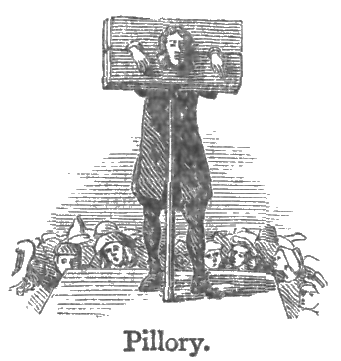
Pillory, pil′o-ri, n. a wooden frame, supported by an upright pillar or post, and having holes through which the head and hands of a criminal were put as a punishment, disused in England since 1837.—vs.t. Pill′ory, Pill′orise, to punish in the pillory: to expose to ridicule:—pa.t. and pa.p. pill′oried. [O. Fr. pilori; ety. dub.; Prov. espitlori—Low L. speculatorium, a lookout—L. specularia, a window, speculum, a mirror.]
Pillow, pil′ō, n. a cushion filled with feathers, &c., for resting the head on: any cushion: a block of metal for bearing the end of a shaft, or the end of a bowsprit: the socket of a pivot.—v.t. to lay or rest on for support.—v.i. to rest the head on a pillow.—ns. Pill′ow-bier, -beer, -case, -slip, a cover which can be drawn over a pillow; Pill′ow-cup, a last cup before going to bed.—adjs. Pill′owed, supported by, or provided with, a pillow; Pill′owy, like a pillow: soft. [A.S. pyle—L. pulvīnus.]
Pillworm, pil′wurm, n. the millipede.
Pilocarpus, pī-lō-kär′pus, n. a shrub about four or five feet high, slightly branched, the branches erect, a native of Brazil.—n. Pilocar′pine, an alkaloid isolated from pilocarpus, with sudorific properties. [Gr. pilos, a cap, karpos, fruit.]
Pilose, pī′lōs, adj. hairy—also Pī′lous.—n. Pilos′ity. [L. pilosus—pilus, hair.]
Pilot, pī′lut, n. the steersman of a ship: one who conducts ships in and out of a harbour, along a dangerous coast, &c.: a guide.—v.t. to conduct as a pilot: to direct through dangerous places.—ns. Pī′lotage, the skill of a pilot: the act of piloting: the fee or wages of pilots; Pī′lot-boat, a boat used by pilots for meeting or leaving ships; Pī′lot-cloth, a coarse, stout kind of cloth for overcoats; Pī′lot-en′gine, a locomotive engine sent on before a train to clear its way, as a pilot; Pī′lot-fish, a fish of the mackerel family, so called from its having been supposed to guide sharks to their prey; Pī′lot-flag, the flag hoisted at the fore by a vessel needing a pilot; Pī′lot-house, an enclosed place on deck to shelter the steering-gear and the pilot—also Wheel-house; Pī′lot-jack′et, a pea-jacket worn by seamen; Pī′lot-whale, the caaing-whale (q.v.). [Fr. pilote—Dut. piloot, from peilen, to sound, loot (Ger. loth, Eng. lead), a sounding-lead.]
Pilule, pil′ūl, n. a little pill—also Pil′ula.—adj. Pil′ular, pertaining to pills.
Pilum, pī′lum, n. the heavy javelin used by Roman foot-soldiers:—pl. Pī′la. [L.]
Pilus, pī′lus, n. one of the slender hairs on plants:—pl. Pī′li. [L.]
Pimento, pi-men′to, n. allspice or Jamaica pepper: the tree producing it.—Also Pimen′ta. [Port. pimenta—L. pigmentum, paint.]
Pimp, pimp, n. one who procures gratifications for the lust of others: a pander.—v.i. to pander.—adjs. Pimp′ing, petty: mean; Pimp′-like. [Fr. pimper, a nasalised form of piper, to pipe, hence to cheat.]
Pimpernel, pim′pėr-nel, n. a plant of the primrose family, with reddish flowers—also Poor man's weather-glass, Red chickweed.—n. Pimpinel′la, a genus of umbelliferous plants—anise, pimpernel, breakstone. [Fr. pimprenelle (It. pimpinella), either a corr. of a L. form bipennula, double-winged, dim. of bi-pennis—bis, twice, penna, feather; or from a dim. of L. pampinus, a vine-leaf.]
Pimple, pim′pl, n. a pustule: a small swelling.—adjs. Pim′pled, Pim′ply, having pimples. [A.S. pipel, nasalised from L. papula, a pustule.]
Pin, pin, n. a piece of wood or of metal used for fastening things together: a peg or nail: a sharp-pointed piece of wire with a rounded head for fastening clothes: anything that holds parts together: a piece of wood set up on end to be knocked down by a bowl, as in skittles: a peg used in musical instruments for fastening the strings: anything of little value.—v.t. to fasten with a pin: to fasten: to enclose: to seize and hold fast:—pr.p. pin′ning; pa.t. and pa.p. pinned.—ns. Pin′-butt′ock (Shak.), a sharp, pointed buttock; Pin′case, Pin′cushion, a case or cushion for holding pins; Pin′-feath′er, a small or short feather.—adj. Pin′-feath′ered.—ns. Pin′-hold, a place where a pin is fixed; Pin′-hole, a hole made by a pin: a very small opening; Pin′-mon′ey, money allowed to a wife by her husband for private expenses, originally to buy pins; Pin′ner, one who pins or fastens: a pin-maker: a pinafore: a head-dress with a lappet flying loose; Pin′-point, the point of a pin: a trifle; Pin′tail, a genus of ducks, one handsome species of which is a winter visitor to many parts of the British coast.—adj. Pin′tailed, having a long, narrow tail.—n. Pin′-wheel, a contrate wheel in which the cogs are pins set into the disc: a form of firework constructed to revolve rapidly while burning.—v.t. Pin′work, to work flax-yarn on a wooden pin so as to make it more supple for ease in packing.—Pin-fire cartridge, a cartridge for breech-loading guns; Pins and needles, a feeling as of pricking under the skin, formication.—In merry pin, in a merry humour; On one's pins, on one's legs: in good condition. [M. E. pinne, like Ir. and Gael. pinne, and Ger. pinn, from L. pinna or penna, a feather.]
Pin, pin, n. an induration of the membranes of the eye, cataract. [A.S. pinn—Low L. pannus.]
Piña-cloth, pē′nya-kloth, n. a beautiful fabric made of the fibres of the leaves of the pine-apple plant.
Pinafore, pin′a-fōr, n. a loose covering of cotton or linen over a child's dress. [Pin + afore.]
Pinaster, pi-nas′tėr, n. the cluster-pine.
Pince-nez, pangs′-nā, n. a pair of eye-glasses with a spring for catching the nose. [Fr.]
Pincers. Same as Pinchers.
Pinch, pinsh, v.t. to grip hard: to squeeze between two hard or firm substances: to squeeze the flesh so as to give pain: to nip: to distress: to gripe.—v.i. to act with force: to bear or press hard: to live sparingly.—n. a close compression with the fingers: what can be taken up between the finger and thumb: an iron bar used as a lever for lifting weights, rolling wheels, &c.: a gripe: distress: oppression.—n. Pinch′commons, a niggard, a miser.—adj. Pinched, having the appearance of being tightly squeezed: hard pressed by want or cold: narrowed in size.—ns. Pinch′er, one who, or that which, pinches; Pinch′ers, Pin′cers, an instrument for gripping anything firmly, esp. for drawing out nails, &c.; Pinch′fist, Pinch′gut Pinch′penny, a niggard.—adv. Pinch′ingly, in a pinching manner.—At a pinch, in a case of necessity; Know where the shoe pinches, to know where the cause of trouble or difficulty is. [O. Fr. pincer; prob. Teut., cf. Dut. pitsen, to pinch.]
Pinchbeck, pinsh′bek, n. a yellow alloy of five parts of copper to one of zinc. [From Chris. Pinchbeck, an 18th-century London watchmaker.]
Pindari, Pindaree, pin′dar-ē, n. one of a band of freebooters who, after the overthrow of the Mogul empire in India, grew (1804-17) to be a formidable power in the Central Provinces. [Hind.]
Pindaric, pin-dar′ik, adj. after the manner of Pindar, one of the first of Greek lyric poets.—n. an ode in imitation of one of Pindar's: an ode of irregular metre.—n. Pin′darism, imitation of Pindar.
Pinder, pin′dėr, n. one who impounds stray cattle.—Also Pin′ner. [A.S. pyndan, to shut up—pund. Cf. Pen, v., and Pound, to shut up.]
Pine, pīn, n. a northern cone-bearing, evergreen, resinous tree, furnishing valuable timber.—adj. Pin′eal.—ns. Pin′eal-gland, a rounded body about the size of a pea, of a slightly yellowish colour, situated upon the anterior pair of corpora quadrigemina, and connected with the optic thalami by two strands of nerve fibres termed its peduncles; Pine′-app′le, a tropical plant, and its fruit, shaped like a pine-cone; Pine′-barr′en, a level sandy tract growing pines; Pine′-chā′fer, a beetle which eats pine-leaves.—adjs. Pine′-clad, Pine′-crowned, clad or crowned with pine-trees.—ns. Pine′-cone, the cone or strobilus of a pine-tree; Pine′-finch, a small fringilline bird of North America; Pine′-house, a pinery; Pine′-need′le, the circular leaf of the pine-tree; Pine′-oil, an oil obtained from the resinous exudations of pine and fir trees; Pin′ery, a place where pine-apples are raised: a pine forest; Pinē′tum, a plantation of pine-trees: a collection of pine-trees for ornamental purposes; Pine′-wood, a wood of pine-trees: pine timber; Pine′-wool, a fibrous substance prepared from the leaves of the pine, and used for flannels, hosiery, and blankets in hospitals.—adjs. Pī′nic, pertaining to, or obtained from, the pine: noting an acid consisting of the portion of common resin soluble in cold alcohol; Pinic′oline, inhabiting pine-woods; Pī′ny, Pī′ney, abounding in pine-trees.—Pine-tree money, silver money coined at Boston in the 17th century, and so called from the coins bearing the rude figure of a pine-tree on one side. [A.S. pín,—L. pīnus (for pic-nus),—pix, picis, pitch.]
Pine, pīn, v.i. to waste away under pain or mental distress: to languish with longing.—v.t. to grieve for: to bewail.—n. wasting pain: weary suffering.—Done to pine, starved to death. [A.S. pínian, to torment—L. pœna, punishment.]
Pinfold, pin′fōld, n. a pound or enclosure for cattle.—v.t. to impound. [For pind-fold=pound-fold.]
Ping, ping, n. the whistling sound of a bullet.—v.i. to produce such a sound.—n. Ping′-pong, a kind of indoor lawn-tennis, played with battledores or small rackets over a net on a table. [From the sounds made by the strokes on the ball.]
Pingle, ping′gl, v.i. (prov.) to eat with feeble appetite: to dawdle.—adj. Ping′ling, dawdling, feeble.
Pinguid, ping′gwid, adj. fat.—n. Ping′uitude. [L. pinguis, fat.]
Pinguin, pin′gwin, n. Same as Penguin.
Pinion, pin′yun, n. a wing: the joint of a wing most remote from the body of the bird: a small wheel with 'leaves' or teeth working into others.—v.t. to confine the wings of: to cut off the pinion: to confine by binding the arms. [O. Fr. pignon—L. pinna (=penna), wing. Cf. Pen, n.]
Pink, pingk, n. a boat with a narrow stern.—Also Pink′y. [Dut.; Ger. pinke.]
Pink, pingk, v.t. to stab or pierce, esp. with a sword or rapier: to decorate by cutting small holes or scallops.—n. a stab: an eyelet.—adj. Pinked, pierced or worked with small holes.—n. Pink′ing-ī′ron, a tool for pinking or scalloping. [Either through A.S. pyngan, from L. pungĕre, to prick; or acc. to Skeat, a nasalised form of pick.]
Pink, pingk, n. a flower of any one of several plants of the genus Dianthus—carnation, &c.: a shade of light-red colour like that of the flower: a scarlet hunting-coat, also the person wearing such: the minnow, from the colour of its abdomen in summer: any type or example of excellence in its kind.—adj. of a pink colour.—n. Pink′iness.—adj. Pink′ish, somewhat pink.—n. Pink′-root, the root of the Carolina or Indian pink, a common vermifuge.—Pink of perfection, the very highest state of perfection: an example of highest perfection.—Dutch pink, a yellow lake obtained from quercitron bark: (slang) blood. [Prob. a nasalised form of Celt. pic, a point—from the finely notched edges of the petals.]
Pink, pingk, v.i. to wink: to half-shut.—n. Pink′-eye, a disease in horses in which the eye turns somewhat red.—adj. Pink′-eyed, having pink eyes like a rabbit: having small or half-shut eyes.—adj. Pink′y, winking. [Dut. pinken, to wink.]
Pinna, pin′a, n. a single leaflet of a pinnate leaf: a wing, fin, or the like: the auricle of the ear:—pl. Pinn′æ.—adjs. Pinn′ate, -d, shaped like a feather: furnished with wings or fins.—adv. Pinn′ately.—adjs. Pinnat′ifid, cut as a leaf, half-way down or more, with the divisions narrow or acute; Pinnat′isect (bot.), pinnately divided; Pinn′iform, like a feather or fin: pinnate; Pinn′igrade, moving by fins—also n.; Pinn′iped, Pinnat′iped, fin-footed, as a bird; Pinn′ūlate, -d.—n. Pinn′ūle, one of the branchlets of a pinnate leaf: one of the lateral divisions of the finger-like stalks of an encrinite—also Pinn′ūla.—Pinnate leaf, a compound leaf wherein a single petiole has several leaflets attached to each side of it. [L. pinna, a feather, dim. pinnula.]
Pinnace, pin′ās, n. a small vessel with oars and sails: a boat with eight oars: a man-of-war's boat. [Fr. pinasse—It. pinassa—L. pinus, a pine.]
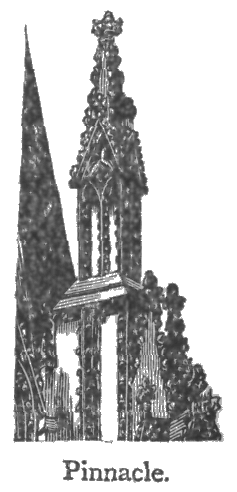
Pinnacle, pin′a-kl, n. a slender turret: a high point like a spire: the highest point of a mountain, &c.—v.t. to build with pinnacles: to place on a pinnacle. [Fr. pinacle—Low L. pinna-culum, double dim. from L. pinna, a feather.]
Pinner, pin′ėr. See Pin.
Pinnet, pin′et, n. (Scott) a pinnacle.
Pinnock, pin′ok, n. the hedge-sparrow.
Pinnoed, pin′ōd, adj. (Spens.) pinioned.
Pinny, Pinnie, pin′ī, n. a pinafore. [Pinafore.]
Pinnywinkle, pin′i-wingk-l, n. an ancient form of torture for the fingers.—Also Pinn′iewinkle, Pil′nie-winks. [A corr. of periwinkle.]
Pint, pīnt, n. a measure of capacity=½ quart or 4 gills: (med.) 12 ounces.—ns. Pint′-pot, a pot for holding a pint, esp. a pewter pot for beer: a seller or drinker of beer; Pint′-stoup, a vessel for holding a Scotch pint. [Fr. pinte—Sp. pinta, mark—L. picta, pingĕre, to paint.]
Pintado, pin-tä′do, adj. painted, spotted.—n. the guinea-fowl: chintz, applied to all printed goods.
Pintail, Pin-wheel. See Pin.
Pintle, pin′tl, n. a little pin: a long iron bolt: the bolt or pin on which the rudder of a ship turns. [Dim. of pin.]
Pinxit, pingk′sit, v.i. and v.t. he or she painted—used in noting the painter of a picture, as Rubens pinxit. [L., 3d sing. perf. indic. of pingĕre, to paint.]
Pioned, pī′ō-ned, adj. (Shak.) overgrown with marsh-marigolds, that flower being still called peony around Stratford.
Pioneer, pī-ō-nēr′, n. one of a party of soldiers who clear the road before an army, sink mines, &c.: one who goes before to prepare the way for others.—v.t. to act as pioneer to.—ns. Pī′oner (Shak.), a pioneer; Pī′oning (Spens.), the work of pioneers: military works. [O. Fr. peonier (Fr. pionnier)—pion, a foot-soldier—Low L. pedo, pedonis, a foot-soldier—L. pes, pedis, a foot.]
Pious, pī′us, adj. showing love, affection, or respect towards parents: having reverence and love for the Deity: proceeding from religious feeling.—adv. Pī′ously, in a pious manner.—adj. Pī′ous-mind′ed, of a pious disposition. [Fr. pieux—L. pius.]
Pip, pip, n. a disease of fowls—also called Roup. [Low L. pipita—L. pipuita, rheum.]
Pip, pip, n. the seed of fruit. [Pippin.]
Pip, pip, n. one of the spots on dice or playing-cards. [Corr. of prov. pick—Fr. pique, a spade, at cards.]
Pip, pip, v.t. (slang) to blackball.
Pip, pip, v.i. to chirp, as a young bird.
Pipe, pīp, n. a musical wind instrument consisting of a long tube: any long tube: a tube of clay, &c., with a bowl at one end for smoking tobacco: a pipeful: the note of a bird: a cask containing two hogsheads.—v.i. to play upon a pipe: to whistle, to chirp: to make a shrill noise.—v.t. to play on a pipe: to call with a pipe, as on board ships: to give forth shrill notes: to supply with pipes, to convey by pipes.—ns. Pip′age, conveyance or distribution by pipes; Pipe′-case, a box softly lined to protect a pipe; Pipe′clay, a fine white plastic clay, very like kaolin, but containing a larger percentage of silica, used for making tobacco-pipes and fine earthenware.—v.t. to whiten with pipeclay: (slang) to blot out, as accounts.—adj. Piped (pīpt), tubulous or fistulous.—ns. Pipe′-fish, a genus of fishes in the same order as the seahorse, having a long thin body covered with partially ossified plates, the head long, and the jaws elongated so as to form a tubular snout, hence the name; Pipe′-lay′er; Pipe′-lay′ing, the laying down of pipes for gas, water, &c.; Pipe′-off′ice, formerly an office in the Court of Exchequer in which the clerk of the pipe made out crown-land leases; Pip′er; Pipe′-roll, a pipe-like roll, the earliest among the records of the Exchequer; Pipe′-stā′ple, the stalk of a tobacco-pipe: a stalk of grass; Pipe′-stick, the wooden tube used as the stem of some tobacco-pipes; Pipe′-tongs, an implement for holding or turning metal pipes or pipe-fittings; Pipe′-tree, the lilac; Pipe′-wine (Shak.), wine drawn from the cask, as distinguished from bottled wine; Pipe′-wrench, a wrench with one movable jaw, both so shaped as to bite together when placed on a pipe and rotated round it.—Pipe down, to dismiss from muster, as a ship's company; Pipe off, to watch a house or person for purposes of theft; Pipe one's eye, to weep.—Drunk as a piper, very drunk; Pay the piper, to bear the expense. [A.S. pípe; Dut. pijp, Ger. pfeife.]
Piperaceous, pip-e-rā′shi-us, adj. pertaining to the Piperā′ceæ, the pepper family.—adj. Piper′ic, produced from such plants.—n. Pip′erine, an alkaloid found in pepper. [L. piper, pepper.]
Pipette, pi-pet′, n. a small tube for removing small portions of a fluid from one vessel to another. [Fr.]
Pipi, pē′pē, n. the astringent pods of Cæsalpinia pipai, a Brazilian plant used in tanning.
Piping, pī′ping, adj. uttering a weak, shrill, piping sound, like the sick: sickly: feeble: boiling.—n. act of piping: sound of pipes: a system of pipes for any purpose: small cord used as trimming for dresses, &c.: a slip or cutting taken from a plant with a jointed stem.
Pipistrel, Pipistrelle, pip-is-trel′, n. a small reddish-brown bat. [Fr.]
Pipit, pip′it, n. a genus of birds resembling larks in plumage and wagtails in habits, the most common British species being the titlark.
Pipkin, pip′kin, n. a small earthen pot. [Pipe.]
Pippin, pip′in, n. a kind of apple. [O. Fr. pepin—L. pepo—Gr. pepōn, a melon.]
Pipul, pip′ul, n. the sacred fig-tree.—Also Pip′al, Pipp′ul-tree, Peep′ul-tree. [Hind.]
Pipy, pī′pi, adj. like a pipe: tubular.
Piquant, pē′kant, adj. stimulating to the taste: of a lively spark.—n. Piq′uancy.—adv. Piq′uantly. [Fr. piquant, pr.p. of piquer, to prick.]
Pique, pēk, n. an offence taken: a feeling of anger or vexation caused by wounded pride: spite: nicety: punctilio.—v.t. to wound the pride of: to offend: to pride or value (one's self):—pr.p. piq′uing; pa.t. and pa.p. piqued. [Fr. pique, a pike, pique; cf. Pick and Pike.]
Piqué, pē-kā′, n. a heavy cotton fabric having a surface corded or with a raised lozenge pattern: a similar pattern produced by quilting with the needle.—n. Piqué-work. [Fr.]
Piquet. Same as Picket.
Piquet, pi-ket′, n. a game at cards.—n. Pique, in piquet, the scoring of 30 points in one hand before the other side scores at all. [Picket.]
Piragua, pi-rä′gwä. Same as Periagua.
Pirate, pī′rāt, n. one who, without authority, attempts to capture ships at sea: a sea-robber: an armed vessel which, without legal right, plunders other vessels at sea: one who steals or infringes a copyright.—v.t. to rob at sea: to take without permission, as books or writings.—n. Pī′racy, the crime of a pirate: robbery on the high seas: infringement of copyright.—adjs. Pirat′ic, -al, pertaining to a pirate: practising piracy.—adv. Pirat′ically. [Fr.,—L. pirata—Gr. peiratēs—peiraein, to attempt.]
Piriform, pir′i-form, adj. pear-shaped.
Pirn, pirn, n. anything that revolves or twists: a reel, bobbin, &c.: the amount of thread wound on a shuttle or reel.
Pirnie, pir′ni, n. (Scot.) a striped woollen nightcap.
Pirogue, pi-rōg′. See Periagua.
Pirouette, pir-ōō-et′, n. a wheeling about, esp. in dancing: the whirling round of a horse on the same ground.—v.i. to execute a pirouette. [Fr.]
Pisces, pis′ēz, n. the Fishes, the twelfth sign of the zodiac.—ns. Pis′cary, right of fishing in another man's waters; Piscatol′ogy, the scientific study of fishes; Piscā′tor, an angler:—fem. Piscā′trix.—adj. Piscatō′rial, relating to fishes or fishing: fond of fishing—also Pis′catory.—n. Pis′cicapture, the taking of fish.—adjs. Piscic′olous, parasitic upon fishes; Piscicul′tural, pertaining to pisciculture.—ns. Pis′ciculture, the rearing of fish by artificial methods; Pis′ciculturist, a fish-culturist.—adjs. Pis′ciform, in shape like a fish: having the form of a fish; Pis′cine, pertaining to fishes; Pisciv′orous, feeding on fishes. [L. piscis, a fish.]
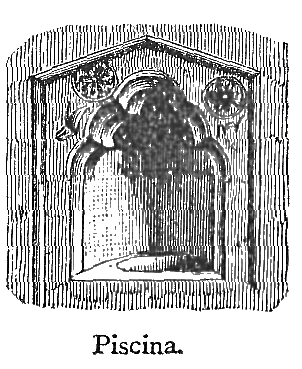
Piscina, pis-ī′na, n. a basin or tank, esp. one for holding fishes or for growing water-plants: a fish-pond: (archit.) a basin or sink on the south side of the altar in old churches, into which is emptied water used in washing any of the sacred vessels.—adj. Pis′cinal, belonging to a fish-pond. [L., a fish-pond, a cistern—piscis, a fish.]
Pisé, pē-zā′, n. stiff earth or clay rammed down to form walls or floors. [Fr.]
Pish, pish, interj. expressing contempt. [Imit.]
Pisiform, pī′si-form, adj. pea-shaped. [L. pisum, pea, forma, shape.]
Pismire, pis′mīr, n. an ant or emmet. [Piss, from the strong smell of the ant-hill, A.S. mire, ant.]
Pisolite, pī′sō-līt, n. a coarse oolite or concretionary limestone in large globules.—adj. Pisolit′ic. [Gr. pisos, pea, lithos, stone.]
Piss, pis, v.i. to discharge urine or make water.—ns. Piss′-a-bed (prov.), the dandelion; Piss′asphalt, Pis′ophalt, a variety of bitumen; Piss′-pot, a chamber-pot. [Fr. pisser; imit.]
Pistachio, pis-tā′shi-ō, n. the almond-flavoured pistachio-nut, the fruit of the Pistā′chia, a small genus of trees of the cashew family, native to western Asia. [It.,—L. pistacium—Gr. pistakion—Pers. pistā.]
Pistareen, pis-ta-rēn′, n. in West Indies, the peseta.
Pistil, pis′til, n. (bot.) the female organ in the centre of a flower, consisting of three parts—ovary, style, and stigma.—adjs. Pistillā′ceous, Pis′tillary, growing on a pistil: pertaining to, or having the nature of, a pistil; Pis′tillāte, having a pistil: having a pistil only; Pistillif′erous, bearing a pistil without stamens. [Fr.,—L. pistillum, a pestle.]
Pistol, pis′tol, n. a small hand-gun, held in one hand when fired.—v.t. to shoot with a pistol.—ns. Pistoleer′, one armed with a pistol; Pis′tolet, a little pistol; Pis′tol-shot. [O. Fr. pistole—It. pistola, said to be from Pistoja (orig. Pistola), a town in Italy.]
Pistole, pis′tōl, n. a Spanish gold coin=about 16 shillings. [Same as above.]
Piston, pis′tun, n. a circular plate of metal, or other material, used in pumps, steam-engines, &c., fitting and moving up and down within a tube or hollow cylinder.—n. Pis′ton-rod, the rod to which the piston is fixed, and which moves up and down with it. [Fr.,—It. pistone—pesto, to pound—L. pinsĕre, pistum.]
Pit, pit, n. a hole in the earth: a place whence minerals are dug: the bottomless pit: the grave: the abode of evil spirits: a hole used as a trap for wild beasts: the hollow of the stomach, or that under the arm at the shoulder: the indentation left by smallpox: the ground-floor of a theatre: an enclosure in which cocks fight: the shaft of a mine.—v.t. to mark with little hollows: to lay in a pit: to set in competition:—pr.p. pit′ting; pa.t. and pa.p. pit′ted.—ns. Pit′-coal, coal dug from a pit—not charcoal; Pit′-frame, the framework round a mine-shaft; Pit′-head, the ground at the mouth of a pit, and the machinery, &c., on it; Pit′man, a man who works in a coal-pit or a saw-pit, esp. the man who works the pumping machinery in the shaft of a mine: (mach.) a rod connecting a rotary with a reciprocating part.—adj. Pit′ted, marked with small pits.—ns. Pit′ting, the act of digging, or of placing in, a pit: a group of pit-marks: a corrosion of the inside of steam-boilers, &c.; Pit′-vill′age, a group of miners' houses near a pit. [A.S. pyt, pytt—L. puteus, a well.]
Pitaka, pit′a-ka, n. a collection of Buddhist scriptures, as made in Tibet. [Sans., 'basket.']
Pitapat, pit′a-pat, adv. with palpitation or quick beating.—adj. fluttering.—n. a light, quick step: a succession of light taps.—v.i. to step or tread quickly.
Pitch, pich, n. the solid black shining substance obtained by boiling down common tar.—v.t. to smear with pitch.—adjs. Pitch′-black, Pitch′-dark, dark as pitch: very dark.—ns. Pitch′-blende, a black oxide of uranium; Pitch′-coal, a kind of bituminous coal: jet; Pitch′iness, state or quality of being pitchy; Pitch′-pine, a kind of pine which yields pitch, and is much used in America as fuel; Pitch′-plas′ter, a plaster of Burgundy or white pitch; Pitch′-stone, an old volcanic-like hardened pitch; Pitch′-tree, the kauri pine, the Amboyna pine, or the Norway spruce.—adj. Pitch′y, having the qualities of pitch: smeared with pitch: black like pitch: dark: dismal. [A.S. pic—L. pix, pic-is.]
Pitch, pich, v.t. to thrust or fix in the ground: to fix or set in array: to fix the rate or price: to fling or throw: (mus.) to set the keynote of.—v.i. to settle, as something pitched: to come to rest from flight: to fall headlong: to fix the choice: to encamp: to rise and fall, as a ship.—n. a throw or cast from the hand: any point or degree of elevation or depression: degree: degree of slope: a descent: the height of a note in speaking or in music: (mech.) distance between the centres of two teeth in a wheel or a saw, or between the threads of a screw measured parallel to the axis.—ns. Pitched′-batt′le, a battle in which the contending parties have fixed positions: a battle previously arranged for on both sides; Pitch′er; Pitch′-far′thing, chuck-farthing; Pitch′fork, a fork for pitching hay, &c.: a tuning-fork.—v.t. to lift with a pitchfork: to throw suddenly into any position.—ns. Pitch′ing, the act of throwing: a facing of stone along a bank to protect against the action of water; Pitch′pipe, a small pipe to pitch the voice or tune with.—Pitch and pay (Shak.), pay down at once, pay ready-money; Pitch and toss, a game in which coins are thrown at a mark, the person who throws nearest having the right of tossing all the coins, and keeping those which come down head uppermost; Pitch in, to begin briskly; Pitch into, to assault. [A form of pick.]
Pitcher, pich′ėr, n. a vessel for holding water, &c.—n. Pitch′er-plant, a plant with leaves shaped like a pitcher or ascidium—Nepenthes, &c.—Pitchers have ears, there may be listeners. [O. Fr. picher—Low L. picarium, a goblet—Gr. bīkos, a wine-vessel, an Eastern word.]
Piteous, pit′e-us, adj. showing or feeling pity: fitted to excite pity: mournful: compassionate: paltry.—adv. Pit′eously.—n. Pit′eousness. [O. Fr. pitos, piteus. Cf. Pity.]
Pitfall, pit′fawl, n. a pit slightly covered, so that wild beasts may fall into it: any concealed danger.
Pith, pith, n. the marrow or soft substance in the centre of the stems of dicotyledonous plants: force or energy: importance: condensed substance: quintessence.—n. Pith′-ball, a pellet of pith.—adv. Pith′ily.—n. Pith′iness.—adj. Pith′less, wanting pith, force, or energy.—n. Pith′-pā′per, a thin sheet cut from pith for paper: rice-paper.—adj. Pith′y, full of pith: forcible: strong: energetic. [A.S. pitha; Dut. pit, marrow.]
Pithecus, pi-thē′kus, n. a name formerly used by zoologists for various groups of apes and monkeys.—ns. Pithecanthrō′pi, hypothetical ape-men; Pithē′cia, the genus of South American monkeys which includes the Sakis and allied species.—adj. Pithē′coid. [L.,—Gr. pithēkos, an ape.]
Pithos, pith′os, n. a large spheroid Greek earthenware vase. [Gr.]
Pit-mirk, pit′-mėrk, adj. (Scot.) dark as pitch.
Pitri, pit′rē, n.pl. the deceased ancestors of a man: in Hindu mythology, an order of divine beings inhabiting celestial regions of their own, and receiving into their society the spirits of those mortals for whom funeral rites have been duly performed. [Sans., 'father,' pl. pitaras.]
Pitsaw, pit′saw, n. a large saw for cutting timber, worked by the pit-sawyer in the pit below the log and the top-sawyer on the log.
Pittacal, pit′a-kal, n. a blue substance obtained from wood-tar oil and used in dyeing. [Gr. pitta, pitch, kalos, beautiful.]
Pittance, pit′ans, n. an allowance of food or drink: a dole: a very small portion or quantity. [Fr. pitance, an allowance of food in a monastery—Low L. pietantea—L. pietas, pity.]
Pituitary, pit′ū-i-tā-ri, adj. mucous—also Pit′ūital, Pit′ūitous.—ns. Pitūī′ta, Pit′uite, phlegm.—Pituitary body, a rounded body of the size of a small bean, situated in the sella turcica in the sphenoid bone on the floor of the cavity of the skull. [L. pituitarius—pituita, mucus.]
Pity, pit′i, n. a strong feeling for or with the sufferings of others: sympathy with distress: a cause or source of pity or grief.—v.t. to feel pity with: to sympathise with:—pa.t. and pa.p. pit′ied.—adj. Pit′iable, deserving pity: affecting: wretched.—n. Pit′iableness.—adv. Pit′iably.—n. Pit′ier, one who pities.—adj. Pit′iful, feeling pity: compassionate: exciting pity: sad: despicable.—adv. Pit′ifully.—n. Pit′ifulness.—adj. Pit′iless, without pity: cruel.—adv. Pit′ilessly.—n. Pit′ilessness.—adv. Pit′yingly, in a pitying manner.—It pitieth me, you, them, &c. (Pr. Bk.), it causeth pity in me, you, them, &c. [O. Fr. pite (Fr. pitié, It. pietà)—L. pietas, pietatis—pius, pious.]
Pityriasis, pit-i-rī′a-sis, n. the term given to certain of the squamous or scaly diseases of the skin, in which there is a continual throwing off of bran-like scales of epidermis.—adj. Pit′yroid, bran-like. [Gr. pityron, bran.]
Più, pū, adv. more.—Più allegro, quicker. [It.]
Pivot, piv′ut, n. the pin on which anything turns: the officer or soldier at the flank upon whom a company wheels: that on which anything depends or turns.—adj. Piv′otal, of the nature of a pivot: acting as a pivot.—n. Piv′ot-bridge, a form of swing-bridge moving on a vertical pivot.—adj. Piv′oted, furnished with a pivot or pivots.—ns. Piv′ot-gear′ing, a system of gearing permitting the driving-shaft to be swivelled so as to set the machine in any direction with relation to the power; Piv′ot-gun, a gun mounted on a pivot, so as to be able to turn in any direction; Piv′oting, the pivot-work in machines; Piv′ot-man, the soldier or officer who acts as a pivot (see Pivot). [Fr. dim. of It. piva, a pipe, a peg, a pin—Low L. pipa.]
Pix, piks, n. Same as Pyx.
Pixy, Pixie, pik′si, n. a small Devonshire fairy.—adj. Pix′y-led, bewildered.—ns. Pix′y-ring, a fairy-ring, a well-marked ring of a different kind of grass, common on meadows and heaths; Pix′y-stool, a toadstool or mushroom. [Puck.]
Pize, pīz, n. a term used in execration, like pox.
Pizzicato, pit-si-kä′to, adj. a phrase used in music for the violin or violoncello, to denote that here the strings are to be twitched with the fingers in the manner of a harp or guitar. [It.,—pizzicare, to twitch.]
Pizzle, piz′l, n. the penis of an animal, as a bull. [Low Ger. pesel.]
Placable, plā′ka-bl, or plak′a-bl, adj. that may be appeased: relenting: willing to forgive.—ns. Placabil′ity, Plā′cableness.—adv. Plā′cably.—v.t. Plā′cāte, to conciliate.—n. Placā′tion, propitiation.—adj. Plā′catory, conciliatory. [L. placabilis—placāre, to appease, akin to placēre, to please.]
Placard, plak′ärd, or plā-kärd′, n. a written or printed paper stuck upon a wall as an advertisement, &c.: a public proclamation: the woodwork and frame of the door of a closet and the like.—v.t. Placard (plā-kärd′, or plak′ärd), to publish or notify by placards. [Fr. placard, a bill stuck on a wall—plaque, plate, tablet; acc. to Diez, from Dut. plak, a piece of flat wood.]
Placcate, plak′āt, n. See Placket.
Place, plās, n. a broad way in a city: an open space used for a particular purpose: a particular locality: a town: room to dwell, sit, or stand in: the position held by anybody, employment, office, a situation: a mansion with its grounds: proper position or dignity, priority in such: stead: passage in a book: a topic, matter of discourse: in sporting contests, position among the first three.—v.t. to put in any place or condition: to find a home for: to settle: to lend: invest: to ascribe.—n. Place′-hunt′er, one who seeks eagerly official position or public office.—adj. Place′less, without place or office.—ns. Place′man, one who has a place or office under a government:—pl. Place′men; Place′ment, placing or setting; Place′-mong′er, one who traffics in appointments to places; Place′-name, the name of a place or locality: a local name; Plac′er.—Give place, to make room, to yield; Have place, to have existence; In place, in position: opportune; Out of place, inappropriate, unseasonable; Take place, to come to pass: to take precedence of. [Fr.,—L. platea, a broad street—Gr. plateia, a street—platys, broad.]
Placebo, plā-sē′bo, n. in the R.C. service of vespers for the dead the name of the first antiphon, which begins with the word: a medicine given to humour or gratify a patient rather than to exercise any curative effect. [L., 'I will please'—placēre, to please.]
Placenta, pla-sen′ta, n. the structure which unites the unborn mammal to the womb of its mother and establishes a nutritive connection between them: (bot.) the portion of the ovary which bears the ovules:—pl. Placen′tæ.—adj. Placen′tal.—n.pl. Placentā′lia, placental mammals.—adjs. Placentā′lian; Placen′tary, pertaining to, or having, a placenta.—n. a mammal having a placenta.—adjs. Placen′tate, Placentif′erous.—ns. Placentā′tion, the mode in which the placenta is formed and attached to the womb; Placentī′tis, inflammation of the placenta. [L., a flat cake, akin to Gr. plakous, a flat cake, from plax, plak-os, anything flat.]
Placer, plas′er, n. a place where the superficial detritus is washed for gold, &c.: hence any place holding treasures. [Sp.]
Placet, plā′set, n. a vote of assent in a governing body: permission given, esp. by a sovereign, to publish and carry out an ecclesiastical order, as a papal bull or edict. [L., 'it pleases,' 3d sing. pres. indic. of placēre, to please.]
Placid, plas′id, adj. gentle: peaceful.—ns. Placid′ity, Plac′idness.—adv. Plac′idly. [Fr.,—L. placidus—placēre, to please.]
Placitory, plas′i-tō-ri, adj. of or relating to pleas or pleading in courts of law.
Placitum, plas′i-tum, n. a public assembly in the Middle Ages, presided over by the sovereign, to consult on affairs of state: a resolution of such an assembly:—pl. Plac′ita. [L., from placēre, to please.]
Plack, plak, n. a small copper coin formerly current in Scotland, equal in value to the third part of an English penny.—adj. Plack′less, penniless. [O. Fr. plaque, a plate.]
Placket, plak′et, n. (Shak.) the slit in a petticoat: a petticoat—hence, a woman: a placcate or additional plate of steel on the lower half of the breast-plate, or back-plate: a leather jacket strengthened with strips of steel. [Fr. plaquet—plaquer, to clap on.]
Placoderm, plak′o-dėrm, adj. noting an order of fossil fishes having their skin covered with bony plates. [Gr. plax, plakos, anything flat, derma, skin.]
Placoid, plak′oid, adj. plate-like.—Placoid fishes, an order of fishes having placoid scales, irregular plates of hard bone, not imbricated, but placed near together in the skin. [Gr. plax, plakos, anything flat and broad, eidos, form.]
Placula, plak′ū-la, n. a little plate or plaque.—adjs. Plac′ular, Plac′ulāte.
Plafond, pla-fond′, n. the ceiling of a room, any soffit. [Fr.]
Plagal, plā′gal, adj. in Gregorian music, denoting a mode or melody in which the final is in the middle of the compass instead of at the bottom—opp. to Authentic. [Gr. plagios, sidewise—plagos, a side.]
Plagiarise, plā′ji-ar-īz, v.t. to steal from the writings or ideas of another.—ns. Plā′giarism, the act or practice of plagiarising; Plā′giarist, one who plagiarises; Plā′giary, one who steals the thoughts or writings of others and gives them out as his own: the crime of plagiarism.—adj. practising literary theft. [Fr. plagiaire—L. plagiarius, a kidnapper—plaga, a net.]
Plagioclase, plā′ji-ō-klāz, n. a group of triclinic feldspars whose cleavage planes are not at right angles to each other.—adj. Plagioclas′tic. [Gr. plagios, oblique, klasis, a fracture.]
Plagiodont, plā′ji-ō-dont, adj. having the teeth oblique.
Plagiostome, plā′ji-ō-stōm, n. a plagiostomous fish, one of the Plagios′tomi, a division of fishes, including sharks and rays.—adjs. Plagiostom′atous, Plagios′tomous.
Plagiotropism, plā-ji-ot′rō-pizm, n. a mode of turning of the organs of plants in the direction of gravitation or of the ray of light.—adj. Plagiotrop′ic.—adv. Plagiotrop′ically. [Gr. plagios, oblique, tropos, a turning.]
Plagium, plā′ji-um, n. the crime of kidnapping.
Plague, plāg, n. any great natural evil: a deadly disease or pestilence: a very troublesome person or thing, esp. a malignant kind of contagious fever, prevailing epidemically, characterised by buboes, or swellings of the lymphatic glands, by carbuncles and petechiæ.—v.t. to infest with disease or trouble: to harass or annoy:—pr.p. plāg′uing; pa.t. and pa.p. plāgued.—ns. Plague′-mark, -spot, a mark or spot of plague or foul disease: a place where disease is constantly present; Plag′uer, one who plagues, vexes, or annoys; Plague′-sore.—adv. Plag′uily, vexatiously.—adj. Plaguy (plā′gi), vexatious: (Shak.) troublesome.—adv. vexatiously.—Plague on, may a curse rest on.—Be at the plague, to be at the trouble. [O. Fr. plague—L. plaga, a blow; Gr. plēgē.]
Plaice, plās, n. a broad, flat fish, in the same genus as the flounder. [O. Fr. plaïs (Fr. plie)—Low L. platessa, a flat fish—Gr. platys, flat.]
Plaid, plad, or plād, n. a loose outer garment of woollen cloth, often of a tartan, or coloured striped pattern, a special dress of the Highlanders of Scotland.—adj. like a plaid in pattern or colours.—adj. Plaid′ed, wearing a plaid: made of plaid cloth.—n. Plaid′ing, a strong woollen twilled fabric. [Gael. plaide, a blanket, contr. of peal-laid, a sheepskin—peall, a skin, cog. with L. pellis, Eng. fell.]
Plain, plān, v.t. and v.i. to complain: to lament.—ns. Plain′ant, one who complains: a plaintiff; Plain′ing (Shak.), complaint. [O. Fr. pleigner (Fr. plaindre)—L. plangĕre, to lament.]
Plain, plān, adj. without elevations, even, flat: level, smooth, without obstructions: free from difficulties, easy, simple: without ornament or beauty, homely: artless: sincere: evident, unmistakable: mere: not coloured, figured, or variegated: not highly seasoned, natural, not cooked or dressed: not trumps at cards.—n. an extent of level land: an open field.—adv. clearly: distinctly.—v.t. (obs.) to make plain.—n.pl. Plain′-clothes, clothes worn by an officer when off duty or not in uniform.—ns. Plain′-cook, one able to cook all ordinary dishes; Plain′-deal′er, one who deals or speaks his mind plainly.—adj. Plain′-deal′ing, speaking or acting plainly, candid.—n. candid speaking or acting, sincerity.—adj. Plain′-heart′ed, having a plain or honest heart: sincere.—n. Plain′-heart′edness.—adv. Plain′ly.—ns. Plain′ness; Plain′-song, the music of a recitative-like character and sung in unison, used in the Christian Church of the West from the earliest times, and still in use in all R.C. churches: a simple air without variations: a plain unvarnished statement; Plain′-speak′ing, straight-forwardness or bluntness of speech.—adj. Plain′-spok′en, speaking with plain, rough sincerity.—n.pl. Plain′stanes (Scot.), flagstones, pavement.—n. Plain′work, plain needlework, as distinguished from embroidery.—Plain as a pikestaff, perfectly plain or clear. [Fr.,—L. plānus, plain.]
Plaint, plānt, n. lamentation: complaint: a sad song: (law) the exhibiting of an action in writing by a complainant.—adj. Plaint′ful, complaining: expressing sorrow.—n. Plaint′iff (Eng. law), one who commences a suit against another—opp. to Defendant.—adj. Plaint′ive, complaining: expressing sorrow: sad.—adv. Plaint′ively.—n. Plaint′iveness.—adj. Plaint′less, without complaint: unrepining. [O. Fr. pleinte (Fr. plainte)—L. planctus—plangĕre, planctum, to lament.]
Plaise, plās, n. Same as Plaice.
Plaister, plās′tėr, n. an obsolete form of plaster.
Plait, plāt, n. a fold: a doubling over, as of cloth upon itself: a braid.—v.t. to fold: to double in narrow folds: to interweave.—adj. Plait′ed, folded over in narrow folds: braided: interwoven: intricate.—ns. Plait′er, one who plaits or braids: a machine for making plaits, as in cloth; Plait′ing, the act of making plaits. [O. Fr. pleit, ploit (Fr. pli)—L. plicāre, -ātum, to fold.]
Plan, plan, n. a drawing of anything on a plane or flat surface: a drawing of a building as it stands on the ground: a scheme or project for accomplishing a purpose: a contrivance: a method or custom.—v.t. to make a sketch of on a flat surface: to form in design: to lay plans for:—pr.p. plan′ning; pa.t. and pa.p. planned.—adj. Plan′less.—ns. Plan′ner, one who forms a plan: a projector; Work′ing-plan, a draft on a large scale given to workmen to work from.—Plan of campaign, the method of conducting the struggle of the Irish tenants against the landlords, organised by the National League in 1886, its officers collecting what they considered a fair rent, and offering it to the landlord, and where he refused to accept it spending it on the support of the persons evicted. [Fr.,—L. planus, flat.]
Planarian, plā-nā′ri-an, adj. and n. a term practically coextensive with Turbellarian, applicable to the members of the lowest class of worm-like animals, living in fresh and salt water, and sometimes in damp earth.—adjs. Planar′iform, Planā′rioid. [L. planarius, flat.]
Planch, planch, v.t. (Shak.) to cover with planks. [Fr. planche—L. planea.]
Planchet, plan′chet, n. a flat piece of metal ready to receive impression as a coin.
Planchette, plan-shet′, n. a small heart-shaped or triangular piece of board resting on three props, two of which are castors and one a pencil-point, which, while a person's fingers are lightly resting on it, sometimes moves, as if of its own accord, and traces with the pencil marks and even words upon a piece of paper below it. [Fr. planchette, a small board.]
Plane, plān, n. (geom.) a surface on which, if any two points be taken, the straight line joining them will lie entirely on the surface: (astron.) a surface thought of as bounded by the line round which a heavenly body moves: any flat or level surface: any incline on which coal is lowered by the effect of gravity: any grade of life or of development.—adj. having the character of a plane: pertaining to, lying in, or forming a plane.—v.t. to make plane or smooth.—adj. Plā′nary, relating to a plane: flat.—n. Plane′-tā′ble, a topographical instrument used in field-mapping, and having a sighting-telescope for observing objects, whose angles may be noted on a paper on the table of the instrument: an inclined table on which ore is dressed.—v.t. to survey with a plane-table.—ns. Plan′igraph, an instrument for reducing or enlarging drawings; Planim′eter, an instrument for measuring the area of a plane figure.—adjs. Planimet′ric, -al.—n. Planim′etry, the mensuration of plane surfaces.—adj. Planipet′alous, having flat petals.—ns. Plan′isher, a thin flat-ended tool used for smoothing tin-plate and brasswork: a workman who planishes, esp. one who prepares copper-plates for engravers; Plan′isphere, a sphere projected on a plane.—adjs. Planispher′ic; Plāno-con′cave, plane on one side and concave on the other; Plā′no-con′ical, plane on one side and conical on the other; Plā′no-con′vex, plane on one side and convex on the other.—n. Planog′raphist, a map-maker.—adj. Plā′no-horizon′tal, having a plane horizontal surface or position.—ns. Planom′eter, a plane surface used in machine-making as a gauge for plane surfaces; Planom′etry, the measurement of plane surfaces.—adj. Plā′no-sub′ulate, smooth and awl-shaped.—Plane angle, an angle contained by two straight lines in a plane; Plane figure, a figure all of whose points lie in one plane; Plane geometry, the geometry of plane figures; Plane sailing, the calculation of a ship's place in its course, as if the earth were flat instead of spherical: easy work; Plane trigonometry, that branch of trigonometry which treats of triangles described on a plane.—Inclined plane (see Incline); Perspective plane (see Perspective). [Fr.,—L. planus, plain.]
Plane, plān, n. a carpenter's tool for producing a level or smooth surface.—v.t. to make a surface (as of wood) level by means of a plane.—ns. Plā′ner, a tool or machine for planing: a smooth wooden block used for levelling a form of type; Plān′ing-machine′, a machine for planing wood or metals.—v.t. Plan′ish, to make smooth: to polish. [Fr.,—Low L. planāre, to make level.]
Planet, plan′et, n. one of the bodies in the solar system which revolve in elliptic orbits round the sun.—n. Planetā′rium, a machine showing the motions and orbits of the planets.—adjs. Plan′etary, pertaining to the planets: consisting of, or produced by, planets: under the influence of a planet: erratic: revolving; Planet′ic, -al.—n. Plan′etoid, a celestial body having the form or nature of a planet: one of a number of very small planets, often called asteroids, moving round the sun between Mars and Jupiter.—adjs. Planetoi′dal; Plan′et-strick′en, Plan′et-struck (astrol.), affected by the influence of the planets: blasted.—n. Plan′etule, a little planet.—Minor planets, the numerous group of very small planets which is situated in the solar system between Mars and Jupiter. [Fr. planète—Gr. planētēs, wanderer—planān, to make to wander.]
Plane-tree, plān′-trē, n. any one of the several trees constituting the genus Platanus, esp. the oriental or common plane-tree, with its variety the maple-leaved plane-tree, and the American plane-tree, usually called sycamore or buttonwood or buttonball: in Great Britain, the sycamore maple. [Fr. plane—L. platanus—Gr. platanos—platys, broad.]
Plangent, plan′jent, adj. resounding: noisy. [L. plangens, -gentis—plangĕre, to beat.]
Plank, plangk, n. a long piece of timber, thicker than a board: one of the principles or aims of an associated party.—v.t. to cover with planks.—n. Plank′ing, the act of laying planks: a series of planks: work made up of planks.—Walk the plank, to be compelled to walk along a plank projecting over the ship's edge into the sea. [L. planca, a board; cf. Plain, even.]
Plankton, plangk′ton, n. pelagic animals collectively. [Gr., planktos, wandering.]
Planodia, plā-nō′di-a, n. a false passage, such as may be made in using a catheter.
Plant, plant, n. a something living and growing, fixed on the ground and drawing food therefrom by means of its root, and developing into a stem, leaves, and seed: a sprout: any vegetable production: the tools or material of any trade or business: (slang) a trick, dodge, hidden plunder.—v.t. to put into the ground for growth: to furnish with plants: to set in the mind, implant: to establish.—v.i. to set shoots in the ground.—adj. Plant′able.—ns. Plant′age (Shak.), plants in general, or the vegetable kingdom; Plantā′tion, a place planted: a wood or grove: (U.S.) a large estate: a colony: act or process of introduction: (Milt.) the act of planting; Plant′er, one who plants or introduces: the owner of a plantation; Plant′-house, a garden structure designed for the protection and cultivation of the plants of warmer climates than our own; Plant′icle, a young plant; Plant′ing, the act of setting in the ground for growth: the art of forming plantations of trees: a plantation.—adj. Plant′less, destitute of vegetation.—ns. Plant′let, a little plant; Plant′-louse, a small homopterous insect which infests plants; Plant′ule, the embryo of a plant. [A.S. plante (Fr. plante)—L. planta, a shoot, a plant.]
Plantain, plan′tān, n. an important food-plant of tropical countries, so called from its broad leaf: a common roadside plant of several species, with broad leaves and seed-bearing spikes.—Plantain eater, one of a family of African, arboreal, vegetarian Pie-like birds. [Fr.,—L. plantago, plantaginis.]
Plantigrade, plant′i-grād, adj. that walks on the sole of the foot.—n. a plantigrade animal, as the bear.—adj. Plant′ar, pertaining to the sole of the foot. [L. planta, the sole, gradi, to walk.]
Planula, plan′ū-la, n. the locomotory embryo of the cœlenterates.—adjs. Plan′ular; Plan′uliform; Plan′uloid.
Planuria, plā-nū′ri-a, n. the discharge of urine through an abnormal passage, uroplania.—Also Plan′ury.
Plap, plap, v.i. to plash, fall with plashing sound. [Imit.]
Plaque, plak, n. a flat piece of metal or other material, used for ornament, as a brooch, &c., or for painting on, to form a wall-picture.—n. Plaquette′, a small plaque. [Fr.; cf. Plack.]
Plash, plash, v.t. to bind and interweave the branches of.—v.i. to bend down a branch.—n. a small branch of a tree partly cut and bound to or twisted among other branches.—n. Plash′ing, a mode of repairing a hedge by bending the branches and twisting them about each other. [O. Fr. plassier—L. plexus—plectĕre, to twist.]
Plash, plash, n. a dash of water: a puddle: a shallow pool: a splashing sound: a sudden downpour: a flash.—v.i. to dabble in water: to splash.—v.t. to sprinkle with colouring matter, as a wall.—adj. Plash′y, full of puddles: watery. [Imit.]
Plasm, plazm, n. a mould or matrix: protoplasm—also Plas′ma.—adjs. Plasmat′ic, -al, plastic, formative; Plas′mic, pertaining to plasma, protoplasmic.—ns. Plasmō′dium, composite masses of primitive protozoa, in which numerous units are fused, or in rare cases simply combined in close contact; Plas′mogen, true protoplasm; Plasmog′ony, the generation of an organism from plasma; Plasmol′ogy, minute or microscopic anatomy, histology.—v.t. Plas′molyse.—n. Plasmol′ysis, the contraction of the protoplasm in active cells under the action of certain reagents.—adj. Plasmolyt′ic.
Plasma, plas′ma, n. a green variety of translucent quartz or silica.—adj. Plas′mic. [Gr.,—plassein, to form.]
Plaster, plas′tėr, n. something that can be moulded into figures: a composition of lime, water, and sand for overlaying walls, &c.: (med.) a medicinal agent consisting of an adhesive substance spread upon cloth or leather, so as to stick to the part of the body to which it is applied.—adj. made of plaster.—v.t. to cover with plaster: to cover with a plaster, as a wound: to besmear: (fig.) to smooth over.—ns. Plas′terer, one who plasters, or one who works in plaster; Plas′tering, the art of covering the internal faces of walls, the partitions and ceiling of a building, with plaster: a covering of plaster: the plasterwork of a building; Plas′ter-stone, gypsum.—adj. Plas′tery, like plaster, containing plaster.—Plaster cast, a copy of an object got by pouring a mixture of plaster of Paris and water into a mould formed from the object; Plaster of Paris, a kind of gypsum, originally found near Paris, used in building and in making casts of figures; Porous plaster, a plaster for application to the body, full of small holes, which prevent it from wrinkling. [A.S. plaster—O. Fr. emplastre—L. emplastrum—Gr. emplastron.]
Plastic, plas′tik, adj. having power to give form to: capable of being moulded: of or pertaining to moulding.—ns. Plastic′ity, state or quality of being plastic; Plastilī′na, a modelling clay which remains soft and plastic for a considerable time; Plastog′raphy, imitation of handwriting. [Gr. plastikos—plassein, to mould.]
Plastron, plas′tron, n. a breast-plate: a detachable part of a woman's dress hanging from the throat to the waist: a man's shirt-bosom: a fencer's wadded shield of leather worn on the breast: the ventral part of the shell of a chelonian or testudinate, the lower shell of a turtle or tortoise: the sternum with costal cartilages attached.—adj. Plas′tral.
Plat, plat, v.t. Same as Plait.
Plat, plat, n. a piece of ground: a piece of ground ornamentally laid out: (obs.) a plan, scheme.—v.t. to make a map or plan of.—n. Plat′-band, a border of flowers in a garden: (archit.) a slightly projecting square moulding, an architrave fascia, a list between flutings. [Plot.]
Platane, plat′ān, n. the plane-tree.—Also Plat′an. [L. platanus—Gr. platanos—platys, broad.]
Plate, plāt, n. something flat: a thin piece of metal: wrought gold and silver: household utensils in gold and silver: a shallow dish nearly flat: an engraved piece of metal.—v.t. to overlay with a coating of plate or metal: to arm or defend with metal plates: to adorn with metal: to beat into thin plates.—n. Plate′-arm′our, armour of strong metal plates for protecting ships-of-war, &c.—adj. Plā′ted, covered with plates of metal for strength, as ships: covered with a coating of a more precious metal: (zool.) covered with hard scales.—ns. Plate′-fleet (Milt.), vessels used for carrying precious metals; Plate′ful, as much as a plate will hold; Plate′-glass, a fine kind of glass, cast in thick plates, used for mirrors and large shop-windows; Plate′-lay′er, a workman whose occupation it is to lay the rails of a railway and fix them to the sleepers; Plate′-mark, a mark or stamp on gold or silver plate to indicate its purity and the place where it was made; Plate′-pow′der, a composition of rouge and prepared chalk used for cleaning gold and silver plate and plated articles; Plate′-print′ing, the process of printing from engraved plates; Plā′ter, one who plates articles with a coating of gold or silver; Plate′-rack, a frame for holding plates, &c., when not in use; Plate′-warm′er, an apparatus in which plates are warmed before the fire; Plā′ting, the covering of an inferior metal with one of the precious metals: a thin coating of metal on another.—adj. Plā′ty, like a plate.—Half′-plate, in photography, a size of plate measuring 4¾ by 6½ in. (4¼ by 5½ in U.S.); Quar′ter-plate, 3¼ by 4¼ in.; Whole′-plate, 6½ by 8½ in. [O. Fr. plate, fem. of plat, flat—Gr. platys, broad.]
Plateau, pla-tō′, n. a broad flat space on an elevated position: a tableland:—pl. Plateaus, Plateaux (pla-tōz′). [Fr.,—O. Fr. platel, dim. of plat.]
Platen, plat′en, n. the flat part of a printing-press which comes down upon the form, and by which the impression is made.
Platform, plat′form, n. a raised level surface: a part of a floor raised above the rest to form a standing-place for speakers, workmen, &c.: (mil.) an elevated floor for cannon: a statement of principles to which a body of men declare their adhesion, and on which they act: (Shak.) a scheme, plan.—v.t. (Milt.) to sketch, plan: (Mrs Browning) to support as on a platform.—ns. Plat′form-bridge (Amer.), a movable gangway between the platforms of two railway carriages; Plat′form-car, a railway car open all round and without a roof; Plat′form-crane, a crane used on a railway platform, or one mounted on a movable truck; Plat′form-scale, a weighing-machine with a flat surface for holding the thing to be weighed.—The platform, the function of public oratory. [Fr. plate-forme, 'flat form.']
Platiasmus, plat-i-as′mus, n. imperfect speech.
Platinum, plat′in-um, n. an important metal of a dim silvery appearance, between gold and silver in value, and very difficult to melt—older name Plat′ina.—adjs. Platin′ic; Platinif′erous.—v.t. Plat′inise, to coat with platinum.—ns. Plat′inoid, one of the metals with which platinum is always found associated—palladium iridium, &c.; Plat′inotype, a method of producing photographs by means of paper coated with a preparation of platinum: a picture so produced.—adj. Plat′inous, containing or consisting of platinum. [Sp. platina—plata, plate.]
Platitude, plat′i-tūd, n. flatness: that which exhibits dullness of thought: an empty remark made as if it were important.—n. Platitudinā′rian, one who indulges in platitudes.—adj. Platitū′dinous. [Fr.,—plat, flat.]
Platonic, -al, plā-ton′ik, -al, adj. pertaining to Plato, the Greek philosopher (about 427-347 B.C.), or to his philosophical opinions.—adv. Plāton′ically.—v.t. and v.i. Plā′tonise, to reason like Plato.—ns. Plā′tonism, the philosophical opinions of Plato; Plā′tonist, Plāton′ic, a follower of Plato.—Platonic love, the love of soul for soul, a love into which sensual desire is supposed not to enter at all.
Platoon, pla-tōōn′, n. a number of recruits assembled for exercise—originally a small body of soldiers in a hollow square, to strengthen the angles of a longer formation: a subdivision of a company. [Fr. peloton, a ball, a knot of men—pelote—L. pĭla, a ball.]
Platter, plat′ėr, n. a large flat plate or dish. [M. E. plater—O. Fr. platel—plat, a plate.]
Platting, plat′ing, n. the process of making interwoven work: such work itself.
Platycephalous, plat-i-sef′a-lus, adj. having the vault of the skull flattened.—Also Platycephal′ic.
Platypus, plat′i-poos, n. the duck-bill (q.v.). [Gr. platys, flat, pous, a foot.]
Platyrhine, plat′i-rin, adj. broad-nosed.—n. a platyrhine monkey.
Plaudit, plawd′it, n. a mark of applause: praise bestowed.—adj. Plaud′itory, applauding.—adj. Plaus′ive, applauding, approving: (Shak.) plausible. [Shortened from L. plaudite, praise ye, a call for applause, 2d pers. pl. imper. of plaudĕre, plausum, to praise.]
Plausible, plawz′i-bl, adj. that may be applauded: seemingly worthy of approval or praise: superficially pleasing: apparently right: fair-spoken: popular.—ns. Plausibil′ity, Plaus′ibleness, an appearance of being right or worthy of approval: that which seems right and true at first sight.—adv. Plaus′ibly. [L. plausibilis—plaudĕre, to praise.]
Plaustral, plä′stral, adj. of or pertaining to a wagon. [L. plaustrum, a wagon.]
Play, plā, v.i. to engage in some amusing exercise: to take part in a game, or a piece of diversion: to gamble: to sport: to trifle: to move irregularly or (mech.) freely: to operate: to act in a theatre: to perform on a musical instrument: to practise a trick: to act a character: to act with repeated strokes.—v.t. to put in motion: to perform upon: to perform: to act a sportive part: to compete with.—n. amusement: any exercise for amusement: a contending for victory or for a prize: practice in a contest: gaming: action or use: manner of dealing, as fair-play: a dramatic composition: movement: room for action or motion: liberty of action.—ns. Play′-act′or, one who acts a part in a play: an actor; Play′-act′orism, the manner or habits of a play-actor; Play′-bill, a bill or advertisement of a play; Play′book, a book of plays or dramas; Play′-club, a wooden-headed golf-club used for driving the ball the longest distances; Play′-day, Play′-time, a day devoted to play: a holiday; Play′er, one who plays: an actor of plays or dramas: a trifler: a musician: a professional at cricket; Play′fellow, Play′mate, a fellow or mate in play or amusements.—adj. Play′ful, given to play: sportive.—adv. Play′fully.—ns. Play′fulness; Play′-gō′er, one who habitually attends the theatre; Play′-gō′ing; Play′-ground, a ground or place on which to play, esp. that connected with a school; Play′-house, a house where dramatic performances are represented: a theatre; Play′ing-card, one of a set of fifty-two cards used in playing games; Play′-mare, the hobby-horse, one of the chief parts in the ancient morris-dance; Play′thing, anything for playing with: a toy; Play′wright, Play′-writ′er, a writer of plays: one who adapts dramatic compositions for the stage.—Played out, worked to the end: used up: tired; Play fast and loose, to act in a tricky, inconstant way: to say one thing and do another; Play fine, at billiards, to strike the object-ball near the edge—opp. to Play full, to strike it nearer the centre than the edge; Play off, to show or display; Play up, to make a beginning of playing: to play more vigorously; Play upon, to trifle with: to delude.—A play upon words, a use of words so as to give them a double meaning; Bring into play, to bring into exercise or use; Come into play, to come into use; Hold in play, to keep the attention of. [A.S. plegan, to play.]
Plea, plē, n. the defender's answer to the plaintiff's demand or charge: an excuse: an apology: an action in a court of law: urgent entreaty. [O. Fr. plait (Fr. plaid)—Low L. placitum, a decision—L. placet, it pleases, placēre, to please.]
Pleach, plēch, v.t. to intertwine the branches of, as a hedge: (Shak.) to fold, as the arms. [O. Fr. plesser—L. plec-tĕre, plait; Gr. plek-ein, weave.]
Plead, plēd, v.i. to carry on a plea or lawsuit: to argue in support of a cause against another: to seek to persuade: to admit or deny a charge of guilt.—v.t. to discuss by arguments: to allege in pleading or defence: to offer in excuse:—pa.t. and pa.p. plead′ed, or (less correctly and coll.) pled.—adj. Plead′able, capable of being pleaded.—n. Plead′er.—adj. Plead′ing, imploring.—n. act of pleading or of conducting any cause: (pl.) the statements of the two parties in a lawsuit (law).—adv. Plead′ingly.—Plead guilty, or not guilty, to admit, or deny, guilt.—Special pleading, unfair argument aiming rather at victory than at truth. [O. Fr. plaider; cf. Plea.]
Please, plēz, v.t. to give pleasure to: to delight: to satisfy.—v.i. to like: to think fit: to choose: to give pleasure: used impers., followed by an object, originally dative, of the person=if it please you.—n. Pleas′ance, merriment: a pleasure garden.—adj. Pleas′ant, pleasing: agreeable: cheerful: gay: facetious.—adv. Pleas′antly.—ns. Pleas′antness; Pleas′antry, anything that promotes pleasure: merriment: lively or humorous talk: a trick:—pl. Pleas′antries; Please′man (Shak.), an officious fellow, a pick-thank; Pleas′er, one who pleases or gratifies.—adj. Pleas′ing, giving pleasure: agreeable: gratifying.—n. (Shak.) pleasure given: (B.) approbation.—adv. Pleas′ingly.—n. Pleas′ingness, the quality of giving pleasure.—adj. Pleas′urable, able to give pleasure: delightful: gratifying.—n. Pleas′urableness.—adv. Pleas′urably.—n. Pleasure (plezh′ūr), agreeable emotions: gratification of the senses or of the mind: what the will prefers: purpose: command: approbation.—v.t. (arch.) to give pleasure to.—ns. Pleas′ure-boat, a boat used for pleasure or amusement; Pleas′ure-ground, ground laid out in an ornamental manner for pleasure; Pleas′ure-house, a house to which one retires for recreation or pleasure.—adj. Pleas′ureless.—ns. Pleas′urer, one who seeks pleasure; Pleas′ure-trip, an excursion for pleasure.—At pleasure, whenever and as one pleases. [O. Fr. plaisir (Fr. plaire)—L. placēre, to please.]
Pleat, plēt, v.t. Same as Plait.
Plebeian, plē-bē′an, adj. pertaining to, or consisting of, the common people: popular: vulgar.—n. originally one of the common people of ancient Rome: one of the lower classes.—v.t. Plebei′anise.—ns. Plebei′anism, state of being a plebeian: the conduct or manners of plebeians: vulgarity; Plebificā′tion, the act of making plebeian.—v.t. Pleb′ify, to make plebeian: to vulgarise. [Fr. plébéien—L. plebeius—plebs, plebis, the common people.]
Plebiscite, pleb′i-sīt, n. a decree of an entire nation, obtained by an appeal to universal suffrage, as in France under Napoleon III.: a method of obtaining an expression of opinion upon a certain point from the inhabitants of a district—also Plebiscī′tum:—pl. Pleb′iscites, Plebis′cita.—adj. Pleb′iscitary. [Fr.,—L. plebiscitum, decree of the people—plebs, the people, scitum, a decree—scīre, to know.]
Plebs, plebz, n. the common people. [L.]
Plectognathi, plek-tog′nā-thī, n. an order of bony fishes, including file-fishes, globe-fishes, coffer-fishes, sun-fishes.—adjs. Plectognath′ic, Plectog′nathous. [Gr. plectos, plaited, gnathos, a jaw.]
Plectrum, plek′trum, n. the quill or other form of instrument by which the strings of the Greek lyre were struck.—Also Plec′tre, Plec′tron. [L.—Gr.,—plēssein, to strike.]
Pled, pled, pa.t. and pa.p. of plead.
Pledge, plej, n. something given as a security: one who becomes surety for another: a sentiment of goodwill or friendship expressed by drinking together.—v.t. to give as security: to engage for by promise: to invite to drink by partaking of the cup first: to drink to the health of.—ns. Pledgee′, the person to whom a thing is pledged; Pledg′er.—Pledge card, a card given, as a remembrancer, to a person who has signed the total abstinence pledge; Pledge cup, a cup for drinking pledges.—Hold in pledge, to keep as security; Put in pledge, to pawn; Take, or Sign, the pledge, to give a written promise to abstain from intoxicating liquor. [O. Fr. plege (Fr. pleige); prob. L. præbēre, to afford.]
Pledget, plej′et, n. a wad of lint, cotton, &c., as for a wound or sore: an oakum string used in caulking.
Pleiad, plī′ad, n. one of the seven daughters of Atlas and Pleione, after death changed into stars:—pl. Plei′ads, Plei′ades, (astron.) a group of seven or more stars in the shoulder of the constellation Taurus.
Pleiocene. Same as Pliocene.
Pleiochroism, plī-ok′rō-izm, n. the property in some crystals, such as some species of topaz, where three distinct colours may be observed on looking through them along three rectangular axes.—Also Pol′ychrōism. [Gr. pleiōn, pleōn, more, chroa, colour.]
Pleistocene, plīs′tō-sēn, n. (geol.) the name given to the system comprising the older accumulations belonging to the Quaternary or Post-Tertiary division. [Gr. pleistos, most, kainos, recent.]
Plenary, plē′nā-ri, adj. full: entire: complete: (law) passing through all its stages—opp. to Summary: having full powers.—adv. Plen′arily.—ns. Plen′ariness; Plē′narty, the state of a benefice when occupied; Plē′nist, one who believes all space to be filled with matter; Plen′itude, fullness: completeness: repletion; Plē′num, space considered as in every part filled with matter.—Plenary inspiration, inspiration which excludes all mixture of error. [Low L. plenarius—L. ple-nus, full—plēre, to fill.]
Plenicorn, plen′i-korn, adj. solid-horned, as a ruminant.
Plenilunar, plen-i-lū′nar, adj. pertaining to the full moon.
Plenipotence, plē-nip′o-tens, n. complete power—also Plenip′otency.—adj. Plenip′otent, having full power. [L. plenus, full, potens, -entis, powerful.]
Plenipotentiary, plen-i-po-ten′shi-a-ri, adj. conferring or having full powers.—n. a person invested with full powers, esp. a special ambassador or envoy to some foreign court. [Low L. plenipotentiarius—L. plenus, full, potens, powerful.]
Plenish, plen′ish, v.t. to furnish: to provide, as a house or farm, with necessary furniture, implements, stock, &c.—n. Plen′ishing (Scot.), furniture. [Fr.,—L. plenus, full.]
Plenty, plen′ti, n. a full supply: all that can be needed: abundance.—adj. being in abundance.—adj. Plen′tēous, fully sufficient: abundant: fruitful: well provided: rich: (B.) giving plentifully.—adv. Plen′tēously.—n. Plen′tēousness.—adj. Plen′tiful, copious: abundant: yielding abundance.—adv. Plen′tifully.—n. Plen′tifulness.—Horn of plenty (see Horn). [O. Fr. plente—L. plenus, full.]
Pleonasm, plē′o-nazm, n. use of more words than are necessary: (rhet.) a redundant expression.—n. Plē′onast, one who is given to pleonasm.—adjs. Pleonas′tic, -al, redundant: using too many words.—adv. Pleonas′tically. [Gr. pleonasmos—pleiōn, more.]
Pleroma, plē-rō′ma, n. fullness: abundance: in Gnosticism, divine being, including all æons which emanate from it. [Gr.,—plērēs, full.]
Plerophory, plē-rof′ō-ri, n. full conviction.—Also Plerophō′ria.
Plesh, plesh, n. (Spens.) a plash, a pool of water.
Plesiomorphism, plē-si-ō-mor′fizm, n. the property of certain substances of crystallising in similar forms while unlike in chemical composition—also Isogonism.—adjs. Plesiomor′phic, Plesiomor′phous.
Plesiosaurus, plē-zi-o-saw′rus, n. the type or leading genus of a family (Plesiosauridæ) of fossil sea-reptiles, which are characteristic of the Mesozoic systems. [Gr. plēsios, near, sauros, lizard.]
Plethora, pleth′o-ra, n. excessive fullness of blood: over-fullness in any way.—adjs. Plethore′tic, Plethor′ic, -al, afflicted with plethora: superabundant: turgid.—adv. Plethor′ically. [Gr. plēthōrē, fullness—pleos, full.]
Pleugh, plūh, n. (Scot.) a plough.—n. Pleugh′-paid′le (Scot.), a small spade or 'paddle' for cleaning a plough.
Pleura, plōō′ra, n. a delicate serous membrane which covers the lungs and lines the cavity of the chest:—pl. Pleu′ræ.—adj. Pleu′ral.—ns. Pleurapoph′ysis, a lateral process of a vertebra, with the morphological character of a rib:—pl. Pleurapoph′yses; Pleurench′yma (bot.), the woody tissue of plants; Pleu′risy, inflammation of the pleura, the investing membrane of the lung; Pleu′risy-root, a plant common in the United States, of which the root has medicinal repute, the infusion being used as a diaphoretic and expectorant.—adjs. Pleurit′ic, -al, pertaining to, or affected with, pleurisy: causing pleurisy.—ns. Pleurī′tis, pleurisy; Pleurodyn′ia, neuralgia of the chest-wall, which may simulate closely the pain of pleurisy; Pleu′ro-pneumō′nia, inflammation of the pleura and lungs, a contagious disease peculiar to cattle. [Gr., a rib.]
Pleuronectidæ, plōō-ro-nek′ti-dē, n.pl. a family of flat-fishes, the flounders. [Gr. pleura, the side, nēktēs, a swimmer.]
Pleximeter, pleks-im′e-tėr, n. a small plate of something hard and elastic, placed on the body, to receive the tap of the fingers or of the hammer in examination by percussion—also Plexom′eter.—adj. Pleximet′ric. [Gr. plēxis, a striking—plēssein, to strike, metron, a measure.]
Plexure, pleks′ūr, n. the act or process of weaving together: that which is woven together.—adj. Plex′iform, in the form of network: formed into a plexus.—n. Plex′us, a number of things, as veins, nerves, &c., woven together: a network: (anat.) an interlacing of nerves, vessels, or fibres. [L. plexus, a twining—plectĕre, plexum, to twine.]
Pliable, plī′a-bl, adj. easily bent or folded: supple: easily persuaded: yielding to influence.—ns. Pliabil′ity, Plī′ableness, quality of being pliable or flexible.—adv. Plī′ably, in a pliable manner.—ns. Plī′ancy, Plī′antness, the state of being pliant: readiness to be influenced.—adj. Plī′ant, bending easily: flexible: tractable: easily influenced.—adv. Plī′antly. [Fr. pliable—L. plicāre, to fold.]
Plica, plī′ka, n. in the phrase Plica Polonica, a disease of the scalp, in which the hairs become matted together by an adhesive and often fetid secretion, occurring in several countries, but esp. in Poland. [L. plicāre, to fold.]
Plicate, -d, plī′kāt, -ed, adj. folded like a fan, as a leaf: plaited.—adv. Plī′cātely.—ns. Plicā′tion, Plic′ature, act or process of folding: state of being folded: a fold. [L. plicatus—plicāre, to fold.]
Pliers, plī′ėrz, n.pl. small pincers for bending.
Plight, plīt, n. something exposed to risk: security: pledge: engagement: promise.—v.t. to pledge: to promise solemnly: to give as security.—n. Plight′er, one who, or that which, plights. [A.S. pliht, risk, danger—plión, to imperil; cog. with Dut. pligt, Ger. pflicht, an obligation.]
Plight, plīt, n. condition: state (either good or bad). [O. Fr. plite—L. plicitus, plicāre, to fold.]
Plight, plīt, v.t. to plait, to braid, to weave.—n. (Spens.) a plait, a fold. [L. plectĕre, freq. of plicäre, to fold.]
Plim, plim, v.i. (prov.) to swell. [Plump.]
Plimsoll's mark. See Load-line, under Load.
Plinth, plinth, n. (archit.) the square at the bottom of the base of a column: the projecting band at the bottom of a wall. [L. plinthus, Gr. plinthos, a brick.]
Pliocene, plī′o-sēn, n. (geol.) the strata more recent than the Miocene or Second Tertiary. [Gr. pleiōn, more, kainos, recent.]
Pliskie, plis′ki, n. (Scot.) condition or plight: a mischievous trick.
Plod, plod, v.i. to travel slowly and steadily: to study or work on steadily: to toil.—v.t. to get along by slow and heavy walking:—pr.p. plod′ding; pa.t. and pa.p. plod′ded.—n. Plod′der, one who plods on: a dull, heavy, laborious man.—adj. Plod′ding, laborious but slow.—n. slow movement: patient study.—adv. Plod′dingly. [Orig. 'to wade through pools,' from Ir. plod, a pool.]
Plonge, plonj, n. the descending part of the path of a bomb: the superior slope of a parapet.—Also Plon′gée.
Plonge, plonj, v.t. to cleanse, as open sewers, by stirring with a pole when the tide is ebbing.
Plop, plop, v.i. to plump into water. [Imit.]
Plot, plot, n. a small piece of ground: a plan of a field, &c., drawn on paper: a patch or spot on clothes.—v.t. to make a plan of:—pr.p. plot′ting; pa.t. and pa.p. plot′ted. [A.S. plot.]
Plot, plot, n. a complicated scheme, esp. for a mischievous purpose: a conspiracy: stratagem: the chain of incidents which are gradually unfolded in the story of a play, &c.—v.i. to scheme: to form a scheme of mischief: to conspire.—v.t. to devise:—pr.p. plot′ting; pa.t. and pa.p. plot′ted.—adj. Plot′ful.—adj. Plot′-proof, safe from any danger by plots.—ns. Plot′ter, one who plots: a conspirator; Plot′ting.—adv. Plot′tingly. [Fr. complot, acc. to Diez, from L. complicitum, pa.p. of complicāre, to fold.]
Plot, plot, v.t. (Scot.) to scald, steep in very hot water.—n. Plot′tie, a kind of mulled wine.
Plotter, plot′ėr, v.i. to plouter (q.v.).
Plough, plow, n. an instrument for turning up the soil to prepare it for seed: tillage: a joiner's plane for making grooves.—v.t. to turn up with the plough: to make furrows or ridges in: to tear: to divide: to run through, as in sailing: (university slang) to reject in an examination.—v.i. to work with a plough.—adj. Plough′able, capable of being ploughed: arable.—ns. Plough′boy, a boy who drives or guides horses in ploughing; Plough′er; Plough′gate (Scots law), a quantity of land of the extent of 100 acres Scots; Plough′ing; Plough′-ī′ron, the coulter of a plough; Plough′-land, land suitable for tillage: as much land as could be tilled with one plough, a hide of land; Plough′man, a man who ploughs: a husbandman: a rustic:—pl. Plough′men; Plough′-Mon′day, the Monday after Twelfth Day when, according to the old usage, the plough should be set to work again after the holidays; Plough′-tail, the end of a plough where the handles are; Plough′-tree, a plough-handle; Plough′wright, one who makes and mends ploughs.—Put one's hand to the plough, to begin an undertaking.—Snow plough, a strong triangular frame of wood for clearing snow off roads, railways, &c., drawn by horses or by a locomotive; Steam plough, a plough driven by a stationary steam-engine; The Plough, the seven bright stars in the constellation of the Great Bear. [Ice. plógr; perh. Celt., Gael. ploc, a block.]