LIST OF ABBREVIATIONS USED IN THIS DICTIONARY. (continued 15)
Reading edition
Riff-raff, rif′-raf, n. sweepings: refuse: the rabble, the mob. [Explained by Skeat as M. E. rif and raf—O. Fr. rif et raf, also rifle et rafle. Rifler, to rifle, ransack—Ice. hrífa, to catch; rafler—Teut., cf. Ger. raffen, to seize.]
Rifle, rī′fl, v.t. to carry off by force: to strip, to rob: to whet, as a scythe.—n. Rī′fler. [O. Fr. rifler—Scand., Ice. hrífa, to seize.]
Rifle, rī′fl, v.t. to groove spirally, as a gun-barrel.—n. a musket with a barrel spirally grooved—many varieties, the Enfield, Minié, Martini-Henry, Chassepot, Mannlicher-repeating, Remington, Lee-Metford, &c.—ns. Rī′fle-bird, an Australian bird-of-Paradise; Rī′fle-corps, a body of soldiers armed with rifles; Rī′fleman, a man armed with a rifle; Rī′fle-pit, a pit dug to shelter riflemen; Rī′fle-range, a place for practice with the rifle; Rī′fling, the act of cutting spiral grooves in the bore of a gun; Rī′fling-machine′. [Scand.; Dan. rifle, to groove, freq. of rive, to tear.]
Rift, rift, n. an opening split in anything: a fissure: a veil: a fording-place.—v.t. to rive: to cleave.—v.i. to split: to burst open. [Rive.]
Rig, rig, v.t. to clothe, to dress: to put on: to equip: (naut.) to fit with sails and tackling:—pr.p. rig′ging; pa.t. and pa.p. rigged.—n. sails and tackling: an equipage, or turn-out, for driving, &c.: fishing-tackle: (coll.) costume, dress.—ns. Rig′ger, one who rigs or dresses: in machinery, a large cylindrical pulley, or narrow drum; Rig′ging, tackle: the system of cordage which supports a ship's masts and extends the sails: the roof; Rig′ging-loft, the place in a theatre from which the scenery is raised; Rig′ging-screw, a machine formed of a clamp worked by a screw; Rig′ging-tree, a roof-tree; Rig′-out, an outfit.—Rig out, to furnish with complete dress, &c.; Rig the market, to raise or lower prices artificially. [Scand.; Norw. rigga, to bandage, to put on sails, rigg, rigging.]
Rig, rig, n. (Scot.) a ridge: a path. [Ridge.]
Rig, rig, n. a frolic, trick: (obs.) a wanton.—v.i. to romp, act the wanton.—adj. Rig′gish (Shak.), wanton, lewd.—n. Rig′gite, one who plays rigs, a jester.—Run a rig, to play a trick; Run the rig upon, to play a trick upon. [Prob. wriggle.]
Rigadoon, rig-a-dōōn′, n. a lively dance for one couple, or its music: formerly in the French army, a beat of drum while culprits were being marched to punishment. [Fr. rigaudon.]
Rigation, rī-gā′shun, n. irrigation. [Irrigation.]
Rigescent, rī-jes′ent, n. growing stiff.
Riggle, rig′l, n. a species of sand-eel.
Right, rīt, adj. straight: most direct: upright: erect: according to truth and justice: according to law: true: correct: just: fit: proper: exact: most convenient: well performed: most dexterous, as the hand: on the right-hand: on the right-hand of one looking towards the mouth of a river: righteous: duly genuine: correct in judgment: equitable: not crooked: to be preferred: precise: in good health: denoting the side designed to go outward, as cloth: opposed to left, as the right-hand: (math.) upright from a base: containing 90 degrees.—n. Right′ness. [A.S. riht; Ger. recht, L. rectus.]
Right, rīt, adv. in a straight or direct line: in a right manner: according to truth and justice: correctly: very: in a great degree.
Right, rīt, n. that which is right or correct: truth: justice: virtue: freedom from error: what one has a just claim to: privilege: property: the right side.—n. Right′-about′, in the opposite direction.—adj. Right′-ang′led, having a right angle or angles; Right′-drawn (Shak.), drawn in a right or just cause.—v.t. Right′en, to set right.—n. Right′er, one who sets right or redresses wrong.—adj. Right′ful, having a just claim: according to justice: belonging by right.—adv. Right′fully.—ns. Right′fulness, righteousness: justice; Right′-hand, the hand which is more used, convenient, and dexterous than the other.—adj. chiefly relied on.—adj. Right′-hand′ed, using the right-hand more easily than the left: dextral: clockwise.—ns. Right′-hand′edness; Right′-hand′er, a blow with the right-hand.—adjs. Right′-heart′ed, having right or kindly dispositions: good-hearted; Right′less, without right.—adv. Right′ly, uprightly: suitably: not erroneously.—adj. Right′-mind′ed, having a right or honest mind.—ns. Right′-mind′edness, the state of being right-minded; Right′ness, the character of being right, correctness: the state of being on the right-hand; Right-of-way, the right which the public has to the free passage over roads or tracks, esp. such as are not statutory roads.—advs. Rights (obs.); Right′ward.—n. Right′-whale, the Greenland whale, the most important species of the true whales.—Right and left, on both sides; Right ascension (see Ascension); Right bank of a river, the bank on the right hand of a person looking in the direction the water flows; Right down, plainly; Right of action, a right which will sustain a civil action; Right off, immediately; Right the helm, to put it amidships, in a line with the keel.—Absolute rights, those which belong to human beings as such; At all rights, in all points; Base right (Scots law), the right which a disposer acquires when he disposes of feudal property; By right, or rights, rightfully; Claim of Right, the statement of the right of the church to spiritual independence and liberty from the interference of the civil courts in her spiritual functions, adopted by an immense majority of the General Assembly in 1842; Contingent rights, such as are distinguished from vested rights; Declaration and Bill of Rights, the instrument drawn up by the Convention Parliament which called the Prince and Princess of Orange to the throne of England in 1689, stating the fundamental principles of the constitution; Declaration of the Rights of Man, a famous statement of the constitution and principles of civil society and government adopted by the French National Assembly in August 1789; Do one right, to do one justice; Have a right, to be under a moral necessity; Have right, to be right; In one's own right, by absolute and personal right; In the right, free from error; Natural rights, those which exist by virtue of natural law—liberty, security of person and property; Petition of right, an action by which a subject vindicates his rights against the Crown; Public rights, the rights which the state has over the subject, and the subject against the state; Put to rights, to arrange; The Right, among continentals, the conservatives, from their usually sitting on the president's right in legislative assemblies; The right side, the place of honour; Writ of right, an action to establish the title to real property.
Righteous, rī′tyus, adj. living and acting according to right and justice: free from guilt or sin: equitable: merited.—adv. Right′eously, in a righteous manner: (arch.) justly.—n. Right′eousness, purity of life: rectitude: conformity to a right standard: a righteous act or quality: holiness: the coming into spiritual reconciliation with God by means of the righteousness of Christ being imputed to a man in consequence of faith.—Original righteousness, the condition of man before the Fall as made in the image of God. [A.S. rihtwís—riht, right, wís, wise.]
Rigid, rij′id, adj. not easily bent: stiff: severe: strict: unyielding: harsh: without delicacy: wanting in ease.—n. Rigid′ity, the quality of resisting change of form: stiffness of manner.—adv. Rig′idly.—n. Rig′idness.—adj. Rigid′ūlous, rather stiff. [L. rigidus—rigēre, to be stiff with cold.]
Rigmarole, rig′ma-rōl, n. a repetition of foolish words: a long story: balderdash.—adj. prolix, tedious. [A corr. of ragman-roll, a document with a long list of names, or with numerous seals pendent.]
Rigol, rig′ol, n. (Shak.) a ring, a circle of a crown or coronet. [It. rigolo—Teut.; Ger. ringel, a ring.]
Rigolette, rig-ō-let′, n. a light head-wrap.
Rigor, rī′gur, n. the same as Rigour: (med.) a sense of chilliness with contraction of the skin, a preliminary symptom of many diseases.—n. Rī′gor-mor′tis, the characteristic stiffening of the body caused by the contraction of the muscles after death.
Rigour, rig′ur, n. the quality of being rigid or severe: stiffness of opinion or temper: strictness: exactness: violence: relentlessness: severity of climate: (med., spelt Rigor; see above).—adj. Rig′orous, exercising rigour: allowing no abatement: marked by severity: harsh: scrupulously accurate: very severe.—adv. Rig′orously.—ns. Rig′orousness; Rig′ourism (R.C.), the opposite of Probalilism; Rig′ourist, a person of strict principles: a purist. [L. rigor—rigēre.]
Rigsdag, rigz′dag, n. the parliament of Denmark.
Rigveda, rig-vā′da, n. the first of the four Vedas. [Sans., rich, a hymn, veda, knowledge.]
Rigwiddie, rig-wid′i, n. (Scot.) the rope that goes over a horse's back to support the shafts of the vehicle it draws. [Rig, the back, widdie, withy, a rope.]
Rile, rīl, v.t. to make angry, to vex—a form of roil.
Rilievo, or Relievo. See Alto-relievo.
Rill, ril, n. a small murmuring brook: a streamlet.—v.i. to flow in small streams.—ns. Rill′et (Tenn.), a rivulet, a little rill; Rill′-mark, a marking produced by the oozing of water on sand. [Low Ger. rille, a channel; Ger. rille, a furrow.]
Rim, rim, n. a raised margin, border, brim: in a wheel, the circular part farthest from the nave.—v.t. to put a rim to:—pr.p. rim′ming; pa.t. and pa.p. rimmed.—n. Rim′-fire, a cartridge which has a detonating substance placed in some part of the rim of its base.—adjs. Rim′iform; Rim′less.—ns. Rim′mer, an instrument for ornamenting pastry; Rim′-plān′er, a machine for dressing wheel-fellies; Rim′-saw, a saw, the cutting part of which is annular. [A.S. rima.]
Rim, rim, n. a membrane: the peritoneum. [A.S. reóma.]
Rimbase, rim′bās, n. a short cylinder connecting a trunnion with the body of a cannon.
Rime, rīm, n. hoar-frost: frozen dew.—adj. Rī′my. [A.S. hrím; Dut. rijm, Ger. reif.]
Rime, rīm, n. a rent, chink, or fissure—also Rī′ma:—pl. Rī′mæ.—adj. Rīmose′, full of rimes or chinks: having numerous minute fissures, mostly parallel, like the bark of a tree.—n. Rimos′ity, state of being rimose or chinky.—adj. Rī′mous, rimose. [L. rima.]
Rimple, rim′pl, v.i. to wrinkle.
Rimula, rim′ū-la, n. (conch.) a genus of fossil keyhole limpets.—adjs. Rim′ūliform, shaped like a crack; Rim′ūlose. [L., dim. of rima, a crack.]
Rinabout, rin′a-bowt, n. (Scot.) a vagrant.
Rind, rīnd, n. the external covering, as the skin of fruit, the bark of trees, &c.—v.t. to strip the rind from.—adj. Rind′ed.—n. Rind′-gall, a defect in timber. [A.S. rinde; Dut. and Ger. rinde; prob. Old High Ger. rinta, rinda.]
Rinderpest, rin′dėr-pest, n. a malignant and contagious disease of cattle. [Ger., 'cattle-plague.']
Rine, rīn, v.t. to touch.—n. the same as Rind. [A.S. hrínan; Ice. hrína, to hurt.]
Rine, rīn, n. (prov.) a ditch or water-course.—Also Rhine, Rone, Rune. [A.S. ryne, a run, flow—rinnan, to run; Ger. ronne, a channel.]
Rinforzando, rin-for-tsan′dō, adj. (mus.) with special emphasis. [It.]
Ring, ring, n. a circle: a small hoop, usually of metal, worn on the finger or in the ear as an ornament: a circular area for races, &c.: a circular course, a revolution: a clique organised to control the market: an arena or prize-ring: the commercial measure of staves for casks: (archit.) a cincture round a column: (anat.) an annulus: a group or combination of persons.—v.t. to encircle: to fit with a ring: to surround: to wed with a ring: (hort.) to cut out a ring of bark from a tree.—v.i. to move in rings.—ns. Ring′-ar′mature, an armature in which the coils of wire are wound round a ring; Ring′-arm′our, armour made of metal rings (see Chain-mail).—v.t. Ring′-bark, to strip a ring of bark round a tree to kill it.—ns. Ring′bill, the ring-necked duck; Ring′-bolt, an iron bolt with a ring through a hole at one end; Ring′bone, in farriery, a bony callus on a horse's pastern-bone, the result of inflammation: the condition caused by this; Ring′-bunt′ing, the reed-bunting; Ring′-carr′ier, a go-between; Ring′-dī′al, a portable sun-dial; Ring′-dog, an iron apparatus for hauling timber; Ring′-dott′erel, the ringed plover; Ring′dove, the cushat or wood-pigeon, so called from a white ring or line on the neck; Ring′-drop′ping, a trick practised by rogues upon simple people.—adj. Ringed, surrounded as with a ring, annulose, annulate: wearing a wedding-ring.—ns. Ringed′-car′pet, a British geometrid moth; Ring′-fence, a fence continuously encircling an estate, a limit; Ring′-fing′er, the third finger of the left hand, on which women wear their marriage-ring.—adj. Ring′-formed, annular.—ns. Ring′-frame, any one of a class of spinning-machines with vertical spindles; Ring′-gauge, a measure consisting of a ring of fixed size used for measuring spherical objects; Ring′leader, the head of a riotous body: one who opens a ball; Ring′let, a little ring: a curl, esp. of hair.—adj. Ring′leted.—ns. Ring′lock, a puzzle-lock; Ring′-mail, chain-armour; Ring′man, the third finger of the hand: one interested in the prize-ring; Ring′-mas′ter, one who has charge of a circus-ring and the performances in it; Ring′-mon′ey, rudely formed rings anciently used for money; Ring′-neck, a kind of ring-plover: the ring-necked duck; Ring′-net, a net for catching butterflies; Ring′-ou′sel, a species of thrush, with a white band on the breast; Ring′-parr′ot, a common Indian parrot; Ring′-perch, the perch of North America; Ring′-plov′er, a ring-necked plover; Ring′-rope, a rope for hauling the cable in rough weather; Ring′-saw, a scroll-saw with annular web; Ring′-small, broken stones of such a size as to pass through a ring two inches in diameter; Ring′-snake, the collared snake, a harmless serpent of the United States; Ring′ster, a member of a ring; Ring′-stop′per, a piece of rope by which the ring of an anchor is secured to the cat-head.—adjs. Ring′-straked (B.), -streaked, streaked with rings.—n. Ring′-tail (naut.), a studding-sail set upon the gaff of a fore-and-aft sail: a light sail set abaft and beyond the spanker: the female of the hen-harrier, named from a rust-coloured ring formed by the tips of the tail-feathers when expanded.—adj. Ring′-tailed, having the tail marked with bars or rings of colour, as a lemur: having a tail curled at the end.—ns. Ring′-thrush, the ring-ousel; Ring′-time (Shak.), time for marrying; Ring′-valve, a hollow cylindrical valve; Ring′-work, a material composed of rings interlinked; Ring′worm, a skin disease in which itchy pimples appear in rings.—Ring the changes (see Change).—Ride, or Tilt, at the ring, to practise the sport of riding rapidly, spear in hand, and carrying off with it a ring hung up; The ring, pugilism and the persons connected with it. [A.S. hring; Ice. hring-r, Ger., Dan., and Sw. ring.]
Ring, ring, v.i. to sound as a bell when struck: to tinkle: to practise the art of ringing bells: to continue to sound: to be filled with report: to resound: to echo.—v.t. to cause to sound, as a metal: to produce by ringing:—pa.t. rang, rung; pa.p. rung.—n. a sound, esp. of metals: the sound of many voices: a chime of many bells.—ns. Ring′er; Ring′ing, the act of causing to sound, as music-bells: resounding.—adv. Ring′ingly.—Ring backward, to change the order of ringing; Ring down, to conclude; Ring in (theat.), to signal the conductor to begin; Ringing of the ears, a sound in the ears; Ring up, to rouse by the ringing of a bell. [A.S. hringan; cog. with Ice. hringja, to ring bells, hringla, to clink, Dan. ringle, to tinkle.]
Ringe, rinj, n. a whisk made of heather.
Ringent, rin′jent, adj. gaping.
Ringicula, rin-jik′ū-la, n. a genus of tectibranchiates.
Rink, ringk, n. the area where a race is run or games are played: a place artificially prepared for skating: a certain piece of ice marked off for curling—about 40 yards in length, and 9 in breadth. [Simply a variant of ring, a circle.]
Rinse, rins, v.t. to cleanse by introducing water: to cleanse with clean water.—ns. Rins′er; Rins′ing-machine′, in cotton manufacture, a series of tanks for cleansing. [O. Fr. rinser (Fr. rincer)—Ice. hreinsa; Ger. and Dut. rein, pure.]
Rinthereout, rin′thār-ōōt, n. (Scot.) a vagrant: a vagabond.
Rio, Riyo, rā-ō′, n. a Japanese ounce, esp. of silver: a tael.
Riot, rī′ot, n. uproar: tumult: a disturbance of the peace: excessive feasting: luxury.—v.i. to brawl: to raise an uproar: to run to excess in feasting, behaviour, &c.: to be highly excited: to throw into a tumult: to annoy.—ns. Rī′oter; Rī′oting; Rī′otise (Spens.), riot, extravagance.—adj. Rī′otous, engaging in riot: seditious: tumultuous: luxurious: wanton.—adv. Rī′otously.—ns. Rī′otousness; Rī′otry.—Riot Act, a statute designed to prevent riotous assemblies.—Run riot, to act without restraint or control. [Fr. riotte; ety. dub.]
Rip, rip, v.t. to divide by cutting or tearing: to cut open: to take out by cutting or tearing: to tear up for search or alteration: to explode, give vent to.—v.i. to break out violently.—v.t. to utter violently (with out):—pr.p. rip′ping; pa.t. and pa.p. ripped.—n. a tear: a rent: a place torn: (slang) a vicious person: a worthless horse: a ripple. [Scand., Norw. ripa, to scratch; Ice. rífa, to rive.]
Rip, rip, n. (Scot.) a handful of grain not thrashed.
Riparian, rī-pā′ri-an, adj. belonging to a river-bank: of animals, shore-loving.—adj. Ripā′rial.—Riparian nations, nations possessing opposite banks of the same river; Riparian proprietor, an owner who has property in the soil to the centre of the stream; Riparian rights, the right of fishery belonging to the proprietor of a stream. [L. ripa, a river-bank.]
Ripe, rīp, adj. ready for harvest: arrived at perfection: fit for use: developed to the utmost: finished: ready: resembling ripe fruit: mature, as ripe judgment.—v.i. to grow ripe, to ripen.—v.t. (Shak.) to make ripe.—adv. Ripe′ly.—v.i. Rī′pen, to grow ripe: to approach or reach perfection.—v.t. to make ripe: to bring to perfection.—n. Ripe′ness. [A.S. ripe, conn. with rip, harvest; cog. with Dut. riip, Ger. reif; akin to A.S. ripan, to reap.]
Ripe, rīp, v.t. to search, to rummage. [Rip.]
Ripidolite, rī-pid′ō-līt, n. the commonest member of the chlorite family of minerals.
Ripieno, ri-pyā′nō, adj. (mus.) supplementary.—n. a supplementary instrument or performer:—pl. Ripie′ni.—n. Ripienist (ri-pyā′nist), a supplementary instrumentalist. [It.]
Ripon, Rippon, rip′on, n. a spur. [Ripon, city.]
Riposte, ri-pōst′, n. a quick short thrust in fencing: a repartee. [Fr.]
Ripper, rip′ėr, n. a tool used in shaping roof-slates: a ripping-tool: one who does his work well: a robber.
Ripper, rip′ėr, n. one who brings fish from the coast inland. [L. riparius.]
Ripper, rip′ėr, n. a fog-horn.
Ripple, rip′l, n. the light fretting of the surface of water: a little curling wave.—v.t. to cause a ripple in.—v.i. to curl on the surface, as running water.—ns. Ripp′le-barr′el, a drum used in theatres; Ripp′le-grass, the rib-grass; Ripp′le-mark, a mark produced on sand at the bottom by the gentle flow of water: (geol.) the mark left on a sea-beach by receding waves, and left impressed on the surface of rocks.—adj. Ripp′le-marked.—ns. Ripp′let, a small ripple: rippling: an eddy; Ripp′ling, an eddy caused by conflicting currents or tides—also adj.—adv. Ripp′lingly.—adj. Ripp′ly, rippling. [Variant of earlier rimple, A.S. hrimpan, to wrinkle, pa.p. hrumpen.]
Ripple, rip′l, v.t. to pluck the seeds from stalks of flax by drawing them through an iron comb.—n. the comb for rippling.—n. Ripp′ler, an apparatus for rippling flax. [Low Ger. repel, reppel, a ripple, hoe, Ger. riffel.]
Riprap, rip′rap, n. broken stones used for walls.
Ripsack, rip′sak, n. the Californian gray whale.
Rip-saw, rip′-saw, n. a hand-saw, with large but narrow-set teeth, for sawing timber lengthwise.
Ript=ripped. See Rip.
Ripuarian, rip-ū-ā′ri-an, adj. riparian.
Risaldar, ris-al-där′, n. the native commander of a troop of cavalry in the British Indian army.—n. Ris′ala, a troop of native irregular cavalry.
Risban, ris′ban, n. a piece of ground upon which a fort is constructed for defence of a post. [Fr.,—Ger. rissbank.]
Risberm, ris-berm′, n. a glacis in jetties to withstand the violence of the sea.
Rise, rīz, v.i. to move from a lower to a higher position: to stand up: to ascend: to grow upward: to swell in quantity or extent: to take an upright position: to leave the place of rest: to tower up: to appear above the horizon: to break forth: to appear: to have its source: to increase in size, value, &c.: to become excited or hostile: to break forth into commotion or insurrection: to increase in rank, fortune, or fame: to be promoted: to be perceptible to other senses: to excavate upward: to come to mind: to close a session: (B.) to ascend from the grave:—pa.t. rōse; pa.p. risen (riz′n).—n. act of rising: ascent: degree of elevation: a steep: origin: increase: (archit.) the upright piece of a step from tread to tread: (mining) a shaft excavated from below: (mus.) elevation of the voice.—n. Rī′ser, a rebel: one who, or that which, rises.—Rise from the ranks, to win a commission; Rise to the occasion, to be equal to an emergency.—Take a rise out of, to take the conceit out of a person by making him ridiculous. [A.S. rísan; Ice. rísa, Goth. reisan, Ger. reisen.]
Rise, rīs, n. a twig, a small bush.—ns. Rise′bush, a faggot; Rī′sel, a support for a climbing vine; Rise′-wood, small wood cut for hedging. [A.S. hrís; Ger. reis.]
Rishi, rish′i, n. a sage or poet, the author of a Vedic hymn.—The seven rishis, the stars of the Great Bear. [Sans.]
Risible, riz′i-bl, adj. capable of exciting laughter: laughable: amusing.—ns. Risibil′ity, quality of being risible; Ris′ibleness.—adv. Ris′ibly. [L. risibilis—ridēre, risum, to laugh.]
Rising, rī′zing, n. act of rising: a revolt: resurrection: the quantity of dough set to rise at one time: (B.) a tumour.—adj. increasing in importance: advancing: approaching a specified amount, as rising three years old.—ns. Rī′sing-lark, the skylark; Rī′sing-line, a line drawn to determine the sweep of the floor-heads throughout the ship's length; Rī′sing-main, the column of pumps in a mine through which water is lifted to the surface; Rī′sing-seat, in a Friends' meeting, that occupied by ministers and elders.
Risk, risk, n. hazard: chance of loss or injury.—v.t. to expose to hazard: to venture, to take the chance of.—n. Risk′er, one who risks.—adj. Risk′y, dangerous: venturesome.—Run a risk, to incur hazard. [Fr. risque (It. risico)—Sp. risco, a rock—L. resecāre, to cut off—re-, off, secāre, to cut.]
Risley, riz′li, n. a Risley performer is an acrobat who lies on his back and carries burdens on his feet.
Risorial, rī-sō′ri-al, adj. risible, causing laughter.—n. Risō′rius, the laughing muscle. [Risible.]
Risotto, ri-zot′tō, n. a stew of onions, butter, rice. [It.]
Risp, risp, v.t. (Scot.) to rasp.
Risp, risp, n. a branch, green stalks.
Rissa, ris′a, n. the genus of birds including the kittiwakes.
Rissole, ris′ōl, n. fish or meat minced and fried with bread-crumbs and egg. [Fr.]
Ristori, ris-tō′ri, n. a woman's loose open jacket—from Madame Ristori, the famous actress.
Risus, rī′sus, n. a laugh: a grin. [L.]
Rit, rit, v.t. (Scot.) to strike.—n. a scratch, tear, &c. [Dut. ritten, to tear.]
Ritardando, rē-tar-dan′dō, adj. (mus.) diminishing in speed. [It.]
Rite, rīt, n. a religious usage or ceremony.—adv. Rite′ly, with due rites.—Ambrosian rite, the Ambrosian office and liturgy; Mozarabic rite (see Mozarabic). [L. ritus.]
Rithe, rīth, n. (prov.) a small stream. [A.S. ríth.]
Ritornelle, rē-tor-nel′, n. (mus.) an instrumental prelude belonging to a vocal work.—Also Ritornel′lo. [It.]
Ritter, rit′ėr, n. a knight.—n. Ritt′-mas′ter, a captain of cavalry. [Ger. ritter.]
Rittock, rit′ok, n. the common tern.—Also Rípp′ock.
Ritual, rit′ū-al, adj. consisting of or prescribing rites.—n. manner of performing divine service, or a book containing it: the body of rites employed in the church: the code of ceremonies observed by an organisation, as the ritual of the Freemasons.—ns. Rit′ūalism, systems of rituals or prescribed forms of religion: the observance of them: the name popularly given to the great increase of ceremonial and symbolism by means of special vestments, &c., in the Church of England since about 1860-65: Rit′ūalist, one skilled in or devoted to a ritual: one of the party devoted to ritualism in the Church of England.—adj. Ritūalist′ic, pertaining to the ritual.—adv. Rit′ūally. [L. ritualis; cf. Rite.]
Riva, rī′va, n. a rift or cleft. [Ice. rifa.]
Rivage, riv′āj, n. a bank, shore. [Fr.,—L. ripa, a bank.]
Rival, rī′val, n. one pursuing the same object as another: one who strives to equal or excel another: a competitor.—adj. having the same claims: standing in competition.—v.t. to stand in competition with: to try to gain the same object as another: to try to equal or excel:—pr.p. rī′valling; pa.t. and pa.p. rī′valled.—n. Rī′valess, a female rival.—adj. Rī′val-hāt′ing, jealous.—v.i. Rī′valise, to enter into rivalry.—ns. Rival′ity (Shak.), rivalry, equality in rank or authority; Rī′valry, act of rivalling: competition: emulation; Rī′valship, emulation. [Fr.,—L. rivalis—rivus, a brook.]
Rive, rīv, v.t. to tear asunder: to split: to pierce: to explode.—v.i. to be split asunder:—pa.t. rīved; pa.p. rīved, riv′en.—n. that which is torn. [Scand., Ice. rífa, to rive; Dut. rijven, Ger. reiben.]
Rive, rīv, n. a bank: shore.—v.i. to land.
Rivel, riv′el, v.t. to wrinkle. [A.S. rifian, to wrinkle.]
Riveling, riv′ling, n. a rough shoe once worn in Scotland: (obs.) a Scotchman. [A.S. rifeling.]
River, riv′ėr, n. a large running stream of water.—adj. Riv′erain, riparian.—ns. Riv′er-bank, the bank of a river; Riv′er-bās′in, the whole region drained by a river and its affluents; Riv′er-bed, the channel in which a river flows; Riv′er-birch, the red birch; Riv′er-bott′om, the alluvial land along the margin of a river; Riv′er-carp, the common carp; Riv′er-chub, the horny-head or jerker; Riv′er-course, the bed of a river; Riv′er-crab, a fresh-water crab; Riv′er-craft, small vessels which ply on rivers; Riv′er-cray′fish, a crayfish proper; Riv′er-dol′phin, a Gangetic dolphin; Riv′er-drag′on (Milt.), a crocodile; Riv′er-duck, a fresh-water duck; Riv′eret, Riv′erling, a small river; Riv′er-flat, alluvial land along a river; Riv′er-god, the tutelary deity of a river; Riv′er-head, the spring of a river; Riv′er-hog, the capybara; Riv′er-horse, the hippopotamus.—adj. Riv′erine, pertaining to, or resembling, a river.—ns. Riv′er-jack, the common water-snake of Europe; Riv′er-man, one who makes his livelihood by dragging the river for sunken goods; River-muss′el, a fresh-water mussel; Riv′er-ott′er, the common European otter; Riv′er-perch, a Californian surf-fish; Riv′er-pie, the water-ousel; Riv′er-shore, the shore or bank of a river; Riv′er-side, the bank of a river; Riv′er-smelt, the gudgeon; Riv′er-snail, a pond snail; Riv′er-swall′ow, the sand-martin; Riv′er-tide, the tide from the sea rising or ebbing in a river; Riv′er-tor′toise, a soft-shelled turtle; Riv′er-wall, a wall made to confine the waters of a river within definite bounds.—adj. Riv′ery, pertaining to rivers, like rivers. [Fr. rivière (It. riviera, shore, river)—Low L. riparia, a shore district—L. ripa, a bank.]
Rivesaltes, rēv′salt, n. a sweet wine made from Muscat grapes. [Rivésaltes in southern France.]
Rivet, riv′et, n. bearded wheat.
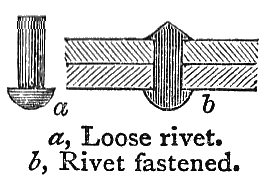
Rivet, riv′et, n. a bolt of metal fastened by being hammered at both ends.—v.t. to fasten with a rivet: to make firm or immovable:—pr.p. riv′eting; pa.t. and pa.p. riv′eted.—ns. Riv′et-cut′ter, a tool for cutting off the ends of rivets; Riv′eter, Riv′etter; Riv′et-hearth, a light portable furnace for heating rivets; Riv′eting; Riv′eting-hamm′er; Riv′eting-machine′, a power-machine for forcing hot rivets into position in metal-work, and heading them; Riv′eting-set, a hollow-faced punch for swaging rivet-heads; Riv′et-knob, a tool for swaging rivet-heads; Riv′et-machine′, a machine for making rivets from rod-iron. [O. Fr. rivet; acc. to Diez from the root of Ice. rífa, Dan. rive, Ger. reiben, Eng. rive.]
Rivière, rē-viār, n. a necklace of precious stones, particularly diamonds. [Fr.]
Rivina, ri-vī′na, n. a genus of apetalous plants, the pokeweed family.
Riving, rī′ving, n. the act of separating.—ns. Ri′ving-knife, a tool for splitting shingles; Rī′ving-machine′, a machine for splitting wood for hoops.
Rivo, rī′vō, interj. (Shak.) a drinking cry.
Rivose, rī′vōs, adj. furrowed. [L. rivus, a stream.]
Rivularia, riv-ū-lā′ri-a, n. a genus of fresh-water algæ.
Rivulet, riv′ū-let, n. a small stream, brook: a geometrid moth.—adj. Riv′ūlose (bot.), marked with irregular lines. [L. rivulus—rivus, a stream.]
Rix-dollar, riks′-dol′ar, n. the rigs-daler of Denmark, &c.
Rixy, rik′si, n. (prov.) the sea-swallow.
Rixy, rik′si, adj. quarrelsome.—n. Rixā′tion, a brawl. [Fr. rixe—L. rixa, a quarrel.]
Rizom, riz′om, n. a plume, as of oats.—adj. Riz′omed (her.), having grains, as an oat-stalk.
Rizzer, riz′ėr, v.t. (Scot.) to dry in the sun.—n. a rizzered haddock.
Rizzer, riz′ėr, n. (Scot.) a red currant.
Rizzle, riz′l, v.t. (prov.) to roast imperfectly.
Rizzle, riz′l, v.i. (prov.) to creep, as ivy.
Roach, rōch, n. a silvery fresh-water fish: a concave curve in the foot of a square sail.—v.t. to arch: to cut short. [O. Fr. roche—Teut.; Ger. roche.]
Roach, rōch, n. a rock: refuse gritty stone.—As sound as a roach, perfectly sound.
Road, rōd, n. a highway for traffic: (B.) a plundering excursion.—ns. Road, Road′stead, Roads, a place where ships ride at anchor; Road′-āg′ent, a highwayman: a commercial traveller; Road′-bed, the bed or foundation of a road: the whole superstructure thereon; Road′-book, a guide-book; Road′-car, a kind of omnibus; Road′-harr′ow, a machine for dragging over roads out of repair; Road′ing, the act of running races with teams; Road′-lev′el, a plumb-level used in the construction of roads; Road′-locomō′tive, a road-steamer; Road′-machine′, a scraper used in road-making; Road′man, Roads′man, one who keeps a road in repair; Road′-met′al, broken stones for roads; Road′-roll′er, a heavy roller used on a macadamised road; Road′-run′ner, a large ground-cuckoo; Road′-scrāp′er, an implement for levelling roads and clearing them of loose stones, &c.; Road′side, footpath: wayside; Road′stead, a place near a shore where vessels may anchor; Road′-steam′er, a locomotive with broad wheels for roads; Road′ster, a horse for driving or riding on the road: a coach-driver: a bicycle, or tricycle; Road′-survey′or, one who supervises roads; Road′way, the way or part of a road or street travelled by carriages; Road′-weed, a plant of the genus Plantago.—adj. Road′worthy, fit for the road.—By the road, by the highway; On the road, travelling; Rule of the road, the custom of the country in passing on a highway; Take to the road, to become a highwayman. [A.S. rád, a riding—rád, pa.t. of rídan, to ride.]
Roam, rōm, v.i. to rove about: to ramble.—v.t. to wander over: to range.—n. Roam′er, a wanderer. [M. E. romen, ramen; allied to A.S. á-rǽman, to spread out, Old High Ger. rāman, rāmen, to direct one's course; the meaning influenced by M. E. Rome-rennere, a pilgrim.]
Roan, rōn, adj. having a bay or dark colour, with spots of gray and white: of a mixed colour, with a decided shade of red.—n. a roan colour: a roan horse: grained sheepskin leather. [O. Fr. roan (Fr. rouan)—Low L. rufanus—L. rufus, red.]
Roan-tree, rōn′-trē. See Rowan.
Roar, rōr, v.i. to utter a full, loud sound: to bellow, as a beast: to cry aloud: to bawl: to guffaw.—n. a full, loud sound: the cry of a beast: an outcry of mirth, esp. of laughter.—ns. Roar′er; Roar′ing, act or sound of roaring: a disease of horses causing them to roar in breathing.—adv. Roar′ingly.—Roaring boys, swaggerers; Roaring forties, the stormy tract between 49° and 50° N. latitude; Roaring game, curling. [A.S. rárian; Mid. High Ger. rēran, Ger. röhren, to cry as a stag, to bellow.]
Roast, rōst, v.t. to cook before a fire, or in an oven: to expose a person to ridicule: to parch by exposure to heat: to heat to excess: to dissipate the volatile parts of by heat.—n. that which is roasted.—ns. Roas′ter, anything suitable for roasting: a furnace used in making ball soda; Roas′ter-slag, slag from the fifth stage of copper-smelting; Roas′ting; Roas′ting-cyl′inder, a furnace for roasting ore; Roas′ting-ear, an ear of maize fit for roasting; Roas′ting-jack, an apparatus for turning the spit on which meat is roasted; Roas′ting-kiln; Roas′ting-ov′en; Roast′-ī′ron, a gridiron.—Roastbeef plant, an iris of Western Europe.—Rule the roast, to domineer. [A.S. róstian; cog. with Dut. roosten, Ger. rösten; or O. Fr. rostir (Fr. rôtir)—Old High Ger. rōstan; or Celt., as Gael. rost, W. rhostio, Bret. rosta, all meaning to roast.]
Rob, rob, v.t. to take away from by force or theft: to plunder: to steal: to deprive: (B.) to withhold what is due.—v.i. to commit robbery:—pr.p. rob′bing; pa.t. and pa.p. robbed.—ns. Rob′ber, one who robs; Rob′ber-coun′cil (Latrocinium Ephesinum), the council which met at Ephesus in August 449, under the presidency of Dioscurus, whose horde of fanatical monks by sheer violence carried the restoration of Eutyches—its resolutions were annulled at Chalcedon in 451; Rob′ber-crab, a hermit-crab; Rob′ber-fly, any dipterous insect of the family Asilidæ; Rob′ber-gull, the skua; Rob′bery, theft from the person, aggravated by violence or intimidation: plundering.—Robbing Peter to pay Paul, paying and repaying out of the same fund: taking what is due to one to pay another. [O. Fr. rober—Old High Ger. roubōn, Ger. rauben.]
Rob, rob, n. the juice of ripe fruit mixed with honey or sugar. [Fr.,—Sp.,—Ar. robb, purified syrup of boiled fruit.]
Robalo, rob′a-lō, n. a fish of the genus Centropomus. [Sp.,—L. labrus—Gr. labrax.]
Robbin, rob′in, n. a short piece of spun-yarn to fasten the head of a sail: the spring of a carriage: the package in which spices, &c., are exported from the East Indies.
Robe, rōb, n. a gown or outer garment: a dress of dignity or state: a rich dress: a dressed skin: the largest and strongest tobacco-leaves: the early form of the chasuble.—v.t. to dress, clothe.—v.i. to assume official vestments.—ns. Robe′-de-cham′bre, a dressing-gown; Robe′-māk′er, a maker of official robes; Rob′ing, the act of putting on ceremonious apparel: a trimming on women's garments; Rob′ing-room, a room in which those wearing official robes, as lawyers, &c., put them on.—Master of the robes, an officer having the charge of the sovereign's robes; The robe, or The long robe, the legal profession. [Fr. robe, robbe; from Old High Ger. raup (Ger. raub), booty.]
Roberd, rob′ėrd, n. the chaffinch.
Robertsman, rob′ėrts-man, n. a stout robber.—Also Rob′erdsman.
Robin, rob′in, n. the Rob′in-red′breast, a well-known and widely-spread singing bird of the family Sylviidæ, with a reddish-orange breast: the red-breasted thrush of North America: the sea-robin or red-breasted merganser: a trimming in front of a dress.—ns. Rob′in-breast, the robin-snipe; Rob′in-dip′per, the buffle-headed duck; Rob′inet, a chaffinch: a little robin: a tap; Rob′in-Good′fellow, the English name of a domestic spirit or brownie, described as the offspring of a woman and Oberon, king of the fairies: an elf or fairy generally, Puck; Rob′in-run-in-the-hedge, the ground-ivy: the bed-straw; Rob′in-snipe, the red-breasted sandpiper; Rob′in's-rye, the hair-cap moss. [A familiar form of Robert; cf. Jack-daw, Mag-pie.]
Robinia, rō-bin′i-a, n. a genus of leguminous trees and shrubs—the Locust-tree, the False Acacia, Thorn Acacia, often simply Acacia. [From the Paris gardener Jean Robin (1550-1629).]
Roble, rō′bl, n. one of the white oaks of California. [Sp.,—L. robur, oak.]
Roborant, rob′or-ant, adj. giving strength.—n. a strengthening medicine.—adj. Robō′reous, like oak, strong. [L. roborāre, to strengthen.]
Roburite, rob′ū-rīt, n. a flameless explosive, composed of chlorinated dinitro-benzene mixed with sufficient ammonium nitrate to completely oxidise it.
Robust, rō-bust′, adj. of great strength or vigour: requiring strength: rude, rough.—adj. Robust′ious (Milt.), violent, rough.—adv. Robust′iously.—n. Robust′iousness.—adv. Robust′ly.—n. Robust′ness. [Fr.,—L. robustus—robur, oak.]
Roc, rok, n. an immense fabulous bird, able to carry off an elephant—also Rok, Ruc, Rukh.—Roc's egg, a mare's nest. [Pers. rukh.]
Rocaille, rō-kal′-ye, n. a scroll ornament of the eighteenth century.
Rocambole, rok′am-bōl, n. a plant of the same genus with garlic, onion, leek, &c., long cultivated in kitchen-gardens.—Also Rok′ambole.
Roccella, rok-sel′a, n. a genus of parmeliaceous lichens, yielding dyers' archil or orchil.—adjs. Roccel′lic, Roccel′line. [Cf. Archil.]
Roccus, rok′us, n. a genus of serranoid fishes, including the rock-fish or striped bass of the United States.
Rochea, rō′kē-a, n. a genus of plants of the order Crassulaceæ. [From the botanist Laroche.]
Rochelle-powder, rō-shel′-pow′dėr, n. seidlitz-powder.—n. Rochelle′-salt, the popular name of the tartrate of soda and potash discovered in 1672 by a Rochelle apothecary named Seignette.
Rochet, roch′et, n. a close-fitting fine linen or lawn vestment proper to bishops and abbots: a mantlet worn by the peers of England during ceremonies. [O. Fr., dim. of Low L. roccus—Old High Ger. roch (A.S. rocc, Ger. rock), a coat.]
Roches moutonnées, rosh mōō-to-nā, n.pl. smooth, rounded, hummocky bosses and undulating surfaces of rock, common in regions overflowed by glacier-ice. [Fr., roche, a rock, moutonnée, masc. moutonné, rounded like a sheep's back.]
Rock, rok, n. a large mass of stone: (geol.) a natural deposit of sand, earth, or clay: that which has the firmness of a rock, foundation, support, defence: (Scot.) a distaff: a hard sweetmeat.—v.t. to throw stones at.—ns. Rock′-al′um, alum stone; Rock′-away, a four-wheeled North American pleasure-carriage; Rock′-bad′ger, a ground-squirrel of North America; Rock′-bās′in, a lacustrine hollow in a rock, excavated by glacier-ice; Rock′-bass, a centrarchoid fish, the goggle-eye; Rock′-bird, a cock of the rock.—adj. Rock′-bound, hemmed in by rocks.—ns. Rock′-break′er, a machine for breaking stones for road-metal; Rock′-butt′er, an impure alum efflorescence of a butter-like consistency found oozing from some alum slates; Rock′-can′dy, pure sugar in large crystals: candy-sugar; Rock′-cist, a plant of the genus Helianthemum; Rock′-cook, the small-mouthed wrasse; Rock′-cork, mountain cork, a variety of asbestos; Rock′-crab, a crab found at rocky sea-bottoms.—adj. Rock′-crowned, surmounted with rocks.—ns. Rock′-crys′tal, the finest and purest quartz, the name being generally applied, however, only to crystals in which the six-sided prism is well developed; Rock′-dol′phin, the sea-scorpion; Rock′-dove, the rock-pigeon or blue-rock; Rock′-drill, a machine-drill worked by steam, &c.; Rock′-eel, a fish of the family Xiphidiontidæ; Rock′-elm, an American elm; Rock′er, the rock-dove; Rock′ery, Rock′work, a mound made with pieces of rock, earth, &c. for the cultivation of ferns, &c.; Rock′-fē′ver, intermittent fever; Rock′-fire, in pyrotechny, a composition of resin, sulphur, nitre, regulus of antimony, and turpentine, burning slowly; Rock′-fish, a name applied to various different varieties of wrasse, the striped bass, black goby, &c.; Rock′-goat, an ibex; Rock′-hawk, the merlin; Rock′-head, bed-rock; Rock′-hop′per, a curl-crested penguin; Rock′ie (Scot.), the rock-lintie or twite; Rock′iness; Rock′-leath′er, rock-cork; Rock′-lil′y, a tropical American cryptogamous plant: a white-flowered Australian orchid; Rock′-lim′pet, a limpet which adheres to rocks; Rock′ling, a genus of fishes of the cod family Gadidæ, of which several species frequent the British seas; Rock′-lin′tie (Scot.), the twite: the Rock′-lark; Rock′-man′ikin, a rock-bird; Rock′-moss, lichen which yields archil; Rock′-oil, petroleum; Rock′-ou′sel, the ring-ousel; Rock′-oys′ter, an oyster-like bivalve; Rock′-pi′geon, a pigeon inhabiting rocks and caves: the sand-pigeon; Rock′-pip′it, the British tit-lark.—n.pl. Rock′-plants, a term applied in gardening to a very miscellaneous group of plants which by their habit of growth are adapted to adorn rockeries.—ns. Rock′-plov′er, the rock-snipe; Rock′-rabb′it, a hyrax; Rock′-rose, a plant of either of the genera Cistus and Helianthemum of the rock-rose family (Cistaceæ); Rock′-ru′by, a ruby-red garnet; Rock′-salm′on, the coal-fish: an amber-fish; Rock′-salt, salt in solid form; Rock′-ser′pent, a venomous Indian serpent, allied to the cobra; Rock′-slāt′er, a wood-louse; Rock′-snake, a python or anaconda; Rock′-snipe, the purple sandpiper; Rock′-soap, a deep-black mineral used for crayons, consisting of silica, alumina, peroxide of iron, and water; Rock′-sparr′ow, a finch: the ring-sparrow; Rock′-star′ling, the rock-ousel; Rock′-swift, the white-throated rock-swift of North America; Rock′-tar, petroleum; Rock′-tem′ple, a temple hewn out of the solid rock; Rock′-thrush, any bird of the genus Monticola or Petrocincla; Rock′-tripe, lichens of the genus Umbilicaria; Rock′-trout, the common American brook-trout: sea-trout; Rock′-vī′olet, an alga growing on moist rocks in the Alps; Rock′-war′bler, a small Australian bird; Rock′-win′kle, a periwinkle; Rock′-wood, ligniform asbestos; Rock′work (archit.), masonry in imitation of masses of rock: a rockery; Rock′-wren, a wren which frequents rocks.—adj. Rock′y, full of rocks: resembling a rock: hard: unfeeling. [O. Fr. roke, roche; prob. Celt., as in Gael. roc, W. rhwg, a projection.]
Rock, rok, n. a distaff.—n. Rock′ing, an evening party in the country. [Ice. rokkr; Ger. rocken.]
Rock, rok, v.t. to move backward and forward: to lull or quiet.—v.i. to be moved backward and forward, to reel.—ns. Rock′er, the curved support on which a cradle or rocking-chair rocks: a rocking-horse or chair: a mining cradle; Rock′-cam, a cam keyed to a rock-shaft; Rock′ing, a swaying backward and forward: the abrading of a copper plate with a rocker, preparatory to mezzo-tinting: the motion by which the design on a steel mill is transferred to a copper cylinder; Rock′ing-beam, an oscillating beam in an automatic transmitter; Rock′ing-chair, a chair mounted on rockers; Rock′ing-horse, the figure of a horse, of wood or other material, mounted on rockers for children: a hobby-horse; Rock′ing-pier, a pier fastened by a movable joint so as to allow it to rock slightly; Rock′ing-stone, a logan, or large mass of rock so finely poised as to move backward and forward with the slightest impulse; Rock′ing-tree, in weaving, the axle from which the lay of a loom is suspended; Rock′-shaft, in steam-engines, a shaft that oscillates instead of revolving.—adj. Rock′y, disposed to rock: tipsy. [A.S. roccian; cf. Dan. rokke, to rock, Ger. rücken, to pull.]
Rockel, rok′el, n. (prov.) a woman's cloak.
Rocket, rok′et, n. a firework which is projected through the air, used for making signals in war, and for saving life at sea by conveying a line over a stranded vessel.—v.i. to fly straight up rapidly when flushed.—ns. Rock′et-case, a case for holding the materials of a rocket; Rock′eter. [Old It. rocchetto; of Teut. origin. Cf. Rock, a distaff.]
Rocket, rok′et, n. any one of several ornamental Old World herbs of the genus Hesperis, of the mustard family. [O. Fr. roquette—L. eruca, cole-wort.]
Rococo, rō-kō′kō, n. a debased style of architecture and decoration in the 18th century, marked by endless multiplication of ornamental details. [Fr., prob. from Fr. rocaille, rockwork.]
Rocta, rok′ta, n. a medieval musical instrument, resembling the violin.
Rod, rod, n. a long twig: a slender stick: anything long and slender, as a magic rod, a lightning-rod, a fishing-rod, &c.: an instrument of correction: an emblem of power or authority: a pole or perch (5½ yards, or 16½ feet)—the square rod, generally called rood, is employed in estimating masonry-work, and contains 16½ × 16½, or 272¼ sq. feet: (fig.) punishment: authority: oppression: (B.) race or tribe: one of the layers of rods composing the retina of the eye: any bar connecting parts of a machine.—v.t. to furnish with rods, esp. lightning-rods.—ns. Rod′-fish′er; Rod′-fish′ing, fly-fishing: angling; Rod′-line, a fishing-line not wound on a reel; Rod′-machine′, in wood-working, a machine for cutting cylindrical sticks such as broom-handles; Rod′-ring, one of the rings along a fishing-rod through which the line runs; Rod′ster, an angler.—Napier's rods (see Napierian). [A.S. ród; Dut. roede, Ger. ruthe; L. rudis.]
Roddin, rod′in, n. (Scot.) rowan-tree.
Rode, rōd, pa.t. of ride.
Rode, rōd, n. (Spens.) a raid, an incursion: also, a roadstead. [Road.]
Rodent, rō′dent, adj. gnawing: belonging to the Rodentia.—n. a rodent mammal.—n.pl. Roden′tia, an order of mammals including squirrels, beavers, rats, rabbits, &c. [L. rodĕre, to gnaw.]
Rodeo, rō-dā′ō, n. a gathering of cattle to be branded. [Sp., rodar, to go round—L. rotāre, to wheel.]
Rodge, roj, n. (prov.) the gray duck.—Also Radge.
Rodomel, rod′ō-mel, n. the juice of roses mixed with honey. [Gr. rhodon, rose, meli, honey.]
Rodomontade, rod-ō-mon-tād′, n. vain boasting, like that of Rodomonte in the Orlando Furioso of Ariosto (earlier Rod′omont).—v.i. to bluster or brag.—ns. Rodomontā′dist, Rodomontā′do (obs.).
Roe, rō, n. the eggs or spawn of fishes: a mottled appearance in wood, esp. mahogany.—adj. Roed, containing roe. [Ice. hrogn; Ger. rogen.]
Roe, rō, n. a species of deer, smaller than the fallow-deer: also the female of the hart.—ns. Roe′buck, the male of the roe, having usually one front antler and two hinder ones; Roe′buck-berr′y, the stone-bramble; Roe′-deer, a roebuck or roe. [A.S. ráh; Ger. reh, Dut. ree.]
Roe-stone, rō′-stōn, n. the same as Oolite (q.v.).
Rog, rog, v.t. (obs.) to shake.
Rogation, rō-gā′shun, n. an asking: supplication.—n.pl. Rogā′tion-days, the three days before the festival of Ascension, the Litany being anciently recited in procession then.—ns. Rogā′tion-flow′er, the milk-wort; Rogā′tion-Sun′day, that before Ascension-day; Rogā′tion-week, the week in which the rogation-days occur.—adj. Rog′atory. [L.,—rogāre, to ask.]
Roger, roj′ėr, n. (prov.) ram: a rogue.—(Sir) Roger-de-Coverley, an English country-dance.
Roggan, rog′an, n. (prov.) a rocking-stone.
Roggenstein, rog′en-stīn, n. a kind of oolite in which the grains are cemented by argillaceous matter. [Ger., roggen, rye, stein, stone.]
Roggle, rog′l, v.i. (prov.) to shake.
Rogue, rōg, n. a dishonest person: a knave: a mischievous or frolicsome person: a vagrant, a sturdy beggar: a wag: a playful person: a plant that falls short of a standard.—v.i. to play the rogue.—v.t. to cheat.—ns. Rogue′-el′ephant, one which lives solitarily, and is of dangerous temper; Rogue′-house, a lock-up; Rogue′-mon′ey, an assessment formerly levied in every county in Scotland for the expenses of catching and prosecuting criminals; Rog′uery, knavish tricks: fraud: mischievousness: waggery; Rogue′ship; Rogue's′-march, music played when drumming a soldier from a regiment, or driving any one away in disgrace.—adj. Rog′uish, knavish: mischievous: waggish.—adv. Rog′uishly.—n. Rog′uishness.—adj. Rō′guy (obs.).—Rogues' gallery, a collection of photographs of criminals kept at police headquarters. [O. Fr. rogue, proud; either from Bret. rok, proud, or acc. to Diez, from Ice. hrók-r, proud.]
Rohan, rō′han, n. an East Indian timber-tree—called also Red-wood and East Indian mahogany.
Roil, roil, v.t. to render turbid: to vex: to rile: to salt fish with a machine called a Roil′er—also Royle.—adj. Roil′y, muddy. [O. Fr. roeler, roler, to disturb, cog. with roll; or O. Fr. roille—L. robigo, rust.]
Roinish, roi′nish, adj. (Shak.) mangy, mean.—Also Roi′nous. [O. Fr. roigneux—L. robiginosus, rusty—robigo, rust.]
Roist, roist, Roister, rois′tėr, v.i. to bluster, swagger, bully.—ns. Rois′ter (arch.), Rois′terer.—adj. Rois′terous.—p.adj. Rois′ting (Shak.), blustering, bullying. [O. Fr. rustre, a rough, rude fellow—O. Fr. ruste—L. rusticus, rustic.]
Roitelet, roi′te-let, n. a petty king: (ornith.) a kinglet or gold-crest.
Roke, rōk, n. (prov.) mist: smoke.—adj. Rō′ky, misty, foggy.
Rokeage, rō′kāj, n. parched and sweetened Indian corn—also Rō′kee.—Also called Pinole.
Rokelay, rok′e-lā, n. Same as Roquelaure.
Roker, rōk′ėr, n. the thornback ray.
Roland, rō′land, n. a chivalrous hero, from Roland in the Charlemagne legend, slain by the Gascons at Roncesvalles in 778.—A Roland for an Oliver, a blow for a blow, anything done or said to match something else.
Rôle, rōl, n. the part performed by an actor in a play: any important part played in public life. [Fr.]
Role, rōl, n. an ancient unit of quantity, seventy-two sheets of parchment.
Roll, rōl, v.i. to turn like a wheel: to turn on an axis: to be formed into a roll or cylinder: to move, as waves: to be tossed about: to move tumultuously: to be hurled: to rock, or move from side to side: to wallow: to spread under a roller: to sound as a drum beaten rapidly: to move onward.—v.t. to cause to roll: to turn on an axis: to wrap round on itself: to enwrap: to drive forward: to move upon wheels: to press or smooth with rollers: to beat rapidly, as a drum.—n. act of rolling: that which rolls: a revolving cylinder making sheets, plates, &c.: a roller: that which is rolled up—hence parchment, paper, &c. wound into a circular form: a document: a register: a kind of fancy bread: the continued sound of a drum, of thunder, &c.: a swagger or rolling gait.—adj. Roll′-about′, podgy.—ns. Roll′-call, the calling of the roll or list of names, as in the army; Roll′-cū′mūlus, a form of strato-cumulus cloud; Roll′er, that which rolls: a cylinder used for rolling, grinding, &c.: one of a family of Picarian birds: a long, broad bandage: (pl.) long heavy waves; Roll′er-skate, a skate mounted on wheels or rollers for use on asphalt or some other smooth surface.—adj. Roll′ing, modulating: moving on wheels: making a continuous sound.—ns. Roll′ing-mill, a place in which metal is made into sheets, bars, rails, or rods, by working it between pairs of rolls: a machine for rolling metal, &c., into any required form, or for crushing materials between rollers; Roll′ing-pin, a cylindrical piece of wood for rolling dough, paste, &c. to any required thickness; Roll′ing-press, a press of two cylinders for rolling or calendering cloth; Roll′ing-stock, the stock or store of locomotive-engines, carriages, &c. of a railway; Roll′way, an incline: a shoot.—Master of the Rolls, the head of the Record-office. [O. Fr. roler, roeler (Fr. rouler)—Low L. rotulāre—L. rotula, a little wheel—rota, a wheel.]
Rollick, rol′lik, v.i. to move or act with a careless, swaggering, frolicsome air:—pr.p. rol′licking; pa.p. rol′licked.—adj. Rol′licking, careless, swaggering. [Prob. roll, with dim. suffix.]
Rollock. See Rowlock.
Roly-poly, rōl′i-pōl′i, n. a pudding made of a sheet of paste, covered with sweetmeats, and rolled up: a stout podgy person: an old game in which balls are bowled into holes or thrown into hats placed on the ground.—adj. round, podgy.
Rom, rom, n. a gipsy. [Gipsy rom, man, husband.]
Romage, rum′āj, n. (Shak.) tumult. [Rummage.]
Romaic, ro-mā′ik, n. modern Greek, the language of the descendants of the Eastern Romans: Hellenic.—adj. pertaining to the foregoing.—n. Romā′ika, a modern Greek dance. [Fr. Romaïque—modern Gr. Rhōmaikos—Rhōmē, Rome.]
Romal, rō-mal′, n. a braided thong of leather, serving as a horseman's whip. [Sp. ramal—L. ramale—ramus, a branch.]
Romalea, rō-mā′lē-a, n. a genus of large-bodied, short-winged locusts. [Gr. rhōmē, strength.]
Roman, rō′man, adj. pertaining to Rome or to the Romans: pertaining to the Roman Catholic religion, papal: (print.) noting the letters commonly used, as opposed to Italics: written in letters (as IV.), not in figures (as 4).—n. a native or citizen of Rome: a Romanist in religion: a Roman letter or type.—adj. Roman′ic, pertaining to Rome or its people.—n. Romanisā′tion.—v.t. Rō′manīse, to convert to the Roman Catholic religion: to Latinise: to represent by Roman letters or types.—v.i. to conform to Roman Catholic opinions or practices: to print in Roman letters.—n. Romanī′ser.—adj. Rō′manish, pertaining to Romanism.—ns. Rō′manism, the tenets of the Roman Catholic Church; Rō′manist, a Roman Catholic.—adj. Roman Catholic.—adj. Rō′mano-Byzan′tine, pertaining to an early medieval style of architecture in which Byzantine and Western elements are combined.—ns. Rome′-penn′y, -scot, Peter's pence.—adv. Rome′ward, toward the Roman Catholic Church.—adj. Rō′mish, belonging to Rome, or to the Roman Catholic Church.—n. Rō′mist.—Roman architecture, a style characterised by the size and boldness of its round arches and vaults, &c.—baths, aqueducts, basilicas, amphitheatres, &c.; Roman candle, a firework discharging a succession of white or coloured stars; Roman Catholic, denoting those who recognise the spiritual supremacy of the Pope or Bishop of Rome—as a noun, a member of the Roman Catholic Church; Roman Catholicism, the doctrines and polity of the Roman Catholic Church collectively; Roman cement, a cement which hardens under water; Roman collar, a collar made of lawn or fine linen, bound and stitched, worn by priests over a black collar, by bishops over a purple, and cardinals over a scarlet; Roman Empire, the ancient empire of Rome, divided in the 4th century into the Eastern and Western Empires; Roman law, the civil law.—Holy Roman Empire (see Holy). [L. Romanus—Roma, Rome.]
Romance, rō-mans′, n. a general name for those modern languages in southern Europe which sprang from a corruption of the Roman or Latin language—Italian, Spanish, Portuguese, Provençal, French, Roumanian, Romansch, &c.: a tale written in one of these dialects: any fictitious and wonderful tale: a fictitious narrative in prose or verse which passes beyond the limits of real life: a ballad.—adj. belonging to the dialects called Romance.—v.i. to write or tell romances: to talk extravagantly: to build castles in the air.—ns. Roman′cer, Roman′cist.—adjs. Roman′cical (Lamb), dealing with romance; Roman′ic, Romance: derived from the Roman alphabet. [O. Fr. romans—Low L. adv. (loqui) romanice, (to speak) in the Roman or Latin tongue—L. Romanicus, Roman.]
Romanesque, rō-man-esk′, n. that which pertains to romance: (archit.) the style of round-arched and vaulted architecture which succeeded Roman architecture, from about the time of Constantine (c. 350 A.D.) till it was gradually superseded by Gothic in the 12th century: the dialect of Languedoc. [Fr.,—Sp. Romanesco—L. Romanicus.]
Romansch, rō-mansh′, n. the language spoken from the Grisons to Friuli on the Adriatic.—Also Rhæ′to-Roman′ic.
Romant, rō-mant′, v.i. to romance: to exaggerate.—n. a romance—generally Rōmaunt′.
Romantic, rō-man′tik, adj. pertaining to or resembling romance: fictitious: extravagant, wild: fantastic: sentimental: imaginative.—adv. Roman′tically.—ns. Roman′ticism, the revolt from the severity, pedanticism, and commonplaceness of a classical or pseudo-classical to a more picturesque, original, free and imaginative style in literature and art, marking the close of the 18th century: romantic feeling; Roman′ticist; Roman′ticness.
Romany, Rommany, rom′a-ni, n. a gipsy: the language of the gipsies.—adj. belonging to the gipsies.—Romany rye, a gentleman who affects the society of gipsies. [Gipsy, rom, man.]
Romero, rō-mā′rō, n. the pilot-fish.
Romic, rō′mik, n. a phonetic notation devised by Henry Sweet, based upon the original Roman values of the letters, supplemented by turned and ligatured letters and diagraphs—in part a recasting of Ellis's Glossic.
Romp, romp, v.i. to play noisily: to skip about in play.—n. a girl who romps: rude frolic.—adv. Romp′ingly, in a romping manner: boisterously: rudely.—adj. Romp′ish, fond of romping or noisy play.—adv. Romp′ishly.—n. Romp′ishness. [Ramp.]
Rompu, rom-pū′, adj. (her.) fracted. [Fr.]
Roncador, rong′ka-dōr, n. one of several sciænoid fishes of the Pacific coast. [Sp.,—L. rhonchus, a snoring.]
Ronchil. See Ronquil.
Rondache, ron-dash′, n. a buckler. [O. Fr. rond.]
Ronde, rond, n. (print.) an angular writing-type.
Rondeau, ron′dō, n. a form of poem characterised by closely-knit rhymes and a refrain, and, as defined in the 17th century, consisting of thirteen lines, divided into three unequal strophes—the two or three first words of the first line serving as the burden, recurring after the eighth and thirteenth lines—brought into vogue by Swinburne: (mus.) a rondo.—ns. Ron′del, a form of French verse, earlier than the rondeau, consisting of thirteen octosyllabic or decasyllabic lines on two rhymes—practised by Charles of Orleans, &c.; Ron′delet, a poem of five lines and two refrains; Ron′do, a musical composition of several strains, during which the first part or subject is repeated several times—often occurring as one of the movements of a sonata: the musical setting of a rondeau: a game of hazard played with small balls; Rondolet′to, a simple rondo. [Fr., from rond, round.]
Rondelle, ron-del′, n. anything round: one of the successive crusts formed on molten metal when cooling, a rosette.—n. Rond′le, a round, step of a ladder (same as Rondelle). [O. Fr., dim. of rond, round.]
Rondure, ron′dūr, n. (Shak.) a round, a circle, the globe. [Fr. rondeur—rond, round.]
Rone, rōn, n. (Scot.) a shrub, a thicket.
Rone, rōn, n. the gutter which collects the rain from the roof—a dial. form of rine.
Rong, rong (Spens.), pa.t. and pa.p. of ring.
Rongeur, rong-zhėr, n. a forceps for gouging bones.
Ronin, rō′nin, n. a discharged Japanese samurai, an outcast or outlaw. [Jap., lit. 'wave-man.']
Ronion, Ronyon, run′yun, n. a mangy, scabby animal or person. [Fr. rogneux—rogne, mange.]
Ronquil, rong′kil, n. a fish of the North Pacific.—Also Ron′chil. [Sp. ronquillo—ronco—L. raucus, hoarse.]
Ront, ront. Same as Runt (q.v.).
Röntgen rays. See X-rays.
Rood, rōōd, n. the fourth part of an acre, or forty perches—from the rod used in measuring: a figure of Christ's cross, and often of the crucifix, esp. that placed at the entrance to the choir in medieval churches.—ns. Rood′-beam (archit.), a beam across the chancel of a church for supporting the rood; Rood′-loft, a gallery over the rood-screen; Roodmas-day, Holy-rood-day; Rood′-screen, an ornamental partition separating the choir from the nave; Rood′-steep′le, a spire built over the entrance to the chancel; Rood′-tree, the cross; Hō′ly-rood, a crucifix. [Same as rod. A.S. ród.]
Roodebok, rōōd′e-bok, n. the bush-buck. [Dut. rood, red, bok, buck.]
Roof, rōōf, n. the top covering of a house or building: a vault or arch, or the inner side of it: a house or dwelling: the upper part of the palate: the loftiest part, the roof and crown of things: the top of a subterraneous excavation: (geol.) the overlying stratum.—v.t. to cover with a roof: to shelter.—ns. Roof′er, one who roofs; Roof′ing, covering with a roof: materials for a roof: the roof itself: shelter.—adj. Roof′less, without a roof: having no house or home: unsheltered.—ns. Roof′let, a small roof or covering; Roof′-plate, a wall-plate which receives the lower ends of the rafters of a roof.—adj. Roof′-shaped, shaped like a gable roof.—ns. Roof′-stā′ging, a scaffold used in working on an inclined roof; Roof′-tree, the beam at the peak of a roof: the roof.—adj. Roof′y, having a roof or roofs.—French roof, a form of roof with almost vertical sides; Gothic roof, a very high-pitched roof; Mansard roof (see Mansard); Square roof, one in which the chief rafters meet at a right angle. [A.S. hróf; Dut. roef.]
Rook, rook, n. a species of crow—from its croak: the ruddy duck: a cheat: a simpleton.—v.i. to cheat.—ns. Rook′er, a swindler; Rook′ery, a group of trees on which rooks build: a cluster of mean tenements: a resort of thieves: a disturbance.—adj. Rook′y (Shak.), inhabited by rooks. [A.S. hróc; Goth. hrukjan, to croak.]
Rook, rook, n. a castle or piece used in playing chess. [O. Fr. roc—Pers. rokh.]
Rookle, rōōk′l, v.i. to poke about like a pig. [Rootle.]
Rool, rōōl, v.t. to raggle, to ruffle.
Room, rōōm, n. space: a chamber: extent of place: space unoccupied: freedom to act: fit occasion: place of another: stead: (B.) a seat: a particular place: a box in a theatre: office: the inner room of a cottage: a garret.—v.i. to occupy a room, to lodge.—adv. (naut.) off from the wind.—n. Room′age, capacity.—adj. Roomed, containing rooms.—ns. Room′er, a lodger; Room′ful, as much or as many as a room will hold.—adv. Room′ily.—n. Room′iness.—adsj. Room′-rid′den, confined to one's room; Room′some, roomy.—adv. Room′y, having ample room: wide: spacious.—Give room, to withdraw so as to leave space for others; Make room, to open a way. [A.S. rúm; Ger. raum, Dut. ruim.]
Room, rōōm, n. a deep-blue dye.—Also Roum.
Roon, rōōn, n. (Scot.) a rim or border.
Roop, rōōp, v.i. (obs.) to roar.—n. hoarseness.—adsj. Roop′it, Roop′y (Scot.), hoarse. [A.S. hrópan, pa.t. hreóp; cf. Ger. rufen, to cry out.]
Roose, rōōz, v.t. (Scot.) to praise highly. [M. E. rosen—Scand., Ice. hrósa, to praise.]
Roost, rōōst, n. a pole or support on which a bird rests at night: a number of fowls resting together: (Scot.) the inner roof of a cottage.—v.i. to sit or sleep on a roost.—n. Roost′er, the male of the domestic fowl, cock: any bird that roosts.—At roost, roosting, asleep. [A.S. hróst; Dut. roest.]
Root, rōōt, n. the part of a plant which is fixed in the earth, and which draws up sap from the soil: an edible root: anything like a root, a growing plant together with its root: the bottom: a word from which others are derived: the cause, occasion, or basis of anything: the source: the lowest place: the first ancestor, or progenitor: (math.) the factor of a quantity which multiplied by itself produces that quantity: any value of the unknown quantity in an equation which will render both sides of it identical.—v.i. to fix the root: to be firmly established: to tear up: to eradicate: to exterminate.—v.t. to plant in the earth: to implant deeply.—ns. Root′age, the act of striking roots; Root′-beer, a drink made from roots of dandelion, sassafras, &c.; Root′-bōr′er, an insect which bores the roots of plants.—adj. Root′-bound (Milt.), fixed in the earth by, or as by, the root.—ns. Root′-cap, a cap-like layer of cells at the tip of roots; Root′-crop, a crop of esculent roots, esp. of single-rooted plants, as turnips, &c.; Root′-dig′ger, a form of tongs for raising carrots, &c.; Root′-eat′er, any animal feeding habitually on roots.—adj. Root′ed, firmly planted: fixed by the roots: deep-seated, as a rooted dislike.—adv. Root′edly.—ns. Root′edness; Root′er.—adj. Root′-fast, firmly rooted.—ns. Root′-fī′bril, one of the fine divisions of a root; Root′-form, a form assumed by an insect when feeding on roots; Root′-graft′ing, the process of grafting scions on a part of the root of some appropriate stock; Root′-hair, a delicate filament developed from a single cell.—adj. Root′-head′ed, fixed as if rooted by the head.—ns. Root′-house, a rustic-house: a storehouse for potatoes, &c.; Root′-knot, an abnormal knot of a root.—adj. Root′less, destitute of roots.—ns. Root′let, a little root: a radicle; Root′-louse, one of the plant-lice; Root′-par′asite, a plant which grows upon, and derives its nourishment from, the root of another plant; Root′-pres′sure, an upward flow of sap, 'bleeding;' Root′-pulp′er, a mill for grinding roots; Root′-sheath, the sheath of the root of a hair or feather; Root′-stock (bot.), a prostrate rooting stem, either fleshy or woody, which yearly produces young branches or plants: origin.—adj. Root′y, abounding in roots: rank.—Root and branch, completely; Root of bitterness, a dangerous error drawing away to apostasy; Root of the matter, that which is essential.—Strike, or Take, root, to root, to become fixed. [Scand.; Ice. rót; Dan. rod; Goth. waurts, A.S. wyrt.]
Root, rōōt, v.t. to turn up with the snout.—v.i. to turn up the earth with the snout.—n. Root′er.—v.t. Root′le. [A.S. wrótan—wrót, a snout.]
Ropalic=Rhopalic (q.v.).
Rope, showing method of construction.
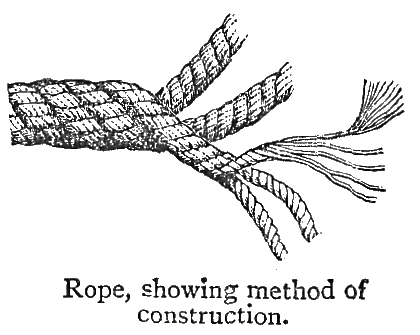
Rope, rōp, n. a thick twisted cord: a string consisting of a number of things united, as a rope of pearls: anything glutinous and stringy: a local lineal measure, 20 feet.—v.i. to fasten with a rope, to restrain: to catch with a noosed rope: to tether: to enclose: to extend into a thread, as by a glutinous quality.—ns. Rope′-clamp, a pair of clamping jaws for securing the end of a cord; Rope′-danc′er, one who performs acrobatic feats on a rope: a rope-walker; Rope′-drill′ing, a method of boring holes in which a rope is used; Rope′-house, an evaporating-house in salt manufacture; Rope′-ladd′er, a ladder made of ropes; Rope′-machine′, a machine for making ropes from yarn; Rope′-māk′er, Rō′per, a maker of ropes; Rope′-māk′ing; Rope′-por′ter, a pulley to save the ropes of steam-ploughs from friction; Rope′-pull′ing, the sport of pulling at a rope, each party endeavouring to draw the other over a line; Rope′-pump, a machine for raising water by an endless rope; Rō′per, a crafty fellow: one who throws the lasso; Rope′-rail′way, a cable-railway.—adj. Rope′-ripe, deserving to be hanged.—ns. Rope′-run′ner, a railway brakesman; Rō′pery, a place where ropes are made; Rope′-spin′ner, one who spins ropes by a revolving wheel; Rope′-stitch, a kind of work in which the stitches are laid diagonally side by side; Rope′-trick, a juggling trick in which a man is firmly tied with ropes from which he extricates himself: (Shak.) a trick deserving the gallows; Rope′-walk, a long narrow shed used for the spinning of ropes; Rope′-winch, a set of three whirlers for twisting simultaneously the three yarns of a rope; Rope′-yarn, a yarn of many fibres for ropes.—adv. Rō′pily.—n. Rō′piness, stringiness: viscosity.—adjs. Rō′ping, Rō′pish, Rō′py, stringy, glutinous.—Rope in, to gather in, to enlist; Rope of sand, a tie easily broken; Rope's end, an instrument of punishment.—Be at the end of one's rope, to have exhausted one's powers or resources; Give a person rope, to allow a person full scope; On the high rope, elated, arrogant. [A.S. ráp; Ice. reip, Dut. reep, Ger. reif.]
Roquelaure, rok′e-lōr, n. a short cloak worn in the 18th century. [Fr.]
Roquet, rō-kā′, n. in the game of croquet, a stroke by which a player strikes another's ball.—v.t. to make this shot. [Prob. formed from croquet.]
Roric, rō′rik, adj. pertaining to dew: dewy—(obs.) Rō′ral.—n. Rorid′ula, a genus of polypetalous plants of the Sundew family.—adjs. Rorif′erous, producing dew; Rorif′luent, flowing with dew; Rō′rulent, full of dew: covered with bloom which may be rubbed off. [L. ros, roris, dew.]
Rorqual, ror′kwal, n. a genus of whales of the largest size. [Sw. rörhval—rör, round, hval, whale.]
Rosaceous, rō-zā′shus, adj. (bot.) pertaining to the rose family: with the petals arranged like the rose.—ns. Rosā′rian, a rose-fancier; Rosā′rium, a rose-garden; Rō′sa-sō′lis, a cordial made with spirits and various flavourings.—adj. Rō′sāted, crowned with roses. [L. rosaceous—rosa, a rose.]
Rosalia, rō-zā′li-a, n. a form of melody in which a phrase is repeated, each time being transposed a step forward. [It.]
Rosaniline, rō-zan′i-lin, n. a derivative of aniline: magenta: roseine.
Rosary, rō′za-ri, n. the string of beads by which Roman Catholics count their prayers: a series of devotions, aves, paternosters, and glorias: a rose-garden: a chaplet: an anthology.—Festival of the Rosary, a festival on the first Sunday in October, commemorating the victory over the Turks at Lepanto in 1571. [O. Fr. rosarie—Low L. rosarium—L. rosa, a rose.]
Roscid, ros′id, adj. dewy. [L.,—ros, roris, dew.]
Rose, pa.t. of rise.
Rose, rōz, n. any shrub of the genus Rosa, having stems generally prickly, flowers terminal, often corymbose, in colour white, yellow, pink, or red: a flower of one of these shrubs: any one of various plants resembling the true rose: a rosette: a perforated nozzle of a pipe, &c.: light crimson, the colour of the rose: an ornamental tie: erysipelas: (her.) a conventional representation of the flower.—v.t. to flush.—n. Rose′-acā′cia, the moss-locust, a tree with deep rose-coloured flowers.—adjs. Rō′seal, like a rose in smell or colour; Rō′seāte, rosy: full of roses: blooming: red.—ns. Rose′-bee′tle, -bug, a coleopterous insect about an inch long, which is destructive to flowers, esp. roses: the rose-chafer; Rose′-berr′y, the fruit of the rose: a hip; Rose′-bit, a cylindrical bit, the oblique surface of which is cut into teeth.—adj. Rose′-breast′ed, having rose-colour on the breast.—ns. Rose′-bud, the bud of the rose: a young girl; Rose′-burn′er, Rosette′-burn′er, a gas-burner in which the gas issues from a series of openings arranged radially round a centre; Rose′-bush, the shrub which bears roses; Rose′-cam′phor, one of the two volatile oils composing attar-of-roses; Rose′-cam′pion, a red flower, Lychnis coronaria; Rose′-carnā′tion, a carnation striped with rose-colour; Rose′-chāf′er, an injurious beetle whose grubs destroy the roots of strawberries, &c.; Rose′-col′our, the colour of a rose, pink: fancied beauty or attractiveness.—adj. Rose′-col′oured, having the colour of a rose.—n. Rose′-cross, a cross within a circle: a Rosicrucian.—adj. Rose′-cut, cut with a smooth, round surface, as a precious stone, and not in facets.—p.adj. Rosed (Shak.), crimsoned, flushed.—ns. Rose′-dī′amond, a diamond nearly hemispherical, cut into twenty-four triangular facets; Rose′-drop, a rose-flavoured orange: a pimply eruption on the nose caused by tippling; Rose′-en′gine, a form of lathe combining the rotary motion of the mandrel with a radial movement of the tool-rest; Rose′-fes′tival, a festival celebrated on 8th June, at Salency in France; Rose′-fly′catcher, an American fly-catching warbler; Rose′-gall, a gall produced on roses by an insect; Rose′-gerā′nium, a house-plant with rose-scented leaves; Rose′-haw, the fruit of the wild-rose: a Rose′-hip.—adj. Rose′-hued, rose-coloured.—n. Rose′-knot, a rosette of ribbon or other soft material.—adj. Rose′-lipped, having red lips.—ns. Rose′-mall′ow, a plant of the same genus, but larger, and having a finer flower than the common mallow, the hollyhock; Rose′-mould′ing (archit.), a moulding ornamented with roses; Rose′-nō′ble, an ancient English gold coin, stamped with the figure of a rose, and current at the value of 6s. 8d. (see Noble, a coin).—adj. Rose′-pink, having a pink or rose colour: sentimental.—n. a crimson-pink colour.—ns. Rose′-quartz, a transparent quartz; Rose′-rash (see Roseola).—adjs. Rose′-red, red as a rose; Rose′-ringed, with a collar of red feathers, as a parrot.—ns. Rose′-root, a succulent herb, having a rose-scented root; Rō′sery, a place where roses are cultivated; Rose′-saw′fly, a sawfly which attacks the rose; Rose′-tan′ager, the summer red-bird; Rose′-tō′paz, an artificial colour of the true topaz produced by heat; Rose′-tree, a standard rose; Rose′-vin′egar, an infusion made by steeping roses in vinegar; Rose′-wa′ter, water distilled from rose-leaves.—adj. sentimental, as 'rose-water philosophy.'—ns. Rose′-win′dow, a circular window with its compartments branching from a centre, like a rose; Rose′wood, the wood of a Brazilian tree having a fragrance like that of roses; Rose′wood-oil, oil obtained from rosewood; Rose′-worm, the larva of a moth which feeds on the leaves of the rose, &c.; Rose′-yard, a rose-garden.—adj. Rō′sied, decorated with roses or the colour of roses.—n. Rō′sier (Spens.), a rose tree or bush.—adv. Rō′sily.—n. Rō′siness.—adjs. Rō′sy, like a rose: red: blooming: blushing: charming; Rō′sy-bos′omed, -col′oured; Rō′sy-bright, bright like a rose: blooming.—n. Rō′sy-drop, acne rosacea: a grog-blossom.—adjs. Rō′sy-fing′ered, Homer's favourite epithet of the dawn: with rosy fingers; Rō′sy-kin′dled, blushing with a rosy colour; Rō′sy-mar′bled, marbled with rosy colour.—ns. Rō′sy-marsh, -rus′tic, -wave, names of moths.—adj. Rō′sy-tint′ed, tinted of a rose-colour.—Under the rose (L., sub rosâ), under the pledge of secrecy, the rose being, among the ancients, the symbol of secrecy; Wars of the Roses, a disastrous dynastic struggle between the Houses of Lancaster and York, which desolated England during the 15th century, from the first battle of St Albans (1455) to that of Bosworth (1485). [A.S. róse—L. rosa, Gr. rhodon.]
Roselet, roz′let, n. the summer fur of the ermine.
Roselite, rō′ze-līt, n. a mineral occurring in small red crystals, being a native arseniate of cobalt. [Ger. roselith, from the mineralogist Gustav Rose (1798-1873), Gr. lithos, a stone.]
Rosella, rō-zel′a, n. the Australian rose-parrakeet.
Roselle, rō-zel′, n. an East Indian rose-mallow.
Rosemary, rōz′mā-ri, n. a small fragrant evergreen shrub of a pungent taste, growing in the countries round the Mediterranean—an ancient emblem of fidelity. [O. Fr. rosmarin—L. ros-marinus—ros, dew, marinus—mare, the sea.]
Roseola, rō-zē′ō-la, n. a rash of rose-coloured patches.
Roset, rō′zet, n. a red colour used by painters.
Roset, ros′et, n. (Scot.) rosin.
Rosetta-stone, rō-zet′a-stōn, n. a slab of black basalt found at Rosetta in Egypt in 1799, having inscribed upon it, in hieroglyphics, demotic or enchorial, and Greek, a decree in honour of Ptolemy V.—the first clue to the decipherment of hieroglyphics.
Rosetta-wood, rō-zet′a-wōōd, n. a handsome orange-wood used in cabinet-making.
Rosette, rō-zet′, n. an imitation of a rose by means of a ribbon: a form of knot: (archit.) a rose-shaped ornament: a disc formed by throwing water on melted metal.—adj. Roset′ted.—Red rosette, or button, the rosette worn by officers of the Legion of Honour. [Fr., dim. of rose.]
Rosicrucian, roz-i-krōō′shi-an, n. one of a secret society of the 17th century, the members of which made great pretensions to an acquaintance with the secrets of Nature, the transmutation of metals, power over elemental spirits, magical signatures, &c.—n. Rosicru′cianism. [Prob. Latinised from Christian Rosenkreuz ('rose cross,' L. rosa, rose, crux, cross), the alleged founder in 1459; or from L. roscidus, dewy—ros, dew, crux, crucis, a cross.]
Rosin, roz′in, n. the solid left after distilling off the oil from crude turpentine.—v.t. to rub or cover with rosin.—adj. Ros′ined.—ns. Ros′in-oil, an oil from pine resin for lubricating machinery; Ros′in-wood, any plant of the genus Silphium.—adj. Ros′iny, like or containing rosin. [Resin.]
Rosing, rō′zing, n. the operation of imparting a pink tint to raw white silk.
Rosland, ros′land, n. (prov.) moorish land.—n. Ross, a swamp.
Rosmarine, roz′ma-rēn, n. (Spens.) a sea-monster supposed to lick dew off the rocks: rosemary: the walrus. [Rosemary.]
Rosmarus, ros′ma-rus, n. the genus containing the walruses.
Rosminianism, ros-min′i-an-izm, n. the philosophical system of Antonio Rosmini-Serbati (1797-1855), founder of the Institute of the Brethren of Charity—its fundamental conception, being considered as the form of the intelligence.—n. Rosmin′ian, a member of the foregoing.
Rosolio, Rosoglio, rō-zō′li-ō, n. a red wine of Malta: a sweet cordial from raisins. [Fr.,—It.,—L. ros solis, dew of the sun.]
Ross, ros, n. the scaly matter on the surface of trees: (Scot.) the refuse of plants.—v.t. to strip the bark from.—n. Ross′ing-machine′, a machine for removing the bark of a tree. [Norw. ros, scale.]
Rossignol, ros′i-nyol, n. the nightingale. [Fr.]
Rostellaria, ros-te-lā′ri-a, n. a genus of marine univalves.—adj. and n. Rostellā′rian.—adjs. Ros′tellate; Rostel′liform.—n. Rostel′lum, any small beak-shaped process, as in the stigma of many violets: the forepart of the head of tapeworms—also Ros′tel. [L. rostellum, a little beak.]
Roster, ros′tėr, n. the list of individuals, or corps, kept by the various staff officers of the army to ensure the allotment of duties in proper rotation: (coll.) any roll of names. [Dut. rooster—L. register, a list.]
Rostrum, ros′trum, n. in ancient Rome, an erection for public speakers in the Forum, adorned with the beaks or heads of ships taken in war: the platform from which a speaker addresses his audience: the snout of an animal, or the beak of a bird: the beak of a ship, an ancient form of ram:—pl. Ros′trums, Ros′tra.—adjs. Ros′tral, like a rostrum or beak; Ros′trāte, -d, beaked.—n.pl. Rostrif′era, a suborder of gasteropods, with contractile rostrum or snout.—adjs. Rostrif′erous, having a rostrum; Ros′triform, shaped like a rostrum; Ros′tro-anten′nary, pertaining to the rostrum and antennæ of a crustacean; Ros′troid, resembling a rostrum; Rostrolat′eral, situated alongside the rostrum.—n. Ros′trulum, the mouth part of a flea. [L. rostrum, the beak—rodĕre, rosum, to gnaw.]
Rosula, roz′ū-la, n. a small rose: a genus of Echinoderms.—adjs. Ros′ūlar, Ros′ūlate, having the leaves in rose-like clusters.
Rot, rot, v.i. to putrefy: to become decomposed: to become morally corrupt: to become affected with sheep-rot.—v.t. to cause to rot: to bring to corruption:—pr.p. rot′ting; pa.t. and pa.p. rot′ted.—n. decay: putrefaction: a special disease of the sheep, as of the potato: a decay (called dry-rot) which attacks timber: (slang) rant, bosh.—ns. Rot′-grass, the soft grass: the butterwort: the penny-rot; Rot′gut, bad liquor; Rot′-steep, the process of steeping cottons to remove impurities. [A.S. rotian, pa.p. rotod; cf. Ice. rotinn, putrid.]
Rota, rō′ta, n. a wheel: a course: a school or military roll: an ecclesiastical tribunal in the R.C. Church, consisting of twelve prelates called auditors, having its seat at the papal court.—adj. Rō′tal.—n.pl. Rotā′lia, the typical genus of Rotaliidæ, small foraminifers of rotate figure.—adjs. Rotā′lian; Rotal′iform; Rō′taline.—n. Rō′talite, a fossil rotalian.—adj. Rō′tary, turning round like a wheel: rotatory: held in rotation.—v.t. Rō′tāte, to turn anything round like a wheel: to cause to turn or to pass in rotation.—v.i. to turn round like a wheel: to go round in succession.—adj. wheel-shaped.—ns. Rotā′ting-ring, a band of brass, &c., placed round a projectile to give it rotation; Rotā′tion, a turning round like a wheel: series or appropriate succession, as of crops: recurrent order.—adjs. Rotā′tional, Rō′tātive.—adv. Rō′tātively.—n. Rotā′tor, any rotational agency: a muscle producing rotatory motion.—n.pl. Rotatō′ria, the wheel-animalcules—also Rotif′era.—adjs. Rotatō′rial, Rotatō′rian; Rō′tatory, turning round like a wheel: following in succession. [L. rota, a wheel.]
Rotche, roch, n. the little auk, or sea-dove.—Also Rotch′ie. [Prob. Dut. rotje, a petrel.]
Rote, rōt, n. the mechanical repetition of words without knowledge of the meaning: a row or rank.—v.t. (Shak.) to learn by rote. [O. Fr. rote, a track—Low L. rupta, a road—rumpĕre, to break.]
Rote, rōt, n. a musical instrument with strings.—n. Rō′tour. [O. Fr. rote, a fiddle (cf. Old High Ger. hrotā), from Celt.; W. crwth, Gael. cruit.]
Rote, rōt, n. the sound of the surf.
Rotella, rō-tel′a, n. a disc, a round shield: a genus of gasteropods. [Dim. of L. rota, a wheel.]
Rother, roth′ėr, adj. (Shak.) roaring, lowing, denoting cattle generally, or horned or black cattle.—n. Roth′er-beast. [A.S. hrýther, an ox, a cow; cf. Ger. pl. rinder, horned cattle.]
Rothesay Herald, one of the six Scottish heralds.
Rotifer, rōt′if-ėr, n. one of a class of minute aquatic animals, popularly called wheel-animalcules, with an anterior equipment of cilia whose movements suggest a rapidly rotating wheel:—pl. Rotif′era.—adjs. Rotif′eral; Rotif′erous; Rō′tiform, wheel-shaped: (bot.) having a short tube and spreading limb. [L. rota, a wheel, ferre, to carry.]
Rotl, rot′l, n. an Arabian pound of twelve ounces.
Rotonde, rō-tond′, n. a ruff worn during the beginning of the 17th century: a cope. [Fr.]
Rotor, rō′tor, n. a quantity having magnitude, direction, and position. [Rotator.]
Rotten, rot′n, adj. putrefied: corrupt: decomposed: unsound: treacherous: fetid: friable, as rottenstone.—adv. Rott′enly, in a rotten manner: defectively.—ns. Rott′enness; Rott′enstone, a soft and earthy stone powdered to polish brass, &c.—v.t. to polish with rottenstone. [Rot.]
Rottlera, rot′ler-a, n. a genus of Indian euphorbiaceous plants now included under Mallotus, yielding kamila (q.v.) dye.
Rottolo, rot′ō-lō, n. a Levantine weight. [It.]
Rotula, rot′ū-la, n. the patella or knee-pan: one of the five radial pieces in the dentary apparatus of the sea-urchin.—adjs. Rot′ūlar; Rot′ūliform.
Rotund, rō-tund′, adj. round: spherical: convexly protuberant.—ns. Rotun′da, Rotun′do, a round building, esp. with a dome, as the Pantheon at Rome.—adjs. Rotun′dāte, rounded off, specifically noting bodies rounded off at the end; Rotundifō′lious, having round leaves; Rotun′dious, Rotundō′vate (bot.), egg-shaped.—ns. Rotund′ness, Rotun′dity, globular form.—adj. Rotund′-point′ed, bluntly pointed. [L. rotundus—rota, a wheel.]
Roture, rō-tūr′, n. in Canadian law, a grant made of feudal property: plebeian rank in France.—n. Roturier (ro-tü-ri-ā′), a plebeian. [Fr.,—Low L. ruptura, ground broken by the plough—L. rumpĕre, ruptum, to break.]
Rouble. Same as Ruble.
Rouched, rowcht, adj. wrinkled, puckered. [Ruck, a wrinkle.]
Roucou, rōō′kōō, n. a dye—arnotto. [Fr.,—Braz.]
Roué, rōō-ā′, n. a fashionable profligate: a rake, debauchee.—n. Rou′erie, debauchery. [A name given by Philippe, Duke of Orléans, Regent of France 1715-23, to his dissolute companions—Fr. roué, one broken on the wheel—pa.p. of rouer—roue—L. rota, a wheel.]
Rouelle, rōō-el′, n. a wheel-like amulet of the ancient Gauls, intended to symbolise the sun.—n. Rouelle′-guard, a guard having the shape of a disc, as on some old daggers. [Fr.]
Rouen-cross. See Cross.
Rouge, rōōzh, n. a powder used to give artificial colour to the cheeks or lips.—v.t. to colour with rouge.—v.i. to use rouge: to blush.—ns. Rouge′-berr′y, a shrub of tropical America, whose berries supply a cosmetic; Rouge′-dish, a saucer containing a thin layer of dry rouge; Rouge-et-noir, a modern game of chance, played by the aid of packs of cards on a table covered with green cloth—also Trente-un and Trente-et-quarante.—Rouge croix, one of the four pursuivants of the English College of Heralds; Rouge dragon, one of the pursuivants of the Heralds' College. [Fr. rouge (It. roggio, robbio)—L. rubeus, red.]
Rouget, rōō-zhā′, n. an infectious disease of swine. [Fr.,—rouge, red.]
Rough, ruf, adj. not smooth: uneven: uncut: unpolished: unfinished: boisterous: tempestuous: violent: harsh: severe: rude: coarse: disordered in appearance: hasty, as a rough guess: stale: astringent: in Greek grammar, marking the stronger aspiration, equivalent to Eng. h.—n. rough condition, crudeness: a piece inserted in a horse's shoe to keep him from slipping: a bully, a ruffian, a rowdy.—v.t. to make rough: to roughen a horse's shoes to keep him from slipping: to shape roughly: to roughen.—v.i. to break the rules in boxing by too great violence.—n. Rough′age, coarse material for bedding cattle, &c.—adj. Rough′-billed, having a rough, horny excrescence on the beak.—v.t. Rough′-cast, to mould in a rough, unfinished way: to form anything in its first rudiments.—n. a rude model: a form in its rudiments: a kind of semi-fluid mortar containing fine gravel, thrown in a thin coating on outer walls.—vs.t. Rough′-cull, to cull oysters hastily; Rough′-draft, -draw, to trace roughly; Rough′-dry, to dry without smoothing.—adj. dry without having been smoothed.—v.t. Rough′en, to make rough.—v.i. to become rough.—n. Rough′er, a workman who shapes something preparatory to a finishing operation: a piece of woollen cloth in preparation for fulling.—adjs. Rough′-foot′ed, having feathered feet, as a grouse; Rough′-grained, coarse-grained.—v.t. Rough′-grind, to grind roughly.—n. Rough′-head, the iguanoid lizard.—v.t. Rough′-hew, to hew coarsely: (Shak.) to give to anything the first appearance of form.—n. Rough′-hew′er.—p.adj. Rough′-hewn, not yet nicely finished: unpolished: unrefined.—ns. Rough′-hound, the dogfish: a kind of shark; Rough′ie (Scot.), dried heath; Rough′ing-mill, a metal disc charged with wet emery, &c., for grinding gems.—adjs. Rough′ish, rather rough; Rough′-legged, having legs covered with feathers.—adv. Rough′ly, coarsely: harshly: rudely.—ns. Rough′ness, crudeness: rawness: harshness: asperity: physical or mental rudeness: (U.S.) fodder consisting of dried corn-stalks: (Scot.) plenty, esp. of food.—adj. Rough′-per′fect, of an actor when nearly perfect in the memorising of a part.—ns. Rough′-rid′er, one who rides rough or untrained horses: a horse-breaker; Rough′-scuff, a coarse fellow: the rabble.—adj. Rough′-shod, shod with roughened shoes, as a horse in frosty weather.—n. Rough′-slant, a shed partially enclosed, for shelter.—adj. Rough′-spun, rude, homely.—ns. Rough′-string, one of the supports for the steps of a wooden stairway; Rough′-stuff, coarse paint laid on after the priming, and before the finish; Rough′-tail, a shield-tail snake.—adj. Rough′-tailed.—n. Rough′-wing, a British moth: a rough-winged swallow.—adj. Rough′-winged.—v.t. Rough′-work, to work over hastily without attention to execution in detail—also n.—Rough and ready, rough in manner but prompt in action; Rough and tumble, said of fighting in any style or by any means: indiscriminate, confused, not too particular about decorum, fairness, &c.; Rough diamond (see Diamond); Rough it, to take what comes.—Cut up rough, to become quarrelsome or violent; In the rough, in an unwrought or rude condition; Ride rough-shod (see Ride). [A.S. rúh, rough; Ger. rauch, rauh, Dut. ruig.]
Rought, rawt, an obsolete pret. of reck.
Roulade, rōō-lad′, n. (mus.) a melodic embellishment: a run. [Fr.,—rouler, to roll.]
Roule, rōōl, n. an obsolete form of roll.
Rouleau, rōō-lō′, n. a roll of paper containing a certain number of coins: a large piping or trimming: one of a bundle of fascines to cover besiegers:—pl. Rouleaux′. [Fr.]
Roulette, rōōl-et′, n. a little ball or roller: a game of chance played on an oblong table divided into numbered and coloured spaces, and having in the centre a rotating disc on which a ball is rolled until it drops into one of the spaces, the player winning if he has staked his money on that space or its colour: an engraver's tool: a cylindrical object used to curl hair upon: (geom.) a particular kind of curve. [Fr.,—rouler, to roll.]
Roum. See Room (2).
Rounce, rowns, n. a wheel-pulley in a hand printing-press: a game of cards.
Rounceval, rown′se-val, n. (obs.) a giant: anything large and strong: the marrow-fat pea.
Rouncy, rown′si, n. (obs.) a common hackney: a nag: a vulgar woman.
Round, rownd, v.t. (Spens.) to address in a whisper. [A.S. runian, to whisper.]
Round, rownd, adj. circular: globular: cylindrical: whole: complete: plump: large: not inconsiderable, as a sum: whole, unbroken: smooth-flowing, continuous, as a sound: full, expressive: open: plain: positive: bold, brisk, without hesitation or delicacy, plain-spoken: candid, as a 'round unvarnished tale': severe: well turned, in a literary sense: periodic: (archit.) vaulted.—adv. on all sides: every way: circularly: in a revolution: from one side or party to another: not in a direct line, circuitously: in a round manner: from beginning to end.—prep. around: on every side of: all over.—n. that which is round: a circle or globe: a series of actions: the time of such a series: a turn: routine: revolution: cycle: an accustomed walk: a rundle or step of a ladder: a song or dance having a frequent return to the same point: a volley or general discharge of firearms, a single charge of ammunition for a musket or field-piece: that in which a whole company takes part, as a treat of liquor, &c.: prescribed circuit, as a policeman's round: the whole scope, as the round of science: one of a series, as rounds of applause: a bout in a boxing match: a brewer's vessel for holding beer while undergoing fermentation.—v.t. to make round: to surround: to go round: to complete: to make full and flowing: to encircle: to make a course round.—v.i. to grow or become round or full: to go round: to go the rounds, as a guard.—adj. Round′about, encircling: circuitous: indirect.—n. a horizontal revolving wheel on which children ride: a round-dance: a short jacket.—adv. Round′aboutly.—ns. Round′aboutness; Round′-all, an acrobatic feat.—adjs. Round′-arched, of a style characterised by semicircular arches; Round′-arm, in cricket, swinging the arm more or less horizontally; Round′-backed, having a round or curved back: round-shouldered; Round′-crest′ed, fan-crested.—ns. Round′-dance, a dance in a circle, or in which the couples wheel; Round′er, one that frequents a place: a tool for making an edge round: (pl.) an English game out of which base-ball grew, played with a small ball and a bat about two feet long.—adj. Round′-faced, having a round face.—ns. Round′-fish, the common carp: the shadwaiter; Round′hand, a style of penmanship in which the letters are well rounded and free; Round′head, a Puritan, so called in the time of Charles I. from the Puritan fashion of having the hair cut close to the head.—adj. Round′headed.—ns. Round′-house, in ships, a cabin or house on the after-part of the quarterdeck: on American railways, an engine-house; Round′ing, in bookbinding, the shaping the folded and sewed sheets into a convex form at the back; Round′ing-machine′, various machines for producing round forms, as a machine for sawing out circular heads for casks; Round′ing-plane, a woodworking tool for rounding the handles of rakes, &c.; Round′ing-tool, an instrument used in forging for rounding a rod: a kind of draw-plate in saddlery for shaping round leather straps; Round′-ī′ron, a plumber's tool for finishing soldered work.—adj. Round′ish, somewhat round.—ns. Round′ishness; Round′le (Spens.), a roundelay; Round′let, a little circle.—adv. Round′ly, in a round manner: fully: completely: boldly: openly: plainly: briskly: generally.—adj. Round′-mouthed (zool.), having a mouth without any lower jaw.—n. Round′ness, quality of being round, globular, or cylindrical: cylindrical form: fullness: smoothness of flow: plainness: boldness: a kind of muff.—n.pl. Round′-num′bers, an indefinite or approximate statement of a number, as a population, say, of 10,000.—v.t. Round′-ridge, to plough into round ridges.—ns. Rounds′man (U.S.), a policeman who acts as inspector; Round′-stone, small stones used for paving; Round′-tā′ble, the group of twelve knights, the bravest of all the throng, who form the centre of the mythical King Arthur's retinue, sitting with the king at a round table; Round′-top, a round platform at the mast-head.—n.pl. Round′-tow′ers, tall narrow circular towers tapering gradually from the base to the summit, found abundantly in Ireland, and occasionally in Scotland, now generally believed to be the work of Christian architects and built for religious purposes.—n. Round′-up, the forming of upward curves: the bringing together of all the cattle in a ranch: a finishing of an arrangement: the convexity of a deck.—adj. Round′-winged, having rounded wings, as some British moths.—n. Round′-worm, one of a class of worms (Nematoda) in which the body is elongated and more or less cylindrical, most of them parasitic—opposed to the flatworms or Plathelminthes, such as tapeworms and flukes.—Round about, in an opposite direction: an emphatic form of round; Round of beef, a cut of the thigh, through and across the bone; Round off, to finish completely; Round to, to turn the head of a ship to the wind.—All round, in all respects; Bring round (see Bring); Come round (see Come); Scold roundly, to bring to book. [O. Fr. roond (Fr. rond)—L. rotundus—rota, a wheel.]
Roundel, rown′del, n. anything of a round form or figure: a circle: a ring-dance, a rondel.—n. Roun′delay, a round: a song in which parts are repeated: a dance in a ring. [O. Fr. rondel (Fr. rondeau), dim. of rond, round.]
Roundrobin, rownd-rob′in, n. a name given to a protest signed by a number of persons in a circular form, so that no one shall be obliged to head the list. [Fr. rond ruban, round ribbon.]
Roundure, rown′dūr, n. (Shak.)=Rondure.
Roup, rowp, n. (Scot.) a sale by auction.—v.t. to sell by auction.
Roup, rōōp, n. an infectious disease of the respiratory passages of poultry.
Rouse, rowz, v.t. to raise up: to stir up: to awaken: to excite to anything: to put into action: to startle or start, as an animal: to work about in salt, to roil.—v.i. to awake: to be excited to action.—n. the reveille.—adv. (obs.) vehemently.—adj. Rous′ant (her.), starting up, as a bird in the attitude of rising.—ns. Rouse′ment, an awakening religious discourse; Rous′er, one who, or that which, rouses, anything astonishing.—adj. Rous′ing, having power to awaken: great, violent.—adv. Rous′ingly.—adj. Rous′y, noisy, riotous. [Scand., Sw. rusa, Dan. ruse, to rush.]
Rouse, rowz, n. a carousal: a bumper. [Scand., Sw. rus, drunkenness, Ice. rúss; cf. Dut. roes, Ger. rausch.]
Roussette, rōō-set′, n. a fruit-eating bat: a dogfish. [Fr.]
Roust, rowst, v.t. to stir up.—v.i. to move energetically.
Roust, rōōst, n. a current in the sea.—v.i. to drive strongly.
Roustabout, rowst′a-bowt′, n. (Amer.) a common wharf labourer: a shiftless vagrant.—Also Rous′ter.
Rout, rowt, n. a tumultuous crowd, a rabble: a large party: a fashionable evening assembly.—n. Rout′-cake, a rich sweet cake for evening parties.—adjs. Rout′ish, clamorous: disorderly; Rout′ous. [O. Fr. route, a band—Low L. rupta, thing broken—L. rumpĕre, ruptum, to break.]
Rout, rowt, n. the defeat of an army or body of troops: the disorder of troops defeated: a pack of wolves.—v.i. to assemble together.—v.t. to put to disorderly flight: to defeat and throw into confusion: to conquer: to drag out, or into the light.—Put to rout, to put to flight. [O. Fr. route—L. ruptus, rupta, pa.p. of rumpĕre, to break.]
Rout, rowt, v.i. to roar like a cow: to snore: to howl like the wind. [A.S. hrútan, to roar.]
Rout, rowt, v.t. to root up, as a pig: to scoop out.—v.i. to poke about—also Wrout.—n. Rout′er, a sash-plane, as Rout′er-gauge, for inlaid work.—v.t. Rout′er, to cut out, leaving some parts in relief.—ns. Rout′er-plane, a plane for the bottoms of rectangular cavities; Rout′er-saw; Rout′ing-machine′, a shaping-machine for wood, metal, or stone. [Root.]
Rout, rowt, n. the brent goose. [Ice. hrota.]
Route, rōōt, n. a course to be traversed: a line of march: road: track.—n. Route′-step, an order of march in which soldiers are not required to keep step.—Star route, in the United States, a post route by means other than steam, the blank contracts for which have three groups of four stars. [Fr.,—L. rupta (via), 'a broken way.']
Routh, rowth, adj. (Scot.) plentiful, abundant—also n.—adj. Routh′ie, plentiful, well filled.
Routier, rōō-ti-ā′, n. a French brigand of the 12th century: any brigand or armed robber.
Routine, rōō-tēn′, n. course of duties: regular course of action: an unvarying round.—adj. keeping an unvarying round.—adj. Routi′nary, customary, ordinary.—ns. Routineer′; Routi′nism; Routi′nist. [Fr.]
Routle, row′tl, v.t. (dial.) to disturb: to root out.
Roux, rōō, n. a mixture of melted butter and flour for soups, &c. [Fr.]
Rove, rōv, v.t. to wander over: to plough into ridges.—v.i. to wander about: to ramble: to range: to aim, as in archery, at some casual mark: to be light-headed: to be full of fun.—n. a wandering.—ns. Rō′ver, one who roves: a robber or pirate: a wanderer: an inconstant person: in archery, a person shooting with a long bow and arrow: an arrow used by a rover: an irregular point to be aimed at: in croquet, a ball that has gone through all the hoops; Rō′very; Rō′ving, the act of wandering.—adv. Rō′vingly.—n. Rō′vingness.—Shoot at rovers, to shoot at random. [M. E. rover, a robber—Dut. roover, a pirate, rooven, to rob—roof. The verb rove is from the noun roof, plunder.]
Rove, rōv, v.t. to draw through an eye: to bring wool into the form it receives before being spun into thread: to ravel out thread: to undo what has been knit: to card.—n. a roll of wool or cotton drawn out and twisted.—ns. Rō′ving, the process of giving the first twist to yarn: a slightly twisted sliver of carded fibre; Rō′ving-frame, a machine for the manufacture of cotton and worsted; Rō′ving-machine′, a machine for winding on bobbins; Rō′ving-plate, a scraper used for giving a grindstone a true circular form; Rō′ving-reel, a device for measuring a hank of yarn. [Prob. a variant of reeve or of rive.]
Rove-beetle, rōv′-bē′tl, n. a brachelytrous coleopterous insect, as the devil's coach-horse.—n. Rō′ver-bee′tle, a salt-water insect.
Row, rō, n. a line: a rank: persons or things in a line.—v.t. to arrange in a line. [A.S. ráw, ráwe; Ger. reihe, Dut. rij.]
Row, rō, v.t. to impel with an oar: to transport by rowing.—v.i. to work with the oar: to be moved by oars.—n. an excursion in a rowing-boat.—adj. Row′able.—ns. Row′boat, a boat moved by rowers; Row′er; Row′-port, a small square hole in small vessels near the water-line for the oars in a calm. [A.S. rówan; Ger. rudern, Ice. róa.]
Row, row, n. a noisy squabble: uproar: an outbreak: a brawl.—v.t. to injure by wild treatment: to abuse, scold.—v.i. to behave in a riotous way.—adj. Row′dy, noisy and turbulent, given to quarrelling.—n. a rough, disreputable fellow.—n. Row′dy-dow, a sustained noise or hubbub, a row.—adjs. Row′dy-dow′dy, given to raising rows, uproarious; Row′dyish.—ns. Row′dyism, the conduct of a rowdy or rough, turbulence; Row′er, one given to quarrels. [Put for rouse (q.v.).]
Row, row, n. (Scot.) a form of roll.—n. Row′-cloth, a folding cloak of warm cloth.
Rowan, row′an, n. the mountain-ash, or quicken-tree, a British tree belonging to the natural order Rosaceæ, whose acid fruit—Rowan berries—is sometimes used for preserves.—Also Roan-tree. [Scand., Sw. röun, Dan. rön, Ice. reynir.]
Rowel, row′el, n. the little wheel in a spur, set with sharp points: a little flat wheel or ring on horses' bits: a seton inserted in the flesh of an animal.—v.t. to put spurs on: to apply the spur to.—ns. Row′el-head, the axis on which a rowel turns; Row′eling-need′le, a needle used for inserting a rowel or seton; Row′eling-scis′sors, a farrier's instrument for inserting rowels; Row′el-spur, a spur having several radiating points. [Fr. rouelle—Low L. rotella, dim. of L. rota, a wheel.]
Rowen, row′en, n. the aftermath, or second crop of hay: (prov.) a stubble-field.
Rowlock, rō′lok, or rul′uk, n. a contrivance on the wale of a boat, to rest the oar in rowing.—Also Roll′ock, Rull′ock. [Prob. A.S. árlóc.]
Rowme, rowm, n. (Spens.) room, space, place.
Roxburghe, roks′bur-ō, n. a style of binding for books, with cloth or paper sides, plain leather back, gilt-top, other sides untrimmed, named from the Duke of Roxburghe (1740-1804).
Roy, roi, n. (obs.) a king. [O. Fr.,—L. rex, regis.]
Royal, roi′al, adj. regal, kingly: magnificent: illustrious: magnanimous: enjoying the favour or patronage of the sovereign: of more than common size or excellence.—n. a large kind of paper (19 by 24 in. for writing-paper, 20 by 25 for printing-paper): (obs.) a royal person, a king: a gold coin: a sail immediately above the topgallant sail: one of the shoots of a stag's head: a small mortar: a tuft of beard on the lower lip, an imperial.—n. Roy′alet, a petty king.—v.t. Roy′alise (Shak.), to make royal.—ns. Roy′alism, attachment to kings or to kingly government; Roy′alist, an adherent of royalism: a cavalier during the English civil war: in American history, an adherent of the British government: in French history, a supporter of the Bourbons—also adj.—adv. Roy′ally.—n. Roy′al-mast, the fourth and highest part of the mast from the deck, commonly made in one piece with the topgallant mast.—adj. Roy′al-rich (Tenn.), rich as a king.—n. Roy′alty, kingship: the character, state, or office of a king: majesty: the person of the king or sovereign: fixed sum paid to the Crown or other proprietor, as on the produce of a mine, &c.: kingdom: royal authority: a royal domain: (Scot.) the bounds of a royal burgh.—Royal bounty, a fund from which the sovereign grants money to the female relatives of officers who die of wounds; Royal cashmere, a thin material of pure wool; Royal fern (Osmunda regalis), the most striking of British ferns; Royal horned caterpillar, a large bombycid moth of the United States; Royal household, the body of persons in the service of the sovereign.—The Royals, a name formerly given to the first regiment of foot in the British army. [Fr.,—L. regalis, regal.]
Royena, roi′e-na, n. a genus of gamopetalous plants of the ebony family. [From the 18th-century Dutch botanist Adrian van Royen.]
Royne, roin, v.t. to bite, to gnaw.—adj. Roy′nish (Shak.), scurvy, mangy: mean. [O. Fr. rogne, mange—L. rubigo, rust.]
Royne, roin, v.i. to whisper, mutter.—Also Roin, Rownd. [Cf. Round, to whisper.]
Roysterer, roist′ėr-ėr, n. Same as Roisterer.
Roytish, roi′tish, adj. (obs.) wild: irregular.
Rub, rub, v.t. to move something over the surface of with pressure or friction: to clean, polish, or smooth, by passing something over: to wipe: to scour: to remove by friction (with off, out): to erase or obliterate (with out): to touch hard, fret: at bowls, to touch the jack with the bowl.—v.i. to move along with pressure, friction, or difficulty: to get through difficulties: to grate, to fret:—pr.p. rub′bing; pa.t. and pa.p. rubbed.—n. the act of rubbing: that which rubs: a collision: an obstruction: difficulty: a pinch: a joke: a sarcasm: a flaw: a rubber at cards.—ns. Rub′-a-dub, the sound of the drum when beaten; Rub′-ī′ron, a wheel-guard, or wheel-guard plate; Rub′stone, a whetstone: a coarse-grained sandstone used for sharpening instruments.—Rubbed work, work in stone smoothed by rubbing with gritstone; Rub down, to rub from top to bottom; Rub in, to force into the pores of by friction: to reiterate or emphasise; Rub out, to erase; Rub the wrong way, to irritate by opposition; Rub up, to polish: to freshen the memory. [Most prob. Celt.; Gael. rub, W. rhwbio, to rub, to grind.]
Rubasse, rōō-bas′, n. a beautiful variety of rock-crystal. [Fr.,—L. rubeus, reddish.]
Rubato, rōō-bä′to, adj. (mus.) in modified or distorted rhythm. [It., pa.p. of rubare, to steal.]
Rubber, rub′ėr, n. one who rubs down horses: one who practises massage: a coarse towel for rubbing the body: a piece of caoutchouc for erasing pencil-marks, india-rubber: a brush for erasing marks of chalk: the cushion of an electric machine: a whetstone, a file: an emery-cloth: an overshoe: a rub, as 'One who plays with bowls must expect to meet with rubbers': a contest of three games, as at whist—also the deciding game in such a series.—adj. made of caoutchouc or india-rubber.—ns. Rubb′er-cloth, a fabric coated with caoutchouc; Rubb′er-dam, a sheet of caoutchouc used by dentists to keep saliva out of a tooth while being filled; Rubb′er-gauge, a device for measuring the amount of india-rubber needed to make a given article; Rubb′er-mould, a vulcanite mould used by dentists in shaping the plates for artificial teeth; Rubb′er-mount′ing, in saddlery, harness-mounting with vulcanite in imitation of leather-work.—n.pl. Rubb′ers, a disease in sheep, with great heat and itchiness.—ns. Rubb′er-saw, a circular rotatory knife for cutting india-rubber; Rubb′er-stamp, an instrument for stamping by hand with ink, the letters, &c., being in flexible vulcanised rubber; Rubb′er-type, a type cast in rubber; Rubb′ing, an application of friction: a copy of an inscribed surface produced by rubbing heel-ball or plumbago upon paper laid over it.—ns. Rubb′ing-machine′, a machine used in linen bleaching; Rubb′ing-post, a stone or wooden post set up for cattle to rub themselves against; Rubb′ing-stone, a gritstone for erasing the marks on a stone.
Rubbish, rub′ish, n. waste matter: the fragments of ruinous buildings: any mingled mass: nonsense: trash: trumpery: litter.—n. Rubb′ish-heap, a pile of rubbish.—adj. Rubb′ishing, trashy: paltry.—n. Rubb′ish-pull′ey, a gin-block.—adj. Rubb′ishy, worthless. [M. E. robows, robeux—O. Fr. robeux, pl. of robel, dim. of robe, robbe, trash, whence also rubble; cf. It. roba, rubbish, spoil.]
Rubble, rub′l, n. the upper fragmentary decomposed matter of a mass of rock: water-worn stones: small, undressed stones used in coarse masonry.—ns. Rubb′le-stone (same as Rubble): also (geol.) a kind of conglomerate rock; Rubb′le-work, a coarse kind of masonry of stones left almost as they come from the quarry, or only dressed a little with the hammer.—adj. Rubb′ly. [O. Fr. robel, pl. robeux, dim. of robe, robbe, rubbish; cf. It. roba, and the cognate rob.]