LIST OF ABBREVIATIONS USED IN THIS DICTIONARY. (continued 2)
Reading edition
Nonage, non′āj, n. legal infancy, minority: time of immaturity generally.—adj. Non′aged. [L. non, not, and age.]
Nonagenarian, non-a-je-nā′ri-an, n. one who is ninety years old.—adj. relating to ninety.—adj. Nonages′imal, belonging to the number ninety.—n. that point of the ecliptic 90 degrees from its intersection by the horizon. [L. nonagenarius, containing ninety—nonaginta, ninety.]
Nonagon, non′a-gon, n. (math.) a plane figure having nine sides and nine angles. [L. novem, nine, nonus, ninth, gōnia, angle.]
Nonce, nons, n. (only in phrase 'for the nonce') the present time, occasion.—Nonce-word, a word specially coined, like Carlyle's gigmanity. [The substantive has arisen by mistake from 'for the nones,' originally for then ones, meaning simply 'for the once.']
Nonchalance, non′shal-ans, n. unconcern: coolness: indifference.—adj. Nonchalant (non′sha-lant).—adv. Non′chalantly. [Fr., non, not, chaloir, to care for—L. calēre, to be warm.]
Nondescript, non′de-skript, adj. novel: odd.—n. anything not yet described or classed: a person or thing not easily described or classed. [L. non, not, descriptus, describĕre, to describe.]
None, nun, adj. and pron. not one: not any: not the smallest part.—adv. in no respect: to no extent or degree.—n. None′-so-prett′y, or London Pride, Saxifraga umbrosa, a common English garden-plant.—adj. None′-spar′ing (Shak.), all-destroying. [M. E. noon, non—A.S. nán—ne, not, án, one.]
Nonentity, non-en′ti-ti, n. want of entity or being: a thing not existing: a person of no importance.
Nones, nōnz, n.pl. in the Roman calendar, the ninth day before the Ides (both days included)—the 5th of Jan., Feb., April, June, Aug., Sept., Nov., Dec., and the 7th of the other months: the Divine office for the ninth hour, or three o'clock. [L. nonæ—nonus for novenus, ninth—novem, nine.]
Non est, non est, adj. for absent, being a familiar shortening of the legal phrase non est inventus=he has not been found (coll).
Nonesuch, nun′such, n. a thing like which there is none such: an extraordinary thing.
Nonet, nō-net′, n. (mus.) a composition for nine voices or instruments.
Non-feasance, non-fē′zans, n. omission of something which ought to be done, distinguished from Misfeasance, which means the wrongful use of power or authority. [Pfx. non, not, O. Fr. faisance, doing—faire—L. facĕre, to do.]
Nonillion, nō-nil′yun, n. the number produced by raising a million to the ninth power.
Nonino. See Nonny.
Nonny, non′i, n. a meaningless refrain in Old English ballads, &c., usually 'hey, nonny'—often repeated nonny-nonny, nonino, as a cover for obscenity.
Nonpareil, non-pa-rel′, n. a person or thing without equal or unique: a fine apple: a printing-type forming about twelve lines to the inch, between emerald (larger) and ruby (smaller).—adj. without an equal: matchless. [Fr.,—non, not, pareil, equal—Low L. pariculus, dim. of par, equal.]
Nonplus, non′plus, n. a state in which no more can be done or said: great difficulty.—v.t. to perplex completely, to puzzle:—pr.p. non′plussing; pa.t. and pa.p. non′plussed. [L. non, not, plus, more.]
Non possumus, non pos′ū-mus, we are not able: we cannot, a plea of inability. [L., 1st pl. pres. ind. of posse, to be able.]
Nonsense, non′sens, n. that which has no sense: language without meaning: absurdity: trifles.—adj. Nonsens′ical, without sense: absurd.—ns. Nonsensical′ity, Nonsens′icalness.—adv. Nonsens′ically.—Nonsense name, an arbitrarily coined name, for mnemonic purposes, &c.; Nonsense verses, verses perfect in form but without any connected sense, being merely exercises in metre, &c.: verses intentionally absurd, like that of the Jabberwock in Through the Looking-glass.
Non sequitur, non sek′wi-tur, it does not follow: a wrong conclusion: one that does not follow from the premises. [L. non, not, and 3d sing. pres. ind. of sequi, to follow.]
Noodle, nōōd′l, n. a simpleton: a blockhead.—n. Nood′ledom. [Noddy.]
Noodle, nōōd′l, n. dried dough of wheat-flour and eggs, used in soup or as a baked dish.
Nook, nōōk, n. a corner: a narrow place formed by an angle: a recess: a secluded retreat.—adjs. Nook′-shot′ten, full of nooks and corners; Nook′y. [Gael. and Ir. niuc; Scot. neuk.]
Noology, no-ol′o-ji, n. the science of the phenomena of the mind, or of the facts of intellect. [Gr. noos, the mind, logia, discourse.]
Noon, nōōn, n. the ninth hour of the day in Roman and ecclesiastical reckoning, three o'clock P.M.: afterwards (when the church service for the ninth hour, called Nones, was shifted to midday) midday: twelve o'clock: middle: height.—adj. belonging to midday: meridional.—v.i. to rest at noon.—n. Noon′day, midday: the time of greatest prosperity.—adj. pertaining to midday: meridional.—ns. Noon′ing, a rest about noon: a repast at noon; Noon′tide, the tide or time of noon: midday.—adj. pertaining to noon: meridional. [A.S. nón-tíd (noontide)—L. nona (hora), the ninth (hour).]
Noose, nōōs, or nōōz, n. a running knot which ties the firmer the closer it is drawn: a snare or knot generally.—v.t. to tie or catch in a noose. [Prob. O. Fr. nous, pl. of nou (Fr. nœud)—L. nodus, knot.]
Nor, nor, conj. and not, a particle introducing the second part of a negative proposition—correlative to neither. [Contr. of nother=neither.]
Noria, nō′ri-a, n. a water-raising apparatus in Spain, Syria, and elsewhere, by means of a large paddle-wheel having fixed to its rim a series of buckets, a flush-wheel. [Sp.,—Ar.]
Norimon, nor′i-mon, n. a kind of sedan-chair used in Japan. [Jap. nori, ride, mono, thing.]
Norland, nor′land, n. the same as Northland.
Norm, norm, n. a rule: a pattern: an authoritative standard: a type or typical unit.—n. Nor′ma, a rule, model: a square for measuring right angles.—adj. Nor′mal, according to rule: regular: exact: perpendicular.—n. a perpendicular.—ns. Normalisā′tion, Normal′ity.—v.t. Nor′malise.—adv. Nor′mally.—adj. Nor′mative, establishing a standard.—Normal school, a training-college for teachers in the practice of their profession. [L. norma, a rule.]
Norman, nor′man, n. a native or inhabitant of Normandy: one of that Scandinavian race which settled in northern France about the beginning of the 10th century, founded the Duchy of Normandy, and conquered England in 1066—the Norman Conquest.—adj. pertaining to the Normans or to Normandy.—v.t. Nor′manise, to give a Norman character to.—Norman architecture, a round-arched style, a variety of Romanesque, prevalent in England from the Norman Conquest (1066) till the end of the 12th century, of massive simplicity, the churches cruciform with semicircular apse and a great tower rising from the intersection of nave and transept, deeply recessed doorways, windows small, round-headed, high in wall; Norman French, a form of French spoken by the Normans, which came into England at the Norman Conquest, modified the spelling, accent, and pronunciation of Anglo-Saxon, and enriched it with a large infusion of new words relating to the arts of life, &c. [Northmen.]
Norman, nor′man, n. (naut.) a bar inserted in a windlass, on which to fasten or veer a rope or cable.
Norn, norn, n. (Scand. myth.) one of the three fates—Urd, Verdande, and Skuld.—Also Norn′a.
Norroy, nor′roi, n. (her.) the third of the three English kings-at-arms, or provincial heralds, whose jurisdiction lies north of the Trent. [Fr. nord, north, roy, roi, king.]
Norse, nors, adj. pertaining to ancient Scandinavia.—n. the language of ancient Scandinavia—also Old Norse.—n. Norse′man, a Scandinavian or Northman. [Ice. Norskr; Norw. Norsk.]
North, north, n. the point opposite the sun at noon: one of the four cardinal points of the horizon: the side of a church to the left of one facing the principal altar: that portion of the United States north of the former slave-holding states—i.e. north of Maryland, the Ohio, and Missouri.—adv. to or in the north.—ns. North′-cock, the snow bunting; North′-east, the point between the north and east, equidistant from each.—adj. belonging to or from the north-east.—n. North′-east′er, a wind from the north-east.—adjs. North′-east′erly, toward or coming from the north-east; North′-east′ern, belonging to the north-east: being in the north-east, or in that direction.—adv. North′-east′ward, toward the north-east.—ns. North′er (th), a wind or gale from the north, esp. applied to a cold wind that blows in winter over Texas and the Gulf of Mexico; North′erliness (th), state of being toward the north.—adj. North′erly (th), being toward the north: coming from the north.—adv. toward or from the north.—adj. North′ern (th), pertaining to the north: being in the north or in the direction toward it: proceeding from the north.—n. an inhabitant of the north.—n. North′erner (th), a native of, or resident in, the north, esp. of the northern United States.—adjs. North′ernmost (th), North′most, situate at the point farthest north.—ns. North′ing, motion, distance, or tendency northward: distance of a heavenly body from the equator northward: difference of latitude made by a ship in sailing northward: deviation towards the north; North′man, one of the ancient Scandinavians; North′-pole, the point in the heavens, or beneath it on the earth's surface, ninety degrees north of the equator; North′-star, the north polar star; Northum′brian, a native of the modern Northumberland, or of the ancient kingdom of Northumbria, stretching from the Humber to the Forth: that variety of English spoken in Northumbria before the Conquest—also adj.—adjs. North′ward, North′wardly, being toward the north.—adv. toward the north—also North′wards.—n. North′-west, the point between the north and west, equidistant from each.—adj. pertaining to or from the north-west.—adjs. North′-west′erly, toward or coming from the north-west; North′-west′ern, belonging to the north-west: pertaining to, or being in, the north-west or in that direction.—North water, the space of open sea left by the winter pack of ice moving southward.—North-east Passage, a passage for ships along the north coasts of Europe and Asia to the Pacific, first made by Nordenskiöld in 1878-79; Northern lights, the aurora borealis (q.v.); North-west Passage, a sea-way for ships from the Atlantic into the Pacific along the northern coast of America, first made by Sir Robert M‘Clure, 1850-54. [A.S. north; cf. Ger. nord.]
Norwegian, nor-wē′ji-an, adj. pertaining to Norway—(Shak.) Norwē′yan.—n. a native of Norway: a kind of fishing-boat on the Great Lakes.
Nose, nōz, n. the organ of smell: the power of smelling: sagacity: the projecting part of anything resembling a nose, as the spout of a kettle, &c.: a drip, a downward projection from a cornice: (slang) an informer.—v.t. to smell: to oppose rudely face to face: to sound through the nose.—ns. Nose′bag, a bag for a horse's nose, containing oats, &c.; Nose′-band, the part of the bridle coming over the nose, attached to the cheek-straps.—adjs. Nosed, having a nose—used in composition, as bottle-nosed, long-nosed, &c.; Nose′-led, led by the nose, ruled and befooled completely; Nose′less, without a nose.—ns. Nose′-leaf, a membranous appendage on the snouts of phyllostomine and rhinolophine bats, forming a highly sensitive tactile organ; Nose′-of-wax, an over-pliable person or thing; Nose′-piece, the outer end or point of a pipe, bellows, &c.: the extremity of the tube of a microscope to which the objective is attached: a nose-band: the nasal in armour; Nose′-ring, an ornament worn in the septum of the nose or in either of its wings; Nos′ing, the projecting rounded edge of the step of a stair or of a moulding.—Aquiline nose, a prominent nose, convex in profile; Bottle nose, a name given to certain species of cetaceans: an eruption on the nose such as is produced by intemperate drinking; Pug nose, a short turned-up nose; Roman nose, an aquiline nose.—Hold, Keep, or Put one's nose to the grindstone (see Grindstone); Lead by the nose, to cause to follow blindly; Put one's nose out of joint, to bring down one's pride or sense of importance: to push out of favour; Thrust one's nose into, to meddle officiously with anything; Turn up one's nose (at), to express contempt for a person or thing. [A.S. nosu; Ger. nase, L. nasus.]
Nosegay, nōz′gā, n. a bunch of fragrant flowers: a posy or bouquet. [From nose and gay (adj.).]
Nosocomial, nos-ō-kō′mi-al, adj. relating to a hospital. [Gr. nosos, sickness, komein, to take care of.]
Nosography, nō-sog′ra-fi, n. the description of diseases.—adj. Nosograph′ic. [Gr. nosos, disease, graphein, to write.]
Nosology, nos-ol′o-ji, n. the science of diseases: the branch of medicine which treats of the classification of diseases.—adj. Nosolog′ical.—n. Nosol′ogist. [Gr. nosos, disease, logia, discourse.]
Nosonomy, nō-son′o-mi, n. the classification of diseases. [Gr. nosos, a disease, onoma, a name.]
Nosophobia, nos-o-fō′bi-a, n. morbid dread of disease. [Gr. nosos, a disease, phobia, fear.]
Nostalgia, nos-tal′ji-a, n. home-sickness, esp. when morbid.—adj. Nostal′gic. [Gr. nostos, a return, algos, pain.]
Nostoc, nos′tok, n. a genus of Algæ, found in moist places.—Also Witches' butter, Spittle of the stars, Star-jelly, &c. [Ger. nostoch.]
Nostology, nos-tol′o-ji, n. the science of the phenomena of extreme old age or senility in which there is ever seen a return to the characteristics of the youthful stage.—adj. Nostolog′ic. [Gr. nostos, return, logia—legein, to speak.]
Nostradamus, nos-tra-dā′mus, n. any quack doctor or charlatan—from the French astrologer (1503-66).
Nostril, nos′tril, n. one of the openings of the nose. [M. E. nosethirl—A.S. nosthyrl—nosu, nose, thyrel, opening. Cf. Drill, to pierce, and Thrill.]
Nostrum, nos′trum, n. any secret, quack, or patent medicine: any favourite remedy or scheme. [L., 'our own,' from nos, we.]
Not, not, adv. a word expressing denial, negation, or refusal.—Not in it (coll.), having no part in some confidence or advantage. [Same as Naught, from A.S. ná, wiht, a whit.]
Notable, nō′ta-bl, adj. worthy of being known or noted: remarkable: memorable: distinguished: notorious: capable, clever, industrious.—n. a person or thing worthy of note, esp. in pl. for persons of distinction and political importance in France in pre-Revolution times.—n.pl. Notabil′ia, things worthy of notice: noteworthy sayings.—ns. Notabil′ity, the being notable: a notable person or thing; Nō′tableness.—adv. Nō′tably.
Notæum, nō-tē′um, n. the upper surface of a bird's trunk—opp. to Gastræum: a dorsal buckler in some gasteropods. [Gr. nōtos, the back.]
Notalgia, nō-tal′ji-a, n. pain in the back.—adj. Notal′gic. [Gr. nōtos, the back, algos, pain.]
Notanda, nō-tan′da, n.pl. something to be specially noted or observed:—sing. Notan′dum. [L. pl. ger. of notāre, to note.]
Notary, nō′ta-ri, n. an officer authorised to certify deeds, contracts, copies of documents, affidavits, &c.—generally called a Notary public—anciently one who took notes or memoranda of others' acts.—adj. Notā′rial.—adv. Notā′rially.—Apostolical notary, the official who despatches the orders of the Pope; Ecclesiastical notary, in the early church, a secretary who recorded the proceedings of councils, &c. [L. notarius.]
Notation, nō-tā′shun, n. the act or practice of recording by marks or symbols: a system of signs or symbols.—adj. Nō′tate (bot.), marked with coloured spots or lines.—Chemical notation (see Chemistry). [L.,—notāre, -ātum, to mark.]
Notch, noch, n. a nick cut in anything: an indentation, incision, incisure: a narrow pass in a rock, or between two mountains.—v.t. to cut a hollow into.—n. Notch′-board, the board which receives the ends of the steps of a staircase—also Bridge-board.—adjs. Notch′-eared, having emarginate ears, as the notch-eared bat; Notched, nicked.—n. Notch′ing, a method of joining framing-timbers, by halving, scarfing, or caulking. [From a Teut. root, as in Old Dut. nock. Cf. Nick, a notch.]
Notchel, Nochel, noch′el, v.t. (prov.) to repudiate.
Note, nōt, n. that by which a person or thing is known: a mark or sign calling attention: a brief explanation: a short remark: a brief report, a catalogue, a bill: a memorandum: a short letter: a diplomatic paper: a small size of paper used for writing: (mus.) a mark representing a sound, also the sound itself, air, tune, tone, also a digital or key of the keyboard: a paper acknowledging a debt and promising payment, as a bank-note, a note of hand: notice, heed, observation: reputation: fame.—v.t. to make a note of: to notice: to attend to: to record in writing: to furnish with notes.—n. Note′-book, a book in which notes or memoranda are written: a bill-book.—adj. Not′ed, marked: well known: celebrated: eminent: notorious.—adv. Not′edly.—n. Not′edness.—adj. Note′less, not attracting notice.—ns. Note′-pā′per, folded writing-paper for letters (commercial, 5 × 8 in.; octavo, 4½ × 7; billet, 4 × 6; queen, 3½ × 5⅜; packet, 5½ × 9; Bath, 7 × 8); Not′er, one who notes or observes: one who makes notes, an annotator; Note′-shav′er (U.S.), a money-lender.—adj. Note′worthy, worthy of note or of notice.—Note a bill, to record on the back of it a refusal of acceptance, as a ground of protest. [Fr.,—L. nota, noscĕre, notum, to know.]
Note, nōt (Spens.), wot or knew not (a contr. of ne wot): could not (a contr. of ne mote).
Nothing, nuth′ing, n. no thing: non-existence: absence of being: a low condition: no value or use: not anything of importance, a trifle: utter insignificance, no difficulty or trouble: no magnitude: a cipher.—adv. in no degree: not at all.—adj. and n. Nothingā′rian, believing nothing.—ns. Nothingā′rianism; Noth′ing-gift (Shak.), a gift of no value; Noth′ingism, nihility; Noth′ingness, state of being nothing or of no value: a thing of no value.—Nothing but, no more than: only; Nothing less than, equal to: as much as.—Come to nothing, to have no result: to turn out a failure; Make nothing of, to consider as of no difficulty or importance; Neck or nothing (see Neck); Next to nothing, almost nothing. [No and thing.]
Notice, nōt′is, n. act of noting or observing: attention: observation: information: warning: a writing containing information: public intimation: civility or respectful treatment: remark.—v.t. to mark or see: to regard or attend to: to mention: to make observations upon: to treat with civility.—adj. Not′iceable, that can be noticed: worthy of notice: likely to be noticed.—adv. Not′iceably.—n. Not′ice-board, a board on which a notice is fixed.—Give notice, to warn beforehand: to inform. [Fr.,—L. notitia—noscĕre, notum, to know.]
Notify, nō′ti-fī, v.t. to make known: to declare: to give notice or information of:—pa.t. and pa.p. nō′tified.—adj. Nō′tifiable, that must be made known.—n. Notificā′tion, the act of notifying: the notice given: the paper containing the notice. [Fr.,—L. notificāre, -ātum—notus, known, facĕre, to make.]
Notion, nō′shun, n. the art of forming a conception in the mind of the various marks or qualities of an object: the result of this act, a conception: opinion: belief: judgment: a caprice or whim: any small article ingeniously devised or invented, usually in pl.—adj. Nō′tional, of the nature of a notion: ideal: fanciful.—adv. Nō′tionally, in notion or mental apprehension: in idea, not in reality.—n. Nō′tionist, one who holds ungrounded opinions. [Fr.,—L. notion-em—noscĕre, notum, to know.]
Notitia, nō-tish′i-a, n. a roll, list, register: a catalogue of public functionaries, with their districts: a list of episcopal sees. [L.; cf. Notice.]
Notobranchiate, nō-tō-brang′ki-āt, adj. and n. having dorsal gills, belonging to Notobranchiā′ta, an order of worms having such. [Gr. nōtos, the back, brangchia, gills.]
Notochord, nō′tō-kord, n. a simple cellular rod, the basis of the future spinal column, persisting throughout life in many lower vertebrates, as the amphioxus, &c.—adj. Nō′tochordal. [Gr. nōtos, the back, chordē, a string.]
Notodontiform, nō-tō-don′ti-form, adj. resembling a tooth-back or moth of the family Notodontidæ. [Gr. nōtos, back, odous, tooth, L. forma, form.]
Notonectal, nō-tō-nek′tal, adj. swimming on the back, as certain insects: related to the Notonectidæ, a family of aquatic bugs, the boat-flies or water-boatmen. [Gr. nōtos, the back, nēktēs, a swimmer.]
Notopodal, nō-top′ō-dal, adj. pertaining to the Notop′oda, a division of decapods, including the dromioid crabs, &c.—Also Notop′odous. [Gr. nōtos, the back, pous, podos, the foot.]
Notopodium, nō-tō-pō′di-um, n. the dorsal or upper part of the parapodium of an annelid, a dorsal oar.—adj. Notopō′dial. [Gr. nōtos, the back, pous, podos, the foot.]
Notorious, no-tō′ri-us, adj. publicly known (now used in a bad sense): infamous.—n. Notorī′ety, state of being notorious: publicity: public exposure.—adv. Notō′riously.—n. Notō′riousness. [Low L. notorius—notāre, -ātum, to mark—noscĕre.]
Notornis, nō-tor′nis, n. a genus of gigantic ralline birds, with wings so much reduced as to be incapable of flight, which have within historical times become extinct in New Zealand, &c. [Gr. nōtos, the south, ornis, a bird.]
Nototherium, nō-tō-thē′ri-um, n. a genus of gigantic fossil kangaroo-like marsupials, found in Australia. [Gr. nōtos, the south, thērion, a wild beast.]
Nototrema, nō-tō-trē′ma, n. the pouch-toads, a genus of Hylidæ.—adj. Nototrem′atous. [Gr. nōtos, the back, trēma, a hole.]
Notour, no-tōōr′, adj. (Scot.) well known, notorious.
Nott-headed, not′-hed′ed, adj. (Shak.) having the hair cut bare.—Nott′-pat′ed. [A.S. hnot, shorn.]
Notum, nō′tum, n. the dorsal aspect of the thorax in insects. [Gr. nōtos, the back.]
Notus, nō′tus, n. the south or south-west wind. [L.]
Notwithstanding, not-with-stand′ing, prep. in spite of.—conj. in spite of the fact that, although.—adv. nevertheless, however, yet. [Orig. a participial phrase in nominative absolute=L. non obstante.]
Nougat, nōō-gä′, n. a confection made of a sweet paste filled with chopped almonds or pistachio-nuts. [Fr. (cf. Sp. nogado, an almond-cake)—L. nux, nucis, a nut.]
Nought, nawt, n. not anything: nothing.—adv. in no degree.—Set at nought, to despise. [Same as Naught.]
Noul, nōl, n. (Spens.) the top of the head. [A.S. hnoll, top or summit.]
Nould, nōōld (Spens.), would not. [A contr. of ne would.]
Noumenon, nōō′me-non, n. an unknown and unknowable substance or thing as it is in itself—opp. to Phenomenon, or the form through which it becomes known to the senses or the understanding:—pl. Nou′mena.—adj. Nou′menal. [Gr. noumenon, pa.p. of noein, to perceive—nous, the mind.]
Noun, nown, n. (gram.) the name of any person or thing.—adj. Noun′al. [O. Fr. non (Fr. nom)—L. nomen, name.]
Nourice, nur′is, n. (Spens.) a nurse. [Nurse.]
Nourish, nur′ish, v.t. to suckle: to feed or bring up: to support: to help forward growth in any way: to encourage: to cherish: to educate.—adjs. Nour′ishable, able to be nourished.—n. Nour′isher.—adj. Nour′ishing, giving nourishment.—n. Nour′ishment, the act of nourishing or the state of being nourished: that which nourishes: nutriment. [O. Fr. norir (Fr. nourrir)—L. nutrīre, to feed.]
Noursle, nurs′l, v.t. to nurse: to bring up.—Also Nous′le. [Nuzzle.]
Nous, nows, n. intellect: talent: common-sense. [Gr.]
Novaculite, nō-vak′ū-līt, n. a hone-stone.
Novalia, nō-vā′li-a, n.pl. (Scots law) waste lands newly reclaimed.
Novatian, nō-vā′shi-an, adj. of or pertaining to Novatianus, who had himself ordained Bishop of Rome in opposition to Cornelius (251), and headed the party of severity against the lapsed in the controversy about their treatment that arose after the Decian persecution.—ns. Novā′tianism; Novā′tianist.
Novation, nō-vā′shun, n. the substitution of a new obligation for the one existing: innovation.
Novel, nov′el, adj. new: unusual: strange.—n. that which is new: a new or supplemental constitution or decree, issued by certain Roman emperors, as Justinian, after their authentic publications of law (also Novell′a): a fictitious prose narrative or tale presenting a picture of real life, esp. of the emotional crises in the life-history of the men and women portrayed.—n. Novelette′, a small novel.—v.t. Nov′elise, to change by introducing novelties: to put into the form of novels.—v.i. to make innovations.—n. Nov′elist, a novel-writer: an innovator.—adj. Novelist′ic.—n. Nov′elty, newness: unusual appearance: anything new, strange, or different from anything before:—pl. Nov′elties. [O. Fr. novel (Fr. nouveau)—L. novellus—novus.]
November, nō-vem′bėr, n. the eleventh month of our year. [The ninth month of the Roman year; L., from novem, nine.]
Novena, nō-vē′na, n. a devotion lasting nine days, to obtain a particular request, through the intercession of the Virgin or some saint. [L. novenus, nine each, novem, nine.]
Novenary, nov′en-a-ri, adj. pertaining to the number nine.—adj. Novene′, going by nines. [L. novenarius—novem, nine.]
Novennial, nō-ven′yal, adj. done every ninth year. [L. novennis—novem, nine, annus, a year.]
Novercal, nō-vėr′kal, adj. pertaining to or befitting a stepmother. [L. novercalis—noverca, a stepmother.]
Noverint, nov′e-rint, n. a writ—beginning with the words noverint universi—let all men know. [3d pers. pl. perf. subj. of noscĕre, to know.]
Novice, nov′is, n. one new in anything: a beginner: one newly received into the church: an inmate of a convent or nunnery who has not yet taken the vow.—ns. Nov′iceship; Novi′ciate, Novi′tiate, the state of being a novice: the period of being a novice: a novice. [Fr.,—L. novitius—novus, new.]
Novum, nō′vum, n. (Shak.) a certain game at dice, in which the chief throws were nine and five.
Novus homo, nov′us hom′o, n. a new man: one who has risen from a low position to a high dignity.
Now, now, adv. at the present time: at this time or a little before.—conj. but: after this: things being so.—n. the present time.—advs. Now′adays, in days now present.—Now—now, at one time—at another time. [A.S. nú; Ger. nun, L. nunc, Gr. nun.]
Nowel, Noël, nō′el, n. Christmas: a joyous shout or song at Christmas: a Christmas carol. [O. Fr. nowel, noel (mod. Fr. noël; cf. Sp. natal, It. natale)—L. natalis, belonging to one's birthday.]
Nowhere, nō′hwār, adv. in no where or place: at no time.—adv. Nō′whither, not any whither: to no place: in no direction: nowhere.
Nowl, nowl, n. (Shak.). Same as Noul.
Nowt, nowt, n. (Scot.) cattle.—Also Nout. [Neat.]
Nowy, now′i, adj. (her.) having a convex curvature near the middle.—Also Nowed. [O. Fr. noue—L. nudatus, knotted.]
Noxious, nok′shus, adj. hurtful: unwholesome: injurious: destructive: poisonous.—adj. Nox′al, relating to wrongful injury.—adv. Nox′iously.—n. Nox′iousness. [L. noxius—noxa, hurt—nocēre, to hurt.]
Noy, noi, v.t. (Spens.). Same as Annoy.
Noyade, nwa-yad′, n. an infamous mode of drowning by means of a boat with movable bottom, practised by Carrier at Nantes, 1793-94. [Fr.,—noyer, to drown.]
Noyance, noi′ans, n. Same as Annoyance.
Noyau, nwo-yō′, n. a liqueur flavoured with kernels of bitter almonds or of peach-stones. [Fr., the stone of a fruit—L. nucalis, like a nut—nux, nucis, a nut.]
Noyous, noi′us, adj. (Spens.) serving to annoy: troublesome: hurtful. [Annoy.]
Noysome, noi′sum, adj. (Spens.) noisome (q.v.).
Nozzle, noz′l, n. a little nose: the snout: the extremity of anything: the open end of a pipe or tube, as of a bellows, &c. [Dim. of nose.]
Nuance, nū-ans′, n. a delicate degree or shade of difference perceived by any of the senses, or by the intellect. [Fr.,—L. nubes, a cloud.]
Nub, nub, v.t. (prov.) to push: beckon: hang.
Nub, nub, n. a knob, knot: point, gist.—adjs. Nub′bly, full of knots; Nub′by, lumpy, dirty.
Nubble, nub′l, v.t. to beat with the fist.
Nubecula, nū-bek′ū-la, n. a light film on the eye: a cloudy appearance in urine:—pl. Nubec′ulæ.
Nubiferous, nū-bif′e-rus, adj. bringing clouds.—adjs. Nūbig′enous, produced by clouds; Nū′bilous, cloudy, overcast—(obs.) Nū′bilose.
Nubile, nū′bil, adj. marriageable.—n. Nubil′ity. [L. nubilis—nubĕre, to veil one's self, hence to marry.]
Nucellus, nū-sel′us, n. the nucleus of the ovule.
Nuchal, nū′kal, adj. pertaining to the Nū′cha or nape.
Nuciform, nūs′i-form, adj. nut-shaped.—adj. Nucif′erous, nut-bearing. [L. nux, nucis, nut, forma, form.]
Nucifraga, nū-sif′ra-ga, n. a genus of corvine birds, between crows and jays, the nutcrackers.
Nucleus, nū′klē-us, n. the central mass round which matter gathers: (astron.) the head of a comet:—pl. Nuclei (nū′klē-ī).—adjs. Nū′clēal, Nū′clēar, pertaining to a nucleus.—v.t. Nū′clēāte, to gather into or around a nucleus.—adjs. Nū′clēate, -d, having a nucleus; Nū′clēiform.—ns. Nū′clēin, a colourless amorphous proteid, a constituent of cell-nuclei; Nū′cleobranch, one of an order of molluscs which have the gills packed in the shell along with the heart:—pl. Nucleobranchiă′ta; Nū′clēōle, a little nucleus: a nucleus within a nucleus—also Nuclē′olus:—pl. Nuclē′oli. [L.,—nux, nucis, a nut.]
Nucule, nūk′ūl, n. a little nut: in Characeæ the female sexual organ. [L. nucula, dim. of nux, nucis, a nut.]
Nude, nūd, adj. naked: bare: without drapery, as a statue: void, as a contract.—n. Nūdā′tion, act of making bare.—adv. Nūde′ly.—ns. Nūde′ness, Nū′dity, nakedness: want of covering: anything laid bare.—adjs. Nudiflō′rous, having the flowers destitute of hairs, glands, &c.; Nūdifō′lious, having bare or smooth leaves; Nūdiros′trate, having the rostrum naked.—n.pl. Nū′dities, naked parts: figures divested of drapery.—The nude, the undraped human figure as a branch of art. [L. nudus, naked.]
Nudge, nuj, n. a gentle push.—v.t. to push gently. [Cf. Knock, Knuckle; Dan. knuge.]
Nudibranch, nū′di-brangk, n. one of an order of gasteropods having no shell, and with the gills exposed on the surface of the body:—pl. Nudibranchiā′ta. [L. nudus, naked, branchiæ, gills.]
Nugatory, nū′ga-tor-i, adj. trifling: vain: insignificant: of no power: ineffectual. [L. nugatorius,—nugæ, jokes, trifles.]
Nugget, nug′et, n. a lump or mass, as of a metal. [Prob. ingot, with the n of the article.]
Nuisance, nū′sans, n. that which annoys or hurts: that which troubles: that which is offensive.—n. Nū′isancer. [Fr.,—L. nocēre, to hurt.]
Null, nul, adj. of no legal force: void: invalid: of no importance.—n. something of no value or meaning, a cipher: a bead-like raised work.—v.t. to annul, nullify.—v.i. to kink: to form nulls, or into nulls, as in a lathe.—Nulled work, woodwork turned by means of a lathe so as to form a series of connected knobs—for rounds of chairs, &c. [L. nullus, not any, from ne, not, ullus, any.]
Nullah, nul′a, n. a dry water-course.
Nulla-nulla, nul′a-nul′a, n. an Australian's hard-wood club.
Nullifidian, nul-i-fid′i-an, adj. having no faith.—n. a person in such a condition. [L. nullus, none, fides, faith.]
Nullify, nul′i-fī, v.t. to make null: to annul: to render void or of no force:—pr.p. null′ifying; pa.t. and pa.p. null′ified.—ns. Nullificā′tion, a rendering void or of none effect, esp. (U.S.) of a contract by one of the parties, or of a law by one legislature which has been passed by another; Null′ifier; Null′ity, the state of being null or void: nothingness: want of existence, force, or efficacy.
Nullipara, nul-lip′a-ra, n. a woman who has never given birth to a child, esp. if not a virgin.—adj. Nullip′arous.
Nullipennate, nul-i-pen′āt, adj. having no flight-feathers, as a penguin.
Nullipore, nul′i-pōr, n. a small coral-like seaweed.—adj. Null′iporous.
Numb, num, adj. deprived of sensation or motion: powerless to feel or act: stupefied: motionless: (Shak.) causing numbness.—v.t. to make numb: to deaden: to render motionless:—pr.p. numbing (num′ing); pa.p. numbed (numd).—adj. Numb′-cold (Shak.), numbed with cold: causing numbness.—n. Numb′ness, state of being numb: condition of living body in which it has lost the power of feeling: torpor. [A.S. numen, pa.p. of niman, to take; so Ice. numinn, bereft.]
Number, num′bėr, n. that by which things are counted or computed: a collection of things: more than one: a unit in counting: a numerical figure: the measure of multiplicity: sounds distributed into harmonies: metre, verse, esp. in pl.: (gram.) the difference in words to express singular or plural: (pl.) the fourth book of the Old Testament.—v.t. to count: to reckon as one of a multitude: to mark with a number: to amount to.—n. Num′berer.—adj. Num′berless, without number: more than can be counted.—ns. Numerabil′ity, Nū′merableness.—adj. Nū′merable, that may be numbered or counted.—adv. Nū′merably.—adj. Nū′meral, pertaining to, consisting of, or expressing number.—n. a figure or mark used to express a number, as 1, 2, 3, &c.: (gram.) a word used to denote a number.—adv. Nū′merally, according to number.—adj. Nū′merary, belonging to a certain number: contained within or counting as one of a body or a number—opp. to Supernumerary.—v.t. Nū′merāte, to point off and read as figures: (orig.) to enumerate, to number.—ns. Nūmerā′tion, act of numbering: the art of reading numbers, and expressing their values; Nū′merātor, one who numbers: the upper number of a vulgar fraction, which expresses the number of fractional parts taken.—adjs. Nūmer′ic, -al, belonging to, or consisting in, number: the same both in number and kind.—adv. Nūmer′ically.—n. Nūmeros′ity, numerousness: harmonious flow.—adj. Nū′merous, great in number: being many.—adv. Nū′merously.—n. Nū′merousness. [Fr. nombre—L. numerus, number.]
Numbles, num′bls, n.pl. the entrails of a deer. See Umbles.
Numerotage, nū-me-rō-täzh′, n. the numbering of yarns so as to denote their fineness. [Fr.]
Numismatic, nū-mis-mat′ik, adj. pertaining to money, coins, or medals.—n.sing. Nūmismat′ics, the science of coins and medals.—ns. Nūmis′matist, one having a knowledge of coins and medals; Nūmismatog′raphy, description of coins; Numismatol′ogist, one versed in numismatology; Nūmismatol′ogy, the science of coins and medals in relation to history. [L. numisma—Gr. nomisma, current coin—nomizein, to use commonly—nomos, custom.]
Nummary, num′a-ri, adj. relating to coins or money.—adjs. Numm′iform, shaped like a coin; Numm′ūlar, Numm′ūlary, Numm′ūlāted, Numm′ūline, pertaining to coins: like a coin in shape; Numm′ūliform.—n. Numm′ūlite, a fossil shell resembling a coin.—adj. Nummulit′ic. [L. nummus, a coin.]
Numskull, num′skul, n. a stupid fellow: a blockhead.—adj. Num′skulled. [From numb and skull.]
Nun, nun, n. a female who, under a vow, secludes herself in a religious house, to give her time to devotion: (zool.) a kind of pigeon with the feathers on its head like the hood of a nun.—ns. Nun′-buoy, a buoy somewhat in the form of a double cone; Nun′nery, a house for nuns.—adj. Nun′nish.—ns. Nun′nishness; Nun's′-veil′ing, a woollen cloth, soft and thin, used by women for veils and dresses. [A.S. nunne—Low L. nunna, nonna, a nun, an old maiden lady, the orig. sig. being 'mother;' cf. Gr. nannē, aunt, Sans. nanā, a child's word for 'mother.']
Nunc dimittis, nungk di-mit′tis, n. 'now lettest thou depart:' the name given to the song of Simeon (Luke, ii. 29-32) in the R.C. Breviary and the Anglican evening service—from the opening words.
Nuncheon, nun′shun, n. a luncheon. [Prob. a corr. of luncheon, with some reference to noon.]
Nuncio, nun′shi-o, n. a messenger: one who brings tidings: an ambassador from the Pope to an emperor or a king.—n. Nun′ciātūre, the office of a nuncio. [It.,—L. nuncius, a messenger, one who brings news—prob. a contr. of noventius; cf. novus, new.]
Nuncle, nung′kl, n. (Shak.) a contr. of mine uncle.
Nuncupative, nung′kū-pā-tiv, adj. declaring publicly or solemnly: (law) verbal, not written, as a will—also Nun′cūpātory.—v.t. and v.i. Nun′cupate, to declare solemnly: to declare orally.—n. Nuncūpā′tion. [Fr.,—Low L. nuncupativus, nominal—L. nuncupāre, to call by name—prob. from nomen, name, capĕre, to take.]
Nundinal, nun′di-nal, adj. pertaining to a fair or market.—Also Nun′dinary. [L. nundinæ, the market-day, properly the ninth day—i.e. from the preceding market-day, both days inclusive—novem, nine, dies, a day.]
Nuphar, nū′fär, n. a genus of yellow water-lilies, the Nymphæa.
Nuptial, nup′shal, adj. pertaining to marriage: constituting marriage.—n.pl. Nup′tials, marriage: wedding ceremony. [Fr.,—L. nuptialis—nuptiæ, marriage—nubĕre, nuptum, to marry.]
Nur, nur, n. a knot or knob in wood. See Knurr.
Nurl, nurl, v.t. to mill or indent on the edge.—ns. Nurl′ing, the milling of a coin: the series of indentations on the edge of some screw-heads: zigzag ornamental engraving; Nurl′ing-tool.
Nurse, nurs, n. a woman who nourishes an infant: a mother while her infant is at the breast: one who has the care of infants or of the sick: (hort.) a shrub or tree which protects a young plant.—v.t. to tend, as an infant or a sick person: to bring up: to cherish: to manage with care and economy: to play skilfully, as billiard-balls, in order to get them into the position one wants.—adj. Nurse′like (Shak.), like or becoming a nurse.—ns. Nurse′maid, a girl who takes care of children; Nurs′er, one who nurses: one who promotes growth; Nurs′ery, place for nursing: an apartment for young children: a place where the growth of anything is promoted: (hort.) a piece of ground where plants are reared; Nurs′ery-gov′erness; Nurs′erymaid, a nurse-maid; Nurs′eryman, a man who owns or works a nursery: one who is employed in cultivating plants, &c., for sale; Nurs′ing-fa′ther (B.), a foster-father; Nurs′ling, that which is nursed: an infant. [O. Fr. norrice (Fr. nourrice)—L. nutrix—nutrīre, to nourish.]
Nurture, nurt′ūr, n. act of nursing or nourishing: nourishment: education: instruction.—v.t. to nourish: to bring up: to educate.—n. Nurt′urer. [O. Fr. noriture (Fr. nourriture)—Low L. nutritura—L. nutrīre, to nourish.]
Nut, nut, n. the name popularly given to all those fruits which have the seed enclosed in a bony, woody, or leathery pericarp, not opening when ripe: (bot.) a one-celled fruit, with a hardened pericarp, containing, when mature, only one seed: often the hazel-nut, sometimes the walnut: a small block of metal for screwing on the end of a bolt.—v.i. to gather nuts:—pr.p. nut′ting; pa.p. nut′ted.—adj. Nut′-brown, brown, like a ripe old nut.—ns. Nut′cracker, an instrument for cracking nuts: a genus of birds of the family Corvidæ; Nut′-gall, an excrescence, chiefly of the oak; Nut′hatch, a genus of birds of the family Sittidæ, agile creepers—also Nut′jobber, Nut′pecker; Nut′-hook, a stick with a hook at the end for pulling down boughs that the nuts may be gathered: a bailiff, a thief who uses a hook; Nut′meal, meal made from the kernels of nuts; Nut′-oil, an oil obtained from walnuts; Nut′-pine, one of several pines with large edible seeds; Nut′shell, the hard substance that encloses the kernel of a nut: anything of little value; Nut′ter, one who gathers nuts; Nut′tiness; Nut′ting, the gathering of nuts; Nut′-tree, any tree bearing nuts, esp. the hazel.—adj. Nut′ty, abounding in nuts: having the flavour of nuts.—n. Nut′-wrench, an instrument for fixing on nuts or removing them from screws.—A nut to crack, a difficult problem to solve; Be nuts on (slang), to be very fond of; In a nutshell, in small compass. [A.S. hnutu; Ice. hnot, Dut. noot, Ger. nuss.]
Nutant, nū′tant, adj. nodding: (bot.) having the top of the stem of the flower-cluster bent downward.—n. Nūtā′tion, a nodding: (astron.) a periodical and constant change of the angle made by the earth's axis, with the ecliptic, caused by the attraction of the moon on the greater mass of matter round the equator: (bot.) the turning of flowers towards the sun. [L. nutāre, to nod.]
Nutmeg, nut′meg, n. the aromatic kernel of an East Indian tree, much used as a seasoning in cookery.—adj. Nut′megged; Nut′meggy. [M. E. notemuge, a hybrid word formed from nut, and O. Fr. muge, musk—L. muscus, musk.]
Nutria, nū′tri-a, n. the fur of the coypou, a South American beaver. [Sp.,—L. lutra, an otter.]
Nutriment, nū′tri-ment, n. that which nourishes: that which helps forward growth or development: food.—adj. Nū′trient, nourishing.—n. anything nourishing.—adj. Nū′trimental, having the quality of nutriment or food: nutritious.—n. Nūtri′tion, act of nourishing: process of promoting the growth of bodies: that which nourishes: nutriment.—adjs. Nūtri′tional; Nūtri′tious, nourishing: promoting growth.—adv. Nūtri′tiously.—n. Nūtri′tiousness.—adjs. Nū′tritive, Nū′tritory, nourishing: concerned in nutrition.—adv. Nū′tritively.—ns. Nū′tritiveness; Nūtritō′rium, the nutritive apparatus. [L. nutrimentum—nutrīre, to nourish.]
Nux vomica, nuks vom′ik-a, n. the seed of an East Indian tree, from which the powerful poison known as strychnine is obtained. [L. nux, a nut, vomicus, from vomĕre, to vomit.]
Nuzzer, nuz′ėr, n. a present made to a superior. [Ind.]
Nuzzle, nuz′l, v.i. to rub the nose against: to fondle closely, to cuddle: to nurse or rear.—v.t. to touch with the nose: to go with the nose toward the ground.—Also Nous′le. [A freq. verb from nose.]
Nyanza, ni-an′za, n. a sheet of water, marsh, the river feeding a lake. [Afr.]
Nyas. See Eyas.
Nyctala, nik′ta-la, n. a genus of owls of family Strigidæ.
Nyctalopia, nik-ta-lō′pi-a, n. the defective vision of persons who can see in a faint light but not in bright daylight: sometimes applied to the opposite defect, inability to see save in a strong daylight—also Nyc′talopy.—n. Nyc′talops, one affected with nyctalopia. [Gr. nyktalōps, seeing by night only—nyx, nyktos, night, ōps, vision.]
Nyctitropism, nik′ti-trō-pizm, n. the so-called sleep of plants, the habit of taking at night certain positions unlike those during the day.—adj. Nyctitrop′ic. [Gr. nyx, night, tropos, a turn.]
Nylghau, nil′gaw, n. a large species of antelope, in North Hindustan, the males of which are of a bluish colour. [Pers. níl gáw—níl, blue, gáw, ox, cow.]
Nymph, nimf, n. a young and beautiful maiden: (myth.) one of the beautiful goddesses who inhabited mountains, rivers, trees, &c.—adjs. Nymph′al, relating to nymphs; Nymphē′an, pertaining to nymphs: inhabited by nymphs; Nymph′ic, -al, pertaining to nymphs; Nymph′ish, Nymph′ly, nymph-like; Nymph′-like.—ns. Nymph′olepsy, a species of ecstasy or frenzy said to have seized those who had seen a nymph; Nymph′olept, a person in frenzy.—adj. Nympholept′ic.—ns. Nymphomā′nia, morbid and uncontrollable sexual desire in women; Nymphomā′niac, a woman affected with the foregoing.—adjs. Nymphomā′niac, -al. [Fr.,—L. nympha—Gr. nymphē, a bride.]
Nymph, nimf, Nympha, nimf′a, n. the pupa or chrysalis of an insect.—n.pl. Nymphæ (nimf′ē), the labia minora.—adj. Nymphip′arous, producing pupæ.—ns. Nymphī′tis, inflammation of the nymphæ; Nymphot′omy, the excision of the nymphæ.
Nymphæa, nim-fē′a, n. a genus of water-plants, with beautiful fragrant flowers, including the water-lily, Egyptian lotus, &c. [L. nympha, a nymph.]
Nys, nis (Spens.), none is. [Ne, not, and is.]
Nystagmus, nis-tag′mus, n. a spasmodic, lateral, oscillatory movement of the eyes, found in miners, &c. [Gr., nystazein, to nap.]
Nyula, ni-ū′la, n. an ichneumon.
the fifteenth letter and fourth vowel of our alphabet, its sound intermediate between a and u—with three values in English, the name-sound heard in note, the shorter sound heard in not, and the neutral vowel heard in son: as a numeral, 'nothing,' or 'zero' (formerly O=11, and (Ō)=11,000): (chem.) the symbol of oxygen: anything round or nearly so (pl. O's, Oes, pron. ōz).
O, oh, ō, interj. an exclamation of wonder, pain, desire, fear, &c. The form oh is the more usual in prose.—O hone! Och hone! an Irish exclamation of lamentation. [A.S. eá.]
O, usually written o', an abbrev. for of and on.
Oaf, ōf, n. a foolish or deformed child left by the fairies in place of another: a dolt, an idiot.—adj. Oaf′ish, idiotic, doltish. [Elf.]
Oak, ōk, n. a tree of about 300 species, the most famous the British oak, valued for its timber in shipbuilding, &c.—ns. Oak′-app′le, a spongy substance on the leaves of the oak, caused by insects—also Oak′leaf-gall; Oak′-bark, the bark of some species of oak used in tanning.—adjs. Oak′-cleav′ing (Shak.), cleaving oaks; Oak′en, consisting or made of oak.—ns. Oak′-gall, a gall produced on the oak; Oak′-leath′er, a fungus mycelium in the fissures of old oaks; Oak′ling, a young oak; Oak′-pā′per, paper for wall-hangings veined like oak.—adj. Oak′y, like oak, firm.—Oak-apple Day, the 29th of May, the anniversary of the Restoration in 1660, when country boys used to wear oak-apples in commemoration of Charles II. skulking in the branches of an oak (the Royal Oak) from Cromwell's troopers after Worcester.—Sport one's oak, in English university slang, to signify that one does not wish visitors by closing the outer door of one's rooms; The Oaks, one of the three great English races—for mares—the others being the Derby and St Leger. [A.S. ác; Ice. eik, Ger. eiche.]
Oaker, ōk′ėr, n. (Spens.) ochre.
Oakum, ōk′um, n. old ropes untwisted and teased into loose hemp for caulking the seams of ships. [A.S. ácumba, ǽcemba—cemban, to comb.]
Oar, ōr, n. a light pole with a flat feather or spoon-shaped end (the blade) for propelling a boat: an oar-like appendage for swimming, as the antennæ of an insect or crustacean, &c.: an oarsman.—v.t. to impel by rowing.—v.i. to row.—n. Oar′age, oars collectively.—adj. Oared, furnished with oars.—ns. Oar′lap, a rabbit with its ears standing out at right-angles to the head; Oar′-lock, a rowlock; Oars′man, one who rows with an oar; Oars′manship, skill in rowing.—adj. Oar′y, having the form or use of oars.—Boat oars, to bring the oars inboard; Feather oars, to turn the blades parallel to the water when reaching back for another stroke; Lie on the oars, to cease rowing without shipping the oars: to rest, take things easily: to cease from work; Put in one's oar, to give advice when not wanted; Ship, or Unship, oars, to place the oars in the rowlocks, or to take them out. [A.S. ár.]
Oarium, ō-ā′ri-um, n. an ovary or ovarium.
Oasis, ō-ā′sis, n. a fertile spot in a sandy desert: any place of rest or pleasure in the midst of toil and gloom:—pl. Oases (ō-ā′sēz). [L.,—Gr. oasis, an Egyptian word; cf. Coptic ouahe.]
Oast, ōst, n. a kiln to dry hops or malt.—n. Oast′-house. [A.S. ást.]
Oat, ōt (oftener in pl. Oats, ōts), n. a well-known grassy plant, the seeds of which are much used as food: its seeds: a musical pipe of oat-straw: a shepherd's pipe, pastoral song generally.—n. Oat′cake, a thin broad cake made of oatmeal.—adj. Oat′en, consisting of an oat stem or straw: made of oatmeal.—ns. Oat′-grass, two species of oat, useful more as fodder than for the seed; Oat′meal, meal made of oats.—Sow one's wild oats, to indulge in the usual youthful dissipations. [A.S. áta, pl. átan.]
Oath, ōth, n. a solemn statement with an appeal to God as witness, and a calling for punishment from Him in case of falsehood or of failure, also the form of words in which such is made—oath of abjuration, allegiance, &c.: an irreverent use of God's name in conversation or in any way: any merely exclamatory imprecation, &c.:—pl. Oaths (ōthz).—adj. Oath′able (Shak.), capable of having an oath administered to.—n. Oath′-break′ing (Shak.), the violation of an oath, perjury.—Upon one's oath, sworn to speak the truth. [A.S. áth; Ger. eid, Ice. eithr.]
Ob., for objection, just as sol. for solution, on the margins of old books of controversial divinity.—n. Ob′-and-sol′er, a disputant, polemic.
Obang, ō-bang′, n. an old Japanese oblong gold coin.
Obbligato, ob-li-gä′to, adj. that cannot be done without.—n. a musical accompaniment, itself of independent importance, esp. that of a single instrument to a vocal piece.—Also Obliga′to. [It.]
Obconic, -al, ob-kon′ik, -al, adj. inversely conical.
Obcordate, ob-kor′dāt, adj. (bot.) inversely heart-shaped, as a leaf.
Obdurate, ob′dū-rāt, adj. hardened in heart or in feelings: difficult to influence, esp. in a moral sense: stubborn: harsh.—n. Ob′dūracy, state of being obdurate: invincible hardness of heart.—adv. Ob′dūrately.—ns. Ob′dūrateness, Obdūrā′tion.—adj. Obdūred′, hardened. [L. obdurāre, -ātum—ob, against, durāre, to harden—durus, hard.]
Obeah. See Obi.
Obedience, ō-bē′di-ens, n. state of being obedient: willingness to obey commands: dutifulness: the collective body of persons subject to any particular authority: a written instruction from the superior of an order to those under him: any official position under an abbot's jurisdiction.—adjs. Obē′dient, willing to obey; Obēdien′tial, submissive: obligatory.—adv. Obē′diently.—Canonical obedience, the obedience, as regulated by the canons, of an ecclesiastic to another of higher rank; Passive obedience, unresisting and unquestioning obedience to authority, like that taught by some Anglican divines as due even to faithless and worthless kings like Charles II. and James II.
Obeisance, ō-bā′sans, or ō-bē′sans, n. obedience: a bow or act of reverence: an expression of respect.—adj. Obē′isant. [Fr.,—obéir—L. obedīre, to obey.]
Obelion, ō-bē′li-on, n. a point in the sagittal suture of the skull, between the two parietal foramina. [Gr. obelos, a spit.]
Obelisk, ob′e-lisk, n. a tall, four-sided, tapering pillar, usually of one stone, finished at the top like a flat pyramid: (print.) a dagger ( † ).—adj. Ob′eliscal.—v.t. Ob′elise, to mark with an obelisk, to condemn as spurious, indelicate, &c.—n. Ob′elus, a mark ( — or ÷ ) used in ancient MSS. to mark suspected passages, esp. in the Septuagint to indicate passages not in the Hebrew:—pl. Ob′eli. [Through Fr. and L., from Gr. obeliskos, dim. of obelos, a spit.]
Oberhaus, ō′ber-hows, n. the upper house in those German legislative bodies that have two chambers. [Ger. ober, upper, haus, house.]
Oberland, ō′ber-lant, n. highlands, as the Bernese Oberland in Switzerland.
Oberon, ō′ber-on, king of the fairies, husband of Titania.
Obese, ō-bēs′, adj. fat: fleshy.—ns. Obese′ness, Obes′ity, fatness: abnormal fatness. [L. obesus—ob, up, edĕre, esum, to eat.]
Obex, ō′beks, n. a barrier: a thickening at the calamus scriptorius of the medulla oblongata. [L., objicĕre, to throw before.]
Obey, ō-bā′, v.t. to do as told by: to be ruled by: to yield to: to carry out or perform.—v.i. to submit to power, &c.: (B.) to yield obedience (followed by to).—n. Obey′er.—adv. Obey′ingly, obediently. [Fr. obéir—L. obedīre—ob, near, audīre, to hear.]
Obfuscate, ob-fus′kāt, v.t. to darken: to confuse.—n. Obfuscā′tion. [L. obfuscāre, -ātum—ob, inten., fuscus, dark.]
Obi, ō′bi, n. a kind of sorcery practised by obeah-men and obeah-women among the negroes of the West Indies and United States, a survival of African magic: a fetish or charm—also O′bea, O′beah, O′by.—n. O′biism. [Prob. Afr.]
Obi, ō′bi, n. a broad, gaily embroidered sash worn by Japanese women. [Jap.]
Obit, ō′bit, or ob′it, n. death: the fact or the date of death: funeral ceremonies: the anniversary of a person's death, or a service at such time.—adj. Obit′ual, pertaining to obits.—adv. Obit′uarily.—n. Obit′uarist, a writer of obituaries.—adj. Obit′uary, relating to the death of a person or persons.—n. a register of deaths (orig.) in a monastery: an account of a deceased person, or a notice of his death. [Fr.,—L. obitus—obīre—ob, to, īre, to go.]
Object, ob-jekt′, v.t. to place before the view: to throw in the way of: to offer in opposition: to oppose.—v.i. to oppose: to give a reason against.—n. Objectificā′tion.—v.t. Object′ify, to make objective.—n. Objec′tion, act of objecting: anything said or done in opposition: argument against.—adj. Objec′tionable, that may be objected to: requiring to be disapproved of.—adv. Objec′tionably, in an objectionable manner or degree.—adj. Object′ive, relating to an object: being exterior to the mind: substantive, self-existent: setting forth what is external, actual, practical, apart from the sensations or emotions of the speaker: as opposed to Subjective, pertaining to that which is real or exists in nature, in contrast with what is ideal or exists merely in thought: (gram.) belonging to the case of the object.—n. (gram.) the case of the object: in microscopes, &c., the lens which brings the rays to a focus: the point to which the operations of an army are directed.—adv. Object′ively.—ns. Object′iveness; Object′ivism.—adj. Objectivist′ic.—ns. Objectiv′ity, state of being objective; Object′or. [Fr.,—L. objectāre, a freq. of objicĕre, -jectum—ob, in the way of, jacĕre, to throw.]
Object, ob′jekt, n. anything perceived or set before the mind: that which is sought after, or that toward which an action is directed: end: motive: (gram.) that toward which the action of a transitive verb is directed.—ns. Ob′ject-find′er, a device in microscopes for locating an object in the field before examination by a higher power; Ob′ject-glass, the glass at the end of a telescope or microscope next the object; Ob′jectist, one versed in the objective philosophy.—adj. Ob′jectless, having no object: purposeless.—ns. Ob′ject-less′on, a lesson in which the object to be described, or a representation of it, is shown; Ob′ject-soul, a vital principle attributed by the primitive mind to inanimate objects.
Objure, ob-jōōr′, v.i. to swear.—n. Objurā′tion, act of binding by oath.
Objurgation, ob-jur-gā′shun, n. act of chiding: a blaming, reproof: reprehension.—v.t. Objur′gate, to chide.—adj. Objur′gatory, expressing blame or reproof. [Fr.,—L.,—ob, against, jurgāre, to sue at law—jus, law, agĕre, to drive.]
Oblanceolate, ob-lan′se-o-lāt, adj. (bot.) shaped like the head of a lance reversed, as a leaf.
Oblate, ob-lāt′, n. a secular person devoted to a monastery, but not under its vows, esp. one of the Oblate Fathers or Oblate Sisters: one dedicated to a religious order from childhood, or who takes the cowl in anticipation of death: a loaf of altar-bread before its consecration.—n. Oblā′tion, act of offering: anything offered in worship or sacred service, esp. a eucharistic offering: an offering generally.—Great oblation, the solemn offering or presentation in memorial before God of the consecrated elements, as sacramentally the body and blood of Christ; Lesser oblation, the offertory. [L. oblatus, offered up.]
Oblate, ob-lāt′, adj. flattened at opposite sides or poles: shaped like an orange.—ns. Oblate′ness, flatness at the poles; Oblate′-spher′oid, a spherical body flattened at the poles. [L. oblatus, pa.p. of offerre, to offer—ob, against, ferre, to bring.]
Obligato. See Obbligato.
Oblige, ō-blīj′, v.t. to bind or constrain: to bind by some favour rendered, hence to do a favour to.—adj. Ob′ligable, that can be held to a promise or an undertaking: true to a promise or a contract.—n. Ob′ligant, one who binds himself to another to pay or to perform something.—v.t. Ob′ligāte, to constrain: to bind by contract or duty:—pr.p. ob′ligāting; pa.p. ob′ligāted.—n. Obligā′tion, act of obliging: the power which binds to a promise, a duty, &c.: any act which binds one to do something for another: that to which one is bound: state of being indebted for a favour: (law) a bond containing a penalty in case of failure.—adv. Ob′ligatorily.—n. Ob′ligatoriness.—adj. Ob′ligātory, binding: imposing duty.—ns. Obligee (ob-li-jē′), the person to whom another is obliged; Oblige′ment, a favour conferred.—adj. Oblig′ing, disposed to confer favours: ready to do a good turn.—adv. Oblig′ingly.—ns. Oblig′ingness; Ob′ligor (law), the person who binds himself to another. [Fr.,—L. obligāre, -ātum—ob, before, ligāre, to bind.]
Oblique, ob-lēk′, adj. slanting: not perpendicular: not parallel: not straightforward: obscure: (geom.) not a right-angle: (gram.) denoting any case except the nominative.—v.i. to deviate from a direct line or from the perpendicular, to slant: to advance obliquely by facing half right or left and then advancing.—ns. Obliquā′tion, Oblique′ness, Obliq′uity, state of being oblique: a slanting direction: error or wrong: irregularity.—adv. Oblique′ly.—adj. Obliq′uid (Spens.), oblique.—Oblique cone or cylinder, one whose axis is oblique to the plane of its base; Oblique narration or speech (L. oratio obliqua), indirect narration, the actual words of the speaker, but, as related by a third person, having the first person in pronoun and verb converted into the third, adverbs of present time into the corresponding adverbs of past time, &c.; Oblique sailing, the reduction of the position of a ship from the various courses made good, oblique to the meridian or parallel of latitude; Obliquity of the ecliptic, the angle between the plane of the earth's orbit and that of the earth's equator. [Fr.,—L. obliquus—ob, before, liquis, slanting.]
Obliterate, ob-lit′ėr-āt, v.t. to blot out, so as not to be readable: to wear out: to destroy: to reduce to a very low state.—n. Obliterā′tion, act of obliterating: a blotting or wearing out: extinction.—adj. Oblit′erātive. [L. obliterāre, -ātum—ob, over, litera, a letter.]
Oblivion, ob-liv′i-un, n. act of forgetting or state of being forgotten: remission of punishment.—adj. Obliv′ious, forgetful: prone to forget: causing forgetfulness.—adv. Obliv′iously.—ns. Obliv′iousness; Oblivisc′ence. [Fr.,—L. oblivion-em—oblivisci, to forget.]
Oblong, ob′long, adj. long in one way: longer than broad.—n. (geom.) a rectangle longer than broad: any oblong figure.—adj. Ob′longish.—adv. Ob′longly.—n. Ob′longness. [Fr.,—L. ob, over, longus, long.]
Obloquy, ob′lo-kwi, n. reproachful language: censure: calumny: disgrace. [L. obloquium—ob, against, loqui, to speak.]
Obmutescence, ob-mū-tes′ens, n. loss of speech, dumbness. [L. obmutescĕre, to become dumb.]
Obnoxious, ob-nok′shus, adj. liable to hurt or punishment: exposed to: guilty: blameworthy: offensive: subject: answerable.—adv. Obnox′iously.—n. Obnox′iousness. [L.,—ob, before, noxa, hurt.]
Obnubilation, ob-nū-bi-lā′shun, n. the act of making dark or obscure.—v.t. Obnū′bilāte. [Low L. obnubilare, to cloud over—L. ob, over, nubilus, cloudy.]
Oboe, ō′bō-e, n. a treble reed musical instrument, usually with fifteen keys, with a rich tone, giving the pitch to the violin in the orchestra: a treble stop on the organ, its bass being the bassoon—also Hautboy.—n. O′bōist, a player on the oboe.—Oboe d'Amore, an obsolete alto oboe; Oboe di Caccia, an obsolete tenor oboe, or rather tenor bassoon. [Fr. hautbois.]
Obol, ob′ol, n. in ancient Greece, a small coin, worth rather more than three-halfpence: also a weight, the sixth part of a drachma—also Ob′olus:—pl. Ob′oli (ī).—adj. Ob′olary, consisting of obols: extremely poor. [Gr. obelos, a spit.]
Obovate, ob-ō′vāt, adj. (bot.) egg-shaped, as a leaf, with the narrow end next the leaf-stalk.—adv. Obō′vātely.—adj. Obō′void, solidly obovate.
Obreption, ob-rep′shun, n. obtaining of gifts of escheat by falsehood—opp. to Subreption (q.v.).—adj. Obreptit′ious.
Obscene, ob-sēn′, adj. offensive to chastity: unchaste: indecent: disgusting: ill-omened.—adv. Obscene′ly.—ns. Obscene′ness, Obscen′ity, quality of being obscene: lewdness. [L. obscenus.]
Obscure, ob-skūr′, adj. dark: not distinct: not easily understood: not clear, legible, or perspicuous: unknown: humble: unknown to fame: living in darkness.—v.t. to darken: to make less plain: to render doubtful.—ns. Obscū′rant, one who labours to prevent enlightenment or reform; Obscū′rantism, opposition to inquiry or reform; Obscū′rantist, an obscurant.—adj. pertaining to obscurantism.—n. Obscūrā′tion, the act of obscuring or state of being obscured.—adv. Obscūre′ly.—ns. Obscūre′ment; Obscūre′ness; Obscū′rer; Obscū′rity, state or quality of being obscure: darkness: an obscure place or condition: unintelligibleness: humility. [Fr.,—L. obscurus.]
Obsecrate, ob′se-krāt, v. to beseech: to implore.—n. Obsecrā′tion, supplication: one of the clauses in the Litany beginning with by.—adj. Ob′secrātory, supplicatory. [L. obsecrāre, -ātum, to entreat; ob, before, sacrāre—sacer, sacred.]
Obsequies, ob′se-kwiz, n.pl. funeral rites and solemnities:—sing. Ob′sequy (Milt.)—rarely used.—adj. Obsē′quial. [Fr. obsèques—L. obsequiæ—ob, before, upon, sequi, to comply.]
Obsequious, ob-sē′kwi-us, adj. compliant to excess: meanly condescending.—adv. Obsē′quiously.—n. Obsē′quiousness. [Fr.,—L. obsequiosus, compliant, obsequium, compliance.]
Observe, ob-zėrv′, v.t. to keep in view: to notice: to subject to systematic observation: to regard attentively: to remark, refer to in words: to comply with: to heed and to carry out in practice: to keep with proper ceremony: to keep or guard.—v.i. to take notice: to attend: to remark.—adj. Observ′able, that may be observed or noticed: worthy of observation: remarkable: requiring to be observed.—n. Observ′ableness.—adv. Observ′ably.—ns. Observ′ance, act of observing or paying attention to: performance: attention: that which is to be observed: rule of practice, a custom to be observed: reverence: homage; Observ′ancy, observance: obsequiousness.—adj. Observ′ant, observing: having powers of observing and noting: taking notice: adhering to: carefully attentive.—n. (Shak.) an obsequious attendant: one strict to comply with a custom, &c.; or Observ′antine, one of those Franciscan monks of stricter rule who separated from the Conventuals in the 15th century.—adv. Observ′antly.—n. Observā′tion, act of observing: habit of seeing and noting: attention: the act of recognising and noting phenomena as they occur in nature, as distinguished from experiment: that which is observed: a remark: performance: the fact of being observed.—adj. Observā′tional, consisting of, or containing, observations or remarks: derived from observation, as distinguished from experiment.—adv. Observā′tionally.—adj. Obser′vative, attentive.—ns. Ob′servātor, one who observes: a remarker; Observ′atory, a place for making astronomical and physical observations, usually placed in some high and stable place; Observ′er.—adj. Observ′ing, habitually taking notice: attentive.—adv. Observ′ingly. [Fr.,—L. observāre, -ātum—ob, before, servāre, to keep.]
Obsession, ob-sesh′un, n. persistent attack, esp. of an evil spirit upon a person: the state of being so molested from without—opp. to Possession, or control by an evil spirit from within. [L. obsession-em—obsidēre, to besiege.]
Obsidian, ob-sid′i-an, n. a natural glass—the vitreous condition of an acid lava. [From Obsidius, who, according to Pliny, discovered it in Ethiopia.]
Obsidional, ob-sid′i-ō-nal, adj. pertaining to a siege.—Also Obsid′ionary.
Obsignate, ob-sig′nāt, v.t. to seal, confirm.—n. Obsignā′tion.
Obsolescent, ob-so-les′ent, adj. going out of use.—n. Obsolesc′ence.—adj. Ob′solete, gone out of use: antiquated: (zool.) obscure: not clearly marked or developed: rudimental.—adv. Ob′soletely.—ns. Ob′soleteness; Obsolē′tion (rare); Ob′soletism. [L. obsolescens, -entis, pr.p. of obsolescĕre, obsoletum—ob, before, solēre, to be wont.]
Obstacle, ob′sta-kl, n. anything that stands in the way of or hinders progress: obstruction.—Obstacle race, a race in which obstacles have to be surmounted or circumvented. [Fr.,—L. obstaculum—ob, in the way of, stāre, to stand.]
Obstetric, -al, ob-stet′rik, -al, adj. pertaining to midwifery.—ns. Obstetric′ian, one skilled in obstetrics; Obstet′rics, the science of midwifery, or the delivery of women in childbed; Obstet′rix, a midwife. [L. obstetricius—obstetrix, -icis, a midwife—ob, before, stāre, to stand.]
Obstinate, ob′sti-nāt, adj. blindly or excessively firm: unyielding: stubborn: not easily subdued or remedied.—ns. Ob′stinacy, Ob′stinateness, the condition of being obstinate: excess of firmness: stubbornness: fixedness that yields with difficulty, as a disease.—adv. Ob′stinately. [L. obstināre, -ātum—ob, in the way of, stāre, to stand.]
Obstipation, ob-sti-pā′shun, n. extreme costiveness.
Obstreperous, ob-strep′ėr-us, adj. making a loud noise: clamorous: noisy.—v.i. Obstrep′erāte (Sterne).—adv. Obstrep′erously.—n. Obstrep′erousness. [L. obstreperus—ob, before, strepĕre, to make a noise.]
Obstriction, ob-strik′shun, n. obligation. [L. obstringĕre, obstrictum, to bind up.]
Obstropulous, ob-strop′ū-lus, adj. a vulgar form of obstreperous.
Obstruct, ob-strukt′, v.t. to block up, to hinder from passing, to retard.—ns. Obstruc′ter, Obstruc′tor, one who obstructs; Obstruc′tion, act of obstructing: that which hinders progress or action: opposition, esp. in a legislative assembly; Obstruc′tionist.—adj. Obstruc′tive, tending to obstruct: hindering.—n. one who opposes progress.—adv. Obstruct′ively.—adj. Ob′struent, obstructing: blocking up.—n. (med.) anything that obstructs, esp. in the passages of the body. [L. obstruĕre, obstructum—ob, in the way of, struĕre, structum, to pile up.]
Obtain, ob-tān′, v.t. to lay hold of: to hold: to procure by effort: to gain: to keep possession of.—v.i. to be established: to continue in use: to become customary or prevalent: to hold good: (rare) to succeed.—adj. Obtain′able, that may be obtained, procured, or acquired.—ns. Obtain′er; Obtain′ment; Obten′tion, procurement.—Obtain to (Bacon), to attain to. [Fr.,—L. obtinēre—ob, upon, tenēre, to hold.]
Obtected, ob-tek′ted, adj. covered, protected by a chitonous case, as the pupæ of most flies. [L. obtegĕre, obtectum, to cover over.]
Obtemper, ob-tem′per, v.t. to yield obedience to (with to, unto). [L. obtemperāre.]
Obtend, ob-tend′, v.t. (obs.) to oppose: to allege. [L. obtendĕre, to stretch before.]
Obtest, ob-test′, v.t. to call upon, as a witness: to beg for.—v.i. to protest.—n. Obtestā′tion, act of calling to witness: a supplication. [L. obtestāri, to call as a witness—ob, before, testis, a witness.]
Obtrude, ob-trōōd′, v.t. to thrust in upon when not wanted: to urge upon against the will of.—v.i. to thrust one's self or be thrust upon.—ns. Obtrud′er; Obtrud′ing, Obtru′sion, a thrusting in or upon against the will of.—adj. Obtrus′ive, disposed to thrust one's self among others.—adv. Obtrus′ively.—n. Obtrus′iveness. [L. obtrudĕre—ob, before, trudĕre, trusum, to thrust.]
Obtruncate, ob-trung′kāt, v.t. to cut or lop off. [L. obtruncāre, -ātum—ob, before, truncāre, cut off.]
Obtund, ob-tund′, v.t. to dull or blunt, to deaden.—adj. Obtund′ent, dulling.—n. an oily mucilage for sores: an application to deaden the nerve of a tooth. [L. obtundĕre, to strike upon.]
Obturate, ob′tū-rāt, v.t. to close or stop up.—ns. Obturā′tion, the act of stopping up, esp. in gunnery, of a hole to prevent the escape of gas; Ob′tūrātor, that which stops or closes up, as a device of this kind in gunnery, &c.: in surgery, an artificial plate for closing an abnormal aperture or fissure, as with cleft palate, &c., or for distending an opening, as in lithotomy: any structure that shuts off a cavity or passage, esp. in anatomy, the membrane vessels, &c., closing the obturator foramen, or thyroid foramen, a large opening or fenestra in the anterior part of the hip-bone. [L. obturāre, -ātum, to stop up.]
Obturbinate, ob-tur′bi-nāt, adj. inversely top-shaped.
Obtuse, ob-tūs′, adj. blunt: not pointed: (bot.) blunt or rounded at the point, as a leaf: stupid: not shrill: (geom.) greater than a right angle.—adjs. Obtuse′-ang′led, Obtuse′-ang′ular, having an angle greater than a right angle.—adv. Obtuse′ly.—ns. Obtuse′ness, Obtus′ity. [Fr.,—L. obtusus—obtundĕre, to blunt—ob, against, tundĕre, to beat.]
Obumbrate, ob-um′brāt, v.t. to overshadow, to darken.—adj. lying under some projecting part, as the abdomen of certain spiders.—adj. Obum′brant, overhanging. [L. obumbrāre, -ātum, to overshadow.]
Obvallate, ob-val′āt, adj. walled up. [L. obvallāre, -ātum, to wall round.]
Obvelation, ob-vē-lā′shun, n. concealment.
Obvention, ob-ven′shun, n. (obs.) any incidental occurrence, or advantage, esp. an offering.
Obverse, ob-vėrs′, adj. turned towards one: bearing the head, as one face of a coin—opp. to Reverse: a second or complemental aspect of the same fact, a correlative proposition identically, implying another: (bot.) having the base narrower than the top.—n. Ob′verse, the side of a coin containing the head, or principal symbol.—adv. Obverse′ly.—n. Obver′sion, the act of turning toward the front of anything: in logic, a species of immediate inference—viz. the predicating of the original subject, the contradictory of the original predicate, and changing the quality of the proposition—e.g. to infer from all A is B that no A is not B—also called Permutation and Equipollence.—v.t. Obvert′, to turn towards the front. [L. obversus—ob, towards, vertĕre, to turn.]
Obviate, ob′vi-āt, v.t. to meet on the way, hence to remove, as difficulties. [L. obviāre, -ātum—ob, in the way of, viāre, viātum, to go—via, a way.]
Obvious, ob′vi-us, adj. meeting one in the way: easily discovered or understood: evident.—adv. Ob′viously.—n. Ob′viousness. [L. obvius.]
Obvolute, -d, ob′vo-lūt, -ed, adj. rolled or turned in, as two leaves in a bud, one edge of each out and the other in, as in the poppy.—adj. Obvol′vent, curved downward or inward. [L. obvolutus—ob, before, volvĕre, volutum, to roll.]
Ocarina, ok-a-rē′na, n. a kind of musical instrument with a whistling sound, made of terra-cotta, with finger-holes and a mouthpiece. [It.]
Occamism, ok′am-mizm, n. the doctrine of the nominalist schoolman, William of Occam or Ockham (c. 1270-1349).—n. Occ′amist, a follower of Occam.
Occamy, ok′a-mi, n. a silvery alloy. [Alchemy.]
Occasion, o-kā′zhun, n. a case of something happening: a special time or season: a chance of bringing about something desired: an event which, although not the cause, determines the time at which another happens: a reason or excuse: opportunity: requirement, business: a special ceremony.—v.t. to cause indirectly: to influence.—adj. Occā′sional, falling in the way or happening: occurring only at times: resulting from accident: produced on some special event.—ns. Occā′sionalism, the philosophical system of the Cartesian school for explaining the action of mind upon matter, or the combined action of both by the direct intervention of God, who on the occasion of certain modifications in our minds, excites the corresponding movements of body, and on the occasion of certain changes in our body, awakens the corresponding feelings in the mind; Occā′sionalist; Occasional′ity.—adv. Occā′sionally.—n. Occā′sioner.—On occasion, in case of need: as opportunity offers, from time to time; Take occasion, to take advantage of an opportunity. [Fr.,—L. occasion-em—occidĕre—ob, in the way of, cadĕre, casum, to fall.]
Occident, ok′si-dent, n. the western quarter of the sky where the sun goes down or sets: the west generally.—adj. Occiden′tal, noting the quarter where the sun goes down or sets: western: relatively less precious, as a gem.—n. a native of some occidental country—opp. to Oriental.—v.t. Occiden′talise, to cause to conform to western ideas or customs.—ns. Occiden′talism, habits, &c., of occidental peoples; Occiden′talist, a student of occidental languages—opp. to Orientalist: an individual belonging to an oriental country who favours western ideas, customs, &c.—adv. Occiden′tally. [Fr.,—L. occidens, -entis, pr.p. of occidĕre, to fall down.]
Occiput, ok′si-put, n. the back part of the head or skull.—adj. Occip′ital, pertaining to the occiput or back part of the head.—n. the occipital bone.—adv. Occip′itally.—adjs. Occip′ito-ax′ial, of or pertaining to the occipital bone and to the axis or second cervical vertebra; Occip′ito-front′al, pertaining to the occiput and to the forehead; Occip′ito-tem′poral, pertaining to the occipital and temporal regions. [L.,—ob, over against, caput, head.]
Occlude, o-klōōd′, v.t. to absorb, as a gas by a metal.—adj. Occlu′dent, serving to close.—n. Occlu′sion, a closing of an opening, passage, or cavity: the act of occluding or absorbing.—adj. Occlu′sive, serving to close.—n. Occlu′sor, that which closes, esp. an organ for closing an opening in a body. [L. occludĕre,—ob, before, claudĕre, to shut.]
Occult, ok-kult′, adj. covered over: escaping observation: hidden: not discovered without test or experiment: secret, unknown, transcending the bounds of natural knowledge.—n. Occultā′tion, a concealing, esp. of one of the heavenly bodies by another: state of being hid.—adj. Occult′ed (Shak.), hidden, secret: (astron.) concealed, as by a body coming between.—ns. Occult′ism, the doctrine or study of things hidden or mysterious—theosophy, &c.; Occult′ist, one who believes in occult things.—adv. Occult′ly.—n. Occult′ness.—Occult sciences, alchemy, astrology, magic, &c. [Fr.,—L. occulĕre, occultum, to hide.]
Occupy, ok′ū-pī, v.t. to take or hold possession of: to take up, as room, &c.: to fill, as an office: to employ: (B.) to use: to trade with: (Shak.) to possess, enjoy.—v.i. to hold possession: (B.) to trade:—pa.t. and pa.p. occ′ūpied.—ns. Occ′upancy, the act of occupying, or of taking or holding possession: possession: the time during which one occupies; Occ′upant, one who takes or has possession.—v.t. Occ′upāte (Bacon), to hold: to possess:—pr.p. occ′ūpāting; pa.p. occ′ūpāted.—n. Occupā′tion, the act of occupying or taking possession: possession: state of being employed or occupied: that which occupies or takes up one's attention: employment.—adj. Occupā′tive.—n. Occ′upier, one who takes or holds possession of: an occupant: (B.) a trader. [Fr.,—L. occupāre, -ātum—ob, to, on, capĕre, to take.]
Occur, o-kur′, v.i. to come or be presented to the mind: to happen: to appear: to be found here and there: to coincide in time:—pr.p. occur′ring; pa.p. occurred′.—ns. Occur′rence, anything that occurs: an event, esp. one unlooked for or unplanned: occasional presentation; Occur′rent, one who comes to meet another: (B.) an occurrence or chance.—adj. (B.) coming in the way. [Fr.,—L. occurrĕre—ob, towards, currĕre, to run.]
Ocean, ō′shan, n. the vast expanse of salt water that covers the greater part of the surface of the globe: one of its five great divisions (Atlantic, Pacific, Indian, Arctic, Antarctic): any immense expanse or vast quantity.—adj. pertaining to the great sea.—n. O′cean-bā′sin, the depression of the earth's surface in which the waters of an ocean are contained.—adjs. Ocean′ian, pertaining to Oceania, which includes Polynesia, Micronesia, Melanesia, Australasia, and Malaysia; Ocean′ic, pertaining to the ocean: found or formed in the ocean or high seas, pelagic: wide like the ocean.—ns.pl. Ocean′ic-is′lands, islands far from the mainland, situated in the midst of the ocean; Ocean′ides, marine molluscs or sea-shells.—ns. O′cean-lane (see Lane); Oceanog′rapher, one versed in oceanography.—adj. Oceanograph′ic.—ns. Oceanog′raphy, the scientific description of the ocean; Oceanol′ogy, the science of the ocean: a treatise on the ocean. [Fr.,—L. oceanus—Gr. ōkeanos, perh. from ōkys, swift.]
Ocellate, -d, ō′sel-lāt, -ed, adj. resembling an eye: marked with spots resembling eyes, as the feathers of a peacock.—adjs. Ocel′lar, Oc′ellary, ocellate, pertaining to ocelli; Ocellif′erous, Ocellig′erous, bearing spots like small eyes.—n. Ocel′lus, a little eye, an eye-spot: one of the round spots of varied colour in the tail of a peacock, &c.:—pl. Ocel′lī. [L. ocellatus—ocellus, dim. of oculus, an eye.]
Ocelot, ō′se-lot, n. the name of several species of animals in tropical America allied to the leopard, but much smaller.—adj. O′celoid. [Mex.]
Ocher, Ocherous. See Ochre.
Och hone, oh hōn, an exclamation of lamentation. [Ir.]
Ochidore, ok′i-dōr, n. a shore-crab.
Ochlesis, ok-lē′sis, n. an unhealthy condition due to overcrowding.—adj. Ochlet′ic. [Gr. ochlos, a crowd.]
Ochlocracy, ok-lok′ra-si, n. mob-rule: government by the populace.—adjs. Ochlocrat′ic, -al.—adv. Ochlocrat′ically. [Gr. ochlokratia—ochlos, the mob, kratia, rule.]
Ochre, ō′kėr, n. a fine clay, mostly pale yellow, used for colouring walls, &c.: (slang) money, esp. gold.—adjs. O′cherous, Ochrā′ceous, O′chreous, O′chroid, O′chry, consisting of, containing, or resembling ochre. [Fr.,—L. ochra—Gr. ōchra—ōchros, pale yellow.]
Ocrea, ō′kre-a, n. (bot.) a sheath formed of two stipules united round a stem:—pl. O′chreæ, O′creæ.—adj. O′chreāte. [L. ochrea, a legging.]
Octachord, ok′ta-kord, n. a musical instrument with eight strings: a diatonic series of eight tones.
Octagon, ok′ta-gon, n. a plane figure of eight sides and eight angles.—adj. Octag′onal. [Gr. oktō, eight, gōnia, an angle.]
Octahedron, ok-ta-hē′dron, n. a solid bounded by eight faces.—adj. Octahē′dral. [Gr. oktō, eight, hedra, a base.]
Octandrous, ok-tan′drus, adj. (bot.) having eight stamens.—n.pl. Octan′dria.—adj. Octan′drian. [Gr. oktō, eight, anēr, andros, a man.]
Octangular, ok-tang′gū-lar, adj. having eight angles.
Octant, ok′tant, n. the eighth part of a circle: an instrument for measuring angles: the aspect of two planets when 45°, or one-eighth of a circle, apart.—Also Oc′tile. [L. octans, octantis—octo, eight.]
Octapla, ok′ta-pla, n. something eightfold: a Bible in eight languages. [Gr. oktaplous, eightfold.]
Octapody, ok-tap′ō-di, n. (pros.) a metre or verse of eight feet.—adj. Octapod′ic.—n. Oc′tastich, a strophe of eight verses or lines—also Octas′tichon.—adj. Octastroph′ic, consisting of eight strophes.
Octastyle. See Octostyle.
Octave, ok′tāv, adj. eight: consisting of eight.—n. an eighth: that which consists of eight: the eighth day after a church festival, counting the feast-day itself as the first: the period between a festival and its octave: (mus.) an eighth, or an interval of twelve semitones: the eighth part of a pipe of wine. [Fr.,—L. octavus, eighth—octo, eight.]
Octavo, ok-tā′vō, adj. having eight leaves to the sheet.—n. a book printed on sheets folded into eight leaves, contracted 8vo—usually meaning a medium octavo, 6×9½ inches. Smaller octavos are—post 8vo, 5½×8½ in.; demy 8vo, 5¼×8 in.; crown 8vo, 5×7½ in.; cap 8vo, 4½×7 in. Larger octavos are—royal 8vo, 6½×10 in.; super-royal 8vo, 7×11 in.; imperial 8vo, 8¼×11 in.:—pl. Octā′vos.
Octennial, ok-ten′i-al, adj. happening every eighth year: lasting eight years.—adv. Octenn′ially.—n. Octocen′tenary, the 800th anniversary of an event. [L. octennis—octo, eight, annus, a year.]
Octillion, ok-til′yun, n. the number produced by raising a million to the eighth power, expressed by a unit with forty-eight ciphers: in France and the United States, one thousand raised to the ninth power, expressed by a unit with twenty-seven ciphers. [L. octo, eight, million.]
October, ok-tō′bėr, n. the eighth month of the Roman year, which began in March: the tenth month in our calendar. [L. octo, eight.]
Octobrachiate, ok-tō-brā′ki-āt, adj. having eight brachia, arms, or rays.
Octocerous, ok-tos′e-rus, adj. having eight arms or rays.
Octodecimo, ok-tō-des′i-mō, adj. having eighteen leaves to the sheet, contracted 18mo.—adj. Octodec′imal (crystal.), having eighteen faces. [L. octodecim, eighteen—octo, eight, decem, ten.]
Octodentate, ok-tō-den′tāt, adj. having eight teeth.
Octofid, ok′tō-fid, adj. (bot.) cleft into eight segments.
Octogenarian, ok-tō-je-nā′ri-an, n. and adj. one who is eighty years old, or between eighty and ninety.—adj. Octog′enary.
Octogynous, ok-toj′i-nus, adj. (bot.) having eight pistils or styles. [Gr. oktō, eight, gynē, wife.]
Octohedron=Octahedron.
Octolateral, ok-tō-lat′e-ral, adj. having eight sides.
Octonary, ok′tō-nā-ri, adj. consisting of eight.
Octonocular, ok-tō-nok′ū-lar, adj. having eight eyes.
Octopede, ok′tō-pēd, n. an eight-footed animal.
Octopetalous, ok-tō-pet′a-lus, adj. having eight petals.
Octopod, ok′tō-pod, adj. eight-footed or eight-armed—also Octop′odous.—n. an octopus.
Octopus, ok′tō-pus, n. a widely distributed genus of eight-armed cuttle-fishes, covered with suckers, a devil-fish. [Gr. oktō, eight, pous, podos, foot.]
Octoradiate, -d, ok-tō-rā′di-āt, -ed, adj. having eight rays.
Octoroon, ok-tō-rōōn′, n. the offspring of a quadroon and a white person: one who has one-eighth negro blood. [L. octo, eight.]
Octosepalous, ok-tō-sep′a-lus, adj. having eight sepals.
Octospermous, ok-tō-sper′mus, adj. having eight seeds.
Octosporous, ok-tō-spō′rus, adj. eight-spored.
Octostichous, ok-tos′ti-kus, adj. (bot.) eight-ranked.
Octostyle, ok′tō-stīl, n. an edifice or portico with eight pillars in front.
Octosyllabic, ok-tō-sil-lab′ik, adj. consisting of eight syllables.—n. Oc′tosyllable, a word of eight syllables.
Octroi, ok-trwä′, n. a grant of the exclusive right of trade: a toll or tax levied at the gates of a city on articles brought in: the place where such taxes are paid. [Fr.,—octroyer, to grant—L. auctorāre, to authorise—auctor, author.]
Octuple, ok′tū-pl, adj. eightfold.—n. Oc′tūplet (mus.), a group of eight notes to be played in the time of six.
Octyl, ok′til, n. a hypothetical organic radical, known only in combination—also Capryl.—n. Oc′tylēne, a hydrocarbon obtained by heating octylic alcohol with sulphuric acid.—adj. Octyl′ic.
Ocular, ok′ū-lar, adj. pertaining to the eye: formed in, or known by, the eye: received by actual sight.—adv. Oc′ularly.—adjs. Oc′ulāte, -d, having eyes, or spots like eyes; Oculau′ditory, representing an eye and an ear together; Oculif′erous, Oculig′erous, bearing an eye or eyes; Oc′uliform, ocular in form; Oc′ulimōtor, -y, ocular and motory.—n. Oc′ulist, one skilled in diseases of the eye. [L. ocularius—oculus, the eye.]
Od, ōd, or od, n. a peculiar force acting on the nervous system, assumed by Reichenbach to exist in light, heat, electricity, living bodies, and all material substances whatever, and to produce the phenomena of mesmerism.—adj. O′dic.—ns. Od′-force, od; O′dism, belief in od. [Gr. hodos, a way.]
Od, od, n. for God—sometimes Odd.—interjs. Od's-bodikins, God's body; Od's life, God's life; Od's-pitikins (Shak.), a corr. of God's pity.
Odal, Odaller, same as Udal, Udaller.
Odalisque, Odalisk, ō′da-lisk, n. a female slave in a harem. [Fr.,—Turk. oda, a chamber.]
Odd, od, adj. not paired with another: not even: left over after a round number has been taken: additional to a certain amount in round numbers: not exactly divisible by two: strange: unusual in kind or appearance: trifling: remote: (Shak.) at variance.—ns. Odd′-come-shortly, an early day, any time; Odd′fellow, a member of a secret benevolent society called Oddfellows; Odd′ity, the state of being odd or singular: strangeness: a singular person or thing.—adj. Odd′-look′ing, having a singular appearance.—adv. Odd′ly.—ns. Odd′ment, something remaining over: one of a broken set—often used in the plural; Odd′ness.—n.pl. Odds (odz), inequality: difference in favour of one against another: more than an even wager: the amount or proportion by which the bet of one exceeds that of another: advantage: dispute: scraps, miscellaneous pieces, as in the phrase Odds and ends (lit. 'points' and ends).—At odds, at variance. [Scand., Ice. oddi, a triangle, odd number—Ice. oddr, point; cf. A.S. ord, point.]
Ode, ōd, n. a song: a poem written to be set to music: the music written for such a poem.—adj. O′dic.—n. O′dist, a writer of odes. [Fr. ode—Gr. ōdē, contr. from aoidē—aeidein, to sing.]
Odeum, ō-dē′um, n. in ancient Greece a theatre for musical contests, &c., sometimes applied to a modern music-hall.—Also Odē′on. [Gr.]
Odin, ō′din, n. the chief of the gods in Norse mythology.
Odious, ō′di-us, adj. hateful: offensive: repulsive: causing hatred.—adv. O′diously.—ns. O′diousness; O′dium, hatred: offensiveness: blame: quality of provoking hate.—Odium theologicum, the proverbial hatred of controversial divines for each other's errors—and persons. [L.,—odi, to hate.]
Odometer=Hodometer (q.v.).
Odontoglossum, ō-don-tō-glos′um, n. a genus of tropical American orchids with showy flowers.
Odontoid, o-don′toid, adj. tooth-shaped: tooth-like.—ns. Odontal′gia, Odontal′gy, toothache.—adj. Odontal′gic.—n. Odontī′asis, the cutting of the teeth.—adj. Odon′tic, dental.—n. Odon′toblast, a cell by which dentine is developed.—adjs. Odon′tocete, toothed, as a cetacean; Odontogen′ic.—ns. Odontog′eny, the origin and development of teeth; Odontog′raphy, description of teeth.—adjs. Odontolog′ic, -al.—ns. Odontol′ogist, one skilled in odontology; Odontol′ogy, the science of the teeth; Odontolox′ia, irregularity of teeth; Odontō′ma, a small tumour composed of dentine.—adjs. Odon′tomous, pertaining to odontoma; Odontoph′oral, Odontoph′oran.—n. Odon′tophore, the radula, tongue, or lingual ribbon of certain molluscs.—adjs. Odontoph′orous, bearing teeth; Odontostom′atous, having jaws which bite like teeth.—ns. Odontotherapī′a, the treatment or care of the teeth; Odon′trypy, the operation of perforating a tooth to draw off purulent matter from the cavity of the pulp. [Gr. odous, odontos, a tooth.]
Odour, ō′dur, n. smell: perfume: estimation: reputation.—adj. Odorif′erous, bearing odour or scent: diffusing fragrance: perfumed.—adv. Odorif′erously.—n. Odorif′erousness, the quality of being odoriferous.—adj. O′dorous, emitting an odour or scent: sweet-smelling: fragrant.—adv. O′dorously.—n. O′dorousness, the quality of exciting the sensation of smell.—adjs. O′doured, perfumed; O′dourless, without odour.—Odour of sanctity (see Sanctity); In bad odour, in bad repute. [Fr.,—L. odor.]
Odyle, ō′dil, n. Same as Od (1).
Odyssey, od′is-si, n. a Greek epic poem, ascribed to Homer, describing the return of the Greeks from the Trojan war, and esp. of Odysseus (Ulysses) to Ithaca after ten years' wanderings.
Œcology, ē-kol′ō-ji, n. the science of animal and vegetable economy.—n. Œ′cium, the household common to the individuals of a compound organism.—adj. Œcolog′ical.
Œconomy, Œcumenic, -al, &c. See Economy, Ecumenic.
Œdema, ē-dē′ma, n. (med.) the swelling occasioned by the effusion or infiltration of serum into cellular or areolar structures, usually the subcutaneous cellular tissue. [Gr. oidēma, swelling.]
Œdemia, ē-dē′mi-a, n. a genus of Anatidæ, the scoters, surf-ducks, or sea-coots. [Gr. oidēma.]
Œillade, ėl-yad′, n. (Shak.) a glance or wink given with the eye.—ns. Œil-de-bœuf, a round or oval opening for admitting light: a small, narrow window, or bull's-eye:—pl. Œils-de-bœuf; Œil-de-perdrix, a small, round figure in decorative art, a dot. [Fr. œillade—œil, eye.]
Œnanthic, ē-nan′thik, adj. having or imparting the characteristic odour of wine.—ns. Œnol′ogy, the science of wines; Œ′nomancy, divination from the appearance of wine poured out in libations; Œnomā′nia, dipsomania; Œnom′eter, a hydrometer for measuring the alcoholic strength of wines; Œnoph′ilist, a lover of wine. [Gr. oinos wine.]
Œnomel, ē′no-mel, n. wine mixed with honey: mead. [Gr. oinos, wine, and meli, honey.]
Œnothera, ē-nō-thē′ra, n. a genus of leafy branching plants, with yellow or purplish flowers, called also Evening, or Tree, primrose. [Gr. oinos, wine, and perh. thēran, to hunt.]
O'er, ōr, contracted from over.
O'ercome, owr′kum, n. (Scot.) the burden of a song: overplus.—n. O'er′lay, a large cravat.
Oes, ōz, n. (Bacon) circlets of gold or silver.
Œsophagus, Esophagus, ē-sof′a-gus, n. the gullet, a membranous canal about nine inches in length, extending from the pharynx to the stomach, thus forming part of the alimentary canal.—n. Œsophagal′gia, pain, esp. neuralgia, in the œsophagus.—adj. Œsophageal (-faj′-).—ns. Œsophagec′tomy, excision of a portion of the œsophagus; Œsophagis′mus, œsophageal spasm; Œsophagī′tis, inflammation of the œsophagus; Œsophag′ocele, hernia of the mucous membrane of the œsophagus through its walls; Œsophagodyn′ia, pain in the œsophagus; Œsophagop′athy, disease of the œsophagus; Œsophagoplē′gia, paralysis of the œsophagus; Œsophagorrhā′gia, hemorrhage from the œsophagus; Œsoph′agoscope, an instrument for inspecting the interior of the œsophagus; Œsophagospas′mus, spasm of the œsophagus; Œsophagostenō′sis, a constriction of the œsophagus. [Gr.]
Œstrum, ēs′trum, n. violent desire.—adj. Œs′trual, in heat, rutting.—v.i. Œs′truāte, to be in heat.—ns. Œstruā′tion; Œs′trus, a gadfly. [L.]
Of, ov, prep. from or out from: belonging to: out of: among: proceeding from, so in the Litany and Nicene Creed: owing to: with: over: concerning: during: (B. and Pr. Bk.) sometimes=by, from, on, or over.—Of purpose (B.), intentionally. [A.S. of; Dut. af, Ger. ab, also L. ab, Gr. apo.]
Off, of, adv. from: away from: on the opposite side of a question.—adj. most distant: on the opposite or farther side: on the side of a cricket-field right of the wicket-keeper and left of the bowler: not devoted to usual business, as an Off day.—prep. not on.—interj. away! depart!—adj. and adv. Off′-and-on′, occasional.—adj. Off′-col′our, of inferior value: indisposed.—n. Off′-come (Scot.), an apology, pretext: any exhibition of temper, &c.—adv. Off′-hand, at once: without hesitating.—adj. without study: impromptu: free and easy.—adj. Off′ish, reserved in manner.—ns. Off′-print, a reprint of a single article from a magazine or other periodical—the French tirage à part, German Abdruck; Off′-reck′oning, an allowance formerly made to certain British officers from the money appropriated for army clothing.—v.t. Off′saddle, to unsaddle.—ns. Off′scouring, matter scoured off: refuse: anything vile or despised; Off′-scum, refuse or scum; Off′set (in accounts), a sum or value set off against another as an equivalent: a short lateral shoot or bulb: a terrace on a hillside: (archit.) a horizontal ledge on the face of a wall: in surveying, a perpendicular from the main line to an outlying point.—v.t. (in accounts) to place against as an equivalent.—n. Off′shoot, that which shoots off from the main stem, stream, &c.: anything growing out of another.—adv. Off′shore, in a direction from the shore, as a wind: at a distance from the shore.—adj. from the shore.—ns. Off′side, the right-hand side in driving: the farther side; Off′spring, that which springs from another: a child, or children: issue: production of any kind.—Off one's chump, head, demented; Off one's feed, indisposed to eat.—Be off, to go away quickly; Come off, Go off, Show off, Take off, &c. (see Come, Go, Show, Take, &c.); Ill off, poor or unfortunate; Tell off, to count: to assign, as for a special duty; Well off, rich, well provided. [Same as Of.]
Offal, of′al, n. waste meat: the part of an animal which is unfit for use: refuse: anything worthless. [Off and fall.]
Offend, of-fend′, v.t. to displease or make angry: to do harm to: to affront: (B.) to cause to sin.—v.i. to sin: to cause anger: (B.) to be made to sin.—n. Offence′, any cause of anger or displeasure: an injury: a crime: a sin: affront: assault.—adjs. Offence′ful (Shak.) giving offence or displeasure: injurious; Offence′less (Milt.), unoffending: innocent.—ns. Offend′er, one who offends or injures: a trespasser: a criminal:—fem. Offend′ress; Offense′, &c., same as Offence, &c.—adj. Offens′ive, causing offence, displeasure, or injury: used in attack: making the first attack.—n. the act of the attacking party: the posture of one who attacks.—adv. Offens′ively.—n. Offens′iveness.—Offensive and defensive, requiring all parties to make war together, or to defend each other if attacked.—Give offence, to cause displeasure; Take offence, to feel displeasure, be offended. [Fr.,—L. ob, against, fendĕre, to strike.]
Offer, of′ėr, v.t. to bring to or before: to hold out for acceptance or rejection: to make a proposal to: to lay before: to present to the mind: to attempt: to propose to give, as a price or service: to present in worship.—v.i. to present itself: to be at hand: to declare a willingness.—n. act of offering: first advance: that which is offered: proposal made.—adj. Off′erable, that may be offered.—ns. Off′erer; Off′ering, act of making an offer: that which is offered: a gift: (B.) that which is offered on an altar: a sacrifice: (pl.) in Church of England, certain dues payable at Easter; Off′ertory, act of offering, the thing offered: the verses or the anthem said or sung while the offerings of the congregation are being made and the celebrant is placing the unconsecrated elements on the altar: the money collected at a religious service: anciently a linen or silken cloth used in various ceremonies connected with the administration of the eucharist. [L. offerre—ob, towards, ferre, to bring.]
Office, of′is, n. settled duty or employment: a position imposing certain duties or giving a right to exercise an employment: business: act of worship: order or form of a religious service, either public or private: that which a thing is designed or fitted to do: a place where business is carried on: (pl.) acts of good or ill: service: the apartments of a house in which the domestics discharge their duties.—ns. Off′ice-bear′er, one who holds office: one who has an appointed duty to perform in connection with some company, society, &c.; Off′icer, one who holds an office: a person who performs some public duty: a person entrusted with responsibility in the army or navy.—v.t. to furnish with officers: to command, as officers.—adj. Offic′ial, pertaining to an office: depending on the proper office or authority: done by authority.—n. one who holds an office: a subordinate public officer: the deputy of a bishop, &c.—ns. Offic′ialism, official position: excessive devotion to official routine and detail; Official′ity, Offic′ialty, the charge, office, or jurisdiction of an official: the official headquarters of an ecclesiastical or other deliberative and governing body.—adv. Offic′ially.—n. Offic′iant, one who officiates at a religious service, one who administers a sacrament.—v.i. Offic′iāte, to perform the duties of an office: (with for) to perform official duties in place of another.—n. Offic′iātor.—Give the office (slang), to suggest, supply information; Holy office, the Inquisition. [Fr.,—L. officium.]
Officinal, of-fis′i-nal, adj. belonging to, or used in, a shop: denoting an approved medicine kept prepared by apothecaries. [Fr.,—L. officina, a workshop—opus, work, facĕre, to do.]
Officious, of-fish′us, adj. too forward in offering services: overkind: intermeddling.—adv. Offic′iously.—n. Offic′iousness. [Fr.,—L. officiosus—officium.]
Offing, of′ing, n. the part of the sea more than half-way between the shore and the horizon.
Oft, oft, Often, of′n, adv. frequently: many times.—adj. Oft′en (B.), frequent.—n. Oft′enness, frequency.—advs. Oft′times, Oft′entimes, many times: frequently. [A.S. oft; Ger. oft, Goth. ufta.]
Ogee, ō-jē′, n. a wave-like moulding formed of a convex curve continued or followed by a concave one. [Fr. ogive.]
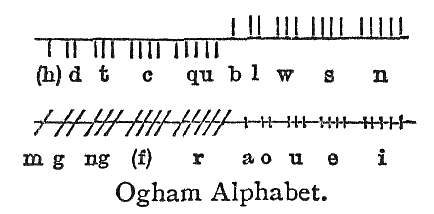
Ogham, Ogam, og′am, n. an ancient Irish writing, in straight lines crossing each other; one of the characters, twenty in number, of which it is formed.—adjs. Ogh′amic, Og′amic.
Ogive, ō′jiv, n. (archit.) a pointed arch or window.—adj. Ogī′val. [Fr.,—Sp.,—Ar. áwj, summit.]
Ogle, ō′gl, v.t. to look at fondly with side glances.—v.i. to cast amorous glances.—ns. O′gle; O′gler; O′gling. [Dut. oogen—ooge, the eye.]
Ogre, ō′gėr, n. a man-eating monster or giant of fairy tales:—fem. O′gress.—adj. O′greish. [Fr. ogre—Sp. ogro—L. orcus, the lower world.]
Ogygian, ō-jij′i-an, adj. pertaining to the mythical Attic king Ogўges, prehistoric, primeval.
Oh, ō, interj. denoting surprise, pain, sorrow, &c.
Ohm, ōm, n. the unit by which electrical resistance is measured, being nearly equal to that caused by a thousand feet of copper wire one-tenth of an inch in diameter.—Ohm's law (see Law). [Georg Simon Ohm, a German electrician, 1787-1854.]
Oidium, ō-id′i-um, n. a genus of parasitic fungi, including the vine-mildew, &c. [Gr. ōon, an egg.]
Oil, oil, n. the juice from the fruit of the olive-tree: any greasy liquid.—v.t. to smear or anoint with oil.—ns. Oil′bag, a bag or cyst in animals containing oil; Oil′cake, a cake made of flax seed from which the oil has been pressed out; Oil′cloth, a painted floorcloth; Oil′-col′our, a colouring substance mixed with oil; Oil′er, one who, or that which, oils: an oil-can: (coll.) a coat of oilskin; Oil′ery, the commodities of an oil-man; Oil′-gas, illuminating gas or heating gas made by distilling oil in closed retorts; Oil′iness; Oil′-man, one who deals in oils; Oil′-mill, a grinding-mill for expressing oil from seeds, nuts, &c.; Oil′nut, the butter-nut of North America; Oil′-paint′ing, a picture painted in oil-colours: the art of painting in oil-colours; Oil′-palm, a palm whose fruit-pulp yields palm-oil; Oil′-press, a machine for expressing oils from seeds or pulp; Oil′skin, cloth made waterproof by means of oil: a garment made of oilskin; Oil′-spring, a spring whose water contains oily matter: a fissure or area from which petroleum, &c. oozes; Oil′stone, a fine-grained kind of stone used, when wetted with oil, for sharpening tools; Oil′-well, a boring made for petroleum.—adj. Oil′y, consisting of, containing, or having the qualities of oil: greasy.—Strike oil (see Strike). [O. Fr. oile (Fr. huile)—L. oleum—Gr. elaion—elaia, the olive.]
Ointment, oint′ment, n. anything used in anointing: (med.) any greasy substance applied to diseased or wounded parts: (B.) a perfume. [O. Fr.,—L. unguentum—ungĕre, to smear.]
Okapi, ō′ka-pi, n. a giraffe-like animal of the Semliki forests of Central Africa.
Oke, ōk, n. a Turkish weight of 2¾ lb. avoirdupois.
Old, ōld, adj. advanced in years: having been long in existence: worn out: out of date, old-fashioned: ancient, former, antique, early: (coll.) great, high: having the age or duration of: long practised: sober, wise.—n. Old-clothes′man, one who buys cast-off garments.—v.i. Old′en, to grow old, to become affected by age.—adj. old, ancient.—adj. Old-fash′ioned, of a fashion like that used long ago: out of date: clinging to old things and old styles: with manners like those of a grown-up person (said of a child).—n. Old-fash′ionedness.—adjs. Old-fō′gyish, like an old fogy; Old-gen′tlemanly, characteristic of an old gentleman; Old′ish, somewhat old; Old′-light, denoting those of the Seceders from the Church of Scotland who continued to hold unchanged the principle of the connection between church and state—the position maintained by the first Seceders in 1733.—n. one of this body.—ns. Old-maid′hood, Old-maid′ism.—adj. Old-maid′ish, like the conventional old maid, prim.—ns. Old′ness; Old′ster (coll.), a man getting old: a midshipman of four years' standing, a master's mate.—adj. Old′-time, of or pertaining to times long gone by: of long standing: old-fashioned.—n. Old′-tim′er, one who has lived in a place or kept a position for a long time.—adjs. Old-wom′anish, like an old woman; Old′-world, belonging to earlier times, antiquated, old-fashioned.—n. the Eastern Hemisphere.—Old age, the later part of life; Old bachelor, an unmarried man somewhat advanced in years; Old English (see English): the form of black letter used by 16th-century English printers; Old gold, a dull gold colour like tarnished gold, used in textile fabrics; Old Harry, Nick, One, &c., the devil; Old Hundred, properly Old Hundredth, a famous tune set in England about the middle of the 16th century to Kethe's version of the 100th Psalm, marked 'Old Hundredth' in Tate and Brady's new version in 1696; Old maid, a woman who has not been married, and is past the usual age of marriage: a simple game played by matching cards from a pack from which a card (usually a queen) has been removed; Old man, unregenerate human nature: (coll.) one's father, guardian, or employer (usually with 'the'); Old Red Sandstone (see Sand); Old salt, an experienced sailor; Old school, of, or resembling, earlier days, old-fashioned; Old song, a mere trifle, a very small price; Old squaw, a sea-duck of the northern hemisphere—also Old wife; Old Style (often written with a date O.S.), the mode of reckoning time before 1752, according to the Julian calendar or year of 365¼ days; Old Testament (see Testament); Old Tom, a strong kind of English gin; Old wife, a prating old woman, or even a man: a chimney-cap for curing smoking.—Of old, long ago, in ancient times, or belonging to such. [A.S. eald; Dut. oud; Ger. alt.]
Oleaginous, ō-lē-aj′in-us, adj. oily: (bot.) fleshy and oily: unctuous, sanctimonious, fawning.—n. Oleag′inousness. [L. oleaginus—oleum, oil.]
Oleander, ō-lē-an′dėr, n. an evergreen shrub with lance-shaped leathery leaves and beautiful red or white flowers, the Rose Bay or Rose Laurel. [Fr., a corr. of Low L. lorandrum. Cf. Rhododendron.]
Oleaster, ō-lē-as′tėr, n. the wild olive. [L.,—olea, an olive-tree—Gr. elaia.]
Olecranon, ō-lē-krā′non, n. a process forming the upper end of the ulna.—adj. Olecrā′nal. [Gr.]
Olein, ō′lē-in, n. a natural fat, found in the fatty oils of animals and vegetables.—n. O′leāte, a salt of oleic acid.—adj. Olefī′ant, producing oil.—ns. Olefī′ant-gas, ethylene; O′lefine, any one of a group of hydrocarbons homologous with ethylene.—adjs. O′leic; Oleif′erous, producing oil, as seeds.—ns. Oleomar′garine, artificial butter at first made from pure beef-fat, now from oleo-oil, neutral lard, milk, cream, and pure butter, worked together, with a colouring matter; Oleom′eter, an instrument for determining the density of oils; O′leon, a liquid obtained from the distillation of olein and lime; Oleores′in, a native compound of an essential oil and a resin: a preparation of a fixed or volatile oil holding resin in solution; Oleosac′charum, a mixture of oil and sugar.—adjs. O′leōse, O′leous, oily. [L. oleum, oil.]
Olent, ō′lent, adj. smelling. [L. olēre, to smell.]
Oleograph, ō′lē-ō-graf, n. a print in oil-colours to imitate an oil-painting.—n. Oleog′raphy, the art of preparing such. [L. oleum, oil, Gr. graphein, to write.]
Oleraceous, ol-e-rā′shus, adj. of the nature of a pot-herb, for kitchen use. [L.]
Olfactory, ol-fak′tor-i, adj. pertaining to, or used in, smelling. [L. olfactāre, to smell—olēre, to smell, facĕre, to make.]
Olibanum, ō-lib′a-num, n. a gum-resin flowing from incisions in several species of Boswellia in Somaliland and southern Arabia—the Lebonah of the Hebrews, Libanos and Libanōtos of the Greeks.
Oligæmia, ol-i-jē′mi-a, n. abnormal deficiency of blood.
Oligarchy, ol′i-gärk-i, n. government by a small exclusive class: a state governed by such: a small body of men who have the supreme power of a state in their hands.—n. Ol′igarch, a member of an oligarchy.—adjs. Oligarch′al, Oligarch′ic, -al, pertaining to an oligarchy. [Fr.,—Gr., oligos, few, archein, to rule.]
Oligist, ol′i-jist, n. a crystallised variety of hematite.
Oligocene, ol′i-gō-sēn, adj. (geol.) pertaining to a division of the Tertiary series, the rocks chiefly of fresh and brackish water origin, with intercalations of marine beds. [Gr. oligos, little, kainos, new.]
Oligochrome, ol′i-gō-krōm, adj. and n. painted in few colours. [Gr. oligos, few, chrōma, colour.]
Oligoclase, ol′i-gō-klās, n. a soda-lime triclinic feldspar.
Olio, ō′li-ō, n. a savoury dish of different sorts of meat and vegetables: a mixture: a medley, literary miscellany. [Sp. olla—L. olla, a pot.]
Oliphant, ol′i-fant, n. an ancient ivory hunting-horn: an obsolete form of elephant.
Olitory, ol′i-tō-ri, adj. and n. pertaining to kitchen-vegetables:—pl. Ol′itories. [L. olitor, gardener.]
Olive, ol′iv, n. a tree cultivated round the Mediterranean for its oily fruit: its fruit: peace, of which the olive was the emblem: a colour like the unripe olive.—adj. of a brownish-green colour like the olive.—adjs. Olivā′ceous, olive-coloured: olive-green; Ol′ivary, like olives.—ns. Ol′ivenite, a mineral consisting chiefly of arsenic acid and protoxide of iron; Ol′ive-oil, oil pressed from the fruit of the olive; Ol′ive-yard, a piece of ground on which olives are grown; Ol′ivine, chrysolite.—Olive branch, a symbol of peace: (pl.) children (Ps. cxxviii. 4; Pr. Bk.). [Fr.,—L. oliva—Gr. elaia.]
Oliver, ol′i-vėr, n. a forge-hammer worked by foot.
Oliverian, ol-i-vē′ri-an, adj. an adherent of the great Protector, Oliver Cromwell (1599-1658).
Olivet, ol′i-vet, n. an imitation pearl manufactured for trade with savages.
Olivetan, ol′i-vet-an, n. one of an order of Benedictine monks founded in 1313, the original house at Monte Oliveto, near Siena.
Olla, ol′la, n. a jar or urn.—n. Ol′la-podrida (-po-drē′da), a Spanish mixed stew or hash of meat and vegetables: any incongruous mixture or miscellaneous collection. [Sp.,—L. olla, a pot.]
Ollam, ol′am, n. a doctor or master among the ancient Irish.—Also Oll′amh. [Ir.]
Ology, ol′ō-ji, n. a science whose name ends in -ology, hence any science generally.
Olpe, ol′pē, n. a small Greek even-rimmed spoutless vase or jug. [Gr.]
Olympiad, ō-lim′pi-ad, n. in ancient Greece, a period of four years, being the interval from one celebration of the Olympic games to another, used in reckoning time (the date of the first Olympiad is 776 B.C.).—adjs. Olym′pian, Olym′pic, pertaining to Olympia in Elis, where the Olympic games were celebrated, or to Mount Olympus in Thessaly, the seat of the gods.—n. a dweller in Olympus, one of the twelve greater gods of Greek mythology.—ns.pl. Olym′pics, Olym′pic games, games celebrated every four years at Olympia, dedicated to Olympian Zeus; Olym′pus, the abode of the gods, supposed to have been Mount Olympus in Thessaly. [Gr. olympias, -ados, belonging to Olympia in Elis.]
Omadhaun, om′a-dawn, n. a stupid, silly creature. [Ir.]
Omasum, ō-mā′sum, n. a ruminant's third stomach, the psalterium or manyplies.—adj. Omā′sal.
Ombre, om′bėr, n. a game of cards played with a pack of forty cards, usually by three persons. [Fr.,—Sp. hombre—L. homo, a man.]
Ombrometer, om-brom′e-tėr, n. a rain-gauge.
Omega, ō′meg-a, or ō-mē′ga, n. the last letter of the Greek alphabet: (B.) the end.—Alpha and Omega, the beginning and the end: the chief point or purpose (Rev. i. 8). [Gr. ō mega, the great or long O.]
Omelet, Omelette, om′e-let, n. a pancake chiefly of eggs, beaten up with flour, &c., and fried in a pan. [O. Fr. amelette (Fr. omelette), which through the form alemette is traced to alemelle, the O. Fr. form of Fr. alumelle, a thin plate, a corr. of lemelle—L. lamella, lamina, a thin plate.]
Omen, ō′men, n. a sign of some future event, either good or evil: a foreboding.—v.i. and v.t. to prognosticate: to predict.—adj. O′mened, containing omens, mostly with prefixes, as ill-omened. [L. for osmen, that which is uttered by the mouth—L. os; or for ausmen, that heard—audīre, to hear.]
Omentum, ō-men′tum, n. a fold of peritoneum, proceeding from one of the abdominal viscera to another:—pl. Omen′ta.—adj. Omen′tal.—Great omentum, the epiploon. [L.]
Omer, ō′mėr, n. a Hebrew dry measure containing about half a gallon, 1⁄10 ephah.
Omicron, ō-mī′kron, n. the short o in the Greek alphabet.
Ominous, om′in-us, adj. pertaining to, or containing, an omen: foreboding evil: inauspicious.—adv. Om′inously.—n. Om′inousness.
Omit, ō-mit′, v.t. to leave out: to neglect: to fail: to make no use of:—pr.p. omit′ting; pa.t. and pa.p. omit′ted.—adj. Omiss′ible, that may be omitted.—n. Omiss′ion, act of omitting: the neglect or failure to do something required: that which is left out.—adj. Omiss′ive, omitting or leaving out.—n. Omit′tance, the act of omitting: the state of being omitted: forbearance. [L. omittĕre, omissum—ob, away, mittĕre, to send.]
Omlah, om′la, n. a staff of native clerks or officials in India. [Ar.]
Omni-, om′ni, from L. omnis, all, a combining form, as in adjs. Omnifā′rious, of all varieties or kinds; Omnif′erous, bearing or producing all kinds; Omnif′ic, all-creating; Om′niform, of, or capable of, every form.—n. Omniform′ity.—v.t. Om′nify (rare), to make universal.—adj. Omnig′enous, consisting of all kinds.—n. Omnipar′ity, general equality.—adjs. Omnip′arous, producing all things; Omnipā′tient, enduring all things.—ns. Omnip′otence, Omnip′otency, unlimited power—an attribute of God.—adj. Omnip′otent, all-powerful, possessing unlimited power.—adv. Omnip′otently.—n. Omnipres′ence, quality of being present everywhere at the same time—an attribute of God.—adj. Omnipres′ent, present everywhere at the same time.—n. Omnisc′ience, knowledge of all things—an attribute of God.—adj. Omnisc′ient, all-knowing: all-seeing: infinitely wise.—adv. Omnisc′iently.—adj. Omniv′orous, all-devouring: (zool.) feeding on both animal and vegetable food.—The Omnipotent, God.