LIST OF ABBREVIATIONS USED IN THIS DICTIONARY. (continued 11)
Reading edition
Put, put, n. a rustic, simpleton. [Perh. W. pwt, pytiau, any short thing.]
Put, put, n. a strumpet.—ns. Pū′tāge, a law phrase for a woman's fornication; Pū′tanism, the habit of prostitution. [O. Fr. pute, a whore.]
Putamen, pū-tā′men, n. the hard bony stone of some fruits—cherry, peach, &c.: the soft shell of an egg: the outer and darker portion of the lenticular nucleus of the brain. [L.,—putāre, to prune.]
Putative, pū′tā-tiv, adj. supposed: reputed: commonly supposed to be.—n. Putā′tion, act of considering, estimation.—Putative marriage, a marriage prohibited by canon law, but entered into in good faith by at least one of the parties. [Fr.,—L. putativus—putāre, -ātum, to suppose.]
Putchock, pōō-chok′, n. the fragrant costus-root, exported from India to China—a chief ingredient in the Chinese pastille-rod, commonly called jostick.—Also Putchuk′. [Perh. Telegu pāch'ckāku, 'green leaf;' or more prob. Malay.]
Puteal, pū′tē-al, n. a well-curb. [L.,—puteus, a well.]
Puteli, put′e-li, n. a flat-bottomed Ganges boat.
Putid, pū′tid, adj. rotten: stinking: worthless.—n. Pū′tidness. [L. putidus, putrid.]
Put-log, put′-log, n. a cross-piece in a scaffolding, the inner end resting in a hole left in the wall.
Putois, pü-twa′, n. a brush of polecat's hair for pottery. [Fr.]
Putoo, put′ōō, n. a dish made of palmyra-nut meal, scraped coco-nut, &c.
Putorius, pū-tō′ri-us, n. a large family of Mustelidæ, including weasels, stoats, polecats, ferrets, &c.
Putrefy, pū′tre-fī, v.t. to make putrid or rotten: to corrupt.—v.i. to become putrid: to rot:—pa.t. and pa.p. pū′trefied.—adjs. Pūtred′inous, having an offensive smell; Putrefā′cient (also n.), Putrefac′tive, pertaining to or causing putrefaction.—ns. Putrefac′tion, the act or process of putrefying: rottenness: corruption; Putrefac′tiveness; Putres′cence.—adjs. Putres′cent, becoming putrid: pertaining to putrefaction; Pū′trid, in a state of decay: showing putrefaction: stinking: rotten: corrupt.—ns. Putrid′ity, Pū′tridness, state of being putrid: corrupt matter: rottenness: corruption.—adj. Pū′trifiable, liable to putrefy. [O. Fr. putrefier—L. putrefacĕre, to make putrid—puter, putris, rotten.]
Putt, put, v.i. in golf, to play with a putter.—n. a short stroke made with a putter in attempting to hole a ball.—ns. Putt′er, one who throws a stone: one who takes coal along underground roads: a short, stiff golf-club used in putting; Putt′er-on (Shak.), an instigator; Putt′er-out (obs.), one who deposited money on going abroad, on condition of receiving a larger sum on his return, the money to be forfeited in case of non-return; Putt′ing, the act of hurling a heavy stone from the hand by a sudden push from the shoulder: the act of striking a golf-ball when near a hole, so as to cause it to fall into it; Putt′ing-green, the prepared ground immediately round a hole in a golf-course; Putt′ing-stone, a heavy stone raised by the hand and thrust forward from the shoulder, as a trial of strength and skill. [Put.]
Putties, put′tiz, n.pl. strips of cloth wound round the legs, from ankle to knee, as leggings.
Puttock, pōōt′ok, n. (Shak.) a kite, a buzzard.
Puttoo, put′ōō, n. a cloth made in Cashmere from the longer and coarser wool of the goat.
Putty, put′i, n. an oxide of tin, or of lead and tin, used in polishing glass, &c.—jewellers' putty: a cement of whiting and linseed-oil, used in glazing windows: a fine cement of lime only—plasterers' putty.—v.t. to fix or fill with putty:—pa.t. and pa.p. putt′ied.—n. Putt′ier, a glazier.—adj. Putt′y-faced, having a face resembling putty in pastiness or colour.—ns. Putt′y-knife, a knife with a blunt, flexible blade for laying on putty; Putt′y-pow′der, an artificially prepared oxide of tin used for polishing glass; Putt′y-root, an American orchid the corm of whose root-stock contains a highly glutinous matter; Putt′y-work, decoration in a soft substance which grows very hard. [O. Fr. potée, properly that which is contained in a pot, Fr. pot.]
Put-up, poot′-up, adj. speciously conceived, planned, or carried out. [Put.]
Puture, pū′tūr, n. the claim to food for man, horse, and dog within the bounds of a forest, &c.—Also Pul′tūre. [O. Fr. peulture.]
Puxi, puk′si, n. the edible larvæ of various flies of the genus Ephydra, found in the alkali lakes of western North America. [Mex. Ind.]
Puy, pwē, n. one of the small volcanic cones in Auvergne, &c. [Fr.]
Puzzel, puz′l, n. (obs.) a drab. [Fr. pucelle.]
Puzzle, puz′l, n. a difficulty to be solved: perplexity: something to try the ingenuity, as a toy or riddle.—v.t. to set a difficult question to: to pose: to perplex.—v.i. to be bewildered: to think long and carefully (with out, over).—ns. Puzz′ledom (coll.), bewilderment; Puzz′le-head, one who is puzzle-headed.—adj. Puzz′le-head′ed, having the head full of confused notions.—ns. Puzz′le-head′edness; Puzz′lement, the state of being puzzled; Puzz′le-monk′ey (same as Monkey-puzzle, q.v.); Puzz′le-peg, a piece of wood so secured under a dog's jaw as to keep his nose from the ground; Puzz′ler; Puzz′le-ring, a ring made of several small rings intricately linked together, capable of being taken apart and put together again.—adj. Puzz′ling, posing: perplexing.—adv. Puzz′lingly. [From M. E. opposaile (Eng. opposal), an objection—opposen, posen. Cf. Pose and Oppose.]
Puzzolana, puz-ō-lä′na, n. a loosely coherent volcanic sand found at Pozzuoli, near Naples, forming a hydraulic cement with ordinary lime.—Also Puzzolä′no, Pozzuolä′na.
Pyæmia, Pyemia, pī-ē′mi-a, n. a disease caused by the introduction into the blood of decomposing matter, from pus, &c.—adjs. Pyæ′mic, Pyē′mic. [Gr. pyon, pus, haima, blood.]
Pycnid, pik′nid, n. a special receptacle in ascomycetous fungi, resembling a perithecium, in which stylospores or pycnospores are produced—also Pycnid′ium.—n. Pyc′nospore, a stylospore. [Gr. pyknos, thick.]
Pycnite, pik′nīt, n. a columnar variety of topaz.
Pycnogonida, pik-nō-gon′i-da, n.pl. a division of marine arthropods, the sea-spiders.—adj. Pycnog′onoid. [Gr. pyknos, thick, gony, the knee.]
Pycnometer, pik-nom′e-tėr, n. an instrument for determining the specific gravity of solid bodies. [Gr. pyknos, thick, metron, measure.]
Pycnon, pik′non, n. (mus.) a small interval in Greek music, a quarter-tone: in medieval music, a semi-tone. [Gr. pyknos, thick.]
Pycnostyle, pik′nō-stīl, adj. (archit.) noting a lower degree of intercolumniation, usually 1½ diameters. [Gr. pyknos, thick, stylos, a column.]
Pyebald. See Piebald.
Pyelitis, pī-e-lī′tis, n. inflammation of the pelvis of the kidney—also Endonephritis.—adjs. Pyelit′ic; Pyelonephrit′ic.—n. Pyelonephrī′tis, inflammation of the kidney and renal pelvis. [Gr. pyelos, the pelvis, nephros, the kidney.]
Pyengadu, pī-eng′ga-dōō, n. a large acacia-like tree of Burma, India, &c., with reddish-brown wood of great heaviness and hardness.—Also Pyn′kado.
Pygal, pī′gal, adj. belonging to the rump or posteriors of an animal.—n. the posterior median or supracaudal plate of a chelonian carapace.—n. Py′garg, a kind of antelope: the osprey or sea-eagle. [Gr. pygē, the rump, argos, white.]
Pygmy, Pigmy, pig′mi, n. one of a fabulous dwarfish race of antiquity: a dwarf: any diminutive thing: one of several pygmy races in equatorial Africa and elsewhere: one of the ancient diminutive dwellers in underground houses, &c., in whom David MacRitchie sees the historical originals of the fairies and elves of folklore.—adj. resembling a pygmy: very small.—adj. Pygmē′an, dwarfish: diminutive. [O. Fr. pigme, pygme—L. Pygmæi—Gr. Pygmaioi, the Pygmies, a (Gr.) pygmē—13½ in. long—pygmē, fist.]
Pygopus, pī′gō-pus, n. a genus of Australian lizards.
Pygostyle, pī′gō-stīl, n. the vomer or ploughshare bone of a bird's tail.—adj. Py′gostyled. [Gr. pygē, the rump, stylos, a column.]
Pyjamas, pe-jä′maz, n.pl. loose drawers or trousers tied round the waist, in India, used also by Europeans.—Also Paijä′mas, Pajä′mas. [Hind. pāëjāma, lit. 'leg-clothing.']
Pylon, pī′lon, n. a gateway to an Egyptian temple: the mass of building through which the gateway was pierced. [Gr. pylōn—pylē, a gate.]
Pylorus, pi-lō′rus, n. the lower opening of the stomach leading to the intestines.—adj. Pylor′ic. [L.,—Gr. pylōros—pylē, an entrance, ouros, a guardian.]
Pyogenesis, pī-ō-jen′e-sis, n. the formation of pus.—adjs. Pyogenet′ic, Pyogen′ic, Py′oid.—ns. Pyopoiē′sis, suppuration; Pyop′tysis, expectoration of pus; Pyorrhē′a, purulent discharge; Pyō′sis, the formation of pus.
Pyramid, pir′a-mid, n. a solid figure on a triangular, square, or polygonal base, with triangular sides meeting in a point: (pl.) 'the Pyramids,' or great monuments of Egypt: a game played on a billiard-table in which the balls are arranged in pyramid shape.—adjs. Pyram′idal, Pyramid′ic, -al, having the form of a pyramid.—advs. Pyram′idally, Pyramid′ically.—ns. Pyramid′icalness; Pyramid′ion, the small pyramidal apex of an obelisk; Pyram′idist, one versed in the history of the Pyramids; Pyr′amis (Shak.), a pyramid:—pl. Pyram′ides.—adjs. Pyr′amoid, Pyram′idoid. [L.,—Gr. pyramis, pyramidos; prob. Egypt. pir-em-us. Some connection with Gr. pyr, fire.]
Pyramidon, pi-ram′i-don, n. in organ-building a stop having wooden pipes in the form of an inverted pyramid, giving very deep notes somewhat like those of a stopped diapason.
Pyrargyrite, pī-rar′ji-rīt, n. an ore of silver consisting of the sulphide of silver and antimony. [Gr. pyr, fire, argyros, silver.]
Pyre, pīr, n. a pile of wood, &c., on which a dead body is burned.—adj. Pyr′al. [L.,—Gr.,—pyr, fire.]
Pyrene, pī′rēn, n. a stone or putamen.—n. Pyrē′nocarp, any drupaceous fruit.—adjs. Pyrē′noid, globular, nucleiform; Pyrē′nous. [Gr. pyrēn.]
Pyrene, pī′rēn, n. a hydrocarbon obtained from coal-tar.
Pyrenean, pir-ē-nē′an, adj. of or pertaining to the Pyrenees, the range of mountains between France and Spain.—n. Pyrenē′ite, a grayish-black garnet. [L. Pyrenæi (montes), the Pyrenees.]
Pyrenomycetes, pī-rē-nō-mī-sē′tez, n.pl. an order of ascomycetous fungi, including ergot, black-rot, &c. [Gr. pyren, a stone, mykēs, pl. mycētes, a mushroom.]
Pyrethrum, pir-eth′rum, n. a genus of plants containing the fever-few, or golden-feather, so much used in gardens as a bordering. [L.,—Gr.,—pyr, fire.]
Pyretic, pī-ret′ik, adj. pertaining to fever.—n. a remedy for fever.—ns. Pyretol′ogy, the science of fevers; Pyrex′ia, fever.—adjs. Pyrex′ial, Pyrex′ic. [Gr. pyrektikos—pyretos, fever—pyr, fire.]
Pyrgoidal, pir-goi′dal, adj. tower-shaped. [Gr., pyrgos, a tower.]
Pyrheliometer, pir-hē-li-om′e-tėr, n. an instrument for measuring the intensity of the sun.—adj. Pyrheliomet′ric. [Gr. pyr, fire, hēlios, sun, metron, measure.]
Pyriform, pir′i-form, adj. pear-shaped. [L. pirum, a pear, forma, form.]
Pyrite, pī′rīt, n. native iron disulphide of a pale-yellow colour and very hard—also Iron pyrites.—Copper pyrites, yellow sulphide of copper and iron. [L.,—Gr. pyrites, a flint—pyr, fire.]
Pyritegium, pir-i-tē′ji-um, n. the curfew-bell. [Low L.]
Pyrites, pir-ī′tēz, n. a term applied to a large class of mineral compounds of metals with sulphur, or with arsenic, or with both—crystalline, hard, generally brittle, and frequently yellow.—adjs. Pyritā′ceous; Pyrit′ic, -al; Pyritif′erous.—v.t. Pyr′itise, to convert into pyrites.—n. Pyritol′ogy, knowledge of pyrites.—adj. Pyr′itous. [L.,—Gr. pyr, fire.]
Pyritohedron, pī-rī-tō-hē′dron, n. a pentagonal dodecahedron.—adj. Pyritohē′dral. [Gr. pyritēs, pyrites, hedra, a seat.]
Pyro-acetic, pī′rō-a-set′ik, adj. relating to acetic acid under heat.
Pyroballogy, pī-rō-bal′ō-ji, n. the art of throwing fire: (Sterne) the science of artillery. [Gr. pyr, fire, ballein, to throw, logia—legein, to speak.]
Pyroclastic, pī-rō-klas′tik, adj. formed by volcanic agencies. [Gr. pyr, fire, klastos, broken.]
Pyro-electricity, pī′rō-e-lek-tris′i-ti, n. that branch of electricity which deals with electrification as produced by change of temperature in certain crystallised bodies.—adj. Py′ro-elec′tric.
Pyrogallic, pī-rō-gal′ik, adj. obtained from gallic acid by the action of heat.
Pyrogen, pī′rō-jen, n. any substance which causes fever when introduced into the blood.—adjs. Pyrogenet′ic, Pyrog′enous, producing fire: produced by fire; Pyrogen′ic, producing fever. [Gr. pyr, fire, root of gignesthai, to become.]
Pyrognomic, pī-rog-nom′ik, adj. becoming incandescent when heated to a certain degree. [Gr. pyr, fire, gnōmōn, a mark.]
Pyrognostic, pī-rog-nos′tik, adj. pertaining to fire or heat. [Gr. pyr, fire, gnōstikos, knowing.]
Pyrography, pī-rog′ra-fi, n. the art of producing a design on wood by applying heat and pressure. [Gr. pyr, fire, graphein, to write.]
Pyrogravure, pī-rō-grā-vūr′, n. a method of engraving on wood by a red-hot metallic point: a picture so produced.
Pyrola, pī′rō-la, n. a genus of plants of the heath kind, called also Wintergreen: a single plant of this genus. [L., dim. of pirus, a pear-tree.]
Pyrolatry, pī-rol′a-tri, n. fire-worship.—n. Pyrol′ater, a fire-worshipper. [Gr. pyr, pyros, fire, latreia, worship.]
Pyroleter, pī-rol′e-tėr, n. a fire-extinguishing chemical apparatus by which carbonic acid is generated and thrown on the fire. [Gr. pyr, fire, oletēr, destroyer—ollynai, to destroy.]
Pyroligneous, pī-rō-lig′ne-us, adj. procured by the distillation of wood—applied to a kind of acetic acid.—Also Pyrolig′nic, Pyrolig′nous.
Pyrology, pī-rōl-ō-ji, n. the science of heat: a treatise on heat.—n. Pyrol′ogist. [Gr. pyr, pyros, fire, logos, discourse.]
Pyrolusite, pī-rō-lū′sīt, n. native manganese dioxide.
Pyromagnetic, pī-rō-mag-net′ik, adj. pertaining to magnetism as modified by the action of heat.
Pyromancy, pī′rō-man-si, n. divination by fire.—adj. Pyroman′tic. [Gr. pyr, pyros, fire, manteia, divination.]
Pyromania, pī-rō-mā′ni-a, n. a mania for destroying things by fire: insanity which takes this form.—n. Pyromā′niac.—adjs. Pyromā′niac, -al.
Pyrometamorphism, pī-rō-met-a-mor′fizm, n. metamorphism due to heat, as opp. to Hydrometamorphism, that due to water.
Pyrometer, pī-rom′e-tėr, n. an instrument in the form of a metallic bar for measuring the temperature of bodies under heat.—adjs. Pyromet′ric, -al.—n. Pyrom′etry, the science or art of measuring degrees of heat beyond the compass of the mercurial thermometer. [Gr. pyr, fire, metron, a measure.]
Pyromorphous, pī-rō-mor′fus, adj. assuming a crystallised form after fusion by heat. [Gr. pyr, pyros, fire, morphē, form.]
Pyronomics, pī-rō-nom′iks, n. the science of heat.
Pyrope, pī′rōp, n. a gem nearly allied to garnet, of a deep-red colour and translucent, generally occurring in roundish grains. [Gr. pyrōpos, fiery-eyed—pyr, pyros, fire, ōps, opos, the face.]
Pyrophanous, pī-rof′a-nus, adj. made transparent by heat.—n. Py′rophāne, an opal translucent while hot by melted wax. [Gr. pyr, fire, phainein, to show.]
Pyrophone, pī′rō-fōn, n. a musical instrument invented by Eugene Kastner (1873), in which the tones are produced by means of burning jets of hydrogen enclosed in graduated glass tubes. [Gr. pyr, fire, phōnē, sound.]
Pyrophorus, pī-rof′ō-rus, n. a substance which takes fire on exposure to air: a genus of elaterid beetles.—n. Py′rophōre, any composition which takes fire on exposure to air or water.—adjs. Pyrophor′ic, Pyroph′orous. [Gr. pyr, fire, pherein, to carry.]
Pyrophosphoric, pī-rō-fos-for′ik, adj. formed by heating phosphoric acid.
Pyrophotography, pī-rō-fō-tog′ra-fi, n. any photographic process in which heat is applied to fix the picture.
Pyroscope, pī′rō-skōp, n. an instrument for measuring the intensity of radiating heat. [Gr. pyr, pyros, fire, skopein, to view.]
Pyrosilver, pī-rō-sil′vėr, n. electroplated ware in which the silver is made to sink into the pores of the plated baser metal by the action of heat.
Pyrosis, pī-rō′sis, n. water-brash (q.v.). [Gr.,—pyr, fire.]
Pyrosoma, pī-rō-sō′ma, n. a genus of compound Tunicates, with brilliant phosphorescence, inhabiting the Mediterranean and the Atlantic—fire-flames. [Gr. pyr, fire, sōma, body.]
Pyrostat, pī′rō-stat, n. an automatic draught-regulator for chimney-stacks, smoke-pipes, &c. [Gr. pyr, fire, statos—histanai, to stand.]
Pyrosulphuric, pī-rō-sul-fū′rik, adj. obtained from sulphuric acid by the action of heat.
Pyrotechnics, pī-rō-tek′niks, n. the art of making fireworks: the use and application of fireworks—also Py′rotechny.—adjs. Pyrotech′nic, -al, pertaining to fireworks.—n. Pyrotech′nist, a maker of fireworks: one skilled in pyrotechny. [Gr. pyr, fire, technikos, artistic—technē, art.]
Pyrotic, pī-rot′ik, adj. burning: caustic.—n. a caustic medicine. [Gr. pyrōtikos—pyr, pyros, fire.]
Pyroxene, pī′rok-sēn, n. an important mineral species, occurring in monoclinic crystals.—adj. Pyroxen′ic. [Gr. pyr, fire, xenos, a guest.]
Pyroxylic, pī-rok-sil′ik, adj. obtained by distilling wood.—ns. Pyrox′yle, Pyrox′ylin, -e, gun-cotton.—Pyroxylic spirit, a mixture of acetone, methyl-alcohol, acetate of methyl, &c., obtained by the destructive distillation of wood in the manufacture of pyroligneous acid. [Gr. pyr, fire, xylon, wood.]
Pyrrhic, pir′ik, n. a kind of war-dance among the ancient Greeks: a poetical foot consisting of two short syllables.—adj. pertaining to the dance or to the poetical foot.—n. Pyr′rhicist, one who dances the pyrrhic. [Gr. pyrrhichē (orchēsis), a kind of war-dance, so called from Pyrrhichos, the inventor.]
Pyrrhic, pir′ik, adj. of or pertaining to Pyrrhus, king of Epirus (318-272 B.C.).—Pyrrhic victory, a victory gained at too great a cost, in allusion to Pyrrhus's exclamation after his victory of Asculum (279), 'Another such victory and we are lost!'
Pyrrhonist, pir′rō-nist, n. one who holds the tenets of Pyrrho, a philosopher of Elis (360-270 B.C.), who taught universal scepticism: a sceptic.—adjs. Pyrrhō′nean, Pyrrhon′ic.—n. Pyr′rhonism, scepticism.
Pyrrhous, pir′us, adj. reddish. [Gr.]
Pyrus, pī′rus, n. a genus of trees and shrubs of the natural order Rosaceæ, sub-order Pomeæ. [L. pyrus, for pirus, a pear-tree.]
Pythagorean, pi-thag-ō-rē′an, adj. pertaining to Pythagoras (c. 532 B.C.), a celebrated Greek philosopher, or to his philosophy.—n. a follower of Pythagoras.—ns. Pythag′orism, Pythagorē′anism, his doctrines.—Pythagorean proposition, the 47th proposition of Euclid, Book I., said to have been discovered by Pythagoras; Pythagorean system, the astronomical system of Copernicus, erroneously attributed to Pythagoras; Pythagorean triangle, a triad of whole numbers proportional to the sides of a right-angled triangle—e.g. 3, 4, 5.
Pythian, pith′i-an, adj. pertaining to the Pythia, the priestess of Apollo at Delphi, who delivered the oracles of the god there: noting one of the four national festivals of ancient Greece, in honour of Apollo, held every four years at Delphi.—Pythian verse, the dactylic hexameter.
Pythogenic, pī-thō-jen′ik, adj. produced by filth.—n. Pythogen′esis. [Gr. pythein, to rot, root of gignesthai, to become.]
Pythometric, pī-thō-met′rik, adj. pertaining to the gauging of casks. [Gr. pithos, a wine-jar, metron, a measure.]
Python, pī′thon, n. a genus of serpents of the boa family, all natives of the Old World, and differing from the true boas by having the plates on the under surface of the tail double: a demon, spirit.—n. Py′thoness, the priestess of the oracle of Apollo at Delphi, in Greece: a witch.—adj. Python′ic, pretending to foretell future events, like the Pythoness: prophetic: like a python.—ns. Py′thonism, the art of predicting events by divination; Py′thonist. [Gr. Pythōn, the serpent slain near Delphi by Apollo.]
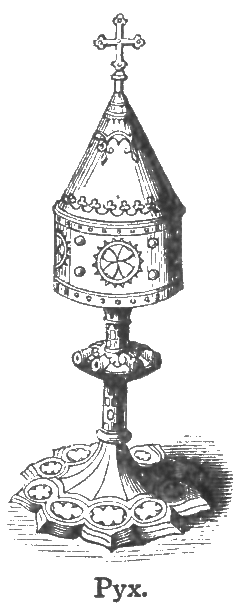
Pyx, piks, n. (R.C.) the sacred box in which the host is kept after consecration: the box at the British Mint containing sample coins.—v.t. to test the weight and fineness of, as the coin deposited in the pyx.—Trial of the pyx, final trial by weight and assay of the gold and silver coins of the United Kingdom, prior to their issue from the Mint. [L. pyxis, a box—Gr. pyxis—pyxos (L. buxus), the box-tree.]
Pyxidium, pik-sid′i-um, n. (bot.) a pod or seed-vessel which opens in two halves, the upper one resembling a lid. [Gr. pyxidion, dim. of pyxis.]
the seventeenth letter of our alphabet—absent from the Anglo-Saxon alphabet, in which the sound was expressed by cw; in Scotland replacing hw, now always followed by u: Roman numeral=500.
Qua, kwä, adv. as far as. [L.]
Quab, Quob, kwob, v.i. (obs.) to tremble.
Quack, kwak, v.i. to cry like a duck: to boast: to practise as a quack.—v.t. to doctor by quackery.—n. the cry of a duck: a boastful pretender to skill which he does not possess, esp. medical skill: a mountebank.—adj. pertaining to quackery: used by quacks.—n. Quack′ery, the pretensions or practice of a quack, esp. in medicine.—adj. Quack′ish, like a quack: boastful: trickish.—n. Quack′ism.—v.i. Quack′le (rare), to quack, croak.—n. Quack′salver, a quack who deals in salves, ointments, &c.: a quack generally.—adj. Quack′salving. [Imit.; cf. Ger. quaken, Dut. kwaken, Gr. koax, a croak.]
Quad, kwod, n. a quadrangle: (slang) a prison.—v.t. (slang) to put in prison.—Also Quod. [Quadrangle.]
Quad, kwod, n. (print.) an abbreviation of quadrat.—v.t. to fill with quadrats.
Quadra, kwod′ra, n. a frame enclosing a bas-relief:—pl. Quad′ræ (-ē). [L. quadrus, square.]
Quadragenarian, kwod-ra-jē-nā′ri-an, adj. consisting of forty: forty years old.—n. Quad′ragene, an indulgence for forty days.
Quadragesima, kwod-ra-jes′i-ma, n. the Latin name for the whole season of Lent, with its forty days: the name commonly assigned to the first Sunday in Lent, by analogy with the three Sundays which precede Lent—Septuagesima, Sexagesima, and Quinquagesima.—adj. Quadrages′imal, belonging to or used in Lent. [L.—quadragesimus, fortieth—quadraginta, forty—quatuor, four.]
Quadrangle, kwod′rang-gl, n. a square surrounded by buildings: (geom.) a plane figure having four equal sides and angles: in the jargon of palmistry, the space between the line of the heart and that of the head.—adj. Quadrang′ular, of the form of a quadrangle.—adv. Quadrang′ularly. [Fr.,—L. quadrangulum—quatuor, four, angulus, an angle.]
Quadrans, kwod′ranz, n. a Roman copper coin, the fourth part of the as:—pl. Quadran′tes. [L.]
Quadrant, kwod′rant, n. (geom.) the fourth part of a circle, or an arc of 90°: an instrument used in astronomy for the determination of angular measurements: an instrument of navigation for measuring the altitude of the sun.—adj. Quadrant′al, pertaining to, equal to, or included in a quadrant. [L. quadrans, from quatuor, four.]
Quadrat, kwod′rat, n. a piece of type-metal lower than the letters, used in spacing between words and filling out blank lines (commonly Quad)—distinguished as en (), em (), two-em (), and three-em ().


Quadrate, kwod′rāt, adj. squared: having four equal sides and four right angles: divisible into four equal parts: (fig.) balanced: exact: suited.—n. a square or quadrate figure: the quadrate bone, that between the lower jaw and the cranium in birds and reptiles, suspending the lower jaw.—v.i. to square or agree with: to correspond.—adj. Quadrat′ic, pertaining to, containing, or denoting a square.—n. (alg.) an equation in which the highest power of the unknown quantity is the second: an old instrument for measuring latitudes: (pl.) that branch of algebra which treats of quadratic equations.—adj. Quadratif′erous, having a distinct quadrate bone.—ns. Quadrā′trix, a curve by which may be found straight lines equal to the circumference of circles or other curves; Quad′rāture, a squaring: (geom.) the finding, exactly or approximately, of a square that shall be equal to a given figure of some other shape: the position of a heavenly body when 90° distant from another: (Milt.) a square space; Quadrā′tus, the quadratus femoris, or square muscle of the femur in man, the quadratus lumborum, that of the loins, the depressor labii inferioris, that of the chin, which draws down the upper lip.—Quadrature of the circle, the problem of squaring the circle, insoluble both by the arithmetical and the geometrical method.—Method of quadratures, the name applied to any arithmetical method of determining the area of a curve. [O. Fr. quadrat—L. quadratus, pa.p. of quadrāre, to square—quatuor, four.]
Quadrel, kwod′rel, n. a square stone, brick, or tile: a square piece of turf.
Quadrennial, kwod-ren′yal, adj. comprising four years: once in four years.—adv. Quadrenn′ially.—ns. Quadrenn′iate, Quadrenn′ium, Quadrienn′ium, a period of four years. [L. quadrennis—quatuor, four, annus, a year.]
Quadric, kwod′rik, adj. (alg.) of the second degree, quadratic—esp. in solid geometry and where there are more than two variables.—n. Quad′ricone, a quadric cone.
Quadricentennial, kwod-ri-sen-ten′i-al, adj. pertaining to a period of 400 years.—n. the 400th anniversary of an event or its celebration.
Quadriceps, kwod′ri-seps, n. the great muscle which extends the leg upon the thigh.—adj. Quadricip′ital. [L. quatuor, four, caput, head.]
Quadricorn, kwod′ri-korn, adj. and n. having four horns, antennæ, &c.—Also Quadricorn′ous.
Quadricycle, kwod′ri-sī-kl, n. a four-wheeled vehicle propelled by the feet. [L. quatuor, four, Low L. cyclus—Gr. kyklos, a circle.]
Quadridentate, kwod-ri-den′tāt, adj. having four teeth. Quadridigitate, kwod-ri-dij′i-tāt, adj. having four digits: quadrisulcate.
Quadrifid, kwod′ri-fid, adj. four-cleft.
Quadrifoliate, kwod-ri-fō′li-āt, adj. four-leaved.
Quadriform, kwod′ri-form, adj. fourfold in form, arrangement, &c.
Quadriga, kwod-rī′ga, n. in Greek and Roman times a two-wheeled car drawn by four horses abreast:—pl. Quadrī′gæ. [L., a contr. of quadrijugæ—quatuor, four, jugum, a yoke.]
Quadrigeminous, kwod-ri-jem′i-nus, adj. fourfold, having four similar parts.—Also Quadrigem′inal, Quadrigem′ināte.
Quadrigenarious, kwod-ri-jē-nā′ri-us, adj. consisting of four hundred.
Quadrijugate, kwod-ri-jōō′gāt, adj. (bot.) pinnate with four pairs of leaflets.—Also Quadriju′gous.
Quadrilateral, kwod-ri-lat′ėr-al, adj. having four sides.—n. (geom.) a plane figure having four sides: the four fortresses—Mantua, Verona, Peschiera, and Legnago—which form the points of a quadrilateral.—n. Quadrilat′eralness. [L. quadrilaterus—quatuor, four, latus, lateris, a side.]
Quadriliteral, kwod-ri-lit′ėr-al, adj. of four letters.—n. a word or a root having four letters. [L. quatuor, four, litera, a letter.]
Quadrille, kwa-dril′, n. a square dance for four couples, consisting of five movements: music for such square dances: a game played by four with forty cards.—v.i. to play at quadrille: to dance quadrilles. [Fr.,—Sp. cuadra, a square—L. quadra, a square—quatuor, four.]
Quadrillion, kwod-ril′yun, n. a million raised to the fourth power, represented by a unit with twenty-four ciphers. [Coined from L. quater, four times, on the model of million.]
Quadrilobate, kwod-ri-lō′bāt, adj. having four lobes or lobules.—Also Quad′rilobed.
Quadrilocular, kwod-ri-lok′ū-lar, adj. having four cells, cavities, or compartments.
Quadrimanous, kwod-rim′a-nus, adj. Same as Quadrumanous.
Quadrinomial, kwod-ri-nō′mi-al, adj. (alg.) consisting of four divisions or terms.—n. an expression of four terms. [L. quatuor, four, Gr. nomē, a division—nemein, to distribute.]
Quadripartite, kwod-ri-par′tīt, adj. divided into four parts: (bot.) deeply cleft into four parts, as a leaf: (archit.) divided, as a vault, into four compartments.—n. a treatise divided into four parts.—adv. Quadripar′titely.—n. Quadriparti′tion. [L.,—quatuor, four, partīre, -ītum, to divide.]
Quadripennate, kwod-ri-pen′āt, adj. and n. having four wings.
Quadriphyllous, kwod-ri-fil′us, adj. having four leaves.
Quadrireme, kwod′ri-rēm, n. a galley with four benches of oars. [L. quadriremis—quatuor, four, remus, an oar.]
Quadrisection, kwod-ri-sek′shun, n. a division into four equal parts. [L. quatuor, four, secāre, sectum, to cut.]
Quadrisyllable, kwod-ri-sil′a-bl n. a word consisting of four syllables.—adjs. Quadrisyllab′ic, -al. [L. quatuor, four, syllaba, a syllable.]
Quadrivalvular, kwod-ri-val′vū-lar, adj. having four valves or valvular parts.—Also Quad′rivalve.
Quadrivium, kwod-riv′i-um, n. the Pythagorean name for the four branches of mathematics—arithmetic, music, geometry, astronomy—when preceded by the trivium of grammar, logic, and rhetoric—together making up the seven liberal arts taught in the schools of the Roman Empire.—adjs. Quadriv′ial, Quadriv′ious. [L., 'the place where four roads meet'—L. quatuor, four, via, a way.]
Quadroon, kwod-rōōn′, n. the offspring of a mulatto and a white person, one 'quarter-blooded.'—Also Quarteroon′. [Sp. cuarteron—cuarto, a fourth.]
Quadrumane, kwod′rōō-mān, n. one of the Quadru′mana, an order of mammalia having four hands, or four feet, with an opposable thumb—also Quad′ruman.—adj. Quadru′manous, having four hands. [L. quatuor, four, manus, a hand.]
Quadruped, kwod′rōō-ped, n. a four-footed animal.—adjs. Quad′ruped, -al, having four feet.—n. Quad′rupedism, the state of being a quadruped. [L. quatuor, four, pes, pedis, a foot.]
Quadruple, kwod′rōō-pl, adj. fourfold.—n. four times the quantity or number.—v.t. to increase fourfold.—v.i. to become four times as many.—n. Quad′ruplet, any combination of four things—also Quart′et: one of four born at a birth.—adj. Quad′ruplex, fourfold, esp. of a telegraphic system capable of sending four messages, two in each direction, simultaneously over one wire.—n. an instrument of this kind.—v.t. to arrange for quadruplex transmission.—adj. Quadru′plicate, fourfold.—n. one of four corresponding things.—v.t. to make fourfold.—ns. Quadruplicā′tion; Quadru′plicāture; Quadruplic′ity.—adv. Quad′ruply, in a fourfold manner.—Quadruple Alliance, a league formed in 1718 between England, France, Austria, and Holland to counteract the ambitious schemes of Alberoni. [Fr.,—L. quadruplus—quatuor, four.]
Quæsitum, kwē-sī′tum, n. something sought or required:—pl. Quæsī′ta. [L. neut. of quæsitus, pa.p. of quærĕre, to seek.]
Quæstor, kwēs′tor, n. a magistrate with charge of the Roman public funds—originally who investigated cases of murder and executed sentence: in the Middle Ages an officer who announced indulgences: a treasurer—also Ques′tor.—ns. Quæs′torship, Ques′torship. [L.,—quærere, quæsitum, to seek.]
Quaff, kwaf, v.t. to drink in large draughts.—v.i. to drink largely.—n. Quaff′er. [Quach, quaich,—Gael. and Ir. cuach, a bowl.]
Quag, kwag, n. a quagmire (q.v.).—adj. Quagg′y, spongy, boggy.
Quagga, kwag′a, n. one of the three species of striped wild horses, or more properly wild asses, peculiar to Africa, of which the zebra is the type. [Hottentot.]
Quagmire, kwag′mīr, n. wet, boggy ground that yields under the feet.—v.t. to entangle, as in a quagmire.—adj. Quag′miry. [Quake and mire.]
Quahog, kwa-hog′, n. the common round clam of the North American Atlantic coast.—Also Quahaug′. [Amer. Ind. poquauhock.]
Quaid, kwād, adj. (Spens.) quelled, crushed.
Quaigh, kwāh, n. (Scot.) a kind of drinking-cup, usually made of wood. [Gael. cuach, a cup.]
Quail, kwāl, v.i. to cower: to fail in spirit: (Shak.) to slacken.—v.t. to subdue: to terrify.—n. Quail′ing (Shak.), act of one who quails: a failing in courage. [A.S. cwelan, to die; Ger. quälen, to suffer.]
Quail, kwāl, n. a small gallinaceous bird, related to the partridge family: (Shak.) a whore.—ns. Quail′-call, -pipe, a call for alluring quails into a net. [O. Fr. quaille—Low L. quaquila—Old Dut. quakele; cf. Low Ger. quackel, and Quack.]
Quaint, kwānt, adj. unusual: odd: whimsical: (obs.) prim, affectedly nice: fine: (Shak.) clever.—adv. Quaint′ly.—n. Quaint′ness. [O. Fr. coint—L. cognitus, known. Some confusion with L. comptus, neat, is probable.]
Quake, kwāk, v.i. to tremble, esp. with cold or fear: to tremble from want of firmness.—v.t. to cause to tremble:—pr.p. quā′king; pa.t. and pa.p. quāked.—n. a shake: a shudder.—ns. Quā′kiness; Quā′king; Quā′king-grass, a native grass of the genus Briza, so called from the tremulous motion of its spikelets.—adv. Quā′kingly.—adj. Quā′ky, shaky. [A.S. cwacian; perh. allied to quick.]
Quaker, kwā′kėr, n. one of the Society of Friends, a religious sect founded by George Fox (1624-90): a dummy cannon: a collector's name for certain noctuoid moths.—n. Quā′ker-bird, the sooty albatross.—n.pl. Quā′ker-butt′ons, the round seeds of nux vomica.—ns. Quā′ker-col′our, drab; Quā′kerdom, the Quakers as a class; Quā′keress, a female Quaker.—adjs. Quā′kerish, Quā′kerly, like a Quaker.—n. Quā′kerism, the tenets of the Quakers.—Stewed Quaker, molasses or honey, with butter and vinegar, taken hot against colds. [The nickname Quakers was first given them by Judge Bennet at Derby, because Fox bade him and those present quake at the word of the Lord.]
Qualify, kwol′i-fī, v.t. to render capable or suitable: to furnish with legal power: to limit by modifications: to soften: to abate: to reduce the strength of: to vary: (Scots law) to prove, confirm.—v.i. to take the necessary steps to fit one's self for a certain position.—adj. Qual′ifiable.—ns. Qualificā′tion, that which qualifies: a quality that fits a person for a place, &c.: (logic) the attaching of quality, or the distinction of affirmative and negative, to a term: abatement: (Shak.) pacification; Qual′ificātive, that which qualifies, modifies, or restricts: a qualifying term or statement; Qual′ificātor (R.C.), one who prepares ecclesiastical causes for trial.—adj. Qual′ificātory.—p.adj. Qual′ified, fitted: competent: modified: limited.—adv. Qual′ifiedly.—ns. Qual′ifiedness; Qual′ifier.—adj. Qual′ifying.—Property qualification, the holding of a certain amount of property as a condition to the right of suffrage, &c. [Fr.,—Low L. qualificāre—L. qualis, of what sort, facĕre, to make.]
Quality, kwol′i-ti, n. that which makes a thing what it is: property: peculiar power: acquisition: character: rank: superior birth or character: (logic) the character of a proposition as affirmative or negative: (Shak.) character in respect to dryness or moisture, heat or cold: (Shak.) cause, occasion.—adj. Qual′itātive, relating to quality: (chem.) determining the nature of components.—adv. Qual′itātively.—adj. Qual′itied, furnished with qualities.—Accidental quality, a quality whose removal would not impair the identity of its subject, as opposed to an Essential quality; The quality, persons of high rank, collectively. [Fr.,—L. qualitas, qualitatis.]
Qualm, kwäm, n. a sudden attack of illness: a sensation of nausea: a scruple, as of conscience.—adj. Qualm′ish, affected with qualm, or a disposition to vomit, or with slight sickness: uneasy.—adv. Qualm′ishly.—n. Qualm′ishness. [A.S. cwealm, death; Ger. qualm, nausea; Sw. qvalm, a suffocating heat.]
Quamash, kwa-mash′, n. camass.
Quandang, kwan′dang, n. a small Australian tree, with edible fruit, the native peach. [Austr.]
Quandary, kwon-dā′ri, or kwon′da-ri, n. a state of difficulty or uncertainty: a hard plight. [Prob. M. E. wandreth, peril—Ice. vandrætdi, trouble.]
Quannet, kwan′et, n. a file for scraping zinc plates: a kind of file used in comb-making.
Quant, kwant, n. a pushing or jumping pole, with a flat cap at the end, used in marshes.
Quantic, kwon′tik, n. (math.) a rational integral homogeneous function of two or more variables.—adj. Quan′tical. [L. quantus, how great.]
Quantify, kwon′ti-fī, v.t. to determine with respect to quantity: to fix or express the quantity of.—n. Quantificā′tion, the art, process, or form by which anything is quantified.—Quantification of the predicate, a phrase belonging to logic, signifying the attachment of the signs of quantity to the predicate. [L. quantus, how great, facĕre, to make.]
Quantity, kwon′ti-ti, n. the amount of anything: bulk: size: a determinate amount: a sum or bulk: a large portion: (logic) the extent of a conception: (gram.) the measure of a syllable: (mus.) the relative duration of a tone: (math.) anything which can be increased, divided, or measured: (Shak.) a small part: (Shak.) proportion.—adj. Quan′titātive, relating to quantity: measurable in quantity: (chem.) determining the relative proportions of components.—advs. Quan′titātively, Quan′titively.—ns. Quan′titātiveness; Quantiv′alence (chem.), the combining power of an atom as compared with that of the hydrogen atom, valence.—adj. Quantiv′alent.—Quantitative logic, the doctrine of probability.—Constant quantity (math.), a quantity that remains the same while others vary. [Fr.,—L. quantitas, quantitatis—quantus, how much—quam, how.]
Quantum, kwon′tum, n. quantity: amount:—pl. Quan′ta.—Quantum sufficit—as much as is sufficient. [L. quantum, neut. of quantus, how great.]
Quaquaversal, kwä-kwä-ver′sal, adj. (geol.) inclining outward in all directions from a centre: facing all ways.—adv. Quaquaver′sally. [L. quaqua, wheresoever, vertĕre, versum, to turn.]
Quarantine, kwor′an-tēn, n. a forced abstinence from communication with the shore which ships are compelled to undergo when they are last from some port where certain infectious diseases are raging—the time originally forty days: (coll.) the isolation of a person, house, district, &c. afflicted with or recovering from contagious disease.—v.t. to prohibit from intercourse from fear of infection.—adj. Quarantin′able, admitting of, or controlled by, quarantine.—Quarantine flag, a yellow flag displayed by a ship to signify the presence on board of contagious disease. [Fr. quarantaine—L. quadraginta, forty—quatuor, four.]
Quarl, kwärl, n. a segment of fireclay used in making covers for retorts, &c.
Quarl, kwärl, n. a medusa or jelly-fish.
Quarrel, kwor′el, n. a square of glass placed diagonally: a lozenge or diamond: a diamond pane of glass: a small square tile: a square-headed arrow for a cross-bow: a graver, glaziers' diamond, or other tool having a several-edged head or point.—ns. Quarr′elet, a small lozenge; Quarr′el-pane. [O. Fr.,—Low L. quadrellus—L. quadrus, square—quatuor, four.]
Quarrel, kwor′el, n. an angry dispute: a breach of friendship: (Shak.) a cause of complaint: a brawl: (Shak.) a quarreller.—v.i. to cavil, find fault: to dispute violently: to fight: to disagree.—v.t. (Scot.) to find fault with: to affect by quarrelling:—pr.p. quarr′elling; pa.t. and pa.p. quarr′elled.—ns. Quarr′eller; Quarr′elling, strife: dissension: brawling.—adjs. Quarr′ellous (Shak.), quarrelsome; Quarr′elsome, disposed to quarrel: brawling: easily provoked.—adv. Quarr′elsomely.—n. Quarr′elsomeness.—Quarrel with one's bread and butter, to act in a way prejudicial to one's means of subsistence.—Pick a quarrel with, to try to get into a dispute with; Take up a quarrel (Shak.), to settle a dispute. [O. Fr. querele—L. querela—queri, questus, to complain.]
Quarrender, kwor′en-dėr, n. (prov.) a kind of apple.
Quarry, kwor′i, n. an excavation from which stone is taken for building, &c., by cutting, blasting, &c.—v.t. to dig from a quarry:—pa.t. and pa.p. quarr′ied.—adj. Quarr′iable, capable of being quarried.—ns. Quarr′ier, Quarr′y-man, a man who works in a quarry.—adj. Quarr′y-faced, rough-faced.—ns. Quarr′ying-machine′, a rock-drill; Quarr′y-wa′ter, the water contained in the pores of stone while unquarried, or newly quarried, before its evaporation. [O. Fr. quarriere (Fr. carrière)—Low L. quadraria—L. quadratus, square.]
Quarry, kwor′i, n. the entrails of the game given to the dogs after the chase: the object of the chase: the game a hawk is pursuing or has killed: a heap of dead game. [O. Fr. curee, cuiree—cuir, the skin—L. corium, hide.]
Quarry, kwor′i, n. a small square tile.—adj. Quarr′ied, paved with such. [O. Fr. quarre—L. quadratus, square.]
Quart, Quarte, kärt, n. a sequence of four cards: one of the eight thrusts and parries in fencing.—Quart and tierce, practice between fencers. [Fr. quarte.]
Quart, kwort, or kwawrt, n. the fourth part of a gallon, or two pints: a vessel containing two pints: (Spens.) a quarter: the peck or quarter of a bushel: (mus.) the interval of a fourth.—n. Quartā′tion, the parting of gold and silver by means of nitric acid.—Quart d'écu (Shak.), a cardecu. [Fr. quarte—L. quartus, fourth—quatuor, four.]
Quartan, kwor′tan, adj. occurring every fourth day, as a fever or ague.—n. an ague of this character. [Fr. quartaine—L. quartanus, of the fourth.]
Quarter, kwor′tėr, n. a fourth part: the fourth part of a cwt.=28 lb. avoirdupois (abbrev. qr.): 8 bushels, as a measure of capacity, for grain, &c.: the fourth part of an hour—of the year—of the moon's period—of a carcass (including a limb)—of the horizon, &c.: a cardinal point: (her.) one of the four parts into which a shield is divided by quartering (dexter chief, sinister chief, dexter base, sinister base), an ordinary occupying one-fourth of the field: a region of a hemisphere: a division of a town, &c.: place of lodging, as for soldiers, esp. in pl.: mercy granted to a disabled antagonist, prob. from the idea of the captor sending the prisoner to his quarters: (Shak.) peace, concord: (naut.) the part of a ship's side between the mainmast and the stern.—v.t. to divide into four equal parts: to divide into parts or compartments: to furnish with quarters: to lodge: to allot or share: to furnish with entertainment: (her.) to bear as an appendage to the hereditary arms: to beat the ground for game.—v.i. to be stationed: to shift or change position: to range for game: to drive across a road from side to side.—ns. Quar′terāge, a quarterly payment: quarters, lodging: a name applied to a particular tax; Quar′ter-back, a certain player or position in football (see Back); Quar′ter-bend, a bend in a pipe or rod altering its direction 90°; Quar′ter-bill, a list of the stations for men on board a man-of-war during action; Quar′ter-blank′et, a horse-blanket for the hind quarters.—n.pl. Quar′ter-blocks, blocks fitted under the quarters of a yard, on each side the slings, for the topsail-sheets, &c., to reeve through.—ns. Quar′ter-board, topgallant bulwarks; Quar′ter-boat, any boat hung to davits over the ship's quarter; Quar′ter-boot, a leather boot to protect an overreaching horse's fore feet from being struck by the hind feet.—adj. Quar′ter-bound, having leather or cloth on the back only.—n.pl. Quar′ter-boys, automata which strike the quarter-hours in certain belfries.—adjs. Quar′ter-bred, having only one-fourth pure blood, as horses, cattle, &c.; Quar′ter-cast, cut in the quarter of the hoof.—ns. Quar′ter-day, the first or last day of a quarter, on which rent or interest is paid; Quar′ter-deck, the part of the deck of a ship abaft the mainmast; Quar′ter-deck′er (coll.), a stickler for small points of etiquette on board ship.—adj. Quar′tered, divided into four equal parts: lodged, stationed for lodging: having hind quarters of a particular kind, as a short-quartered horse: sawed into quarters: (her.) having a square piece cut out of the centre.—ns. Quar′ter-ē′vil, -ill, symptomatic anthrax, an infectious and frequently fatal disease of cattle, marked by hemorrhage into the subcutaneous areolar tissue of the limbs—also Black-leg, Quarter, or Spaul, &c.; Quar′terfoil (archit.), an ornamental carving disposed in four segments of circles like an expanded flower; Quar′ter-gall′ery, a projecting balcony on each of the quarters of a large ship: a small structure on a ship's quarters containing the water-closet and bath-tub; Quar′ter-gun′ner, a petty-officer in the United States navy, having care, under the gunner, of arms, ammunition, &c.—adj. Quar′tering, sailing nearly before the wind: striking on the quarter of a ship, as a wind.—n. assignment of quarters to soldiers: (archit.) a series of small upright posts for forming partitions of rooms, lathed and plastered only, or boarded also: (her.) the bearing of two or more coats-of-arms on a shield divided by horizontal and perpendicular lines, denoting the alliances of the family—also, one of the divisions thus formed.—ns. Quar′tering-block, a block on which the body of a person condemned to be quartered was cut in pieces; Quar′ter-line, the position of ships of a column ranged in a line when one is four points forward or abaft another's beam.—adj. Quar′terly, relating to a quarter: consisting of, or containing, a fourth part: once a quarter of a year.—adv. once a quarter: (her.) arranged according to the four quarters of a shield.—n. a periodical published every quarter of a year.—ns. Quar′termaster, an officer who looks after the quarters of the soldiers, and attends to the supplies—he is assisted by a non-commissioned officer named Quar′termaster-ser′geant: (naut.) a first-class petty officer who attends to the helm, signals, &c.; Quar′termaster-gen′eral, in the British army, a staff-officer of high rank (major-general or colonel) who deals with all questions of transport, marches, quarters, fuel, clothing, &c.; Quar′tern, the fourth part of a peck, a stone, or a pint: the quarter of a pound; Quar′tern-loaf, a loaf weighing, generally, four pounds; Quarteroon′ (see Quadroon); Quar′ter-plate, in photography, a size of plate measuring 3¼ by 4¼ inches: a picture of this size; Quar′ter-round, a moulding having an outline approximating to a quadrant, an ovolo: any tool adapted for making such; Quar′ter-seal, the seal kept by the director of the Chancery of Scotland—the testimonial of the Great Seal; Quar′ter-ses′sions, a criminal court held quarterly by Justices of the Peace, established in 1350-51, but having had most of its administrative powers transferred in 1888 to the County Councils: county or borough sessions held quarterly; Quar′ter-staff, a long staff or weapon of defence, grasped at a quarter of its length from the end and at the middle; Quar′ter-tone (mus.), an interval equivalent to one-half of a semitone; Quar′ter-watch (naut.), one-half of the watch on deck; Quartette′, Quartet′, anything in fours: a musical composition of four parts for voices or instruments: a stanza of four lines.—adj. Quar′tic (math.), of the fourth degree or order.—n. an algebraic function of the fourth degree.—n. Quar′tile (astrol.), an aspect of planets when their longitudes differ by 90°.—adj. Quar′to, having the sheet folded into four leaves (abbrev. 4to).—n. a book of a quarto size:—pl. Quar′tos (demy quarto, 8¾ × 11¼ in.; medium quarto, 9¼ × 11¾ in.; royal quarto, 10 × 12½ in.).—Beat up the quarters of, to disturb: to visit unceremoniously; Come to close quarters, to get into a hand-to-hand struggle.—Small quarto, a square octavo: a book having eight leaves to a sheet but the shape of a quarto.—Winter quarters, the quarters or station of an army during the winter. [O. Fr.,—L. quartarius—quartus, fourth.]
Quartodeciman, kwor-tō-des′i-man, n. one of those who celebrated the Paschal festival on the 14th day of Nisan without regard to the day of the week. The western churches kept it on the Sunday after the 14th day—the usage approved by the Council of Nice (325 A.D.). [L. quartodecimus, fourteenth, quatuor, four, decem, ten.]
Quartz, kworts, n. the common form of native silica, or the oxide of silicon, occurring both in crystals and massive, scratching glass easily, and becoming positively electrical by friction, colourless when pure—Rock-crystal, Common, and Compact Quartz.—ns. Quartz′-crush′er, -mill, a machine, mill, where auriferous quartz is reduced to powder, and the gold separated by amalgamation.—adj. Quartzif′erous.—ns. Quartz′ite, Quartz′-rock, a common rock, usually white, gray, or rusty in colour, and composed of an aggregate of quartz-grains welded together.—adjs. Quartzit′ic; Quartz′ose, of or like quartz; Quartz′y. [Ger. quarz.]
Quash, kwosh, v.t. to crush: to subdue or extinguish suddenly and completely: to annul. [O. Fr. quasser (Fr. casser)—L. quassāre, inten. of quatĕre, to shake.]
Quashee, kwosh′e, n. a negro, esp. in West Indies.
Quashey, kwosh′i, n. a pumpkin.
Quasi, kwā′sī, conj. and adv. as if: in a certain manner, sense, or degree—in appearance only, as 'quasi-historical,' &c. [L.]
Quasimodo, kwas-i-mō′do, n. the first Sunday after Easter, Low Sunday. [From the first words of the introit for the day, 1 Peter, ii. 2; L. Quasi modo geniti infantes, as new-born babes, &c.]
Quass, kwas, n. See Kvass.
Quassation, kwas-sā′shun, n. the act of shaking: the state of being shaken: concussion.—adj. Quas′sative. [L. quassatio—quassāre, to shake.]
Quassia, kwash′i-a, n. a South American tree, the bitter wood and bark of which are used as a tonic.—ns. Quass′ine, Quass′ite, the bitter principle of quassia-wood, the Bitter-wood of the West Indies. [So called by Linnæus from a negro named Quassi, who first discoverer its value against fever.]
Quat, kwot, n. (Shak.) a pimple: an insignificant person.
Quatch, kwoch, adj. (Shak.) squat, flat.
Quatercentenary, qua-ter-sen′te-nā-ri, n. a 400th anniversary.
Quaterfoil, kat′ėr-foil, n. See Quarterfoil.
Quaternary, kwa-tėr′nar-i, adj. consisting of four: by fours: pertaining to strata more recent than the Upper Tertiary: (math.) containing four variables.—n. a group of four things.—adjs. Quāt′ern, Quāter′nāte, composed of, or arranged in, sets of four.—n. Quāter′nion, a set or group of four: a word of four syllables: (pl.) in mathematics, a calculus of peculiar power and generality invented by Sir W. R. Hamilton of Dublin, as a geometry, primarily concerning itself with the operations by which one directed quantity or vector is changed into another.—v.t. to divide into quaternions: (Milt.) to divide into companies.—ns. Quāter′nionist, a student of quaternions; Quātern′ity, the state of being four, a group of four.—Quaternary number, ten; so called by the Pythagoreans because equal to 1 + 2 + 3 + 4.
Quatorze, ka-torz′, n. the four aces, kings, queens, knaves, or tens in the game of piquet.—n. Quator′zain, a stanza or poem of fourteen lines. [Fr.]
Quatrain, kwot′rān, n. a stanza of four lines rhyming alternately. [Fr.]
Quatre-foil, Fr. Quatre-feuille=Quarterfoil.
Quattrocento, kwot-rō-chen′to, n. in Italian, a term for the 15th century, its literature and art: the early Renaissance.—n. Quattrocen′tist. Outstanding quattrocentisti in art are Donatello, Masaccio, Lippo Lippi, and Mantegna. [It., 'four hundred,' contr. for 1400.]
Quaver, kwā′vėr, v.i. to shake: to sing or play with tremulous modulations.—n. a trembling: a vibration of the voice: a note in music=half a crotchet or one-eighth of a semibreve.—n. Quā′verer.—adv. Quā′veringly. [Imit.; cf. Quiver, and Ger. quabbeln.]
Quay, kē, n. a landing-place: a wharf for the loading or unloading of vessels.—n. Quay′age, payment for use of a quay. [O. Fr. quay—Celt., as in Bret. kaé, and W. cae, an enclosure.]
Quayd, kwād, adj. (Spens.). Same as Quelled.
Queachy, kwē′chi, adj. shaking: unsteady. [From queach, a variant of quitch.]
Quean, kwēn, n. a saucy girl or young woman: a woman of worthless character. [Queen.]
Queasy, kwē′zi, adj. sick, squeamish: inclined to vomit: causing nausea: fastidious: ticklish, nice.—adv. Quea′sily.—n. Quea′siness. [Scand.; Norw. kveis, sickness after a debauch, Ice. -kveisa, pains, as in idhra-kveisa, pains in the stomach.]
Quebracho, ke-brä′chō, n. the bark of several hard-wooded South American trees—good in fever. [Port.,—quebrahacho, axe-breaker—quebrar, to break, hacha, facha, axe.]
Quebrada, ke-brä′da, n. a ravine. [Sp. Amer.]
Queen, kwēn, n. the wife of a king: a female sovereign: the best or chief of her kind: a queen-bee or queen-ant: of playing-cards, one with the queen painted on it: the piece in chess which is the most deadly in attack.—v.i. to play the queen.—ns. Queen′-app′le, Queen′ing, the name of several varieties of apple; Queen′-bee, the sole female of a bee-hive, considerably larger than an ordinary bee; Queen′-con′sort, the wife of the reigning sovereign—opp. to Queen′-reg′nant, holding the crown in her own right; Queen′craft, craft or policy on the part of a queen; Queen′dom, queenly rule or dignity: the realm of a queen; Queen′-dow′ager, the widow of a deceased king; Queen′hood, the state of being a queen; Queen′let, a petty queen.—adjs. Queen′-like, Queen′ly, like a queen: becoming or suitable to a queen.—n. Queen′liness.—adv. Queen′ly, like a queen.—ns. Queen′-moth′er, a queen-dowager, the mother of the reigning king or queen; Queen′-of-the-mead′ows, the meadow-sweet; Queen′-post (archit.), one of two upright posts in a trussed roof, resting upon the tie-beam, and supporting the principal rafters; Queen′-rē′gent, a queen who reigns as regent; Queen's′-arm, a musket; Queen′ship, the state, condition, or dignity of a queen; Queen′-stitch, a square or chequer pattern in embroidery stitch.—Queen Anne's Bounty, a fund for augmenting the incomes of the poorer clergy of England, set aside in 1703; Queen Anne style (archit.), the style popular in the early part of the 18th century, the buildings plain and simple, with classic cornices and details, and frequently with large windows divided by mullions; Queen of heaven, a title often given to the goddess Astarte or Ashtoreth: among Roman Catholics, a title for the Virgin Mary; Queen of the May=May-queen (see May); * Queen's Bench (court of: see King); * Queen's colour, one of the pair of colours belonging to each regiment in our army; * Queen's counsel (see Counsel); * Queen's English, correct use of the English language; * Queen's evidence (see Evident); * Queen's messenger (see Message); Queen's metal, an alloy consisting chiefly of tin; Queen's tobacco pipe, the facetious designation of a peculiarly shaped kiln which used to be situated at the corner of the tobacco warehouses belonging to the London Docks, and in which contraband goods were burned; Queen's ware, a variety of Wedgwood ware, otherwise known as cream-coloured ware; Queen's yellow, the yellow subsulphate of mercury. [A.S. cwén; Goth. kwēns, Ice. kván, kvæn.]
* Now King's Bench, &c.
Queer, kwēr, adj. odd, singular, quaint: open to suspicion, dubious: counterfeit: having a sensation of coming sickness.—v.t. (slang) to banter, ridicule.—adj. Queer′ish, somewhat singular.—n. Queer′ity (rare).—adv. Queer′ly.—n. Queer′ness.—Queer Street, the imaginary residence of persons in financial and other difficulties.—A queer fish (see Fish); Shove the queer (slang), to pass bad money. [Low Ger. queer, across, oblique (Ger. quer); cf. Thwart.]
Queet, kwēt, n. (Scot.) an ankle. [Coot (2).]
Queez-madam, kwēz′-mad′am, n. (Scot.) the cuisse-madam, a French jargonelle pear.
Queint, kwānt, adj. (Spens.). Same as Quaint.
Queint, kwent (Spens.), pa.t. and pa.p. of quench.
Quelch, kwelch, v.i. (prov.) to make a sucking sound like that of water in one's boots.
Quelea, kwē′le-a, n. the weaver-bird of Africa.
Quell, kwel, v.t. to crush: subdue: to allay.—v.i. to die, perish, (Shak.) abate.—ns. Quell (Shak.), murder: (Keats) power of quelling; Quell′er, one who quells or crushes: a slayer. [A.S. cwellan, to kill, causal of cwelan, to die. Cf. Quail (v.).]
Queme, kwēm, v.t. (Spens.) to please, suit, fit. [A.S. cwéman; cf. Ger. bequem, fit.]
Quench, kwensh, v.t. to put out: to destroy: to check: to allay: to place in water.—v.i. to lose zeal, grow cold.—adj. Quench′able, that may be extinguished.—ns. Quench′er, one who, or that which, quenches: a draught or drink; Quench′ing, act of extinguishing: the act of cooling the surface of molten metal and forming rosettes in the crust.—adj. Quench′less, that cannot be extinguished: irrepressible.—adv. Quench′lessly.—n. Quench′lessness. [A.S. cwencan, to quench, causal of cwincan; cf. Old Fries. kwinka, to go out.]
Quenelle, ke-nel′, n. a forcemeat ball of chicken, veal, or the like. [Fr.]
Quenouille-training, ke-nōō′lye-trā′ning, n. the training of trees in a conical shape with the branches bent downwards. [Fr. quenouille, a distaff—Low L. colucula—L. colus, a distaff.]
Quercetum, kwer-sē′tum, n. a collection of living oaks. [L.,—quercus, an oak.]
Quercitron, kwer′si-tron, n. the name both of a dye-stuff and of the species of oak of which it is the bark—the Quercus coccinea of North America, also called Dyer's oak and Yellow-barked oak.—ns. Quer′cite, a sweet crystalline compound found in acorns; Quer′citin, a yellow crystalline compound derived from quercitrin by the action of mineral acids; Quer′citrin, a glucoside, the colouring-matter of quercitron-bark. [L. quercus, oak, citrus, a tree of the lemon kind.]
Querela, kwe-rē′la, n. a complaint preferred in a court.—n. Quē′rent, a plaintiff. [L.]
Querimonious, kwer-i-mō′ni-us, adj. complaining: discontented.—adv. Querimō′niously.—n. Querimō′niousness. [L. querimonia, a complaining—queri, to complain.]
Querist, kwē′rist, n. one who inquires or asks questions. [Query.]
Querk, kwėrk, v.t. (prov.) to throttle.—v.i. to grunt.
Querl, kwėrl, v.t. (U.S.) to twirl.—n. a coil.
Quern, kwėrn, n. a stone handmill for grinding grain. [A.S. cwyrn, cweorn; Ice. kvern, Goth, kwairnus.]
Querquedula, kwer-kwed′ū-la, n. the teal. [L.]
Querulous, kwer′ū-lus, adj. complaining: discontented: quarrelsome.—adv. Quer′ulously.—n. Quer′ulousness. [L.,—queri, to complain.]
Query, kwē′ri, n. an inquiry: the mark of interrogation.—v.t. to inquire into: to question: to doubt of: to mark with a query.—v.i. to question:—pa.t. and pa.p. quē′ried.—adj. Ques′itive, interrogatory. [L. quære, imper. of quærĕre, quæsitum, to inquire.]
Quest, kwest, n. the act of seeking: search: pursuit: a searching party: a jury of inquest: inquiry, investigation: request or desire.—v.i. to go in search of, to go begging: to give tongue, as a dog after game.—ns. Quest′ant, Quest′er (Shak.), one who seeks after anything, a candidate.—adj. Quest′ful. [O. Fr. queste (Fr. quête)—L. quæsita (res), a thing sought—quærĕre, quæsitum, to seek.]
Question, kwest′yun, n. a seeking: an inquiry: an examination, esp. by torture: an investigation: dispute: doubt: a subject of discussion, esp. the particular point actually before the house, the measure to be voted upon: (Shak.) conversation.—v.t. to ask questions of: to examine by questions: to inquire of: to regard as doubtful: to challenge, take exception to: to have no confidence in.—v.i. to ask questions: to inquire: to debate, consider, to converse.—adj. Quest′ionable, that may be questioned: doubtful: uncertain: suspicious.—n. Quest′ionableness.—adv. Quest′ionably.—adj. Quest′ionary, asking questions.—n. one who hawks about for sale indulgences or relics.—ns. Quest′ioner; Quest′ioning, a query, doubt, suspicion.—adv. Quest′ioningly.—n. Quest′ionist, a questioner, a doubter: at Cambridge, a student qualified to be a candidate for a degree.—adj. Quest′ionless, unquestioning: beyond question or doubt: certainly.—n. Quest′rist (Shak.), a seeker, a pursuer.—adj. Quest′uary (obs.), greedy of gain, yielding gain.—Question of fact, consideration as to the actual occurrence of an event.—Beg the question (see Beg); Call in question, to challenge, to subject to judicial inquiry; In question, under consideration, referring to a thing just mentioned; Leading-question (see Lead); Out of question, doubtless; Out of the question, not to be thought of; Pop the question (see Pop); Previous question (see Previous). [Fr.,—L. quæstion-em—quærĕre, quæsitum, to seek.]
Questor, Questorship. See Quæstor.
Quetzal, kwet′sal, n. the resplendent trogon, a native of Central America, the plumage of the male a magnificent golden green.—Also Ques′al, Quij′al.
Queue, kū, n. a pendent braid of hair at the back of the head, a pigtail: a file of persons waiting in the order of arrival: a tailpiece, as of a violin: (her.) the tail of a beast.—v.t. to tie or fasten in a queue or pigtail. [Fr.,—L. cauda, a tail.]
Quey, kwā, n. (Scot.) a young cow or heifer, a cow that has not yet had a calf. [Ice. kvíga; Dan. kvie.]
Quhilk, hwilk, pron. an obsolete Scotch form of which.
Quib, kwib. Same as Quip.
Quibble, kwib′l, n. a turning away from the point in question into matters irrelevant or insignificant: an evasion, a pun: a petty conceit.—v.i. to evade a question by a play upon words: to cavil: to trifle in argument: to pun.—n. Quibb′ler.—adv. Quibb′lingly. [Freq. of quip.]
Quich, kwich, v.i. (Spens.) to stir, to move.—Also Quinch, Quitch. [A.S. cweccan, causal of cwacian, to quake.]
Quick, kwik, adj. living: lively: speedy: nimble: ready: sensitive: hasty: pregnant: active, piercing.—adv. without delay: rapidly: soon.—n. a living animal or plant: the living: the living flesh: the sensitive parts: a hedge of some growing plant, quickset.—adj. Quick′-an′swered (Shak.), quick at giving an answer.—n. Quick′beam, the mountain-ash or rowan.—adj. Quick′-conceiv′ing, quick at conceiving or understanding.—v.t. Quick′en, to make quick or alive: to revive: to reinvigorate: to cheer: to excite: to sharpen: to hasten.—v.i. to become alive: to move with activity.—n. the couch or quitch-grass.—ns. Quick′ener, one who, or that which, reinvigorates; Quick′ening, the period in pregnancy when the mother first becomes conscious of the movement of the child—from the sixteenth or seventeenth week onwards.—adj. Quick′-eyed, having acute sight.—ns. Quick′-grass=Quitch-grass; Quick′-hedge, a hedge of living plants; Quick′lime, recently burnt lime, caustic and unslaked: carbonate of lime without its carbonic acid.—adv. Quick′ly.—ns. Quick′march (same as Quick′step); Quick′match (see Match); Quick′ness; Quick′sand, a movable sandbank in a sea, lake, &c., any large mass of sand saturated with water, often dangerous to travellers: anything treacherous.—adj. Quick′-scent′ed, having a keen scent.—n. Quick′set, a living plant set to grow for a hedge, particularly the hawthorn.—adj. consisting of living plants.—adj. Quick′-sight′ed, having quick or sharp sight: quick in discernment.—ns. Quick′-sight′edness, sharpness of sight or discernment; Quick′silver, the common name for fluid mercury, so called from its great mobility and its silvery colour.—v.t. to overlay or to treat with quicksilver.—adj. Quick′silvered.—ns. Quick′silvering, the mercury on the back of a mirror; Quick′step, a march in quick time: (mus.) a march written in military quick time.—adj. Quick′-tem′pered, irascible.—n. Quick′-wa′ter, a solution of nitrates of mercury and of gold, for water-gilding.—adj. Quick′-wit′ted, having ready wit.—ns. Quick′-wit′tedness; Quick′-work, the part of a ship under water when laden: the part of the inner upper-works of a ship above the covering board: the short planks worked inside between the ports: spirketting.—Some quick (Spens.), something alive. [A.S. cwic; Ice. kvikr, Goth. kwius, living; allied to L. vivus.]
Quicunque, kwī-kung′kwe, n. the so-called Athanasian Creed, from its first words, Quicunque vult='whosoever will.'
Quid, kwid, n. what, substance: something.—Tertium quid, something distinct from both mind and matter, itself immediately known, mediating between the mind and the reality. [L., what.]
Quid, kwid, n. something chewed or kept in the mouth, esp. a piece of tobacco. [A corr. of cud.]
Quid, kwid, n. (slang) a sovereign.
Quidam, kwī′dam, n. somebody, one unknown. [L.]
Quiddany, kwid′a-ni, n. a confection of quince-juice and sugar. [L. cydonium. Cf. Quince.]
Quiddit, kwid′it, n. an equivocation: a subtilty or quibble. [A contr. of quiddity.]
Quiddity, kwid′i-ti, n. the essence of anything: any trifling nicety: a cavil: a captious question.—adjs. Quidd′ative, Quidd′itātive. [Low L. quidditas—L. quid, what.]
Quiddle, kwid′l, v.i. to spend time in trifling.—n. one who does so.—n. Quidd′ler, a trifler.—adj. Quidd′ling. [L. quid.]
Quidnunc, kwid′nungk, n. one always on the lookout for news: one who pretends to know all occurrences. [L., 'what now?']
Quid pro quo, kwid prō kwō, n. something given or taken as equivalent to something else. [L., 'something for something.']
Quien sabe, kien sä′be, who knows? a common reply to a question in the south-western United States, meaning 'I do not know.' [Sp. quien, who—L. quis, who; sabe, 3d pers. sing. pres. indic. of saber, to know—L. sapĕre, to have sense.]
Quiescent, kwī-es′ent, adj. being quiet, resting: not sounded, as a quiescent letter: still: unagitated: silent.—v.i. Quiesce′, to become quiet: to become silent in pronunciation, as a letter.—ns. Quies′cence, Quies′cency, state of being at rest: rest of mind: silence: torpor.—adv. Quies′cently. [L. quiescens, -entis, pr.p. of quiescĕre, to rest.]
Quiet, kwī′et, adj. at rest: calm: smooth: peaceable: gentle, inoffensive: silent, still: free from gaudiness, in good taste: free from bustle or formality.—n. the state of being at rest: repose: calm: stillness: peace.—v.t. to bring to rest: to stop motion: to calm or pacify: to lull: to allay.—v.i. to become quiet, to abate.—n. Quī′etāge (Spens.), quiet.—v.t. Quī′eten, to make quiet, calm.—v.i. to become quiet.—n. Quī′eter (Shak.), a person or thing that quiets.—v.t. Quī′etise, to make quiet.—ns. Quī′etism, rest of the mind: mental tranquillity: apathy: the doctrine that religious perfection on earth consists in passive and uninterrupted contemplation of the Deity; Quī′etist, one who believes in this doctrine (Molinos, Mme. Guyon, &c.).—adj. Quietist′ic, pertaining to quietism.—n. Quī′etive, anything that induces quiet.—adv. Quī′etly, in a quiet manner: without motion or alarm: calmly: silently: patiently.—ns. Quī′etness, Quī′etude, rest: repose: freedom from agitation or alarm: stillness: peace: silence.—adj. Quī′etsome (Spens.), calm, still, undisturbed.—n. Quiē′tus, a final settlement or discharge: ending generally: (slang) a severe blow.—At quiet (B.), peaceful; In quiet, quietly; On the quiet, clandestinely; Out of quiet, disturbed. [L. quietus—quiscĕre, to rest.]
Quight, kwīt, adv. a misspelt form of quite.
Qui-hi, -hye, kwī′hī′, n. in Bengal, the Anglo-Indian call for a servant: (coll.) an Anglo-Indian in Bengal. [Hind. koī hai, 'who is there?']
Quill, kwil, n. a fold of a plaited or fluted ruff.—v.t. to flute: form with rounded ridges.—adj. Quilled, crimped, fluted.—n. Quill′ing, a narrow bordering of plaited lace or ribbon. [Fr. quille, a keel.]
Quill, kwil, n. a reed-pen: the feather of a goose or other bird used as a pen, hence a pen generally: the profession of letters: anything like a quill: the hollow basal stem of a feather: one of the large hollow sharp spines (modified hairs) of the hedgehog, porcupine, &c.: the reed on which weavers wind their thread: the instrument for striking the strings of certain instruments: the tube of a musical instrument: the hollow shaft or mandril of the seal-engraver's lathe: a train for igniting a blast: bark in a cylindrical roll.—v.t. to plait with small ridges like quills: to wind on a quill: to pluck out quills from.—ns. Quill′-driv′er (slang), one who works with a quill or pen, a clerk; Quill′-driv′ing, writing.—adj. Quilled, furnished with quills, or formed into a quill.—ns. Quill′-nib, a quill-pen shortened for use with a holder; Quill′-turn, the machine in which a weaver's quill is turned; Quill′-work, embroidery with porcupine quills, done by the North American Indians; Quill′-wort, any plant of the genus Isoëtes, esp. Isoëtes lacustris.—In the quill (Shak.), perhaps=penned, though others interpret 'in form and order like a quilled ruff.' [Explained by Skeat as orig. a stalk, hence anything pointed, O. Fr. quille, a peg—Old High Ger. kegil or chegil (Ger. kegel), a cone-shaped object, ninepin.]
Quillet, kwil′et, n. a trick in argument: a petty quibble. [L. quidlibet, 'what you will.']
Quillet, kwil′et, n. (prov.) a furrow: a small croft.
Quillon, kē-lyong′, n. one of the branches of the cross-guard of a sword.
Quilt, kwilt, n. a bed-cover of two cloths sewed together with something soft between them: a thick coverlet.—v.t. to make into a quilt: to stitch together with something soft between, to stitch in: to sew like a quilt.—adj. Quilt′ed, stitched together as a quilt: (Spens.) padded.—ns. Quilt′er, a person or machine for making quilting; Quilt′ing, the act of making a quilt: that which is quilted: a cotton or linen cloth, like diaper, with raised pattern, for vests, &c.: a kind of coating formed of sinnet, strands of rope, &c., outside any vessel containing water: a thrashing with a rope's end; Quilt′ing-bee, in New England, a gathering of women to help one in quilting a counterpane, followed by a supper to which men are admitted; Quilt′ing-cott′on, cotton-wadding; Quilt′ing-frame, an adjustable frame for holding a fabric for quilting. [O. Fr. cuilte (Fr. couette)—L. culcita, a cushion.]
Quin, kwin, n. (prov.) a kind of scallop.
Quinarian, kwī-nā′ri-an, adj. classified in sets of five: (zool.) relating to the circular or so-called natural system of classification, propounded in 1819 and much elaborated by Swainson in 1835—also Quī′nary.—n. one who supports this theory. [L. quinarius—quini, five each—quinque, five.]
Quinate, kwī′nāt, adj. (bot.) having five leaflets on a petiole. [L. quini, five each.]
Quince, kwins, n. the golden, globose or pear-shaped, fragrant fruit of a large shrub or small tree (Pyrus Cydonia) of the rose family, too austere to be eaten raw, but excellent for jellies, marmalade, and flavouring other fruits. [Pl. of quine—O. Fr. coin (Fr. coing)—L. cydonium—Gr. Cydōnia, in Crete.]
Quincentenary, kwin-sen′te-nā-ri, adj. relating to five hundred, especially five hundred years.—n. a five hundredth anniversary.
Quinch, kwinsh, v.t. (Spens.). Same as Quitch, v.t.
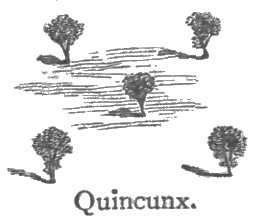
Quincunx, kwin′kungks, n. an arrangement of five things, so as to occupy each corner and the centre of a square, esp. of trees or plants.—adj. Quincun′cial.—adv. Quincun′cially. [L. quinque, five, uncia, a twelfth part, an ounce.]
Quindecemvir, kwin-dē-sem′vir, n. one of a college of fifteen men in ancient Rome who had the charge of the Sibylline books:—pl. Quindecem′viri.—ns. Quindec′agon, a plane figure with fifteen sides and angles; Quindecem′virate, the body of the quindecemviri or their office; Quindec′ima (mus.), the interval of a fifteenth, or double-octave. [L.,—quindecim, fifteen (quinque, five, decem, ten), vir, a man.]
Quinible, kwin′i-bl, n. (mus.) an interval of a fifth: a descant sung at the fifth. [L. quinque, five.]
Quinine, kwin′ēn, ki-nēn′, or kwī′nīn, n. a colourless, inodorous, and very bitter alkaloid, obtained from the bark of the Cinchona tree, its salts used for agues and fevers.—ns. Quī′na, the bark of various species of Cinchona; Quinam′ine, a natural white crystalline alkaloid obtained from various Cinchona barks; Quinaquī′na, the bark of various species of Cinchona.—adj. Quin′ic, pertaining to, or derived from, quinine.—ns. Quin′idine, a white crystalline compound, isomeric with quinine, found in some Cinchona barks; Quinol′ogy, the knowledge of quinine and other Cinchona alkaloids. [Fr.,—Sp. and Port. quinina—Peruv. quina, kina, bark.]
Quinisext, kwin′i-sekst, adj. pertaining to five and six, or to the fifth and sixth.
Quinnat, kwin′at, n. the king-salmon.
Quinoa, kē′no-a, n. a Chilian and Mexican food-plant, resembling some British species of chenopodium, cultivated for its farinaceous seeds. [Peruv.]
Quinoline, kwin′ō-lin, n. a pungent, colourless liquid obtained by the distillation of bones, coal-tar, and various alkaloids—the base of many organic bodies, isomeric with Leucol.—Also Chin′oline. [Peruv. quina, kina, bark.]
Quinone, kwin′ōn, n. or Benzoquinone, a golden-yellow crystalline compound usually prepared by oxidising aniline with potassium bichromate and sulphuric acid: a general name applied to all benzene derivatives in which two oxygen atoms replace two hydrogen atoms.—Also Kinone (kē′nōn), as Kinic—Quinic.
Quinquagesima, kwin-kwa-jes′i-ma, n. a period of fifty days.—n. Quinquagenā′rian, one who is between fifty and sixty years old.—Quinquagesima Sunday, the Sunday before Ash Wednesday, being the fiftieth day before Easter. [L. quinquaginta, fifty—quinque, five.]
Quinquangular, kwin-kwang′gū-lar, adj. having five angles.—adjs. Quinquartic′ular, of five articles; Quinquecap′sular, having five capsules; Quinquecos′tāte, -d having five ribs; Quinqueden′tate, -d (bot.), five-toothed; Quinquefā′rious, disposed in five sets or rows; Quin′quefid, cleft into five segments; Quinquefō′liate, -d (bot.), having five leaves or leaflets; Quinquelit′eral, consisting of five letters; Quinquelō′bate, having five lobes; Quinqueloc′ular, having five loculi; Quinquepär′tite, five-parted; Quinquesep′tate, having five septa; Quinquesē′rial, arranged in five series; Quinquesyllab′ic, having five syllables; Quinquev′alent, having an equivalence of five; Quin′quevalve, Quinqueval′vular, having five valves.
Quinquenniad, kwin-kwen′i-ad, n. a period of five years—also Quinquenn′ium.—adj. Quinquenn′ial, occurring once in five years: lasting five years.—n. a fifth anniversary or its celebration.
Quinquereme, kwin′kwe-rēm, n. an ancient galley having five banks of oars. [L.,—quinque, five, remus, an oar.]
Quinquina, kin-kī′nä, n. quinaquina. [Quinine.]
Quinquino, kin′ki-nō, n. the tree (Myroxylon Pereiræ) which yields the balsam of Peru.
Quinsy, kwin′zi, n. an inflammatory affection of the substance of the tonsils, attended when fully developed by suppuration.—ns. Quin′sy-berr′y, the common black-currant; Quin′sy-wort, a small trailing British herb of the madder family. [O. Fr. squinancie (Fr. esquinancie)—Gr. kynanchē—kyōn, a dog, anchein, to throttle.]
Quint, kwint, n. a set or a sequence of five: (mus.) a fifth: the E string of a violin.—adj. Quint′an, recurring on every fifth day.—n. a malarial fever whose paroxysms recur on every fifth day. [Fr.,—L. quintus, fifth—quinque, five.]
Quinta, kwin′tä, n. a country house in Madeira. [Sp.]
Quintad, kwin′tad, n. the same as Pentad.
Quintadena, kwin-ta-dē′na, n. in organ-building, a mutation stop yielding a tone one-twelfth above the digital struck.
Quintain, kwin′tān, n. a post with a turning and loaded top or cross-piece, to be tilted at.—Also Quin′tin. [Fr.,—L. quintana, quintus, fifth, the place of recreation in the Roman camp being between the fifth and sixth maniples.]
Quintal, kwin′tal, n. a hundredweight, either 112 or 100 pounds according to the scale.—The Quintal métrique, the modern French quintal, is 100 kilograms=220 lb. avoirdupois. [Fr. and Sp. quintal—Ar. qintăr—L. centum, a hundred.]
Quintessence, kwin-tes′ens, n. the pure concentrated essence of anything, the most essential part of anything: the fifth essence, according to the Pythagoreans, beyond earth, water, fire, air.—adj. Quintessen′tial.—v.t. Quintessen′tialise. [Fr.,—L. quinta essentia, fifth essence, orig. applied to ether, supposed to be purer than fire, the highest of the four ancient elements.]
Quintet, Quintette, kwin-tet′, n. a musical composition for five voices or instruments: a company of five singers or players. [It. quintetto, dim. of quinto, a fifth part—L. quintus, fifth—quinque, five.]
Quintic, kwin′tik, adj. of the fifth degree.
Quintile, kwin′til, n. the aspect of planets distant from each other the fifth part of the zodiac, or 72°.
Quintillion, kwin-til′yun, n. the fifth power of a million, or a unit followed by thirty ciphers: generally, in U.S., the sixth power of one thousand, or a unit followed by eighteen ciphers.
Quintole, kwin′tōl, n. a five-stringed viol common in France in the 18th century: a group of five notes to be played in the time of three, four, or six. [It. quinto—L. quintus, fifth.]
Quintroon, kwin-trōōn′, n. the offspring of a white by one who has one-sixteenth part of negro blood. [Sp. quinteron—L. quintus, fifth—quinque, five.]
Quintuple, kwin′tū-pl, adj. fivefold: (mus.) having five crotchets in a bar.—v.t. to make or to increase fivefold.—ns. Quin′tūplet, a set of five things: (pl.) five young at a birth: (mus.) same as Quintole; Quintū′plicāte, consisting of five: one of five exactly corresponding things.—v.t. to make or to increase a set of fivefold.—n. Quintuplicā′tion. [Fr.,—L. quintuplex—quintus, fifth, plicāre, to fold.]
Quinzaine, kwin′zān, n. the fifteenth day onward from a feast day, counting itself: a stanza of fifteen lines. [Fr. quinze, fifteen—L. quindecim—quinque, five, decem, ten.]
Quinze, kwinz, n. a card-game, like vingt-et-un, the object being to count as nearly to fifteen as possible without going above it.
Quip, kwip, n. a sharp, sarcastic turn, a gibe: a quick retort.—v.i. to use sarcasms.—v.t. to sneer at.—adj. Quip′pish. [W. chwip, a quick turn, chwipio, to move briskly.]
Quipu, kē′pōō, or kwip′ōō, n. the mnemonic language of coloured and knotted cords used by the Incas of ancient Peru—depending on order, colour, and kind.—Also Quip′o. [Peruv., 'a knot.']
Quire, kwīr, n. a collection of paper consisting of twenty-four sheets, the twentieth part of a ream, each having a single fold.—v.t. to fold in quires. [O. Fr. quaier (Fr. cahier), prob. from Low L. quaternum, a set of four sheets,—L. quatuor, four.]
Quire, kwīr, n. old form of choir.—n. Quī′rister, a chorister.
Quirinus, kwi-rī′nus, n. an Italic divinity identified with the deified Romulus.—n. Quirinā′lia, a festival in ancient Rome in honour of Quirinus, on Feb. 17.
Quirites, kwi-rī′tez, n.pl. the citizens of ancient Rome in their civil capacity.
Quirk, kwėrk, n. a quick turn: an artful evasion: a quibble: a taunt or retort: a slight conceit: inclination, turn: fantastic phrase: (archit.) an acute angle or recess.—v.i. to turn sharply.—v.t. to twist or turn: to furnish with a quirk or channel.—adjs. Quirk′ish, consisting of quirks; Quirk′y, abounding in quirks. [Skeat explains as prob. for obs. Eng. quirt, to turn; from W. chwired, a piece of craft, from chwiori, to turn briskly; cf. Gael. cuireid, a turn.]
Quirt, kwėrt, n. a riding-whip much used in the western states of North America.—v.t. to flog with a quirt. [Perh. Sp. cuerda, a rope.]
Quiscalus, kwis′ka-lus, n. a genus of birds, the American grackles or crow-blackbirds.
Quit, kwit, v.t. to pay, requite: to release from obligation, accusation, &c.: to acquit: to depart from: to give up: to clear by full performance: (Spens.) to remove by force: (coll.) to give over, cease:—pr.p. quit′ting; pa.t. and pa.p. quit′ted.—adj. (B.) set free: acquitted: released from obligation.—n. Quit′-claim, a deed of release.—v.t. to relinquish claim or title to.—n. Quit′-rent, a rent by which the tenants are discharged from all other services—in old records called white rent, as being paid in silver money.—adj. Quit′table, capable of being quitted.—ns. Quit′tal (Shak.), requital, repayment; Quit′tance, a quitting or discharge from a debt or obligation: acquittance: recompense.—v.t. (obs.) to repay.—Quit cost, to pay expenses; Quit one's self (B.), to behave; Quit scores, to balance accounts.—Be quits, to be even with one; Cry quittance, to get even; Double or quits, in gambling, said when a stake due is either to become double or be reduced to nothing, according to the issue of a certain chance; Notice to quit (law), notice to a tenant of real property that he must surrender possession. [O. Fr. quiter (Fr. quitter)—Low L. quietāre, to pay—L. quietāre, to make quiet—quietus, quiet.]
Qui tam, kwī tam, an action on a penal statute, brought partly at the suit of the state and partly at that of an informer—from the first words. [L. qui, who, tam, as well.]
Quitch, kwich, n. couch-grass.—Also Quitch′-grass, Quick′ens. [Assibilated form of quick.]
Quitch, kwich, v.i. (Spens.) to move. [A.S. cweccan, causative of cwacian, to quake.]
Quite, kwīt (Spens.). Same as Quit.
Quite, kwīt, adv. completely: wholly: entirely.—Quite a little, a good few: considerable; Quite so, a phrase denoting assent in conversation. [Merely an adv. use of the adj. quit.]
Quitter, kwit′ėr, n. a fistulous sore on the quarters or the heel of the coronet of a horse's hoof.—v.i. to suppurate.
Quiver, kwiv′ėr, adj. (Shak.) nimble, active.
Quiver, kwiv′ėr, n. a case for arrows.—adj. Quiv′ered, furnished with a quiver: sheathed, as in a quiver. [O. Fr. cuivre; from Old High Ger. kohhar (Ger. köcher); cog. with A.S. cocer.]
Quiver, kwiv′ėr, v.i. to shake with slight and tremulous motion: to tremble: to shiver.—ns. Quiv′er, Quiv′ering, a tremulous motion, shiver.—adv. Quiv′eringly, with quivering.—adj. Quiv′erish, tremulous. [A.S. cwifer, seen in adv. cwiferlíce, eagerly. Cf. Quick and Quaver.]
Qui vive, kē vēv, Who goes there?—the challenge of French sentries to those who approach their posts.—Be on the qui vive, to be on the alert. [Fr.,—qui, who, vive, 3d pers. sing. pres. subj. of vivre, to live—L. vivĕre.]
Quixotic, kwiks-ot′ik, adj. like Don Quixote, the knight-errant in the great romance of Cervantes (1547-1616), extravagantly romantic, aiming at an impossible ideal.—adv. Quixot′ically.—ns. Quix′otism, Quix′otry, absurdly romantic, impracticable, and magnanimous notions, schemes, or actions like those of Don Quixote.
Quiz, kwiz, n. a riddle or enigma: one who quizzes another: an odd fellow: a monocular eye-glass, often with a handle: (coll.) an oral examination of a pupil or class by a teacher.—v.t. to puzzle: to banter or make sport of: to examine narrowly and with an air of mockery.—v.i. to practise derisive joking:—pr.p. quiz′zing; pa.t. and pa.p. quizzed.—ns. Quiz′zer; Quiz′zery.—adj. Quiz′zical.—ns. Quizzical′ity; Quizzificā′tion.—v.t. Quiz′zify, to turn into a quiz.—ns. Quiz′ziness, oddness; Quiz′zing, raillery; Quiz′zing-glass, a single eye-glass. [Origin obscure; doubtless framed from question, or direct from L. quæso, I ask.]
Quoad, kwō′ad, prep. as far as, to this extent.—Quoad hoc, as far as this; Quoad omnia, in respect of all things; Quoad sacra, as far as concerns sacred matters, as a parish disjoined for ecclesiastical purposes only. [L.]
Quod, kwod, n. (slang) prison.
Quodlibet, kwod′li-bet, n. a scholastic argument upon a subject chosen at will, almost invariably theological: a humorous fanciful combination of two or more familiar melodies.—n. Quodlibetā′rian, one given to quodlibets.—adjs. Quodlibet′ic, -al. [L., 'what you please'—quod, what, libet, it pleases.]
Quodlin, kwod′lin, n. (Bacon). Same as Codlin.
Quoif, koif, n. a cap or hood.—v.t. to cover or dress with a coif.
Quoin, koin, n. (archit.) a wedge used to support and steady a stone: an external angle, esp. of a building: (gun.) a wedge of wood or iron put under the breech of heavy guns or the muzzle of siege-mortars to raise them to the proper level: (print.) a wedge used to fasten the types in the forms.—v.t. to wedge or steady with quoins. [Coin.]
Quoit, koit, n. a heavy flat ring of iron for throwing as near as possible to one hob or pin from the other—18 to 21 yards apart—the points in the game counted as in bowls or curling: (pl.) the game played with such rings.—v.i. to throw quoits: to throw as with a quoit. [Perh. from O. Fr. coiter, to drive, which may be from L. coactāre—cogĕre, to force.]
Quondam, kwon′dam, adj. that was formerly: former. [L., formerly.]
Quoniam, kwō′ni-am, n. the part of the 'Gloria in Excelsis' beginning 'For Thou only art holy:' the musical setting thereof: (obs.) a kind of drinking-cup. [L., 'since now.']
Quook, kwook (Spens.), pa.t. of quake.
Quop, kwop, v.i. to move: to throb, as the heart.—Also Quab, Quap.
Quorum, kwō′rum, n. a number of the members of any body sufficient to transact business. [The first word of a commission formerly issued to certain justices, of whom (L. quorum) a certain number had always to be present when the commission met.]
Quota, kwō′ta, n. the part or share assigned to each.—n. Quot′ity (Carlyle), the number of individuals in a collection. [It.,—L. quotus, of what number?—quot, how many?]
Quote, kwōt, v.t. to repeat the words of any one: to adduce for authority or illustration: to give the current price of: to enclose within quotation marks: (Shak.) to set down in writing.—v.i. to make a quotation.—adj. Quō′table, that may be quoted.—ns. Quō′tableness, Quōtabil′ity.—adv. Quō′tably.—ns. Quōtā′tion, act of quoting: that which is quoted: the current price of anything; Quōtā′tion-mark, one of the marks used to note the beginning and the end of a quotation—generally consisting of two inverted commas at the beginning, and two apostrophes at the end of a quotation; but a single comma and a single apostrophe are frequently used; Quō′ter. [O. Fr. quoter, to number—Low L. quotāre, to divide into chapters and verses—L. quotus, of what number?—quot, how many?]
Quoth, kwōth, v.t. say, says, or said—used only in the 1st and 3d persons present and past, and always followed by its subject.—interj. Quō′thä, forsooth, indeed. [A.S. cwethan, pa.t. cwæth, to say. For quoth'a, said he—'a being a corr. of he.]
Quotidian, kwō-tid′i-an, adj. every day: occurring daily.—n. anything returning daily: (med.) a kind of ague that returns daily. [Fr.,—L. quotidianus—quot, as many as, dies, a day.]
Quotient, kwō′shent, n. (math.) the number which shows how often one number is contained in another.—n. Quōtī′ety, the proportionate frequency of an event. [Fr.,—L. quotiens, quoties, how often?—quot, how many?]
Quotum, kwō′tum, n. quota: share: part or proportion. [L., neut. of quotus; cf. Quota.]
Quo warranto, kwō wo-ran′to, n. (law) the title of a writ by which a person or corporate body is summoned to show by what warrant a particular franchise or office is claimed. [So called from these words in the writ. L. quo, by what (abl. sing. neut. of quis, who, which, what), warranto, abl. of Low L. warrantum, warrant.]

the eighteenth letter in our alphabet, belonging to the class of liquids—the 'dog's letter' (littera canina), from the trilling or vibration of the tip of the tongue: as a medieval numeral=80; R=80,000.—The three R's, a humorous term for reading, writing, and arithmetic.
Ra, rä, n. the supreme sun-god of the Memphite system of ancient Egyptian mythology.
Rabanna, ra-ban′a, n. matting made from the fibre of the raffia, in Madagascar. [Malagasy.]
Rabat, ra-bä′, n. a neck-band with flaps worn by French ecclesiastics: a turned-down collar or ruff—(obs.) Rab′atine, Rabā′to. [Fr.]
Rabate, ra-bāt′, v.t. to beat down.—n. abatement. [Fr. rabattre, to beat down—re-, again, abattre—L. ad, to, batuĕre, to beat.]
Rabbet, rab′et, n. a groove cut in the edge of a plank so that another may fit into it.—v.t. to groove a plank thus.—ns. Rabb′eting-machine′, -plane, -saw, for ploughing and cutting grooves; Rabb′et-joint, a joint formed by fitting together timber with rabbets. [O. Fr. raboter, to plane—rabouter—re-, again, aboter, abouter, to thrust against.]
Rabbi, rab′i, or rab′ī, Rabbin, rab′in, n. Jewish title of a doctor or expounder of the law:—pl. Rabbis (rab′īz), Rabb′ins.—ns. Rabb′an ('our master'), a title of greater honour than rabbi; Rabb′inate, the dignity of a rabbi.—adjs. Rabbin′ic, -al, pertaining to the rabbis or to their opinions, learning, and language.—n. Rabbin′ic, the later Hebrew.—adv. Rabbin′ically.—ns. Rabb′inism, the doctrine or teaching of the rabbis: a rabbinical peculiarity of expression: the late Jewish belief which esteemed the oral law equally with the written law of God; Rabb′inist, Rabb′inite, one who adheres to the Talmud and traditions of the rabbis; Rabbō′ni, my great master. [Gr.,—Heb. rabbí—rab, great, master—rābab, to be great. Cf. Ar. rabb, master, the Lord.]
Rabbit, rab′it, n. a small rodent burrowing animal of the hare family: a cony: any member of the hare family.—v.i. to hunt rabbits.—ns. Rabb′it-brush, a North American composite plant; Rabb′it-ear, a long slender oyster; Rabb′iter, one who hunts rabbits; Rabb′it-fish, the 'king of the herrings;' Rabb′it-hutch, a box for the rearing of rabbits; Rabb′it-moth, a moth in United States of a furry appearance; Rabb′it-mouth, harelip; Rabb′it-root, the wild sarsaparilla; Rabb′itry, a rabbit-warren; Rabb′it-squirr′el, a chincha, a South American rodent; Rabb′it-suck′er (Shak.), a sucking rabbit; Rabb′it-warr′en, a place where rabbits are kept and bred.—Snow-shoe rabbit, an American hare found in the Rocky Mountains which turns white in winter; Welsh rabbit, melted cheese with a little ale poured over a slice of hot toast—sometimes written 'Welsh rarebit' by wiseacres. [M. E. rabet, dim. of a form seen in Old Dut. robbe.]
Rabbit, rab′it, v.t. an interjectional expression, like confound. [Perh. a corr. of rabate.]
Rabble, rab′l, n. a disorderly, noisy crowd: a mob: the lowest class of people.—adj. disorderly.—v.i. to utter nonsense.—v.t. (Scot.) to mob.—ns. Rabb′lement, a tumultuous crowd of low people; Rabb′ling (Scot.), the act of assaulting in a disorderly manner, mobbing. [Allied to Old Dut. rabbelen, to gabble, Prov. Ger. rabbeln.]
Rabble, rab′l, n. an iron bar used in puddling.—v.t. to stir with a rabble.—n. Rabb′ler. [O. Fr. roable (Fr. râble)—L. rutabulum, a poker.]
Rabdomancy. Same as Rhabdomancy.
Rabelaisian, rab-e-lā′zi-an, n. characteristic of Rabelais (1490-1553), broadly humorous, coarse.
Rabi, rab′i, n. the great grain crop of Hindustan.
Rabid, rab′id, adj. furious: mad: affected with rabies, as a dog: foolishly intense.—adj. Rab′ic, pertaining to rabies.—adv. Rab′idly.—ns. Rab′idness; Rā′bies, the disease (esp. of dogs) from which hydrophobia is communicated: canine madness.—adjs. Rābiet′ic, resembling madness; Rābif′ic, communicating hydrophobia; Rā′bious, raging. [L. rabidus—rabĕre, to rave.]
Rabot, rab′ot, n. a rubber used in polishing marble.
Raca, rā′ka, adj. worthless—a term of contempt used by the Jews of Christ's day; cf. Matt. v. 22. [Chaldee rēkā, worthless; perh. conn. with raq, to spit (Ar. rīq), or with rīqā, empty.]
Raccahout, rak′a-hōōt, n. an Eastern dish made from the edible acorns of the oak. [Fr.,—Ar. rāquat, rāqaout, a nourishing starch.]
Raccoon, Racoon, ra-kōōn′, n. a genus of the bear family of North America, valuable for its fur.—ns. Raccoon′-berr′y, the May apple of the United States; Raccoon′-oys′ter, an oyster growing on the shores of the sea in United States. [Amer. Ind.]
Race, rās, n. the human family: the descendants of a common ancestor: a breed or variety: a tribal or national stock: a line of persons, as of statesmen, or of animals, as the feline race: a herd: peculiar flavour, as of wine, by which its origin may be recognised: (Shak.) intrinsic character, vigour. [Fr.,—Old High Ger. reiza, a line.]
Race, rās, n. rapid motion: trial of speed: progress: course of action: a strong and rapid current: a canal to a water-wheel: a competitive trial of speed in running, walking, &c.: a horse-race, as the Ascot races.—v.i. to run swiftly: to contend in running.—v.t. to cause to race, as steamers, horses, &c.—ns. Race′-card, a card containing information about races; Race′-course, -ground, -track, the course over which races are run; Race′-cup, a piece of plate forming a prize at a race; Race′horse, a horse bred for racing; Race′-meet′ing, a meeting for purposes of horse-racing; Rā′cer, one who races: a racehorse; Race′-way, a mill-race; Rā′cing, the running of races; Rā′cing-bit, a light jointed ring-bit; Consolā′tion-race (see Consolation); Flat′-race, a horse-race over level or clear ground—opp. to a Hurdle-race or Steeplechase, which are called generally Obstacle-races.—Racing calendar, a full list of races to be run. [A.S. rǽs, stream; Ice. rás, rapid course.]
Race, rās, n. (Shak.) a root.—n. Race′-gin′ger, unpulverised ginger. [O. Fr. rais—L. radix, a root.]
Race, rās, v.t. (obs.)=Raze.—adj. Raced.
Raceme, ra-sēm′, n. a cluster: a flower-cluster, as in the currant.—adjs. Racemed′, having racemes; Racem′ic, pertaining to, or obtained from, grapes: an acid obtained from a certain kind of grape; Racemif′erous, bearing racemes; Rac′emōse, Rac′emous, growing in, or resembling, a raceme.—n. Rac′emūle, a small raceme.—adj. Racem′ulōse, bearing small racemes. [Fr.,—L. racemus.]
Rach, Ratch, rach, n. a dog that hunts by scent. [A.S. ræcc, a dog; Ice. rakki.]
Rachianectes, ra-ki-an-ek′tez, n. the gray whale of the North Pacific. [Gr. rhachia, a rocky shore, nēktēs, a swimmer.]
Rachis, rā′kis, n. the spine: (bot.) a branch or axis of inflorescence which proceeds in nearly a straight line from the base to the apex:—pl. Rā′chidēs.—n. Rāchial′gia, pain in the spine.—adjs. Rāchial′gic; Rāchid′ial, Rāchid′ian.—n. Rāchil′la, a secondary rachis in a compound inflorescence.—adj. Rāchit′ic, rickety.—ns. Rāchī′tis, rickets in children (see Rickets): (bot.) a disease which produces abortion in the fruit; Rāch′itome, an anatomical instrument for opening the spinal canal. [Gr. rachis, the spine.]
Racial, rā′si-al, adj. relating to lineage, peculiar to a race.—adv. Rā′cially.
Rack, rak, n. an instrument for racking or extending: an engine for stretching the body in order to extort a confession, hence (fig.) extreme pain, anxiety, or doubt: a framework on which articles are arranged, as hat-rack, plate-rack, letter-rack, &c.: the grating above a manger for hay: (mech.) a straight bar with teeth to work into those of a wheel, pinion, or endless screw, for converting a circular into a rectilinear motion, or vice versâ: (Scot.) the course in curling.—v.t. to stretch forcibly: to strain: to stretch on the rack or wheel: to torture: to exhaust: to worry, agitate: to wrest, overstrain: to practise rapacity: to extort: to place in a rack or frame: (naut.) to seize together with cross-turns, as two ropes.—n. Rack′er, one who tortures.—adj. Rack′ing, tormenting.—ns. Rack′-rail, a railway having cogs which work into similar cogs on a locomotive; Rack′-rent, an annual rent stretched to the utmost value of the thing rented, exorbitant rent.—v.t. to subject to such rents.—ns. Rack′-rent′er, one who exacts or pays rack-rent; Rack′-stick, a stick for stretching a rope; Rack′-tail, a bent arm in a repeating clock connected with the striking mechanism; Rack′work, a strong bar with cogs to correspond with similar cogs on a wheel, which either moves or is moved by the bar.—Live at rack and manger, to live sumptuously and wastefully; On the rack, stretched upon it: tortured by anxiety; Put to the rack, to put to the torture of the rack: to subject to keen suffering. [The radical sense is to stretch, closely allied to reach (q.v.); cf. Ice. rakkr, straight, Ger. rack, a rail, recken, to stretch.]
Rack, rak, n. same as Wrack=Wreck—now used only in the phrases Go to rack, Go to rack and ruin. [Cf. the next word.]
Rack, rak, n. thin or broken clouds drifting across the sky.—v.i. to drift, to drive. [Wrack; cf. Ice. rek.]
Rack, rak, v.t. to strain or draw off from the lees, as wine.—ns. Rack′ing-can, a vessel from which wine can be drawn without disturbing the lees; Rack′ing-cock, -fau′cet, a cock used in drawing off liquour from a cask; Rack′ing-pump, a pump for the transfer of liquor to casks. [O. Fr. raquer, vin raqué; prob. cog. with Sp. rascar, to scrape.]
Rack, rak, n. (prov.) the neck and spine of a fore-quarter of veal or mutton: the neck of mutton or pork.
Rack, rak, n. the gait of a horse between a trot and a gallop.—n. Rack′er, a horse that moves in this gait. [Perh. rack, to drift, or rock.]
Rack, rak, n. same as Arrack.—Rack punch, a punch made with arrack.
Rack, rak, n. a young rabbit. [Orig. unknown.]
Rackabones, rak′a-bōnz, n. (Amer.) a very lean person or animal.
Rackarock, rak′a-rok, n. an explosive of potassium chlorate and nitro-benzol.—Also Rend′rock.
Racket, Racquet, rak′et, n. a bat for playing tennis: a snow-shoe: an organ-stop: a 17th-cent. musical instrument: (pl.) a modern variety of the old game of tennis.—v.t. to strike, as with a racket.—ns. Rack′et-, Racq′uet-court, -ground, a court for playing rackets: a tennis-court; Rack′et-tail, a humming-bird with two feathers like rackets.—adj. Rack′et-tailed. [O. Fr. rachete (Fr. raquette)—Sp. raqueta—Ar. rāhat, the palm of the hand.]
Racket, rak′et, n. a clattering noise: hurly-burly.—v.i. to make a clattering noise: to engage in racket of any kind: to be dissipated.—n. Rack′eter.—adj. Rack′ety.—v.t. and v.i. Rack′le (prov.), to rattle.—n. noisy talk. [Gael. racaid—rac, to cackle.]
Raconteur, ra-kong-tėr′, n. a story-teller. [Fr.]
Racoon. See Raccoon.
Racovian, ra-kō′vi-an, n. a 17th-cent. Polish Socinian—their seminary being at Rakow.
Racy, rā′si, adj. having a strong flavour imparted by the soil, as wine: exciting to the mind by strongly characteristic thought or language: spirited: pungent, as a racy story: peculiar to the race.—adv. Rā′cily.—n. Rā′ciness. [Race, a family.]
Rad, rad (Spens.), pa.t. of read and ride.
Rad, rad, adj. (Scot.) afraid.
Rad, rad, n. short for radical.
Raddle, rad′l, v.t. to interweave: to beat.—n. a hedge formed by interweaving the branches of trees: a hurdle: split wood like laths: a wooden bar used in domestic weaving. [Perh. a transposed form of hurdle; or perh. formed from wreathe, or writhe, and confused with hurdle.]
Raddle, rad′l, n. a layer of red pigment—also Redd′le.—v.t. to colour coarsely, as with raddle: to do work in a slovenly way. [Ruddle.]
Rade, rād, old form of rode.
Radial, rā′di-al, adj. shooting out like a ray or radius: pertaining to the radius of the forearm: (bot.) developing uniformly on all sides.—ns. Rādiā′le, the radiocarpal bone:—pl. Rādiā′lia; Rādiā′lis, a radial muscle, artery, or nerve:—pl. Rādiā′les; Rādialisā′tion, arrangement in radiating forms.—v.t. Rā′dialise, to make ray-like: to cause to radiate.—n. Rādial′ity, radial symmetry.—adv. Rā′dially, in the manner of a radius or of rays.—adjs. Rā′diocar′pal, pertaining to the wrist or carpus; Rā′diomus′cular, pertaining to the radius and to muscles; Rā′dio-ul′nar, pertaining to the radius and the ulna.—Radial artery, the smaller of the branches of the branchial artery at the elbow.
Radian, rā′di-an, n. the angle subtended at the centre of a circle by an arc equal to the radius.
Radiant, rā′di-ant, adj. emitting rays of light or heat: issuing in rays: beaming with light: shining: (her.) edged with rays.—n. (opt.) the luminous point from which light emanates: (astron.) the centre point from which meteoric showers proceed: (geom.) a straight line from a point about which it is conceived to revolve.—ns. Rā′diance, Rā′diancy, quality of being radiant: brilliancy: splendour.—adv. Rā′diantly.—adj. Rā′dious (obs.), radiant.—Radiant energy, energy in the form of light or radiant heat; Radiant heat, heat proceeding in rays or direct lines from a centre. [L. radians, -antis, pr.p. of radiāre, -ātum, to radiate—radius.]
Radiata, rā-di-ā′ta, n.pl. the lowest of Cuvier's four great divisions of the animal kingdom—the organs of sense and motion disposed as rays round a centre.
Radiate, rā′di-āt, v.i. to emit rays of light: to shine: to proceed in direct lines from any point or surface.—v.t. to send out in rays: to furnish with rays.—adjs. Rā′diāte, -d, formed of rays diverging from a centre: (bot.) consisting of a disc in which the florets are tubular: (min.) having crystals diverging from a centre: belonging to the Radiata: in coins, represented with rays proceeding from a centre, as a head or bust.—adv. Rā′diately, in a radiate manner: with radiation from a centre.—adj. Rādiā′tiform, having the appearance of being radiate.—adv. Rā′diatingly.—n. Rādiā′tion, act of radiating: the emission and diffusion of rays of light or heat.—adj. Rā′diative.—n. Rā′diator, a body which radiates or emits rays of light or heat: a part of a heating apparatus for a room.—adj. Rā′diatory.—ns. Rādioflagell′ata, marine animalcules; Rā′diograph, an instrument by which solar radiation is measured.—adj. Rādiolā′rian, pertaining to the ooze at the bottom of the sea, composed of the shells of Radiolā′rians, a class of marine rhizopod Protozoa, so called from their having thread-like processes of living matter radiating outwards on all sides.—ns. Rādī′olus, one of the barbules of the main shaft of a feather; Rādiom′eter, an instrument consisting of four horizontal arms of very fine glass, carefully poised so as to revolve easily on a point, the whole contained in a glass vessel almost exhausted of air—the arms move round under light or heat, more or less swiftly according to the strength of the rays.—adj. Rādiomet′ric.—ns. Rādiomicrom′eter, an instrument for measuring very small amounts of heat; Rā′diophone, an instrument for producing or transmitting sound by heat-rays.—adj. Rādiophon′ic.—ns. Rādiophon′ics, Rā′diophony, the production of sound by radiant heat; Rā′dium, a rare element whose radiations act upon photographic plates and have properties like the X-rays.
Radical, rad′i-kal, adj. pertaining to the root or origin: original: fundamental: intrinsic: primitive: implanted by nature: not derived: serving to originate: (bot.) proceeding immediately from the root: (politics) ultra-liberal, democratic.—n. a root: a primitive word or letter: one who advocates radical reform, an uncompromising democratic politician: (chem.) the base of a compound.—v.t. Rad′icalise, to make radical.—v.i. to become radical, adopt radical political principles.—n. Rad′icalism, the principles or spirit of a radical or democrat.—adv. Rad′ically.—n. Rad′icalness. [Radix.]
Radicate, rad′i-kāt, adj. deeply rooted: firmly established: (zool.) fixed at the bottom as if rooted: (conch.) adhering like a limpet.—v.t. to root: to plant or fix deeply and firmly:—pr.p. rad′icāting; pa.p. rad′icāted.—adjs. Rad′icant (bot.), sending out roots from the stem above the ground; Radicā′rian, relating to roots; Rad′icated, rooted.—ns. Radicā′tion, the act or process of radicating or taking root deeply: (bot.) the disposition of the root with respect to the ascending or descending stem; Rad′icel, a rootlet.—adjs. Radicic′olous, Radic′olous, living on roots, pertaining to the root-form of the phylloxera; Radiciflō′rous, flowering from the root; Radic′iform, like a root.—n. Rad′icle, a little root: the part of a seed which in growing becomes the root.—adjs. Rad′icōse, having a large root; Radic′ūlar, pertaining to a radicle.—n. Rad′icūle (bot.), that end of the embryo which is opposite to the cotyledons.—adj. Radic′ūlōse (bot.), covered with rootlets: radicose, having a large root. [L. radicāri, -ātus, to take root—radix, a root.]
Radish, rad′ish, n. an annual whose succulent pungent root is eaten raw as a salad.—ns. Rad′ish-fly, an American insect; Sea′side-rad′ish, the wild radish. [Fr. radis—Prov. raditz—L. radix, radicis, a root.]
Radius, rā′di-us, n. (geom.) a straight line from the centre to the circumference of a circle: anything like a radius, as the spoke of a wheel: a ray: (anat.) the exterior bone of the arm: (bot.) the ray of a flower: the movable arm of a sextant: one of the radiating lines of a geometrical spider's web:—pl. Rā′dii (ī).—ns. Rā′dius-bar, -rod, in a steam-engine, a rod pivoted at one end and connected at the other with a concentrically moving part at a fixed distance.—Radius vector (pl. Radii vectores), the distance from a fixed origin to any point of a curve. [L., a rod.]
Radix, rā′diks, n. a root: primitive source: a primitive word from which other words are formed: the base of a system of logarithms:—pl. Radices (rā-dī′sēz). [L. radix, radic-is.]
Radoub, ra-dōōb′, n. the refitting of a ship. [Fr., radouber, to mend. Cf. Redub.]
Radula, rad′ū-la, n. the tongue or lingual ribbon of a mollusc.—adjs. Rad′ūlar; Rad′ūlāte; Radūlif′erous, bearing a radula; Rad′ūliform, rasp-like: like a file. [L.,—radĕre, to scrape.]
Raff, raf, n. the sweepings of society, the rabble: the riff-raff: rubbish: a low worthless fellow, a rowdy.—v.t. (obs.) to snatch, to sweep off.—adj. Raff′ish, worthless. [O. Fr. raffer, to catch; cog. with Ger. raffen, to snatch; cf. Riff-raff.]
Raff, Raffe, raf, n. (naut.) a three-cornered sail set on a schooner when before the wind.—Also Raff′ie.
Raffia. Same as Raphia.
Raffle, raf′l, n. a kind of sale by chance or lottery in which the price is subscribed equally by all who hope to win.—v.i. to try a raffle.—n. Raff′ler. [Fr. rafle, a certain game of dice—rafler, to sweep away—Ger. raffeln, freq. of raffen (A.S. reafian), to seize.]
Raffle, raf′l, n. lumber, rubbish. [Cf. Raff (1).]
Raffled, raf′ld, adj. having the edge finely notched.
Rafflesia, raf-lē′zi-a, n. a remarkable genus of apetalous parasitic plants, named after Sir T. Stamford Raffles (1781-1826), British governor in Sumatra (1818).
Raft, raft, n. (U.S.) a miscellaneous or promiscuous lot. [A variant of Raff (1).]
Raft, raft, n. a collection of pieces of timber fastened together for a support on the water: planks conveyed by water.—v.t. to transport on a raft: to form into a raft.—v.i. to manage a raft, travel by raft.—ns. Raft′-bridge, a bridge supported on rafts; Raft′-dog, an iron bar fitted for securing logs in a raft; Raft′-duck, the black-head duck of the United States; Raft′-port, a square hole in some ships for convenience in loading and unloading timber; Raft′-rope, a rope used in whaling-vessels for stringing blubber; Rafts′man, one who guides a raft. [Ice. raptr (pron. raftr), a rafter—ráf, ræfr, a roof; cf. Old High Ger. rāfo, a spar.]
Rafter, raft′ėr, n. an inclined beam supporting the roof of a house.—v.t. to furnish with rafters.—n. Raft′er-bird, the spotted fly-catcher.—Principal rafter, a main timber in supporting the weight of a roof. [A.S. ræfter, a beam; Ice. raptr (raftr), a beam; Dan. raft, a pole.]
Rag, rag, n. a fragment of cloth: a rock having a rough irregular surface: a remnant, scrap: a beggarly person: anything rent or worn out.—adj. made of rags.—v.t. to make ragged.—v.i. to become ragged, to fray: (U.S. slang) to dress (out).—ns. Rag′abash, a low fellow; Rag′amuffin, a low, disreputable person.—adj. Rag′amuffinly.—ns. Rag′-bush, in some heathen countries, a bush dedicated to some deity and decorated with rags torn from the clothes of pilgrims; Rag′-dust, the refuse of rags used by dyers; Rag′-fair, a fair or market for rags, old clothes, &c.; Rag′gery, rags collectively; Rag′ging, the first rough separation of the ore from dross; Rag′-man, a man who collects or deals in rags; Rag′-mon′ey (slang), paper money; Rag′-pick′er, one who collects rags, &c., from ash-heaps, dung-hills, &c.: a machine for tearing old rags, &c., to pieces; Rag′-shop, a shop where rag-pickers dispose of their finds; Rag′-sort′er, one who sorts out rags for paper-making; Rag′-stone, Ragg, an impure limestone, consisting chiefly of lime and silica; Rag′-tag, the rabble; Rag′weed, any plant of the composite genus Ambrosia; Rag′wheel, a wheel with teeth or cogs on the rim, which fit into the links of a chain or into rackwork: a cutlass polishing-wheel; Rag′-wool, shoddy; Rag′work, mason-work built of small stones about the size of bricks: a manufacture from strips of rag.—Rag-tag and bobtail, a rabble. [Ice. rögg, shagginess.]
Rag, rag, v.t. to banter, torment.—Also n. [Perh. from the previous word; others refer to Ice. rægja, to calumniate; cog. with A.S. wrégan, to accuse.]
Ragbolt, rag′bōlt, n. an iron pin with barbed shank.
Rage, rāj, n. violent excitement: enthusiasm: rapture: furious anger: intensity: any object much sought after, the fashion.—v.i. to be furious with anger: to exercise fury: to prevail fatally, as a disease: to be violently agitated, as the waves.—v.t. to enrage.—adjs. Rage′ful, full of rage, furious; Rā′ging, acting with rage, violence, or fury.—adv. Rā′gingly.—All the rage (coll.), quite the fashion. [Fr.,—L. rabies—rabĕre, to rave.]
Ragg, rag, n. (geol.)=Ragstone. See under Rag (1).
Ragged, rag′ed, adj. torn or worn into rags: having a rough edge: ruggedly uneven, jagged: wearing ragged clothes: shabby.—adv. Ragg′edly.—ns. Ragg′edness; Ragg′ed-rob′in, the cuckoo flower; Ragg′ed-sail′or, the prince's feather-plant; Ragg′ed-school, a school for the destitute; Ragg′ed-staff (her.), a knotted stick with short stumps of branches on each side. [Cf. Rag.]
Raggee, rag′ē, n. a species of millet, grown in Southern India. [Hind.]
Raggle, rag′l, v.t. to notch irregularly.—n. a ragged piece. [Freq. of rag.]
Raglan, rag′lan, n. a loose, wide-sleeved overcoat. [From Lord Raglan (1788-1855), commander of the English forces in the Crimea.]