Volume 3 — K
Reading edition
“The Kabbēras,” Mr. Francis continues, “are at present engaged in a number of callings, and, perhaps in consequence, several occupational sub-divisions have arisen, the members of which are more often known by their occupational title than as either Gangimakkalu or Kabbēras. The Bārikes, for example, are a class of village servants who keep the village chāvadi (caste meeting house) clean, look after the wants of officials halting in the village, and do other similar duties. The Jalakaras are washers of gold-dust; the Madderu are dyers, who use the root of the maddi (Morinda citrifolia) tree; and apparently (the point is one which I have not had time to clear up) the Besthas, who have often been treated as a separate caste, are really a sub-division of the Gangimakkalu, who were originally palanquin-bearers, but, now that these vehicles have gone out of fashion, are employed in divers other ways. The betrothal is formally evidenced by the partaking of betel-leaf in the girl’s house, in the manner followed by the Kurubas. As among the Mādigas, the marriage is not consummated for three months after its celebration. The caste follow the Kuruba ceremony of calling back the dead.” Consummation is, as among the Kurubas and Mādigas, postponed for three months, as it is considered unlucky to have three heads of a family in a household during the first year of marriage. By the delay, the birth of a child should take place only in the second year, so that, during the first year, there will be only two heads, husband and wife. In the ceremony of calling back the dead, referred to by Mr. Francis, a pot of water is worshipped in the house on the eleventh day after a funeral, and taken next morning to some lonely place, where it is emptied.
For the following note on the Kabbēras of the Bellary district, I am indebted to Mr. Kothandram Naidu. The caste is sometimes called Ambiga. Breaches of caste rules and customs are enquired into by a panchayat presided over by a headman called Kattemaniavaru. If the fine inflicted on the offender is a heavy one, half goes to the headman, and half to the caste people, who spend it in drink. In serious cases, the offender has to be purified by shaving and drinking holy water (thirtam) given to him by the headman. Both infant and adult marriage are practiced. Sexual license previous to marriage is tolerated, but, before that takes place, the contracting couple have to pay a fine to the headman. At the marriage ceremony, the tāli is tied on the bride’s neck by a Brāhman. Married women carry painted new pots with lights, bathe the bride and bridegroom, etc. Widows are remarried with a ceremonial called Udiki, which is performed at night in a temple by widows, one of whom ties the tāli. No married men or women may be present, and music is not allowed. Divorce is said to be not permitted. In religion the Kabbēras are Vaishnavites, and worship various village deities. The dead are buried. Cloths and food are offered to ancestors during the Dasara festival, excepting those who have died a violent death. Some unmarried girls are dedicated to the goddess Hulugamma as Basavis (dedicated prostitutes).
Kabbili.—Kabbili or Kabliga, recorded as a sub-division of Bestha, is probably a variant of Kabbēra.
Kadacchil (knife-grinder or cutler).—A sub-division of Kollan.
Kadapēri.—A sub-division of Kannadiyan.
Kadavala (pots).—An exogamous sept of Padma Sālē.
Kādi (blade of grass).—A gōtra of Kurni.
Kādir.—The Kādirs or Kādans inhabit the Ānaimalai or elephant hills, and the great mountain range which extends thence southward into Travancore. A night journey by rail to Coimbatore, and forty miles by road at the mercy of a typically obstinate jutka pony, which landed me in a dense patch of prickly-pear (Opuntia Dillenii), brought me to the foot of the hills at Sēthumadai, where I came under the kindly hospitality of Mr. H. A. Gass, Conservator of Forests, to whom I am indebted for much information on forest and tribal matters gathered during our camp life at Mount Stuart, situated 2,350 feet above sea-level, in the midst of a dense bamboo jungle, and playfully named after Sir Mountstuart Grant Duff, who visited the spot during his quinquennium as Governor of Madras.
At Sēthumadai I made the acquaintance of my first Kādir, not dressed, as I hoped, in a primitive garb of leaves, but wearing a coloured turban and the cast-off red coat of a British soldier, who had come down the hill to carry up my camp bath, which acted as an excellent umbrella, to protect him from the driving monsoon showers. Very glad was I of his services in helping to convey my clothed, and consequently helpless self, across the mountain torrents, swollen by a recent burst of monsoon rain.
The Kādir forest guards, of whom there are several in Government service, looked, except for their noses, very unjungle-like by contrast with their fellow-tribesmen, being smartly dressed in regulation Norfolk jacket, knickerbockers, pattis (leggings), buttons, and accoutrements.
The salient characteristics of the Kādirs may be briefly summed up as follows: short stature, dark skin, platyrhine. Men and women have the teeth chipped. Women wear a bamboo comb in the back-hair. Those whom I met spoke a Tamil patois, running up the scale in talking, and finishing, like a Suffolker, on a higher note than they commenced on. But I am told that some of them speak a mixture of debased Tamil and Malayālam. I am informed by Mr. Vincent that the Kādirs have a peculiar word Āli, denoting apparently a fellow or thing, which they apply as a suffix to names, e.g., Karaman Āli, black fellow; Mudi Āli, hairy fellow; Kutti Āli, man with a knife; Pūv Āli, man with a flower. Among nicknames, the following occur: white mother, white flower, beauty, tiger, milk, virgin, love, breasts. The Kādirs are excellent mimics, and give a clever imitation of the mode of speech of the Muduvans, Malasars, and other hill tribes.
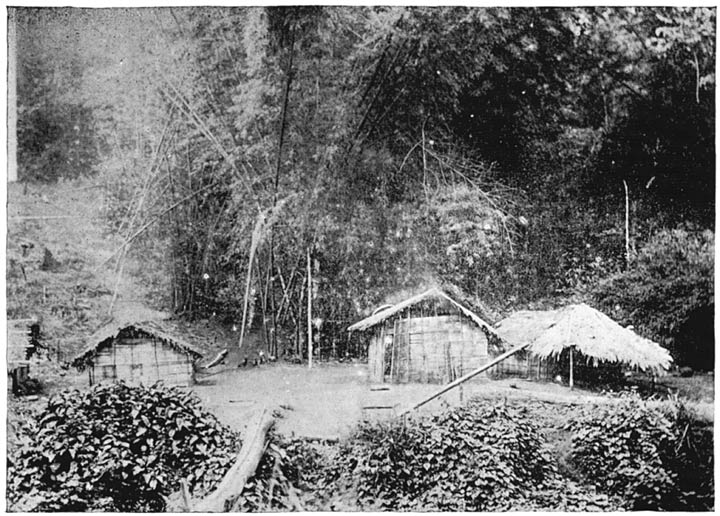
Kādir Huts.
The Kādirs afford a typical example of happiness without culture. Unspoiled by education, the advancing wave of which has not yet engulfed them, they still retain many of their simple “manners and customs.” Quite refreshing was it to hear the hearty shrieks of laughter of the nude curly-haired children, wholly illiterate, and happy in their ignorance, as they played at funerals, or indulged in the amusement of making mud pies, and scampered off to their huts on my appearance. The uncultured Kādir, living a hardy out-door life, and capable of appreciating to the full the enjoyment of an “apathetic rest” as perfect bliss, has, I am convinced, in many ways, the advantage over the poor under-fed student with a small-paid appointment under Government as the narrow goal to which the laborious passing of examination tests leads.
At the forest depôt the Kādir settlement consists of neatly constructed huts, made of bamboo deftly split with a bill-hook in their long axis, thatched with leaves of the teak tree (Tectona grandis) and bamboo (Ochlandra travancorica), and divided off into verandah and compartments by means of bamboo partitions. But the Kādirs are essentially nomad in habit, living in small communities, and shifting from place to place in the jungle, whence they suddenly re-appear as casually as if they had only returned from a morning stroll instead of a long camping expedition. When wandering in the jungle, the Kādirs make a rough lean-to shed covered over with leaves, and keep a small fire burning through the night, to keep off bears, elephants, tigers, and leopards. They are, I am told, fond of dogs, which they keep chiefly as a protection against wild beasts at night. The camp fire is lighted by means of a flint and the floss of the silk-cotton tree (Bombax malabaricum), over which powdered charcoal has been rubbed. Like the Kurumbas, the Kādirs are not, in a general way, afraid of elephants, but are careful to get out of the way of a cow with young, or a solitary rover, which may mean mischief. On the day following my descent from Mount Stuart, an Oddē cooly woman was killed on the ghāt road by a solitary tusker. Familiarity with wild beasts, and comparative immunity from accident, have bred contempt for them, and the Kādirs will go where the European, fresh to elephant land, fears to tread, or conjures every creak of a bamboo into the approach of a charging tusker. As an example of pluck worthy of a place in Kipling’s ‘Jungle-book,’ I may cite the case of a hill-man and his wife, who, overtaken by night in the jungle, decided to pass it on a rock. As they slept, a tiger carried off the woman. Hearing her shrieks, the sleeping man awoke, and followed in pursuit in the vain hope of saving his wife. Coming on the beast in possession of the mangled corpse, he killed it at close quarters with a spear. Yet he was wholly unconscious that he had performed an act of heroism worthy of the bronze cross ‘for valour.’
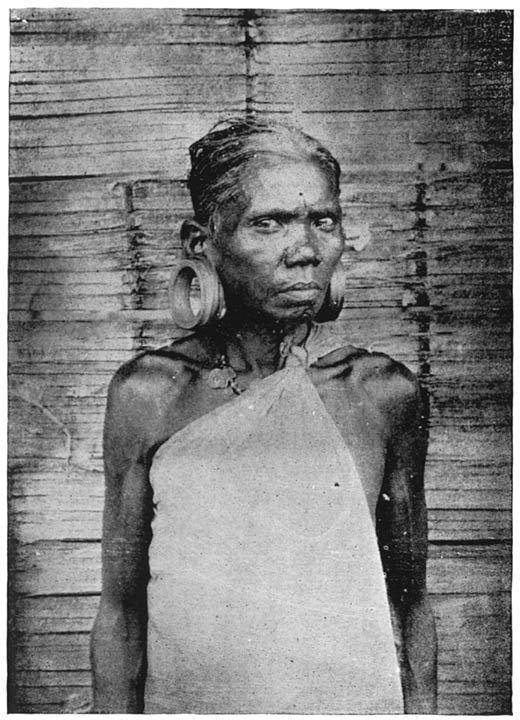
Kādir.
The Kādirs carry loads strapped on the back over the shoulders by means of fibre, instead of on the head in the manner customary among coolies in the plains; and women on the march may be seen carrying the cooking utensils on their backs, and often have a child strapped on the top of their household goods. The dorsal position of the babies, huddled up in a dirty cloth, with the ends slung over the shoulders and held in the hands over the chest, at once caught my eye, as it is contrary to the usual native habit of straddling the infants across the loins as a saddle.
Mr. Vincent informs me that “when the planters first came to the hills, the Kādirs were found practically without clothes of any description, with very few ornaments, and looking very lean and emaciated. All this, however, changed with the advent of the European, as the Kādirs then got advances in hard cash, clothes, and grain, to induce them to work. For a few years they tried to work hard, but were failures, and now I do not suppose that a dozen men are employed on the estates on the hills. They would not touch manure owing to caste scruples; they could not learn to prune; and with a mamoti (spade) they always promptly proceeded to chop their feet about in their efforts to dig pits.” The Kādirs have never claimed, like the Todas, and do not possess any land on the hills. But the Government has declared the absolute right of the hill tribes to collect all the minor forest produce, and to sell it to the Government through the medium of a contractor, whose tender has been previously accepted. The contractor pays for the produce in coin at a fair market rate, and the Kādirs barter the money so obtained for articles of food with contractors appointed by Government to supply them with their requirements at a fixed rate, which will leave a fair, but not exorbitant margin of profit to the vendor. The principal articles of minor forest produce of the Ānaimalai hills are wax, honey, cardamoms, myrabolams, ginger, dammer, turmeric, deer horns, elephant tusks, and rattans. And of these, cardamoms, wax, honey, and rattans are the most important. Honey and wax are collected at all seasons, and cardamoms from September to November. The total value of the minor produce collected, in 1897–98, in the South Coimbatore division (which includes the Ānaimalais) was Rs. 7,886. This sum was exceptionally high owing to a good cardamom crop. An average year would yield a revenue of Rs. 4,000–5,000, of which the Kādirs receive approximately 50 per cent. They work for the Forest Department on a system of short advances for a daily wage of 4 annas. And, at the present day, the interests of the Forest Department and planters, who have acquired land on the Ānaimalais, both anxious to secure hill men for labour, have come into mild collision.
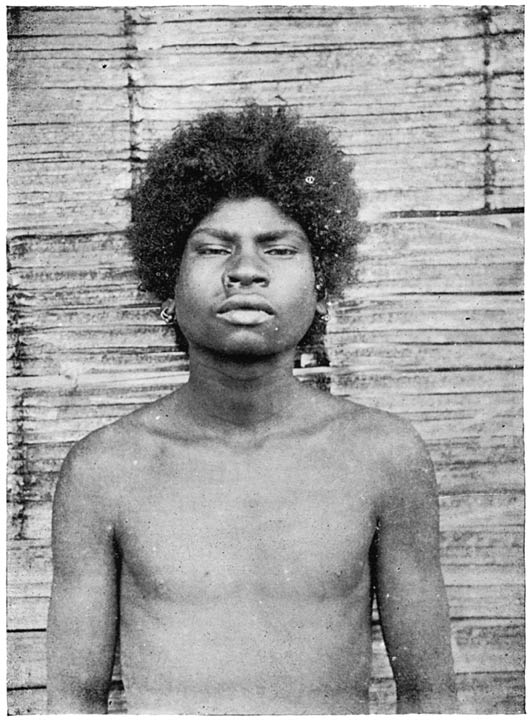
Kādir.
Some Kādirs are good trackers, and a few are good shikāris. A zoological friend, who had nicknamed his small child his “little shikarī” (=little sportsman) was quite upset because I, hailing from India, did not recognise the word with his misplaced accent. One Kādir, named Viapoori Muppan, is still held in the memory of Europeans, who made a good living, in days gone by, by shooting tuskers, and had one arm blown off by the bursting of a gun. He is reputed to have been a much married man, greatly addicted to strong drinks, and to have flourished on the proceeds of his tusks. At the present day, if a Kādir finds tusks, he must declare the find as treasure-trove, and hand it over to Government, who rewards him at the rate of Rs. 15 to Rs. 25 per maund of 25 lb. according to the quality. Government makes a good profit on the transaction, as exceptionally good tusks have been known to sell for Rs. 5 per lb. If the find is not declared, and discovered, the possessor thereof is punished for theft according to the Act. By an elastic use of the word cattle, it is, for the purposes of the Madras Forest Act, made to include such a heterogeneous zoological collection of animals as elephants, sheep, pigs, goats, camels, buffaloes, horses—and asses. This classification recalls to mind the occasion on which the Flying-fox or Fox-bat was included in an official list of the insectivorous birds of the Presidency; and, further, a report on the wild animals of a certain district, which was triumphantly headed with the “wild tattu,” the long-suffering, but pig-headed country pony.
Often, when out on the tramp with the late Government Botanist, Mr. M. A. Lawson, I have heard him lament that it is impossible to train arboreal monkeys to collect specimens of the fruit and flowers of lofty forest trees, which are inaccessible to the ordinary man. Far superior to any trained Simian is the Kādir, who, by means of pegs or notches, climbs even the tallest masts of trees with an agility which recalls to memory the celebrated picture in “Punch,” representing Darwin’s ‘Habit of climbing plants.’ For the ascent of comparatively low trees, notches are made with a bill-hook, alternately right and left, at intervals of about thirty inches. To this method the Kādir will not have recourse in wet weather, as the notches are damp and slippery, and there is the danger of an insecure foot-hold.
In their search for produce in the evergreen forests of the higher ranges, with their heavy rainfall, the Kādirs became unpleasantly familiar with leeches and blue bottle flies, which flourish in the moist climate. And it is recorded that a Kādir, who had been gored and wounded by a bull ‘bison,’ was placed in a position of safety while a friend ran to the village to summon help. He was not away for more than an hour, but, in that short time, flies had deposited thousands of maggots in the wounds, and, when the man was brought into camp, they had already begun burrowing into the flesh, and were with difficulty extracted. On another occasion, the eye-witness of the previous unappetising incident was out alone in the forest, and shot a tiger two miles or so from his camp. Thither he went to collect coolies to carry in the carcase, and was away for about two hours, during which the flies had, like the child in the story, ‘not been idle,’ the skin being a mass of maggots and totally ruined. I have it on authority that, like the Kotas of the Nīlgiris, the Kādirs will eat the putrid and fly-blown flesh of carcases of wild beasts, which they come across in their wanderings. To a dietary which includes succulent roots, which they upturn with a digging stick, bamboo seed, sheep, fowls, rock-snakes (python), deer, porcupines, rats (field, not house), wild pigs, monkeys, etc., they do credit by displaying a hard, well-nourished body. The mealy portion of the seeds of the Cycas tree, which flourishes on the lower slopes of the Ānaimalais, forms a considerable addition to the ménu. In its raw state the fruit is said to be poisonous, but it is evidently wholesome when cut into slices, thoroughly soaked in running water, dried, and ground into flour for making cakes, or baked in hot ashes. Mr. Vincent writes that, “during March, April, and May, the Kādirs have a glorious time. They usually manage to find some wild sago palms, called by them koondtha panai, of the proper age, which they cut down close to the ground. They are then cut into lengths of about 1½ feet, and split lengthways. The sections are then beaten very hard and for a long time with mallets, and become separated into fibre and powder. The powder is thoroughly wetted, tied in cloths and well beaten with sticks. Every now and then, between the beatings, the bag of powder is dipped in water, and well strained. It is then all put into water, when the powder sinks, and the water is poured off. The residue is well boiled, with constant stirring, and, when it is of the consistency of rubber, and of a reddish brown colour, it is allowed to cool, and then cut in pieces to be distributed. This food stuff is palatable enough, but very tough.” The Kādir is said to prefer roasting and eating the flesh of animals with the skin on. For catching rats, jungle-fowl, etc., he resorts to cunningly devised snares and traps made of bamboo and fibre, as a substitute for a gun. Porcupines are caught by setting fire to the scrub jungle round them as they lie asleep, and thus smoking and burning them to death.
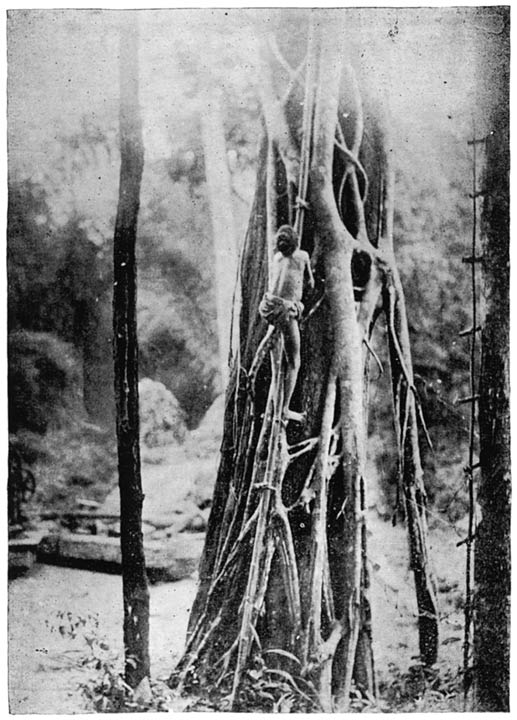
Kādir Tree-climbing.
When a Kādir youth’s thoughts turn towards matrimony, he is said to go to the village of his bride-elect, and give her a dowry by working there for a year. On the wedding day a feast of rice, sheep, fowls, and other luxuries is given by the parents of the bridegroom, to which the Kādir community is invited. The bride and bridegroom stand beneath a pandal (arch) decorated with flowers, which is erected outside the home of the bridegroom, while men and women dance separately to the music of drum and fife. The bridegroom’s mother or sister ties the tāli (marriage badge) of gold or silver round the bride’s neck, and her father puts a turban on the head of the bridegroom. The contracting parties link together the little fingers of their right hands as a token of their union, and walk in procession round the pandal. Then, sitting on a reed mat of Kādir manufacture, they exchange betel. The marriage tie can be dissolved for incompatibility of temper, disobedience on the part of the wife, adultery, etc., without appeal to any higher authority than a council of elders, who pronounce judgment on the evidence. As an illustration of the manner in which such a council of hill-men disposes of cases, Mr. Bensley cites the case of a man who was made to carry forty basket loads of sand to the house of the person against whom he had offended. He points out how absolute is the control exercised by the council. Disobedience would be followed by excommunication, and this would mean being turned out into the jungle, to obtain a living in the best way one could.
By one Kādir informant I was assured, as he squatted on the floor of my bungalow at “question time,” that it is essential that a wife should be a good cook, in accordance with a maxim that the way to the heart is through the mouth. How many men in civilised western society, who suffer from marrying a wife wholly incompetent, like the first Mrs. David Copperfield, to conduct the housekeeping, might well be envious of the system of marriage as a civil contract to be sealed or unloosed according to the cookery results! Polygyny is indulged in by the Kādirs, who agree with Benedick that “the world must be peopled,” and hold more especially that the numerical strength of their own tribe must be maintained. The plurality of wives seems to be mainly with the desire for offspring, and the father-in-law of one of the forest-guards informed me that he had four wives living. The first two wives producing no offspring, he married a third, who bore him a solitary male child. Considering the result to be an insufficient contribution to the tribe, he married a fourth, who, more prolific than her colleagues, gave birth to three girls and a boy, with which he remained content. In the code of polygynous etiquette, the first wife takes precedence over the others, and each wife has her own cooking utensils.
Special huts are maintained for women during menstruation and parturition. Mr. Vincent informs me that, when a girl reaches puberty, the friends of the family gather together, and a great feast is prepared. All her friends and relations give her a small present of money, according to their means. The girl is decorated with the family jewelry, and made to look as smart as possible. For the first menstrual period, a special hut, called mutthu salai or ripe house, is constructed for the girl to live in during the period of pollution; but at subsequent periods, the ordinary menstruation hut, or unclean house, is used. All girls are said to change their names when they reach puberty. For three months after the birth of a child, the woman is considered unclean. When the infant is a month old, it is named without any elaborate ceremonial, though the female friends of the family collect together. Sexual intercourse ceases on the establishment of pregnancy, and the husband indulges in promiscuity. Widows are not allowed to re-marry, but may live in a state of concubinage. Women are said to suckle their children till they are two or three years old, and a mother has been seen putting a lighted cigarette to the lips of a year old baby immediately after suckling it. If this is done with the intention of administering a sedative, it is less baneful than the pellet of opium administered by ayahs (nurses) to Anglo-Indian babies rendered fractious by troubles climatic, dental, and other. The Kādir men are said to consume large quantities of opium, which is sold to them illicitly. They will not allow the women or children to eat it, and have a belief that the consumption thereof by women renders them barren. The women chew tobacco. The men smoke the coarse tobacco as sold in the bazars, and showed a marked appreciation of Spencer’s Torpedo cheroots, which I distributed among them for the purposes of bribery and conciliation.
The religion of the Kādirs is a crude polytheism, and vague worship of stone images or invisible gods. It is, as Mr. Bensley expresses it, an ejaculatory religion, finding vent in uttering the names of the gods and demons. The gods, as enumerated and described to me, were as follows:—
(1) Paikutlātha, a projecting rock overhanging a slab of rock, on which are two stones set up on end. Two miles east of Mount Stuart.
(2) Athuvisariamma, a stone enclosure, ten to fifteen feet square, almost level with the ground. It is believed that the walls were originally ten feet high, and that the mountain has grown up round it. Within the enclosure there is a representation of the god. Eight miles north of Mount Stuart.
(3) Vanathavāthi. Has no shrine, but is worshipped anywhere as an invisible god.
(4) Iyappaswāmi, a stone set up beneath a teak tree, and worshipped as a protector against various forms of sickness and disease. In the act of worshipping, a mark is made on the stone with ashes. Two miles and a half from Mount Stuart, on the ghāt road to Sēthumadai.
(5) Māsanyātha, a female recumbent figure in stone on a masonry wall in an open plain near the village of Ānaimalai, before which trial by ordeal is carried out. The goddess has a high repute for her power of detecting thieves or rogues. Chillies are thrown into a fire in her name, and the guilty person suffers from vomiting and diarrhœa.
When Kādirs fall sick, they worship the gods by saluting them with their hands to the face, burning camphor, and offering up fruits, cocoanuts, and betel. Mr. Vincent tells me that they have a horror of cattle, and will not touch the ordure, or other products of the cow. Yet they believe that their gods occasionally reside in the body of a “bison,” and have been known to do pūja (worship) when a bull has been shot by a sportsman. It is noted by Mr. Anantha Krishna Iyer that wild elephants are held in veneration by them, but tame ones are believed to have lost the divine element.
The Kādir dead are buried in a grave, or, if death occurs in the depths of the jungles, with a paucity of hands available for digging, the corpse is placed in a crevice between the rocks, and covered over with stones. The grave is dug from four to five feet deep. There is no special burial-ground, but some spot in the jungle, not far from the scene of death, is selected. A band of music, consisting of drum and fife, plays weird dirges outside the hut of the deceased, and whistles are blown when it is carried away therefrom. The old clothes of the deceased are spread under the corpse, and a new cloth is put on it. It is tied up in a mat, which completely covers it, and carried to the burial-ground on a bamboo stretcher. As it leaves the hut, rice is thrown over it. The funeral ceremony is simple in the extreme. The corpse is laid in the grave on a mat in the recumbent posture, with the head towards the east, and with split bamboo and leaves placed all round it, so that not a particle of earth can touch it. No stone, or sepulchral monument of any kind, is set up to mark the spot. The Kādir believes that the dead go to heaven, which is in the sky, but has no views as to what sort of place it is. The story that the Kādirs eat their dead originated with Europeans, the origin of it being that no one had ever seen a dead Kādir, a grave, or sign of a burial-place. The Kādirs themselves are reticent as to their method of disposing of the dead, and the story, which was started as a joke, became more or less believed. Mr. Vincent tells me that a well-to-do Kādir family will perform the final death ceremonies eight days after death, but poorer folk have to wait a year or more, till they have collected sufficient money for the expenses thereof. At cock-crow on the morning of the ceremonies, rice, called polli chor, is cooked, and piled up on leaves in the centre of the hut of the deceased. Cooked rice, called tullagu chor, is then placed in each of the four corners of the hut, to propitiate the gods, and to serve as food for them and the spirit of the dead person. At a short distance from the hut, rice, called kanal chor, is cooked for all Kādirs who have died, and been buried. The relations and friends of the deceased commence to cry, and make lamentations, and proclaim his good qualities, most of which are fictitious. After an hour or so, they adjourn to the hut of the deceased, where the oldest man present invokes the gods, and prays to them and to the heaped up food. A pinch from each of the heaps is thrown into the air as a gift of food to the gods, and those present fall to, and eat heartily, being careful to partake of each of the food-stuffs, consisting of rice, meat, and vegetables, which have been prepared.
On a certain Monday in the months of Ādi and Āvani, the Kādirs observe a festival called nōmbu, during which a feast is held, after they have bathed and anointed themselves with oil. It was, they say, observed by their ancestors, but they have no definite tradition as to its origin or significance. It is noted by Mr. Anantha Krishna Iyer that, at the Ōnam festival, presents in the shape of rice, cloths, coats, turbans, caps, ear-rings, tobacco, opium, salt, oil and cocoanuts are distributed among the Kādirs by the Forest Department.
Perhaps the most interesting custom of the Kādirs is that of chipping all or some of the incisor teeth, both upper and lower, into the form of a sharp-pointed, but not serrated cone. The operation, which is performed with a chisel or bill-hook and file by members of the tribe skilled therein, on boys and girls, has been thus described. The girl to be operated on lies down, and places her head against a female friend, who holds her head firmly. A woman takes a sharpened bill-hook, and chips away the teeth till they are shaded to a point, the girl operated on writhing and groaning with the pain. After the operation she appears dazed, and in a very few hours the face begins to swell. Swelling and pain last for a day or two, accompanied by severe headache. The Kādirs say that chipped teeth make an ugly man or woman handsome, and that a person, whose teeth have not been thus operated on, has teeth and eats like a cow. Whether this practice is one which the Kādir, and Mala Vēdar of Travancore, have hit on spontaneously in comparatively recent times, or whether it is a relic of a custom resorted to by their ancestors of long ago, which remains as a stray survival of a custom once more widely practiced by the remote inhabitants of Southern India, cannot be definitely asserted, but I incline to the latter view.
A friendly old woman, with huge discs in the widely dilated lobes of the ears, and a bamboo five-pronged comb in her back-hair, who acted as spokesman on the occasion of a visit to a charmingly situated settlement in a jungle of magnificent bamboos by the side of a mountain stream, pointed out to me, with conscious pride, that the huts were largely constructed by the females, while the men worked for the sircar (Government). The females also carry water from the streams, collect firewood, dig up edible roots, and carry out the sundry household duties of a housewife. Both men and women are clever at plaiting bamboo baskets, necklets, etc. I was told one morning by a Kādir man, whom I met on the road, as an important item of news, that the women in his settlement were very busy dressing to come and see me—an event as important to them as the dressing of a débutante for presentation at the Court of St. James’. They eventually turned up without their husbands, and evidently regarded my methods as a huge joke organised for the amusement of themselves and their children. The hair was neatly parted, anointed with a liberal application of cocoanut oil, and decked with wild flowers. Beauty spots and lines had been painted with coal-tar dyes on the forehead, and turmeric powder freely sprinkled over the top of the heads of the married women. Some had even discarded the ragged and dirty cotton cloth of every-day life in favour of a colour-printed imported sāri. One bright, good-looking young woman, who had already been through the measuring ordeal, acted as an efficient lady-help in coaching the novices in the assumption of the correct positions. She very readily grasped the situation, and was manifestly proud of her temporary elevation to the rank of standard-bearer to Government.
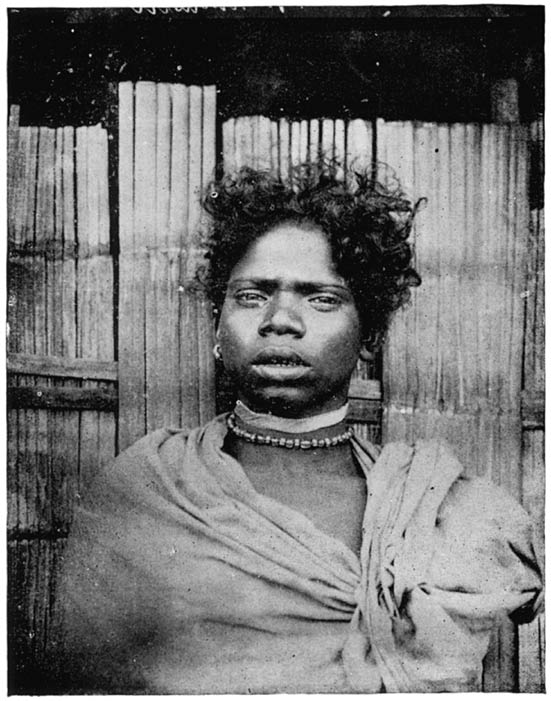
Kādir Boy with Chipped Teeth.
It is sometimes difficult to distinguish adolescent Kādir youths with curly fringe, chests covered by a cotton cloth, and wearing necklets made of plaited grass or glass and brass beads, from girls. And I was myself several times caught in an erroneous diagnosis of sex. Many of the infants have a charm tied round the neck, which takes the form of a dried tortoise foot; the tooth of a crocodile mimicking a phallus, and supposed to ward off attacks from a mythical water elephant which lives in the mountain streams; or wooden imitations of tiger’s claws. One baby wore a necklet made of the seeds of Coix Lachryma-Jobi (Job’s tears). Males have the lobes of the ears adorned with brass ornaments, and the nostril pierced, and plugged with wood. The ear-lobes of the females are widely dilated with palm-leaf rolls or huge wooden discs, and they wear ear-rings, brass or steel bangles and finger-rings, and bead necklets.
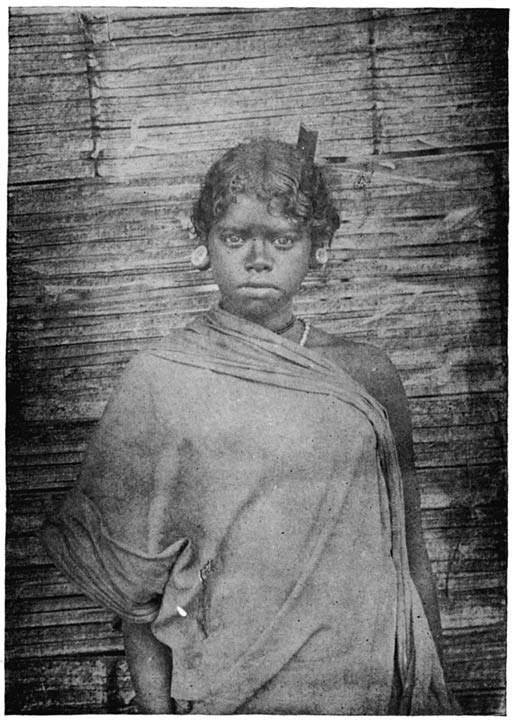
Kādir Girl Wearing Comb.
It is recorded by Mr. Anantha Krishna Iyer that the Kādirs are attached to the Rāja of Cochin “by the strongest ties of personal affection and regard. Whenever His Highness tours in the forests, they follow him, carry him from place to place in manjals or palanquins, carry sāman (luggage), and in fact do everything for him. His Highness in return is much attached to them, feeds them, gives them cloths, ornaments, combs, and looking-glasses.”
The Kādirs will not eat with Malasars, who are beef-eaters, and will not carry boots made of cow-hide, except under protest.
Average stature 157.7 cm.; cephalic index 72.9; nasal index 89.
Kadlē.—Kadlē, Kallē, and Kadalē meaning Bengal gram (Cicer arietinum) have been recorded as exogamous septs or gōtras of Kurubas and Kurnis.
Kādu.—Kādu or Kāttu, meaning wild or jungle, has been recorded as a division of Golla, Irula, Korava, Kurumba, and Tōttiyan. Kādu also occurs as an exogamous sept or gōtra of the Kurnis. Kādu Konkani is stated, in the Madras Census Report, 1901, to mean the bastard Konkanis, as opposed to the Gōd or pure Konkanis. Kāttu Marāthi is a synonym for the bird-catching Kuruvikarans. In the Malabar Wynaad, the jungle Kurumbas are known as Kāttu Nāyakan.
Kādukuttukiravar.—A synonym, meaning one who bores a hole in the ear, for Koravas who perform the operation of piercing the lobes of the ears for various castes.
Kahar.—In the Madras Census Report, 1901, the Kahars are returned as a Bengal caste of boatmen and fishermen. In the Mysore Census Report, it is noted that Kahar means in Hindustani a blacksmith, and that those censused were immigrants from the Bombay Presidency.
The name Kaikōlan is further derived from kai (hand), and kōl (shuttle). The Kaikōlans consider the different parts of the loom to represent various Dēvatas and Rishis. The thread is said to have been originally obtained from the lotus stalk rising from Vishnu’s navel. Several Dēvas formed the threads, which make the warp; Nārada became the woof; and Vēdamuni the treadle. Brahma transformed himself into the plank (padamaram), and Adisēsha into the main rope.
In some places, the following sub-divisions of the caste are recognised:—Sōzhia; Rattu; Siru-tāli (small marriage badge); Peru-tāli (big marriage badge); Sirpādam, and Sevaghavritti. The women of the Siru and Peru-tāli divisions wear a small and large tāli respectively.
In religion, most of the Kaikōlans are Saivites, and some have taken to wearing the lingam, but a few are Vaishnavites.
The hereditary headman of the caste is called Peridanakāran or Pattakāran, and is, as a rule, assisted by two subordinates entitled Sengili or Grāmani, and Ūral. But, if the settlement is a large one, the headman may have as many as nine assistants.
The Kaikōlan community is, as already indicated, divided into seventy-two nādus or dēsams, viz., forty-four mēl (western) and twenty-eight kīl (eastern) nādus. Intermarriages take place between members of seventy-one of these nādus. The great Tamil poet Ottaikūththar is said to have belonged to the Kaikōlan caste and to have sung the praises of all castes except his own. Being angry on this account, the Kaikōlans urged him to sing in praise of them. This he consented to do, provided that he received 1,008 human heads. Seventy-one nādus sent the first-born sons for the sacrifice, but one nādu (Tirumarudhal) refused to send any. This refusal led to their isolation from the rest of the community. All the nādus are subject to the authority of four thisai nādus, and these in turn are controlled by the mahānādu at Conjeeveram, which is the residence of the patron deity Kamātchiamman. The thisai nādus are (1) Sīvapūram (Walajabad), east of Conjeeveram, where Kamātchiamman is said to have placed Nandi as a guard; (2) Thondipūram, where Thondi Vinayakar was stationed; (3) Virinjipūram to the west, guarded by Subramanya; (4) Sholingipūram to the south, watched over by Bairava. Each of the seventy-one nādus is sub-divided into kilai grāmams (branch villages), pērūr (big) and sithur (little) grāmams. In Tamil works relating to the Sengundar caste, Conjeeveram is said to be the mahānādu, and those belonging thereto are spoken of as the nineteen hundred, who are entitled to respect from other Kaikōlans. Another name for Kaikōlans of the mahānādu seems to be Āndavar; but in practice this name is confined to the headman of the mahānādu, and members of his family. They have the privilege of sitting at council meetings with their backs supported by pillows, and consequently bear the title Thindusarndān (resting on pillows). At present there are two sections of Kaikōlans at Conjeeveram, one living at Ayyampettai, and the other at Pillaipālayam. The former claim Ayyampettai as the mahānādu, and refuse to recognise Pillaipālayam, which is in the heart of Conjeeveram, as the mahānādu. Disputes arose, and recourse was had to the Vellore Court in 1904, where it was decided that Ayyampettai possesses no claim to be called the mahānādu.
Many Kaikōlan families have now abandoned their hereditary employment as weavers in favour of agriculture and trade, and some of the poorer members of the caste work as cart-drivers and coolies. At Coimbatore some hereditary weavers have become cart-drivers, and some cart-drivers have become weavers de necessité in the local jail.
In every Kaikōlan family, at least one girl should be set apart for, and dedicated to temple service. And the rule seems to be that, so long as this girl or her descendants, born to her or adopted, continue to live, another girl is not dedicated. But, when the line becomes extinct, another girl must be dedicated. All the Kaikōlans deny their connection with the Dēva-dāsi (dancing-girl) caste. But Kaikōlans freely take meals in Dāsi houses on ceremonial occasions, and it would not be difficult to cite cases of genuine Dāsis who have relationship with rich Kaikōlans.
Kaikōlan girls are made Dāsis either by regular dedication to a temple, or by the headman tying the tāli (nāttu pottu). The latter method is at the present day adopted because it is considered a sin to dedicate a girl to the god after she has reached puberty, and because the securing of the requisite official certificate for a girl to become a Dāsi involves considerable trouble.
Of the orthodox form of ceremonial in connection with a girl’s initiation as a Dāsi, the following account was given by the Kaikōlans of Coimbatore. The girl is taught music and dancing. The dancing master or Nattuvan, belongs to the Kaikōlan caste, but she may be instructed in music by Brāhman Bhāgavathans. At the tāli-tying ceremony, which should take place after the girl has reached puberty, she is decorated with jewels, and made to stand on a heap of paddy (unhusked rice). A folded cloth is held before her by two Dāsis, who also stand on heaps of paddy. The girl catches hold of the cloth, and her dancing master, who is seated behind her, grasping her legs, moves them up and down in time with the music, which is played. In the course of the day, relations and friends are entertained, and, in the evening, the girl, seated astride a pony, is taken to the temple, where a new cloth for the idol, the tāli, and various articles required for doing pūja, have been got ready. The girl is seated facing the idol, and the officiating Brāhman gives sandal and flowers to her, and ties the tāli, which has been lying at the feet of the idol, round her neck. The tāli consists of a golden disc and black beads. Betel and flowers are then distributed among those present, and the girl is taken home through the principal streets. She continues to learn music and dancing, and eventually goes through a form of nuptial ceremony. The relations are invited for an auspicious day, and the maternal uncle, or his representative, ties a gold band on the girl’s forehead, and, carrying her, places her on a plank before the assembled guests. A Brāhman priest recites the mantrams, and prepares the sacred fire (hōmam). The uncle is presented with new cloths by the girl’s mother. For the actual nuptials a rich Brāhman, if possible, and, if not, a Brāhman of more lowly status is invited. A Brāhman is called in, as he is next in importance to, and the representative of the idol. It is said that, when the man who is to receive her first favours, joins the girl, a sword must be placed, at least for a few minutes, by her side. When a Dāsi dies, her body is covered with a new cloth removed from the idol, and flowers are supplied from the temple, to which she belonged. No pūja is performed in the temple till the body is disposed of, as the idol, being her husband, has to observe pollution.
Though the Kaikōlans are considered to belong to the left-hand faction, Dāsis, except those who are specially engaged by the Bēri Chettis and Kammālans, are placed in the right-hand faction. Kaikōlan Dāsis, when passing through a Kammālan street, stop dancing, and they will not salute Kammālans or Bēri Chettis.
A peculiar method of selecting a bride, called siru tāli kattu (tying the small tāli), is said to be in vogue among some Kaikōlans. A man, who wishes to marry his maternal uncle’s or paternal aunt’s daughter, has to tie a tāli, or simply a bit of cloth torn from her clothing, round her neck, and report the fact to his parents and the headman. If the girl eludes him, he cannot claim her, but, should he succeed, she belongs to him. In some places, the consent of the maternal uncle to a marriage is signified by his carrying the bride in his arms to the marriage pandal (booth). The milk-post is made of Erythrina indica. After the tāli has been tied, the bridegroom lifts the bride’s left leg, and places it on a grinding-stone. Widows are stated by Mr. Stuart to be “allowed to remarry if they have no issue, but not otherwise; and, if the prevalent idea that a Kaikōla woman is never barren be true, this must seldom take place.”
On the final day of the death ceremonies, a small hut is erected, and inside it stones, brought by the barber, are set up, and offerings made to them.
The following proverbs are current about or among the Kaikōlans:—
Narrate stories in villages where there are no Kaikōlans.
Why should a weaver have a monkey?
On examining the various occupations, weaving will be found to be the best.
A peep outside will cut out eight threads.
The person who was too lazy to weave went to the stars.
The Chetti (money-lender) decreases the money, and the weaver the thread.
The titles of the Kaikōlans are Mūdali and Nāyanar.
Among the Kaikōlan musicians, I have seen every gradation of colour and type, from leptorhine men with fair skin and chiselled features, to men very dark and platyrhine, with nasal index exceeding 90.
For the following account of a ceremony, which took place at Conjeeveram in August, 1908, I am indebted to the Rev. J. H. Maclean. “On a small and very lightly built car, about eight feet high, and running on four little wheels, an image of Kāli was placed. It was then dragged by about thirty men, attached to it by cords passed through the flesh of their backs. I saw one of the young men two days later. Two cords had been drawn through his flesh, about twelve inches apart. The wounds were covered over with white stuff, said to be vibūthi (sacred ashes). The festival was organised by a class of weavers calling themselves Sankunram (Sengundar) Mudaliars, the inhabitants of seven streets in the part of Conjeeveram known as Pillaipalyam. The total amount spent is said to have been Rs. 500. The people were far from clear in their account of the meaning of the ceremony. One said it was a preventive of small-pox, but this view did not receive general support. Most said it was simply an old custom: what good it did they could not say. Thirty years had elapsed since the last festival. One man said that Kāli had given no commands on the subject, and that it was simply a device to make money circulate. The festival is called Pūntēr (flower car).”
In September, 1908, an official notification was issued in the Fort St. George Gazette to the following effect. “Whereas it appears that hook-swinging, dragging of cars by men harnessed to them by hooks which pierce their sides, and similar acts are performed during the Mariyamman festival at Samayapuram and other places in the Trichinopoly division, Trichinopoly district, and whereas such acts are dangerous to human life, the Governor in Council is pleased, under section 144, sub-section (5), of the Code of Criminal Procedure, 1898, to direct that the order of the Sub-divisional Magistrate, dated the 7th August, 1908, prohibiting such acts, shall remain in force until further orders.”
Kaila (measuring grain in the threshing-floor).—An exogamous sept of Māla.
Kaimal.—A title of Nāyars, derived from kai, hand, signifying power.
Kaipūda.—A sub-division of Holeya.
Kaivarta.—A sub-division of Kevuto.
Kāka (crow).—The legend relating to the Kāka people is narrated in the article on Koyis. The equivalent Kākī occurs as a sept of Mālas, and Kāko as a sept of Kondras.
Kākara or Kākarla (Momordica Charantia).—An exogamous sept of Kamma and Mūka Dora.
Kākirekka-vāndlu (crows’ feather people).—Mendicants who beg from Mutrāchas, and derive their name from the fact that, when begging, they tie round their waists strings on which crows’, paddy birds’ (heron) feathers, etc., are tied.
Kakka Kuravan.—A division of Kuravas of Travancore.
Kakkalan.—The Kakkalans or Kakkans are a vagrant tribe met with in north and central Travancore, who are identical with the Kakka Kuravans of south Travancore. There are among them four endogamous divisions called Kavitiyan, Manipparayan, Meluttan, and Chattaparayan, of which the two first are the most important. The Kavitiyans are further sub-divided into Kollak Kavitiyan residing in central Travancore, Malayālam Kavitiyan, and Pāndi Kavitiyan or immigrants from the Pāndyan country.
The Kakkalans have a legend concerning their origin to the effect that Siva was once going about begging as a Kapaladhārin, and arrived at a Brāhman street, from which the inhabitants drove him away. The offended god immediately reduced the village to ashes, and the guilty villagers begged his pardon, but were reduced to the position of the Kakkalans, and made to earn their livelihood by begging.
The women wear iron and silver bangles, and a palunka māla or necklace of variously coloured beads. They are tattooed, and tattooing members of other castes is one of their occupations, which include the following:—
Katukuttu, or boring the lobes of the ears.
Katuvaippu, or plastic operations on the ear, which Nāyar women and others who wear heavy pendant ear ornaments often require.
Kainokku or palmistry, in which the women are more proficient than the men.
Kompuvaippu, or placing the twig of a plant on any swelling of the body, and dissipating it by blowing on it.
Taiyyal, or tailoring.
Pāmpātam or snake dance, in which the Kakkalans are unrivalled.
Fortune telling.
The chief object of worship by the Kakkalans is the rising sun, to which boiled rice is offered on Sunday. They have no temples of their own, but stand at some distance from Hindu temples, and worship the gods thereof. Though leading a wandering life, they try to be at home for the Malabar new year, on which occasion they wear new clothes, and hold a feast. They do not observe the national Ōnam and Vishu festivals.
The Kakkalans are conspicuously polygamous, and some have as many as twelve wives, who are easily supported, as they earn money by their professional engagements. A first marriage must be celebrated on Sunday, and the festivities last from Saturday to Monday. Subsequent marriages may also be celebrated on Thursday. On the night of the day before the wedding, a brother, or other near relation of the bridegroom, places the sambandham (alliance) by bringing a fanam (coin), material for chewing, and cooked rice to the marriage pandal (booth). Fruit and other things are flung at him by the bride’s people. On the following day the bridegroom arrives at the pandal, and, after raising the tāli (marriage badge) three times towards heaven, and, invoking a blessing from on high, ties it round the bride’s neck. When a girl reaches puberty, a merry celebration is kept up for a week. The dead are buried. Inheritance is from father to son. A childless widow is a coparcener with the brothers of the deceased, and forfeits this right if she remarries.
Kakkē (Indian laburnum: Cassia fistula).—A gōtra of Kurni.
Kala.—Recorded, in the Travancore Census Report, 1901, as a sub-division of Nāyar.
Kalaikūttādi (pole-dancer).—A Tamil synonym of Dommara.
Kalāl.—A Hindustani synonym of Gamalla.
Kalamkotti (potter).—An occupational title of Nāyar.
Kalāsi.—A name given to Vāda fishermen by Oriya people.
Kālava (channel or ditch).—An exogamous sept of Padma Sālē.
Kalavant.—The Kalavants are dancers and singers, who, like other dancing-girls, are courtesans. The name occurs not only in South Canara, but also in the Telugu country.
In the foregoing account, the Oriya-speaking Kālinjis, and Telugu-speaking Kālingis, are both referred to. The confusion seems to have arisen from the fact that the Kālinjis are sometimes called Kālingis by other castes. The Kālingis are essentially Telugus, and are found mainly on the borderland between the districts of Ganjam and Vizagapatam. The Kālinjis are, on the other hand, Oriyas, and seem to be closely allied to the agricultural castes, Doluva, Alia, Bosantiya, etc., like which they are mainly agriculturists. The Kālinjis can be easily distinguished from the Kālingis, as the latter wear the sacred thread. The following story is told in connection with the origin of the Kālinji caste. A band of robbers was once upon a time staying in a fort near Bhattu Kunnarade, and molesting the people, who invited the king of Puri to come and drive the robbers away. Among the warriors who were recruited for this purpose, was a member of the Khondaito caste, who, with the permission of the king, succeeded in expelling the robbers. He was named by the people Bodo-Kālinja, or one having a stout heart. He and his followers remained in the Ganjam country, and the Kālinjis are their descendants. The caste is widespread in the northern part thereof.
There do not seem to be any sub-divisions among the Kālinjis, but there is a small endogamous group, called Mohiri Kālinji. Mohiri is a well-known division in Ganjam, and Kālinjis who dwell therein intermarry with others, and do not form a separate community. It has been suggested that the Mohiri Kālinjis are Telugu Kālingis, who have settled in the Oriya country. Like other Oriya castes, the Kālinjis have gōtras, e.g., bāno (sun), sukro (star), sanko (conch-shell), bhāgo (tiger) and nāgo (cobra). There is a good deal of confusion regarding the gōtras in their connection with marriage. The same gōtra, e.g., sukro, is exogamous in some places, and not so in others. Many titles occur among the Kālinjis, e.g., Borado, Bissoyi, Bariko, Bēhara, Dolei, Gaudo, Jenna, Moliko, Naiko, Pātro, Podhāno, Pulleyi, Rāvuto, Sānto, Sāvu, Swayi, Guru. In some places, the titles are taken as representing bamsams (or vamsams), and, as such, are exogamous. Families as a rule refrain from marrying into families bearing the same title. For example, a Dolei man will not marry a Dolei girl, especially if their gōtras are the same. But a Dolei may marry a Pullei, even if they have the same gōtra.
The headman of the Kālinjis is styled Sānto, and he is assisted by a Pātro. There is also a caste messenger, called Bhollobhaya. For the whole community there are said to be four Sāntos and four Pātros, residing at Attagada, Chinna Kimedi, Pedda Kimedi, and Mohiri. A man who is suffering from a wound or sore infested by maggots is said to be excommunicated, and, when he has recovered, to submit himself before the caste-council before he is received back into the community.
Girls are generally married before puberty, and, if a real husband is not forthcoming, a maid goes through a mock marriage ceremony with her elder sister’s husband, or some elder of the community. A bachelor must be married to the sādo (Streblus asper) tree before he can marry a widow. The remarriage of widows (thuvathuvvi) is freely allowed. A widow, who has a brother-in-law, may not marry anyone else, until she has obtained a deed of separation (tsado pātro) from him. The marriage ceremonies conform to the standard Oriya type. In some places, the little fingers of the contracting couple are linked, instead of their hands being tied together with thread. On the fourth day, a Bhondāri (barber) places on the marriage dais some beaten rice and sugar-candy, which the bride and bridegroom sell to relations for money and grain. The proceeds of the sale are the perquisite of the Bhondāri. On the seventh day, the bridegroom breaks a pot on the dais, and, as he and the bride go away, the brother of the latter throws brinjal (Solanum Melongena) fruits at him.
The dead are as a rule cremated. On the day after death, food, made bitter by the addition of margosa (Melia Azadirachta) leaves, is offered. A piece of bone is carried away from the burning-ground, and buried under a pīpal (Ficus religiosa) tree. Daily, until the tenth day, water is poured seven times over the spot where the bone is buried. On the tenth day, if the deceased was an elder of the community, the jola-jola handi ceremony is performed with a pot riddled with holes. (See Bhondāri.)
Kalkatta.—An occupation name for stone-masons in South Canara.
Kalkatti.—Kalkatti, denoting, it has been suggested, those who wear glass beads, is a sub-division of Idaiyan. The Lingāyats among Badagas of the Nīlgiri hills are called Kalkatti, because they hang a stone (the lingam) from their necks in a casket. Some Irulas of the same hills are also said to go by the name Kalkatti.
Kalla.—Recorded as a sub-division of Shānān, and of Idaiyans in localities where Kallans are most numerous.
Kallādi.—The title of a Cheruman who performs important duties, and becomes possessed by the spirit of the deceased, at a Cheruman funeral.
Kallādi Māngan.—A synonym of Mondi.
Kalladi Siddhan.—The name, meaning a beggar who beats himself with a stone, of a class of Telugu mendicants, who are very clamorous and persistent in their demands for alms. The name is applied as a term of contempt for any obstinate and troublesome individual. These beggars carry with them a gourd, have tortoise and cowry shells tied on their elbows, and carry an iron rod, with which they beat an iron ring worn on the hand. They present a very revolting spectacle, as they smear their bodies with rice done up so as to resemble vomit, and with the juice of the prickly-pear (Opuntia Dillenii), to make people believe that it is blood oozing from cuts made with a knife. They are said to be very fond of eating crows, which they catch with nets. (See Mondi.)
Kallamu (threshing-floor).—An exogamous sept of Panta Reddi.
Kallan.—Of the Kallans of the Madura district in the early part of the last century, an excellent account was written by Mr. T. Turnbull (1817), from which the following extract has been taken. “The Cullaries are said to be in general a brave people, expert in the use of the lance and in throwing the curved stick called vullaree taddee. This weapon is invariably in use among the generality of this tribe; it is about 30 inches in curvature. The word Cullar is used to express a thief of any caste, sect or country, but it will be necessary to trace their progress to that characteristic distinction by which this race is designated both a thief, and an inhabitant of a certain Naud, which was not altogether exempted from paying tribute to the sovereign of Madura. This race appears to have become hereditary occupiers, and appropriated to themselves various Nauds in different parts of the southern countries; in each of these territories they have a chief among them, whose orders and directions they all must obey. They still possess one common character, and in general are such thieves that the name is very justly applied to them, for they seldom allow any merchandize to pass through their hands without extorting something from the owners, if they do not rob them altogether, and in fact travellers, pilgrims, and Brāhmans are attacked and stript of everything they possess, and they even make no scruple to kill any caste of people, save only the latter. In case a Brāhman happens to be killed in their attempt to plunder, when the fact is made known to the chief, severe corporal punishment is inflicted on the criminals and fines levied, besides exclusion from society for a period of six months. The Maloor Vellaloor and Serrugoody Nauds are denominated the Keelnaud, whose inhabitants of the Cullar race are designated by the appellation of Amblacaurs.
“The women are inflexibly vindictive and furious on the least injury, even on suspicion, which prompts them to the most violent revenge without any regard to consequences. A horrible custom exists among the females of the Colleries when a quarrel or dissension arises between them. The insulted woman brings her child to the house of the aggressor, and kills it at her door to avenge herself. Although her vengeance is attended with the most cruel barbarity, she immediately thereafter proceeds to a neighbouring village with all her goods, etc. In this attempt she is opposed by her neighbours, which gives rise to clamour and outrage. The complaint is then carried to the head Amblacaur, who lays it before the elders of the village, and solicits their interference to terminate the quarrel. In the course of this investigation, if the husband finds that sufficient evidence has been brought against his wife, that she had given cause for provocation and aggression, then he proceeds unobserved by the assembly to his house, and brings one of his children, and, in the presence of witness, kills his child at the door of the woman who had first killed her child at his. By this mode of proceeding he considers that he has saved himself much trouble and expense, which would otherwise have devolved on him. This circumstance is soon brought to the notice of the tribunal, who proclaim that the offence committed is sufficiently avenged. But, should this voluntary retribution of revenge not be executed by the convicted person, the tribunal is prorogued to a limited time, fifteen days generally. Before the expiration of that period, one of the children of that convicted person must be killed. At the same time he is to bear all expenses for providing food, etc., for the assembly during those days.
“The Maloor Naud was originally inhabited and cultivated by Vellaulers. At a certain period some Cullaries belonging to Vella Naud in the Conjeeveram district proceeded thence on a hunting excursion with weapons consisting of short hand pikes, cudgels, bludgeons, and curved sticks for throwing, and dogs. While engaged in their sport, they observed a peacock resist and attack one of their hounds. The sportsmen, not a little astonished at the sight, declared that this appeared to be a fortunate country, and its native inhabitants and every living creature naturally possessed courage and bravery. Preferring such a country to their Naud in Conjeeveram, they were desirous of establishing themselves here as cultivators. To effect this, they insinuated themselves into the favour of the Vellaulers, and, engaging as their servants, were permitted to remain in these parts, whither they in course of time invited their relations and friends, and to appearance conducted themselves faithfully and obediently to the entire satisfaction of the Vellaulers, and were rewarded for their labour. Some time afterwards, the Vellaulers, exercising an arbitrary sway over the Cullaries, began to inflict condign punishment for offences and misdemeanours committed in their service. This stirred up the wrath of the Cullaries, who gradually acquired the superiority over their masters, and by coercive measures impelled them to a strict observance of the following rules:—
1st.—That, if a Culler was struck by his master in such a manner as to deprive him of a tooth, he was to pay a fine of ten cully chuckrums (money) for the offence.
2nd.—That, if a Culler happened to have one of his ear-laps torn, the Vellauler was to pay a fine of six chuckrums.
3rd.—That if a Culler had his skull fractured, the Vellauler was to pay thirty chuckrums, unless he preferred to have his skull fractured in return.
4th.—That, if a Culler had his arm or leg broke, he was then to be considered but half a man. In such case the offender was required to grant the Culler one cullum of nunjah seed land (wet cultivation), and two koorkums of punjah (dry cultivation), to be held and enjoyed in perpetuity, exclusive of which the Vellauler was required to give the Culler a doopettah (cloth) and a cloth for his wife, twenty cullums of paddy or any other grain, and twenty chuckrums in money for expenses.
5th.—That, if a Culler was killed, the offender was required to pay either a fine of a hundred chuckrums, or be subject to the vengeance of the injured party. Until either of these alternatives was agreed to, and satisfaction afforded, the party injured was at liberty to plunder the offender’s property, never to be restored.
“During the feudal system that prevailed among these Colleries for a long time, they would on no consideration permit the then Government to have any control or authority over them. When tribute was demanded, the Cullers would answer with contempt: ‘The heavens supply the earth with rain, our cattle plough, and we labour to improve and cultivate the land. While such is the case, we alone ought to enjoy the fruits thereof. What reason is there that we should be obedient, and pay tribute to our equal?’
It is further noted, in the Gazetteer of the Tanjore district, that the ambitions of the Kallans have been assisted “by their own readiness, especially in the more advanced portions of the district, to imitate the practices of Brāhmans and Vellālans. Great variations thus occur in their customs in different localities, and a wide gap exists between the Kallans of this district as a whole and those of Madura.”
It is recorded, in the Gazetteer of the Madura district, that “dacoity of travellers at night used to be the favourite pastime of the Kallans, and their favourite haunts the various roads leading out of Madura, and that from Ammayanāyakkanūr to Periyakulam. The method adopted consisted in threatening the driver of the cart, and then turning the vehicle into the ditch so that it upset. The unfortunate travellers were then forced by some of the gang to sit at the side of the road, with their backs to the cart and their faces to the ground, while their baggage was searched for valuables by the remainder. The gangs which frequented these roads have now broken up, and the caste has practically quitted road dacoity for the simpler, more paying, and less risky business of stealing officials’ office-boxes and ryots’ cattle. Cattle-theft is now the most popular calling among them. They are clever at handling animals, and probably the popularity of the jallikats (see Maravan) has its origin in the demands of a life, which always included much cattle-lifting. The stolen animals are driven great distances (as much as 20 or 30 miles) on the night of the theft, and are then hidden for the day either in a friend’s house, or among hills and jungles. The next night they are taken still further, and again hidden. Pursuit is by this time hopeless, as the owner has no idea even in which direction to search. He, therefore, proceeds to the nearest go-between (these individuals are well-known to every one), and offers him a reward if he will bring back the cattle. This reward is called tuppu-kūli, or payment for clues, and is very usually as much as half the value of the animals stolen. The Kallan undertakes to search for the lost bullocks, returns soon, and states that he has found them, receives his tuppu-kūli, and then tells the owner of the property that, if he will go to a spot named, which is usually in some lonely neighbourhood, he will find his cattle tied up there. This information is always correct. If, on the other hand, the owner reports the theft to the police, no Kallan will help him to recover his animals, and these are eventually sold in other districts or Travancore, or even sent across from Tuticorin to Ceylon. Consequently, hardly any cattle-thefts are ever reported to the police. Where the Kallans are most numerous, the fear of incendiarism induces people to try to afford a tiled or terraced roof, instead of being content with thatch. The cattle are always tied up in the houses at night. Fear of the Kallans prevents them from being left in the fields, and they may be seen coming into the villages every evening in scores, choking every one with the dust they kick up, and polluting the village site (instead of manuring the land) for twelve hours out of every twenty-four. Buffaloes are tied up outside the houses. Kallans do not care to steal them, as they are of little value, are very troublesome when a stranger tries to handle them, and cannot travel fast or far enough to be out of reach of detection by daybreak. The Kallans’ inveterate addiction to dacoity and theft render the caste to this day a thorn in the flesh of the authorities. A very large proportion of the thefts committed in the district are attributable to them. Nor are they ashamed of the fact. One of them defended his class by urging that every other class stole, the official by taking bribes, the vakil (law pleader) by fostering animosities, and so pocketing fees, the merchant by watering the arrack (spirit) and sanding the sugar, and so on, and that the Kallans differed from these only in the directness of their methods. Round about Mēlūr, the people of the caste are taking energetically to wet cultivation, to the exclusion of cattle-lifting, with the Periyār water, which has lately been brought there. In some of the villages to the south of that town, they have drawn up a formal agreement (which has been solemnly registered, and is most rigorously enforced by the headmen), forbidding theft, recalling all the women who have emigrated to Ceylon and elsewhere, and, with an enlightenment which puts other communities to shame, prohibiting several other unwise practices which are only too common, such as the removal from the fields of cow-dung for fuel, and the pollution of drinking-water tanks (ponds) by stepping into them. Hard things have been said about the Kallans, but points to their credit are the chastity of their women, the cleanliness they observe in and around their villages, and their marked sobriety. A toddy-shop in a Kallan village is seldom a financial success.”
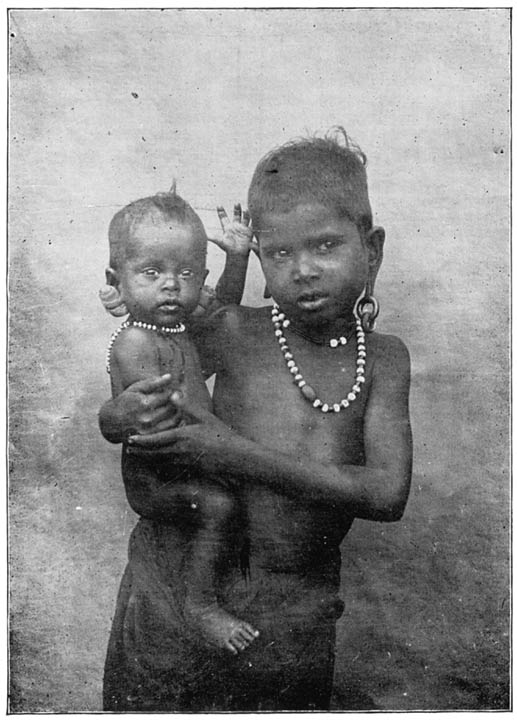
Kallan Children with Dilated Ear-lobes.
Portions of the Madura and Tanjore districts are divided into areas known as nādus, a name which, as observed by Mr. Nelson, is specially applicable to Kallan tracts. In each nādu a certain caste, called the Nāttan, is the predominant factor in the settlement of social questions which arise among the various castes living within the nādu. Round about Devakotta in the Sivaganga zamindari there are fourteen nādus, representatives of which meet once a year at Kandadēvi, to arrange for the annual festival at the temple dedicated to Swarnamurthi Swāmi. The four nādus Unjanai, Sembonmari, Iravaseri, and Tennilai in the same zamindari constitute a group, of which the last is considered the chief nādu, whereat caste questions must come up for settlement. For marriage purposes these four nādus constitute an endogamous section, which is sub-divided into septs or karais. Among the Vallambans these karais are exogamous, and run in the male line. But, among the Kallans, the karai is recognised only in connection with property. A certain tract of land is the property of a particular karai, and the legal owners thereof are members of the same karai. When the land has to be disposed of, this can only be effected with the consent of representatives of the karai. The Nāttar Kallans of Sivaganga have exogamous septs called kīlai or branches, which, as among the Maravans, run in the female line, i.e., a child belongs to the mother’s, not the father’s, sept. In some castes, and even among Brāhmans, though contrary to strict rule, it is permissible for a man to marry his sister’s daughter. This is not possible among the Kallans who have kīlais such as those referred to, because the maternal uncle of a girl, the girl, and her mother all belong to the same sept. But the children of a brother and sister may marry, because they belong to different kīlais, i.e., those of their respective mothers.
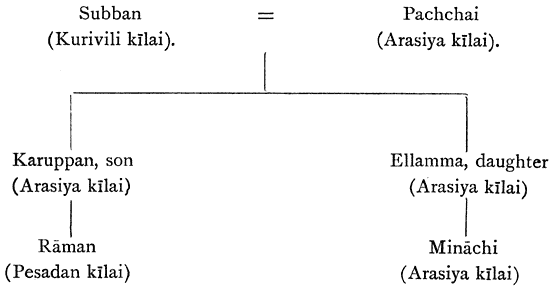
In the above example, the girl Mināchi may not marry Karuppan, as both are members of the same kīlai. But she ought, though he be a mere boy, to marry Rāman, who belongs to a different sept.
In an account of marriage among the Kallans, Mr. Nelson writes that “the most proper alliance in the opinion of a Kallan is one between a man and the daughter of his father’s sister, and, if an individual have such a cousin, he must marry her, whatever disparity there may be between their respective ages. A boy of fifteen must marry such a cousin, even if she be thirty or forty years old, if her father insists upon his so doing. Failing a cousin of this sort, he must marry his aunt or his niece, or any near relative. If his father’s brother has a daughter, and insists upon him marrying her he cannot refuse; and this whatever may be the woman’s age. One of the customs of the western Kallans is specially curious. It constantly happens that a woman is the wife of ten, eight, six, or two husbands, who are held to be the fathers jointly and severally of any children that may be born of her body, and, still more curiously, when the children grow up they, for some unknown reason, invariably style themselves the children not of ten, eight or six fathers as the case may be, but of eight and two, six and two, or four and two fathers. When a wedding takes place, the sister of the bridegroom goes to the house of the parents of the bride, and presents them with twenty-one Kāli fanams (coins) and a cloth, and, at the same time, ties some horse-hair round the bride’s neck. She then brings her and her relatives to the house of the bridegroom, where a feast is prepared.
Sheep are killed, and stores of liquor kept ready, and all partake of the good cheer provided. After this the bride and bridegroom are conducted to the house of the latter, and the ceremony of an exchange between them of vallari thadis or boomerangs is solemnly performed. Another feast is then given in the bride’s house, and the bride is presented by her parents with one markāl of rice and a hen. She then goes with her husband to his house. During the first twelve months after marriage, it is customary for the wife’s parents to invite the pair to stay with them a day or two on the occasion of any feast, and to present them on their departure with a markāl of rice and a cock. At the time of the first Pongal feast after the marriage, the presents customarily given to the son-in-law are five markāls of rice, five loads of pots and pans, five bunches of plantains, five cocoanuts, and five lumps of jaggery (crude sugar). A divorce is easily obtained on either side. A husband dissatisfied with his wife can send her away if he be willing at the same time to give her half of his property, and a wife can leave her husband at will upon forfeiture of forty-two Kāli fanams. A widow may marry any man she fancies, if she can induce him to make her a present of ten fanams.”
In connection with the foregoing account, I am informed that, among the Nāttar Kallans, the brother of a married woman must give her annually at Pongal a present of rice, a goat, and a cloth until her death. The custom of exchanging boomerangs appears to be fast becoming a tradition. But, there is a common saying still current “Send the valari tadi, and bring the bride.” As regards the horse-hair, which is mentioned as being tied round the bride’s neck, I gather that, as a rule, the tāli is suspended from a cotton thread, and the horse-hair necklet may be worn by girls prior to puberty and marriage, and by widows. This form of necklet is also worn by females of other castes, such as Maravans, Valaiyans, and Morasa Paraiyans. Puramalai Kallan women can be distinguished by the triangular ornament, which is attached to the tāli string. It is stated, in the Gazetteer of the Madura district, that “when a girl has attained maturity, she puts away the necklace of coloured beads she wore as a child, and dons the horse-hair necklet, which is characteristic of the Kallan woman. This she retains till death, even if she becomes a widow. The richer Kallans substitute for the horse-hair a necklace of many strands of fine silver wire. In Tirumangalam, the women often hang round their necks a most curious brass and silver pendant, six or eight inches long, and elaborately worked.”
It is noted in the Census Report, 1891, that as a token of divorce “a Kallan gives his wife a piece of straw in the presence of his caste people. In Tamil the expression ‘to give a straw’ means to divorce, and ‘to take a straw’ means to accept divorce.”
In their marriage customs, some Kallans have adopted the Purānic form of rite owing to the influence of Brāhman purōhits, and, though adult marriage is the rule, some Brāhmanised Kallans have introduced infant marriage. To this the Puramalai section has a strong objection, as, from the time of marriage, they have to give annually till the birth of the first child a present of fowls, rice, a goat, jaggery, plantains, betel, turmeric, and condiments. By adult marriage the time during which this present has to be made is shortened, and less expenditure thereon is incurred. In connection with the marriage ceremonies as carried out by some Kallans, I gather that the consent of the maternal uncle of a girl to her marriage is essential. For the betrothal ceremony, the father and maternal uncle of the future bridegroom proceed to the girl’s house, where a feast is held, and the date fixed for the wedding written on two rolls of palm leaf dyed with turmeric or red paper, which are exchanged between the maternal uncles. On the wedding day, the sister of the bridegroom goes to the house of the bride, accompanied by women, some of whom carry flowers, cocoanuts, betel leaves, turmeric, leafy twigs of Sesbania grandiflora, paddy (unhusked rice), milk, and ghī (clarified butter). A basket containing a female cloth, and the tāli string wrapped up in a red cloth borrowed from a washerman, is given to a sister of the bridegroom or to a woman belonging to his sept. On the way to the bride’s house, two of the women blow chank shells (musical instrument). The bride’s people question the bridegroom’s party as to his sept, and they ought to say that he belongs to Indra kūlam, Thalavala nādu, and Ahalya gōtra. The bridegroom’s sister, taking up the tāli, passes it round to be touched by all present, and ties the string, which is decorated with flowers, tightly round the bride’s neck amid the blowing of the conch shell. The bride is then conducted to the home of the bridegroom, whence they return to her house on the following day. The newly married couple sit on a plank, and coloured rice-balls or coloured water are waved, while women yell out “killa, illa, illa; killa, illa, illa.” This ceremony is called kulavi idal, and is sometimes performed by Kallan women during the tāli-tying.
The following details relating to the marriage ceremonies are recorded in the Gazetteer of the Tanjore district. “The arrival of the bridegroom has been described as being sometimes especially ceremonious. Mounted on a horse, and attended by his maternal uncle, he is met by a youth from the bride’s house, also mounted, who conducts the visitors to the marriage booth. Here he is given betel leaves, areca nuts, and a rupee by the bride’s father, and his feet are washed in milk and water, and adorned with toe-rings by the bride’s mother. The tāli is suspended from a necklet of gold or silver instead of cotton thread, but this is afterwards changed to cotton for fear of offending the god Karuppan. A lamp is often held by the bridegroom’s sister, or some married woman, while the tāli is being tied. This is left unlighted by the Kallans for fear it should go out, and thus cause an evil omen. The marriage tie is in some localities very loose. Even a woman who has borne her husband many children may leave him if she likes, to seek a second husband, on condition that she pays him her marriage expenses. In this case (as also when widows are remarried), the children are left in the late husband’s house. The freedom of the Kallan women in these matters is noticed in the proverb that, “though there may be no thread in the spinning-rod, there will always be a (tāli) thread on the neck of a Kallan woman,” or that “though other threads fail, the thread of a Kallan woman will never do so.”
By some Kallans pollution is, on the occasion of the first menstrual period, observed for seven or nine days. On the sixteenth day, the maternal uncle of the girl brings a sheep or goat, and rice. She is bathed and decorated, and sits on a plank while a vessel of water, coloured rice, and a measure filled with paddy with a style bearing a betel leaf struck on it, are waved before her. Her head, knees, and shoulders are touched with cakes, which are then thrown away. A woman, conducting the girl round the plank, pours water from a vessel on to a betel leaf held in her hand, so that it falls on the ground at the four cardinal points of the compass, which the girl salutes.
It is recorded, in the Gazetteer of the Madura district, that “the Kilnād Kallans usually bury their dead. Lamps are periodically lighted on the tomb, and it is whitewashed annually. The Piramalainād division usually burn the dead. If a woman dies when with child, the baby is taken out, and placed alongside her on the pyre. This, it may be noted, is the rule with most castes in this district, and, in some communities, the relations afterwards put up a stone burden-rest by the side of a road, the idea being that the woman died with her burden, and so her spirit rejoices to see others lightened of theirs. Tradition says that the caste came originally from the north. The dead are buried with their faces laid in that direction; and, when pūja is done to Karuppanaswāmi, the caste god, the worshippers turn to the north.”
It is recorded, in the Gazetteer of the Madura district, that Karuppan is “essentially the god of the Kallans, especially of the Kallans of the Mēlūr side. In those parts, his shrine is usually the Kallans’ chāvadi (assembly place). His priests are usually Kallans or Kusavans. Alagarswāmi (the beautiful god) is held in special veneration by the Kallans, and is often popularly called the Kallar Alagar. The men of this caste have the right to drag his car at the car festival, and, when he goes (from Alagar Kōvil) on his visit to Madura, he is dressed as a Kallan, exhibits the long ears characteristic of that caste, and carries the boomerang and club, which were of their old favourite weapons. It is whispered that Kallan dacoits invoke his aid when they are setting out on marauding expeditions, and, if they are successful therein, put part of their ill-gotten gains into the offertory (undial) box, which is kept at his shrine.”
The Kallans are stated by Mr. Hemingway to be very fond of bull-baiting. This is of two kinds. The first resembles the game played by other castes, except that the Kallans train their animals for the sport, and have regular meetings, at which all the villagers congregate. These begin at Pongal, and go on till the end of May. The sport is called tolu mādu (byre bull). The best animals for it are the Pulikkolam bulls from the Madura district. The other game is called pāchal mādu (leaping bull). In this, the animals are tethered to a long rope, and the object of the competition is to throw the animal, and keep it down. A bull which is good at the game, and difficult to throw, fetches a very high price.
It is noted in the Gazetteer of the Tanjore district, that “the Kallans have village caste panchayats (councils) of the usual kind, but in some places they are discontinuing these in imitation of the Vellālans. According to the account given at Orattanādu, the members of Ambalakāran families sit by hereditary right as Kāryastans or advisers to the headman in each village. One of these households is considered superior to the others, and one of its members is the headman (Ambalakāran) proper. The headmen of the panchayats of villages which adjoin meet to form a further panchayat to decide on matters common to them generally. In Kallan villages, the Kallan headman often decides disputes between members of other lower castes, and inflicts fines on the party at fault.”
In the Gazetteer, of the Madura district, it is recorded that “the organization of the Kilnād Kallans differs from that of their brethren beyond the hills. Among the former, an hereditary headman, called the Ambalakāran, rules in almost every village. He receives small fees at domestic ceremonies, is entitled to the first betel and nut, and settles caste disputes. Fines inflicted are credited to the caste fund. The western Kallans are under a more monarchial rule, an hereditary headman called Tirumala Pinnai Tēvan deciding most caste matters. He is said to get this hereditary name from the fact that his ancestor was appointed (with three co-adjutors) by King Tirumala Nāyakkan, and given many insignia of office including a state palanquin. If any one declines to abide by his decision, excommunication is pronounced by the ceremony of ‘placing the thorn,’ which consists in laying a thorny branch across the threshold of the recalcitrant party’s house, to signify that, for his contumacy, his property will go to ruin and be overrun with jungle. The removal of the thorn, and the restitution of the sinner to Kallan society can only be procured by abject apologies to Pinnai Tēvan.”
Kallankanadōru (stone).—A sub-division of Kōmati, said to be descended from those who sat on the stone (kallu) mantapa outside the Penukonda Kanyakamma temple, when the question whether to enter the fire-pits or not was being discussed by the caste elders.
Kallan Mūppan.—In the Madras Census Report, 1901, Kallan Mūppan is returned as “a sub-caste of the Malabar Kammālans, the members of which are stone-workers.” A correspondent writes to me that, “while the Kammālans are a polluting and polyandrous class, the Kallan Mūppans are allowed to enter the outside enclosure of temples. They do not remarry their widows, and are strictly monogamous. Their purōhits are Tamil barbers, who officiate at their marriages. The barber shaves the bridegroom before the wedding ceremony. The purōhit has also to blow the conch-shell all the way from the bridegroom’s house to that of the bride.”
The names Kallan and Kalkōtti are also those by which the Malabar stone-masons are known.
Kallangi.—Kallangi and Kallavēli (Kallan’s fence) are fanciful names, returned by Pallis at times of census.
Kallasāri (stone-workers).—The occupational name of a sub-division of Malayālam Kammālans.
Kallātakurup.—A sub-division of Ambalavāsis, who sing in Bhagavati temples. They play on a stringed instrument, called nandurini, with two strings and a number of wooden stops glued on to the long handle, and a wooden plectrum.
Kallu (stone).—A sub-division of Gāniga and Oddē. Kallukoti (stone-mason) is a sub-division of Malabar Kammālans, who work in stone.
Kallukatti.—It is noted, in the Gazetteer of the South Canara district, that “a grinding stone made of granite is an article peculiar to South Canara. It is a semicircular, oval-shaped block with a flat bottom, and a round hole in the middle of the surface. It has another oval-shaped block, thin and long, with one end so shaped as to fit into the hole in the larger block. These two together make what is known as the grinding-stone of the district, which is used for grinding curry-stuff, rice, wheat, etc. Mill-stones for pounding grain are also made of granite. Formerly, a class of people called Kallukattis used to make such articles, but the industry is now taken up by other castes as well. Mile-stones, slabs for temple door-frames, idols and other figures for temple purposes are also made of granite.”
Kallūr.—Recorded, in the Travancore Census Report, 1901, as a name for the Pulikkappanikkan sub-division of Nāyar.
Kallūri (stone village).—An exogamous sept of Mēdara.
Kal Tacchan (stone-mason).—A sub-division of Kammālan.
Kalti (expunged).—A degraded Paraiyan is known as a Kalti. Amongst the Paraiyans of Madras, Chingleput and North Arcot, the rule is that a man who does not abide by the customs of the caste is formally excommunicated by a caste council. He then joins “those at Vinnamangalam” near Vellore, i.e., those who have, like himself, been driven out of the caste.
Kalugunādu (eagle’s country).—An exogamous sept of Tamil goldsmiths in the Madura district.
Kaluthai (possessors of donkeys).—A sub-division of Oddē.
Kalyānakulam (marriage people).—A fanciful name returned by some Mangalas at times of census, as they officiate as musicians at marriages.
Kamadi (tortoise).—A gōtra of Kurni.
Kāmākshiamma.—Recorded, in the North Arcot Manual, as a sub-division of Vāniyan. Kāmākshiamma is the chief goddess worshipped at Conjeeveram. She and Mīnākshi Amma of Madura are two well-known goddesses worshipped by Saivites. Both names are synonyms of Parvati, the wife of Siva.
Kāmāti (foolish).—A name sometimes applied to carpenters, and also of a sub-division of Okkiliyans, who are said to have abandoned their original occupation of cultivating land, and become bricklayers.
Kambalam.—The name Kambalam is applied to a group of nine castes (Tottiyan, Annappan, Kāppiliyan, Chakkiliyan, etc.), because at their council meetings a blanket (kambli) is spread, on which is placed a brass vessel (kalasam) filled with water, and decorated with flowers. (See Tottiyan.)
Kambalattān.—A synonym of Tottiyan.
Kamban.—A title of the Ōcchans, to which caste the great Tamil epic poet Kamban is reputed to have belonged.
Kambha.—Kambha or Kambhāpu, meaning a pillar or post, has been recorded as an exogamous sept of Mādiga and Kōmati.
Some Kammas, when questioned by Mr. F. R. Hemingway in the Godāvari district, stated that they were originally Kshatriyas, but were long ago persecuted by a king of the family of Parikshat, because one of them called him a bastard. They sought refuge with the Kāpus, who took them in, and they adopted the customs of their protectors. According to another legend, a valuable ear ornament, belonging to Rāja Pratāpa Rudra, fell into the hands of an enemy, whom a section of the Kāpus boldly attacked, and recovered the jewel. This feat earned for them and their descendants the title Kamma. Some of the Kāpus ran away, and they are reputed to be the ancestors of the Velamas (veli, away). At the time when the Kammas and Velamas formed a single caste, they observed the Muhammadan gōsha system, whereby the women are kept in seclusion. This was, however, found to be very inconvenient for their agricultural pursuits. They accordingly determined to abandon it, and an agreement was drawn up on a palm-leaf scroll. Those who signed it are said to have become Kammas, and those who declined to do so Velamas, or outsiders. One meaning of the word kamma is the palm-leaf roll, such as is used to produce dilatation of the lobes of the ears. According to another story, there once lived a king, Belthi Reddi by name, who had a large number of wives, the favourite among whom he appointed Rāni. The other wives, being jealous, induced their sons to steal all the jewels of the Rāni, but they were caught in the act by the king, who on the following day asked his wife for her jewels, which she could not produce. Some of the sons ran away, and gave origin to the Velamas; others restored the kamma, and became Kammas. Yet one more story. Pratāpa Rudra’s wife lost her ear ornament, and four of the king’s captains were sent in search of it. Of these, one restored the jewel, and his descendants became Kammas; the second attacked the thieves, and gave origin to the Velamas; the third ran away, and so his children became the ancestors of the Pakanātis; and the fourth disappeared.
According to the Census Report, 1891, the main sub-divisions of the Kammas are Gampa, Illuvellani, Gōdajāti, Kāvali, Vaduga, Pedda, and Bangāru. It would seem that there are two main endogamous sections, Gampa (basket) Chātu, and Gōda (wall) Chātu. Chātu is said to mean a screen or hiding place. Concerning the origin of these sections, the following story is told. Two sisters were bathing in a tank (pond), when a king happened to pass by. To hide themselves, one of the girls hid behind a basket, and the other behind a wall. The descendants of the two sisters became the Gampa and Gōda Chātu Kammas, who may not intermarry by reason of their original close relationship. According to another legend, after a desperate battle, some members of the caste escaped by hiding behind baskets, others behind a wall. The terms Illuvellani and Pedda seem to be synonymous with Gōdachatu. The women of this section were gōsha, and not allowed to appear in public, and even at the present day they do not go out and work freely in the fields. The name Illuvellani indicates those who do not go (vellani) out of the house (illu). The name Pedda (great) refers to the superiority of the section. Vaduga simply means Telugu, and is probably a name given by Tamilians to the Kammas who live amongst them. The name Bangāru is said to refer to the custom of the women of this sub-division wearing only gold nose ornaments (bangāramu). The Gōdajāti sub-division is said to be most numerously represented in North Arcot and Chingleput, the Illuvellani in Kistna, Nellore and Anantapur. The Kāvali sub-division is practically confined to the Godāvari, and the Pedda to the Kistna district. The Vaduga Kammas are found chiefly in Coimbatore.
In his note on the Kammas of the Godāvari district, Mr. Hemingway writes that “in this district they are divided into Kāvitis, Erēdis, Gampas or Gūdas, Uggams, and Rāchas. These names are, according to local accounts, derived from curious household customs, generally from traditional methods of carrying water. Thus, the Kāvitis will not ordinarily carry water except in pots on a kāvidi, the Erēdis except on a pack-bullock, the Uggams except in pots held in the hand, and not on the hip or head, the Rāchas except in a pot carried by two persons. The Gampa women, when they first go to their husbands’ houses, take the customary presents in a basket. It is said that these practices are generally observed at the present day.”
Writing concerning the Iluvedalani (Illuvellani) Kammas, the editor of the Kurnool Manual (1886) states that “a few families only exist in the district. The women are kept in strict gōsha. They consider it beneath them to spin thread, or to do other work. A sub-division of this caste lives in Pullalcheruvu, whose families, also gōsha, work at the spindles, like other women of the country. Another class of indoor Kammas resides about Owk. They are apparently descendants of the Kammas, who followed the Naiks from Guntūr to Gandikota in the sixteenth century. They are now reduced, and the females work, like Kāpus, in the field. The Gampas are distinguished from the indoor Kammas by their women wearing the cloth over the right, instead of the left shoulder.”
As with other Telugu castes, there are, among the Kammas, a number of exogamous septs or intipēru, of which the following are examples:—
Anumollu, Dolichos Lablab. Tsanda, tax or subscription. Jasthi, too much. Mallela, jasmine. Lanka, island. Thota kūra, Amarantus gangetícus. Komma, horn, or branch of a tree. Chēni, dry field. Palakala, planks. Kastūri, musk. Baththāla, rice. Karnam, accountant. Irpina, combs. Gāli, wind. Dhaniāla, coriander.
The Kammas also have gōtras such as Chittipoola, Kurunollu, Kulakala, Uppāla, Cheruku (sugar-cane), Vallotla, and Yenamalla.
When matters affecting the community have to be decided, a council of the leading members thereof assembles. But, in some places, there is a permanent headman, called Mannemantri or Chaudri.
Prior to the betrothal ceremony, female ancestors, Vignēswara, and the Grāma Dēvata (village deities) are worshipped. A near relation of the future bridegroom proceeds, with a party, to the home of the future bride. On their way thither, they look for omens, such as the crossing of birds in an auspicious direction. Immediately on the occurrence of a favourable omen, they burn camphor, and break a cocoanut, which must split in two with clean edges. One half is sent to the would-be bridegroom, and the other taken to the bride’s house. If the first cocoanut does not split properly, others are broken till the wished-for result is obtained. When the girl’s house is reached, she demands the sagunam (omen) cocoanut. Her lap is filled with flowers, cocoanuts, turmeric, plantains, betel leaves and areca nuts, combs, sandal paste, and coloured powder (kunkumam). The wedding day is then fixed. Marriage is generally celebrated at the house of the bridegroom, but, if it is a case of kannikadhānam (presenting the girl without claiming the bride’s price), at the house of the bride. The bride-price is highest in the Gampa section. On the first day of the marriage rites, the petta mugada sangyam, or box-lid ceremony is performed. The new cloths for the bridal couple, five plantains, nuts, and pieces of turmeric, one or two combs, four rupees, and the bride-price in money or jewels, are placed in a box, which is placed near the parents of the contracting couple. The contents of the box are then laid out on the lid, and examined by the sammandhis (new relations by marriage). The bride’s father gives betel leaves and areca nuts to the father of the bridegroom, saying “The girl is yours, and the money mine.” The bridegroom’s father hands them back, saying “The girl is mine, and the money yours.” This is repeated three times. The officiating purōhit (priest) then announces that the man’s daughter is to be given in marriage to so-and-so, and the promise is made before the assembled Dēva Brāhmanas, and in the presence of light, Agni, and the Dēvatas. This ceremony is binding, and, should the bridegroom perchance die before the bottu (marriage badge) is tied, she becomes, and remains a widow. The milk-post is next set up, the marriage pots are arranged, and the nalagu ceremony is performed. This consists of the anointing of the bridal couple with oil, and smearing the shoulders with turmeric flour, or Acacia Concinna paste. A barber pares the nails of the bridegroom, and simply touches those of the bride with a mango leaf dipped in milk. In some places this rite is omitted by the Gampa section. A small wooden framework, called dhornam, with cotton threads wound round it, is generally tied to the marriage pandal (booth) by a Tsākali (washerman) not only at a marriage among the Kammas, but also among the Balijas, Kāpus, and Velamas. After the return of the bridal couple from bathing, the bridegroom is decorated, and taken to a specially prepared place within or outside the house, to perform Vīra-gudimokkadam, or worship of heroes in their temple. At the spot selected a pandal has been erected, and beneath it three or five bricks, representing the heroes (vīralu), are set up. The bricks are smeared with turmeric paste, and painted with red dots. In front of the bricks an equal number of pots are placed, and they are worshipped by breaking a cocoanut, and burning camphor and incense. The bridegroom then prostrates himself before the bricks, and, taking up a sword, cuts some lime fruits, and touches the pots three times. In former days, a goat or sheep was sacrificed. The hero worship, as performed by the Gōda section, differs from the above rite as practiced by the Gampa section. Instead of erecting a pandal, the Gōdas go to a pīpal (Ficus religiosa) tree, near which one or more daggers are placed. A yellow cotton thread is wound three or five times round the tree, which is worshipped. As a substitute for animal sacrifice, lime fruits are cut. The hero worship concluded, the wrist-threads of cotton and wool (kankanam) are tied on the bride and bridegroom, who is taken to the temple after he has bathed and dressed himself in new clothes. On his return to the booth, the purōhit lights the sacred fire, and the contracting couple sit side by side on a plank. They then stand, with a screen spread between them, and the bridegroom, with his right big toe on that of the bride, ties the bottu round her neck. They then go three times round the dais, with the ends of their cloths knotted together. The bottu of the Gampas is a concave disc of gold, that of the Gōdas a larger flat disc. On the following day, the usual nāgavali, or sacrifice to the Dēvas is offered, and a nāgavali bottu (small gold disc) tied. All the relations make presents to the bridal pair, who indulge in a mock representation of domestic life. On the third day, pongal (rice) is offered to the pots, and the wrist-threads are removed. Like the Palli bridegroom, the Kamma bridegroom performs a mimic ploughing ceremony, but at the house instead of at a tank (pond). He goes to a basket filled with earth, carrying the iron bar of a ploughshare, an ox-goad, and rope, accompanied by the bride carrying in her lap seeds or seedlings. While he pretends to be ploughing, his sister stops him, and will not let him continue till he has promised to give his first-born daughter to her son in marriage. The marriage pots are presented to the sisters of the bridegroom. During the marriage celebration, meat must not be cooked.