Volume 3 — K (continued 2)
Reading edition
When a pregnant woman is delivered, twigs of Balanites Roxburghii are placed round the house.
As regards their religion, some Kammas are Saivites, others Vaishnavites. Most of the Saivites are disciples of Ārādhya Brāhmans, and the Vaishnavites of Vaishnava Brāhmans or Sātānis. The Gampas reverence Draupadi, Mannarsāmi, Gangamma, Ankamma, and Padavetiamma; the Gōdas Poleramma, Veikandla Thalli (the thousand-eyed goddess) and Padavetiamma.
Kamma (ear ornament).—An exogamous sept of Motāti Kāpu.
Kammālan (Tamil).—The original form of the name Kammālan appears to have been Kannālan or Kannālar, both of which occur in Tamil poems, e.g., Thondamandala Satakam and Er Ezhuvathu, attributed to the celebrated poet Kamban. Kannālan denotes one who rules the eye, or one who gives the eye. When an image is made, its consecration takes place at the temple. Towards the close of the ceremonial, the Kammālan who made it comes forward, and carves out the eyes of the image. The name is said also to refer to those who make articles, and open the eyes of the people, i.e., who make articles pleasing to the eyes.
“Knox has a reference to the subject as follows. ‘Some, being devoutly disposed, will make the image of this god (Buddha) at their own charge. For the making whereof they must bountifully reward the Founder. Before the eyes are made, it is not accounted a god, but a lump of ordinary metal, and thrown about the shop with no more regard than anything else. But, when the eyes are to be made, the artificer is to have a good gratification, besides the first agreed upon reward. The eyes being formed, it is thenceforward a god. And then, being brought with honour from the workman’s shop, it is dedicated by solemnities and sacrifices, and carried with great state into its shrine or little house, which is before built and prepared for it.’” The pupils of the eyes of a series of clay votive offerings, which were specially made for me, were not painted at the potter’s house, but in the verandah of the traveller’s bungalow where I was staying.
The Tamil Kammālans are divided into three endogamous territorial groups, Pāndya, Sōzia (or Chōla), and Kongan. The Pāndyas live principally in the Madura and Tinnevelly districts, and the Sōzias in the Trichinopoly, Tanjore, Chingleput, North and South Arcot districts, and Madras. The Kongas are found chiefly in the Salem and Coimbatore districts. In some places, there are still further sub-divisions of territorial origin. Thus, the Pāndya Tattāns are divided into Karakattar, Vambanattar, Pennaikku-akkarayar (those on the other side of the Pennaiyar river), Munnūru-vīttukārar (those of the three hundred families), and so forth. They are further divided into exogamous septs, the names of which are derived from places, e.g., Perugumani, Musiri, Oryanādu, Thiruchendurai, and Kalagunādu.
The Kammālans are made up of five occupational sections, viz., Tattān (goldsmith), Kannān (brass-smith), Tac’chan (carpenter), Kal-Tac’chan (stone-mason), and Kollan or Karumān (blacksmith). The name Pānchāla, which is sometimes used by the Tamil as well as the Canarese artisan classes, has reference to the fivefold occupations. The various sections intermarry, but the goldsmiths have, especially in towns, ceased to intermarry with the blacksmiths. The Kammālans, claiming, as will be seen later on, to be Brāhmans, have adopted Brāhmanical gōtras, and the five sections have five gōtras called Visvagu, Janagha, Ahima, Janardana, and Ubhēndra, after certain Rishis (sages). Each of these gōtras, it is said, has twenty-five subordinate gōtras attached to it. The names of these, however, are not forthcoming, and indeed, except some individuals who act as priests for the Kammālans, few seem to have any knowledge of them. In their marriages the Kammālans closely imitate the Brāhmanical ceremonial, and the ceremonies last for three or five days according to the means of the parties. The parisam, or bride’s money, is paid, as among other non-Brāhmanical castes. Widows are allowed the use of ordinary jewelry and betel, which is not the case among Brāhmans, and they are not compelled to make the usual fasts, or observe the feasts commonly observed by Brāhmans.
The Kammālan caste is highly organised, and its organisation is one of its most interesting features. Each of the five divisions has at its head a Nāttāmaikkāran or headman, and a Kāryasthan, or chief executive officer, under him, who are elected by members of the particular division. Over them is the Anjivīttu Nāttāmaikkāran (also known as Ainduvittu Periyathanakkāran or Anjijāti Nāttāmaikkāran), who is elected by lot by representatives chosen from among the five sub-divisions. Each of these chooses ten persons to represent it at the election. These ten again select one of their number, who is the local Nāttāmaikkāran, or one who is likely to become so. The five men thus selected meet on an appointed day, with the castemen, at the temple of the caste goddess Kāmākshi Amman. The names of the five men are written on five slips of paper, which, together with some blank slips, are thrown before the shrine of the goddess. A child, taken at random from the assembled crowd, is made to pick up the slips, and he whose name first turns up is proclaimed as Anjivīttu Nāttāmaikkāran, and a big turban is tied on his head by the caste priest. This is called Urumā Kattaradu, and is symbolic of his having been appointed the general head of the caste. Lots are then drawn, to decide which of the remaining four shall be the Anjivīttu Kāryasthan of the newly-elected chief. At the conclusion of the ceremony, betel leaf and areca nut are given first to the new officers, then to the local officers, and finally to the assembled spectators. With this, the installation ceremony, which is called pattam-kattaradu, comes to an end. The money for the expenses thereof is, if necessary, taken from the funds of the temple, but a special collection is generally made for the occasion, and is, it is said, responded to with alacrity. The Anjivīttu Nāttāmaikkāran is theoretically invested with full powers over the caste, and all members thereof are expected to obey his orders. He is the final adjudicator of civil and matrimonial causes. The divisional heads have power to decide such causes, and they report their decisions to the Anjivīttu Nāttāmaikkāran, who generally confirms them. If, for any reason, the parties concerned do not agree to abide by the decision, they are advised to take their cause to one of the established courts. The Anjivīttu Nāttāmaikkāran has at times to nominate, and always the right to confirm or not, the selection of the divisional heads. In conjunction with the Kāryasthan and the local heads, he may appoint Nāttāmaikkārans and Kāryasthans to particular places, and delegate his powers to them. This is done in places where the caste is represented in considerable numbers, as at Sholavandan and Vattalagūndu in the Madura district. In this connection, a quaint custom may be noted. The Pallans, who are known as “the sons of the caste” in villages of the Madura and Tinnevelly districts, are called together, and informed that a particular village is about to be converted into a local Anjivīttu Nāttānmai, and that they must possess a Nāttāmaikkāran and Kāryasthan for themselves. These are nominated in practice by the Pallans, and the nomination is confirmed by the Anjivīttu Nāttāmaikkāran. From that day, they have a right to get new ploughs from the Kallans free of charge, and give them in return a portion of the produce of the land. The local Nāttāmaikkārans are practically under the control of the Kāryasthan of the Anjivīttu Nāttāmaikkāran, and, as the phrase goes, they are “bound down to” the words of this official, who possesses great power and influence with the community. The local officials may be removed from office by the Anjivīttu Nāttāmaikkāran or his Kāryasthan, but this is rarely done, and only when, for any valid reason, the sub-divisions insist on it. The mode of resigning office is for the Nāttāmaikkāran or Kāryasthan to bring betel leaf and areca nut, lay them before the Anjivīttu Nāttāmaikkāran, or his Kāryasthan, and prostrate himself in front of him. There is a tendency for the various offices to become hereditary, provided those succeeding to them are rich and respected by the community. The Anjivīttu Nāttāmaikkāran is entitled to the first betel at caste weddings, even outside his own jurisdiction. His powers are in striking contrast with those of the caste Guru, who resides in Tinnevelly, and occasionally travels northwards. He purifies, it is said, those who are charged with drinking intoxicating liquor, eating flesh, or crossing the sea, if such persons subject themselves to his jurisdiction. If they do not, he does not even exercise the power of excommunication, which he nominally possesses. He is not a Sanyāsi, but a Grihastha or householder. He marries his daughters to castemen, though he refrains from eating in their houses.
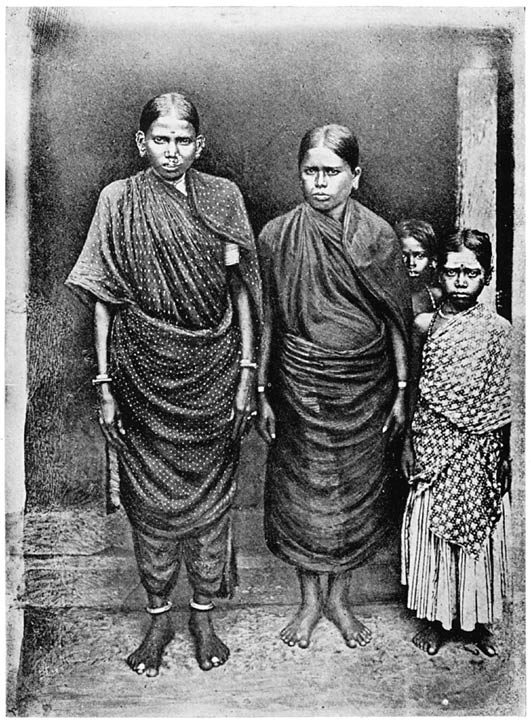
Kammālans.
The dead are, as a rule, buried in a sitting posture, but, at the present day, cremation is sometimes resorted to. Death pollution, as among some other non-Brāhmanical castes, lasts for sixteen days. It is usual for a Pandāram to officiate at the death ceremonies. On the first day, the corpse is anointed with oil, and given a soap-nut bath. On the third day, five lingams are made with mud, of which four are placed in the four corners at the spot where the corpse was buried, and the fifth is placed in the centre. Food is distributed on the fifth day to Pandārams and the castemen. Srādh (annual death ceremony) is not as a rule performed, except in some of the larger towns.
The Kammālans profess the Saiva form of the Brāhman religion, and reverence greatly Pillaiyar, the favourite son of Siva. A few have come under the Lingāyat influence. The caste, however, has its own special goddess Kāmākshi Amma, who is commonly spoken of as Vriththi Daivam. She is worshipped by all the sub-divisions, and female children are frequently named after her. She is represented by the firepot and bellows-fire at which the castemen work, and presides over them. On all auspicious occasions, the first betel and dakshina (present of money) are set apart in her name, and sent to the pūjāri (priest) of the local temple dedicated to her. Oaths are taken in her name, and disputes affecting the caste are settled before her temple. There also elections to caste offices are held. The exact connection of the goddess Kāmākshi with the caste is not known. There is, however, a vague tradition that she was one of the virgins who committed suicide by throwing herself into a fire, and was in consequence deified. Various village goddesses (grāma dēvata) are also worshipped, and, though the Kammālans profess to be vegetarians, animal sacrifices are offered to them. Among these deities are the Saptha Kannimar or seven virgins, Kōchadē Periyāndavan, and Periya Nayanar. Those who worship the Saptha Kannimar are known by the name of Mādāvaguppu, or the division that worships the mothers. Those who revere the other two deities mentioned are called Nādīkā Vamsathāl, or those descended from men who, through the seven virgins, attained eternal bliss. Kōchadē Periyāndavan is said to be a corruption of Or Jatē Periya Pāndyan, meaning the great Pāndya with the single lock. He is regarded as Vishnu, and Periya Nayanar is held to be a manifestation of Siva. The former is said to have been the person who invited the Tattāns (who called themselves Pāndya Tattāns) to settle in his kingdom. It is traditionally stated that they emigrated from the north, and settled in the Madura and Tinnevelly districts. An annual festival in honour of Kōchadē Periyāndavan is held in these districts, for the expenses in connection with which a subscription is raised among the five sub-divisions. The festival lasts over three days. On the first day, the image of the deified king is anointed with water, and a mixture of the juices of the mango, jāk (Artocarpus integrifolia), and plantain, called muppala pūjai. On the second day, rice is boiled, and offered to the god, and, on the last day, a healthy ram is sacrificed to him. This festival is said to be held, in order to secure the caste as a whole against evils that might overtake it. Tac’chans (carpenters) usually kill, or cut the ear of a ram or sheep, whenever they commence the woodwork of a new house, and smear the blood of the animal on a pillar or wall of the house.
The Kammālans claim to be descended from Visvakarma, the architect of the gods, and, in some places, claim to be superior to Brāhmans, calling the latter Gō-Brāhmans, and themselves Visva Brāhmans. Visvakarma is said to have had five sons, named Manu, Maya, Silpa, Tvashtra, and Daivagna. These five sons were the originators of the five crafts, which their descendants severally follow. Accordingly, some engage in smithy work, and are called Manus; others, in their turn, devote their attention to carpentry. These are named Mayas. Others again, who work at stone-carving, are known as Silpis. Those who do metal work are Tvashtras, and those who are engaged in making jewelry are known as Visvagnas or Daivagnas. According to one story of the origin of the Kammālans, they are the descendants of the issue of a Brāhman and a Bēri Chetti woman. Hence the proverb that the Kammālans and the Bēri Chettis are one. Another story, recorded in the Mackenzie manuscripts, which is current all over the Tamil country, is briefly as follows. In the town of Māndāpuri, the Kammālans of the five divisions formerly lived closely united together. They were employed by all sorts of people, as there were no other artificers in the country, and charged very high rates for their wares. They feared and respected no king. This offended the kings of the country, who combined against them. As the fort in which the Kammālans concealed themselves, called Kāntakkōttai, was entirely constructed of loadstone, all the weapons were drawn away by it. The king then promised a big reward to anyone who would burn down the fort, and at length the Dēva-dāsīs (courtesans) of a temple undertook to do this, and took betel and nut in signification of their promise. The king built a fort for them opposite Kāntakkōttai, and they attracted the Kammālans by their singing, and had children by them. One of the Dēva-dāsīs at length succeeded in extracting from a young Kammālan the secret that, if the fort was surrounded with varaghu straw and set on fire, it would be destroyed. The king ordered that this should be done, and, in attempting to escape from the sudden conflagration, some of the Kammālans lost their lives. Others reached the ships, and escaped by sea, or were captured and put to death. In consequence of this, artificers ceased to exist in the country. One pregnant Kammālan woman, however, took refuge in the house of a Bēri Chetti, and escaped decapitation by being passed off as his daughter. The country was sorely troubled owing to the want of artificers, and agriculture, manufactures, and weaving suffered a great deal. One of the kings wanted to know if any Kammālan escaped the general destruction, and sent round his kingdom a piece of coral possessing a tortuous aperture running through it, and a piece of thread. A big reward was promised to anyone who should succeed in passing the thread through the coral. At last, the boy born of the Kammālan woman in the Chetti’s house undertook to do it. He placed the coral over the mouth of an ant-hole, and, having steeped the thread in sugar, laid it down at some distance from the hole. The ants took the thread, and drew it through the coral. The king, being pleased with the boy, sent him presents, and gave him more work to do. This he performed with the assistance of his mother, and satisfied the king. The king, however, grew suspicious, and, having sent for the Chetti, enquired concerning the boy’s parentage. The Chetti thereon detailed the story of his birth. The king provided him with the means for making ploughshares on a large scale, and got him married to the daughter of a Chetti, and made gifts of land for the maintenance of the couple. The Chetti woman bore him five sons, who followed the five branches of work now carried out by the Kammālan caste. The king gave them the title of Panchayudhattar, or those of the five kinds of weapons. They now intermarry with each other, and, as children of the Chetti caste, wear the sacred thread. The members of the caste who fled by sea are said to have gone to China, or, according to another version, to Chingaladvīpam, or Ceylon, where Kammālans are found at the present day. In connection with the above story, it may be noted that, though ordinarily two different castes do not live in the same house, yet Bēri Chettis and Kammālans so live together. There is a close connection between the Kammālans and Acharapākam Chettis, who are a section of the Bēri Chetti caste. Kammālans and Acharapākam Chettis interdine; both bury their dead in a sitting posture; and the tāli (marriage badge) used by both is alike in size and make, and unlike that used by the generality of the Bēri Chetti caste. The Acharapākam Chettis are known as Malighe Chettis, and are considered to be the descendants of those Bēri Chettis who brought up the Kammālan children, and intermarried with them. Even now, in the city of Madras, when the Bēri Chettis assemble for the transaction of caste business, the notice summoning the meeting excludes the Malighe Chettis, who can neither vote nor receive votes at elections, meetings, etc., of the Kandasāmi temple, which every other Bēri Chetti has a right to.
From a note by Mr. F. R. Hemingway, I gather that the friendship between the Muhammadans and Kammālans, who call each other māni (paternal uncle) “originated in the fact that a holy Muhammadan, named Ibrahim Nabi, was brought up in the house of a Kammālan, because his father was afraid that he would be killed by a Hindu king named Namadūta, who had been advised by his soothsayers that he would thus avoid a disaster, which was about to befall his kingdom. The Kammālan gave his daughter to the father of Ibrahim in exchange. Another story (only told by Kammālans) is to the effect that the Kammālans were once living in a magnetic castle, called Kānda Kōttai, which could only be destroyed by burning it with varagu straw; and that the Musalmans captured it by sending Musalman prostitutes into the town, to wheedle the secret out of the Kammālans. The friendship, according to the story, sprang up because the Kammālans consorted with the Musalman women.”
The Kammālans belong to the left hand, as opposed to the right hand faction. The origin of this distinction of castes is lost in obscurity, but, according to one version, it arose out of a dispute between the Kammālans and Vellālas. The latter claimed the former as their Jātipillaigal or caste dependents, while the former claimed the latter as their own dependents. The fight grew so fierce that the Chōla king of Conjeeveram ranged these two castes and their followers on opposite sides, and enquired into their claims. The Kammālans, and those who sided with them, stood on the left of the king, and the Vellālas and their allies on the right. The king is said to have decided the case against the Kammālans, who then dispersed in different directions. According to another legend, a Kammālan who had two sons, one by a Balija woman, and the other by his Kammālan wife, was unjustly slain by a king of Conjeeveram, and was avenged by his two sons, who killed the king and divided his body. The Kammālan son took his head and used it as a weighing pan, while the Balija son made a pedler’s carpet out of the skin, and threads out of the sinews for stringing bangles. A quarrel arose, because each thought the other had got the best of the division, and all the other castes joined in, and took the side of either the Kammālan or the Balija. Right and left hand dancing-girls, temples, and mandapams, are still in existence at Conjeeveram, and elsewhere in the Tamil country. Thus, at Tanjore, there are the Kammāla Tēvadiyāls, or dancing-girls. As the Kammālans belong to the left-hand section, dancing-girls of the right-hand section will not perform before them, or at their houses. Similarly, musicians of the right-hand section will not play in Kammālan houses. In olden days, Kammālans were not allowed to ride in palanquins through the streets of the right hands. If they did, a riot was the result. Such riots were common during the eighteenth century. Thus, Fryer refers to one of these which occurred at Masulipatam, when the contumacy of the Kamsalas (Telugu artisans) led to their being put down by the other castes with the aid of the Moors.
The Kammālans call themselves Āchāri and Paththar, which are equivalent to the Brāhman titles Ācharya and Bhatta, and claim a knowledge of the Vēdas. Their own priests officiate at marriages, funerals, and on other ceremonial occasions. They wear the sacred thread, which they usually don on the Upakarmam day, though some observe the regular thread investiture ceremony. Most of them claim to be vegetarians. Non-Brāhmans do not treat them as Brāhmans, and do not salute them with the namaskāram (obeisance). Their women, unlike those of other castes, throw the end of their body-cloth over the right shoulder, and are conspicuous by the nose ornament known as the nattu.
An association, called the Visvakarma Kulābhimana Sabha, was established in the city of Madras by the Kammālans in 1903. The objects thereof were the advancement of the community as a whole on intellectual and industrial lines, the provision of practical measures in guarding the interests, welfare and prospects of the community, and the improvement of the arts and sciences peculiar to them by opening industrial schools and workshops, etc.
Of proverbs relating to the artisan classes, the following may be noted:—
The goldsmith who has a thousand persons to answer. This in reference to the delay in finishing a job, owing to his taking more orders than he can accomplish in a given time.
The goldsmith knows what ornaments are of fine gold, i.e., knows who are the rich men of a place.
It must either be with the goldsmith, or in the pot in which he melts gold, i.e., it will be found somewhere in the house. Said to one who is in search of something that cannot be found.
Goldsmiths put inferior gold into the refining-pot.
The goldsmith will steal a quarter of the gold of even his own mother.
Stolen gold may be either with the goldsmith, or in his fire-pot.
If the ear of the cow of a Kammālan is cut and examined, some wax will be found in it. It is said that the Kammālan is in the habit of substituting sealing-wax for gold, and thus cheating people. The proverb warns them not to accept even a cow from a Kammālan. Or, according to another explanation, a Kammālan made a figure of a cow, which was so lifelike that a Brāhman purchased it as a live animal with his hard-earned money, and, discovering his mistake, went mad. Since that time, people were warned to examine an animal offered for sale by Kammālans by cutting off its ears. A variant of the proverb is that, though you buy a Kammālan’s cow only after cutting its ears, he will have put red wax in its ears (so that, if they are cut into, they will look like red flesh).
What has a dog to do in a blacksmith’s shop? Said of a man who attempts to do work he is not fitted for.
When the blacksmith sees that the iron is soft, he will raise himself to the stroke.
Will the blacksmith be alarmed at the sound of a hammer?
When a child is born in a blacksmith’s family, sugar must be dealt out in the street of the dancing-girls. This has reference to the legendary relation of the Kammālans and Kaikōlans.
A blacksmith’s shop, and the place in which donkeys roll themselves, are alike.
The carpenters and blacksmiths are to be relegated, i.e., to the part of the village called the Kammālachēri.
What if the carpenter’s wife has become a widow? This would seem to refer to the former practice of widow remarriage.
The carpenter wants (his wood) too long, and the blacksmith wants (his iron) too short, i.e., a carpenter can easily shorten a piece of wood, and a blacksmith can easily hammer out a piece of iron.
When a Kammālan buys cloth, the stuff he buys is so thin that it does not hide the hair on his legs.
For the following note on Malabar Kammālans I am indebted to Mr. S. Appadorai Iyer. The five artisan classes, or Ayinkudi Kammālans, are made up of the following:—
Asāri, carpenters.
Mūsāri, braziers.
Tattān, goldsmiths.
Karumān, blacksmiths.
Chembotti or Chempotti, coppersmiths.
The name Chembotti is derived from chembu, copper, and kotti, he who beats. They are, according to Mr. Francis, “coppersmiths in Malabar, who are distinct from the Malabar Kammālans. They are supposed to be descendants of men who made copper idols for temples, and so rank above the Kammālans in social position, and about equally with the lower sections of the Nāyars.”
The Kammālans will not condescend to eat food at the hands of Kurups, Tōlkollans, Pulluvans, Mannāns, or Tandans. But a Tandan thinks it equally beneath his dignity to accept food from a Kammālan. The Kammālans believe themselves to be indigenous in Malabar, and boast that their system of polyandry is the result of the sojourn of the exiled Pāndavas, with their common wife Pānchāli, and their mother Kunthi, in the forest of the Walluvanād division. They say that the destruction of the Pāndavas was attempted in the Arakkuparamba amsam of this division, and that the Tac’chans (artisans) were given as a reward by the Kurus the enjoyment of Tacchanattukara amsam. They state further that the Pāndus lived for some time at the village of Bhīmanād, and went to the Attapādi valley, where they deposited their cooking utensils at the spot where the water falls from a height of several hundred feet. This portion of the river is called Kuntipuzha, and the noise of the water, said to be falling on the upset utensils, is heard at a great distance.
The Kammālans, male and female, dress like Nāyars, and their ornaments are almost similar to those of the Nāyars, with this difference, that the female Tattān wears a single chittu or ring in the right ear only.
The blacksmith is employed in the manufacture of locks and keys, and ornamental iron and brasswork for the houses of the rich. The smithy is near the dwelling hut, and the wife blows the bellows. The smith makes tyres for wheels, spades, choppers, knives, sickles, iron spoons, ploughshares, shoes for cattle and horses, etc. These he takes to the nearest market, and sells there. In some places there are clever smiths, who make excellent chellams (betel boxes) of brass, and there is one man at Walluvanād who even makes stylographic pens.
The Mūsāri works in bell-metal, and makes all kinds of household utensils, and large vessels for cooking purposes. He is an adept at making such articles with the proper proportions of copper, lead and brass. In some of the houses of the wealthier classes there are cooking utensils, which cost nearly a thousand rupees. Excellent bell-metal articles are made at Cherpalcheri, and Kunhimangalam in North Malabar is celebrated for its bell-metal lamps. The importation of enamelled and aluminium vessels, and lamps made in Europe, has made such inroads into the metal industry of the district that the brazier and blacksmith find their occupation declining.
The goldsmith makes all kinds of gold ornaments worn by Malaiālis. His lot is better than that of the other artisan classes.
It is noted in the Malabar Marriage Commission’s report that “among carpenters and blacksmiths in the Calicut, Walluvanād and Ponnāni taluks, several brothers have one wife between them, although the son succeeds the father amongst them.” Polyandry of the fraternal type is said to be most prevalent among the blacksmiths, who lead the most precarious existence, and have to observe the strictest economy. As with the Nāyars, the tāli-kettu kalyānam has to be celebrated. For this the parents of the child have to find a suitable manavālan or bridegroom by the consultation of horoscopes. An auspicious day is fixed, and new cloths are presented to the manavālan. The girl bathes, and puts on new clothes. She and the manavālan are conducted to a pandal (booth), where the tāli-tying ceremony takes place. This concluded, the manavālan takes a thread from the new cloth, and breaks it in two, saying that his union with the girl has ceased. He then walks away without looking back. When a Kammālan contemplates matrimony, his parents look out for a suitable bride. They are received by the girl’s parents, and enquiries are made concerning her. The visit is twice repeated, and, when an arrangement has been arrived at, the village astrologer is summoned, and the horoscopes of the contracting parties are consulted. It is sufficient if the horoscope of one of the sons agrees with that of the girl. The parents of the sons deposit as earnest money, or āchcharapanam, four, eight, twelve, or twenty-one fanams according to their means, in the presence of the artisans of the village; and a new cloth (kacha) is presented to the bride, who thus becomes the wife of all the sons. There are instances in which the girl, after the āchcharam marriage, is immediately taken to the husband’s house. All the brother-husbands, dressed in new clothes and decorated with ornaments, with a new palmyra leaf umbrella in the hand, come in procession to the bride’s house, where they are received by her parents and friends, and escorted to the marriage pandal. The bride and bridegrooms sit in a row, and the girl’s parents give them fruits and sugar. This ceremony is called mathuram kotukkal. The party then adjourns to the house of the bridegrooms where a feast is held, in the course of which a ceremony called pāl kotukkal is performed. The priest of the Kammālans takes some milk in a vessel, and pours it into the mouths of the bride and bridegrooms, who are seated, the eldest on the right, the others in order of seniority, and lastly the bride. During the nuptials the parents of the bride have to present a water-vessel, lamp, eating dish, cooking vessel, spittoon, and a vessel for drawing water from the well. The eldest brother cohabits with the bride on the wedding day, and special days are set apart for each brother. There seems to be a belief among the Kammālan women that, the more husbands they have, the greater will be their happiness. If one of the brothers, on the ground of incompatibility of temper, brings a new wife, she is privileged to cohabit with the other brothers. In some cases, a girl will have brothers ranging in age from twenty-five to five, whom she has to regard as her husband, so that by the time the youngest reaches puberty she may be well over thirty, and a young man has to perform the duties of a husband with a woman who is twice his age.
If a woman becomes pregnant before the āchchara kalyānam has been performed, her parents are obliged to satisfy the community that her condition was caused by a man of their own caste, and he has to marry the girl. If the paternity cannot be traced, a council is held, and the woman is turned out of the caste. In the sixth or eighth month of pregnancy, the woman is taken to her mother’s house, where the first confinement takes place. During her stay there the pulikudi ceremony is performed. The husbands come, and present their wife with a new cloth. A branch of a tamarind tree is planted in the yard of the house, and, in the presence of the relations, the brother of the pregnant woman gives her conji (rice gruel) mixed with the juices of the tamarind, Spondias mangifera and Hibiscus, to drink. The customary feast then takes place. A barber woman (Mannathi) acts as midwife. On the fourteenth day after childbirth, the Thali-kurup sprinkles water over the woman, and the Mannathi gives her a newly-washed cloth to wear. Purification concludes with a bath on the fifteenth day. On the twenty-eighth day the child-naming ceremony takes place. The infant is placed in its father’s lap, and in front of it are set a measure of rice and paddy (unhusked rice) on a plantain leaf. A brass lamp is raised, and a cocoanut broken. The worship of Ganēsa takes place, and the child is named after its grandfather or grandmother. In the sixth month the chōronu or rice-giving ceremony takes place. In the first year of the life of a boy the ears are pierced, and gold ear-rings inserted. In the case of a girl, the ear-boring ceremony takes place in the sixth or seventh year. The right nostril of girls is also bored, and mukkuthi worn therein.
It is recorded, in the Gazetteer of Malabar, that, “amongst Kammālans, the betrothal ceremony is similar to that of the Tiyans. If more than one brother is to be married, to the same girl, her mother asks how many bridegrooms there are, and replies that there are mats and planks for so many. Cohabitation sometimes begins from the night of the betrothal, the eldest brother having the priority, and the rest in order of seniority on introduction by the bride’s brother. If the girl becomes pregnant, the formal marriage must be celebrated before the pregnancy has advanced six months. At the formal marriage, the bridegrooms are received by the bride’s mother and brothers; two planks are placed before a lighted lamp, before which the bridegrooms and the bride’s brothers prostrate themselves. The bride is dressed in a new cloth, and brought down by the bridegroom’s sister and fed with sweetmeats.
“Next day all the bridegroom’s party visit the Tandān of the bride’s desam (village), who has to give them arrack (liquor) and meat, receiving in his turn a present of two fanams (money). The next day the bride is again feasted in her house by the bridegrooms, and is given her dowry consisting of four metal plates, one spittoon, one kindi (metal vessel), and a bell-metal lamp. The whole party then goes to the bridegroom’s house, where the Tandān proclaims the titles of the parties and their desam. All the brothers who are to share in the marriage sit in a row on a mat with the bride on the extreme left, and all drink cocoanut milk. The presence of all the bridegrooms is essential at this final ceremony, though for the preceding formalities it is sufficient if the eldest is present.”
The Kammalāns burn the corpses of adults, and bury the young. Fifteen days’ pollution is observed, and at the expiration thereof the Thali-kurup pours water, and purification takes place. On the third day the bones of the cremated corpse are collected, and placed in a new earthen pot, which is buried in the grounds of the house of the deceased. One of the sons performs beli (makes offerings), and observes dīksha (hair-growing) for a year. The bones are then carried to Tirunavaya in Ponnāni, Tiruvilamala in Cochin territory, Perūr in Coimbatore, or Tirunelli in the Wynād, and thrown into the river. A final beli is performed, and the srādh memorial ceremony is celebrated. If the deceased was skilled in sorcery, or his death was due thereto, his ghost is believed to haunt the house, and trouble the inmates. To appease it, the village washerman (Mannān) is brought with his drums, and, by means of his songs, forces the devil into one of the members of the household, who is made to say what murthi or evil spirit possesses him, and how it should be satisfied. It is then appeased with the sacrifice of a fowl, and drinking the juice of tender cocoanuts. A further demand is that it must have a place consigned to it in the house or grounds, and be worshipped once a year. Accordingly, seven days later, a small stool representing the deceased is placed in a corner of one of the rooms, and there worshipped annually with offerings of cocoanuts, toddy, arrack, and fowls. In the grounds of some houses small shrines, erected to the memory of the dead, may be seen. These are opened once a year, and offerings made to them.
The Kammālans worship various minor deities, such as Thīkutti, Parakutti, Kala Bairavan, and others. Some only worship stone images erected under trees annually. They have barbers of their own, of whom the Mannān shaves the men, and the Mannathi the women. These individuals are not admitted into the Mannān caste, which follows the more honourable profession of washing clothes.
In the Madras Census Report, 1901, the following sub-castes of Malabar Kammālans are recorded:—Kallan Muppan and Kallukkotti (stone-workers), Kottōn (brass-smith), Pon Chetti (gold merchant), and Pūliasāri (masons). In the Cochin Census Report, 1901, it is stated that “the Kammālans are divided into six sub-castes, viz., Marāsāri (carpenter), Kallasāri (mason), Mūsāri (brazier), Kollan (blacksmith), Tattān (goldsmith), and Tōlkollan (leather-worker). Of these six, the first five interdine, and intermarry. The Tōlkollan is considered a degraded caste, probably on account of his working in leather, which in its earlier stages is an unholy substance. The other sub-castes do not allow the Tōlkollans even to touch them. Among the Marāsāris are included the Marāsāris proper and Tacchans. The Tacchans are looked upon by other castes in the group as a separate caste, and are not allowed to touch them. All the sub-castes generally follow the makkathāyam law of inheritance, but there are some vestiges of marumakkathāyam also among them. There is a sub-caste called Kuruppu, who are their barbers and priests. They officiate as priest at marriage and funeral ceremonies. When they enter the interior shrine of temples for work in connection with the image of a god, or with the temple flagstaff, the Asāri and Mūsāri temporarily wear a sacred thread, which is a rare privilege. Their approach within a radius of twenty-four feet pollutes Brāhmans. On the completion of a building, the Marāsāri, Kallāsāri and Kollan perform certain pūjas, and sacrifice a fowl or sheep to drive out the demons and devils which are supposed to have haunted the house till then.”
For the following note on the Kammālans of Travancore, I am indebted to Mr. N. Subramania Aiyar. “The titles of the Malayālam Kammālans are Panikkan and Kanakkan. The word Panikkan means a worker, and Kanakkan is the title given to a few old and respectable Kammālas in every village, who superintend the work of others, and receive the highest remuneration. It is their business to sketch the plan of a building, and preside at the vastubali rite. Many Tamil Kammālans have naturalised themselves on the west coast, and speak Malayālam. Between them and the Malayālam Kammālans neither intermarriage nor interdining obtains. The latter are divided into five classes, viz., Asāri or Marapanikkan (workers in wood), Kallan or Kallāsāri (workers in stone), Mūsāri (braziers and coppersmiths), Tattān (goldsmiths), and Kollan (workers in iron). To these the Jātinirnaya and Kēralavisēshamāhātmya add a sixth class, the Tacchan or Irchchakollan, whose occupation is to fell trees and saw timber. The Tacchans are also known as Villasans (bowmen), as they were formerly required to supply bows and arrows for the Travancore army.
Epigraphic records point to the existence of the five classes of Kammālans in Malabar at least as early as the beginning of the ninth century A.D., as a Syrian Christian grant refers to them as Aimvazhi Kammālas. There is a tradition that they were brought to Kērala by Parasu Rāma, but left in a body for Ceylon on being pressed by one of the early Perumāl satraps of Cranganūr to marry into the washerman caste, after they had by a special arrangement of the marriage shed trapped to death a large number of that obnoxious community. The King of Ceylon was requested, as an act of international courtesy, to send back some of the Kammālans. As, however, they were loth to return to their former persecutor, they were sent in charge of some Izhavas, who formed the military caste of the island. The legend is given in detail by Canter Visscher, who writes as follows. “In the time of Cheramperoumal, a woman belonging to the caste of the washermen, whose house adjoined that of an Ajari (the carpenter caste), being occupied as usual in washing a cloth in water mixed with ashes (which is here used for soap), and having no one at hand to hold the other end of it, called to a young daughter of the Ajari, who was alone in the house, to assist her. The child, not knowing that this was an infringement of the laws of her caste, did as she was requested, and then went home. The washerwoman was emboldened by this affair to enter the Ajari’s house a few days afterwards; and, upon the latter demanding angrily how she dared to cross his threshold, the woman answered scornfully that he belonged now to the same caste as she did, since his daughter had helped to hold her cloth. The Ajari, learning the disgrace that had befallen him, killed the washerwoman. Upon this, her friends complained to Cheramperoumal, who espoused their cause, and threatened the carpenters; whereupon the latter combined together to take refuge in Ceylon, where they were favourably received by the King of Candy, for whom the Malabars have great veneration. Cheramperoumal was placed in great embarrassment by their departure, having no one in his dominions who could build a house or make a spoon, and begged the King of Candy to send them back, promising to do them no injury. The Ajaris would not place entire confidence in these promises, but asked the king to send them with two Chegos (Chōgans) and their wives, to witness Cheramperoumal’s conduct towards them, and to protect them. The king granted their request, with the stipulation that on all high occasions, such as weddings and deaths and other ceremonies, the Ajaris should bestow three measures of rice on each of these Chegos and their descendants as a tribute for their protection; a custom which still exists. If the Ajari is too poor to afford the outlay, he is still obliged to present the requisite quantity of rice, which is then given back to him again; the privilege of the Chegos being thus maintained.
“The Kammālans are to some extent educated, and a few of them have a certain knowledge of Sanskrit, in which language several works on architecture are to be found. Their houses, generally known as kottil, are only low thatched sheds. They eat fish and flesh, and drink intoxicating liquors. Their jewelry is like that of the Nāyars, from whom, however, they are distinguished by not wearing the nose ornaments mukkutti and gnattu. Some in Central Travancore wear silver mukkuttis. Tattooing, once very common, is going out of fashion.
“In timber work the Asāris excel, but the Tamil Kammālans have outstripped the Tattāns in gold and silver work. The house-building of the Asāri has a quasi-religious aspect. When a temple is built, there is a preliminary rite known as anujgna, when the temple priest transfers spiritual force from the image, after which a cow and calf are taken thrice round the temple, and the Kanakkan is invited to enter within for the purposes of work. The cow and calf are let loose in front of the carpenter, who advances, and commences the work. On the completion of a building, an offering known as vastubali is made. Vastu is believed to represent the deity who presides over the house, and the spirits inhabiting the trees which were felled for the purpose of building it. To appease these supernatural powers, the figure of a demon is drawn with powders, and the Kanakkan, after worshipping his tutelary deity Bhadrakāli, offers animal sacrifices to him in non-Brāhmanical houses, and vegetable sacrifices in Brāhman shrines and homes. An old and decrepit carpenter enters within the new building, and all the doors thereof are closed. The Kanakkan from without asks whether he has inspected everything, and is prepared to hold himself responsible for any architectural or structural shortcomings, and he replies in the affirmative. A jubilant cry is then raised by all the assembled Asāris. Few carpenters are willing to undertake this dangerous errand, as it is supposed that the dissatisfied demons are sure to make short work of the man who accepts the responsibility. The figure is next effaced, and no one enters the house until the auspicious hour of milk-boiling.
“Vilkuruppu or Vilkollakkuruppu, who used formerly to supply bows and arrows for the Malabar army, are the recognised priests and barbers of the Kammālans. They still make and present bows and arrows at the Ōnam festival. In some places the Kammālans have trained members of their own caste to perform the priestly offices. The Malayāla Kammālans, unlike the Tamils, are not a thread-wearing class, but sometimes put on a thread when they work in temples or at images. They worship Kāli, Mātan, and other divinities. Unlike the Tamil Kammālans, they are a polluting class, but, when they have their working tools with them, they are less objectionable. In some places, as in South Travancore, they are generally regarded as higher in rank than the Izhavas, though this is not universal.
“The tāli-kettu ceremony is cancelled by a ceremony called vāzhippu, by which all connection between the tāli-tier and the girl is extinguished. The wedding ornament is exactly the same as that of the Izhavas, and is known as the minnu (that which shines). The system of inheritance is makkathāyam. It is naturally curious that, among a makkathāyam community, paternal polyandry should have been the rule till lately. ‘The custom,’ says Mateer, ‘of one woman having several husbands is sometimes practiced by carpenters, stone-masons, and individuals of other castes. Several brothers living together are unable to support a single wife for each, and take one, who resides with them all. The children are reckoned to belong to each brother in succession in the order of seniority.’ But this, after all, admits of explanation. If only the marumakkathāyam system of inheritance is taken, as it should be, as a necessary institution in a society living in troublous times, and among a community whose male members had duties and risks which would not ordinarily permit of the family being perpetuated solely through the male line, and not indicating any paternal uncertainty as some theorists would have it; and if polyandry, which is much more recent than the marumakkathāyam system of inheritance, is recognised to be the deplorable result of indigence, individual and national, and not of sexual bestiality, there is no difficulty in understanding how a makkathāyam community can be polyandrous. Further, the manners of the Kammālars lend a negative support to the origin just indicated by the marumakkathāyam system of inheritance even among the Nāyars. The work of the Kammālars was within doors and at home, not even in a large factory where power-appliances may lend an element of risk, for which reason they found it quite possible to keep up lineage in the paternal line, which the fighting Nāyars could not possibly do. And the fact that the marumakkathāyam system was ordained only for the Kshatriyas, and for the fighting races, and not for the religious and industrial classes, deserves to be specially noted in this connection.”
Kammiyan.—A Tamil name for blacksmiths.
Kampa (bush of thorns).—An exogamous sept of Yerukala.
Kāmpo.—In the Manual of the Ganjam district, the Kāmpos are described as Oriya agriculturists. In the Madras Census Report, 1901, the name is taken as an Oriya form of Kāpu. Kāmpu is the name for Savaras, who have adopted the customs of the Hindu Kāmpos.
Kamsala.—The Kamsalas, or, as they are sometimes called, Kamsaras, are the Telugu equivalent of the Tamil Kammālans. They are found northward as far as Berhampore in Ganjam. According to tradition, as narrated in the note on Kammālans, they emigrated to the districts in which they now live on the disruption of their caste by a certain king. The Kamsalas of Vizagapatam, where they are numerically strong, say that, during the reign of a Chōla king, their ancestors claimed equality with Brāhmans. This offended the king, and he ordered their destruction. The Kamsalas fled northward, and some escaped death by taking shelter with people of the Ozu caste. As an acknowledgment of their gratitude to their protectors, some of them have Ozu added to their house-names, e.g., Lakkozu, Kattozu, Patozu, etc.
In 1885, a criminal revision case came before the High Court of Madras, in which a goldsmith performed abishēkam by pouring cocoanut-water over a lingam. In his judgment, one of the Judges recorded that “the facts found are that 1st accused, a goldsmith by caste, on the night of the last Mahāsivarātri, entered a Siva temple at Vizagapatam, and performed abishēkam, i.e., poured cocoanut-water over the lingam, the 2nd and 3rd accused (Brāhmans) reciting mantrams (sacred formulæ) while he did so. Another Brāhman who was there expostulated with 1st accused, telling him that he, a goldsmith, had no right to perform abishēkam himself, upon which 1st accused said that it was he who made the idol, and he was fit to perform abishēkam. An outcry being raised, some other Brāhmans came up, and objected to 1st accused performing abishēkam, and he was turned out, and some ten rupees spent in ceremonies for the purification of the idol. The 2nd-class Magistrate convicted the 1st accused under sections 295 and 296, Indian Penal Code, and the 2nd and 3rd accused of abetment. All these convictions were reversed on appeal by the District Magistrate. There was certainly no evidence that any of the accused voluntarily caused disturbance to an assembly engaged in the performance of religious worship or religious ceremonies, and therefore a conviction under section 296 could not be supported. In order to support a conviction under section 295, it would be necessary for the prosecution to prove (1) that the accused ‘defiled’ the lingam, and (2) that he did so, knowing that a class of persons, viz., the Brāhmans, would consider such defilement as an insult to their religion. It may be noted that the 1st accused is a person of the same religion as the Brāhmans, and, therefore, if the act be an insult at all, it was an insult to his own religion. The act of defilement alleged was the performance of abishēkam, or the pouring of cocoanut-water over the lingam. In itself, the act is regarded as an act of worship and meritorious, and I understand that the defilement is alleged to consist in the fact that the 1st accused was not a proper person—not being a Brāhman—to perform such a ceremony, but that he ought to have got some Brāhman to perform it for him.” The other Judge (Sir T. Muttusami Aiyar) recorded that “in many temples in this Presidency, it is not usual for worshippers generally to touch the idol or pour cocoanut-water upon it, except through persons who are specially appointed to do so, and enjoined to observe special rules of cleanliness. If the accused knew that the temple, in the case before us, is one of those temples, and if he did the act imputed to him to ridicule openly the established rule in regard to the purity of the lingam as an object of worship, it might then be reasonably inferred that he did the act wantonly, and with the intention of insulting the religious notions of the general body of worshippers. The Sub-Magistrate refers to no specific evidence in regard to the accused’s knowledge of the usage. I may also observe that, in certain temples attended by the lower classes, the slaughtering of sheep is an act of worship. But, if the same act is done in other temples to which other classes resort as places of public worship, it is generally regarded as a gross outrage or defilement.” The High Court upheld the decision of the District Magistrate.
Each occupational sub-division of the Kamsalas has a headman styled Kulampedda, and occasionally the five headmen assemble for the settlement of some important question of general interest to the community.
A Kamsala may, according to the custom called mēnarikam, claim his maternal uncle’s daughter in marriage. The following account of the wedding rites is given in the Nellore Manual. “The relations of the bridegroom first go to the bride’s parents or guardians, and ask their consent to the proposed union. If consent is given, a day is fixed, on which relations of the bridegroom go to the bride’s house, where all her relations are present with cocoanuts, a cloth for the bride, betel, turmeric, etc. On the same occasion, the amount of the dower is settled. The bride bathes, and is adorned with flowers, turmeric, etc., and puts on the new cloth brought for her, and she receives the articles which the bridegroom’s party have brought. On the auspicious day appointed for the marriage, the relations of the bride go to the bridegroom’s house, and fetch him in a palanquin. A Brāhman is sent for, who performs the ceremonies near the dais on which the bride and bridegroom are seated. After the recital of the mantras (hymns) before the young couple, he sends for their uncles, and blesses them. The bridegroom then ties a pilgrim’s cloth upon him, places a brass water-pot on his head, holds a torn umbrella in his hands, and starts out from the pandal (booth), and says he is going on a pilgrimage to Benares, when the bride’s brother runs after him, and promises that he will give his sister in marriage, swearing thrice to this effect. The bridegroom, satisfied with this promise, abandons his pretended journey, takes off his pilgrim cloths, and gives them, with the umbrella, to the Brāhman. The couple seat themselves on the dais, and the Brāhman, having repeated some mantras, gives a sacred thread to the bridegroom to place over his shoulders. He then blesses the mangalasutram (marriage badge corresponding to the Tamil tāli), and hands it to the bridegroom, who ties it round the bride’s neck, his sister or other elderly matron seeing that it is properly tied. The bride’s father comes forward, and, placing his daughter’s right hand in the bridegroom’s right, pours water on them. The other ceremonies are exactly similar to those practiced by the Brāhmans.” Girls are invariably married before puberty. Widows are not allowed to remarry, and divorce is not recognised.
The Kamsalas are either Mādhvas, Saivites, or Lingāyats. All revere the caste goddess Kāmākshi Amma, who is represented by each sub-division in a special manner. Thus the Kanchāra represents her by the stone on which he beats his metal work, the goldsmith by one of his implements, and the blacksmith by his bellows. On the eighteenth day of the Dasara festival, an annual festival is celebrated in honour of the goddess.
The dead are buried in a seated posture, but, in recent years, some Kamsalas have taken to cremation. The death rites closely follow the Brāhmanical form. Death pollution is observed for twelve days.
The caste title of the Kamsalas is usually Ayya, but, in recent times, a good many have taken the title Achāri.
The two begging castes Panasa and Runja are stated by Mr. Hemingway to be exclusively devoted to the Kamsalas. “The former,” he writes, “are said to be out-castes from the Kōmati sub-division of that name. Formerly in the service of the Nizam, it is said they were disgraced by him, and driven to accept food of a degrading nature from a Kamsala. The Kamsalas accordingly took them under their protection. The Runjas are said to have been specially created by Siva. Siva had killed a giant named Ravundasura, and the giant’s dying request was that his limbs might be turned into musical instruments, and a special caste created to play them at the celebration of Siva’s marriage. The Runjas were the caste created. The god ordered Viswakarma, the ancestor of the Kamsalas, to support them, and the Kamsalas say that they have inherited the obligation.”
It is recorded, in the Kurnool Manual, that “the story goes that in Golkonda a tribe of Kōmatis named Bacheluvaru were imprisoned for non-payment of arrears of revenue. Finding certain men of the artificer caste, who passed by in the street, spit chewed betel-nut, they got it into their mouths, and begged the artificers to get them released. The artificers pitied them, paid the arrears, and procured their release. It was then that the Kamsalis fixed a vartana or annual house fee for the maintenance of the Panasa class, on condition that they should not beg alms from the other castes.”
Kamukham (areca-nut: Areca Catechu).—A tree or kothu of Kondaiyamkōttai Maravan.
Kamunchia.—Recorded, in the Madras Census Report, 1901, as a very small class of Oriya cultivators.
Kānagu (Pongamia glabra).—An exogamous sept of Koravas and Thūmati Gollas. The latter may not use the oil obtained from the seeds of this tree. The equivalent Kānagala occurs as an exogamous sept of Kāpu.
Kanaka.—An exogamous sept of Badagas of the Nīlgiris.
It is laid down in the Village Officers’ Manual that “the Karnam, who is entrusted with the keeping of village accounts, is subordinate to the Head of the village. He should help and advise the Head of the village in every way. He is the clerk of the Head of the village in his capacity of village munsif and magistrate. He has to prepare reports, accounts, statements, etc., which it is necessary to put in writing.” When sudden or unnatural death takes place within the limits of a village, the Karnam takes down in writing the evidence of persons who are examined, and frames a report of the whole proceedings. He keeps the register of those who are confined, or placed in the stocks by the Head of the village for offences of a trivial nature, such as using abusive language, or petty assaults or affrays. It is the Karnam who keeps the revenue accounts, and registers of the price of all kinds of grain, strangers passing or re-passing through the village, births and deaths, and cattle mortality when cattle disease, e.g., anthrax or rinderpest, exists. Further, it is the duty of the Karnam to take proper care of Government survey instruments, and, when revenue survey is being carried out, to satisfy himself that the village and field boundary marks are properly erected.
In their marriage and death ceremonies, the Kanakkans closely follow the Tamil Purānic type as observed by Vellālas. The Kaikatti section, however, has one peculiar custom. After the marriage ceremony, the girl is kept inside the house, and not allowed to move about freely, for at least two or three days. She is considered to be under some kind of pollution. It is said that, in former times, she was confined in the house for forty days, and, as occupation, had to separate dhal (peas) and rice, which had been mixed together.
The following proverbs are not complimentary to the Kanakkan, who, as an influential village official, is not always a popular individual:—
Though babies are sold for a pie each, we do not want a Kanakka baby.
Wherever you meet with a Kanakka child or with a crow’s young one, put out its eyes.
In Travancore, Kanakkan is a name by which Kammālans are addressed, and a prefix to the name of Todupūzha Vellālas. It further occurs, on the west coast, as a sub-division of Cheruman or Pulayan.
The Kanakkans belong to the slave castes, and are even now attached to some landlords. In the tāluks of Trichūr, Mukandapuram, and Cranganūr, where I obtained all my information about them, I learnt that they are the Atiyars (slaves) of Chittūr Manakkal Nambūdiripad at Perumanom near Trichūr, and they owe him a kind of allegiance. The Nambūdiri landlord told me that the members of the caste, not only from almost all parts of the State, but also from the British tāluks of Ponnāni, Chowghat, and even from Calicut, come to him with a Thirumulkazhcha, i.e., a few annas in token of their allegiance. This fact was also confirmed by a Kanakkanar (headman) at Cranganūr, who told me that he and his castemen were the slaves of the same landlord, though, in disputes connected with the caste, they abide by the decision of the local Rāja. In the event of illness or calamity in the family of a Kanakkan, an astrologer (Kaniyan), who is consulted as to the cause and remedy, sometimes reminds the members thereof of the negligence in their allegiance to the landlord, and suggests the advisability of paying respects to him (Nambikuru) with a few annas. On the Puyām day in Makaram (January-February), these people from various parts of the State present themselves in a body with a few annas each, to own their allegiance to him. The following story is mentioned by him. One of his ancestors chanced to pay his respects to one of the rulers of the State, when the residence of the Royal Family was in Cochin. On arriving near the town, the boat capsised in a storm, but was luckily saved by the bravery of a few rowers of this caste. The Rāja, who witnessed the incident from a window of his palace, admired their valour, and desired to enlist some Kanakkans into his service.
There are four endogamous sub-divisions among the Kanakkans, viz., Patunna, the members of which formerly worked in salt-pans, Vettuva, Chavala, and Parāttu. Each of these is further sub-divided into clans (kiriyam), which are exogamous.
A young man may marry the daughter of his maternal uncle, but this is not permissible in some places. Marriage is both infant and adult, and may be celebrated by Patunna Kanakkans at any time between the tenth and thirteenth years of a girl, while the Vettuva Kanakkans may celebrate it only after girls attain puberty. They often choose the bridegroom beforehand, with the intention of performing the ceremony after puberty.
When a Vettuva Kanakka girl comes of age, the headman (Vatikāran) of the caste is informed. He comes, along with his wife, to help the girl’s parents in the performance of the ceremony. Seven girls are invited. Each of them breaks a cocoanut, and pours the water on the girl’s head. Water is also poured over her. As soon as she is thus bathed, she is allowed to remain in a room, or in a part of the hut. Near her are placed a mirror made of metal, a vessel of paddy, a pot full of water, and a lighted lamp. The young man who has been chosen as her husband is invited. He has to climb a cocoanut tree to pluck a tender cocoanut for the girl, and a cluster of flowers. He then takes a meal in the girl’s hut, and departs. The same proceedings are repeated on the fourth day, and, on the seventh day, he takes the cluster of flowers, and throws it on water.
As soon as a young man is sufficiently old, his parents look out for a girl as his wife. When she is chosen, the negotiations leading to marriage are opened by the father of the bridegroom, who, along with his brother-in-law and Enangan (relations by marriage), goes to the house of the bride-elect, where, in the midst of relations and friends previously assembled, the formal arrangements are made, and a portion of the bride’s money is also paid. The auspicious day for the wedding is settled, and the number of guests to be invited is fixed. There is also an entertainment for those that are assembled. A similar one is also held at the hut of the bridegroom-elect. These people are too poor to consult the local Kaniyan (astrologer); but, if it is known that the couple were born on the day of the same constellation, the match is at once rejected. On the day chosen for the celebration of the marriage, the bridegroom, neatly dressed, and with a knife and stylus, sets out from his hut, accompanied by his parents, uncles, other relatives, and men of his village, to the hut of the bride, where they are welcomed, and seated on mats in a pandal (booth) put up for the occasion. The bride, somewhat veiled, is taken to the pandal and seated along with the bridegroom, and to both of them a sweet preparation of milk, sugar and plantain fruits is given, to establish the fact that they have become husband and wife. There is no tāli-tying then. The guests are treated to a sumptuous dinner. As they take leave of the chief host, each of them pays a few annas to meet the expenses of the ceremony. The bridegroom, with the bride and those who have accompanied him, returns to his hut, where some ceremonies are gone through, and the guests are well fed. The bridegroom and bride are seated together, and a sweet preparation is given, after which the parents and the maternal uncle of the former, touching the heads of both, says “My son, my daughter, my nephew, my niece,” meaning that the bride has become a member of their family. They throw rice on their heads as a token of their blessings on them. After this, the couple live together as man and wife. In some places, marriage is performed by proxy. A young Vettuva Kanakkan cannot marry by proxy. Neither can the tāli-tying ceremony be dispensed with.
If a woman has abandoned herself to a member of a lower caste, she is put out of caste, and becomes a Christian or Muhammadan. Adultery is regarded with abhorrence. All minor offences are dealt with by the headman, whose privileges are embodied in a Thīturam (royal order), according to which he may preside at marriage, funeral, and other ceremonies, and obtain a small fee as remuneration for his services. He may use a stick, a stylus, and a knife lined with gold. He may wear a white coat, turban and ear-rings, and use an umbrella. He may also construct a shed with six posts for marriage ceremonies. He has to pay a tax of ten annas to the Sirkar (Government). Chittūr Manakkal Nambūdiripad in the tāluk of Talapilly, the Cranganūr Rāja in the tāluk of Cranganūr, and His Highness the Maharāja exercise absolute powers in the settlement of disputes connected with this and other castes.
The Kanakkans believe in magic, sorcery, and witchcraft. Persons who practice the art are very rare among them. They go to a Pānan, Vēlan, or Parayan, whenever they require his services. They profess Hinduism, and worship Siva, Vishnu, Ganapathi, and Subramania, Mūkkan, Chāthan, Kandakaranan, and the spirits of their ancestors are also adored. Vettuva Kanakkans do homage to Kappiri and Vīrabhadran also. Chāthan cannot be worshipped at Cranganūr, as he is opposed to the local deity. Wooden or brass images of their ancestors are kept in their huts, to whom regular sacrifices are offered on Karkadagom, Thulam, and Makaram Sankranthis. In their compounds is often seen a raised platform beneath a tree, on which are placed a few stones representing the images of the demons whom they much fear and respect. Sacrifices are offered to them on leaves.
Patunna Kanakkans invariably bury their dead. The funeral rites are similar to those observed by other low castes. Death pollution lasts for fifteen days. On the sixteenth morning, the hut and compound are swept and cow-dunged. The relatives and castemen are invited, and bring some rice and curry stuffs for a feast. Along with the chief mourner (the son of the deceased) and his brothers, they go to the nearest tank or river to bathe. The Enangan of the family purifies them by the sprinkling of cow-dung water. They return home, and those assembled are treated to a grand dinner. The son observes the diksha (mourning) either for forty-one days, or for a whole year, after which a grand feast called Masam is celebrated.
The Kanakkans are employed in fishing in the backwaters, cutting timber and floating it on bamboo rafts down rivers flooded during the monsoon, boating, pumping out water from rice fields by means of water-wheels, and all kinds of agricultural labour. They were at one time solely engaged in the manufacture of salt from the backwaters. Women are engaged in making coir (cocoanut fibre) and in agricultural labour. Vettuva Kanakkans are engaged in cocoanut cultivating, and making lime out of shells. They are very skilful in climbing cocoanut trees for plucking cocoanuts.
The Kanakkans take food prepared by members of the higher castes, and by Kammālans, Izhuvas, and Māppillas. They have a strong objection to eating at the hands of Veluthēdans (washermen), Velakkathalavans (barbers), Pānans, Vēlans, and Kaniyans. Pulayas, Ulladans, and Nayādis have to stand far away from them. They themselves have to keep at a distance of 48 feet from high caste Hindus. They pollute Izhuvas by touch, and Kammālans and Valans at a short distance. They cannot approach the temples of the higher castes, but take part in the festivals of temples in rural parts. At Cranganūr, they can come as far as the kozhikallu, which is a stone outside the temple at a short distance from it, on which fowls are offered by low caste people.
Kanakku.—A prefix to the name of Nāyars, e.g., Kanakku Rāman Krishnan, and also adopted as a prefix by the Todupuzha Vellālas of Travancore.
Kanchāran.—A Malabar caste, the occupation of which is the manufacture of brass vessels.
Kanchēra.—Kanchēra and Kanchāri are names of the Telugu section of metal-workers.
Kānchimandalam Vellāla. —A name assumed by Malaiyālis of the Salem hills, who claim to be Vellālas who emigrated from Conjeeveram (Kānchipūram).
Kanchu (bell-metal).—An exogamous sept of Kuruba. Kansukejje (bronze bell) occurs as a sub-division of Toreya.
Kandappan.—A sub-division of Ōcchan.
Kandulu (dāl: Cajanus indicus).—An exogamous sept of Yerukala. Kandikattu (dāl soup) occurs as an exogamous sept of Mēdara.
Kangara.—The word Kangara means servant, and the Kangaras (or Khongars) were originally village watchmen in the Vizagapatam Agency tracts, corresponding to the Kāvalgars of the Tamil country. They are described as follows by Lieutenant J. Macdonald Smith, who was Assistant Agent to the Governor in Jeypore in the sixties of the last century. “A Khongar, it seems, is nothing but a Kāvilgar or village watchman. That these people, in many parts of India, are little better than a community of thieves, is pretty well known, and what was the true nature of the system in Jeypore was very clearly brought to light in a case which was committed to my Court. It was simply this. Before we entered the country, the entire police and magisterial authority of a tāluk was lodged in the revenue ameen or renter. Whenever a theft occurred, and the property was of sufficient importance to warrant the trouble and expense, the traveller or householder, as the case might be, resorted at once to the ameen, who (if sufficiently fed by the complainant) forthwith sent for the Head Khongar of the quarter, and desired him to recover the goods, whatever they might be. The Khongar generally knows very well where to lay his hand on the property, and would come back with such portion of it as the urgency of the ameen’s order seemed to require, while the zeal of that functionary of course varied in each case, according to the extent of the gratification the complainant seemed disposed to give. This is the Khongar system of Jeypore in its length and breadth, as proved at the trial referred to. Wherever a tāluk is taken up by the Police, the system of course falls down of itself. As for the Khongars, they willingly enlist in our village constabulary, and are proving themselves both intelligent and fearless.” The Meriah Officers (1845–61) remarked that the former Rājas of Jeypore, and their subordinate chiefs, retained in their service great numbers of professional robbers, called Khongars, whom they employed within the Jeypore country, and in the plains, on expeditions of rapine and bloodshed.
Kangayan.—A division of Idaiyans settled in Travancore.
Kāniāla (land-owners).—A sub-division of Vellāla.
Kanigiri (a hill in the Nellore district).—An exogamous sept of Mēdara.
Kānikar.—The Kānikars, who are commonly known as Kānis, are a jungle tribe inhabiting the mountains of South Travancore. Till recently they were in the habit of sending all their women into the seclusion of the dense jungle on the arrival of a stranger near their settlements. But this is now seldom done, and some Kānikars have in modern times settled in the vicinity of towns, and become domesticated. The primitive short, dark-skinned and platyrhine type, though surviving, has become changed as the result of contact metamorphosis, and many leptorhine or mesorhine individuals above middle height are to be met with.
AV. MAX. MIN. AV. MAX. MIN.
Jungle 155.2 170.3 150.2 84.6 105 72.3
Domesticated 158.7 170.4 148 81.2 90.5 70.8
The Kānikars are said to be characterised by a high standard of honour, and to be straightforward, honest and truthful. They are good trackers and fond of sport, and in clearing forest paths they have hardly any equals. Their help and guidance are sought by, and willingly given to any person who may have to travel through the forests.
The jungle Kānikars have no permanent abode, but shift about from one part of the forest to another. Their settlements, composed of lowly huts built of bamboo and reeds, are abandoned when they suffer from fever, or are harassed by wild beasts, or when the soil ceases to be productive. The settlements are generally situated, away from the tracks of elephants, on steep hill slopes, which are terraced and planted with useful trees. In their system of cultivation the Kānikars first clear a patch of forest, and then set fire to it. The ground is sown with hardly any previous tillage. When, after two or three years, the land diminishes in productiveness, they move onto another part of the forest, and follow the same rough and ready method of cultivation. Thus one patch of ground after another is used for agricultural purposes, until a whole tract of forest is cleared. But the Kānikars have now to a large extent abandoned this kind of migratory cultivation, because, according to the forest rules, forests may not be set fire to or trees felled at the unrestricted pleasure of individuals. They cultivate various kinds of cereals and pulses, as well as tapioca (Manihot utilissima), sweet potatoes (Ipomœa batatas), ganja (Indian hemp), and tobacco. Each settlement now has a forest block assigned to it for cultivation, with which other tribes are not allowed to interfere, and wherein the Kānikars are allowed to fell, clear, and grow their crops. They do not pay anything in the way of tax to the Government. Once a year they go in a group to visit the Mahārāja at Trivandrum, and he “always receives them most kindly, accepting the nuzzur they offer in the shape of the bamboo plantain with large though few fruits, a parcel of Muttucheri hill rice, bamboo joints containing different varieties of honey, and virukachattam or a parcel of civet. The customary modes of court address, and the prescribed court etiquette are alike unknown to them, and the Mahārāja, pleased with their simplicity and unaffected homage, rewards them with presents of cloth, money, salt, and tobacco, with which they return satisfied to their jungle home.” The Rev. S. Mateer notes that he had difficulty in persuading the Kānikars to part with a sucker of the bamboo plantain, as they fancied it must be reserved for the use of the Mahārāja alone.
Some Kānikars are engaged as coolies on planters’ estates, or in felling timber and cutting bamboos for contractors, others in the manufacture of bows and arrows with blunt or barbed iron heads. Heated arrows are used by them, for hitting elephants which invade their sugar-cane or other crop, from the safe protection of a hut built on a platform of sticks in tall trees of branches or bamboo covered with leaves of Ochlandra Travancorica or other large leaves. In connection with these huts, which are called ānamadam (elephant huts), it has been said that “the hills abound with game. ‘Bison’ (Bos gaurus), bears, and sāmbar (Cervus unicolor) are frequently met with, while elephants and tigers are so numerous that the Kānikars are in some parts compelled to build their houses high up in trees. These primitive houses are quickly and easily constructed. The walls are made of bamboo, and the roof is thatched with jungle leaves. They are generally built about fifty feet above the ground, and are securely fastened to the branches of a substantial tree, and a crude ladder of bamboo connects them with the ground. When all the inmates are safely housed for the night, the ladder is removed aloft out of the reach of elephants, who, mischievously inclined, might remove the obstruction, and leave the Kānikars to regain terra firma the best way they could.” Sometimes a single bamboo, with the shoots on the sides cut short, does duty for a ladder. It has been said that, when the crops are ripening, the Kānikar watchmen are always at home in their arboreal houses, with their bows and arrows, and chanting their wild songs. Sometimes the blunt end of an arrow is used as a twirling stick in making fire by friction, for which purpose sticks made of Grewia tiliœfolia, etc., are also used. In making fire, the Kānikars “procure two pieces of wood, one of which is soft, and contains a small hole or hollow about half an inch deep to receive the end of the other, which is a hard round stick about eighteen inches long, and as thick as an ordinary ruler. The Kānikar takes this stick between the palms of his hands, keeping it in a vertical position, with the end of it in the hollow referred to, and produces a quick rotary and reverse motion, and with slight pressure causes the friction necessary to produce a quantity of fluff, which soon ignites.”
The Kānikars are employed by the Government to collect honey, wax, ginger, cardamoms, dammar, and elephant tusks, in return for a small remuneration known as kutivāram. Other occupations are trapping, capturing or killing elephants, tigers, and wild pigs, and making wicker-work articles of bamboo or rattan. The Rev. S. Mateer mentions having seen a wicker bridge, perhaps a hundred feet long, over which a pony could pass. A tiger trap is said to be a huge affair made of strong wooden bars, with a partition at one end for a live goat as bait. The timbers thereof are supported by a spring, which, on a wild beast entering, lets fall a crushing weight on it.
The Kānikars wander all over the hills in search of honey, and a resident in Travancore writes that “I have seen a high rugged rock, only accessible on one side, the other side being a sheer precipice of several hundred feet, and in its deep crevices scores of bees’ nests. Some of them have been there for generations, and the Kānikars perform periodically most daring feats in endeavouring to secure at least a portion of the honey. On this precipice I have seen overhanging and fluttering in the breeze a rattan rope, made in rings and strongly linked together, the whole forming a rope ladder several hundred feet long, and securely fastened to a tree at the top of the precipice. Only a short time ago these people made one of their usual raids on the ‘honey rock.’ One of the tribe descended the rope ladder for a considerable distance, with a basket fastened to his back to receive the honey, and carrying with him torch-wood with which to smoke the bees out of the nests. Having arrived at his goal two hundred feet from the top, and over three hundred feet from the ground below, he ignited the torch, and, after the usual smoking process, which took some little time to perform, the bees made a hurried exit from the nests, and the Kānikar began the work of destruction, and with every movement the man and the ladder swayed to and fro, as if the whole thing would collapse at any moment. However, all was safe, and, after securing as much honey as he could conveniently carry, he began the return journey. Hand and foot he went up ring after ring until he reached the top in safety, performing the ascent with an air of nonchalant ease, which would have done credit to any steeple jack.” The honey is brought for sale in hollow bamboo joints.
Sometimes Kānikars come into Trivandrum, bringing with them live animals for the zoological gardens.
The word Kānikaran means a hereditary proprietor of land. There is a tradition that there were once two hill kings, Srī Rangan and Vīrappan, whose descendants emigrated from the Pāndyan territories beyond Agastyakūtam under pressure from a superior force, and never returned to the low country. The following legend is current among the Kānikars. “The sea originally covered everything, but God caused the water to roll back, and leave bare all the hills. Then Paramēswara and Parvati made a man and woman, whose descendants were divided into fifty-six races, and multiplied exceedingly, so that a sore famine invaded the land. In those days men were hunters, and lived by snaring animals and plucking wild fruits off the trees. There was no corn, for men did not know how to sow rice, and cultivate it. The cry of the famine-stricken reached Paramēswara and Parvati, and they visited the earth in the form of a pair of hamsam (the bird which carries Brahma), and alighted on a kanjiram tree. While seated there, the god and goddess noticed a pair of dragon-flies, which paired together, and they too, their hearts swelling with love, embraced each other, and, taking pity on mankind, willed that a field of rice should sprout on the low-lying land near the sea-shore. The Paraiyans and Pulayans, who witnessed the rice growing, were the first to taste of the crop, and became prosperous. This was in Malabar, or the far north of Travancore. The Mahārāja, hearing of the new grain, sent seven green parrots to go On a journey of discovery, and they returned with seven ears of rice. These the Mahārāja placed in a granary, and gave some to the Paraiyans to sow, and the grain miraculously increased. But the Mahārāja wanted to know how it was to be cooked. The parrots were accordingly once more brought into requisition, and they flew away, and brought back eighteen varieties of cooked rice which a Paraiyan’s wife had prepared. Then the Mahārāja, having got some rice prepared by his cooks, fell to and eat heartily. After eating, he went into the yard to wash his hands, and, before drying them on a cloth, wrung his right hand to get the last drops of water off. A valuable gold ring with three stones fell therefrom, and, burying itself in the dust, was never recovered. The Mahārāja was sore distressed by his loss, but, Paramēswara, as some recompense, caused to grow from the ground where the ring fell three trees which are very valuable in Travancore, and which, by the sale of their produce, would make the Mahārāja wealthy and prosperous. The trees were the dammar tree, the resinous gum of which is useful in religious ceremonies, the sandal-wood tree so widely used for its perfume, and lastly the bamboo, which is so useful and necessary to the well-being of the Kānikars.”
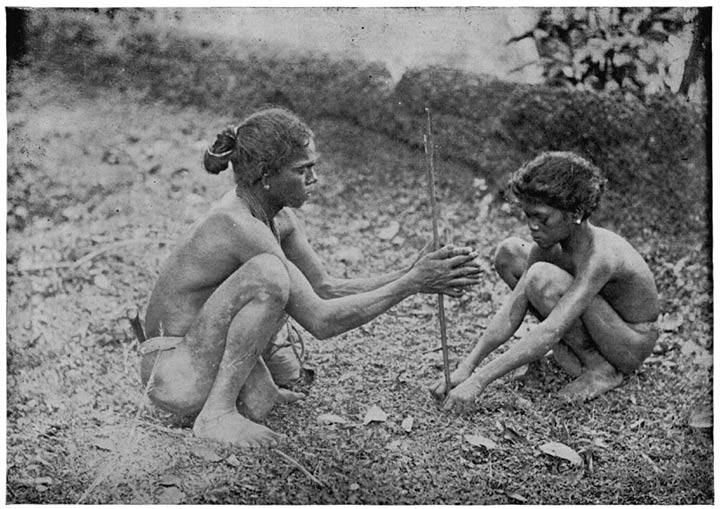
Kānikars Making Fire.
The sub-divisions among the Kānikars are known as illams or families, of which five are said to be endogamous, and five exogamous. The former are called Machchampi or brother-in-law illams, and the latter Annantampi or brother illams. They are named after mountains (e.g., Pālamala, Talamala), places (e.g., Vellanāt), etc. The Kānikars who live south of the Kodayar river cannot marry those living north of it, the river forming a marital boundary.
Among the names of Kānikars are Parapan (broad-faced), Chanthiran (moon), Marthandan (sun), Muntan (dwarf), Kāliyan (little Kali), Mādan (a deity), Nīli (blue) and Karumpi (black). The first name is sometimes that of the settlement in which they live. For example, the various Mullans are known as Kuzhumbi Mullan, Ānaimalai Mullan, Chembilakayam Mullan, etc.
The Kānikars live together in small communities under a Mūttakāni or headman, who wields considerable influence over them, and enjoys various perquisites. He presides over tribal council meetings, at which all social questions are discussed and settled, and fixes the time for clearing the jungle, sowing the seed, gathering the harvest, worshipping the gods, etc. Fines which are inflicted are spent in propitiating the gods.
The language of the Kānikars is a dialect of Malayālam, with a large admixture of Tamil, which they call Malampāshai or language of the hills.
The system of inheritance among those who live in the hills is makkathāyam (from father to son). But a moiety of the personal property goes to the nephews. With those who live in the plains, an equal distribution of their self-acquired property is made between the sons and nephews. If there are no sons, the nephews inherit the property, the widow being entitled to maintenance.
The chief object of worship is said to be Sāsthan, a forest god. But the Kānikars also make offerings to a variety of deities, including Amman, Poothathan, Vetikād Pootham, Vadamala Poothathan, and Amcala. They have, it has been said, “certain spots, trees or rocks, where their relations or friends have met with some unusual good luck or calamity, where they generally offer their prayers. Here they periodically assemble, and pray that the catastrophe that had befallen a comrade may not fall on them, or that the blessings which another had received may be showered on them.” Generally in February a festival called kodai is held, whereat the Kānikars assemble. Goats and fowls are sacrificed, and the pūjāri (priest) offers boiled rice and meat to the sylvan deities in a consecrated place. The festival, to which many come from the low country, winds up with drinking and dancing. The Kānikar musical instruments include a reed flute or clarionet, and men dance to the music, while the women clap their hands in time with it. The Kānikars worship their gods twice a year, in the months of Mīnam and Kanni. On the morning of the celebration, every family takes rice and plantains to the dwelling of the headman. With the exception of a small quantity which is set aside, the rice is husked and ground to flour by boys or men, after bathing and washing their hands and feet. The rice is taken to a clearing in the fields, whither a Kānikar who knows how to invoke the deity comes after bathing. He lays out a row of plantain leaves, and spreads on each leaf a little rice, on which plantains are laid. These are covered over with a plantain leaf, on which rice is sprinkled. The officiating Kānikar then burns incense, carries it round the trophy, and places it in front thereof. All do obeisance by raising their hands to their foreheads, and pray for a fruitful harvest. Sometimes the officiating Kānikar becomes inspired like a Velichapād, and gives expression to oracular utterances. At the close of the ceremony, a distribution of the rice and plantains takes place. When the land is to be cleared for cultivation, the headman is invited to attend, and some rice and cocoanuts are presented to him, which he offers up, and clears a small portion with his own hand. On the first appearance of the ears of grain, the Kānikars spend two nights in drumming, singing, and repeating mantrams at the field, and put up a tattu or platform on four sticks as a shrine for the spirits, to whom they offer raw rice, tender cocoanuts, flowers, etc. At harvest time rice, plantains, sweetmeats, and flowers are offered to the various hill demons, Pūrcha Mallan Pey, the cat giant, Athirakodi Pey, the boundary flag demon, and others.
Both adult and infant marriage are practiced. Those who had married ‘infants,’ on being questioned, stated that this is the safest course, as grown-up brides sometimes run away to their parents’ house, whereas younger girls get accustomed to their husbands’ home. On a fixed day, within a month of the marriage ceremony, four Kānikars, accompanied by a boy carrying betel leaves and areca nuts, go to the home of the future bride, and present them to the families of the settlement. On the wedding morning, all assemble at a pandal (booth), and the bridegroom distributes pān-supāri (betel leaf and areca nuts). His sister then brings forward the bride, and the bridegroom presents her with a cloth, which she puts on. Bride, bridegroom, and a young boy, then stand on a mat beneath the pandal, and the bridegroom ties the minnu (marriage badge) round the neck of the bride if she is an infant. If she is an adult, he places the minnu in front of her neck, on which it is tied by his sister. A plantain leaf is then placed in front of the bridal couple, and curry and rice served thereon by their mothers. The two women then take hold of the bride’s head, and press it seven times towards her husband’s shoulders. This ceremony concluded, the young boy takes a small quantity of the curry and rice, and puts it in the mouth of the bridegroom seven times. The bridegroom’s younger brother then gives a morsel to the bride. The ceremonial terminates with a feast. The dowry includes billhooks, brass vessels, choppers, grain, and pulses. The headman, according to Mateer, offers some advice to the husband concerning the management of his wife. The heads of his discourse are arranged under the following heads:—teaching by words, pinching, and blows, and casting the woman away at last, if she is not obedient. In the remarriage of widows, the bridegroom simply gives the woman a pair of cloths, and, with the consent of the male members of her family, takes her to his home.
During the seventh month of pregnancy, a woman has to perform a ceremony called vaguthu pongal. Seven pots are placed on seven hearths, and, when the rice placed therein has boiled, the woman salutes it, and all present partake thereof. According to Mateer “the ceremony practised on the occasion of pregnancy is called vayaru pongal, when boiled rice is offered to the sun. First they mould an image of Ganēsha, and, setting it in a suitable place, boil the rice. To this they add for an offering aval or flattened rice, parched rice, cakes, plantain fruits, young cocoanuts, and tender leaves of the same palm, with the flowers of the areca palm. The headman then commences dancing, and repeating mantrams. He waves the offerings to the sun. On first giving rice to a child, a feast is held, and an offering presented to the jungle demons.”
Concerning the death ceremonies, Mateer writes that “when any one is taken ill, the headman is at once consulted. He visits the sick person, and orders two drumming and singing ceremonies to be performed. A whole night is spent in dancing, singing, drumming, and prayers for the recovery of the patient. The offerings consist of tapioca, flour and cocoanuts, and other articles. After some time the headman, with manifestations of demoniac possession, reveals whether the sufferer will die or not. If the former, he repeats a mantram (kudumi vettu mantram, or formula on cutting off the top-knot), and cuts off the sick man’s kudumi. This being a sign of approaching death, the relatives and others pay their last visits to the sick. After death, a mixture of ganja (Indian hemp), raw rice, and cocoanut, is put into the mouth of the corpse by the son and nephews, and it is buried at some distance from their abode, mantrams being repeated over it. Occasionally the corpse is cremated. The relatives bathe before returning home, and cannot take any of the produce of their lands till the death pollution is removed, fearing that wild beasts will attack them or destroy their crops. To this end a small shed is built outside their clearing on the third day. Three measures of rice are boiled, and placed in a cup or on a plantain leaf inside the shed. Then all bathe, and return home. On the seventh day all this is repeated, the old shed being pulled down, and a new one put up. On returning to their dwelling, they sprinkle cow-dung on their houses and in the yard, which finally removes the defilement. People in better circumstances make a feast of curry and rice for all present.” The cow-dung is sprinkled with leafy twigs of the mango or jāk tree, or flower stalks of the areca palm. The ashes, after cremation, are said to be collected in a pot or leaf, and thrown into the nearest stream or river. An annual ceremony, in commemoration of ancestors, is held, at which rice is boiled and offered up.
The Kānikars, like the Irulas and Yānādis of the Tamil and Telugu countries, do not belong to the polluting classes. Pulayans, Kuruvans, and Vēdans are not allowed to approach them.
The dietary of the jungle Kānikars includes wild pigs, deer, porcupines, hares, monkeys, fowls, sheep and goats, parakeets, doves, tortoises, fish, crabs, peacocks, tigers (said to taste like black monkey), owls, squirrels and field rats, in addition to many vegetable products of the forest. They will not eat beef or the flesh of ‘bison.’
Some Kānikars are tattooed on the forehead with a crescent and dot, or a vertical stripe. The Kānikars say that their ancestors wore a garment made of jungle fibre, which has been replaced by a cotton loin-cloth. “Both men and women,” Mr. M. Ratnaswami Aiyar writes, “wear on the neck numerous strings of red beads and rings made of shells, which hang down to the abdomen in the case of the women. The men wear ear-rings of brass or silver. The women wear bangles of brass and iron, and a number of brass rings on the fingers. The men bear suspended from one of their shoulders a cloth bag containing two or more partitions, in which they keep their vilangupetti or box containing betel, tobacco, and chunam. They carry, too, suspended from the shoulder, a cane basket wherein they place their day’s crop of grain or roots, or any other food obtained by them. They attach to their waist-string or cloth a billhook and knife, and carry their bows and arrows slung on their shoulders. Whenever the Kānikars from the different kānis or settlements have to be gathered together for a common meeting, or for going together elsewhere on a common purpose, a messenger amongst them carries from one kāni to another the message with a knot of fibres of creepers, which serves as a symbol of call. The knotted fibre is passed on from one kāni to another till the required assembly is secured. It is thus that I secured my Kānikars to present them to their Excellencies Lord and Lady Curzon.”