Volume 3 — K (continued 5)
Reading edition
Kalinga Kōmatis, who live in the northern part of Ganjam, and have forgotten their mother-tongue, have practically adopted the Oriya customs, as they have to depend mainly on Oriya Brāhmans. At their marriages, however, they use the Telugu bottu or sathamānam.
Widow remarriage is not permitted among any sections of the caste, which is very strict in the observance of this rule. Except among the Saivites, a widow is not compelled to have her head shaved, or give up wearing jewelry, or the use of betel. In the south of the Madras Presidency, if a little girl becomes a widow, her māngalyam is not removed, and her head is not shaved till she reaches maturity. Vaishnava widows always retain their hair.
The Kōmatis wear the sacred thread, and utter the Gāyatri and other sacred mantras. A number of them, at Adōni in the Bellary district, refused to be measured by me in the afternoon, as they would not have time to bathe, and remove the pollution by evening. In Telugu dictionaries, the Kōmatis are given the alternative names of Mūdava Kolamuvāru (those of the third caste), Vaisyalu, and Nallanayya Todabiddalu (those who were begotten from the thighs of Vishnu). As already stated, there are among the Kōmatis ordinary Saivites, who daub themselves with ashes; Lingāyats or Vīra Saivas, who wear the linga in a silver casket; Rāmānuja Vaishnavites; Chaitanya Vaishnavas, who are confined to the Kalinga section; and Mādhvas, who put on the sect marks of Mādhva Brāhmans. The Traivarnikas are a special class among the Vaishnavas. They imitate the Vaishnava Brāhmans more closely than the rest. They, and their females, tie their cloths like Brāhmans, and the men shave moustaches. Unlike the Saivites and Lingāyats, they eat flesh and fish, and drink spirituous liquors. They will eat in the houses of Sātānis, whereas other Kōmatis do not eat in any but Brāhman houses. But it may be observed that Velamas, Balijas, Kammālans, Ambattans, Vannāns, and many other castes, will take neither water nor food from Kōmatis. This, however, does not prevent them from purchasing the cakes prepared in ghī or oil, which the Kōmatis sell in petty shops.
All over the country, the Kōmatis venerate the deified virgin Kannika Paramēswari, to whom, in most places, they have erected temples. One of these, at Tadpatri in the Anantapūr district, which was in course of construction in 1904, is of more than ordinary interest. It was being built at the expense of the local Kōmatis, who had raised a subscription among themselves for the purpose. The design was original, and even arches entered into its construction. The sculpture, with which it is decorated, is quite excellent in design and finish. Much of it is copied from the two beautiful temples, which have existed at the place since the days of the Vijianagar dynasty. Other notable temples are those at Penukonda, Vizianagram in Vizagapatam, and Berhampur in Ganjam. Fines collected from erring castemen in the Godāvari, Guntūr and Kistna districts, are still sent to the temple at Penukonda. The Kōmatis worship various goddesses, in addition to Kanyaka Paramēswari. Those who live in Vizagapatam “relax their faith in favour of the celebrated Muhammadan saint, who lies buried by the Durga on the top of the hill which overlooks the harbour. Every vessel, passing the harbour inwards and outwards, salutes him by hoisting and lowering its flag three times. He is considered all potent over the elements in the Bay of Bengal, and many a silver dhoney (boat) is presented at his shrine by Hindu ship-owners after a successful voyage. We remember a suit between a Kōmati, the owner of a dhoney, and his Muhammadan captain, who was also the super-cargo, for settlement of accounts. In a storm off the coast of Arakan, the skipper stated that he had vowed a mudupu or purse of rupees to the Durga, and had duly presented it on his return. This sum, among other sets-off, he charged to the owner of the vessel, the plaintiff, whose sole contention was that the vow had never been discharged; the propriety of conciliating the old Fakir in a hurricane he submissively allowed.” Even now, the Kōmatis, though no longer boat-owners, revere the saint, and make vows to him for the success of civil suits, and recovery from all sorts of maladies.
The Kōmatis employ Brāhmans for the performance of their ceremonial rites, and recognise a Brāhman as their guru. He is commonly called Bhāskarāchārya, after the individual of that name who lived at Penukonda prior to the sixteenth century A.D., and translated the Sanskrit Kanyaka Purāna into a Telugu poem. He made certain regulations for the daily conduct of the Kōmatis, and made the 102 gōtras submit to them. A copy of an inscription on a copper plate, in the possession of one Kotta Appaya, the Archaka or priest of the Nagarēswaraswāmi temple at Penukonda, is given in the Mackenzie manuscripts. It records a grant (of unknown date) to Bhāskarāchārya, the guru of the Vaisyas, by the 102 gōtrams, according to which each family agreed for ever afterwards to give half a rupee for every marriage, and a quarter of a rupee for each year. Such doles are common even at the present day to his successors. These, like the original Bhāskarāchārya, who is considered to be an incarnation of Brahma, are house-holders, and not Sanyāsis (religious ascetics). There are several of them, in different parts of the country, one for example being at Penukonda, and another near Hospet, who makes periodical tours in state, with drums, silver maces, and belted peons, and is received with every mark of respect. He settles disputes, levies fines, and collects subscriptions towards the upkeep of his mutt (religious institution), which is also supported by inām (rent-free) lands.
The Kōmati dead, except children and Lingāyats, are cremated, Lingāyat Kōmatis, like other Lingāyats, bury their dead in a sitting posture. The death ceremonies among the Gavaras closely resemble those of Brāhmans. The period of death pollution is sixteen days, during which sweets are taboo.
The Kōmatis are best known as merchants, grocers, and money-lenders. In the city of Madras, they are the principal vendors of all sorts of imported articles. The row of shops in the China bazar, between Pachaiyappa’s College and Popham’s Broadway, is almost entirely maintained by them. Many Kōmatis are cloth merchants, and Traivarnikas are almost entirely engaged in the glassware trade. In the Northern Circars, some earn a living as petty dealers in opium and ganja (Indian hemp). In the Ganjam, Vizagapatam and Godāvari districts they are found in the hills, acting as middle-men between the hill tribes and the people of the plains. Most of the Kōmatis are literate, and this helps them in their dealings with their constituents. They are proverbially shrewd, industrious, and thrifty, and are often rich. If a Kōmati fails in business, his compatriots will come to his rescue, and give him a fresh start. Organised charity is well known among them. Each temple of Kanyaka Paramēswari is a centre for charity. In the city of Madras the Kanyaka Paramēswari charities, among other good objects, promote the development of female education. In 1905, the Kōmatis established a Southern India Vysia Association, with the object of encouraging “the intellectual, moral, religious, social, industrial and commercial advancement of the Vysia community.” Among the means employed for so doing, are the helping of deserving students with scholarships for the prosecution of the study of the English and vernacular languages, and organised relief of poor and distressed members of the community by founding orphanages, and so forth. The affairs of the association are managed by an executive committee made up of prominent members of the caste, including merchants, lawyers, and contractors.
The Blind Kōmati and Vishnu.
A blind Kōmati prayed to Vishnu for the restoration of his eyesight, and at last the god appeared before him, and asked him what he wanted. “Oh! God,” he replied, “I want to see from above the seventh storey of my mansion my great-grandsons playing in the streets, and eating their cakes from golden vessels.”
Vishnu was so astonished at the request of the blind man, which combined riches, issue, and the restoration of his eyesight in one demand, that he granted all his desires.
The Kōmati and the Thief.
An old Kōmati observed a thief at dead of night lurking under a pomegranate tree, and cried out to his wife to bring him a low stool. On this he seated himself in front of the thief, and bawled out for hot water, which his wife brought him. Pretending that he was suffering from severe tooth-ache, he gargled the water, and spat it out continuously at the wondering thief. This went on till daybreak, when he called out his neighbours, who captured the thief, and handed him over to the police.
The Kōmati and his Cakes.
A Kōmati was on his way to the weekly market, with his plate of cakes to sell there. A couple of thieves met him when he was half way there, and, after giving him a severe thrashing, walked off with the cakes. The discomfited Kōmati, on his way back home with the empty plate, was met by another Kōmati going to market with his cakes. The latter asked how the demand for cakes was at the market, and the former replied “Why go to the market, when half-way people come and demand your cakes?” and passed on. The unsuspecting Kōmati went on, and, like the other, was the recipient of a sound thrashing at the hands of the thieves.
The Kōmati and the Scorpion.
A number of Kōmatis went one day to a temple. One of them put one of his fingers into the navel of the image of Vināyakan (the elephant god) at the gateway, when a scorpion, which was inside it, stung him. Putting his finger to his nose, the Kōmati remarked “What a fine smell! I have never experienced the like.” This induced another man to put his finger in, and he too was stung, and made similar pretence. All of them were thus stung in succession, and then consoled each other.
The Kōmati and the Milk Tax.
Once upon a time, a great king levied a tax upon milk, and all his subjects were sorely tried by it. The Kōmatis, who kept cows, found the tax specially inconvenient. They, therefore, bribed the minister, and mustered in strength before the king, to whom they spoke concerning the oppressive nature of the tax. The king asked what their profit from the milk was. “A pie for a pie” said they to a man, and the king, thinking that persons who profit only a pie ought not to be troubled, forthwith passed orders for the abolition of the tax.
The Kōmati and the Pāndyan King.
Once upon a time, a Pāndyan King had a silver vessel of enormous size made for the use of the palace, and superstitiously believed that its first contents should not be of an ordinary kind. So he ordered his minister to publish abroad that all his subjects were to put into the vessel a chembu-full of milk from each house. The frugal Kōmatis, hearing of this, thought, each to himself, that, as the king had ordered such a large quantity, and others would bring milk, it would suffice if they took a chembu-full of water, as a little water poured into such a large quantity of milk would not change its colour, and it would not be known that they only contributed water. All the Kōmatis accordingly each brought a chembu-full of water, and none of them told the others of the trick he was about to play. But it so happened that the Kōmatis were the first to enter the palace, while they thought that the people of other castes had come and gone. The vessel was placed behind a screen, so that no one might cast the evil eye on it, and the Kōmatis were let in one by one. This they did in all haste, and left with great joy at the success of their trick. Thus there was nothing but water in the vessel. Now it had been arranged that the king was to be the first person to see the contents of his new vessel, and he was thunderstruck to find that it contained only water. He ordered his minister to punish the Kōmatis severely. But the ready-witted Kōmatis came forward, and said “Oh! gracious King, appease thy anger, and kindly listen to what we have to say. We each brought a chembu-full of water, to find out how much the precious vessel will hold. Now that we have taken the measurement, we will forthwith fetch the quantity of milk required.” The king was exceedingly pleased, and sent them away.
A story is told to the effect that, when a Kōmati was asked to identify a horse about which a Muhammadan and Hindu were quarrelling, he said that the fore-part looked like the Muhammadan’s, and the hind-part like the Hindu’s. Another story is told of a Kōmati, who when asked by a Judge what he knew about a fight between two men, deposed that he saw them standing in front of each other and speaking in angry tones when a dust-storm arose. He shut his eyes, and the sound of blows reached his ears, but he could not say which of the men beat the other.
Of proverbs relating to the Kōmatis, the following may be noted:—
A Brāhman will learn if he suffers, and a Kōmati will learn if he is ruined.
If I ask whether you have salt, you say that you have dhol (a kind of pulse).
Like the burning of a Kōmati’s house, which would mean a heavy loss.
When two Kōmatis whisper on the other side of the lake, you will hear them on this side. This has reference to the harsh voice of the Kōmatis. In native theatricals, the Kōmati is a general favourite with the audience, and he is usually represented as short of stature, obese, and with a raucous voice.
The Kōmatis are satirically named Dhaniyāla jāti, or coriander caste, because, as the coriander seed has to be crushed before it is sown, so the Kōmati is supposed to come to terms only by rough treatment.
The Kōmatis have the title Setti or Chetti, which is said to be a contracted form of Srēshti, meaning a precious person. In recent times, some of them have assumed the title Ayya.
Kombara.—The name, meaning a cap made of the spathe of the areca palm (Areca Catechu) of an exogamous sept of Kelasi. Such caps are worn by various classes in South Canara, e.g., the Holeyas and Koragas.
Kombu (stick).—An exogamous sept of Kuruba.
Komma.—Komma (a musical horn) or Kommula has been recorded as an exogamous sept of Kamma and Māla. Kommula is further a professional title for horn-blowers, mainly Māla, Mādiga, and Panisavan, who perform at festivals and funerals.
Kommi.—A gōtra of Gollas, the members of which may not use kommi fuel.
Kompala (houses).—An exogamous sept of Dēvānga.
Kōnān.—Kōnān or Kōnār is a title of Idaiyans. Some Gollas call themselves Kōnānulu.
Kōnangi (buffoon).—An exogamous sept of Dēvānga.
Konda (mountain).—An exogamous sept of Dēvānga and Mēdara, and a synonym for Konda Dora.
In the Census Report, 1891, Mr. H. A. Stuart writes that “these people all speak Telugu, and the majority of them have returned that as their parent-tongue. But a large number returned their caste name in the parent-tongue column. I have since received a vocabulary, which is said to be taken from the dialect of the Konda Doras; and, if this is correct, then the real speech of these people is a dialect of Khond.” One Durgi Pātro, the head of a mutta (division of a Zemindari) informed Mr. G. F. Paddison that Konda Doras and Khonds are identical. In the Census Report, 1901, Mr. W. Francis states that the Konda Doras “seem to be a section of the Khonds, which has largely taken to speaking Telugu, has adopted some of the Telugu customs, and is in the transitional stage between Animism and Hinduism. They call themselves Hindus, and worship the Pāndavas and a goddess called Talupulamma. They drink alcohol, and eat pork, mutton, etc., and will dine with Kāpus.” At times of census, Pāndavakulam (or Pāndava caste) has been returned as a title of the Konda Doras.
For the following note I am indebted to Mr. C. Hayavadana Rao. There are, among the Konda Doras, two well-defined divisions, called Pedda (big) and Chinna (little) Kondalu. Of these, the former have remained in their old semi-independent position, while the latter have come under Telugu domination. The Chinna Kondalu, who have been living in contact with the Bhaktha caste, have adopted the Telugu system of intipērulu, as exogamous septs, whereas the Pedda Kondalu have retained the totem divisions, which occur among other hill castes, e.g., Nāga (cobra), Bhāg (tiger), and Kochchimo (tortoise). Among the Chinna Kondalu, the custom of mēnarikam, according to which a man marries his maternal uncle’s daughter, is observed, and may further marry his own sister’s daughter. The Chinna Kondalu women wear glass bangles and beads, like women of the plains. Men of the Chinna Kondalu section serve as bearers and Government employees, whereas those of the Pedda Kondalu section are engaged in cultivation. The former have personal names corresponding to those of the inhabitants of the plains, e.g., Linganna, Gangamma, while the names of the latter are taken from the day of the week on which they were born, e.g., Bhudra (Wednesday), Sukra (Friday).
Among the Chinna Kondalu, a girl is married before or after puberty. When a marriage is decided on, the girl’s parents receive a present (vōli) of four rupees and a female cloth. On an auspicious day fixed by the Chukkamusti (star-gazer), the bride is conducted to the home of the bridegroom. The contracting couple are bathed in turmeric-water, put on new cloths presented by their fathers-in-law, and wrist-threads are tied on their wrists. On the same day, or the following morning, at a time settled by the Chukkamusti, the bridegroom, under the direction of a caste elder, ties the sathamānam (marriage badge) on the bride’s neck. On the following day, the wrist-threads are removed, and the newly married couple bathe.
Among the Pedda, as among the Chinna Kondalu, a girl is married before or after puberty. When a man contemplates taking a wife, his parents carry three pots of liquor to the home of the girl whose hand he seeks. The acceptance of these by her father is a sign that the match is agreeable to him, and a jholla tonka (bride-price) of five rupees is paid to him. The future bridegroom’s party has to give three feasts to that of the bride-elect, for each of which a pig is killed. The girl is conducted to the house of the bridegroom, and, if she has reached puberty, remains there. Otherwise she returns home, and joins her husband later on, the occasion being celebrated by a further feast of pork.
Both sections allow the remarriage of widows. Among the Pedda Kondalu, a younger brother may marry the widow of his elder brother. By both sections divorce is permitted. Among the Chinna Kondalus, a man who marries a divorcée has to pay her first husband twenty-four rupees, of which half is divided among the neighbouring caste villages in certain recognised proportions.
The dead are usually burnt by both sections. The Pedda Kondalu kill a pig on the third day, and hold a feast, at which much liquor is disposed of. By the Chinna Kondalu the chinna rōzu (little day) ceremony is observed, as it is by other castes dwelling in the plains.
The Chinna Kondalu bear the titles Anna or Ayya when they are merely cultivators under Bhaktha landlords, and Dora under other circumstances. The Pedda Kondalu usually have no title.
A riot took place, in 1900, at the village of Korravanivalasa in the Vizagapatam district, under the following strange circumstances. “A Konda Dora of this place, named Korra Mallayya, pretended that he was inspired, and gradually gathered round him a camp of four or five thousand people from various parts of the agency. At first his proceedings were harmless enough, but in April he gave out that he was a re-incarnation of one of the five Pāndava brothers; that his infant son was the god Krishna; that he would drive out the English and rule the country himself; and that, to effect this, he would arm his followers with bamboos, which should be turned by magic into guns, and would change the weapons of the authorities into water. Bamboos were cut, and rudely fashioned to resemble guns, and armed with these, the camp was drilled by the Swāmi (god), as Mallayya had come to be called. The assembly next sent word that they were going to loot Pāchipenta, and when, on the 1st May, two constables came to see how matters stood, the fanatics fell upon them, and beat them to death. The local police endeavoured to recover the bodies, but, owing to the threatening attitude of the Swāmi’s followers, had to abandon the attempt. The District Magistrate then went to the place in person, collected reserve police from Vizagapatam, Pārvatipur, and Jeypore, and at dawn on the 7th May rushed the camp to arrest the Swāmi and the other leaders of the movement. The police were resisted by the mob, and obliged to fire. Eleven of the rioters were killed, others wounded or arrested, and the rest dispersed. Sixty of them were tried for rioting, and three, including the Swāmi, for murdering the constables. Of the latter, the Swāmi died in jail, and the other two were hanged. The Swāmi’s infant son, the god Krishna, also died, and all trouble ended at once and completely.”
Kondaikatti.—The name of a sub-division of Vellālas, meaning those who tie the whole mass of hair of the head (kondai) in a knot on the top of the head, as opposed to the kudumi or knot at the back of the partially shaved head.
Kondaita.—A sub-division of Doluva.
Kondaiyamkottai.—A sub-division of Maravan.
Kondalar.—Recorded, in the Madras Census Report, 1901, as a sub-caste of Vellāla. Kondalam means women’s hair or a kind of dance, and it is possible that the name was returned by people of the Dēva-dāsi caste, who are rising in the social scale, and becoming absorbed in the Vellāla caste. Kondali, of doubtful meaning, has been returned by cultivators and agricultural labourers in North Arcot.
Kondh.—In the Administration Report of the Ganjam Agency, 1902–3, Mr. C. B. Cotterell writes that Kondh is an exact transliteration from the vernacular, and he knows of no reason, either sentimental or etymological, for keeping such spelling as Khond.
It is noted, in the Madras Census Report, 1891, that “the Khonds inhabit the hill tracts of Ganjam and parts of Vizagapatam, and are found also in Bengal and the Central Provinces. They call themselves Kui, a name identical with the Koi or Koya of the Godāvari agency and the south of the Jeypore Zemindāri. The Telugu people call them Kōtuvāndlu. The origin of the name Khond is doubtful, but Macpherson is, I think, right in deriving it from Telugu Konda, a hill. There is a tribe in Vizagapatam called Konda Dora or Konda Kāpu, and these people are also frequently called Kōtuvāndlu. All these names are derivatives of the root kô or kû, a mountain. The number of sub-divisions returned is 58. The list includes many names of other castes, a fact which must be in part ascribed to the impossibility of distinguishing the true Khonds from persons returned as Kondavāndlu, Kondalu, Kōtuvāndlu, etc., terms which mean simply highlanders, and are applicable to all the hill tribes. For example, 12,164 Pānos have returned their main caste as Khond.”
It has been noted that “the character of the Khonds varies as much as their language. Where there has been much contact with the plains, it is not as favourable as elsewhere. As a rule, they may be taken to be a bold, and fitfully laborious mountain peasantry of simple, but not undignified manners; upright in their conduct; sincere in their superstitions; proud of their position as landholders; and tenacious of their rights. The Linepada Khonds affect manners like Uriyas, and, among other things, will not eat pork (the flesh of wild pigs excepted). The Khond villages have quite the appearance of Uriya villages, the houses are built with mud walls, a thing unknown with Khonds in other parts of the Māliahs; and there is also much neat garden cultivation, which is rare elsewhere, probably because the produce thereof would be appropriated by the Uriyas. In 1902, the Linepada Muttah (settlement) presented the unusual spectacle of a Khond ruler as Dolabēhara, as well as Moliko, with the Uriya Paiks really at his beck and call. In some places, the most valuable portions of the land have passed into the possession of Sondis and low-country sowcars (money-lenders), who have pandered to the Khonds by advancing them money, the greater portion of which has been expended in drink, the repayment being exacted in land. Except in the Goomsur Māliahs, paddy (rice) cultivation is not extensively carried on by the Khonds; elsewhere it is chiefly in the hands of the Uriyas. The Khonds take little trouble in raising their crops. The result is that, except in the Goomsur Māliahs, where they grow crops to sell in the market for profit, we find a poverty-stricken race, possessing hardly any agricultural stock, and no signs of affluence. In Kimedi, however, they are beginning to follow the example of Goomsur, and doubtless their material prosperity would much increase if some check could be devised to save them from the Uriyas and Sondis, who are steadily acquiring all the wet land, and utilising the Khonds merely as cultivators.”
“The Khonds are very keen in the pursuit of game, for which the hot weather is the appointed time, and, during this period, a sambar or ‘bison’ has but little chance of escape if once wounded by an arrow, as they stick to the trail like sleuth hounds, and appear insensible to distance or fatigue. The arms they carry are the bow, arrows, and tangi, a species of light battle-axe that inflicts a serious wound. The women are not addicted to drink, but the males are universally attached to liquor, especially during the hot weather, when the sago palm (solopo: Caryota urens) is in full flow. They often run up sheds in the jungle, near especially good trees, and drink for days together. A great many deaths occur at this season by falls from trees when tapping the liquor. Feasts and sacrifices are occasions for drinking to excess, and the latter especially are often scenes of wild intoxication, the liquor used being either mohwa, or a species of strong beer brewed from rice or koeri. Khond women, when once married, appear to keep pretty straight, but there is a good deal of quiet immorality among the young men and girls, especially during the commencement of the hot weather, when parties are made up for fishing or the collection of mohwa fruit and other jungle berries. At the same time, a certain sense of shame exists, as instances are not at all uncommon of double suicide, when a pair of too ardent lovers are blown upon, and their liaison is discovered.
“The generality of Khond and Pâno houses are constructed of broad sâl logs hewn out with the axe, and thatched with jungle grass, which is impervious to white-ants. In bamboo jungles, bamboo is substituted for sâl. The Khond houses are substantially built but very low, the pitch of the roof never exceeding 8 feet, and the eaves being only about 4 feet from the ground, the object being to ensure resistance to the violent storms that prevail during the monsoons.
“Intermarriage between Khonds, Pânos, and Uriyas is not recognised, but cases do occur when a Pâno induces a Khond woman to go off with him. She may live with him as his wife, but no ceremony takes place. If a Pâno commits adultery with a Khond married woman, he has to pay a paronjo, or a fine of a buffalo, to the husband who retains his wife, and in addition a goat, a pig, a basket of paddy, a rupee, and a cavady (shoulder-pole) load of pots. If the adulterer is a Khond, he gets off with payment of the buffalo, which is slaughtered for the entertainment of the village. The husband retains his wife in this case, as also if he finds her pregnant when first she comes to him; this is not an uncommon incident. Divorce of the wife on the husband’s part is thus very rare, if it occurs at all, but cases are not unknown where the wife divorces her husband, and adopts a fresh alliance. When this takes place, her father has to return the whole of the gifts known as gontis, which the bridegroom paid for his wife when the marriage was originally arranged.”
There is a tradition that, in olden days, four Kondhs, named Kasi, Mendora, Bolti, and Bolo, with eyes the size of brass pots, teeth like axe-heads, and ears like elephant’s ears, brought their ancestor Mandia Pātro from Jorasingi in Boad, and gave him and his children authority all over the country now comprised in Mahasingi, and in Kurtilli Barakhumma, Bodogodo, Balliguda, and Pussangia, on condition of settling their disputes, and aiding them in their rights. The following legendary account of the origin of the Kondhs is given by Mr. A. B. Jayaram Moodaliar. Once upon a time, the ground was all wet, and there were only two females on the earth, named Karaboodi and Tharthaboodi, each of whom was blessed with a single male child. The names of the children were Kasarodi and Singarodi. All these individuals sprang from the interior of the earth, together with two small plants called nangakoocha and badokoocha, on which they depended for subsistence. One day, when Karaboodi was cutting these plants for cooking, she accidentally cut the little finger of her left hand, and the blood dropped on the ground. Instantly, the wet soft earth on which it fell became dry and hard. The woman then cooked the food, and gave some of it to her son, who asked her why it tasted so much sweeter than usual. She replied that she might have a dream that night, and, if so, would let him know. Next morning, the woman told him that, if he would act on her advice, he would prosper in this world, that he was not to think of her as his mother, and was to cut away the flesh of her back, dig several holes in the ground, bury the flesh, and cover the holes with stones. This her son did, and the rest of the body was cremated. The wet soil dried up and became hard, and all kinds of animals and trees came into existence. A partridge scratched the ground with its feet, and rāgi (millet), maize, dhāl (pea), and rice sprung forth from it. The two brothers argued that, as the sacrifice of their mother brought forth such abundance, they must sacrifice their brothers, sisters, and others, once a year in future.A god, by name Boora Panoo, came, with his wife and children, to Tharthaboodi and the two young men, to whom Boora Panoo’s daughters were married. They begat children, who were divided equally between Boora Panoo the grandfather and their fathers. Tharthaboodi objected to this division on the grounds that Boora Panoo’s son would stand in the relation of Mamoo to the children of Kasarodi and Singarodi; that, if the child was a female, when she got married, she would have to give a rupee to her Mamoo; and that, if it was a male that Boora Panoo’s daughter brought forth, the boy when he grew up would have to give the head of any animal he shot to Mamoo (Boora Panoo’s son). Then Boora Panoo built a house, and Kasarodi and Singarodi built two houses. All lived happily for two years. Then Karaboodi appeared in a dream, and told Kasarodi and Singarodi that, if they offered another human victim, their lands would be very fertile, and their cattle could flourish. In the absence of a suitable being, they sacrificed a monkey. Then Karaboodi appeared once more, and said that she was not pleased with the substitution of the monkey, and that a human being must be sacrificed. The two men, with their eight children, sought for a victim for twelve years. At the end of that time, they found a poor man, who had a son four years old, and found him, his wife and child good food, clothing, and shelter for a year. They then asked permission to sacrifice the son in return for their kindness, and the father gave his assent. The boy was fettered and handcuffed to prevent his running away, and taken good care of. Liquor was prepared from grains, and a bamboo, with a flag hoisted on it, planted in the ground. Next day, a pig was sacrificed near this post, and a feast was held. It was proclaimed that the boy would be tied to a post on the following day, and sacrificed on the third day. On the night previous to the sacrifice, the Janni (priest) took a reed, and poked it into the ground in several places. When it entered to a depth of about eight inches, it was believed that the god and goddess Tadapanoo and Dasapanoo were there. Round this spot, seven pieces of wood were arranged lengthways and crossways, and an egg was placed in the centre of the structure. The Khonds arrived from the various villages, and indulged in drink. The boy was teased, and told that he had been sold to them, that his sorrow would affect his parents only, and that he was to be sacrificed for the prosperity of the people. He was conducted to the spot where the god and goddess had been found, tied with ropes, and held fast by the Khonds. He was made to lie on his stomach on the wooden structure, and held there. Pieces of flesh were removed from his back, arms and legs, and portions thereof buried at the Khond’s place of worship. Portions were also set up near a well of drinking water, and placed around the villages. The remainder of the sacrificed corpse was cremated on a pyre set alight with fire produced by the friction of two pieces of wood. On the following day, a buffalo was sacrificed, and a feast partaken of. Next day, the bamboo post was removed outside the village, and a fowl and eggs were offered to the deity. The following stanza is still recited by the Janni at the buffalo sacrifice, which has been substituted for that of a human victim:—Oh! come, male slave; come, female slave. What do you say? What do you call out for? You have been brought, ensnared by the Haddi. You have been called, ensnared by the Domba. What can I do, even if you are my child? You are sold for a pot of food.
The ethnological section of the Madras Museum received a few years ago a very interesting relic in the shape of a human (Meriah) sacrifice post from Baligudu in Ganjam. This post, which was fast being reduced to a mere shell by white-ants, is, I believe, the only one now in existence. It was brought by Colonel Pickance, who was Assistant Superintendent of Police, and set up in the ground near the gate of the reserve Police barracks. The veteran members of a party of Kondhs, who were brought to Madras for the purpose of performing before the Prince and Princess of Wales in 1906, became wildly excited when they came across this relic of their former barbarous custom.
In the same year, Mr. Arbuthnot, Collector of Vizagapatam, reported as follows. “Of the hill tribe Codooloo, there are said to be two distinct classes, the Cotia Codooloo and Jathapoo Codooloo. The former class is that which is in the habit of offering human sacrifices to the god called Jenkery, with a view to secure good crops. This ceremony is generally performed on the Sunday preceding or following the Pongal feast. The victim is seldom carried by force, but procured by purchase, and there is a fixed price for each person, which consists of forty articles such as a bullock, a male buffalo, a cow, a goat, a piece of cloth, a silk cloth, a brass pot, a large plate, a bunch of plantains, etc. The man who is destined for the sacrifice is carried before the god, and a small quantity of rice coloured with saffron (turmeric) is put upon his head. The influence of this is said to prevent his attempting to escape, even though set at liberty. It would appear, however, that, from the moment of his seizure till he is sacrificed, he is kept in a continued state of stupefaction or intoxication. He is allowed to wander about the village, to eat and drink anything he may take a fancy to, and even to have connection with any of the women whom he may meet. On the morning set apart for the sacrifice, he is carried before the idol in a state of intoxication. One of the villagers acts as priest, who cuts a small hole in the stomach of the victim, and with the blood that flows from the wound the idol is smeared. Then the crowds from the neighbouring villages rush forward, and he is literally cut into pieces. Each person who is so fortunate as to procure it carries away a morsel of the flesh, and presents it to the idol of his own village.”
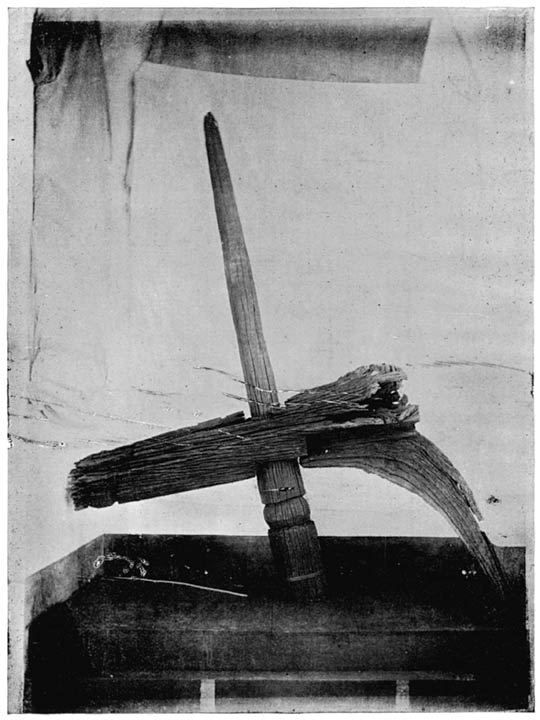
Meriah Sacrifice Post.
The Kondhs of Bara Mootah promised to relinquish the rite on condition, inter alia, that they should be at liberty to sacrifice buffaloes, monkeys, goats, etc., to their deities with all the solemnities observed on occasions of human sacrifice; and that they should be at liberty, upon all occasions, to denounce to their gods the Government, and some of its servants in particular, as the cause of their having relinquished the great rite.
The last recorded Meriah sacrifice in the Ganjam Māliahs occurred in 1852, and there are still Kondhs alive, who were present at it. Twenty-five descendants of persons who were reserved for sacrifice, but were rescued by Government officers, returned themselves as Meriah at the census, 1901. The Kondhs have now substituted a buffalo for a human being. The animal is hewn to pieces while alive, and the villagers rush home to their villages, to bury the flesh in the soil, and so secure prosperous crops. The sacrifice is not unaccompanied by risk to the performers, as the buffalo, before dying, frequently kills one or more of its tormenters. This was the case near Baliguda in 1899, when a buffalo killed the sacrificer. In the previous year, the desire of a village to intercept the bearer of the flesh for a neighbouring village led to a fight, in which two men were killed.
It was the practice, a few years ago, at every Dassara festival in Jeypore, Vizagapatam, to select a specially fine ram, wash it, shave its head, affix thereto red and white bottu and nāmam (sect marks) between the eyes and down the nose, and gird it with a new white cloth after the manner of a human being. The animal being then fastened in a sitting posture, certain pūja (worship) was performed by a Brāhman priest, and it was decapitated. The substitution of animals for human victims is indicated by various religious legends. Thus, a hind was substituted for Iphigenia, and a ram for Isaac.
“At the time of the great Kiabon (Campbell) Sahib’s coming, the country was in darkness; it was enveloped in mist.
Having sent paiks to collect the people of the land, they, having surrounded them, caught the Meriah sacrificers.
Having caught the Meriah sacrificers, they brought them, and again they went and seized the evil councillors.
Having seen the chains and shackles, the people were afraid; murder and bloodshed were quelled.
Then the land became beautiful, and a certain Mokodella (Macpherson) Sahib came.
He destroyed the lairs of the tigers and bears in the hills and rocks, and taught wisdom to the people.
After the lapse of a month, he built bungalows and schools; and he advised them to learn reading and law.
They learnt wisdom and reading; they acquired silver and gold. Then all the people became wealthy.”
Human sacrifice was not practiced in the Kurtilli Muttah of the Ganjam Māliahs. The reason of this is assigned to the fact that the first attempt was made with a crooked knife, and the sacrificers made such a bad business of it that they gave it up. Colonel Campbell gives another tradition, that, through humanity, one of the Kurtilli Pātros (head of a group of villages) threatened to leave the muttah if the practice was carried out.
Blame us not, O buffalo!
Thus for sacrificing thee,
For our fathers have ordained
This ancient mystery.
We have bought thee with a price,
Have paid for thee all thy worth.
What blame can rest upon us,
Who save our land from dearth?
Famine stares us in the face,
Parched are our fields, and dry,
Death looks in at ev’ry door,
For food our young ones cry.
Thadi Pennoo veils her face,
Propitiate me, she cries,
Give to me of flesh and blood,
A willing sacrifice.
That where’er its blood is shed,
On land, or field, or hill,
There the gen’rous grain may spring,
So ye may eat your fill.
Then be glad, O buffalo!
Willing sacrifice to be,
Soon in Thadi’s meadows green,
Thou shalt brouse eternally.
After the Khonds had been chanting this sacrificial hymn for some time, the buffalo was untied from the carved post, and led, with singing, dancing and shouting, and with the noise of many musical instruments, to a sacred grove a few hundred yards off, and there tied to a stake. As soon as it had been firmly tied, the Khonds threw off all their superfluous clothing to the large crowd of womankind waiting near, and stood round the animal, each man with his hand uplifted, and holding a sharp knife ready to strike at a moment’s notice, as soon as the priest or Janni had given the word of command. The Janni, who did not differ outwardly from the others, now gave the buffalo a slight tap on the head with a small axe. An indescribable scene followed. The Khonds in a body fell on the animal, and, in an amazingly short time, literally tore the living victim to shreds with their knives, leaving nothing but the head, bones, and stomach. Death must, mercifully, have been almost instantaneous. Every particle of flesh and skin had been stripped off during the few minutes they fought and struggled over the buffalo, eagerly grasping for every atom of flesh. As soon as a man had secured a piece of flesh, he rushed away with the gory mass, as fast as he could, to his fields, to bury it therein according to ancient custom, before the sun had set. As some of them had to do good distances to effect this, it was imperative that they should run very fast. A curious scene now took place, for which we could obtain no explanation. As the men ran, all the women flung after them clods of earth, some of them taking very good effect. The sacred grove was cleared of people, save a few that guarded the remnants left of the buffalo, which were taken, and burnt with ceremony at the foot of the stake.”
At a marriage among the Kondhs of Baliguda, after the heads of the bride and bridegroom have been brought together, an arrow is discharged from a bow by the younger brother of the bridegroom into the grass roof of the hut. At the betrothal ceremony of some Kondhs, a buffalo and pig are killed, and some of the viscera eaten. Various parts are distributed according to an abiding rule, viz., the head to the bridegroom’s maternal uncle, the flesh of the sides to his sisters, and of the back among other relations and friends. Some Kondh boys of ten or twelve years of age are said to be married to girls of fifteen or sixteen. At Shubernagiri, in the Ganjam Māliahs, are two trysting trees, consisting of a jāk (Artocarpus integrifolia) and mango growing close together. The custom was for a Kondh, who was unable to pay the marriage fees to the Pātro (headman), to meet his love here by night and plight his troth, and then for the two to retire into the jungle for three days and nights before returning to the village. Afterwards, they were considered to be man and wife.
Some years ago, a young Kondh was betrothed to the daughter of another Kondh, and, after a few years, managed to pay up the necessary number of gifts. He then applied to the girl’s father to name the day for the marriage. Before the wedding took place, however, a Pāno went to the girl’s father, and said that she was his daughter (she had been born before her parents were married), and that he was the man to whom the gifts should have been paid. The case was referred to a council meeting, which decided in favour of the Pāno.
Of birth ceremonies, the following account is given by Mr. Jayaram Moodaliar. The woman is attended in her confinement by an elderly Kondh midwife, who shampooes her abdomen with castor-oil. The umbilical cord is cut by the mother of the infant. For this purpose, the right thigh of the baby is flexed towards its abdomen, and a piece of cooled charcoal placed on its right knee. The cord is placed on the charcoal, and divided with the sharp edge of an arrow. The placenta is buried close to the house near a wall. After the cord has been severed, the mother daubs the region of the infant’s navel with her saliva, over which she smears castor-oil. She then warms her hands at a fire, and applies them to the infant’s body. [It is stated, in the Ganjam Manual, that the infant is held before a hot fire, and half roasted.] The warming is repeated several times daily for four or five days. When the umbilical cord has sloughed off, a spider is burnt to ashes over a fire, placed in a cocoanut shell, mixed with castor-oil, and applied by means of a fowl’s feather to the navel. The infant’s head is shaved, except over the anterior fontanelle, the hair from which is removed after about a month. Its body is smeared all over daily with castor-oil and turmeric paste until it is a month old. The mother then goes with her baby and husband to her brother’s house, where the infant is presented with a fowl, which is taken home, and eaten by her husband. The appropriation of the fowl varies according to the locality. In some places, the infant’s father, and other relations, except the mother, may eat it, and, in others, both its parents, and relations living in the house, may do so. In still other places, the father, paternal grandfather and grandmother, and paternal uncle, may partake of it.
The naming ceremony among the Kondhs of Gumsūr is thus described by Mr. J. A. R. Stevenson. “Six months after birth, on a fixed day, they make gāduthuva (the ceremony of naming the child). On that day, killing a dog, and procuring liquor, they make bāji. They wash the feet of the child. The Jāni being come, he ties a cord from the haft to the point of a sickle, and they divine by means of it. Having assembled the petrilu (literally ancestors, but here denoting household images or gods), they put rice on the sickle. As the names (of the ancestors or family?) are repeated in order, each time the rice is put on, that name is chosen on the mention of which the sickle moves, and is given to the child. They then drink liquor, and eat bāji. They give rice and flesh to the Jāni.”
Of death ceremonies, the following account is given in the manual of the Ganjam district. “Immediately after death, a cloth is wrapped round the corpse, but no cloths or valuables are removed. A portion of paddy (unhusked rice), and all the cooking utensils of the deceased are given to the village Sitra. [The Sitras manufacture the brass rings and bangles worn by the Kondhs.] The body is then burnt. On the following day, a little rice is cooked, put on a dish, and laid on the spot where the corpse was burnt. An incantation is then pronounced, requesting the spirit of the deceased person to eat the rice and enjoy itself, and not to change itself into a devil or tiger, and come bothering the survivors in the village. Three days after death, the madda ceremony is performed. An effigy of the deceased is prepared of straw, which is stuck up in front of or on the roof of the house, and the relations and friends assemble, lament, and eat at the expense of the people of the deceased’s house. Each person brings a present of some kind or other, and, on his departure on the next day, receives something of slightly higher value. The death of a man in a village requires a purification, which is made by the sacrifice of a buffalo on the seventh day after death. If a man is killed by a tiger, the purification is made by the sacrifice of a pig, the head of which, cut off with a tangi (axe) by a Pāno, is passed between the legs of the men in the village, who stand in a line astraddle. It is a bad omen for him if the head touches any man’s legs. If the Pātro attends a funeral, he gets a fee of a goat for firing his gun, to drive away the dead man’s ghost.” According to Mr. Jayaram Moodaliar, if a person is killed by a tiger, the head of the decapitated pig is placed in a stream, and, as it floats down, it has to pass between the legs of the villagers. If it touches the legs of any of them, it forebodes that he will be killed by a tiger.
In a note on the death ceremonies in Gumsūr, Mr. J. A. R. Stevenson writes as follows. “On life ceasing, they tie a sheep to the foot of the corpse. They carry the clothes, brass eating-dish, brass drinking-vessel, ornaments, grain in store, and the said sheep to the burning-ground. Having burned the body, and gone around about the pile, they leave all those things there, and, beating drums, return home. The garments the Pānos take away. They procure liquor, and drink it. They then go to their respective houses, and eat. On the next day, they kill a she-buffalo, and get together a great quantity of liquor. The whole of the tribe (near and distant relations) being assembled, they make bāji, and eat. They beat drums. If the deceased were of any consequence, dancers come and dance to the sound of the drums, to whom some animal is given, which they take, and go away. Subsequently, on the twelfth day, they carry a hog to the spot where the body was burned, and, after perambulating the site of the pyre, return to their home, where they kill a hog in the place set apart for their household gods, and, procuring liquor, make baji, the members of the tribe eating together. Should a tiger carry off any one, they throw out of doors all the (preserved) flesh belonging to him, and all the people of the village, not excepting children, quit their homes. The Jāni, being come with two rods of the tummeca tree (Acacia arabica), he plants these in the earth, and then, bringing one rod of the condatamara tree (Smilax macrophylla), he places it transversely across the other two. The Jāni, performing some incantation, sprinkles water on them. Beginning with the children, as these and the people pass through the passage so formed, the Jāni sprinkles water on them all. Afterwards, the whole of them go to their houses, without looking behind them.”
In connection with customs observed in the event of death, Mr. Jayaram Moodaliar writes that “if a woman’s husband dies, she removes the beads from her neck, the metal finger rings, ankle and wrist ornaments, and the ornament worn in the lobe of one ear, that worn in the lobe of the other ear being retained. These are thrown on the chest of the corpse, before it is cremated. The widow does not remove the ornaments worn in the helices of the ears, and in the alæ and septum of the nose. When a Khond dies, his body is cremated. The people in the house of the deceased are not allowed to cook their food on that or the next day, but are fed by their relations and friends in the village. On the day after death, rice and a fowl are cooked separately, put in big leaf cups, and placed on the spot where the corpse was burnt. The spirit of the deceased is invited to eat the meal, and asked not to do them any harm. On the third day, the relations bathe, and smear their heads with clay. An effigy of the deceased is made, and stuck up on the roof of the house. The practice of making an image of the deceased obtains among the Goomsūr Khonds, but, in some other places, is considered inauspicious. On the seventh day, a purificatory ceremony is gone through, and a buffalo killed, with which, and the indispensable liquor, the guests are entertained. At a village two miles from Baliguda, a boy, about sixteen years old, died. His gold ear-rings and silver bracelets were not removed, but burnt. His cloths were thrown on the pyre. Rāgi and other grains, paddy, etc., were placed near the funeral pyre, but not in the fire. The food-stuffs, and a buffalo, were divided among the Haddis, who are the servants of the headman (Pātro) of the muttah. They also took the remains of the jewels, recovered from the ashes after cremation.”
Of superstitions among the Kondhs, the following are recorded by Mr. Jayaram Moodaliar:—
“When a Kondh starts out on a shooting expedition, if he first meets an adult female, married or unmarried, he will return home, and ask a child to tell the females to keep out of his way. He will then make a fresh start, and, if he meets a female, will wave his hand to her as a sign that she must keep clear of him. Before a party start out for shooting, they warn the females not to come in their way. The Kondh believes that, if he sees a female, he will not come across animals in the jungle to shoot. If a woman is in her menses, her husband, brothers, and sons living under the same roof, will not go out shooting for the same reason.
A Kondh will not leave his village when a jāthra (festival) is being celebrated, lest the god Pennu should visit his wrath on him.
They will not cut trees, which yield products suitable for human consumption, such as the mango, jāk, jambul (Eugenia Jambolana), or iluppai (Bassia) from which they distil a spirituous liquor. Even though these trees prevent the growth of a crop in the fields, they will not cut them down.
If an owl hoots over the roof of a house, or on a tree close thereto, it is considered unlucky, as foreboding a death in the family at an early date. If an owl hoots close to a village, but outside it, the death of one of the villagers will follow. For this reason, the bird is pelted with stones, and driven off.
They will not kill a crow, as this would be a sin amounting to the killing of a friend. According to their legend, soon after the creation of the world there was a family consisting of an aged man and woman, and four children, who died one after the other in quick succession. Their parents were too aged to take the necessary steps for their cremation, so they threw the bodies away on the ground, at some distance from their home. God appeared to them in their dreams one night, and promised that he would create the crow, so that it might devour the dead bodies.
They do not consider it a sin to kill a Brahminy kite (Haliastur indus: Garuda pakshi), which is held in veneration throughout Southern India. A Kondh will kill it for so slight an offence as carrying off his chickens.
They will not cut the crops with a sickle with a serrated edge, such as is used by the Oriyas, but use a straight-edged knife. The crops, after they have been cut, are removed to the village, and threshed by hand, and not with the help of cattle. While this is being done, strangers (Kondh or others) may not look on the crop, or speak to them, lest their evil eye should be cast on them. If a stranger is seen approaching near the threshing-floor, the Kondhs keep him off by signalling to him with their hands, without speaking. The serrated sickle is not used, because it produces a sound like that of cattle grazing, which would be unpropitious. If cattle were used in threshing the crop, it is believed that the earth god would feel insulted by the dung and urine of the animals.
They believe that they can transform themselves into tigers or snakes, half the soul leaving the body and becoming changed into one of these animals, either to kill an enemy, or satisfy hunger by having a good feed on cattle in the jungle. During this period, they are believed to feel dull and listless, and disinclined for work, and, if a tiger is killed in the forest, they will die synchronously. Mr. Fawcett informs me that the Kondhs believe that the soul wanders during sleep. On one occasion, a dispute arose owing to a man discovering that another Kondh, whose spirit used to wander about in the guise of a tiger, ate up his spirit, and he became ill.
When cholera breaks out in a village, all males and females smear their bodies from head to foot with pig’s fat liquefied by heat, and continue to do so until a few days after the disappearance of the dread disease. During this time, they do not bathe, lest the smell of the fat should be washed away.”
The following example of a Kondh oath is given by Mr. J. A. R. Stevenson. “The subject of the circumstance is first repeated by the swearing party, and a basket containing the following things is held before him:—
A blood-sucker (lizard).
A bit of tiger’s skin.
A peacock’s feather.
Earth from a ‘white-ant’ hill.
Rice mixed with fowl’s blood.
A lighted lamp.
He proceeds with his oath, touching each object in the basket at that part of the oath which refers to that object. ‘Oh! father (god), I swear, and, if I swear falsely, then, Oh! father, may I become shrivelled and dry like a blood-sucker, and thus die. May I be killed by a tiger. May I crumble to dust like this white-ant’s hill. May I be blown about like this feather. May I be extinguished like this lamp.’ In saying the last words, he puts a few grains of rice in his mouth, and blows out the lamp, and the basket with its contents is made to touch the top of his head.”
In 1906, a Kondh, suspecting a Pāno girl of having stolen some cloths and a silver ornament from him, went to the dhengada house in Sollagodo, where the girl slept with other unmarried girls, and took her to his village, where he confined her in his house. On the following day, he took her to an Oriya trader, who thrashed her, in order to make her confess to the theft. Subsequently, some of the villagers collected to see her undergo the ordeal of boiling water. A pot nearly full of water was boiled, some cow-dung and sacred rice added, and a rupee placed in the pot. The girl was ordered to take out the rupee. This she did three times, but, on the fourth occasion, the water scalded her hand and forearm. She was then ordered to pay as a fine her ear-ring, which was worth one rupee. This she did, as it was the custom for an unsuccessful person to hand over some property. Her right hand was practically destroyed as the result of the scalding. An elderly Pātro (headman) deposed that the ordinary practice in trials of this sort is to place two pots of water, one boiling and the other cold. In the boiling water a rupee and some rice are placed, and the suspected person has to take out the rupee once, and should then dip his hand in the cold water. If the hand is then scalded, the person is considered guilty, and has to pay a fine to the caste.
The fact is noted by Mr. Jayaram Moodaliar that the Kondh system of notation is duodecimal. Thirteen is twelve and one, forty three twelves and four, and so forth.
Kondh Bibliography.
Aborigines of the Eastern Ghâts. Journ. Asiat. Soc. Bengal, XXV, 39–52, 1856.
Caldwell, R. Comparative Grammar of the Dravidian or South Indian Family of Languages, 2nd edn., appendix, 516–17, 1875.
Campbell, G. Specimens of Languages of India, including those of the Aboriginal Tribes of Bengal, the Central Provinces and the Eastern Frontier, 95–107, 1904, Calcutta.
Campbell, Major-General. Personal Narrative of Service amongst the Wild Tribes of Khondistan, 1864.
Dalton, E. T. Descriptive Ethnology of Bengal, 285–301, 1872.
Duff, Rev. A. The First Series of Government Measures for the Abolition of Human Sacrifices among the Khonds. Selections from the Calcutta Review, 194–257, 1845–6.
Fawcett, F. Miscellaneous Notes. Journ., Anthrop. Soc., Bombay, II, 247–51.
Francis, W. Gazetteer of the Vizagapatam District, Vol. I, 1907.
Friend-Pereira, J. E. Marriage Customs of the Khonds. Journ., Asiat. Soc. Bengal, LXXI, part III, 18–28, 1903.
Friend-Pereira, J. E. Totemism among the Khonds. Journ., Asiat. Soc., Bengal, LXXIII, Part III, 39–56, 1905.
Frye, Captain. Dialogues and Sentences in the Kondh Language, with an English translation, 1851, Cuttack.
Frye, Captain. Fables in the Kondh Language, with an English translation, 1851, Cuttack.
Frye, Captain. Fables in the Kondh Language, with an Oriya translation, 1851, Cuttack.
Frye, Captain. The History of Joseph in the Kui or Kondh Language, 1851, Cuttack.
Frye, Captain. Primer and Progressive Reading Lessons in the Kondh Language, with an Oriya translation, 1851, Cuttack.
Frye, Lieut. J. P. On the Uriya and Kondh Population of Orissa. Journ., Roy. Asiat. Soc. of Great Britain and Ireland, XVII, 1–38, 1860.
Grierson, G. A. Linguistic Survey of India, IV, 457–71, 1906.
History of the Rise and Progress of the Operations for the Suppression of Human Sacrifice and Female Infanticide in the Hill tracts of Orissa. Selections from the Records of the Government of India (Home Department) No. V, 1854, Calcutta.
Hunter, W. W. Orissa II, 67–100, 1872.
Huttmann, G. H. Lieut. Macpherson’s Report upon the Khonds of the Districts of Ganjam and Cuttack. Calcutta Review, VIII, 1–51, 1847.
Huttmann, G. H. Captain Macpherson’s Report upon the Khonds of the Districts of Ganjam and Cuttack. Calcutta Review, X, 273–341, 1848.
Lingum Letchmajee. Introduction to the Grammar of the Kui or Kondh Language, 2nd edn., 1902, Calcutta.
Macpherson, Captain S. C. An account of the Religious Opinions and Observances of the Khonds of Goomsūr and Boad. Journ., Roy. Asiat. Soc. of Great Britain and Ireland, VII, 172–99, 1843.
Macpherson, Captain S. C. An account of the Religion of the Khonds in Orissa. Journ., Roy. Asiat. Soc. of Great Britain and Ireland, XIII, 216–74, 1852.
Macpherson, Lieut. Report upon the Khonds of the Districts of Ganjam and Cuttack, 1863, Madras.
Maltby, T. J. Ganjam District Manual, 65–87, 1882.
Rice, S. P. Occasional Essays on Native South Indian Life, 97–102, 1901.
Risley, H. H. The Tribes and Castes of Bengal, I, 397–413. 1891.
Smith, Major J. McD. Practical Handbook of the Khond Language, 1876, Cuttack.
Taylor, Rev. W. On the Language, Manners, and Rites of the Khonds or Khoi Jati of the Goomsūr Mountains from documents furnished by J. A. R. Stevenson. Madras Journ. Lit. and Science, VI, 17–46, 1837.
Taylor, Rev. W. Some Additional Notes on the Hill Inhabitants of the Goomsūr Mountains. Madras Journ., Lit. and Science, VII, 89–104, 1838.
Kondra.—The Kondras or Kondoras are a fishing caste in Ganjam, who fish in ponds, lakes, rivers, and backwaters, but are never engaged in sea-fishing. It has been suggested that the name is derived from konkoda, a crab, as they catch crabs in the Chilka lake, and sell them. The Kondras rank very low in the social scale, and even the Haddis refuse to beat drums for them, and will not accept partially boiled rice, which they have touched. In some places, the members of the caste call themselves Dāsa Dīvaro, and claim descent from the boatmen who rowed the boat when King Bharatha went to Chithrakutam, to inform Rāma of the death of Dasaratha. Apparently the caste is divided into two endogamous sections, viz., Macha Kondras, who follow the traditional occupation of fishing, and Dandāsi Khondras, who have taken to the duties of village watchmen. As examples of septs or bamsams, the following may be cited:—kāko (crow), bilva (jackal), gaya (cow), kukkiriya (dogs), ghāsia (grass), bholia (wild dog), sanguna (vulture). A few said that reverence is paid to the animals after which the bamsam is named before the marriage ceremonies, but this was denied by others. The headman of the caste is styled Bēhara, and he is assisted by the Dolobēhara and Bhollobaya. There is also a caste messenger called Chattia. The Bēhara receives a fee of a rupee on occasions of marriage, and one anna for death ceremonies.
Girls are married either before or after puberty. Sometimes a girl is married in performance of a vow to the sahada (Streblus asper) tree. The ground round the tree is cleaned, a new cloth is then tied round the trunk, and a bow and arrow are rested against it. The Bēhara officiates as priest, and on behalf of the girl, places near the tree twelve handfuls or measures of rice and twelve of dāl (peas: Cajanus indicus), and twelve pieces of string on a leaf, as provisions for the bridegroom. If the girl has not reached maturity, she must remain seven days near the tree; otherwise she remains four days. On the last day, the Bēhara, sitting close to the tree, says: “We have given you provisions for twelve years. Give us a tsado-patra (deed of separation).” This is written on a palmyra leaf, and thrown down near the tree.
The dead are cremated, and the corpses of both men and women are said to be placed face downwards on the pyre. Among many other castes, only those of women are placed in this position. The death ceremonies are similar to those observed by many Oriya castes. A bit of bone is removed from the burning-ground, and food offered to it daily until the tenth day, when all the agnates, as well as the brothers-in-law and sons-in-law of the deceased, are shaved. The sons of the sister of the dead person are also expected to be shaved if they are fatherless; but, if their father is alive, they are shaved on the following day.
The Kondras regard Ganga-dēvi as their caste deity, but worship also other deities, e.g., Chāmunda, Buddhi, and Kālika.
Konga.—Konga or Kongu is a territorial term, meaning inhabitant of the Kongu country. It has, at recent times of census, been returned as a division of a large number of classes, mostly Tamil, which include Ambattan, Kaikōlan, Kammālan, Kūravan, Kusavan, Malayan, Oddē, Pallan, Paraiyan, Shānān, Uppara, and Vellāla. It is used as a term of abuse among the Badagas of the Nīlgiri hills. Those, for example, who made mistakes in matching Holmgren’s wools, were scornfully called Konga by the onlookers. Similarly, in parts of the Tamil country, a tall, lean and stupid individual is called a Kongan.
Konga Vellāla.—For the following note on the Konga Vellālas of the Trichinopoly district, I am indebted to Mr. F. R. Hemingway. They seem to have little in common with the other Vellālas, except their name, and appear to hold a lower position in society, for Reddis will not eat with them, and they will dine with Tottiyans and others of the lower non-Brāhman castes. They live in compact communities, generally in hamlets. Their dwellings are generally thatched huts, containing only one room. They are cultivators, but not well off. Their men can generally be recognized by the number of large gold rings which they wear in the lobes of the ears, and the pendant (murugu), which hangs from the upper part of the ears. Their women have a characteristic tāli (marriage badge) of large size, strung on to a number of cotton threads, which are not, as among other castes, twisted together. They also seem always to wear an ornament called tāyittu, rather like the common cylindrical talisman, on the left arm.
The Konga Vellālas are split into two endogamous divisions, viz., the Konga Vellālas proper, and the Tondan or Ilakanban-kūttam (servant or inferior sub-division). The latter are admittedly the offspring of illegitimate intercourse with outsiders by girls and widows of the caste, who have been expelled in consequence of their breach of caste rules.
The Kongas proper have an elaborate caste organisation. Their country is divided into twenty-four nādus, each comprising a certain number of villages, and possessing recognised head-quarters, which are arranged into four groups under the villages of Palayakōttai, Kāngayam, Pudūr and Kadayūr, all in the Coimbatore district. Each village is under a Kottukkāran, each nādu under a Nāttu-kavundan or Periyatanakkāran, and each group under a Pattakkāran. The last is treated with considerable respect. He wears gold toe-rings, is not allowed to see a corpse, and is always saluted with clasped hands. He is only occasionally called in to settle caste disputes, small matters being settled by the Kottukkārans, and matrimonial questions by the Nāttukavundan. Both the Kongas proper, and the Tondans have a large number of exogamous septs, the names of which generally denote some article, the use of which is taboo, e.g., kādai (quail), pannai (Celosia argentea, a pot-herb). The most desirable match for a boy is his maternal uncle’s daughter. To such an extent is the preference for such unions carried out, that a young boy is often married to a grown-up woman, and it is admitted that, in such cases, the boy’s father takes upon himself the duties of a husband until his son has reached maturity, and that the wife is allowed to consort with any one belonging to the caste whom she may fancy, provided that she continues to live in her husband’s house. With widows, who are not allowed to remarry, the rules are more strict. A man convicted of undue intimacy with a widow is expelled from the caste, unless she consents to his leaving her and going back to the caste, and he provides her with adequate means to live separately. The form of consent is for the woman to say that she is only a mud vessel, and has been broken because polluted, whereas the man is of bell-metal, and cannot be utterly polluted. The erring man is readmitted to the caste by being taken to the village common, where he is beaten with an erukkan (arka: Calotropis gigantea) stick, and by providing a black sheep for a feast to his relatives.
At weddings and funerals, the Konga Vellālas employ priests of their own caste, called Arumaikkārans and Arumaikkāris. These must be married people, who have had children. The first stage, so far as a wife is concerned, is to become an elutingalkāri (woman of seven Mondays), without which she cannot wear a red mark on her forehead, or get any of her children married. This is effected, after the birth of at least one child, by observing a ceremonial at her father’s house. A pandal (booth) of green leaves is erected in the house, and a fillet of pungam (Pongamia glabra) and tamarind twigs is placed round her head. She is then presented with a new cloth, prepares some food and eats it, and steps over a mortar. A married couple wait until one of their children is married, and then undergo the ceremony called arumaimanam at the hands of ten Arumaikkārans and some Pulavans (bards among the Kaikōlans), who touch the pair with some green grass dipped in sandal and water, oil, etc. The man then becomes an Arumaikkāran, and his wife an Arumaikkāri. All people of arumai rank are treated with great respect, and, when one of them dies, a drum is beaten by a man standing on another man’s shoulders, who receives as a present seven measures of grain measured, and an equal quantity unmeasured.
The betrothal ceremony takes place at the house of the future bride, in the presence of both the maternal uncles, and consists in tying fruit and betel leaf in the girl’s cloth. On the wedding day, the bridegroom is shaved, and an Arumaikkāri pours water over him. If he has a sister, the ceremony of betrothing his prospective daughter to her son, is performed. He then goes on horseback, carrying some fruit and a pestle, to a stone planted for the occasion, and called the nāttukal, which he worships. The stone is supposed to represent the Kongu king, and the pestle the villagers, and the whole ceremony is said to be a relic of a custom of the ancient Kongu people, to which the caste formerly belonged, which required them to obtain the sanction of the king for every marriage. On his return from the nāttukal, balls of white and coloured rice are taken round the bridegroom, to ward off the evil eye. His mother then gives him three mouthfuls of food, and eats the remainder herself, to indicate that henceforth she will not provide him with meals. A barber then blesses him, and he repairs on horseback to the bride’s house, where he is received by one of her party similarly mounted. His ear-rings are put in the bride’s ears, and the pair are carried on the shoulders of their maternal uncles to the nāttukal. On their return thence, they are touched by an Arumaikkāran with a betel leaf dipped in oil, milk and water. The tāli (marriage badge) is worshipped and blessed, and the Arumaikkāran ties it on her neck. The barber then pronounces an elaborate blessing, which runs as follows: “Live as long as the sun and moon may endure, or Pasupatisvarar (Siva) at Karūr. May your branches spread like the banyan tree, and your roots like grass, and may you flourish like the bamboo. May ye twain be like the flower and the thread, which together form the garland and cleave together, like water and the reed growing in it.” If a Pulavan is present, he adds a further blessing, and the little fingers of the contracting couple are linked together, anointed with milk, and then separated.
The death ceremonies are not peculiar, except that the torch for the pyre is carried by a Paraiyan, and not, as among most castes, by the chief mourner, and that no ceremonies are performed after the third day. The custom is to collect the bones on that day and throw them into water. The barber then pours a mixture of milk and ghi (clarified butter) over a green tree, crying poli, poli.
The caste has its own beggars, called Mudavāndi (q.v.).
Kongara (crane).—An exogamous sept of Padma Sālē, and Kamma.
Konhoro.—A title of Bolāsi.
The following note on Konkanis is extracted from the Travancore Census Report, 1901. “The Konkanis include the Brāhman, Kshatriya, and Vaisya castes of the Sārasvata section of the Gauda Brāhmans. The Brāhmans of this community differ, however, from the Konkanastha Mahārāshtra Brāhmans belonging to the Drāvida group. The Konkani Sūdras who have settled on this coast are known by a different name, Kudumikkar. The Konkanis’ original habitation is the bank of the Sārasvati, a river well known in early Sanskrit works, but said to have lost itself in the sands of the deserts north of Rajputana. According to the Sahyādrikanda, a branch of these Sārasvatas lived in Tirhut in Bengal, whence ten families were brought over by Parasurāma to Gōmantaka, the modern Goa, Panchakrōsi, and Kusasthali. Attracted by the richness and beauty of the new country, others followed, and the whole population settled themselves in sixty villages and ninety-six hamlets in and around Goa, the settlers in the former being called Shashtis (Sanskrit for sixty), and those in the latter being called Shannavis or Shenavis (Sanskrit for ninety-six). The history of those Sārasvatas was one of uninterrupted general and commercial prosperity until about twenty years after the advent of the Portuguese. When King Emanuel died and King John succeeded him, the policy of the Goanese Government is believed to have changed in favour of religious persecution. A large efflux to the Canarese and Tulu countries was the result. Thence the Konkanis appear to have migrated to Travancore and Cochin, and found a safe haven under the rule of their Hindu sovereigns. In their last homes, the Konkanis extended and developed their commerce, built temples, and endowed them so magnificently that the religious institutions of that community, especially at Cochin and Alleppey, continue to this day almost the richest in all Malabar.
“Having settled themselves in the Canarese districts, most of the Konkanis came under the influence of Madhavāchārya, unlike the Shenavis, who still continue to be Smartas. The worship of Venkatarāmana, the presiding deity of the Tirupati shrine, is held in great importance. Every Konkani temple is called Tirumala Dēvasmam, as the divinity that resides on the sacred hill (Tirumala) is represented in each.”
Konsāri.—The Konsāris derive their name from konsa, a bell-metal dish. They are Oriya workers in bell-metal, and manufacture dishes, cups and plates. Brāhmans are employed by them as purōhits (priests) and gurus (preceptors). They eat fish and mutton, but not fowls or beef, and drink liquor. Marriage is infant. Remarriage of widows and divorcées is permitted.
Koonapilli vāndlu.—Beggars attached to Padma Sālēs.
Koppala.—A section of Velamas, who tie the hair in a knot (koppu) on the top of the head, and an exogamous sept of Mutrāchas, whose females do up their hair in a knot when they reach puberty.
Kōra (sun).—A sept of Gadaba, Mūka Dora, and Rōna.
Koracha.—See Korava.
The Koragas rank below the Holeyas. In some towns, they are employed by the sanitary department as scavengers. They remove the hide, horns, and bones of cattle and buffaloes, which die in the villages, and sell them mainly to Māppilla merchants. They accept food, which is left over after feasts held by various castes. Some are skilful in the manufacture of cradles, baskets, cylinders to hold paddy, winnowing and sowing baskets, scale-pans, boxes, rice-water strainers, ring-stands for supporting pots, coir (cocoanut fibre) rope, brushes for washing cattle, etc. They also manufacture various domestic utensils from soapstone, which they sell at a very cheap rate to shopkeepers in the bazar.
It is noted in the Manual of the South Canara district, that “all traditions unite in attributing the introduction of the Tulu Brahmins of the present day to Mayūr Varma (of the Kadamba dynasty), but they vary in details connected with the manner in which they obtained a firm footing in the land. One account says that Habāshika, chief of the Koragas, drove out Mayūr Varma, but was in turn expelled by Mayūr Varma’s son, or son-in-law, Lōkāditya of Gōkarnam, who brought Brahmins from Ahi-kshētra, and settled them in thirty-two villages.” Concerning the power, and eventual degradation of the Koragas, the following version of the tradition is cited by Mr. Walhouse. “When Lokadirāya, whose date is fixed by Wilks about 1450 B.C., was king of Bhanvarshe in North Canara (a place noted by Ptolemy), an invader, by name Habāshika, brought an army from above the ghauts, consisting of all the present Chandāla or slave-castes, overwhelmed that part of the country, and marched southward to Mangalore, the present capital of South Canara. The invading host was scourged with small-pox, and greatly annoyed by ants, so Habāshika moved on to Manjeshwar, a place of ancient repute, twelve miles to the south, subdued the local ruler Angarawarma, son of Virawarma, and reigned there in conjunction with his nephew; but after twelve years both died—one legend says through enchantments devised by Angarawarma; another that a neighbouring ruler treacherously proposed a marriage between his sister and Habāshika, and, on the bridegroom and his caste-men attending for the nuptials, a wholesale massacre of them all was effected. Angarawarma, then returning, drove the invading army into the jungles, where they were reduced to such extremity that they consented to become slaves, and were apportioned amongst the Brahmans and original landholders. Some were, set to watch the crops and cattle, some to cultivate, others to various drudgeries, which are still allotted to the existing slave-castes, but the Koragars, who had been raised by Habāshika to the highest posts under his government, were stripped and driven towards the sea-shore, there to be hanged, but, being ashamed of their naked condition, they gathered the leaves of the nicki bush (Vitex Negundo), which grows abundantly in waste places, and made small coverings for themselves in front. On this the executioners took pity on them and let them go, but condemned them to be the lowest of the low, and wear no other covering but leaves. The Koragas are now the lowest of the slave divisions, and regarded with such intense loathing and hatred that up to quite recent times one section of them, called Andē or pot Koragars, continually wore a pot suspended from their necks, into which they were compelled to spit, being so utterly unclean as to be prohibited from even spitting on the highway; and to this day their women continue to show in their leafy aprons a memorial of the abject degradation to which their whole race was doomed.” It is said that in pre-British days an Andē Koraga had to take out a licence to come into the towns and villages by day. At night mere approach thereto was forbidden, as his presence would cause terrible calamity. The Koragas of those days could cook their food only in broken vessels. The name Vastra, by which one class of Koragas is called, has reference to their wearing vastra, or clothes, such as were used to shroud a dead body, and given to them in the shape of charity, the use of a new cloth being prohibited. According to another account the three divisions of the Koragas are (1) Kappada, those who wear clothes, (2) Tippi, who wear ornaments made of the cocoanut shell, and (3) Vanti, who wear a peculiar kind of large ear-ring. These three clans may eat together, but not intermarry. Each clan is divided into exogamous septs called balis, and it may be noted that some of the Koraga balis, such as Haledennaya and Kumērdennaya, are also found among the Māri and Mundala Holeyas.
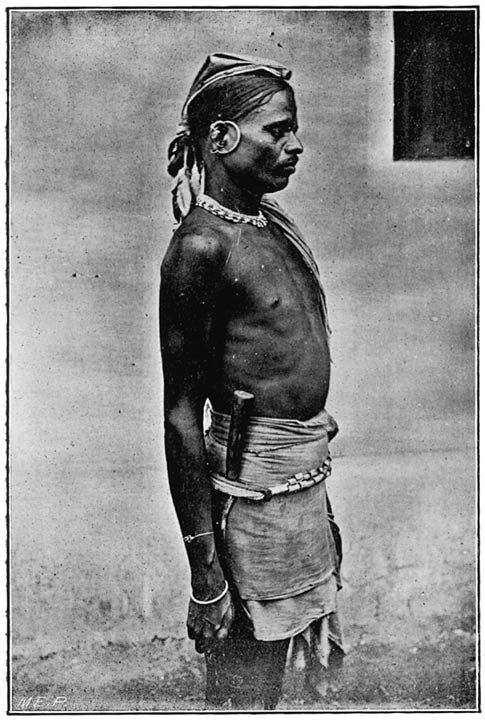
Koraga.
On the subject of Koraga slavery, Mr. Ullal Raghvendra Rao writes that “although these slaves are in a degraded condition, yet they by no means appear to be dejected or unhappy. A male slave gets three hanis of paddy (unhusked rice) or a hani and a half of rice daily, besides a small quantity of salt. The female slave gets two hanis of paddy, and, if they be man and wife, they can easily sell a portion of the rice to procure other necessaries of life. They are also allowed one cloth each every year, and, besides, when transferred from one master to another, they get a cocoanut, a jack tree (Artocarpus integrifolia), and a piece of land where they can sow ten or twenty seers of rice. The greater number of slaves belong to the Alia Santānam castes (inheritance in the female line), and among these people a male slave is sold for three pagodas (fourteen rupees) and a female slave for five pagoda; whereas the few slaves who belong to the Makkala Santānam castes (inheritance in the male line) fetch five pagodas for the man slave, and three pagodas for the female. This is because the children of the latter go to the husband’s master, while those of the former go to the mother’s master, who has the benefit of the husband’s services also. He has, however, to pay the expenses of their marriage, which amount to a pagoda and a half; and, in like manner, the master of the Makkala Santāna slave pays two pagodas for his marriage, and gets possession of the female slave and her children. The master has the power of hiring out his slave, for whose services he receives annually about a mura of rice, or forty seers. They are also mortgaged for three or four pagodas.”
For the marriages of the Koragas, Mr. Walhouse informs us that “Sunday is an auspicious day, though Monday is for the other slave castes. The bridegroom and bride, after bathing in cold water, sit on a mat in the former’s house, with a handful of rice placed before them. An old man presides, takes a few grains of rice and sprinkles on their heads, as do the others present, first the males and then the females. The bridegroom then presents two silver coins to his wife, and must afterwards give six feasts to the community.” At these feasts every Koraga is said to vie with his neighbour in eating and drinking. “Though amongst the other slave castes divorce is allowed by consent of the community, often simply on grounds of disagreement, and the women may marry again, with the Koragars marriage is indissoluble, but a widow is entitled to re-marriage, and a man may have a second, and even third wife, all living with him.”
Concerning the ceremonies observed on the birth of a child, Mr. Ullal Raghvendra Rao writes that “after a child is born, the mother (as among Hindoos) is unholy, and cannot be touched or approached. The inmates take leave of the koppu for five nights, and depend on the hospitality of their friends, placing the mother under the sole charge of a nurse or midwife. On the sixth night the master of the koppu calls his neighbours, who can hardly refuse to oblige him with their presence. The mother and the child are then given a tepid bath, and this makes them holy. Members of each house bring with them a seer of rice, half a seer of cocoanut oil, and a cocoanut. The woman with the baby is seated on a mat—her neighbour’s presents before her in a flat basket. The oldest man present consults with his comrades as to what name will best suit the child. A black string is then tied round the waist of the baby. The rice, which comes in heaps from the neighbours, is used for dinner on the occasion, and the cocoanuts are split into two pieces, the lower half being given to the mother of the child, and the upper half the owner. This is the custom followed when the baby is a male one; in case of a female child, the owner receives the upper half, leaving the lower half for the mother. Koragars were originally worshippers of the sun, and they are still called after the names of the days of the week—as Aita (a corruption of Aditya, or the sun); Toma (Sōma, or the moon); Angara (Mangala); Gurva (Jupiter); Tanya (Shani, or Saturn); Tukra (Shukra, or Venus). They have no separate temples for their God, but a place beneath a kāsaracana tree (Strychnos Nux-vomica) is consecrated for the worship of the deity which is exclusively their own, and is called Kata. Worship in honour of this deity is usually performed in the months of May, July, or October. Two plantain leaves are placed on the spot, with a heap of boiled rice mixed with turmeric. As is usual in every ceremony observed by a Koragar, the senior in age takes the lead, and prays to the deity to accept the offering and be satisfied. But now they have, by following the example of Bants and Sudras, exchanged their original object of worship for that of Bhutas (demons).”
On the subject of the religion of the Koragas, Mr. Walhouse states that “like all the slave castes and lower races, the Koragars worship Mari Amma, the goddess presiding over small-pox, the most dreadful form of Parvati, the wife of Siva. She is the most popular deity in Canara, represented under the most frightful form, and worshipped with bloody rites. Goats, buffaloes, pigs, fowls, etc., are slaughtered at a single blow by an Asādi, one of the slave tribes from above the ghauts. Although the Koragars, in common with all slaves, are looked upon as excommunicated and unfit to approach any Brahminical temple or deity, they have adopted the popular Hindoo festivals of the Gokalastami or Krishna’s birthday, and the Chowti. In the latter, the preliminaries and prayers must be performed by a virgin.” Concerning these festivals, Mr. Ullal Raghvendra Rao gives the following details. “The Koragars have no fixed feasts exclusively of their own, but for a long time they have been observing those of the Hindus. Of these two are important. One is Gōkula Ashtami, or the birthday of Krishna, and the other is the Chowti or Pooliyar feast. The latter is of greater importance than the former. The former is a holy day of abstinence and temperance, while the latter is associated with feasting and merry-making, and looks more like a gala-day set apart for anything but religious performance. On the Ashtami some cakes of black gram are made in addition to the usual dainties. The services of Bacchus are called in aid, and the master of the koppu invites his relatives and friends. A regular feasting commences, when the master takes the lead, and enjoys the company of his guests by seating himself in their midst. They are made to sit on the floor crosswise with a little space intervening between every guest, who pays strict regard to all the rules of decency and rank. To keep up the distinction of sexes, females are seated in an opposite row. The host calls upon some of his intimates or friends to serve on the occasion. The first dish is curry, the second rice; and cakes and dainties come in next. The butler Koragar serves out to the company the food for the banquet, while the guests eat it heartily. If one of them lets so much as a grain of rice fall on his neighbour’s plate, the whole company ceases eating. The offender is at once brought before the guests, and charged with having spoiled the dinner. He is tried there and then, and sentenced to pay a fine that will cover the expenses of another banquet. In case of resistance to the authority of the tribunal, he is excommunicated and abandoned by his wife, children and relatives. No one dare touch or speak to him. A plea of poverty of course receives a kind consideration. The offender is made to pay a small sum as a fine, which is paid for him by a well-to-do Koragar. To crown the feast, a large quantity of toddy finds its way into the midst of the company. A small piece of dry areca leaf sewed together covers the head of a Koragar, and forms for him his hat. This hat he uses as a cup, which contains a pretty large quantity of liquid. A sufficient quantity is poured into their cup, and if, in pouring, a drop finds its way to the ground, the butler is sure to undergo the same penalty that attaches itself to any irregularity in the dinner as described above. After the banquet, some male members of the group join in a dance to the pipe and drum, while others are stimulated by the intoxicating drink into frisking and jumping about. To turn to the other festival. The inmates of the house are required to fast the previous night—one and all of them—and on the previous day flesh or drink is not allowed. The next morning before sunrise, a virgin bathes, and smears cowdung over a part of the house. The place having been consecrated, a new basket, specially made for the occasion, is placed on that spot. It contains a handful of beaten rice, two plantains, and two pieces of sugar-cane. The basket is then said to contain the god of the day, whom the sugar-cane represents, and the spot is too holy to be approached by man or woman. A common belief which they hold, that the prayers made by a virgin are duly responded to on account of her virgin purity, does not admit of the worship being conducted by any one else. The girl adorns the basket with flowers of the forest, and prays for the choicest blessings on the inmates of the house all the year round.
A Koraga woman, when found guilty of adultery, is said to be treated in the following extraordinary way. If her paramour is of low caste similar to herself, he has to marry her. But, in order to purify her for the ceremony, he has to build a hut, and put the woman inside. It is then set on fire, and the woman escapes as best she can to another place where the same performance is gone through, and so on until she has been burnt out seven times. She is then considered once more an honest woman, and fit to be again married. According to Mr. Walhouse, “a row of seven small huts is built on a river-bank, set fire to, and the offender made to run over the burning sticks and ashes as a penance.” A similar form of ordeal has been described as occurring among the Bākutas of South Canara by Mr. Stuart. “When a man is excommunicated, he must perform a ceremony called yēlu halli sudodu, which means burning seven villages, in order to re-enter the caste. For this ceremony, seven small booths are built, and bundles of grass are piled against them. The excommunicated man has then to pass through these huts one after the other, and, as he does so, the headman sets fire to the grass” (cf. Koyi). It is suggested by Mr. R. E. Enthoven that the idea seems to be “a rapid representation of seven existences, the outcast regaining his status after seven generations have passed without further transgression. The parallel suggested is the law of Manu that seven generations are necessary to efface a lapse from the law of endogamous marriage.”