Volume 3 — K (continued 3)
Reading edition
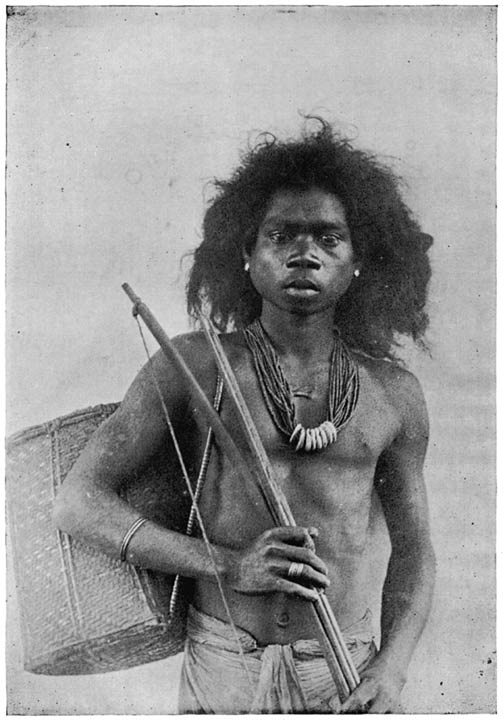
Kānikar.
Kani Kuruppu.—Barbers of the Kaniyans.
Kani Rāzu.—A name, denoting fortune-telling Rāzus, sometimes used as a synonym by Bhatrāzus, in whose songs it occurs. The name Kani-vāndlu, or fortune-tellers, occurs as a synonym of Yerukala.
Kaniyan.—Kaniyan, spelt and pronounced Kanisan in Malabar, is a Malayālam corruption of the Sanskrit Ganika, meaning an astrologer. The word was originally Kani, in which form it invariably appears in Malayālam works and Tamil documents. The honorific suffix ‘ān’ has been added subsequently.
The two titles, generally applied to Kaniyans, are Panikkar and Āsan. The former is said to be a common title in Malabar, but in Travancore it seems to be restricted to the north. The word Panikkar comes from pani, or work, viz., that of military training. The fact that most of the families, who own this title at present, were once teachers of bodily exercises, is evident not only from the name kalari, literally a military school, by which their houses are usually known, but also from the Kēralolpatti, which assigns military training as a duty of the caste. Āsan, a corruption of the Sanskrit Āchārya, is a common title among Kaniyans in South Travancore. Special titles, such as Anantapadmanābham, Sivasankaran, and Sankili, are said to be possessed by certain families in the south, having been conferred on them by kings in olden times. Some Kaniyans in the north enjoy the surname of Nampikuruppu.
Kaniyans are divided into two endogamous sections, viz., Kaniyar and Tīnta (or polluting). The occupations of the latter are umbrella-making and spirit-exorcising, while the others remain astrologers, pure and simple. A few families, living at Alengad, are called Vattakan Kaniyans, and are believed to have come there on the eve of Tīpū Sultan’s invasion. The women of the Kaniyans proper do not eat with them. According to tradition, eight sub-septs are said to have existed among the Kaniyans, four of which were known as kiriyams, and four as illams. The names of the former are Annavikkannam, Karivattam, Kutappilla, and Nanna; of the latter Pampara, Tachchazham, Netumkanam, and Ayyarkāla. These divisions were once endogamous, but this distinction has now disappeared.
(1) Pitichu Kali. Two persons play on their drums (chenda), while a third person, well dressed in a kacha, and with a turban on his head, and provided with a sword and shield, performs various feats in harmony with the drum beating. It is a kind of sword-dance.
(2) Parishathalam Kali. A large pandal (booth) is erected in front of the house where the performance is to take place, and the boys below sixteen, who have been previously trained for it, are brought there. The performance takes place at night. The chenda, maddhalam, chengala, and elathalam (circular bell-metal plates slightly concave in the middle) are the instruments used in the performance. After the performance, the boys, whom the Āsan has trained, present themselves before him, and remunerate him with whatever they can afford. Parties are organised to give this performance on all auspicious occasions in rural districts.
(3) Kolati. Around a lighted lamp, a number of persons stand in a circle, each with a stick a foot in length, and as thick as a thumb, in each hand. They begin to sing, first in slow time, and gradually in rapid measure. The time is marked by each one hitting his neighbours’ sticks with his own on both sides. Much dexterity and precision are required, as also experience in combined action and movements, lest the amateur should be hit by his neighbours as the measure is accelerated. The songs are invariably in praise of God or man.
According to another legendary account, there were Kaniyans before the time of Bhattatiri, but their astrological attainments are connected with him. Talakulattu Bhattatiri was one of the earliest astrologers of renown, being the author of Muhūrtapadavi, and lived in the fourth century A.D. There is a tradition, believed by the Kaniyans south of Neyyattenkara, that their ancestor was descended from the union of a Gandharva woman with Kani, a Brāhman saint, who lived in the western ghāts. Their grandson propitiated the god Subrahmanya presiding over astronomy, and acquired the surname Nālīka from his never-ceasing truthfulness. Some of the southern Kaniyans even at the present day call themselves Nāli. According to another legend, Paramēswara and his wife Parvati were living happily together, when Agni fell desperately in love with the latter. Eventually, Paramēswara caught them together, and, to save Agni, Parvati suggested that he should hide himself inside her body. On Agni doing this, Parvati became very indisposed, and Paramēswara, distressed at seeing his wife rolling in agony, shed tears, one of which fell on the ground, and became turned into a man, who, being divinely born, detected the cause of Parvati’s indisposition, and, asking for some incense, sprinkled it over a blazing torch. Agni, seeing his opportunity, escaped in the smoke, and Parvati had instant relief. For this service, Paramēswara blessed the man, and appointed him and his descendants to cure diseases, exorcise demons, and foretell events.
The Kaniyans of Malabar have been connected by tradition with the Valluvans of the Tamil country, who are the priests, doctors, and astrologers of the Pallans and Paraiyans. According to this tradition, the modern Kaniyans are traced to the Valluvans brought from the east by a Perumāl who ruled over Kerala in 350 M.E. The latter are believed to have become Kaniyans proper, while the old Kaniyans of the west coast descended to the rank of Tīntā Kaniyans. The chief of the Valluvans so brought was a Yōgi or ascetic, who, being asked by a Nambūtiri concerning a missing article at Pazhūr, replied correctly that the lost ring had been placed in a hole in the bank of the Nambūtiri’s tank (pond), and was consequently invited to settle there permanently.
The Kaniyans are easily recognised by their punctilious cleanness of person and clothing, the iron style and knife tucked into the waist, the palm umbrella with its ribs holding numbers of horoscopes, their low artistic bow, and their deliberate answers to questions put to them. Most of them are intelligent, and well versed in Malayālam and Sanskrit. They are, however, not a flourishing community, being averse to manual labour, and depending for their living on their hereditary profession. There are no more conservative people in Travancore, and none of them have taken kindly to western education. In their clothing they follow the orthodox Malabar fashion. The dress of the males seldom hangs loose, being tucked in in token of humility. The Kaniyan, when wanted in his professional capacity, presents himself with triple ash marks of Siva on his chest, arms, and forehead. The woman’s ornaments resemble those of the Izhuvans. Fish and flesh are not forbidden as food, but there are many families, as those of Pazhūr and Onakkūru, which strictly abstain from meat. Marriage between families which eat and abstain from flesh is not absolutely forbidden. But a wife must give up eating flesh immediately on entering the house of her vegetarian husband. The profession of the Kaniyans is astrology. Marco Polo, writing as early as the thirteenth century about Travancore, says that it was even then pre-eminently the land of astrologers. Barbosa, at the beginning of the sixteenth century, has a detailed reference to the Kaniyans, of whom he writes that “they learn letters and astronomy, and some of them are great astrologers, and foretell many future things, and form judgments upon the births of men. Kings and great persons send to call them, and come out of their palaces to gardens and pleasure-grounds to see them, and ask them what they desire to know; and these people form judgment upon these things in a few days, and return to those that asked of them, but they may not enter the palaces; nor may they approach the king’s person on account of being low people. And the king is then alone with him. They are great diviners, and pay great attention to times and places of good and bad luck, which they cause to be observed by those kings and great men, and by the merchants also; and they take care to do their business at the time which these astrologers advise them, and they do the same in their voyages and marriages. And by these means these men gain a great deal.” Buchanan, three centuries later, alludes in the same glowing terms to the prosperity of the Kaniyans. He notes that they are of very low caste, a Nambūtiri coming within twenty-four feet of one being obliged to purify himself by prayer and ablution. “The Kaniyans,” he writes, “possess almanacks, by which they inform people as to the proper time for performing ceremonies or sowing their seeds, and the hours which are fortunate or unfortunate for any undertaking. When persons are sick or in trouble, the Cunishun, by performing certain ceremonies in a magical square of 12 places, discovers what spirit is the cause of the evil, and also how it may be appeased. Some Cunishuns possess mantrams, with which they pretend to cast out devils.” Captain Conner notes twenty years later that “Kanneans derive the appellation from the science of divination, which some of their sect profess. The Kannean fixes the propitious moment for every undertaking, all hysterical affections being supposed to be the visitation of some troublesome spirit. His incantations are believed alone able to subdue it.”
The science of astrology is studied and practiced by other castes, but the Kani house of Pazhūr is the most celebrated. Numerous stories are related of the astrological skill of the Pazhūr Kaniyans, of which one relates to the planets Mercury and Venus, who, arriving at the house of one of the Kaniyans, were asked by him to wait at the gate. He then jumped into a neighbouring well, to conduct some prayers with a view to keeping them there permanently. In this task he succeeded, and even today a prophecy made at that out-house is believed to be certain of turning out true.
In addition to astrology, the Kaniyans practice sorcery and exorcism, which are strictly the occupation of the Tīntā Kaniyans. The process by which devils are driven out is known as kōlamtullal (a peculiar dance). A troupe of Kaniyans, on being invited to a house where a person is suspected of being possessed by a devil, go there wearing masques representing Gandharva, Yakshi, Bhairava, Raktēsvari, and other demons, and dressed up in tender cocoanut leaves. Accompanied by music and songs, they rush towards the affected person, who is seated in the midst of the assembly, and frighten away the evil spirit. For the cure of disease, which is considered as incurable by ordinary methods of treatment, a form of exorcism called kālapāsamtikkuka, or the removal of the rope or evil influence, is resorted to. In this, two Kaniyans take the stage, and play the parts of Siva and Yama, while a third recites in song the story of the immortal Markandēya.
(1) Ganīta, which treats of the constellations.
(2) Sankīta, which explains the origin of the constellations, comets, falling stars, and earthquakes.
(3) Hōra, by which the fate of man is explained.
“The Panikkar, who follows in the footsteps of his forefathers, should have a thorough knowledge of astrology and mathematics, and be learned in the Vēdas. He should be sound in mind and body, truthful, and patient. He should look well after his family, and should worship regularly the nine planets:—Sūryan, the sun; Chandran, moon; Chovva, Mars; Budhan, Mercury; Vyāzham, Guru, or Brihaspati, Jupiter; Sukran, Venus; Sani, Saturn; Rāhu; and Kētu. The two last, though not visible, are, oddly enough, classed as planets by the Panikkar. They are said to be two parts of an Āsura who was cut in two by Vishnu. The Panikkars also dabble in magic, and I have in my possession a number of yantrams presented to me by a Panikkar. They should be written on a thin gold, silver, or copper plate, and worn on the person. A yantram written on gold is the most effective. As a rule, the yantram is placed in a little cylinder-case made of silver, fastened to a string tied round the waist. Many of these are often worn by the same person. The yantram is sometimes written on cadjan (palm leaf), or paper. I have one of this kind in my collection, taken from the neck of a goat. It is common to see them worn on the arm, around the neck.”
The following examples of yantrams are given by Mr. Fawcett:—
Aksharamāla.—Fifty-one letters. Used in connection with every other yantram. Each letter has its own meaning, and does not represent any word. In itself this yantram is powerless, but it gives life to all others. It must be written on the same plate as the other yantram.
Sūlini.—For protection against sorcery or devils, and to secure the aid of the goddess.
Māha Sūlini.—To prevent all kinds of harm through the devils, chief of whom is Pulatini, he who eats infants. Women wear it to avert miscarriage.
Ganapati.—To increase knowledge, and put away fear and shyness.
Sarasvati.—To enable its possessor to please his listeners, and increase his knowledge.
Santāna gopalam.—As a whole it represents Srī Krishna. Used by barren women, so that they may bear children. It may be traced on a metal plate and worn in the usual way, or on a slab of butter, which is eaten. When the latter method is adopted, it is repeated on forty-one consecutive days, during which the woman, as well as the Panikkar, may not have sexual connection.
Navva.—Drawn in ashes of cow-dung on a new cloth, and tied round the waist. It relieves a woman in labour.
Asvarūdha (to climb a horse).—A person wearing it is able to cover long distances easily on horseback, and he can make the most refractory horse amenable by tying it round its neck. It will also help to cure cattle.
“The charms,” Mr. Fawcett explains, “are entirely inoperative, unless accompanied in the first place with the mystic rite, which is the secret of the Panikkar.”
Many Kaniyans used formerly to be village schoolmasters, but, with the abolition of the old methods of teaching, their number is steadily decreasing. Some of them are clever physicians. Those who have no pretension to learning live by making palm-leaf umbrellas, which gives occupation to the women. But the industry is fast declining before the competition of umbrellas imported from foreign countries.
The Kaniyans worship the sun, the planets, the moon, Ganēsa and Subramanya, Vishnu, Siva, and Baghavati. On each day of the week, the planet, which is believed to preside over it, is specially worshipped by an elaborate process, which is compulsorily gone through for at least three weeks after a Kaniyan has become proficient in astrology, and able to make calculations for himself.
It is generally believed that the supreme authority in all social matters affecting the Kaniyan rests in British Malabar with the Yōgi already referred to, in Cochin and North Travancore with the head of the Pazhūr house, and in South Travancore with the eldest member of a house at Manakkad in Trivandrum, known by the name of Sankili. Practically, however, the spiritual headmen, called Kannālmas, are independent. These Kannālmas are much respected, and well paid on festive occasions by every Kaniyan house. They and other elders sit in judgment on persons guilty of adultery, commensality with lower castes, and other offences, and inflict punishments.
The Kaniyans observe both the tāli-kettu ceremony before puberty, and sambandham after that event. Inheritance is through the father, and the eldest male of a family has the management of the ancestral estate. Fraternal polyandry is said to have been common in olden times, and Mr. Logan observes that, “like the Pāndava brothers, as they proudly point out, the Kanisans used formerly to have one wife in common among several brothers, and this custom is still observed by some of them.” There is no restriction to the marriage of widows.
Concerning polyandry, Mr. Anantha Krishna Iyer states that “among the Kaniyans, as well as among Panikkans, polyandry largely prevails. If the young woman is intended to be the wife of several brothers, the eldest brother goes to the bride’s house, and gives her the cloth, and takes her home the next day along with her parents and relations, who are all well entertained. The young woman and the brothers are seated together, and a sweet preparation is given to them, which signifies that she has become the common wife of all. The Kalari Mūppan (Nāyar headman of the village) also declares her to be such. The guests depart, and the bridegroom (the eldest brother) and the bride are invited to what they call virunnu-oon (sumptuous meal) in the house of the latter, where they stay for a few days. The bridegroom then returns home with the wife. The other brothers, one after another, are similarly entertained along with the bride at her house. The brothers cannot afford to live together for a long time, and they go from place to place, earning their livelihood by astrology. Each brother is at home only for a few days in each month; hence practically the woman has only one husband at a time. If several of them happen to be at home together for a few weeks, each in turn associates with the woman, in accordance with the directions given by their mother.”
The Kaniyans follow high-caste Hindus as regards many of their ceremonies. They have their name-bestowing, food-giving and tuft-making ceremonies, and also a superstitious rite called ittaluzhiyuka, or exorcism in child-birth on the seventh or ninth day after the birth of a child. A Kaniyan’s education begins in his seventh year. In the sixteenth year a ceremony, corresponding to the upanayana of the higher castes, is performed. For forty-one days after, the Kannālma initiates the young Kaniyan into the mysteries of astrology and witchcraft. He is obliged to worship Subramanya, the tutelary god of the caste, and abstains from meat and liquor. This may be taken as the close of his Brahmacharya stage or Samāvartana, as marriage cannot take place before the observance of this ceremony.
On the subject of religion, Mr. Anantha Krishna Iyer writes that “the Kalari Panikkans and the Kaniyans are generally Saivite worshippers, but are not disinclined to the worship of Vishnu also. It is said that their kalaris are forty-two feet long, and contain the images of forty-two deities. The following are the most important of them:—Subrahmanya, Sastha, Ganapati, Vīrabhadran, Narasimha, Ashtabairavas, Hanumān, and Bhadrakāli. Some of their kalaris, which were seen by me, contained stone and metal images of these gods. Every night a lamp is lighted in front of them for their worship. During the Mandalam (forty days) from the first of Vrischikam to the tenth of Dhanu (14th November to 25th December), the senior member of the Panikkan’s family bathes early in the morning, and performs his pūjas to all the gods, making offerings of boiled rice, plantains and cocoanuts. On the fortieth day, i.e., the last day of the Mandalam, a grand pūja is performed individually to every one of the deities in the kalari, and this lasts for twenty-four hours, from sunrise to sunrise, when offerings of boiled rice, parched rice, sheep and fowls are also given. This is the grand pūja performed once in the course of the year. Besides this, some of their deities command their special reverence. For instance, Subrahmanya is adored for the sake of astrology, Sastha for wealth and offspring. They are also worshippers of Sakti in any of her following manifestations, namely, Bala, Thripura, Mathangi, Ambika, Durga, Bhadrakāli, the object of which is to secure accuracy in their astrological predictions. Further, every member of the caste proficient in astrology daily offers, after an early bath, his prayers to the seven planets. Among the minor deities whom they worship, are also Mallan, Mundian, Muni and Ayutha Vadukan, the first three of which they worship for the prosperity of their cattle, and the last four for their success in the training of young men in athletic feats. These deities are represented by stones placed at the root of some shady tree in their compounds. They also worship the spirits of their ancestors, on the new-moon nights in Karkadakam (July-August), Thulam (October-November), and Makaram (December-January). The Kalari Panikkans celebrate a kind of feast to the spirits of their female ancestors. This is generally done a few days before the celebration of a wedding in their houses, and is probably intended to obtain their blessings for the happy married life of the bride. This corresponds to the performance of Sumangalia Prarthana (feast for the spirits of departed virgins and married women) performed by Brāhmans in their families. At times when small-pox, cholera, and other pestilential diseases prevail in a village, special pūjas are offered to Māriamma (the small-pox demon) and Bhadrakāli, who should be propitiated. On these occasions, their priest turns Velichapād (oracle), and speaks to the village men as if by inspiration, telling them when and how the maladies will subside.”
Kaniyans were formerly buried, but are now, excepting young children, cremated in a portion of the grounds of the habitation, or in a spot adjacent thereto. The ashes are collected on the fourth day, and deposited under water. In memory of the deceased, an annual offering of food is made, and an oblation of water offered on every new moon.
The Potuvans or Kani Kuruppus are the barbers of the Kaniyans, and have the privilege of being in attendance during marriages and funerals. It is only after they have sprinkled water in the houses of polluted Kaniyans that they again become pure. In fact, the Potuvans stand in the same relation to the Kaniyans as the Mārāns to the Nāyars. The Potuvans are not expected to shave the Tīntā Kaniyans.
The Kaniyans are said to keep at a distance of twenty-four feet from a Brāhman or Kshatriya, and half that distance from a Sūdra. The corresponding distances for a Tīntā Kaniyan are thirty-six and eighteen feet. This restriction is not fully observed in Trivandrum, and south of it. It is noted by Mr. Anantha Krishna Iyer that, on marriage occasions, a Nāyar gives a gift of a few annas and betel leaves to the astrologer, standing close beside him, and yet there is no pollution. The Malayālam proverb “On marriage occasions the Nāyars give dakshina (gift), almost touching the hand,” refers to this fact. The Kaniyans cannot enter Brāhmanical temples. They will not receive food from Izhavans, except in a few villages in central Travancore, but this is a regular practice with the Tīntā Kaniyans. It is believed that the Kaniyans proper have no objection to receiving sweetmeats from Kammālans.
The late Mr. Pogson, when Government astronomer, used to say that his principal native assistant was an astronomer from 10 A.M. to 5 P.M. and an astrologer from 5 P.M. to 10 A.M.
Kannada.—Kannada (Kanarese) has, at recent times of census, been returned as a linguistic or territorial division of various classes, e.g., Agasa, Bēdar, Dēvānga, Holeya, Koracha, Kumbāra, Sāmagāra, Rāchewar, and Uppiliyan.
Kannaku.—A prefix to the name of Nanchinat Vellālas in Travancore.
Kannān.—A sub-division of Kammālans, the members of which do braziers’ work.
About twenty miles from the city of Madras is a big tank (lake) named after the village of Chembrambākam, which is close by. The fertile land surrounding this tank is occupied, among others, by a colony of Lingāyats, of whom each household, as a rule, owns several acres of land. With the cultivation thereof, they have the further occupation of cattle grazing. They utilize the products of the cow in various ways, and it supplies them with milk, butter and curds, in the last two of which they carry on a lucrative trade in the city of Madras. The curds sold by them are very highly appreciated by Madras Brāhmans, as they have a sour taste caused by keeping them till fermentation has set in. So great is the demand for their curds that advances of money are made to them, and regular delivery is thus secured. Their price is higher than that of the local Madras curds, and if a Lingāyat buys the latter and sells them at the higher rate, he is decisively stigmatised as being a “local.” They will not even touch sheep and goats, and believe that even the smell of these animals will make cows and buffaloes barren.
Though the chief settlement of the Lingāyats is at Chembrambākam, they are also to be found in the adjacent villages and in the Conjeeveram tāluk, and, in all, they number, in the Chingleput district, about four thousand.
How far the husbandmen carried out their threat of seeking a distant settlement it is impossible, at this distance of time, to determine. If the theory of religious persecution as the cause of their emigration has not an air of certainty about it, it is at least plausible.
If the beginning of the eighteenth century is the earliest, the end of that century is the latest date that can be set down for the Lingāyat emigration. That century was perhaps the most troublous one in the modern history of India. Armies were passing and repassing the ghāts, and I have heard from some old gentlemen that the Chingleput Lingāyats, who are mostly shepherds, accompanied the troops in the humble capacity of purveyors of milk and butter.
Whatever the causes of their emigration, we find them in the Chingleput district ordinarily reckoning the Mysore, Salem and Bellary Lingāyats as of their own stock. They freely mix with each other, and I hear contract marital alliances with one another. They speak the Kannada (Kanarese) language—the language of Mysore and Bellary. They call themselves by the name of Kannadiyans or Kannadiyars, after the language they speak, and the part of the village they inhabit—Kannadipauliem, or village of the Kannadiyars. In parts of Madras they are known as Kavadi and Kavadiga (=bearers of head-loads).
Both men and women are possessed of great stamina. Almost every other day they walk to and fro, in all seasons, more than twenty miles by road to sell their butter and curds in Madras. While so journeying, they carry on their heads a curd pot in a rattan basket containing three or four Madras measures of curds, besides another pot containing a measure or so of butter. Some of the men are good acrobats and gymnasts, and I have seen a very old man successively break in two four cocoanuts, each placed on three or four crystals of common salt, leaving the crystals almost intact. And I have heard that there are men who can so break fifty cocoanuts—perhaps an exaggeration for a considerable number. In general the women may be termed beautiful, and, in Mysore, the Lingāyat women are, by common consent, regarded as models of feminine beauty.
These Lingāyats are divided into two classes, viz., Gauliyars of Dāmara village, and Kadapēri or Kannadiyars proper, of Chembrambākam and other places. The Gauliyars carry their curd pots in rattan baskets; the Kannadiyars in bamboo baskets. Each class has its own beat in the city of Madras, and, while the majority of the rattan basket men traffic mainly in Triplicane, the bamboo basket men carry on their business in Georgetown and other localities. The two classes worship the same gods, feed together, but do not intermarry. The rattan is considered superior to the bamboo section. Both sections are sub-divided into a large number of exogamous septs or bēdagagulu, of which the meaning, with a few exceptions, e.g., split cane, bear, and fruit of Eugenia Jambolana, is not clear.
Monogamy appears to be the general rule among them, but polygamy to the extent of having two wives, the second to counteract the sterility of the first, is not rare. Marriage before puberty is the rule, which must not be transgressed. And it is a common thing to see small boys grazing the cattle, who are married to babies hardly more than a year old. Marriages are arranged by the parents, or through intermediaries, with the tacit approval of the community as a whole. The marriage ceremony generally lasts about nine or ten days, and, to lessen the expenses for the individual, several families club together and celebrate their marriages simultaneously. All the preliminaries such as inviting the wedding guests, etc., are attended to by the agent of the community, who is called Chaudri. The appointment of agent is hereditary.
The first day of the marriage ceremony is employed in the erection of the booth or pandal. On the following day, the bodice-wearing ceremony is performed. The bride and bridegroom are presented with new clothes, which they put on amid general merriment. In connection with this ceremony, the following Mysore story may not be out of place. When Tipu Sultan once saw a Lingāyat woman selling curds in the street without a body cloth, he ordered the cutting off of her breasts. Since then the wearing of long garments has come into use among the whole female population of Mysore.
The third day is the most important, as it is on that day that the Muhūrtham, or tāli-tying ceremony, takes place, and an incident of quite an exceptional character comes off amid general laughter. A Brāhman (generally a Saivite) is formally invited to attend, and pretends that he is unable to do so. But he is, with mock gravity, pressed hard to do so, and, after repeated guarantees of good faith, he finally consents with great reluctance and misgivings. On his arrival at the marriage booth, the headman of the family in which the marriage is taking place seizes him roughly by the head, and ties as tightly as possible five cocoanuts to the kudumi, or lock of hair at the back of the head, amidst the loud, though not real, protestations of the victim. All those present, with all seriousness, pacify him, and he is cheered by the sight of five rupees, which are presented to him. This gift he readily accepts, together with a pair of new cloths and pān-supāri (betel leaves and areca nuts). Meanwhile the young folk have been making sport of him by throwing at his new and old clothes big empty brinjal fruits (Solanum Melongena) filled with turmeric powder and chunām (lime). He goes for the boys, who dodge him, and at last the elders beat off the youngsters with the remark that “after all he is a Brāhman, and ought not to be trifled with in this way.” The Brāhman then takes leave, and is heard of no more in connection with the wedding rites. The whole ceremony has a decided ring of mockery about it, and leads one to the conclusion that it is celebrated more in derision than in honour of the Brāhmans. It is a notorious fact that the Lingāyats will not even accept water from a Brāhman’s hands, and do not, like many other castes, require his services in connection with marriage or funeral ceremonies. The practice of tying cocoanuts to the hair of the Brāhman seems to be confined to the bamboo section. But an equally curious custom is observed by the rattan section. The village barber is invited to the wedding, and the infant bride and bridegroom are seated naked before him. He is provided with some ghī(clarified butter) in a cocoanut shell, and has to sprinkle some of it on the head of the couple with a grass or reed. He is, however, prevented from doing so by a somewhat cruel contrivance. A big stone (representing the linga) is suspended from his neck by a rope, and he is kept nodding to and fro by another rope which is pulled by young lads behind him. Eventually they leave off, and he sprinkles the ghī, and is dismissed with a few annas, pān-supāri, and the remains of the ghī. By means of the stone the barber is for the moment turned into a Lingāyat.
The officiating priest at the marriage ceremony is a man of their own sect, and is known as the Gurukkal. They address him as Ayyanavaru, a title generally reserved for Brāhmans in Kannada-speaking districts. The main items of expenditure at a wedding are the musician, presents of clothes, and pān-supāri, especially the areca nuts. One man, who was not rich, told me that it cost him, for a marriage, three maunds of nuts, and that guests come more for them than for the meals, which he characterised as not fit for dogs.
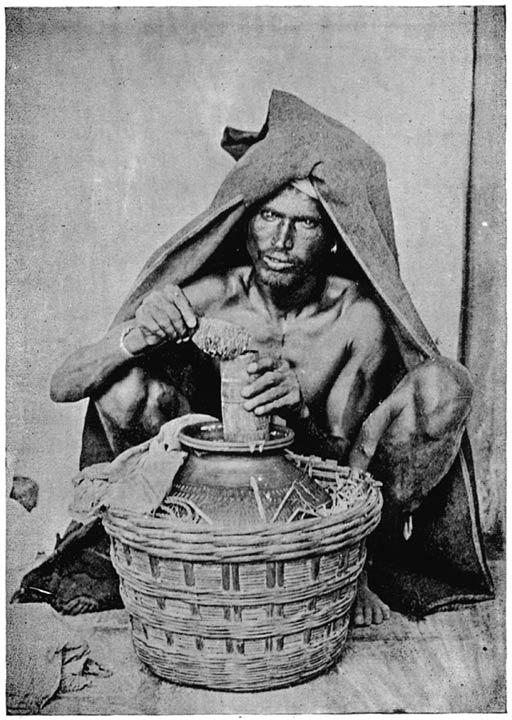
Kannadiyan.
Widow remarriage is permitted. But it is essential that the contracting parties should be widower and widow. For such a marriage no pandal is erected, but all the elders countenance it by their presence. Such a marriage is known as naduvīttu tāli, because the tāli is tied in the mid-house. It is usually a simple affair, and finished in a short time after sunset instead of in the day time. The offspring of such marriages are considered as legitimate, and can inherit. But remarried couples are disqualified from performing certain acts, e.g., the distribution of pān-supāri at weddings, partaking in the hārathi ceremony, etc. The disqualifications attaching to remarried people are, by a curious analogy, extended to deformed persons, who are, in some cases, considered to be widowers and widows.
Among the ordinary names of males are Basappa, Linganna, Dēvanna, Ellappa, Naganna; and of females Ellamma, Lingi and Nāgamma. It is said that all are entitled to the honorific Saudri; but the title is specially reserved for the agent of their sect. Among common nicknames are Chikka and Dodda Thamma (younger and elder brother), Āndi (beggar), Karapi (black woman), Gūni (hunch back). In the Mysore Province the most becoming method of addressing a Lingāyat is to call him Sivanē. Their usual titles are Ravut, Appa, Anna, and Saudri.
The child-naming ceremony is a very important one. Five swords with limes fixed to their edges are set in a line with equi-distant spaces between them. By each sword are placed two plantain fruits, a cocoanut, four dried dates, two cocoanut cups, pān-supāri, and kārāmani (Vigna Catiang) cakes. In front of the swords are also placed rice-balls mixed with turmeric powder, various kinds of vegetables and fruits, curds and milk. Opposite each sword five leaves are spread out, and in front of each leaf a near relation of the family sits. The chief woman of the house then brings five pots full of water, and gives to each man a potful for the worship of the jangama linga which he wears. She also brings consecrated cow-dung ashes. The men pour the water over the linga, holding it in the left hand, and smear both the linga and their faces with the ashes. The woman then retires, and the guests partake of a hearty meal, at the conclusion of which the woman reappears with five vessels full of water, with which they wash their hands. The vessels are then broken, and thrown on a dung-heap. After partaking of pān-supāri and chunām (lime), each of the men ties up some of the food in a towel, takes one of the swords in his hand, and leaves the house without turning back. The headman of the family then removes the limes from the swords, and puts them back in their scabbards. The same evening the child is named. Sometimes this ceremony, which is costly, is held even after the child is a year old.
When a death takes place, information is sent round to the relations and castemen by two boys carrying little sticks in their hands. Under the instructions of a priest, the inmates of the house begin to make arrangements for the funeral. The corpse is washed, and the priest’s feet are also washed, and the refuse-water on the ground is poured over the corpse or into its mouth. Among certain sections of Lingāyats it is customary, contrary to the usual Hindu practice, to invite the friends and relations, who have come for the funeral, to a banquet, at which the priest is a guest. It is said that the priest, after partaking of food, vomits a portion of it, which is shared by the members of the family. These practices do not seem to be followed by the Chingleput Lingāyats. A second bath is given to the corpse, and then the nine orifices of the body are closed with cotton or cloth. The corpse is then dressed as in life, and, if it be that of a priest, is robed in the characteristic orange tawny dress. Before clothing it, the consecrated cow-dung ashes are smeared over the forehead, arms, chest, and abdomen. The bier is made like a car, such as is seen in temple processions on the occasion of car festivals. To each of its four bamboo posts are attached a plantain tree and a cocoanut, and it is decorated with bright flowers. In the middle of the bier is a wooden plank, on which the corpse is set in a sitting position. The priest touches the dead body three or four times with his right leg, and the funeral cortège, accompanied by weird village music, proceeds to the burial-ground. The corpse, after removal from the bier, is placed in the grave in a sitting posture, facing south, with the linga, which the man had worn during life, in the mouth. Salt, according to the means of the family, is thrown into the grave by friends and relations, and it is considered that a man’s life would be wasted if he did not do this small service for a dead fellow-casteman. They quote the proverb “Did he go unserviceable even for a handful of mud?” The grave is filled in, and four lights are placed at the corners. The priest, standing over the head of the corpse, faces the lamps, with branches of Leucas aspera and Vitex Negundo at his feet. A cocoanut is broken and camphor burnt, and the priest says “Lingannah (or whatever the name of the dead man may be), leaving Nara Loka, you have gone to Bhu Loka,” which is a little incongruous, for Nara Loka and Bhu Loka are identical. Perhaps the latter is a mistake for Swarga Loka, the abode of bliss of Brāhmanical theology. Possibly, Swarga Loka is not mentioned, because it signifies the abode of Vishnu. Then the priest calls out Oogay! Oogay! and the funeral ceremony is at an end. On their return home the corpse-bearers, priest, and sons of the deceased, take buttermilk, and apply it with the right hand to the left side of the back. A Nandi (the sacred bull) is made of mud, or bricks and mortar, and set up over the grave. Unmarried girls and boys are buried in a lying position. From enquiries made among the Lingāyats of Chembarambākam, it appears that, when a death has occurred, pollution is observed by the near relatives; and, even if they are living at such distant places as Bellary or Bangalore, pollution must be observed, and dissolved by a bath.
Basava attached no importance to pilgrimages. The Chingleput Lingāyats, however, perform what they call Jātray (i.e., pilgrimage), of which the principal celebration takes place in Chittra-Vyasi (April-May), and is called Vīrabhadra Jātray. The bamboo Lingāyats of Chembarambākam send word, with some raw rice, to the rattan Lingāyats of Kadapēri to come to the festival on a fixed day with the image of their god Vīrabhadra. The Gauliyars of Kadapēri and other villages accordingly proceed to a tank on the confines of the village of Chembrambākam, and send word that they have responded to the call of their brethren. The chief men of the village, accompanied by a crowd, and the village musicians, start for the tank, and bring in the Kadapēri guests. After a feast all retire for the night, and get up at 3 A.M. for the celebration of the festival. Swords are unsheathed from their scabbards, and there is a deafening noise from trumpets and pipes. The images of Vīrabhadra are taken in procession to a tank, and, on the way thither, the idol bearers and others pretend that they are inspired, and bawl out the various names of the god. Sometimes they become so frenzied that the people break cocoanuts on their foreheads, or pierce their neck and wrists with a big needle, such as is used in stitching gunny bags. Under this treatment the inspired ones calm down. All along the route cocoanuts are broken, and may amount to as many as four hundred, which become the perquisite of the village washerman. When the tank is reached, pān-supāri and kadalai (Cicer arietinum) are distributed among the crowd. On the return journey, the village washerman has to spread dupatis (cloths) for the procession to walk over. At about noon a hearty meal is partaken of, and the ceremony is at an end. After a few days, a return celebration takes place at Kadapēri. The Vīrabhadra images of the two sections, it may be noted, are regarded as brothers. Other ceremonial pilgrimages are also made to Tirutāni, Tiruvallūr and Mylapore, and they go to Tiruvallūr on new moon days, bathe in the tank, and make offerings to Vīra Rāghava, a Vaishnava deity. They do not observe the feast of Pongal, which is so widely celebrated throughout Southern India. It is said that the celebration thereof was stopped, because, on one occasion, the cattle bolted, and the men who went in pursuit of them never returned. The Ugādi, or new year feast, is observed by them as a day of general mourning. They also observe the Kāma festival with great éclat, and one of their national songs relates to the burning of Kāma. When singing it during their journeys with the curd-pots, they are said to lose themselves, and arrive at their destination without knowing the distance that they have marched.
In addition to the grand Vīrabhadra festival, which is celebrated annually, the Arisērvai festival is also observed as a great occasion. This is no doubt a Tamil rendering of the Sanskrit Harisērvai, which means the service of Hari or worship of Vishnu. It is strange that Lingāyats should have this formal worship of Vishnu, and it must be a result of their environment, as they are surrounded on all sides by Vaishnavite temples. More than six months before the festival a meeting of elders is convened, and it is decided that an assessment of three pies per basket shall be levied, and the Saudri is made honorary treasurer of the fund. If a house has two or more baskets, i.e., persons using baskets in their trade, it must contribute a corresponding number of three pies. In other words, the basket, and not the family, is the unit in their communal finance. An invitation, accompanied by pān-supāri, is sent to the Thādans (Vaishnavite dramatists) near Conjeeveram, asking them to attend the festival on the last Saturday of Paratāsi, the four Saturdays of which month are consecrated to Vishnu. The Thādans arrive in due course at Chembrambākam, the centre of the bamboo section of the Lingāyats, and make arrangements for the festival. Invitations are sent to five persons of the Lingāyat community, who fast from morning till evening. About 8 or 9 P.M., these five guests, who perhaps represent priests for the occasion, arrive at the pandal (booth), and leaves are spread out before them, and a meal of rice, dhal (Cajanus indicus) water, cakes, broken cocoanuts, etc., is served to them. But, instead of partaking thereof, they sit looking towards a lighted lamp, and close their eyes in meditation. They then quietly retire to their homes, where they take the evening meal. After a torchlight procession with torches fed with ghī (clarified butter) the village washermen come to the pandal, and collect together the leaves and food, which have been left there. About 11 P.M. the villagers repair to the spot where a dramatic performance of Hiranya Kasyapa Nātakam, or the Prahallāda Charitram, is held during five alternate nights. The latter play is based on a favourite story in the Bhāgavatha, and it is strange that it should be got up and witnessed by a community of Saivites, some of whom (Vīra Saivas) are such extremists that they would not tolerate the sight of a Vaishnavite at a distance.
The Chembrambākam Lingāyats appear to join the other villagers in the performance of the annual pūja (worship) to the village deity, Nāmamdamma, who is worshipped in order to ward off cholera and cattle disease. One mode of propitiating her is by sacrificing a goat, collecting its entrails and placing them in a pot, with its mouth covered with goat skin, which is taken round the village, and buried in a corner. The pot is called Bali Sētti, and he who comes in front of it while it is being carried through the streets, is supposed to be sure to suffer from serious illness, or even die. The sacrifice, filling of the pot, and its carriage through the streets, are all performed by low class Ōcchans and Vettiyāns. The Chembrambākam Lingāyats assert that the cholera goddess has given a promise that she will not attack any of their community, and keeps it faithfully, and none of them die even during the worst cholera epidemics.
Kanni (rope).—A gōtra of Kurni.
Kapata.—A name for rag-wearing Koragas.
Kappala (frog).—An exogamous sept of Mādiga, and sub-division of Yānādis, who are said to be frog-eaters. It is also a gōtra of Janappans, who have a legend that, when some of their family were fishing, they caught a haul of big frogs instead of fish. Consequently, members of this gōtra will not injure frogs. I have seen frogs hanging up for sale in the Cochin bazār.
Kāppiliyan.—The Kāppiliyans, or Karumpuraththāls, as they are sometimes called, are Canarese-speaking farmers, who are found chiefly in Madura and Tinnevelly. It is noted, in the Manual of the Madura district, that “a few of the original Poligars were Canarese; and it is to be presumed that the Kāppiliyans immigrated under their auspices. They are a decent and respectable class of farmers. Their most common agnomen is Koundan (or Kavandan).”
The Kāppiliyans are one of the nine Kambalam castes, who are so called because, at their caste council meetings, a kambli (blanket) is spread, on which is placed a kalasam (brass vessel) filled with water, and decorated with flowers. Its mouth is closed by mango leaves and a cocoanut. According to the Gazetteer of the Madura district, they are “split into two endogamous sub-divisions, namely the Dharmakattu, so called because, out of charity, they allow widows to marry one more husband, and the Mūnukattu, who permit a woman to have three husbands in succession.” They are also said to recognise, among themselves, four sub-divisions, Vokkiliyan (cultivator), Mūru Balayanōru (three bangle people), Bottu Kattōru (bottu tying people), Vokkulothōru, to the last of which the following notes mainly refer.
They have a large number of exogamous septs, which are further divided into exogamous sub-septs, of which the following are examples:—
Sept. Sub-sept.
Basiriyōru Hennu (female) Basiri.

Gandu (male) Basiri.
Lodduvōru Loddu.

Palingi Loddu.
Kolingi Loddu.
Uddudhōru (Phaseolus Mungo, var. radiatus).
Hunisēyōru (tamarind people).
Mottuguni.
Manalōru, sand people.
One exogamous sept is called Ānē (elephant), and as names of sub-septs, named after animate or inanimate objects, I may mention Hatti (hamlet), Aranē (lizard) and Puli (tiger).
The affairs of the caste are regulated by a headman called Gauda, assisted by the Saundari. In some places, the assistance of a Pallan or Maravan called Jādipillai, is sought.
Marriage is, as a rule, adult, and the common emblem of married life—the tāli or bottu—is dispensed with. On the first day of the marriage ceremonies, the bride and bridegroom are conducted, towards evening, to the houses of their maternal uncles. There the nalagu ceremony, or smearing the body with Phaseolus Mungo, sandal and turmeric paste, is performed, and the uncles place toe-rings on the feet of the contracting couple. On the following day, the bride’s price is paid, and betel is distributed, in the presence of a Kummara, Urumikkāran, and washerman, to the villagers in a special order of precedence. On the third day, the bridegroom goes in procession to the house of the bride, and their fingers are linked together by the maternal uncle or uncles. For this reason, the day is called Kai Kudukāhodina, or hand-locking day.
It is noted, in the Gazetteer of the Madura district, that “the binding portions of the marriage ceremony are the donning by the bride of a turmeric-coloured cloth sent her by bridegroom, and of black glass bangles (unmarried girls may only wear bangles made of lac), and the linking of the couple’s little fingers. A man’s right to marry his paternal aunt’s daughter is so rigorously insisted upon that, as among the Tottiyans, ill-assorted matches are common. A woman, whose husband is too young to fulfil the duties of his position, is allowed to consort with his near relations, and the children so begotten are treated as his. [It is said that a woman does not suffer in reputation, if she cohabits with her brothers-in-law.] Adultery outside the caste is punished by expulsion, and, to show that the woman is thenceforward as good as dead, funeral ceremonies are solemnly performed to some trinket of hers, and this is afterwards burnt.”
At the first menstrual period, a girl remains under pollution for thirteen days, in a corner of the house or outside it in the village common land (mandai). If she remains within, her maternal uncle makes a screen, and, if outside, a temporary hut, and, in return for his services, receives a hearty meal. On the thirteenth day the girl bathes in a tank (pond), and, as she enters the house, has to pass over a pestle and a cake. Near the entrance, some food is placed, which a dog is allowed to eat. While so doing, it receives a severe beating. The more noise it makes, the better is the omen for a large family of children. If the poor brute does not howl, it is supposed that the girl will bear no children. A cotton thread, dyed with turmeric, is tied round her neck by a married woman, and, if she herself is married, she puts on glass bangles. The hut is burnt down and the pots she used are broken to atoms.
The caste deities are said to be Lakkamma and Vīra Lakkamma, but they also worship other deities, such as Chenrāya, Thimmappa, and Siranga Perumal. Certain septs seem to have particular deities, whom they worship. Thus Thimmarāya is reverenced by the Dasiriyōru, and Malamma by the Hattiyōru.
The dead are as a rule cremated, but children, those who have died of cholera, and pregnant women, are buried. In the case of the last, the child is, before burial, removed from the mother’s body. The funeral ceremonies are carried out very much on the lines of those of the Tottiyans. Fire is carried to the burning ground by a Chakkiliyan. On the last day of the death ceremonies (karmāndiram) cooked food, fruits of Solanum xanthocarpum, and leaves of Leucas aspera are placed on a tray, by the side of which a bit of a culm of Saccharum arundinaceum, with leaves of Cynodon Dactylon twined round it, is deposited. The tray is taken to a stream, on the bank of which an effigy is made, to which the various articles are offered. A small quantity thereof is placed on arka (Calotropis gigantea) leaves, to be eaten by crows. On the return journey to the house, three men, the brother-in-law or father-in-law of the deceased, and two sapindas (agnates) stand in a row at a certain spot. A cloth is stretched before them as a screen, over which they place their right hands. These a washerman touches thrice with Cynodon leaves dipped in milk, cow’s urine, and turmeric water. The washerman then washes the hands with water. All the agnates place new turbans on their heads, and go back in procession to the village, accompanied by a Urimikkāran and washerman, who must be present throughout the ceremony.
For the following note on the Kāppiliyans of the Kambam valley, in the Madura district, I am indebted to Mr. C. Hayavadana Rao. According to a tradition which is current among them, they migrated from their original home in search of new grazing ground for their cattle. The herd, which they brought with them, still lives in its descendants in the valley, which are small, active animals, well known for their trotting powers. It is about a hundred and fifty strong, and is called dēvaru āvu in Canarese, and thambirān mādu in Tamil, both meaning the sacred herd. The cows are never milked, and their calves, when they grow up, are not used for any purpose, except breeding. When the cattle die, they are buried deep in the ground, and not handed over to Chakkiliyans (leather-workers). One of the bulls goes by the name of pattada āvu, or the king bull. It is selected from the herd by a quaint ceremonial. On an auspicious day, the castemen assemble, and offer incense, camphor, cocoanuts, plantains, and betel to the herd. Meanwhile, a bundle of sugar-cane is placed in front thereof, and the spectators eagerly watch to see which of the bulls will reach it first. The animal which does so is caught hold of, daubed with turmeric, and decorated with flowers, and installed as the king bull. It is styled Nanda Gōpāla, or Venugōpālaswāmi, after Krishna, the divine cattle-grazer, and is an object of adoration by the caste. To meet the expenses of the ceremony, which amount to about two hundred rupees, a subscription is raised among them. The king bull has a special attendant, or driver, whose duties are to graze and worship it. He belongs to the Māragala section of the Endār sub-division of the caste. When he dies, a successor is appointed in the following manner. Before the assembled castemen, pūja (worship) is offered to the sacred herd, and a young boy, “upon whom the god comes,” points out a man from among the Māragalas, who becomes the next driver. He enjoys the inams, and is the custodian of the jewels presented to the king bull in former days, and of the copper plates, whereon grants made in its name are engraved. As many as nine of these copper grants were entrusted to the keeping of a youthful driver, about sixteen years old, in 1905. Most of them record grants from unknown kings. One Ponnum Pāndyan, a king of Gudalūr, is recorded as having made grants of land, and other presents to the bull. Others record gifts of land from Ballāla Rāya and Rāma Rāyar. Only the names of the years are recorded. None of the plates contain the saka dates. Before the annual migration of the herd to the hills during the summer, a ceremony is carried out, to determine whether the king bull is in favour of its going. Two plates, one containing milk, and the other sugar, are placed before the herd. Unless, or until the bull has come up to them, and gone back, the migration does not take place. The driver, or some one deputed to represent him, goes with the herd, which is accompanied by most of the cattle of the neighbouring villages. The driver is said to carry a pot of fresh-drawn milk within a kāvadi (shrine). On the day on which the return journey to the valley is commenced, the pot is opened, and the milk is said to be found in a hardened state. A slice thereof is cut off, and given to each person who accompanied the herd to the hills. It is believed that the milk would not remain in good condition, if the sacred herd had been in any way injuriously affected during its sojourn there. The sacred herd is recruited by certain calves dedicated as members thereof by people of other castes in the neighbourhood of the valley. These calves, born on the 1st of the month Thai (January-February), are dedicated to the god Nandagōpāla, and are known as sanni pasuvu. They are branded on the legs or buttocks, and their ears are slightly torn. They are not used for ploughing or milking, and cannot be sold. They are added to the sacred herd, but the male calves are kept distinct from the male calves thereof. Many miracles are attributed to the successive king bulls. During the fight between the Tottiyans and Kāppiliyans at Dindigul, a king bull left on the rock the permanent imprint of its hoof, which is still believed to be visible. At a subsequent quarrel between the same castes, at Dombachēri, a king bull made the sun turn back in its course, and the shadow is still pointed under a tamarind tree beneath which arbitration took place. For the assistance rendered by the bull on this occasion, the Māragalas will not use the wood of the tamarind tree, or of the vēla tree, to which the bull was tied, either for fuel or for house-building. The Kāppiliyans have recently (1906) raised Rs. 11,000 by taxing all members of the caste in the Periyakulam tāluk for three years, and have spent this sum in building roomy masonry quarters at Kambam for the sacred herd. Their chief grievance at present is that the same grazing fees are levied on their animals as on mere ordinary cattle, which, they urge, is equivalent to treating gods as equals of men. In the settlement of caste affairs, oaths are taken within the enclosure for the sacred herd.
Kāpu.—The Kāpus or Reddis are the largest caste in the Madras Presidency, numbering more than two millions, and are the great caste of cultivators, farmers, and squireens in the Telugu country. In the Gazetteer of Anantapur they are described as being the great land-holding body in the Telugu districts, who are held in much respect as substantial, steady-going yeomen, and next to the Brāhmans are the leaders of Hindu Society. In the Salem Manual it is stated that “the Reddis are provident. They spend their money on the land, but are not parsimonious. They are always well dressed, if they can afford it. The gold ornaments worn by the women or the men are of the finest kind of gold. Their houses are always neat and well built, and the Reddis give the idea of good substantial ryots. They live chiefly on rāgi (grain: Eleusine Coracana), and are a fine, powerful race.” Of proverbs relating to the hereditary occupation of the Reddis, the following may be quoted. “Only a Reddi can cultivate the land, even though he has to drink for every clod turned over.” “Those are Reddis who get their living by cultivating the earth.” “The Reddi who grows arika (Paspalum strobiculatum) can have but one cloth for man and wife.”
Writing in the Manual of the Salem district concerning the Kongu kingdom, the Rev. T. Foulkes states that “the Kongu kingdom claims to have existed from about the commencement of the Christian era, and to have continued under its own independent kings down to nearly the end of the ninth century A.D., when it was conquered by the Chola kings of Tanjore, and annexed to their dominions. The earliest portion of the Kongu Chronicle (one of the manuscripts of the Mackenzie collection) gives a series of short notices of the reigns of twenty-eight kings who ruled the country previous to its conquest by the Cholas. These kings belonged to two distinct dynasties: the earlier line was of the solar race, and the later line of the Ganga race. The earlier dynasty had a succession of seven kings of the Ratti tribe, a tribe very extensively distributed, which has at various periods left its mark throughout almost every part of India. This is probably the earliest reference to them as a ruling power, and it is the most southern situation in which they ever held dominion. They disappear in these parts about the end of the second century A.D.; and, in the next historical references to them, we find them high up in the Northern Dakkan, amongst the kingdoms conquered by the Chālukyas about the fourth century A.D. soon after they first crossed the Nerbudda. In the Kongu Chronicle they are stated to be of the solar race: and the genealogies of this tribe accordingly trace them up to Kusha, the second son of Rāma, the hero of the great solar epic of the Hindus; but their claim to this descent is not undisputed. They are, however, sometimes said to be of the lunar race, and of the Yādava tribe, though this latter statement is sometimes confined to the later Rāthors.” According to the Rev. T. Foulkes, the name Ratti is found under various forms, e.g., Irattu, Iretti, Radda, Rāhtor, Rathaur, Rāshtra-kūta, Ratta, Reddi, etc.
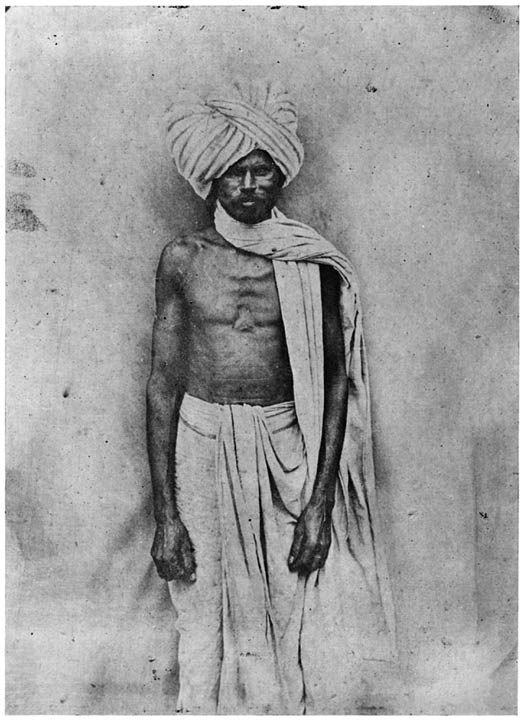
Kāpu.
It is a common saying among the Kāpus that they can easily enumerate all the varieties of rice, but it is impossible to give the names of all the sections into which the caste is split up. Some say that there are only fourteen of these, and use the phrase Panta padnālagu kulālu, or Panta and fourteen sections.
Ayōdhya, or Oudh, where Rāma is reputed to have lived. The sub-division is found in Madura and Tinnevelly. They are very proud of their supposed connection with Oudh. At the commencement of the marriage ceremony, the bride’s party asks the bridegroom’s who they are, and the answer is that they are Ayōdhya Reddis. A similar question is then asked by the bridegroom’s party, and the bride’s friends reply that they are Mithila Reddis.
Balija. The chief Telugu trading caste. Many of the Balijas are now engaged in cultivation, and this accounts for so many having returned Kāpu as their main caste, for Kāpu is a common Telugu word for a ryot or cultivator. It is not improbable that there was once a closer connection than now between the Kāpus and Balijas.
Bhūmanchi (good earth).
Dēsūr. Possibly residents originally of a place called Dēsūr, though some derive the word from dēha, body, and sūra, valour, saying that they were renowned for their courage.
Gandi Kottai. Found in Madura and Tinnevelly. Named after Gandi Kōta in the Ceded districts, whence they are said to have emigrated southward.
Gāzula (glass bangle makers). A sub-division of the Balijas. They are said to have two sections, called Nāga (cobra) and Tābēlu (tortoise), and, in some places, to keep their women gōsha.
Kammapuri. These seem to be Kammas, who, in some places, pass as Kāpus. Some Kammas, for example, who have settled in the city of Madras, call themselves Kāpu or Reddi.
Morasa. A sub-division of the Vakkaligas. The Verala icche Kāpulu, or Kāpus who give the fingers, have a custom which requires that, when a grandchild is born in a family, the wife of the eldest son of the grandfather must have the last two joints of the third and fourth fingers of her right hand amputated at a temple of Bhairava.
Nerati, Nervati, or Neradu. Most numerous in Kurnool, and the Ceded districts.
Oraganti. Said to have formerly worked in the salt-pans. The name is possibly a corruption of Warangal, capital of the Pratāpa Rudra.
Pākanāti. Those who come from the eastern country (prāk nādu).
Palle. In some places, the Pallis who have settled in the Telugu country call themselves Palle Kāpulu, and give as their gōtra Jambumāha Rishi, which is the gōtra of the Pallis. Though they do not intermarry with the Kāpus, the Palle Kāpulu may interdine with them.
Panta (Panta, a crop). The largest sub-division of all.
Pedaganti or Pedakanti. By some said to be named after a place called Pedagallu. By others the word is said to be derived from peda, turned aside, and kamma eye, indicating one who turns his eyes away from the person who speaks to him. Another suggestion is that it means stiff-necked. The Pedakantis are said to be known by their arrogance.
Pōkanādu (pōka, areca palm: Areca Catechu).
Velanāti. Kāpus from a foreign (veli) country.
Yerlam.
“The last division,” Mr. Stuart writes, “are the most peculiar of all, and are partly of Brāhmanical descent. The story goes that a Brāhman girl named Yerlamma, not having been married by her parents in childhood, as she should have been, was for that reason turned out of her caste. A Kāpu, or some say a Besta man, took compassion on her, and to him she bore many children, the ancestors of the Yerlam Kāpu caste. In consequence of the harsh treatment of Yerlamma by her parents and caste people, all her descendants hate Brāhmans with a deadly hatred, and look down upon them, affecting also to be superior to every other caste. They are most exclusive, refusing to eat with any caste whatever, or even to take chunam (lime for chewing with betel) from any but their own people, whereas Brāhmans will take lime from a Sūdra, provided a little curd be mixed with it. The Yerlam Kāpus do not employ priests of the Brāhman or other religious classes even for their marriages. At these no hōmam (sacred fire) ceremony is performed, and no worship offered to Vignēswara, but they simply ascertain a fortunate day and hour, and get an old matron (sumangali) to tie the tāli to the bride’s neck, after which there is feasting and merry-making.”
In the Census Report, 1891, Kāpu (indicating cultivator), is given as a sub-division of Chakkiliyans, Dommaras, Gadabas, Savaras and Tēlis. It further occurs as a sub-division of Mangala. Some Marātha cultivators in the Telugu country are known as Arē Kāpu. The Konda Doras are also called Konda Kāpus. In the Census Report, 1901, Pandu is returned as a Tamil synonym, and Kāmpo as an Oriya form of Kāpu.
Reddi is the usual title of the Kāpus, and is the title by which the village munsiff is called in the Telugu country, regardless of the caste to which he may belong. Reddi also occurs as a sub-division of cultivating Linga Balijas, Telugu Vadukans or Vadugans in the Tamil country, Velamas, and Yānādis. It is further given as a name for Kavarais engaged in agriculture, and as a title of the Kallangi sub-division of Pallis, and Sādars. The name Sambuni Reddi is adopted by some Palles engaged as fishermen.
As examples of exogamous septs among the Kāpus, the following may be cited:—
Avula, cow. Alla, grain. Bandi, cart. Barrelu, buffaloes. Dandu, army. Gorre, sheep. Gudise, hut. Guntaka, harrow. Kōdla, fowl. Mēkala, goats. Kānugala, Pongamia glabra. Mungāru, woman’s skirt. Nāgali, plough. Tangēdu, Cassia auriculata. Udumala, Varanus bengalensis. Varige, Setaria italica. Yeddulu, bulls. Yēnuga, elephant.
At Conjeeveram, some Panta Reddis have true totemistic septs, of which the following are examples:—
Magili (Pandanus fascicularis). Women do not, like women of other castes, use the flower-bracts for the purpose of adorning themselves. A man has been known to refuse to purchase some bamboo mats, because they were tied with the fibre of this tree.
Ippi (Bassia longifolia). The tree, and its products, must not be touched.
Mancham (cot). They avoid sleeping on cots.
Arigala (Paspalum scrobiculatum). The grain is not used as food.
Chintaginjalu (tamarind seeds). The seeds may not be touched, or used.
Puccha (Citrullus vulgaris; water melon). The fruit may not be eaten.
The Pichigunta vandlu, a class of mendicants who beg chiefly from Kāpus and Gollas, manufacture pedigrees and gōtras for these castes and the Kammas.
Concerning the origin of the Kāpus, the following legend is current. During the reign of Pratāpa Rudra, the wife of one Belthi Reddi secured by severe penance a brilliant ear ornament (kamma) from the sun. This was stolen by the King’s minister, as the King was very anxious to secure it for his wife. Belthi Reddi’s wife told her sons to recover it, but her eldest son refused to have anything to do with the matter, as the King was involved in it. The second son likewise refused, and used foul language. The third son promised to secure it, and, hearing this, one of his brothers ran away. Finally the ornament was recovered by the youngest son. The Panta Kāpus are said to be descended from the eldest son, the Pākanātis from the second, the Velamas from the son who ran away, and the Kammas from the son who secured the jewel.
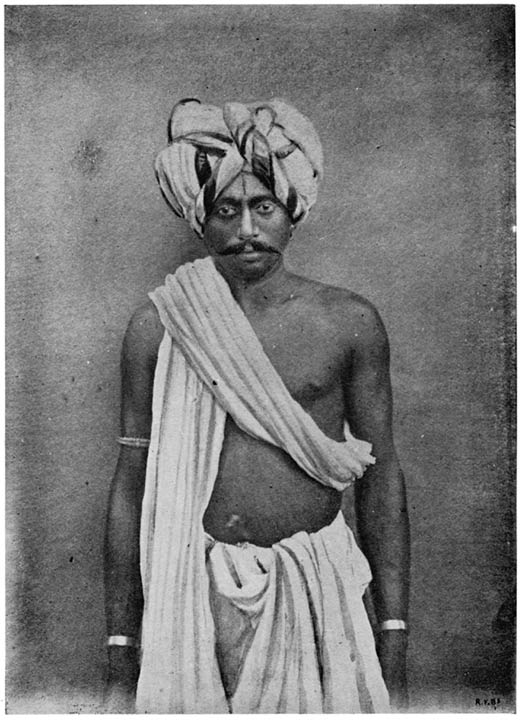
Panta Kāpu.
The Kāpus are said to have originally dwelt in Ayōdhya. During the reign of Bharata, one Pillala Mari Belthi Reddi and his sons deceived the King by appropriating all the grain to themselves, and giving him the straw. The fraud was detected by Rāma when he assumed charge of the kingdom, and, as a punishment, he ordered the Kāpus to bring Cucurbita (pumpkin) fruits for the srādh (death ceremony) of Dasarātha. They accordingly cultivated the plant, but, before the ceremony took place, all the plants were uprooted by Hanumān, and no fruits were forthcoming. In lieu thereof, they promised to offer gold equal in weight to that of the pumpkin, and brought all of which they were possessed. This they placed in the scales, but it was not sufficient to counterbalance a pumpkin against which it was weighed. To make up the deficiency in weight, the Kāpu women removed their bottus (marriage badges), and placed them in the scales. Since that time women of the Mōtāti and Pedakanti sections have substituted a cotton string dyed with turmeric for the bottu. It is worthy of notice that a similar legend is current among the Vakkaligas (cultivators) of Mysore, who, instead of giving up the bottu, seem to have abandoned the cultivation of the Cucurbita plant. The exposure of the fraud led Belthi Reddi to leave Ayōdhya with one of his wives and seventy-seven children, leaving behind thirteen wives. In the course of their journey, they had to cross the Silānadi (petrifying river), and, if they passed through the water, they would have become petrified. So they went to a place called Dhonakonda, and, after worshipping Ganga, the head of the idol was cut off, and brought to the river bank. The waters, like those of the Red Sea in the time of Pharaoh, were divided, and the Kāpus crossed on dry ground. In commemoration of this event, the Kāpus still worship Ganga during their marriage ceremonies. After crossing the river, the travellers came to the temple of Mallikarjuna, and helped the Jangams in the duties of looking after it. Some time afterwards the Jangams left the place for a time, and placed the temple in charge of the Kāpus. On their return, the Kāpus refused to hand over charge to them, and it was decided that whoever should go to Nāgalōkam (the abode of snakes), and bring back Nāga Malligai (jasmine from snake-land), should be considered the rightful owner of the temple. The Jangams, who were skilled in the art of transformation, leaving their mortal frames, went in search of the flower in the guise of spirits. Taking advantage of this, the Kāpus burnt the bodies of the Jangams, and, when the spirits returned, there were no bodies for them to enter. Thereon the god of the temple became angry, and transformed the Jangams into crows, which attacked the Kāpus, who fled to the country of Oraganti Pratāpa Rudra. As this King was a Sakti worshipper, the crows ceased to harass the Kāpus, who settled down as cultivators. Of the produce of the land, nine-tenths were to be given to the King, and the Kāpus were to keep a tithe. At this time the wife of Belthi Reddi was pregnant, and she asked her sons what they would give to the son who was about to be born. They all promised to give him half their earnings. The child grew into a learned man and poet, and one day carried water to the field where his brothers were at work. The vessel containing the water was only a small one, and there was not enough water for all. But he prayed to Sarasvati, with whose aid the vessel was always filled up. Towards evening, the grain collected during the day was heaped together, with a view to setting apart the share for the King. But a dispute arose among the brothers, and it was decided that only a tithe should be given to him. The King, being annoyed with the Kāpus for not giving him his proper share, waited for an opportunity to bring disgrace on Belthi Reddi, and sought the assistance of a Jangam, who managed to become the servant of Belthi Reddi’s wife. After some time, he picked up her kamma when it fell off while she was asleep, and handed it over to Pratāpa Rudra, who caused it to be proclaimed that he had secured the ornament as a preliminary to securing the person of its owner. The eldest son of Belthi Reddi, however, recovered the kamma in a fight with the King, during which he carried his youngest brother on his back. From him the Kammas are descended. The Velamas are descended from the sons who ran away, and the Kāpus from those who would neither fight nor run away.
Pollution at the first menstrual ceremony lasts, I am informed, for sixteen days. Every day, both morning and evening, a dose of gingelly (Sesamum) oil is administered to the girl, and, if it produces much purging, she is treated with buffalo ghī (clarified butter). On alternate days water is poured over her head, and from the neck downwards. The cloth which she wears, whether new or old, becomes the property of the washerwoman. On the first day the meals consist of milk and dhāl (Cajanus indicus), but on subsequent days cakes, etc., are allowed.
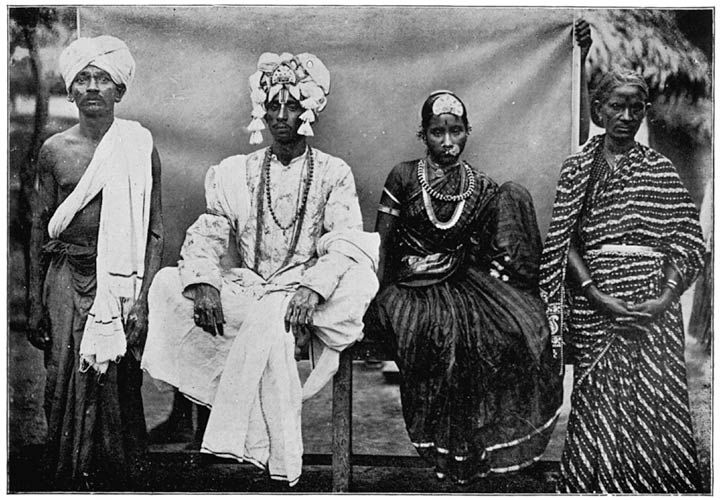
Kāpu Bride and Bridegroom.
In the Census Report, 1891, Mr. Stuart states that he was informed that polyandry of the fraternal type exists among the Panta Kāpus, but the statement requires verification. I am unable to discover any trace of this custom, and it appears that Reddi Yānādis are employed by Panta Reddis as domestic servants. If a Reddi Yānādi’s husband dies, abandons, or divorces his wife, she may marry his brother. And, in the case of separation or divorce, the two brothers will live on friendly terms with each other.
In the disposal of their dead, the rites among the Kāpus of the Telugu country are very similar to those of the Kammas and Balijas. The Panta Reddis of the Tamil country, however, follow the ceremonial in vogue among various Tamil castes. The news of a death in the community is conveyed by a Paraiyan Tōti (sweeper). The dead man’s son receives a measure containing a light from a barber, and goes three times round the corpse. At the burning-ground the barber, instead of the son, goes thrice round the corpse, carrying a pot containing water, and followed by the son, who makes holes therein. The stream of water which trickles out is sprinkled over the corpse. The barber then breaks the pot into very small fragments. If the fragments were large, water might collect in them, and be drunk by birds, which would bring sickness (pakshidhōsham) on children, over whose heads they might pass. On the day after the funeral, a Panisavan or barber extinguishes the fire, and collects the ashes together. A washerman brings a basket containing various articles required for worship, and, after pūja has been performed, a plant of Leucas aspera is placed on the ashes. The bones are collected in a new pot, and thrown into a river, or consigned by parcel-post to an agent at Benares, and thrown into the Ganges.
By religion the Kāpus are both Vaishnavites and Saivites, and they worship a variety of deities, such as Thāllamma, Nāgarapamma, Putlamma, Ankamma, Munēswara, Pōleramma, Dēsamma. To Munēswara and Dēsamma pongal (cooked rice) is offered, and buffaloes are sacrificed to Pōleramma. Even Mātangi, the goddess of the Mādigas, is worshipped by some Kāpus. At purificatory ceremonies a Mādiga Basavi woman, called Mātangi, is sent for, and cleanses the house or its inmates from pollution by sprinkling and spitting out toddy.
In the Kāpu community, women play an important part, except in matters connected with agriculture. This is accounted for by a story to the effect that, when they came from Ayōdhya, the Kāpus brought no women with them, and sought the assistance of the gods in providing them with wives. They were told to marry women who were the illegitimate issue of Pāndavas, and the women consented on the understanding that they were to be given the upper hand, and that menial service, such as husking paddy (rice), cleaning vessels, and carrying water, should be done for them. They accordingly employ Gollas and Gamallas, and, in the Tamil country, Pallis as domestic servants. Mālas and Mādigas freely enter Kāpu houses for the purpose of husking paddy, but are not allowed into the kitchen, or room in which the household gods are worshipped.
In some Kāpu houses, bundles of ears of paddy may be seen hung up as food for sparrows, which are held in esteem. The hopping of sparrows is said to resemble the gait of a person confined in fetters, and there is a legend that the Kāpus were once in chains, and the sparrows set them at liberty, and took the bondage on themselves.
In a note on the Pongala or Pōkanāti and Panta Reddis of the Trichinopoly district, Mr. F. R. Hemingway writes as follows. “Both speak Telugu, but they differ from each other in their customs, live in separate parts of the country, and will neither intermarry nor interdine. The Reddis will not eat on equal terms with any other Sūdra caste, and will accept separate meals only from the vegetarian section of the Vellālas. They are generally cultivators, but they had formerly rather a bad reputation for crime, and it is said that some of them are receivers of stolen property. Like various other castes, they have beggars, called Bavani Nāyakkans, attached to them, who beg from no other caste, and whose presence is necessary when they worship their caste goddess. The Chakkiliyans are also attached to them, and play a prominent part in the marriages of the Panta sub-division. Formerly, a Chakkiliyan was deputed to ascertain the status of the other party before the match was arranged, and his dreams were considered as omens of its desirability. He was also honoured at the marriage by being given the first betel and nuts. Nowadays he precedes the bridegroom’s party with a basket of fruit, to announce its coming. A Chakkiliyan is also often deputed to accompany a woman on a journey. The caste goddess of the Reddis is Yellamma, whose temple is at Esanai in Perambalūr, and she is reverenced by both Pantas and Pongalas. The latter observe rather gruesome rites, including the drinking of a kid’s blood. The Pantas also worship Rengayiamman and Pōlayamman with peculiar ceremonies. The women are the principal worshippers, and, on one of the nights after Pongal, they unite to do reverence to these goddesses, a part of the ritual consisting in exposing their persons. With this may be compared the Sevvaipillayar rite celebrated in honour of Ganēsa by Vellāla woman (see Vellāla). Both divisions of Reddis wear the sacred thread at funerals. Neither of them allow divorcées or widows to marry again. The women of the two divisions can be easily distinguished by their appearance. The Panta Reddis wear a characteristic gold ear-ornament called kammal, a flat nose-ring studded with inferior rubies, and a golden wire round the neck, on which both the tāli and the pottu are tied. They are of fairer complexion than the Pongala women. The Panta women are allowed a great deal of freedom, which is usually ascribed to their dancing-girl origin, and are said to rule their husbands in a manner rare in other castes. They are often called dēvadiya (dancing-girl) Reddis, and it is said that, though the men of the caste receive hospitality from the Reddis of the north country, their women are not invited. Their chastity is said to be frail, and their lapses easily condoned by their husbands. The Pongalas are equally lax about their wives, but are said to rigorously expel girls or widows who misconduct themselves, and their seducers as well. However, the Panta men and women treat each other with a courtesy that is probably to be found in no other caste, rising and saluting each other, whatever their respective ages, whenever they meet. The purification ceremony for a house defiled by the unchastity of a maid or widow is rather an elaborate affair. Formerly a Kolakkāran (huntsman), a Tottiyan, a priest of the village goddess, a Chakkiliyan, and a Bavani Nāyakkan had to be present. The Tottiyan is now sometimes dispensed with. The Kolakkāran and the Bavani Nāyakkan burn some kāmācchi grass (Andropogon Schœnanthus), and put the ashes in three pots of water. The Tottiyan then worships Pillayar (Ganēsa) in the form of some turmeric, and pours the turmeric into the water. The members of the polluted household then sit in a circle, while the Chakkiliyan carries a black kid round the circle. He is pursued by the Bavani Nāyakkan, and both together cut off the animal’s head, and bury it. The guilty parties have then to tread on the place where the head is buried, and the turmeric and ash water is poured over them. This ceremony rather resembles the one performed by the Ūrālis. The Pantas are said to have no caste panchāyats (council), whereas the Pongalas recognise the authority of officers called Kambalakkārans and Kottukkārans who uphold the discipline.”
The following are some of the proverbs relating to the Kāpus:—
The Kāpu protects all.
The Kāpu’s difficulties are known only to god.
The Kāpu dies from even the want of food.
The Kāpu knows not the distinction between daughter and daughter-in-law (i.e., both must work for him).
The Karnam (village accountant) is the cause of the Kāpu’s death.
The Kāpu goes not to the fort (i.e., into the presence of the Rāja). A modern variant is that the Kāpu goes not to the court (of law).
While the Kāpu was sluggishly ploughing, thieves stole the rope collars.
The year the Kāpu came in, the famine came too.
The Reddis are those who will break open the soil to fill their bellies.
When the unpracticed Reddi got into a palanquin, it swung from side to side.
The Reddi who had never mounted a horse sat with his face to the tail.
The Reddi fed his dog like a horse, and barked himself.
Kāradhi.—A name sometimes given to Māri Holeyas.
Karadi (bear).—An exogamous sept of Tottiyan.
Kāraikkāt.—Kāraikkāt, Kāraikkātar, or Kārkātta, meaning those who waited for rain, or, according to another version, those who saved or protected the clouds, is an endogamous division of Vellāla. Some Tamil Malayālis, who claim to be Vellālas who emigrated to the hills from Conjeeveram, have, at times of census, returned themselves as Kāraikkaāt Vellālas.
Karaiturai (sea-coast) Vellāla.—A name assumed by some Pattanavans.
Karaiyālan (ruler of the coast).—A title of Maravans, also taken by some Idaiyans.
Karaiyān.—A name for Tamil sea-fishermen, who live on the coast (karai). The fishing section of the Palles is known as Palle Kariyālu. See Pattanavan.
Kārālan.—In the Census Report, 1891, the Kārālans (rulers of clouds) are returned as a tribe of hunters and cultivators found in the hills of Salem and South Arcot. In the Report, 1901, Kārālan is given as a synonym for Vellāla in Malabar, and also as a name for Malayālis. At the census, 1901, many of the Malayālis of the Shevaroy hills in the Salem district returned themselves as Vellālas and Kārālans. And the divisions returned by the Kārālans, e.g., Kolli, Pacchai, Periya, and Perianan, connect them with these Malayālis (q.v.).
Karepāku.—Karepāku or Karuvepilai is a name for Koravas, who hawk for sale leaves of the curry-leaf plant (Murraya Kœnigii). Karichcha.—Recorded, in the Travancore Census Report, 1901, as a sub-division of Nāyar.
Karimbarabannaya (sugar-cane sept).—An exogamous sept of Kēlasi.
Kariya.—A sub-division of Kudubi.
Karkadabannaya (scorpion sept).—An exogamous sept of Bant.
Karkatta.—A synonym of Kāraikāttu Vellāla.
Karna.—A sub-division of Golla, and an exogamous sept of Māla.
Karnabattu.—The Karnabattus, or Karnabhatus, are a Telugu weaving caste, found chiefly in the Godāvari district. The story goes that there once lived a king, who ruled over a portion of the country now included in this district, and was worried by a couple of demons, who carried off some of his subjects for their daily food. The king prayed Siva for deliverance from them, and the god, being gratified at his devotion to him, produced nine persons from his ears, and ordered them to slay the demons. This they did, and their descendants are the Karnabhatus, or ear soldiers. By religion, the Karnabattus are either ordinary Saivites or Lingāyats. When a girl reaches maturity, she remains under a pollution for sixteen days. Early marriage is the rule, and a Brāhman officiates at weddings. The dead, as among other Lingayāts, are buried in a sitting posture. The caste is organised in the same manner as the Sālēs, and, at each place, there is a headman called Kulampedda or Jātipedda, corresponding to the Sēnāpatbi of the Sālēs. They weave coarse cloths, which are inferior in texture to those manufactured by Patta Sālēs and Sīlēvantas.
In a note on the Karnabattus, Mr. F. R. Hemingway writes that “though a low caste, they forbid the remarriage of widows. But the remark in the Census Report (1901) that they abstain from meat is not true of the Karnabattus questioned, who admitted that they would eat even pork. Their special deity is Somēsvara, whom they unite to worship on the new-moon day of Pushyam (January-February). The god is represented by a mud idol made for the occasion. The pūjāri (priest) throws flowers over it in token of adoration, and sits before it with his hands outstretched and his mouth closed until one of the flowers falls into his hands.”
The Karnabattus have no regular caste titles, but sometimes the elders add Ayya or Anna as a suffix to their name.
Karna Sālē.—The Karna Sālēs are a caste of Telugu weavers, who are called Sēniyans in the Tamil country, e.g., at Madura and Tanjore. They seem to have no tradition as to their origin, but the name Karna would seem to have its origin in the legend relating to the Karnabattus. These are, in the community, both Saivites and Vaishnavites, and all members of the Illabaththini sept are Vaishnavites. They are said to have only one gōtra, Kāsi (Benares), and numerous exogamous septs, of which the following are examples:—
Vasthrāla, cloth.
Rudrākshala, seeds of Elæocarpus Ganitrus.
Mandha, village common or herd.
Kodavili, sickle.
Thādla, rope.
Thātichettu, palmyra palm.
Dhoddi, court-yard.
Thippa, rubbish-heap.
In some places, the office of headman, who is called Setti, is hereditary. He is assisted by a Pedda Kāpu, and Nela Setti, of whom the latter is selected monthly, and derives his name from the Telugu nela (month). In their marriage ceremonial, the Karna Sālēs closely follow the Padma Sālēs, but they have no upanāyanam (sacred thread rite), or Kāsiyathrē (mock pilgrimage to Benares), have twelve pots brought for worship, and no pot-searching.
As among other Telugu castes, when a girl reaches puberty, twigs of Strychnos Nux-vomica are placed in the special hut erected for the occasion. On the third or fifth day, the girl’s relations come to her house under a cloth canopy (ulladam), carrying rice soaked in jaggery (crude sugar) water. This rice is called dhadibiyam (wet rice), and is placed in a heap, and, after the waving of coloured water, distributed, with pān-supāri (betel leaves and areca nuts), among those present.
The dead are carried to the burial-ground in a car, and buried, after the manner of Lingāyats, in a sitting posture. Jangams officiate at funerals.
Karnam.—See Korono.
Karnam (accountant).—An exogamous sept of Kamma.
Karnataka.—The territorial name of a sub-division of Handichikka and Uppāra. It is also the name of a sub-division of Mādhva and Smarta Brāhmans who speak the Kanarese language, as opposed to the Dēsastha Brāhmans, who are immigrants into Southern India from the Marātha country.
Karpūra Chetti.—A synonym of Uppiliyans, who used to manufacture camphor (karpūra).
Kartā.—Kartā and Kartāvu, meaning agent or doer, is an honorific title of Nāyars and Sāmantas. It is also the name for the chief mourner at funerals of Nāyars and other castes on the west coast. Kartākkal, denoting, it is said, governors, has been returned, at times of census by Balijas claiming to be descendants of the Nāyak kings of Madura and Tanjore.
Karukku-pattayar (those of the sharp sword).—A sub-division of Shānān. In the Census Report, 1891, the division Karukku-mattai (petiole of the palmyra leaf with serrated edges) was returned. Some Shānāns are said to have assumed the name of Karukku-mattai Vellālas.
Karumala (black mountain).—An exogamous sept of Kānikar.
Karuman.—A sub-division of Kammālans, who do blacksmith’s work.
Karumpuraththal.—A synonym for the caste name adopted by some Kāppiliyans.
Karutta (dark-coloured).—Recorded, at the Madras census, 1891, as a sub-division of Idaiyans, who have also returned Karuttakkādu, meaning black cotton soil or regur.
Karuva Haddi.—A name for the scavenging section of Haddis.
Karuvan.—A corrupt form of Karumān.
Karuvēlam.—Recorded in the Travancore Census Report, 1901, as a sub-division of Nāyar.
Kasayi (butcher).—A Muhammadan occupational name.
Kāsi (Benares).—A gōtra of Mēdara and Karna Sālē.
Kāsi.—A name for the stone-mason section of Kamsalas.
Kasturi (musk).—An exogamous sept of Badaga, Kamma, Okkiliyan, and Vakkaliga. Indian musk is obtained from the musk glands of the Himalayan musk-deer, Moschus moschiferus.
Kasuba (workmen).—A section of Irulas of the Nīlgiris, who have abandoned jungle life in favour of working on planters’ estates or elsewhere.
Kāsukkar.—The name, derived from kās, cash, of a sub-division of Chetti.
Kāsula (copper coins).—An exogamous sept of Padma Sālē.
Kasyapa.—A Brāhmanical gōtra adopted by Bhatrāzus, Khatris, and Tontis. Kasyapa was one of the seven important Rishis, and the priest of Parasu Rāma.
Katakam (crab).—An exogamous sept of Kōmati.
Katal Arayan.—See Vālan.
Kāththavarāya.—A synonym for Vannān, derived from Kāththavarāya, the deified son of Kāli, from whom the Vannāns trace their descent.
Kaththē (donkey).—An exogamous sept of Mādiga.
Kaththi (knife).—An exogamous sept of Dēvānga and Mādiga.
Kaththiri (scissors).—An exogamous sept of Dēvānga, and sub-division of Gadaba.
Kaththiravāndlu (scissors people).—Concerning this section of the criminal classes, Mr. F. S. Mullaly writes to me as follows. “This is purely a Nellore name for this class of professional pick-pockets. The appellation seems to have been given to them from the fact that they frequent fairs and festivals, and busy railway platforms, offering knives and scissors for sale. And, when an opportunity presents itself, they are used for cutting strings of beads, ripping open bags, etc. Several of these light-fingered gentry have been found with small scissors in their mouths. Most of them wear shoes of a peculiar shape, and these form a convenient receptacle for the scissors. Bits of broken glass (to act as knives) are frequently found in their mouths. In different districts they are known by different appellations, such as Donga Dāsaris in North Arcot and parts of Cuddapah; Golla Woddars, Donga Woddars, and Muheri Kalas in Cuddapah, Bellary, and Kurnool; Pachupus in Kistna and Godāvari; Alagiris, Ena or Thogamalai Koravas in the southern districts. Individuals belonging to this class of thieves have been traced, since the opening of the East Coast Railway, as far as Midnapore. An important way of identifying them is the fact that everyone of them, male and female, is branded at the corners of the eyebrows and between the eyes in childhood, as a safeguard against convulsions.”
For the following additional information I am indebted to an official of the Police department. “I am not aware of these people using any particular shoes. They use sandals such as are generally worn by ryots and the lower classes. These they get by stealing. They pick them up from houses during the daytime, when they go from house to house on the pretence of begging, or they steal them at nights along with other property. These sandals are made in different fashions in different districts, and so those possessed by Kathiras are generally of different kinds, being stolen from various parts of the country. They have no shoes of any peculiar make, nor do they get any made at all. Kathiras do not generally wear any shoes. They walk and run faster with bare feet. They wear shoes when walking through the jungle, and entrust them to one of their comrades when walking through the open country. They sometimes throw them off when closely pursued, and run away. In 1899, when we arrested one on the highroad, he had with him five or six pairs of shoes of different kinds and sizes, and he did not account satisfactorily for being in possession of so many. I subsequently learnt that some supernumeraries were hiding in the jungle close to the place where he was arrested.
“About marks of branding on the face, it is not only Kathiras, but almost all nomadic tribes who have these marks. As the gangs move on exposed to changes of weather, the children sometimes get a disease called sandukatlu or palakurkura. They generally get this disease from the latter part of the first year up to the fifth year. The symptoms are similar to those which children sometimes have at the time of teething. It is when children get this disease that they are branded on the face between the eyebrows, on the outer corners of the eyes, and sometimes on the belly. The brand-marks on the face and corners of the eyes are circular, and those on the belly generally horizontal. The circular brand-marks are made with a long piece of turmeric, one end of which is burnt for the purpose, or with an indigo-coloured cloth rolled like a pencil and burnt at one end. The horizontal marks are made with a hot needle. Similar brand-marks are made by some caste Hindus on their children.”
To Mr. P. B. Thomas I am indebted for specimens of the chaplet, made of strips of rolled pith, worn by Kaththira women when begging, and of the cotton bags, full of false pockets, regularly carried by both men and women, in which they secrete the little sharp knife and other articles constituting their usual equipment.
In his “History of Railway thieves,” Mr. M. Paupa Rao Naidu, writing about the pick-pockets or Thetakars, says that “most of them wear shoes called chadāvs, and, if the articles stolen are very small, they put them at once into their shoes, which form very convenient receptacles from their peculiar shape; and, therefore, when a pick-pocket with such a shoe on is suspected of having stolen a jewel, the shoes must be searched first, then the mouth and the other parts of the body.”
Kaththula (sword).—An exogamous sept of Yānadi.
Kātige (collyrium).—A gōtra of Kurni.
Kātikala (collyrium).—An exogamous sept of Dēvānga.
Katike.—The Katike or Katikilu are butchers in the Telugu country, concerning whom it is noted, in the Kurnool Manual, that “some are called Sultāni butchers, or Hindus forcibly circumcised by the late Nabob of Kurnool. They observe both Mussalman and Hindu customs.” A correspondent in the Kurnool district informs me that the butchers of Kurnool belong to three classes, one selling beef, and the others mutton. Of these, the first are Muhammadans, and are called Gāyi Khasayi, as they deal in beef. The other two are called respectively Sultānis and Surasus, i.e., the circumcised and uncircumcised. Both claim to be the descendants of two brothers, and have the following tradition concerning their origin. Tīpu Sultān is said not to have relished the idea of taking mutton at the hands of Hindus, as they would not perform Bismallah at the time of slaughtering the sheep. He accordingly ordered both the brothers to appear before him. Being the manager of the family, the elder went, and was forcibly circumcised. On hearing the news, the younger brother absconded. The descendants of the former are Muhammadans, and of the latter Hindus. As he was made a Muhammadan by force, the elder brother and his descendants did not adopt all the Muhammadan manners and customs. Till recently they did not even allow their beards to grow. At the present day, they go to mosques, dress like Muhammadans, shave their heads, and grow beards, but do not intermarry with the true Muhammadans. The descendants of the younger brother still call themselves Āri-katikelu, or Marātha butchers, profess the Hindu religion, and follow Hindu manners and customs. Though they do not eat with Muhammadans or Sultānis, their Hindu brethren shun them because of their profession, and their intimacy with Sultānis. I am informed that, at Nandyal in the Kurnool district, some Marātha butchers, who observe purely Hindu customs, are called by Muhammadan names. The Tahsildar of the Sirvel tāluk in the same district states that, prior to the reign of the father of Ghulam Rasul Khān, the dethroned Nawāb of Kurnool, the butcher’s profession was solely in the hands of the Marāthas, some of whom were, as stated in the Manual, forcibly circumcised, and became a separate butcher caste, called Sultāni. There are two sections among these Sultāni butchers, viz., Bakra (mutton) and Gai Kasai (beef butcher). Similar stories of forcible conversion to the Muhammadan religion are prevalent in the Bellary district, where the Kasāyis are mostly converted Hindus, who dress in the Hindu style, but possess Muhammadan names with Hindu terminations, e.g., Hussainappa.