Volume 3 — K (continued 6)
Reading edition
Of the language spoken by the Koragars, Mr. Ullal Raghvendra Rao states that “it is a common belief that the Koragar has a peculiar dialect generally spoken by him at his koppu. He may be induced to give an account of his feasts, his gods, his family, but a word about his dialect will frighten him out of his wits. Generally polite and well-behaved, he becomes impolite and unmannerly when questioned about his dialect.” “All the Hindoos,” Mr. Walhouse writes, “believe that the Koragars have a language of their own, understood only by themselves, but it seems doubtful whether this is anything more than an idiom, or slang.” A vocabulary of the Koraga dialect is contained in the South Canara Manual (1895).
Korama.—See Korava.
In 1903, a gang of Koravas, travelling in the guise of pūjāris, was arrested at Puri. The Police discovered that a warrant remained unexecuted against one of them, who had been concerned in a dacoity case in North Arcot many years previously. The report of the case states that “cognate with the Kepmaries is a class of Korava pūjāris (as they call themselves in their own village), who, emanating from one small hamlet in the Tanjore district, are spread more or less all over India. There are, or were until the other day, and probably are still some of them in Cuttack, Balasore, Midnapūr, Ahmedabad, Patna, Bombay, Secunderabad, and other places. One of them attained a high position in Bombay. Their ostensible profession is that of curing piles and fistulas, but it is noticeable that, sooner or later after their taking up their abode at any place, the Kepmaries are to be found somewhere near, and the impression, which is not quite a certainty but very nearly so, is that they play the convenient rôle of receivers of property stolen by the Kepmaries.” Kēpmari is regarded as a very strong term of abuse, indicating, as it does, a rogue of the worst character. In the southern districts, the Kāsukkar Chettis and Shānāns are said to be very much trusted by the Koravas in the disposal of property.
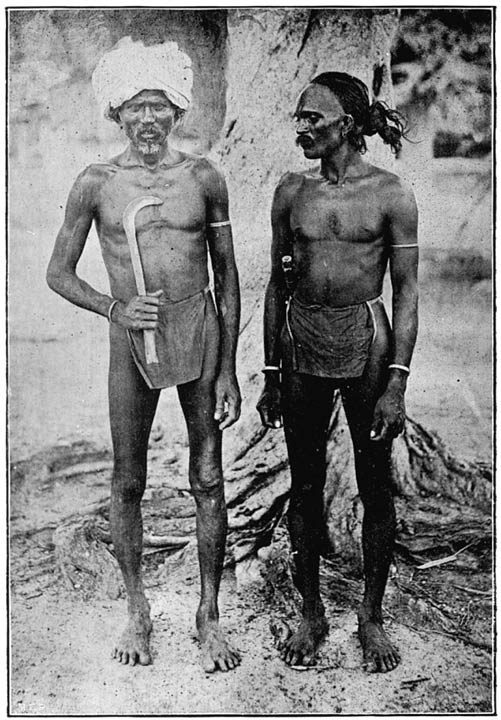
Yerukalas.
From the accounts given by them, it appears that the Koravas claim to have originated in mythological ages. The account varies slightly according to the locality, but the general outlines agree more or less with the story related in the Bhāgavātham. The purōhits, or priests, are the safest guides, and it was one of them who told the following story, culled, as he admitted, from the Sāstras and the Rāmāyana. When the great Vēnudu, son of Agneswathu, who was directly descended from Brahma, ruled over the universe, he was unable to procure a son and heir to the throne, and, when he died, his death was looked on as an irreparable misfortune. His body was preserved. The seven ruling planets sat in solemn conclave, and consulted as to what they should do. Finally they agreed to create a being from the right thigh of the deceased Vēnudu, and they accordingly fashioned and gave life to Nishudu. But their work was not successful, for Nishudu turned out to be not only deformed in body, but repulsively ugly in face. It was agreed at another meeting of the planets that he was not a fit person to be placed on the throne. So they set to work again, and created a being from the right shoulder of Vēnudu, and their second effort was crowned with success. They called the second creation Proothu Chakravarthi, and, as he gave general satisfaction, he was placed on the throne. This supersession naturally caused the first-born Nishudu to be discontented, and he sought a lonely place, in which he communed with the gods, begging of them the reason why they had created him if he was not to rule. The gods explained that he could not now be placed on the throne, as Chakravarthi had already been installed, but that he should be a ruler over forests. In this capacity Nishudu begat the Bōyas, Chenchus, Yānādis, and Koravas. The Bōyas were his legitimate children, but the others were all illegitimate. It is because Nishudu watched in solemn silence to know his creator that some of his offspring called themselves Yerukalas (yeruka, to know). Another story explains the name Korava. When the princes Dharmarāja and Duryodana were at variance, the former, to avoid strife, went into voluntary exile. A woman who loved him set out in search of him, but, through fear of being identified, disguised herself as a fortune-teller. In this manner she found him, and their offspring became known as Koravas, from kuru, fortune-telling.
The appellation Koracha or Korcha appears to be of later date than Korava, and is said to be derived from the Hindustani kori (sly), korri nigga (sly look) becoming corrupted into Korcha. Whenever this name was applied to them, they had evidently learnt their calling thoroughly, and the whole family, in whatever direction its branches spread, established a reputation for cunning in snaring animals or birds, or purloining other peoples’ goods, until to-day their names are used for the purpose of insulting abuse in the course of a quarrel. Thus a belligerant might call the other a thieving Yerukala, or ask, in tones other than polite, if he belongs to a gang of Korchas. In the Tamil country, a man is said to kura-kenju, or cringe like a Korava, and another allusion to their dishonesty is kurapasāngu, to cheat like a Korava. The proverb “Kuruvan’s justice is the ruin of the family” refers to the endless nature of their quarrels, the decision of which will often occupy the headmen for weeks together.
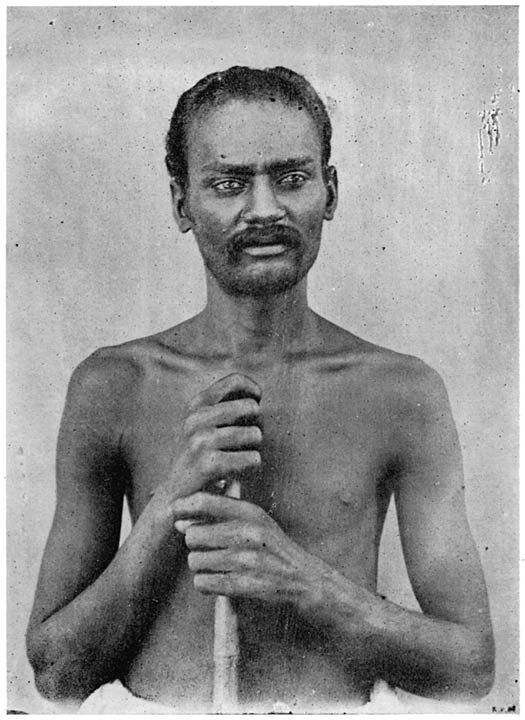
Korava.
Constable Erthalakayadu. Red-headed man.
Head constable Kederarilu. The man who rides on an ass.
Taking bribe Kalithindrathu. Eating rāgi food.
Toddy Uggu perumalu ollaithanni. White water, or good water.
Fowls Rendukal Naidu. The Naidu of two legs.
Mussalmans Arthupottavungo. Those who have cut (circumcised).
Pariah Ūtharalu keenjalu. The man that pipes.
Butcher’s knife Elamayarathe bottarathu. That for striking those that graze leaves.
Rupees Pālakanna. Milk eyes.
Ollakelluka. White pebbles.
Korava society is purely patriarchal, and, in whatever division or sept of the caste a Korava may be born, he has to subordinate himself to the will of his elders or the leaders of his particular gang. The head of a gang is called the Peru Manusan or Beriya Manasan (big man). He is selected principally because of his age, intelligence, and the influence he commands amongst the members of the gang. It is a post which carries with it no remuneration whatever, but the holder presides at all consultations, and is given the position of honour at all social functions.
Concerning the caste government, Mr. Fawcett writes that “the kulam or caste assembly adjudicates claims, inflicts penalties, ejects individuals from the caste, or readmits them thereto. Free drinking of toddy at the expense of one of the parties accompanies every caste assembly. It is the aggrieved party who gives notice for assembly of the kulam. The disputants join hands, thereby indicating to the kulam that their dispute should be decided by them. Each pays one rupee. The kulam may decide the dispute at once, or adjourn for further consideration at any time. The next meeting is called the second joining of hands, when each pays one rupee, as before, to be spent in toddy. A man who fails to attend when the kulam has been convened loses his caste absolutely. If there is a third adjournment, that is a third joining of hands, each side pays Rs. 3½ for toddy, to keep the kulam in good spirits. As this is always the final adjournment, the decision is sometimes arrived at by means of an ordeal. An equal quantity of rice is placed in two pots of equal weight having a quantity of water, and there is an equal quantity of firewood. The judges satisfy themselves most carefully as to quantity, weights, and so on. The water is boiled, and the man whose rice boils first is declared to be the winner of the dispute. The loser is to recoup the winner all his expenses. It sometimes happens that both pots boil at the same time; then a coin is to be picked out of a pot containing boiling oil. There is yet another method of settling disputes about money. The amount claimed is brought by one party, and placed beside an idol. The claimant is then asked to take it, and, should nothing unpleasant happen to him or to his family afterwards, he is declared to have made out his claim. The kulam has nothing whatever to do with planning the execution of offences, but is sometimes called upon to decide about the division of plunder, as, for instance, when any member of a criminal expedition improperly secretes something for himself. But they engage vakils (pleaders) for defending members of the gang who are charged with a criminal offence, whether they have been concerned in it or not.”
There are a great many classes of Koravas, most of them obtaining their names from the particular occupations they have followed as an ostensible means of livelihood for many generations. But, whatever they may call themselves, they all, according to Mr. Mainwaring, fall within three divisions, viz.:—
1. Sakai, Sampathi, Sāthupadi.
2. Kāvadi or Gujjula.
3. Dēvarakonda, Mendrakutti, or Menapadi.
The members of the first two divisions are pure Koravas, the legitimate descendants of Koravas who have never married outside the caste, whereas the third division represents and includes the mixed marriages, and the offspring thereof. The Koravas receive into their ranks members of castes other than Paraiyans (including Mālas and Mādigas), Yānādis, Mangalas, and Tsākalas. The ceremony of introduction into the Korava community consists in burning the tongue with a piece of gold. The Koravas have a strong objection to taking food touched by Mēdaras, because, in their professional occupation of doing wicker-work, they use an awl which resembles the tool used by Mādigas in shoe-making. The Koravas are said to be divided into two large families, which they call Pōthu and Pēnti, meaning male and female. All the families included in the first division noted above are Pōthu, and those in the second Pēnti. The families in the third division, being the product of mixed marriages, and the position of females being a lowly one, they are also considered to be Pēnti. The Pōthu section is said to have arisen from men going in search of brides for themselves, and the Pēntis from men going in search of husbands for their daughters. When a Korava, male or female, wishes to marry, a partner must be sought in a division other than their own. For example, a Korava of the first division is bound to marry a female belonging to the second or third division, who, after marriage, belongs to her husband’s division. This may be a little hard on the women of the first division, because they are bound to descend in the social scale. However, their daughters can rise by marrying into the first division. For the purpose of religious ceremonies, each division has fixed duties. The members of the first division have the right of decorating the god, and dressing him in his festival attire. Those of the second division carry the god and the regalia in procession, and burn incense, and those of the third drag the temple car, and sing and shout during its progress. For this reason, it is said, they are sometimes called Bandi (cart).
“The major divisions,” Mr. Paupa Rao Naidu writes, “are four in number, and according to their gradation they are Sāthepāti, Kāvadi, Mānapāti, Mendragutti. They are all corrupted Tamil words.
“1. Sāthepāti is a corruption of Sāthupādi, which means adorning a Hindu deity with flowers, jewels and vestments.
“2. Kāvadi, meaning a pole carried on the shoulders with two baskets pendant from its ends, in which are contained offerings for a deity or temple.
“3. Mānapāti is a corruption of Mānpadi, which means singing in praise of god, when He is worshipped in a temple.
“4. Mendragutti is a corruption of Menrikutti, which means stitching a pair of shoes, and presenting them to the temple—a custom still prevalent at Tirupati and other important shrines.
“Of these four divisions, the first two are, or rather were, considered superior to the other two, a Kāvadi man being styled Pōthuvādu (man), and a Sāthepāti man Pēnti (female).”
It is recorded, in the Gazetteer of the Trichinopoly district, that “the Kuravans are divided into a number of endogamous sections, of which the Īna Kuravans and the Kāvalkāran Kuravans are the most criminal, especially the latter. The latter are also called the Marasa, Mondu, and Kādukutti Kuravans. In dress and appearance the Nāmakkal Kuravans are said to be superior to those of Karūr, and to look like well-dressed Vellālans or Pallis. They are peculiar in wearing long ear-rings. They are also said to be much better thieves than the others, and to dislike having a Karūr Kuravan when breaking into a house, for fear he might wake the household by his clumsiness.”
As examples of intipēru, or exogamous septs, the following, which were given by Uppu Yerukalas, may be cited:—
Dāsari, Vaishnavite mendicant. Sukka, star. Kampa, bush of thorns. Āvula, cows. Thoka, tail. Kānaga (Pongamia glabra). Bandi, cart. Gajjala, small bell. Mogili (Pandanus fascicularis) Uyyāla, swing. Rāgala, rāgi grain. Pūla, flowers. Katāri, dagger. Ambojala, lotus. Samudrāla, sea. Venkatagiri, a town.
“A knowledge,” Mr. Fawcett writes, “of these house or sept names may be useful in order to establish a man’s identity, as a Koravar, who is generally untruthful as to his own name, is seldom if ever so as regards his house or sept name, and his father’s name. He considers it shameful to lie about his parentage, ‘to be born to one, and yet to give out the name of another.’ Totemism of some kind evidently exists, but it is rather odd that it has not always any apparent connection with the sept or house name. Thus, the totem of persons of the Konēti sept is horse-gram (kollu in Tamil), which they hold in veneration, and will not touch, eat, or use in any way. The totem of the Samudrāla sept is the conch shell, which likewise will not be used by those of the sept in any manner. It may be noted that persons of the Ramēswari sept will not eat tortoises, while those of the Konēti sept are in some manner obliged to do so on certain occasions.”
Concerning the Pacchaikuttis, or, as they are also called, Gadde (soothsayers), Mr. Paupa Rao Naidu writes that “the women start with a basket and a winnowing basket or tray into a village, proclaiming their ostensible profession of tattooing and soothsaying, which they do for grain or money. When unfortunate village women, who always lose children or who often fall ill, see these Gadde women moving about, they call them into their houses, make them sit, and, pouring some grain into their baskets, ask them about their past misery and future lot. These women, who are sufficiently trained to speak in suitable language, are clever enough to give out some yarns in equivocal terms, so that the anxious women, who hope for better futurity, understand them in the light uppermost in their own minds. The Korava women will be rewarded duly, and doubly too, for they never fail to study the nature of the house all the time, to see if it offers a fair field for booty to their men.”
The Ūr or village Koravas have given up their nomad life, and settled in villages of their own, or together with other communities. Many of them have attended pial schools, and can read and write to some extent. Some of them are employed in the police and salt departments, as jail warders, etc. The Ūr Korava is fast losing his individuality, and assimilating, in dress, manners and customs, the ryots among whom he dwells. In the Salem district there is a village called Koravūr, which is inhabited entirely by Koravas, who say that they were originally Uppu Koravas, but now cultivate their own lands, or work as agricultural labourers for the land-owners. They say further that they pay an occasional visit to Madras for the purpose of replenishing their stock of coral and beads, which they sell at local shandis (markets). Some Koravas are said to buy gilded beads at Madura, and cheat unsuspecting villagers by selling them as gold. Though the Ūr Koravas are becoming civilised, they have not yet lost their desire for other men’s goods, and are reported to be the curse of the Anantapur, Cuddapah, and Bellary districts, where they commit robbery, house-breaking, and theft, especially of sheep and cattle. A particularly bold sheep theft by them a few years ago is worthy of mention. The village of Singanamalla in the Anantapur district lies a few miles off the railway. It is bordered on two sides by Government forest reserves, into which the villagers regularly drove their sheep and goats to graze, in charge of small boys, in the frequent absences of the forest watcher, or when the watcher was well disposed towards them. An arrangement was made between the Koravas and a meat-supplier at Bangalore to deliver on his behalf a large number of sheep at a wayside station near Dharmāvaram, to receive which trucks had to be ready, and the transaction was purely cash. One morning, when more than a hundred sheep had been driven far into the reserve by their youthful charges, who kept more or less close together for the sake of company, a number of Koravas turned up, and represented themselves as forest watchers, captured the small boys, gagged them and tied them to trees, and drove off all the available sheep. The boys were not discovered till late at night, and the police did not get to work till the following morning, by which time the sheep were safely entrained for Bangalore.
It is noted, in the Madras Police Report, 1905–1906, that “a large number of members of the notorious Rudrapād Koracha gangs have recently been released from His Highness the Nizam’s prisons, and their return will add appreciably to the difficulties of the Bellary Police.”
A section of Koravas, called Koot (dancing) or Kōthee (monkey) Kaikaries, is referred to by Mr. Paupa Rao Naidu as “obtaining their living by prostitution. They also kidnap or sell children for this purpose. Some of the women of this class are thriving well in the Madras Presidency as experts in dancing. They are kept by rich people, and are called in the Telugu country Erukala Bōgamvaru, in Tamil Korava Thevidia. They also train monkeys, and show them to the public.”
The domestic god of the Koravas, in the southern districts, is said to be Sathavu, for whom a day of worship is set apart once in three or four years. The Koravas assemble, and, in an open place to the west of the village, a mud platform is erected, on which small bricks are spread. In front of the platform are placed a sickle, sticks, and arrack (liquor). Cocoanuts, plantain fruits, and rice are offered, and sheep sacrificed. Sandal and turmeric are poured over the bricks, and camphor is burnt. The proceedings terminate with a feast.
The following account of a peculiar form of human sacrifice by the Koravas in former days was given to Mr. C. Hayavadana Rao by an old inhabitant of the village of Āsūr near Walajabad in the Chingleput district. A big gang settled at the meeting point of the three villages of Āsūr, Mēlputtūr, and Avalūr, on an elevated spot commanding the surrounding country. They had with them their pack-bullocks, each headman of the gang owning about two hundred head. The cow-dung which accumulated daily attracted a good many of the villagers, on one of whom the headmen fixed as their intended victim. They made themselves intimate with him, plied him with drink and tobacco, and gave him the monopoly of the cow-dung. Thus a week or ten days passed away, and the Koravas then fixed a day for the sacrifice. They invited the victim to visit them at dusk, and witness a great festival in honour of their caste goddess. At the appointed hour, the man went to the settlement, and was induced to drink freely. Meanwhile, a pit, large enough for a man to stand upright in it, had been prepared. At about midnight, the victim was seized, and forced to stand in the pit, which was filled in up to his neck. This done, the women and children of the gang made off with their belongings. As soon as the last of them had quitted the settlement, the headmen brought a large quantity of fresh cow-dung, and placed a ball of it on the head of the victim. The ball served as a support for an earthen lamp, which was lighted. The man was by this time nearly dead, and the cattle were made to pass over his head. The headmen then made off, and, by daybreak, the whole gang had disappeared. The murdered man was found by the villagers, who have, since that time, scrupulously avoided the Koravas. The victim is said to have turned into a Munisvara, and for a long time troubled those who happened to go near the spot at noon or midnight. The Koravas are said to have performed the sacrifice so as to insure their cattle against death from disease. The ground, on which they encamped, and on which they offered the human sacrifice, is stated to have been barren prior thereto, and, as the result thereof, to have become very fertile.
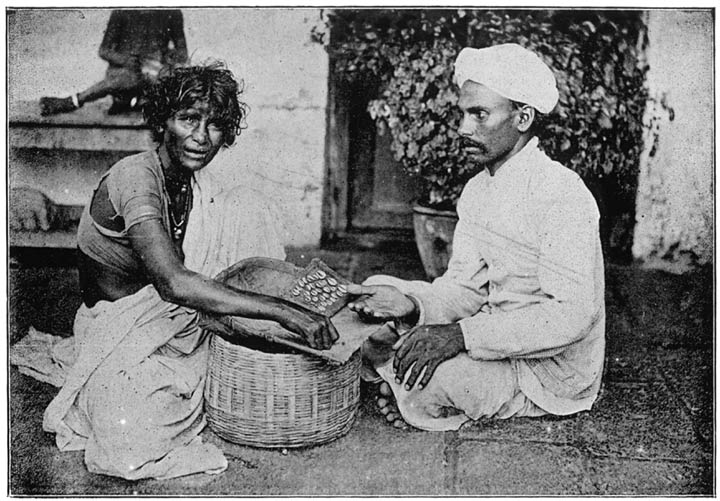
Korava Woman Telling Fortune.
Brāhmans fix the auspicious hour for marriage, and Chettis are invited to act as priests at the purification ceremony for re-admission into caste of a man or woman who has cohabited with a Paraiyan or Muhammadan, or been beaten with a shoe, etc. For the purpose of re-admission, a panchāyat (council) assembles, at which the headman presides. Enquiries are made into the conduct of the accused, and a fine of two rupees levied. Of this sum the Chetti receives eight annas, with some betel and tobacco. The balance is spent in liquor for those who are assembled. After the Chetti has received his fee, he smears the foreheads of the guilty person and the company with sacred ashes. The impure person goes to a stream or well, and bathes. He then again comes before the council, and is purified by the Chetti again marking his forehead. The proceedings wind up with a feast. In former days, at a trial before a council, the legs of the complainant and accused were tied together. In 1907, a Koracha was excommunicated for having illicit intercourse with a widow. The ceremony of excommunication usually consists of shaving the head and moustache of the guilty person, and making him ride a donkey, wearing a necklace of bones. In the case under reference, a donkey could not be procured, so a temporary shed was made of sajja (Setaria italica) stalks, which were set on fire after the man had passed through it. He was to be re-admitted into the caste by standing a feast to all the members of five gangs of Korachas.
In connection with omens and superstitions, Mr. Fawcett writes as follows. “Koravas, being highly superstitious, are constantly on the look-out for omens, especially before starting out on an excursion when the objective is dacoity or housebreaking. The household deity, represented by a brick picked up at random, is worshipped, and a sheep or fowl is sacrificed. Water is first poured over the animal, and, if it shakes its body, the omen is good, while, if it stands perfectly still, there is misfortune ahead. It is unfortunate, when starting, to see widows, pots of milk, dogs urinating, a man leading a bull, or a bull bellowing. On the other hand, it is downright lucky when a bull bellows at the scene of the criminal operation. To see a man goading a bull is a good omen when starting, and a bad one at the scene. Sprinkling urine over doors and walls of a house facilitates breaking into it. The failure of an expedition is generally attributed to the evil eye, or the evil tongue, whose bad effects are evinced in many ways. If the excursion has been for housebreaking, the housebreaking implement is often soldered at its sharp end with panchalokam (five metals), to counteract the effect of the evil eye. The evil tongue is a frequent cause of failure. It consists in talking evil of others, or harping on probable misfortunes. There are various ways of removing its unhappy effects. A mud figure of a man is made on the ground, and thorns are placed over the mouth. This is the man with the evil tongue. Those who have suffered walk round it, crying out and beating their mouths; the greater the noise, the better the effect. Cutting the neck of a fowl half through and allowing it to flutter about, or inserting a red hot splinter in its anus to madden it with pain, are considered to be effective, while, if a cock should crow after its neck has been cut, calamities are averted. The fowl is a sort of adjunct to the Koravar’s life. In early childhood, the first experiments in his career consist in stealing fowls; in manhood he feasts on them when he is well off, and he uses them, as we have seen, with abominable cruelty for divination or averting misfortune. The number seven is considered ominous, and an expedition never consists of seven men. The word for the number seven in Telugu resembles the word for weeping, and is considered to be unlucky. A man who has returned from jail, or who has been newly married, is not as a rule taken on an expedition. In the case of the former, the rule may be set aside by bringing a lamb from a neighbouring flock. A man who forgets to bring his stick, or to equip or arm himself properly, is always left behind. As in the case of dacoities, seven is an unlucky number to start out for housebreaking, but, should it be unavoidable, a fiction is indulged in of making the housebreaking implement the eighth member of the gang. When there are dogs about a house, they are soon kept quiet with powdered gajjakai or ganja leaves mixed with cooked rice, which they eat greedily. Detached parties in the jungle or elsewhere are able to unite by making sounds like the howling of jackals or hooting of owls. The direction taken on a road, or in the forest, is indicated by throwing the leaves of the tangēdu (Cassia auriculata) along the road. At crossroads, the road taken is indicated by the thick end of a twig of the tangēdu placed under a stone. Rows of stones, one piled over the other, are also used to point out the route taken when crossing hills. The women resort to divination, but not accompanied by cruelty, when their husbands are long enough absent to arouse apprehension of danger. A long piece is pulled out of a broom, and to one end of it are tied several small pieces dipped in oil. If the stick floats in water, all is well; but, should it sink, two of the women start out at once to find the men. They generally know as a matter of pre-arrangement whereabouts to find them, and proceed thither, pretending to sell karipak (curry leaves). The eighteenth day of the Tamil month Avani is the luckiest day of all for committing crimes. A successful criminal exploit on this day ensures good luck throughout the year. Sundays, which are auspicious for weddings, are inauspicious for crimes. Mondays, Wednesdays and Saturdays are unlucky until noon for starting out from home. So, too, is the day after new moon. Fridays are unsuitable for breaking into the houses of Brāhmans or Kōmatis, as they may be engaged in worshipping Ankalamma, to whom the day is sacred.”
Many Koravas examined by Mr. Mainwaring were injured in one way or another. One man had his left nostril split, and explained that it was the result of a bite by another Korava in the course of a drunken brawl at a toddy-shop. Another had lost some of his teeth in a similar quarrel, and a third was minus the lobe of his right ear.
The Koravas disguise themselves as Kēpmaris, Alagiris or pūjāris. The terms Kēpmari, Alagiri, Kathirivāndlu, etc., are applied to certain persons who adopt particular methods in committing crime, all of which are adopted by the Koravas. The Tamil equivalent of Kēpmari is Talapa Mathi, or one who changes his head-dress. Alagiris are thieves who worship at the temple of Kalla Alagar near Madura, and vow that a percentage of their ill-gotten gains will be given as an offering to his temple. Kathirivāndlu (scissors people) are those who operate with knives or scissors, snipping off chains, cutting the strings of purses, and ripping open bags or pockets.
The Koravas are not nice as regards the selection of some of their food. Cats, fowls, fish, pigs, the black-faced monkey known in Telugu as kondamuchu, jackals, field rats, deer, antelope, goats and sheep serve as articles of dietary. There is a Tamil proverb “Give an elephant to a pandit, and a cat to a Kuravan.” They will not eat cattle or buffaloes, and will not take food in company with Muhammadans, barbers, washermen, carpenters, goldsmiths, blacksmiths, Paraiyans or Chakkiliyans. The Bōyas seem to be the lowest class with whom they will eat. They drink heavily when funds are available, or at social gatherings, when free drinks are forthcoming. At council meetings liquor must be supplied by the disputants, and there is a proverb, “With dry mouths nothing can be uttered.”
Most Koravas possess knives, and a kind of billhook, called koduvāl, which is a sort of compromise between a sword and a sickle. The back of the blade is heavy, and renders it capable of dealing a very severe blow. With this implement animals are slaughtered, murders committed, and bamboos split.
For the purpose of committing burglaries, the Koravas are said by Mr. Mullaly to use an iron instrument pointed at either end, called gādi kōlu or sillu kōlu, which is offered, before a gang sets out, to Perumāl, whose aid in the success of the undertaking is invoked.
The Koravas as a class are industrious, and generally doing something. One may see the men on the march twisting threads into stout cord. Others will be making fine nets for fishing, or coarse ones, in which to suspend household pots or utensils; straw pads, on which the round-bottomed chatties invariably stand; or a design with red thread and cowry shells, wherewith to decorate the head of a bull or a money-bag. It is when hawking these articles from door to door that the Koravas are said to gain information as to property which may be worth stealing. The following is a free translation of a song representing Koracha characteristics, in a play by Mr. D. Krishnamacharlu, a well-known amateur dramatist of Bellary:—
Hurrah! Our Koracha caste is a very fine caste,
The best of castes, Hurrah!
When a temple feast is proceeding,
We beg, and commit thefts surprising.
Don’t we? Care we for aught?
Don’t we slip off uncaught?
(Chorus.)
Cutting trinkets off,
From the necks of babes in their mothers’ arms.
Who could suspect us? Cannot we hoodwink them all?
Cannot we get away?
(Chorus.)
When those eternal watchmen catch us,
After endless search take life out of us.
Do we blurt out? Do we confess?
Don’t we enquire what is our offence?
(Chorus.)
In the south, the Koravas are frequently employed by villagers as watchmen (kāvalgars) on the principle of setting a thief to keep other thieves off. They are paid in grain. The villagers are more than half afraid of them, and, if the remuneration stipulated upon is not promptly paid to the watchmen, a house-breaking will certainly occur in the village. If a crime happens to take place in a village where a Korava has been appointed watchman, he frequently manages to get back the stolen property if the theft is the work of another Korava, but only on condition that the police are not called in to investigate the offence.
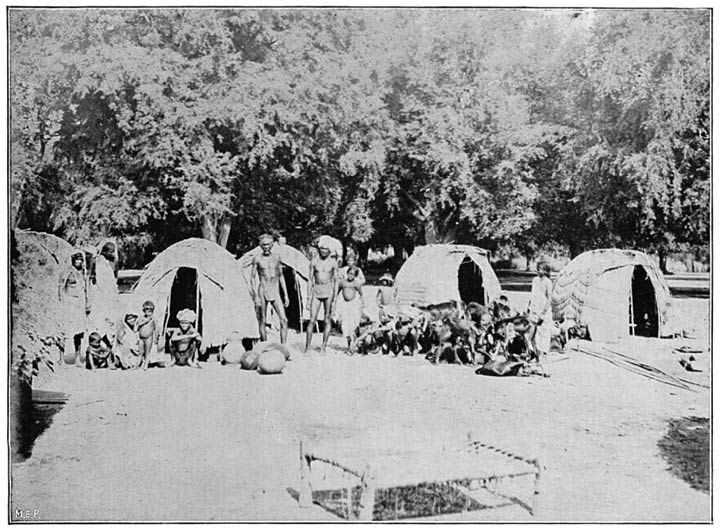
Yerukala Settlement.
The dwellings in which the Koravas live are made with low mud walls and thatched. The wanderers erect a temporary hut called gudisē, with mats or cocoanut or palmyra palm leaves, not more than 4 feet high. It is constructed of crossed bamboos tied together, and connected by another bamboo, which serves as a ridge, over which they fasten the mats.
Procure five white bulls.
Get five white goats.
Get a seer of gold.
Always love your father
And live happy for ever.
Look after your mother always,
Your father and mother-in-law.
Do not heed what folk say.
Look after your relations,
And the God above will keep you happy.
Five sons and four daughters
Shall compose your family.
A predominance of sons is always considered desirable, and, with five sons and four daughters, the mystic number nine is reached.
No widows, women who have remarried, or girls dedicated as prostitutes, are allowed to join the wedding circle, as they would be of evil omen to the bride. Widows and remarried women must have lost a husband, and the prostitute never knows the God to whose service she is dedicated. On the third day, the rice-throwing ceremony is repeated, but on this occasion the bride and bridegroom pour some of the rice over each other’s heads before the women officiate. This ends the marriage ceremony, but, as among some other classes, consummation is prohibited for at least three months, as a very strong superstition exists that three heads should not enter a door within one year. The bride and bridegroom are the first two heads to enter the new home, and the birth of a child within the year would constitute the third. This undesirable event is rendered less likely by a postponement of consummation. After the prescribed time has lapsed, the bride, with feigned reluctance, is escorted by her female relations to her husband’s hut. On the way obscene pleasantries, which evoke much merriment, are indulged in. The bride’s pretended reluctance necessitates a certain amount of compulsion, and she is given an occasional shove. Finally, she is thrust into the door of the hut, and the attendant women take their departure.
The following details in another form of the marriage rites may be noted. The bridegroom proceeds on a Saturday to the settlement of the bride, where a hut has been set up for him close to that of the bride. Both the huts should face the east. On the following day, the headman, or an elder, brings a tray containing betel, flowers and kankanams (wrist-threads). He ties the threads round the wrists of the bride and bridegroom, and also round a pestle and mortar and a crowbar. A distribution of rice to all present, including infants, follows, and pork and mutton are also distributed. Towards evening, married women go, with music produced by beating on a brass tray, to a well or tank, with three pots beneath a canopy (ulladam). The pots are filled with water, and placed near the marriage milk-post. The bride takes her seat on a plank, and the bridegroom is carried on the shoulders of his brother-in-law, and conducted to another plank. Three married women, and some old men, then pour rice over the heads of the pair, while the following formula is repeated: “Try to secure four pairs of donkeys, a few pigs and cattle; live well and amicably; feed your guests well; grow wise and live.” The couple are then taken to the bride’s hut, the entrance to which is guarded by several married women, who will not allow them to enter till the bridegroom has given out the name of the bride. Within the hut, the pair exchange food three times, and what remains after they have eaten is finished off by some married men and women. That night the pair sleep in the bride’s hut, together with the best man and bridesmaid. On the following day, a feast is held, at which every house must be represented by at least one married woman. Towards evening, the bridegroom takes the bride to his hut, and, just before they start, her mother ties up some rice in her cloth. At the entrance to the hut, a basket, called Kolāpuriamma’s basket, is placed. Depositing a winnowing tray thereon, the bride pours the rice which has been given to her on it. The rice is then transferred by the bridegroom to the mortar, and he and the bride pound it with the pestle and crowbar. The tāli is then tied by the bridegroom round the bride’s neck.
In connection with marriage, Mr. Fawcett writes as follows. “A girl’s mother’s brother’s son has the right to have her to wife, and, if his right is abrogated by giving her to another, he (or his father?) receives a penalty from the man to whom she is given. The girl’s maternal uncle disposes of the girl. In the Coimbatore district, however, it is the father who is said to do so; indeed it is said that the father can even take a girl away from her husband, and give her to another for a higher bride-price. Prior to marriage proper, there is the betrothal, accompanied by presentation of betel leaves and draughts of toddy, when the maternal uncle or father repeats a regular formula which is answered word for word by the girl’s party, in which he agrees to hand over the girl for such a price, at the same time requiring that she shall receive no bodily injury or have her hair cut, and, if she is returned damaged physically, payment shall be made according to a fixed rate. It should be said that the betrothal sometimes takes place at a tavern, the favourite haunt of the Koravas, where the bridegroom’s party offers a pail of toddy to the father of the girl and his party. The emptying of this pail seals the marriage contract, and involves the father of the girl into payment of the bride-price as a fine, together with a fine of Rs. 2 for every male child, and Rs. 4 for every female child that may be born. This penalty, which is known as ranku, is not, as a rule, pressed at once, but only after some children have been born. The day of marriage, generally a Sunday, is fixed by a Brāhman, who receives betel nuts, cocoanuts, one rupee, or even less. He selects an auspicious day and hour for the event. The hour selected is rather early in the evening, so that the marriage may be consummated the same night. A few days before the appointed day, two unmarried lads cut a branch of the nāval tree (Eugenia Jambolana), and throw it into a tank (pond) or river, where it is left until the wedding day, when the same two lads bring it back, and plant it in the ground near the dwelling of the bride, and on either side of it is placed a pot of water (brought from the tank or river where the branch had been left to soak) carried thither by two married women under a canopy. The mouth of each pot is closed by placing on top an earthen vessel on which is a lamp. The bride and bridegroom sit on donkey saddles spread on the ground, and undergo the nalugu ceremony, in which their hands and feet are rubbed nine times with saffron (turmeric) coloured red with chunam (lime). The elders bless the couple, throwing rice over their heads with crossed hands, and all the while the women chant monotonously a song such as this:—
Galianame Baipokame Sobaname,
Oh, Marriage giver of happiness and prosperity!
The best oil of Madanapalle is this nalugu;
The best soap seed of Silakat is for this nalugu;
Paint yourselves, Oh sisters, with the best of colours;
Stain your cloth, Oh brother, with the best of dyes;
Bring, Oh brother, the greenest of snakes;
Adorn with it our Basavayya’s neck;
Bring, Oh brother, the flowers without leaves;
Adorn with them the hair of the bride.
Then the bridegroom ties the bride’s tāli, a string coloured yellow with saffron (turmeric), or a string of small black beads. Every married woman must wear a necklet of black beads, and glass bangles on her wrists; when she becomes a widow, she must remove them. A feature of the ceremony not to be overlooked is the wedding meal (pendlikudu). After undergoing the nalugu, the bridegroom marks with a crowbar the spot where this meal, consisting of rice, milk, green gram, and jaggery (sugar), is to be cooked in a pot called bhūpalakunda. A trench is dug at the spot, and over it the cooking is done. When the food is ready, the bride and bridegroom take of it each three handfuls, and then the boys and girls snatch the pot away from them. After this, the couple proceed to the bridegroom’s hut, where they find a light burning. The elders sprinkle them with water coloured yellow with saffron (turmeric) as they enter.”
For the following note on marriage among the Yerukalas of the Vizagapatam district, I am indebted to Mr. Hayavadana Rao. A man may marry the daughter of his paternal aunt or maternal uncle. The father of the would-be husband of a girl goes with ten rupees, called sullaponnu, to her home, and pays the money to one of several elders who are brought together. Towards evening, the ground in front of the girl’s hut is swept, and a wooden plank and stone are set side by side. The bridegroom sits on the former, and the bride on the latter. Two pots of water are placed before them, and connected together by a thread tied round their necks. The pots are lifted up, and the water is poured over them. Contrary to the custom prevailing among many castes, new cloths are not given to them after this bath. Resuming their seats, the couple sprinkle each other with rice. An intelligent member of the caste then personates a Brāhman priest, mutters sundry mantrams (prayers), and shows a string (karugu) with a piece of turmeric tied to it to those assembled. It is touched by them in token of a blessing, and tied by the bridegroom on the neck of the bride. A feast, with a liberal supply of liquor, is held, the expenses of which are met from the ten rupees already referred to. The younger brother may marry the widow of an elder brother, and vice versâ. A widow is married in front of her mother’s hut. The marriage string is tied round her neck, but without the ceremonial observed at the marriage of a maid. If a husband wishes to secure a divorce, he asks his wife to break a twig in two before a caste council. If a woman wishes for a divorce, she elopes with a man, who pays a small fine, called ponnu, to the husband, and asks him to break a twig.
The following story is current among the Koramas, to account for the tāli or bottu being replaced by a string of black beads. Once upon a time, a bridegroom forgot to bring the tāli, and he was told off to procure the necessary piece of gold from a goldsmith. The parties waited and waited, but the young man did not return. Since then, the string of beads has been used as a marriage badge. According to another story, the tāli was prepared, and kept on the bank of a river, but disappeared when it was going to be picked up. A man was sent to procure another, but did not come back.
I am informed that the Yerukalas of the Kistna district are divided into two classes—sheep and goats practically. Of these, the latter are the bastard offspring of the former. Illegitimate must, in the first instance, marry illegitimate. The offspring thereof is ipso facto whitewashed, and becomes legitimate, and must marry a legitimate.
A woman who marries seven men successively one after the other, either after the death of her husbands or after divorce, is said by Mr. Paupa Rao Naidu to be considered to be a respectable lady, and is called Pedda Bōyisāni. She takes the lead in marriages and other religious ceremonies.
It is noted, in the Census Report, 1891, that “if a man is sent to jail, his wife will form a connection with some other man of the gang, but on the release of her husband, she will return to him with any children born to her in the interval. The Korava women are accustomed to honour their lords and husbands with the dignified title of cocks.” On one occasion, a Korava got into trouble in company with a friend, and was sentenced to three years imprisonment, while his friend got two years. The latter, at the termination of his period of enforced seclusion, proceeded to live with the wife of the former, settling down in his friend’s abode. The former escaped from jail, and, turning up at his home, claimed his wife. His friend journeyed to the place where the jail was located, and reported to the authorities his ability to find the escaped convict, who was recaptured, while his friend regained possession of his wife, and pocketed twenty-five rupees for giving the information which led to his rearrest.
The remarriage of widows is permitted. The man who wishes to marry a widow purchases new cloths for himself and his bride. He invites a number of friends, and, in their presence, presents his bride with the cloths. The simple ceremony is known as chīrakattu-kōradam, or desiring the cloth-tying ceremony.
As a general rule, the Korava wife is faithful to her husband, but, in the event of incompatibility, man and wife will announce their intention of separating to their gang. This is considered equivalent to a divorce, and the husband can demand back the four annas, which were paid as earnest money to his wife’s maternal uncle. This is said to be done, whether the separation is due to the fault either of the husband or the wife. Among other castes, the woman has to return the money only if she is divorced owing to her own fault. Divorce is said to be rare, and, even after it has taken place, the divorced parties may make up their differences, and continue to keep house together. In cases of abduction, the father of the girl summons a council meeting, at which the offender is fined. A girl who has been abducted cannot be married as a spinster, even if she was recovered before sexual connection had taken place. The man who carried her off should marry her, and the ceremony of widow marriage is performed. In the event of his refusing to marry her, he is fined in the same amount as the parents of a girl who fail to keep the contract to marry her to a particular person. The fact of a man who abducts a girl having a wife already would be no bar to his marrying her, as polygamy is freely permitted. In former days, an adulterer who was unable to pay the fine imposed was tied to a tree, and shaved by a barber, who used the urine of the guilty woman in lieu of water.
In connection with birth ceremonies, Mr. Fawcett writes as follows. “Difficulty in parturition is thought to be due to an ungratified desire of the woman before she is confined. This is generally something to eat, but it is sometimes ungratified lust. In cases of the latter kind, the Koravar midwife induces the woman to mention her paramour’s name, and, as the name is mentioned, the midwife puts a pinch of earth into the woman’s mouth with the idea of accelerating delivery. The woman is confined in an outlying hut, where she is tabu to all, with the exception of the midwife, for about ten days. As soon as the child is born, incense is burnt in front of this hut, and there is an offering of jaggery (crude sugar) to the spirits of the departed elders, who are invoked in the following words in the Korava dialect:—‘Ye spirits of our elders! Descend on us, give us help, and increase our cattle and wealth. Save us from the Sircar (Government), and shut the mouth of the police. We shall worship you for ever and ever.’ The jaggery is then distributed to all present, and the new-born infant is cleaned with cow-dung and washed. A Brahman is sometimes consulted, but it is the maternal uncle upon whom the responsibility falls of naming the child. This he does on the ninth day after confinement, when the mother and child are bathed. Having named the child, he ties a string of thread or cotton round its waist. This string signifies the entry of the child into the Koravar community, and it, or its substitute, is worn until the termination of married life. The name given on this occasion is not usually the name by which an individual is known by his fellows, as persons are generally called after some physical trait or characteristic thus:—Nallavādu, black man; Pottigādu, short man; Nettakalādu, long-legged man; Kuntādu, lame man; Boggagādu, fat man; Juttuvādu, man with a large tuft of hair; Gunadu, hunch-backed man; Mugadu, dumb man; and so on. In a few cases, children are genuinely named after the household deities. Those so named are called Rāmudu, Lachigādu, Venkatigādu, Gengadu, Chengadu, Subbadu, Ankaligādu, and so on. An old custom was to brand the children on the shoulders with a piece of red-hot iron. Marks of such branding are called the cattle mark, for it seems that children should be branded on the shoulders before undertaking the ‘sacred duty’ of tending cattle. They explain the custom by saying that Krishna, the God of the shepherds, allowed boys of his own caste, and of no other, to perform the sacred duty, after the boy dedicated thereto had undergone the branding ceremony. This ceremony is seldom observed nowadays, as it leads to identification. Birth of a child on a new-moon night, when the weather is strong, is believed to augur a notorious thieving future for the infant. Such children are commonly named Venkatigādu after the God at Tirupati. The birth of a child having the umbilical cord twisted round its neck portends the death of the father or maternal uncle. This unpleasant effect is warded off by the uncle or the father killing a fowl, and wearing its entrails round his neck, and afterwards burying them along with the umbilical cord.”
In connection with the couvade, Mr. Fawcett writes that “it has been observed in the bird-catching Koravars, and the custom has been admitted by others. Directly a woman is brought to bed, she is given asafœtida rolled in betel leaf. She is then given a stimulant composed of asafœtida and other drugs. The husband partakes of a portion of this before it is given to the woman. This custom is one of those which the Koravar is generally at pains to conceal, denying its existence absolutely. The proverb ‘When the Koravar woman is confined, the Koravar man takes asafœtida’ is, however, well known. Very soon after a woman is confined, attention is paid exclusively to her husband, who wraps himself in his wife’s cloth, and lies down in his wife’s place beside the new-born infant. He stays there for at least some minutes, and then makes room for his wife. The writer of this note was informed by Koravars that any one who refused to go through this ceremony would undergo the severest penalties, indeed, he would be turned out of the community. Nothing annoys a Koravar so much as to mention the word asafœtida in his presence, for he takes it to be an insulting reference to the couvade. The worst insult to a Koravar woman lies in the words ‘Will you give asafœtida?’ which are understood by her to mean an improper overture.”
Some Koravas are said to believe that the pangs of labour are largely allayed by drinking small doses of a mixture of the dung of a male donkey and water. A few years ago, when a camp of Koravas was visited in the Salem district by the Superintendent of Police, two men of the gang, who had petitioned for the removal of the constables who were escorting the gang, dragged a woman in the throes of childbirth by the armpits from the hut. This was done to show that they could not move their camp, with a woman in such a condition. Nevertheless, long before daylight on the following day, the camp had been moved, and they were found at a spot fifteen miles distant. When they were asked about the woman, a hut slightly apart from the rest was pointed out, in front of which she was suckling the newly-born infant. She had done the journey immediately after delivery partly on foot, and partly on a donkey.
The Korava child’s technical education commences early. From infancy, the Koravas teach their children to answer “I do not know” to questions put to them. They are taught the different methods of stealing, and the easiest way of getting into various kinds of houses. One must be entered through the roof, another by a hole in the wall, a third by making a hole near the bolt of the door. Before letting himself down from a roof, the Korava must make sure that he does not alight on brass vessels or crockery. He generally sprinkles fine sand in small quantities, so that the noise made thereby may give him an idea of the situation. The methods to be adopted during the day, when hawking wares, must be learnt. When a child is caught red-handed, he will never reveal his identity by giving the name of his parents, or of the gang to which he belongs. A girl about twelve or thirteen years old was captured a few years ago in the Mysore State at the Oregam weekly market, and, on being searched, was found to have a small knife in her cheek. She declared that she was an orphan with neither friends nor relations, but was identified by the police. The Koravas are adepts at assuming aliases. But the system of finger-print records, which has been introduced in recent years, renders the concealment of their identity more difficult than it used to be. “Both men and women,” Mr. Paupa Rao writes, “have tattoo marks on their foreheads and forearms. When they are once convicted, they enlarge or alter in some way the tattoo marks on their forearms, so that they might differ from the previous descriptive marks of identification entered by the police in their search books and other records. During festivals, they put red stuff (kunkuma) over the tattoo marks on their foreheads.”
Their conduct is regulated by certain well-defined rules. They should not enter a house by the front door, unless this is unavoidable, and, if they must so enter it, they must not leave by the same way. If they enter by the back door, they depart by the front door, which they leave wide open. They should not commit robbery in a house, in which they have partaken of rice and curds. Curds always require salt, and eating salt is equivalent to taking the oath of fealty according to their code of honour. They ease themselves in the house in which they have committed a theft, in order, it is said, to render the pursuit of them unsuccessful.
In a note on the initiation of Yerukala girls into the profession of fortune-telling in Vizagapatam, Mr. Hayavadana Rao writes that it is carried out on a Sunday succeeding the first puberty ceremony. A caste feast, with plenty of strong drink, is held, but the girl herself fasts. The feast over, she is taken to a spot at a little distance from the settlement called Yerukonda. This is said to be the name of a place on the trunk road between Vizianagram and Chicacole, to which girls were taken in former times to be initiated. The girl is blindfolded with a cloth. Boiled rice and green gram are mixed with the blood of a black fowl, black pig, and black goat, which are killed. Of this mixture she must take at least three morsels, and, if she does not vomit, it is taken as a sign that she will become a good Yeruka or fortune-teller. Vomiting would indicate that she would be a false prophetess.
When a wandering Korava dies, he is buried as quickly as possible, with head to the north, and feet to the south. If possible, a new cloth is obtained to wrap the corpse in. The grave is covered with the last hut which the deceased occupied. The Koravas immediately leave a camp, in which a death has occurred. The nomad Koravas are said by Dr. Pope to bury their dead at night, no one knows where. Thence originates the common saying in regard to anything which has vanished, leaving no trace behind, that it has gone to the dancing-room of the wandering actors. Another proverb runs to the effect that no one has seen a dead monkey, or the burning-ground of a Korava.
In Vizagapatam, the Yerukala dead are stated by Mr. Hayavadana Rao to be burnt in a state of nudity. A tulsi plant (Ocimum sanctum) is usually planted on the spot where the corpse was burnt. The relations cannot follow their regular occupation until a caste feast has been held, and some cooked food thrown on the spot where cremation took place.
In a note on the death rites of the Koravas of the southern districts, Mr. F. A. Hamilton writes that, when one of the community dies, the news of the death is conveyed by a Paraiyan or Chakkiliyan. At the burning-ground, whither the corpse is accompanied with music, it is laid on dried cow-dung, which has been spread on the ground. The son of the deceased goes thrice round the corpse, and breaks a new water-pot which he has brought with him near the head. He also hands over a piece of burning sandalwood for lighting the pyre, and goes straight home without seeing the corpse again. On the third day, the son and other relations go to the burning-ground, heap up the ashes, plant either tulsi (Ocimum sanctum), pērandai (Vitis quadrangularis), or kathalai (Agave Americana), and pour milk. On the sixteenth day, or at some later time, a ceremony called karumathi is performed. The relatives assemble at the burning-ground, and a stone is set up, and washed with water, honey, milk, etc. On the following day, all the relatives take an oil-bath, and new cloths are presented to the host. Sheep are killed, and a feast, with a liberal supply of liquor, is held. Till this ceremony is performed, the son remains in mourning.
Concerning death ceremonies, Mr. Fawcett writes as follows. “A Tamil proverb likens the death of a Koravar to that of a monkey, for no one ever sees the dead body of either. Just as the monkey is thought to be immortal, the other monkeys removing the carcass instantly, so the corpse of the Koravar is made away with and disposed of with all possible speed. There is very little wailing, and preparations are made at once. If the deceased was married, the bier on which he is carried is practically a ladder; if unmarried, it is a single bamboo with pieces of stick placed transversely. The winding-sheet is always a piece of new cloth, in one corner of which is tied a half anna-piece (which is afterwards taken by one of the corpse-bearers). Only two of these are under pollution, which lasts the whole of the day, during which they must remain in their huts. Next day, after bathing, they give the crows food and milk. A line is drawn on the body from head to foot with milk, the thick end of a piece of grass being used as a brush; then they bathe. Pollution of the chief mourner lasts for five days. Half-yearly and annual ceremonies to the deceased are compulsory. A figure of the deceased is drawn with charcoal on a piece of new cloth spread on the floor of the hut. On either side of the figure is placed cooked rice and vegetables served on castor leaves. After some time, the food is placed on a new winnow, which is hung suspended from the roof of the hut the whole night. Next morning, the relations assemble, and partake of the food.”
From a note on the Yerukalas of the Nellore district, I gather that, as a rule, the dead are buried, though respected elders of the community are cremated. Married individuals are carried to the grave on a bier, those who die unmarried wrapped in a mat. On the second day, some cooked food, and a fowl, are placed near the grave, to be eaten by crows. A pot of water is carried thrice round the grave, and then thrown down. On the ninth day, food is once more offered for the crows. The final death ceremonies are generally performed after two or three months. Cooked food, onions, brinjals (fruits of Solanum Melongena), Phaseolus pulse, squash gourd (Cucurbita maxima), pork, and mutton are placed on a number of castor (Ricinus) leaves spread on the floor, and offered to the soul of the deceased, which is represented by a human figure drawn on a new cloth. At the conclusion of the worship, the food is placed on new winnowing trays provided for the purpose, and given to the relations, who place the winnows on the roof of the house till the following day, when the food is eaten.
By some Koravas, a ceremony in honour of the departed ancestors is performed at the time of the November new moon. A well-polished brass vessel, with red and white marks on it, is placed in the corner of a room, which has previously been swept, and purified with cow-dung. In front of the pot is placed a leaf plate, on which cooked rice and other edibles are set. Incense is burned, and the eldest son of the house partakes of the food in the hope that he, in due course, will be honoured by his offspring.
The Koramas of Mysore are said to experience considerable difficulty in finding men to undertake the work of carrying the corpse to the grave. Should the dead Korama be a man who has left a young widow, it is customary for some one to propose to marry her the same day, and, by so doing, to engage to carry out the principal part of the work connected with the burial. A shallow grave, barely two feet deep, is dug, and the corpse laid therein. When the soil has been loosely piled in, a pot of fire, carried by the chief mourner in a split bamboo, is broken, and a pot of water placed on the raised mound. Should the spot be visited during the night by a pack of jackals, and the water drunk by them to slake their thirst after feasting on the dead Korama, the omen is accepted as proof that the liberated spirit has fled away to the realms of the dead, and will never trouble man, woman, child, or cattle. On the sixth day, the chief mourner must kill a fowl, and mix its blood with rice. This he places, with some betel leaves and nuts, near the grave. If it is carried off by crows, everything is considered to have been settled satisfactorily.
As regards the dress of the Koravas, Mr. Mullaly writes as follows. “The women wear necklaces of shells and cowries interspersed with beads of all colours in several rows, hanging low down on the bosom; brass bangles from the wrist to the elbow; brass, lead, and silver rings, very roughly made, on all their fingers except the middle one. The cloth peculiar to Koravar women is a coarse black one; but they are, as a rule, not particular as to this, and wear stolen cloths after removing the borders and all marks of identification. They also wear the chola, which is fastened across the bosom, and not, like the Lambādis, at the back. The men are dirty, unkempt-looking objects, wear their hair long, and usually tied in a knot on the top of the head, and indulge in little finery. A joochi (gochi), or cloth round the loins, and a bag called vadi sanchi, made of striped cloth, complete their toilet.”