THE SWIMMERS (Natatores).
Thomas Rymer Jones translation
BUT little difference of opinion exists among naturalists as to the limits of our last order; indeed, a swimming bird is at once recognisable by characters so sharply defined that there is scarcely room for doubt or hesitation. The grand character whereby they are all distinguishable is to be found in the structure of their feet, the toes of which are more or less completely united to each other by a broad web by which they are converted into paddles, admirably adapted to propel them through their appropriate element. Hence they swim with facility, and frequent rivers, lakes, and seas. Generally speaking, the Natatores move awkwardly on land, as, in order to render the strokes of their paddle-like feet more effective, their legs are placed more or less behind the centre of gravity, so that when on the ground they have, in a great measure, to retain their balance by muscular exertion, as may be seen in the Goose or Swan as they waddle clumsily over the grass. In some cases these birds are compelled to assume an upright attitude, as do the Auks and Penguins. In the structure of the feet important differences are observable, generally only the three front toes are connected together by the web, but occasionally the hind toe is likewise included in the expansion of the skin, or is provided with lateral appendages that materially enlarge its surface. The form of the body in the swimming birds is boat-like; in those that dive, the ribs are strong and carried back, so as to almost entirely surround the enclosed viscera, and thus defend them from undue pressure. Their plumage is dense, close, and waterproof, consisting of a thick under garment of down overlaid with broad flat feathers, which throw off the water as if their surface were oiled. In many groups the neck is very long and the tail very short, while in others the tail composed of rigid quills is employed as a rudder when the birds are diving. Some are utterly incapable of flight, and use their wings in the water as though they were fins. The members of this order live almost exclusively upon animal food, only a few preferring a vegetable diet. All, without exception, are sociable in their habits; most of them exceedingly prolific, some species, however, lay but one egg. Frequently they crowd their favourite breeding-places in great numbers, and are devotedly attached to their offspring; some will even incubate eggs, and rear young that are not their own.
THE SIEVE BEAKS.
The SIEVE BEAKS (Lamellirostres), according to our usual plan, are placed at the head of the Natatorial order, as in these TOOTH-BILLED and SOFT-BILLED SWIMMERS, as they have been called by various writers, the peculiar attributes of Swimming Birds are most equally developed, and their locomotive capabilities most varied. Whoever examines a Duck with attention, will appreciate the leading features whereby the Lamellirostres are distinguished. Their bill is generally depressed, broad, and always laminated at the sides; the lamination being more prominent in some species than in others, but always so arranged as to form a sieve-like apparatus, by means of which these birds obtain their food, in a manner peculiar to themselves. This remarkably constructed beak, which is seldom longer than the head, is usually straight, broad, and flatly arched above, terminating in front in a broad nail-like appendage, while at the sides it presents a series of horny laminæ, which interlock with similar developments from the under jaw. With the exception of the margins, which are tolerably hard, the entire beak is covered with a soft skin, and is largely supplied with branches of the fifth pair of nerves,[Pg 115] so as evidently to be endowed with great sensibility, as is likewise the tongue, which is large and fleshy except at its sides, which are fringed and toothed with horny ridges. When we observe the use that the Duck makes of this organ, we perceive that, unlike other birds, it discriminates its food, not by sight or smell, but by the sense of touch resident in its tongue. It plunges its beak into the mud, and brings up whatever it may happen to meet with, and from this mouthful of stuff it selects, by the aid of that member alone, whatever is good for food; while what is useless escapes through the straining apparatus at the sides of the bill. In comparison with this remarkable structure of the beak, the other characters whereby these birds are distinguishable become of secondary importance, nevertheless they also are somewhat striking. The slightly elongated body is strongly built, the neck either of moderate length, or very long and slender, the high and narrow head of medium size. The tarsus is small or moderate (or, exceptionally, very high), four-toed, and webbed in front. The moderate-sized wings are somewhat pointed; they consist occasionally of but twelve feathers, and are either truncate or rounded, sometimes wedge-shaped or pointed at the extremity. The plumage is always close, smooth, and well packed with down. The distribution of the various races of these birds is more limited than that of many Natatorial families, and some of them at certain seasons migrate regularly from colder to warmer climates, and vice versâ.
[Pg 116]
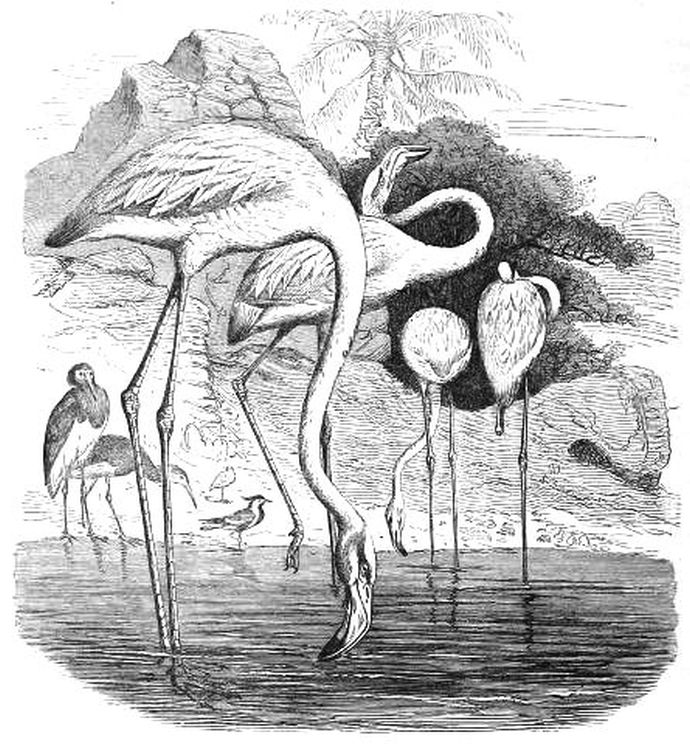
THE FLAMINGO (Phœnicopterus roseus).
The FLAMINGOES (Phœnicopteri), notwithstanding their extraordinary length of leg and neck, which have induced some authors to class them with the Wading Birds, are, both in their general structure and mode of life, most undoubtedly to be regarded as members of the present order, and are, as their internal anatomy teaches, very nearly related to the Swans. Their body is slenderly built, neck very long, head large, and the wings, in which the second quill is the longest, of moderate length; the tail, which consists of twelve feathers, is remarkably short. The peculiarly constructed beak is somewhat longer than the head, higher than broad, but thick and bent down towards the middle, at an obtuse angle. The upper mandible, which is much smaller and feebler than the lower, is remarkably flat; both mandibles are provided at their circumference with the lamellated sieve-like structure characteristic of the Lamellirostres. The whole apparatus very much resembles a box, of which the lower jaw forms the body, while the upper mandible constitutes the lid. This extraordinary bill is covered with soft skin, but is hard at its apex, and towards its base presents a soft cere. The legs, which are most disproportionately long and slender, are denuded of feathers for a considerable distance above the heel; the three front toes are of moderate length, and connected by a broad, slightly-excavated web. The hind toe, which is considerably elevated, is short and feeble. The thick, compact, soft plumage is beautifully coloured, and is exactly comparable to that of other Swimming Birds. The internal structure of the Flamingo has been carefully studied by Wagner, and found to correspond in every particular with that of the Ducks (Anatidæ). Naturalists are at present acquainted with about half a dozen species belonging to this group, and although the history of some of them is far from complete, enough is known to induce us to believe that in their mode of life they differ in no respect from the species with which we are best acquainted. These remarkable birds are widely distributed over the warmer portions of the globe, and are met with principally in Asia, Africa, and South Europe. According to the accounts of both ancient and modern writers, they make their appearance every year in great numbers in the vicinity of the lakes of Sardinia and Sicily, as also in Albufera de Valencia, and other parts of Spain. Along the coasts of Egypt, Tripoli, Tunis, Algiers, and Morocco, they are abundant, as also in Smyrna, and near the banks of the Volga, but are very rarely met with in Greece. Occasionally a few stragglers have been seen as far north as the banks of the Rhine; generally speaking, however, the south coast of Europe must be regarded as their northern limit, and North Africa and Central Asia as their usual habitat. Those species that inhabit the Western Hemisphere are likewise confined within corresponding limits. Lakes of salt or brackish water in the vicinity of sea-coasts are the favourite resorts of the Flamingoes. To lakes of fresh water they are only casual visitants, and never resort to them for any length of time. On the other hand, they are always very abundant on the sea-coast, more especially where the shores are flat and swampy. All are birds of passage, and the migrations of some occur with such regularity that the period of their return may be predicted with tolerable accuracy. According to Cetti, Flamingoes appear in Sardinia about the middle of August, and depart thence in March or the beginning of April. In South Italy they are stationary, remaining in the same locality all the year round. Only those who have had the good fortune to see these birds assembled in flocks, consisting of many thousands, can form an adequate idea of the beauty of their appearance. "Looking from Cagliari to the sea," says Cetti, "it seemed to be banked in with a wall of red bricks, or to be covered with countless numbers of roses. On nearer approach these proved to be Flamingoes ranged[Pg 117] in regular ranks. Aurora herself was never adorned with more roseate tints than the wings of these birds, they seemed literally to glow with pink and carmine. The name of the Flamingo, both in Greek and Latin, was derived from the magnificent hues of their glorious wings, and the French in the epithet flammant only repeat the same idea. The first impression produced by such a spectacle is not easily to be forgotten; the birds stood in ranks, not merely of thousands, but literally of hundreds of thousands, ranged in interminable array. As the sunlight played upon the dazzling white and glowing red, the effect was indescribable; at length, taking alarm at something, the whole body of them rose into the air, displaying their wings to still greater advantage, as they formed themselves into an immense wedge-shaped phalanx, and winged their way far up into the blue sky." When standing quietly upon the shore, the appearance of these birds very much resembles that of an army drawn up in order of battle; the Cingalese call them "English soldier birds," the South Americans simply "soldiers," and indeed not without cause, for, as Humboldt informs us, the inhabitants of Angostura, soon after the establishment of that colony, were one day thrown into a state of great alarm by the sudden appearance of what they took to be a numerous army, and it was only when the supposed enemy took flight to the shores of the Orinoco, that they discovered their mistake. A solitary Flamingo is very rarely seen, never perhaps before the commencement of the pairing season, and even then it must be some young bird that has strayed by accident from its fellows. Usually they keep together in flocks, and carefully avoid any locality where danger might be apprehended. Open waters are usually selected as their fishing-place, and should a boat approach they at once take flight whilst it is still far off, so that it is by no means easy to observe their proceedings, except with the aid of a telescope. In general they may be seen with their legs immersed in the water, or more rarely on the dry shore or on sandbanks with their necks curved in a very peculiar manner (see page 116) in front of the breast, the head being laid as it were upon the back, or buried beneath the shoulder-feathers of the wing; generally the whole weight of the body is supported by one leg, the other being held obliquely backwards or drawn up close to the body; in this strange position the Flamingo sleeps. The manner in which these birds obtain their food is equally remarkable. Like all other sieve-beaked birds, the materials upon which they subsist are procured by raking in the mud. The Flamingo when in search of food, wades into the water to a convenient depth, and then bends down its long neck until its head is upon the same level as its feet; it then plunges its beak, with the upper mandible downwards, into the mud. In this position the bird rakes about at the bottom of the water, moving backwards and forwards with short steps, and opening and shutting its bill whilst its tongue is busily at work. In this manner, by the delicate sense of touch resident in that member, the Flamingo examines the contents of its mouth, retaining what is useful as food, and straining out through the sieve-like apparatus the mud or non-nutritive materials with which it is accompanied. Meanwhile, by the movements of its webbed feet, it is continually stirring up the bottom, and thus putting in motion all the little aquatic animals of which it is in search. The gait of the Flamingo very much resembles that of the Long-legged Waders, but is not exactly similar, although the difference is not easily described. Its steps are longer, more regular, and more vacillating, as might be expected from the extraordinary length of its legs, but at the same time its movements are easy, and differ widely from the accounts given of them by some writers, who tell us that when walking it is compelled to help itself along by its beak. Its beak, however, is occasionally employed to assist it in its movements, as for example, when having bent its legs under its body it lies down upon the ground to rest, and is suddenly obliged to rise from this position, the bill is employed to assist in getting up, but this once accomplished it runs away with tolerable speed in the manner above described. When taking flight from the sea or lake in which it has been feeding, it not unfrequently goes to a considerable distance, half running and half flying over the surface of the water, much after the manner of a Duck or Water-hen. In deep[Pg 118] water it also swims apparently without the slightest effort, and although its progress may be somewhat slower than that of the Short-legged Swimmers, it is evidently more enduring. Its flight, when once it has raised itself out of the water in the manner above described, is light and tolerably rapid, the quick strokes of its wings producing a noise not unlike that which accompanies the flight of Ducks and Wild Geese, indeed, the sound made by the rising of a whole flock has been compared to distant thunder. When fairly on the wing a flying Flamingo could not be mistaken for any other bird, even by the most unpractised novice. Unlike the generality of long-necked birds, it stretches not only its long legs, but its neck straight out, thus presenting an appearance of extraordinary length and slenderness; so that, with its narrow wings exactly in the centre, it assumes pretty much the shape of a cross. When flying together in considerable numbers, the flock, as we have already said, arrange themselves in regular phalanx, either in one long line, or in a wedge-shape like that of the letter V. When descending from a great height, their flight assumes a spiral direction, but just before alighting they sweep forward for a little distance over the water until they find a suitable spot whereon to settle. The loud harsh voice of these birds somewhat resembles that of a Goose. The food of the Flamingo consists principally of water-snails, worms, crustaceans and small fishes, but it by no means despises vegetable substances, and in a state of captivity will eat boiled rice, corn, or soaked bread. Our information concerning the breeding of these birds is not very satisfactory. Labat many years ago gave a very strange description of their mode of incubation, which was subsequently contradicted by Dampier; and later writers have contented themselves with copying these accounts without ascertaining their accuracy. Dampier informs us that "the Flamingoes build their nests where plenty of dirt is procurable. This dirt they rake together by means of their feet, so as to form a hillock, which stands like a little island, a foot and a half above the water, each hillock being of a conical shape, and having a depression at the top, on which the nest is placed." Labat states that the hillocks are solid, as high as the surface of the water, but that above this point they are hollowed like a basin, and that when the birds lay or incubate their eggs, they place themselves upright, not upon the hillock, but close to it, with their feet upon the ground, in such a manner, that leaning against the hillock they cover the nest with their tail. Naumann in the strongest terms refuses to believe either of the above accounts, and from our own observations on the living birds we ourselves quite acquiesce in the doubts he expresses. It is true we have never seen a Flamingo actually engaged in incubating; but at Mensala, in Egypt, where we obtained a full-grown egg from the oviduct of a dead female, we procured the following information concerning the mode of incubation. The Flamingo makes her nest in shallow places in the water, or, as the Arabs assert, upon flat insular spots, overgrown with low vegetation. In the first case the nest is a conical heap of mud scraped together by the feet of the bird, and raised so high that its top is a foot and a half above the water. In the second case it consists of a mere hollow trough, scooped out in the soil and lined with sedge, rushes, grass, and similar materials. The number of eggs laid is generally two, occasionally three. Their shape is elongated, and their shell smooth and of chalky whiteness. The bird when brooding most undoubtedly sits upon her eggs in the usual manner, bending her legs beneath her, and lying flat upon the nest. The duration of incubation is stated to be from thirty to thirty-two days. The young when hatched immediately betake themselves to the water, and swim from the day of their birth. They soon learn to run, but are not capable of flight till a lapse of several weeks. The chase after Flamingoes requires considerable caution. In the daytime they are so timid that it is almost impossible to get within gunshot of one of their numerous assemblages, seeing that while feeding they invariably station some of the older members of the flock to warn them of the approach of danger. The Arabs informed us, however, that they may be procured in considerable numbers by a very simple contrivance. The plan adopted in Egypt is to suspend ordinary fishing-nets between two boats, and in this manner to sail[Pg 119] directly towards the sleeping-place of the birds; thus suddenly awakened, the Flamingoes fly against the nets, in which they are easily captured, and in this manner fifty or sixty are sometimes taken at once. The fishermen on the Lake of Mensala adopt a still stranger plan: after having, by carefully watching a flock, discovered where the sentinels are placed (the latter always remain bolt upright, whilst the rest of the flock sleep with their heads under their wings), a naked fisherman, having his head covered with a bundle of grass or reeds, swims or creeps towards the unsuspecting birds, and suddenly seizing the sentry, plunges his head under water, and breaks his neck before an alarm can be given. The sleepers then become easy victims. This latter account we should certainly not have credited without corroborative evidence. In North Egypt, however, dozens of these beautiful birds may be seen exposed for sale in the markets, where they are eagerly bought for the table; their flesh is excellent, and quite devoid of the oily flavour which we fully expected would have rendered it unpalatable.
The SWANS (Cygni), from their proud looks and majestic demeanour, must ever hold a conspicuous position in the order to which they belong. Their imposing size and elegant appearance at once rivet attention, and closer examination shows that amongst Lamellirostral birds they form a sharply-defined group, easily distinguishable from the Ducks and the Geese, with which they have been sometimes associated. Their body is elongated, their neck very long, and their head moderate. Their beak is straight, of equal breadth throughout, rounded in front, and at its base naked and protuberant. The upper mandible is flatly vaulted above, and terminates anteriorly in a roundish nail. The length of the beak is pretty nearly the same as that of the head; the legs are short, and placed very far back; the middle toe is longer than the tarsus, and the hinder toe, which is small and feeble, is so much elevated that in walking it does not reach the ground; while the web connecting the three front toes is remarkably broad and complete. In the construction of the wing, the relative proportions between the bony framework and the quills is deserving of notice, the former being very long, the latter somewhat short, while the primary quills, of which the second is the longest, are scarcely longer than the secondaries and the tertiaries. The tail consists of eighteen or twenty graduated feathers. On the under surface the plumage is thick and fur-like; on the upper side, on the contrary, the feathers are broad; but everywhere, both above and below, the body is richly covered with down.
With the exception of the equatorial regions of our globe, Swans are to be met with in every climate, but they principally abound in temperate and cold latitudes. In Asia and Europe three species are met with, which occasionally extend their winter visits as far as North Africa. Two of these species are likewise met with in America, together with several others that are peculiar to that continent; while at least one other very conspicuous species is an inhabitant of Australia. The extent over which these several kinds are spread is very considerable, and their migrations extend over a great distance. All the species are migratory, but by no means all the individuals belonging to each, seeing that there are many of them whose residence is within the limits of the temperate zone, that remain all the year round in the same locality, or at all events, content themselves with wandering to some place not very far remote from their usual residence.
The following interesting account of the migrations of these birds is given by Franklin: "About the first of September the Swans leave the Polar Sea, and resort to the lakes and rivers in and about the latitude of Hudson's Bay; there they remain till October, preparing for their departure for the winter, when they collect in flocks of from twenty to thirty, and seizing a favourable opportunity, with the wind not opposed to the direction of their flight, they mount high in the air, form a prolonged wedge, and with loud screams depart for more genial climes. While making either their semi-annual transmigration, or on shorter expeditions, an occasional scream, equal to, 'How do you all come on[Pg 120] behind?' issues from the leader, which is always replied to by some posterior Swan with an 'All's well!' vociferation. When the leader of the party becomes fatigued with his extra duty of cutting the air, he falls into the rear, and his neighbour takes his place. When mounted, as they sometimes are, several thousand feet above the earth, with their delicate outline scarcely perceptible against the clear blue of heaven, this harsh sound, softened and modulated by distance, and issuing from the immense void above, assumes a supernatural kind of tone."
The permanent habitat of the Swans is always upon large lakes of fresh water, or in marshy situations where fresh water is abundant. During their migrations, however, they take up a temporary residence on water of any kind. Their nests are generally placed on rivers or fresh-water lakes, but probably this is only on account of the shallowness of such situations, as after the breeding season some betake themselves to the sea, or wherever food is most abundantly procurable. The Swans are only active in the day, and even their migrations are never carried on by night. In their locomotive capabilities they surpass most other Swimming Birds. Their domain is the water, and it is only unwillingly that they ever venture on dry land; nor do they readily take wing, unless compelled to do so by unavoidable necessity. The very backward position of their legs renders walking on land difficult, so that when on dry ground their gait is heavy and vacillating. Their flight apparently requires considerable effort, more especially when they attempt to rise from the surface of the water; when, however, they have gained a certain altitude, it is extremely rapid. It would appear almost impossible for these birds to rise from the ground, and they never venture to alight on dry land. When beginning their flight from the water, they always stretch out their necks horizontally to their full length, striking the surface with their wings, and splashing with their broad-soled feet; and thus, half flying and half walking, they proceed for a distance of from forty to eighty feet, before they can acquire impetus to enable them to mount into the air. When, however, this is once accomplished, their movements are perfectly easy and free. When alighting from their flight they glide obliquely downwards to the water, and when they have nearly reached it, spread out their webbed feet to stay their headlong career, and moderate the shock of their descent. As relates to their vocal powers, different species of Swans vary considerably; some appear to be mute, but generally speaking their cry may be said to have somewhat the sound of a trumpet, and much resembles the voice of the Cranes. Some commonly, however, only utter a loud hissing or a low muttering noise; in other species, on the contrary, the voice is loud and powerful, and somewhat varied, so that when heard from a distance its effect is by no means disagreeable. The cry of the male is always louder and of a deeper tone than that of the female. The young "pipe," like young Geese. The manners of Swans are gentle, and rather shy, nevertheless they exhibit a certain degree of vanity and consciousness of power, often manifested in their domineering behaviour towards other Water-fowl. Only those of the same species associate in large numbers, and they seem particularly jealous of intruders. The matrimonial engagements of these birds are kept with exemplary fidelity, and last throughout their lives. No sooner have they paired, than the happy couple begin to show the tenderest affection towards each other, manifested by innumerable graceful caresses; they swim together with indefatigable constancy, and should danger approach defend each other with the utmost courage and self-devotion. Their care for their young progeny is equally remarkable. Although the male does not himself actually take a share in the duties of incubation, all his energies seem to be devoted to the protection of his mate during her patient retirement, and he may at such times always be seen, either swimming proudly and defiantly around her, or reposing in the immediate vicinity of the nest, as though to cheer her confinement by his presence. Although the labour of nidification seems to devolve principally upon the female, she is eagerly assisted by her mate, whose employment seems chiefly to be the procuration of materials, which he supplies abundantly, dragging them with his beak, sometimes from[Pg 121] a considerable distance, or pushing them before him in heaps towards the selected locality. The nest, when completed, is a very large but inartistically constructed pile, composed of all sorts of water plants, confusedly heaped together, but surmounted with a finer covering of sedge grass and other softer materials. The place chosen for the situation of the nest is generally some small island, and its size such that it would float even with the weight of its occupants upon it. In this capacious cradle the female Swan lays from six to eight thick-shelled eggs, of a dirty white, or dirty pale green colour, from which, after the lapse of five or six weeks, the young brood make their escape. When first hatched the Cygnets are pretty little creatures, warmly clad in a thick covering of down; after having remained in the nest for a day or so, they venture out and trust themselves upon the water. Sometimes the mother carries them upon her back, sometimes takes them beneath the shelter of her wings, and always watches over them with the greatest tenderness and anxiety, until they are able to take care of themselves. No sooner, however, are they completely fledged, than they finally separate themselves from their parents, never to see them again; for should they next year make their appearance in the same locality, they would at once be driven away, and treated as any other intruders. The food of the Swans is very diversified, consisting of such vegetables of various kinds as grow in ponds and marshes, roots, leaves, and seeds, beetles and their larvæ, worms, snails, tadpoles, and fishes; anything, in short, that affords nourishment. They are not so strictly vegetable feeders as the Geese, neither are they so carnivorous as the Ducks, but in this respect they seem to occupy a middle position between the two. Their food is principally obtained at the bottom of the pond, which, owing to the length of their necks, they are able to reach, even in water of considerable depth; and here they gather aquatic plants, or, straining the mud through their sieve-like jaws, extract such nutriment as it affords.
As the Wild Swans, owing to their great size and strength, are well able to defend themselves against ordinary assailants, they have few enemies to fear, with the exception of the larger Eagles and of the arch-destroyer, man himself, who wages constant war against them, partly on account of their flesh, which affords excellent food, and partly for their feathers and down, the latter of which in particular is extremely valuable. The chase after these birds, however, requires considerable skill and perseverance, owing to their extreme watchfulness and the rapidity of their flight. In the north they are generally pursued in a boat whilst they are swimming in the water; the sportsman taking advantage of a high wind, and then steering with all sail directly towards them, in this manner he is sometimes able to approach them so closely as to get them within range of his gun, more especially as they always prefer to fly right against the wind. In Algeria, as Buvry informs us, they are taken in the same manner as the Flamingoes, by wading towards them under cover of floating herbage, or they are often captured on the shores of sheltered bays by means of hooks, and lines of camel's hair, baited with bread, flesh, or fish. When the bird has swallowed the bait, says Buvry, it must perforce remain quiet until the hunter comes to rescue it from its unpleasant position.
THE MUTE SWAN.
The MUTE SWAN (Cygnus olor), the species so frequently seen in this country living upon our ornamental water in a state of semi-domestication, and sometimes described by writers as the "Tame Swan" (Cygnus mansuetus) is, in its wild state, an inhabitant of Northern Europe and Northern Asia, more especially of Eastern Siberia, and is easily recognisable by the callous protuberance at the base of its bill. Its body is elongate, its neck extremely long and slender, and its bill, which is nearly of the same length as the head, of a red colour, surmounted at its base with the black knob-like protuberance above alluded to. The plumage of the adult is white, that of the young grey, or occasionally white. The eye is brown, the beak red, while the bridles and protuberance at the base[Pg 122] of the beak are black; the feet brownish or pure black. This bird is seventy inches long, and one hundred inches broad; the length of the wing is twenty-seven inches, and of the tail ten to eleven inches; the female is not quite so large. Brehm is of opinion that the Polish Swan (Cygnus immutabilis) of Yarrell, is merely a variety of the above species, but the following extract from a paper, read by Yarrell before the Zoological Society, will give our readers that naturalist's reasons for maintaining that these birds are not identical, although in their appearance, habits, and mode of life, they closely resemble each other. "The London dealers in birds," he says, "have long been in the habit of receiving from the Baltic a large Swan which they distinguish by the name of the Polish Swan. During the severe weather of January, 1838, several flocks of these Polish Swans were seen pursuing a southern course along the line of our north-east coast, from Scotland to the mouth of the Thames, and several specimens were obtained. The circumstance of these flocks being seen without any observable difference in the specimens obtained, all of which were distinct from our Mute Swan; the fact also that the Cygnets, as far as we observed, were of a pure white colour like the parent birds, and did not assume at any age the grey colour borne for the greater part of the first two years by the young of the other species of Swans; and an anatomical distinction in the form of the cranium, which was described by Mr. Pelerin in the Magazine of Natural History, induce me to consider this Swan as a distinct species, and in reference to the unchangeable colour of the plumage, I proposed for it the name of Cygnus immutabilis."
As additional peculiarities of this species, Yarrell notes that "the parent birds were remarkable in having the legs, toes, and their intervening membranes, of a pale ash-grey colour. The black tubercle at the base of the beak was of small size, and there was a slight difference in the nostrils, the elongated openings of which did not reach the black colour at the base of the beak." The Mute Swan, as it has erroneously been called from the fact of its possessing a soft voice very unlike the harsh tones of its wild brethren, utters a somewhat monotonous and plaintive call during the spring, or occasionally later in the season when moving about with its young. Col. Hawker, in his "Sporting Notes," describes this "Swan's melody" as consisting of two notes, C and the minor third E flat, adding that the musician he heard kept working with his head, as though delighted with the sounds he was producing. In England, where these birds live in a state of semi-domestication, they are met with at all seasons. During the period of incubation they live in pairs, and jealously drive away all intruders from the domain they have appropriated for the purpose of building. The nest, which is formed of a mass of reeds and rushes, is placed near the edge of the river or pond, or on an island, and by a most wonderful instinct is frequently raised to a height sufficient to escape a rising of the water even before man himself has observed any indication of such a danger. The eggs are six or seven in number, and have a dull greenish white shell; their length is about four inches by two inches nine lines broad. During the whole period of incubation, which lasts about six weeks, the male is in constant attendance to guard his spouse, boldly chasing off all intruders, and occasionally taking his place upon the nest. When first hatched, the young follow the mother about in the water, and are frequently carried on her back as she sails along the stream. Speaking of these birds in their wild state, Lloyd says, "In flying they make a strange appearance; their long necks protrude, and resemble at a distance long lines with black points; their heavy bodies and triangular wings seeming mere appendages to the prolonged neck. When thus in motion, their wings pass through so few degrees of a circle that, unless seen horizontally, they appear almost quiescent, their movements being widely different from the semicircular sweeps of the Goose. The Swan, when migrating, with a moderate wind in its favour, and mounted high in the air, travels at the rate of one hundred miles or more an hour. I have often timed the flight of the Goose, and found one mile a minute a common rapidity, and when the two birds, in a change of feeding ground, have been flying near each other, the Swan invariably passed with nearly[Pg 123] double the velocity." The Mute Swan was first brought to England from the island of Cyprus by Richard I., and is still regarded as a royal bird which no subject can claim when kept in a public river, except by permission of the crown. Formerly, when this permission was accorded, a Swan mark was granted in order to identify the property of the persons so endowed. In the days of Queen Elizabeth it was ordered that all Swans in the Thames and its tributaries should be "upped," i.e., taken up and marked on the skin of the bill on an appointed day in the presence of the king's Swanherd. This ceremony, known to us as "Swan hopping," was performed annually, until quite recently, upon the first Monday in August. The flesh of this Swan was formerly highly esteemed, and was served as one of the principal dishes on state occasions. The value of one of these birds in the reign of Edward III. may be estimated by the fact, that while the best Capon sold for sixpence, the best Hen for fourpence, and twelve eggs for one penny, the price of a Swan was fixed at four shillings, and the poulterers were forbidden by proclamation to exact a larger sum. The late Bishop of Norwich gave Mr. Yarrell the following account of the manner in which young Swans were formerly fed at Norwich for the table: "The town clerk," he says, "sent a note to the public Swanherd, and to the members of the Corporation there who had Swans and Swan rights. On the second Monday in August the Swans were collected in a small stew or pond (the number varying from fifty to seventy). They began to feed immediately, being provided with as much barley as they could eat, and were usually ready for killing in November; these were all Cygnets. If kept beyond November they begin to fall off, losing both flesh and fat, the flesh also becomes darker in colour and stronger in flavour." A printed copy of the following lines was usually sent with each bird:—
"TO ROAST A SWAN.
"Take three pounds of beef, beat fine in a mortar, Put it into the Swan, that is when you've caught her; Some pepper, salt, mace, some nutmeg, an onion, Will heighten the flavour in Gourmand's opinion. Then tie it up tight with a small piece of tape, That the gravy and other things may not escape; A meal paste, rather stiff, should be laid on the breast, And some whited brown paper should cover the rest. Fifteen minutes at least, ere the Swan you take down, Pull the paste off the bird that the breast may get brown.
"THE GRAVY.
"To a gravy of beef, strong and good, I opine You'll be right if you add half a pint of port wine; Pour this through the Swan, yes, quite through the belly, Then serve the whole up with some hot currant jelly. N.B.—The Swan must not be skinned."
THE WHISTLING SWAN.
The WHISTLING SWAN (Cygnus musicus) has a more compact body and shorter and thicker neck than the Cygnus olor. The beak, which is without the cere, is raised at its yellow base, and tipped with black. This species is sixty inches long, and from ninety to ninety-six broad, the wing measures twenty-four, and the tail eight inches.
The Whistling Swan is a native of the colder latitudes of both hemispheres, but has been known to breed as far south as Greece. In England, where it is only a winter visitor, it is sometimes seen in large flocks, should the season be severe, but very rarely occurs in mild winters. In the eastern countries of Europe it is numerously met with.
The winter peregrinations of this bird take it at certain seasons into Egypt and Northern Africa,[Pg 124] as also to the north-western portions of the African continent, as for example the lakes of Morocco, Algeria, and Tunis. It also sometimes visits Spain. In an easterly direction it is to be met with in great numbers throughout the lake districts of Central Russia, and also near the mouths of large rivers, both in Southern Russia and Central Siberia. Of the Whistling Swans that breed in Iceland, few ever wander far from their native place, and this for a very simple reason, namely, that owing to the Gulf stream which sweeps through its numerous bays and creeks, and the many hot springs derived from volcanic sources, the inland lakes are kept free from ice, while in Russia the swans are all obliged to take their departure before the setting in of winter freezes the lakes and rivers.
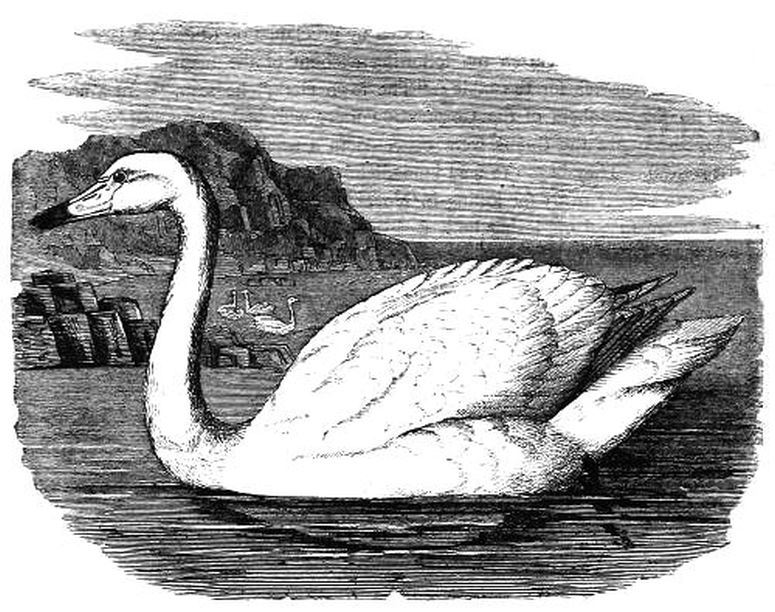
THE WHISTLING SWAN (Cygnus musicus). ONE-SIXTEENTH NATURAL SIZE.
In its general appearance the Whistling Swan bears some resemblance to the Mute or Tame Swan, but is by no means so elegant in its shape. Its neck has not the same flexibility or the same graceful bend; nevertheless, though surpassed in grace by Cygnus olor, it is a very beautiful bird. The main feature in which it differs from other Swans is its loud-toned and agreeable voice. Pallas informs us that "its voice has a sound as sweet as that of a silver bell," and adds, "it sings as it flies, and may be heard at a great distance, indeed all that has been said of the notes of the dying Swan is no fable, for with its last breath the wounded 'Singing Swan' utters its song."
"The epithet musicus," says Faber, "is well bestowed on these birds, for when a little flock of them approaches, flying in the air, their tuneful melancholy voices sound like trumpets heard at a distance. Olaf tells us, "when a company of these birds passes through the air, their song during the long winter nights is truly delightful, equal to the notes of a violin." "It is certain," says Arman, "that the voice of a Singing Swan has a more silvery tone than that of any other creature. When wounded, its breath produces this silver sound, so that its song is celebrated in many a Russian ballad." Oesel says, "Their song consists of two notes, which when uttered by the whole flock are[Pg 125] very loud, and may be heard at the distance of three English miles." "At last," says Homeyer, "I have heard the voice of the Singing Swan. Eight or ten of these birds were swimming about a hundred yards from the shore, and uttering their loud full-sounding notes. I cannot say that any melody was distinguishable; there was first a single, long-drawn, well-sounding note, followed by another in a lower key, so that altogether they formed a sound that was not inharmonious. Notwithstanding the distance at which I was, the notes were brought distinctly to my ear over the water."
Schilling expresses himself still more plainly: "When, owing to the intensity of the frost the water of the sea is frozen, and the streams everywhere converted into ice, and the Swans are thus shut out from all the shallows where they usually obtain their food, these stately birds assemble by hundreds in any patch of water that may be still accessible, and there, with melancholy cries, bewail their destitute condition. At such times during the long winter evenings, and throughout the night, I have often listened to their many-voiced lamentations, which have been heard distinctly at a distance of three or four miles. Sometimes the notes thus heard would resemble the sound of a bell, sometimes that of some wind instrument. Still it was not exactly like either of them, just as a living voice cannot be imitated by dead metal. This peculiar concert realised in my mind the truth of what I had heard concerning the song of the Swan, which I had before regarded as a poetical fiction. Indeed, in one sense it might truly be called the death-song of these beautiful creatures, for, seeing that they are quite unable to obtain their food in deep water, they must soon die of hunger, as they no longer have strength enough to fly to a warmer climate, and are thus often found starved to death and frozen upon the ice; still to the last we hear their clear melancholy voice."
From these extracts we hope the reader will be able to arrive at a more correct idea of the real character of the song of the dying Swan. The poetical notions which have been entertained upon the subject have, it appears, really some foundation, but the facts have been so distorted as to become no longer recognisable. The dying Swan, we find, has nothing peculiar in its notes, but its last cries may be as loud and musical as any others to which it has previously given utterance.
In Russia, we are told, the Whistling Swan is preferred as an ornamental bird to our Tame Swan, principally on account of the loudness of its voice.
Montagu gives the following interesting account of one of these birds which was shot at Bridgewater, and was given to him after it recovered from its wounds:—
"This beautiful and docile creature is now in high health, living with many sorts of Ducks, in the greatest harmony. Towards the spring she becomes more clamorous and impatient of confinement, but at all times will approach those persons who are in the habit of feeding her, and will take food from the hand, at the same time uttering those plaintive harmonious notes for which the species has been remarkable, and which are always attended with a singular jerk of the head. She usually carries her neck straight and erect, either upon the water or when stationary upon land; but in walking the head is lowered, and the neck reclining on the back. In the season of love she flaps along the surface of the water, and would undoubtedly fly if the precaution of annually cutting the feathers of one wing were omitted. Her nature is gentle, timid, and sociable, and she will follow those with whom she is acquainted from one side of the menagerie to the other, especially the ladies of the family dressed in white; is often turned out of her course by a pugnacious male Shieldrake, and acts only offensively when food is the object, and then only when resentment is not expected. She eats but little grass on land, but will devour aquatic plants occasionally. Barley, however, is her principal food, and she never attempts to touch bread, which is sometimes thrown to other birds; nor will she devour small fish, which some of the Diving Ducks greedily eat."
The nesting-place of the Whistling Swan is in the wide swamps of Finland and North Russia; considerable numbers likewise breed in Iceland and North America. In Iceland, Faber tells us, they[Pg 126] may be seen in February upon ponds of fresh water, and there they remain until the end of April, when most of them resort to more elevated situations; some of them, however, remain in the valleys. A small pond or lake is always selected as a breeding-place, and if a pair should not be able to appropriate a whole pond, they take possession of part as their own peculiar property, and resolutely drive away all intruders. The nest, which is sometimes raised upon an island, but often floats upon the water, is generally a huge structure, built of reeds, rushes, sedge, and water-plants, and its cavity carefully lined with down. About the end of April or the beginning of May (probably much earlier in more southern latitudes) the female lays from five to seven yellowish white, greenish, or brownish yellow eggs, from which the young come forth during the first days of July. The faithful husband during the whole period of incubation keeps his partner company, lying upon the nest, but taking no part in the brooding. Towards the middle of October the whole family may be seen swimming about together, the young ones being by that time nearly fully fledged. Throughout the north these Swans are eagerly sought for, and many are mercilessly destroyed during the moulting season. When moulting their wing-quills they are attacked in their breeding-ponds by means of small boats, and numbers of them killed with sticks. Both old and young are at this season very fat, and are in much request for the table.
BEWICK'S SWAN.
BEWICK'S SWAN (Cygnus Bewickii) is considerably smaller than the species above described. In this bird the neck is very slender, the bill much raised at its base, and the tail composed of eighteen feathers; in other respects it resembles the Cygnus musicus. The plumage is at first grey, afterwards white, tinged with rust-red on the crown of the head and under surface of the body, and ultimately becomes of a pale white. Bewick's Swan is an annual visitor to Great Britain, and is most numerously seen during severe and long-continued snowstorms, when it resorts to the open sea-coast of estuaries. Mr. Blackwall, describing a flock of these birds seen in Lancashire, says, "They were observed flying at an elevation not exceeding fifty yards above the surface of the earth. They flew in a line, taking a northerly direction, and their loud calls, for they were very clamorous when on the wing, might be heard to a considerable distance. One individual of this flock having been wounded, was placed on a reservoir, near the place where it fell. When on the water it had somewhat the appearance of a Goose, being almost wholly devoid of that grace and majesty by which the Mute Swan is so distinguished. It appeared to be a shy and timid bird, and could only be approached by stratagem, when it intimated its apprehension by uttering its call. This bird carefully avoided the company of a Mute Swan that occupied the same piece of water." According to Yarrell, some other specimens taken near Belfast were very gentle and timid, and never attempted to molest the Wild Fowl contained in the same pond, though all were their inferiors both in size and strength.
This Swan appears by preference to spend the greater portion of its time on land. Its voice, which is chiefly heard during the migratory season, is a low deep whistle, once repeated. Temminck states that this species breeds in Iceland in May, and has been seen in Picardy during the winter.
THE BLACK-NECKED SWAN.
The BLACK-NECKED SWAN (Cygnus nigricollis) is a beautiful bird, inhabiting South America, and recognisable from its northern brethren by the shortness of its wings, which do not extend beyond the base of the tail, which is composed of eighteen feathers, and by the black in its plumage. In this bird the entire body is white with black head and neck, the former enlivened by a white line upon the brow. The eye is brown, and the beak lead-grey; the cere and bare cheek-stripes are blood-red, and the feet pale red. This species is forty-eight inches long, the wing measures fourteen, and the tail from six to seven inches. The habitat of the Black-necked Swan is limited to the most southern portion of[Pg 127] America, extending from South Peru to the Falkland Islands, and from that point along the east coast as far as Santos in Brazil. The residence of these birds varies with the season of the year; during the spring and autumn they are met with in small parties about Buenos Ayres on their way to their more northern haunts, where they remain throughout the winter, when they return south to breed. During the period of incubation they occupy the lagoons and lakes of the interior, and after that season unite with their own and allied species into large flocks. The flight of this Swan is light and beautiful, but in other respects it is without the grace that characterises most members of this family. While swimming the neck is held erect, after the manner of a Goose. We are without particulars concerning the incubation of these birds, beyond that when first hatched the young are covered with white down, and that they grow with such rapidity that by the autumn they are scarcely distinguishable from their parents. The late Earl of Derby was presented with the first Black-necked Swan ever brought to Europe; to this were afterwards added seven more. After the death of the Earl two were presented to her Majesty, and the rest consigned to the Zoological Gardens, in the Regent's Park, where they lived for many years without breeding. In 1856, however, a pair commenced a nest, but did not lay until the following year, since which time they have incubated annually.
THE BLACK SWAN.
The BLACK SWAN (Cygnus-Chenopsis-atratus) has a slender body, very long neck, and small well-formed head; the beak nearly equals the head in length, and is without a cere. In this species almost the entire plumage is of a brownish black, lightest on the under side, and shading into blackish grey at the edges of the feathers. This sombre garb is relieved by the brilliant white of the primary and of a considerable portion of the secondary quills. The eyes are scarlet, the bridles red, and the feet black: the beak is carmine-red, tipped with white, a stripe near the extremity of the upper mandible is also white. This bird is not quite so large as the Cygnus olor. The Black Swan is not merely strictly confined to Australia, but inhabits only its southern and western districts, occupying the rivers, estuaries, lagoons, and large pieces of water frequently in large flocks. On arms of the sea, which expand into sheets of shallow water, these birds are especially numerous, as in such localities they are beyond the reach of severe winds or pursuit from the natives. "In the white man, however," says Mr. Gould, "the Black Swan finds an enemy so deadly, that it has been almost, if not entirely, extirpated. One most destructive mode in which this is effected, is that of chasing the birds with a boat at the time they shed their primary quill-feathers, when, being unable to fly, they are soon rowed down and captured."
The breeding season is from the beginning of October to the middle of January. Mr. Gould procured newly-hatched young, clad in greyish white, at Southport River, on the 31st of December, and took five newly-laid eggs on Flinders' Island on Bass' Straits, on the 13th January. The nest is large, composed of flags and other herbage, and generally placed on an isolated island. The eggs are from five to eight, pale green stained all over with buffy brown, and are four and a half inches long by two and three-quarters broad. The Black Swan is graceful in demeanour, and gentle and harmless unless molested.
[Pg 128]
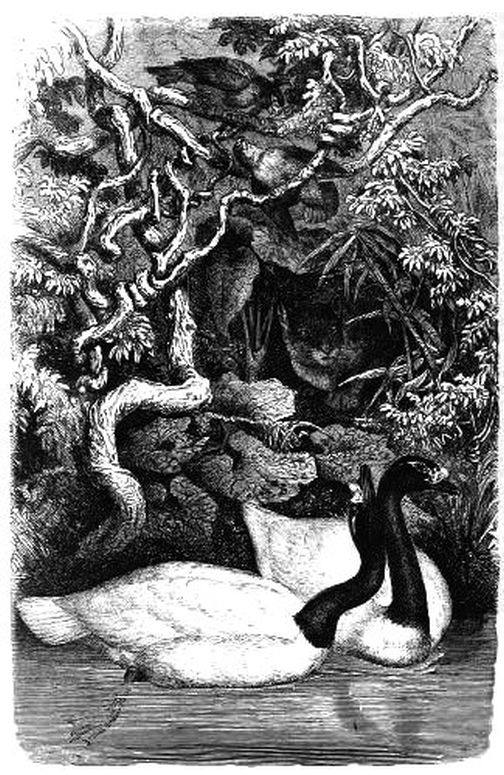
BLACK-NECKED SWANS (Cygnus nigricollis).
These birds are to be found in most aviaries in Europe, but as an instance of their most successful rearing, Mr. Gould gives us the following account of some of them kept on the Wandle, at Carshalton, Surrey, by Mr. S. Gurney:—"They were purchased from Baker, Leadenhall Market, in 1851, but did not breed till 1854, when they laid their first egg on January 1. It was a most severe winter, snow on the ground, and intense frost nearly the whole time they were sitting. They hatched their young during the greatest cold of that winter, from which they did not suffer, though they had no shelter of any kind, and their nest was fully exposed to the east wind. Out of the ninety-three young ones hatched by them up to the present year, 1862 (inclusive), about half that number have been reared. Some of them have died from disease, but most of them have been killed by the old ones dragging them about in the fields, when they have fallen into small holes on their backs, and have not been able to recover themselves. They have bred sixteen times in seven years, having laid 111 eggs."
[Pg 129]
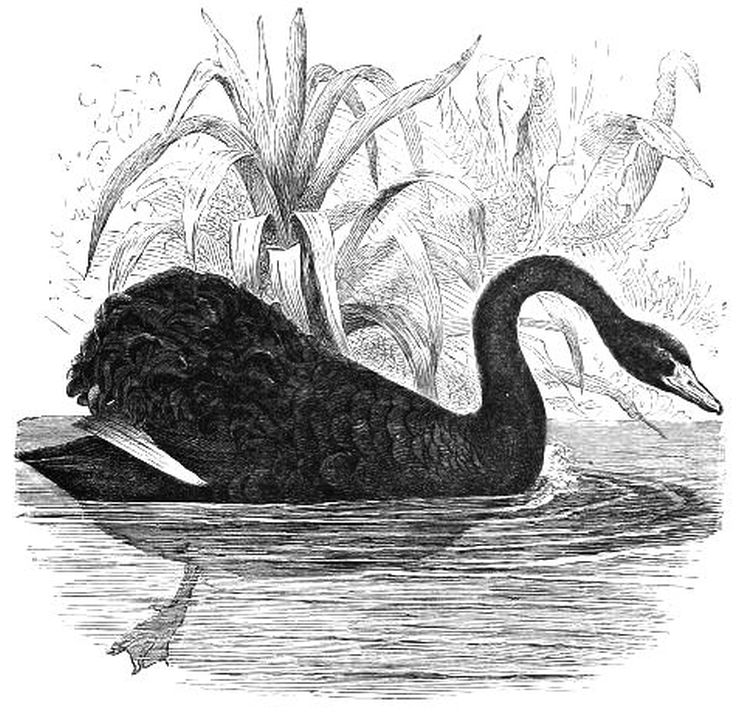
THE BLACK SWAN (Cygnus or Chenopsis atratus). ONE-SIXTH NATURAL SIZE.
The GEESE (Anseres) constitute a very numerous family, whose members are met with in all parts of the world. In these birds the body is compact, the neck short, and the head large; the legs are situated near the middle of the body. The beak, which nearly equals the head in length, and slopes gradually to its tip, is vaulted above and flat beneath, compressed at its sides, and terminated by a large broad nail; its margins are more or less denticulated, and its surface covered with a soft skin. The moderate-sized foot has its three anterior toes united by a large web, and armed with stout, strong, flatly-curved claws. In the large, broad, pointed wing the second quill is longer than the rest, and the upper secondaries are less developed than in the Swan; the wrist-joint exhibits a hard knob, which in some species assumes the form of a powerful spur. The short tail is composed[Pg 130] of from fourteen to twenty feathers, and is either broadly rounded or straight at its extremity. The plumage is very similarly coloured in both sexes, but varies considerably in different groups; the young when one year old resemble their parents. Every division of the world has its own appropriate species of Geese. In Europe, and in Asia, many different kinds are to be met with in almost equal abundance, and in high northern latitudes many are common to the eastern and western hemispheres. Towards the south, however, the habitat of the different races is more sharply defined. The Geese are less exclusively aquatic than any other Lamellirostres; indeed, some of them pass the greater part of their lives on dry land, and a few might almost be called arboreal in their habits, seeing that they not only resort to and roost upon trees, but build their nests among the branches. Most of them prefer plains to mountainous districts; nevertheless, certain species are to be met with at considerable altitudes, both in the Himalayas and the Andes. They walk extremely well, and though in swimming they are neither so graceful as the Swans nor as active as the Ducks, they row themselves along with ease and facility; on an emergency many of them will dive to a considerable depth, and the power and endurance of their flight is remarkable. When flying in companies, they always arrange themselves in a regular V-shaped phalanx, the form of which appears to be of importance; neither is it difficult to understand why they so persistently adopt the same arrangement, as it is evident that such a disposition is the only one that would enable every individual of the numerous party to have a free and unobstructed range of vision, and, moreover, it possibly facilitates their passage through the air, at all events it affords free scope for the use of their wings, which otherwise, from their crowding together, would be seriously interfered with. Very generally a flight of Wild Geese will be seen to press onward with unbroken ranks until they are quite lost in the distance; occasionally, however, they will, as it were, with one consent relax their speed, break up their phalanx, and for a short space become confusedly mixed together. Soon, however, a leader again places himself at their head; his followers resume their ranks, and the whole body moves forward in precisely the same order as before. Their flight is accompanied by a loud rushing noise, caused by the powerful strokes of their wings, and the rising or setting down of a flock presents a very bustling scene. When walking on level ground, the Geese keep the fore part of the body slightly elevated, with their neck straight or somewhat bent. Their steps are short and quick, and upon occasions many species can run with considerable speed. While swimming, the breast is deeply immersed, while the tail, on the contrary, is raised above the surface of the water. Their voice varies with the species; most of them express their anger by loud and prolonged hissing, some cackle, while others, like the Singing Swans, produce loud resonant notes that can be heard at a great distance.
These birds differ very much, both as to the localities they select for their nesting-places, and the season at which they breed. Many species, as spring approaches, begin to assemble in remote morasses and unfrequented swamps, and here upon small islands or hillocks they make a rude kind of nest, composed of water-plants, and lined with down. Some, on the contrary, select the forked branches and hollow trunks of trees, or occasionally convert to their own use the eyries of other birds. Their brood consists of from six to twelve well-shaped, thick-shelled eggs, always of a dull and uniform tint. The usual duration of incubation is about a month. The newly-hatched Goslings are covered with a soft warm coat of greyish down, and soon begin, under the guidance of their parents, to provide for themselves. They run and swim actively on the very day of their birth, and their growth is so rapid, that in the course of a couple of months they are completely fledged. They, however, remain together as a family for a very long period. All Geese live principally upon vegetable diet; by means of the hard margins of their beak they are able to crop grass, and also to collect grain, and a variety of vegetables. They likewise procure various small animals and aquatic plants from the bottom of the water.
[Pg 131]
THE SPUR-WINGED GOOSE.
The SPUR-WINGED GOOSE (Plectropterus Gambensis) is characterised by its large size, slender body, long neck, strong beak, furnished with an excrescence at its base, its unfeathered face, and long bare legs. The feet are provided with long toes, connected by large webs; in the long, pointed wings the upper secondaries are much developed, and the wrist-joint armed with a powerful spur; the tail is of moderate length and wedge-shaped, and the plumage, composed of large feathers, is smooth and compact. In this bird the cheeks, chin, throat, centre of breast, under side, and the short feathers on the upper wing-covers are all white; the rest of the plumage is blackish green. The eyes are reddish brown, the beak and the excrescence at its base blueish red; the feet dull light red. This species is three feet long and five feet and a half broad; the tail measures seven inches. The female is considerably smaller than her mate, but resembles him in the coloration of her feathers; the young are brown on the upper parts of the body, with black wings, a greyish brown neck, and white throat; the rest of their plumage is light grey. The habitat of the Spur-winged Goose extends over the whole of Central and South Africa, where it occupies the borders of streams or rain tanks, in small parties, and seldom wanders to any distance from its usual haunts. During the months of March and July it retires to secluded and marshy localities in order to moult, as at those periods it is unable to fly. At the commencement of the rainy season the flocks separate in pairs, and seek their breeding-places. The large nest, which is formed of rushes, reeds, and grass, is occasionally placed in the water, and contains from three to six eggs. The downy young appear about September or October, and remain with their parents until they are full-grown. Within the first year they acquire the same plumage as the adults, but do not exhibit the excrescence on the bill till they are somewhat older. When in the water the movements of this species resemble those of its brethren, but upon the ground its gait is very similar to that of the Stork. When about to fly it runs for some distance, and then rises with powerful and rapid strokes of its wings to a considerable height; occasionally whilst in the air it may be seen indulging in a very peculiar hovering motion. We have never heard the Spur-winged Goose do more than utter a hoarse hissing sound. According to our own observations it is timid and cautious in its intercourse with man, but appears to take little heed of any of its feathered companions. Yarrell mentions that two specimens of this bird have been shot in England, the one in Cornwall, the other in Yorkshire, and for many years several have been kept in the Zoological Gardens, Regent's Park.
THE GREY OR WILD GOOSE.
The GREY or WILD GOOSE (Anser cinereus), the species from which our Domestic Goose is descended, has the feathers on the upper portions of the body of a brownish grey, edged with a whitish shade; whilst those on the under side are yellowish grey bordered with deep grey. The wing is dark grey, and the region of the rump pure white; the quills and tail-feathers are blackish grey with white shafts, the latter are also tipped with white; the eye is light brown, the beak yellow, and the foot pale red. This species is fully three feet long, and five feet and a half broad; the wing measures eighteen, and the tail six inches. The Grey Wild Goose was formerly very common in the fenny districts of England, but is now comparatively rare both in this country and in Ireland. It is a winter visitor to Orkney and Shetland, but does not remain to breed, passing northwards in the spring.
[Pg 132]
THE CANADA GOOSE.
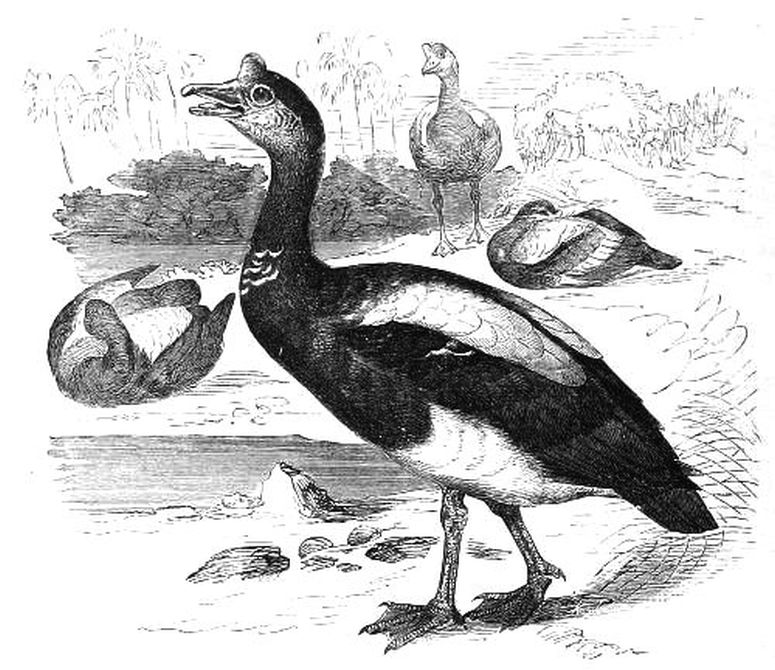
THE SPUR-WINGED GOOSE (Plectropterus Gambensis). ONE-FIFTH NATURAL SIZE.
The CANADA GOOSE (Cygnopsis Canadensis) nearly resembles the Domestic Goose in many particulars, but is recognisable therefrom by its comparatively slender body, long neck, and variegated plumage. In this bird the head and nape are black, and the cheeks, throat, and gullet white or greyish white; the feathers on the upper part of the body are brownish grey with light edges; those on the breast and upper neck dark grey, and those on the rest of the under side pure white; the primary quills are blackish brown; the secondaries and tail (the latter composed of sixteen or eighteen feathers) are black. The eye is greyish brown, the beak black, and the foot blackish grey. The length of the male is from thirty-five to thirty-six inches, and his breadth from sixty-three to sixty-five inches; the wing measures eighteen inches, and the tail seven and a half. The female is not quite so large. The Canada Goose has frequently been shot in this country, and it is therefore included by Yarrell amongst British birds. Large flocks have been seen in Cambridgeshire, and specimens have been killed in Hampshire, Cornwall, and the Scilly Isles. A writer in the Magazine of Natural History also gives an account of a small flock of these birds that frequented and made their nest near Derby. This species, the Common Wild Goose of America, is well known throughout the United States, both as a resident and migratory bird. It advances north about April and May, when the disappearance of the snow and ice allows it to find berries and other vegetable matter; and after feeding for about three weeks, separates from the flock, and with its mate seeks such retired spots for breeding as afford a supply of suitable food. The nest is usually made upon the ground, but occasionally in trees, or in the deserted eyrie of a Raven or Fishing Hawk. During the breeding season the Gander displays his courage to the greatest advantage. Audubon gives the following[Pg 133] account of his personal experience in this particular. "I knew a male," says that writer, "that appeared larger than usual, and of which all the lower parts were of a rich cream-colour. It returned three years in succession to a large pond a few miles from the mouth of the Green River, in Kentucky, and whenever I visited the nest it seemed to look upon me with utter contempt. It would stand in a stately attitude until I reached within a few yards of the nest, when suddenly lowering its head and shaking it, as if it were dislocated from the neck, it would open its wings and launch into the air, flying directly at me. So daring was this fine fellow that in two instances he struck me a blow with one of his wings on the right arm, which for an instant I thought was broken. I observed that immediately after such an effort to defend his nest and mate, he would run swiftly towards them, pass his head and neck several times over and around the female, and again assume his attitude of defiance. Should danger be imminent, the brave Gander urges his mate to fly off, and resolutely remains near the nest until he is assured of her safety, when he betakes himself to flight, mocking, as it were, by his notes his disappointed enemy. Suppose all to be peace and quiet around the fond pair, and the female to be sitting in security upon her eggs. The nest is placed near the bank of a noble stream or lake, the clear sky is spread over the scene, the bright beams glitter on the waters, and a thousand odorous flowers give beauty to the swamp which was of late so dismal. The Gander passes to and fro over the liquid element, moving as if lord of the waters; now he inclines his head with a graceful curve, now sips to quench his thirst, and as noontide has arrived he paddles his way towards the shore to relieve for awhile his patient consort. Carefully tended and taught, the young grow apace, and by the beginning of September are able to fly from one shore to another; then, as the increasing frosts give warning of approaching winter, the separate families unite, and on perceiving the coming of a snow-storm, at the general warning cry of the Ganders, the united flock rises high into the air, and the young are instructed how to move.
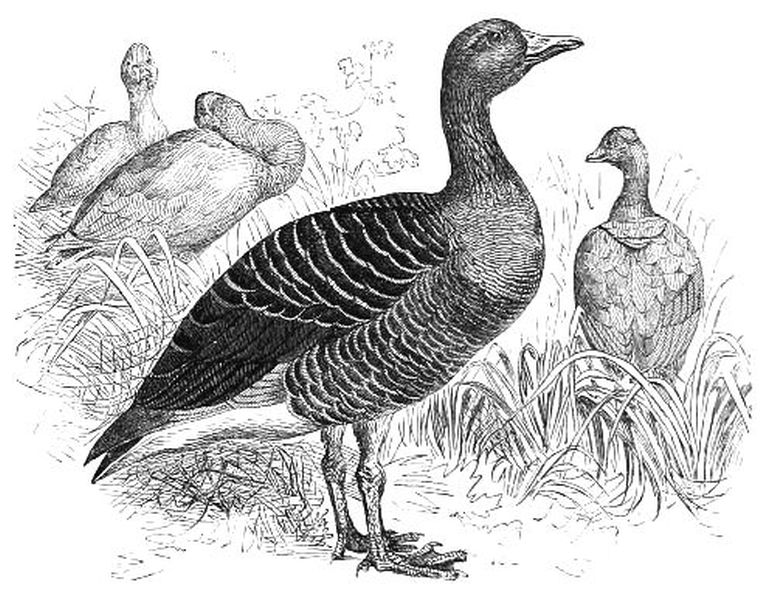
THE GREY OR WILD GOOSE (Anser cinereus). ONE-SIXTH NATURAL SIZE.
[Pg 134]
"But now the host has been marshalled, and off it starts, showing as it proceeds at one time an extended front, at another a single lengthened file, and now arraying itself in an angular form. The old males advance in front, the females follow; the young come in succession according to their strength, the weakest forming the rear. Should one feel fatigued, his position is changed in the ranks, and he assumes a place in the wake of another, who cleaves the air before him. Two, three, or more days elapse before they find a secure resting-place. The fat with which they were loaded at their departure has rapidly wasted; they are fatigued, and experience the keen gnawings of hunger; but now they spy a wide estuary, towards which they direct their course. Alighting on the water, they swim to the beach, stand and gaze around them; the young full of joy, the old full of fear, for they are well aware that many foes have been waiting their arrival. All night the flock remains silent, but not inactive; they betake themselves with care to the grassy shores, where they allay the cravings of appetite, and recruit their wasted strength. Soon as the early dawn lightens the surface of the deep, they rise into the air and proceed southward, until arriving in some place where they think they may be enabled to rest in security, they remain during the winter. At length, after many annoyances, they joyfully perceive the return of spring, and prepare to fly away from their greatest enemy, man."
The Canada Goose arrives in the western districts of that country about the beginning of September, and frequents the lakes, rivers, and wet savannahs of the interior as well as the sea-shore. These birds usually feed by plunging their head and the fore parts of their body beneath the surface, but never by diving. In the fields they pluck the grass sideways, like the Domestic Goose, and pat the earth with their feet to drive the earthworms from their retreats. They frequently alight in corn-fields to feed on the tender blades, and everywhere are extremely vigilant. While the flock reposes, sentinels are placed on the watch to rouse their sleeping companions if danger should approach. If pursued into the water, the Ganders utter loud cries, and in a few moments they rise simultaneously, and fly off in a compact body.
"So acute," says Audubon, "is their sense of hearing, that they are able to distinguish the different sounds or footsteps of their foes with astonishing accuracy. Thus the breaking of a stick by a deer is distinguished from the same accident occasioned by a man. If a dozen large turtles drop into the water, making a great noise in their fall, or if the same effect has been produced by an alligator, the Wild Goose pays no regard to it, but however faint and distant may be the sound of an Indian's paddle that may by accident have struck the side of his canoe, it is at once marked, every individual raises its head and looks intently towards the place from which the noise has proceeded, and in silence all watch the movements of their enemy. I was much surprised one day, while on the coast of Labrador, to see how cunningly one of these birds, which in consequence of the moult was quite unable to fly, managed for awhile to elude our pursuit. It was first perceived at some distance from the shore, when the boat was rowed towards it, and it swam before us with great speed, making directly towards the land; but when we came within a few yards of it, it dived, and nothing could be seen of it for a long time. Every one of the party stood on tip-toe, to mark the spot where it should rise, but all in vain, when the man at the rudder accidentally looked down over the stern, and then saw the Goose, its body immersed, the point of its bill alone above water, and its feet busily engaged in propelling it so as to keep pace with the movements of the boat. The sailor attempted to catch it while within a foot or two of him, but with the swiftness of thought it shifted from side to side, fore and aft, until, delighted at having witnessed so much sagacity in a Goose, I begged the party to suffer the poor bird to escape." The residents in Hudson's Bay eagerly welcome the arrival of these birds, on which they depend for their winter supply of provisions. Huts are built over the marshes where they feed, and decoys set up to lure them to destruction. In some years as many as three thousand or four thousand have been killed in Hudson's Bay, and salted for winter use. The eggs are also[Pg 135] much esteemed, and the feathers form an important article of commerce. The call of the Canada Goose resembles the syllables, "Hawk, hawk, hawk, awhawk, awhawk."
THE SNOW GOOSE.
The SNOW GOOSE (Anser [Chen] hyperboreus) has the entire plumage of a pure white, with the exception of the first ten quills, which are black, with white roots, and white shafts tipped with black. In young birds the feathers on the upper back, shoulders, a portion of the neck, the breast, and sides are blackish grey; the head and nape are shaded with grey; the lower back and feathers on the upper tail-covers are dark grey; the primary and secondary quills greyish black, the latter bordered with greyish white; the tail-feathers are also dark grey, and similarly edged. The eye is dark brown, the beak dull pale red, edged with black, and the foot pale bright red. This species is from twenty-six to twenty-seven inches long, and from fifty-two to fifty-three broad; the wing measures sixteen and the tail six inches.
"The young of this species," says Audubon, "begin to acquire their whiteness about the head and neck after the first year, but the upper parts remain of a dark blueish colour until the bird suddenly becomes white all over, at least this is the case with such as are kept in captivity. My friend Dr. Bachman, of Charleston, South Carolina, kept a male Snow Goose several years along with his tame Geese. He had received it from a friend while it was in its grey plumage, and the following spring it became white. It had been procured in the autumn, and proved to be a male. In a few days it became very gentle, and for several years it mated with a Common Goose, but the eggs produced by the latter never hatched. The Snow Goose was in the habit of daily frequenting a mill-pond in the vicinity, and returning regularly at night along with the rest; but in the beginning of each spring it occasioned much trouble. It then continually raised its head and wings, and attempted to fly off; but finding this impossible, it was anxious to perform its journey on foot, and it was several times overtaken and brought back, after it had proceeded more than a mile, having crossed fences and plantations in a direct course northward. This propensity cost it its life; it had proceeded as far as the banks of the Cooper River, when it was shot by a person who supposed it to be a wild bird." A Snow Goose kept by Audubon himself exhibited the same desire to go northward on the return of spring.
When migrating northward, although they start at the same time, the young and old keep in separate flocks, the young continuing to remain apart from the old even when approaching the higher latitudes. During the whole winter, indeed, they remain divided, although in the same localities; and Audubon informs us that, although the young and old are often seen to repose on the same sand-bar, the flocks keep at as great a distance as possible from each other.
The SEA GEESE (Bernicla) are comparatively small, compactly-built birds, with short necks and moderately large heads; the short delicate beak is strong, broad and high at its base, slender towards its tip, and slightly denticulated at its margins; the foot is low, but powerful; and the wing so long as to extend as far as the tip of the short tail, which is rounded at its extremity. The thick plumage is principally of a deep grey, marked with black, white, and reddish brown. These Geese are met with in the extreme north of Europe, Asia, and America; the American, formerly considered as distinct from the European, being evidently only a variety. The home of these birds is to be found upon the coasts and islands situated between 60° and 80° of north latitude. Only a few breed in Iceland; but in Spitzbergen they are very numerous, and further east they abound throughout the summer along all the shores of the Icy Ocean; they are likewise numerous in Hudson's Bay and the neighbouring waters. From the above inhospitable regions they make annual pilgrimages to warmer[Pg 136] climates, appearing in Great Britain towards the end of October or the beginning of November. At this time they crowd the vicinity of the coast in thousands and tens of thousands; far as the eye can reach they may sometimes be seen wading around the banks of sand and amid the shallows left by the receding tide; their cries are to be heard above the roar of the surf; and the masses, when they take flight and rise into the air, resemble at a distance a thick and wide-spread smoke, their numbers being absolutely incalculable. A few individuals may also be sometimes seen in the interior of the country upon lakes and other large sheets of water; these, however, can only be regarded as stragglers: all Sea Geese well deserve the name, as under ordinary circumstances they never leave the coast. As relates to their ordinary food, these birds differ from Common Geese in so far that, besides grass and marine plants, they eat a considerable proportion of animal food. In northern regions they feed upon whatever is there to be met with. With us they prefer meadow grass and tender herbage. In captivity they readily feed upon grain, to which, however, should be added a considerable proportion of green vegetables.
THE BRENT GOOSE.
The BRENT GOOSE (Bernicla torquata) is black upon the head, neck, quills, and tail; the feathers on the breast, back, and upper belly are dark grey, with light tips; the sides of the belly, rump, and upper tail-covers are white; the sides of the throat are decorated with a white crescent-shaped patch. The young are without the white feathers on the throat, and are darker than the adult birds.
The Brent Geese are constant summer visitors to the British shores, arriving in October and departing about the end of April. These birds are distinguishable beyond all others of the family by the elegance of their movements and their peaceful demeanour; they walk well both upon firm ground and over a muddy surface; they swim rapidly and buoyantly, and dive with facility; their power of flight surpasses that of any other Geese; they do not, however, when flying adopt the wedge-like arrangement so commonly seen among their congeners, but make their way through the air in large noisy flocks, in which the birds are promiscuously crowded together. The noise made by one of these vast assemblages, as they rise from the ground, resembles the roll of distant thunder, and even when flying at a considerable elevation the movement of their wings produces a whizzing sound which is distinctly audible. Their voice is very harsh; the call-note somewhat resembles the syllables "Kn-āng," often repeated; when feeding they utter a rough hoarse "Krōch," while their expression of anger is a low hiss. Like others of their race they always live associated in flocks, and should an unfortunate straggler become accidentally separated from his companions, he may be seen flying anxiously about in search of others of his species, never resting until once more safe in their society. The behaviour of these birds in the presence of man proclaims them at once to be unsophisticated children of the north, who have never experienced the tender mercies of their arch-enemy. They seem at first to witness his approach without any suspicion of danger, and it is only after suffering severely for their temerity that they become wild and distrustful. On their first arrival, indeed, whole families of them may sometimes be killed with stones and clubs, and they are taken in snares more easily than most other Geese.
"In calm weather," says Colonel Hawker, "these Geese have in general the cunning to leave the mud as soon as the tide flows high enough to bear an enemy, and then they go off to sea and feed on the drifting weeds. To kill Brent Geese by day, go out in a small punt at low water, and keep as near as possible to the edge of the sea. You will then hear them like a pack of hounds in full cry, and they will repeatedly pass within fair shot, provided you are well concealed, and the weather is windy to make them fly low. Before you fire at them, spring suddenly up, and these awkward birds will be in such a fright as to hover together and present a mark like a barn door. The Brent Geese[Pg 137] when fat are excellent eating." In confinement they are at first exceedingly timid, but soon become reconciled to their new condition, and even show marked attachment to those who feed them, coming at their call, and, if kindly treated, following their footsteps like dogs. In a farmyard, or upon a large pond, they are extremely ornamental, and deserve much more attention than they have as yet received. The Brent Geese have been long known to breed in considerable numbers on the shores of Spitzbergen, but it is only recently that we have had any definite accounts of their proceedings. Malmgren tells us that their breeding-places are chiefly to be met with in the western and northern coasts of the island, and on the rocks in the vicinity, more especially in places resorted to by Eider Ducks. Their nests are very rudely constructed with the stems and leaves of water-plants, and are often placed so close to those of the Eider Duck that those birds frequently steal their eggs in great numbers. The brood of the Brent Goose consists of from six to eight comparatively small, thin-shelled, lustreless eggs, of a dirty, greenish white colour. Middendorf found a young bird newly hatched about the middle of July. Further than this we have no information.
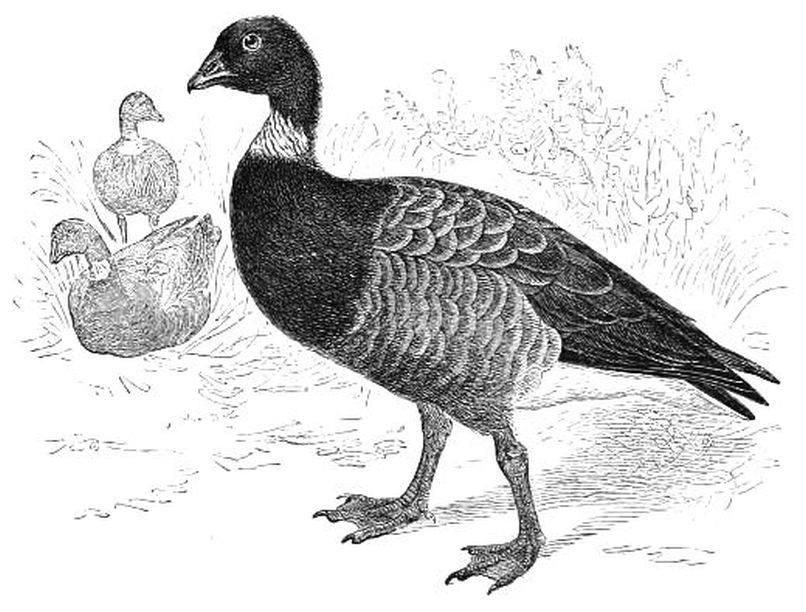
THE BRENT GOOSE (Bernicla torquata). ONE-FIFTH NATURAL SIZE.
Upon the southern coasts of the Baltic and in Holland, during the spring and autumn, thousands of these birds are shot, and a still greater number captured by means of decoys. Their flesh is much esteemed, but has occasionally a disagreeable rancid taste, probably owing to the shell-fish upon which they feed. To remedy this, it is usual in Holland to keep them for some time before they are killed, feeding them with grain and other vegetable diet.
The FOXY GEESE (Chenalopex) are at once recognisable from the above species by their slender neck, large head, short beak, high foot, broad wing, and beautiful plumage. The somewhat feeble bill, which is raised at the base and depressed towards the tips, terminates in a broad, round nail; the partially bare foot is slender, and furnished with small toes; the wings exhibit a slight spur[Pg 138] at the wrist-joint, and have the upper secondary quills well developed; the short tail is composed of fourteen feathers. The members of this group are natives of Africa and Syria.
THE NILE GOOSE.
The NILE GOOSE (Chenalopex Ægyptiacus) has unusually variegated plumage. In this species the sides of head and front of the neck are yellowish white, finely dotted; the patch around the eye, the nape, and a broad band about the throat, are reddish brown; the feathers on the upper portions of the body are grey and black, and those of the under side reddish yellow, marked with black and white; the centre of the breast and belly are of lighter shade, and the former is decorated with a large, round, reddish brown patch; the white wing-covers are striped with black and enlivened by a fine metallic lustre; the tips of the quills and the tail-feathers are glossy black; the eye is orange or yellow; the beak blueish red with blueish grey base, and light tip to the upper mandible; the foot is reddish, or light yellow. This bird is two feet three inches long and four feet and a half broad; the wing measures sixteen inches and the tail five inches and a quarter. The female is smaller than her mate, but nearly resembles him in her general appearance; her plumage, however, is not so finely marked, and the patch upon her breast of inferior size.
The head-quarters of the Nile Goose extend from Egypt to the Cape of Good Hope, and from the east coast far into the interior of Africa; along the west coast of that continent it probably does not occur. From Africa its range extends throughout Palestine and Syria, reaching as far as Greece, Italy, and the south of Spain. During our travels in Africa we had abundant opportunities of observing these beautiful birds, whose portrait is not unfrequently to be seen sculptured upon the monuments of ancient Egypt. In Lower Egypt they are abundant all along the Nile, except in such places as are particularly unsuited to their habits; as, for example, where the river washes walls of bare rock, or where no islands are to be met with. In Southern Nubia they are to be seen in large flocks; in Soudan they are regular occupants of the banks of the rivers, and are even met with upon pools of rain-water, as well as large ponds, at a considerable distance from their banks. During the breeding season these birds generally occur in pairs, afterwards in company with their young families; but at a later period they associate together in large flocks, and in the moulting season, during which they are not incapable of flight, innumerable hosts of them may be seen crowding the shores of the river for hours together. On one occasion during our journeyings along the White Nile, for three successive days we found the banks crowded with countless birds, of which the Nile Geese formed a very conspicuous portion; they are, however, never to be seen at any great distance from water, except, indeed, when winging their way high in the air. They seem, moreover, to prefer certain parts of the river, from whence they fly into the neighbouring fields in search of food, returning to them again when their hunger is satisfied. Each pair takes possession of a certain space of ground, from which they jealously expel all intruders; nevertheless, the males readily associate with each other, and may often be seen together apparently enjoying a quiet chat, or occasionally a bit of fighting. The personal endowments of the Nile Geese are quite on a par with the elegance of their plumage. In running they emulate the long-legged Spurred Geese; they swim gracefully and without effort, keeping the fore part of their bodies deeply immersed; they are able, moreover, to dive to a considerable depth, rowing themselves along when under water both with their feet and wings. Their flight is noisy, but light and rapid. When flying in pairs, one follows close behind the other; when in large flocks, they frequently observe no regular order, except they are bound upon a long journey, on which occasions they adopt the V-like phalanx. Their voice has some distant resemblance to that of our Domestic Goose; it is, however, hoarse, and reminds the listener of the notes of a cracked trumpet. In all its proceedings this Goose seems to be particularly cautious and circumspect; always watchful[Pg 139] for its own safety, it mistrusts the slightest approach of a stranger, and in this respect is more afraid of a foreigner than of the negroes, with whose appearance it is most familiar. Its temper and disposition are by no means in accordance with the beauty of its appearance; indeed, it must be classed with the most domineering and vicious of its race, for although living in society it can hardly be said ever to be at peace with its companions. During the pairing season the battles between the males are literally to the death (at least so we have found it in some that we kept in confinement); they follow one another with loud cries and unappeasable fury, bite savagely, and beat each other with their wings until one or both fall exhausted to the ground. The Ganders seem to delight in tyrannising over all the other inmates of the pond, and not content with persecuting Ducks and Geese considerably larger than themselves, such is their boldness and audacity that they will sometimes attack even man himself. Should one of them encounter another male of his own species, either alone or accompanied by a female, it will fall upon him as though it were a bird of prey, and should it be unable to kill him by blows inflicted with the beak and wings, will try to drown him. No sooner is the vanquished bird so exhausted as to be unable to resist, than, mounting upon its body, the victor seizes it by the neck and holds its head under water until life is quite extinct. With such dangerous propensities it is not to be wondered at that this species, notwithstanding the vivacity of its manners and the beauty of its appearance, is scarcely admissible among other birds.
The food of the Nile Goose is of a very promiscuous character; like our own Wild Geese it may be seen grazing in the fields upon all sorts of vegetables; after the manner of Ducks it obtains nutriment from the mud of shallow pools, and will even dive to the bottom of rivers in search of what is there procurable. At certain seasons the young birds are passionately fond of locusts, and neither old nor young have the slightest objection to animal food; they do not, however, appear to eat fishes. It may occasionally happen in places where no trees are to be met with that these birds construct their nests upon the ground, but wherever there are woods coming to the water's edge, or even single trees of suitable dimensions, their nests must be looked for among the branches. In Africa they generally select for this purpose the thorny mimosa, known among the Arabs as the Harahsi. Their nest is very generally constructed of branches derived from the tree itself, inter-mixed with smaller twigs, and warmly lined with grasses.
The number of eggs, according to our own experience, varies from four to six; our black hunters nevertheless asserted that they had taken ten or twelve from a single nest. The eggs are of very round shape, thick-shelled, smooth, and of a yellowish or greyish white colour. The breeding-time of these birds varies according to the season. In Egypt breeding commences about the beginning of September. From individuals kept in confinement we have ascertained that the period of incubation extends over twenty-seven or twenty-eight days, and that only the female sits upon the eggs. During this period the Gander keeps careful watch, sitting constantly close to his mate and giving timely warning of the approach of any intruder. Once a day, and that always in the afternoon, the breeding female leaves her nest, having previously covered her eggs warmly with down. The young are able to run about immediately after leaving the egg, and on the slightest alarm hurry at once into the water, where they immediately dive; their education very much resembles that of the goslings of the Grey Goose.
In Egypt the Nile Goose is much sought after both by Turks and Europeans. Its flesh differs little as an article of food from that of the Wild Geese; that of the young birds is excellent, but the old are hard and tough, nevertheless they make capital soup.
The DWARF GEESE (Nettapus) form a distinct group, whose members occupy South Asia, Africa, and Australia. These birds are characterised by their small beak, which is high at the base,[Pg 140] slopes gradually to the tip, and is furnished with very short, broad denticulations; their wings are abruptly rounded, and their tail composed of twelve feathers.
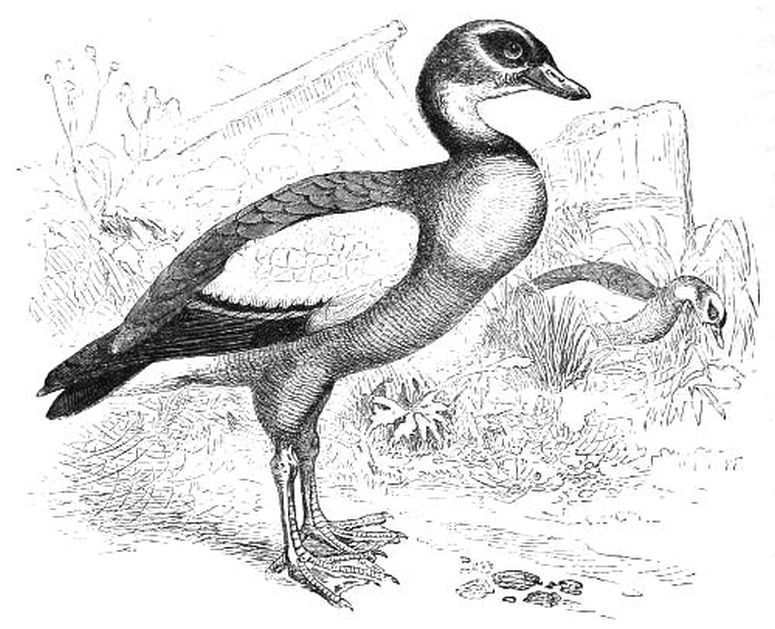
THE NILE GOOSE (Chenalopex Ægyptiacus). ONE-FOURTH NATURAL SIZE.