THE STILT-WALKERS (Grallatores). (continued 3)
Thomas Rymer Jones translation
The FALCINELS (Falcinellus) constitute a group of the above birds, possessing a slender body, moderately long neck, thin, curved, and long beak, medium-sized foot, and somewhat broad, rounded wings, in which the second and third quills are the longest; the tail is short, the plumage thick, and the face bare.
THE GLOSSY IBIS.
The GLOSSY IBIS (Falcinellus igneus), a European representative of the above group, is of a brownish red on the throat, breast, belly, legs, and upper portions of the wings. The crown of the head is dark brown, shaded with red; the back, tail, and quills are brown, with a green or violet sheen. The eye is brown, the bare circles around it greenish grey; the beak dull dark green, and the foot greenish grey. During the winter the head and throat are black, and the feathers lower down of a lighter shade, with white edges; those on the upper part of the body exhibit a mixture of copper-colour and green; the under side is brownish. This species is from nineteen to twenty-three inches long, and from thirty-five to thirty-eight broad; the wing measures from thirteen to fourteen inches, and the tail three inches and a half.
The Glossy Ibis frequents the whole of Central Europe, a large portion of Asia, and Northern Africa, and visits the central and western portions of the latter continent. During its migration, it is met with in India in large numbers during cold weather, whilst in Egypt it remains throughout the year. In Central Europe it arrives about the end of April, and leaves again from August to September. It is reported to have even visited Great Britain. "The Ibis," says Montagu, "is adopted as part of the arms of Liverpool, and formerly, if not at present, stood conspicuous on the Guildhall in golden array. It was termed the 'Liver,' from which that flourishing town derived its name, and is now standing on the spot where the 'Pool' was, on the verge of which the Liver was killed." Aristotle records that the Glossy Ibis, or Liver, was called "Leheras," or "Jeheras," by the ancient Egyptians.
River-banks, edges of large tanks, djeels, swamps, and inundated paddy-fields, are the favourite resorts of these birds, affording them a plentiful supply of the mussels, fish, small reptiles, and similar fare, for which they wade deep into the water during the winter months; whilst in summer, on the contrary, they subsist principally upon larvæ, worms, and insects of various kinds, seizing their prey with great dexterity, even when upon the wing. They roost at night in beds of large reeds, and fly in flocks, which move with remarkable regularity, and generally assume the form of a wedge. The loud call of the Glossy Ibis is often uttered in flight and when alarmed. It is now fully ascertained that these birds breed in Europe, and we have to thank Löbenstein for an account of their nests, as seen by himself in the Donautiefländer. These nests were situated in a reed-covered marsh, and placed on[Pg 56] willow bushes, usually at eight or ten feet from the ground. In many instances the nests, which were somewhat numerous, proved to be those of other birds, repaired and lined with straw for the reception of the young. The three or four oval-shaped eggs were about the size of those of the Domestic Hen, and had a thick, blueish green, or pale green, shell. The flesh of the Glossy Ibis is excellent.
THE SCARLET IBIS.
The SCARLET IBIS (Ibis rubra) resembles the species last described in most respects, with some slight difference in the construction of the wings and tail; in the former the third quill is larger than the rest: the face is bare. In the adult bird the plumage is of a uniform bright scarlet, only varied by the blackish brown on the outer web and tips of the quills; the eye is yellow; the beak brown at its extremity, with a flesh-red base; the bare broad bridles and the throat are of the latter colour; and the foot of a somewhat lighter shade. The length is twenty-four inches; the wing measures ten and the tail three inches. In the young the plumage on the back is pale brown, the under side of a whitish hue, and the beak yellowish; the bare face and legs are flesh-red. After the moulting, these colours are paler and greyer; and after the second moulting are exchanged for a pale rose-red, which, at each succeeding change becomes deeper, till it attains the magnificent scarlet of the adult bird. Central America and the northern portions of South America as far as the Amazon are the native haunts of this fine species, and from thence it wanders forth occasionally into the most southern of the United States. Edwards gives the following interesting account of a flock of these beautiful birds that he met with in a cane-brake near the forests bordering the river Amazon:—"In this part the Scarlet Ibis had nested, and the bended tops of the canes were covered with half-grown birds in their black plumage, interspersed with many in the brilliant scarlet plumage of the adult. They seemed little troubled at our approach, merely flying a few steps forward, and crossing the stream. Continuing our road, the flocks increased in size, the red birds became more frequent, and the canes bent over with their weight like reeds. Wood Ibises and Spoonbills were likewise numerous. The nests of all these filled every bit of ground where a nest could be placed; and the younger Ibises, covered with down, and standing like so many Storks, their heavy bills resting upon their breasts, and uttering no cry, were in strong contrast to the well-feathered Spoonbills, beautiful in their slightly roseate dress, and noisily loquacious. Their mode of feeding their young is remarkable. In the throat of the old female Ibis, directly at the base of the lower mandible, is a dilatation of skin forming a pouch, which is capable of holding the bulk of a small Hen's egg. She would return from fishing on the shallows with this pouch distended by tiny fishes, and allowed her young to pick them out with their bills."
The flight of this Ibis is lofty and strong, and it utters a loud and peculiar cry as it passes through the air. According to Sagra, this species breeds in December and January. The eggs, three or four in number, are laid upon the ground, and have a greenish shell. Schomburghk states that young and adult birds do not associate with each other, but unite in distinct bands. The Scarlet Ibis is sometimes domesticated, and accompanies the poultry, occasionally showing great courage in defending itself, not only from their attacks, but from those of cats. The flesh is generally esteemed as good food, and the rich and gaudy plumage is used by the Brazilians for various kinds of ornamentation.
THE WHITE, EGYPTIAN, OR SACRED IBIS.
[Pg 57]
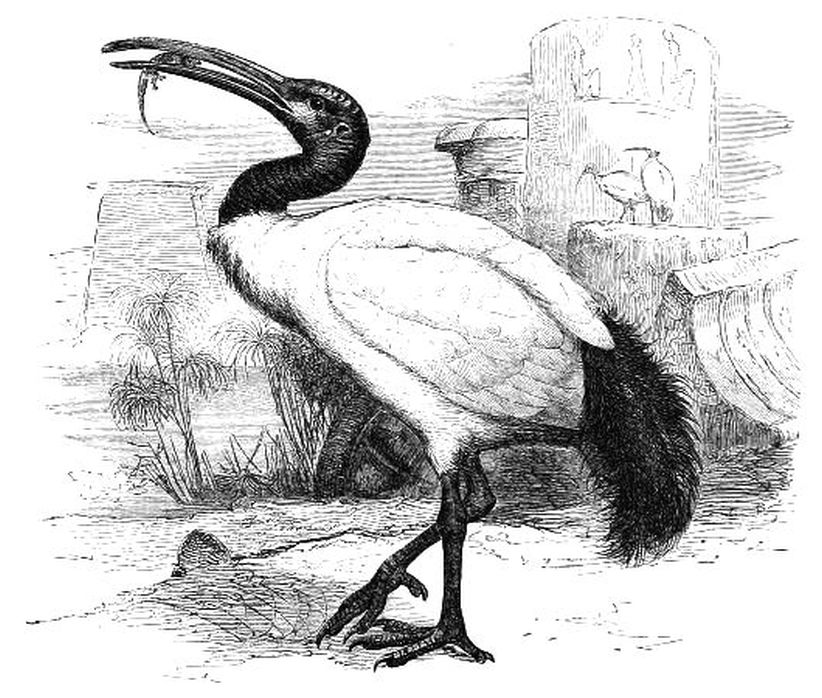
THE WHITE OR SACRED IBIS (Threskiornis religiosa). ONE-FIFTH NATURAL SIZE.
The WHITE, EGYPTIAN, or SACRED IBIS (Threskiornis religiosa, or Geronticus Æthiopica), represents a group having the head and neck bare, and the webs of the shoulder-feathers disunited or open, and loose at their extremities. The plumage is principally white, with a yellowish shade on the wings, and blueish black tips to the quills and shoulder-feathers. The eye is carmine-red, the beak black, and the foot blackish brown. The bare black skin on the neck is of a velvety texture. In the young birds the head and throat are covered with dark brown and blackish feathers edged with white; the rest of the plumage resembles that of the adult bird. After the first moulting the young attain the streaming shoulder-feathers, but only exhibit the bare head and neck in their third year. This species is from twenty-eight to twenty-nine inches long, and fifty-one broad; the wing measures from thirteen to fourteen, and the tail six inches. This bird has been the subject of many strange tales from the most remote times, and is called the Sacred Ibis because it figures extensively, and evidently in a religious character, on the hieroglyphics of ancient Egypt. It is not improbable that the estimation in which it was held arose from the fact that its annual appearance was coincident with the rising of the Nile, a phenomenon on which depends the prosperity of the whole country. According to our own observations, this species is now but rarely seen in Egypt, and was never met with by us below eighteen degrees north latitude; it, however, occurs regularly in South Nubia and the Soudan, where it arrives at the beginning of the rainy season, and after having reared its young, migrates, or wanders over the country to a considerable distance. In India it is not uncommon during the cold season. River-banks, marshes, tanks, and water-courses are the situations it usually frequents in search of aquatic insects, molluscs, and probably small reptiles, or it flies in small parties over the steppes in search of grasshoppers, beetles, and similar fare. This Ibis was formerly supposed to destroy and eat snakes, and the supposition appeared corroborated by the fact that[Pg 58] Cuvier actually discovered the remains of a snake within the body of a mummied Ibis; recent specimens, however, seldom contain anything but molluscs and insects. Some seem to feed entirely on fishes and aquatic insects, of which they destroy far more than they can possibly consume; and it is not uncommon for them, when tired of killing fish and fully satiated, to leave the rest to be devoured by birds of prey or some of the other frequenters of the water. When desirous of procuring food of this description, they walk with a slow firm step, and in large parties, through shallow muddy lakes, and when they have discovered a suitable and well-stored spot, they dance, as it were, all through it, stirring up the mud at the bottom with their feet. The victims as they rise to the surface are immediately struck with the long beak and deprived of life. In the course of a very short time hundreds of fishes, frogs, and reptiles cover the surface, and are greedily swallowed till the birds become perfectly gorged. We were fortunate enough to discover a breeding settlement on a small island in the White Nile, and found that the Ibises had built principally on the branches of a very thorny and thickly-foliaged species of mimosa, called by the natives "Harahri." The nests were flat, loosely constructed of thin twigs and grass, and placed close together on the densest branches. The three or four white coarse-shelled eggs were of about the size of those laid by the Domestic Hen.
The SPOONBILLS (Plataleæ) constitute a small group of very remarkable birds, possessing a powerful body, moderate-sized, strong neck, and small head; the long almost straight beak is flat and spoon-shaped towards its extremity, its interior is grooved, and the upper mandible hooked and nail-like at its tip. The strong, medium-sized foot has the three anterior toes much webbed, and furnished with small blunt claws. The wings are large and broad, and have the second quill longer than the rest; the tail is short, rounded, and composed of twelve feathers. The remarkably thick plumage does not vary either in the sexes or at different seasons, but changes its hue somewhat as the birds become older. The back of the head is adorned with a crest, and the upper throat is bare; in some instances a portion of the crown is also unfeathered. The members of this group occupy almost every portion of the globe, and resemble each other very closely in their mode of life and habits.
THE COMMON SPOONBILL.
The COMMON SPOONBILL (Platalea leucorodia) has a portion of the throat bare, and the head adorned with a flowing crest. The plumage of this bird is entirely pure white, except a yellowish stripe around the crop. The eye is carmine-red, the beak black tipped with yellow, the foot black, the eye-ring yellowish green, and the throat greenish yellow. The female is smaller than her mate; the young are without the yellow patch on the breast, and have no crest. This species is from thirty to thirty-one inches long, and fifty-two inches broad; the wing measures seventeen, and the tail five inches.
Such of these remarkable birds as inhabit Central Asia remain throughout the entire year; whilst those frequenting more northern latitudes arrive with the Storks about March or April, and leave about August or September. During the course of these wanderings, the British Islands are occasionally, but rarely, visited. As with the Ibises, the migrating flocks assume the form of two diverging lines, and usually travel in the day, resting from time to time in such localities as afford a good supply of food. The shores of rivers and lakes, marsh land, or slimy muddy spots upon the coast are the favourite resorts of the Spoonbill, and around these it is constantly to be seen stalking slowly, or wading with body bent and bill waving from side to side as it searches amongst the mud, or snatches from the water the fish, crabs, mussels, snails, small reptiles, and aquatic insects on which it mainly subsists. This bird, however, has a very decided preference for fish diet, and exhibits wonderful dexterity in disposing of the slippery prey, even if five or six inches in length, seizing[Pg 59] and turning them adroitly in its beak, and swallowing them head downwards. The entire day is passed in thus searching for food, with the exception of a short time devoted to repose at noon; and at night it retires shortly after sunset to sleep upon the branches, only resuming its active labours at sunrise. Occasionally, but probably very rarely, it is seen at work till a later hour. The flight of the Spoonbill is beautifully light, and often performed in circles, or the bird assumes a hovering motion, and flies with neck stretched directly forward, making rapid strokes with its wings; the voice is quaking, and only audible at a short distance. In disposition these birds are usually timid and cautious, but if not molested soon acquire confidence. With their own kind they live in the utmost harmony, and are constantly to be seen billing and arranging each other's feathers, with every demonstration of sympathy and affection. Even when excited by hunger they never actually quarrel; and appear almost incapable of existing apart from their companions. During the breeding season the same social disposition is also manifested, regular settlements are formed, and as many nests as possible are placed close together on trees; should the latter not be attainable, reeds are sometimes resorted to for this purpose. The nest is broad, and carelessly constructed of dry twigs and reeds, lined with leaves, rushes, or grass, and contains from two to four large, thick-shelled, and coarsely-grained eggs, of a lustreless, whitish hue, very variously spotted, and marked with pale reddish grey and yellow. Both sexes probably brood and tend their young with great care; the latter remain with their parents until after their return from the winter migration, and do not commence the cares of a family till they are three years old. The Spoonbill is readily tamed if taken young, and soon accustoms itself to all kinds of nourishment; in some countries it is still hunted on account of its flesh, which is not, however, particularly well-flavoured.
The BOAT-BILLS (Cancromata) comprise two strange species, the one occupying South America, the other a native of Africa, and both possessing a very remarkable and powerful broad high beak, a muscular body, moderately long, thick neck; long, broad, rounded wings, in which the third and fourth quills exceed the rest in length, a moderate-sized, straight tail, and long toes. The soft thick plumage forms a crest upon the nape.
THE WHALE-HEADED STORK, OR SHOE-BEAK.
The WHALE-HEADED STORK, or SHOE-BEAK (Balæniceps rex), is recognisable by its great size, heavy body, thick neck, large head, and the peculiar form of its beak, which, in appearance, much resembles a wooden shoe. In this bill the grooved upper mandible curves slightly inwards, and terminates in a decided hook, whilst its lower portion is entirely covered with a leathery skin. The legs are very long; the feet large, and the long toes furnished with very powerful claws; the wings, which are broad and long, have the third and fourth quills longer than the rest; the tail is of medium size, straight, composed of twelve feathers, and the head is adorned with a crest. The large-feathered, but soft plumage, of an ashy grey. All the body-feathers are edged with grey, and those of the tail and quills with greyish black; the eye is light yellow, the beak horn-grey, and the foot black.
This remarkable species is extremely numerous on the marshy grounds and rain-beds near the White Nile and the neighbouring streams, and is especially common between five and eight degrees north latitude.
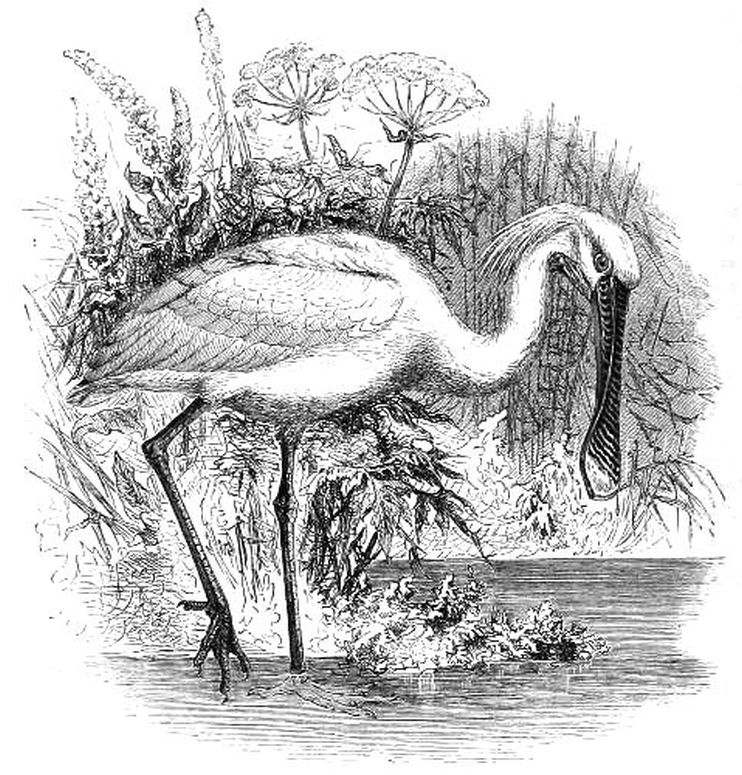
THE SPOONBILL (Platalea leucorodia). ONE-FIFTH NATURAL SIZE.
According to Mr. Petherick, who, in 1860, first brought the Shoe-beaks to England, they are but rarely seen on the banks of the Nile itself, as these, shelving off more or less abruptly, furnish few favourable spots for indulging their propensities. Although occasionally seen in the Bahr-il-Gagal, they prefer the natural banks of the morasses of the interior, where the shallowness of the water,[Pg 60] distributed over a large surface, affords them greater facilities for procuring food. They are usually seen wading about in pairs or parties, and, if disturbed, fly low over the water, and settle at no great distance; but if really terrified, or fired at, they rise in flocks, high into the air, and, after hovering and wheeling around, settle on the highest trees, and as long as their foes are in sight will not return to the water. Their roosting-places at night are said to be on the ground. Their food consists principally of fish and water-snakes, which they have been seen to catch and devour. They will also feed on the intestines of dead animals, the carcases of which they easily rip open with the strong hook of the upper bill. Their breeding-time is in the rainy season, during the months of July and August; and the spot chosen is among reeds or high grass, immediately at the water's edge, or on some small elevated and dry spot, entirely surrounded by water. The bird, before laying, scrapes a hole in the earth, in which, without any lining of grass or feathers, the female deposits her eggs. As many as a dozen have been found in the same nest. "Numbers of these nests," says Mr. Petherick,[Pg 61] "have been robbed by my men of both eggs and young; but the young birds so taken invariably died. After repeated unsuccessful attempts to rear them, continued for two years, the eggs were eventually hatched under Hens, which were procured at a considerable distance, from the Raik negroes. As soon as the Hens began to lay, and in due time to sit, a part of their eggs were replaced by half the number of those of the Balæniceps, as fresh as possible from the nest, the locality of which was previously known, and several young birds were successfully hatched. These young birds ran about the premises of the camp, and, to the great discomfort of the poor Hens, would persist in performing all sorts of unchicken-like manœuvres with their large beaks and extended wings in a small artificial pool, constantly supplied with water by several negresses retained for their especial benefit. Negro boys were also employed to supply their little pond with live fish, upon which, and occasionally the intestines of animals killed for our use, chopped into small pieces, they were reared."
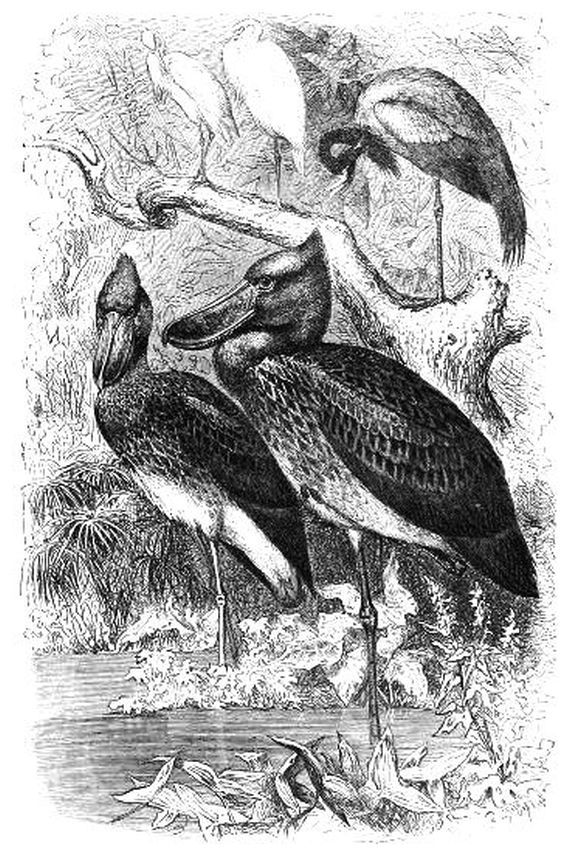
THE WHALE-HEADED STORK, OR SHOE-BEAK (Balæniceps rex).
[Pg 62]
THE SAVAKU, OR BOAT-BILL.
The SAVAKU, or BOAT-BILL (Cancroma cochlearia), has a compact body, a comparatively short strong neck, thick flat-crowned head, and an extremely broad bill, which is longer than the head, much depressed and dilated towards its middle. The culmen is prominently keeled with a deep lateral groove, extending to the tip, which is acutely hooked; the nostrils are placed in the lateral groove on the surface of the bill, their openings are longitudinal, and partly covered by a membrane. The moderate-sized, powerful wings have the fourth quill longer than the rest; the short broad tail is composed of twelve feathers, and the long slender legs are clothed almost to the knee; the soft streaming feathers upon the nape form a plume; the cheek-stripes and a portion of the throat are bare; the broad cheeks and fore part of the neck are white; the lower neck and breast yellowish white; the back is light grey; the back of the neck and belly are reddish brown, with black sides; the quills and tail-feathers are whitish grey; the brown eye is edged with grey, and the brown beak has a yellow margin to the lower mandible; the foot is of a yellowish shade. The male of this species is twenty-two inches long and thirty-eight across; the wing measures eleven inches and a half, and the tail four inches and a half; the female is somewhat smaller than her mate; the plumage of the young is at first entirely reddish brown, with the back of a deeper colour than the under side.
This bird is an inhabitant of Brazil, where it frequents the reed or bush covered banks of streams, and lives either solitary, or, during the breeding season, in pairs, keeping principally amongst the thickest trees or bushes, and hopping nimbly from branch to branch. Water insects of all kinds probably afford it the principal means of subsistence, although the stomachs of specimens examined by the Prince von Wied only contained worms. We are unacquainted with the voice and other habits of this strange bird, except that it occasionally produces a clapping sound with its bill, after the manner of a Stork. The eggs of the Savaku are oval in shape, pure white, and lustreless.
THE HAMMER-HEAD, OR SHADOW-BIRD.
The HAMMER-HEAD, or SHADOW-BIRD (Scopus umbretta), is an African species, and represents a family possessing a compact, almost conical body, short thick neck, comparatively large head, and broad, much-rounded wing, in which the third quill is longer than the rest, and a medium-sized tail, composed of twelve feathers. The high beak is longer than the head, straight, compressed at its sides, and slightly bent at its tip. The feet are moderate, with toes but slightly connected. The head is decorated with a bushy crest, and the thick streaming plumage is of an almost uniform umber-brown, with the under side of a lighter shade. The quills are glossy and darker than the back, and the tail-feathers are enlivened by a broad, purplish brown band at their extremities, and narrow irregular lines of the same at their roots. The eye is dark brown, the beak black, and the foot either black or blackish[Pg 63] brown. The length is twenty and the breadth forty inches; the wing measures eleven inches and two-thirds and the tail six inches. The female differs in no respect from her mate.
This remarkable species inhabits all the central and southern portions of the African continent, including Madagascar; and is also met with in Southern Arabia, but is nowhere numerous.
"The Hammer-heads," says Layard "are strange, weird birds, frequenting ponds, marshes, rivers, and lakes, flitting about with great activity in the dusk of the evening, and preying upon frogs, small fish, and similar fare. At times, when two or three are feeding in the same small pool, they execute a singular dance, skipping round one another, opening and closing their wings, and performing strange antics. They breed on trees and rocky ledges, forming a huge structure of sticks, some of them of considerable thickness. These nests are so solid that they will bear the weight of a large heavy man on the domed roof without collapsing. The entrance is a small hole, generally placed on the most inaccessible side. The pure white eggs are from three to five in number. On my late friend Jackson's farm, at Nels Poort, there is a singular rocky glen between two hills. In this spot a beautiful permanent spring, called 'Jackal's Fountain,' takes its rise. Of course, in consequence, there are a few wild almond and other trees; indeed, the place is a little oasis amid the barren mountains, and a favourite resort for hyænas, jackals, leopards, and other wild animals. On the ledges of the rocks in this secluded spot a colony of Hammer-heads have built for years. Some of the nests are quite inaccessible, whilst others can be reached with a little trouble. I counted six or eight within fifty yards, all exhibiting the same form and structure, and some of them containing at least a large cartload of sticks. About some that I visited I found brass and bone buttons, bits of crockery, bleached bones, &c. Mr. Jackson told me that if a 'tottie' lost his knife or tinder-box on the farm, or within some miles of the place, he made a point of examining these nests, and frequently with success; the occupants, like the Bower Bird of Australia, embellishing their dwellings with any glittering or bright-coloured thing they can pick up. In the karroo between Worcester and Robertson I saw a nest placed on the ground on the side of a trifling rise; it was at least three yards in length, by one and a half across, with a small entrance-hole at one end." From Jules Verreaux we learn that these remarkable structures contain three distinct chambers, the partitions of which are carefully formed, like the outer walls, of twigs and clay most artistically worked together, and entered by a hole just large enough to admit the body of the bird. Of these compartments the hindermost is the largest, and so raised as to remain dry should heavy rain penetrate the outer parts of the nest; so excellently, however, is the entrance constructed, that such accidents but rarely occur, or, if water should break through, are readily and at once repaired. The large back chamber is covered with a soft bed formed of various vegetable materials, for the reception of the eggs, which are hatched by the united attentions of both parents; the centre apartment serves as a pantry, and usually contains a goodly supply of provender; while the small outer compartment is employed as a guard-room, from which a strict watch is kept in case of approaching danger, the vigilant owner, according to Verreaux, lying flat on the ground as he reconnoitres, and keeping his head protruded through the entrance-hole. The young when first hatched are almost naked, with but a very slight development of greyish brown down. They grow slowly, and are tended with much affection by their parents, who feed them principally at early morning and evening.
The STORKS (Ciconiæ) are stoutly-built birds, with thick beaks, long legs, and short toes. The bill is long, straight, and conical, occasionally slightly curved upwards, and compressed towards its tip; the legs are long, powerful, and usually covered with scales; the toes are short: of these the inner and centre toes are only slightly connected, while the outermost and middle toes are united by a web as far as the first joint; the claws are thick and stumpy. In the long broad wing the third[Pg 64] or fourth quill is longer than the rest. The short, rounded tail is formed of twelve feathers. In some species the head and throat are covered with long and narrow, and in others with short rounded feathers; in others, again, these are scanty, and either almost hairy in texture, or, as the birds increase in age, terminate in horny lancet-shaped points; the rest of the plumage, which is formed of large compact feathers, is occasionally glossy and beautifully coloured. All the various species have the region of the eye and throat bare, in some this bareness extends over the brow and cheeks. The sexes differ in size, and the young are recognisable by the comparative paleness of their tints.
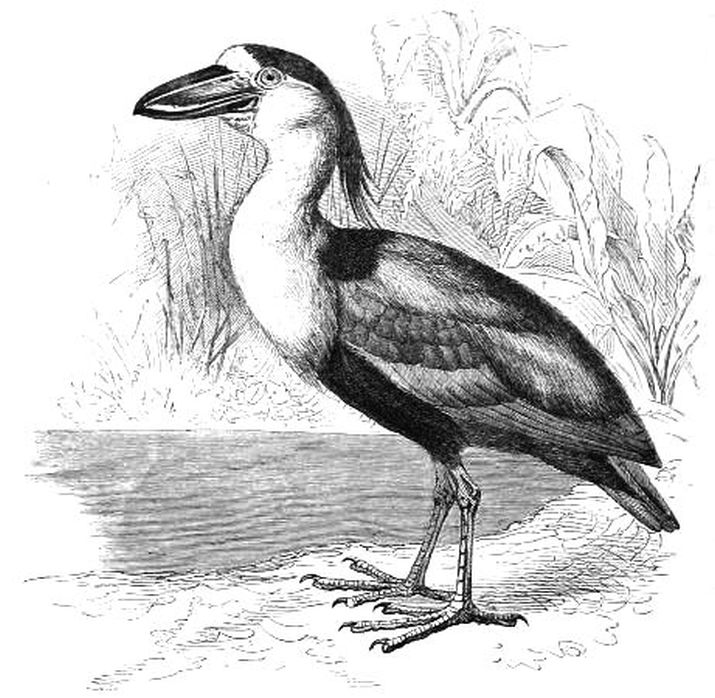
THE SAVAKU, OR BOAT-BILL (Cancroma cochlearia). ONE-FOURTH NATURAL SIZE.
The Storks are met with in almost every portion of the globe, and are especially numerous in its warmest latitudes. Such as dwell in the north migrate or wander to a very considerable distance, whilst the occupants of southern countries are stationary. Everywhere they principally frequent flat marshy localities, or the vicinity of rivers and streams, occasionally appearing upon arid plains or cultivated ground in search of grasshoppers and other insects. Well-wooded districts are for the most part their favourite resorts, as they constantly select trees both for breeding purposes and as resting-places for the night; some few species, however, prove exceptions to this rule, and make their nests on roofs, chimneys, or other elevated situations in the immediate vicinity[Pg 65] of men. All the various members of this group exhibit much similarity in their mode of life and demeanour; they walk slowly and with a certain dignity, keeping the neck gently arched, wade deep into the water, though they rarely swim, and fly lightly, with neck and limbs stretched directly out, at a considerable distance from the ground. The almost entire deficiency of voice observable in these birds is supplied by a peculiar habit of clapping loudly with the beak when excited. Some species of Storks greedily devour carrion, and for this reason are regarded with much favour by man; while all subsist in a great measure upon fish, reptiles, young birds, small quadrupeds, worms, insects, and similar fare, and seek their food during daylight. The nests, which are of great size, are formed of dry branches, sticks, and such-like materials, lined with more elastic substances. The large eggs, which are of uniform hue and few in number, are hatched by the female alone; the male, however, is much attached to his young, and tends his mate with exemplary care.
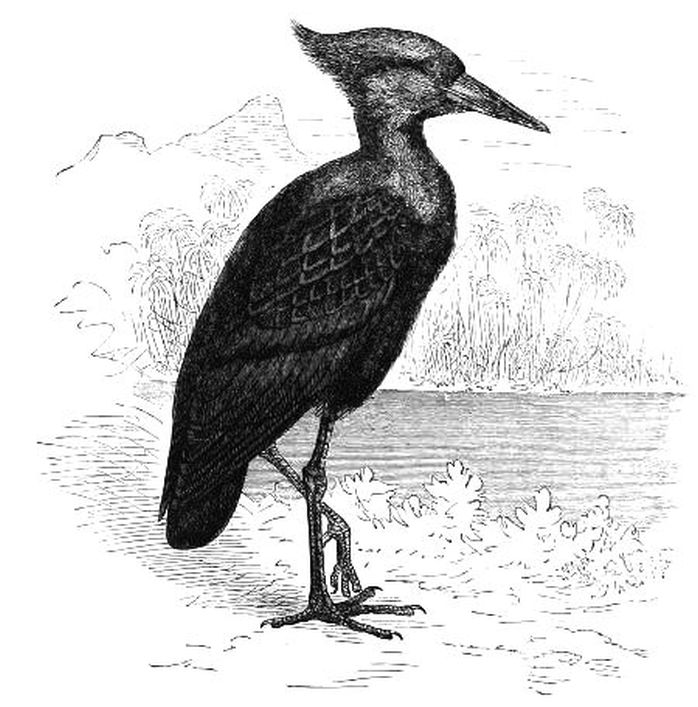
THE HAMMER-HEAD, OR SHADOW-BIRD (Scopus umbretta). ONE-FIFTH NATURAL SIZE.
The TANTALI (Tantalus) have a powerful beak, moderate-sized strong neck, and rather large head. The beak resembles that of the True Stork, but is thicker at its base, has its tip slightly hooked, and the margins turned roundly inwards. The tarsi are high and powerful, and the long toes broadly webbed; in the long broad wings the second quill exceeds the rest in length; the tail is short, and the plumage thick, soft, and beautifully coloured. The sexes differ in size, and the young do not[Pg 66] resemble the adult bird. These birds are usually classed with the Ibises, but in our opinion their proper place is among the Storks.
THE IBIS-LIKE TANTALUS.
The IBIS-LIKE TANTALUS (Tantalus ibis) is a most beautiful bird, with white plumage marked with deep rose-red on the wing-covers, and shaded with rose-red on the back; the quills and tail-feathers are of glossy greenish black. The eye is yellowish white, the beak of a waxy yellow, the foot pale red, and the bare face cinnabar-red. The young are attired in a garb of yellowish grey, with throat and mantle of a darker hue. The size of this striking bird varies from thirty-four to forty inches, and its breadth from sixty-two to sixty-seven inches; the wing measures eighteen, and the tail six inches.
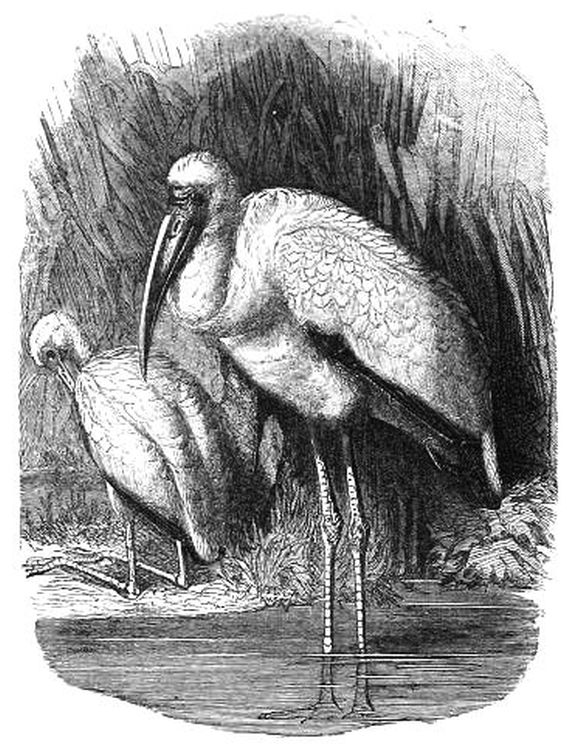
THE IBIS-LIKE TANTALUS (Tantalus ibis).
The Ibis-like Tantalus is an inhabitant of Central Africa, from which it occasionally but rarely wanders as far as Egypt or the coast. In the region of the Blue and White Nile, on the contrary, it is often numerously met with, and makes its appearance in company with the Ibis and Little House Stork, remaining in Soudan during the rainy season, and again disappearing. In[Pg 67] August the plumage of this bird displays its full beauty, and we may therefore infer that the period of incubation commences about September. River-banks, or the immediate vicinity of streams, tanks, and pools, are the localities it frequents, and in and about them it may be seen at morning and evening wading in search of fish, reptiles, and worms, or engaged in the capture of birds and small quadrupeds; about noon it resorts to the trees and sand-islands in large flocks, or takes its mid-day repose standing upright in shallow water. In all its movements the Tantalus closely resembles the Stork, but owing to its superior beauty of plumage, presents a more striking appearance when in the air. We are without any particulars respecting the nidification of this bird, but Jerdon informs us that a nearly-allied Indian species breeds in societies, and forms large nests upon high trees; the three or four eggs have a white shell, faintly spotted with yellow. Bodinus states that this bird has the very peculiar habit of fishing for prey with the bill wide open, as though it expected its victims to enter its jaws without further trouble; according to the same authority it is by no means a greedy feeder, and quite undeserving of its German name of the "Insatiable."
The TRUE STORKS (Ciconia) have a powerful broad-breasted body, rather long muscular neck, moderate-sized head, and a long conical beak, which has its margins turned decidedly inwards, and its entire surface covered with a horny coat. The legs are long and bare, and the toes short and broad; of these the centre and outer toe are connected as far as the first joint. The very long, broad, and rather blunt wings have the third, fourth, and fifth quills of equal length, and longer than the rest; the rounded tail is composed of twelve feathers, and the thick glossy plumage is of very uniform tint. These birds frequent the marshy districts of Europe, and seek their food principally on the banks of rivers, or in moist localities. Fishes, reptiles, and small birds constitute their ordinary fare; but they occasionally frequent dry open plains or cultivated grounds, in order to obtain grasshoppers, to which they are extremely partial, and a variety of other insects. Their huge nest, composed of sticks and twigs, is placed on buildings and tree-stumps. Occasionally these enormous structures, which are employed and repaired by many succeeding generations, are said to attain a height of four or even six feet. The female alone carries on the work of incubation, although her mate shares in her proverbial attachment to the little family.
"The Hebrew name for the Stork," says Dr. Tristram, "is derived from a root signifying 'kindness,' from the devoted maternal and filial affection of which the Stork has in all ages been held to be the type and emblem. This maternal instinct implied in the Hebrew name is repeatedly noticed by Greek and Latin authors, who believed further that the young repaid the care of their parents, by tending them in old age, and, contrary to the habits of all other animals, attended them through life. Though we certainly have no proof of this rather pleasing conceit, the devotion of the old birds to their offspring is very strongly displayed, and has been corroborated by modern observation. The Stork has a very ardent attachment to certain localities, and nothing but unremitting persecution can drive it from a spot which has once been selected for a nest. Year after year—indeed, generation after generation—a pair of birds return every spring to the same place, and either rebuild or thoroughly repair their old nest. If any accident happen to one of the pair, its place is speedily supplied, and the succession of tenants maintained. The only instance of a breeding-place having been deserted which ever fell under my own observation was under curious circumstances. On the highest point of a large mass of ruin, at Rabbath Ammon, were the remains of a deserted pile of sticks, an old Storks' nest. One of the birds had got its leg entangled and broken in a chink of the ruin, where it had perished miserably, and its gaunt skeleton, with the pinion-feathers still remaining on the wing-bones, swayed to and fro suspended in mid-air, and had effectually scared all its fellows from the spot."[Pg 68]
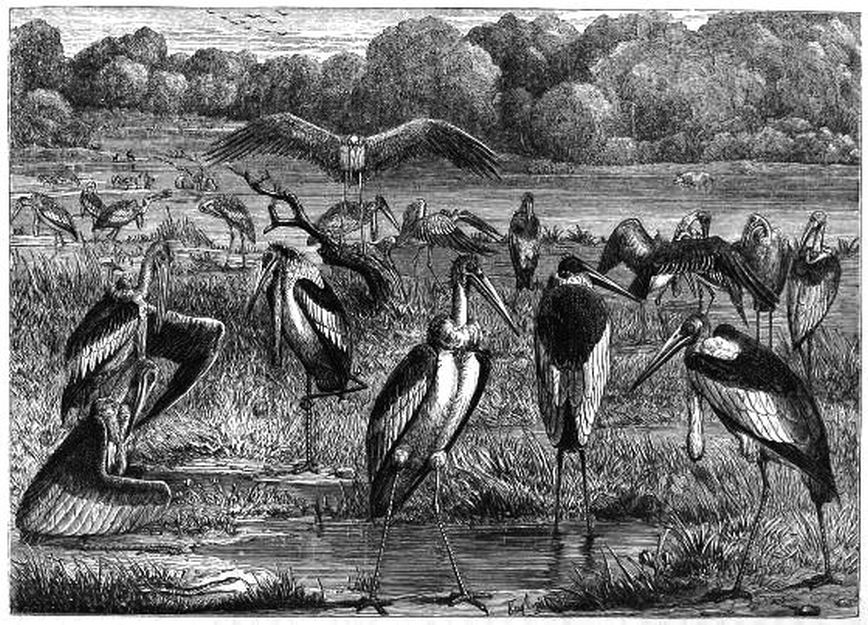
ADJUTANTS.
[Pg 69]
THE WHITE OR HOUSE STORK.
The WHITE or HOUSE STORK (Ciconia alba) has its plumage of a dirty white, with the exception of the quills and longest feathers on the wing-covers, which are black; the eye is brown; the beak bright, and the foot blood-red. This bird is forty-two inches long, and eighty-six across the wings; the wing measures twenty-five, and the tail ten inches. The female is somewhat smaller than her mate.
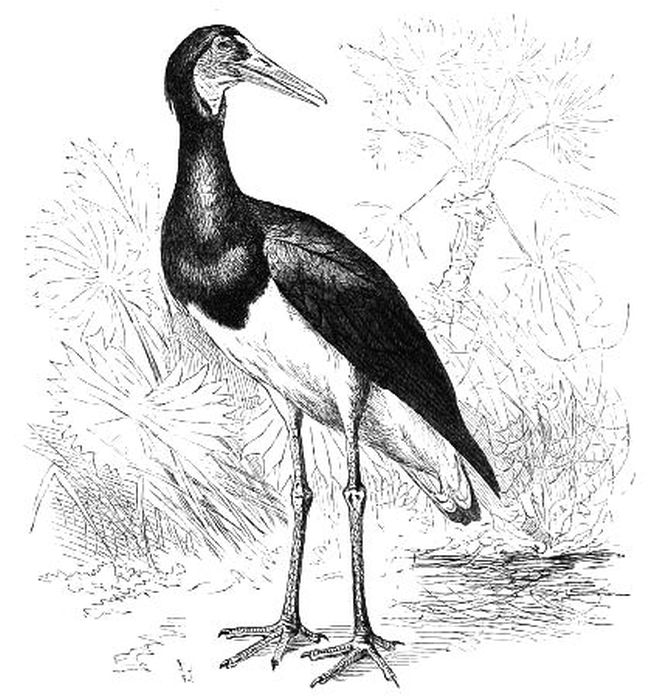
THE SIMBIL (Spenorhynchus Abdimii). ONE-FIFTH NATURAL SIZE.
The White Stork, though common in many parts of Central Europe, is now but rarely seen in Great Britain, and is met with during its annual migrations as far south as 13° north latitude. The multitudes of these huge birds which arrive in Palestine at certain seasons, and at once distribute themselves over the whole land, is truly startling, whilst in winter not one is to be seen. "On the 25th of March," says Dr. Tristram, "vast flocks suddenly appeared steadily travelling northwards, and leaving large detachments on every plain and hill. From that period till about the 4th of May they kept possession of the whole land, except where the ground was utterly barren, abounding specially in any marshy plains. They did not congregate like rooks, but like sheep or cattle scattered over a wide pasture; they systematically quartered every acre of the country, probably until they had cleared[Pg 70] it of all the snakes, lizards, and frogs they could find, when either scarcity, or the increasing heat of summer, reminded them of their northern homes, and they withdrew as suddenly as they had arrived, leaving behind them only a pair here and there at the established nesting-places. They were equally abundant on both sides of Jordan. On Mount Nebo they so covered the range that at first, and until we examined them through our telescopes, we took them for vast flocks of Moabite sheep pasturing. In the year 1858 I had observed them arrive on the 22nd of March, just two days earlier. Their halt in Syria agrees with the time of their arrival in Russia, which is said to be the beginning of May." In Holland and Denmark they arrive about the middle of April. In various parts of Holland the nest of the Stork, built on the chimney-top, remains undisturbed for many succeeding years, and the owners return with unerring sagacity to the well-known spot. The joy which they manifest on again taking possession of their dwelling, and the attachment they manifest towards their benevolent hosts, are familiar to everybody. In all countries where the Stork breeds it is protected; boxes are provided on the tops of the houses, and he considers himself a fortunate man whose roof is selected for their residence.
On the continent of Europe, indeed, the Stork is a welcome visitor everywhere, as its taste for offal and carrion renders it extremely useful; for this reason in many places it is regarded with great favour, and this kindly feeling is often carried to such a length as not only to subject a person ill-using it to unpleasant remarks, but to actual danger; indeed, in some parts it is looked upon as almost a sin to molest it. In consequence of being thus favoured, the Stork frequently becomes exceedingly tame, and may be seen stalking about the streets with the utmost confidence, and scarcely moving out of the way of a passer-by. These birds, according to popular belief, are not unmindful of the kindness shown them, and the eggs and young that are frequently found outside the nests are considered by the peasants to be tokens of their gratitude.
THE SIMBIL.
The SIMBIL (Spenorhynchus Abdimii) is an inhabitant of Southern Africa, and represents a division of the above birds having the face bare. In this species the head and neck are greenish black, with a purple gloss, and the mantle-quills and tail black, shaded with green; the under side is white; the eye brown, the ring around it blue; the bare portions of the face and throat are red; the beak is greenish, tipped with red; and the foot brownish grey, with pale red joints. The length of the body is twenty-eight and span of the wings sixty inches; the pinion measures seventeen and the tail seven inches.
This bird is common in some parts of Central Africa, where it frequents the villages during the breeding season, and makes its nest occasionally upon the houses, but usually in the mimosa-trees in their immediate vicinity. The eggs are very various in shape, and smaller than those of Ciconia alba. This Stork is held in such regard by the natives as rendered it almost impossible for us to procure its eggs, and at last we only succeeded by affecting to require them as an ingredient in remedies for certain cases of illness. To have touched one on any less serious grounds would have been to rouse the whole village. The flesh of the Simbil is regarded by the colonists as excellent food. Layard tells us that an allied species, the Ciconia nigra, is extremely difficult to obtain, and puts all the sportsman's powers of woodcraft to the test in order to circumvent him; for if the bird be wounded, he proves no mean antagonist, striking fiercely with his sharp-pointed and powerful bill at the face and hands of his pursuers. "On one occasion," says that gentleman, "having only broken the tip of a wing with a long shot, I had to dispatch my bird with half a charge of dust-shot, so great was his resistance; he, moreover, as if aware of his greater chance, took to the water, and would not be driven from it."
[Pg 71]
The GIANT STORKS (Mycteria) are comparatively tall birds, with a slender body, long neck, and rather large head; the very long beak is almost straight or very slightly curved, and furnished with a saddle-shaped cere at its base, and skinny knobs or appendages beneath. The tarsi are high, and the toes short; the long and rounded wing has its third quill longer than the rest; the tail is straight, and of medium length. The sexes are almost alike in size. The young are less brightly coloured than the adult birds. Of the three species of Giant Storks with which we are acquainted, one occupies Africa, another Australia, and the third South America; these birds nearly resemble each other in their general appearance and habits.
THE SENEGAL JABIRU.
The SENEGAL JABIRU (Mycteria Senegalensis) is a large powerful bird, with the head, throat, upper wing, shoulders, and tail of a glossy metallic black; the rest of the plumage is of dazzling whiteness. In the beak the upper mandible is of very pale tint for about three inches from its base, and the under one for about one inch and a half; then comes a bar of black for about three inches, and from that to the end the bill is reddish, increasing in depth of colour to the bright vermilion tip. On each side of the upper mandible is a large semi-oval and transparent space, which at the back part is continued upwards in a curved direction across the fore part of the eyes and over the nostrils. Beneath the base of the bill, just at the beginning of the feathery part, are two very small, pear-shaped, pendent, yellowish wattles adhering by very small necks. The bare portions of the face are reddish, the eyes and eye-rings yellow; the broad movable cere is also yellow, surrounded by a narrow border of black feathers. The tarsi are brownish grey, the knee and toe-joints dull red. This species is fifty-six inches long, and ninety-two broad; the wing measures twenty-five, and the tail ten inches. In the young, all the dark parts of the plumage are brownish grey, and the under side dirty greyish yellow. Their eye is brown, and beak blackish red; the appendages beneath the beak are not developed.
This fine bird is a native of Africa, where it principally frequents the regions watered by the White and Blue Nile, but is also seen in other parts of the continent. It lives in pairs, and occupies the shores of rivers, or the vicinity of lakes, tanks, and morasses, only quitting these for a short period during the rainy season; occasionally, but very rarely, it is met with near shallow salt water. Upon the ground it moves with a certain stately grace, and, owing to its length of leg, appears taller than it really is. Whilst in the air its fine black and white pinions render it a most striking and beautiful object. Unfortunately for science, the Senegal Jabiru is so extremely shy as to render any close observation of its habits almost impossible. In the stomachs of such specimens as we examined, we found reptiles and beetles; it also eats fish, and, according to Rüppell, has been seen upon carrion, but whether the bird was eating the putrid flesh, or merely gleaning off the insects that were feasting thereon, is at present uncertain. Gurney states that the pairs remain united for life, and entertain each other by a most strange dancing kind of performance. Should one of them die, the survivor does not soon mate again. It is probable that this species breeds on trees, and builds a nest resembling that of the Stork.
THE JABIRU.
The JABIRU (Mycteria Australis) has the head and neck of a deep glossy green, shading into purple and violet at the back of the head; the large wing-covers, scapularies, lower part of the back, and tail are glossy green, tinged with a golden lustre; the rest of the plumage is pure white. The beak is black, the eye deep hazel, and the leg bright red.
This species has a wide range over Australia, and at the time of its first colonisation was seen as near to Sydney as Botany Bay; in the neighbourhood of the Hunter River, it is occasionally met[Pg 72] with, and is comparatively common in the vicinity of Botany Bay. Macgillivray and Gilbert also found it at Port Essington. The Jabiru frequents the vicinity of salt-water creeks, and obtains its food principally from the necks of land running out into the sea, or on sandbanks and morasses. It is very difficult of approach, and if pursued, hides amongst the dense reeds in the lagoons; the natives, we are told, steal upon it when reposing, as it frequently does, upon the tarsi, the bird taking some time to rise from that position. In 1851, Dr. Bennett purchased a fine living specimen, which was brought to Sydney from Port Macquarie, and we have to thank that careful observer for the following interesting particulars respecting this remarkable and otherwise almost unknown species.
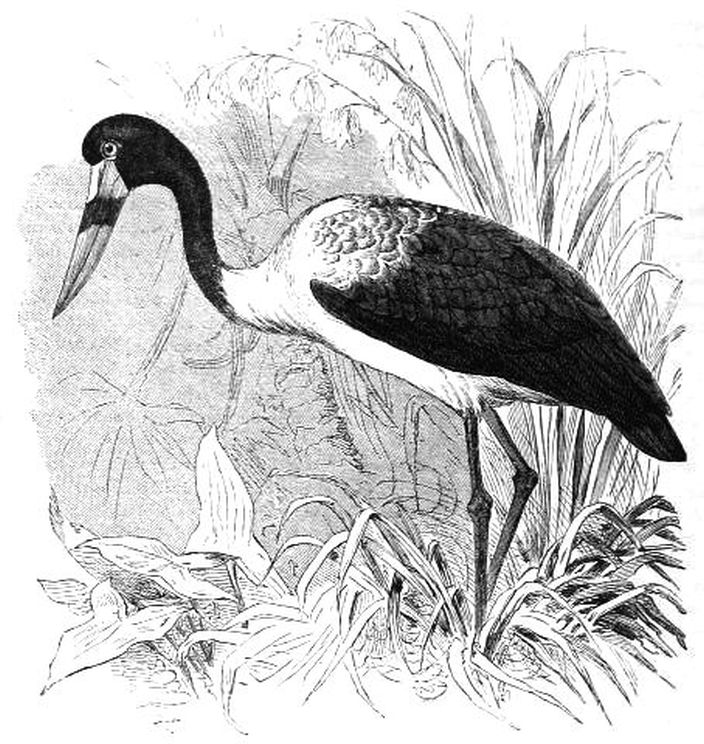
THE SENEGAL JABIRU (Mycteria Senegalensis). ONE-SIXTH NATURAL SIZE.
"The first evening it was at my house," says the above naturalist, "it walked into the hall, gazed at the gas-lamp which had just been lighted, and then proceeded to walk upstairs, seeking for a roosting-place; but not liking the ascent, quietly came down again, returning into the yard, and afterwards went to roost in the coach-house between the carriages, where it now retires regularly every evening[Pg 73] soon after dark. It may always be found in that part of the yard where the sun is shining, and with its face invariably towards it. When hungry it seeks for the cook, who usually feeds it; and if she has neglected its food, looks into the kitchen as if to remind her of the neglect, and waits quietly, but with a searching eye, during the time the meat is cutting up, until it is fed. It is amusing to observe this bird catch flies; it remains very quiet, as if asleep, and on a fly passing, it is snapped up in an instant. There happened to be a pugnacious fussy little Bantam Cock in the yard, who would not permit the intrusion of any stranger; and on seeing the Jabiru he strutted up with expanded and fluttering wings and ruffled feathers, in a violent state of excitement, cackling and screaming most vehemently, and making efforts as energetic as so diminutive a bird was capable of to frighten, and drive him out of the yard. The Jabiru, with his keen bright eyes, regarded the little fluttering object with cool contempt, and walked about as before; the Bantam followed. At last the Jabiru turned and strode after the consequential little creature, as if to tread it under his feet, when the Bantam seeing matters take this turn made off as fast as possible, like all little bullies, and did not again venture to attack so formidable an opponent. In a few days the Jabiru became quite domesticated among the poultry.
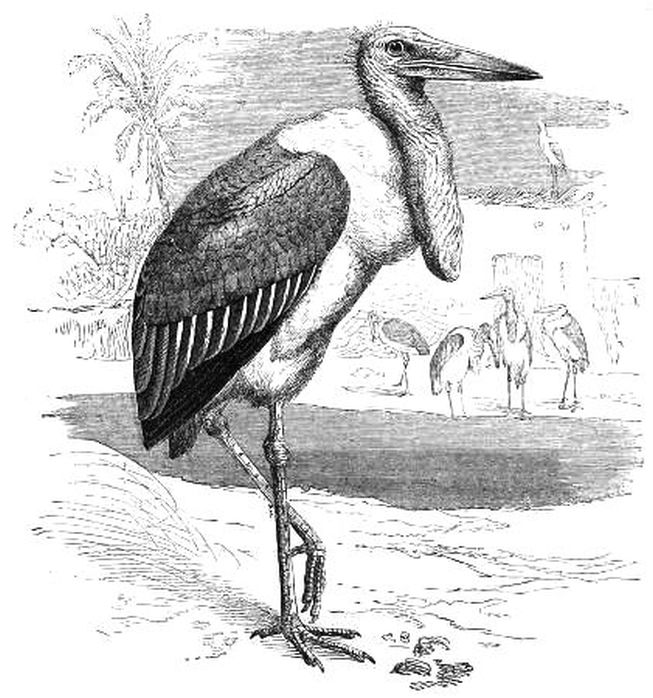
THE MARABOU (Leptoptilos crumenifer). ONE-EIGHTH NATURAL SIZE.
[Pg 74]
He was occasionally fed upon fish cut up into small pieces, which he beat about with the mandibles, and after continuing this process for some little time, swallowed them. "I have," continues Dr. Bennett, "noticed him watch the ground very attentively under the trees, and then dart his bill into the earth and bring up larvæ, which I found were those of locusts (Tettigoniæ). When the bird observed a slight motion of the ground, he darted his beak down, and devoured the insect as it was emerging from the soil. He became latterly very familiar. When called to be fed, he ran from any part of the yard, clapping his long mandibles." Unfortunately, this rare bird sickened, and refused food for several days, avoided the open air, and was at last found dead in the stable. His skeleton is in the Osteological Collection of the British Museum.
The ADJUTANTS, ARGALAS, or MARABOUS (Leptoptilos), are at once recognisable by the pouch-like appendage on the lower part of the neck, their clumsy body, thick bare neck, scabious head, more or less covered with a few downy feathers, and their huge beak, which is very thick, four-sided, and almost conical in front. Their legs are long, wings strong and rounded, with the fourth quill longer than the rest; the tail is of a medium size, with the feathers of its lower covers extraordinarily and beautifully developed. These birds inhabit South Asia and Central Africa, and render most important service to man by clearing off a host of unclean and putrid substances, that would otherwise pollute the air and constantly breed disease and death in those hot regions.
THE AFRICAN MARABOU.
The AFRICAN MARABOU (Leptoptilos crumenifer) has the flesh-coloured head sparsely covered with short hairy feathers, and the neck bare. Upon the mantle the plumage is of a glossy, metallic, dark green, and white on the under side and nape; the quills and tail-feathers are black and lustreless; the larger feathers of the covers are edged with white on the outer web. The eye is brown, beak dull whitish yellow, and the foot black. This huge bird is generally about five feet long; of this the bill measures a foot and a half, and the tail one foot. The span of the wings is ten feet, and the length of the pinion twenty-eight inches. Mr. Smeathman, who had many opportunities of observing this species, states that an adult often measures as much as seven feet, and the head being covered with thin whitish down, it has at a distance much the appearance of a grey-headed man. "These birds," he says, "are met with in companies near the mouths of rivers, and as they advance with extended wings, might readily be mistaken for canoes, or, when on the banks, for persons picking up shells." A young Marabou about five feet high was brought up tame, and presented to the chief of the Bananas, where Mr. Smeathman lived. Being fed in the great hall, it soon became quite familiar, and duly attended at dinner-time, placing itself behind its master's chair frequently before the guests entered. The servants were obliged to watch it narrowly, and to defend the provisions with switches; but in spite of these precautions it would frequently snatch something from the table—a whole boiled fowl, for example—which it devoured in an instant.
THE INDIAN ADJUTANT, OR ARGALA.
The INDIAN ADJUTANT, or ARGALA (Leptoptilos argala), a nearly-allied species, is very common in some portions of Northern India, especially Bengal and the North-eastern Provinces, where it arrives in April or May, and departs in October, a few unpaired birds only remaining behind in the south. Jerdon tells us that it soars with the Vultures to an immense height, ready to descend on any carcase[Pg 75] that may be discovered. In Calcutta and other large towns, the labours of these birds are regarded as so important that they are protected by law, and become so tame as to be seen walking familiarly about the town, lurking about the slaughter-houses and burning-grounds of the Hindoos, or examining the heaps of refuse accumulated in the streets, ready to be carted away by the scavengers. They do not, however, rely entirely on this highly-flavoured diet, but forage in the tanks and ditches for frogs and fish. During the heat of the day they retire to trees or house-tops, where they may be seen resting on the whole tarsus. The nests are made about rocky cliffs or occasionally on lofty trees, away from hills. The white eggs are two in number; when first hatched the young are covered with white down. The Hindoos have a popular superstition that if the head of an Adjutant be split whilst the bird is still alive, the celebrated stone called the tahir mora, or "poison-killer," will be discovered. This stone is supposed to be an antidote for all kinds of poisons. The soft and beautiful feathers on the under tail-covers of this and allied species form a well-known and valuable article of commerce; and to obtain these, in many parts of India the birds are kept in flocks about the villages. We are told that there is a popular idea in India, that the souls of the Brahmins possess these birds. They are thought invulnerable; and when Mr. Ives missed his shots at several, the standers-by observed with great satisfaction that he would never succeed in wounding them.
The CLAPPER-BILLED STORKS, or SHELL-EATERS (Anastomus), inhabit Africa and Southern Asia. These most remarkable birds have a comparatively slender body, covered with short thick plumage, the head is small, the wing large, broad, and pointed, with its second and third quills longer than the rest; the short tail is composed of twelve feathers. The thick beak has its margins slightly incised, and the mandibles so formed that they only close together at the base and tip of the bill. The foot resembles that of the Stork, and the plumage is close and compact.
THE AFRICAN CLAPPER-BILL, OR SHELL-EATER.
The AFRICAN CLAPPER-BILL, or SHELL-EATER (Anastomus lamelligerus), is about the size of the Common Stork—that is, thirty-three inches long. In this bird all the feathers on the neck, belly, and legs are tipped with narrow horny little plates; these plates and the feather-shafts have a green and purple gloss. The eye is reddish, the bare bridles and throat yellowish grey, the beak yellowish, and feet black. The young are without the horny plates at the tips of their feathers, and are principally of a brownish grey. This Shell-eater is a native of Central and Southern Africa, and is met with in large flocks on the shores of the Blue River. We are unacquainted with its habits, except that it consumes fish, frogs, and molluscs of various kinds. Jerdon, however, tells us that the Anastomus osculans, a nearly-allied species, which is common in all the marshy districts of India, subsists entirely upon shell-fish. "I was formerly of opinion," says that writer, "that the open space between the mandibles was mainly caused by a process of training a Bhyri, and these, as is usual, had their eyes sewn up, to prevent their struggling or fluttering. To feed them the falconer had a quantity of the large Ampullaria brought, which were placed before the captive and blinded Shell-eaters. The bird secured a shell by its feet, and after sundry alterations of its position, succeeded in cutting off the operculum as cleanly as if it had been done by a razor, but so rapidly that I was unable to see the exact way in which it was accomplished. It then inserted the tip of its beak into the open mouth of the shell, and after working it about for a short time, pulled out the entire shell-fish, almost to its utmost tip." These birds are sometimes caught by means of a bamboo with a noose attached; this is bent down, and fixed tightly to the ground by a small peg, to which an Ampullaria is fastened. The Shell-eater, while hunting about, soon finds the shell, and in moving it to get at its contents the peg is withdrawn, the bamboo flies up, and the noose catches the bird, which remains dangling in[Pg 76] mid-air. The Indian Shell-eater breeds upon high trees about June or July, and associates in large flocks during the whole period of incubation. The eggs are four in number, and are of a dirty white. The young are defended by their parents with great courage and fierceness.
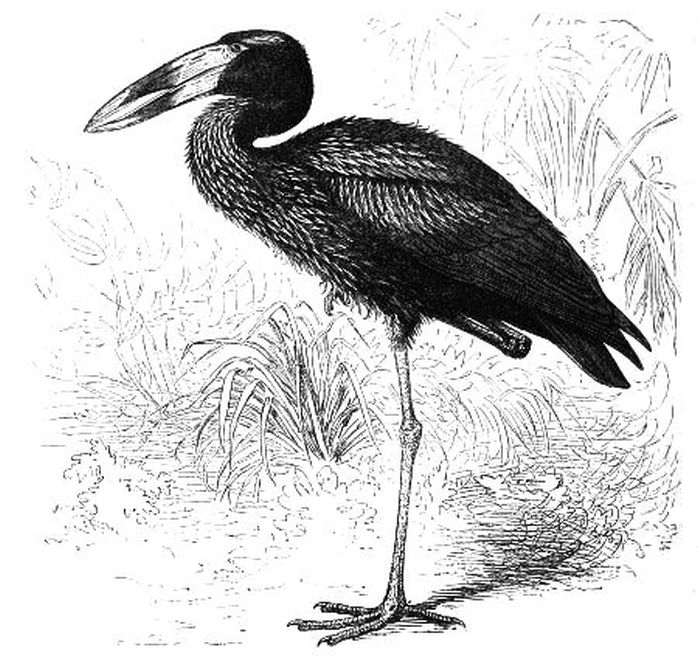
THE AFRICAN CLAPPER-BILL (Anastomus lamelligerus). ONE-FIFTH NATURAL SIZE.
The HERONS (Ardeæ) are large, ungainly birds, with a weak body, much compressed at its sides, a long thin neck, and small, narrow, flat head. The strong straight beak is as long as, or longer, than the head, compressed at the sides and culmen; the sharp margins are turned inwards, the tip is incised, and in its entire surface, except in the region of the nostrils, covered with a hard, smooth, horny coat. The legs and toes are moderately long, the claw of the centre toe being curiously denticulated on its lower side. The long, broad, blunt wing has its second, third, and fourth quills of almost equal length; the short rounded tail is composed of from ten to twelve feathers. The thick, soft, lax plumage is often much prolonged on the crown of the head and upper breast; and though strikingly and very variously coloured in the different species, is never remarkably gay. The Persians, however, catch these birds, and after depriving them of the long feathers, which are highly prized, suffer them to depart. These feathers, together with tufts of diamonds and other[Pg 77] precious stones, set in the form of Heron's plumes, adorn the dhul bandt of the Persian monarch. The members of this group are met with in most parts of the globe, migrating according to the change of seasons, or when their supply of food falls short. Swamps, shallow rivers, and pools are their favourite haunts, and in these they quietly stand, with their necks drawn down between their shoulders, watching the approach of a fish, upon which they suddenly dart, and seizing it in the beak, swallow it in an instant. They also consume small quadrupeds, frogs, and a variety of insects. Some species have been seen perched upon the backs of cattle, and feeding upon the larvæ that infest their hides. The nest of the Herons, which is usually erected on lofty trees, on elevated buildings, or among the tall reeds and river-banks, is constructed of sticks, lined with small twigs, and so loosely put together as to form a large flat expanse.
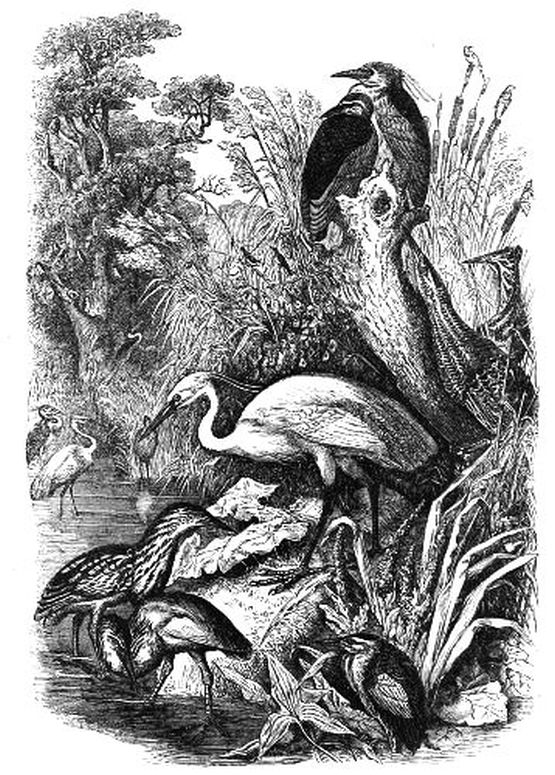
GROUP OF HERONS.
[Pg 78]
THE COMMON HERON.
The COMMON HERON (Ardea cinerea) represents a group possessing a thin body, long neck, long powerful beak, and plumage of more or less sombre appearance. In the adult birds the crown and brow are white, the neck greyish white, the back ash-grey, varied by the white of its long feathers; the sides of the lower parts are black; a stripe from the eye to the nape, three long crest-feathers, a threefold row of spots on the front of the neck, and the large quills, are all black; and the upper secondaries and tail-feathers grey. The eyes are golden yellow, the bare patches on the face greenish yellow, the beak is straw-colour, and the foot brownish black. This species is forty-two inches long and seventy-five broad, the wing nineteen and the tail seven inches. The young are greyer than the adults, and have no crest.
Owing to the large size of their wings, these Herons are enabled to support themselves in the air with but little exertion, and can mount without fatigue to a great height when pursued by their natural enemies the Falcons. This Heron is a successful fisher, and might be taken as a very picture of patience as it stands, motionless as a statue, up to its knees in water, with neck slightly extended and eye steadily fixed, but fully awake to the slightest movement. Suddenly its head is darted forward with unerring aim, a small fish is captured and instantly swallowed, head foremost. An eel of some size is brought to land and beaten to death on the bank, and a large fish impaled on the bill, if worth the labour, is carried to a safe retreat and devoured at leisure. A frog is swallowed whole, and a water-rat is usually killed by having its skull split open. The Heron devours shrimps, small crabs, newts, and a variety of water-beetles, in large quantities. Should the fishing at a selected spot be unsuccessful, the bird rises a few feet into the air and slowly flaps its way to a little distance, where, standing on one leg, with its head thrown back, it awaits better fortune. Whilst on the watch it is silent, but as it flies off utters its harsh grating scream. A great portion of the day is passed on the branches of lofty trees, whither these birds often repair with a booty too large to be disposed of at once. During the winter Herons live solitarily, but in the month of March begin to congregate and soon after repair to their breeding-places, called heronries. These are generally situated in stately clumps of trees or groves, and were formerly so favoured that a fine of twenty shillings or three months' imprisonment, or the suretyship of two persons, bound in twenty pounds each, was the penalty for killing one of their feathered occupants. No Herons were allowed to be taken (out of a man's own premises) except by hawking or shooting with the long-bow. For taking the young out of the nest a fine of six shillings was imposed, and for taking or destroying the eggs from the 31st of March to the 30th of June a man was subjected to imprisonment for a year, besides having to pay eightpence for every egg.
Pennant counted more than eighty nests upon one oak at Cressy Hall, near Spalding, Lincolnshire, an estate then belonging to the Heron family, one of the most ancient in this county. Sometimes Herons build on steep rocks near the coast. Although the favour bestowed upon these birds in former times has ceased, there still exist many heronries in different parts of England, and also of Scotland. On the eastern coast they may be met with in great numbers after the breeding season is over; and an observer in the neighbourhood of Stonehaven, writing to Mr. Macgillivray, says:—"In autumn, when they appear to be most numerous, I have seen one hundred or one hundred and twenty or more together, their numbers being made up probably in a great measure from young birds of the year. When disturbed they betake themselves round some corner of the rocks to a neighbouring bay, flying heavily along, generally within gunshot of the water's surface.[Pg 79] During high tide they rest on detached rocks, at a short distance from the land, and occasionally on the face of some of the heughs, or high sandbanks." "Once or twice," says the same correspondent, "I have seen them in the fields. I recollect one forenoon seeing four of them standing in a ploughed field, in most grotesque attitudes, reminding one more of a consultation of witches than of anything else."
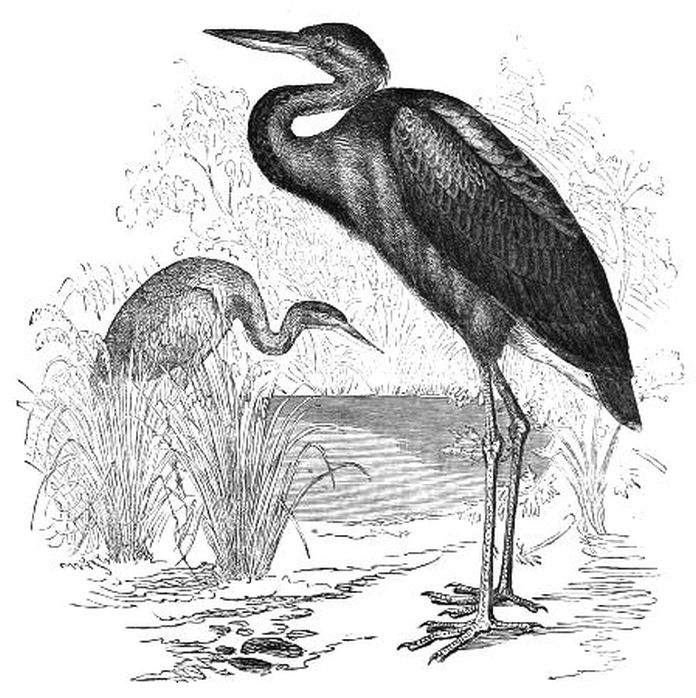
THE GIANT HERON (Ardea Goliath). ONE-SIXTH NATURAL SIZE.
The nests of the Herons are huge masses of sticks, about a yard across, lined with a little grass or other soft materials, and are placed close to each other. Each nest contains four or five eggs, on which the female sits constantly for three weeks, and is meanwhile fed by her mate. The young are quite helpless till they are sufficiently fledged to perch on the branches, where they receive nourishment from their parents. Herons, according to Layard, are very abundant throughout Southern Africa, in all suitable localities, feeding upon fish, frogs, and an occasional snake. "I am told," says this observer, "that they breed on the Cape Flats, placing their nests in company on tufts of grass and rushes, surrounded with water." This seems very different from their European practice, but there is no reason to doubt the word of my informant.
[Pg 80]
THE GIANT HERON.
The GIANT HERON (Ardea Goliath) is a powerful bird, of about fifty-two inches long and seventy-one inches broad; the wing measures twenty-one and the tail eight inches. Upon the head, upper neck, centre of breast, and belly, the plumage is brownish red; the back and upper breast are dark grey, and the throat and gullet white; the eyes are yellow, the eye-rings violet, and the bridles green; the upper mandible is black, and lower one violet tipped with greenish yellow; the foot is black. This species leads a solitary life upon the shores of the fresh-water lakes and streams of Central Africa. In disposition it is extremely shy; it flies badly, has a harsh loud voice, and subsists upon fish, reptiles, birds, and small quadrupeds. In other respects it closely resembles the Ardea cinerea. We are entirely without particulars respecting its habits.
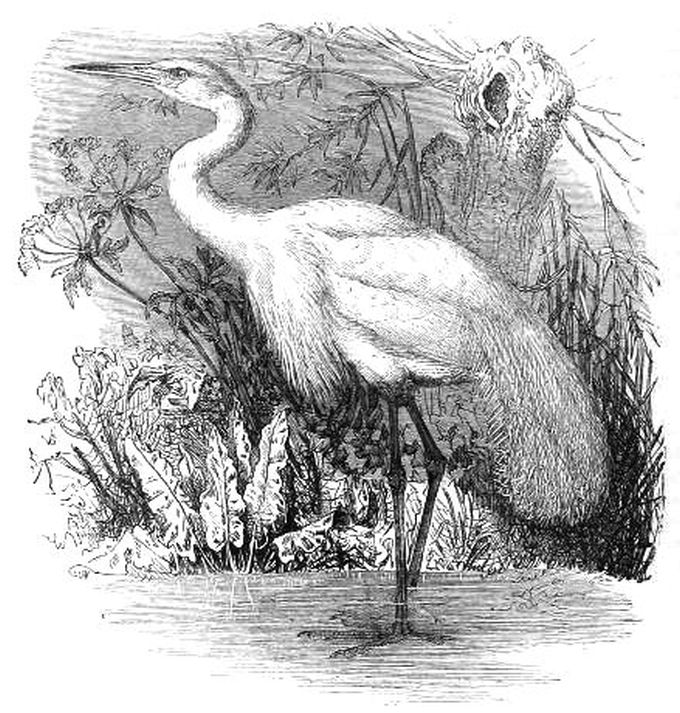
THE GREAT WHITE HERON (Herodias alba). ONE-SIXTH NATURAL SIZE.
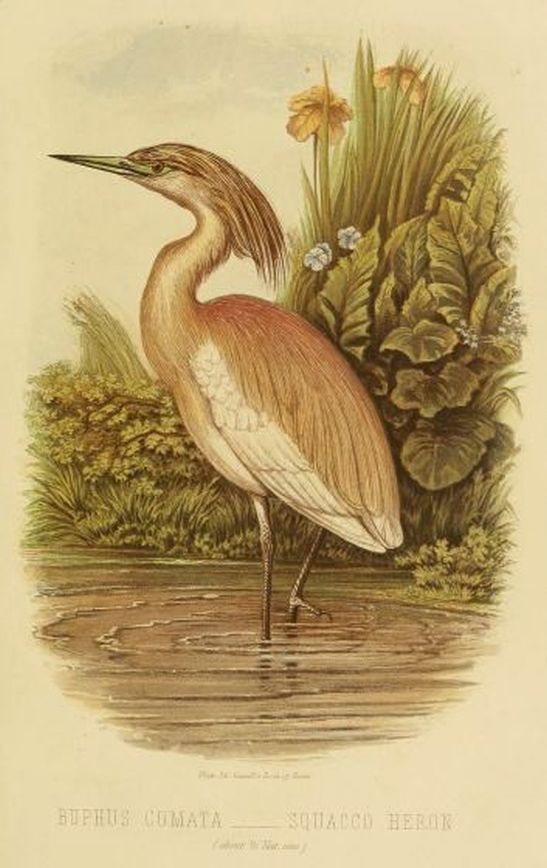
Plate 34. Cassell's Book of Birds
BUPHUS COMATA ____ SQUACCO HERON
(about 1/2 Nat. size)
[See larger version]
[Pg 81]
The WHITE HERONS (Herodias) possess a slender body, long neck, and a comparatively weak bill. Their pure white plumage is adorned with long streaming feathers on the back during the period of incubation.
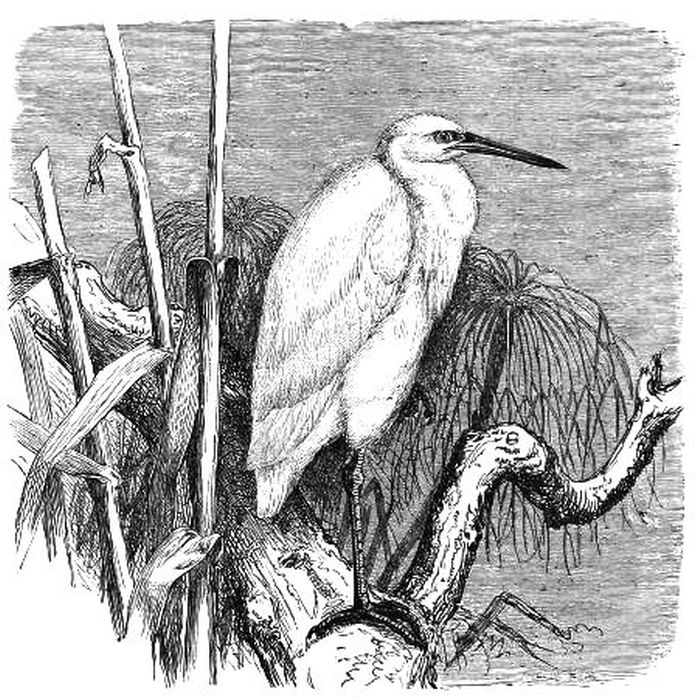
THE LESSER EGRET (Herodias garzetta). ONE-FOURTH NATURAL SIZE.
THE GREAT WHITE HERON.
The GREAT WHITE HERON (Herodias alba) has the entire plumage of pure and dazzling white. The eye is yellow, and the beak dark yellow; the bare cheeks are greenish yellow, and the feet dark grey. This species is forty inches long and seventy-two broad; the wing measures twenty-one inches, and the tail seven inches and a half. The beak changes colour, not according to the age of the bird, but at different seasons of the year. The young do not exhibit the streaming feathers on the back. This Heron inhabits the southern parts of Siberia and South-eastern Europe, and during its migrations appears in South Asia and North Africa. In India, and South and Western Africa, it is replaced by a very similar species. In England it is occasionally but rarely seen. Like its congeners, this beautiful bird occupies marshy ground in the vicinity of water, preferring such spots as are least frequented by man, and subsists upon the same fare as other members of its family. In its general[Pg 82] air and movements, however, it differs from them in many respects; it walks with a more stately step, flies faster and more gracefully, and constantly assumes a variety of strange postures; when standing, it frequently buries its head, neck, and one leg in its plumage, and thus presents the appearance of a great white ball fastened to the top of a thin stick. The large nest of this bird is placed amongst reeds, of portions of which it is also built; so firm and strong are these heaps that, as we are told, they can support the weight of a man. The eggs are usually three or four in number, and have a smoother shell and bluer tint than those of the species before described.
THE LESSER EGRET.
The LESSER EGRET (Herodias garzetta) resembles the above bird in its general appearance and habits, but it is not more than twenty-four inches long and forty-two broad; the wing measures twelve and the tail four inches. In this species the eye is bright red, the beak black, and the foot black, with greenish yellow joints. This beautiful little Egret occupies the same latitudes as the larger species, and, according to Layard, has been procured both in winter and nuptial dress in the vicinity of Cape Town; also at Colesberg, and at the Kneysna. The stomachs examined by that naturalist contained multitudes of small aquatic shells. A nearly-allied species (Ardea egretta) is common on the Kneysna, but is so shy as to be almost unapproachable; it breeds on a small rock on the sea.
The Little Egret is now very rare in Great Britain, but was formerly much more common, and was regarded by our forefathers as a dainty article of food. In the celebrated feast on the enthronisation of Archbishop Nevill no less than 1,000 Egrets are mentioned in the bill of fare.
THE CATTLE HERON.
The CATTLE HERON (Bubulcus ibis) represents a group recognisable by their compact form, short neck, short powerful beak, short legs, and the hair-like development of some of their feathers. The plumage is pure white during the breeding season, adorned with long, flowing, rust-red feathers on the crown, upper breast, and back. The eyes are light yellow, the bridles and eyelids greenish yellow, the beak is orange, and the foot of the adult bird reddish yellow; that of the young is of a brownish shade. The male is nineteen inches long and thirty-four broad; the wing measures nine inches and a quarter, and the tail three inches and a quarter; the female is not quite so large. This species is extremely common in Egypt, where, unlike other Herons, it frequents inhabited districts, preferring inundated fields, and only occasionally visiting the banks of lakes or streams. In Egypt it is constantly seen following the buffaloes and cattle, or inspecting their backs, in search of insects or grubs; and in Eastern Soudan accompanying droves of elephants for the same purpose. We have been told, on reliable authority, that as many as twenty of these birds are sometimes seen upon a single elephant. With the natives they live on most excellent terms, and carry on their acceptable work quite regardless of their presence. Such of these birds as inhabit Egypt commence breeding when the Nile rises, while those dwelling in Eastern Soudan lay somewhat earlier in the year. The nests are built close together upon trees, and are constantly seen close to the huts of the natives. The eggs, from three to five in number, are oval in form, and have a greenish blue shell.
THE NIGHT HERON.
The NIGHT HERON (Nycticorax Europæus) has a compact body, short, thick, broad beak, curved at its culmen, moderately high legs, broad wings, and thick plumage, which, unlike that of the members of the family already described, has but three of its feathers unusually prolonged; these are slender, and placed on the back of the head. In the adult bird, the crown, nape, upper part of the back, and shoulders are greenish black, the rest of the mantle and sides of the throat dark grey; the feathers on[Pg 83] the under side are pale straw-yellow, and the three long crest-feathers either quite white or white and black. The eye is of a rich purple, the beak black with yellow base, the bare patch on the head green, and the foot greenish yellow. In the young, the mantle is brown, spotted with brownish yellow and yellowish white; the throat yellow, and belly white, spotted with brown; the eyebrows are brown, and the head without crest. This species is from twenty-one to twenty-two inches long, and forty-four broad; the wing measures twelve inches and a half, and the tail four inches and a quarter.
The Night Heron is extremely common in Holland in the summer, and is also met with in Germany, Italy, the south of France, and Spain; occasionally, but very rarely, it has been shot in Great Britain. It visits Africa during the winter, and is found far in the interior of that continent. In northern latitudes it appears about the end of April, and leaves again in September or October. The Night Herons both sleep and breed upon trees, and therefore principally frequent well-wooded localities, whether these be in the vicinity of water or not; in moist, well-planted regions, however, they are especially numerous. Except during the breeding season they sleep, or at any rate remain quiet, throughout the entire day, and only descend at twilight from their perches in order to seek for food. Upon the ground they progress slowly, with short steps, but move in the air with comparative swiftness, alternating an easy gliding motion with rapid but noiseless strokes of the wings. In places where these birds abound, they are often seen flying together in very large flocks, at a considerable height, on their way to a suitable hunting-ground, over which they generally hover before alighting. Among the branches they climb with an agility that is not exceeded by any member of the family. Their voice is extremely harsh, and somewhat resembles the discordant croak of the Raven. The Night Herons breed from May to July, and usually form regular settlements not only of their own species, but with many allied birds. The large, carelessly-constructed nest is placed high on trees, and contains four or five oval green eggs of very various shades. The female broods, whilst her mate mounts guard quietly perched by her side, or quarrels with and teases other males in his neighbourhood.
The Great Night Heron of America, which is considered by Audubon and others as a distinct species, is seen as far as the northern and eastern extremities of the United States, but is unknown farther northwards. In the winter it goes as far as the tropics. These birds arrive in Pennsylvania in April, and immediately take possession of their old nurseries, usually in the depths of a cedar swamp, or of some inundated and inaccessible grove of oaks; there they pass the day till twilight comes, and then the parent birds sally forth to the sea-shores and marshes in search of food for themselves and young, proceeding in marshalled ranks, and uttering from time to time a guttural "kwah," in a hollow voice, that resembles the sound of a person vomiting. The eyries of the "Kwah" birds have been occupied from remote times by eighty or one hundred pairs, and when the trees are felled, they only remove to another part of the same swamp.
The BITTERNS (Ardetta) are recognisable by their comparatively small size, slender bill, low feathered tarsi, their short wings, in which the second quill is longer than the rest, and weak short tail. The plumage, which is by no means striking in its coloration, varies in hue according to the age and sex of the bird.
THE LITTLE BITTERN.
The LITTLE BITTERN (Ardetta minuta) is from fourteen to sixteen inches long, and from twenty-one to twenty-three broad; the wing measures five inches and three-quarters, and the tail two inches. This elegant bird is of a glossy blackish green on the crown, nape, back, and shoulders; the upper wing and under side are reddish yellow, spotted with black on the side of the breast; the quills and tail-feathers are black; the eye and bridles yellow. The pale yellow beak is brown at its culmen; and the foot greenish yellow. In the female all the dark parts are brownish black, and the light portions of the plumage pale yellow; the young have the crown and nape reddish brown, striped with a deeper shade, the under side spotted brown and reddish yellow, and lower belly and tail-covers white. The Little Bittern is only a summer visitor to Great Britain. It frequents marshes, osier holts, and other places in the neighbourhood of water, feeding on such small animal food as is there easily obtained.
[Pg 84]
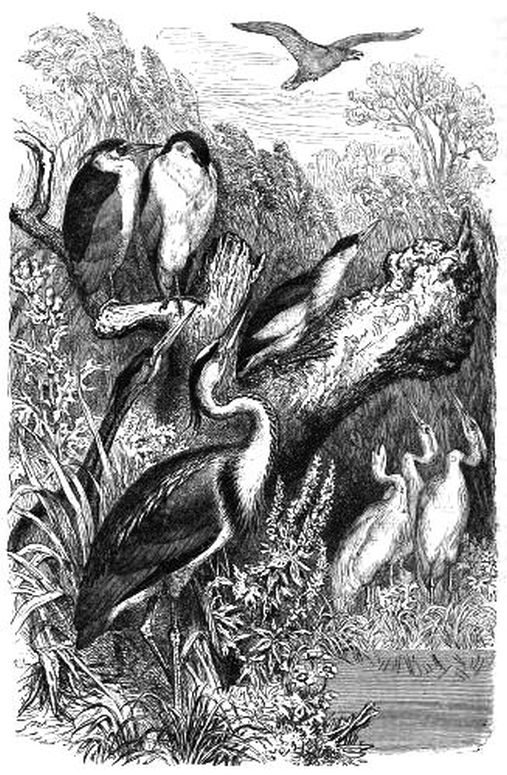
DAY AND NIGHT HERONS.
[Pg 85]
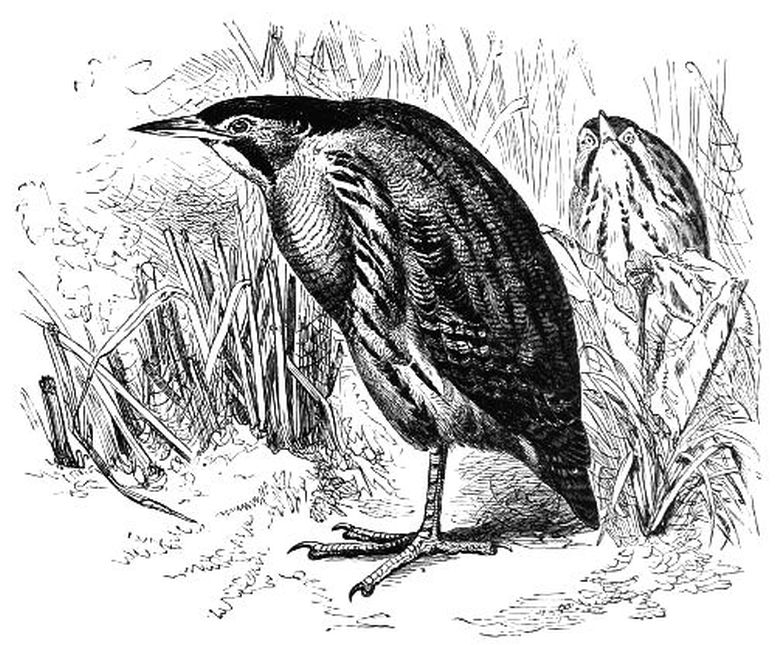
THE COMMON BITTERN (Botaurus stellaris). ONE-FOURTH NATURAL SIZE.
The COMMON BITTERN (Botaurus stellaris) is the representative of a group having a compact body, long thin neck, a narrow high beak, large-toed feet, broad wings, a tail composed of ten feathers, and thick plumage, which is slightly prolonged on the neck. The sexes only differ in their size. In both the crown is black, the nape greyish black, mixed with yellow, and the rest of the plumage spotted and streaked with dark brown of various shades; the throat exhibits three stripes; the eye is bright yellow, and the bare portion around it greyish green; the upper mandible is brownish grey, and the lower one of greenish hue; the foot is light green, with yellow joints. This bird is twenty-eight inches long and forty-eight broad. The wing measures fifteen and the tail five inches. The nest is placed in marshes, among reeds. The eggs are five in number, of an olive colour. Its food consists principally of fish and reptiles of various kinds. During the breeding season it utters a loud bellowing noise, and for this cause it probably received the generic name of Botaurus. "This bellowing noise", says Latham, "is supposed to arise from a loose membrane, which can be filled with air and exploded at pleasure. The situation of it is at the divarication of the windpipe. It is capable of great[Pg 86] distension, and is probably the cause of this singular phenomenon, observed, we believe, in no other bird, at least in the same degree." At other times the bird makes a sharp harsh cry on rising, not unlike that of a Wild Goose.
THE SUN BITTERN, OR PEACOCK HERON.
The SUN BITTERN, or PEACOCK HERON (Eurypyga helias), represents a group of South American birds, having a small meagre body, long thin neck, a head resembling that of a Heron, and a long, straight, hard-pointed, and powerful beak, compressed at its sides, and slightly arched at its culmen. The high slender foot has the hinder toe moderately developed; and the large broad wing has its third quill longer than the rest; the remarkably long tail is composed of broad feathers. The rich, lax, and variegated plumage is black upon the head and nape; the eyebrows, a line that passes from the corner of the mouth to the nape, the chin, and throat are all white; the feathers on the back and shoulders, and the upper secondaries are black, striped with brownish red; the feathers on the rump and upper tail-covers are black and white; those on the neck striped black and white; and those on the under side yellowish or brownish white; the quills are light grey, veined with black and white, and striped with brown; the tail is similarly coloured, but is broadly marked with a black stripe, edged on one side with brown. Slight variations from the above colours and markings are often observable. The eye is red, the beak yellow, and the foot straw-colour. This species is about sixteen inches long.
This beautiful bird is a native of the northern parts of South America, and is met with on the coast and river-banks from Guiana to Peru, and from Ecuador to the Province of Goyas, in Brazil. Upon the shores of the Orinoco and Amazon it is especially numerous. We are told by travellers that among all the gorgeously-coloured inhabitants of these luxuriant regions, the Peacock Heron is conspicuous, presenting as it does a most brilliant combination of yellow, green, black, brown, and grey, when seen by the full light of the sun, in whose rays it delights to bask, keeping meanwhile its wings and tail gracefully outspread. In Para, in Northern Brazil, says Bates, "the banks at the edge of the water are clothed with mangrove bushes, and beneath them the muddy banks, into which the long roots that hang down from the fruit before it leaves the branches strike their fibres, swarm with crabs. On the lower branches the beautiful Ardea Eurypyga helias is found. This is a small Heron, of exquisitely graceful shape and mien; its plumage is minutely variegated with bars and spots of many colours, like the wings of certain kinds of moths. It is difficult to see the bird in the woods, on account of its sombre colours and the shadiness of its dwelling-places; but its note, a soft, long-drawn whistle, often betrays its hiding-place. I was told by the Indians that it builds on trees, and that the nest, which is made of clay, is beautifully constructed. It is a favourite pet-bird of the Brazilians, who call it Pavaõ (pronounced 'Pavaong'), or Peacock. I often had opportunities of observing its habits. It soon becomes tame, and walks about the floors of houses, picking up scraps of food, or catching insects, which it secures by walking gently to the place where they settle, and spearing them with its long slender beak. It allows itself to be handled by children, and will answer to its name 'Pavaõ! Pavaõ!' walking up with a dainty, circumspect gait, and taking a fly or beetle from the hand." According to Castelnau, in its wild state the Sun Bittern is by no means so amiable, but if molested, springs upon its enemy as a cat does upon a mouse, beating the air meanwhile with its wings.
For further particulars respecting the habits of this beautiful species, we are indebted to observations made on birds that have been successfully reared in the Zoological Gardens of London and Amsterdam. A pair of Peacock Herons purchased in 1862 by the London Zoological Society, in 1865 showed symptoms of a desire to breed. According to Mr. Bartlett, whom we have to thank for the following interesting particulars, early in May they commenced carrying bits of grass, sticks,[Pg 87] and such-like scraps, and were constantly walking round their pond, evidently in search of materials to compose a nest, and appeared to try to mix wet dirt with bits of moss. This proceeding suggested the idea of supplying them with wet clay and mud, which they at once employed. After a short time, they decided to make their nest on the top of a pole or tree about ten feet from the ground, on which was fixed an old straw nest. Both birds carried up mud and clay, mixed with bits of straw and grass-roots, in order to form the outer wall, and plastered the inside thickly with a coating of mud. Shortly after the nest was completed a broken egg was found, and in the early part of June another was laid; both parents took their turn in the work of incubation, and hatched the young bird on the 9th of July. It was covered with fine short down, and closely resembled a young Plover or Snipe in its general appearance. It remained in the nest, and was fed with small live fishes and insects, and did not gape or cry, but as soon as the parents appeared with food, it pecked the morsels from them, and swallowed them. It left the nest in twenty-one days, its wings being strong enough to bear it to the ground, where it was fed as before, and never returned to the nest; it grew very rapidly, and in two months' time was not distinguishable from the adults. Early in August the old birds began to repair the nest, adding a fresh lining of mud and clay; and at the end of the month the female laid another egg. This time the male attended more to the duties of incubation than his partner, who devoted her principal attention to feeding her now full-grown offspring. The second young bird was hatched on the 28th of September, but received such slight attention from its parents that the keeper feared it might starve from their neglect, and he therefore determined to go up by a ladder and feed it. The hungry little fellow took the food readily from his hand, and was thus reared till it arrived at maturity.
The MARSH-WADERS (Paludicolæ) comprise so great a variety of species as to render a general description of their characteristics extremely difficult. In these birds the body is powerful, the neck of moderate size, the head small, the beak round and straight, the legs long, and the feet furnished with four toes; the wings are of medium length, and the tail short. The thick plumage varies strikingly in its hues in old and young birds, and but little in the sexes. Most of the members of this group occupy moist or boggy localities, and pass their lives upon the ground, while some few frequent the branches of trees. Insects, small animals of various kinds, combined with vegetable diet, afford them the means of subsistence. The eggs are deposited in a nest, and have a spotted shell.
The CRANES (Grues) constitute by far the largest, best formed, and most intelligent division of the above birds, and are characterised by their almost conical body, long thin neck, small, beautifully-shaped head, and sharp, moderately strong beak, which is straight and slightly compressed at its sides and blunt at the culmen, about as long as the head, soft at its base, and hard at the tip. The long powerful legs are bare, and the feet are furnished with four toes; of these the hinder toe is so small as not to touch the ground; the exterior and centre toes are connected by skin as far as the first joints; the claws are short, blunt, and flatly curved, the wings large and broad, with the third quill longer than the rest and the upper secondaries much prolonged; the short tail is usually rounded, and the thick plumage composed of small feathers; in some species the head and neck are bare, in others adorned with beautiful plumes. The sexes are similar in their coloration, but differ much in size; the young resemble the adult bird after the first moulting, but only attain the flowing crest at a later period.[Pg 88]
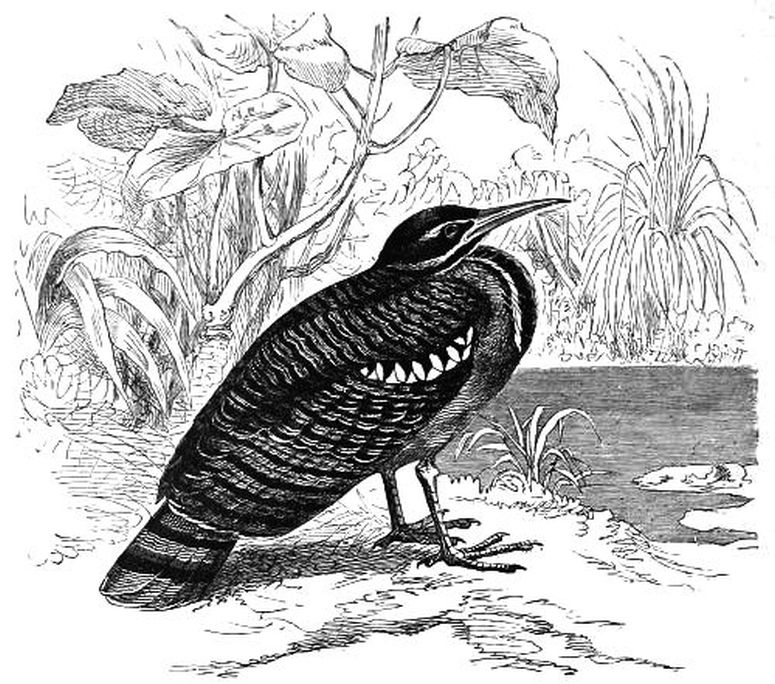
THE SUN BITTERN, OR PEACOCK HERON (Eurypyga helias). ONE-FOURTH NATURAL SIZE.
Cranes are met with in almost every portion of the globe, but are especially numerous in its warmer regions; such as inhabit northern latitudes migrate as far as, but do not breed in the countries near the equator. Marshy localities or morasses, in the vicinity of cultivated land, are the situations they prefer, as affording a rich and constant supply of the frogs, molluscs, worms, and vegetable diet upon which they subsist. In Palestine the Cranes visit the cultivated districts only in the time of their spring migrations, when but a few pairs remain in the marshy plains, while the greater number pass on to the north. In the Southern Wilderness they resort in immense numbers to certain favourite roosting-places during the winter. Towards evening at this season, we are told that clouds of these enormous birds literally darken the air. Their roosting-place, according to Dr. Tristram, is usually a gently-sloping, isolated knoll, where no ambush is possible, and where they can keep a good look-out on all sides. In such situations their whooping and trumpeting cry is to be heard through the entire night. The following interesting particulars respecting the migrations of these birds in the Wilderness of Sinai are from the notes of the Rev. F. W. Holland:—"On March the 22nd we saw an immense flock of Cranes crossing the Red Sea from Africa. The line appeared to stretch across the whole breadth of the sea. Five days afterwards we found a solitary one amongst the mountains, which did not attempt to fly, but stalked majestically on before our camels, quite regardless of a few revolver bullets whizzing close past him. At last an Arab boy gave chase, and running him into a bush soon caught him, and returned in triumph, holding him up by the tips of his wings. When released he stalked on as unconcernedly as before; but when on the point of being caught again, the strange bird suddenly took wing, and after wheeling round several times flew away over the mountains. On the 13th of April, three days south of Beersheba, in the desert, another large flock of more than two[Pg 89] thousand Cranes passed over our heads, all going north as the others. In the beginning of May, several smaller flocks were seen crossing the same desert from Akabah towards Suez."
THE COMMON CRANE.
The COMMON CRANE (Grus cinerea) is recognisable by its partially bare head, and the long curly feathers on its upper wing-covers. In this bird the plumage is principally ash-grey, black in the region of the throat and brow, and whitish on the side of the neck; the quills are black, the eyes brownish red, and the feet blackish; the beak is reddish at its base, and blackish green at its tip. This species is four feet and a half long, and seven and three-quarters broad; the wing measures twenty-five and the tail eight inches in length.
The Common Crane is a native of the northern portions of the Eastern Hemisphere, from Central Siberia to Scandinavia, and from thence wanders south as far as China, India, and Central and Western Africa. The periodical migrations of these birds are remarkable for such punctuality that for a long series of years they have been observed to pass through France in the month of October, invariably returning during the latter half of the month of March. On these occasions they always fly in large flocks, which move with great rapidity; and alight during the day to rest and seek for food. The Common Crane, although now only an occasional visitor to England, was formerly much more common, and bred in the marshes, which then afforded it food and shelter. Since these have been drained, and the land cultivated, they have almost entirely disappeared. In Charles II.'s time Sir Thomas Browne writes: "Cranes are often seen here in hard weather, especially about the champaign and fieldy part. It seems they have been more plentiful, for in a bill when the Mayor entertained the Duke of Norfolk, I met with Cranes in a dish."
In an account preserved by Leland, in his "Collectanea Antiqua," of the great feast at the enthronisation of George Nevill, Archbishop of York and Chancellor of England, in the reign of King Edward IV., 204 Cranes form a part of the goodly provision detailed; and in the second course of the dinners, Crane forms the first "rost" dish, followed by "Cony, Heronshaw, and Curlew."
During their migrations, these birds always fly in two lines, which in front meet in an acute angle, thus forming a figure somewhat resembling the Greek letter [Greek: g], which, indeed, is said to have derived its shape from this very circumstance. One of the company always flies in advance of the rest, and thus constitutes the vertex of the angle; and if the movements of the flock are watched, it may readily be observed that when this individual becomes fatigued by being the first to cleave the air, it falls to the rear, and leaves the next in succession to take its post. It has been noticed, moreover, that when the Cranes in their migratory flights meet with a lofty mountain, they utter shrill cries, appear anxious and restless, and fly without any kind of order. Gradually, and each for itself, they now ascend spirally until such time as they have attained sufficient height to pass over the obstacle, when, assuming their original formation, they proceed on their course. At times their flight is so very high that, notwithstanding each individual occupies a considerable space, the birds themselves, though heard in the air, are not perceptible to the naked eye. Their shrill, loud, and trumpet-like note is audible far and near, and if at a short distance is almost deafening. Their voices are rendered more powerful by the peculiar construction of the windpipe, which forms several curvatures in the breast-bone, before descending into and joining the lungs. This tall and stately bird, when it stands upright, reaches to the breast of a man. It is of a shy and wary disposition, and when a large flock alights in a field, either for the purpose of feeding or resting, one or more of the party is always seen standing at some little distance, with head erect, and evidently on the watch. On the approach of danger this individual is the first to take wing, on which the rest follow its example. The nest of the Crane is generally placed among the thick reeds or in the luxuriant herbage of their[Pg 90] favourite marshes, but occasionally on the top of some deserted edifice. The eggs are two in number, and have a greenish shell, spotted with brown. Both parents brood, and feed their offspring at first in the nest; the young do not attain their full strength of wing until several months old.
THE DEMOISELLE, OR NUMIDIAN CRANE.
The DEMOISELLE, or NUMIDIAN CRANE (Anthropoides virgo), is distinguishable from its congeners by its short beak and entirely feathered head, which is decorated with two flowing plumes; also by the length of the plumage on the lower neck, and the prolonged but straight feathers on the upper wing-covers. The unusually soft plumage is chiefly light grey; the long feathers on the lower neck are deep black, the crests pure white, and the quills greyish black; the eye is bright red; the beak dull green at the base, horn-grey towards the extremity, and pale red at the tip; the foot is black. This species is from thirty-two to thirty-three inches long and sixty-four broad; the wing measures seventeen and the tail six inches. The young are without the flowing feathers on the head and neck.
This beautiful and attractive bird inhabits South-eastern Europe and Central Asia, and is especially numerous at the mouth of the Volga, in the countries bordering on the Caspian Sea, and in Mongolia and Tartary; from thence it wanders as far as Southern India and Central Africa; occasionally it has been also met with in South-western Europe. The Demoiselle Crane arrives and departs about the same time as the other members of the family, and like them frequents the vicinity of water or morasses, but, according to Radde, sometimes occupies mountain regions, even to an altitude of 3,500 feet above the sea. In its habits and modes of life it closely resembles the Cranes already described, and like them lays but two eggs. Both sexes brood, and commence their preparations about April; by the end of July the young are fledged, and shortly after that time are able to fly in company with the adults. The Demoiselles have received their name from the dancing movements in which they frequently indulge, the males entertaining the females and each other by leaping and turning round, accompanying all their actions with a constant waving of the head.
The AFRICAN CROWNED CRANES (Balearica) possess a powerful body, moderate-sized neck, large head, and a strong, conical, slightly-curved bill of medium length; the legs and feet are long; the claws strong; the wings very much rounded, with the fourth quill longer than the rest; the tail is short and straight; and the plumage thick. The back of the head is adorned with a conspicuous plume of bristle-like feathers, while those on the neck and upper breast are prolonged, and those on the wing-covers disunited at the web; the prominent cheeks and throat are bare. The sexes differ but little in colour; the young are of duller complexion than the adults. These fine birds are natives of Africa, and have hitherto been classed with the Cranes; owing, however, to the many important points in which they differ from the members of that family, we have preferred to place them in a different group.