THE STILT-WALKERS (Grallatores). (continued 4)
Thomas Rymer Jones translation
THE CROWNED AFRICAN OR PEACOCK CRANE.
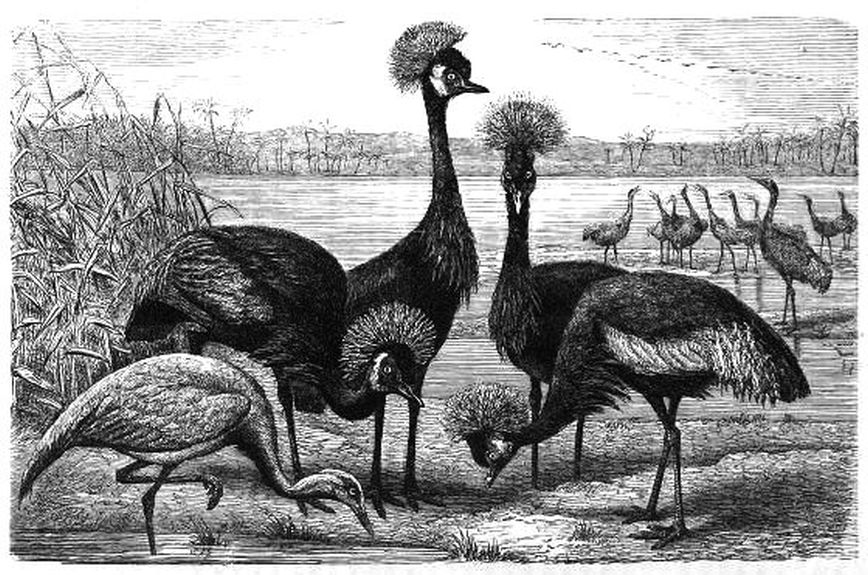
The CROWNED AFRICAN or PEACOCK CRANE (Balearica pavonina) has black plumage, and a golden yellow and black crest; the feathers on the wing-covers are pure white, and most of the upper secondaries reddish brown, those at the exterior being golden yellow; the eye is white; the cheeks are light flesh-pink above, and bright red below; the beak is black, tipped with white; and the foot blackish grey. During the life of this bird the plumage is covered with a blueish dust. The length of the body is thirty-eight inches, the breadth seventy-two; the wing measures nineteen inches and a half, and the tail eight inches and a half.
This species was formerly supposed to be a native of the Balearic Isles, whence its scientific[Pg 91] name. Central Africa, from 17° north latitude, is, however, really its principal habitat; whilst in the most southern portions of that continent it is replaced by a nearly-allied species. In these regions it occupies the flat bush-covered shores of rivers and streams, or light woods, and is to be seen during the day principally upon the small islands and sandbanks, whither it comes in pairs or small flocks, either to seek for food or to perform a variety of dancing movements. During the rainy season these small parties often increase to companies numbering more than one hundred birds, and occasionally they associate with the Grey or Demoiselle Cranes. Upon the ground the Crowned Crane usually walks erect and slowly, with its crest upraised; but if sore pressed it can run with such swiftness as renders it a matter of difficulty for a man to overtake it. Before rising into the air it runs for a short distance with wings outspread, and then mounts with slowly-flapping pinions, extended neck, and crest laid back. It is at present uncertain whether both sexes indulge in the exercise above alluded to, during which the performers often spring three or four feet high, turn, twist, and step with their feet as if dancing. Their loud call is supposed to resemble the Arabic word "Rharmuk," and may be heard at the distance of at least a quarter of a mile. Seeds, grains, berries, portions of plants, insects, and occasionally mussels or small fish, are the principal food of these birds; and for these they begin to seek about sunrise, and after feeding for about two hours bathe, dance, and preen themselves. This one repast is usually sufficient for the entire day; at night they fly with loud trumpeting cries to seek repose upon the trees. We have seen as many as thirty or forty Peacock Cranes perching in the branches, and from this circumstance conclude that they also breed in similar situations. The capture of these birds is attended with much difficulty, owing to their extreme shyness; when caught, however, they are readily tamed, and carry on their dancing movements even in captivity.
The FIELD STORKS (Arvicolæ) have a short or moderately long bill, with soft base and horny tip; high feet, furnished with small toes, the hinder of which is too short to reach the ground; and medium-sized or short wings. The tail is of various lengths, and the plumage rather thick; the cheek-stripes and a patch around the eye are bare. These birds are natives of South America, where they frequent dry, cultivated districts, and subsist upon seeds and insects; their nests are placed on or near the ground; the eggs are of uniform hue.
The SNAKE CRANES (Dicholophus) constitute a group of remarkable birds, having a slender body, long neck, moderately large head, and short, hard, powerful wings, in which the fourth and fifth quills are longer than the rest, and shoulder-feathers prolonged. The long, decidedly-rounded tail is formed of ten feathers, the slender beak is shorter than the head, slightly compressed, straight or curved, and hooked at its tip. The long legs are unfeathered, and the short toes armed with thick, hooked, and pointed claws, resembling those of a bird of prey. The head-feathers are soft, long, and pointed; and those on the brow graduated from the base of the beak, till they form an upright crest. The plumage on the belly and rump is of downy texture, and that about the base of the bill bristle-like; the cheek-stripes are bare.
THE BRAZILIAN CARIAMA, OR CRESTED SCREAMER.
[Pg 92]
CROWNED, DEMOISELLE, AND COMMON CRANES.
[Pg 93]
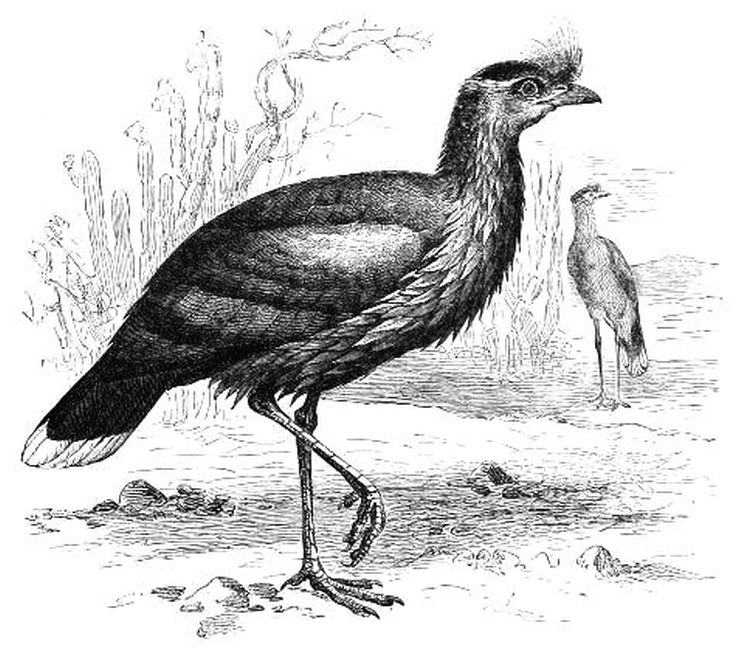
The BRAZILIAN CARIAMA, or CRESTED SCREAMER (Dicholophus cristatus), has grey plumage, each feather delicately marked with zigzag lines of various shades; upon the breast, the feathers are only marked upon the shaft; and those on the lower belly are without any lines. The long feathers on the head and neck are blackish brown, the quills brown, striped with white; the two centre tail-feathers are greyish brown, the rest blackish brown in the middle, and white at the base and tip. The eyes are light sulphur-yellow, the cheek-stripes greyish flesh-pink, the bare eye-rings blueish, and the feet reddish brown in front, and bright red at their sides; the beak is coral-red. The female has shorter feathers on her head and a yellowish shade in her plumage. The young resemble the mother. This bird is from thirty-one to thirty-two inches long; the wing measures fourteen and the tail twelve inches.
THE CARIAMA, OR CRESTED SCREAMER (Dicholophus cristatus). ONE-SIXTH NATURAL SIZE.
The Cariamas inhabit the extensive open meadows of Central Brazil, and are also met with throughout a great portion of South America. In the states of La Plata they are replaced by a very similar species. These birds live in pairs or small families, and if disturbed, at once take refuge in the long grass that covers their favourite haunts, peeping forth from time to time, in order to reconnoitre, and forthwith returning to their place of safety. So cautious are they, indeed, that Burmeister tells us he has often heard their voices close to him during an entire day, without ever succeeding in catching a glimpse of them. In the daytime the Cariamas are occupied in searching for the insects, snakes, and other reptiles upon which they subsist. Owing to the great services they render by destroying the latter noxious creatures, the natives are forbidden by law to kill them. Burmeister tells us that they also eat berries. Unlike the Cranes, these birds are constantly in motion throughout the day. According to the Prince von Wied, they occasionally repose upon the branches, but if alarmed, at once return to the ground, and endeavour to save themselves by running, a mode of locomotion which they perform with such extraordinary rapidity as to outstrip a horseman. The harsh loud[Pg 94] voice of this species has been compared to the barking or yelping of a young dog, or the hoarse cry of a bird of prey. These most unpleasing sounds are sometimes continued for half an hour at a time, the noisy performer sitting upright on a branch, and turning its head about in a sort of accompaniment to its harsh screams, which Burmeister remarks are enough to drive any person with weak nerves from its vicinity. During the period of incubation, the males contend fiercely, tearing each other with their beaks, and presenting a most ludicrous appearance, as, with plumage inflated and tail fully spread, they bound into the air. The nest is usually placed in trees, at no great height from the ground, and is formed of dry twigs, lined with a coating of clay or dung. The two eggs, which are about as large as those of the Peacock, have a white shell, sparsely dotted with rust-red. The young, when first hatched, are clad in thick reddish down, marked with deep greyish brown, and remain for some time in the nest. The Crested Screamers are readily tamed and reared in the poultry-yard. Burmeister saw two of these birds that were domesticated in a farmhouse, standing warming themselves at the fire among a group of men and children. If driven forcibly to one side, they merely retired quietly to a short distance, and almost immediately returned to their former position. Although the flesh of the Cariama is white and well-flavoured, it is seldom killed, as its swiftness of foot renders its capture a work of much difficulty, even to a mounted sportsman. The plan usually adopted, according to the Prince von Wied, is to follow it patiently on horseback, until at last it is driven into a corner and becomes too weary to make further attempts to escape or elude pursuit.
The TRUMPETERS (Psophia) possess a powerful body, moderately long neck, medium-sized head, and short, curved beak, compressed at its sides and hooked at its tip. The feet are high, the tarsi long, the toes short, and armed with curved sharp claws; the exterior and centre toes are united by a short skin; the arched wing has its fourth quill longer than the rest; the tail is short and weak, and the plumage principally composed of large feathers. Those on the head and neck are of velvety, and those on the under side of downy texture.
These birds frequent the South American forests, where they render themselves conspicuous by their most peculiar and noisy cry. This loud trumpet-like sound is uttered six or seven times in succession, without opening the beak, and is so deep and sonorous that it appears to proceed from the bird's entire body. According to Pallas, the strange noise results from a peculiar construction of the windpipe, which at its upper portion is as thick as a Swan's quill, but becomes more slender as it enters the chest, when it gives off two membranous semicircular air-bags, of which the right is the largest, and divided into three or four cells. The hollow internal drumming, preceded by a wild cry, is evidently produced by the vibration of the air forced into these air-bags by the action of the muscles of the thorax. During the performance the chest heaves as in birds when singing.
THE AGAMI, OR GOLD-BREASTED TRUMPETER.
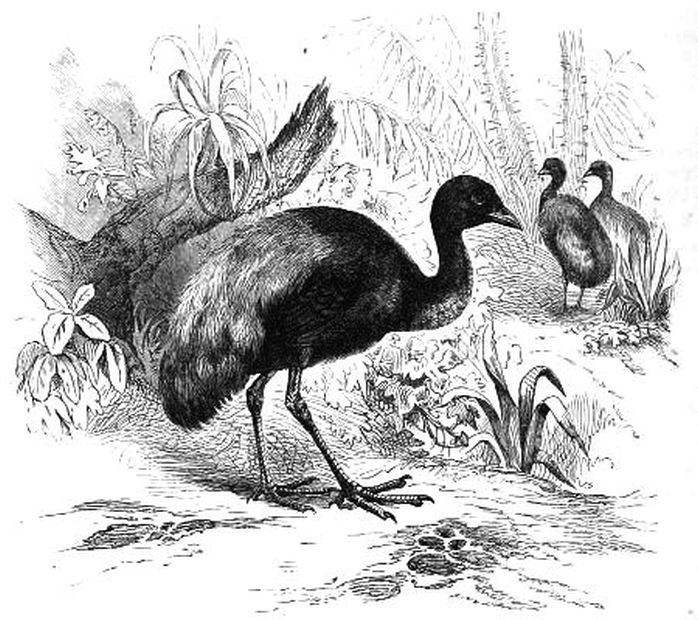
The AGAMI, or GOLD-BREASTED TRUMPETER (Psophia crepitans), is black upon the head, neck, upper back, wings, lower breast, belly, and rump; the shoulder-feathers are purplish black, shaded with blue or green; the upper breast is steel-blue, with a copper-red sheen. The eye is reddish brown, the bare ring around it flesh-pink, the beak greenish white, and the foot yellowish pink. This species is twenty inches long; the wing measures eleven inches, and the tail one inch.
The Agami occupies such parts of South America as are situated north of the Amazon, while on the other side of that mighty stream it is replaced by another but nearly-allied species. Both occupy forests, and are met with in large flocks, that often number some two hundred birds. These parties wander about together in search of the fruit, berries, seeds, and insects upon which they subsist; and usually move with a slow and stately step, enlivening themselves from time to time by leaping into the[Pg 95] air with a variety of ludicrous movements, and if disturbed, they at once seek safety by running. Their flight is so weak, according to Schomburghk, that when crossing a river they are often compelled to drop upon the water and save themselves by swimming. This statement explains the reason why the habitat of the two species is so strictly confined to the two sides of the Amazon. If much pressed, after running some distance, they flutter into the branches or lie close to the ground, and are then readily shot. When alarmed, their remarkable cry is heard to most advantage. The Agamis usually deposit their eggs in a slight hollow on the ground, generally at the foot of a tree. The eggs have a light green shell, and are ten in number. The young leave the nest as soon as they are hatched, but do not lose their downy covering till they are several weeks old. These interesting birds become remarkably docile when domesticated, as the following account, drawn from the "Galerie des Oiseaux," will show:—"The Agami soon learns to obey the voice of its master, follows him wherever he goes, and appears delighted at receiving his caresses; it welcomes his return with alacrity, and seems to repine at his absence. In the same proportion that it appreciates the favours bestowed upon it, it is jealous of any rival. Should even a dog approach, it immediately assails it with its beak and drives it to a distance, with every symptom of displeasure. It presents itself regularly at the dinner-table, from which it chases all domestic animals, and sometimes even the negroes who wait at table, should they happen to be strangers, and only asks for a share of the dinner after it has expelled from the room all who might aspire to favourable notice from the family. It is remarkably courageous; dogs of moderate size are obliged to cede to its authority. It walks out alone, without any danger of losing itself, and it is even asserted that an Agami may be trusted with the care of a flock of sheep, and that every morning it will drive ducks and fowls to their feeding-place and bring them home at night, after carefully collecting any stragglers. As for the bird itself, it is never shut up, but sleeps just where it pleases, upon the roof of a barn, or in the farmyard." Its trumpeting is described as resembling the sound produced by a person endeavouring to pronounce "Tou, tou, tou; tou, tou, tou," with his mouth shut, or the doleful noise made by the Dutch bakers, who blow a glass trumpet to inform their customers when their bread is taken out of the oven.
The SCREAMERS (Palamedeæ) constitute a group of strange birds, possessing large heavy bodies, long necks, small heads, long powerful wings, strong tail, and moderately high, thick foot, with remarkably long toes. The bill is shorter than the head, compressed at the culmen, hooked at its tip, and covered with a cere at its base. The legs are partially bare, and the exterior and middle toes connected by a skin; the hind toe is so long as to touch the ground; the claws are of moderate size, slightly hooked, and pointed. In the wing the third quill is longer than the rest, and the rounded tail is composed of twelve feathers; the plumage of the body is thick; the neck is covered with small feathers. The members of this group have two powerful spurs on the joint of the wing, and one species has a horny protuberance on the head. The sexes are unlike in colour.
The Screamers frequent the marshy grounds of South America, where they live in pairs or small parties. In disposition they are extremely timid and shy, but soon betray their presence by their noisy vociferations. Seeds and portions of plants constitute their principal fare, but they do not reject insects, small reptiles, or even fishes. Upon the ground they move with much dignity, and in their manner of flight nearly resemble some of the larger birds of prey; when at rest, they generally perch on the branches of lofty trees. Although usually peaceful, they exhibit much courage if attacked, and defend themselves boldly with the formidable spurs upon their wings. The nest is large, situated on the ground in their favourite marshes, and contains two unspotted eggs. The horn and spurs of this bird are much esteemed by the Indians as healing remedies, and in many parts of the interior are articles of trade.[Pg 96]
THE ANIUMA, OR HORNED SCREAMER.
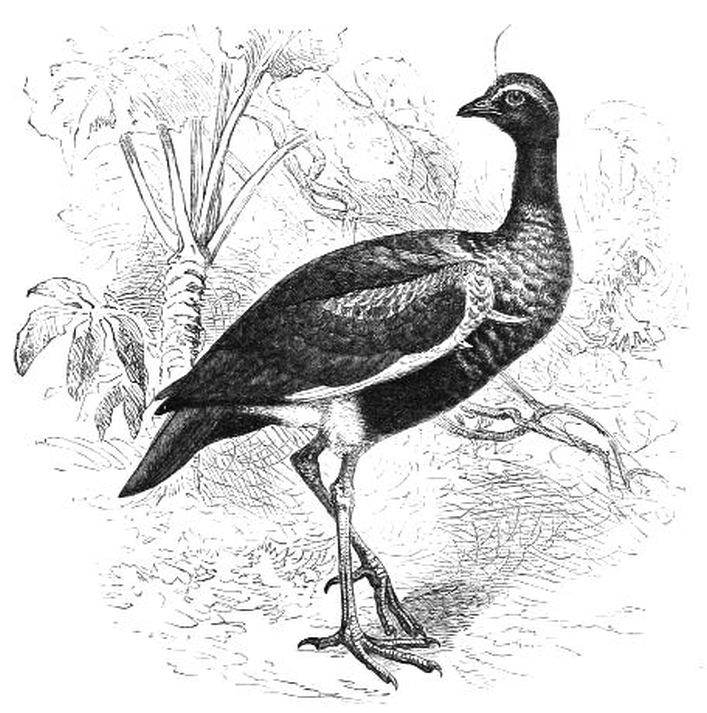
The ANIUMA, or HORNED SCREAMER (Palamedea cornuta), is characterised by a horn upon the brow, its thickly-plumaged bridles, and the short feathers on its head and neck. The horn of this species, which is about five or six inches long, either straight and upright or slightly curved, is situated near the beak, and is about a line and a half in diameter at its base. The upper wing-spur is about two inches long, pointed and triangular, and curves gently upwards; and the lower one strong, almost straight, and about four lines long. The velvety feathers on the crown are whitish grey tipped with black; those of the cheeks, throat, neck, back, breast, wings, and tail are blackish brown; those on the shoulder and large wing-covers of a greenish metallic shade; and the small cover-feathers yellowish at their roots. The feathers on the lower throat and upper breast are silver-grey, broadly edged with black, and those of the belly and rump pure white, the horn whitish grey, and the foot slate-colour. This bird is thirty inches long and seventy-eight broad; the wing measures twenty-one, and the tail eleven inches.
THE GOLD-BREASTED TRUMPETER (Psophia crepitans).
The Aniuma is a native of Brazil, where it frequents the vast swamps and savannahs, and preys upon the swarms of small animals with which they teem. In these localities, an incessant discord of jarring sounds arises from the voices of the multifarious inhabitants, but high and shrill above them all[Pg 97] is heard the loud startling cry of the Horned Screamer. Formidable snakes of all kinds infest these haunts; but by the aid of the powerful, large, hard spurs upon the joint of each wing, it is enabled to protect itself and its young from their assaults. If not attacked, however, its habits are shy, and its disposition gentle. When in search of the leaves and seeds of the aquatic plants on which it partly subsists, it wades deep into the water, and when on the ground walks with an air of pride, keeping its head elevated. Its flight, as might be expected from the length and spread of its wings, is strong and sweeping. These birds live in pairs that are united for life, and make their nest on the ground. According to the natives they lay two white eggs.
THE ANIUMA, OR HORNED SCREAMER (Palamedea cornuta). ONE-FIFTH NATURAL SIZE.
THE CHAUNA, OR TSCHAJA.
The CHAUNA, or TSCHAJA (Chauna Chavaria), has a horn upon the brow, but a shorter beak than the Aniuma; the bridles are bare, the nape decorated with a crest, and the plumage soft, but not of velvety texture, on the head and neck. The feathers of the crest and on the crown are grey, those on the cheeks, throat, and upper neck white, those of the mantle brown, of the nape and[Pg 98] upper breast deep greyish blue. The edges of the wings, the lower wing-covers, and feathers on the rump and belly are whitish. The eyes are yellow, and the bridles and bare eye-rings flesh-red; the beak is black, and the foot light red. This species is thirty-two inches, the wing measures nineteen, and the tail eight inches.
The Chaunas are peculiar to the northern parts of South and Central America, where they frequent marshes, or occasionally river-banks, either in pairs or small parties. Their manners are shy, and when not disturbed their gait is stately and slow. In the air their movements are easy and swift, but they are unable to run without the assistance of their wings; when about to rest, they resort to the branches of high trees. According to Gray, these birds are kept by the natives with their poultry, going with them to feed about the neighbourhood during the day, and proving very useful in defending the fowls, by the aid of their spurs, from the attacks of the numerous feathered tyrants with which the country is infested. Marshy or inundated localities are the situations they principally frequent, as their food consists entirely of the leaves of aquatic plants, grapes, and seeds. The spacious nest is made of small branches, and is usually placed in a bush surrounded by water, or among reeds and rushes. The eggs are two in number, and have a rough white shell. According to Gray, if the living bird be handled, a peculiar crackling is felt, which is caused by the quantity of air lodged between the skin and the muscles.
The RAILS (Ralli) are characterised by their high body, which is much compressed at its sides, their moderately long neck and small head. The bill is variously formed, compressed at the sides, and seldom longer than the head. In the high, long-toed foot, the hind toe is well developed, the wing is rounded, and does not extend so far as the extremity of the rounded tail, which is formed of twelve feathers. The plumage is compact and thick. The members of this family inhabit almost every portion of the globe, and exhibit many modifications of form, according to the situation they are created to occupy. Owing to the slender shape of their bodies, they are able to thread their way through beds of the thickest stems of reeds, bulrushes, and other aquatic plants, among which they seek shelter; or, like the Land Rail, penetrate the tall grass of the meadow, and that so rapidly and noiselessly that they elude pursuit with the greatest ease, and seldom can be forced to take wing. All the various species are able to pass over the surface of soft ooze, or the flat leaves of plants that float thickly on the water of their favourite haunts; many of them can also swim with much facility. The Rails are social in their habits, and frequently assemble in small flocks, which remain together until the migratory season. Insects, larvæ, worms, eggs, and even young nestlings, frequently fall a prey to them; but seeds of various kinds and portions of plants form their principal fare. The nest, which is very carefully constructed, is usually placed among reeds, grass, or rushes; the light-coloured eggs are darkly spotted, and from three to twelve in number. Both parents brood, and they rear two families during the summer. The flesh of these birds is excellent, but it is difficult to shoot them without the aid of a dog.
The SNIPE RAILS (Rhynchæa) are recognisable by the peculiar form of their bill, which is longer than the head, straight at the base, compressed at its sides, and inclines and curves downwards at the tip of both mandibles, which are of equal length. The moderate-sized foot is furnished with short unconnected toes, and has the hind toe placed higher than the rest; the broad wing is slightly rounded, the third quill being longer than the rest; and the tail is composed of twelve feathers. The plumage is very beautifully variegated, the dress of the male being usually of quieter tints than his mate; and for this reason superficial observers have often been mistaken as to the sex of the latter.[Pg 99]
THE GOLDEN RAIL, OR PAINTED CAPE SNIPE.
The GOLDEN RAIL, or PAINTED CAPE SNIPE (Rhynchæa Capensis), is of a blackish grey on the upper part of the body; the eyebrows, a stripe on the head, and another on the shoulder, are yellowish; the upper wing is brown, marked with black; the lower throat and upper breast are deep blackish grey and white; the rest of the under side is white; the quills and tail-feathers are adorned with golden eyes and black spots. In the female the upper parts of the body are dark brown, irregularly striped with greenish black. The brown head has a green gloss, the eyebrows are yellowish white, a line over the head is yellowish, the neck reddish brown, and the upper breast blackish brown; the under side and a line on the shoulder are white, the quills and tail-feathers green and black, enlivened by golden eyes, and the feathers of the wing-covers green, striped with black; the eye is brown, the beak dark green at the base, and tipped with brownish red; the foot is light green. The male is nine inches long and sixteen and a quarter broad; the wing measures five inches and one-sixth, and the tail two inches; while the female is ten inches long and eighteen broad.
The Painted Snipes are dispersed over a large portion of Africa. They keep together in small parties, and lead a quiet and retired life, beneath the sheltering leaves of aquatic plants that overspread the morasses and river-banks, which are their favourite haunts. We are almost entirely without particulars respecting these birds, except that they run well and swiftly, and flutter rather than fly, when compelled to rise into the air. Near the Cape they are known by the name of "Keuvitts," as that word is supposed to resemble their cry, which is constantly heard during evening. We obtained two eggs from the ovary of one of these Snipes, shot in the month of May; in form and colour these resembled the eggs of the Gallinago.
THE WATER RAIL.
The WATER RAIL (Rallus aquaticus) represents a group having the bill rather longer than the head, straight or slightly curved, and compressed at its sides; the feet are moderately large, the wings short, blunt, arched, and formed of soft quills, of which the third and fourth are the longest; and a very short, narrow tail, composed of twelve weak, curved, and pointed feathers. The thick compact plumage is of a golden yellow, spotted with black on the back; the lower part of the body and sides of the head are blueish grey, striped with black and white on the thighs. The belly and rump are brownish yellow, the quills pale brownish black, edged with greenish brown, and tail-feathers black bordered with olive-brown. The eye is dull red, the beak brownish grey at the culmen, and bright red at its margins and lower mandible, the foot is brownish green. The female is smaller than her mate, but resembles him in colour. The young are reddish grey on the under side, spotted with various shades of black. This species is eleven inches long and fifteen broad; the wing measures four inches and a half, and the tail two inches and one-sixth.
The Water Rail is a native of Northern and Central Europe, and Central Asia, as far east as the river Amoor; and is also met with in Southern Europe and Northern Africa during the course of its wanderings. In England it is permanently resident, and is to be found if sought for at all seasons of the year, but owing to its shy and sedentary habits, and the peculiar situations it frequents, is not very frequently seen. Marshes, pools, or water-courses are the favourite haunts of this bird; such as are covered and edged with reeds, dense grass, or aquatic plants being preferred, as in these it finds a constant shelter and refuge, the narrow form of its head and body enabling it to pass through the closest masses with great facility. To this fact it is indebted for its principal means of security, as when driven into the air it flies awkwardly and slowly, with the legs hanging down. Few dogs even succeed in forcing it into view before it has gained its retreat, which is often a rat-hole, or a tangled[Pg 100] mass of tree-roots. When disturbed, it occasionally runs along the surface of the water, supported by the floating leaves, for which purpose its broad, spreading feet are well adapted; it can also dive with much facility. Worms, slugs, aquatic insects, together with the leaves and seeds of aquatic plants, are its principal food, and for these it chiefly seeks during the twilight hours. The nest of the Water Rail is composed of sedges and coarse grass loosely heaped together, and is made on the ground, amongst reeds and rushes, beneath bushes, and occasionally in short herbage. The eggs, from six to ten in number, vary somewhat in colour, but are usually brownish white, or greenish, spotted with violet, grey, and brown. The young look like little, round, puffy balls of down when first hatched, and at once roll into the water, where they swim about with as much delight and enjoyment as if they had been accustomed to the exercise for years. When domesticated, the Rallus aquaticus often exhibits the utmost affection and docility. In an instance that came under our notice, one of these birds not only ran freely about the house, following and obeying its master, but slept at night in his bed, beneath the coverlet.
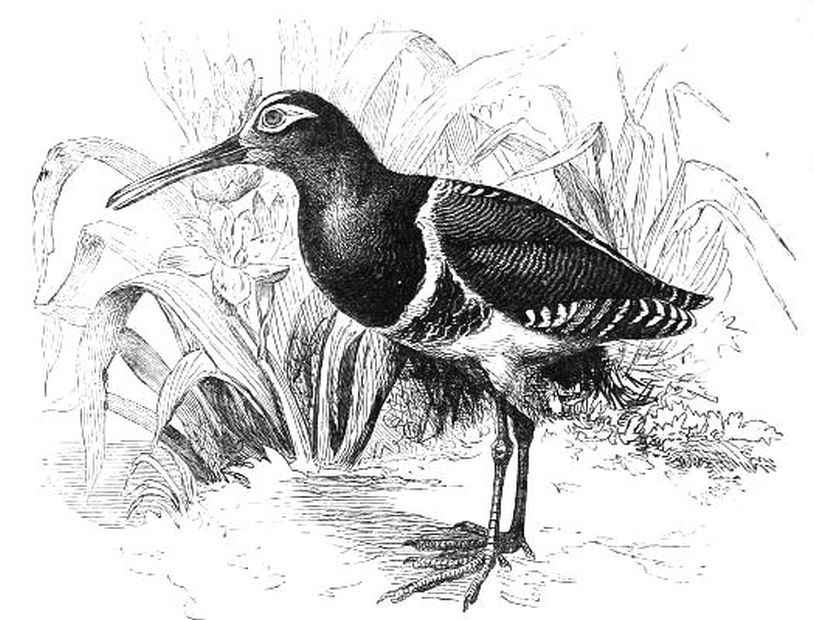
THE GOLDEN RAIL, OR PAINTED CAPE SNIPE (Rhynchæa Capensis). ONE-THIRD NATURAL SIZE.
The ARAMIDES (Aramides) are slenderly-formed birds, with strong bills, which are longer than the head, compressed at the sides, and slightly arched at the culmen; the legs are long, the tarsi thin, the moderate-sized toes quite unconnected, and the claws long, sharp, and curved. The medium-sized wing has the third and fourth quills longer than the rest; the tail is moderate, and the plumage of uniform hue. The members of this group occupy the marshy grounds of Central Brazil, where they seem to be general favourites among the country people, sometimes evincing a remarkable susceptibility of domestication.[Pg 101]
THE SERRAKURA.
The SERRAKURA (Aramides gigas) is about eighteen inches long; the wing measures ten and the tail three inches. Upon the head, upper neck, and legs, the plumage is slate-grey, and reddish brown on the nape; the back and wing-covers are olive-green, and the lower belly and rump black; the quills, lower breast, and sides of belly are bright rust-red; and the tail-feathers of blackish hue. The eye is bright red, the bill yellowish green tipped with grey, and the foot flesh-pink.
These birds frequent the marsh-lands or moist grounds in the interior of Brazil, in search of the seeds and insects upon which they subsist. Throughout the morning and evening hours, their peculiar resonant cry is constantly heard, but owing to their shyness and the dexterity with which they conceal themselves, they are but rarely seen. The nest is placed amongst reeds or long grass. The eggs have a pale reddish yellow shell, slightly spotted with brown. When taken young, these birds are readily domesticated. Azara tells us that he saw a tame Serrakura running about a poultry-yard in Paraguay, and not only boldly defending itself from, but attacking the fowls, with whose most vulnerable parts it was evidently well acquainted. This bird showed a great fondness for eggs, and no sooner was one laid, than it was seized upon, carried off, and devoured; nor did its audacity end here, for if the unlucky hens were longer in laying the next than suited its impatient temper, it fell upon them and pecked them so viciously that they were obliged to quit the nest. These depredations were not confined to its master's premises; every yard in the neighbourhood was regularly visited and plundered, until at last complaints became so numerous and urgent, that this troublesome but most interesting little thief had to be killed.
THE LAND RAIL, OR CORN CRAKE.
The LAND RAIL, or CORN CRAKE (Crex pratensis), is recognisable by its high body, with much compressed sides, its moderately-long neck, and large head; and its short, strong, compressed beak, with high culmen; the leg is of medium length, and partially feathered; the wing is wedge-shaped, its second quill being longer than the rest; and the short weak tail is almost entirely concealed under the covers. The smooth but not very thick plumage is of a blackish brown above, spotted with yellowish grey; the throat and fore parts of the neck are ash-grey, with brownish grey sides, spotted with brownish red; the wings are brownish red, spotted with yellowish white. The eye is light brown, the beak brownish grey, and the foot lead-grey. The female is not so brightly coloured. This species is eleven inches long and eighteen broad; the wing measures five inches and a half, and the tail two inches.
The Land Rail is found throughout a great part of Central Asia and the whole of Northern Europe, and visits not only the southern portions of the latter continent during the course of its peregrinations, but penetrates as far as Central Africa. In the British Isles it is a summer resident, and appears in the southern counties about April, generally departing about October. Marshy meadows, fields of green corn, and beds of reeds and rushes are its favourite resorts, and in these its peculiar creaking note is constantly to be heard. This call, according to Yarrell, may be exactly imitated by passing the edge of the thumb-nail, or a piece of wood, briskly along the line of the points of the teeth of a small comb, and so similar is the sound, that the bird may be decoyed by it within a very short distance. The male is the caller, and he continues to utter his discordant cry until a mate be found and incubation commenced, after which he is less frequently heard. In its general habits this species resembles the members of its family already described, and exhibits not only a similar dexterity in avoiding pursuit or observation, but, when alarmed, is cunning enough, we are told, to simulate death. Mr. Jesse relates the following interesting anecdote in corroboration of this[Pg 102] fact:—"A gentleman had a Corn Crake brought to him by his dog, to all appearance lifeless. As it lay on the ground he turned it over with his foot, and felt convinced that it was dead. Standing by, however, in silence, he suddenly saw it open an eye; he then took it up, its head fell, its legs hung loose, and it again appeared quite dead. He then put it in his pocket, but before long he felt it all alive, and struggling to escape. He then took it out, it was as lifeless as before. Having laid it again on the ground and retired to some distance, the bird in about five minutes warily raised its head, looked around, and decamped at full speed." The pairing season commences almost as soon as the Corn Crakes arrive, and during this period the males guard their mates with jealous care from the approach of a rival, and drive off any intruder with loud harsh cries. The nest is built when the herbage has attained a sufficient height, and is formed of fibres, moss, dry blades of grass, and similar materials. The eggs, which are usually seven or nine, but occasionally as many as twelve in number, are large and beautifully formed, with a smooth, glossy, yellowish, or greenish white shell, strewn with spots of various shades. The female broods for three weeks, and sits with so much devotion that she will remain to be taken in the hand rather than desert her offspring. The young are covered with black down, and at first seek shelter beneath their parents' wing; if alarmed they run like mice over the ground, and are almost instantly in a place of safety. The flesh of this species is good for the table.
The JACANAS (Parræ) form a group of remarkable birds, occupying the warmer parts of both hemispheres, and characterised by their slender body, long thin beak, narrow pointed wings, short tail, composed of slender feathers (in one species the latter are much prolonged towards the centre), and the extraordinary length of their thin toes and claws. The heavy, beautifully-coloured plumage is alike in both sexes, but the young differ considerably in appearance from the parents. Most members of this group have a bare patch or excrescence on the brow, and a thorn-like appendage on the first wing-joint. These beautiful birds frequent marshy ground, on the borders of rivers and ponds, and obtain the seeds and aquatic insects—that form their principal means of subsistence—from amongst the aquatic plants, over the surface of which their long feet enable them to run with astonishing rapidity. The nest is made among reeds, and contains usually either three or four eggs.
The cry of the Jacanas somewhat resembles a laugh, and is generally uttered just after they have alighted, or when they are about to take wing. If suddenly surprised they instantly give warning to their companions, and immediately fly away, the whole party following, with neck outstretched, and screaming loudly.
THE CHILIAN JACANA.
The CHILIAN JACANA (Parra Jacana) represents a division of the above group, having the slender wing armed with a spur, and composed of pointed feathers. The third quill is longer than the rest. The delicate bill is bare at its corners, and has a skinny appendage at its base; the feet are long and thin, and have the claws and toes of nearly equal length. The short tail, formed of ten soft, slightly-pointed feathers, is rounded at its extremity. In the adult of this species the head, neck, breast, and belly are black, and the back, wings, and sides of the belly reddish brown. The quills are yellowish green, tipped with black, and the tail dark reddish brown; the eye is pale yellow, the beak red, tipped with yellow; the bare patches on the brow and corners of the bill are blood-red, the feet grey, and the wing-spurs yellow. The young are yellowish white on the under side; the crown of the head and nape are black, and the back olive-brown. This species is from nine to ten inches long, the wing measures five inches and one-sixth, and the tail two inches. "A bird so well armed as the Chilian Jacana," says Molina, "cannot want for means of defence in case of necessity, and it of course fights with great courage and vigour everything that attempts to molest it. It is never seen in elevated places, and never perches upon trees, but lives wholly in the plains, and feeds upon insects and[Pg 103] worms. It builds its nest in the grass, where it lays four coloured eggs, spotted with black, a little larger than those of a Partridge. It keeps in pairs, and the male and female are almost always together, but it is rarely seen in flocks. When these birds perceive anyone searching for their eggs, they at first conceal themselves in the grass, without discovering any apprehension; but as soon as they see the person approaching the spot where the nest is placed, they rush out with fury to defend it. It is observed that this bird never makes the least noise during the day, and that it cries at night only when it hears some one passing. For this reason the Araucanians when at war are accustomed to watch the cry of this bird, which serves them as a sentinel to inform them of the approach of an enemy. They were formerly accustomed in Chili to hunt these birds with the Falcon, but this mode has been long out of use." The Jacana is good game, in no respect inferior to the Woodcock.
THE CHINESE JACANA.
The CHINESE JACANA, or WATER PHEASANT (Hydrophasianus Sinensis), differs from other Jacanas, inasmuch as it is without the naked forehead and appendages at the corner of the mouth, for which they are so remarkable; the tail, moreover, has the four central feathers of extraordinary length; the first and second primary quills of the wings are longer than the rest; the beak is very slender, the foot somewhat powerful, and the toes proportionately shorter than those of the spur-winged birds. In the Chinese Water Pheasant the fore part of the head, face, chin, neck, and upper breast are white; the hinder neck is yellowish white, marked with a black stripe, that separates it from the upper neck. The upper parts of the body are dark brown, gleaming in certain lights with purple. The upper wing-covers are white. A patch on the head is black; the breast deep brownish black; the lower wing-covers nut-brown; the first wing-quill black, and the second of a very dark shade; the third quill is black on the outer web and at the tip; its other parts are white; the secondary quills are singularly marked; the tail is black, the eye dark brown, the beak blue at its base and greenish towards its point. The length of the male is eighteen inches, and the breadth twenty-four inches. The wing measures eight and the tail ten inches. The female is larger than her mate. One measured by Jerdon was twenty inches long and thirty broad. During the winter the plumage of these birds is of a pale greyish brown on the upper part of the body, and the small wing-covers are transversely banded; the crown and nape are brown, the regions of the eyebrows white, and forehead spotted with white.
This beautiful bird is not confined to China, but is to be found throughout India and Ceylon wherever suitable localities invite its presence. In disposition it is by no means shy, and indeed appears to court admiration, for if driven from the floating lotus-leaves on which it walks, it gives itself but little trouble to escape from observation. At certain seasons it is said to utter sounds resembling the mewing of a cat or the whining of a puppy. Its food consists of aquatic insects, small mollusca, and vegetable substances. Its nest is constructed of aquatic plants, and floats upon the surface of the water. In July or August the female lays from four to seven beautiful eggs, of a bronze-brown or greenish shade. In winter these birds associate in small parties, but are not easily procurable, as if one is wounded it immediately dives, and when it again comes to the surface allows nothing but its bill to appear above water. The flesh of this species is excellent. Jerdon tells us that in Purneah the natives say that before the incubation, i.e., the breeding, this Jacana says "dub, dub" (go under water), and afterwards in the cold weather "powai, powai," which in Purneah dialect means "next year." Amongst the Cingalese, according to Latham, it is known as the Cat Teal, from the peculiarity of its cry.
The WATER HENS (Gallinulæ) constitute a numerous and varied family, closely related to[Pg 104] the last-mentioned species, and largely distributed throughout the warm and temperate parts of the earth. These birds are characterised by their powerful, compactly-built body, moderately long neck, large head, and short, strong, deep, thick beak, the culmen of which is strongly arched; and in most instances are further distinguished by a naked projection from the beak, which spreads over the forehead. Their legs are strong and of moderate length, and their toes either very long, or provided with broad lateral fringes or lobes. Their wings are short, the third or fourth quill being usually the longest; the tail is very short, and they are more or less without variety of tint. In their anatomical structure they are very closely related to the Rallidæ.
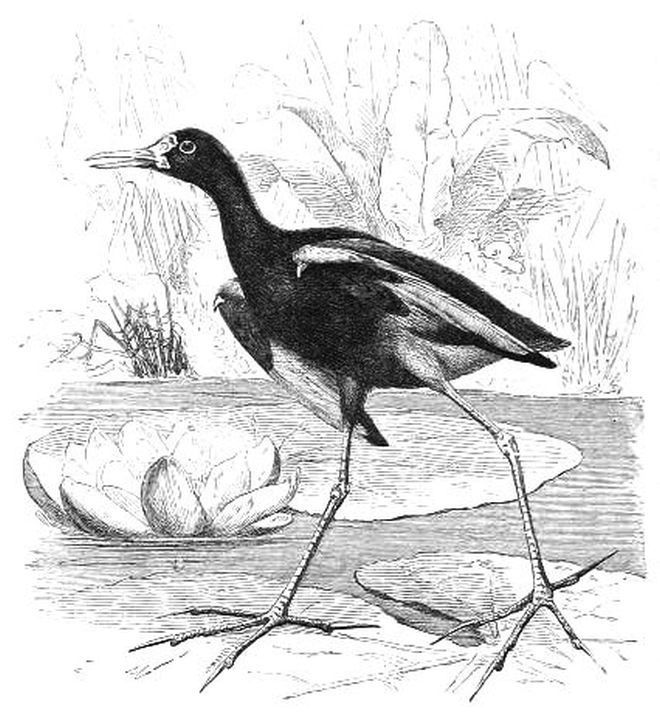
THE JACANA (Parra Jacana). ONE-HALF NATURAL SIZE.
All the Gallinulæ are inhabitants of marshy districts, and some of them might even be called water-fowl. They usually prefer sedgy lakes, large swampy morasses and brooks, or ponds and rivers well stocked with vegetation, but are without exception restricted to fresh water. They are generally seen swimming about in open spaces. They run with less agility than the Rails, but far surpass them in their powers of swimming and diving. Although these birds are by no means social in disposition, they show a remarkable attachment to any locality of which they have taken possession, keeping others, even of their own species, at a distance, and sometimes exhibit resolute courage in driving away intruders much larger and stronger than themselves. They also attack small birds with murderous rancour, and are very destructive to young fledglings. On the other hand, they are tenderly attached to their own progeny, both parents exerting themselves for their defence and support, and evincing the greatest affection for each other. The nest is always built either among or in the immediate vicinity of the water-plants that abound in their favourite resorts. The female lays from four to twelve smooth-shelled and spotted eggs; the nestlings when first hatched are clad in dark-coloured down. As soon as the young are capable of exertion, they and the parent quit the place of their birth and wing their way, in some instances farther south, or merely to a more favourable situation, where they remain till after the moulting season.
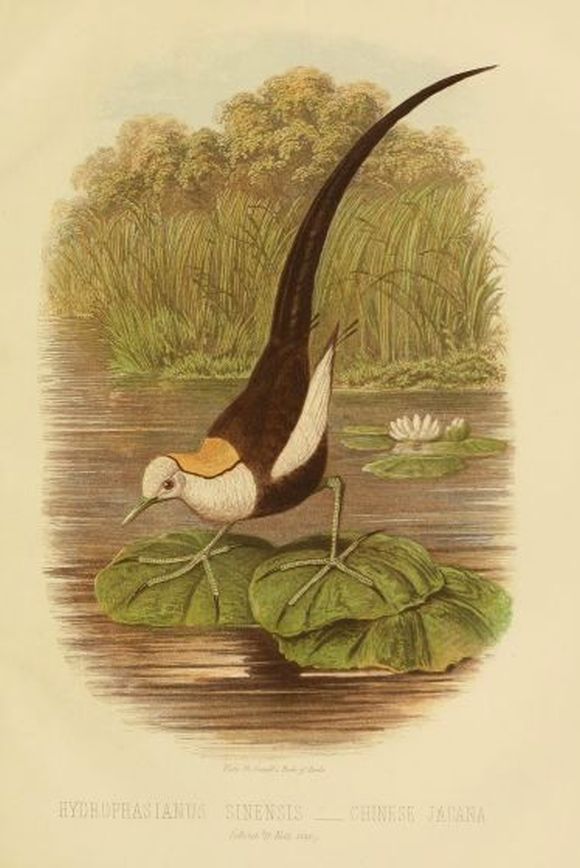
Plate 35. Cassell's Book of Birds
HYDROPHASIANUS SINENSIS ____ CHINESE JACANA
(about 1/2 Nat. size)
[See larger version]
[Pg 105]
The GALLINULES (Porphyrio), the most beautiful of the European Gallinulæ, and known in some countries as the Sultan's Chickens, were regarded by the ancient Greeks and Romans almost as objects of religious worship, and were kept in the neighbourhood of their temples, as though under the special protection of the gods. Even at the present day they are less persecuted than many of their congeners, probably on account of the beauty of their plumage. The members of this group are moderate-sized but powerfully built birds, distinguished by their strong, hard, thick, and very deep beak, which is of about the same length as the head, and at its base expands into a broad callosity, that spreads over the region of the forehead. The tarsi are long, and the feet strong, with large, widely-separated toes. Their wings are of moderate length, the plumage smooth, and remarkable for its rich colouring. These birds are generally to be met with in swampy localities, in the vicinity of fields of corn, or in rice-fields, which as they are almost constantly under water, seem to suit them as well as their favourite marshes. As regards their food, the Sultan's Chickens differ in no respect from the rest of the family. During the breeding season, they are constantly prowling about the ponds in search of the nests of other birds, which they plunder in the most daring manner. Their thefts are by no means restricted to attacks on smaller species; they rifle the larger ones with utter recklessness, so that in any marsh frequented by the Gallinules the broken egg-shells testify to their destructive habits; they likewise often lay in wait for Sparrows after the manner of a cat before a mouse-hole; a single blow with their powerful beak at once destroys their victim, which is speedily torn to pieces and eaten. Tristram mentions having seen an imprisoned bird thus devour young Ducks.
THE HYACINTHINE PORPHYRIO.
The HYACINTHINE PORPHYRIO (Porphyrio hyacinthinus) has the face and fore part of the neck of a beautiful bright blue; the hinder part of the head, neck, and belly and thighs are dark indigo-blue, as are the breast, back, wing-covers, and quills, but these last are more vivid in their tints; the region of the vent is white; the eye is pale red, surrounded by a narrow circle of yellow; the beak and its prolongation over the forehead are brilliant red, and the feet yellowish red. The length of this bird is about eighteen inches and breadth thirty-two inches. In young birds the plumage of the back is greyish blue, and the under parts speckled with white. The Hyacinthine Porphyrio occupies the marshy districts of Spain and Italy, and is probably also to be found in North-western Africa. In North-eastern Africa it is represented by a nearly-allied species, called by the Arabs the "Dickme," to which we have given the name of Porphyrio chloronotus.
This species is to be seen in numbers, which vary with the season of the year, in Sardinia, Sicily, the lake district of the eastern coast of Spain, in the neighbourhood of Albufera de Valencia, upon the coast of Valencia, and near Algiers. Although usually migratory in their habits, many of these birds remain throughout the winter in the vicinity of their breeding-places. In their deportment they remind us of our own Water-hens, but they have a prouder gait, and step with greater freedom.[Pg 106] Their toes spread out so widely that they cover a considerable surface, and each stride is accompanied with a jerking movement of the tail; they are able, moreover, half fluttering and half running, to make their way over a floating surface of aquatic plants. They likewise swim with considerable facility, lying lightly upon the water, and as they row themselves along, constantly bow with their head, as though keeping time with the strokes of their feet. When upon the wing, the beauty of their plumage is fully displayed; their flight, however, is inelegant, they rise unwillingly into the air, and fluttering onwards, fall quickly to the ground, always, if possible, among high reeds, sedge, or rice, amongst which they at once hide themselves. During flight, their long legs hang down behind, and render them easily recognisable at a distance. Their voice somewhat resembles the cackling or clucking of a Hen, reminding us at the same time of that of the Water-hen, but it is of stronger and deeper tone. Like the rest of the family, which it closely resembles in its general habits, this species eats the tender shoots of young corn, grass, and various kinds of grain. When the breeding season approaches, the mated pairs generally resort to rice-fields, and settle down in some place of concealment among the reeds and rushes. Their nest, which floats upon the top of the water, is but a rude agglomeration of dry grass, rice-straw, reeds, and other similar materials. In this roughly-constructed cradle, the female about the end of May lays from three to five eggs, of somewhat elongated shape, with a smooth polished shell, the ground colour of which is dark silvery grey or reddish brown. When first hatched the young are dressed in a suit of dark grey down, their beak, forehead, and legs being of a blueish tinge. They soon learn to swim about and to dive, but their parents continue to watch over them for a considerable period with great tenderness. According to Jerdon, this species is said to destroy large numbers of Wild Ducks' eggs, by sucking them; and one of these birds has been seen to seize a duckling in its huge foot, crush its head, and eat out the brains, leaving the rest untouched.
THE PURPLE GALLINULE.
The PURPLE GALLINULE (Porphyrio chloronotus) is indigo-blue upon the nape and fore-part of the wing, and bright blue on the front of the neck. The breast is indigo-blue, gradually shaded to a slaty-black on the belly. The mantle is dark green. The eye is yellowish brown, the beak blood-red, and the foot brick-red. This species is seventeen inches long and thirty broad. The Purple Gallinule is principally found in the lake districts of Lower Egypt, its presence extending thence east over Syria and the region watered by the Euphrates. As far as our observations enable us to judge, it is a bird of passage, and makes its appearance in Egypt about the end of April, leaving that country in September. It does not, as far as we could learn, ascend the Nile, nor did we ever see it in the countries through which the Upper Nile passes. Its general habits closely resemble those of the species above described.
The WATER-HENS (Stagnicola) are recognisable by the structure of their beak, which is of conical form and compressed at its sides, its base being prolonged over the forehead, and its cutting edges finely denticulated. The feet are large, with long toes, furnished at the sides with broad, web-like folds of skin; the wings are broad and obtuse, the third quill being the longest; the tail is short, and formed of twelve feathers. The plumage is thick and luxuriant.
These birds are more aquatic in their habits than the Rails; they swim with great facility, disporting themselves upon the surface in a singular manner, and continually striking the water with their tails. When approached or alarmed, they have recourse to diving, employing their wings to assist their progress under water, or take flight, skimming along close to the surface till they reach a place of shelter. On the land they move with ease, whisking with the tail at intervals as they walk, and are enabled by the compressed shape of their bodies to run rapidly through coverts or[Pg 107] thick herbage. From the length of their toes, they can also walk over considerable spaces of still waters, supported on the floating foliage of aquatic plants. The borders of rivers and lakes are their favourite resorts, especially when the current is slow and deep, and the stream bordered with rocks and herbage, as the latter affords a safe shelter during the day. The food of these birds consists of slugs, worms, and insects, together with various kinds of grain and vegetable matter. The nest is a thick mass of interlaced grasses, rushes, and flags, and is generally placed in a retired spot among the reeds by the water-side.
THE COMMON GALLINULE, OR MOOR-HEN.
The COMMON GALLINULE, or MOOR-HEN (Stagnicola, or Gallinula chloropus), is, notwithstanding the plainness of its attire, a very beautiful bird. The plumage of the back is dark olive-brown, elsewhere dark slate-grey; the thighs are spotted with white, the region of the vent is pure white. The colour of the eye is peculiar; immediately round the pupil is a circle of yellow, to which succeeds a second of green, while a third exterior ring is red. The beak towards its base is vermilion-red, towards its apex yellow; the foot greenish yellow. The length of this bird is twelve inches, its breadth twenty-three inches; the length of the wing seven inches and a half, and the length of the tail three inches and a half.
The habitat of the Moor-hen extends all over Europe and a considerable portion of Asia, but it is seldom seen in Africa. In Europe, with the exception of the high northern latitudes, it is everywhere common. In England it is met with at all seasons, whilst in Germany it is a bird of passage, arriving about the end of March, and departing in October; some few, however, remain all through the winter. These birds generally travel by night, and probably on foot, at least some of them have been captured under circumstances that lead to such a supposition. In early spring they usually arrive in pairs, in the vicinity of their breeding-places, but occasionally they come singly. Naumann, who watched a pair of Moor-hens from his garden for several consecutive years, sometimes observed that the males and sometimes the females appeared first; on one occasion the female came alone, and seemed to use her best endeavours to get a partner to join her, but in vain, until at length, after a fortnight's sojourn, she disappeared. On another occasion the male arrived by himself, and seemed by no means to consider his solitary condition as one of single blessedness; day and night he reiterated his call-note, almost without intermission, and sometimes in such a pitiable tone that it was almost distressing to hear him, until at length, on the fifth evening, his anxiously looked-for mate arrived, and put an end to his love-lorn suspense. When a pair has once taken possession of a suitable pond they are silent, but if a female is first upon the spot, she seems to invite any passing male to join her. The individual so invited frequently flies around her in wide circles, as though bethinking himself what he should do; generally, however, he is content to pursue his journey alone, as is made manifest by the renewed solicitations of the female.
Slow waters, the margins of which are thickly covered with sedge and coarse grasses, or at least with reeds and brushwood, and partially overgrown with floating herbage, afford the requisite conditions for their residence. Each family of Moor-hens seems to prefer having a whole pond to itself, and it is only on extensive pieces of water that several pairs are to be met with, and even in this case each pair strives jealously to keep possession of its own territory. There is something particularly pleasing in the appearance of these graceful and well-proportioned birds when undisturbed in their quiet pools. As they move, the points of their wings cross each other, and their tail, held perpendicularly upwards, is constantly kept moving in little jerks, their neck being bent into the shape of the letter S, and their body laying horizontally on the water. Occasionally they come on dry land to obtain a little repose, either on a tuft of weeds, or on the bough of a tree, or sometimes[Pg 108] on a piece of floating wood. Here they employ themselves in preening and oiling their feathers, preparatory to taking another swim, or to ensconcing themselves among the rushes and thick grass. Their narrow and apparently compressed bodies enable them to make their way with facility over weeds and leaves floating upon the top of the water. Upon firm ground they move lightly and gracefully, with long and measured steps, and should they be suddenly surprised, they will rise and fly to their pond, with a flight somewhat resembling that of a Barn-door Fowl. When on the water their power of diving is extraordinary; at the slightest appearance of danger they vanish like lightning, and having plunged beneath the surface, use both wings and feet to row themselves along. Should they under these circumstances be forced to come up again to breathe, only the beak is protruded, and that under the protecting shelter of a tuft of herbage.
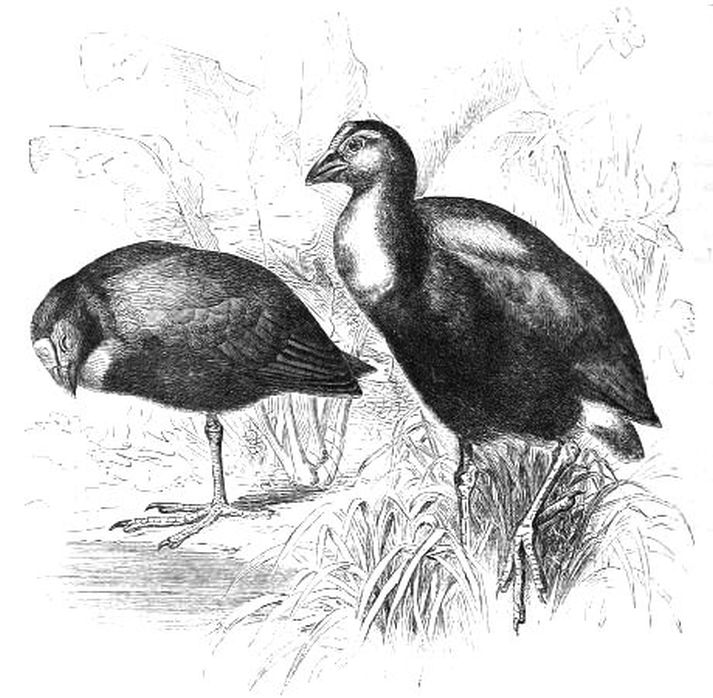
THE HYACINTHINE PORPHYRIO (Porphyrio hyacinthinus). ONE-FOURTH NATURAL SIZE.
[Pg 109]
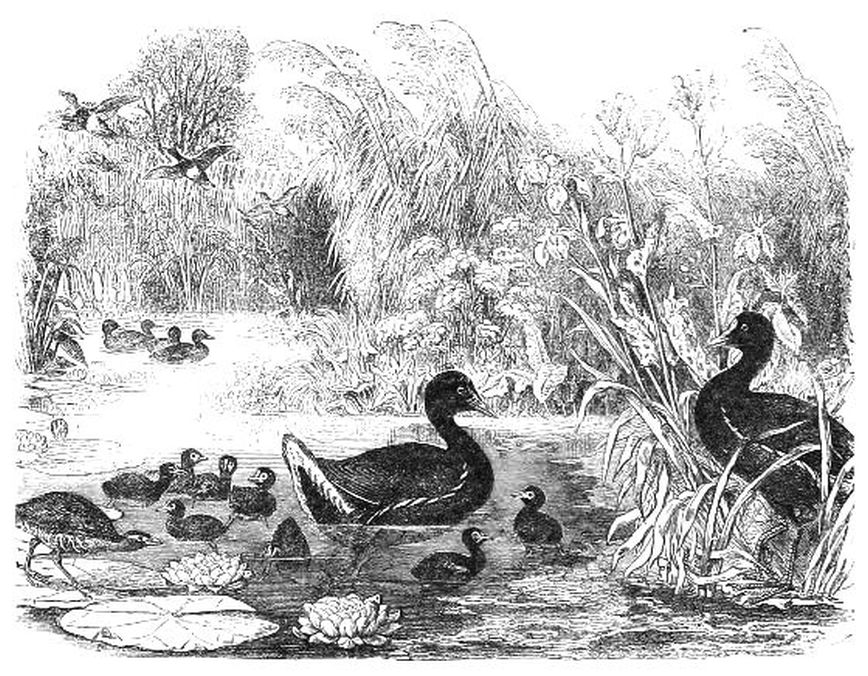
HOME OF THE MOOR-HENS (Gallinula chloropus).
The nest is usually placed among reeds on the ground, sometimes on the bank at the edge of the pool, occasionally among roots of trees, or long grass, or on branches overhanging the river, when there is danger of the water rising and overwhelming the nest. This instinctive forethought is, however, equalled, if not surpassed by the ready ingenuity of these birds when such a danger unexpectedly arises, as the following account by Mr. Selby will show: "During the early part of the summer of 1835, a pair of Moor-hens built their nest by the margin of the ornamental pond by Bell's Hill, a piece of water of considerable extent, and ordinarily fed by a spring from the height above, but into which the contents of another large pond can be occasionally admitted. This was done while the female was sitting; and as the nest had been built when the water-level stood low, the sudden influx of this large body of water from the second pond caused a rise of several inches, so as to threaten the speedy destruction of the eggs. This the birds seem to have been aware of, and immediately took precaution against so imminent a danger; for when the gardener, seeing the sudden rise of the water, went to look after the nest, expecting to find it covered, and the eggs destroyed, or at least forsaken by the hen, he observed, while at a distance, both birds busily engaged about the brink, where the nest was placed, and when near enough he clearly perceived that they were adding, with all possible dispatch fresh materials to raise the fabric beyond the level of the increased contents of the pond, and that the eggs had by some means been removed from the nest by the birds, and were then deposited upon the grass, about a foot or more from the margin of the water. He watched them for some time, and saw the nest rapidly increase in height, but I regret to add that he did not remain long enough, fearing he might create alarm, to witness the interesting act of replacing the eggs, which must have taken place shortly afterwards, for upon his return in less than an hour, he found the hen quietly sitting upon them in the newly-raised nest. In a few days afterwards the young were[Pg 110] hatched, and, as usual, soon quitted the nest and took to the water with their parents. The nest," continues Mr. Selby, "was shown to me soon afterwards, and I could then plainly discern the difference between the new and the older part of the fabric."
The construction of the Moor-hen's nest is a serious operation, in which both parents assist. The materials made use of are leaves of various kinds, both dry and fresh; these are piled upon each other, sometimes apparently in a very slovenly manner, but at others with more care, so that when completed the structure looks like a coarsely-made basket of leaves, in the centre of which is a basin-shaped depression, wherein the eggs, from seven to eleven in number, are deposited in the course of about a fortnight. The eggs are of moderate size, the shells hard, fine-grained, and smooth, but dull-looking. Their colour is pale rusty yellow, spotted with violet-grey and ash-grey, and besprinkled with cinnamon and reddish brown specks. Both sexes take a share in the incubation of the eggs, which are hatched after the lapse of twenty or twenty-one days. The young remain in the nest about twenty-four hours after their escape from the egg, at the end of which time they are introduced by their mother to their new element, the water, to which they are heartily welcomed by their male parent. The family now begins to be a very interesting spectacle; the young brood swims about, closely following the movements of the old birds, all of them eagerly watching for worms or insects that their affectionate caterers pick up for them; and as soon as they see one caught, all simultaneously rush forward to obtain the coveted morsel. After a few days, however, they learn how to obtain their own food, although they are still carefully watched and protected from danger. At the slightest warning they vanish; indeed, it is wonderful to see the celerity of their movements. In about a fortnight they are able to shift for themselves, and their elders begin to make preparations for rearing a second brood, which, after the lapse of a few weeks, make their appearance upon the water, and the scene we have just described is enacted over again, but with additional circumstances that make it still more interesting. By the time the second family show themselves, those of the first brood are half grown up, and might be supposed to trouble themselves very little about the additional members of their family; such, however, is by no means the case; small and great, old and young, seem to meet each other in the most affectionate manner. The half-grown birds at once begin to share with their parents the labour of providing for their new brothers and sisters, to whom they bring food in their beaks, and watch over them with the greatest assiduity, just as their parents had done to them a few weeks previously. As the number of the second brood is usually smaller than that of the first, and the parent birds are not a bit less assiduous in helping their younger than they were in providing for their elder children, the latter grow rapidly; they generally swim in the middle of the little flock, and are fed and cared for by all.
The COOTS (Fulica) are distinguished from the above birds by the structure of their feet, the Water-hens having the toes bordered by simple folds of the integument, whilst in the Coots these membranous folds are scalloped, and more elaborately constructed. In conformity with such enlargement of their feet, which make excellent oars, the members of this group spend more of their time in water than on land. During the course of the day, however, they frequently come on shore in order to repose and preen their feathers. Upon level ground they run with considerable facility, and in their powers of diving might compete with many of the really web-footed birds. If alarmed, they at once plunge to a very considerable depth, and when under water, row themselves along by means of their feet and wings for a considerable distance before again rising to the surface. It is probable that during these immersions they obtain the greater part of the larvæ, worms, mollusca, and vegetable matter on which they principally subsist. Although the flight of the Coots is somewhat superior to that of the Common Gallinules, they but seldom take wing, and when about to do so are compelled to run[Pg 111] before rising into the air, in order to obtain sufficient impetus. Should they endeavour to take flight from the water, they are obliged to flutter along for some distance, striking the surface with the soles of their feet, and splashing along in such a noisy manner that they may be heard at a considerable distance. No sooner have a pair of Coots selected a pond for their residence than they immediately set about the important work of building their nest. On large sheets of water, on which several couples may have taken up their abode, this business is by no means an easy task, as many battles must be fought before the question of appropriated territory is satisfactorily settled; indeed, in localities where many of these birds have congregated, their shrieking, splashing, and flying about seems interminable; no sooner does one pair encroach upon the domain of another, than the invaded male at once hastens to the combat, and furious encounters take place, until the enemy is fairly driven away. Sometimes these engagements afford a very interesting spectacle. The battle-field is generally some quiet creek, in which the birds swim around each other, using the arms with which Nature has provided them with all their might, hacking with their bills, striking with their wings, and kicking with their feet, until one or other is compelled to yield. These affairs settled, the labour of building is at once commenced. The nests are placed near the water, either amidst or upon aquatic plants that there abound; sometimes they are raised upon a bed of reeds or similar matter, or float upon the surface of the pool. The foundation of the nest is generally laid with dry reeds and stubble, while the upper part is formed of finer material and more carefully arranged, the interior is snugly lined with soft hay, rushes, and leaves. The eggs, from seven to fifteen in number, are smooth-shelled, but lustreless. The female does not begin to sit until the last egg is laid; the young make their appearance in about twenty-one days; when first hatched they are beautiful little creatures, clad in dark-coloured down, with flaming red heads. They at once betake themselves to the water, where they are carefully fed, tended, and valorously defended by both the parent birds. At first they seem to prefer to keep themselves hidden among the reeds, but at night they retire to the nest. As they get stronger they become more independent, and even before they are fully fledged are well able to provide for themselves. Although the flesh of the Coots is scarcely eatable, they are nevertheless frequently killed for the sake of the sport. In Italy great numbers are caught by means of nets, and they are commonly sold in the markets at a very low price.
THE COMMON COOT.
The COMMON COOT (Fulica atra) very closely resembles the Water-hens, except in the peculiar construction of its feet. Its body is powerfully framed and slightly compressed at the sides; the neck is of moderate length, and the head rather large; the beak is conical, compressed at the sides, and has its sharp cutting margins slightly denticulated. The callosity upon the forehead is large; the foot moderately high, strong, compressed at the sides, and furnished with long toes, each of which is fringed laterally with a broad expansion of the skin divided into lobes. The wings are of moderate length, with their second and third quills longer than the rest; the tail consists of fourteen or sixteen quills, and is very short, being almost entirely hidden by its covers. The plumage, which is of extraordinary thickness, is almost entirely of a uniform slaty-black; the head and neck, however, are darker, and the breast and belly lighter than the rest of the body. The eyes are light red, the beak and callosity on the brow pure white, and the feet lead-grey, merging towards the heel into a reddish green. In young birds the plumage on the under side of the body is light grey mixed with black, and the mantle tinged with an olive shade. This species is eighteen inches long, and thirty broad; the wing measures nine, and the tail three inches.
The Common Coot is a native of Europe, and is met with in all parts of that continent; it has also been seen during the winter in Central Asia, and the interior of Africa. In Germany it is found[Pg 112] on every piece of water adapted for its residence, and is abundant in England on all fresh-water lakes. In the choice of a locality it seems to avoid streams and rivers, as also salt water, but readily takes up its abode near still deep water, the margins of which are fringed with sedges and tall reeds. For their winter quarters, these birds resort to the extensive marshes of Southern Europe, and to the northern and central parts of Africa, returning to their usual haunts as soon as the snow begins to melt, and there remaining till the autumn; unlike allied species, they assemble in large flocks previous to commencing their migrations. The food of the Common Coot consists of shelled molluscs, worms, larvæ, and a variety of vegetable substances; in southern climates we are told they sometimes visit the corn-fields in order to devour the grain. We are not inclined to question this statement, as we have not only seen them eat corn with avidity when in a state of captivity, but appear to prefer that diet even when fishes were offered them. The nests of this species are large, and, though clumsily formed, are strong and compact. So remarkable, indeed, is the strength of these apparently careless structures, that Mr. Hewitson tells us, upon one occasion when standing up to his knees in water, a nest made of flags and broken reeds afforded him a firm seat. The eggs are of a pale yellowish brown, delicately spotted with dark ashy green, and marked with brown. The Coot when properly prepared before roasting is tolerable eating, otherwise, it becomes imbued with a fishy flavour owing to an oil which exudes from the skin when cooking. During the winter great numbers are killed upon the coast while roosting on the sandbanks.
The FINFOOTS (Podoæ), a group of birds inhabiting South America and Senegal, present many difficulties in their classification, although, judging from their structure generally, and more especially from the formation of their skeleton, they show the closest relationship with the Coots. Their toes are not exactly webbed, but furnished with broad lateral membranes admirably adapted for swimming; their bodies are small and slender, but strongly built; their long neck curves gracefully; their wings are weak and their tail strong and broad. The beak, which is about the same length as the head, is thin and feeble, slightly arched along the line of the culmen, but without any callous prolongation on the brow. The legs are very stout and feathered to the tarsus; the front toes exceed the tarsus in length, and are furnished, as we have said, with lateral folds which perform the office of a web; the hind toe is small and without any appendage; in the wing the second and third quills are longer than the rest; the tail is composed of eighteen feathers, which are slightly rounded at their extremities.
THE SURINAM FINFOOT, OR PICAPARE.
The SURINAM FINFOOT, or PICAPARE (Heliornis Surinamensis), has the head and upper neck black; the back, wings, and tail are brown; a stripe over the eye, the throat and front of neck are white; the breast and belly yellowish white. The eye is brown, beak pale greyish yellow with brown base and black point; in old birds the bill has a red shade. The feet are yellowish red, the inner and hinder parts of the tarsus black, and the toes marked with a black band over every joint. The length of this bird is twelve inches, breadth sixteen inches, length of wing five and a half inches, and tail three and one-sixth inches. According to observations made by the Prince von Wied, the Picapare is to be met with in Brazil and Paraguay, its habitat extending to 25° south latitude, so that it may be said to occur throughout a considerable part of South America. It is by no means scarce upon the rivers of East Brazil, but is often overlooked, as it hides itself amongst the luxuriant vegetation that covers the shore; wherever darkness and silence favour its presence, it is always to be found. Very frequently it may be seen sitting on a thin branch, partially immersed in the water, and occupied in bowing its head in a most peculiar manner. Its food consists of aquatic insects and seeds, in search of which it occasionally plunges its head under water. Its voice, which is emitted from the[Pg 113] throat, somewhat resembles the barking of a little dog. We learn from the same authority that the young of these birds are only two in number, and are reared during the hot season. At first they are nearly naked, and hide themselves under the wings of their parents, holding themselves on by means of their beaks; when they have grown a little stronger, they may be seen sitting upon their mother's back, and even accompanying her in her dives under water. If alarmed when with its young, the Picapare at once takes wing, and betakes itself to the shelter of the thick bushes that cover the shore; if still further pressed it hides among rushes and reeds until the danger is passed. It seems only to dive when seriously alarmed, as for example, when shot at; on such occasions it will remain under water for a considerable space of time; its powers of diving, however, are far inferior to those of many water birds.
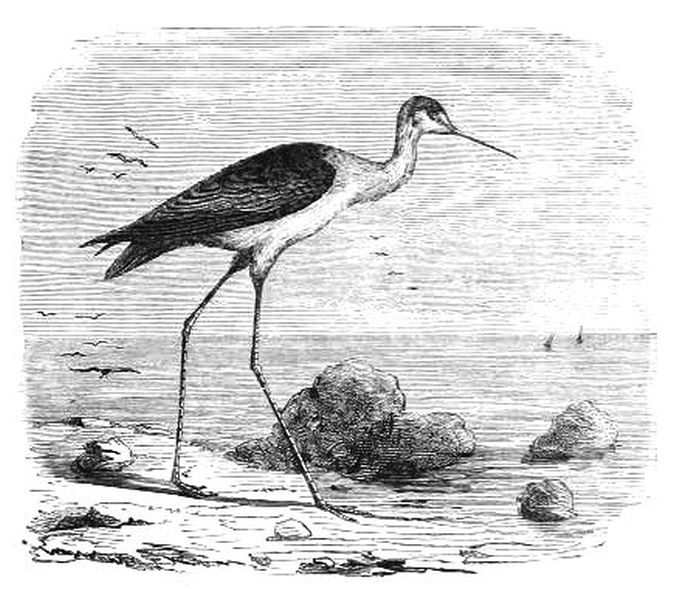
THE STILT BIRD (Charadrius himantopus).
[Pg 114]