THE OAR-FOOTED SEA-FLIERS (Steganopodes).
Thomas Rymer Jones translation
THE members of this order present but a very distant resemblance to the swimming birds described in the preceding pages, from which they differ not only in the construction of their feet, but in their general appearance and peculiar habits.
The birds belonging to this division are characterised by having their body considerably elongated, their neck of moderate length, the head small, and the wings long and rounded or very long and pointed. The tail is variously constructed, but always peculiar and very pointed; and invariably there is between the branches of the under jaw a naked, more or less pouch-like, fold of skin. The tarsus is short and the toes long in correspondence with the great size of the web which connects all the toes with one another, a character whereby they are particularly distinguishable. The general plumage is thick; in some instances compact and stiff, but in others of silky softness. Its colour occasionally differs in the two sexes, and varies much at different ages.
The oar-footed races may all be called inhabitants of the sea, although but a single family is so decidedly oceanic that it never absents itself from the water. All the others willingly prolong their flight far inland, where many of them establish settlements; indeed, there are certain races that only exceptionally visit the sea at all; nevertheless, when they do find themselves in that element they are quite at home, and not only care little for the land, but are able to dispense with fresh water. Some of them at certain intervals come on shore to rest themselves or to sleep on rocky islands and coasts; others prefer a shelving shore; and others, whenever they get an opportunity, roost upon trees: certain species, indeed, might almost be considered true forest birds. In northern climates, as their breeding-time approaches, many of them migrate with great regularity; but in low latitudes they only remove hither and thither, northwards or southwards, following the windings of the sea-coast.
Their nests are generally built either upon trees or in fissures of rocks, sometimes upon ledges of cliffs or on the tops of mountains; less frequently on the little islands met with in marshes and swamps. Wherever their breeding-place may be, they are generally indebted to other birds for relieving them of a considerable share of the labour of nest-building, often contenting themselves with adding materials to their deserted domiciles. Some of them lay but a single egg, others two, others four; the eggs are small, of elongated shape, and generally covered with a calcareous deposit which obscures the markings on the shell. Both parents assist in the work of incubation, and some species would seem frequently to produce two broods in the course of the breeding season. Most of these birds feed exclusively upon fishes; some will occasionally devour small quadrupeds, molluscs, and worms, but fishes invariably constitute their ordinary diet. Some of them catch their food by sailing over the water at a little distance above the surface, whence they suddenly plunge into the water beneath; some swim upon the sea like Ducks, and seize their prey in shallow water by means of their long necks; whilst others again, after the manner of the real divers, pursue their prey to a considerable depth. They are terribly destructive to fishes, and are, consequently, everywhere regarded and treated as enemies by all fishermen.
The TROPIC BIRDS (Phaëton), "Children of the Sun," as they were called by Linnæus, always warn the mariner by their presence that he has entered the precincts of the torrid zone, beyond which they seldom stray. The characteristic features of these beautiful creatures are the small size and[Pg 220] compact build of their bodies. Their beak is about the same length as the head, and compressed laterally—its upper surface slightly curved, its apex acutely pointed, and its cutting edges finely denticulated. The legs are small in proportion to the size of the body, and the hind toe connected with the inner one by but a very narrow web. The wings are long, and the tail composed of twelve or fourteen quills; the central tail-feathers are remarkably prolonged, and present a structure that is quite peculiar, owing to the laxity and sparseness of their barbs. Their general plumage is thick and delicately tinted. "No one who sees the Tropic Birds for the first time," says Pöpping, "would regard them as inhabitants of the sea, but would rather imagine them to be land birds that had strayed by accident far into the illimitable desert of the ocean. In strength of wing they are unrivalled. Without moving their pinions in the slightest degree, or turning the body, they mount quickly to a great altitude, and there seem to repose upon the air, as if it were a solid support. Only when engaged in fishing, or when they perceive a ship, do they exchange this state of luxurious repose for active exertion. On such occasions down they come from the skies with astonishing speed, and never seem tired of circling round the vessel, as though narrowly watching all that may be passing on board. Frequently they soar so high as to be completely invisible except to a practised eye, but they are very rarely seen to swim."
THE WHITE-TAILED TROPIC BIRD.
The WHITE-TAILED TROPIC BIRD (Phaëton æthereus) is strikingly beautiful. Its head, neck, and under parts of the body are pure white, delicately tinged with red; the face is marked about the eyes with a broad stripe of black; the back and mantle are white, marked with a crooked dark line; the wings are black, bordered with white. The eye is brown, beak coral-red, foot dusky yellow. The length of this bird is two feet five inches, of this one foot five inches belongs to the centre tail-feathers; the breadth is three feet four inches. The White-tailed Tropic Birds are commonly met with upon the Atlantic Ocean, and, according to Latham, are found in abundance in the South Sea Islands, but are especially numerous in Palmerston Island, where the trees are frequently loaded with them. Ellis tells us that in the latter island they are so tame as to allow themselves to be taken from the branches with the hand. "These," says Bennett, "are amongst the most beautiful of all the oceanic birds, and excite admiration as the rays of a bright sun shine upon their chaste and delicate satin plumage; they are as gentle in manner as graceful in flight, and it is pleasing to watch their evolutions, for when soaring to a great elevation the action of their wings is slow, accompanied by a jerking motion, rising and falling in the air, at the same time uttering their peculiar, shrill notes. Sometimes they are resting on the surface of the water, and in calm weather occasionally seat themselves on the backs of turtles as they float along in lazy enjoyment."
Sailors formerly believed that the appearance of Tropic Birds indicated the contiguity of land; this idea, however, is erroneous, as they are frequently seen at a great distance from shore. According to Bennett this species has been seen 1,000 miles from the coast. The long tail-feathers of this beautiful bird are in great request.
THE RED-TAILED TROPIC BIRD.
The RED-TAILED TROPIC BIRD (Phaëton phœnicurus) has, like the preceding species, white plumage tinged with rose-colour; a broad, black, transverse band, which commences in front of the eyes, is prolonged towards the back of the head into a point; the centre of the secondary quills, and the feathers on the sides are deep black; the shafts of the primary quills are black nearly to the tips. The middle tail-feathers are white towards their base, but elsewhere bright red with black shafts. The eye is blackish brown, beak scarlet, with a pale blue stripe at its base, and the tarsus faint blue; the[Pg 221] feet are black. The length of this species is two feet four inches, breadth three feet; the longest tail-feathers are fifteen inches, and the rest five inches. The Red-tailed Tropic Bird is met with throughout the warm and temperate parts of the South Seas and Indian Ocean; during August and September it retires to breed upon the islands. The following description of the eggs and young was given to Mr. Gould by Macgillivray:—
"The eggs of the P. Phœnicurus are blotched and speckled with brownish red on a pale reddish grey ground, and are two inches and three-eighths long, by one inch four-eighths and a half broad. The contents of the stomach consisted of the remnants of cuttle-fishes."
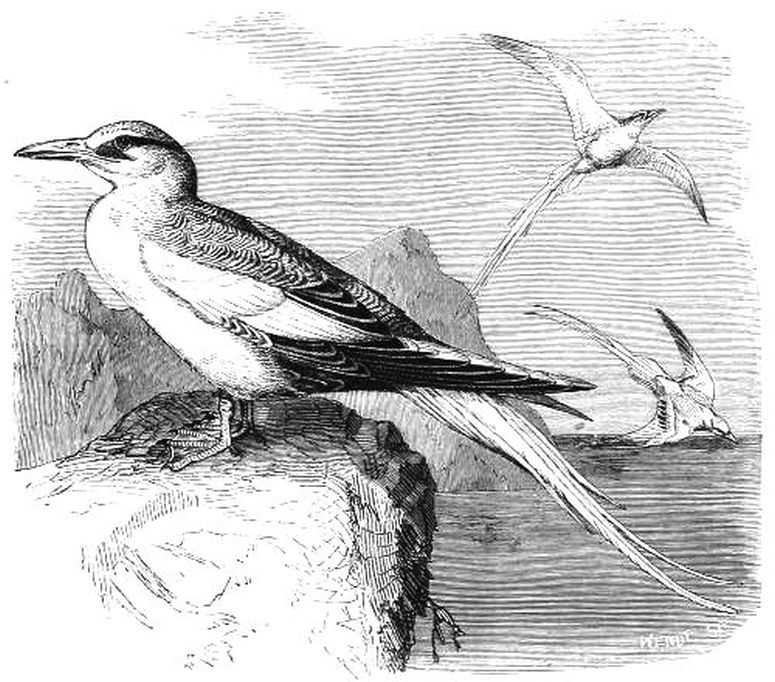
THE WHITE-TAILED TROPIC BIRD (Phaëton æthereus). ONE-FOURTH NATURAL SIZE.
Latham states that these birds are found in great numbers in the Island of Mauritius, where they make their nests on the ground under trees. According to Bennett, "The nestlings have a singular appearance, resembling powder-puffs, being round as a ball and of a delicate snow-white colour; the plumage of the first year is white speckled with black, and they are deficient in the red shafts projecting from the tail, which do not make their appearance till the second year, when on the young bird moulting, the splendid and delicate roseate plumage is displayed."
The GANNETS (Sula) are larger but more slenderly built than the Tropic Birds. Their bill is longer than the head, and the upper mandible looks as though it were divided posteriorly into an[Pg 222] upper and an under portion, so that the beak has the appearance of consisting of three parts. The tarsi are diminutive but strong; the wings unusually long, with the first quill the longest; the tail consists of twelve feathers, and terminates in a wedge-like point. The face and throat are naked.
The Gannets inhabit the northern hemisphere, and are met with in all seas from 70° north latitude to the tropics; further southward their absence is supplied by other species. They are abundant in Iceland, and the Faroe Islands, the Orkneys, and the Hebrides; upon the coast of Norway they are less frequent, but plentiful on the American shores, both of the Pacific and Atlantic. In Great Britain Gannets breed in great numbers on the Bass Rock, Souliskerry, St. Kilda, Ailsa, and Skellig Islands. They betake themselves to the open sea during the winter, pursuing the herrings, pilchards, and other fishes, upon which they dart nearly vertically. It would seem as if these birds entertained a sort of affection for certain islands, or particular localities upon the coast. When they have an opportunity of doing so, they like to pass the night on dry land, generally preferring high precipitous cliffs that rise abruptly from the sea, and from which they can see the waves breaking perpetually before them. Their choice in this particular is somewhat fanciful, at all events they are always to be seen on certain rocks, and seem as constantly to avoid others apparently just as well suited to their purpose.
The power of flight possessed by these birds is very great; they appear to swim only while they give themselves a little rest upon the water, and are never seen upon dry land except during the breeding season, or when, as has been said, they come on shore to sleep. When trying to stand upon their feet they are very helpless, and their walk is hardly more than a waddle. Neither is their power of swimming of much avail; they allow themselves to be blown along by the wind without any exertion of their own, and, indeed, never use their legs except when compelled to do so. When they employ their wings, however, they make up for these deficiencies; their flight is, perhaps, inferior to that of the Petrels, but it is exceedingly swift and strong. After a few rapid strokes of the wings, apparently to give it the necessary impulse, the Gannet glides through the air like an arrow, wheeling round and turning with the greatest ease, at one time sailing close to the surface of the sea, at another rising high into the air, and guiding its course by the simple sloping of its wings. Its voice consists of a succession of harsh croakings, while that of the young birds is a disagreeable screech. Whoever has visited the localities where these birds breed, will have little difficulty in understanding the beds of guano which of late years have been so profitably turned to account. They congregate upon the islands selected as their nesting-places by hundreds of thousands, and by millions, insomuch that, using the words in their literal sense, the air all around is filled with them; "their multitudes shut out the light of the sun, and their voices deafen any visitor." Towards the end of April they first make their appearance upon these islands, and leave them again about October. Their nests are placed so close together, that it is difficult for a man to walk between them. Those first built are of tolerably large dimensions, those made at a later period considerably smaller, while those constructed by the last comers must necessarily be placed on any little unoccupied spaces that can be sought out. The nest itself consists of a mere heap of land or sea plants, on which the female deposits her single egg. The eggs are of moderate size, with chalky-looking shells that are at first white, but soon become of a dirty yellowish brown. The young birds are not hatched till the beginning of June, and by the end of July are about half grown, but still clad in a yellowish white dress of short down.
"In the year 1821," says Faber, "I visited one of the little islands upon which these birds had built their nests. As soon as I had landed, both young and old greeted my arrival with a burst of most discordant music, consisting of one harsh shrieking sound. Not one of them, however, stirred from the spot where they sat, so that I might have readily helped myself to as many of them as I chose. The nests lay crowded close together, but the ground was so slippery with all sorts of filth, that in[Pg 223] walking amongst them I should have run the risk of falling from the craggy cliffs into the sea. It was a wonderful sight to see the multitudes below fishing for food, which, as soon as they had collected enough, they brought with flagging wings to the top of the rock and laid it before their young ones. Towards the end of August, the nestlings are fully fledged, and at that time if they are not larger they are at least fatter than their parents. In this condition the country people catch as many of them as they can, and salt them for food."
In St. Kilda every year there is a regular massacre of young Gannets, which, as they are killed, are thrown down from the rocks into the sea, and there collected into boats; great quantities are then sent to Edinburgh and other places and brought to market.
THE COMMON GANNET.
The COMMON GANNET (Sula alba) is altogether white, except the primary quills, which are brownish black; the upper part of the head and hinder part of the neck are tinged with yellow. The plumage of the young is blackish brown upon the upper parts of the body, speckled with white; the under surface is light brown spotted with a darker shade. The eye is yellow, the beak blueish, the foot green, and the bare skin of the throat black. This species is from thirty to thirty-three inches long, and from seventy-two to seventy-four broad; the wing measures twenty-one, and the tail ten inches. The female is somewhat smaller than her mate.
These birds are constant residents on the shores of Great Britain, changing their locality, however, according to the varying seasons of the year. The principal breeding-places are, Lundy Island, the Skellig Isles on the coast of Kerry; and in Scotland, the Isle of Ailsa, St. Kilda, Souliskerry (Orkney), and the Bass Rock in the Firth of Forth. This latter rock, where Macgillivray made some observations which we will detail, is about a mile in circumference, and of an oblong form, with precipitous cliffs, in some places perpendicular, and in others overhanging, except in one narrow part, where a less abrupt projection forms the only landing-place.
"The Gannets arrive about the middle of February or the beginning of March, and depart in October; some years, a few individuals remain during winter. The nests are composed of grass and seaweed, generally placed on the bare rock or earth elevated in the form of a truncated cone, of which the base is about twenty inches in diameter, with a shallow terminal cavity. On the summit of the island are numerous holes in the turf, formed by the Gannets in pulling away grass and turf for their nests; these are placed in all parts of the rock where a convenient spot occurs, but are much more numerous towards the summit. Some of them, which have been occupied for years on the face of the cliff, or in a shallow fissure, are piled up to the height of from three to five feet; but in this case they always lean against the rock. The egg, which is solitary and presents nothing remarkable in its position, is of an elongated oval form, white, dull, with a chalky surface, usually sullied or patched with yellowish brown dirt. It is subjected to rough usage, for the bird when alighting, flying off, or disturbed by the intrusion of human visitors, tosses it about, and often stands upon it. All the movements of the Gannets on land are very awkward; it hobbles or waddles when it tries to walk, stares at you with its white goggle eyes, opens its ugly black throat, and emits a torrent of crackling sounds.
"When sitting, the Gannets allow a person to approach within three feet, sometimes much nearer, so that one may even touch them. When approached, they merely open their bill and utter their usual cry, or rise to their feet and express some degree of resentment, but little apprehension of danger. They take advantage of the absence of their neighbours to pilfer the materials of their nests; frequently two join in the same act, and occasionally two may be seen at the same bunch, endeavouring to wrest it from each other. They are constantly repairing their nests, which, being[Pg 224] composed in a great measure of seaweeds, shrink up in dry weather and decompose in wet; and when seated close together have frequent quarrels. I saw one seize its neighbour by the back of the neck, and hold fast until the assaulted bird, I may say, roared out; but in general they are satisfied with menacing each other with their open bills and loud clamour." Owing to their so often interfering with each other, a constant noise is kept up amongst them. Their cry is hoarse and harsh, and may be expressed by the syllables, "Carra, carra," or "Kirra, kirra;" sometimes it is "Crac, crac," or "Cra, cra," or "Cree, cree." The cry varies considerably in different individuals, some having a sharper voice than others, and when unusually irritated they repeat it with great rapidity.
When first hatched they have a smooth, bare, black skin; this soon becomes covered with white down, which thickens until the nestlings present the appearance of a powder-puff; through this down the true feathers, which are black, appear, and are followed by the adult white plumage.
"The old bird," says Macgillivray, "at first feeds its young with a kind of fish-soup, prepared in its own gullet and stomach, and which it introduces, drop by drop as it were, into its throat; but when its nursling is pretty well grown, it places its bill within its mouth and disgorges the fish, either whole or in fragments. It never carries fish to the rock in its bill. Upon the Cornish coast these birds are most abundant in autumn and winter."
"The fishermen," says Mr. Couch, "learn by their actions when shoals of pilchards are present, and what course they are pursuing. The Gannet takes its prey in a different manner from any other of our aquatic birds; for, traversing the air in all directions, as soon as it discovers the fish, it rises to such a height as experience shows best calculated to carry it by a downward motion to the required depth, and then, partially closing its wings, it falls perpendicularly on the prey, and rarely without success, the time between the plunge and immersion being about fifteen seconds."
THE FRIGATE BIRD.
The FRIGATE BIRD (Tachypetes aquila) has deservedly been called the "Eagle of the Sea." The most conspicuous feature whereby it may be distinguished among all allied species, is the enormous development of its wings. Its body is slim, the neck powerful, and the head of moderate size; the beak is half as long again as the head, somewhat depressed at its base, vaulted above, and strongly hooked at the tip; the apex of the under mandible is bent downwards in a corresponding manner; the space beneath the lower mandible is large, broad, and denuded of feathers; the gape extends backwards to beneath the eyes; the tarsus is very short, powerful, and covered with feathers as far as the feet; the web between the toes is extremely narrow, looking as if a portion of it had been cut away; the toes are furnished with strong, sharp, curved claws, that on the inner side being toothed; the wing is of inordinate length, and sharply pointed at the tip, the first quill being the longest; the tail consists of twelve feathers, and is very long and deeply forked; the general plumage is compact, smooth, and glossy; upon the head, neck, and breast the feathers are elongated, upon the mantle round, and upon the breast fur-like; the throat and a space around the eyes are naked. The colour of the plumage of the adult male is brownish black, shimmering with metallic green and purple on the head, nape, back, and sides; upon the wings it is shaded with grey; and upon the secondary quills and tail with brown; the eye is deep or greyish brown, the naked space around the eye purple-blue, the beak light blue at the root, white in the middle, and dark horn-colour at the point; the sac beneath the throat is orange-yellow. The length of the Frigate Bird is forty-one inches, the spread of the wings twenty-five inches, length of tail eighteen inches. The weight of the entire bird is only a little more than three pounds. The female is distinguishable by her lighter tint and duller colours, and by her breast being more or less covered with white feathers.
The Frigate Bird is to be found in the same latitude as the "Sons of the Sun," braving with[Pg 225] them the fervour of inter-tropical heat, but it seldom wanders so far from land as they. It has indeed been reported to have been seen at a distance of from six hundred to seven hundred miles from the nearest coast, but generally speaking, it seldom flies to more than from twenty to fifty miles from the shore, to which it usually resorts in stormy weather. At the earliest dawn of morning it leaves its sleeping-place, and may soon afterwards be observed making broad circles in the air, or flying rapidly against the wind towards the sea in search of food. After catching fishes until satisfied, it returns to the dry land, which it reaches, should the weather be stormy, about noon, but if fine, not until later in the day. Mr. Gosse, wishing to know at what time this species retired to their resting-places, visited one of these, arriving there just at sunset, but found to his mortification that he was too late; already the Frigate Birds, Gannets, and Pelicans that resorted to the spot, had retired to roost. At his approach, however, the whole assembly rose as it were in a mass from the trees where they had been reposing, the Frigate Birds instantly flying far out to sea, or sailing in beautiful circles high in the air, neither did they return until darkness had completely set in. A few days later, the same observer visited the place at an earlier hour, arriving about three or four o'clock in the afternoon, but even then he found that the greater number of them had got home, and were quietly digesting the result of their day's employment.
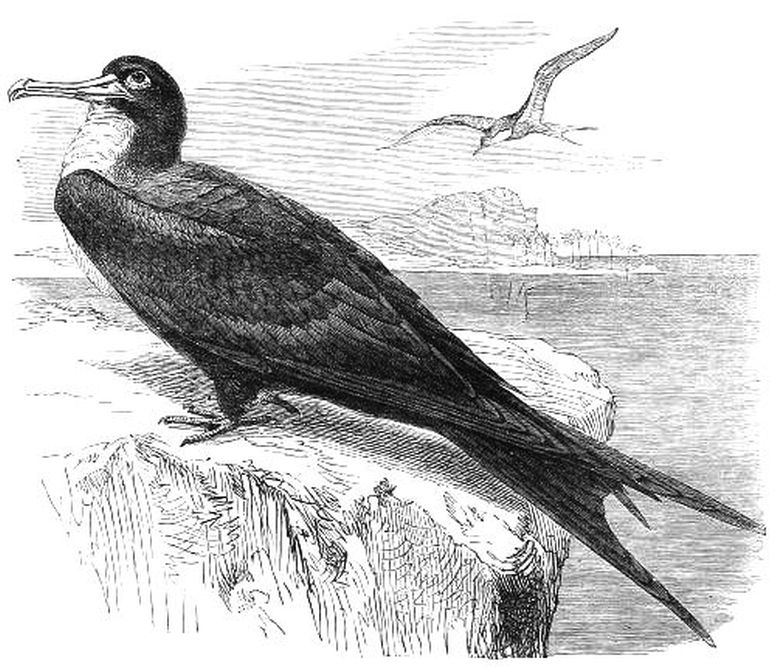
THE FRIGATE BIRD (Tachypetes aquila). ONE-FIFTH NATURAL SIZE.
This bird, according to Bennett, being incapable of swimming and diving, may generally be seen on the alert for flying-fish, when these are started into the air by Albicores and Bonitas, and when[Pg 226] unsuccessful it is compelled to resort to a system of plundering other sea-birds. The quiet and industrious tribes, the Gannets and Sea Swallows (Sterna hirundo, Linn.), are generally selected as objects of attack, and on returning to their haunts to feed their young brood, after having been out fishing all day, are stopped in mid-air by the marauding Frigate Bird, and compelled to deliver up some of their prey, which, being disgorged by them, is most dexterously caught by the plunderer before it reaches the water. A Frigate Bird has been observed to soar over the mast-head of a ship, and tear away the pieces of coloured cloth appended to the vane.
"About the middle of May," says Audubon, "a period which to me appeared very late for birds found in so warm a climate as the Florida Keys, the Frigate Pelicans assemble in flocks of from fifty to five hundred pairs or more. They are seen flying at a great height over the islands on which they have bred many previous seasons, courting for hours together, after which they return towards the mangroves, alight on them, and at once begin to repair the old nests or construct new ones. They pillage each other's nests of their materials, and make excursions for more to the nearest Keys. They break the dry twigs of a tree with ease, passing swiftly on wing and snapping them off by a single grasp of their powerful bill. It is indeed a beautiful sight to see them when thus occupied, especially when several are so engaged, passing and repassing with the swiftness of thought over the trees whose tops are blasted; their purpose appears accomplished as if by magic. It sometimes happens that this bird accidentally drops a stick while travelling towards its nest, when, if this should happen over the water, it plunges after it, and seizes it with its bill before it has reached the waves. The nests are usually placed on the south side of the Keys, and on such trees as hang over the water, some low, others high; several in a single tree, or only one, according to the size of the mangrove, but in some cases lining the whole island. They are composed of sticks crossing each other, to the height of about two inches, and are flattish, but not very large. When the birds are incubating, their long wings and tails are seen extending beyond the nest for more than a foot. The eggs are two or three—more frequently the latter—in number, measure two inches and seven-eighths in length, two in breadth, being thus of a rather elongated form, and have a thick smooth shell of a greenish white colour, frequently soiled with the filth of the nests. The young are covered with yellowish white down, and look at first as if they had no feet. They are fed by regurgitation, but grow tardily, and do not leave the nest until they are able to follow their parents on the wing."
"The Frigate Pelican," continues the same authority, "is possessed of a power of flight which I imagine superior perhaps to that of any other bird. However swiftly the Cayenne Tern, the smaller Gulls, or the Jager move on wing, it seems a matter of mere sport to it to overtake any of them. The Goshawk, the Peregrine, and the Gyr Falcon, which I conceive to be the swiftest of our Hawks, are obliged to pursue their victim, should it be a Green-winged Teal, or Passenger Pigeon, at times for half a mile at the highest pitch of their speed before they can secure it. The bird of which I speak comes from on high with the velocity of a meteor, and on nearing the object of its pursuit, which its keen eye has spied out while fishing at a distance, darts on either side to cut off all retreat, and with open bill forces it to drop or disgorge the fish which it has just caught. Upon one occasion I observed a Frigate Bird that had forced a Cayenne Tern, yet in sight, to drop a fish, which the broad-winged warrior had seized as it fell; this fish was rather large for the Tern, and might probably be about eight inches in length; the Frigate Bird mounted with it across his bill about a hundred yards, and then, tossing it up, caught it as it fell, but not in the proper manner; he therefore dropped it, but before it had fallen many yards caught it again. Still it was not in a good position, the weight of the head, it seemed, having prevented the bird from seizing it by that part. A second time the fish was thrown upward, and now at last was received in a convenient manner, that is, with its head downwards, and swallowed. These birds are gregarious, and utter a rough croaking cry."
[Pg 227]
The Society Islanders ornament the head-dresses of the chiefs with the feathers of these birds, climbing the cliffs, where they are congregated during the breeding season, in order to procure them. The eggs are laid on the sand, beneath a sheltering ledge in the lofty cliffs of Ascension Island and other coasts, and in the low islands of the South Pacific. According to Dr. Bennett, they roost and build in lofty trees. Mr. Burton states that the female deposits one egg, and the male bird sits, a fact clearly established, as one was absolutely taken by the hand while sitting.
The CORMORANTS (Haliei) are peculiarly-constructed birds, easily recognisable by the following characters:—Their body is very much elongated, almost cylindrical in shape, and powerfully built. Their neck is very long, slender, or thin; their head small. The beak is of moderate length, and either straight and sharp-pointed, or strongly bent down and hooked at the end. The tarsus is short and compressed at the sides; the toes large. The wings are long, but blunt at their extremity, owing to the shortness of the primaries, of which the third is the longest. The tail, which consists of twelve or fourteen feathers, is of medium size, or moderately long, and scarcely at all arched; so that it looks very oddly put on. The quills of the wings and tail are very hard, with the barbs broad and strongly connected, the shafts being strong but flexible; the feathers of the under side are loose and silky, those of the upper side closely imbricated.
The members of this numerous family are to be met with in all parts of the world, living equally well in the sea or in fresh water. Some species are resident in the northern seas, but the greater number frequent the temperate and torrid zones. Their habitat is very diversified; some species seldom remove far from the sea, where they take their station on some rocky island, others dwell in reedy marshes or in lakes formed by rivers, only casually visiting the sea-coast; or follow the course of rivers very far into the interior, where they remain during the breeding season. The northern species are regular birds of passage, but those in southern climates only wander from place to place.
The Cormorants are peculiarly adapted to an aquatic life; they are the most gifted divers belonging to their order, and are almost equally qualified for any other kind of locomotion. They walk tolerably on level ground, and although their gait is somewhat vacillating, they are strikingly at home amongst the branches of trees. Their flight is much better than their appearance would seem to indicate, although when flying they always look as if they were fatigued. As far as is possible, they spend their time in the water, where they swim and dive with such skill and perseverance as astonishes anyone who watches their exertions.
The name of these birds is indicative of their voracity, which it seems impossible to satisfy; they will eat as much and as long as they can, and immediately attack any other food that may happen to come within their reach. They seem to rest simply for the purpose of again enabling them to eat, and, with the exception of the very short period they employ in pluming their feathers, their whole time is usually employed in eating and sleeping. The expansiveness of their gullet enables them to swallow fishes of considerable size, but these are rapidly digested, and their craving appetite must again be satisfied. In lands occupied by man, their presence is not tolerated, seeing that they do unspeakable damage to fisheries, but in the ocean, where they can gorge ad libitum, without interfering with mankind, they are at least of some service; they devour fishes and convert them into guano. All the birds belonging to this family build their nests in company with others of their race, and sometimes the numbers thus congregated together amount to several thousand pairs. Their nests are placed either on rocky islands, where they build in the clefts and fissures, or upon the ledges of the rocks, or else in inland places upon trees, forty or fifty of them together. When obliged to build their own nests, they construct a rude framework of thick twigs, upon which they[Pg 228] pile sedges and other kinds of grass, which are heaped together in a very slovenly manner, and moreover kept so wet that the contents literally lie in a sort of puddle. Their eggs, generally from two to four in number, are proportionately very small, and much elongated, they have a strong white shell generally covered with soft chalky matter. Both sexes brood alternately, with much self-devotion, and both assist in the nurture of their young ones, which when first hatched are nearly naked, but at a later period become clothed with a thick coat of dusky-coloured down. They cannot be said to be fledged till they are nearly half grown, at which period they begin to follow their parents into the water, by whom they are instructed for a few days, and then left to their own devices.
The DARTERS, or SNAKE-NECKS (Plotus), we consider as indubitably belonging to the family of the Cormorants, from which they are principally distinguishable by the conformation of their neck and bill; in other particulars of structure, more especially in their internal anatomy, they resemble them so closely that to separate the two races, as many English ornithologists have done, is out of the question. Cormorants they are in their shape and the coloration of their plumage, and they are Cormorants likewise in their habits and mode of life.
The Darters are characterised by the extraordinary elongation of their bodies; the thinness of their snake-like necks; their small head and straight, slender, acutely-pointed beak, the cutting edges of which towards the apex are finely toothed. The legs are short, thick, strong, and placed very far backwards; the feet are provided with long toes. The wings are long, but rounded at their apices, their third quill being the longest. The tail is long, and consists of twelve quill-feathers, each of which becomes considerably increased in breadth towards its extremity. The general plumage is handsome, and brightly coloured, the feathers upon the upper surface being much elongated, while those on the under side of the body are so lax as to resemble fur. In their internal structure, as we learn from Audubon's dissections, these birds present all the anatomical peculiarities of the Cormorants, the most considerable differences being the smallness and slenderness of the skull and the structure of the cervical vertebræ, which, from their great elongation, remind us of those of the Herons. At the present time we are acquainted with four distinct species of Snake-necks, which belong respectively to America, Africa, Southern Asia, and New Holland; these differ considerably amongst themselves, not only in shape and colour, but also in their mode of life.
THE ANHINGA.
The ANHINGA (Plotus Anhinga) has the head, neck, and all the under side of the body velvet-black, shaded with green, the top of the head and forehead being slightly speckled with greyish brown. The upper back and upper surface of the wing are marked with patches of a lighter colour. The shoulder and hinder wing-covers are longitudinally streaked with white, the quills and tail-feathers are black, the latter shading into greyish brown towards their apices. The eye is bright orange-red, or in some cases dirty orange-yellow; the inner side of the leg is dingy yellowish brown, its external surface dirty greyish brown. The length of this species is thirty-five inches, breadth forty-five inches; length of wing thirteen inches, length of tail, ten inches. In the female the head, hinder neck, and back are of a grey-brown, the under surface is tawny, and the belly brownish black.
Both the present species, and those inhabiting South Asia and Australia live, if not exclusively, at least preferably, in fresh water. Tschudi, indeed, asserts that the Anhinga has at times been met with on the open sea fishing in company with twenty or thirty others, but we are very doubtful as to the correctness of this statement.
In remote districts, seldom visited by man, these birds evince so little shyness, that it is not[Pg 229] difficult to procure specimens; all that is requisite is to find out the trees upon which they sleep and towards evening to take up a position in the vicinity and patiently await their coming. When one of them is shot, all the survivors tumble, as if dead, into the water below, where they immediately dive, and when they come up again, only show their necks above the surface; moreover they generally ensconce themselves among the floating weeds, where they are hidden from observation. The Prince von Wied, when travelling in Brazil, tried to shoot Anhingas from a boat, laying himself down at the bottom, and allowing it to float with the stream until he came close to some of them, at which he instantly fired; he found, however, that it was easier to waste his shot than to kill the birds, as their bodies were completely hidden in the water, and to hit their slender necks before they could be withdrawn was a very different matter. Dr. Bachmann gives the following interesting account of two Snake Birds which he brought home and kept with a view to taming them:—
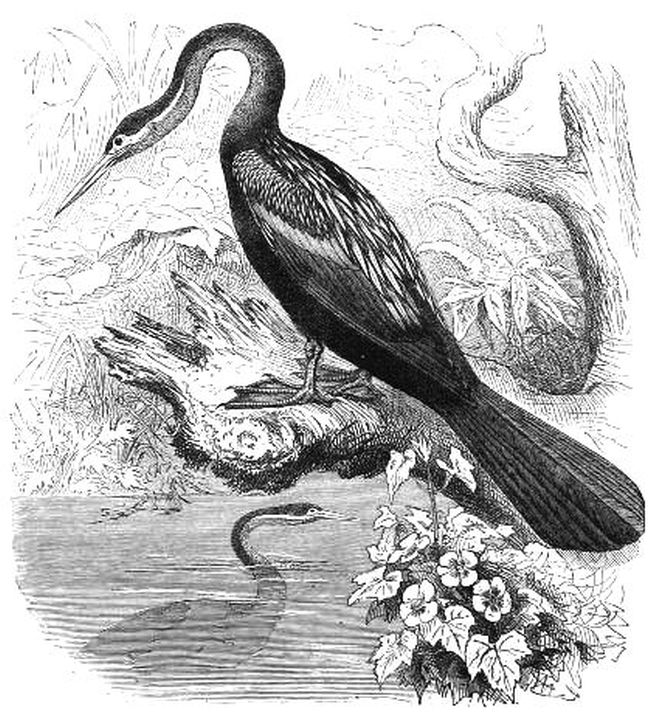
LE VAILLANT'S SNAKE BIRD, OR DARTER (Plotus Levaillantii).
"While these two birds," he says, "were yet in the same cage, it was curious indeed to see the[Pg 230] smaller one, when hungry, incessantly trying to force its bill into the mouth and throat of the other, which, after being thus teased for a short time, would open its mouth, to suffer the little one to thrust its whole head down the throat of its brother, from which it would receive the fish which the latter had swallowed. In this singular manner did the larger bird—which after awhile proved to be a male—continue to act as the foster-parent of his weaker sister, which indeed seemed to be thrown on his protection. The one still in my possession is fed on fish, which it picks up, tosses a few times in the air, and swallows at the first convenient opportunity—that is, when the fish falls towards its mouth head-foremost. At the outset, when the fish was large, I had it cut into pieces, thinking that the apparent slenderness of the bird's neck could not expand enough to swallow it whole; but I soon ascertained that this was not necessary. Fish three times the size of the neck were tossed up, seized by the expanded jaws and gobbled at once, and immediately after, the bird would come to my feet, clicking its bill in such an unequivocal manner that I never failed to give it more. My pet was tame from the beginning of its captivity, and followed me about the house and garden until it became quite troublesome from its attachment to me. It was not until the bird was fully fledged that I found it willing or anxious to go into the water; and then whenever it saw me go towards the pond, it accompanied me as far as the gate of the garden, seeming to say, 'Pray let me go.' On my opening the gate, it at once followed me, waddling like a Duck; and no sooner was it in sight of its favourite element than it immediately let itself in, not with a plunge, but by dropping from a plank into the stream, where for awhile it would swim like a Duck, then dipping its long neck, it would dive for the purpose of procuring fish. The water was clear enough to enable me to see all its movements; and after many devious windings, it would emerge at the distance of forty or fifty yards. This bird sleeps in the open air during warm nights, perched on the highest bar of the fence, with its head under its wings, and in rainy weather it often sits in the same position for nearly the whole day. It appears to be very susceptible of cold, retreating to the kitchen and near the fire, battling with the cook or the dogs for the most comfortable place on the hearth. Whenever the sun shines, it spreads its wings and tail, rustles its feathers, and seems delighted with our warmest sunny days. When walking, and occasionally hopping, it does not support itself by the tail as Cormorants sometimes do. When fishes are presented to it, it seizes and swallows them greedily; but when these cannot be procured, we are forced to feed it on meat, when it opens its mouth and receives the food placed in it. Occasionally it has spent several days without any food; but in those cases the bird became very troublesome, harassing all around by its incessant croakings, and giving blows to the servants, as if to remind them of their neglect."
LE VAILLANT'S SNAKE BIRD.
LE VAILLANT'S SNAKE BIRD (Plotus Levaillantii), like the preceding species, is black upon the under side of the body, the neck is rust-red, a stripe beginning at the eye, and extending down the sides of the neck is blackish brown, and another below this white. The plumage on the back is nut-brown, the long feathers are silvery white; the wings and tail are black, the latter becoming somewhat lighter towards its extremity. The eye is copper-colour, and the bare skin on the head yellowish green; the beak is grey, and foot greenish blue. The length of this bird is thirty-three inches, and its breadth forty-one inches and a half; the wing measures thirteen inches and tail nine inches and a half. The female resembles her mate, but is not so brightly coloured. Le Vaillant's Snake Bird inhabits Africa, where it is to be met with on suitable sheets of water from 15° north latitude to the Cape of Good Hope.
The CORMORANTS PROPER (Phalacrocorax) differ from the Snake Birds principally in their more bulky shape and in the construction of their bill. Their beak, which is of moderate length,[Pg 231] is compressed at the sides, rounded above, furrowed at the sides of the upper mandible, bent downwards and strongly hooked at its tip. The legs are strong, and wings short, with the third quill longer than the rest. The tail consists of twelve feathers, and is shorter than that of the Darters. The Cormorants are met with from the middle of Norway to the south of Europe, and during the winter resort in countless multitudes to Africa. They are also very abundant in Central Asia and North America, whence they wander as far as the West Indies. The habitat of these birds is either the sea or fresh water, according to circumstances. They frequently resort to large rivers or lakes thickly skirted with trees, and sometimes make their appearance in inhabited districts, from which it is difficult to drive them away. An instance is even recorded in which they took up their quarters in the centre of a town, selecting the church tower for their citadel. They visit the sea in great numbers, and there seem to prefer certain localities, generally selecting a situation where the coast is but little accessible or where there are long reefs and ridges of rock. They are very abundant on the coast of Scandinavia, as also in Iceland, the Faroe Islands, the Hebrides, Orkneys, and other similar localities where they are little disturbed by mankind. During the winter season they are met with in equal abundance in more southern districts. In Greece they may be seen in great numbers from one year's end to another, both upon the large lakes and in the sea. In Egypt, they cover the lakes near the shore, as far as the eye can reach, whence they every morning fly out to sea in countless multitudes, returning in the evening. In Southern China and in India they are equally numerous. Indeed, it may be said that they are met with in every locality where water and fishes are to be had. In their habits and mode of life the Cormorants present many peculiarities. They are very sociable, and generally keep together in flights that are more or less numerous. It is a rare occurrence to see one of them alone. During the morning they are always indefatigably employed in fishing; about noon they betake themselves to repose, and digest their food; towards evening they are again busy fishing, and afterwards they resort to the places where they sleep. These are generally lofty trees, growing at some little distance inland upon islands in rivers or lakes, the same upon which they subsequently build their nests; they are generally such as afford them an extensive prospect in every direction, and allow them to fly away and return with facility. The islands thus frequented are easily recognisable at a distance by the thick covering of nascent guano by which the ground is everywhere hidden; indeed, they would soon literally become beds of that material had it a Peruvian sun to dry, or as Scheffel says, "purify" it. Similar deposits are likewise to be seen on islands in the sea, which seldom fail to arrest the attention of the passing mariner. Their history, however, is quite intelligible, and their appearance remarkable when they are densely covered with Cormorants, sitting in close ranks like regiments of soldiers, tier above tier, all turned in the same direction with their faces towards the sea; thus presenting a strangely picturesque scene, for although they are stationary, they are by no means motionless; each of them is constantly moving its head, spreading its tail, or stretching out its wings, so as to give an appearance of animation to the whole assemblage. For a single individual among them to remove from the place where it stands without flying away altogether is an impossibility, so densely are they crowded together. It is asserted by some that these birds can only walk while propping themselves up with their tails; this, however, is not correct; their walk, it is true, is but a clumsy waddle, still it enables them to get over the ground with tolerable quickness. Upon the branches of trees the Cormorants are much more at home than on level ground; nevertheless, like the Snake-necks it is only when swimming or diving in the water that they show their real capabilities. Should a boat approach the rock upon which hundreds of them have taken their station, they first begin to show symptoms of uneasiness by stretching out their necks and moving their heads; they then begin a sort of restless shuffling backwards and forwards, and ultimately they take flight; a few of the assembled multitude rise into[Pg 232] the air, flying at first with fluttering wings, but they soon sweep away, gliding straight forward to a considerable distance, or rise upwards in circles high into the air; the majority of them, however, spring at once into the sea, like so many frogs. Here they instantly dive, and when they come up again may be seen a considerable distance off, peering at the boat with their little green eyes and ready to dive again, in an instant, should they think such a course conducive to their safety. The Darters unquestionably swim and dive more dexterously, but it is questionable whether any other birds can excel the Cormorants in this respect. They progress so rapidly under the water, that a boat manned with strong rowers is unable to overtake them; they dive likewise not only to a great distance, but to a considerable depth, and when they come up, they simply take breath and at once dive again. When chasing their prey beneath the surface they stretch their bodies quite straight, and by powerful strokes of their feet, dart through the water with arrow-like swiftness.
That these birds possess a good deal of intelligence is proved by the fact that in China great numbers of tame Cormorants are taught to catch fish for the benefit of their owners. Fortune was informed by one of these Chinese fishermen that the birds so employed are kept in a state of captivity from the moment of their birth, and that the eggs from which they are obtained are incubated by barn-door fowls. When old enough they are taken to the water-side, and there carefully taught to obey their master's commands, and to bring to him the fishes that they procure. Upon inland waters the presence of Cormorants is a very serious matter, seeing that they destroy the fish in incredible quantities. Their voracity is almost beyond belief; a single Cormorant, when it can get them, will eat as many fishes as a Pelican. Although Cormorants generally prefer to build their nests upon trees, when these are not to be found they content themselves with cavities and projections among rocks or places of a similar description. In inland situations, or where the woods come down almost to the sea, they often make their appearance in rookeries and heronries, and after expelling the Rooks with little trouble, and the Herons after long-contested battles, proceed to take possession of their nests, to which they add a few materials of their own selection, and at once begin to lay their eggs. Should they remain in undisturbed possession of the invaded locality for a year or two, they are only to be got rid of with the greatest difficulty. In the year 1812, says Naumann, four pairs of Cormorants made their appearance in Lutzenburg, not far from the sea-coast, and built their nests in a wood upon a very high beech-tree, which had been for several years the resort of Rooks and Herons. After driving away the Herons, whose nests they took possession of, they each proceeded to rear two broods, one in May, the other in July, and when they left the place about the end of autumn, they numbered about thirty individuals. In the spring of the following year, these repeated their visit, and continued to return every year in still increasing numbers, until it was estimated that there were at least 7,000 brooding pairs assembled in the neighbourhood. Boje counted fifty of their nests in a single tree, the multitudes of them constantly flying to the sea and returning again seemed to fill the air, and the noise they made was positively deafening; the trees upon which they assembled were white with filth, and the whole place stank in consequence of the quantities of putrid fishes fallen from their nests. It was only after several years of unabated exertion that they were at length destroyed or driven away.
The Cormorants generally make their appearance in their breeding-places in April, and set about preparing their nests with great zeal. Towards the end of the month, they lay three or four narrow eggs, of a blueish green colour, but generally incrusted with calcareous deposit. The two sexes sit by turns for about four weeks, and when the young are hatched feed them with indefatigable perseverance. Being thus abundantly provided for, the nestlings grow rapidly; the old birds behave very affectionately towards their progeny, but when danger threatens will not stay to defend them, at least from their human enemies. Whenever the old birds visit their nests, they are literally full to[Pg 233] the throat with the food that they have procured; each of them disgorges on the borders of the nest several dozens of small fishes, which are immediately appropriated by the hungry occupants. Many, however, fall upon the ground, and as no Cormorant thinks it worth while to pick them up, they are left to taint the atmosphere. Towards the end of June the young birds fly away, and the old ones begin to rear a second brood. The chase after Cormorants is a very favourite amusement with the zealous sportsman, although the birds when killed are of no use whatever. Their watchfulness and cunning when they are at large are calculated to test his utmost perseverance and caution. Near the trees where they build their nests, however, they are very much more easily destroyed, and still more readily in their eyries; their destruction, indeed, is so simple that it becomes almost a matter of necessity. But here the sport loses its charms, and the battues that are organised against them assume very much the appearance of a massacre; every one who can procure a gun hastens to the scene of action, and multitudes of the birds are annually slaughtered. In this country the flesh of the Cormorant is regarded as uneatable; the Laplanders, however, and also the Arabs, are of a very different opinion, and consider it, on account of its fatness, to be an especially dainty kind of food.
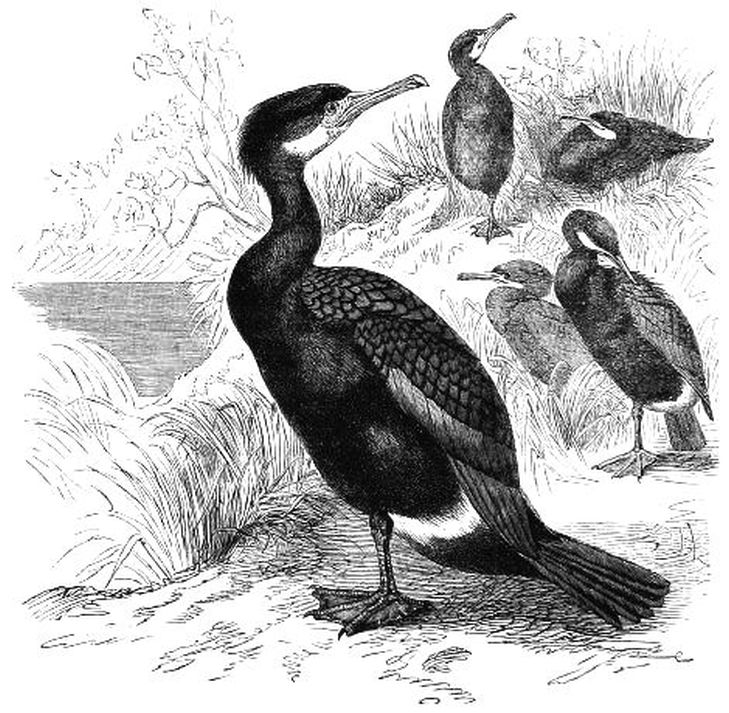
THE CORMORANT (Phalacrocorax carbo). ONE-FIFTH NATURAL SIZE.
[Pg 234]
THE COMMON CORMORANT.
The COMMON CORMORANT (Phalacrocorax carbo) is from thirty-five to thirty-seven inches long, and from sixty to sixty-four broad. The length of wing is fourteen to fifteen inches, and of tail six and a half to seven inches. The plumage on the top of head, neck, breast, belly, and rump is of a glossy blackish green, with a slight metallic lustre. The fore part of the back and upper surface of the wings brown with a bronze shade. Owing to the dark margins of the feathers, these parts have the appearance of being imbricated: quills and tail-feathers black; a white patch commencing behind the eye surrounds the throat. The eye is sea-green; beak black, with yellowish base; the bare skin on neck and face is yellow; and foot black. During the breeding season the Cormorants, more especially the males, have delicate white feathers on the head; these, however, soon disappear. The young are more or less grey; the upper parts of the body being dark, with the imbricated appearance above alluded to; the under side is yellowish or light grey. This species is commonly found on all the rocky parts of the British coast. The nests are placed on high cliffs, many birds congregating together and living harmoniously. The nest is large, and composed of sticks and a mass of coarse grass and seaweed, sometimes a foot high. The rough oblong eggs are from four to six in number, of a chalky white and pale blue colour. In the course of a few days after hatching, the young are able to take to the water. "These birds," says Yarrell, "are frequently seen sitting on posts, rails, or leafless trees by the water-side, when, if a fish should move on the surface within their sight, it is pounced upon and caught to a certainty. An eel is a favourite morsel with him, and a Cormorant has been seen to pick up an eel from the mud, return to the rail he was previously sitting upon, strike the eel three or four hard blows against the rail, toss it up into the air, and, catching it by the head in its fall, swallow it in an instant."
"In China the bridges across the Min, at Fuhchau, may often be seen crowded with men viewing the feats of the tame fishing Cormorants. These birds look at a distance about the size of a Goose, and are of a dark dirty colour. The fisherman who has charge of them stands upon a raft, about two feet and a half wide and fifteen or twenty feet long, made out of five large bamboos of similar size and shape, firmly fastened together. It is very light, and is propelled by a paddle. A basket is placed on it to contain the fish when caught. Each raft has three or four Cormorants connected with it. When not fishing they crouch down stupidly on the raft.
"The fisherman, when he wishes to make a Cormorant fish, pushes or throws it off the raft into the water. If it is not disposed at once to dive and seek for fish, he beats the water with his paddle, or sometimes strikes the bird, so that it is glad to dive and get out of his reach. When it has caught a fish it rises to the surface, holding it in its mouth, and apparently striving to swallow it. A string tied loosely around its neck or a metallic ring effectually prevents swallowing, except perhaps in the case of very small fish. It usually swims directly for the raft. The fisherman on seeing the prize paddles towards it with all speed, lest it should escape from the bird. Sometimes the fish is a large one, and there is evidently a struggle between it and the Cormorant. The fisherman, when near enough, dexterously passes a net-like bag, fastened to the end of a pole, over the two, and draws them both on the raft. He then forces the fish from the grasp of the bird, and, as if to reward the latter for its cleverness and success, gives it a mouthful of food, which it is enabled to swallow on his raising the ring from the lower part of its neck. The bird, if apparently tired out, is allowed to rest awhile on the raft, and then it is pushed off again into the water and made to dive and hunt for fish as before. Sometimes the Cormorant, from imperfect training, swims away from the raft with the fish it has caught. In such a case the fisherman pursues and speedily overtakes the truant. Sometimes, it is reported, two or three Cormorants assist in securing a large and powerful fish, and occasionally two[Pg 235] quarrel together for the fish one has taken, or one pursues the other for the fish in its mouth. At such times the interest of the spectators on the bridge increases to noisy shouting. The bird is provided with a sort of pouch or large throat, in which the small fish are entirely concealed, while the head or tail of the larger fish protrudes from its mouth. It is only at or near full tide that these birds are successful in catching fish under and near the bridges, as then the water is deep and comparatively still, and the fish seem to abound in the vicinity more than at low-tide. At such times there are frequently several rafts with Cormorants fishing near the bridges. The skill of the fisherman in propelling his craft, and the success of the bird in catching the fish are attested by the delighted curiosity and animated interest of the spectators."
The PELICANS (Pelecani), the largest and most striking members of this order, are at once recognisable by their enormous beak, furnished underneath with a capacious bag, and strongly hooked at its extremity. The upper mandible, which is remarkably depressed from its origin to its apex, is moderately broad, and rounded at the point; the culmen forms a conspicuous keel, running along the entire length of the upper jaw, and at its termination bends down to form the strong claw-like hook at the extremity. The lower mandible is exceedingly weak and slender, consisting of two long lateral branches, only joined to each other towards the apex, and enclosing between them a very capacious bag, formed by a dilatable expansion of the throat. In comparison with the above most characteristic features, the rest of the structure of the bird is to the ornithologist of secondary importance; it is, however, very peculiar. The body is large and cylindrical, the neck long and slender; the feet are small, toes long, and connected by a broad web. In the large broad wing, the third quill exceeds the rest in length; the tail, which is short, broad, and rounded, consists of twenty or twenty-four feathers. The plumage is thick, but remarkably hard and stiff; besides the almost naked sac beneath the throat, there is a considerable space around the eye completely denuded of feathers. The two sexes resemble each other very closely, but considerable differences serve to distinguish the old birds from the young.
Pelicans inhabit the torrid regions of the earth, but are also found to a considerable distance within the limits of the temperate zone. In their habits and mode of life, the different groups nearly resemble each other, and we shall therefore confine ourselves to a description of two species met with in Europe.
None but those who have travelled in Egypt and North Africa can form any idea of the vast numbers of fish-eating birds that there crowd the shores of every lake and river. Upon all the Egyptian lakes along the course of the Nile, during the period of its inundation, and still further to the south, along the banks of the Blue and White Nile, as well as on the shores of the Red Sea, Pelicans occur in such immense flocks that the eye is unable even to estimate their extent. Over a considerable surface of country they literally cover the quarter, or the half, of every square mile. When they are swimming out upon the lakes, they look like immense beds of water-lilies. When they come out of the water to sit upon the shore, more especially if it be upon one of the islands, and sit in the sunshine preening their feathers, they look at a distance like a vast white wall, and when they retire to sleep, all the trees upon the island are so thickly covered with them that they have the appearance of blossoms without a single green leaf. To meet a small flock of about ten or a dozen is an unusual occurrence, but to see hundreds or thousands together is a very ordinary spectacle. As the spring approaches, these enormous hosts are in some measure broken up. Many which during the winter season congregated together make their way to Southern Europe, where they breed, but numbers of them are left behind. In selecting the place of their sojourn, these birds seem to make no difference between salt water and fresh; they frequent both in almost equal numbers, but the depth of the water is to them a matter of considerable importance.
[Pg 236]
Only a single American species obtains its food by diving, the others are altogether too lightly built to render such a mode of fishing practicable. They lie upon the surface of the water as if they were made of cork, and it is only in shallow water, to the bottom of which they can reach with their long neck and hooked bill, that they usually fish for food. For this purpose they assemble together in some place where water is of the proper depth, arranging themselves with considerable regularity, so as to enclose a large space, which as they advance forward is gradually diminished. In large lakes and shallows by the sea-shore they arrange themselves in a semicircle, and row themselves gradually towards the beach, or else they form a complete circle, the diameter of which diminishes as they advance towards each other. In narrow rivers or canals they divide into two parties, and arrange themselves in close ranks facing each other, thus enclosing a space in which their prey is to be procured, as the two lines swim in opposite directions until they meet. In general these birds feed only on fishes, but not unfrequently they catch other vertebrate animals. Young birds, for example, that happen to approach them too closely are seized and swallowed, and even half-grown Ducks occasionally disappear down their capacious throats in an equally unceremonious manner. When on dry land the gait of these birds is slow and waddling, nevertheless they can scarcely be said to walk badly, and notwithstanding their webbed feet, they readily perch upon trees; they swim well, and their powers of flight are excellent. The daily life of the Pelicans is conducted in a very regular manner; the early hours of morning are employed in catching food, and they may then be seen hastening from all quarters to their fishing-ground, in small or large parties, the former flying in single file, the latter in the well-known V-shape adopted by many birds of passage. Some parties may soon be seen returning from the water, satisfied with their meal, while others are making their way towards the shallow bay from which their breakfast has to be procured. Towards ten o'clock a.m. they begin to congregate upon their favourite sandbank, or an inland group of trees, and here they repose after their toil, some lazily digesting their food, and others more actively employed in oiling and preening their feathers, a proceeding in which they are occupied for a considerable length of time, their long unmanageable bill being but little adapted to the work. When this is accomplished, they take a kind of siesta, some perched on trees, others on the ground, the former generally sitting bolt upright upon the branches, with their necks thrown back, and their beak resting on their breasts, while the latter generally lie flat on their bellies, and doze away the noontide hours. Between three and four o'clock the whole assembly begins to wake up and prepare for another fishing excursion, in which they are engaged till sunset, after which they at once set off to their sleeping-places, situated on a lonely sandbank, or some island covered with trees, upon the branches of which they pass the night. As to the breeding of these birds, we have been able to collect little from personal observation; it appears, however, by no means unlikely that in the interior of Africa some of them may build their nests in the trees, to which they so frequently resort. In Southern Europe, as Von der Muhle informs us, they select morasses and lakes for their breeding-places. In some of these lakes, says our informant, floating islands are to be met with, which are only approachable with great difficulty, and upon these they build their rudely-constructed nests, as close to each as other they can well be placed. The nests themselves are constructed of reeds and sedges, trodden together into a mass, and are generally damp or even wet. The whole neighbourhood is covered with their filth, the stench of which, added to that of the putrid fishes, which are everywhere strewn about, is at this hot season of the year, absolutely unbearable. Strangely enough they do not all breed at the same time, for brooding females are often sitting in the immediate vicinity of fledged young birds; indeed, Freyberg, who has often visited these breeding-places, informs us that in the same nest he has seen a nearly-fledged young one, and another as yet only covered with down, a circumstance only to be explained by supposing that two females had laid their eggs in the same nest. The usual number of eggs, as we are told by Bädecker,[Pg 237] is from three to five. Those that have been observed in a state of captivity have only laid two. In proportion to the bird the eggs are of small size, being not so large as those of a Swan; their shape is more or less elongated, with both ends of equal size, their colour is blueish white, but their external surface remains for some time soft and pasty, and a layer of dirt, which sticks to them after they have been sat upon, renders it impossible to clean the shell. The young present nothing particular in their appearance, save that they are disgustingly filthy, nevertheless, their parents seem affectionately attached to them, and will suffer themselves to be captured rather than desert their charge.
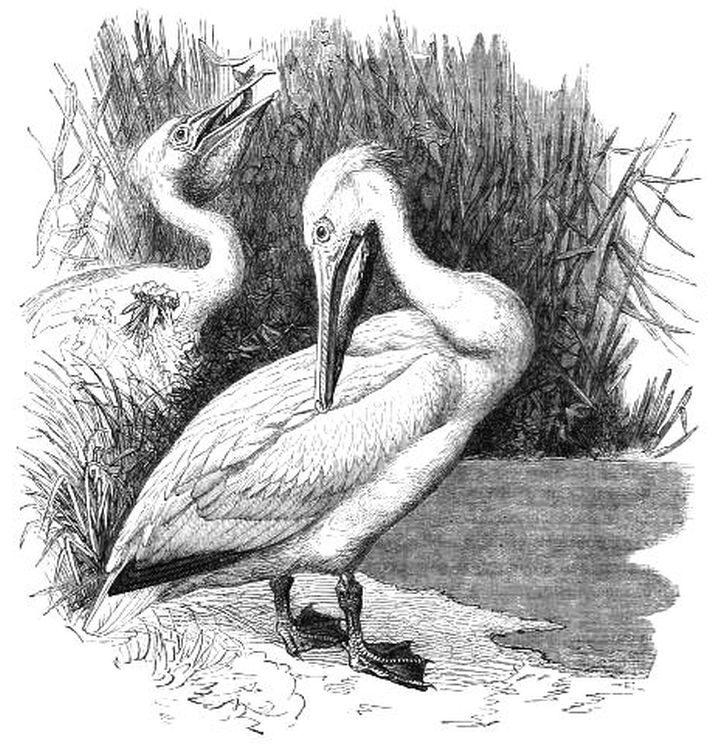
THE PELICAN (Pelecanus onocrotalus). ONE-SEVENTH NATURAL SIZE.
THE WHITE PELICAN.
The WHITE PELICAN (Pelecanus onocrotalus), the commonest and most widely distributed species, is one of the largest members of the natatorial order. In this bird the general colour of the body is white slightly tinged with rose-red; the primary quills being dark brown; the front of breast[Pg 238] is yellow, upon the top of the head the feathers are much elongated, so as to form a long streaming crest. In young birds the mantle is brown mingled with grey, the under side dark grey. The eye is bright red, and the bare space around it yellow; the beak is grey speckled with red and yellow; the bag beneath the bill veined with yellowish blue; the feet are bright flesh-red. This species is from fifty-five to sixty-two inches long, and ninety to one hundred broad; the wing measures about twenty inches; and the tail about six inches and a half. The White Pelican principally inhabits the tropical climates of Africa and India, but is also found in the Mediterranean, on the extensive lakes of Hungary and Russia, and on the eastern rivers of Europe. In Southern Europe it appears about the end of April or beginning of May, returning to its winter quarters after the breeding season. Occasionally these birds miss their way and make their appearance in Germany, greatly to the astonishment of the inhabitants of the districts so visited. In Hungary they usually arrive in flocks of some four or six hundred individuals; these immediately disperse throughout the country for the purpose of breeding; after the period of incubation they again assemble in flocks previous to taking their departure. This species subsists on all kinds of fish, which it catches with facility, and with such sharp-eyed vigilance, that not even the smallest escapes its observation. It is unable to dive, and therefore only searches for food in small and shallow inlets of rivers. It occasionally ascends to some height in the air, and descrying a fish from on high, darts upon it with unerring aim.
The nest is placed on the ground, and is composed of coarse grass, lined with a softer kind. The two eggs are white. It carefully tends its young, conveying food to them in the singular pouch which, says Shaw, is one of the most remarkable appendages that is found in the structure of any animal. Though it contracts nearly into the hollow of the jaws, and the sides are not (in a quiescent state) above an inch asunder, it may be extended to an amazing capacity, and when the bird has fished with success, its size is almost incredible; it will contain a man's head with the greatest ease. In fishing, the Pelican fills this bag, and does not immediately swallow his prey, but when this is full, he returns to the shore to devour at leisure the fruits of his industry. Audubon gives the following graphic account of the movements of an American species, P. Americanus, which is not only very similar in appearance, but until recently bore the same specific name as the bird above described, thereby creating considerable confusion between it and the White Pelican of the eastern hemisphere. "Ranged along the margins of the sand bar in broken array, stand a hundred heavy-bodied Pelicans, pluming themselves, and awaiting the return of hunger. Should one chance to gape, all open their large and broad mandibles, yawning lazily and luxuriously. But when the red beams of the setting sun tinge the tall tops of the forest trees, the birds rise clumsily on their short legs, and hastily waddle to the water and plunge into the stream. Lightly they float as they marshal themselves and extend their lines; and now their broad, paddle-like feet propel them onwards. In yonder nook the small fry are dancing on the quiet water. Thousands are there, and the very manner of their mirth making the water to sparkle, invites their foes to advance. And now the Pelicans at once spread out their broad wings, press closely forward with powerful strokes of their feet, drive the little fishes towards the shallow shore, and then, with their enormous pouches spread like so many bag-nets, scoop them out and devour them." These birds are altogether diurnal; when gorged, they retire to the shores of small islands in bays and rivers, or sit on logs floating in shallow water at a good distance from the beach, in all which situations they lie or stand close together. The White Pelicans appear to be almost inactive during the greater part of the day, fishing only after sunrise, and again an hour before sunset, though at times the whole flock will mount high in the air, and perform extended gyrations. In the south of Europe the chase after Pelicans is a favourite sport, and by the Arabs their flesh is considered not unpalatable.
[Pg 239]
THE GREAT TUFTED OR DALMATIAN PELICAN.
The GREAT TUFTED or DALMATIAN PELICAN (Pelecanus crispus) is white, slightly tinged with greyish red, except upon the quills, which are black. In this species, the head-feathers are long and curly, forming a sort of helmet. The eye is silvery white, beak greyish yellow, bag beneath the throat blood-red veined with blue, and the foot black. The plumage of the young is greyish. The length of this bird is sixty-six inches, breadth one hundred and fourteen inches, the length of wing thirty inches, and tail eight inches. The habitat of the Great Tufted Pelican extends from the Black Sea over all the well-watered districts of Central and Southern Asia; a few penetrate annually into South China and North Africa, but in both these regions they are comparatively of rare occurrence.
The first example known of this bird was shot in 1828 in Dalmatia by Baron Fildegg, and it has been since found by Rüppell and Kittlitz in Abyssinia.
"It arrives," says the baron, "in spring and autumn, giving preference to the neighbourhood of Fort Opus, on the river Naronta, which is bordered with morasses. It comes through Bosnia, seldom alone, but generally in flocks. I have seen as many as twelve together hunting for fish. It is very cunning, and is extremely difficult to shoot."
No particulars are known respecting its habits, nidification, &c., which are supposed to resemble others of its family.
[Pg 240]