THE DIVERS (Urinatores).
Thomas Rymer Jones translation
THE birds belonging to this extensive order are all aquatic, and almost exclusively subsist on fishes, which they capture by diving. In conformity with this mode of life, they all present a general type of structure which is unmistakable. Their bodies are powerfully built, almost cylindrical in shape, and their legs placed far backwards. Their wings are short, feeble, and pointed, but little adapted to flight, and in many cases almost resembling fins, while their dense smooth plumage, which is impenetrable to water, admirably fits them for a residence in that element. Their beak is strong, hard, acutely pointed, and generally compressed at the sides; it is seldom much longer than the head, and its margins are usually sharp and well adapted for cutting. The foot is furnished either with three or four toes, of which the three in front are either strongly-webbed or furnished with lateral expansions of the skin, which render them efficient instruments of propulsion. The tail is often altogether wanting, or if present is always short, rounded, and generally formed of more than twelve feathers. There is much similarity in the coloration of their plumage, in which black and pure white predominate; in some species, however, variety of colour is not wanting. Generally speaking, these birds are all inhabitants of the sea; nevertheless, a few are to be met with only in inland lakes: some species have a very wide range in a great variety of climates; but the majority prefer the polar regions of the world, both north and south, from which, however, some of them migrate at stated intervals. The greater part of their lives is passed upon the surface of the water; indeed, it is only during the breeding season that they come upon dry land. Although many species fly with tolerable facility, in most instances the wings are too feeble to support the weight of their bodies, and are principally used almost like fins, to enable them to progress more rapidly when diving beneath the surface of the water, where they obtain the fishes and small crustaceans that constitute their usual food. A few diving birds build their nests solitarily; but by far the greater number congregate in innumerable hosts, and breed in company with each other upon rocks and islands that rise abruptly from the sea. The eggs are two in number.
The GREBES (Podicipites) are only to be met with in fresh water, and accordingly are classed by some naturalists in the immediate vicinity of the Coots, to which, as far as relates to the structure of their feet, they certainly bear a considerable resemblance. Their true position, however, we consider to be undoubtedly among the Divers. Their body is remarkably broad and squat; their neck long and moderately slender; their head small and elongated; their beak long, conical, and compressed at the sides, with incurved, sharp cutting edges, the lower mandible being slightly overlapped by the upper one. The legs are placed so far backward, that they seem to be attached quite to the posterior extremity of the body, and moreover are of very peculiar conformation. The tarsi are of moderate height, and so much compressed at the sides that the front of the instep presents a sharp smooth edge. The structure of the foot is likewise remarkable; of the three front toes, the exterior is as long or longer than the middle toe, while the inner toe is by far the shortest of the three; the hinder toe, which is slightly elevated, is a mere rudiment. The three front toes are connected by a web as far as the first joint, but beyond this point they are separated, although each is furnished on both sides with a broad fold of skin, which is not scalloped, but smoothly rounded off in front, where it is further strengthened by the broad flattened claws. The wings are small, short, and narrow, the second and[Pg 241] third quills being longer than the rest. The tail is altogether wanting, its place being occupied by a small bunch of fur-like feathers. The general plumage is everywhere very thick, and upon the lower part of the body so smooth and bright as almost to resemble satin, while on the head, neck, and hinder part of the body it has somewhat the appearance of hair. When in their nuptial plumage, the head of the adults is adorned with a remarkable collar or frill, developed from the sides of the face and neck, or provided with bunches of feathers, generally decorated with bright colours. Members of this family are to be found in the temperate zones of both hemispheres, beyond which they do not extend very far either to the north or south. Their usual habitat is on ponds or large sheets of stagnant water, and exceptionally on deep, slow-moving streams; but always where sedges and rushes are abundant. Occasionally, though rarely, they have been seen upon the sea. "Probably there are no birds," says Naumann, "better entitled to the name of water-fowl than the Grebes"—at least we know of no others that do not on some occasions make their appearance on dry land. It is only, however, under the most urgent circumstances—as, for example, when wounded—that these approach the shore, and even then they keep so close to the brink that on the slightest alarm they can at once plunge into their proper element. It would seem that whatever they do must be done in the water; they cannot even rise upon the wing without a preliminary rush over the surface of the lake: from dry land they cannot commence their flight. Their whole life is divided between swimming and diving; and even when other water-birds go on shore to sleep, the Grebes repose floating on their liquid bed. When thus sleeping upon the tranquil water, they float as buoyantly as if they were made of cork, their legs raised to the edges of their wings, and their head comfortably buried among the feathers between their back and shoulder. Should, however, a storm disturb their rest, and the boisterous elements drive them towards the shore, they at once turn round to face the blast, and are generally able, by the active movement of their paddle-like feet, to maintain themselves in the same place.
The conformation of their bodies, their tapering shape, small heads, sharp beak, and the very backward position of their feet, enable them to dive with wonderful facility; in fact, when under water they make their way more swiftly than even when swimming at the top. A man upon the shore would find it very difficult to keep pace with a diving Grebe, as, aided by wings and feet, it shoots onwards with the velocity of a rocket. When flying, their long neck is stretched out straight forwards and their feet backwards, while their small wings, by the rapidity of their movements, carry them very quickly through the air. In the absence of any tail, they steer their course by means of their feet, and are able not only to direct but to change the course of their flight with surprising facility; at the end of their journey they come down obliquely upon the surface of the water, into which they fall with a very audible splash. When alarmed they always instantly dive, and nothing but the utmost extremity of danger will compel them to take wing. The food of these birds consists of small fishes, insects, frogs, and tadpoles, in search of which they dive to the very bottom of the pond, but always bring them to the top before swallowing them. In their manner of breeding, the Grebes are in many respects peculiar. They live together in pairs, the male and the female exhibiting the greatest affection towards each other, keeping each other company even during their migrations, and always returning together to the same pond. When the time arrives, they construct a floating nest, which, instead of being built of dry materials, as in the case of other birds, is merely a mass of wet weeds, in which the eggs are kept not only constantly damp, but absolutely in the water. The weeds used in building the nest are procured by diving, from the bottom of the pond; these are put together in the most slovenly manner, so as to resemble a floating heap of rubbish rather than a nest, and are then fastened to some old upright reeds. The number of the eggs varies from three to six; they are of elongated shape, and at first of a greenish white colour, but they soon become dirty, and are then of a yellowish red or olive-brown tint, sometimes marbled.
[Pg 242]
The male and female sit upon the eggs alternately, but the female has the greater share in the business of incubation, the male often swimming around the place apparently for the purpose of keeping her company. Should, however, both be obliged to leave the nest at the same time, they carefully cover the eggs with a mass of half-rotten water-plants, brought up from the bottom for the purpose. In about three weeks the young are hatched, even from eggs which during a great part of the time have been lying in the water. From the first moment they are able to swim, and in the course of a few days to dive; they are, however, constantly accompanied by their parents, who often give them shelter under their wings. Having once quitted the nest, the young ones seldom return to it, a comfortable resting and sleeping place being afforded to them on the backs of their parents.
THE CRESTED GREBE.
The CRESTED GREBE (Podiceps cristatus), the stateliest member of the family, is a bird of considerable size, measuring from twenty-five to twenty-six inches in length, and from thirty-six to thirty-seven in breadth. The length of the wing is seven inches. During the time of its courtship this bird is furnished with a very remarkable head-dress, consisting of a large bunch of long feathers, divided above into two horn-like appendages, and also with a prominent collar or frill of hair-like plumes, on each side of the upper extremity of the neck and sides of the head. The upper parts of its body are of a shining blackish brown, a bright patch on each wing; the region of the cheeks and the throat are white; the collar around the neck rust-red, with a blackish brown margin. The under part of the body is of a glossy satiny white, speckled upon the sides with rusty red and dark grey. The eye is carmine-red, the bridles red, the beak pale red; the outer aspect of the tarsus is dark horn-colour, and the inner side yellowish grey. In its winter garb, the tufts upon the head and the collar are not developed, the brown upon the upper part of the body is mingled with deep grey, and the rust-red of the collar as well as the rust-brown of the sides is duller. The female is distinguishable from the male by her smaller size, but not by any difference in her colour. The young birds are less beautiful than are the adults in their winter dress, and are striped about the head and neck. The nestlings are at first clothed in greyish brown, streaked with black.
The Crested Grebe is to be met with wherever suitable pieces of water exist over all parts of Europe south of 60° north latitude. It is by no means scarce in Germany, and is still more abundant in lakes further to the south. In England it is principally met with in Shropshire and Lincolnshire, and is reckoned as a stationary bird even in Zetland. In the northern countries it makes its appearance early in the spring, generally in April, or shortly after the melting of the snow, and remains until October or November, when it retreats to Southern Europe and Northern Africa. In Greece and Spain it remains all through the winter; indeed, the numbers to be met with in those countries are considerably augmented by arrivals from localities further north. In North-western Africa it likewise makes its appearance at regular intervals, but in Egypt only a few solitary birds are to be met with. In Central and Northern Asia it is quite as common as it is in Europe, and there its range seems to extend from Siberia to Southern China and Japan. It is likewise abundant in North America, extending from the north of that continent to the southern provinces of the United States. In early spring these birds always make their appearance in pairs, but towards the autumn large parties of them may be seen together, consisting of fifty or sixty individuals, who keep company with each other during their migration southwards. In their migrations it is generally understood that these birds only travel by night, and that wherever large lakes or rivers are to be found, as also along the sea-coast, they make their way principally by swimming. During the summer season the Crested Grebe takes up its abode on extensive lakes, where reeds and other water-plants are abundant. Their powers of swimming and diving are quite wonderful. According to Naumann's observations, this[Pg 243] Grebe will dive in the course of half a minute to a distance of two hundred feet. Its flight, too, when it thinks proper to take wing, is tolerably swift; it always proceeds in a straight line, and the whirring noise made by the rapid motion of its wings is audible at some distance. In its behaviour it seems to be the most circumspect and the shyest member of the family, and is not easily approached, more especially as it generally keeps in open water, where it can see to a distance. If surprised when in the vicinity of a bed of reeds, it immediately takes refuge among them, but only so long as to enable it again to plunge into deep water; if pursued it immediately dives, and when it comes up again to breathe, allows only its beak to appear above the surface, and as soon as it has taken breath dives again, until it has placed itself quite beyond the reach of danger.
The male and female are deservedly attached to each other. Should one of them accidentally stray to a distance, the other never ceases to call the wanderer back with anxious care; they generally swim about in close companionship, and often make their voice heard as they playfully caress each other. At the commencement of the breeding season each male zealously resists the intrusion of another pair within the area he has selected, so that where several pairs have taken possession of a piece of water, desperate battles are frequently fought, at the end of which the vanquished combatant has generally to have recourse to his wings in order to escape from the fury of the victor. It is only when the reeds and sedges have attained a certain height that a pair sets seriously to work upon the construction of their nest, which is always placed in the vicinity of a group of tall reeds or rushes, and frequently at a considerable distance from the shore. The nest, when constructed, is about a foot in diameter and six inches high, its cavity is extremely shallow, and it becomes gradually pressed flatter and flatter by the weight of the laying birds; even when completed, the fabric has very little the appearance of a nest, but rather resembles a heap of rotten weeds casually blown together by the winds, and left to float on the top of the water. It is wonderful that such a wet lump should bear the weight of the bird that sits upon it, and still more astonishing that it is not upset, as its occupant steps on and off a structure that possesses so little buoyancy. The normal number of eggs usually laid in this strange nest may be stated at four, sometimes there are five, sometimes only three. Out of seven nests examined by Holtz, four of them contained four eggs, one five, one three, and one two. The colour of the eggs is at first pure white, which soon, however, changes into a dirty yellow. The male and female sit upon the eggs alternately, with an unwearying assiduity, that in their case is indispensable, seeing that the eggs are actually half immersed in water; and on examining a nest from which the sitting bird has been recently driven, it will be found that not only the eggs, but the entire nest is warm throughout. Both manifest extreme attachment to their young brood; should a stranger approach, they hastily cover it up with weeds, and only retire to a little distance, returning to their charge so soon as danger has passed. It is asserted that if before incubation has commenced the eggs are abstracted one at a time, the female will lay twenty eggs or more in succession. As soon as the young are hatched, they are introduced by their parents to their proper element, and carefully defended, more especially by the male bird, who seems to take upon himself the duty of a sentinel. The nestlings are fed with insects and such small diet, at first put into their beaks, but afterwards only placed before them on the surface of the water. They soon, however, learn to dive in search of small fishes, and do not long require the supervision of their elders. The young, more especially at an early period, are elegant little creatures. "It is a treat," says Jäckel, "to watch the little family as now one, now another of the young brood, tired with the exertion of swimming or of struggling against the rippling water, mount as to a resting-place on their mother's back; to see how gently, when they have recovered their strength, she returns them to the water; to hear the anxious plaintive notes of the little wanderers when they have ventured too far from the nest; to see their food laid before them by the old birds; or to witness the[Pg 244] tenderness with which they are taught to dive. It is only when they are eight days old that they are strong enough to enter upon this last important part of their education, which is commenced in the following manner:—The mother bird at first swims towards her little flock two or three times, holding in her beak the proffered food; but as they advance to receive it she gradually retires before them, and at last dives with it again and again, thus tempting the timid little creatures to follow her, and always at the end of the performance allowing the best swimmer to obtain the tempting prize as a reward for its exertions." The flesh of these birds is quite uneatable, but great quantities of them are destroyed annually on account of their skins.
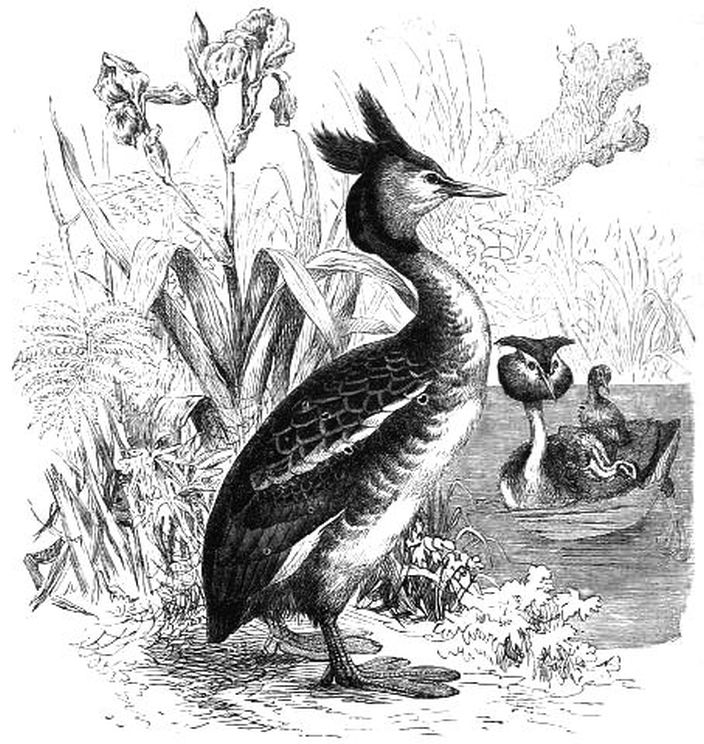
THE CRESTED GREBE (Podiceps cristatus). ONE-FOURTH NATURAL SIZE.
THE LITTLE GREBE.
The LITTLE GREBE (Podiceps minor) is much more plentiful than the species last described. It is a beautiful bird, measuring nine or ten inches in length and seventeen or eighteen in breadth, the[Pg 245] length of its wing being four inches. When in its nuptial dress, the plumage of the upper part of the body is brilliant black shimmering with brown, the under parts being greyish white, clouded with a darker shade; the throat and a place in the front of the eye are black; the head, sides of the neck, and throat, chestnut-brown; the eye is reddish brown; the bridles yellowish green; the beak yellow at its base and black towards its apex; the external aspect of the foot is blackish, internally it is of a clear horn-colour. In its autumnal plumage the upper parts of the body are more of a brownish grey, the under surface satiny white; the head and neck bright grey.
The range of this bird is pretty nearly the same as that of the species last described; it is not, however, so numerously met with during the winter season. It makes its appearance in Germany about the end of March, and remains in that country so long as the waters are free from ice; but during the winter it takes up its abode in the south of Europe. In Great Britain it is met with as far north as the Hebrides, and in the southern counties of England may be seen throughout the year.
It usually selects for its residence some large pond well provided with reeds and rushes, and it is also occasionally to be found in morasses and other swampy localities. It seems to avoid clear water; its food, which consists principally of insects and their larvæ, being more abundantly met with in ditches and muddy places. In its habits and mode of life it closely resembles other members of its family; it seems, however, to be more active than the larger species, and uses its feet with more facility in running.
In swimming and diving it may be said to excel even its congeners, but its powers of flying are very limited, owing to the shortness of its wings. Its flight, indeed, is said by Naumann to resemble that of a grasshopper. In summer time it is very shy, and can only be approached with difficulty, but in the winter its shyness diminishes, so that it will even come near villages, and at this season it frequently falls a victim to its own carelessness. When alarmed it immediately dives, and if further threatened with danger, secretes itself in the water under the shelter of the herbage, leaving nothing but its beak visible above the surface, and thus it will remain until all cause for apprehension is removed. Its voice is a short piping note that sounds like "bib" or "bibi," and this during the pairing season is repeated so rapidly that it sounds something like a "shake" upon some musical instrument.
The nest of the Little Grebe is always placed among water-plants, but is never hidden from view; more commonly, indeed, it is rather a conspicuous object; it is, however, invariably removed from the sides of the pond. In its appearance, it is just as rudely constructed, as wet and uncomfortable-looking as that of the species last described. In this floating cradle the female, towards the end of April or the beginning of May, lays from three to six elongated eggs, the colour of which seems to depend upon that of the plants of which the nest is composed. Upon these eggs, both the male and the female sit alternately for twenty or twenty-one days. As soon as the young are hatched they betake themselves to the water, where they are taught and tended by their parents in the same manner as those of the Crested Grebes described above.
The DIVERS (Colymbi) may be regarded as the marine representatives of the Grebes, from which, however, they are at once distinguishable by their larger bodies, shorter neck, more bulky head, and stronger beak. These birds are fully webbed; their wings are short, and their quills, the second of which is the longest, hard and stiff; the tail is composed of from sixteen to twenty close-set feathers. The coloration of the thick warm plumage varies considerably at different seasons of the year. The number of species belonging to this group is very limited; of these only three are recognised as belonging to Great Britain; namely, C. glacialis, C. arcticus, and C. septentrionalis. The members of this group are essentially sea-birds, only visiting rivers or lakes of fresh water during the[Pg 246] breeding season or in the course of their winter migrations. Like the Grebes, they transact all their business in the water. They swim with the utmost ease to very considerable distances, and rest themselves by lying as it were flat upon the surface of the sea; sometimes, however, they sink their bodies to such a depth that only a small portion of the back is visible. Now they are seen gliding leisurely along over the tranquil waves, and now with the rapidity of lightning they disappear apparently without the slightest effort, and without causing any perceptible disturbance in the water. No sooner are they submerged, than they stretch themselves out to their full length, their feathers become flat and smooth, their wings are pressed close to their sides, and thus presenting a shape beautifully adapted to their work, they shoot through the water with arrow-like speed, now in one direction, now in another; sometimes swimming along close beneath the surface, sometimes plunging to a depth of several fathoms in pursuit of the fishes upon which they feed.
"To see them from some promontory," says Mudie, "against which the air and the sea are setting full wind and tide, and driving before them myriads of herrings and other fishes, is a glorious sight. They dash along the surface, they dart under it, they bounce up again, they bore through the advancing waves, and when the billow breaks in foam and thunders over them, and the spectator naturally concludes they are buried for ever in the deep, up they spring to the surface of the unbroken water farther from the land, as though exulting in the fury of the elements." This facility for swimming and diving they enjoy from their earliest infancy, and to it they trust as a means of escape from danger. It is seldom that they set foot upon dry land; indeed, even when they visit the shore they can scarcely be said to do so, they might rather be said to slide out of the water on to the beach; as to walking, in the ordinary acceptation or the term, that is quite out of their power—indeed, they are unable to support themselves in an upright position; by the efforts of their feet and wings, aided by their neck and beak, they creep, or rather tumble over the ground until they regain their proper element. Their powers of flight are very limited, nevertheless it is a pretty sight to see them plunge from some high cliff into the waters beneath, the efforts of their wings only serving to give an oblique direction to their downward career, as they shoot headlong into the deep, and immediately disappear beneath the waves.
The Divers appear to avoid the company of other birds, and indeed seldom associate with those of their own kind, except during the breeding season—at which time they may be seen in pairs. Their food consists exclusively of fishes overtaken in the water or brought up from the bottom of the sea; of these they seem to prefer the mid-sea swimmers, but flat fishes, such as small plaice and soles, form likewise a considerable part of their diet. Graba informs us, that from his window he has often seen them bring up flounders of considerable size, in disposing of which they showed considerable dexterity. If too large to be swallowed whole, they were dropped into the water and devoured piecemeal. Even a herring seemed to be a somewhat unmanageable morsel; but the smaller fry were at once made away with. When the breeding season approaches, all the different species of Divers betake themselves to lakes of fresh water, at some little distance from the coast, and sometimes at a considerable altitude above the level of the sea. Their harsh-sounding cry is now uttered more frequently than usual, especially towards evening, at which time they come down to the shore and throw themselves from the rocks into the ocean, in order to procure a supply of food. Their nest is generally built upon some small island in the middle of the lake or pond, or should such a situation not offer itself, upon the margin, but always close to the water; it is rudely constructed of sedge-grass and reeds, negligently heaped together and frequently without the slightest attempt at concealment, insomuch as the sitting bird is rather a conspicuous object, and may be seen from a considerable distance. Upon this rude nest the female lays two eggs of an elongated shape, having a strong, coarse-grained, but somewhat polished shell. The two sexes take their turn in the incubation of the[Pg 247] eggs, and both labour with equal zeal in the feeding and rearing of the young. The eggs are laid towards the end of May, and towards the end of June young birds may be found in the nests; but the exact period of incubation is not as yet accurately determined. Should the lake on which the nest is placed be well stocked with fish, both the parents remain constantly with their progeny; but if there is a scarcity of such a supply, and the old birds have to resort to the sea for food, they do so by turns, each of them most probably bringing to the nest a share of what they capture wherewith to feed their nestlings. These last, however, as soon as they are hatched begin to show considerable aptitude for the chase, and are able to procure food for themselves betimes. When they are fully fledged they betake themselves to the sea.
THE GREAT NORTHERN DIVER.
The GREAT NORTHERN DIVER (Colymbus glacialis) is a very striking bird, measuring about three feet in length and five feet across the wings. The length of each wing is sixteen inches and tail two inches and a quarter. In its summer plumage it is principally black, enlivened with white spots; on the head and neck the feathers are greenish black, the latter being traversed by a broad longitudinal band of black and white; a similar stripe is situated on the fore part of the neck. The sides of the upper breast are black striped with white; the rest of the under surface is a rich satiny white. The eye is light brown, and beak black; the exterior of the tarsus is grey, the under surface of a reddish flesh-colour. In its winter dress the upper part and sides are blackish, and without the white spots, and the under surface white; the breast black, streaked with white. The young are clad in a similar garb, but are without the white streaks upon the breast.
The Northern Diver is common on all the coasts of the North Sea, as well as on the inland lakes of high latitudes. It appears on the coast of Great Britain in the autumn, and remains during the winter, going at the breeding season; except at that time, it lives at sea, following the shoals of herrings and sprats; it also resorts to arms of the sea and sandy bays, floating lightly, with its body deep in the water; when alarmed, it swims with astonishing swiftness, and endeavours to escape by diving.
These birds breed on the Faroe Islands. Respecting their manner of nidification Mr. Porter, who observed them closely during the nesting season in Iceland, says:—"The Northern Diver breeds on the lochs of fresh water. In the nests I examined, a single egg was deposited. On the bare ground, but just out of water-mark, rather under a rugged bank on some broken ground, I was successful in finding two nests. I allowed the single egg to remain in one of them in the expectation that another egg would be laid to it, but was disappointed. The old bird was very shy, and always left the egg on our approach, when at a great distance off, taking to the water and keeping so far from the side as not to be within shot." In the breeding season they frequent islands, making their nests of dead herbage near the water's edge. The eggs, usually two in number, are dark olive-brown, with a few umber-brown spots, and are three inches six lines long by two inches three lines broad. The mother lies flat on the eggs, and, if disturbed, pushes herself along the ground with her feet, diving as soon as she reaches the water. The young are able in a day or two after birth to follow their mother to the water, and are able to swim and dive well. They are fed during the first fortnight with food from the crop of their parent. The voice of this bird is loud, plaintive, and much varied in tone.
Montagu tells us that, "A Northern Diver taken alive was kept in a pond for some months. In a few days it became extremely docile, would come at a call from one side of the pond to the other, and would take food from the hand. The bird had received an injury in the head which had deprived one eye of its sight, and the other was a little impaired; but, notwithstanding, it could, by incessantly diving, discover all the fish that was thrown into the pond. In default of fish it would eat flesh. It[Pg 248] is observable that the legs of this bird are so constructed and situated as to render it incapable of walking upon them. When the bird quitted the water, it shoved its body along upon the ground like a seal, by jerks, rubbing the breast against the earth; and returned to the land in a similar manner. In swimming and diving, the legs only are used and not the wings, as in the Guillemot and Auk tribes; and by their situation so far behind and their little deviation from the line of the body, it is enabled to propel itself in the water with great velocity in a straight line, as well as turn with astonishing quickness." The plumage of the Northern Diver is close, and its skin tough, on which account it is much used by the inhabitants of northern countries in the manufacture of comfortable articles of clothing. The flesh is hard and of a rank fishy flavour.
THE BLACK-THROATED DIVER.
The BLACK-THROATED DIVER (Colymbus arcticus) is smaller than the preceding species, but very much like it both in the colour and markings of its plumage. In its nuptial costume the upper part of the head and hind neck are deep ashy grey, the back and wings black, a space upon the back and another upon the hinder part of the wing are spotted with white, while upon the fore part of the wing is another space speckled with blue spots. The side of the neck presents a longitudinal black streak, the fore neck has a transverse white band, and the sides are longitudinally marked with black. The under side is white. During the winter, the head and nape are grey, the rest of the feathers on the upper surface black with white borders; the lower parts of the body are white, and the sides of the crop striped black and white. In young birds the latter markings are wanting. The eye is light brown, and the beak black. The foot is grey at its exterior, and flesh-red on the inner side. This species is from twenty-eight to thirty inches long and from fifty to fifty-two broad; the wing measures from fourteen to fifteen inches, and the tail from two inches and a quarter to two inches and a half. The Black-throated Diver is rare on our southern coasts; on the northern shores of our island it begins to appear about September. The majority of these depart about April, although a few remain to nest in the northern parts and islands of Scotland. We are indebted to Mr. Selby for the following account of its breeding, as observed by himself during the course of an excursion in Scotland.
"This beautiful species, whose breeding station has never before been detected, we found upon most of the interior Sutherland lochs. The first we noticed was at the foot of Loch Shin, where we were so fortunate as to find the nest, or rather the two eggs upon the bare ground of a small islet, removed about ten or twelve feet from the water's edge. The female was seen in the act of incubation, sitting horizontally, and not in an upright position, on the eggs. In plumage she resembled the male, and when fired at immediately swam or rather dived off to a short distance. Our pursuit after them was, however, ineffectual, though persevered in for a long time, as it was impossible to calculate where they were likely to rise after diving. Submersion frequently continued for nearly two minutes at a time, and they generally reappeared at about a quarter of a mile's distance from the spot where they had gone down. In no instance have I ever seen them attempt to escape by taking wing. I may observe that a visible track from the water to the eggs was left by the female, whose progress upon land is effected by shuffling along upon her belly, propelled by her legs behind. On the day following (May 31st) Mr. J. Wilson was fortunate enough to find two newly-hatched young ones in a small creek of Loch Craigie, about two miles and a half from Lairg. After handling and examining them, during which the old birds approached very near to him, he left them in the same spot. Accordingly, on the Monday morning we had the boat conveyed to the loch, and on our arrival soon descried the two old birds, attended by their young and apparently moving to a different part of the loch. Contrary to their usual habit at other times, they did not attempt to dive on our approach, but kept swimming around their young, which, from their very tender age, were unable to make much way in the water. The female could only be distinguished from the male by a slight inferiority of size, and both were in full adult plumage. We afterwards saw several pairs upon various lochs, and upon Loch Kay, a pair attended by two young ones nearly half grown. When swimming they are in the constant habit of dipping their bill into the water, with a graceful motion of the head and beak."
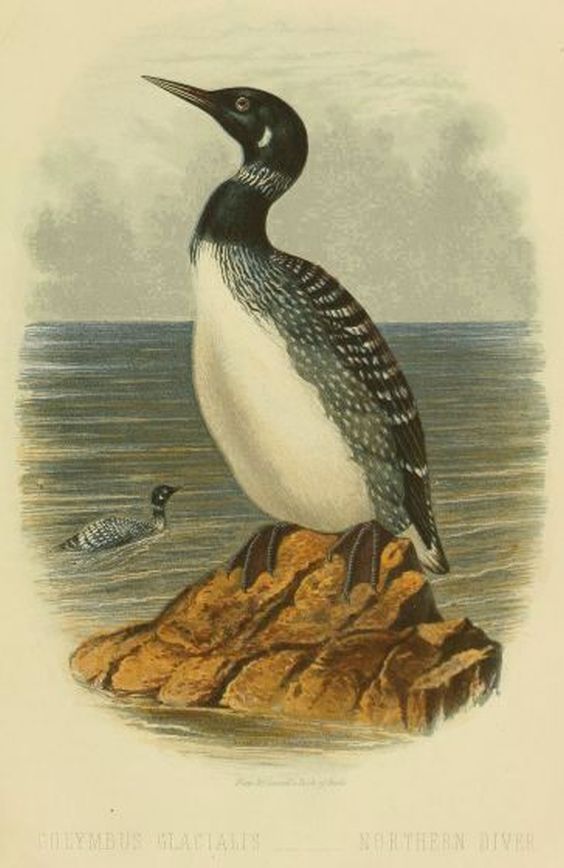
Plate 39, Cassell's Book of Birds
COLYMBUS GLACIALIS ____ NORTHERN DIVER.
(about ¼ Nat. size).
[See larger version]
[Pg 249]
Mr. Dunn, who observed these birds in Norway, tells us that, "The eggs have a very rank fishy taste, but are much sought after by the Lapps. After the young are hatched, both male and female are very assiduous in bringing them food, and may be seen flying at a vast height, with fish in their beaks, from one lake to another; on arriving over the lake where they intend to alight, they descend very suddenly in an oblique direction." The cries of this Diver are very peculiar during the breeding season, and may be heard at a great distance. The voice is said to be very melancholy, and to resemble the cry of a human being in distress.
THE RED-THROATED DIVER.
The RED-THROATED DIVER (Colymbus septentrionalis), as the smallest of these three species is called, is only from twenty-five to twenty-six inches long, and from forty to forty-three broad; the wing measures from ten inches and a half to twelve and a half; and the tail two and a half to three and a half inches. The colour of this bird is ash-grey upon the head and on the sides of the neck; the back of the neck is striped with white; the front of the throat bright chestnut-brownish red; the back is brownish black; the under side white; the front and sides of the breast are black, with longitudinal rows of spots. In their winter dress the feathers of the back are tipped with white, and the region of the throat is white. In young birds the colours of the plumage are indistinct. The eye is light brownish red; the beak black; the foot is dark brown, mingled with blueish grey, the latter colour being deepest on the web between the toes. This bird inhabits the high northern latitudes of the eastern hemisphere, and is more especially met with upon the coasts of Greenland, Spitzbergen, and of European and Asiatic Russia. It is likewise common in the Faroe Islands, as well as in the Orkneys and the Hebrides. In winter time it extends its range further south, and may be found on the coasts of Denmark, Germany, and Holland, as well as upon the shores of Great Britain. Its habitat may be said to stretch from 60° to 70° north latitude. The Red-throated Diver is common on the shores of Great Britain and Ireland in the winter season, and about the mouth of the Thames is known by the name of the Sprat Loon, on account of its following the shoals of sprats. It remains during winter to breed in Scotland, frequenting the inland Highland lakes, as well as the Orkney, Hebrides, and Shetland Islands. The neatly-made nest is placed near the margin of the water, sometimes on the bare beach, and sometimes among herbage, and is formed of such plants and leaves as are easily procurable. The eggs, usually two in number, are of an elongated oval shape, brown in colour, and dotted with dark amber-brown. The male remains near the nest, and is said occasionally to assist in brooding. When an intruder approaches, the female continues to sit till her foe is close at hand, when she starts off, plunges into the water, and usually flies off or sometimes swims anxiously about in company with her mate; if deprived of their eggs the loud lamentations of the parents may be heard for several evenings; the notes are harsh, and, according to Macgillivray, resemble those of the Gannet. The young take to the water as soon as they leave the egg, and continue with their parents until able to use their wings, when all fly off to the sea. Mr. Low, in his "Natural History of Orkney," says, "This bird continues with us the whole season, builds on the very edge of a lake in the hills of Hay, and lays two eggs; its nest is placed so that it can slip from it into the water, as it can neither stand nor move on land, but can make very quick way at sea; flies well,[Pg 250] and commonly very high; makes a vast howling and sometimes croaking noise, which our country folks say prognosticates rain, whence its name with us of the 'Rain Goose.'" Mr. Dunn, who saw this bird in Norway, thus writes to Mr. Yarrell: "This Diver is far more common here than the Black-throated. On the west coast of Norway it is very abundant from the Naze to the North Cape; in the Lapland Alps, in the Dofre Field, and in the interior of Sweden it is equally numerous. In August, 1838, I saw, on the great Tornea Lake, thirty in a flock, and all old birds. Although so common, it is rarely one sees the young before they are able to fly; their habits and feeding are similar to those of the Black-throated Diver. Their cries are very mournful and melancholy. During the breeding season, while on the wing, they utter frequently a sound like the word 'kakera-kakera,' by which name they are called in many parts of Scandinavia."
The AUKS (Alcidæ) are distinguishable by their strongly-built body, short neck, large head, short, almost rudimentary wings, short tail, strong, compact, three-toed, broadly-webbed feet, and rich, thick, and downy plumage, which is similarly coloured in the two sexes, but varies considerably at different seasons.
The LOONS (Uriæ), while they present the general characters above-mentioned, have wings of moderate length, in which the first quill is the longest, and a short tail composed of twelve feathers. Their beak, which is of moderate length, is vaulted above, somewhat angular beneath, and much compressed and furrowed upon the sides.
The various members of these groups are all inhabitants of northern seas and of the creeks and bays with which they are contiguous; indeed, except in the winter time, they seldom pass much beyond the precincts of the frigid zone. They are all strictly sea-birds; indeed, it is only during the breeding season that they take up their abode on terra firma; at all other times they live exclusively upon the water. They swim and dive with remarkable facility; their powers of flight are moderately good, and although they do not willingly walk, they are able to do so tolerably well, treading upon the soles of their feet, and not shuffling along upon their tarsi. Their food consists exclusively of crustaceans and fishes, which they are able to bring up from a considerable depth. They live and feed together, exhibiting considerable sociability, and during the breeding season they assemble in flocks, amounting in some species to the number of several hundred thousand pairs, and thus become to the inhabitants of the extreme north of inestimable importance. In many settlements on the coast of Greenland they, next to the seals, constitute the most important article of food, and famine would be the inevitable result of their ceasing to visit their usual breeding-places in their wonted numbers.
THE GREENLAND DOVE, OR BLACK GUILLEMOT.
The GREENLAND DOVE, or BLACK GUILLEMOT (Cephus grylle), one of the best-known members of its family, may be regarded as the representative of a distinct group, and is easily recognisable by its small size, and comparatively long, slender, straight beak, which curves downwards at the extremity of the upper mandible. The legs are placed very far back; the wings are small and pointed, but furnished with strong quills; the short, rounded tail is composed of from twelve to fourteen feathers. The plumage is thick, and of velvety texture; its coloration varies considerably at different ages and at different seasons of the year. When in full dress at the commencement of the breeding season, the plumage is glossy black, shaded with green, and enlivened by a white patch upon the wings. The eye is brown, beak black, and foot coral-red. In its winter garb the under side is spotted black and white; in young birds the upper parts are blackish, the wings being white striped with black, the belly white, and the rest of the body spotted with blackish grey. The length of this species is thirteen inches,[Pg 251] breadth twenty-two inches, length of wing six and a half inches, and of tail two inches. The range of the Black Guillemot extends from about 80° to 53° north latitude: within this zone it is met with on every sea-coast. These birds are seldom seen assembled in large numbers; they generally arrive in small parties, or in pairs. It is only when the sea is frozen over, that they congregate together around any openings that may be met with in the ice, and as soon as opportunity offers, they again disperse, and distribute themselves among their usual haunts. As the severity of winter increases, they migrate further towards the south, and it is only at such seasons that they occur upon our own shores. There is always something cheerful in the aspect of these birds, whether they are seen sitting upright on the rocks, or swimming and diving in their proper element; they float upon the water light and buoyant, and as they row themselves gracefully along, their bright red feet often become visible above the surface. When they dive, their movements are equally graceful; a single backward stroke of their feet raises their tails into the air, and instantly they disappear, without any visible disturbance of the water around them. As soon as they are fairly submerged, they partially open their wings, and by the aid of these, as well as of their feet, they shoot along with great rapidity, remaining under water about two minutes before they again show themselves. When the sea is tranquil and the water clear, their course may be easily traced for a considerable distance, but we think that some observers have over-estimated the depth to which they are able to plunge. Their flight is tolerably good, although, owing to the shortness of their wings, they are compelled to make such rapid strokes as to produce a whirling sound. When about to fly, they rise from the sea with some little difficulty, and have to make considerable efforts in order to get the necessary impetus; but so soon as they have attained a certain elevation, they can mount rapidly to the top of the cliffs, upon which they frequently take their station. Their voice differs considerably from that of the generality of their congeners; instead of the usual scream it is rather a whistling note. About the beginning of March, they begin to assemble at their breeding-places in small flocks, seldom consisting of more than thirty or forty together, although millions of other birds may resort to the same locality; and here each pair selects a suitable rent or fissure in the rock, at a short distance from the entrance of which, towards the end of April or beginning of May, the female lays her two eggs upon the bare stone. The eggs are tolerably large, with coarse lustreless shells of a dingy whitish or blueish green colour, spotted with ashy green, and streaked with brown or blackish brown patches. Should the eggs first laid be removed, as they very frequently are when the breeding-places are accessible, the breeding pair will lay a second time, but usually only a single egg. The parents take their turns in the task of incubation, towards the close of which they sit so assiduously that they will suffer themselves to be captured rather than desert their charge. After the lapse of twenty-four days, the young make their appearance, clad in a thick covering of greyish down; at first they are diligently fed upon sand-worms, small molluscs, sand-eels, and similar fare, but they are soon able to fish for themselves; they swim well from their earliest infancy, but are not able to dive until they are fully fledged. In Greenland and Iceland, great numbers of these birds are killed and eaten, the Norwegians, however, are content to take their eggs. Their flesh has a strong flavour of train-oil, still it may be rendered eatable if properly cooked; in Lapland, the young birds are often brought to table; the feathers, also, are used to fill beds, but they are chiefly profitable on account of their eggs, which, although they have a very peculiar taste, are eagerly sought after. In the British Isles, according to Macgillivray, the Black Guillemot has no breeding-places south of the Tweed and Solway; the most southern point being the Bass Rock at the mouth of the Firth of Forth, and the Isle of Man.
The TRUE GUILLEMOTS (Uria) are larger than the above birds, but very similar in structure; their beak is elongated, of moderate length, straight and sharply-pointed, slightly vaulted above, and[Pg 252] decidedly angular beneath; its sides are compressed, and edges somewhat drawn in the foot resembles that of Cephus grylle, but the toes are proportionately longer; the wings are also smaller and more pointed, and the tail, composed of twelve feathers, shorter; the general plumage is thick and compact; the under surface is usually white and almost fur-like, whilst the upper parts of the body are more or less dark brown. The Guillemots principally inhabit northern latitudes, at certain seasons appearing in more temperate climates; except during the period of incubation they seldom visit the land, but pass their whole time upon the ocean. They are excellent swimmers, and dive well, using both feet and wings for their propulsion, so that their movements beneath the water are performed with admirable rapidity and precision; their flight is rapid but hurried, and, owing to the shortness of their wings, whirring and noisy. So numerous are these birds in the neighbourhood of their breeding-places, that (more especially if it be a rock of a pyramidal form) they resemble at a distance a great swarm of bees. When descending into the water to fish for food, their wings are kept quite straight and motionless. Except during the breeding season these flights are not often attempted, at other times they seldom leave the water, or if induced to take a short excursion, by way of exercising their wings, they soon drop down again into the friendly shelter of the waves. They are almost unable to progress upon dry land; occasionally, however, they may be seen upon the beach, half walking and half flying, with a very peculiar gait, somewhat resembling dancing. Anyone who has visited the breeding-places of these birds will no longer wonder that they have in all languages received names expressive of foolishness and stupidity. When in the water they will often let a boat come close to them without showing the slightest distrust of its dangerous occupants, and on dry land, such is their unconsciousness of harm, that they will allow a man to come within a few steps of them without stirring from the spot. This so-called stupidity or indolence is, however, easily explicable. Of man, who seldom visits their wild resorts, they have no experience, and consequently have not learned to fear him; but should a Falcon or an Eagle make its appearance, even in the remote distance, thousands of them at once take wing, and hastily retreat to some place of safety. The cliffs on which they build present a remarkable spectacle; rocks abounding in rifts, cracks, shelves, and ledges, stretching along the shore or rising abruptly from the sea, afford them the situations they prefer; if isolated, solitary, and accessible to none but winged creatures, so much the more eligible. There, about the end of March or beginning of April, they may be seen to congregate, their numbers gradually increasing until countless multitudes throng every available situation. Thousands and hundreds of thousands swarm upon the ledges, shelves, and projections, wherever these are to be found, and range themselves in rows like a regiment of soldiers, all with their white breasts turned towards the sea, hundreds of thousands more may be seen flying off from the ledges of the cliffs down to the water below, while multitudes, equally innumerable, are as constantly flying upwards from the sea to the cliff, and whole fleets are swimming and diving in the waves beneath. Strange to say, although every place affording foothold is crowded to excess, the utmost order and decorum everywhere prevail; each seems desirous of assisting and accommodating the other, so that disputes or battles seldom occur. The countless pairs of which this vast assembly consists exhibit the utmost constancy and attachment, and may be seen before the eggs are laid, keeping constantly together, caressing each other with their beaks, and evincing the greatest affection. They fly off together to the sea, fish together for a supply of food, and then return to their nesting-place, where they subsequently share the duties connected with the incubation of the eggs, and the procuration of food for their progeny. The female lays but a single very large egg, which is shaped like a pegtop, and thus, by a simple but beautiful contrivance, is prevented from rolling off the narrow ledge on which, without any other protection, it safely rests. The egg is provided with a coarse shell, spotted and streaked with dark markings upon a light ground, but so variable are the colours, that out of a hundred scarcely two will be found exactly alike.[Pg 253] The period of incubation extends over from thirty to thirty-five days. When the young makes its appearance it rather resembles a ball of greyish black wool than a bird; its coat of down soon disappears; its growth is rapid; and in about a month it is completely fledged.
THE COMMON OR FOOLISH GUILLEMOT.
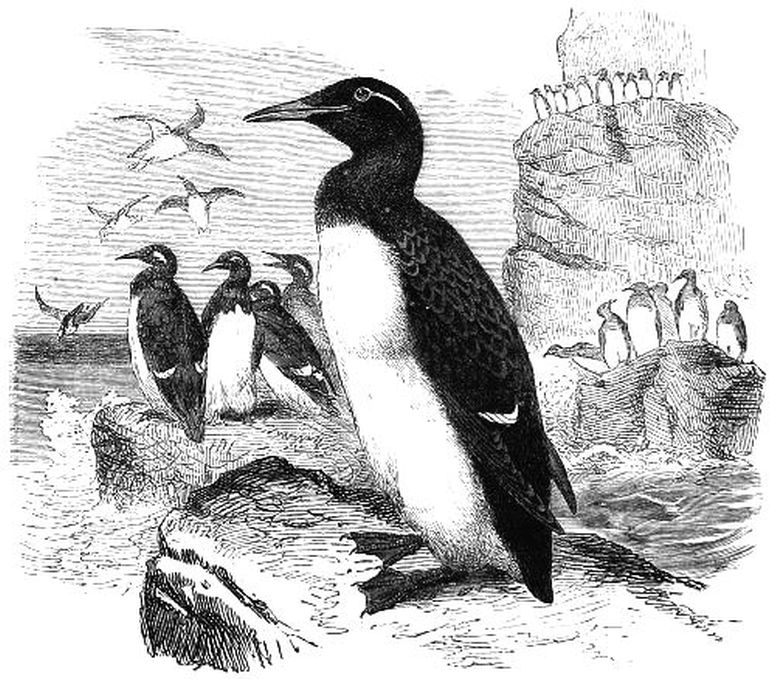
THE COMMON OR FOOLISH GUILLEMOT (Uria troile). ONE-FOURTH NATURAL SIZE.
The COMMON or FOOLISH GUILLEMOT (Uria troile), in its nuptial garb, is bright brown upon the back and on the fore parts of the neck; the points of the feathers upon the upper arm are white, forming a conspicuous band. The under surface is white; the sides are striped with brown. In the winter dress both the fore part of throat and hinder part of cheek are white. The eye is brown, beak black, and foot grey. This species is seventeen inches and a half long, and from twenty-seven to twenty-eight broad; the wing measures three inches and the tail two and a half. The Common Guillemots are to be seen around the British coast at all seasons of the year. About the beginning of May they assemble in their breeding-places on the rocks, which are also frequented by other birds for the same purpose. "From the numbers that congregate," observes Yarrell, "and the bustle apparent amongst them, confusion of interests might be expected; but, on the contrary, it will be found that the Guillemots occupy one station, or line of ledges on the rocks, the Razor-bills another, the Puffins a third, Kittiwake Gulls a fourth, whilst the most inaccessible pinnacles seem to be left for the use of the[Pg 254] lesser Black-backed and the Herring Gulls. Two distinct species scarcely ever breed close by the side of each other."
The egg is laid on a ledge or hollow of the bare rock: it is pear-shaped, about three inches and a quarter long, of a blueish green, or yellowish green colour, with streaks and blotches of brown or black: sometimes the eggs are plain white or green. Great numbers of these eggs are collected by men who descend from the cliff above by means of ropes. The eggs are hatched in about a month. The young are fed for a short time on the rocks by their parents, after which they accompany them to the sea. In what manner they descend seems to be a problem. Mr. Waterton was assured by the men about Flamborough Head that when the young Guillemot gets to a certain size, it manages to climb on the back of the old bird, which conveys it down to ocean; and Mr. Yarrell, in support of this statement, assures us that he has seen at the base of very high cliffs in the Isle of Wight the young of Razor-bills and Guillemots "so small that they could not have made the descent by themselves from the lofty site of their birthplace without destruction; yet these little birds knew perfectly well how to take care of themselves, and at the approach of a boat would swim away and dive like so many Dabchicks." About August, old and young leave the rocks and take to open water. Audubon gives the following curious description of these birds on a group of rocks, which consist of several low islands, destitute of vegetation, and at no great height from the water. "Here thousands of Guillemots annually assemble at the beginning of May to deposit each its single egg and raise its young. As you approach these islands, the air becomes darkened with the multitudes of these birds that fly about. Every square foot of the ground seems to be occupied by a Guillemot planted erect, as it were, on the granite rock, but carefully warming its cherished egg. All look towards the south, and if you are fronting them, the snowy white of their bodies produces a remarkable effect, for the birds at some distance look as if destitute of head, so much does that part assimilate with the dark hue of the rocks on which they stand. On the other hand, if you approach them in the rear, the isle appears as if covered with a black pall."
THE LITTLE AUK, OR GUILLEMOT.
The LITTLE AUK, or GUILLEMOT (Arctica or Mergulus Alle), is recognisable by its short thick beak, which is vaulted above, much turned in at its cutting edge, and incised near its sharp point; in old birds the bill is furrowed in front of the oval-shaped nostril apertures. The upper part of the body is deep black, paler upon the fore neck; the under surface is white, striped with brown upon the sides; the foot is blueish. In winter the throat is whitish and the neck dark grey. The length of this species is from nine to ten inches, breadth sixteen to eighteen inches, length of wing five and a half to six inches, and that of tail one inch and one-eighth to one and three-eighths. The Little Auk is in Greenland generally known to the whale-fishers as the "Ice Bird," from an idea that its presence in any considerable numbers betokens the vicinity of ice. It is usually found within the Arctic Circle. Captain Parry found it even as far north as 82° north latitude; and they were numerous between 81° and 82°. Around Spitzbergen, and Nova Zembla, and near Greenland, it is common; further south it is much scarcer; in Great Britain it is only a winter visitor, and is most frequently seen in the Orkney and Shetland Isles; specimens have, however, been seen upon the English coast, even as far south as Kent. These birds only visit the shores for the purpose of incubation, except when driven inland by violent storms; the ocean is their home, and there they may be seen riding joyfully upon the surge or sleeping tranquilly with their beak buried among their feathers even amid the raging of the billows.
"In the course of my voyages across the Atlantic," observes Audubon, "I have often observed the Little Guillemots in small groups, rising and flying to short distances at the approach of the ship,[Pg 255] or diving close to the bow and reappearing a little way behind. Now with expanded wings they would flutter and run as it were on the face of the deep; again they would seem to be busily engaged in procuring food, which apparently consisted of shrimps, other crustacea, and particles of seaweeds."
The Little Auk must certainly be regarded as the gayest and briskest member of its family; when visiting the shore it steps nimbly along on its toes, vanishes from observation among the stones, or creeps like a mouse into crevices in the rocks. When out at sea it swims and dives with wonderful alacrity, remaining under water for even more than a couple of minutes. Its flight resembles that of the birds above described, but it moves its little wings even more rapidly than they. During the breeding season the Little Auks congregate in immense numbers in the vicinity of the islands on which the eggs are to be deposited. Each pair seeks a suitable spot among the stones that have fallen upon the beach, and there lays a single egg of about the same size as that of the Pigeon, and of a whitish colour slightly tinged with blue. How long incubation continues is unknown; it has, however, been ascertained that both parents attend to their solitary young one (which makes its appearance clad in greyish down) supplying it with food until it is fledged and capable of flying out to sea.
The STARIKIS (Phaleres), a race of birds occupying northern regions, appear to some extent to claim relationship with the Auks and Divers, but are at once distinguishable from them by the flowing crest which adorns their head. Their beak is short, and very much depressed, broad, and of a somewhat triangular shape, it is incised towards the tip, and slightly vaulted above. The short slender feet are placed very far backwards; the wings are of moderate length, and tail very short. The thick plumage is rather brightly coloured. Most of the species belonging to this group are met with between the north coast of Asia, and the north-west shores of America. These birds live in small flocks, swimming with ease and celerity while in quest of their food, which consists of crustacea, mollusca, and other marine animals. As the night approaches they seek the shore, where, under the ledges of the rocks, or in burrows dug with their bills and feet, they retire to rest. The single egg is deposited in similar situations.
THE STARIKI.
The STARIKI (Phaleris cristatella) presents as its most conspicuous feature a sort of plume upon the head, consisting of six or eight remarkable feathers, placed close together; other feathers of similar character, and of a pale white, ornament the sides of the head, and project over the origin of the bill. The plumage of the adult bird is blackish brown upon the upper part of the body, and blueish grey beneath, shading upon the belly to a yellowish grey. The wing-quills and tail are black, the outermost quill being spotted with brown, and the rest with white. The eye is dark brown, beak coral-red, and foot blueish. In young birds the tuft upon the head is wanting; the feathers on the brow are black, with white shafts; the entire upper portion of the body is black, except the region of the shoulder, which is grey; the throat is greyish yellow, and under surface pure white. In its general appearance this bird resembles a large Quail. Steller, who first discovered the Stariki, met with it in Behring's Straits; subsequent naturalists have traced it from thence to the Sea of Japan and the north coasts of America. In disposition these birds are social and lively. Kittlitz tells us he has seen small parties of them swimming and diving together in twos and threes.
We learn from the same authority that each pair lays two eggs, which are moderately large, and of an elongated form. The shell is brownish white, speckled and marked with brown.
The AUKS (Alcæ) may in certain senses be considered as intermediate between the Guillemots and the Coulternebs, resembling the former in the coloration of their plumage and mode of life, and[Pg 256] the latter in the peculiar structure of their bill. The beak is of moderate length, very narrow, and very high; the upper mandible bends like a bow along the culmen, while the lower one turns angularly upwards, and is furrowed towards its base; the cutting edge, which is also curved, is exceedingly sharp. The tail is short, and consists of twelve narrow feathers; the wings are slender, long, pointed, and sometimes sabre-shaped. In their habits and modes of life these strange-looking birds closely resemble the Guillemots.
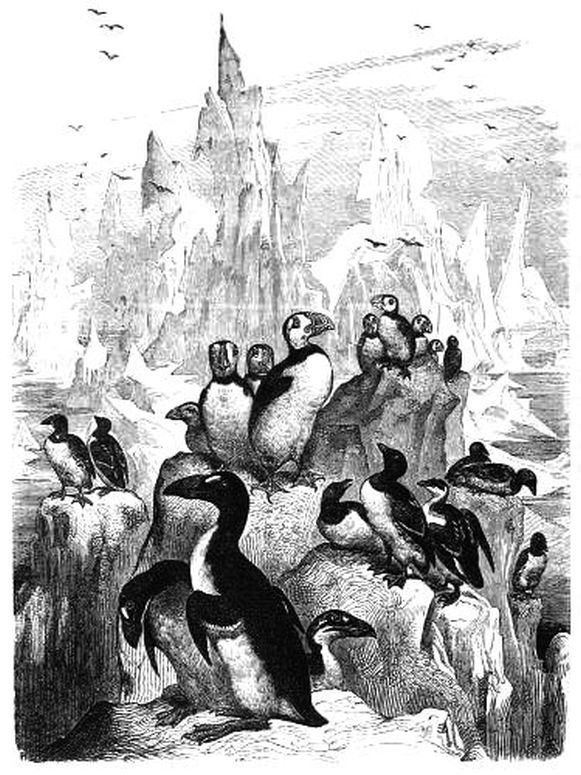
AN ASSEMBLAGE OF AUKS.
[Pg 257]
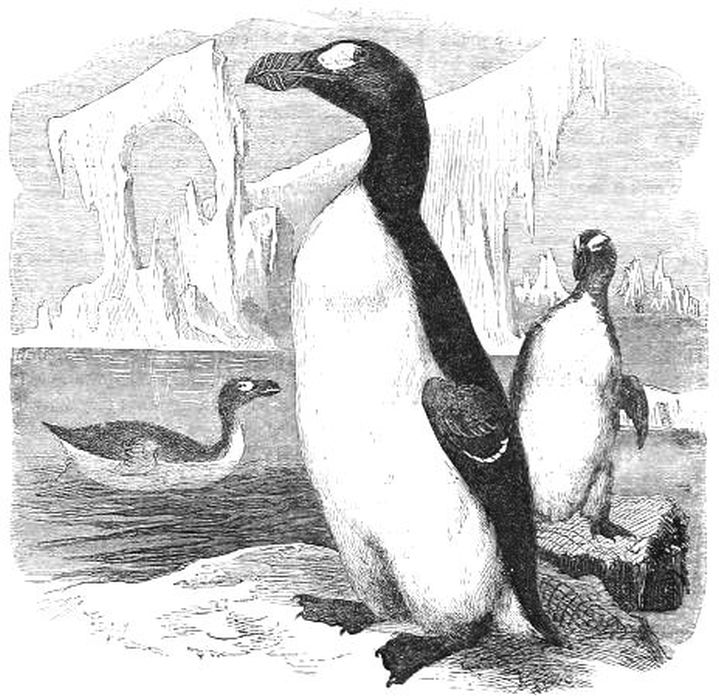
GREAT AUK, OR THE GIANT PENGUIN (Alca pinguinus or impennis).
THE RAZOR-BILL.
The RAZOR-BILL (Alca torda) is from sixteen to seventeen inches long, by twenty-six and a half to twenty-seven in breadth; the length of wing is eight inches, and that of tail three and a half. When in nuptial costume, this species is black upon the upper part of body and fore neck; a narrow band passing from the base of the beak to the eye, a line formed by the tips of the secondary quills, and the breast and belly are all pure white. In winter the neck and sides of head are white. In young birds the colours are indistinct. The eye is dark brown, beak black, with a transverse line of white, and foot black. The Razor-bill is emphatically a sea-bird, passing the greater part of its time upon the ocean, and living from year's end to year's end almost in the same locality. In winter these birds may be seen in great numbers in all the Norwegian fjords, from which they are absent during the summer. They appear likewise with some regularity upon the north shores of Germany, Holland, France, and Great Britain, wending their way back at the coming of spring, to breed in more northern latitudes. In the month of May they resort to the same breeding-places as the groups above described, and that in even still greater numbers. Boje observed a flight of Razor-bills measuring at least a thousand yards across, and which was so long in passing over his head that he had time to load and fire his gun ten times into the thick of the passing multitudes. We ourselves have seen equally numerous flights. Upon the Nyken during the breeding season they may be counted by hundreds of thousands, sitting in pairs and little societies upon every available projection of the rock, bending and[Pg 258] twisting their heads in all directions, with most ludicrous pertinacity. In these northern regions they are so fearless of man that they will allow themselves to be approached within a few hundred paces without exhibiting the slightest mistrust. When, however, we tried to seize one of them, they threw themselves headlong into the sea, from whence, after having swum about and dived a little, they again ascended to their resting-place. Upon rocks much resorted to by sea-fowl we have observed that the Razor-bills always take possession of rents and crevices, in which they deposit their egg. Some are found under stones, and a few in holes. Each pair produces but a single egg, which is of large size, much elongated, and very variable both in colour and markings, insomuch that no two can be found exactly alike. The young when hatched are clad in a thick coat of brownish black down, with white faces. Before they are half grown they become impatient of longer confinement, and apparently excited by the noise around them, throw themselves into the sea beneath, or roll themselves over and over upon the rocks until they reach it. The parents immediately follow them, and instruct them how to obtain food. This first leap of the young is a very hazardous proceeding, and thousands, instead of falling into the water, are dashed to pieces on the stones, insomuch that at this season the foot of the rock is literally covered with their mangled remains.
THE GREAT AUK.
The GREAT AUK (Alca pinguinus or impennis). This extraordinary bird occupied the northern regions of the Atlantic at the commencement of this century, but is now apparently extinct, owing to the determined pursuit to which it has been subjected. So abundant was it even a few years ago, that it was used in Greenland and Iceland as an article of food—at present its stuffed skin could not be bought for its weight in gold. This species is described by Fleming as a British bird, and he assures us that it not unfrequently bred in the Island of St. Kilda. The distinguishing mark of this interesting species was the rudimentary condition of its wings, for wings they must be called, presenting as they do all the parts met with in ordinary birds, but yet so small as to be quite useless as instruments of flight. The beak, as may be seen in stuffed specimens, is elongated and very high, and gently curved along its culmen; the lower jaw is deep and vaulted, but much compressed at its sides; its cutting edge from the corner of the mouth to beyond the nostrils is nearly straight, but beyond that bends downwards at an obtuse angle to the tip. The sides of the bill present several furrows towards its anterior extremity: of these, six or seven are on the upper, and nine or ten on the lower mandible. The structure of the foot resembles that of other Auks, as does the plumage. The tail is also composed of the same number of feathers. Its stature is nearly that of a Goose; its length being about thirty inches; the wings are not more than six and a half or seven and a half; the tail measures three inches or three and a half. Upon the upper surface the plumage is glossy black; on the throat blackish brown; an oval white patch is situated immediately in front of the eye. The under side and a thin streak across the tips of the secondary wing-quills are white. The winter plumage is entirely white. The beak and feet are black. The history of a bird so recently blotted out from the list of living creatures becomes a subject of considerable interest, and several writers have endeavoured to rescue from oblivion the principal facts recorded concerning its habits and mode of life. Previous to these inquiries, it was generally understood that the Great Auk inhabited all parts of the Frozen Ocean; such, however, appears not to have been the case. We have no proof that it ever visited the coast of Spitzbergen, nor has it been found on the shores of North America even at very high latitudes. It is authentically stated that it used formerly to breed on the Faroe Isles and was a frequent visitor to the Hebrides. Brüllock obtained one from the latter islands in 1812, and Fleming was present at the capture of another on St. Kilda's Isle in 1822. A dead specimen was washed ashore in Normandy in 1830, and this is the furthest point south it is known to have reached.[Pg 259] At one time it seems to have been numerous upon the reefs and rocky islets contiguous to Newfoundland. Over these rocks a formidable surf continually breaks, and it was probably on account of their inaccessibility that these situations were selected as safe breeding-places. Some of these reefs are still known by names indicative of this circumstance, "Geirfuglasker," for example, meaning the "Great Auk's Rock." In 1830, a collector of skins, of the name of Goudmundson undertook two expeditions in search of these birds; in the first he obtained twelve or thirteen, and in the second eight specimens; the greater part of which found their way into museums. Others were procured in the same manner till 1844, when two only, probably the last of their race, were taken. We will briefly relate the particulars of their capture, as they will throw some light upon the habits of these birds. The expedition sent in search of them consisted of fourteen men, who started in a boat from Kyrkjuebogr one evening in June, and came next morning to the Island of Eldey, a steep rock rising precipitately from the sea, and forming in one place a kind of platform, to which the sea rises at high water-mark. On this platform were seen two Great Auks sitting amidst a countless host of smaller species, and these at once became the objects of attack. The frightened creatures made not the slightest attempt at resistance, but immediately began to run down the cliff, their heads outstretched and little wings displayed. Notwithstanding the shortness of their legs they ran with considerable speed, but were, however, soon overtaken—a sailor with outspread arms drove one of them into a corner and held it fast—the other was seized close to the edge of the rock.
In 1858, Messrs. J. Wolley and Alfred Newton went to Iceland, but were unable to land on the Auk Skua, or even to see a bird. They obtained bones from the inhabitants.
Sir L. M'Clintock, of the Fox, says: "The Great Auk has not been met with on any of the modern Arctic expeditions. I was told in South Greenland twenty-five years ago, that a young specimen was obtained, but am not sure of the fact. The resident Europeans are quite aware of the value attached by naturalists to this bird, so have kept a sharp look-out for it."
Mr. Proctor, of Durham Museum, writes: "One bird was bought in 1834 by the Rev. J. Gisborne, for £8. I was in Iceland in 1833, and made every inquiry for it, but never saw a single bird. I went to the northern parts of Iceland in 1837 in search of it again, and travelled through the northern parts as far as Gremsey Iceland—a small island forty miles north of the mainland—but could not meet with it. I have never seen the bird alive, neither have I had the eggs. A fisherman in Iceland had two birds and two eggs in 1846. The birds were sent to Copenhagen; the eggs were broken."
"The Great Auk inhabits the Arctic seas, but is so diminishing in numbers as now to be rarely seen. It extends from the Arctic Regions to the Orkneys, in which islands, however, only three of four specimens (a bird of this species, according to Mr. Bullock, was killed in Bucks) have been seen in the memory of the oldest inhabitant. Two individuals are recorded as having been taken at St. Kilda in 1822 and 1829; one in Buckinghamshire; another found dead at Lundy Island, 1829; another taken alive in 1834, off the coast of Waterford."
Attempts have been made to impose on collectors by the manufacture of spurious Auks' eggs. They are considered as copies of the true egg, very cleverly done.
[Pg 260]
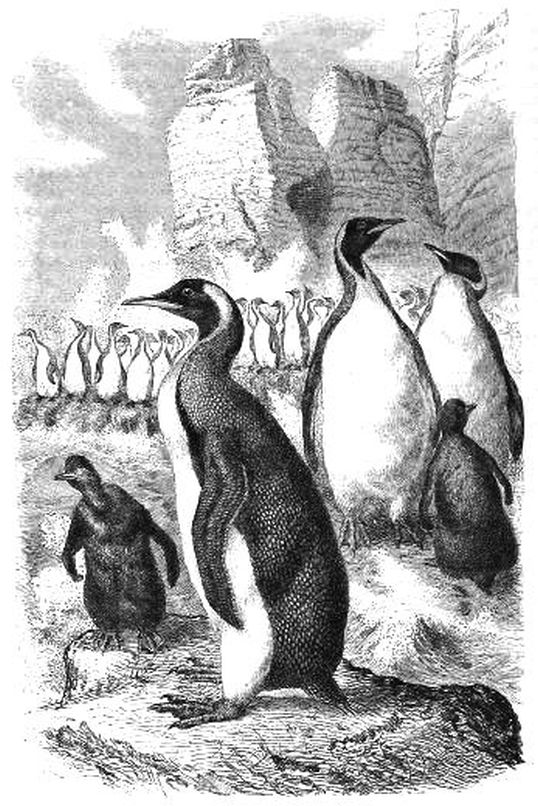
GIANT PENGUINS.
[Pg 261]
"The natives of the Orkneys," says Montagu, "informed Mr. Bullock, on his tour through those islands several years ago, that only one male had made its appearance for a long time, which had regularly visited Papa Westra for several seasons. The female, which the natives call the Queen of the Auks, was killed just before Mr. Bullock's arrival. The king, or male, Mr. Bullock had the pleasure of chasing for several hours in a six-oared boat, but without being able to kill him, though he frequently got near him, so expert was the bird in its natural element, that it appeared impossible to shoot him. The rapidity with which he pursued his course under water was quite incredible." This bird was sent to Mr. Bullock about a fortnight after his departure, and at the sale of his collection became the property of the British Museum, which possesses in all two birds and two eggs.
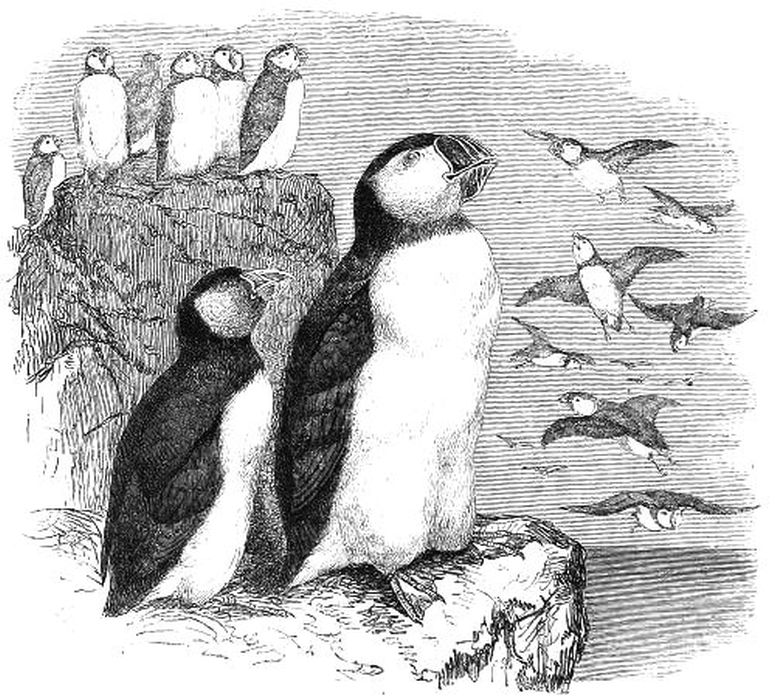
THE COULTERNEB, OR ARCTIC PUFFIN.
Mr. Champley, who has lately made a tour through Europe and collected evidence of every bird and egg known to exist, computes the whole at thirty-four birds and forty-two eggs, of which England has fourteen birds and twenty-four eggs. Audubon tells us that "Mr. Henry Havell, the brother of his engraver, when on his passage from New York to England hooked a Great Auk on the banks of Newfoundland in extremely boisterous weather. On being hauled on board it was left at liberty on deck. It walked very awkwardly, often tumbling over, bit every one within reach of its powerful bill, and refused food of all kinds. After continuing some days on board, it was restored to its proper element."
In a letter from Hakluyt, written so far back as 1578, we learn the reason of the rapid extinction of these strange birds; this writer states that in a locality known as "Penguin Island" they were so numerous and so tame that flocks of them were driven over a plank into a boat until the boat was full. "The French," he adds, "are in the habit of salting the flesh of these birds." We learn from various sources that these birds swam well, with head erect, and neck thrown back; if alarmed, they immediately dived. When upon land they sat bolt upright, and running held themselves erect, walking with short steps; if alarmed, they at once throw themselves into the sea. The[Pg 262] voice is described as a feeble croak. These birds were never known to defend their eggs, but when laid hold of would bite severely. Their adroitness in the water was such that Mr. Bullock, as related by Montagu, followed one of them about for hours in a six-oared boat without being able to get near it. The food of the Great Auk consisted entirely of fishes. The single egg laid by the female was deposited in June; in size, this egg exceeded that of any other European species, being upwards of five inches long; the shell was thick, lustreless, coarse, and of a dirty white, variously marked with brown and black. The male and female, we are told, sat alternately upon their eggs: the young were at first covered with dark grey down, and soon found their way into the water.
THE COULTERNEB, OR ARCTIC PUFFIN.
The COULTERNEB, or ARCTIC PUFFIN (Mormon fratercula), one of the most remarkable birds we have yet described, although an inhabitant of northern regions, is a regular summer visitant to our own, where it is known by a great variety of names all indicative of the strangeness of its appearance, such as the "Pope," "Mullet," "Sea Parrot," "Jammie," and the "Norrie." The Coulterneb is at once recognisable from all its brethren by the peculiar structure of its beak, the shortness of its neck, and the shape of its head. Its bill, when seen in profile, has a somewhat triangular shape, being high at the base, and remarkably compressed at its sides; at its origin it is covered with a thick fold of skin which is prolonged around the corner of the mouth; its anterior is deeply furrowed, rather obtuse at its tip, and very sharply edged. In this last respect the beak cannot be compared with that of any other bird. The feet are three-toed, strongly webbed, and provided with sharp claws, the points of which are turned sideways; the small feeble wing is rounded at its extremity, and the short tail composed of sixteen feathers. The plumage on the upper parts of the body is short, thick, compact, and smooth, whilst underneath it is somewhat longer, and more fur-like in appearance. The top of the head, a band around the neck, and the entire mantle are black; the cheeks and throat ash-grey. The under parts of the body are white shading to grey or black at the sides. The eye is dark brown, eye-ring coral-red, beak pale red at its tip, lighter in the furrows, and blueish grey towards the base; the corner of the mouth is orange-yellow, and the foot vermilion-red. The young birds are distinguishable by the comparative shallowness of their beaks, and the inferior brilliancy of their colours. This strange bird is twelve inches long, and twenty-three to twenty-three and a half broad; the wing measures six inches and a half to six and three-quarters, and the tail two inches and three-quarters.
The Coulternebs inhabit the northern seas as far as 82° north latitude, and are met with equally upon the northern coasts of Europe, Asia, and America; a few pairs are known to breed in Heligoland; further north they become more abundant, and in the Frozen Ocean they swim in countless multitudes; indeed, millions of them may be seen in the summer-time crowding the vicinity of their breeding-places. In Great Britain they appear on the coast about April, and betake themselves to various stations for the purpose of breeding, frequenting for this purpose the cliffs or turfy ground above them, and occasionally making use of rabbit-burrows. The Isles of Man, Anglesea, and Wight, are all frequented by them, and also the Scilly Isles, which in the fourteenth century were held under the king for the annual payment of six shillings and eightpence or 300 Puffins. The Yorkshire coast, the Fern Islands, and the coasts and islands of Scotland are also frequented by them.
"On the coast of Labrador," says Audubon, "is Perroquet Island, known to all the cod-fishers, and celebrated for the number of Puffins that annually breed there. As we rowed towards it, although we found the water literally covered with thousands of these birds, the number that flew over and around the green island seemed much greater, insomuch that one might have imagined[Pg 263] half the Puffins in the world had assembled there. This far-famed isle is of considerable extent; its shores are guarded by numberless blocks of rock, and within a few yards of it the water is several fathoms in depth. The ground rises in the form of an amphitheatre to the height of about seventy feet, the greatest being from north to south, and its southern extremity fronting the Strait of Belleisle. For every burrow in the island previously visited by us, there seemed to be a hundred here; on every crag and stone stood a Puffin, at the entrance of every hole another, and yet the sea was covered and the air filled by them. * * * The burrows were all inhabited by young birds, of different ages and sizes, and clouds of Puffins flew over our heads each holding a fish by the head. * * * While flying the Puffins emitted a deep croaking noise, but they never dropped the fish, and many of them, when brought down by a shot, still held their prey fast. I beheld with concern the extraordinary affection manifested by these birds towards each other, for whenever one fell dead or wounded on the water its mate or a stranger immediately alighted by its side, swam around it, pushed it with its bill, as if to urge it either to fly or dive, and seldom would leave it until an oar was raised to knock it on the head, when, at last aware of the danger, it would plunge below in an instant. Those which fell wounded immediately ran with speed to some hole and dived into it, on which no further effort was made to secure them. Those which happened to be caught alive in the hand bit most severely, and scratched with their claws at such a rate, that we were glad to let them escape. The burrows here communicated in various ways with each other, so that the whole island was perforated as if by a multitude of subterranean labyrinths, over which one could not run without danger of falling at almost every step. The voices of the young sounded beneath our feet like voices from the grave, and the stench was extremely disagreeable, so that as soon as our boats were filled with birds we were glad to get away. During the whole of our visit the birds never left the place, but constantly attended to their avocations. Here one would rise from beneath, there within a few yards of us another would alight with a fish and dive into its burrow, or feed the young that stood waiting at the entrance. The young birds were far from being friendly with each other, and those we carried with us kept continually fighting so long as we kept them alive. They used their yet extremely small and slender bills with great courage and pertinacity, and their cries resembled the wailings of young whelps. The smaller individuals were fed by the parents by regurgitation, or received little pieces of fish which were placed in their mouths; the larger picked up the fish that were dropped before them, but almost all of them seemed to crawl to the entrance of the hole for the purpose of being fed. In all the burrows that communicated with others, a round place was scooped out on one side of the avenue, in the form of an oven, whilst in those that were single this oven-like place was found at the end, and was larger than the corridor. All the passages were flattish above and rounded beneath as well as on the sides. In many instances we found two birds sitting each on its egg in the same hole."
Their brood consists of but a single egg, about the size of that of a Duck; of this the shell is coarse and uneven, and the colour pure white, at least until they become soiled and dirty. Both sexes sit upon the eggs by turns, but how long the process of incubation lasts we are unable to state; some observers say five weeks. The dress of the newly-hatched young is composed of a thick down, of a light grey colour, spotted with coal-black. During the first day or two of its life, its cry is piping and very sad; but the note soon gets stronger, yet it is not till they are fledged that they learn to utter the shrill peculiar cry of the old birds. The young grow slowly, and after the lapse of a month are able to leave their holes, and, under the guidance of their parents, plunge into the sea.
Both parents evince the greatest affection for their young one; they go miles away in order to procure it food, and will face any danger in its defence. Sometimes, if the female is lost, the male will take upon himself the entire charge of his nestling, defending it with really serious bites of his formidable beak, and indefatigably providing for it the means of subsistence. Should their first egg[Pg 264] be taken away, the mother lays a second, and, if deprived of that, a third, generally in the same hole. If both parents are destroyed, other birds will supply their places, and voluntarily devote themselves both to the incubation of the egg and the rearing of the young. The owners of the localities where these birds build make them a source of considerable profit; they always rob the birds of their first egg, but generally leave the second to be hatched and reared; as soon as it is nearly fledged, however, it likewise is taken possession of, and thousands upon thousands are thus killed and salted for winter food.
In the Fern Islands, there being no rabbit-holes, these Puffins are obliged to dig their own burrows. According to Mr. Selby, this operation is commenced in May, a hole being generally excavated to a depth of three feet, often in a curving direction, and occasionally with two entrances. So intent are the birds upon their work of digging, which is generally performed by the males, that they will sometimes allow themselves to be captured by the hand; the same authority states that a similar indifference to what is passing around them is noticeable during the business of incubation. In St. Kilda, where their return is hailed with joy as affording an abundant supply of food, they are taken both by hand and by means of a horsehair noose, attached to the end of a rod. The Coulternebs can scarcely be called birds of passage, although during the winter season many of them journey far south; strictly speaking, they only migrate from their breeding-places to the open sea, and hence back again to the cliffs and islands, where they rear their young. Their life, indeed, may be considered as consisting of two epochs, viz., their summer residence upon the rocks, and their winter life upon the ocean; of this latter part of their existence we have still much to learn. Our first acquaintance with the Coulternebs began in the vicinity of Loffoden, and the first circumstance which arrested our attention was the manner of their flight over the sea, keeping so close to the waves that they had rather the appearance of skating over the surface than of flying through the air. The bird, in fact, in these peregrinations avails itself both of its feet and wings, sliding as it were quickly from wave to wave, half flying and half swimming, striking the air with its wings and the water with its feet, and advancing by a sort of undulating course that exactly follows the contour of the rising and sinking waves. During this remarkable kind of progression the beak seems to be employed in cleaving the water, reminding the spectator of the Scissor-bill (Rhynchops). When it rises from the waves, however, it flies straight on with untiring wings, and moves so rapidly that the sportsman who first tries his hand at shooting them generally fails to hit the mark. In its mode of swimming, the Coulterneb differs altogether from any other bird of its race; it rides lighter upon the wave, or sinks at will to any required depth, dives without the slightest apparent exertion, and without even disturbing the water around it, It will remain submerged for upwards of three minutes, and, if we believe the statements of some observers, will plunge to a depth of thirty fathoms. Upon dry land it walks well, but with a hopping vacillating step; rises at once from its seat into the air, and alights from its flight without difficulty. When at rest it usually sits upright upon the soles of its feet and tail, or else it lies flat on its belly upon the surface of the rock. When sitting erect, its head and neck are in constant motion, as though it were perpetually looking for something that it had lost, giving it a most comical appearance. Its voice is a sort of deep scream at times it resembles the sound made by a man when yawning, or by a discontented dog. The food of the Coulternebs consists of crustaceans and small fishes; but it is principally with the latter that they feed their young. What may be the special use of the curiously-constructed beak it is not easy to say; all that we know upon the subject is that they are able to use it with great adroitness, both while procuring their usual food, and when lopping the green herbage, which in summer scantily clothes the rocky fastnesses where they rear their young. As a weapon of defence, both from the sharpness of its edges and the strength of its muscles, it is really formidable.
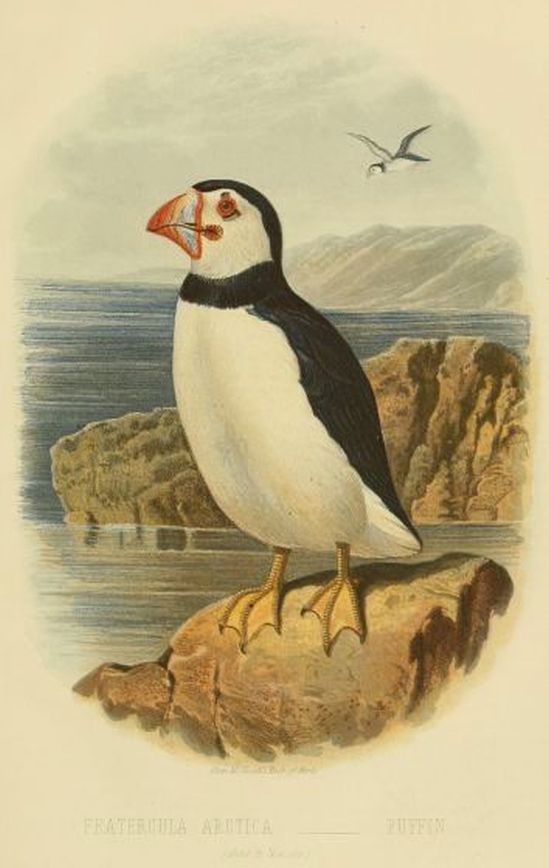
Plate 40, Cassell's Book of Birds
FRATERCULA ARCTICA ____ PUFFIN
(about ½ Nat. size)
[See larger version]
[Pg 265]
The PENGUINS (Aptenodytes) have their wings completely converted into fins, and only available as instruments of natation. In their appearance they present but a distant relationship with the Auks and Divers, and form a distinct family, recognisable by well-marked characters. The general shape of their bodies may almost be called conical, as it seems gradually to taper off from the tail upwards, the middle of the trunk presenting scarcely any perceptible enlargement. Their neck is of moderate length, but extremely thick, the head small, and the beak, which is nearly of the same length as the head, straight, strong, hard, and somewhat compressed at the sides; frequently it is marked externally with transverse furrows. Its cutting edges are sharp, but it is somewhat blunted at its apex. The structure of the foot is quite peculiar, seeing that the four toes with which it is provided, three of which are joined together by a broad web, are all directed forwards. The wings are so short that they might almost be called fins, moreover the feathers that cover them rather resemble scales than ordinary quills. Even the plumage reminds us of the closely-imbricated scales of fishes; in short, from their whole formation they are evidently inhabitants of the water rather than of the air. Their internal structure corresponds with their external appearance; all their bones are hard, thick, and heavy, they present no openings or cavities for the reception of air, and even the humerus and femur are filled with oily matter.
Birds belonging to this remarkable family are inhabitants of the southern hemisphere, and there occupy a zone extending from 30° to 75° south latitude, living entirely upon the surface of the ocean, and only visiting the land during the period of incubation. All the various species of Penguins are utterly incapable of flight, but their powers of progression in their proper element are truly astonishing. They bound through the sea like porpoises, using their short fin-like wings to assist their progress; by the aid of these they stem the most turbulent waves with the greatest facility, and during the severest gale descend to the bottom, where they paddle about in search of crustaceans, small fish, and marine vegetables. Owing to the thickness and weight of their plumage they swim very deep in the water, so that very little is to be seen except their head and neck. Upon dry land they also exhibit considerable agility. The position of their legs compels them to keep their bodies perfectly erect, and they thus walk, putting one foot before another almost like human beings; their gait, however, is waddling, and they get along but slowly; when alarmed, therefore, they throw themselves down upon their breasts and push themselves along both with feet and wings, and that so rapidly, that a man has some difficulty in overtaking them. In this manner they throw themselves from the rocks or roll down some deep declivity into the sea, apparently knowing full well that as soon as they reach the water they are safe from pursuit. Sometimes large parties may be seen from a ship, going in a given direction as though on a journey, cutting through the waves with a celerity far surpassing that of the swiftest vessel. During a considerable portion of the year these birds are employed in providing for their young, as it is necessary that their progeny should acquire sufficient vigour to resist the raging element on which they are destined to dwell, and which they most probably will never leave, except when in their turn they seek land for the purpose of reproduction.