THE SEA-FLIERS (Longipennes).
Thomas Rymer Jones translation
IN the broad-billed water birds, we have had an opportunity of admiring the manner in which their power of swimming becomes more and more complete. In the Sea-fliers we shall recognise the tyrants of the ocean, seeing that in their presence the swimming birds, whether inhabitants of the coast or children of the wave are subservient. The great character whereby the Longipennes are distinguished is the enormous development of their wings, while that of their feet remains comparatively in abeyance. Some of them, it is true, are well able both to swim and to walk, but their special adaptation is for flight. Their power of flying is supreme, and in this they are surpassed by no other birds. As to their general structure, there is a great similarity between the different races. Their body is powerful, their neck short, and their head of moderate size. Their beak, which is of medium length, is compressed at the sides and sharp-pointed or hooked at the end; in conformity with this structure, the upper mandible is more or less arched, while the under jaw at a little distance from its apex, is strengthened by an angular enlargement. Their feet are feeble in proportion to the size of their bodies, and only webbed upon the three anterior toes; moreover, even upon these the webs are often very imperfectly developed. The wings are always long, and sharp-pointed, more or less narrow and proportionately very large; their tail is of moderate dimensions, either truncate, greatly rounded, pointed, or forked at the extremity, and usually composed of twelve feathers. The general plumage is very thick and rich, but not particularly well-furnished with down; its colour is much varied, and changes with the age of the bird and at different seasons. In all the above characters and in many others that might be adduced from an examination of their internal structure, these birds differ from the Swimmers in so many particulars that they cannot be considered as in any way belonging to the same order.
The domain of the Sea-fliers is the ocean, their territory the wide world. Some families seem more especially to frequent coasts, others prefer fresh water to the salt sea, but these are mere exceptions. Sweeping continually over the waves, or skimming in the proximity of coasts, they wander over the sea and circle round the globe. By one tie only are they bound to the dry land, and that is, their affection for their offspring. They lay their eggs upon the land, and there watch over their young brood until their wings attain sufficient strength to enable them to join their brethren in the air; the rest of their time is for the most part devoted to the sea, upon which they sometimes repose, or, in exceptional cases, sleep upon the shore. Their flight is longer sustained than that of the Swallows or Swifts, or even of the Humming-birds, for they fly not only during the whole day but often likewise throughout the night. It is to this untiring energy and constant restlessness that we must attribute the boundless range over which particular species spread themselves. Some of them indeed have literally a world-wide distribution, and visit every climate between the equator and the polar seas. Others again, restrict their wanderings, or migrations, or flights, or whatever the reader may choose to call them, either within more or less definite regions, or within certain degrees of latitude; it must, however, be kept in mind that these boundaries are not coasts or countries, but whole continents and oceans.
All Sea-fliers are divers, but, owing to the thickness of their plumage, some are less capable than others of plunging far beneath the surface. They generally fly over the waves at a certain altitude, disporting themselves in the sunshine should the weather be fine, or battling with the elements during[Pg 176] a storm. While flying, their attention is anxiously bent upon the sea beneath, on the look-out for food, upon which, when discovered, they instantly dart down, some of them with the straightness and rapidity of an arrow, others more leisurely, while some, before they seize their prey, settle down and swim. All are equally rapacious, whether they catch food for themselves or rob other birds of their hard-earned booty, whether they devour living victims or content themselves with feeding, like the Vultures, upon carrion. Whatever the sea presents for their acceptance they greedily swallow. In their mode of breeding these birds very much resemble each other. Their nests are generally placed upon the ground, sometimes in wild mosses and swamps, sometimes on ledges or projections of rocks, and in the holes and excavations of the soil. Occasionally they select precipitous cliffs and mountains, more rarely trees; some lay but one egg, others two, three, or four. All show much attention to their mates and offspring. The young are at once introduced to their future element, where they soon learn to catch their own food.
The TERNS, or SEA SWALLOWS (Sternæ), are a race of middle-sized or small slenderly-built birds. Their beak is of about the same length as the head, hard, straight, or gently arched towards the tip, both in the upper and lower mandible. The feet are feeble, and provided with toes united by a short or deeply-excavated web, and furnished with slightly-curved sharp claws. The wings are long, narrow, and sharp-pointed, the first quill being the longest; the tail, which is of medium length, consists of twelve feathers, and is more or less forked. The thick, soft, close plumage is coloured light blue, black, and white, and varies but little either with the sexes, age, or season of the year. The Terns are very extensively distributed, inhabiting every zone; still they appear to prefer warm and temperate climates to the colder regions, only visiting the latter, indeed, for a short time during the year. The members of this group live both upon the sea and fresh water, and during their wanderings follow the windings of coasts and the courses of rivers; some species prefer flat, bare shores, others resort to localities rich in vegetation, while others, again, delight in the neighbourhood of woods. All are exceedingly active, and from sunset to sunrise are constantly on the wing; their nights are passed on dry land, but they apparently require less repose than any of their kindred. They walk badly, and when on the ground hold their body in a horizontal position, slightly depressed in front, so that the tips of their long sabre-like wings are higher than their head, which is kept in a retracted position. In the water they swim like corks, their little feet being almost incapable of assisting them in that element; on the other hand, their powers of flight are wonderful, and will bear comparison in every respect with those of the Swallow. When not in haste they move their wings with slow wide-spreading strokes, and thus glide onwards through the air in a gently undulating line; but if urged to speed they beat the wind with powerful rapid jerks, and skim along with indescribable velocity. In fine weather they disport themselves almost after the manner of Swallows, sweeping round and round in broad circles, and performing a variety of elegant curves and graceful evolutions; but in a storm their energies seem roused to the utmost, and they may then be seen battling untiringly against the gale. Generally they fly very low over the surface of the water, rising and sinking as the waves heave and fall, till suddenly, with close-shut wings, they dart obliquely into the sea, sinking so deep that they almost disappear, but, immediately rising again, they shake their wings and recommence their devious course over the billows. In this manner they fly over a vast extent of water during the day, but however widely they may wander, return again and again to the same track, and never remove far from the locality whence they started. The disagreeable shrieking cry uttered by these birds varies but little in different species. Although the Terns are very sociable in their intercourse with their own kind, they appear to take but little heed of the rest of their feathered companions, even when, as is often the case, they associate with them in search of food. The diet of the Sea Swallows consists principally of fishes and a variety of creatures met with in the sea, their prey being always taken when on the wing. These birds are strictly monogamous: a few weeks before the commencement of the breeding season they begin to assemble in the vicinity of their meeting-place, returning year after year to the same locality. Such species as inhabit the sea-shore generally select coral-banks, islands, or long spits of bare sand for this purpose, while such as settle inland seek out similar, but less barren spots, in the vicinity of swamps and marshes, the various species usually breeding apart from each other. Such as resort to morasses lay their eggs in a mere depression of the ground. Their unpretending apologies for a nest are sometimes isolated, sometimes so crowded together as literally to cover the ground so thickly, that the brooding birds have all to sit with their heads in one direction, and a man cannot pass between them without crushing the eggs of contiguous nests. Even such species as resort to trees construct nothing in the shape of a nest, but deposit their eggs in chinks of the bark or inequalities of the branches. Most of the Terns lay three eggs, others two, whilst those that breed on trees deposit but one. The male and female brood alternately; during the heat of the day, however, they leave their eggs to be kept warm by the sun. The young are hatched in about a fortnight or three weeks, and make their appearance clad in down; they leave the hollow that has served as a nest on the day of their birth, and run at once down to the water's edge, quite as fast as their parents, by whom they are anxiously and carefully tended.
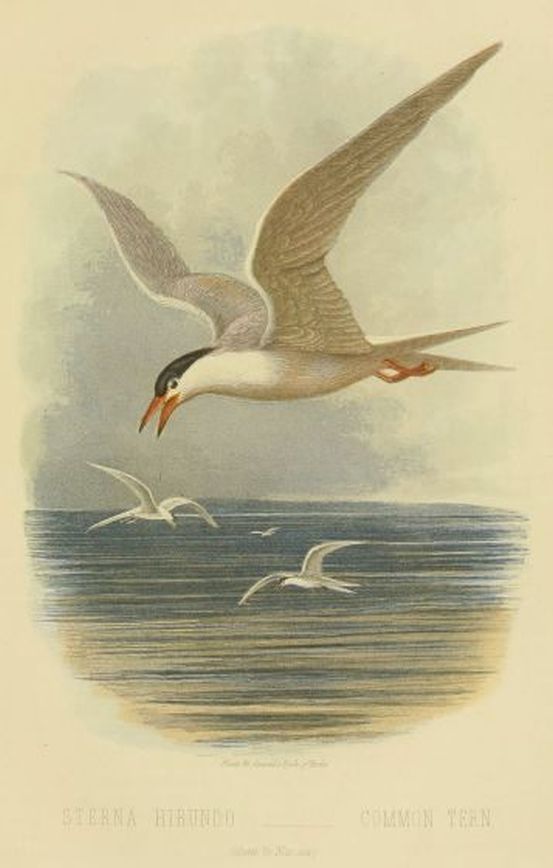
Plate 38, Cassell's Book of Birds
STERNA HIRUNDO ____ COMMON TERN
(about 1/3 Nat. size)
[See larger version]
[Pg 177]
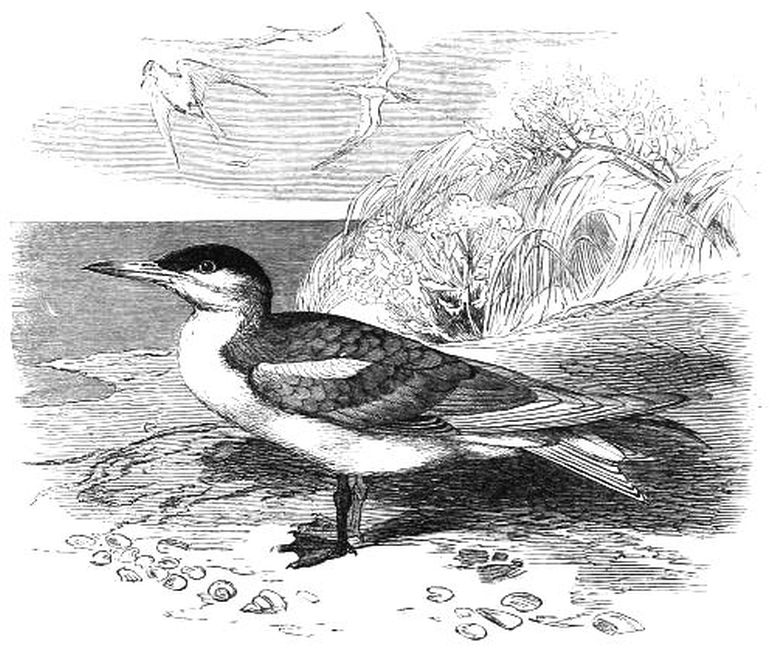
THE CASPIAN TERN (Sylochelidon Caspia).
The RAPACIOUS TERNS (Sylochelidon) are the largest of the Sea Swallows, and distinguishable[Pg 178] from other species by their proportionately strong, compressed body, as also by their large strong beak, which is longer than the head. The foot is small, and the web but little excised; their wing is long and sabre-like; the tail but slightly forked; and the general plumage close and thick.
THE CASPIAN TERN.
The CASPIAN TERN (Sylochelidon Caspia) is twenty inches long, and fifty across the spread of its wings; the wing measures sixteen, and tail six inches; the feathers upon the top of the head are black, those on the sides of neck, upper back, and under surface of body, pure white; the mantle is light greyish blue; the tips of the wing-quills are darker and those of the tail-feathers lighter than the general colour of the upper parts of the plumage. The eye is brown, the beak coral-red, and the foot black. In winter the top of the head is black and white; in young birds the feathers of the back are transversely spotted with brown. The Caspian Tern inhabits Central Asia and Southern Europe; it breeds, however, exceptionally in the Island of Sylt, as well as upon some parts of the Dutch and French coasts. During the winter it appears upon the southern shores of the Mediterranean and the lower lakes of Egypt, as also in the northern parts of the Red Sea and Indian Ocean; it occurs on the west coast of Africa, but does not seem to have crossed the Atlantic. In England several specimens have been shot in Norfolk and other parts of the east coast. On the Island of Sylt it arrives towards the latter part of April, and after rearing its young, departs in August. This bird may generally be seen flying at a height of forty or fifty feet, its head, with its shining red beak, being directed downwards, and its great wings slowly waving, until from time to time it plunges headlong into the water after its prey. When in search of a resting-place it betakes itself with its companions to some rocky locality near the shore, where they all perch in a close rank, with their heads turned towards the sea, in which position they are readily mistaken for Sea Gulls. The term rapacious has been well applied to the members of this group. Fishes form their ordinary food, but they likewise devour coast and water birds, swallowing them with great ease and relish. In India they hunt eagerly after crabs, and everywhere voraciously feed upon the eggs of other birds whenever they can obtain them. Schilling tells us he has seen them fly to the breeding-places of Sea-fowl, and although at once attacked by the brooding parents, make their way to the nests quite regardless of the clamour, and help themselves without stint. Naumann and he visited a celebrated colony of this species at the northern extremity of the Island of Sylt, where they found their eggs laid upon the bare sand in little hollows, at a short distance from the water, the different broods not being more than two feet apart from each other. The eggs in shape and size much resembled those of tame Ducks. Their shells are smooth, but not shining, and their ground colour a dirty brownish white, marked with ash-grey and black; considerable difference, however, was observable even in those in the same nest. These birds begin to lay about the beginning of May; in Sylt the inhabitants regularly take the eggs, only allowing them to begin to brood eight or ten days before Midsummer. Should a man approach their nests, both male and female endeavour to defend it, and raise a terrible outcry. The young are clothed in down, of a greyish black above and white on the under surface; they soon run about, and for some days are assiduously fed with small fishes, which are brought to them by both parents.
The RIVER TERNS (Sterna) are distinguished from the preceding birds by their somewhat arched, moderately short beak, small short-toed feet, and deeply-forked tail; and by their frequent occurrence at the mouths or along the banks of rivers, or of inland streams or lakes. In size they are considerably smaller than the Caspian Terns, and their flight is much more graceful and Swallow-like, always exciting the admiration of the beholder.
[Pg 179]
THE COMMON TERN.
The COMMON TERN (Sterna hirundo, Coloured Plate XXXVIII.), when in its adult plumage, closely resembles the Caspian Sea Swallow, but may be recognised by its inferior size, the grey colour of the under parts of the body, and by its red feet. In young birds the plumage of the back, like that of the preceding species, is transversely spotted with brown, but the feet are of a yellowish shade. The length of this species is from sixteen to seventeen inches; of these six and a half belong to the tail, the fork being four inches deep; the span of the wings is twenty-three inches. It is at present uncertain whether all River Terns are to be regarded as belonging to this species or not. Should they be found to do so, their habitat must extend throughout the whole north temperate zone, seeing that they are pretty equally distributed in the eastern and western hemispheres. They are met with more frequently than other Terns in the vicinity of rivers and lakes of fresh water. As these birds make regular migrations, they are only seen at their breeding-places in the summer, appearing during the last days of April or the beginning of May, and in July or August preparing for their departure. They spend the winter in the south of Europe, or in the north of Africa, where at that season they are very common. When on their journeyings they fly leisurely, and at a considerable elevation, from one sheet of water to another, generally following the course of streams and rivers, to which, if pressed by hunger, they repair, in order to obtain food and rest. Arrived at their destination, they settle themselves either in the vicinity of the sea, or near fresh water, without seeming to have any decided preference for either.
The Common Terns arrive in the south of Europe early in May, and progressing northwards, colonising as they go, visit Ireland, Scotland, and some of the adjacent islands. On inland waters the Terns do not congregate in great numbers. On the sea-shore, on the contrary, as the breeding season approaches, hundreds of them collect together and form large settlements. One of these settlements, on the coast of one of the Canary Islands, was visited by Bolle, who gives the following account of what he saw:—"The farther we advanced the more numerous became the flights of such pairs as we had disturbed, until at length we were obliged to proceed carefully to avoid treading on their eggs, so numerously did they lay around us on every side. Scarcely had we begun to collect some of the eggs in our hats and baskets, than up rose the whole multitude of breeding birds into the air, thousands in number, and overshadowed us like a great white cloud. Their shrieks were positively deafening, and the uproar was still further increased by the appearance of some other men at a little distance, who were likewise collecting eggs. From out of the living screen above us, many of these birds seemed to rush right down upon our heads, and these were probably those whose nests lay nearest to the place where we stood, and were consequently in the greatest danger of being plundered. After a little while, we retired to a distance, whence we could plainly see the different pairs, as they returned to their eggs, upon which the females immediately planted themselves, while their faithful spouses took their stations beside them. We did not leave them, however, till we had completely filled all our baskets with eggs, and this we accomplished in less than an hour. The men above alluded to, informed us that for a few weeks in the year, the place was constantly resorted to by the inhabitants, who eagerly collected the eggs, and that, nevertheless, the number of birds did not seem to diminish; the truth of this last assertion was indeed sufficiently evident." It not unfrequently happens that by some sudden flood in the rivers, or heavy storm at sea, the breeding-places of these Terns are completely inundated, and their eggs consequently destroyed. Should such an event occur early in the season, the parent birds will produce a second brood, but if it happens at a later period, their hope of progeny is at an end. Upon one occasion Naumann had an opportunity of witnessing a fair chase between the Common Tern and the agile Tree Falcon. The Tern did not[Pg 180] put into execution any of the usual manœuvres of water-birds, when trying to escape from pursuit, such as diving below the surface, but took boldly to her wings, and it was truly wonderful to see the adroitness with which all the efforts of the Falcon were foiled; whenever this terrible bird of prey stooped upon his intended victim, she slipped nimbly aside, and thus eluded the fatal clutch; or sometimes she would fall perpendicularly downwards, then mount above her foe towards the skies, rising higher and higher as he followed in pursuit, until at length the strength of the Falcon failed him, and he was forced to give up the chase. This Falcon is, however, very destructive to the young Terns, before their wings are strong enough to cope with those of their fleet foe. The eggs of this Tern are either yellowish grey, pale greenish brown or greenish blue, spotted with ash-grey or dark brown. Respecting the movements and noisy vociferations of the Common Terns, Macgillivray says, "When walking along the sandy shore you may see them coming up from a distance, increasing their speed as they approach, and then wheeling and plunging over you, until at last they fly off. Proceeding at a moderate height, they stop now and then, hover a moment, dip into the water, and secure a sand-eel or young coal-fish. Many attend on the fishermen, or others who are catching sand-eels for bait or food, to pick up those which fall from them disabled. On such occasions they are very vociferous, as they also are when they have fallen in with a shoal of fry. They never dive, but I have seen them alight on the water and swim a little, and sometimes a whole flock may be observed reposing on the placid bosom of the waters."
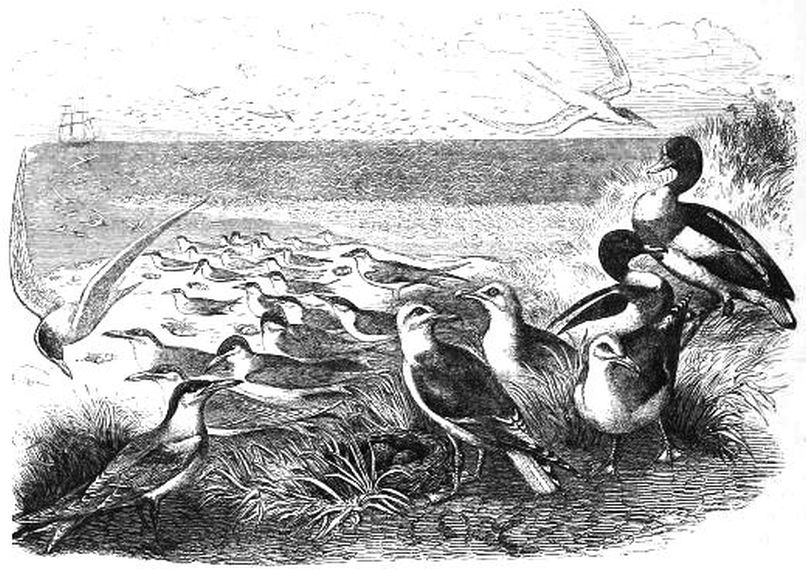
TERNS AND THEIR NESTS.
[Pg 181]
THE LESSER TERN.
The LESSER TERN (Sternula minuta) has been considered by some ornithologists as the representative of a distinct sub-family, although it only differs from the preceding species in its inferior size, proportionately strong short beak, the deeply-incised web of its foot, and the shallow furcation of its tail. In this bird the forehead and under side are white, the upper head and nape black, the mantle and wings dark green. The eye is brown, the beak yellow, with black point, and the foot clay-yellow. The length of this bird is eight inches and a half; breadth nineteen to twenty inches; length of wing seven, and tail three inches. The young are spotted like the preceding species. The range of the Lesser Tern extends over Europe, Asia, Africa, and America, from 24° to 58° north latitude. In Brazil it is replaced by a somewhat larger species. The Lesser Tern makes its appearance in Great Britain about May, and after having reared its young, resumes its wandering habits about the end of July or August. It is, however, a slow traveller, and only reaches the lakes and streams of North Africa in the autumn; its migrations from North Asia and North America are conducted in a similar manner. This species prefers fresh to salt water, and chiefly frequents large rivers without, however, altogether withdrawing from the sea-shore. The first requisite for its accommodation would seem to be a little island or bed in a stream, covered with gravel or sand, for where these are wanting it is never to be found. Although the two or three eggs of the Lesser Tern (which have a stone-coloured shell marked with grey, or reddish brown) are usually merely deposited in a slight depression of the ground above high-water mark, Audubon states that some pairs that he found breeding on the coasts of Labrador had formed very snug nests composed of short fragments of moss, well matted together, while those on the island near the Bay of Gaveston had laid their eggs on dry drifted weeds, which appeared to have been gathered by them for this purpose. The same author tells us that the common note of this bird resembles that of the Barn Swallow when disturbed about its nest, and is at times as smartly and rapidly repeated. The following very pretty description of the light and beautiful movements of this Tern whilst on the wing is from the pen of Mr. Macgillivray:—"In the elegance of its buoyant flight as it skims over the waters or shoots on its way to and from its breeding-place, the tiny creature must be an object of admiration to every lover of nature. You may see a pair coming up from a distance flying at the height of a few yards over the waves, their long wings winnowing the air and impelling them in starts, as it were, as they wend their way in undulating and wavering movements. Suddenly their flight is arrested over a large pool left on the sands by the retiring tide; with quick beats of their wings, they hover stationary, or but slightly shifting place, and with downward-pointed bill seem intent on something which they perceive in the water. One drops, but not like a stone, dips, but with upraised wings, and rises with a small fish in its bill. The other is similarly successful. Onward they proceed, now and then emitting a shrill cry and with gentle beats of their wings. Far ahead is a flock engaged in picking up their prey, and onward they speed to join their kindred." Although these birds usually swallow their prey whilst in the air they are occasionally seen to alight upon the ground with their booty, and there devour it piecemeal.
The WATER SWALLOWS (Hydrochelidon) constitute a well-defined group belonging to the Tern family. These birds are powerfully built and of elegant appearance; their beak is feeble, tarsus high, toes long and united by a deeply-incised web. The wing is very long, tail short and but little forked. The general plumage, which is soft and thick, is during the breeding season principally black; this latter character, however, varies much according to the age of the bird and season of the year.
[Pg 182]
THE BLACK MARSH TERN.
The BLACK MARSH TERN (Hydrochelidon nigra) is of a deep rich black on the head, nape, breast, and centre of belly; the mantle is blueish grey, and the region of vent white. The wing-quills are dark grey bordered with a lighter shade, and the tail-feathers dark grey. The eye is brown, beak greyish black with red base, and foot brownish red. In the winter dress, only the back of the head and nape are black, the forehead and under part being white. In young birds the mantle-feathers and wing-covers are edged with reddish yellow. The length of this species is nine inches, span of wings twenty-six inches. The Black Tern inhabits the north temperate zone, and during the winter wanders so far south, that, like Sternula minuta, it is to be met with in four continents—Europe, Asia, Africa, and America. It makes its appearance in Great Britain at the same time as the other Terns, but is much less abundant than formerly, being seldom seen in the North of England and very rarely in Scotland, although it still visits many parts of Ireland. It arrives in this country about the end of April or beginning of May, and is principally found in Lincolnshire, Norfolk, and Cambridgeshire. In Montagu's time it was common in Romney Marsh, in Kent; specimens have also been procured in other southern counties. During their winter peregrinations these birds generally travel in companies varying from twenty to about a thousand individuals, following the course of the streams, and taking up a temporary residence wherever these spread out into extensive swamps or overflow the neighbouring land. In their deportment, food, and mode of breeding, they also differ materially from the Common Terns. They walk seldom, and as badly as their brethren, and rarely swim, as their powers in that respect are very limited. Their flight is not so rapid and devious as that of their congeners, but more even, gentle, and light. During the night season they betake themselves to repose, but in the daytime are constantly on the wing, hunting after food. The Black Terns live almost exclusively upon insects, although they will also occasionally seize a little fish or other small inhabitant of the water. They somewhat resemble the Swallows in their mode of life, and like them may be seen skimming over pools of water, apparently more for the sake of amusement than from any real necessity for such active exertion. When they discover anything in the shape of food, they hover over it for an instant and pounce upon their prey, not coming down upon it precipitately and perpendicularly as some of the Divers do, but sweeping obliquely towards it, so as to seize it with the beak without immersing their bodies. According to Montagu, "The flight of this species is not unlike that of the Goatsucker; its evolutions are rapid and it turns short if attacked, by which means it escapes the talons of predaceous birds, as we once had an opportunity of witnessing. In a very hard gale of wind many Terns were sporting over the water, when a Peregrine Falcon passed like a shot, singled out his bird and presently coming up with the chase, made a pounce, but the great dexterity of the Tern avoided the deadly stroke and took a new direction. The Falcon, by his superior velocity, soon regained sufficient elevation to successively repeat his pounces, but at last relinquished the pursuit." The Black Terns, unlike the generality of their congeners, are fearless and unsuspicious, and seem rather to welcome than to avoid the presence of mankind; if molested, however, they soon become more wary. Towards each other they manifest considerable affection, and should one of their party be shot, the others instantly collect around their wounded companion, not from any sinister motives, as has been asserted by some writers, but out of commiseration for his condition. For their breeding-places these birds invariably choose some wide swamp or morass, placing their nests upon little heaps of mud that project above the surface of the water, upon tufts of grass or sedge, upon floating masses of reeds, rushes, or similar materials, or sometimes on the floating leaves of aquatic plants. The nest itself is constructed of substances that vary with the locality selected, such as leaves, roots and rushes heaped carelessly together. In this cradle, about the beginning[Pg 183] of June, each pair lays two, three, or four eggs; these are of a pale olive or yellowish colour, spotted with grey, reddish brown, and brownish black. Both sexes incubate by turns, keeping the eggs constantly covered. If disturbed during the breeding season, these Terns are as noisy as any of their congeners, but unlike them remain close over the nest and only go in search of food at regular intervals. After the lapse of fourteen or sixteen days the young make their appearance, and about a fortnight later quit the nest. Even after they are fully fledged they accompany their parents, who tend them with great devotion, and feed them while on the wing, after the manner of Swallows. This species subsists chiefly on shell-fish, beetles, and dragon-flies. The flesh of the Black Terns is tolerably good.
THE WHITE-WINGED TERN.
The WHITE-WINGED TERN (Hydrochelidon leucoptera) has the body-feathers of a rich deep black; the upper part of the wing is blueish grey; the shoulders and points of the secondary quills are whitish grey, and the rump and tail-feathers white. This species, which closely resembles the Black Tern in size, manners, and habits, is very rare upon the coasts of Great Britain. Temminck states that it frequents the shores of the Mediterranean, and the lakes, rivers, and marshes beyond the Alps, being common about Gibraltar, and Lakes Como, Lugano, and Lucerne, but that it never visits Holland, or North Europe. Nilsson, on the contrary, includes it amongst the birds of Germany and Scandinavia. The food of the White-winged Tern consists of winged and aquatic insects, worms, and sometimes small fishes.
THE WHITE-BEARDED TERN.
The WHITE-BEARDED TERN (Hydrochelidon leucopareja) has the black upon the head and nape divided from the dark grey lower neck by a broad white stripe; the breast is dark grey, mantle light grey, and belly greyish white. This rare bird was first discovered by M. Natterer, in the marshes of South Hungary, and is but very seldom seen in Great Britain. We are little acquainted with its habits beyond that it subsists upon worms, snails, and winged insects. Yarrell describes the egg as being one inch and a half long, by one and one-eighth broad, with an asparagus-green shell, spotted with brownish black and blueish grey.
THE WHITE OR SILKY TERN.
The WHITE or SILKY TERN (Gygis Candida) is a beautiful bird, with slender body, long thin beak, which curves perceptibly upwards, long wings, and deeply excised tail. The feet are small, and the toes furnished with a narrow web; the plumage is of silky softness and pure white; the eye is black, the beak dark blue towards its base and black at the point; the foot is saffron-yellow.
The White Tern inhabits the Pacific Ocean, and is to be met with from Moreton Bay to Cape York. Gould was informed by Mr. Cumming, that on visiting Elizabeth Island, in the South Seas, which is entirely destitute of inhabitants and fresh water, he found this, or an allied species, breeding on a kind of Pandanus, its single egg being deposited on the horizontal branches in a depression, which, although slight, was sufficient to retain it in position, despite the high winds and consequent oscillation to which it was subjected. Mr. Cumming added that the old birds were flying about in thousands, like swarms of bees, and that he noticed several breeding on the same tree. Some of the young birds were hatched and covered with down, and being within reach, he took a few of them in his hand, and after examining, replaced them on their dangerous resting-place, from which it appeared they occasionally fell down and were destroyed, as he observed several lying dead on the ground. Gould also refers to a bird of this genus, and perhaps the same species noticed by Darwin in the Journal of Researches in Geology and Natural History, who, speaking of Keeling Island,[Pg 184] says:—"There is one charming bird, a small and snow-white Tern, which smoothly hovers at the distance of an arm's length from your head, its large black eye scanning with quiet curiosity your expression. Little imagination is required to fancy that so light and delicate a body must be tenanted by some wandering fairy spirit."
THE NODDY.
The NODDY (Anous stolidus) represents a group recognisable by its somewhat clumsy appearance; its beak is longer than the head, strong, almost straight, and compressed at the sides, with the fore part of the under mandible bent at an angle; the legs are powerful, and the feet furnished with long narrow toes, fully webbed; the wings are long, narrow, and pointed, but their apices are somewhat rounded off, the tail is long and wedge-shaped, but not forked. The colour of its plumage, with the exception of the upper part of the head, which is greyish white, is sooty brown, a patch in front of and another behind the eye black, the quills and tail-feathers blackish brown; the eye is brown, the beak black, and the foot dusky brownish red. The length of the Noddy is sixteen inches, its breadth thirty-two, length of wing eleven inches, of tail five inches. These birds appear to be more widely distributed than any of their congeners; they are met with both in the Atlantic and the Pacific Oceans, being perhaps most abundant in the latter portion of the globe. Some ornithologists, however, are undecided whether the Atlantic and Pacific birds must be regarded merely as varieties or as distinct species. Mr. Coues, who is of the latter opinion, has proposed to call the Pacific species Anous frater. Mr. Gould, however, prefers to describe the Australian bird under the old name of stolidus, rather than unnecessarily multiply the number of specific appellations, but he observes that though the Noddies of the northern and southern hemispheres are very much alike, considerable variation is found to exist in their modes of nidification, and the season at which it is performed; there is also a difference in the colouring and number of their eggs, those in the northern hemisphere being said to lay three, those in the southern only one egg. The Noddy, and an allied species, Anous melanops, says Gilbert, are extremely numerous on the Houtmann's Abrolhos, where they breed in prodigious numbers. The present species lays its eggs in November and December, on a nest constructed of seaweed, about six inches in diameter, and varying in height from four to eight inches, but without anything like regularity of form; the top is nearly flat, there being but a very slight hollow to prevent their single egg from rolling off. The nests are so completely plastered with the excrement of the bird, that at first sight they appear to be entirely formed of that material; they are either placed on the ground in a clear open space, or on the tops of the thick scrub, over those of the Onochoprios fuliginosus, the two species incubating together with the most perfect harmony, and the bushes presenting a mottled appearance, from the great numbers of both species perched on their tops. By the middle of January the eggs were nearly ready to hatch, and there would be an overwhelming increase of this species yearly, but for the check which Nature has provided against it, in the presence of a small lizard, which is very abundant in their breeding-places, and which finds an easy prey in the young.
"About the beginning of May," says Audubon, "the Noddies collect from all parts of the Gulf of Mexico and coasts of Florida, for the purpose of returning to their breeding-places on one of the Tortugas, called the Noddy Key, where they form regular nests of twigs and dry grass, which they place on bushes or low trees, but never on the ground. On visiting their island on the 11th of May, 1832, I was surprised to see that many of them were repairing and augmenting nests which had remained throughout the winter, while others were employed in commencing new ones, and some were already sitting on their eggs. In a great many instances the repaired nests formed masses nearly two feet in height, and yet all of them had only a slight hollow for the eggs, broken shells of which[Pg 185] were found among the entire ones, as if they had been purposely placed there. The birds did not discontinue their labours, although there were nine or ten of us walking among the bushes, and when we had gone a few yards into the thicket, thousands of them flew quite low over us, some at times coming so close as to enable us to catch a few of them with the hand. On one side might be seen a Noddy carrying a stick in its bill, or a bird picking up something from the ground to add to its nest, on the other several were sitting on their eggs, unconscious of danger, while their mates brought them food. The greater part rose on wing as we advanced, but re-alighted as soon as we had passed. The bushes were rarely taller than ourselves, so that we could easily see the eggs in the nests." It is stated that the Anous stolidus occasionally visits St. George's Channel, and in 1840 two specimens were shot off the coast of Wexford.
The SCISSOR-BILLS (Rhynchopes) constitute a group of night birds, bearing the same relationship to the Sea Swallows as the Owls to the Falcons. Their body is elongate, neck long, head small, wings very long, and the forked tail of moderate size. Their beak is so peculiar in its structure that it can be compared to nothing so happily as to a pair of scissors. The lower mandible is very considerably longer than the upper portion of the bill; the legs are feeble, tolerably long but slender, and the anterior toes connected by a deeply-incised web. The general plumage, which is close and smooth, presents a peculiar, greasy appearance.
THE INDIAN SCISSOR-BILL.
The INDIAN SCISSOR-BILL (Rhynchops orientalis) is white upon the forehead, face, tail, under side of the body, and upon the points of the larger wing-covers; the top of the head, back of neck, and mantle are blackish brown; the eyes are dark brown, the beak and feet coral-red. The length of this species is seventeen inches, its breadth forty-two inches, length of wing thirteen inches, and of tail two inches and a half. The Scissor-bill has frequently come under our notice, while travelling along the banks of the Middle and Upper Nile. This bird may occasionally be seen flying by day if it has been disturbed; but it usually remains motionless upon sandbanks from morning to evening, generally lying flat upon its belly, more rarely standing up on its little feeble feet; while thus reposing, it is but seldom that it makes any noise or exhibits the slightest activity. As the sun sets, however, it begins to be more lively, moves about, stretches itself, raises its wings, hops backwards and forwards, and utters its peculiar cry; but it is only as night approaches that it flies away in search of food. Its movements are then in exact accordance with the peculiar structure of its beak. With long strokes of its wings, it glides noiselessly along close to the water, from time to time dipping its lower mandible beneath the surface and keeping it there for a minute or two at a time, ploughing, as it were, the top of the river, with its strangely-shaped under jaw, and skimming the water. In this manner it manages to collect great numbers of the insects, which upon the banks of the Nile, at least, constitute its principal food. Whether it also eats small molluscs, more particularly bivalves, and is skilful in opening them with its beak, we cannot say, but that this is the case with some of its congeners seems to be pretty well established. Lesson states that he saw an American Scissor-bill seat itself quietly down near some bivalve shell-fish left by the tide and wait patiently till they opened their valves, when it inserted its beak between the separated shells, till the occupant again closed its valves and thus laid hold upon the beak; he then flew away with it to a neighbouring stone and beat the shell to pieces. Tschüdi relates the same circumstance, but whether from his own observation or from Lesson's narrative we do not know. At present we entertain some doubts of the accuracy of the observations alluded to. The flight of the Scissor-bill is light and beautiful, but somewhat peculiar, inasmuch as the bird is obliged to raise its wings very high in order to prevent the tips from[Pg 186] striking the water; its proportionately long neck enables it to do this, allowing it to keep its body at the distance of about an inch from the surface, while a considerable portion of its beak is held under water. Its hunting ground seems to extend for about the space of a mile up and down the stream. In Central Africa it will sometimes leave the river to hunt over some neighbouring pond. On the south and western parts of that continent it may possibly, like its American congeners, occasionally pay a visit to the coast. The cry of the Scissor-bills, which may sometimes be heard when they are passing about in company with each other is very peculiar, and entirely different from the cry of any other bird with which we are acquainted.
In the neighbourhood of Dongola we were fortunate enough to light upon one of their breeding-places. In the month of May we happened to see a number of these birds at their ease lying flat upon a large sandbank, which we were thus tempted to visit, and here to our great delight we found some of their nests. These latter consisted simply of excavations made in the sand; there was, however, this peculiarity about them, that each seemed to be the centre of a series of radiating lines that looked as if drawn with the back of a knife, and which obviously had been made by the birds, with their lower mandible. The eggs we found bore an extraordinary resemblance to those of the Sea Swallows. They were of an oval shape and in colour of a greenish grey, bordering on yellow, irregularly speckled with light and dark patches and streaks of grey and dark brown. In every nest we found five eggs. Whether both sexes brood or not we were unable to ascertain, neither could we obtain information as to the rearing of the nestlings.
Speaking of the young of the Indian species, Mr. Brooks writes to Jerdon:—"It was amusing to see an army of some hundreds of these little fellows (tortoiseshell-looking things) running steadily a couple of hundred yards before us. They run well, and when we reached the end of the sandbank, they attempted to swim off, while many squatted down; they did not make much way swimming, and sank very deep in the water."
The GULLS (Lari) form a well-defined and distinct family, recognisable by the following characters. Although these birds vary in size, from that of a Jackdaw to that of an Eagle, all are powerfully framed, with a short neck and large head. Their beak, which is of medium length, is strongly compressed at the sides, straight from the brow to the centre of culmen, and from that point to its apex bent gradually downwards, so as to form a strong terminal hook; both the upper and lower mandibles are provided with sharp cutting edges, and the gape extends backwards as far as the eyes; the tarsus is moderately high, but slender; the foot, with few exceptions, four-toed, the interior toes being webbed; the wings are long and broad, but acutely-pointed, the first quill being the longest; the tail, consisting of twelve feathers, of moderate length, is broad and straight, less frequently slightly incised; in a few species the centre feathers are somewhat prolonged. The general plumage, which is thick and soft, and fur-like on the under surface of the body, is very similarly coloured throughout the entire family. Upon the mantle and wings the prevalent hue is a beautiful blueish grey, varied with white and slate-black; the feathers of the under side (in many species the head and neck) are pure white; the back and feet of old birds are brighter and often of a different tint to those of the young. Gulls are to be met with in every quarter of the globe, but are most abundant in northern regions. A few species wander to a considerable distance from land, always, however, returning to the vicinity of the shore. All may therefore properly be called coast birds, and to the mariner they are always welcome, as sure harbingers of land. Their flights inland are even more frequent than their excursions into the open sea, and many of them may often be seen following the course of large rivers, or winging their way from lake to lake, into the interior of the country. Some species will frequently settle in the vicinity of inland lakes, and most of them prefer a similar situation as their[Pg 187] breeding-place. Many members of this family are more or less migratory; some appear upon our northern shores in the spring, and after rearing their young, take their departure in the autumn; others again only wander to considerable distances; there are, indeed, but few species that can be properly regarded as stationary. These wandering propensities are intimately connected with their supply of food. All of them live more or less upon fishes, but some also greedily devour insects, and these latter migrate with the greatest regularity. Besides the above articles of nourishment, Gulls eagerly pick up whatever small animals or animal substances they may happen to meet with. Carrion they devour as greedily as do the Vultures, even if it be in a putrid condition. In short, they appear to share the appetites of many other birds, and to be quite as omnivorous as the Crows. All Sea Gulls walk well and quickly; they swim buoyantly, lying in the water like so many air-bubbles, and dive with facility, but to no great depth, plunging probably for not more than one or two feet below the surface. Their voice consists of a harsh, disagreeable scream. As their breeding time approaches, these birds begin to assemble in flocks, which are frequently joined by other parties, until at last they form a numerous host. Even upon our own shores their nesting-places are often occupied by many hundred pairs, whilst further north they congregate in countless multitudes. The larger species crowd less closely together at these times than the smaller ones, the latter often literally covering the rocks on which their nests are so closely placed, that the brooding parents press upon each other. The structure of the nests varies in different localities; where grass and seaweeds are procurable they are carefully heaped together, but where these fail the nests are of still scantier proportions. The brood consists of from two to four comparatively large oval eggs, with strong coarse, brownish green or greenish brown shells, spotted with grey and brown; upon these both male and female sit by turns, for a period of three or four weeks. The young are clothed in a thick covering of speckled down, and shortly after emerging from the shell may be seen trotting about upon the sand, hiding themselves if alarmed behind little hillocks, or boldly plunging into the water. Such, however, as are born upon the ledges of perpendicular rocks, must necessarily remain there until their wings are strong enough to enable them to come down from their lofty perch, for they appear not to take the desperate leaps into the sea attempted by so many sea birds, to their destruction. During the first few days, the young are fed with half-digested food from their parents' crops, and afterwards with freshly-caught fishes, or other small animals. For some little time after they are able to fly they remain together, but soon quit their birthplace, and spread themselves along the coast. In the northern regions the Gulls are not only the most beautiful, but the most useful of the many feathered visitants; they are regarded as property, and as jealously preserved as any other game. In Norway the eggs form a very considerable part of the land proprietors' revenue. Among the poorer inhabitants the feathers are used instead of eider-down for bedding. The flesh of the old birds finds favour only amongst the Esquimaux, while that of the young is eaten by the inhabitants of Greenland and Iceland. If properly cooked, the latter, in truth, form by no means a despicable dish. Still, however, the eggs and feathers are looked upon as far more valuable than this somewhat fishy-flavoured game. In some localities, at certain seasons of the year, great battues are held, apparently much more from a love of slaughter than from any desire to turn the birds to account. The chase after Sea Gulls presents but few difficulties, a white pocket handkerchief thrown into the air is quite sufficient to attract their attention, and when they approach, if one is killed many others will at once crowd around it. They are also caught by a great variety of contrivances; snares are laid for them upon the sandbanks, some are caught in nets, and others by means of hooks, baited with fish.
The FISHING GULLS (Larus) comprise the larger members of the family, and constitute a well-marked section, principally distinguished by the colour of their plumage. All the members of this[Pg 188] group that we have selected for description are to be met with in northern climates between 60° and 70° latitude, where they breed upon the various cliffs and islands. Sometimes, indeed, they may be seen wandering inland, but, notwithstanding, all are sea-birds in the strictest sense. As regards their movements, they walk well, wade readily in the shallow water near the shore, swim lightly and buoyantly upon a rough sea, and often sleep upon the water. Their flight is slow, but by no means heavy, and can be sustained for a considerable time. With long strokes of their wings they sweep onwards through the air, sometimes flying in circles, sometimes mounting upwards against the wind, and again descend to the surface of the sea. In these flights they appear to be quite at their ease even during the wildest storms, and may frequently be seen plunging into the sea from a considerable height upon any prey that they may happen to espy. In sagacity and courage the Gulls are superior to their kindred, but they likewise surpass them in thieving and gluttony. They care little for the society of their brethren; nevertheless, it is a rare thing to see one of them alone. These Gulls subsist principally upon fishes of various size, and regard carrion, whether fish or flesh, as very delectable food; they also kill and devour small quadrupeds, and young or disabled birds. They rob the feebler sea-fowl of their eggs, and search upon the beach for worms and other animals. Should the shell of a crab or mussel be too hard for their beak, they at once fly with it into the air, and then, dropping it from a sufficient elevation upon the rocks beneath, shatter it to pieces.
THE GREAT BLACK-BACKED GULL.
The GREAT BLACK-BACKED GULL (Larus marinus), one of the best-known members of the above group, has the head, neck, under surface of the body, rump, and tail pure white; the upper back and wings are black; the wing-quills tipped with white. In young birds the head, neck, and under side are white, streaked and spotted with yellow and brown; the rump and wing-covers are brownish grey, with light edges; the quills and tail-feathers are black, the latter marked with white. The eye is silver-grey and the ring around it bright red. The beak is yellow, the under mandible being red towards its apex; the foot is light greyish yellow. The length of this species is twenty-eight inches, and breadth sixty-five inches; the wing measures nineteen, and the tail seven inches and a half. The Black-backed Gull frequents the shores of Europe, and, according to Audubon, is met with in North America. In Ireland it is a resident species, and is found dispersed in abundance along the English and Scotch coasts. It breeds in Caermarthenshire on sandy flats, in the British Channel on sandy islands or steep holms, and in the marshes near the mouth of the Thames. Dr. Edmondson says, "This species breeds on the flat grassy tops of a few inaccessible holms, or small islands—as the far-famed Cradleholm, of Ness—in considerable numbers, never in cliffs, and excludes every other bird from such localities. A pair or two—we may suppose the melancholy remnant of a more numerous race—may now and then be met with on lower and more accessible, but still flat situations." It usually produces three young, which, independently of their size, may be easily distinguished from other species by the more distinct speckling with black of their grey plumage. Like all the larger Gulls, it is fond of carrion. In winter these birds feed much on starfish, a meagre and frugal diet, it must be admitted; but the abundance of herrings, in summer, amply compensates for the abstinence of winter. When flocks of Shags are enjoying their gluttonous siesta on the rocks, a Black-backed Gull is very often perched near them, and on such occasions he acts as their sentinel by giving the alarm with his hoarse voice, or taking flight when an enemy endeavours to approach within shot. His deportment is dull and solitary.
[Pg 189]
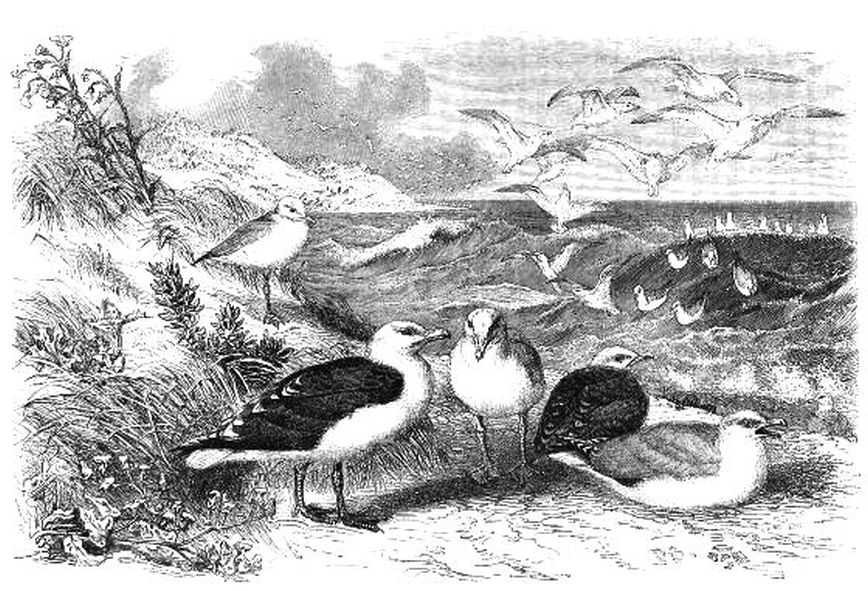
BLACK-BACKED AND HERRING GULLS.
[Pg 190]
During our travels in Norway and Lapland, we found the Black-backed Gull common enough, but it was only at Portsangfjord, towards the northern parts of the country, that we first met with their breeding-places. Upon an island in that vicinity we observed several hundred pairs, in company with the Herring Gulls. The nests of both species were placed promiscuously upon the ground, seldom more than fifty paces apart. Some of the nests were round, and carefully lined with grass, while others were more negligently constructed. A terrible uproar was raised as soon as we set foot on the island, such birds as had begun to brood remained sitting, and even allowed us to approach within a few steps of their nest, as if they thought that the fact of their presence would frighten us away. At length, however, they got up, and with loud cries flew around us at a little distance, every now and then plunging down as if to strike us, and then rising again, and taking a circuit previous to renewing the attack. Several times they flew so close over our heads that they touched us with their wings, but they did not venture to attack us with their sharp beaks. In several nests the young ones had not only managed to scramble out at our approach, but hid themselves very effectually among the long grass.
The eggs of these birds are usually three, sometimes four, in number, rough, of a yellowish grey or yellowish brown colour, tinged and spotted with dark brown and slate-grey; they are about three inches long, and rather more than two inches broad. Mr. Hewitson, who saw these Gulls breeding in the Orkney and Shetland Isles, says: "Their eggs are rich and excellent to eat; and they are in consequence a most valuable acquisition to the owners of the islands upon which they are deposited. The custom is to take the whole of the first eggs as soon as laid, and the second in like manner, allowing the birds to sit the third time. One gentleman, Mr. Scott, upon whose property they breed, and by whom we were most hospitably received, told us that he had secured sixty dozen of their eggs for winter use, though the extent of the island was scarcely half an acre."
An egg of this species was hatched in a most curious manner by a boat's crew, who kept it in a blanket by day, and near the fireplace at night. For many years this bird lived quite tame at Dartmouth, swimming in the river, and watching for the return of the fishermen, who always threw it a supply of small fishes.
THE LESSER BLACK-BACKED OR YELLOW-LEGGED GULL.
The LESSER BLACK-BACKED or YELLOW-LEGGED GULL (Larus fuscus). In the summer plumage of the adult bird, the head and whole of neck, all round, are pure white; the back, wing-covers, and all the wing-feathers dark slate-grey, the tips only of some of the longer scapulars and tertials being white, the shorter of the primaries have white tips; the upper tail-covers and tail-feathers are white, the breast, belly, and all the under surface of the body pure white, legs and feet yellow, bill yellow, inferior angle of lower mandible red; and the irides straw-yellow. The whole length is twenty-three inches, from the anterior joint of the wing to the tip of the longest quill-feather sixteen inches. In winter the head and neck are streaked with dusky brown.
THE HERRING GULL.
The HERRING GULL (Larus argentatus). In summer the adults have the head and neck pure white, the back and all the wing-covers uniform delicate French grey; tertials tipped with white; primaries mostly black, but grey on basal portion of inner web, and the first primary with a triangular patch of white at the end, the second and third with smaller portions of white; upper tail-covers and tail-feathers pure white; chin, throat, breast, belly, and whole of under surface of body and tail pure white; legs and feet flesh-colour; bill yellow, angle of under mandible red; edges of eyelids orange, irides straw-yellow. The length is from twenty-two inches to twenty-four inches and a half, depending on the age and sex; wing from sixteen inches and a half to seventeen and a quarter long. In winter the adult birds have the head streaked with dusky grey. This species is common along the whole of the south coast of England, and is particularly numerous in the Isle of Wight, from Freshwater Bay to the Needles.[Pg 191] During winter the Herring Gulls spread themselves along the coast, especially frequenting the estuaries where young herrings are congregated. "When engaged with a shoal of fry," says Macgillivray, "the Herring Gulls hover over the water, now ascending to a height perhaps of twenty feet, then skimming close over the surface, and on observing an object, stretching upward and vibrating their wings and letting down their feet so as to touch and sometimes pat the water, they pick it up without alighting. Sometimes they plunge partly into the water, and occasionally seize their prey while swimming. All this while they emit now and then a loud and rather shrill cry. They feed on shell-fish, and occasionally large dead fishes, crustaceans, molluscs, echini, &c. During the winter and spring they travel inland, seeking for insects, worms, and similar fare, they rest on beaches and headlands, usually lying down, but sometimes standing on one leg."
Audubon observed these birds in great numbers in the Bay of Fundy. "The rocky shores of the islands on which I saw them breeding," says this writer, "are covered with multitudes of sea-urchins, having short greenish spines, which give them the semblance of a ball of moss. At low water, the Herring Gulls frequently devour these animals, thrusting their bill through the shell and sucking its contents. They also take up shells into the air and drop them upon the rocks to break them. We saw one that had met with a very hard mussel, take it up and drop it three times in succession before it succeeded in breaking it, and I was much pleased to see the bird let it fall each succeeding time from a greater height than before." While on Whitehead Island, in the Bay of Fundy, Audubon saw numbers of the nests of these birds on fir-trees, some being placed near the top, others on the middle or lower parts of the trees. He was informed by the proprietor of the district that in his memory these Gulls had built their nests on moss, on open ground, but their nests having been robbed and the birds otherwise annoyed, they had betaken themselves to the thickest parts of the woods, hoping that by placing their nests on the trees they would be out of the reach of their arch-enemy, man. The nest of the Herring Gull, which is frequently placed on ledges of rocks, is usually formed of grass, or any other vegetable matter that may be at hand. The eggs are laid about May: these vary much both in size and colour. The young remain in the nest until they are partially fledged, but at once quit it if alarmed, and frequently take to the water if pursued.
THE LARGE OR GLAUCOUS WHITE-WINGED GULL.
The LARGE or GLAUCOUS WHITE-WINGED GULL (Larus glaucus) is almost entirely white, with a faint blue tinge upon the back and wing-covers; the primaries are also white, and extend but little beyond the end of the tail. The bill is yellowish white, except upon the inferior angle of the lower mandible, which is reddish orange; the eyes are pale yellow, and legs and feet flesh-red. In winter the head and neck are slightly streaked with dark grey. The length of this species is about thirty inches; the wing measures nine and a half, and the tail eight inches and a half; according to Yarrell, some have been taken that measured thirty-two and thirty-three inches. The White-winged Gull is an inhabitant of the high latitudes, and was found in great numbers by our Arctic voyagers in the Polar Seas, Davis' Straits, and Baffin's Bay, breeding on precipitous rocks and ledges of cliffs. The Glaucous Gull is also common in Russia, on the shores of the Baltic, and has been found in France, Germany, Holland, and various parts of our own and the Irish coast. It visits Shetland about the middle of autumn, and departs about the end of spring. It frequents open bays, and attends fishing-boats a few miles from land, in order to feed upon any refuse that may be thrown overboard. Sometimes, if allured by carrion, it will even venture inland. This Gull is very rapacious, and when deprived of other food will fall upon small birds and eat them. Sir J. Richardson tells us it feeds upon carrion, and during Captain Ross's expedition one specimen when struck disgorged an Auk, and after death another was found in its stomach. In disposition it is shy and inactive, and exhibits little of the[Pg 192] clamorousness observable in most other members of the genus. The Dutch have bestowed the name of "Burgomaster" upon this bird; and, according to Scoresby, it may with propriety be called the chief magistrate of the feathered tribe in the Spitzbergen regions, as none of its class dare dispute its authority, when with unhesitating superiority it descends on its prey, though in the possession of another. The "Burgomaster" is not a numerous species, and yet it is a general attendant on the whale-fishers, whenever any spoils are to be obtained. It then hovers over the scene of action, and having marked out its morsel, descends upon it, and carries it off on the wing. On its descent, the most dainty food must be relinquished, though in the grasp of the Fulmar Petrel, the Ivory Gull, or the Kittiwake. It seldom alights in the water; when it rests on the ice it selects a hummock, and fixes itself on the highest pinnacle. Sometimes it condescends to take a more humble situation, that offers any advantages for procuring food. Upon these occasions the peculiarity of its appearance is very striking. Its usual deportment is grave and imposing, exhibiting little of the vivacity or inquisitiveness of many of its tribe; it is roused to exertion chiefly by a sense of danger, or the cravings of hunger. When it flies, it extends its wings more than any other species of Gull, and its flight is remarkably buoyant; when not in quest of food it is of a reserved disposition, seldom coming within range of a fowling-piece, but keeping at a respectful distance, it utters at intervals a hoarse scream, of a sound peculiar to itself. Scoresby found the eggs (which are of a yellowish grey, spotted and blotched with brown and grey), deposited on the beach above high-water mark, in such a manner as to receive the benefit of the full rays of the sun. According to Dr. Edmondson, a single bird of this species may occasionally be met with accompanying a large flock of other Gulls, and feeding with them.
THE LESSER WHITE-WINGED GULL.
The LESSER WHITE-WINGED GULL (Larus leucopterus) has the head and neck entirely pure white; the back and wings are pale grey; the primary quills, chin, throat, breast, entire under surface, and tail of a beautiful pure white. In the male the bill is yellow, with red angle to lower mandible; the eyes are straw-colour, and the legs flesh-red. This species is twenty-two inches long; the pointed wings when closed extend two inches beyond the tail. According to Faber this Gull has grey spots on its winter plumage. The Lesser White-winged Gull (formerly confounded with L. glaucus) occupies the northern portions of the globe, and has been seen by Arctic voyagers in Davis' Straits, Baffin's Bay, and Melville Island. It is also found in Greenland, and, according to Audubon, is seen in North America from Nova Scotia to New York during the winter months. This species is less shy than the Herring Gull, it also proceeds farther up the rivers and salt-water creeks, and alights more frequently in the water or on salt meadows than that bird. A few examples have been shot in Northumberland, Yorkshire, and Ireland, as well as in the Orkney and Shetland Isles. According to Faber this is the only Gull that winters in Iceland without breeding there. "I have," he says, "travelled over most of the coast of the island, but have never found its breeding-place. A few days after the middle of September a few specimens, both old and young, make their appearance on the coast of Iceland, confining themselves to the northern parts, among the small inlets of which great numbers pass the winter. When I lived on the innermost of the small fjords on the northern coast, these birds were our daily guests. Towards the end of April their numbers decreased, and by the end of May they had nearly all disappeared from Iceland. These tame birds came on land by my winter dwelling on the northern coast, to snap up the entrails thrown away by the inhabitants, and fought for them fiercely with the Raven. I had made one so tame that it came every morning at a certain time to my door to obtain food, and then flew away again. It gave me notice of its arrival by its cry. These Gulls indicated to the seal-shooters in the fjord where they should look for seals, continually following their track in the sea, and hovering over them in flocks, with incessant[Pg 193] cries, and while the seals hunted the sprat and the capelin towards the surface of the water, these Gulls precipitated themselves down upon the fishes, and snapped them up. In like manner they follow the track of the cod-fish in the sea, to feed upon the booty hunted up by this fish of prey. In the winter of 1821, which I passed on the southern coast, there was not a single Larus leucopterus to be seen. On the 1st of March, the shore was almost free from Sea Gulls; but as I stepped out of my room early on the 2nd of March, the air was almost filled with a species of Larus which had appeared suddenly. As I approached and looked up at them, I soon recognised my Larus leucopterus, which had arrived in great numbers during the night. The Icelanders concluded, from the sudden appearance of these Gulls, that shoals of cod-fish must have arrived on the coast. They got ready their fishing-boats and nets, and the fish had in truth arrived in such numbers that the fishing for that season commenced immediately. There, where hitherto an ornithological quiet had reigned, everything now became enlivened through the arrival of these birds, which without intermission and with incessant cries hovered over the nets. In this year, 1821, they remained on the southern coast till the middle of May, when they entirely left it, to proceed northward to their breeding-places. This Gull was my weather-guide in winter. If it swam near the shore, and there, as if anxious, moved along with its feathers puffed out, then I knew that on the following day storms and snows were to be expected. In fine weather it soared high in the air. These birds often sit by hundreds on a piece of ice, and in that way are drifted many miles."
Mr. Yarrell describes a specimen egg in the collection of Lady Cust as being two inches and a half long by one inch and three-quarters broad, of a pale greenish white colour, with numerous spots and specks of two shades of brown, with others of a blueish-grey, over the surface generally.
The ICE GULLS (Pagophila) are recognisable by their slender build, proportionately longer wings and tail, smaller feet, and shorter web between the toes.
THE IVORY GULL.
The IVORY GULL (Pagophila eburnea) is pure white, at times suffused with a blush of pink. The eye is yellow, and the eye-ring carmine-red; the bill over half its length from the base is blueish, towards its apex reddish yellow, and there is a ring of greenish yellow just in front of the nostrils; the feet are black. In young birds the head and neck are greyish; the feathers of the mantle, the quills of the wings, and the ends of the tail-feathers speckled with black. The length of this bird is twenty inches; breadth, forty-two inches; length of wing, thirteen inches and a half; length of tail, five inches and a half.
The Ivory Gull is an inhabitant of the Arctic Regions, and is only a rare visitor in lower latitudes. It may be regularly met with at Spitzbergen, as also in the Asiatic part of the Arctic Ocean, and in the northern parts of Greenland, but even Iceland seems too far south for its residence. In Greenland it can hardly be called scarce, seeing that during and after the autumnal storms it sometimes makes its appearance in great numbers. Audubon tells us that it visits the southern parts of Labrador and Newfoundland every winter. A few individuals have been seen on different parts of the British coasts. "Although so delicate in appearance," says Scoresby, "this Gull is almost as rare as the Fulmar Petrel, and as little nice in its food; it is, however, more cautious. It is a constant attendant on the flensing operations of the whale-fishers, when it generally seizes its portion while on the wing." Like all other birds inhabiting extreme northern latitudes, it is easily captured indeed, Holboell states that it may be tempted to come within reach of the hand with a bit of bacon tied to a string. Wherever a walrus has been killed these birds are sure to make their appearance, and so devoid of shyness are they, that by throwing them bits of blubber a man may catch as many of them as he chooses.
[Pg 194]
Numbers of these Gulls are constantly to be seen upon the carcases left by the seal-hunters, or the Polar bears, and they are always present around the holes or rifts in the ice, to which seals generally resort. As relates to the breeding of these birds, the same author tells us that on the 7th of July, at the northern extremity of Murchison's Bay, he saw a great number of them upon the ledges of a perpendicular cliff of limestone in company with a variety of other birds. It was easy to perceive that the females were sitting upon their eggs; these were at the time quite unapproachable, but on the 30th of June he was ably assisted by a party of men, furnished with long ropes, to get at some of the nests, which consisted of a small quantity of grass, spread upon the bare rock, and rudely lined with grass, seaweed, moss, and feathers.
The KITTIWAKES (Rissa) may be selected as the representatives of the Three-toed Gulls, their distinguishing character being that the hinder toe is wanting or reduced to a mere rudiment. Should other points of difference be sought for, they may be found in the feebleness of the beak and in the proportionately short tarsi. The toes, however, are long, and the feet provided with well-developed webs. In the adults, the plumage upon the head, neck, rump, tail, and under parts of the body is snow-white, and on the mantle blueish grey, the wings are whitish grey, black at the points. The eye is brown, the eye-ring coral-red; the beak citron-yellow, red at the corner of the mouth; the foot black, yellowish in the sole. After their autumnal moult, the hinder neck becomes blueish grey, and a round spot behind the ear black. In young birds, the mantle is dark grey, each feather being margined with black. The length of this Gull is from sixteen to seventeen inches, the breadth thirty-seven to thirty-nine inches; the length of the wing twelve inches, and of the tail five inches.
This bird is an inhabitant of high northern latitudes; during the winter, however, it leaves the frozen ocean, and not only appears in considerable numbers upon the shores of Great Britain, but extends its flight to places much farther south. These Gulls are seen inland more frequently than the generality of their kindred, as they often follow the course of rivers to a considerable distance into the interior of the country, sometimes appearing there in large flocks. In Iceland and Greenland their arrival is always hailed as the harbinger of spring. They make their appearance there between the 8th and 20th of March, and although the weather is still piercingly cold, proceed at once to take possession of the rocks where they intend to breed, as though each pair were anxious to lose no time in securing a resting-place. Should the ledges of the rock happen to be covered with snow, the Kittiwakes are more than usually restless, and their unremitting shrieks are almost deafening. They remain in their summer residence till near November, about which time they leave the fjords and fly away into the open sea.
In their habits the Kittiwakes are perhaps more sociable and noisier than the rest of their family, but in other respects they present nothing particularly noticeable. They walk badly, and therefore seldom come on dry land, but they swim well, even in the roughest weather. Their flight is light, easy, and much diversified, sometimes sweeping around in beautiful gyrations, sometimes urged rapidly forward by long strokes of their wings. Occasionally they will plunge from a considerable altitude into the water, to catch a fish, or seize upon any food that happens to present itself. They never seem to quarrel, and it is really wonderful to observe in what harmony thousands, or we might say millions, of them live together.
For their breeding-places these Gulls invariably select rocks well furnished with ledges, projections, or cavities, ranged one above another, and it is on these shelves or within the hollows, that they place their nests. From the foot of the rock to its very summit, each "coign of vantage" is appropriated, each platform covered, and if not exactly cooing like so many Doves, at least they make as musical shriekings and screechings as a Sea Gull is capable of producing. During all this[Pg 195] love-making, great numbers are continually flying hither and thither in search of materials with which to build, so that the whole hill is surrounded with them, and when seen at a distance they present very much the appearance of a swarm of bees. Previous to our visiting Lapland we had read descriptions of these breeding-places, but from them had formed a very imperfect conception of the reality. Never shall we forget the day on which we made an excursion to Svärrholt, not very far from the North Cape. The vast perpendicular front of the rock to which the Gulls resorted, looked as we approached it like a gigantic slate covered all over with millions of little white dots. On our firing a gun, all these millions of shining points seemed to detach themselves from the dark background, afterwards to become alive, next to become Sea Gulls, and then to pour themselves in a continuous stream into the sea. Looking upwards it seemed exactly as if a great snow-storm had begun to shower gigantic flakes from the skies—for minutes together it snowed birds, the whole sea, as far as we could discern, was thickly covered with them, and yet the surface of the rock seemed as densely peopled with birds as at first. We had before thought the narratives we had read were exaggerations, we now found them to be far below the truth. In every nest these birds lay three or four eggs of a dirty rusty yellow, sparsely besprinkled with dots and streaks of a darker tint. It is only reasonable to suppose that each pair devote themselves exclusively to the incubation of their own eggs and the rearing of their own young. But how a pair, among all those hundreds of thousands of nests can ever find their own abode, or even each other, when they have once left their place even for a minute is beyond our comprehension. The young birds remain in the nest till the middle of August, at which time they are sufficiently fledged to enable them to fly out to sea and add their voice to the deafening screeching of their fellows.
The BLACK-HEADED GULLS (Chroicocephalus) constitute a group whose most conspicuous character is that, when in their nuptial dress, their head is covered, as it were, with a black cap. We can hardly, from this circumstance, regard them as a distinct sub-family; nevertheless, they present certain peculiarities not common to the race. All these birds inhabit temperate climates, and seldom or never appear in the northern regions visited by so many other species. The food of the Black-headed Gulls consists principally of insects and small fishes; however, they by no means despise small quadrupeds or carrion. Insects they generally catch in the water and pick from the surface of the ground, but occasionally they take them while on the wing. The young are fed almost exclusively on insects.
THE LAUGHING GULL.
The LAUGHING GULL (Chroicocephalus ridibundus). The adult in summer has the head, occiput, and upper part of the neck of a dark brown, the colour being most intense when first assumed, and becoming lighter by time and wear; the sides and back of the neck are pure white; the back, wing-covers, secondaries, and tertials, uniform French grey; the first three quill primaries white on the shafts and webs, but margined with black; the fourth white on the outer web, grey on the inner web, and edged with black; the fifth and sixth grey on both webs, the edge of the inner or broader web and the point black; tail-covers and tail-feathers white; front of the neck, breast, and all the under surface of the body and tail pure white; legs and feet, like the beak, are vermilion-red; irides hazel; eyelids orange.
The adult bird in winter has the head only slightly marked with a dusky patch at the ear-covers. The young are brownish on the upper parts of the body. This species is sixteen inches long, and thirty-six inches broad; the wing measures twelve and tail five inches.
With regard to the change in colour of the head according to the season of the year, Mr. Yarrell observes: "A Gull in the collection at the Gardens of the Zoological Society began to change colour[Pg 196] on the head, from white to dark brown, on the 11th of March; it was a change of colour, and not an act of moulting; no feather was shed, and the change was completed in five days."
The Laughing Gull is plentiful from 30° to 60° north latitude, and within this zone it rears its young. It is met with pretty nearly in equal numbers upon suitable inland waters in Europe, Asia, and America. In the South of Europe it is seen throughout the year; in Central Europe and Great Britain it is only a visitor, leaving us in October and November to take up its quarters upon the shores of the Mediterranean. It is, however, said to be a constant resident in Ireland.
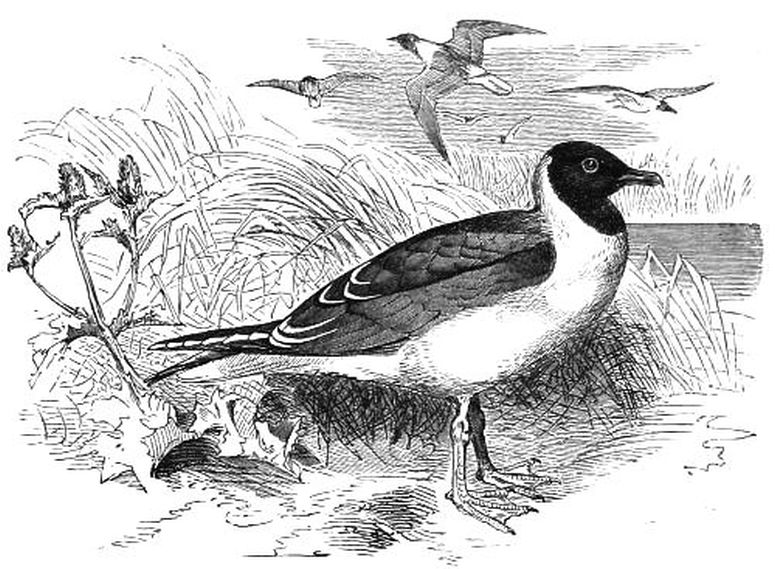
THE LAUGHING GULL (Chroicocephalus ridibundus).
When the snow begins to melt, these Gulls return, and in fine seasons arrive at their more northern terminus towards the end of March, or at the beginning of April. Before commencing their journey, the old birds have already selected their mates; they accompany their partners at once to the breeding-places, but the younger ones seem to defer their courtship till they arrive at their destination. They only live in the sea during the winter, and it is seldom that they breed even on islands near the coast. Fresh waters, surrounded by fields, are their favourite places of resort in the summer season, and here they find everything that they require. These birds are abundant at the mouth of the Thames, where they lay their eggs on the low flat islands and marshes of Essex. In Norfolk an extensive piece of water, called Scoulton Mere, has from time immemorial been one of their favourite breeding-places. The eggs, which are most abundant there about May, are assiduously collected, and are sometimes so plentiful that we are told a man and three boys have obtained 1,600 in a single day.
When swimming, these Gulls may be regarded as ornamental birds, more especially when they are in their full plumage. Their movements are extremely elegant and graceful, they walk quickly, and are not readily tired, and for hours together may be seen following the ploughman, or roaming about fields and meadows in search of insects. They swim beautifully, but not very rapidly. They rise readily into the air, either from the surface of the ground or from the water, and apparently[Pg 197] without effort perform a variety of pleasing evolutions during their flight. In some of the Swiss cantons, and in all parts of Southern Europe lying near the sea, they are treated by the inhabitants as if half domesticated. They may be seen everywhere, running about with the greatest confidence, as if they knew very well that no one would attempt to do them an injury. Their voice is harsh and disagreeable, earning for them doubtless the name of Sea Crows, whereby they are generally designated. Towards the end of April the breeding season commences, and after much quarrelling the place selected where each pair is to build its nest. These birds never breed separately, seldom in small parties, but most generally in large flocks, of hundreds or rather thousands of birds, which generally crowd themselves together into a very limited space. Their nests are usually placed upon insulated patches of ground surrounded by water, or situated in the centre of a marsh, and overgrown with sedges, reeds, and rushes; under some circumstances they will build in the marsh itself, sheltering their nests among tufts of grass, but always in some unfrequented situation, to which access is nearly impracticable. The foundation of the nest is laid by flattening down the herbage and lining the cavity so formed with leaves, straw, and similar materials. The eggs, which are deposited about the beginning of May, to the number of four or five in each nest, are tolerably large, of a pale olive-green colour, speckled, spotted, and streaked with ashy-grey and dark brownish grey, but the eggs vary considerably both in size, colour, and markings. The two sexes brood alternately, one or other of them remaining constantly upon the nest during the night, but in the daytime they seem to think the heat of the sun an efficient substitute for their presence. After the lapse of about eighteen days the young make their appearance, and in about three or four weeks afterwards are completely fledged. In situations where the nests are surrounded by water the young ones do not leave them during the first few days, but if they are situated upon dry ground the little nestlings scramble out and run about very actively. When a fortnight old they are able to flutter from place to place, and at the end of the third week are almost able to take care of themselves. The courage with which the parents defend their young is most exemplary. No sooner does an enemy in the shape of a Hawk, a Crow, or a Heron make its appearance, than a tremendous outcry is raised by the whole colony, even the brooding birds leave their nests, and all rush forward to oppose the invader. A dog or fox they attack with equal fury. Should a man intrude upon them they fly around him in circles, screaming with all their might, and if, deafened by the noise, he retires, he is followed to some distance, with every indication of joy at his departure.
In the north of Germany it is common on a certain day to have a general battue, and slaughter the poor Gulls by wholesale. This useless destruction, which, under the name of "the Gull-shooting," serves as an excuse for a general holiday, savours much of the barbarism of the Dark Ages; as, far from being pernicious, these beautiful birds render important services to the farmers by clearing the land of a vast quantity of hurtful insects.
THE GREAT BLACK-HEADED GULL.
The GREAT BLACK-HEADED GULL (Chroicocephalus ichthyaëtus) in its summer plumage has the entire head and upper neck black, the feathered orbits white, back and wing blue-grey, upper tail-covers and tail pure white, with a black band, primaries with a black band, increasing in width to the outermost one, which has the whole of the web black, the rest of the first five primaries white, the others grey, tipped with white; the other parts of the plumage are pure white; bill red, yellow at tip; irides brown; feet dull red; length about twenty-six inches; wing nineteen to twenty inches; tail seven inches; bill at front two inches and a quarter; tarsus three inches; the closed wing extends about one inch and a half beyond the tail. This bird inhabits Northern and Central Asia, and is rare in India. Jerdon observed it on the sea-coast at Madras, and occasionally ascending the Hooghly and other[Pg 198] large rivers. It frequents the borders of the Caspian Sea. The eggs, which are oblong, and marked with deep brown and paler spots, are laid on the bare sand, near large rivers. When flying, the hoarse voice of this bird resembles that of the Rover.
THE LESSER BLACK-HEADED GULL.
The LESSER BLACK-HEADED GULL (Chroicocephalus melanocephalus) is about fifteen inches and a quarter in length. In this species the whole head, except a small patch of white above and beneath the eye, is of an extremely deep black; the back of neck, chest, tail, and all the under parts are pure white; the whole of the upper part, delicate pearl-grey; primaries, white at their tips, the outer web of the first primary black for three parts of its length; beak, legs, and eyelids vermilion, irides brown. This bird inhabits Southern Europe, particularly the shores of the Adriatic. It abounds in Dalmatia, breeding in the marshes.
THE LITTLE GULL.
The LITTLE GULL (Chroicocephalus minuta). In winter the entire upper surface of the adult's plumage is of a blueish ash; quills and secondaries tipped with white; throat and under surface pure white, with a slight tinge of rose-colour; bill brownish red; tarsi bright red; irides brown. In summer the whole of the head and upper part become of a brownish black. It is found, though not in great abundance, in the western part of Europe. This species inhabits the eastern parts of Russia, Livonia, and Hungary, and the shores of the Black and Caspian Seas.
It is rare in Great Britain, and was first described as a British bird by Montagu, in his "Ornithological Dictionary." According to Temminck, it feeds on worms and insects. Little, however, is known of its habits.
The SKUAS (Lestres), although resembling the Gulls in shape and plumage, differ from them in so many particulars that they must be regarded as forming a separate family. The principal points of difference between these birds and the true Sea Gulls are found in the structure of the beak and feet, as also in the peculiarity of their colours, and in their mode of life.
In the Skuas the body is strongly built, the neck short, the head small, the beak moderately short but strong, thick, and towards the apex compressed. The upper mandible is vaulted above, strongly hooked, and provided at its base with a cere. The tarsus is moderately high, the toes short, but with a very complete web, and furnished with crooked, sharp-pointed, and sharp-edged claws. The wings are long, narrow, and pointed, the first quill being the longest. The tail consists of twelve feathers, of moderate length, and has the central tail-feathers prolonged. The plumage is rich and thick, upon the under surface fur-like; its prevailing colour is a dusky brown.
The Skuas, or Parasite Gulls, are most abundant in the Arctic Regions. They live principally in the open sea, but at their breeding-time seek the neighbourhood of coasts and islands. Occasionally they wing their way into more southern latitudes, and sometimes are to be seen far inland. In strength of wing they are superior to the Gulls, and they swim well, but prefer flying to swimming. In a certain sense, they might be said to hold a middle position between Sea Gulls and birds of prey. They attack all animals that they are able to subdue, and persecute their weaker brethren until they oblige them to yield up whatsoever prey they may have caught. Indeed, it was recently generally believed that they were unable to catch prey for themselves, but were obliged to live the life of freebooters, and depend upon thieving for their support; modern observations have, however, shown that this is not altogether correct. It is, however, quite true that their power of diving is not such as to enable them to catch fishes at any great depth; they can only procure such as may be swimming close to the[Pg 199] surface. They are, however, by no means confined to a fish diet; they devour birds and their eggs, kill small quadrupeds, and prey upon shell-fish of every kind. They will even attack young lambs, hack out their eyes and brains, and, in short, prey upon everything that offers itself, whether living or dead. Generally, however, they live by the labour of other diving birds. They watch the Gulls, Terns, Guillemots, and other predatory species, and whenever they perceive that they have caught a fish, hasten after them with all speed, and so torment and worry them as to compel them to disgorge their already swallowed prey, and let it drop from their mouths. No sooner do their pursuers see it fall than, swooping after it with the speed of a Falcon, they catch it before it reaches the water, and appropriate it to their own use. Such barefaced robbery as this naturally causes the Skuas to be detested by all seafaring birds; nevertheless, they seem to care very little for the general hatred, and recklessly pursue their system of plunder whenever opportunity offers. No sea-bird will brood in their vicinity, or remain upon any inland lake of which they have possession. Every individual who has once made their acquaintance endeavours, as the sailors say, to give them a wide berth. The more valorous species often attack them furiously; the timid flee at their approach, or if they are in a position which enables them to do so, dive out of their sight. When their breeding-time arrives, the Skuas assemble in small parties, and build their nests in company with each other. The places selected for this purpose are generally large islands, some species preferring the level of the shore, others the summits of the highest rocks. In these localities they scratch or construct for themselves a round excavation in the sand, and, if practicable, concealed among plants, and in the ample nest lay two or three eggs, upon which the male and female sit alternately. The young are fed at first with food partially digested in the stomachs of their parents, subsequently upon coarser diet. They remain in the nest for several days, and when they leave it run about on the beach like young birds, hiding themselves, in case of danger, between the stones, or among the inequalities of the ground. After they have become capable of flight, they continue for some time in the neighbourhood of the coast, profit by their parents' instructions, and in their company they at last fly away to the open sea. In the second summer of their lives they begin to breed. The eggs of the Skuas are eaten by the inhabitants of northern countries, but the birds themselves are considered worthless; nevertheless, they are killed in great numbers. The chase after them is easy enough, inasmuch as they will greedily swallow any kind of bait, and fear man no more than they do the birds that they plunder.
THE COMMON SKUA.
The COMMON SKUA (Lestris catarractes), the most conspicuous member of the above family, is twenty-two inches long, fifty-two inches broad; the length of its wing sixteen inches and a half, of the tail, six inches and a half. The colour of its plumage is greyish brown, the somewhat lighter under surface is striped longitudinally with pale or red grey; a space at the base of the dark-coloured wing is white; the eye is red-brown; the beak leaden grey at the root, and black at the apex; the foot blackish grey. The young birds resemble the adults.