THE SWIMMERS (Natatores). (continued 2)
Thomas Rymer Jones translation
THE WHITE-BODIED GOOSE TEAL.
The WHITE-BODIED GOOSE TEAL (Nettapus Coromandelianus) is black on the crown of the head, and of a magnificent green shaded with purple over the entire mantle; the face, back of the head, neck, and under side are pure white; the throat is partially encircled by a black band; the feathers on the belly and the lower tail-covers are spotted with black and white, those of the upper covers are greyish brown with light spots, the tail-feathers blackish brown; the extremities of the primary quills are spotted with white, the lower secondaries exhibit similar but smaller spots, whilst the upper secondaries are marked with black; the eye is red; the beak black; and the foot greenish brown; during the period of incubation the latter is spotted with black. This small Goose is not more than thirteen or fourteen inches long, the wing measures six inches and a half, and the tail three and a quarter. In the plumage of the female the brown is less conspicuous, and the mantle comparatively lustreless; her quills are also without any white spots; the sides of the wings and tail-covers are pale brown; the feathers on the nape are marked with dark lines, those of the under side with dirty white, and the thighs with pale grey. This most beautiful little Goose, according to Jerdon, "is met with in India, as also in Ceylon, and on the Malay Peninsula. In some parts of India it is very numerous, but is rare in the North-west Provinces. Its favourite resorts are ponds covered with reeds and rich in grass, and upon these it may sometimes be seen in numerous flocks." Its flight is rapid, and when upon the wing it utters a loud peculiar cry. According to Blyth it walks badly, and after making a few steps regularly squats down; hence it is possible, or rather probable, that in a wild state it seldom comes upon dry land. So long as it has not suffered persecution it is extremely tame and trustful. It makes its nest in the cavity of some old hollow tree, or occasionally in ruins or old walls, sometimes at a distance from the water. The small eggs, which are eight, ten, or more in number, have a white shell. The young are at first clad in a coat of thick grey down, and almost immediately after their birth they are literally cast out of the nest by their parents, who at once conduct them to the nearest pond. We are told by one observer that only the female broods, while the Gander amuses himself in the society of others of his own sex. Jerdon, however, doubts this statement, or at least that such is always the case, basing his scruples upon the fact that in more than one instance he has seen both male and female fly together from the tree in which their nest was situated. The flesh of these Geese is not much esteemed; nevertheless it is said that at certain seasons it is tolerably good.
[Pg 141]
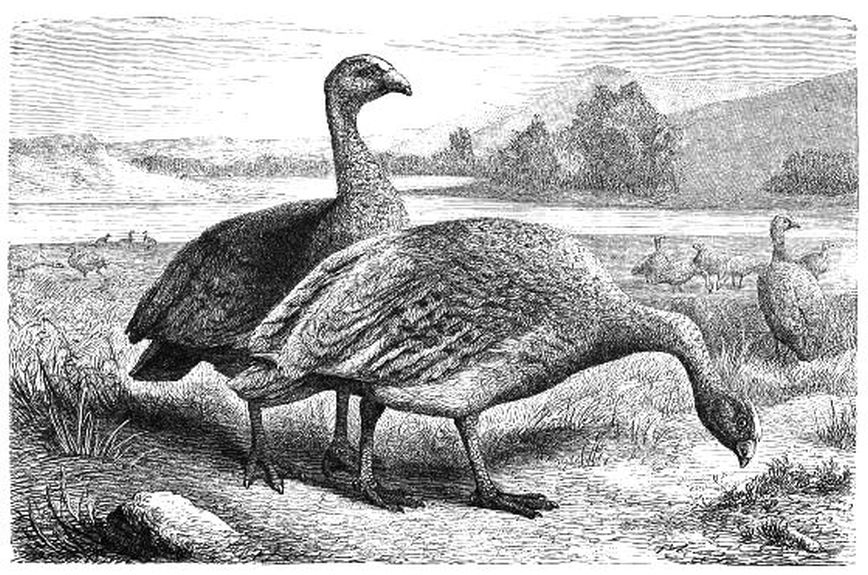
CEREOPSIS GEESE.
[Pg 142]
THE CEREOPSIS GOOSE.
The CEREOPSIS GOOSE (Cereopsis Novæ-Hollandiæ) is recognisable by its powerful body, thick short neck, small head, and short strong beak, which is high at the base, and covered with a cere almost to the blunt and hooked extremity. The webbed feet have long tarsi, short toes, and large powerful claws. In the broad wings the shoulder-quills are well developed. The tail is short and rounded; the thick plumage is of a beautiful dark grey, shaded with brown. The crown of the head is somewhat lighter, and the back decorated with round, blackish brown spots, situated at the tips of some of the feathers. The lower halves of the secondary quills and tail-feathers are also brownish black. The eye is scarlet, the beak black, the cere greenish yellow, and the foot blackish. The female resembles her mate in the coloration of her plumage, but is recognisable by her inferior size. The Cereopsis Goose, the only member of the family to which it belongs, is one of those extraordinary birds that at once arrest the attention of the traveller. Not many years ago the localities where it was the most numerous appear to have been the islands in Bass's Straits.
Labillardière relates that the first specimens he obtained were captured by the sailors with their hands; and Flinders tells us that one of his boat's crew killed a great number with short sticks, and took several alive. Bailly not only confirmed these accounts, but states that those he saw could be easily run in upon and captured without trouble. All the above navigators speak of the flesh as being excellent, much better, indeed, than that of European Geese, and seem to have prosecuted the chase with considerable ardour. As a necessary consequence, later visitors found not only that the bird was no longer plentiful, but that from many of these islands it had been completely extirpated. Gould, who shot a pair on Isabella Island, nevertheless thinks that several of them may yet exist upon unvisited parts of the southern coast of Australia. "An old Bushman," however, remarks that on the Australian continent he only saw them twice—in one case there was a small flock, and in the other only two birds, which were in company with some other Geese. The Cereopsis, or "Hen" Goose, as it is called, lives, as might be expected from such an appellation, much more on dry land than on the water. It walks well, and swims badly; indeed, judging from individuals kept in our Zoological Gardens, it seldom enters the water of its own free will. Its flight, likewise, is performed with difficulty, and is remarkably heavy. Its voice is a dull buzzing sound, very unlike the cry of a Goose. We have but scanty information respecting the habits of these birds in their wild state; but from their behaviour in captivity it is easy to form an idea of their usual mode of life. In its aversion to water the Cereopsis differs from all other Geese. Except when driven into a pond, it spends its whole time on land, devoting the morning and evening to the procuration of food, but reposing during the heat of the day and throughout the night. It is seldom seen in company with other species; indeed, its[Pg 143] disposition is even more quarrelsome and imperious than that of the Nile Goose. A pair of these birds, when placed among other water-fowl, begin in a very short time to assume unlimited authority, and their behaviour becomes (especially during the breeding season) absolutely insupportable. Nevertheless, they soon learn to recognise their keepers, to whom they exhibit considerable attachment. In New Holland they would long ago have been numbered among the inhabitants of every farmyard had it not been for this unbearable conduct. Such as have been brought to Europe have again and again hatched and reared a numerous progeny, so that with us they might readily be acclimatised. One principal obstacle to their breeding in the north is the contrariety of the seasons. In Australia they breed in the spring, which, of course, corresponds with our autumn; so that in the northern hemisphere, the young brood, becoming at once exposed to the rigours of winter, not unfrequently perish. We have, however, already learnt that those birds that have lost their eggs breed again in February, hence in the succeeding months there is every reason to suppose the young may be reared without difficulty. During pairing time the affection of the sexes towards each other is unmistakable. The Gander walks around his mate with graceful salutations, keeps vigilant watch over her safety, and resolutely drives away all other intruders, great and small, that may happen to approach the domain which he has selected. The care of constructing the nest appears to devolve upon the female, who always selects the best materials within her reach; and, although the result of her labours is not an artistically-constructed cradle, it is considerably more so than the nests of the generality of Geese, its interior being smoothly rounded and comfortably lined with feathers. The eggs are comparatively small, somewhat round in shape, smooth-shelled, and of a yellowish white colour. From observations made in Paris we found the duration of incubation to extend over thirty days; in a colder climate it is somewhat longer. In the park of our friend, M. Cornèly, in Belgium, thirty-eight days elapsed before the young escaped from their shell. On the very day of their escape they ran after their mother, picking up food from among the grass. They refused to eat hard-boiled eggs, chopped earthworms, and other kinds of animal food, and would not even touch white bread, confining themselves exclusively, as it appeared, to green vegetables. No sooner are the young hatched than the pugnacity of the Gander displays itself in full force; he seems to fear nothing, and attacks a man with as much animosity as he exhibits towards every other animal that intrudes upon his privacy. "I considered my Gander bad enough before," writes M. Cornèly, "but now I think he must be mad. He attacks every living thing indiscriminately. One of my large Cranes happened to come in his way; he flew at him, and although the keeper was not a hundred yards off, and ran as fast as he could to part them, the poor Crane was killed before he could interfere. One night the Gander got into the stable where another of these birds was kept, and in the morning the body of the Crane was found almost hacked to pieces." However ornamental these Geese may be, it is evident that it is only where they have plenty of room to themselves and are not likely to interfere with other animals, that they are eligible subjects for domestication.
[Pg 144]
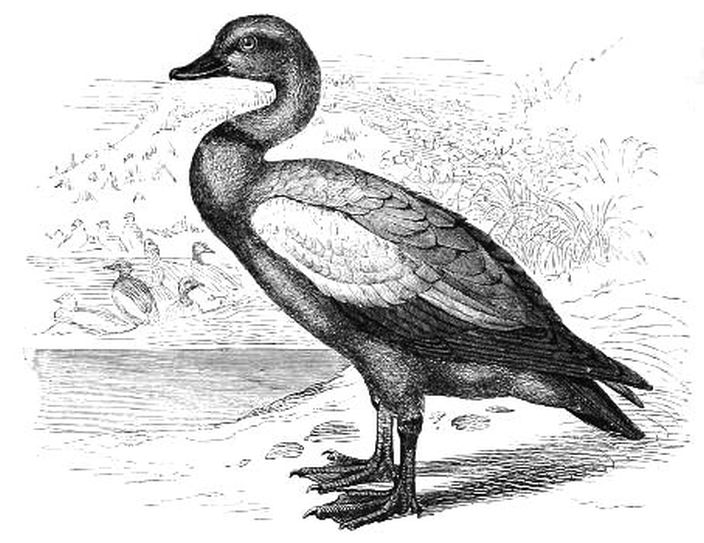
THE RUDDY SHELDRAKE, OR BRAHMINY DUCK (Casarca rutila). ONE-FOURTH NATURAL SIZE.
The DUCKS (Anates) constitute the most numerous and varied family of the entire order, and are at once distinguishable from the Geese by the flatness of their feet, and from the Swans by the shortness of their necks. In these birds the body is short and broad, the neck short or moderately long, and the head thick; the beak, which is about the same length as the head, is either of uniform breadth, or is highest towards the tip; the base of the bill is more or less high, and in some instances furnished with an excrescence; the upper mandible is arched, and projects so far over the sides of the lower one as partially to enclose it; the margins of both mandibles are sharply denticulated; the weak flat foot, which is placed very far back, has the centre toe as long as the tarsus; the hind toe is well developed, and in some species furnished with a membranous lobe; the claws are weak; in the moderate-sized, narrow, and pointed wing the second quill is the longest; the short broad tail is composed of from fourteen to twenty feathers, and is either rounded or pointed at its extremity. The plumage, which is rich, smooth, and thickly interspersed with down, varies in colour according to the sex or age of the bird; that of the male is more or less brilliant, and that of the female of comparatively sombre hue. The members of this family, regarded generally, are to be met with in every climate; the number of species is, however, greater in warm than in cold latitudes, while on the contrary in northern regions individuals of the same species swarm in immense numbers. Ducks frequent both fresh and salt water, being sometimes met with on mountain lakes to a considerable elevation; at the approach of winter they migrate to southern latitudes, often in incalculable hosts. In the extent of their migrations some species emulate the Swallow itself, while others wander no further than is absolutely necessary in order to obtain food. These migrations are generally commenced at sunset; towards midnight the birds alight upon some expanse of water, and after resting for a few hours recommence their journey in the early morning. Their flight is conducted either in one long string or in a wedge-like phalanx. The power of locomotion displayed by these birds is very various; some species can walk upon dry ground almost as well as the Geese, while others waddle along with considerable difficulty. All are excellent swimmers, but they only dive exceptionally, and with considerable effort. Their flight is accomplished by rapid movements of their wings, and they are able to rise as easily from the surface of the water as from the ground. Ducks subsist upon both animal and vegetable food; some, however, prefer the former, while others confine themselves to the latter diet. They are for the most part monogamous, and generally associate during the breeding season in great numbers; a circumstance in which they differ remarkably from the Swans and Geese. Some build their nests in holes in the ground or in the clefts of rocks; others in hollow trees, or even among the branches, some making use of the deserted nests of land birds; while others build upon the ground a rude structure composed of stalks and leaves, warmly lined with down. The number of eggs varies in different species from six to sixteen; the period of incubation extends from twenty-one to twenty-four days.
[Pg 145]
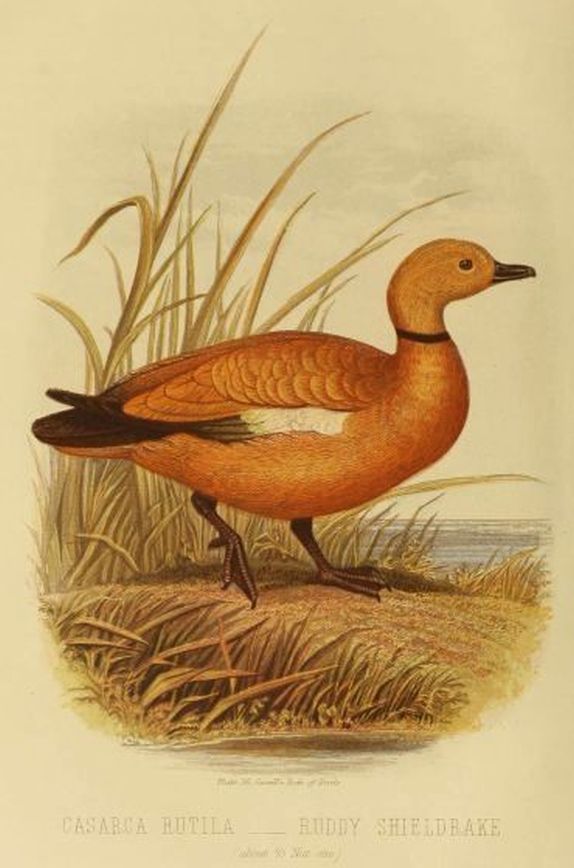
Plate 36. Cassell's Book of Birds
CASARCA RUTILA ____ RUDDY SHIELDRAKE
(about 1/3 Nat. size)
[See larger version]
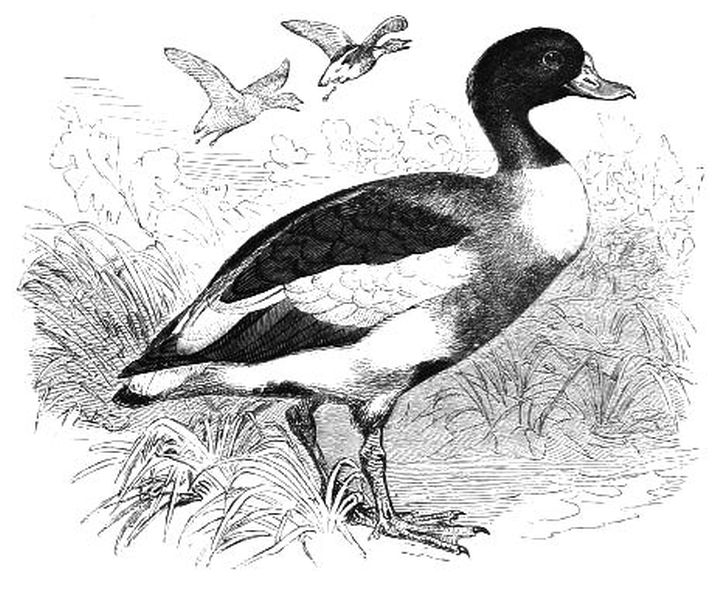
THE SHELDRAKE (Vulpanser ladorna). ONE-FOURTH NATURAL SIZE.
THE RUDDY SHELDRAKE, OR BRAHMINY DUCK.
The RUDDY SHELDRAKE, or BRAHMINY DUCK (Casarca rutila), represents a group possessing slender bodies, moderate-sized wings, and somewhat remarkably coloured plumage, which differs but little in the sexes. In this species the body is almost entirely of a bright rust-red; the cheek is yellowish white; the neck reddish yellow; the wing is decorated with a glossy green patch, and has its covers of a pure white; the margins of the wings, upper tail-covers, quills, and tail, are glossy greenish black. During the breeding season the male has a clearly-defined band of greenish black on the lower throat; the female rarely exhibits this collar, and is smaller than her mate; her entire plumage is also less brightly coloured, and her face of a whitish shade; the eye is light brown; the beak black; and the foot lead-grey. This species is from twenty-four inches to twenty-five inches long and forty-four inches broad; the wing measures sixteen inches, and the tail seven inches. The Ruddy Sheldrakes inhabit Central Asia, and from thence spread in an easterly direction to the Upper Amoor, and westwards as far as Morocco. In the course of their wanderings they are pretty regular visitants to Greece and South Italy. As winter guests they are well known throughout the Indian Peninsula, and are by no means uncommon upon the lakes of Egypt. In Tunis, Algiers, and Morocco they are abundant, but do not apparently extend their range into the interior of Africa. The gait of this beautiful bird is light and elegant; it does not waddle as most Ducks do, but steps out like a Goose;[Pg 146] it is an excellent swimmer, and upon an emergency dives with facility. Its flight is strong and enduring, and its voice loud, but by no means unpleasing. Its food consists principally of vegetable materials; Jerdon, indeed, says he has been told that it will sometimes eat carrion, but adds that he has never seen it so employed, though he has often observed it feeding in fields of corn. Until the approach of the breeding season the Brahminy Ducks live very peaceably in company with other swimming birds, but about that time they become very pugnacious and quarrelsome. Towards the end of April or the beginning of May the different pairs retire to their appropriate nesting-places, which are generally in holes in the ground. In North-west Africa, Calvin found one of their nests in the cleft of a perpendicular rock, which had likewise been the nesting-place of Robins, Kites, and Vultures. In Siberia they not unfrequently build in the holes of Siberian marmots, and occasionally in hollow trees. The nest, which is composed of dry grass and lined with down, usually contains from four to six roundish thin-shelled eggs, of a glossy white or yellowish white. As soon as the young brood are sufficiently dry after their escape from the shell they leap from the nest and make their way to the nearest pond, where, under the careful superintendence of their parents, they pass the earlier part of their lives. At first they are clad in a suit of down, which is brownish grey upon the upper part of the body with the exception of a whitish spot upon the breast; the lower surface is of a dirty white. Pallas states that in Mongolia these birds are regarded as sacred.
The SHELDRAKES (Vulpanser) differ from the above birds in the formation of their beak, the comparative shortness of their wings and legs, and in the coloration of their plumage. In this group the upper mandible is broadest towards its extremity, and in the male exhibits an excrescence at its base, which swells considerably during the breeding season, and afterwards almost entirely disappears.
THE COMMON SHELDRAKE.
The COMMON SHELDRAKE (Vulpanser tadorna) is a beautiful bird, with head and neck of dark glossy green. The shoulders exhibit two large black spots; a patch on the breast, the centre of the back, the wing-covers, side of the body and upper portion of the tail are pure white. The centre of the breast and belly are greyish black; a broad band on the neck, and some of the upper secondaries are of a bright reddish brown. The lower tail-covers are yellowish; the quills blackish grey, and the wings decorated with a metallic green patch. The eye is dark rust-red, the beak carmine-red, and foot flesh-brown. This species is two feet long, and three feet and a half broad; the wing measures fourteen inches, and the tail four inches and a half. The female is similarly but less beautifully coloured. In young birds the nape is grey, the upper part of the back and under side are yellowish grey; there is also no band upon their breasts. The range of the Sheldrake extends north to about the middle of Sweden, and south as far as North Africa, where they are to be met with on every lake during the winter, and make their appearance in countless multitudes. They are likewise numerous upon the coasts of China and Japan, as well as upon the great lakes of Siberia and Central Asia; nevertheless, they decidedly prefer salt water to fresh, and are always most abundant upon the sea itself, or upon salt-water lakes. In Great Britain these birds are indigenous, and breed upon every part of the coast. Even in extensive collections of water-fowl, where various species of Ducks are seen in close proximity to each other, the Sheldrakes are conspicuously beautiful; but when seen swimming on the sea or crowding the surface of some large lake, the eye is enchanted with the variety and elegance of their movements. In Africa they add an unspeakable charm to the lake scenery, the brilliancy and liveliness of their colours rendering them prominent objects at a very considerable distance. Even upon the islands near Schleswig, Jutland, and Denmark, where they are almost household birds, they invariably call forth the admiration of the beholder. In their general[Pg 147] habits they bear some resemblance to the Brahminy Ducks before described; their gait, however, is somewhat heavier, and they swim with greater facility. In their voices there is no resemblance whatever between the two species. The call-note of the female is a loud "Quack," and that of the male a deep "Koer," while during the pairing season they give utterance to a peculiar whistle. Their food is preferably vegetable, consisting of the tender parts of seaweeds and other plants which abound in salt water; they will likewise eat grass, and when in confinement occasionally devour small fishes, molluscs, and small crustaceans; neither do they altogether refuse flesh. These birds seek their food less by swimming than by wading. As the tide recedes they may be seen running like shore-birds just at the margin of the water, and carefully examining the contents of every little pool. During the morning they visit the fields, in order to hunt for insects and grubs, as well as for vegetable matter; they sometimes for a like purpose resort to marshes and swampy places. The Common Sheldrakes construct their nests only in holes or burrows excavated in the earth. "Whoever has been much in the vicinity of the sea-coast," says Bodinus, "will probably have observed with surprise that a pair or two of these birds, seen at the distance of half a mile or so, in some open spot, suddenly disappear in a most unaccountable manner, and on visiting the place will find that they have taken refuge underground, in some hole formed by a fox, badger, or rabbit; nay, more, that they have positively taken up their abode in this strange locality even while its formidable four-footed occupant is actually in possession of the premises. It is now an undeniable fact, established by the concurrent testimony of numerous observers, that the Sheldrake and the fox not unfrequently dwell in the same hole, and that the latter, who spares no other bird, does not molest or injure its adventurous lodger." We have certainly not been able to verify this statement by personal observations, and have moreover found on one occasion the wings and feathers of a Sheldrake lying close to a hole inhabited by a fox; but there was nothing to show that the fox had been the murderer, even under circumstances so suspicious, seeing that the spot was in the vicinity of a wood much frequented by Hawks and other birds of prey. Were we asked why the bloodthirsty quadruped should thus spare the poor Duck, we should confidently reply that it was on account of the extraordinary courage of the bird. We have ourselves seen a young Sheldrake, not many days old, defend itself valorously against animals of large size, such as fowls, small dogs, and rabbits. Instead of running away, it showed a bold front, holding its neck outstretched, angrily repelling every attack, and never seeming to think of retreating until its assailant had retired. The old birds, more especially during the breeding season, are equally courageous; the male stands bravely forward, and confronts his opponent with loud hisses, until, daunted by his angry, threatening demeanour, the enemy sneaks away. Having put his adversary to flight, he returns to his mate, who stands up nobly to assist her spouse, and both give utterance to their mutual congratulations over the victory in loud screams and frequent caresses.
The following particulars concerning the breeding of these birds, by the forester Grömelbein, will be read with interest. Towards the end of May, Grömelbein, while busily employed in a wood at some distance from the coast, observed a pair of Sheldrakes that flew around his party several times in succession, and as often flew towards and alighted on a hill of sand at some little distance, where the male always stationed himself as if to keep watch, while the female leisurely entered a hole, in which she remained about a quarter of an hour. When she again came to the surface she approached her mate, and after apparently holding a consultation they both took a circular flight into some neighbouring fields, where they alighted on spots quite remote from each other, evidently for the purpose of misleading anyone who might be watching their movements. On observing this manœuvre, Grömelbein hastened to the hill, and there found the hole of a fox, at the entrance of which were numerous footmarks of the fox and of the Ducks, together with recent[Pg 148] excreta from both. After watching the birds, however, for some days, it was discovered that, with the view of deceiving the men, they had only made a pretence of having their nest in the hole above mentioned, and that their real residence was another much larger excavation, in the joint occupation of a bitch-fox and a badger. This second hole being carefully watched, it was seen that the badger was in the habit of walking in and out of his abode, which was subsequently found to be ten feet deep, without troubling himself at all about his feathered visitors, whose footmarks were traceable to a depth of seven feet. There were, however, other holes belonging to the same den, through which the fox was also in the habit of passing. The ground before these entrances was trampled smooth by the feet of the Ducks, and as clearly impressed with the footmarks of the fox. On perceiving this, Grömelbein concealed himself behind a wall in such a manner as to be able to watch all their proceedings, nor had he long to wait before he saw the sly Sheldrakes paying their accustomed visit to the labourers and the sand-hill above mentioned; after which, flying close to the ground, they came to the real nesting-place, when, after carefully looking around them, they walked into the fox-hole as quietly and unconsciously as Ducks in a farmyard would go to their roosting-place. There they remained about half an hour, when they again made their appearance, climbed hastily to the top of the hill beneath which the den was situated, and finding, as they thought, the coast clear, flew off to the meadows.
In the Island of Sylt and others off the coast of Schleswig, the inhabitants construct artificial burrows, covered with movable lids, near which at the proper season they place quantities of broom and moss, so that the coming birds may find everything ready. These consequently take up their abode in the prepared burrows without the slightest scruple, and that sometimes quite close to the houses of their owners; nay, they at length become so familiarised with their keepers that they may be said to be in a state of semi-domestication. In these burrows the females, if not disturbed, will lay from seven to twelve large, smooth, white, thin-shelled eggs; but if the eggs are gradually taken from the nest, as they are at Sylt, the females will go on laying till they have laid twenty or thirty. When the mother bird begins to sit, she carefully surrounds her eggs with down, and when she leaves her nest covers them with the same warm material. After the lapse of about twenty-six days, the young make their appearance, and soon follow their mother to the neighbouring moors, generally stopping, however, to have a swim in a pond of fresh water that is found on the road thither. To the inhabitants of Sylt and other islands in the North Sea, it appears, therefore, that the Sheldrakes are objects of considerable attention. The eggs serve as important additions to their table; and the down from their nests, scarcely inferior to that of the Eider, is extremely valuable. The flesh of these birds is not much esteemed, having a rancid or oily taste and a disagreeable smell; they are therefore never killed, but, on the contrary, are protected by the inhabitants of the islands they frequent.
The TREE DUCKS (Dendrocygna) form a group having a high slender body, moderately long neck, delicately-shaped head, and weak bill; the legs are long, the wings blunt, with the third and fourth quills longer than the rest; the tail is rounded at its extremity, and the plumage variegated.
[Pg 149]
THE WIDOW DUCK.
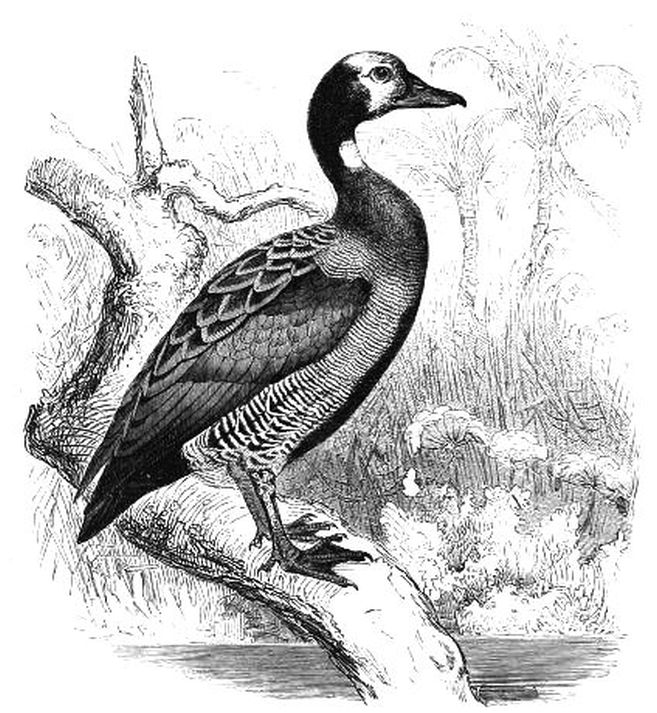
THE WIDOW DUCK (Dendrocygna viduata). ONE-FOURTH NATURAL SIZE.
The WIDOW DUCK (Dendrocygna viduata) has the face and throat white, shaded with reddish brown on the brow and cheeks; the back of head, nape, and sides of the neck are bright reddish brown; the sides of the breast and the back reddish olive, darkly spotted and marked; the long lower shoulder-feathers are olive-brown edged with yellowish white; the lower back, centre of tail, and entire under side below the breast are black; the sides of the body are greyish white, striped with blackish brown; the upper wing-covers are bright reddish brown; secondary quills olive-brown, with green edges, and the quills and tail-feathers greenish black; the eye is reddish brown, beak black, with a dark grey stripe near its nail-like tip; the foot is lead-grey. This species is eighteen inches long and thirty-two inches broad; the wing measures eight inches and three-quarters, the tail two inches and two-thirds. The female closely resembles her mate. All travellers who have visited South America describe this bird as occurring in amazing multitudes, more especially in the marshy grounds of the prairies; and travellers in Africa assert that it is equally abundant in the southern and western regions of that continent. Upon the Upper Blue Nile we have ourselves several times met with it in extraordinarily large flocks, which, in closely-packed ranks, covered the banks of the river to a great distance, and when they rose into the air had the appearance of a dense cloud. Heuglin states that the males and females of these birds remain constantly separate from each other; such a statement, however, we can positively contradict, seeing that we have killed individuals of both sexes at a single shot. We are by no means well informed as to the history of these birds, and about their mode of breeding we know little or nothing certainly. The Widow Duck is[Pg 150] distinguishable among its congeners by a gait which sometimes resembles that of a Goose, as also by the heaviness of its flight, but more particularly by its predilection for sandbanks and sandy places upon the riverside, to which, when driven away, it invariably returns. The Prince von Wied tells us that at Sertong, in the province of Bahia, it is very abundant in swampy, overflooded meadows, also in marshes, as well as in lakes and other open sheets of water; it is, likewise, often to be seen upon the sea-coast. As regards the latter statement, however, Schomburghk expressly says that he has never met with it on the sea-coast, but that in the swamps of Savannah it is particularly numerous, and with this our experience in Africa quite coincides. Of their behaviour Schomburghk gives a very pleasing sketch:—"The pretty little Bisisi Ducks," says that writer, "seem to be under a ban in this neighbourhood; no sooner did we see a flock of them than men jumped at once into the water almost up to their necks, and began to shoot with their well-directed arrows as rapidly as possible into the thickest part of the flock. If the birds flew high, so that they could see the arrows, the flock immediately parted, just like a swarm of Passenger Pigeons when a Hawk swoops upon them. In the confusion of their flight they broke each other's wings, and many of them fell to the ground stunned and wounded. When two flocks of them met, the hubbub was still greater. I have on such occasions seen as many as five or even eight of them fall to the ground together, although only one of them had been hit by an arrow; and when a flock of them, under such circumstances, came within range of my gun, I have not unfrequently brought down ten or a dozen of them at one shot." We learn further from Schomburghk that these Ducks are very easily tamed, and the Indians generally keep them domesticated in the neighbourhood of their dwellings.
THE WILD DUCK.
The WILD DUCK (Anas boschas) represents a group characterised by their powerful body, short neck, broad slightly-raised bill, which terminates in a decidedly-curved and nail-like tip; their moderately high feet, placed in the centre of the body, and furnished with long toes; and their rounded tail—the feathers on the upper covers of which curl upwards. The coloration of the plumage varies considerably in the sexes. In the male bird the head and upper neck are green; the fore part of the breast is brown, shaded with a variety of tints; the shoulder-feathers are greyish white; the back is a mixture of black and brown; the upper wings are decorated with a patch of fine blue, bordered with white; the lower back and rump are blackish green, and the rest of the under side greyish white, delicately lined with black; a narrow white band divides the green throat from the reddish brown breast; the upper wing-covers are blackish green, the lower covers deep black, and the quills dark grey. The eye is light brown, beak greenish yellow, and foot pale red. During the autumn the male assumes a dress similar to that of the female. The latter is reddish grey, darkly spotted on the head and neck; her crown is blackish brown, and back brown, its feathers marked and edged with various shades of grey, yellow, and black. The lower throat and crop are light chestnut-brown, decorated with black crescent-shaped patches; the rest of the under side is spotted with brown. This fine bird is twenty-four inches long and forty inches broad; the wing measures eleven inches and the tail three and a half. The Wild Duck well deserves the epithet Communis, applied to it by some writers, seeing that its range extends not only over the northern hemisphere in the vicinity of the Pole, but during the winter extends southwards to the very verge of the torrid zone. In the extreme north it must be regarded as a bird of passage, seeing that on the approach of winter it migrates regularly towards the south, returning again northwards when the intensity of the cold has abated. In more southern countries it is merely a wanderer. In October and November the Wild Ducks assemble in large flocks, and commence their migrations towards more hospitable climates; most of them make their way as far as Italy, Greece, and Spain; some even visit Northern[Pg 151] Africa, or corresponding latitudes on the Asiatic continent. In the vicinity of the lakes of Southern Europe they may about this time be seen arriving in flocks of thousands and hundreds of thousands, when they alight upon the water, covering a space of half a square league in extent; and when they rise all at once into the air, producing a rushing sound, audible at a great distance, and resembling the roar of the surf on a storm-beaten shore. In February, or at the latest in March, they commence their return journey, hence they are sometimes called on the Continent "March Ducks." It is only occasionally that they are to be seen upon the sea-coast. These must be considered as strictly belonging to the race of fresh-water Ducks, and it is to lakes and ponds thickly covered with sedges and water-plants that they most generally resort. Waters which are here and there free from herbage, more especially if overhung at the sides with bushes and marsh-plants, afford them their favourite resort, and it is in such places that they generally pass the winter and rear their progeny; in similar localities they likewise procure the greater part of their food, and from thence make little excursions to the ponds and lakes, ditches and fields, that may happen to be in the vicinity. They are very seldom seen upon open waters, but generally seek the shelter of little islands and shallow places overgrown with water-plants, where, half running and half wading, they can search with their beaks for whatever nutriment is to be found. Wild Ducks may be classed with the most gluttonous birds with which we are acquainted. They devour the leaves and tender tops of water-plants, the buds, young shoots, and ripe seeds, being in turn equally acceptable; and are likewise exceedingly fond of the different kinds of corn and of bulbous roots. They, moreover, eagerly hunt after all sorts of small animals, from worms and snails to tadpoles, frogs, and fishes; they seem, indeed, to be always suffering from the pangs of hunger, and so long as they are awake are constantly endeavouring to alleviate them. In their general habits the Wild Ducks closely resemble our tame species, which are in reality their lineal descendants; the tame Ducks are, however, far behind their progenitors in watchfulness, energy, and vigour. They swim, dive, and fly much in the same manner, but decidedly better than tame Ducks; their voice, likewise, is precisely similar. The loud, short "Quack" of the female, and the duller "Quack" of the male; the conversational "Weck, weck," and the call-note, "Wack, wack;" the alarm-cry, "Katsch," or "Rab, rab;" in short, all the sounds with which we are familiar in the tame Ducks are exactly repeated by their wild relatives. Soon after their arrival, the Wild Ducks begin to choose their mates, the selection of course involving many a battle between the rival males; but their partners do not need to be won by a prolonged courtship. Their habit of associating in large flocks is at once laid aside, and they attach themselves to their spouses with ardent devotion. The place selected for the nest is generally some quiet, retired, dry spot under a bush or concealed by herbage, and very generally near the water, but sometimes at a considerable distance from it. Occasionally and, indeed, not unfrequently, they will take possession of some nest placed in a tree—such, for example, as that of a Crow. Their proper nest is constructed of the stems and leaves of various plants, loosely put together, so as to present internally a rounded cavity, which at a subsequent period is warmly lined with down and feathers. The brood consists of from eight to sixteen eggs, of a somewhat elongated shape, hard, smooth-shelled, and of a greyish white colour; in fact, exactly similar to those of the domesticated Duck. The period of incubation, during which the female, who alone broods, sits with the greatest patience and self-devotion, extends over from twenty to twenty-eight days. The newly-hatched young ones remain perhaps for a single day in the nest, and are then taken to the water. Those that are born in a nest placed at a considerable elevation simply spring out and fall upon the ground, without receiving the slightest injury. It is quite a mistake to say, as some writers have done, that they are carried down by their mother in her beak.
During the first few days of their lives they endeavour to conceal themselves as much as possible among the reeds and water-plants; and it is only when their wings have to be tried that they[Pg 152] venture to show themselves in open water. Meanwhile the mother takes the greatest pains to conceal them from observation. In case of danger she makes every endeavour to draw it upon herself, or if the assailants are such as to make it at all practicable, she flies at them with the utmost fury, and uses every effort to drive them away. The young brood follow her with every demonstration of affection; they watch her slightest warning, listen to every sound she utters, and when bidden, at once hide themselves among weeds or sink down between the inequalities of the ground. Their growth is exceedingly rapid, so that in about six weeks they are able to fly.
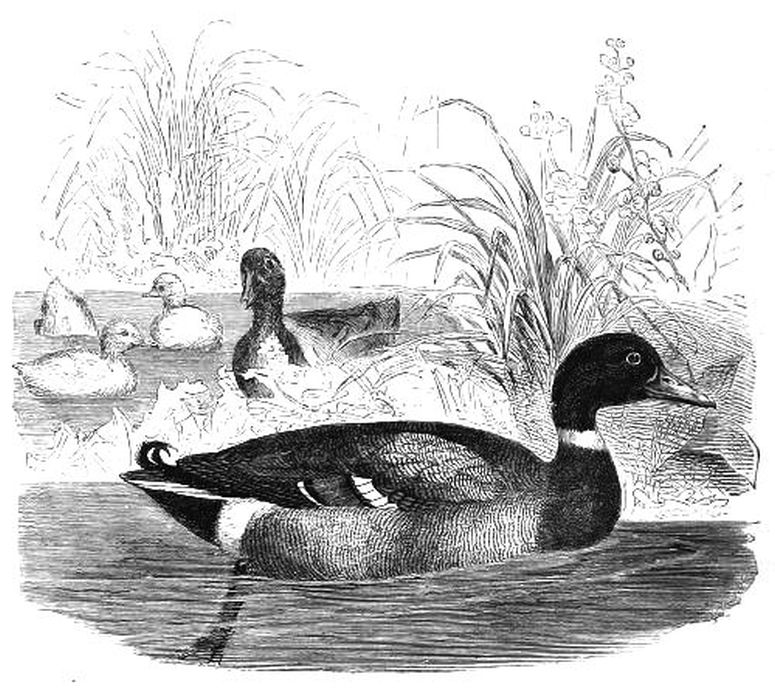
THE WILD DUCK (Anas boschas).
Whilst the mother is thus busily employed in defending and instructing her offspring, the male Duck gives himself very little trouble about his family; sometimes he takes another mate, but if this is not the case, he joins his male companions in their recreations on the water. Even before the eggs are hatched, the old birds begin to moult their feathers, and soon exchange their beautiful nuptial dress for the duller plumage in which they appear during the four months of summer, after which, partly by moulting, and partly by change of colour in their feathers, they resume their splendid autumnal garb. At this latter period the young birds likewise undergo their first moult, after which the family becomes again united. Both parents and their progeny remain together during the autumn, and ultimately fly in company with each other to their winter quarters.
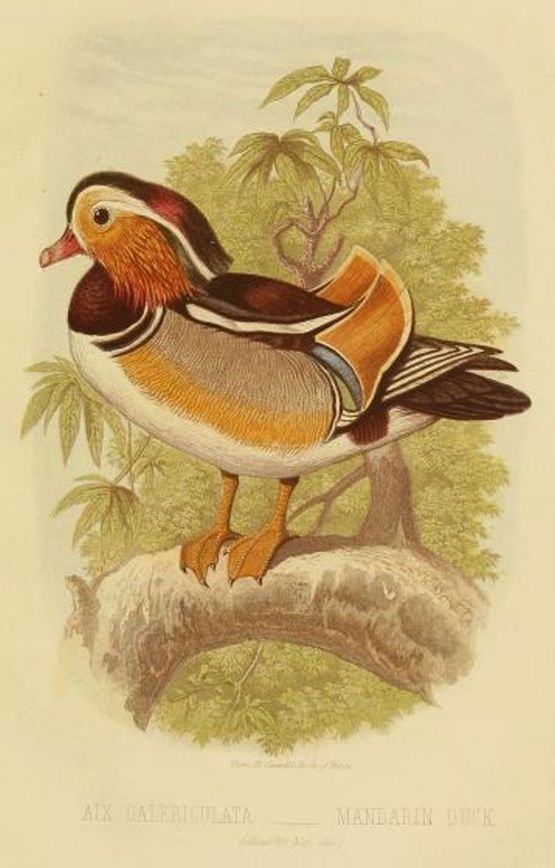
Plate 37. Cassell's Book of Birds
AIX GALERICULATA ____ MANDARIN DUCK
(about 5/8 Nat. size)
[See larger version]
[Pg 153]
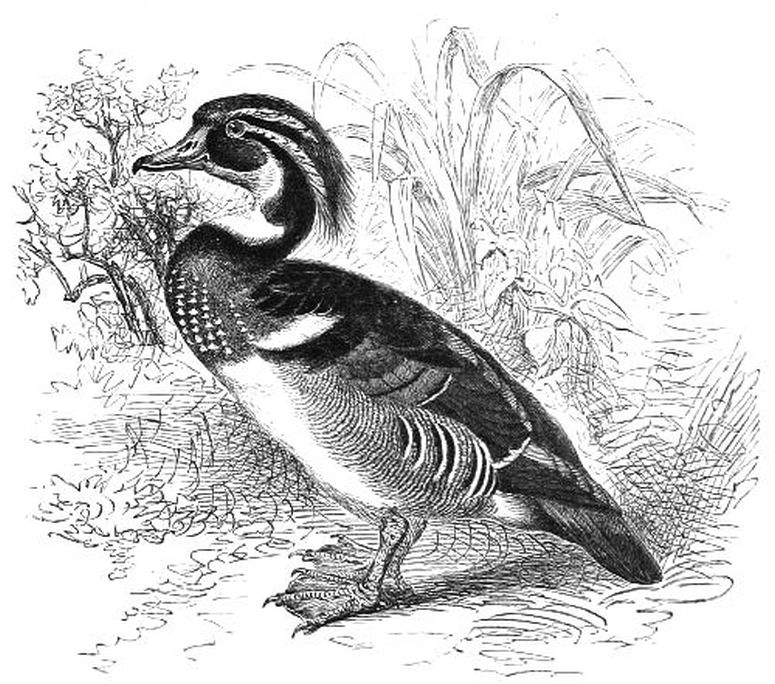
THE WOOD OR SUMMER DUCK (Aix sponsa). ONE-FOURTH NATURAL SIZE.
The flesh of these birds is so surpassingly excellent, that the chase after them is everywhere carried on with unrelenting perseverance. It would lead us too far from our subject were we here even to glance at the multiplied contrivances whereby they are killed or captured, sometimes in immense numbers. The markets of Italy, Greece, Spain, and Egypt, are, during the winter season, filled to overflowing with Ducks of all descriptions, among which the Wild Duck is by far the most plentiful; they are then everywhere to be purchased for a few pence. In Greece, however, the mode of catching them is somewhat peculiar. On many of the lakes in that country, which are for the most part covered with vegetation, there are generally long patches of open water, indicating those parts which are too deep to allow of the growth of plants from the bottom. As winter sets in these open spaces are closed by nets prepared for the purpose, and during the passage of the Ducks the evenings are devoted to their capture. When it begins to grow dark, two boats, efficiently manned, and each of them furnished with a lantern and a bell, put off in opposite directions towards the enclosed space, and as they row slowly along, display their lanterns, ring their bells, and thus drive before them the Ducks which, instead of taking flight, crowd outwards towards the nets, with which they are ultimately enclosed. From Von der Mühle and Lindermayer we learn that they are sometimes also taken by means of a casting-net. To accomplish this, the sportsmen, having ascertained the position of the Ducks, row slowly towards them with muffled oars, at the same time occupying their attention by displaying a lighted lantern suspended at the end of a long pole, carried at the bow of the boat. The curiosity of the Ducks being thus excited, they approach the light in great numbers without[Pg 154] seeing their enemies below, who thus succeed in throwing a net over them, and capturing a score or so at a single haul.
THE WOOD OR SUMMER DUCK.
The WOOD or SUMMER DUCK (Aix sponsa) represents a group possessing a slender body, moderately long, thin neck, a large crested head, and a short slender bill, which terminates in a hooked and nail-like tip. In these birds the short powerful foot is placed far backward; the narrow, pointed wing has its first and second quill longer than the rest; and the very broad strong tail is composed of sixteen feathers, and rounded at its extremity. The plumage of this species is magnificently coloured, and forms a crest at the back of the head; a small space between the eyes and the base of upper mandible is bare. This beautiful bird has the feathers on the crown of head and the cheeks of glossy dark green; the sides of head and a patch on sides of the neck are purplish green shaded with blue; the crest is golden green, decorated with two narrow white stripes that commence on the brow; the sides of the upper neck and breast are bright reddish brown dotted with white; some of the shoulder-feathers, hinder parts of back, and upper tail-covers, are blackish green; the rest of the shoulder-feathers, the primary quills, and tail, greenish purple, shaded with blue and glossy black; some of the exterior tail-feathers are prolonged, and of an orange hue; the lower tail-covers are brown; the chin, throat, a band on the upper neck, the centre of the breast, and the belly, are white; the sides of the body yellowish grey, marked with black; some of the long feathers on these parts are black edged with white; the eye is bright red; eyelid orange; beak whitish, with reddish base and black tip; the foot is reddish yellow. This species is seventeen inches and a half long and twenty-seven and a half broad; the wing measures eight and a half, and tail four inches. The female is somewhat smaller than her mate, and without an actual crest upon her head; her plumage is deep brownish green on the back, shaded with purple and spotted; the head is greyish green, neck brownish grey, gullet white, breast white spotted with brown, and belly pure white; the eyes are surrounded by a broad white line, which passes from thence as far as the region of the ear. The Summer Duck is a native of America, where it occupies the United States, and thence wanders regularly to the central portions of that continent and to the West Indies; it has also been killed in Great Britain, France, and Germany, but most probably these specimens were not stragglers but birds that had been reared in aviaries. According to Audubon, the flight of the Wood Duck is remarkable for its speed, and the ease and elegance with which it is performed. "It passes," he says, "through the wood, and even among the branches of trees, with as much facility as the Passenger Pigeon, and when removing from some secluded haunt to its breeding-grounds, at the approach of night it shoots over the trees like a meteor, scarcely emitting any sound from its wings." Wilson asserts that these birds seldom fly in parties of more than three or four individuals together; but Audubon expresses his surprise at such a statement from the admired author of "American Ornithology," and assures his readers that he has "seen hundreds in a single flock, and has known fifteen to be killed by a single shot." In disposition the Wood Duck is naturally bold and fearless; but, if molested, soon becomes shy and cautious. When in captivity it is very readily tamed, and exhibits much attachment to those who feed it. In their natural state these birds subsist upon grain, reeds, delicate shoots of plants, worms, snails, and insects, the latter being gleaned from the trees, or snapped at as they float through the air; they will also readily devour small reptiles, and a variety of similar fare. When tame, they can be reared on corn or fish, and in fact will eat almost anything that may be offered them. The period of incubation commences about March, and at this season the parties separate in pairs and commence their search for a convenient breeding-place. For this purpose a squirrel's or Woodpecker's hole is usually selected as affording all that they require, and into this the female at once creeps in order to make the preparations necessary for the[Pg 155] reception of her eggs, while her faithful spouse keeps watch outside. About May, or in some localities a month later, the eggs, from seven to twelve in number, are deposited; they are small, oval, and have a smooth white or yellowish shell. As soon as all the eggs are laid, the female covers them with down, spreading it thickly over them whenever she quits her charge. No sooner is the mother burdened with family cares than, as is the case with some other species, she is deserted by her hitherto devoted mate, who joins his male companions and roams with them over neighbouring pieces of water until the close of the moulting season. The period of incubation lasts about twenty-five days. "If," says Audubon, "the nest of the Wood Duck is placed immediately over the water, the young, the moment they are hatched, scramble to the mouth of the hole, launch into the air with their little wings and feet spread out, and drop into their favourite element; but whenever their birthplace is at some distance from it, the mother carries them to it one by one in her bill, holding them so as not to injure their tender frames. On several occasions, however, when the hole was thirty, forty, or more yards from a pool or other piece of water, I observed the mother suffered the young to fall on the grasses and dried leaves beneath the trees, and afterwards led them to the nearest edge of the next pool or creek. At this early age the young answer to their parent's call with a mellow 'Pee, pee, pee,' often and rapidly repeated. The call of the mother at such time is soft, low, and prolonged, resembling the syllables 'Pe-ēē, pe-ēē.' The watch-note of the male, which resembles 'Hoe-ēēk,' is never uttered by the female; indeed, the male himself seldom uses it unless alarmed by some uncommon sound or the sight of a distant enemy, or when intent on calling passing birds of his own species."
Wilson mentions having heard from an eye-witness that a female of this species was seen carrying down thirteen young from her nest to the ground in the space of ten minutes. This she accomplished by seizing them one by one in her bill by the wing or back of the neck, and thus bearing them to the foot of the tree, whence she afterwards led them to the water.
THE CHINESE TEAL, OR MANDARIN DUCK.
The CHINESE TEAL, or MANDARIN DUCK (Aix galericulata), represents the group Cosmonessa, comprising birds closely resembling the Summer Ducks above described. This well-known species is not merely adorned with a crest, but has a flowing collar, and two remarkable fans or plumes situated on the shoulders. In the gorgeously apparelled male the green crest is purplish blue in front, with brown and green at the sides and back; a broad, brownish yellow line shading into yellowish white passes from the eyes to the nape; the long-pointed collar-feathers are bright red, the front of the neck and sides of the breast brownish red. The back-feathers are light brown; the fan-like shoulder-plumes steel-blue on the outer and brownish yellow on the inner web, which is edged with black and white. The sides of the breast exhibit two white and two black stripes; the sides of body are yellowish grey darkly marked; the under parts white, and the quills brownish grey bordered with white on the outer web. The eye is yellowish red, the beak red, with a white tip, and the foot reddish yellow. The female closely resembles the female Aix sponsa in appearance. The brilliant plumage of the male is thrown off from May to August, when the bird also loses its crest and wing-fans, and assumes a sober-tinted dress similar to that of his mate. The Mandarin Ducks are natives of Japan and China, and are highly esteemed in the latter country as exhibiting, it is supposed, a most striking example of conjugal attachment and fidelity. A pair of these birds are frequently placed in a gaily-decorated cage, and carried in their marriage processions, and are afterwards presented to the bride and bridegroom as worthy objects of their emulation. So highly, indeed, are they valued, that Dr. Bennett, we are told, was informed by a friend whom he commissioned to buy him a pair, that he could send him two live mandarins to Australia with far more ease than a pair of Mandarin Ducks.[Pg 156] To the above naturalist we are indebted for the following interesting particulars concerning the attachment to their mates that characterises these beautiful birds:—"One day Mr. Beales' aviary at Macao was broken open, and the male bird stolen; his poor mate remained in a retired part of the aviary and refused to be comforted. She would scarcely take any food, and allowed her plumage to become dirty; in vain did another Drake endeavour to console her for her loss, she rejected all his advances, and remained disconsolate. After some time the lost bird was discovered in the hut of a Chinese of the lower class, and was brought back again. As soon as he recognised his old abode, he expressed his joy by flapping his wings and quacking vehemently, and no sooner did his mate recognise his voice than she almost quacked to screaming with ecstacy, and flew to meet him, and both expressed their joy by crossing necks and quacking together. Next morning the returned spouse fell upon the unfortunate Drake who had made advances to his mate in his absence, pecked his eyes out, and otherwise so disfigured him as to occasion his death in the course of a few days." According to Schrenck, this species appears in the countries watered by the Amoor about May, and departs again at the end of August; at this season it is always met with in small or large flocks, which are so extremely shy that they rarely come within gunshot. Whilst on the wing these parties crowd closely together in front, whilst the birds in the rear occupy a comparatively free space; the same authority states he has repeatedly seen Mandarin Ducks perching upon trees. These beautiful birds have been successfully reared in the London Zoological Gardens, some being hatched under the parent, and others under a Domestic Hen; the latter hatching the eggs two days sooner than the mother. The eggs are of a creamy brown colour.
THE SHOVELER DUCK.
The SHOVELER DUCK (Spatula clypeata) represents a group distinguished by their very remarkable and large bill, slender at its base, very broad and vaulted towards its extremity, and finely denticulated at its margins. The plumage of the male of this species is much variegated. The head and upper neck are dark green; the nape, upper back, and short shoulder-feathers edged with light grey; the lower neck, crop, and the upper wing-covers are white; the rest of the wing is light blue, decorated with a broad white stripe and a patch of metallic green. The lower parts of the back and rump are blackish green; the breast and belly chestnut-brown. The lower tail-covers are black, the quills brown, the centre tail-feathers brown bordered with white, and those at the sides more or less white. The eye is golden yellow, the bill black, and the foot reddish yellow. This bird is nineteen inches long and thirty inches broad; the wing measures ten inches and a half, and tail two and a half. The plumage of the female is greyish yellow, darkly spotted; the upper wing is grey, with a small greyish green patch, and her bill greenish yellow, edged with pale red. The summer costume of the male resembles that of his mate. The Shoveler Duck inhabits the temperate regions of the earth, and only occasionally wanders into northern latitudes. In Europe it is met with in all parts as far north as Norway. In Great Britain it is usually only a winter visitor, but occasionally remains to breed. From these temperate latitudes it wanders forth during the winter to Mexico, North and Central Africa, the South of China, and India. Audubon, who met with this bird in the United States, where he tells us it is rare, says:—"The Shoveler walks prettily, and I have often admired its movements in the puddles formed by heavy dashes of rain in our Southern corn-fields, where I have found it in company with the Wood Duck, Mallard, and Pin-tail. Its flight resembles that of the Blue-winged Teal, and in tenderness as well as in flavour its flesh rivals that of that beautiful bird as an article of food. No sportsman who is a judge will ever pass a Shoveler to shoot a Canvas-back. It is rarely ever found on salt water, and then only when compelled to resort thither." The Shoveler Ducks pass a good deal of the day on dry land; they, however, principally frequent lakes, marshes,[Pg 157] rivers, and muddy shores, in search of insects, molluscs, worms, and crustaceans, that form their principal means of subsistence; they also consume grass and other vegetable matter.
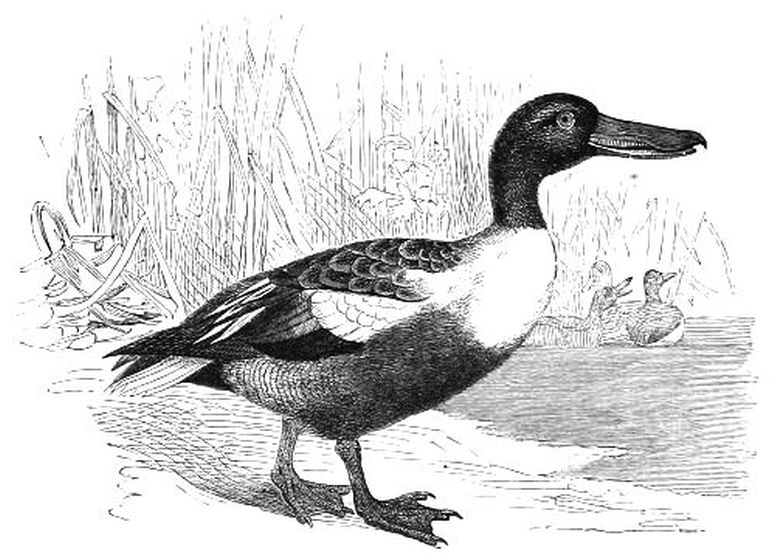
THE SHOVELER DUCK (Spatula clypeata). ONE-FOURTH NATURAL SIZE.
The remarkable beak possessed by these birds is admirably suited for the use to which it is destined, its laminated sides being furnished with numerous nerves, which endow it with a delicate sense of touch, enabling it at once to select such matters as are fitted for sustenance. The nest, which is placed on a tuft of herbage, is composed of fine grass, the eggs being carefully covered with down from the mother's breast. The eggs are of a buffy white, tinged with green; their size is about two inches two lines by one inch six lines.
THE MUSK DUCK.
The MUSK DUCK (Cairina moschata) is recognisable by its slender rounded body, tolerably slender neck, and large head, and by its comparatively long powerful beak, which is elevated at its base. The bare bridles are covered with large fleshy warts, and the claws are short and broad. The proportionately short wings have the third quill longer than the rest. The tail is strong and rounded, and composed of eighteen feathers. The plumage of the male is principally brownish black; the top of the head brownish green; the rump, wings, and rest of the upper part of the body are shaded with metallic green and purple-violet. The quills are green, shimmering with dark steel-blue; the wing-covers mostly white, the under parts dull blackish brown; the under tail-covers shining green; the eye yellow; the naked places on the face brownish black; the warty excrescences dark red, partially spotted with black. The bill is black, with a cross stripe of blueish white just in front of the nostrils; towards the point it is of a pale flesh-colour. Length of male, thirty-two inches; breadth, forty-seven inches; length of wing, fourteen inches and a half; length of tail, seven inches and three-quarters. The female is considerably smaller than her mate, but in other respects they very much resemble each other.
[Pg 158]
All travellers who have had an opportunity of studying these Ducks in a wild state tell us that they are beautiful, lively, and well-flavoured birds, equally attractive to the naturalist and the sportsman. This species is extensively distributed throughout the South American continent, from Paraguay to Guiana, and is to be met with almost in equal numbers near the mouths of rivers flowing into the sea, and amid the swamps and marshes of wild uncultivated parts of the country. The Prince von Wied found it swimming upon rivers in the depths of the primitive forests, and also in still, secluded bays, and upon islands near the sea-coast. Schomburghk observed it at an altitude of 1,500 feet above the level of the sea. During the mid-day heat, and in the afternoon, these birds generally seek out shady places upon the shores and on sandbanks; in the morning and evening they employ themselves in searching for their food, which consists of fishes and snails, also algæ and other water-plants. They invariably pass the night upon trees, and if disturbed in the daytime always seek shelter among their branches; even those which spend their days in marshes and morasses exchange these localities as the sun descends for extensive woods, and perch upon the loftiest trees they can find. Their flight is remarkably rapid, and is always, at their first rising, accompanied by a loud noise, somewhat resembling that produced by a covey of Partridges when first flushed. Their pairing-time seems to be signalised by incessant quarrelling amongst the jealous males; and if the violence of these combats is to be judged of by the number of feathers left upon their battle-fields, they are more than usually pugnacious. Their nest is sometimes built in the hollow of a tree near the sea-shore, sometimes amid the branches. The female parent shows herself most vigilant in protecting her young ones, and should they be attacked, rushes at once to their rescue; when she has succeeded in driving back their enemies she calls them together with a peculiar cry. These birds seem to have two broods during the season—one in May, the other in September.
In Brazil, tame Musk Ducks are everywhere to be met with; indeed, at the period of the visit of the Prince von Wied there seemed to be no others kept in a state of domestication. In Germany, also, breeders have endeavoured to rear them for the table, and speak favourably of the result of their efforts. In their good opinion of these birds we cannot participate. To say nothing of their being unable to endure the cold of our winter so well as other more common species, we consider them to be positively dangerous; they not only attack and do serious damage to other Ducks, but they have been known to set upon children and injure them very seriously. Should any of their companions fall under their displeasure, they follow them unremittingly by land or water, pluck their feathers off and bite them savagely; indeed, they not unfrequently kill them outright by swimming after them and holding them so long under water that they are drowned.
The DIVING DUCKS (Fuligulæ) were formerly considered as belonging to the same race as the preceding, from which they are now properly separated, seeing that they have no more in common with them than Geese or Swans. The Diving Ducks are at once recognisable by their short, broad, plump body, by their short thick neck, their large head, and moderate-sized beak; the latter is broad, furnished with very short teeth, and occasionally somewhat enlarged at the base. The tarsi are short, feathered quite to the heel, and compressed laterally. The anterior toes are large, long, and strongly webbed. The wings are short and vaulted, the two first quills being the longest. The tail is short, but broad, consisting of from fourteen to eighteen close-set feathers; the general plumage is thick and close, differing in colour according to sex and age, and on the head is generally prolonged into a tuft or crest, which is rendered more conspicuous by the brightness of its colours. These Ducks, in correspondence with their power of diving, always prefer open deep water to such as is either shallow or overgrown with plants. The greater number of them live upon the sea, and only visit fresh water during the breeding season. There are, however, some that must be considered as fresh-water birds,[Pg 159] seeing that they spend the greater portion of their lives upon ponds, lakes, or rivers. In consequence of the backward position of their legs, they are obliged, when they stand or walk, to keep themselves very upright; indeed, their gait can scarcely be called a waddle, inasmuch as it is with difficulty that they stagger along. Their flight is, perhaps, better than that of most other Ducks, and when once on the wing they move pretty rapidly through the air. In the water they are quite in their proper element; their broad powerful body is so deeply immersed that only a small portion of the top of the back is visible, and their tail touches the surface of the water. As they row themselves nimbly along, striking well out their broadly-webbed feet, they tilt their body tail upwards, and disappear with a single stroke. These birds are not, like the Divers, able to catch their prey by pursuing it under water; when they dive they seem to plunge more or less perpendicularly down to the bottom, and, after about a minute's absence, again make their appearance nearly upon the same spot from whence they vanished. As it is from the bottom of the water that they obtain their food, even those inhabiting fresh water have necessarily to dive to a considerable depth; whilst those that live in the sea must occasionally plunge still deeper, even to the depth of fifty or sixty fathoms—a fact of which it is easy to convince oneself by examining the contents of their stomachs. A few of them seem to prefer a vegetable diet, but the greater number live upon small bivalve shell-fish and other mollusca; they likewise eat worms, crustaceans, and fishes, while those that inhabit fresh water also feed upon aquatic insects. The booty thus procured from the bottom is also swallowed under water. The Diving Ducks, when employed in fishing for their food, only come to the surface to breathe. Their voice is totally different from that of the Swimming Ducks; instead of quacking they only screech. The manner of their breeding agrees pretty closely with that of ordinary Ducks; still, however, there are points of difference. They breed more in company with each other, and sometimes form regular settlements. Two females even of different species will occasionally lay their eggs in the same nest, sharing the duties of incubation and the charge of the young brood. Some individuals exhibit a sort of mania for brooding; they will slip into the nests of other birds, roll away the eggs, and take possession of them, or even tempt the nestlings away from their proper parents in order to take them under their own care. The eggs are rounder, the shells more closely-grained than those of the Common Ducks, but in other respects resemble them. Some Diving Ducks are valuable on account of the down with which they line their nests, others on account of the excellence of their flesh, but, generally speaking, the latter is rank and ill-flavoured.
The EIDER DUCKS (Somateria) first claim our attention, inasmuch as they are not only the largest and most beautiful of the Diving Ducks, but also the most useful members of the family, ornamenting the seas that they frequent, and conferring inestimable benefit upon the inhabitants of the inhospitable coasts where they are common. Apart from their very considerable size, the Eider Ducks are distinguishable by their long slender beak, the base of which extends up the forehead, and is divided by a triangular projection of the feathers; the upper mandible, which is brightly coloured, terminates in a large nail-like appendage, covering the entire anterior margin of the bill; the tarsi are short, the feet broad-soled, and the toes long; the wings are of moderate length, the second primary quill being the longest; the tertiary quills, which are sickle-shaped, are deflected, and prolonged so as to overlap the primaries; the tail, which is slightly rounded at its extremity, consists of fourteen or sixteen tapering feathers. The general plumage is soft, thick, and fleecy. In the adult male the prevailing colours are simply black and white; the head, however, is ornamented with sea-green, and the breast suffused with roseate pink or brownish yellow; in one species smalt-blue is likewise observable. The colour of the female is brownish grey or reddish brown. All the various species inhabit the colder regions of the Northern Hemisphere. Although the name[Pg 160] of these Ducks is supposed to be derived from the river Eider, dividing the duchy of Holstein from Lower Schleswig, they are in reality seldom found south of the sixty-third degree of north latitude, from which point to the North Cape they are met with in vast numbers all along the coast and in the fiords that indent it in every direction, stretching sometimes 200 miles inland. The northern shores of Russia, Siberia, and the same latitudes of North America, are also inhabited by these valuable fowls.
The Eider Ducks are strictly sea-birds; upon dry land they walk with extreme difficulty, and as they clumsily waddle along often stumble and fall down flat on the ground. Their flight seems difficult and fatiguing, requiring the sustained rapid action of their proportionately short wings. They rarely rise to any height in the air, but wing their way straight down into the water beneath, and it is only when they reach this, their proper element, that they begin to show what are their real capabilities. They swim with the body less deeply immersed than the generality of Diving Ducks, but their movements are quicker than those of any of their congeners.
The breeding-time of the Eider Ducks is rather late in the season, generally towards the end of May, sometimes in June or July; about this period they assemble upon certain small islands, apparently selected because they are easily accessible; the birds then separate into pairs, each pair proceeding at once to chose a place for establishing its nest, the principal conditions required being seclusion and safety. In localities where the birds are tended as though they were private property, the owners of the islands to which they resort take care to furnish a supply of old boxes, platforms built with stones, boards covered with brushwood, and other similar conveniences for breeding.
Though shy enough before, the birds now become wonderfully tame and fearless; they not only unhesitatingly take possession of the platforms, boxes, ledges, and other contrivances prepared for them, but allow themselves to be driven to the most suitable places, without being at all alarmed or disturbed at the presence of their conductors. They come into the immediate neighbourhood of the solitary huts of their keepers, and will enter them in search of a snug corner in which to build; indeed, it not unfrequently happens that adventurous females will take possession of bedrooms, stables, and other similar localities, to the great inconvenience and discomfort of the keeper's wife. At first the male bird always accompanies his mate in these pedestrian excursions in search of lodgings, which generally occupy them during the morning; about noon they fly away towards the fiords or swim about upon the open sea; but towards evening they come on shore to pass the night. While the female is employed in laying her eggs, the male watches over the nest with great perseverance and devotion; but no sooner is the number of eggs complete, and the female begins in earnest the work of incubation, than the male flies off, leaving both nest and wife, and hastens to join the society of other males who may be disporting themselves far out at sea. Upon the rocks and "scaars" upon the coast of Norway these forlorn widowers may be seen playing together by hundreds. The nest of the Eider Duck is a very simple affair, consisting merely of a few twigs, stalks of seaweed, blades of grass, straw, and similar materials, such as can be picked up in the immediate neighbourhood, heaped together in the most slovenly manner; the rougher the framework, however, so much thicker and more valuable is the rich lining of down—the costly toll which the breeding birds have to pay to the masters of the soil for their temporary residence. After the lapse of a few days, the female sits most assiduously; in places where she is accustomed to the sight of men she will not stir even should they approach her nest; she simply bows her head to the ground, and slightly spreads her wings so as to make herself as inconspicuous as possible. The colour of her plumage generally coincides so exactly with that of the surrounding rocks, that to an unpractised eye the bird is with difficulty distinguishable from the ground on which it sits. We have more than once had convincing proof of the efficacy of this mode of concealment, in the shape of a sharp bite on the leg,[Pg 161] inflicted by the beak of a brooding female, of whose presence we were quite unaware before—at the last moment—she flew away. Those females who happen to have taken up their abode in the vicinity of men will allow themselves to be taken up from the nest while their eggs are examined, after which they immediately settle down again to brood, without showing the slightest desire to escape. Frequently we have sat close to their nests for hours together, have stroked their feathers, put our hands between their bodies and their eggs to note the temperature, and yet few of them have stirred from the spot. Some of them would occasionally bite our fingers as if in play, but the majority testified neither timidity nor annoyance. Some we purposely took to a little distance from their nesting-place and placed upon the ground, but they would immediately waddle back to their domicile, arrange the down around the eggs, and quietly resume their position, as if nothing had happened. When left quite to themselves the brooding females quit their nests regularly every morning, taking care, however, to cover their eggs warmly with down, so that they may not be chilled during their absence; having done this, away they fly out to sea, and dive assiduously for half an hour in search of food, and in this short period manage to fill their crops almost to bursting with various kinds of shell-fish, after which they return at once to their charge. The males are much more timid than the females, even when with them at the breeding season or whilst keeping watch over their nests. Should any one approach, they immediately get into a terrible flurry, toss their heads, call loudly to their wives, and after blustering for a little time, fly off to sea, whence they anxiously watch the proceedings of the disturber of their quietude. After the lapse of twenty-five or twenty-six days, the young ones break their shells and make their appearance; they are beautiful little creatures, clad in rich parti-coloured down. From the first moment of their birth they are well able both to swim and to dive; they also walk with considerable facility, even better than their mother, who takes them, before their downy coat has had time to dry, down to the sea. Should the breeding-place be far from the sea, and the departure of the little flock be unusually delayed, the keepers frequently come to their assistance, and, putting the entire brood into a basket, walk with them to the shore, followed by the waddling parents, who seem quite satisfied with the arrangement.
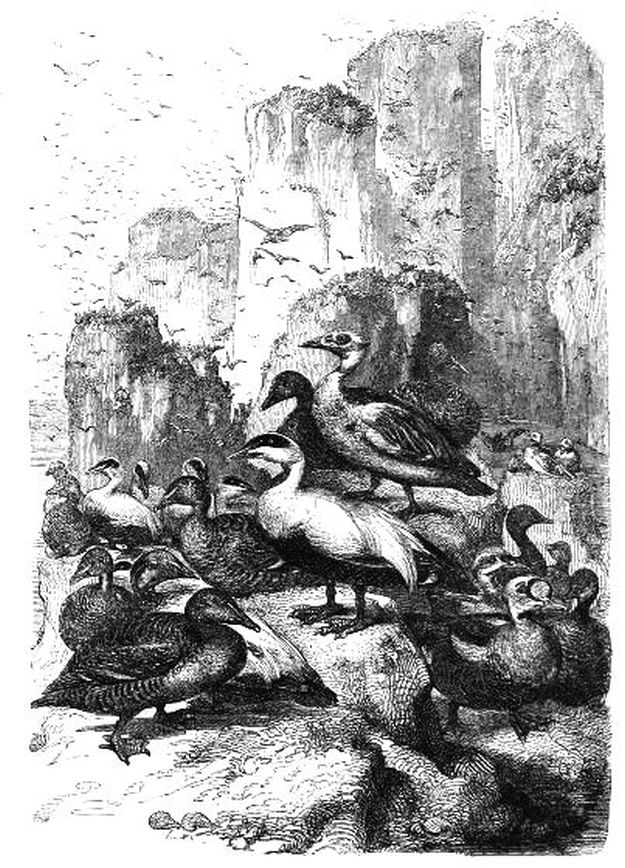
EIDER DUCKS AT HOME.
[Pg 162]
The sea, indeed, is the safest place for these helpless nestlings, as there they can most readily escape from their natural enemies the Falcons, Ravens, and Skuas. Very frequently several mothers, accompanied by their little families, consort together, and then they present to the observer a very attractive spectacle. Should the parent birds perceive that they are followed by a boat, they at once begin to paddle away with all their strength, hoping to escape from their pursuers, and it is not till the boat has come close upon them that they decide upon taking wing; by so doing they are of course compelled to desert the young birds, who, however, seem very well to understand how to provide for their own safety, as they immediately make for the land, and scrambling on to the shore, may be seen running nimbly in search of some convenient hiding-place, dropping down between stones, or concealing themselves behind slight inequalities of the ground, from which they are scarcely distinguishable. Should the threatened danger pass away, they will be found after a little time hastening back to the sea, into which they immediately plunge, and paddle away directly from the shore, until they are joined either by their own mother or by some other elderly female belonging to their flock. Should their mother be killed, the young, if unable to do without assistance, at once join some other family, into which they are received without the slightest reluctance, and tended and cared for by the old birds precisely as if they were their own offspring. The instinct for brooding in the Eider Ducks is indeed very remarkable; they will even steal each other's eggs in order to brood upon them. The nestlings grow rapidly, and often within a week from their birth are well able to procure their own food; they remain, nevertheless, in company with their parents till the early part of the following year. In their earliest infancy they are fed with small crustaceans and other soft-bodied animals; at a later period they live for the most part upon bivalve shell-fish, but likewise feed willingly on fishes, or indeed on any small marine animals that they may meet with. Although the Eider Ducks constitute a considerable portion of the wealth of the countries they inhabit, they are by no means cared for and protected as they might be. Intelligent landholders, whose property the breeding-places are, take the opportunity while the birds are laying to remove some of their eggs, and thus succeed in making them lay a greater number than they otherwise would do. Moreover, they are content to wait patiently until the breeding-time is over before they gather the down from[Pg 163] their nests. More generally, however, neither birds nor eggs are taken the least care of. Notwithstanding that their flesh is not by any means palatable, these Ducks are continually persecuted and slaughtered, and the consequence is, that in Spitzbergen and other localities where the sale of the Eider-down used to be reckoned by the hundredweight, it is now reckoned only by pounds. Malmgren assures us that it is a rare thing to see young birds in the autumn; and the bird-catchers are loud in their complaints of a scarcity, for which they have only their own improvidence to blame. In Greenland the diminution, although not quite so conspicuous, is still very great, not more than a thousand pounds being now collected there annually. "Formerly," says Holboell, "the gross quantity of down procured in South Greenland in the course of a year was 5,007 lbs., and North Greenland produced about half that quantity." According to the usual reckoning a dozen nests yield a pound weight of the raw material, so that every year 104,520 birds were not only despoiled of their down but also robbed of their eggs.
THE TRUE EIDER DUCK, OR ST. CUTHBERT'S DUCK.
The TRUE EIDER DUCK, or ST. CUTHBERT'S DUCK (Somateria mollissima), has the cheeks, chin, back, and breast white, the latter with a reddish tinge. Front and sides of the head black; nape, to the throat, pea-green; quills and tail brown, marked on the wings with velvet-black. The eye is reddish brown, the beak greenish yellow, the foot olive-green. The length of this bird is twenty-four inches, the breadth forty; the length of wing eleven inches, and length of tail three inches and a half. The female is smaller than the male, and her plumage rust-red, marked on the head and neck with longitudinal brown streaks, elsewhere with crescent-shaped black spots; her under side with deep brown, slightly lined with black. After the breeding season the plumage of the male loses much of its beautiful glistening appearance, both head and neck become blackish grey, more darkly clouded, the shoulders greyish black, and the region of the crop yellowish white, marked with black and rust-brown upon the borders of the individual feathers. It seems probable that this change of plumage is not produced by moulting, but by a gradual change in the colour of the feathers.
This valuable Duck is met with throughout the northern regions of the globe, its range extending from Jutland to Spitzbergen, and from the west coast of Europe along its northern shores to Greenland and Iceland. It is a constant resident in some of the northern parts of England and Scotland, and has the name of St. Cuthbert's Duck from the numbers that nest in that island. Its most southern breeding-places are upon the Island of Sylt and other small Danish islands in the same latitude, and from thence north it is met with in continually increasing numbers. In Iceland, Greenland, and Norway, it is very abundant, and is preserved with the utmost strictness. Their nests along the coast of Norway, we are told, produce, from the down they yield, on an average, a profit of five pounds a-piece in the year; so that a small barren rock, frequented by these birds, becomes a very valuable property, and has often been the subject of litigation between Norwegian landholders. Some years ago the Eider Fowl were killed in such numbers that their extinction in that country seemed imminent, but in 1847 the Norwegian Parliament passed a law for their relief, and since that time their pursuers have been obliged to confine themselves to robbing the nests; the consequence is that these Ducks are now very plentiful, and from the perfect security in which they live have attained a degree of impudent assurance unsurpassed by the London Sparrows, or their own distant connections on the ornamental waters in our parks. In the town of Tromsöe they come to the house doors to be fed, and walk about as if strongly impressed with the consciousness of their own importance. In the northern parts of Great Britain these birds are seen assembling in groups along the shores of the mainland about April, from whence they cross to the adjacent islands early in May. The nest of this[Pg 164] species, which contains from four to ten (generally six or eight) well-shaped, smooth-shelled eggs, usually of a dusky greyish green, is formed of fine seaweed, and is lined, after the eggs are deposited, with down from the mother's breast, placed so thickly that the eggs are completely hidden from view. The down from a single nest, when cleansed, although sufficient in bulk to fill a man's hat, seldom weighs more than one ounce. In northern countries the business of robbing the nests of this valuable material begins soon after the eggs are laid, the female replacing it by a fresh supply from her breast, until it is quite bare, when the male bird in turn strips himself to provide a warm covering for his young. "In a month's time," says Mr. Selby, "the little family are led or carried in their parent's bill to the water, where they swim and dive with facility; the mother meanwhile carefully watching over them to defend them from their biped foes, and feigning lameness to lure their pursuers from the spot."
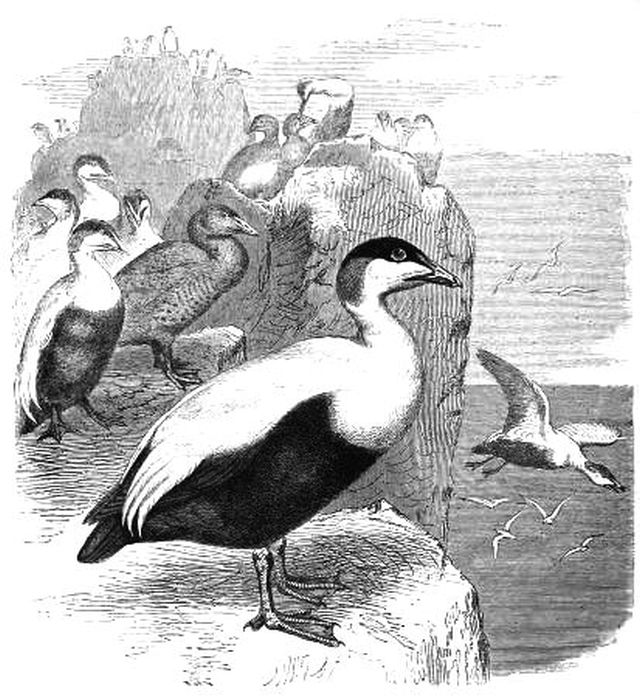
THE EIDER DUCK (Somateria mollissima).
"The care which the mother takes of her young," says Audubon, "cannot be exceeded. She leads[Pg 165] them gently in a close flock in shallow waters, where, by diving, they procure food, and at times, when the young are fatigued and at some distance from the shore, she sinks her body in the water and receives them on her back, where they remain several minutes. At the approach of their merciless enemy, the Black-backed Gull, the mother beats the water with her wings, as if intending to raise the spray around her, and, on her uttering a peculiar sound, the young dive in all directions, while she endeavours to entice the marauder to follow her, by feigning lameness, or she leaps out of the water and attacks her enemy, often so vigorously that, exhausted and disappointed, he is glad to fly off, on which she alights near the rocks, among which she expects to find her brood, and calls them to her side. Now and then I saw two females which had formed an attachment for each other, as if for the purpose of more effectually contributing to the safety of their young, and it was very seldom that I saw these prudent mothers assailed by the Gulls."
We must not omit to mention that the eagerness of these birds for brooding is so great, that, when robbed of their eggs, they have frequently been known to steal the eggs or even the young of others of their species. In its natural state the Eider Duck subsists upon small fish, molluscs, crustaceans, and fish spawn, but when kept confined will eat grain. The flight of this species, which is steady and rapid, is usually carried on near the surface of the water; it dives with facility, and is capable of remaining submerged for a considerable time.
THE KING EIDER.
The KING EIDER (Somateria spectabilis) has the bill, the sides of which are elevated, arched and ridged, surrounded by a fine black band; a similar band runs from the base of the under mandible down each side of the neck. The upper head is grey, the cheeks are sea-green, the neck, back, and sides of the rump white, the front of the breast is light flesh-red; the scapulars, lower part of back, wings, tail, and belly, are white, and the rest of the feathers black; tertials, as in the preceding species, deflected. The eye is brown, beak red, and foot reddish. The female is distinguishable from that of the True Eider by her light reddish brown plumage, and by the structure of the base of the bill.
General Sabine states (in the Appendix to Sir E. Parry's first Voyage) that these birds were abundant in the North Georgian Islands, their nests being placed on the ground in the neighbourhood of fresh-water ponds, and their food consisting of the aquatic vegetation. Sir J. C. Ross says, "Vast numbers of this beautiful Duck resort annually to the shores and islands of the Arctic Regions in the breeding season, and have on many occasions afforded a valuable and salutary supply of fresh provision to the crews of the vessels employed on those seas. On our late voyages comparatively few were obtained, although seen in very great numbers. They do not retire far to the south in the winter, but assemble in large flocks, the males by themselves, and the females with their young brood are often met with in the Atlantic Ocean, far distant from any land, where the numerous crustaceans and other marine animals afford them abundance of food."
This species, which very rarely occurs in Great Britain, was found, on one occasion, according to Dr. Latham, about June, at Papa Westra, one of the Orkney Islands. The eggs, six in number, rather smaller than those of the True Eider Duck, were embedded in down, and placed on a rock overhanging the sea. Nuttall states that the eggs of this bird are whitish, while Yarrell describes them as pale green, and Audubon as of a uniform dull greenish hue. Latham tells us that in Greenland, where the King Ducks are common, the natives assemble in canoes, and by their shouts terrify the birds, which dive to avoid them; but as the place where they are about to emerge is betrayed by the bubbling of the water, their pursuers follow them, and the same game being several times repeated, the birds are at length tired out and easily secured.
[Pg 166]
The WESTERN or STELLER'S EIDER DUCK (Somateria or Heniconetta Stelleri) is a smaller species, still more beautifully coloured and marked. In the male the head, nape, and sides of neck are white, a spot on the forehead, and a transverse band at the back of the head are green, a circle round the eye, the fore and hinder neck, the rump, tail, and points of the quills are black. The upper wing-covers and shoulders are white, striped with dark blue. The under side, as far as the blackish brown centre of the belly, is yellowish brown. In the plumage of the female reddish brown predominates. The eye is brown, the beak grey, and the foot greenish grey. The Western Eider Duck was first described by Steller, from specimens which he obtained in Kamschatka, where it builds on inaccessible rocks. But few specimens of this rare Duck have been shot in England. This species is exclusively a sea bird, is never seen entering the estuaries of rivers, and breeds among rocks and precipices. It flies in large flocks.
The SCOTERS (Oidemia) are birds of considerable size, with remarkably dark plumage. Their beak is moderately long, broad, irregularly swollen at its junction with the forehead, and bright coloured. The tarsi are short, the toes long and large, and the wings of medium length; the tail, which is wedge-shaped, consists of fourteen feathers; the soft and velvety plumage only exhibits colour on the head and wings. All the species belonging to this group are inhabitants of high latitudes, and breed within the Arctic Circle.
THE VELVET SCOTER.
The VELVET SCOTER (Oidemia fusca), one of the species most common in Great Britain, is coal-black, with the exception of a spot beneath the eye, and another on the wing, which are white; the beak is bright yellowish red, marked with black at the edges and at its base; the feet are pale flesh-red, varied with black at the joints; the eye is pearl-white. The female is dark brown, with the exception of a white spot in the region of the ear, a white patch upon the wing, a yellowish bridle-streak, and a grey place upon the centre of the breast. Her eye is brown, her beak black, and her foot greenish yellow. The length of this species is twenty-four inches; the breadth forty inches; the length of the wing twelve inches, and that of the tail three inches and a half. The range of the Velvet Scoter extends from the northern parts of Scandinavia eastward as far as America. In the north of Russia and Siberia it is common. During its excursions it not only visits our shores, but goes still further southwards, and has occasionally been seen even upon the coasts of Spain and in Greece, but rarely shows itself inland. It makes its appearance in our latitudes late in the year, generally about the middle of November or the beginning of December, and returns to its northern home early in the spring. In the neighbourhood of the Gulf Stream, where the sea remains open, it may be met with throughout the winter, frequenting the fjords and bays, sometimes in numerous flocks, at others only in small parties, and seldom visits the shores.
The Velvet Scoter walks and flies badly, but swims well and dives admirably. Naumann states that it is less shy than the generality of its race, a statement which we cannot subscribe to; in Norway, at least, we have always observed it to be one of the most timid and circumspect of diving birds. The food of these Ducks consists principally of bivalve shell-fish; in their breeding-places they may likewise procure insects, worms, and probably small fishes; but it is upon the bivalve molluscs that they chiefly feed, and to obtain these they will even leave their brooding-ground and fly out to sea. They have also been observed to feed upon vegetable substances.
Upon the mountain lakes of Southern Norway the Velvet Scoters breed with tolerable regularity; and further to the north there is hardly a sheet of water of this description, if not too remote from the sea, upon which their young are not to be found. About the middle of June their rudely-constructed nests may be met with hidden in bushes or high grass, or amid tufts of rushes. The[Pg 167] nest itself is constructed of coarse sticks, stalks, and leaves, loosely heaped together, and lined with down plucked from the body of the female. The eight or ten eggs constituting a brood are elongated, smooth, and shining, and of a reddish yellow colour. The young remain in their native lakes until fully able to fly, and do not betake themselves to the sea till the end of October.
The FEN DUCKS (Aythya) are handsome, strongly-built birds, with moderately long beaks, which are not dilated at the base; short, broad-soled feet; moderately long, pointed wings, and smooth plumage.
The range of the members of this group extends from the Arctic Circle to the tropics. They do not inhabit very high latitudes, and only visit the south during their migrations. They may, therefore, be considered as properly belonging to the temperate zone. During the winter months they are to be met with in Southern Russia and the low countries bordering on the Danube, also in Greece, South Italy, Spain, and throughout the north of Africa. These birds make their migrations by night, great numbers of them flying together in large flocks, generally without any regular order, but sometimes arranged in converging oblique lines. In the spring they are usually seen in pairs or in small parties. During the summer they visit lakes of fresh water, large ponds, morasses, or fens having a considerable surface of water of sufficient depth, sometimes resorting to smaller ponds which may happen to be in the neighbourhood. As regards their locomotive powers, these Ducks are decidedly the best endowed of their family—they can walk tolerably well, but, being very unwieldy, they do not willingly come upon dry land, and then only to repose upon some sandbank, or beat up any masses of reeds that may be lying on the margin of the pond. When swimming their body is not so deeply immersed as is that of some of their congeners; they cut through the waves, however, with the same rapidity, and dive as quickly as any of their neighbours. Their flight is hasty and performed by frequent strokes of their wings, that make a perceptible rushing sound, but do not propel them very quickly through the air; nevertheless, they do not seem to become fatigued so quickly as might be expected.
During the summer time the Fen Ducks live almost entirely on vegetable substances; bulbous roots, buds, and tender shoots of trees, succulent leaves, blossoms and seeds of water-plants, constitute the staple of their diet; they will, however, likewise catch aquatic insects, fishes, and pond mollusca; in fact, they seem to like variety. During their migrations they appear more partial to animal food, and when they indulge in this to any extent, their flesh, at other times excellent food, acquires a somewhat disagreeable flavour.
Their breeding-time begins late in the season, generally about the middle of May, when they usually construct their nests among the sedges and reeds that grow upon the margins of the marsh or pond which they may have selected for their residence. Whether this be fresh water or salt seems to be to them a matter of no consequence. Sometimes they will build in situations frequented by man, sometimes by the side of very small ponds, but in the latter case they soon remove their young ones to a more roomy locality. After their first arrival they spend a long time in the society of other species of Ducks, apparently without ever thinking of the great object of their visit. Towards the end of April they become restless and lively, and the males begin to utter their amorous call, the flock separates into pairs, which at once set to work in earnest to construct their nests. There does not seem to be any fighting amongst the males; the females quietly select their mates, and the espoused couple immediately resort to their building ground. The nest is usually a mere pile of sedges, stalks of reeds, hay, straw, and leaves, slightly hollowed at the top, and warmly lined with feathers. The eggs, eight or ten in number, sometimes in exceptional cases more, sometimes fewer, are moderately large, roundish, and of a dull grey or olive-green. So long as the female continues to[Pg 168] lay, her mate remains true to his duty, and carefully watches over her safety. When, however, she begins to sit upon her eggs, the male deserts his charge, leaves her while he amuses himself in the society of other roving males, and finally troubles himself no more about either mother or eggs. After the lapse of twenty-two or twenty-three days, the young ones make their appearance, and on the very day of their birth are to be seen paddling about upon the surface of the water, but at first they do not venture beyond the shelter of the floating herbage at the side of the pond. Soon, however, their parent, by the pressure of her body, crushes down the reeds and water-plants, so as to make a sort of bed, to be used as a sleeping or resting place, and here she may be found sitting, closely surrounded by her little flock, as they sun themselves and preen their feathers. If disturbed in their snug retreat, they endeavour to save themselves by repeatedly diving, and if the threatened danger continues, the mother hastens to lead them to a more secluded spot, always, if possible, making their way thither by water, never, except in cases of urgent necessity, trusting to the dry land. The size of the young Ducks rapidly increases, and they do not learn to fly until they have attained their full growth. Owing to the excellence of their flesh, the chase after these birds is eagerly followed up, and the sportsman is able sometimes to bring down several of them at once, seeing that, if pursued, the young birds always crowd closely together. Occasionally they are taken in considerable numbers by means of decoys.