THE SWIMMERS (Natatores). (continued 3)
Thomas Rymer Jones translation
THE RED-HEADED DUCK, DUNBIRD, OR POCHARD.
The RED-HEADED DUCK, DUNBIRD, or POCHARD (Aythya ferina), one of the best-known representatives of the above group, is of a beautiful brownish red upon the head and fore part of the neck, the front of the breast is black, the back and sides are pure ash-grey, delicately marked with cross lines of black. The under side is greyish white, the region of the vent black; the wing-covers are ash-grey, the wing-spots light grey, and the quills and tail grey. The eye is yellow, the beak black at its base, and the margins elsewhere blueish grey; the foot is greenish grey. In the female the head and neck are reddish greyish brown, marked with an indistinct crescent of dark brown. Her body is whitish grey, and wings ash-grey. The young males in their summer dress resemble the females, but are somewhat brighter in hue, and have the back-feathers of a purer grey. The length of this bird is nineteen inches, its breadth thirty inches, the wing measures nine inches and a half, and the tail two inches and a half.
The Red-headed Ducks are winter visitors to Great Britain, appearing in October, and, as a rule, departing in spring. Occasionally a few have been said to remain and breed in Norfolk. These birds do not confine themselves to the sea-coast, but visit inland lakes and rivers. Their note is usually a low whistle, but, when alarmed, they utter a hoarse croak. The nest, which is placed among rushes or coarse herbage, contains from ten to twelve buffish-white eggs; they are about two inches long, and one inch and five-eighths broad. "Although," says Audubon (in speaking of this species, which is numerously met with during winter about New Orleans, East Florida, and Chesapeake Bay), "these Ducks dive much and to a great depth, while in our bays and estuaries, yet when in the shallow ponds of the interior, they are seen dabbling in the mud along the shores, much in the manner of the Mallard; and, on occasionally shooting them there, I have found their stomach crammed with young tadpoles and small water lizards, as well as with blades of grass; nay, on several occasions I have found pretty large acorns and beech-nuts in their throats, as well as snails, entire or broken, and fragments of the shells of several small unios, together with much gravel."
Pochards are sold in large numbers in the London markets, and Gould tells us, on reliable authority, that no less than 14,400, the sale of which produced £1,200, have been captured in one decoy.
[Pg 169]
The method by which Pochards were formerly taken is thus described by Montagu:—"Poles were erected at the avenues leading to the decoys, and after a great number of birds had collected for some time on the pond, a net was, at a given time, erected by pulleys to these poles, beneath which a deep pit had been previously dug; and as these Ducks, like the Woodcocks, go to feed just as it is dark, and are said always to rise against the wind, a whole flock was sometimes taken together in this manner; for if once they strike against the net, they never attempt to return, but flutter down the net till they are received into the pit, from which they cannot rise."
The PIN-TAILED DUCKS (Erismatura) are recognisable by the structure of their tail; their body is elongated; neck short and thick; and head tolerably large. Their beak, which is flat in front, and considerably enlarged towards its base, is furnished at its tip with a small nail; the tarsi are short; toes long; and the wings remarkably small and much vaulted. The long, wedge-shaped tail is formed of eighteen feathers, which are of hard strong texture, and very tapering towards their extremities. The close harsh plumage of this group is readily distinguishable by the peculiarity of its colouring from that of all other Ducks.
THE WHITE-HEADED PIN-TAILED DUCK.
The WHITE-HEADED PIN-TAILED DUCK (Erismatura leucocephala) has the head white, with the exception of a large black patch upon the centre; a band around the neck and throat is black. The lower neck and region of the crop are chestnut-brown, finely marked with black; the mantle is greyish yellow, streaked with black; the under side reddish yellow, with greyish white centre and black markings; the primary quills are grey, and the tail black. The eye is reddish yellow; beak blueish grey; and foot reddish grey. This species is nineteen inches long and twenty-five inches broad; length of wing six inches and a half, and of tail four inches and a half. The female is smaller than her mate, and more variegated, but is not so handsome, owing to the absence of the white feathers and black spot that adorn the head of the male; the upper part of her head and a spot upon the cheeks are brown, the latter encircled by a line of yellowish white; the rest of her plumage is principally reddish brown, marked with watered black and grey lines. The White-headed Pin-tail is met with throughout the south and south-east parts of Europe, the south parts of Southern Asia, and North-west Africa; it is, however, scarcer than the generality of Ducks, even in localities where it is most frequently observed. It is principally abundant on the lakes of Asia, whilst in countries more to the west it seems less common. In Greece it is a regular visitant, but has not yet been found in Spain. Buvry and Tristram encountered it upon the lakes of Algeria, and the first-mentioned naturalist succeeded in obtaining its eggs. "The White-headed Ducks," says Buvry, "are most elegant birds, and are always met with in pairs. Their beautiful light blue beak forms a lively contrast to their white head and brown body. Their attitude when swimming is very striking; they lift up their tail almost perpendicularly, and glide lightly and quickly over the water like so many little boats. If pursued they seldom have recourse to their wings; nevertheless, such is the rapidity of their movements in the water that they are rarely captured." They lie so deep when swimming that, with the exception of their head, neck, and tail, very little of them is seen; and if they choose to exert themselves when paddling with their powerful and broadly-webbed feet, they swim and dive with all the facility of a Cormorant. In their flight they rather resemble Divers than ordinary Ducks, and the rapid motion of their wings produces a very audible whirring sound. Their voice, which is a somewhat jarring quack, reminds us of that of the Duck. The food of these birds consists of molluscs and fishes. In Central Asia their breeding-time occurs later than that of any of their kindred, their eggs being never met with before July. The nest is difficult to find, as it is carefully hidden in the thickest entanglements[Pg 170] of the reeds, rushes, and bushes, that abound in their favourite resorts; occasionally it is still further concealed by a covering of similar materials. The nests found by Tristram in Algeria contained—the one three and the other eight eggs. "These," he says, "are very large in proportion to the size of the bird, of a regular elliptical shape, very rough shelled, and, unlike those of other Ducks, of a dingy white." We have no information respecting the rearing of the young.
The MERGANSERS, or GOOSANDERS (Mergi), are distinguishable by their very elongate body, moderately long, thin neck, and large head, which is generally ornamented by a tuft or hood; their bill is long, straight, or slightly arched, slender, and almost cylindrical; its callous margins are sharp and strongly denticulated, and its tip terminated by a strong hook; the legs are short, and placed very far backwards, the feet large, and toes long; the hind toe is furnished with a supplementary web, resembling that of some of the Divers. The wings are of moderate length, and very acutely pointed, the first and second quills being the longest; the tail, which consists of sixteen or eighteen feathers, is short, broad, and rounded; the plumage is short, thick, and prettily coloured, but the colours vary at different ages, and also in the sexes as well as at different seasons of the year. These remarkable birds walk badly, with a vacillating waddling gait, keeping their bodies erect, but they are excellent swimmers, and dive with wonderful facility. Their flight is rapid, light, and somewhat resembles that of the Duck. When Mergansers fly in company, as they frequently do, they range themselves in a certain regular order; they rise readily, but with a loud noise, splashing with their feet upon the water, and when they alight again in that element, fly obliquely downwards, and either at once dive or stop themselves by means of their outstretched tail. All the members of this family belong to the northern regions of our globe, but are met with pretty equally both in the eastern and western hemispheres. When driven south by the intensity of the cold, their migrations sometimes extend to the south of Europe, and to corresponding latitudes in Central Asia and America. The Goosanders subsist chiefly upon fishes, crustaceans, worms, and insects; the fishes they obtain by diving, and chasing them through the water, exactly after the manner of the true Divers. These birds are strictly monogamous, and construct their nests sometimes upon the ground, in clumps of herbage, among reeds, in hollow trunks, or amongst the branches of trees, and occasionally in the deserted homes of other birds. The nest is inartistically formed of dried stalks, leaves, moss, and rushes, warmly lined with down. The brood consists of from seven to fourteen unspotted grey or greenish white eggs. The female alone broods, sitting for a period of from twenty-two to twenty-four days, the male always taking up a position in the neighbourhood of his mate. At first he seems to take some interest in his young brood, but soon forsakes them, and joining company with others of his own sex, retires from his family cares in order to undergo his autumnal moult. The flesh of the Goosanders is disagreeable, and of an oily taste, but they are often killed for the sake of their down and feathers. The eggs are in much request.
THE WHITE-HEADED GOOSANDER.
The WHITE-HEADED GOOSANDER (Mergellus albellus) has been made the representative of a distinct sub-family, probably on account of the shortness and breadth of its bill, and the peculiarities in its mode of life. This bird bears a great resemblance to some of the Divers, and therefore must be placed near them.
The summer dress of the male is pure white, a spot between the eyes, the beak, and a band across the nape are blackish green; the back and a portion of the wings, two small stripes upon the shoulder, and a long stripe above the wing are black; the sides are blueish grey, cross-waved with black; the primary quills blackish brown, and the tail-feathers grey; the eye is blueish grey, the beak[Pg 171] and foot greyish blue. The length is nineteen inches, the breadth thirty inches; the length of wing eight inches and a half, and the length of tail three inches. In the female, which is smaller than her mate, the head and hinder neck are brown, the bridles black, the throat and under part of the body white, the feathers of the mantle grey, the upper breast and sides whitish, transversely waved with black. After the summer moult the dress of the male very much resembles that of the female. The real habitat of the White-headed or Dwarf Goosander, as it is sometimes called, seems to be in Northern Asia, from whence it extends westward into Northern Europe, and eastwardly into the northern parts of America. During the winter months, however, it wanders far southward. It is then to be met with in considerable numbers throughout the whole of China, being more especially abundant in the northern provinces of the Celestial Empire. It is, moreover, a regular visitant to Northern India, and is not unfrequently seen in Central and in Southern Europe. It seems to be more scarce in the Southern Provinces of the United States of North America, for Audubon informs us that in the western division, at least, it was a bird of unusual occurrence. In very hard winters it makes its appearance in Germany, as early as the month of November, but more usually not until the middle of December, returning again to the north in February or March. It is likewise a winter visitor to the shores of Great Britain, large numbers being sometimes seen on the eastern or southern coasts of England. It is rarely found north of the Humber, and is comparatively rare in Scotland and Ireland. In some parts of Switzerland it may be met with even so late as the beginning of May. This species is generally only to be found in the neighbourhood of fresh-water lakes, sometimes, but only casually, it may be seen in quiet bays upon the sea-coast, more especially in such as are at the mouths of rivers. Unlike the Divers, it seems to prefer flowing streams to stagnant water, and often wanders along the course of rivers, from which it only makes excursions to such lakes and ponds as may be free from ice. When walking, the Dwarf Goosander holds its body in a horizontal position, with its head retracted; it walks with a waddling gait, but better than the generality of its near allies. When swimming it keeps itself about half submerged, and when it dives it stretches itself out to its full length, and disappears in an instant. Its flight, which very much resembles that of the smaller Ducks, is rapid, straight, accompanied by a slight whirring of the wings, and is generally but little elevated above the surface of the ground or of the water. It is remarkably lively in its disposition, and even during the bitterest cold weather is sprightly and active.
These birds may generally be recognised by the manner of their diving; the True Divers, after their plunge, generally reappear close to the spot where they went down, but the Goosanders swim while under water to a considerable distance, shooting along like a pike or a trout, and as they can keep submerged for a minute at a time, it is not easy to calculate where they will come up again. They live principally upon small fishes, crustaceans, and aquatic insects, and in confinement, at least, do not refuse vegetables; they will also eat bread greedily. In catching fishes they are quite as skilful as the larger Divers, and it is very interesting to watch a flock of them thus employed. Now you see them swimming altogether; in a moment they all vanish at once, and the water becomes disturbed by their movements underneath; at length they come up again one after another, but widely separated, and often from thirty to fifty yards from the place where they went down. Again they congregate, and anon they dive again; some of them coming up perhaps close to the shore. Sometimes they are obliged to procure their food through small holes in the ice, often not a foot square, and to pursue their game beneath the frozen surface, only presenting themselves every now and then at the aperture for a supply of air. Their power of seeing under the water must therefore be very good, or they would never be able to find the broken place at which to emerge. Where the supply of food is scanty they will rake up the bottoms of ponds, in search of frogs or insects. The habit of diving all at once is peculiar to the Goosanders, and the explanation of this manœuvre[Pg 172] seems to be that by so doing they come among the astonished fishes in all directions, thus enabling one bird to catch those that are trying to escape from another; but we have never seen them, as some writers assert, arrange themselves in the form of a crescent, so as to drive the fishes, as it were, into a narrow space. About the breeding of these birds we are very imperfectly informed; we know, however, that in the north of Russia they assemble in great numbers, and build their nests upon the shore, or upon small islands, sometimes in hollow trees. We know, likewise, that their nest is composed of dry broom (Genista) and grasses, lined with feathers, and that their eggs, eight to twelve in number, are of a dirty white, or greenish brown colour, but we are ignorant either of the duration of their incubation, or of the manner in which they educate their progeny.
THE GREEN-HEADED GOOSANDER.
The GREEN-HEADED GOOSANDER (Mergus merganser) differs from the preceding species not only in its greater size, but in the structure of its bill, which is elongated and compressed at its sides. In his summer dress the male is blackish green upon the head and upper neck; the upper back, shoulders, and margins of the wings are black; the whole under surface and the upper wing-covers are of a beautiful yellowish red; the wing-spot is white. The wing-quills are black, the lower tail-covers grey, finely marked with black, and the tail-feathers grey. The eye is reddish yellow, beak coral-red, and foot pale red. The female has the upper head and nape brown, the back-feathers blueish grey, the under surface of her body and the wing-spot white; the fore parts of her breast and sides are grey, marked with a darker and a lighter shade. After the summer moult the plumage of the male is very similar to that of the female, but somewhat more beautiful. The length of this species is from thirty to thirty-two inches; breadth, forty to forty-two inches; length of wing, twelve inches; length of tail, three inches.
The Green-headed Goosander inhabits the northern parts of Europe, Asia, and America, being pretty equally distributed in all these continents: its migrations, which occur with much greater regularity than those of the Mergellus albellus, extend, on the one hand, to all the southern countries of Europe, the south of China, and north of India; and on the other, to the extreme south provinces of the United States. A few pairs are occasionally known to breed in the Orkneys and Hebrides, but with us by far the greater number only arrive from the north about the end of November, and return thither in February. The Green-headed Goosander may justly be regarded as one of the most beautiful of aquatic birds. With the exception of a few hours at noon, he is invariably to be seen in the water. Upon dry land his gait is waddling, and his flight, although rapid, laboured and heavy; but upon the sea he is quite at home. When swimming quietly upon the surface he rows himself along with powerful but slowly-repeated strokes of his broad feet, passing through the water with tolerable velocity. Should he, however, cast an envious eye upon some other bird that has caught and is about to swallow a fish he would fain appropriate, he rushes in pursuit with truly wonderful rapidity. In diving he is equally adroit, plunging suddenly down without the least sound or commotion, and in clear water, where his career, as he steers his course half way between the surface and the bottom can be observed, his rapid progress seems rather to resemble the movements of a trout than those of a bird. On occasions he can remain under water for two minutes at a time; generally, however, he comes up in about a minute, and in this short period, notwithstanding all the ins and outs of his zigzag course, will have dived, as shown by the place of his reappearance, upwards of 100 yards. As long as these birds can obtain a sufficient supply, they subsist exclusively upon fishes, preferring such as are about five or six inches long, although they are well able to vanquish and swallow those of much larger size. The breeding-place of these Goosanders is generally in latitudes very far north, their usual resort being to the Danish islands, and even still farther north.[Pg 173] Their period of incubation commences about the beginning of June. The nest is constructed in various situations, often in some excavation in the ground, hidden between stones or bushes, on the tops of pollard willows, on the lofty eyries of birds of prey, in the deserted nests of Crows, or within the cavities of hollow trees. At Jana-Elf we saw large chests, resembling dove-cots, upon all the tallest trees; these we were told were intended specially to induce the Goosanders to build their nests, and lay their eggs in them. These breeding-boxes are likewise in common use among the Lapps and Finns, and, as we learned, were regularly visited by the breeding birds.
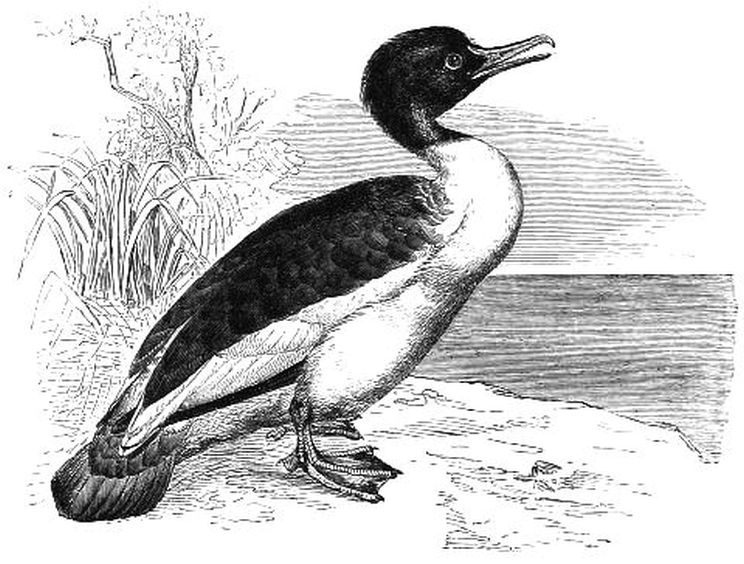
THE GREEN-HEADED GOOSANDER (Mergus merganser).
The nest itself is more or less artistically constructed of twigs, stalks, straw-grass, leaves, and similar materials, always well and warmly lined with down. The brood consists of from eight to fourteen eggs, but by regularly abstracting them as they are laid, the female will sometimes produce double those numbers. The eggs are well-shaped, rather elongate, slightly shining, and of a delicate greenish brown, grey, or dirty olive-green colour. Only the female sits, and upon her the guardianship of the young brood almost entirely devolves. Such as are born in nests placed at a considerable height, must necessarily be brought by her to the surface of the ground, but we are not aware that any naturalist has witnessed such a proceeding. It is just possible that, like some Ducks and Geese, they may leap from the nest trusting to their fluttering wings and thick downy covering to come off scatheless. Were we to judge by the observations we have had opportunities of making relative to the breeding of the Red-breasted Merganser (Mergus serrator), we should say that the young brood at first comport themselves exactly like young Ducks; soon, however, their natural peculiarities and special endowments begin to show themselves, and after the lapse of about eight days, they adopt the habits of their race. When first hatched they live upon small crustaceans and larvæ, caught upon the surface of the water, but on the third day are able to dive, and from the eighth day are quite[Pg 174] capable of fishing for themselves. They grow very rapidly, and soon become independent. According to Naumann the instinct for brooding is so strong in these birds, that if robbed of their eggs, they will take possession of the nest of a Duck, and after forcibly driving away its owner, will sit upon her eggs till they are hatched.
[Pg 175]