THE NADIISHA-DENA OR KIOWA APACHE
Reading edition
TRIBAL SYNONYMY
Apaches—Agent Thomas Fitzpatrick, Ind. Report, 52, 1850. This has been their official popular name for the last fifty years.
Apaches of Arkansas river—Agent J. W. Whitfield, Report, 255, 1855.
Apaches of the Plains—Pope, 1854, in Pacific Railroad Survey, 17, 1855.
Kiowa Apaches—Clark, Indian Sign Language, 33, 1885.
Ésikwíta—Properly the name of the Mescalero Apache, but in various forms—Essequeta, etc—has sometimes been incorrectly applied to the Kiowa Apache.
Gáta`ka—Mooney, Misc. Ind. MS. So called by the Pawnee.
Ca´takâ—Lewis, Report, 1805, in Mess. from the President communicating discoveries by Lewis and Clark, etc, 38, 1806.
Cataha—Lewis, Travels, 15, 1809 (misprint).
Cattako—Lewis and Clark, Discoveries, 23, 1806.
Cuttako—American State Papers, IV, 710, 1832.
Gataea (for Gataca)—La Salle, 1682, in Margry, Découvertes, II, 168, 1877.
Gataka—Harris, Coll. Voy. and Travels, I, map, 685, 1705.
Gattacka—La Salle, 1682, in Margry, Découvertes, II. 201, 1877.
Gû´ta`k—La Flesche, Omaha and Ponca name, probably derived from the Pawnee.
Ka-ta-ka—Kioway, Kataka, and Towakaro treaty; ratified 1838.
Kattekas—French, Hist. Colls. of Louisiana, new series, I, 153, note, 1869.
Quataquois—La Harpe, 1719, in Margry, Découvertes, VI, 289.
Quataquon—Beaurain, 1719, ibid.
Tha`ká-hinĕ´na—Mooney, Misc. Ind. MS. Arapaho names, derived from Gáta`ka and hinĕ´na, "people," or itâ´n, "tribe."
Tha`ká-itän—Mooney, Misc. Ind. MS. Arapaho names, derived from Gáta`ka and hinĕ´na, "people," or itâ´n, "tribe."
Gĭnä's—Mooney, Misc. Ind. MS. Wichita name.
Kántsi—Mooney, Misc. Ind. MS. Caddo collective name for the Apache tribes, signifying "liars;" hence Cancy, etc.
K`á-pätop—A generic Kiowa name for several tribes cognate with the Apache, including Apache proper, Mescalero, Lipan, and Kiowa Apache. It signifies "knife-whetters," or "whetstone people." The name became obsolete about six years ago in consequence of the death of a Kiowa chief named K`á-pä'te.
Kĭsínăhĭs—Mooney, Misc. Ind. MS. Kichai name.
Mûtsiănă-täníu—Cheyenne name, signifying "whetstone people."
Nadíisha-déna—The name used by themselves, signifying "our people" or "people of our kind;" singular, Ná-isha. Déna, "people," is the word which, in the various dialectal forms of dina, tĭné, dĭ'nĕ, tûne, nde, etc, enters into so many tribal names of the Athapascan stock.
Prairie Apache—Whitfield in Rept. Comr. of Ind. Aff., 297, 1854.
Sádalsómte-k`íägo—Another Kiowa name for the Kiowa Apache, signifying "weasel people."
Semät—The name by which the Kiowa call them, signifying "thieves;" the name which designates this tribe alone, superseded a few years ago the more general term K á-pä´top.
Tagúi—The old Kiowa name for the Apache tribes generally, superseded for a time by K á-pä´top, but now again in use. Cf T'a`ká-i, "white man."
Tâ´gugála—Hodge, Pueblo MS. Notes, 1895. The Jemez name for the Apache tribes, including the Kiowa Apache.
Tágukerésh—Hodge, Pueblo MS. Notes, 1895. The Pecos name for the Apache tribes, including the Kiowa Apache.
Tashĭn—Mooney, Misc. Ind. MS. Comanche generic name for the Apache tribes.
TRIBAL SIGN
Right index finger rubbed briskly up and down along the back of left index finger. This is the generic sign for all tribes of Apache connection, including Apache proper, Navaho, Mescalero, Lipan, and Kiowa Apache. It is commonly interpreted to mean "knife whetters" or "whetstone people," and this is also the meaning of the generic term for Apache in most of the plains languages. It is possible, however, that this is a misconception of the original purpose of the sign, which may have had reference to a peculiar musical instrument found in various forms among the Pueblo and other Indians of the southwest. Clark says:
I have heard two distinct conceptions for this gesture, the Cheyenne claiming that the sign came from a peculiar musical instrument made from an elk horn, which produced weird-like sounds by rubbing it backward and forward with a stick, and the second (I do not remember what tribe gave me the conception) from a specially good whetstone which the Apaches made and used (Clark, 9).
In a personal letter to the author Grinnell states, on Cheyenne authority, that the sign "is not whetting a knife, which would be performed by one open flat hand on back of other flat hand, and not poor, which would be passing right forefinger down over back of left forefinger held vertically. The sign is said by the Cheyenne to refer to a musical instrument used in old times by the Apache. This instrument was played by passing the forefinger back and forth over the flat surface of the instrument, from which surface a tongue protruded, which, when struck, vibrated and made the sound, somewhat after the manner of the Jew's-harp."
ORIGIN AND HISTORY
The Kiowa Apache are a small tribe of Athapascan stock, numbering now about two hundred and twenty-five, associated with the Kiowa from the earliest traditional period and forming a component part of the Kiowa tribal circle, although reserving their distinct language; they call themselves Nadíisha-dena, "our people." In the early French records of the seventeenth century, in Lewis and Clark's narrative, and in their first treaty, in 1837, they are called by various forms of the name Gáta`ka, the name by which they are known to the Pawnee, although this does not necessarily imply that the word is of Pawnee origin. They are possibly the Kaskaia or "Bad-hearts" of Long in 1820. The Kiowa call them by the contemptuous title of Semät, "thieves," a recent substitute for the older generic term Tagúi, applied also to other tribes of the same stock. They are now commonly known as Kiowa Apache, under a mistaken impression, arising from the fact of their Athapascan affinity, that they are a detached band of the Apache nation of Arizona. On the contrary, they have never had any political connection with the Apache proper and were probably unaware of their existence until about one hundred years ago. A few Mescalero Apache from New Mexico are now living with them, and individuals of the two tribes frequently exchange visits, but this friendly intimacy is a matter of only sixty or eighty years' standing, resulting from the peace between the Kiowa and Comanche, as already recorded.
BUREAU OF AMERICAN ETHNOLOGY— SEVENTEENTH ANNUAL REPORT PL. LXXII
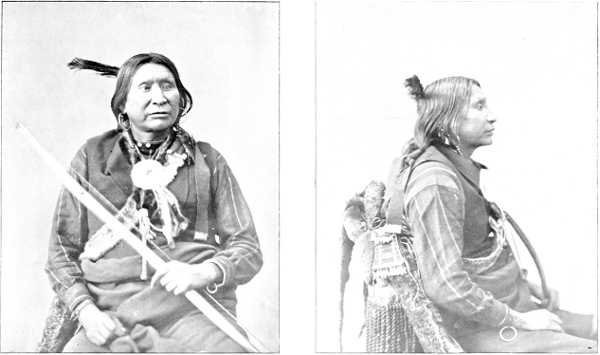
PHOTOS BY JACKSON, 1872.
DAHA, A KIOWA APACHE SUBCHIEF.
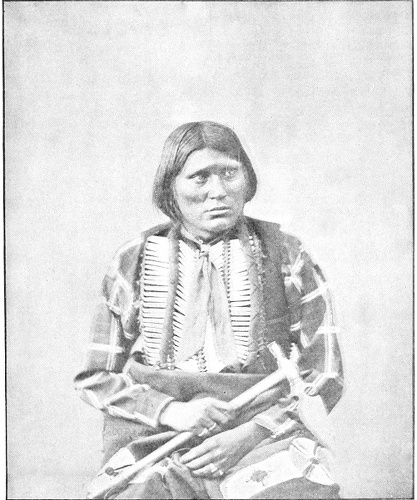
Photo by Hayden Survey, 1872.
Fig. 58—Gray-eagle, a Kiowa Apache subchief.
They have not migrated from the southwest into the plains country, but have come with the Kiowa from the extreme north, where they lay the scene of their oldest traditions, including their great medicine story. Their association with the Kiowa antedates the first removal of the latter from the mountains, as both tribes say they have no memory of a time when they were not together. It is probable that the Kiowa Apache, like the cognate Sarsi, have come down along the eastern base of the Rocky mountains from the great Athapascan hive of the Mackenzie river region instead of along the chain of the Sierras, the line followed by the kindred Tototin, Wailaki, Navaho, and Apache proper, and that, finding themselves too weak to stand alone, they took refuge with the Kiowa, as the Sarsi have done with the Blackfeet.
BUREAU OF AMERICAN ETHNOLOGY— SEVENTEENTH ANNUAL REPORT PL. LXXIII
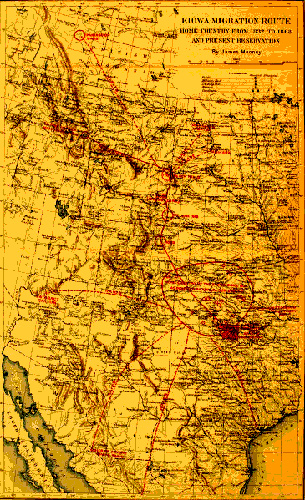
by James Mooney, 1872.
KIOWA MIGRATION ROUTE.
In regard to this northern origin and early association Clark says, in his valuable work on the sign language: "Tradition locates the Kiowas near and to the southwest of the Black Hills, Dakota, and without doubt they had previous to that time lived near the Missouri river. The Apaches with whom they are now associated were at this time with them." In another place he states that an old Apache told him, about 1881, that he was then about seventy years of age and had been born near Missouri river, northeast of the Black Hills (Clark, 10). Keim chooses to call them Lipan, in which he is mistaken, the Lipan being still another Athapascan tribe living farther south, and states that "these people are improperly known as Apaches and so called in the official documents of the government. They say of themselves that they are not Apaches, that the Apaches live away to the west." He says that they have a tradition of having formerly lived in the Bad-lands of Dakota, whence they drifted to the south, but adds somewhat naively that there is no other authority for this than their own story (Keim, 4).
As the Apache are practically a part of the Kiowa in everything but language, they need no extended separate notice. Curiously enough their authentic history begins nearly seventy years earlier than that of the dominant tribe with which they are associated. They are first mentioned by the French explorer La Salle, in an undated letter of 1681 or 1682, under the name of Gattacka. Writing from a post in what is now Illinois, he says that the Pana (Pawnee) live more than 200 leagues to the west, on one of the tributaries of the Mississippi, and are "neighbors and allies of the Gattacka and Manrhoet, who are south of their villages, and who sell to them horses, which they probably steal from the Spaniards of New Mexico." In another fragmentary letter of 1682, written from the same place, he proposes to make an overland journey by means of horses, "which may easily be had, as there are many with the savages called Pana, Pancassa, Manrhout, Gataea, Panimaha, and Pasos, who lie somewhat remote, it is true, but yet communication with them is very easy by means of the river of the Missourites, which flows into the river Colbert" (Margry, 1). In modern terms Pana, Pancassa (or Paneassa), Gataea (for Gataca), Panimaha, Missourites, and Colbert are respectively Pawnee, Ponca (?), Kiowa Apache, Pawnee-Maha or ——, Missouri, and Mississippi. Paso is problematic, and Manrhoet or Maurhout, which in both letters is mentioned in connection with the Kiowa Apache, may possibly be some obsolete name for the Kiowa themselves.
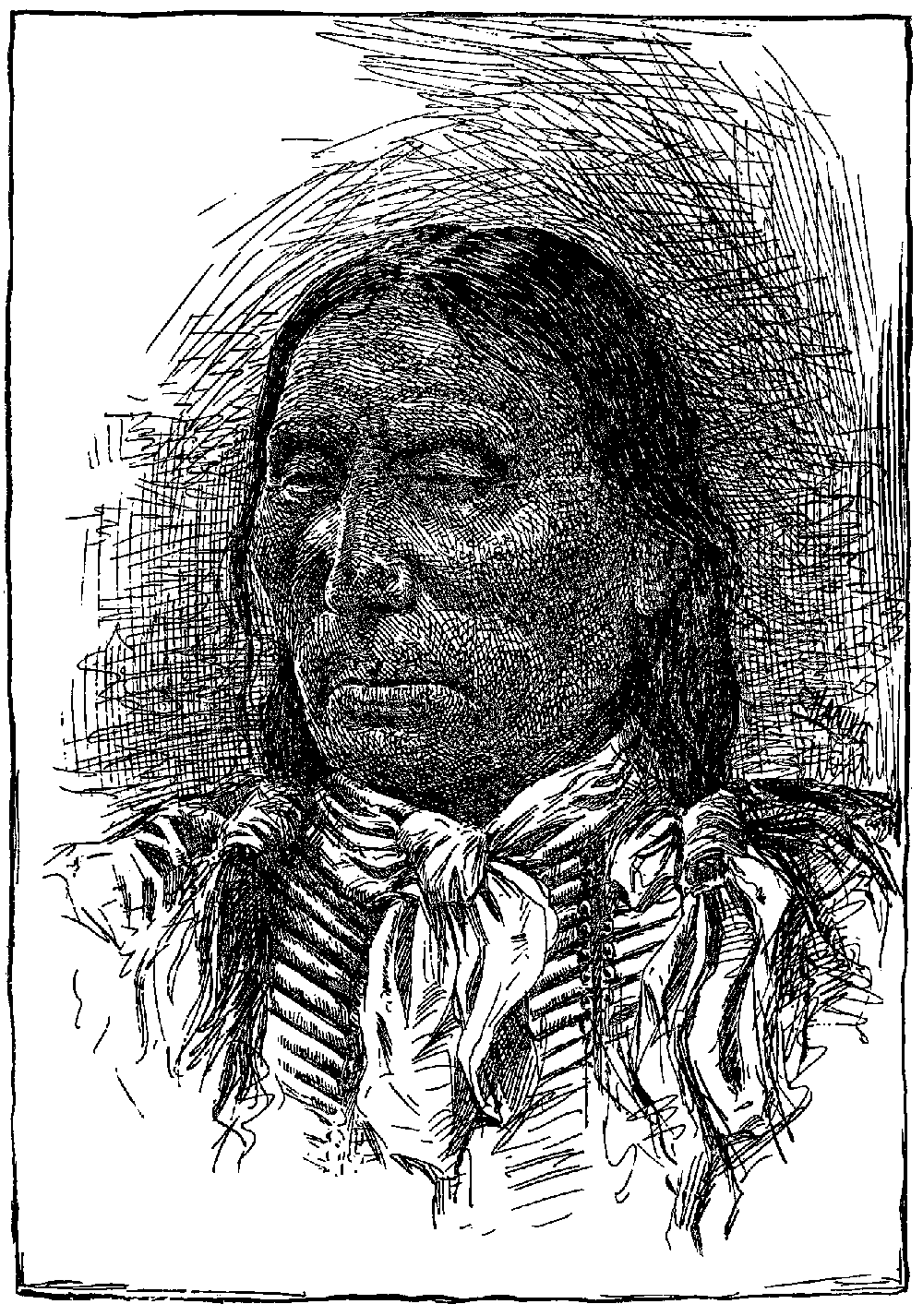
Fig. 59—Tsáyăditl-ti or White-man, present head-chief of the Kiowa Apache.
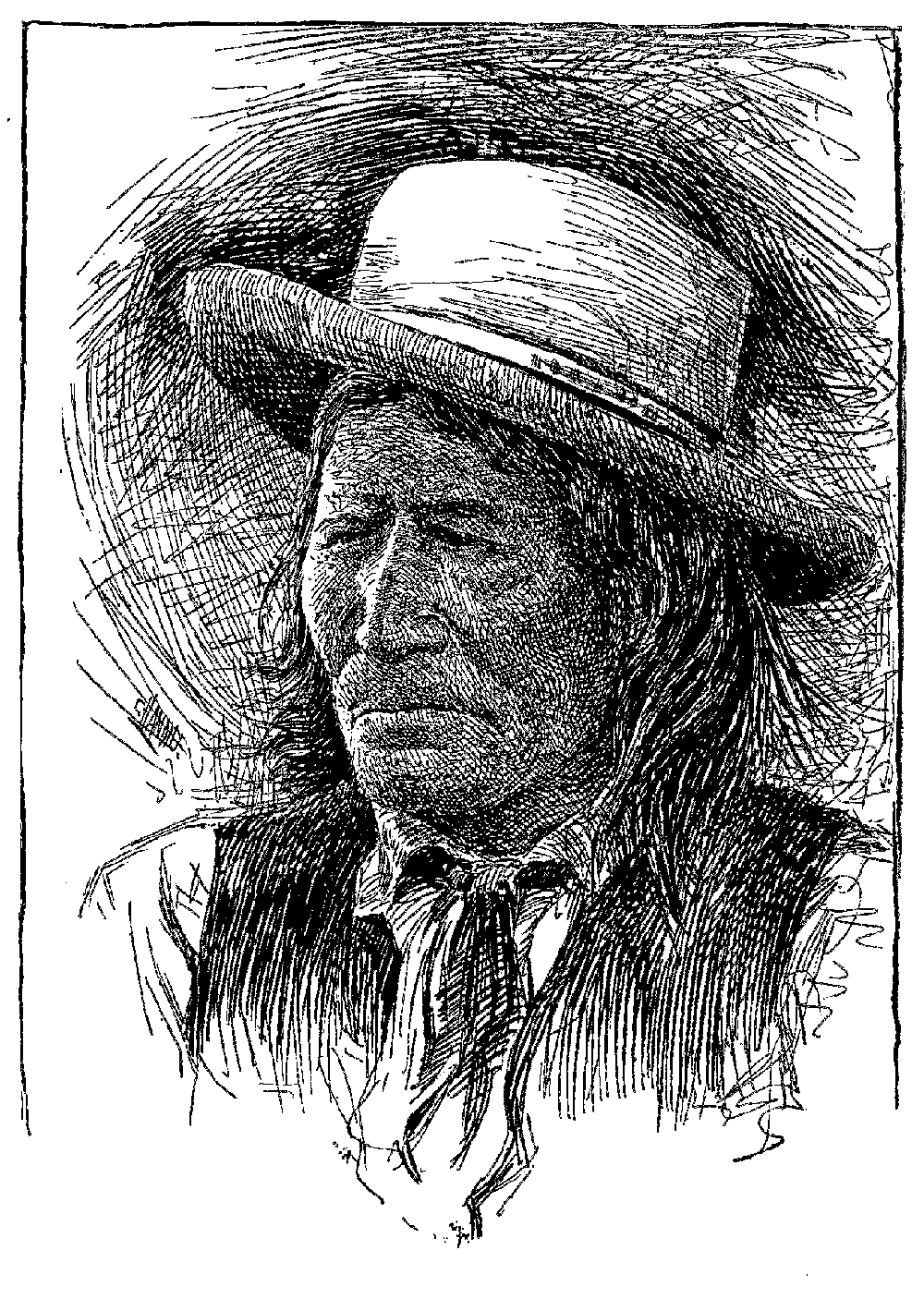
Fig. 60—Dävéko, "The-same-one," a Kiowa Apache subchief and medicine-man
From these references it is plain that the Kiowa Apache—and presumably also the Kiowa—ranged even at this early period in the same general region where they were known more than a hundred years later, namely, between the Platte and the frontiers of New Mexico, and that they already had herds of horses taken from the Spanish settlements. It appears also that they were then in friendship with the Pawnee. From the fact that they traded horses to the other tribes, and that La Salle proposed to supply himself from them or their neighbors, it is not impossible that they sometimes visited the French fort on Peoria lake. On a map in Harris' Collection of Voyages and Travels, published in 1705, we find the "Gataka" marked—probably on the authority of early French documents—on the west side of the Missouri, above the Quapaw (see the Kiowa Apache synonymy, page 245). In 1719 La Harpe found them ("Quataquois") living in connection with the Tawákoni and other affiliated tribes in a village which has been identified by Philip Walker, Esquire, of Washington, as situated on the south bank of the Cimarron, near its junction with the Arkansas, in what is now the Creek nation of Indian Territory (Margry, 2).
BUREAU OF AMERICAN ETHNOLOGY— SEVENTEENTH ANNUAL REPORT PL. LXXIV
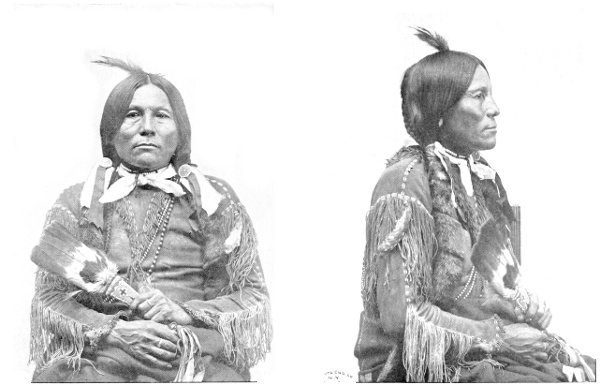
PHOTOS BY HILLERS, 1894.
GOÑKOÑ OR APACHE JOHN, A KIOWA APACHE SUBCHIEF.
FIRST OFFICIAL AMERICAN NOTICE
The official history of the Apache begins nearly a hundred years later. In 1805 the explorers Lewis and Clark describe the "Ca´takâ," whom they apparently did not meet, as living between the heads of the two forks of Cheyenne river, in the Black Hills region of northeastern Wyoming, and numbering twenty-five tipis, seventy-five warriors, and three hundred souls. This appears to be a singularly close estimate. The Kiowa lived near them, on the North Platte, and both tribes had the same alliances and general customs. They were rich in horses, which they sold to the Arikara and Mandan, but had no trader among them, and the mouth of Cheyenne river was suggested as a suitable place for the establishment of a trading post for them both (Lewis and Clark, 6).
TREATIES
In 1837, in connection with the Kiowa and Tawákoni, they made their first treaty with the government, as has already been described at length in treating of the Kiowa. They are called Kataka in the treaty, this being apparently the last official use of that name, and thenceforth they have been known as Apache. Their subsequent history is that of the Kiowa. In 1853 they are mentioned as a warlike band ranging the waters of Canadian river, in the same great plains occupied by the Comanche, with whom they often joined in raiding expeditions (Report, 67).
By the treaty of the Little Arkansas, in 1865, they were officially detached from the Kiowa and attached to the Cheyenne and Arapaho. This was done at the request of the Apache themselves, in consequence of the unfriendly attitude of the Kiowa toward the whites. But the arrangement had no practical force, and by the treaty of Medicine Lodge, in 1867, they were formally reunited to the Kiowa. This latter treaty was signed by six chiefs on behalf of the Apache, Gúañtekána, "Poor-bear," being then their principal chief (see the treaty, ante). A part of the Apache continued to live with the Cheyenne and Arapaho until after the readjustment at the close of the outbreak of 1874—75. In keeping with the general conduct of the tribe, they remained peaceable and friendly throughout the trouble (Report, 68).
DELEGATION TO WASHINGTON, 1872—FRIENDLY DISPOSITION
They participated with the Kiowa and others in the joint delegation which visited Washington in October, 1872, being represented on that occasion by Pacer the principal chief, Daho, and Gray-eagle. In his official report Captain Alvord, chairman of the commission which had charge of the delegation, says of the Apache:
The Apache who are in the Indian Territory number about five hundred, are recognized by the supplemental treaty of 1867 as confederated with the Kiowa and Comanche, and have generally been controlled by and acted with the Kiowa. More or less of them have constantly participated in the marauding of the others, but as a tribe or band it is believed that they are better disposed than their associates, and that the professions of friendship which are made by their three principal chiefs, now in Washington, are in good faith, and may be received accordingly. I think that if they can be removed from the evil influences of the Kiowa and Comanche, they will do well (Report, 69).
PROGRESS TOWARD CIVILIZATION—DEATH OF PACER, 1875
On the return of the delegation the Apache in good faith commenced to learn the ways of civilization and to earn their own living. Their agent reports:
The Apache were very attentive, working themselves with the hoe. Apache John, a chief, is especially deserving of mention. He worked hard, had all the weeds hoed out, and in addition, to his corn has a fine crop of watermelons, some of which he brought me as a present. It was a very nice sight to see one who a few months ago was regarded as a wild and dangerous man drive up in his wagon (I had given him one) and unload from it a number of fine melons of his own cultivation and raising (Report, 70).
The next year, 1874, started out with even more encouraging prospects. The Apache chiefs worked in their own fields as an example to their people, and at the request of Pacer a school was established among them by A. J. Standing, who, like Battey and Haworth, was a Quaker. All went well until summer, when the Cheyenne, Comanche, and a part of the Kiowa took up arms in defense of their hunting grounds, as already narrated, more or less involving the other tribes, and putting a complete stop to the work of civilization. By direction of the agent the Apache, at the beginning of the trouble, repaired to the friendly camp at Fort Sill, where during all the disturbance they maintained their loyalty and kept the peace, and afterward used their good offices to bring about the surrender of the hostiles, as they had done previously in 1869 (Report, 71).
Pacer, head chief of the Apache, died in the summer of 1875. He was a man of considerable ability and is frequently mentioned in the official reports of the period, as well as by Battey. He had been the consistent advocate of friendly relations with the whites, and on his death was given a civilized burial, at the request of his people, as had been done in the case of Kicking-bird, the Kiowa chief, who died shortly before (Report, 72).
RECENT HISTORY AND PRESENT CONDITION
The Apache participate with the Kiowa and Comanche in the benefits of the leases of grass lands. They suffered terribly in the epidemic of 1892, losing more than one-fourth of their number. They joined in the protest against the late unratified agreement and were represented in the joint delegation of 1894 by Goñkoñ, "Stays-in-tipi," or Apache John. In dress, customs, and general characteristics they resemble the Kiowa, but are much more agreeable and reliable in disposition. They join with them in the sun dance and the peyote rite, and have no distinct tribal ceremony of their own, although they have a "horse medicine" of considerable repute. In 1896 they numbered two hundred and eight, under the head chieftainship of White-man, and resided chiefly on Apache creek and in the vicinity of the Kichai hills.
POPULATION
Below is given the population of the Apache at different periods, all but the first estimate (Lewis and Clark, 6) being taken from the annual Indian reports. They have probably never numbered much over three hundred and fifty:
1805—Ca´takâ, 25 tipis, 75 warriors, 300 souls.
1850—50 lodges (=325 souls?).
1854—40 lodges (Fitzpatrick); 320 (Whitfield, Report of 1855).
1865—500 (Report), 40 lodges, with 4 or 5 to a lodge (Leavenworth, in Report on Condition of Indian Tribes, 37, 1867).
1867—800 (?), 70 tipis, 420 souls (estimate in report of Medicine Lodge treaty—Indian Miscel.).
1868—Same.
1869—300 (Report of 1870).
1870—Same.
1871—378.
1872—380a; 517b.
1873—774 (?).
1874—602 (?).
1875—344.
1876—325.
1877—343.
1878—344.
1879—315.
1880—334.
1881—337.
1882—340.
1883—337.
1884—308.
1885—319.
1886—332.
1887—Same.
1888—348.
1889—349; "a very careful census."
1890—326.
1891—325.
1892—241 (decrease from epidemic).
1893—224.
1894—Same, taken from preceding.
1895—226.
1896—208.
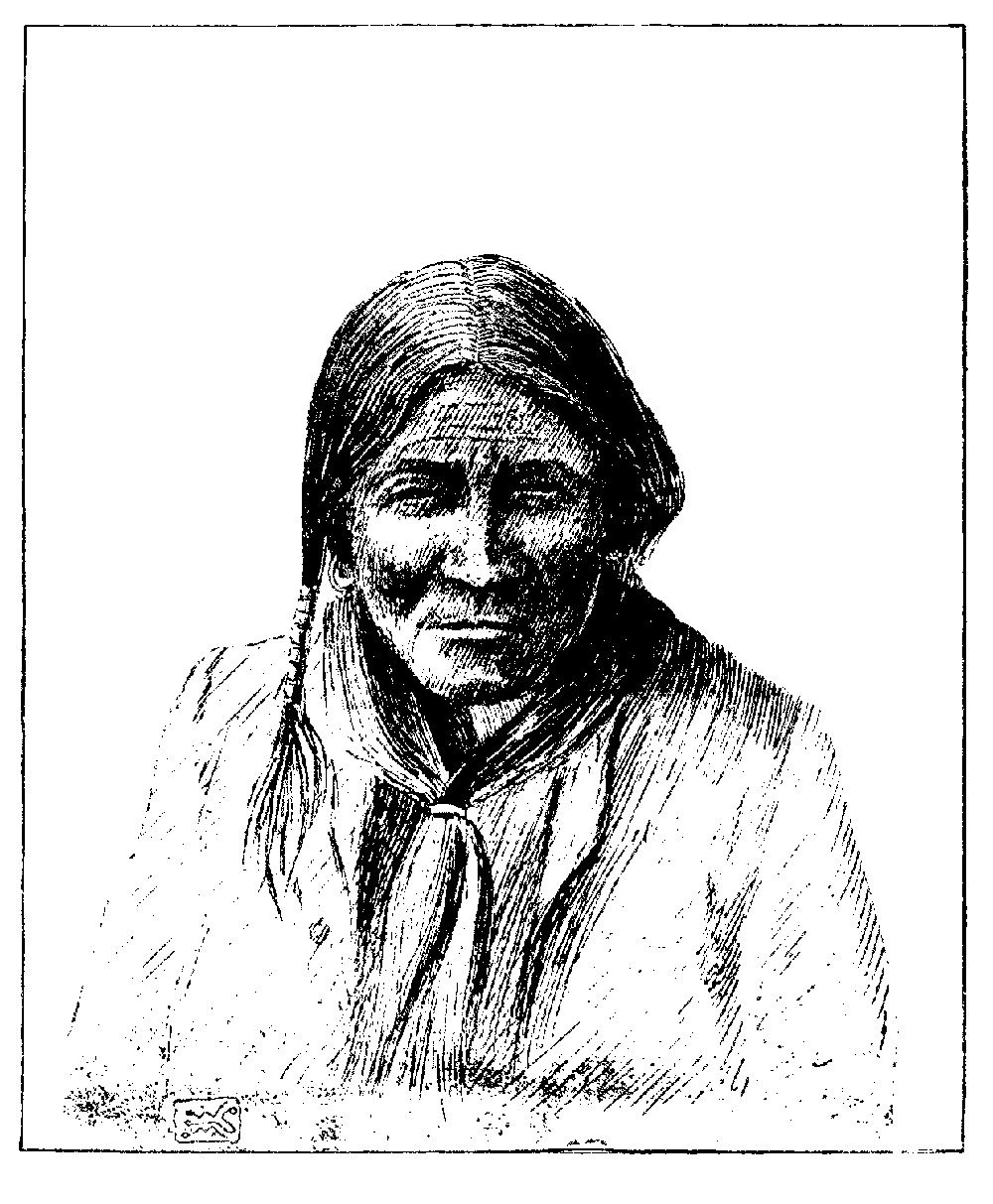
Fig. 61—Sét-t'án or Little-bear.
BUREAU OF AMERICAN ETHNOLOGY— SEVENTEENTH ANNUAL REPORT PL. LXXV
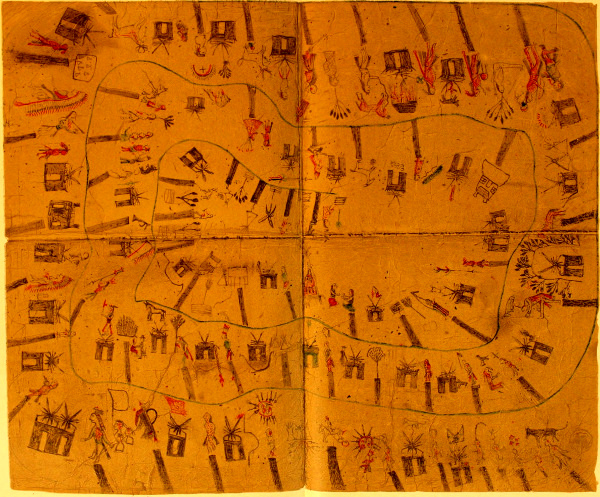
THE SET-T'AN ANNUAL CALENDAR, (FROM THE NATIVE DRAWING).