SKETCH OF THE KIOWA TRIBE
Reading edition
TRIBAL SYNONYMY
Be´shĭltcha—Na-isha Apache name.
Datŭmpa´ta—Hidatsa name, according to old T'ebodal. Perhaps another form of Witapähätu or Witapätu, q. v.
Gâ´-i-gwŭ—The proper name as used by the tribe, and also the name of one of the tribal divisions. The name may indicate a people having two halves or parts of the body or face painted in different colors (see the glossary). From this come all the various forms of Caygua and Kiowa.
Cahiaguas—Escudero, Noticias Nuevo Mexico, 87, 1849.
Cahiguas—Ibid., 83.
Caiawas—H. R. Rept., 44th Cong., 1st sess., I, 299, 1876.
Caigua—Spanish document of 1735, title in Rept. Columbian Hist. Exposition, Madrid, 323, 1895.
Caihuas—Document of 1828, in Soc. Geogr. Mex., 265, 1870. This form occurs also in Mayer, Mexico, II, 123, 1853.
Caiwas—American Pioneer, I, 257, 1842.
Cargua—Spanish document of 1732, title in Rept. Columbian Hist. Exp., Madrid, 323, 1895 (for Caigua).
Cayanwa—Lewis, Travels, 15, 1809 (for Cayauwa).
Caycuas—Barreiro, Ojeada Sobre Nuevo Mexico, app., 10, 1832.
Cayguas—Villaseñor, Teatro Americano, pt. 2, 413, 1748. This is the common Spanish form, written also Caygüa, and is nearly identical with the proper tribal name.
Cayugas—Bent, 1846, in California Mess. and Corresp., 193, 1850 (for Cayguas).
Ciawis—H. R. Rept., 44th Cong., 1st sess., I, 299, 1876.
Gahe´wă—Wichita name.
Gai´wa—Omaha and Ponka name, according to Francis La Flesche.
Kaiawas—Gallatin, in Trans. Am. Eth. Soc., II, 20, 1848.
Kaí-ó-wás—Whipple, Pacific Railroad Report, pt. I, 31, 1856.
Kaiowan—Hodge, MS. Pueblo notes, 1895, in Bur. Am. Eth. (Sandia name).
Kaiowe´—Powell fide Gatschet, Sixth Ann. Rept. Bur. Eth., XXXIV, 1888.
Kaî-wa—Comanche name, from the proper form Gâ´-i-gŭa. As the Comanche is the trade language of the southern plains, this form, with slight variations, has been adopted by most of the neighboring tribes and by the whites. The same word in the Comanche language also signifies "mouse." The form Kai-wa is that used by the Pueblo Indians of Cochiti, Isleta, San Felipe, and Santa Ana—Hodge, MS. Pueblo notes, 1895, in Bur. Am. Eth.
Kai-wane´—Hodge, MS. Pueblo notes, 1895, in Bur. Am. Eth. (Picuris name).
Kawas—Senate Ex. Doc. 72, 20th Cong., 104, 1829. Kawa—La Flesche, Omaha MS. in Bur. Am. Eth. (Omaha name).
Kayaguas—Bent, 1846, in House Doc. 76, 30th Cong., 1st sess., 11, 1848.
Kayaways—Pike, Expedition, app. III, 73, 1810.
Kayowa—Gatschet, Kaw MS., 1878, in Bur. Am. Eth. (K aw and Tonkawa name).
Ka´yowe´—Gatschet, in American Antiquarian, IV, 281, 1881.
Kayowû—Grayson, Creek MS. in Bur. Am. Eth., 1886 (Creek name).
Kayuguas—Bent, 1846, in Schoolcraft, Indian Tribes, I, 244, 1851.
Ka´yuwa—Dorsey, Kansas MS. Voc., 1882, in Bur. Am. Eth. (Kaw name).
Keawas—Porter, 1829, in Schoolcraft, Indian Tribes, III, 596, 1853.
Keaways—Farnham, Travels, 29, 1843.
Ki´-â-wâ—Lewis, Report, 1805, in Mess. from the President Communicating Discoveries by Lewis and Clark, etc, 37, 1806.
Kiaways—Gallatin, in Trans. American Ethn. Soc., II, cvii, 1848.
Kinawas—Gallatin, in Trans. American Antiq. Soc., II, 133, 1836 (misprint).
Kiniwas—Wilkes, U. S. Exploring Exped., IV, 473, 1845 (misprint).
Kiovas—Möllhausen, Journey to the Pacific, I, 158, 1858 (misprint).
Kiowas—Rept. Comm'r Ind. Affairs, 240, 1834. This is the American official and geographic form; pronounced Kai´-o-wa.
Kiowahs—Davis, El Gringo, 17, 1857.
Kioways—Brackenridge, Views of Louisiana, 80, 1814.
Kiwaa—Kendall, Santa Fé Ex., I, 198, 1844 (given as the pronunciation of Caygüa).
Kuyawas—Sage, Scenes in the Rocky Mountains, 167, 1846.
Kyaways—Pike (1807), Expedition, app. II, 16, 1810.
Riana—Kennedy, Texas, I, 189, 1841 (double misprint).
Ryawas—Morse, Rept. on Ind. Aff., app., 367, 1822 (misprint).
Ryuwas—Brackenridge, Views of Louisiana, 85, 1814 (misprint).
Ko´mpabi´ănta—"Large tipi flaps," a name sometimes used by the Kiowa to designate themselves.
Kompa´go—An abbreviated form of Ko´mpabi´anta.
Kwu´'dă´—"Coming out" or "going out;" the most ancient name by which the Kiowa designated themselves. See Te´pdă´.
Na'la´ni—"Many aliens," or "many enemies;" the collective Navaho name for the southern plains tribes, particularly the Comanche and Kiowa.
Nĭ´chihinĕ´na—"Rivermen," the Arapaho name, from nĭ´chia river and hinĕ´na (singular hinĕ´n) men. The Kiowa are said to have been so called from their long residence on the upper Arkansas.
Ni-ci´-he-nen-a—Hayden, Ethn. and Phil. Missouri Valley, 326, 1862.
Nitchihi—Gatschet in American Antiquarian, IV, 281, 1881.
Shi´sh-i-nu´-wut-tsi´t-a-ni-o—Hayden, Ethn. and Phil. Missouri Val., 290, 1862. Improperly given as the Cheyenne name for the Kiowa and rendered "rattlesnake people." The proper form is Shĭ´shĭnu´wut-tsĭtäni´u, "snake [not rattlesnake] people," and is the Cheyenne name for the Comanche, not the Kiowa, whom the Cheyenne call Witapä´tu. The mistake arose from the fact that the Comanche and Kiowa are confederated.
Te´pdă´—"Coming out," "going out," "issuing" (as water from a spring, or ants from a hole); an ancient name used by the Kiowa to designate themselves, but later than Kwu´`da, q. v. The two names, which have the same meaning, may refer to their mythic origin or to their coming into the plains region. The name Te´pdă´ may have been substituted for Kwu´`da´, in accordance with a custom of the tribe, on account of the death of some person bearing a name suggestive of the earlier form.
Tepk`i´ñägo—"People coming out," another form of Te´pdă´.
Wi´tapähä´tu—The Dakota name, which the Dakota commonly render as people of the "island butte," from wita, island, and pähä, locative pähäta, a butte. They are unable to assign any satisfactory reason for such a name. See Witapähät.
T'häpet'häpa´yit'he—Arbuthnut letter in Bur. Am. Eth. (given as the Cheyenne name for the Kiowa).
Vi´täpä´tu´i—Name used for the Kiowa by the Sutaya division of the Cheyenne.
Watakpahata—Mallery in Fourth Ann. Rep. Bur. Eth., 109, 1886.
Wate-pana-toes—Brackenridge, Views of Louisiana, 85, 1814 (misprint).
Watepaneto—Drake, Book of Indians, xii, 1848 (misprint).
Wetahato—Lewis, Travels, 15, 1809 (misprint).
Wetapahato—Lewis and Clark, Expedition, Allen ed., I, 34, map, 1814.
We-te-pâ-hâ´-to—Lewis, Report, 1805, in Mess. from the President Communicating Discoveries by Lewis and Clark, etc, 36, 1806. (Incorrectly given as distinct from the Kiowa, but allied to them.)
Wetopahata—Mallery, in Fourth Ann. Rep. Bur. Eth., 109, 1886.
Wettaphato—Morse, Report on Indian Affairs, app., 366, 1882.
Wi´tăpähät, Wităp´ätu—Cheyenne forms, derived from the Dakota form Witapähätu, or vice versa. The Dakota render the name "island butte." Attempts have been made to translate it from the Cheyenne language as people with "cheeks painted red" (wi´tapa, red paint; tu, cheek bone), but there is no evidence that this habit was specially characteristic of the Kiowa. It may possibly be derived from the ancient name Te´pdă´, q.v.
Wi´-ta-pa-ha—Riggs-Dorsey, Dakota-English Dictionary, 579, 1890.
TRIBAL SIGN
To make the sign for "Kiowa" in the sign language of the plains tribes, the right hand is held close to the right cheek, with back down, fingers touching and slightly curved, and the hand moved in a rotary motion from the wrist. According to the Kiowa this sign had its origin in an old custom of their warriors, who formerly cut the hair from the right side of the head, on a line with the base of the ear, in order better to display the ear pendants, while allowing it to grow to full length on the left side, so as to be braided and wrapped with otter skin after the common fashion of the southern plains tribes. This was in addition to the ordinary small scalplock hanging down behind. This style of wearing the hair, although now nearly obsolete from long association with tribes of different habit, is still occasionally seen. It is shown in the picture of the chief Big-bow, taken in 1870 (figure 43).
Dodge thus correctly explains the sign: "Kiowa—The open palm, held bowl-shaped, to right of and beside the face, is passed round and round in a circle. Supposed to indicate the peculiarity of these Indians in cutting the hair of the right side of the head" (Dodge, 2).
The sign has no connection with the idea of "rattle-brain," "crazy head," "crazy knife," "drinking water," or "prairie people rising up," as has been variously stated; neither is the sign ever properly made on the left side. Such misconceptions have arisen from the careless making of the sign by persons ignorant of its true meaning. The Cheyenne claim that it refers to a former Kiowa custom of painting a stripe across the upper lip and cheeks. This is probably only an attempt to explain the name Witapätu, q.v., without any basis in fact, for, had such a custom existed, it would have been indicated by drawing the finger across the face. Moreover, in a series of forty figures painted for the author by Kiowa Indians to illustrate their ancient styles of war paint, not one is thus depicted.
LINGUISTIC AFFINITY
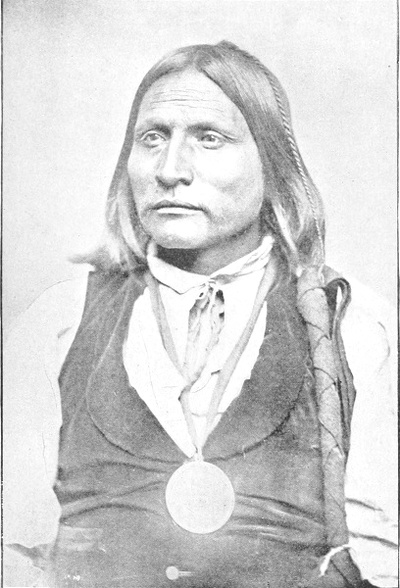
Photo by Soule, about 1870.
Fig. 43—Zépko-eétte or Big-bow.
The Gâ´igwŭ´ or Kiowa, although originating in the far north, have been known for the last sixty years as one of the principal and most predatory tribes of the southern plains. Their linguistic affinity is still uncertain, the language apparently having no connection with that of any other tribe. This uncertainty, however, is due largely to the paucity of the linguistic material thus far collected from them, and to the fact that philologists have made the comparison with the languages of the southern tribes, with whom the Kiowa were found most closely associated, rather than with that of tribes nearer the Canadian border, whence they have drifted to the south. Another thing which serves to render comparison difficult is the fact that the Kiowa have the custom of dropping from the language any word which suggests the name of a person recently deceased, and substituting for the tabooed word another which will convey the same idea. The old word may be restored after a term of years, but it frequently happens that the new one keeps its place and the original word is entirely forgotten. The change is a new combination of existing roots, or a new use of an existing word, rather than the deliberate invention of a new word, although in some instances words seem to be borrowed for this purpose from existing languages. The same custom exists to a limited degree among the Comanche, who may have adopted it in consequence of their association with the Kiowa, and perhaps among other tribes. With the Kiowa it is carried to such an extent that old men sometimes remember as many as three names which have been used in chronologic succession for the same object. Further linguistic investigation may result in establishing their affinity with the Athapascan, northern Shoshonean, or Salishan tribes.
TRIBAL NAMES
Kiowa, the name by which the tribe is commonly known to the whites, is from the softened Comanche form of the name by which they call themselves, Gâ´igwŭ´ (see the glossary). It is claimed by one or two old men that Gâ´igwŭ´ was not originally their proper name, but a foreign name adopted by the tribe, and untranslatable in their own language. However that may be, it is now, in its root form, Gâi, synonymous with Kiowa, whether applied to the individual, language, territory, or utensils of the tribe. It is also the name of one of their recognized tribal divisions. Ancient names used to designate themselves are Kwú'dă´ and afterward Tépdă´, both names signifying "coming out," perhaps in allusion to their mystic origin. These two names are known now only to their oldest men. They sometimes refer to themselves as Kómpabíăntă, or people of the "large tipi flaps," although, so far as observation goes, their tipis are not peculiar in this respect. Their name for Indians in general is Gíăguádaltágâ, "people of the red flesh." Among other tribes they are called by various names, the best known being the Dakota or Cheyenne form Witapähätu, of doubtful translation. The tribal sign, a quick motion of the hand past the right cheek, they explain as referring to a former custom of cutting the hair on that side on a level with the ear.
GENESIS AND MIGRATION
According to Kiowa mythology, which has close parallels among other tribes, their first ancestors emerged from a hollow cottonwood log at the bidding of a supernatural progenitor. They came out one at a time as he tapped upon the log until it came to the turn of a pregnant woman, who stuck fast in the hole and thus blocked the way for those behind her so that they were unable to follow, which accounts for the small number of the Kiowa tribe. The same being gave them the sun, made the division of day and night, exterminated a number of malevolent monsters, and rendered the most ferocious animals harmless; he also taught them their simple hunting arts and finally left them to take his place among the stars. Other wonderful things were done for them by a supernatural boy hero, whose father was the son of the Sun and whose mother was an earthly woman. This boy afterward transformed himself into two, and finally gave himself to the Kiowa in eucharistic form as a tribal "medicine," which they still retain. Unlike the neighboring Cheyenne and Arapaho, who yet remember that they once lived east of the Missouri and cultivated corn, the Kiowa have no tradition of ever having been an agricultural people or anything but a tribe of hunters.
Leaving the mythic or genesis period, the earliest historic tradition of the Kiowa locates them in or beyond the mountains at the extreme sources of the Yellowstone and the Missouri, in what is now western Montana. They describe it as a region of great cold and deep snows, and say that they had the Flatheads (´daltoñ-ká-igihä´go, "compressed head people") near them, and that on the other side of the mountains was a large stream flowing westward, evidently an upper branch of the Columbia. These mountains they still call Gá´i K'op, "Kiowa mountains." Here, they say, while on a hunting expedition on one occasion, a dispute occurred between two rival chiefs over the possession of the udder of a female antelope, a delicacy particularly prized by Indians. The dispute grew into an angry quarrel, with the result that the chief who failed to secure the coveted portion left the party and withdrew with his band toward the northwest, while the rest of the tribe moved to the southeast, crossed the Yellowstone (Tsósá P'a, "pipe (?) stone river"), and continued onward until they met the Crows (Gaă-k'íägo, "crow people"), with whom they had hitherto been unacquainted. By permission of the Crows they took up their residence east of that tribe, with which they made their first alliance. Up to this time they had no horses, but used only dogs and the travois. For a while they continued to visit the mountains, but finally drifted out into the plains, where they first procured horses and became acquainted with the Arapaho and Cheyenne, and later with the Dakota.
Keim, writing in 1870, says that the Kiowa "claim that their primitive country was in the far north," from which they were driven out by wars, moving by the aid of dogs and dog sledges. "From the north they reached a river, now the south fork of the Platte. Their residence upon this river is within the recollection of the old men of the tribe. Not satisfied with the Platte country, they moved on across the Republican and Smoky Hill rivers until they reached the Arkansas. Thence they moved upon the headwaters of the Cimarron. Here they permanently located their council fire, and after much fighting secured control of all the country south of Arkansas river and north of the Wichita mountains and headwaters of Red river" (Keim, 1).
There can be no doubt as to the correctness of the main points of this tradition, which is corroborated by the testimony of the northern Arapaho and other tribes of that region. While to the ordinary reader the result of the quarrel may seem out of all due proportion to the cause, it will not appear so to anyone familiar with Indian life and thought. The savage is intellectually a child, and from the point of view of civilized man his history is shaped by trivial things, as will be sufficiently apparent from a study of the calendars. It is said that a war between the Delaware and Shawano originated in a dispute between two children concerning a grasshopper. The Crows themselves, according to their own story, separated from their kinsmen the Hidatsa or Minitari on the Missouri for a reason precisely like that of the Kiowa tradition—a quarrel between two chiefs over the proper division of a buffalo (Matthews, 1; Clark, 2.) A similar story is related to account for the origin of one of the bands of the Dakota. Among wandering hunters disputes in regard to the possession or division of game have always been the most potent causes of separations and tribal wars.
In regard to the dissatisfied band that went to the north, the Kiowa have a fixed belief that their lost kindred, whom they call Azä´tañhop ("those who went away dissatisfied on account of the udder"), are still in existence beyond the mountains somewhere to the north or northwest of their old home, where they still speak the old Kiowa language. They assert as positively that they have no relatives in any other quarter, east, west, or south. Several stories are current in the tribe in support of this belief. One woman, now about 80 years of age, when a child was taken by her father with others on a visit to their old friends, the Crows, and says that while there they met a white trader from the north, who addressed them in the Kiowa tongue, which he said he learned from a tribe living farther north, which spoke the Kiowa language. Again, they say that when the Nez Percés (´dalkatóigo, "people with hair cut round across the forehead"), who had been brought down as prisoners to Indian Territory, visited them in 1883, they told the Kiowa that they knew a people who lived in the "white mountains" west of the old home of the Nez Percés in Idaho, and who spoke a language similar to Kiowa. Whatever weight we may attach to these stories, they at least offer a suggestion concerning the direction in which the linguistic affinity of the Kiowa is to be sought.
Bearing on the subject of the early habitat of the tribe, it may further be stated that, while making a collection among the Kiowa a few years ago, the author obtained from them a small cradle which is essentially different from any now in use among the Kiowa or any other of the well-known prairie tribes, in that the buckskin covering is attached directly to a solid board back, which is elaborately carved and painted in the style characteristic of the tribes of the Columbia and the northwest coast. On asking the old woman who made it, where she had obtained the idea, she replied that it was the kind the Kiowa used to make a very long time ago. On showing it afterward to Dr Washington Matthews, the distinguished ethnologist and anatomist, he expressed the opinion that such a cradle would produce a flattened skull. It is now in the National Museum at Washington.
EARLY ALLIANCE WITH THE CROWS
The leading facts in the traditional history of the Kiowa are those of their early residence at the extreme head of the Missouri and their subsequent removal to the east and alliance with the Crows. It is impossible to assign any definite date to this early migration from the mountain country, but it was probably about or before 1700. It was subsequent to the separation of the Crows from the Hidatsa, an event which probably took place before the end of the seventeenth century (Matthews, 2; Clark, 3), and it must have been long before the discovery of the Black Hills by the Dakota, which, according to a calendar of that people, occurred in 1775 (Mallery, 2). The present tai-me or sun-dance "medicine" of the Kiowa was obtained from the Crows while the two tribes were neighbors in the north, at a date probably very near 1765. It is probable that scarcity of game or severity of climate had much to do with their original removal from the head of the Missouri, but it is worthy of note that in all their wanderings the Kiowa have never, for any long period, entirely abandoned the mountains. After making friends with the Crows, they established themselves in the Black Hills until driven out by the invading Dakota and Cheyenne, and now for seventy years or more they have had their main headquarters in the Wichita mountains.
The northern Arapaho, now living on a reservation in Wyoming, have distinct recollection of this former northern residence of the Kiowa, with whom in the old times they were on terms of intimate friendship. While visiting them in 1892 they informed the author that when they first knew the Kiowa that tribe lived about the Three forks of the Missouri, near where are now Gallatin and Virginia City, Montana. This information, obtained from old men without the use of leading questions, and with the aid of good maps, tallies exactly with the earliest tradition of the Kiowa tribe. They say further that the Kiowa moved down from the mountains and eastward along the Yellowstone in company with the Crows, and then turned southeastward to about the present neighborhood of Fort Robinson, Nebraska, where they parted with the Crows and continued southward. "Plenty-poles," then nearly ninety years of age, first met the Kiowa when he was a small boy on the head of the North Platte, west of the present town of Cheyenne, Wyoming.
The friendship between the Kiowa and the Crows was close and intimate, in spite of occasional quarrels, and continued after the Kiowa had entirely removed from the north and established themselves on the Arkansas. They made common cause against the invading Dakota and Cheyenne from the east, by whom they were finally dispossessed. As already stated, the Kiowa obtained their present tai-me or sun-dance medicine from the Crows, and the sacred arrow lance of Tängúadal's family came originally from the same source. For a long time after removing from the north it was a frequent occurrence for Kiowa fathers to make visits to the Crows and leave with that tribe their young children for two or three years in order that they might learn the Crow language and thus help to preserve the old friendship. There are still several old people among the Kiowa who have a considerable Crow vocabulary acquired in this way. Conversely, the northern Arapaho state that the Crows refer to the Kiowa as their relatives, and that some of them speak a little of the language acquired during similar visits to the south.
THE ASSOCIATED KIOWA APACHE
Incorporated with the Kiowa, and forming a component part of their tribal circle, is a small tribe of Athapascan stock, commonly known as Apache or Kiowa Apache, but calling themselves Nadiisha Dena. They are not a detached band of the Apache tribe proper of Arizona, as has commonly been supposed, but came down with the Kiowa from the north, and neither tribe has any tradition of a time when they were not associated. They will be spoken of at length later on. This ancient Athapascan alliance is another link in the chain connecting the Kiowa with the far north.
THE HISTORICAL PERIOD
POSSESSION OF THE BLACK HILLS
We come now to more definite historic ground. Situated east of the Crows, the Kiowa took possession of the Black Hills (Sádalkáñi K`op, "stomach-rind, i. e., 'manifold,' mountains"), and having by this time procured some horses, began to make raids on the Spanish frontiers to the south, while they established a friendly trade and intercourse with the Arikara and Mandan on the Missouri. They are mentioned under the name of Cargua (for Caigua) in a Spanish document of 1732, and again as Caigua in 1735. In 1748 the Spanish historian Villaseñor mentions the "Cayguas," in connection with Comanche, Apache, Navaho, and Ute, as among the hostile tribes of New Mexico (see the synonymy). It will be remembered that the greater portion of what is now Colorado was included with New Mexico under Spanish domination. If, as seems possible, they are identical with the Manrhoat or Manrhout of La Salle, allies of the Gattacka (Kiowa Apache), our knowledge of the tribe would go back to 1682. They continued to occupy the Black Hills until about the close of the last century, when they were driven out by the Dakota advancing from the east, and by the Cheyenne who crossed the Missouri from the northeast. The same pressure drove their old allies, the Crows, farther westward.
The northern Cheyenne informed Grinnell that on first coming into their present country they had found the region between the Yellowstone and Cheyenne rivers, including the Black Hills, in possession of the Kiowa and Comanche (?), whom they drove out and forced to the south. When the author was among the Dakota some years ago, they informed him that they had first known the Kiowa in the Black Hills, and had driven them out from that region. This is admitted by the Kiowa, who continued at war with the Dakota and Cheyenne until about 1840, when a permanent peace was made. It does not appear that the Arapaho had anything to do with this expulsion of the Kiowa, with whom they seem generally to have been on friendly terms, although at a later period we find them at war with the Kiowa, being probably drawn into hostilities through their connection with the Cheyenne. As is well known to ethnologists, the Dakota are comparatively recent immigrants from east of the Missouri. They first reached the Black Hills in 1775, as already stated, so that the final expulsion of the Kiowa must have occurred between that date and 1805, when Lewis and Clark found the Cheyenne in possession of the same region, the Cheyenne being then at war with the Dakota. Curiously enough, there is no note of this war on any of the several Dakota calendars covering this period, described and illustrated by Mallery, although we find a reference to the killing of a Kiowa in the winter of 1814—15.
THE EXTINCT K'ÚATO
The Kiowa have a better memory, and one of their old hero stories relates to the slaughter of an entire band of Kiowa by the Dakota. The ill-fated band was called the K'úato, a name signifying "pulling up, or pulling out" from the ground or from a hole, being indicated in the sign language by the motion of "pulling up" with one or both hands. According to the story the Kiowa, apparently nearly the whole tribe together, were attacked by an overwhelming body of the Dakota. Finding resistance hopeless, they fled, but the chief of the K'úato urged his people not to run, "because if they did their relatives in the other world would not receive them." Inspired to desperate courage by his words, the K'úato faced the enemy and were all killed where they stood, excepting one woman who had fled with the others. According to Te'bodal, who was born about 1817 and is now the oldest man in the tribe, this massacre took place when his grandfather was a young man, perhaps about 1770. Te'bodal himself remembered having seen the single woman survivor. It is said that the K'úato spoke a peculiar dialect of the Kiowa language, although recognized as a part of the tribe, and were noted for doing foolish and ridiculous things, a statement borne out by the story of their extermination.
INTERCOURSE WITH THE ARIKARA, MANDAN, AND HIDATSA
Next to the Crows, the Kiowa have most to say of their friendship in these old days with the Arikara (Ree), Mandan, and Hidatsa or Minitari on Missouri river. For many years these three confederated tribes, now reduced to about 1,100 souls in all, have occupied jointly a single village on the northeastern bank of Missouri river, in the vicinity of old Fort Berthold, about opposite Knife river, in North Dakota. In 1805 the three tribes, with a small subtribe, now extinct, occupied eight villages, with a total population of nearly 6,000 souls. The Arikara were then considerably farther down the river, while the others were nearly in their present position. From the fact that Grand river, South Dakota, is known to the Dakota as Arikara river it is probable that the Arikara formerly had their residence there for a long period. In habits and home life the three tribes are almost identical, being sedentary agriculturists, living in substantial earth-covered log houses; but in language they are quite distinct. The Arikara or Ree are a branch, of the Pawnee and speak a dialect of that language; the Hidatsa, Grosventres, or Minitari were formerly a part of the Crows and speak a dialect of that language; while the language of the Mandan is distinct from either of the others, although remotely cognate with the Hidatsa. They are mentioned prominently by every traveler in that region during the last century, the best description of them being given by Matthews in his work on the Hidatsa.
The definite recollection which the Kiowa have of these tribes shows that they must have been very intimate with them in former times, especially with the Arikara, whom they call K'át'á, "biters," designating them in the sign language by a twisting motion of the closed right band, with thumb extended, in front of the month, the allusion being to gnawing corn from a cob. In the north the sign is sometimes made with both hands, the right working against the left, the allusion then being to shelling corn. The Arikara are preeminently distinguished among the northern tribes as the corn-planting Indians, and are usually designated in pictographs by the figure of a man with an ear of corn. It is probable that they taught agriculture to the Mandan and Hidatsa. The Kiowa further identify the K'át'á as being called Paläni by the Dakota and as speaking a language like that of the Pawnee. Stumbling-bear claims to have met and talked with some of them on a former visit to Washington. They have more to say of the Arikara than of the others, probably because then, as now, they were the largest of the three tribes, and also, as the Kiowa themselves say, because the Arikara lived nearest, being probably located then, as at a later period, on Ree or Grand river, in South Dakota, which is called by their name in the various Indian languages. They describe the three tribes as living on the Missouri (Tsosâ P'a) river, in earth-covered grass houses (really log houses, filled in between the logs with grass and covered with earth), and cultivating corn and tobacco, which they traded to the Kiowa. One of the principal divisions of the Kiowa tribe, and the one to which the great Dohásän and several other prominent chiefs belonged, is the K`at'a or Arikara band, so called, the Kiowa state, on account of their special intimacy with the Arikara in the old times, and not because of Arikara descent. The name of the band must have originated, of course, subsequently to the first acquaintance of the two tribes.
The Mandan they call Dóhón, "the last tipi," assigning as a reason for the name that they lived farthest toward the east. The Mandan, unlike the other tribes, did in fact have one of their villages on the farther (eastern) bank of the Missouri. They also sometimes call them Dowákohón, an older form of Dohon, and Sabă´, "stingy," perhaps from some trade dispute. In the sign language the Kiowa designate them by indicating tattoo marks, stating that the women, and sometimes the men, tattooed the arms, breast, and around the lips. This agrees exactly with Clark, who says that the proper sign for Mandan is intended to indicate tattooing on the chin and lower part of the face. He states also, on the authority of an old plainsman, that fifty years ago the Mandan women had a small spot tattooed on the forehead, together with a line on the chin, while of the men the chiefs alone were tattooed, this being done on one side, or one-half of the breast, or on one arm and breast (Clark, 4). It may be that the small tattooed circle on the foreheads of many Kiowa women is an imitation from their Mandan sisters. Matthews says that he has seen a few old men of the Hidatsa with parallel bands tattooed on the chest, throat, and arms, but not on any other part of the body, or on any young or middle-age persons in the tribe (Matthews, 3).
The Hidatsa or Minitari are known to the Kiowa as Henóñko, a name which they can not translate. In this word the terminal ko is the tribal suffix, while Henóñ is the root, possibly a derivative from Herantsa, another form of Hidatsa, the Kiowa having no r in their language. To designate them in the sign language, they make a gesture as if dipping up water with the hand, referring to their common name of Minitari, "water crossers," or "water people." This sign is probably now obsolete in the north, as it is not noted by either Clark or Mallery. They say that the Henoñko called the Kiowa Datûmpáta. The Kiowa describe the three tribes as about the same in regard to house-building methods and the cultivation of corn and Indian tobacco. They have also a distinct recollection of the peculiar "bull boats," tub-shaped and covered with rawhide, used by the Mandan and their allies. They ascribe these boats more particularly to the Mandan, from whom perhaps the Arikara obtained them after moving up to the same neighborhood.
RECOLLECTIONS OF OTHER NORTHERN TRIBES
The old men who have most knowledge of this northern residence and alliance with the Crows and Arikara say, after the Indian style of chronology, that it was in the time when their grandfathers were young men, and when they still had but few horses and commonly used dogs as pack animals in traveling. One of the mythic legends of the tribe accounts for the origin of the Black Hills (Sádalkañi K`op, "manifold mountains"), and another deals with the noted Bear Lodge or Devil's Tower (Tsó-aí, "tree rock," i. e., monument rock), near Sun Dance, Wyoming, which they claim is within their old country. Beyond the Yellowstone (Tsósâ P'a) they say lived the Blackfeet (Tóñkóñko, "blackleg people") and the Arapaho Gros Ventres (Botk`iägo, "belly people"). They knew also the Shoshoni (Sondóta, "grass houses"), who, they say, formerly lived in houses of interwoven rushes or grass; the Flatheads, the northern Arapaho, and of course the Dakota. It is somewhat remarkable that they knew also the small tribe of Sarsi, living on the Canadian side of the line at the source of the North Saskatchewan, whom they describe accurately as a tribe living with the Blackfeet and speaking a language resembling that of the Apache. They call them Pák`iägo, which they render "stupid people," indicating the tribe in the sign language by a sweeping motion of the right hand across the thigh, perhaps from a confusion with paki, thigh. It is possible that the name is not really of Kiowa origin, but is derived from Päki or Päkiani, the Shoshoni name for the Blackfeet themselves. The Kiowa call the Brulé Dakota Pakí-gudălkantă, "red-burnt thigh" people, with the same gesture sign as for the Sarsi. Several prominent men of the Kiowa tribe, among whom may be mentioned Gaápiatañ and Pá-tádal, are of Sarsi descent. The maternal grandmother of the noted chief Setäñgya, killed at Fort Sill in 1871, was a Sarsi woman who married a Kiowa man during an interchange of friendly visits between the two tribes. By reason of this Athapascan blood, those of Sarsi descent, including Gaápiatañ, who is Setäñgya's nephew, consider themselves in a measure related to the Kiowa Apache.
From the beginning the Kiowa say that they were usually on friendly terms with the Crows, Arapaho, Arikara, Mandan, and Hidatsa, and, so far as they can recollect, with the Shoshoni and Flatheads, the friendship being interrupted, however, by occasional quarrels more or less serious. They were frequently at war with the Cheyenne, and always, from their first acquaintance, with the Dakota, Pawnee, and Ute. Their relations with the southern tribes will be noted hereafter.
ACQUIREMENT OF HORSES
Although the Kiowa had no horses until they came down from the mountains and settled near the Crows, it is probable that they obtained some very soon afterward, probably from their friends the Crows. La Salle, in 1682, states that the Gattacka (Kiowa Apache) and Manrhoat (Kiowa?) had then plenty of horses, which he says they had probably stolen from New Mexico (Margry, 1).
The notice in Villaseñor would indicate that they were able to mount some of their warriors as early as 1748, as it is hardly probable that they would have been able to attract attention by their inroads so far south as the Spanish settlements if their warriors had been obliged to travel entirely on foot. With some tribes, however, notably the Pawnee, it was a frequent practice for the warriors to go out on foot, returning, if successful, mounted on the horses taken from their enemies. Horses must also have been taken by the Kiowa from the Comanche, who lived south of them in the territory adjoining the Spanish possessions, and with whom the Kiowa were then at war. In the beginning of the present century we find the Kiowa mentioned as possessing large herds of horses, which they traded with the Arikara and Mandan for European goods.
Horace Jones, interpreter at Fort Sill, states that at a council held at Fort Cobb in 1868, Ten-bears, an old Comanche chief, scorned the Kiowa for their constant raids into Mexico and Texas in spite of their promises to the government to cease such practices, saying to the assembled Kiowa, "When we first knew you, you had nothing but dogs and sleds. Now you have plenty of horses, and where did you get them if they were not stolen from Mexico?" This must be interpreted, however, from a point of comparison of the Comanche, who have long been noted for the number of their ponies. It was certainly a case of the pot calling the kettle black, as the principal business of both tribes for generations, until confined to a reservation, was that of raiding their southern neighbors in order to obtain horses and captives. It is unnecessary to dilate on the revolution made in the life of the Indian by the possession of the horse. Without it he was a half-starved skulker in the timber, creeping up on foot toward the unwary deer or building a brush corral with infinite labor to surround a herd of antelope, and seldom venturing more than a few days' journey from home. With the horse he was transformed into the daring buffalo hunter, able to procure in a single day enough food to supply his family for a year, leaving him free then to sweep the plains with his war parties along a range of a thousand miles.
INTERCOURSE AND WAR WITH THE COMANCHE
While the Kiowa still occupied the Black Hills their nearest neighbors toward the south were the Comanche, whose language and traditions show them to be a comparatively recent offshoot from the Shoshoni of Wyoming, and whose war parties formerly ranged from Platte river to central Mexico. In 1724 Bourgmont describes them, under the name of Padouca, as located between the headwaters of Platte and Kansas rivers. Like the other prairie tribes, they drifted steadily southward, and about the middle of last century were established chiefly about the upper Arkansas and its principal tributaries. Long before this time, however, the Pénätĕka division had separated from the main body and gone down into Texas. Pádouca, the name used by Bourgmont, is one form of the name by which the Comanche are known to the Osage, Dakota, and related tribes, and is probably derived from Pénätĕka.
As the Kiowa pressed southward before the advancing Dakota and Cheyenne, they encountered the Comanche, resulting in a warfare continuing many years, in the course of which the Comanche were gradually driven south of the Arkansas. The war was finally terminated and a lasting peace and alliance effected between the two tribes through the good offices of the Spaniards of New Mexico.
PEACE WITH THE COMANCHE
Now the Kiowa tradition becomes clear and detailed. According to the story which the old men had from their fathers, who were contemporary with the events, the Kiowa advanced along the base of the mountains and pushed the Comanche from the northern head streams of the Arkansas. When both sides were about worn out with fighting, it happened that a small party of Kiowa on a friendly visit to a Spanish settlement southwestward from that river—perhaps Las Vegas or possibly Santa Fé—stopped to rest at a house, which they particularly state was not a fort or trading post. The house was a large one with several rooms, and by a curious coincidence a party of Comanche had arrived shortly before and were then talking in the next room, all unaware of the near presence of their enemies. Hearing the voices and recognizing the language, the Kiowa at once prepared for battle, and another bloody encounter was about to be added to the long list, when their Mexican host, friendly to both sides, interposed and represented to the Kiowa that now was their opportunity to establish a lasting peace with their foes, offering his own services as mediator. After some debate the Kiowa accepted his proposition, and the kindly Mexican, going into the next room, informed the astonished Comanche that a party of their hated enemies was outside waiting to talk of peace. Being assured that no treachery was intended, they came out and the leaders of the two parties saluted each other. The Kiowa leader, whose name was Guik`áte, "Wolf-lying-down," and who was next in authority to the principal chief of the tribe, assuming to speak for his people, then expressed their desire for peace. To this the Comanche leader, Päréiyä, "Afraid-of-water" (Toñpeto in the Kiowa language), replied that as this was a matter of grave importance, it would have to be considered by the whole tribe, and invited the Kiowa to go back with them to the Comanche country in order that the business might there be fully discussed. The Kiowa hesitated, not yet being quite willing to trust themselves in the lion's den, when Guik`áte, anxious to spare further bloodshed, said, "I am a chief. I am not afraid to die. I will go." A Comanche captive among the Kiowa volunteered to go with him. Turning then to his followers, he said to them, "Go home and tell our tribe that I am gone to make peace with the Comanche. Return for me to this place when the leaves are yellow. If you do not find me here, know that I am dead and avenge my death." He then dismissed them, and the Kiowa started homeward, while he, with the captive and one or two Mexicans accompanied the Comanche to their camps on Gañta P'a, the Double-mountain fork of the Brazos, in Texas.
On arriving there with his escort, the Comanche were at first disposed to regard him as an enemy and made a show of preparing to revenge upon him the losses they had suffered at the hands of his people, but finding that he was a brave man not to be easily frightened, they changed their purpose and gave him a friendly welcome. He remained with them all summer, being well entertained by them on the hunt and at their social gatherings, and when at last the leaves began to turn, the tipis were taken down, and the whole band, having long ago decided on peace, moved off to meet the Kiowa at the appointed rendezvous. They had not long to wait, for Indians observe the season changes closely, before the whole warrior body of the Kiowa tribe appeared in sight, prepared either to make a treaty of perpetual friendship or to avenge the death of their chief, as the case might be. As they approached, the Comanche chief and Guik`áte rode out to meet them, somewhat to the surprise of the Kiowa, who had hardly hoped ever again to see their kinsman alive. He told the story of his kind treatment at the hands of the Comanche and their earnest desire for peace, and the result was a treaty of friendship and alliance which endures to this day, the two tribes, with the Kiowa-Apache, having ever since occupied a common territory and acted together on all important occasions, notwithstanding radical differences in language, ceremonies, and temperament. The former condition of hostility is clearly shown by the fact that the common name of the Kiowa for their present allies, the Comanche, is Gyái'ko, "Enemies."
This treaty with the Comanche must have been made toward the close of the last century, probably about 1790. As there is no tally date in Kiowa history until we come to "the year when the stars fell," i. e., 1833, a description of the manner in which we arrive at this conclusion may be of interest as a specimen of the ordinary methods of Indian chronology.
Among the oldest men of the tribe are T'ébodal, "One who carries a buffalo's lower leg, "Gaápiatañ, "Feathered lance," (commonly known as Heidsick, from his Comanche name of Haí-tsiki), and ´dalpepte, "Bushy-hair" (Frizzle-head), all being prominent men and noted warriors when in their prime. T'ébodal is the oldest man in the tribe, and as he was "a well grown boy when the stars fell," is consequently now just about 80 years of age, as the Indians consider a boy a young warrior at 17 or 18. Gaápiatañ is a few years younger, and ´dalpepte was "old enough, to ride a horse when the stars fell," so that we may assume him to be now (1896) about 70 years of age. It will be noted that, contrary to general opinion, Indians are not remarkably long-lived.
Graápiatañ's estimate seems to place the event farthest back in point of time. He fixes it by "a very old woman," who died eleven winters ago (1885), and whose father had told her that the treaty with the Comanche was made thirty-three years before she was born. Âdalpepte states that it was made "when his father was a young man." T'ébodal says that it was before he was born, but that his father knew both leaders who negotiated the peace, and that he himself knew the Comanche leader, Päréiyä, as a very old man, who was afterward killed by the Cheyenne at a time when T'ébodal was grown to manhood and had already been to war. According to the Kiowa calendar, the allied tribes made peace with the Cheyenne about 1840, so that the chief who negotiated the treaty for the Comanche must have been killed shortly before that time, the Kiowa leader, Guik`áte, being already dead. Balancing all the statements, we get 1790 as the most probable approximate date. The principal chief of the tribe at the time of the treaty was Políakyă, "Harelip," alias Kágiätsé, "Thick-blanket." He was succeeded by Tsóñbohón, "Feather-cap," who was succeeded by A'dáte, "Island-man," who was deposed in 1833 in favor of Dohásän, who thenceforth ruled the tribe until his death in 1866.
CONFEDERATION OF THE TWO TRIBES
The peace thus made between the two tribes has never been broken, in which fact there may be a sermon for those who regard the Indian as faithless, when we consider how few European alliances have endured as long. The Pénätĕka Comanche, who lived far down in Texas, were not included in this compact and had very little connection even with the northern bands of their own people until brought together under the reservation system. Immediately after the treaty the Kiowa began to move down and make their camps along and south of the Arkansas, which, until that time, had been considered the northern boundary of the Comanche country and the southern limit of the Kiowa range. In the territory which they thenceforth held in common the Kiowa usually made their home camps more to the northwest, about the Arkansas, while the Comanche kept near to the Staked plains and the Texas frontier. Strengthened by their alliance for war and defense, the confederated tribes were now able to make a successful stand behind the Arkansas against further invasion from the north. The raids of the Kiowa on the Mexican settlements, hitherto desultory and ineffective, now became constant and destructive and continued until both tribes were finally subjugated and confined to their reservation after the outbreak of 1874. In these raiding expeditions they frequently made headquarters in the Sierra Madre, whence they descended upon the lower country on each side. Old men are still living in the tribe who have raided as far south as the city of Durango (which they know by this name) and southwest through Sonora and Sinaloa to the Gulf of California. These war parties would sometimes be absent two years. To the west they reached the great Colorado river and tell of killing some Havasupai in their canyon home. In the east they made captives on Matagorda bay, Texas.
NEUTRAL ATTITUDE OF NEW MEXICANS
According to the Kiowa and Comanche, whose statements are confirmed by abundant testimony from other sources, the inhabitants of New Mexico, from mercenary motives, usually held themselves neutral in this war on their brethren to the south. New Mexican Comancheros and domesticated Pueblo Indians carried on a lucrative trade among these tribes at the same time that Kiowa or Comanche war parties were ravaging the southern provinces or selling horses and mules, taken in these raids, to the inhabitants of Las Vegas and neighboring towns. The lances and tomahawks used by their warriors were of Mexican manufacture, more slender and graceful in design than those supplied to the northern tribes by English and American traders. It was only by such tacit connivance or active aid from the people of New Mexico that these tribes were able to carry on an unceasing warfare of extermination as far south as Tamaulipas and Durango in Mexico.
RELATIONS WITH OTHER SOUTHERN TRIBES
Subsequent to the treaty with the Comanche, and as a consequence of it, the Kiowa made peace with the Mescalero Apache (Ĕ´sikwita), with whom they had formerly been at enmity, having driven them from the Staked plains into the mountains west of the Pecos. The friendship, however, was somewhat precarious. They were also on friendly terms with the Wichita and their associated tribes, the Waco, Tawákoni, and Kichai. With the Caddo and the cannibal Tonkawa to the east, and with the Navaho and Ute and presumably also the Jicarilla Apache on the west, they were always at war. They usually carried on a friendly trade with the neighboring Pueblos. Their relations with the Apache of Arizona were too casual to be of a definite nature. They were at war with the Osage until 1834. To all these tribes the confederated Kiowa, Comanche, and Apache held but one and the same relation after the alliance of about 1790.
FIRST OFFICIAL AMERICAN NOTICES, 1805—1807
The earliest official account of the Kiowa is given by the explorers Lewis and Clark, who ascended the Missouri in 1804 and wintered among the Mandan, before proceeding onward across the mountains and down to the mouth of the Columbia. They do not appear to have met any of the Kiowa, but heard of them from the tribes living on the river. By that time the Kiowa, whom the explorers erroneously supposed were distinct from the "Wetepahatoes," had been driven out of the Black Hills, which were then in possession of the Cheyenne, while the Dakota held the country to the eastward. The Kiowa were then on the Padouca or North Platte. This agrees with the statements of old men of the Dakota confederacy, who informed the writer that within their early recollection that tribe had lived between the North Platte and the Niobrara, having been expelled from the Black Hills by the Dakota of the preceding generation.
The official report of Captain Lewis describes the Kiowa ("Kiawas" and "Wetepahatoes") as living in 1805 on the North fork of the Platte, and numbering 70 tipis, 200 warriors, and 700 souls, while the Kiowa Apache ("Cataka") lived somewhat farther north, on the headwaters of the two forks of Cheyenne river, and are estimated at 25 tipis, 75 warriors, and 300 souls. While the figures thus given for the Apache are probably nearly correct, those for the Kiowa are much too low, unless we assume that they had been so greatly reduced by the war with the Dakota. The alliances and wars of the two tribes, Kiowa and Apache, were the same, they carrying on a defensive war with the Dakota and being at peace with all the other tribes of the region, particularly with the Arikara, Mandan, and Hidatsa. The account continues:
They are a wandering nation, inhabit an open country, and raise a great number of horses, which they barter to the Ricaras, Mandans, etc, for articles of European manufactory. They are a well-disposed people, and might be readily induced to visit the trading establishments on the Missouri. From the animals their country produces, their trade would no doubt become valuable. These people again barter a considerable proportion of the articles they obtain from the Menetares, Ahwahhaways, Mandans, and Ricaras to the Dotames and Castapanas.... Neither these people ("Kiawas"), the Wetepahatoes, nor the Chyennes have any idea of exclusive right to the soil (Lewis and Clark, 1).
The Dotames and Castapanas (for Castahanas) here mentioned are described as living back of the Kiowa, between the head streams of the North Platte and the Yellowstone, and were probably bands of the Shoshoni. From this it appears that besides being well supplied with horses, with which they carried on a profitable trade at this period with the tribes on the Missouri, the Kiowa also acted as the trading medium between these tribes and others living in the mountains beyond the Kiowa. The officer suggests the mouth of Cheyenne river as the most suitable place to establish a trading post for them. The Crows are described as having then the same wars and friendships as the Kiowa, excepting that they were at war with the Arikara as well as with the Dakota (Lewis and Clark, 2).
The Comanche are described at this period (1805) under the name of the "La Playes" division of "Aliatans" or "Snake Indians," as inhabiting the plains from the headwaters of the Arkansas, and including the sources of Red river, and extending from the mountains eastward indefinitely. They were a wandering people, claiming no particular boundaries, and, although possessing no guns, were brave and warlike. Their country abounded in wild horses, besides great numbers which they raised themselves (Lewis and Clark, 3).
In his volume published a few years later the explorer, Zebulon M. Pike, states that the Kiowa, estimated by him to number 1,000 men, had in 1803 been driven by the Dakota into the mountains on the heads of the Platte and Arkansas and north of the Comanche, where they were then wandering. They owned immense herds of horses, were armed with bows, arrows, and lances, hunted the buffalo, and were at war with the Dakota, Pawnee, and "Tetau" (here meaning the Ute). In another place he mentions both Ute and Kiowa as living in the mountains of northern Mexico—the present Colorado and New Mexico—the former being more civilized from contact with the Spaniards. He speaks also of meeting, in 1807, a party of Kiowa and Comanche returning from a trading expedition to the Mandan (Pike, 1).
EXPLANATION OF "ALIATAN" AND "TETAU"
As the names Aliatan and Tetau here quoted from Lewis and Clark, with their variants, have been the cause of much confusion in our western tribal nomenclature, some explanation will not be out of place. Although so unlike in appearance, these appellations are really but different forms of the same word. The Ute of the mountain, region at the headwaters of the Platte and the Arkansas, being a powerful and aggressive tribe, were well known to all the Indians of the plains, who usually called them by some form of their proper name, Yútawáts, or, in its root form, Yuta, whence we get Eutaw, Utah, and Ute. Among the Kiowa the name becomes Íătä(-go), while the Siouan tribes seem to have nasalized it so that the early French traders wrote it as Ayutan, Iatan, or Ietan. By prefixing the French article it became L'Iatan, and afterward Aliatan, while by misreading of the manuscript word we get Jatan, Jetan, and finally Tetau. Moreover, as the early traders and explorers knew but little of the mountain tribes, they frequently confounded those of the same generic stock, so that almost any of these forms may mean Shoshoni, Ute, or Comanche, according to the general context of the description.
UNSUCCESSFUL OVERTURES OF THE DAKOTA
As an incident of the war in progress during this period between the Kiowa and the Dakota, we find it recorded on a calendar of the latter tribe, under date of 1814—15, that a party of their people visited the Kiowa camp on Horse creek for the purpose of making peace, but their benevolent purpose was defeated by the occurrence of a sudden quarrel between one of their own men and a Kiowa, which ended by the Dakota sinking his tomahawk into the Kiowa's head, thus bringing the peace negotiations to an abrupt close (Mallery, 3). The story, which well illustrates the uncertainty of Indian temper, has a striking parallel in Grinnell's story of "The Peace with the Snakes" (Grinnell, Blackfoot, 1). The Kiowa camp was at the junction of Kiowa creek with Horse creek, which enters the North Platte from the south in Nebraska, just east of the Wyoming line.
SMALLPOX EPIDEMIC OF 1816
In 1816 the smallpox made terrible ravages among all the tribes in the region of the Red and Rio Grande, being probably communicated from the Spanish settlements. The Comanche especially lost heavily (Morse, 1). The Kiowa suffered in proportion, and their old men speak of this as the first epidemic of smallpox within the memory of their tribe. It is probable, however, that they had suffered in the same way some years before, for we know that in 1801 a Pawnee war party, returning from New Mexico, brought the smallpox home with them, with the result that it spread among the tribes from the Missouri to the coast of Texas. The prairie tribes are said to have lost more than half their population at this time, while the Wichita, Caddo, and others in the south suffered almost as severely (Morse, 2; Lewis and Clark, 4).
THE KIOWA IN 1820
In the account of his expedition up the Arkansas in 1820, Long speaks of the Kiowa as wandering with the Arapaho and others over the prairies of Arkansas and Red rivers, and having great numbers of horses, which they traded to the Cheyenne and other northern Indians, who were not able to rear them so easily in their colder and more barren country. He describes a great gathering of tribes in 1815 on the South Platte, apparently about the junction of Kiowa creek in Colorado, a region which he mentions as frequented by the Kiowa, when the Cheyenne came down with goods from the traders on the Missouri to meet and trade for horses with the Kiowa, Arapaho, and "Kaskaia or Bad Hearts," and a party of traders from St Louis (James, Long's Ex., 1). This appears to be the first notice of the Kiowa as living on Red river—which, however, may here mean the Canadian—and is evidence that they were at this time on friendly terms with the Arapaho and Cheyenne, with both of which tribes they were soon after at war. We learn also from this notice that the St Louis traders had already begun to come out to trade with them on the Arkansas, although none were regularly established in their territory until some years later. The "Kaskaias" are probably the Kiowa Apache, or possibly the Wichita.
THE OSAGE MASSACRE AND THE DRAGOON EXPEDITION—1833—34
We come now to the period covered by the Kiowa calendars, the first important event of which is the massacre of a large number of the tribe by a war party of Osage in the early spring of 1833. This led indirectly to the expedition of the First dragoons in 1834, by which the Kiowa, Comanche, Wichita, and associated tribes were first brought into official relations with the United States. The massacre and the expedition will be found treated at length in the proper place. When the troops returned to Fort Gibson, in the eastern part of Indian Territory, in August, they were accompanied by a party of one Waco, one Comanche, three Wichita, and fifteen Kiowa chiefs or headmen, of whom the artist Catlin says they were undoubtedly one of the most interesting groups that had ever visited the frontier. Invitations were sent out to the chiefs of all the neighboring tribes to come in to Fort Gibson and meet their visitors from the west. A number responded, and a council lasting several days was held under the auspices of Colonel Dodge of the Dragoons, Indian Agent Major Armstrong, and Indian Commissioner General Stokes, which paved the way for a friendly understanding between the eastern and western tribes, and for both with regard to the United States (Catlin, 1).
A year later, in August, 1835, as a result of the friendly relations thus established, the chiefs of the Comanche and Wichita met the United States commissioners at Camp Holmes, about 5 miles northeast of the present site of Purcell, Indian Territory, and made their first treaty with the government. The principal stipulation was that there should be peace and friendship between the Comanche and Wichita on the one hand, and the United States, Creek, Cherokee, and other immigrant tribes, and the Osage on the other (Treaties).
THE TREATY OF 1837
Owing to a delay in the negotiations, the Kiowa who had attended the meeting became impatient and returned home and consequently were not parties to this treaty, but two years later a full delegation of Kiowa, Apache, and Tawakoni went down to Fort Gibson, where the first treaty between the United States and these tribes was made on May 26, 1837, and was formally ratified the following year. In the document the three tribes are called "the Kioway, Ka-ta-ka, and Ta-wa-karo nations of Indians." The general terms of the treaty are the same as in that previously made with the Comanche and Wichita, namely, peace and friendship, with forgiveness of past injuries, and satisfactory settlement of future disputes that might arise between these western tribes and the Osage, Muscogee (Creek), and citizens of the United States. All the tribes concerned were to have equal hunting rights on the southern prairies as far west as the jurisdiction of the government extended, and citizens of the United States were to have free right of travel to and from Mexico and Texas through the Indian hunting grounds.
There was also a stipulation that if "any of the red people belonging to the nations or tribes of Indians residing south of the Missouri river and west of the states of Missouri and Arkansas, not parties to this treaty," should be found in the country of the Kiowa, they should be kindly treated by them. This was probably intended to refer only to the immigrant tribes removed from the east, as it was hardly to be expected that the Kiowa would act very hospitably toward any stray Dakota or Pawnee who might occasionally visit the Arkansas in search of Kiowa scalps or ponies. There was also a distinct understanding that it was the desire of the government that perfect peace should exist between the Kiowa and their allies and the republics of Mexico and Texas. The usual presents were then distributed and everybody was happy (Treaties).
The peace thus made with the Osage and Creeks was never broken, although in after years relations with the Osage were somewhat strained in consequence of their serving as scouts against the allied southern plains tribes. The promised friendship was also kept with regard to the citizens of the United States until after the annexation of Texas, which the Kiowa and Comanche never ceased to regard as a distinct and hostile government, making a clear distinction between "Americans," i. e., settlers and emigrants from the north or Kansas side, and "Texans," whom they regarded as a different nation and their enemies, in having driven them from their best hunting grounds in violation of treaties and without compensation.
The treaty commissioners on behalf of the government were General Montfort Stokes and A. P. Chouteau, the latter being a member of the noted pioneer trading company. Clermont and Roly McIntosh, head chiefs of the Osage and Creeks, signed, with others, for their respective tribes. Among the witnesses were a number of officers, stationed at Fort Gibson, including, among others, the commanding officer, Colonel Whistler, the noted Captain Bonneville, and Colonel R. L. Dodge, who had led the dragoon expedition. The treaty was signed by ten Kiowa chiefs and principal men, three Apache (whose Kiowa names only are given), and four Tawakoni. Below are given the names of the Kiowa and Apache, as the earliest on record from these tribes, excepting those given by Catlin, together with the proper forms and translations of those which can be identified.
Kiowa Ta-ka-ta-couche, "Black Bird" (Couche-kóñigya, "black"?). Cha-hon-de-ton, "Flying Squirrel." Ta-ne-congais, "Sea Gull" (?) (T'ené-kóñigyă, "Black Bird"). Bon-congais, "Black Cap" (Bohón-kóñigya, "Black Cap"). To-ho-sa, "Top of the Mountain" (Dohásän, "Little Bluff"). Sen-son-da-cat, "White Bird." Con-a-hen-ka, "Horned Frog" (Séhänk`ia, "Horned Toad Man"?). He-pan-ni-gais, "Night." Ka-him-hi, "Prairie Dog" (Tséñhi ? "Dog"). Pa-con-ta, "My Young Brother." Apache Hen-ton-te, "Iron Shoe" (Hâñ-doti, "Iron Shoe, or Moccasin"). A-ei-kenda, "One who is Surrendered." Cet-ma-ni-ta, "Walking Bear" (Set-mänte, "Bear Above? or Walking Bear"?).
At this time the Kiowa were located on the upper waters of Arkansas, Canadian, and Red rivers, in friendship with the Comanche and Wichita, who occupied much of the same territory, but usually ranged more to the east and south. They continued to occupy the same general region until confined to their present reservation. Their war parties extended their raids far beyond these limits, particularly toward the south.
CATLIN'S OBSERVATIONS IN 1834
Catlin, who saw them in 1834, describes them as a much finer race of men than either the Comanche or Wichita, being tall and erect, with an easy graceful gait, long hair reaching often nearly to the ground, with a fine Roman outline of head, of a type common among the northern tribes, but entirely distinct from that usually found in the south (Catlin, 2).
TRADERS AMONG THE KIOWA
From the statement of Lewis and Clark already noted, it appears that in 1805, while still located on the North Platte, the Kiowa had as yet no communication with traders, but obtained supplies indirectly through the tribes living farther east. From Pike's narrative, however, we learn that James Pursley, "the first American who ever penetrated the immense wilds of Louisiana," spent a trading season with the Kiowa and Comanche in 1802 or 1803, under engagement with a French trader operating from the Mandan country, and remained with them until the next spring, when the Dakota drove them from the plains into the mountains at the heads of the Platte and Arkansas (Pike, 2). From Long's statement, also previously quoted, we learn that in 1815, the Kiowa having drifted farther south in the meantime, traders from St Louis had begun to ascend Arkansas river to trade with the Kiowa, Cheyenne, and other tribes near its headwaters. From other sources it is apparent that before this time they had had dealings also with the Spaniards of New Mexico. The first regular American trading expedition to the Kiowa country was made in 1834 when, on the return of the visiting chiefs from Fort Gibson, a company of eighty trappers and traders went back with them to their homes on the upper Washita and Red rivers (Catlin, 3). In 1835, shortly after the treaty with the Comanche at Camp Holmes, Colonel Auguste Chouteau built on the same site a small stockade fort, where a considerable trade was carried on with the Comanche, Kiowa, Wichita, and associated tribes until his death three years later, when the place was abandoned (Gregg, 1). The exact location of Camp Holmes and Chouteau's fort was at a spring on a small creek, both still bearing the name of Chouteau, on the east or north side of South (main) Canadian river, about 5 miles northeast of where now is the town of Purcell, Indian Territory. It was a favorite Indian camping ground and was the site of a Kichai village about 1850.
Auguste Chouteau, the descendant of one of the early French founders of St Louis, was the pioneer organizer of the Indian trade in the upper Red river country, as were the Bents, also of French origin, on the upper Arkansas. Under the name of Soto, Chouteau is still held in affectionate remembrance by the Kiowa.
Chouteau's fort on the Canadian was considered to be in Comanche territory. Shortly after the treaty with the Kiowa in 1837, he established what they regard as the first trading post within their own country, on the west bank of Cache creek, about 3 miles below the present Fort Sill, Oklahoma. Tomé-te (Thomas?) is the name by which the Kiowa remember the trader in charge, who, however, did not remain long. Another store was established nearly on the same ground by William Madison (Sénpo-zédalbe, "Terrible-beard") in 1869, after the tribes had been assigned to a reservation. In 1844, William Bent began building trading posts on the South Canadian, in the Texas panhandle, near the principal Kiowa trails. They also traded extensively at various points on the Arkansas until their final removal to Indian Territory.
FIRST VISIT TO FORT GIBSON
With the treaty of 1837 and the building of the first trading post in their country, the modern history of the Kiowa may be said to have fairly begun. Their first introduction to American civilization was in 1834, when Dohásän and the other chiefs accompanied the troops back to Fort Gibson, and again in 1837 when they went to the same place for the purpose of making the treaty. Soon afterward arrangements were made by Colonel Chouteau to have a delegation of Kiowa, Comanche, and their associated tribes visit Washington and other eastern cities. A party of chiefs visited Fort Gibson for this purpose in the summer of 1839, but Colonel Chouteau having died during the previous winter, and the season being then far advanced, it was deemed best to abandon the trip, and accordingly they were given some presents and returned to their homes (Report, 1).
SMALLPOX EPIDEMIC OF 1839—40—PEACE WITH THE CHEYENNE AND ARAPAHO
In the winter of 1839—40 the Kiowa again suffered from the smallpox, which had broken out in the north in the summer of 1837, nearly exterminating the Mandan, and then swept the whole plains to the gulf. In 1840 they made peace with the Arapaho and Cheyenne, with whom they have ever since been on terms of intimate friendship (see the calendar). They had already made peace with the Dakota, so that they were now on good terms with all the tribes of the plains excepting the Pawnee and Tonkawa, who seem always to have been outlawed tribes, without friends or allies.
TEXAN SANTA FÉ EXPEDITION
In 1841 the Texan Santa Fé expedition passed through the country of the Kiowa. Kendall, the historian of that ill-fated undertaking, describes the tribe as occupying the prairies near the headwaters of Colorado, Brazos, Wichita, and Red rivers, and incorrectly supposes that their hunting grounds had never before been visited by white men. He says that they seemed to be a powerful people, hitherto but little known, owing to the fact that their range was south of the line of the Missouri traders and north of that portion of the Comanche country with which the Texans were acquainted. He speaks of their extraordinary horsemanship, and credits them with the feat, ascribed also to other plains tribes, of throwing themselves to one side of their horses while riding parallel with their enemies in such a way as to conceal and protect their bodies while discharging their arrows directly under their horses' necks. They had then but few guns, and these were ineffective in their hands, but were surprisingly expert in the use of shields, bows, and lances (Kendall, 1). The disastrous encounter of the Texans with the tribe is narrated in the proper place.
CHOLERA EPIDEMIC OF 1849
The next notable event in Kiowa history is the cholera epidemic of 1849. It was brought from the east by California emigrants, and ravaged all the tribes of the plains. The Kiowa remember it as the most terrible experience in their history, far exceeding in fatality the smallpox of nine years before. Hundreds died and many committed suicide in their despair (see the calendar).
FORT ATKINSON TREATY IN 1853
For years the Kiowa and their confederates had been carrying on a chronic warfare against Mexico and Texas, although generally friendly toward Americans on the north. For the protection of the advancing settlements and the traffic over the Santa Fé trail, now amounting to over $2,000,000 annually (Report, 2), it was deemed necessary to end this anomalous condition of affairs. Accordingly, on July 27, 1853, a treaty was negotiated by agent Thomas Fitzpatrick, at Fort Atkinson, on the Arkansas, in Kansas, with the Kiowa, Comanche, and Apache, by which these tribes agreed to remain at peace with both the United States and Mexico, and conceded the right of the government to establish roads and military posts within their territory. In return for these concessions, they were to receive an annuity of $18,000 for a term of ten years, subject to a further extension of five years (Treaties). It is somewhat remarkable that this treaty is not noted on the calendar, neither does it seem to form a subject of conversation among the older men.
DEPREDATIONS IN MEXICO—MEXICAN CAPTIVES
Although for obvious reasons the Indians were opposed to the establishment of roads and military posts in their country, the chief difficulty in the way of a treaty was their unwillingness to cease war on Mexico. The proposition to restore their Mexican captives met a prompt and decided refusal. As the Mexican captive element forms so large a proportion of the blood of these three tribes, the remarks of agent Fitzpatrick in this connection are of interest:
The chief difficulty which occurred in negotiating the present treaty was not, however, presented in the article embracing the foregoing points, but in that which contemplates a cessation of hostilities against the neighboring provinces of Mexico and the restoration of prisoners hereafter captured. For a long time these tribes have been in the habit of replenishing their caballadas of horses from the rich valleys and pasture lands which border upon the Rio Grande. Yearly incursions have been made by them far into the interior of Chihuahua and Durango, and they but seldom return without having acquired much plunder, as well as many captives, from the defenseless inhabitants of that country. The name of the Comanche and Apache has become a byword of terror even in the villages and beneath the city walls of those fertile provinces. The consequences of those expeditions are twofold, for while they serve to sharpen the appetite for pillage and rapine, they also tend to keep up the numbers of the tribe. The large herds driven off produce the former result, and the prisoners captured contribute to the latter. The males thus taken are most commonly adopted into the tribe, and soon become the most expert leaders of war parties and the most accomplished of marauders. The females are chosen as wives and share the duties and pleasures of the lodge. In fact, so intermingled amongst these tribes have the most of the Mexican captives become that it is somewhat difficult to distinguish them. They sit in council with them, hunt with them, go to war with them, and partake of their perils and profits, and but few have any desire to leave them. Upon this account the chiefs of the nations refused positively and distinctly to entertain any proposals or make any treaties having in view giving up those captives now dwelling amongst them. They stated very briefly that they had become a part of the tribe; that they were identified with them in all their modes of life; that they were the husbands of their daughters and the mothers of their children, and they would never consent to a separation, nor could any persuasion or inducement move them to abate this position. All that could be accomplished was to make a provision for the future (Report, 3).
Even this much, seems to have amounted to but little, for in the next year we find the same agent-reporting that "so far as I can learn, they have faithfully complied with the treaty stipulations, save one. It is a difficult matter to make them understand that New Mexico now belongs to the United States. They deny ever having consented not to war on Mexicans. They say that they have no other place to get their horses and mules from" (Report, 4).
DEFEAT OF ALLIED TRIBES BY SAUK AND FOX, 1854
In the summer of 1854 the Kiowa, Comanche, Apache, Cheyenne, and others of the plains tribes, organized a great expedition for the purpose of exterminating the immigrant tribes in eastern Kansas, whose presence was beginning to be felt in an ominous decrease of the buffalo. Although this was perhaps the largest war party ever raised by the plains Indians south of the Sioux country, being estimated to number 1,500 warriors, they were ingloriously defeated with heavy loss by a party of Sauk and Fox numbering hardly a hundred, the result being due to the fact that the latter were armed with long-range rifles, while their enemies had only bows and arrows. Almost every old man of the Kiowa now alive was in this battle, which is famous among all the tribes of the southern plains (see the calendar).
In the same year, according to Clark, a party of 113 Pawnee was cut off and slaughtered almost to a man by an overwhelming force of Cheyenne and Kiowa (Clark, 19). There is no record of this engagement on the calendars, although several minor encounters with the Pawnee are noted about this time.
HOSTILE DRIFT OF THE KIOWA
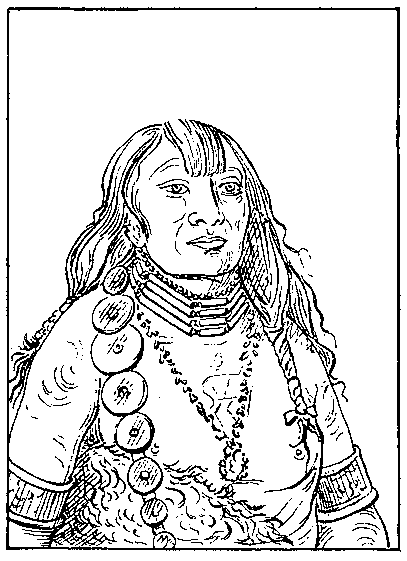
Fig. 44—Dohásän or Little-bluff, principal chief, 1833—1866 (after Catlin, 1834).
In the next few years we find little of importance recorded of the Kiowa beyond concurrent statements of both military and civil officials that they were growing constantly more insolent and unmanageable. In 1856 a war party of nearly one hundred arrived at Albuquerque, New Mexico, having passed through the center of the settlements of that territory, on their way to attack the Navaho. They were turned back by the military commander, committing several depredations as they retired (Report, 5). Two years later another large war party, together with some Cheyenne, passed Fort Garland, Colorado, almost on the great divide, in pursuit of the Ute (Report, 6).
DEFIANT SPEECH OF DOHÁSÄN
On one occasion, during the distribution of the annuity goods on the Arkansas, when fifteen hundred lodges of Cheyenne, Arapaho, Comanche, Kiowa, and Apache were encamped along the river, the agent took the opportunity to tell the Kiowa as plainly as possible that if they did not cease their depredations the government would not only withhold their presents but would send troops to punish them. The great chief Dohásän, after listening in respectful silence to the end, sprang to his feet, and, calling the attention of the agent to the hundreds of tipis in the valley below, replied in a characteristic speech:
The white chief is a fool. He is a coward. His heart is small—not larger than a pebble stone. His men are not strong—too few to contend against my warriors. They are women. There are three chiefs—the white chief, the Spanish chief, and myself. The Spanish chief and myself are men. We do bad toward each other sometimes, stealing horses and taking scalps, but we do not get mad and act the fool. The white chief is a child, and like a child gets mad quick. When my young men, to keep their women and children from starving, take from the white man passing through our country, killing and driving away our buffalo, a cup of sugar or coffee, the white chief is angry and threatens to send his soldiers. I have looked for them a long time, but they have not come. He is a coward. His heart is a woman's. I have spoken. Tell the great chief what I have said (Report, 7).
SMALLPOX EPIDEMIC OF 1861—62
In the winter of 1861—62 the smallpox, brought back from New Mexico by a party of Kiowa returning from a trading trip, again ravaged the Kiowa, Comanche, and other tribes of the plains (see the calendar). To prevent a recurrence of the disease, the government soon afterward took measures for vaccinating the western Indians. In the summer of 1863 a delegation of Kiowa visited Washington and gave permission for the establishment of mail stations along the roads through their country in southeastern Colorado (Report, 8).
INDIAN WAR ON THE PLAINS, 1864
The chronic raiding still continued. In 1860 the troops had been ordered to chastise the Kiowa and Comanche, but apparently with little effect. Then came the rebellion, involving all the civilized and partly civilized tribes of the south and reacting on the wild tribes of the plains. At the same time the fugitive hostiles from the Sioux war in Minnesota in 1862, who had taken refuge with their western brethren of the same tribe, helped to increase the ferment. There is evidence also that agents of the Confederacy had something to do with this result. In the fall of 1863 it was learned that a combination had been formed by the Dakota, Cheyenne, part of the Arapaho, the Kiowa, Comanche, and Apache—all the principal fighting tribes—to inaugurate a general war along the plains in the spring. To meet the emergency, messages were sent out to the different tribes in June, 1864, directing all friendly Indians to repair at once to certain designated military posts, with a warning that all found away from these posts after a certain date would be considered hostile. As it was difficult for troops to distinguish one tribe from another, an order was issued at the same time prohibiting the friendly Indians in eastern Kansas from going out on their usual buffalo hunt upon the plains.
Only a part of the Arapaho, and later some of the Cheyenne, responded and came in. After waiting a sufficient time, Governor Evans of Colorado issued a proclamation in the summer of 1864 designating all Indians remaining out as hostiles, whom all persons were authorized to kill and destroy as enemies of the country, wherever they might be found (Report, 9). In August the agent at Fort Lyon, Colorado, for the Kiowa, Comanche, Apache, Cheyenne, and Arapaho, wrote that "the orders are to kill every Indian found in the country, and I am inclined to assist in carrying the orders into effect" (Report, 10).
The official reports covering the summer of 1864 are full of notices of murders and depredations on the plains. The agent of the Overland Mail stated in August that as a consequence the company had been compelled to abandon all its stations for a distance of 400 miles, while every ranch within the same section had been deserted. He reported that the Indians "arrogantly declare that the land belongs exclusively to them; they intend to regain and hold it if they have to destroy every white man, woman, and child to accomplish their purpose. It would seem that the recent enormous emigration across the plains has alarmed many of the tribes and infused into their rude minds the belief that the whites were about to take possession of their country" (Report, 11). The great emigration referred to was in consequence of the rush to the gold mines of Pike's Peak, discovered in 1858.
VACCINATION AMONG THE PLAINS TRIBES—SET-T'AIÑTE
As usual, the Indians had deferred hostilities until the grass was high enough in the spring to enable their ponies to travel. In April a government physician, who had been sent among these tribes to vaccinate them as a protection from the smallpox which had recently decimated them, as already noted, found them all apparently friendly. From him we have an interesting description of the appearance and home life of the famous chief Set-t'aiñte. He writes from Fort Larned:
I have been two weeks among the Kiowas, about 40 miles up the Arkansas river. I was four days in Satana's [Set-t'aiñte] or White Bear's village, who is, I believe, their principal chief. He is a fine-looking Indian, very energetic, and as sharp as a brier. He and all his people treated, me with much friendship. I ate my meals regularly three times a day with him in his lodge. He puts on a good deal of style, spreads a carpet for his guests to sit on, and has painted fireboards 20 inches wide and 3 feet long, ornamented with bright brass tacks driven all around the edges, which they use for tables. He has a brass French horn, which he blew vigorously when the meals were ready. I slept with Yellow Buffalo, who was one of the chiefs that visited Washington with Major Colley. They have quite a number of cows and calves and a good many oxen and some mules and American horses that they say they stole from Texas. A body of Kiowas and Comanches and some Cheyennes intend to make another raid into Texas in about five or six weeks.
It will be remembered that Texas was at this time in armed rebellion against the general government, a fact which confirmed the Indians in their belief that Texans and Americans were two distinct and hostile nations. With correct prophecy the doctor surmises that a successful result in the contemplated raid will encourage them to try their hand farther north. By this time he had vaccinated nearly all the Indians of the upper Arkansas (Report, 12). Fort Larned, in western Kansas, was then the distributing point for the goods furnished by the government to the Kiowa, Comanche, and Apache.
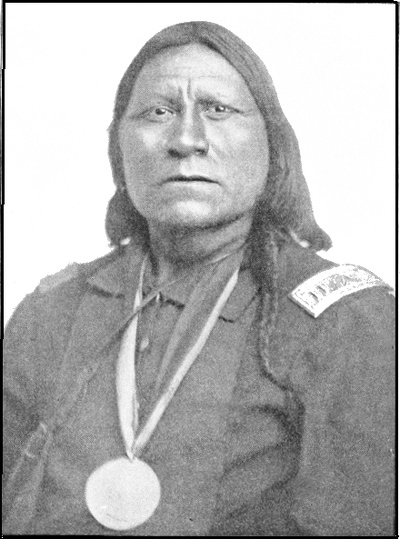
Photo by Soule, about 1870.
Fig. 45—Set-t'aiñte (Satanta) or White-bear.
THE LITTLE ARKANSAS TREATY IN 1865
In a few months the grass was up and a change came o'er the spirit of the dream. Hostilities had begun on the plains, and in order that the innocent might not be punished with the guilty, the friendly tribes along the eastern border had been forbidden to go out into the buffalo country. This deprivation of accustomed privileges naturally caused great dissatisfaction among the friendly Indians, who had come to depend on their annual buffalo hunt to eke out their scanty food supply, and they complained bitterly that the government had been feeding and clothing the hostiles, while they themselves had been left to starve. In a strong letter their agent writes that, while he has a desire to shield all Indians from wrong and severe treatment, yet "lead, and plenty of it, is what the Kiowas want and must have before they will behave." He denounces them as murderous thieves, and says that he has had personal experience of their insolence and outrages (Report, 13). The incidents of this war noted on the calendar are the encounter at Fort Larned, in which the Kiowa ran off the horses of the soldiers, and the attack on a Kiowa camp by a detachment of troops and Ute Indians under command of Kit Carson (see the calendar).
From the agent's report it appears that the Indians had begun hostilities in the summer simultaneously on the Platte and the Arkansas, and up to September had killed a number of people and run off several thousand head of horses, mules, and cattle. Communication between the Colorado settlements and the Missouri had been almost entirely cut off, the overland coaches had to be supplied with large escorts, and emigrant trains were compelled to combine for safety. It was thought that all the tribes of the plains were on the warpath together. The Indians were well mounted, knew the whole country perfectly, and so far, in every contest on anything like equal terms, had proven themselves a match for the white soldiers. As nearly the whole available force of the government was then employed in suppressing the rebellion, no additional troops could be sent to the frontier, and Governor Evans of Colorado asked and received permission to raise a force of volunteers against the hostiles. It was the opinion of many persons, including army officers stationed in the country, that the whole trouble might have been averted had the Indians been properly treated by the whites (Report, 14).
In spite of the serious condition of affairs it was evident that the chiefs did not want war. Early in September peace overtures were received from the Cheyenne and Arapaho, who soon after came in and camped as directed near Fort Lyon, Colorado. A month later the agent reported that the Kiowa and Comanche had committed no depredations for a long time and were supposed then to be south of the Arkansas, near the Texas border (Report, 15). Before the trouble began they had been encamped on the Arkansas, near Fort Larned. As the tribes had now expressed their desire for peace, a commission was sent out early in 1865 to meet them for that purpose. The commissioners met the Kiowa, Comanche, and Apache on August 15 at the mouth of the Little Arkansas, where now is the town of Wichita, Kansas, and received their promise to cease hostilities and to meet the same commission in October to make a regular treaty of peace. Three days later the Cheyenne and Arapaho entered into a similar agreement at the same place. The Kiowa chiefs signing the agreement were Dohásän as head chief, Gúi-pä´go ("Lone-wolf"), Sét-dayâ´-ite ("Many-bears"), Set-t'aiñte ("White-bear"), Te'né-angópte ("Kicking-bird"), and Set-ĭmkía ("Pushing-bear," commonly known as Stumbling-bear), with Sét-tádal ("Lean-bear") for the Apache, and eight of the Comanche. Credit for this result is due largely to the efforts of agent Leavenworth, who secured a suspension of military operations while he went out to bring in the Indians, a matter of peculiar difficulty in view of their fresh recollection of the massacre of friendly Cheyenne by Colonel Chivington in the autumn of the preceding year (Report, 16).
Pursuant to agreement, commissioners met the five tribes in October, 1865, at the mouth of the Little Arkansas, where treaties were made with the Cheyenne and Arapaho on the 14th, with the Apache on the 17th, and with the Kiowa and Comanche on the 18th. By the treaty with the Apache they were officially detached from the Kiowa and Comanche and attached to the Cheyenne and Arapaho, who agreed to relinquish their reservation in southeastern Colorado for one farther south, in Kansas and Indian Territory. The Kiowa and Comanche agreed to remove south of the Arkansas, the reservation proposed for their future home being a tract in western Texas and Oklahoma, as follows: Commencing on the Canadian river where the eastern line of New Mexico crosses the same; thence running south along said line to the southern boundary of New Mexico; thence in a northeastwardly direction to the headwaters of Big Wichita river; thence down said river to its mouth or its junction with Red river; thence due north to Canadian river; thence up the Canadian to the place of beginning. By this treaty, which was intended, to be only temporary, they gave up all claims in Colorado, Kansas, and New Mexico, and were restricted to southwestern Oklahoma and the region of the Staked plain in Texas. Five white captives were surrendered by the Kiowa and Comanche at the same time (Treaty).
DEATH OF DOHÁSÄN
In the course of the talk Dohásän, on behalf of his people, made a vigorous protest against being confined to a reservation, claiming that the Kiowa owned from Fort Laramie and the North Platte to Texas and had always owned it, and that he did not want his country cut up and divided with other tribes or given to the white man; his people wanted a large country to roam over; they did not want to stay long in one place, but wanted to move about; the Santa Fé road was open and would not be disturbed, but the rest of their country he wanted let alone. Notwithstanding this protest the treaty was signed. Among others officially present were Kit Carson, William Bent, and Agent Leavenworth, with William Shirley and Jesse Chisholm as interpreters (Report, 17). Dohásän died shortly afterward, early in 1866, and with his death began the rapid decline of the Kiowa tribe. He was succeeded by Gúi-pä´go, "Lone-wolf," adopted father of the present chief of the same name. But the Indian day was drawing to a close. Within a few years the Kiowa were practically prisoners on a reservation, and their chiefs were the creatures of petty factions and mere figureheads in the hands of the government.
KIOWA RAIDS CONTINUED
As a result of these peaceful efforts, there were but few reports of disturbances during the next year, excepting from the incorrigible Kiowa. Notwithstanding all their promises, Set-t'aiñte led a war party into Texas and returned with five captives, a woman and four children, whom he brought into Fort Larned for ransom. The agent sharply reminded him of his promise to cease such acts, and demanded the surrender of the prisoners without compensation, whereon, under pretense of consulting the other chiefs, Set-t'aiñte took them to Fort Dodge, where the commander, compassionating their condition, rescued them for a large sum. In reporting the circumstance, their agent urges that it is high time the Kiowa were made to feel the strong arm of the government as the only means of bringing them to a sense of their duty, as they even went so far as to boast that stealing white women was a more lucrative business than stealing horses (Report, 18).
Other complaints came in during the next year, but full investigation by the military authorities satisfied them that with the exception of this raid by Set-t'aiñte the Kiowa and Comanche were innocent (Report, 19). Accordingly measures were taken to arrange a meeting with these tribes to establish more definite treaty relations, as contemplated in the provisional treaty of 1865. Preliminary to this meeting Agent Labadi, with a small party, went from Santa Fé across to the Texas border, where he met a large portion of the confederated tribes and urged on them the necessity of keeping peace with the government, at the same time demanding the free surrender of all white captives of the United States held by them, concluding by telling them that all of their tribes hereafter found north of the Arkansas would be treated as hostiles. After a conference among themselves, the chiefs agreed to deliver up the captives and end all difficulties, and arranged for a full meeting later, when some absent chiefs should have returned. In regard to the raids into Texas, they distinctly stated that they had been told by the military officers of the government to do all the damage they could to Texas, because Texas was at war with the United States (referring to the recent rebellion), and that until now they were ignorant that peace had been established. Although it is pretty certain that some of them at least had already been told that the rebellion was at an end, yet there can be no doubt that the peculiar relations which from the very beginning had existed between Texas and the general government furnished them a plausible excuse for the depredations (Report, 20).