CALENDAR HISTORY OF THE KIOWA INDIANS BY JAMES MOONEY
Reading edition
Seventeenth Annual Report of the Bureau of American Ethnology to the Secretary of the Smithsonian Institution, 1895-96, Government Printing Office, Washington, 1898, pages 129—444
CONTENTS
Page
Introduction 141
Age of aboriginal American records 141
Aboriginal American calendars 141
The Walam Olum of the Delawares 142
The Dakota calendars 142
Other tribal records 142
The Kiowa calendars 143
The Annual calendars of Dohásän, Poläñ´yi-katón, Set-t'an, and Anko 143
The Anko monthly calendar 145
Comparative importance of events recorded 145
Method of fixing dates 146
Scope of the memoir 147
Acknowledgments 147
Sketch of the Kiowa tribe 148
Tribal synonymy 148
Tribal sign 150
Linguistic affinity 150
Tribal names 152
Genesis and migration 152
Early alliance with the Crows 155
The associated Kiowa Apache 156
The historical period 156
Possession of the Black Hills 156
The extinct K'úato 157
Intercourse with the Arikara, Mandan, and Hidatsa 158
Recollections of other northern tribes 160
Acquirement of horses 160
Intercourse and war with the Comanche 161
Peace with the Comanche 162
Confederation of the two tribes 164
Neutral attitude of New Mexicans 165
Relations_with_other_southern_tribes 165
First_official_American_notices_1805_1807 165
Explanation of "Aliatan" and "Tetau" 167
Unsuccessful overtures of the_Dakota 167
Smallpox epidemic of 1816 168
The Kiowa in 1820 168
The Osage massacre and the dragoon expedition, 1833—34 168
The treaty of 1837 169
Catlin's observations in 1834 171
Traders among the Kiowa 171
First visit to Fort Gibson 172
Smallpox epidemic of 1839—40—Peace with the Cheyenne and Arapaho 172
Texan Santa Fé expedition 172
Cholera epidemic of 1849 173
Fort Atkinson treaty in 1853 173
Depredations in Mexico—Mexican captives 173
Defeat of allied tribes by Sauk and Fox, 1854 174
Hostile drift of the Kiowa 175
Defiant speech of Dohásän 175
Smallpox epidemic of 1861—62 176
Indian war on the plains, 1864 176
Vaccination among the plains tribes—Set-t'aiñte 177
The little Arkansas treaty in 1865 178
Death of Dohásän 180
Kiowa raids continued 181
The treaty of Medicine Lodge, 1867, and its results 181
Renewed hostilities 186
Battle of the Washita—Removal to the reservation 187
Further insolence of the Kiowa—Raids into Texas 188
Intertribal peace council, 1872 190
Joint delegation to Washington, 1872 190
Thomas C. Battey, first teacher among the Kiowa, 1872 193
Report of Captain Alvord 193
Release of Set-t'aiñte and Big-tree, 1873 195
Haworth's administration, 1873—78 197
First school established by Battey 198
The outbreak of 1874—75 199
Causes of the dissension 199
The Comanche medicine-man 201
Apache and Arapaho friendliness 202
Further defiance 202
Battle of Adobe Walls 203
Friendlies collected at Fort Sill 203
Fight at Anadarko, the Wichita agency 204
Set-t'aiñte 206
Progress of the campaign 210
Surrender of the Cheyenne 212
Prisoners sent to Florida 213
The Germaine family 213
Surrender of the Comanche 214
Proposition to deport hostile tribes 214
Kicking-bird 216
Changed conditions 218
Epidemics of measles and fever in 1877—First houses built 218
Agency removed to Anadarko—The last of the buffalo 218
Threatened outbreak instigated by Dátekâñ 219
Epidemic of 1882—Beginning of church work 219
Leasing of grass lands 219
Pá-iñgya, the medicine man and prophet 220
Indian court established 220
Intertribal council of 1888 221
Death of Sun-boy—The last sun dance 221
Ghost dance inaugurated—Äpiatañ's journey in 1890 221
Enlistment of Indians as soldiers 223
Measles epidemic of 1892—Grass lands leased 223
Commission for allotment of lands—Protest against decision 224
Present condition—Agents in charge of confederate tribes 225
Summary of principal events 226
Sociology of the Kiowa 227
Absence of the clan system 227
Local divisions 227
Subtribes 227
The camp circle 228
Military organization—Yä`´pähe warriors 229
Heraldic system 230
Name system 231
Marriage 231
Tribal government 233
Character 233
Population 235
Religion of the Kiowa 237
Scope of their belief 237
The sun 237
Objects of religious veneration 238
Tribal medicines of other Indians 242
The sun dance 242
The Nadíisha-dena or Kiowa Apache 245
Tribal synonymy 245
Tribal sign 246
Origin and history 246
First official American notice 251
Treaties 251
Delegation to Washington, 1872—Friendly disposition 251
Progress toward civilization—Death of Pacer, 1875 252
Recent history and present condition 252
Population 253
The annual calendars, 1833—1892 254
1832—33. Money captured from American traders 254
1833. Massacre by the Osage and capture of the taíme—Pedestrian war parties—Beheading 257
1833—34. Meteoric display 260
1834. Dragoon expedition—First official intercourse—Trade established 261
1834—35. Bull-tail killed by Mexicans 269
1835. Cat-tail rush sun dance—Capture of Bóiñ-edal and Cynthia Parker 270
1835—36. Big-face or Wolf-hair killed in Mexico 270
1836. Wolf creek sun dance—Kiñep visit Crows—Battle with Cheyenne 271
1836—37. K`iñähíate killed in Mexico 271
1837. Cheyenne massacred on upper Red river 271
1837—38. Head-dragging winter 272
1838. Kiowa and allies defeat Cheyenne and Arapaho 273
1838—39. Battle with the Arapaho 273
1839. Peninsula sun dance 274
1839—40. Smallpox ravages the plains tribes 274
1840. Red-bluff sun dance—Peace with Cheyenne and Arapaho 275
1840—41. Hide-quiver war expedition—Expeditions against Mexico 276
1841. Pawnee massacred on the South Canadian 276
1841—42. Encounter with Texan Santa Fé expedition—´dalhabä´k`ia killed 277
1842. Repeated sun dance 279
1842—43. Crow-neck died 280
1843. Nest-building sun dance—Encounter with Texans 280
1843—44. Woman stabbed—Raid into Mexico—Trading post on South Canadian 280
1844. Dakota sun dance—Dakota visit Kiowa 281
1844—45. Great expedition against Mexico—Ä´tahá-ik`i killed 282
1845. Stone necklace sun dance 283
1845—46. Bent establishes trading post on South Canadian.—Allison's post on the Arkansas 283
1846. Págunhéñte initiated—The Ka´itséñk`ia 283
1846—47. Mustache-shooting winter—Fight with the Pawnee 285
1847. Fight with the Santa Fé traders; Red-sleeve killed 286
1847—48. Camp on upper South Canadian 287
1848. Kâ´itséñko initiated 287
1848—49. Antelope drive on the Arkansas; the ceremonies 287
1849. Cholera on the plains—Treaty negotiations postponed 289
1849—50. Fight with the Pawnee—The scalp dance 290
1850. Chinaberry sun dance on Beaver creek 292
1850—51. Tañgíapa killed in Mexico 292
1851. Dusty sun dance—Treachery of the Pawnee 293
1851—52. Woman elopes and is frozen—"Stealing" a woman 294
1852. Allied tribes defeated by Pawnee—Iron-shirt killed 294
1852—53. Race horse stolen by Pawnee boy 295
1853. Showery sun dance—Taíme sacrilege 295
1853—54. Raid into Mexico, Päñgyägíate killed 296
1854. Medicine-lodge creek sun dance—Confederated tribes defeated by Sauk and Fox 297
1854—55. Gyaí`koaóñte killed by the Älähó 299
1855. Sitting summer; horses worn out 300
1855—56. Big-head kills an Älähó—Raid into Mexico 300
1856. Prickly-pear sun dance 301
1856—57. Tipis seized by the Cheyenne 301
1857. Forked-stick-sprouting sun dance—Expeditions against El Paso and the Sauk—Story of the ä´poto 301
1857—58. Horses stolen by the Pawnee 305
1858. Timber-circle sun dance 305
1858—59. Gúi-k`áte killed by Mexicans—Expedition against the Ute 306
1859. Cedar-bluff sun dance 306
1859—60. Gíaká-ite abandoned to die 307
1860. Attacked by troops with Indian allies—Increasing hostility 308
1860—61. Crazy bluff winter—Revenge upon Caddo—Raid into Texas—The zótă´ or driveway 309
1861. Horse sacrificed at sun dance—Sacrilege against taíme—The lost war party 310
1861—62. Smallpox—Effect of gold discovery in Colorado 311
1862. Sun dance after the smallpox 311
1862—63. Expedition against Texas—The echo in the tree tops—The Gua-dagya or travel song 312
1863. Sun dance on No-arm's river 313
1863—64. Death of Big-head and Kills-with-a-gun—Anko calendar begins 313
1864. Ragweed sun dance—Kiowa stampede horses from Fort Larned; general war upon the plains 313
1864—65. Muddy travel winter—Kiowa repel Kit Carson 314
1865. Peninsula sun dance 317
1865—66. Death of Dohásän and Tä´nkóñkya—Smith's trading party 318
1866. German-silver sun dance—Whitacre the trader—Trade in silver with Mexicans 318
1866—67. Attack on Texas emigrants; Ä´pämâdalte killed—Andres Martinez captured 319
1867. Horses stolen by the Navaho—Kâitséñko initiated 319
1867—68. Medicine Lodge treaty—Expedition against the Navaho 320
1868. Sun dance on Medicine-lodge creek—Disastrous expedition against the Ute—The taíme captured 322
1868—69. Tän-gúădal killed; his medicine lance—Burial expedition 325
1869. War-bonnet sun dance—Expedition against the Ute 326
1869—70. Bugle stampede—The Cheyenne on the warpath 326
1870. Plant-growing sun dance 327
1870—71. Set-äñ´gya brings home his son's bones—Drunken fight—Negroes killed in Texas—Death of Ansó`te 328
1871. Koñpä´te killed—Arrest of Set-t'aiñte and other chiefs—Tragic death of Setäñgya—The Kâitséñko death song—Set-äñgya and Set-t'aiñte 328
1871—72 (1872—73). Peace with the Pawnee; removal to Indian Territory 333
1872. Bíako shot by whites in Kansas 335
1872—73. Visit of the Pueblos—Dohásän's tipi burned—Kiowa heraldic system 336
1873. Sun dance on Sweetwater creek—Guibadái's wife stolen 336
1873—74. Set-t'aiñte released—Lone-wolf's son killed 337
1874. Sun dance on North fork—Set-t´aiñte gives his medicine lance to Ä´`to-t'aiñ 338
1874—75. Fight at Anadarko—Gi-edal killed—Prisoners sent to Florida 339
1875. Sun dance at Love-making spring—Escorted by troops 339
1875—76. Sheep and goats issued to Indians—Stock losses by outbreak 339
1876. Sun dance on North fork—Sun-boy's horses stolen—Dóhéñ´te dies 340
1876—77. A`gábaí killed by her husband—Enlistment of scouts 340
1877. Sun dance on Salt fork of Red river—Ravages of measles 341
1877—78. Buffalo hunt—Fever epidemic—Houses built for chiefs 342
1878. Repeated sun dance—Buffalo hunt under soldier escort 343
1878—79. Hunting party attacked by Texans; Ä´`to-t'aiñ killed 343
1879. Horse-eating sun dance—Last of the buffalo—Boy shot 344
1879—80. "Eye-triumph winter"—Expedition against the Navaho—The talking owl 345
1880. No sun dance—Päbóte dies—Dead names tabooed 346
1880—81. Zoñtam's (?) house built—Last visit by the Pueblos 346
1881. Hot or hemorrhage sun dance—Instances of malformation 347
1881—82. The dó-á contest—The dó-á game—Dátekâñ's medicine tipi 347
1882. No sun dance because no buffalo—Stumbling-bear's daughter dies—Dátekâñ, the prophet 349
1882—83. Bót-édalte dies—Talk of grass leases 350
1883. Nez Percés visit Kiowa—The Nez Percé war—Taimete succeeds to the taíme 351
1883—84. House built by Gákiñăte—Children taken to Chilocco—Visited by Sioux 352
1884. No sun dance—Kiowa haul freight 352
1884—85. House building—Woman stolen 353
1885. Little Peninsula sun dance—First grass money 353
1885—86. T'ébodal's camp burned 354
1886. No sun dance—Anko a policeman—Grass payment 354
1886—87. Suicide of Peyi 354
1887. Buffalo bought for sun dance—Grass payment—Name changes 355
1887—88. Cattle received for grass leases 355
1888. Permission for sun dance refused—Excitement caused by the prophet Pá-iñgya 356
1888—89. Sun-boy dies—Anko splits rails 357
1889. No sun dance—Grass payment 358
1889—90. Grass payment—The Íâm dance 358
1890. Last attempt at sun dance; stopped by troops 358
1890—91. Ghost dance inaugurated; Ä´piatañ's mission—Schoolboys frozen 359
1891. P´ódaläñte killed—The Cheyenne visit the Kiowa 361
1891—92. P´ódaläñte killed—Enlistment of Indian soldiers 362
1892. Terrible ravages of measles—Large grass payment—Delegation to Washington—Appropriation for house building 362
Kiowa chronology 365
Terms employed 365
The seasons 366
Kiowa moons or months 367
Moons or months of other tribes 369
The Anko monthly calendar: August, 1889-July, 1892 373
T´águñótal P´a Sän (August, 1889); no event 373
T´águñótal P´a; no event 373
Gákiñăt´o P´a; woman whipped 373
Ä`gâ´nti; no event 373
Tépgañ P´a; wagon stalled 373
Gañhíña P´a (January? 1890); annuity issue 374
Ka`gúăt P´a Sän; mares foal 374
Ka`guăt P´a; split rails 374
Aideñ P´a; horses lost 374
Pai Ä`gâ´nti; visit Cheyenne 374
Pai Tépgañ P´a; visit Cheyenne again—first ghost dance 374
Pai Gañhíña P´a (July, 1890); sun dance stopped—grass payments 375
T´águñótal P´a Sän; no event 375
T´águñótal P´a; Äpiatañ goes to the messiah 375
Gákiñăt´o P´a; Sitting-bull comes 375
Ä`gâ´nti; no event 375
Tépgañ P´a; boys frozen 376
Gañhíña P´a (January? 1891); annuity issue 376
Ka`gúăt P´a Sän (February, 1891); Ä´piatañ returns 376
Ka`gúăt P´a; wire issue 376
Aídeñ P´a; no event 376
Pai Ägâ´nti (June, 1891); Caddo and Wichita agreement 376
Pai Tépgañ P´a (July, 1891); Fourth of July races 376
Pai Gañhíña P´a; Setk`opte's wife stolen 377
T´águñótal P´a Sän; the Pueblo dance 377
T´águñótal P´a; P´odalä´ñte killed 377
Gákiñat´o P´a; made medicine—cut wood 377
A`gâ´nti (November, 1892); lunar eclipse 377
Tépgañ P´a; no event 378
Gañhíña P´a (January? 1892); annuity issue 378
Ka`gúăt P´a Sän; wire issue 378
Ka`gúăt P´a: move camp—late frost 378
Aídeñ P´a (April, 1892); emigrant to Cheyenne country 378
Pai Ä`gâ´nti: Íatäkía dies—grass payment 378
Pai Tépgañ P´a; measles epidemic—grass payment 379
Pai Gañhíña P´a (July, 1892); Fourth of July races 379
T´águñótal P´a Sän (August, 1892); visit of Cheyenne and Arapaho 379
Military and trading posts, missions, etc 381
The Kiowa language 389
Characteristics 389
Kiowa-English glossary 391
English-Kiowa glossary 430
Authorities cited 440
ILLUSTRATIONS
Page
Plate LVII. Range of the Kiowa and neighboring tribes (map) 141
LVIII. Gui-pägo or Lone-wolf, principal chief, 1866—1874 189
LIX. Tseñ-t'aiñte or White-horse 190
LX. Gui-k`áte or Sleeping-wolf (Wolf-lying-down) and wife 192
LXI. Quanah Parker, principal chief of the Comanche 202
LXII. Inside of Set-t'aiñte's shield 208
LXIII. Outside of Set-t'aiñte's shield 210
LXIV. Set-ĭmkía or Stumbling-bear (Pushing-bear) 219
LXV. Paí-tälyí or Sun-boy 221
LXLXVI. Andres Martinez ("Än´dali") 236
LXVII. The Porcupine in the tree, and flight of the Sun-woman 238
LXVIII. Peyote plant and button 241
LXIX. The taíme 242
LXX. Arapaho sun-dance lodge, 1893 244
LXXI. Pacer (Peso), former head-chief of the Kiowa Apache 245
LXXII. Daha, a Kiowa Apache subchief 246
LXXIII. Kiowa migration route 249
LXXIV. Goñk`oñ or Apache John, a Kiowa Apache subchief 251
LXXV. The Sét-t'an annual calendar 254
LXXVI. Bóhon-kóñkya, "Quay-ham-kay," Gunpäñdâmä, and "Kotsatoah" (after Catlin) 268
LXXVII. Sand mosaic of the Hopi Antelope priests 296
LXXVIII. Lawrie Tatum, with group of rescued captives 331
LXXIX. The Do-gíägyä-guat or tipi of battle pictures 337
LXXX. The Anko calendar 373
LXXXI. Anko 374
Figure 43. Zépko-eétte or Big-bow 151
44. Dohásän or Little-bluff, principal chief, 1833—1866 175
45. Set-t'aiñte (Satanta) or White-bear 178
46. Set-ängya (Satank) or Sitting-bear 189
47. Tseñ-t'aiñte or White-horse 191
48. Ä´do-eétte or Big-tree 192
49. "Ka-ati-wertz-ama-na—A brave man, not afraid of any Indian" 195
50. T'ené-angópte or Kicking-bird 196
51. Gui-pägo or Lone-wolf, present head-chief of the Kiowa 200
52. Ä´piatañ or Wooden-lance 222
53. H. L. Scott, Captain, Seventh, cavalry, U. S. A. 224
54. A group of Kiowa 225
55. The Kiowa camp circle 229
56. Mäñyí-tén or Woman-heart, a typical Kiowa 232
57. Gaápiatáñ (alias Haitsĭki) or Feathered-lance, a typical Kiowa 234
58. Gray-eagle, a Kiowa Apache subchief 247
59. Tsáyădítl-ti or White-man, present head-chief of the Kiowa Apache 249
60. Dävéko, "The-same-one," a Kiowa Apache subchief and medicine-man 250
61. Sét-t'án or Little-bear 254
62. Winter 1832—33—Money captured 255
63. Summer 1833—They cut off their heads 258
64. Winter 1833—34—The stars fell 261
65. The star shower of 1833 (from the Dakota calendars) 261
66. Summer 1834—Return of Gunpä´ñdamä´ 261
67. Meeting of the dragoons and the Comanche (after Catlin) 264
68. Kĭ´tskûkătû´k, the Wichita village on North fork in 1834 267
69. Winter 1834—35—Bull-tail killed 269
70. Summer 1835—Cat-tail rush sun dance 269
71. Winter 1835—36—Big-face killed 270
72. Summer 1836—Wolf-river sun dance 271
73. Winter 1836—37—Ki´ñähíate killed 271
74. Summer 1837—Cheyenne massacred 271
75. Battle pictures (from the Dakota calendars) 272
76. Winter 1837—38—Head dragged 273
77. Summer 1838—Attacked by Cheyenne 273
78. Winter 1838—39—Battle with Arapaho 274
79. Summer 1839—Peninsula sun dance 274
80. Winter 1839—40—Smallpox 274
81. Smallpox (from the Dakota calendars) 275
82. Summer 1840—Red-bluff sun dance 275
83. Winter 1840—41—Hide-quiver war expedition 276
84. Summer 1841—Pawnee fight 276
85. Winter 1841—42—´dalhabä´k`ía killed 277
86. Summer 1842—Repeated sun dance 279
87. Winter 1842—43—Crow-neck died 280
88. Summer 1843—Nest-building sun dance 280
89. Winter 1843—44—Woman stabbed 281
90. Summer 1844—Dakota sun dance 281
91. Winter 1844—45—Ä´tahá-ik`í killed 282
92. Giving the war pipe (from the Dakota calendars) 282
93. Summer 1845—Stone-necklace sun dance 283
94. Winter 1845—46—Wrinkled-neck's trading post 283
95. Summer 1846—Hornless-bull initiated 284
96. Dog-soldier initiated (?) (from the Dakota calendars) 285
97. Winter 1846—47—Mustache shooting 286
98. Summer 1847—Red-sleeve killed 286
99. Winter 1847—48—Winter camp 287
100. Summer 1848—Initiation sun dance 287
101. Winter 1848—49—Antelope drive 287
102. Antelope drives (from the Dakota calendars) 288
103. Summer 1849—Cholera sun dance 289
104. Cholera (from the Dakota calendars) 290
105. Winter 1849—50—Dance over slain Pawnee 292
106. Summer 1850—Chinaberry sun dance 292
107. Winter 1850—51—Buck-deer killed 293
108. Summer 1851—Dusty sun dance; flag stolen 293
109. Winter 1851—52—Woman frozen 294
110. Summer 1852—Iron-shirt killed 294
111. Winter 1852—53—Gúădal-tséyu stolen 295
112. Summer 1853—Showery sun dance 295
113. Rain symbols (Chinese, Hopi, and Ojibwa) 296
114. Winter 1853—54—Pä´ñgyägíate killed 296
115. Summer 1854—Black-horse killed 297
116. Winter 1854—55—Gyai`koaóñte killed 299
117. Summer 1855—Sitting summer 300
118. Winter 1855—56—Big-head kills an Ä´lähó 300
119. Summer 1856—-Prickly-pear sun dance 301
120. Winter 1856—57—Tipis left 301
121. Summer 1857—Forked-stick-sprouting sun dance 302
122. Winter 1857—58—Horses stolen 305
123. Summer 1858—Timber-circle sun dance 306
124. Winter 1858—59—Gúi-k`ate killed 306
125. Summer 1859—Cedar-bluff sun dance 306
126. Winter 1859—60—Gíaká-ite died 307
127. Summer 1860—Bird-appearing killed 308
128. Winter 1860—61—Crazy-bluff winter 309
129. Summer 1861—Pinto left tied 310
130. Winter 1861—62—Smallpox 311
131. Summer 1862—Sun dance after smallpox 311
132. Winter 1862—63—Treetop winter 312
133. Summer 1863—No-arm's-river sun dance 313
134. Winter 1863—64—Big-head dies; Hâ´ñzephó`da dies 313
135. Summer 1864—Ragweed sun dance; soldier fight 314
136. Winter 1864—65—Ute fight 315
137. Summer 1865—Peninsula sun dance 317
138. Winter 1865—66—Tän-kóñkya died; Dohásän died 318
139. Summer 1866—German-silver sun dance 319
140. Winter 1866—67—Äpämâ´dalte killed 319
141. Summer 1867—Black-ear stolen; the Kâ´itséñko 320
142. Winter 1867—68—Medicine Lodge treaty; Navaho killed 320
143. Summer 1868—Ute fight 322
144. Winter 1868—69—Tängúadal killed 325
145. Summer 1869—War-bonnet sun dance 326
146. Winter 1869—70—Bugle scare 326
147. Summer 1870—Plant-growing sun dance; dusty sun dance 327
148. Winter 1870—71—Set-ängya's bones brought home; drunken fight; negroes killed 327
149. Summer 1871—Set-t'aiñte arrested; Kóñpäte killed 328
150. Set-taíñte in prison 330
151. Winter 1871—72 (1872—73)—Pawnee visit; camp on Long-tree creek 333
152. Summer 1872—Viejo shot 335
153. Winter 1872—73—Pueblo visit; battle tipi burned 336
154. Summer 1873—Pa-kóñkya's horses killed 337
155. Winter 1873—74—Set-t'aiñte returns; Lone-wolf's son killed 337
156. Summer 1874—The medicine lance; Bluff-end sun dance 338
157. Winter 1874—75—Gi-edal killed; Kiowa imprisoned 339
158. Summer 1875—Love-making spring sun dance 339
159. Winter 1875—76—Sheep and goats issued 339
160. Summer 1876—Horse-stealing sun dance 340
161. Winter 1876—77—A'gábaí killed; scouts enlisted 341
162. Summer 1877—Measles sun dance 341
163. Winter 1877—78—Camp at Signal mountain; hunt on Pecan creek 342
164. Summer 1878—Repeated sun dance 343
165. Winter 1878—79—Ä'to-t´áiñ killed 343
166. Summer 1879—Horse-eating sun dance; boy shot 344
167. Winter 1879—80—Eye-triumph winter 345
168. Summer 1880—No dance; Päbóte died 346
169. Winter 1880—81—House built; Pueblo visit 347
170. Summer 1881—Hemorrhage or hot sun dance 347
171. Winter 1831—82—Dó-á game; medicine tipi 348
172. Summer 1882—Buffalo medicine; Pä´tso`gáte died 349
173. Winter, 1882—83—Bot-édalte dies; grass leases; camp on Pecan creek 350
174. Summer 1883—Nez Percé sun dance 351
175. Winter 1883—84—House built; children taken; Sioux dances 352
176. Summer 1884—No sun dance; hauled freight 352
177. Winter 1884—85—Winter camp; Tón-ak`a's elopement 353
178. Summer 1885—Little Peninsula sun dance; grass payment 353
179. Winter 1885—86—Camp burned 354
180. Summer 1886—No sun dance; policemen; grass payment 354
181. Winter 1886—87—Peyi commits suicide 354
182. Summer 1887—No sun dance (?); grass payment 355
183. Winter 1887—88—Cattle payment 355
184. Summer 1888—Sun dance (?); Pá-iñgya's prophecy 356
185. Winter 1888—89—Winter camp; Sun-boy died; split rails 358
186. Summer 1889—No sun dance; grass payment 358
187. Winter 1889—90—Winter camp; grass payment; Íâm dance 358
188. Summer 1890—Unfinished sun dance 359
189. Winter 1890—91—Sitting-bull comes; Ä´piatañ; boys frozen 359
190. Summer 1891—P'ódalä´ñte killed; visit Cheyenne 361
191. Winter 1891—92—Soldiers enlisted; P'ódalä´ñte killed 362
192. Summer 1892—Measles; grass payment 362
193. T'águñótal P'a Sän 373
194. T'águñótal P'a 373
195. Gakíñat'o P'a—Woman-whipped 373
196. Ä`gâ´nti 373
197. Tépgañ P'a—Wagon stalled 373
198. Gañhíña P'a—Annuity issue 374
199. Ka`gúăt P'a Sän—Mares foal 374
200. Ka`gúăt P'a—Split rails 374
201. Aideñ P'a—Horses lost 374
202. Pai Ä`gâ´nti—Visit Cheyenne 374
203. Pai Tépgañ P'a—Ghost dance 374
204. Pai Gañhíña P'a—Sun dance stopped; grass payment 375
205. T'aguñótal P'a Sän 375
206. T'aguñótal P'a—Ä´piatañ 375
207. Gákiñăt´o P'a—Sitting-bull 375
208. Ä`gâ´nti 375
209. Tépgañ P'a—Schoolboys frozen 376
210. Gañhíña P'a—Annuity issue 376
211. Ka`gúăt P'a Sän—Ä´piatañ returns 376
212. Ka`gúăt P'a—Wire issue 376
213. Aideñ P'a 376
214. Pai Ä`gâ´nti—Treaty sale 376
215. Pai Tépgañ P'a—Races 377
216. Pai Gañhíña P'a—Woman stolen 377
217. T'aguñótal P'a Sän—Pueblo dance 377
218. T'aguñótal P'a—P'odalä´ñte killed 377
219. Gákíñat'o P'a—Made medicine; cut wood 377
220. Ä`gâ´nti—Lunar eclipse 378
221. Tépgañ P'a 378
222. Gañhíña P'a—Annuity issue 378
223. Ka`gúăt P'a Sän—Wire issue 378
224. Ka`gúăt P'a—Move camp 378
225. Áideñ P'a—Immigrants arrive 378
226. Pai Ä`gâ´nti—Íatäkía dies; grass payment 378
227. Pai Tépgañ P'a—Measles; grass payment 379
228. Pai Gañhíña P'a—Fourth of July races 379
229. T'águñótal P'a Sän—Cheyenne dance 379
BUREAU OF AMERICAN ETHNOLOGY—SEVENTEENTH ANNUAL REPORT PL. LVII
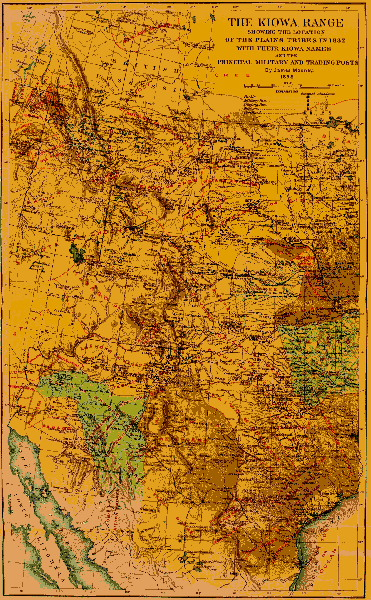
THE KIOWA RANGE SHOWING THE LOCATION OF THE PLAINS TRIBES IN 1832.
CALENDAR HISTORY OF THE KIOWA INDIANS By James Mooney