KIOWA CHRONOLOGY
Reading edition
TERMS EMPLOYED
Now—íñhogo (íñhoti=this).
Then (past)—óhyo (same as there).
Second, minute, hour—unknown.
Day (from sunrise to sunset)—kíădă, abbreviated kíă.
A day (of twenty-four hours, i. e., one day and one night)—pägo kiă´ (="one day").
Dawn—kíăt'ä´ (literally, "first light," t'ä; t'ä seems to be connected with t'aiñ, white; gyäpá-iñgya).
Sunrise—paí-báda, literally, "the sun has come up."
Morning—kíädä´, literally, fall day; cf. Day and Dawn; gyäpá-iñgya; very early in the morning—gíñaga (cf. Night); late morning, shortly before noon—kyähíñ kíäsá.
This morning—íñhoti gyäpá-iñgya.
Noon—kíäsá.
Afternoon (early, until about 3 oclock)—dekíäsa.
Afternoon (late)—déhíñ.
Evening—dám-kóñkya (literally, first darkness); dekómdóle (-gya, from an archaic root referring to slight darkness).
Night—gíñde; gíñăgya; one night, pägo gi.
Midnight—gíñ-kopá-iñgya; after midnight—gíñă-tógya (togya, after or past).
Tonight—íñhoti gi.
Today—íñhoti kiă.
Yesterday—kíädédal.
Tomorrow—kyähíñgă.
Day after tomorrow—añgádal kíăgyă kyähíñ (literally, a day—kíăgyă; beyond or more—añgádal; tomorrow—kyähíñ); abbreviated, añgádal kyähíñ.
Day before yesterday—tópde kíädédal, literally, before yesterday; day next before, understood.
Journey—estimated by "darks," koñ, i. e., nights, instead of by "sleeps." Thus, if one asks how far away is a certain distant place, he is told that it is pä´go koñ, yía koñ, one dark, two darks, etc., i. e., that to reach it he must be one night, two nights, etc., on the road. They understand now how to measure short distances by the mile, on, literally, "a measure."
Week—The Kiowa did not originally group the days into weeks, but have now learned to make such a period, counting by Sundays or by the biweekly ration issue. Thus Sunday is Dakíădă, literally, "medicine day," i. e., "sacred day." One week is pä´go Dakíădă; two weeks, yía Dakíădă, etc. Next week—ki-gía Dakíădă, literally, after Sunday; also, koñtä´kia, literally, middle of (issue) nights.
One issue—pä´go kóñakán, literally, one end or series (akán) of darks or nights. The regular ration issue is made every two weeks, on Friday, and as this is the great gathering time of the Indians, when they meet their friends and talk over matters of mutual interest, it has become a red-letter day and a starting point, like our Sunday.
Month or moon—p'a. The same word means river or stream, while pa, without the aspirate, signifies a buffalo bull.
Year—The years are counted hy winters; one year, pägo sai, literally, one winter or cold season, from saí-gia, or sai, winter; plural, säta.
Days of the week (modern)—Sunday, Dakíădă; Monday, Dakía kyähíñ; Tuesday, Wednesday, Thursday, Friday, have no names, but are counted as two, three, four, or five days after Sunday; Saturday, Dakía-sän literally, little Sunday.
Christmas (modern)—Píä-kíădă, "eating day," or "feast day."
Fourth of July (modern)—Tsolaí (i. e., July, which they take to be the name of the day); Tsä´nkia kíădă, "race day," because on that occasion races are held by the Indians at the agency and at Fort Sill.
THE SEASONS
The Kiowa distinguished only four seasons, unlike some of the agricultural tribes of the east, who distinguished five, separating the autumn season into early, when the leaves change color, and late, when the leaves fall, but assigning entirely different names to each. The Kiowa begin the year with the beginning of winter as fixed by the first snowfall. This seems to have been the case also with the Pawnee and perhaps with other prairie tribes. To an agricultural people the renewal of vegetation would seem a more natural starting point.
The first season is called Saígya or Säta, abbreviated Saí, which is considered to begin on the first fall of snow. In western Oklahoma this is generally about the first or middle of December, although on one occasion, about ten years ago, this occurred as early as October. Cold weather and frost may come, but it is not called Saígya until snow falls.
Next comes Áségya, spring. This is an archaic term which cannot be analyzed. It is sometimes called by the more modern name of Són-páta, "grass springing." It is considered to begin when the grass and buds sprout and the mares foal (about first of March), and is known to be near at hand when the breasts of the eagles begin to turn white and when the panther whelps are born. The old men say that one half of the month Ka`gúăt P'a Sän belongs to Saígya and the other half to Áségya.
The third season is Paígya or Paíta, abbreviated Pai, summer. The name seems to have a connection with the word for sun, pai. It begins after the grass has ceased sprouting (sónpáta) and is considered to continue until fires are needed in the tipis at night, i. e., from about June to September. During this season the fires are made outside the tipis, or, rather, outside the leafy arbors under which the people sit and sleep during the hot weather.
Next comes the fourth and last season, Paóngya or autumn. The term is archaic and seems to refer to the thickening of the fur (pa) of the buffalo and other animals as the cold weather approaches. It is sometimes called Aídeñ-gyägúădal-ómgyä-i, the time "when the leaves are red." The season is supposed to begin when the leaves change color and fires become comfortable in the tipis at night, that is, about the first of September.
In addition to these recognized divisions the summers or warm weather periods, as distinguished from the winters, were usually counted by k`ádós or sun dances, which were commonly held once a year, the time being fixed by the whitening of the down on the cottonwoods, about the beginning of June.
The following table is a good approximation of the manner in which the Kiowa divide the year, beginning about October 1:
SAÍGYA: WINTER
Gákiñăt'o P'a, last half.
Ä`gâ´nti.
Tépgañ P'a.
Gañhíña P'a.
Ka`gúăt P'a Sän, first half.
ÁSÉGYA: SPRING
Ka`gúăt P'a Sän, last half.
Ka`gúăt P'a.
Aideñ P'a.
Pai Ä`gâ´nti, first half.
PAÍGYA: SUMMER
Pai Ä`gâ´nti, last half.
Pai Tépgañ P'a.
Pai Gañhíña P'a.
T'águñótal P'a Sän.
T'águñótal P'a, first half.
PAÓNGYA: AUTUMN
T'águñótal P'a, last half.
Gákiñăt'o P'a, first half.
Autumn seems to be less definitely noted than the other seasons.
KIOWA MOONS OR MONTHS
While the Kiowa note the changes of the moon and have a fixed name for each moon or lunar month, it is not to be supposed that their system could have the exactness of the calendar systems of the more cultivated nations of the south, or perhaps even of the sedentary tribes of the east, whose interests so largely depended upon noting carefully the growth and ripening of crops, the appearance of the various species of fish in the streams, etc. Nevertheless, they have a system, imperfect though it be, and it can not be said of them, as Matthews says of some northern tribes, that "they have no formal names for the lunar periods." In this, as in other matters of tribal lore, they defer to the superior knowledge of certain old men who assume the position of experts on the subject.
The Kiowa recognize twelve or more moons or months, beginning the year, according to one authority, with the first cold weather, about the end of October, or according to other authority, with the first snowfall, about a month or more later. They have seven distinct moon or month names, and some of these are duplicated and distinguished as great, small, or of summer, to make the full number for the year. These moons of course do not coincide closely with our calendar months, and as the system is necessarily imperfect, there is a discrepancy of authorities, some recognizing twelve moons while a few count as many as fourteen or fifteen, the additional names being a further duplication of some of the others, as already explained; all authorities agree on the first eight as here given, and all but one agree on the ninth, after which there is a discrepancy. The author has made no arbitrary attempt to harmonize conflicting statements, as the result would be artificial and not aboriginal; and we must expect a certain amount of uncertainty and disagreement on such a complicated subject, among primitive people. Our own calendar system has been of slow growth, and more than one hundred million Europeans still refuse to accept it. The list here given is that obtained from Anko, the best calendar authority in the tribe, and is that generally accepted by the Kiowa. By means of tally dates from his picture calendar their periods can be pretty closely assigned, although, as will be noticed, even he varies a month in some instances in the course of three years. Some of the old men put another moon, Pai Ka`gúăt P'a Sän (see number 5), between Pai Gáñhíña P'a and T'águñ´ótal P'a Sän.
1. Gákiñăt'o P'a—"Ten-colds moon." It is so called because the first ten days of it are cold, a premonition of winter, after which it grows warm for a time; this moon is about equivalent to late September and early October. It is the first and last moon of the Kiowa year, the old year and the summer being considered to end with the full moon of this period, after which the winter and the new year begin; by the time this moon ends the leaves are off the trees; in talking with Anko on September 23 (1895) he said: "This is Gákiñăt'o P'a, but it is still summer. After the moon is full and again begins to wane, then winter has begun, and we are in the winter half of Gákiñat'o P'a." Snow sometimes comes in this moon.
6. Ka`gúăt P'a, "Bud moon." It is sometimes distinguished from the preceding by adding edal, "great;" the buds are all out and it is now full (áségya), spring; it is considered to include parts of February and March.
7. Aideñ P'a, "Leaf moon." The leaves are all out by the end of this moon, which approximately comprises late March and early April. Anko remarks that the moon names already given, with the two T'aguñótal P'a, are all old recognized names, but that this moon has no proper name. It is here also that the discrepancy begins on the other lists; a tally date on the Anko calendar gives April 19 as belonging to this moon.
8. Pai Ȧgâ´nti, "Summer Ägâ´nti" (see number 2). This moon is so named because, in Kiowa folklore, it says to its predecessor, "Just watch me; pretty soon I'll make it hot. Spring (áségya) ends and summer (paígya, pai) begins after this moon is full and begins to wane; it maybe considered approximately to include late April and early May, but a tally on the Anko calendar puts an event of June 14 within this period.
10. Pai Gañhíña P'a Sȧn, "Summer Gañhíña moon" (see numbers 4 and 9). This is also a summer moon, approximating June-July. Tallies from the Anko calendar put events of July 4 and July 20 within this moon, to which also he says belongs the time of school closing, about June 20.
11. Táguñótal P'a Sȧn, "Little-moon-of-deer-horns-dropping-off," because the deer now begin to shed their horns. This is another summer moon, equivalent to July-August, and was considered to begin after the annual sun dance. Tallies from the Anko calendar give to it an event of July 29, and in one instance the celebration of July 4.
12. Táguñótal P'a (Edal), "(Great-) Moon-of-deer-horns-dropping-off," because when it is at an end, all the deer have shed their antlers. This moon comprises August-September; summer ends and fall (páongya) begins in the middle of this moon. It is sometimes also called Aídeñgúak`o P'a, "Yellow-leaves Moon," because the leaves now begin to change color.
MOONS OR MONTHS OF OTHER TRIBES
Some extracts from standard authorities on other wild tribes may be of interest in connection with the moons or months of the Kiowa.
Hidatsa and Mandan—"Many writers represent that savage Indian tribes divide the year into twelve periods corresponding to our months, and that each month is named from some meteorological occurrence or phase of organic creation observable at the time. Among others, Maximilian presents us with a list of twelve months; 'the month of the seven cold days,' 'the pairing month,' 'the month of weak eyes,' etc.; he introduces this list in one of his chapters descriptive of the Mandans. He does not say it is their list of months, but publishes it without comment, and yet it is presented in such a manner as to lead the reader to suppose that it is the regular and original Mandan calendar. Other authors present lists of Indian months in much the same way. As the results of my own observations, I should say that the Mandan and Minnetaree are generally aware that there are more than twelve lunations in a year, that they as yet know nothing of our manner of dividing the year, and that although, when speaking of 'moons,' they often connect them with natural phenomena, they have no formal names for the lunar periods. I think the same might be said of other tribes who are equally wild.
"The Hidatsa recognize the lapse of time by days, lunar periods, and years; also by the regular recurrence of various natural phenomena, such as the first formation of ice in the fall, the breaking of the ice in the Missouri in the spring, the melting of the snowdrifts, the coming of the wild geese from the south, the ripening of various fruits, etc. A common way of noting time a few years ago was by the development of the buffalo calf in utero. A period thus marked by a natural occurrence, be it long or short, is called by them the kadu, season, time, of such an occurrence. Some long seasons include shorter seasons; thus they speak of the season of strawberries, the season of service-berries, etc., as occurring within the season of warm weather. They speak of the seasons of cold weather or of snow, of warm weather, and of death or decay, which we consider as agreeing with our seasons of winter, summer, and fall; but they do not regularly allot a certain number of moons to each of these seasons. Should you ask an interpreter who knew the European calendar what were the Indian names of the months, he would probably give you names of a dozen of these periods or natural seasons, as we might call them, corresponding in time to our months. In a few years, when these Indians shall know more of our system of noting time than they now do, they will devise and adopt regular Hidatsa names for the months of our calendar" (Matthews, 4).
Pawnee.—"They had no method of computing years by calendric notation. Occasionally a year that had been marked by some important event, as a failure of crops, unusual sickness, or a disastrous hunt, was referred to as a year by itself, but at a few years' remove even this mark became indistinct or faded altogether away. Any occurrence ten or twelve years past was usually designated as long ago. Their great use of the past was not as history, but simply as a storehouse of tradition, and this tendency soon enveloped the most important events with a semi-traditional glamour. When time was computed by years, it was done by winters. The year comprised alternately twelve and thirteen moons or months.... The intercalary month, ŭsarĕr´ăhu, was usually inserted at the close of the summer months. The regular months were grouped as with us by threes, the first three constituting winter (pi´c̀ĭkŭt), the second three spring (ora´rĕkaru), the next three summer (li´ŭt), the last three autumn (lĕtskukĭ). The year was also divided into two seasons (kŭt´ĭharu), a warm and a cold. As may be readily anticipated, there was much confusion in their system of reckoning by moons. They sometimes became inextricably involved and were obliged to have recourse to objects about them to rectify their computations. Councils have been known to be disturbed, or even broken up, in consequence of irreconcilable differences of opinion as to the correctness of their calculations."
"As an aid to the memory, they frequently made use of notches cut in a stick or some similar device for the computation of nights (for days were counted by nights) or even of months and years. Pictographically a day or daytime was represented by a six or eight pointed star, thus, *, as a symbol of the sun. A simple cross, thus X (a star), was a symbol of a night; and a crescent, thus ☾, represented a moon or lunar month" (Dunbar, 1).
Dakota, and Cheyenne.—"The Dakota count their years by winters (which is quite natural, as that season in their high levels and latitudes practically lasts more than six months), and say a man is so many snows old, or that so many snow seasons have passed since an occurrence. They have no division of time into weeks, and their months are absolutely lunar, only twelve, however, being designated, which receive their names upon the recurrence of some prominent physical phenomenon. For example, the period partly embraced by February is called the 'raccoon moon'; March, 'the sore eye moon;' and April, that in which the geese lay eggs. As the appearance of raccoons after hibernation, the causes inducing inflamed eyes, and oviposition by geese vary with the meteorological character of each year, and as the twelve lunations reckoned do not bring them back to the point in the season where counting commenced, there is often dispute in the Dakota tipis toward the end of winter as to the correct current date" (Mallery, 4).
"Some tribes have twelve named moons in the year, but many tribes have not more than six; and different bands of the same tribe, if occupying widely separated sections of the country, will have different names for the same moon. Knowing well the habits of animals, and having roamed over vast areas, they readily recognize any special moon that may be mentioned, even though their name for it may be different. One of the nomenclatures used by the Teton-Sioux and Cheyenne beginning with the moon just before winter is as follows:
1. The moon the leaves fall off.
2. The moon the buffalo cow's fœtus is getting large.
3. The moon the wolves run together.
4. The moon the skin of the fœtus of buffalo commences to color.
5. The moon the hair gets thick on buffalo fœtus; called also "men's mouth" or "hard mouth."
6. The sore-eyed moon; buffalo cows drop their calves.
7. The moon the ducks come.
8. The moon the grass commences to get green and some roots are fit to be eaten.
9. The moon the corn is planted.
10. The moon the buffalo bulls are fat.
11. The moon the buffalo cows are in season.
12. The moon that the plums get red" (Clark, 16).
Klamath and Modok.—Their months "do not coincide with the months of our calendar, for they extend from one new moon to the next one, and therefore should be more properly called moons or lunations. Twelve and a half of them make up the year, and they are counted on the fingers of both hands. The first moon of their year begins on the first new moon after their return from the wokash harvest [about the end of August], at Klamath Marsh, which is the time when all the provisions and needful articles have been gathered in for the winter. They have now generally discarded the former method of counting moons upon fingers, and instead of it they reckon time by the seasons in which natural products are harvested (Gatschet, 1).
Bannock.—They distinguish the earlier moons thus: First, "running season for game;" second, "big moon;" third, "black smoke" (cold); fourth, "bare spots along the trail" (i. e., no snow in places); fifth, "little grass, or grass first comes up." They have no names for moons after the season gets warm (Clark, 17).
BUREAU OF AMERICAN ETHNOLOGY— SEVENTEENTH ANNUAL REPORT PL. LXXX
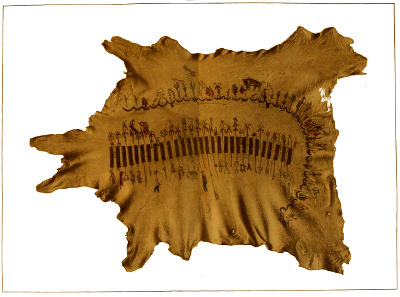
THE ANKO CALENDAR