SKETCH OF THE KIOWA TRIBE (continued 3)
Reading edition
The prisoners while in Florida were merely kept under surveillance and were not subjected to close confinement. Philanthropic white people took an interest in them, especially in the younger ones, and undertook to give them rudimentary instruction in civilization and Christianity. When they were finally released in May, 1878, a number of the young men consented to remain a few years longer in the east to acquire an education, among whom were eight of the Kiowa. Those who were not taken into private families were placed in the Normal Institute at Hampton, Virginia, originally established for the education of negroes. Soon after, fifty other young Indians were assembled at Hampton, which thus became also an Indian school. The success of this experiment led to the establishment of the Indian school at Carlisle, Pennsylvania, in 1879 (Report, 57).
Several of the young Kiowa were received in refined and philanthropic families in the north, with the purpose of educating them to be missionaries among their people on their return. One of these, Paul Zotom (Zoñtam), was regularly ordained as a deacon in the Episcopal church. (Report, 58). He returned in the summer of 1881, but has sadly fallen from grace. Another, Paul Saitkopeta (Setk'opte), after similar careful training in a refined family with the same purpose in view, returned a year later nearly dead from consumption contracted in the east, and although of more manly character than Zotom is now almost helpless for any practical purpose, being a confirmed invalid, and has reverted to many of the Indian customs. Setk'opte is a Kiowa by adoption only, being the son of a Cheyenne chief by a Pawnee captive woman.
KICKING-BIRD
The noted chief, T'ené-angópte, "Kicking-bird," who had been so long a leader of the peace element among his people, died suddenly on May 5, 1875. It was suspected at the time, and is still believed by some of the tribe, that he had been poisoned by his enemies of the war party, but although the matter was investigated it could not be proven. Like so many others of the Kiowa, he was of mixed origin, his paternal grandfather having been a Crow captive taken when a boy and adopted into the tribe. Although a young man, he had a commanding influence among his people, and on the failure of the war party under Lone-wolf became recognized as the principal chief of the Kiowa. An untaught savage, he was yet a man of fine native ability and thoroughly versed in the traditions and ceremonials of his people. Recognizing early the inevitable changes consequent upon the advent of the white man, he deliberately abandoned the warpath and addressed himself to the task of preparing his people to meet the new conditions. From that time forward his voice and example were always on the side of peace and civilization. By this course he drew upon himself the hatred of the conservatives and the war party, who denounced him as a coward and a traitor, charges which he met and refuted in characteristic fashion. When the question of peace or war came to a final issue in 1874, his powerful influence held more than two-thirds of the Kiowa from the warpath, and by his exertions afterward he secured the best possible terms for the defeated hostiles. It was by his invitation and assistance that Battey organized the first school in the tribe in 1873. His last counsel to his people was to remain at peace with everybody and to follow the advice of their teachers, and he declared that he was dying "holding on to the white man's hand." At the request of his family, Agent Haworth took charge of his body and gave it Christian burial, this being the first instance of the kind in the history of the tribe (Report, 59; Battey, 11).
His long-continued attachment to the whites at one time so far brought him into disrepute with his tribe that they charged his friendship to cowardice, called him a woman, and refused to listen to his counsels. Finding his influence in the tribe nearly gone, he raised a force, conducted a raid into Texas, and had a severe engagement with the white soldiers, where he led his men with such ability and coolness as to come off victorious and win a testimony of respect from the commander of his enemy's forces. On his return home he again advocated peace with the whites, and has steadily continued to do so from that time to the present. The tribe, thoroughly convinced of his bravery, no longer attribute his desire for peace to cowardice, and listen to his eloquent arguments, in most cases yielding to his counsels; so that he really stands at the head of all those Kiowa who are disposed to live peaceably, as Lone-wolf does at the head of those occupying a less friendly position (Battey, 12).
Another characteristic incident is recorded by Battey. Shortly before the outbreak some trouble occurred between Kicking-bird and the chiefs disposed to hostility, who accused him of having lied about them. A meeting was arranged at the agency to talk it over, and as the Indians were greatly excited some trouble was anticipated. When, the Kiowa began to arrive, each as he entered the office and seated himself strung his bow and placed it where it could be instantly seized for action, put his quiver of arrows in convenient position, also placing three or four arrows across his lap, loosened his revolver, and turned the handle ready for grasping, while many of them trembled with excitement. When the room was nearly filled, Kicking-bird, accompanied only by his brother and another friend, rode up coolly, as if unaware of what might be going on inside. Securing their ponies, they entered the office, Kicking-bird in advance. Looking around the circle, he took in the situation at once, and seating themselves, he and his companions coolly proceeded to place their bows, arrows, and revolvers in the same position for convenient use if necessary. Then addressing the agent, Kicking-bird informed him of the charges against himself (Kicking-bird), and called upon him to keep back nothing that he had told him, but to tell his people his whole talk (Battey, 13).
CHANGED CONDITIONS
With the close of the outbreak and the subsequent readjustment of affairs came a great change in the condition of the Kiowa and their confederated tribes. The old chiefs who had so often led them on the warpath were dead or in prison; their horses, which to prairie warriors were almost as essential as the bow or rifle, had been taken from them, together with their weapons; military posts and garrisons had been established in their midst and the chain of white settlements had been drawn closer around them; their old allies, the Cheyenne, had been rendered powerless to help them, and, more than all, their unfailing commissary, the buffalo, had practically disappeared. They felt that they were powerless in the hands of the stronger race, and with a deep sigh of regret for their vanished sovereignty they literally put their hands to the plow and endeavored in their weak fashion to follow the white man's road. The warriors, realizing that their time was too short to learn new ways, were anxious to see their children prepared to meet the changed conditions, and in consequence the schools were soon crowded, some of the chiefs even assisting the teachers in the work of organizing. Henceforth we find them trying to follow the new path with patient resignation, in spite of difficulties and frequent neglect, with only occasional weak ebullitions of the old fighting temper when aroused by some particularly aggravated grievance.
EPIDEMICS OF MEASLES AND FEVER IN 1877—FIRST HOUSES BUILT
In 1877 an epidemic of measles in the tribe carried off a large number of children. It was followed immediately afterward by an outbreak of fever. In the fall of the same year the government, through agent Haworth, built a number of houses for the prominent chiefs, these being the first Indian houses on the reservation (see the calendar). In accordance with a new plan of employing Indians at agencies, a police force of about thirty natives was organized in 1878. The result in this as in all other cases has been eminently satisfactory (Report, 60).
AGENCY REMOVED TO ANADARKO—THE LAST OF THE BUFFALO
For years Indians and agents alike had complained of the location of the agency at Fort Sill. In consequence of repeated representations of the matter, it was removed toward the close of 1879 to Anadarko on the Washita and consolidated with the Wichita agency at that point, where it still remains (Report, 61). As a result, the Kiowa, who had previously been together in a single camp on Cache creek below the fort, now began to scatter and take up individual farms along the Washita and on the creeks north of Mount Scott. This year may be taken as the date of the disappearance of the buffalo from the Kiowa country, the Indians during the summer of 1879 being reduced to the necessity of killing and eating their ponies to keep from starving, in consequence of the almost total failure of their annual hunt (see the calendar). Thereafter the appearance of even a single buffalo was a rare event.
BUREAU OF AMERICAN ETHNOLOGY— SEVENTEENTH ANNUAL REPORT, PL. LXIV
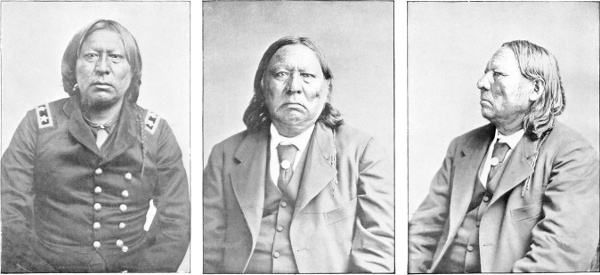
PHOTO BY SOULE, ABOUT 1870. PHOTOS BY JACKSON, 1872.
SET-ĬMKÍA OR STUMBLING-BEAR (PUSHING-BEAR).
In the same year died Lone-wolf, the principal chief and leader of the war element in the late outbreak. Dohásän, Set-ängya, and Set-t'aiñte being already gone, his death may be said to mark the end of the war history of the Kiowa. Shortly after his return from Florida he had conferred his name and succession upon the present bearer of the name, who had been the comrade of his son, killed in Texas, although not related by blood. The succession is now disputed by Ä´piatañ, the nephew of the first Lone-wolf.
THREATENED OUTBREAK INSTIGATED BY DÁTEKÂÑ
In June of 1881 there was considerable excitement caused by threats of an outbreak by the Kiowa on account of dissatisfaction with the rations. Their attitude became so threatening that the more peaceable Wichita and associated tribes became alarmed, and troops were sent from Fort Sill to prevent trouble, which had the effect of quieting the unrest (Report, 62). It is possible that the Kiowa were instigated to this course by Dátekâñ, who soon afterward began preaching the return of the buffalo and the old Indian life (see the calendar, 1882).
EPIDEMIC OF 1882—BEGINNING OF CHURCH WORK
In the fall of 1882 the tribe suffered from an epidemic of whooping cough and measles (Report, 63). In 1883 the first church was built at the agency by Reverend J. B. Wicks of the Episcopal church, who had been conducting missionary work among the associated tribes for about two years previously. It was built and supported, however, by the Wichita and affiliated tribes, the Kiowa and Apache as yet taking little interest in such matters (Report, 64). The work was abandoned shortly after and not resumed until 1887, when the Methodists entered the field, followed later by the Presbyterians, Baptists, and Catholics.
LEASING OF GRASS LANDS
For some time various agents had called attention to the fact that the Indians had a large surplus of valuable grass lands, which might be made to yield them a considerable income if leased to cattlemen. The suggestion being approved by the department, an arrangement was made with several large cattle firms. The first money payment to the Indians under this agreement was made in the summer of 1885, but only to the Comanche, as the Kiowa and Apache for a year longer refused to accept the money, believing this to be a scheme to deprive them of their lands. There is no official notice of this at the time, for the reason that the arrangement was at first only a matter of tolerance and mutual agreement between the Indians and cattlemen, without formal official recognition or responsibility for several years afterward.
PÁ-IÑGYA, THE MEDICINE-MAN AND PROPHET
In the spring of 1887 a prophet named Pá-iñgya, "In-the-middle," revived the doctrine which had been taught five years before by Dátekâñ of the speedy return of the buffalo and the revival of the old Indian life, adding the usual accompaniments of invulnerability for his followers and the destruction of the whites and unbelieving Indians by fire and whirlwind. He claimed also the power to resurrect the dead and to destroy his enemies with a glance as by a lightning stroke. His preaching aroused great excitement among the Kiowa, and nearly the entire tribe was soon enrolled among his adherents, including every prominent chief except Stumbling-bear and Sun-boy. He established headquarters on Elk creek, at the extreme western end of the reservation, to which all his followers repaired. Here, by the friction of a stick upon a block of wood, he kindled a sacred fire, from which the devotees took brands to light and warm their tipis, being commanded to throw away the white man's matches or flint and steel, together with the white man's dress and weapons. As the day appointed for the final cataclysm approached, the Indians took their children from the schools at the agency in order that they might escape the destruction which was soon to overwhelm the intrusive race, and left in a body for the rendezvous on Elk creek. The movement alarmed the whites, who saw that there was trouble brewing, but could get no explanation of the reason. In anticipation of an outbreak, the agent, Captain Hall, summoned the troops to his assistance. With a small escort he visited the prophet's camp, and through the medium of Stumbling-bear invited the chiefs to a conference, with the result that the Kiowa agreed to return to their homes and await developments. As the time came and went without supernatural event, they became satisfied that the prophecy was a delusion, and the excitement died out. Pá-iñgya still lives, and when the messiah revelation spread among the southern tribes a few years later he hailed it as the delayed fulfillment of his own prophecy (see the calendar).
INDIAN COURT ESTABLISHED
As a practical step toward educating the Indians in civilized forms of self-government and to save the time consumed by the agent and other officials in trivial concerns, an Indian court consisting of three judges was organized upon the reservation in 1888 for the trial of minor offenses and questions, the first judges appointed being Quanah, Lone-wolf, and Tawákoni Jim, head chiefs respectively of the Comanche, Kiowa, and Wichita (Report, 65). This court is still in successful operation.
BUREAU OF AMERICAN ETHNOLOGY— SEVENTEENTH ANNUAL REPORT PL. LXV
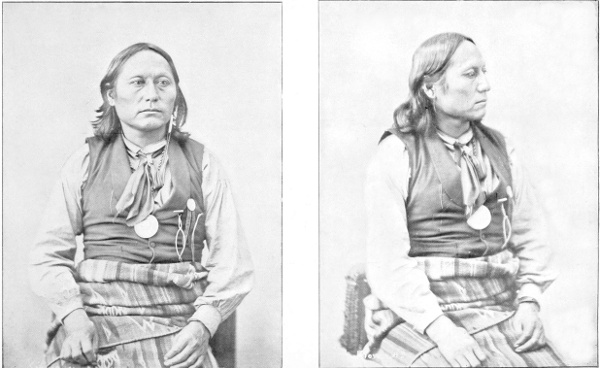
PHOTOS BY JACKSON; 1872.
PAÍ-TÄLYÍ OR SUN-BOY.
INTERTRIBAL COUNCIL OF 1888
The questions of railroads through the reservations, intrusions, allotments, and the ultimate opening of Indian Territory to white settlement, had now assumed such proportions that the civilized tribes had become alarmed and had called an intertribal council to debate measures to meet the emergency. The council met at Fort Gibson, in the Cherokee nation, in June, 1888, with representatives of about twenty tribes in attendance. Although recognizing civilization as their ultimate destiny, they were strongly opposed to any change in the tribal holding of their lands, and the sentiment was practically unanimous against allotment or any disturbance of the existing tribal system. The delegates and speakers from the Kiowa and associated tribes were Täbinä´naka and White-wolf for the Comanche, Big-tree for the Kiowa. White-man for the Apache, and Caddo Jake for the Caddo, Wichita, and smaller bands (Report, 66).
DEATH OF SUN-BOY—THE LAST SUN DANCE
In the fall of 1888 died Pai´-tälyi´, "Sun-boy," one of the last of the prominent chiefs of the old days of the buffalo hunt and the warpath (see the calendar). The summer of 1890 is notable for the last sun dance (k`adó) undertaken by the tribe. On this occasion the agent, making objection to the ceremony, which the Indians refused to abandon, ordered out the troops from Fort Sill to prevent it. On their arrival, although the Kiowa were at first disposed to resistance, upon the advice of Stumbling-bear and some other of the cooler heads, they finally dispersed to their homes, leaving the unfinished medicine lodge standing (see the calendar).
GHOST DANCE INAUGURATED—ÄPIATAÑ'S JOURNEY IN 1890
In the fall of 1890 Sitting-bull (Hänä´chä-thíak), an Arapaho, came and inaugurated the ghost dance among the Kiowa. As this subject is treated at length in the author's work on "The Ghost-dance Religion," in the Fourteenth Annual Report of the Bureau of Ethnology, it need only be mentioned here. Like all the neighboring tribes except the Comanche, the Kiowa went heart and soul into the new religion, which was in line with the previous prophecies of Dátekâñ and Pá-iñgya. A few months later they sent Ä´piatañ, "Wooden-lance," a prominent young man of the tribe, to find the messiah and investigate and report upon his doctrine. On his return in the following spring he denounced the new teacher as an impostor, whereupon the Kiowa abandoned the dance. Within the last two years, however, they have revived the ghost-dance ceremonies with all the old-time vigor (see the calendar).
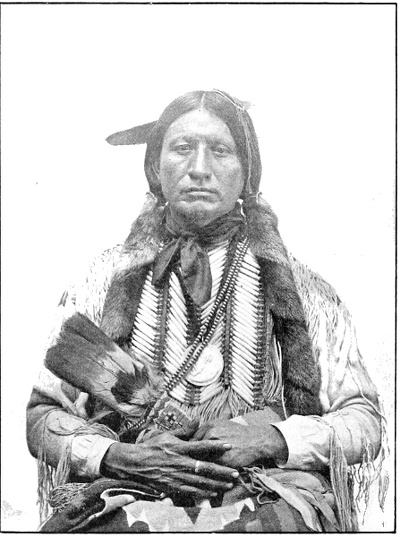
Fig. 52—A´piatañ or Wooden-lance.
In the same winter, in January, 1891, three boys ran away from the government school at the agency in consequence of the harshness of a teacher, and a day or two later were found frozen to death in the mountains, having been overtaken by a blizzard while attempting to reach their homes. The affair naturally created intense excitement in the tribe and threats were made against the teacher who was responsible for the occurrence, but the matter finally quieted down without the necessity of calling on the troops (see the calendar).
ENLISTMENT OF INDIANS AS SOLDIERS
In March, 1891, the Secretary of War authorized the enlistment of an Indian contingent for each of the cavalry and infantry regiments serving in the west. In pursuance of this plan, a troop was enlisted from among the Kiowa, Comanche, and Apache tribes in the fall of 1891 and placed under the command of Lieutenant (now Captain) H. L. Scott, and designated as troop L, of the Seventh cavalry, then stationed at Fort Sill. Of this troop probably two-thirds were Kiowa and Apache. The experiment did not prove satisfactory, and all of the Indian companies have now been disbanded. The Kiowa troop maintained its existence longest, under Captain Scott, who was peculiarly fitted for the position by his intimate and sympathetic acquaintance with Indian habit and belief and his expert knowledge of the sign language. For this reason he has several times been selected by the War Department to investigate threatened troubles among the associated tribes, particularly during the critical period of the ghost dance, and has also been selected by the Indians themselves to represent their interests at Washington (see the calendar; also War, 4).
MEASLES EPIDEMIC OF 1892—GRASS LANDS LEASED
The year 1892 was signalized by several important events. Early in the spring an epidemic of measles broke out among the children in the Kiowa school. Instead of isolating and nursing the sick, the superintendent in charge sent the infected children home to their camps, thus spreading the disease broadcast, resulting in the death of about two hundred and twenty persons, nearly all children, among the Kiowa and Apache, or fifteen per cent of the entire number. The superintendent was soon afterward removed. This epidemic was the most terrible calamity that has befallen the tribe in many years. Every family lost relatives, and in addition to the large number of deaths thousands of dollars' worth of property, in the form of horses, wagons, blankets, etc, was destroyed at the graves in accordance with the Indian custom (see the calendar).
As by this time the Indians had learned that the leasing of their grass lands would be a substantial benefit to themselves, they held a joint council in the spring of the same year and authorized Quanah, Lone-wolf, and White-man, head chiefs of the three confederate tribes, to go as delegates to Washington, where they succeeded in negotiating leases for nearly all of their surplus grass lands for an aggregate annual rental of nearly $100,000. This money, with that received by the Indian soldiers, has been invested largely in houses and improved stock. Today probably half the Indians of the three tribes are owners of houses paid for with their own money (see the calendar).
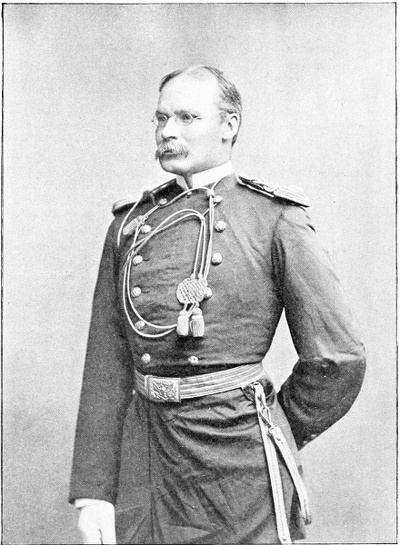
Fig. 53—H.L. Scott, Captain, Seventh cavalry, U.S.A.
COMMISSION FOR ALLOTMENT OF LANDS—PROTEST AGAINST DECISION
In the autumn of 1892 a commission, which had already concluded agreements with several other tribes, visited the Kiowa, Comanche, and Apache to negotiate with them for the distribution of individual allotments and the sale of the remainder of their reservation. As the terms of the Medicine Lodge treaty, under which they hold their present reservation, do not expire until August 25, 1898, the Indians were opposed to any change in the existing conditions, but by bringing strong pressure to bear upon them, an agreement was finally reached by which the reservation was to be thrown open immediately upon the ratification of the contract by Congress. On learning the true nature of the instrument, the Indians denounced the interpreter and demanded that their names be stricken from the paper. This being refused, they repudiated in council the action of the chiefs who had signed, and elected other representatives to go to Washington to protest against the whole proceeding. The delegates chosen were Ä´piatañ, already mentioned, Apache John (Goñk'oñ, "Stays-in-tipi") and Piänä´vonĭt, "Big-looking-glass," for the Kiowa, Apache, and Comanche, respectively, with Captain Scott, U. S. A., and Andres Martinez (Ä´ndali), an influential Mexican captive among the Kiowa, as interpreter. The delegation arrived in March, 1894, and made such representation of the matter that no action was taken upon the agreement, and it is still unratified.
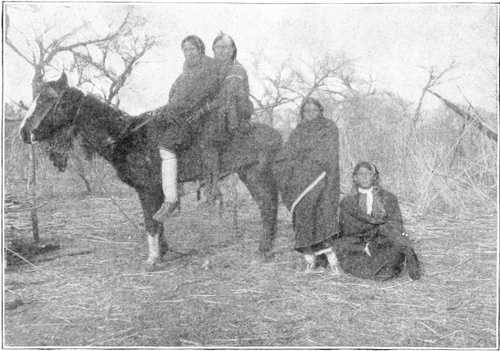
Fig. 54—A group of Kiowa.
PRESENT CONDITION—AGENTS IN CHARGE OF CONFEDERATE TRIBES
Realizing that a change is inevitable in the near future, the Indians are going to work, and with the aid of the money received for their grass lands invested in houses, cattle, and improved breed of horses, the opening of small farms, and the general educational work of the schools, there is a fair prospect that at the expiration of their present treaty in 1898 they will be able to meet the new conditions (see 52d Cong., 2d sess., Senate ex. doc. 17—Comanche, Kiowa, and Apache Agreement; 53d Cong., 2d sess., misc. doc. 102—Kiowa, Comanche, and Apache memorial).
Following are the names of the agents who have been in charge of the Kiowa, Apache, and Comanche since they were first brought upon the reservation in December, 1868. Of the earlier ones, Haworth (Senpo-gúadal, "Red-beard") is held in best remembrance:
1869—Laurie Tatum (Kiowa name, Dän-pá-iñgya-t'á-i, "Bald-head").
1873, April—J. N. Haworth (Sénpo-gúadal, "Red-beard").
1878, April—P. B. Hunt (Tádalk`ia, "Lean-man").
1885, September—J. Lee Hall (K`ódal-gúadal, "Red-neck").
1887, September—E. E. White, special agent (T'áiñte, "White").
1888, September—W. D. Myers (Maiz).
1889, October—Charles E. Adams (Ädam).
1891, December—George D. Day (Ĭmasä´nmot, "Grinning").
1893, June—Hugh G. Brown, captain Twelfth infantry.
1893, November—Maury Nichols, lieutenant Seventh infantry (Dogúatal-taíde, "Young Man Chief").
1894, October—W. H. Abell, special agent (Pá-ehémgó`te, "Lame-bull").
1894, November—Frank D. Baldwin, captain Fifth infantry.
SUMMARY OF PRINCIPAL EVENTS
The principal events in the history of the Kiowa may be summarized as follows:
1700 (about)—Migration from the mountains to the Yellowstone region.
1732—Mentioned in Spanish document of New Mexico.
1770 (about)—Massacre of the K'úato and expulsion from the Black Hills.
1790 (about)—Peace and alliance with the Comanche.
1805—First American mention; Kiowa then on North Platte.
1833—Massacre by the Osage and capture of the taíme.
1834—Dragoon expedition and first official intercourse with United States.
1837—First treaty, at Fort Gibson.
1839—Smallpox epidemic.
1849—Cholera epidemic.
1854—Defeat of plains tribes by the Sauk.
1864—General outbreak of plains tribes.
1866—Death of Dohásän.
1867—Medicine Lodge treaty; Kiowa agree to go on reservation.
1868—Battle of the Washita; Ute capture the taíme.
1869—Kiowa go upon present reservation.
1871—Setängya killed.
1872—First attempt to establish schools.
1874—Outbreak of Cheyenne, Comanche, and Kiowa.
1879—Practical disappearance of the buffalo.
1881—Dátekâñ's prophecy.
1886—First money for grass paid to Kiowa and Apache.
1887—Pá-iñgya's prophecy.
1890—Last sun dance; beginning of the ghost dance in the tribe.
1892—Measles epidemic; unratified agreement of land sale.
SOCIOLOGY OF THE KIOWA
ABSENCE OF THE CLAN SYSTEM
The clan system does not exist among the Kiowa, and there is no evidence that they have ever had it. This may be a surprise to those disciples of Morgan who have assumed that because the system is found among the eastern tribes and certain tribes of the southwest and extreme northwest it is therefore universal and a necessary factor in tribal development. It is by no means universal, and it is doubtful if it exists among the Athapascan tribes of British America, the tribes of the Columbia region, Oregon, or California, or any of the recognized Shoshonean stock with the exception of the Hopi. The Cheyenne and Sioux of the plains seem to know as little of it as do the Kiowa. Clark, in his "Indian Sign Language," says: "I cannot help feeling that Mr Morgan's careful study of the form of government of the Iroquois league colored his writings in regard to all other Indians. Certain it is that no trace now exists of such organization among many of the plains tribes." In another place he states that among the majority of the plains tribes, and perhaps the western Indians generally, judging from their laws of inheritance and marriage customs, the system never did exist (Clark, 5). Gatschet, in his great work on the Klamath language, declares that the Klamath Indians of Oregon are absolutely ignorant of the clan system, while Hale, in the "Iroquois Book of Rites," takes the ground that the system is simply an artificial invention, adopted for convenience and spreading from various local centers. In support of the idea that it is artificial rather than natural he points out the fact that it is not found among the Polynesian tribes, who are on about the same plane of development as our Indians (Hale, 1). In the United States the clan system seems to be found more particularly among the agricultural tribes.
LOCAL DIVISIONS
Before they were confined to the reservation the Kiowa were grouped into two general local divisions, known, respectively, as T'ó-k`íñähyup, "cold men" (i.e., men of the cold, or northern, country), and Gwáhalégo, from the Comanche name Kwáhadi or Kwáhari. These terms were practically equivalent to "northern" and "southern," the former ranging chiefly along Arkansas river and the Kansas frontier, while the latter, as the name indicates, associated more with the Kwáhadi Comanche of the region of the Staked plain. As they were merely temporary local designations and not proper band or gentile names, they have now ceased to be of any practical importance.
SUBTRIBES
The Kiowa have six recognized divisions or subtribes, including the Apache, who form a component part of the Kiowa tribal circle. The extinct K'úato formerly made a seventh, but their position in the circle is now forgotten. These divisions are not clans or gentes (social) based on marriage regulations, but subtribes (political), each division having had originally its own chief, subordinate to the recognized head chief of the tribe, with certain peculiarities of dialect and sometimes its special "medicine" or religious ceremonial. They may have been in the beginning distinct cognate tribes, with the exception of the Apache, which confederated at a later period for mutual assistance. The Comanche, although now allied with the Kiowa, have no part in their tribal organization or ceremonies.
THE CAMP CIRCLE
The names of the bands and their order in the camp circle on the occasion of all tribal gatherings are as follows:
1. K`at'a, "Biters," i. e., Arikara. This is the largest and most important division, occupying the first place in the camp circle, immediately south of the door or entrance. To it belonged Dohásän, the great chief who ruled the Kiowa for more than thirty years. To his family was assigned the hereditary duty of furnishing the buffalo for each annual sun dance. At present the K`at'a may be said to constitute the aristocracy of the tribe. The name is said not to indicate an admixture of Ree or Arikara blood, but simply a more intimate trading association with that tribe in early days. As this association was comparatively modern, the word may be a substitute for another name discarded, in accordance with a Kiowa custom, in consequence of the death of some noted individual of the same name. They are sometimes called Gâ´i-K`at'a, "Kiowa K`at'a," to distinguish them from the Arikara proper.
2. Ko gúi, "Elk." This band took the lead in war ceremonials. A`dáte, whose camp was surprised and destroyed by the Osage in 1833, was its chief. Set-t'aiñte and the first Big-bow also belonged to this band.
3. Gâ´-igwû, "Kiowa proper." This may have been the original nucleus of the Kiowa tribe, as the name would seem to imply. Although not numerous, they are held in much respect, are the keepers of the taíme, and have charge of the K`ado Dó, or priestly tipi, at the sun-dance ceremony. The western side of the circle properly belongs to them, but in consequence of their small number individuals of other bands sometimes camp with them.
4. Kiñep, "Big Shields." To them belonged the gadómbitsóñhi image or idol, now lost, which was exposed in front of the taíme image at the annual sun dance.
5. Semät, "Thieves," i. e., Apache. Although a distinct tribe, they have formed an integral part of the Kiowa tribal circle from the earliest traditionary period.
6. Koñtä´lyui, "Black Boys," or Síndiyúi, "Sindi's children." No reason is assigned for either of these names, which are about equally common, Sindi is the great mythic hero of the Kiowa. They are a small band, and occupy the last place in the circle.
7. K'úato "Pulling Up." These were exterminated by the Dakota about 1780, as already related. They spoke a peculiar dialect of Kiowa. It is not now known what position they occupied in the tribal circle.
Clark mentions four of these divisions, under the names of Elk (Kogúi), Shield (Kiñep), Cut-Off (K`at'a), and Black (Koñtälyui), and adds, "some claim five, the Apache Kiowa band" (Clark, 20).
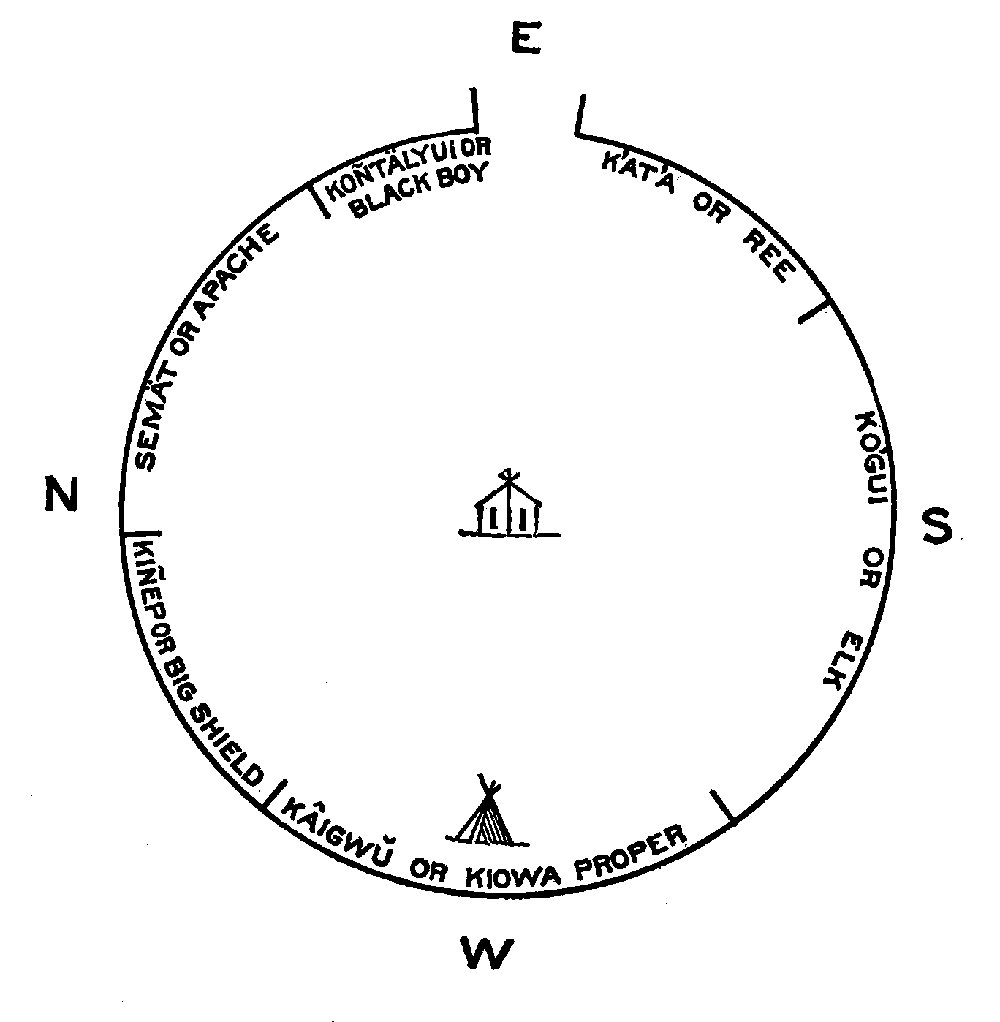
Fig. 55—The Kiowa camp circle.
MILITARY ORGANIZATION—YÄ`´PÄHE WARRIORS
The Kiowa have an elaborate military organization, now fast becoming obsolete, known as Yä´pähe, "Warriors." A similar organization is found among most of the prairie tribes, and is commonly known to the whites as the Dog-soldier society, from an imperfect rendering of the name of one of the principal bands. The Kiowa organization consists of six orders, each having its own dance, songs, insignia, and duties. The members were first enrolled as boys among the "Rabbits," and were afterward promoted, according to merit or the necessities of war, in regular progression, to higher ranks. Only the bravest few, however, ever attained the highest order, that of the Kâ-itséñko. Almost every able-bodied man was enrolled. The orders, beginning with the lowest, are as follows:
1. Polä´ñyup or Tsä´ñyui, "Rabbits." Boys above the age of eight or ten years, who were drilled in their future duties as warriors by certain old men. The step of their dance is intended to imitate the jumping of a rabbit.
2. Ädaltóyui or Téñbeyu´i, "Young (wild) Sheep."
3. Tseñtä´nmo, "Horse Head-dresses." (?)
4. Toñkóñko, "Black Legs."
5. T'äñpéko, "Skunkberry People" or Tséñ-â'dalka-i, "Crazy Horses."
6. Kâ´-itsénko, "Real or Principal Dogs (?)." These were the picked men of the warriors and were limited to ten in number. According to the myth, their founder saw in a vision a body of warriors dressed and painted after the manner of the order, accompanied by a dog, which sang the song of the Kâ´-itséñko and commanded him, "You are a dog; make a noise like a dog and sing a dog song." Their peculiar insignia and obligations will be described in another place (see the calendar, summer 1846.)
Clark gives the names of the Kiowa orders as follows, omitting the Poläñyup: Raven Soldiers or Black Leggings (Toñkoñko); Sheep (Ädaltóyui); Feather Head (Tseñtä´nmo); Horse (Kâ-itséñko); War-club (T'äñpéko). He adds, "The Kiowa Apache have only three bands, viz: 1st, Big Horse; 2d, Raven; 3d, Swift Fox" (Clark, 6).
At home the Yä`pähe acted as camp police and leaders in the tribal ceremonies; abroad they were the warriors and conductors of the hunt. Battey gives an illustration of the system as he once saw it in practical operation:
Being determined that none of their thoughtless young men should go raiding in Texas and thereby bring trouble upon the tribe, the Kiowas, immediately after the whole tribe got together on Pecon creek, organized a military system, under the control of the war chiefs, which was immediately put into operation. By this a strong guard of their soldiers were continually watching day and night while in camp to prevent any such enterprise from being undertaken. In moving from place to place these soldiers marched on each side of the main body, while a front guard went before and a rear guard behind, thus preventing any from straggling.
Their buffalo hunts were conducted in the same military order. The soldiers, going out first, surrounded a tract of country in which were a large herd of buffalo, and no one might chase a buffalo past this ring guard on pain of having his horse shot by the soldiers. Within the ring hundreds of men on horseback were chasing and shooting the huge creatures with revolvers or bows and arrows until each had killed as many as his female attendants could skin and take care of (Battey, 14).
HERALDIC SYSTEM
In connection with their military and social organization the Kiowa and Apache have a system of heraldry, which finds tangible expression in the painting and ornamentation of their shields and tipis. There were formerly about fifty shield patterns used in the two tribes, and all the warriors carrying shields of the same pattern constituted a close brotherhood, with similar war cries, body paint, and ceremonial taboos and regulations. Every prominent family also had its heraldic tipi, which occupied its fixed place in the tribal camp circle. Special taboos and rules belonged to the tipi as to the shield, and the right of hereditary descent was as nicely regulated as property ownership among the whites. This system of heraldry will form the subject of a future monograph.
NAME SYSTEM
Their system of personal names is also interesting. All the names have meaning and are as much a part of the owner as his hand or his foot. Children are usually named soon after birth by one of the grandparents or other relative not the parent; the name is commonly suggested by some passing incident, but may be hereditary, or intended to commemorate the warlike deed of some ancestor. In this way a girl may bear a war name bestowed by her grandfather to preserve the recollection of his own achievement. There are no ordinal names as among the eastern Sioux, no clan names as among the Shawnee, and no names which indicate the band of the individual. Young men as they grow up usually assume dream names, in obedience to visions, and these are sometimes superseded in later life by names acquired on the warpath, the hunt, or in council. Frequently an aged warrior, who feels that his day is near its close, formally gives his name to some young man who seems to him to merit the honor; the older man then assumes a new name, or more frequently lives out his remaining years without a name, being referred to and addressed simply as "old man." Sometimes the old warrior, having outlived the need of a name and not regarding any younger man as worthy to bear it, deliberately "throws it away" and is henceforth nameless. Should he die without having bestowed his name upon a successor, the name dies with him and can not be revived. The name of the dead is never spoken in the presence of the relatives, and upon the death of any member of a family all the others take new names—a custom noted by Raleigh's colonists on Roanoke island more than three centuries ago. Moreover, all words suggesting the name of the dead person are dropped from the language for a term of years, and other words, conveying the same idea, are substituted. The same custom exists among the Comanche and perhaps among other tribes.
MARRIAGE
Marriage among the Kiowa, as among the plains tribes generally, is a simple affair, with none of the elaborate ceremonials found among the Hopi and other sedentary Indians. About all that is necessary is that the maiden of the young man's choice shall be willing, and, this having been ascertained by the lover, he sends some friend as a mediator to her parents to make an offer of ponies or other property to compensate them for the loss of their daughter. If both sides come to an agreement, the match is made, and the young couple, with the assistance of their friends, set up housekeeping on their own account. Compulsion is no more brought to bear upon the girl than in civilized communities; the brother of the girl has as much to do with the decision of the case as her parents, and continues to claim a sort of guardianship over her even after her marriage. The marriageable age is about fourteen for girls and sixteen for boys. In general the husband goes to live among his wife's people instead of taking her to his own camp. The father seems to exercise more control over his children than among tribes having the clan system and mother right. There appears to be no fixed rule of inheritance, but shield, tipi, and band name usually descend in the male line. The husband avoids the mother-in-law, but not to the same extent as among other plains tribes. Polygamy is allowed, but is not frequent, only a few of the Kiowa now having two wives, and none more than that number. In the old times it was more common, in consequence of the surplus of women resulting from the killing off of the men in their constant wars. The father of T'ebodal is famous for having had ten wives; Quanah, the present head chief of the Comanche, has six. It was common to marry sisters of the same family, and according to tribal custom, which had analogy among the ancient Hebrews, the man who married the eldest daughter had first claim upon her sisters.
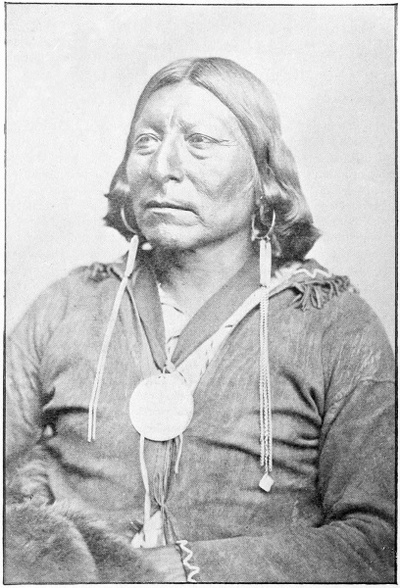
Fig. 56—Mäñyi-tén or Woman-heart, a typical Kiowa.
Divorce is easy and without ceremony, but not so common as might be supposed, there being many couples that have lived faithfully together for nearly half a century. Adultery is punished by taking or destroying the property of the guilty man. The woman is simply "thrown away" by her husband, although in theory her life is forfeited. In former times he might kill her or cut off her nose, as was done also among the neighboring tribes, but this latter custom is now only a memory.
TRIBAL GOVERNMENT
The tribal government was formerly committed to the care of a head chief and the chiefs of the several bands, together with the war chiefs, who had control in military affairs. Women had no voice in the government. From the evidences of tradition and the statements of old men, the chiefs in former times, before tribal customs were demoralized by the advent of the conquering race, must have exercised almost despotic powers and were feared as well as respected by their people. Their last great chief was Dohásän, who died in 1866, since which time no one has had the unquestioned allegiance of the whole tribe. The present officially recognized head chief is Lone-wolf, the adopted son of the hostile leader of the same name in the last outbreak. The elder Lone-wolf formally bestowed his own name upon the younger man in 1879, thus publicly recognizing him as his successor. Camp and ceremonial regulations were enforced and their violation punished by the Yä'´pähe, acting under direction of the war chiefs. Personal grievances were avenged by the injured party or by his nearest relatives, without interference by the tribe.
CHARACTER
In character the Kiowa are below the standard. Having been intimately associated with them for some years, the author would be better pleased to make a different showing, but truth compels the statement. Tribal traits are strongly marked among Indians. The Sioux are direct and manly, the Cheyenne high-spirited and keenly sensitive, the Arapaho generous and accommodating, the Comanche practical and businesslike, but the Kiowa, with some honorable exceptions, are deficient in all these qualities. They have the savage virtue of bravery, as they have abundantly proven, but as a people they have less of honor, gratitude, and general reliability than perhaps any other tribe of the plains. The large infusion of captive blood, chiefly Mexican, must undoubtedly have influenced the tribal character, but whether for good or evil the student of heredity must determine.
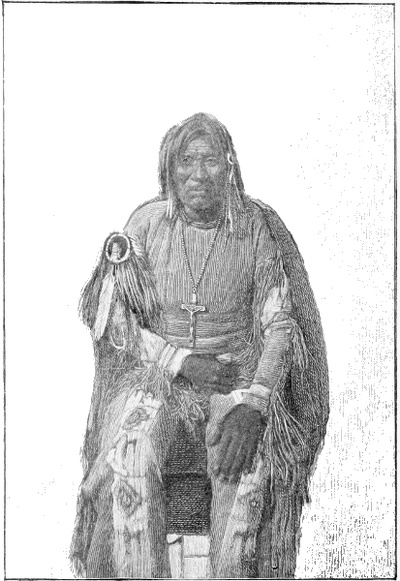
Fig. 57—Gaápiatáñ (alias Haitsĭki) or Feathered-lance, a typical Kiowa.
The report of Captain Alvord, already quoted at length, affords a good insight into Kiowa character. Gregg in 1844 described them as "one of the most savage tribes that infest the western prairies" (Gregg, 7). Captain (afterward General) John Pope ten years later called them deceitful and unreliable and "absolutely destitute of most of the chivalrous characteristics which distinguish the Comanche brave." General Pope in 1870 denounced them as being altogether the worst Indians the government had to deal with, having been for twenty-five years past "the most faithless, cruel, and unreliable of all the Indians of the plains." About the same time General Sheridan expressed his lasting regret that he did not hang Set-t'aiñte and Lone-wolf and punish the whole tribe when he first met them. The Quaker Battey, a good friend of theirs, describes them as "the most fierce and desperately bloodthirsty tribe of the Indian Territory"—a people who had hitherto resisted all attempts to bring them into friendly relations with the government or to a knowledge of civilization, still continuing to commit depredations upon the white settlements, stealing horses and mules, murdering men and women and carrying their children into captivity. He says it would probably be difficult to find in the whole tribe a man whose hands had not been imbrued in blood. Clark states that in personal appearance, intelligence, and tenacity of purpose he considers them inferior to the Comanche (Pacific, 1; War, 5; Battey, 16; Clark, 8).
POPULATION
It is always difficult to estimate the population of a roving tribe, and almost invariably first reports are greatly exaggerated. This is particularly true of the Kiowa, whose restless disposition and inveterate habit of raiding made them equally at home anywhere along a frontier of a thousand miles. Excluding some extravagant early estimates, the statements of the most competent observers, and the official reports since they have been put upon the reservation, all indicate that the combined population of the confederated Kiowa and Apache was never much more than 1,600, or 1,800 at the greatest, of whom the Apache numbered nearly one-fourth. No really accurate count was ever made until after their final subjugation in 1875, and it is worth noting that their numbers, which had been reported at 2,774 and 2,302 in the preceding two years, at once fell to 1,414, and remained nearly stationary at that figure until the epidemic of 1892. Battey's estimate in 1873 (in which he probably means to include the Apache) of 1,600 to 1,650 is probably very nearly correct. In 1892 the Kiowa numbered 1,014 and the Apache 241, a total of 1,255, being a decrease from 1,476 in the previous year in consequence of the epidemic of measles. In November, 1896, they numbered: Kiowa 1,065, Apache 208, a total of 1,273. The associated Comanche at the same time numbered 1,545. In each of these tribes there is a large captive element of which, no separate account is taken, but investigation would probably show that at least one-fourth of the whole number have more or less of captive blood. The captives are chiefly Mexicans and Mexican Indians, with Indians of other tribes, and several whites taken from Texas when children, including one old man who still remembers having gone to school in Germany and having crossed the ocean with his parents (see Pope in Pacific, 2).
Some of the estimates are based on the number of tipis or warriors, an uncertain ratio, which varies greatly in different tribes. With the Kiowa it may be assumed to equal 2 warriors and 6 or 7 souls to a tipi. Below are given the various estimates and enumerations, beginning with the earliest, that of Lewis and Clark in 1805. The estimates of 1807, 1810, 1841—1845, and perhaps of 1850 probably include the Apache.
1805—Kiowa and Wetepahatoe, 70 tipis, 200 warriors, 700 souls (Lewis and Clark, 5).
1810—1,000 warriors, i. e., about 3,000 souls (Pike, Expedition, 1810).
1814—Wate-pana-toe and Ryuwa, 200 warriors, 900 souls (Brackenridge, Views of Louisiana, 85, 1814).
1820—Wettaphato, 1,000 souls, 900 souls (Morse, 3).
1828—140 families (i. e., about 950 souls?) (Spanish, doc. of 1828, in Societa Geog. Mex., 265, 1870).
1829—Keawas, 1,000 souls (Porter, in Schoolcraft, Ind. Tribes, III, 596, 1853).
1836—Kioways, 1,800 (estimate in Schoolcraft, III, 611).
1841—45—1,800 souls (Indian Reports for these years; for the same period the Comanche are estimated at 19,200).
1846—400 tipis, 2,000 souls (Bent, in Rept., 1846).
1849—300 warriors, 1,500 souls, a "careful estimate" (Neighbors, Report, 1849; he estimates the Comanche at 4,000 warriors and 20,000 souls).
1850—Kayuguas, 2,000 souls, not to exceed (War, 6).
1851—1,500 souls, probably not more than (Pacific, 3).
1854—2,800 souls (Agent Whitfield, Report, 1855; in the same report we find another agent estimating the Kiowa and Comanche at 20,000 in 1852).
1865—1,800 (Report, 1865); 1,500 to 1,700 souls, about 280 tipis, without Apache (Agent Leavenworth, in Report on Condition of Indian Tribes, 37, 1867).
1866—Kiowa and Comanche, without Apache, 2,800 (Report, 1866).
1867—280 tipis, 1,680 souls, without Apache (estimate in report of Medicine Lodge treaty, Indian Miscellany).
1867—68—Kiowa and Comanche, without Apache, 4,000 (Report, 1867 and 1868). The peace commission at the same time, 1867, estimates these two tribes at 14,800.
1869—70—1,896 (Reports for 1869 and 1870).
1871—1,776 (Report).
1872—1,200; 1,930 (Report).
1873—2,000 (Report); 1,600 to 1,650 at 6 to a tipi (Battey, 17).
1874—1,700 (Report; all following are from the official reports).
1875—1,070.
1876—1,090.
1877—same.
1878—1,120.
1879—1,138.
1880—1,139.
1881—1,145.
1882—1,176.
1883—1,167.
1884—1,152.
1885—1,169.
1886—1,164.
1887—1,179.
1888—1,121.
1889—1,142, "a very careful census."
1890—1,140.
1891—1,151.
1892—1,014 (decrease from epidemic).
1893—1,017.
1894—same; taken from preceding.
1895—1,037.
1896—1,065.
BUREAU OF AMERICAN ETHNOLOGY— SEVENTEENTH ANNUAL REPORT PL. LXVI
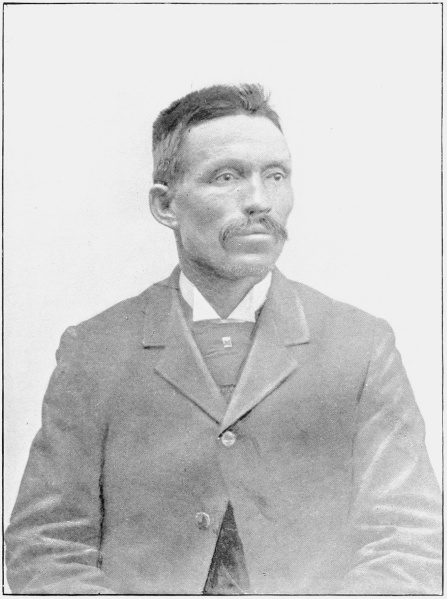
PHOTO BY HILLERS, 1894.
ANDRES MARTINEZ ("ÄN'DALI").
RELIGION OF THE KIOWA
SCOPE OF THEIR BELIEF
In religion the Kiowa are polytheists and animists, deifying all the powers of nature and praying to each in turn, according to the occasion. Their native system has no Great Spirit, no heaven, no hell, although they are now familiar with these ideas from contact with the whites; their other world is a shadowy counterpart of this. There is an indistinct idea of transmigration, owls and other night birds being supposed to be animated by the souls of the dead, with a general belief in ghosts, witches, and various sorts of good and bad "medicine." Dreams and visions are supernatural revelations, to be trusted and obeyed implicitly.
A curious instance of the persistence of the Indian beliefs in spite of educational influences is afforded by the case of the late Kiowa interpreter, a full-blood Indian, who had been reared and educated in the east, graduated in theology, and was ordained to the ministry, married a white woman, and returned as a missionary to his people. The Indians accused him of deceiving them as to the terms of the treaty, and told him that he "could not live," and he died shortly afterward in the belief that he had been bewitched by the medicine-men as a punishment for his part in the negotiations. The fact is a matter of official record, as well as of contemporary newspaper publication.
THE SUN
The greatest of the Kiowa gods is the Sun; by him they swear, to him they make sacrifice of their own flesh, and in his honor they held the great annual k'ado or sun dance. Next to the sun the buffalo and the señi or peyote plant claim reverence, and these too may be reduced to the same analysis, as the buffalo bull in his strength and majesty is regarded as the animal symbol of the sun, while the peyote, with its circular disk and its bright center, surrounded by white spots or rays, is its vegetal representative. The â'dalbeáhya also derives its origin from the sun. Unlike the agricultural tribes, they pay but little attention to the rain gods and seem to have no reverence for the snake. Each shield order prays to some special deity, and every man has also his own personal "medicine," somewhat like the guardian angel or patron saint of the Catholic system. There are also supernatural heroes, of whom the Sun-boy and Sindi are the greatest, with ogres, dwarfs, water people, monsters, and all the other features of the orthodox fairy book.
OBJECTS OF RELIGIOUS VENERATION
Their most sacred objects of religious veneration are the Â'dalbeáhya, the Taíme, the Gadómbitsoñhi, and the señi or peyote. Their great tribal religious ceremony is the k'ado or. sun dance. Their tribal religion is that which centers around the â'dalbeáhya and the taíme. The worship of the peyote, although now general, excepting among the oldest men, is comparatively modern with the Kiowa, having been adopted from the more southern tribes. These two systems are compatible and auxiliary to each other. In 1890 the new religion of the ghost dance was introduced among the Kiowa. It is essentially different from the older Indian systems and antagonistic to them, being based on the doctrine of one God, although it preaches a return to the old Indian life.
The Â'dalbeáhya (the word has some connection with âdal, "hair," and scalp) is the eucharistic body of their supernatural hero teacher, the Sun-boy, and has been known among them almost from the beginning of their existence as a people. According to the myth, which has close parallels in other tribes, a girl was one day playing with some companions when she discovered a porcupine in the branches of a tree. She climbed up to capture it, but as she climbed the tree grew, carrying her with it, until it pierced the arch of the sky into the upper world; here the porcupine took on his proper form as the Son of the Sun; they were married and had a son. Her husband had warned her that, in her excursions in search of berries and roots, she must never go near the plant called äzón (pomme blanche, Psoralea esculenta) if its top had been bitten off by a buffalo. Like Eve, or Pandora, she longed to test the prohibition, so one day while digging food plants she took hold of a pomme blanche which a buffalo had already cropped and pulled it up by the root, leaving a hole through which she saw far below the earth, which she had forgotten since the day that she had climbed the tree after the porcupine. Old memories awakened, and full of an intense longing for her former home she took her child and fastening a rope above the hole began letting herself down to the earth. Her husband, returning from the hunt, discovered her absence and the method of her escape, and throwing a stone after her through the hole, before she had reached the end of the rope, struck her upon the head and she fell to the ground dead. The child was uninjured, and after staying some time beside the body of his mother he was found and cared for by Spider Woman, who became a second mother to him. One day in playing he threw upward a gaming wheel, which came down upon his head and cut through his body without killing him, so that instead of one boy there were now twin brothers. After many adventures, in the course of which they rid the world of several destructive monsters, one of the brothers walked into a lake and disappeared forever under its waters, after which the other transformed himself into this "medicine," and gave himself in that shape to the Kiowa, who still preserve it as the pledge and guardian of their national existence. This â´dalbeáhya, or, as it is sometimes called, the tä´lyí-dá-i, "boy-medicine," is in ten portions, in the keeping of as many priests. Its chief priest is T'ébodal, the oldest man of the tribe, with whom the author once had the opportunity of seeing the pouch in which it is carried, for no man, unless possibly the priest himself, has ever been permitted to open it and look upon the contents. It is kept in a small pouch fringed with numerous scalps, in a special tipi appointed for its residence; it is brought out for use in connection with a sweat-house ceremony as individuals may desire to sacrifice to it, and not, like the taíme, at tribal gatherings. It is briefly mentioned by Clark in his work on the sign language (Clark, 7).
BUREAU OF AMERICAN ENTHOLOGY— SEVENTEENTH ANNUAL REPORT PL. LXVII
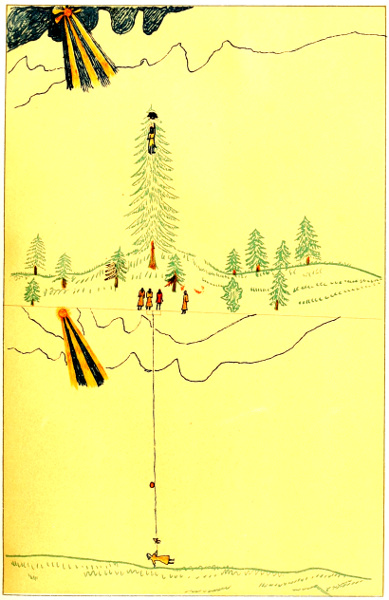
THE PORCUPINE IN THE TREE, AND FLIGHT OF THE SUN WOMAN (FROM THE NATIVE DRAWING.)
The Gadómbítsoñhi, "Old-woman-under-the-ground," belonged to the Kiñep band of the Kiowa. It was a small image, less than a foot high, representing a woman with flowing hair. It was exposed in front of the taíme at the great sun-dance ceremony, and by some unexplained jugglery the priest in charge of it caused it to rise out of the ground, dance in the sight of the people, and then again sink into the earth. A few years ago it was stolen by a crazy Indian from the priest who guarded it and has never since been recovered, although there are stories in the tribe of hunters belated in the mountains, or beside unfrequented streams, who have caught glimpses of a wailing dwarf with disheveled hair who vanished as soon as discovered, and is believed to have been the lost gadómbítsoñhi.
The Señi, "prickly fruit," the peyote or mescal plant, is a small species of cactus of the genus Lophophora (Coulter), which grows in the stony hill country along the Mexican border. On account of its medical properties and its wonderful effect upon the imagination, it is regarded by the Indians as the vegetal incarnation of a deity, and a whole system of myth and ritual has grown up in connection with its use. The rite originated among the more southern tribes, and has come through the Mescalero and Comanche to the Kiowa within about fifty years. The ceremony was first brought to public notice by the author and may be the subject of a more extended monograph at some future time.
Another ritual, pertaining more particularly to women, was dedicated to the Star Girls, or Pleiades (Dä´-mä´tán). Its last priestess died a few years ago.
The great, central figure of the k`adó, or sun dance, ceremony is the taíme. This is a small image, less than 2 feet in length, representing a human figure dressed in a robe of white feathers, with a headdress consisting of a single upright feather and pendants of ermine skin, with numerous strands of blue beads around its neck, and painted upon the face, breast, and back with designs symbolic of the sun and moon. The image itself is of dark-green stone, in form rudely resembling a human head and bust, probably shaped by art like the stone fetishes of the Pueblo tribes. It is preserved in a rawhide box in charge of the hereditary keeper, and is never under any circumstances exposed to view except at the annual sun dance, when it is fastened to a short upright stick planted within the medicine lodge, near the western side. It was last exposed in 1888 (see the calendar). The ancient taíme image was of buckskin, with a stalk of Indian tobacco for a headdress. This buckskin image was left in the medicine lodge, with all the other adornments and sacrificial offerings, at the close of each ceremony. The present taíme is one of three, two of which came originally from the Crows, through an Arapaho who married into the Kiowa tribe, while the third came by capture from the Blackfeet.
The tobacco upon the head of the ancient taíme is another evidence of the northern origin of the Kiowa, as the Kutenai, Blackfoot, and other tribes living near and across the Canadian border are noted for their cultivation of tobacco, and have a special tobacco dance and ceremonies. The more remote tribes along the northwest coast are equally celebrated for their carving in stone, the material used being commonly a black slate, and the original stone taímes may have come from that region.
According to the legend, which is told with the exactness of an historical tradition, an Arapaho, who was without horses or other wealth, attended with his tribe the sun dance of the Crows and danced long and earnestly before the "medicine," in hope that it would pity him and make him prosperous. The chief priest of the Crows rewarded him by giving him the taíme image, notwithstanding the protests of the Crows, who were angry at seeing such favor shown to a stranger. Fortune now smiled upon the Arapaho; he stole many horses and won new blessings for himself by tying numerous ponies to the medicine lodge as a sacrifice to the taíme, until at last his herd was of the largest. Being now grown wealthy, when next his own people visited the Crows he collected his horses and started back with them, but the jealous Crows followed secretly, untied the taíme bag from the pole in front of his tipi and stole it, as Rachel stole her father's gods. On discovering his loss the Arapaho made duplicates, which he took back with him to his own people. He afterward married a Kiowa woman and went to live with her tribe, bringing with him the taíme, which thus became the medicine of the Kiowa. Since that time the taíme has been handed down in his family, the keeper being consequently always of part Arapaho blood.
BUREAU OF AMERICAN ETHNOLOGY— SEVENTEENTH ANNUAL REPORT PL. LXVIII
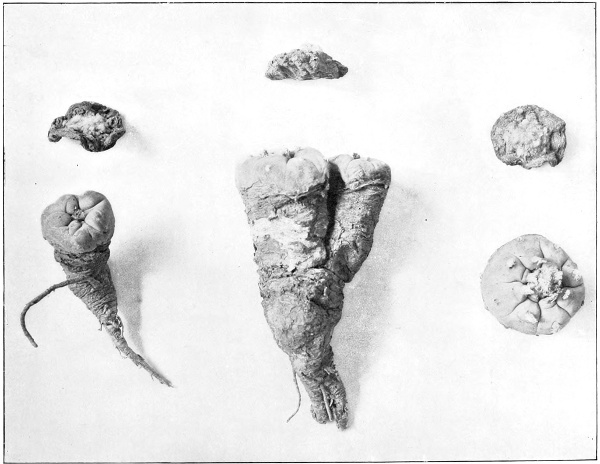
PEYOTE PLANT AND BUTTON.
The present guardian is a woman, Émaä, who succeeded to the office on the death of Taíméte, "Taíme-man," in 1894; she is the ninth successive guardian, the Arapaho being the first. The fifth keeper, Ánsogíani, "Long Foot," or Ánso'te, held it forty years—from before the Osage massacre until his death in the winter of 1870—71. Assuming that the combined terms of the first four guardians equaled in time the combined terms of the last four—i. e., about sixty or sixty-five years, or from about 1830 to 1894—we would have 1770 as the approximate date when the Kiowa obtained the present taíme image. As previously stated, they already had the ceremony and an equivalent image of buckskin. Of the two taíme images, both of which were of the same shape and material, one, the "man," was small, only a few inches in length, while the other, the "woman," was much larger. It is believed among the Kiowa that the Crows still have the originals which they stole from the Arapaho.
Long afterward, after the Kiowa had confederated with the Comanche, the latter had a fight with the Blackfeet, in which they killed a warrior and captured his medicine. The Comanche captor, so the story goes, kept the medicine one night in his tipi, but it kept up a strange noise, which so frightened him that the next day he gave it to a Kiowa, who pulled off a long "tooth" attached to it, and thenceforth it was silent. Learning afterward that it was a part of the taíme medicine, he gave it to the taíme keeper, who put it with the other images. It is said to have been nearly similar in appearance to the smaller image.
The complete taíme medicine thus consisted of three decorated stone images, a large one or "woman," a smaller one called a "man," and a third one closely resembling the second. They were kept in a rawhide case known as the taíme-bíĭmkâ´i, shaped somewhat like a kidney (see figure, summer 1835), and painted with taíme symbols, the large image being in one end of the case and the two smaller ones at the other; some say that the third image was kept in a separate box by a relative of the taíme priest. The smaller images, like the ark of the covenant, were sometimes carried to war, the box being slung from the shoulders of the man who carried it, and consequently were finally captured by the Ute. The large image, the "woman" taíme, was never taken from the main home camp.
The taíme has been twice captured by enemies, first by the Osage in 1833, and again by the Ute in 1868. In the first instance the Osage surprised the Kiowa camp and captured all the images with the bag, killing the wife of the taíme priest as she was trying to loosen it from its fastenings, but returned it two years later, after peace had been made between the two tribes (see the calendar, 1833 and 1835). In the other case the Kiowa had taken the two smaller images, as a palladium of victory, upon a war expedition, when they were met by a war party of Ute, who defeated them, killed the bearer of the medicine, and carried off the images, which have never since been recovered. The larger image is still with the tribe (see the calendar, 1868; also plate LXIX).
TRIBAL MEDICINES OF OTHER INDIANS
Nearly every important tribe, excepting perhaps those aboriginal skeptics, the Comanche, has or did have a tribal "medicine" equivalent to the taíme, around which centers the tribal mythology and ceremonial with which the prosperity and fate of the tribe is bound up. With the Cheyenne this is a bundle of sacred arrows, now in the keeping of one of the southern bands near Cantonment, Oklahoma. With the Arapaho it consists of a pipe, a turtle, and an ear of corn, all of stone, wrapped in skins, and kept by the hereditary priest with the northern branch of the tribe in Wyoming. Among the Omaha it was a large shell, now preserved in the Peabody Museum at Cambridge, Massachusetts. With the Creeks it is a set of graven metal tablets, possibly relics of De Soto's disastrous expedition through the gulf states, religiously guarded by the priest of the Wind clan of the nation in Indian Territory.
THE SUN DANCE
The great tribal ceremony of the Kiowa was the k`adó, or sun dance, which was commonly celebrated annually when the down appeared on the cottonwoods, i. e., about the middle of June. In their calendar system the summers are counted by k`adós, the winters being designated as "cold seasons." On this occasion the whole tribe encamped in a circle, each band in its appropriate place, with the k`adó or medicine lodge in the center. Within the medicine lodge the taíme was exposed during the continuance of the ceremony, which lasted four days, although the preliminary buffalo hunt and other necessary arrangements occupied much more time. Space forbids a detailed account of the ceremony, which was common to most of the prairie tribes, and has been described with more or less accuracy by various writers. The Kiowa sun dance resembled that of the Dakota, Cheyenne, and other tribes in its general features—the search for the buffalo, the arrangement of the camp circle, the procession of the women to cut down the tree for the center pole of the medicine lodge, the sham battle for possession of the pole, the building of the medicine lodge, and the four days' dance without eating, drinking, or sleeping. It differed radically, however, in the entire absence of those voluntary self tortures which have made the sun dance among other tribes a synonym for savage horrors. With the Kiowa even the accidental shedding of blood on such an occasion was considered an evil omen, and was the signal for abandoning the dance; voluntary laceration by way of sacrifice was practiced at other times, but not at the k'ado. Among the Kiowa the center pole must always be cut down by a captive woman. On account of the dread in which the taíme is held, by reason of the many taboos connected with it, they have also a captive, taken from Mexico when a boy and given to the taíme for this special purpose, to unwrap it and set it in place at the ceremonial exposure, so that should any regulation be inadvertently violated, the punishment would fall upon the captive and not upon the tribe. It is hardly necessary to state that this Mexican captive has as perfect faith in the taíme as the priestly keeper himself.
BUREAU OF AMERICAN ETHNOLOGY— SEVENTEENTH ANNUAL REPORT PL. LXIX
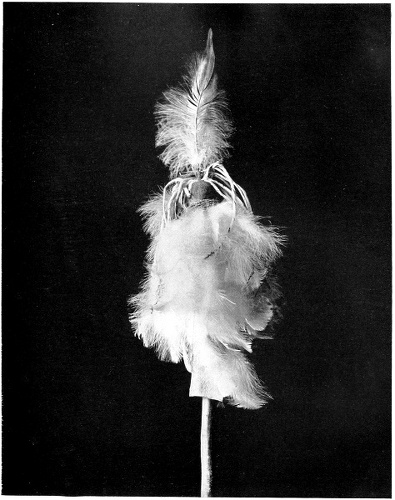
THE TAIME.
In the Sett'an calendar the summer is always designated by a rude figure of the medicine lodge. On the Anko calendar the distinction is made by the decorated center-pole of the lodge. Medicine-lodge creek, where the famous treaty was negotiated, derives its name from several medicine lodges formerly standing on its banks near the southern Kansas line, this being a favorite spot for the sun dance with both the Kiowa and Cheyenne. The following description of the medicine lodge is from Battey's account of the Kiowa sun dance witnessed by him in 1873, to which account the reader is referred (Battey, 15):
The medicine house is situated nearly in the center of the encampment, is circular in form, and about 60 feet in diameter, having its entrance toward the east. It is built by erecting a forked post, 20 feet high, perhaps, for a central support; around this, and at nearly equal distances, are 17 other forked posts, forming the circumference of the building. These are from 12 to 15 feet in height, and all of cottonwood. Small cottonwood trees are tied on the outside of these, in a horizontal position, with ropes of rawhide, having limbs and leaves on them. Outside of these small cottonwood trees are placed in an upright position, thus forming a wall of green trees and leaves several feet in thickness, in the midst of which many hundred spectators afterwards found a cool retreat, where they could observe what was going on without making themselves conspicuous. Long cottonwood poles extend from each of the posts in the circumference to the central post, and then limbs of the same are laid across these, forming a shady roof one-third of the way to the center.
The central post is ornamented near the ground with the robes of buffalo calves, their heads up, as if in the act of climbing it. Each of the branches above the fork is ornamented in a similar manner, with the addition of shawls, calico, scarfs, etc., and covered at the top with black muslin. Attached to the fork is a bundle of cottonwood and willow limbs, firmly bound together and covered with a buffalo robe, with head and horns, so as to form a rude image of a buffalo, to which were hung strips of new calico, muslin, strouding, both blue and scarlet, feathers, shawls, etc., of various lengths and qualities. The longer and more showy articles were placed near the ends. This image was so placed as to face the east. The lodges of the encampment are arranged in circles around the medicine house, having their entrances toward it, the nearest circle being some 10 rods distant....
The ground inside the inclosure had been carefully cleared of grass, sticks, and roots, and covered several inches deep with clean white sand. A screen had been constructed on the side opposite the entrance by sticking small cottonwoods and cedars deep into the ground, so as to preserve them fresh as long as possible. A space was left, 2 or 3 feet wide, between it and the inclosing wall, in which the dancers prepared themselves for the dance, and in front of which was the medicine. This consisted of an image lying on the ground, but so concealed from view in the screen as to render its form indistinguishable; above it was a large fan made of eagle quills, with the quill part lengthened out nearly a foot by inserting a stick into it and securing it there. These were held in a spread form by means of a willow rod or wire bent in a circular form; above this was a mass of feathers, concealing an image, on each side of which were several shields highly decorated with feathers and paint. Various other paraphernalia of heathen worship were suspended in the screen, among these shields or over them, impossible for me to describe so as to be comprehended. A mound had also been thrown up around the central post of the building, 2 feet high and perhaps 5 feet in diameter.
BUREAU OF AMERICAN ETHNOLOGY— SEVENTEENTH ANNUAL REPORT PL. LXX
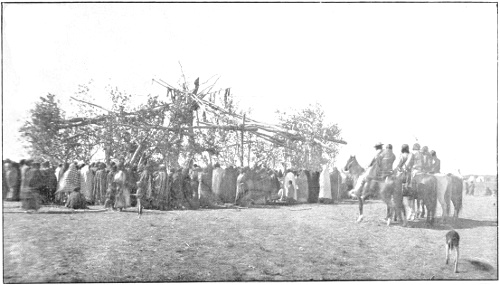
ARAPAHO SUN-DANCE LODGE, 1893.
BUREAU OF AMERICAN ETHNOLOGY— SEVENTEENTH ANNUAL REPORT PL. LXXI
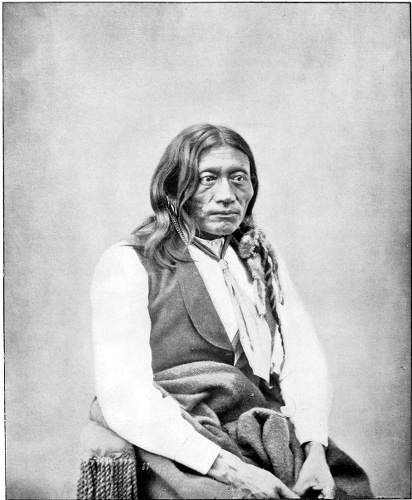
PHOTO BY JACKSON, 1872.
PACER (PESO), FORMER HEAD-CHIEF OF THE KIOWA APACHE.