Front matter
Reading edition
Transcriber's Note
The Table of Contents is added to facilitate the search for a particular bird or group of birds.
Table of Contents
Systematic Page Details Page
SYSTEMATIC ARRANGEMENT OF THE GENERA OF BIRDS v —
ORDER PASSERES v 1
ORDER PICARIÆ xiii 123
ORDER STRIGES xv 142
ORDER ACCIPITRES xv 147
ORDER STEGANOPODES xviii 165
ORDER HERODIONES xvii 170
ORDER ANSERES xviii 176
ORDER COLUMBÆ xix 203
ORDER PTEROCLETES xx 211
ORDER GALLINÆ xx 212
ORDER FULICARIÆ xx 228
ORDER ALECTORIDES xxi 234
ORDER LIMICOLÆ xxi 238
ORDER GAVIÆ xxiii 275
ORDER PYGOPODES xxiv 291
ORDER TUBINARES xxv 304
BRITISH BIRDS IN THEIR HAUNTS
By the late REV. C. A. JOHNS, F.L.S.
Author of
Flowers of the Field
Edited, Revised, and Annotated by
J. A. OWEN
Author of
Birds in their Seasons, etc.
Collaborator in all Books by a '
Son of the Marshes
'
Illustrated with 64 Coloured Plates (256 Figures) by
WILLIAM FOSTER, M.B.O.U.
WITH A GLOSSARY OF COMMON AND PROVINCIAL NAMES AND
OF TECHNICAL TERMS
TWELFTH EDITION
LONDON
GEORGE ROUTLEDGE & SONS, LIMITED
NEW YORK: E. P. DUTTON & CO.
UNIFORM WITH THIS WORK. Each with a series of Coloured Plates and Text-illustrations. FLOWERS OF THE FIELD. By C. A. Johns, F.L.S., revised by Clarence Elliott. BRITISH BUTTERFLIES AND MOTHS. By Dr. W. E. Kirby. BRITISH FERNS AND THEIR ALLIES. By C. T. Druery. BRITISH FUNGI. By George Massee, of Kew Gardens. BRITISH TREES AND SHRUBS. By C. A. Johns. Edited by E. T. Cook. ILLUSTRATED NATURAL HISTORY OF THE WORLD. By Ernest Protheroe, F.Z.S. ALPINE PLANTS OF EUROPE. By H. S. Thompson. With 64 coloured plates. GEORGE ROUTLEDGE & SONS, LTD.
John's Birds, edited by Owen.
First Edition, February, 1909; Reprinted, July, 1910; Reprinted, December, 1915; Reprinted, November, 1917; Reprinted, June, 1919; Reprinted, January, 1921; Reprinted, October, 1922; Reprinted, March, 1925; Reprinted, August, 1928; Reprinted, December, 1931; Reprinted, January, 1935; Reprinted, January, 1938.
Printed in Great Britain by Butler & Tanner Ltd., Frome and London
EDITOR'S PREFACE
This admirable work by the late Rev. C. A. Johns, F.L.S., which is now offered in a new form, has already proved the making of many a naturalist and it will be a delight and help to many more nature lovers who wish to determine a species without recourse to bulky scientific works.
In editing the present edition I have carefully preserved all Mr. Johns' delightful personal stories and his descriptions of the birds and their daily life in their haunts, but I have brought the scientific arrangement of the species up to date, as well as altered the nomenclature, in accordance with present-day knowledge and use.
We begin with the Passeres because modern ornithologists are now nearly all agreed that this order attains the highest Avian development.
I have rectified statements as to the local distribution of various species which, with the progress of time and local changes, no longer apply, and have added facts here and there which I considered of some value.
The faithful and beautiful presentments made by Mr. William Foster for this new edition have no need of our commendation to the public.
J. A. OWEN.
SYSTEMATIC ARRANGEMENT OF THE GENERA OF BIRDS
(Numbered in accordance with the Plates and Descriptions in this Volume.)
ORDER PASSERES (PERCHING BIRDS)
Bill various; feet adapted for perching on trees or on the ground (not for grasping, wading, or swimming); toes four, all in the same plane, three before and one behind; claws slender, curved, and acute. Food, various; that of the nestlings, perhaps in all instances, soft insects.
FAMILY TURDIDÆ (Thrushes)
Bill as long as the head, compressed at the sides; upper mandible arched to the tip, which is not abruptly hooked, notch well marked, but not accompanied by a tooth; gape furnished with bristles; feet long, with curved claws. Food—insects, snails and fruits.
SUB-FAMILY TURDIDÆ
Young in first plumage differ from adults in having the upper and under parts spotted.
Genus 1. Turdus (Thrush, Blackbird, etc.) Bill moderate, compressed at the point; upper mandible notched, bending over the lower one; gape furnished with a few bristles; nostrils basal, lateral, oval, partly covered by a naked membrane; tarsus longer than the middle toe; wings and tail moderate; first primary very short or almost abortive, second shorter than the third or fourth, which are the longest.
Page 1
2. Saxícola (Wheatear). Bill straight, slender, the base rather broader than high, advancing on the forehead, compressed towards the point; upper mandible keeled, curved, and notched; gape surrounded by a few bristles; nostrils basal, lateral, oval, half closed by a membrane; first primary half as long as the second, which is shorter than the third, third and fourth longest; tarsus rather long; claw of the hind toe short, strong and curved.
Page 10
3. Pratíncola (Chats). Bill shorter and broader than in Saxicola; bristles at the gape strongly developed. Wings and tail rather short.
Page 12
4. Ruticilla (Redstarts). Bill slender, compressed towards the point, a little deflected and very slightly emarginate; gape with tolerably large bristles. Nostrils basal, supernal, and nearly round. Wings moderate; the first quill short; the second equal to the sixth; the third, fourth and fifth, nearly equal, and one of them the longest. Legs slender, the tarsus longer than the middle toe, and covered in front by a single scale and three inferior scutellæ.
Page 14
5. Eríthacus (Redbreast). Bill rather strong, as broad as it is high at the base, where it is depressed, slightly compressed towards the tip; upper mandible bending over the lower and notched, nostrils basal, oval, pierced in a membrane, partly hid by bristles diverging from the gape; first primary half as long as the second, fifth the longest; tail slightly forked.
Page 16
6. Daulias (Nightingale). Bill rather stout, straight, as broad as high at the base; upper mandible slightly bent over at the tip; gape with a few short bristles; nostrils basal, round, pierced in a membrane; first primary very short, second and fifth equal in length, third and fourth longest; tail somewhat rounded; tarsus elongated.
Page 17
SUB-FAMILY ACCENTORINÆ
Bill strong and broad at base; upper mandible overlapping lower and slightly notched at tip.
7. Accentor (Hedge-sparrow). Bill of moderate length, strong, straight, tapering to a fine point; edges of both mandibles compressed and bent inwards, the upper notched near the tip; nostrils naked, basal, pierced in a large membrane; feet strong; claw of the hinder toe longest, and most curved; first primary almost obsolete, the second nearly equal to the third, which is the longest.
Page 20
SUB-FAMILY SYLVIINÆ
Young on leaving nest differ slightly in colour from adults.
8. Sylvia (Whitethroats, Blackcap, Warblers). Bill rather stout, short, not very broad at base; upper mandible decurved towards point, which is slightly emarginate; nostrils basal, lateral, oval, and exposed; gape with bristles. Wings moderate, first quill very short. Tail with twelve feathers, generally rounded. Tarsus scutellate in front and longer than middle toe; toes and claws short.
Page 21
9. Acrocéphalus (Reed, Marsh, Sedge, and Aquatic Warblers). Bill nearly straight, with culmen elevated, wide at base, compressed towards tip, and slightly emarginate; edges of lower mandible inflected; nostrils basal, oblique, oval, and exposed; moderately developed bristles at gape. Forehead narrow, depressed. Wings rather short, first quill minute, third usually longest. Tail rounded, rather long. Legs long; feet large and stout, hind toe strong; claws long and moderately curved.
Page 25
10. Locustella (Grasshopper Warbler). Differs from other Sylviinæ chiefly in its more rounded tail and longer under tail-coverts. The late Professor Newton found the tendons of the tibial muscles strongly ossified in this genus.
Page 28
11. Phyllóscopus (Chiff-chaff, Willow and Wood-warblers). Bill slender, rather short; upper mandible decurved from middle and compressed towards tip, which is very slightly notched; nostrils basal, lateral, oblong, partly operculate, membrane clothed with small bristle-tipped feathers, internasal ridge very thin; gape beset with hairs. Wings rather long, first quill comparatively large, third or fourth longest. Tail slightly forked, twelve feathers. Tarsus scaled in front, rather long. Toes long, claws curved.
Page 30
SUB-FAMILY REGULINÆ
Arboreal. Each nostril covered by a single stiff feather.
12. Régulus (Gold and Fire-crested Wrens). Bill very slender, awl-shaped, straight, compressed; cutting edges bent inwards about the middle; nostrils partly concealed by small bristly feathers, directed forwards; first primary very short, second much shorter than the third, fourth and fifth longest; tail moderate; tarsus slender, rather long.
Page 33
FAMILY PARIDÆ (Tits)
Bill short, straight, conical, sharp-pointed, destitute of a notch; nostrils basal, concealed by reflected bristly hairs. Small birds, remarkable for their activity, not highly gifted with musical power, constantly flitting and climbing about trees and bushes, which they examine for small insects, suspending themselves in all attitudes, feeding also on grains and fruits, and not sparing small birds when they are able to overpower them.
13. Acrédula (Long-tailed Tit). Bill much compressed, both mandibles curved, upper considerably longer than lower. Eyelids with wide bare margins. Length of wing quills increases to fourth and fifth, which are longest. Tail very long, narrow, graduated, outer feathers one-third length of middle pair. Tarsus long, feet moderate.
Page 35
14. Parus (Great, Blue, Cole, Marsh, and Crested Tits). Bill slightly compressed, upper mandible hardly longer than lower. First wing quill short, fourth or fifth longest. Tail moderate, even or slightly rounded. Tarsus moderate, feet strong.
Page 37
FAMILY PANURIDÆ (Reedlings)
15. Panúrus (Bearded Tit or Reedling). Bill short, subconical; upper mandible curved at tip and bending over lower one, which is nearly straight; the edges of both somewhat inflected and not notched. Nostrils basal, oval, pointed in front and partly covered by reflected bristly feathers. Wing with ten quills, first almost obsolete, third longest, fourth and fifth nearly equal to it. Tail very long and, much graduated. Tarsus long and scutellate in front; feet stout; claws not much hooked.
Page 42
FAMILY SITTIDÆ (Nuthatches)
16. Sitta (Nuthatch). Bill moderate, strong, and slightly conical; lower mandible ascending from angle to point. Tongue short, horny tip abrupt and furnished with strong bristles. Nostrils basal, rounded, in deep hollow, covered by short feathers and hairs. Wings rather long; first quill much shorter than second, fourth or fifth longest. Tail short, flexible, broad, nearly square. Legs short, stout, tarsi scutellate; toes long, strong, hind toe especially, outer toe joined at base to middle toe; claws large, much hooked.
Page 44
FAMILY CERTHIIDÆ (Creepers)
Bill either straight and subulate or slender, long, and curved; nostrils basal; tail never emarginate; fourth toe coalesced at first phalanx with middle toe. Principally insectivorous.
17. Certhia (Creeper). Bill rather long, slender, compressed, decurved, pointed; nostrils basal, lateral, elongate, partly covered by membrane. Wings moderate, rounded, first feather short, fourth and fifth longest. Tail of twelve feathers, long, stiff, pointed, slightly decurved. Feet large, tarsus slender; fore toes long, united at base as far as first joint; claws moderate, but much curved; hind toe short, but with long curved claw. Plumage soft and thick, especially above.
Page 47
FAMILY TROGLODYTIDÆ
18. Tróglodytes (Wren). Bill moderate, compressed, slightly curved, not notched, pointed. Nostrils basal, oval, partly covered by membrane. Wings short, concave, rounded; first quill rather short, fourth or fifth longest. Tail generally short; its feathers soft and rounded. Tarsus rather long and strong, middle toe united at base to outer but not to inner toe; hind toe as long or longer than middle toe; claws long, stout and curved. Plumage long and soft.
Page 48
FAMILY CINCLIDÆ
19. Cinclus (Dipper). Bill moderate, slightly ascending, angular, higher than broad at base, straight, compressed, and rounded near tip; upper mandible slightly decurving at point. Nostrils basal, lateral; in depression, cleft longitudinally, partly covered by membrane. Gape very narrow, without bristles. Wings short, broad, convex; first quill very short, second not so long as third or fourth, which are nearly equal. Tail short. Legs feathered to tibio-tarsal joint; tarsus longer than middle toe; lateral toes equal in length, outer toe slightly connected with middle. Whole body closely covered with down.
Page 51
FAMILY ORIOLIDÆ
Bill with notch in upper mandible; nostrils placed well in front of base of bill and quite bare.
20. Oriólus (Oriole). Bill an elongated cone, depressed at the base; upper mandible keeled above, notched near the point, bending over the lower one; nostrils basal, lateral, naked, pierced horizontally in a large membrane; tarsus not longer than the middle toe; wings moderate; first primary very short, second shorter than the third, which is the longest.
Page 53
FAMILY STURNIDÆ (Starlings)
Bill nearly straight, short at the base, diminishing regularly to a sharp point, which is not distinctly notched; the ridge of the upper mandible; ascends upon the forehead, dividing the plumage of that part; nostrils placed low in the bill; planta tarsi entire; wings moderate, not reaching to end of tail. An extensive and widely diffused family, comprising species for the most part above the average size of Passerine birds, yet inferior to the Crows. They are in general social, feeding much on the ground; their legs and feet are robust, their gait stately, their plumage, though commonly of dark colours, is lustrous, with reflections of steel-blue, purple, or green.
21. Sturnus (Starling). Bill straight, forming an elongated cone, depressed broad at the base, bluntish; upper mandible broader than the lower; nostrils at the base of the bill, partly closed by an arched membrane; first primary very short, second longest.
Page 54
22. Pastor (Rose-coloured Starling). Bill slightly arched, forming an elongated cone, compressed; nostrils at the base of the bill partly covered by a feathery membrane; wings with the first primary very short, second and third longest.
Page 56
FAMILY CORVIDÆ (Crows)
Bill powerful, more or less compressed at the sides; upper mandible more or less arched to the point without distinct notch; gape nearly straight; nostrils concealed by stiff bristles. Hallux very strong, but with its claw not as long as the middle toe and claw. Birds of firm and compact structure; their wings long, pointed, and powerful; their feet and claws robust. In disposition bold and daring, extremely sagacious, easily tamed and made familiar. Most of them have the power of imitating various sounds, but their natural voices are harsh. They evince a remarkable propensity for thieving and hiding brilliant and gaudy substances. In appetite they are omnivorous.
23. Pyrrhócorax (Chough). Bill longer than the head, rather slender, arched from the base, and pointed; nostrils oval; feet strong, tarsus longer than the middle toe; wings rounded, first primary short, fourth and fifth the longest; tail even at the end.
Page 56
24. Nucífraga (Nutcracker). Bill about as long as the head, straight, conical, the base dilated, and dividing the feathers of the forehead; mandibles blunt, the upper somewhat the longer; nostrils round; wings rather long and pointed; first primary shorter than the second and third, fourth longest; tail nearly even.
Page 57
25. Gárrulus (Jay). Bill shorter than the head, conical; both mandibles equally curved, the upper notched near the tip; crown feathers forming a crest; wings rounded, fourth, fifth, and sixth primaries nearly equal, and the longest; tarsus longer than the middle toe; tail moderate, slightly rounded.
Page 58
26. Pica (Magpie). Bill, nostrils, and feet as in Corvus; wings short and rounded; tail long, graduated.
Page 59
27. Corvus (Raven, Crows, Rook). Bill not longer than the head, strong, straight at the base, cutting at the edges, and curved towards the point; nostrils oval; feet strong, tarsus longer than the middle toe; wings pointed, first primary moderate, second and third shorter than the fourth, which is the longest; tail moderate, rounded.
Page 61
FAMILY LANIIDÆ (Shrikes)
Bill strong, arched, and hooked, the upper mandible strongly notched after the manner of the Falconidæ; claws adapted for capturing insects and even small birds. Sylvan. Young barred below.
28. Lánius (Shrike, or Butcher Bird). Bill short, flattened vertically (compressed) at the sides; gape furnished with bristly feathers directed forwards; wings with the first three primaries graduated, the third and fourth being the longest.
Page 73
FAMILY AMPELIDÆ (Chatterers)
Bill stoat, approaching, especially in the form of the lower mandible, to that of the Corvidæ; the upper mandible is however somewhat broad at the base, flat, with the upper edge more or less angular and ridged, and the tip distinctly notched. Feet usually stout, with the outer toe united to the middle one as far as, or beyond, the first joint. They feed principally on berries and other soft fruits, occasionally also on insects.
29. Ámpelis (Waxwing). Bill as above; nostrils oval, concealed by small feathers directed forwards; wings long and pointed; first and second primaries longest, some of the secondaries and tertials terminating in wax-like prolongations of their shafts.
Page 76
FAMILY MUSCICAPIDÆ (Flycatchers)
Bill broad, flattened horizontally (depressed), slightly toothed and adapted for catching small flying insects; nostrils more or less covered by bristly hairs; feet generally feeble.
30. Muscícapa (Flycatcher). Bill moderate, somewhat triangular, depressed at the base, compressed towards the tip, which is slightly curved downwards; gape armed with stiff bristles; tarsus equal to or longer than the middle toe; side toes of equal length; wings with the first primary very short, and the third and fourth longest.
Page 77
FAMILY HIRUNDINIDÆ (Swallows and Martins)
Beak short but broad, and more or less flattened horizontally; mouth very deeply cleft; feet small and weak; wings with nine visible primaries, long and powerful, and thus adapted for sustaining a protracted flight in pursuit of winged insects, which form the sole sustenance of these birds; tail long and usually forked; plumage close, smooth, often burnished with a metallic gloss. Migratory birds, spending the summer in temperate climates, but being impatient of cold, withdrawing in winter to equatorial regions.
31. Hirundo (Swallow). Bill short, depressed, very wide at base, commissure straight. Nostrils basal, oval, partly closed by membrane. Tail deeply forked, of twelve feathers, the outermost greatly elongated and abruptly attenuated. Legs and feet slender and bare; toes rather long, three in front, one behind; claws moderate.
Page 80
32. Chelídon (Martin). Bill short, depressed, very wide at base, commissure slightly decurved. Nostrils basal, oval, partly closed by membrane and opening laterally. Tail forked, of twelve feathers, outermost not abruptly attenuated. Legs and feet slender, closely feathered above; toes rather long, three in front, one behind; claws moderate, sharp.
Page 83
33. Cótile (Sand-martin). Bill short, depressed, very wide at base, commissure straight. Nostrils, wings and tail as in Chelidon. Legs and feet slender, and bare except for tuft of feathers on tarsus just above hallux; toes moderate, three in front, one behind; claws strong.
Page 84
FAMILY FRINGILLIDÆ (Finches)
Remarkable for the shortness, thickness, and powerful structure of the bill; the upper and lower mandibles are usually equally thick, and their height and breadth are nearly alike, so that the bill when closed presents the appearance of a short cone, divided in the middle by the gape. By its aid they break open the hard woody capsules and fruit-stones containing the seeds and kernels which form their chief food. At nesting-time many species live on insect larvæ, with which the young are almost exclusively fed. The wings have nine visible primaries. This family is one of immense extent, consisting of relatively small birds.
34. Ligurinus (Greenfinch). Bill compressed towards tip, with scarcely perceptible notch at point; nostrils basal, concealed by stiff feathers directed forwards; wings rather pointed, first quill obsolete, second, third and fourth nearly equal and longest. Tail rather short, slightly forked. Tarsus scutellate in front; toes moderate; claws arched and laterally grooved.
Page 86
35. Coccothraustes (Hawfinch). Bill tapering rapidly to point, culmen rounded; mandibles nearly equal, edges inflected and slightly indented. Nostrils basal, lateral, oval, nearly hidden by projecting and recurved frontal plumes. Wings with first quill obsolete, third and fourth primaries nearly equal, sixth, seventh, and eighth curved outwards. Tail short, and nearly square. Tarsus scutellate in front, covered at sides with single plate, stout and short; claws moderately curved, rather short and strong.
Page 87
36. Carduêlis (Goldfinch and Siskin). Bill a rather elongated cone, compressed at the tip, and finely pointed; wings long, pointed; first three primaries nearly equal and the longest; tail slightly forked
Page 88
37. Passer (Sparrows). Bill somewhat arched above; lower mandible rather smaller than the upper; first three primaries longest.
Page 92
38. Fringilla (Chaffinch and Brambling). Bill straight, sharp, pointed; mandibles nearly equal; first primary a little shorter than the second, much shorter than the third and fourth, which are nearly equal and the longest.
Page 95
39. Acanthis (Linnet, Redpolls, Twite). Bill a short straight cone, compressed at the tip; wings long, pointed; third primary somewhat shorter than the first and second, which are equal and the longest; tail forked.
Page 98
40. Pýrrhula (Bullfinch). Bill short and thick, the sides tumid; upper mandible much arched and bending over the lower one; first primary nearly equal to the fifth, second a little shorter than the third and fourth, which are the longest.
Page 101
41. Loxia (Crossbill). Bill thick at the base; both mandibles equally curved, hooked at the tips, and crossing each other at the points.
Page 103
42. Emberiza (Buntings, Yellow-hammer). Bill with upper mandible not wider than lower, edges of both inflected and those of latter gradually cut away (sinuated); the palate generally furnished with a hard bony knob; wings moderate, first primary obsolete, second, third and fourth nearly equal. Tail rather long and slightly forked. Claws considerably curved, that of hind toe of moderate length.
Page 106
43. Plectrophenax (Snow Bunting). Bill with upper mandible narrower than lower, otherwise as in Emberiza. Wings long and pointed, first primary obsolete, second and third nearly equal and longest in wing, fourth considerably longer than fifth. Tail moderate and slightly forked. Front claws rather long and curved; hind claw considerably curved and elongated.
Page 110
44. Calcarius (Lapland Bunting). Bill with considerably inflected cutting edges (tomia); claws of front toes short and slightly curved; hind claw nearly straight and elongated; other characters much as in Plectrophenax.
Page 111
FAMILY MOTACILLIDÆ (Wagtails and Pipits)
Wings with nine visible primaries. Inner secondaries nearly as long as primaries.
45. Motacilla (Wagtail). Cutting edges of both mandibles slightly compressed inwards; nostrils basal, oval, partly concealed by a naked membrane; first primary acuminate and nearly obsolete, second and third nearly equal and longest; one of the scapulars as long as the quills; tail long, nearly even at the end; tarsus much longer than the middle toe.
Page 111
46. Anthus (Pipit). Bill and nostrils very much as in Motacilla; two of the scapulars as long as the closed wing; first primary acuminate and nearly obsolete, second shorter than the third and fourth, which are the longest; hind claw very long.
Page 116
FAMILY ALAUDIDÆ (Larks)
Wings with nine or more visible primaries. Planta tarsi scutellate. Granivorous birds, frequenting open spaces, and singing during their flight; nesting on ground and seeking their food there by running; they are 'pulverators', i.e. they shake dust or sand into their feathers instead of bathing.
47. Alauda (Lark). Bill moderate, slightly compressed at edges; upper mandible more or less arched from middle. Nostrils basal, oval, covered by bristly feathers directed forward. Gape straight. Wings long; first primary short but unmistakably developed; second, third and fourth nearly equal, but third longest. Tail moderate, slightly forked. Tarsus longer than middle toe; claws slightly curved and moderate, except that of hind toe, which is generally elongate and nearly straight.
Page 119
48. Otócorys (Shore-lark). Bill rather short, subconic; upper mandible slightly arched. Head—in adult male—with tuft of long, erectile feathers on either side of occiput. Wings long; first primary so small as at first sight to seem wanting, second longest but third nearly its equal, fourth decidedly shorter, outer secondaries short and emarginate at tip. Tail rather long, slightly forked. Tarsus shorter than middle toe; claws moderate and very slightly curved, that of hind toe being comparatively straight.
Page 122
ORDER PICARIÆ
Opposed to the Passeres. The feet are relatively weaker and smaller.
FAMILY CYPSELIDÆ (Swifts)
Tail of ten feathers (swallows have twelve). Gape very wide.
49. Cýpselus (Swift). Bill very short, flattened horizontally, triangular; upper mandible curved downwards at the point; gape extending beyond the eyes; legs very short; toes all directed forwards; wings extremely long; first primary a little shorter than the second.
Page 123
FAMILY CAPRIMULGIDÆ (Goatsuckers)
The bill in this family resembles that of the Swallows, but is shorter and weaker; the gape is enormous and its sides are, for the most part, furnished with long and stiff bristles, which point forwards; the wings are long, and formed for powerful flight; the feet are small, and feathered to the toes; plumage soft and downy, and beautifully mottled with black, brown, grey, and white, varying in colour with the soil of their habitat; the claw of the middle toe is dilated on one side and toothed like a comb. Tail of ten feathers. Nocturnal birds, feeding on large insects, which they capture in their flight.
50. Caprimúlgus (Goatsucker or Nightjar). Bill very short, somewhat curved, broad and flattened at the base; upper mandible curved downwards at the tip; gape extending beyond the eyes, and armed with strong bristles; wings long; first primary shorter than the second, which is the longest.
Page 125
FAMILY PICIDÆ (Woodpeckers)
Feet short, but of unusual strength; the rigid toes diverge from a centre, two pointing forwards, and two backwards; claws large, much curved, and very hard and sharp; breast-bone shallow; flight weak and undulating.
SUB-FAMILY PICINÆ
Tail feathers stiff and pointed: nostrils covered with bristles.
51. Dendrocopus (Spotted Woodpeckers). Bill about as long as the head, robust, straight, irregular, compressed, pyramidal, laterally bevelled at the tip; tongue long and extensile, the tip barbed; nostrils basal, oval, concealed by reflected bristly feathers; wings with the first primary very short, fourth and fifth longest; tail-feathers graduated, stiff and pointed. Fourth toe much longer than third. Prevailing colours of the plumage black and white, or black and red.
Page 127
52. Gécinus (Green Woodpecker). Bill hard, broad at base, compressed at tip; upper mandible slightly arched, ending abruptly with shallow groove on each side running parallel to and near the culmen, and longer than lower mandible, which is pointed and has the gonys nearer the tip than the base and the tomia rounded. The fourth toe equal to the third. Prevailing colour greenish, otherwise much as in Dendrocopus.
Page 129
SUB-FAMILY IŸNGINÆ
Nostrils partly covered by a membrane. Nostrils partly covered by a membrane.
53. Iÿnx (Wryneck). Bill shorter than the head, straight, conical; tongue long and extensile; nostrils without bristles, partly closed by a membrane; wings with the second primary somewhat the longest; tail-feathers soft and flexible.
Page 131
FAMILY ALCEDINIDÆ (Kingfishers)
Bill long, stout, and pointed, with angular sides, not serrated; feet small and feeble, the outer and middle toes united to the last joint; wings rounded and hollow, ill adapted for protracted flight; form robust, with a large head and usually a short tail. Predatory birds, feeding on fish, insects, and even reptiles, birds, and small quadrupeds. Scattered over the world, but Australia and South America contain the greatest number of species.
54. Alcédo (Kingfisher). Bill long, straight, quadrangular, sharp; wings short with the third primary the longest; tail very short.
Page 132
FAMILY CORACIIDÆ (Rollers)
Bill corvine in shape; culmen rounded; nostrils near base of upper mandible and hidden by bristly feathers; tail feathers twelve.
54. Corácias (Roller). Bill compressed, straight, with cutting edges; upper mandible slightly hooked at the point; sides of the gape bristled; tarsus short; wings long; first primary a little shorter than the second, which is the longest.
Page 134
FAMILY MEROPIDÆ (Bee-eaters)
Bill long; culmen with sharply defined ridge; toes joined for part of length.
55. Mêrops (Bee-eater). Bill long, compressed, slightly curved, slender, with cutting edges, broad at the base; upper mandible keeled, the tip not hooked; tarsus very short; wings long, pointed, second primary the longest; centre tail feathers elongated.
Page 135
FAMILY UPUPIDÆ (Hoopoes)
56. Upupa (Hoopoe). Bill longer than the head, slender, slightly arched, compressed; feathers of the head long, forming a two-ranked crest; tail even at the extremity.
Page 136
FAMILY CUCULIDÆ (Cuckoos)
Bill moderate, rather deeply cleft, both mandibles compressed, and more or less curved downwards; nostrils exposed; wings for the most part short; tail of ten feathers lengthened; toes four, two pointing backwards and two forwards, but the outer hind toe of each foot is capable of being placed at right angles with either the inner or outer front toe. A tropical family of birds, many of which migrate to the temperate regions in summer. Not so decidedly climbers as the Woodpeckers and Creepers, yet having great power of clinging. Their flight is feeble, their food soft-bodied insects, varied in many cases with berries and other fruits, and some of the larger species will occasionally prey on mice, reptiles, and the eggs and young of birds. Most, perhaps all of the migratory species, lay their eggs in the nests of other birds.
57. Cúculus (Cuckoo). Bill shorter than the head, broad, depressed at the base, with the ridge curved and the sides compressed towards the tip, which is entire and acute; nostrils in a membranous groove, the opening rounded and exposed; wings pointed, third primary longest; tail long, graduated; tarsi very short, feathered below the heel.
Page 137
ORDER STRIGES (OWLS)
Head large, feathered; eyes large, dilated and projecting, each surrounded by a concave disc formed of stiff diverging feathers, concealing the cere and nostrils; ears large, and of elaborate construction; plumage lax and downy, adapted for slow and quiet flight; outer toe reversible; tibia more than double the length of tarsus. Food, small quadrupeds, birds, and insects.
FAMILY STRIGIDÆ
SUB-FAMILY STRIGINÆ
Bill somewhat elongated, bending at the tip only; head-tufts wanting nostrils oval, oblique; facial disc large and complete; ears large, covered by an operculum; wings long, the second primary longest; tarsi long, feathered to the toes, which are strangely furnished with hair-like feathers; claws long, the middle one serrated beneath.
58. Strix (White Owl). Characters given above.
Page 142
SUB-FAMILY SYRNIINÆ
Bill bending from the base; tufts more or less conspicuous or wanting; facial disc complete; ears large, covered by an operculum; legs feathered to the claws.
59. Asio (Eared Owls). Nostrils oval, oblique; tufts more or less elongated; wings long, second primary the longest.
Page 144
60. Syrnium (Tawny Owl). Nostrils round; egrets wanting; wings short and rounded; fourth primary longest.
Page 146
ORDER ACCIPITRES (EAGLES, HAWKS, ETC.)
Bill short, strong, stout at base, culmen strongly curved. Feet strong, armed with powerful talons which are capable of being bent under the feet, inner one stronger and more curved than others. Outer toe usually not reversible.
FAMILY FALCONIDÆ
Head covered with feathers, though sides of face are more or less bare.
SUB-FAMILY BUTEONINÆ
Bill rather small and weak, bending from the base; cutting edge of the upper mandible nearly straight, or but slightly festooned; cere large; nostrils oval; wings long; the first four feathers deeply notched on their inner webs; tail not forked. Hinder aspect of tarsus scutellate.
61. Circus (Harriers). Head surrounded by a circle of feathers; tarsi, long and slender, feathered a little below the joint; wings long third and fourth primaries the longest; tail long, somewhat rounded.
Page 147
62. Buteo (Buzzard). Lore without feathers; tarsi short and strong, naked or feathered; wings large, the fourth primary the longest.
Page 150
63. Pernis (Honey Buzzard). Lore with feathers; tarsi short and strong, naked or feathered; wings large, the fourth primary the longest.
Page 151
SUB-FAMILY AQUILINÆ
Bill stout, convex or slightly angular above, straight at the base, much hooked at the tip, commissure simply festooned; cere bristly; nostrils rounded or oval; wings long. Hinder aspect of tarsus reticulate.
64. Aquila (Eagles). Upper mandible with the cutting edge nearly straight; tarsi feathered to the toes; claws unequal, grooved beneath; wings with the fourth primary longest.
Page 152
65. Haliaëtus (Sea-eagle). Bill very long; edges of the upper mandible slightly prominent near the hook; tarsi half-feathered; claws unequal, grooved beneath; wings with the fourth primary longest; nostrils transverse, with bony margin all round.
Page 153
66. Pandíon (Osprey). Bill short, cutting edges of the upper mandible nearly straight; tarsi naked; outer toe reversible; claws equal, rounded beneath; wings with the second primary longest.
Page 154
SUB-FAMILY ACCIPITRINÆ
Long-legged Hawks
Bill short, strong, curved from the base; edge of the upper mandible with a prominent festoon beyond the middle; nostrils oval; wings rounded, short, reaching only to the middle of the tail; middle toe much the longest.
67. Accípiter (Sparrow-hawk). Tarsi long and slender; fourth and fifth primaries equal in length and the longest. Ridge of bill measured from margin of cere is less than half middle toe (without claw).
Page 156
SUB-FAMILY MILVINÆ
Bill of moderate length, slightly curved from the base, upper mandible with a slight festoon; nostrils oval, oblique; wings long; tail long and forked.
68. Milvus (Kites). Tarsi feathered a little below the knee; fourth primary the longest.
Page 158
SUB-FAMILY FALCONINÆ
Bill short, strong, curved from the base, upper mandible strongly toothed, lower notched; nostrils round; tarsi strong and short; hinder aspect reticulate; wings long and pointed, with the second primary longest, the first and third equal in length and having the inner web notched near the extremity.
69. Falco (Falcons, Merlin, Hobby and Kestrel). Characters given above.
Page 159
ORDER STEGANOPODES
Hind toe articulated on the inner surface of the tarsus, united to other toes by a web.
FAMILY PELECANIDÆ
Bill strong, edges of the mandibles minutely toothed; wings long; legs short; toes four, all connected by a membrane.
70. Phalacrócorax (Cormorant). Bill straight, longer than the head, compressed; upper mandible much hooked at the point; face and throat naked; inner edge of the middle claw serrated; tail rounded, rigid.
Page 165
71. Sula (Gannet). Bill straight, longer than the head, compressed, tapering to a point, which is but slightly curved; face and throat naked; inner edge of the middle claw serrated; tail graduated.
Page 168
ORDER HERODIONES
Hallux free, not united to other toes by a web.
FAMILY ARDEIDÆ (Herons)
Hind toe on same plane as others. Bill rounded or ridged; notched, with no hook at end. Outer toe with broad basal web, obsolete at base of inner toe; middle claw pectinated, loral space bare; powder down patches present.
72. Árdea (Herons). Edges of mandibles distinctly serrated; head crested; nape feathers elongated and ornamented; plumes of fore-neck not disintegrated; no dorsal train.
Page 173
73. Nyctícorax (Night Heron). Bill scarcely longer than the head, much compressed; neck rather thick and short; crest of three very long tapering feathers. In other respects resembling Árdea.
Page 173
74. Botaurus (Bittern). Bill scarcely longer than the head, much compressed; neck thick, clothed in front with long and loose feathers. In other respects resembling Ardea.
Page 173
FAMILY CICONIIDÆ (Storks)
Hind toe elevated above plane of others; no powder down patches; bill not hooked at tip.
75. Cicónia (Stork). Bill much longer than the head, stout, tapering to a point; nostrils near the base, pierced in the horny substance of the bill; tarsi very long; claws not pectinated; wings moderate, third, fourth, and fifth primaries longest.
Page 175
FAMILY PLATALEIDÆ (Spoonbills)
Bill flattened, narrow in middle, and widening out into a spoon-shaped end.
76. Plataléa (Spoonbill). Head partly bare, auricular orifice covered with plumes. Nostrils elongated and in a shallow depression.
Page 176
ORDER ANSERES
Tarsus about length of femur, reticulate at back and generally in front. Bill straight, always with distinct nail at tip of upper mandible. Young covered with down, and able to run or swim in a few hours after hatching.
FAMILY ANATIDÆ (Ducks, Geese, Swans, etc.)
Bill thick, broad, high at the base, covered with a thin membranous skin and ending in a nail-like horny tip; edges of the mandibles cut into thin parallel ridges, or toothed; wings moderate; legs placed not very far behind; feet, four-toed, palmated; hind toe free, placed high on the tarsus. Food, grass and aquatic weeds, worms, insects, molluscs, and small fish.
SUB-FAMILY ANSERINÆ
77. Anser (Geese). Bill nearly long as head, elevated and covered with cere or skin at base; conspicuous nail at tip; under mandible smaller than upper; nostrils lateral, near middle of bill; tail of sixteen feathers; legs under centre of body; hind toe free, articulated upon tarsus.
Page 176
78. Bernicla (Brent and Bernicle Geese). Bill shorter than head, higher than broad at base; culmen slightly convex, outline of lower mandible decidedly so, leaving elliptical space displaying lamellæ; nostrils sub-basal; neck feathers less furrowed than in Anser; tail short, rounded; tibia feathered to joint; hind toe short and elevated.
Page 180
79. Cygnus (Swans). Bill of equal length throughout, furnished with knob at base; nostrils medial; legs short; neck exceedingly long.
Page 181
SUB-FAMILY ANATIDÆ
Bill of equal width throughout, or broader at the top than at the base, of about the same width as the head; legs short, placed rather behind the middle of the body; hind toe without a pendent membrane; tarsi somewhat round.
80. Tadorna (Sheldrake). Bill with an elevated tubercle at the base, depressed in the middle; nostrils large, pervious; lower portion of tarsus in front with a row of transverse scutellæ.
Page 184
81. Anas (Mallard, Gadwall). Bill long as head, broad, depressed, sides parallel, sometimes partially dilated, both mandibles with transverse lamellæ on inner edges; nostrils small, oval, lateral, anterior to base of bill; wings rather long, pointed; tail wedge-shaped; legs rather short; hind toe without lobe. Sexes differ in plumage.
Page 185
82. Spatula (Shoveller). Bill much longer than head, widening towards end, lamellæ projecting conspicuously; no soft membrane on sides of bill towards tip; wing pointed, first and second quills longest; tail short, graduated; legs very short.
Page 189
83. Dafila (Pintail). Bill long as head, edges nearly parallel, widening a little to end, lamellæ not strongly defined; neck long, slender; tail sharply pointed, central rectrices considerably elongated in male; margin of web to anterior toes slightly emarginate.
Page 190
84. Querquédula (Teal). Bill long as head, lamellæ exposed along projecting edge of upper mandible; tail of sixteen feathers, short and rounded; hind toe very small, outer shorter than third, centre rather long; interdigital membrane emarginate.
Page 191
85. Maréca (Wigeon). Bill shorter than head, higher than broad at base, depressed and narrowed towards point; tail short, pointed; tibia bare for short distance; hind toe with very narrow lobe.
Page 192
SUB-FAMILY FULIGULINÆ
Hind toe with lobated membrane; tarsi compressed.
86. Fulígula (Pochard, Tufted Duck, Scaup). Bill not longer than head, slightly elevated at base, broader towards tip; edges of upper mandible enclosing edges of lower; nostrils near base.
Page 193
87. Clangúla (Goldeneye). Bill much shorter than head, depressed towards nail, which is elliptical and decurved at tip; lamellæ hidden; nostrils near middle of bill.
Page 195
88. Harelda (Long-tailed Duck). Bill much shorter than head, tapering rapidly to broad, decurved nail at tip. Lamellæ slightly exposed; nostrils sub-basal. Feathering at base of bill forming oblique line, advancing furthest forward on forehead. Wings rather short, pointed; scapulars elongate and lanceolate in adult male; tail short, graduated except for two central feathers, which are long and tapering in adult male.
Page 196
89. Somateria (Eider Duck). Bill swollen and elevated at base, extending up the forehead, there divided by angular projection of feathers; nostrils medial.
Page 197
90. Œdemia (Scoters). Bill short, broad, with an elevated knob at the base, the tip much flattened; nail large, flat, obtuse, slightly deflected; lamellæ coarse, widely set; nostrils oval, medial; tail short, graduated, acute.
Page 199
SUB-FAMILY MERGANINÆ
91. Mergus (Smew, Merganser, Goosander). Bill straight, slender, narrow, approaching to cylindrical; upper mandible hooked; edges of both mandibles armed with sharp teeth directed backwards; legs short, placed far backward.
Page 201
ORDER COLUMBÆ (Pigeons and Doves)
Bill swollen at tip, convex; the upper mandible covered at the base with a soft membrane in which lie the nostrils, with a valve over them; tarsi covered fore and rear with hexagonal scales.
The birds of this order have considerable powers of flight, and perch freely on trees or rocks. Their food consists principally of grain, seeds, and the leaves of herbaceous plants. The young are fed on a milky fluid secreted in the crop of the old birds.
FAMILY COLUMBIDÆ
Tail with twelve feathers; hind toe with the skin prominently expanded on the sides.
92. Columba (Wood-pigeon, Stock-dove, Rock-dove). Bill moderate, straight at base, compressed, point deflected; tail nearly even; first primary much larger than sixth.
Page 203
93. Turtur (Turtle-dove). Bill rather slender, tip of upper mandible gently deflected, that of lower scarcely exhibiting the appearance of an angle; tail rather long, graduated.
Page 209
ORDER PTEROCLETES
FAMILY PTEROCLIDÆ
94. Syrrhaptes (Sandgrouse). Bill small, gradually decurved; nostrils basal, hidden; wings long, pointed, first primary largest; tail of sixteen feathers, cuneate, central pair long; tarsi short, strong; feathered to toes; three toes, all in front; hallux obsolete; soles rugose; claws broad and obtuse.
Page 211
ORDER GALLINÆ
Bill short and stout; culmen arched, and overhanging the mandible.
FAMILY TETRAONIDÆ
95. Tetráo (Black Grouse, Capercaillie). Bill strong; eyebrows naked, adorned with scarlet papillæ; tarsi feathered, without spurs; front toes naked, with pectinated margins; hind toe larger than the nail.
Page 212
96. Lagópus (Red Grouse, Ptarmigan). Front toes feathered, nearly smooth at the margins; hind toe shorter than the nail; in other respects like the last.
Page 215
FAMILY PHASIANIDÆ
Nostrils never hidden by feathers; toes never pectinated.
97. Phasiánus (Pheasant). Cheeks naked, adorned with scarlet papillæ; tail very long, of eighteen feathers.
Page 219
98. Perdix (Partridge). Bill strong; orbits naked; tarsus naked, male with a knob on the tarsus behind; tail of sixteen feathers, short, bent down.
Page 222
99. Caccabis (Red-legged Partridge). Tail of fourteen feathers; tarsi armed with blunt spurs in male.
Page 225
100. Coturnix (Quail). Bill slender; orbits feathered; wings with the first primary longest; tail very short; almost concealed by the tail-coverts.
Page 226
ORDER FULICARIÆ (RAILS AND COOTS)
FAMILY RALLIDÆ (Rails)
101. Crex (Corn-crake). Bill shorter than the head, thick at the base, compressed, pointed; front toes entirely divided, not margined; second and third primaries longest. Tail pointed, rectrices narrow.
Page 228
102. Porzana (Spotted and Little Crakes). Bill shorter than head; wings shorter than in Crex; second quill longest; secondaries shorter than primaries by length of hind toe and claw.
Page 229
103. Rallus (Water-rail). Bill longer than head; wings moderate, third and fourth quills longest.
Page 230
104. Gallínula (Moor-hen). Bill shorter than the head, stout, straight, compressed; upper mandible expanding at the base and forming a disc on the forehead; toes entirely divided, bordered by a narrow entire membrane, middle toe longer than tarsus.
Page 231
105. Fúlica (Coot). Bill shorter than the head, straight, robust, convex above, much compressed; upper mandible dilated at the base, and forming a naked patch on the forehead; all the toes united at the base, and bordered by a scalloped membrane.
Page 233
ORDER ALECTORIDES
Angle of the mandible always truncated, hind toe generally raised above level of others.
FAMILY GRUIDÆ
Nasal depression more than half as long as maxilla; rectrices twelve.
106. Grus (Crane). Upper mandible deeply channelled; nostrils medial; wings moderate; third primary longest.
Page 234
FAMILY OTIDIDÆ (Bustards)
Bill flattened and obtuse; no hind toe; tarsi unarmed; wings very short; rectrices sixteen to twenty.
107. Otis (Bustard). Legs long, naked above the knee; wings moderate, hind quill longest.
Page 236
ORDER LIMICOLÆ (WADERS)
Leg and tarsus long, the lower portion of the former generally destitute of feathers; bill long or moderate; toes three or four, more or less connected by a membrane at the base, sometimes lobated. Primaries eleven; fifth secondary wanting; after shaft to contour feathers present.
Adapted by structure for feeding in marshes, on the muddy or sandy sea-shore, or on the banks of lakes and rivers. Some, which feed on fish, have unusually long legs and powerful bills; others, owing to their length of bill and legs, are able to search muddy places for worms and insects, without clogging their feathers; and others, again, are decidedly aquatic, and have considerable swimming powers, thus approaching the next order; the majority have great power of flight, and lay their eggs on the ground.
FAMILY GLAREOLIDÆ
108. Glaréola (Pratincole). Bill short, convex, compressed towards the point; upper mandible curved throughout half its length; nostrils basal, oblique; legs feathered nearly to the knee; tarsus long; three toes in front, one behind, the latter joined on the tarsus; wings very long; first primary longest.
Page 238
FAMILY CHARADRIIDÆ
Hind toe absent in most species; tarsus usually reticulate, sometimes scutellate.
109. Œdicnémus (Thick-knee). Bill stout, straight, longer than the head, slightly compressed towards the end; nostrils in the middle of the bill, narrow, with the aperture in front, pervious; toes three, united by a membrane as far as the first joint; wings as in the last.
Page 239
110. Cursorius (Courser). Bill shorter than the head, depressed at the base, slightly curved, pointed; nostrils basal, oval, covered by a little protuberance. Legs long, slender; toes three, very short, divided nearly to the base, inner toe half the length of the middle one; its claw serrated; claws very short; wings moderate; first primary nearly as long as the second, which is the longest in the wing.
Page 240
111. Charádrius (Plover). Bill shorter than the head, slender, straight, compressed, somewhat swollen towards the tip; nasal channel reaching from the base through two-thirds of the bill, covered by a membrane; nostrils basal, very narrow; tarsi moderate, slender; toes three, the outer and middle connected by a short membrane; wings moderate; first primary longest.
Page 240
112. Squatárola (Grey Plover). Bill shorter than the head, straight, swollen and hard towards the tip; nostrils basal, narrow, pierced in the membrane of a long groove; legs slender; outer and middle toe connected by a short membrane, hind toe rudimentary, jointed on the tarsus, not touching the ground; wings long, pointed; first primary longest.
Page 242
113. Eudromias (Dotterel). Bill shorter than head, slender, compressed; nasal channel reaching about half length of bill. Wings moderate; inner secondaries much longer than in Charádrius.
Page 244
114. Ægialitis (Ringed and Kentish Plovers). Bill much shorter than head, slender, straight to end of nasal channel, which extends beyond middle of bill, then slightly raised, but decurved at tip; wings long, pointed.
Page 245
115. Vanellus (Lapwing). Wings large, quills broad and rounded, the fourth and fifth primaries longest. In other respects resembling Squatarola.
Page 247
116. Hæmátopus (Oyster Catcher). Bill longer than the head, stout, straight, forming a wedge; legs moderate, stout; toes three, bordered by a narrow membrane; wings long; first primary longest.
Page 248
117. Strépsilas (Turnstone). Bill short, thickest at the base and tapering; nostrils basal, narrow, pervious; legs moderate; three front toes connected at the base by a membrane, fourth rudimentary, jointed on the tarsus, touching the ground with its tip.
Page 250
FAMILY SCOLOPACIDÆ (Snipes, etc.)
Bill long and slender; toes four, the hind one weak and elevated, very rarely wanting.
118. Recurvirostra (Avocet). Bill very long, slender, weak, much curved upwards, pointed; legs long, slender; front toes connected as far as the second joint; hind toe very small.
Page 252
119. Phaláropus (Phalarope). Bill as long as the head, slender, weak, depressed and blunt; front toes connected as far as the first joint, and bordered by a lobed and slightly serrated membrane; hind toe not bordered.
Page 253
120. Scólopax (Woodcock). Bill long, compressed, superior ridge elevated at base of mandible, prominent. Legs rather short, anterior toes almost entirely divided.
Page 254
121. Gallinágo (Snipe). Bill very long; legs rather long and slender; anterior toes divided to the base.
Page 256
122. Calidris (Sanderling). Bill as long as the head, slender, straight, soft, and flexible, dilated towards the end; nostrils basal, narrow, pierced in the long nasal groove which reaches to the tip; legs slender; toes three, scarcely connected by a membrane; wings moderate; first primary longest.
Page 260
123. Tringa (Sandpiper, Knot, Dunlin, Stint). Bill as long as the head or a little longer, straight or slightly curved, soft and flexible, dilated, and blunt towards point; both mandibles grooved along sides; nostrils lateral wings moderately long, pointed, first quill longest; legs moderately long; three toes in front, divided to origin; one behind, small, articulated upon tarsus.
Page 361
124. Machétes (Ruff). Bill straight, as long as the head, dilated and smooth at the tip; nasal channel reaching to nearly the end of the bill; nostrils basal; first and second primaries longest; toes four, the outer and middle connected as far as the first joint; neck of the male in spring furnished with a ruff.
Page 266
125. Tótanus (Redshank, Sandpiper). Bill moderate, slender, soft at the base, solid at the end; both mandibles grooved at the base, upper channelled through half its length; nostrils pierced in the groove; legs long, slender; toes four.
Page 267
126. Limósa (Godwit). Bill very long, slender, curved upwards, soft and flexible throughout, dilated towards the tip, and blunt; upper mandible channelled throughout its whole length; nostrils linear, pierced in the groove, pervious; legs long and slender; toes four, the outer and middle connected as far as as the first joint; wings moderate; first primary longest.
Page 272
127. Numenius (Curlew, Whimbrel). Bill much larger than the head, slender, curved downwards.
Page 273
ORDER GAVIÆ
Front toes entirely connected by webs. Primaries, ten large and visible, one minute and concealed.
FAMILY LARIDÆ (Gulls, Terns, Skuas)
SUB-FAMILY STERNINÆ
Bill straight, rather slender; mandibles of about equal length.
128. Hydrochelidon (Black, White-winged, and Whiskered Terns). Tail feathers rounded or slightly pointed; tail short, less than half length of wing.
Page 275
129. Sterna (Other Terns). Outer tail feathers longest, pointed; tarsus short; tail at least half length of wing; bill compressed and slender; tarsus never exceeds length of middle toe with claw.
Page 276
SUB-FAMILY LARINÆ
Bill with upper mandible longer and bent over tip of under one.
130. Larus (Gull). Bill moderate, strong, sharp-edged above, compressed, slightly decurved; hind toe high on the tarsus; first primary nearly equal to the second, which is longest; tail even, or but slightly forked.
Page 281
131. Rissa (Kittiwake). Bill rather short and stout, considerably decurved; hind toe minute and usually obsolete; first primary slightly exceeding second; tail perceptibly forked in young, nearly square in adult.
Page 287
SUB-FAMILY STERCORARIINÆ
Bill with a cere; claws large, strong, hooked.
132. Stercorarius (Skua). Bill moderate, strong, rounded above, compressed towards the tip, which is decurved; nostrils far forward, diagonal, pervious; hind toe very small, scarcely elevated; the middle tail-feathers more or less elongated.
Page 288
ORDER PYGOPODES
Wings short
FAMILY ALCIDÆ (Auks)
Bill much flattened vertically (compressed); wings short; legs placed at the extremity of the body; feet three-toed, palmated; tail short. Food, mostly fish, and captured by diving.
133. Alca (Razor-bill). Bill large, sharp-edged, the basal half feathered, the terminal part grooved laterally; upper mandible much curved towards the point; nostrils nearly concealed by a feathered membrane; tail pointed.
Page 291
134. UÚria (Guillemot). Bill strong, nearly straight, sharp-pointed, of moderate length; nostrils basal, partly covered by a feathered membrane; first primary longest.
Page 292
135. Mérgulus. (Little Auk). Bill strong, conical, slightly curved, shorter than the head; nostrils basal, partly covered by a feathered membrane; first and second primaries equal.
Page 294
136. Fratercula (Puffin). Bill shorter than head, higher than long, ridge of upper mandible higher than crown; both mandibles much curved throughout, transversely furrowed, notched at tip; nostrils basal, almost closed by a naked membrane.
Page 295
FAMILY COLYMBIDÆ (Divers)
Bill slightly compressed, not covered with a membranous skin; edges of the mandibles unarmed, or but slightly toothed; wings short; legs placed far behind; tarsi very much compressed; toes four. Food, fish and other aquatic animal substances obtained by diving. Females smaller than males.
137. Colymbus (Diver). Bill forming a pointed cylindrical cone; front toes entirely palmated; tail very short.
Page 297
FAMILY PODICIPEDIDÆ (Grebes)
Hallux raised above level of other toes; toes with wide lateral lobes, united at base. Tail vestigial.
138. Pódicipes (Grebe). Bill forming pointed cylindrical cone; secondaries, if any, very little shorter than primaries.
Page 300
ORDER TUBINARES
External nostrils are produced into tubes; anterior toes fully webbed; hallux small or absent.
FAMILY PROCELLARIIDÆ
Nostrils united exteriorly above culmen.
139. Fulmarus (Fulmar). Bill not so long as head; upper mandible of four portions divided by indentations, the whole large, strong, curving suddenly to point; under mandible grooved along sides, bent at end; edges of mandibles sharp; nostrils prominent, united, enclosed, somewhat hidden in tube with single external orifice; wings rather long, first quill longest; tarsi compressed, feet moderate.
Page 304
140. Puffinus (Shearwaters). Bill rather longer than head, slender; mandibles compressed, decurved; nasal tube low, both nostrils visible from above, directed forwards and slightly upwards; wings long, pointed, first quill slightly the longest; tail graduated; tarsi compressed laterally.
Page 305
141. Procellaria (Storm and Fork-tailed Petrels). Bill small, robust, much shorter than head, straight to nail, which is decurved; wings long, narrow, second quill longest, slightly exceeding third, first shorter than fourth; tail moderate, slightly rounded; legs moderate, claws rather short.
Page 307
ORDER PASSERES
FAMILY TURDIDÆ Sub-Family TURDINÆ
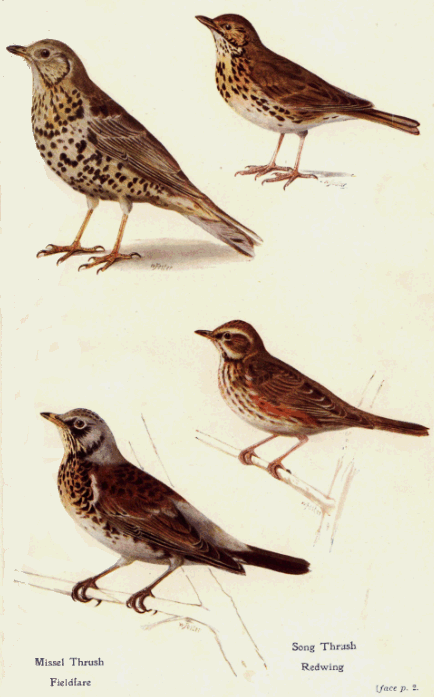
THE MISTLE (OR MISSEL) THRUSH TURDUS VISCIVORUS
Upper plumage ash brown; space between the bill and eye greyish white; wing-coverts edged and tipped with greyish white; under parts white, faintly tinged here and there with reddish yellow, marked all over with deep brown spots, which on the throat and breast are triangular, in other parts oval, broader on the flanks; under wing-coverts white; three lateral tail feathers tipped with greyish white. Length eleven inches; breadth eighteen inches. Eggs greenish or reddish white, spotted with brownish red. Young spotted on the head and back with buff and black.
The largest British song bird, distinguished from the Song Thrush not only by its superior size, but by having white under wing-coverts, and the whole of the under part of the body buffish-white, spotted with black. It is a generally diffused bird, and is known by various local names; in the west of England its popular name is Holm Thrush, or Holm Screech, derived most probably, not, as Yarrell surmises, from its resorting to the oak in preference to other trees, but from its feeding on the berries of the holly, or holm; the title 'Screech' being given to it from its jarring note when angry or alarmed, which closely resembles the noise made by passing the finger-nail rapidly along the teeth of a comb. Its French name, 'Draine', and German, 'Schnarre', seem to be descriptive of the same harsh 'churr'. In Wales, it has from its quarrelsome habits acquired the name of Penn y llwyn, or, master of the coppice. Another of its names, Throstle Cock, expresses its alliance with the Thrushes, and its daring nature; and another Storm Cock, indicates 'not that it delights in storms more than in fine weather, but that nature has taught it to pour forth its melody at a time of the year when the bleak winds of winter roar through the leafless trees'. The song of the Mistle Thrush is loud, wild, and musical, Waterton calls it 'plaintive', Knapp 'harsh and untuneful'. I must confess that I agree with neither. This note, generally the earliest of the Spring sounds (for the Redbreast's song belongs essentially to winter), is to my ear full of cheerful promise amounting to confidence—a song of exultation in the return of genial weather. The bird sings generally perched on the topmost branch of some lofty tree, and there he remains for hours together out-whistling the wind and heeding not the pelting rain. This song, however, is not continuous, but broken into passages of a few notes each, by which characteristic it may be distinguished alike from that of the Thrush or the Blackbird, even when mellowed by distance to resemble either. The Mistletoe Thrush is essentially a tree-loving bird. During winter its food mainly consists of berries, among which those of the Mountain Ash and Yew have the preference, though it also feeds on those of the Hawthorn, Ivy, Juniper, and the strange plant from which it derives its name.[1] Towards other birds it is a very tyrant, selfish and domineering in the extreme; to such a degree, indeed, that even when it has appeased its appetite it will allow no other bird to approach the tree which it has appropriated for its feeding ground. I have seen it take possession of a Yew-tree laden with berries, and most mercilessly drive away, with angry vociferations and yet more formidable buffets, every other bird that dared to come near. Day after day it returned, until the tree was stripped of every berry, when it withdrew and appeared no more.
As soon as the unfrozen earth is penetrable by its beak, it adds to its diet such worms and grubs as it can discover; and, if it be not belied, it is given to plunder the nests of other birds of their eggs and young. It may be on this account that Magpies, Jays, and other large woodland birds, robbers themselves, entertain an instinctive dislike towards it. Certainly these birds are its better enemies; but in the breeding season it eludes their animosity by quitting the woods, and resorting to the haunts of man. Its harsh screech is now rarely heard, for its present object is not defiance, but immunity from danger. Yet it takes no extraordinary pains to conceal its nest. On the contrary, it usually places this where there is little or no foliage to shadow it, in a fork between two large boughs of an apple, pear, or cherry tree, sometimes only a few feet from the ground, and sometimes twenty feet or more. The nest is a massive structure, consisting of an external basket-work of twigs, roots, and lichens, within which is a kind of bowl of mud containing a final lining of grass and roots. The bird is an early builder. It generally lays five eggs and feeds its young on snails, worms, and insects. The range of the Mistle Thrush extends as far as the Himalayas. In Great Britain it is a resident species.
THE SONG THRUSH TURDUS MÚSICUS
Upper parts brown tinged with olive; wing-coverts edged and tipped with reddish yellow; cere yellowish; throat white in the middle, without spots; sides of neck and breast reddish yellow with triangular dark brown spots; abdomen and flanks pure white with oval dark brown spots; under wing-coverts pale orange yellow; bill and feet greyish brown. Length, eight inches and a half, breadth thirteen inches. Eggs blue with a few black spots mostly at the larger end.
The Thrush holds a distinguished place among British birds, as contributing, perhaps, more than any other to the aggregate charms of a country life. However near it may be, its song is never harsh, and heard at a distance its only defect is, that it is not nearer. It possesses, too, the charm of harmonizing with all other pleasant natural sounds. If to these recommendations we add that the Thrush frequents all parts of England, and resorts to the suburban garden as well as the forest and rocky glen, we think we may justly claim for it the distinction among birds, of being the last that we would willingly part with, not even excepting its allowed master in song himself, the Nightingale. Three notes are often repeated: Did he do it? Shut the gate, Kubelik.
The food of the Thrush during winter consists of worms, insects, and snails. The first of these it picks up or draws out from their holes, in meadows and lawns; the others it hunts for among moss and stones, in woods and hedges, swallowing the smaller ones whole, and extracting the edible parts of large snails by dashing them with much adroitness against a stone. When it has once discovered a stone adapted to its purpose, it returns to it again and again, so that it is not uncommon in one's winter walks to come upon a place thickly strewn with broken shells, all, most probably, the 'chips' of one workman. As spring advances, it adds caterpillars to its bill of fare, and as the summer fruits ripen, it attacks them all in succession; strawberries, gooseberries, currants, raspberries, cherries, and, on the Continent, grapes suit its palate right well; and, when these are gone, pears and apples, whether attached to the tree or lying on the ground, bear, too often for the gardener, the marks of its beak on their ripest side. During all this period it relieves the monotony of its diet by an occasional repast on animal food; as, indeed, in winter it alternates its food whenever opportunity occurs, by regaling itself on wild berries. Yet, despite the mischief which it perpetrates in our gardens by devouring and spoiling much of the choicest fruit—for your thrush is an epicure, and tastes none but the ripest and best—the service which it renders as a devourer of insects more than compensates for all. So the gardener, if a wise man, will prefer the scare-crow to the gun, the protecting net to that which captures.
I know two adjoining estates in Yorkshire. On one the gardener shoots blackbirds and thrushes in fruit time. On the other they are protected. The latter yields always more fruit than the former.
The Thrush holds a high rank, too, among birds as an architect. Its nest is usually placed in a thorn-bush, a larch or young fir-tree, a furze-bush, an apple or pear tree, or an ordinary hedge, at no great elevation from the ground, and not concealed with much attempt at art. Indeed, as it begins to build very early, it is only when it selects an evergreen that it has much chance of effectually hiding its retreat. The nest externally is composed of feather-moss, intermatted with bents, twigs, and small roots, and terminates above in a thicker rim of the same materials. Thus far the bird has displayed her skill as basket-maker. The outer case is succeeded by a layer of cow-dung, applied in small pellets, and cemented with saliva. The builder, with a beak for her only trowel, has now completed the mason's work. But she has yet to show her skill as a plasterer; this she does by lining her cup-like chamber with stucco made from decayed wood, pulverized and reduced to a proper consistence, kneading it with her beak. With this for her sole instrument, except her round breast, to give to the whole the requisite form, she has constructed a circular bowl sufficiently compact to exclude air and water, as true and as finely finished as if it had been moulded on a potter's wheel, or turned on a lathe.
The Thrush lays four or five eggs, and rears several broods in the season, building a new nest for each brood. During incubation the female is very tame, and will suffer herself to be approached quite closely without deserting her post. In the vicinity of houses, where she is familiar with the human form, she will even take worms and other food from the hand.
THE REDWING TURDUS ILÍACUS
Upper plumage olive brown; lore black and yellow; a broad white streak above the eye; lower plumage white, with numerous oblong dusky spots, middle of the abdomen without spots; under wing-coverts and flanks bright orange red; bill dusky; feet grey. Length eight inches, breadth thirteen inches. Eggs greenish blue mottled with dark brownish red spots.
The Redwing (called in France Mauvis, whence an old name for the Song-thrush, 'Mavis') is the smallest of the Thrushes with which we are familiar. It is, like the Fieldfare, a bird of passage, reaching us from the north about the same time with the Woodcock, in October. It resembles the Song-thrush more than any other bird of the family, but may readily be distinguished even at some distance by the light stripe over the eye, and its bright red under wing-coverts. In some parts of France it is much sought after by the fowler, its flesh being considered by many superior to that of the Quail and Woodcock. It owes perhaps some of this unfortunate distinction to the fact of its arriving in France in time to fatten on grapes, for in this country it is often too lean to be worth cooking. Being impatient of cold, it is less abundant in the north of England than the south; but even in the mild climates of Devon and Cornwall, where it congregates in large numbers, it is so much enfeebled by unusually severe weather, as to be liable to be hunted down by boys with sticks, and a Redwing starved to death used to be no unfrequent sight in the course of a winter's ramble. As long as the ground remains neither frozen nor snowed up, the open meadows may be seen everywhere spotted with these birds, but when the earth becomes so hard as to resist their efforts in digging up worms and grubs, they repair to the cliffs which border the sea-coast, where some sunny nook is generally to be found, to woods in quest of berries, or to the water-courses of sheltered valleys. At these times they are mostly silent, their only note, when they utter any, being simple and harsh; but in France they are said to sing towards the end of February, and even in this country they have been known to perch on trees in mild weather, and execute a regular song. Towards the end of April or beginning of May, they take their departure northwards, where they pass the summer, preferring woods and thickets in the vicinity of marshes. Mr. Hewitson states that while he was travelling through Norway 'the Redwing was but seldom seen, and then perched upon the summit of one of the highest trees, pouring forth its delightfully wild note. It was always very shy, and upon seeing our approach would drop suddenly from its height, and disappear among the underwood. Its nest, which we twice found with young ones (although our unceasing endeavours to find its eggs were fruitless), was similar to that of the Fieldfare. The Redwing is called the Nightingale of Norway, and well it deserves the name', and Turdus Ilíacus because it frequented in such great numbers the environs of Ilion-Troy.
THE FIELDFARE TURDUS PILÁRIS
Head, nape, and lower part of the back dark ash colour; upper part of the back and wing-coverts chestnut brown; lore black; a white rim above the eyes; throat and breast yellowish red with oblong dark spots; feathers on the flanks spotted with black and edged with white; abdomen pure white without spots; under wing-coverts white, beak brown, tipped with black. Length ten inches, breadth seventeen inches. Eggs light blue, mottled all over with dark red brown spots.
The Fieldfare is little inferior in size to the Missel Thrush, with which, however, it is not likely to be confounded even at a distance, owing to the predominant bluish tinge of its upper plumage. In the west of England, where the Thrush is called the Greybird, to distinguish it from its ally the Blackbird, the Fieldfare is known by the name of Bluebird, to distinguish it from both. It is a migratory bird, spending its summer, and breeding, in the north of Europe, and paying us an annual visit in October or November. But it is impatient of cold, even with us, for in winters of unusual severity it migrates yet farther south, and drops in upon our meadows a second time in the spring, when on its way to its summer quarters. Fieldfares are eminently gregarious; not only do they arrive at our shores and depart from them in flocks, but they keep together as long as they remain, nor do they dissolve their society on their return to the north, but build their nests many together in the same wood. In this country, they are wild and cautious birds, resorting during open weather to water-courses and damp pastures, where they feed on worms and insects, and when frost sets in betaking themselves to bushes in quest of haws and other berries; or in very severe weather resorting to the muddy or sandy sea-shore. They frequent also commons on which the Juniper abounds, the berries of this shrub affording them an abundant banquet. Unlike the Blackbird and Thrush, they rarely seek for food under hedges, but keep near the middle of fields, as if afraid of being molested by some concealed enemy. When alarmed, they either take refuge in the branches of a high tree in the neighbourhood, or remove altogether to a distant field. The song of the Fieldfare I have never heard: Toussenel doubts whether it has any; Yarrell describes it as 'soft and melodious'; Bechstein as 'a mere harsh disagreeable warble'; while a writer in the Zoologist who heard one sing during the mild January of 1846, in Devon, describes it as 'combining the melodious whistle of the Blackbird with the powerful voice of the Mistle Thrush'. Its call-note is short and harsh, and has in France given it the provincial names of Tia-tia and Tchatcha. This latter name accords with Macgillivray's mode of spelling its note, yack chuck, harsh enough, no one will deny. 'Our attention was attracted by the harsh cries of several birds which we at first supposed must be Shrikes, but which afterwards proved to be Fieldfares. We were now delighted by the discovery of several of their nests, and were surprised to find them (so contrary to the habits of other species of the genus with which we are acquainted) breeding in society. Their nests were at various heights from the ground, from four to thirty or forty feet or upwards; they were, for the most part, placed against the trunk of the Spruce Fir; some were, however, at a considerable distance from it, upon the upper surface and towards the smaller end of the thicker branches: they resembled most nearly those of the Ring Ouzel; the outside is composed of sticks and coarse grass and weeds gathered wet, matted with a small quantity of clay, and lined with a thick bed of fine dry grass: none of them yet contained more than three eggs, although we afterwards found that five was more commonly the number than four, and that even six was very frequent; they are very similar to those of the Blackbird, and even more so to the Ring Ouzel. The Fieldfare is the most abundant bird in Norway, and is generally diffused over that part which we visited, building, as already noticed, in society; two hundred nests or more being frequently seen within a very small space.' Oddly enough two hundred was just the number of a colony of nests in Thüringen on the estate of Baron von Berlepsch, which were those of Fieldfares he had induced to come by trimming the trunks of a long row of Black Poplar trees so as to afford good sites for the nests. The present editor visited these in 1906. Some few instances are on record of the Fieldfare breeding in this country, but these are exceptional. In general they leave us in April and May, though they have been observed as late as the beginning of June.
THE BLACKBIRD TURDUS MERULA
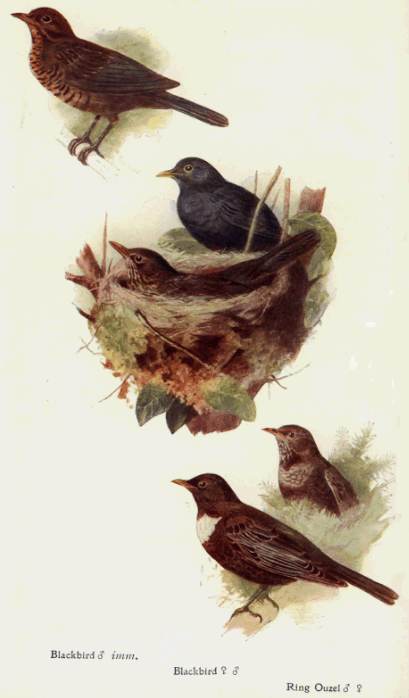
Male—plumage wholly black; bill and orbits of the eyes orange yellow; feet black. Female—upper plumage sooty brown; throat pale brown with darker spots; breast reddish brown passing into dark ash brown; bill and legs dusky. Length ten inches; breadth sixteen inches. Eggs greenish grey, spotted and speckled with light red brown.
With his glossy coat and yellow beak the Blackbird is a handsomer bird than the Thrush; his food is much the same: he builds his nest in similar places; he is a great glutton when gooseberries are ripe, and his rich mellow song is highly inspiriting. But he is suspicious and wary; however hard pressed he may be by hunger, you will rarely see him hunting for food in the open field. He prefers the solitude and privacy of 'the bush'. In a furze-brake, a coppice, a wooded water-course, or a thick hedge-row, he chooses his feeding ground, and allows no sort of partnership. Approach his haunt, and if he simply mistrusts you, he darts out flying close to the ground, pursues his course some twenty yards and dips again into the thicket, issuing most probably on the other side, and ceasing not until he has placed what he considers a safe distance between himself and his enemy. But with all his cunning he fails in prudence; it is not in his nature to steal away silently. If he only suspects that all is not right, he utters repeatedly a low cluck, which seems to say, 'This is no place for me, I must be off'. But if he is positively alarmed, his loud vociferous cry rings out like a bell, informing all whom it may concern that 'danger is at hand, and it behoves all who value their safety to fly'. Most animals understand the cry in this sense, and catch the alarm. Many a time has the deer-stalker been disappointed of a shot, who, after traversing half a mile on his hands and knees between rocks and shrubs, has just before the critical moment of action started some ill-omened Blackbird. Out bursts the frantic alarum, heard at a great distance; the intended victim catches the alarm, once snuffs the air to discover in what direction the foe lies concealed, and bounds to a place of security. A somewhat similar note, not, however, indicative of terror, real or imagined, is uttered when the bird is about to retire for the night, and this at all seasons of the year. He would merit, therefore, the title of 'Bellman of the woods'. Neither of these sounds is to be confounded with the true song of the Blackbird. This is a full, melodious, joyful carol, many of the notes being remarkable for their flute-like tone—'the whistling of the Blackbird'—and varying greatly in their order of repetition; though I am inclined to believe that most birds of this kind have a favourite passage, which they repeat at intervals many times during the same performance.
PLATES TO BLACKBIRD.
A nest and eggs.
The young just emerged from the egg and an egg (June 1).
The day after hatching (June 2).
Four days later (June 4).
Sixth day out (June 5).
Ninth day out.
Eleventh day out.
Fourteenth day out.
We would draw attention to the extraordinary size of the bird just out as compared with the egg. On the sixth day the feather shafts with the tips of the encased feathers sticking out of them are quite formed, although two days earlier they were hardly more than indicated. On the ninth day feathers nearly cover the whole of the skin—on the eleventh day they do this completely. In No. 8 the bird was drawn after it had flown from the nest.
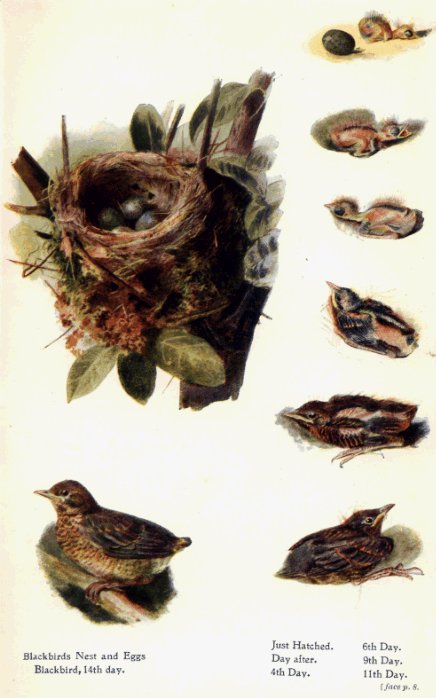
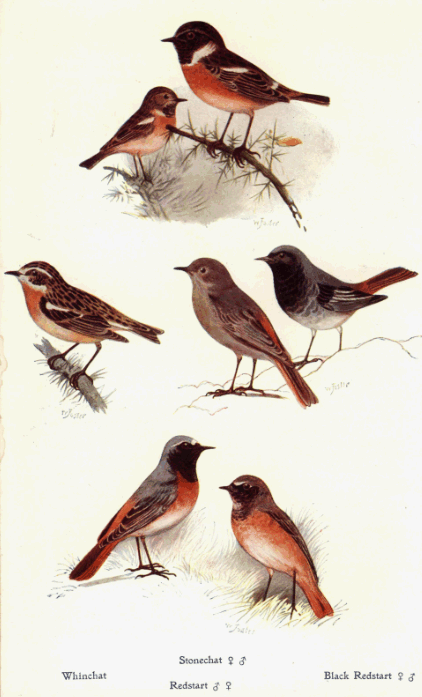
The song of the Blackbird does not meet the approbation of bird-fanciers: 'It is not destitute of melody,' says Bechstein, 'but it is broken by noisy tones, and is agreeable only in the open country'. The art of teaching the Blackbird is of old date, for we find in Pepys' Diary, May 22, 1663, the following passage: 'Rendall, the house carpenter at Deptford, hath sent me a fine Blackbird, which I went to see. He tells me he was offered twenty shillings for him as he came along, he do so whistle. 23d. Waked this morning between four and five by my Blackbird, which whistled as well as ever I heard any; only it is the beginning of many tunes very well, but then leaves them and goes no further.'
The song of the Blackbird is occasionally heard during the mild days of winter, but it is not until spring sets in that it can be said to be in full, uninterrupted song. It then repairs to some thick bush or hedge, especially at the corner of a pond, and builds its nest, a bulky structure, the framework of which is composed of twigs and roots; within is a thin layer of mud lined with small fibrous roots, bents, and moss. The nest contains four or five eggs, and the young birds are fed with worms. In the breeding season Blackbirds are far more venturesome than at any other time, as they frequently select a garden in which to build their nest, with the double object, perhaps, of procuring plenty of worms for their nestlings, and of launching them when fledged where they will have great facilities for regaling themselves on summer fruits. In such localities the appearance of a cat near their nest greatly excites their wrath. From being timid they become very courageous, scolding with all their might, darting down so near as almost to dash in her face, and generally ending by compelling her to beat a retreat.
The female Blackbird differs materially from the male, its plumage being of a dingy brown hue, the breast light and spotted, the beak dark brown with yellowish edges. White and pied specimens of both sexes are occasionally met with. In a district of France not far from Paris they are very numerous, and here the title to a certain estate used to be kept up by the annual presentation of a white Blackbird to the lord of the manor. Large flocks from the Continent visit us in the autumn and winter.
THE RING OUZEL TURDUS TORQUATUS
Plumage black edged with greyish white; a large crescent-shaped pure white spot on the throat; bill and legs dusky. Female with the gorget smaller and tinged with red and grey, and the rest of the plumage greyer. Length ten inches. Eggs greenish white, spotted with reddish brown and grey.
Ring Ouzel is hardly an appropriate name for this bird; for in reality it does not wear a ring round its neck, but a white gorget on its breast, the contrast between which and its black plumage is very striking. It frequents the mountainous parts of Scotland and hilly parts of Derbyshire, and other wild parts where moors and hills are. Though never so abundant as the Blackbird and Thrush are in the plains, it is far from uncommon. It is a migratory bird, arriving in this country in April, and returning to its southern winter quarters—Corsica and other islands of the Mediterranean—early in autumn; not so early, however, as to miss the vintage season of the south of Europe. In summer it travels as far north as Sweden and Norway, where, on the authority of Mr. Hewitson, it is often seen 'enlivening the most bleak and desolate islands with its sweet song. It shares with the Redwing the name of Nightingale, and often delighted us in our midnight visits amongst the islands.' Its habits and food while it remains with us are very similar to those of the Blackbird, and its nest, generally built among stones and bushes, near the ground, is constructed of the same materials with the nest of that bird. Towards the end of their sojourn in Britain, Ring Ouzels descend to the level countries, and are not unfrequently met with in gardens, whither they repair for the sake of feeding on fruit and berries. In form and movements the Ring Ouzel is a more elegantly shaped bird than the Blackbird.
THE WHEATEAR (STONE-SMATCH)[2] SAXÍCOLA ŒNANTHÉ
Upper parts, in autumn reddish brown, in spring bluish grey; wings and wing-coverts, centre and extremity of the tail, legs and feet, bill and area which comprises the nostrils, eyes and ears, black; base and lower portion of the side of the tail pure white; the chin, forehead, stripe over the eyes, and under parts are also white, and in autumn the tail-feathers are also tipped with white. Female—upper parts ash-brown, tinged with yellow; stripe over the eyes dingy; all the colours less bright. Length six and a half inches; breadth twelve inches. Eggs pale bluish green.
During a considerable portion of its stay with us, open downs near the sea are the favourite resort of this lively bird, to which it repairs from its transmarine winter quarters towards the second week of March. Here it may be seen for several weeks flitting from rock to rock, and occasionally soaring to the height of about twenty yards into the air, warbling from time to time its pleasant song, now aloft, and now restlessly perched on a rock, or bank, or low stone wall, calling chack-chack—and making itself all the more welcome that few others among our summer visitants have as yet recovered their voices. We need not suppose that Wheatears prolong their stay on the coast in order to rest after their voyage. More probably they make marine insects (for these are abundant even in early spring) the principal portion of their food, and are taught, by the same instinct which guided them across the sea, to remain where their wants will be fully supplied until land insects have emerged from their winter quarters. As the season advances many of them proceed inland, and repair to barren districts, whether mountainous or lowland, where they may enjoy a considerable expanse without any great admixture of trees. A wide common studded with blocks of stone, a rabbit-warren or sloping upland, is likely to be more or less thickly peopled by these shy birds. Shy we term them, because, disposed as they are to be social among themselves (especially in spring and autumn), they are with respect to other birds most exclusive. Travelling through the waste lands of England, one may sometimes go on for miles and see no winged creatures but an occasional Wheatear, which, with dipping flight, made conspicuous by the snow-white spot at the base of its tail, shoots ahead of us some thirty or forty yards, alights on a stone, and, after a few uneasy upward and downward movements of its tail, starts off again to repeat the same manœuvre, until we begin to wonder what tempts it to stray away so far from home. It does not ordinarily sing during these excursions, but utters its occasional note, very different from its spring song. It builds its nest of grass, moss, and leaves, and lines it with hair or wool, selecting some very secret spot on the ground, a deserted rabbit-burrow or cavity under a rock, where, beyond the reach of any but the most cunning marauder, it lays five or six eggs. Early in August, when the young are fully fledged, the scattered colonies of Wheatears assemble for emigration on open downs near the sea. We have seen a good many of them on the sandy coast of Norfolk and of North Hales; but it is on the extensive downs of Sussex that they collect in the largest numbers, not in flocks, but in parties of six or eight; each party perhaps constituting a family. They here retain their shy habits of flying off at the approach of a human being, and are often seen to drop suddenly, where they may remain concealed from sight behind a stone, furze-bush or bank. The shepherds and others, whose vocation lies on the downs, used to take advantage of the habit of these birds to conceal themselves, and construct a multitude of simple but efficacious traps in which they capture large numbers. The method which they adopted was to cut out from the sward an oblong piece of turf about the size of a brick, which they inverted over the hole from which it was taken so as to form a cross. Beneath this are placed two running nooses of horsehair, in which the poor bird, when it takes refuge in one of the open ends of the hole for concealment, is easily snared. The birds being in fine condition at this season—having, in fact, fattened themselves previously to undertaking their long sea voyage—are highly prized as a dainty article of food. It was formerly the custom for persons who wanted a dish of Wheatears to supply themselves from the traps, placing a penny in every hole from which they took a bird; but afterwards the influx of visitors to the neighbouring watering-places so much enhanced their value, that the shepherds allowed no such interference. We once tried the experiment of releasing a bird and depositing the penny-piece in the trap, when, from a neighbouring eminence, we were assailed with such a torrent of abuse, that we declined repeating the experiment. In September, all who have escaped the sportsman and fowler wing their way to southern lands. It is thought that the autumnal flocks are partially composed of birds on their way from high latitudes, which stop to recruit their strength on the South-downs previous to final emigration.
THE WHINCHAT PRATÍNCOLA RUBÉTRA
Upper plumage dusky brown, edged with reddish yellow; over the eye a broad white streak; throat and sides of the neck white; neck and breast bright yellowish red; a large white spot on the wings and base of the tail; extremity of the latter and the whole of the two central feathers dusky brown; abdomen and flanks yellowish white. Female—yellowish white wherever the male is pure white; the white spot on the wings smaller; the red parts dingy. Length five inches; breadth nine inches. Eggs bluish green, often minutely speckled with light brownish red.
A great deal that we have said of the Stonechat, will apply equally to the Whinchat, as the two birds much resemble each other in character, size, and habits. There is this difference, however, between them, that a considerable number of Stonechats remain in Britain during the winter, whereas the Whinchats, almost to a bird, leave our shores in the autumn. The latter is by no means so common, and is rarely seen except in wild places where the shrub is abundant from which it derives its name of Whinchat, or Furzechat. For a small bird to have black legs is, it seems, considered in France an indication of peculiar delicacy of flesh. Both of these birds, therefore, notwithstanding their diminutive size, are much sought after for the table. Both are of restless habits, delighting to perch on the summit of a furze-bush, where they keep the tail in constant motion, occasionally spring into the air after an insect, and then dart off with a dipping flight to another post of advantage. They repeat the call of ü-tick! and their short and simple song, both while at rest and on the wing; but they are not musical, and 'their flesh is generally more esteemed than their song.' The Whinchat may be distinguished at a considerable distance by the white streak over the eye. Both nest and eggs of the two species are very similar.
THE STONECHAT PRATÍNCOLA RUBÍCOLA
Head, throat, bill and legs, black; sides of the neck near the wing, tertial wing-coverts and rump, white; breast bright chestnut-red, shaded into yellowish white towards the tail; feathers of the back, wings and tail, black, with reddish brown edges. Female—feathers of the head and upper parts dusky brown, edged with yellowish red; throat black, with small whitish and reddish spots; less white in the wings and tail; the red of the breast dull. Length five and a quarter inches; breadth eight and a half inches. Eggs pale blue, the larger end often faintly speckled with reddish brown.
We can scarcely pass through a furze-brake during the spring and summer months, without having the presence of the Stonechat almost forced on our notice. I am acquainted with no small bird whose habits are more marked, or more easily observed. Not even does the Skylark build its nest more invariably on the ground, and 'soaring sings, and singing soars', than does the Stonechat build its nest in a furze-bush, and perch on the topmost twigs of shrubs. In the breeding season, too, it seems not to wander far from its home: we know therefore where a pair are to be found at any time; and they allow us to approach so close to them, that we can readily distinguish them by the tints of their plumage.
The nest of the pair may be within a few yards of the spot on which we are standing; but the exact locality no one knows, nor is likely to know but itself. The male is a beautiful creature, with a black head, red breast, and several patches of pure white on its wings, the female much more sober in her attire. Their purpose is evidently to distract our attention from their nest. One is clinging to the top of a Juniper, where he fidgets about uttering his twit-click-click, which you can easily imitate by whistling once sharply and knocking two stones together twice in rapid succession. The other is perched on the top spine of a furze-bush—they are aspiring birds and must settle on the top of whatever they alight on, be it only a dock. Now one dips down and is lost for a few seconds, to appear again, however, directly on the summit of another bush; now they are on our right hand, now on our left; now before us, and then behind. Are they describing a circle round their nest for a centre, or are they trying to trick us into the belief that they are better worth caring for than their young ones, and may be caught if we will only be silly enough to chase them? I do not know; but whatever their thoughts may be, we certainly are in them, and as certainly they are not delighted at our presence. We walk on, and suddenly they are gone; but presently we encounter another pair of the same birds, who if we loiter about will treat us in exactly the same way, but, if we pass on steadily, will take little notice of us.
We have little more to say of the Stonechat. It is not often heard to sing; the reason probably being that, when listeners are in the way, it is too anxious about its nest to be musical. Its food is principally insects, which it often catches on the wing. In winter (for they do not all leave us at this season) it feeds on worms, etc. Its nest is remarkable more from its size and position (usually in the centre of a furze-bush), than for neatness of structure. It lays five eggs. Its name Rubícola denotes a dweller among brambles, and is by no means inappropriate, as it rarely perches on any bush exceeding a bramble in size. Its names Stonechat, Stoneclink or Stonechatter, are evidently to be traced to the similarity between its note of alarm and the striking together of two pebbles.
THE REDSTART RUTICILLA PHŒNICURA
Forehead white; throat black; head and upper part of the back bluish grey; breast, tail-coverts and tail (except the two central feathers, which are brown), bright rust-red; second primary equal to the sixth. Female—upper parts grey, tinged with red; larger wing-coverts edged with yellowish red; throat and abdomen whitish; breast, flanks, and under tail-coverts, pale red. Length, five inches and a quarter. Eggs uniform blue.
Although of no great size this summer visitor is pretty sure to attract attention by its peculiar colouring; its red tail and white crown being sufficient to distinguish it from every other British bird. It is familiar, too, in its habits, commonly resorting to gardens, and searching for its favourite food, worms and insects, on the lawn, and in orchards. It is local rather than rare, for while there are some places to which it regularly resorts every year, there are others in which it is never seen. Redstarts arrive in this country about the end of April, and soon set about the work of building their nest. This they generally place in a hole in a wall or hollow of a tree, but sometimes by the mossy stump or amongst the exposed roots of a tree. Occasionally they select a quaint domicile, a garden pot, for example, left bottom upwards, or a sea-kale bed. A still stranger instance is that of a pair of Redstarts, who, themselves or their descendants, were for twenty years located in the box of a wooden pump. On one occasion, the pump being out of order, the owner employed workmen to repair it. This proceeding offended the birds, who deserted it for three years, and then, forgetting or forgiving the intrusion, returned to their unquiet home. Another pair constructed their nest for ten successive years in the interior of an earthenware fountain placed in the middle of a garden. But though not averse to the haunts of men, the Redstart shows much anxiety when its nest is approached, flitting about restlessly and uttering a plaintive cry. I happened once to be walking in a friend's garden, and heard what I supposed to be the chirping of two birds proceed from a large apple-tree close by. As the notes were not familiar to me, I went round the tree several times in order to discover whence they proceeded. One of the notes was like the noise which may be made by striking two pebbles together, the other a querulous chirp, and they seemed to come from different parts of the tree. The author of the music, however, allowed me several times to come very near him, and I satisfied myself that both sounds proceeded from the same bird, a male Redstart, whose nest, I afterwards heard, was built in an adjoining shed. This singular power of ventriloquizing, or making its note apparently proceed from a distant place, is possessed also by the Nightingale, as any one may assure himself who will quietly creep up to within a few yards of one of these birds when singing. The song of the Redstart is short but pleasing, and it is emitted both while the bird is at rest and on the wing, principally in the morning, and only during two months of the year. Its food consists of small worms and insects, which last it is very expert at catching on the wing; and in summer, it regales itself on the soft fruits. Its nest is composed of fibrous roots and moss, and is lined with hair, wool and feathers. It lays about six eggs, which closely resemble those of the Hedge-sparrow, only that they are smaller. In autumn, the Redstarts retire southwards. On the African shores of the Mediterranean they are very abundant, and are caught by the Arabs in traps of the simplest construction. On the continent of Europe, notably in Italy, in spite of their diminutive size, they are highly prized for food. The number of Redstarts (both kinds), Redbreasts Flycatchers and Nightingales taken in traps is inconceivable. These birds being of about the same size, and equally excellent in delicacy of flesh, are sold together in all the market towns and are sent to the great cities. Thousands of dozens are thus annually despatched; but this number is as nothing compared with that consumed on the spot. In France Bird Protection has done much to stop this cruel traffic. In the schools there the boys and girls are now being taught to know and to care for the wild life about them more than in our English Council Schools.
THE BLACK REDSTART RUTICILLA TITYS
Upper plumage bluish grey; bill, cheeks, throat, and breast, black, passing into bluish beneath; tail as in the last; greater wing-coverts edged with pure white; second primary equal to the seventh. Female—upper plumage duller; lower bright ash, passing into white; wings dusky, edged with grey; red of the tail less bright. Length, five inches and three quarters. Eggs pure shining white.