Front matter (continued 6)
Reading edition
The Golden Eagle breeds only in the Highlands, but it is not an unfrequent visitor to the Lowlands of Scotland in the cold season. Those birds which have been recorded as visiting England were generally not this species but the White-tailed or Sea Eagle in immature plumage. It prefers mountains or extensive forests, building its eyrie either on rocks or lofty trees. In France, Sweden, Spain, and Switzerland, it is frequently observed. Its note, called in the Highlands 'a bark', is sharp and loud, resembling at a distance, as, on the only occasion I ever heard it, it seemed to me, the croak of a Raven. It lays two or sometimes three eggs, and feeds its young, which are very voracious, on birds and the smaller quadrupeds.
THE WHITE-TAILED (SEA) EAGLE HALIAËTUS ALBICILLA
Tail not longer than the wings; upper plumage brown, that of the head and neck lightest, lower, chocolate brown; tail white; beak, cere, and feet yellowish white; claws black. In young birds the tail is dark brown, and the beak and cere are of a darker hue. Length of the male, two feet four inches; of the female, two feet ten inches. Eggs dirty white with a few pale red marks.
The White-tailed Eagle, known also by the name of the Sea Eagle, is about equal in size to the Golden Eagle, but differs considerably in character and habits; for while the latter has been known to pounce on a pack of Grouse and carry off two or three from before the very eyes of the astonished sportsman and his dogs, or to appropriate for his own special picking a hunted hare when about to become the prey of the hounds, the White-tailed Eagle has been observed to fly terror-struck from a pair of Skua Gulls, making no return for their heavy buffets but a series of dastardly shrieks. The ordinary food, too, of the nobler bird is living animals, though, to tell the truth, he is always ready to save himself the trouble of a chase, if he can meet with the carcase of a sheep or lamb; but the White-tailed Eagle feeds principally on fish, water-fowl, the smaller quadrupeds, and offal, whether of quadrupeds, birds, or fish. On such fare, when pressed by hunger, he feeds so greedily that he gorges himself till, unable to rise, he becomes the easy prey of the shepherd's boy armed but with a stick or stone. The Eagle is sometimes seen on the southern sea-board of England in autumn and winter when the younger birds that have been reared in the north of Europe are migrating south; but its eyries are now only on the west and north coasts, and especially the Shetland Islands. It inhabits Greenland, Iceland, Norway, Sweden, Scotland, and the north of England, where it frequents the vicinity of the sea and large lakes. In winter it appears to leave the high latitudes and come farther south, not perhaps so much on account of cold as because its ordinary prey, being driven to seek a genial climate, it is compelled to accompany its food. Consequently it is more abundant in Scotland during winter than summer, and when seen late in autumn is generally observed to be flying south, in early spring northwards. It builds its nest either in forests, choosing the summit of the loftiest trees, or among inaccessible cliffs overhanging the sea. The materials are sticks, heath, tufts of grass, dry sea-weed, and it lays two eggs. The young are very voracious, and are fed by the parent birds for some time after they have left the nest, but when able to provide for themselves are driven from the neighbourhood to seek food and a home elsewhere.
THE OSPREY PANDÍON HALIAËTUS
Wings longer than the tail; feathers of the head and neck white, with dark centres; on each side of the neck a streak of blackish brown, extending downwards; upper plumage generally deep brown; under white, tinged here and there with yellow, and on the breast marked with arrow-shaped spots; tail-feathers barred with dusky bands; cere and beak dark grey; iris yellow. Length two feet; breadth five feet. Eggs reddish white, blotched and spotted with dark reddish brown.
'Endowed with intense keenness of sight, it hovers high in the air, and having descried a fish in the sea, it darts down with great rapidity, dashes aside the water with its body, and seizes its prey in an instant.' So says the ancient naturalist Pliny, describing a bird which he calls Haliaëtus, or Sea Eagle. Eighteen centuries later, Montagu thus described a bird, which, when he first observed it, was hawking for fish on the river Avon, near Aveton Gifford, in Devonshire: 'At last', he says, 'its attention was arrested, and like the Kestrel in search of mice, it became stationary, as if examining what had attracted its attention. After a pause of some time, it descended to within about fifty yards of the surface of the water, and there continued hovering for another short interval, and then precipitated itself into the water with such great celerity as to be nearly immersed. In three or four minutes the bird rose without any apparent difficulty, and carried off a trout of moderate size, and instead of alighting to regale upon its prey, soared to a prodigious height, and did not descend within our view.' There can be no reasonable doubt that the bird thus described at such distant intervals of time is the same, and that the Sea Eagle of the ancients is the Osprey of the moderns. Wilson thus eloquently describes its habits under the name of the 'Fish Hawk': "Elevated on the high dead limb of some gigantic tree, that commands a wide view of the neighbouring shore and ocean, the great White-headed Eagle seems calmly to contemplate the motions of the various feathered tribes that pursue their busy vocations below. High over all these hovers one whose actions instantly arrest all his attention. By his wide curvature of wing, and sudden suspension in air, he knows him to be the Fish Hawk settling over some devoted victim of the deep. His eye kindles at the sight, and balancing himself with half-open wings on the branch, he watches the result. Down, rapid as an arrow from heaven, descends the distant object of his attention, the roar of its wings reaching the ear as it disappears in the deep, making the surges foam around. At this moment the eager looks of the Eagle are all ardour; and, levelling his neck for flight, he sees the Fish Hawk once more emerge struggling with his prey, and mounting in the air with screams of exultation. These are the signals for our hero, who, launching into the air, instantly gives chase, soon gains on the Fish Hawk: each exerts his utmost to mount above the other, displaying in the rencontres the most elegant and sublime aërial evolutions. The unincumbered Eagle rapidly advances, and is just on the point of reaching his opponent, when, with a sudden scream, probably of despair and honest execration, the latter drops his fish; the Eagle, poising himself for a moment, as if to take a more certain aim, descends like a whirlwind, snatches it in his grasp ere it reaches the water, and bears his ill-gotten booty silently away to the woods."
The Osprey has been observed on various parts of the coast of Great Britain and Ireland, especially in autumn, and in the neighbourhood of the Scottish Lakes, not merely as a stray visitor, but making itself entirely at home. It is known in Sussex and Hampshire, as the Mullet Hawk, because of its liking for that fish. It may be considered as a citizen of the world, for it has been found in various parts of Europe, the Cape of Good Hope, India, and New Holland. In America, we have already seen, it is abundant. It builds its nest of sticks on some rock or ruin, generally near the water, and lays two or three eggs. It has not been known to breed in Ireland.
Sub-Family ACCIPITRINÆ
THE SPARROW-HAWK ACCÍPITER NISUS
Upper plumage dark bluish grey, with a white spot on the nape of the neck; lower reddish white, transversely barred with deep brown; tail grey, barred with brownish black; beak blue, lightest at the base; cere, irides, and feet yellow; claws black. Female—upper parts brown passing into blackish grey; lower, greyish white barred with dark grey. Length, male twelve inches, female fifteen inches; breadth, male twenty-four inches, female twenty-eight inches. Eggs bluish white, blotched and spotted with deep rusty brown.
Since the introduction of firearms, the Goshawk and Sparrow-Hawk have lost much of their reputation, every effort being now made to exterminate them, for carrying on, on their own account, the same practises which in bygone days they were enlisted to pursue on behalf of others. For hawking, it must be remembered, was not exclusively a pastime followed by the high and noble for amusement's sake, but was, in one of its branches, at least, a very convenient method of supplying the table with game; and that, too, at a period when there were not the same appliances, in the shape of turnips, oil-cake, etc., for fattening cattle and producing beef and mutton in unlimited quantities, that there are now. The produce of the fish-ponds, woods, and fields was then a matter of some moment, and much depended on the training of the Hawks and diligence of the falconer whether the daily board should be plentifully or scantily furnished. In recent times, even, some idea of the intrinsic value of a good Hawk may be gathered from the fact that, in Lombardy, it was thought nothing extraordinary for a single Sparrow-Hawk to take for his master from seventy to eighty Quails in a single day. In the Danubian Provinces and in Hungary, the practise of hunting Quails with Sparrow-hawks is still in vogue; but with us, the agile bird is left to pursue his prey on his own account. And right well does he exercise his calling. Unlike the Kestrel, which soars high in air and mostly preys on animals which when once seen have no power of escape, the Sparrow-Hawk is marked by its dashing, onward flight. Skimming rapidly across the open fields, by no means refusing to swoop on any bird or quadruped worthy of its notice, but not preferring this kind of hunting-ground, it wings its easy way to the nearest hedge, darts along by the side, turns sharply to the right or left through an opening caused by a gate or gap, and woe to any little bird which it may encounter, either perched on a twig or resting on the ground. Unerring in aim, and secure of its holdfast, it allows its victims no chance of escape, one miserable scream, and their fate is sealed. And even if the prey detects its coming enemy, and seeks safety in flight, its only hope is to slip into the thick bushes and trust to concealment: resort to the open field is all but certain death. Nor is it fastidious in its choice of food—leverets, young rabbits, mice, partridges, thrushes, blackbirds, sparrows, larks, pipits, and many others are equal favourites. It resorts very frequently to the homestead and farmyard, not so much in quest of chickens, which, by the way, it does not despise, as for the sake of the small birds which abound in such places. There it is a bold robber, little heeding the presence of men, suddenly dashing from behind some barn or corn-rick, and rapidly disappearing with its luckless prey struggling in its talons, pursued, perhaps, by the vociferous twitter of the outraged flock, but not dispirited against another onslaught. This coursing for its prey, though the usual, is not the only method of furnishing his larder pursued by the Sparrow-Hawk. He has been known to station himself on the branch of a tree in the neighbourhood of some favourite resort of Sparrows, concealed himself, but commanding a fair view of the flock below. With an intent as deadly as that of the fowler when he points his gun, he puts on the attitude of flight before he quits his perch, then selecting his victim, and pouncing on it all but simultaneously, he retires to devour his meal and to return to his post as soon as the hubbub he has excited has subsided somewhat. At times he pays dear for his temerity. Pouncing on a bird which the sportsman has put up and missed, he receives the contents of the second barrel; making a swoop on the bird-catcher's call-bird, he becomes entangled in the meshes; or dashing through a glazed window at a caged Canary bird, he finds his retreat cut off.
As is the case with most predaceous birds, the female is larger and bolder than the male, and will attack birds superior to herself in size. Though a fierce enemy, she is an affectionate mother, and will defend her young at the risk of her life. She builds her nest, or appropriates the deserted nest of a Crow, in trees, or if they be wanting, in a cliff, and lays four or five eggs. The young are very voracious, and are fed principally on small birds, the number of which consumed may be inferred from the fact that no less than sixteen Larks, Sparrows, and other small birds, were on one occasion found in a nest, the female parent belonging to which had been shot while conveying to them a young bird just brought to the neighbourhood of the nest by the male; the latter, it was conjectured, having brought them all, and deposited them in the nest in the interval of nine hours which had elapsed between their discovery and the death of his partner.
The Sparrow-Hawk is found in most wooded districts of Great Britain and Ireland, and the greater part of the Eastern Continent.
Sub-Family MILVINÆ
THE RED KITE MILVUS ICTINUS
Upper parts reddish brown; the feathers with pale edges; those of the head and neck long and tapering to a point, greyish white, streaked longitudinally with brown; lower parts rust coloured, with longitudinal brown streaks; tail reddish orange, barred indistinctly with brown; beak horn coloured; cere, irides, and feet yellow; claws black. Female—upper plumage of a deeper brown; the feathers pale at the extremity; head and neck white. Length, twenty-five inches; breadth, five feet six inches. Eggs dirty white, spotted at the larger end with red-brown.
'The Kite', Pliny informs us, 'seems, by the movement of its tail, to have taught mankind the art of steering—nature pointing out in the air what is necessary in the sea'. The movement of the bird through the air indeed resembles sailing more than flying. 'One cannot' says Buffon, 'but admire the manner in which the flight of the Kite is performed; his long and narrow wings seem motionless; it is his tail that seems to direct all his evolutions, and he moves it continuously; he rises without effort, comes down as if he were sliding along an inclined plane; he seems rather to swim than to fly; he darts forward, slackens his speed, stops, and remains suspended or fixed in the same place for whole hours without exhibiting the smallest motion of his wings.' The Kite generally moves along at a moderate height, but sometimes, like the Eagle, rises to the more elevated regions of the air, where it may always be distinguished by its long wings and forked tail.
In France, it is known by the name 'Milan Royal', the latter title being given to it not on account of any fancied regal qualities, but because in ancient times it was subservient to the pleasures of princes. In those times, hawking at the Kite and Heron was the only kind of sport dignified with the title of 'Chase Royal', and no one—not even a nobleman—could attack the Kite and Heron without infringing the privileges of the king.
Though larger than the noble Falcons, it is far inferior to them in daring and muscular strength; cowardly in attacking the strong, pitiless to the weak. It rarely assails a bird on the wing, but takes its prey on the ground, where nothing inferior to itself in courage seems to come amiss to it. Moles, rats, mice, reptiles, and partridges, are its common food; it carries off also goslings, ducklings, and chickens, though it retires ignominiously before an angry hen. When pressed by hunger, it does not refuse the offal of animals, or dead fish; but being an expert fisherman, it does not confine itself to dead food of this kind, but pounces on such fish as it discerns floating near the surface of the water—carries them off in its talons, and devours them on shore.
The Kite is more abundant in the northern than the southern countries of Europe, to which latter, however, numerous individuals migrate in autumn. It is of very rare occurrence in the southern counties of England, where no doubt it has gained discredit for many of the evil deeds of the Sparrow-Hawk. It builds its nest of sticks, lined with straw and moss, in lofty trees, and lays three or four eggs. A few still breed in some districts in Scotland, also in the wilder parts of Wales, but their eggs are, unfortunately, soon taken.
Sub-Family FALCONINÆ
THE PEREGRINE FALCON FALCO PEREGRINUS
Tail not longer than the wings; upper plumage dark bluish grey with darker bands; head bluish black, as are also the moustaches descending from the gape; lower plumage white; breast transversely barred with brown; beak blue, darker at the point; cere yellow; iris dark brown; feet yellow; claws black. Female—upper plumage tinged with brown, lower with reddish yellow. Length fifteen inches; female seventeen inches. Eggs dull light red, spotted and blotched with deep red.
The Peregrine Falcon occupies among the 'noble' birds of prey a place second only in dignity to the Gyr Falcon. Indeed, from its being more generally diffused and therefore more easily obtained, it is a question whether it was not considered, in England, at least, the special bird of falconry. In France it appears to have been used almost exclusively as the Falcon of the country; and as the number of Gyr Falcons imported to England must have fallen far short of the demand when the gentle science was in full vogue, here also the Peregrine must be considered the bird of falconry. The 'noble' Falcons were those which flew fearlessly on any birds, no matter how much larger they were than themselves, and at once deprived their prey of life by pouncing on a vital part, devouring the head before they lacerated the carcase. The name Peregrine (foreigner) was given to this bird on account of its wide dispersion through most regions of the globe, and for the same reason it has long borne in France the name of Pélerin (pilgrim), and not on account of its wide range in search of quarry. It is a bird of haughty aspect and rich colouring, sagacious, powerful, and daring; a type of the chivalry of the Middle Ages, a veritable knight-errant, always armed, and ready to do battle in any cause against all comers.
In France the Peregrine Falcon is most abundant in the marshy districts of the north, which are much frequented by Snipes and Wild Duck; with us it is most commonly seen in those parts of the sea-coast where sea-fowl abound. The high cliffs of the Isle of Wight, Beachy Head, North Wales, and the Scottish coast have been favourite haunts, and there it once reigned supreme among the feathered tribe, but it becomes more scarce, alas! of late. It makes its eyrie in the most inaccessible part of the cliff, constructing no nest, but laying two to four eggs in a cavity of a rock where a little loose earth has been deposited; sometimes in the deserted nest of the Raven or Carrion Crow. If either of the old birds happens to be shot during the period of breeding, it is incredible in how short a space of time the survivor finds a new mate. Within a short distance from their nest they establish a larder well supplied with Puffins, Jackdaws, and above all, Kestrels; while the immediate neighbourhood is strewed with bones. Remarkable as are both male and female bird for muscular power and high courage, the latter, which is also considerably larger, is by far the superior. The female was, consequently, in the days of falconry flown at Herons and Ducks, and she was the falcon proper among falconers; the male, termed a Tiercel or Tiercelet, was flown at Partridges and Pigeons. In their native haunts they seem to cause little alarm among the Puffins and Razor-bills by which they are surrounded, but the sudden appearance of a pair in a part of the cliff frequented by Jackdaws, causes terrible consternation; while any number of intruders on their own domain are driven away with indomitable courage. When pressed by hunger, or desirous of changing their diet, they condescend to attack and capture birds so small as a Lark, and it is remarkable that however puny may be the prey, the Falcon preserves its instinctive habit of dealing a deadly blow at once, as if afraid that under all circumstances the natural impulse of its quarry were to stand on the defensive. Even in ordinary flight the movement of its wings is exceedingly quick, but when it stoops on its prey its rapidity of descent is marvellous, accompanied too, as it is, by a sound that may be heard at a distance of two hundred yards. Perhaps no bird has had more written about it than this Falcon, numerous treatises have been composed on the art of 'reclaiming' it, or training it for hawking, and the proper method of conducting the sport. We have at present space only to add a few words on the latter subject. The art of the falconer is to intercept the Herons when flying against the wind. When a Heron passes, a cast or couple of Falcons are thrown off, which dart into the air, flying in a spiral direction to get above the Heron. As soon as the first has attained the necessary elevation, she makes a stoop, and if she misses, a second stoop is made by the other in her turn. When one has succeeded in striking its prey, the other joins in the attack, and all three birds come to the ground together, buoyed in their descent by their expanded wings. The falconer now comes to the rescue, for though the Heron makes no resistance in the air, as soon as it reaches the ground it uses its formidable beak in defence, and unless prevented may work much mischief to its pursuers.
As when a cast of Faulcons make their flight
At an Heronshaw that lyes aloft on wing,
The whyles they strike at him with heedlesse might
The wary foule his bill doth backward wring.
On which the first, whose force her first doth bring,
Herselfe quite through the bodie doth engore,
And falleth downe to ground like senselesse thing,
But th' other, not so swift as she before,
Fayles of her souse, and passing by doth hurt no more.
Faerie Queene.
In France the 'cast' consisted of three Falcons, which were trained to perform particular duties, the first to start the game in the required direction, the second to keep guard over it, and the third to deal the fatal swoop.
The 'Lanner' of Pennant is a young female Peregrine.
THE HOBBY FALCO SUBBUTEO
Wings longer than the tail; upper plumage bluish black; beneath, reddish yellow, with longitudinal brown streaks; moustaches broad, black; lower tail-coverts and feathers on the leg reddish; beak bluish, darker at the tip; cere greenish yellow; iris dark brown; feet yellow; claws black. Female—all the colours duller, and the streaks below broader. Length twelve to fourteen inches; breadth about two feet. Eggs yellowish white, speckled with reddish brown.
The Hobby is a less common bird in England than in France, where it is said to be a constant companion of the sportsman, and to be endowed with enough discrimination to keep out of shot. Not satisfied with appropriating to its own use wounded birds, it pursues and captures those which have been fired at unsuccessfully, and not unfrequently even those which have been put up but have not come within shot. It is frequently taken, too, in the nets spread for Larks, or inveigled into the snare of the fowler who pursues his craft with limed twigs and the imitated cry of the Owl. It is a bird of passage, both on the Continent and in England, arriving and taking its departure at about the same time with the Swallow. In form and colouring it somewhat resembles the Peregrine Falcon, but is much smaller and more slender; the wings, too, are larger in proportion, and the dark stripes beneath are longitudinal instead of transverse. Its natural prey consists for the most part of Larks and other small birds, beetles, and other large insects. It is said also to prey on Swallows; but swift as its flight undoubtedly is, it is somewhat doubtful whether these birds are not sufficiently nimble to elude it, unless, indeed, it attacks individuals exhausted by cold or other cause. It has been trained for hawking small birds; but owing, perhaps, to its migratory habits, it was found to be impatient of captivity, and was not much prized. Hobbies frequently hunt in pairs, and an instance has been recorded where one hunted a Lark in company with a Hen Harrier; but the latter, a bird of heavier flight, was soon compelled to give up the chase. It builds its nest, or appropriates a deserted one, in high trees, and lays three or four eggs.
THE MERLIN FALCO ÆSALON
Tail longer than the wings; upper plumage greyish blue; lower reddish yellow, with longitudinal oblong dark brown spots; tail barred with black; beak bluish, darker at the tip; cere yellow; irides dark brown; feet yellow, claws black. Female—above tinged with brown; below, yellowish white. Length eleven to twelve inches; breadth two feet. Eggs mottled with two shades of dark reddish brown.
The Merlin, or Stone Falcon (so called from its habit of alighting on stones to watch the flight of the small birds which it intends to make its prey), is a beautiful little bird, but notwithstanding its small body ranks among the 'noble' Falcons. Associated with the Sparrow-Hawk, it was, on the Continent, anciently trained to hunt Quails—and the old falconers are loud in its praises. In England, it was accounted especially the Ladies' Hawk. In a state of nature, it has been observed to attack the Partridge, Magpie, Starling, Blackbird, etc., but its favourite prey is the Lark; and it was to fly at this bird principally, that it was formerly trained. In hawking with Merlins, three of these birds were assigned to the Magpie, two to the Lark, and in the chase of the Quail and Land-rail, the Sparrow-Hawk was associated with it. The Merlin is more frequent in the northern than in the southern part of Great Britain, and is seen more frequently in winter than in summer, but is nowhere common. In Norfolk, many are caught at the autumnal equinox in the fowlers' nets. It occasionally, perhaps generally, breeds in Northumberland, Cumberland, and North Wales, placing its nest upon the ground amongst the heather, and laying four or five eggs.
THE KESTREL FALCO TINNÚNCULUS
Wings shorter than the tail; upper plumage, neck and breast, dark-lead grey; sides, under tail-coverts and thighs, light-yellowish red, with longitudinal narrow dark streaks; beak blue, lighter towards the base; cere and feet yellow; irides brown; claws black. Female—upper plumage and tail light red, with transverse spots and bars of dark brown; lower, paler than in the male. Length fifteen inches; breadth thirty inches. Eggs reddish white, blotched and mottled with dark red-brown.
The Kestrel being the most abundant and by far the most conspicuous in its habits of all the British birds of prey, is probably, in most instances, the bird which has been observed whenever the appearance of 'a Hawk' has been mentioned. Though rapid in flight whenever it chooses to put forth its full powers, it is more remarkable for the habit which has acquired for it the name of 'Windhover'; and there can scarcely be any one, however unobservant, who makes even but an occasional expedition into the country, but has stopped and gazed with delight on its skilful evolutions. Suspended aloft, with its head turned towards the wind, but neither advancing against the breeze, nor moved by it from its position, it agitates its wings as regularly and evenly as if they were turned on a pivot by machinery. Presently, impelled as it were by a spirit of restlessness, it suddenly darts forwards, perhaps ascending or descending a few feet, and making a slight turn either to the right or the left. Then it skims on with extended, motionless pinions, and once more anchors itself to the air. But on what object is it intent all this while? for that some design is present here is indubitable. Not surely on the capture of birds, for at that slight elevation its keen eye would detect the movement of a bird at a mere glance; nor has it the dashing flight one would expect to see in a hunter after game furnished with the same organs of motion as itself. But, if intent on the capture of small animals which creep out of holes in the earth and hunt for their food among the grass, surely no method can be conceived of exploring the field so quickly and so completely. The Kestrel, then, though stigmatized by game keepers with an evil name, does not merit the reproaches heaped on it; while to the farmer it is an invaluable ally, destroying countless beetles, the grubs of which would gnaw away the roots of his crops;, caterpillars, which would devour the foliage; and, above all, mice, which would fatten on the grain. For such food its appetite is enormous, and its stomach capacious, an instance being recorded of a specimen having been shot, the craw of which contained no less than seventy-nine caterpillars, twenty-four beetles, a full-grown field mouse, and a leech. To this varied bill of fare it adds, as occasion offers, glow-worms, lizards, frogs, grasshoppers, and earthworms. In the winter, indeed, when these animals have withdrawn to their retreats, it is compelled by hunger to provide itself with what my readers would consider more palatable food; for now it preys on any birds which it is swift enough to overtake, and strong enough to master. The skill with which it plucks the feathers from birds before tearing them to pieces, certainly argues in favour of the theory that a bird-diet is not unnatural to it, or, that the habit, if an acquired one, came to an apt learner. But in autumn and winter, game-birds are fully fledged and being quite able to take care of themselves are by no means liable to fall a prey to the Kestrel. Thus, admitting, as we fear we must, that if, while hovering for mice, it detects a young Partridge in the hay-field, it is unable to withstand the temptation of carrying it off as a delicate repast for its young, yet an occasional trespass of this kind far from counterbalances the advantages it confers as a consistent destroyer of vermin.
The Kestrel appears to be generally distributed over the country, showing no marked predilection for upland or lowland, heath or marsh. It is very frequently seen near the sea-coast, to which in winter it habitually resorts, finding there, no doubt, greater facilities for obtaining food. Like others of its tribe, it possesses little architectural skill, placing its nest in a hole in a cliff, in ruins, or on lofty trees, often appropriating the deserted dwelling of some more industrious builder than itself. On the Continent it resorts to buildings in towns and cities, as, for instance, the Louvre in Paris, and the towers of cathedrals. During summer it hawks principally in the gardens and orchards near the town, and when harvest is gathered in, repairs to the corn-fields to hunt for mice among the stubble. When taken young from the nest, it is easily tamed, and becomes one of the most amusing of pets. Even after being fully fledged and allowed its liberty, it will remain in the neighbourhood of the place where it was reared, coming regularly to be fed, and recognizing the presence of its master by repeating its wild note, klee, klee, klee, and flying to meet him. An anecdote is recorded in the Zoologist of a male Kestrel having, in the second year of his domestication, induced a female bird to join him in his half-civilized life, and to assist him in rearing a joint family. 'Billy' still continued to make himself quite at home at the house where he was brought up, coming fearlessly into the nursery and making friends with the children; but his mate never threw off her wild nature so far as to do this, contenting herself with waiting outside, and asserting her right to her fair share of whatever food he brought out. Tame Kestrels have been observed to have the habit of hiding their food when supplied with more than they can consume at the time. I have often noticed, too, in the case of tame Kestrels, that the Chaffinches and other small birds which frequent gardens show no instinctive dread of them, as if they were their natural enemies, but perch on the same tree with them, fearless and unnoticed.
The Kestrel was formerly trained to hunt small birds, and in the court of Louis XIII was taught to hawk for Bats.
ORDER STEGANOPODES
FAMILY PELECANIDÆ
Feet entirely webbed, or all four toes connected by webs.
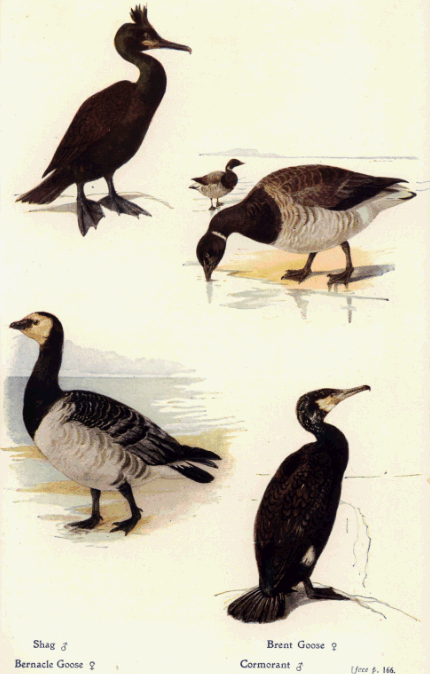
THE COMMON CORMORANT PHALACRÓCORAX CARBO
Tail of fourteen feathers. Winter—head, neck, and all the under parts, black, with green reflections; close to the base of the bill a broad white gorget; on the neck a few faint whitish lines; feathers of the back and wings bronze-colour bordered with black; primaries and tail black; beak dusky; orbits greenish yellow; irides green; feet black. Summer—feathers of the head elongated, forming a crest; on the head and neck numerous long silky white feathers; on the thighs a patch of pure white. Young birds brown and grey, the gorget greyish white. Length three feet. Eggs greenish white, chalky.
Phalacrocorax, the modern systematic name of the genus Cormorant, is given by Willughby as a synonym of the Coot, and with much propriety, for translated into English it means 'Bald Crow'. Applied to the Cormorant, it must be considered as descriptive of the semblance of baldness produced by the white feathers of the head during the breeding season. The Cormorant Willughby describes under the name of Corvus aquaticus, or Water Raven. The English name,'Corvorant', is clearly Corvus vorans, a voracious Raven; and 'Cormorant' perhaps a corruption of Corvus marinus, Sea Raven.
sea-side visitors are pretty sure of seeing more than one specimen of this bird, if they care to look for them, for the Cormorant frequents all parts of the coast as well as lakes and rivers, and does not leave us at any period of the year. Often we may see two or three of these birds flying along together at a slight distance above the surface of the sea, distinguished by their black hue, long outstretched neck, and rapid waving of the wings. They fly swiftly in a straight line, and seem to be kept from dipping into the water by making ahead at full speed. There is no buoyancy in their flight, no floating in the air, or soaring; their sole motive for using their narrow but muscular wings is clearly that they may repair to or from some favourite spot with greater speed than they can attain by swimming or diving. Occasionally, while engaged in a boating expedition, we may encounter a party of three or four occupied in fishing. They are shy, and will not allow a near approach, but even at a distance they may be distinguished by their large size, sooty hue, long necks, and hooked beaks. They sit low in the water, often dipping their heads below the surface, and in this posture advancing, in order that their search for food may not be impeded by the ripple of the water. A sheltered bay in which shoals of small fish abound is a choice resort, and here they make no long continuous stay in the swimming attitude, but suddenly and frequently dive, remaining below a longer or shorter time, according to the depth which they have to descend in order to secure their prey, but when successful, occupying but a very brief space of time in swallowing it. Not unfrequently they may be discerned from the shore similarly occupied, floating or diving in the midst of the very breakers. Sometimes, but rarely, one settles on a rail or stump of a tree close to the water in a tidal river. The capture of fish is still its object, and it is quite as expert in securing its prey from such a station as when roving at large on the open sea.
All along our coast there is at various intervals a rock popularly distinguished in the neighbourhood by the name of 'Shag rock'. Such a rock is generally low, isolated, and situated at a safe distance from land; or, if near the shore, is close to the base of a steep cliff. Hither the Cormorants, when their hunger is appeased, repair for the threefold purpose of resting, digesting their food, and drying their wings. The process of digestion is soon completed, but the time consumed in drying their thoroughly drenched wings depends on the amount of sunshine and air moving. Of these, whatever they may be, they know how to avail themselves to perfection. They station themselves on the highest ridge of the rock, wide apart, and in a row, so as not to screen one another, raise their bodies to their full height, and spread their wings to their utmost extent. No laundress is more cunning in the exercise of her vocation. Indeed, they can hardly fail to recall the idea of so many pairs of black trousers hung out to be aired.
Cormorants do not confine their fishing expeditions to the sea, but frequently ascend tidal rivers, and follow the course of streams which communicate with fish-ponds and lakes, where they commit great havoc; for the quantity of fish which they devour at a meal is very great. Pliny has observed that the Cormorant sometimes perches on trees; and the truth of this remark has been confirmed by many subsequent writers. They have been even known to build their nest in a tree, but this is a rare occurrence.[29] They generally select exposed rocks, where they collect a large quantity of sticks and rubbish, and lay three or four eggs in a depression on the summit.
Most people are familiar with a representation of a fishery with the help of Cormorants conducted by the Chinese; but it is not so generally known that a similar method once was practised in England. Willughby quoting Faber's Annotations on the Animals of Recchus, says: 'It is the custom in England to train Cormorants to catch fish. While conveying the birds to the fishing-ground the fishermen keep the heads and eyes of the birds covered to prevent them from being alarmed. When they have reached the rivers, they take off the hoods, and having first tied a leather strap loosely round the lower part of the neck, that the birds may be unable to swallow down what fishes they catch, throw them into the water. They immediately set to work and pursue the fish beneath them with marvellous rapidity. When they have caught one they rise to the surface, and, having first pinched it with their beaks, swallow it as far as the strap permits, and renew the chase until they have caught from five to six each. On being called to return to their masters' fist, they obey with alacrity, and bring up, one by one, the fish they have swallowed, injured no farther than that they are slightly crushed. The fishing being brought to an end, the birds are removed from the neighbourhood of the water, the strap is untied, and a few of the captured fish, thrown to them as their share of the booty, are dexterously caught before they touch the ground.'
THE SHAG PHALACRÓCORAX GRÁCULUS
Tail graduated, of twelve feathers. In winter, general plumage deep greenish black; feathers of the back glossy with black borders; orbits and pouch greenish yellow; bill dusky; irides green; feet black. In summer, head crested. Young birds greenish brown above; light grey below. Length twenty-eight inches. Eggs greenish blue, chalky.
Except in the smaller size and differences of plumage mentioned above, there is little to distinguish the Shag from the Cormorant. Both, too, are of common occurrence, and frequent the same localities; except that the Shag is more disposed to be gregarious: it does not, however, commonly resort to tidal rivers, and is still more rarely found on inland lakes; its food and method of obtaining it are precisely similar, so that a description of one bird will suit the other almost equally well. The Shag is called sometimes the Green Cormorant, from the tint of its plumage; but this name is not in common use. Another of its names is the Crested Cormorant; but this is vague, inasmuch as both species are crested in spring. In Scotland a common name for it is Scart, applied also to the Great Cormorant.
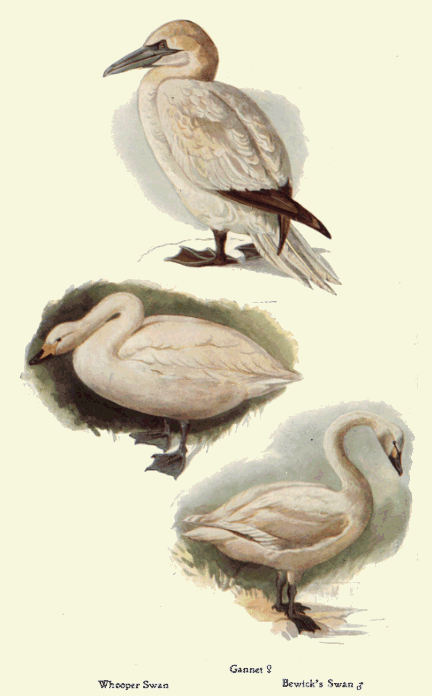
THE GANNET SULA BASSANA
Crown buff-yellow; general plumage milk-white; quills black; bill bluish grey at the base, white at the tip; orbits pale blue; membrane prolonged from the gape and that under the throat dusky blue; irides yellow; feet striped with green, the membranes dusky; claws white. Birds of the first year, general plumage dusky brown, beneath greyish. In the second year, greyish black above, marked with numerous triangular white spots, whitish below. Length three feet. Eggs dull greenish white.
It would not be difficult to compile, from various sources, a description of the Gannet and its habits which would fill more pages than my readers, perhaps, would care to peruse. To avoid this contingency, I will limit myself to a statement of my own personal acquaintance with the bird and its ways, and a transcript of notes kindly furnished me by a friend who visited the Bass Rock, one of its favourite haunts in the breeding season.
Extract from my own Journal.—'August 27th. I lay for a long time to-day on the thick herbage which crowns the splendid cliffs, "the Gobbins", near the entrance of Belfast Lough, watching through a telescope the proceedings of some Gannets, or Solan Geese. This bird, which is allied to the Pelicans rather than the Geese, is of a large size, much bigger than a Gull, from which, also, it may be distinguished at a distance by its greater length of neck, the intense whiteness of its plumage, and the black tip of its wide-spreading wings. But apart from all these distinguishing characters, its mode of fishing is, by itself, sufficient to mark it. In flight it is eminently wandering; it circles round and round, or describes a figure of eight, at a varying elevation above the water, in quest of herrings, pilchards, or other fish whose habit is to swim near the surface. When it has discovered a prey, it suddenly arrests its flight, partially closes its wings, and descends head foremost with a force sufficient to make a jet d'eau visible two or three miles off, and to carry itself many feet downwards. When successful, it brings its prize to the surface, and devours it without troubling itself about mastication. If unsuccessful, it rises immediately, and resumes its hunting. It is sometimes seen swimming, perhaps to rest itself, for I did not observe that it ever dived on these occasions. My companion told me that the fishermen on the coast of Ireland say that, if chased by a boat when seen swimming, it becomes so terrified as to be unable to rise. The real reason may be that it is gorged with food. He was once in a boat on the Lough, when, a Gannet being seen a long way ahead, it was determined to give chase, and ascertain whether the statement was correct. As the boat drew near, the Gannet endeavoured to escape by swimming; but made no attempt either to dive or to use its wings. After a pretty long chase, the bowman secured it in spite of a very severe bite which it inflicted on his hand, and carried it home in triumph. It did not appear to have received any injury, and when released, in the evening of the same day, swam out to sea with great composure. A fisherman in Islay told me that in some parts of Scotland a singular method of catching Gannets is adopted. A herring is fastened to a board and sunk a few feet deep in the sea. The sharp eye of the Gannet detects the fish, and the bird, first raising itself to an elevation which experience or instinct has taught it to be sufficient to carry it down to the requisite depth, pounces on the fish, and in the effort penetrates the board to which the fish is attached. Being thus held fast by the beak, and unable to extricate itself, it is drowned. Gannets are frequently caught in the herring-nets, at various depths below the surface. Diving after the fish, they become entangled in the nets, and are thus captured in a trap not intended for them. They perform good service to fishermen, by indicating at a great distance the exact position of the shoals of fish.'
Gannets breed in great numbers on several parts of our rocky coast; from the extreme north to Lundy Island in the Bristol Channel. The two most important stations are St. Kilda and the Bass Rock, in the Firth of Forth. On this rock stand the ruins of the once formidable stronghold of the Douglas family, the Castle of Tantallan. In circumference the island is about a mile; on the northern side it rises to an elevation of eight hundred feet, whilst towards the south it shelves almost down to the sea. The isolated position of this rock, and the difficulty of landing on it, have rendered it a fit retreat for sea-fowl of various kinds; and as the proprietor 'preserves' them, they flourish without sensible diminution. The discharge of a gun causes the whole of the colony to take wing; and as they rise into the air, the eye of the spectator is dazzled by the mazy intercrossings of white wings, the ear bewildered by the discord of confused screamings. A visit paid at sunrise, when flocks of various kinds are wheeling about in all directions, will more than reward the early riser for his activity, for Scotland scarcely offers a more interesting sight. Of all the numerous birds which frequent the rock, the Solan Goose is the most abundant and most profitable, as almost the only revenue of the island accrues from the sale of these birds to the country people of the mainland, and at the Edinburgh market, where they have fetched, for the last century and a half, the unvarying price of two shillings and fourpence a head. The size of the Gannet is somewhat larger than that of the domestic Goose.
'The only parts of the island where they can be approached are on the south and west sides. They sit lazily and stupidly on and about their nests, which are composed of a mass of weeds and grass, and will suffer themselves to be stroked, patted, or knocked on the head, as the case may be, with a most philosophical gravity. They are frequently shot; but as they then generally fall into the sea, a boat has to be on the alert, or they are soon washed away. The plan of lowering a man by means of a rope held by the others, is also adopted; but this is most dangerous. The Frigate Pelican [The Skua?] often chases a successful Gannet till the terrified bird disgorges its prey, which the pursuer seizes before it reaches the water.'
'A Solan Goose to most people would not afford a delicious meal, being a rank, coarse, fishy dish; but many of the poorer classes eat them with a relish—nay, as a delicacy—and during the winter would fare ill had they not these birds for food.'
The Gannet lays but one egg; and the young bird is nourished on semi-liquid food disgorged by the parent. On its first exclusion from the egg its skin is naked, and of a bluish black hue, but is soon covered with a white down. Through this the true feathers appear, which are black, the adult plumage being pure white.
For an interesting account of the capture of these birds at St. Kilda, the reader is referred to Professor James Wilson's Voyage round the Coast of Scotland. From a calculation once made of the number of Gannets consumed by each family in a year, on this island, it appeared that the total secured, not taking into account a large number which could not be reached for various reasons, was 22,600: and this number was considered to be below the average, the season being a bad one.
ORDER HERODIONES
FAMILY ARDEIDÆ
THE COMMON HERON ÁRDEA CINÉREA
A crest of elongated bluish black feathers at the back of the head; similar feathers of a lustrous white hanging from the lower part of the neck; scapulars similar, silver grey; forehead, neck, middle of the belly, edge of the wings, and thighs, pure white; back of the head, sides of the breast, and flanks, deep black; front of the neck streaked with grey; upper plumage bluish grey; beak deep yellow; irides yellow; orbits naked, livid; feet brown, red above; middle toe, claw included, much shorter than the tarsus. In young birds the long feathers are absent; head and neck ash-coloured; upper plumage tinged with brown; lower, spotted with black. Length three feet two inches. Eggs uniform sea green.
The Heron, though a large bird, measuring three feet in length from the point of the beak to the extremity of the tail, and four feet and a half in breadth from the tip of one wing to the other, weighs but three pounds and a half. Consequently, though not formed for rapid flight, or endued with great activity of wing, its body presents so large a surface to the air, that it can support itself aloft with but a slight exertion. It is thus enabled, without fatigue, to soar almost into the regions assigned to the Eagle and Vulture; and when pursued by its natural enemies, the Falcons, to whom it would fall an easy prey on account of the largeness of the mark which its body would present to their downward swoop if it could only skim the plains, it is enabled to vie with them in rising into the air, and thus often eludes them.
The Heron, though it neither swims nor dives, is, nevertheless, a fisher, and a successful one, but a fisher in rivers and shallow waters only, to human anglers a very pattern of patience and resignation. Up to its knees in water, motionless as a stone, with the neck slightly stretched out, and the eye steadily fixed, but wide awake to the motion of anything that has life, the Heron may be seen in the ford of a river, the margin of a lake, in a sea-side pool, or on the bank of an estuary, a faultless subject for the photographer. Suddenly the head is shot forward with unerring aim; a small fish is captured, crushed to death, and swallowed head foremost; an eel of some size requires different treatment, and is worth the trouble of bringing to land, that it may be beaten to death on the shingle; a large fish is impaled with its dagger-like beak, and, if worth the labour, is carried off to a safe retreat, to be devoured at leisure. If observers are to be credited, and there is no reason why they should not, a full-grown Heron can thus dispose of a fish that exceeds its own weight. A frog is swallowed whole; a water rat has its skull split before it discovers its enemy, and speedily is undergoing the process of digestion. Shrimps, small crabs, newts, water beetles, all is fish that comes to its comprehensive net; but if, with all its watchfulness, the look-out be unsuccessful, it rises a few feet into the air, and slowly flaps itself away to some little distance, where perhaps, slightly altering its attitude, it stands on one leg, and, with its head thrown back, awaits better fortune. While thus stationed it is mute; but as it flies off it frequently utters its note, a harsh, grating scream, especially when other birds of the same species are in the neighbourhood. On these occasions it is keenly on the alert, descrying danger at a great distance, and is always the first to give notice of an approaching enemy, not only to all birds feeding near it on the shore, but to any Ducks which may chance to be paddling in the water. [30]
During a great portion of the year the Heron is a wanderer. I have frequently seen it at least fifty miles distant from the nearest heronry; but when it has discovered a spot abounding in food, it repairs thither day after day for a long period.
In the month of January, if mild, but as a rule in February, Herons show a disposition to congregate, and soon after repair to their old-established breeding-places, called Heronries. These are generally lofty trees, firs or deciduous trees in parks, or even in groves close by old family mansions. One at Kilmorey, by Loch Gilphead, has long been frequented, though within a hundred yards of the house. The nests, huge masses of sticks, a yard across, lined with a little grass, and other soft materials, are placed near each other, as many, sometimes, as a hundred in a colony, [31] or, more rarely, they are placed among ivy-clad rocks, ruins, or even on the ground. Each nest contains three to four eggs, on which the female sits about three weeks, constantly fed by her partner during the whole period of incubation. Two weeks later a second clutch of eggs is sometimes laid and hatched off whilst the first young are in the nest. The power of running would be of little use to a young bird hatched at an elevation of fifty feet from the ground; the young Herons are consequently helpless till they are sufficiently fledged to perch on the branches of the trees, where they are fed by their parents, who themselves perch with the facility of the Rook. Indeed, the favourite position of these birds, both old and young, is, during a considerable portion of the day, on the upper branches of a lofty tree, whither, also, they often repair with a booty too large to be swallowed at once.
By a statute of Henry VIII the taking of Herons in any other way than by hawking, or the long bow, was prohibited on a penalty of half a mark; and the theft of a young bird from the nest was visited with a penalty of ten shillings.
Not to be acquainted with the noble art of Falconry was deemed degrading: so that the saying, 'He does not know a Hawk from a Heronshaw', was a common expression of contempt, now corrupted into the proverb, 'He does not know a Hawk from a handsaw'.
THE NIGHT HERON NYCTÍCORAX GRISEUS.
Head, back, and scapulars, black, with blue and green reflections; on the back of the head three very long narrow white feathers; lower part of the back, wings, and tail, pearl-grey; forehead, streak over the eyes, and all the lower parts, white; beak black, yellow at the base; irides red; feet yellowish green. Young birds have no crest; the upper plumage is dull brown streaked with yellow; wing-coverts and primaries marked with fish-shaped streaks, which are yellowish; under parts dull white, mottled with brown and ash; bill greenish; irides and feet brown. Length twenty-one inches. Eggs pale blue.
The Night Heron is a bird of wide geographical range; but, on account of its nocturnal habits and the rarity of its occurrence in this country, it has been little observed. It is, however, not uncommon on migration. A specimen was brought to me at Helston, Cornwall, about the year 1836, which had been shot in the dusk of the evening, on Goonhilly Downs. Its long and delicate crest had been stupidly tied into a knot, and by the bruised condition of these feathers the specimen, if it still exists in any museum, may yet be identified.
The Night Heron is said to be not uncommon on the shores of the Baltic, in the wide marshes of Bretagne and Lorraine, and on the banks of the Rhone. It passes the day concealed among the thick foliage of trees and shrubs, and feeds only by night. It builds its nest in trees, and lays four or five eggs.
THE COMMON BITTERN BOTAURUS STELLÁRIS
Moustaches and crown black; upper plumage yellowish rust-red, spotted with dusky; the feathers of the neck elongated, marked with brown zigzag lines; primaries barred with rust-red and dusky grey; plumage beneath paler, marked with oblong dusky streaks; upper mandible brown, edged with yellow; lower, orbits, and feet, greenish yellow; irides bright yellow. Length two feet four inches. Eggs dingy green.
Macgillivray, who was as well acquainted as most ornithologists with birds haunting moors and swamps, admits that he never heard one, and thinks that a brother naturalist, who describes what, no doubt, he heard, mistook for the booming of the Bittern the drumming of a Snipe. Lord Lilford tells us that a lady of his acquaintance told him that as a young wife, living near marshes, she often was kept awake by the booming of Bitterns.
In Sir Thomas Browne's time, It was common In Norfolk, and was esteemed a better dish than the Heron.
Willughby, who wrote about the same time, 1676, says: 'The Bittern, or Mire-drum, it is said, makes either three or five boomings at a time—always an uneven number. It begins to bellow early in February, and continues during the breeding season. The common people believe that it thrusts its beak into a reed, and by the help of this makes its booming. Others maintain that it imitates the lowing of an ox by thrusting its beak into water, mud, or earth. They conceal themselves among rushes and reeds, and not unfrequently in hedges, with the head and neck erect. In autumn, after sunset, they are in the habit of rising into the air with a spiral ascent, so high that they are lost sight of. Meanwhile they utter a singular note, but not at all resembling the characteristic 'booming'.
It is called Botaurus, because it imitates boatum tauri, the bellowing of a bull. Of 'Botaurus', the names 'Bitour' and Bittern are evident corruptions; and the following names, in different languages, are all descriptive of the same peculiar note: Butor, Rordump, Myredromble, Trombone, Rohrtrummel, Rohrdommel, and Rordrum.
Of late years, so unusual has the occurrence become of Bitterns breeding in this country, owing to collectors, that the discovery of an egg in Norfolk has been thought worthy of being recorded in the transactions of the Linnean Society; and even the appearance of a bird at any season finds its way into the provincial newspapers or the magazines devoted to natural history: Stuffed specimens are, however, to be seen in most collections, where its form and plumage may be studied, though its habits can only be learnt, at least in England, from the accounts furnished by naturalists of a past generation. It comes now only to be shot.
The Bittern is a bird of wide geographical range, as it resorts, more or less, to all countries of Europe and Asia. Specimens are said to differ much in size, some being as large as the Heron, others considerably less; but there is no reason to suppose that they are of different species, a similar variation having been observed in other birds, as in the Curlew, for example, of which I have had in my possession at once four or five specimens all of different dimensions.
The Bittern builds its nest on the ground, and lays four brown eggs, which are tinged with ash or green. The old bird, if wounded, defends itself in the same way as the Heron.
FAMILY CICONIIDÆ
THE WHITE STORK CICÓNIA ALBA
General plumage white; scapulars and wings black; bill and feet red; orbits naked, black; irides brown. Young birds have the wings tinged with brown and the beak reddish black. Length three feet six inches. Eggs white tinged with ochre.
Sir Thomas Browne says, in his Account of Birds found in Norfolk: 'The Ciconia, or Stork, I have seen in the fens; and some have been shot in the marshes between this [Norwich] and Yarmouth.' His contemporary, Willughby, says:—'The Stork is rarely seen in England; never, in fact, but when driven hither by the wind or some accident. I have received from Dr. Thomas Browne, the eminent naturalist, a figure drawn to the life, and a short description of one which was captured in Norfolk.' Yarrell records instances of a few others which have been killed, at distant intervals, in various parts of England; but the Stork is so rare a visitor with us, that I have no scruple in referring my readers, for a full account of the habits of so interesting a bird, to some more comprehensive work on the subject. The White Stork was, over 350 years ago, only an irregular visitor to Great Britain.
THE BLACK STORK CICÓNIA NIGRA
Upper plumage black, with green and purple reflections; under white; bill and orbits red; irides brown; feet deep red. In young birds the bill, orbits, and feet, are olive green; and the upper plumage is tinged with rust-brown. Length nearly three feet. Eggs dull white, tinged with green, and sometimes sparingly spotted with brown.
A still rarer visitor in Great Britain than the White Stork, from which it differs quite as much in habit as it does in colour; for whereas the one is eminently sociable with birds of its own kind, and devoted in its attachment to human dwellings, the other is a solitary bird, shy and wary, avoiding at all times the sight of men and their habitations. It is a rare bird in most countries of Europe, but is common in several parts of Asia and the whole of the known regions of Africa. It builds a large nest in a lofty tree, and lays from two to five eggs.
FAMILY PLATALEIDÆ
THE SPOONBILL PLATALÉA LEUCORODIA
General plumage white; a large patch of reddish yellow on the breast; a crest of long narrow white feathers pendent over the neck; lore, orbits, and naked space on the neck, pale yellow; bill black, tipped with yellow; irides red; feet black. Young birds want the yellow patch on the breast and the occipital crest; portions of the wing black. Length thirty-one inches. Eggs white, spotted with light red.
Spoonbills do not appear to have been common at any time; for though Sir Thomas Browne enumerates them among the birds of Norfolk and Suffolk, where they build in heronries, his contemporary, Willughby, knew them only as natives of Holland. This bird is not unfrequent in East Anglia, and it is met with now and again along the south coast, and has wandered up the Thames valley.
The Spoonbill is a migratory bird, building its nest and rearing its young in the north of Europe and Asia, and retiring in autumn to the shores of the Mediterranean or to Africa. It is remarkable not only for the singular conformation of its bill, but for 'being one of the very few which have been found to possess no true muscles of the organ of voice; and no modulation of a single tone appears to be possessed by the bird.'[32]
It builds its nest in high trees, or, when these are wanting, among reeds and rushes; and lays four eggs.
ORDER ANSERES
FAMILY ANATIDÆ
THE GREY LAG GOOSE ANSER CINEREUS
Folded wings not reaching to the extremity of the tail; bill strong, orange-yellow, the nail whitish; upper plumage ash-brown, many of the feathers bordered with greyish white; under plumage, in front, light ash-grey, barred on the flanks and belly with brown, behind pure white; irides deep brown; legs dull flesh-colour. Eggs ivory white. Length two feet ten inches.
The Geese characterized by having a large, ovate body, a long neck, a short and stout beak, high at the base and bent down at the tip, adapted for cropping vegetable food; the wings are large and powerful; the legs, placed under the centre of the body, afford some facility in walking, and the webbed feet are eminently fitted for paddling, but rarely employed in diving. They spend the greater portion of the year in high latitudes, where their arrival is celebrated with great rejoicings, as an indication of returning summer. They are eminently gregarious, flying generally in the form of a half-opened pair of compasses, with the angle in front, or in an irregular wavy line, and uttering a loud harsh cry, which may often be heard some time before the birds themselves are in sight.
The present species, which is supposed by some to be the origin of the domestic Goose, was formerly of common occurrence in Great Britain, but is now much less frequent. It breeds in northern Scotland, coming south from autumn to spring. On their arrival in autumn, they resort to marshes and swamps, meadows, corn-fields, and turnip-fields, especially such as are remote from human dwellings. There they feed by day on such vegetable substances as fall in their way, but they are said to prefer the young shoots of corn to any other kind of food. So wary are they and difficult of approach, that a 'Wild Goose chase' is a proverbial expression for an unsuccessful enterprise. At night they retire to the broad flats near the sea, or to the mouths of rivers, where they roost on the ground. Yarrell is of opinion 'that the term "lag", as applied to this Goose, is either a modification of the English word "lake", the Latin lacus, or perhaps an abbreviation of the Italian "lago", from which latter country it is even probable that we may originally have obtained this our domesticated race.'
THE WHITE-FRONTED GOOSE ANSER ALBIFRONS
Folded wings reaching a little beyond the tail; bill orange-yellow, the nail white; a large space on the forehead pure white, surrounded by a dusky band; upper plumage ash-brown, varied with grey, dull white, and bluish black; under plumage in front brownish white, with patches and bars of black; behind white; irides dark brown; feet orange. Length two feet three inches. Eggs white, tinged with buff.
A regular visitor to the British Isles, coming late in the autumn to stay till spring, usually seen in small flocks of from eight to twenty birds; it is entirely graminivorous, and, when undisturbed, usually rests at night in any grass-field where it may have been feeding in the afternoon.
Its habits, during its stay in these latitudes, are similar to those of the other species, but it is said by Mr. Selby to 'vary from the Bean Goose in preferring low and marshy districts to the upland and drier haunts of that bird, and in these localities subsists on the aquatic grasses, being very seldom seen to frequent corn or stubble fields'. In Norfolk it has frequently been seen associated with the Bean Goose. It has never been observed to remain with us after April, when it betakes itself to the regions bordering on the Arctic circle. In Lapland it is very abundant, and in the fur countries of North America it was seen in spring by Dr. Richardson in large flocks travelling northwards. It breeds in the woody districts skirting Mackenzie's River, and in the islands of the Arctic Sea.
The white forehead of this bird tends to confirm the opinion maintained by some authors that the common Domestic Goose owes its origin to this species.
THE BEAN GOOSE ANSER SÉGETUM
Folded wings exceeding the tail in length; bill long, orange, the base and nail black; upper plumage ash-brown; the wings darker, edged with greyish white; under plumage in front dirty white, behind pure white; irides dark brown; legs orange; beak yellowish white. Length thirty-four inches. Eggs white.
The several species constituting the group to which the Bean Goose belongs resemble each other very nearly in all respects. All are gregarious, fly high in the form of a V, or in an undulating line, uttering repeated cries, which no one who has heard a domesticated Goose can fail to recognize; they pass the night for the most part on broad flats near the sea, and at early dawn repair inland to their feeding-grounds. The Bean Goose is, on the authority of Yarrell, next to the Brent Goose, the commonest and most numerous as a species among our Wild Geese. In Scotland it is far more abundant than in England, being seen in large flocks from October to April, especially at the periods of migration to and from its summer quarters. But it does not altogether desert the British Isles during the intervening months. A few are said annually to remain, and breed in the lakes of Westmoreland, and in the Hebrides. In Sutherlandshire, also, many remain all the year—a fact thoroughly ascertained by Mr. Selby, who gives an interesting account of several young broods which he saw on the lochs, some of which he captured. They construct their nests among the tussocks of sedge or grass hillocks on the islands, and lay from three to four eggs, smaller than those of the Common Goose, but of a similar shape and colour.
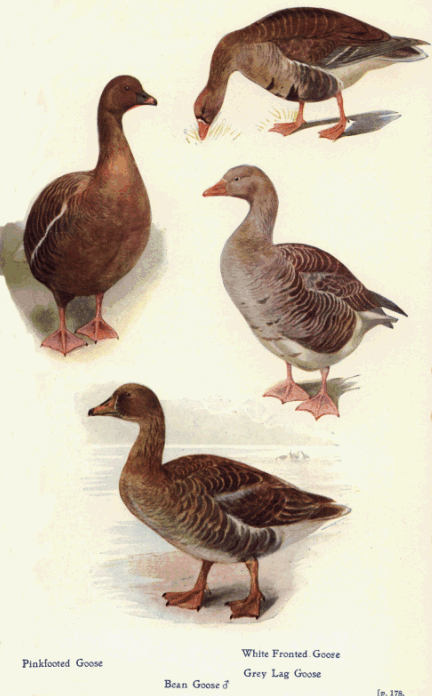
THE PINK-FOOTED GOOSE ANSER BRACHYRHYNCHUS
Folded wings not reaching to the extremity of the tail; bill shorter than the head, narrow and much contracted towards the tip, pink, with the nail and base black; head and neck reddish brown; rest of the upper plumage ash-grey, edged with greyish white; under plumage in front fawn-colour, behind white; irides dark brown; feet pink, tinged with vermilion. Length two feet four inches. Eggs dull yellowish white.
It is said that most, if not all the various species of wild Geese have strong local attachments; that flocks composed of one particular kind are in the habit of visiting, year after year, the same spot, to the exclusion of other species, which may, nevertheless, be found frequenting places of like character at no great distance. Of the truth of the statement I met with signal confirmation in the severe winter of 1860-1. I then spent several days on the coast of Norfolk, for the purpose of watching the habits of Waders and sea-fowl. Without indulging in the chase of wild Geese, I heard and saw a great many flocks, of which some were unmistakably Brent Geese; others, of a larger size and a different colour, I was obliged to include under the comprehensive name of Grey Geese. The Brents, I found, regularly repaired to the salt marshes adjoining Thornham Harbour, which, I was told, was their usual place of resort. The others were known to alight only in the meadows near Holkham. Having heard that several had been shot at the latter place, I procured one, and on examination it proved to be the present species, up to that time entirely unknown to me. On consulting Yarrell, I found the following passage:—'In January of the present year, 1841, I was favoured with a letter from the Hon. and Rev. Thomas Keppel, of Warham Rectory, near Holkam, informing me that a Pink-footed Goose had been killed by his nephew, Lord Coke, at Holkam. This bird was shot out of a flock of about twenty, but nothing particular was observed in their flight or habits.' The bird brought to me had been shot, along with many others, out of similar flocks, in exactly the same place, at an interval of twenty years; and I have no doubt that the many other specimens which have been shot there between the above two dates, belonged to the same species, the characters which distinguish it from the common Bean Goose being not sufficiently striking to attract the notice of sea-side gunners. The habits of the species appear not to differ from those of its congener; it arrives and departs about the same time, and it frequents the marshes and uplands of Norfolk, and in winter the east coast of Scotland.
THE BRENT GOOSE BERNICLA BRENTA
Head, beak, neck, breast, feet, quills, and tail, black; on each side of the neck a patch of white with a few black feathers intermixed; upper plumage dingy; all the tail-coverts white; belly brownish grey, barred on the flanks with greyish white. Length twenty-two to twenty-three inches. Eggs greyish white.
The Wild Geese which we have hitherto been considering feed on grass, clover, and grain, in quest of which they resort to inland marshes, meadows, and arable land; but the Brent is a decidedly marine bird. During its annual visits to our shores it stays out at sea by night, cradled by the billows, and at early dawn repairs to the muddy flats and sand-banks, where it feeds exclusively on marine plants, especially laver and zostéra. As soon as these are left bare by the ebbing tide, the Brents are taught by their instinct that they have no time to lose, and hasten in 'skeins' or 'gaggles' making in their flight a trumpet-like noise which, heard at a distance, resembles that of a pack of harriers or fox-hounds in full cry. They prefer to take their stand on those parts of the ooze which are least intersected by creeks, and there, if left undisturbed, they continue to feed without intermission till the rising tide lifts them off their feet. Then, away to sea again! or, if the weather be boisterous, they seek for shelter in the rivers and estuaries. They are local in their attachments, returning annually to the same feeding-grounds. They do not associate from choice with other species, for though they may be frequently seen feeding in the vicinity of various Waders, they form no society with them, and are, indeed, in quest of different food. sea-side fowlers are well acquainted with the peculiarity of their habits, and not only know where to look for them when they are settled, but at what points they can most easily be intercepted, going and returning. It is the custom of the fowler to conceal himself behind some lurking-place, natural or artificial; or, if this be wanting, to stretch himself on the ground. Then, as a skein, unconscious of danger, approaches, he suddenly shows himself; the birds, panic-struck, huddle together before they alter their line of flight, and the sportsman fires into the midst of them.
They are the most abundant of all the Geese which frequent our shores, and are killed in great numbers and sent to market. They come to us in November and remain till late in February, when they begin to migrate in successive flights, the youngest bird staying until April. It is not believed that they ever remain to breed, but that they repair to the Arctic regions, and make their nests of withered herbage in marshy ground.
THE BERNICLE GOOSE BERNICLA LEUCOPSIS
Forehead, sides of the head, and throat, pure white; a dark streak between the eyes and bill; head/neck, quills, and tail, black; rest of the upper plumage undulated transversely with ash-grey, black, and dull white; lower plumage white, tinged on the flanks with grey; irides dusky-brown; bill and feet black. Length two feet one inch. Eggs greenish white.
This beautiful bird occurs chiefly on the west side of Great Britain in winter. 'It then more frequently retires to the sea than to the lakes during its periods of repose, or when driven from its feeding-grounds. A large flock then presents a beautiful spectacle, as the birds sit lightly on the water, and when advancing elevate their necks. Not less beautiful do they seem when on wing; now arranged in long lines, ever undulating; at one time extending in the direction of their flight; at another obliquely, or at right angles to it, sometimes in an angular figure, and again mingling together. Their voice is clear, and rather shrill, and comes agreeably on the ear when the cries of a large flock come from a considerable distance'. In England it is far less common, but occasionally resorts to marshes both on the eastern and western coast. The mythical fragment of ancient natural history, that the Bernicle is the product of a tree, is too trite to require repetition here.
THE WHOOPER SWAN CYGNUS MÚSICUS
Whole plumage pure white, the head and nape sometimes slightly tinged with yellow; lower half of the bill quadrangular, yellow, upper black; lore and a great portion of the edge of the upper mandible yellow; irides brown; legs black; tail of twenty feathers. Young birds have the plumage grey; lore flesh-colour. Length five feet; breadth seven feet ten inches. Eggs dull white, tinged with greenish.
The ancient fable that Swans sing most sweetly before their death did not survive the age which invented it. Pliny disbelieved it, and, though the assertion may have been resuscitated from time to time as a poetic fiction, it has found no place in works on natural history.
The Swan is not musical; it rests its claims to our admiration on other grounds, unchallenged and indisputable; the unsullied white of its plumage is an apt emblem of purity, and the elegance of its movements in the water has become proverbial. The present species, which owes its name to its powerful voice, is said to be not quite so graceful as the tame Swan, but on land it is far more active. A bird which has been winged by a sportsman, and has fallen on the land, can only be overtaken by smart running. In Iceland, the summer resort of these birds, they are much sought after for the sake of their down. In the month of August, when the old birds, having cast their quill-feathers, are unable to fly, the natives assemble in bodies in the places where the Swans collect, and mounted on small but active horses chase them through the marshes, and ride many of them down; but the greater number are caught by the dogs, which always seize the birds by the neck, and so encumber them that they are then easily overtaken. But it is not the habit of Swans to remain much on land; the perfect ease with which they float and swim indicates that the water is their element, and a glance at their long necks tells at once that their nature is to feed in shallow water or on the margin of deep lakes, where with their strong bills they either tear up the stems and roots of aquatics from the bottom, or crop at their pleasure from the banks. To this kind of food they add such insects, molluscs and worms as come within their reach; and (when sailing in salt water) sea-weeds, and especially the long, ribbon-like leaves of zostéra. During summer they frequent the most secluded swamps and lakes in the wooded districts of the north, and build a very large nest in a spot unapproachable by human feet. A few go no farther north than the Orkneys and Shetlands, but their headquarters are Siberia, Iceland, Lapland, and Hudson's Bay.
After they have recovered from their summer moult, they migrate southwards, and arrive in Scotland, sometimes in large flocks, early in October. Mr. St. John, in his Wild Sports of the Highlands, gives an interesting account of their habits while in this country. He went in pursuit of a flock which had selected for their winter feeding-place some fresh-water lochs about half a mile from the sea. They passed the day mostly on the salt water, and in the evening came inland to feed. He found them on one of the smaller lochs, some standing high and dry on the grassy islands trimming their feathers after their long voyage, and others feeding on the grass and weeds at the bottom of the loch, which in some parts was shallow enough to allow of their pulling up the plants which they fed on as they swam about, while numbers of wild Ducks of different kinds, particularly Wigeons, swarmed round them, and often snatched the pieces of grass from the Swans as soon as they had brought them to the surface, to the great annoyance of the noble birds, who endeavoured in vain to drive away these most active little depredators, who seemed determined to profit by their labours. 'I observed', he says, 'that frequently all their heads were under the water at once, excepting one—but invariably one had kept his head and neck perfectly erect, and carefully watched on every side to prevent their being taken by surprise; when he wanted to feed, he touched any passer-by, who immediately relieved him in his guard, and he in his turn called on some other Swan to take his place as sentinel.'
Swans, like wild Geese, are in the habit of returning every year to the same district of country, and in passing to and from their feeding-ground keep closely to the same line of flight, a peculiarity of which fowlers take advantage by lying in ambuscade somewhere beneath their aërial road.
When disturbed on the water they generally huddle together and utter a low cry of alarm before they take flight. Owing to their great weight they have not the power of rising suddenly into the air, but flap along the water, beating the surface with their great wings, some twenty or thirty yards. The flapping noise made while this process is going on, may be heard at a great distance.
In severe winters, flocks of Whoopers, Whistling Swans, or Elks, as they are variously called, come farther south, and may be observed from time to time on different parts of the coast.
BEWICK'S SWAN CYGNUS BEWICKI
Whole plumage pure white; bill black, orange-yellow at the base; irides dark; feet black; tail of eighteen feathers. Young birds greyish brown; immature specimens tinged on the head and belly with rust-red. Length three feet nine inches; breadth forty-six to fifty. Eggs dull white, tinged with brown.
Bewick's Swan is distinguished from the Whooper, not only by the characters given above, but by strongly marked anatomical features, which were first pointed out by Mr. Yarrell, who, with the modesty and generosity for which he was noted, gave it its present name; 'Thus devoting it to the memory of one whose beautiful and animated delineations of subjects in natural history entitle him to this tribute.'
In severe winters it is fairly frequent on the coasts of England, and even abundant in Scotland. In the case of distant flocks the only criterion is size; and as this species is one-third less than the Whooper, there is little probability of an experienced observer being mistaken in the identity.
In their habits they closely resemble their congeners, but are less graceful in their movements on the water, and spend a larger portion of their time on land.
THE COMMON SHELDRAKE TADORNA CORNUTA
Head, throat, and upper back black, with green reflections; lower parts of the neck and back, flanks, rump and tail (except the black tip) white; from the shoulders a broad band of bright chestnut, which meets on the breast, passing into a broad, blotched, black band, which passes down the abdomen nearly to the tail; under tail-coverts pale reddish yellow; scapulars black; wing-coverts white; secondaries chestnut; primaries black; speculum bronzed green and purple; bill, and protuberance at the base, red; irides brown; feet crimson-red. The female wants the red protuberance on the bill, and the colours generally are somewhat less bright. Length twenty to twenty-two inches. Eggs white, tinged with green.
The Sheldrake is the largest and among the handsomest of the British Ducks, and if easy of domestication would be no doubt a common ornament of our lakes and rivers. It is, however, in Great Britain at least, a marine bird; though from one of its French names, Canard des Alpes, it would seem also to frequent the large continental lakes. Numerous attempts have been made to familiarize it with inland fresh-water haunts to which some other species readily take, but they have rarely succeeded, while to induce it to breed at a distance from its sea-side home has proved yet more difficult.
It differs from the majority of the Duck tribe in remaining on the coast of Britain throughout the year. In South Wales, for example, it is seen in winter and early spring, but about the breeding season it disappears for a few weeks. During this interval it is employed in incubation, but when its brood is hatched it is seen again, accompanied by a troop of ducklings, feeding in the creeks and marshy places. When thus discovered, the young broods are commonly hunted down by sea-side idlers for the sake of being sold to any one who cares to try the experiment of rearing them.
On the coast of Norfolk it is more usual to search for the nests, in order to secure the eggs and place them under a tame Duck or domestic Hen. The male and female keep together, not only during incubation, but until the young are able to provide for themselves. It derives the name 'Burrow Duck', by which it is also known, from its custom of making its nest either in the burrow of a rabbit or in a hole hollowed out by itself. The nest is constructed of such herbage as abounds in the neighbourhood; it is lined with down plucked from the breast of the parent bird, and contains from ten to twelve eggs.
Pennant (vol. ii, p. 257) says of these birds: "They inhabit the sea-coasts and breed in rabbit-holes. When a person attempts to take their young, the old birds show great address in diverting his attention from the brood; they will fly along the ground as if wounded, till the former can get into a place of security, and then return and collect them together."
From this instinctive cunning, Turner, with good reason, imagines them to be the chenalōpex, or Tox-Goose, of the ancients; the natives of the Orkneys to this day call them the Sly-Goose, from an attribute of that quadruped.
Sheldrake are more numerous during the summer in North Britain than in the South, but in winter they are driven by the freezing of their feeding-grounds to more temperate climates. Here numbers of them meet the fate of wild fowl generally, and specimens are often to be seen exposed in the English markets, though their flesh is held in little estimation as food.
Sheld means parti-coloured. 'Shelled' is still current in the eastern counties of England. Shelled duck is the more proper appellation. Howard Saunders calls it Sheld-duck always.
THE WILD DUCK ANAS BOSCAS
Head and neck dark green; at the base of the neck a white collar; upper parts marked with fine zigzag lines of ash-brown and grey; breast chestnut; lower parts greyish white, marked with fine zigzag ash-brown lines; speculum dark blue with purple and green reflections, bordered above and below with black and white; four middle feathers of the tail curled upwards; bill greenish yellow; irides red-brown; feet orange. Length twenty-four inches. Female smaller; plumage mottled with various shades of brown and grey; throat whitish; speculum as in the male; all the tail-feathers straight. Eggs greenish white.
Its size, abundance, and value as an article of food, have given to the Wild Duck an importance which belongs to few other British birds; and the modes of capturing it are so varied and interesting that they are often to be met with described in works not exclusively devoted to natural history. For this reason I shall in great measure confine my notice of this bird to such particulars in its history as the reader may probably have an opportunity of verifying by his own observation in the course of his rambles among places which it habitually frequents.
The term Wild Duck', properly applicable to the female bird only ('Mallard' being the distinctive name of the male), is generally employed to include both sexes. The difference in the plumage of the two is very great, as, indeed, is the case with all those varieties of the same bird which, under the name of 'Tame Ducks,' have altered the least from their natural wild type. Yet in the summer months, when both sexes moult,[33] the Mallard puts off the whole of his characteristic gay plumage, and appears in the sober brown garb of the Duck. It is only, in fact, from October to May that the Mallard can be distinguished from his partner by his markings. At this season, too, young birds, so far as they are fledged, are of the same tone of colouring. Domesticated birds are subject to the same change; but a reason for this singular metamorphosis no naturalist, as far as I am aware, has ventured to assign.
Wild Ducks hold a prominent place among birds of the most extensive distribution, being 'indigenous to the greater part of the northern hemisphere'.[34] In consequence of this wide range they must of necessity frequent many districts highly favourable to their preservation; they are therefore numerous. Equally well adapted for travelling by sea and through the air, and capable of enduring great variations of heat and cold, their presence may be expected wherever a tract of country occurs calculated to supply them with food and opportunities for nidification. As long as England abounded in marshes, and her rivers ran through wastes rarely frequented by man, Wild Ducks were numerous in many counties where they are now but rarely seen. Many have retired before draining and civilization, yet they never totally desert us. In most districts where there are rivers lined with reeds, even not so very far removed from the sound of the steam-engine, one may, by cautiously and quietly guiding one's steps, fall in with a brood of active ducklings sifting the ooze, with the instinct of their kind, for minute insects; flapping along the water in chase of a fly, or paddling among the reeds on the look-out for anything good to eat. The matron of the party, with a proud consciousness of her dignity as sentinel and protector, preserves a more stately demeanour, but, with this slight difference, is similarly occupied. As you approach she is the first to descry you; with a homely 'quack', differing in no respect from the note of the domesticated bird, she sounds an alarm, and the whole family, mother and children, are quickly concealed among the reeds. It is possible, by long-continued persecution, to induce her to rise, but she does so reluctantly, and even then, unless you are such a barbarian as to shoot her, all is yet safe. The young will hide themselves securely until danger is past, and she, not far off, though unseen, is circling round her helpless brood. In an islet, probably, of the river; in a tuft of reeds surrounded by quagmire; among thick bushes near the bank; under the stump of an alder, or even high up among the branches, she formerly had her nest, composed of grass, and lined with down from her own breast; and at no great distance from this her offspring are yet lingering. The latter could swim immediately that they left the egg, but their bodies are large and heavy in proportion to the size of their wings, so that they will be unable to fly until nine or ten weeks old, when they will be thoroughly fledged, and only distinguishable from their parent by their smaller size.
From the rapidity with which young Ducks 'scutter' along the surface of the water, using both feet and wings, they are called by sportsmen, 'flappers'; and from the same habit, no doubt, the children's game of 'Ducks-and-drakes' was named. The word is one with which I have been familiar, like most other people, from my earliest years, yet I never thought of its etymology until I was passing, a few weeks since, in a steamer down Loch Tarbet. The boat disturbed a party of 'flappers' which were feeding near the shore, and as they half flew, half paddled away at a rapid rate, the sport and the name suggested themselves to my mind together. It is mostly absent from the northern districts of Scotland in winter.
In marshy districts, both in England and Scotland, these birds remain all the year round; but their numbers are greatly augmented in winter by the arrival of large flocks from the north. These fly mostly by night, in long lines, and proceed to the fens and salt marshes, where they feed until daylight. They then put out to sea, and rest, floating on the water, until dusk; and it is while they are on their way to and from these feeding-grounds that the sea-side gunners do the greatest execution among them. They fly mostly in small parties, and utter no note; but if after dusk a shot be fired in the vicinity of a marsh or of a piece of reclaimed land intersected by ditches, it is followed by a concert of 'quacks' from all sides, which proves that however small the parties may have been, the number of Ducks collectively must be very great.
In the neighbourhood of the salt marshes in the eastern counties, one may meet, in severe winter weather, just before dusk, little knots of men setting out on ducking expeditions. Each is furnished with a spade, a bag of straw, and a gun. Experience has taught these men that the line of flight usually taken by the birds is along a narrow creek or arm of the sea, which has on either side a high muddy bank. For such a point the gunners are making. The use of the spade is to dig a hole for concealment in the mud, and the straw is intended to furnish a dry seat. It must be a wearisome occupation to sit here hour after hour, with nothing to do but to hope that birds are coming; and when they come matters are not much mended; for if the shot be successful it will never do to leave the hiding-place in order to pick up the booty, or another chance may be missed. Three or four hours are thus spent, and on moonlight nights a longer time. The slain birds are then collected, a few hours are given to rest, and in the morning twilight the same scene is re-enacted.