Front matter (continued 3)
Reading edition
Throughout the whole of England the Wren is invested with a sanctity peculiar to itself and the Redbreast. In the west of England I was familiar, as a child, with the doggerel rhymes: England I was familiar, as a child, with the doggerel rhymes:
Whoso kills a Robin or a Wran
Shall never prosper boy nor man.
In the north it is protected by a similar shield:
Malisons, malisons, mair than ten,
Who harries the queen of heaven's Wren.
In the Isle of Man a legend exists that there 'once on a time' lived a wicked enchantress who practised her spells on the warriors of Mona, and thereby stripped the country of its chivalry. A doughty knight at length came to the rescue, and was on the point of surprising her and putting her to death, when she suddenly transformed herself into a Wren and flew through his fingers. Every year, on Christmas Day, she is compelled to reappear in the island under the form of a Wren, with the sentence hanging over her, that she is to perish by human hands. On that day, consequently, every year, a grand onslaught is made by troops of idle boys and men on every Wren which can be discovered. Such as are killed are suspended from a bough of holly and carried about in triumph on the following day (St. Stephen's Day), the bearers singing a rude song descriptive of the previous day's hunt. The song is preserved in Quiggin's Guide to the Isle of Man, as it was sung in 1853; and, strange to say, it agrees almost word for word with a song which was current twenty years ago, and is so perhaps now, among the rustic population of Devonshire, though the actual hunt has in the latter case fallen into disuse.
In several parts of Ireland, especially the south, there still exists a legend to the effect that a party of Irish soldiers were on the point of surprising their enemies (either Danes or Royalists, for the story varies) who lay fatigued and asleep, when a Wren perched on the drum and awoke the sentinels. An unhappy legend for the poor bird. For some weeks previous to Christmas, peasants assemble to revenge the treachery of the offender in the persons of his descendants. Every Wren that is seen is hunted to death, and the bodies are carefully saved till St. Stephen's Day, when they are suspended from a decorated holly-bough and carried from house to house by the captors, accompanied by a song of which, in Connemara, this is the burden:
The Wran, the Wran, the king of all birds,
St. Stephen's Day was caught in the furze;
Although he is little, his family's great;
So come out, kind ladies, and give us a trate.
The version of the song in Hall's Ireland, as it is sung in the neighbourhood of Cork, scarcely differs from the above, and a similar one may be heard on the same day within twenty miles of Dublin. That a custom so absurdly singular should exist in places so remote, is in itself evidence that it is of ancient origin, though whence derived it would be idle to inquire.
The true story of the Wren is simple enough. It is a minute bird of unpretending plumage, distinguished easily by its erect tail and its habit of hiding in bushes and hedges, not clinging like the Creeper to the perpendicular or horizontal bough of a tree, but hopping from twig to twig, and occasionally taking a short direct flight to another place of concealment, but rarely exposing itself by doing more than this. When hunting for its food, which is considered to be almost exclusively insects, it searches diligently holes and crannies of all kinds, and in all substances. I have known one make its way habitually through a zinc pipe into a greenhouse, and do much service there by picking aphides from the slender stalks of herbaceous plants, which bent into the form of an arch under even its trifling weight. While thus occupied it has suffered me to come within arm's length, but has taken no notice of me. Generally, it displays little fear of man; but, though in winter it resorts to the neighbourhood of houses in quest of food, it shows no disposition, like the Redbreast, to enter on terms of intimacy, nor is it sociable either with its own kind or other birds. Its call-note is a simple 'chip, chip', which often betrays its vicinity when it is itself concealed from sight. Its proper song is full, loud, clear, and powerful, rapidly executed and terminating in a trill or shake, followed by two or three unimportant notes. This it utters occasionally in autumn and winter. About the middle of March the song of the Wren is among the most frequent sounds of the country. At this season one may often hear in a garden the roundelay of a Wren poured forth from the concealment of a low shrub; and, immediately that it is completed, a precisely similar lay bursts forth from another bush some twenty yards off. No sooner is this ended than it is answered, and so the vocal duel proceeds, the birds never interfering with each other's song, but uttering in turns the same combinations and arrangement of notes, just as if they were reading off copies of a score printed from the same type.[9]
But the season is coming on when the Wren has to be occupied with other things than singing down a rival. Nest-making is with this bird something more than the laying of a few sticks across one another. It is not every one who has at once the time, the inclination and the steadiness of purpose to watch, from beginning to end, the completion of a Wren's nest. To most people, one or other of these qualifications is wanting, and to not a few all three. A friend of Mr. Macgillivray, however, performed the task, and furnished him with a most satisfactory detailed account of what passed under his observation. The nest was commenced at seven o'clock in the morning of the thirtieth of May, by the female bird's placing the decayed leaf of a lime-tree in the cleft of a Spanish juniper. The male took no part in the work, but regaled his busy partner by singing to her all day long. At one period of the day she brought in bundles of leaves four, five, and even six times in the space of ten minutes. At other times, when greater care was needed in the selection of materials, she was sometimes absent for eight or ten minutes, but such was her industry that at seven o'clock the whole of the external workmanship was finished, the materials being dry leaves, felted together with moss. On the following day both birds joined in the work, beginning as early as half-past three o'clock in the morning, the materials being now moss and a few feathers. So the work proceeded, day after day, until the eighth of June, when the structure was completed, being a compact ball of dried leaves felted with moss and thickly lined with finer moss and feathers, domed over and having a small circular opening on one side. Dried leaves form the exterior of most Wrens' nests, unless they are placed in situations where such an appearance would attract the attention of a passer-by. On a mossy bank, the outside would probably consist of moss; under the root of a tree, of twigs; in a hay-stack, of hay, and so on, the bird being guided by its instinct to select the least conspicuous material. The number of eggs laid is usually six, but as many as fifteen or sixteen have been observed. Any one residing in the country, who has given his attention to birds' nests, must have remarked what a large proportion of the Wrens' nests which he has discovered are in an unfinished state and contain no eggs. These are called 'cock' nests. In winter wrens resort in numbers to old nests and to holes in walls for mutual warmth and shelter.
FAMILY CINCLIDÆ
THE DIPPER CINCLUS AQUÁTICUS
Upper plumage dark brown, tinged with ash; throat and breast pure white; abdomen brownish red; bill blackish; feet horn-colour. Female—colours nearly the same, but of a dingy hue. Length seven inches. Eggs pure white.
Any one who has wandered by the mountain rivers of Scotland, North Wales, or Derbyshire, can have scarcely failed to notice a bird, somewhat less than a Blackbird, black above, with white throat and breast, dart with rapid and direct flight from a low rock on the river's bank, and alight on a wet mossy stone rising but a few inches above the water, where the stream runs swiftest and the spray sparkles brightest. But for the roar of the torrent you might hear his song, a low melodious strain, which he often carries far on into the winter. His movements while he is thus perched are peculiar; a jerking upwards of the tail and dipping forward of the head remind us of the Wren, a bird with which he has, however, nothing really in common. Water Thrush is one of his names; but he is better known by the names, Dipper and Water Ouzel. Though neither furnished with web-feet like the Ducks, nor with long legs like the Waders, the Dipper is decidedly an aquatic bird, for he is never seen at any distance from a stream or mountain tarn; in his habits he resembles no other of his tribe—a water bird with a song—a song bird that wades, and swims. That he should be so far only singular in his habits is not enough. Although he is a wader he wades differently from other birds; and he uses his wings like oars. The Dipper uses both legs and wings in search of prey, examining the pebbles, feeding on molluscs and the larvæ of insects. Mr. St. John is of opinion that it commits great havoc among the spawn, 'uncovering the eggs, and leaving what it does not eat open to the attack of eels and other fish, or liable to be washed away by the current'. Mr. Macgillivray, on the contrary, states that he has dissected a great number of individuals at all seasons of the year, and has found no other substances in their stomachs but insects and molluscs; he is therefore of opinion that the charge of destroying the spawn of fish is unfounded. The latter opinion obtains now.
I might greatly extend my sketch of this interesting bird, but I have space only to add, that it builds a compact nest of moss, felted so as to be impervious to water, and lined with dead leaves, under a bank overhanging a stream, in the hole of a wall near a mill-dam, or between two rocks under a cascade, but always in such a situation that both old and young birds can throw themselves into the water immediately on being alarmed. I have read of one instance in which a nest was built under a waterfall in such a position, that the bird could not go to and fro without penetrating every time a vertical sheet of water. The nest is domed, and can be entered only by a small hole in front. It contains usually five or six whitish eggs, somewhat smaller than those of the Thrush.
FAMILY ORIOLIDÆ
THE GOLDEN ORIOLE ORIÓLUS GÁLBULA
Plumage golden yellow; lore, wings and tail black, the tail yellow at the tip. Female:—olive green above, greyish white tinged with yellow beneath, and streaked with greyish brown; wings dark brown, the quills edged with olive grey; tail olive, tinged with dark brown. Length ten inches. Eggs white with a few isolated dark brown or black spots.
This brilliant bird, resembling the Thrushes in form and habits, but apparelled in the plumage of the Tropics, would seem to have no right to a place among British birds, so little is its gorgeous livery in keeping with the sober hues of our other feathered denizens. There can, however, be no doubt of the propriety of placing it among our visitors, though it comes but seldom and makes no long stay. It is a visitor to the southern sea-board counties and often seen in Cornwall and the Scilly Isles. Were it left unmolested, and allowed to breed in our woods, it is probable that it would return with its progeny, and become of comparatively common occurrence; but though there are on record one or two creditable exceptions, when real naturalists have postponed the glory of shooting and adding to their collection a British specimen, to the pleasure of watching its ways on British soil, yet its biography is not to be written from materials collected in this country. On the European continent it is a regular visitor, though even there it makes no long stay, arriving in the beginning of May, and taking its departure early in autumn. It is most common in Spain, Southern France, and Italy, but is not unfrequent in many other parts of France, in Belgium, and the south of Germany, and Hungary.
'His note', says Cuthbert Collingwood, 'is a very loud whistle, which may be heard at a great distance, but in richness equalling the flute stop of a fine-toned organ. This has caused it to be called Loriot in France. But variety there is none in his song, as he never utters more than three notes consecutively, and those at intervals of half a minute or a minute. Were it not for its fine tone, therefore, his song would be as monotonous as that of the Missel Thrush, which in modulation it greatly resembles.'
The nest of the Oriole is described as a marvel of architectural skill, excelling in elegance of form, richness of materials, and delicacy of workmanship combined with strength. It is overlaid externally, like that of the Chaffinch, with the silvery white lichen of fruit trees, which gives it the appearance of being a part of the branch which supports it. But the mansion of the Oriole is more skilfully concealed than that even of the Chaffinch. The latter is placed on a branch, of which it increases the apparent size, and so attracts attention. The nest of the Oriole, on the contrary, is suspended between the two forks of a horizontal branch, which intercept the side view of it. The materials employed are the lichen above mentioned, wool, cobwebs, and feathers, but all of a white hue. When not placed in a fruit tree, it is attached by a kind of cordage to the twigs of a poplar or birch tree, or even to a bunch of mistletoe, hanging in mid-air like the car of a balloon. A cradle thus sedulously constructed we should expect to find watched with unusual solicitude. And such is the case; it is defended most valiantly against the attacks of marauding birds, and so devoted is the mother bird that she has been known to suffer herself to be carried away sitting on her eggs, and to die of starvation. Surely a bird so beautiful and so melodious, so skilful an architect and so tender a nurse, deserves rather to be encouraged than exterminated. Nests have been found in several of our counties, more especially in Kent. The plumage of the female bird differs considerably from that of the male in richness of tint, and the young of both sexes resemble the female.
FAMILY STURNIDÆ
THE STARLING STURNUS VULGARIS
Plumage black, with brilliant purple and green reflections, the upper feathers tipped with cream-colour; under tail-coverts edged with white; beak yellow; feet flesh-colour, tinged with brown. Female—spotted below as well as above. Young—uniform ash-brown, without spots. Length eight and a half inches; width fifteen inches. Eggs uniform pale greenish blue.
The Starling is a citizen of the world. From the North Cape to the Cape of Good Hope, and from Iceland to Kamtschatka, he is almost everywhere at home, and too familiar with the dealings of man to come within a dangerous distance of his arm, though he fully avails himself of all the advantages which human civilization offers, having discovered, long ago, that far more grubs and worms are to be procured on a newly-mown meadow than on the bare hillside, and that the flavour of May-dukes and Coroons immeasurably excels that of the wild cherries in the wood. That dove-cots, holes in walls, and obsolete water-spouts are convenient resting-places for a nest, appears to be a traditional piece of knowledge, and that where sheep and oxen are kept, there savoury insects abound, is a fact generally known, and improved on accordingly. So, in suburban gardens, where even the Redbreast and Tits are unknown, Starlings are periodical visitors and afford much amusement by their shambling gait, and industrious boring on the lawn for larvæ—in cherry orchards they are regarded with terror, on account of the amount of mischief they will accomplish in a short space of time; and in the sheep-fold they are doubtless most cordially welcomed and their services thankfully received, as they rid the poor tormented animals of many an evil 'tick'.
The Starling is a handsome bird; seen at a distance it appears to be of a uniform black hue, but on closer inspection its sable coat is found to be lustrous with reflections of purple and green, and every feather is tipped with white, or cream-colour—a mantle of shot-silk garnished with pearls.
Except during the nesting season, a Starling is rarely seen alone; most commonly perhaps they are observed in parties of from six to twelve, hunting in orchards or meadows for whichsoever article of their diet happens to be in season. Wherever a colony of Rooks, Jackdaws, or Rock Pigeons has established itself, there most probably, or somewhere in the neighbourhood, a large party will assemble to roost, and will attend the others on all their foraging expeditions. In spring the flocks, small and great, break up into pairs, each withdrawing to a convenient nesting place, which is sometimes a hole in a tree, sometimes a building, a cliff, or a cave. The nest itself is a simple structure, being composed of dry grass and roots, and contains generally five eggs. At this season the male bird adds to the chirping and twittering notes of both sexes a soft, and not unmusical note, which resembles more closely than any other sound with which I am acquainted the piping of a boatswain's whistle, and it is not uncommon to hear a party of choristers thus engaged, perched meanwhile on some high tree, even while incubation is going on. Starlings, also, mimic the notes of other singers. The breeding season over, they become nomad in their habits. Many families unite into a flock, and explore the country far and wide for suitable feeding places, their diet being, up to this time, exclusively worms and insects. But no sooner does the fruit begin to ripen in the cherry districts, than the flocks, now assembled in countless multitudes, descend on the trees, and, if not observed and scared away, appropriate the whole crop.
Newly-fledged Starlings are so different from their parents, that they might be mistaken for a different species. The plumage is of a uniform greyish brown, lighter beneath. It is not till the end of July or the beginning of August that the adult plumage begins to show itself, and then the young birds present a singular appearance, as the glossy black feathers, tipped with pearl, appear in irregular patches on various parts of the body. Starlings do not usually roost near the scene of their depredations, but from this season and thence until late in autumn they repair, as if by some preconcerted scheme, to a rendezvous common to many detachments. A writer in the Zoologist states that there were formerly, near Melbourne In Cambridgeshire, some large patches of reeds, which were rented at a certain annual sum, and which the tenant sold to builders to use in making plaster-floors and ceilings of rooms. Towards autumn, Starlings resorted to them in such numbers to roost, that unless scared away, they settled upon the reeds, broke them down and rendered them completely useless. It required a person to keep watch every evening for some time, and fire at them repeatedly with a gun as they were settling down; but as the spot was a favourite one, they showed considerable reluctance in quitting it.
THE ROSE-COLOURED STARLING PASTOR ROSEUS
Head crested; crest and neck black, lustrous with violet reflections; back and lower parts rose-colour; wings and tail lustrous brown. Length eight inches.
A very beautiful bird, partaking the characters of the Starlings and Crows. It is an inhabitant of Syria, Asia Minor, and Africa, where it is gregarious in its habits, and does much mischief to the grain crops. It comes as a straggler to our country from spring to autumn; only, unfortunately, to be shot as a 'specimen'.
FAMILY CORVIDÆ
THE CHOUGH PYRRHÓCORAX GRÁCULUS
Plumage black, with purple and green reflections; beak and feet coral-red; claws black. Length sixteen inches; width thirty-two inches. Eggs yellowish white, spotted with ash-grey and light brown.
Continental authors state that the bird which we call the Chough or Red-legged Crow frequents the highest mountain regions and the confines of perpetual snow, and that hence it is sometimes known by the name of 'Jackdaw of the Alps'. Like the rest of its tribe, it is omnivorous, and lives in societies, like the common Jackdaw and Rook, but rarely deserting, and then only when pressed by hunger, the place of its birth. With us it is never seen inland, confining itself to the rocky sea-coast, where it builds its nest in inaccessible cliffs, and leads the same kind of life with its sable relatives the Crows and Jackdaws, though it never ventures, as they do, far from its sea-side strongholds. The name Chough was probably in ancient times used as a common appellation of all the members of the family Corvidæ which have black plumage, this one being distinguished as the 'Cornish Chough', from the rocky district which it frequented. The famous lines in King Lear—
The Crows and Choughs that wing the midway air
Show scarce so gross as beetles:
point probably to the Jackdaw, which is abundant on the rocky coast of Kent, where the Chough has not been observed, though there is a traditional account of a pair which many years ago escaped from confinement and bred there. By its flight it is scarcely to be distinguished from the Jackdaw; but if it comes near enough to the observer to betray the vermilion colour of its legs, it may be known at once, and, seen on the ground, its long curved bill, and more slender form, sufficiently distinguish it from all others to which it assimilates in colour and size.
Not many years since, the Chough was far from uncommon in several parts of the coast of Devon and Cornwall. It is now much less frequent, though it still lingers about the Lizard in the latter county, and is said to breed in the high cliffs near Combe Martin in Devonshire, in both of which places I have often looked out sharply for it, but have never been quite satisfied that I have seen one. It is said also to haunt the precipitous coast of several other parts of Great Britain, and to be found also in many parts of Ireland; in the Channel, especially in Guernsey, it is fairly common, but always preferring the least frequented localities. The peculiar habits of a bird so uncommon and secluded are little known, so far at least as they are characteristic of the bird in its wild state. In captivity its ways differ little from those of the rest of its tribe. It is inquisitive, intrusive, captious in temper, disposed to become attached to those who treat it well, fond of attracting notice; in a word, it surpasses in intelligence most other tribes of birds, ranking among those members of the brute creation whose instinct amounts to something more than a formal compliance with certain laws which the rational creation has arbitrarily set down for their government. Insects and the rejectamenta of the sea-shore and occasionally grain form its diet. It builds its nest of sticks, and lines it with wool and hair, preferring a cleft in a rock, but not refusing any old ruin conveniently situated for its purpose. It lays four or five eggs.
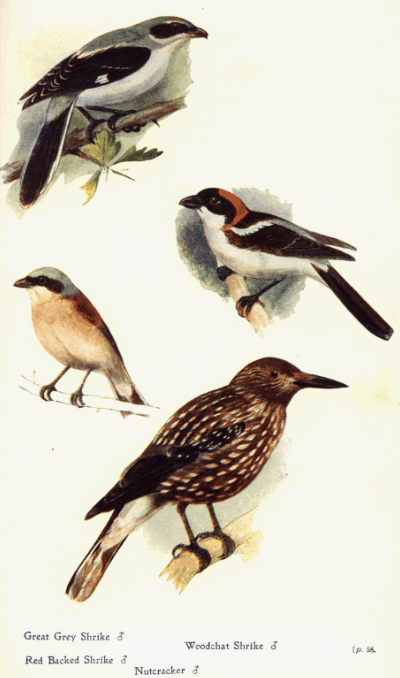
THE NUTCRACKER NUCÍFRAGA CARYOCATACTES
Plumage sooty brown, spotted on the back and under parts with white; tail black, barred with white at the extremity; beak and feet horn-colour; iris brown. Length thirteen inches. Eggs light buff, with a few greyish brown spots.
The Nutcracker Crow, a rare straggler, must not be confounded with the Nuthatch, which we have already described; the former is a large bird, as big as a Jay, and is only an occasional visitor in this country, and whose habits partake of those of the Crows and Woodpeckers. The propriety of its name is questionable, according to Yarrell, who says that 'it cannot crack nuts'. Here perhaps there may be some little mistake. Its name is evidently a translation of the French Cassenoix. In England we mean by 'nuts' filberts or hazel-nuts; but the French word noix is applied exclusively to walnuts, our nuts being noisettes, or 'little nuts'; and French authors are agreed that its food consists of insects, fruits, and walnuts; that is, the ordinary diet of its relative, the Rook, whose fondness for walnuts is notorious. It lays its eggs in the holes of trees, and, except in the breeding season, is more or less gregarious in its habits.
THE JAY GÁRRULUS GLANDÁRIUS
Feathers of the crest greyish white, streaked with black; a black moustache from the corners of the beak; general plumage reddish grey, darker above; primaries dingy black; secondaries velvet-black and pure white; inner tertials rich chestnut; winglet and greater coverts barred with black, white, and bright blue; upper and under tail-coverts pure white; iris bright blue; beak black; feet livid brown. Length thirteen and a half inches; breadth twenty-two inches. Eggs dull green, minutely and thickly-speckled with olive-brown.
There exists among gamekeepers a custom of selecting a certain spot in preserved woods, and there suspending, as trophies of their skill and watchfulness, the bodies of such destructive animals as they have killed in the pursuit of their calling. They are generally those of a few stoats or weasels, a Hawk, a Magpie, an owl, and two or three Jays. All these animals are judged to be destructive to game, and are accordingly hunted to the death, the Jay, perhaps, with less reason than the rest, for though it can hardly resist the temptation of plundering, either of eggs or young, any nest, whether of Partridge or Pheasant, that falls in its way, yet it does not subsist entirely upon animal food, but also upon acorns and various other wild fruits. Its blue feathers are much used in the manufacture of artificial flies. Nevertheless, owing to their cautious and wary habits, there are few wooded districts in which they are not more or less numerous. Their jarring unconnected note, which characterizes them at all seasons, is in spring and summer varied by their song proper, in which I have never been able to detect anything more melodious than an accurate imitation of the noise made by sawyers at work, though Montagu states that 'it will, sometimes, in the spring utter a sort of song in a soft and pleasing manner, but so low as not to be heard at any distance; and at intervals introduces the bleating of a lamb, mewing of a cat, the note of a Kite or Buzzard, hooting of an Owl, or even neighing of a horse. These imitations are so exact, even in a natural wild state, that we have frequently been deceived.' The Jay generally builds its nest in a wood, either in the top of a low tree, or against the trunk of a lofty one, employing as material small sticks, roots, and dry grass, and lays five eggs. There seems to be a difference of opinion as to the sociability of the family party after the young are fledged, some writers stating that they separate by mutual consent, and that each shifts for itself; others, that the young brood remains with the old birds all the winter. For my own part, I scarcely recollect ever having seen a solitary Jay, or to have heard a note which was not immediately responded to by another bird of the same species, the inference from which is that, though not gregarious, they are at least social.
When domesticated, the Jay displays considerable intelligence; it is capable of attachment, and learns to distinguish the hand and voice of its benefactor.
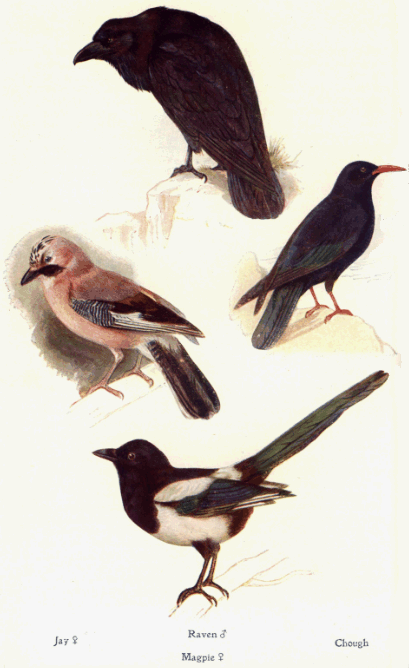
THE MAGPIE PICA RÚSTICA
Head, throat, neck, and back velvet-black; scapulars and under plumage white; tail much graduated and, as well as the wings, black, with lustrous blue and bronze reflections; beak, iris, and feet black. Length eighteen inches; breadth twenty-three inches. Eggs pale dirty green, spotted all over with ash-grey and olive-brown.
The Magpie, like the Crow, labours under the disadvantage of an ill name, and in consequence incurs no small amount of persecution. Owing to the disproportionate length of its tail and shortness of its wings its flight is somewhat heavy, so that if it were not cunning and wary to a remarkable degree, it would probably well-nigh disappear from the catalogue of British Birds. Yet though it is spared by none except avowed preservers of all birds (like Waterton, who protects it 'on account of its having nobody to stand up for it'), it continues to be a bird of general occurrence, and there seems indeed to be but little diminution of its numbers. Its nest is usually constructed among the upper branches of a lofty tree, either in a hedge-row or deep in a wood; or if it has fixed its abode in an unwooded district, it selects the thickest thorn-bush in the neighbourhood and there erects its castle. This is composed of an outwork of thorns and briers supporting a mass of twigs and mud, which is succeeded by a layer of fibrous roots. The whole is not only fenced round but arched over with thorny sticks, an aperture being left, on one side only, large enough to admit the bird. In this stronghold are deposited generally six eggs, which in due time are succeeded by as many young ogres, who are to be reared to birds by an unstinted supply of the most generous diet. Even before their appearance the old birds have committed no small havoc in the neighbourhood; now, however, that four times as many mouths have to be filled, the hunting ground must either be more closely searched or greatly extended. Any one who has had an opportunity of watching the habits of a tame Magpie, must have observed its extreme inquisitiveness and skill in discovering what was intended to be concealed, joined, moreover, to an unscrupulous habit of purloining everything that takes its roving fancy. Even when surrounded by plenty and pampered with delicacies it prefers a stolen morsel to what is legally its own. Little wonder then that when it has to hunt on its own account for the necessaries of life, and is stimulated besides by the cravings of its hungry brood, it has gained an unenviable notoriety as a prowling bandit. In the harrying of birds' nests no schoolboy can compete with it; Partridges and Pheasants are watched to their retreat and plundered mercilessly of their eggs and young; the smaller birds are treated in like manner: hares and rabbits, if they suffer themselves to be surprised, have their eyes picked out and are torn to pieces; rats, mice, and frogs are a lawful prey; carrion, offal of all kinds, snails, worms, grubs, and caterpillars, each in turn pleasantly vary the diet; and, when in season, grain and fruit are attacked with as much audacity as is consistent with safety; and might, whenever available, give a right to stray chickens and ducklings. The young birds, nurtured in an impregnable stronghold, and familiarized from their earliest days with plunder, having no song to learn save the note of caution and alarm when danger is near, soon become adepts in the arts of their parents, and, before their first moult, are a set of inquisitive, chattering marauders, wise enough to keep near the haunts of men because food is there most abundant, cautious never to come within reach of the fowling-piece, and cunning enough to carry off the call-bird from the net without falling themselves into the snare. Even in captivity, with all their drollery, they are unamiable.
Magpies, though generally distributed, are far more numerous in some districts than others. In Cornwall they are very abundant; hence I have heard them called Cornish Pheasants. In Ireland they are now very common. It is stated that they are in France more abundant than in any other country of Europe, where they principally build their nests in poplar-trees, having discovered, it is said, 'that the brittle nature of the boughs of this tree is an additional protection against climbers!' 'In Norway', says a writer in the Zoologist,[10] 'this bird, usually so shy in this country, and so difficult to approach within gunshot, seems to have entirely changed its nature: it is there the most domestic and fearless bird; its nest is invariably placed in a small tree or bush adjoining some farm or cottage, and not unfrequently in the very midst of some straggling village. If there happens to be a suitable tree by the roadside and near a house, it is a very favourable locality for a Norwegian Magpie's nest. I have often wondered to see the confidence and fearlessness displayed by this bird in Norway; he will only just move out of your horse's way as you drive by him on the road, and should he be perched on a rail by the roadside he will only stare at you as you rattle by, but never think of moving off. It is very pleasant to see this absence of fear of man in Norwegian birds; a Norwegian would never think of terrifying a bird for the sake of sport; whilst, I fear, to see such a bird as the Magpie sitting quietly on a rail within a few feet, would be to an English boy a temptation for assault which he could not resist. I must add, however, with regard to Magpies, that there is a superstitious prejudice for them current throughout Norway; they are considered harbingers of good luck, and are consequently always invited to preside over the house; and, when they have taken up their abode in the nearest tree, are defended from all ill; and he who should maltreat the Magpie has perhaps driven off the genius loci, and so may expect the most furious anger of the neighbouring dwelling, whose good fortune he has thus violently dispersed.' Faith in the prophetic powers of the Magpie even yet lingers in many of the rural districts of England also.
THE JACKDAW CORVUS MONÉDULA
Crown of the head and upper parts black, with violet reflections; back of the head and nape grey; lower parts duller black; iris white; beak and feet black. Length thirteen inches; breadth twenty-seven inches. Eggs very light blue, with scattered spots of ash-colour and dark brown.
This lively and active bird, inferior in size as well as dignity to the Rook, yet in many respects resembles it so closely that it might be fabled to have made the Rook its model, and to have exercised its imitative powers in the effort to become the object of its admiration. A vain effort, however; for nature has given to it a slender form, a shriller voice, a partially grey mantle, and an instinct which compels it to be secretive even in the placing of its nest. Its note, which may be represented either by the syllable 'jack' or 'daw', according to the fancy of the human imitator, sounds like an impertinent attempt to burlesque the full 'caw' of the Rook; it affects to be admitted into the society of that bird on equal terms; but whether encouraged as a friend, or tolerated as a parasite whom it is less troublesome to treat with indifference than to chase away, is difficult to decide. Most probably the latter; for although It is common enough to see a party of Jackdaws dancing attendance on a flock of Rooks, accompanying them to their feeding-grounds, and nestling in hollow trunks of trees in close proximity to rookeries, they are neither courted nor persecuted; they come when they like and go away when they please. On the other hand, no one, I believe, ever saw a flock of Rooks making the first advances towards an intimacy with a flock of Jackdaws, or heard of their condescending to colonize a grove, because their grey-headed relatives were located in the neighbourhood. On the sea-coast, where Rooks are only casual visitors, the Jackdaw has no opportunity of hanging himself on as an appendage to a rookery, but even here he must be a client. With the choice of a long range of cliff before him, he avoids that which he might have all to himself, and selects a portion which, either because it is sheltered from storms, or inaccessible by climbers, has been already appropriated by Sea-mews.
The object of the Jackdaw in making church-towers its resort is pretty evident. Where there is a church there is at least also a village, and where men and domestic animals congregate, there the Jackdaw fails not to find food; grubs in the fields, fruit in the orchards, and garbage of all kinds in the waste ground. Here, too, it has a field for exercising its singular acquisitiveness. Wonderful is the variety of objects which it accumulates in its museum of a nest, which, professedly a complication of sticks, may comprise also a few dozen labels stolen from a Botanic Garden, an old tooth-brush, a child's cap, part of a worsted stocking, a frill, etc. Waterton,[11] who strongly defends it from the charge of molesting either the eggs or young of pigeons, professes himself unable to account for its pertinacious habit of collecting sticks for a nest placed where no such support is seemingly necessary, and, cunning though it is, comments on its want of adroitness in introducing sticks into its hole: 'You may see the Jackdaw', he says, 'trying for a quarter of an hour to get a stick into the hole, while every attempt will be futile, because, the bird having laid hold of it by the middle, it is necessarily thrown at right angles with the body, and the Daw cannot perceive that the stick ought to be nearly parallel with its body before it can be conveyed into the hole. Fatigued at length with repeated efforts, and completely foiled in its numberless attempts to introduce the stick, it lets it fall to the ground, and immediately goes in quest of another, probably to experience another disappointment on its return. When time and chance have enabled it to place a quantity of sticks at the bottom of the hole, it then goes to seek for materials of a more pliant and a softer nature.' These are usually straw, wool, and feathers; but, as we have seen, nothing comes amiss that catches its fancy. In addition to rocks, towers, and hollow trees, it sometimes places its nest in chimneys or in rabbit-burrows, but never, or in the rarest instances, among the open boughs of a tree. It lays from four to six eggs, and feeds its young on worms and insects, which it brings home in the pouch formed by the loose skin at the base of its beak. When domesticated, its droll trickeries and capability of imitating the human voice and other sounds are well known. By turns affectionate, quarrelsome, impudent, confiding, it is always inquisitive, destructive, and given to purloining; so that however popular at first as a pet, it usually terminates its career by some unregretted accident, or is consigned to captivity in a wicker cage.
THE RAVEN CORVUS CÓRAX
Plumage black with purple reflections; tail rounded, black, extending two inches beyond the closed wings; beak strong, black as well as the feet; iris with two circles, the inner grey, the outer ash-brown. Length twenty-five inches; width four feet. Eggs dirty green, spotted and speckled with brown.
The Raven, the largest of the Corvidæ, and possessing in an eminent degree all the characteristics of its tribe except sociability, is the bird which beyond all others has been regarded with feelings of awe by the superstitious in all ages. In both instances in which specific mention of it occurs in Holy Writ, it is singled out from among other birds as gifted with a mysterious intelligence. Sent forth by Noah when the ark rested on the mountains of Ararat, it perhaps found a congenial home among the lonely crags strewed with the carcases of drowned animals, and by failing to return, announced to the patriarch that a portion of the earth, though not one fit for his immediate habitation, was uncovered by the waters. At a subsequent period, honoured with the mission of supplying the persecuted prophet with food, it was taught to suppress its voracious instinct by the God who gave it. The Raven figures prominently in most heathen mythologies, and is almost everywhere regarded with awe by the ignorant even at the present time. In Scandinavian mythology it was an important actor; and all readers of Shakespeare must be familiar with passages which prove it to have been regarded as a bird of dire omen.
The sad presaging Raven tolls
The sick man's passport in her hollow beak.
And in the shadow of the silent night
Doth shake contagion from her sable wing.
Marlowe.
In the Judgment of others, its friendly mission to the Tishbite invested it with a sanctity which preserved it from molestation.
Apart from all traditional belief, the Raven derives its ill-omened character as a herald of death from the rapidity with which it discerns, in the vicinity of its haunts, the carcase of any dead animal. In the coldest winter days, at Hudson's Bay, when every kind of effluvium is greatly checked if not arrested by frost, buffaloes and other beasts have been killed when not one of these birds was to be seen; but in a few hours scores of them have been found collected about the spot to pick up the blood and offal. 'In Ravens', says a writer in the Zoologist,'the senses of smell and sight are remarkably acute and powerful. Perched usually on some tall cliff that commands a wide survey, these faculties are in constant and rapid exercises, and all the movements of the bird are regulated in accordance with the information thus procured. The smell of death is so grateful to them that they utter a loud croak of satisfaction instantly on perceiving it. In passing any sheep, if a tainted smell is perceptible, they cry vehemently. From this propensity in the Raven to announce his satisfaction in the smell of death has probably arisen the common notion that he is aware of its approach among the human race, and foretells it by his croakings.' The same observant author, as quoted by Macgillivray, says again: 'Their sight and smell are very acute, for when they are searching the wastes for provision, they hover over them at a great height; and yet a sheep will not be dead many minutes before they will find it. Nay, if a morbid smell transpire from any in the flock, they will watch it for days till it die.'
To such repasts they are guided more by scent than by sight, for though they not unfrequently ascend to a great height in the air, they do not then appear to be on the look-out for food. This duty is performed more conveniently and with greater success by beating over the ground at a low elevation. In these expeditions they do not confine themselves to carrion, but prey indiscriminately on all animals which they are quick enough to capture and strong enough to master. Hares, rabbits, rats, mice, lizards, game of various kinds, eggs, and the larger insects, all of these enter into their diet, and, wanting these, they resort to the sea-shore for refuse fish, or ransack dunghills in villages, before the inhabitants are astir, for garbage of all sorts. Pliny even relates that in a certain district of Asia Minor they were trained to hawk for game like the noble Falcons. Few of these qualifications tend to endear them to mankind; and as they are dreaded by shepherds on account of their being perhaps more than suspected of making away with sickly lambs when occasion offers, and of plundering poultry yards, Ravens are become, in populous districts, almost unknown birds. I have only seen them myself on the rocky sea-shore of Devon and Cornwall, in the wilds of Dartmoor, and the Highlands of Scotland. There was for many successive years a nest built on a ledge of granite near the Bishop Rock, in Cornwall, a huge mass of sticks, and what appeared to be grass, inaccessible from below, but commanded by a venturous climber from above. Where it still continues to breed inland, it places its nest, constructed of sticks and lined with the wool and fur of its victims, either on an inaccessible rock, or near the summit of a lofty tree, the ill-omened 'Raven-tree' of romances. In the north of Scotland, in the Orkneys and Hebrides, where it is still abundant, it builds its nest in cliffs which it judges to be inaccessible, both inland and on the sea-shore, showing no marked preference for either. Two pairs never frequent the same locality, nor is any other bird of prey permitted to establish itself in their vicinity. Even the Eagle treats the Raven with respect, and leaves it to its solitude, not so much from fear of its prowess, as worn out by its pertinacious resistance of all dangerous intruders. Hence, in some districts, shepherds encourage Ravens, because they serve as a repellent to Eagles; while in others, where Eagles are of unusual occurrence, they allow them to build their nests undisturbed, but when the young are almost fledged, destroy them by throwing stones at them from above. Nevertheless the original pair continues to haunt the same locality for an indefinite term of years, and it is not a little singular that if one of them be killed, the survivor will find a mate in an incredibly short space of time.
The geographical range of the Raven is very extensive. Throughout all the zones of the Northern Hemisphere it is to be found; and having this wide range, its physical constitution is strong, and it lives to a great age, amounting, so the ancients tell us, to twenty-seven times the period of a man's life. The note of the Raven is well described by the word 'croak', but it is said by those who have had the opportunity of observing it under various circumstances, to utter another sound, resembling the word 'whii-ur'. With this cry it very commonly intermixes another, sounding like 'clung', uttered very much as by a human voice, only a little wilder in the sound. From the cry croak the Raven no doubt derives its Latin name Corvus the French Corbeau, and its common Scotch appellation Corbie.
THE CARRION CROW CORVUS CORÓNE
Black, with green and violet reflections; tail slightly rounded, extending an inch and a quarter beyond the closed wings; iris dark hazel; lower part of the beak covered with bristly feathers; beak and feet black. Length nineteen inches; breadth three feet. Eggs bluish green, spotted and speckled with ash-grey and olive.
Breeding early in the year, like the Raven, the Carrion Crow builds its nest in some tree which, from its loftiness or other reason, is difficult of ascent, where its young ones are hatched about the time that most other birds are laying their eggs, and when the lambing season is at its height. Then, too, its habits are most fully developed. Its young are clamorous for food, and will not be satisfied with a little. So the old bird sallies forth to scour the districts least frequented by man, and makes every living thing its prey, provided that by force or cunning it can overpower it. If Grouse are plentiful, it is said that one pair, what with stealing the eggs and carrying off the young, will in a season destroy more of them than the keenest sportsman. It will pounce on the leveret and bear it screaming from the side of its mother. It watches sheep which have strayed from the fold, and mangles the newly-born or weakly lambs, carrying them piece-meal to the young ones at home. If mowers are at work, the wary birds alight on some lofty tree, taking care to keep at a safe distance, and when a nest has been laid bare by the scythe, their incredibly sharp eye discerns the prize which, whether it consist of eggs or callow young, is borne off in triumph. Lest their depredations should be discovered by the accumulation of egg-shells, feathers and bones, which are the natural consequence of these raids, they carefully carry to some distance everything that would tend to betray them, so that one might pass directly beneath the scene of these enormities unsuspicious of the evil existing overhead. Keen as this bird is in pursuit of such delicate fare, he can be, when occasion serves, as unclean a feeder as the Vulture, and he can, on the other hand, make a meal off corn. Mr. Knox states that in the Weald of Sussex, where the Raven is common, it resorts to the brooks and ponds, which abound in fresh-water mussels (Anodon), and feeds on them most voraciously, especially after floods, when they lie scattered on the mud. The same author states that in winter it resorts to the sea-shore, and feeds on the oysters, mussels, small crabs, marine insects, worms, and dead fish which are cast up by the waves during the prevalent south-westerly storms. It has been frequently observed, he adds, to ascend to a great height in the air with an oyster in its claws, and after letting it fall on the beach, to descend rapidly with closed pinions and devour the contents. A similar instance of apparent reasoning is recorded of the same bird by Pliny, but with the substitution of walnuts for oysters.
With such wandering habits, it seems at first sight strange that the phrase 'as the Crow flies' should be adopted to mark distances in a straight line across the open country; yet when it is borne in mind how many persons confound the Crow with the Rook, and even talk of the 'Crows in a rookery', the suggestion will at once occur to the mind that the term owed its origin to its far gentler and more respectable relation, the Rook, whose evening flights from the feeding-ground are among the most familiar sights of the country, and are invariably performed in a line so straight, that if a whole flock could be tracked through the air on any one evening it would be found scarcely to deviate from that of the preceding or the following. It is to be feared that this inaccurate application of names has done the Rook ill service; yet the two birds are totally distinct; Crows are solitary birds, rarely being seen in more than pairs together; Rooks are eminently sociable. Crows shun the haunts of men; Rooks court the vicinity of his dwellings. Crows are carnivorous; Rooks feed principally on the grubs of beetles, worms, and noxious insects, rewarding themselves occasionally for their services by regaling on corn and fruits, but rarely touching carrion or molesting living animals. In appearance the two birds are much alike; the Crow, however, is somewhat smaller, the beak is stouter at the point and encircled at the base with numerous short feathers, while the bill of the Rook is encroached on by a white membrane which is almost bare of feathers. Both are noted for their intelligence; the Crow has been known to remove its eggs from its nest when apprehensive of danger; it was held in high consideration in the days of augury, and certain of its movements were considered to be indicative of changes in the weather. It builds its nest of sticks, and lines it with moss, straw, hair, and wool, and lays from four to six eggs. Like the Raven, it is a widely-diffused bird, and attains a great age, outliving (the ancients said) nine generations of men, showing great attachment to any spot in which it has once fixed its home, and suffering neither its own progeny nor any other large birds to nestle in its vicinity.
This Crow is becoming more numerous of late in the close vicinity of London. It comes constantly to some of our suburban gardens.
THE HOODED CROW, GREY OR ROYSTON CROW CORVUS CORNIX
Head, throat, wings and tail black, the rest of the plumage ash-grey; tail rounded; beak and feet black; iris brown. Length nineteen and a half inches; breadth three feet two inches. Eggs bluish green, mottled with ash-grey and olive.
The Hooded Crow closely resembles the Carrion Crow, scarcely differing from it in fact except in colour. They are, however, perfectly distinct species, and for the most part exercise their calling in separate haunts. In Norway Hooded Crows are very abundant, to the almost total exclusion of the Carrion Crow and Rook, and, though not congregating so as to form a society like the last-named bird, they may be seen simultaneously employed in searching for food in groups which collectively amount to a hundred or more. Though numerous in the winter at Newmarket Heath and Royston (where they are sometimes called Royston Crows), and annually resorting to many parts of the sea-coast, they rarely breed so far south. In the Isle of Man, the Orkneys, Hebrides, and in all but the south of Scotland they are of more frequent occurrence than any other of the tribe, essentially belonging to the 'Land of the mountain and the flood'. It is on the increase in Ireland and very unwelcome there. One can scarcely traverse the shores of the salt-water lochs of Scotland without seeing a pair, or, in the latter part of the year, a small party of four or five of these birds, gravely pacing the shingle and sand in quest of food. As far as my own experience goes, I should consider the Hooded Crow as 'half sea-bird', but it is said to be met with, in summer, in the very centre of the Grampians and other inland districts. Its proper diet consists of the smaller marine animals, such as crabs, echini, and molluscs, alive or dead, fish and carrion. At high-water it retires inland, and skulks about the low grounds in quest of the eggs and young of Moor-fowl, thereby gaining the execrations of gamekeepers; takes a survey of any adjacent sheep-walks, on the chance of falling in with a new-born lamb, or sickly ewe, whence it has but an ill name among shepherds; and returns when the tide has well ebbed, to finish the day's repast on food of a nature light and easy of digestion. It is less wary of man than the Carrion Crow, and often comes within shot, but, being far too numerous to admit of being exterminated, is but little assailed. In the comparatively mild climate of the Scottish sea-coast, these birds find an abundant supply of food all the year round and as there is no sensible diminution of their numbers in winter, it is supposed that those which frequent the English coast from October to March have been driven southwards by the inclement winters of high latitudes. They are then frequently observed on the coast of Norfolk and Sussex in parties of thirty or more, and it has been remarked that the hunting grounds of the two species are defined by singularly precise limits, the neighbourhood of Chichester being frequented by the Carrion Crow, that of Brighton by its congener. It is abundant on the sea-coast of Norfolk in the winter, where I have seen it feeding with Gulls, Plovers, etc. In musical capabilities it is inferior even to its relative, its solitary croak being neither so loud nor so clear. The nest of the Hooded Crow is large, composed of twigs, sea-weeds, heath, feathers, and straws, and is placed on rocks, tall trees, low bushes, and elsewhere, according to circumstances.
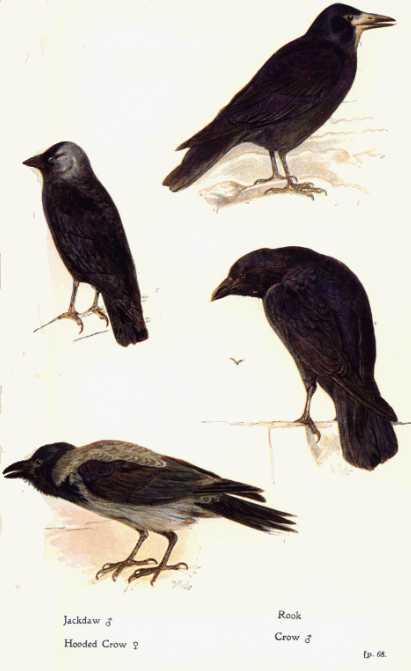
THE ROOK CORVUS FRÚGILEGUS
Plumage black, with purple and violet reflections; base of the beak, nostrils; and region round the beak bare of feathers and covered with a white scurf, iris greyish white; beak and feet black. Length eighteen inches; breadth three feet. Eggs pale green, thickly blotched with olive and dark-brown.
As the Hooded Crow is essentially the type of the Corvidæ in Scandinavia and the Isles of Scotland, where the Carrion Crow and Rook are all but unknown, so in England the representative of the tribe is the Rook, a bird so like the Crow that it is called by its name almost as frequently as by its own, yet so different in habits that, instead of being under a perpetual and universal ban, it is everywhere encouraged and indeed all but domesticated. There are few English parks that do not boast of their rookery, and few proprietors of modern demesnes pretending to be parks, who would not purchase at a high price the air of antiquity and respectability connected with an established colony of these birds. Owing to their large size and the familiarity with which they approach the haunts of men, they afford a facility in observing their habits which belongs to no other birds; hence all treatises on Natural History, and other publications which enter into the details of country life in England, abound in anecdotes of the Rook. Its intelligence, instinctive appreciation of danger, voracity, its utility or the reverse, its nesting, its morning repasts and its evening flights, have all been observed and more or less faithfully recorded again and again; so that its biography is better known than that of any other British bird. It would be no difficult task to compile from these materials a good-sized volume, yet I doubt not that enough remains untold, or at least not sufficiently authenticated, to furnish a fair field of inquiry to any competent person who would undertake to devote his whole attention to this one bird for a considerable period of time. Such a biographer should make himself master of all that has been recorded by various authorities, and should then visit a large number of rookeries in all parts of the kingdom, collecting and sifting evidence, making a series of personal observations, and spreading his researches over all seasons of the year. Such an inquiry, trivial though it may seem, would be most useful, for the Rook, though it has many friends, has also many enemies, and, being everywhere abundant, its agency for good or evil must have serious results. The following account being imperfect from want of space, the reader who wishes to know more about this interesting bird must refer to our standard works on Ornithology, and, above all, record and compare his own personal observations.
In the early spring months Rooks subsist principally on the larvæ and worms turned up by the plough, and without gainsay, they are then exceedingly serviceable to the agriculturist, by destroying a vast quantity of noxious insects which, at this period of their growth, feed on the leaves or roots of cultivated vegetables. Experience has taught them that the ploughman either has not the power or the desire to molest them; they therefore approach the plough with perfect fearlessness, and show much rivalry in their efforts to be first to secure the treasures just turned up. During the various processes to which the ground is subjected in preparation for the crop, they repeat their visits, spreading more widely over the field, and not only pick up the grubs which lie on the surface, but bore for such as, by certain signs best known to themselves, lie concealed. I need not say that in all these stages the wisdom of the farmer is to offer them every inducement to remain; all that they ask is to be let alone. Not so, however, when the seed-crop is sown. Grain, pulse, and potatoes are favourite articles of diet with them, and they will not fail to attack these as vigorously as they did the grubs a few days before. They are therefore undeniably destructive at this season, and all available means should be adopted to deter them from alighting on cultivated ground. About the second week in March they desert the winter roosting places, to which they had nightly congregated in enormous flocks, leave off their wandering habits, and repair as if by common consent to their old breeding places. Here, with much cawing and bustling, they survey the ruins of their old nests, or select sites for new ones, being guided by their instinct to avoid all those trees the upper branches of which are too brittle for their purpose either because the trees are sickly or in an incipient state of decay. Hence, when it has occasionally happened that a nestless tree in a rookery has been blown down, the birds have been saluted as prophets, while in reality the tree yielded to the blast before its fellows because it was unsound, the Rooks knowing nothing about the matter except that signs of decay had set in among the upper twigs while as yet all seemed solid beneath. How the birds squabble about their nests, how they punish those thievishly disposed, how they drive away intruders from strange rookeries, how scrupulously they avoid, during building, to pick up a stick that has chanced to drop, how the male bird during incubation feeds his mate with the most luscious grubs brought home in the baggy pouch at the base of his bill, how every time that a bird caws while perched he strains his whole body forward and expands his wings with the effort, all these things, and many more, I must pass over without further notice, leaving them to be verified by the reader with the help of a good field-glass. I must, however, mention, in passing, the custom so generally adopted by sportsmen, of shooting the young birds as soon as they are sufficiently fledged to climb from their nests to the adjoining twigs, or to perform their first tentative flight over the summits of the trees. It is supposed to be necessary to keep down their numbers, but this is a disputed point. I have, however, little doubt that Rooks during the whole of their lives associate the memory of these battues with the appearance of a man armed with a gun. Many people believe that Rooks know the smell of powder: they have good reason to know it; but that they are as much alarmed at the sight of a stick as a gun in the hand of a man, may be proved by any one who, chancing to pass near a flock feeding on the ground, suddenly raises a stick. They will instantly fly off, evidently in great alarm.
While the young are being reared, the parent birds frequent corn-fields and meadows, where they search about for those plants which indicate the presence of a grub at the root. Such they unscrupulously uproot, and make a prize of the destroyer concealed beneath. They are much maligned for this practise, but without reason; for, admitting that they kill the plant as well as the grub, it must be borne in mind that several of the grubs on which they feed (cockchafer and daddy-longlegs) live for several years underground, and that, during that period, they would if left undisturbed, have committed great ravages. I have known a large portion of a bed of lettuces destroyed by a single grub of Melolontha, having actually traced its passage underground from root to root, and found it devouring the roots of one which appeared as yet unhurt. Clearly, a Rook would have done me a service by uprooting the first lettuce, and capturing its destroyer.
I must here advert to a peculiar characteristic of the Rook which distinguishes it specifically from the Crow. The skin surrounding the base of the bill, and covering the upper part of the throat, is, in the adult birds, denuded of feathers. Connected with this subject many lengthy arguments have been proposed in support of two distinct opinions: one, that the bareness above mentioned is occasioned by the repeated borings of the bird for its food; the other, that the feathers fall off naturally at the first moult, and are never replaced. I am inclined to the latter view, and that for two reasons: first, if it be necessary (and that is not at all clear) that the Rook, in order to supply itself with food, should have no feathers at the base of its bill, I believe that nature would not have resorted to so clumsy a contrivance, and one so annoying to the bird, as that of wearing them away bit by bit: and, secondly, the bare spot is, as far as I have observed, of the same size and shape in all birds, and at all periods of the year, a uniformity which can scarcely be the result of digging in soils of various kinds, and at all seasons. I cannot, therefore, but think that the appearance in question is the result of a law in the natural economy of the bird, that the feathers are not rubbed off, but fall off, and that they are not renewed, because nature never intended that they should grow there permanently; if not, why is there no similar abrasion in the Crow? The number of lambs eaten by Crows is very small after all, and birds' eggs are not always in season, nor is carrion so very abundant; so that, during a great portion of the year, even Crows must dig for their livelihood, and the great distinction between a Crow and a Rook is, that the former has actually no bare space at the base of his bill. But the question is still open, and the reader may make his own observations, which in Natural History, as well as in many other things, are far better than other people's theories.
In very dry summer weather, Rooks are put to great shifts in obtaining food. Grubs and worms descend to a great depth to get beyond the influence of the drought, and the soil is too parched and hard for digging; they then retire to the sea-shore, to marshes, fresh-water and salt, to cabbage and potato gardens, and in the last-named localities they are again disposed to become marauders. To fruit gardens they are rarely permitted to resort, or they would commit great ravages. As the season advances, ripe walnuts are a very powerful attraction, and when they have discovered a tree well supplied with fruit, a race ensues between them and the proprietor as to which shall appropriate the greater share, so slyly do they watch for opportunities, and so quick are they in gathering them and carrying them off in their beaks. In long winter frosts, or when the ground is covered with snow, they are again reduced to straits. Some resort to the sea-shore and feed on garbage of all kinds, some to turnip-fields where they dig holes in the bulbs. They have also been observed to chase and kill small birds, which, as near starvation as themselves, have been unable to fly beyond their reach, and I have even seen a Rook catch a small fish.
I must not conclude this imperfect sketch without noticing a peculiar habit of Rooks, which is said to portend rain. A flock will suddenly rise into the air almost perpendicularly, with great cawing and curious antics, until they have reached a great elevation, and then, having attained their object, whatever that may be, drop with their wings almost folded till within a short distance of the ground, when they recover their propriety, and alight either on trees or on the ground with their customary grave demeanour. Occasionally in autumn, as White of Selborne remarks,
Sooth'd by the genial warmth, the cawing Rook
Anticipates the spring, selects her mate,
Haunts her tall nests, and with sedulous care
Repairs her wicker eyrie, tempest torn.
Similar instances of this unseasonable pairing are recorded by modern ornithologists.
Efforts are sometimes made, and not always unsuccessfully, to induce Rooks to establish a colony in a new locality. One plan is to place some eggs taken from a Rook's nest in that of some large bird which has happened to build in the desired spot, that of a Crow for instance, a Magpie, Jackdaw, Jay, or perhaps a Mistle Thrush. If the young are reared, it is probable that they will return to breed in the same place in the following year. Another plan which has been tried with success is to place several bundles of sticks, arranged in the form of nests, among the highest branches of the trees which it is desired to colonize. Stray Rooks in quest of a settlement, mistaking these for ruins of old nests, accept the invitation and establish themselves if the locality suits them in other respects.
During 1907-1908 the economic rôle played by the Rook has been thoroughly investigated by ornithologists and farmers all over Hungary, with the results that this bird stands as a friend rather than a foe to agriculture.
FAMILY LANIIDÆ
THE GREAT GREY SHRIKE LANIUS EXCÚBITOR
Head, nape, and back, bright ash grey; a broad black band beneath the eyes; under plumage pure white; wings short, black; base of the primaries and tips of the secondaries white; tail with the two middle feathers black, and the outer on each side white with a black spot at the base, the rest black and white; bill and feet black. Female of a more dingy hue above; below dull white, the proportion of black in the feathers increasing as they approach the middle; each feather of the breast terminating in a crescent-shaped ash grey spot. Length ten inches; breadth fourteen inches. Eggs bluish white, spotted at the larger end with two shades of brown. Sylvan. Young barred below.
The family of Shrikes, or Butcher-birds, would seem to occupy an intermediate station between birds of prey and insectivorous birds. The subject of the present chapter especially, though little resembling a Hawk in appearance, has, on account of its habits, some pretension to be ranked among birds of prey; from which, however, it differs in the essential particular that, as well as the rest of the family, it seizes and carries off its prey with its beak and not with its claws. Although a fairly common visitor from autumn to spring this Shrike does not breed with us, and is rarer in Ireland. It derives its name excubitor (sentinel) from its favourite habit of posting itself on the topmost twig of a poplar or other lofty tree, whence it keeps up a watchful look-out, not only for its prey, but for any bird of the Hawk tribe, against which it wages incessant and deadly hostility. When it descries one of these birds, which it does at a great distance, it utters a shriek, as if for the purpose of giving an alarm, a cry which is instantly repeated by all birds of the same species which happen to be within hearing. This antipathy against birds of prey is taken advantage of by fowlers in France, who, when setting their nets for hawks, take with them a 'sentinel' Shrike and station it near the living bird, which they employ as a lure. So rapid is the swoop of the Falcon that but for the warning cry of the Shrike it would descend and carry off its victim before the fowler had time to close his nets; but the keen eye of the sentinel detects, and his shrill cry announces, the approach of his enemy, and the fowler has time to prepare. The principal food of this bird appears to be mice, frogs, lizards and insects, especially the stag-beetle and grasshopper, though in its natural state it will capture and destroy any birds inferior to itself in strength and courage. Its name Lanius (Latin for butcher) and Butcher-bird were given to it from its habit of impaling beetles and small birds on thorns in the vicinity of its nest. Its flight is peculiar, being composed of a series of dips, like that of the Wagtail; and when it quits its perch on the summit of one tall tree to fly to another, it drops and rises again so as to form a curve like that of a loose rope hung from two tall masts. Another peculiarity of the Shrike is a remarkable power of imitating the song of other birds, which it is said to exercise in order to obtain its food more easily, by beguiling the nestlings of the smaller birds into answering it by a chirrup, and so betraying their retreat. The notes which it has been observed to imitate are those of the Nightingale, Robin, Swallow, and Stonechat. Its proper note is harsh, resembling somewhat that of the Kestrel, Shake-shake! the call note is truii! Of the Lesser Grey Shrike, Lanius minor, there have been few occurrences in these Islands.
LESSER GREY SHRIKE LANIUS MINOR
Grey above: breast and flanks roseate; wing-bar white.
Of this species only four occurrences recorded until recently—in Scilly Islands, Norfolk and Devon.
THE RED-BACKED SHRIKE LANIUS COLLURIO
Head, nape, shoulders and upper tail-coverts ash-grey, a black band reaching from the gape to beyond the ears; back, scapulars, and wing-coverts reddish brown; throat white, passing into rose-red on the breast and flanks; wings blackish, edged with reddish brown; tail nearly even at the end, four middle feathers black tipped with reddish grey, the rest white from the base through two-thirds of their length, the other third black with a white tip; second primary longer than the fifth. Female—upper plumage rusty brown, tinged near the nape and tail with ash-grey; lower white, the sides barred transversely by narrow curved lines; outer webs and tips of the outer tail feathers yellowish white, four middle ones uniform dusky brown. Length seven inches; breadth eleven inches. Eggs cream-coloured, greenish, or delicate grey variously mottled and spotted with light brown and ash-grey.
The Red-backed Shrike, though not generally diffused throughout England, is to certain localities a far from uncommon wanderer, but for some reason it has been scarce in 1908. In the wooded districts of the midland and southern counties many specimens may be annually observed, and the nest is of frequent occurrence. This is usually placed a few feet from the ground, in the middle of a thick bush or hedge; and, very unlike that of the rapacious birds, is a massive, well-built structure of twigs, dry grass, and moss, lined with hair and fine roots. This bird is called in France l'êcorcheur (the flayer), from the custom ascribed to it of skinning the bodies of its victims before devouring them. Its habits and food are similar to those of the last species, and it is said also to possess the same imitative power. That it impales insects and even young birds on thorns there can be no doubt as it has been watched by a competent observer in the very act of thus dealing with the carcase of a hedge-sparrow.
A professional bird-catcher told how a Red-backed Shrike once pounced on one of his call-birds (a linnet), and attempted to carry it off; but being prevented from doing so by the linnet being fastened to the ground by a string and wooden peg, the Shrike tore off the head of its victim, with which it made its escape. The bird-catcher then drew out from the ground the peg which held down the linnet, and left the dead bird lying in the net. In about half an hour the Shrike again appeared, pounced upon the body of the dead linnet, and carried it off in its beak, with the string and peg hanging to it; the weight of the latter was probably the cause of the Shrike not carrying its prey quite away, as it dropped it after flying about fifteen yards, when the bird-catcher again picked up the dead linnet, and replaced it in the net. The Shrike in the meantime retreated to some neighbouring bushes, from which it soon made a third pounce upon the nets, this time attacking the second call-bird, which was a sparrow. On this occasion, however, the bird-catcher was on the watch, and, drawing his nets, captured the Shrike, which proved to be an adult female. This daring act was observed late in the month of June, when, perhaps, the courage of the mother bird was unusually excited by the cravings of her brood at home, and further stimulated by the impression that the call-birds were in trouble, and consequently offered an easy prey.
An amiable trait in the character of this Shrike is its attachment to its mate and young. A female has been known to approach so close to the cage in which her captured lord was confined, that she was herself easily taken; and when a nest of young birds is molested, both parents defend their offspring with astonishing intrepidity.
The Red-backed Shrike is known to us only as a summer visitor, departing early in autumn. Its note is a harsh chuck! but the song of the mate is somewhat pleasant.
WOODCHAT SHRIKE LANIUS POMERÁNUS
Forehead and cheeks black; nape bright rust colour; back and wings variegated with black, white, and reddish brown; under parts white; outer tail feathers white, with a square black spot at the base on the inner web, the two next with the black spot larger, and on both webs, the two middle ones wholly black, the rest black tipped with white; tail slightly rounded; second primary equal in length to the fifth. Female—all her colours dingy; breast marked transversely with fine brown lines. Length, seven and a half inches. Eggs bluish white, spotted at the larger end with brown and ash-grey.
The habits of this bird, which is a very rare visitant to the British Isles, differ in no material respect from those of the foregoing species. On the Continent it is more frequent in the south than the north, where it frequents trees rather than bushes, and generally places its nest, which it constructs of twigs, moss, and white lichen, in the forked branch of an oak. Like the rest of the family it is migratory, coming and departing at the same time as the other species.
FAMILY AMPELIDÆ
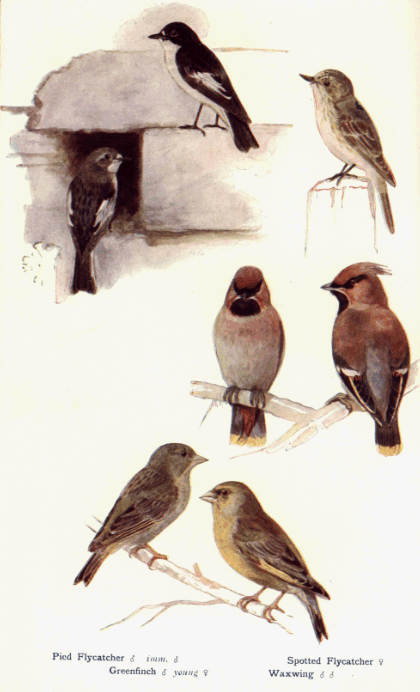
THE WAXWING ÁMPELIS GÁRRULUS
Feathers of the head elongated, forming a crest; upper plumage purplish red; lower the same, but of a lighter tint; throat and lore black; greater wing-coverts black, tipped with white; primaries black, with a yellow or white angular spot near the extremity, six or eight of the secondaries and tertiaries having the shaft prolonged and terminating in a substance resembling red sealing-wax; tail black, tipped with yellow. Length eight inches. Eggs pale blue, with a few streaks of brown and lilac.
The Waxwing is an elegant bird, of about the size of a Thrush. It visits this country, and in fact every other European country where it is known at all, at irregular intervals, generally in flocks, which vary in number from eight or ten to some scores. Thus it is everywhere a stranger; and little was known till recently of its nesting habits. It is perhaps on account of this ignorance of its natural history, that it has borne a variety of names which are as inappropriate as possible. Temminck describes it under the name Bombycivora, or devourer of Bombyx, a large moth, a name quite unfit for a bird which lives exclusively on fruits and berries. This was softened into Bombycilla, which means, I presume, a little Bombyx, though the bird in question is far larger than any known moth. Its French name Jaseur, equivalent to the English one, Chatterer, is quite as inappropriate, as it is singularly silent. In default of all certain information, then, I venture to surmise that, coming in parties no one knows whence, and going no one knows whither, they may have received the name Bohemian, because they resemble in their habits the wandering tribes of gypsies, who were formerly called indifferently Egyptians and Bohemians. Taken in this sense, the Bohemian or Wandering Waxwing, as it used to be called, is a name open to no exception. The plumage of the bird is silky, and that of the head is remarkable for forming a crest, and being capable of being elevated, as in the Cardinal. Its black gorget and tiara, the patches of white, yellow, and black described above, make it very conspicuous for colouring, and the singularity of its appearance is much increased by the appendages to its secondaries and tertiaries, which resemble in colour and substance red sealing-wax. In very old birds these waxen appendages are also to be found at the extremities of the tail-feathers, being no more than the shafts of the feathers, condensed with the web. In its habits the Waxwing resembles the Tits. It feeds on insects, fruit, berries, and seeds. Its call-note is a twitter, which it rarely utters, except when taking flight and alighting. The Waxwing is a northern bird, and Dr. Richardson, the Arctic traveller, informs us that he one day saw a flock, consisting of three or four hundred birds, alight on one or two trees in a grove of poplars, making a loud twittering noise. One of its German names, Schneevogel (snowbird), was evidently given in this belief. It is sometimes caught and caged, but has nothing but its beautiful colouring to recommend it. It is a stupid lazy bird, occupied only in eating and reposing for digestion. Its song is weak and uncertain.
FAMILY MUSCICAPIDÆ
Muscicapidæ.—Nostrils more or less covered by bristly hairs
THE SPOTTED FLYCATCHER MUSCÍCAPA GRÍSOLA
Upper plumage ash-brown; feathers of the head marked with a central dark line; under parts white, the sides marked with longitudinal brown streaks; flanks tinged with red. Length six inches; breadth ten inches. Eggs bluish white, mottled with reddish spots, which are deepest in colour towards the larger end.
There are few birds with whose haunts and habits we are more familiar than those of the common Flycatcher. In the wooded parts of England there is scarcely a country house, perhaps, which has not in its neighbourhood at least a single pair of these birds, who, though their stay with us is but short, become as necessary appendages of the garden during the summer months as the Redbreast is in winter. They have neither song to recommend them nor brilliancy of colouring; yet the absence of these qualities is more than compensated by the confidence they repose in the innocent intentions of the human beings whose protection they claim, by their strong local attachments, and by their unceasing activity in the pursuit of flying insects. At any time during the months of June, July, and August, in most country and suburban gardens, one may observe perched on a railing, standard rose, or the low branch of an apple-tree, a small brownish bird, with a speckled breast, about the size of a Sparrow, but more slender in form, taking no notice of human beings, but nevertheless evidently on the look-out for something. Suddenly it darts from its position, flies rapidly forwards for a few yards, performs an evolution in the air, and returns either to the exact spot which it had previously occupied or to a similar one hard by. After a rest of a few seconds, it performs the same manœuvre, and always with the same object and success. Every time it quitted its perch, some ill-fated fly or beetle was discovered, winging its way through the air, and captured to be devoured on the spot, or to form part of a pellet of insect food for a hungry nestling. The nest, composed of moss, straws, and hair, and lined with feathers, is usually placed either against a wall, hidden by the leaves of a trained fruit-tree, or on the horizontal bough of a standard apple-tree. During the year 1859, a pair of these birds had taken up their quarters in my own garden in a situation such as that first described, but becoming dissatisfied with the locality even after the nest had received its complement of eggs—five—deserted it, and built another nest in an apple-tree a few yards off, choosing a position on a short branch, where their workmanship was concealed from the sight of passengers by a cluster of large apples. The bough overhung a path by which many persons passed to and fro every day; but the nest was built, and the old birds hatched their eggs, neither noticed nor noticing, until one day when I happened to stop underneath, upon which the bird took flight, and so revealed her place of retreat. I do not mention this incident as anything remarkable, but simply to exemplify the habits of the bird when it has taken up its residence in a frequented garden, and in contrast with its treatment of intruders when it has chosen a more secluded spot for a home. A few days after, I happened to be fly-fishing on the bank of a stream close to which grew some tall elm-trees. Under one of these I was pursuing my amusement, when a flycatcher darted from a tree on the opposite side of the stream, and flew so close to my face that to dip my head out of the way was unavoidable. The same movement was repeated again and again, making it impossible for me to persist. Suspecting that there was a nest somewhere very near me, I looked up and discovered, within a few inches of my head, a nest built against the hole of the tree, and containing four or five nearly fledged young ones, whose heads and breasts projected considerably beyond the edge of their mossy cradle. As I moved away, the parent bird hopped about uneasily in a neighbouring tree, uttering its monotonous and unmusical chirrup, but molested me no further. It would seem then that the garden bird, grown familiar with the human form, was unsuspicious of danger, while the other, who had not been accustomed to see her sanctuary approached, immediately took alarm. It is supposed that the same birds are in the habit of returning annually to their old resort. Both the above incidents tend to give weight to this opinion: one of the birds having been reared, probably in the garden, and so having been accustomed to the sight of men from the first; the other having been always a recluse. The fact which fell under my own notice, that a nest was built, and a brood reared for three successive years in exactly the same spot, is, I think, conclusive evidence that either the same birds or their immediate descendants were the architects, it being scarcely credible that three several pairs of birds should have fixed on the same spot by accident. Mr. Denham Weir has observed that the Spotted Flycatcher consumes only a day and a half in the construction of its nest, and that a pair of birds which he watched fed their young no less than five hundred and thirty-seven times in one day, beginning at twenty-five minutes before four o'clock in the morning, and ending at ten minutes before nine in the evening. The young birds assume the adult plumage in their first year, and soon learn to hawk for their prey as well as their parents. I have recorded elsewhere an instance in which the parent birds contrived to feed a disabled young one after it had left the nest. The Flycatcher arrives in England about the end of April, and leaves about the end of September.
THE PIED FLYCATCHER MUSCÍCAPA ATRICAPILLA
Upper plumage and tail black, the wings black, with the central coverts white; scapulars edged with white; under plumage white. In the female the black is replaced by greyish brown, the white is dingy, and the three lateral tail feathers are edged with white. Length five inches. Eggs pale blue, generally without spots.
The Pied Flycatcher, so called from its feathers being varied with black and white, is a smaller bird than the preceding, and by no means so common, being very local as a breeder. It appears, indeed, to be mainly confined to the northern counties of England, where it arrives about the middle of April, and builds its nest of dry leaves, small roots, grass, and a little hair, loosely put together, in the hole of a tree. There it lays from five to seven pale blue eggs, very like, both in size and colour, those of the Redstart, which it also much resembles in habits. It has more claim to be considered a songster than the Spotted Flycatcher. In places where it is frequent it is often observed to settle on the decayed stump of a tree, constantly repeating its short, little varied, but far from unpleasing song, every now and then interrupted by the pursuit and capture of some passing insect. It is said also to be very noisy and clamorous when its nest is approached. It quits our shores in September.
FAMILY HIRUNDINIDÆ
THE SWALLOW HIRUNDO RÚSTICA
Forehead and throat chestnut-brown; upper parts, sides of the neck, and a bar across the breast black, with violet reflections; lower parts dull reddish white; tail very long and forked. Female—with less red on the forehead and less black on the breast; under parts whiter; outer tail-feathers shorter. Length six inches and a half, width thirteen inches and a quarter. Eggs white, spotted with brown and dark red.
There are many features in the life of the Swallow so prominent, that no undomesticated bird is more thoroughly known. Like the Sparrow, it accompanies man wherever he fixes his dwelling; but, unlike the Sparrow, it is liable to be mistaken for no other bird; its flight is peculiar and all but ceaseless; at least, it is rarely seen except in motion; and it is absent during the greater portion of the year, so giving to itself a twofold notoriety, being regretted at the season of its departure and welcomed at its return. These three circumstances, its migratory habits, its mode of flight, and attachment to the dwellings of man, have been the cause why, in all ages, it has been invested with especial interest. Its return is universally greeted as prophetic of summer weather; the very proverb that 'one Swallow does not make a summer', only indicates a popular belief; and its departure is among the first intimations of approaching winter. The Swallow consequently is the type of migratory birds; if the Swallow is come, all take it for granted that the other summer birds have arrived, and when its twitter is no longer heard, we know that all the other birds of passage are gone or going. Of the Swallow, therefore, it is said pre-eminently, "God sends us the Swallow in the first days of summer, to relieve us of the insects which the summer suns are calling into life. The home of the Swallow is all the habitable earth; it knows nothing of winter or winter's cold." In remote ages the Swallow was considered to be endowed with supernatural intelligence; it refused to build its nest in a certain town because it was polluted with crime; in another, because it had been frequently burnt down; it foretold tempests; and, above all, it was noted for having taught men the healing properties of a certain herb,[12] by employing it to give sight to its young. Not only was it thus skilled in the healing art, but was in itself a medicine of no ordinary virtue. Even in the time of our countryman Ray, not two hundred years ago, its efficacy in various complaints was seriously believed: the whole body burnt was considered a specific for weak eyes, quinsy and inflamed uvula; the heart was prescribed in epilepsy and in quartan ague, it was good also for strengthening the memory; the blood was good for the eyes, especially if drawn from under the right wing: a little stone sometimes found in the stomach of young birds, called chelidonius, tied to the arm, or hung around the neck, was a remedy against children's fits. This was to be searched for before or at the August full moon, in the eldest of a brood. Even the nest had its virtues, being, if applied externally, good for quinsy, redness of the eyes, and the bite of a viper.
A century later 'good old White' published his account of the Swallow, to which the reader is referred as an admirable model of bird-biography, not only for the age, but as an authentic history full of fresh interest to the reader in all ages. The only point on which White had doubts was whether Swallows all migrate, or whether some of the young do not occasionally stay behind, and hibernate in hollow trees, holes of rocks, and the banks of pools and rivers. Individuals are said to occasionally remain, perhaps in consequence of having been disabled by accident at the season when the migratory instinct was in its active force, or from some other cause unknown to us. Several instances of such have been recorded by authors who, whether accurate observers or not, certainly believed that they were reporting truly. That they were seen only on warm days is of course no evidence that they had been roused from a state of torpor by the unusual warmth. Sunny days in winter tempt people to walk abroad and to resort to the same places which winter-gnats would choose for their gambols. Here, too, the stray Swallow would be found; but in dark stormy weather the gnats and the Swallow would stay at home, and the ornithologist would have little temptation to do otherwise. I happen to be myself among the number of those who on personal evidence believe that individual Swallows do remain in England long after the period of general migration. I was walking through a limestone quarry at Saltram on the bank of the Plym, in Devonshire, many years ago, on the twenty-fourth of December, when I saw a Swallow, whether a Chimney Swallow or Martin, I cannot positively affirm, wheeling about, and evidently hawking for gnats near the face of the cliff. The season was a mild one, the air still, and the sun shining brightly against the limestone rocks, from which much heat was reflected. That the bird had been kept in captivity until the migratory season had passed and then released is not probable. On any other supposition it must have remained either of its own free will, which is not likely, or from incapacity to accompany its congeners. Left alone it probably found a sheltered retreat in the face of the cliff, and sallied forth whenever the weather was inviting, making the most of the short days, and, on the finest, contenting itself with a scanty meal. The temperature of the west of England in winter it is quite able to bear; in fact, it is not uncommon there for a whole winter to pass without any weather so severe as that which has characterized the whole of the present April (1860), though Swallows have returned, and contrive to find food enough to keep themselves alive. If, therefore, the bird which I saw managed to live on till Christmas Eve, there is no reason why it should not survive the whole of the winter. But as 'one Swallow does not make a spring', so neither is one sufficient to upset a theory. There remains, therefore, the rule with the one exception to prove it, that Swallows do migrate. A full account of all that has since been learnt of the Swallow's history will be found in Yarrell's British Birds. For the sake of reference only I will add a short summary of what I may term its statistics. The Swallow is a migratory bird wherever it is found, that is in most of the countries of Europe, Asia, and Africa. The first Swallows arrive in this country about the eleventh of April, and are followed by others at various intervals, until the middle or end of May. On their arrival, they resort to those places which, being most sheltered, abound most in winged insects, these being frequently the courses of rivers and canals. As the season advances, they spread themselves more generally over the country, still, however, being most numerous in the vicinity of water. In May they build their shallow open nests of mud and straw lined with feathers, a few feet down a chimney, in an outhouse, a bell-tower, the shaft of a deserted mine, or any other place which is at once dry and dark, rarely in more exposed places. They lay four or five eggs, and rear two or three broods in a season. The young being, from the usual situation of the nest, unable to leave their nursery until they are fully fledged, require to be fed a long time, but they continue to be, partially at least, dependent on the parent birds for many days after they have learnt to hawk for themselves. The process of feeding is carried on while both old and young are on the wing; or the young, perched on the top of a house or the branch of a tree, receive in turn the morsels which their more skilful parents have caught for them. In autumn, many days before migration is actually about to take place, Swallows, old and young, assemble in large flocks, especially towards evening, and roost on trees in the vicinity of water. At this season they seem to be more socially disposed, even during the day, than at any other period of their sojourn with us. In October they take their departure collectively, and so strongly is the migratory instinct then in force, that it overcomes parental affection, powerful though this feeling is in the Swallow; some of the late broods being left behind.