Front matter (continued 9)
Reading edition
During its flight, the Woodcock invariably holds its beak pointed in a direction towards the ground. Young birds taken from the nest are easily reared; and afford much amusement by the skill they display in extracting worms from sods with which they are supplied. The Woodcock is found in all countries of the eastern hemisphere where trees grow; but it is only met as a straggler on the Atlantic coast of the United States.
THE GREAT SNIPE GALLINÁGO MAJOR
Crown black, divided longitudinally by a yellowish white band; a streak of the same colour over each eye; from the beak to the eye a streak of dark brown; upper plumage mottled with black and chestnut-brown, some of the feathers edged with straw-colour; greater wing-coverts tipped with white; under parts whitish, spotted and barred with black; tail of sixteen feathers; bill brown, flesh-coloured at the base. Length eleven and a half inches. Eggs brownish olive, spotted with reddish brown.
The Great Snipe, Solitary Snipe or Double Snipe, is intermediate in size between the Woodcock and Common Snipe. Though not among the rarest of our visitants, it is far from common. It is, however, an annual visitor, and is seen most frequently in the eastern counties in the autumn. Its principal resorts are low damp meadows and grassy places near marshes, but it does not frequent swamps like its congeners. This difference in its haunts implies a different diet, and this bird, it is stated, feeds principally on the larvæ or grubs of Tipulæ (known by the common name of Father Daddy-Long-legs), which are in summer such voracious feeders on the roots of grass. It breeds in the northern countries of Europe, and in some parts of Sweden is so abundant that as many as fifty have been shot in a day. When disturbed on its feeding-ground, it rises without uttering any note, and usually drops in again, at no great distance, after the manner of the Jack Snipe. It may be distinguished by its larger size, and by carrying its tail spread like a fan. In the northern countries where it breeds it is found most commonly in the meadows after hay-harvest, and as it is much prized for the delicacy of its flesh it is a favourite object of sport. It is remarkable for being always in exceedingly good condition, a remark which applies to specimens procured in this country as well as those shot in Sweden. The nest, which has rarely been seen, is placed in a tuft of grass, and contains four eggs. The Zoologist once mentioned the fact of four solitary Snipes being killed in the county of Durham in August, and two of these were young birds, scarcely fledged.
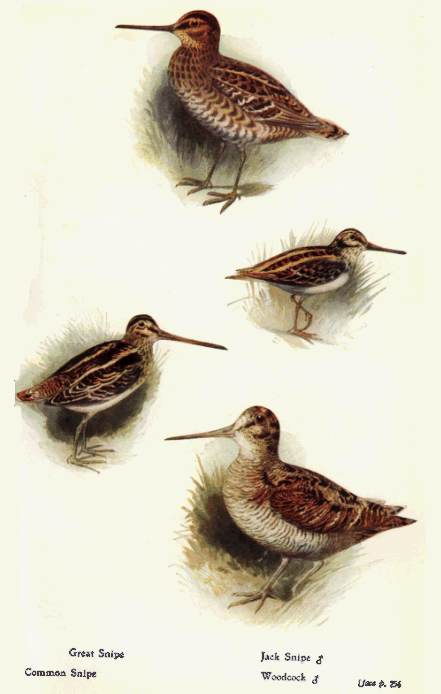
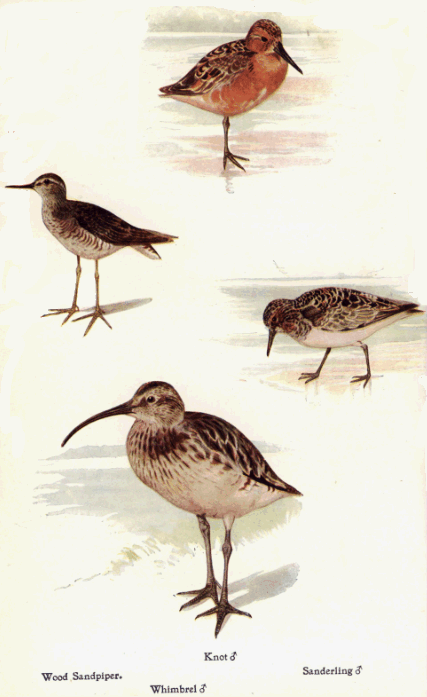
THE COMMON SNIPE GALLINÁGO CÆLESTIS
Upper plumage very like the last; chin and throat reddish white; lower parts white, without spots; flanks barred transversely with white and dusky; tail of fourteen feathers. Length eleven and a half inches. Eggs light greenish yellow, spotted with brown and ash.
The Common Snipe is a bird of very general distribution, being found in all parts of the eastern hemisphere, from Ireland to Japan, and from Siberia to the Cape of Good Hope. It is common also in many parts of America, especially Carolina, and is frequent in many of the American islands. In Britain, Snipes are most numerous in the winter, their numbers being then increased by arrivals from high latitudes, from which they are driven by the impossibility of boring for food in ground hardened by frost or buried beneath snow. In September and October large flocks of these birds arrive in the marshy districts of England, stopping sometimes for a short time only, and then proceeding onwards; but being like many other birds, gregarious at no other time than when making their migrations, when they have arrived at a district where they intend to take up their residence, they scatter themselves over marsh land, remaining in each other's neighbourhood perhaps, but showing no tendency to flock together. Their food consists of the creeping things which live in mud, and to this, it is said by some, they add small seeds and fine vegetable fibre; but it is questionable whether this kind of food is not swallowed by accident, mixed up with more nourishing diet. The end of their beak is furnished with a soft pulpy membrane, which in all probability is highly sensitive, and enables the bird to discover by the touch the worms which, being buried in mud, are concealed from its sight. Snipes when disturbed always fly against the wind, so when suddenly scared from their feeding-ground, and compelled to rise without any previous intention on their part, they seem at first uncertain which course to take, but twist and turn without making much progress in any direction; but in a few seconds, having decided on their movements, they dart away with great rapidity, uttering at the same time a sharp cry of two notes, which is difficult to describe, but once heard can scarcely be mistaken. When a bird on such an occasion is fired at, it often happens that a number of others, who have been similarly occupied, rise at the report, and after having performed a few mazy evolutions, dart off in the way described. At other times they lie so close that between the sportsman and the bird which he has just killed there may be others concealed, either unconscious of danger, or trusting for security to their powers of lying hid. This tendency to lie close, or the reverse, depends much on the weather, though why it should be so seems not to have been decided. But the movements of Snipes generally are governed by laws of which we know little or nothing. At one season they will be numerous in a certain marsh; the next year perhaps not one will visit the spot; to-day, they will swarm in a given locality; a night's frost will drive them all away, and a change of wind a few days after will bring them all back again. If very severe weather sets in they entirely withdraw, but of this the reason is obvious; the frozen state of the marsh puts a stop to their feeding. They then retire to milder districts, to springs which are never frozen, to warm nooks near the sea, or to salt marshes. Perhaps the majority perform a second migration southwards; for, as a rule, they are most numerous at the two periods of autumn and spring—that is, while on their way to and from some distant winter-quarters. After March they become far less frequent, yet there are few extensive marshes, especially in Scotland and the north of England, where some do not remain to breed. At this season a striking change in their habits makes itself perceptible. A nest is built of withered grass, sometimes under the shelter of a tuft of heath or reeds, and here the female sits closely on four eggs. The male, meanwhile, is feeding in some neighbouring swamp, and if disturbed, instead of making off with his zigzag winter's flight, utters his well-remembered note and ascends at a rapid rate into the air, now ascending with a rapid vibration of wing, wheeling, falling like a parachute, mounting again, and once more descending with fluttering wings, uttering repeatedly a note different from his cry of alarm, intermixed with a drumming kind of noise, which has been compared to the bleat of a goat. This last sound is produced by the action of the wings, assisted by the tail-feathers, in his descents. One of its French names is Chèvre volant, flying goat, and the Scottish name 'Heather-bleater', was also given to it as descriptive of its peculiar summer note. The female sits closely on her eggs, and if disturbed while in charge of her yet unfledged brood, endeavours to distract the attention of an intruder from them to herself by the artifice already described as being employed by others of the Waders.
'Sabine's Snipe', which was at one time thought to be a distinct species, is now admitted to be a melanism, a dark variety of the Common Snipe, recent examination of specimens having proved that its tail contains fourteen feathers and not twelve only, as was supposed. It is seldom found outside Great Britain.
THE JACK SNIPE GALLINÁGO GALLÍNULA
Crown divided longitudinally by a black band edged with reddish brown; beneath this on either side a parallel yellowish band reaching from the bill to the nape; back beautifully mottled with buff, reddish brown, and black, the latter lustrous with green and purple; neck and breast spotted; belly and abdomen pure white; tail of twelve feathers, dusky edged with reddish grey; bill dusky, lighter towards the base. Length eight and a half inches. Eggs yellowish olive, spotted with brown.
As the Great Snipe has been called the Double Snipe, on account of its being superior in size to the common species, so the subject of the present chapter is known as the Half Snipe, from being contrasted with the same bird, and being considerably smaller. The present species is far less abundant than the Common Snipe; yet still it is often seen, more frequently, perhaps, than the other, by non-sporting observers, for it frequents not only downright marshes, but the little streams which meander through meadows, the sides of grassy ponds, and the drains by the side of canals, where the ordinary pedestrian, if accompanied by a dog, will be very likely to put one up. Its food and general habits are much the same as those of the Common Snipe; but it rises and flies off without any note. Its flight is singularly crooked until it has made up its mind which direction it intends to take; indeed it seems to decide eventually on the one which was at first most unlikely to be its path, and after having made a short round composed of a series of disjointed, curves, it either returns close to the spot from which it was started, or suddenly drops, as by a sudden impulse, into a ditch a few gunshots off. I have seen one drop thus within twenty yards of the spot where I stood, and though I threw upwards of a dozen stones into the place where I saw it go down, it took no notice of them. It was only by walking down the side of the ditch, beating the rushes with a stick, that I induced it to rise again. It then flew off in the same way as before, and dropped into the little stream from which I had first started it.
From this habit of lying so close as to rise under the very feet of the passenger, as well as from its silence, it is called in France la Sourde, 'deaf'. In the same country it is known also as 'St. Martin's Snipe', from the time of its arrival in that country, November 11; with us it is an earlier visitor, coming about the second week in September.
A few instances are recorded of the Jack Snipe having been seen in this country at a season which would lead to the inference that it occasionally breeds here; but no instance of its doing so has been ascertained as a fact.
THE SANDERLING CALIDRIS ARENARIA
Winter—upper plumage and sides of the neck whitish ash; cheeks and all the under plumage, pure white; bend and edge of the wing and quills blackish grey; tail deep grey, edged with white; bill, irides, and feet, black. Summer—cheeks and crown black, mottled with rust-red and white; neck and breast reddish ash with black and white spots; back and scapulars deep rust-red, spotted with black, all the feathers edged and tipped with white; wing-coverts dusky, with reddish lines, and tipped with white; two middle tail-feathers dusky, with reddish edges. Young in autumn—cheeks, head, nape, and back variously mottled with black, brown, grey, rust-red and dull white. Length eight inches. Eggs olive, spotted and speckled with black.
The early flocks of Sanderlings often consist of old as well as young birds, which is not the common rule with Waders. They are plentiful on our sandy shores, and they sometimes visit inland waters. By April the return passage begins. The note is a shrill wick! They arrive on our shores early in autumn, keeping together in small flocks, or joining the company of Dunlins, or Ringed Plovers. In spring they withdraw to high latitudes, where they breed; they are not, however, long absent. Yarrell mentions his having obtained specimens as late as April and June, and I have myself obtained them as early as the end of July, having shot at Hunstanton, on the coast of Norfolk, several young birds of the year, on the twenty-third of that month; and on another occasion I obtained a specimen on the sands of Abergele, in North Wales, in August. This leaves so very short a time for incubation and the fledging of the young, that it is probable that a few birds, at least, remain to breed in this country, or do not retire very far north. Little is known of their habits during the season of incubation, but they are said to make their nests in the marshes, of grass, and to lay four eggs.
Like many other shore birds, they have an extensive geographical range, and are found in all latitudes, both in the eastern and western hemispheres.
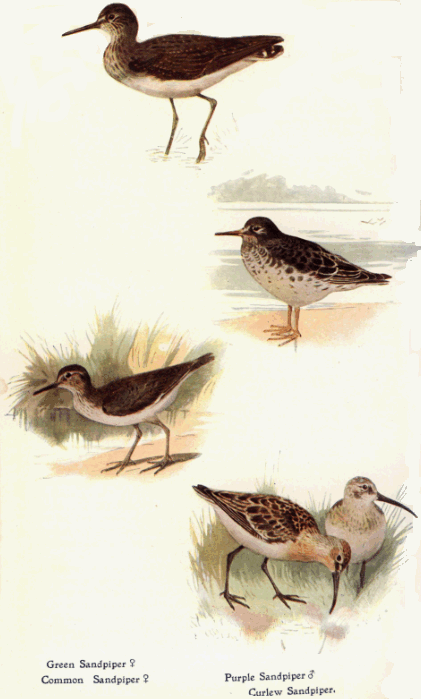
THE CURLEW SANDPIPER TRINGA SUBARQUATA
Bill curved downwards, much longer than the head. Winter—upper tail-coverts and all the under parts white; upper plumage ash-brown, mottled with darker brown and whitish; breast the same colours, but much lighter; bill black; iris brown; feet dusky. Summer—crown black, mottled with reddish; under plumage chestnut-red, speckled with brown and white; much of the upper plumage black, mottled with red and ash. Length seven and a half inches. Eggs yellowish, with brown spots.
This bird, called also the Pigmy Curlew, is of about the same size as the far commoner Dunlin, from which it is distinguished not only by the difference in the colour of its plumage, but by the greater length of its beak, which is curved downwards. Pigmy Curlews are observed from time to time in this country at the periods of autumn and spring, and it is said that a few remain with us to breed, but their nest and eggs have never been detected. In their habits they resemble the Dunlins, from which they may readily be distinguished, even when flying, by their white upper tail-coverts. They are of wide geographical range, but nowhere abundant, and visit us on passage in spring and autumn.
THE KNOT TRINGA CANÚTUS
Beak straight, a little longer than the head, much dilated towards the tip; tail even at the extremity; a small part of the tibia naked. Winter—throat and abdomen white; breast and flanks white, barred with ash-brown; upper plumage ash-grey, mottled with brown; wing-coverts tipped with white; rump and upper tail-coverts white, with black crescents; bill and legs greenish black. Summer—streak over the eye, nape, and all the under plumage, rusty-red, the nape streaked with black; back streaked and spotted with black, red, and grey. The upper plumage of young birds is mottled with reddish brown, grey, black, and dull white; legs dull green. Length ten inches. Eggs unknown.
The Knot, Willughby informs us, is so called from having been a favourite dish of King Canutus, or Knute. It is a migratory bird, visiting the coasts of Great Britain early in autumn, and remaining here till spring, when it retires northwards to breed. During the intervening months it keeps exclusively to the sandy or muddy sea-shore, assembling in small flocks, and mixing freely with Dunlins, Sanderlings, and Purple Sandpipers. Some authors state that it feeds principally early and late in the day, and during moonlight nights; but I have seen it on the coast of Norfolk in winter feeding at all hours of the day in company with the birds mentioned above, and differing little from them in the mode of obtaining its food. But I remarked on several occasions that, when a flock was disturbed, the Knots often remained behind, being less fearful of the presence of man; in consequence of which tardiness in rising they more than once fell to our guns after their companions had flown off. On their first arrival, they are said to be so indifferent to the vicinity of human beings that it is not difficult to knock them down with stones. Their provincial name in Norfolk is the Green-legged Shank, the latter name, Shank, being applied for shortness to the Redshank. Dr. Richardson states that 'Knots were observed breeding on Melville Peninsula by Captain Lyon, who tells us that they lay four eggs on a tuft of withered grass, without being at the pains of forming any nest.'
Flocks of young make their appearance early in August, the adults arriving a little later.
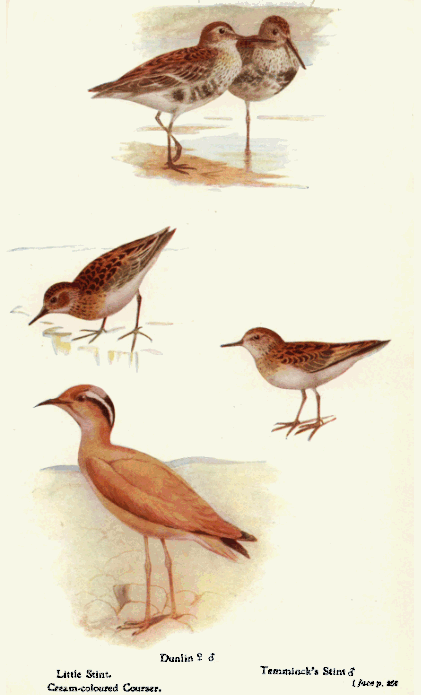
THE DUNLIN TRINGA ALPINA
Bill a little longer than the head, slightly bent down at the tip; two middle tail-feathers the longest, dusky and pointed; a small part of the tibia naked. Winter—throat and a streak between the bill and eye white; upper plumage ash-brown streaked with dusky; upper tail-coverts dusky; lateral tail-feathers ash, edged with white; breast greyish white, mottled with brown; bill black; feet dusky. Summer—most of the upper plumage black, edged with rust-red; belly and abdomen black. Young birds have the upper plumage variously mottled with ash-brown, dusky, and reddish yellow; the bill is shorter and straight. Length eight inches. Eggs greenish white, blotched and spotted with brown.
The name variabilis, changeable, has been applied to this species of Sandpiper on account of the great difference between its summer and winter plumage. It was formerly, indeed, supposed that the two states of the bird were distinct species; of which the former was called Dunlin, the latter Purre. It is now known that the two are identical, the bird being commonly found to assume in spring and autumn colours intermediate between the two.
Except during the three summer months, May, June, and July, the Dunlin is common on all the shores of Great Britain, where there are extensive reaches of sand or mud. I have obtained specimens on the coast of Norfolk as early as the twenty-fifth of July; but, generally, it is not until the following month that they become numerous. From this time until late in the winter they are reinforced by constant additions; and in very severe weather the flocks are increased to such an extent that, if it were possible to number them, they would be probably found to contain very many thousands. Such a season was the memorable winter of 1860-61, when, during the coldest part of it, I made an excursion to the coast of Norfolk for the purpose of observing the habits of the sea-side Grallatores and Natatores which, in winter, resort to that coast. Numerous as were the species and individuals of these birds which then flocked to the beach and salt-marshes, I have no doubt, in my own mind, that they were all outnumbered by Dunlins alone. Of nearly every flock that I saw feeding on the wet sand or mud, fully half were Dunlins; many flocks were composed of these birds alone; while of those which were constantly flying by, without alighting, the proportion of Dunlins to all other birds was, at least, three to one. Added to which, while the parties of other birds were susceptible of being approximately counted, the individuals which composed a flock of Dunlins were often innumerable.
At one time, we saw in the distance, several miles off, a light cloud, as of smoke from a factory chimney: it moved rapidly, suddenly disappeared, and as suddenly again became visible. This was an enormous flock of Dunlins, consisting of many thousands at least. They did not come very near us; but smaller flocks which flew about in our immediate vicinity presented a similar appearance. As the upper surface of their bodies was turned towards us, they were of a dark hue; suddenly they wheeled in their flight as if the swarm was steered by a single will, when they disappeared; but instantaneously revealed themselves again flying in a different direction, and reflected glittering snowy white.
Dunlins, while feeding, show a devoted attention to their occupation, which is not often to be observed in land birds. They run rapidly, looking intently on the ground, now stopping to pick up some scrap of animal matter which lies on the surface of the sand, now boring for living prey where they detect indications of such prey lying hid. Occasionally an individual bird appears to suffer from lameness, and halts in its progress as if its legs were gouty. Frequently they chase a receding wave for the sake of recovering a prize which has been swept from the beach: never venturing to swim, but showing no fear of wetting either feet or feathers. While engaged in these various ways, they often keep up a short conversational twitter, in a tone, however, so low that it can only be heard at a very short distance. While flying, they frequently utter a much louder piping note, which can readily be distinguished from the call of the other sea-side birds. I observed that a small detached flock, when disturbed, generally flew off to a great distance; but if other birds were feeding in the neighbourhood, they more frequently alighted near them, as if assured by their presence that no danger was to be apprehended.
Dunlins have bred in Cornwall and Devon; but in many parts of Scotland, in the Hebrides and Orkneys 'they frequent the haunts selected by the Golden Plovers, with which they are so frequently seen in company, that they have popularly obtained the name of Plovers' Pages. Sometimes before the middle of April, but always before that of May, they are seen dispersed over the moors in pairs like the birds just named, which, at this season, they greatly resemble in habits. The nest, which is composed of some bits of withered grass, or sedge, and small twigs of heath, is placed in a slight hollow, generally on a bare spot, and usually in a dry place, like that selected by the Golden Plover. The female lays four eggs, and sits very assiduously, often allowing a person to come quite close to her before removing, which she does in a fluttering and cowering manner.' [49]
In a few specimens which I obtained, the bill was considerably curved downwards throughout its whole length, thus approaching in form that of the Pigmy Curlew; but the dusky upper tail-coverts sufficiently distinguished it from its rarer congener.
PURPLE SANDPIPER TRINGA STRIATA
Bill longer than the head, slightly bent down at the tip, dusky, the base reddish orange; head and neck dusky brown, tinged with grey; back and scapulars black, with purple and violet reflections, the feathers edged with deep ash; breast grey and white; under plumage white, streaked on the flanks with grey; feet ochre-yellow. Length eight and a quarter inches. Eggs yellowish olive, spotted and speckled with reddish brown.
The Purple Sandpiper is described as being far less common than the Dunlin, and differing from it in habits, inasmuch as it resorts to the rocky coast in preference to sandy flats. The few specimens of it which I have seen were associated with Dunlins, flying in the same flocks with them, feeding with them, and so closely resembling them in size and movements, that a description of the one equally characterizes the other. It was only, in fact, by the difference of colour that I could discriminate between them; and this I did, on several occasions, with great ease, having obtained my specimens singly while they were surrounded by other birds. According to Mr. Dunn, 'The Purple Sandpiper is very numerous in Orkney and Shetland, appearing early in spring, and leaving again at the latter end of April; about which time it collects in large flocks, and may be found on the rocks at ebb-tide, watching each retiring wave, running down as the water falls back, picking small shellfish off the stones, and displaying great activity in escaping the advancing sea. It does not breed there.'
This species has a wide geographical range. It has been often observed in the Arctic regions, where it breeds. It is well known in North America, and is found in various parts of the continent of Europe, especially Holland.
TEMMINCK'S STINT TRINGA TEMMINCKI
Bill slightly bent down at the tip, much shorter than the head; tail graduated. Winter—upper plumage brown and dusky; breast reddish; lower plumage and outer tail-feathers white; bill and feet brown. Summer—All the upper feathers black, bordered with rust-red; breast reddish ash, streaked with black. Length five and a half inches. Eggs unknown.
Temminck, in whose honour this bird was named, states that it 'inhabits the Arctic Regions, and is seen on its passage at two periods of the year in different parts of Germany, on the banks of lakes and rivers; probably, also, in the interior of France; never along the maritime coasts of Holland; very rare on the Lake of Geneva. Its food consists of small insects. It probably builds its nest very far north.' A few have been killed in England, and it occurs in many parts of Asia and in North Africa, but it is nowhere abundant, being an irregular visitor, only on migration.
LITTLE STINT TRINGA MINUTA
Bill straight, shorter than the head; two middle and two outer feathers of the tail longer than the rest ('tail doubly forked'); tarsus ten lines; upper plumage ash and dusky; a brown streak between the bill and the eye; under plumage white; outer feathers of the tail ash-brown, edged with whitish; middle ones brown; bill and feet black. Length five and a half inches. Eggs reddish white, spotted with dark red-brown.
A rare and occasional visitant, appearing from time to time in small flocks on the muddy or sandy sea-coast. My friend, the Rev. W. S. Hore (to whom I am indebted for many valuable notes, incorporated in the text of this volume), obtained several specimens of this bird in October, 1840, on the Laira mud banks, near Plymouth. In their habits they differed little from the Dunlin. They were at first very tame, but after having been fired at became more cautious. In their food and mode of collecting it, nothing was observed to distinguish them from the other Sandpipers. They come on passage in spring and autumn.
THE RUFF AND REEVE MACHÉTES PUGNAX
Male in spring—face covered with yellowish warty pimples; back of the head with a tuft of long feathers on each side; throat furnished with a ruff of prominent feathers; general plumage mottled with ash, black, brown, reddish white, and yellowish, but so variously, that scarcely two specimens can be found alike; bill yellowish orange. Male in winter—face covered with feathers; ruff absent; under parts white; breast reddish, with brown spots; upper plumage mottled with black, brown, and red; bill brownish. Length twelve and a half inches. Female, 'The Reeve'—long feathers of the head and ruff absent; upper plumage ash-brown, mottled with black and reddish brown; under parts greyish white; feet yellowish brown. Length ten and a half inches. In both sexes—tail rounded, the two middle feathers barred; the three lateral feathers uniform in colour. Eggs olive, blotched and spotted with brown.
Both the systematic names of this bird are descriptive of its quarrelsome propensities: machetes is Greek for 'a warrior', pugnax Latin for 'pugnacious'. Well is the title deserved; for Ruffs do not merely fight when they meet, but meet in order to fight. The season for the indulgence of their warlike tastes is spring; the scene, a rising spot of ground contiguous to a marsh; and here all the male birds of the district assemble at dawn, for many days in succession, and do battle valiantly for the females, called Reeves, till the weakest are vanquished and leave possession of the field to their more powerful adversaries. The attitude during these contests is nearly that of the domestic Cock—the head lowered, the body horizontal, the collar bristling, and the beak extended. But Ruffs will fight to the death on other occasions. A basket containing two or three hundred Ruffs was once put on board a steamer leaving Rotterdam for London. The incessant fighting of the birds proved a grand source of attraction to the passengers during the voyage; and about half of them were slain before the vessel reached London. Ruffs are gluttonously disposed too, and, if captured by a fowler, will begin to eat the moment they are supplied with food; but, however voracious they may be, if a basin of bread and milk or boiled wheat be placed before them, it is instantly contended for; and so pugnacious is their disposition, that even when fellow-captives, they would starve in the midst of plenty if several dishes of food were not placed amongst them at a distance from each other.
Many years have not passed since these birds paid annual visits in large numbers to the fen-countries. They were, however, highly prized as delicacies for the table, and their undeviating habit of meeting to fight a pitched battle gave the fowler such an excellent opportunity of capturing all the combatants in his nets, that they have been gradually becoming more and more rare. The fowler, in fact, has been so successful that he has destroyed his own trade.
Another peculiarity of the Ruff is, that the plumage varies greatly in different individuals—so much so, indeed, that Montagu who had an opportunity of seeing about seven dozen in a room together, could not find two alike. These birds are now become rare, but occasional specimens are still met with in different parts of Great Britain, and at various seasons; but if they are ever served up at table, they must be consignments from the Continent.
The female builds her nest of coarse grass, among reeds and rushes, and lays four eggs. The brood, when hatched, remain with her until the period of migration; but the males take no interest in domestic affairs. The few that have not been caught become more amicably disposed during the latter portion of the year. They lose the feathery shields from whence they derive their English name, and, assuming a peaceful garb, withdraw to some southern climate. The Ruff is about one-third larger than the Reeve; and the latter is, at all seasons, destitute of a prominent collar. Formerly these birds bred in the east of England.
GREEN SANDPIPER TÓTANUS ÓCHROPUS
Upper plumage olive-brown, with greenish reflections, spotted with whitish and dusky; lower plumage white; tail white, the middle feathers barred with dusky towards the end, the two outer feathers almost entirely white; bill dusky above, reddish beneath; feet greenish. Length nine and a half inches. Eggs whitish green, spotted with brown.
This bird, which derives its name from the green tinge of its plumage and legs, must be reckoned among the rarer Sandpipers. In habits it differs considerably from most of its congeners, in that it is not given to congregate with others of its kind, and that it resorts to inland waters rather than to the sea. It is seen for the most part in spring and autumn, at which seasons it visits us when on its way to and from the northern countries in which it breeds. Specimens have been killed late in the summer, from which it has been inferred that the Green Sandpiper sometimes breeds in this country; but the fact does not appear to have been confirmed by the discovery of its nest. While migrating it flies very high, but when scared from its feeding-ground it skims along the surface of the water for some distance, and then rises high into the air, uttering its shrill whistle. In its choice of food, and habits while feeding it resembles the Common Sandpiper. It lays its eggs in deserted nests and old squirrel dreys—and breeds probably in wild parts of Surrey, Sussex and Hampshire. The Son of the Marshes considers that it does so.
THE WOOD SANDPIPER TÓTANUS GLARÉOLA
Winter—a narrow dusky streak between the bill and eye; upper parts deep brown, spotted with white; breast and adjacent parts dirty white, mottled with ash-brown; under plumage and tail-coverts pure white; tail-feathers barred with brown and white; two outer feathers on each side with the inner web pure white; bill and legs greenish. Summer—head streaked with brown and dull white; the white of the breast clearer; each of the feathers of the back with two white spots on each side of the centre. Length seven and a half inches.
This species closely resembles the last both in appearance and habits. It received its name of Wood Sandpiper from having been observed occasionally to resort to boggy swamps of birch and alder, and has been seen even to perch on a tree. Its most common places of resort are, however, swamps and wet heaths. Like the last, it is a bird of wide geographical range, nowhere very abundant, and imperfectly known, coming only on passage in spring and autumn.
THE COMMON SANDPIPER TÓTANUS HYPOLEUCUS
Upper parts ash-brown, glossed with olive; back and central tail-feathers marked with fine wavy lines of rich dark brown; a narrow white streak over each eye; under plumage pure white, streaked at the sides with brown; outer tail-feathers barred with white and brown; bill dusky, lighter at the base; feet greenish ash. Length seven and a half inches. Eggs whitish yellow, spotted with brown and grey.
To this bird has been given not inappropriately the name of Summer Snipe. In form and mode of living it resembles the Snipe properly so called, and it is known to us only during summer. Unlike the last two species, it is a bird of common occurrence. One need only to repair to a retired district abounding in streams and lakes, at any period of the year between April and September, and there, in all probability, this lively bird will be found to have made for itself a temporary home. Arrayed in unattractive plumage, and distinguished by no great power of song—its note being simply a piping, which some people consider the utterance of one of its provincial names, 'Willy Wicket'—it may nevertheless be pronounced an accomplished bird. It flies rapidly and in a tortuous course, likely to puzzle any but the keenest shot; it runs with remarkable nimbleness, so that if a sportsman has marked it down, it will probably rise many yards away from the spot; it can swim if so inclined; and when hard pressed by a Hawk, it has been seen to dive and remain under water until all danger had passed away. It has never been observed to perch on the twigs of trees, but it has been noticed running along the stumps and projecting roots of trees. Its favourite places of resort are withy holts (where it searches for food in the shallow drains), moss-covered stones in rivers, the shallow banks of lakes, and the flat marshy places intersected by drains, which in low countries often skirt the sea-shore. Its food consists of small worms and the larvæ and pupæ of the countless insects which spend their lives in such localities. It may be presumed, too, that many a perfect winged insect enters into its dietary, for its activity is very great. Even when its legs are not in motion, which does not often happen, its body is in a perpetual state of agitation, the vibration of the tail being most conspicuous.
Sandpipers do not congregate like many others of the Waders; they come to us generally in pairs, and do not appear to flock together even when preparing to migrate. The nest is a slight depression in the ground, most frequently well concealed by rushes or other tufted foliage, and is constructed of a few dry leaves, stalks of grass, and scraps of moss. The Sandpiper lays four eggs, which are large, and quite disproportionate to the size of the bird. Indeed, but for their peculiar pear-shaped form, which allows of their being placed so as to occupy a small space with the pointed ends all together, the bird would scarcely be able to cover them. The parent bird exhibits the same marvellous sagacity in diverting the attention of an intruder from the young birds to herself, by counterfeiting lameness, which has been observed in the Plovers. The young are able to run within a very short time after exclusion from the egg, there being an instance recorded in the Zoologist of a gentleman having seen some young birds scramble away from the nest while there yet remained an egg containing an unhatched chick. Early, too, in their life they are endowed with the instinct of self-preservation, for Mr. Selby states that if discovered and pursued before they have acquired the use of their wings, they boldly take to the water and dive.
The Sandpiper is found in all parts of Europe and Asia, but not in America.
THE COMMON REDSHANK TÓTANUS CALIDRIS
Winter—upper plumage ash-brown; throat, sides of the head, streak over the eye, neck, and breast, greyish white; rump, belly, and abdomen, white; tail marked transversely with black and white zigzag bars, tipped with white; feet and lower half of both mandibles red. Summer—upper feathers ash-brown, with a broad dusky streak in the centre; under parts white, spotted and streaked with dusky; feet and lower half of both mandibles vermilion red. Length ten to eleven inches. Eggs greenish yellow, blotched and spotted with brown.
The Redshank is a bird of frequent occurrence on all such parts of the coast as are suited to its habits. Nowhere, I suppose, is it more abundant than on the coast of Norfolk—at least, on those parts of the coast where it can have access to muddy marshes. It does not, indeed, confine itself to such places, for it is not unfrequently to be seen on the sea-shore, feeding in the neighbourhood of Dunlins, Knots, Grey Plovers, and other Waders; or, when its favourite haunts are covered by the tide, a solitary bird or a party of three or four meet or overtake the stroller, by the sea-side, taking care to keep at a respectful distance from him, either by flying high over his head or sweeping along, a few feet above the surface of the sea, in the line of the breakers or in the trough outside them. They may easily be distinguished from any other common bird of the same tribe by the predominance of white in their plumage. Other Waders, such as Dunlins and Sanderlings, present the dark and light sides of their plumage alternately, but the Redshank shows its dark and white feathers simultaneously, and if seen only on the wing might be supposed to be striped with black and white. Keen-sighted observers can also detect its red legs. Its flight, as accurately described by Macgillivray, 'is light, rapid, wavering, and as if undecided, and, being performed by quick jerks of the wings, bears some resemblance to that of a Pigeon'. During its flight it frequently utters its cry, which is a wild shrill whistle of two or three notes, approaching that of the Ringed Plover, but louder and less mellow. At low water, it frequents, in preference to all other places of resort, flat marshes which are intersected by muddy creeks, and in these it bores for food. It is very wary, flying off long before the fowler can come within shot if it happens to be standing exposed; and even if it be concealed under a high bank, where it can neither see nor be seen, it detects his approach by some means, and in most cases is up and away before any but the most expert shot can stop its flight. On these occasions it invariably utters its alarm note, which both proclaims its own escape and gives warning to all other birds feeding in the vicinity. Scattered individuals thus disturbed sometimes unite into flocks, or fly off, still keeping separate, to some distant part of the marsh. On one occasion only have I been enabled to approach near enough to a Redshank to watch its peculiar movements while feeding, and this observation I was much pleased in making, as it confirms the account of another observer. A writer in the Naturalist, quoted by Yarrell and Macgillivray, says: 'I was very much struck with the curious manner in which they dart their bill into the sand nearly its whole length, by jumping up and thus giving it a sort of impetus, if I may use the word, by the weight of their bodies pressing it downwards.' This account Macgillivray, with an unamiable sneer too common in his writings when he refers to statements made by others of facts which have not fallen within his own observation, considers to be so inaccurate that he pronounces the birds to be not Redshanks at all, and calls them 'Irish Redshanks'. On the occasion to which I have referred, I saw at a distance a largish bird feeding on a bank of mud close to an embankment. Calculating as nearly as I could how many paces off it was, I cautiously crept along the other side of the embankment; and when I had reached what I supposed was the right spot, took off my hat and peeped over. Within a few yards of me was an unmistakable Redshank, pegging with his long beak into the mud, and aiding every blow with an impetus of his whole body. In my own mind I compared his movements with those of a Nuthatch, with which I was quite familiar, and, the surface of the mud being frozen hard, I imagined that the laborious effort on the part of the bird was necessitated by the hardness of the ground. Perhaps this may have been the case; but, whether or not, it is clear enough that the bird does, when occasion requires it, lend the weight of his body to the effort of his beak in searching for food. I should add that I did not know, at the time, that any similar occurrence had been recorded.
The food of the Redshank consists of worms, marine insects, and any other animal matter which abounds on the sea-shore. In small communities it builds its nest of a few blades of grass in the marshes, in a tuft of rushes or long grass, never among the shingle where that of the Ringed Plover is placed, but often under a shrub (popularly known on the coast of Norfolk by the name of 'Rosemary'), the Suæda fruticosa, Shrubby Sea Blite, of botanists. It lays four eggs, which are considered delicate eating.
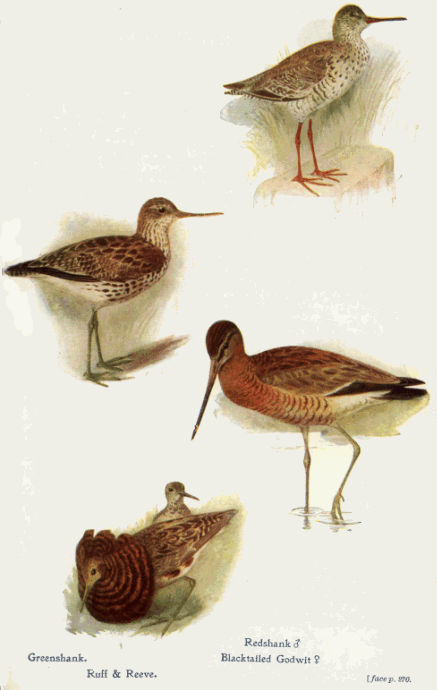
THE GREENSHANK TÓTANUS CANESCENS
Bill strong, compressed at the base, slightly curved upwards. Winter—forehead, all the lower parts, and lower back, white; head, cheeks, neck and sides of the breast, streaked with ash-brown and white; rest of the upper feathers mottled with dusky and yellowish white; tail white, middle feathers barred with brown, outer white with a narrow dusky streak on the outer web; bill ash-brown; legs yellowish green, long and slender. Summer—feathers of the back edged with white, breast and adjacent parts white, with oval black spots; middle tail-feathers ash, barred with brown. Length fourteen inches. Eggs olive-brown, spotted all over with dusky.
An unusual colour and disproportionate length of leg are characters which sufficiently distinguish the Greenshank and account for its name. It is far less common than the Redshank, but seems to resemble it in many of its habits. It is sociably disposed towards birds of its own kind and allied species, but utterly averse to any familiarity with man, insomuch that fowlers rarely come within shot of it. It frequents low muddy or sandy shores and brackish pools, the oozy banks of lakes, ponds, and rivers, preferring such open situations as allow it a clear view of threatening danger while there is plenty of time to decamp. In the course of feeding it wades unconcernedly through pools of shallow water, and, if so minded, hesitates neither to swim nor to dive.
Its visits to England are paid most commonly in spring and autumn, while it is on its way to and from the northern climates in which it breeds. 'In Scotland it is seen', says Macgillivray, 'in small flocks here and there along the sea-shore, by the margins of rivers, and in marshy places breeding there in the north, but it is nowhere common, and in most districts of very rare occurrence. By the beginning of summer it has disappeared from its winter haunts, and advanced northwards; individuals or pairs remaining here and there in the more northern parts of Scotland, while the rest extend their migration.' The same author describes a nest, which he found in the island of Harris, as very like those of the Golden and Lapwing Plovers, with four eggs, intermediate in size between the eggs of these two birds. Another nest was also found by Selby, in Sutherlandshire. There can be therefore no doubt that the north of Scotland is within the extreme southern limit of its breeding-ground. During the winter it is to be seen in the west of Ireland only.
THE BAR-TAILED GODWIT LIMÓSA LAPPONICA
Beak slightly curved upwards; middle claw short, without serratures. Winter-upper plumage variously mottled with grey, dusky, and reddish ash; lower part of the back white, with dusky spots; tail barred with reddish white and dusky; lower parts white. Summer—all the plumage deeply tinged with red. Young birds have the throat and breast brownish white, streaked with dusky, and a few dusky lines on the flanks. Length sixteen inches. Eggs unknown.
On the coast of Norfolk, where I made my first acquaintance with this bird in the fresh state, it is called a Half-Curlew. In like manner, a Wigeon is called a Half-Duck. In either case the reason for giving the name is, that the smaller bird possesses half the market value of the larger. It resembles the Curlew in its flight and the colour of its plumage; but differs in having its long beak slightly curved upwards, while that of the Curlew is strongly arched downwards; and it is far less wary, allowing itself to be approached so closely that it falls an easy prey to the fowler. It appears to be most frequently met with in spring and autumn, when it visits many parts of the coast in small flocks. In Norfolk it is met with from May, the twelfth of that month being called 'Godwit day,' by the gunners, although it is almost unknown up north at that season.
The specimens which were brought to me were shot in the very severe weather which ushered in the year 1861. These birds have nowhere been observed in England later than the beginning of summer, from which fact the inference is fairly drawn that they do not breed in this country. Their habits differ in no material respects from the other sea-side Waders, with whom they frequently mingle while feeding, not, seemingly, for the sake of good fellowship, but attracted by a motive common to all, that of picking up food wherever an abundance is to be met with. Their note is a loud, shrill cry, often uttered while on the wing. The female is much larger than the male.
This bird is sometimes called the Sea Woodcock. Its flesh is good eating, but is far inferior in flavour to that of the true Woodcock.
THE BLACK-TAILED GODWIT LIMÓSA BELGICA
Beak nearly straight; middle claw long and serrated; upper parts ash-brown, the shafts of the feathers somewhat deeper; breast and adjacent parts greyish white; tail black, the base, and the tips of the two middle feathers, white; beak orange at the base, black at the point; feet dusky. Summer—much of the plumage tinged with red. Length seventeen and a half inches. Eggs deep olive, spotted with light brown.
This bird is, in outward appearance, mainly distinguished from the preceding by having two-thirds of the tail black, instead of being barred throughout with white and black. Like its congener, it is most frequently seen in autumn and spring, while on the way to and from its breeding-ground in the north; but it does not stay with us through winter, though occasionally a few pairs used to remain in the fen-countries to breed. It is by far the less common of the two, and seems to be getting annually more and more rare. Its habits, as far as they have been observed, approach those of the other Scolopacidæ. In its flight it resembles the Redshank. Its note is a wild screaming whistle, which it utters while on the wing. It builds its nest in swamps, among rushes and sedges, simply collecting a few grasses and roots into any convenient hole, and there it lays four eggs.
THE COMMON CURLEW NUMENIUS ARQUATA
General plumage reddish ash, mottled with dusky spots; belly white, with longitudinal dusky spots; feathers of the back and scapulars black, bordered with rust-red; tail white, with dark brown transverse bars; upper mandible dusky; lower, flesh-colour; irides brown; feet bluish grey. Length varying from twenty-two to twenty-eight inches. Eggs olive-green, blotched and spotted with brown and dark green.
Dwellers by the sea-side—especially where the tide retires to a great distance leaving a wide expanse of muddy sand, or on the banks of a tidal river where the receding water lays bare extensive banks of soft ooze—are most probably quite familiar with the note of the Curlew, however ignorant they may be of the form or name of the bird from which it proceeds. A loud whistle of two syllables, which may be heard for more than a mile, bearing a not over-fanciful resemblance to the name of the bird, answered by a similar cry, mellowed by distance into a pleasant sound—wild, but in perfect harmony with the character of the scene—announces the fact that a party of Curlews have discovered that the ebb-tide is well advanced, and that their feeding-ground is uncovered. The stroller, if quietly disposed, may chance to get a sight of the birds themselves as they arrive in small flocks from the inland meadows; and though they will probably be too cautious to venture within an unsafe distance, they will most likely come quite close enough to be discriminated. Not the merest novice could mistake them for Gulls; for not only is their flight of a different character, but the bill, which is thick enough to be distinguished at a considerable distance, is disproportionately long, and is curved to a remarkable degree. Curlews are in the habit of selecting as their feeding-ground those portions of the shore which most abound in worms and small crustaceous animals; these they either pick up and, as it were, coax from the tip to the base of the beak, or, thrusting their long bills into the mud, draw out the worms, which they dispose of in like manner. When the sands or ooze are covered, they withdraw from the shore, and either retire to the adjoining marshes or pools, or pace about the meadows, picking up worms, snails, and insects. Hay-fields, before the grass is cut, are favourite resorts, especially in the North; and, in districts where there are meadows adjoining an estuary, they are in the habit of changing the one for the other at every ebb and flow of the tide. From the middle of autumn till the early spring Curlews are, for the most part, sea-side birds, frequenting, more or less, all the coast; but at the approach of the breeding season they repair inland, and resort to heaths, damp meadows, and barren hills. Here a shallow nest is made on the ground, composed of bents, rushes, and twigs of heath, loosely put together. The eggs, which are very large, are four in number. During the period of incubation the male keeps about the neighbourhood, but is scarcely less wary than at other seasons. The female, if disturbed, endeavours to lure away the intruder from her dwelling by the artifice, common in the tribe, of pretending to be disabled; and great anxiety is shown by both male and female if any one approaches the spot where the young lie concealed. The latter are able to run almost immediately after they are hatched, but some weeks elapse before they are fledged. It seems probable that an unusually long time elapses before they attain their full size, for the dimensions of different individuals vary to a remarkable degree. Eight or nine specimens were brought to me in Norfolk in the winter of 1861, and among them about half seemed full-grown; of the others some were so small that, at the first glance, I supposed them to be Whimbrels.
The Curlew is found on the sea-coast over the whole of Europe and Asia, and along the northern coast of Africa.
The flesh of this bird is said by some to be excellent eating. This, perhaps, may be the case with young birds shot early in autumn before they have been long subjected to a marine diet. My own experience of birds shot in winter does not confirm this opinion. I have found them eatable, but not palatable.
THE WHIMBREL NUMENIUS PHÆOPUS
General plumage pale ash-colour, mottled with white and dusky spots; crown divided by a longitudinal streak of yellowish white; over each eye a broader brown streak; belly and abdomen white, with a few dusky spots on the flanks; feathers on the back, and scapulars deep brown, in the middle bordered by lighter brown; rump white; tail ash-brown, barred obliquely with dark brown; bill dusky, reddish at the base; irides brown; feet lead-colour. Length not exceeding seventeen inches. Eggs dark olive-brown, blotched with dusky.
Though by no means a rare bird, the Whimbrel is of far less common occurrence than the Curlew, and is seen only at two periods of the year, in May and August, when performing its migrations. It resembles the Curlew both in figure and habits, though much smaller in size; its note, too, is like the whistle of that bird, but somewhat higher. It is gregarious, but unsociable with other birds. The extreme southern limit at which the Whimbrel breeds is considered to be the Orkney and Shetland Islands. It is known to visit most of the countries of Europe and Asia in spring and autumn, but is nowhere very abundant.
ORDER GAVIÆ
FAMILY LARIDÆ
Sub-Family STERNINÆ
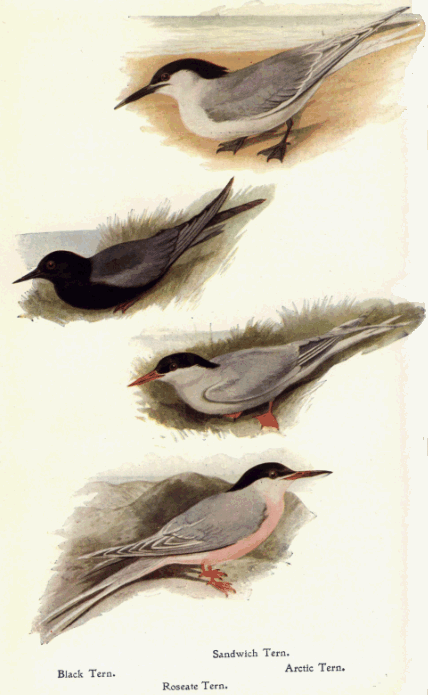
THE BLACK TERN HYDROCHELIDON NIGRA
Bill black; feet purple-brown, the membrane short; head and neck black; upper parts lead-colour; under parts dark ash-grey; under tail-coverts white; tail not much forked, shorter than the wings; irides brown. In winter, the lore, throat and breast are white. Length ten and a quarter inches. Eggs dark olive-brown, blotched and spotted with black.
The Black Tern is a common bird in most temperate countries which abound in extensive marshes. In its habits it is scarcely less aquatic than the preceding species, but differs from them all in preferring fresh water to salt. It was formerly of frequent occurrence in England; but draining and reclaiming have, within the last few years, given over many of its haunts to the Partridge and Wood Pigeon; and it is now but rarely known to breed in this country.[50] A few, however, are not unfrequently seen in spring and autumn, when on their way from and to their winter quarters, which are the warmer regions of the globe. In Norfolk its name still lingers as the 'Blue Darr', a corruption, probably, of Dorr-Hawk (another name of the Nightjar), a bird which it closely resembles in its mode of flight. Like the Dorr-Hawk, the Black Tern feeds on beetles and other insects, which it catches on the wing, but adds to its dietary small fresh-water fish, which it catches by dipping for them. While in pursuit of its winged prey, it does not confine itself to the water, but skims over the marsh and adjoining meadows, sometimes even alighting for an instant to pick up a worm. Black Terns are sociable birds among themselves, but do not consort with other species. They lay their eggs in the most inaccessible swamps, on masses of decayed reeds and flags, but little elevated above the level of the water. The nests are merely depressions in the lumps of vegetable substance, and usually contain three or sometimes four eggs. They are placed near enough to each other to form colonies; and the birds continue to flock together during their absence in warmer climates. Large flocks have been seen in the Atlantic, midway between Europe and America. In Holland and Hungary they are said by Temminck to be numerous. This author states that the Black Tern commonly lays its eggs on the leaves of the water-lily.
THE SANDWICH TERN STERNA CANTIACA
Bill long, black, the tip yellowish; tarsus short (one inch); tail long; head and crest as in the last; nape, upper part of the back, and all the lower parts brilliant white, tinged on the breast with rose; back and wings pale ash-grey; quills deeper grey; tail white; feet black, yellowish beneath. Young birds—head mottled with black and white; back, wing-coverts, and tail-feathers varied with irregular lines of black; bill and feet dark brown. Length eighteen inches. Eggs greyish green, blotched with brown and black.
The Sandwich Tern, which takes its name from the place where it was first seen in England, is not uncommon on many parts of the coast during the summer months. In some places it seems to be abundant. A large colony inhabits the Farne Islands. They breed as far north as the Findhorn. Upon this coast it is called par excellence 'The Tern', all the other species passing under the general name of 'Sea Swallows'. Its habits are so like those of the Common Tern, to be described hereafter, that, to avoid repetition, I purposely omit all account of its mode of fishing, and content myself with quoting, on the authority of Audubon and Meyer, incidents in its biography which I have not noticed in the Common Tern. The former author says: 'Its cries are sharp, grating, and loud enough to be heard at the distance of half a mile. They are repeated at intervals while it is travelling, and kept up incessantly when one intrudes upon it in its breeding-ground, on which occasion it sails and dashes over your head, chiding you with angry notes, more disagreeable than pleasant to your ear.' Meyer, writing of the same bird, says: 'The Sandwich Tern is observed to be particularly fond of settling on sunken rocks where the waves run high, and the surf is heavy: this being a peculiar fancy belonging to this species, it is sometimes called by the name of Surf Tern.'
THE ROSEATE TERN STERNA DOUGALLI
Bill black, red at the base; feet orange, claws small, black; tarsus three-quarters of an inch long; tail much forked, much longer than the wings; upper part of the head and nape black; rest of the upper plumage pale ash-grey; tail white, the outer feathers very long and pointed; cheeks and under plumage white, tinged on the breast and belly with rose. Length fifteen to seventeen inches. Eggs yellowish stone-colour, spotted and speckled with ash-grey and brown.
Of this Tern Dr. M'Dougall, its discoverer, says, 'It is of light and very elegant figure, differing from the Common Tern in the size, length, colour, and curvature of the bill; in the comparative shortness of the wing in proportion to the tail, in the purity of the whiteness of the tail, and the peculiar conformation and extraordinary length of the lateral feathers. It also differs from that bird in the hazel-colour and size of the legs and feet.'
Roseate Terns have been discovered on several parts of the coast, principally in the north, as in the mouth of the Clyde, Lancashire and the Farne Islands. They associate with the Common Terns, but are far less numerous. Selby says, 'the old birds are easily recognized amidst hundreds of the other species by their peculiar and buoyant flight, long tail, and note, which may be expressed by the word crake, uttered in a hoarse grating key.' They rarely nest in Great Britain.
THE ARCTIC TERN STERNA MACRURA
Bill slender, red throughout; under plumage ash-grey; tail much forked, longer than the wings; legs orange-red, in other respects very like the last. Length fifteen inches. Eggs as in the last.
This bird, as its name indicates, frequents high northern latitudes, to which, however, it is not confined; since in the Orkneys and Hebrides it is the common species. It breeds also on the coast of some of the northern English counties, but not farther south than the Humber, though several instances are recorded of large flocks making their appearance in different places at the season when they were probably on their way from their winter quarters—far away to the south—to their breeding-ground. In the rocky islands, which they frequent from May to September, they form colonies and lay their eggs, generally apart from the allied species. The eggs closely resemble those of the Common Tern, but are somewhat smaller. In its habits and general appearance the Arctic Tern comes so close to the last-named species, that the birds, even when flying together, can only be distinguished by the most practised eye.
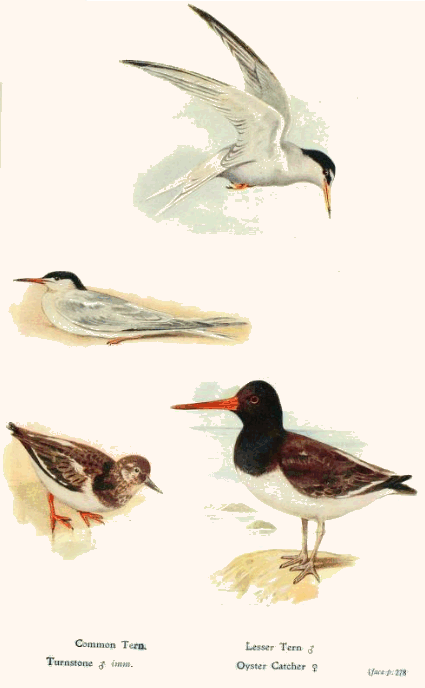
THE COMMON TERN STERNA FLUVIÁTILIS
Bill moderate, red with a black tip; head and long feathers on the back of the head black; upper parts bluish ash; quills ash-grey, brown at the tips; tail much forked, not longer than the wings, white, the two outer feathers on each side dusky on the outer webs; under parts white, tinged with grey on the breast; irides reddish brown; feet coral-red. Young birds have a good deal of white about the head, and the feathers on the back are tipped with white; tail ash-grey, whitish at the tip. Length fourteen inches. Eggs olive-brown, blotched and spotted with ash and dusky.
On those parts of the coast where the Common Tern is abundant, no sea-bird is more likely to attract the notice of the visitor than the Common Tern. It is less in size than any of the common species of Gull, with which, however, it is often confounded by the unobservant. It is more lively and active in its motions, not ordinarily flying in circles, but, if I may use the expression, 'rambling' through the air, frequently diverging to the right or left, and raising or depressing itself at frequent intervals. These characters alone are sufficient to distinguish the Tern from any of the Gulls; but it presents yet more striking features. Its tail is elongated and forked like that of the Swallow, and from this character rather than from its flight it is commonly known as the Sea Swallow. Its mode of taking its prey is totally different from that of the Gulls. Very frequently a single Tern may be observed pursuing its course in a line with the breakers on a sandy shore at the distance perhaps of from fifty to a hundred yards from the beach. Its beak is pointed downwards, and the bird is evidently on the look-out for prey. Suddenly it descends perpendicularly into the water, making a perceptible splash, but scarcely disappearing. In an instant it has recovered the use of its wings and ascends again, swallowing some small fish meanwhile if it has been successful, but in any case continuing its course as before. I do not recollect ever to have seen a Tern sit on the water to devour its prey when fishing among the breakers. Often, too, as one is walking along the shore, or sailing in a boat, when the sea is calm, a cruising party of Terns comes in sight. Their flight now is less direct than in the instance just mentioned, as they 'beat' the fishing-ground after the fashion of spaniels, still, however, making way ahead. Suddenly one of the party arrests its flight, hovers for a few seconds like a Hawk, and descends as if shot, making a splash as before. If unsuccessful it rises at once, but if it has captured the object on which it swooped, it remains floating on the water until it has relieved itself of its incumbrance by the summary process of swallowing it. I do not know a prettier sight than a party of Terns thus occupied. They are by no means shy, frequently flying quite over the boat, and uttering from time to time a short scream, which, though not melodious, is more in keeping with the scene than a mellow song would be.
In rough weather they repair to sheltered bays, ascend estuaries, or follow the course of a river until they have advanced far inland. They are harbingers of summer quite as much as the Swallow itself, coming to us in May and leaving in September for some warmer coast. They usually breed on flat shores, laying two or three eggs on the ground, in marshes, or on sandy shingle. The eggs in my collection were procured on the coast of Norfolk, but I have seen the birds themselves in the greatest numbers in Belfast Lough and in Loch Crinan. They have bred as far north as Sutherland.
THE LITTLE (OR LESSER) TERN STERNA MINUTA
Bill orange, with a black tip; feet orange; forehead, and a streak above the eye, white; crown black; upper parts pearl-grey; under, white; tail much forked, shorter than the wings. Young birds have the head brownish, with darker streaks; upper plumage yellowish white and dusky; bill pale yellow, with a dark tip; legs dull yellow. Length eight and a half inches. Eggs stone-colour, spotted and speckled with grey and brown.
On the sandy and marshy shores of Norfolk, the Lesser Tern is a bird of common occurrence in summer, either single, or in small parties of three or four. Not unfrequently, as the sea-side visitor is sauntering about on the sands, one of these birds seems to take offence at its dominion being invaded. With repeated harsh cries it flies round and round the intruder, coming quite close enough to allow its black head and yellow beak to be distinguished. Its flight is swift, something like that of a Swallow, but more laboured, and not so rapid. If fired at, it takes little notice of the noise; and, knowing nothing of the danger, continues its screams[51] and circling till its pertinacity becomes annoying. When feeding it presents a far pleasanter appearance. Then, altogether heedless of intrusion, it skims along the surface of the drains in the marshes, profiting by its length of wing and facility of wheeling, to capture flying insects. At least, if this be not its object, I can in no other way account for the peculiar character of its flight. At other times, either alone or in company with a few other individuals of the same species, it is seen flying slowly along, some fifteen or twenty feet above the surface of a shallow tidal pool, or pond, in a salt marsh. Suddenly it arrests its onward progress, soars like a Kestrel for a second or two, with its beak pointed downwards. It has descried a shrimp, or small fish, and this is its way of taking aim. Employing the mechanism with which its Creator has provided it, it throws out of gear its apparatus of feathers and air-tubes, and falls like a plummet into the water, with a splash which sends circle after circle to the shore; and, in an instant, having captured and swallowed its petty booty, returns to its aërial watch-post. A social little party of three or four birds, who have thus taken possession of a pond, will remain fishing as long as the tide is high enough to keep it full. They take little notice of passengers; and if startled by the report of a gun, remove to a short distance only, and there resume their occupation. Sometimes they may be seen floating about in the open sea, resting their wings, perhaps, after a long flight, or simply idling, certainly not fishing; for although they plunge from a height, with great ease and elegance, diving proper is not one of their accomplishments.
To the stranger who visits the coast of Norfolk, the Lesser Tern will, perhaps, be pointed out under the name of 'Sea Swallow', or, more probably, as a 'Shrimp Catcher'. Either of these names is appropriate. Its mode of progress through the air is more like a Swallow's than that of the Common Tern, and in size it does not so very much exceed the Swift as to make the comparison outrageous. A shrimp it can undoubtedly catch; and it exercises its vocation in shallow water, such as shrimps alone inhabit or small fish no larger than shrimps.
Like the other Terns it is migratory, repairing year after year to low flat shores on various parts of the coast, arriving in May, and departing in September for some climate subject to no cold severe enough to banish small marine animals to deep water. The Lesser Tern makes no nest, but lays its eggs, generally two, among the shingle.
Sub-Family LARINÆ
THE LITTLE GULL LARUS MINUTUS
Summer—head and neck black; lower part of the neck, tail, all the under plumage, white; upper plumage pale ash-grey; primaries white at the end; bill reddish brown; irides dark; legs vermilion. Winter—forehead, front and sides of the neck white; nape and cheeks white, streaked with greyish black. Length eleven inches.
This, the smallest of the Gulls, comes sometimes in numbers to the British coast. It is said to be remarkably active and graceful in its movements through the air, and to associate with Terns. Its food consists of marine insects and small fish. Its breeding-place and eggs are unknown. As a rule it leaves us in September or early in October.
THE BROWN-HEADED GULL LARUS RIDIBUNDUS
Summer—head and upper part of the neck deep brown; lower part of the neck and all the under plumage white, slightly tinged with rose; upper plumage bluish ash; primaries white, edged with ash, and broadly tipped with black; irides brown; bill and feet red, with a purple tinge. In winter the head and neck are white; bill and feet bright vermilion. In young birds the hood is pale brown; the upper plumage dark brown, mottled at the edges of the feathers with yellowish; bill livid at the base, the tip black; feet yellowish. Length seventeen inches. Eggs olive, spotted with brown and dusky.
Black-headed, Blackcap, Brown-headed, Red-legged, and Pewit, are all common distinctive names of this Gull, to which may be added that of Laughing Gull. The latter name is, indeed, often given to the next species, a rare bird, and might with equal propriety be applied to several other species, whose harsh cry resembles a laugh. The systematic name, ridibundus, which has the same meaning, is by general consent confined to this. The reader, therefore, must bear in mind that though the term ridibundus will bear no translation but 'laughing', the name of the Laughing Gull is Larus atricapilla, which can mean only 'Black-headed Gull'; a paradoxical statement, perhaps, but one which it is necessary to make, or the young student will probably fall into error.
Brown-headed Gull is the most appropriate of all the above names, at least in summer, for at this period both male and female are best distinguished by the deep brown colour of the head and upper part of the neck.
This is one of the most frequent of the Gulls, to be sought for in the breeding season not on the rocky shore among cliffs, but on low flat salt marshes on the coast and in fresh-water marshes far inland. Early in spring large numbers of Brown-headed Gulls repair to their traditional breeding-grounds and wander over the adjoining country in search of food, which consists of worms and grubs. From the assiduity with which they resort to arable land and follow the plough, they have been called Sea Crows. In April and May they make their simple preparations for laying their eggs by trampling down the broken tops of reeds and sedges, and so forming a slight concavity. The number of eggs in each nest is generally three, and as a large number of birds often resort to the same spot, the collecting of these eggs becomes an occupation of importance. By some persons they are considered a delicacy, and, with the eggs of the Redshank, are substituted for Plovers' eggs; but to a fastidious palate they are not acceptable, and far inferior to an egg from the poultry yard. Willughby describes a colony of Blackcaps on a small island in a marsh or fish pond, in the county of Stafford, distant at least thirty miles from the sea. He says that when the young birds had attained their full size, it was the custom to drive them from the island into nets disposed along the shore of the lake. The captured birds were fattened on meat and garbage, and sold for about fourpence or fivepence each (a goodly price in those days, 1676). The average number captured every year was 1200, returning to the proprietor an income of about £15. In The Catalogue of Norfolk and Suffolk Birds, it is stated that precisely the same sum is paid for the privilege of collecting the eggs from Scoulton Mere, in Norfolk. Towards the end of July, when the young are fully fledged, all the birds, old and young, repair to the sea, and scatter themselves in small flocks to all parts of the coast, preferring a low sandy shore, or the mouth of a tidal river, as the Thames and the Clyde, where they are of common occurrence. They also accompany shoals of herrings and other small fish, often congregating with other species in countless numbers.
Before winter the distinctive character afforded by the brown plumage of the head and neck has entirely disappeared. These parts are now of a pure white, and the red legs afford the best distinguishing feature. Persons residing on the coast, who are familiarly acquainted with the habits of the bird, but are unaware of the periodical change in its colour, consider the two forms of the bird as distinct species. Thus I have received from a marsh on the coast of Norfolk the eggs of the 'Black-Headed Gull', and have had the same bird pointed out to me in winter as the 'Red-legged Pigeon-Mow' (Mew). One flock of about thirty thus pointed out to me presented a very pretty sight. They had detected either a shoal of small fishes, or a collection of dead animal matter floating among the breakers, and were feeding with singular activity.
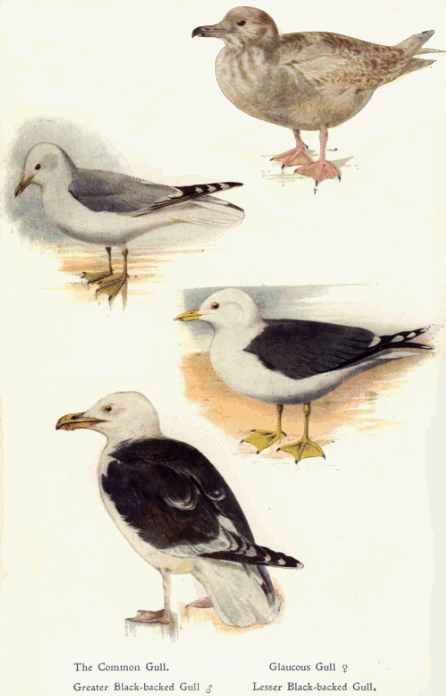
THE COMMON GULL LARUS CÁNUS
In spring the head and neck of this species are white and the mantle is a pale grey, a little darker in summer, the head, tail and under parts white; primaries comparatively long, and the three outer pairs dull black on the lower portions, with large white 'mirrors' near the tips in mature birds—in the rest the predominant tone is a pale grey, the black only forming a bar, and all but the first primary broadly tipped with white; bill a rich yellow towards the point; legs and feet greenish yellow in summer, darker in winter. In winter the head and neck are streaked and spotted with ash-brown. Length eighteen inches.
This is a species resident in Great Britain, but it is not known to breed south of the Solway. It nests, however, in the west of Ireland; grassy sides and islands of lochs or slopes that face the sea, not far often above high-water, are its favourite resorts, where it breeds in colonies, the nest of sea-weeds, heather and dry grass being fairly large. In it will be, as a rule, three eggs, an olive-brown, spotted and streaked with a blackish tone; but pale blue, light green and straw-coloured varieties are found often. This Gull is the first to seek the shore on the approach of 'coarse' weather; and it may often be studied in the fields as it picks up grubs among the furrows in the company of Rooks, or by the town-tied Cockney, from his own standpoint of Westminster Bridge.
The 'Blue Maa', as this species is called in the north, breeds in abundance on the Scottish coasts as well as the moors of the fresh-water lochs, including the Hebrides, Orkneys and Shetlands. The Black-Headed Gull is generally the Common Gull of the peasantry in Ireland, but the underside of the wing in the young of the Common Gull is mottled with brown, whereas it is greyish-white in the Black-Headed species.
Gulls are, moreover, of material service, for they perform for the surface of the sea the same office which crustaceous animals do for its depths. Most of their time is spent in either flying or swimming about (they are no divers) in quest of food, which is of that nature that, if suffered to accumulate, more than one of our senses would be offended. All animal matter which, when life is extinct, rises to the surface, it is their especial province to clear away. To perform this necessary work, they have need of a quick eye and a voracious appetite. That they have the former in an eminent degree, any one may convince himself who, when taking a sea voyage, sees the vessel followed, as he often will, by a flock of Gulls. Let him fling overboard, into the foaming track of the ship, where his own eye can distinguish nothing, ever so small a portion of bread or other kind of food. That some one individual at least among the flock will have seen it fall and be able to descry it is certain; now, probably, a general scramble will ensue, and the prize will be secured by the swiftest. Having tried this several times with the same result, let him throw over, instead of meat or bread, a bit of wood. Not a bird will come near even to examine it. I have often tried this experiment, and have met with but one result. To prove that the Gull is capable of consuming a large quantity of food, as well as quick-sighted, a single anecdote will suffice:—"A man who was shooting on the banks of the river Yare, seeing something, which had the appearance of an eel half-swallowed, hanging from the mouth of a Gull which was flying overhead, fired at the bird, and on taking it up, found, not an eel, but—five tallow candles attached to a piece of thread, to the other end of which was fastened a sixth, the latter having been almost entirely swallowed. The candles were about twelve inches in length, with cotton wicks, such as are used on board the fishing boats, from the deck of which he had probably taken them". The Gull, then, is not choice in its diet; it is, in fact, omnivorous. It skims the deep for dead animal matter, follows the ship for offal thrown overboard, paces the shore in quest of molluscs and marine insects, flies inland in stormy weather (a specimen was once brought me which had been shot in Hertfordshire, twenty miles from the nearest navigable river) in winter and spring, and follows the plough along with Rooks and Jackdaws, alights on fields which have been manured with decomposed fish, resorts to marshes for frogs and worms, and after an inundation repairs to the lately submersed ground, and picks up the small quadrupeds which have been drowned. It usually flies at no great elevation above the water, but when repairing inland and returning it frequently rises to a very great height.
THE HERRING GULL LARUS ARGENTÁTUS
Head and neck white, streaked in summer with light brown; tail and lower parts white; back and wings bluish ash; primaries dusky, passing into black, the shafts black and extremities white; secondaries edged and tipped with white; bill, orbits, and irides, yellow; feet flesh-colour. In young birds the white is mostly replaced by dark grey, mottled with brown; wings and tail brown, the latter reddish yellow towards the end; bill dusky; irides, orbits, and feet, brown. Length twenty-three inches. Eggs olive-brown, spotted with dark brown and dusky.
If, among a flock of Common Gulls, seen either following a vessel at sea or attending on the movements of a shoal of fish, one be observed which greatly surpasses the rest in size, it will probably be this species, provided that it have a grey and not a black back. In the latter case it may either be the Great or Lesser Black-Backed Gull.
The Herring Gull is a large and powerful bird, thoroughly competent to dispose of a herring or even a more bulky fish. It is common on most parts of the British coast, and remains with us all the year, building its nest on steep cliffs, or rocky islands. In the south of England it is very abundant, and is more frequently seen inland, in newly-ploughed fields, than any other species. Like the other Gulls, it may easily be tamed if taken young; and, when kept in a garden, earns its maintenance by keeping down slugs and other vermin.
THE LESSER BLACK-BACKED GULL LARUS FUSCUS
Wings reaching two inches beyond the tail; head and neck white, streaked (in winter) with brown; lower parts pure white; rest of the upper plumage blackish grey; primaries black, the first two with an oval white spot near the tip; secondaries and scapulars tipped with white; bill, irides, and feet, yellow; tarsus two and a quarter inches long; orbits red. In young birds the white plumage is mostly replaced by grey mottled with brown, and the black by dusky edged with yellowish; the primaries have no white spots, and the bill is dusky. Length twenty-three inches. Eggs brownish grey, spotted with brown and black.
This is a generally diffused species, occurring in considerable numbers, not only on various parts of our coast, but in the Baltic, the Mediterranean, the Black Sea, the Red Sea, and the northern parts of America. It repairs in spring either to rocky islands, steep cliffs, or sometimes to inland lakes, where it builds a rather large nest of tufts of grass, and lays two or three eggs. When the young are hatched it is very impatient of having its stronghold invaded, and resents molestation by darting at the head of the intruder. The Lesser Black-Backed Gull breeds habitually on many parts of the coast, especially such as are frequented by the Herring Gull. Its food and habits are much the same as those of the Common Gull. In the South of England, the nesting-places are confined to Devon and Cornwall, but there are colonies on the Farne Islands, the Isle of Man and Wales.
THE GREAT BLACK-BACKED GULL LARUS MARÍNUS
Wings extending but little beyond the tail; legs pale flesh-colour. Length thirty inches; breadth about five feet nine inches. In most other respects resembling the Lesser Black-Backed Gull. Eggs stone-buff, blotched and spotted with dusky brown.
Of the two Black-Backed Gulls, the Greater, or 'Cobb', is by far the less frequent on our coasts, and when seen generally occurs in pairs. It remains with us all the year, but is most frequent in the south during winter. In spring, Great Black-Backed Gulls for the most part withdraw to cliffs and rocky islands far north, as, for instance, the Orkneys and Hebrides, where they are numerous, a few only nesting southwards. Unlike most other Gulls, birds of this species are unsociable even in the breeding season. They build their nests on the most inaccessible parts of the rocks, and reserve the situation entirely to themselves, not even permitting birds of their own species or any other intruders to settle there. They are exceedingly wary, and give notice of the approach of danger to other animals. Consequently, they are held in dislike by the gunner, whether in pursuit of sea-birds or seals. Like the rest of the Gulls, they are omnivorous, but are, more than any others, addicted to carrion, in quest of which they often wander inland; hence, they are sometimes called Carrion Gulls. 'If a floating prize presents itself', says Mr. St. John, 'such as the remains of a large fish or dead bird, it is soon discovered by one of the large Gulls, who is not, however, allowed to enjoy his prize alone, for every one of his fellows within sight joins in tearing it to pieces. When I have winged a Duck, and it has escaped and gone out to sea, I have frequently seen it attacked, and devoured almost alive, by these birds.'
Stations occur here and there on the coast of England in which the Great Black-Backed Gull builds. It sometimes resorts to a marsh at the breeding season, but retains its habit of driving away all intruders. Its eggs are prized as dainties, being thought to resemble Plovers' eggs.
GLAUCOUS GULL, OR BURGOMASTER LARUS GLAUCUS
General plumage white; back and wings bluish grey; tail and terminal portion of the quills white; bill strong, yellow; legs livid flesh-colour. Young mottled with white, grey, and light brown; shafts of the quills white; in other respects like the last, but the bill is longer and stouter. Length about twenty-nine inches; breadth five feet two inches. Eggs as in the last, but of a greener hue.
The Glaucous Gull, a large, handsome, and powerful bird, resembles in many of its habits the species last described, but it has not been known to breed in even the most northerly of the British Isles. It pays occasional visits to our shores in winter. A few specimens only have been shot in the southern portion of the island, and no large number in Scotland; but in the neighbourhood of the whale fishery it is common enough. It is very voracious, and not only eats fish, whether dead or alive, and shares with the whale-fisher in his booty, but pursues other sea-fowl, compels them to disgorge their prey, robs them of their eggs, and, if they resist, kills and devours them.[52] In short, it is the very tyrant of the Arctic Ocean. Its predatory habits were noticed by the early navigators in these waters, who gave it the name of Burgomaster; but as no accurate description of the bird was brought home, and as some of our other large Gulls are open to a charge of similar rapacity, the name was naturally transferred by Willughby to another species, which he calls the Wagel (probably the Great Black-Backed Gull in immature plumage). This was in 1676. A hundred years later Brunnich gave it the name of Glaucous Gull; but it is still called Burgomaster by the Dutch, and by Arctic voyagers generally.
Mr. St. John gives the name of Wagel to the Great Grey Gull.
THE KITTIWAKE GULL RISSA TRIDACTYLA
Hind toe represented by a small knob without a claw. Summer plumage—head and neck pale bluish ash, a few fine dusky streaks before the eyes; forehead, region of the eyes, and all the under parts, pure white; upper plumage bluish ash; first primary with the outer web black, four first tipped with black, two or three of them ending in a small white spot, fifth having the tip white bordered with black; bill greenish yellow; orbits red; irides brown; feet dark olive-brown. In winter, the whole of the head and neck is white. Young birds have the head white, mottled with grey and dusky; upper feathers tipped with brown; bend and upper edge of the wing black; primaries black; tail black, towards the end tipped with white; bill, orbits, and irides, black; feet pale brown. Length fifteen and a half inches. Eggs stone-colour, spotted with grey and two shades of brown.
The Kittiwake Gull takes its name from the cry with which in the breeding season it assails any intruder on its domain. It is a beautiful bird, especially in its variegated immature plumage, remarkable for its delicacy of colouring and the easy grace of its flight, frequenting high cliffs in summer, while engaged in the duties of incubation, and at all other times preferring the open sea to estuaries, and feeding on such small fish as swim near the surface. It is very abundant in the Arctic regions of both hemispheres during summer, and extends its southern limits so far as to include the British Isles, but is most numerous in the north. Its nest, built of sea-weed or bents, is placed high up in the face of a precipitous cliff, generally on a narrow ledge, and in close proximity with others belonging to birds of the same species. It contains three eggs, and the young birds remain in their airy nest until fully fledged, when, as well as their parents, they disperse over the neighbouring seas, rarely venturing either to perch on land or fly over it. The young of the Kittiwake, previous to its first moult, is sometimes called the Tarrock. Colonel Irby says that the Kittiwake is a partially resident species. Marked birds have been known to follow vessels across the North Atlantic.
Sub-Family STERCORARIINÆ (Robber Gulls)
THE GREAT SKUA STERCORARIUS CATARRHÁCTES
Upper plumage brown, of several shades; shafts of the quills, basal half of the primaries, and shafts of the tail-feathers, white; under, reddish grey, tinged with brown; two central tail-feathers but slightly elongated, not tapering; tarsus two and a half inches long, somewhat rough at the back. Length twenty-five inches. Eggs olive-brown, blotched with brown.
The Skuas, called also Skua Gulls, are sufficiently distinguished from the true Gulls by their strong hooked bills and talons, and by the habits of daring and voracity founded on these characters. The present species, though called common, is only to be so considered in high latitudes; for it is very rarely seen on the coasts of England, and has become scarce even in the Shetland Islands, where it was at one time frequent. Mr. Dunn[53] says: "I never saw this bird in Orkney, and there are only three places in Shetland where it breeds—viz. Foula, Rona's Hill, and the Isle of Mist; in the latter place it is by no means numerous, and is strictly preserved by the landlords, on whose property it may have settled, from a superstition that it will defend their flocks from the attacks of the Eagle. That it will attack the Eagle if he approaches their nests is a fact I have witnessed: I once saw a pair completely beat off a large Eagle from their breeding-place, on Rona's Hill. The flight of the Skua is stronger and more rapid than that of any other Gull. It is a great favourite with the fishermen, frequently accompanying their boats to the fishing-ground, or Haaf, which they consider a lucky omen; and in return for its attendance, they give it the refuse of the fish which are caught. The Skua Gull does not associate in groups; and it is seldom that more than a pair are seen together. During the breeding season it is highly courageous; and will strike furiously at, and will even pursue, any one who may happen to approach its nest, which is constructed among the heath or moss; the female laying two eggs."
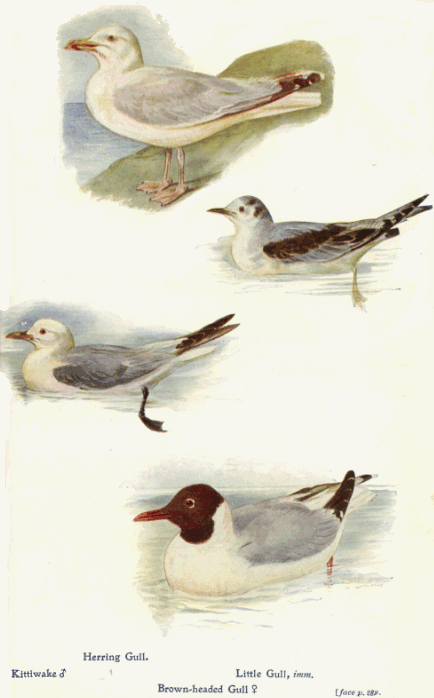
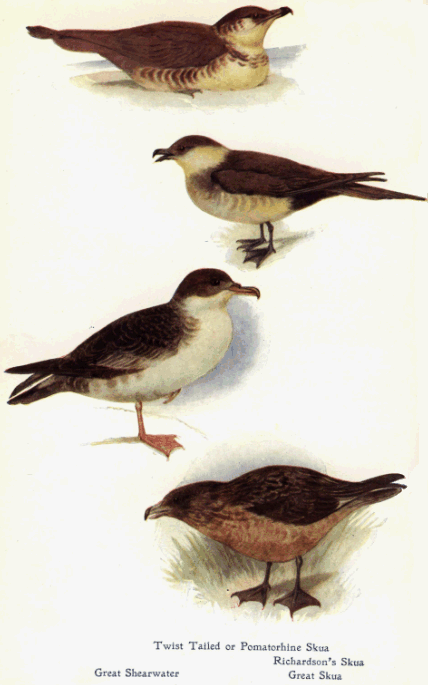
Some authors state that the Common Skua obtains its livelihood by levying contributions on the White Gulls, compelling them to disgorge their prey, and catching it before it reaches the water; but Dr. Edmonston, who had great opportunities of watching the habits of these birds, says that they do not adopt the practises correctly attributed to the Arctic Gull, or Richardson's Skua. The voice of the Common Skua is said to resemble that of a young Gull, being sharp and shrill; and it is from the resemblance of its cry to that of the word Skua, or Skui, that it obtains its popular name. That it is remarkably courageous and daring, all accounts agree. Mr. Low says that, when the inhabitants are looking after their sheep on the hills, the Skua often attacks them in such a manner that they are obliged to defend themselves with their cudgels held above their heads, on which it often kills itself; and Captain Vetch, In the Memoirs of the Wernerian Society, says that it not only drives away Ravens and Eagles, but that the larger quadrupeds, such as horses and sheep, which venture near its nest, are immediately put to flight. Its northern name is Bonxie.
TWIST-TAILED OR POMATORHINE SKUA STERCORARIUS POMATORHINUS
Upper plumage uniform dark brown; feathers of the nape long, tapering lustrous; sides of the face and under plumage white; a collar of brown spots on the breast, and similar spots on the flanks; shafts of the quills and tail-feathers white, except at the tip; two central tail-feathers projecting three inches, not tapering; tarsus two inches long, rough at the back, with projecting scales. Length twenty-one inches. Young birds—upper plumage dusky brown, mottled with reddish yellow; under, yellowish white, thickly set with brown spots and bars. Eggs ash-green, spotted with dusky.
The habits of this bird vary but little from those of the other species. Its home is in the Arctic seas, from which it strays southwards in winter, and has been occasionally seen on our coasts. The following account of the capture of one of these birds, in 1844, indicates a bird of unusual daring and voracity: "About the beginning of last October, a Pomarine Skua was taken in the adjoining village of Ovingdean. It had struck down a White Gull, which it would not quit: it was kept alive above a fortnight, and then died. The very first day of its captivity it (is said to have) devoured twenty-five Sparrows. Once it escaped, and immediately attacked a Duck, which it held till recaptured."[54]
RICHARDSON'S SKUA STERCORARIUS CREPIDATUS
Crown dusky; cheeks, neck, and under plumage white, tinged with yellow or brown; rest of the plumage dusky, the wings and tail the darkest. Two central tail-feathers tapering from the base, pointed, and projecting six inches; tarsus less than two inches. Length twenty-one inches. Eggs olive, with a circle of brown spots near the larger extremity, the rest speckled with the same colour.
This species of Skua, most familiarly known, perhaps, as the Arctic Gull, received its distinctive name, 'Richardson's', in honour of the eminent Arctic naturalist. It is distinguished from the species already described by its longer tail, but the habits of all are much alike; indeed, the names of 'Arctic Gull', 'Boatswain', 'and Man-of-War', appear to be sometimes employed indiscriminately. Richardson's Skua, like the rest, inhabits the Arctic seas, but extends its wanderings southwards in far greater numbers than either of the other species, so that its occurrence on the east coast of England is not unusual. According to Mr. Dunn, 'numbers of this bird breed in Orkney and Shetland, appearing regularly in May and leaving in August: it is confined to a few situations and is strictly preserved, from the same motive as the Skua Gull. It constructs its nest on low, not mossy, heaths in exposed situations. The female lays two eggs, and has recourse to the same stratagems that the Plover employs to decoy you from the nest; but when a person approaches near to the place where the nest is built, becomes bold and fierce, and strikes severely with the feet and bill.' The following account is taken from Mr. St. John's Wild Sports of the Highlands: "I was much amused the other day by the proceedings of a pair of the Black-toed Gull or Boatswain. These two birds were sitting quietly on an elevated ridge of sand, near which a number of other Gulls of different kinds were fishing, and hovering about in search of what the waves might cast up. Every bird, indeed, was busy and employed, excepting these two black robbers, who seemed to be quietly resting, quite unconcerned. When, however, a Gull had picked up a prize, these birds seemed instinctively to know it, and darting off with the rapidity of a Hawk (which bird they much resemble in their manner of flight), they attacked the unfortunate Gull in the air, and in spite of his screams and attempts to escape, they pursued and beat him till he disgorged the fish or whatever he had swallowed, when one of them darted down and caught the substance before it could reach the water. The two then quietly returned to their sandbank, where they waited patiently to renew the robbery, should an opportunity occur. As the flock of Gulls moved on with the flow of the tide, the Boatswains moved on also, hovering on their flank like a pair of plundering freebooters. I observed that, in chasing a Gull, they seemed perfectly to understand each other as to who should get the spoil; and in their attacks on the largest Gulls (against whom they waged the most fearless warfare), they evidently acted so as to aid each other. If another pair of Boatswains intruded on their hunting-ground they immediately seemed to send them further off; not so much by actual battle, as by a noisy and screaming argument, which they continued most vigorously till the new-comers left the neighbourhood.