Front matter (continued 7)
Reading edition
When it is desired to construct a decoy,[35] a quiet, shallow pond is selected, edged with reeds, and having an extent of from two to fifty acres or more. From the edge of this are dug, at various points, curved creeks, called 'pipes', broad at the mouth, and contracting till the banks meet. Over each of these pipes is thrown a net, supported on arches made of hoops; the first about ten feet high, the others diminishing in size, and the whole ending in a bag-net, or 'purse'. On each bank of the pipes are erected screens made of reeds, high enough to conceal a man. Previously to commencing operations the decoy-man has let loose on the pond a few tame Ducks, closely resembling wild birds in plumage, who are familiar with his person and have been trained to come at his call. Accompanied by a little dog, 'a piper', he stations himself behind a screen, near the mouth of a pipe which faces the wind, choosing this position because Ducks prefer to swim against the wind and to feed on a lee shore. When the pond is well stocked with birds he throws some corn on the water near the mouth of a pipe, and makes a low whistle. At the familiar sound the 'coy-ducks' hasten to the spot, and, if all be well, are followed by a portion of the wild birds. The piper is then let loose, and immediately runs to the water's edge. The Wild Ducks, either from curiosity, or some unknown motive, paddle towards him. The ruse succeeding so far, the piper is made to appear for a moment beyond the next screen, and so on until a party of Ducks have been lured so far up the pipe as to be out of sight of those remaining in the pond. The decoy-man, who has all the while been lying hid near the first screen, then shows himself to his intended victims, who, in their flight, hurry on to the 'purse', and are caught and dispatched at leisure. All this time the coy-ducks, if well trained, have remained at the mouth of the pipe, feeding, and unconsciously enticing new-comers into the snare.
That this method of capturing wild-fowl is effective, may be inferred from the fact that decoys of a precisely similar kind have been worked ever since the time of Willughby (1676), who describes them at length. A Son of the Marshes gives a fuller account of Duck decoys in Wild-Fowl and Sea-Fowl.
THE GADWALL ANAS STRÉPERA
Head and neck light grey, speckled with brown; back and breast dark grey, the feathers ending in crescent-shaped whitish lines; belly white, speckled with brown; small wing-coverts and tip of the wing chestnut; greater coverts, rump, and tail-coverts black; speculum white; bill black; irides brown; feet orange. Female less distinctly marked. Length twenty inches. Eggs buffy white, tinged with green.
This species of Duck now breeds in Norfolk and Suffolk. Its food and habits closely resemble those of the other Ducks; it is active, and both swims and flies rapidly, preferring fresh-water lakes to the sea, and resorting principally to such pieces of water as afford it ready concealment. Meyer states that when flocks of Gadwalls 'fly about, they keep close together in a ball, but not in a line, and may therefore be very soon distinguished from the common wild Duck'. By day they mostly swim about in the open water, and come near the shore to feed in the evening. They breed in the great northern marshes of both hemispheres. The Gadwall is a surface feeder and not a diving duck.
THE SHOVELER SPATULA CLYPEATA
Head and neck glossy green; breast pure white; belly and flanks chestnut; back brown; lesser wing-coverts pale blue; scapulars white, speckled and spotted with black; speculum brilliant green; bill lead colour; irides yellow; feet reddish orange. Female—head pale reddish brown, streaked with dusky; upper plumage dusky brown, edged with reddish white; under plumage reddish with large brown spots; the blue and green of the wings less bright. Length twenty inches. Eggs greenish buff.
The Shoveler is well distinguished among all the British Ducks by the form and structure of its bill, which in old birds is dilated near the extremity into a form approaching that of a spoon, and is furnished with a fringe of slender lamellæ, resembling a comb. Towards the end of the bill these are not conspicuous as long as the mouth of the bird is closed, but along the narrower part they are prominent under all circumstances. So singular an apparatus obviously indicates that the habit of the Shoveler is to sift water and mud for the sake of securing the insects and worms which they contain. It resorts, therefore, to the margins of fresh-water lakes, ponds, and ditches, and is rarely seen at sea, nor does it ever dive after its food in deep water, but frequently comes to land in quest of slugs, snails, and worms. It is met with from time to time in many parts of England; a tolerable number remain to breed with us, especially in the eastern counties. Its distaste for the sea disqualifies it for inhabiting the Arctic Regions; consequently it breeds in temperate countries, and flies farther to the south in winter, having been observed on both shores of the Mediterranean, and in some of the warm parts of India. The extensive drainage of our fens and marshes has made it less frequent in England than it formerly was; but in Holland and other continental countries it is abundant. The nest, usually placed in a tuft of grass, is made of dry grass mixed with down which the female plucks from her own body, and contains eight or nine eggs.
The Shoveler is not sufficiently common in this country to claim any importance as an article of food, but its flesh is said to be superior in flavour even to that of the famous Canvas-backed Duck of America.
The male annually undergoes a moult, or change of feathers, similar to that described as taking place in the Mallard.
THE PINTAIL DUCK DAFILA ACÚTA
Two central tail-feathers much elongated, black; head and neck rich dark brown; back and flanks marked with zigzag black and grey lines; front of the neck, and a line on each side, white; speculum lustrous with green and purple, bounded above by reddish brown, below by white; bill lead colour and black. Female—central tail-feathers scarcely elongated; head and neck reddish brown speckled with dusky; upper feathers dusky edged with reddish white; lower plumage reddish yellow spotted with brown; speculum dull yellowish brown; no white line on the side of the neck. Length twenty-six inches. Eggs dull greenish white.
The Pintail Duck is a northern bird which visits our shores in small parties, during severe winters, and it nests sometimes in Ireland. In form it is the most elegant of all the Ducks, and its movements are described as being active and graceful. I have never myself had the good fortune to see one alive, the only specimen I ever possessed having been sent to me from Newcastle-on-Tyne, near which it was shot at sea. It is not, however, considered a very rare species, as the fishermen on the Norfolk coast, and perhaps elsewhere, are well acquainted with it. Yarrell states, that on the coast of Dorsetshire and Hampshire it is so well known as to have acquired a local name, 'Sea Pheasant'.[36] For this it is indebted to the length of its tail, in which respect it differs from all the common Ducks. It arrives early in autumn, and remains either on the coast or in the inland marshes, until the return of spring; differing, indeed, little in its habits from the common wild Duck. It is occasionally taken in decoys in Norfolk, and has often been observed to associate with Wigeons. Its note is described by Montagu as being 'extremely soft and inward'.
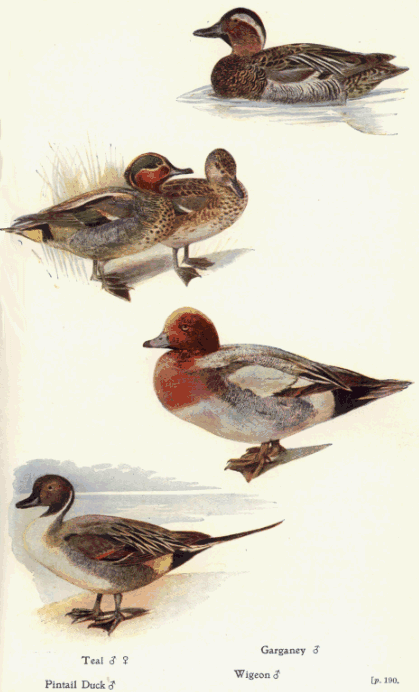
The Pintail Duck has a wide geographical range, as it either breeds in or pays winter visits to the greater part of the northern hemisphere. The male annually assumes in summer the plumage of the female, resembling in this respect the Mallard, to be described hereafter. The flesh is considered excellent, on which account it is much sought after by wild-fowl shooters, both on the coast and in the fens.
THE TEAL QUERQUÉDULA CRÉCCA
Head and neck bright chestnut; on each side of the head a broad green band edged with buff, inclosing the eye and extending to the nape; lower part of the neck, back, and flanks, marked with numerous black and white zigzag lines; breast reddish white, with roundish black spots; speculum black, green and purple, edged with white; bill dusky; irides brown; feet ash. Female—upper plumage dusky brown mottled with reddish grey; throat, cheeks and a band behind the eyes yellowish white spotted with black; speculum black and green. Length fourteen inches and a half. Eggs yellowish white.
The Teal is the smallest, and by no means the least beautiful, among the British Ducks. It is decidedly an indigenous species, as it breeds in many parts both of Great Britain and Ireland, especially in the eastern counties, in Welsh bogs, and northern mosses. It is domesticated, too, without difficulty, and is generally to be found on artificial and other pieces of water where the breed of water fowl is encouraged. Its favourite summer resorts in England are lakes which are lined with rushes, boggy places on the moors, and sedgy rivers. It is an active bird, rising from the water with great facility, and having a rapid flight. The few Teal which remain all the year with us pair early in spring. I have observed them in couples on the Kennet, in Berkshire, before winter had well departed. They appear to have a strong attachment to any place on which they have once fixed to build their nest, and return to the same locality year after year; and the young brood remain in the neighbourhood of their birth-place until pairing time in the following year. The nest is usually placed among coarse herbage by the bank of a lake or river, and is constructed of decayed vegetable matter, lined with down and feathers, and contains from ten to fifteen eggs. The number, however, of these birds to be found with us in summer is as nothing compared with the immense flocks which visit our inland lakes and swamps in winter. They are then much sought after for the table, being considered more delicate eating than any others of the tribe. In some parts they repair to salt marshes and the sea-shore, where they share the fate of the Wild Duck.
Willughby tells us that in his time the Teal and Wigeon, considered as marketable goods, were classed together as 'half-fowl', their value being only half that of the Wild Duck. In the fen counties they are still ranked together as 'Half Ducks', and for the same reason.
The Teal has two notes, one a kind of quack, the other, uttered by the male only during winter, which has been compared to the whistle of the Plover. Its food consists of water insects, molluscs, worms, and the seeds of grass and sedge. It is widely distributed in Scotland.
THE GARGANEY QUERQUÉDULA CIRCIA
Crown dusky; over the eye a white band extending down the neck; throat black; neck chestnut-brown streaked with white; breast pale yellowish brown, with crescent-shaped black bars; back mottled with dusky grey and brown; speculum greyish green bordered above and below with white; bill dark brown; irides brown; feet grey. Length sixteen inches. Eggs buff.
This elegant little bird visits us in March and April, being at that time, it is supposed, on its way to the south. Though not among the rarest of the tribe, it is now of unusual occurrence, but was formerly so regular a visitor in the eastern counties, that it acquired the provincial name of 'Summer Teal'. Young birds are commonly seen on the Broads of Norfolk in July and August, distinguishable from young Teal by the lighter colour of their plumage, more slender habit, and greater length of neck. The nests are built among the thickest reed beds, and owing now to protection their numbers are increasing. In Ireland it is the rarest of the well-known ducks.
THE WIGEON MARÉCA PENÉLOPE
Male—head and upper part of the neck chestnut, the cheeks and crown speckled with black; a broad cream-coloured band extending from the bill to the crown; throat nearly black; a narrow collar of white and black wavy lines extending over the back and flanks; lower part of the neck and sides of the breast chocolate colour; scapulars velvet-black edged with white; wing-coverts white; quills ash-brown; speculum glossy green, with a black band above and below; tail wedge-shaped, two middle feathers pointed, and the longest, dusky ash; under tail-coverts black; bill bluish grey, the tip black; irides hazel; feet dusky grey. Female—head and neck reddish brown, speckled with dusky; back and scapulars dusky brown, the feathers edged with rusty red; wing-coverts brown, edged with whitish; speculum without the green gloss; flanks reddish brown. Length twenty inches. Eggs brownish white.
The name Whew Duck, or Whewer, by which, this bird is known in some parts of England, was given to it on account of its emitting a shrill whistle while flying. The name is an old one, for Ray and Willughby describe it under the name of 'Whewer'. Its French name Siffleur, 'Whistler', has reference to the same peculiarity, and by this note the bird may often be distinguished from others of the same tribe, when so far off that the eye fails to identify it. The Wigeon ranks next to the Teal and Wild Duck as an article of food, and, being more plentiful than either of these birds, it is among the best known of all the Ducks which frequent our shores. It breeds over most of Sutherland, and sparingly elsewhere in the north; a few pairs are said to nest also in various parts of Ireland.
Flocks of Wigeons repair to our shores in autumn, and either betake themselves to inland lakes and morasses, or keep to the coast, especially where there are extensive salt marshes. In winter their numbers are greatly increased, especially in the south; and as they feed by day as well as by night, they offer themselves a ready prey to the fowler. Their food consists of marine and fresh-water insects, small shellfish, sea-weed, and grass. Their nidification differs little from that of the Teal.
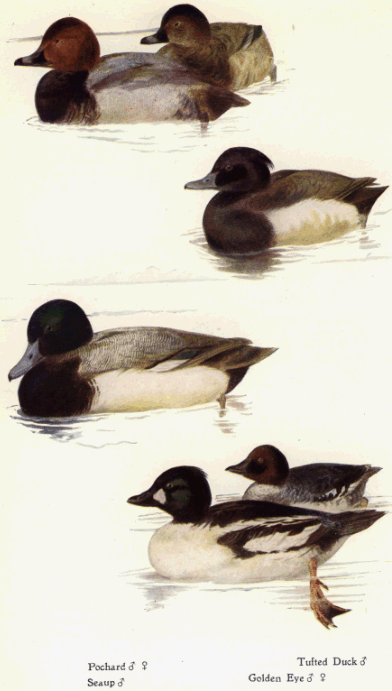
THE COMMON POCHARD FULÍGULA FERÍNA
Head and neck bright chestnut; breast, upper part of the back, and rump black; back, scapulars, flanks, and abdomen greyish white, marked with numerous fine wavy lines; no speculum; bill black, with a broad lead-coloured transverse band; irides bright orange; feet lead colour, the membranes black. Female—smaller; head, neck, and breast, reddish brown; throat white, mottled with reddish; large brown spots on the flanks; wavy lines on the back less distinct. Length nineteen inches. Eggs greenish white.
A hardy northern bird of wide geographical range, with considerable power of flight, a skilful diver, and not particular as to diet, the Pochard is an abundant species. It breeds in some districts: But it is principally as a winter visitant that it is known in the south of Europe. In Norfolk 'Red-Headed' Pochards are perhaps more numerous than any other kind of Duck which falls to the gun of the sea-side fowler. Small parties of these birds may frequently be seen by day flying over the sea, or swimming securely in the offing; and in the evening great numbers resort to the fens and salt marshes, where they feed on various kinds of animal matter, and the roots and leaves of grasses and aquatic plants. As they are considered good eating, and command a ready sale, they contribute to the support of the sea-side population, who, when thrown out of work by the severe weather, wander about the shore by day and lie in wait by night, armed with guns of various calibre, for the chance of securing in one or two Ducks the substitute for a day's wages.
They are variously known in different places by the name of Pochards, Pokers, Dunbirds, and Red-eyed Pochards. On some parts of the coast of Norfolk I found that they are included with the Wigeon under the common name of 'Smee-Duck'.
The Pochard builds its nest among reeds, in Russia, Denmark, and the north of Germany, and lays twelve or thirteen eggs.
The Red-crested is a different species from the 'Red-headed.'
THE TUFTED DUCK FULÍGULA CRISTÁTA
Feathers on the back of the head elongated; head, neck, breast, and upper plumage black, with purple, green, and bronze reflections; speculum and under plumage white, except the abdomen, which is dusky; bill blue, nail black; irides bright yellow; feet bluish, with black membranes. Female—smaller, the crest shorter; upper plumage dull black, clouded with brown; under plumage reddish white, spotted on the breast and flanks with reddish brown. Length seventeen inches. Eggs greenish white spotted with light brown.
The points of difference in habit between this and the preceding species are so few that it is scarcely necessary to say more than that it is a regular winter visitor to the British Isles, and is distributed, generally in small flocks, never alone, over our lakes and marshes, arriving in October and taking its departure in March or April. Its food is less exclusively of a fishy nature than that of the Scaup Duck, consequently its flesh is more palatable, being, in the estimation of French gastronomists, un rôti parfait. The Tufted Duck now breeds in a good many districts here.
THE SCAUP DUCK FULÍGULA MARÍLA
Head and upper part of the neck black, with green reflections; breast and rump black; back and scapulars whitish, marked with numerous fine wavy black lines; belly, flanks, and speculum, white; bill blue, the nail and edges black; irides bright yellow; feet ash-grey, with dusky membranes. Female—a broad whitish band round the base of the bill; head and neck dusky brown; breast and rump dark brown; back marked with fine wavy lines of black and white; flanks spotted and pencilled with brown, irides dull yellow. Length twenty inches. Eggs clay-buff.
The Scaup is so called from its feeding on 'scaup', a northern word for a bed of shellfish.[37] It is a northern bird, arriving on our coasts in October and November, and remaining with us till the following spring. During this time it frequents those parts of the coast which abound in shellfish, mostly diving for its food after the manner of the Scoters. On the coast of Norfolk, where Scaups often appear during winter in large flocks, they are called 'Mussel Ducks', a name no less appropriate than Scaup; for mussels, and indeed many other kinds of shellfish, as well as insects and marine plants, seem equally acceptable to them. Selby records a single instance of the Scaup having bred so far south as Sutherlandshire, a female having been seen in the month of June, accompanied by a young one. They have paired on Loch Leven. It is generally distributed along the shores of Great Britain, excepting on the south coast [of Ireland]. In August, 1861, I observed two birds swimming sociably on a small fresh-water loch in the island of Islay, which, upon examination through a telescope, appeared to me to be, one, a kind of Goose, the other decidedly a Duck of some kind. On inquiry I found that the former was a Bernacle Goose, which had been caught in a neighbouring island in the previous winter, and had been given to the laird's keeper, who pinioned it and turned it out on the loch to shift for itself. Of the Duck nothing was known, nor had it been observed before. It eventually proved to be an adult male Scaup Duck, but what had induced it to remain there all the summer in the society of a bird of a different tribe, is a question which I did not attempt to solve.
The Scaup Duck is very abundant in Holland during winter, covering the inland seas with immense flocks. It is found more sparingly in other continental countries. It breeds in the extreme north, both in the eastern and western hemispheres.
THE GOLDEN EYE CLANGÚLA GLAUCION
A white patch under the eye; head and neck black, lustrous with violet and green; back black; scapulars, great wing-coverts, speculum, and under parts, white; bill black; irides golden yellow; feet orange, with black membranes. Female—all the head and neck dark brown; feathers of the back dusky bordered with dark ash; greater wing-coverts white tipped with black; speculum and under parts white; tip of the bill yellowish, irides and feet pale yellow. Length eighteen and a half inches. Eggs buffy white.
This pretty, active little Duck is a regular winter visitant to the British shores, from autumn to spring, resorting to most of the localities frequented by other species, and frequently falling to the sportsman's gun, though little prized for the table. Females and young birds, called Mormons, are most numerous in England. They are very strong of flight, and are remarkable for making with their wings as they cleave the air a whistling sound, thought to resemble the tinkling of bells, whence the German name die Schelle Ente, Bell Duck, the Norfolk provincial name Rattle-Wing, and the systematic name Clangula. The young male does not make this noise, and having also dissimilar plumage from the adult, has been described by some authors as a distinct species under the name of Morillon.
The food of the Golden Eye varies with its haunts. In estuaries it feeds on crustaceous and molluscous animals and small fish, which it obtains by diving. In rivers and lakes it feeds principally on the larvæ and pupæ of insects, for which also it dives in clear deep water. The call-note is an unmelodious quack or croak.
The Golden Eye breeds only in high latitudes, and builds its nest in holes of trees, often at the height of twelve or fifteen feet from the water, into which it has been seen to convey its young one by one, holding them under the bill, and supported on its neck. The Lapps, in order to supply themselves with eggs, are in the habit of placing in the trees, on the banks of the rivers and lakes frequented by these birds, boxes with an entrance hole, which, though invariably robbed, are visited again and again.
The Golden Eye is found in many countries of Europe, in Northern Asia, and in North America.
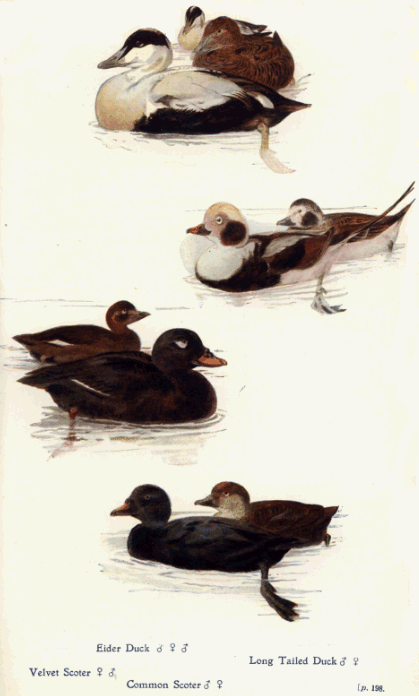
THE LONG-TAILED DUCK, OR 'CALLOO' HARELDA GLACIÁLIS
Winter plumage—head, neck, elongated scapulars, under parts, and lateral tail-feathers white; a large patch of chestnut-brown on each cheek; flanks ash-grey; rest of the plumage brownish black; two central tail-feathers very long; bill black, with a transverse orange band; irides orange; feet yellow with dark membranes. Length, including the tail, twenty-two inches. The female wants the white scapulars and elongated tail; head and neck dark brown and greyish white; below the ear-coverts a patch of brown; neck in front light brown, clouded with darker brown; upper plumage generally dark brown, under white. Length sixteen inches. Eggs greenish white, tinged with buff.
Though a few specimens of this beautiful bird are obtained from time to time in various parts of England, especially on the coast of the eastern counties, it cannot be considered other than a rarity. 'Among the northern islands of Scotland, and along the coasts of the mainland', Macgillivray tells us,'these birds make their appearance in October, in small flocks, which gradually enlarge by the accession of new families. In the Bay of Cromarty, where they are very common, it is pleasant to see them in small flocks scattered over the water. They are most expert swimmers, and live on bivalve shellfish and crustacea, which they obtain by diving in shallow or moderately deep water. The male in swimming raises his tail obliquely, in rough water almost erects it, and is remarkable for the grace and vivacity of his movements. Their flight is rapid, direct, and generally performed at the height of a few feet. They rise easily from the water, especially when facing a breeze, and alight rather abruptly. Sometimes during the day, but more frequently at night, they emit various loud and rather plaintive cries, as well as cacklings of shorter guttural notes.' Mr. Hewitson, who met with many of them in Norway, considers their note to be strikingly wild and most interesting. Farther north the Long-Tailed Duck is yet more abundant. Mr. Dunn says, 'This species (Calloo) is very abundant in both Orkney and Shetland, arriving about the middle of October, and departing again in the month of March. It is to be met with in all the inlets or voes, generally in large flocks, never far from the land, feeding upon small shellfish and star-fish. When on the wing it utters a musical cry, something like "Calloo", which may be heard at a great distance. From this cry it derives its provincial name.' In the Arctic regions of both continents these birds are so numerous as to be known by the name of 'Arctic Ducks'. They build their nests among rushes near the shore of fresh-water lakes, and line them with down from their breasts, like the Eider Duck. Iceland appears to be the extreme southern limit of their breeding-ground.
The Long-Tailed Duck is described by Willughby under the name of Anas caudacuta Islandica. by the natives called Havelda. Selby and modern ornithologists have preserved the Iceland name in Harolda.
THE EIDER DUCK SOMATERIA MOLLISSIMA
Prolongations of the bill flat; upper part of the head velvet-black, with a central whitish band, lower greenish white; neck and back white; breast ringed with red; lower plumage black; bill and feet greenish grey; irides brown. Female—general plumage reddish brown, with transverse black bars; wing-coverts black, bordered with dark reddish brown; two whitish bars across the wing; belly brown barred with black. Length twenty-five inches. Eggs shining greenish grey.
The Eider Duck differs from all the birds of the same tribe hitherto described, in being essentially and absolutely a sea-bird. Rarely found on inland waters, it does not even visit the fresh-water lochs which, in many places in the north, are only separated from the sea by a bar of sand and shingle. It spends the greater part of its time on the water, and feeds on fish, molluscs, and other animal matter which it can obtain by diving. In the latter art it is very expert, and when pursued by the fowler generally manages to escape, as it can remain a long time under water, and on rising to the surface is ready to descend again almost instantly. Though a northern bird, it is subjected to no privations by the freezing of lakes and marshes, since it finds its rest and food on the open sea. Consequently it is not migratory, and stray specimens only visit the southern shores of England. Where it was bred, there, probably, or not far off, it remains all the year round. The Farn Islands, off the coast of Northumberland, are considered to be the extreme southern limit of its breeding-ground. In the Hebrides, the Orkneys and Shetland Islands, it is quite at home, but in none of these places is it found in sufficient numbers to give it importance. It is rare on the Irish coast.
In the Arctic regions, in Iceland, and on the rocky coasts of Norway and Sweden, Eider Ducks are very numerous. In Labrador, Audubon informs us, they begin to form their nests about the end of May or the beginning of June. 'For this purpose some resort to islands scantily furnished with grass; others choose a site beneath the spreading boughs of stunted firs, and, in such places, five, six, or even eight are sometimes found beneath a single bush; many are placed on the sheltered shelvings of rocks a few feet above high-water mark. The nest, which is sunk as much as possible into the ground, is formed of sea-weeds, mosses, and dried twigs, so matted and interlaced as to give an appearance of neatness to the central cavity, which rarely exceeds seven inches in diameter. In the beginning of June the eggs are deposited, the male attending upon the female the whole time. The eggs, which are regularly placed on the moss and weeds of the nest without any down, are generally from five to seven. When the full complement of eggs has been laid the female begins to pluck some down from the lower part of the body; this operation is daily continued for some time, until the roots of the feathers, as far forward as she can reach, are quite bare. This down she disposes beneath and around the eggs. When she leaves the nest to go in search of food, she places it over her eggs to keep up their warmth.'
Sir W. J. Hooker, in his interesting Journal of a Tour in Iceland, describes the nests as he saw them in the little island of Akaroe, where, as on other uninhabited islands, the Eider Ducks breed in great numbers. "On our landing on the rocky island, we found the Eider fowls sitting upon their nests, which were rudely formed of their own down, generally among the old and half-decayed sea-weed, that the storms had cast high up on the beach, but sometimes only among the bare rocks. It was difficult to make these birds leave their nests, and so little inclined were many of them to do it, that they even permitted us to handle them, whilst they were sitting, without their appearing to be at all alarmed. Under each of them were two or four eggs; the latter is the number they lay, but from many of them two had been taken for food by the natives, who prefer those which have young ones in them. June 24th." A few days later (June 27,) he visited the island of Vidöe, the residence of the ex-governor, where, he says, 'we were shown the immense number of Eider Ducks which lived on Vidöe, and which were now sitting on eggs or young ones, exhibiting a most interesting scene. The ex-governor made us go and coax some of the old birds, who did not on that account disturb themselves. Almost every little hollow place between the rocks is occupied with the nests of these birds, which are so numerous that we were obliged to walk with the greatest caution, to avoid trampling upon them; but, besides this, the ex-governor has a number of holes cut in the smooth and sloping side of a hill in two rows, and in every one of these, also, there is a nest. No Norfolk housewife is half so solicitous after her poultry as the ex-governor after his Eider Ducks, which by their down and eggs afford him a considerable revenue; since the former sells for three rix-dollars (twelve shillings) a pound. Cats and dogs are, at this season of the year, all banished from the island, so that nothing may disturb these birds.' I need scarcely add that the Eider down of commerce is taken from these nests, not in a pure state but mixed with fragments of plants. Pennant says that if the nest and eggs be taken 'the Duck lays again, and repeats the plucking of her breast, if she is robbed after that, she will still lay, but the drakes must supply the down, as her stock is now exhausted; if her eggs are taken a third time, she wholly deserts the place. The quantity of down found in one nest weighs about three-quarters of an ounce, and may be compressed into a ball two inches in diameter, but on being shaken out will fill a large hat.
The young brood take to the water immediately on being hatched. To effect this they are often obliged to travel a considerable distance, and if difficulties present themselves, insurmountable in any other way, the parent bird carries the young in her bill. Once clear of the rocks, they are liable to no further molestation from land robbers. But the sea is not without its dangers, for the rapacious Black-backed Gull frequently attacks them, and, but for the self-devotion and bravery of the mother bird, would commit great havoc among them. At his appearance the young dive in all directions, while the mother counterfeits lameness to distract his attention from them to herself, or springs from the water and attacks the Gull until he is compelled to retire from the contest.
THE BLACK (OR COMMON) SCOTER ŒDEMIA NIGRA
General plumage deep black; quills dusky brown on the inner web, glossy grey beneath; disk of the upper mandible orange-yellow; protuberance at the base black; no speculum on the wings. Female—general plumage brown of several shades; bill without the protuberance; nostrils, and a spot towards the tip, yellowish. Length eighteen inches. Eggs pale buff.
This bird is well known along the eastern coast of England under the name of Black Duck. Although a few scattered specimens have been observed from time to time during summer, in most parts it must be considered as a winter visitant only. Being the only entirely black Duck which frequents our shores, it is distinguished among other species by its colour alone. Small parties of these birds may occasionally be seen on different parts of the coast, swimming and diving at a short distance outside the surf, or flying, three or four together, at an elevation of a few feet above the surface of the sea. Large flocks visit the sea between us and Holland at times. They fly rapidly in a straight line, and when diving remain a long time under water. Their food consists of mussels and other shellfish, in quest of which they often ascend the creeks and arms of the sea, but they are rarely seen in fresh water.
The flesh of the Black Duck is said to be oily and fishy; on this account it is in some Roman Catholic countries classed with fish, and allowed to be eaten during Lent. In some parts of the Continent, where it is consequently in demand, fishermen take advantage of its diving propensities, and spread their nets over the mussel banks to which they have observed that these birds resort, and capture them in large numbers. The nest of the Scoter is described as being like that of the Eider Duck, and similarly located. The female also covers her eggs with down from her own breast, but in smaller quantities. A few of this species remain to breed in the north of Scotland.
THE VELVET SCOTER ŒDEMIA FÚSCA
General plumage velvet black; below the eyes a white crescent; speculum white; bill orange, protuberance at the base, nostrils and edge of mandibles, black; irides and feet red, the membranes of the latter black. Female smaller; upper plumage sooty brown; under parts light grey, streaked and spotted with dusky brown; between the bill and eye a whitish spot, and another over the ear; bill dusky ash; irides brown; feet dull red. Length twenty-three inches. Eggs buff.
The Velvet Scoter, an inhabitant of the extreme northern regions of Asia and Europe, appears in the British Isles as a winter visitor only, being sometimes seen on the eastern coast of Scotland, in large flocks, but not generally extending its migration to our southern shores except in the severest weather. It may be distinguished from the Common Scoter by its larger size, and yet more strikingly by the conspicuous white bar across the wing.
The habits and food of the Velvet Duck differ in no material respect from those of the Common Scoter, or Black Duck.
THE SURF SCOTER ŒDEMIA PERSPICILLATA
A bony protuberance on each side of the bill near the base; no speculum; general plumage black; on the forehead and nape a patch of white; bill yellow, with a square black spot on each side near the base; irides white; feet red, the membranes black. In the female the black is replaced by dark ash-brown, and the white by light grey; bill dark olive; feet brown, with black membranes. Length twenty inches. Eggs white.
Only a few specimens of this bird have been obtained in Europe, and these probably had been driven eastward by storms from North America, where alone they are found in any numbers. In habits and food the Surf Scoter resembles the common species, deriving its name from the pertinacity with which it selects, as its feeding-ground, a sandy beach over which surf rolls. It rarely or never visits the salt marshes.
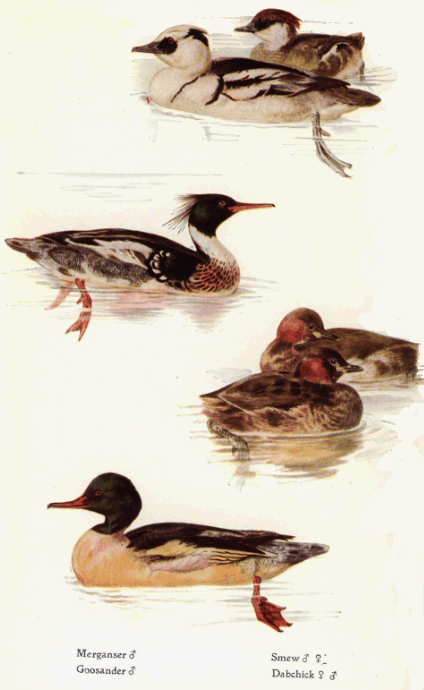
THE GOOSANDER MERGUS MERGANSER
Head and crest greenish black; back black; speculum (not barred with black), under parts, wing-coverts, outer scapulars, and some of the quills, buff; bill red, the ridge and nail black; feet vermilion. Length twenty-four to twenty-eight inches. Female and young—head and crest reddish brown; breast and flanks pale buff; upper plumage dark ash; bill and feet dull red. Eggs dull white.
The Goosander is a regular winter visitor to the shores of Great Britain and Ireland, frequenting bays and estuaries, but preferring fresh-water rivers and lakes, where it makes great havoc among trout and other fish. It is far more abundant in the north than in the south, and, according to Macgillivray, is sometimes seen even in summer in the Scotch lochs. It has been known to breed in the outer Hebrides, and of late years in several parts of the Highlands, but the general summer residence of this species is much farther to the north, both in the eastern and western hemispheres. The habits of the Goosander and Merganser are so much alike that further detail is unnecessary.
The females and young birds of the Goosander and Merganser are popularly called Dun-divers.
THE RED-BREASTED MERGANSER MERGUS SERRATOR
Head, crest, and neck black, with greenish reflections; a white collar round the neck; breast reddish brown, spotted with black; near the insertion of the wing several white spots, edged with black; speculum white, divided by two transverse black bars; back black; belly white, barred on the flanks and rump with wavy grey lines; bill and irides red; feet orange. Length twenty-two inches. Female smaller; head and crest reddish brown; breast mottled with ash and white; upper plumage and flanks deep ash-colour; speculum with one black bar; bill and feet dull orange; irides brown. Eggs whitish ash.
This large and handsome bird is not uncommon in the estuaries and rivers of Great Britain, but is most frequent in the north. It is resident in Scotland and Ireland. The adult male is less frequently seen than females and young males, which closely resemble one another in size and plumage, both being inferior to the first in brilliancy of colouring. Their food consists of fish, especially sand-eels, and, when they find their way into fresh-water lakes and rivers, of eels and trout, which they capture by diving, and retain with ease by the help of their strong bills notched throughout like a saw.
In birds of the first year the tuft of feathers on the head is barely perceptible, and there is but a slight tinge of red on the lower part of the neck. Most of the Mergansers which resort to our shores during winter visit us from high latitudes; but a few remain to breed in the Scotch and Irish lakes, making their nests of dry herbage and moss mixed with down from their own breasts.
The name Merganser, that is, 'Diving Goose', has reference to the size of the bird and its habit of diving for its food. Its flight is strong and rapid, but differs somewhat from that of the Ducks, the neck being not stretched out to its full length, but slightly folded back. After the young are hatched the male deserts the female and leaves her to bring off her brood without assistance.
THE SMEW MERGUS ALBELLUS
Crest, neck, scapulars, smaller wing-coverts, and all the under parts white; cheeks and back of the head greenish black; two crescent-shaped marks advancing from the shoulders on each side to the breast black; tail ash coloured; bill and feet bluish grey, the membranes black; irides brown. Length seventeen inches. Female smaller; head and cheeks reddish brown; under parts white, clouded on the breast, flanks, and rump, with ash-grey; upper plumage and tail greyish black; wings variegated with black, white, and grey. Eggs whitish.
The birds of this genus, though placed among the Anatidæ, or Duck tribe, are so strongly marked by the conformation of the bill that a simple examination of the head alone will enable the student to distinguish either of the species from the true Ducks already described. On the coast of Norfolk the popular name 'Smee Duck' includes several kinds of Ducks, and I presume the present species; but the bill, in the form of an elongated and almost cylindrical cone, with the edges of both mandibles furnished with saw-like teeth pointed backwards, cannot fail to distinguish the genus Mergus.
The Smew, or Smee, properly so called, is a winter visitor with us, more impatient of cold than the Duck-tribe generally, and consequently frequenting the southern more than the northern parts of the island. In open weather it resorts to our rivers and fresh-water lakes, where it feeds on small fish and other aquatic animals, which it obtains by diving. In severe frosts it either flies farther south or repairs to tidal rivers and harbours. Though not a rare bird, it is sparingly distributed. It is found on many of the continental rivers, even those which are far distant from the sea, but is not often killed, as it is shy of being approached, readily takes wing, flies swiftly, and as a diver is most rapid and expert. It is, however, little sought after, for, in spite of its relationship, its strong fishy flavour prevents it from passing muster as a Duck. Of its nesting little or nothing is known. In the north of Devon it is called, according to Montagu, 'Vare Wigeon', from the supposed resemblance of its head to that of a 'vare' or weasel. I have also heard it called the 'Weasel Duck' in Norfolk, and on the south coast the 'Weasel-headed'.
ORDER COLUMBÆ
FAMILY COLUMBIDÆ
THE WOOD PIGEON OR RING DOVE COLUMBA PALUMBUS
Head, cheeks, neck, and upper part of the tail, bluish grey; back and wing-coverts darker; a white crescent-shaped spot on each side of the neck surrounded by scale-like feathers with green and purple reflections; primaries grey towards the base, white in the middle, and dusky towards the extremity, with the outer web white; tail barred with black at the end; abdomen whitish; bill orange, powdered with white at the base; iris light yellow; feet blood-red; claws brown. Length sixteen and a half inches. Eggs pure white.
Two hundred and fifty years ago the taste for keeping different sorts of Pigeons was as strong as it is in the present day, and the popular names of Runts, Croppers, Shakers, Carriers, Jacobins, Turbits, Barbaries, Tumblers, Horsemen, Spots, etc., modern though they may sound, were then applied to the very same varieties which are described under these names in recent Guides to the Poultry-yard. Many of these were of foreign origin, and were known at a remote period in various eastern countries, so that there can be no doubt that the custom of keeping tame Pigeons is of very ancient date.
The Pigeons in some of their habits approach the gallinaceous birds, with which accordingly they are classed. They are furnished with long and powerful wings, by help of which they can sustain a rapid and continuous flight. They seek their food mostly on the ground, but do not scratch with their feet, and are more given to bathe in water than to flutter in a bath of dust, though in this habit also they not unfrequently indulge. They are furnished, moreover, with a large crop, in which the food supplied to their young is partially macerated and reduced to a kind of pulp before the latter are fed. This process is carried on more by the agency of the receiver than of the giver, as the young birds, instead of opening their mouths and allowing the food to be dropped in, help themselves by inserting their bills into the sides of the old bird's mouth. Their mode of drinking differs from that of the true gallinaceous birds; they do not take short sips, lifting the head after every draught, but satisfy their thirst by one continuous immersion of the whole bill. They build their nests of a few sticks, and lay two white eggs.
Some of the foreign species are distinguished by their brilliant plumage. Those inhabiting Britain are unmarked by gaudy tints, but redeemed from plainness by the metallic glossy lustre of their neck feathers.
The Wood Dove, called also Wood Pigeon and Ring Dove, is the largest British species, exceeding in dimensions most varieties of the domestic Pigeon. The summer wanderer through a wood in almost any part of the country can scarcely fail to have been disturbed in his meditations by the sudden flapping of wings of some large bird, which, without uttering any note, dashes through the foliage of a neighbouring tree, and makes off with hurried flight for some distant part of the wood. Seen through the openings of the trees, its predominant tint is blue-grey, but a large patch of white is distinctly perceptible on each wing. It might be mistaken for a hawk, so rapidly does it cleave its way through the air; but birds of prey are too wary to betray their movements by the sound of their wings; they, too, rather launch into the air, than start with a violent clapping of their pinions. A Jay might make a similar noise; but when alarmed it always utters its harsh scream, and, if it comes in sight, may at once be distinguished by the striking contrast of its white and black feathers. The bird just disturbed can scarcely, then, be anything but a Wood Dove, perhaps frightened from its nest, perhaps attending on its mate, or it may have been simply digesting its last meal, or waiting until sent forth by the cravings of hunger in quest of a new one; for the bird, though exemplary as a spouse and parent, has a large crop which is never allowed to remain long empty. The food and habits of Wood Pigeons vary with the season. In spring and summer they are most frequently seen alone or in pairs. They then feed principally on the tender leaves of growing plants, and often commit great ravage in fields of beans and peas. Spring-sown corn is attacked by them both in the grain and the blade, and as soon as young turnips have put forth their second pair of leaves, they, too, come in for their share of devastation. As the season advances, they visit the corn-fields, especially those in the vicinity of their native woods, preferring, above all, those parts where the corn has been laid, and where a neighbouring grove or thicket will afford them a ready retreat if disturbed. They are very partial also to oily seeds of all kinds, and it is said that since colza has been extensively grown in the south of France, Wood Pigeons have become a scourge of agriculture, and that consequently war is waged on them unsparingly. It has been remarked also, that they have become much more abundant in Scotland in consequence of 'the great increase in the cultivation of turnips and clover, which afford them a constant supply of food during winter, and the great increase of fir woods, which are their delight both for roosting and rearing their young'. At the approach of autumn they assemble in small flocks, and resort to oak and beech woods, especially the last, where acorns and beech-mast, swallowed whole, afford them an abundant and generous diet. They are now in great demand for the table, but, being very cautious and shy, are difficult of approach. A good many, however, are shot by men and boys, who discover beforehand in what particular trees they roost, and, lying in ambush to await their arrival, fire at them as they drop in in small parties. In winter, the small flocks unite and form large ones. So large, indeed, are these sometimes in severe seasons, that it is fair to suppose that their numbers are considerably augmented by subsidies from colder climates, driven southwards perhaps by scarcity of food. In districts abounding in oak and beech woods, they find abundance of food during the greater part of the winter; but when this supply is exhausted, or the ground is covered with snow, they repair once more to the turnip-fields, and feed on the green leaves. Hunger, however, does not rob them of their shyness, nor make them confiding; for let a human figure appear in ever so large a field where a flock is feeding, the alarm is at once caught and communicated to the whole party, who lose no time in displaying the white bar on the wing, and are soon beyond the reach of fowler and gun.
Among the first woodland sounds of spring and the last of autumn is the note of the Ring Dove, often continued for a long time together, always monotonous, but never wearisome. It is generally considered to be tinged with melancholy, and on this account the bird itself is supposed to have been named the Queest or Cushat
Deep toned
The Cushat plains; nor is her changeless plaint
Unmusical, when with the general quire
Of woodland harmony it softly blends.
Grahame.
Wordsworth celebrates it under a name generally given to the next species:
I heard a Stock Dove sing or say
His homely tale, this very day;
His voice was buried among trees,
Yet to be come at by the breeze.
It did not cease; but cooed and cooed,
And somewhat pensively he wooed;
He sang of love with quiet blending.
Slow to begin, and never ending;
Of sorrows, faith, and inward glee;
That was the song, the song for me.
And again, still more happily:
Over his own sweet voice the Stock Dove broods.
The note may be imitated by attempting to whistle, in a very deep tone, the syllables 'cooe-coo-roo-o-o-o'; or still more closely by clasping the hands together, so as to form a hollow, open only between the second joints of the thumbs, and blowing the same words over the orifice. With a little practise so close an imitation may be produced, that a genuine cooer may be beguiled into giving an answer. I may add, too, that with the same natural instrument and with a greater expenditure of breath the hoot of the Owl may be imitated; with a gentler effort and a quiver of the tongue the coo of the Turtle Dove may be nearly approached.
The Wood Dove has never been considered to be the origin of the domestic Pigeon, nor will it breed in captivity. There is no difficulty, however, in rearing birds taken young from the nest; and birds so brought up will alight with perfect confidence on the person of their foster nurse, and feed from his hand or mouth. The nest of the Wood Dove is an unsubstantial structure, composed of sticks so loosely put together that the eggs or young birds are sometimes visible from below. It is placed in a fork or among the branches of a tree; a thick fir is preferred; but nests are to be met with in ivy and thorn bushes either in a wood, coppice, or, more rarely, in a hedge-row. The number of eggs is always two. The male bird assists in the office of incubation.
THE STOCK DOVE COLUMBA ŒNAS
Head, throat, wings, and lower parts, bluish grey; the lower parts of the neck with metallic reflections, no white spots; breast wine-red; a black spot on the two last secondaries and some of the wing-coverts; primaries grey at the base, passing into dusky; tail grey barred with black at the extremity, the outer feather with a white spot on the outer web near the base; irides reddish brown; bill yellow, red at the base; feet red; claws dusky. Length twelve and a half inches. Eggs white.
The Stock Dove is by some persons supposed to be so called from its having been believed at one time to be the origin of the domestic Pigeon; but as it bore the name before the above question was mooted, it is more reasonable to suppose that it derived its name from its habit of nestling in the stocks of trees, and not on the branches like the Ring Dove, nor in caves like the Rock Dove. Ray and Willughby, who treat the domestic Dove as a distinct species, gave it the name of Œnas (from the Greek oinos, wine), and Vinago (from the Latin vinum), from the purpled or wine-red hue of its breast and wings. Temminck does not hesitate to identify the domestic Pigeon with the Rock Dove, without even hinting the possibility of its having derived its origin from the Stock Dove. Since, therefore, the two birds have no marked resemblance, it may be reasonably supposed that the relationship between them rests solely on the narrow foundation that there exists a wild Pigeon, popularly called a Stock Dove, and that the word 'stock' has among other meanings that of 'parentage' or 'origin'. Thus the name gave rise to a theory which, having a plausible show, was hastily assumed, and was then employed to prove a fact which will not bear the test of examination. The Stock Dove in its habits closely resembles the Ring Dove, from which it cannot easily be distinguished at a distance. When tolerably near, a sharp eye can detect the absence of the white patch on the wings and of the ring round the neck. Its flight is more rapid, and it rarely perches on a slender bough, preferring to alight on a main branch or stump. Its note is softer, and approaches that of the tame Pigeon. But the great mark of distinction is that on which I have supposed its name to be founded; that it does not build its nest among the branches of trees, but in the side of a stump, or other locality, where no one would even think of looking for a Ring Dove's nest. Yarrell states that 'in the open counties of Norfolk and Suffolk, this species frequently makes its nest in holes in the ground, generally selecting a rabbit's burrow'. It has greatly increased in the south of England of late, and it nests along the Moray and Dornock Firths. White, who had never seen its nest, says that it used to be abundant at Selborne 'from November to February'. Yarrell saw two old birds exposed for sale with Ring Doves, in London, on January 4. It resorts in spring to the neighbourhood in which it was bred, as a convenient place for rearing its own young, and at the end of summer repairs to woods and groves better adapted for supplying it with its favourite food, acorns and beech-mast. There it flocks together with Ring Doves, vast numbers of which assemble in winter in some districts, and when the fowler plies his occupation, shares their fate. It is, however, by no means so common a bird as the Ring Dove at any season, nor is it so generally distributed. In the North it is certainly only a summer visitor; and, on the other hand, it is most abundant in the south of Europe and in Africa during winter.
THE ROCK DOVE COLUMBA LIVIA
Plumage bluish ash, lighter on the wings; rump white; neck and breast lustrous with green and purple reflections, without a white spot; two transverse black bands on the wings; primaries and tail tipped with black; rump white; outer tail-feather white on the outer web; irides pale orange; bill black; feet red. Length twelve and a half inches. Eggs white.
The Rock Dove, though a bird of extensive range, is less generally known in its natural condition than either of the other British species. As its name imports, its favourite place of resort is the rocky coast; but this it frequents, not because it has any predilection for the sea-shore and its productions, but that its instincts teach it to make lofty rocks its stronghold, just as the natural impulse of the Ring Dove is to find safety in the forests. If this species is the original of all the numerous varieties of tame Pigeon, it must inhabit most countries of the eastern hemisphere; for a pigeon-fancier's dove-cot, to be complete, must contain several sorts which were first brought from remote regions; and we know that in Egypt, Phœnicia, and Persia, Pigeons had a mythological importance at an early date. It is said that the Pigeons which have established themselves in various public buildings of continental cities, as Saint Mark at Venice, and Pont Neuf at Paris, are exclusively Rock Pigeons; and I have seen it stated that they frequent the towers of Canterbury Cathedral; but it is possible that these may be in all cases derived from tame birds escaped from domestication, and resuming, to a certain extent, their wild habits and original plumage. That they resort to ruinous edifices near the sea in retired districts is beyond question, as I have seen them flying about and alighting on the walls of an old castle in the island of Kerrera, near Oban, in the Western Highlands, indifferent, seemingly, whether they nestled in the lofty cliffs on the mainland, where they are numerous, or on the equally secure ruins of masonry in the opposite island. That they are truly wild here there can be no doubt. Indeed, the precipitous shores of Scotland, the Hebrides, and Orkneys, afford them exactly the kind of retreat that suits their habits; and here among inaccessible rocks they build their nests and on their return from their inland marauding expeditions, pass their nights. Their attitudes, mode of flight, progression when on the ground, note, and manner of feeding, are the same as those of the common tame Pigeon; and, as might be expected, both wild and tame birds agree in declining to perch on trees.
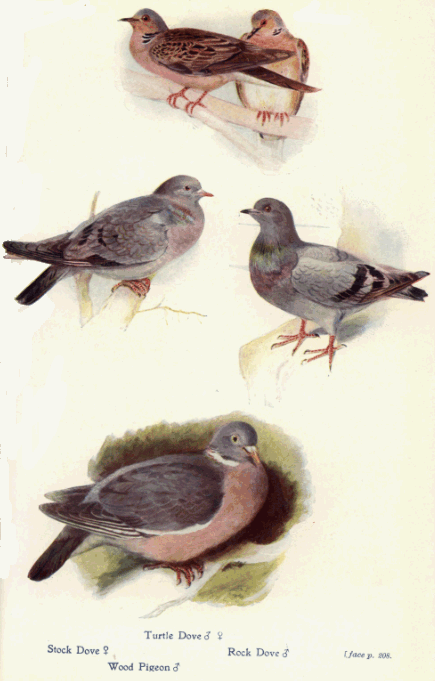
Macgillivray, who had opportunities of watching them in their native haunts at all seasons, informs us that they leave their caves in the crags at early dawn, and, proceeding along the shore, unite with other parties on their way till they reach the cultivated grounds, where they settle in large flocks, diligently seeking for grains of barley and oats, seeds of wild mustard and other weeds, picking up also the small snails[38] which abound in sandy pastures near the sea. In summer they make frequent short visits of this kind, returning at intervals to feed their young. In winter they form much larger flocks, and, making the best use of their short day, feed more intently, thus holding out a temptation to the fowler, who, if sufficiently wary, can sometimes approach near enough to kill a large number at a shot. They are supposed to pair for life; and this, I believe, is generally the case with tame Pigeons. They lay two eggs, and sit for three weeks. The male and the female sit, alternately relieving each other. They breed twice a year, but the number of eggs never exceeds two. Hence the old Scottish saying, 'a doo's cleckin', for a family of only two children—a boy and a girl. They may be distinguished from the other common species while flying, by showing a large patch of white between the back and the tail.
THE TURTLE DOVE TURTUR COMMÚNIS
Head and nape ash, tinged with wine-red; a space on the sides of the neck composed of black feathers tipped with white; neck and breast pale wine-red; back ash-brown; primaries dusky; secondaries bluish ash; scapulars and wing-coverts rust-red with a black spot in the centre of each feather; abdomen and lower tail-coverts white; tail dusky, all but the two middle feathers tipped with white, the outer feather edged with white externally; irides yellowish red; feet red; bill brown. Eggs white.
Nearly three thousand years ago the Turtle Dove had the distinction of being enumerated among the pleasant things of spring:
'Lo, the winter Is past, the rain is over and gone; the flowers appear on the earth; the time of the singing of birds is come, and the voice of the Turtle is heard in our land.'[39] Less sweetly, but to the same effect, sings a poet of the last century:
The cuckoo calls aloud his wand'ring love.
The Turtle's moan is heard in ev'ry grove;
The pastures change, the warbling linnets sing.
Prepare to welcome in the gaudy spring!
Philips.
There is no melody in the song of the Turtle, as it consists of a single note, a soft, sweet, agitated murmur, continued without pause for a long time, called a 'moan' [2] both by Latin and English poets, not from its being suggestive of pain, but because there is no other word which describes it so nearly. I have already had occasion to remark how unsatisfactory are most of the attempts which have been made to represent the songs of birds by combinations of letters, but the Latin name of the Turtle-dove, Turtur, is a notable exception. Pronounced 'tur-r-r tur-r-r', it will instantly recall the note to any one who has once heard it. The French name also, Tourterelle, can belong to this bird alone.
The Turtle Dove is found in all the southern countries of Europe, in Palestine, and many other parts of Asia, including the islands south of China. In England it is a visitor in the southern and midland counties only, arriving in spring and remaining with us until the end of September. Its favourite places of resort are groves, belts of trees, and tall hedgerows in cultivated districts. Here it builds its unsubstantial nest of a few sticks, and lays two eggs. Its food consists of seeds of various kinds, and it has the discredit of resorting to fields of green wheat for the sake of feeding on the milky grain. I am doubtful whether this charge can be sustained. Often enough when walking through a cornfield one may see two or three Turtle Doves rise suddenly from the thick corn with a rustle and low cry of alarm, rapidly dart away in the direction of the nearest grove, disappearing in the shade, all but a white segment of a circle, formed by the tips of their tail-feathers; but on examining the spot from which they rose, I have been unable to detect any ears of corn rifled of their contents, though the ground was thickly matted with weeds, which might have furnished them food. I am informed by a young friend that he has often shot them while in the act of rising from such situations and has invariably found their crops distended with the green seed-vessels of a weed common in corn-fields, the corn-spurrey (Spérgula arvensis). This being the case, the Turtle Dove is more a friend than an enemy to the farmer, even if it sometimes regales on ripe grain or interferes with the occupation of the gleaner. It is also very partial to vetches. I have met with an instance where a Turtle Dove paid daily visits to one particular spot, under a hedge in a field, and though fired at by the owner of the field many times, under the idea that it was a rare bird, it soon returned; and when at last shot, its crop was found to be full of vetch seeds which had been accidentally spilled from a bag.
The Turtle Dove is smaller than any of the other British Doves. When flying, it seems scarcely larger than a Missel Thrush; but it is more slender in shape, and its wings are much longer. It beats its wings, too, more rapidly, and moves through the air with greater velocity. The tints of its plumage are more varied than in the other British species, but far inferior in brilliancy to many foreign ones.
The Turtle Dove so frequently kept in a cage is the Collared Turtle Dove (Columba risoria), a native of India and China. This species is distinguished by a black crescent on the back of the neck, the horns of which nearly meet in front. Turtle Doves are much kept in Germany, owing to a strange popular superstition that they are more predisposed than the human species to nervous disorders and rheumatism, and that when any of these complaints visit a house, they fall on the birds rather than on their owners.
ORDER PTEROCLETES
FAMILY PTEROCLIDÆ
THE THREE-TOED SAND-GROUSE
Legs and toes feathered to the claws; no hind toe. Length sixteen to twenty inches.
This species was not known with us till 1859. Great flights visited this country in 1863, in 1888, and in 1889 when a few pair bred here.
ORDER GALLINÆ
FAMILY TETRAONIDÆ
THE CAPERCAILLIE TETRÁO UROGÁLLUS
Feathers of the throat elongated, black; head and neck dusky; eyes with a bare red skin above and a white spot below; wings brown speckled with black; breast lustrous green; abdomen black with white spots; rump and flanks marked with undulating lines of black and ash colour; tail black with white spots; beak horn white; eyebrows naked, red, beneath the eye a white spot. Length thirty-six inches. Female—a third smaller, barred and spotted with tawny red, black, and white; throat tawny red, unspotted; breast deep red; tail dark red with black bars, white at the tip; bill dusky. Eggs dull yellowish white speckled with yellowish brown.
The Capercaillie, Wood Grouse, or Cock of the Woods, was a rare bird in Scotland in Pennant's time (1769), and was found only in the Highlands north of Inverness. It became extinct in the eighteenth century, but was re-introduced in 1837 in Scotland, and it is now common in firwoods there, especially in Perthshire. In the pine forests of Sweden and Norway it is still indigenous, but, being a large and beautiful bird, is much sought after, and is annually receding from the haunts of men. It is also found in some of the central countries of Europe, as Poland and the Jura mountains, where it is said to be rather common. It is not only an inhabitant of woods, but passes its time for the most part in trees, and feeds in great measure on the young shoots of the Scotch fir. In summer it adds to its dietary berries, seeds, and insects, for which it searches among bushes or on the ground, returning to the woods to roost. The male bird has obtained great celebrity for his marvellous performances when serenading the hens during the morning and evening twilight in spring. "During his play, the neck of the Capercaillie is stretched out, his tail is raised and spread like a fan, his wings droop, his feathers are ruffled up, and, in short, he much resembles in appearance an angry Turkey Cock. He begins his play with a call something resembling the words peller, peller, peller; these sounds he repeats at first at some little intervals, but, as he proceeds, they increase in rapidity, until, at last, and after perhaps the lapse of a moment or so, he makes a sort of gulp in his throat, and finishes by drawing in his breath. During the continuance of this latter process, which only lasts a few seconds, the head of the Capercaillie is thrown up, his eyes are partially closed, and his whole appearance would denote that he is worked up into an agony of passion." This performance, however attractive it may De to those for whose benefit it is intended, exercises a fascination over himself which is often dangerous; for the sportsman, well acquainted with the sound, is thus guided to his perch, and, shy though the bird is at other times, is able to get near him unperceived or unheeded, and summarily closes his performances. The Capercaillie hen makes her nest upon the ground, and lays from six to twelve eggs. She is said to sit for four weeks. The young keep with her until towards the approach of winter. The size of the full-grown bird varies considerably according to the latitude in which it is found. In Lapland the male weighs about nine or ten pounds, but in the southern provinces of Sweden as much as seventeen pounds. The hen usually weighs from five to six pounds.
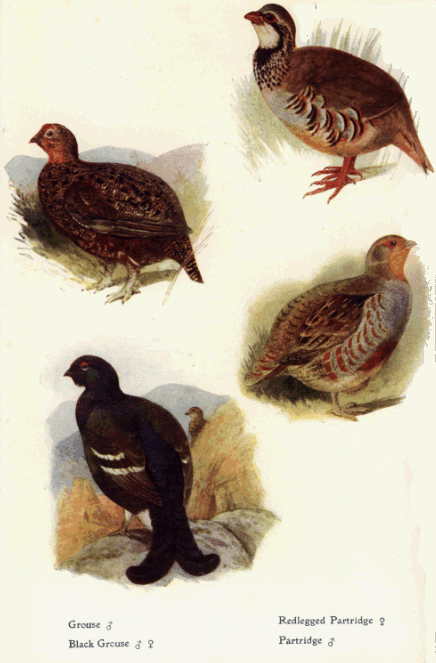
THE BLACK GROUSE TETRÁO TÉTRIX
Throat-feathers not elongated; plumage black with violet reflections; a broad white band on the wings; secondaries tipped with white; lower tail-coverts white; tail much forked, the outer feathers curved outwards. Eyebrows naked, vermilion; beneath the eye a white spot. Length twenty-three inches. Female—smaller; head and neck rust-red barred with black; rump and tail-feathers black barred with red; belly dusky brown with red and whitish bars; tail slightly forked. Eggs dull yellow spotted and speckled with reddish brown.
The Black Grouse is a native of the northern countries of Europe and of the mountainous districts of the central part of the Continent. In the south it is unknown. Of a hardier nature than the Pheasant, and less fastidious in its dietary, it braves the most inclement seasons, and is never stinted in its supply of food. Moreover, as it rarely wanders far from its heath-clad home, it would probably, if it enjoyed the privilege of insignificance, be abundant in all the extensive waste lands of Britain. But its large size, the excellent flavour of its flesh, and the excitement of the sport which it affords all tend to keep down its numbers, so that a moor well stocked with Black Grouse is a possession not to be thought lightly of by the highest and wealthiest. The male bird is, in sporting phraseology, a Black Cock, the female a Grey Hen; and it is the etiquette of the field to shoot Cocks only, the Hens being left for breeding. The Black Cock resembles, in one of its most striking peculiarities, its near relative, the Capercaillie. 'During the spring', says Mr. St. John, 'and also in the autumn, about the time the first hoar frosts are felt, I have often watched the Black Cocks in the early morning when they collect on some rock or height, and strut and crow with their curious note, not unlike that of a Wood Pigeon. On these occasions they often have most desperate battles. I have seen five or six Black Cocks all fighting at once; and so violent and eager were they, that I approached within a few yards before they rose. Usually there seems to be a master-bird in these assemblages, who takes up his position on the most elevated spot, crowing and strutting round and round with spread-out tail like a Turkey Cock, and his wings trailing on the ground. The hens remain quietly near him, whilst the smaller or younger male birds keep at a respectful distance, neither daring to crow, except in a subdued kind of voice, nor to approach. If they attempt the latter, the master-bird dashes at the intruder, and often a short melée ensues, several others joining in it, but they soon return to their former respectful distance. I have also seen an old Black Cock crowing on a birch-tree with a dozen hens below it, and the younger Cocks looking on with fear and admiration. It is at these times that numbers fall to the share of the poacher, who knows that the birds resort to the same spot every morning.'
The food of these birds is abundant in quantity, and though simple, yet partakes of an extensive assortment of flavours. Twigs of the fine-leaved heath (Erica cinerea), and heather (Calluna); buds of the willow and birch; the tender shoots of cotton-grass, sedge, and grass; and whortleberries, cranberries, and crowberries, are the principal items of their bill of fare, varied according to the season. In the months of February, March and April, they do much mischief to plantations by destroying the tender shoots of Scotch and Silver Fir. 'In searching for food, the Black Grouse frequents the lower grounds of the less-cultivated districts, not generally removing far from the shelter of woods or thickets, to which it betakes itself as occasion requires. It sometimes makes an excursion into the stubble-fields in search of the seeds of cereal plants, and in summer and autumn includes those of the grasses and rushes. While thus employed, it walks and runs among the herbage with considerable agility, and, when apprehensive of danger, flies off to a sheltered place, or settles down and remains motionless until the intruder passes by. It perches adroitly, and walks securely on the branches; but its ordinary station is on the ground, where also it reposes at night. It may often, especially in spring, be seen on the turf-top of the low walls inclosing plantations. Its flight is heavy, direct, and of moderate velocity, and is capable of being protracted to a great distance.'[41]
The Grey Hen constructs a rude nest of withered grass and a few twigs in the shelter of some low bush, and lays from five to ten eggs. The male bird takes no part in the bringing up of the brood, but leaves the duties of incubation and attention to the wants of his family to the hen, who devotes herself wholly to the careful nurture of her little ones. While the poults are in their nonage, she assiduously leads them about where food is most abundant; and if surprised by an intruder, leaves them to hide among the heath and ferns, creeps rapidly herself to some distance, and then rises in a fluttering manner, so that a stranger to her habits would suppose her to be wounded. By August 20, the young are supposed to be fully fledged, and the sportsman is expected not only to show his skill as a marksman, but his quickness of eye in discriminating between males and females as the covey rises. The former are to be distinguished by their richer colouring, and by the more strongly marked white on the wings. At this season the old Black Cocks club together.
The Black Cock is found in greater or less quantities in the moorland districts of many of the English counties, but is most abundant in the north of England and Wales, and in Scotland.
THE RED GROUSE LAGÓPUS SCÓTICUS
Plumage chestnut brown, marked on the back with black spots and beneath with black lines; a fringe of small white feathers round the eyes, and a white spot at the base of the lower mandible; a crimson fringed band above the eyes; some of the feathers of the abdomen tipped with white; tail of sixteen feathers, the four middle ones chestnut with black bars, the rest dusky; feet and toes covered thickly with grey hair-like feathers. Female—the red eye-lid less conspicuous; colours not so dark and tinged with reddish yellow, the black spots and lines more numerous. Length sixteen inches. Eggs reddish ash colour, nearly covered with blotches and spots of deep red-brown.
The diminution of the number of Pheasants in France, owing to a relaxation of the efforts formerly made to protect them, and the abundance of the same birds, in those parts of England where unceasing care is taken of them in severe or protracted winters, tend to prove the great difficulty of preserving a foreign bird in a country which is not in every respect adapted to its habits and constitution. On the other hand, the undiminished abundance of Red Grouse in Great Britain, in spite of the absence of all artificial protection, and notwithstanding the vast quantity which annually fall a prey to vermin, poachers, and sportsmen, proves as satisfactorily that where a bird has become abundant, in a country in all respects suited to its constitution and producing an inexhaustible supply of its natural food, it is impossible to extirpate it. If we ever had occasion to adopt a bird as a national emblem, the choice might for one reason fall on the Red Grouse. It is a native of the British Isles, and is found in no other country. On the moors of Scotland, the hilly parts of the north of England, the mountains of Wales, and the wastes of Ireland, it is as wild and free as the Gull on the sea-cliff. It frequents extensive heaths where man could not protect it if he would, and finds no stint of food where few living things can exist but insects and some of the larger rapacious animals which make it their special prey. Eagles, Falcons, Buzzards, Crows, Foxes, Martins, and Polecats, all wage against it incessant war; it is wholly without armour, offensive or defensive; yet its numbers are undiminished. And we may confidently say that, as long as there are large tracts of land in Great Britain unreclaimed, there will be Grouse.
Red Grouse must, occasionally, fall in the way of the wanderer over the Scottish moors, whatever may be the object of his rambles; but a sportsman alone is privileged to make the bird his study at all seasons. My sketch, therefore, of the Grouse is to be considered as taken, not from the limited observation which I have been enabled to make, when I have chanced to start a bird on the hills of Westmoreland or the Highlands, but to be compiled from the notes of others who have had more ample means of observing its habits.
"The Brown Ptarmigan, generally known by the name of Red Grouse, as compared with the Black Grouse, is met with in Scotland on all kinds of surface, provided it be covered with heath, whether Calluna vulgaris (Ling) or Erica cinerea (Common Purple Heath), from the level of the sea to the height of about two thousand feet. The low sandy heaths of the eastern counties of the middle division appear to be less favourable to it than the more moist peaty tracts of the western and northern districts, where the shrubs on which it feeds attain a great size."
Its food appears to be much the same as that of the Black Grouse, to which it is similar in many of its habits; but it never perches on trees. It has, moreover, a decided predilection for the national grain of Scotland. Hence the cultivation of small tracts of land with oats in the neighbourhood of moors where it abounds is an unprofitable labour.
Its name, Lagópus (Hare-footed), is equally appropriate as descriptive of its thickly-clothed foot and its fleetness as a runner; by some French ornithologists it is enumerated among Velocipedes, for the latter reason. On ordinary occasions it does not fly much, but keeps concealed among the heath, seldom choosing to rise unless its enemy comes very near. Red Grouse pair early in the season, and build their nests generally on the borders between heath and lea ground, with a view to providing their young with an open nursery-ground, on which to learn the use of their legs, as well as a safe retreat on the approach of danger. The nest is loosely constructed of straws and twigs which may chance to lie about near the selected spot. The number of eggs is usually eight to ten; the hen sits very closely, allowing the shepherd almost to trample on her before she springs. The period of hatching is a perilous one for the chicks, for, as they break the shell, they utter a small but shrill chirp—a certain signal to some watchful Hooded Crow that a prey is at hand; he traces up the sound, drives the mother from her nest, and destroys the whole brood.
Once fairly hatched, the danger decreases; the young birds, while still quite small, show great readiness in concealing themselves. When disturbed they separate in all directions, crouch on the ground, squeeze between objects that seem to defy all passage, work their way through the cover, or, if they fancy that an eye is fixed on them, lie as motionless as stones. When so far grown as to be able to fly, they still prefer the shelter afforded by the cover; but if hard pressed the old cock usually rises first, with a cry which some compare to the quack of a Duck. The hen and young birds show no hurry in following his example, but take wing singly, and at unequal intervals—not like Partridges, which always rise in a covey. This is the period when they afford the easiest shot to the sportsman, who often puts them up almost beneath his feet, or under the very nose of his dogs. Later in the season a great change takes place, and this, it is said, whether the birds have been much harassed or not. Become cautious and wild, they no longer trust to concealment or swiftness of foot, but, discovering from a great distance the approach of danger, they rise most frequently out of shot, so that it requires skill and patience to get near them. A slight and early snow sometimes makes it more easy to approach them, at least for a few hours; but ordinarily, not even extreme cold, or a covering of snow a foot thick, appears to tame them at all. Under such circumstances, they collect in enormous 'packs', and betake themselves to some particular part of the moor from which the snow has been more or less drifted. These packs keep together during winter, and at the beginning of spring separate and pair, not, however, without some previous altercations; but these are soon over, and they lose much of their shyness, venturing close to the roads, and being little disturbed by the passage of the traveller.
THE PTARMIGAN LAGOPUS MÚTUS
Winter plumage—pure white, a black line from the angle of the beak through the eye; outer tail-feathers black; above the eyes a scarlet fringed membrane; bill and claws black; tarsi and toes thickly clothed with woolly feathers. Female—without the black line through the eyes. Summer plumage—wings, under tail-coverts, two middle tail-feathers, and legs white; outer tail-feathers black, some of them tipped with white; rest of plumage ash-brown, marked with black lines and dusky spots. Length fifteen inches. Eggs reddish yellow, spotted and speckled with deep reddish brown.
This beautiful bird is the Schneehuhn, 'Snow-chick', of the Germans, the White Partridge of the Alps and Pyrenees, and the Gaelic Tarmachan. Whilst most birds shrink from cold, the Ptarmigan, on the contrary, seems to revel in it, and to fear nothing so much as the beams of the sun. Not even when the valleys rejoice in the livery of spring does it desert the snowy regions altogether, and, when the mist-wreaths clear away, it avoids the rays of the sun by seeking the shady sides of the mountains. Only when the northern regions or lofty mountains are so thickly covered with snow as to threaten it with starvation does it repair to districts where the cold is somewhat mitigated, but never lower into the valleys than where it may quench its thirst with snow. 'The male bird', says a field naturalist, 'has been seen, during a snow-storm in Norway, to perch himself on a rock which overtopped the rest, and to sit there for some time as if enjoying the cold wind and sleet, which was drifting in his face; just as one might have done on a sultry summer's day on the top of the Wiltshire downs, when a cool air was stirring there.'[42] The same writer observes: 'I have generally found the Ptarmigan concealed among the grey, lichen-coloured rocks on the summits of the fjelds, and so closely do they resemble these rocks in colour that I could scarcely ever see them on the ground; and sometimes when the practised eye of my guide found them, and he would point out the exact spot, it was not until after a long scrutiny that I could distinguish the bird within a dozen yards of me. Frequently we would find them on the snow itself, and many a time has a large circular depression in the snow been pointed out to me, where the Ptarmigan has been lying and pluming himself in his chilly bed. He is a noble bird, free as air, and for the most part uninterrupted in his wide domain; he can range over the enormous tracts of fjeld, seldom roused by a human step, and still more seldom hunted by man. When the winter clothes his dwelling in a garb of snow, he arrays himself in the purest and most beautiful white; when the summer sun melts away the snow, and the grey rocks appear, he, too, puts on his coloured dress, and assimilates himself once more to his beloved rocks. But the young Ptarmigans are my especial favourites: I have caught them of all ages; some apparently just emerged from the egg, others some weeks older; they are remarkably pretty little birds, with their short black beaks and their feathered toes; and so quickly do they run, and so nimble and active are they in escaping from you, that they are soon beneath some projecting stone, far beyond the reach of your arm, where you hear them chirping and calling out in defiance and derision. The call of the old Ptarmigan is singularly loud and hoarse; it is a prolonged grating, harsh note, and may be heard at a great distance.' This has been compared to the scream of the Missel Thrush; but Macgillivray says it seems to him more like the croak of a frog.
Ptarmigans pair early in spring, and build their nest of grass, bents and twigs in a slight hollow behind a stone or bush, and lay from seven to twelve eggs. The young are able to run about as soon as they are hatched, and, as we have seen, are most expert and nimble in concealing themselves. The hen bird when surprised with her young brood counterfeits lameness, and runs about in great anxiety, as if wishing to draw attention from her chicks to herself. Their food consists of the fresh green twigs of heath and other mountain plants, seeds, and berries. While feeding they run about, and are shy in taking flight even when they have acquired the use of their wings, but crouch on the approach of danger, and remain motionless and silent. When at length they do rise, they fly off in a loose party, and mostly in a direct line, for a distant part of the mountain, the movement of their wings resembling that of the Grouse, but being lighter in character. Early in the season, a long time before Grouse, the coveys of Ptarmigans unite and form large packs, and it is while thus congregated that they perform their partial migrations from the high grounds to what they consider a milder climate, the Norwegian valleys. There, while the ground is covered thickly with snow, they, to a certain extent, modify their habits, and perch on trees, sometimes in such numbers that the branches seem to be altogether clothed in white. It does not appear that any of these flocks make long journeys or cross the sea. In Scotland they are no more numerous in winter than in summer, nor have they been observed to take refuge in the woods. In the comparatively mild temperature of Scotland there occurs no lengthened period during which they cannot find their simple food somewhere in the open country; they consequently do not leave the moors, but only descend lower.
The Ptarmigan is neither so abundant nor so generally diffused in Scotland as the Grouse. It is resident on high mountains. It is said to have existed at one time in the north of England and in Wales; if so, it has totally disappeared, nor is it known in Ireland.
FAMILY PHASIANIDÆ
THE PHEASANT PHASIÁNUS COLCHICUS
Head and neck glossy, with metallic reflections of green, blue, and purple; sides of the head bare, scarlet, minutely speckled with black; general plumage spotted and banded with orange-red, purple, brown, yellow, green, and black, either positive or reflected; tail very long, of eighteen feathers, the middle ones longest. Female—light brown, marked with dusky; sides of the head feathered; tail much shorter. Length three feet. Eggs olive-brown.
This climate suits the Pheasant pretty well, and at most seasons of the year it finds abundance of food; but in hard winters the supply diminishes, or fails altogether; and were not food specially scattered about for it in its haunts, it would either die off from being unable to withstand cold and hunger together, or become so weak that it would fall a prey to the smaller rapacious animals, who are not a match for it when it is strong and active. A healthy cock Pheasant has been known to beat off a cat; a sickly one would be unable to compete with a Magpie or Jay. It is, in fact, an exotic running wild, and enabled to do so only by the care of those who help it to surmount the inconveniences of a life spent in a foreign land.
The Pheasant is said to have been brought originally from Colchis, a country on the shores of the Black Sea, and to have derived its name from the river Phasis, the famous scene of the expedition of the Argonauts, bearing date about 1200 years before Christ. From this epoch it is said to have been known to the Athenians, who endeavoured to acclimatize it for the sake of its beauty as well as the delicacy of its flesh. The Romans received it from the Greeks; but it was little known, except by name, in Germany, France, and England, until the Crusades. The custom was then introduced from Constantinople of sending it to table decorated with its tail feathers and head, as a dish for kings and emperors—a special honour until that time confined to the Peacock. Willughby, in the seventeenth century, says of it that, from its rarity, delicacy of flavour, and great tenderness, it seems to have been created for the tables of the wealthy. He tells us, too, that the flesh of Pheasants caught by hawking is of a higher flavour, and yet more delicate than when they are taken by snares or any other method.
The kings of France greatly encouraged the naturalization of the Pheasants in the royal forests, both as an object of sport and as an acquisition to the festive board, and were imitated by the nobles and superior clergy. In the fourteenth century, all the royal forests, the parks of Berry and the Loire, all the woods and vineyards of the rich abbeys, were peopled with Pheasants. The male bird was protected by the title of 'Royal game of the first class', and the killing of a hen was forbidden under the severest penalties. During the period between the reigns of Henry IV and Louis XVI its estimation increased. During the revolution royal edicts were little heeded. Pheasants, no less than their owners, forfeited their dignity, which, however, rose again somewhat under the empire. Waterloo, and succeeding events, brought desolation to the Pheasantries as well as to the deer-parks of France; and now the royal bird, French authors tell us, is likely to disappear from the country. Already, the space which it occupies is reduced to a thirtieth part of the national territory. The centre of this privileged province is Paris; its radius is not more than five-and-twenty leagues, and is decreasing every year. Pheasants have disappeared from the districts of the Garonne and Rhone, while in Touraine and Berry a few only are to be found in walled parks.
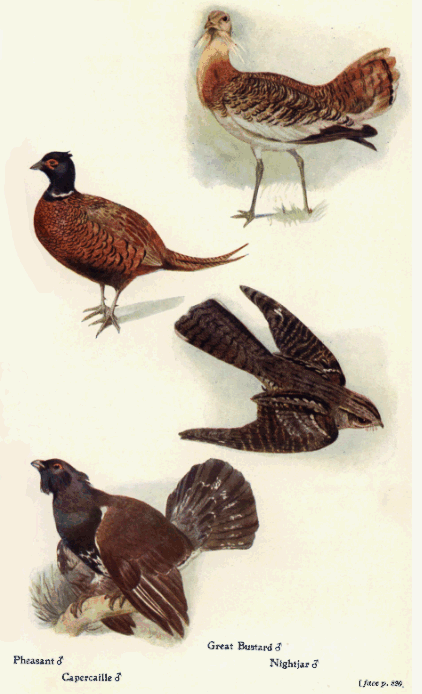
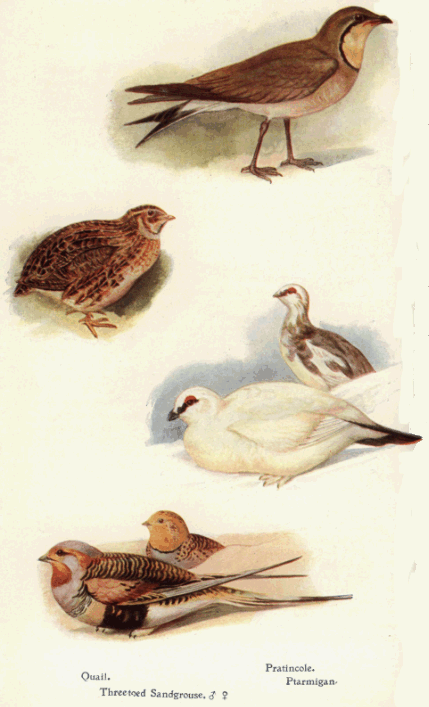
If the Pheasant should ever, in this country, lose the protection of the Game Laws, it will probably dwindle away in like manner. Under existing circumstances, it offers an inducement to poaching too tempting to be resisted. Gamekeepers engage in more affrays with poachers of Pheasants than of all the other game birds taken collectively; and if the offence of destroying them were made less penal than it is at present, they would doubtless diminish rapidly. Next to Wood Pigeons, they are said to be the most destructive of all British birds; so that farmers would gladly do their utmost to exterminate them; their large size and steady onward flight combine to make them an 'easy shot' for the veriest tyro in gunnery, while the estimation in which they are held for the table would always secure for them a value in the market.
The places best adapted for Pheasants are thick woods in the neighbourhood of water, where there is abundance of shelter on the ground, in the shape of furze-bushes, brambles, tall weeds, rushes, or tussock grass; for they pass their lives almost exclusively on the ground, even roosting there, except in winter, when they fly up in the evening, and perch on the lower boughs of middling-sized trees. In April or May, the female bird scratches for herself a shallow hole in the ground under the shelter of some bushes or long grass, and lays from ten to fourteen eggs; but not unfrequently she allows might to prevail over right, and appropriates both the nest and eggs belonging to some evicted Partridge. The situation of the nests is generally known to the keepers, and all that are considered safe are left to be attended to by the owner. Such, however, as are exposed to the depredations of vermin or poachers are more frequently taken, and the eggs are placed under a domestic hen.
Pheasant chicks are able to run about and pick up their own food soon after they have escaped from the egg. This consists of grain, seeds, an enormous quantity of wireworms, small insects, especially ants and their eggs, and green herbage. When full grown, they add to this diet beans, peas, acorns, beech-mast, and the tuberous roots of several wild plants. A strip of buck-wheat, of which they are very fond, is sometimes sown for their special benefit along the skirt of a plantation. In seasons of scarcity they will enter the farmyard, and either quietly feed with the poultry, or, less frequently, do battle with the cocks for the sovereignty. A story is told, in the Zoologist, of a male Pheasant, which drove from their perch, and killed in succession, three fine cocks. The proprietor, with a view to prevent further loss, furnished a fourth cock with a pair of steel spurs. Armed with these, the lawful occupant was more than a match for the aggressor, who, next morning, was found lying dead on the ground beneath the perch. Another has been known to beat off a cat; and a third was in the habit of attacking a labouring man. The female is a timid, unoffending bird, as peaceful in her demeanour as quiet in her garb. The tints of her plumage, far less gaudy than in the male, are a protection to her in the nesting season, as being less likely to attract the notice either of poachers or vermin. Indeed, were she always to lie close, her nest would not be easily discovered, for the colour of her feathers so closely resembles that of withered leaves, that she is, when sitting, less conspicuous than her uncovered eggs would be.