Front matter (continued 5)
Reading edition
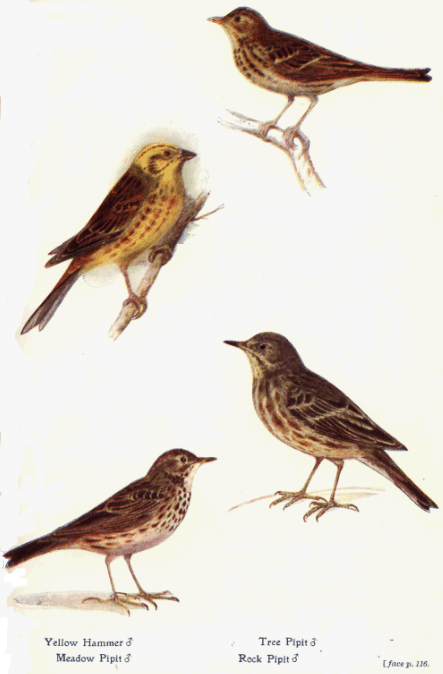
THE MEADOW PIPIT ANTHUS PRATENSIS
Hind claw longer than the toe, slightly curved; upper parts ash, tinged with olive, especially in winter, the centre of each feather dark brown; under parts reddish white, streaked with dark brown. Length five inches and three-quarters. Eggs dull white, variously spotted and mottled with brown.
It may be thought at the first glimpse that a difference in the comparative length of the hinder claws of two birds so much alike as the Tree and Meadow Pipits is scarcely sufficient to justify a specific distinction; but when it is considered that a short and curved claw enables a bird to retain a firm grasp of a small twig, while a long and almost straight one is best adapted for perching on the ground, it will appear at once that, however similar two birds may be in all other respects, yet the slight one in which they differ is the point on which hinges a complex scheme of habits. So the Tree Pipit frequents wooded districts, and passes a large portion of its time aloft among the branches, while the Meadow Pipit finds its happiness on the ground. It is not, indeed, confined to the unwooded country, for no bird is more generally diffused, and the nests of both species, constructed of similar materials, may frequently be found in the border of the same field, yet it often finds a home in wild, barren districts, frequented by no other small birds but the Wheatear and Ring Ouzel. I have even more than once seen it alight on a tree, but this was apparently as a resting-place on which it perched previously to descending to roost among the heath on a common. Had I not been near, it would most probably have dropped at once to its hiding-place as some of its companions did. From its attachment to commons and waste lands, the Meadow Pipit has received the names of Ling-bird and Moss-cheeper. In winter it is more abundant in the plains, where it may often be seen in small parties searching for seeds and insects in recently-ploughed lands, well marked by its running gait and the olive tinge of its upper plumage. Its song, which is not frequently heard, is a short and simple strain, sometimes uttered on the ground, but more generally, while rising or falling, at no great height in the air. Its nest is only to be distinguished from that of the Tree Pipit by the dark brown hue of the eggs which are somewhat similar to those of the Skylark, only smaller. 'The egg of the Cuckoo is more frequently deposited and hatched in the nest of the Meadow Pipit than in that of any other bird,' says Yarrell. It is interesting to know, now, that this bird—an immoral creature we might call it—which never keeps to one mate, deposits its eggs in the nests of about 145 species, taking the world over.
THE ROCK PIPIT ANTHUS OBSCÚRUS
Hind claw about equal in length to the toe, much curved; upper plumage greenish brown, the centre of each feather darker brown; a whitish streak over the eye; under parts dull white, spotted and streaked with dark brown. Length six inches and three-quarters. Eggs dull white, mottled with dingy brown.
Except that it is somewhat larger, the Rock Pipit is very similar in form and colour to the last species. It is, however, far more local, being confined exclusively to the sea-shore, but there of very common occurrence. Every one familiar with the sea-coast, must have observed it moving through the air with a jerking flight, occasionally alighting on a rock or on the beach near the line of high-water mark, searching busily for marine insects. In spring, it frequently takes little flights inland, never to a great distance, repeating its simple song all the while, and chasing as if in sport some one or other of its companions. In winter, it seems to act as a guide to the smaller land birds, who, finding their supply of food diminished or altogether cut off by the frost, are attracted by its movements, and join it in searching for insects among the unfrozen
'ridge of all things vile,'
left on the shore by the receding tide. Montagu says, that it has never been observed to be gregarious; his editor, however, Rennie, states that he has noticed it to be, if not quite gregarious, at least very nearly so, on the wild rocky shores of Normandy; and, from my own acquaintance with its habits in Devon and Cornwall, I am inclined to agree with the latter. If not gregarious, it is at least sociable, and that too at seasons when the flocks could hardly have been family gatherings only. The same remark holds good of the Meadow Pipit. A migration southwards takes place in October along our east coast.
FAMILY ALAUDIDÆ
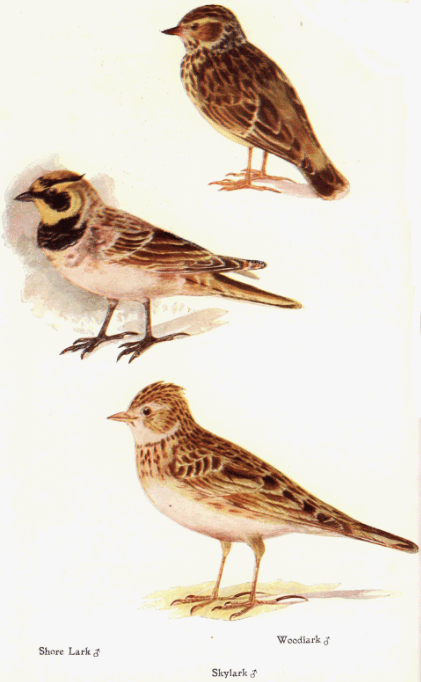
THE SKYLARK ALAUDA ARVENSIS
Upper parts reddish brown, the centre of each feather dark brown; a faint whitish streak above the eyes; throat white; neck and breast whitish, tinged with yellow and red, and streaked with dark brown; tail moderate. Length seven inches and a quarter. Eggs greyish, thickly speckled with dark grey and brown.
The Skylark, a bird whose flight and song are better known perhaps than those of any other bird, needs but a simple biography. The favourite bird of the poets, its story might be told in extracts compiled from various authors whose muse has led them to sing of Nature. Much, however, that has been written is but an amplification of the golden line, 'Hark, the Lark at Heaven's gate sings!' and not a little is an exaggerated statement of the height to which it ascends, and the time which it remains suspended in mid-air. But the Skylark needs no panegyrists, so, with all due deference to those who have struck the lyre in its honour, I will endeavour to describe its habits and haunts in humble prose.
The Skylark is a generally-diffused bird, adapted by the conformation of its claws for perching on the ground, and by its length and power of wing for soaring high in the air. Accordingly, its food consists of small insects and seeds, which it collects among the herbage of stubble-fields, meadows and downs, or in newly-ploughed fields. To this fare, it adds in winter and spring the tender stalk of sprouting corn. Hence it is regarded with deadly hostility by farmers, and hence, too, the quiet of the country is much disturbed at these seasons, by boys employed to frighten it away by screaming and plying a peculiar kind of rattle.[15] During autumn and winter, Larks congregate in large flocks, and occupy their time principally in searching for food on the ground. If disturbed, they rise in a scattered manner, wheel about in the air until the flock is formed again, chirping from time to time, and then withdraw, not in a compact body, but at unequal distances from the earth and from each other, to a new feeding-ground, over which they hover with circling flight for some time before alighting. On trees they never perch; though one or two may occasionally be seen settled on a quickset hedge or a railing. In North Britain, at the approach of severe weather, they flock together and migrate southwards. Great numbers also visit England from the Continent, arriving in November, when they used to be caught in nets and traps for the table. Early in spring the flocks break up, when the birds pair, and for three or four months, every day and all day long, when the weather is fine (for the Lark dislikes rain and high winds), its song may be heard throughout the breadth of the land. Rising as it were by a sudden impulse from its nest or lowly retreat, it bursts forth, while as yet but a few feet from the ground, into exuberant song, and with its head turned towards the breeze, now ascending perpendicularly, and now veering to the right or left, but not describing circles, it pours forth an unbroken chain of melody, until it has reached an elevation computed to be, at the most, about a thousand feet. To an observer on earth, it has dwindled to the size of a mere speck; but, as far as my experience goes, it never rises so high as to defy the search of a keen eye. Having reached its highest elevation, its ambition is satisfied without making any permanent stay, and it begins to descend, not with a uniform downward motion, but by a series of droppings with intervals of simple hovering, during which it seems to be resting on its wings. Finally, as it draws near the earth, it ceases its song and descends more rapidly, but before it touches the ground it recovers itself, sweeps away with almost horizontal flight for a short distance and disappears in the herbage. The time consumed in this evolution is at the most from fifteen to twenty minutes, more frequently less; nor have I ever observed it partially descend and soar upwards again. A writer in the Magazine of Natural History maintains that 'those acquainted with the song of the Skylark, can tell, without looking at them, whether the birds be ascending or stationary in the air, or on their descent; so different is the style of the song in each case'. Mr. Yarrell is of the same opinion, and I have little doubt that they are correct, though I am not certain that I have myself attained the skill of discriminating. In July, the Lark ceases its soarings and song together, but in fine weather, in October, it receives a new inspiration and is musical again. From time to time, during winter, if the season be mild, it resumes its aërial habits, but it neither ascends so high nor sings so long, two or three minutes becoming now the limits of its performance. Like most other birds, it sings least about noon and the first two hours of the afternoon; but it begins before sunrise, having been heard at midsummer as early as two o'clock in the morning, and it sometimes continues its song till late on into the night, having been heard at ten o'clock when it was quite dark. Occasionally, too, it sings on the ground; and, in a cage, as all the world knows, it pours out its melody with as much spirit, as if its six inches of turf could be measured by acres, and the roof of its little cage were the vault of heaven. The following stanza in French is equally successful in imitating the song of the Skylark and describing its evolutions:
La gentille Alouette avec son tirelire,
Tirelire, relire et tirelirant, tire
Vers la voûte du ciel; puis son vol en ce lieu
Vire, et semble nous dire: Adieu, adieu, adieu.
The Lark builds its nest in a hollow in the ground, the rut of a cart-wheel, the depression formed by a horse's hoof, or in a hole which it scrapes out for itself. The nest is composed of dry grass, and lined with finer fibres. It lays four or five eggs, and rears two broods in the year. It displays great attachment to its young, and has been known, when disturbed by mowers, to build a dome over its nest, as a substitute for the natural shelter afforded by the grass while standing, and to remove its young in its claws to another place of concealment. In a cage, even the male is an excellent nurse. Mr. Weir mentions one which brought up several broods entrusted to its care, and a similar instance has fallen under my own notice. Larks frequently become the prey of the Hobby and Merlin, which pounce on them as they are on the point of leaving the ground, and bear them off with as much ease as they would a feather. But if an intended victim discovers its oppressor in time, it instantly begins to ascend with a rapidity which the other cannot follow, carried on as it is by the impetus of its horizontal flight. The Hawk, foiled for this time, renews the chase and endeavours to soar above its quarry; if it succeeds, it makes a second swoop, sometimes with deadly effect; but if it fails a second time, the Lark folds Its wings, drops like lead to the ground, and, crouching among the herbage, often escapes detection.
THE WOODLARK ALAUDA ARBÓREA
Upper parts reddish brown, the centre of each feather dark brown; a distinct yellowish white streak above the eye passing to the back part of the head; lower parts yellowish white, streaked with dark brown; tail short. Length six inches and a half. Eggs greyish white, speckled and sometimes faintly streaked with brown.
The Woodlark is much less frequent than the Skylark, and is confined to certain districts, also it is only resident northwards up to Stirling. It is distinguished by its smaller size, short tail, a light mark over the eye, and by its habit of perching on trees, where the Skylark is never known to alight. It builds its nest very early in the season, sometimes so soon as the end of March, and probably rears several broods in the year, as it has been found sitting as late as September. It is consequently among the earliest songsters of the year, and among the last to bid adieu to summer. It sings on until the occurrence of severe frosts, and its note is among the sweetest and most touching sounds of nature. The song, though of less compass and less varied than that of the Skylark, is superior in liquidness of tone, and is thought to resemble the syllables 'lulu', by which name the bird is known in France. When soaring it may be distinguished from the Skylark not only by its song, but by its ascending in circles, which it describes, poets tell us, and perhaps correctly, with its nest for a centre. Sometimes, especially during sunshine after a summer shower, it alights on the summit of a lofty tree, to 'unthread its chaplet of musical pearls', and its simpler lulu notes may be heard as it flies from place to place while but a few feet above the surface of the ground. In autumn, Woodlarks assemble in small sociable parties (but not in large flocks), and keep together during the winter. Early in spring these societies are broken up into pairs, and the business of the season commences. The nest is composed of bents and a little moss, and is lined with finer grass, and, though built on the ground, is generally concealed with more art than that of the Skylark, the birds availing themselves of the shelter afforded by a bush or tuft of grass.
THE SHORE LARK OTÓCORYS ALPESTRIS
Throat, forehead, and ear-coverts yellow; over the forehead a black band; lore, moustache, and gorget black; upper parts reddish brown; breast and flanks yellowish white; abdomen white. Length nearly seven inches. Eggs greyish white, spotted with pale blue and brown.
The Shore Lark, like the last, is a very rare visitor of Britain, and appears to be equally uncommon In France. A few have been shot in Norfolk, and in the high latitudes both of the Old and New Worlds it is a common resident on the rocky coasts. It builds its nest on the ground, and shares in the great characteristic of the family, that, namely, of soaring and singing simultaneously. In colouring, it is strongly marked by its black gorget and crest.
ORDER PICARIÆ
FAMILY CYPSELIDÆ
THE SWIFT CÝPSELUS ÁPUS
General plumage sooty brown; chin greyish white; tarsi feathered; bill feet, and claws, shining black. Length eight inches; width seventeen inches. Eggs pure white.
The Swift is, perhaps, the strongest and swiftest, not merely of the Swallow tribe, but of all birds; hence a voyage from Southern Africa[16] to England is performed without overtaxing its strength. It stands in need of no rest after this prodigious flight, but immediately on its arrival starts with a right good will on its pursuit of food, as if its journey had been but a pleasant course of training for its daily vocation. With respect to temperature, however, its powers of endurance are limited; it never proceeds far northwards, and occasionally even suffers from unseasonably severe weather in the temperate climates where it fixes its summer residence. Mr. F. Smith, of the British Museum, related in the Zoologist,[17] that, at Deal, on the eighth of July, 1856, after a mild but wet day, the temperature suddenly fell till it became disagreeably cold. The Swifts were sensibly affected by the atmospheric change; they flew unsteadily, fluttered against the walls of the houses, and some even flew into open windows. 'Whilst observing these occurrences', he says, 'a girl came to the door to ask me if I wanted to buy a bat; she had heard, she told me, that I bought all kinds of bugs, and her mother thought I might want a bat. On her producing it, I was astonished to find it was a poor benumbed Swift. The girl told me they were dropping down in the streets, and the boys were killing all the bats; the church, she said, was covered with them. Off I started to witness this strange sight and slaughter. True enough; the children were charging them everywhere, and on arriving at the church in Lower Street I was astonished to see the poor birds hanging in clusters from the eaves and cornices; some clusters were at least two feet in length, and, at intervals, benumbed individuals dropped from the outside of the clusters. Many hundreds of the poor birds fell victims to the ruthless ignorance of the children.' Being so susceptible of cold, the Swift does not visit us until summer may be considered to have completely set in. In the south it is generally seen towards the end of April, but it generally brings up the rear of the migratory birds by making its first appearance in the first or second week in May, in the north.
Early in August it makes itself, for a few days, more than ever conspicuous by its wheeling flights around the buildings which contain its nest, and then suddenly disappears. At this period, too, its note is more frequently heard than during any other part of its visit, and in this respect it is peculiar. As a general rule, birds cease their song partially, if not entirely, when their eggs are hatched. The new care of providing for the wants of a brood occupies their time too much to allow leisure for musical performance, so that with the exception of their call-notes, and their cries of alarm or defiance, they are for a season mute. An early riser, and late in retiring to roost, the Swift is always on the wing. Thus, whether hunting on his own account or on behalf of his mate and nestlings, his employment is unvaried, and the same amount of time is always at his disposal for exercising his vocal powers. These are not great; he has no roundelay; he neither warbles nor carols; he does not even twitter. His whole melody is a scream, unmusical but most joyous; a squeak would be a better name, but that, instead of conveying a notion that it results from pain, it is full of rollicking delight. Some compare it to the noise made by the sharpening of a saw; to me it seems such an expression of pent-up joy as little children would make if unexpectedly released from school, furnished with wings, and flung up into the air for a game of hide-and-seek among the clouds. Such soarings aloft, such chasings round the pinnacles of the church-tower and the gables of the farmhouses, no wonder that they cannot contain themselves for joy. Every day brings its picnic or village feast, with no weariness or depression on the morrow.
The nest of the Swift is constructed of any scraps that the bird may chance to find floating in the air, or brought to it by the wind, for it literally never perches on the ground, whence it rises with difficulty. These are rudely pressed together in any convenient aperture or moulding in a building, and cemented together by some glutinous secretion from the bird's mouth. Two eggs are laid, and the young, as a matter of necessity, remain in the nest until quite fledged.
Another name for the Swift is Black Martin, and in heraldry it is familiarly known as the Martlet, the figure of which is a device of frequent occurrence in heraldic coats of arms, and denotes that the original wearer of the distinction served as a crusader pilgrim. In Arabia it is still known by the name of Hadji, or Pilgrim, to denote its migratory habits.
FAMILY CAPRIMULGIDÆ
THE NIGHTJAR CAPRIMÚLGUS EUROP['Æ]US
General plumage ash-grey, spotted and barred with black, brown and reddish brown; first three primaries with a large white patch, on the inner web; two outer tail-feathers on each side tipped with white. Length ten inches and a quarter; breadth twenty-two inches. Eggs whitish, beautifully marbled with brown and ash.
This bird used to be described as a nocturnal robber who finds his way into the goat-pens, sucks the dugs of the goats, poisoning them to such an extent that the animals themselves are blinded, and their udders waste away. This fable we notice in order to account for the strange name Goatsucker, by which it was formerly so well known. The bird has, indeed, strangely enough, been known all over Europe by an equivalent for this name from the earliest times. The bird itself is perfectly inoffensive, singular in form and habits, though rarely seen alive near enough for its peculiarities of form and colour to be observed. Its note, however, is familiar enough to persons who are in the habit of being out late at night in such parts of the country as it frequents. The silence of the evening or midnight walk in June is occasionally broken by a deep churr-churr-err which seemingly proceeds from the lower bough of a tree, a hedge, or paling. And a whirring of the wings comes often from their being brought in contact as the birds twist in insect-hunting.[18] The churring is nearly monotonous but not quite so, as it occasionally rises or falls about a quarter of a note, and appears to increase and diminish in loudness. Nor does it seem to proceed continuously from exactly the same spot, but to vary its position, as if the performer were either a ventriloquist or were actually shifting his ground. The bird perches with its feet resting lengthwise on a branch, its claws not being adapted for grasping, and turns its head from side to side, thus throwing the sound as it were in various directions, and producing the same effect as if it proceeded from different places. I have repeatedly worked my way close up to the bird, but as I labour under the disadvantage of being short-sighted, and derive little assistance from glasses at night, I have always failed to observe it actually perched and singing. In the summer of 1859 a Nightjar frequented the immediate neighbourhood of my own house, and I had many opportunities of listening to its note. One evening especially, it perched on a railing within fifty yards of the house, and I made sure of seeing it, but when I had approached within a few yards of the spot from whence the sound proceeded the humming suddenly stopped, but was presently again audible at the other end of the railing which ran across my meadow. I cautiously crept on, but with no better success than before. As I drew near, the bird quitted its perch, flew round me, coming within a few feet of my person, and, on my remaining still, made itself heard from another part of the railing only a few yards behind me. Again and again I dodged it, but always with the same result; I saw it, indeed, several times, but always on the wing. At last a longer interval of silence ensued, and when I heard the sound again it proceeded from a distant hedge which separated the meadow from a common. Here probably its mate was performing the domestic duty of incubation cheered by the dismal ditty of her partner; but I never saw her, though I undertook another nocturnal chase of the musician, hunting him from tree to tree, but never being able to discover his exact position, until the cessation of the sound and the sudden rustling of leaves announced the fact of his having taken his departure.
In the dusk of the evening the Nightjar may commonly be seen hawking for moths and beetles after the manner of the Swallow-tribe, only that the flight is less rapid and more tortuous. I once saw one on the common mentioned above, hawking seemingly in company with Swifts and Swallows during the bright glare of a summer afternoon; but most frequently it spends the day either resting on the ground among heath or ferns or on the branch of a tree, always (according to Yarrell and others) crouching close down upon it, in the line of the limb, and not across it. When perched on the ground it lies very close, 'not rising (a French author says) until the dogs are almost on it, but worth shooting in September'. The poet Wordsworth, whose opportunities of watching the Nightjar in its haunts must have been numerous, knew that the whirring note is an accompaniment of the chase:
The busy Dor-Hawk chases the white moth
With burring note——
The burring Dor-Hawk round and round is wheeling:
That solitary bird
Is all that can be heard
In silence, deeper far than deepest noon.
One point in the economy of the Nightjar is still disputed (1908) the use which it makes of its serrated middle claw. White, and another observer, quoted by Yarrell, have seen the bird while on the wing capture insects with the claw and transfer them to the mouth. Wilson, on the other hand, states that the use of this singular structure is to enable the bird to rid itself of vermin, to which it is much exposed by its habit of remaining at rest during the heat of the day. As he has actually observed a bird in captivity thus employing its claw, it would follow that the same organ is used for a twofold purpose.
The Nightjar is a migratory bird and the last to arrive in this country, appearing not before the middle of May. It is found more or less sparingly in all parts of England, especially those which abound most in woods interspersed with heaths and brakes. In the wooded valleys of Devonshire it is of frequent occurrence, and here it has been known to remain so late in the season as November, whereas from most other localities it migrates southwards about the middle or end of September. It builds no nest, but lays its singularly beautiful eggs, two in number, on the ground among the dry herbage of the common.
Other names by which it is locally known are Fern Owl, Wheeler, and Nightchurr.
FAMILY PICIDÆ
Sub-Family PICINÆ
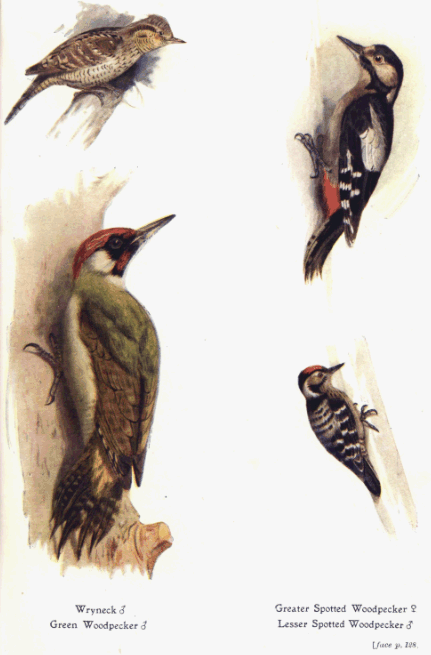
THE GREAT SPOTTED WOODPECKER DENDROCOPUS MAJOR
Crown and upper plumage black; a crimson patch on the back of the head; a white spot on each side of the neck; scapulars, lesser wing-coverts, and under plumage white; abdomen and under tail-coverts crimson; iris red. Female—without the crimson on the head. Length nine inches and a half; breadth fourteen inches. Eggs glossy white.
In habits this bird closely resembles the Green Woodpecker. It is of less common occurrence, but by no means rare, especially in the wooded districts of the southern and midland counties. A writer in the Zoologist[19] is of opinion that it shows a decided partiality to fallen timber. 'In 1849', he says, 'a considerable number of trees were cut down in an open part of the country near Melbourne, which were eventually drawn together and piled in lots. These lay for some time, and were visited almost daily by Great Spotted Woodpeckers. Their habits and manners were very amusing, especially whilst searching for food. They alighted on the timber, placed the body in a particular position, generally with the head downward' [differing in this respect from the Green Woodpecker], 'and commenced pecking away at the bark. Piece by piece it fell under their bills, as chips from the axe of a woodman. Upon examining the bark, I found that the pieces were chipped away in order that the-bird might arrive at a small white grub which lay snugly embedded in the bark; and the adroitness of the bird in finding out those portions of it which contained the greatest number of grubs, was certainly very extraordinary. Where the birds were most at work on a particular tree, I shelled off the bark and found nearly thirty grubs in nine squares inches; but on shelling off another portion from the same tree, which remained untouched, no grub was visible. Yet how the bird could ascertain precisely where his food lay was singular, as in both cases the surface of the bark appeared the same and bore no traces of having been perforated by insects. During the day one bird chipped off a piece thirty inches long and twenty wide—a considerable day's work for so small a workman.' Another observer states that this bird rarely descends to the ground, and affects the upper branches of trees in preference to the lower. Its note is like that of the Green Woodpecker. Both species are charged with resorting to gardens and orchards during the fruit season, not in quest of insect food; but no instance of this has come under my own notice. It is said, too, that they eat nuts. This statement is most probably correct. I myself doubt whether there are many birds of any sort which can resist a walnut; and I would recommend any one who is hospitably disposed towards the birds which frequent his garden, to strew the ground with fragments of these nuts. To birds who are exclusively vegetarians, if indeed there be any such indigenous to Britain, they are a natural article of diet, and as from their oily nature they approximate to animal matter, they are most acceptable to insectivorous birds. They have an advantage over almost every other kind of food thus exposed, that they are not liable to be appropriated as scraps of meat and bread are, by prowling cats and dogs. A walnut, suspended from the bough of a tree by a string, will soon attract the notice of some inquisitive Tit, and, when once detected, will not fail to receive the visits of all birds of the same family which frequent the neighbourhood. A more amusing pendulum can scarcely be devised. To ensure the success of the experiment, a small portion of the shell should be removed.
THE LESSER SPOTTED WOODPECKER DEUDROCOPUS MINOR
Forehead and lower parts dirty white; crown bright red: nape, back, and wings black, with white bars; tail black, the outer feathers tipped with white and barred with black; iris red. Length five inches and a half; breadth twelve inches. Eggs glossy white.
This handsome little bird resembles its congeners so closely, both in structure and habits, that it scarcely needs a lengthened description. Resident in England but rare in Scotland and Ireland, owing to its fondness for high trees and its small size it often escapes notice. It lays its eggs on the rotten wood, which it has either pecked, or which has fallen, from the holes in trees; they are not to be distinguished from those of the Wryneck. Lately (1908) a Scottish newspaper recorded the shooting of "that rare species, the Spotted Woodpecker!" "The man with the gun" is incurable.
THE GREEN WOODPECKER GÉCINUS VIRIDIS
Upper plumage green; under, greenish ash; crown, back of the head, and moustaches crimson; face black. Female—less crimson on the head; moustaches black. Length thirteen inches; breadth twenty-one inches. Eggs glossy white.
One of the most interesting among the natural sounds of the country, is that of the
Woodpecker tapping the hollow beech tree:
yet one may walk through the woods many times and hear no tapping at all, and even if such a sound be detected and traced to its origin, it will often be found to proceed from the Nuthatch, who has wedged a hazel-nut into the bark of an oak, than from the hammering of a Woodpecker. Yet often indeed it may be observed ascending, by a series of starts, the trunk of a tree, inclining now a little to the right, and now to the left, disappearing now and then on the side farthest from the spectator, and again coming into view somewhat higher up. Nor is its beak idle; this is employed sometimes in dislodging the insects which lurk in the rugged bark, and sometimes in tapping the trunk in order to find out whether the wood beneath is sound or otherwise. Just as a carpenter sounds a wall with his hammer in order to discover where the brickwork ends and where lath and plaster begin, so the Woodpecker sounds the wooden pillar to which it is clinging, in order to discover where the wood is impenetrable alike by insects and itself, and where the former have been beforehand with it in seeking food or shelter. Such a canker-spot found, it halts in its course, tears off piece-meal a portion of bark and excavates the rotten wood beneath, either as far as the fault extends or as long as it can find food. It is, then, by no means a mischievous bird, but the reverse; as it not only destroys a number of noxious insects, but points out to the woodman, if he would only observe aright, which trees are beginning to decay and consequently require his immediate attention. This aspect of the Woodpecker's operations is the right one and not the old idea that 'it is a great enemy of old trees in consequence of the holes which it digs in their trunks', as some old writer states.
But with all his digging and tapping, the sound by which the vicinity of a Woodpecker is most frequently detected, especially in spring and summer, is the unmistakable laughing note which has gained for him the name of 'Yaffle.' No more perhaps than the mournful cooing of the dove does this indicate merriment; it is harsh, too, in tone; yet it rings through the woods with such jovial earnestness that it is always welcome. On such occasions the bird is not generally, I think, feeding, for if the neighbourhood from which the sound proceeded be closely watched, the Yaffle may frequently be observed to fly away, with a somewhat heavy dipping flight, to another tree or grove, and thence, after another laugh, to proceed to a second. It is indeed oftener to be seen on the wing than hunting for food on the trunks of trees. Very frequently too it may be observed on the ground, especially in a meadow or common in which ants abound.
The admirable adaptation of the structure of the Woodpecker to its mode of life is well pointed out by Yarrell. Its sharp, hooked toes, pointing two each way, are eminently fitted for climbing and clinging. The keel of the breast-bone is remarkably shallow; hence, when ascending (its invariable mode of progress) a tree, it is enabled to bring its body close to the trunk without straining the muscles of the legs. Its tail is short, and composed of unusually stiff feathers, which in the process of climbing are pressed inwards against the tree, and contribute greatly to its support. The beak is strong and of considerable length, and thus fitted either for digging into an ant-hill or sounding the cavities of a tree; and the tongue, which is unusually long, is furnished with a curious but simple apparatus, by which it is extended so that it can be thrust into a hole far beyond the point of the bill, while its tip is barbed with small filaments, which, like the teeth of a rake, serve to pull up the larva or insect into its mouth. The Woodpecker builds no nest, but lays five or six glossy white eggs on the fragments of the decayed wood in which it has excavated its nest.
Other names by which this bird is known are Popinjay, Wood-sprite, Rain-bird, Hew-hole and Woodweele.
Sub-Family IŸNGINÆ
THE WRYNECK IŸNX TORQUILLA
Upper plumage reddish grey, irregularly spotted and lined with brown and black; a broad black and brown band from the back of the head to the back; throat and breast yellowish red, with dusky transverse rays; rest of the under plumage whitish, with arrow shaped black spots; outer web of the quills marked with rectangular alternate black and yellowish red spots; tail-feathers barred with black zigzag bands; beak and feet olive brown. Length six inches and a half; breadth eleven inches. Eggs glossy white.
The note of the Wryneck is so peculiar that it can be confounded with none of the natural sounds of the country; a loud, rapid, harsh cry of pay-pay-pay from a bird about the size of a lark may be referred without hesitation to the Wryneck. Yet it is a pleasant sound after all—'the merry pee-bird' a poet calls it—and the untuneful minstrel is the same bird which is known by the name of 'Cuckoo's Mate', and so is associated with May-days, pleasant jaunts into the country, hayfields, the memory of past happy days and the hope of others to come. This name it derives not from any fondness it exhibits for the society of the cuckoo, as it is a bird of remarkably solitary habits, but because it arrives generally a few days before the cuckoo. Not less singular than its note is its plumage, which, though unmarked by gaudiness of colouring, is very beautiful, being richly embroidered as it were with brown and black on a reddish grey ground. In habits, it bears no marked resemblance to the Woodpeckers; it is not much given to climbing and never taps the trunks of trees; yet it does seek its food on decayed trees, and employs its long horny tongue in securing insects. It darts its tongue with inconceivable rapidity into an ant-hill and brings it out as rapidly, with the insects and their eggs adhering to its viscid point. These constitute its principal food, so that it is seen more frequently feeding on the ground than hunting on trees. But by far the strangest peculiarity of the Wryneck, stranger than its note and even than its worm-like tongue, is the wondrous pliancy of its neck, which one might almost imagine to be furnished with a ball and socket joint. A country boy who had caught one of these birds on its nest brought it to me on a speculation. As he held it in his hand, I raised my finger towards it as if about to touch its beak. The bird watched most eagerly the movement of my finger, with no semblance of fear, but rather with an apparent intention of resenting the offer of any injury. I moved my finger to the left; its beak followed the direction—the finger was now over its back, still the beak pointed to it. In short, as a magnetic needle follows a piece of steel, so the bird's beak followed my finger until it was again in front, the structure of the neck being such as to allow the head to make a complete revolution on its axis, and this without any painful effort. I purchased the bird and gave it its liberty, satisfied to have discovered the propriety of the name Torquilla.[20] I may here remark that the name Iÿnx,[21] is derived from its harsh cry. Besides this, the proper call-note of the bird, it utters, when disturbed in its nest, another which resembles a hiss; whence and partly, perhaps, on account of the peculiar structure of its neck, it is sometimes called the Snake-bird. Nest, properly speaking, it has none; it selects a hole in a decaying tree and lays its eggs on the rotten wood. Its powers of calculating seem to be of a very low order. Yarrell records an instance in which four sets of eggs, amounting to twenty-two, were successively taken before the nest was deserted; a harsh experiment, and scarcely to be justified except on the plea that they were taken by some one who gained his livelihood by selling eggs, or was reduced to a strait from want of food. A similar instance is recorded in the Zoologist, when the number of eggs taken was also twenty-two. The Wryneck is a common bird in the south-eastern counties of England and to the west as far as Somersetshire; but I have never heard its note in Devon or Cornwall; it is rare also in the northern counties.
FAMILY ALCEDINIDÆ
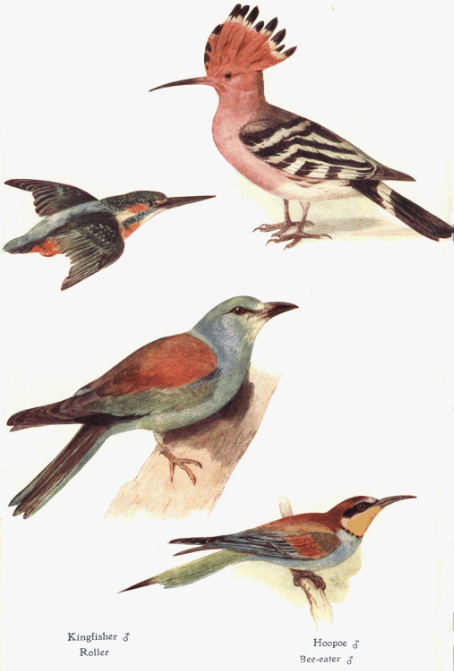
THE KINGFISHER ALCEDO ÍSPIDA
Back azure-blue; head and wing-coverts bluish green, spotted with azure-blue; under and behind the eye a reddish band passing into white, and beneath this a band of azure-green; wings and tail greenish blue; throat white; under plumage rusty orange-red. Length seven inches and a quarter; width ten inches. Eggs glossy white, nearly round.
Halcyon days, every one knows, are days of peace and tranquillity, when all goes smoothly, and nothing occurs to ruffle the equanimity of the most irascible member of a household; but it may not be known to all my younger readers that a bird is said to be in any way concerned in bringing about this happy state of things. According to the ancient naturalists the Halcyon, our Kingfisher, being especially fond of the water and its products, chooses to have even a floating nest. Now the surface of the sea is an unfit place whereon to construct a vessel of any kind, so the Halcyon, as any other skilful artisan would, puts together on land first the framework, and then the supplementary portion of its nest, the materials being shelly matter and spines, whence derived is unknown; but the principal substance employed is fish-bones. During the progress of the work the careful bird several times tests its buoyancy by actual experiment, and when satisfied that all is safe, launches its future nursery on the ocean. However turbulent might have been the condition of the water previously to this event, thenceforth a calm ensued, which lasted during the period of incubation; and these were 'Halcyon days' (Halcyonides dies), which set in seven days before the winter solstice, and lasted as many days after. What became of the young after the lapse of this period is not stated, but the deserted nest itself, called halcyoneum, identical, perhaps, with what we consider the shell of the echinus, or sea-urchin, was deemed a valuable medicine.[22]
The real nest of the Kingfisher is a collection of small fish-bones, which have evidently been disgorged by the old birds. A portion of one which I have in my possession, and which was taken about twenty years since from a deep hole in an embankment at Deepdale, Norfolk, consists exclusively of small fish-bones and scraps of the shells of shrimps. A precisely similar one is preserved in the British Museum, which is well worthy the inspection of the curious. It was found by Mr. Gould in a hole three feet deep on the banks of the Thames; it was half an inch thick and about the size of a tea saucer, and weighed 700 grains. Mr. Gould was enabled to prove that this mass was deposited, as well as eight eggs laid, in the short space of twenty-one days. In neither case was there any attempt made by the bird to employ the bones as materials for a structure; they were simply spread on the soil in such a way as to protect the eggs from damp, possessing probably no properties which made them superior to bents or dry leaves, but serving the purpose as well as anything else, and being more readily available, by a bird that does not peck on the ground, than materials of any other kind.
The wanderer by the river's side on a bright sunny day, at any season, may have his attention suddenly arrested by the sight of a bird shooting past him, either up or down the stream, at so slight an elevation above the water, that he can look down on its back. Its flight is rapid, and the colour of the plumage so brilliant, that he can compare it to nothing less dazzlingly bright than the richest feathers of the peacock, or a newly dug specimen of copper ore. After an interval of a few seconds it will perhaps be followed by a second, its mate, arrayed in attire equally gorgeous with emerald, azure, and gold. Following the course of the bird, let him approach cautiously any pools where small fish are likely to abound, and he may chance to descry, perched motionless on the lower branch of an alder overhanging the stream, on some bending willow, or lichen-covered rail, the bird which but now glanced by him like a meteor. If exposed to the rays of the sun, the metallic green of its upper plumage is still most conspicuous; if in the shade, or surrounded by leaves, its chestnut red breast betrays its position. Not a step further in advance, or the fisherman, intent as he is on his sport, will take alarm and be off to another station. With beak pointed downwards it is watching until one among a shoal of minnows or bleaks comes within a fair aim; then with a twinkle of the wing it dashes head foremost from its post, plunges into the stream, disappears for a second, and emerges still head foremost with its struggling booty. A few pinches with its powerful beak, or a blow against its perch, deprives its prey of life, and the morsel is swallowed entire, head foremost. Occasionally, where convenient perches are rare, as is the case with the little pools left by the tide on the sea-shore (for the Kingfisher is common on the banks of tidal rivers as well as on inland streams and lakes), it hovers like a Kestrel, and plunges after small fish, shrimps, and marine insects. It once happened to me that I was angling by a river's side, quite concealed from view by a willow on either side of me, when a Kingfisher flew down the stream, and perched on my rod. I remained perfectly still, but was detected before an opportunity had been afforded me of taking a lesson from my brother sportsman.
The Kingfisher is a permanent resident in this country, and may be observed, at any season, wherever there is a river, canal, or lake, those streams being preferred the banks of which are lined with trees or bushes. Like most other birds of brilliant plumage, it is no vocalist; its only note being a wild piping cry, which it utters while on the wing. Happily the Kingfishers are again on the increase in our country.
FAMILY CORACIIDÆ
THE ROLLER CORÁCIAS GÁRRULUS
Head, neck, and under parts tinged with various shades of light blue, varied with green; back and scapulars reddish brown; tail blue, green, and black. Length twelve inches and a half. Eggs smooth shining white.
About twenty specimens in all of this bird have been observed in England, the one of most recent occurrence being, I believe, one which was shot close to my garden, on the twentieth of September, 1852. The winter home of the Roller is Africa, and it is said to be particularly abundant in Algeria. About the middle of April it crosses the Mediterranean, and seems to prefer the north of Europe to the south as a summer residence, being more abundant in Germany and the south of Russia than in France, though many proceed no further than Sicily and Greece. Its food consists mainly of caterpillars and other insects. The name Roller, being derived directly from the French Rollier, should be pronounced so as to rhyme with 'dollar'.
FAMILY MEROPIDÆ
THE BEE-EATER MÊROPS APIÁSTER
Forehead white, passing into bluish green; upper plumage chestnut; throat golden yellow, bounded by a black line; wings variegated with blue, brown, and green; tail greenish blue. Length eleven inches. Eggs glossy white.
This bird, which in brilliancy of plumage vies with the Hummingbirds, possesses little claim to be ranked among soberly clad British birds. Stray instances are indeed met with from time to time, but at distant intervals. In the islands of the Mediterranean, and in the southern countries of Europe, they are common summer visitors, and in Asia Minor and the south of Russia they are yet more frequent. They are gregarious in habits, having been observed, both in Europe, their summer, and in Africa, their winter residence, to perch together on the branches of trees in small flocks. They also build their nests near each other. These are excavations in the banks of rivers, variously stated to be extended to the depth of from six inches to as many feet. Their flight is graceful and light, resembling that of the Swallows. Their food consists of winged insects, especially bees and wasps, which they not only catch when they are wandering at large through the air, but watch for near their nests. The inhabitants of Candia and Cyprus are said to catch them by the help of a light silk line, to which is attached by a fish-hook a wild bee. The latter in its endeavour to escape soars into the air, and the Bee-eater seizing it becomes the prey of the aërial fisherman.
FAMILY UPUPIDÆ
THE HOOPOE UPUPA EPOPS
Crest orange-red tipped with black; head, neck, and breast pale cinnamon; back, wings, and tail barred with black and white; under parts white. Length twelve inches; width nineteen inches. Eggs lavender grey, changing to greenish olive.
Little appears to be known of the habits of this very foreign-looking bird from observation in Great Britain. The season at which it is seen in this country is usually autumn, though a few instances have occurred of its having bred with us. In the south of Europe and north of Africa it is of common occurrence as a summer visitor, but migrates southwards in autumn. Its English name is evidently derived from the French Huppe, a word which also denotes 'a crest', the most striking characteristic of the bird. It is called also in France Puput, a word coined, perhaps, to denote the noise of disgust which one naturally makes at encountering an unpleasant odour, this, it is said, being the constant accompaniment of its nest, which is always found in a filthy condition, owing to the neglect of the parent birds in failing to remove offensive matter, in conformity with the laudable practise of most other birds. In spite of the martial appearance of its crest, it is said to be excessively timid, and to fly from an encounter with the smallest bird that opposes it. It lives principally on the ground, feeding on beetles and ants. On trees it sometimes perches but does not climb, and builds its nest in holes in trees and walls, rarely in clefts of rocks. It walks with a show of dignity when on the ground, erecting its crest from time to time. In spring the male utters a note not unlike the coo of a Wood-pigeon, which it repeats several times, and at other seasons it occasionally emits a sound something like the shrill note of the Greenfinch. But it is no musician and is as little anxious to be heard as seen. The nest is a simple structure composed of a few scraps of dried grass and feathers, and contains from four to six eggs. It would breed here annually if not always shot on arrival.
FAMILY CUCULIDÆ
THE CUCKOO CÚCULUS CANÓRUS
Upper plumage bluish ash colour, darker on the wings, lighter on the neck and chest; under parts whitish with transverse dusky streaks; quills barred on the inner webs with oval white spots; tail-feathers blackish, tipped and spotted with white; bill dusky, edged with yellow; orbits and inside of the mouth orange-yellow; iris and feet yellow. Young—ash-brown, barred with reddish brown; tips of the feathers white; a white spot on the back of the head. Length thirteen inches and a half, breadth twenty-three inches. Eggs varying in colour and markings.
No bird in a state of nature utters a note approaching so closely the sound of the human voice as the Cuckoo; on this account, perhaps, partially at least, it has at all times been regarded with especial interest. Its habits have been much investigated, and they are found to be unlike those of any other bird. The Cuckoo was a puzzle to the earlier naturalists, and there are points in its biography which are controverted still. From the days of Aristotle to those of Pliny, it was supposed to undergo a metamorphosis twice a year, appearing during the summer months as a Cuckoo, "a bird of the hawk kind, though destitute of curved talons and hooked beak, and having the bill of a Pigeon; should it chance to appear simultaneously with a Hawk it was devoured, being the sole example of a bird being killed by one of its own kind. In winter it actually changed into a Merlin, but reappeared in spring in its own form, but with an altered voice, laid a single egg, or rarely two, in the nest of some other bird, generally a Pigeon, declining to rear its own young, because it knew itself to be a common object of hostility among all birds, and that its brood would be in consequence unsafe, unless it practised a deception. The young Cuckoo being naturally greedy, monopolized the food brought to the nest by its foster parents; it thus grew fat and sleek, and so excited its dam with admiration of her lovely offspring, that she first neglected her own chicks, then suffered them to be devoured before her eyes, and finally fell a victim herself to his voracious appetite."[23]—A strange fiction, yet not more strange than the truth, a glimmering of which appears throughout. We know well enough now that the Cuckoo does not change into a Merlin, but migrates in autumn to the southern regions of Africa; but this neither Aristotle nor Pliny could have known, for the common belief in their days was, that a continued progress southwards would bring the traveller to a climate too fierce for the maintenance of animal life. Now the Merlin visits the south of Europe, just at the season when the Cuckoo disappears, and returns northwards to breed in spring, a fact in its history as little known as the migration of the Cuckoo. It bears a certain resemblance to the Cuckoo, particularly in its barred plumage, certainly a greater one than exists between a caterpillar and a butterfly, so that there were some grounds for the belief in a metamorphosis, strengthened not a little by the fact that the habits of the bird were peculiar in other respects. Even so late as the time of our own countrymen, Willughby and Ray (1676), it was a matter of doubt whether the Cuckoo lay torpid in a hollow tree, or migrated during winter. These authors, though they do not admit their belief of a story told by Aldrovandus of a certain Swiss peasant having heard the note of a Cuckoo proceed from a log of wood which he had thrown into a furnace, thought it highly probable that the Cuckoo did become torpid during winter, and were acquainted with instances of persons who had heard its note during unusually mild winter weather. A Cuckoo which had probably been hatched off too late to go away with the rest remained about the tennis ground of a relative of the present editor until the middle of November, getting very tame. Then, unfortunately, a cat got it. The assertion again of the older naturalists, that the Cuckoo is the object of hatred among birds generally, seems credible, though I should be inclined to consider its habit of laying its eggs in the nests of other birds as the cause rather than the consequence of its unpopularity. The contrary, however, is the fact, numerous anecdotes of the Cuckoo showing that it is regarded by many other birds with a respect which amounts to infatuation, rather than with apprehension. The statement that it lays but one egg is erroneous, so also is the assertion of Willughby that it invariably destroys the eggs found in a nest previously to depositing its own. Pliny's assertion that the young bird devours its foster brothers and sisters is nearer the truth, but his account of its crowning act of impiety in swallowing its nurse, is, I need not say, altogether unfounded in fact. Having disposed of these errors, some of which are entertained by the credulous or ill-informed at the present day, I will proceed to sketch in outline the biography of this singular bird, as the facts are now pretty generally admitted.
The Cuckoo arrives in this country about the middle of April; the time of its coming to different countries is adapted to the time of the foster-parents' breeding. During the whole of its stay it leads a wandering life, building no nest, and attaching itself to no particular locality. It shows no hostility towards birds of another kind, and little affection for those of its own. If two males meet in the course of their wandering they frequently fight with intense animosity. I was once witness of an encounter between two birds who chanced to meet in mid-air. Without alighting they attacked each other with fury, pecking at each other and changing places just as one sees two barn-door cocks fight for the supremacy of the dunghill. Feathers flew in profusion, and in their passion the angry birds heeded my presence so little that they came almost within arm's length of me. These single combats account for the belief formerly entertained that the Cuckoo was the only sort of Hawk that preyed on its own kind. The female does not pair or keep to one mate. It is, however, frequently accompanied by a small bird of another kind, said to be a Meadow Pipit.
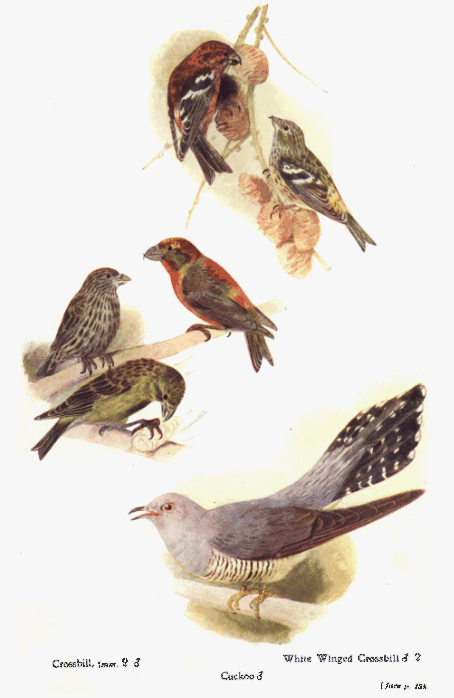
The Cuckoo hunts for its food both in trees and on the ground. On its first arrival it lives principally on beetles, but when caterpillars become abundant it prefers them, especially the hairy sorts. In the months of May and June, the female Cuckoo lays her eggs (the number of which is variously estimated from five to twelve), choosing a separate locality for each, and that invariably the nest of some other bird. The nests in which the egg of a Cuckoo has been found in this country are those of the Hedge Sparrow, Robin, Redstart, Whitethroat, Willow Warbler, Sedge Warbler, Wagtail, Pipit, Skylark, Yellow Bunting, Chaffinch, Greenfinch, Linnet, Blackbird and Wren; the Pipit being the most frequent. It has now been ascertained that the nests of birds in which the Cuckoo lays its eggs in different countries number 145 species.[24] In some of these instances, the position and structure of the nests were such that a bird of so large a size could not possibly have laid an egg in the usual way. Hence, and from other evidence, it is pretty clear that the egg is in all cases laid at a distance from the nest and carried by the bird in her bill to its destination. The bird can have no difficulty in accomplishing this seemingly hard task; for the gape of the Cuckoo is wide, and the egg disproportionately small, no larger in fact than the egg of the Skylark, a bird only a fourth of its size. The period during which a nest is fit for the reception of a Cuckoo's egg is short; if a time were chosen between the completion of the nest and the laying of the first egg by the rightful owner, the Cuckoo could have no security that her egg would receive incubation in good time, and again if the hen were sitting there would be no possibility of introducing her egg surreptitiously. She accordingly searches for a nest in which one egg or more is laid, and in the absence of the owner lays down her burden and departs. There are certain grave suspicions that the intruder sometimes makes room for her own egg by destroying those already laid; but this, if it be true, is exceptional. If it were very much larger than the rest, it might excite suspicion, and be either turned out, or be the cause of the nest being deserted; it would require, moreover, a longer incubation than the rest, and would either fail to be hatched, or produce a young Cuckoo at a time when his foster-brothers had grown strong enough to thwart his evil designs. As it is, after fourteen days' incubation, the eggs are hatched simultaneously, or nearly so, the Cuckoo being generally the first. No sooner does the young bird see the day, than he proceeds to secure for himself the whole space of the nest and the sole attention of his foster-parents, by insinuating himself under the other young birds and any eggs which may remain unhatched, and hurling them over the edge of the nest, where they are left to perish. 'The singularity of its shape', says Dr. Jenner, 'is well adapted for these purposes; for, different from other newly-hatched birds, its back from the shoulders downwards is very broad, with a considerable depression in the middle. To the question which naturally suggests itself, 'Why does the young Cuckoo thus monopolize the nest and the attentions of its foster parents?' the solution is plain. The newly-hatched bird must of necessity be less in size than the egg from which it proceeded, but a full-grown Cuckoo exceeds the dimensions of a whole brood of Pipits; its growth therefore must be rapid and cannot be maintained without a large supply of food. But the old birds could not possibly with their utmost exertions feed a brood of their own kind and satisfy the demands made by the appetite of the voracious stranger as well. The latter consequently saves them from this impossible task, and, by appropriating to his single use the nourishment intended for a brood of four or five, not only makes provision for his own well-being, but helps them out of a difficulty. So assiduously is he taken care of that he soon becomes a portly bird and fills his nest; in about three weeks he is able to fly, but for a period of four or five weeks more his foster-parents continue to feed him. It is probable that the young Cuckoo actually exercises some fascination over other birds. There is a case on record in which a pair of Meadow Pipits were seen to throw out their own young ones to make room for the intruder. In another instance, a young Cuckoo which had been taken from the nest and was being reared by hand escaped from confinement. Having one of its wings cut, it could not fly, but was found again, at the expiration of a month, within a few fields of the house where it was reared, and several little wild birds were in the act of feeding it. The Bishop of Norwich[25] mentions two instances in which a young Cuckoo in captivity was fed by a young Thrush which had only just learnt to feed itself.
In the days when omens were observed, it was considered a matter of high import to hear the song of the Nightingale before that of the Cuckoo. Thus Chaucer says:
it was a commone tale
That it were gode to here the Nightingale,
So, when on a certain occasion he heard the Cuckoo first, and was troubled in consequence, he represents the Nightingale as thus addressing him:
be thou not dismaied
For thou have herd the Cuckow erst than me,
For if I live it shall amendid be
The nexte Maie, if I be not afraied.
More recently Milton thus addresses the Nightingale:
Thy liquid notes that close the eye of day,
First heard before the shallow Cuccoo's bill,
Portend success in love.
Whether any traces of this popular belief yet linger in our rural districts, I do not know; but I can recall my childish days in the west of England (where there are no Nightingales), when I looked forward with implicit faith to the coming of the Cuckoo, to 'eat up the dirt', and make the Devonshire lanes passable for children's spring wanderings.
The song of the Cuckoo, I need scarcely remark, consists of but two notes, of which the upper is, I believe, invariably, E flat, the lower most frequently C natural, forming, however, not a perfect musical interval, but something between a minor and a major third. Occasionally two birds may be heard singing at once, one seemingly aiming at a minor, the other a major third; the effect is, of course, discordant. Sometimes the first note is pronounced two or three times, thus 'cuck-cuck-cuckoo', and I have heard it repeated rapidly many times in succession, so as to resemble the trilling note of the Nightingale, but in a lower key. The note of the nestling is a shrill plaintive chirp, which may best be imitated by twisting a glass stopper in a bottle. Even the human ear has no difficulty in understanding it as a cry for food, of which it is insatiable. Towards the end of June the Cuckoo, according to the old adage, 'alters its tune', which at first loses its musical character and soon ceases altogether. In July the old birds leave us, the males by themselves first, and the females not many days after; but the young birds remain until October.
Referring to the young cuckoo's manner of ejecting the eggs of its foster-parents, and the reason for this apparently cruel action, the editor refers our readers to Mr. W. H. Hudson's interesting chapter in Idle Days in Hampshire.
ORDER STRIGES
FAMILY STRIGIDÆ
Sub-Family STRIGINÆ
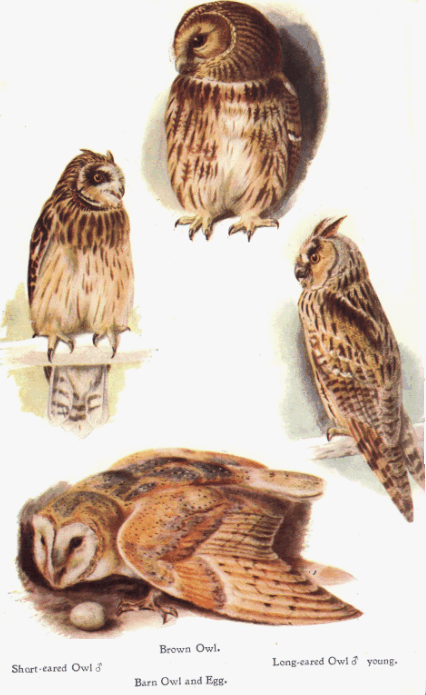
THE BARN OWL STRIX FLAMMEA
Beak yellowish white; upper parts light tawny yellow minutely variegated with brown, grey, and white; face and lower plumage white, the feathers of the margin tipped with brown. Length fourteen inches; breadth nearly three feet. Eggs white.
Returning from our Summer-evening's walk at the pleasant time when twilight is deepening into night, when the Thrush has piped its last roundelay, and the Nightingale is gathering strength for a flesh flood of melody, a sudden exclamation from our companion 'What was that?' compels us to look in the direction pointed at just in time to catch a glimpse of a phantom-like body disappearing behind the hedge-row. But that the air is still, we might have imagined it to be a sheet of silver paper wafted along by the wind, so lightly and noiselessly did it pass on. We know, however, that a pair of Barn Owls have appropriated these hunting-grounds, and that this is their time of sallying forth; we are aware, too, how stealthily they fly along the lanes, dipping behind the trees, searching round the hay-stacks, skimming over the stubble, and all with an absence of sound that scarcely belongs to moving life. Yet, though by no means slow of flight, the Barn Owl can scarcely be said to cleave the air; rather, it fans its way onwards with its down-fringed wings, and the air, thus softly treated, quietly yields to the gentle force, and retires without murmur to allow it a passage. Not without meaning is this silence preserved. The nimble little animals that constitute the chase, are quick-sighted and sharp of hearing, but the pursuer gives no notice of his approach, and they know not their doom till they feel the inevitable talons in their sides. The victim secured, silence is no longer necessary. The successful hunter lifts up his voice in a sound of triumph, repairs to the nearest tree to regale himself on his prize, and, for a few minutes—that is, until the chase is resumed—utters his loud weird shriek again and again. In the morning, the Owl will retire to his private cell and will spend the day perched on end, dozing and digesting as long as the sunlight is too powerful for his large and sensitive eyes. Peep in on him in his privacy, and he will stretch out or move from side to side his grotesque head, ruffling his feathers, and hissing as though your performance were worthy of all condemnation. Yet he is a very handsome and most amusing bird, more worthy of being domesticated as a pet than many others held in high repute. Taken young from the nest, he is soon on familiar terms with his owner, recognizes him by a flapping of wings and a hiss whenever he approaches, clearing his premises of mice, and showing no signs of pining at the restriction placed on his liberty. Give him a bird, and he will soon show that, though contented with mice, he quite appreciates more refined fare. Grasping the body with his talons, he deliberately plucks off all the large feathers with his beak, tears off the head, and swallows it at one gulp, and then proceeds to devour the rest piece-meal. In a wild state his food consists mainly of mice, which he swallows whole, beetles, and sometimes fish, which he catches by pouncing on them in the water.
The service which the Barn Owl renders to the agriculturist, by its consumption of rats and mice, must be exceedingly great, yet it is little appreciated. "When it has young", says Mr. Waterton, "it will bring a mouse to the nest every twelve or fifteen minutes. But in order to have a proper idea of the enormous quantity of mice which this bird destroys, we must examine the pellets which it ejects from its stomach in the place of its retreat. Every pellet contains from four to seven skeletons of mice. In sixteen months from the time that the apartment of the Owl on the old gateway was cleared out, there has been a deposit of above a bushel of pellets."
The plumage of the Barn Owl is remarkable for its softness, its delicacy of pencilling on the upper parts and its snowy whiteness below. Its face is perfectly heart-shaped during life, but when the animal is dead becomes circular. The female is slightly larger than her mate, and her colours are somewhat darker. The nest of the Barn Owl is a rude structure placed in the bird's daily haunt. The eggs vary in number, and the bird lays them at different periods, each egg after the first being hatched (partially at least) by the heat of the young birds already in being. That this is always the case it would not be safe to assert, but that it is so sometimes there can be no doubt. The young birds are ravenous eaters and proverbially ugly; when craving food they make a noise resembling a snore. The Barn or White Owl is said to be the most generally diffused of all the tribe, being found in almost all latitudes of both hemispheres, and it appears to be everywhere an object of terror to the ignorant. A bird of the night, the time when evil deeds are done, it bespeaks for itself an evil reputation; making ruins and hollow trees its resort, it becomes associated with the gloomiest legends; uttering its discordant note during the hours of darkness, it is rarely heard save by the benighted traveller, or by the weary watcher at the bed of the sick and dying; and who more susceptible of alarming impressions than these? It is therefore scarcely surprising that the common incident of a Screech-Owl being attracted by a solitary midnight taper to flutter against the window of a sick room, and there to utter its melancholy wail, should for a time shake the faith of the watcher, and, when repeated with the customary exaggerations, should obtain for the poor harmless mouser the unmerited title of 'harbinger of death'.
Sub-Family SYRNIINÆ
LONG-EARED OWL ASIO ÓTUS
Beak black; iris orange yellow; egrets very long, composed of eight or ten black feathers, edged with yellow and white; upper parts reddish yellow, mottled with brown and grey; lower parts lighter, with oblong streaks of deep brown. Length fifteen inches; breadth thirty-eight inches. Eggs white.
Though not among the most frequent of the English Owls, this species occurs in most of the wooded parts of England and Ireland, as indeed it does in nearly all parts of the world where woods are to be found. It is more common than is usually supposed in France, where it unites in its own person all the malpractises which have been popularly ascribed to the whole tribe of Owls. It is there said to be held in great detestation by all the rest of the feathered tribe; a fact which is turned to good account by the bird-catcher, who, having set his traps and limed twigs, conceals himself in the neighbourhood and imitates the note of this Owl. The little birds, impelled by rage or fear, or a silly combination of both, assemble for the purpose of mobbing the common enemy. In their anxiety to discern the object of their abhorrence, they fall one after another into the snare, and become the prey of the fowler. The Long-eared Owl is not altogether undeserving of the persecution which is thus intended for her, her principal food being field-mice, but also such little birds as she can surprise when asleep. In fact, she respects neither the person nor the property of her neighbours, making her home in the old nests of large birds and squirrels, and appropriating, as food for herself and her voracious young, the carcases of any that she finds herself strong enough to master and kill.
The cry of this bird is only occasionally uttered—a sort of barking noise. The note of the young bird is a loud mewing and seems to be intended as a petition to its parents for a supply of food. A writer in the Zoologist[28] who has had many opportunities of observing this species in its native haunts, says that it does not confine its flight entirely to the darker hours, as he has met with it in the woods sailing quickly along, as if hawking, on a bright summer day. It is curious to observe, he says, how flat they invariably make their nests, so much so, that it is difficult to conceive how the eggs retain their position, even in a slight wind, when the parent bird leaves them. The eggs are four to six in number, and there are grounds for supposing that the female bird begins to sit as soon as she has laid her first egg.
THE SHORT-EARED OWL ASIO ACCIPITRÍNUS
Face whitish; beak black; iris yellow; egrets inconspicuous, of a few black feathers; eyes encircled by brownish black; upper plumage dusky brown, edged with yellow; lower pale orange, streaked with brown. Length sixteen inches; breadth thirty-eight. Eggs white.
From the name, Hawk-Owl, sometimes given to this species, we should expect to find this bird not so decidedly nocturnal in its habits as the preceding; and such is the case; for, though it does not habitually hunt by day, it has been known to catch up chickens from the farmyard, and has been seen in chase of pigeons. If attacked during daylight, it does not evince the powerless dismay of the last species, but effects a masterly retreat by soaring in a spiral direction until it has attained an elevation to which its adversary does not care to follow it. Unlike its allies, it frequents neither mountains nor forests, but is found breeding in a few marshy or moorland districts; later in the year it is met with in turnip fields and stubbles. As many as twenty-eight were once seen in a single turnip-field in England; from whence it has been inferred that in autumn the Short-eared Owls are gregarious, and establish themselves for a time in any place they fall in with, where field-mice or other small quadrupeds are abundant. In England this bird is not uncommonly started by sportsmen when in pursuit of game. It then flies with a quick zigzag motion for about a hundred yards, and alights on the ground, never on a tree. By some it is called the Woodcock-Owl, from its arriving and departing at about the same time with that bird; it is not, however, invariably a bird of passage, since many instances are on record of its breeding in this country, making a rude nest in a thick bush, either on the ground, or close to it, and feeding its young on mice, small birds, and even the larger game, as Moor-fowl, a bird more than double its own weight. The Short-eared Owl affords a beautiful illustration of a fact not generally known, that the nocturnal birds of prey have the right and left ear differently formed, one ear being so made as to hear sounds from above, and the other from below. The opening into the channel for conveying sound is in the right ear, placed beneath the transverse fold, and directed upwards, while in the left ear the same opening is placed above the channel for conveying sound, and is directed downwards.
In the severe weather of January, 1861, I had the gratification of seeing three or four of these Owls among the sand-hills of the coast of Norfolk, near Holkham. I imagined them to be in pursuit of the Redwings and other small birds which had been driven by the intense cold to the sea-coast, since they flew about as Hawks do when hunting for prey, and occasionally alighted among the sand-hills. I even fell in with several heaps of feathers, showing where some unhappy bird had been picked and eaten. A few days afterwards, however, I inquired at another part of the coast whether there were any Owls there, and received for an answer, 'No, because there are no Rabbits'; from which I inferred that these birds have the reputation of hunting larger game than Thrushes, a charge which the size and power of their hooked talons seem to justify.
THE TAWNY OWL SYRNIUM ALÚCO
Beak greyish yellow; irides bluish dusky; upper parts reddish brown, variously marked and spotted with dark brown, black, and grey; large white spots on the scapulars and wing coverts; primaries and tail feathers barred alternately with dark and reddish brown; lower parts reddish white, with transverse brown bars and longitudinal dusky streaks; legs feathered to the claws. Length sixteen inches; breadth three feet. Eggs dull white.
This bird, the Ulula of the ancients, took its name from the Latin ululare; the word used to denote, and partially to imitate, the cry of the wolf; it enjoys also the doubtful honour of giving name to the whole tribe of 'Owls', whether they howl, hoot, or screech. This species is much more common than the Barn Owl in many districts, although it is decreasing in others. Owing to its nocturnal habits, and dusky colour, it is not so often seen as heard. It has many a time been my amusement to repair, towards the close of a summer evening, to a wood which I knew to be the resort of these birds, and to challenge them to an exchange of greetings, and I rarely failed to succeed. Their note may be imitated so exactly as to deceive even the birds themselves, by forming a hollow with the fingers and palms of the two hands, leaving an opening only between the second joints of the two thumbs, and then by blowing with considerable force down upon the opening thus made, so as to produce the sound hoo-hoo-hoo-o-o-o. I have thus induced a bird to follow me for some distance, echoing my defiance or greeting, or whatever he may have deemed it; but I do not recollect that I ever caught sight of the bird.
Squirrels, rats, mice, moles, shrews, and any small birds that he can surprise asleep, with insects, form his principal food. These he hunts by night, and retires for concealment by day to some thick tree or shrubbery, either in the hill country or the plains. The nest, composed principally of the dried pellets of undigested bones and fur, which all the Owls are in the habit of disgorging, is usually placed in a hollow tree: here the female lays about four eggs, from which emerge, in due time, as many grotesque bodies enveloped in a soft plush of grey yarn: destined, in due time, to become Tawny Owls. The full-grown females are larger than the males, and, being of a redder tinge, were formerly considered a distinct species. The old birds utter their loud hoo-hou! or to-whit, in-who! chiefly in the evening.
ORDER ACCIPITRES
FAMILY FALCONIDÆ
Sub-Family BUTEONINÆ
MARSH HARRIER CIRCUS ÆRUGINOSUS
Head, neck, and breast yellowish white, with numerous longitudinal brown streaks; wing-coverts reddish brown; primary quills white at the base, the rest black; tail and secondaries ash-grey; lower plumage reddish brown; beak bluish black; cere, irides, and feet yellow; claws black. Length twenty inches. Eggs white.
The Harriers are bold predatory voracious birds, having somewhat of the appearance and movements of the Hawks. On a closer inspection, however, they are seen to approach nearer in character to the Owls. In the first place, they hunt their prey more in the morning and evening than at any other time of day. In the next place, these twilight habits are associated with a large head, and a somewhat defined face formed by a circle of short feathers; while the plumage generally is soft and loose, and their mode of hunting resembles that of the nocturnal predatory birds, rather than that of the Falcons. They are remarkable for the great difference which exists between the plumage of the two sexes, which has made the task of discriminating the number of species very difficult. Less active than the Falcons, they yet carry on a formidable war against small birds, reptiles, and mice. The Harriers or Harrows are so called from their harrying propensities. Of similar import is the etymology of the English word 'havoc', which may be clearly traced to the Anglo-Saxon hafoc, or hawk. The habit of the Marsh Harrier is not to station itself on a tree or rock, thereon to explore the country; but while hunting, it is always on the wing, skimming along the ground, and beating about the bushes with a noiseless, unsteady flight, and always taking its prey on the ground. Rabbit-warrens afford this bird a favourite hunting-ground, where it either pounces on such living animals as it can surprise, or performs the office of undertaker to the dead bodies of rabbits killed by the weasels, burying them in the grave of its craw. In this ignoble office it is said to be sometimes assisted by the Buzzard, and both birds have been accused of setting to work before their unhappy victim has breathed its last. On the sea-shore, the Marsh Harrier commits great depredations among young water-fowl, and is often mobbed and driven from the neighbourhood by the assembled old birds. The Partridge and Quail often, too, fall victims to its voracity, so that the Marsh Harrier receives no quarter from gamekeepers. It places its nest generally near water, in a tuft of rushes, or at the base of a bush, constructing it of sticks, rushes, and long grass, and lays three or four eggs.
The Marsh Harrier is a widely dispersed species, being found, says Temminck, in all countries where there are marshes. It occurs now but sparingly in most parts of Great Britain and Ireland. It is better known as the Moor Buzzard.
HEN HARRIER CIRCUS CYÁNEUS
Tail longer than the wings; third and fourth primaries of equal length; upper plumage of the male bluish grey; lower white. Upper plumage of the female reddish brown; lower, pale reddish yellow, with deep orange brown longitudinal streaks and spots. Beak black; cere greenish yellow; irides reddish brown; feet yellow; claws black. Length, male, eighteen inches; female, twenty inches. Eggs white.
The Hen Harrier and Ringtail were formerly considered distinct species; and no wonder; for not only are they different in size, but dissimilar in colour, one having the upper parts grey, the lower white; and the other the upper parts reddish brown, and various parts of the plumage of a light colour, barred and streaked with deep brown. The experienced ornithologist, Montagu, suspecting that they were male and female of the same species, undertook to clear up the matter by rearing a brood taken from the same nest. The result was that at first there was no great difference except in size, all having the dark plumage of the Hen Harrier; but after the first moult, the males assumed the grey and white plumage, while the larger birds, the females, retained the gayer colouring, and the latter was the Ringtail. In habits both birds resemble the Marsh Harrier, but do not confine themselves to damp places. They frequent open plains, hillsides, and inclosed fields, hunting a few feet above the surface of the ground, and beating for game as skilfully as a well-trained spaniel. The moment that the Harrier sees a probable victim he rises to a height of twenty feet, hovers for a moment, and then comes down with unerring aim on his prey, striking dead with a single blow, Partridge or Pheasant, Grouse or Blackcock, and showing strength not to be expected from his light figure, and slender, though sharp talons. Not unfrequently he accompanies the sportsman, keeping carefully out of shot, and pouncing on the birds, killing them, and carrying them off to be devoured in retirement. He preys exclusively on animals killed by himself, destroying a great quantity of game small mammals, birds and reptiles. It is a generally-diffused bird, by no means so common as the Kestrel and Sparrow-hawk, but is met with occasionally in most countries of Europe and Asia, and in various parts of the British Isles. It is far from improbable that this bird may frequently be seen, without being recognized as belonging to the Hawk tribe; indeed, the beautiful form and light blue and white plumage, might cause it to be mistaken for a Gull. It builds a flattish nest of sticks, just raised above the round, in a heather, or furze-bush, and lays four to six eggs.
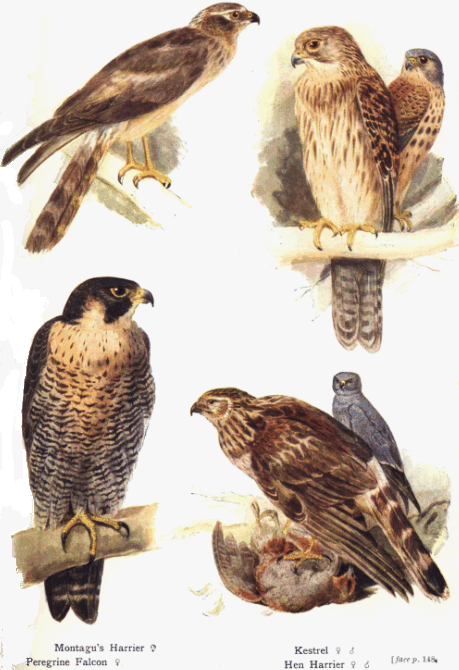
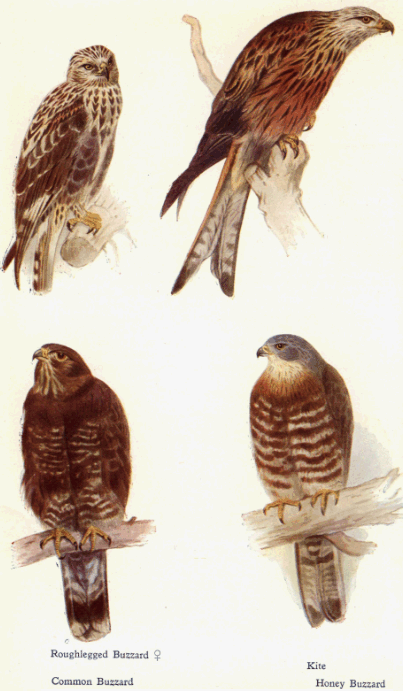
MONTAGU'S HARRIER CIRCUS CINERÁCEUS
Wings a little longer than the tail; third primary longer than the fourth and second; upper plumage bluish grey; primaries black, secondaries with three transverse dark bars; lateral tail-feathers white barred with reddish orange; under plumage white, variously streaked with reddish orange. Female—upper plumage brown of various tints; under, pale reddish yellow, with longitudinal bright red streaks. Beak black; cere deep yellow; irides hazel; feet yellow; claws black. Length seventeen inches. Eggs bluish white.
This bird, which is of rare occurrence in Britain, resembles the Hen Harrier very closely, both in appearance and habits, although it is smaller and more slender, and the wings are longer in proportion. On the Continent, especially in Holland, it is more frequent. It received its name in honour of Colonel Montagu, who was the first to ascertain the identity of the Hen Harrier and Ringtail, and to separate the present species from both.
COMMON BUZZARD BUTEO VULGARIS
Upper plumage, neck and head, dark brown; lower, greyish brown, mottled with darker brown; tail marked with twelve dark transverse bands; beak lead-coloured; cere, iris, and feet yellow. Length twenty to twenty-two inches. Eggs white, variously marked with pale greenish brown.
The Buzzard, though ranked very properly among birds belonging to the Falcon tribe, is deficient in the graceful activity which characterizes the true Falcons. In sluggishness of habits it approaches the Vultures, and in its soft plumage and mode of flight the Owls; but differs from the former in feeding on live prey as well as carrion, and from the latter in its diurnal habits. In form indeed it resembles neither, being a bulky broad-winged Hawk, with stout legs and a short much-curved beak. It can fly swiftly enough when occasion requires, but its favourite custom is to take its station on some withered branch, or on the projecting corner of a rock, whence it can both obtain a good view of the surrounding country, and, when it has digested its last meal, sally forth in quest of a new one as soon as a victim comes within its range of observation. It pounces on this while on the ground, and pursues its chase with a low skimming flight, keeping a sharp look-out for moles, young hares and rabbits, mice, reptiles, small birds and insects. At times it rises high into the air, and, soaring in circles, examines the surface of the ground for carrion. It has neither the spirit nor daring of the noble Falcons, submitting patiently to the attacks of birds much less than itself, and flying from the Magpie or Jackdaw. As an architect the Buzzard displays no more constructive skill than other birds of its tribe, building its nest of a few sticks, either on a rock or in a tree, and not unfrequently occupying the deserted nest of some other bird. It has, however, a redeeming point, being a most assiduous nurse. The female sits close, and will allow the near approach of an intruder before she leaves her eggs. In captivity, strange to say, though by nature having a strong inclination for the flesh of chickens, she has been known to sit on the eggs of the domestic hen, to hatch a brood, and to rear them with as much solicitude as their natural mother could have shown, distributing to them morsels of raw meat, not comprehending, of course, their repugnance to such fare, and bearing with extreme patience and good humour their unaccountable preference for barley and crumbs of bread. The male bird is scarcely less affectionate as a parent: an instance being recorded of one, which, on the death of his partner, completed the period of incubation and reared the young brood by himself. The Buzzard rarely molests game, and more than compensates for the mischief it does work, by the destruction of undoubted vermin; yet the hostility shown by gamekeepers against all birds except those which it is their business to protect, has so thinned its numbers that the Buzzard, though once common, is now become rare.
THE HONEY BUZZARD PERNIS APIVORUS
Lores or spaces between eyes and bill are covered with feathers. The head of male is ash-grey, his upper parts brown; three blackish bars cross the tail; upper parts white-barred and spotted with brown on the breast. Length twenty-two to twenty-five inches; female slighter the larger.
This species visits us during May and June, and a few stay to nest, placing the nest upon the remains of that of some other large bird. Wasps, wild bees and larvae form their food in summer, but other insects are eaten, and sometimes mice, birds, other small mammals, worms and slugs. From two to four eggs are laid, both male and female taking part in the incubation. The sitting bird is regularly fed by the other.
The Honey Buzzard has bred from the New Forest up to Aberdeenshire. Unfortunately, as much as £5 having been offered for a couple of well-marked eggs of this species in the New Forest by collectors, their numbers have become very few. Nearly £40 has been offered by extravagant collectors for a good pair of the birds. By the year 1870 nearly all were driven away from that district.
THE ROUGH-LEGGED BUZZARD BUTEO LAGÓPUS
Tarsi feathered to the claws; plumage yellowish white, variegated with several shades of brown; a broad patch of brown on the breast; tail white in the basal half, the rest uniform brown; beak black; cere and irides yellow; feathers on the legs fawn-coloured, spotted with brown; toes yellow; claws black. Length twenty-six inches. Eggs whitish, clouded with reddish brown.
This bird, which is distinguished from the preceding by having its legs thickly clothed with long feathers, is a native of the colder countries of both Continents, being only an occasional visitor in Great Britain during autumn and winter. It is sometimes seen in large flights on the Yarmouth Denes in October and November, at the same time with the Short-horned Owl. It mostly frequents the banks of rivers, where it feeds on vermin, reptiles, and the carcases of animals brought down by the floods. In softness of plumage and mode of flight, it resembles the Owls even more than the preceding species, and often extends its hunting expeditions until far into the evening. When not alarmed, it flies slowly and deliberately, and seemingly has neither the inclination nor the power to attack living birds, unless they have been previously disabled by wounds or other cause. The Rough-legged Buzzard builds its nest in lofty trees, and lays three or four eggs; but there are no well-authenticated instances of its breeding in this country.
THE SPOTTED EAGLE AQUILA NÆVIA
General colour reddish brown; tail brown above; legs feathered in front of the toes. Length twenty-six inches.
This species is only a rare straggler to Great Britain.
Sub-Family AQUILINÆ
THE GOLDEN EAGLE AQUILA CHRYSAËTOS
Tail longer than the wings, rounded; plumage of the head, back of the neck and legs, lustrous reddish brown, of the rest of the body dark brown; primaries nearly black; secondaries brownish black; tail dark grey, barred and tipped with brownish black; beak bluish at the base, black at the extremity; iris brown; cere and feet yellow; claws bluish black. Length of the male three feet, that of the female more; breadth eight feet. Eggs dirty white, mottled with pale reddish brown.
The fable of the Eagle soaring to a great height in order to enjoy a gaze at the sun in his unclouded brilliancy, is founded probably on a belief of the ancients, thus stated by the naturalist Pliny:—'Before its young are as yet fledged, the Eagle compels them to gaze at the rays of the sun, and if it observes one to wink or show a watery eye casts it from the nest as a degenerate offspring; if, on the contrary, it preserves a steady gaze, it is saved from this hard fate, and brought up.'
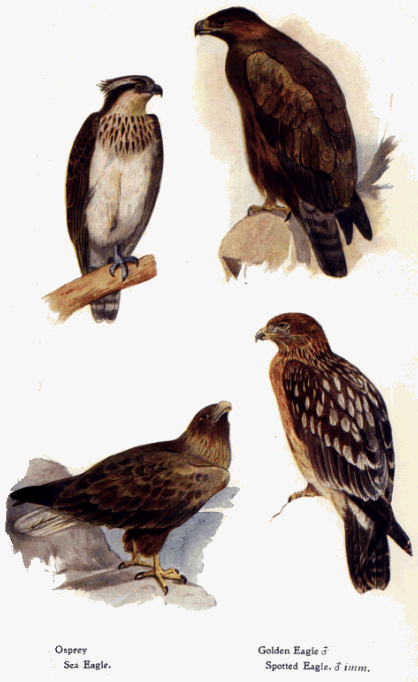
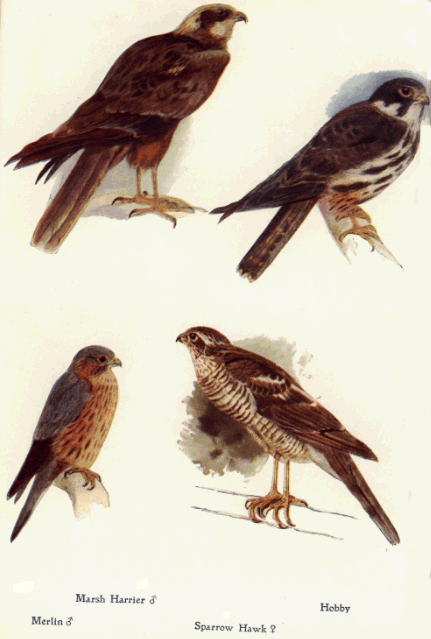
'The Golden Eagle', says Macgillivray, 'seems to prefer live prey to carrion, and easily secures Grouse, in searching for which it flies low on the moors, sailing and wheeling at intervals. Hares, roes, and even red deer, it also attacks, but it does not haunt the shores for fish so much as the Sea Eagle does. There seems very little probability that Eagles have the sense of smell very acute, but that their vision is so is evident. I am not, however, inclined to think that they perceive objects from the vast height to which they sometimes soar, because I never saw one descend from such an elevation in a manner indicating that it had observed a carcase or other eatable object; whereas, on the other hand, I have very frequently seen them flying along the sides of the hills, at a small height, obviously in search of food, in a manner somewhat resembling that of the Sparrow-Hawk, but with much less rapidity.'