Front matter (continued 2)
Reading edition
A much less frequent visitor to this country than the preceding, but by no means ranking among our rarest birds, specimens occurring in the winter of every year in some part of England or another, especially in Devon and Cornwall. Its habits are much the same as those of its congener; but it generally chooses a loftier situation for its nest, which is placed in the walls of buildings, at an elevation varying from a few feet to eighty or ninety. Its plumage differs in being much darker in the fore part of the body, while the tail is of a brighter red. The eggs are white. It generally arrives in England about the first week in November, and remains with us all the winter. Its nest has never been found in this country.
THE REDBREAST, OR ROBIN ERÍTHACUS RUBÉCULA
Upper parts brownish grey tinged with olive; forehead, lore, and breast red, the red edged with ash-grey; abdomen white. Female like the male, except that the upper parts are ash-brown, the red less bright, and the grey surrounding it less conspicuous. Length, five inches and three quarters. Eggs yellowish white, spotted with light reddish brown.
The Redbreast is everywhere invested with a kind of sanctity beyond all other birds. Its wonted habit of making its appearance, no one knows whence, to greet the resting traveller in places the most lonely—its evident predilection for the society of the out-of-door labourer, whatever his occupation—the constancy with which it affects human habitations—and the readiness with which, without coaxing, or taming, or training, it throws itself on human hospitality—engender an idea that there must be some mysterious connexion between the two—that if there were no men, there would be no Redbreasts. Trust on one side engenders confidence on the other, and mutual attachment is the natural result. There is something, too, beyond the power of explanation in the fact that the Robin is the only bird which frequents from choice the homes of men.
The habits of the Redbreast are so well known, that to describe them would be simply to write down what every one has seen or may see.
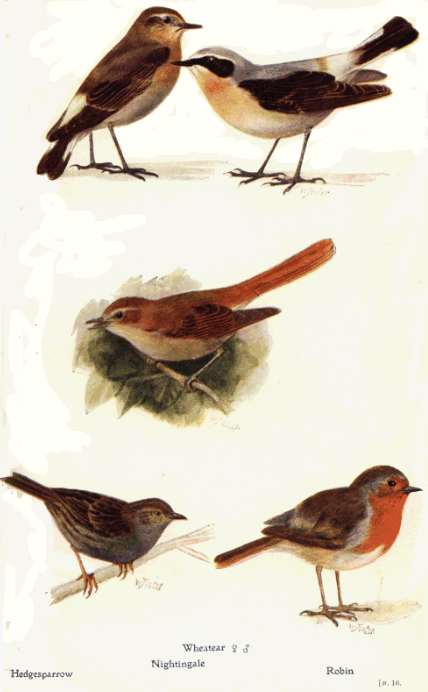
It generally builds its nest in a hole, near the bottom of a hedge or under the stump of a tree, in an ivy-clad wall, or amidst the creepers trained round the veranda of a cottage. I have seen it also placed in a niche in a wall intended for the reception of a vase, in a bee-hive stored away on the rafters of an outhouse, and under a wisp of straw accidentally left on the ground in a garden. It is usually composed of dry leaves, roots, bents, and moss, lined with hair and wool, and contains five or six eggs. The young birds are of a brown tint, and have the feathers tipped with yellow, which gives them a spotted appearance. Until they acquire the red breast, they are very unlike the parents, and might be mistaken for young Thrushes, except that they are much smaller. They may be often observed in gardens for many days after they have left the nest, keeping together, perching in the bushes, and clamorous for food, which the old birds bring to them from time to time. It is said, that only one brood is reared in a year, but this I am inclined to doubt, having observed in the same locality families of young birds early in the spring, and late in the summer of the same year. Towards the end of August, the young birds acquire the distinctive plumage of their species, and are solitary in their habits until the succeeding spring. The call-notes of the Redbreast are numerous, and vary beyond the power of description in written words; the song is loud, and it is needless to say, pleasing, and possesses the charm of being continued when all our other feathered songsters are mute. The red of the breast often has a brighter tint, it is occasionally almost a carmine red. The late Lord Lilford told the editor such were often birds that had been bred on the Continent. Numbers of young birds come across the sea to us each autumn.
THE NIGHTINGALE DAULIAS LUSCÍNIA
Upper plumage russet brown; tail bright rust-red; under plumage buffish white; flanks pale ash colour. Length six and a quarter inches; breadth nine and a half inches. Eggs uniform olive-brown.
The southern, eastern, and some of the midland counties of England, enjoy a privilege which is denied to the northern and western—an annual visit, namely, from the Nightingale. It is easy enough to understand why a southern bird should bound its travels northwards by a certain parallel, but why it should keep aloof from Devon and Cornwall, the climate of which approaches more closely to that of its favourite continental haunts than many of the districts to which it unfailingly resorts, is not so clear. Several reasons have been assigned—one, that cowslips do not grow in these counties; this may be dismissed at once as purely fanciful; another is, that the soil is too rocky; this is not founded on fact, for both Devon and Cornwall abound in localities which would be to Nightingales a perfect Paradise, if they would only come; a third is, that the proper food is not to be found there: but this reason cannot be admitted until it is proved that the portions of the island to which the Nightingale does resort abound in some kind of insect food which is not to be found in the extreme southern counties, and that the Nightingale, instead of being, as it is supposed, a general insect-eater, confines itself to that one; and this is a view of the question which no one has ventured to take. My own theory—and I only throw it out for consideration—is that the Nightingale is not found in these two counties on account of their peculiar geographical position. The continental Nightingales are observed to take their departure in autumn, either eastward through Hungary, Dalmatia, Greece, and the islands of the Archipelago; or southwards across the Straits of Gibraltar, but none by the broad part of the Mediterranean. Hence we may infer that the bird dislikes a long sea voyage, and that when in spring it migrates northward and westward, it crosses the English Channel at the narrowest parts only,[3] spreads itself over the nearest counties in the direction of its migration, but is instinctively prevented from turning so far back again to the south as the south-west peninsula of England. From Scotland it would be naturally excluded by its northern position, and from Ireland by the Welsh mountains and the broad sea.
For the dwellers in these unfavoured districts alone is my description of the Nightingale intended; for, where it abounds, its habits are too well known to need any description. Twenty-four hours of genial May weather spent in the country with a good use of the eyes and ears, will reveal more of the life and habits of the bird than is contained in all the ornithological treatises that have been written on the subject, and they are not a few.
No great amount of caution is necessary in approaching the Nightingale while singing at night. One may walk unrestrainedly across the fields, talking in an ordinary tone of voice, and not even find it necessary to suppress conversation when close to a singing bird. Either he is too intent on his occupation to detect the presence of strangers, or he is aware of the security in which he is wrapped by the shades of night, or he is actually proud of having listeners. In the neighbourhood of my present residence in Hertfordshire, Nightingales are numerous. They arrive about the seventeenth of April, and for the first few days assemble year after year in the bushes and hedges of a certain hillside, the position of which it would be unsafe to indicate particularly, and taking their station two or three hundred yards apart from each other, set up a rivalry of song which is surpassingly beautiful. At this season, one may hear five or six chanting at once; every break in the song of the nearest being filled up by the pipings or wailings of the more distant ones. The male birds arrive several days before the female, and employ the interval, it is fancifully said, in contending for the prize in a musical contest. This period is anxiously watched for by bird-catchers, who have learnt by experience that birds entrapped before they have paired will bear confinement in a cage, but that those captured after the arrival of their mates pine to death. The Nightingale being a fearless bird and of an inquisitive nature is easily snared; hence, in the neighbourhood of cities, the earliest and therefore strongest birds fall ready victims to the fowler's art.
It must not be supposed that this bird sings by night only. Every day and all day long, from his first arrival until the young are hatched (when it becomes his duty to provide for his family), perched in a hedge or on the branch of a tree, rarely at any considerable height from the ground, he pours forth his roundelay, now, however, obscured by the song of other birds. But not even by day is he shy, for he will allow any quietly disposed person to approach near enough to him to watch the movement of his bill and heaving chest. At the approach of night he becomes silent, generally discontinuing his song about an hour before the Thrush, and resuming it between ten and eleven. It is a disputed point whether the Nightingale's song should be considered joyous or melancholy. This must always remain a question of taste. My own opinion is, that the piteous wailing note which is its most characteristic nature, casts a shade of sadness as it were over the whole song, even those portions which gush with the most exuberant gladness. I think, too, though my assertion may seem a barbarous one, that if the Nightingale's song comprised the wailing notes alone, it would be universally shunned as the most painfully melancholy sound in nature. From this, however, it is redeemed by the rapid transition, just when the anguish of the bird has arrived at such a pitch as to be no longer supportable, to a passage overflowing with joy and gladness. In the first or second week of June he ceases his song altogether. His cataract of sweet sounds is exhausted, and his only remaining note is a harsh croak exactly resembling that of a frog, or the subdued note of a raven, wate-wate or cur-cur. On one occasion only I have heard him in full song so late as the fourth week in June: but this probably was a bird whose first nest had been destroyed, and whose song consequently had been retarded until the hatching of a second brood. From this time until the end of August, when he migrates eastward, he may often be observed picking up grubs, worms, and ants' eggs on the garden lawn, or under a hedge in fields, hopping from place to place with an occasional shake of the wings and raising of the tail, and conspicuous whenever he takes one of his short flights by his chestnut brown tail-coverts.
The Nightingale's nest is constructed of dead leaves, principally of the oak, loosely put together and placed on the ground under a bush. Internally it is lined with grass, roots, and a few hairs. It contains four or five eggs of a uniform olive-brown.
Sub-Family ACCENTORINÆ
THE HEDGE SPARROW ACCENTOR MODULÁRIS
Crown of the head ash colour, with brown streaks; sides of the neck, throat, and breast, bluish grey; bill strong and broad at base; wing-coverts and feathers on the back reddish brown, with a tawny spot in the centre; middle wing-coverts tipped with yellowish white; lower tail-coverts brown, with a whitish border; middle of abdomen white. Length five and a half inches. Eggs greenish blue, without spots.
Inveterate custom has so attached the name of Hedge Sparrow to this bird, that in spite of all the efforts of ornithologists to convince the world that it is no sparrow at all (a hard-beaked, grain-eating bird), but a true warbler, it is still more frequently called by its popular name than by any of those that have been suggested. The gentle, innocent, confiding, little brown bird, which creeps like a mouse through our garden flower-beds, picks up a meagre fare in our roads and lanes, builds its nest in our thorn hedges, and though dingy itself, lays such brilliant blue eggs, has been known to us from our infancy as a 'Hedge Sparrow', and we decline any innovation: the name is a time-honoured one, and no one will mistake us. Hedge Accentor, Hedge Warbler, and Shuffle-wing, are names open to those who prefer them, but we adhere to the old-fashioned designation of Hedge Sparrow. This bird is a genuine Warbler, and one of the few belonging to the tribe who remain with us all the winter; we should suppose, indeed, that he never wandered far from the place of his birth. At all seasons his habits and food appear to be the same. All day long he is shuffling about on the ground picking up minute atoms, whether seeds or insects, who knows? Every day, nearly all the year round, he repairs at intervals to the nearest hedge, where he sings a song, soft and gentle like himself; and every evening, when the Blackbird rings his curfew bell, he fails not to respond with his drowsy cheep, cheep, as he repairs to the bush he has selected for his night's rest. Very early in spring, before his brother warblers have arrived from the south, he has chosen his mate, built his snug nest, and too probably commenced a second; for unsuspicious in nature, he does not retire to solitary places for this purpose, and the leafless hedges but ill conceal his labours from the peering eyes of all-destroying ploughboys. Such are nearly all his "short and simple annals". He quarrels with no one, he achieves no distinction, throwing no one into ecstasies with his song, and stealing no one's fruit; unobtrusive and innocent, he claims no notice, and dreads no resentment; and so, through all the even tenor of his way, he is, without knowing it, the favourite of children, and of all the good and gentle.
Sub-Family SYLVIINÆ
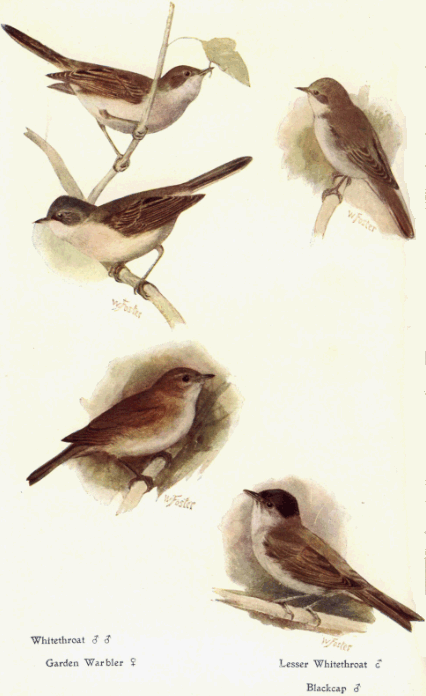
THE WHITETHROAT SYLVIA CINÉREA
Head ash-grey; rest of the upper parts grey, tinged with rust colour; wings dusky, the coverts edged with red; lower parts white, faintly tinged on the breast with rose colour; tail dark brown, the outer feather white at the tip and on the outer web, the next only tipped with white. Female without the rose tint on the breast, but with the upper plumage more decidedly tinged with red; feet brown. Length five inches and a half; breadth eight and a half. Eggs greenish white, thickly spotted with reddish and greenish brown. Young, leaving nest, differ very little from adult birds.
The Whitethroat is in England the most common of all the migratory warblers, and is generally diffused. It is essentially a hedge-bird, neither taking long flights nor resorting to lofty trees. Early in May it may be detected in a hawthorn or other thick bush, hopping from twig to twig with untiring restlessness, frequently descending to the ground, but never making any stay, and all the while incessantly babbling with a somewhat harsh but not unpleasant song, composed of numerous rapid and short notes, which have but little either of variety or compass. Occasionally it takes a short flight along the hedge, generally on the side farthest from the spectator, and proceeds to another bush a few yards on, where it either repeats the same movements, or perches on a high twig for a few seconds. From time to time it rises into the air, performing curious antics and singing all the while. Its short flight completed, it descends to the same or an adjoining twig; and so it seems to spend its days. From its habit of creeping through the lower parts of hedges, it has received the popular name of 'Nettle-creeper'. From the grey tone of its plumage, it is in some districts of France called 'Grisette', and in others, from its continuous song, 'Babillarde', names, however, which are popularly applied without distinction to this species and the next. While singing it keeps the feathers of its head erected, resembling in this respect the Blackcap and several of the other warblers. Though not naturally a nocturnal musician, it does not, like most other birds, when disturbed at night, quietly steal away to another place of shelter, but bursts into repeated snatches of song, into which there seems to be infused a spice of anger against the intruder.[4] Its food consists of insects of various kinds; but when the smaller fruits begin to ripen, it repairs with its young brood to our gardens, and makes no small havoc among raspberries, currants, and cherries. It constructs its nest among brambles and nettles, raised from two to three feet from the ground, of bents and the dry stems of herbs, mixed with cobweb, cotton from the willow, bits of wool, and horsehair. It usually lays five eggs.
THE LESSER WHITETHROAT SYLVIA CURRÚCA
Head and lore dark ash-grey; rest of the upper parts greyish ash, tinged with brown; wings brown, edged with ash-grey; tail dusky, outer feather as in the last, the two next tipped with white; lower parts pure silvery white; feet deep lead colour. Length five inches and a quarter. Eggs greenish white, spotted and speckled, especially at the larger end, with ash and brown.
Gilbert White in his charming history says, "A rare, and I think a new little bird frequents my garden, which I have very great reason to think is the Pettichaps; it is common in some parts of the kingdom; and I have received formerly dead specimens from Gibraltar. This bird much resembles the Whitethroat, but has a more white, or rather silvery breast and belly; is restless and active, like the Willow-wrens, and hops from bough to bough, examining every part for food; it also runs up the stems of the crown-imperials, and, putting its head into the bells of those flowers, sips the liquor which stands in the nectarium of each petal. Sometimes it feeds on the ground like the Hedge-Sparrow, by hopping about on the grass plots and mown walks." The little bird of which the amiable naturalist gives so interesting a description, was, there is little doubt, that which is now called the Lesser Whitethroat, then a 'new bird', inasmuch as it had not been made a distinct species, and necessarily a 'rare bird', not because a few only visited Britain, but because, until his time set the example, competent observers of birds were rare. It differs externally from the preceding, in its smaller size, and the darker colour of its beak, upper plumage, and feet, and resembles it closely in its habits, though I have never observed that it indulges in the eccentric perpendicular flights, which have gained for its congener, the Greater Whitethroat, the quaint sobriquet of 'singing skyrocket.' It feeds, too, on insects, and is not found wanting when raspberries and cherries are ripe. But no matter what number of these it consumes, it ought with its companions to be welcomed by the gardener as one of his most valuable friends. For it should be borne in mind, that these birds, by consuming a portion of a crop of ripe fruit, do not at all injure the trees, but that the countless aphides and caterpillars which they devoured at an earlier period of the year, would, if they had been allowed to remain, have feasted on the leaves and young shoots, and so not only have imperilled the coming crop, but damaged the tree so materially as to impair its fertility for some time to come. Those birds, therefore, which in spring feed on insects and nourish their young on the same diet, may be considered as necessary to protect from injury the trees which are destined to supply them with support when insect food becomes scarce. Consider what would be the result if the proper food of birds were leaves, or if insects were permitted to devour the foliage unchecked! our woods would be leafless, our gardens would become deserts.
THE GARDEN WARBLER SYLVIA HORTENSIS
Upper parts greyish brown, slightly tinged with olive; orbits white; below the ear a patch of ash-grey; throat dull white; breast and flanks grey, tinged with rust colour; rest of the under parts dull white. Length five inches and three-quarters; breadth eight and a half. Eggs greenish white, speckled with two shades of greenish brown.
Though tolerably well dispersed throughout England, this bird is by no means so abundant as the Blackcap, which it resembles in size and habits, but it arrives later, coming early in May. It is very local. Its song is little if at all inferior to that of the bird just named, and it is far from improbable that some of the sweet strains for which the Blackcap gets credit, particularly late in the summer, may be produced by the Garden Warbler; I have heard its song so late as the fifth of October. By some authors it is called the Greater Pettychaps, by others the Fauvette, which latter name is by some French ornithologists applied to the group containing this bird and several allied species. Its nest and eggs are so like those of the Blackcap as to be discriminated with difficulty.
THE BLACKCAP SYLVIA ATRICAPILLA
Top and back of the head black, in the female chocolate colour; upper parts, wings, and tail ash-grey, slightly tinged with olive; neck light grey passing into greyish white; bill and feet black. Length five inches and a half; breadth eight and a half. Eggs pale greenish white, variously mottled with several shades of brown; sometimes pinkish, mottled with light purple, and speckled with dark purple.
Whatever difference of opinion there may be as to the character of the Nightingale's song—whether it partakes more of joyousness or of melancholy—the gladsomeness of the Blackcap's warble is beyond all dispute. Conceding to the Nightingale the first place among the warblers which visit England, we do not hesitate to claim the second for the Blackcap. Its song is inferior in power and compass to that of the bird of night, but there is about it a delicious eloquence which makes it irresistibly charming. White of Selborne describes it as "full, sweet, deep, loud and wild"; high but not unmerited praise. If there are no vocal efforts to astonish, there are no piteous wailings to distress, and though the bird retires to rest at a reasonable hour, it continues its song until a late period of the season, long after that of the Nightingale has degenerated to a croak. It has been compared to that of the Redbreast, but it is more mellow and flute-like; to that of the Thrush, but it is softer and of more compass; to that of the Lark, but it is more varied. A practised ear will confound it with neither of these, though, strange to say, many persons who have lived all their lives in the country and who take much interest in its pleasant sights and sounds, habitually confound it with the song of one or other of these birds, not knowing to whom they are indebted for one of the principal charms of their gardens. The Blackcap, like several other of the migratory warblers, returns again and again to its old haunts. For six successive years it has been known to build its nest in a bramble which hung down from a rock in a public garden; and for even a longer period my own garden has been annually visited by a pair who, from unfailingly resorting to the same bushes, must, I have little doubt, be the same pair, though I cannot say that I have found or even searched for their nest. On its first arrival in April, the Blackcap is in the habit of what bird-fanciers call 'recording'—that is, practising over its song in a low tone. During this season of rehearsal it does not care to be seen, but hides away in a thick bush. It is nevertheless by no means shy of being heard, as it will allow the listener to approach within a few yards of its hiding-place without stopping its song, and if disturbed will remove to a very little distance and recommence. After a few days it acquires its full powers of voice.
Its song is now remarkable among the full choir for sweetness, loudness, and long continuance. Its food at this time consists of aphides, caterpillars, and other small insects which infest roses and fruit-trees; it rarely captures flies on the wing or descends to feed on the ground. In June it begins to sing shorter strains, but with no diminished power. It may then be observed flying from branch to branch of an apple-tree, resting for a few seconds only in the same spot, and busily occupied in collecting grubs or aphides, then indulging in a short strain. In July, when the raspberries ripen, the Blackcap becomes chary of its song, and introduces its young brood to the choicest and juiciest fruit; in their attentions to which both old and young birds are exceedingly pertinacious, holding scarecrows in extreme contempt, and heeding clapping of hands or the discharge of a gun as little. The young of the first year resemble the adult female in having a chocolate-coloured crown. The song of the Blackcap may be heard occasionally late in the summer; in September or October both old and young take their departure, and the Redbreast is left without a rival to assert his superiority as a warbler, until the return of spring. The nest is usually placed in a hedge or low bush, a few feet from the ground, and is constructed of bents, and lined with fibrous roots and hair. The male bird assists the female in performing the office of incubation, and is said to relieve the monotony of his occupation by singing, thus often betraying a well-concealed nest.
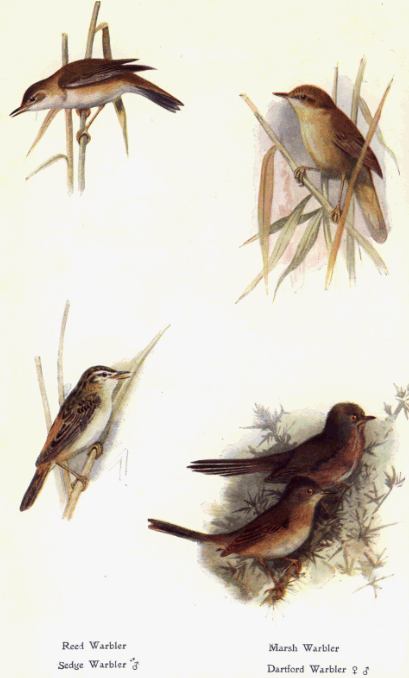
THE DARTFORD WARBLER SYLVIA UNDATA
Upper parts blackish brown; under, purplish red; middle of the abdomen white; tail long, dark brown, the outer feather tipped with white; wings very short; quills ash-grey on the inner web, dark brown on the outer; feet yellowish; bill yellowish white, with a black tip. Length five inches and a half. Eggs greenish white, speckled all over, and especially at the larger end, with brown and ash-grey.
This species received its name from having been first shot on Bexley Heath, near Dartford in 1773. It has since been observed on furzy commons in several of the southern and western counties, but is local and nowhere abundant. In its habits it resembles the Stone and Furze Chats, perching on the upper sprays of the furze and whitehorn, but never still for a minute, throwing itself into various attitudes, erecting its crest and tail at intervals, frequently rising into the air with most fantastic movements, catching insects on the wing, and either returning to the same twig, or making a short flight to some other convenient bush. The syllables 'cha cha cha' are several times repeated when the bird is irritated. Its note is commonly Pitchou, hence its French name. It keeps quite aloof from human habitations, and is so timid that on the approach of an observer, it creeps into a bush, and remains concealed until the danger is past. The nest of goose grass and soft bits of furze, wool and moss is placed in the fork of a furze-bush selected for its thickness and difficulty of access. It is somewhat wandering, but may be called a resident in the South, gradually extending northwards. Many specimens have been observed in mid-winter, and Rennie states that he has seen one as early as the end of February hovering over furze and singing like a Whitethroat.
THE REED WARBLER ACROCÉPHALUS STRÉPERUS
Upper parts of a uniform reddish brown, without spots; wing-feathers brown, edged with olive; a white streak between (not over) the eye and bill; throat white; under plumage yellowish white, the sides tinged with reddish; tail long, rounded. Length five and a half inches; breadth seven and a half. Eggs dull greenish white, speckled with olive and light brown, especially towards the larger end.
Both the Sedge and the Reed warblers are jaseuses, or chatterers, with rounded tails; but the Sedge Warbler has its upper plumage spotted with dark brown, and a white line above its eye, while the upper plumage of the Reed Warbler is of a uniform pale brown, and the light mark is absent from above the eye. The haunts and habits of the two birds are precisely similar, but the Reed Warbler is by far the less common of the two; for while the Sedge Warbler is sure to be found wherever the Reed Warbler has been observed, the converse by no means follows. The parts of England in which it appears to be most frequent, are East Riding of Yorkshire, Essex, Surrey, Kent, Suffolk, and Norfolk. In the reed-beds on the banks of the Thames, between Erith and Greenwich, it is common.
"The nest of the Reed Warbler is often elegantly built, and generally fixed to three or four reed-stems. It is composed of slender blades of grass, interwoven with reed-tops, dry duckweed, and the spongy substance which covers many of the marsh ditches; and, here and there, a long piece of sedge is wound securely around it; the lining is of the finer flowering stems of grass, intermixed with a little horsehair. It is a deep and solid structure, so that the eggs cannot easily roll out; it is firmly fastened to the reeds in tidal ditches and rivers, at the height of three or four feet from the water, but in still ditches often not more than a foot. In windy weather, when wading through the reed-beds, I have seen nests, with both old and young in them, blown nearly to the surface of the water; but the birds fix their claws firmly to the sides of the nest, with their heads to windward, and thus ride as securely in their cradle as a sailor does in his cot or hammock."[5] The Cuckoo occasionally chooses the Reed Warbler's nest to lay its eggs in, for the same writer remarks—"At the latter end of July, 1829, while reading in my garden, which adjoins a market garden, I was agreeably surprised to see a young Cuckoo, nearly full-grown, alight on the railings between the two, not more than a dozen yards from where I was sitting. Anxious to see what bird had reared this Cuckoo, I silently watched his movements, and had not waited more than a minute, when a Reed Warbler flew to the Cuckoo, who, crouching down with his breast close to the rail, and fluttering his wings, opened wide his orange-coloured mouth to receive the insect his foster-mother had brought him. This done, the Reed Warbler flew away for a fresh supply of food. The difference in the size of the two birds was great; it was like a pigmy feeding a giant. While the Reed Warbler was absent, the Cuckoo shuffled along the rail, and hopped upon a slender post to which it was nailed, and which projected about eight inches above the rail. The Reed Warbler soon returned with more food, and alighted close to the Cuckoo, but on the rail beneath him; she then began to stretch herself to the utmost to give him the food, but was unable to reach the Cuckoo's mouth, who, like a simpleton, threw his head back, with his mouth wide open, as before. The Reed Warbler, by no means at a loss, perched upon the Cuckoo's broad back, who, still holding back his head, received in this singular way the morsel brought for him." The song of the Reed Warbler is loudest and at its best during the evening twilight.
MARSH WARBLER ACROCÉPHALUS PALUSTRIS
Upper parts olive-green without any reddish tinge; legs and feet pale brown.
The Marsh Warbler is local in its occurrence, in the south of England. It nests in drier places than the Reed Warbler and its song is different, being much more melodious, and uttered more boldly. Close to low bushes, or among meadow-sweet, nettles and cow-parsnip, you may find its nest, which is made of fine rounded stalks of grass and lined with horsehair. There are five to seven eggs, whiter in ground colour than those of the Reed Warbler. The Marsh Warbler comes each spring to the neighbourhood of Taunton, but it is still a somewhat rare species.
THE SEDGE WARBLER ACROCÉPHALUS PHRAGMÍTIS
Upper plumage olive-grey, the centre of each feather tinged with brown; above the eyes a broad yellowish white stripe; under, yellowish white, more or less tinged with red; throat white; tail rounded, of moderate length, of a uniform ash-brown. Length four and a half inches; breadth seven and a half. Eggs dirty white, mottled all over with dull yellowish brown.
On the banks of reedy and bushy rivers, in marshes, withy holts, wherever, in fact, there is fresh water associated with enough vegetation to shelter and conceal, this bustling little bird is a constant summer visitor; restless in its habits, and courting notice by its twittering song, from the time of its arrival to that of its departure. It is usually first detected by its rapidly repeated note, which it utters while performing its short flights from bush to bush, and while creeping in and out among reeds and rushes. The fisherman knows it well, and is often tempted to withdraw his eye from his fly or float, to watch its movements on the opposite bank. From its unceasing babble, ploughboys call it a 'chat', a name which exactly answers to the French name of the group to which it belongs—'Jaseuses'. Its note is remarkable neither for volume nor sweetness, and, like that of unfeathered chatterers, seems to carry more noise than meaning. To a certain extent the bird is a mimic, as it imitates such notes of other birds as are within the compass of its little throat. I was walking one morning in May by the banks of a canal not far from a village, when I remarked the exact resemblance between a portion of its song and the chirrup of a House Sparrow. Intermixed with this, I detected the note of some other bird; but, familiar though it sounded, I ransacked my memory in vain to discover from whom it was purloined. Pursuing my walk towards the houses, I heard the note of some Guinea-fowls; not the 'come-back' cry, but the 'click-click' which every one knows so well. Of this the Sedge Warbler had caught exactly both the key and the time; the two notes were in fact identical, except that they were performed on instruments of different calibre. Like other chatterers, who, when they have finished their song, are easily provoked to begin again, the Sedge Warbler, if he does occasionally retire to a bed of reeds and there holds his peace, may be excited to repeat his whole story over again, with variations and additions, by flinging a stone into his breathing-place. And not content with babbling all day, he extends his loquacity far into the night; hence he has been called the Sedge Nightingale, but with doubtful propriety, for, with all the will perhaps to vie with that prince of songsters, the zinzinare of the Nightingale is far beyond his powers. Yet in spite of his obtrusiveness, he is an amusing and a pleasant companion to the wanderer by the river's side: his rivalry is devoid of malice, and his mimicry gives no one pain. While at rest—if he is ever to be detected in this state—he may be distinguished from all other birds frequenting similar haunts by his rounded tail, and a light narrow mark over each eye. His food consists of worms, insects, and fresh-water mollusks, for which he hunts among the stems of aquatic plants. As an architect, he displays great skill, constructing his nest among low bushes, never at any great distance from the water, about a foot from the ground. It is composed of stems and leaves of dead grass, moss and fine roots, and lined with hair, wool, feathers, and the down of various marsh plants. The structure is large, compact, and deep, suspended from, rather than built on, its supports. The eggs are usually five or six in number, though as many as seven have been sometimes found.
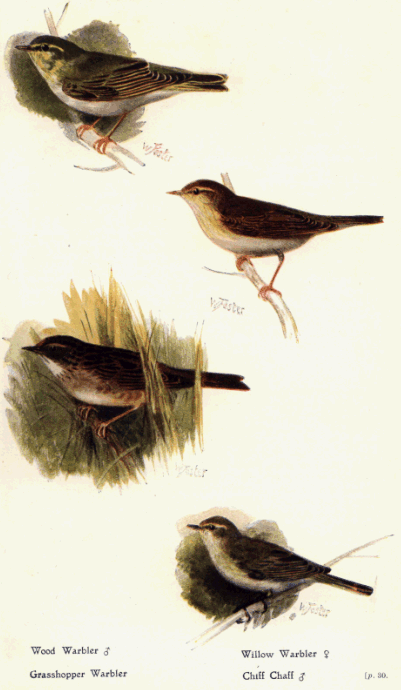
THE GRASSHOPPER WARBLER LOCUSTELLA NÆVIA
Upper parts light brown, with a tinge of green, and presenting a spotted appearance, owing to the centres of the feathers being darkest; tail long, rounded at the extremity and tapering towards the base; under parts whitish brown, the breast marked with darker spots; feet and toes light brown. Length five and a half inches; breadth seven and a half. Eggs reddish white, closely speckled with darker red.
As long ago as the time when a stroll of five-and-twenty miles fatigued me less than a journey of ten does now—when I returned from my botanical rambles with tin boxes, hands and pockets, laden with stores of flowers, ferns, and mosses, my homeward path often led me through a certain valley and wood on the skirts of Dartmoor, known by the names of Bickleigh Vale and Fancy Wood. It often happened that twilight was fading into gloom when I reached this stage in my wanderings—the last of the evening songsters had hushed its note; for this county, beautiful as it is, offers not sufficient attraction to the Nightingale; yet I never passed this way under such circumstances without feeling myself compelled to stop once and again to listen to the monotonous whir of what I had been told, and what I believed to be the note of the large green grasshopper, or locust. Monotonous is, perhaps, not the right word to use, for an acute ear can detect in the long unmusical jar a cadence descending sometimes a semitone, and occasionally almost a whole note; and it seemed besides to increase in loudness for a few seconds and then to subside a little below the ordinary pitch; this fall is chiefly at the breeding season. Whether the difference was produced by a rising and lulling of the breeze, or whether the musician actually altered its note and intensity of noise (or must I call it music?), I could never decide. As long as I fancied the performer to be an insect, I was inclined to believe that one of the first suppositions was correct; for it seemed hardly possible that the purely mechanical action of an insect's thighs against its body could produce variety of sound—as well expect varied intonations from a mill-wheel or saw-pit. Attentive observation, and the knowledge that the noise in question proceeded not from the exterior of an insect, but from the throat of a bird, has led me to form another conclusion. I am not surprised at my having fallen into the error; for the song of this bird is but an exaggeration of the grasshopper's note, and resembles the noise produced by pulling out the line from the winch of a fishing-rod, no less continuous is it, nor more melodious. Many years afterwards, when the memory of these pleasant wanderings had faded away, I happened one evening in May to be passing across a common in Hertfordshire, skirted by a hedge of brushwood, when the old familiar sound fell on my ear like a forgotten nursery melody. The trees not being in their full foliage, I was not without hope that I might be able to get a sight of the performer, whom I now knew to be a bird, and I crept quietly towards the spot whence the noise proceeded. Had it been singing in a copse-wood instead of a hedge, I should certainly have failed, for there is the same peculiarity about its note that there is about that of the insect—you cannot make up your mind exactly whereabouts the instrument which makes the noise is at work. The note, when near, is continuous, monotonous, and of equal loudness throughout; it might be a minute spinning-wheel revolving rapidly, or a straw pipe with a pea in it blown with a single breath and then suddenly stopping. But whether the performance is going on exactly before you, a little to the right, or a little to the left, it is hard to decide. I approached to within a few yards of the hedge, and peered through the hazel rods, now decorated with drooping tufts of plaited leaves, but all in vain. I went a step or two nearer; the sound ceased, and the movement of a twig directed my attention towards a particular bush, on which I saw a little bird, about as big as a Hedge Sparrow, quietly and cautiously dropping branch by branch to the ground. In a few minutes I observed it again a few yards off, creeping with a movement resembling that of the Nuthatch up another bush. Having reached to nearly the summit it became motionless, stretched out its neck, and keeping its mandibles continuously open and slightly elevated, commenced its trill again; then it shuffled about for some seconds and repeated the strain. It now seemed to descry me, and dropping to the ground as before, reappeared a few yards off. I fancied that while actually singing its feathers were ruffled; but in the imperfect twilight I could not decide positively. That it kept its mandibles motionless while singing, I had no doubt. Half an hour afterwards, at a quarter to eight, I returned from my walk, and observed it several times go through precisely the same manœuvres. On no occasion did it make a long flight, but even when I scared it by throwing a stone into the hedge near it, it merely dropped to the ground, and in a minute or two was piping from another bush. I have not found, as some authors say, that it resorts only to the vicinity of watery places. The one which I saw on this occasion had located itself for the summer several miles from a stream; and others which I have heard night after night had settled down on the skirts of a dry common, watered only by the clouds. Its nest I have sought for in vain.
THE CHIFF-CHAFF PHYLLOSCOPUS RUFUS
Upper parts olive-green tinged with yellow; above the eyes a narrow, faint, yellowish, white streak; under parts yellowish white; feathers of the leg dirty white; second primary equal to the seventh; third, fourth, fifth, and sixth with the outer web sloped off at the extremity; under wing-coverts primrose-yellow; feet slender; legs nearly black. Length four inches and a half; breadth seven and a quarter. Eggs white, sparingly spotted with dark purple.
Whatever question there may be whether the name of Willow-warbler be appropriately applied to the last species, there can be no doubt that the Chiff-chaff is well named. Let any one be asked in the month of May to walk into a wood and to hold up his hand when he heard a bird call itself by its own name, 'Chiff-chaff', he could not possibly fall into an error. The bird is so common that it would be difficult to walk a mile in a woodland district without passing near one or more, and having little to say, it seems never weary of repeating its tale, 'Chiff, chaff, cheff, chiff, chaff': the syllables have a harsh sound pronounced by human lips, but when chanted in the silvery notes of a little bird, in the season of primroses and wild hyacinths, and accompanied by the warble of the Hay-bird, the full song of the Thrush, and the whistle of the Blackbird, they contribute not a little to the harmony of the woods.
For two successive years a little yellowish bird, scarcely bigger than a wren, has established himself in my garden about the middle of April, and sedulously devoted himself to clearing away the aphides which infested some China roses trained against the walls of my house. Occasionally he would flutter against the windows, and give his attention to the spiders and gnats which nestled in the corners of the panes. The first year I took him for a Hay-bird, but, only too grateful for his kind offices, I was careful not to molest him. When, however, he appeared a second year, exactly at the same season, and performed a series of manœuvres so precisely similar that it was impossible to doubt that the bird was not merely of the same species, but the same individual, I watched him more closely. The dark colour of his feet, as observed from within the house, as he was fluttering against the glass, decided the point that he was not a Hay-bird, and when he retired to an apple-tree hard by and treated himself to a song after his repast, no doubt remained that he was a Chiff-chaff. It is not often that the Chiff-chaff is thus familiar in its habits. More frequently it makes its abode in woods and groves, resembling the Hay-bird so closely in size, colour and habits, that to distinguish the two is very difficult. The difference of note, however, is decisive; and the colour of the feet (when the bird is near enough to admit of being thus distinguished) is another certain criterion. The two birds frequent the same trees without rivalry or jealousy. The Chiff-chaff is the earliest of our spring visitors, arriving the middle of March, and it sings all through the summer; I have heard it as late as the thirtieth of September. The nests, popularly called 'wood-ovens', are alike and placed in similar situations; their eggs are of the same size and shape, but those of the Chiff-chaff are spotted with very dark purple instead of rust colour. A few occasionally remain with us all the year, feeding on winter gnats and the pupæ of small insects, but remaining wholly silent. Other names by which it is known are 'Chip-chop' and Lesser Pettichaps.
THE WILLOW-WARBLER PHYLLOSCOPUS TRÓCHILUS
Upper parts bright olive-green; a narrow streak of yellow over the eye; under parts yellowish white, palest in the middle; feathers of the leg yellow; second primary equal to the sixth; third, fourth, and fifth with the outer web sloped off at the extremity; feet stoutish; legs light brown. Length nearly five inches; breadth eight. Eggs white, more or less speckled with rust colour.
There seems to be no sufficient reason why this bird should be named Willow-warbler or Willow-wren, as it shows no special preference for willows, nor does it frequent watery places. The popular name, 'Hay-bird', is, I think, the better of the two; for, except in the extreme west of England, wherever there are hayfields and trees these birds are to be found; they build their nests principally of hay, and very frequently place it in the border of a hay-field. But, by whatever name it is known, it is a cheerful and active little bird, to which our woods and groves are much indebted for their melody. It is abundant and generally diffused, arriving in England early in April, and remaining until the middle of September. During the greater part of this period, it may be seen fluttering about the tops of trees, hunting the twigs and leaves for insects, and occasionally catching flies on the wing. It often, too, descends to the ground, and picks up insects among the herbage. I have never heard it sing on the ground; but while employing itself aloft, it rarely allows more than a few minutes to elapse without going through its short and sweet song. This, though very agreeable, possesses no great variety, and is composed of about twenty or thirty notes, the latter ones of which are repeated rapidly, and form a natural cadence. For many years this pleasant little melody, or the simpler song of the Chiff-chaff, has been the first sound I have heard to announce the arrival of the summer birds of passage; perhaps it is on this account that it is with me, at all seasons, a favourite rural sound.
Ornithologists seem well agreed that the Willow-warbler's food consists entirely of insects. This may be so, but I am much mistaken if a brood of this species annually hatched in a bank of furze adjoining my garden, do not, in conjunction with Blackcaps and Whitethroats, pay daily visits to a certain row of red raspberries in my garden. It may be that they come only in quest of aphides, but I have certainly seen them in dangerous proximity to clusters of the ripest fruit, which, when they were scared away, bore evident marks of having been pecked by birds. The nest of the Hay-bird resembles that of the Wood-warbler, but it is lined with feathers. The eggs are usually from five to seven, and of the same size and shape, but the spots are rust-coloured and limited in number.
THE WOOD-WREN PHYLLOSCOPUS SIBILÁTRIX
Upper plumage bright yellowish green; a broad streak of sulphur-yellow over the eye; sides of the head, throat, insertion of the wings and legs bright yellow; rest of the under plumage pure white; second primary equal to the fourth, third and fourth with the outer web sloped off at the extremity; legs pale brown. Length five inches and a half; breadth eight and three quarters. Eggs white, speckled so thickly with purplish brown as almost to conceal the ground.
The Wood-warbler, Willow-warbler, and Chiff-chaff resemble each other so closely in size, colour, and habits, that except by a practised observer, they are likely to be mistaken for one another. In song, however, they differ materially, and as this is begun early, and continued till very late in the season, it affords ready means of discriminating the species. The Wood-warbler, or Wood-wren as it is now called, arrives in England towards the end of April, and betakes itself to woodland districts, where it spends the greater portion of its time among the upper branches of lofty trees, constantly moving from place to place with rapid irregular flight, and frequently repeating its short and peculiar song. It feeds exclusively on insects, which it occasionally catches on the wing. Its song is difficult to describe. The name by which it is popularly known in some parts of France, Touïte, is derived from the syllable 'tweet', which, rapidly and continuously repeated many times, constitutes its song. These notes are uttered in a sweet tone, and with a tremulous accent, and are unlike those of any other bird. Gilbert White, who appears to have been the first who noticed the bird, describes it as "joyous, easy, and laughing". The last notes of its strain are accompanied by a quivering of the wings and tail, which accounts for their tremulous sound.
The Wood-warbler is much less frequent than either the Willow-warbler or Chiff-chaff, and on a close inspection may be distinguished by its superior size, by the pure white of its under tail-coverts, and by the bright yellow line above the eye. The nest is composed of grass, ferns, and moss, and lined with fine grass and hair; it is covered with a dome, an entrance being left sufficiently large to allow its contents to be seen, and is placed on the ground, in or near a wood, among thick herbage, or against the stump of a tree. The eggs are from five to seven in number, almost round, and so thickly spotted with purple-brown that the ground is almost invisible.
Sub-Family REGULINÆ
THE GOLD-CREST RÉGULUS CRISTÁTUS
Upper parts olive, tinged with yellow; cheeks ash colour, without streaks; wing greyish brown, with two transverse white bands; crest bright yellow, tipped with orange and bounded on each side by a black line; under parts yellowish grey. In the female the crest is lemon colour, and the other tints are less brilliant. Each nostril is covered by one buff feather. Length three inches and a half. Eggs cream colour, minutely mottled at one end.
The Gold-crest, Golden-crested Regulus, or Golden-crested Wren, though not exceeding in dimensions some of the larger humming-birds, and though decorated with a crest equalling in brilliancy of colour the gay plumage of tropical birds, is a hardy little fellow, able to bear without shrinking the cold of an English winter, and to keep his position among the branches of high trees in the stormiest weather. Even during a heavy gale I have watched Gold-crests fluttering from branch to branch, and busily hunting for food, though the trees were waving like reeds. They are most numerous in winter, as a considerable number migrate southwards in October, but a great many remain with us all the year, preferring those districts where there are fir-plantations. Their whole life is spent in the air; I at least have never observed one on the ground. Their food consists of the insects which infest the leaves and twigs of trees; and I have seen them capture small moths on the wing. While hunting for food, which appears to be all day long, they are never still, fluttering from branch to branch, hanging in all attitudes, and peering in all directions. From time to time they utter their thin and wiry call-note, which is by some compared to the cry of the Shrew. It might be mistaken for the jarring noise made by two branches which cross one another, or that of a damp finger rubbed lightly along a pane of glass. Early in spring the song commences; it is composed of about fifteen short notes, rapidly uttered at an exceedingly high pitch, and ending with a yet more rapid cadence. By the call-note or song the vicinity of the bird is far more frequently detected than by its actual appearance; for the branches of firs in woods are mostly at a considerable height from the ground, and our 'little king' (saving his majesty) is hard to be distinguished from a fir-cone, except when he is in motion. Gold-crests are eminently social birds; they generally hunt in parties of half a dozen or more, and do not often change their hunting-ground; at least I infer as much from the fact that on various occasions I have observed the same bird on the same clump of trees, at intervals extending over several weeks. I could scarcely have been mistaken in the identity of the bird, as it had lost a leg, by what accident I know not; but the loss did not at all interfere with its activity or spirits. Their sociability extends sometimes to birds of other kinds, as the Creeper and the Tits of several species have been seen hunting in company with them. The habits of these birds being similar, they perhaps associate from a feeling of mutual protection, just as Sparrows, Buntings, and Finches make common cause, when they invade our rick-yards. The Gold-crests are, however, naturally less wary than any of the Tits. These last will at once decamp if disturbed, but Gold-crests will continue their hunting without taking any notice of a spectator. In autumn large flocks sometimes arrive on our east coast extending across England and on into Ireland. In April a return migration takes place. The nest of the Gold-crest is a beautiful structure. Its external form is nearly that of a globe, with a contracted opening at the top. It is composed of moss and lichens, interwoven with wool and lined thickly with feathers. It is usually placed among the boughs of a silver-fir or spruce-fir, in such a manner as to be partially suspended from one branch and supported by another. The bird seems neither to court nor to shun the vicinity of human beings; as I have found nests in the most lonely woods, and I have seen one in the branches of a spruce-fir, so close to my house that I could look into the nest from my bedroom windows, and watch the old birds feeding their young. The eggs vary in number from five to eight, they are almost globular, and smaller than those of any other British bird. This is scarcely surprising, seeing that the weight of a recently killed adult male which I have before me is eighty-seven grains; so that five and a half full-grown birds weigh but an ounce.
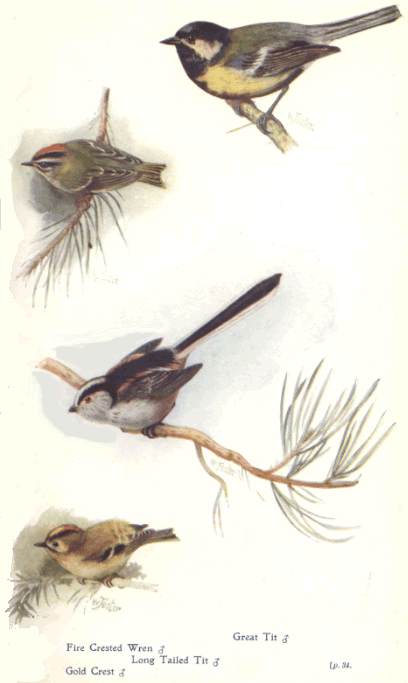
THE FIRE-CRESTED WREN RÉGULUS IGNICAPILLUS
Upper parts olive-green; a dark streak passing through the eye, and another white one above and below; crest brilliant orange, bounded in front and on each side by a black streak; in other respects resembling the last. Female with all the colours less brilliant. Length four inches. Eggs cream colour, tinged with red and dotted.
This species both in size and habits resembles the last, from which it is best distinguished by three dark lines on each side of its head. Hence it is called in France 'Roitelet à triple bandeau'. It is far less common than the Gold-crest, and has not been observed in the winter, when birds of the other species are most abundant—in fact, it is only a rare straggler. Its call-note is shorter than that of the Gold-crest, not so shrill, and pitched in a different key. The nests of the two birds are much alike.
FAMILY PARIDÆ
THE LONG-TAILED TIT ACRÉDULA CAUDÁTA
Head, neck, throat, breast, and a portion of the outer tail-feathers white; back, wings, and six middle feathers of the tail black; a black streak above the eye; sides of the back and scapulars tinged with rose-red; under parts reddish white; tail very long; beak very short. Length five inches and three-quarters; breadth six inches and three-quarters. Eggs white, minutely and sparingly speckled with light red or plain white.
All the Tits, of whatever species, are more or less sociable in their habits, hunting about during autumn in parties of half a dozen or more; but some of them are given to be quarrelsome, not only towards other birds—like the Great Tit, who actually murders them for the sake of picking out their brains—but among themselves, as the Blue Tit, who has been noticed so intently engaged in combat with another bird of his own kind, that the observer caught them both in his hat. The Long-tailed Tits, however, are sociable after another sort. From the time that a young brood leaves the nest until the next pairing season, father, mother, and children keep together in irreproachable harmony. Exploring the same clump of trees in society, perfectly agreed as to whither their next flitting shall be, no one showing any disposition to remain when the rest are departing, molesting no one, and suffering as far as it can be ascertained no persecution, they furnish a charming example of a happy family. Nomad in their habits, save that they indulge in no questionable cravings for their neighbours' property, they satisfy their wants with the natural produce of any convenient halting-place, when they have exhausted which they take their flight, in skirmishing order, but generally in a straight line, and strictly following the lead of their chief, to some other station; and when overtaken by night, they halt and encamp where chance has left them. Their only requisite is, in summer, the branch of a tree; in winter, some sheltered place where they can huddle together, and sleep until the next day's sun calls them to resume their erratic course.[6] Their food, during those journeys, consists of caterpillars, small beetles, and the pupæ of insects generally, and this diet they seem never or very rarely to vary.[7] The ripest fruits do not tempt them to prolong their stay in a garden, and insects that crawl on earth are in two senses beneath their notice. Their rapid progress from tree to tree has been compared to a flight of arrows. Singular as is their flight, they are no less amusing while employed in hunting for food, as they perform all the fantastic vagaries of the Tits, and their long straight tails add much to the grotesqueness of their attitudes. Seen near at hand, their appearance may be called comical. Their abundant loose feathers, the prevailing hue of which is grey, suggest the idea of old age, and, together with the short hooked beak, might give a caricaturist a hint of an antiquated human face, enveloped in grey hair. Many of the provincial names of the bird are associated with the ridiculous; thus, Long-tailed Mufflin, Long-tail Mag, Long-tail Pie, Poke-pudding, Hack-muck, Bottle Tom, Mum-ruffin, and Long-pod, pet names though they are, are also whimsical, and prepare one beforehand for the information that their owner is 'just a little eccentric'. But whatever be their name, I never hear the well-known 'zit, zit', the pass-word which keeps them together, and which always accompanies their journeyings, without stopping to watch the little family on their flight.
The nest of this species is of most exquisite workmanship and beautiful texture. Its form is that of a large cocoon broadest at the base, or that of a fir cone. It is sometimes fastened to the stem of a tree, sometimes placed in a fork, but more frequently built into the middle of a thick bush, so that it can only be removed by cutting away the branches to which it is attached. The outer surface is composed principally of the white lichen which is most abundant in the neighbourhood, and so is least likely to attract attention. All the scraps are woven together with threads of fine wool; the dome is felted together, and made rain-proof by a thick coating of moss and lichen, wool and the web of spiders' eggs. The walls are of moss. The interior is a spherical cell, lined with a profusion of feathers. A softer or warmer bed it would be hard to imagine. At the distance of about an inch from the top is a circular opening scarcely large enough to admit one's thumb. In this luxurious couch, which it has cost the female bird some three weeks of patient industry to complete, she lays ten or twelve eggs, which all in good time are developed into as many Bottle Tits; but by what skilful management the ten or twelve long tails are kept unruffled, and are finally brought to light as straight as arrows, I can offer no opinion. Nests are occasionally found containing as many as eighteen eggs. In these cases it has been affirmed that two or more females share a common nursery, and incubate together. Certainly it is difficult to imagine how a single pair can manage to supply with food so many hungry young birds, but there is no direct evidence of their being two distinct broods.
THE GREAT TIT, OX-EYE OR TOMTIT PARUS MAJOR
Head, throat, and a line passing down the centre of the breast, black; back olive-green; cheeks and a spot on the nape white; breast and abdomen yellow. Length six inches; breadth nine. Eggs white, speckled with light rusty.
As this bird is no larger than a Sparrow, its surname 'Great' must be understood to denote only its superiority in size to other birds of the same family. It is, however, great-hearted, as far as boldness and bravery entitle it to this epithet, being ready to give battle to birds far its superiors in size, foremost to join in mobbing an intrusive Owl, and prepared to defend its nest against robbers of all kinds. Its powers of locomotion are considerable, as it is strong in flight, active on the ground, and as a climber is surpassed by few rivals. Its stout and much-curved hind claw gives it great facility in clinging to the twigs and branches of trees, sides of ricks, and even the walls of houses. Such situations it resorts to in quest of its favourite food, caterpillars and pupæ of all kinds, and it is most amusing to watch it while thus engaged. Attitude seems to be a matter of no consequence; it can cling with perfect security to anything but a smooth surface. On trees it hangs from the branches, with its back either downwards, or turned sideways, and explores crevices in walls with as little regard to the vertical position of the surface to which it clings, as if it were examining a hole in the level ground. Its efforts to disengage a chrysalis from its cocoon are very entertaining. One scarcely knows which most to admire, the tenacity of its grasp, the activity with which it turns its head and body, or the earnestness and determination with which it clears away every obstacle until it has secured the prize. It does not, however, limit its food to insects; it is accused of feeding occasionally on the buds of fruit-trees, but it is doubtful whether the bird has any other object in attacking these, than that of hunting out the insects that infest them. It is said also to be very fond of nuts, which it sticks into crevices in the bark of trees, and cracks by repeated blows of its beak. Whether it has this power, I do not know; but that it will eat nuts of every kind, it is easy to prove by fastening the kernels of filberts or walnuts to the trunks of trees by means of stout pins. Tits, great and little, and Nuthatches, if there be any in the neighbourhood, will soon discover them, and if once attracted may thus be induced to pay daily visits to so productive a garden. A Great Tit of unusual intelligence, which frequents my garden at the present time, has been frequently observed to draw up by its claws a walnut suspended by a string from the bough of an apple-tree, and to rifle its contents, being itself all the while leisurely perched on the twig, and keeping the nut firm by a dexterous use of its claws. A charge, amounting to a grave accusation against the Great Tit, and one which cannot be palliated by the plea that he has accomplices, is, that when driven by hunger and he has the opportunity, he attacks other small and weakly birds, splits their skulls by means of his strong, sharp beak, and picks out their brains. One story in particular I find, of a Great Tit having been placed in a well-filled aviary. In the course of a single night, he had killed every one of his companions, with the exception of a Quail, and when he was discovered, he was in the very act of dealing to this the coup de grâce. His skill and discrimination in pecking holes in the sunniest side of ripe apples and pears are well known; but to this reward for his services in destroying caterpillars he is justly entitled.
The Great Tit builds its nest generally in the hole of a tree, employing as materials moss and leaves, and, for the lining, hair and feathers; but as its habits lead it to our gardens, it comes into close contact with human beings and becomes familiar with them. Hence it occasionally builds its nest in quaint places, which bear ever so distant a resemblance to its natural haunts. An unused pump affords it an excellent harbour; and the drawer of an old table, left in an outhouse, has been found thus occupied.
The notes of the Great Tit are various, but not musical. Its spring song must be familiar to every one; though not every one who hears it knows who is the musician. It consists of but two notes, repeated frequently, and sounding as if made by a bird alternately drawing in and sending out its breath; both together give a fair imitation of the sharpening of a saw. Besides this, it indulges in a variety of chirps, twitters, and cheeps, some angry, some deprecatory, and some pert, which a practised ear only can refer to their proper author.
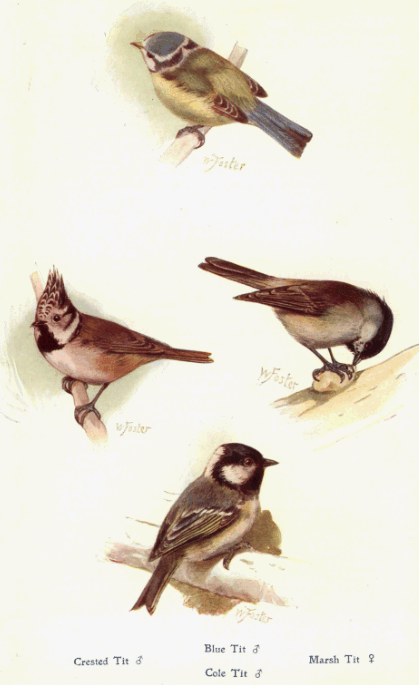
THE BLUE TIT, ALSO CALLED TOMTIT PARUS CŒRÚLEUS
Crown of the head blue, encircled with white; cheeks white, bordered with dark blue; back olive-green; wings and tail bluish; greater coverts and secondaries tipped with white; breast and abdomen yellow, traversed by a dark blue line. Length four inches and a half; breadth seven inches and a half. Eggs as in the preceding, but smaller.
The Blue or Tom Tit so closely resembles the Great Tit in its habits, that, with trifling exceptions, a description of one would be equally applicable to the other. Though much smaller than his relative, the Tom Tit is equally brave and pugnacious, and is even more quarrelsome, for he will fight with birds of his own kind; and the Great Tit, if obliged to contest with him the possession of a prize, retires from the field. His food, too, consists principally of insects, but he is also very partial to meat. This taste leads him much to the neighbourhood of houses and other places where he can indulge his carnivorous propensities. A dog-kennel, with its usual accompaniment of carrion, is a favourite resort, and there are probably few butchers' shops in country villages which he does not frequently visit. A bit of bacon suspended from the branch of a tree is a great attraction. He evinces little fear of man, and will hunt about the trees in our gardens without seeming to notice the presence of a stranger. He frequently pays visits, too, to roses trained against cottages, and will occasionally flutter against the glass to secure a spider or gnat that he has detected while passing. His power of grasping is very great. I have seen him cling to the moulding of a window for several minutes, without relinquishing his hold, though the projecting surface was merely a smooth beading. All this while he was engaged in tearing to pieces the cocoon which some caterpillar had constructed in a crevice; and so intent was he on his occupation, that he took no notice of the tenants of the room, though they were only a few feet distant from him. He is more frequently seen on the ground than either of the other species, and where it is the custom to throw out crumbs and the scrapings of plates, for the benefit of little birds, the Blue Tit rarely fails to present itself among Sparrows and Redbreasts.
The Tom Tit builds its nest of moss, and lines it with hair, wool, and feathers. This it places in a hole, either in a wall or tree, and is at so great pains to combine comfort and security for its brood, that it has been known to excavate, in a decayed stump, a chamber large enough for its nest, and to carry away the chips in its beak to some distant place, lest, we may suppose, they should betray its retreat. More frequently, however, it selects a natural hollow, as, for instance, the stump of a small tree in a hedge, of which all the inner part is decayed; nor does it despise human appliances if they will answer its purpose; a disused pump, a bottle, or a flower-pot, have all been known to serve its turn. It lays seven or eight eggs, but a nest containing eighteen is on record; and in defence of its family, shows great courage. If a nest be molested, the bird, instead of endeavouring to escape, retains its place and makes an unpleasant hissing noise, and if this be not enough to deter the intruder, pecks his fingers with great vigour. Hence it has received the popular name of 'Billy Biter'. As a songster, it does not rank high: yet it has some variety of notes, which it utters in short snatches, expressive rather than musical, as if the bird were trying to talk rather than to sing.
THE COLE TIT PARUS ATER
Crown of the head, throat, and front of the neck black; cheeks and nape white; upper parts grey; wings bluish grey, with two white bands; under parts white, tinged with grey. Length four inches and a half; breadth nearly eight. Eggs like the last.
This and the following species resemble each other so closely in size, habits, general hue and note, that at a distance it is difficult to distinguish them. There are, however, strong points of difference; the head and neck of the present species being glossy black, with a patch of pure white on the nape of the neck and on the cheeks, while the head of the Marsh Tit is of a dull sooty black, without any admixture of white, nor is there a white spot on the cheeks. The Cole Tit is in many districts a common bird, inhabiting woods and hedgerows, and feeding on insects, for which it hunts with unceasing activity among the branches and twigs of trees. Its note is less varied than that of the Blue Tit, but sweeter in tone. It builds its nest in the holes of trees and walls, of moss, hair, and feathers, and lays six or seven eggs.
THE MARSH TIT PARUS PALUSTRIS
Forehead, crown, head, and nape black; upper parts grey; wings dark grey, lighter at the edges; cheeks, throat, and breast dull white. Dimensions and eggs as in the last.
As has been said, the Marsh Tit and Cole Tit are so much alike that it requires a sharp eye to distinguish them at a distance. On a closer inspection, however, the characters mentioned in the preceding paragraph become apparent, and there can be no question that they are distinct species. The Marsh Tit is a bird of common occurrence, resident south of the Forth, being in some places less abundant, in others more so than the Cole Tit, while in others, again, the two are equally frequent. In those districts with which I am myself most familiar, it is hard to say which kind preponderates. Though it freely resorts to woods and plantations remote from water, it prefers, according to Montagu, low, wet ground, where old willow-trees abound, in the holes of which it often makes its nest. Its note, I have already observed, is very like that of the Cole Tit, being less harsh than that either of the Blue or Great Tit. The peculiar double note, which I know no other way of describing than by comparing it to the syllables 'if-he', rapidly uttered, and repeated in imitation of a sob, characterizes, in a more or less marked degree, the spring song of all four. Another characteristic of the same species is, that all the members of a brood appear to keep much together for several months after they are fledged. At the approach of winter, they break up their societies, and are for the most part solitary till the return of spring. The Marsh Tit, like the Tom Tit, has been observed to enlarge the hole which it has selected for its nest, and to carry the chips in its bill to a distance, and it is equally courageous in defence of its eggs and young.
THE CRESTED TIT PARUS CRISTÁTUS
Feathers of the crown elongated and capable of being erected, black, edged with white; cheeks and sides of the neck white; throat, collar, and a streak across the temples black; all the other upper parts reddish brown; lower parts white, faintly tinged with red. Length four inches and three-quarters. Eggs white spotted with blood-red.
'The Crested Tit', is a solitary retired species, inhabiting only gloomy forests, particularly those which abound with evergreens. On the European Continent it is found in Denmark, Sweden, Russia, Switzerland, and some parts of France. In the large pine tracts in the north of Scotland, it is said to be not uncommon, and it used to be found also in the neighbourhood of Glasgow, but has been seldom observed in England. Its food consists of insects, berries of the juniper, and seeds of evergreens. It builds its nest in hollow trees, or in the deserted nests of squirrels and crows, and lays as many as eight eggs.
FAMILY PANURIDÆ
THE BEARDED TITMOUSE OR REEDLING PANÚRUS BIÁRMICUS
Head bluish grey; between the bill and eye a tuft of pendant black feathers prolonged into a pointed moustache; throat and neck greyish white; breast and abdomen white, tinged with yellow and pink; upper parts light orange-brown; wings variegated with white, black, and red; tail long, orange-brown, the outer feathers variegated with white and black. In the female the moustache is of the same colour as the cheek, and the grey on the head is absent. Length six inches. Eggs white, with a few wavy lines of dark red.
This pretty bird is of very local occurrence, being found in considerable numbers in several marshy districts where reeds abound, but in others being totally unknown. Their habits resemble those of the true Tits, but instead of spending their lives in trees, they confine themselves to the marshes, and are constantly employed in running up and down the stems of the reeds, hunting for their food, which consists of small molluscs (or water-snails) and the seeds of the reeds. Like the Tits, too, they are sociable, always being observed in pairs or families; not congregating like Sparrows for the sake of mutual protection, but seemingly from the pure love of each other's company. A writer in the Magazine of Natural History gives the following account of their habits:—'I was told that some of these birds had been seen in a large piece of reeds below Barking Creek; and being desirous of observing them in their haunts, I went, accompanied by a person and a dog, to the above-named place, on a cold and windy morning; the reed-cutters having commenced their operations, I was fearful of deferring my visit, lest my game might be driven away. Arrived on our ground, we traversed it some time without success, and were about to leave it, when our attention was roused by the alarm-cry of the bird. Looking up, we saw eight or ten of these beautiful creatures on the wing, just topping the reeds over our heads, uttering, in full chorus, their forcibly musical note, which resembles the monosyllable ping! pronounced first slow and single, then two or three times in a more hurried manner, uttered in a clear and ringing, though soft tone, which well corresponds with the beauty and delicacy of the bird. Their flights were short and low, only sufficient to clear the reeds, on the seedy tops of which they alight to feed, hanging, like most of their tribe, with the head and back downwards. After some time, we were fortunate enough to shoot one, a male, in fine plumage. I held it in my hand when scarcely dead. Nothing could exceed the beauty of the eye; the bright orange of the iris, surrounded by the deep glossy black of the moustaches and streak above, receives additional brilliancy from the contrast, and struck me as a masterpiece of colour and neatness.' These specimens were observed in the month of December. Towards the end of April the Bearded Tit begins building its nest. This is composed externally of the dead leaves of reeds and sedges, and lined with the feathery tops of reed. It is generally placed in a tuft of coarse grass or rushes near the ground on the margin of the dikes, in the fen; sometimes among the reeds that are broken down, but never suspended between the stems. Two nests, described by Yarrell, were composed entirely of dried bents, the finer ones forming the lining; and others, increasing in substance, made up the exterior. The eggs were from seven to eight in number, rather smaller than those of the Great Tit, and less pointed, white, and sparingly marked with pale red lines or scratches. The same author observes that 'it is very abundant in Holland; and numbers are brought alive from that country to the London markets for sale; the birds being attractive in confinement from the beauty of the plumage, their graceful form and general sprightliness.' I have seen it stated that the moustaches, from which the bird takes its name, are movable, and that their play gives a peculiar animation to the expression of the bird's face, but I have never had an opportunity of verifying this remark. They have been increasing in the Norfolk Broads of late years.
FAMILY SITTIDÆ
THE NUTHATCH SITTA CÆSIA
Upper plumage bluish grey; a black streak across the eye; cheeks and throat white; under plumage dull orange red; outer tail-feathers black, with a white spot near the end, tipped with grey, the two central ones grey; beak bluish black, the lower mandible white at the base; feet light brown. Length six inches. Eggs white, spotted with two shades of purplish red.
Standing, one winter's day, by the side of a pond, near a row of tall elms, and watching some boys sliding, I heard the few short twittering notes of a Nuthatch overhead, and it at once occurred to me how I should describe the note in such a way that it should be infallibly recognized. It is precisely like the sound made by a pebble thrown so as to bound along ice. This is the winter note. On fine sunny days in February it begins to add to its simple call a more musical sound, approaching a whistle. Further on in the season, the twitter is heard no more, and is exchanged altogether for a not unmelodious whistle, several times repeated, rarely protracted into a bubbling sound, such as it might be supposed to make if it were rattling a pea in its throat. On these occasions it is usually perched in the branches of a tree, and may be distinguished by its bluish grey back, dull red breast, and short tail. The Nuthatch is not an accomplished musician, and claims, therefore, to be pointed out by other characteristics. This is no difficult task to undertake; for no British bird is more decidedly marked in its habits. In the first place, it has strong clasping claws, which admirably adapt it for climbing; and though it does not possess the rigid tail of the Woodpeckers to aid it in this operation, it has a short tail which never comes in the way. In most counties of England where old timber is (except the extreme western and northern, where it is rare) any one walking through a woodland district and keeping a sharp look-out may observe a bluish bird, somewhat larger than a Sparrow, creeping by starts up the trunk of any rough barked tree. It is so intent on its occupation—that of searching for insects in the crevices of the bark—that it takes no notice of the observer, but pursues its course after a method of its own, but according to no rule that we can detect. Now it disappears on one side of the trunk and then shows itself a few inches higher on the other; now it is lost to sight for a longer interval—one would think it was hiding, or had taken its departure—but no, there it is again, creeping, back downwards, along a horizontal branch; arrived at the extremity it utters a double twitter, perhaps, and flies either to a new tree or to another branch of the same. This time it creeps from the extremity of a branch towards the hole of the tree, equally at ease whatever may chance to be its position, and no more affected by gravity than a fly. Arrived at the main stem it keeps on its course, still advancing by starts, and accompanying every movement, as, indeed, it has been doing all along, by an almost imperceptible twinkling of its wings, something like that which has gained for the Hedge Sparrow the sobriquet of 'Shuffle-wing'. That no other bird but the Nuthatch has the power of creeping down a tree I cannot say, for I once observed a Tree-creeper descend for a few inches but no other British bird does habitually hunt after this method; by this habit consequently it may be discriminated. Equally comfortable in all positions, if it has any choice, or desires to rest, it clings to the upright trunk of a tree, head downwards.
The Nuthatch is singular, too, in its mode of nidification. The only nest which I have thoroughly examined was built in the hollow of an apple-tree, and was composed entirely of scraps of birch-bark. The Naturalist contains a description of one made of beech-bark, though probably here, too, birch is meant; others are described as being made of dry leaves and moss: but, whatever the materials may be, the nest itself is invariably placed in the hole of a tree. There are good reasons for believing that in case of necessity the bird enlarges the cavity to make its dwelling sufficiently commodious, chips of wood having been sometimes found in the vicinity; but what makes the Nuthatch singular among British birds is, that it not only enacts the carpenter when occasion arises, but adds the vocation of plasterer.
In the case above alluded to I do not know that its powers were called out in either of these capacities. As a plasterer it had no occasion to work, for the opening to the hole was so small that it required to be cut away in order to admit a boy's hand, but many instances are recorded when it selected a hole with a large orifice which is contracted by lining it with a thick coat of mud and gravel. This parapet, constructed either to keep out bulky intruders or to keep in the young birds, if injured or destroyed will be found restored after a short lapse of time; and so devoted a mother is the hen bird that she will suffer herself to be taken rather than desert her brood. I have rarely noticed a Nuthatch on the ground during winter, but in spring and summer it adds to its diet terrestrial insects and worms and is said also to be partial to red currants—not a singular taste. But the fruit which has an especial charm for the Nuthatch is that from which it derives its name.[8] Its keen eye detects the ripening filbert in the garden or orchard before the hazels in the wood are beginning to turn brown, and it then despises less dainty food. One by one the clusters are pecked open and their contents purloined, carried, perhaps, to some convenient storehouse for future banquetings. At any rate the owner of filbert trees where these birds abound has need to keep a daily watch, or his share in the produce will prove exceedingly small. I have seen trees bearing a fine crop of husks but nearly all empty. The proprietor had suffered them to remain till they were ripe, the Nuthatches had taken a different view of the case and preferred them unripe rather than not at all. But what, it may be asked, can a bird little larger than a Sparrow find to do with a filbert, or even a hazel-nut? Here we have a fresh distinctive feature in the biography of the Nuthatch. The bird carries off its prey in its beak, and when in want of a meal wedges the nut in the crevice of some rough-barked tree, such as an oak, an elm, or a walnut. This done, he takes his stand, head downwards, above the nut, throws back his head to gather force for a blow, and then brings it violently forwards many times in rapid succession, aided, too, by the weight of his body and a clapping of the wings in exact time with each stroke. By dint of repeated blows thus dealt by his strong beak, even the hard shell of a filbert at last gives way; a small hole is the result, which is soon enlarged, and the kernel becomes the hardly-earned prize. Any one who will take the trouble to examine the trunks of old oaks and elms will be sure to find shells still remaining wedged into the bark, and if during a ramble in the woods in autumn or winter, or even in early spring, he should happen to hear a smart tapping, let him follow the direction of the sound, and he will stand a fair chance of discovering the clever little nutcracker at work. If in the course of his operations the bird happens to dislodge a nut, so nimble is he that before it reaches the ground he will have caught it in his beak. Acorns and the nuts of yew-berries, and probably other hard seeds, are similarly treated by the Nuthatch; cherrystones, I suspect, are beyond his powers, yielding only to the massive beak of the Hawfinch. The Nuthatch may easily be induced to visit gardens by wedging hazel or Spanish nuts into the bark of trees; a walnut fastened on by a pin is equally effectual. But no more enticing bait can be set than a lump of fat meat, which should be tied tightly by a string to the horizontal branch of an apple-tree or any other tree, a good view of which can be commanded from the house. If the weather be severe and the ground covered with snow, it is surprising what a variety of birds will come to partake of the unknown food. Robins, Sparrows, Tits of several kinds, Chaffinches, and others flock for a share, not without sundry bickerings, alarms, and semblances of fighting. But should a Nuthatch happen to appear, all retire until his highness is satisfied. He enters upon the scene in a way of his own. Other birds alight on a bough or twig at some little distance from the banquet and make gradual advances. Not so the Nuthatch; he darts forward in a horizontal line, as if propelled by a missile, sticks by his claws to whatever part of the branch he happens to touch, not caring in what attitude he alights, stops for a second as if to assure himself in what direction his head is pointing, creeps nimbly round to the morsel, takes his stand on it and hammers away until he has separated a large lump. This he then seizes in his beak and retires to a place of seclusion, leaving the inferior animals to squabble to their hearts' content over the crumbs which he has dislodged, and presently he discomfits them again by a reappearance. What his powers as a combatant may be I cannot say; great, it may be supposed, for no one is inclined to do him battle, and he is not sociably disposed even towards those of his own kind.
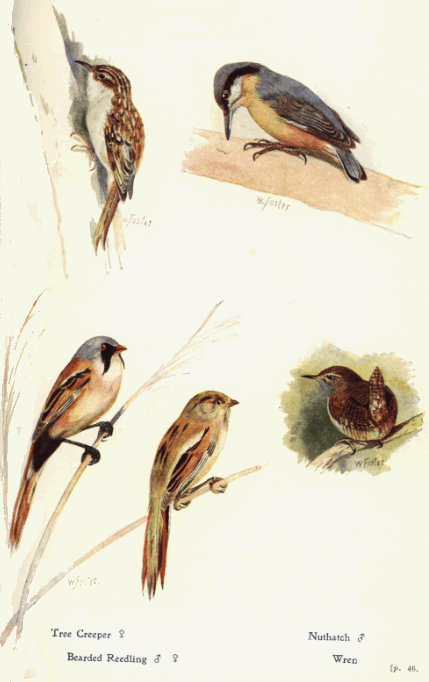
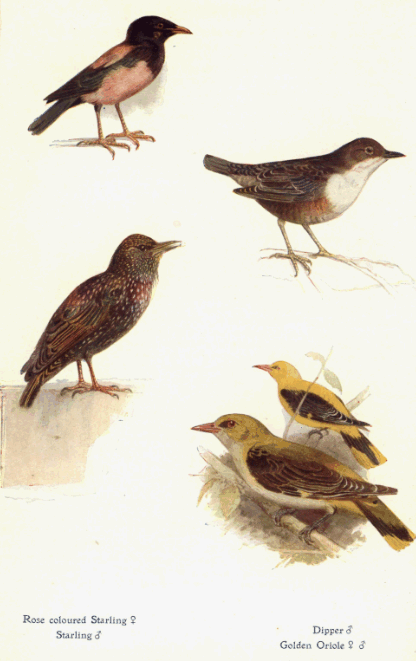
FAMILY CERTHIIDÆ
THE TREE CREEPER CERTHIA FAMILIÁRIS
Upper plumage mottled with yellowish brown, dark brown, and white; a pale streak over the eyes; throat and breast buff-white, becoming dusky towards the tail; wings brown tipped with white and barred with white brown, and dull yellow; tail-feathers reddish brown, stiff and pointed. Length five inches, breadth seven inches. Eggs white, with small yellowish red spots.
The Tree Creeper, though a common bird, is less familiarly known than many others of much rarer occurrence, yet, if once observed, can be confounded with no other. In size it ranks with the Tits, Willow Wren, etc., but is less likely to attract notice than any of these, as it never alights on the ground, nor perches on the small twig of a tree. Its note, too, is weak, simple, and unpretending, amounting to no more than an occasional 'cheep', which it utters from time to time while hunting for food, and while performing its short flights. Any one, however, who wishes to see the bird, and knows what to search for, can scarcely fail of success if he looks well about him during a stroll through almost any wood of full-grown trees. Half-way up the trunk of a rugged elm or oak he will observe a small portion of bark, as it were, in motion; the motion, and not the colour, betrays the presence of a small brown bird, which is working its way by a succession of irregular starts up the trunk. Frequently it stops for a few seconds, and is evidently pecking at some small insect, quite noiselessly however. Its beak is not adapted for hammering; it confines its attention therefore to such insects as live on the surface of the bark. It utters a low 'cheep', and proceeds, not in a straight line up the tree, but turning to the right or left according as it descries a probable lurking-place of its prey: presently it disappears on the other side of the trunk, and again comes in view a few feet higher up. Now it reaches a horizontal branch; along this it proceeds in like manner, being indifferent whether it clings sideways, or hangs with its back downwards. Arrived at the smaller subdivisions of the bough it ceases to hunt; but, without remaining an instant to rest, flies to the base of another bough, or more probably, to another tree, alighting a few feet only from the ground, and at once beginning a new ascent. This mode of life it never varies: from morning to night, in winter and in summer, it is always climbing up the boles of trees, and when it has reached the top, flying to the base of others. On one solitary occasion I observed one retrace its steps for a few inches, and stand for a second or two with its head downwards; but this is a most unusual position, as indeed may be inferred from the structure of its tail, the feathers of which are rigid, and more or less soiled by constant pressure against the bark. It frequently visits orchards and gardens in the country, displaying little fear of man, preferring perhaps to hunt on the far side of a tree when any one is looking on; but not very particular even about this, and certainly never thinking it necessary to decamp because it is being watched. To this indifference to the presence of human beings, it owes its name 'familiaris', and not, as it might be imagined, to any fondness for their society, which, in fact, it neither courts nor shuns. It is a quiet inoffensive creature, congregating with no other birds, and being rarely, except in spring, seen in company with even its own species. It builds its nest of small roots and twigs, scraps of bark and grass, and lines it with wool and feathers. A hole in a pollard willow is a favourite place for a nest; in default of this a hollow in any other tree is selected, or the space between the stump of a tree and a detached portion of bark; and it chooses the straw eaves of some shed. It lays from six to nine eggs, which are exceedingly like those of the smaller Tits.
FAMILY TROGLODYTIDÆ
THE WREN TRÓGLODYTES PÁRVULUS
Upper plumage reddish brown with transverse dusky bars; quills barred alternately with black and reddish brown; tail dusky, barred with black; over the eyes a narrow light streak; under parts light reddish brown; the sides and thighs marked with dark streaks. Length three inches and three-quarters; breadth six inches and a half. Eggs white with a few yellowish red spots towards the larger end, sometimes without spots.