Front matter (continued 10)
Reading edition
"I never saw these birds hunt for their own living in any other way than by robbing the other Gulls. Though not nearly so large as some of the birds which they attack, their Hawk-like swoops and great courage seem to enable them to fight their way most successfully. They are neatly and powerfully made, their colour a kind of sooty dull black, with very little gloss or shining tints on their feathers."
ORDER PYGOPODES
FAMILY ALCIDÆ
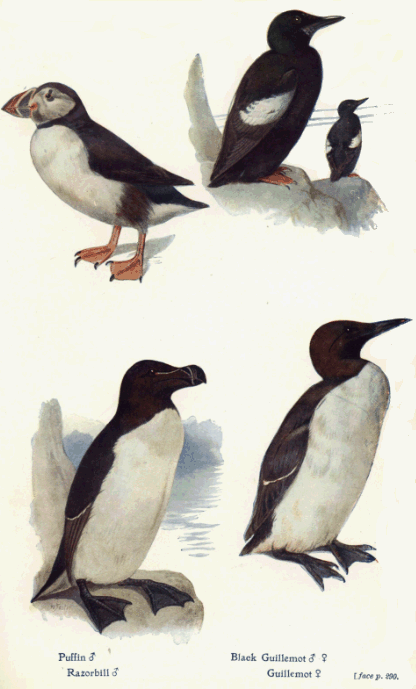
THE RAZOR-BILL ALCA TORDA
Wings reaching to the origin of the tail; head and upper parts black; a band across the wing; an interrupted line from the eye to the base of the bill, and all the under parts white; bill black, with three or four furrows, of which the middle one is white; irides hazel; legs dusky. In summer the line from the eye to the bill is pure white, and the whole of the throat and neck is black, tinged with red. Length seventeen inches. Eggs white, blotched and spotted with two shades of brown.
In general habits, the Razor-bill closely resembles the Guillemot and Puffin. Indeed, in some parts of the coast, the Razor-bill is called a Puffin, and the latter a Sea Parrot; and in Cornwall both Guillemots and Razor-bills are known by the common name of Murre. At a distance the birds can only be distinguished by a practised eye; but on a close inspection they cannot be possibly confounded.
Razor-bills are common on many parts of our coast during the later summer months. They are more frequently seen swimming than flying, and if pursued by a boat are little disposed to take alarm until they are approached to within twenty or thirty yards, when they dive, but soon reappear not very far off. If two birds be in company and one be killed by a shot from a gun, its companion, instead of taking measures to insure its own safety, seems to lose the power of self-preservation. It paddles round its companion as if unable to comprehend the reason why it neither dives nor flies, and if pursued suffers itself to be overtaken and knocked down by an oar. This sympathetic feeling is not confined to birds which have paired, or to members of the same family; for in an instance which came under my own notice, both birds were only a few months old, and, as the Razor-bill lays but one egg, the birds could not possibly have grown up together. Towards winter, Razor-bills migrate southwards, either to avoid cold or to find waters where their prey swims nearer to the surface than in our climate. In spring they return northwards, and repair, like Puffins, to places of habitual resort for the purpose of breeding. At this season, also, they are eminently social, laying each an egg in close proximity on a ledge in the rocks, lower down than the Puffins, but above the Guillemots, all of which birds flock to the same portion of coast, often in countless multitudes. The egg differs from that of the Guillemot not only in colour but in shape, being less decidedly pear-shaped. It is much sought after as an article of food, and is said to be very palatable.
The 'Auk' of Arctic voyagers is this bird. The Razor-bill is one of the best known of the Auk family, or Alcidæ, although less plentiful than the Guillemot or the Puffin.
THE COMMON GUILLEMOT ÚRIA TRÓILE
Bill much compressed, longer than the head, greyish black; upper plumage brownish black; the secondaries tipped with white; a whitish patch behind the eye on each side; under plumage white; feet dusky; iris brown. Length nearly eighteen inches. Eggs greenish or bluish, blotched and streaked with black.
This is one of our common sea-birds during a great portion of the year, though little known to ordinary sea-side visitors, owing to its habit of keeping well out to sea and having nothing ostentatious in its habits. Yet, during a cruise in a yacht, on almost any part of the coast, a practised eye will often discover a few stragglers, distinguished among other sea-birds by their black and white colours, short neck, and sharp beak. They swim low in the water; and when disturbed do not invariably dive like the Grebes and Divers, but readily take wing. They are essentially marine birds, never resorting to fresh water, and living exclusively on fish, which they capture by diving, an art in which they are scarcely less skilful than the true Divers, and which they practise in the same way—by the means, namely, of both wings and feet. Occasionally, a small party may be observed, flying in single file near the surface of the water. On the eastern coast of England, the Guillemot is best known by the name of Willock. It is also called Tinker's Hue, or, as Yarrell gives it, 'Tinkershere'; and in the west of England it is often called a Murr. The old writers describe it under the name of Greenland Dove, or Sea Turtle-Dove; and in Scotland it has a variety of other names. Tinker's Hue is, I presume, the sobriquet of a white bird with a smutty back; Murr is clearly a corruption of Mergus, or 'diver'. Yet more commonly it is known as the 'Foolish Guillemot', a term of reproach analogous to that of 'Booby', given to it from the indifference which it evinces, in the breeding season, to one of its few, but that one the most formidable of its enemies, man. Early in spring Guillemots throng together from all parts of the open sea, and repair to some lofty cliff, where, on a narrow ledge of rock, which in their folly they deem inaccessible, they lay each a single egg. As the bird holds the egg between her legs, she could not well cover more than one; and though a concave nest is very needful to keep eggs together when there are several, no such contrivance is necessary when there is one only; so the Foolish Guillemot builds no nest, but lays a solitary egg on the bare rock. The egg, which is large, is thick-shelled and rough, so that it receives no detriment from the rock; and it is not likely to roll off, for at one end it is thick, and at the other tapers almost to a point; consequently, if accidentally moved by the parent bird when taking flight, it turns as if on a pivot, but does not fall off. At this season, the cliffs to which Guillemots resort are frequented also by myriads of other sea-birds, such as Razor-bills, Puffins, and Gulls, each congregating with its own species, but never consorting with another. In Iceland, the Faroe Islands, St. Kilda, the Orkneys, and many parts of the coast of Scotland, the breeding season of these birds is the harvest-time of the natives. Either by climbing from below, or by being let down with ropes from above, the egg-collectors invade the dominions of these literally feathered 'tribes'. The Foolish Guillemots, rather than leave their charge, suffer themselves to be knocked on the head, to be netted, or noosed. Although stationed so close to each other that a Foolish Guillemot alone could know its own egg, they learn no wisdom from the fate of their nearest neighbours. They are captured in detail for the sake of their feathers; and their eggs are taken for food. In St. Kilda and, perhaps, elsewhere, young birds are also taken in large numbers, and salted for consumption in winter. Such as escape this systematic slaughter flounder, as well as they are able, into the sea when nearly fledged, or are carried thither by their foolish mothers. There they learn to swim, to dive, and to fish, and about the middle of August old and young disperse.
Huge baskets of their eggs are sometimes brought to the markets of seaport towns (I have seen them so far south as Devonport), and sold for a price exceeding that of domestic fowls, for they are much larger, and are said to afford good eating. Wilson, in his Voyage round the Coasts of Scotland, says that the natives of St. Kilda prefer the eggs of these, and other sea-fowl, 'when sour; that is, when about ten or twelve days old, and just as the incipient bird, when boiled, forms in the centre into a thickish flaky matter, like milk.'[55] Great quantities are used in the neighbourhood of Flamborough Head early in the nesting season.
THE BLACK GUILLEMOT ÚRIA GRYLLE
Upper plumage black; middle of the wings and under parts white; iris brown; feet red. Length thirteen and a half inches. Eggs whitish grey, blotched and speckled with grey and two shades of brown.
The Black Guillemot, is a resident species breeding on the Isle of Man, and on the Irish coasts. In Scotland it is common. Its mode of life, as described by Macgillivray, who was familiarly acquainted with it, differs in no material respect from that of the species already described. It is, however, much smaller, and lays two or sometimes three eggs. Macgillivray says that, on those parts of the coast which it frequents, attempts are often made to rear it in captivity; but always unsuccessfully. In summer, these birds may be readily distinguished from other sea-fowl, by their black and white plumage and red feet: the predominant tint of the plumage in winter is white, with a tinge of grey; and in high latitudes the proportion of white increases.
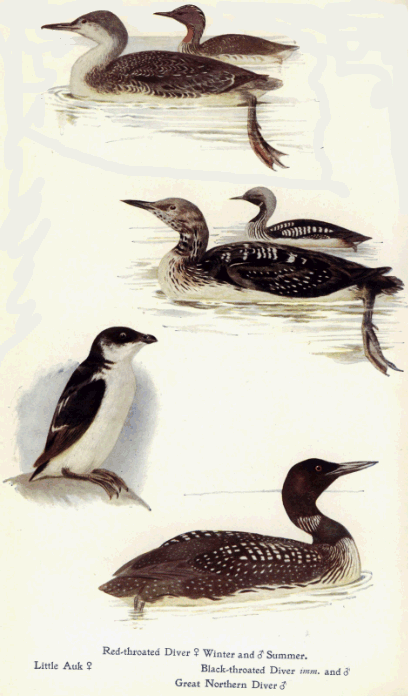
THE LITTLE AUK MÉRGULUS ÁLLE
Head and upper parts black; two bands across the wings; a spot above the eye and all the under parts white. In summer the throat and front of the neck are also black. Length about seven inches. Eggs uniform pale blue.
The Little Auk is essentially a northern sea-bird, coming to us in winter, and is described by Arctic voyagers under the name of Rotche. It is an indefatigable swimmer, and has considerable powers of flight; but it does not possess the faculty of diving to the same degree as the Divers and Grebes, as it generally stays but a short time under water. Hence it must find its food near the surface; and this is supposed to consist of the small crustaceous animals which are so abundant in the Arctic waters. Little Auks are eminently social birds, and have been observed occasionally in such numbers on the water and floating masses of ice as almost to hide their resting-place. They rarely travel far south; and when they visit our shores, which is in winter, and after tempestuous weather, they are supposed to have been driven hither against their will. Instances are recorded of specimens having been found far inland, disabled or dead. It lays only a single egg.
THE PUFFIN FRATERCULA ÁRCTICA
Crown, collar, and upper parts, black; cheeks, region of the eyes, and throat, greyish white; under parts pure white; bill bluish grey at the base, yellow in the middle, bright red at the tip; upper mandible with three transverse furrows, lower, with two; iris whitish; orbits red; feet orange-red. Length twelve and a half inches. Eggs whitish, with indistinct ash-coloured spots.
Unlike the majority of sea-birds which have been passing under our notice, Puffins visit the shores of the British Isles in summer, and even in winter they are not absent. They make their appearance about April or May, not scattering themselves indiscriminately along the coast, but resorting in vast numbers to various selected breeding-places, from the Scilly Islands to the Orkneys. Their home being the sea, and their diet small fish, they possess the faculties of swimming and diving to a degree of perfection. They have, moreover, considerable powers of flight; but on land their gait is only a shuffling attempt at progress. Their vocation on shore is, however, but a temporary one, and requires no great amount of locomotion. Soon after their arrival they set to work about their nests. Fanciful people who class birds according to their constructive faculty as weavers, basket-makers, plasterers, and so on, would rank Puffins among miners. Building is an art of which they are wholly ignorant, yet few birds are lodged more securely. With their strong beaks, they excavate for themselves holes in the face of the cliff to the depth of about three feet, and at the extremity the female lays a solitary egg—solitary, that is to say, unless another bird takes shelter in the same hole, which is not unfrequently the case. Puffins generally show no overweening partiality for their own workmanship; sloping cliffs which have been perforated by rabbits are favourite places of resort; and here they do not at all scruple to avail themselves of another's labour, or, if necessary, to eject by force of beak the lawful tenant. If the soil be unsuited for boring, they lay their eggs under large stones or in crevices in the rock. The old bird sits most assiduously, and suffers herself to be taken rather than desert her charge, but not without wounding, with her powerful beak, and to the best of her ability, the hand which ventures into her stronghold. Myriads burrow on Lundy Island. Lunde means Puffin, and ey Island, the name being given by the old Scandinavian rovers who settled there.
The young are fed by both parents, at first on half-digested fish, and when older on pieces of fresh fish. At this period they suffer their colonies to be invaded without showing much alarm, and are either shot, knocked down with a stick, or noosed without difficulty. As soon as the young are fully fledged, all the Puffins withdraw to southern seas, where they pass the winter, and do not approach land until the return of the breeding season. "A small island near Skye, named Fladda-huna, is a great breeding haunt of Puffins, a species which arrives in the earlier part of May, literally covering the rocks and ledgy cliffs with its feathered thousands. Although these have no concern with our Grouse-shooting season, they almost totally disappear on the twelfth of August."[56] It was just about this period (August 7) in the present year (1861) that I observed several large flocks of Puffins, floating with the tide through the Sound of Islay, and was told by an intelligent gamekeeper that "these birds habitually swim through the sound at this season, but always fly when returning". The reason probably is that the young are not at the former period sufficiently fledged to undertake a long flight, though they find no difficulty in swimming. By spring they have attained their full strength, and are able to adopt the more rapid mode of progress. In Scotland there are many large colonies, also in the cliffs by Flamborough Head, and on the Farne Islands.
Puffins and some other sea-birds appear to be either liable to a fatal epidemic or to be surprised by some atmospheric disturbance, being unable to resist which, they perish in large numbers. I have seen a portion of the sea-shore in Cornwall strewed for the distance of more than a mile with hundreds of their remains. All the softer parts had been apparently devoured by fishes and crustaceous animals, and nothing was left but the unmistakable parrot-like beaks. A friend informs me that he witnessed a similar phenomenon in Norfolk, in September, 1858; but in this instance the carcases of the birds were not devoured, and the birds were of different kinds. He estimated that about ninety per cent. were Guillemots, and the remainder Puffins, Razor-bills, Scoters, and a sprinkling of Black Throated Divers. A similar mortality among sea-birds is recorded in the Zoologist as having taken place on the coast of Norfolk, in May, 1856. On this occasion they were so numerous as to be thought worth collecting for manure.
Other names by which the Puffin is known are Sea Parrot, Coulterneb, Mullet, Bottlenose; and, in Scotland, Ailsa Parrot, Tammie-Norie, and Tammas.
FAMILY COLYMBIDÆ
THE GREAT NORTHERN DIVER COLYMBUS GLACIÁLIS
Bill, with the upper mandible, nearly straight, upwards of four inches in length; head and neck violet-black, with a double gorget white, barred with black; upper parts black, spotted with white; under parts white; bill black; irides brown; feet dusky, the membranes whitish. Young very like the next, but distinguishable by their superior size and the direction of the bill. Length thirty-three inches. Eggs dark olive-brown, with a few spots of purplish brown.
The name Divers is, on the sea-coast, loosely applied to a tribe of sea-birds, including the Grebes, Cormorants, and other birds, which, when pursued, place their safety in diving rather than in flying. In works on natural history the term is, however, employed to designate the genus Colymbus, and with great propriety; for, however skilled any of the above birds may be in this mode of progression, the true divers surpass them immeasurably. First among these in size and dignity is the Great Northern Diver, a native of high latitudes in both hemispheres, never perhaps coming farther south than the Shetlands for breeding purposes, and visiting our waters only during winter.[57] The Northern Diver, or Imber or Ember Goose, appears to be tolerably frequent in British waters. In Scotland it prefers salt-water lochs and sandy bays to the open sea, though occasionally seen some miles from land. It swims deep in the water, but advances rapidly. When in pursuit of prey it sinks beneath the surface without plunge or splash, the head disappearing last, and it traverses perhaps two or three hundred yards of water before it rises again. Montagu says that it propels itself by its feet alone; Audubon, on the contrary, states that it uses the wings under water. The latter author is most probably correct, for it dives more swiftly than the Grebes, and these birds undoubtedly make a vigorous use of their wings. Where shoals of small fish, such as sand-eels and sprats, abound, or where fish even of a much larger size are numerous, the Northern Diver finds a rich harvest. Occasionally while thus engaged it meets its death by dashing into the herring nets, and there getting entangled. A fine specimen was recently shown to me in the island of Islay, which had been thus captured. Though it has never been known to take wing in attempting to elude pursuit, it is often seen flying with strength and rapidity, outstripping even the Grebe, which, in proportion to its size, is furnished with far larger wings than itself.
The adult male, which is a very handsome bird, is of rare occurrence, most of those which visit our shores being young birds.
The nest is usually placed near the edge of a reedy lake or large river, having a well-beaten track leading to it from the water's edge. This is formed by the bird in its clumsy effort to walk, a feat which it only performs on such occasions. The nest itself is bulky, and is formed of the vegetable substances found in the immediate vicinity, such as grasses and other herbaceous plants. It contains two, and sometimes three, eggs. The young are able to swim and dive very soon after they are hatched, and are fed for about a fortnight by their parents, at the expiration of which time they have to hunt for themselves.
THE BLACK-THROATED DIVER COLYMBUS ARCTICUS
Bill slightly curved upwards, with the middle of the lower mandible equal in width to the base, exceeding three inches in length; head ash-grey; throat and front of the neck black, lustrous with violet and green; beneath the throat a narrow band streaked with white and black; sides and front of the neck streaked with white and black; back black, with a longitudinal patch of white and black bars on the upper part; scapulars with twelve or thirteen transverse white bars; bill dusky; iris brown; feet dusky, with whitish membranes. Young birds have the head and back of the neck greyer and the upper plumage dark brown, edged with bluish ash; under plumage white; cheeks white, spotted with ash; upper mandible ash-grey, lower dull white. Length twenty-four to twenty-eight inches. Eggs dark olive-brown, spotted with purplish brown.
This Diver differs from the preceding species principally in being of inferior size. The predominant tints of the plumage are the same, and the habits of the two are so similar that a separate description is unnecessary. The present species is, however, far less common, though it breeds in the Outer Hebrides and in Scotland, where both eggs and young birds have been observed, and migrates southward in winter. It lays two eggs, near the edge of a fresh-water loch; and Mr. Selby observed that a visible track from the water to the eggs was made by the female, whose progress upon land is effected by shuffling along upon her belly, propelled by her legs behind. In the breeding season the old birds are often seen on the wing, at which time also they have a peculiar and loud cry, which has been compared to the voice of a human being in distress.
THE RED-THROATED DIVER COLYMBUS SEPTENTRIONALIS
Bill slightly curved upwards, with the edges of both mandibles much incurved, not exceeding three inches in length; head, throat, and sides of the neck mouse-colour; crown spotted with black; neck both above and below marked with white and black lines; on the front of the neck a large orange-coloured patch; back dusky brown; lower parts white. Young birds—upper plumage mouse-colour, darker on the back, where it is marked by longitudinal white lines; wings dusky; feathers on the flanks dusky, some of them edged with white; all the under plumage pure white. Length twenty-six inches. Eggs chestnut-brown, spotted with darker brown.
The name 'Loon,' given in some districts to the Crested Grebe, is elsewhere given to the Red-throated Diver. The term is an old one, for our countrymen, Ray and Willughby, quoting yet more ancient authorities, describe the Northern Diver under the name of 'Loon', and the Black-Throated Diver under that of 'Lumme', the latter being the name of the bird in Iceland and Norway, and the former probably an English corruption of the same word, which in the original signifies 'lame'.
On no part of our coast must we expect to hear this bird popularly called by the name of 'Red-throated', for, though common on many parts of the coast, almost all the specimens observed are young birds of the year, which have the throat pure white. Several were brought to me by the sea-side gunners on the coast of Norfolk. In May birds with red throats are noticed. A writer in the Zoologist[58] says that they are very numerous in winter off the coast of the Isle of Wight, passing and repassing in small flocks and in two lines about a mile apart. Of the hundreds which fell under his notice one only had a red throat, and this was captured under singular circumstances. On April 24, 1839, some fishermen observed an object floating which they imagined was a keg of spirits, but which proved to be a large fish of the kind known as the Fishing Frog, or Angler. On hauling it on board with their boat-hooks, the fishermen discovered that the animal had nearly choked himself by swallowing, tail foremost, an adult Red-throated Diver. The head of the bird protruded from the throat into the mouth of the captor, and, strange to say, it had not only survived its imprisonment, but was unhurt. It was extricated and presented to the Zoological Gardens, where it lived for six months. Another writer in the same magazine[59] says that he saw a large number in Norway during the breeding season, but not one without the dark red throat.
This species, like the rest of the genus, obtains its food by diving; when pursued it rarely tries to escape by taking wing, though it has the power of flying with great rapidity. During the breeding season especially, it often flies about over the water with its long neck outstretched, and uttering a wailing scream.
I am informed by a friend, that while fishing in a boat in calm water off the coast of North Devon, he has many times seen Divers pass through the water, at a considerable depth below, propelling themselves by a free and active use of their wings.
From October to May only these Divers frequent our coast. Towards the end of spring they withdraw northwards and build their nests, of coarse grass and other herbs, close to the edge of a fresh-water loch. They lay two eggs, and the male is said to take his turn in the office of incubation. Many stay to breed in the Orkneys and Outer Hebrides, and in Ireland.
FAMILY PODICIPEDIDÆ
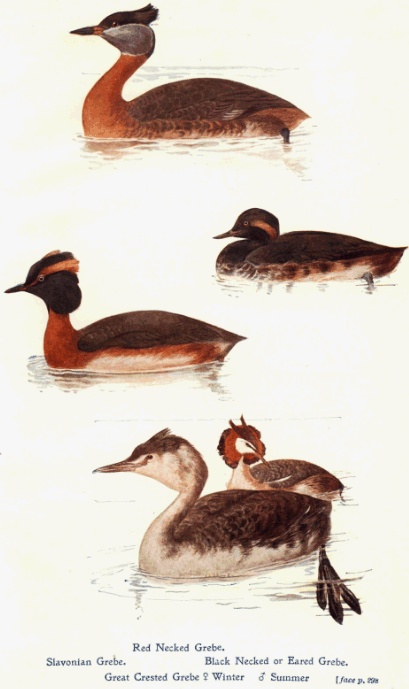
THE GREAT CRESTED GREBE PÓDICEPS CRISTÁTUS
Bill longer than the head, reddish, the tip white; distance from the nostril to the tip seventeen or eighteen lines; cheeks white; crest and ruff dark brown and chestnut; upper plumage dark brown; secondaries white; breast and under parts silky white; bill brownish red; irides red; feet dull green. Female—crest and ruff less conspicuous, colours generally less bright. Young birds have neither crest nor ruff. Length twenty-one inches. Eggs white.
The Great Crested Grebe is thus described by Sir Thomas Browne, under the name of Loon: 'A handsome and specious fowl, cristated, and with divided fin-feet placed very backward. They come about April, and breed in the broad waters; so making their nest in the water, that their eggs are seldom dry while they are set on.' Fifty years ago the Loon continued to be so common on the Broads of Norfolk that eighteen or twenty might be counted together. It is more or less resident in England and Wales—in the meres of the Midlands and the lakes of Breconshire, and has lately bred in the vicinity of the Clyde.
The movements of this bird in the water are described as most graceful; in swimming it vies with the Swan, and it is a skilful diver. As seen perched up in a museum its form is ungainly, but in its native element it might serve as the standard of perfection among water birds. The legs, compressed so as to present a sharp edge, cut the water with a minimum of resistance; the webbed feet are placed so far backwards that they fulfil at once the office of propellers and rudder; the body is conical and covered with satiny plumage, which throws off water as perfectly as the fur of the otter; the long neck tapers to exceedingly narrow dimensions and terminates in a small head produced into a slender bill. The conformation of the greyhound is not better adapted for fleet running than that of the Grebe for rapid diving. The chase, I need scarcely add, consists of fish; but the Loon will feed on frogs, tadpoles, and any other small animals which fall in its way. It frequents fresh water during the summer months, but on the approach of winter repairs to the sea, not, it would seem, from any desire of varying its food, but to avoid being frozen up. It builds its nest among rushes or decaying weeds, but little above the level of the water, and lays four eggs, the male assisting his partner in the office of incubation.
The young can dive and swim immediately that they are hatched; but if the mother be suddenly alarmed while they are with her, she takes them under her wing and dives with them.
The name Loon is supposed to be a corruption of the Finnish designation, Leomme or Lem, 'lame', given to several of the Colymbidæ on account of the awkwardness with which they advance on land.
The Loon is found in lakes throughout a great portion of both the eastern and western hemispheres, but not very far to the north. It rarely flies, except at the period of migration, when it passes swiftly through the air, with neck and feet extended to their full length.
RED-NECKED GREBE PÓDICIPES GRISEÍGENA
Bill as long as the head, black, yellow at the base; distance from the nostrils to the tip eleven lines; crest very short; head and crest lustrous black; cheeks and throat mouse-colour; a black band along the nape; breast bright rust-red; lower parts white; flanks spotted with dusky; feet black, greenish yellow beneath. Young birds have the head, neck, and back, dusky; throat, cheeks, breast, belly, and abdomen, silky white; sides of the breast spotted with grey. Length sixteen inches. Eggs dirty greenish white.
The Red-necked Grebe is smaller than the Loon, from which it differs also in wanting the elongated crest, in having a more robust bill in proportion to its size, and is further distinguished by the grey hue of its cheeks, on account of which last character it is known in France under the name of Grébe Jou-gris. It is a native of the north-eastern parts of Europe, and is fairly common along the eastern coast of Great Britain from autumn to spring. In habits it differs little from the last described species, but is less common, occurring both in fresh-water lakes and along the sea-coast.
SLAVONIAN GREBE PÓDICIPES AURITUS
Bill strong, shorter than the head, compressed throughout its whole length, black, with the tip red; eyes with a double iris, the inner yellow, the outer red; distance from the nostrils to the tip of the bill six or seven lines; head and bushy ruff glossy black; two horn-like crests orange-red; lore, neck, and breast, bright chestnut; upper plumage dusky; secondaries and under parts white; bill black, rose-coloured at the base and red at the tip. Young—crest and ruff wanting; upper plumage and flanks dusky ash, under parts white; irides white, surrounded by red. Eggs dirty white.
The Slavonian, or Horned Grebe, approaches so closely in habits to the two preceding species that it is unnecessary to say more than that it inhabits the northern parts of America and Europe, visiting us from autumn to spring. Audubon describes its nest as a rude structure of weeds, situated at a distance of about twelve feet from the water's edge; but other authors state that though it constructs its nest of these materials, it disposes it among weeds in such a way that it rises and falls with every alteration in the level of the water. It lays from five to seven eggs, and the male is supposed to assist in the office of incubation.
THE BLACK-NECKED OR EARED GREBE PÓDICIPES NIGRICOLLIS
In summer the head and neck of this species are black, with a triangular patch of long golden-reddish feathers on the ear-coverts. Breast and belly white—flanks a dull chestnut, bill black, upcurved slightly. In winter it resembles the last named Grebe in plumage, excepting that it is white on the primaries. Length twelve inches.
This is essentially a bird of the south, visiting us in spring and summer, but also now and again in autumn and winter, but this more rarely. It is said to have bred occasionally in the southern counties, and more often in Suffolk and Norfolk. To the north it becomes more scarce, although it has been observed up to the Orkneys. Just a few instances are recorded from Cumberland, but the bird is rare on our western side. Very few have been met with in Ireland. In Algeria it is said to nest in "societies more densely crowded than any rookery," the nests being raised on islets with stout foundations constructed by the bird. In Denmark the nests observed were on tussocks at the edge of the lake, and they were made of moss, part of which the female used to cover her eggs with on leaving them.
THE LITTLE GREBE, OR DABCHICK PÓDICIPES FLUVIÁTILIS
Bill very short, shining, compressed; no crest or ruff; distance from nostrils to tip of the bill five lines; tarsus with a double row of serratures behind; head black; cheeks bright chestnut; breast and flanks dusky, mottled with white; upper parts dark brown, tinged with green; primaries ash-brown; secondaries white at the base and on the inner web, under parts dusky ash, tinged on the thighs with reddish; bill black, whitish at the tip and base of the lower mandible; irides reddish brown; feet externally greenish brown, beneath flesh-colour. Young birds are ash-brown above, slightly tinged with red; breast and flanks reddish white; belly pure white; bill brown and yellowish ash. Length nearly ten inches. Eggs dirty white.
The Lesser Grebe, or, as it is more commonly called, the Dabchick, is the only species with which it is possible to become familiarly acquainted in Britain. It frequents rivers, ponds, and lakes, in all parts of the country, rarely flying, and still more rarely coming to land.
Rambling by the side of a sluggish river, the sides of which are lined with reeds or bulrushes, one may often descry, paddling about with undecided motion, what appears to be a miniature Duck no longer than a Blackbird. It does not, like the Moor-hen, swim with a jerking movement, nor when alarmed does it half swim and half fly in a direct line for the nearest bank of weeds. If you are unobserved, it swims steadily for a short distance, then suddenly disappears, making no splash or noise, but slipping into the water as if its body were lubricated. It is diving for its food, which consists of water insects, molluscs, small fish and worms. As suddenly as it dives so suddenly does it reappear, most likely not far from the spot where you first observed it:
A di-dapper peering through a wave,
Who, being looked on, ducks as quickly in.
Shakspeare.
Another short swim and it dives again; and so it goes on, the time spent under the water being far in excess of that employed in taking breath. Advance openly or make a noise, it wastes no time in idle examinations or surmises of your intentions, but slips down as before, not, however, to reappear in the same neighbourhood. Its motives are different: it now seeks not food, but safety, and this it finds first by diving, and then by propelling itself by its wings under water in some direction which you cannot possibly divine; for it by no means follows that it will pursue the course to which its bill pointed when it went down. It can alter its line of flight beneath the water as readily as a swallow can change its course of flight through the air. But wherever it may reappear, its stay is now instantaneous; a trout rising at a fly is not more expeditious. You may even fail to detect it at all. It may have ensconced itself among weeds, or it may be burrowing in some subaqueous hole. That it has the power of remaining a long while submerged, I have no doubt. There is in the parish of Stamford Dingley, Berks, a large and beautiful spring of water, clear as crystal, the source of one of the tributaries of the Thames. I was once bending over the bank of this spring, with a friend, watching the water, some five or six feet down, as it issued from a pipe-like orifice and stirred the sand around like the bubbling of a cauldron, when there suddenly passed between us and the object we were examining a form so strange that we were at first doubtful to what class of animals we should refer it. In reality, it was a Dabchick, which, alarmed probably by the noise of our conversation, was making for a place of safety. As it passed within two or three feet of our faces, we could distinctly see that it propelled itself by its wings; but it appeared not to have observed us, for it kept on in a direct course towards the head of the spring. We searched long in the hope of discovering it again, but failed; and as there were no weeds among which it could possibly hide above water, and we could examine the bottom of the spring almost as thoroughly as if it contained air only, we could but conclude that our apparition had taken refuge in a hole under the bank.
Early in spring, when Dabchicks leave the small streams and water-courses for broader pieces of water, they have been observed to fly; and during the building season also they have been seen circling round in the air near the locality of their intended nest. The nest itself is constructed of weeds of all kinds, forming a thick mass raised but a few inches above the surface of the water, and invariably far enough from the bank to be inaccessible except by wading. The Dabchick lays five or six long-shaped eggs, pointed at either end, of a chalky white colour. These the bird, when she leaves the nest, covers with weeds for the purpose of concealment, and on her return continues the work of incubation without removing the covering, so that the eggs soon lose their white hue, and before the period of hatching have become very dirty. The young birds can swim and dive immediately on leaving the egg. I have never myself seen a Dabchick fly through the air or walk on land, neither have I ever heard its note. The latter, a low clicking and chattering sort of noise, it is said to utter in spring. It breeds even in St. James' Park. Females smaller than males.
ORDER TUBINARES
FAMILY PROCELLARIIDÆ
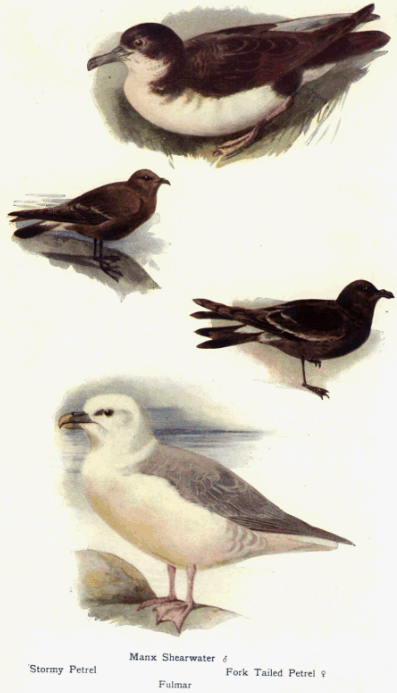
THE FULMAR PETREL PROCELLARIA GLACIÁLIS
Head, neck, under plumage, and tail, white; wings bluish ash, the primaries brownish grey; beak, irides, and feet, yellow. Young of the year grey tinged with brown, mottled on the back with deeper brown; bill and feet yellowish ash. Length nineteen inches. Eggs white.
In some of the Outer Hebrides Fulmars breed; but the great station, to which tens of thousands annually resort, is the remote island of St. Kilda. To the Fulmar indeed, and in a less degree to the Gannet and two or three other sea-birds, the island is indebted for its being able to boast of human inhabitants. Eggs and birds, fresh or salted, furnish them with food; the Fulmar with oil: and feathers pay their rent. In the Shetlands it is said to be increasing.
Professor James Wilson says: 'The oil is extracted from both the young and old birds, which, however, they must seize on suddenly and strangle, else, as a defensive movement, the desired (and pungent) oil is immediately squirted in the face and eyes of their opponent.' This oil is ejected, not, as it is sometimes said, through tubular nostrils, but directly through the throat and open mouth. The flesh of the Fulmar is also a favourite food with the St. Kildans, who like it all the better on account of its oily nature.
The Fulmar is essentially a sea-bird, and never comes to land except in the breeding season, when it builds its nest of herbage on the grassy shelves of the highest cliffs, and lays a single egg, if which be taken, it lays no more. The young birds are fed with oil by the parents, and on being molested spurt out through the throat and open mouth the same fluid, which, being of a rank smell, infects not only the nest, but the whole neighbourhood. The young birds, which are taken early in August, are boiled, and made to furnish a large quantity of fat, which is skimmed off and preserved for winter use. The old birds are considered great dainties.
In the Arctic regions the Fulmar is well known for its assiduity in attending on whale ships, keeping an eager watch for anything thrown over; and when the operation of cutting up a whale is going on, helping itself most greedily to stray pieces of offal, and venturing so near as to be easily knocked down by a boathook or to be taken by hand.
Owing to the rankness of its food, the smell of the Fulmar is very offensive. A specimen recently shot was brought to me in Norfolk, early in January, 1862, and being a great rarity, was carefully preserved and set up; but on being sent home from the bird-stuffer's it was banished to an outhouse, where it has remained for three months without losing anything of its offensive odour.
THE GREAT SHEARWATER PUFFINUS MAJOR
Bill two inches long; tail pointed; upper plumage dusky; under, deep ash grey. Length eighteen inches.
The Great Shearwater is far less abundant than the preceding species, and may indeed be considered a rarity. A few solitary specimens have from time to time been shot on various parts of the coast, and they have occasionally been noticed in considerable numbers off the coast of Cornwall. In the Scilly Islands, where they are called 'Hackbolts', they are said to be yet more frequent. The Great Shearwater differs little in habits, as far as they are known, from the other species.
THE MANX SHEARWATER PUFFINUS ANGLORUM
Bill an inch and a half long; tail rounded; upper plumage brownish black lustrous; under white; sides of the neck barred with grey; sides spotted with grey. Length fourteen inches. Eggs nearly round; pure white.
That a bird whose generic name is Puffinus should sometimes be called a 'Puffin' is not surprising; and the reader who meets with the name in books should satisfy himself whether the subject of his study be an Auk or a Shearwater, before he admits as facts any statements about the 'Puffin' which may fall in his way. Yarrell, for instance, gives the name of Puffin to the bird already described under the name of Fratercula Arctica, while by Montagu that bird is described under the name of 'Coulterneb', 'Puffin' being given as a synonym for the Shearwater. Off Cornwall it is called skiddeu and brew.
The Shearwater is so called from its mode of flight, in which it 'shears' or skims the water; and its distinctive name, Manx, it owes to its having been formerly very abundant in the Calf[60] of Man, a small island lying south of the Isle of Man.
The Manx Shearwater is, during the greater portion of the year, an ocean-bird, and only ventures on shore during the breeding season. It then repairs to some island, or portion of the coast little frequented by man, and in society with other birds of the same species there takes up its summer quarters. A sandy or light earthy soil, scantily furnished with vegetation, is preferred to any other station. Its nest is a hole in the ground, either the deserted burrow of a rabbit or a tunnel excavated by itself, or less frequently it lays its one egg in the crevice of a rock. During the day Shearwaters, for the most part, remain concealed in their holes, and lie so close that they will suffer themselves to be dug out with a spade and make no attempt to escape. Towards evening they quit their hiding-places, and paddle or fly out to sea in quest of food. This consists of small fish and other marine animals which swim near the surface, and are caught by the birds either while they are floating or 'shearing' the water. No nest ever contains more than one egg, but that one and the chick which it produces are objects of the greatest solicitude.
Unfortunately for the poor Shearwaters, their young, though fed on half-digested fish oil, are delicate eating; consequently, some of the stations of these birds have been quite depopulated, and in others their numbers have been greatly thinned.
Willughby tells us that in his time 'Puffins' were very numerous in the Calf of Man, and that fully fledged young birds, taken from the nests, were sold at the rate of ninepence a dozen. He adds, that in order to keep an accurate reckoning of the number taken, it was customary to cut off, and retain, one of each bird's legs. The consequence was that the state in which the birds were sent to market was supposed to be their natural condition, and the Puffin was popularly believed to be a 'monopod' (one-footed bird).
This station is now nearly, if not quite, deserted; but colonies still exist in Annet, one of the Scilly Islands, on the south coast of Wales, in the Orkneys, and in the Shetlands. In the Scilly Islands the Shearwater is called a Crew, from the harsh note uttered by the bird when its burrow is invaded; in the north, a Lyrie or Scrabe.
THE STORM-PETREL PROCELLARIA PELÁGICA
General plumage like the last; tail even at the extremity; legs moderate; membranes black. Length scarcely six inches. Eggs white.
Under the name of 'Mother Carey's Chickens' the Petrels must be known to all readers of voyages. According to the belief popular in the forecastle, these birds are invisible during calm or bright weather; but when the sky lowers, and a storm is impending, suddenly, no one knows whence, forth come these ill-omened heralds of the tempest, inspiring more terror than would be caused even by the hurricane which they are supposed to commence. In reality, the Petrels are scarcely birds of the day; they love to hide themselves in holes and behind stones. It is not, therefore, surprising that when the sea is calm, and the sun bright, they lurk in their hiding-places, if near enough to land; or, if on the open ocean, lie asleep on the surface of the water, unnoticed, because still and of small size. An overcast sky, however, awakes them as twilight would, and they leave their hiding-places, or rise from their watery bed, not because a storm is impending, but because the cloud which accompanies the storm brings them the desired gloom. When in motion they are more conspicuous than when at rest, and they follow the wake of a ship for the same reason that other sea-fowl do, for the sake of the offal thrown overboard. They will sometimes accompany a ship for days, showing that they have untiring power of wing, and to all but the superstitious greatly relieving the monotony of the voyage.
The Petrel builds its nest, a rude structure of weeds and rubbish, either in the hole of a cliff or under stones on the beach, and lays a single egg. It rarely comes abroad by day, and if disturbed ejects from its mouth an oily matter, after the manner of the Fulmar. Towards evening it comes forth from its stronghold, and skims the sea in quest of food, which consists of floating animal matter of all kinds. Its name, Petrel, or Little Peter, is derived from its habit of occasionally skimming along so close to the surface of the sea as to dip its feet in the water, and present the appearance of walking; but its ordinary flight is very like that of the Swallow.
The Storm-Petrel breeds in the Orkney, Shetland, and Scilly Islands and a few on the Welsh coast, also in the Channel Islands, but a genuine ocean-bird quits the land as soon as its young are able to accompany it. It is frequently seen in the Atlantic and Mediterranean, and is not an uncommon visitor to our shores, especially during severe weather.
Its note is only heard during the season of incubation, when its retreat is often betrayed by a low twittering.
Storm-Petrels are gregarious birds; they breed in colonies, and skim the sea in small flocks. The French steamers which sail between Toulon and Algiers are said to be regularly accompanied by these birds.
THE FORK-TAILED PETREL PROCELLARIA LEUCORRHOA
General plumage like the last; tail forked; legs moderate; membrane dusky Length seven and a quarter inches. Eggs white, marked with small rusty spots.
The Fork-Tailed Petrel, a native of North America, does not differ materially in habits from the other species. It is met with almost annually on our east coast, and is common off Cornwall. In Ireland it is frequent. This species was first declared to be a British bird by Bullock, who found it at St. Kilda in 1818.
GLOSSARY OF COMMON AND PROVINCIAL NAMES AND OF TECHNICAL TERMS.
♂: male ♀: female
Aberdeen Sandpiper: a name for the Knot
Aberdevine: a name for the Siskin
Accentor, Hedge: Sparrow, Chanter or Warbler
Alk: the Razor-bill
Allamotte: the Petrel
Allan: the Skua
Alp: a name for the Bullfinch
Annet: the Kittiwake Gull
Arctic-bird: the Skua
Arctic Skua
" Tern
Assilag: the Petrel
Awl: the Woodpecker
Badock: the Skua
Bankjug: the Chiff-chaff and Willow Warbler
Bargander: the Sheldrake
Barley-bird: the Siskin and Wryneck
Barred or Lesser-spotted Woodpecker
Bar-tailed Godwit
Basal: at or near the base
Beam-bird: the Spotted Flycatcher
Bean Crake: the Land-Rail
" Goose
Bearded Reedling
Bee-bird: a name sometimes given to the Flycatcher;
sometimes to the Willow Warbler
" -eater
" -hawk: the Honey Buzzard
Beech-finch: the Chaffinch
Bergander: the Sheldrake
Bernicle Goose
Billy: the Hedge Sparrow
Billy-whitethroat: the Whitethroat
Bittern
Black-a-top: the Stonechat
Black-billed Auk: a name given to the Razor-bill in the winter
plumage of the first year
Blackcap: a name sometimes given to the Black-headed Gull,
the Marsh Tit, and Coal Tit
Black Duck: the Scoter
Blacky-top: the Stonechat
Bloodulf: the Bullfinch
Blind Dorbie: the Purple Sandpiper
Blue-backed Falcon: the Peregrine Falcon
" -bird: the Fieldfare
" -cap: the Blue Tit
" Darr: the Black Tern
" Hawk: the Peregrine Falcon
Blue-headed Wagtail: the greyheaded Wagtail
" -tailed Bee-eater
" Tit: the Tom Tit, the Blue-cap
" -winged Shoveler: the Shoveler
Boatswain: the Skua
Brake-hopper: the Grasshopper Warbler
Brambling, or Bramble-finch
Bran: the Crow
Brancher: the Goldfinch in its first year
Brantail: the Redstart
Brent Goose
Broad-bill: the Shoveler
Bronzie: the Cormorant
Brook Ouzel: a name given to the Dipper, and incorrectly to the Water-Rail
Brown Owl, or Tawny Owl
" -Leader Gull: Black-headed Gull, Red-headed Gull or Hooded Gull
" Starling: a name sometimes given to the young of the Starling
" Tern: the Tern in its immature plumage
Budfinch: the Bullfinch
Bullfinch, Common
" Pine, or Pine Grosbeak
Bunting, Lapland, or Finch
Burgomaster: the Glaucous Gull
Burrow Duck: the Sheldrake
Bustard, Great
Cackareer: the Kittiwake Gull
Caddaw: the Jackdaw
Calloo: the Long-tailed Duck
Cargoose: the Crested Grebe
Carinate: in the form of a keel
Carrion Crow
Car-swallow: the Black Tern
Cere: the wax-like membrane which covers the base of the bill in the Falconidae
Chaldrick or Chalder: the Oyster-Catcher
Chanchider: the Spotted Flycatcher
Channel Goose: the Gannet
Chanter, Hedge: Sparrow, Accentor or Warbler
Charlie Miftie: the Wheatear
Chank, and Chank-daw: the Chough
Chepster: the Starling
Cherry-finch: the Hawfinch
Cherry-sucker, Cherry-chopper, and Cherry-Snipe: the Spotted Flycatcher.
Chevy Lin: the Redpoll
Chickell: the Wheatear
Chickstone: the Stonechat
Chippet Linnet: the Redpoll
Church Owl: the White Owl
Churn Owl: the Nightjar
Churr: the Dunlin
Cirl Bunting
Clack Goose, Clakes: the Bernicle Goose
Clatter Goose: the Brent Goose
Clee: the Red Shank
Cleff: the Tern
Clinker: the Avocet
Cloven-footed Gull: the Tern
Coal-and-candle-light: the Long-tailed Duck
Coal Goose: the Cormorant
Coaly Hood: the Bullfinch or Coal Mouse
Cob: the male Swan
Cob: the Great Black-backed Gull
Cobble: the Great Northern Diver
Cobbler's Awl: the Avocet
Cobweb: the Spotted Flycatcher
Cockandy: the Puffin
Cock-winder: the Wigeon
Coddy Moddy: the common Gull in its first year's plumage
Coldfinch: the Pied Flycatcher
Colk: the King Duck
Colin: a name in New Spain for Quail
Compressed: flattened vertically
Coot-foot: the Phalarope
Copperfinch: the Chaffinch
Corbie: the Raven
Corndrake: the Land-Rail
Cornish Crow, or Daw: the Chough
Cornwall Kae: the Chough
Coulterneb: the Puffin
Crake, Little
" Spotted
Crank bird: the Lesser Spotted Woodpecker
Craw: part of the stomach in birds
Cream-coloured Plover: Swiftfoot or Courser
Courser Gull: the Glaucous Gull
Creeper, Creep-tree, or Tree-creeper. These names are in some places given to the Nuthatch
Crested Cormorant: the Shag
" Heron, Common or Grey
Cricket-bird: the Grasshopper Warbler
Cricket Teal: the Garganey
Crooked Bill: the Avocet
Crossbill: Common
Cuckoo's Leader or Mate: the Wryneck
Cuhnen: the ridge of the upper mandible
Cultrate: in the form of a billhook or pruning knife
Curlew-Jack: the Whimbrel
Curwillet: the Sanderling
Cushat: the Ring Dove
Cutty Wren: the Common Wren
Cygnet: the young Swan
Daker Hen: the Land-Rail
Danish Crow: the Hooded Crow
Darr, Blue: the Black Tern
Dertrum
Depressed: flattened horizontally
Deviling: the Swift
Dick Dunnock: the Hedge Sparrow
Dippearl: the Tern
Dirty Allen: the Skua
Dishwater: the Wagtail
Diving Pigeon: the Guillemot
Dobbler and Dobchick: the Lesser Grebe
Door Hawk and Dorr Hawk: the Nightjar.
Dorbie: the Dunlin
Doucker: a popular name for a Grebe or Diver
Doveky: the Black Guillemot
Dove-coloured Falcon: the Peregrine Falcon
Draine: the Missel Thrush
Duck Hawk: the Marsh Harrier
Ducker: a popular name for a Grebe or Diver
Dulwilly: the Ring Plover
Dunkir and Dunair: the Pochard
Dun Crow: the Hooded Crow
Dundiver: the female and young of the Merganser
Dung Hunter: the Skua
Dunlin
Dunnock: the Hedge Sparrow
Earl Duck: the Red-breasted Merganser
Easterling: the Smew
Ebb: the Bunting
Ecorcheur: the Shrike
Egret: a tuft of long narrow feathers found on the lower part of the neck of the Herons.
The name is also sometimes extended to the two tufts of feathers, resembling ears or horns,
in some of the Owls
Elk: the Hooper Swan
Emmer or Ember Goose: the Great Northern Diver
Emmet Hunter: the Wryneck
Erne: the Eagle
Falk or Falc: the Razor-bill
Faller: the Hen Harrier
Fallow Chat, Fallow Finch, Fallow Lunch, or Fallow Smich: the Wheatear
Fanny Redtail: the Redstart
Fauvette: the Garden Warbler, also applied to others of the Warblers.
Feather-poke: i.e. "sack of feathers" is the Chiff-chaff, so called from the
materials and form of the nest
Felt and Feltyfare: the Fieldfare
Fiddler: the Common Sandpiper
Field Duck: the Little Bustard
Field Lark: the Skylark
Fiery Linnet: the Common Linnet
Finch, or Lapland Bunting
Fire-crested Regulus or Wren
Fire-tail: the Redstart
Flapper: a young Duck
Flopwing: the Lapwing
Flusher: the Butcher-bird
Foot: The foot of a bird consists of four, never less than three, toes,
with their claws, and the joint next above, called the "tarsus"
French Linnet: the Redpoll
" Magpie: the Red-backed Shrike
" Pie: the Great Spotted Woodpecker.
Gaggle: a flight of Wild Geese
Gairfowl: the Auk and the Razor-bill
Gallinule: the Moor Hen; this name is sometimes applied to the Crakes
Gallwell Drake: the Land Drake
Gannet: the Skua
Garden Ouzel: the Blackbird
" Warbler
Gardenian Heron: the young of the Night Heron
Gaunt: the Crested Grebe
Gidd: the Jack Snipe
Gillhowter: the White Owl
Gladdy: the Yellow Hammer
Glaucous Gull
Glead, Gled, or Glade: the Kite
Goat Owl and Goatsucker: the Nightjar
Goldeneye
Golden-crested Regulus, Warbler or Wren
" Oriole or Thrush
" Plover
Gorcock: the Moor Cock
Gorsehatch: the Wheatear
Gorse-duck: the Corn Crake
Gorse Linnet: the Common Linnet
Goud Spink: the Goldfinch
Gouldring: the Yellow Hammer
Gourder: the Petrel
Gouk: the Cuckoo
Graduated: a term applied to the tail of a bird when the middle
feathers are longest and the outer ones are shorter in gradation
Greenwich Sandpiper: the Ruff
Grey: the Gadwall
Greybird: the Thrush
Grey-Duck: the Gadwall
" Coot-footed Tringa: the Phalarope
" Crow: the Hooded Crow
" Falcon: the Hen Harrier
" Heron: common or Crested Heron
Grey Lapwing, or Sandpiper: the Grey Plover
" Linnet: the Common Linnet
" Owl: the White Owl
" Partridge: the Common Partridge
" Shrike, Lesser: the Ash-coloured Shrike
" Skit: the Water-Rail
" -lag: Fen, Stubble, or Wild Goose
Grisette: the Whitethroat
Ground Lark: the Pipit and Bunting
" Wren: the Willow Warbler
Guldenhead: the Puffin
Gull-tormentor: the Skua
Gunner: the Great Northern Diver
Gurfel: the Razor-bill
Gustarda: the Bustard
Hackbolt: the Greater Shearwater
Hadji: the Swift
Hagdown: the Greater Shearwater
Haggard: the Peregrine Falcon
Hagister: the Magpie
Half-Curlew: the Whimbrel and Godwit
" -Duck: the Wigeon, Pochard, etc.
" -Snipe: the Jack Snipe
Harle: the Red-breasted Merganser
Harpy: the Marsh Harrier
Hawk Owl: this name is sometimes given to the Short-eared Owl
Hay-bird, or Hay-Tit: the Willow Warbler
Hay-Jack: the Garden Warbler and Whitethroat
Heather Bleater: the Snipe
Heath Throstle: the Ring Ouzel
Hebridal Sandpiper: the Turnstone
Heckimal: the Blue Tit
Hedge-Chicken: the Wheatear
" -Jug, the Long-tailed Tit
Hegrilskip: the Heron
Helegug: the Puffin
Hellejay: the Razor-bill
Hern, Hernshaw, Heronshaw: the Heron
Heronsewgh: the Heron
Herring-bar: perhaps a corruption of Herring-bird, Diver
Herring Gant: the Gannet
" Gull
Hew-hole: the Woodpecker
Hickwall: the Lesser Spotted Woodpecker
High-hoo: the Woodpecker
Hiogga: the Razor-bill
Hissing Owl: the White Owl
Hoarse Gowk: the Snipe
Hoddy: the Crow
Holm Cock and Holm Screech: the Mistle Thrush
Hoop: the Bullfinch
Hornfinch: the Petrel
Horniwinks: the Lapwing
Horra: the Brent Goose
Horsefinch: the Chaffinch
Horsmatch: the Red-backed Shrike, the Wheatear and Whinchat
Howlet: the Brown Owl
Howster: the Knot
Huckmuck: the Long-tailed Tit
Hullat: the Owl
Icebird: the Little Auk
Imber, or Great Northern Diver
Isle of Wight Parson: the Cormorant
Iris (
plural
, Irides): the coloured circle of the eye surrounding the pupil
Isaac: the Hedge Sparrow
Ivy Owl: the Barn Owl
Jack Curlew: the Whimbrel
Jackdaw
Jack-nicker: the Goldfinch
" Saw: the Goosander
" Snipe
Jar Owl: the Night Owl
Jay, Jay Pie, or Jay Pyet
Jenny: the Wren
Jid or Judcock: the Jack Snipe
Kadder and Kae: the Jackdaw
Kamtschatka Tern: the Black Tern
Katabella: the Hen Harrier
Kate: the Hawfinch
Katogle: the Eagle Owl
Kiddaw: the Guillemot
King-Harry: the Goldfinch
Kip: the Tern
Kirktullock: the Shoveler
Kirmew and Kirmow: the Tern
Knee: a name often given, though inaccurately, to the junction of the
tarsus and tibia of a bird.
Knot
Lamhi or Lavy: the Guillemot
Land Curlew: the Great Plover
Lary: the Guillemot
Laughing Goose: the White-fronted Goose
Lavrock: the Skylark
Leg-bird: the Sedge Warbler
Lesser wing-coverts: the feathers which overlie the greater
wing-coverts, or those next the quills
Ling-bird: the Meadow Pipit
Linlet: a young Linnet
Lobefoot: the Phalarope
Long-tongue: the Wryneck
Loom or Loon: the Diver
Lore: the space between the beak and the eye
Lough Diver: the Smew
Lum, Lungy: the Guillemot
Lumme: the Diver
Lyre: the Manx Shearwater
Madge Howlet: the White Owl
Maglowan: a name for the Divers
Magpie Diver: the Smew
Malduck, or Malmarsh: the Fulmar
Mallemoke: the Fulmar
Mandibles: upper and under, the two portions of a bird's bill
Man-of-war bird: the Skua
Manx Shearwater: the Manx Petrel
Marketjew Crow: the Chough
Marrot: the Guillemot and Razor-bill
May-bird, or Mayfowl: the Whimbrel
Mavis: the Thrush
Meadow Crake, or Drake: the Gallinule
" Pipit, Titlark or Titling
Meggy-cut-throat: the Whitethroat
Merlie: the Blackbird
Mew or Mow: a Gull
Millithrum: the Long-tailed Tit
Minute Gallinule: the Little Crake
" Merganser: the young Smew
" Tringa: the Little Stint
Mire Snipe: the Snipe
Mistle Thrush, or Mistletoe Thrush
Mitty: the Petrel
Mock-bird: the Sedge Warbler
" Nightingale: the Blackcap and Garden Warbler
Monk: the Bullfinch
Moor Blackbird, or Ouzel: the Ring Ouzel
Moor Hen, or Water Hen
Morrot: the Guillemot
Moss-cheeper: the Meadow Pipit
Mother Carey's Chickens: the Petrels
Mountain Linnet: the Twite
" Ouzel: the Ring Ouzel
Mouse Hawk or Owl: the Hawk Owl
Mow: a Gull
Mud-plover: the Grey Plover
Muggy: the Whitethroat
Mullet: the Puffin
Mum-ruffin: the Long-tailed Tit
Murdering-bird: the Butcher-bird
Nape: the upper part of the neck behind
Neck-a-pecker and Nickle: the Woodpecker
Night-crow, or Night-hawk: the Nightjar
" Heron
Nope: the Bullfinch
Norfolk Plover: the Great Plover
Norie: the Cormorant
Northern Crow: the Hooded Crow
Norway Lark: the Snow Bunting
Nun: the Blue Tit
Oke: the Auk
Olive: the Oyster-catcher
Olive-tufted Duck: the Goldeneye
Operculum: a lid or covering
Orbit: the skin that surrounds the eye, and in some birds is
destitute of feathers
Ouzel, Water, or Dipper
Oven-bird: the Chiff-Chaff, Willow Warbler, and Wood Warbler
Owl, Long-eared or Horned
" Short-eared or Little-horned
" Tawny or Brown
Padge and Padge Owl: the Barn Owl
Palmipedes: Web-footed Birds
Pandle-whew: the Wigeon
Parasitic Gull: the Skua
Parrot, Ailsa: the Puffin
" Sea: the Puffin
Parson Mew: the Black-backed Gull
Passerine: belonging to the order Passeres
" Warbler: the Garden Warbler
Pea-finch: the Chaffinch
Pearl: the Tern
Pease Crow: the Tern
Peck: the Bar-tailed Godwit
Pectinated: cut like a comb
Peese-weep: the Peewit, also sometimes given to the Greenfinch
Peggy: the Wren, Whitethroat and the Garden Warbler
Peggy cut-throat: the Whitethroat
Petrel: the name Petrel is in some places given to the Godwit
Pettychaps, Greater: the Garden Warbler
" Lesser: the Chiff-chaff
Philomel: the Nightingale
Pianet: the Magpie, and Oyster-catcher
Picarini: the Avocet
Pick-cheese: the Tom-Tit and Great Tit
Pickmire: the Black-headed Gull
Picktarney and Picket: the Tern
Pictarn: the Black-headed Gull
Pie, Sea: the Oyster-catcher
Pied Diver: the Smew
" Wagtail
" Wigeon: the Garganey, and Goldeye
Pie-finch: the Chaffinch
Pienet and Piet: the Magpie
Piet, Water: the Water Ouzel
Pigeon Hawk: the Sparrow Hawk
" Mow, Red-legged: the Black-headed Gull in its winter plumage
Pigmy Curloo, or Sandpiper
Pine Bullfinch, or Pine Grosbeak
Pink: the Chaffinch
Pink-footed Goose
Pinnock: a Tit
Pint: the Laughing Gull
Pintail Duck
Pirenet: the Sheldrake
Plover's Page: the Purple Sandpiper
Pocker, or Poker: the Pochard
Poke-Pudding: the Long-tailed Tit
Pomarine Skua, or Gull, Twist-tailed
Poor-willie: the Godwit
Pop: the Redwing
Pope: the Puffin
Popinjay: the Green Woodpecker
Port-Egmont Hen: the Common Skua
Post-bird: the Spotted Flycatcher
Primaries: the quills, usually ten, of the terminal joint of a bird's wing.
Provence Furzel: the Dartford Warbler
Proud-tailor: the Goldfinch
Puckeridge: the Nightjar
Pudding-poke: the Long-tailed Tit
Puffin
Puffinet: the Black Guillemot
Purple Sandpiper
Purre: the Dunlin
Puttock: the Buzzard and Kite
Pywipe: the Lapwing
Quaketail: the Wagtail
Que: the Night Heron
Queest or Quest: the Ring-dove
Queet: the Coot and Guillemot
Quills: the large feathers of the wing, called primary, or digital;
secondary or cubital;
and tertiary, or humeral;
according as they arise from the terminal, middle, or inner joint
Quill-coverts: a row of feathers immediately covering the base of the
quills above and below, and therefore called upper and under
Quinck: the Goose
Rafter-bird: the Spotted Flycatcher
Rail, Land
Rain-bird: the Green Woodpecker
" -Goose: the Red-throated Diver
Raptores: Birds of Prey
Rasores: Gallinaceous Birds
Rattle-wings: the Goldeneye
Redcap: the Goldfinch
Red Godwit: the Bar-tailed Godwit
" Grouse
Red-headed Linnet: the Common Linnet and Redpoll
" Pochard: the Common Pochard
" Wigeon: the Common Wigeon
" Hoop: the Bullfinch
" -legged Crow: the Chough
" " Godwit: the Spotted Sandpiper
" " Gull, the Black-headed Gull
" " Partridge
" -necked Coot-foot, Lobefoot, or Phalarope
Red Sandpiper: the Knot in its summer plumage
Redstart, Common
" Black
Red-throated Diver
Red-winged Blackbird: Maize-bird, or Starling
Reed-bird: the Sedge Warbler
Reed Bunting: the Black-headed Bunting
" Fauvette: the Sedge Warbler
" Pheasant: the Bearded Tit
" Sparrow: the Black-headed Bunting
" Warbler or Wren
Reeve: the female of the Ruff
Richardson's Skua
Richel Bird: the Lesser Tern
Rind-tabberer: the Green Woodpecker
Ring Blackbird: the Ring Ouzel
" Dove
Ringed Dotterel, or Plover
" Guillemot
" -necked or Great Northern Diver
Ring-tailed Eagle: the Golden Eagle in its second year's plumage
Rippock: the Tern
Rochie: the Little Auk
Rock-birds: the Auk, Puffin, and Guillemot
" Dove, Rocker Dove, Rockier Dove
" Hawk: the Merlin
" Lark, or Pipit
" Ouzel: the Ring Ouzel
" Sandpiper: the Purple Sandpiper
Rodge: the Gadwall
Rood Goose, or Brent Goose
Rose-coloured Ouzel, Pastor, Starling or Thrush
" Linnet: the Redpoll, and Common Linnet
Rotck, or Rotcke: the Little Auk
Rothermuck: the Bernicle Goose
Ruddock: the Redbreast, Robin
Ruddy Goose, or Sheldrake
" Plover: the Bar-tailed Godwit
Ruff (female Reeve)
Runner: the Water-Rail
" Stone: the Ringed Plover
St. Cuthbert's Duck: the Elder
St. Martin's Snipe: the Jack Snipe
Sandcock: the Redshank
Sanderling
Sandsnipe: a Sandpiper
Sandwich Tern
Sandy-loo: the Ring Plover
" Poker: the Pochard
Sarcelle: the Long-tailed Duck
Saw-bill: the Merganser
Scale Drake: the Sheldrake
Scallop-toed Sandpiper: the Phalarope
Scammel: the Bar-tailed Godwit
Scapulars: the feathers which rise from the shoulders and cover the sides of the back
Scar Crow: the Black Tern
Scarf and Scart: the Shag
Scaurie: the Herring Gull
Scooper: the Avocet
Scotch Goose: the Brent Goose
Scout: the Common Guillemot
Scurrit: the Lesser Tern
Scrabe: the Manx Shearwater
Scraber: the Black Guillemot
Scraye: the Tern
Screamer and Screecher: the Swift
Screech: the Missel-Thrush
" Martin: the Swift
" Owl: the Barn Owl
Scull: the Skua
Scuttock: the Guillemot
Sea Crow: the Cormorant, and Black-headed Gull
" Dotterel: the Turnstone
" Hen: the Guillemot
Sea Lark: the Rock Pipit and Ring Plover
" Mall, Mew, or Mow: the Gull
" Parrot: the Puffin
" Pheasant: the Pintail Duck
" Pie: the Oyster-catcher
" Sandpiper: the Purple Sandpiper
" Snipe: the Dunlin
" Swallow: the Tern
" Titling: the Rock Pipit
" Turtle-dove: the Guillemot and Rotche
" Wigeon: the Scaup
" Woodcock: the Godwit
Seaford Goose: the Brent Bernicle
Secondaries: the quill-feathers arising from the second joint of the wing
Sedge-bird, Sedge Warbler, or Sedge Wren
Selninger Sandpiper: the Purple Sandpiper
Serrator: the Ivory Gull
Serrated: toothed like a saw
Serrula: the Red-breasted Merganser
Sheldapple: the Crossbill This name and "Shelly" are sometimes given to the Chaffinch
Shepster: the Starling
Shilfa: the Chaffinch
Shoeing-horn: the Avocet
Shore-bird: the Sand Martin
" Pipit: the Rock Pipit
Short-eared or -horned Owl
Shrieker: the Black-tailed Godwit
Shrimp-catcher: the Lesser Tern
Shrite: the Missel Thrush
Silvery Gull: the Herring Gull
Skart: the Cormorant, and Shag
Skein: a flight of Geese
Skiddaw: the Guillemot
Skiddy Cock, Skilty, or Skit: the Water-Rail
Skite: the Yellow Hammer
Skitty: the Spotted Crake
Skrabe: the Black Guillemot
Snake-bird: the Wryneck
Snite: the Snipe
Snow-bird: the Ivory Gull
" -Bunting: Flake, or Fleck
Snuff-headed Wigeon: the Pochard
Solan, or Solent Goose: the Gannet
Solitary Snipe: the Great Snipe
Song Thrush: the Common Thrush
Sparlm-fowl: the female Merganser
Spectacle Duck: the Goldeneye
Speculum: the bright feathers which form a kind of disc of the wing of the Ducks
Speckled-bellied Goose: the White-fronted Goose
" Diver: the young of the Great Northern Diver
Spider-diver: the Dabchick
Speney: the Petrel
Spink: the Chaffinch
Spoonbill, White
Spotted-necked Turtle Dove: the Turtle Dove
Sprat Loon, the young of the Great Northern Diver
" Mew: the Kittiwake Gull
Spurre: the Tern
Standgale, or Stannel: the Kestrel
Starling, Common, Stare, or Starenil
Staynil: the Starling
Steel Duck, Larger: the Goosander
" " Lesser: the Merganser
Stint: the Dunlin, or any similar bird, is often so called on the coast
Stock-Dove
Stonechacker or Stoneclink: Stonechat
Stone Curlew: the Great Plover
Stonegale: the Kestrel
Stone Hawk: the Merlin
Stone-smirch: the Wheatear
Stork, White
Storm Cock: the Missel Thrush
" Petrel, or Storm Finch
Straney: the Guillemot
Summer Snipe: the Sandpiper
" Teal: the Garganey
" Duck, or Sheldrake: the Long-tailed Duck
Sweet William: the Goldfinch
Swiftfoot: the Courser
Swimmer, Little: the Phalarope
Swine-pipe: the Redwing
Tail-coverts: upper and under, feathers covering the basal portion
of the tail feathers above and below
Tailor, Proud: the Goldfinch
Tammie Cheekie and Tammie Norie: the Puffin
Tang-waup: the Whimbrel
Tangle-picker: the Turnstone
Taring, Tarrot: the Tern
Tarrock: the young of the Kittiwake Gull
Tarse: the male Falcon, a name used in falconry
Tarsus: the bone of a bird's foot next above the toes. In a domestic
fowl the tarsus is the portion between what is called
the "drumstick" and the toes; the shank
Tatler: a Sandpiper
Teal Cricket: the Garganey
Teaser: the Skua
Teewit: the Peewit
Tertiaries: the quills which spring from the third or inner joint of a bird's wing
Thistlefinch: the Goldfinch
Three-toed Sandgrouse
Thrice-cock: the Mistle Thrush
Throstle: the Thrush
Tibia: the joint of a bird's leg next above the tarsus; the "drumstick."
Tick: the Whinchat
Tidley: the Wren
Tinkershere, or Tinker's hue: the Guillemot
Tippet Grebe: the Crested Grebe
Titlark, and Titling: the Meadow Pipit
" Sea: the Rock Pipit
Tom Harry: the Skua
Tom Pudding: the Dabchick
Tommy Norie: the Puffin
Tomtit: the Blue Tit
Tonite: the Wood Warbler
Tony Hoop: the Bullfinch
Tope: the Wren
Tor-Ouzel: the Ring Ouzel
Towilly: the Sanderling
Tree Pipit, or Lark
" Sparrow
" Sheeler: the Tree Creeper
Tuchit: the Lapwing Plover
Tufted Duck
Tuliac: the Skua
Turkey-bird: the Wryneck
Turtle, Sea: the Guillemot and Ricke
Twink: the Chaffinch
Twit Lark: the Meadow Pipit
Tystie: the Black Guillemot
Ulnia: the Tawny Owl
Under tail-coverts: the feathers which overlap the base of the tail beneath
Under wing-coverts: the feathers which cover the wings beneath
Upper tail-coverts: the feathers which overlap the base of the tail above
Upper wing-coverts: the feathers which overlap the base of the quills
Utick: the Whinchat
Vare Wigeon: the Smew
Velvet Runner: the Water-Rail
Wagell: the young of the Great Black-backed Gull
Wall Hick: the Lesser Spotted Woodpecker
Wash-dish and Washerwoman: the Pied Wagtail
Water-hen: the Moor-hen
" Crow, the Dipper
" Junket: the Common Sandpiper
" Ouzel or Dipper
" Sparrow: the Sedge Warbler
" Tie: the Wagtail
" Wagtail: the Pied Wagtail
Waxen Chatterer or Waxwing
Wease-alley: the Skua
Weasel Coot: the young Smew
" Duck: the Smew
Weet-weet: the Common Sandpiper
Wellplum: the Red-headed Pochard
Whaup: the Curlew
Whautie: the Whitethroat
Wheel-bird, or Wheeler: the Nightjar
Wheety-why: the Whitethroat
Winthrush: the Redwing
Whewer: the Wigeon
Whey-bird: the Whitethroat
Whilk: the Scoter
Whim: the Wigeon
Whimbrel or May-bird
Whin Linnet: the Common Linnet
Whistling Plover: the Golden Plover
Whistling Swan: the Whooper Swan
White Baker: the Spotted Flycatcher
White-breasted Blackbird: the Ring or Water Ouzel
" -faced Duck: the Pochard
" Tinch: the Chaffinch
" -headed Goosander: the Smew
" -headed Cormorant: the Common Cormorant
" -headed Harpy: the Moor Buzzard
" Nun: the Smew
" -spot Cormorant: the Common Cormorant
" -tail: the Wheatear
" -winged Black Duck: the Velvet Scoter
Whit-ile, i.e. Whittle: the Green Woodpecker
Whitterick: the Curlew
Whitty-beard: the Whitethroat
Whitwall and Witwall: the Green Woodpecker
Wierangel: the Ash-coloured Shrike
Willock and Willy: the Guillemot
Willow-biter: the Tomtit
Willywicket: the Common Sandpiper
Windhover and Windfanner: the Kestrel
Windle, Winnard, and Wind-thrush: the Redwing
Wing-coverts: several rows of feathers covering the basal part of
the quills above and below, and called the upper and
under wing-coverts; the feathers outside these are
called the lesser wing-coverts
Winglet: a process arising from near the base of the terminal joint of
the wing, answering to the thumb in the human hand
Winnel and Windle-Straw: the Whitethroat
Winter-bonnet: the Common Gull
" Duck: the Pintail Duck
Winter-Gull, or Mew: the Common Gull in its winter plumage
" Wagtail: the grey-headed Wagtail
Witch: the Petrel
Witwall: the Green Woodpecker
Woodcock Owl: the Short-eared Owl
" Sea: the Godwit
" -Snipe: the Great Snipe
Woodcracker: the Nuthatch
Wood Grouse: the Capercaillie
Woodpie: the Green Woodpecker
Wood Sandpiper
" Shrike Woodchat
Woodspite, Woodwall, and Woodwele: the Green Woodpecker
Wood Warbler, or Wren
Writing Lark: the Bunting, so called from the markings of the eggs
Yaffil, Yaffle, Yaffler, Yappingale: the Green Woodpecker
Yardkeep and Yarwhip: the Bar-tailed Godwit
Yarwhelp: the Stone Plover and Godwit
Yeldrin and Yeldrock: the Yellow Hammer
Yellow legged Gull: the Lesser Black-backed Gull
" Sandpiper: the young of the Ruff
" Owl: the White Owl
" Plover: the Golden Plover
" Poll: the Wigeon
" Warbler: the Willow Warbler
" Yeldock, Yoit, Yoldrin and Yowley, the Yellow Hammer
Yelper: the Avocet
INDEX OF BIRDS AND OF ILLUSTRATIONS
The first numeral refers to the text, the second to the illustration facing the page named.
Auk, Little:
294
;
p. 291
Avocet:
252
;
p. 247
Bearded Reedling:
41
;
p. 46
Bee-eater:
135
;
p. 129
Bittern:
173
;
p. 231
Blackbird:
7
;
p. 3
Blackcap:
23
;
p. 17
Brambling:
97
;
p. 85
Bullfinch:
101
;
p. 97
Bunting, Cirl:
108
;
p. 108
" Corn (or common):
106
;
p. 108
" Lapland:
111
;
p. 108
" Reed:
109
;
p. 108
" Snow:
110
;
p. 108
"
Yellow (Yellow Hammer):
107
;
p. 116
Burgomaster:
see
Gull, Glaucous
Bustard, Great:
236
;
p. 220
Buzzard, Common:
150
;
p. 149
" Honey:
151
;
p. 149
" Rough-legged:
151
;
p. 149
Capercaillie:
212
;
p. 220
Chaffinch:
95
;
p. 96
Chiff-chaff:
30
;
p. 30
Chough:
56
;
p. 59
Coot:
233
;
p. 231
Cormorant, Common:
165
;
p. 166
" Green:
167
;
p. 166
Courser, Cream-coloured:
240
;
p. 262
Crake, Corn:
228
;
p. 230
" Little:
230
;
p. 230
" Spotted:
229
;
p. 230
Crane:
234
;
p. 234
Crested Tit:
see
Titmice
Crossbill:
103
;
p. 138
" Two barred (White-winged):
106
;
p. 138
Crow, Carrion:
65
;
p. 68
" Hooded:
67
;
p. 68
Cuckoo:
137
;
p. 138
Curlew, Common:
273
;
p. 246
Dabchick:
see
Grebe, Little
Dipper:
51
;
p. 47
Diver, Black-throated:
298
;
p. 291
" Great Northern:
297
;
p. 291
" Red-throated:
299
;
p. 291
Dotterel:
244
;
p. 246
Dove, Ring (Wood Pigeon):
203
;
p. 208
" Rock:
208
;
p. 208
" Stock:
207
;
p. 208
" Turtle:
209
;
p. 208
Duck, Black:
see
Scoter, Black
" Eider:
197
;
p. 198
" Goldeneye:
195
;
p. 191
" Long-tailed:
196
;
p. 198
" Pintail:
190
;
p. 190
" Scaup:
194
;
p. 191
" Tufted:
194
;
p. 191
" Wild:
185
;
p. 179
Dunlin:
262
;
p. 262
Eagle, Golden:
152
;
p. 152
" Sea, or White-tailed:
153
;
p. 152
" Spotted:
152
;
p. 152
Falcon:
see
Peregrine Falcon
Fern Owl:
see
Nightjar
Fieldfare:
5
;
p. 2
Flycatcher, Pied:
79
;
p. 69
" Spotted:
77
;
p. 69
Fulmar:
see
Petrel, Fulmar
Gadwall:
189
;
p. 179
Gallinule:
see
Moor-hen
Gannet:
168
;
p. 167
Garganey:
192
;
p. 190
Godwit, Bar-tailed:
272
;
p. 247
" Black-tailed:
273
;
p. 270
Gold Crest:
see
Wren
Goldfinch:
88
;
p. 96
Goosander:
201
;
p. 199
Goose, Bean:
178
;
p. 178
" Bernicle:
181
;
p. 166
" Brent:
180
;
p. 166
" Grey Lag:
176
;
p. 178
" Pink-footed:
179
;
p. 178
" White-fronted:
177
;
p. 178
Grebe, Black-necked:
308
;
p. 298
" Great-crested:
300
;
p. 298
" Little:
302
;
p. 199
" Red-necked:
301
;
p. 298
" Slavonian:
302
;
p. 298
Greenfinch:
86
;
p. 69
Greenshank:
271
;
p. 270
Grosbeak, Pine:
102
Grouse, Black:
213
;
p. 209
" Red:
215
;
p. 209
Guillemot, Common:
292
;
p. 290
" Black:
294
;
p. 290
Gull, Black or Brown-headed:
281
;
p. 282
" Common:
283
;
p. 279
" Glaucous:
287
;
p. 279
" Great Black-backed:
286
;
p. 279
" Herring:
285
;
p. 282
"
Kittiwake:
287
;
p. 282
" Lesser Black-backed:
285
;
p. 279
" Little:
281
;
p. 282
Harrier, Hen:
148
;
p. 148
" Marsh:
147
;
p. 153
" Montagu's:
149
;
p. 148
Hawfinch:
87
;
p. 96
Hawk, Sparrow:
156
;
p. 153
Heron, Common:
170
;
p. 234
" Night:
173
;
p. 234
Hobby:
161
;
p. 153
Hoopoe:
136
;
p. 129
Jackdaw:
61
;
p. 68
Jay:
58
;
p. 59
Kestrel:
163
;
p. 148
Kingfisher:
132
;
p. 129
Kite:
158
;
p. 149
Kittiwake:
see
Gull, Kittiwake
Knot:
261
;
p. 257
Lapwing:
247
;
p. 246
Lark, Shore:
122
;
p. 117
" Sky:
119
;
p. 117
" Wood:
122
;
p. 117
Linnet:
98
;
p. 85
" Mountain:
100
;
p. 97
Magpie:
59
;
p. 59
Martin, House:
83
;
p. 84
" Sand:
84
;
p. 84
Merganser:
202
;
p. 199
Merlin:
162
;
p. 153
Moor-hen:
231
;
p. 231
Nettle-creeper:
see
Whitethroat
Nightingale:
17
;
p. 14
Nightjar:
125
;
p. 220
Nutcracker:
57
;
p. 58
Nuthatch:
44
;
p. 46
Oriole:
53
;
p. 47
Osprey:
154
;
p. 152
Owl, Barn or White:
142
;
p. 139
" Long-eared:
144
;
p. 139
" Short-eared:
145
;
p. 139
" Tawny or Brown:
146
;
p. 139
Ox-bird:
see
Dunlin
Ox-eye:
see
Great Tit
Oyster-catcher:
248
;
p. 278
Partridge, Common:
222
;
p. 209
" Red-legged:
225
;
p. 209
Penguin:
see
Razor-bill
Peewit:
see
Lapwing
Peregrine Falcon:
159
;
p. 148
Petrel, Fork-tailed:
308
;
p. 299
" Fulmar:
304
;
p. 299
" Storm:
307
;
p. 299
Phalarope, Grey:
253
;
p. 247
" Red-necked:
253
;
p. 247
Pheasant:
219
;
p. 220
Pipit, Meadow:
117
;
p. 116
" Rock:
118
;
p. 116
" Tree:
116
;
p. 116
Pigeon, Wood;
203
;
p. 208
Plover, Cream-coloured: 240
" Golden:
240
;
p. 235
" Green: 247
" Grey:
242
;
p. 235
" Kentish:
246
;
p. 235
" Ringed:
244
;
p. 235
" Stone or Great Norfolk:
239
;
p. 246
Pochard (or Dunbird):
193
;
p. 191
Pratincole:
238
;
p. 221
Ptarmigan:
217
;
p. 221
Puffin:
295
;
p. 290
Quail:
226
;
p. 221
Raven:
63
;
p. 59
Razor-bill:
291
;
p. 290
Redbreast:
see
Robin
Redpoll, Lesser:
99
;
p. 97
" Mealy:
99
;
p. 97
Redstart:
14
;
p. 9
" Black:
16
;
p. 9
Redshank;
269
;
p. 270
Redwing:
2
;
p. 2
Reedling, Bearded:
see
Bearded Reedling
Reeve, Female of Ruff: 266
Ring Ouzel:
10
;
p. 3
Ringtail:
see
Hen Harrier
Robin:
16
;
p. 14
Roller:
134
;
p. 129
Rook;
68
;
p. 68
Ruff and Reeve:
266
;
p. 270
Sanderling:
260
;
p. 257
Sandgrouse:
211
;
p. 221
Sandpiper, Common:
268
;
p. 263
" Curlew:
261
;
p. 263
" Green:
267
;
p. 263
" Purple:
264
;
p. 263
" Wood:
268
;
p. 257
Scaup:
194
;
p. 191
Scoter, Black (or Common):
199
;
p. 198
" Surf:
201
" Velvet:
200
;
p. 198
Shag:
167
;
p. 166
Shearwater, Great:
305
;
p. 283
" Manx:
305
;
p. 299
Sheldrake:
184
;
p. 179
Shoveler:
189
;
p. 179
Shrike, Great Grey:
73
;
p. 58
" Lesser Grey: 74
" Red-backed:
74
;
p. 58
" Woodchat:
76
;
p. 58
Siskin:
90
;
p. 96
Skua, Great:
288
;
p. 283
" Richardson's:
290
;
p. 283
" Twist-tailed:
289
;
p. 283
Smew:
202
;
p. 199
Snipe, Common;
257
;
p. 256
" Jack:
259
;
p. 256
" Great or Solitary:
256
;
p. 256
Sparrow: House:
92
;
p. 85
" Hedge:
20
;
p. 14
" Tree:
94
;
p. 85
Spoonbill, White:
176
;
p. 231
Starling:
54
;
p. 47
" Rose-coloured:
56
;
p. 47
Stint, Little:
265
;
p. 262
" Temminck's:
265
;
p. 262
Stonechat:
13
;
p. 9
Stork:
175
;
p. 234
" Black: 175
Swallow:
80
;
p. 84
" Night:
see
Nightjar
Swan, Bewick's:
181
;
p. 167
" Whooper or Wild:
180
;
p. 167
Swift:
123
;
p. 84
Teal:
191
;
p. 190
Tern, Arctic:
278
;
p. 271
" Black:
275
;
p. 271
" Common:
278
;
p. 278
" Little:
279
;
p. 278
" Roseate:
277
;
p. 271
" Sandwich:
276
;
p. 271
Thick-knee:
see
Plover, Great
Thrush, Song:
1
;
p. 2
" Mistle:
1
;
p. 2
Titmouse, Great:
37
;
p. 34
" Blue:
39
;
p. 35
" Cole:
40
;
p. 35
" Marsh:
41
;
p. 35
" Bearded: 42
" Crested:
42
;
p. 35
" Long-tailed:
35
;
p. 34
Titlark:
see
Pipit, Meadow
Tree-creeper:
47
;
p. 46
Turnstone:
250
;
p. 278
Twite:
see
Linnet, Mountain
Wagtail, Blue-headed:
115
;
p. 109
" Grey:
113
;
p. 109
" Pied:
112
;
p. 109
" White:
111
;
p. 109
" Yellow:
115
;
p. 109
Warbler: Dartford:
25
;
p. 31
" Garden:
23
;
p. 17
" Grasshopper:
28
;
p. 30
" Marsh:
27
;
p. 31
" Reed:
25
;
p. 31
" Sedge:
27
;
p. 31
" Willow:
31
;
p. 30
" Wood:
32
;
p. 30
Waterhen:
see
Moor-hen
Water Rail:
230
;
p. 230
Waxwing:
76
;
p. 69
Wheatear:
10
;
p. 14
Whimbrel:
275
;
p. 257
Whinchat:
12
;
p. 9
Whitethroat:
21
;
p. 17
" Lesser:
22
;
p. 17
Wigeon:
192
;
p. 190
Windhover:
see
Kestrel
Woodcock:
254
;
p. 256
Woodpecker, Green:
129
;
p. 128
" Great Spotted:
127
;
p. 128
" Lesser Spotted:
129
;
p. 128
Wren, Common:
48
;
p. 46
"
Gold-crested:
33
;
p. 34
" Fire-crested:
35
;
p. 34
Wryneck:
131
;
p. 128
Yellow Hammer:
see
Bunting, Yellow
Transcriber's Notes
The illustration captions have been rearranged so they are listed in order of picture layout.
There were quite a few minor punctuation corrections made that are not detailed here. Several words were shown both with a hyphen and without (ex., sea-shore and seashore) and with diacritical accents and not. For the diacritical marks, either other resources were used to select the 'correct' version or the most frequently used variation was adopted. Some quoted passages have words that appear to be typos (ex., Dottrels p. 224); but were left unchanged as that was or may have been the way they were originally spelt in the text from which it is quoted. In the Glossary, several entries were out of alphabetical order and were moved to the correct location.
The PODICIPEDIDÆ section (Page 300) was missing the word FAMILY from the title. As most of the species names in the text are shown in ALLCAPS, those few shown as small caps were converted to ALLCAPS. Formatting of references to similar Family or Genus names were standardized to the most prevalent form.
Typographical Corrections
Page Correction
xx bind ⇒ hind
2 cheery ⇒ cherry
234 Neue ⇒ Nene