Front matter (continued 4)
Reading edition
THE HOUSE MARTIN CHELÍDON ÚRBICA
Head, nape and upper part of the back, black with violet reflections; lower part of the back, and all the under parts, pure white; feet and toes covered with downy feathers; tail forked, moderate. Length five inches and a half. Eggs pure white.
The swallows and the Martins are so much alike in their leading habits, namely, migration, mode of flight, and food, that a description of either will in many respects be applicable to the other. The House Martin generally arrives a few days after the Swallow, and resorts to similar localities. In the early part of the season the most sheltered places are sought out, and the two species may frequently be seen hawking for flies in company. Later in the season its numbers are observed to be greatly increased, and it is joined by the Swift and Sand Martin. Not that any society is entered into by the different species, or that they even sport together; but one may often stand on the bank of a canal, or by the margin of a pond, and see all four kinds glance by in varied succession, and in proportions which differ according as one or the other is most abundant in the neighbourhood. Acute listeners can, it is said, hear a snapping noise made by the bird as it closes its beak on a captured insect, but I must confess that though I have often tried to detect this sound, I have never succeeded. Swift as their passage is, and similar though the flight of all the species, no difficulty is found in distinguishing them. The Chimney-Swallow is sufficiently marked by its long forked tail and red chin; the House Martin by the snow-white hue of its abdomen and lower part of the back, and by its shorter tail, which is also forked; the Sand Martin by its smaller size, its greyish brown back and dirty-white under plumage, as well as by its shorter, slightly forked tail; and the Swift can be distinguished at any distance by its shape, which resembles a bent bow, with the body representing an arrow ready to be shot. On a nearer view, the Swift is marked by its general black hue relieved only by a spot of white on the chin, which it requires a sharp eye to detect. All the species have the power of suddenly, and with the greatest rapidity, altering their course by a slight movement of the wings and tail.
Immediately on its arrival in this country, the Martin pays a visit to its old dwelling, clings to its walls, peeps in or even enters many times a day. It has been proved by several experiments, that the same birds return year after year to their old nests, and it is hard to believe, so thoroughly delighted do they seem, that they are guided simply by an impassive instinct. If so, why should they hang about the 'old house at home' so many days before they begin to set in order again the future nursery? No elaborate plans of alterations and improvements are to be devised; last year's family are launched on the world, and are quite equal to building for their own accommodation. No collecting of materials is requisite. The muddy edge of the nearest pond will provide plaster enough and to spare to carry out all necessary repairs; shreds of straw are to be had for the picking up, and farmyard feathers are as plentiful as of yore. It would seem then a reasonable conclusion, that a bird endowed with an instinct powerful enough to guide it across the ocean, and a memory sufficiently powerful to lead it to the snug window corner of the same cottage where it reared its first brood, may live in the past as well as the present, and that its seeming joyousness is a reality, even mixed perhaps with hopeful anticipations of the future.
As the reader may, if he will, have ample opportunity of watching the habits of a bird that probably builds its nest under the eaves of his own house, whether he dwell in a town, a village, or a lonely cottage, it is unnecessary to enter into further details of its biography.
THE SAND MARTIN CÓTILE RIPÁRIA
All the upper parts, cheeks, and a broad bar on the breast, mouse-colour; throat, fore part of the neck, abdomen, and under tail-coverts white; legs and feet naked with the exception of a few small feathers near the insertion of the hind toe; tail forked, rather short. Length five inches. Eggs pure white.
While all the other British species of Swallow resort from choice to the haunts of man, the Sand or Bank Martin is indifferent about the matter. Provided that it can find a convenient place for excavating its nest, other considerations are omitted. It is said to be partial to the vicinity of water, but even this selection is rather to be attributed to the accidental circumstance that perpendicular cliffs often have rivers running at their base, than to any decided preference shown by the bird for such situations. Railway cuttings carried through a sandy district offer, perhaps, equal attraction; and it is probable that a majority of the colonies planted within the last twenty years overlook, not the silent highway of the river, but the unromantic parallel bars of iron which have enabled man to vie almost with the Swallow in rapidity of flight. The word colonies is applicable to few British birds besides the Sand Martin. Others of the tribe not unfrequently construct their nests in close proximity with each other, and, when thus associated, are most neighbourly—hunting in society, sporting together, and making common cause against an intrusive Hawk; but still this is no more than a fortuitous coming together.
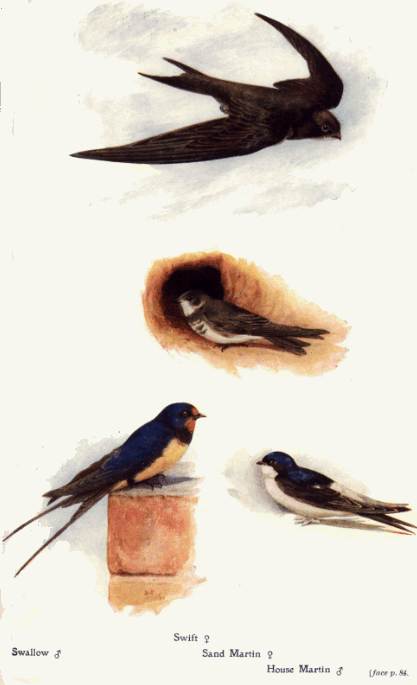
It so happens that a certain district offers good hunting-ground, and the eaves or windows of a certain house are peculiarly well adapted for sheltering nests; so a number of Window Martins, not having taken counsel together, but guided each by independent choice, find themselves established sometimes so close together that their nests have party walls, like the houses in a street. They accordingly make acquaintances, and are sociable to a limited extent. But Sand Martins go beyond this, they are comrades banded together by municipal laws, which no doubt they understand and obey, inhabiting dwellings which constitute a joint settlement, returning without fail to the familiar haunt after every annual migration, or if they desert a station, leaving no stragglers behind, and pitching their camp anew in some locality which common consent has pronounced to be an eligible one. They are not, however, exclusive in their fraternization; as they hunt in society with their relatives the Swifts and Swallows, and even accompany them in distant flights. I have repeatedly observed Sand Martins flying about with others of the same tribe many miles away from their homes. They may readily be distinguished, as I have stated before, by their dingy mouse-coloured hue, smaller size, and less forked tails. I have never had an opportunity of watching a colony engaged in their mining operations at the busy period of their year, that of nidification; but from the description by Professor Rennie (Bird Architecture) and that by Mr. R. D. Duncan, quoted by Macgillivray, the sight must be most interesting. The task of the older birds must be a light one; not so, however, that of the younger members of the flock. The former have neither walls nor roofs to repair; the holes which served them as nests the previous year afford the same accommodation as before. All that is needed is, that the remains of the old nest should either be removed or receive the addition of a few straws and feathers to protect the eggs and young from direct contact with the cold sand; their labours then are over. But the new colonists have a toilsome work to perform before they can enjoy the gratification of bringing up a family. The settlement is fixed probably in the perpendicular face of a bank of sand, gravel, or clay, at an elevation from the ground which varies from a few to a great many feet. Their claws are sharp and well adapted for clinging, the beak short, rigid, and pointed, no less well suited for excavating. Grasping the perpendicular surface of the bank with their claws, and steadying themselves by means of their tails they commence operations by pricking a small hole with their bills. This hole they gradually enlarge by moving round and round, and edging off the sand with the side of their bills, which they keep shut. Their progress is slow at first, but after they have made room to stand on the excavation, they proceed rapidly, still working with their bills, and carefully pushing out the loosened sand with their feet. At one time the male, at another the female, is the excavator. When their burrowing is impeded by the resistance of a stone, they either dig round it and loosen it, or, if it prove so large as to defy removal, they desist and begin another cell. The form of the hole varies both in size and shape, but it rarely exceeds three or four inches in diameter, and more or less approaches the circular form. The depth varies from a few inches to three feet, and the direction seems to depend on the nature of the soil encountered. In all, however, the extremity of the hole is enlarged to a diameter of five or six inches, and is situated above the level of the entrance, so that no rain-water can lodge. The work is performed only in the mornings, and is consequently carried over several days. The nest itself consists of straws of grass and feathers, and is placed in the terminal chamber. The eggs are five or six in number, pure white, and of a rather long shape.
FAMILY FRINGILLIDÆ
THE GREENFINCH LIGURINUS CHLORIS
All the plumage yellowish green, variegated with yellow and ash-grey. Length six inches. Eggs bluish white, speckled and spotted with purplish grey and dark brown.
The Greenfinch, or Green Linnet, is one of our most generally diffused birds. No bird is a more frequent inhabitant of country gardens during the summer than this, being attracted, it would seem, not so much by the prospect of abundance of food, as by its fondness for building its nest in evergreens and the thick hedges of shrubberies. The lively greenish yellow tint of the plumage on its throat and breast sufficiently distinguish it from any other British bird; and its note, when once identified, can be confounded with no other song. Let any one who wishes to obtain a sight of one, walk anywhere in the country where there are trees, on a bright sunny day in May or June, and listen for a monotonous long-drawn croak, trying to pronounce the syllable 'twe-e-e' or 'bree-eze'. No matter what other birds may be tuning their lays, the harsh monotone of the Greenfinch, if one be near, will be heard among them, harmonizing with none, and suggestive of heat and weariness. In a few seconds it will be repeated, without a shadow of variation either in tone or duration; and if it be traced out, the author of the noise (music I cannot call it) will be discovered perched among the branches of a moderately high tree, repeating his mournful ditty with extreme complacency for an hour together. Very often he takes advantage of the midday silence of the groves, and pipes away without any other competitor than the Yellow Hammer, whose song, like his own, is a constant accompaniment of sultry weather. The Greenfinch has another note which is heard most frequently, but not exclusively, in spring. This is a single plaintive chirp which may be easily imitated by human whistling; it resembles somewhat one of the call-notes of the Canary-bird or Brown Linnet, and, being full and sweet, harmonizes with the woodland chorus far better than the monotonous croak described above. Another of the notes is a double one, and closely resembles that of the 'Pee-wit', hence it is called in some places 'Pee-sweep'. The Greenfinch builds its nest, when not among evergreens, in some tall thick bush either in a hedge or coppice. Less neatly finished than that of the Chaffinch, it is nevertheless a beautiful structure. It is composed externally of a framework of light twigs and roots, interleaved with moss and wool, to which succeeds a denser layer of the same materials lined with hair. It lays five eggs, which are of a light grey colour, almost white, variously speckled with purple, and of a long shape. In winter, Greenfinches congregate in large numbers, and feed together on the seeds of various weeds in stubble fields, or not unfrequently they descend on newly-sown fields of wheat, where they are very troublesome. If disturbed, they rise simultaneously, fly rapidly only a few feet from the ground to another part of the field, but before they alight wheel about several times with singular precision of movement, disappearing from the sight and reappearing according as the dark or light portion of their plumage is turned towards the spectator; and by this peculiarity they may be distinguished from flocks of of other small birds at a great distance. If repeatedly disturbed, they alter their tactics, and take refuge in the top branches of the neighbouring trees until their persecutor has turned his back, when they return to the charge with the same perseverance which they display in the repetition of their summer song. These flocks, probably, are composed of individuals which have banded together in some more northern climate, and emigrated southwards in quest of food; for smaller parties, either unmixed, or associated with Sparrows, Chaffinches, and Buntings, frequent our farmyards and gardens in undiminished numbers.
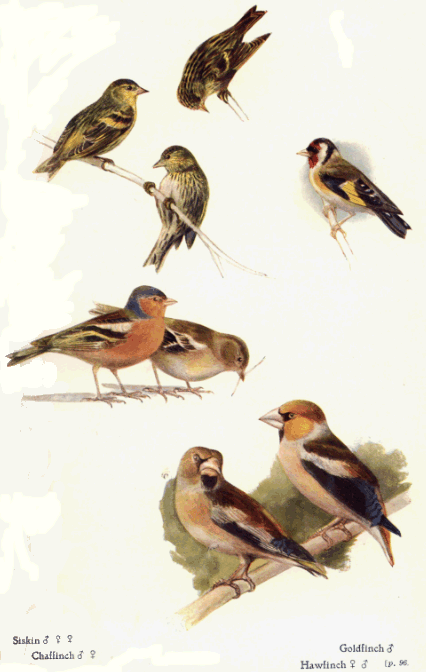
THE HAWFINCH COCCOTHRAUSTES VULGARIS
Lore, throat, and plumage at the base of the bill black; crown and cheeks reddish brown; nape ash-grey; back dark reddish brown; wings black, great coverts white; some of the quills truncated at the extremity; under parts light purplish red; tail short. Length seven inches. Eggs light olive-green, with a few brown spots and numerous irregular lines of a lighter tint.
Judging from its conformation, one would, without knowing anything of the habits of this bird, pronounce it to be a professor of some laborious occupation. Its short tail and wings unfit it for long aërial voyages, and its thick neck and ponderous bill denote the presence of great muscular power, and such, indeed, it both has and requires. It is not a common bird, and was until within the last few years considered to be migratory; but so many instances have occurred in which its nest has been found, that no doubt is now entertained of its being a constant resident. In Berkshire I have several times seen two or three together busily occupied in picking up the seeds which had fallen from the cones of a spruce fir. On one occasion a nest was brought to me by a man who had found it built on some twigs which grew from the trunk of a tall oak-tree; it was built of the tangled white lichens which grow on trees, on a foundation of a few roots, and contained five eggs. I afterwards discovered another nest of exactly similar structure, which I believed must have been built by the same bird, but it was empty. In Hertfordshire a single Hawfinch visited my garden one winter for several days in succession, and diligently picked up and cracked the stones of laurel cherries, from which Blackbirds had, a few months before, as busily stripped the pulp. In the cherry orchards in the neighbourhood they are not uncommon, where, even if not seen, their visits are detected by the ground being strewed with halves of cherrystones, which these birds split with their powerful beaks as cleverly as a workman with the chisel. Their note I have never heard, but the proprietor of the orchards assured me that he had often detected their presence by the low twittering noise which they made, a description the truth of which a writer quoted by Yarrell confirms. I have never seen a nest in Hertfordshire, but on several occasions have observed their eggs among the collections made by the country boys in the neighbourhood. Besides cherrystones, Hawfinches feed on hazel-nuts, hornbeam seeds, the kernels of the fruit of the hawthorn, seeds of various kinds, and, when they can get them, green peas, for the sake of which they often venture into gardens. They usually build their nests in trees at an elevation varying from twenty-five to thirty feet, and the nest is composed of dead twigs, intermixed with pieces of grey lichen; this last material varying much in quantity in different nests, but being never absent.
THE GOLDFINCH CARDUÉLIS ÉLEGANS
Back of the head, nape, and feathers round the base of the bill black; forehead and throat blood-red; cheeks, forepart of the neck and lower parts white; back and scapulars dark brown; wings variegated with black, white and yellow; tail black, tipped with white. Length five inches. Eggs bluish white, speckled with pale purple and brown.
This little bird, as sprightly in its habits as it is brilliant in its colouring, is perhaps a more general favourite than any other British bird. Though in its natural state less familiar with man than the Redbreast, and inferior as a musician to the Lark, the Thrush, and others of our resident birds, it is more frequent as a caged bird than either, and thus is known to tens of thousands of city folk who never heard the wild song of the Thrush, nor saw a Redbreast under any circumstances. In a cage it is attractive from its lively movements, its agreeable song, and yet more from its docility, as it not only is readily tamed, but may be taught to perform various tricks and manœuvres utterly repugnant to the nature of birds. Its affection, too, for its owner is not less remarkable. Of this many instances are, I doubt not, familiar to the reader; but the following is not so well known. There was some years since in a small town, about twelve leagues from Paris, a tame Goldfinch, which belonged to a carrier, and which for many years regularly accompanied his master twice a week to and from the metropolis. At first it used to content itself with perching on the driver's seat, and from time to time flying a short distance ahead, or gambolling with other birds of the same kind that it encountered on the way. By and by it seemed to grow dissatisfied with the slow pace of the wagon, and took long flights in advance, still returning from time to time to its accustomed perch. At length, becoming more enterprising, it would leave its master in the lurch, and fly in advance the whole of the way, and announce his approach at the house in the city where he put up. If the weather was stormy, it would quietly await his arrival, taking up its quarters by the fireside; but if the weather was fine, it would, after making a brief stay, return to meet him. At every meeting, caresses and congratulations were exchanged, as fondly as if they had been separated for years. This romantic attachment was at length terminated by the disappearance of the bird, but whether through the instrumentality of a cat, a Hawk, or some mischievous boy, was never discovered.
Whatever doubt may exist as to the services rendered to man by the Sparrow and Chaffinch, about the Goldfinch there can be no difference of opinion. The farmer has no better friend, and yet an abundance of Goldfinches on an estate is anything but a welcome sight; for it denotes abundance of its favourite food, the seeds of thistles. Where these weeds flourish, there, for the most part, Goldfinches are to be met with in considerable numbers. The French name, Chardonneret, denotes 'a frequenter of thistles', and the ancient Greek and Latin name for it, Acanthis, is of similar import; the Acanthis, Pliny tells us,[13] bears animosity against no living creature but the donkey, a beast which eats the flowers of thistles, and so deprives it of its food. To this dietary it adds the seeds of dandelions, centaury and other weeds, but shows a decided preference for the seeds of the compound flowers. Its nest is among the most beautiful that birds construct. One now before me is placed among the terminal branches cut from the bough of a Scotch fir which grew at an elevation of about twenty feet from the ground. It is encircled by upwards of a dozen leafy twigs which unite beneath its base, and form both a firm support and effectual shelter. The substance is composed of tufted white lichens (Usnea and Evernia), and a few fine roots and wiry stems of garden-thyme, felted together with wool so securely, that it is scarcely possible to remove one of them without damaging the whole. With these is intermixed a piece of worsted, and a thread of sewing cotton; a few horsehairs succeed, and the whole of the interior is thickly matted with the white silky down of the coltsfoot. Other nests vary in the materials employed, moss being sometimes used instead of white lichen, and willow-cotton or feathers instead of the down of the coltsfoot. Thistle-down is sometimes named as the material of the lining; but this must be under unusual circumstances, that substance being generally unattainable in spring. Besides fir-trees, the apple and elm are often selected by Goldfinches to build their nests in, and they not unfrequently resort to any low tree in a hedge or shrubbery, also to young oak-trees. In autumn, Goldfinches assemble in flocks of from ten to twenty or more, and resort to waste places, or the borders of fields, where thistles abound, and it is hard to imagine a prettier sight than a party of these innocent and brilliant hunters, perching, all heedless of spines and prickles, on the thistle heads, plucking out the seeds with the pappus attached, and cleverly separating the former from their appendage. While thus employed, they seem to take it for granted that no one will molest them, but continue their useful labour, twittering pleasantly all the while, until the spectator comes within a few yards of them, when they fly off like butterflies to another prickly bed.
Owing to more efficient bird-protection the Goldfinch, which was decreasing largely in numbers, is now on the increase again.
THE SISKIN CARDUÉLIS SPINUS
Crown black; behind the eye a broad yellow streak; all the plumage variegated with grey, dusky, and various shades of yellow and yellowish green; wings dusky, with a transverse greenish yellow bar, and a black one above, and another black one across the middle of the tertiaries; tail dusky, the base and edge of the inner web greenish yellow. Female—all the colours less bright, and no black on the head. Length four and a half inches. Eggs greyish white, speckled with purplish brown.
The Siskin, or Aberdevine, is best known as a cage-bird, as it is only a very occasional breeder in Great Britain, and during the period of its stay is retiring in its habits. Siskins are more frequently met with in the northern than the southern counties of England, but they are common in neither, and will only nest where pine woods abound. They are generally observed to keep together in small flocks of from twelve to fifteen, and may be heard from a considerable distance, as they rarely intermit uttering their call-note, which, though little more than a soft twittering, is as clear as that of the Bullfinch, to which it has been compared. Their flight is rapid and irregular, like that of the Linnet. They leave their roosting-places early in the morning, and usually alight on the branches of alder-trees, where they remain all day. The seeds of the alder, inclosed within scales something like those of the coniferous trees, form the principal food of these pretty little birds, who are obliged to hang at the extremities of the twigs in order to explore the seed-vessels on all sides. Occasionally, but less frequently, they are seen visiting heads of thistles and burdocks, and not unfrequently they descend to the ground for the sake of picking up scattered seeds. During the whole of their feeding time, they never cease twittering and fluttering about joyously from twig to twig. Now and then, as if by preconcerted signal given by a leader, they all take flight to another tree or, after a short evolution, return to the same from which they started. Should it happen that, while one little band is occupied in despoiling a tree, another is heard in the air, the latter is immediately invited by general acclamation to take part in the banquet, and rarely fails to accept the invitation. Owing to this sociability of character they are easily entrapped, provided that one of their own species be employed as a decoy bird. They soon become reconciled to captivity, and are valued for their readiness to pair with the Canary-bird, the note of which the joint offspring is thought to improve. The nest, which in some respects resembles those of the Greenfinch and Chaffinch, is concealed with great care in the fork formed by two branches of a fir, with which it is so skilfully made to assimilate, that it is almost impossible to discern it from below. In France, Siskins are most numerous from the middle of October to the beginning of December. They are then supposed to travel southwards, and appear again, but in greatly diminished numbers, in spring, at which period they are considered to be travelling towards their summer quarters in Russia and Scandinavia.
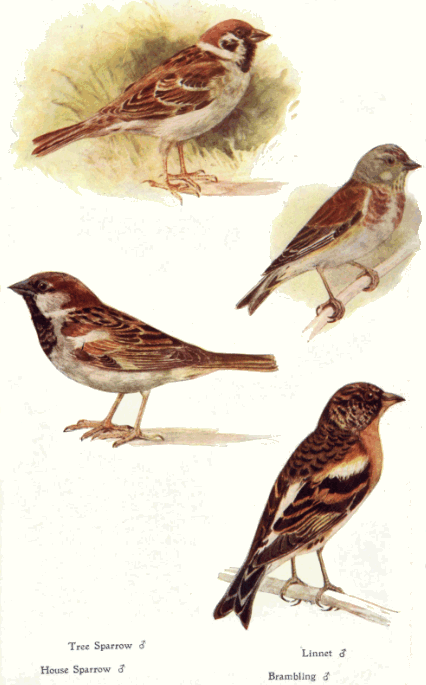
THE HOUSE SPARROW PASSER DOMESTICUS
Crown and back of the head dark bluish ash; lore, throat, and front of the neck black; above the eyes a band of uniform reddish brown, intermixed with a few small white feathers; upper feathers dark brown, edged with reddish brown; a single transverse white bar on the wing; cheeks, sides of the neck, and under parts greyish white. Female—head, nape, neck, and breast ash-brown; above the eye a light yellowish brown streak; rest of the plumage less bright. Length five inches and three-quarters. Eggs white, spotted and speckled with dark grey and brown.
What were the haunts of the Sparrow at the period when men dwelt in tents, and there were neither farmhouses nor villages, much less towns and cities, it were hard to say. Certain it is now that thoroughly wild Sparrows are not to be met with in districts remote from human dwellings and cultivation; they have left the hillside and forest as if by common consent, and have pitched their tents where man builds, or ploughs, or digs, and nowhere else. In the city, the seaport town, the fishing village, the hamlet, the farmhouse, nay, near the cot on the lone waste and by the roadside smithy, they are always present, varying in the amount of confidence they place in their patrons, but all depending on man to a certain extent. And not only do they court his society, but they have adopted his diet. Whatever is the staple food of a household, the Sparrows that nestle around will be right pleased to share it; bread, meat, potatoes, rice, pastry, raisins, nuts, if they could have these for the asking, they would not trouble themselves to search farther; but obliged, as they are, to provide for themselves, they must be content with humble fare; and so skilful are they as caterers, that whatever other birds may chance to die of starvation, a Sparrow is always round and plump, while not a few have paid for their voracity by their lives. Much difference of opinion exists as to whether Sparrows should be courted by man as allies, or exterminated as enemies. The best authorities on this point have come to the conclusion that their numbers must be lessened, and that the most humane way to do this is to tear down nests before the young are hatched out. The fact that great efforts are at the present time being made to introduce them into New Zealand, where the corn crops suffer great injury from the attacks of insects, which the presence of Sparrows would, it is believed, materially check, leads to the conclusion that their mission is one of utility. That Sparrows consume a very large quantity of corn in summer there can be no doubt; as soon as the grain has attained its full size, and long before it is ripe, they make descents on the standing corn, and if undisturbed will clear so effectually of their contents the ears nearest to the hedges, that this portion of the crop is sometimes scarcely worth the threshing. During harvest they transfer their attention to the sheaves, while the reapers and binders are occupied elsewhere; as gleaners they are indefatigable; they participate, too, in the joys of harvest home, for their food is then brought to their very doors. The most skilful binder leaves at least a few ears exposed at the wrong end of the sheaf, and these are searched for diligently in the rick; and the barns must be well closed indeed into which they cannot find admission. At threshings and winnowings they are constant attendants, feeding among the poultry, and snatching up the scattered grains under the formidable beak of Chanticleer himself. At seed-time their depredations are yet more serious, as they now come in not simply for a share of the produce, but undermine the very foundations of the future crop. I once had the curiosity to examine the crop of a Sparrow which had been shot as it flew up from a newly-sown field, and found no less than forty-two grains of wheat. A writer in the Zoologist, who professes himself a deadly enemy of the Sparrow, states that he once took 180 grains of good wheat from the crops of five birds, giving an average of thirty-six for a meal. Now if Sparrows had the opportunity of feeding on grain all the year round, they would be unmitigated pests, and a war of extermination against them could not be waged too vigorously; but during the far greater portion of the year they have not the power of doing mischief, and all this time they have to find food for themselves. Against their will, perhaps, they now hunt for the seeds of various weeds, especially the wild mustard; and these being smaller than grains of corn and less nutritive, they consume an immense number of them, varying their repast with myriads of caterpillars, wireworms, and other noxious grubs; also they devour small beetles (called hay-chaffers) when the hay lies in swathes on the field. They thus compensate, certainly in part, perhaps wholly, for the mischief they do at other seasons; and it is even questionable whether, if a balance were struck between them and the agriculturists, the obligation would not be on the side of the latter.
It is scarcely necessary to say much of the habits of a bird which stands on such familiar terms with the human race as the Sparrow. During no period of the year do Sparrows live together in perfect amity; if half a dozen descend to pick up a handful of scattered crumbs, each in his turn will peck at any other who comes too near his share of the feast, and, with a peculiar sidelong shuffle or hop, will show his intention of appropriating as large a portion of the feeding-ground as he can. In spring, this bickering assumes a more formidable character. A duel is commenced among the branches of a tree, obstinate and noisy; all the Sparrows within hearing flock to the scene of combat, joining at first with their voices, and finally with their beaks; a general riot ensues, with as little object seemingly as an Irish 'row'; for suddenly the outcry ceases, and the combatants return to their various occupations. A writer in the Naturalist gives an account of a fray of this kind, during which three male birds fell at his feet one after another either dead or dying; but cases of this kind are very rare.
Sparrows build their nests at a considerable elevation from the ground, but are by no means particular as to the locality. At the period when most farmhouses and cottages were thatched, the eaves were their favourite resort, and here they hollowed out for themselves most comfortable dwellings. The general employment of tiles or slates has interfered with this arrangement; but they will fix upon any projection, niche, crack, or hole which will hold a nest, and if these are all occupied, content themselves with a tree; but, as far as my own observation goes, the number built in trees far exceeds that to be found in other localities. Very frequently they appropriate the nest of the House Martin. The nest itself is a rude structure, composed mainly of straw and hay, and lined with feathers and any other soft materials which they can find. Two or three broods are reared every year, the number of eggs being usually five. The young are fed on worms, caterpillars, and insects of various kinds.
THE MOUNTAIN OR TREE SPARROW PASSER MONTÁNUS
Crown and back of the head chestnut-brown; lore, ear-coverts, and throat black; neck almost surrounded by a white collar; upper plumage resembling the last; wing with two transverse white bars. The female scarcely differs from the male. Length five inches and a half. Eggs as in the last.
The Mountain Sparrow seems scarcely to deserve its name, as it is by no means confined to mountainous districts. It is abundant all over the European continent, and is to be met with here and there in many parts of England in the east of Scotland and of late years in Ireland and in the Hebrides; but it is nowhere so abundant as the House Sparrow, which it resembles in all respects, except that the head is of a bright chestnut colour, and the neck wears a white collar. I have never seen it except in society with the common species, and could never detect any difference either in flight or note; but other observers state that the flight is slow and constrained, and the note assumes more the character of a song. The nest is placed in soft rotten wood of pollard willows and other trees, in hollow trees and under the thatch of buildings.
THE CHAFFINCH FRINGILLA CǼLEBS
Forehead black; crown and nape greyish blue; back and scapulars chestnut, tinged with green; rump green; breast wine-red, fading towards the abdomen into white; wings black, with two white bands; coverts of the secondaries tipped with yellow; tail black, the two middle feathers ash-grey, the two outer on each side black, with a broad oblique white band. Female—head, back and scapulars, ash-brown, tinged with olive; lower parts greyish white; the transverse bands less distinct. Length six inches. Eggs greenish purple, streaked and spotted with purple-brown.
'Gai comme Pinson', as gay as a Chaffinch, is a familiar French proverb, which describes not only the character of the bird, but the peculiar temperament which in France is an essential part of gaiety. The Chaffinch is a smart, lively, active bird, always in a bustle, flitting here and there incessantly and staying long nowhere, always wearing a holiday look, so trim and spruce is he, and rattling through his song with wondrous volubility. It received the name cælebs, bachelor, from Linnæus, who observed that the flocks in winter are composed for the most part either exclusively of males or of females. Large flocks arrive on our east coast each year from the Continent, and others coming from the north spread themselves over the country to the southward. During the open weather of autumn and early winter, Chaffinches frequent stubble and ploughed fields, where they busily collect grain and the seeds of various weeds, and are not, I fear, very scrupulous whether they are engaged as gleaners of what is lost, or robbers of what is sown. In severe weather they resort to farmyards and homesteads, where, along with Sparrows, Buntings, and Greenfinches, they equally consider all they can find as provided for their own especial use. On the return of spring, they feed upon the young shoots, and for a few weeks show themselves great enemies to horticulture. Their visits to our flower-gardens, paid very early in the morning, are attested by scattered buds of polyanthuses, which they attack and pull to pieces as soon as they begin to push from between the leaves. In the kitchen-garden they are yet more mischievous, showing a strong inclination for all pungent seeds. Woe to the unthrifty gardener, who, while drilling in his mustard, or cress, or radishes, scatters a few seeds on the surface! The quick eye of some passing Chaffinch will surely detect them; so surely will the stray grains serve as a clue to the treasure concealed beneath, and so surely will a hungry band of companions rush to 'the diggings', and leave the luckless proprietor a poor tithe of his expected crop. Yet so large is the number of the seeds of weeds that the Chaffinch consumes, in the course of a year, more particularly of groundsel, chickweed, and buttercup, that he, without doubt, more than compensates for all his misdeeds; and as his summer food partially, and that of his young family exclusively, consists of caterpillars and other noxious insects, he is in reality among the gardener's best friends, who should be scared away at the seasons when his visits are not welcome, and encouraged at all other times. The Chaffinch, though a wary bird, does not stand greatly in fear of man; for if disturbed at a meal, he is generally satisfied with the protection afforded by the branches of the nearest tree, on which he hops about until the danger is past, uttering his simple but not unpleasing note, 'twink' or 'pink' or 'spink, spink, spink' as it is variously translated. To this cry it adds the syllable 'tweet', frequently repeated in an anxious tone and with a peculiar restlessness of manner, which always indicate that its nest is somewhere very near at hand, and by which indeed it is very often betrayed.
Its proper song commences very early in spring, and is continued until June or later. This must be the song which the poet had in view when he sang:—
Then as a little helpless innocent bird,
That has but one plain passage of few notes,
Will sing the simple passage o'er and o'er,
For all one April morning, till the ear
Wearies to hear it.—Tennyson.
It consists of from ten to twelve notes of the same tone, and about the same length, with the last but one elevated and accented, uttered rapidly at short intervals, and without the least variation.
In Germany, this bird is so great a favourite that not a single tone of its voice has escaped the experienced ears of bird-fanciers. In some parts of Holland and the north of France, the passion for song Chaffinches amounts to a frenzy. Philharmonic societies are formed, whose exclusive object is to educate Chaffinches, and to organize vocal combats. The combatants, each in his cage, are placed a few yards from each other. One of them utters his strain, which is replied to by the other; strict silence is imposed on the spectators, lest the attention of the birds should be distracted by their remarks or applause. The contest proceeds as long as the birds continue to utter their notes of defiance, and the victory is adjudged to the one who has the last word. The price paid for a bird of mark, and the pains bestowed on the capture of any bird which in its wild state holds out promise of being an apt pupil, are past belief, and the cruelty practised in producing a perfect songster I cannot bring myself to describe. After all, Bechstein's translator says that the notes of the wild Chaffinches in England are finer than any cage ones he has heard in Germany. English bird-fanciers, without going so far as their German brethren, profess to distinguish three variations of song in the Chaffinch.
The nest of the Chaffinch is an exquisite piece of workmanship, composed of moss, dry grass, fine roots felted together with wool, decorated externally with scraps of white lichens, and lined with hair and feathers. It is placed sometimes in the fork of a tree, sometimes against the bole, but more frequently than anywhere else it is built in among the twigs of an apple-tree; but in every case it is attached to its support by wool interwoven with the other materials. The Chaffinch usually lays five eggs.
THE BRAMBLING FRINGILLA MONTIFRINGÍLLA
Head, cheeks, nape, and upper part of the back, black, the feathers (in winter) tipped with light brown or ash-grey; neck and scapulars pale orange-brown; wings black, variegated with orange-brown and white; rump and lower parts white, the flanks reddish, with a few dark spots. Female—crown reddish brown, the feathers tipped with grey, a black streak over the eyes; cheeks and neck ash-grey; all the other colours less bright. Length six inches and a half. Eggs yellowish white, spotted and streaked with dark red.
In winter this bird occurs over the whole continent of Europe, and not unfrequently in enormous flocks. Pennant mentions an instance in which eighteen were killed at one shot—a statement which I can well believe, having seen in the winter of 1853 by far the largest flock of small birds I ever beheld, and which was composed entirely of Bramblings. They were employed in searching for food on the ground in a beech wood, and, as I approached, flew up into the branches in thousands. The Brambling, called also the Bramble Finch and Mountain Finch, is a fairly regular autumn and winter visitor to many parts of Scotland. Its presence in our country in any numbers depends on the severity of the weather on the Continent. Sometimes it is fairly numerous with us, especially where there are many beech woods. Few visit Ireland. It resembles the Chaffinch in habits, size, and general tone of colour; and as it often feeds in company with it, is probably sometimes confounded with it by an inexperienced eye. It arrives in this country in November, and takes its departure early in spring, never having been known to breed here. Its song is said to be something like that of the Chaffinch, and its nest, built in fir-trees, to be constructed with the same marvellous art.
THE LINNET ACANTHIS CÁNNABINA
Winter—head ash-brown, the feathers dusky in the middle, those of the forehead more or less tinged with crimson; back chestnut-brown, becoming brighter towards the scapulars and duller towards the tail; tail-feathers black, edged towards the tip with reddish grey, the outer ones bordered with white; primaries black, the first five with very narrow, the next five with broad, white edges, the rest of the wing-feathers tinged with red, all tipped with ash-grey; under parts—breast-feathers dull crimson or brown, edged with yellowish red; abdomen dull white; flanks reddish yellow; beak brownish horn colour; feet and toes brown; tail moderate. In summer the beak is of a bluish lead colour; feathers of the forehead and crown greyish brown, tipped with crimson; upper plumage uniform rich chestnut-brown; breast crimson, with a few pale brown feathers intermixed. Length five inches. Eggs pale bluish grey, speckled with deep red.
It is not unusual in the country to hear mention made of the Brown, the Grey, and the Rose or Red Linnet, and the Common Linnet, as if these were all different birds. Such, however, is not the case. The Linnet is a bird which varies its plumage considerably at different seasons of the year, in consequence of which, at a period when little attention was paid to Ornithology, the same individual was known by whichever of these names best described its characteristic colouring. Even by the earlier ornithologists there were supposed to be two species, one of which was called Linota, probably from its having been observed feeding on flax-seed (Linum); the other Cannabina, from having been seen to feed on hemp seed (Cannabis). Linnets offer themselves to our notice in the evenings of autumn and winter more than at any other time. Large flocks of them may then be observed making their way, with rapid and irregular flight, towards tall trees which happen to stand in the vicinity of a common or a furze-brake. On the summits of these they alight, with their heads, in stormy weather, always turned towards the wind, and after keeping up a continuous twittering for a few minutes, suddenly drop into their roosting-places among the furze and thick shrubs. At the return of dawn, they issue forth to their feeding-grounds, still congregated in large flocks, and spend the whole of the day in hunting on the ground for food. This consists principally of the seeds of various weeds, especially wild-mustard or charlock, wild-cabbage, and other plants of the same tribe, thistle and dandelion; chance grains of corn no doubt are not passed by, but any injury which may be done by these birds, either to standing crops or newly-sowed lands, must be far outweighed by their services as destroyers of weeds and insects, which latter also enter into their dietary. At this season their only note is a simple call, mellow and pleasant, which they utter both while flying and when perched. In spring, the flocks break up, and the members betake themselves in pairs to the commons and heaths, which afforded them night-lodging during winter. Here they build their nests at a moderate distance from the ground, more frequently in a furze-bush than anywhere else, but occasionally in other shrubs or an adjoining hedge. The nest is constructed of small twigs, moss, roots, and wool; and is lined with hair, feathers, and sometimes vegetable down. The Linnet lays four or five eggs. The spring and summer song of the Linnet is remarkable neither for compass nor power; it is, however, very sweet, and on this account the Linnet is a favourite cage-bird.
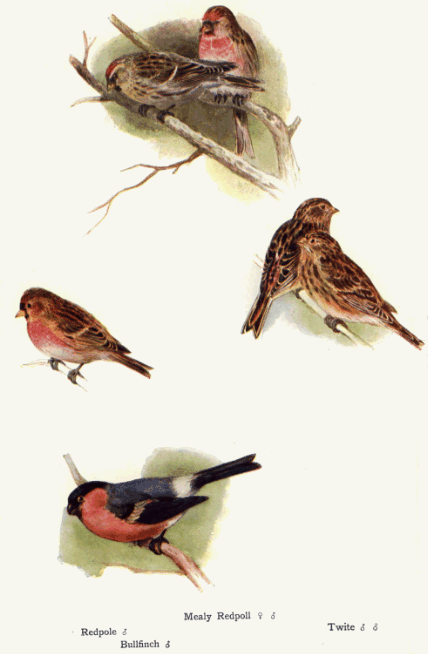
THE MEALY REDPOLL ACANTHIS LINÁRIA
Throat and lore black; forehead and crown blood-red; breast and rump rose-red; under parts white; nape reddish white, with dusky streaks; shoulders and back with dark streaks, edged with white; quills and tail feathers greyish brown, edged with white. Length five and a half inches.
A northern species of Linnet, closely resembling the Lesser Redpoll, but larger. It visits Great Britain only in the winter and at irregular intervals, being in some seasons tolerably abundant, and in others not seen at all. Little appears to be known of its habits.
THE LESSER REDPOLL ACANTHIS RUFESCENS
Forehead, throat, and lore black; crown deep crimson; under parts light crimson tinged with buff, fading towards the tail into white; upper parts reddish brown, with dusky streaks; wings and tail dusky, edged with pale reddish brown. Female—all the colours less bright. Length five and a quarter inches. Eggs bluish white, speckled at the larger end with reddish brown.
The Lesser Redpoll so closely resembles the Siskin in its habits and temperament, that a description of either of these birds would serve well for the other. Like that bird it congregates in small flocks; it frequents damp valleys where alder-trees abound; it feeds on the seeds of the same trees; like it, hangs at the extremities of the twigs to explore the catkins, twitters merrily as it flies, and is quite as easily reconciled to captivity. But for the yellow plumage and larger size of the Siskin, they might well be mistaken one for the other. The Redpoll, however, is a much more frequent bird, as its annual visits to the southern counties of England in winter are as regular as those of Swallows in summer. Though a northern bird, it does not unexceptionally repair to high latitudes, but in summer remains to breed in Scotland and the northern counties of England. As far south as Yorkshire it is not unfrequent, and its nest has been occasionally found in the midland counties; some eggs were recently brought to me in Hertfordshire. Meyer relates, that having one confined in a cage he placed it in his garden in fine weather, in the hope that other birds of the same species might be attracted by its note to visit it in its confinement. His expectation was realized, for several wild Redpolls not only came into his garden and twittered their notes of recognition from the neighbouring trees, but actually alighted on the bars of the cage. This took place in the county of Surrey, and during the month of June, thus proving that some at least of the species remain with us all the year round. The nest, which is remarkably small, is described as being placed in the fork of an alder-tree, loosely constructed of dry grass and weeds, and lined either with the cotton of the willow or the pappus of some compound flower, stated by some to be dandelion, by others, thistle, but perhaps, in reality, coltsfoot. In captivity, Redpolls are prized for their liveliness and remarkable affection for each other, and, indeed, for all little birds who do not disdain their attentions. They can be taught many little tricks also.
THE MOUNTAIN LINNET, OR TWITE ACANTHIS FLAVIROSTRIS
Upper plumage dark brown, edged with light brown; no crimson either on the forehead or breast; rump of the male tinged with red; throat tawny brown, without streaks; breast and abdomen dull white, streaked on the flanks with dark brown; beak yellow; feet and claws dark brown; tail long. Length five inches and a quarter. Eggs pale bluish white, speckled with purple-red.
Another northern bird, inhabiting the Arctic Regions, Scandinavia, and Russia, and travelling southwards in autumn. In the Orkney and Shetland Islands it is the most common, if not the only, species, and builds its nest among the corn or heath. It breeds from Derbyshire and northwards, but is very local; at one time it was very common on the Lancashire moors. Yellow-neb Lintie is a Scotch name given to it. In the countries where it is resident all the year round, it is very destructive to wheat in winter, and to turnips in summer. As soon as the latter plants appear above ground, the bird pulls them up, nips off the seed-leaves, and the field remains strewn with the fragments of the young plants. In winter, Mountain Linnets assemble in very large flocks, and in their habits resemble Common Linnets, from which they are best distinguished (at a distance) by their longer tails. During severe weather I have observed them in Norfolk, flocking to the salt marshes, and feeding on the seeds of saline plants, especially those of the shrubby sea-blite. At this season their note resembles the twitter of the Common Linnet, but is less mellow. The nest is placed among heath, grass, or young corn, and invariably on the ground—in this respect differing from all other birds of the same family. It is constructed of dry grass, moss, and roots, and lined with various soft substances. The Mountain Linnet is generally called the Twite, a syllable which its simple note is thought to resemble. It is more shy as a rule than the Lesser Redpoll.
THE BULLFINCH PÝRRHULA EUROPÆA
Crown, throat, plumage round the bill, wings and tail lustrous purple-black; upper part of the back bluish ash; cheeks, neck, breast and flanks red (in the female reddish brown); rump and abdomen pure white; a broad buff and grey band across the wings. Length six and a quarter inches. Eggs light greenish blue, speckled and streaked with light red and dark purple.
'The Bullfinch', said Macgillivray, usually so accurate an observer, 'is not very common anywhere.' From this last remark I infer that the author in question was never either proprietor or occupant of a fruit-garden in a wooded district, or he would have reported very differently of the frequency of the Bullfinch. During winter the food of these birds consists exclusively of berries of various kinds and seeds, especially of such weeds as thistle, rag-wort, duckweed, plantains, etc., either picked up from the ground or gathered from herbs and shrubs. In spring, unfortunately for the gardener, their taste alters, and nothing will satisfy them but the blossom-buds of fruit-trees, especially those which are cultivated. They attack, indeed, the buds of the sloe and hawthorn as well; but of these, being valueless, no one takes note. Still keeping together in small family parties, all uninvited, they pay most unwelcome visits to gooseberries, plums, and cherries, and, if undisturbed, continue to haunt the same trees until all hope of a crop is destroyed. Gooseberry-bushes are left denuded of flower-buds, which have been deliberately picked off and crushed between their strong mandibles, while the leaf-buds, situated principally at the extremities of the branches, are neglected. Plum and cherry trees are treated in like manner, the ground being strewed with the bud-scales and rudiments of flowers. Some persons endeavour to deter them by whitewashing the trees, and are said to find this plan effectual. Others wind a straw rope round the gooseberry-bushes, so disguising their natural appearance. This plan I found perfectly successful one year, but the next it was entirely without effect. A new one which I have adopted this year is somewhat more complex. In addition to the straw bands, I have stretched long strings, with feathers attached here and there, so as to resemble the tail of a paper kite; and, by way of offering them an inducement to stay away, I have sprinkled peas on the ground in an adjoining lane, in the hope that they will partially, at least, satisfy their hunger on these. A bird with so strong a beak as that of the Bullfinch is evidently designed to crush its food, not to swallow it whole; accordingly, I find my peas disappearing, but the parchment-like rind is left on the ground, a substance too indigestible even for the gizzard of a Bullfinch. This bird has, however, justly many friends, who assert that the buds he attacks are infested with concealed insects, and that the tree he strips one season will be heavily laden the following year. When not occupied in disbudding fruit-trees, Bullfinches are most frequently observed in tall and thick hedges, either in small flocks as described above, or in pairs. They are rarely met with singly, and yet less frequently associated with birds of another species. Occasionally a pair may be seen feeding with Sparrows and Chaffinches in the farmyard; but this society seems one of accident rather than of choice. When disturbed in a hedge they are singularly methodical in their movements: first one flies out, bounds, as it were through the air in a direction away from the spectator, perches on a twig in the thick part of the hedge, and is followed by the rest of the party in single file. When the passenger has approached within what the bird considers a safe distance, the same manœuvre is repeated, each bird following, with dipping flight, the line marked out by its predecessor.
PINE GROSBEAK PÝRRHULA ENUCLEATOR
Head and upper parts of the neck reddish orange, streaked on the back with dusky; wings and tail black, the former with two white bars, the primaries and tail-feathers edged with orange, the secondaries with white under parts orange-yellow. Length seven and a quarter inches. Eggs white.
A large and handsome bird, inhabiting the Arctic regions during the summer months, and in winter descending a few degrees to the south in both hemispheres. It is of very rare occurrence in the pine-forests of Scotland, and a still more unfrequent visitor to England. The Pine Grosbeak, or Pine Bullfinch, is a bird of sociable habits, and an agreeable songster.
THE CROSSBILL LOXIA CURVIRÓSTRA.
Bill equalling in length the middle toe, point of the lower mandible extending beyond the ridge of the upper mandible; plumage variegated, according to age and sex, with green, yellow, orange, and brick-red. Length six and a half inches. Eggs bluish white, speckled with red-brown.
The beak of this bird was pronounced by Buffon 'an error and defect of Nature, and a useless deformity'. A less dogmatic, but more trustworthy authority, our countryman, Yarrell, is of a different opinion. 'During a series of observations', he says, 'on the habits and structure of British birds, I have never met with a more interesting or more beautiful example of the adaptation of means to an end, than is to be found in the beak, the tongue, and their muscles, in the Crossbill.' No one can read the chapter of British Birds devoted to the Crossbill (in which the accomplished author has displayed even more than his usual amount of research and accurate observation) without giving a ready assent to the propriety of the latter opinion. Unfortunately the bird is not of common occurrence in this country, or there are few who would not make an effort to watch it in its haunts, and endeavour to verify, by the evidence of their own eyes, the interesting details which have been recorded of its habits. I have never myself succeeded in catching a sight of a living specimen, and am therefore reduced to the necessity of quoting the descriptions of others. Family parties of this species visit—1907—a small wood of pine trees in the valley of the Kennet near Theale some winters, as well as other scattered pine-forest lands in the southern counties, and across the Solway and northward it nests in suitable districts.
The Crossbill is about the size of the Common Bunting, and, like it and the Hawfinch, is a remarkably stout bird, having a strong bill, a large head, short thick neck, compact ovate body, short feet of considerable strength, rather long wings, and moderately large tail. Its plumage, in which green or red predominates, according to the age of the bird, is much more gaudy than that of our common birds, and approaches that of the Parrots, a tribe which it also resembles in some of its habits. Though only occasional visitors with us, Crossbills are plentiful in Germany, Bavaria, Sweden, and Norway all the year round, and are occasionally mischievous in orchards and gardens, on account of their partiality to the seeds of apples, which they reach by splitting the fruit with one or two blows of their stout bills. Food of this kind, however, they can only obtain in autumn; at other seasons, and, indeed, all the year round in districts remote from orchards, they feed principally on the seeds of various kinds of fir, which they extract from the cone by the joint action of their beak and tongue. The alder and other trees are also sometimes visited, and they have been noticed to resort to thistles and pick the seeds from them. 'In the autumn of 1821', says Macgillivray, 'when walking from Aberdeen to Elgin, by the way of Glenlivat, and along the Spey, I had the pleasure of observing, near the influx of a tributary of that river, a flock of several hundreds of Crossbills, busily engaged in shelling the seeds of the berries which hung in clusters on a clump of rowan (mountain ash) trees. So intent were they on satisfying their hunger that they seemed not to take the least heed of me; and as I had not a gun, I was content with gazing on them without offering them any molestation. They clung to the twigs in all sorts of positions, and went through the operation of feeding in a quiet and business-like manner, each attending to his own affairs without interfering with his neighbours. It was, indeed, a pleasant sight to see how the little creatures fluttered among the twigs, all in continued action, like so many bees on a cluster of flowers in sunshine after rain.' A writer in the Zoologist thus describes the manœuvres of a flock which he observed in 1849, in the county of Durham: "On the fifteenth of July when taking a drive in the western part of the county, where there are many thousand acres of fir-plantations, I had the good fortune to see a flock of birds cross my path, which appeared to be Crossbills; so, leaving the gig, I followed some distance into a fir-plantation, where, to my great gratification, I found perhaps thirty or more feeding on some Scotch firs. The day being fine, and as they were the first I had seen in a state of wild nature, I watched them for about twenty minutes. Their actions are very graceful while feeding, hanging in every imaginable attitude, peering into the cones, which, if they contain seeds, are instantly severed from the branch; clutched with one foot, they are instantly emptied of their contents, when down they come. So rapidly did they fall, that I could compare it to nothing better than being beneath an oak-tree in autumn, when the acorns are falling in showers about one's head, but that the cones were rather heavier. No sooner are they on the wing than they, one and all, commence a fretful, unhappy, chirl, not unlike the Redpoll's, but louder.' Another writer, in the Magazine of Natural History, thus records his experience: 'From October, 1821, to the middle of May, 1822, Crossbills were very numerous in this county (Suffolk), and, I believe, extended their flight into many parts of England. Large flocks frequented some fir-plantations in this vicinity, from the beginning of November to the following April. I had almost daily opportunities of watching their movements; and so remarkably tame were they, that, when feeding on fir-trees not more than fifteen or twenty feet high, I have often stood in the midst of the flock, unnoticed and unsuspected. I have seen them hundreds of times, when on the larch, cut the cone from the branch with their beak, and, holding it firmly In both claws, as a hawk would a bird, extract the seeds with the most surprising dexterity and quickness. I do not mean to assert this to be their general habit; but it was very frequently done when feeding on the larch. I have never seen them adopt the like method with cones of the Scotch or other species of pine, which would be too bulky for them to manage. Their method with these, and, of course, most frequently with the larch, was to hold firmly on the cone with their claws; and, while they were busily engaged in this manner, I have captured great numbers; many with a horsehair noose fixed to the end of a fishing-rod, which I managed to slip over their head when they were feeding, and, by drawing it quickly towards the body, I easily secured them; others I took with a limed twig, fixed in such a manner in the end of a rod that, on touching the bird, the twig quickly became disengaged, adhered to the feathers, rendered the wings useless, and caused the poor bird to fall perfectly helpless on the ground. In this manner, in windy weather, I have taken several from the same tree, without causing any suspicion of danger. On warm sunny days, after feeding a considerable time, they would suddenly take wing, and, after flying round for a short time, in full chorus, alight on some lofty tree in the neighbourhood of the plantations, warbling to each other in low pleasing strains. They would also fly from the trees occasionally for the purpose of drinking, their food being of so dry a nature. To captivity they were quickly reconciled, and soon became very familiar. As, at first, I was not aware what food would suit them, I fixed branches of the larch against the sides of the room in which I confined them, and threw them a quantity of the cones on the floor. I found that they not only closely searched the cones on the branches but, in a few days, not one was left in the room that had not been pried into. I gave them canary and hemp-seed; but thinking the cones were both amusement and employment, I continued to furnish them with a plentiful supply. I had about four dozen of them; and frequently, whilst I have been in the room, they would fly down, seize a cone with their beak, carry it to a perch, quickly transfer it to their claws, and in a very short time empty it of its seeds, as I have very many times witnessed to my surprise and amusement.' These accounts are most interesting, yet they are all equally defective in failing to describe the mode in which Buffon's 'useless deformity', the crossed bill, is employed in the work of splitting open a cone This defect is supplied partially by Mr. Townson's description, quoted by Yarrell, and partly by the latter author in his own words. 'Their mode of operation is thus:—They first fix themselves across the cone, then bring the points of the mandibles from their crossed or lateral position, to be immediately over each other. In this reduced compass they insinuate their beaks between the scales, and then, opening them—not in the usual manner, but by drawing the inferior mandible sideways—force open the scales.' "'At this stage', Yarrell proceeds to say, 'the end of the tongue becomes necessary; and this organ is no less admirably adapted for the service required.... While the points of the beak press the scale from the body of the cone, the tongue is enabled to direct and insert its cutting scoop underneath the seed, and the food thus dislodged is transferred to the mouth; and when the mandibles are separated laterally in this operation the bird has an uninterrupted view of the seed in the cavity with the eye on that side to which the under mandible is curved.'"
The beak of the Crossbill then, far from being a defect in the organization of the bird, is a perfect implement always at its owner's command, faultless alike in design and execution, and exquisitely adapted to its work, not an easy one, of performing, by a single process, the office of splitting, opening, and securing the contents of a fir-cone, and he must be a bold man who could venture to suggest an improvement in its mechanism.
It has been observed that young birds in the nest have not their mandibles crossed, and at this period such an arrangement would be useless, as they are dependent for food on the parent birds. It has also been observed that the side on which the upper mandible crosses the lower varies in different individuals; in some it descends on the right side of the lower mandible, in others on the left. The bird appears to have no choice in the matter, but whatever direction it takes at first, the same it always retains.
The nest of the Crossbill is constructed of slender twigs of fir and coarse dry grass, and lined with fine grass and a few hairs, and concealed among the upper branches of a Scotch fir.
The Two-barred (or White-winged) Crossbill (Loxia bifasciata) is only a rare straggler in winter to this country.
THE CORN (OR COMMON) BUNTING EMBERIZA MILIARIA
Upper parts yellowish brown, with dusky spots; under parts yellowish white, spotted and streaked with dusky. Length seven inches and a half. Eggs dull white, tinged with yellow, or pink, and spotted and streaked with dark purple brown.
Though called the Common Bunting, this bird is by no means so abundant in England as the Yellow Bunting; its name, however, is not misapplied, as it appears to be the most generally diffused of the family, being found all over the European continent, in the islands of the Mediterranean, in Asia Minor, and the north of Africa. In the latter district it appears as a bird of passage in November; and about Martinmas it is so abundant as to become a staple article of food. At this season, all the trees in the public roads and squares of the villages are literally covered with these birds. Macgillivray informs us that it is more abundant in the outer Hebrides than in any other part of the country he has visited; and that it is there generally known by the name of Sparrow. In England it is a constant resident; but as it is much more abundant in autumn and winter than in summer, it probably receives accessions to its numbers from the north. From its habit of congregating in large flocks in the winter and alighting on arable land to feed, after the manner of the Skylark, it is sometimes called 'Lark Bunting', and, from its favourite food, 'Corn Bunting'. It builds its nest in a tuft of grass, often under the shelter of briers or a low bush, constructing it of dry grass with a lining of hair. Its song, which is harsh and unmelodious, consists of a number of short repetitions of the same note, terminating with a long one lower in tone, and is generally uttered by the bird perched the while on some slight elevation, such as a stone or the topmost twig of a furze-bush. On first rising, it allows its legs to drop as if broken.
THE YELLOW BUNTING (OR YELLOW HAMMER) EMBERIZA CITRINÉLLA
Head, neck, breast, and lower parts bright yellow, more or less streaked with dusky; flanks streaked with brownish red; upper parts reddish brown spotted with dusky. Female—the yellow parts less vivid, and spotted with dull reddish brown. Length six inches and a quarter. Eggs purplish or yellowish white, speckled and lined with dark purple brown.
This familiar and pretty bird appears to be generally diffused throughout all parts of the country, except the mountains. With its bright yellow head and breast it can scarcely fail to attract the attention of those even who are least observant of birds, and being by no means shy it will allow itself to be examined from a short distance. It may often be detected by its bright yellow plumage among the leaves of a hedge, neither fluttering nor hunting for food, but apparently waiting to be admired. As we approach within a few yards it darts out into the lane with rapid flight, displaying the white feathers of its tail, with tawny tail-coverts, perches on another twig some fifty yards in advance, and, after one or two such manœuvres, wheels away with rapid flight uttering two or three short notes as it passes over our head. In summer, especially during the hot afternoons of July, when most other birds have closed their concert for the season, it loves to perch on the top of a furze bush or other shrub, and repeat its simple song. This consists of about a dozen short notes, rapidly repeated and closed by a longer note, which I believe to be a musical minor third below. Sometimes this last note is preceded by another which is a third above. The effect is in some measure plaintive, and gives the idea that the bird is preferring a petition. In Devonshire it goes by the names of 'Little-bread-and-no-cheese', and 'Gladdy'. Of the latter name I do not know the origin; that of the former is clear enough; for if the words 'A little bit of bread and no cheese' be chanted rapidly in one note, descending at the word 'cheese, chee-ese', the performance, both in matter and style, will bear a close resemblance to the bird's song. It has been noticed that the song of the Yellow Hammer may always be heard about three o'clock in the afternoon.
In winter, Yellow Hammers assemble in large flocks, often mixed with other hard-billed birds, and resort to ploughed fields, or rick-yards. Macgillivray describes with singular accuracy their movements on these occasions. "When the ground is covered with snow, they congregate about houses, and frequent cornyards along with other birds, retiring to the trees and hedges in the vicinity when alarmed. Their flight is undulated, light, strong, and graceful, and they alight abruptly, jerking out their tail-feathers. It is indeed surprising to see with what velocity they descend at once from a considerable height, to settle on the twigs of a tree which had attracted their notice as they were flying over it, and with what dexterity all the individuals of a flock perch in their selected places."
The nest and eggs of the Yellow Hammer resemble those of the Common Bunting, but are smaller. The nest is most frequently placed close to the ground, or actually on the ground, among grass on the skirt of a meadow. Yarrell suggested that the name 'Yellow Hammer' should be written 'Yellow Ammer'—the word Ammer being a well-known German term for Bunting.
Collectors of eggs should carefully avoid cleaning the eggs of the Buntings, as the dark colouring matter with which they are blotched is easily rubbed off with a damp cloth.
THE CIRL BUNTING EMBERÍZA CIRLUS
Crown dark olive, streaked with black; gorget and band above and below the eye bright yellow; throat, neck, and band across the eye, black; breast olive-grey, bounded towards the sides by chestnut; abdomen dull yellow; back brownish red, with dusky spots. Female—the distinct patches of black and yellow wanting; the dusky spots on the back larger. Eggs greyish, marked with ash-coloured and black blotches and lines.
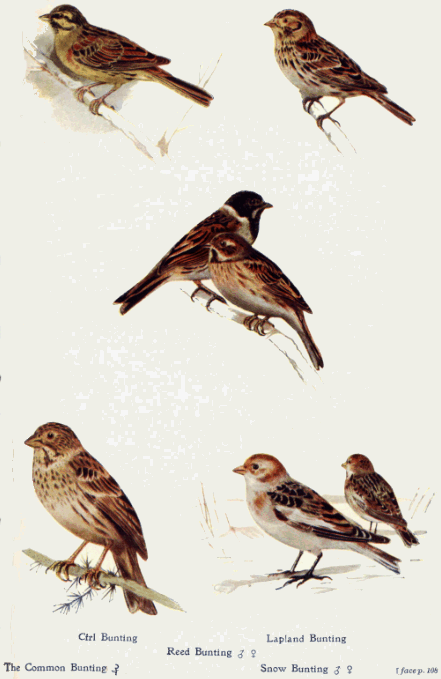
With the exception of its black chin and throat, this bird closely resembles the Yellow Hammer. Its habits, too, are much the same, so that little can be said of it which does not equally apply to its congener. It appears, however, to be much less patient of cold, and is consequently mostly confined to the southern counties of England, from Cornwall to Kent, and in the valley of the Thames. In the south of Europe, in the islands of the Mediterranean, and in Asia Minor, it is said to replace the Yellow Hammer, which is far less common. It is in the habit of perching higher than the Yellow Hammer, and is said to be partial to elm-trees. The present editor knows of its nesting recently in Hertfordshire.
THE REED BUNTING EMBERÍZA SCHŒNICLUS
Head, throat and gorget black (in winter speckled with light brown); nape, sides of the neck, and a line extending to the base of the beak on each side, white; upper parts variegated with reddish brown and dusky; under parts white, streaked with dusky on the flanks. Female—head reddish brown, with dusky spots; the white on the neck less distinct; under parts reddish white, with dusky spots. Length six inches. Eggs purplish grey, blotched and lined with dark purple brown.
Wherever there is water, in the shape of a lake, canal, or river, lined by bushes and rushes, there the Black-headed Bunting is pretty sure to be seen at most seasons of the year. The male is strongly marked by his black head and white collar; the head of the female is of the same colour as the body; but the white collar, of a less bright hue, she shares with her mate. 'Reed Bunting' and 'Reed Sparrow' are other names for the same bird. In summer it rarely quits the vicinity of water. At this season its food consists of various seeds and insects; but on the approach of winter it either forms small parties, or joins itself on to flocks of Yellow Hammers, Sparrows, and Finches, and visits the stack-yards in search of grain. It builds its nest in low bushes, or among aquatic plants, very near the ground, employing bents, bits of straw, reeds, etc., and lining it with hair. The eggs are four or five in number, of a dull, livid purple colour, marked with irregular curves or blotches of darker purple, which remind one of the figure of the lines, so often seen on bramble leaves, made by leaf-eating grubs. Its note resembles that of the other Buntings, and is pleasant from its association with walks by the river's side rather than for tone or melody. In Scotland the Reed Bunting is migratory, repairing southwards in October and returning in March.
SNOW BUNTING PLECTROPHENAX NIVALIS
Head, neck, portion of the wings, and lower parts white; upper parts black, tinged here and there with red. Length six inches and three-quarters. Eggs pale reddish white, speckled and spotted with brown and pale red.
This, though a northern bird also, does not confine itself so closely to the Arctic regions as the preceding species; but is of common occurrence in many parts of Scotland during autumn and winter and later in the season in various parts of England. Macgillivray, whose acquaintance with British birds, especially those of Scotland, was very accurate, was inclined to the opinion that the Snow Bunting or Snow-flake breeds on the higher Grampians, having observed a specimen on a mountain of this range so early as the fourth of August, while the migratory flocks do not appear until two months later. "About the end of October it makes its appearance along the coasts or on the higher grounds of the south of Scotland, and about the same period in the south of England, although it is there of much less frequent occurrence. Assembled in large straggling flocks, or scattered in small detachments, these birds may be seen flying rather low along the shore, somewhat in the manner of Larks, moving in an undulating line by means of repeated flappings and short intervals of cessation, and uttering a soft and rather low cry, consisting of a few mellow notes, not unlike those of the Common Linnet, but intermixed at times with a sort of stifled scream or churr. When they have found a fitting place, they wheel suddenly round, and alight rather abruptly, on which occasion the white of the wings and tail becomes very conspicuous. They run with great celerity along the sand, not by hops, like the Sparrows and Finches, but in a manner resembling that of the Larks and Pipits; and when thus occupied, it is not in general difficult to approach them, so that specimens are easily procured. At intervals they make excursions into the neighbouring fields, alight in cornyards, at barn-doors, or even on the roads, where they obtain seeds of oats, wheat, and weeds, which I have found in them. In the villages along the coast of Lothian, they are sometimes, in spring, nearly as common as Sparrows, and almost as familiar. About the middle of April, or sometimes a week later, these birds disappear and betake themselves to their summer residence." Its habits, as observed in England, are similar; but the flocks are generally smaller. In the Arctic regions, it is abundant from the middle or end of April to the end of September. Its nest is composed of dry grass, neatly lined with deer's hair and a few feathers, and is generally fixed in the crevice of a rock or in a loose pile of timber or stones. In spring it feeds principally on the buds of Saxifraga oppositifolia, one of the earliest of the Arctic plants; during winter, on grass seeds. Peculiar interest attaches to the Snow Bunting, from the fact that it is (according to Linnæus) the only living animal that has been seen two thousand feet above the line of perpetual snow in the Lapland Alps. Mention of it frequently occurs in books of Arctic travels. I must not omit to state that the specimens obtained in Great Britain vary so considerably in the proportions of white and tawny in their plumage, that there were at one time considered to be three several species. In Norfolk, I have seen them in severe weather flocking with Larks, among which they make themselves so conspicuous by the white portion of their plumage, as to be popularly known by the name of 'White-winged Larks'.
THE LAPLAND BUNTING CALCARIUS LAPPÓNICUS
Crown of the head black, speckled with red; throat and breast black, a broad white band extending from the eye down the sides of the neck; nape bright chestnut; back, wings, and tail variegated with brown, white, and black; under parts white, spotted at the sides with dark brown. Length six inches and three-quarters. Eggs pale ochre-yellow, spotted with brown.
This bird, as its name denotes, is an inhabitant of high northern latitudes; and its occurrence in this country is very rare. A few only have been shot, in places remote from each other; and in the year 1843, a female was captured by a bird-catcher near Milnthorpe, in Westmoreland, and kept for some time in an aviary, where it soon became friendly with its companions and took its daily meal of rape, canary, or hemp seeds, and now and then a sprinkling of oats, with apparent satisfaction. In the Arctic regions it inhabits hilly and mountainous districts, and spends most of its time on the ground, where it runs in the manner of Larks, and where also it builds its nest. The male is said to have a pleasing song, combining that of the Skylark and of the Linnet.
FAMILY MOTACILLIDÆ
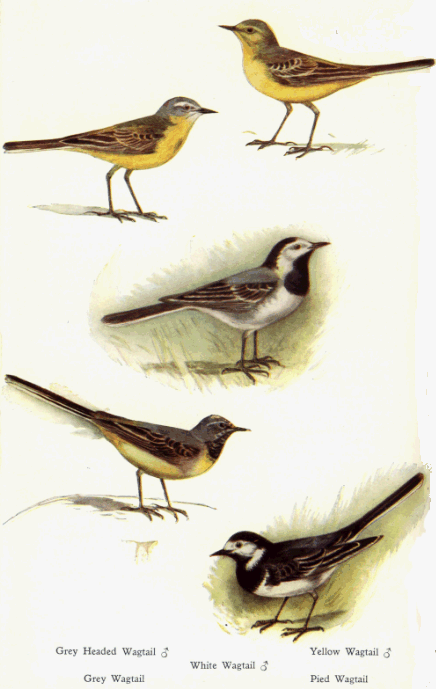
THE WHITE WAGTAIL MOTACILLA ALBA
Summer—head, breast, wings and tail variegated with black and white; chin, throat, and neck black; back and scapulars pearl-grey; side of the neck as low as the wings white. Winter—chin, throat and neck white, with an isolated black gorget. Length nearly seven inches and a half. Eggs bluish white, speckled with black.
This species has bred in England more frequently than has been supposed. It is not uncommon in Cornwall in spring, and indeed it visits many of our English counties. Its nest has been found in such odd places as a Sand Martin's burrow and the middle of a strawberry bed. The present editor has seen it nesting among the spraying branches of a Virginian creeper growing over trellis work. A beautiful little bird it is.
THE PIED WAGTAIL MOTACILLA LÚGUBRIS
Summer—all the plumage variegated with white and black; back and scapulars, chin, throat, and neck black; a small portion of the side of the neck white. Winter—back and scapulars ash-grey; chin and throat white, with a black, but not entirely isolated, gorget. Length seven inches and a half. Eggs bluish white, speckled with dark grey.
The Pied Wagtail or Dishwasher is a familiar and favourite bird, best known by its habit of frequenting the banks of ponds and streams, where it runs, not hops about, picking insects from the herbage, and frequently rising with a short jerking flight, to capture some winged insect, which its quick eye has detected hovering in the air. Its simple song consists of but few notes, but the tone is sweet and pleasing, and is frequently heard when the bird is cleaving its way through the air with its peculiar flight, in which it describes a series of arcs, as if it were every instant on the point of alighting, but had altered its mind. While hunting for food, it keeps its tail in perpetual motion. It shows little fear of man, and frequently approaches his dwelling. It may often be noticed running rapidly along the tiles or thatch of a country house, and it not unfrequently takes its station on the point of a gable, or the ridge of the roof, and rehearses its song again and again. Very frequently, too, it perches in trees, especially such as are in the vicinity of ponds. Next to watery places, it delights in newly-ploughed fields, and hunts for insects on the ground, utterly fearless of the ploughman and his implements. A newly-mown garden lawn is another favourite resort; so also is a meadow in which cows are feeding, and to these it is most serviceable, running in and out between their legs, and catching, in a short time, an incredible number of flies. The country scarcely furnishes a prettier sight than that afforded by a family of Wagtails on the short grass of a park, in July or August. A party of five or six imperfectly fledged birds may often be seen scattered over a small space of ground, running about with great activity, and picking up insects, while the parent birds perform short aërial journeys above and around them, frequently alighting, and transferring from their own mouths to those of their offspring, each in its turn, the insects they have just captured. They are at all times sociably disposed, being seen sometimes in small parties, and sometimes in large flocks. It has been noticed that when one of a party has been wounded by a discharge from a gun, another has flown down as if to aid it, or sympathize with it. Advantage is taken of this habit by bird-catchers in France. It is the custom to tie Wagtails by their feet to the clap nets, and make them struggle violently and utter cries of pain when a flight of the same kind of birds is seen approaching; these stop their flight, and alighting are caught in large numbers for the spit, their flesh, it is said, being very delicate. They share, too, with Swallows the praise of being among the first to announce to other birds the approach of a Hawk, and join with them in mobbing and driving it away.
About the middle of April, the Pied Wagtail begins to build its nest. This is usually placed in a hole in a bank or hedge, among stones, or in the hollow of a tree; it is composed of dry grass and withered leaves, mixed with moss, and lined with wool, hair, and a few feathers. It is a compact and solid structure, capable of protecting the eggs and young from the damp soil, but is not generally concealed with much art; and hence perhaps it is frequently selected by the Cuckoo, to lay an egg in.
Towards autumn, Pied Wagtails for the most part migrate southwards. In the midland counties they may be often observed in large companies, in October, halting for a few days wherever food is abundant, and then suddenly disappearing; after which only a few stragglers are seen until the spring. They return northwards about the beginning of March. In the extreme south of England they are numerous all the year round; but as many instances have occurred of their alighting on a ship at sea, it is probable that the majority migrate to some southern climate, where the ponds do not freeze and gnats gambol at Christmas.
THE GREY WAGTAIL MOTACILLA MELANÓPE
Summer—head and back bluish grey; a pale streak above the eyes; throat black; under parts bright yellow; tail very long. Winter—chin and throat whitish, passing into yellow. Length seven inches and three-quarters. Eggs bluish white, speckled with dark grey.
Grey Wagtail is not a very happy name for this bird, as the bright yellow of its neck and breast are far more conspicuous than the more sober grey of the head and back; yet, as there are other claimants for the more appropriate names 'Yellow', and Grey-headed, the young observer must be cautious while reading the descriptions of the several members of the family, or he may possibly fall into error. The Grey Wagtail is among the most elegant and graceful of British birds, and in delicacy of colouring is surpassed by few. Its habits are much the same as those of the Pied Wagtail, but it is even lighter and more active in its movements. It is less frequently observed away from water than that species, and though, like it, not altogether a permanent resident in England, it visits us at the opposite season, coming in autumn, and retiring northwards in spring. It does not seem often to go so far north as Inverness-shire, but is regularly seen about Edinburgh in winter; and, on the other hand, it breeds yearly in the southern counties of England during summer, as on the streams which flow from Dartmoor. This partial migration seems to be characteristic of the family, and is difficult to account for. Why out of a certain number of birds of the same species, some should annually travel southwards, to supply the place of individuals belonging to an allied species, who have travelled yet further to the south, and why, on the reappearance of the latter in spring, the first should return to their northern haunts, are questions more easily asked than answered.
The Grey Wagtail has been repeatedly observed to indulge in a fancy which might well obtain for it the name of 'window-bird'. The first recorded instance occurs in an early number of the Zoologist, where it is stated, that every morning for a period of between three and four months, from the beginning of October to the end of January, a Grey Wagtail came to the window of a country house as soon as the blinds were drawn up, and darted against the panes of glass, pecking with its beak as if it saw some object. It would then retire, and after a pause repeat the operation, but from what motive no one could conjecture. A lady writes to me from Dewlish House, Dorsetshire: 'We are constantly being disturbed by a yellow-breasted Water-Wagtail, which comes tapping at the windows or skylights, from the first streak of light till evening. What may be his object no one can say. It is too cold at present (March) for flies or spiders, and, had there been any hybernating there he would have eaten them long ago, he comes so frequently. When, on going upstairs, or when sitting down in my room, I hear this loud repeated tapping, it is vain for me to open the window and try to entice him in with crumbs; he does not even notice them. This morning he woke me at about four o'clock. You would have said, 'Some one rapping at my window as a signal that I must get up. An old servant tells me, "Ah, 'twere just the same last spring, when the family were in London; they say that it do mean something."'
The Grey Wagtail does not commonly build its nest in the southern counties of England, although instances have occurred. It prefers hilly and rocky districts. More frequently it repairs in spring to the north of England and south of Scotland, and builds its nest on the ground, or in the hole of a bank, or between large stones, and never at any great distance from the water. It is composed of stems and blades of grass, mixed with moss and wool, and lined with wool, hair and feathers.
THE BLUE-HEADED (OR GREY-HEADED) WAGTAIL MOTACILLA FLAVA
Top of the head, lore, and nape lead-grey; over the eye a white streak; scapulars, back, and upper tail-coverts greenish olive, tinged with yellow; chin white, in the young male yellow; under parts bright yellow. Length six inches and a half. Eggs mottled with yellow, brown, and grey.
This, one of the common Yellow Wagtails of the Continent, is a rare visitor in this country. Its habits, nest, and eggs, closely resemble those of the next species. It is the Bergeronette printanière ('Little shepherdess of the Spring') of the French, a pretty name, suggested by the habit, common to all the genus, of resorting to sheepfolds for the sake of feeding on the flies with which such places abound.
YELLOW WAGTAIL MOTACILLA RAII
Top of the head, lore, nape, back, and scapulars pale olive; over the eye a streak of bright yellow; chin yellow; lower parts of the same colour. Length six inches and a half. Eggs whitish, mottled with yellow, brown, and grey.
Ray's Wagtail, the third of the Yellow Wagtails placed on the list of British birds, is, next to the Pied, the best known species, being a regular summer visitor, and everywhere tolerably common. It is said by most authors to frequent the water rather less than the other species, and to prefer fields of peas and tares, open downs and sheep pastures; but, as far as my own observation goes, I have seen it far more frequently near water than elsewhere, and if I wished to observe its habits, I should repair to the nearest canal or river, in the certain expectation of seeing a pair hunting among the aquatic weeds for their food, running along the sandy or muddy shore, perching on the broad leaves of the water-lily, and chasing each other with dipping flight through the air. I am inclined to believe that, though it may have often been noticed in dry pastures and stony places, yet that when so circumstanced, it is only engaged on an exploring expedition from its watery haunts; for it is scarcely possible that a bird so thoroughly at home in a weedy pond, can ever be long absent from such a locality from choice. Its habits are precisely similar to those of the Pied Wagtail, except that it visits us in the summer exclusively, retiring southwards in autumn. It may often also be seen in company with that species. Besides its call-note, which consists of two shrill notes, the second of which is a musical tone lower than the first, it has a short and exceedingly sweet song, something like that of the Redbreast when at its best. This I have heard it utter whilst it was perched on a low bush overhanging a pond. Its nest was probably somewhere in the neighbourhood, for when disturbed it flew to a short distance only, alighted on another twig and repeated its warble again. This was in the first week in May, and is the only occasion on which I ever heard it really sing. The nest resembles that of the Pied Wagtail, and is placed on the ground, usually in pea-fields. The popular name Washerwoman belongs to the whole family. The corresponding term, Lavandière, is also found in France, and was given from the fanciful similarity between the beating of the water with its tail by the bird while tripping along the leaves of a water-lily, and the beating of linen in the water by washerwomen, a custom still existing in France, and some parts of England and Ireland.
THE TREE PIPIT ANTHUS TRIVIÁLIS
Hind claw shorter than the toe, and curved so as to form the fourth of a circle; upper parts ash, tinged with olive, the centre of each feather dark brown; a double band across the wing, formed by the yellowish white tips of the lesser and middle wing-coverts; throat and region of the eye dull white; breast reddish yellow, spotted, and at the sides lightly streaked with dark brown. Length six inches. Eggs dull white, variously mottled with purple brown.
The name Titlark is popularly applied to three common species of birds which were formerly placed in the same family with the Skylark. Modern ornithologists now place them in a distinct genus, the characters of which differ from those of the true Lark in that the beak is more slender and slightly notched near the point, the first three quills are nearly of the same length and the outer toe is united with the middle one as far as the first joint. In colouring, however, in general form, and, to a slight extent, in habits, namely, in the mode of feeding and nesting, there is much similarity between the genera; but in the power of soaring, the Lark, though imitated by one species, is unrivalled. The old name Titlark, then, must be understood to be merged in the more distinctive title, Pipit, given to three common kinds which severally frequent trees, meadows, and the sea-shore. Pipits are more allied to the Wagtail family than with Larks. The Tree Pipit alone is a migratory species, arriving in this country towards the end of April, and leaving us in the autumn. It is common in most of the wooded counties of England, except the extreme west and north, but attracts little notice, being unostentatious in size and colour, while its song, except by the practised ear, is likely to be lost in the general melody of the woods. Yarrell's succinct account of its most characteristic habit is so comprehensive and accurate, that the observer who wishes to make its acquaintance can scarcely fail by its help to identify the bird on its very first occurrence. 'The male has a pretty song, perhaps more attractive from the manner in which it is given, than the quality of the song itself. He generally sings while perched on the top of a bush, or one of the upper branches of an elm-tree standing in a hedge-row, from which, if watched for a short time, he will be seen to ascend with quivering wing about as high again as the tree; then, stretching out his wings and expanding his tail, he descends slowly by a half-circle, singing the whole time, to the same branch from which he started, or to the top of the nearest other tree; and so constant is this habit with him, that if the observer does not approach near enough to alarm him, the bird may be seen to perform the same evolution twenty times in half an hour, and I have witnessed it most frequently during and after a warm May shower.' Its descent to the ground is generally performed in the same manner. Its food consists of insects and small seeds, for which it searches among the grass or newly-ploughed ground, with the walking and running gait of the Wagtails, but without their incessant waving movement of the tail. The nest, which is placed on the ground, under a tuft of grass or low bush, and very frequently on the skirt of a wood or copse, is composed of dry grass and small roots, and lined with finer grass and hair. The eggs are usually five in number, and vary so much, that extreme specimens would scarcely seem to belong to the same bird. In the predominating brown hue a tinge of red is, however, always perceptible, and by this it may be distinguished from the egg of the Meadow Pipit.[14] The Tree Pipit is not seen in Ireland, or it is as yet unrecorded there.