Front matter (continued 8)
Reading edition
Common Pheasants are occasionally found having a large portion, or even the whole, of their plumage white. These, though highly ornamental when mixed with the common sort, are not prized, owing to their being a more conspicuous mark for poachers. The 'Ringed Pheasant' occasionally shot in English preserves is not, as some maintain, a distinct species; it differs from the typical form of the bird only in that the neck is partially surrounded by a narrow white collar passing from the back of the neck to the sides, but not meeting in front.
THE COMMON PARTRIDGE. PERDIX CINÉREA
Face, eyebrows, and throat, bright rust-red; behind the eye a naked red skin; neck, breast, and flanks, ash colour with black zigzag lines, and on the feathers of the flanks a large rust-red spot; low on the breast a chestnut patch shaped like a horseshoe; upper parts ash-brown with black spots and zigzag lines; scapulars and wing-coverts darker; quills brown, barred and spotted with yellowish red; tail of eighteen feathers, the laterals bright rust-red; beak olive-brown; feet grey. Female—less red on the face; head spotted with white; upper plumage darker, spotted with black; the horseshoe mark indistinct or wanting. Length thirteen inches. Eggs uniform olive-brown.
Very few, even of our common birds, are more generally known than the Partridge. From the first of September to the first of February, in large towns, every poulterer's shop is pretty sure to be decorated with a goodly array of these birds; and there are few rural districts in which a walk through the fields will fail to be enlivened by the sudden rising and whirring away of a covey of Partridges, in autumn and winter; of a pair in spring. At midsummer they are of less frequent appearance, the female being too busily occupied, either in incubation or the training of her family, to find time for flight; and at this season, moreover, the uncut fields of hay, clover, and corn afford facilities for the avoiding of danger, by concealment rather than by flight. The habits of the Partridge, as of the Grouse, are especially terrestrial. It never flies, like the Lark, for enjoyment; and as it does not perch in trees it has no occasion for upward flight. Still, there are occasions when Partridges rise to a considerable distance from the ground, and this seems to be when they meditate a longer flight than usual.
A friend, to whom I am indebted for many valuable notes on various birds, tells me that when a covey of Partridges are disturbed by a pack of hounds, they lie close at first, as if terrified by the noise and bent on concealing themselves; but when the pack actually comes on them they rise to a great height, and fly to a distance which may be measured by miles—at least, so he supposes, as he has watched them diminish and fade from the sight before they showed any sign of preparing to alight.
The Partridge, though decorated with no brilliant colours, which would tend to thwart it in its habit of concealing itself among vegetation of the same general hue as itself, is a beautiful bird. Its gait is graceful, its feet small and light, its head well raised; and its plumage, though devoid of striking contrasts, is exquisitely pencilled, each feather on the back and breast being veined like the gauzy wings of a fly. The most conspicuous part of the plumage of the male bird, the horseshoe on its breast, is invisible as it walks or crouches, and the general tone approaches that of the soil.
Partridges pair early in the year; but the hen does not begin to lay until May, nor to sit until towards the beginning of June. The nest is merely a depression in the ground, into which a few straws or dead leaves have been drawn. It is sometimes placed among brushwood under a hedge, but more frequently in the border of a field of hay, clover, or corn, or in the wide field itself. The mowing season, unfortunately, is not noted in the calendar of Nature; so the mother-bird, who is a close sitter, is not unfrequently destroyed by the scythe, or, at all events, is driven away, and returns to find her eggs carried off to be entrusted to the care of a domestic hen. In unusually wet seasons, nests which have been fixed in low situations are flooded, and the eggs being thus reduced to a low temperature become addle. When this has taken place, the Partridge makes a second laying, and a late brood is reared.
Notwithstanding this, however, Partridges are exceedingly prolific, and are said to be increasing in numbers in proportion as new lands are reclaimed from the waste, although the Red-legged Partridge has lessened its numbers in some districts. It must certainly be admitted that, in bad seasons, they are treated with a consideration that would scarcely be shown towards them if they were simply destroyers of grain and had nothing to recommend them as objects of sport or as delicacies for the table. When abundant, they fall freely before the sportsman's gun; but when the coveys are either small or few, they are treated with forbearance, and enough are left to stock the preserves for the ensuing year.
While the hen is sitting, the male bird remains somewhere in the neighbourhood, and gives timely warning of the approach of danger; when the eggs are hatched, he accompanies his mate, and shares in the work of teaching the young to shift for themselves—a lesson which they begin to learn at once. The food both of old and young birds is, to a great extent, insects. The young are especially fond of ants and their pupæ or larvæ. During the year 1860, in which there were no broods of Partridges, I was much struck by the fact that stubble-fields abounded, to an unusual degree, with ant-hills. In ordinary seasons, these are found torn to pieces and levelled. This year, scarcely one was touched; and even at the present time, the end of October, winged ants are far more numerous than they usually are at this time of the year. Besides insects, Partridges feed on the seeds of weeds, green leaves, grain spilt in reaping, and on corn which has been sown. This last charge is a serious one; yet, on the whole, it is most probable that Partridges do far more good than harm on an estate, the insects and weeds which they destroy more than making amends for their consumption of seed-corn.
I might fill many pages with anecdotes of the devotion of Partridges to their maternal duties—their assiduity in hatching their eggs, their disregard of personal danger while thus employed, their loving trickeries to divert the attention of enemies from their broods to themselves, and even the actual removal of their eggs from a suspectedly dangerous position to a place of safety; but with many of these stories the reader must be already familiar if he has read any of the works devoted to such subjects.
The number of eggs laid before incubation commences varies from ten to fifteen, or more. Yarrell says, 'Twenty-eight eggs in one instance, and thirty-three eggs in two other instances, are recorded as having been found in one nest; but there is little doubt, in these cases, that more than one bird had laid eggs in the same nest.' This may be; but I find in a French author an instance in which no less than forty-two eggs were laid by a Partridge in captivity, all of which, being placed under a hen, would have produced chicks, but for the occurrence of a thunder-storm accompanied by a deluge of rain which flooded the nest, when the eggs, which all contained chicks, were on the point of being hatched. The average number of birds in a covey is, I believe, about twelve; quite enough to supply the sportsmen and to account for the abundance of the bird.
The character of the Partridge's flight is familiar to most people. Simultaneously with the startled cry of alarm from the cock comes a loud whirr-r-r as of a spinning-wheel: away fly the whole party in a body, keeping a horizontal, nearly straight line: in turns each bird ceases to beat its wings and sails on for a few yards with extended pinions; the impetus exhausted which carried it through this movement, it plies its wings again, and if it have so long escaped the fowler, may, by this time, consider itself out of danger, for its flight, though laboured, is tolerably rapid.
The call of the Partridge is mostly uttered in the evening, as soon as the beetles begin to buzz. The birds are now proceeding to roost, which they always do in the open field, the covey forming a circle with their heads outwards, to be on the watch against their enemies, of whom they have many. They feed for the most part in the morning and middle of the day, and vary in size according to the abundance of their favourite food. In some districts of France, it is said, the weight of the Partridges found on an estate is considered as a fair standard test of the productiveness of the soil and of the state of agricultural skill.
Most people are familiar with the distich:
If the Partridge had the Woodcock's thigh,
It would be the best bird that e'er did flie;
but every one does not know that the saying was in vogue among epicures in the reign of Charles II.
THE RED-LEGGED PARTRIDGE CÁCCABIS RUFA
Throat and cheeks white, surrounded by a black band, which spreads itself out over the breast and sides of the neck in the form of numerous spots and lines, with which are intermixed a few white spots; upper plumage reddish ash; on the flanks a number of crescent-shaped spots, the convexity towards the tail rust-red, the centre black, bordered by white; beak, orbits, and feet, bright red. Length thirteen and a half inches. Eggs dull yellow, spotted and speckled with reddish brown and ash colour.
The Red-legged Partridge, called also the French and Guernsey Partridge, is a stronger and more robust bird than the common species, which it also greatly surpasses in brilliancy of colouring. As some of its names indicate, it is not an indigenous bird, but a native of the south of Europe, whence it was first introduced into England in the reign of Charles II. To Willughby, who lived at that period, it was unknown except as a native of the continent of Europe and the islands of Guernsey and Jersey. Towards the close of the last century it was re-introduced into Suffolk, where it has become numerous; so much so, indeed, in some places, as to have gained the better of the common species for a time.
Its flight is rapid, but heavier and more noisy than that of the Common Partridge. It is less patient of cold, and less able to elude the attacks of birds of prey. It is quite a terrestrial bird, very slow in taking flight, and never perching except when hard pressed, when, on rare occasions, it takes refuge among the thick branches of an oak or pinaster; here it considers itself safe, and watches the movements of the dogs with apparent unconcern. Sometimes, too, when closely hunted, it takes shelter in a rabbit's burrow or the hole of a tree; but under ordinary circumstances it runs rapidly before the dogs, and frequently disappoints the sportsman by rising out of shot. The Grey or Common Partridge frequents rich cultivated lands; the Red Partridge prefers uncultivated plains, 'which summer converts into burning causeways, winter into pools of water—monotonous landes, where skeletons of sheep pasture without variation on heath and the dwarf prickly genista. It delights, too, in bushy ravines, or the steep sides of rocky hills covered with holly, thorns, and brambles; and when it resorts to vineyards, it selects those situated on the sides of steep slopes, where marigolds and coltsfoot are the principal weeds, rabbits and vipers the most abundant animals.'[43] Red Partridges are consequently most numerous in the least cultivated districts of France, especially those between the Cher and the Loire, and between the Loire and the Seine. Towards the east they do not extend beyond the hills of Epernay, and do not cross the valley of the Meuse. The flesh of the Red Partridge is considered inferior to that of the Grey, and the bird itself is less esteemed by sportsmen as an object of pursuit. In England it seems to retain its natural taste of preferring bushy heaths to inclosed land. In the mode of incubation and rearing the young the two species are much alike.
THE QUAIL. COTÚRNIX COMMÚNIS
'This species', says a French naturalist, 'is probably the most productive of all winged creatures; and it could not well be otherwise, or it would be unable to withstand the war of extermination declared against it by human beings and birds of prey. One may get an idea of the prodigious number of victims which the simple crossing of the Mediterranean costs the species by two well-known and often quoted facts. The Bishop of Capri, a wretched islet scarcely a league in length, which lies at the entrance of the Bay of Naples, used to clear a net revenue of 25,000 francs a year (£1,000) by his Quails. This sum represents 160,000 Quails at the lowest computation. In certain islands of the Archipelago, and parts of the coast of the Peloponnese, the inhabitants, men and women, have no other occupation during two months of the year than that of collecting the Quails which are showered on them from heaven, picking and cleaning them, salting them ('they spread them all abroad for themselves') and packing them away in casks for transportation to the principal markets of the Levant; that is to say, the migration of Quails is to this part of Greece what the migration of herrings is to Holland and Scotland. The Quail-catchers arrive at the shore a fortnight in advance, and every man numbers his ground to avoid disputes. The Quail arrives in France from Africa early in May, and takes its departure towards the end of August.'
Another French author says, 'Like Rails, Woodcocks, Snipes, and many of the waders, the Quail, when it travels towards the sea-shore, flies only in the night. It leaves the lands, where it has passed the day, about the dusk of the evening, and settles again with the dawn of the morning.' Not unfrequently, while performing their transit, they become weary, and alight on vessels, or fall into the sea, and are drowned. 'Being at a small town on the coast, in the month of May', says M. Pellicot, 'I saw some boats come in with ten or a dozen sharks. They were all opened before me, and there was not one which had not from eight to twelve Quails in its body.' 'Enormous flights are annually observed at the spring and fall, after crossing an immense surface of sea, to take a brief repose in the islands of Malta, Sicily, Sardinia, Crete, in the kingdom of Naples, and about Constantinople, where, on these occasions, there is a general shooting match, which lasts two or three days. This occurs always in the autumn. The birds, starting from the Crimea about seven at night, and with a northerly wind, before dawn accomplish a passage of above sixty leagues in breadth, and alight on the southern shore to feed and repose. In the vernal season the direction of the flight is reversed, and they arrive in similar condition on the Russian coast. The same phenomena occur in Malta, etc.'[44]
On its arrival, the Quail betakes itself to open plains and rich grassy meadows, especially where the soil is calcareous, and avoids woody countries. During the early part of summer it frequents corn-fields, saintfoin, and lucern. In September it is found in stubble and clover fields, and among the weeds growing in dry ponds, or it finds shelter in any crops which may yet remain standing. In warm countries it resorts to vineyards, attracted, it is said, not so much by the grapes as by the numerous small snails with which the vines are then infested; for the crops of the late birds are generally found filled with these molluscs. In locomotion it makes more use of its feet than its wings, and when put up is never induced to perch on a tree. Its flight resembles in character that of the Partridge, but it rarely flies far, and when it alights makes awkward attempts to conceal itself, but often fails, and may sometimes be captured with the hand. In June or July, the female lays from eight to fourteen eggs in a hole in the ground, and brings up her young without the assistance of the male. Towards the end of August the old birds migrate southwards, and are followed by the young. Before the end of October all have disappeared, though instances have occurred of their being shot during winter, especially in seasons when the harvest has been a late one.
The flesh of the Quail is considered a great delicacy, and many thousands are caught, imported to the London markets, for the table. They are placed in low flat cages, scarcely exceeding in height the stature of the bird, for the reason that in confinement, the birds, in their effort to escape, would beat themselves against the upper bars, and destroy themselves. These are said to be all old males.
Quails inhabit the eastern continent, from China—where they are said to be carried about in winter by the natives, to keep their hands warm—to the British Isles. With us they are nowhere plentiful, but are occasionally shot by sportsmen in most parts of the country. In corn-fields, on the shores of Belfast Lough, in the north of Ireland, they are of frequent occurrence.
In Palestine the Quails still come up in the night, as of old, and "cover the land."
ORDER FULICARIÆ
FAMILY RALLIDÆ
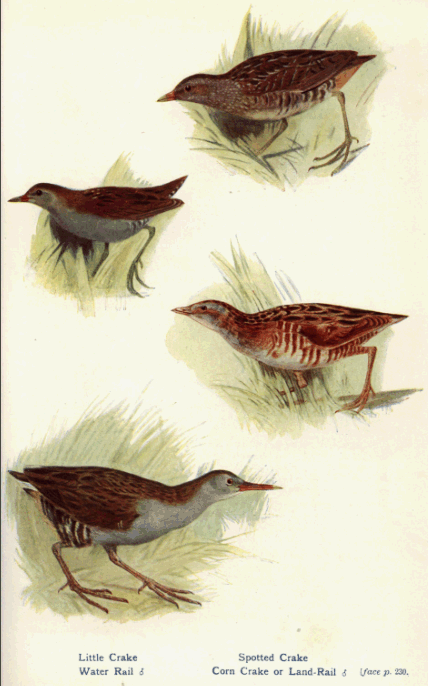
LAND RAIL, OR CORN CRAKE CREX PRATENSIS
Upper feathers dusky brown bordered with reddish ash; over the eye and down the side of the head, a streak of ash; wing-coverts rust-red; quills reddish brown; throat, belly, and abdomen, whitish; breast pale yellowish brown; flanks barred with white and rust-red; upper mandible brown, lower whitish; irides brown; feet reddish brown. Length ten inches. Eggs yellowish brown spotted and speckled with grey and reddish brown.
Few persons can have spent the summer months in the country, and enjoyed their evenings in the open air, without having grown familiar with the note of the Corn Crake; yet, strange to say, among those who have heard it on numberless occasions, not one in a hundred (leaving sportsmen out of the account) have ever seen one alive. Its whole life, while with us, seems to be spent among the long grass and stalks of hay or corn, between which its long legs and slender body give it peculiar facility of moving, and it is only when hard pressed that it rises from the ground. Its flight is low, with its legs hanging down; and it usually drops into the nearest hedge or cover which presents itself, and from which it is not easily flushed a second time.
The Corn Crake used to be found, during summer, in all the counties of England, but is less frequent in Cornwall and Devonshire than in the counties farther east, and increases in abundance as we advance northwards. In the north of Ireland it is to be heard in every meadow and cornfield, and here its incessant cry in the evenings is monotonous, if not wearisome; in many parts of Scotland it is also very common, and here it is much more frequently seen. In waste lands, where it can find no continuous corn, it takes refuge in patches of flags, rushes, or tall weeds, and if watched for, may be seen leaving its place of concealment, and quietly walking along the grass, lifting its feet high, and stooping from time to time to pick up its food, consisting of worms, insects, snails, and seeds.
The Land Rail is considered a delicate article of food, and has long been prized as such. In France it used to be termed, in old sporting phraseology, 'King of the Quails', the Quail being a bird which it much resembles it colouring.
The Corn Crake places its nest, which is composed of a few straws, in a hollow in the ground, among corn or hay, and lays from eight to ten, or rarely, twelve eggs. The young birds are able to accompany their parents in their mazy travels as soon as they have left the shell. The note of the old bird is heard much later in the season than the song of most other birds, and is probably employed as a call-note to the young, which, but for some such guidance, would be very likely to go astray. In the still evenings of August, I have, while standing on the shore of the island of Islay, distinctly heard its monotonous crek-crek proceeding from a cornfield on the opposite shore of Jura, the Sound of Islay which intervened being here upwards of half a mile wide. On ordinary occasions it is not easy to decide on the position and distance of the bird while uttering its note; for the Corn Crake is a ventriloquist of no mean proficiency.
THE SPOTTED CRAKE PORZANA MARUETTA
Forehead, throat, and a streak over the eye, lead-grey; upper plumage olive-brown, spotted with black and white; breast and under plumage olive and ash, spotted with white, the flanks barred with white and brown; bill greenish yellow, orange at the base; irides brown; feet greenish yellow. Length nine inches. Eggs yellowish red, spotted and speckled with brown and ash.
The Spotted Crake is smaller in size than the Corn Crake, and far less common. It is shot from time to time in various parts of Great Britain, especially in the fen countries, to which its habits are best suited. It frequents watery places which abound with reeds, flags, and sedges, and among these it conceals itself, rarely using its wings, but often wading over mud and weeds, and taking freely to the water, in which it swims with facility. The nest, which is a large structure, composed of rushes and reeds, is placed among thick vegetation, near the water's edge, and contains from seven to ten eggs.
The drainage and improving of waste lands has driven this Crake away, but its eggs have been found in Roscommon, and a nestling in Kerry.
THE LITTLE CRAKE PORZANA PARVA
Head brown; upper plumage olive-ash, the feathers black in the centre; middle of the back black, sprinkled with white; throat, face, and breast, bluish grey, without spots; abdomen and flanks indistinctly barred with white and brown; wings without spots, reaching to the extremity of the tail; bill green, reddish at the base; irides red; feet green. Length seven and a half inches. Eggs yellowish, spotted with olive-brown.
This species appears to be generally diffused throughout the eastern and southern countries of Europe, but is very rare in England, coming now and again from spring to autumn. It is a shy bird, like the last species, confining itself exclusively to reedy marshes, and building its nest close to the water's edge. It lays seven or eight eggs.
THE WATER RAIL RALLUS AQUÁTICUS
Upper feathers reddish brown, with black centres; under plumage in front lead-colour, behind and on the flanks barred with black and white; bill red, tinged with red above and at the tip; irides red; feet flesh-colour. Length ten inches. Eggs yellowish, spotted with ash-grey and red-brown.
The Water Rail is a generally diffused bird, but nowhere very common, haunting bushy and reedy places near the banks of rivers and lakes, and especially the Norfolk Broads, where it feeds on aquatic insects, worms, and snails. Like the Crakes, it makes more use of its legs than of its wings, and places its safety in concealment. Rarely does it take flight, and then only when closely hunted; still more rarely does it expose itself outside its aquatic jungle. I recollect on one occasion, during an intense frost, when every marsh was as impenetrable to a bird's bill as a sheet of marble, passing in a carriage near a stream which, having just issued from its source, was unfrozen; I then saw more than one Water Rail hunting for food among the short rushes and grass on the water's edge. Its mode of walking I thought was very like that of the Moor-hen, but it had not the jerking movement of body characteristic of that bird, which alone would have sufficed to distinguish it, even if I had not been near enough to detect the difference of colour. Either the severity of the weather had sharpened its appetite, and made it less shy than usual, or it had not learnt to fear a horse and carriage, for it took no notice of the intrusion on its privacy, but went on with its search without condescending to look up. The Water Rail, then, unlike the Corn Crake, remains with us all the winter. When forced to rise, this bird flies heavily straight forwards, at no great elevation above the rushes, with its legs hanging loose, and drops into the nearest thicket of weeds. A nest and eggs of this bird are thus described in the Annals of Natural History: 'The bird had selected for her nest a thick tuft of long grass, hollow at the bottom, on the side of the reed pond; the nest, about an inch and a half thick, was composed of withered leaves and rushes; it was so covered by the top of the grass, that neither bird, nest, nor eggs could be seen; the entrance to the nest was through an aperture of the grass, directly into the reeds, opposite to where any one would stand to see the nest.' The number of eggs is about ten or eleven. Its note during breeding is a loud, groaning cro-o-o-an.
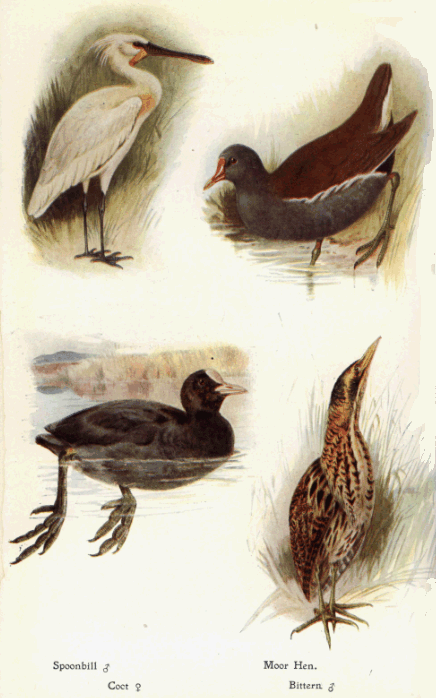
THE MOOR-HEN GALLÍNULA CHLÓROPUS
Upper plumage deep olive-brown; under tail-coverts and edge of the wing white, the former with a few black feathers; under plumage slate colour, the flanks streaked with white; base of the bill and a space on the forehead bright orange, point of the bill yellow; irides red; feet olive-brown; a red ring round the tibia. In females the colours are brighter than in the males. Young birds have the front of the neck whitish, the belly grey, the base of the beak and legs olive-brown. Length thirteen inches. Eggs buff, spotted and speckled with orange-brown.
Of the two common names of this bird, 'Moor-hen' and 'Water-hen', the former is that which is more generally in use, though the latter is the more appropriate. The bird frequents moors, it must be admitted, but only such as are watery; while there is scarcely a river, lake, canal, brook, or even pond, of moderate dimensions, which Moor-hens do not either inhabit all the year round or occasionally visit. The name is objectionable on other accounts; the male bird is called a Moor-hen as well as the female, while the terms Moor-fowl and Moor-cock have long been applied to the Ptarmigan. For these reasons, I suppose, many recent ornithologists Anglicize the systematic name, and call it the Gallinule, which means 'little fowl', and is suggestive of the half-domestic habits of the bird, under certain circumstances.
The Gallinule being a common bird of some size, conspicuous colours, and active habits, is an interesting appendage of our rivers and pieces of artificial water. Its note, something between a bark and a croak, is as well known in watered districts as the note of the Cuckoo, and is often uttered when the bird has no intention of being seen. Any one who may happen to be walking on the bank of a reedy pond may perhaps hear its strange cry and see the bird itself at some little distance, swimming about with a restless jerky motion, often dipping its head, and with every dip turning slightly to the right or the left. If he wishes for a nearer view, let him advance quietly, concealing himself as much as he can; for if he proceeds carelessly, and takes off his eyes for any considerable time from the spot where he observed it, when he looks again it will have disappeared, taken wing, he may imagine, for some distant part of the water. Not so; the cunning bird, as soon as a stranger was perceived within a dangerous proximity, steered quietly for the nearest tuft of reeds, among which it lies ensconced till he has passed on his way. Or it rose out of the water, and, with its feet trailing on the surface, made for a similar place of concealment; or dived to the bottom, where it still remains clinging to the weeds. Perhaps it lies close to his feet, having sunk beneath the water, and, aided by feet and wings, rowed a subaqueous course to an often-tried thicket of rushes, where, holding on with its feet to the stems of submerged weeds, it remains perfectly still, leaving nothing above the surface of the water but the point of its beak. If the observer suspects the whereabouts of its concealment, he may beat the rushes with his stick and produce no effect; the bird knows itself to be safe where it is and will make no foolish attempt to better itself. A water spaniel or Newfoundland dog will be more effective. Very often an animal of this kind is an overmatch for its sagacity, and seizes it in his mouth before the poor bird was aware that the water itself was to be invaded; but more frequently it discovers an onset of this nature in time to clear itself from its moorings, and dashing out with a splashing movement of feet and wings skims across the pond to another lurking-place, and defies further pursuit.
The Gallinule, though an excellent swimmer and diver, belongs to the Waders; it has, consequently, free use of its legs on land, and here it is no less nimble than in the water. When induced to change the scene it steps ashore, and, with a peculiar jerking motion of its tail, showing the white feathers beneath, and very conspicuous by its bright red bill, which harmonizes pleasantly with the green grass, it struts about and picks up worms, insects, snails, or seeds, with unflagging perseverance, making no stay anywhere, and often running rapidly. If surprised on these occasions, it either makes for the water, or flies off in a line for some thick hedge or patch of brushwood, from which it is very difficult to dislodge it.
Its mode of life is pretty much the same all the year round; it is not a traveller from choice. Only in severe weather, when its haunts are bound up with ice, it is perforce compelled to shift its quarters. It then travels by night and searches for unfrozen streams. At such times it appears occasionally in pretty large numbers in places where usually a few only resort. When the south of Europe is visited by severe frosts it is supposed even to cross the Mediterranean, it having been observed in Algeria, feeding in marshes in half-social parties, where a day or two before none had been seen. To the faculties of swimming and running it adds that of perching on trees; this it does habitually, as it roosts in low bushy trees; and it has besides the power of walking cleverly along the branches.
In the neighbourhood of houses where it has long been undisturbed, it loses much of its shy nature, and will not only allow itself to be approached within a short distance, but, becoming half-domesticated, will consort with the poultry in the farmyard, and come with them to be fed. It is fond also of visiting the kitchen-garden, where it is apt to make itself unwelcome, by helping itself to the tenderest and best of the vegetables. Bishop Stanley, in his entertaining Book on Birds, gives some highly amusing anecdotes of the Gallinule.
It builds its nest on the stump of a tree, or in a bush among wet places, or in the roots of alders, but often it is placed on the low-lying branch of a tree overhanging the water. The nest is a large structure, made of rushes and dry flags, and is easy of detection. It is very liable, too, to be swept away by any sudden rise in a river. Added to which, the young frequently fall a prey to pike. But as the bird has two, and sometimes three, broods in a year, each consisting of from six to eight, it remains undiminished in numbers. The nest is sometimes placed in a tree at a distance from the water. When this is the case, as the habits of the young birds are aquatic, immediately on their breaking the egg, the old birds convey them in their claws to the water. An instance is recorded in the Zoologist of a female Gallinule being seen thus employed carrying a young one in each foot; it has been observed, too, that in such cases the male bird builds a second nest, near the water's edge, to which the young retire for shelter during the night, until they are sufficiently fledged to accompany their parents to their ordinary roosting-places in trees.
THE COMMON COOT FÚLICA ÁTRA
Upper plumage black, tinged on the back with grey; under parts bluish grey; frontal disk large, pure white; bill white, tinged with rose-red; irides crimson; feet grey, tinged with green; part of the tibia orange-yellow. Length sixteen inches. Eggs brownish, speckled with reddish brown.
The Coot, seen from a distance, either on land or water, might be mistaken for a Gallinule, flirting up its tail when it swims, jerking its head to and fro, and when on land strutting about with a precisely similar movement of all its members. On a nearer examination, it is clearly distinguished by its larger size and the white bare spot above the bill, in front, from which it is often called the Bald-headed Coot. It is only during the summer season that the two birds can be compared; for while the Gallinule remains in the same waters all the year round, the Coot visits the Azores, Madeira and the Canaries, North Africa and Egypt in winter, and gets as far south as the Blue Nile. Their note, in summer, is a loud harsh cry, represented by the syllable krew, as it would be uttered by a crazy trumpet. In winter they are nearly mute. During the latter season, Coots are confined to the southern parts of the island; but in the breeding season they are more generally diffused.
When seen on the sea-coast, they are readily distinguished from Ducks by the different position in which they sit on the water, with their heads low, poking forwards, and their tails sticking high above the body. When flying in large coveys, they crowd together into a mass, but when swimming scatter over a wide space.
They have the same power of concealing themselves by diving among weeds that has been already said to be possessed by the Gallinule. I have seen a female Coot and her brood, when disturbed by a party of sportsmen, paddle for a small patch of rushes, and defy a long-continued and minute search conducted by keepers and clever water-dogs. The latter appeared to traverse, again and again, every square foot of the rush bed; but not a single bird was dislodged.
Owing to drainage the Coot is less plentiful than it was, although the late Lord Lilford said it had increased much on the river Nene of recent years.
ORDER ALECTORIDES
FAMILY GRUIDÆ
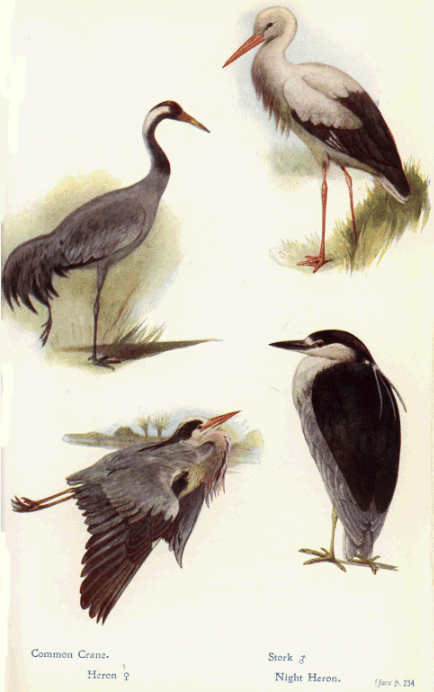
THE CRANE GRUS COMMÚNIS
General plumage ash-grey; throat, part of the neck, and back of the head, dark blackish grey; forehead and cere covered with black bristly hairs; crown naked, orange red; some of the secondaries elongated, arched, and having the barbs of the feathers free; bill greenish black, reddish at the base, horn-coloured at the tip; irides reddish brown; feet black. Young birds have the crown feathered, and want the dark grey of the neck and head. Length five feet. Eggs pale greenish ash, blotched and spotted with brown and dark green.
From the fact of nine Cranes being recorded among the presents received at the wedding of the daughter of Mr. More, of Loseley, in 1567, it would appear that these birds were tolerably common in England at that date.
Willughby, whose Ornithology was published about a hundred years later, says that Cranes were regular visitors in England, and that large flocks of them were to be found, in summer, in the fens of Lincolnshire and Cambridgeshire. Whether they bred in England, as Aldrovandus states, on the authority of an Englishman who had seen their young, he could not say on his own personal knowledge.
Sir Thomas Browne, a contemporary of Willughby, writes, in his account of birds found in Norfolk: 'Cranes are often seen here in hard winters, especially about the champaign and fieldy part. It seems they have been more plentiful; for, in a bill of fare, when the mayor entertained the Duke of Norfolk, I met with Cranes in a dish.'
Pennant, writing towards the close of the eighteenth century, says: 'On the strictest inquiry, we learn that, at present, the inhabitants of those counties are scarcely acquainted with them; we therefore conclude that these birds have left our land.' Three or four instances only of the occurrence of the Crane took place within the memory of Pennant's last editor; and about as many more are recorded by Yarrell as having come within the notice of his correspondents during the present century. It would seem, therefore, that the Crane has ceased to be a regular visitor to Britain. It is, however, still of common occurrence in many parts of the Eastern Continent, passing its summer in temperate climates, and retiring southwards at the approach of winter. Its periodical migrations are remarkable for their punctuality, it having been observed that, during a long series of years, it has invariably traversed France southward in the latter half of the month of October, returning during the latter half of the month of March. On these occasions, Cranes fly in large flocks, composed of two lines meeting at an angle, moving with no great rapidity, and alighting mostly during the day to rest and feed. At other seasons, it ceases to be gregarious, and repairs to swamps and boggy morasses, where in spring it builds a rude nest of reeds and rushes on a bank or stump of a tree, and lays two eggs. As a feeder it may be called omnivorous, so extensive is its dietary. Its note is loud and sonorous, but harsh, and is uttered when the birds are performing their flights as well as at other times.
The Crane of the Holy Scriptures is most probably not this species, which is rare in Palestine, but another, Grus Virgo, the Crane figured on the Egyptian monuments, which periodically visits the Lake of Tiberias, and whose note is a chatter, and not the trumpet sound of the Cinereous Crane. In the north of Ireland, in Wales and perhaps elsewhere, the Heron is commonly called a Crane.
A certain number of Cranes have been noticed in the Shetland Isles, and some in the Orkneys. The latest seen in Ireland was in 1884, County Mayo.
FAMILY OTIDIDÆ
No hind toe.
THE GREAT BUSTARD OTIS TARDA
Head, neck, breast, and edge of the wing ash grey; on the crown a longitudinal black streak; bill with a tuft of elongated loose feathers on each side of the lower mandible; upper plumage reddish yellow, streaked transversely with black; lower whitish; tail reddish brown and white, barred with black. Female—smaller, without a moustache, the streak on the crown fainter. Length nearly four feet. Eggs olive-brown, irregularly blotched with dull red and deep brown.
The Great Bustard was formerly not unfrequent in Britain, but of late years it has become so rare that it is now impossible to describe its habits on the testimony of a living eye-witness. In several parts of the Continent it is indeed still to be met with; but I find so many discrepancies in the various accounts which I have consulted, that it is hard to believe all the writers who describe it to have had the same bird in view. Some of these the reader may examine for himself.
The earliest mention of it which I find occurs in the Anabasis of Xenophon, who describes a plain or steppe near the Euphrates full of aromatic herbs, and abounding with Wild Asses, Ostriches, and Bustards (Otis). The latter, he says, 'could be caught when any one came on them suddenly, as they fly to a short distance like Partridges and soon give in. Their flesh is delicious.' Pliny's description of the Bustard is very brief. He says it approaches the Ostrich in size; that it is called Avis tarda in Spain, Otis in Greece; its flesh is very disagreeable, in consequence of the strong scent of its bones.' Our countryman Willughby, who wrote in the middle of the seventeenth century, gives a longer account. 'The Bustard has no hind claw, which is especially worthy of notice; for by this mark and by its size it is sufficiently distinguished from all birds of the tribe. It feeds on corn and the seeds of herbs, wild cabbage, leaves of the dandelion, etc. I have found in its crop abundance of the seeds of cicuta, with but a few grains of barley even in harvest-time. It is found on the plains near Newmarket and Royston, and elsewhere on heaths and plains. Bustards are birds of slow flight, and raise themselves from the ground with difficulty, on account of their size and weight; hence, without doubt, the name tardu was given to them by the Latins. By the Scotch, on the authority of Hector Boethius, they are called Gustardæ.'
M. Perrault, who wrote in 1676, gives an account of a tame Bustard which was kept for a while in summer in a garden, and died of cold in the winter. 'He killed mice and sparrows with his bill by pinching their heads, and then swallowed them whole, even when of considerable size. It was easy to observe a large mouse going down his throat, making a moving tumour till it came to the turn of the neck; it then moved backwards, and although out of sight, yet its progress was traced by the feathers between the shoulders separating, and closing again as soon as it passed into the gizzard. He was fond of worms, and while the gardener was digging, stood by him and looked out for them. He ate the buds of flowers, and particularly of roses; also the substance of cucumbers, but not the outside. From these observations the Bustard is evidently fitted more particularly to live on animal food.'
The average number of Bustards annually supplied to Chevet, the great game-dealer of the Palais Royal, Paris, about fifty years ago, was six. Its principal place of resort in France was the wild country between Arcis-sur-Aube and Châlons, in most other districts it was as little known as with us.
Several authors of undoubted veracity state that the adult male Bustard has a capacious pouch, situated along the fore part of the neck, the entrance of which is under the tongue, capable of holding several quarts of water—it is said not less than seven. Montagu, in his Ornithological Dictionary, expresses his doubt whether the bird could carry as much as seven quarts, or fourteen pounds, while flying; he admits, however, that 'it is large, as may be seen in the Leverian Museum'; and he adds, 'that it is only discoverable in adults, as it is most likely intended for the purpose of furnishing the female and young in the breeding with water.' Of this pouch a figure is given by Yarrell, copied from Edwards' Gleanings of Natural History, and there inserted on the authority of Dr. James Douglas, the discoverer. Some doubts having arisen in Mr. Yarrell's mind as to the accuracy of the statement, he took much pains to ascertain the truth by dissecting several adult males, and found no peculiarity of structure—a result which was also arrived at by Professor Owen, who dissected one with a view of obtaining a preparation of the supposed pouch for the Museum of the College of Surgeons. A paper by Mr. Yarrell,[45] read before the Linnean Society since the publication of his admirable work on Ornithology, contains many other interesting particulars respecting this bird, to which the reader is referred.
Bustards have been seen in England at various intervals during the last eighty or a hundred years, sometimes in small flights and sometimes as solitary specimens, more frequently in Norfolk than in any other county, but they have ceased to breed in this country. I lately met a gentleman in Norfolk who well recollected the time when Bustards were to be met with in that county. On the lands near Flamborough Head there used to be droves of them. They were occasionally seen in the middle of the large uninclosed plains with which Norfolk formerly abounded, and in such situations he had himself seen them. When disturbed they move off rapidly, employing both their feet and wings, rising heavily, but at an angle so acute that they advanced perhaps a hundred yards before they attained the height of a man. When once on the wing, they flew swiftly. They formerly bred in the parish of Deepdale, and he could himself recollect an instance when an attempt was made to rear some in captivity from the eggs, but failed. The Bustard is now only a very rare visitor to Great Britain. Its last fertile eggs were taken in Norfolk and Suffolk about the year 1838.
ORDER LIMICOLÆ
FAMILY GLAREOLIDÆ
THE PRATINCOLE GLAREOLA PRATÍNCOLA
Crown, nape, back, scapulars, and wing-coverts, greyish brown; throat and front of the neck white, tinged with red, and bounded by a narrow black collar, which ascends to the base of the beak; lore black; breast whitish brown; lower wing-coverts chestnut; under parts white, tinged with brownish red; tail-coverts, and base of tail-feathers, white; the rest of the tail dusky, much forked; beak black, red at the base; irides reddish brown; orbits naked, bright red; feet reddish ash. Length nine inches and a half. Eggs pale stone colour, spotted with grey and dusky.
The Pratincole, called on the Continent, but without good reason, Perdrix de mer, or Sea Partridge, is a rare visitor to Great Britain, inhabiting for the most part the northern part of Africa, and the countries in the vicinity of the Don, the Volga, the Caspian, and the Black Sea. It has been observed also from time to time in several of the countries of Europe.
In some of its habits it resembles the Plovers, as it frequents open plains and runs with great rapidity. In nidification, also, and in the shape, colour, and markings of its eggs it is associated with the same tribe; while in its mode of flight and habit of catching flies while on the wing, it approaches the Swallows. Hence it was named by Linnæus, Hirundo pratincola, and under this designation it is figured in Bewick. Its true place in the system is, however, undoubtedly, among the waders, several of which not only feed on insects, but are expert in catching them on the wing.
FAMILY CHARADRIIDÆ
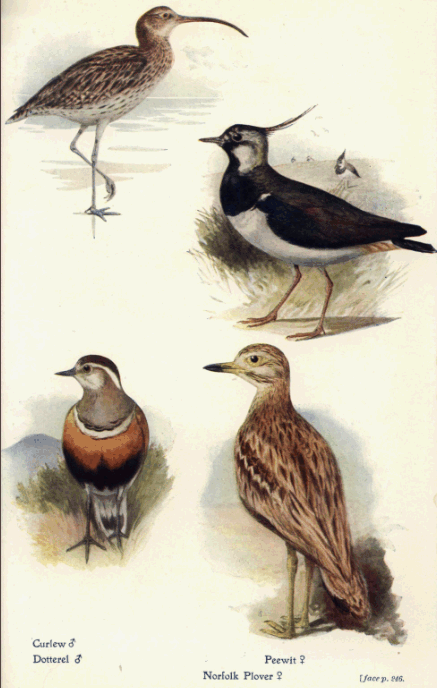
THE THICK-KNEE OR STONE CURLEW ŒDICNÉMUS SCÓLOPAX
Upper parts reddish ash with a white spot in the middle of each feather; space between the eye and beak, throat, belly, and thighs, white; neck and breast tinged with red, and marked with fine longitudinal brown streaks; a white longitudinal bar on the wing; first primary with a large white spot in the middle; second, with a small one on the inner web; lower tail-coverts reddish, the feathers, except those in the middle, tipped with black; beak black, yellowish at the base; hides, orbits, and feet, yellow. Length seventeen inches. Eggs yellowish brown clouded with greenish, blotched and spotted with dusky and olive.
Though a citizen of the world, or at least of the eastern hemisphere, this bird is commonly known under the name of Norfolk Plover, from its being more abundant in that county than in any other. It is also called Thick-knee, from the robust conformation of this joint; and Stone Curlew, from its frequenting waste stony places and uttering a note which has been compared to the sound of the syllables curlui or turlui. Like the Cuckoo, it is more frequently heard than seen, but that only by night. In some of its habits it resembles the Bustard, and is said even to associate, in Northern Africa, with the Lesser Bustard. Its favourite places of resort are extensive plains; it runs rapidly when disturbed, and when it does take wing, flies for a considerable distance near the ground before mounting into the air. It frequents our open heaths and chalk downs and breeds in Romney Marsh and in the uplands of Kent and Sussex.
By day the Thick-knee confines itself to the ground, either crouching or hunting for food, which consists of worms, slugs, and beetles, under stones, which it is taught by its instinct to turn over. After sunset, it takes flight, and probably rises to a great height, as its plaintive whistle, which somewhat resembles the wail of a human being, is often heard overhead when the bird is invisible. It is singularly shy, and carefully avoids the presence of human beings, whether sportsmen or labourers. Yet it is not destitute of courage, as it has been seen to defend its nest with vigour against the approach of sheep or even of dogs. Nest, properly speaking, it has none, for it contents itself with scratching a hole in the ground and depositing two eggs. The males are supposed to assist in the office of incubation. The young inherit the faculty of running at an early age, being able to leave their birth-place with facility soon after they are hatched; but the development of their wings is a work of time, for their body has attained its full size long before they are able to rise from the ground. Before taking their departure southwards in autumn, they assemble in small parties, numbering from four to six or seven, when they are somewhat more easy of approach than in spring. In the chalky plains of La Marne in France they are very numerous; and here, by the aid of a light cart, fowlers in quest of them have little difficulty in shooting large numbers, the birds being less afraid of the approach of a horse than of a human being. But when obtained they are of little value, as their flesh is barely eatable.
The Thick-knee is migratory, visiting us in the beginning of April to stay till October. His flights are made by night.
THE CREAM-COLOURED COURSER CURSORIUS GALLICUS
Plumage reddish cream colour; wing-coverts bordered with ash-grey; throat whitish; behind the eyes a double black bar; lateral tail-feathers black towards the tip, with a white spot in the centre of the black; abdomen whitish. Length nine inches. Eggs unknown.
Though the specific name Europæus would seem to imply that this bird is of frequent occurrence in Europe, this is not the case. Not more than three or four have been observed in Great Britain, at various intervals, from 1785 to 1827; and on the Continent it is an equally rare visitor to the plains of Provence and Languedoc.
It is a native of Syria, Egypt, and Abyssinia, frequenting pools and other moist situations. It is singularly fearless of man, and when disturbed prefers to run, which it does very swiftly, rather than to take flight. Its winter residence is supposed to be the central lakes of Africa, from which it returns to the countries named above early in autumn, and disappears at the approach of winter. Nothing is known of its nidification. About the autumn of 1868 one was shot in Lanarkshire.
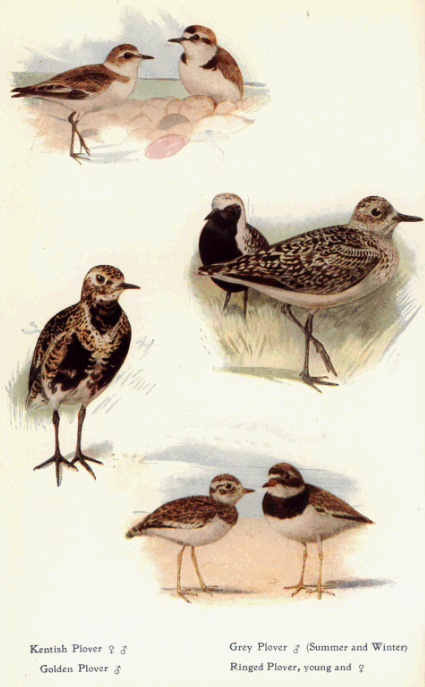
THE GOLDEN PLOVER CHARÁDRIUS PLUVIALIS
Winter—upper plumage dusky, spotted with yellow, cheeks, neck, and breast mottled with ash-brown and buff; throat and abdomen white; quills dusky, white along the shafts towards the end; beak dusky, feet deep ash-colour; irides brown. Summer—upper plumage greyish black, spotted with bright yellow; forehead and space above the eyes white; sides of the neck white, mottled with black and yellow; lore, throat, neck, and lower parts deep black. Length nine inches. Eggs yellowish green, blotched and spotted with black.
The Golden Plover is a common bird in the south of England during the winter months, and in the mountainous parts of Scotland and the north of England during the rest of the year; yet so different are its habits and plumage at the extremes of these two seasons, that the young naturalist who has had no opportunities of observing them in their transition stage, and has had no access to trustworthy books, might be forgiven for setting down the two forms of the bird as distinct species.
In the hilly districts of the north of Europe, Golden Plovers are numerous, sometimes being, with Ptarmigans, the only birds which relieve the solitude of the desolate wastes. Though numerous in the same localities, they are not gregarious during spring and summer, and are remarkable for their fearlessness of man. So tame, indeed, are they that, in little-frequented places, when disturbed by the traveller they will run along the stony ground a few yards in front of him, then fly a few yards, then stand and stare and run along as before. On such occasions they frequently utter their singular cry—the note so often referred to in Sir Walter Scott's poems—which, like the Nightingale's song, is considered simply plaintive or painfully woe-begone, according to the natural temperament or occasional mood of the hearer. This bird builds no nest; a natural depression in the ground, unprotected by bush, heather or rock, serves its purpose, and here the female lays four eggs, much pointed at one end, and arranges them in accordance with this.
At the approach of autumn, no matter where their summer may have been passed, Plovers migrate southwards in large flights, those from Scotland to the southern counties of England, where they frequent wide moist pastures, heaths, and reclaimed marshland. From the northern parts of the continent of Europe they take their departure in October, either to the European shores of the Mediterranean, or to the plains of Northern Africa. In these migrations they are not unfrequently joined by Starlings. They travel in close array, forming large flocks much wider than deep, moving their sharp wings rapidly, and making a whizzing sound which may be heard a long way off. Now and then, as if actuated by a single impulse, they sweep towards the ground, suddenly alter the direction of their flight, then wheel upwards with the regularity of a machine, and either alight or pursue their onward course. This habit of skimming along the ground and announcing their approach beforehand, is turned to good purpose by the bird-catcher, who imitates their note, attracts the whole flight to sweep down into his neighbourhood, and captures them in his net, a hundred at a time, or, when they are within range, has no difficulty in killing from twelve to twenty at a shot. Not unfrequently, too, when some members of a flock have been killed or wounded, the remainder, before they remove out of danger, wheel round and sweep just over the heads of their ill-fated companions, as if for the purpose of inquiring the reason why they have deserted the party, or of alluring them to join it once more. This habit is not peculiar to Plovers, but may be noticed in the case of several of the sea-side waders, as Dunlins and Sanderlings. In severe winter weather they desert the meadows, in which the worms have descended into the ground beyond the reach of frost, and so of their bills, and resort to the muddy or sandy sea-shore. In the Hebrides it is said that they do not migrate at all, but simply content themselves with shifting from the moors to the shore and back again, according to the weather. In the northern parts of France, on the other hand, they are only known as passengers on their way to the south. From making their appearance in the rainy season they are there called pluviers, whence our name Plover, which, however, is supposed by some to have been given to them for their indicating by their movements coming changes in the weather, in which respect indeed their skill is marvellous.
The Golden Plover, sometimes called also Yellow Plover, and Green Plover, is found at various seasons In most countries of Europe; but the Golden Plovers of Asia and America are considered to be different species.
THE GREY PLOVER SQUATÁROLA HELVETICA
Winter—forehead, throat, and under plumage, white, spotted on the neck and flanks with grey and brown; upper plumage dusky brown, mottled with white and ash colour; long axillary feathers black or dusky; tail white, barred with brown and tipped with reddish; bill black; irides dusky; feet blackish grey. Summer—lore, neck, breast, belly, and flanks, black, bounded by white; upper plumage and tail black and white. Length eleven and a half inches. Eggs olive, spotted with black.
Many of the Waders agree in wearing, during winter, plumage in a great measure of a different hue from that which characterizes them in summer; and, as a general rule, the winter tint is lighter than that of summer. This change is, in fact, but an extension of the law which clothes several of the quadrupeds with a dusky or a snowy fur in accordance with the season. The Grey Plover, as seen in England, well deserves its name, for, as it frequents our shores in the winter alone, it is only known to us as a bird grey above and white below. But in summer the under plumage is decidedly black, and in this respect it bears a close resemblance to the Golden Plover, with which, in spite of the presence of a rudimentary fourth toe, it is closely allied. My friend, the Rev. W. S. Hore, informs me that he has seen them in Norfolk wearing the full black plumage in May. The occurrence of the bird, however, in this condition, in England, is exceptional; while in the northern regions, both of the Old and New World, it must be unusual to see an adult bird in any other than the sable plumage of summer.
The Grey Plover is a bird of extensive geographical range, being known in Japan, India, New Guinea, the Cape of Good Hope, Egypt, the continent of Europe, and North America. In this country, as I have observed, it occurs from autumn to spring, frequenting the sea-shore, and picking up worms and other animal productions cast up by the sea. Grey Plovers are less abundant than Golden Plovers; yet, in severe seasons they assemble in numerous small flocks on the shores of the eastern counties, and, as Meyer well observes, they are disposed to be "sociable, not only towards their own species, but to every other coast bird. When a party either go towards the shore, or leave it for the meadows and flat wastes, they unanimously keep together; but when alighting, they mix with every other species, and thus produce a motley group." They fly in flocks, varying from five to twenty or more, keeping in a line, more or less curved, or in two lines forming an angle. Their flight is strong and rapid, rarely direct, but sweeping in wide semicircles. As they advance they alternately show their upper and under plumage, but more frequently the latter; for they generally keep at a height of sixty or a hundred yards from the ground, in this respect differing from Ringed Plovers, Dunlins, etc. Occasionally one or two of the flock utter a loud whistle, which seems to be a signal for all to keep close order. Just as Starlings habitually alight wherever they see Rooks or Gulls feeding, so the Grey Plovers join themselves on to any society of birds which has detected a good hunting-ground. During a single walk along the sands I have observed them mixed up with Dunlins, Knots, Gulls, Redshanks, and Royston Crows; but in no instance was I able to approach near enough to note their habit of feeding. They were always up and away before any other birds saw danger impending. In autumn they are less shy.
The people on the coast describe the Grey Plover as the shyest of all the Waders, and could give me no information as to its habits; but Meyer, whose description of this bird is very accurate in other respects, states that "its general appearance is peculiar to itself; it walks about on the ground slowly and with grace, and stops every now and then to pick up its food; it carries its body in a horizontal position on straight legs, and its head very close to its body, consequently increasing the thick appearance of the head."
The Grey Plover breeds in high latitudes, making a slight hollow in the ground, and employing a few blades of grass. It lays four eggs, on which it sits so closely that it will almost be trodden on. When thus disturbed its ways remind one of the Ringed Plover.
THE DOTTEREL EUDROMIAS MORINELLUS
Winter—head dusky ash; over each eye a reddish white band, meeting at the nape; face whitish, dotted with black; back dusky ash, tinged with green, the feathers edged with rust-red; breast and flanks reddish ash; gorget white; beak black; hides brown; feet greenish ash. Summer—face and a band over the eyes white; head dusky; nape and sides of the neck ash; feathers of the back, wing-coverts, and wing-feathers, edged with deep red; gorget white, bordered above by a narrow black line; lower part of the breast and flanks bright rust-red; middle of the belly black; abdomen reddish white. Young birds have a reddish tinge on the head, and the tail is tipped with red. Length nine inches and a half. Eggs yellowish olive, blotched and spotted with dusky brown.
The Dotterel, Little Dotard, or Morinellus, 'little fool', received both the one and the other of its names from its alleged stupidity. 'It is a silly bird', says Willughby, writing in 1676; 'but as an article of food a great delicacy. It is caught in the night by lamplight, in accordance with the movements of the fowler. For if he stretch out his arm, the bird extends a wing; if he a leg, the bird does the same. In short, whatever the fowler does, the Dotterel does the same. And so intent is it on the movements of its pursuer, that it is unawares entangled in the net.' Such, at least, was the common belief; and Pennant alludes to it, quoting the following passage from the poet Drayton
Most worthy man, with thee 'tis ever thus,
As men take Dottrels, so hast thou ta'en us
Which, as a man his arme or leg doth set,
So this fond bird will likewise counterfeit.
In Pennant's time, Dotterels were not uncommon in Cambridgeshire, Lincolnshire, and Derbyshire, appearing in small flocks of eight or ten only, from the latter end of April to the middle of June; and I have been informed by a gentleman in Norfolk that, not many years since, they annually resorted also in small flocks to the plains of that county. Of late years, owing most probably to their being much sought after for the table, they have become more rare; and the same thing has taken place in France.
The Dotterel has been observed in many of the English counties both in spring and autumn, and has been known to breed in the mountainous parts of the north of England; but I may remark that the name is frequently given in Norfolk and elsewhere to the Ringed Plover, to which bird also belong the eggs collected on the sea-coast, and sold as Dotterel's eggs.
THE RINGED PLOVER ÆGIALITIS HIATÍCULA
Forehead, lore, sides of the face, gorget reaching round the neck, black; a band across the forehead and through the eyes, throat, a broad collar, and all the lower parts, white; upper plumage ash-brown; outer tail-feather white, the next nearly so, the other feathers grey at the base, passing into dusky and black, tipped with white, except the two middle ones, which have no white tips; orbits, feet and beak orange, the latter tipped with black. Young—colours of the head dull; gorget incomplete, ash-brown; bill dusky, tinged with orange at the base of the lower mandible; feet yellowish. Length seven and a half inches. Eggs olive-yellow, with numerous black and grey spots.
On almost any part of the sea-coast of Britain, where there is a wide expanse of sand left at low water, a bird may often be noticed, not much larger than a Lark, grey above and white below, a patch of black on the forehead and under the eye, a white ring round the neck, and a black one below. If the wind be high, or rain be falling, the observer will be able to get near enough to see these markings; for sea-birds generally are less acute observers in foul weather than in fair. On a nearer approach, the bird will fly up, uttering a soft, sweet, plaintive whistle of two notes, and, having performed a rapid, semicircular flight, will probably alight at no great distance, and repeat its note. If it has settled on the plain sand or on the water's edge, or near a tidal pool, it runs rapidly, without hopping, stoops its head, picks up a worm, a portion of shellfish, or a sand-hopper, runs, stops, pecks, and runs again, but does not allow any one to come so near as before. The next time that it alights, it may select, perhaps, the beach of shells and pebbles above high-water mark. Then it becomes at once invisible; or, if the observer be very keen-sighted, he may be able to detect it while it is in motion, but then only. Most probably, let him mark ever so accurately with his eye the exact spot on which he saw it alight, and let him walk up to the spot without once averting his eye, he will, on his arrival, find it gone. It has run ahead with a speed marvellous in so small a biped, and is pecking among the stones a hundred yards off. Its name is the Ringed Plover, or Ringed Dotterel. Fishermen on the coast call it a Stone-runner, a most appropriate name; others call it a Sea Lark. In ornithological works it is described under the former of these names.
The Ringed Plover frequents the shores of Great Britain all the year round. It is a social bird, but less so in spring than at any other season; for the females are then employed in the important business of incubation, and the males are too attentive to their mates to engage in picnics on the sands. The nest is a simple hollow in the sand, above high-water mark, or on the shingly beach; and here the female lays four large, pointed eggs, which are arranged in the nest with all the small ends together. The young are able to run as soon as they break the shell; but, having no power of flight for a long time, avoid impending danger by scattering and hiding among the stones. The old bird, on such occasions, uses her wings; but not to desert her charge. She flies up to the intruder, and, like other members of the same family, endeavours to entice him away by counterfeiting lameness or some injury.
The Ringed Plover sometimes goes inland to rear her young, and lays her eggs in a sandy warren, on the bank of a river or the margin of a lake; but when the young are able to fly, old and young together repair to the sea-shore, collecting in flocks, and for the most part continuing to congregate until the following spring. Their flight is rapid and sweeping, consisting of a succession of curves, while performing which they show sometimes their upper grey plumage, and at other times the under, which is of a dazzling white. Occasionally, too, as they wheel from one tack to another, every bird is lost sight of, owing to the perfect unanimity with which, at the same instant, they alter their course, and to the incapacity of the human eye to follow the rapid change from a dark hue to a light.
Not unfrequently one falls in with a solitary individual which has been left behind by its companions, or has strayed from the flock. Such a bird, when disturbed, utters its whistle more frequently than on ordinary occasions, and, as its note is not difficult of imitation, I have often enticed a stray bird to fly close up to me, answering all the while. But it has rarely happened that I have succeeded in practising the deception on the same bird a second time.
THE KENTISH PLOVER ÆGIALITIS CANTIANA
Forehead, a band over each eye, chin, cheeks, and under parts, white; upper part of the forehead, a band from the base of the beak extending through the eye, and a large spot on each side of the breast, black; head and nape light brownish red; rest of the upper plumage ash-brown; two outer tail-feathers while, the third whitish, the rest brown; beak, irides, and feet, brown. Female wants the black spot on the forehead, and the other parts black in the male are replaced by ash-brown. Length six and a half inches. Eggs olive-yellow, spotted and speckled with black.
The Kentish Plover differs from the preceding in its inferior size, in having a narrower stripe of black on the cheeks, and in wanting the black ring round the neck. It is found from time to time in various parts of the country, breeding in Kent, Sussex and the Channel Islands, but is most abundant on the shores of the Mediterranean. Its habits resemble closely those of the allied species.
On the authority of the Greek historian Herodotus, a little bird is found in Egypt called the Tróchilus, which is noted for the friendly and courageous office it performs for the Crocodile. This unwieldy monster, having no flexible tongue wherewith to cleanse its mouth, comes on shore after its meals, opens its jaws, and allows the Tróchilus to enter and pick off the leeches and fragments of food, which, adhering to its teeth, interfere, with its comfort. This story was long believed to be a fable; but the French naturalist Geoffrey de Saint Hilaire has, in modern times, confirmed the veracity of the father of history, and pronounces the Tróchilus of the ancients to be the Pluvier à Collier interrompu, the subject of the present chapter. The Cayman of South America is also said to be indebted for a similar service to the kindly offices of a little bird, which, however, is not a Plover, but a Toddy.
THE LAPWING, OR PEEWIT VANELLUS VULGARIS
Feathers on the back of the head elongated and curved upwards; head, crest and breast, glossy black; throat, sides of the neck, belly and abdomen white; under tail-coverts yellowish red; upper plumage dark green with purple reflections; tail, when expanded, displaying a large semicircular graduated black patch on a white disk, outer feather on each side wholly white; bill dusky; feet reddish brown. Young—throat dull white, mottled with dusky and tinged with red; upper feathers tipped with dull yellow. Length twelve and a half inches. Eggs olive-brown to stone buff, blotched and spotted with dusky black.
The Peewit, or Green Plover, as it is sometimes called, is among the best known birds indigenous to the British Isles. This notoriety it owes to several causes. The lengthened feathers on the back of its head, forming a crest, at once distinguish it from every other British Wader. Its peculiar flight, consisting of a series of wide slow flappings with its singularly rounded wings, furnishes a character by which it may be recognized at a great distance; and its strange note, resembling the word 'peweet' uttered in a high screaming tone, cannot be mistaken for the note of any other bird. In London and other large towns of England its eggs also are well known to most people; for 'Plovers' eggs', as they are called, are considered great delicacies.
Peewits are found in abundance in most parts of Europe and Asia from Ireland to Japan. They are essentially Plovers in all their habits, except, perhaps, that they do not run so rapidly as some others of the tribe. They inhabit the high grounds in open countries, the borders of lakes and marshes and low unenclosed wastes, and may not unfrequently be seen in the large meadows, which in some districts extend from the banks of rivers. They are partially migratory; hence they may appear at a certain season in some particular spot, and be entirely lost sight of for many months. Individuals which have been bred in high latitudes are more precise in their periods of migration than those bred in the south. In Kamtschatka, for instance, their southern migration is so regular that the month of October has received the name of the 'Lapwing month'. In Britain their wanderings are both more uncertain and limited; for, though they assemble in flocks in autumn, they only migrate from exposed localities to spots which, being more sheltered, afford them a better supply of food.
In April and May these birds deposit their eggs, making no further preparation than that of bringing together a few stalks and placing them in a shallow depression in the ground. The number of eggs is always four, and they are placed in the order so common among the Waders, crosswise. Lapwings are to a certain extent social, even in the breeding season, in so far that a considerable number usually frequent the same marsh or common. It is at this season that they utter most frequently their characteristic cry, a note which is never musical, and heard by the lonely traveller (as has happened to myself more than once by night) is particularly wild, harsh, and dispiriting. Now, too, one may approach near enough to them to notice the winnowing movement of their wings, which has given them the name of Lapwing in England and Vanneau in France (from van, a fan). The young are able to run as soon as they have burst the shell, and follow their parents to damp ground, where worms, slugs, and insects are most abundant. When the young have acquired the use of their wings, the families of a district unite into flocks. They are then very wary, and can rarely be approached without difficulty; but as they are considered good eating, many of them fall before the fowler.
OYSTER CATCHER HÆMÁTOPUS OSTRATEGUS
The plumage of this species is entirely black and white; head, neck, scapulars and terminal half of the tail black; rump, upper tail-coverts white; legs and toes pink; eyelids crimson. Length, sixteen inches. The young have the feathers of the back and wings margined with brown. The Oyster Catcher inhabits the shores of Great Britain and Ireland throughout the year. The first time I came upon a flock of these birds I was able to approach them nearer than on any other occasion. They frequently uttered a harsh note in a high key which, though unmusical, harmonized well with the scenery. I had many other opportunities of observing them on the shores of the Scottish lochs, and I was once induced, on the recommendation of a friend, to have one served up for dinner as an agreeable variation from the bacon and herrings which mainly constitute the dietary of a Scottish fishing-village inn. But I did not repeat the experiment, preferring fish pure and simple to fish served up through the medium of a fowl. The nature of its food sufficiently accounts for its strong flavour. Oyster Catchers frequent rocky promontories or the broad banks of mud, sand, and ooze, which stretch out from low portions of the coast. Here they feed on mussels and other bivalves, limpets, worms, crustacea, and small fish; mixing freely with other birds while on the ground, but keeping to themselves while performing their flights. In their mode of using their wings they remind the spectator of Ducks rather than of Plovers, and they advance in a line, sometimes in single file, one after another, but more frequently wing by wing. When they alight, too, it is not with a circular sweep, but with a sailing movement. When the mud-banks are covered by the tide they move to a short distance inland, and pick up slugs and insects in the meadows, or betake themselves to salt marshes and rocky headlands. They have also been observed many miles away from the coast; but this is a rare occurrence. Their nest is generally a slight depression among the shingle above high-water mark; but on rocky shores they make an attempt at a nest, collecting a few blades of grass and scraps of sea-weed. They lay three or four eggs, and the young are able to run soon after breaking the shell.
In high latitudes Oyster Catchers are migratory, leaving their breeding grounds in autumn, and returning in the spring; consequently, those coasts from which they never depart afford an asylum in winter to vast numbers of strangers, in addition to their native population. On the coast of Norfolk, for example, they are to be seen in small parties all through the summer; but in winter, especially if it be a severe one, they may be reckoned by thousands. They here seem to have favourite spots on which to pass the night. One of these is what is called the "Eastern point" of Brancaster Marsh, a place of perfect security, for it is difficult of access under any circumstances, and cannot be approached at all with any chance of concealment on the part of the intruder. Towards this point I have seen line after line winging their way, all about the same hour, just before sunset, all following the line of the coast, but taking care to keep well out at sea, and all advancing with perfect regularity, every individual in a company being at the same height above the water. They are very wary at this season, insomuch that though I must have seen many thousands, and examined upwards of twenty species of sea-shore birds, which had been shot in the neighbourhood, not a single Oyster Catcher was brought to me.
A common name for this bird is Sea-pie, another appropriate one is 'Mussel picker'; and it is thought that 'Catcher' comes from the Dutch aekster (magpie). The note is a shrill keep, keep. It swims well, and sometimes it will take to the water of its own accord. Although the nest is commonly on shingle or among sand-hills, or a tussock of sea-pink on a narrow ledge of rock, Mr. Howard Saunders has seen eggs of this bird in the emptied nest of a Herring-gull and on the summit of a lofty 'stack.'
THE TURNSTONE STRÉPSILAS INTÉRPRES
Crown reddish white, with longitudinal black streaks; upper part of the back, scapulars, and wing-coverts, rusty brown, spotted with black; rest of the plumage variegated with black and white; bill and irides black; feet orange-yellow. Length nine inches. Eggs greenish-grey, blotched and spotted with slate and brown.
The Turnstone is a regular annual visitor to the shores of Great Britain, and indeed of almost every other country, having been observed as far north as Greenland, and as far south as the Straits of Magellan; but it is rarely inland. It arrives on our coasts about the beginning of August, not in large flocks like the Plovers, but in small parties, each of which, it is conjectured, constitutes a family. It is a bird of elegant form and beautiful parti-coloured plumage, active in its habits, a nimble runner, and an indefatigable hunter after food. In size it is intermediate between the Grey Plover and Sanderling, being about as big as a Thrush. The former of these birds it resembles in its disposition to feed in company with birds of different species, and its impatience of the approach of man. For this latter reason it does not often happen that any one can get near enough to these birds to watch their manœuvres while engaged in the occupation from which they have derived their name, though their industry is often apparent from the number of pebbles and shells found dislodged from their socket on the sands where a family has been feeding. Audubon, who had the good fortune to fall in with a party on a retired sea-coast, where, owing to the rare appearance of human beings, they were less fearful than is their wont, describes their operations with his usual felicity: "They were not more than fifteen or twenty yards distant, and I was delighted to see the ingenuity with which they turned over the oyster-shells, clods of mud, and other small bodies left exposed by the retiring tide. Whenever the object was not too large, the bird bent its legs to half their length, placed its bill beneath it, and with a sudden quick jerk of the head pushed it off, when it quickly picked up the food which was thus exposed to view, and walked deliberately to the next shell to perform the same operation. In several instances, when the clusters of oyster-shells or clods of mud were too heavy to be removed in the ordinary way, they would not only use the bill and head, but also the breast, pushing the object with all their strength, and reminding me of the labour which I have undergone in turning over a large turtle. Among the sea-weeds that had been cast on shore, they used only the bill, tossing the garbage from side to side with a dexterity extremely pleasant to behold.[46] In like manner I saw there four Turnstones examine almost every part of the shore along a space of from thirty to forty yards; after which I drove them away, that our hunters might not kill them on their return."
A writer in the Zoologist[47] gives an equally interesting account of the successful efforts of two Turnstones to turn over the dead body of a cod-fish, nearly three and a half feet long, which had been imbedded in the sand to about the depth of two inches.
For an account of the habits of the Turnstone during the breeding season—it never breeds with us—we are indebted to Mr. Hewitson, who fell in with it on the coast of Norway. He says, 'We had visited numerous islands with little encouragement, and were about to land upon a flat rock, bare, except where here and there grew tufts of grass or stunted juniper clinging to its surface, when our attention was attracted by the singular cry of a Turnstone, which in its eager watch had seen our approach, and perched itself upon an eminence of the rock, assuring us, by its querulous oft-repeated note and anxious motions, that its nest was there. We remained in the boat a short time, until we had watched it behind a tuft of grass, near which, after a minute search, we succeeded in finding the nest in a situation in which I should never have expected to meet a bird of this sort breeding; it was placed against a ledge of the rock, and consisted of nothing more than the dropping leaves of the juniper bush, under a creeping branch of which the eggs, four in number, were snugly concealed, and admirably sheltered from the many storms by which these bleak and exposed rocks are visited.
FAMILY SCOLOPACIDÆ
THE AVOCET RECURVIROSTRA AVOCÉTTA
General plumage white; crown, nape, scapulars, lesser wing-coverts, and primaries, black; bill black; irides reddish brown; feet bluish ash. Length eighteen inches. Eggs olive-brown, blotched and spotted with dusky.
This bird has become so rare, that having recently applied to two several collectors in Norfolk, once the headquarters of the Avocet, to know if they could procure me a specimen, I was told by one that they were not seen oftener than once in seven years—by the other, that it was very rare, and if attainable at all could not be purchased for less than five pounds. In Ray's time it was not unfrequent on the eastern maritime coasts. Small flocks still arrive in May and now and again in the autumn, but collectors never allow them to breed. They used to rest on the flat shores of Kent and Sussex. Sir Thomas Browne says of it: 'Avoseta, called shoeing horn, a tall black and white bird, with a bill semicircularly reclining or bowed upward; so that it is not easy to conceive how it can feed; a summer marsh bird, and not unfrequent in marsh land.' Pennant, writing of the same bird, says: 'These birds are frequent in the winter on the shores of this kingdom; in Gloucestershire, at the Severn's mouth; and sometimes on the lakes of Shropshire. We have seen them in considerable numbers in the breeding season near Fossdike Wash, in Lincolnshire. Like the Lapwing, when disturbed, they flew over our heads, carrying their necks and long legs quite extended, and made a shrill noise (twit) twice repeated, during the whole time. The country people for this reason call them Yelpers, and sometimes distinguish them by the name of Picarini. They feed on worms and insects, which they suck with their bills out of the sand; their search after food is frequently to be discovered on our shores by alternate semicircular marks in the sand, which show their progress.[48] They lay three or four eggs, about the size of those of a Pigeon, white, tinged with green and marked with large black spots.' Even so recent an authority as Yarrell remembers having found in the marshes near Rye a young one of this species, which appeared to have just been hatched; he took it up in his hands, while the old birds kept flying round him.
The Avocet is met with throughout a great part of the Old World, and is said to be not unfrequent in Holland and France. A writer of the latter country says that 'by aid of its webbed feet it is enabled to traverse, without sinking, the softest and wettest mud; this it searches with its curved bill, and when it has discovered any prey, a worm for instance, it throws it adroitly into the air, and catches it with its beak'.
THE GREY PHALAROPE PHALÁROPUS FULICARIUS
Winter—plumage in front and beneath white; back of the head, ear-coverts, and a streak down the nape, dusky; back pearl-grey, the feathers dusky in the centre, a white transverse bar on the wings; tail-feathers brown, edged with ash; bill brown, yellowish red at the base; irides reddish yellow; feet greenish ash. Summer—head dusky; face and nape white; feathers of the back dusky, bordered with orange-brown; front and lower plumage brick-red. Length eight inches and a half. Eggs greenish stone colour, blotched and spotted with dusky.
The Grey Phalarope, without being one of our rarest birds, is not of irregular occurrence. Its proper home is in the Arctic regions, from whence it migrates southward in winter. It is a bird of varied accomplishments, flying rapidly like the Snipes, running after the fashion of the Sandpipers, and swimming with the facility of the Ducks. In all these respects it does not belie its appearance, its structure being such that a naturalist would expect, à priori, that these were its habits. During the breeding season, the Phalarope quits the sea, its usual haunt, and repairs to the sea-shore, where it builds a neat nest, in a hollow of the ground, with grass and other weeds, and lays four eggs. The usual time of its appearance in Great Britain is autumn; sometimes it comes then in numbers; but specimens have been obtained in winter. On all these occasions it has shown itself singularly fearless of man.
THE RED-NECKED PHALAROPE PHALÁROPUS HYPERBOREUS
Head deep ash-grey; throat white; neck bright rust-red; under plumage white, blotched on the flanks with ash; back black, the feathers bordered with rust-red; a white bar across the wing; two middle tail-feathers black, the rest ash, edged with white; bill black; irides brown; feet greenish ash. Length seven inches. Eggs dark olive, closely spotted with black.
The Red-necked Phalarope, or Lobefoot, is, like the preceding species, an inhabitant of the Arctic regions, but extends its circle of residence so far as to include the Orkney Islands, in which numerous specimens have been obtained. It builds its nest of grass, in the marshes or on the islands in the lakes, and lays four eggs. The most marked habit of these birds seems to be that of alighting at sea on beds of floating sea-weed, and indifferently swimming about in search of food, or running, with light and nimble pace, after the manner of a Wagtail. They are often met with thus employed at the distance of a hundred miles from land. They are described as being exceedingly tame, taking little notice of the vicinity of men, and unaffected by the report of a gun.
THE WOODCOCK SCÓLOPAX RUSTÍCOLA
Back of the head barred transversely with dusky; upper plumage mottled with chestnut, yellow, ash, and black; lower reddish yellow, with brown zigzag lines; quills barred on their outer web with rust-red and black; tail of twelve feathers tipped above with grey, below with silvery white; bill flesh-colour; feet livid. Length thirteen inches. Eggs dirty yellow, blotched and spotted with brown and grey.
The history of the Woodcock as a visitor in the British Isles is briefly as follows: Woodcocks come to us from the south in autumn, the earliest being annually observed about the twentieth of October. On their first arrival, they are generally found to be in bad condition; so weak, in fact, that I recollect many instances of flights having reached the coasts of Cornwall, only able to gain the land. Their condition at these times is one of extreme exhaustion; and they become the prey, not only of the sportsman, but are knocked down with a stick, or caught alive. In the course of a very few days they are enabled to recruit their strength, when they make their way inland. They have been known even to settle on the deck of a ship at sea, in order to rest; or actually to alight for a few moments in the smooth water of the ship's wake. Their usual places of resort by day are woods and coppices in hilly districts, whither they repair for shelter and concealment. Disliking cold, they select, in preference, the side of a valley which is least exposed to the wind; and though they never perch on a branch, they prefer the concealment afforded by trees to that of any other covert. There, crouching under a holly, or among briers and thorns, they spend the day in inactivity, guarded from molestation by their stillness, and by the rich brown tint of their plumage, which can hardly be distinguished from dead leaves. Their large prominent bead-like eyes are alone likely to betray them; and this, it is said, is sometimes the case. So conscious do they seem that their great security lies in concealment, that they will remain motionless until a dog is almost on them or until the beater reaches the very bush under which they are crouching. When at length roused, they start up with a whirr, winding and twisting through the overhanging boughs, and make for the nearest open place ahead; now, however, flying in almost a straight line, till discovering another convenient lurking-place, they descend suddenly, to be 'marked' for another shot. About twilight, the Woodcock awakens out of its lethargy, and repairs to its feeding-ground. Observation having shown that on these occasions it does not trouble itself to mount above the trees before it starts, but makes for the nearest clear place in the wood through which it gains the open country, fowlers were formerly in the habit of erecting in glades in the woods, two high poles, from which was suspended a fine net. This was so placed as to hang across the course which the birds were likely to take, and when a cock flew against it, the net was suddenly made to drop by the concealed fowler, and the bird caught, entangled in the meshes. Not many years ago, these nets were commonly employed in the woods, near the coast of the north of Devon, and they are said still to be in use on the Continent. The passages through which the birds flew were known by the name of 'cockroads', and 'cockshoots'.
The localities which Woodcocks most frequent are places which abound in earthworms, their favourite food. These they obtain either by turning over lumps of decaying vegetable matter and picking up the scattered worms, or by thrusting their bills into the soft earth, where (guided by scent it is supposed) they speedily find any worm lying hid, and having drawn it out, swallow it whole, with much dexterity. When the earth is frozen hard, they shift their ground, repairing to the neighbourhood of the sea, or of springs; and now, probably, they are less select in their diet, feeding on any living animal matter that may fall in their way. In March they change their quarters again, preparatory to quitting the country; hence it often happens that considerable numbers are seen at this season in places where none had been observed during the previous winter. They now have a call-note, though before they have been quite mute; it is said by some to resemble the syllables pitt-pitt-coor, by others to be very like the croak of a frog. The French have invented the verb croûler, to express it, and distinguish Woodcock shooting by the name croûle. Some sportsmen wisely recommend that no Woodcock should be shot after the middle of February; for it has been ascertained that increasing numbers of these remain for the purpose of breeding in this country; and it is conjectured, with reason, that if they were left undisturbed in their spring haunts, they would remain in yet larger numbers. As it is, there are few counties in England in which their nest has not been discovered; and there are some few localities in which it is one of the pleasant sights of the evening, at all seasons of the year, to watch the Woodcocks repairing from the woods to their accustomed feeding-ground.
The nest is built of dry leaves, principally of fern, and placed among dead grass, in dry, warm situations, and contains four eggs, which, unlike those of the Snipes, are nearly equally rounded at each end.
There have been recorded numerous instances in which a Woodcock has been seen carrying its young through the air to water, holding the nestling between her thighs pressed close to her body.