Part 4 — The Library.
Reading edition
DR. HENRY’S HISTORY OF GREAT BRITAIN. A GAME OF CHESS.—OF MONACHISM AND CHIVALRY. DINNER AT LORENZO’S. SOME ACCOUNT OF BOOK-COLLECTORS IN ENGLAND.
URING the first seven miles of our return from the busy scene which has just been described, it was sufficiently obvious that Lisardo was suffering a little under the pangs of mortification. True it was, he had filled his pocket with an ampler supply of pistoles than it ever fell to the lot of Gil Blas, at the same time of life, to be master of; but he had not calculated upon the similar condition of his competitors; some of whom had yet greater powers of purchase, and a more resolute determination, as well as nicer skill, in exercising these powers, than himself. Thus rushing into the combat with the heat and vehemence of youth, he was of necessity compelled to experience the disappointment attendant upon such precipitancy. It was in vain that Philemon and myself endeavoured to make him completely satisfied with his purchase: nothing produced a look of complacency from him. At length, upon seeing the rising ground which was within two or three miles of our respective homes, he cheered up by degrees; and a sudden thought of the treasures contained in his Clement, De Bure and Panzer, darted a gleam of satisfaction across his countenance. His eyes resumed their wonted brilliancy, and all the natural gaiety of his disposition returned with full effect to banish every vapour of melancholy. "Indeed, my good friend," said he to me—"I shall always have reason to think and speak well of your kindness shewn towards me this day; and although some years may elapse before a similar collection may be disposed of—and I must necessarily wait a tedious period 'ere I get possession of Maittaire, Audiffredi, and others of the old school—yet I hope to convince Lysander, on the exhibition of my purchase, that my conversion to bibliography has been sincere. Yes: I perceive that I have food enough to digest, in the volumes which are now my travelling companions, for two or three years to come—and if, by keeping a sharp look-out upon booksellers' catalogues when they are first published, I can catch hold of Vogt, Schelhorn and Heinecken, my progress in bibliography, within the same period, must be downright marvellous!" "I congratulate you," exclaimed Philemon, "upon the return of your reason and good sense. I began to think that the story of Orlando had been thrown away upon you; and that his regular yearly purchases of a certain set of books, and making himself master of their principal contents before he ventured upon another similar purchase, had already been banished from your recollection."
We were now fast approaching the end of our journey; when the groom of Lorenzo, mounted upon a well-bred courser, darted quickly by the chaise, apparently making towards my house—but on turning his head, and perceiving me within it, he drew up and bade the postilion stop. A note from his master soon disclosed the reason of this interruption. Lorenzo, upon hearing of the arrival of Lysander and Philemon, and of their wish to visit his library, had sent us all three a kind invitation to dine with him on the morrow. His close intimacy with Lisardo (who was his neighbour) had left no doubt in the mind of the latter but that a similar note had been sent to his own house. After telling the messenger that we would not fail to pay our respects to his master, we drove briskly homewards; and found Lysander sitting on a stile under some wide-spreading beech trees, at the entrance of the paddock, expecting our arrival. In less than half an hour we sat down to dinner (at a time greatly beyond what I was accustomed to); regaling Lysander, during the repast, with an account of the contest we had witnessed; and every now and then preventing Lisardo from rushing towards his packet (even in the midst of his fricandeau), and displaying his book-treasures. After dinner, our discussion assumed a more methodical shape. Lysander bestowed his hearty commendations upon the purchase; and, in order to whet the bibliomaniacal appetite of his young convert, he slyly observed that his set of De Bure's pieces were half bound and uncut; and that by having them bound in morocco, with gilt leaves, he would excel my own set; which latter was coated in a prettily-sprinkled calf leather, with speckled edges. Lisardo could not repress the joyful sensations which this remark excited; and I observed that, whenever his eyes glanced upon my shelves, he afterwards returned them upon his own little collection, with a look of complacency mingled with exultation. It was evident, therefore, that he was now thoroughly reconciled to his fortune.
Lysand. During your absence, I have been reading a very favourite work of mine—Dr. Henry's History of Great Britain; especially that part of it which I prefer so much to the history of human cunning and human slaughter; I mean, the account of learning and of learned men.
Phil. It is also a great favourite with me. But while I regret the inexcuseable omission of an index to such a voluminous work, and the inequality of Mr. Andrews's partial continuation of it, I must be permitted to observe that the history of our literature and learned men is not the most brilliant, or best executed, part of Dr. Henry's valuable labours. There are many omissions to supply, and much interesting additional matter to bring forward, even in some of the most elaborate parts of it. His account of the arts might also be improved; although in commerce, manners and customs, I think he has done as much, and as well, as could reasonably be expected. I question, however, whether his work, from the plan upon which it is executed, will ever become so popular as its fondest admirers seem to hope.
Lysand. You are to consider, Philemon, that in the execution of such an important whole, in the erection of so immense a fabric, some parts must necessarily be finished in a less workman-like style than others. And, after all, there is a good deal of caprice in our criticisms. You fancy, in this fabric (if I may be allowed to go on with my simile), a boudoir, a hall, or a staircase; and fix a critical eye upon a recess badly contrived, an oval badly turned, or pillars weakly put together:—the builder says, Don't look at these parts of the fabric with such fastidious nicety; they are subordinate. If my boudoir will hold a moderate collection of old-fashioned Dresden China, if my staircase be stout enough to conduct you and your company to the upper rooms; and, if my hall be spacious enough to hold the hats, umbrellas and walking-sticks of your largest dinner-party, they answer the ends proposed:—unless you would live in your boudoir, upon your staircase, or within your hall! The fact then is, you, Philemon, prefer the boudoir, and might, perhaps, improve upon its structure; but, recollect, there are places in a house of equal, or perhaps more, consequence than this beloved boudoir. Now, to make the obvious application to the work which has given rise to this wonderful stretch of imagination on my part:—Dr. Henry is the builder, and his history is the building, in question: in the latter he had to put together, with skill and credit, a number of weighty parts, of which the "Civil and Ecclesiastical" is undoubtedly the most important to the generality of readers. But one of these component parts was the The History of Learning and of Learned Men; which its author probably thought of subordinate consequence, or in the management of which, to allow you the full force of your objection, he was not so well skilled. Yet, still, never before having been thus connected with such a building, it was undoubtedly a delightful acquisition; and I question whether, if it had been more elaborately executed—if it had exhibited all the fret-work and sparkling points which you seem to conceive necessary to its completion; I question, whether the popularity of the work would have been even so great as it is, and as it unquestionably merits to be! A few passionately-smitten literary antiquaries are not, perhaps, the fittest judges of such a production. To be generally useful and profitable should be the object of every author of a similar publication; and as far as candour and liberality of sentiment, an unaffected and manly style, accompanied with weighty matter, extensive research, and faithful quotation, render a work nationally valuable—the work of Dr. Henry, on these grounds, is an ornament and honour to his country.
Phil. Yet I wish he had rambled (if you will permit me so to speak) a little more into book-men and book-anecdotes.
Lysand. You may indulge this wish very innocently; but, certainly, you ought not to censure Dr. Henry for the omission of such minutiæ.
Lis. Does he ever quote Clement, De Bure, or Panzer?
Lysand. Away with such bibliomaniacal frenzy! He quotes solid, useful and respectable authorities; chiefly our old and most valuable historians. No writer before him ever did them so much justice, or displayed a more familiar acquaintance with them.
Lis. Do pray give us, Lysander, some little sketches of book-characters—which, I admit, did not enter into the plan of Dr. Henry's excellent work. As I possess the original quarto edition of this latter, bound in Russia, you will not censure me for a want of respect towards the author.
Phil. I second Lisardo's motion; although I fear the evening presses too hard upon us to admit of much present discussion.
Lysand. Nothing—(speaking most unaffectedly from my heart) nothing affords me sincerer pleasure than to do any thing in my power which may please such cordial friends as yourselves. My pretensions to that sort of antiquarian knowledge, which belongs to the history of book-collectors, are very poor, as you well know,—they being greatly eclipsed by my zeal in the same cause. But, as I love my country and my country's literature, so no conversation or research affords me a livelier pleasure than that which leads me to become better acquainted with the ages which have gone by; with the great and good men of old; who have found the most imperishable monuments of their fame in the sympathizing hearts of their successors. But I am wandering—
Lis. Go on as you please, dear Lysander; for I have been too much indebted to your conversation ever to suppose it could diverge into any thing censoriously irrelevant. Begin where and when you please.
Lysand. I assure you it is far from my intention to make any formal exordium, even if I knew the exact object of your request.
Phil. Tell us all about book-collecting and Bibliomaniacs in this country—
Lis. "Commençez au commençement"—as the French adage is.
Lysand. In sober truth, you impose upon me a pretty tough task! "One Thousand and One Nights" would hardly suffice for the execution of it; and now, already, I see the owl flying across the lawn to take her station in the neighbouring oak; while even the middle ground of yonder landscape is veiled in the blue haziness of evening. Come a short half hour, and who, unless the moon befriend him, can see the outline of the village church? Thus gradually and imperceptibly, but thus surely, succeeds age to youth—death to life—eternity to time!—You see in what sort of mood I am for the performance of my promise?
Lis. Reserve these meditations for your pillow, dear Lysander: and now, again I entreat you—"commençez au commençement."
Phil. Pray make a beginning only: the conclusion shall be reserved, as a desert, for Lorenzo's dinner to-morrow.
Lysand. Lest I should be thought coquettish, I will act with you as I have already done; and endeavour to say something which may gratify you as before.
It has often struck me my dear friends, continued Lysander—(in a balanced attitude, and seeming to bring quietly together all his scattered thoughts upon the subject) it has often struck me that few things have operated more unfavourably towards the encouragement of learning, and of book-collecting, than the universal passion for chivalry—which obtained towards the middle ages; while, on the other hand, a monastic life seems to have excited a love of retirement, meditation, and reading.[210] I admit readily, that, considering the long continuance of the monastic orders, and that almost all intellectual improvement was confined within the cloister, a very slow and partial progress was made in literature. The system of education was a poor, stinted, and unproductive one. Nor was it till after the enterprising activity of Poggio had succeeded in securing a few precious remains of classical antiquity,[211] that the wretched indolence of the monastic life began to be diverted from a constant meditation upon "antiphoners, grailes, and psalters,"[212] towards subjects of a more generally interesting nature. I am willing to admit every degree of merit to the manual dexterity of the cloistered student. I admire his snow-white vellum missals, emblazoned with gold, and sparkling with carmine and ultramarine blue. By the help of the microscopic glass, I peruse his diminutive penmanship, executed with the most astonishing neatness and regularity; and often wish in my heart that our typographers printed with ink as glossy black as that which they sometimes used in their writing. I admire all this; and now and then, for a guinea or two, I purchase a specimen of such marvellous leger-de-main: but the book, when purchased, is to me a sealed book. And yet, Philemon, I blame not the individual, but the age; not the task, but the task-master; for surely the same exquisite and unrivalled beauty would have been exhibited in copying an ode of Horace, or a dictum of Quintilian. Still, however, you may say that the intention, in all this, was pure and meritorious; for that such a system excited insensibly a love of quiet, domestic order, and seriousness: while those counsels and regulations which punished a "Clerk for being a hunter," and restricted "the intercourse of Concubines,"[213] evinced a spirit of jurisprudence which would have done justice to any age. Let us allow, then, if you please, that a love of book-reading, and of book-collecting, was a meritorious trait in the monastic life; and that we are to look upon old abbies and convents as the sacred depositories of the literature of past ages. What can you say in defence of your times of beloved chivalry?
"We ordain that if any clerk be defamed of trespass committed in forest or park of any man's, and thereof be lawfully convicted before his ordinary, or do confess it to him, the diocesan shall make redemption thereof in his goods, if he have goods after the quality of his fault; and such redemption shall be assigned to him to whom the loss, hurt, or injury, is done; but if he have no goods, let his bishop grievously punish his person according as the fault requireth, lest through trust to escape punishment they boldly presume to offend." Fol. 86, rev.: vide infra. (The same prohibition against clergymen being Hunters appears in a circular letter, or injunctions, by Lee, Archbishop of York, A.D. 1536. "Item; they shall not be common Hunters ne Hawkers, ne playe at gammes prohibytede, as dycese and cartes, and such oder." Burnet's Hist. of the Reformation; vol. iii. p. 136, "Collections.")
"Of the removing of Clerks' Concubines."
"Although the governors of the church have always laboured and enforced to drive and chase away from the houses of the church that rotten contagiousness of pleasant filthiness with the which the sight and beauty of the church is grievously spotted and defiled, and yet could never hitherto bring it to pass, seeing it is of so great a lewd boldness that it thursteth in unshamefastly without ceasing; we, therefore," &c. Fol. 114, rect.
"Of Concubines, that is to say of them that keep Concubines."
"How unbecoming it is, and how contrary to the pureness of Christians, to touch sacred things with lips and hands polluted, or any to give the laws and praisings of cleanness, or to present himself in the Lord's temple, when he is defiled with the spots of lechery, not only the divine and canonical laws, but also the monitions of secular princes, hath evidently seen by the judgment of holy consideration, commanding and enjoining both discreetly and also wholesomely, shamefacedness unto all Christ's faithful, and ministers of the holy church." Fol. 131, rect. Constitutions Provincialles, and of Otho aud Octhobone. Redman's edit. 1534, 12mo. On looking into Du Pin's Ecclesiastical History, vol. ix., p. 58, edit. 1699, I find that Hugh of Dia, by the ninth canon in the council of Poictiers, (centy. xi.) ordained "That the sub-deacons, deacons, and priests, shall have no concubine, or any other suspicious women in their houses; and that all those who shall wittingly hear the mass of a priest that keeps a concubine, or is guilty of simony, shall be excommunicated."
Phil. Shew me in what respect the gallant spirit of an ancient knight was hostile to the cultivation of the belles-lettres?
Lysand. Most readily. Look at your old romances, and what is the system of education—of youthful pursuits—which they in general inculcate? Intrigue and bloodshed.[214] Examine your favourite new edition of the Fabliaux et Contes of the middle ages, collected by Barbazan! However the editor may say that "though some of these pieces are a little too free, others breathe a spirit of morality and religion—"[215] the main scope of the poems, taken collectively, is that which has just been mentioned. But let us come to particulars. What is there in the Ordene de Chevalerie, or Le Castoiement d'un Pere à son fils (pieces in which one would expect a little seriousness of youthful instruction), that can possibly excite a love of reading, book-collecting, or domestic quiet? Again; let us see what these chivalrous lads do, as soon as they become able-bodied! Nothing but assault and wound one another. Read concerning your favourite Oliver of Castile,[216] and his half-brother Arthur! Or, open the beautiful volumes of the late interesting translation of Monstrelet, and what is almost the very first thing which meets your eye? Why, "an Esquire of Arragon (one of your chivalrous heroes) named Michel D'Orris, sends a challenge to an English esquire of the same complexion with himself—and this is the nature of the challenge: [which I will read from the volume, as it is close at my right hand, and I have been dipping into it this morning in your absence—]
"First, to enter the lists on foot, each armed in the manner he shall please, having a dagger and sword attached to any part of his body, and a battle-axe, with the handle of such length as the challenger shall fix on. The combat to be as follows: ten strokes of the battle-axe, without intermission; and when these strokes shall have been given, and the judge shall cry out 'Ho!' ten cuts with the sword to be given without intermission or change of armour. When the judge shall cry out 'Ho!' we will resort to our daggers, and give ten stabs with them. Should either party lose or drop his weapon, the other may continue the use of the one in his hand until the judge shall cry out 'Ho!'" &c.[217] A very pretty specimen of honourable combat, truly!—and a mighty merciful judge who required even more cuts and thrusts than these (for the combat is to go on) before he cried out "Ho!" Defend us from such ejaculatory umpires!—
Lis. Pray dwell no longer upon such barbarous heroism! We admit that Monachism may have contributed towards the making of bibliomaniacs more effectually than Chivalry. Now proceed—
These words had hardly escaped Lisardo, when the arrival of my worthy neighbour Narcottus (who lived by the parsonage house), put a stop to the discourse. Agreeably to a promise which I had made him three days before, he came to play a game of chess with Philemon; who, on his part, although a distinguished champion at this head-distracting game, gave way rather reluctantly to the performance of the promise: for Lysander was now about to enter upon the history of the Bibliomania in this country. The Chess-board, however was brought out; and down to the contest the combatants sat—while Lisardo retired to one corner of the room to examine thoroughly his newly-purchased volumes, and Lysander took down a prettily executed 8vo. volume upon the Game of Chess, printed at Cheltenham, about six years ago, and composed "by an amateur." While we were examining, in this neat work, an account of the numerous publications upon the Game of Chess, in various countries and languages, and were expressing our delight in reading anecdotes about eminent chess players, Lisardo was carefully packing up his books, as he expected his servant every minute to take them away. The servant shortly arrived, and upon his expressing his inability to carry the entire packet—"Here," exclaimed Lisardo, "do you take the quartos, and follow me; who will march onward with the octavos." This was no sooner said than our young bibliomaniacal convert gave De Bure, Gaignat, and La Valliere, a vigorous swing across his shoulders; while the twenty quarto volumes of Clement and Panzer were piled, like "Ossa upon Pelion," upon those of his servant—and
"Light of foot, and light of heart"
Lisardo took leave of us 'till the morrow.
Meanwhile, the chess combat continued with unabated spirit. Here Philemon's king stood pretty firmly guarded by both his knights, one castle, one bishop, and a body of common soldiers[218]—impenetrable as the Grecian phalanx, or Roman legion; while his queen had made a sly sortie to surprise the only surviving knight of Narcottus. Narcottus, on the other hand, was cautiously collecting his scattered foot soldiers, and, with two bishops, and two castle-armed elephants, were meditating a desperate onset to retrieve the disgrace of his lost queen. An inadvertent remark from Lysander, concerning the antiquity of the game, attracted the attention of Philemon so much as to throw him off his guard; while his queen, forgetful of her sex, and venturing unprotected, like Penthesilea of old, into the thickest of the fight, was trampled under foot, without mercy,[219] by a huge elephant, carrying a castle of armed men upon his back. Shouts of applause, from Narcottus's men, rent the vaulted air; while grief and consternation possessed the astonished army of Philemon. "Away with your antiquarian questions," exclaimed the latter, looking sharply at Lysander: "away with your old editions of the Game of Chess! The moment is critical; and I fear the day may be lost. Now for desperate action!" So saying, he bade the King exhort his dismayed subjects. His Majesty made a spirited oration; and called upon Sir Launcelot, the most distinguished of the two Knights,[220] to be mindful of his own and of his country's honour: to spare the effusion of blood among his subjects as much as possible; but rather to place victory or defeat in the comparative skill of the officers: and, at all events, to rally round that throne which had conferred such high marks of distinction upon his ancestors. "I needed not, gracious sire," replied Sir Launcelot—curbing in his mouth-foaming steed, and fixing his spear in the rest—"I needed not to be here reminded of your kindness to my forefathers, or of the necessity of doing every thing, at such a crisis, beseeming the honour of a true round-table knight.—Yes, gracious sovereign, I swear to you by the love I bear to the Lady of the Lake[221]—by the remembrance of the soft moments we have passed together in the honey-suckle bowers of her father—by all that an knight of chivalry is taught to believe the most sacred and binding—I swear that I will not return this day alive without the laurel of victory entwined round my brow. Right well do I perceive that deeds and not words must save us now—let the issue of the combat prove my valour and allegiance." Upon this, Sir Launcelot clapped spurs to his horse, and after driving an unprotected Bishop into the midst of the foot-soldiers, who quickly took him prisoner, he sprang forward, with a lion-like nimbleness and ferocity, to pick out Sir Galaad, the only remaining knight in the adverse army, to single combat. Sir Galaad, strong and wary, like the Greenland bear when assailed by the darts and bullets of our whale-fishing men, marked the fury of Sir Launcelot's course, and sought rather to present a formidable defence by calling to aid his elephants, than to meet such a champion single-handed. A shrill blast from his horn told the danger of his situation, and the necessity of help. What should now be done? The unbroken ranks of Philemon's men presented a fearful front to the advance of the elephants, and the recent capture of a venerable bishop had made the monarch, on Narcottus's side, justly fearful of risking the safety of his empire by leaving himself wholly without episcopal aid. Meanwhile the progress of Sir Launcelot was marked with blood; and he was of necessity compelled to slaughter a host of common men, who stood thickly around Sir Galaad, resolved to conquer or die by his side. At length, as Master Laneham aptly expresses it, "get they grysly together."[222] The hostile leaders met; there was neither time nor disposition for parley. Sir Galaad threw his javelin with well-directed fury; which, flying within an hair's breadth of Sir Launcelot's shoulder, passed onward, and, grazing the cheek of a foot soldier, stood quivering in the sand. He then was about to draw his ponderous sword—but the tremendous spear of Sir Launcelot, whizzing strongly in the air, passed through his thickly quilted belt, and, burying itself in his bowels, made Sir Galaad to fall breathless from his horse. Now might you hear the shouts of victory on one side, and the groans of the vanquished on the other; or, as old Homer expresses it,
Victors and vanquished shouts promiscuous rise. With streams of blood the slippery fields are dyed, And slaughtered heroes swell the dreadful tide. Iliad [passim].
And, truly, the army of Narcottus seemed wasted with a great slaughter: yet on neither side, had the monarch been checked, so as to be put in personal danger! "While there is life there is hope," said the surviving Bishop[223] on the side of Narcottus: who now taking upon him the command of the army, and perceiving Sir Launcelot to be pretty nearly exhausted with fatigue, and wantonly exposing his person, ordered the men at arms to charge him briskly on all sides; while his own two castles kept a check upon the remaining castle, knight, and bishop of the opposite army: also, he exhorted the king to make a feint, as if about to march onwards. Sir Launcelot, on perceiving the movement of the monarch, sprang forward to make him a prisoner; but he was surprised by an elephant in ambuscade, from whose castle-bearing back a well-shot arrow pierced his corslet, and inflicted a mortal wound. He fell; but, in falling, he seemed to smile even sweetly, as he thought upon the noble speech of Sir Bohort[224] over the dead body of his illustrious ancestor, of the same name; and, exhorting his gallant men to revenge his fall, he held the handle of his sword firmly, till his whole frame was stiffened in death. And now the battle was renewed with equal courage and equal hopes of victory on both sides: but the loss of the flower of their armies, and especially of their beloved spouses, had heavily oppressed the adverse monarchs: who, retiring to a secured spot, bemoaned in secret the hapless deaths of their queens, and bitterly bewailed that injudicious law which, of necessity, so much exposed their fair persons, by giving them such an unlimited power. The fortune of the day, therefore, remained in the hands of the respective commanders; and if the knight and bishop, on Philemon's side, had not contested about superiority of rule, the victory had surely been with Philemon. But the strife of these commanders threw every thing into confusion. The men, after being trampled upon by the elephants of Narcottus, left their king exposed, without the power of being aided by his castle. An error so fatal was instantly perceived by the bishop of Narcottus's shattered army; who, like another Ximenes,[225] putting himself at the head of his forces, and calling upon his men resolutely to march onwards, gave orders for the elephants to be moved cautiously at a distance, and to lose no opportunity of making the opposite monarch prisoner. Thus, while he charged in front, and captured, with his own hands, the remaining adverse knight, his men kept the adverse bishop from sending reinforcements; and Philemon's elephant not having an opportunity of sweeping across the plain to come to the timely aid of the king,[226] the victory was speedily obtained, for the men upon the backs of Narcottus's elephants kept up so tremendous a discharge of arrows that the monarch was left without a single attendant: and, of necessity, was obliged to submit to the generosity of his captors.
——dulces moriens reminiscitur Argos!

Thus ended one of the most memorable chess contests upon record. Not more stubbornly did the Grecians and Romans upon Troy's plain, or the English and French upon Egypt's shores, contend for the palm of victory, than did Philemon and Narcottus compel their respective forces to signalize themselves in this hard-fought game. To change the simile for a more homely one; no Northamptonshire hunt was ever more vigorously kept up; and had it not been (at least so Philemon thought!) for the inadvertent questions of Lysander, respecting the antiquity of the amusement, an easy victory would have been obtained by my guest over my neighbour. Lysander, with his usual politeness, took all the blame upon himself. Philemon felt, as all chess-combatants feel upon defeat, peevish and vexed. But the admirably well adapted conversation of Lysander, and the natural diffidence of Narcottus, served to smooth Philemon's ruffled plumage; and at length diffused o'er his countenance his natural glow of good humour.
It was now fast advancing towards midnight; when Narcottus withdrew to his house, and my guests to their chambers.
To-morrow came; and with the morrow came composure and hilarity in the countenances of my guests. The defeat of the preceding evening was no longer thought of; except that Philemon betrayed some little marks of irritability on Lysander's shewing him the fac-simile wood-cuts of the pieces and men in Caxton's edition of the game of chess, which are published in the recent edition of the Typographical Antiquities of our country.
Lisardo visited us betimes. His countenance, on his entrance gave indication of vexation and disappointment—as well it might; for, on his return home the preceding evening, he found the following note from Lorenzo:—
"My dear Lisardo;
Our friend's visitors, Lysander and Philemon, are coming with their host to eat old mutton, and drink old sherry, with me to-morrow; and afterwards to discuss subjects of bibliography. I do not ask you to join them, because I know your thorough aversion to every thing connected with such topics. Adieu!
Truly yours,
Lorenzo."
"Little," exclaimed Lisardo, "does he know of my conversion. I'll join you uninvited; and abide by the consequences."
At four o'clock we set off, in company with Lisardo, for Lorenzo's dinner. I need hardly add that the company of the latter was cordially welcomed by our host; who, before the course of pastry was cleared away, proposed a sparkling bumper of Malmsey madeira, to commemorate his conversion to Bibliomaniacism. By half-past-five we were ushered into the library, to partake of a costly dessert of rock melons and Hamburgh grapes, with all their appropriate embellishments of nectarines and nuts. Massive and curiously cut decanters, filled with the genuine juice of the grape, strayed backwards and forwards upon the table: and well-furnished minds, which could not refuse the luxury of such a feast, made every thing as pleasant as rational pleasure could be.
Lis. If Lorenzo have not any thing which he may conceive more interesting to propose, I move that you, good Lysander, now resume the discussion of a subject which you so pleasantly commenced last night.
Phil. I rise to second the motion.
Loren. And I, to give it every support in my power.
Lysand. There is no resisting such adroitly levelled attacks. Do pray tell me what it is you wish me to go on with?
Phil. The history of book-collecting and of book-collectors in this country.
Lis. The history of Bibliomania, if you please.
Lysand. You are madder than the maddest of book-collectors, Lisardo. But I will gossip away upon the subjects as well as I am able.
I think we left off with an abuse of the anti-bibliomaniacal powers of chivalry. Let us pursue a more systematic method; and begin, as Lisardo says, "at the beginning."
In the plan which I may pursue, you must forgive me, my friends, if you find it desultory and irregular: and, as a proof of the sincerity of your criticism, I earnestly beg that, like the chivalrous judge, of whom mention was made last night, you will cry out "Ho!" when you wish me to cease. But where shall we begin? From what period shall we take up the history of Bookism (or, if you please, Bibliomania) in this country? Let us pass over those long-bearded gentlemen called the Druids; for in the various hypotheses which sagacious antiquaries have advanced upon their beloved Stone-henge, none, I believe, are to be found wherein the traces of a Library, in that vast ruin, are pretended to be discovered. As the Druids were sparing of their writing,[227] they probably read the more; but whether they carried their books with them into trees, or made their pillows of them upon Salisbury-plain, tradition is equally silent. Let us therefore preserve the same prudent silence, and march on at once into the seventh, eighth, and ninth centuries; in which the learning of Bede, Alcuin, Erigena, and Alfred, strikes us with no small degree of amazement. Yet we must not forget that their predecessor Theodore, archbishop of Canterbury, was among the earliest book-collectors in this country; for he brought over from Rome, not only a number of able professors, but a valuable collection of books.[228] Such, however, was the scarcity of the book article, that Benedict Biscop (a founder of the monastery of Weremouth in Northumberland), a short time after, made not fewer than five journeys to Rome to purchase books, and other necessary things for his monastery—for one of which books our immortal Alfred (a very Helluo Librorum! as you will presently learn) gave afterwards as much land as eight ploughs could labour.[229] We now proceed to Bede; whose library I conjecture to have been both copious and curious. What matin and midnight vigils must this literary phenomenon have patiently sustained! What a full and variously furnished mind was his! Read the table of contents of the eight folio volumes of the Cologne edition[230] of his works, as given by Dr. Henry in the appendix to the fourth volume of his history of our own country; and judge, however you may wish that the author had gone less into abstruse and ponderous subjects, whether it was barely possible to avoid falling upon such themes, considering the gross ignorance and strong bias of the age? Before this, perhaps, I ought slightly to have noticed Ina, king of the West Saxons, whose ideas of the comforts of a monastery, and whose partiality to handsome book-binding, we may gather from a curious passage in Stow's Chronicle or Annals.[231]
We have mentioned Alcuin: whom Ashmole calls one of the school-mistresses to France.[232] How incomparably brilliant and beautifully polished was this great man's mind!—and, withal, what an enthusiastic bibliomaniac! Read, in particular, his celebrated letter to Charlemagne, which Dr. Henry has very ably translated; and see, how zealous he there shews himself to enrich the library of his archiepiscopal patron with good books and industrious students.[233] Well might Egbert be proud of his librarian: the first, I believe upon record, who has composed a catalogue[234] of books in Latin hexameter verse: and full reluctantly, I ween, did this librarian take leave of his Cell stored with the choicest volumes—as we may judge from his pathetic address to it, on quitting England for France! If I recollect rightly, Mr. Turner's elegant translation[235] of it begins thus:
"O my lov'd cell, sweet dwelling of my soul, Must I for ever say, dear spot, farewell?"
Now, don't imagine, my dear Lisardo, that this anguish of heart proceeded from his leaving behind all the woodbines, and apple-trees, and singing birds, which were wont to gratify his senses near the said cell, and which he could readily meet with in another clime!—No, no: this monody is the genuine language of a bibliomaniac, upon being compelled to take a long adieu of his choicest book-treasures, stored in some secretly-cut recess of his hermitage; and of which neither his patron, nor his illustrious predecessor, Bede, had ever dreamt of the existence of copies! But it is time to think of Johannes Scotus Erigena; the most facetious wag of his times, notwithstanding his sirname of the Wise. "While Great Britain (says Bale) was a prey to intestine wars, our philosopher was travelling quietly abroad amidst the academic bowers of Greece;"[236] and there I suppose he acquired, with his knowledge of the Greek language, a taste for book-collecting and punning.[237] He was in truth a marvellous man; as we may gather from the eulogy of him by Brucker.[238]
In his celebrated work upon predestination, he maintained that "material fire is no part of the torments of the damned;"[239] a very singular notion in those times of frightful superstition, when the minds of men were harrowed into despair by descriptions of hell's torments—and I notice it here merely because I should like to be informed in what curious book the said John Scotus Erigena acquired the said notion? Let us now proceed to Alfred; whose bust, I see, adorns that department of Lorenzo's library which is devoted to English History.
This great and good man, the boast and the bulwark of his country, was instructed by his mother, from infancy, in such golden rules of virtue and good sense that one feels a regret at not knowing more of the family, early years, and character, of such a parent. As she told him that "a wise and a good man suffered no part of his time, but what is necessarily devoted to bodily exercise, to pass in unprofitable inactivity"—you may be sure that, with such book-propensities as he felt, Alfred did not fail to make the most of the fleeting hour. Accordingly we find, from his ancient biographer, that he resolutely set to work by the aid of his wax tapers,[240] and produced some very respectable compositions; for which I refer you to Mr. Turner's excellent account of their author:[241] adding only that Alfred's translation of Boethius is esteemed his most popular performance.
After Alfred, we may just notice his son Edward, and his grandson Athelstan; the former of whom is supposed by Rous[242] (one of the most credulous of our early historians) to have founded the University of Cambridge. The latter had probably greater abilities than his predecessor; and a thousand pities it is that William of Malmesbury should have been so stern and squeamish as not to give us the substance of that old book, containing a life of Athelstan—which he discovered, and supposed to be coeval with the monarch—because, forsooth, the account was too uniformly flattering! Let me here, however, refer you to that beautiful translation of a Saxon ode, written in commemoration of Athelstan's decisive victory over the Danes of Brunamburg, which Mr. George Ellis has inserted in his interesting volumes of Specimens of the Early English Poets:[243] and always bear in recollection that this monarch shewed the best proof of his attachment to books by employing as many learned men as he could collect together for the purpose of translating the Scriptures into his native Saxon tongue.
Let us pass by that extraordinary scholar, courtier, statesman, and monk—St. Dunstan; by observing only that, as he was even more to Edgar than Wolsey was to Henry VIII.—so, if there had then been the same love of literature and progress in civilization which marked the opening of the sixteenth century, Dunstan would have equalled, if not eclipsed, Wolsey in the magnificence and utility of his institutions. How many volumes of legends he gave to the library of Glastonbury, of which he was once the abbot, or to Canterbury, of which he was afterwards the Archbishop, I cannot take upon me to guess: as I have neither of Hearne's three publications[244] relating to Glastonbury in my humble library.
We may open the eleventh century with Canute; upon whose political talents this is not the place to expatiate: but of whose bibliomaniacal character the illuminated MS. of The Four Gospels in the Danish tongue—now in the British Museum, and once this monarch's own book—leaves not the shadow of a doubt! From Canute we may proceed to notice that extraordinary literary triumvirate—Ingulph, Lanfranc, and Anselm. No rational man can hesitate about numbering them among the very first rate book-collectors of that age. As to Ingulph, let us only follow him, in his boyhood, in his removal from school to college: let us fancy we see him, with his Quatuor Sermones on a Sunday—and his Cunabula Artis Grammaticæ[245] on a week day—under his arm: making his obeisance to Edgitha, the queen of Edward the Confessor, and introduced by her to William Duke of Normandy! Again, when he was placed, by this latter at the head of the rich abbey of Croyland, let us fancy we see him both adding to, and arranging, its curious library[246]—before he ventured upon writing the history of the said abbey. From Ingulph we go to Lanfranc; who, in his earlier years, gratified his book appetites in the quiet and congenial seclusion of his little favourite abbey in Normandy: where he afterwards opened a school, the celebrity of which was acknowledged throughout Europe. From being a pedagogue, let us trace him in his virtuous career to the primacy of England; and when we read of his studious and unimpeachable behaviour, as head of the see of Canterbury,[247] let us acknowledge that a love of books and of mental cultivation is among the few comforts in this world of which neither craft nor misfortune can deprive us. To Lanfranc succeeded, in book-fame and in professional elevation, his disciple Anselm; who was "lettered and chaste of his childhood," says Trevisa:[248] but who was better suited to the cloister than to the primacy. For, although, like Wulston, Bishop of Worcester, he might have "sung a long mass, and held him apayred with only the offering of Christian men, and was holden a clean mayde, and did no outrage in drink,"[249] yet in his intercourse with William II. and Henry I., he involved himself in ceaseless quarrels; and quitted both his archiepiscopal chair and the country. His memory, however, is consecrated among the fathers of scholastic divinity.
And here you may expect me to notice that curious book-reader and Collector, Girald, Archbishop of York, who died just at the close of the 11th century. Let us fancy we see him, according to Trevisa,[250] creeping quietly to his garden arbour, and devoting his midnight vigils to the investigation of that old-fashioned author, Julius Firmicus; whom Fabricius calls by a name little short of that of an old woman. It is a pity we know not more of the private studies of such a bibliomaniac. And equally to be lamented it is that we have not some more substantial biographical memoirs of that distinguished bibliomaniac, Herman, bishop of Salisbury; a Norman by birth; and who learnt the art of book-binding and book-illumination, before he had been brought over into this country by William the Conqueror.[251] (A character, by the bye, who, however completely hollow were his claims to the crown of England, can never be reproached with a backwardness in promoting learned men to the several great offices of church and state.)
Loren. If you proceed thus systematically, my good Lysander, the morning cock will crow 'ere we arrive at the book-annals even of the Reformation.
Lysand. It is true; I am proceeding rather too methodically. And yet I suppose I should not obtain Lisardo's forgiveness if, in arriving at the period of Henry the Second,[252] I did not notice that extraordinary student and politician, Becket!
Lis. At your peril omit him! I think (although my black-letter reading be very limited) that Bale, in his English Votaries, has a curious description of this renowned archbishop; whose attachment to books, in his boyish years, must on all sides be admitted.
Lysand. You are right. Bale has some extraordinary strokes of description in his account of this canonized character: but if I can trust to my memory (which the juice of Lorenzo's nectar, here before us, may have somewhat impaired), Tyndale[253] has also an equally animated account of the same—who deserves, notwithstanding his pomp and haughtiness, to be numbered among the most notorious bibliomaniacs of his age.
"The fresh and lusty beginnings of Thomas Becket."
As those authors report, which chiefly wrote Thomas Becket's life—whose names are Herbert Boseham, John Salisbury, William of Canterbury, Alen of Tewkesbury, Benet of Peterborough, Stephen Langton, and Richard Croyland—he bestoyed his youth in all kinds of lascivious lightness, and lecherous wantonness. After certain robberies, rapes, and murders, committed in the king's wars at the siege of Toulouse in Languedoc, and in other places else, as he was come home again into England, he gave himself to great study, not of the holy scriptures, but of the bishop of Rome's lousy laws, whereby he first of all obtained to be archdeacon of Canterbury, under Theobald the archbishop; then high chancellor of England; metropolitan, archbishop, primate; pope of England, and great legate from antichrist's own right side. In the time of his high-chancellorship, being but an ale-brewer's son of London, John Capgrave saith that he took upon him as he had been a prince. He played the courtier altogether, and fashioned himself wholly to the king's delights. He ruffled it out in the whole cloth with a mighty rabble of disguised ruffians at his tail. He sought the worldly honour with him that sought it most. He thought it a pleasant thing to have the flattering praises of the multitude. His bridle was of silver, his saddle of velvet, his stirrups, spurs, and bosses double gilt; his expenses far passing the expenses of an earl. That delight was not on the earth that he had not plenty of. He fed with the fattest, was clad with the softest, and kept company with the plesantest. Was not this (think you) a good mean to live chaste? I trow it was. Englyshe Votaryes, pt. ii., sign. P. vi. rect. Printed by Tisdale, 8vo. The orthography is modernized, but the words are faithfully Balëan! Thus writes Tyndale: and the king made him (Becket) his chancellor, in which office he passed the pomp and pride of Thomas (Wolsey) cardinal, as far as the ones shrine passeth the others tomb in glory and riches. And after that, he was a man of war, and captain of five or six thousand men in full harness, as bright as St. George, and his spear in his hand; and encountered whatsoever came against him, and overthrew the jollyest rutter that was in the host of France. And out of the field, hot from bloodshedding, was he made bishop of Canterbury; and did put off his helm, and put on his mitre; put off his harness, and on with his robes; and laid down his spear, and took his cross ere his hands were cold; and so came, with a lusty courage of a man of war, to fight an other while against his prince for the pope; when his prince's cause were with the law of God, and the pope's clean contrary. Practise of Popish Prelates. Tyndale's Works, edit. 1572, p. 361. The curious bibliographer, or collector of ancient books of biography, will find a very different character of Becket in a scarce Latin life of him, printed at Paris in the black letter, in the fifteenth century. His archiepiscopal table is described as being distinguished for great temperance and propriety: "In ejus mensa non audiebantur tibicines non cornicines, non lira, non fiala, non karola: nulla quidem præterquam mundam splendidam et inundantem epularum opulentiam. Nulla gule, nulla lascivie, nulla penitus luxurie, videbantur incitamenta. Revera inter tot et tantas delicias quæ ei apponebantur, in nullo penitus sardanapalum sed solum episcopum sapiebat," &c. Vita et processus sancti Thome Cantuariensis martyris super libertate ecclesiastica; Paris, 1495, sign. b. ij. rect. From a yet earlier, and perhaps the first printed, mention of Becket—and from a volume of which no perfect copy has yet been found—the reader is presented with a very curious account of the murder of the Archbishop, in its original dress. "Than were there iiij. cursed knyghtes of leuyng yt thoughte to haue had a grete thanke of the kyng and mad her a vowe to gedir to sle thomas. And so on childremasse day all moste at nyghte they come to caunterbury into thomas hall Sire Reynolde beriston, Sire william tracy, Sire Richard breton, and sire hewe morley. Thanne Sire Reynolde beriston for he was bitter of kynde a none he seyde to thomas the king that is be yonde the see sente us to the and bad that thou shuldst asoyle the bishoppe that thou cursiddiste than seyde thomas seris they be not acursed by me but by the Pope and I may not asoyle that he hathe cursid well seyde Reynolde than we see thou wolte not do the kynges byddynge and swore a grete othe by the eyon of God thou shalt be dede. than cryde the othir knyghtes sle sle and they wente downe to the courte and armyd hem. Than prestis and clerkis drowe hem to the church to thomas and spered the dores to hem. But whan thomas herde the knyghtes armed and wold come into the churche and myghte not he wente to the dore and un barred it and toke one of the knyghtes by the honde and seyde hit be semyth not to make a castell of holy churche, and toke hem by the honde and seyde come ynne my children in goddis name Thanne for it was myrke that they myghte not see nor knowe thomas they seyde where is the traytour nay seyde thomas no traytour but Archebishoppe. Than one seyde to hym fle fore thou arte but dede. Nay seyde thomas y come not to fle but to a byde Ego pro deo mori paratus sum et pro defensione iusticie et ecclesie libertate I am redy to dye for the loue of God and for the fredomme and righte of holy churche Than reynold with his swerdes poynte put off thomas cappe and smote at his hede and cutte of his crowne that it honge by like a dysche Than smote anothir at him and smote hit all of than fill he downe to the grounde on his knees and elbowes and seyde god into thy hondes I putte my cause and the righte of holy churche and so deyde Than the iij knyghte smote and his halfe stroke fell upon his clerkis arme that helde thomas cross be fore him and so his swerde fill down to the grounde and brake of the poynte and he seyde go we hens he is dede. And when they were all at the dore goyng robert broke wente a geyne and sette his fote to thomas necke and thruste out the brayne upon the pauement Thus for righte of holoye churche and the lawe of the londe thomas toke his dethe." The boke that is callid Festiuall; 1486, fol. sign. m. iij. These anecdotes, which are not to be found in Lyttleton or Berrington, may probably be gratifying to the curious.
Although I wish to be as laconic as possible in my Catalogue Raisonné of libraries and of book-collectors, during the earlier periods of our history, yet I must beg to remind you that some of the nunneries and monasteries, about these times, contained rather valuable collections of books: and indeed those of Glasgow, Peterborough, and Glastonbury,[254] deserve to be particularly noticed and commended. But I will push on with the personal history of literature, or rather of the Bibliomania.
I should be wanting in proper respect to the gentlemanly and scholar-like editor of his works, if I omitted the mention of that celebrated tourist and topographer, Girald Barri, or Giraldus Cambrensis; whose Irish and Welch itinerary has been recently so beautifully and successfully put forth in our own language.[255] Giraldus, long before and after he was bishop of St. David's, seems to have had the most enthusiastic admiration of British antiquities; and I confess it would have been among the keenest delights of my existence (had I lived at the period) to have been among his auditors when he read aloud (perhaps from a stone pulpit) his three books of the Topography of Ireland.[256] How many choice volumes, written and emblazoned upon snow-white vellum, and containing many a curious and precious genealogy, must this observing traveller and curious investigator have examined, when he was making the tour of Ireland in the suite of Prince, afterwards King, John! Judge of the anxiety of certain antiquated families, especially of the Welch nation, which stimulated them to open their choicest treasures, in the book way, to gratify the genealogical ardour of our tourist!
Lis. I wish from my heart that Girald Barri had been somewhat more communicative on this head!
Loren. Of what do you suppose he would have informed us, had he indulged this bibliographical gossipping?
Lis. Of many a grand and many a curious volume.
Lysand. Not exactly so, Lisardo. The art of book-illumination in this country was then sufficiently barbarous, if at all known.
Lis. And yet I'll lay a vellum Aldus that Henry the second presented his fair Rosamond with some choice Heures de Notre Dame! But proceed. I beg pardon for this interruption.
Lysand. Nay, there is nothing to solicit pardon for! We have each a right, around this hospitable table, to indulge our book whims: and mine may be as fantastical as any.
Loren. Pray proceed, Lysander, in your book-collecting history! unless you will permit me to make a pause or interruption of two minutes—by proposing as a sentiment—"Success to the Bibliomania!"
Phil. 'Tis well observed: and as every loyal subject at our great taverns drinks the health of his Sovereign "with three times three up-standing," even so let us hail this sentiment of Lorenzo!
Lis. Philemon has cheated me of an eloquent speech. But let us receive the sentiment as he proposes it.
Loren. Now the uproar of Bacchus has subsided, the instructive conversation of Minerva may follow. Go on, Lysander.
Lysand. Having endeavoured to do justice to Girald Barri, I know of no other particularly distinguished bibliomaniac till we approach the æra of the incomparable Roger, or Friar, Bacon. I say incomparable, Lorenzo; because he was, in truth, a constellation of the very first splendour and magnitude in the dark times in which he lived; and notwithstanding a sagacious writer (if my memory be not treacherous) of the name of Coxe, chooses to tell us that he was "miserably starved to death, because he could not introduce a piece of roast beef into his stomach, on account of having made a league with Satan to eat only cheese;"[257]—yet I suspect that the end of Bacon was hastened by other means more disgraceful to the age and equally painful to himself.
for to telle Of such thyngs as befelle:
which was the joint manufactory of the patron and his èleve. As lately as the year 1666, Bacon's life formed the subject of a "famous history," from which Walter Scott has given us a facetious anecdote in the seventh volume (p. 10) of Dryden's Works. But the curious investigator of ancient times, and the genuine lover of British biography, will seize upon the more prominent features in the life of this renowned philosopher; will reckon up his great discoveries in optics and physics; and will fancy, upon looking at the above picture of his study, that an explosion from gun-powder (of which our philosopher has been thought the inventor) has protruded the palings which are leaning against its sides. Bacon's "Opus Majus," which happened to meet the eyes of Pope Clement IV., and which now would have encircled the neck of its author with an hundred golden chains, and procured for him a diploma from every learned society in Europe—just served to liberate him from his first long imprisonment. This was succeeded by a subsequent confinement of twelve years; from which he was released only time enough to breathe his last in the pure air of heaven. Whether he expended 3000, or 30,000 pounds of our present money, upon his experiments, can now be only matter of conjecture. Those who are dissatisfied with the meagre manner in which our early biographers have noticed the labours of Roger Bacon, and with the tetragonistical story, said by Twyne to be propagated by our philosopher, of Julius Cæsar's seeing the whole of the British coast and encampment upon the Gallic shore, "maximorum ope speculorum" (Antiquit. Acad. Oxon. Apolog. 1608, 4to., p. 353), may be pleased with the facetious story told of him by Wood (Annals of Oxford, vol. i., 216, Gutch's edit.) and yet more by the minute catalogue of his works noticed by Bishop Tanner (Bibl. Brit. Hibern. p. 62): while the following eulogy of old Tom Fuller cannot fail to find a passage to every heart: "For mine own part (says this delightful and original writer) I behold the name of Bacon in Oxford, not as of an individual man, but corporation of men; no single cord, but a twisted cable of many together. And as all the acts of strong men of that nature are attributed to an Hercules; all the predictions of prophecying women to a Sibyll; so I conceive all the achievements of the Oxonian Bacons, in their liberal studies, are ascribed to one, as chief of the name." Church History, book iii., p. 96.
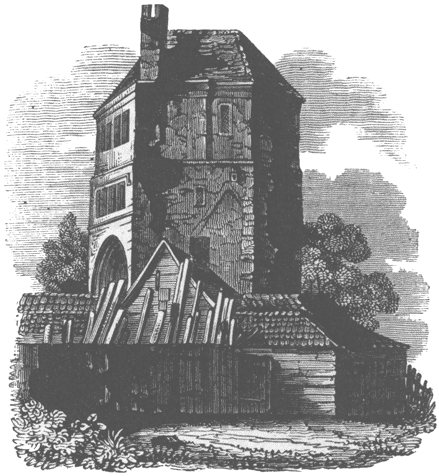
Only let us imagine we see this sharp-eyed philosopher at work in his study, of which yonder print is generally received as a representation! How heedlessly did he hear the murmuring of the stream beneath, and of the winds without—immersed in the vellum and parchment rolls of theological, astrological, and mathematical lore, which, upon the dispersion of the libraries of the Jews,[258] he was constantly perusing, and of which so large a share had fallen to his own lot!
Unfortunately, my friends, little is known with certainty, though much is vaguely conjectured, of the labours of this great man. Some of the first scholars and authors of our own and of other countries have been proud to celebrate his praises; nor would it be considered a disgrace by the most eminent of modern experimental philosophers—of him, who has been described as "unlocking the hidden treasures of nature, and explaining the various systems by which air, and earth, and fire, and water, counteract and sustain each other"[259]—to fix the laureate crown round the brows of our venerable Bacon!
We have now reached the close of the thirteenth century and the reign of Edward the First;[260] when the principal thing that strikes us, connected with the history of libraries, is this monarch's insatiable lust of strengthening his title to the kingdom of Scotland by purchasing "the libraries of all the monasteries" for the securing of any record which might corroborate the same. What he gave for this tremendous book-purchase, or of what nature were the volumes purchased, or what was their subsequent destination, is a knot yet remaining to be untied.
Of the bibliomaniacal propensity of Edward's grandson, the great Edward the Third, there can be no question. Indeed, I could gossip away upon the same 'till midnight. His severe disappointment upon having Froissart's presentation copy of his Chronicles[261] (gergeously attired as it must have been) taken from him by the Duke of Anjou, is alone a sufficient demonstration of his love of books; while his patronage of Chaucer shews that he had accurate notions of intellectual excellence. Printing had not yet begun to give any hint, however faint, of its wonderful powers; and scriveners or book-copiers were sufficiently ignorant and careless.[262]
So ofte a daye I mote thy worke renew, If to correct and eke to rubbe and scrape, And all is thorow thy neglegence and rape." Ashmole Theatrum Chemicum; p. 439.
The mention of Edward the Third, as a patron of learned men, must necessarily lead a book-antiquary to the notice of his eminent chancellor, Richard De Bury; of whom, as you may recollect, some slight mention was made the day before yesterday.[263] It is hardly possible to conceive a more active and enthusiastic lover of books than was this extraordinary character; the passion never deserting him even while he sat upon the bench.[264] It was probably De Bury's intention to make his royal master eclipse his contemporary Charles the Vth, of France—the most renowned foreign bibliomaniac of his age![265] In truth, my dear friends, what can be more delightful to a lover of his country's intellectual reputation than to find such a character as De Bury, in such an age of war and bloodshed, uniting the calm and mild character of a legislator, with the sagacity of a philosopher, and the elegant-mindedness of a scholar! Foreigners have been profuse in their commendations of him, and with the greatest justice; while our Thomas Warton, of ever-to-be-respected memory, has shewn us how pleasingly he could descend from the graver tone of a historical antiquary, by indulging himself in a chit-chat style of book-anecdote respecting this illustrious character.[266]
Loren. The task we have imposed upon you, my good Lysander, would be severe indeed if you were to notice, with minute exactness, all the book-anecdotes of the middle ages. You have properly introduced the name and authority of Warton; but if you suffered yourself to be beguiled by his enchanting style, into all the bibliographical gossiping of this period, you would have no mercy upon your lungs, and there would be no end to the disquisition.
Lysand. Forgive me, if I have transgressed the boundaries of good sense or good breeding: it was not my intention to make a "Concio ad Aulam"—as worthy old Bishop Saunderson was fond of making—but simply to state facts, or indulge in book chit-chat, as my memory served me.
Lis. Nay, Lorenzo, do not disturb the stream of Lysander's eloquence. I could listen 'till "Jocund day stood tip-toe on the mountain."
Phil. You are a little unconscionable, Lisardo: but I apprehend Lorenzo meant only to guard Lysander against that minuteness of narration which takes us into every library and every study of the period at which we are arrived. If I recollect aright, Warton was obliged to restrain himself in the same cause.[267]
Loren. It belongs to me, Lysander, to solicit your forgiveness. If you are not tired with the discussion of such a various and extensive subject (and more particularly from the energetic manner in which it is conducted on your part), rely upon it that your auditors cannot possibly feel ennui. Every thing before us partakes of your enthusiasm: the wine becomes mellower, and sparkles with a ruddier glow; the flavour of the fruit is improved; and the scintillations of your conversational eloquence are scattered amidst my books, my busts, and my pictures. Proceed, I entreat you; but first, accept my libation offered up at the shrine of an offended deity.
Lysand. You do me, and the Bibliomania, too much honour. If my blushes do not overpower me, I will proceed: but first, receive the attestation of the deity that he is no longer affronted with you. I drink to your health and long life!—and proceed:
If, among the numerous and gorgeous books which now surround us, it should be my good fortune to put my hand upon one, however small or imperfect, which could give us some account of the History of British Libraries, it would save me a great deal of trouble, by causing me to maintain at least a chronological consistency in my discourse. But, since this cannot be—since, with all our love of books and of learning, we have this pleasing desideratum yet to be supplied—I must go on, in my usual desultory manner, in rambling among libraries, and discoursing about books and book-collectors. As we enter upon the reign of Henry IV., we cannot avoid the mention of that distinguished library hunter, and book describer, John Boston of Bury;[268] who may justly be considered the Leland of his day. Gale, if I recollect rightly, unaccountably describes his bibliomaniacal career as having taken place in the reign of Henry VII.; but Bale and Pits, from whom Tanner has borrowed his account, unequivocally affix the date of 1410 to Boston's death; which is three years before the death of Henry. It is allowed, by the warmest partizans of the reformation, that the dissolution of the monastic libraries has unfortunately rendered the labours of Boston of scarcely any present utility.
There is a curious anecdote of this period in Rymer's Fœdera,[269] about taking off the duty upon six barrels of books, sent by a Roman Cardinal to the prior of the Conventual church of St. Trinity, Norwich. These barrels, which lay at the custom-house, were imported duty free; and I suspect that Henry's third son, the celebrated John Duke of Bedford, who was then a lad, and just beginning to feed his bibliomaniacal appetite, had some hand in interceding with his father for the redemption of the duty.
Lis. This Duke of Bedford was the most notorious bibliomaniac as well as warrior of his age; and, when abroad, was indefatigable in stirring up the emulation of Flemish and French artists, to execute for him the most splendid books of devotion. I have heard great things of what goes by the name of The Bedford Missal![270]
Lysand. And not greater than what merits to be said of it. I have seen this splendid bijou in the charming collection of our friend ——. It is a small thick folio, highly illuminated; and displaying, as well in the paintings as in the calligraphy, the graphic powers of that age, which had not yet witnessed even the dry pencil of Perugino. More gorgeous, more beautifully elaborate, and more correctly graceful, missals may be in existence; but a more curious, interesting, and perfect specimen, of its kind, is no where to be seen: the portraits of the Duke and of his royal brother Henry V. being the best paintings known of the age. 'Tis, in truth, a lovely treasure in the book way; and it should sleep every night upon an eider-down pillow encircled with emeralds!
Lis. Hear him—hear him! Lysander must be a collateral descendant of this noble bibliomaniac, whose blood, now circulating in his veins, thus moves him to "discourse most eloquently."
Lysand. Banter as you please; only "don't disturb the stream of my eloquence."
The period of this distinguished nobleman was that in which book-collecting began to assume a fixed and important character in this country. Oxford saw a glimmering of civilization dawning in her obscured atmosphere. A short but dark night had succeeded the patriotic efforts of De Bury; whose curious volumes, bequeathed to Trinity College, had laid in a melancholy and deserted condition 'till they were kept company by those of Cobham, Bishop of Worcester, Rede, Bishop of Chichester, and Humphrey the good Duke of Gloucester.[271] Now began the fashion (and may it never fall to decay!) of making presents to public libraries:—but, during the short and splendid career of Henry V., learning yielded to arms: the reputation of a scholar to that of a soldier. I am not aware of any thing at this period, connected with the subject of our discourse, that deserves particular mention; although we ought never to name this illustrious monarch, or to think of his matchless prowess in arms, without calling to mind how he adorned the rough character of a soldier by the manners of a prince, the feelings of a Christian, and, I had almost said, the devotion of a saint.
That thei that have of him lost thoute and mynde By this peinture may ageine him fynde.
Humphrey, Duke of Gloucester, "commonly called the good, was youngest brother to Henry V. and the first founder of the university library in Oxford, which was pillaged of the greater part of its books in the reign of Edward the Sixth." Park's edit. of the Royal and Noble Authors; vol. i., 198. "As for the books which he gave (says Wood) they were very many, more by far than authors report; for whereas 'tis said he gave 129, you shall find anon that they were more than treble the number." The Duke's first gift, in 1439, of one hundred and twenty-nine treatises, was worth, according to Wood, a thousand pounds. All his book presents, "amounting to above 600 (mostly treating of divinity, physic, history, and humanity) which were from several parts of the world obtained, were transmitted to the university, and for the present laid up in chests in Cobham's library. The catalogue also of them which were then sent, and the indentures for the receipt of the said books, were laid up in the chest called Cista Librorum et Rotulorum." History (or Annals) of the University of Oxford; vol. ii., pt. ii., 914. Gutch's edit. Consult also the recent and very amusing History of the same University, by Mr. A. Chalmers, vol. ii., p. 459. Leland has not forgotten this distinguished bibliomaniac; for he thus lauds him in roman verse:
Tam clari meminit viri togata Rectè Gallia; tum chorus suavis Cygnorum Isidis ad vadum incolentûm Cui magnum numerum dedit bonorum Librorum, statuitque sanctiori Divinus studio scholæ theatrum; Nostro quale quidem videtur esse Magnum tempore, forsan et futuro Cygn. Cant. Vide Lelandi Itinerarium Curâ Hearne; edit. 1770, vol. ix., p. 17.
The reign of his successor, Henry VI., was the reign of trouble and desolation. It is not to be wondered that learning drooped, and religion "waxed faint," 'midst the din of arms and the effusion of human blood. Yet towards the close of this reign some attempt was made to befriend the book cause; for the provost and fellows of Eton and Cambridge petitioned the king to assist them in increasing the number of books in their libraries;[272] but the result of this petition has never, I believe, been known.
I had nearly passed through the reign of Henry the Sixth without noticing the very meritorious labours of a sort of precursor of Dean Colet; I mean, Sir Walter Sherington. He was a most assiduous bibliomaniac;[273] and, in the true spirit of ancient monachism, conceived that no cathedral could be perfect without a library. Accordingly, he not only brought together an extraordinary number of curious books, but framed laws or regulations concerning the treatment of the books, and the hours of perusing them; which, if I can trust to my memory, are rather curious, and worth your examination. They are in Hearne's edition of the Antiquities of Glastonbury, composed in our own language.
Regulations concerning Sherington's Library.
"Quodque dicta libraria, hostiis ipsius per præfatos capellanos custodes ejusdem, et eorum successores, aut alterum ipsorum, apertis singulis diebus profestis annuatim á festo Nativ. beat. Mar. Virg. usque festum Annunciacionis ejusdem, ob ortu solis, donec hora nona post altam missam de servicio diei in dicta ecclesiâ cathedrali finiatur: et iterum ab hora prima post meridiem usque ad finem completorii in eadem ecclesia cathedrali, vel saltem usque ad occasum solis per eosdem, seu eorum alterum, sic continue diligenter custodiatur. Et eciam singulis diebus profestis annuatim, ab eodem festo Annunciacionis beatæ Mariæ Virginis usque ad prædictum festum nativitatis ejusdem, ab hora diei sexta, donec hora nona post altam missam in dicta ecclesia cathedrali, et iterum ab hora prima post meridiem quosque completorium in eadem ecclesia cathedrali finiatur, per præfatos capellanos, seu eorum alterum et successores suos custodes dictæ librariæ debitè et diligenter aperta, custodiatur, nisi causa racionabilis hoc fieri impediat. Ita quod nullum dampnum eidem librariæ aut in libris, aut in hostiis, seruris vel fenestris vitreis ejusdem, ex negligencia dictorum capellanorum aut successorum suorum custodum dictæ librariæ evenire contingat. Et si quid dampnum hujusmodi in præmissis, seu aliquo præmissorum, per negligenciam ipsorum capellanorum, seu eorum alterius, aut successorum suorum quoque modo imposterum evenerit, id vel ipsa dampnum aut dampna recompensare, emendare et satisfacere, tociens quociens contigerit, de salariis seu stipendiis suis propriis, auctoritate et judicio dictorum Decani et Capituli, debeant et teneantur, ut est justum. Ceteris vero diebus, noctibus et temporibus hostia prædicta, cum eorum seruris et clavibus, omnino sint clausa et secure serata." Id.: p. 193.
We now enter upon the reign of an active and enterprising monarch; who, though he may be supposed to have cut his way to the throne by his sword, does not appear to have persecuted the cause of learning; but rather to have looked with a gracious eye upon its operations by means of the press. In the reign of Edward IV., our venerable and worthy Caxton fixed the first press that ever was set to work in this country, in the abbey of Westminster. Yes, Lorenzo; now commenced more decidedly, the æra of Bibliomania! Now the rich, and comparatively poor, began to build them small Book Rooms or Libraries. At first, both the architecture and furniture were sufficiently rude, if I remember well the generality of wood cuts of ancient book-boudoirs:—a few simple implements only being deemed necessary; and a three-legged stool, "in fashion square or round," as Cowper[274] says, was thought luxury sufficient for the hard student to sit upon. Now commenced a general love and patronage of books: now (to borrow John Fox's language) "tongues became known, knowledge grew, judgment increased, books were dispersed, the scripture was read, stories were opened, times compared, truth discerned, falsehood detected, and with finger pointed (at)—and all, through the benefit of printing."[275]
"Joint stools were then created: on three legs Upborne they stood. Three legs upholding firm A massy slab, in fashion square or round. On such a stool immortal Alfred sat, And sway'd the sceptre of his infant realms. And such in ancient halls and mansions drear May still be seen; but perforated sore, And drilled in holes, the solid oak is found, By worms voracious eating through and through." Task: b. i., v. 19, &c.
It had escaped the amiable and sagacious author of these verses that such tripodical seats were frequently introduced into old book-rooms; as the subjoined print—which gives us also a curious picture of one of the libraries alluded to by Lysander—may serve to shew:
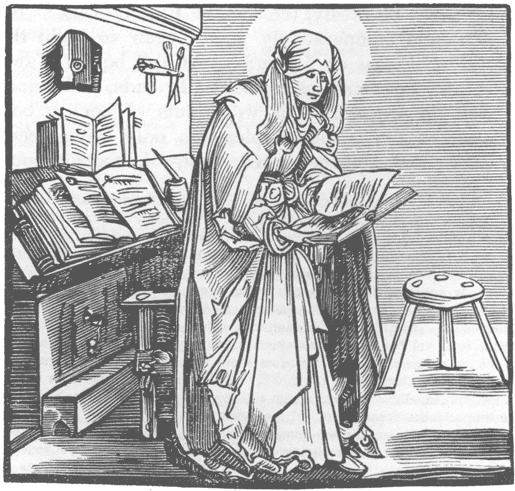
Revelaciones Sancte Birgitte; ed. 1521, sign. z. 3 rev.
Lis. Now you have arrived at this period, pray concentrate your anecdotes into a reasonable compass. As you have inveigled us into the printing-office of Caxton, I am fearful, from your strong attachment to him, that we shall not get over the threshhold of it, into the open air again, until midnight.
Phil. Order, order, Lisardo! This is downright rudeness. I appeal to the chair!—
Lorenz. Lisardo is unquestionably reprehensible. His eagerness makes him sometimes lose sight of good breeding.
Lysand. I was going to mention some Vellum and Presentation copies—but I shall hurry forward.
Lis. Nay, if you love me, omit nothing about "vellum and presentation copies." Speak at large upon these glorious subjects.
Lysand. Poor Lisardo!—we must build an iron cage to contain such a book-madman as he promises to become!
Phil. Proceed, dear Lysander, and no longer heed these interruptions.
Lysand. Nay, I was only about to observe that, as Caxton is known to have printed upon vellum,[276] it is most probable that one of his presentation copies of the romances of Jason and Godfrey of Boulogne (executed under the patronage of Edward IV.), might have been printed in the same manner. Be this as it may, it seems reasonable to conclude that Edward the Fourth was not only fond of books, as objects of beauty or curiosity, but that he had some affection for literature and literary characters; for how could the firm friend and generous patron of Tiptoft, Earl of Worcester—with whom this monarch had spent many a studious, as well as jovial, hour—be insensible to the charms of intellectual refinement! Pause we here for one moment—and let us pour the juice of the blackest grape upon the votive tablet, consecrated to the memory of this illustrious nobleman! and, as Caxton has become so fashionable[277] among us, I will read to you, from yonder beautiful copy of his English edition of "Tully upon Friendship," a part of our printer's affecting eulogy upon the translator:—"O good blessed Lord God, what great loss was it of that noble, virtuous, and well-disposed lord! When I remember and advertise his life, his science, and his virtue, me thinketh God not displeased over a great loss of such a man, considering his estate and cunning," &c. "At his death every man that was there, might learn to die and take his (own) death patiently; wherein I hope and doubt not, but that God received his soul into his everlasting bliss. For as I am informed he right advisedly ordained all his things, as well for his last will of worldly goods, as for his soul's health; and patiently, and holily, without grudging, in charity, to fore that he departed out of this world: which is gladsome and joyous to hear."—What say you to this specimen of Caxtonian eloquence?
Lis. It has a considerable merit; but my attention has been a good deal diverted, during your appropriate recital of it, to the beautiful condition of the copy. Thrice happy Lorenzo! what sum will convey this volume to my own library!
Loren. No offer, in the shape of money, shall take it hence. I am an enthusiast in the cause of Tiptoft; and am always upon the watch to discover any volume, printed by Caxton, which contains the composition of the hapless Earl of Worcester! Dr. Henry has spoken so handsomely of him, and Mr. Park, in his excellent edition of Walpole's Royal and Noble Authors,[278] has made his literary character so interesting that, considering the dearth of early good English authors,[279] I know of no other name that merits greater respect and admiration.
Lysand. True; and this nobleman's attention to the acquisition of fine and useful books, when he was abroad, for the benefit of his own country,[280] gives him a distinguished place in the list of Bibliomaniacs. I dare say Lisardo would give some few hundred guineas for his bust, executed by Flaxman, standing upon a pedestal composed of the original editions of his works, bound in grave-coloured morocco by his favourite Faulkener?[281]
Lis. I entreat you not to inflame my imagination by such tantalizing pictures! You know this must ever be a fiction: the most successful bibliomaniac never attained to such human happiness.
Phil. Leave Lisardo to his miseries, and proceed.
Lysand. I have supposed Edward to have spent some jovial hours with this unfortunate nobleman. It is thought that our monarch and he partook of the superb feast which was given by the famous Nevell, archbishop of York, at the inthronization of the latter; and I am curious to know of what the library of such a munificent ecclesiastical character was composed! But perhaps this feast itself[282] is one of Lisardo's fictions.
Enough has probably been said of Edward. We will stop, therefore, but a minute, to notice the completion of the Humphrey Library, and the bibliomaniacal spirit of master Richard Courtney,[283] during the same reign; and give but another minute to the mention of the statute of Richard III. in protection of English printers,[284] when we reach the Augustan book-age, in the reign of Henry VII.
Phil. Before we proceed to discuss the bibliomaniacal ravages of this age, we had better retire, with Lorenzo's leave, to the drawing-room; to partake of a beverage less potent than that which is now before us.
Lorenz. Just as you please. But I should apprehend that Lysander could hold out 'till he reached the Reformation;—and, besides, I am not sure whether our retreat be quite ready for us.
Lis. Pray let us not take leave of all these beauteous books, and busts, and pictures, just at present. If Lysander's lungs will bear him out another twenty minutes, we shall, by that time, have reached the Reformation; and then "our retreat," as Lorenzo calls it, may be quite ready for our reception.
Lysand. Settle it between yourselves. But I think I could hold out for another twenty minutes—since you will make me your only book-orator.
Lorenz. Let it be so, then. I will order the lamps to be lit; so that Lisardo may see his favourite Wouvermans and Berghems, in company with my romances, (which latter are confined in my satin-wood book-case) to every possible degree of perfection!
Lysand. Provided you indulge me also with a sight of these delightful objects, you shall have what you desire:—and thus I proceed:
Of the great passion of Henry the VIIth for fine books, even before he ascended the throne of England,[285] there is certainly no doubt. And while he was king, we may judge, even from the splendid fragments of his library, which are collected in the British Museum, of the nicety of his taste, and of the soundness of his judgment. That he should love extravagant books of devotion,[286] as well as histories and chronicles, must be considered the fault of the age, rather than of the individual. I will not, however, take upon me to say that the slumbers of this monarch were disturbed in consequence of the extraordinary and frightful passages, which, accompanied with bizarre cuts,[287] were now introduced into almost every work, both of ascetic divinity and also of plain practical morality. His predecessor, Richard, had in all probability been alarmed by the images which the reading of these books had created; and I guess that it was from such frightful objects, rather than from the ghosts of his murdered brethren, that he was compelled to pass a sleepless night before the memorable battle of Bosworth Field. If one of those artists who used to design the horrible pictures which are engraved in many old didactic volumes of this period had ventured to take a peep into Richard's tent, I question whether he would not have seen, lying upon an oaken table, an early edition of some of those fearful works of which he had himself aided in the embellishment, and of which Heinecken has given us such curious fac-similes:[288]—and this, in my humble apprehension, is quite sufficient to account for all the terrible workings in Richard, which Shakespeare has so vividly described.
De la flamme tousiours esprise De feu denfer qui point ne brise De busches nest point actise Ne de soufflemens embrase Le feu denfer, mais est de Dieu Cree pour estre en celuy lieu Des le premier commencement Sans jamais pendre finement Illec nya point de clarte Mais de tenebres obscurte De peine infinie durte De miseres eternite Pleur et estraignement de dens Chascun membre aura la dedans Tourmmens selon ce qua forfait La peine respondra au fait, &c. &c. &c.
Le passe tempe de tout home, et de toute femme; sign. q. ii., rev.
Printed by Verard in 8vo., without date: (from a copy, printed upon vellum, in the possession of John Lewis Goldsmyd, Esq.)—The next extract is from a book which was written to amuse and instruct the common people: being called by Warton a "universal magazine of every article of salutary and useful knowledge." Hist. Engl. Poetry: vol. ii., 195.
In hell is great mourning Great trouble of crying Of thunder noises roaring with plenty of wild fire Beating with great strokes like guns with a great frost in water runs And after a bitter wind comes which goeth through the souls with ire There is both thirst and hunger fiends with hooks putteth their flesh asunder They fight and curse and each on other wonder with the fight of the devils dreadable There is shame and confusion Rumour of conscience for evil living They curse themself with great crying In smoak and stink they be evermore lying with other pains innumerable.
Kalendar of Shepherds. Sign G. vij. rev. Pynson's edit., fol.
Specimens of some of the tremendous cuts which are crowded into this thin folio will be seen in the second volume of the new edition of the Typographical Antiquities. However, that the reader's curiosity may not here be disappointed, he is presented with a similar specimen, on a smaller scale, of one of the infernal tortures above described. It is taken from a book whose title conveys something less terrific; and describes a punishment which is said to be revealed by the Almighty to St. Bridget against those who have "ornamenta indecentia in capitibus et pedibus, et reliquis membris, ad provocandum luxuriam et irritandum deum, in strictis vestibus, ostensione mamillarum, unctionibus," &c. Revelaciones sancte Birgitte; edit. Koeberger, 1521, fol., sign. q., 7, rev.
Lis. This is, at least, an original idea; and has escaped the sagacity of every commentator in the last twenty-one volume edition of the works of our bard.
Lysand. But to return to Henry. I should imagine that his mind was not much affected by the perusal of this description of books: but rather that he was constantly meditating upon some old arithmetical work—the prototype of Cocker—which, in the desolation of the ensuing half century, has unfortunately perished. Yet, if this monarch be accused of avaricious propensities—if, in consequence of speculating deeply in large paper and vellum copies, he made his coffers to run over with gold—it must be remembered that he was, at the same time, a patron as well as judge of architectural artists; and while the completion of the structure of King's college Chapel, Cambridge, and the building of his own magnificent chapel[289] at Westminster (in which latter, I suspect, he had a curiously-carved gothic closet for the preservation of choice copies from Caxton's neighbouring press), afford decisive proofs of Henry's skill in matters of taste, the rivalship of printers and of book-buyers shews that the example of the monarch was greatly favourable to the propagation of the Bibliomania. Indeed, such was the progress of the book-disease that, in the very year of Henry's death, appeared, for the first time in this country, an edition of The Ship of Fools—in which work, ostentatious and ignorant book-collectors[290] are, amongst other characters, severely satirized.

I am the firste fole of all the hole navy To kepe the pompe, the helme, and eke the sayle: For this is my mynde, this one pleasoure have I— Of bokes to haue great plenty and aparayle. I take no wysdome by them: nor yet avayle Nor them perceyve nat: And then I them despyse. Thus am I a foole, and all that serue that guyse. Shyp of Folys, &c., Pynson's edit., 1509, fol.
We have now reached the threshhold of the reign of Henry VIII.—and of the era of the Reformation. An era in every respect most important, but, in proportion to its importance, equally difficult to describe—as it operates upon the history of the Bibliomania. Now blazed forth, but blazed for a short period, the exquisite talents of Wyatt, Surrey, Vaux, Fischer, More, and, when he made his abode with us, the incomparable Erasmus. But these in their turn.
Phil. You omit Wolsey. Surely he knew something about books?
Lysand. I am at present only making the sketch of my grand picture. Wolsey, I assure you, shall stand in the foreground. Nor shall the immortal Leland be treated in a less distinguished manner. Give me only "ample room and verge enough," and a little time to collect my powers, and then—
Lis. "Yes, and then"—you will infect us from top to toe with the book-disease!
Phil. In truth I already begin to feel the consequence of the innumerable miasma of it, which are floating in the atmosphere of this library. I move that we adjourn to a purer air.
Lysand. I second the motion: for, having reached the commencement of Henry's reign, it will be difficult to stop at any period in it previous to that of the Reformation.
Lis. Agreed. Thanks to the bacchanalian bounty of Lorenzo, we are sufficiently enlivened to enter yet further, and more enthusiastically, into this congenial discourse. Dame nature and good sense equally admonish us now to depart. Let us, therefore, close the apertures of these gorgeous decanters:—
"Claudite jam rivos, pueri: sat prata bibêrunt!"
The striking device of M. Morin, Printer, Rouen.