Part 5 — The Drawing Room.
Reading edition
HISTORY OF THE BIBLIOMANIA, OR ACCOUNT OF BOOK-COLLECTORS, CONTINUED.
OLATILE as the reader may comceive the character of Lisardo to be, there were traits in it of marked goodness and merit. His enthusiasm so frequently made him violate the rules of severe politeness; and the quickness with which he flew from one subject to another, might have offended a narrator of the gravity, without the urbanity, of Lysander; had not the frankness with which he confessed his faults, and the warmth with which he always advocated the cause of literature, rendered him amiable in the eyes of those who thoroughly knew him. The friends, whose company he was now enjoying, were fully competent to appreciate his worth. They perceived that Lisardo's mind had been rather brilliantly cultivated; and that, as his heart had always beaten at the call of virtue, so, in a due course of years, his judgment would become matured, and his opinions more decidedly fixed. He had been left, very early in life, without a father, and bred up in the expectation of a large fortune; while the excessive fondness of his mother had endeavoured to supply the want of paternal direction, and had encouraged her child to sigh for every thing short of impossibility for his gratification.

In consequence, Lisardo was placed at College upon the most respectable footing. He wore the velvet cap, and enjoyed the rustling of the tassels upon his silk gown, as he paraded the High street of Oxford. But although he could translate Tacitus and Theocritus with creditable facility, he thought it more advantageous to gratify the cravings of his body than of his mind. He rode high-mettled horses; he shot with a gun which would have delighted an Indian prince; he drank freely out of cut-glasses, which were manufactured according to his own particular taste; and wines of all colours and qualities sparkled upon his table; he would occasionally stroll into the Bodleian Library and Picture Gallery, in order to know whether any acquisitions had been recently made to them; and attended the Concerts when any performer came down from London. Yet, in the midst of all his gaiety, Lisardo passed more sombrous than joyous hours: for when he looked into a book, he would sometimes meet with an electrical sentence from Cicero, Seneca, or Johnson, from which he properly inferred that life was uncertain, and that time was given us to prepare for eternity.
He grew dissatisfied and melancholy. He scrambled through his terms; took his degree; celebrated his anniversary of twenty-one, by drenching his native village in ale which had been brewed at his birth; added two wings to his father's house; launched out into coin and picture collecting; bought fine books with fine bindings; then sold all his coins and pictures; and, at the age of twenty-five, began to read, and think, and act for himself.
At this crisis, he became acquainted with the circle which has already been introduced to the reader's attention; and to which circle the same reader may think it high time now to return.
Upon breaking up for the drawing room, it was amusing to behold the vivacity of Lisardo; who, leaping about Lysander, and expressing his high gratification at the discourse he had already heard, and his pleasure at what he hoped yet to hear, reminded us of what Boswell has said of Garrick, who used to flutter about Dr. Johnson, and try to soften his severity by a thousand winning gestures.
The doors were opened; and we walked into Lorenzo's Drawing Room. The reader is not to figure to himself a hundred fantastical and fugitive pieces of furniture, purchased at Mr. Oakley's, and set off with curtains, carpet, and looking-glasses—at a price which would have maintained a country town of seven hundred poor with bread and soup during the hardest winter—the reader will not suppose that a man of Lorenzo's taste, who called books his best wealth, would devote two thousand pounds to such idle trappings; which in the course of three years, at farthest, would lose their comfort by losing their fashion. But he will suppose that elegance and propriety were equally consulted by our host.
Accordingly, a satin-wood book-case of 14 feet in width and 11 in height, ornamented at the top with a few chaste Etruscan vases—a light blue carpet, upon which were depicted bunches of grey roses, shadowed in brown—fawn-coloured curtains, relieved with yellow silk and black velvet borders—alabaster lamps shedding their soft light upon small marble busts—and sofas and chairs corresponding with the curtains—(and upon which a visitor might sit without torturing the nerves of the owner of them) these, along with some genuine pictures of Wouvermans, Berghem, and Rysdael, and a few other (subordinate) ornaments, formed the furniture of Lorenzo's Drawing Room. As it was en suite with the library, which was fitted up in a grave style or character, the contrast was sufficiently pleasing.
Lisardo ran immediately to the book-case. He first eyed, with a greedy velocity, the backs of the folios and quartos; then the octavos; and, mounting an ingeniously-contrived mahogany rostrum, which moved with the utmost facility, he did not fail to pay due attention to the duodecimos; some of which were carefully preserved in Russia or morocco backs, with water-tabby silk linings, and other appropriate embellishments. In the midst of his book-reverie, he heard, on a sudden, the thrilling notes of a harp—which proceeded from the further end of the library!—it being Lorenzo's custom, upon these occasions, to request an old Welch servant to bring his instrument into the library, and renew, if he could, the strains of "other times." Meanwhile the curtains were "let fall;" the sofa wheeled round;
—and the cups That cheer, but not inebriate,
with "the bubbling and loud hissing urn," "welcomed the evening in." Lorenzo brought from his library a volume of Piranesi, and another of engravings from the heads of Vandyke. Lisardo, in looking at them, beat time with his head and foot; and Philemon and Lysander acknowledged that Dr. Johnson himself could never have so much enjoyed the beverage which was now before them.
If it should here be asked, by the critical reader, why our society is not described as being more congenial, by the presence of those "whom man was born to please," the answer is at once simple and true—Lorenzo was a bachelor; and his sisters, knowing how long and desperate would be our discussion upon the black letter and white letter, had retreated, in the morning, to spend the day with Lisardo's mother—whither —— —— had been invited to join them.
The harper had now ceased. The tea-things were moved away; when we narrowed our circle, and, two of us upon the sofa, and three upon chairs, entreated Lysander to resume his narrative; who, after "clearing his pipes (like Sir Roger de Coverley) with a loud hem or two," thus proceeded.
"I think we left off," said Lysander, "with seating Henry the Eighth upon the throne of England. It will be as well, therefore, to say something of this monarch's pretensions to scholarship and love of books. Although I will not rake together every species of abuse which has been vented against him by one Anthony Gilbie,[291] yet Henry must be severely censured, in the estimation of the most candid inquirer, for that gross indifference which he evinced to the real interests of literature, in calmly suffering the libraries of convents and monasteries to be pillaged by the crafty and rapacious. He was bibliomaniac enough to have a few copies of his own work, in defence of the Roman Catholic exposition of the Sacrament, struck off upon vellum:[292] but when he quarrelled with the Roman pontiff about his divorce from Queen Catharine, in order to marry Anne Boleyn,[293] he sounded the tocsin for the eventful destruction of all monastic libraries: and although he had sent Leland, under an express commission, to make a due examination of them, as well as a statistical survey of the realm, yet, being frustrated in the forementioned darling object, he cared for nothing about books, whether upon vellum or large paper. But had we not better speak of the book ravages, during the reformation, in their proper place?"
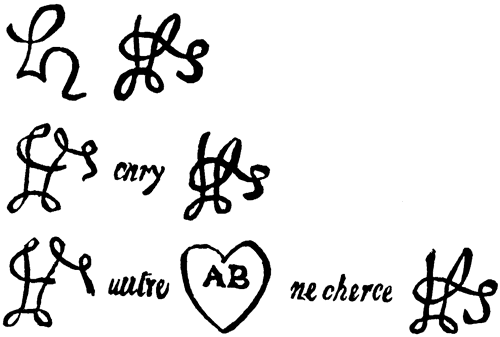
When one thinks of the then imagined happiness of the fair object of these epistles—and reads the splendid account of her coronation dinner, by Stow—contrasting it with the melancholy circumstances which attended her death—one is at loss to think, or to speak, with sufficient force, of the fickleness of all sublunary grandeur! The reader may, perhaps, wish for this, "coronation dinner?" It is, in part, strictly as follows: "While the queen was in her chamber, every lord and other that ought to do service at the coronation, did prepare them, according to their duty: as the Duke of Suffolk, High-Steward of England, which was richly apparelled—his doublet and jacket set with orient pearl, his gown crimson velvet embroidered, his courser trapped with a close trapper, head and all, to the ground, of crimson velvet, set full of letters of gold, of goldsmith's work; having a long white rod in his hand. On his left-hand rode the Lord William, deputy for his brother, as Earl Marshall, with ye marshal's rod, whose gown was crimson velvet, and his horse's trapper purple velvet cut on white satin, embroidered with white lions. The Earl of Oxford was High Chamberlain; the Earl of Essex, carver; the Earl of Sussex, sewer; the Earl of Arundel, chief butler; on whom 12 citizens of London did give their attendance at the cupboard; the Earl of Derby, cup-bearer; the Viscount Lisle, panter; the Lord Burgeiny, chief larder; the Lord Broy, almoner for him and his copartners; and the Mayor of Oxford kept the buttery-bar: and Thomas Wyatt was chosen ewerer for Sir Henry Wyatt, his father." "When all things were ready and ordered, the queen, under her canopy, came into the hall, and washed; and sat down in the middest of the table, under her cloth of estate. On the right side of her chair stood the Countess of Oxford, widow: and on her left hand stood the Countess of Worcester, all the dinner season; which, divers times in the dinner time, did hold a fine cloth before the Queen's face, when she list to spit, or do otherwise at her pleasure. And at the table's end sate the Archbishop of Canterbury, on the right hand of the Queen; and in the midst, between the Archbishop and the Countess of Oxford, stood the Earl of Oxford, with a white staff, all dinner time; and at the Queen's feet, under the table, sate two gentlewomen all dinner time. When all these things were thus ordered, came in the Duke of Suffolk and the Lord William Howard on horseback, and the Serjeants of arms before them, and after them the sewer; and then the knights of the Bath, bringing in the first course, which was eight and twenty dishes, besides subtleties, and ships made of wax, marvellous gorgeous to behold: all which time of service, the trumpets standing in the window, at the nether end of the hall, played," &c. Chronicles; p. 566: edit. 1615, fol.
Lorenz. As you please. Perhaps you will go on with the mention of some distinguished patrons 'till you arrive at that period?
Lysand. Yes; we may now as well notice the efforts of that extraordinary bibliomaniacal triumvirate, Colet, More, and Erasmus.
Phil. Pray treat copiously of them. They are my great favourites. But can you properly place Erasmus in the list?
Lysand. You forget that he made a long abode here, and was Greek professor at Cambridge. To begin, then, with the former. Colet, as you well know, was Dean of St. Paul's; and founder of the public school which goes by the latter name. He had an ardent and general love of literature;[294] but his attention to the improvement of youth, in superintending appropriate publications, for their use, was unremitting. Few men did so much and so well, at this period: for while he was framing the statutes by which his little community was to be governed, he did not fail to keep the presses of Wynkyn De Worde and Pynson pretty constantly at work, by publishing the grammatical treatises of Grocyn, Linacre, Stanbridge, Lilye, Holte, Whittington, and others—for the benefit, as well of the public, as of his own particular circle. I take it, his library must have been both choice and copious; for books now began to be multiplied in an immense ratio, and scholars and men of rank thought a Study, or Library, of some importance to their mansions. What would we not give for an authenticated representation of Dean Colet in his library,[295] surrounded with books? You, Lisardo, would be in ecstacies with such a thing!
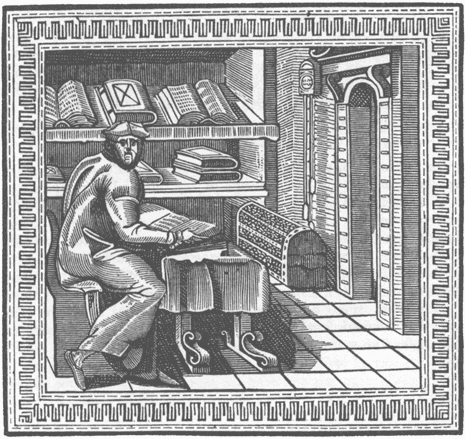
Lis. Pray don't make such tantalizing appeals to me! Proceed, proceed.
Lysand. Of this amiable and illustrious character I will only further observe that he possessed solid, good sense—unaffected and unshaken piety—a love towards the whole human race—and that he dignified his attachment to learning by the conscientious discharge of his duty towards God and man. He sleeps in peace beneath a monument, which has been consecrated by the tears of all who were related to him, and by the prayers of those who have been benefitted by his philanthropy.
Of Sir Thomas More,[296] where is the schoolboy that is ignorant? He was unquestionably, next to Erasmus, the most brilliant scholar of his age: while the precious biographical memoirs of him, which have luckily descended to us, place his character, in a domestic point of view, beyond that of all his contemporaries. Dr. Wordsworth[297] has well spoken of "the heavenly mindedness" of More: but how are bibliomaniacs justly to appreciate the classical lore, and incessantly-active book-pursuits,[298] of this scholar and martyr! How he soared "above his compeers!" How richly, singularly, and curiously, was his mind furnished! Wit, playfulness, elevation, and force—all these are distinguishable in his writings, if we except his polemical compositions; which latter, to speak in the gentlest terms, are wholly unworthy of his name. When More's head was severed from his body, virtue and piety exclaimed, in the language of Erasmus,—"He is dead: More, whose breast was purer than snow, whose genius was excellent above all his nation."[299]
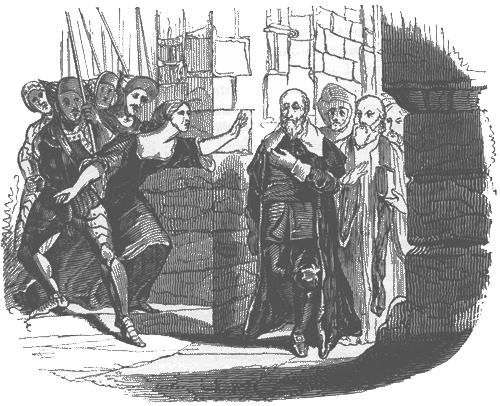
Behold him going to execution—his beloved daughter (Mrs. Roper) rushing through the guards, to take her last embrace.
How can I speak, with adequate justice, of the author of these words!—Yes, Erasmus!—in spite of thy timidity, and sometimes, almost servile compliances with the capricious whims of the great; in spite of thy delicate foibles, thou shalt always live in my memory; and dear to me shall be the possession of thy intellectual labours! No pen has yet done justice to thy life.[300] How I love to trace thee, in all thy bookish pursuits, from correcting the press of thy beloved Froben, to thy social meetings with Colet and More! You remember well, Lisardo,—we saw, in yonder room, a large paper copy of the fine Leyden edition of this great man's works! You opened it; and were struck with the variety—the solidity, as well as gaiety, of his productions.
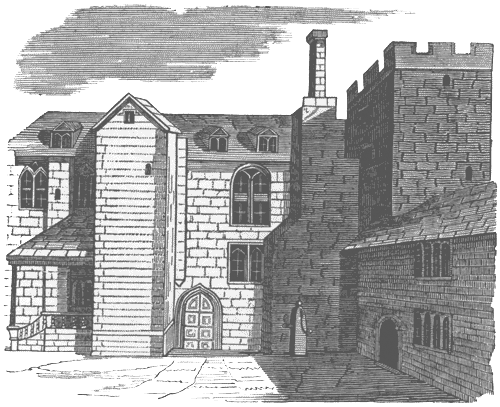
I shall conclude this Erasmiana (if the reader will premit me so to entitle it) with a wood-cut exhibition of a different kind: it being perhaps the earliest portrait of Erasmus published in this country. It is taken from a work entitled, "The Maner and Forme of Confesion," printed by Byddell, in 8vo., without date; and is placed immediately under an address from Erasmus, to Moline, Bishop of Condome; dated 1524; in which the former complains bitterly of "the pain and grief of the reins of his back." The print is taken from a tracing of the original, made by me, from a neat copy of Byddel's edition, in the collection of Roger Wilbraham, Esq. I am free to confess that it falls a hundred degrees short of Albert Durer's fine print of him, executed A.D. 1526.
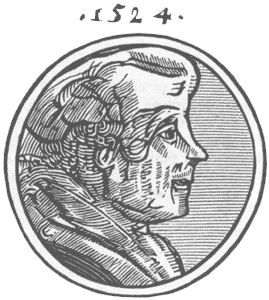
Lis. Let me go and bring it here! While you talk thus, I long to feast my eyes upon these grand books.
Lysand. You need not. Nor must I give to Erasmus a greater share of attention than is due to him. We have a large and varied field—or rather domain—yet to pass over. Wishing, therefore, Lorenzo speedily to purchase a small bronze figure of him, from the celebrated large one at Rotterdam, and to place the same upon a copy of his first edition of the Greek Testament printed upon vellum,[301] by way of a pedestal—I pass on to the notice of other bibliomaniacs of this period.
Subdued be every harsher feeling towards Wolsey, when we contemplate even the imperfect remains of his literary institutions which yet survive! That this chancellor and cardinal had grand views, and a magnificent taste, is unquestionable: and I suppose few libraries contained more beautiful or more numerous copies of precious volumes than his own. For, when in favour with his royal master, Henry VIII., Wolsey had, in all probability, such an ascendency over him as to coax from him almost every choice book which he had inherited from his father, Henry VII.; and thus I should apprehend, although no particular mention is made of his library in the inventories of his goods[302] which have been published, there can be no question about such a character as that of Wolsey having numerous copies of the choicest books, bound in velvet of all colours, embossed with gold or silver, and studded even with precious stones! I conceive that his own Prayer Book must have been gorgeous in the extreme! Unhappy man—a pregnant and ever-striking example of the fickleness of human affairs, and of the instability of human grandeur! When we think of thy baubles and trappings—of thy goblets of gold, and companies of retainers—and turn our thoughts to Shakspeare's shepherd, as described in the soliloquy of one of our monarchs, we are fully disposed to admit the force of such truths as have been familiar to us from boyhood, and which tell us that those shoulders feel the most burdened upon which the greatest load of responsibility rests. Peace to the once proud, and latterly repentant, spirit of Wolsey!
He is set so high In his hierarchy Of frantic frenesy And foolish fantasy, That in chamber of stars All matters there he mars, Clapping his rod on the borde No man dare speake a word; For he hath all the saying Without any renaying: He rolleth in his records He saith: "How say ye my lords? Is not my reason good?" Good!—even good—Robin-hood? Borne upon every side With pomp and with pride, &c. To drink and for to eat Sweet ypocras, and sweet meat, To keep his flesh chaste In Lent, for his repast He eateth capons stew'd Pheasant and partidge mewed.
Warton's Hist. Engl. Poetry, vol. ii., 345.
Steevens has also quoted freely from this poem of Skelton; see the editions of Shakspeare, 1793, and 1803, in the play of "King Henry VIII." Skelton's satire against Wolsey is noticed by our chronicler Hall: "In this season, the cardinal, by his power legantine, dissolved the convocation at Paul's, called by the Archbishop of Canterbury; and called him and all the clergy to his convocation to Westminster, which was never seen before in England; whereof Master Skelton, a merry poet, wrote:
Gentle Paul lay down thy sweard For Peter of Westminster hath shaven thy beard." Chronicle, p. 637, edit. 1809.
In Mr. G. Ellis's Specimens of the Early English Poets, vol. ii., pp. 7, 8, there is a curious extract from the same poet's "Image of Ypocrycye"—relating to Sir Thomas More—which is printed for the first time from "an apparently accurate transcript" of the original, in the possession of Mr. Heber. From the last mentioned work (vol. ii., p. 11, &c.), there is rather a copious account of a yet more formidable poetical attack against Wolsey, in the "Rede me and be not wroth," of William Roy: a very rare and precious little black-letter volume, which, although it has been twice printed, is scarcely ever to be met with, and was unknown to Warton. It will, however, make its appearance in one of the supplemental volumes of Mr. Park's valuable reprint of the Harleian Miscellany. While the cardinal was thus attacked, in the biting strains of poetry, he was doomed to experience a full share of reprobation in the writings of the most popular theologians. William Tyndale stepped forth to shew his zeal against papacy in his "Practise of Popishe Prelates," and from this work, as it is incorporated in those of Tyndale, Barnes, and Frith, printed by Day in 1572, fol., the reader is presented with the following amusing specimen of the author's vein of humour and indignation: "And as I heard it spoken of divers, he made, by craft of necromancy, graven imagery to bear upon him; wherewith he bewitched the king's mind—and made the king to doat upon him, more than he ever did on any lady or gentlewoman: so that now the king's grace followed him, as he before followed the king. And then what he said, that was wisdom; what he praised, that was honourable only." Practise of Popishe Prelates, p. 368. At p. 369, he calls him "Porter of Heaven." "There he made a journey of gentlemen, arrayed altogether in silks, so much as their very shoes and lining of their boots; more like their mothers than men of war: yea, I am sure that many of their mothers would have been ashamed of so nice and wanton array. Howbeit, they went not to make war, but peace, for ever and a day longer. But to speak of the pompous apparel of my lord himself, and of his chaplains, it passeth the xij Apostles. I dare swear that if Peter and Paul had seen them suddenly, and at a blush, they would have been harder in belief that they, or any such, should be their successors than Thomas Didimus was to believe that Christ was risen again from death." Idem, p. 370,—"for the worship of his hat and glory of his precious shoes—when he was pained with the cholic of an evil conscience, having no other shift, because his soul could find no other issue,—he took himself a medicine, ut emitteret spiritum per posteriora." Exposition upon the first Ep. of St. John, p. 404. Thomas Lupset, who was a scholar of Dean Colet, and a sort of elève of the cardinal, (being appointed tutor to a bastard son of the latter) could not suppress his sarcastical feelings in respect of Wolsey's pomp and severity of discipline. From Lupset's works, printed by Berthelet in 1546, 12mo., I gather, in his address to his "hearty beloved Edmond"—that "though he had there with him plenty of books, yet the place suffered him not to spend in them any study: for you shall understand (says he) that I lie waiting on my Lord Cardinal, whose hours I must observe to be always at hand, lest I should be called when I am not by: the which should be taken for a fault of great negligence. Wherefore, that I am now well satiated with the beholding of these gay hangings, that garnish here every wall, I will turn me and talk with you." (Exhortacion to yonge men, fol. 39, rev.) Dr. Wordsworth, in the first volume of his Ecclesiastical Biography, has printed, for the first time, the genuine text of Cavendish's interesting life of his reverend master, Wolsey. It is well worth perusal. But the reader, I fear, is beginning to be outrageous (having kept his patience, during this long-winded note, to the present moment) for some bibliomaniacal evidence of Wolsey's attachment to gorgeous books. He is presented, therefore, with the following case in point. My friend Mr. Ellis, of the British Museum, informs me that, in the splendid library of that establishment, there are two copies of Galen's "Methodus Medendi," edited by Linacre, and printed at Paris, in folio, 1519. One copy, which belonged to Henry the Eighth, has an illuminated title, with the royal arms at the bottom of the title-page. The other, which is also illuminated, has the cardinal's cap in the same place, above an empty shield. Before the dedication to the king, in the latter copy, Linacre has inserted an elegant Latin epistle to Wolsey, in manuscript. The king's copy is rather the more beautiful of the two: but the unique appendage of the Latin epistle shews that the editor considered the cardinal a more distinguished bibliomaniac than the monarch.
We have now reached the Reformation; upon which, as Burnet, Collier, and Strype, have written huge folio volumes, it shall be my object to speak sparingly: and chiefly as it concerns the history of the Bibliomania. A word or two, however, about its origin, spirit, and tendency.
It seems to have been at first very equivocal, with Henry the Eighth, whether he would take any decisive measures in the affair, or not. He hesitated, resolved, and hesitated again.[303] The creature of caprice and tyranny, he had neither fixed principles, nor settled data, upon which to act. If he had listened to the temperate advice of Cromwell or Cranmer,[304] he would have attained his darling object by less decisive, but certainly by more justifiable, means. Those able and respectable counsellors saw clearly that violent measures would produce violent results; and that a question of law, of no mean magnitude, was involved in the very outset of the transaction—for there seemed, on the one side, no right to possess; and, on the other, no right to render possession.[305]
Latimer, more hasty and enthusiastic than his episcopal brethren, set all the engines of his active mind to work, as if to carry the point by a coup de main; and although his resolution was, perhaps, upon more than one occasion, shaken by the sufferings of the innocent, yet, by his example, and particularly by his sermons,[306] he tried to exasperate every Protestant bosom against the occupiers of monasteries and convents.
With Henry, himself, the question of spiritual supremacy was soon changed, or merged (as the lawyers call it) into the exclusive consideration of adding to his wealth. The Visitors who had been deputed to inspect the abbies, and to draw up reports of the same (some of whom, by the bye, conducted themselves with sufficient baseness[307]), did not fail to inflame his feelings by the tempting pictures which they drew of the riches appertaining to these establishments.[308] Another topic was also strongly urged upon Henry's susceptible mind: the alleged abandoned lives of the owners of them. These were painted with a no less overcharged pencil:[309] so that nothing now seemed wanting but to set fire to the train of combustion which had been thus systematically laid.
A pause perhaps of one moment might have ensued. A consideration of what had been done, in these monasteries, for the preservation of the literature of past ages, and for the cultivation of elegant and peaceful pursuits, might, like "the still small voice" of conscience, have suspended, for a second, the final sentence of confiscation. The hospitality for which the owners of these places had been, and were then, eminently distinguished; but more especially the yet higher consideration of their property having been left with them only as a sacred pledge to be handed down, unimpaired, to their successors—these things,[310] one would think, might have infused some little mercy and moderation into Henry's decrees!
Phil. But what can be said in defence of the dissolute lives of the monks?
Lysand. Dissoluteness shall never be defended by me, let it be shewn by whom it may; and therefore I will not take the part, on this head, of the tenants of old monasteries. But, Philemon, consider with what grace could this charge come from him who had "shed innocent blood," to gratify his horrid lusts?
Lis. Yet, tell me, did not the dissolution of these libraries in some respects equally answer the ends of literature, by causing the books to come into other hands?
Lysand. No doubt, a few studious men reaped the benefit of this dispersion, by getting possession of many curious volumes with which, otherwise, they might never have been acquainted. If my memory be not treacherous, the celebrated grammarian Robert Wakefield[311] was singularly lucky in this way. It is time, however, to check my rambling ideas. A few more words only, and we cease to sermonize upon the Reformation.
Phil. There is no occasion to be extremely laconic. The evening has hardly yet given way to night. The horizon, I dare say, yet faintly glows with the setting-sun-beams. But proceed as you will.
Lysand. The commotions which ensued from the arbitrary measures of Henry were great;[312] but such as were naturally to be expected. At length Henry died, and a young and amiable prince reigned for a few months. Mary next ascended the throne; and the storm took an opposite direction. Then an attempt was made to restore chalices, crucifixes, and missals. But the short period of her sovereignty making way for the long and illustrious one of her sister Elizabeth, the Cecils and Walsinghams[313] united their great talents with the equally vigorous ones of the Queen and her favourite archbishop Parker, in establishing that form of religion which, by partaking in a reasonable degree of the solemnity of the Romish church, and by being tempered with great simplicity and piety in its prayers, won its way to the hearts of the generality of the people. Our Great English Bibles[314] were now restored to their conspicuous situations; and the Bibliomania, in consequence, began to spread more widely and effectively.
"Of Queen Mary and her Predecessors.
"She (Mary) found also the whole face of the commonwealth settled and acquieted in the ancient religion; in which, and by which, all kings and queens of that realm (from as long almost before the conquest as that conquest was before that time) had lived, reigned, and maintained their states; and the terrible correction of those few that swerved from it notorious, as no man could be ignorant of it. As King John, without error in religion, for contempt only of the See Apostolic, plagued with the loss of his state, till he reconciled himself, and acknowledged to hold his crown of the Pope. King Henry VIII., likewise, with finding no end of heading and hanging, till (with the note of tyranny for wasting his nobility) he had headed him also that procured him to it. Fol. 85, 86.
"Libellous Character of Cecil.
"In which stem and trunk (being rotten at heart, hollow within, and without sound substance) hath our spiteful pullet (Cecil) laid her ungracious eggs, mo than a few: and there hath hatched sundry of them, and brought forth chickens of her own feather, I warrant you. A hen I call him, as well for his cackling, ready and smooth tongue, wherein he giveth place to none, as for his deep and subtle art in hiding his serpentine eggs from common men's sight: chiefly for his hennish heart and courage, which twice already hath been well proved to be as base and deject at the sight of any storm of adverse fortune, as ever was hen's heart at the sight of a fox. And, had he not been by his confederate, as with a dunghill cock, trodden as it were and gotten with egg, I doubt whether ever his hennish heart, joined to his shrewd wit, would have served him, so soon to put the Q.'s green and tender state in so manifest peril and adventure. Fol. 88, rect.
"Libellous Characters of Cecil and N. Bacon.
"Let the houses and possessions of these two Catalines be considered, let their furniture, and building, let their daily purchases, and ready hability to purchase still, let their offices and functions wherein they sit, let their titles, and styles claimed and used, let their places in council, let their authority over the nobility, let their linking in alliance with the same, let their access to the prince, let their power and credit with her: let this their present state, I say, in all points (being open and unknown to no men) be compared with their base parentage and progeny, (the one raised out of the robes, and the other from a Sheeprive's son) and let that give sentence as well of the great difference of the tastes, that the several fruits gathered of this tree by your Q., and by them do yield, as whether any man at this day approach near unto them in any condition wherein advancement consisteth. Yea, mark you the jollity and pride that in this prosperity they shew; the port and countenance that every way they carry; in comparison of them that be noble by birth. Behold at whose doors your nobility attendeth. Consider in whose chambers your council must sit, and to whom for resolutions they must resort; and let these things determine both what was the purpose indeed, and hidden intention of that change of religion, and who hath gathered the benefits of that mutation: that is to say, whether for your Q., for your realms, or for their own sakes, the same at first was taken in hand, and since pursued as you have seen. For according to the principal effects of every action must the intent of the act be deemed and presumed. For the objected excuses (that they did it for conscience, or for fear of the French) be too frivolous and vain to abuse any wise man. For they that under King Henry were as catholic, as the six articles required: that under King Edward were such Protestants as the Protector would have them; that under Q. Mary were Catholics again, even to creeping to the Cross: and that under Q. Elizabeth were first Lutheran, setting up Parker, Cheiny, Gest, Bill, &c., then Calvinists, advancing Grindall, Juell, Horne, &c.: then Puritans, maintaining Sampson, Deering, Humfrey, &c.; and now (if not Anabaptists and Arians) plain Machiavellians, yea, that they persuade in public speeches that man hath free liberty to dissemble his religion, and for authority do allege their own examples and practice of feigning one religion for another in Q. Mary's time (which containeth a manifest evacuation of Christ's own coming and doctrine, of the Apostles, preaching and practice, of the blood of the martyrs, of the constancy of all confessors; yea, and of the glorious vain deaths of all the stinking martyrs of their innumerable sects of hereticks, one and other having always taught the confession of mouth to be as necessary to salvation as the belief of heart): shall these men now be admitted to plead conscience in religion; and can any man now be couzined so much, as to think that these men by conscience were then moved to make that mutation?" Fol. 96, 97. "At home, likewise, apparent it is how they provided, every way to make themselves strong there also. For being by their own marriages allied already to the house of Suffolk of the blood royal, and by consequence thereof to the house of Hertford also, and their children thereby incorporated to both: mark you how now by marriage of their children with wily wit and wealth together, they wind in your other noblest houses unto them that are left, I mean in credit and countenance. Consider likewise how, at their own commendation and preferment, they have erected, as it were, almost a new half of your nobility (of whom also they have reason to think themselves assured) and the rest then (that were out of hope to be won to their faction) behold how, by sundry fine devices, they are either cut off, worn out, fled, banished or defaced at home," &c., fol. 105, rect. The good Lord Burghley, says Strype, was so moved at this slander that he uttered these words: "God amend his spirit, and confound his malice." And by way of protestation of the integrity and faithfulness of both their services, "God send this estate no worse meaning servants, in all respects, than we two have been." Annals of the Reformation, vol. ii., 178. Camden's Hist. of Q. Elizabeth, p. 192,—as quoted by Herbert.
Loren. Had you not better confine yourself to personal anecdote, rather than enter into the boundless field of historical survey?
Lysand. I thank you for the hint. Having sermonized upon the general features of the Reformation, we will resume the kind of discourse with which we at first set out.
Phil. But you make no mention of the number of curious and fugitive pamphlets of the day, which were written in order to depreciate and exterminate the Roman Catholic religion? Some of these had at least the merit of tartness and humour.
Lysand. Consult Fox's Martyrology,[315] if you wish to have some general knowledge of these publications; although I apprehend you will not find in that work any mention of the poetical pieces of Skelton and Roy; nor yet of Ramsay.
Loren. Skelton and Roy are in my library;[316] but who is Ramsay?
Lysand. He wrote a comical poetical satire against the Romish priests, under the title of "A Plaister for a galled Horse,"[317] which Raynald printed in a little thin quarto volume of six or seven pages.
Mark the gesture, who that lyst; First a shorne shauelynge, clad in a clowt, Bearinge the name of an honest priest, And yet in no place a starker lowte. A whore monger, a dronkard, ye makyn him be snowte— At the alehouses he studieth, till hys witte he doth lacke. Such are your minysters, to bringe thys matter about: But guppe ye god-makers, beware your galled backe. Then wraped in a knaues skynne, as ioly as my horse, Before the aulter, in great contemplacion Confessinge the synnes of his lubbrysh corse To god and all saynctes, he counteth hys abhomination Then home to the aulter, with great saintification With crosses, and blesses, with his boy lytle Jacke: Thus forth goeth syr Jhon with all his preparation. But guppe ye god-makers, beware your galled backe. Then gloria in excelsis for ioye dothe he synge More for his fat liuinge, than for devocion: And many there be that remember another thinge Which syng not wyth mery hart for lacke of promocion Thus some be mery, some be sory according to their porcion Then forth cometh collects, bounde up in a packe, For this sainct and that sainct, for sickenes, and extorcion But guppe ye god-makers, beware your galled backe. Stanzas, 17, 18, 19.
At the sale of Mr. Brand's books, in 1807, a copy of this rare tract, of six or seven pages, was sold for 3l. 17s. 6d. Vide Bibl. Brand, part i., no. 1300. This was surely more than both plaister and horse were worth! A poetical satire of a similar kind, entitled "John Bon and Mast Person," was printed by Daye and Seres; who struck off but a few copies, but who were brought into considerable trouble for the same. The virulence with which the author and printer of this lampoon were persecuted in Mary's reign is sufficiently attested by the care which was taken to suppress every copy that could be secured. The only perfect known copy of this rare tract was purchased at the sale of Mr. R. Forster's books, for the Marquis of Bute; and Mr. Stace, the bookseller, had privilege to make a fac-simile reprint of it; of which there were six copies struck off upon vellum. It being now rather common with book-collectors, there is no necessity to make a quotation from it here. Indeed there is very little in it deserving of republication.
Loren. I will make a memorandum to try to secure this "comical" piece, as you call it; but has it never been reprinted in our "Corpora Poetarum Anglicorum?"
Lysand. Never to the best of my recollection. Mr. Alexander Chalmers probably shewed his judgment in the omission of it, in his lately published collection of our poets. A work, which I can safely recommend to you as being, upon the whole, one of the most faithful and useful, as well as elegant, compilations of its kind, that any country has to boast of. But I think I saw it in your library, Lorenzo?—
Loren. It was certainly there, and bound in stout Russia, when we quitted it for this place.
Lis. Dispatch your "gall'd horse," and now—having placed a justly merited wreath round the brow of your poetical editor, proceed—as Lorenzo has well said—with personal anecdotes. What has become of Wyatt and Surrey—and when shall we reach Leland and Bale?
Lysand. I crave your mercy, Master Lisardo! One at a time. Gently ride your bibliomaniacal hobby-horse!
Wyatt and Surrey had, beyond all question, the most exquisitely polished minds of their day. They were far above the generality of their compeers. But although Hall chooses to notice the whistle[318] of the latter, it does not follow that I should notice his library, if I am not able to discover any thing particularly interesting relating to the same. And so, wishing every lover of his country's literature to purchase a copy of the poems of both these heroes,[319] I march onward to introduce a new friend to you, who preceded Leland in his career, and for an account of whom we are chiefly indebted to the excellent and best editor of the works of Spencer and Milton. Did'st ever hear, Lisardo, of one William Thynne?
Lis. Pray make me acquainted with him.
Lysand. You will love him exceedingly when you thoroughly know him; because he was the first man in this country who took pains to do justice to Chaucer, by collecting and collating the mutilated editions of his works. Moreover, he rummaged a great number of libraries, under the express order of Henry VIII.; and seems in every respect (if we may credit the apparently frank testimony of his son[320]), to have been a thoroughbred bibliomaniac. Secure Mr. Todd's Illustrations of Gower and Chaucer, and set your heart at ease upon the subject.
But it is time to introduce your favourite Leland: a bibliomaniac of unparalleled powers and unperishable fame. To entwine the wreath of praise round the brow of this great man seems to have been considered by Bale among the most exquisite gratifications of his existence. It is with no small delight, therefore, Lorenzo, that I view, at this distance, the marble bust of Leland in yonder niche of your library, with a laureate crown upon its pedestal. And with almost equal satisfaction did I observe, yesterday, during the absence of Philemon and Lisardo at the book-sale, the handsome manner in which Harrison,[321] in his Description of England, prefixed to Holinshed's Chronicles, has spoken of this illustrious antiquary. No delays, no difficulties, no perils, ever daunted his personal courage, or depressed his mental energies. Enamoured of study, to the last rational moment of his existence, Leland seems to have been born for the "Laborious Journey" which he undertook in search of truth, as she was to be discovered among mouldering records, and worm-eaten volumes. Uniting the active talents of a statist with the painful research of an antiquary, he thought nothing too insignificant for observation. The confined streamlet or the capacious river—the obscure village or the populous town—were, with parchment rolls and oaken-covered books, alike objects of curiosity in his philosophic eye! Peace to his once vexed spirit!—and never-fading honours attend the academical society in which his youthful mind was disciplined to such laudable pursuits!
Est congesta mihi domi supellex Ingens, aurea, nobilis, venusta, Qua totus studeo Britanniarum Vero reddere gloriam nitori; Sed fortuna meis noverca cœptis Jam felicibus invidet maligna. Quare, ne pereant brevi vel hora Multarum mihi noctium labores Omnes—— Cranmere, eximium decus priorum! Implorare tuam benignitatem Cogor.
The result was that Leland lost his senses; and, after lingering two years in a state of total derangement, he died on the 18th of April, 1552. "Prôh tristes rerum humanarum vices! prôh viri optimi deplorandam infelicissimamque sortem!" exclaims Dr. Smith, in his preface to Camden's Life, 1691, 4to. The precious and voluminous MSS. of Leland were doomed to suffer a fate scarcely less pitiable that that of their owner. After being pilfered by some, and garbled by others, they served to replenish the pages of Stow, Lambard, Camden, Burton, Dugdale, and many other antiquaries and historians. "Leland's Remains," says Bagford, "have been ever since a standard to all that have any way treated of the Antiquities of England. Reginald Wolfe intended to have made use of them, although this was not done 'till after his death by Harrison, Holinshed, and others concerned in that work. Harrison transcribed his Itinerary, giving a Description of England by the rivers, but he did not understand it. They have likewise been made use of by several in part, but how much more complete had this been, had it been finished by himself?" Collectanea: Hearne's edit., 1774; vol. i., p. lxxvii. Polydore Virgil, who had stolen from these Remains pretty freely, had the insolence to abuse Leland's memory—calling him "a vain-glorious man;" but what shall we say to this flippant egotist? who according to Caius's testimony (De Antiq. Cantab. Acad., lib. 1.) "to prevent a discovery of the many errors of his own History of England, collected and burnt a greater number of ancient histories and manuscripts than would have loaded a waggon." There are some (among whom I could number a most respectable friend and well qualified judge) who have doubted of the propriety of thus severely censuring Polydore Virgil; and who are even sceptical about his malpractices. But Sir Henry Savile, who was sufficiently contemporaneous to collect the best evidence upon the subject, thus boldly observes: "Nam Polydorus, ut homo Italus, et in rebus nostris hospes, et (quod caput est) neque in republica versatus, nec magni alioqui vel judicii vel ingenii, pauca ex multis delibans, et falsa plerumque pro veris amplexus, historiam nobis reliquit cum cætera mendosam tum exiliter sanè et jejunè conscriptam." Script. post. Bedam., edit. 1596; pref. "As for Polydore Virgil, he hath written either nothing or very little concerning them; and that so little, so false and misbeseeming the ingenuitie of an historian, that he seemeth to have aimed at no other end than, by bitter invectives against Henry VIII., and Cardinal Wolsey, to demerit the favour of Queen Mary," &c., Godwyn's translation of the Annales of England; edit. 1630, author's Preface. "It is also remarkable that Polydore Virgil's and Bishop Joscelin's edition of Gildas's epistle differ so materially that the author of it hardly seems to be one and the same person." This is Gale's opinion: Rer. Anglican. Script. Vet.; vol. i., pref., p. 4. Upon the whole—to return to Leland—it must be acknowledged that he is a melancholy, as well as illustrious, example of the influence of the Bibliomania! But do not let us take leave of him without a due contemplation of his expressive features, as they are given in the frontispiece of the first volume of the Lives of Leland, Hearne, and Wood. 1772, 8vo.
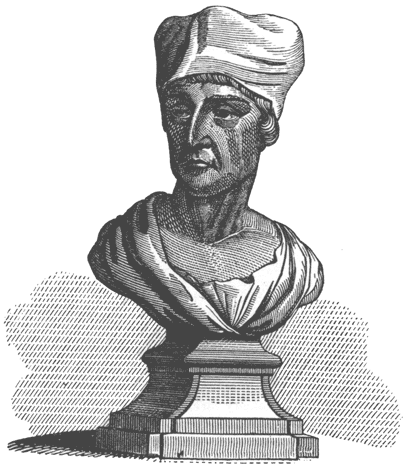
IN REFECTORIO COLL. OMN. ANIM. OXON.
Bale follows closely after Leland. This once celebrated, and yet respectable, writer had probably more zeal than discretion; but his exertions in the cause of our own church can never be mentioned without admiration. I would not, assuredly, quote Bale as a decisive authority in doubtful or difficult cases;[322] but, as he lived in the times of which he in a great measure wrote, and as his society was courted by the wealthy and powerful, I am not sure whether he merits to be treated with the roughness with which some authors mention his labours. He had, certainly, a tolerable degree of strength in his English style; but he painted with a pencil which reminded us more frequently of the horrific pictures of Spagnoletti than of the tender compositions of Albano. That he idolized his master, Leland, so enthusiastically, will always cover, in my estimation, a multitude of his errors: and that he should leave a scholar's inventory (as Fuller saps), "more books than money behind him," will at least cause him to be numbered among the most renowned bibliomaniacs.

Before I enter upon the reign of Elizabeth, let me pay a passing, but sincere, tribute of respect to the memory of Cranmer; whose Great Bible[323] is at once a monument of his attachment to the Protestant religion, and to splendid books. His end was sufficiently lamentable; but while the flames were consuming his parched body, and while his right hand, extended in the midst of them, was reproached by him for its former act of wavering and "offence," he had the comfort of soothing his troubled spirit by reflecting upon what his past life had exhibited in the cause of learning, morality, and religion.[324] Let his memory be respected among virtuous bibliomaniacs!
Marmoreo Licinus tumulo jacet, at Cato parvo, Pompeius nullo. Quis putet esse Deos?
No; we are better Christians, I trust, than so: who are taught, that the rewards of God's elect are not temporal but eternal. And Cranmer's martyrdom is his monument, and his name will outlast an epitaph or a shrine." Life of Cranmer; p. 391. It would seem, from the same authority, that Ridley, Latimer, and Cranmer, were permitted to dine together in prison, some little time before they suffered; although they were "placed in separate lodgings that they might not confer together." Strype saw "a book of their diet, every dinner and supper, and the charge thereof,"—as it was brought in by the bailiffs attending them.
Dinner Expenses of Ridley, Latimer, and Cranmer.
Bread and Aleiid.
Item, Oistersid.
Item, Butteriid.
Item, Eggsiid.
Item, Lyngviiid.
Item, A piece of fresh Salmonxd.
Wineiiid.
Cheese and pearsiid.
Charges for burning Ridley and Latimer.
s.d.
For three loads of wood fagots120
Item, One load of furs fagots34
For the carriage of the same20
Item, A Post14
Item, Two chains34
Item, Two staples06
Item, Four Labourers28
Charges for burning Cranmer.
s.d.
For an 100 of wood fagots,060
For an 100 and half of furs fagots034
For the carriage of them08
To two labourers14
I will draw the curtain upon this dismal picture, by a short extract from one of Cranmer's letters, in which this great and good man thus ingeniously urges the necessity of the Scriptures being translated into the English language; a point, by the bye, upon which neither he, nor Cromwell, nor Latimer, I believe, were at first decided; "God's will and commandment is, (says Cranmer) that when the people be gathered together, the minister should use such language as the people may understand, and take profit thereby; or else hold their peace. For as an harp or lute, if it give no certain sound that men may know what is stricken, who can dance after it—for all the sound is vain; so is it vain and profiteth nothing, sayeth Almighty God, by the mouth of St. Paul, if the priest speak to the people in a language which they know not." Certain most godly, fruitful, and comfortable letters of Saintes and holy Martyrs, &c., 1564; 4to., fol. 8.
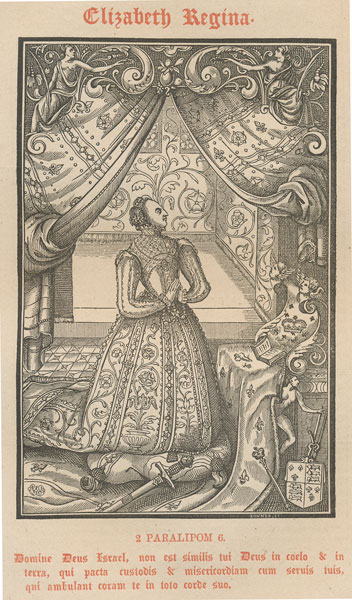
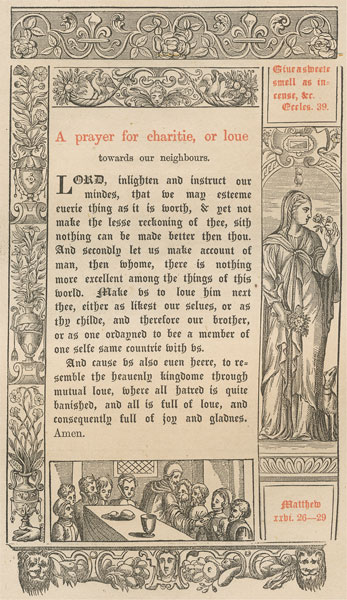
All hail to the sovereign who, bred up in severe habits of reading and meditation, loved books and scholars to the very bottom of her heart! I consider Elizabeth as a royal bibliomaniac of transcendent fame!—I see her, in imagination, wearing her favourite little Volume of Prayers,[325] the composition of Queen Catherine Parr, and Lady Tirwit, "bound in solid gold, and hanging by a gold chain at her side," at her morning and evening devotions—afterwards, as she became firmly seated upon her throne, taking an interest in the embellishments of the Prayer Book,[326] which goes under her own name; and then indulging her strong bibliomaniacal appetites in fostering the institution "for the erecting of a Library and an Academy for the study of Antiquities and History."[327] Notwithstanding her earnestness to root out all relics of the Roman Catholic religion (to which, as the best excuse, we must, perhaps, attribute the sad cruelty of the execution of Mary, Queen of Scots), I cannot in my heart forbear to think but that she secured, for her own book-boudoir, one or two of the curious articles which the commissioners often-times found in the libraries that they inspected: and, amongst other volumes, how she could forbear pouncing upon "A great Pricksong Book of parchment"—discovered in the library of All Soul's College[328]—is absolutely beyond my wit to divine!
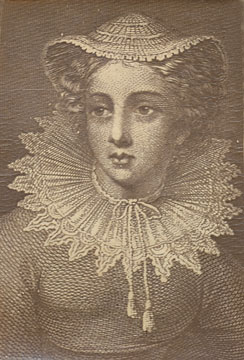
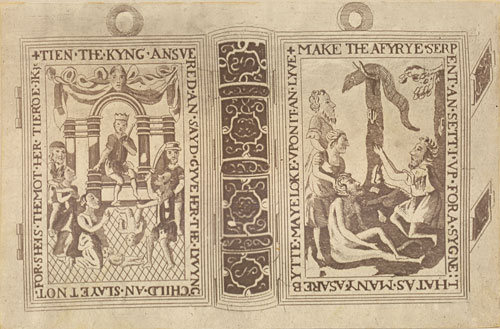
[Enlarge]
Three mass books, old and new, and 2 portmisses Item, 8 grailes, 7 antiphoners of parchment and bound —— 10 Processionals old and new —— 2 Symnalls —— an old manual of paper —— an Invitatorie book —— 2 psalters—and one covered with a skin —— A great pricksong book of parchment —— One other pricksong book of vellum covered with a hart's skyn —— 5 other of paper bound in parchment —— The Founder's mass-book in parchment bound in board —— In Mr. Mill his hand an antiphoner and a legend —— A portmisse in his hand two volumes, a manual, a mass-book, and a processional.
[Enlarge]
Elizabeth Regina.
2 PARALIPOM 6.
Domine Deus Israel, non est similis tui Deus in coelo & in terra, qui pacta custodis & misericordiam cum seruis tuis, qui ambulant coram te in toto corde suo.
[Enlarge]
Giue a sweete smell as incense, &c. Eccles. 39.
A prayer for charitie, or loue towards our neighbours.
LORD, inlighten and instruct our mindes, that we may esteeme euerie thing as it is worth, & yet not make the lesse reckoning of thee, sith nothing can be made better then thou. And secondly let us make account of man, then whome, there is nothing more excellent among the things of this world. Make vs to loue him next thee, either as likest our selues, or as thy childe, and therefore our brother, or as one ordayned to bee a member of one selfe same countrie with vs.
And cause vs also euen heere, to resemble the heauenly kingdome through mutual loue, where all hatred is quite banished, and all is full of loue, and consequently full of joy and gladnes. Amen.
Matthew xxvi. 26-29.
Loren. You are full of book anecdote of Elizabeth: but do you forget her schoolmaster, Roger Ascham?
Lysand. The master ought certainly to have been mentioned before his pupil. Old Roger is one of my most favourite authors; and I wish English scholars in general not only to read his works frequently, but to imitate the terseness and perspicuity of his style. There is a great deal of information in his treatises, respecting the manners and customs of his times; and as Dr. Johnson has well remarked, "his philological learning would have gained him honour in any country."[329] That he was an ardent bibliomaniac, his letters when upon the continent, are a sufficient demonstration.
From the tutor of Elizabeth let us go to her prime minister, Cecil.[330] We have already seen how successfully this great man interposed in matters of religion; it remains to notice his zealous activity in the cause of learning. And of this latter who can possibly entertain a doubt? Who that has seen how frequently his name is affixed to Dedications, can disbelieve that Cecil was a lover of books? Indeed I question whether it is inserted more frequently in a diplomatic document or printed volume. To possess all the presentation copies of this illustrious minister would be to possess an ample and beautiful library of the literature of the sixteenth century.
Now see these Swannes the new and worthie seate Of famous Cicill, treasorer of the land, Whose wisedome, counsell skill of Princes state The world admires, then Swannes may do the same: The house itselfe doth shewe the owner's wit, And may for bewtie, state, and every thing, Compared be with most within the land, Vallan's Tale of Two Swannes, 1590, 4to., reprinted in Leland's Itinerary; vol. v. p. xiii, edit. 1770.
But the book-loving propensities of Elizabeth's minister were greatly eclipsed by those of her favourite archbishop, Parker:
clarum et venerabile nomen Gentibus, et multum nostræ quod proderat urbi.
For my part, Lorenzo, I know of no character, either of this or of any subsequent period, which is more entitled to the esteem and veneration of Englishmen. Pious, diffident, frank, charitable, learned, and munificent, Parker was the great episcopal star of his age, which shone with undiminished lustre to the last moment of its appearance. In that warm and irritable period, when the Protestant religion was assailed in proportion to its excellence, and when writers mistook abuse for argument, it is delightful to think upon the mild and temperate course which this discreet metropolitan pursued! Even with such arrant bibliomaniacs as yourselves, Parker's reputation must stand as high as that attached to any name, when I inform you that of his celebrated work upon the "Antiquity of the British Church"[331] are only twenty copies supposed to have been printed. He had a private press, which was worked with types cast at his own expense; and a more determined book-fancier, and treasurer of ancient lore, did not at that time exist in Great Britain.
Archbishop Parker's early Studies and popular Preaching.
"But now, he being very well and perfectly instructed in the liberal sciences, he applied all his mind to the study of divinity, and to the reading of the volumes of the ecclesiastical fathers; and that so earnestly that, in short space of time, he bestowed his labour not unprofitably in this behalf; for, after the space of four or five years, he, issuing from his secret and solitary study into open practice in the commonwealth, preached every where unto the people with great commendation; and that in the most famous cities and places of this realm, by the authority of King Henry VIII., by whose letters patent this was granted unto him, together with the license of the Archbishop of Canterbury. In execution of this function of preaching, he gained this commodity; that the fame of him came unto the ears of King Henry," &c. Sign. A. iij. recto.
His attention to Literature and Printing, &c.
"——he was very careful, and not without some charges, to seek the monuments of former times; to know the religion of the ancient fathers, and those especially which were of the English church. Therefore in seeking up the Chronicles of the Britons and English Saxons, which lay hidden every where contemned and buried in forgetfulness, and through the ignorance of the languages not well understanded, his own especially, and his mens, diligence wanted not. And to the end that these antiquities might last long, and be carefully kept, he caused them, being brought into one place, to be well bound and trimly covered. And yet, not so contented, he endeavoured to set out in print certain of those ancient monuments, whereof he knew very few examples to be extant; and which he thought would be most profitable for the posterity, to instruct them in the faith and religion of the elders. [Orig. 'to instructe them in the faythe and religion off the elders.] Hereupon, he caused the perpetual histories of the English affairs, by Mathæus Parisiensis, once a monk of Saint Alban's, and Mathæus Florilegus, a monk of Saint Peter in Westminster, written in Latin, to be printed; after he had diligently conferred them with the examples which he could get in any place; to the end that, as sincerely as might be, as the authors first left them, he might deliver them into other men's hands. Lastly, that he might not be unmindful of those monuments which, both in antiquity, worthiness, and authority, excelled all other, or rather wherewith none are to be compared (I mean the Holy Scriptures) here he thought to do great good if, by his number, he increased the Holy Bibles, which shortly would be wanting to many churches, if this discommodity were not provided for in time. Therefore it seemed good unto him, first, with his learned servants, to examine thoroughly the English translation; wherein he partly used the help of his brethren bishops, and other doctors; with whom he dealt so diligently in this matter that they disdained not to be partners and fellows with him of his labor. And now all their work is set out in very fair forms and letters of print," &c. Sign. C. rect. & rev.
His work De Antiquitate Ecclesiæ Britannicæ.
"——Much more praiseworthy is she (the 'Assyrian Queen of Babylon,') than he, whosoever it was, that of late hath set forth, to the hurt of christian men, certain rhapsodies and shreds of the old forworn stories, almost forgotten—had he not (Parker) now lately awakened them out of a dead sleep, and newly sewed them together in one book printed; whose glorious life promiseth not mountains of gold, as that silly heathen woman's (the aforesaid Queen) tomb, but beareth Christ in the brow, and is honested with this title in the front, 'De Antiquitate,' &c." Sign. C. iiij. rev. The satirical part, beginning with "To the Christian Reader," follows the biography from which these extracts have been taken. It remains to observe, that our Archbishop was a bibliomaniac of the very first order; and smitten with every thing attached to a Book, to a degree beyond any thing exhibited by his contemporaries. Parker did not scruple to tell Cecil that he kept in his house "drawers of pictures, wood-cutters, painters, limners, writers, and book-binders,"—"one of these was Lylye, an excellent writer, that could counterfeit any antique writing. Him the archbishop customarily used to make old books compleat,"—&c. Strype's Life of Parker; pp. 415, 529. Such was his ardour for book-collecting that he had agents in almost all places, abroad and at home, for the purpose of securing everything that was curious, precious, and rare: and one of these, of the name of Batman (I suppose the commentator upon Bartholomæus) "in the space of no more than four years, procured for our archbishop to the number of 6700 books." Id. p. 528. The riches of his book bequests to Cambridge are sufficiently described by Strype; pp. 501, 518, 519, 529, &c. The domestic habits and personal appearance of Parker are described by his biographer (p. 504) as being simple and grave. Notwithstanding his aversion to wearing silk, to plays and jests, and hawks and hounds (even when he was a young man), I take it for granted he could have no inward dislike to the beautiful and appropriate ceremony which marked his consecration, and which is thus narrated by the lively pen of Fuller: "The east part of the chapel of Lambeth was hung with tapestry, the floor spread with red cloth, chairs and cushions are conveniently placed for the purpose: morning prayers being solemnly read by Andrew Peerson, the archbishop's chaplain, Bishop Scory went up into the pulpit, and took for his text, The Elders which are among you I exhort, who also am an elder; and a witness of the sufferings of Christ, &c. Sermon ended, and the sacrament administered, they proceed to the consecration. The Archbishop had his rochet on, with Hereford; and the suffragan of Bedford, Chichester, wore a silk cope; and Coverdale a plain cloth gown down to his ancles. All things are done conformable to the book of ordination: Litany sung; the Queen's patent for Parker's consecration audibly read by Dr. Vale: He is presented: the oath of supremacy tendered to him; taken by him; hands reverently imposed on him; and all with prayers begun, continued, concluded. In a word, though here was no theatrical pomp to made it a popish pageant; though no sandals, gloves, ring, staff, oil, pall, &c., were used upon him—yet there was ceremony enough to clothe his consecration with decency, though not to clog it with superstition." Church History, b. ix., p. 60. But the virtues of the primate, however mild and unostentatious, were looked upon with an envious eye by the maligant observer of human nature; and the spontaneous homage which he received from some of the first noblemen in the realm was thus lampooned in the satirical composition just before noticed:
Homage and Tribute paid to Archbishop Parker.
"The next is, what great tributes every made bishop paid him. How they entertained his whole household or court, for the time, with sumptuous feasting. How dearly they redeemed their own cloaths, and carpets, at his chaplain's hands. What fees were bestowed on his crucifer, marshall, and other servants. All which plentiful bounty, or rather, he might have said, largess, is shrunk up, he saith, to a small sum of ten pounds, somewhat beside, but very small, bestowed, he might have said cast away, upon the archbishop's family, &c.—The same earl (of Gloucester) must be his steward and chief cupbearer, the day of his inthronization: This is not to be called gracious Lords, as the Lords of the earth, but this is to be beyond all grace; and to be served of these gracious Lords, and to be their Lord paramount. In this roll of his noble tenants, the next are the Lord Strangways, the Earl of Oxford, the Lord Dacy, all which (saith he) owe service to that Archbishop. Then descendeth he to the gifts that every his suffragan provincial bishop bestoweth on him, in their life, and at their death: some their palfrey with saddle and furniture; some their rings, and some their seals. Among the rest, the Bishop of Rochester, who is there called specially his chaplain, giveth him a brace of dogs. These be trim things for prelates to give or receive; especially of them to make such account as to print them among such special prerogatives." Sign. D. iiij. v. Yet even to this libel was affixed the following epitaph upon Parker; which shews that truth "is great, and will prevail."
Matthew Parker liued sober and wise Learned by studie, and continuall practise, Louinge, true, off life uncontrold The courte did foster him, both young and old. Orderly he delt, the ryght he did defend, He lyved unto God, to God he mad his ende.
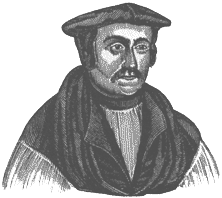
Let us take leave of this amiable, erudite, and truly exemplary, character, by contemplating his features—according to the ensuing cut of Tyson's fac-simile of the rare ancient print, prefixed to some of the copies of the Antiquity of the British Church; premising that the supposed original painting of Parker, at Benet College, Cambridge, is nothing more than one of the aforesaid ancient prints, delicately coloured: as a tasteful antiquary, of the first authority, discovered, and mentioned to me.
Phil. You have called the reign of Henry the Seventh the Augustan-Book-age; but, surely, this distinction is rather due to the æra of Queen Elizabeth?
Lysand. Both periods merit the appellation. In Henry's time, the invention of printing was of early growth; but the avidity of readers considerable. The presses of Rome, Venice, and Paris, sent forth their costly productions; and a new light, by such means, was poured upon the darkened mind. Our own presses began to contribute to the diffusion of this light; and, compared with the preceding part of the fifteenth century, the reign of Henry VII. was highly distinguished for its bibliomaniacal celebrity. Undoubtedly, the æra of Queen Elizabeth was the golden age of Bibliomaniacism.
Do not let me forget, in my rambling method of treating of books and book-men, the name and celebrity of the renowned Dr. John Dee. Let us fancy we see him in his conjuring cap and robes—surrounded with astrological, mathematical, and geographical instruments—with a profusion of Chaldee characters inscribed upon vellum rolls—and with his celebrated Glass suspended by magical wires. Let us then follow him into his study at midnight, and view him rummaging his books; contemplating the heavens; making calculations; holding converse with invisible spirits; writing down their responses: anon, looking into his correspondence with Count a Lasco and the emperors Adolphus and Maximilian; and pronouncing himself, with the most heartfelt complacency, the greatest genius of his age![332] In the midst of these self-complacent reveries, let us imagine we see his wife and little ones intruding; beseeching him to burn his books and instruments; and reminding him that there was neither a silver spoon, nor a loaf of bread, in the cupboard. Alas, poor Dee!—thou wert the dupe of the people and of the Court: and, although Meric Casaubon has enshrined thy conjurations in a pompous folio volume, thy name, I fear, will only live in the memory of bibliomaniacs!
Dee's Library:
"4000 Volumes—printed and unprinted—bound and unbound—valued at 2000 lib.
1 Greek, 2 French, and 1 High Dutch, volumes of MSS., alone worth 533 lib. 40 years in getting these books together."
Appertaining thereto,
Sundry rare and exquisitely made Mathematical Instruments.
A radius Astronomicus, ten feet long.
A Magnet Stone, or Loadstone; of great virtue—"which was sold out of the library for v shill. and for it afterwards (yea piece-meal divided) was more than xx lib. given in money and value."
"A great case or frame of boxes, wherein some hundreds of very rare evidences of divers Irelandish territories, provinces, and lands, were laid up. Which territories, provinces, and lands were therein notified to have been in the hands of some of the ancient Irish princes. Then, their submissions and tributes agreed upon, with seals appendant to the little writings thereof in parchment: and after by some of those evidences did it appear how some of those lands came to the Lascies, the Mortuomars, the Burghs, the Clares," &c.
"A box of Evidences antient of some Welch princes and noblemen—the like of Norman donation—their peculiar titles noted on the forepart with chalk only, which on the poor boxes remaineth." This box, with another, containing similar deeds, were embezzled.
"One great bladder with about 4 pound weight, of a very sweetish thing, like a brownish gum in it, artificially prepared by thirty times purifying of it, hath more than I could well afford him for 100 crownes; as may be proved by witnesses yet living."
To these he adds his three Laboratories, "serving for Pyrotechnia"—which he got together after 20 years' labour. "All which furniture and provision, and many things already prepared, is unduly made away from me by sundry meanes, and a few spoiled or broken vessels remain, hardly worth 40 shillings." But one more feature in poor Dee's character—and that is his unparalleled serenity and good nature under the most griping misfortunes—remains to be described: and then we may take farewell of him, with aching hearts. In the 10th chapter, speaking of the wretched poverty of himself and family—("having not one penny of certain fee, revenue, stipend, or pension, either left him or restored unto him,")—Dee says that "he has been constrained now and then to send parcels of his little furniture of plate to pawn upon usury; and that he did so oft, till no more could be sent. After the same manner went his wives' jewels of gold, rings, bracelets, chains, and other their rarities, under the thraldom of the usurer's gripes: 'till non plus was written upon the boxes at home." In the 11th chapter, he anticipates the dreadful lot of being brought "to the stepping out of doors (his house being sold). He, and his, with bottles and wallets furnished, to become wanderers as homish vagabonds; or, as banished men, to forsake the kingdom!" Again: "with bloody tears of heart, he, and his wife, their seven children, and their servant (seventeen of them in all), did that day make their petition unto their honours," &c. Can human misery be sharper than this—and to be the lot of a philosopher and bibliomaniac?! But "veniet felicius ævum."
Of a wholly different cast of character and of reading was the renowned Captain Cox of Coventry. How many of Dee's magical books he had exchanged for the pleasanter magic of Old Ballads and Romances, I will not take upon me to say; but that this said bibliomaniacal Captain had a library, which, even from Master Laneham's imperfect description of it,[333] I should have preferred to the four thousand volumes of Dr. John Dee, is most nuquestionable.
We now approach two characters of a more dignified cast; and who, in every respect, must be denominated the greatest bibliomaniacs of the age: I mean Sir Robert Cotton and Sir Thomas Bodley. We will touch upon them separately.
The numerous relics which are yet preserved of the Cottonian Collection, may serve to convey a pretty strong idea of its splendour and perfection in its original shape. Cotton had all the sagacity and judgment of Lord Coke, with a more beautifully polished mind, and a more benevolent heart. As to books, and book men, he was the Mecænas[334] of his day. His thirst for knowledge could never be satiated; and the cultivation of the mind upon the foundation of a good heart, he considered to be the highest distinction, and the most permanent delight, of human beings. Wealth, pomp, parade, and titles, were dissipated, in the pure atmosphere of his mind before the invigorating sun of science and learning. He knew that the tomb which recorded the worth of the deceased had more honest tears shed upon it than the pompous mausoleum which spoke only of his pedigree and possessions. Accordingly, although he had excellent blood flowing in his veins, Cotton sought connection with the good rather than with the great; and where he found a cultivated understanding, and an honest heart, there he carried with him his Lares, and made another's abode his own.
Equally celebrated for literary zeal, and yet more for bibliomaniacal enthusiasm, was the famous Sir Thomas Bodley; whose account of himself, in Prince's Worthies of Devon, and particularly in one of Hearne's publications,[335] can never be read without transport by an affectionate son of our Oxford Alma Mater. View this illustrious bibliomaniac, with his gentleman-like air, and expressive countenance, superintending, with the zeal of a Custom-house officer, the shipping, or rather barging, of his books for the grand library which is now called by his own name! Think upon his activity in writing to almost every distinguished character of the realm: soliciting, urging, arguing, entreating for their support towards his magnificent establishment; and, moreover, superintending the erection of the building, as well as examining the timbers, with the nicety of a master-carpenter!—Think of this; and when you walk under the grave and appropriately-ornamented roof, which tells you that you are within the precincts of the Bodleian Library, pay obeisance to the portrait of the founder, and hold converse with his gentle spirit that dwells therein!
"Soon grew from pigmy to gigantic size."
The reader is therefore here informed, as a necessary preliminary piece of intelligence, that the present note will be more monstrous than any preceding one of a similar nature. Let him, however, take courage, and only venture to dip his feet in the margin of the lake, and I make little doubt but that he will joyfully plunge in, and swim across it. Of the parentage, birth, and education of Bodley there seems to be no necessity for entering into the detail. The monument which he has erected to his memory is lofty enough for every eye to behold; and thereupon may be read the things most deserving of being known. How long the subject of his beloved library had occupied his attention it is perhaps of equal difficulty and unimportance to know; but his determination to carry this noble plan into effect is thus pleasingly communicated to us by his own pen: "when I had, I say, in this manner, represented to my thoughts, my peculiar estate, I resolved thereupon to possess my soul in peace all the residue of my days; to take my full farewell of state employments; to satisfy my mind with that mediocrity of worldly living that I have of my own, and so to retire me from the Court; which was the epilogue and end of all my actions and endeavours, of any important note, till I came to the age of fifty-three years."—"Examining exactly, for the rest of my life, what course I might take; and, having, as I thought, sought all the ways to the wood, I concluded, at the last, to set up my staff at the library door in Oxon, being thoroughly persuaded, in my solitude and surcease from the commonwealth affairs, I could not busy myself to better purpose than by reducing that place (which then in every part lay ruinated and waste) to the public use of Students." Prince's Worthies of Devon, p. 95, edit. 1810. Such being the reflections and determination of Sir Thomas Bodley, he thus ventured to lay open his mind to the heads of the University of Oxford:
"To the Vice-Chancellor (Dr. Ravis) of Oxon; about restoring the public library.
(This letter was published in a convocation holden March 2, 1597)
Sir,
Although you know me not, as I suppose, yet for the farthering an offer, of evident utility, to your whole university, I will not be too scrupulous in craving your assistance. I have been always of a mind that, if God, of his goodness, should make me able to do any thing, for the benefit of posterity, I would shew some token of affection, that I have ever more borne, to the studies of good learning. I know my portion is too slender to perform, for the present, any answerable act to my willing disposition: but yet, to notify some part of my desire in that behalf, I have resolved thus to deal. Where there hath been heretofore a public library in Oxford, which, you know, is apparent by the room itself remaining, and by your statute records, I will take the charge and cost upon me to reduce it again to his former use: and to make it fit and handsome, with seats, and shelves, and desks, and all that may be needfull, to stir up other men's benevolence, to help to furnish it with books. And this I purpose to begin, as soon as timber can be gotten, to the intent that you may reap some speedy profit of my project. And where before, as I conceive, it was to be reputed but a store of books of divers benefactors, because it never had any lasting allowance, for augmentation of the number, or supply of books decayed: whereby it came to pass that, when those that were in being were either wasted or embezelled, the whole foundation came to ruin:—to meet with that inconvenience, I will so provide hereafter (if God do not hinder my present design) as you shall be still assured of a standing annual rent, to be disbursed every year in buying of books, in officers' stipends, and other pertinent occasions, with which provision, and some order for the preservation of the place, and of the furniture of it, from accustomed abuses, it may, perhaps, in time to come, prove a notable treasure for the multitude of volumes; an excellent benefit for the use and ease of students; and a singular ornament in the University. I am, therefore, to intreat you, because I will do nothing without their public approbation, to deliver this, that I have signified, in that good sort, that you think meet: and when you please to let me know their acceptation of my offer, I will be ready to effect it with all convenient expedition. But, for the better effecting of it, I do desire to be informed whether the University be sufficiently qualified, by licence of Mortmain, or other assurance, to receive a farther grant of any rent or annuity than they do presently enjoy. And, if any instruments be extant of the ancient donations to their former library, I would, with their good liking, see a transcript of them: and likewise of such statutes as were devised by the founders, or afterwards by others for the usage of the books. Which is now as much as I can think on, whereunto, at your good leisure, I would request your friendly answer. And, if it lie in my ability to deserve your pains in that behalf, although we be not yet acquainted, you shall find me very forward. From London, Feb. 23, 1597.
Your affectionate friend,
Tho. Bodley."
In the Easter following, "Mr. Bodley came to Oxford to view the place on which he intended his bounty, and making them a model of the design with the help of Mr. Saville, Warden of Merton College, ordered that the room, or place of stowage, for books, should be new planked, and that benches and repositories fo books should be set up." Wood's Annals of the University, vol. ii., pt. ii., p. 920. The worthy founder then pursued his epistolary intercourse with the Vice-Chancellor:
"To Mr. Vice Chancellor.
Sir,
I find myself greatly beholden unto you for the speed that you have used in proposing my offer to the whole University, which I also hear by divers friends was greatly graced in their meeting with your courteous kind speeches. And though their answer of acceptance were over thankful and respective; yet I take it unto me for a singular comfort, that it came for that affection, whose thanks in that behalf I do esteem a great deal more than they have reason to esteem a far better offer. In which respect I have returned my dutiful acknowledgement, which I beseech you to present, when you shall call a convocation, about some matter of greater moment. Because their letter was in Latin, methought it did enforce me not to show myself a truant, by attempting the like, with a pen out of practice: which yet I hope they will excuse with a kind construction of my meaning. And to the intent they may perceive that my good will is as forward to perform as to promise, and that I purpose to shew it to their best contentation, I do hold it very requisite that some few should be deputed by the rest of the House to consider, for the whole, of the fittest kind of facture of desks, and other furniture; and when I shall come to Oxford, which I determine, God willing, some time before Easter, I will then acquaint the self same parties with some notes of a platform, which I and Mr. Savile have conceived here between us: so that, meeting altogether, we shall soon resolve upon the best, as well for shew, and stately form, as for capacity and strength, and commodity of students. Of this my motion I would pray you to take some notice in particular, for that my letter herewith to your public assembly doth refer itself in part to your delivery of my mind. My chiefest care is now, the while, how to season my timber as soon as possible. For that which I am offered by the special favour of Merton College, although it were felled a great while since, yet of force it will require, after time it is sawed, a convenient seasoning; least by making too much haste, if the shelves and seats should chance to warp, it might prove to be an eye sore, and cost in a manner cast away. To gain some time in that regard, I have already taken order for setting sawyers a-work, and for procuring besides all other materials; wherein my diligence and speed shall bear me witness of my willingness to accomplish all that I pretend, to every man's good liking. And thus I leave and commend you to God's good tuition. From London, March 19, —97
Your assured to use in all your occasions,
Tho. Bodley."
Neither this nor the preceding letter are published in Mr. Gutch's valuable edition of Wood's original text: but are to be found, as well as every other information here subjoined, in Hearne's edition of Joh. Confrat. &c., de Reb. Glaston., vol. ii., pp. 612 to 645. We will next peruse the curious list of the first benefactors to the Bodleian Library.
My Lord of Essex: about 300 volumes: greater part in folio.
My Lord Chamberlain: 100 volumes, all in a manner new bound, with his arms, and a great part in folio.
The Lord Montacute: 66 costly great volumes, in folio; all bought of set purpose, and fairly bound with his arms.
The Lord Lumley: 40 volumes in folio.
Sir Robert Sidney: 102 new volumes in folio, to the value of one hundred pounds, being all very fair, and especially well bound with his arms.
Merton College: 38 volumes of singular good books in folio, &c.
Mr. Philip Scudamor: 50 volumes: greatest part in folio.
Mr. William Gent: 100 volumes at the least.
Mr. Lawrence Bodley: 37 very fair and new bought books in folio. (There were seven other donations—in money, from 4 to 10l.)
Another list of benefactors; read in Convocation, July 17, 1601.
Sir John Fortescue, Knt.: 47 volumes: of which there are 5 Greek MSS. of singular worth.
Mr. Jo. Crooke: Recorder of the City of London: 27 good volumes; of which 25 are in folio.
Mr. Henry Savile: all the Greek interpreters upon Aust(in).
Mr. William Gent, of Glocester Hall: 160 volumes; of which there are 50 in folio.
Mr. Thomas Allen, of do., hath given 12 rare MSS., with a purpose to do more, and hath been ever a most careful provoker and solicitor of sundry great persons to become benefactors.
Mr. William Camden, by his office Clarentius: 7 volumes; of which 4 are manuscripts.
Mr. Thomas James, of New College: 100 volumes: almost all in folio, and sundry good manuscripts. With about 50 other donations, chiefly in money.
To Dr. Raves, Vice-Chanc. (Read in Convoc. May 10, 1602.)
A yet larger, and more complete, list will be found in Mr. Gutch's publication of Wood's text. Let us next observe how this distinguished bibliomaniac seized every opportunity—laying embargoes upon barges and carriages—for the conveyance of his book-treasures. The ensuing is also in Mr. Gutch's work:
"To the Right W. Mr. D. King, Dean of Christ-Church, and Vice-Chancellor of the University of Oxon, or, in his absence, to his Deputies there.
(Read in Convocation, July 8, 1608.)
Sir,
I have sent down, by a western barge, all the books that I have of this year's collection, which I have requested Mr. James, and other of my friends, to see safely brought from Burcote, and placed in the library. Sir Francis Vere hath sent me this year his accustomed annual gift of ten pounds. The Lady Mary Vere, wife to Sir Horace Vere, in the time of her widowhood (for so she is desired it should be recorded), being called Mrs. Hoby, of Hales, in Gloucestershire, hath given twenty pound. (He then enumerates about 15 other donations, and thus goes on:) Thus I thought meet to observe my yearly custom, in acquainting the University with the increase of their store: as my care shall be next, and that very shortly, to endow them with that portion of revenue and land that I have provided, whensoever God shall call me, for the full defraying of any charge that, by present likelihood, the conservation of the books, and all needful allowances to the keeper and others, may from time to time require. I will send you, moreover, a draught of certain statutes, which I have rudely conceived about the employment of that revenue, and for the government of the library: not with any meaning that they should be received, as orders made by me (for it shall appear unto you otherwise) but as notes and remembrances to abler persons, whom hereafter you may nominate (as I will also then request you) to consider of those affairs, and so frame a substantial form of government, sith that which is a foot is in many thinges defective for preservation of the library: for I hold it altogether fitting that the University Convocation should be always possessed of an absolute power to devise any statutes, and of those to alter as they list, when they find an occasion of evident utility. But of these and other points, when I send you my project, I will both write more of purpose, and impart unto you freely my best cogitations, being evermore desirous, whatsoever may concern your public good, to procure and advance it so, to the uttermost of my power: as now in the meanwhile, reminding unto you my fervent affection, I rest for any service,
Your most assured, at commandment,
Tho. Bodleie.
London, June 30, 1608."
In a letter to his "dearest friends, Doctor Kinge, Vice-Chancellor, the Doctors, Proctors, and the rest of the Convocation House in Oxon," (16th June, 1609) after telling them how he had secured certain landed property for the payment of the salaries and other expenses attendant upon the library, Sir Thomas thus draws to a conclusion: "Now because I presuppose that you take little pleasure in a tedious letter, having somewhat besides to impart unto you, I have made it known by word to Mr. Vicechancellor, who, I know, will not fail to acquaint you with it: as withall I have intreated him to supply, in my behalf, all my negligent omissions, and defective form of thanks, for all your public honours, entertainments, letters, gifts, and other graces conferred upon me, which have so far exceeded the compass of my merits that, where before I did imagine that nothing could augment my zealous inclination to your general good, now methinks I do feel it (as I did a great while since) was very highly augmented: insomuch as I cannot but shrive myself thus freely and soothly unto you. That, albeit, among a number of natural imperfections, I have least of all offended in the humour of ambition, yet now so it is, that I do somewhat repent me of my too much niceness that way: not as carried with an appetite to rake more riches to myself (wherein, God is my witness, my content is complete) but only in respect of my greedy desire to make a livelier demonstration of the same that I bear to my common mother, than I have hitherto attained sufficient ability to put in execution. With which unfeigned testification of my devotion unto you, and with my daily fervent prayers for the endless prosperity of your joint endeavours, in that whole institution of your public library, I will close up this letter, and rest, as I shall ever,
Yours, in all loving and dutiful affection,
Thomas Bodley.
London, May 31, 1609."
The following, which is also in Mr. Gutch's publication, shews the laudable restlessness, and insatiable ambition, of our venerable bibliomaniac, in ransacking foreign libraries for the completion of his own.
"To the Right Worshipfull Mr. D. Singleton, Vicechancellor of the University of Oxon.
(Read in Convocation, Nov. 9, 1611.)
Sir,
About some three years past, I made a motion, here in London, to Mr. Pindar, Consul of the Company of English Merchants at Aleppo (a famous port in the Turk's dominions) that he would use his best means to procure me some books in the Syriac, Arabic, Turkish, and Persian tongues, or in any other language of those Eastern nations: because I make no doubt but, in process of time, by the extraordinary diligence of some one or other student, they may be readily understood, and some special use made of their kind of learning in those parts of the world: and where I had a purpose to reimburse all the charge that might grow thereupon, he sent of late unto me 20 several volumes in the foresaid tongues, and of his liberal disposition hath bestowed them freely on the library. They are manuscripts all (for in those countries they have no kind of printing) and were valued in that place at a very high rate. I will send them, ere be long, praying you the while to notify so much unto the University, and to move them to write a letter of thanks, which I will find means to convey to his hands, being lately departed from London to Constantinople. Whether the letter be indited in Latin or English, it is not much material, but yet, in my conceit, it will do best to him in English."
(The remainder of this letter is devoted to a scheme of building the public schools at Oxford; in which Sir Thomas found a most able and cheerful coadjutor, in one, Sir Jo. Benet; who seems to have had an extensive and powerful connection, and who set the scheme on foot, "like a true affected son to his ancient mother, with a cheerful propension to take the charge upon him without groaning.")
In April 1585, Queen Elizabeth granted Sir Thomas "a passport of safe conveyance to Denmark"; and wrote a letter to the King of Denmark of the same date, within two days. She wrote, also, a letter to Julius, Duke of Brunswick of the same date: in which the evils that were then besetting the Christian world abroad were said to be rushing suddenly, as "from the Trojan Horse." "These three letters (observes Mr. Baker to his friend Hearne) are only copies, but very fairly wrote, and seem to have been duplicates kept by him that drew the original letters."
We will peruse but two more of these Bodleian epistles, which Hearne very properly adds as an amusing appendix, as well to the foregoing, as to his Reliquiæ Bodleianæ (1703, 8vo). They are written to men whose names must ever be held in high veneration by all worthy bibliomanacs.
"Sir Tho. Bodley to Sir Robert Cotton. (Ex. Bibl. Cotton.)
Sir,
I was thrice to have seen you at your house, but had not the hap to find you at home. It was only to know how you hold your old intention for helping to furnish the University Library: where I purpose, God willing, to place all the books that I have hitherto gathered, within these three weeks. And whatsoever any man shall confer for the storing of it, such order is taken for a due memorial of his gift as I am persuaded he cannot any way receive a greater contentment of any thing to the value otherwise bestowed. Thus much I thought to signify unto you: and to request you to hear how you rest affected.
Yours, to use in any occasion,
Tho. Bodley.
From my house, June 6."
"Sir Henry Savile to Sir R(obert) C(otton).
Sir,
I have made Mr. Bodley acquainted with your kind and friendly offer, who accepteth of it in most thankful manner: and if it pleaseth you to appoint to-morrow at afternoon, or upon Monday or Tuesday next, at some hour likewise after dinner, we will not fail to be with you at your house for that purpose. And remember I give you fair warning that if you hold any book so dear as that you would be loth to have him out of your sight, set him aside before hand. For my own part, I will not do that wrong to my judgment as to chuse of the worst, if better be in place: and, beside, you would account me a simple man.
But to leave jesting, we will any of the days come to you, leaving, as great reason is, your own in your own power freely to retain or dispose. True it is that I have raised some expectation of the quality of your gift in Mr. Bodley, whom you shall find a gentleman in all respects worthy of your acquaintance. And so, with my best commendations, I commit you to God. This St. Peter's day.