Part 6 — The Alcove. (continued 2)
Reading edition
(See page 407, ante; for a brief account of this extraordinary copy.)
Plutarchi Vitæ (Lat.);Venet.N. Jenson.Folio, 1478. vol. 1.
Aristotelis Opera Varia (Lat.);Venet. Folio, 1483. 3 vols.
(This was the Pinelli copy, and was purchased for 73l. 10s.)
Statii Achilles;Brixiæ. Folio, 1485.
Chroniques de France, dictes de St. Denys;Paris. Folio, 1493. vol. 2 & 3.
Anthologia Græca;Florent. Quarto, 1494.
Lancelot du Lac;Paris.Verard,Folio, 1494. vol. 2.
Boccace des nobles Malheureux;ibid. Folio, 1494.
Appollonius Rhodius;Florent. Quarto, 1496.
Destruction de Troy le Grant;Paris. Folio, 1498.
Poliphili Hyperonotomachia;Venet. Folio, 1499.
Mer des Histores;Paris. Folio, (no date) 2 vols.
Monstrelet Chronique de;Paris. Folio, (no date) 3 vols.
Roman de la Rose;Paris.Verard.Folio, (no date)
—— de Tristan;ibid.id.(no date)
—— d' Ogier le Danois;ibid.id.(no date)
—— de Melis et Lenin;ibid.id.(no date)
I have heard that Count M'Carthy's books do not exceed 4000 in number; and of these, perhaps, no private collector in Europe has an equal number printed upon vellum. In our own country, however, the finest vellum library in the world might be composed from the collections of His Majesty, the Duke of Marlborough, Earl Spencer, Sir M.M. Sykes, Bart., Mr. Johnes, Mr. Coke, and the Quin collection. Yet let us not forget the finest vellum copy in the world of the first edition of Aristotle's works (wanting one volume) which may be seen in the library of Corpus Christi College, Oxford. Of Mr. Edward's similar copy of the first Livy, Lysander and myself (vide Part iii.) have spoken like honest bibliomaniacs. Earl Spencer possesses the rival volume, printed by the same printers, (Sweynheym and Pannartz) and upon the same material, in his Pliny Senior of 1470—But let all quiet bibliomaniacs wait with patience till the work of Mons. Praet upon this subject, alluded to at p. 68, ante, shall have made its appearance! and then—let us see whether we can prevail upon some Gnome to transport to us, through the 'thin air,' Pynson's 'Ship of Fools' upon vellum!!
Lis. Are we as successful in printing upon vellum as were our forefathers?
Lysand. Certainly not; if we except some of the works from the press of Bodoni—which are oftentimes truly brilliant. But the fault, in general, is rather in the preparation of the vellum than in the execution of the press-work.
Loren. You have seen, Lisardo, my small volumes of 'Heures,' or 'Missals,' as they are called; some of them in MS. and others in print—and what can be more delicate than the texture of the vellum leaves, or more perfect than the execution of penmanship and printing?
Alman. I have often set whole hours, my dear brother, in contemplating with rapture the sparkling radiance of these little volumes; and wish in my heart I had a few favourite authors executed in a similar manner! I should like to employ Bodoni[446] for life.
Lis. I could go on, 'till midnight, indulging my wishes of having favourite books printed upon vellum leaves; and at the head of these I would put Crammer's Bible for I want scholarship sufficient to understand the Complutensian Polyglott of Cardinal Ximenes.[447]
Berlin. So much for the Vellum Symptom. Proceed we now to the sixth: which upon looking at my memoranda, I find to be the First Editions. What is the meaning of this odd symptom?
Lysand. From the time of Ancillon to Askew, there has been a very strong desire expressed for the possesssion of original or first published editions[448] of works; as they are in general superintended and corrected by the author himself, and, like the first impressions of prints are considered more valuable. Whoever is possessed with a passion for collecting books of this kind, may unquestionably be said to exhibit a strong symptom of the Bibliomania: but such a case is not quite hopeless, nor is it deserving of severe treatment or censure. All bibliographers have dwelt on the importance of these editions[449] for the sake of collation with subsequent ones; and of detecting, as is frequently the case, the carelessness displayed by future editors. Of such importance is the first edition Shakspeare[450] considered, on the score of correctness, that a fac-simile reprint of it has been recently published. In regard to the Greek and Latin Classics, the possession of these original editions is of the first consequence to editors who are anxious to republish the legitimate text of an author. Wakefield, I believe, always regretted that the first edition of Lucretius had not been earlier inspected by him. When he began his edition, the Editio Princeps was not (as I have understood) in that storehouse of almost every thing which is exquisite and rare in ancient and modern classical literature—need I add the library of Earl Spencer?[451]
SIXTH MAXIM.
Who of Editions recks the least, But, when that hog, his mind would feast Fattens the intellectual beast With old, or new, without ambition,— I'll teach the pig to soar on high, (If pigs had pinions, by the bye) How'er the last may satisfy, The bonne bouche is the "First Edition." Bibliosophia; p. vi.
These first editions are generally, with respect to foreign works, printed in the fifteenth or in the early part of the sixteenth century: and indeed we have a pretty rich sprinkling of a similar description of first editions executed in our own country. It is not, therefore, without justice that we are described, by foreign bibliographers, as being much addicted to this class of books: "With what avidity, and at what great prices, this character of books is obtained by the Dutch, and especially by the English, the very illustrious Zach. Conrad ab Uffenbach shews, in the preface to the second volume of his catalogue." Vogt; p. xx., edit. 1793. There is a curious and amusing article in Bayle (English edition, vol i., 672, &c.) about the elder Ancillon, who frankly confessed that he "was troubled with the Bibliomania, or disease of buying books." Mr. D'Israeli says that he "always purchased first editions, and never waited for second ones," but I find it, in the English Bayle, note D, "he chose the best editions." The manner in which Ancillon's library was pillaged by the Ecclesiastics of Metz (where it was considered as the most valuable curiosity in the town) is thus told by Bayle: "Ancillon was obliged to leave Metz: a company of Ecclesiastics, of all orders, came from every part, to lay hands on this fine and copious library, which had been collected with the utmost care during forty years. They took away a great number of the books together; and gave a little money, as they went out, to a young girl, of twelve or thirteen years of age, who looked after them, that they might have it to say they had paid for them. Thus Ancillon saw that valuable collection dispersed, in which, as he was wont to say, his chief pleasure and even his heart was placed!"—Edit. 1734. A pleasant circumstance, connected with our present subject, occurred to the Rev. Dr. Charles Burney. At a small sale of books which took place at Messrs. King and Lochée's, some few years ago, the Doctor sent a commission, for some old grammatical treatises; and calling with Mr. Edwards to see the success of the commission, the latter, in the true spirit of bibliomaniacism, pounced upon an anciently-bound book, in the lot, which turned out to be—nothing less than the first edition of Manilius by Regiomontanus: one of the very scarcest books in the class of those of which we are treating! By the liberality of the purchaser, this primary bijou now adorns the noble library of the Bishop of Ely.
lay on Macduff! And d——d be he who first cries "Hold, enough!"
Such a spirit was irresistible, and bore down all opposition. The Duke was of course declared victor, and he marched off, triumphantly, with the volume under his arm. Lord Spencer has a fine copy of this first edition of Shakspeare, collated by Steevens himself.
——pinus ingens, albaque populus Umbram hospitalem consociare amant Ramis—
let the Doric Temple be raised, with its white-marbled columns, sacred to the memory of this illustrious nobleman! Let his bust, in basso-relievo, with appropriate embellishments, adorn the most conspicuous compartment within: and peace and virtue, and filial affection, will, I am sure, be the guardians of so cherished a spot!
ARMS OF EARL SPENCER.

It must not, however, be forgotten that, if first editions are, in some instances, of great importance, they are in many respects superfluous, and only incumber the shelves of a collector; inasmuch as the labours of subsequent editors have corrected the errors of their predecessors, and superseded, by a great fund of additional matter, the necessity of consulting them. Thus, not to mention other instances (which present themselves while noticing the present one), all the fine things which Colomiés and Reimannus have said about the rarity of La Croix du Maine's Bibliothéque, published in 1584, are now unnecessary to be attended to, since the publication of the ample and excellent edition of this work by De La Monnoye and Juvigny, in six quarto volumes, 1772.
Lis. Upon the whole, I should prefer the best to the first edition; and you, Lorenzo, may revel in the possession of your first Shakespeare—but give me the last Variorum edition in twenty-one volumes.
Loren. "Chacun a son gout," yet it may be as well to possess them both. Indeed, I not only have these editions, but a great number of the early plays printed in quarto;[452] which are considered the ne plus ultra of Shakspearian bibliomaniacism.
Belin. Much good may these wretchedly printed volumes do you! Now let me proceed with my pupil. Tell us, good Lysander, what can you possibly mean by the seventh symptom of the Bibliomania, called True Editions?
Lysand. My definition of this strange symptom will excite your mirth.[453] Some copies of a work are struck off with deviations from the usually received ones, and although these deviations have generally neither sense nor beauty to recommend them (and indeed are principally defects!), yet copies of this description are eagerly sought after by collectors of a certain class. What think you of such a ridiculous passion in the book-way?
SEVENTH MAXIM.
Who dares to "write me down an ass," When, spying through the curious mass, I rub my hands, and wipe my glass, If, chance, an error bless my notice— Will prize when drill'd into his duty, These lovely warts of ugly beauty; For books, when false (it may be new t'ye), Are "True Editions:"—odd,—but so 'tis.
Let us proceed to see whether this biting satire be founded upon truth, or not. Accidental variations from the common impressions of a work form what are called true editions: and as copies, with such variations (upon the same principle as that of Prints; vide p. 501-2, ante) are rare, they are of course sought after with avidity by knowing bibliomaniacs. Thus speaks Ameilhon upon the subject:—"pendant l'impression d'un ouvrage il est arrivé un accident qui, à telle page et à telle ligne, a occasioné un renversement dans les lettres d'un mot, et que ce désordre n'a été rétabli qu'apres le tirage de six ou sept exemplaires; ce qui rend ces exemplaires défectueux presque uniques, et leur donne, â les entendre, une valeur inappréciable; car voila un des grands secrets de cet art, qui, au reste, s'acquiert aisément avec de la memoire." Mem. de l'Institut: vol. ii., p. 485. The author of these words then goes on to abuse the purchasers and venders of these strange books; but I will not quote his saucy tirade in defamation of this noble department of bibliomaniacism. I subjoin a few examples in illustration of Lysander's definition:—Cæsar. Lug. Bat. 1636, 12mo. Printed by Elzevir. In the Bibliotheca Revickzkiana we are informed that the true Elzevir edition is known by having the plate of a buffalo's head at the beginning of the preface and body of the work: also by having the page numbered 153, which ought to have been numbered 149. A further account is given in my Introduction to the Classics, vol. i., p. 228.—Horace, Londini, 1733, 8vo., 2 vols. Published by Pine. The true edition is distinguished by having at page 108, vol. ii., the incorrect reading "Post Est."—for "Protest."—Virgil. Lug. Bat., 1636, 12mo. Printed by Elzevir. The true edition is known, by having at plate 1, before the Bucolics, the following Latin passage printed in red ink. "Ego vero frequentes a te literas accepi." Consul de Bure, no. 2684.—Idem. Birmingh. 1763, 4to. Printed by Baskerville. A particular account of the true edition will be found in the second volume of my "Introduction to the Classics," p. 337—too long to be here inserted.—Bocaccio. Il Decamerone, Venet. 1527, 4to. Consult De Bure no. 3667; Bandini, vol. ii. 105, 211; (who, however, is extremely laconic upon this edition, but copious upon the anterior one of 1516) and Haym, vol. iii., p. 8, edit. 1803. Bibl. Paris., no. 408. Clement. (vol. iv. 352,) has abundance of reference, as usual, to strengthen his assertion in calling the edition "fort rare." The reprint, or spurious edition, has always struck me as the prettier book of the two. These examples appeared in the first edition of this work. I add to them what of course I was not enabled to do before. In the second edition of The Bibliomania, there are some variations in the copies of the small paper; and one or two decided ones between the small and large. In the small, at page 13, line 2, we read
"beat with perpetual forms."
in the large, it is properly
"beat with perpetual storms."
Which of these is indicative of the true edition? Again: in the small paper, p. 275, line 20, we read properly
"Claudite jam rivos pueri, sat prata biberunt."
in the large paper,
"Claudite jam rivos pueri, sat parta biberunt."
It was in my power to have cancelled the leaf in the large paper as well as in the small; but I thought it might thereby have taken from the former the air of a true edition; and so the blunder (a mere transposition of the letters ar) will go down to a future generation in the large paper. There is yet another slight variation between the small and large. At p. 111, in the account of the catalogue of Krohn's books, the concluding sentence wholly varies: but I believe there is not an error in either, to entitle one to the rank of Truism more than another.[H]
Alman. It seems to me to be downright idiotism. But I suspect you exaggerate?
Lysand. In sober truth, I tell you only what every day's experience in the book-market will corroborate.
Belin. Well!—what strange animals are you bibliomaniacs. Have we any other symptom to notice? Yes, I think Lysander made mention of an eighth; called a passion for the Black-Letter. Can any eyes be so jaundiced as to prefer volumes printed in this crabbed, rough, and dismal manner?
Loren. Treason—downright treason! Lisardo shall draw up a bill of indictment against you, and Lysander shall be your judge.
Belin. My case would then be desperate; and execution must necessarily follow.
Lis. I shall be better able to form an opinion of the expediency of such a measure after Lysander has given us his definition of this eighth and last symptom. Proceed, my friend.
Lysand. Of all symptoms of the Bibliomania, this eighth symptom is at present the most powerful and prevailing. Whether it was imported into this country, from Holland, by the subtlety of Schelhorn[454] (a knowing writer upon rare and curious books) may be a point worthy of consideration. But whatever be its origin, certain is that books printed in the black-letter, are now coveted with an eagerness unknown to our collectors in the last century. If the spirits of West, Ratcliffe, Farmer, and Brand, have as yet held any intercourse with each other, in that place "from whose bourne no traveller returns," which must be the surprise of the three former, on being told, by the latter, of the prices given for some of the books at the sale of his library!
EIGHTH MAXIM.
Who dreams the Type should please us all, That's not too thin, and not too tall, Nor much awry, nor over small, And, if but Roman, asks no better— May die in darkness:—I, for one, Disdain to tell the barb'rous Hun That Persians but adore the sun Till taught to know our God—Black-Letter. Bibliosophia: p. vii.
However cruel may be the notes of one poet, it seems pretty clear that the glorious subject, or bibliomaniacal symptom, of which we are treating, excited numbers of a softer character in the muse of Dr. Ferriar: for thus sings he—inspired by the possession of black-letter tomes:
In red morocco drest, he loves to boast The bloody murder, or the yelling ghost; Or dismal ballads, sung to crowds of old, Now cheaply bought for thrice their weight in gold. v. 62-65.
Ev'n I, debarr'd of ease and studious hours, Confess, mid' anxious toil, its lurking pow'rs. How pure the joy, when first my hands unfold The small, rare volume, black with tarnished gold! The Bibliomania, l. 135-8.
But let us attend to a more scientific illustration of this eighth symptom. 'Black-Letter, which is used in England, descends from the Gothic characters; and is therefore called Gothic by some, old English by others; but printers give it the name of Black-Letter, because its face taking in a larger compass than Roman or Italic of the same body, the full and spreading strokes thereof appear more black upon paper than common.' Smith's Printer's Grammar; edit. 1755, p. 18. The same definition is given in a recent similar work; with the addition that 'black-letter is more expensive than Roman or Italic, its broad face requiring an extraordinary quantity of ink, which always gives the best coloured paper a yellow cast, unless worked upon that of a superior quality. It has a good effect in a title-page, if disposed with taste.' Stower's Printer's Grammar; 1808, p. 41. To these authorities we may add, from Rowe Mores, that 'Wynkyn de Worde's letter was of The Square English or Black face, and has been the pattern for his successors in the art.' Of English Founders and Foundries; 1778, 8vo. p. 4, 5. 'The same black-letter printer,' says Palmer or Psalmanaazar, 'gave a greater scope to his fancy, and formed such a variety of sorts and sizes of letter that, for several years after him, none of his successors attempted to imitate him therein.' General History of Printing; p. 343. It is not necessary to collect, in formal array, the authorities of foreigners upon this important subject; although it may be as well to notice the strange manner in which Momoro, in his Traité elémentaire de L'Imprimerie, p. 185, refers us to an elucidation of the Gothic letter ('appelé du nom de certains peuples qui vinrent s'établir dans la Gothie, plus de quatre cens ans avant J.C.') in one of the plates of Fournier's Dictionnaire Typographique: vol. ii. p. 205—which, in truth, resembles anything but the Gothic type, as understood by modern readers.—Smith and Mr. Stower have the hardihood to rejoice at the present general extinction of the black-letter. They were not, probably, aware of Hearne's eulogy upon it—'As it is a reproach to us (says this renowned antiquary) that the Saxon language should be so forgot as to have but few (comparatively speaking) that are able to read it; so 'tis a greater reproach that the Black-Letter, which was the character so much in use in our grandfathers' days, should be now (as it were) disused and rejected; especially when we know the best editions of our English Bible and Common-Prayer (to say nothing of other books) are printed in it.' Robert of Gloucester's Chronicle: vol. i., p. lxxxv. I presume the editor and publisher of the forth-coming fac-simile re-impression of Juliana Barnes's Book of Hawking, Hunting, &c., are of the same opinion with Hearne: and are resolved upon eclipsing even the black-letter reputation of the afore-named Wynkyn De Worde.—A pleasant black-letter anecdote is told by Chevillier, of his having picked up, on a bookseller's stall, the first edition of the Speculum Salutis sive Humanæ Salvationis (one of the rarest volumes in the class of those printed in the middle of the fifteenth century) for the small sum of four livres! L'Origine de l'Imprimerie; p. 281. This extraordinary event soon spread abroad, and was circulated in every bibliographical journal. Schelhorn noticed it in his Amœnitates Literariæ: vol. iv. 295-6: and so did Maichelius in his Introd. ad Hist. Lit. et Præcip. Bibl. Paris, p. 122. Nor has it escaped the notice of a more recent foreign bibliographer. Ameilhon makes mention of Chevillier's good fortune; adding that the work was 'un de ces livres rares au premièr degré, qu' un bon Bibliomane ne peut voir sans trépigner de joie, si j'ose m'exprimer ainsi.' Mem. de l'Institut. vol. ii. 485-6. This very copy, which was in the Sorbonne, is now in the Imperial, library at Paris. Ibid. A similar, though less important, anecdote is here laid before the reader from a communication sent to me by Mr. Wm. Hamper of Birmingham. '"Tusser's Five Hundred Points of Good Husbandry, black-letter, sewed," was valued at sixpence, in a catalogue of a small Collection of Books on the sale at the shop of Mr. William Adams, Loughborough, in the year 1804: and, after in vain suing the coy collector at this humble price, remained unsold to the present year, 1809, when (thanks to your Bibliomania!) it brought a Golden Guinea.'—I have myself been accused of 'an admiration to excess' of black-letter lore; and of recommending it in every shape, and by every means, directly and indirectly. Yet I have surely not said or done any thing half so decisive in recommendation of it as did our great moralist, Dr. Johnson: who thus introduces the subject in one of his periodical papers.—'The eldest and most venerable of this society, was Hirsutus: who, after the first civilities of my reception, found means to introduce the mention of his favourite studies, by a severe censure of those who want the due regard for their native country. He informed me that he had early withdrawn his attention from foreign trifles, and that since he begun to addict his mind to serious and manly studies, he had very carefully amassed all the English books that were printed in the Black-Letter. This search he had pursued so diligently that he was able to show the deficiencies of the best catalogues. He had long since completed his Caxton, had three sheets of Treveris, unknown to antiquaries, and wanted to a perfect [collection of] Pynson but two volumes: of which one was promised him as a legacy by its present possessor, and the other he was resolved to buy at whatever price, when Quisquilius' library should be sold. Hirsutus had no other reason for the valuing or slighting a book than that it was printed in the Roman or the Gothick letter, nor any ideas but such as his favourite volumes had supplied: when he was serious, he expatiated on the narratives of Johan de Trevisa, and, when he was merry, regaled us with a quotation from the Shippe of Fools.' Rambler, no. 177.—Nor was the Doctor himself quite easy and happy 'till he had sold, in the character of a bookseller, a few volumes—probably of black-letter celebrity. Mr. Boswell relates that 'During the last visit which the Doctor made to Litchfield, the friends, with whom he was staying missed him one morning at the breakfast table. On inquiring after him of the servants, they understood that he had set off from Litchfield at a very early hour, without mentioning to any of the family whither he was going. The day passed without the return of the illustrious guest, and the party began to be very uneasy on his account, when, just before the supper hour, the door opened, and the Doctor stalked into the room. A solemn silence of a few minutes ensued; nobody daring to enquire the cause of his absence, which was at length relieved by Johnson addressing the lady of the house as follows: "Madam, I beg your pardon for the abruptness of my departure this morning, but I was constrained to it by my conscience. Fifty years ago, Madam, on this day, I committed a breach of filial piety, which has ever since lain heavy on my mind, and has not until this day been expiated. My father, you recollect, was a bookseller, and had long been in the habit of attending Walsall Market; and opening a stall for the sale of his books during that day. Confined to his bed by indisposition, he requested of me, this time fifty years ago, to visit the market, and attend the stall in his place. But, Madam, my pride prevented me from doing my duty, and I gave my father a refusal. To do away the sin of this disobedience, I this day went in a post-chaise to Walsall, and going into the market at the time of high business, uncovered my head, and stood with it bare an hour before the stall which my father had formerly used, exposed to the sneers of the by-standers, and the inclemency of the weather: a penance, by which I have propitiated Heaven for this only instance, I believe, of contumacy towards my father."'—Is it not probable that Dr. Johnson himself might have sold for sixpence, a Tusser, which now would have brought a 'golden guinea?'
A perusal of these prices may probably not impress the reader with any lofty notions of the superiority of the black-letter; but this symptom of the Bibliomania is, nevertheless, not to be considered as incurable, or wholly unproductive of good. Under a proper spirit of modification, it has done, and will continue to do, essential service to the cause of English literature. It guided the taste, and strengthened the judgment, of Tyrwhitt in his researches after Chaucerian lore. It stimulated the studies of Farmer and Steevens, and enabled them to twine many a beauteous flower round the brow of their beloved Shakspeare.
It has since operated, to the same effect, in the labour of Mr. Douce,[455] the Porson of old English and French Literature; and in the editions of Milton and Spenser, by my amiable and excellent friend Mr. Todd, the public have had a specimen of what the Black-Letter may perform, when temperately and skilfully exercised.
I could bring to your recollection other instances; but your own memories will better furnish you with them. Let me not, however, omit remarking that the beautiful pages of the 'Minstrelsy of the Scottish Border' and 'Sir Tristrem' exhibit, in the notes, (now and then thickly studded with black-letter references) a proof that the author of 'The Lay,' 'Marmion,' and 'The Lady of the Lake,' has not disdained to enrich his stores with such intelligence as black-letter books impart. In short, although this be a strong and general symptom of the Bibliomania, it is certainly not attended with injurious effects when regulated by prudence and discretion. An undistinguishable voracious appetite to swallow every thing, because printed in the black-letter, must necessarily bring on an incurable disease, and, consequently, premature dissolution.
There is yet one other, and a somewhat generally prevailing, symptom, indicative of the prevalence of the Bibliomania; and this consists in a fondness for books which have been printed for Private Distribution[456] only, or at a private press. What is executed for a few, will be coveted by many; because the edge of curiosity is whetted, from a supposition that something very extraordinary, or very curious, or very uncommon, is propagated in this said book, so partially distributed. As to works printed at a Private Press, we have had a very recent testimony of the avidity with which certain volumes, executed in this manner, and of which the impression has been comparatively limited, have been sought after by book Cognoscenti.
"Dear wood! and you, sweet solitary place, Where I estranged from the vulgar live," &c.
Of the volume which had been thus described, only 120 copies were printed. The Views were all drawn and etched by her Ladyship: and are executed with a spirit and correctness which would have done credit to the most successful disciple of Rembrandt. A copy of the work, which had been presented to the late Right Hon. C.F. Greville, produced, at the sale of his books, the sum of sixteen guineas.
Lis. You allude to the Strawberry Hill Press?[457]
Repine not, Gray, that our weak dazzled eyes Thy daring heights and brightness shun, How few can track the eagle to the skies, Or, like him, gaze upon the sun! The gentle reader loves the gentle muse, That little dares, and little means, Who humbly sips her learning from Reviews, Or flutters in the Magazines. No longer now from learning's sacred store, Our minds their health and vigour draw; Homer and Pindar are revered no more, No more the Stagyrite is law. Though nurst by these, in vain thy muse appears To breathe her ardours in our souls; In vain to sightless eyes, and deaden'd ears, Thy lightning gleams, and thunder rolls! Yet droop not Gray, nor quit thy heav'n-born art: Again thy wondrous powers reveal, Wake slumb'ring virtue in the Briton's heart. And rouse us to reflect and feel! With antient deeds our long-chill'd bosoms fire, Those deeds which mark'd Eliza's reign! Make Britons Greeks again.—Then strike the lyre, And Pindar shall not sing in vain.
——ii. A journey into England, originally written in Latin, by Paul Hentzner. In the year 1598. Printed 1757. Advertisement of 10 pages in a fine large beautiful type, printed on paper of great delicacy. The body of the work, which is printed in a smaller type, occupies 126 double pages; on account of the Latin and English being on the opposite pages, each page is marked with the same number. Only 220 copies of this curious and elegant work were printed.—iii. Fugitive Pieces in Verse and Prose. Pereunt et Imputantur. mdcclviii. 8vo. Two pages of dedication "To the Honourable Major General Henry Seymour Conway:" two pages of a table of contents, body of the work 219 pages. Printed with the small type: and only 200 copies struck off.—iv. An account of Russia as it was in the year 1710. By Charles Lord Whitworth. Printed at S.H. mdcclviii, 8vo. Advertisement 24 pages, body of this work 158—with a page of errata, 700 copies printed. This is an interesting and elegantly printed little volume.—v. A parallel, in the manner of Plutarch, between a most celebrated man of Florence, and one scarce ever heard of in England. By the Reverend Mr. Spence, 1758, 8vo. This is the beautiful and curious little volume, of which mention has already been made at p. 86, ante. Seven hundred copies of it were printed; and from a copy, originally in the possession of the late Mr. John Mann, of Durham, I learnt that "the clear profits arising from the sale of it being about 300l., were applied for the benefit of Mr. Hill and his family." (Magliabechi was "the man of Florence;" and Hill "the one scarce ever heard of in England.") A copy of this edition, with MS. notes by Mr. Cole, was purchased by Mr. Waldron, at the sale of George Steevens's books, for 3l.6s. It was reprinted by Dodsley: but the curious seek only the present edition.——vi. Lucani Pharsalia, mdcclx, 4to. This is the most beautiful volume, in point of printing, which the Strawberry Hill press ever produced. A tolerably copious account of it will be found in my Introduction to the Classics, vol. ii., p. 53. Kirgate the printer (recently deceased) told me that uncommon pains were taken with its typographical execution.——vii. Anecdotes of Painting in Englaud; mdcclxi. four volumes; Catalogue of Engravers, 4to., one volume. This is the first, and, on account of having the earliest impressions of the plates, the best edition of this amusing, and once popular work. It was reprinted in quarto, in 1765; of which edition I believe 600 copies were struck off. Again, in 1786, crown 8vo., five volumes, without the plates.——viii. The Life of Edward Lord Herbert of Cherbury, written by himself. Printed in the year mdcclxix, 4to. Dedication of two pages to Lord Powis. Advertisement six pages, not numbered. After this, there should be a "Genealogical Table of the family of Herbert," which is very scarce, on account of its being suppressed by Mr. Walpole, for its inaccuracy. The life occupied 171 pages. "Mr. Walpole," says the late Mr. Cole, "when I was with him in the autumn of 1763, at which time the book was partly printed, told me that either one or two hundred copies were to be printed; half to be sent to the Earl of Powis, and the other half he was to reserve for himself, as presents to his friends; so that, except the book is reprinted by some bookseller, privately, as probably it will, it will be a curiosity. It was not published till the end of June, 1764, when the honourable editor sent it to me.——ix. Poems by Anna Chambers, Countess Temple. mdcclxiv, 4to. This volume, containing 13 poems on various subjects, is printed in 34 pages, with a large, but not very elegant type. Only 100 copies were struck off.——x. The Mysterious Mother. A Tragedy, by Mr. Horace Walpole. Sit mihi fas audita loqui. Virg. Printed at S.H., mdcclxviii. 8vo. No vignette on the back. First leaf, errata, and "persons" [of the play.] Printed with the small type on 120 pages; after which follows a "postscript" of 10 pages. Only 50 copies printed. An uncut copy was recently sold for 6l. 15s.——xi. Cornélie vestale. Tragédie. Imprimée à S.H. mdcclxviii, 8vo., 200 copies. The title-page is followed by a letter "a Mons. Horace Walpole." A page of the names of the actors forms the commencement of the work, which contains 91 pages, neatly printed. Only 200 copies printed, of which 150 were sent to Paris.——xii. Poems by the Reverend Mr. Hoyland, mdcclxix, 8vo. The advertisement ends at p. iv.; the odes occupy 19 pages. Although this little volume is not printed with the usual elegance of the S.H. press, it is valuable from its scarcity, on account of its never having been re-printed. Only 300 copies were struck off.——xiii. Original Letters from K. Edward VI. to Barnaby Fitzpatrick, 1772, 4to. I am not acquainted with any circumstance, intrinsic or extrinsic, that renders this small volume sought after.——xiv. Miscellaneous Antiquities, or a collection of curious papers: either republished from scarce tracts, or now first printed from original MSS. Two numbers printed by Thomas Kirgate, mdcclxxii, 4to. No. I. Advertisement of two pages, ending p. iv. The number contains besides: Contents. Chap. I. "An account of some Tournaments and other martial Diversions." This was reprinted from a work written by Sir William Segar, Norroy; and is called by the author, Honour, Military and Ceuill, printed at London in 1602. Chap. II. Of "Justs and Tournaments," &c., from the same. Chap. III. "A Triumph in the Reigne of King Richard the Second, 1390," from the same. Chap. IV. "A Militarie Triumph at Brussels, Anno 1549," from the same. Chap. V. "Of Justs and Tourneaments," &c., from the same. Chap. VI. "Triumphes Military, for honour and loue of Ladies: brought before the Kings of England," from the same. Chap. VII. "Of the life and actions in Armes since the reigne of Queene Elizabeth," from the same. Chap. VIII. "The original occasions of the yeerely Triumph in England." All these tracts are taken from the above work. No. II. Second leaf, a plate of a head from the original wood-cut by Hans Holbein. Contents. This number is almost entirely occupied by the "Life of Sir Thomas Wyat, the elder," copied by Mr. Gray from the originals in the Harleian Collection, now in the British Museum. This extends to p. 54, after which is an Appendix of eight pages on a few miscellaneous subjects. Five hundred copies were printed.——xv. Memoirs du Comte de Grammont, par Monsieur le Comte Antoine Hamilton. Nouvelle edition, Augumentée denotes et eclaircissemens necessaires. Par M. Horace Walpole. mdcclxxii, 4to. The title-page is succeeded by a dedication "à Madame ——," in six lines and a half, printed in a very large type. Then follows an "Avis de L'Editour," and "Avertissement," occupying three pages. An "Epitre à Monsieur le Comte de Grammont,' continues to p. xxi: then a "Table des Chapitres," to p. xxiii., on the back of which are the errata. The body of the work extends to 290 pages; which are succeeded by "Table des Personnes," or index, in three pages. These memoirs are printed with the middle size type; but neither the type nor paper are so beautiful as are those of Hentzner's Travels, or the comparison between Magliabechi and Hill. Portraits. 1. Le Comte Antoine Hamilton, faces the title page. 2. Philibert, Comte de Grammont, opposite the "Epitre:" badly executed. 3. A portrait of Miss Warminster, opposite p. 85, in the style of Worlidge's gems. 4. Mademoiselle d'Hamilton, Comtesse de Grammont, faces p. 92. This engraving, by G. Powle, is executed in a style of beauty and spirit that has seldom been surpassed. 5. Lord Chesterfield, second Earl, in the style of the preceding; very beautiful. There were only 100 copies of this edition printed, of which 30 were sent as presents to Paris.——xvi. The Sleep Walker, a Comedy: in two acts. Translated [by Lady Craven] from the French, in March. Printed by T. Kirgate, mdcclxxviii, 8vo. It is printed in the small type on 56 pages, exclusively of viii. introductory ones, of "prologues" and "persons," &c. Only 75 copies were printed: and of these, one was sold for 4l. in the year 1804, at a public auction.——xvii. A Letter to the Editor of the Miscellanies of Thomas Chatterton. Printed by T. Kirgate. mdcclxxix, 8vo. This title is preceded by what is called a bastard title: and is followed by 55 pages of the work, not very elegantly printed. Only 200 copies.——xviii. The Muse Recalled, an ode occasioned by the nuptials of Lord Viscount Althorp (the late Earl Spencer) and Miss Lavinia Bingham, eldest daughter of Charles, Lord Lucan, March vi., mdcclxxxi. By William Jones, Esq. Printed by Thomas Kirgate, mdcclxxxi. 4to. Eight pages, exclusively of the title-page. Printed in the middle size type; but neither the paper nor typographical execution are in the best style of the S.H. press. Only 250 copies printed.——xix. A Description of the Villa of Mr. Horace Walpole, youngest son of Sir Robert Walpole, Earl of Orford, at Strawberry Hill, near Twickenham, Middlesex. With an inventory of the Furniture, Pictures, Curiosities, &c. Printed by Thomas Kirgate, mcclxxxiv, 4to. This book contains 96 pages in the whole. It was preceded by a small quarto impression of mdcclxxiv: which is scarce; and of which there are large paper copies. The work entitled Ædes Walpolianæ was printed in mdcclxvii.
Plates to the edition of 1784.
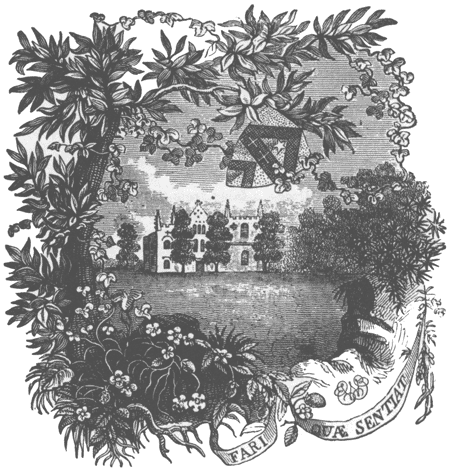
1. Frontispiece, Gothic; motto on a scroll, "Fari quæ sentiat." 2. North Front of Strawberry Hill. 3. Entrance of Strawberry Hill. 4. View of the Prior's Garden, at ditto. 5. Chimney in the Great Parlour. 6. Chimney in the China Room. 7. Chimney in the Yellow Bedchamber. 8. Do. —— —— Blue Bedchamber. 9. Staircase at Strawberry Hill. 10. Library at ditto. 11. Chimney Piece of the Holbein Chamber. 12. The Gallery. 13. Chimney in the Round Room. 14. The Cabinet. 15. View from the Great Bedchamber. 16. Garden Gate. 17. View of the Chapel in the Garden at Strawberry Hill. 18. The Shell Bench. 19. View from the Terrace at Strawberry Hill. 20. East View of the Cottage Garden at Strawberry Hill. There were only 200 copies of this edition printed.
The following may amuse the curious reader:
"Mr. Walpole is very ready to oblige any curious persons with the sight of his house and collection; but as it is situated so near to London, and in so populous a neighbourhood, and as he refuses a ticket to nobody that sends for one, it is but reasonable that such persons as send should comply with the rules he has been obliged to lay down for shewing it:—Any person, sending a day or two before may have a ticket for four persons for a day certain;—No Ticket will serve but on the day for which it is given. If more than four persons come with a ticket, the housekeeper has positive orders to admit none of them;—Every ticket will admit the company only between the hours of twelve and three before dinner, and only one company will be admitted on the same day;—The house will never be shewn after dinner, nor at all but from the first of May to the first of October;—As Mr. Walpole has given offence by sometimes enlarging the number o four, and refusing that latitude to others, he flatters himself that for the future nobody will take it ill that he strictly confines the number; as whoever desires him to break his rule does in effect expect him to disoblige others, which is what nobody has a right to desire of him;—Persons desiring a ticket may apply either to Strawberry Hill, or to Mr. Walpole's, in Berkeley Square, London. If any person does not make use of the ticket, Mr. Walpole hopes he shall have notice: otherwise he is prevented from obliging others on that day, and thence is put to great inconvenience;—They who have tickets are desired not to bring children."——xx. A copy of all the Works of Mr. Walpole that were printed by him before his death, 1784, 4to. This brochure, which has been called "rare" in book-auction catalogues, has been sold for upwards of two guineas.——xxi. Postscript to the Royal and Noble Authors. mdccxxxvi, 8vo. There should be, before the title-page, an outline etching of "Reason, Rectitude, and Justice, appearing to Christin de Pisan, &c., from an illumination in the library of the King of France," which is exceedingly well engraved. The work contains only 18 pages: and there were but 40 copies printed. The Royal and Noble Authors were first printed in 1759, 8vo. 2 vols.——xxii. Essai sur l'Art des Jardins Modernes, par M. Horace Walpole. Traduit en François, par M. Le Duc de Nivernois, en mdcclxxxiv. Imprimé à S.H. par T. Kirgate, mdcclxxxv. With an opposite title in English, 4to. It contains 94 double pages, and every page of French has an opposite one of English. Not printed in the best manner of S.H. A copy of this book was sold for 3l.; at a sale in 1804.——xxiii. Bishop Banner's Ghost. Printed by T.K. mdlccxxxix, 4to. On the first leaf is the following "Argument." "In the gardens of the palace of Fulham is a dark recess: at the end of this stands a chair, which once belonged to Bishop Bonner. A certain Bishop of London (the late Beilby Porteus) more than 200 years after the death of the aforesaid Bonner, just as the clock of the gothic chapel had struck six, undertook to cut, with his own hand, a narrow walk through this thicket, which is since called the Monk's walk. He had no sooner begun to clear the way, than lo! suddenly up started from the chair, the ghost of Bishop Bonner, who, in a tone of just and bitter indignation, uttered the following verses." This curious publication contains only four pages of stanzas, written in alternate rhyme, of 8 and 6 feet metre.——xxiv. The Magpie and her Brood; a fable, from the tales of Bonaventure de Periers, valet de chambre to the Queen of Navarre; addressed to Miss Hotham. This is a very scarce poetical tract of four pages only; subscribed H.W.——xxv. Fourteen different pieces, printed at Strawberry Hill, of verses, cards, &c. This title I borrow from a book-auction catalogue. At a sale in 1804, these detached pieces were sold for 2l. 2s.; but it is not in my power to identify them. Whether they be the same "parcel of scraps, and loose leaves of poetry, epigrams," &c. which, according to a daily newspaper, were sold at the commencement of this year "for 16 pounds," I am also equally ignorant. See Kirgate's Catalogue, 1810, no. 420.——xxvi. Hieroglyphic Tales, 8vo. Only seven copies printed; idem, no. 380. From newspaper authority, I learn that these tales formed "a small pamphlet of two sheets, crown 8vo.," which were sold for 16l.; and I understand that the late Mr. G. Baker was the purchaser. N.B. They are incorporated in the author's printed works; but this is not having the first and true edition! There is nothing like the comfort of bleeding smartly for exhibiting these fourth and fifth symptoms of the Bibliomania! Vide pp. 521, 525, ante.——xxvii. Additions to First Editions of Walpole's Lives of the Painters, sewed.——xxviii. The Press at Strawberry Hill to his Royal Highness the Duke of Clarence, a Poem.——xxix. The Master of Otranto in durance.——xxx. Air, a Poem.——xxxi. A Poetical Epistle to Mrs. Crewe.——xxxii. A Poetical Epistle to Lady Horatio Waldegrave, on the Death of the Duke of Ancaster.——xxxiii. The Press at Strawberry Hill to Miss Mary and Miss Agnes Berry, a Poetical Epistle. [These last seven articles are taken from Mr. Cuthell's catalogue of 1811.] I should add that a much more copious and complete list, though not possessing all the intelligence here communicated, was prepared by the late Mr. George Baker for press; and printed, since his decease, for donations to his particular friends. Only twenty copies of this bibliographical brochure are said to have been executed. We will now take leave of the Prelum Walpolianum by subjoining a copy of the most elegant title-page vignette which ever issued from it.
Before the reader's eyes are finally turned from a contemplation of this elegant device—and as connected with the subject of Private Presses—let me inform him that the Marquis of Bute is in possession of a thin folio volume, exhibiting paintings, upon vellum, of the various devices used by Pope Sixtus V., in the frontispieces of the several works which issued from the Apostolical Press, while he filled the Papal Chair. To a tasteful bibliomaniac, few volumes would afford so much delight as a contemplation of the present one. It is quite a keimelion in its way!
Lysand. I do; but I have not so ardent an admiration of these volumes, as the generality of collectors. On the contrary, I think that the Hafod Press has, by one single production only, outweighed the whole of the Walpolian lucubrations; at least on the score of utility.
I might here add, to the foregoing symptoms, a passion to possess works which have been suppressed, condemned, or burnt; but all these things rank under the head of causes of the rarity of books; and as an entire volume might be written upon this symptom alone, I can here only allude to to the subject; hoping some diligent bibliographer will one day do for us what foreigners have done for other nations.
Thus have I, rather slightly, discussed the Symptoms of the Disease, called The Bibliomania. During this discussion, I see our friend has been busy, as he was yesterday evening, in making sketches of notes; and if you examine the finished pictures of which such outlines may be made productive, you will probably have a better notion of the accuracy of my classification of these symptoms.
It is much to be wished, whatever may be the whims of desperate book-collectors, that, in some of those volumes which are constantly circulating in the bibliomaniacal market, we had a more clear and satisfactory account of the rise and progress of arts and sciences. However strong may be my attachment to the profession of the cloth, I could readily exchange a great number of old volumes of polemical and hortatory divinity for interesting disquisitions upon the manners, customs, and general history of the times. Over what a dark and troublesome ocean must we sail, before we get even a glimpse at the progressive improvement of our ancestors in civilised life! Oh, that some judicious and faithful reporter had lived three hundred and odd years ago!—we might then have had a more satisfactory account of the origin of printing with metal types.
Lis. Pray give us your sentiments upon this latter subject. We have almost the whole day before us:—the sun has hardly begun to decline from his highest point.
Lysand. A very pretty and smooth subject to discuss, truly! The longest day and the most effectually-renovated powers of body and mind, are hardly sufficient to come to any satisfactory conclusion, upon the subject. How can I, therefore, after the fatigues of the whole of yesterday, and with barely seven hours of daylight yet to follow, pretend to enter upon it? No: I will here only barely mention Trithemius[458]—who might have been numbered among the patriarchal bibliographers we noticed when discoursing in our friend's Cabinet—as an author from whom considerable assistance has been received respecting early typographical researches. Indeed, Trithemius merits a more marked distinction in the annals of Literature than many are supposed to grant him: at any rate, I wish his labours were better known to our own countrymen.
Lis. I will set his works down among my literary desiderata. But proceed.
Lysand. With what? Am I to talk for ever?
Belin. While you discourse so much to the purpose, you may surely not object to a continuance of this conversation. I wish only to be informed whether bibliomaniacs are indisputably known by the prevalence of all, or of any, of the symptoms which you have just described.
Alman. Is there any other passion, or fancy, in the book-way, from which we may judge of Bibliomaniacism?
Lysand. Let me consider. Yes; there is one other characteristic of the book-madman that may as well be noticed. It is an ardent desire to collect all the editions of a work which have been published. Not only the first—whether uncut, upon large paper, in the black-letter, unique, tall, or illustrated—but all the editions.[459]
Belin. Strange—but true, I warrant!
Lysand. Most true; but, in my humble opinion, most ridiculous; for what can a sensible man desire beyond the earliest and best editions of a work?
Be it also noticed that these works are sometimes very capricious and extroardinary. Thus, Baptista is wretched unless he possess every edition of our early grammarians, Holt, Stanbridge, and Whittinton: a reimpression, or a new edition, is a matter of almost equal indifference: for his slumbers are broken and oppressive unless all the dear Wynkyns and Pynsons are found within his closet!—Up starts Florizel, and blows his bugle, at the annunciation of any work, new or old, upon the diversions of Hawking, Hunting, or Fishing![460] Carry him through Camillo's cabinet of Dutch pictures, and you will see how instinctively, as it were, his eyes are fixed upon a sporting piece by Wouvermans. The hooded hawk, in his estimation, hath more charms than Guido's Madonna:—how he envies every rider upon his white horse!—how he burns to bestride the foremost steed, and to mingle in the fair throng, who turn their blue eyes to the scarcely bluer expanse of heaven! Here he recognises Gervase Markham, spurring his courser; and there he fancies himself lifting Dame Juliana from her horse! Happy deception! dear fiction! says Florizel—while he throws his eyes in an opposite direction, and views every printed book upon the subject, from Barnes to Thornton.
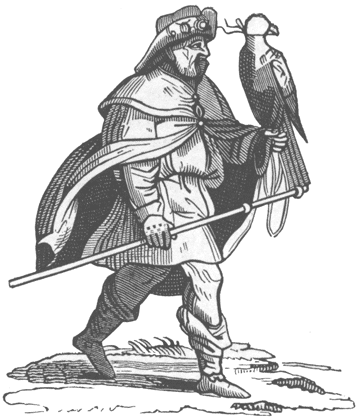
We will conclude this Hawking note with the following excerpt from one of the earliest editions of the abridgment of our statutes:—'nul home pringe les oves dascu[n] faucon, goshawke, lan, ou swan hors de le nyst sur peyn de inprison p[our] vn an et vn iour et de faire fyn all volunte le roy et que nul home puis le fest de paque p[ro]chyn auenpart ascun hawke de le brode dengl' appell vne nyesse, goshawke, lan, ou laneret sur sa mayn, sur peyn de forfaiture son hawke, et que null enchasse ascun hawke hors de c[ou]uerte sur peyne de forfaiture x li. lun moyte al roy et lauter a celuy que voet sur.' Anno xi. H. vij. ca. xvij. Abbreviamentum Statutorum; printed by Pynson, 1499, 8vo., fol. lxxvij.
There are other tastes of an equally strange, but more sombre, character. Dion will possess every work which has any connexion, intimate or remote, with Latimer and Swedenborg;[461] while Antigonus is resolved upon securing every lucubration of Withers or Warburton; whether grave or gay, lively or severe.
NO.
18. Regnum Animale, or the Animal Kingdom in three parts. The first treats of the Viscera of the Abdomen, or the lower Region. The second, of the Viscera of the Breast, or of the Organs of the superior Region. The third, of the Skin, the Touch, and the Taste, and of organical forms in general. Part printed at the Hague, and part in London, 1744, 1745, in 4to.
19. De Cultu et Amore Dei, or of the Worship and Love of God. The first part treats of the Origin of the Earth, of Paradise, of the Birth, Infancy, and Love of the first Man, or Adam. London, 1744, in 4to. The second part treats of the Marriage of the first man, of the Soul, of the intellectual Spirit, of the State of Integrity, and of the Image of God. London, 1745, 4to.
20. Arcana Cœlestia, or Heavenly Mysteries contained in the Sacred Scriptures or Word of the Lord, manifested and laid open, in an Explanation of the Books of Genesis and Exodus, interspersed with relations of wonderful things seen in the World of Spirits, and the Heaven of Angels. London, from 1747 to 1758, in eight volumes, 4to. "In this work the reader is taught to regard the letter of the Scriptures as the Repository of Holy and Divine Things within; as a Cabinet containing the infinite Treasures and bright Gems of spiritual and celestial Wisdom; &c."(*)....
21. De Cœlo et Inferno; or A Treatise concerning Heaven and Hell, and of the wonderful Things therein heard and seen. London, 1758, 4to. "By this work the reader may attain to some conception of the heavenly kingdom, and may learn therein that all social virtues, and all the tender affections that give consistence and harmony to society, and do honour to humanity, find place and exercise in the utmost purity in those delectable abodes; where every thing that can delight the eye, or rejoice the heart, entertain the imagination, or exalt the understanding, conspire with Innocence, Love, Joy, and Peace, to bless the spirits of just men made perfect, and to make glad the city of our God," &c.(*)
Loren. I suspect that, like many dashing artists, you are painting for effect?
Phil. On the part of Lysander, I may safely affirm that the preceding has been no caricatured description. I know more than one Baptista, and Florizel, and Dion, and Antigonus.
Lis. I hope I shall shortly add to the number of such an enthusiastic class of book-collectors—I'm for Natural History; and, in this department, for birds and beasts—Gesner and Bewick![462]
Phil. Restrain your wild feelings—listen to the sober satire of Lysander. Have you nothing else, in closing this symptomatic subject, to discourse upon?
Lysand. There is certainly another point not very remotely connected with the two preceding; and it is this: a passion to possess large and voluminous works, and to estimate the treasures of our libraries rather by their extent and splendour than by their intrinsic worth: forgetting how prettily Ronsard[463] has illustrated this subject by the utility and beauty of small rivers in comparison with those which overflow their banks and spread destruction around. "Oh combien (says Cailleau, in his Roman Bibliographique) un petit livre bien pensé, bein plein, et bein écrit, est plus agréable, plus utile à lire, que ces vastes compilations à la formation desquelles l'intérêt a présidé plus souvent que le bon-goût!"
Belin. Well; we live in a marvellous book-collecting and book-reading age—yet a word more:
Alman. I crave your pardon, Belinda; but I have a thought which must be now imparted, or the consequence may be serious.
Lysand. I wait both your commands.
Alman. My thought—or rather the subject which now occupies my mind—is this: You have told us of the symptoms of the Disease of Book-Madness, now pray inform us, as a tender-hearted physician, what are the means of its cure?
Belin. The very question I was about to put to our bibliomaniacal physician. Pray inform us what are the means of cure in this disorder?
Lysand. You should say Probable Means of Cure, as I verily believe there are no certain and correct remedies.
Belin. Well, Sir, probable means—if it must be so. Discourse largely and distinctly upon these.
Lysand. Briefly and perspicuously, if you please: and thus we begin.
In the first place, the disease of the Bibliomania is materially softened, or rendered mild, by directing our studies to useful and profitable works; whether these be printed upon small or large paper, in the gothic, roman, or italic type. To consider merely the intrinsic excellence, and not the exterior splendour, or adventitious value, of any production will keep us perhaps wholly free from this disease. Let the midnight lamp be burnt to illuminate the stores of antiquity—whether they be romances, or chronicles, or legends, and whether they be printed by Aldus or Caxton—if a brighter lustre can thence be thrown upon the pages of modern learning! To trace genius to its source, or to see how she has been influenced or modified by the lore of past times, is both a pleasing and profitable pursuit. To see how Shakspeare, here and there, has plucked a flower from some old ballad or popular tale, to enrich his own unperishable garland;—to follow Spenser and Milton in their delightful labyrinths 'midst the splendour of Italian literature; are studies which stamp a dignity upon our intellectual characters! But, in such a pursuit, let us not overlook the wisdom of modern times, nor fancy that what is only ancient can be excellent. We must remember that Bacon, Boyle, Locke, Taylor, Chillingworth, Robertson, Hume, Gibbon, and Paley, are names which always command attention from the wise, and remind us of the improved state of reason and acquired knowledge during the two last centuries.
Alman. There seems at least sound sense, with the prospect of much future good, in this first recipe. What is your second.
Lysand. In the second place, the reprinting of scarce and intrinsically valuable works is another means of preventing the propagation of this disorder. Amidst all our present sufferings under the Bibliomania, it is some consolation to find discerning and spirited booksellers republishing the ancient Chroniclers; and the collections known by the names of "The Harleian Miscellany" and "Lord Somers' Tracts," and "The Voyages of Hakluyt."[464] These are noble efforts, and richly deserve the public patronage.
Loren. I fully coincide with these sentiments; and, as a proof of it, regularly order my London bookseller to transmit to me every volume of the reprint of these excellent works as it is published.
Belin. Can you find it in your heart, dear brother, to part with your black-letter Chronicles, and Hakluyt's Voyages, for these new publications?
Loren. I keep the best editions of the ancient Chronicles; but the new Fabian, the Harleian Miscellany, Lord Somers' Tracts, and the Voyages, are unquestionably to be preferred; since they are more full and complete. But proceed with your other probable means of cure.
Lysand. In the third place, the editing of our best ancient authors, whether in prose or poetry,[465] is another means of effectually counteracting the mischievous effects arising from the bibliomaniacal disease; and, on this score, I do think this country stands pre-eminently conspicuous; for we are indefatigable in our attentions towards restoring the corrupted texts of our poets.
Phil. Yet forgive me if I avow that this same country, whose editorial labours you are thus commending, is shamefully deficient in the cultivation of Ancient English History! I speak my sentiments roundly upon this subject: because you know, Lysander, how vigilantly I have cultivated it, and how long and keenly I have expressed my regret at the almost total apathy which prevails respecting it. There is no country upon earth which has a more plentiful or faithful stock of historians than our own; and if it were only to discover how superficially some of our recent and popular historians have written upon it, it were surely worth the labour of investigation to examine the yet existing records of past ages.
Loren. To effect this completely, you should have a National Press.
Lis. And why not? Have we here no patriotic spirit similar to that which influenced the Francises, Richlieus, Colberts, and Louises of France?
Alman. You are getting into bibliographical politics! Proceed, good Lysander, with your other probable means of cure.
Lysand. In the fourth place, the erection of Public Institutions[466] is of great service in diffusing a love of books for their intrinsic utility, and is of very general advantage to scholars and authors who cannot purchase every book which they find it necessary to consult.
Phil. You are right. These Institutions are of recent growth, but of general utility. They are a sort of intellectual Hospitals—according to your mode of treating the Bibliomania. Yet I dare venture to affirm that the News-Paper Room is always better attended than the Library!
Lysand. Let us have no sarcasms. I will now give you the fifth and last probable means of cure of the Bibliomania; and that is the Study of Bibliography.[467]
Peignot, in his Dictionnaire de Bibliologie, vol. i. 50, has given a very pompous account of what ought to be the talents and duties of a bibliographer. It would be difficult indeed to find such qualifications, as he describes, united in one person! De Bure, in the eighth volume of his Bibliographie Instructive, has prefixed a "Discourse upon the Science of Bibliography, and the Duties of a Bibliographer," which is worth consulting: but I know of nothing which better describes, in few words, such a character, than the following: "In eo sit multijuga materiarum librorumque notitia, ut saltem potiores eligat et inquirat: fida et sedula apud exteras gentes procuratio, ut eos arcessat; summa patientia ut rarè venalis expectet; peculium semper præsens et paratum, ne, si quando occurrunt, emendi, occasio intercidat: prudens denique auri argentique contemptus, ut pecuniis sponte careat quæ in bibliothecam formandam et nutriendam sunt insumendæ. Si forte vir literatus eo felicitatis pervenit ut talem thesaurum coacervaverit, nec solus illo invidiose fruatur, sed usam cum eruditis qui virgilias suas utilitati publicæ devoverunt, liberaliter communicet;" &c.—Bibliotheca Hulsiana, vol. i. Præfat. p. 3, 4. Morhof abounds with sagacious reflections upon this important subject: but are there fifty men in Great Britain who love to read the Polyhistor Literarius? The observations of Ameilhon and Camus, in the Memoires de l'Institut, are also well worth consultation; as are those of Le Long, and his editor, prefixed to the last edition of the Bibliotheca Sacra.
Lis. Excellent!—Treat copiously upon this my darling subject.
Belin. You speak with the enthusiasm of a young convert; but I should think the study of Bibliography a sure means of increasing the violence of the book-disease.
Lysand. The encouragement of the Study of Bibliography, in its legitimate sense, and towards its true object, may be numbered among the most efficacious cures for this destructive malady. To place competent Librarians over the several departments of a large public Library; or to submit a library, on a more confined scale, to one diligent, enthusiastic, well-informed, and well-bred Bibliographer or Librarian (of which in this metropolis we have so many examples), is doing a vast deal towards directing the channels of literature to flow in their proper courses. And thus I close the account of my recipes for the cure of the Bibliomania. A few words more and I have done.
It is, my friends, in the erection of Libraries as in literary compositions, the task is difficult, and will generally meet with opposition from some fastidious quarter,[468] which is always betraying a fretful anxiety to bring every thing to its own ideal standard of perfection. To counteract the unpleasant effect which such an impression must necessarily produce, be diligent and faithful, to your utmost ability, in whatsoever you undertake. You need not evince the fecundity of a German[469] author; but only exert your best endeavours, and leave the issue to a future generation. Posterity will weigh, in even scales, your merits and demerits, when all present animosities and personal prejudices shall have subsided; and when the utility of our labours, whether in promoting wisdom or virtue, shall be unreservedly acknowledged. You may sleep in peace before this decision take place; but your children may live to witness it; and your name, in consequence, become a passport for them into circles of learning and worth. Let us now retreat; or, rather, walk round Lorenzo's grounds. We have had Book-Discussion enough to last us to the end of the year.[470] I begin to be wearied of conversing.
THE DIRECTION.
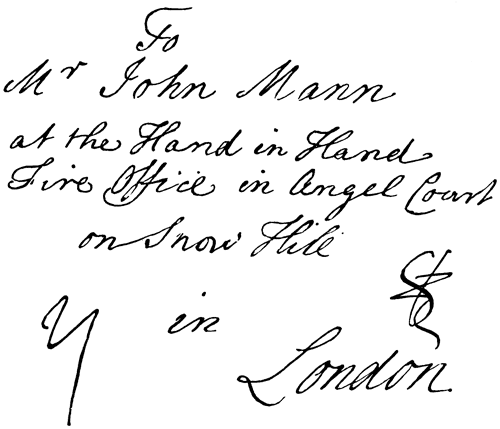
To Mr John Mann at the Hand in Hand Fire Office in Angel Court on Snow Hill [illegible] in London
Exeter, 21st March, 1738.
Dear Sir,
I take the liberty presuming upon the Intimacy of our Acquaintance to employ you in a pretty troublesome Affair. Fletcher Gyles, Bookseller in Holbourn, with whom I had some Dealings about two years ago, has lately sent me Down a Catalogue of a Library which will begin to be sold by Auction at his house next Monday Evening. As I have scarce laid out any Money in Books for these two years past, the great number of Valuable Books contained in this Collection, together with the tempting prospect of getting them cheaper in an Auction than they are to be had in a Sale, or in any other way whatsoever, has induced me to lay out a Sum of mony this way, at present, which will probably content my Curiosity in this kind, for several years to come. Mr. Gyles has offered himself to act for me, but as I think 'tis too great a Trial of his Honesty to make him at the same time both Buyer & Seller, & as Books are quite out of my Brother's Way, I have been able to think of no Friend I could throw this trouble upon but you. I propose to lay out about £60 or £70, and have drawn up a List of the Books I am inclined to, which you have in the First Leaf, with the Price to each Book, which I would by no means exceed, but as far as which, with respect to each single Book, I would venture to go; though I am persuaded upon the whole they are vastly overvalued. For my Valuation is founded in proportion upon what I have been charged for Books of this kind, when I have sent for them on purpose from London, and I have had too many proofs that the Booksellers make it a Rule to charge near double for an uncommon Book, when sent for on purpose, of what they would take for it in their own Shops, or at a Sale. So that, though the Amount of the Inclosed List is above £120, yet, when Deductions are made for the Savings by the Chance of the Auction, & for the full rate of such Books as I may be over bid in, I am satisfied it will come within the sum I propose. Now, Sir, the Favour which I would beg of you is to get some Trusty Person (& if you should not be able readily to think of a proper Person yourself, Mr. Hinchcliffe or Mr. Peele may probably be able to recommend one) to attend this Auction, in my behalf, from the beginning to the end, & to bid for me agreeably to the inclosed List & (as the Additional Trouble of it over and above the Attendance would not be great) to mark in the Catalogue, which you may have of Mr. Gyles for a shilling, the price Every Book contained in the Catalogue is sold at, for my future Direction in these Matters. For this Service I would willingly allow 3 Guineas, which, the Auction continuing 24 Days, is 3 shillings over and above half a Crown a Day; or, if that is not sufficient, whatever more shall be thought necessary to get my Commission well Executed. It may be necessary to observe to you that the Auction requires the Attendance of the whole day, beginning at Eleven in the Morning, and ending at two and at five in the Afternoon, and Ending at Eight. It may also be proper to inform the Person you shall Employ that he is not to govern his first bidding by the valuation in my list for many of the Books will very probably be sold for less than half what I have marked them at; he is therefore, in every Instance, to bid Low at first, and afterwards to continue advancing just beyond the other Bidders, till he has either bought the Book, or the price I have fixed it at is exceeded. There are many Books in the List which have several numbers before them; the meaning of which is that the very same Book is in several places of the Catalogue; and in that Case, I would have the first of them bought, if it be in very good condition, otherwise let the person Employed wait till the other comes up. I would desire him also not to buy any book at all that is both Dirty & ragged; but, though the Binding should not be in very good Order, that would be no Objection with me, provided the Book was clean. I would also desire him not to bid for any Number in the Catalogue that is not expressly mentioned in my List, upon a supposition that it may be the same Book with some that are mentioned in it; nor to omitt any Book that is actually upon the List, upon an Imagination, from the Title, that it may be there more than once; for I have drawn it up upon an Exact consideration of the Editions of the Books, insomuch that there is no Book twice upon the List, but where there is a very great difference in the Editions; nor is any of the Books in my List oftener in the Catalogue than is expressly specified in it. By the Conditions of Sale, the Auction is constantly adjourned from Fryday night to Monday Morning, the Saturday being appointed for fetching away, at the Expence of the buyer, the Books bought the week before, & for payment of the Mony. This part of the trouble I must beg you to charge yourself with; &, in order to enable you, as to the payment, I shall send you up, either by the next Post, or, however, time enough for the Saturday following, Fifty Pounds. I would beg the Favour of you to let me hear from you, if possible, by the Return of the Post; & also to give me an Account by every Saturday night's post what Books are bought for me, and at what price. As to which you need only mention the Numbers without the Titles, since I have a Catalogue by me. When the Auction is Ended, I shall take the Liberty of giving you farther Directions about Packing up the Books, & the way I would have them sent down. When I drew up my List, I had not observed one of the Conditions of Sale, which imports that no Person is to advance less than a shilling after twenty shillings is bid for any book. Now you will find a pretty many Books which I have valued at more than twenty shillings marked at an Odd Sixpence; in all which Cases, I would have the Bidder add Sixpence more to the Price I have fixed, in order to make it Even Money, & conformable to the Conditions of the Auction. And now, Dear Sir, another Person would make a thousand Apologies for giving you all this trouble; all which superfluous tediousness I shall spare you, being persuaded I shall do you a great pleasure in giving you an Opportunity of being serviceable to me, as I am sure it would be a very sensible one to me, if I ever had it in my power to be of any use to you. Mine and my Wive's humble respects wait upon Mrs. Mann, and you will be so good to present my hearty services to all our Friends.
I am most sincerely, Dear Sir,
Your Faithful & Affectionate humble Servt.
Benj Heath

HIS SEAL.
£s.d.
Octavo5Pet. Angeli Bargæi Poemata056
40Hieron. Fracastorij Poemata076
47or 455, or 1546, Joan. Leonis Africæ Desc.036
68Christ. Longolij Orationes et Epistolæ066
78Pierij Valeriani Hexametri046
Quarto46Diogenes Laertius1126
Octavo164or 624, Scaligerana026
201or 1280, Car. Ogerij Iter Danicum030
Quarto66Plautus Taubmanni0116
Octavo282Hen. Lornenij Itinerarium030
Quarto132Marcus Antonius de Dominis026
143Hen. Stephani Dialogus046
157Ausonii Opera096
178Anacreon and Sappho086
180Excerpta ex Polybio086
181Sophocles and Eschylus126
Carried Forward£6160
£s.d.
Brought Forward6160
Octavo405or 2413, or 2953, Historia Gothorum066
435or 1488, or 1688, Lucretius Gifanij056
436Is Casaubon de Satyrica Poesi036
Quarto198or 344, Iamblicus de Vita Pythag.0116
275Aulus Gellius Gronovij0186
280Statij quæ Extant Barthij0186
Octavo700or 1093, Martial Scriverij066
Quarto302Juvenal Henninij0186
314Manilij Astronomicon0116
316Poetriarum Octo066
Folio170Fam. Strada da Bello Belgico1136
Octavo739Virgilius Illustratus036
752Paulli Manutij Epistolæ030
Folio206or 235, or 590, Io. Leunclavij Annales126
Octavo989Senecæ Tragediæ Scriverij046
91911088Pontani Opera086
Folio264Demosthenis et Æschinis Opera2176
301Thucydides Wasse296
306Platonis Opera456
308Herodoti Historia176
Quarto503Pauli Collomesij Opera090
543566Bern. Pensini Vita Baronij030
Octavo1239or 2831, Poesis Philosophica036
Folio270Philostrati Opera176
376Historiæ Romanæ Scriptores1116
386Plutarchi Opera576
Octavo1519Caninij Hellenismus026
1608or 2705, Virgilius Hiensij036
Folio426Geo. Buchanani Opera1116
443Plautus Lambini0136
448Horatius Turnebi et Lambini0186
Octavo1650Dom. Baudij Amores030
Folio476Æschyli Tragediæ0166
Octavo1814Lud. Kusterus de vero Usu, &c.036
Quarto871Gab. Faerni Fabulæ Centum066
Folio477Luciani Opera176
Carried Forward£4270
£s.d.
Brought Forward4270
479Dionis Cassij Historia1126
485Diodorus Siculus2186
490Appiani Historia0116
491Palladius de Gentibus Indiæ056
498Isocratij Orationes136
Quarto908Papin. Statij Opera096
921Claudian Cum Animad. Barthij0116
Folio529Maffæi Historia Indica086
509546Saxonis Grammatici Historia0176
Octavo2101Huntingtoni Epistolæ036
Quarto1018And. Nangerij Opera096
1023Tho. Hyde Historia Relig. Vett. Pers.0186
1047Claud. Salmasij Epistolæ036
1088Theocriti Moschi Bionis0166
1089Hesiodus Græce0186
Folio627Rerum Moscoviticarum Coment.0116
638Angeli Politiani Opera0186
Octavo2354Ausonius076
2362Mythographi Latini066
Quarto1139Aristotelis Opera346
Octavo2481Fabricij Bibliotheca Latina0116
Quarto1192Sannazarij Poemata0116
Octavo2526Meursij Elegantiæ056
2559Statij Opera046
2578Is Casauboni Comment.030
2597Maximi Tyrij Dissertationes040
Folio698Nic. Antonij Bibliotheca Hispan.246
Octavo2712Ovidij Opera0156
Folio765Nic. Antonij Bibliotheca Hisp. Vetus176
Octavo2891Pet. Dan. Huetij Comentarius026
3098Sir John Suckling's Plays, &c.036
3099Dr. Downe's Poems040
Quarto1498Lord's Discovery of the Banian Religion056
Folio857or 896, Burnet's Theory of ye Earth096
Octavo3364Milton's Poems020
3374King's British Merchant0126
Carried Forward£68110
£s.d.
Brought Forward68110
3379Milton's Paradise Regained026
Folio912Wheeler's Journey into Greece0130
Octavo3463or 3473, Grevil's Life Of Sir P. Sidney030
3466Jobson Debes's Description of Feroe020
3529Terry's Voyage to the East Indies036
Quarto1672Description de l'Egypte0136
1692Apologie de M. Castar040
1694Replique de M. Girac036
Octavo3538Geddes's History of the Church, &c.030
3600Songs by the Earl Of Surrey036
3741or 4112, Oeuvres de Sarasin040
3854or 3859, Scaligerana026
Quarto1873Viaggi di Pietro della Valli150
1875Opera di Annibale Caro080
1876Orlando Inamorato0126
1879or 2070, Pastor Fido0126
1884or 1977, Morgante Maggiore090
1920or 1965, La Gerusalemme Liberata126
1928Il Verato036
1953Orlando Inamorato096
1957Historia della Guerre Civili0176
1967Scritti nella Causa Veniziana046
1980Historia della Sacra Inquisitione056
1983Examinatione sopra la Rhetorica056
1990or 2037, Istoria Diplomatica0116
1995Fasti Consolari di Salvini096
1998Satire del Menzini076
Folio1109Bibliotheca Napolitana di Toppi116
1123Orlando Furioso126
Quarto2005or 2039, Dialoghi del Speroni076
2015Poetica di Aristotele Volgarizzata066
2024Poetica di Aristotele di Piccolomini046
2031Della Difesa della Comedia di Dante0130
2033Squittinio della Liberta Veneta056
2049Il Goffredo col. Comento di Beni096
2050Dante di Daniello096
Carried Forward£84130
£s.d.
Brought Forward84130
Folio1129Historia del Regno di Napoli0146
1132Historia del Consilio Tridentino2136
1137Vocabularia della Crusca846
Octavo4268Voyage de Bachanmont, &c.026
4295or 4330, or 4339, or 4511, Ragionamenti del Aretino0116
4305Prose Fiorentine036
4309Lettre Volgari036
4321Gravina della Ragione Poetica056
4322Battaglie di Mugio036
4331or 4527, La Comedia di Dante0116
Quarto2053Degli Raguagli di Parnaso086
2067Il Decameron di Boccaccio256
2076or 2168, Lezioni di Varchi086
2098L'Amadigi di Tasso086
Folio1154L'Adone del Marino0116
1154Il Libro del Cortegiano0136
1162Istoria del Concilio di Trento246
1164La Historia di Italia di Guicciardini0176
Octavo4354Rime Diverse del Mutio046
4363L'Amorosa Fiametta046
4371Compendio del Historie di Nap.056
4379Opere di Guilio Cammillo046
4384L'Aminta di Tasso066
4385L'Opere Poetiche di Guarin056
4387Comedie di M. Agnolo Firenz.056
4415Notize de Libri Rari046
4416Satire e Rime di Aristo056
4417Delle Eloquenza Italiana066
4423Comedie Varie036
4438Labarinto d'Amore di Boccac.046
4443Opere di Redi110
Quarto2100Lettere di Vincenzio Martelli086
2103or 2154, Ameto di Boccaccio046
2104or 2161, Le Rime di Petrarca086
2114Ragionamento dell' Academico086
Carried Forward£111170
£s.d.
Brought Forward111170
2124Poesie Liriche del Testi086
Octavo4452Il Petrarca0116
4456or 4550, Lettre di Paolo Sarpi036
4460Opere Burleschi di Berni066
4464or 4485, Prose di M. Agnolo Firenz.036
4471Commento di Ser Agresto036
4475L'Aminta di Tasso066
4483La Secchia Rapita056
4486or 4627, Comedie di Aretino056
4496Trattato delle Materie Benef.046
4531Il 2do Libro delle Opere Burlesch.066
Quarto2149Annotationi e Discorsi0166
2159Gyrone il Cortese096
2164Il Decamerone di Boccaccio0146
2169Historia della Cose passate056
2171Apologia degli Academia096
2176Della Guerra di Fiandra226
2178Rime e Prose di Maffei0136
2182Discorsi Poetichi056
Octavo4561La Libreria del Doni046
4591La Cassaria026
4592Teatro Italiano116
4614La Divina Comedia di Dante116
4615La Rime di Angelo di Cestanzo076
4625Tutte le Opere di Bernia066
£12436

Lysander concluded; when Lorenzo rose from his seat, and begged of us to walk round his grounds. It was now high noon; and, after a pleasant stroll, we retreated again to the alcove, where we found a cold collation prepared for our reception. The same day we all dined at Lisardo's; and a discussion upon the pleasures and comparative excellences of Music and Painting succeeded to the conversation which the foregoing pages have detailed. A small concert in the evening recreated the exhausted state of Lysander's mimd.
The next day, my friends left me for their respective places of destination. Lorenzo and his sisters were gathered round my outer gate; and Lisardo leapt into the chaise with Lysander and Philemon; resolved to equal, if not eclipse, his bibliographical tutor in the ardour of book researches. "Adieu," said Lysander, putting his hand out of the chaise—"remember, in defence of my bibliomaniacal gossipping, that Similis never knew happiness till he became acquainted with books."[471] The postillion smacked his whip; and the chaise, following the direction of the road to the left, quickly disappeared. The servant of Lysander followed gently after, with his Master's and Philemon's horses: taking a near direction towards Lysander's home.
ΣΙΜΙΛΙΣ ΕΝ ΤΑΥΘΑ ΚΕΙΤΑΙ ΒΙΟΥΕ ΜΕΝ ΕΤΗ ΕΒΔΟΜΗΚΟΝΤΑ ΖΗΣΑΣ ΔΕ ΕΤΗ ΕΠΤΑ
Here lies Similis; In the seventieth year of his age But only the seventh of his Life.
This story is related by Dion Cassius; and from him told by Spizelius in his Infelix Literarius; p. 167.
Lorenzo and his sisters returned with me to the Cabinet. A gloom was visible upon all our countenances; and the Ladies confessed that the company and conversation of my departed guests, especially of Lysander, were such as to leave a void which could not easily be supplied. For my part, from some little warmth each sister betrayed in balancing the solid instruction of Lysander and the humorous vivacity of Lisardo, against each other, I thought the former had made a powerful impression upon the mind of Belinda, and the latter upon that of Almansa: for when the probability of a speedy revisit from both of them was mentioned the sisters betrayed unusual marks of sensibility; and upon Lorenzo's frankly confessing, though in a playful mood, that such brothers-in-law would make him "as happy as the day was long"—they both turned their faces towards the garden, and appeared as awkward as it was possible for well-bred ladies to appear.
It was in vain that I turned to my library and opened a large paper, illustrated, copy of Daulby's Catalogue of Rembrandt's Prints, or Mr. Miller's new edition of the Memoirs of Count Grammont, or even the Roman de la Rose, printed by Galliot du Pré, upon vellum.... Nothing produced a kind look or a gracious word from them. Silence, sorrow, and indifference, succeeded to loquacity, joy, and enthusiasm. I clearly perceived that some other symptom, wholly different from any thing connected with the Bibliomania, had taken possession of their gentle minds.
But what has a Bibliographical Romance to do with Love and Marriage? Reader Adieu!—When thou hast nothing better deserving of perusal before thee, take up these pages; and class the author of them, if thou wilt, with the Bostons, or Smiths, or Norths, of "other times;" with those who have never wished to disturb the peaceful haunts of intellectual retirement; and whose estate, moreover, like Joseph Scaliger's, lies chiefly under his hat.

p. 57. To the list of useful bibliographical works, published about the period here designated, I might have added the Lexicon Literarium of Theophilus Georgius; cum Suppl. ad an. 1750. Leips. 1742-50, folio; two thick and closely printed volumes, with an excellent chronological arrangement. It is not common in this country.
p. 69. The Abbé Rive was also the author of—1. Notice d'un Roman d'Artus Comte de Bretagne: Paris, 1779, 4to. pp. 20. 2. Etrennes aux Joueurs de cartes, ou Eclaircissemens historiques et critiques sur l'invention des cartes à jouer; Paris, 1780, 12mo. pp. 43. These works are slightly commended in the "Advertissement" to the Vallière Catalogue, 1783, pp. xxv-vj. They are reviewed by a rival author.
p. 216. Since writing the first note, concerning the "Assertio Septem Sacramentorum," &c., I have seen a magnificent copy of the same, printed upon vellum, in the library of Earl Spencer; which redeems the coldness of my opinion in regard to books printed by Pynson upon vellum. The painted ornaments, in Lord Spencer's copy, were, in all probability, executed abroad. The art, in our own country, was then too rude for such elegance of decoration.
p. 404. I was right in my prediction about these Garlands being swallowed up by some "hungry book-fish!" I saw them, a few days after, in the well-furnished library of Atticus: who exhibited them to me in triumph—grasping the whole of them between his finger and thumb! They are marvellous well-looking little volumes—clean, bright, and "rejoicing to the eye!"—many of them, moreover, are first editions! The severest winter cannot tarnish the foliage of such "Garlands!"
p. 328. Among the Illustrated Grangers I forgot to notice the ample and magnificent copies belonging to the Marquis of Bute and Mr. John Towneley.
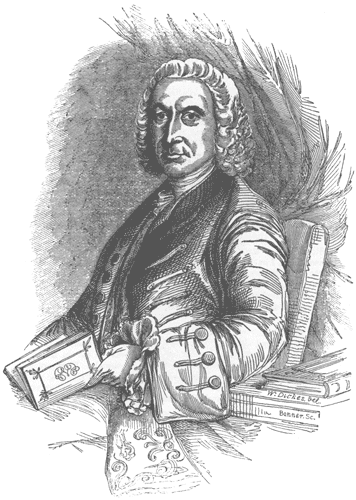
DR. BENJAMIN HEATH.