Part 6 — The Alcove.
Reading edition
SYMPTOMS OF THE BIBLIOMANIA.——PROBABLE MEANS OF ITS CURE.
OFTLY blew the breeze, and merrily sung the lark, when Lisardo quitted his bed-chamber at seven in the morning, and rang lustily at my outer gate for admission. So early a visitor put the whole house in commotion; nor was it without betraying some marks of peevishness and irritability that, on being informed of his arrival, I sent word by the servant to know what might be the cause of such an interruption. The reader will readily forgive this trait of harshness and precipitancy, on my part, when he is informed that I was then just enjoying the "honey dew" of sleep, after many wakeful and restless hours.
Lisardo's name was announced: and his voice, conveyed in the sound of song-singing, from the bottom of the garden, left the name of the visitor no longer in doubt. I made an effort, and sprung from my bed; and, on looking through the venetian blinds, I discovered our young bibliomaniacal convert with a book sticking out of his pocket, another half opened in his hand (upon which his eyes were occasionally cast), and a third kept firmly under his left arm. I thrust my head, "night-cap, tassel and all," out of window, and hailed him; not, however, before a delicious breeze, wafted over a bed of mignonette, had electrified me in a manner the most agreeable imaginable.
Lisardo heard, and hailed me in return. His eyes sparkled with joy; his step was quick and elastic; and an unusual degree of animation seemed to pervade his whole frame. "Here," says he, "here is The British Bibliographer[414] in my hand, a volume of Mr. Beloe's Anecdotes of Literature and Scarce Books in my pocket, while another, of Mr. D'Israeli's Curiosities of Literature, is kept snugly under my arm, as a corps de reserve, or rallying point. If these things savour not of bibliography, I must despair of ever attaining to the exalted character of a Bibliomaniac!"
"You are up betimes," said I. "What dream has disturbed your rest?" "None" replied he; "but the most delightful visions have appeared to me during my sleep. Since you left Lorenzo's, I have sipt nectar with Leland, and drunk punch with Bagford. Richard Murray has given me a copy of Rastell's Pastime of People,[415] and Thomas Britton has bequeathed to me an entire library of the Rosicrusian[416] philosophy. Moreover, the venerable form of Sir Thomas Bodley has approached me; reminding me of my solemn promise to spend a few autumnal weeks,[417] in the ensuing year, within the precincts of his grand library. In short, half the bibliomaniacs, whom Lysander so enthusiastically commended last night, have paid their devoirs to me in my dreams, and nothing could be more handsome than their conduct towards me."
This discourse awakened my friends, Lysander and Philemon; who each, from different rooms, put their heads out of window, and hailed the newly-risen sun with night caps which might have been mistaken for Persian turbans. Such an unexpected sight caused Lisardo to burst out into a fit of laughter, and to banter my guests in his usual strain of vivacity. But on our promising him that we would speedily join his peripatetic bibliographical reveries, he gave a turn towards the left, and was quickly lost in a grove of Acacia and Laurustinus. For my part, instead of keeping this promise, I instinctively sought my bed; and found the observation of Franklin,—of air-bathing being favourable to slumber,—abundantly verified—for I was hardly settled under the clothes 'ere I fell asleep: and, leaving my guests to make good their appointment with my visitor, I enjoyed a sweet slumber of more than two hours.
As early rising produces a keen appetite for bodily, as well as mental, gratification, I found my companions clamorous for their breakfast. A little before ten o'clock, we were all prepared to make a formal attack upon muffins, cake, coffee, tea, eggs, and cold tongue. The window was thrown open; and through the branches of the clustering vine, which covered the upper part of it, the sun shot a warmer ray; while the spicy fragrance from surrounding parterres, and jessamine bowers, made even such bibliomaniacs as my guests forgetful of the gaily-coated volumes which surrounded them. At length the conversation was systematically commenced on the part of Lysander.
Lysand. To-morrow, Philemon and myself take our departure. We would willingly have staid the week; but business of a pressing nature calls him to Manchester—and myself to Bristol and Exeter.
Lis. Some bookseller,[418] I warrant, has published a thumping catalogue at each of these places. Ha!—here I have you, sober-minded Lysander! You are as arrant a book-madman as any of those renowned bibliomaniacs whom you celebrated yesterday evening!—Yet, if you love me, take me with you! My pistoles are not exhausted.
Phil. Peace, Lisardo!—but you are, in truth, a bit of a prophet. It is even as you surmise. We have each received a forwarded letter, informing us of very choice and copious collections of books about to be sold at these respective places. While I take my departure for Mr. Ford of Manchester, Lorenzo is about to visit the book-treasures of Mr. Dyer of Exeter, and Mr. Gutch of Bristol:—but, indeed, were not this the case, our abode here must terminate on the morrow.
Lis. I suppose the names you have just mentioned describe the principal booksellers at the several places you intend visiting.
Lysand. Even so: yet I will make no disparaging comparisons.[419] We speak only of what has come within our limited experience. There may be many brave and sagacious bibliopolists whose fame has not reached our ears, nor perhaps has any one of the present circle ever heard of the late Mr. Miller of Bungay;[420] who, as I remember my father to have said, in spite of blindness and multifarious occupations, attached himself to the book-selling trade with inconceivable ardour and success. But a word, Lisardo!
I hait flatterie; and into wourdis plane, And unaffectit language, I delyte: (Quod Maister Alexander Arbothnat; in anno 1572.)
Lis. Twenty, if you please.
Lysand. What are become of Malvolio's busts and statues, of which you were so solicitous to attend the sale, not long ago?
Lis. I care not a brass farthing for them:—only I do rather wish that I had purchased the Count de Neny's Catalogue of the Printed Books and Manscripts in the Royal Library of France. That golden opportunity is irrevocably lost!
Phil. You wished for these books, to set fire to them perhaps—keeping up the ancient custom so solemnly established by your father?[421]
Lis. No more of this heart-rending subject! I thought I had made ample atonement.
Lysand. 'Tis true: and so we forgive and forget. Happy change!—and all hail this salubrious morning, which witnesses the complete and effectual conversion of Lisardo! Instead of laughing at our book-hobbies, and ridiculing all bibliographical studies—which, even by a bibliographer in the dry department of the law, have been rather eloquently defended and enforced[422]—behold this young bibliomaniacal chevalier, not daunted by the rough handling of a London Book-Auction, anxious to mount his courser, and scour the provincial fields of bibliography! Happy change! From my heart I congratulate you!
Lis. From the bottom of mine, I congratulate you, Lysander, upon the resuming of your wonted spirits! I had imagined that the efforts of yesterday would have completely exhausted you. How rapturously do I look forward for the Symptoms of the Bibliomania to be told this morning in Lorenzo's Alcove! You have not forgotten your promise!
Lysand. No, indeed; but if I am able to do justice to the elucidation of so important a subject, it will be in consequence of having enjoyed a placid, though somewhat transient, slumber: notwithstanding the occurrence of a very uncommon dream!
Lis. "I dreamt a dream last night;" which has been already told—but what was yours?
Lysand. Nay, it is silly to entertain one another with stories of phantastic visions of the night. I have known the most placid-bosomed men grow downright angry at the very introduction of such a discourse.
Phil. That may be; but we have, luckily, no such placidly-moulded bosoms in the present society. I love this sort of gossipping during breakfast, of all things. If our host permit, do give us your dream, Lysander!
Lis. The dream!—The dream!—I entreat you.
Lysand. I fear you will fall asleep, and dream yourself, before the recital of it be concluded. But I will get through it as well as I can.
Methought I was gently lifted from the ground into the air by a being of very superior size, but of an inexpressible sweetness of countenance. Although astonished by the singularity of my situation, I was far from giving way entirely to fear; but, with a mixture of anxiety and resignation, awaited the issue of the event. My Guide or Protector (for so this being must now be called) looked upon me with an air of tenderness, mingled with reproof; intimating, as I conceived, that the same superior Power, which had thus transported me above my natural element, would of necessity keep me in safety. This quieted my apprehensions.
We had travelled together through an immensity of space, and could discover the world below as one small darkened spot, when my Guide interrupted the awful silence that had been preserved, by the following exclamation: "Approach, O man, the place of thy destination—compose thy perturbed spirits, and let all thy senses be awakened to a proper understanding of the scene which thou art about to behold." So saying, he moved along with an indescribable velocity; and while my eyes were dazzled by an unusual effulgence of light, I found myself at rest upon a solid seat—formed of crystal, of prodigious magnitude.
My guide then fixed himself at my right hand, and after a vehement ejaculation, accompanied by gestures, which had the effect of enchantment upon me, he extended a sceptre of massive gold, decorated with emeralds and sapphires. Immediately there rose up a Mirror of gigantic dimensions, around which was inscribed, in fifty languages, the word "Truth." I sat in mute astonishment. "Examine," said my Guide, with a voice the most encouraging imaginable, "examine the objects reflected upon the surface of this mirror." "There are none that are discernible to my eyes," I replied. "Thou shalt soon be gratified then," resumed this extraordinary being (with a severe smile upon his countenance), "but first let me purge thine eyes from those films of prejudice which, in the world you inhabit, are apt to intercept the light of Truth." He then took a handful of aromatic herbs, and, rubbing them gently upon my temples, gave me the power of contemplating, with perfect discernment, the objects before me.
Wonderful indeed was this scene: for upon the surface of the Mirror the whole world seemed to be reflected! At first, I could not controul my feelings: but, like a child that springs forward to seize an object greatly beyond its grasp, I made an effort to leave my seat, and to mingle in the extraordinary scene. Here, however, my guide interfered—and, in a manner the most peremptory and decisive, forbade all further participation of it. "View it attentively," replied he, "and impress firmly on thy memory what thou shalt see—it may solace thee the remainder of thy days."
The authoritative air, with which these words were delivered, quite repressed and unnerved me. I obeyed, and intently viewed the objects before me. The first thing that surprised me was the representation of all the metropolitan cities of Europe. London, Paris, Vienna, Berlin, and Petersburg, in particular, occupied my attention; and, what was still more surprising, I seemed to be perfect master of every event going on in them—but more particularly of the transactions of Bodies Corporate. I saw Presidents in their chairs, with Secretaries and Treasurers by their sides; and to whatever observations were made the most implicit attention was paid. Here, an eloquent Lecturer was declaiming upon the beauty of morality, and the deformity of vice: there, a scientific Professor was unlocking the hidden treasures of nature, and explaining how Providence, in all its measures, was equally wonderful and wise. The experiments which ensued, and which corroborated his ingenious and profound remarks, suspended a well-informed audience in rapturous attention; which was followed by instinctive bursts of applause.
Again I turned my eyes, and, contiguous to this scene, viewed the proceedings of two learned sister Societies, distinguished for their labours in Philosophy and Antiquity. Methought I saw the spirits of Newton and of Dugdale, looking down with complacency upon them, and congratulating each other upon the general progress of civilization since they had ceased to mingle among men. "These institutions," observed my Guide, "form the basis of rational knowledge, and are the source of innumerable comforts: for the many are benefitted by the researches and experiments of the few. It is easy to laugh at such societies, but it is not quite so easy to remedy the inconveniences which would be felt, if they were extinct. Nations become powerful in proportion to their wisdom; it has uniformly been found that where philosophers lived, and learned men wrote, there the arts have flourished, and heroism and patriotism have prevailed. True it is that discrepancies will sometimes interrupt the harmony of public bodies. But why is perfection to be expected, where every thing must necessarily be imperfect? It is the duty of man to make the nearest approaches to public and private happiness. And if, as with a sponge, he wipe away such establishments, genius has little incentive to exertion, and merit has still less hope of reward. Now cast your eyes on a different scene."
I obeyed, and, within the same city, saw a great number of Asylums and Institutions for the ignorant and helpless. I saw youth instructed, age protected, the afflicted comforted, and the diseased cured. My emotions at this moment were wonderfully strong—they were perceived by my guide, who immediately begged of me to consider the manner by which epidemic maladies were prevented or alleviated, and especially how the most fatal of them had been arrested in its progress. I attentively examined the objects before me, and saw thousands of smiling children and enraptured mothers walking confidently 'midst plague and death! I saw them, happy in the protection which had been afforded them by the most useful and most nutritious of animals! "Enough," exclaimed my guide, "thou seest here the glorious result of a philosophical mind, gifted with unabatable ardour of experiment. Thou wilt acknowledge that, compared with the triumph which such a mind enjoys, the conquests of heroes are puerile, and the splendour of monarchy is dim!" During this strain, I fancied I could perceive the human being, alluded to by my guide, retire apart in conversation with another distinguished friend of humanity, by those unwearied exertions the condition of many thousand poor people had been meliorated.
"There is yet," resumed my guide, "another scene equally interesting as the preceding. From a pure morality flows a pure religion: look therefore on those engaged in the services of Christianity." I looked, and saw a vast number of my fellow-creatures prostrate in adoration before their Creator and Redeemer. I fancied I could hear the last strains of their hallelujahs ascending to the spot whereon I sat. "Observe," said my Protector, "all do not worship in the same manner, because all assent not to the same creed; but the intention of each may be pure: at least, common charity teaches us thus to think, till some open act betray a malignity of principle. Toleration is the vital spark of religion: arm the latter with the whips of persecution, and you convert her into a fiend scattering terror and dismay! In your own country you enjoy a liberty of sentiment beyond every other on the face of the globe. Learn to be grateful for such an inestimable happiness."
These words had hardly escaped my guide, when I was irresistibly led to look on another part of the Mirror where a kind of imperial magnificence, combined with the severest discipline, prevailed. "You are contemplating," resumed my preternatural Monitor, "one of the most interesting scenes in Europe. See the effect of revolutionary commotions! While you view the sable spirit of the last monarch of France gliding along, at a distance, with an air of sorrow and indignation; while you observe a long line of legitimate princes, exiled from their native country, and dependant upon the contributions of other powers; mark the wonderful, the unparalleled reverse of human events! and acknowledge that the preservation of the finest specimens of art, the acquisition of every thing which can administer to the wants of luxury, or decorate the splendour of a throne—the acclamations of hired multitudes or bribed senates—can reflect little lustre on that character which still revels in the frantic wish of enslaving the world! It is true, you see yonder, Vienna, Petersburg, Stockholm, and Berlin, bereft of their ancient splendour, and bowing, as it were, at the feet of a despot—but had these latter countries kept alive one spark of that patriotism which so much endears to us the memories of Greece and Rome—had they not, in a great measure, become disunited by factions, we might, even in these days, however degenerate, have witnessed something like that national energy which was displayed in the bay of Salamis, and on the plains of Marathon."
My Guide perceiving me to be quite dejected during these remarks, directed my attention to another part of the Mirror, which reflected the transactions of the Western and Eastern world.
At first, a kind of mist spread itself upon the glass, and prevented me from distinguishing any object. This, however, gradually dissolved, and was succeeded by a thick, black smoke, which involved every thing in impenetrable obscurity. Just as I was about to turn to my guide, and demand the explanation of these appearances, the smoke rolled away, and instantaneously, there flashed forth a thousand bickering flames. "What," cried I, "is the meaning of these objects?" "Check, for one moment, your impatience, and your curiosity shall be gratified," replied my guide. I then distinctly viewed thousands of Black Men, who had been groaning under the rod of oppression, starting up in all the transport of renovated life, and shouting aloud "We are free!" One tall commanding figure, who seemed to exercise the rights of a chieftain among them, gathered many tribes around him, and addressed them in the following few, but comprehensive, words: "Countrymen, it has pleased the Great God above to make man instrumental to the freedom of his fellow-creatures. While we lament our past, let us be grateful for our present, state: and never let us cease, each revolving year, to build an altar of stones to the memory, of that great and good man, who hath principally been the means of our freedom from slavery. No: we will regularly perform this solemn act, as long as there shall remain one pebble upon our shores."
"Thus much," resumed my Guide, "for the dawning felicities of the western world: but see how the eastern empires are yet ignorant and unsettled!" I was about to turn my eyes to Persia and India, to China and Japan, when to my astonishment, the surface of the Mirror became perfectly blackened, except in some few circular parts, which were tinged with the colour of blood. "The future is a fearful sight," said my Guide; "we are forbidden its contemplation, and can only behold the gloomy appearances before us: they are ominous ones!"
My mind, on which so many and such various objects had produced a confused effect, was quite overpowered and distracted. I leaned upon the arm of the chair, and, covering my face with my hands, became absorbed in a thousand ideas, when a sudden burst of thunder made me start from my seat—and, looking forward, I perceived that the Mirror, with all its magical illusions had vanished away! My preternatural Guide then placed himself before me, but in an altered female form. A hundred various coloured wings sprung from her arms, and her feet seemed to be shod with sandals of rubies; around which numerous cherubs entwined themselves. The perfume that arose from the flapping of her wings was inexpressibly grateful; and the soft silvery voices of these cherubic attendants had an effect truly enchanting.
No language can adequately describe my sensations on viewing this extraordinary change of object. I gazed with rapture upon my wonderful Guide, whose countenance now beamed with benevolence and beauty. "Ah!" exclaimed I, "this is a vision of happiness never to be realized! Thou art a being that I am doomed never to meet with in the world below." "Peace:" whispered an unknown voice; "injure not thy species by such a remark: the object before thee is called by a name that is familiar to thee—it is 'Candour.' She is the handmaid of Truth, the sister of Virtue, and the priestess of Religion."
I was about to make reply, when a figure of terrific mien, and enormous dimensions, rushed angrily towards me, and, taking me up in my crystal chair, bore me precipitately to the earth. In my struggles to disengage myself, I awoke: and on looking about me, with difficulty could persuade myself that I was an inhabitant of this world. My sensations were, at first, confused and unpleasant; but a reflection on the Mirror of Truth, and its divine expositor, in a moment tranquillized my feelings. And thus have I told you my dream.
Lysander had hardly concluded the recital of his dream—during which it was impossible for us to think of quaffing coffee or devouring muffins—when the servant entered with a note from Lorenzo:
"My dear Friend,
"The morning is propitious. Hasten to the Alcove. My sisters are twining honey-suckles and jessamine round the portico, and I have carried thither a respectable corps of bibliographical volumes, for Lysander to consult, in case his memory should fail. All here invoke the zephyrs to waft their best wishes to you.
"Truly your's,
"Lorenzo."
The note was no sooner read than we all, as if by instinct, started up; and, finishing our breakfast as rapidly as did the Trojans when they expected an early visit from the Grecians, we sallied towards Lorenzo's house, and entered his pleasure grounds. Nothing could be more congenial than every circumstance and object which presented itself. The day was clear, calm, and warm; while a crisp autumnal air
Nimbly and sweetly recommend itself Unto our gentle senses.[423]
Unfolding fair the last autumnal day,
is also very apposite; and reminds us of one of those soft and aërial pictures of Claude Loraine, where a heaven-like tranquillity and peace seem to prevail. Delightful scenes!—we love to steal a short moment from a bustling world, to gaze upon landscapes which appear to have been copied from the paradise of our first parents. Delusive yet fascinating objects of contemplation! You whisper sweet repose, and heart-soothing delight! We turn back upon the world; and the stunning noises of Virgil's Cyclops put all this fair Elysium to flight.
At a distance, the reapers were carrying away their last harvest load; and numerous groups of gleaners picking up the grain which they had spared, were marching homewards in all the glee of apparent happiness. Immediately on our left, the cattle were grazing in a rich pasture meadow; while, before us, the white pheasant darted across the walk, and the stock-dove was heard to wail in the grove. We passed a row of orange trees, glittering with golden fruit; and, turning sharply to our right, discovered, on a gentle eminence, and skirted with a profusion of shrubs and delicately shaped trees, the wished-for Alcove.
We quickly descried Almansa busied in twining her favourite honey-suckles round the portico; while within Belinda was sitting soberly at work, as if waiting our arrival. The ladies saluted us as we approached; and Lorenzo, who till now had been unperceived, came quietly from the interior, with his favourite edition of Thomson[424] in his hand.
The Alcove at a distance, had the appearance of a rustic temple.[425] The form, though a little capricious, was picturesque; and it stood so completely embosomed in rich and variegated foliage, and commanded so fine a swell of landscape, that the visitor must be cold indeed who could approach it with the compass of Palladio in one hand, and the square of Inigo Jones in the other. We entered and looked around us.
Those who have relished the mild beauties of Wynants' pictures would be pleased with the view from the Alcove of Lorenzo. The country before was varied, undulating, and the greater part, highly cultivated. Some broad-spreading oaks here and there threw their protecting arms round the humble saplings; and some aspiring elms frequently reared their lofty heads, as land-marks across the county. The copses skirted the higher grounds, and a fine park-wood covered the middle part of the landscape in one broad umbrageous tone of colouring. It was not the close rusticity of Hobbima—or the expansive, and sometimes complicated, scenery of Berghem—or the heat-oppressive and magnificent views of Both—that we contemplated; but, as has been before observed, the mild and gentle scenery of Wynants; and if a cascade or dimpling brook had been near us, I could have called to my aid the transparent pencil of Rysdael, in order to impress upon the reader a proper notion of the scenery. But it is high time to make mention of the conversation which ensued among the tenants of this Alcove.
Loren. I am heartily glad we are met under such propitious circumstances. What a glorious day!
Alman. Have you recovered, Sir, the immense fatigue you must have sustained from the exertions of yesterday? My brother has no mercy upon a thoroughly-versed book guest!
Lysand. I am indeed quite hearty: yet, if any thing heavy and indigested hung about me, would not the contemplation of such a landscape, and such a day, restore every thing to its wonted ardour?! You cannot conceive how such a scene affects me: even to shedding tears of pleasure—from the reflections to which it gives rise.
Belin. How strangely and how cruelly has the character of a bibliographer been aspersed! Last night you convinced me of the ardour of your enthusiasm, and of the eloquence of your expression, in regard to your favourite subject of discussion!—but, this morning, I find that you can talk in an equally impassioned manner respecting garden and woodland scenery?
Lysand. Yes, Madam: and if I possessed such a domain as does your brother, I think I could even improve it a little—especially the interior of the Alcove! I don't know that I could attach to the house a more appropriate library than he has done; even if I adopted the octagonal form of the Hafod Library;[426] which, considered with reference to its local situation, is, I think, almost unequalled:—but it strikes me that the interior of this Alcove might be somewhat improved.
—Paradise, open'd in the wild,
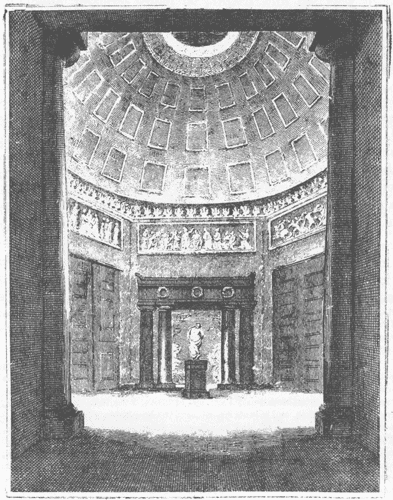
perfect justice! I have seen Mr. Stothard's numerous little sketches of the pleasure-grounds and surrounding country, which are at once faithful and picturesque. But what were this "Paridise" of rocks, waterfalls, streams, woods, copses, dells, grottos, and mountains, without the hospitable spirit of the owner—which seems to preside in, and to animate, every summer-house and alcove. The book-loving world is well acquainted with the Chronicles of Froissart, Joinville, De Brocquiere, and Monstrelet, which have issued from the Hafod Press; and have long deplored the loss, from fire, which their author, Mr. Johnes, experienced in the demolition of the greater part of his house and library. The former has been rebuilt, and the latter replenished: yet no Phœnix spirit can revivify the ashes of those volumes which contained the romances notified by the renowned Don Quixote! But I am rambling too wildly among the Hafod rocks—I hasten, therefore to return and take the reader with me into the interior of Mr. Johnes's largest library, which is terminated by a Conservatory of upwards of 150 feet. As the ancient little books for children [hight Lac Puerorum!] used to express it—"Look, here it is."
Loren. What defects do you discover here, Lysander?
Lysand. They are rather omissions to be supplied than errors to be corrected. You have warmed the interior by a Grecian-shaped stove, and you do right; but I think a few small busts in yonder recesses would not be out of character. Milton, Shakespeare, and Locke, would produce a sort of inspiration which might accord with that degree of feeling excited by the contemplation of these external objects.
Loren. You are right. 'Ere you revisit this spot, those inspiring gentlemen shall surround me.
Belin. And pray add to them the busts of Thomson and Cowper: for these latter, in my opinion, are our best poets in the description of rural life. You remember what Cowper says—
God made the country, and Man made the town?
Alman. This may be very well—but we forget the purpose for which we are convened.
Lis. True: so I entreat you, Master Lysander, to open—not the debate—but the discussion.
Lysand. You wish to know what are the symptoms of the bibliomania?—what are the badges or livery marks, in a library, of the owner of the collection being a bibliomaniac?
Alman. Even so. My question, yesterday evening, was—if I remember well—whether a mere collector of books was necessarily a bibliomaniac?
Lysand. Yes: and to which—if I also recollect rightly—I replied that the symptoms of the disease, and the character of a bibliomaniac, were discoverable in the very books themselves!
Lis. How is this?
Alman & Belin. Do pray let us hear.
Phil. At the outset, I entreat you, Lysander, not to overcharge the colouring of your picture. Respect the character of your auditors; and, above all things, have mercy upon the phlogistic imagination of Lisardo!
Lysand. I will endeavour to discharge the important office of a bibliomaniacal Mentor, or, perhaps, Æsculapius, to the utmost of my power: and at all events, with the best possible intentions.
Before we touch upon the Symptoms, it may be as well to say a few words respecting the General Character of the Book Disease. The ingenious Peignot[427] defines the bibliomania to be "a passion for possessing books; not so much to be instructed by them, as to gratify the eye by looking on them." This subject has amused the pens of foreigners; although we have had nothing in our own language, written expressly upon it, 'till the ingenious and elegantly-composed poem of Dr. Ferriar appeared; after which, as you well know, our friend put forth his whimsical brochure.[428]
Styll am I besy bokes assemblynge For to have plenty it is a pleasaunte thynge In my conceyt, and to have them ay in honde; But what they mene do I nat understonde. Shyp of Folys: see p. 206, ante.
There is a short, but smart and interesting, article on this head in Mr. D'Israeli's Curiosities of Literature: vol. i. 10. "Bruyere has touched on this mania with humour; of such a collector (one who is fond of superb bindings only), says he, as soon as I enter his house, I am ready to faint on the stair-case from a strong smell of Russia and Morocco leather. In vain he shews me fine editions, gold leaves, Etruscan bindings, &c.—naming them one after another, as if he were shewing a gallery of pictures!" Lucian has composed a biting invective against an ignorant possessor of a vast library. "One who opens his eyes with an hideous stare at an old book; and after turning over the pages, chiefly admires the date of its publication." But all this, it may be said, is only general declamation, and means nothing!
Whether Peignot's definition be just or not, I will not stop to determine: but when I have described to you the various symptoms, you will be better able to judge of its propriety.
Lis. Describe them seriatim, as we were observing yesterday.
Lysand. I will; but let me put them in battle array, and select them according to their appearances. There is, first, a passion for Large Paper Copies; secondly, for Uncut Copies; thirdly, for Illustrated Copies; fourthly, for Unique Copies; fifthly, for Copies printed upon Vellum; sixthly, for First Editions; seventhly, for True Editions; and eighthly, for Books printed in the Black-Letter.
Belin. I have put these symptoms down in my pocket-book; and shall proceed to catechise you according to your own method. First, therefore, what is meant by Large Paper Copies?
Lysand. A certain set, or limited number of the work, is printed upon paper of a larger dimension, and superior quality, than the ordinary copies. The press-work and ink are, always, proportionably better in these copies: and the price of them is enhanced according to their beauty and rarity.
This Symptom of the Bibliomania is, at the present day, both general and violent. Indeed, there is a set of collectors, the shelves of whose libraries are always made proportionably stout, and placed at a due distance from each other, in order that they may not break down beneath the weight of such ponderous volumes.
Belin. Can these things be?
Phil. Yes; but you should draw a distinction, and not confound the Grolliers, De Thous, and Colberts of modern times, with "a set of collectors," as you call them, who are equally without taste and knowledge.
Lis. We have heard of De Thou and Colbert, but who is Grollier?[429]
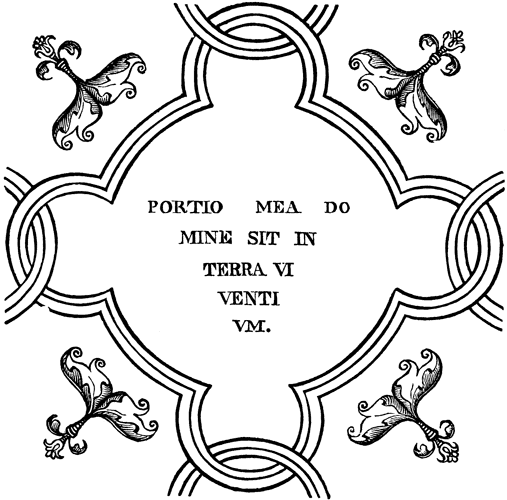
PORTIO MEA DO MINE SIT IN TERRA VI VENTI VM.
Beneath the title of the book: 'Io: Grollerii et Amicorum.'
This extraordinary man, whom France may consider the first Bibliomaniac of the sixteenth century, died at Paris in the year 1565, and in the 86th of his age. Let us close this account of him with an extract from Marville's Melanges d'Histoire et de Litérature; "La Bibliothèque de M. Grollier s'est conservée dans l'Hôtel de Vic jusqu'à ces annêes dernieres qu'elle a été venduë à l'encan. Elle meritoit bien, étant une des premieres et des plus accomplies qu'aucun particulier se soit avisé de faire à Paris, de trouver, comme celle de M. de Thou, un acheteur qui en conservât le lustre. La plûpart des curieux de Paris ont profité de ses débris. J'en ai eu à ma part quelques volumes à qui rien ne manque: ni pour la bonté des editions de ce tems là, ni pour la beauté du papier et la propreté de la relieure. Il semble, à les voir, que les Muses qui ont contribué à la composition du dedans, se soient aussi appliquées à les approprier au dehors, tant il paroît d'art et d'esprit dans leurs ornemens. Ils sont tous dorez avec une delicatesse inconnuë aux doreurs d'aujourd'hui. Les compartemens sont pients de diverses couleurs, parfaitemente bien dessinez, et tous de differentes figures, &c.:" vol. i., p. 187, edit. 1725. Then follows a description, of which the reader has just had ocular demonstration. After such an account, what bibliomaniac can enjoy perfect tranquillity of mind unless he possess a Grollier copy of some work or other? My own, from which the preceding fac-simile was taken, is a folio edition (1531) of Rhenanus, de rebus Germanicis; in the finest preservation.
Phil. Lysander will best observe upon him.
Lysand. Nay; his character cannot be in better hands.
Phil. Grollier was both the friend and the treasurer of Francis the First; the bosom companion of De Thou, and a patron of the Aldine family. He had learning, industry, and inflexible integrity. His notions of Virtû were vast, but not wild. There was a magnificence about every thing which he did or projected; and his liberality was without bounds. He was the unrivalled Mecænas of book-lovers and scholars; and a more insatiable bibliomaniacal appetite was never, perhaps, possessed by any of his class of character.
Lis. I thank you for this Grollieriana. Proceed, Lysander with your large paper copies.
Alman. But first tell us—why are these copies so much coveted? Do they contain more than the ordinary ones?
Lysand. Not in the least. Sometimes, however, an extra embellishment is thrown into the volume—but this, again, belongs to the fourth class of symptoms, called Unique Copies—and I must keep strictly to order; otherwise I shall make sad confusion.
Belin. Keep to your large paper, exclusively.[430]
But devious oft, from ev'ry classic Muse, The keen collector meaner paths will choose: And first the Margin's breadth his soul employs, Pure, snowy, broad, the type of nobler joys. In vain might Homer roll the tide of song, Or Horace smile, or Tully charm the throng; If crost by Pallas' ire, the trenchant blade Or too oblique, or near, the edge invade, The Bibliomane exclaims, with haggard eye, 'No Margin!'—turns in haste, and scorns to buy. The Bibliomania; v. 34-43.
Next come the rivals strains of 'An Aspirant.'
FIRST MAXIM.
Who slaves the monkish folio through, With lore or science in his view, Him ... visions black, or devils blue, Shall haunt at his expiring taper;— Yet, 'tis a weakness of the wise, To chuse the volume by the size, And riot in the pond'rous prize— Dear Copies—printed on Large Paper! Bibliosophia; p. iv.
After these saucy attacks, can I venture upon discoursing, in a sober note-like strain—upon those large and magnificent volumes concerning which Lysander, above, pours forth such a torrent of eloquence? Yes—gentle reader—I will even venture!—and will lay a silver penny to boot (See Peacham's 'Worth of a Penny'—) that neither Dr. Ferriar nor the 'Aspirant' could withhold their ejaculations of rapture upon seeing any one of the following volumes walk majestically into their libraries. Mark well, therefore, a few scarce
Works printed upon Large Paper.
Lord Bacon's Essays; 1798, 8vo. There were only six copies of this edition struck off upon royal folio paper: one copy is in the Cracherode collection, in the British Museum; and another is in the library of Earl Spencer. Mr. Leigh, the book-auctioneer, a long time ago observed that, if ever one of these copies were to be sold at an auction, it would probably bring -00l.—! I will not insert the first figure; but two noughts followed it.——Twenty Plays of Shakspeare from the old quarto editions; 1766, 8vo., 6 vols. Only twelve copies printed upon large paper. See Bibl. Steevens: no. 1312; and p. 581, ante.——Dodsley's Collection of Old Plays; 1780, 8vo., 12 vols. Only six copies struck off upon large paper. Bibl. Woodhouse, no. 698.——The Grenville Homer; 1800, 4to., 4 vols. Fifty copies of this magnificent work are said to have been printed upon large paper; which have embellishments of plates. Mr. Dent possesses the copy which was Professor Porson's, and which was bought at the sale of the Professor's library, in boards, for 87l., see p. 459, ante. Seven years ago I saw a sumptuous copy in morocco, knocked down for 99l. 15s.——Mathæi Paris, Monachi Albanenses, &c.; Historia Major; a Wats; Lond. 1640; folio. This is a rare and magnificent work upon large paper; and is usually bound in two volumes.——Historiæ Anglicanæ Scriptores X; a Twysden; 1652, folio. Of equal rarity and magnificence are copies of this inestimable production.——Rerum Anglicarum Scriptores Veteres, a Gale; 1684, 91; folio, 3 volumes. There were but few copies of this, now generally coveted, work printed upon large paper. The difference between the small and the large, for amplitude of margin and lustre of ink, is inconceivable.——Historiæ Anglicanæ Scriptores Varii, a Sparke; Lond. 1723, folio. The preface to this work shews that there are copies of it, like those of Dr. Clarke's edition of Cæsar's Commentaries, upon paper of three different sizes. The 'charta maxima' is worthy of a conspicuous place upon the collector's shelf; though in any shape the book has a creditable aspect.——Recueil des Historiens des Gaules, &c., par Boucquet; 1738, 1786; folio, 13 vols. It is hardly possible for the eye to gaze upon a more intrinsically valuable work, or a finer set of volumes, than are these, as now exhibited in Mr. Evans's shop, and bound in fine old red morocco by the best binders of France. They were once in my possession; but the 'res angusta domi' compelled me to part with them, and to seek for a copy not so tall by head and shoulders. Since the year 1786, two additional volumes have been published.
We will now discourse somewhat of English books.
Scott's Discoverie of Whitcraft; 1584, 4to. Of this work, which has recently become popular from Mr. Douce's frequent mention of it (Illustrations of Shakspeare, &c., 1806, 2 vols., 8vo.), my friend, Mr. Utterson, possesses a very beautiful copy upon large paper. It is rarely one meets with books printed in this country, before the year 1600, struck off in such a manner. This copy, which is secured from 'winter and rough weather' by a stout coat of skilfully-tool'd morocco, is probably unique.——Weever's Funeral Monuments; 1631, folio. Mr. Samuel Lysons informs me that he has a copy of this work upon large paper. I never saw, or heard of, another similar one.——Sanford's Genealogical History; 1707, folio. At the sale of Baron Smyth's books, in 1809, Messrs. J. and A. Arch purchased a copy of this work upon large paper for 46l. A monstrous price! A similar copy is in the library of Mr. Grenville, which was obtained from Mr. Evans of Pall-Mall. The curious should purchase the anterior edition (of 1677) for the sake of better impressions of the plates; which, however, in any condition, are neither tasteful nor well engraved. What is called 'a good Hollar' would weigh down the whole set of them!——Strype's Ecclesiastical Memorials; 1721, Folio, 3 vols.——Annals of the Reformation; 1725, Folio, 4 vols. Happy the collector who can regale himself by viewing large paper copies of these inestimable works! In any shape or condition, they are now rare. The latter is the scarcer of the two; and upon large paper brings, what the French bibliographers call, 'un prix enorme.' There is one of this kind in the beautiful library of Mr. Thomas Grenville.——Hearne's Works—'till Mr. Bagster issued his first reprints of Robert of Gloucester and Peter Langtoft, upon paper of three different sizes—(of which the largest, in quarto, has hardly been equalled in modern printing)—used to bring extravagant sums at book-auctions. At a late sale in Pall-Mall, were the books in general were sold at extraordinary prices, the large paper Hearnes absolutely 'hung fire'—as the sportsman's phrase is.——Hudibras, with Dr. Grey's Annotations, and Hogarth's cuts; 1744, 2 vols. There were but twelve copies of this first and best edition of Dr. Grey's labours upon Hudibras (which Warburton strangely abuses—) printed upon large paper: and a noble book it is in this form!——Milner's History of Winchester; 1798, 4to., 2 vols. Of this edition there were, I believe, either twelve or twenty-four copies printed upon large paper; which brings serious sums in the present general rage for books of this description.——Kennet's (Bp.) Parochial Antiquities; Oxford, 1695, 4to. The only known copy of this work upon large paper is in the fine library of Sir Richard Colt Hoare, Bart. This copy was probably in the collection of 'that well-known collector, Joseph Browne, Esq., of Shepton Mallet, Somersetshire:' as a similar one 'in Russia, gilt leaves,' was sold in Pt. II. of his collection, no. 279, for 7l. 17s. 6d. and purchased in the name of Thornton.——The Chronicles of Froissart and Monstrelet: translated by Thomas Johnes, Esq. Hafod, 1803, 1810, quarto, 9 vols.: including a volume of plates to Monstrelet. Of these beautiful and intrinsically valuable works, there were only 25 copies struck off upon folio; which bring tremendous prices.——History of the Town of Cheltenham, and its Environs; 1802, 8vo. There were a few copies of this superficial work printed upon large paper in royal octavo, and a unique copy upon paper of a quarto size; which latter is in the possession of my friend Mr. Thomas Pruen, of the same place. A part of this volume was written by myself; according to instructions which I received to make it 'light and pleasant.' An author, like a barrister, is bound in most cases to follow his instructions! As I have thus awkwardly introduced myself, I may be permitted to observe, at the foot of this note, that all the large paper copies of my own humble lucubrations have been attended with an unexpectedly successful sale. Of the Introduction to the Classics, edit. 1804, 8vo., there were fifty copies, with extra plates, struck off in royal octavo, and published at 2l. 2s.: these now sell for 5l. 5s.: the portrait of Bishop Fell making them snapped at, with a perch-like spirit, by all true Grangerites. Of the Typographical Antiquities of our own country there were 66 printed in a superb style, upon imperial paper, in 4to.; these were published at 6l. 6s. a copy. The following anecdote shews how they are 'looking up'—as the book-market phrase is. My friend —— parted with his copy; but finding that his slumbers were broken, and his dreams frightful, in consequence, he sought to regain possession of it; and cheerfully gave 10l. 10s.! for what, but a few months before, he had possessed for little more than one half the sum! The same friend subscribes for a large paper of the present work, of which there are only eighteen copies printed: and of which my hard-hearted printer and myself seize each upon a copy. Will the same friend display equal fickleness in regard to this volume? If he does, he must smart acutely for it: nor will 15l. 15s. redeem it! It is justly observed, in the first edition of this work, that, 'analogous to large paper, are tall copies: that is, copies of the work published on the ordinary size paper, and barely cut down by the binder,' p. 45. To dwarfise a volume is a 'grievous fault' on the part of any binder; but more particularly is it an unpardonable one on the part of him who has had a long intercourse with professed bibliomaniacs! To a person who knows anything of typographical arrangement, the distinction between tall and large paper copies is sufficiently obvious. For this reason, I am quite decided that the supposed large paper copy of Scapula's Lexicon, possessed by Mr. ——, of Caversham, near Reading, is only a tall copy of the work, as usually printed: nor is this copy more stately than another which I have seen. The owner of the volume will suppress all feelings which he may entertain against my heretical opinions (as I fear he will call them), when he considers that he may dispose of his Scapula for a sum three times beyond what he gave for it. Let him put it by the side of his neighbour Dr. Valpy's numerous large paper copies of the old folio classics, and he will in a moment be convinced of the accuracy of the foregoing remark. Fine paper copies of a work should be here noticed; as they are sought after with avidity. The most beautiful work of this kind which I ever saw, was Rapin's History of England, in nine folio volumes, bound in red morocco, and illustrated with Houbraken's Heads; which Sir M.M. Sykes recently purchased of Mr. Evans, the bookseller,—for a comparatively moderate sum. A similar copy (exclusively of the illustrations) of Rapin's History of England, which was once in the library of the Royal Institution, was burnt in the fire that destroyed Covent-Garden Theatre; it having been sent to Mr. Mackinlay, the book-binder, who lived near the Theatre.
Lysand. I have little to add to what has been already said of this symptom. That a volume, so published, has a more pleasing aspect, cannot be denied. It is the oak, in its full growth, compared with the same tree in its sapling state: or, if you please, it is the same picture a little more brilliant in its colouring, and put into a handsomer frame. My friend Marcus is a very dragon in this department of book-collecting: nothing being too formidable for his attack. Let the volume assume what shape it may, and let the price be ever so unconscionable—he hesitates not to become a purchaser. In consequence, exclusively of all the Dugdales and Montfaucons, upon large paper, and in the finest bindings, he possesses the Grand Folio Classics, the Benedictine Editions of the Fathers, the County Histories, and all works, of a recent date, upon History and the Belles Lettres. In short, nothing can be more magnificent than the interior of his library; as nothing but giants, arrayed in the most splendid attire, are seen to keep guard from one extremity of the room to the other.
Lis. Who is this Marcus? I'll rival him in due time!—But proceed.
Belin. Thus much, I presume, for the first symptom of the Bibliomania. Now pray, Sir, inform us what is meant by that strange term, Uncut Copies?
Lysand. Of all the symptoms of the Bibliomania, this is probably the most extraordinary.[431] It may be defined a passion to possess books of which the edges have never been sheared by the binder's tools. And here I find myself walking upon doubtful ground:—your friend [turning towards me] Atticus's uncut Hearnes rise up in "rough majesty" before me, and almost "push me from my stool." Indeed, when I look around in your book-lined tub, I cannot but acknowledge that this symptom of the disorder has reached your own threshold; but when it is known that a few of your bibliographical books are left with the edges uncut merely to please your friends (as one must sometimes study their tastes as well as one's own), I trust that no very serious conclusions will be drawn about the fatality of your own case.
SECOND MAXIM.
Who, with fantastic pruning-hook, Dresses the borders of his book, Merely to ornament its look— Amongst philosophers a fop is: What if, perchance, he thence discover Facilities in turning over? The Virtuoso is a Lover Of coyer charms in "Uncut Copies." Bibliosophia; p. v.
I have very little to add in illustration of Lysander's well-pointed sarcasms relating to this second symptom of Book-Madness. I think I once heard of an uncut Cranmer's Bible; but have actually seen a similar conditioned copy of Purchas's Pilgrimes and Pilgrimage, which is now in the beautiful library of the Honourable T. Grenville.
As to uncut copies, although their inconvenience [an uncut Lexicon to wit!] and deformity must be acknowledged, and although a rational man can wish for nothing better than a book once well bound, yet we find that the extraordinary passion for collecting them not only obtains with full force, but is attended with very serious consequences to those "que n'out point des pistoles" (to borrow the idea of Clement; vol. vi. p. 36). I dare say an uncut first Shakspeare, as well as an uncut vellum Aldus[432] would produce a little annuity!
Belin. 'Tis very strange'—as Hamlet says at the walking of his father's ghost! But now for your Illustrated Copies!
Lysand. You have touched a vibrating string indeed!—but I will suppress my own feelings, and spare those of my friend. A passion for books illustrated, or adorned with numerous Prints[433] representing characters, or circumstances, mentioned in the work, is a very general and violent symptom of the Bibliomania. The origin, or first appearance, of this symptom, has been traced by some to the publication of the Rev. —— Granger's "Biographical History of England;" but whoever will be at the pains of reading the preface of that work will see that Granger shelters himself under the authorities of Evelyn, Ashmole, and others; and that he alone is not to be considered as responsible for all the mischief which this passion for collecting prints has occasioned. Granger, however, was the first who introduced it in the form of a history; and surely "in an evil hour" was that history published; although its amiable author must be acquitted of "malice prepense."
He pastes, from injur'd volumes snipt away, His English Heads in chronicled array, Torn from their destin'd page (unworthy meed Of Knightly counsel, and heroic deed), Not Faithorne's stroke, nor Field's own types can save The gallant Veres, and one-eyed Ogle brave. Indignant readers seek the image fled, And curse the busy fool who wants a head. Proudly he shews, with many a smile elate, The scrambling subjects of the private plate While Time their actions and their names bereaves, They grin for ever in the guarded leaves. The Bibliomania; v. 119-130.
These are happy thoughts, happily expressed. In illustration of v. 123, the author observes,—"three fine heads, for the sake of which, the beautiful and interesting commentaries of Sir Francis Vere have been mutilated by collectors of English portraits." Dr. Ferriar might have added that, when a Grangerian bibliomaniac commences his illustrating career, he does not fail to make a desperate onset upon Speed, Boissard, and the Heroologia. Even the lovely prints of Houbraken (in Dr. Birch's account of Illustrious Persons of Great Britain) escape not the ravages of his passion for illustration. The plates which adorn these books are considered among the foundation materials of a Grangerian building. But it is time, according to my plan, to introduce other sarcastic strains of poetry.
THIRD MAXIM.
Who, swearing not a line to miss, Doats on the leaf his fingers kiss, Thanking the words for all his bliss,— Shall rue, at last, his passion frustrate: We love the page that draws its flavour From Draftsman, Etcher, and Engraver And hint the booby (by his favour) His gloomy copy to "Illustrate." Bibliosophia; p. v.
At this stage of our inquiries, let me submit a new remedy as an acquisition to the Materia Medica, of which many first-rate physicians may not be aware—by proposing a
Recipe for Illustration.
Take any passage from any author—to wit: the following (which I have done, quite at random) from Speed: 'Henry le Spenser, the warlike Bishop of Norwich, being drawn on by Pope Vrban to preach the Crusade, and to be General against Clement (whom sundry Cardinals and great Prelates had also elected Pope) having a fifteenth granted to him, for that purpose, by parliament,' &c. Historie of Great Britaine, p. 721, edit. 1632. Now, let the reader observe, here are only four lines; but which, to be properly illustrated, should be treated thus: 1st, procure all the portraits, at all periods of his life, of Henry le Spencer; 2dly, obtain every view, ancient and modern, like or unlike, of the city of Norwich; and, if fortune favour you, of every Bishop of the same see; 3dly, every portrait of Pope Vrban must be procured; and as many prints and drawings as can give some notion of the Crusade—together with a few etchings (if there be any) of Peter the Hermit and Richard I., who took such active parts in the Crusade; 4thly, you must search high and low, early and late, for every print of Clement; 5thly, procure, or you will be wretched, as many fine prints of Cardinals and Prelates, singly or in groups, as will impress you with a proper idea of the Conclave; and 6thly, see whether you may not obtain, at some of our most distinguished old-print sellers, views of the house of Parliament at the period (A.D. 1383.) here described!!! The result, gentle reader, will be this: you will have work enough cut out to occupy you for one whole month at least, from rise to set of sun—in parading the streets of our metropolis: nor will the expense in coach hire, or shoe leather, be the least which you will have to encounter! The prints themselves may cost something! Lest any fastidious and cynical critic should accuse me, and with apparent justice, of gross exaggeration or ignorance in this recipe, I will inform him, on good authority, that a late distinguished and highly respectable female collector, who had commenced an illustrated bible, procured not fewer than seven hundred prints for the illustration of the 20th, 21st, 22d, 23d, 24th, and 25th verses of the 1st chapter of Genesis! The illustrated copy of Mr. Fox's Historical work, mentioned in the first edition of this work, p. 63, is now in the possession of Lord Mountjoy. The similar copy of Walter Scott's edition of Dryden's works, which has upwards of 650 portraits, is yet in the possession of Mr. Miller, the bookseller.
Granger's work seems to have sounded the tocsin for a general rummage after, and plunder of, old prints. Venerable philosophers, and veteran heroes, who had long reposed in unmolested dignity within the magnificent folio volumes which recorded their achievements, were instantly dragged forth from their peaceful abodes, to be inlaid by the side of some clumsy modern engraving, within an Illustrated Granger!
Nor did the madness stop here. Illustration was the order of the day; and Shakspeare[434] and Clarendon became the next objects of its attack. From these it has glanced off, in a variety of directions, to adorn the pages of humbler wights; and the passion, or rather this symptom of the Bibliomania, yet rages with undiminished force. If judiciously treated, it is, of all the symptoms, the least liable to mischief. To possess a series of well-executed portraits of illustrious men, at different periods of their lives, from blooming boyhood to phlegmatic old age, is sufficiently amusing; but to possess every portrait, bad, indifferent, and unlike, betrays such a dangerous and alarming symptom as to render the case almost incurable!
There is another mode of illustrating copies by which this symptom of the Bibliomania may be known; it consists in bringing together, from different works, [including newspapers and magazines, and by means of the scissars, or otherwise by transcription] every page or paragraph which has any connexion with the character or subject under discussion. This is a useful[435] and entertaining mode of illustrating a favourite author; and copies of works of this nature, when executed by skilful hands, should be deposited in public libraries; as many a biographical anecdote of eminent literary characters is preserved in consequence. I almost ridiculed the idea of an Illustrated Chatterton, 'till the sight of your friend Bernardo's copy, in eighteen volumes, made me a convert to the utility that may be derived from a judicious treatment of this symptom of the Bibliomania: and indeed, of a rainy day, the same bibliomaniac's similar copy of Walton's Complete Angler affords abundant amusement in the perusal.
Lis. Forgive me, if I digress a little. But is not the knowledge of rare, curious, and beautiful Prints—so necessary, it would seem, towards the perfecting of illustrated copies—is not this knowledge of long and difficult attainment?
Lysand. Unquestionably, this knowledge is very requisite towards becoming a complete pupil in the school of Granger.[436] Nor is it, as you very properly suppose, of short or easy acquirement.
Alman. How so? A very little care, with a tolerably good taste, is only required to know when a print is well engraved.
Lysand. Alas, Madam! the excellence of engraving is oftentimes but a secondary consideration!
Belin. Do pray explain.
Lysand. I will, and as briefly and perspicuously as possible.
There are, first, all the varieties of the same print[437] to be considered!—whether it have the name of the character, or artist, omitted or subjoined: whether the head of the print be without the body, or the body without the head—and whether this latter be finished, or in the outline, or ghostly white! Then you must go to the dress of this supposed portrait:—whether full or plain; court or country-fashioned: whether it have a hat, or no hat; feather, or no feather; gloves, or no gloves; sword, or no sword; and many other such momentous points.
Catalogue of Barnard's Prints; 1798, 8vo.
7th Day's Sale.
NO. £ s. d.
47. Sir Thos. Isham de Lamport, by Loggan and Valck; before the names of the artists, very fine. 5 5 0
68. King Charles I. on horseback, with the page, by Lombard; very fine and scarce. 1 14 0
69. The same plate; with Cromwell's head substituted for the King's—variation in the drapery. 3 6 0
70. The same: a curious proof—the face blank and no inscription at bottom—drapery of the page different—and other variations. 1 2 0
90. Catharine, queen of K. Charles II.; in the dress in which she arrived: very scarce. By Faithorne. 4 16 0
97. Queen Elizabeth; habited in the superb court dress in which she went to St. Paul's to return thanks for the defeat of the Spanish Armada—by Passe; from a painting of Isaac Oliver. 6 12 6
[I have known from 14l. to 20l. given for a fine impression of this curious print: but I am as well pleased with Mr. Turner's recently published, and admirably executed, facsimile mezzotint engraving of it; a proof of which costs 1l. 1s. Every member of the two Houses—and every land and sea Captain—ought to hang up this print in his sitting-room.]
Eighth day's Sale.
6. Esther before Ahasuerus: engraved by Hollar; first impression; with the portraits at top; curious and extremely rare. 16 0 0
199. Jo. Banfi Hunniades; proof; very fine and rare. By the same. 2 7 0
200. The same print, with variations. By the same. 3 15 0
202. The Stone-eater; with his history below. By the same. Very rare. 4 4 0
248. Sir Thomas Chaloner; by the same. A proof impression. One of the scarcest prints in existence. 59 17 0
[A similar print has been since sold for 74l.; which is in the collection of Mr. John Townley; whose Hollars are unrivalled!]
256. Herbert, Earl of Pembroke; before the alteration. By the same. 2 10 0
257. Devereux, Earl of Essex; on horseback. By the same. 4 5 0
258. Devereux, Earl of Essex: standing on foot; whole length. By the same. 4 4 0
259. Algernon, Earl of Northumberland; on horseback. By the same. 14 0 0
266. Lady Elizabeth Shirley; an unfinished proof, the chaplet round her head being only traced; curious and extremely rare. By the same. 10 10 0
267. A reverse of the proof; very fine. By the same. 5 5 0
Catalogue of Sir William Musgrave's Prints.
Third Day's Sale.
29. George, Earl of Berkeley; oval, in his robes, 1679; extra fie and rare. 10 5 0
45. George, Duke of Buckingham; oval; cloak over his left arm, hand on sword, nine lines expressive of his titles, &c. Sold by P. Stent: fine and extra rare. 4 12 0
109. George, Earl of Cumberland; whole length, dressed for a tournament. By R. White. 11 0 0
Fifth Day's Sale.
94. The Newcastle Family, in a room, after Diepenbeke, by Clowet; a beautiful proof, before the verses, extra rare. 39 18 0
[There is a very indifferent copy of this print. The original may be seen in the collection of the Marquis of Stafford and Sir M.M. Sykes, Bart. Nothing can exceed the tenderness and delicacy of Clowet's engraving of this naturally conceived and well-managed picture.]
Tenth Day's Sale.
82. Richard Smith; virtuoso and literary character. By W. Sherwin; extra rare and fine. [See my account of this distinguished bibliomaniac at p. 302, ante. Sir M.M. Sykes is in possession of Sir William Musgrave's copy of the portrait.] 7 17 0
Eleventh Day's Sale.
30. Sir Francis Willoughby; with a view of Wollaton Hall; mezzotint by T. Man, extra rare. 13 2 6
43. Sir Francis Wortley; 1652, folio: with trophies, books, &c., by A. Hertochs: extra rare and fine. 29 10 0
Eighteenth Day's Sale.
78. Dr. Francis Bernard; a touched proof; very rare. [The reader may recollect this sagacious bibliomaniac, as noticed at page 316, ante.] 4 14 6
Twentieth Day's Sale.
85. Sir Matthew Lister; M.D. 1646; by P. Van Somer; fine proof, extra rare. 14 14 0
86. Humphrey Lloyd, of Denbigh, Antiquary, ætat. 34, 1651. By Faber, 1717, extra rare and fine. 4 7 0
Twenty-first Day's Sale.
9. Sir John Marsham; ætat. 80. By R. White, extra rare and fine. 6 6 0
19. Martin Master; ætat. 53. 1607. By R. Gaywood, extra rare and fine. 8 8 0
Twenty-seventh Day's Sale.
80. Lady Paston, wife of Sir William Paston, by W. Faithorne; extra rare and fine. 31 0 0
82. Mary, Countess of Pembroke, by Simon Passe, 1618. Fine and rare. 10 0 0
83. Penelope, Countess of Pembroke, in an oval, by W. Hollar. Rare. 3 6 0
84. Anne Clifford, Countess of Pembroke, by R. White: extra rare and fine. 7 17 6
[The prints at this sale—the catalogue containing 323 pages—were sold for 4987l. 17s.]
Miscellaneous Catalogues of Prints.
First Day's Sale.
58. Richard Cromwell, Lord Protector, in a square. "This portrait was etched by Hollar, but he was afraid to put his name to it; and the plate was destroyed as soon as Richard resigned his pretensions to the Protectorship." Note by Mr. Hillier. Very rare. 1 10 0
61. Lord Digby, in armour; after Vander Borcht. Extra rare and fine. 9 9 0
64. Robert Devereux, Earl of Essex, standing, whole length: army in the distance, 1644, fine and rare. 5 5 0
65. The same, on horseback: under the horse a map of England; 1643: first state of the plate; extra fine and rare. 9 0 0
73. Hollar's own portrait, in an oval, ætat. 40, 1647: with variations in the arms. 3 3 0
Sixth Day's Sale.
53. Sir William Paston, 1659: esteemed Faithorne's finest portrait: extra rare. 10 15 0
56. Carew Reynell, from the Fothergill collection: extra fine and rare. 16 5 6
62. Prince Rupert, in armour, right hand on the breast: after Vandyck. Sold by Robert Peake. Extra fine and rare. 9 0 0
Thirteenth Day's Sale.
54. King and Queen of Bohemia, and five children, by Wm. Passe, with thirty-two Englishes [qu?]; 1621: extra fine and rare, The same plate; with the addition of five children; the youngest in a cradle. 4 11 0
55. The same, sitting under a tree; with four children; the youngest playing with a rabbit: fine and rare. 6 6 0
92. James, Duke of York: with the anchor, proof; very fine and rare. (16th day's sale.) 5 2 6
72. Sir Francis Winderbank and Lord Finch; with Finch's wings flying to Winderbank; extra rare. (19th day.) 25 0 0
A Catalogue of a genuine and valuable Collection of English and Foreign Portraits, &c., sold by Auction by Mr. Richardson, February 18, 1798.
1st day's sale.
34. Princess Augusta Maria, daughter of Charles I. in hat and feather, ætat. 15, 1646: by Henry Danckers, 1640. Fine and rare. 3 3 0
57. Anne, Queen of James I. with her daughter Anne; curiously dressed, whole length. By J. Visscher: extra fine and rare. 6 0 0
41. Mary, Queen of Scotts: "Scotorumque nunc Regina"—in an oval: cap adorned with jewels, feather-fan in her hand, &c. By Peter Mynginus: extra fine and rare. 6 12 0
53. Prince Frederick, Count Palatine, with Princess Elizabeth, whole length, superbly dressed: By R. Elstracke: extra fine and rare. 14 0 0
74. Henry the Eighth, with hat and feather, large fur tippet: by C. M(atsis); very fine, and supposed unique. 10 10 0
79. Mary, Queen of Scots: veil'd cross at her breast: ætat. 44, 1583: extra fine and rare. 9 2 6
80. Queen Elizabeth; superbly dressed, between two pillars: extra fine and rare. 15 15 0
A Catalogue of a valuable and genuine Collection of Prints, Drawings, and elegantly illustrated Books, &c., sold by auction by Mr. Richardson; March, 1800.
143. Henry, Lord Darnley, by Passe; fine and very rare. 16 0 0
186. Sir Philip Sidney, by Elstracke; extremely fine. 3 1 0
263. Thomas Howard, Earl of Suffolk, by ditto, extra fine and rare. 13 0 0
264. Edward Somerset, Earl of Worcester, by Simon Passe: rare and fine. 7 15 0
265. Henry Vere, Earl of Oxford, sold by Compton Holland; very rare and fine. 9 0 0
273. Henry Wriothesly, Earl of Southampton, by Simon Passe; most brilliant impression, extra rare. 13 5 0
278. Thomas Howard, Earl of Arundel, by the same; rare and very fine. 5 0 0
279. Richard Sackville, Earl of Dorset, by the same; extra fine and rare—(with a copy by Thane). 3 0 0
280. John Digby, Earl of Bristol; rare and fine: from the Fothergill Collection. 13 0 0
281. Robert Sidney, Viscount Lisle, by Simon Passe; rare and very fine. 5 2 6
284. Edmund, Baron Sheffield: by Elstracke; very fine. 14 10 0
286. James, Lord Hay, by Simon Passe; brilliant impression, fine and rare. 9 0 0
294. George Mountaine, Bishop of London; G.Y. sculpsit; very fine and rare. 5 10 0
330. Sir Julius Cæsar, by Elstracke; extra fine and rare. 23 12 6
335. Arthurus Severus Nonesuch O'Toole, by Delaram; most brilliant impression, and very rare (with the copy). 11 11 0
367. Sir John Wynn de Gwedir, by Vaughan; very rare. 6 6 0
472. Prince Frederic Henry, by Delaram: very fine and rare. 5 7 6
479. Prince Rupert, by Faithorne; very fine and rare. 7 5 0
567. Sir John Hotham, Governor of Hull; whole length; extremely rare and fine. 43 1 0
812. Edward Mascall, by Gammon. 7 3 0
946. Edward Wetenhall, Bishop of Corke and Ross; mezzotint, by Becket; fine. 5 0 0
960. Andrew Lortie, by Van Somer. 13 5 0
979. Thomas Cole, large mezzotint. 4 10 0
997. Sir William Portman, mezzotint. 7 10 0
1001. Anthony, Earl of Shaftesbury, by Blooteling; exceeding fine impression. 6 0 0
1013. Sir Patrick Lyon, of Carse, by White. 5 5 0
1033. Sir Greville Verney, by Loggan. 5 10 0
1045. Marmaduke Rawdon, by White; fine. 14 0 0
1048. Slingsby Bethel, whole length, by W. Sherwin (with small copy). 17 5 0
1054. Samuel Malines, by Lombart; very fine. 12 0 0
1057. Thomas Killegrew, as sitting with the dog: by Faithorne. 16 0 0
A Catalogue of a very choice assemblage of English Portraits, and of Foreigners who have visited England: serving to illustrate Granger's Biographical History; the property of an eminent Collector, &c., Sold by auction, by Messrs. King and Lochée, April, 1810.
But it is time to pause. The present note may have completely served to shew, not only that Lysander was right in drawing such bold conclusions respecting the consequences resulting from the publication of Granger's Biographical History, and the capriciousness of print-fanciers respecting impressions in their various stages, and with all their varieties,—but, that the pursuit of print-collecting is both costly and endless. For one 'fine and rare' print, by Hollar, Faithorne, Elstracke, the Passes, Delaram, or White, how many truly precious and useful volumes may be collected? "All this is vastly fine reasoning"—methinks I hear a Grangerite exclaim—"but compare the comfort afforded by your 'precious and useful volumes' with that arising from the contemplation of eminent and extraordinary characters, executed by the burin of some of those graphic heroes before-mentioned—and how despicable will the dry unadorned volume appear!! On a dull, or rainy day, look at an illustrated Shakespeare, or Hume, and then find it in your heart, if you can, to depreciate the Grangerian Passion!!" I answer, the Grangerite is madder than the Bibliomaniac:—and so let the matter rest.
Next let us discuss the serious subject of the background!—whether it be square or oval; dark or light; put in or put out; stippled or stroked; and sundry other similar, but most important, considerations. Again; there are engravings of different sizes, and at different periods, of the same individual, or object: and of these, the varieties are as infinite as of any of those attached to the vegetable system. I will not attempt even an outline of them. But I had nearly forgotten to warn you, in your Rembrandt Prints, to look sharply after the Burr!
Alman. Mercy on us—what is this Burr?!
Lysand. A slight imperfection only; which, as it rarely occurs, makes the impression more valuable. It is only a sombre tinge attached to the copper, before the plate is sufficiently polished by being worked; and it gives a smeared effect, like smut upon a lady's face, to the impression! But I am becoming satirical. Which is the next symptom that you have written down for me to discourse upon?
Lis. I am quite attentive to this delineation of a Print Connoisseur; and will not fail to mark all the Rembrandt[438] varieties, and take heed to the Burr!
Rembrandtiana;
beseeching him to take due heed to what Lysander has above alluded to by all the Varieties and the Burr!
Lot Daulby. £ s. d.
5 30. Abraham entertaining the three angels; very fine, with the burr, on India paper. 2 18 0
10 43. The Angel appearing to the Shepherds; very fine, presque unique. 6 0 0
14 56. The flight into Egypt, in the style of Elsheimer; on India paper, the 1st impression, extremely rare. 4 16 0
22 75. The Hundred Guilder Piece. This impression on India paper, with the burr, is acknowledged by the greatest connoisseurs in this kingdom to be the most brilliant extant. 42 0 0
23 75. Ditto, restored plate, by Capt. Baillie, likewise on India paper, and very fine. 2 12 6
25 77. The Good Samaritan; the 1st impression with the white tail, most beautifully finished, with a light point, and fine hand; very fine and rare. 6 6 0
27 79. Our Lord before Pilate, second impression on India paper, fine and scarce. 5 15 6
28 79. Same subject, third impression, with the mask, extremely rare: from the collection of the Burgomaster Six. 4 4 0
30 84. The Descent from the Cross. This print is beautifully executed, the composition is grand, and the head full of character; 1st and most brilliant impression. 15 15 0
39 117. The Rat-killer; a most beautiful impression. 3 3 0
42 126. The Marriage of Jason and Creusa; a 1st impression, without the crown, on India paper, very brilliant. 4 10 0
45 152. The Hog; a remarkably fine impression, from Houbraken's collection: scarce. 1 14 0
46 154. The Shell. This piece is finely executed, and this impression, with the white ground, may be regarded as presque unique. 9 10 0
47 178. Ledikant, or French Bed. This is the entire plate, and is a very great rarity. 4 14 6
56 194. The Woman with the Arrow: very scarce. 2 15 0
61 204. The Three Trees; as fine as possible. 6 10 0
63 209. A Village near a high road, arched: 1st impression on India paper, before the cross hatchings: scarce. 4 14 6
67 213. A landscape of an irregular form; 1st impression, with the burr, very scarce. 5 0 0
82 232. Blement de Jonge; 1st impression, the upper bar of the chair is left white, extremely rare. 2 7 0
83 252. Ditto, second impression, very scarce. 1 7 0
84 252. Ditto, third impression, very fine. 2 10 0
85 253. Abraham France, with the curtain, on India paper. 5 5 0
86 353. Ditto: with the chair. 3 18 0
87 254. Ditto; with the figures on the paper which he holds in his wands. All these impressions are rare and fine. 5 10 0
88 254. Old Haaring or Haring, the Burgo-master; beautiful impression on India paper, with the burr, extremely rare. 7 7 0
89 255. Young Haaring, beautiful impression from Houbraken's collection; scarce. 6 6 0
90 256. John Lutma; 1st impression before the window, &c. extremely rare. 4 10 3
93 257. John Aselyn; 1st impression, with the easel, extremely rare. 9 2 0
97 259. Wtenbogardus, the Dutch Minister; a most beautiful and brilliant impression, oval, on a square plate; proof, before the pillar, arch, verses, or any inscription: presque unique. 9 19 6
99 261. The Gold Weigher; 1st impression, with the face blank, extremely rare. 10 10 0
100 261. Ditto; a most beautiful and brilliant impression; and esteemed the finest extant. From the collection of Capt. Baillie. 21 0 0
101 262. The Little Coppenol, with the picture; the second and rarest impression, generally esteemed the 1st; from the Earl of Bute's collection. 7 7 0
102 262. Ditto; without the picture, very fine. 1 13 0
103 263. The great Coppenol, remarkably fine. 4 14 6
104 265. The Advocate Tol; a superb impression, extremely rare with the copy. 54 12 0
145 265. The Burgo-master Six; a most extraordinary impression, the name and age of the Burgo-master are wanting, and the two middle figures in the date are reversed: a very great rarity. 36 15 0
Perhaps the finest collection of Rembrandt's prints, in great Britain, is that in the possession of Lord Viscount Fitzwilliam, at Richmond; a nobleman of extremely retired habits, and equally distinguished for his taste, candour, and erudition. His Paintings and Books are of the very first class.
Lysand. Do so; and attend the shops of Mr. Richardson, Mr. Woodburn, and Mr. Grave, and you may soon have a chance of gratifying your appetite in these strange particulars. But beware of a Hogarth rage!
Lis. Is that so formidable?
Lysand. The longest life were hardly able to make the collection of Hogarth's prints complete! The late Mr. Ireland has been the Linnæus to whom we are indebted for the most minute and amusing classification of the almost innumerable varieties of the impressions of Hogarth's plates.[439]
Lis. I will stick to Rembrandt and leave Hogarth at rest. But surely, this rage for Portrait Collecting cannot be of long duration. It seems too preposterous for men of sober sense and matured judgment to yield to.
Lysand. So think you—who are no Collector! But had you accompanied me to Mr. Christie's on Friday[440] last, you would have had convincing evidence to the contrary. A little folio volume, filled with one hundred and fifty-two prints, produced—
NO. £ s. d.
54. The Right Honourable and truly generous Henry Veere, Earl of Oxford, Viscount Bulbeck, &c. Lord High Chamberlain of England. J. Payne sculp. With a large hat and feather, small, in a border with many figures. Will. Passo, sculp. Tho. Jenner exc. On distinct plates. The most brilliant impression of a print of the greatest rarity. 30 9 0
63. Generall (Edward) Cecyll son to the Right Honourable the Earle of Exeter, &c. In an oval; in armour. Simmon Passæs, sculp. Anno 1618. Sould in Pope's Head Alley, also by John Sudbury and George Humble. Most brilliant impression of a print of the greatest rarity. 34 2 6
90. The true Portraicture of Richard Whitington, thrise Lord Mayor of London, a vertuous and godly man, full of good workes (and those famous) &c. R. Elstracke sculp. Are to be sold by Compton Holland over against the Exchange: First impression with the hand on a skull. Extra fine and rare. 10 10 0
152. Mull'd Sack; a fantastic and humourous Chimney-Sweeper, so called: with cap, feather, and lace band: cloak tuck'd up; coat ragged; scarf on his arm; left leg in a fashionable boot, with a spur; on his right foot a shoe with a rose; sword by his side, and a holly bush and pole on his shoulder; in his left hand, another pole with a horn on it; a pipe, out of which issues smoke, is in his right hand; at the bottom are eight verses (as given in Granger, vol. ii., p. 61). Are to be sold by Compton Holland over against the Exchange, with further manuscript account by a provost of Eton. Considered Unique [but not so]. 42 10 6
Lis. Perhaps, Three Hundred Guineas?
Lysand. Just double the sum, I believe.
Lis. O rare James Granger—thy immortality is secured! But we forget our symptoms of the Bibliomania.
Belin. As I am the examiner, I here demand of you, Sir, what may be the meaning of the fourth symptom of the bibliomaniacal disease, which you call Unique Copies?
Lysand. A passion for a book of which only one copy was printed, or which has any peculiarity about it[441] by either, or both, of the foregoing methods of illustration—or which is remarkable for its size, beauty, and condition—or has any embellishment, rare, precious and invaluable—which the researches of the most sedulous bibliomaniac, for three and thirty long years, would not be able to produce—is indicative of a rage for unique copies; and is unquestionably a strong prevailing symptom of the Bibliomania. Let me therefore urge every sober and cautious collector not to be fascinated by the terms "Curious and rare;" which 'in slim italics' (to copy Dr. Ferriar's happy expression[442]) are studiously introduced into Booksellers' catalogues to lead the unwary astray. Such a Collector may fancy himself proof against the temptation; and will, in consequence, call only to look at this unique book, or set of books; but—led away by the passion which inflamed Berryer and Caillard[443]—when he views the morocco binding, silk water-tabby lining, blazing gilt edges; when he turns over the white and unspotted leaves; gazes on the amplitude of margin; on a rare and lovely print introduced; and is charmed with the soft and coaxing manner in which, by the skill of Herring, Mackinlay, Rodwell, Lewis, or Faulkener, "leaf succeeds to leaf"—he can no longer bear up against the temptation; and, confessing himself vanquished, purchases, and retreats—exclaiming with Virgil's shepherd——
Ut vidi, ut perii—ut me malus abstulit error!
FOURTH MAXIM.
Who in all copies finds delight— The wrong not scenting from the right— And, with a choiceless appetite, Just comes to feed, ... like Soph, or Templar, Out on his iron stomach!—we Have rarities we merely see, Nor taste our Phœnix though it be ... Serv'd up in the "Unique Exemplar," Bibliosophia, p. v.
One of the most curious proofs of the seductive popularity of unique copies may be drawn from the following excerpt from a catalogue of a Library sold at Utrecht in 1776; which was furnished me by Mr. H. Ellis from a copy of the catalogue in the possession of Mr. Cayley of the Augmentation Office.
NO. 6870. Les Avantures de Telemaque, 8o. Rotterd. av. fig. en cart. 'Cet exemplaire est tout barbouillé. Mais il est de la main de la jeune Princesse Wilhelmine Auguste de Saxe-Weimar, qui y a appris le François en 1701!!!'
I will mention a unique copy of a somewhat different cast of character. Of the magnificent and matchless edition of Shakspeare, printed by Mr. Bulmer and published by Mr. Nicols, between the years 1790 and 1805, there were one hundred copies, of the first six plays only, struck off upon imperial folio, or Colombier paper; in which the large engravings, published at the Shakspeare Gallery (now the British Institution) might be incorporated and bound up. The late George Steevens undertook the revision of the text, intending to complete the entire plays in a similar form; but the trouble and expense attending this part of the undertaking were so great that the further prosecution of it was abandoned. Mr. Bulmer preserved the whole of the proof-sheets of this partial Colombier impression; and to form a 'unique edition' (these are his own words) he bound them up in the exact order in which the plays were printed. On the margins of many of the sheets, besides the various corrections, emendations, and notes to the printer, by Mr. Steevens, there are some original sonnets, a scene for a burlesque tragedy, and other happy effusions from the pen of the same elegant and learned editor. Need I ask the reader, whether he would have the barbouillé (unique) copy of Telemaque of the young Princesse Wilhelmine Auguste de Saxe-Weimar (like the Vicar of Wakefield, I like to give the full name) or Mr. Bulmer's similar copy of Shakspeare? The difference would soon be found in King Street or the Strand! I must mention one more example—of a nature different from both the preceding—of what Lysander has above, elaborately, and perhaps, a little confusedly, described as unique copies. It is Colonel Stanley's copy of De Bry (see a superb one before noticed) which is bound in seven folio volumes, in blue morocco, by Padaloup, and is considered superior to every known copy. It contains all the maps and prints, with their variations, according to the Bibliographie Instructive, no. 4230, Cat. de Paris de Meyzieu, 1790; no. 486, Cat. de Santander, no. 3690; and Camus sur les Collections des Grands et Petits Voyages, 1802, 4to.: with both editions of the first nine parts of the West Indies, and duplicates of parts x. and xi. It has also a considerable number of duplicate plates, where a superior impression could be procured at any expense. The owner of this unique copy, of a work unrivalled for its utility and elegance, is distinguished for a noble collection, bound by our choicest binders, in whatever is splendid and precious in the Belles Lettres, Voyages, and Travels. Take two more illustrations, kind-hearted reader!——Goldsmith's Deserted Village, 1802. Mr. Bulmer printed a single copy of this beautiful poem, in quarto, upon satin—picked and prepared in a very curious manner. It was purchased by a foreigner. His impressions upon vellum are noticed, post.——Falconer's Shipwreck, 1804, 8vo. Mr. Miller caused two copies only (is is almost unique!) of this beautiful edition, printed by Bensley, to be struck off upon satin, in imperial 8vo. One of these copies now remains with him for sale.
At ev'ry auction, bent on fresh supplies, He cons his catalogue with anxious eyes: Where'er the slim Italics mark the page, Curious and rare his ardent mind engage. The Bibliomania; v. 54.
Belin. For the benefit—not of the 'Country Gentlemen,' but—of the 'Country Ladies,' do pray translate these Latin words. We are always interested about the pastoral life.
Lis. It only means, Belinda, that this said shepherd was blockhead enough to keep gazing upon his beloved fair, although every glance shot him through the heart, and killed him a hundred times. Still he caressed the cause of his ruin. And so bibliomaniacs hug the very volumes of which they oftentimes know they cannot afford the purchase money! I have not forgotten your account of Dr. Dee:[444] but the ladies were then absent.
Belin. Well, let us now go on to the explanation of the fifth symptom of the Bibliomania; which you have called, Copies printed upon vellum!
Lysand. A desire for books printed in this manner[445] is an equally strong and general symptom of the Biblomania; but, as these works are rarely to be obtained of modern date, the collector is obliged to have recourse to specimens executed, three centuries ago, in the printing offices of Aldus, Verard, or the Giunti. Although the Bibliotheque Imperiale, at Paris, and the library of Count M'Carthy, at Toulouse, are said to contain the greatest number of books, printed upon vellum, yet, those who have been fortunate enough to see copies of this kind in the libraries of his Majesty, the Duke of Marlborough, Earl Spencer, Mr. Johnes, and the late Mr. Cracherode (which latter is now in the British Museum) need not travel on the Continent for the sake of being convinced of their exquisite beauty and splendour. An unique copy of the first Livy, upon vellum, (of which the owner has excited the envy of foreigners) is a library of itself!—and the existence of vellum copies of Wynkyn De Worde's reprint of Juliana Barnes's Book of Hawking, &c., complete in every respect, (to say nothing of his Majesty's similar copy of Caxton's Doctrinal of Sapience, in the finest preservation) are sufficient demonstrations of the prevalance of this symptoms of the Bibliomania in the times of our forefathers; so that it cannot be said, as some have asserted, to have appeared entirely within the last half century.
FIFTH MAXIM.
Who blindly take the book display'd By pettifoggers in the trade. Nor ask of what the leaf was made, That seems like paper—I can tell 'em, That though 'tis possible to squint Through any page with letters in't, No copy, though an angel print, Reads elegantly—but "on vellum." Bibliosophia, p. vi.
I proceed to give evidence of the present passion which prevails, respecting books of the description of which we are now speaking, by extracting a few articles from the library of which such honourable mention was made at p. 448-9, ante. They are all
Works printed upon Vellum.
NO. £ s. d.
241. Epistolæ Beati Jeronimi. Impressio Moguntinæ facta per Virum famatum in hæc arte Petrum Schoiffer de Gernsheym, 2 vols., 1470. A fine specimen of a grand book, superbly bound in blue turkey. Folio. 28 7 0
242. Sexti Decretalium Opus præclarum Bonifacii vii., Pont. Max. In Nobili Urbe Moguncia non Atramento è plumali ereâque Pennâ Cannâve per Petrum Schoiffer de Gernsheym consummatum. A.D. 1476. A most beautiful work, superbly bound in blue turkey. 19 19 0
253. Constitutiones Clementis Papæ Quinti, unà cum apparatu Domini Joannis Andreæ. Venetiis impress. Ere atque Industriâ Nicolai Jenson Gallici, 1476. A most beautiful specimen of clean vellum, with a fine illumination, bound in purple velvet. Folio. 21 10 0
244. Leonora, from the German of Burgher, by Mr. Spencer, with the designs of Lady Diana Beauclerc, 1796. Folio. 25 4 0
A beautiful unique copy, with the plates worked on satin, superbly bound in blue turkey.
245. Dryden's Fables, with engravings from the pencil of Lady Beauclerc. A beautiful unique copy, splendidly bound in morocco, with the plates worked on satin. 34 13 0
246. Missale Monasticum secundum Ritum et consuetudinem Ordinis Gallæ Umbrosæ. Venetiis, per Ant. de Giunta Florentinum, 1503. A most beautiful copy of a very rare book, with plates and illuminations, bound in morocco. Folio. 13 3 6
247. Postilla super Libros N. Testamenti Fratris Nicolai de Lyra. Venet. per Joan. de Colonia et Nic. Jenson, 1481. A fine specimen of beautiful vellum, with illuminations, bound in blue turkey. Folio. 17 17 0
248. The German Bible, by Martin Luther, 2 vols. Augspurg, 1535, folio. A most fair, and beautiful copy, with coloured plates, in the finest preservation, and bound in crimson velvet, with two cases.—'The copies on vellum of this fine edition were printed at the charges of John Frederick, Elector of Saxony, (vide Panzer).' Folio. 52 10 0
249. Le Livre de Jehan Bocasse de la Louenge et Vertu des nobles et Cleres Dames. Paris, par Ant. Verard, 1493. A beautiful work, with curious illuminations, finely bound in blue turkey. Folio. 14 14 0
250. Virgilii Opera curâ Brunck. Argentorati, 1789. An unique copy, bound in morocco, with a case. Quarto. 33 12 0
251. Somervile's Chace, a Poem, with fine plates on wood, by Bewick. Printed by Bulmer, 1796. Quarto. A beautiful unique copy, splendidly bound in green, morocco. 15 4 6
252. Poems by Goldsmith and Parnell, with fine plates on wood by Bewick. Printed by Bulmer, 1795. A beautiful unique copy, superbly bound in green morocco. 15 15 0
253. The Gardens, a poem, by the Abbe de Lisle, with fine plates by Bartolozzi, coloured. Printed by Bensley, 1798. A fine book, and bound in green morocco. Quarto. 14 3 6
254. The Castle of Otranto, by the Earl of Oxford. Printed at Parma, 1791. A fine copy elegantly bound in blue morocco. Quarto. 13 2 6
255. Coustumes du Pais de Normandie. Rouen, 1588. A beautiful unique copy, on fine white vellum, the presentation copy to the Duke de Joyeuse; in old morocco. 14 3 6
256. P. Virgilii Maronis Codex antiquissimus in Bibliotheca Mediceo-Laurentiana. Florent. 1741. A curious facsimile of the old MS. bound in yellow morocco, 4to. 17 17 0
257. Junius's Letters, 4 vols., 8vo. Printed by Bensley, 1796. A beautiful unique copy, with the plates also worked on vellum, bound in morocco. 25 4 0
258. Il Castello di Otranto, storia Gotica, Lond. 1795. Beautifully printed, with fine cuts, illuminated, bound in morocco. 4 16 0
259. Milton's Paradise Regained, Poems, and Sonnets, and Latin Poems, with notes, 3 vols. Printed by Bensley, 1796, 8vo. A unique and beautiful copy, bound in blue turkey. 17 6 6
260. La Guirlande de Julie offerte a Mademoiselle de Rambouillet, par le Marq. de Montausier. Paris de l'Imprim. de Monsieur, 1784, 8vo. 'This matchless book is embellished with exquisite miniatures, paintings of flowers, and wreaths of flowers, to illustrate the work, and is one of the most exquisite performances ever produced;' superbly bound in green morocco.
[30 guineas were bidden; but the book was passed on and not sold.]
261. La Vedova, Commedia facetissima di Nic. Buonaparte Cittadino Florentino. Paris, 1803, 8vo. A curious work by an ancestor of the First Consul; a beautiful unique copy, superbly bound in red morocco. 4 4 0
262. The Old English Baron, a Gothic story, by Clara Reeve, 1794, 8vo. Richly bound in blue turkey. 2 2 0
263. The Œconomy of Human Life, with fine plates, 1795. A beautiful unique copy, with the plates finely tinted in colours and superbly bound in morocco, 8vo. 15 15 0
264. Dr. Benjamin Franklin's Works. Paris, 1795, 8vo. A beautiful unique copy, and bound in crimson velvet. 5 0 0
265. The Dance of Death. Painted by Holbein, and engraved by Hollar, a beautiful unique copy, with the plates exquisitely painted, and very richly bound in red morocco. 17 17 0
266. La Gerusalemme liberata di Torquato Tasso, 4 vols. Parigi Presso Molini, 1783, 8vo. A beautiful copy, bound in green morocco. 9 19 6
267. Catullus, Tibullus, et Propertius, 3 vols. Par. ap. Coustelier, 1743, 8vo. A singularly beautiful copy, and bound in old blue turkey. 14 14 0
268. Opere Toscane di Luigi Alamanni. Leoni. ap. Gryphia, 1552. A most beautiful copy, presented to King Francis I. of France: old morocco. 6 6 0
269. A New Testament in German. Augsburg, 1535, 12mo. A fine copy, with illuminations, of a very rare edition. 2 7 0
Lysander has above noticed the collection of Count M'Carthy of Toulouse. By the kindness of Mr. Roche, banker, at Cork, I learn that this collection 'is a truly splendid one.' The possessor's talents are not confined to the partial walk of bibliography: in his younger years, he was considered one of the first gentlemen-violin players in Europe. He quitted Ireland forty years ago, and now resides at Toulouse, in his 70th year, surrounded by a numerous and respectable family. His leading passion, in book-collecting, (like his countryman's, poor Mr. Quin—who gave 170 guineas for the Spira Virgil of 1470, in membranis!) is marked by a fondness for works printed upon vellum. From Mr. Roche, Mr. Edwards, and other quarters, I am enabled to present the reader with a list of a few of
Count M'Carthy's Books upon Vellum.
Psalmorum Codex;Mogunt.Fust and Schoiffer.Folio, 1457.
—— ——;ibid.apud eosdem.Folio, 1459.
Durandi Rationale;ibid.apud eosdem.Folio, 1459.
Clementis Papæ V. Constitutiones;ibid.apud eosdem.Folio, 1460.
—— —— —— ——;ibid.apud eosdem.Folio, 1467.
Catholicon;ibid.apud eosdem.Folio, 1460.
Biblia Sacra Latina;ibid.apud eosdem.Folio, 1462.
[His Majesty and Earl Spencer possess similar copies of these works.]
Franciscus de Retras Comment. Vitiorum; Nuremb.Folio, 1470.
Hieronimi Epistolæ;Mogunt.Fust and Schoiffer.Folio, 1470.
(Another copy: very large thick paper.)
Priscianus de Art. Grammat.Venet.Vin. Spira.Folio, 1470.
(See p. 407, ante.)
Liber Sextus Decretalium Bonif. Papæ VIII.Mogunt. Folio, 1470.
Guarini Regulæ; Quarto, 1470.
Quintiliani Institutiones;Jenson, Folio, 1471.
Baptista de Alberti de Amore; Quarto, 1471.
—— —— —— de Amoris Remedio: Quarto, 1471.
Biblia in Ling. Volg. Folio, 1471, 2 vols.
Historia Natur. de Plinio tradotto da Landino;Jenson,Venet.1476.
(A similar copy is in Mr. Coke's library at Holkam; illuminated, and in magnificent condition.)
Biblia Sacra Polyglotta; Ximenis;Complut. Folio, 1516, &c., 6 vols.