Part 5 — The Drawing Room. (continued 2)
Reading edition
Your very assured friend,
Henry Savile."
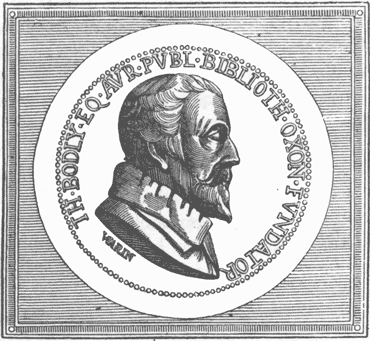
It only remains now to indulge the dutiful sons of Alma Mater with a fac-simile wood-cut impression of the profile of the venerable founder of the Bodleian Library, taken from a print of a medal in the Catalogi Librorum Manuscriptorum Angliæ, &c., 1697, fol.; but whether it have any resemblance to the bust of him, "carved to the life by an excellent hand at London, and shortly after placed in a niche in the south wall of the same library," with the subjoined inscription, I cannot at this moment recollect.
THOMAS SACKVILLUS DORSET, COMES, SUMMUS ANGLIÆ THESAURAR. ET HUJUS ACAD. CANCELLAR. THOMÆ BODLEIO EQUITI AURATO QUI BIBLIOTHECAM HANC INSTITUIT HONORIS CAUSA P.P.
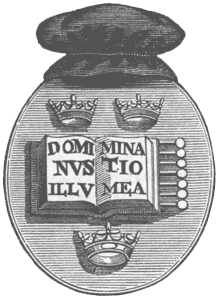
The library of Sir Thomas Bodley, when completed, formed the figure of a T: it was afterwards resolved, on the books accumulating, and the benefactions increasing, to finish it in the form of an H; in which state it now remains. Sir Kenelm Digby, like a thorough bred bibliomaniac, "gave fifty very good oaks, to purchase a piece of ground of Exeter College, laying on the north west side of the library; on which, and their own ground adjoining, they might erect the future fabric." The laying of the foundation of this erection is thus described by Wood; concluding with a catastrophe, at which I sadly fear the wicked reader will smile. "On the thirteenth of May, being Tuesday, 1634, the Vice-chancellor, Doctors, Heads of Houses, and Proctors, met at St. Mary's church about 8 of the clock in the morning; thence each, having his respective formalities on came to this place, and took their seats that were then erected on the brim of the foundation. Over against them was built a scaffold, where the two proctors, with divers masters, stood. After they were all settled, the University Musicians, who stood upon the leads at the west end of the library, sounded a lesson on their wind music. Which being done, the singing men of Christ-Church, with others, sang a lesson, after which the senior Proctor, Mr. Herbert Pelham, of Magdalen College, made an eloquent oration: that being ended also, the music sounded again, and continued playing till the Vice-Chancellor went to the bottom of the foundation to lay the first stone in one of the south angles. But no sooner had he deposited a piece of gold on the said stone, according to the usual manner in such ceremonies, but the earth fell in from one side of the foundation, and the scaffold that was thereon broke and fell with it; so that all those that were thereon, to the number of a hundred at least, namely, the Proctors, Principals of Halls, Masters, and some Bachelaurs, fell down all together, one upon another, into the foundation; among whom, the under butler of Exeter College had his shoulder broken or put out of joint, and a scholar's arm bruised." "The solemnity being thus concluded with such a sad catastrophe, the breach was soon after made up and the work going chearfully forward, was in four years space finished." Annals of the University of Oxford; vol. ii., pt. ii., p. 939. Gutch's edition. We will take leave of Sir Thomas Bodley, and of his noble institution, with the subjoined representation of the University's Arms—as painted upon the ceiling of the library, in innumerable compartments; hoping that the period is not very remote when a History of the Bodleian Library, more ample and complete than any thing which has preceded it, will appear prefixed to a Catalogue of the Books, like unto that which is hinted at p. 74, ante, as "an urgent desideratum."
Lis. Alas, you bring to my mind those precious hours that are gone by, never to be recalled, which I wasted within this glorious palace of Bodley's erection! How I sauntered, and gazed, and sauntered again.—
Phil. Your case is by no means singular. But you promise, when you revisit the library, not to behave so naughtily again?
Lis. I was not then a convert to the Bibliomania! Now, I will certainly devote the leisure of six autumnal weeks to examine minutely some of the precious tomes which are contained in it.
Lysand. Very good. And pray favour us with the result of your profound researches: as one would like to have the most minute account of the treasures contained within those hitherto unnumbered volumes.
Phil. As every sweet in this world is balanced by its bitter, I wonder that these worthy characters were not lampooned by some sharp-set scribbler—whose only chance of getting perusers for his work, and thereby bread for his larder, was by the novelty and impudence of his attacks. Any thing new and preposterous is sure of drawing attention. Affirm that you see a man standing upon one leg, on the pinnacle of Saint Paul's[336]—or that the ghost of Inigo Jones had appeared to you, to give you the extraordinary information that Sir Christopher Wren had stolen the whole of the plan of that cathedral from a design of his own—and do you not think that you would have spectators and auditors enough around you?
Lis. Yes, verily: and I warrant some half-starved scrivener of the Elizabethan period drew his envenomed dart to endeavour to perforate the cuticle of some worthy bibliomaniacal wight.
Lysand. You may indulge what conjectures you please; but I know of no anti-bibliomaniacal satirist of this period. Stubbes did what he could, in his "Anatomy of Abuses,"[337] to disturb every social and harmless amusement of the age. He was the forerunner of that snarling satirist, Prynne; but I ought not thus to cuff him, for fear of bringing upon me the united indignation of a host of black-letter critics and philologists. A large and clean copy of his sorrily printed work is among the choicest treasures of a Shakspearian virtuoso.
But admitting even that Stubbes had drawn his arrow to the head, and grazed the skin of such men as Bodley and Cotton, the wound inflicted by this weapon must have been speedily closed and healed by the balsamic medicine administered by Andrew Maunsell, in his Catalogue of English Printed Books.[338] This little thin folio volume afforded a delicious treat to all honest bibliomaniacs. It revived the drooping spirits of the despondent; and, like the syrup of the renowned Dr. Brodum, circulated within the system, and put all the generous juices in action. The niggardly collector felt the influence of rivalship; he played a deeper stake at book-gambling; and hastened, by his painfully acquired knowledge of what was curious and rare in books, to anticipate the rustic collector—which latter, putting the best wheels and horses to his carriage, rushed from the country to the metropolis, to seize, at Maunsell's shop, a choice copy of Cranmer's Bible, or Morley's Canzonets.[339]
Let us, however, not forget that we have reached the reign of James I.; a monarch who, like Justinian, affected to be "greatly given to study of books;"[340] and who, according to Burton's testimony, wished he had been chained to one of the shelves of the Bodleian library.[341] Of all literary tastes, James had the most strange and sterile. Let us leave him to his Demonology; but notice, with the respect that it merits, the more rational and even elegantly cultivated mind of his son Prince Henry;[342] of whose passion for books there are some good evidences upon record. We will next proceed to the mention of a shrewd scholar and bibliomaniac, and ever active voyager, ycleped Thomas Coryate, the Peregrine of Odcombe. This facetious traveller, who was as quaint and original a writer as old Tom Fuller, appears (when he had time and opportunity) to have taken special notice of libraries; and when he describes to us his "worm eaten" copy of Josephus's Antiquities,[343] "written in ancient Longobard characters in parchment," one cannot but indulge a natural wish to know something of the present existence of a MS. which had probably escaped Oberthür, the last laborious editor of Josephus.
£s.d.
17th October, paid to a Frenchman, that presented a book 4100
20th October, paid Mr. Holyoak for writing a Catalogue of the Library which the Prince had of Lord Lumley}8134
&c. &c. &c.
Apology for the Believers in the Shakspeare-Papers, 1797, 8vo., p. 233.
Let me here beseech you to pay due attention to the works of Henry Peacham, when they come across you. The first edition of that elegantly written volume, "The Compleat Gentleman," was published I believe in the reign of James I., in the year 1622.
Loren. I possess not only this, but every subsequent copy of it, and a fair number of copies of his other works. He and Braithwait were the "par nobile fratrum" of their day.
Phil. I have often been struck with some curious passages in Peacham, relating to the Education of Youth[344] in our own country; as I find, from them, that the complaint of severity of discipline still continued, notwithstanding the able work of Roger Ascham, which had recommended a mild and conciliatory mode of treatment.
deserta per avia dulcis Raptat amor. Juvat ire iugis, quâ nulla priorum Castaliam molli divertitur orbita clivo. (Georg. libi. iij.)
With sweet love rapt, I now by deserts pass, And over hills where never track of yore: Descending easily, yet remembered was, That led the way to Castalie before. (Peacham.)
But instead of many good, they have infinite bad; and go stumbling from the right, as if they went blindfold for a wager. Hence cometh the shifting of the scholler from master to master; who, poor boy (like a hound among a company of ignorant hunters hollowing every deer they see), misseth the right, begetteth himself new labour, and at last, by one of skill and well read, beaten for his paines," pp. 29, 30. Peacham next notices the extreme severity of discipline exercised in some schools. "I knew one, who in winter would ordinarily, in a cold morning, whip his boys over for no other purpose than to get himself a heat: another beats them for swearing, and all the while sweares himself with horrible oaths. He would forgive any fault saving that! I had, I remember, myself (neer St. Alban's in Hertfordshire, where I was born) a master, who, by no entreaty, would teach any scholler he had farther than his father had learned before him; as if he had only learned but to read English, the son, though he went with him seven years, should go no further: his reason was, they would then prove saucy rogues, and controle their fathers! Yet these are they that oftentimes have our hopefull gentry under their charge and tuition, to bring them up in science and civility!" p. 27. This absurd system is well contrasted with the following account of the lenity observed in some of the schools on the continent: "In Germany the school is, and as the name imports, it ought to be, merely, Ludus literarius, a very pastime of learning, where it is a rare thing to see a rod stirring: yet I heartily wish that our children of England were but half so ready in writing and speaking Latin, which boys of ten and twelve years old will do so roundly, and with so neat a phrase and style, that many of our masters would hardly mend them; having only for their punishment, shame; and for their reward, praise," p. 24. "Wherefore I cannot but commend the custome of their schools in the Low-countries, where for the avoyding of this tedious sitting still, and with irksome poring on the book all day long, after the scholler hath received his lecture, he leaveth the school for an houre, and walkes abroad with one or two of his fellows, either into the field or up among the trees upon the rampire, as in Antwerp, Breda, Vtrecht, &c., when they confer and recreate themselves till time calls them in to repeat, where perhaps they stay an hour; so abroad again, and thus at their pleasure the whole day," p. 26. Thus have we pursued the History of the Education of Boys to a period quite modern enough for the most superficial antiquary to supply the connecting links down to the present times. Nor can we conclude this prolix note without observing upon two things which are remarkable enough: first, that in a country like our own—the distinguishing characteristics of whose inhabitants are gravity, reserve, and good sense—lads should conduct themselves with so much rudeness, flippancy, and tyranny towards each other—and secondly, that masters should, in too many instances, exercise a discipline suited rather to a government of despotism and terror than to a land of liberty and social comfort! But all human improvement, and human happiness, is progressive. Speramus meliora!
Lysand. But you must not believe every thing that is said in favour of Continental lenity of discipline, shewn to youth, if the testimony of a modern newspaper may be credited!——
Lis. What your newspaper may hold forth I will not pretend to enter into.
Lysand. Nay, here is the paragraph; which I cut out from "The Observer," and will now read it to you. "A German Magazine recently announced the death of a schoolmaster in Suabia, who, for 51 years, had superintended a large institution with old fashioned severity. From an average, inferred by means of recorded observations, one of the ushers had calculated that, in the course of his exertions, he had given 911,500 canings, 121,000 floggings, 209,000 custodes, 136,000 tips with the ruler, 10,200 boxes on the ear, and 22,700 tasks by heart. It was further calculated that he had made 700 boys stand on peas, 6000 kneel on a sharp edge of wood, 5000 wear the fool's cap, and 1,700 hold the rod. How vast (exclaims the journalist) the quantity of human misery inflicted by a single perverse educator!" Now, my friends, what have you to say against the English system of education?
Phil. This is only defending bad by worse.
Lis. Where are we digressing? What are become of our bibliomaniacal heroes?
Lysand. You do right to call me to order. Let us turn from the birch, to the book, history.
Contemporaneous with Peacham, lived that very curious collector of ancient popular little pieces, as well as lover of "sacred secret soul soliloquies," the renowned melancholy composer, ycleped Robert Burton;[345] who, I do not scruple to number among the most marked bibliomaniacs of the age; notwithstanding his saucy railing against Frankfort book-fairs. We have abundance of testimony (exclusive of the fruits of his researches, which appear by his innumerable marginal references to authors of all ages and characters) that this original, amusing, and now popular, author was an arrant book-hunter; or, as old Anthony hath it, "a devourer of authors." Rouse, the Librarian of Bodleian, is said to have liberally assisted Burton in furnishing him with choice books for the prosecution of his extraordinary work.
——No minute but affords some tears. No walks but private solitary groves Shut from frequent, his contemplation loves; No treatise, nor discourse, so sweetly please As sacred-secret soule soliloquies. Arcadian Princesse, lib. 4, p. 162.
And see, gentle reader, how the charms of solitude—of "walking alone in some solitary grove, betwixt wood and water, by a brook-side, to meditate upon some delightsome and pleasant subject" are depicted by the truly original pencil of this said Robert Burton, in his Anatomy of Melancholy, vol. i., p. 126, edit. 1804. But our theme is Bibliomania. Take, therefore, concerning the same author, the following: and then hesitate, if thou canst, about his being infected with the book-disease. "What a catalogue of new books all this year, all this age (I say) have our Frank-furt marts, our domestic marts, brought out! Twice a year, 'Proferunt se nova ingenia et ostentant;' we stretch our wits out! and set them to sale: 'Magno conatu nihil agimus,' &c. 'Quis tam avidus librorum helluo,' who can read them? As already, we shall have a vast chaos and confusion of books; we are oppressed with them; our eyes ake with reading, our fingers with turning," &c. This is painting ad vivum—after the life. We see and feel every thing described. Truly, none but a thorough master in bibliomaniacal mysteries could have thus thought and written! See "Democritus to the Reader," p. 10; perhaps the most highly finished piece of dissection in the whole anatomical work.
About this period lived Lord Lumley; a nobleman of no mean reputation as a bibliomaniac. But what shall we say to Lord Shaftesbury's eccentric neighbour, Henry Hastings? who, in spite of his hawks, hounds, kittens, and oysters,[346] could not for forbear to indulge his book propensities though in a moderate degree! Let us fancy we see him, in his eightieth year, just alighted from the toils of the chase, and listening, after dinner, with his "single glass" of ale by his side, to some old woman with "spectacle on nose" who reads to him a choice passage out of John Fox's Book of Martyrs! A rare old boy was this Hastings. But I wander—and may forget another worthy, and yet more ardent, bibliomaniac, called John Clungeon, who left a press, and some books carefully deposited in a stout chest, to the parish church at Southampton. We have also evidence of this man's having erected a press within the same; but human villany has robbed us of every relic of his books and printing furniture.[347] From Southampton, you must excuse me if I take a leap to London; in order to introduce you into the wine cellars of one John Ward; where, I suppose, a few choice copies of favourite authors were sometimes kept in a secret recess by the side of the oldest bottle of hock. We are indebted to Hearne for a brief, but not uninteresting, notice of this vinous book collector.[348]
"John, the sonne of John Clungeon of this towne, Alderman, erected this presse and gave certain books, who died, anno 1646.
"The books are, however, now gone, and the surplices, &c. are kept in the chest." See a tasteful and elegantly printed little volume, entitled "A Walk through Southampton;" by Sir H.C. Englefield, Bart. 1801, 8vo., p. 64.
s.d.
binding and claspes400
vellum400"
Annals of Dunstaple Priory, vol. i., p. xxx., note.
Lis. If Master Cox, "by profession a mason," and living in the country, could have collected such a cabinet of romances and ballads—why should not a wine merchant, living in the metropolis, have turned his attention to a similar pursuit, and have been even more successful in the objects of it?
Phil. I know not; particularly as we have, at the present day, some commercial characters—whose dealings in trade are as opposite to books as frogs are to roast beef—absolute madmen in search after black-letter, large paper, and uncut copies! But proceed, Lysander.
Lysand. Such was the influence of the Book Mania about, or rather a little before, this period that even the sacred retirement of a monastery, established upon Protestant principles, and conducted by rules so rigid as almost to frighten the hardiest ascetic, even such a spot was unable to resist the charms of book-collecting and book-embellishment. How St. Jerome or St. Austin would have lashed the Ferrar Family[349] for the gorgeous decorations of their volumes, and for devoting so much precious time and painful attention to the art and mystery of Book-binding! Yes, Lisardo; it is truly curious to think upon the Little Gidding Monastery—near which, perhaps, were
——"rugged rocks, that holy knees had worn—"
and to imagine that the occupiers of such a place were infected—nay, inflamed—with a most powerful ardour for curious, neat, splendid, and, I dare venture to affirm, matchless copies of the several volumes which they composed! But I will now hasten to give very different evidence of the progress of this disease, by noticing the labours of a bibliomaniac of first rate celebrity; I mean Elias Ashmole:[350] whose museum at Oxford abundantly proves his curious and pertinacious spirit in book-collecting. His works, put forth under his own superintendence, with his name subjoined, shew a delicate taste, an active research, and, if we except his Hermetical propensities, a fortunate termination. His "opus maximum" is the Order of the Garter; a volume of great elegance both in the composition and decorations. Your copy of it, I perceived, was upon large paper; and cost you—
DURANTE MUSÆO ASHMOLEANO OXON. NUNQUAM MORITURUS.
A summer month might be profitably passed in the Ashmolean collection of Books! Let us not despair that a complete Catalogue Raisonné of them may yet be given.
Loren. Not eight guineas—although you were about to say fourteen!
Lysand. Even so. But it must have been obtained in the golden age of book-collecting?
Loren. It was obtained, together with an uncut copy of his Theatrum Chemicum,[351] by my father, at the shop of a most respectable bookseller, lately living, at Mews-Gate, and now in Pall-Mall—where the choicest copies of rare and beautiful books are oftentimes to be procured, at a price much less than the extravagant ones given at book-sales. You observed it was bound in blue morocco—and by that Coryphæus of book-binders, the late Roger Payne!
Lysand. I observed it had a "glorious aspect," as bibliographers term it.
Lis. But what has become of Ashmole all this while?
Lysand. I will only further remark of him that, if he had not suffered his mind to wander in quest of the puzzling speculations of alchemy and astrology—which he conceived himself bound to do in consequence, probably, of wearing John Dee's red velvet night cap—he might have mingled a larger portion of common sense and sound practical observations in his writings.
But a truce to worthy old Elias. For see yonder the bibliomaniacal spirit of Archbishop Laud pacing your library! With one hand resting upon a folio,[352] it points, with the other, to your favourite print of the public buildings of the University of Oxford—thereby reminding us of his attachment, while living, to literature and fine books, and of his benefactions to the Bodleian Library. Now it "looks frowningly" upon us; and, turning round, and shewing the yet reeking gash from which the life-blood flowed, it flits away—
Par levibus ventis, volucrique simillima somno!
Peace, peace, thou once "lofty spirit"—peace to thy sepulchre—always consecrated by the grateful student who has been benefited by thy bounty!
Perhaps Laud should have been noticed a little earlier in this list of bibliomanical heroes; but, having here noticed him, I cannot refrain from observing to you that the notorious Hugh Peters revelled in some of the spoils of the archbishop's library; and that there are, to the best of my recollection, some curious entries on the journals of the House of Commons relating to the same.[353]
Lis. This is extraordinary enough. But, if I well remember, you mentioned, a short time ago, the name of Braithwait as connected with that of Peacham. Now, as I persume Lorenzo has not tied down his guests to any rigid chronological rules, in their literary chit-chat, so I presume you might revert to Braithwait, without being taxed with any great violation of colloquial order.
Lysand. Nay, I am not aware of any bookish anecdote concerning Braithwait. He was mentioned with Peacham as being a like accomplished character.[354] Some of his pieces are written upon the same subjects as were Peacham's, and with great point and elegance. He seems, indeed, to have had the literary credit and moral welfare of his countrymen so much at stake that, I confess, I have a vast fondness for his lucubrations. His "English Gentlewoman" might be reprinted with advantage.
——he has the happiest wit, Who has discretion to attemper it. And of all others, those the least doe erre, Who in opinion are least singular. Let Stoicks be to opposition given, Who to extreames in arguments are driven; Submit thy judgment to another's will If it be good; oppose it mildly, ill. Lib. iv., p. 7.
Strong good sense has been rarely exhibited in fewer lines than in the preceding ones. We have next a vigorously drawn character which has the frightful appellation of
Uperephanos, who still thought That th' world without him would be brought to nought: For when the dogge-starre raged, he used to cry, "No other Atlas has the world but I. I am that only Hee, supports the state; Cements divisions, shuts up Janus' gate; Improves the publike fame, chalks out the way How princes should command, subjects obey. Nought passeth my discovery, for my sense Extends itself to all intelligence." &c. &c. &c. So well this story and this embleme wrought, Uperephanos was so humble brought, As he on earth disvalu'd nothing more, Than what his vainest humour priz'd before. More wise, but lesse conceited of his wit; More pregnant, but lesse apt to humour it; More worthy, 'cause he could agnize his want; More eminent, because less arragant. In briefe, so humbly-morally divine, He was esteem'd the Non-such of his time. Id., pp. 8, 11.
Another character, with an equally bizarre name, is drawn with the same vigour:
Melixos; such a starved one, As he had nothing left but skin and bone. The shady substance of a living man, Or object of contempt wheree'er he came. Yet had hee able parts, and could discourse, Presse moving reasons, arguments enforce, Expresse his readings with a comely grace, And prove himselfe a Consul in his place! Id., p. 12.
We have a still more highly-coloured, and indeed a terrific, as well as original, picture, in the following animated verses:
Next him, Uptoomos; one more severe, Ne'er purple wore in this inferiour sphere: Rough and distastefull was his nature still, His life unsociable, as was his will. Eris and Enio his two pages were, His traine stern Apuneia us'd to beare. Terrour and thunder echo'd from his tongue, Though weake in judgment, in opinion strong. A fiery inflammation seiz'd his eyes, Which could not well be temper'd any wise: For they were bloud-shot, and so prone to ill, As basiliske-like, where'ere they look, they kill. No laws but Draco's with his humour stood, For they were writ in characters of bloud. His stomacke was distemper'd in such sort Nought would digest; nor could he relish sport. His dreames were full of melancholy feare, Bolts, halters, gibbets, halloo'd in his eare: Fury fed nature with a little food, Which, ill-concocted, did him lesser good, Id., p. 16.
But it is time to pause upon Braithwait. Whoever does not see, in these specimens, some of the most powerful rhyming couplets of the early half of the seventeenth century, if not the model of some of the verses in Dryden's satirical pieces, has read both poets with ears differently constructed from those of the author of this book.
As I am permitted to be desultory in my remarks, (and, indeed, I craved this permission at the outset of them) I may here notice the publication of an excellent Catalogue of Books, in 1658, 4to.; which, like its predecessor, Maunsell's, helped to inflame the passions of purchasers, and to fill the coffers of booksellers. Whenever you can meet with this small volume, purchase it, Lisardo; if it be only for the sake of reading the spirited introduction prefixed to it.[355] The author was a man, whoever he may chance to be, of no mean intellectual powers. But to return.
Where sleep now the relics of Dyson's Library, which supplied that Helluo Librorum, Richard Smith, with "most of his rarities?"[356] I would give something pretty considerable to have a correct list—but more to have an unmolested sight—of this library, in its original state: if it were merely to be convinced whether or not it contained a copy of the first edition of Shakespeare, of larger dimensions, and in cleaner condition, than the one in Philander's Collection!
I have incidentally mentioned the name of Richard Smith.[357] Such a bibliomaniac deserves ample notice, and the warmest commendation. Ah, my Lisardo! had you lived in the latter days of Charles II.—had you, by accident, fallen into the society of this indefatigable book-forager, while he pursued his book-rounds in Little Britain—could you have listened to his instructive conversation, and returned home with him to the congenial quiet and avocations of his book-room—would you, however caressed St. James's, or even smiled upon by the first Duchess in the land—have cared a rush for the splendours of a Court, or concentrated your best comforts in a coach drawn by six cream-coloured horses? Would you not, on the contrary, have thought with this illustrious bibliomaniac, and with the sages of Greece and Rome before him, that "in books is wisdom, and in wisdom is happiness."
Lis. In truth I should have done even more than what your barren imagination has here depicted. Smith's figure, his address, his conversation, his library—
Loren. Enough—peace! There is no end to Lisardo's fruitful imagination. We are surfeited with the richness of it. Go on, dear Lysander; but first, satisfy a desire which I just now feel to be informed of the period when Sales of Books, by Auction, were introduced into this country.
Lysand. You take that for granted which remains be proved: namely, my ability to gratify you in this particular. Of the precise period when this memorable revolution in the sale of books took place I have no means of being accurately informed: but I should think not anterior to the year 1673, or 1674; for, in the year 1676, to the best of my recollection, the catalogue of the Library of Dr. Seaman was put forth; to which is prefixed an address to the reader, wherein the custom of selling books by auction is mentioned as having been but of recent origin in our country.[358] It was, however, no sooner introduced than it caught the attention, and pleased the palates, of bibliomaniacs exceedingly: and Clavel, a bookseller, who published useful catalogues of books to be sold in his own warehouse, retorted in sharp terms upon the folly and extravagance which were exhibited at book auctions. However, neither Clavel nor his successors, from that period to the present, have been able to set this custom aside, nor to cool the fury of book-auction bibliomaniacs—who, to their eternal shame be it said, will sometimes, from the hot and hasty passions which are stirred up by the poisonous miasmata floating in the auction-room, give a sum twice or thrice beyond the real value of the books bidden for! Indeed, I am frequently amused to see the vehemence and rapture with which a dirty little volume is contended for and embraced—while a respectable bookseller, like Portius, coolly observes across the table—"I have a better copy on sale at one third of the price!"
"Reader,
"It hath not been usual here in England to make Sale of Books by way of Auction or who will give most for them: But it having been practised in other countreys to the advantage both of buyers and sellers, it was therefore conceived (for the encouragement of learning) to publish the sale of these books this manner of way; and it is hoped that this will not be unacceptable to schollers: and therefore, methought it convenient to give an advertisement concerning the manner of proceeding therein. First, That having this catalogue of the books, and their editions, under their several heads and numbers, it will be more easie for any person of quality, gentleman, or others, to depute any one to buy such books for them as they shall desire, if their occasions will not permit them to be present at the auction themselves." The second clause is the usual one about differences arising. The third, about discovering the imperfections of the copies before they are taken away. The fourth, that the buyers are to pay for their purchases within one month after the termination of the auction. The fifth, that the sale is to begin "punctually at 9 o'clock in the morning, and two in the afternoon; and this to continue daily until all the books be sold; wherefore it is desired that the gentlemen, or those deputed by them, may be there precisely at the hours appointed, lest they should miss the opportunity of buying those books which either themselves or their friends desire." As this is the earliest auction catalogue which I have chanced to meet with, the present reader may probably be pleased with the following specimens, selected almost at random of the prices which were given for books at a public sale, in the year 1676.
In Folio. Philologists.
s.d.
Pet. Heylyn's Cosmographie, Lond. 1652.140
Io. Stow's Annals, or Chronicles of England, &c. ibid., 1631.150
Burton's Anatomy of Melancholy, Oxon, 1638.60
Geo. Withers, his Emblems; illustrated with brass figures, 1635.86
Os. Gabelhower's book called the Dutch Physic, Dort, 1579.30
p. 12.
In Quarto. Philologie.
The Royal Passage of her Majesty, from the tower to Whitehall, Lond., 1604. The Vision of the Goddesses, a mask by the Queen and her Ladies, 1604. King James his Entertainment through the city of London, ibid. A particular Entertainment of the Queen and Prince, 1608. The magnificent Entertainment of King James, Queen Anne, and Prince Henry Frederick, 1604. Her Majesties speech to both Houses of Parliament, 1604. Vox Cœli, or News from Heaven, 1624. An experimental Discovery of the Spanish Practises, 1623. Tho. Scotts aphorisms of State, or secret articles for the re-edifying the Romish Church, 1624. The Tongue Combat between two English Souldiers, 1621. Votivæ Angliæ, or the Desires and Wishes of England, 1624. A book of Fishing, with hook and line, and other instruments, 1600. s. 5 d. 0
p. 63.
Now a-days, the last article alone would pr duce—shall I say nine times the sum of the whole? But once more:
In Octavo. Philologists.
Rob. Crowley's Confutation and Answer to a wicked ballade of the abuse of the sacrament of the altar, 1548. Philargyne, or Covetousness of Great Britain, 1551. A Confutation of 13 articles of Nicol Sharton's, 1551. The Voice of the last Trumpet, blown by the seventh angel, 1550. Rob. Crowley's four last things. A petition against the oppressors of the poor of this realm, 1550. A supplication of the poor Commons, 1550. Piers Plowman Exhortation to the Parliament, and a New-Year's gift, 1550. The Hurt of Sedition to the Commonwealth, 1549. s. 3 d. 2
To continue the History of Book Auctions, a little further. Two years after the preceding sale, namely, in 1678, were sold the collections of Dr. Manton, Dr. Worsley, and others. In the address to the Reader, prefixed to Manton's catalogue, it would seem that this was the "fourth triall" of this mode of sale in our own country. The conditions and time of sale the same as the preceding; and because one Briggs, and not one Cooper, drew up the same, Cooper craves the reader's "excuse for the mistakes that have happened; and desires that the saddle may be laid upon the right horse." In this collection there is a more plentiful sprinkling of English books; among which, Dugdale's Warwickshire, 1656, was sold for 1l. 6s.; and Fuller's Worthies for the same sum. The "Collections of Pamphlets, bound together in Quarto," were immense. Dr. Worsley's collection, with two others, was sold two months afterwards; namely, in May, 1678: and from the address "To the Reader," it would appear that Dr. Manton's books brought such high prices as to excite the envy of the trade. Worsley's collection was sold at 9 and 2, the usual hours "at the house over against the hen and chickens, in Pater-Noster Row." The venders thus justify themselves at the close of their address: "We have only this to add in behalf of ourselves; that, forasmuch as a report has been spread that we intend to use indirect means to advance the prices, we do affirm that it is a groundless and malicious suggestion of some of our own trade, envious of our undertaking: and that, to avoid all manner of suspicion of such practice, we have absolutely refused all manner of commissions that have been offered us for buying (some of them without limitation): and do declare that the company shall have nothing but candid and ingenuous dealing from
John Dunmore. Richard Chiswel."
At this sale, the Shakspeare of 1632 brought 16s.; and of 1663, 1l. 8s.
In the November and December of the same year were sold by auction the books of Voet, Sangar, and others, and from the preface to each catalogue it would seem that the sale of books by auction was then but a recent, yet a very successful, experiment; and that even collections from abroad were imported, in order to be disposed of in a like manner.
Lis. From what you say, it would appear to be wiser to lay out one's money at a bookseller's than at a book-auction?
Lysand. Both methods must of necessity be resorted to: for you cannot find with the one what you may obtain at the other. A distinguished collector, such as the late Mr. Reed, or Mr. Gough, or Mr. Joseph Windham, dies, and leaves his library to be sold by auction for the benefit of his survivors. Now, in this library so bequeathed, you have the fruits of book-labour, collected for a long period, and cultivated in almost every department of literature. A thousand radii are concentrated in such a circle; for it has, probably, been the object of the collector's life to gather and to concentrate these radii. In this case, therefore, you must attend the auction; you must see how such a treasure is scattered, like the Sibylline leaves, by the winds of fate. You must catch at what you want, and for what you have been a dozen years, perhaps, in the pursuit of. You will pay dearly for these favourite volumes; but you have them, and that is comfort enough; and you exclaim, as a consolation amidst all the agony and waste of time which such a contest may have cost you,—"Where, at what bookseller's, are such gems now to be procured?" All this may be well enough. But if I were again to have, as I have already had, the power of directing the taste and applying the wealth of a young collector—who, on coming of age, wisely considers books of at least as much consequence as a stud of horses—I would say, go to Mr. Payne, or Mr. Evans, or Mr. Mackinlay, or Mr. Lunn, for your Greek and Latin Classics; to Mr. Dulau, or Mr. Deboffe, for your French; to Mr. Carpenter, or Mr. Cuthell, for your English; and to Mr. White for your Botany and rare and curious books of almost every description. Or, if you want delicious copies, in lovely binding, of works of a sumptuous character, go and drink coffee with Mr. Miller, of Albemarle Street—under the warm light of an Argand lamp—amidst a blaze of morocco and russia coating, which brings to your recollection the view of the Temple of the Sun in the play of Pizarro! You will also find, in the vender of these volumes, courteous treatment and "gentlemanly notions of men and things." Again, if you wish to speculate deeply in books, or to stock a newly-discovered province with what is most excellent and popular in our own language, hire a vessel of 300 tons' burthen, and make a contract with Messrs. Longman, Hurst, and Co., who are enabled, from their store of quires, which measure 50 feet in height, by 40 in length, and 20 in width, to satisfy all the wants of the most craving bibliomaniacs. In opposition to this pyramid, enter the closet of Mr. Triphook, jun., of St. James's Street—and resist, if it be in your power to resist, the purchase of those clean copies, so prettily bound, of some of our rarest pieces of black-letter renown!
Loren. From this digression, oblige us now by returning to our bibliomaniacal history.
Lysand. Most willingly. But I am very glad you have given me an opportunity of speaking, as I ought to speak, of some of our most respectable booksellers, who are an ornament to the cause of the bibliomania.
We left off, I think, with noticing that renowned book-collector, Richard Smith. Let me next make honourable mention of a "par nobile fratrum" that ycleped are North. The "Lives" of these men, with an "Examen" (of "Kennet's History of England"), were published by a relative (I think a grandson) of the same name; and two very amusing and valuable quarto volumes they are! From one of these Lives, we learn how pleasantly the Lord Keeper used to make his meals upon some one entertaining Law-volume or another: how he would breakfast upon Stamford,[359] dine upon Coke, and sup upon Fitzherbert, &c.; and, in truth, a most insatiable book appetite did this eminent judge possess. For, not satisfied ("and no marvel, I trow") with the foregoing lean fare, he would oftentimes regale himself with a well-served-up course of the Arts, Sciences, and the Belles-Lettres!
His brother, Dr. John North, was a still greater Helluo Librorum; "his soul being never so staked down as in an old bookseller's shop." Not content with a superficial survey of whatever he inspected, he seems to have been as intimately acquainted with all the book-selling fraternity of Little-Britain as was his contemporary, Richard Smith; and to have entered into a conspiracy with Robert Scott[360]—the most renowned book vender in this country, if not in Europe—to deprive all bibliomaniacs of a chance of procuring rare and curious volumes, by sweeping every thing that came to market, in the shape of a book, into their own curiously-wrought and widely-spread nets. Nay, even Scott himself was sometimes bereft of all power, by means of the potent talisman which this learned Doctor exercised—for the latter, "at one lift," would now and then sweep a whole range of shelves in Scott's shop of every volume which it contained. And yet how whimsical, and, in my humble opinion, ill-founded, was Dr. North's taste in matters of typography! Would you believe it, Lisardo, he preferred the meagre classical volumes, printed by the Gryphii, in the italic letter, to the delicate and eye-soothing lustre of the Elzevir type—?
Lis. "De gustibus—" you know the rest. But these Norths were brave bibliomaniacs! Proceed, we are now advancing towards the threshold of the eighteenth century; and the nearer you come to it, the greater is the interest excited.
Lysand. Take care that I don't conclude with the memorable catalogue-burning deed of your father! But I spare your present feelings.
All hail to the noble book-spirit by which the Lives of Oxford-Athenians, and the Antiquities of Oxford University, are recorded and preserved beyond the power of decay![361] All hail to thee, Old Anthony a-Wood! May the remembrance of thy researches, amidst thy paper and parchment documents, stored up in chests, pews, and desks, and upon which, alas! the moth was "feeding sweetly," may the remembrance of these thy laborious researches always excite sensations of gratitude towards the spirit by which they were directed! Now I see thee, in imagination, with thy cautious step, and head bowing from premature decay, and solemn air, and sombre visage, with cane under the arm, pacing from library to library, through gothic quadrangles; or sauntering along the Isis, in thy way to some neighbouring village, where thou wouldst recreate thyself with "pipe and pot." Yes, Anthony! while the Bodleian and Ashmolean collections remain—or rather as long as Englishmen know how to value that species of literature by which the names and actions of their forefathers are handed down to posterity, so long shall the memory of thy laudable exertions continue unimpaired!
H.S.E. antonius wood, antiquarius. ob. 28 Nov. Ao. 1695, æt. 64."
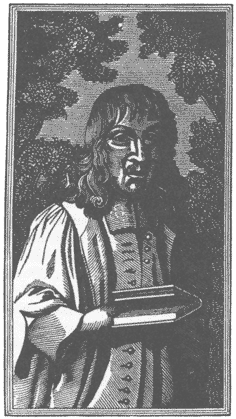
In his person, he was of a large robust make, tall and thin, and had a sedate and thoughtful look, almost bordering upon a melancholy cast. Mr. Hearne says, in his Collectanea MSS., that though he was but sixty-four years of age when he died, he appeared to be above fourscore; that he used spectacles long before he had occasion for them, that he stooped much when he walked, and generally carried his stick under his arm, seldom holding it in his hand. As to the manner of his life, it was solitary and ascetic. The character which Gassendus gives of Peireskius, may, with propriety, be used as descriptive of Mr. Wood's. "As to the care of his person, cleanliness was his chief object, he desiring no superfluity or costliness, either in his habit or food. His house was furnished in the same manner as his table; and as to the ornament of his private apartment, he was quite indifferent. Instead of hangings, his chamber was furnished with the prints of his particular friends, and other men of note, with vast numbers of commentaries, transcripts, letters, and papers of various kinds. His bed was of the most ordinary sort; his table loaded with papers, schedules, and other things, as was also every chair in the room. He was a man of strict sobriety, and by no means delicate in the choice of what he eat. Always restrained by temperance, he never permitted the sweet allurements of luxury to overcome his prudence." Such, as is here represented, was the disposition of Mr. Wood: of so retired a nature as seldom to desire or admit a companion at his walks or meals; so that he is said to have dined alone in his chamber for thirty years together. Mr. Hearne says that it was his custom to "go to the booksellers at those hours when the greater part of the University were at their dinners," &c. And at five leaves further, in a note, we find that, "when he was consulting materials for his Athenæ Oxon., he would frequently go to the booksellers, and generally give money to them, purposely to obtain titles of books from them; and 'twas observed of him that he spared no charges to make that work as compleat and perfect as possible." Hearne's Coll. MSS. in Bodl. Lib., vol. ix., p. 185. The following letter, describing Wood's last illness, and the disposition of his literary property, is sufficiently interesting to be here, in part, laid before the reader: it was written by Mr. (afterwards Bishop) Tanner to Dr. Charlett.
"Honoured Master,
Yesterday, at dinner-time, Mr. Wood sent for me; when I came, I found Mr. Martin and Mr. Bisse of Wadham (college) with him, who had (with much ado) prevailed upon him to set about looking over his papers, so to work we went, and continued tumbling and separating some of his MSS. till it was dark. We also worked upon him so far as to sign and declare that sheet of paper, which he had drawn up the day before, and called it his will; for fear he should not live till night. He had a very bad night of it last night, being much troubled with vomiting. This morning we three were with him again, and Mr. Martin bringing with him the form of a will, that had been drawn up by Judge Holloway, we writ his will over again, as near as we could, in form of law. He has given to the University, to be reposited in the Museum Ashmol., all his MSS., not only those of his own collection, but also all others which he has in his possession, except some few of Dr. Langbain's Miscellanea, which he is willing should go to the public library. He has also given all his printed books and pamphlets to the said musæum which are not there already. This benefaction will not, perhaps, be so much valued by the University as it ought to be, because it comes from Anthony Wood; but truly it is a most noble gift, his collection of MSS. being invaluable, and his printed books, most of them, not to be found in town," &c. This letter is followed by other accounts yet more minute and touching, of the last mortal moments of poor old Anthony! It now remains to say a few words about his literary labours. A short history of the editions of the Athenæ Oxonienses (vide p. 45, ante) has already been communicated to the reader. We may here observe that his Antiquities of the University shared a similar fate; being garbled in a Latin translation of them, which was put forth under the auspices of Bishop Fell: 1676, fol., in 2 vols. Wood's own MS. was written in the English language, and lay neglected till towards the end of the 18th century, when the Rev. Mr. Gutch conferred a real benefit upon all the dutiful sons of alma mater, by publishing the legitimate text of their venerable and upright historian; under the title of The History and Antiquities of the Colleges and Halls, 1786, 4to., with a supplemental volume by way of Appendix, 1790, 4to., containing copious indexes to the two. Then followed the Annals of the University at large, viz. The History and Antiquities of the University of Oxford; 1792, 4to., in two volumes; the latter being divided into two parts, or volumes, with copious indexes. These works, which are now getting scarce, should be in every philological, as well as topographical, collection. In order to compensate the reader for the trouble of wading through the preceding tremendous note, I here present him with a wood-cut facsimile of a copper-plate print of Wood's portrait, which is prefixed to his Life, 1772, 8vo. If he wishes for more curious particulars respecting Wood's literary labours, let him take a peep into Thomæ Caii Vindic. Antiq. Acad. Oxon.: 1730, 8vo., vol. i., pp. xl. xliii. Edit. Hearne. Wood's study, in the Ashmolean museum, is yet to be seen. It is filled with curious books, which, however, have not hitherto been catalogued with accuracy. Ritson has availed himself, more successfully than any antiquary in poetry, of the book treasures in this museum.
A very few years after the death of this distinguished character, died Dr. Francis Bernard;[362] a stoic in bibliography. Neither beautiful binding, nor amplitude of margin, ever delighted his eye or rejoiced his heart: for he was a stiff, hard, and straight-forward reader—and learned, in Literary History, beyond all his contemporaries. His collection was copious and excellent; and although the compiler of the catalogue of his books sneers at any one's having "an entire collection in physic," (by the bye, I should have told you that Bernard was a Doctor of Medicine,) yet, if I forget not, there are nearly 150 pages in this said catalogue which are thickly studded with "Libri Medici," from the folio to the duodecimo size. Many very curious books are afterwards subjoined; and some precious bijous, in English Literature, close the rear. Let Bernard be numbered among the most learned and eminent bibliomaniacs.
"TO THE READER.
The character of the person whose collection this was, is so well known, that there is no occasion to say much of him, nor to any man of judgment that inspects the catalogue of the collection itself. Something, however, it becomes us to say of both; and this I think may with truth and modesty enough be said, that as few men knew books, and that part of learning which is called Historia Litteraria, better than himself, so there never yet appeared in England so choice and valuable a catalogue to be thus disposed of as this before us: more especially of that sort of books which are out of the common course, which a man may make the business of his life to collect, and at last not to be able to accomplish. A considerable part of them being so little known, even to many of the learned buyers, that we have reason to apprehend this misfortune to attend the sale, that there will not be competitors enough to raise them up to their just and real value. Certain it is this library contains not a few which never appeared in any auction here before; nor indeed, as I have heard him say, for ought he knew, (and he knew as well as any man living) in any printed catalogue in the world."—"We must confess that, being a person who collected his books for use, and not for ostentation or ornament, he seemed no more solicitous about their dress than his own; and therefore you'll find that a gilt back, or a large margin, was very seldom any inducement to him to buy. 'Twas sufficient that he had the book." "Though considering that he was so unhappy as to want heirs capable of making that use of them which he had done, and that therefore they were to be dispersed after this manner; I have heard him condemn his own negligence in that particular; observing, that the garniture of a book was as apt to recommend it to a great part of our modern collectors (whose learning goes not beyond the edition, the title-page, and the printer's name) as the intrinsic value could. But that he himself was not a mere nomenclator, and versed only in title-pages, but had made that just and laudable use of his books which would become all those that set up for collectors, I appeal to the Literati of his acquaintance, who conversed most frequently with him; how full, how ready, and how exact he was in answering any question that was proposed to him relating to learned men, or their writings; making no secret of any thing that he knew, or any thing that he had; being naturally one of the most communicative men living, both of his knowledge and his books."—"And give me leave to say this of him, upon my own knowledge; that he never grudged his money in procuring, nor his time or labour in perusing, any book which he thought could be any ways instructive to him, and having the felicity of a memory always faithful, always officious, which never forsook him, though attacked by frequent and severe sickness, and by the worst of diseases, old age, his desire of knowledge attended him to the last; and he pursued his studies with equal vigour and application to the very extremity of his life." It remains to add a part of the title of the catalogue of the collection of this extraordinary bibilomaniac: "A Catalogue of the Library of the late learned Dr. Francis Bernard, Fellow of the College of Physicians, and Physician to St. Bartholomew's Hospital, &c.," 1698, 8vo. The English books are comprised in 1241 articles; and, among them, the keen investigator of ancient catalogues will discover some prime rarities.
Having at length reached the threshold, let us knock at the door, of the eighteenth century. What gracious figures are those which approach to salute us? They are the forms of Bishops Fell and More:[363] prelates, distinguished for their never ceasing admiration of valuable and curious works. The former is better known as an editor; the latter, as a collector—and a collector, too, of such multifarious knowledge, of such vivid and just perceptions, and unabating activity—that while he may be hailed as the Father of black-letter Collectors in this country, he reminds us of his present successor in the same see; who is not less enamoured of rare and magnificent volumes, but of a different description, and whose library assumes a grander cast of character.
"These are imperial works, and worthy kings!"
And here, benevolent reader, the almost unrivalled Bibliotheca Moriana yet quietly and securely reposes. Well do I remember the congenial hours I spent (A.D. 1808) in the closet holding the most precious part of Bishop More's collection, with my friend the Rev. Mr. ——, tutor of one of the colleges in the same University, at my right-hand—(himself "greatly given to the study of books") actively engaged in promoting my views, and increasing my extracts—but withal, eyeing me sharply "ever and anon"—and entertaining a laudable distrust of a keen book-hunter from a rival University! I thank my good genius that I returned, as I entered, with clean hands! My love of truth and of bibliography compels me to add, with a sorrowful heart, that not only is there no printed catalogue of Bishop More's books, but even the fine public library of the university remains unpublished in print! In this respect they really do "order things better in France." Why does such indifference to the cause of general learning exist—and in the 19th century too? Let me here presume to submit a plan to the consideration of the syndics of the press; provided they should ever feel impressed with the necessity of informing the literati, of other countries as well as our own, of the book treasures contained in the libraries of Cambridge. It is simply this. Let the books in the Public Library form the substratum of the Catalogue Raisonné to be printed in three or more quarto volumes. If, in any particular department, there be valuable editions of a work which are not in the public, but in another, library—ex. gr. in Trinity, or St. John's—specify this edition in its appropriate class; and add Trin. Coll., &c.—If this copy contain notes of Bentley, or Porson, add "cum notis Bentleii," &c.: so that such a catalogue would present, not only every volume in the Public Library, but every valuable edition of a work in the whole University. Nor is the task so Herculean as may be thought. The tutors of the respective colleges would, I am sure, be happy, as well as able, to contribute their proportionate share of labour towards the accomplishment of so desirable and invaluable a work.
The opening of the 18th century was also distinguished by the death of a bibliomaniac of the very first order and celebrity. Of one, who had, no doubt, frequently discoursed largely and eloquently with Luttrell, (of whom presently) upon the rarity and value of certain editions of old Ballad Poetry: and between whom presents of curious black-letter volumes were, in all probability, frequently passing. I allude to the famous Samuel Pepys;[364] Secretary to the Admiralty.
Now it was a convincing proof to me, my dear friends, that the indulgence of a passion for books is perfectly compatible with any situation, however active and arduous. For while this illustrious bibliomaniac was sending forth his messengers to sweep every bookseller's shop from the Tweed to Penzance, for the discovery of old and almost unknown ballads—and while his name rung in the ears of rival collectors—he was sedulous, in his professional situation, to put the Navy of Old England upon the most respectable footing; and is called the Father of that system which, carried into effect by British hearts of oak, has made the thunder of our cannon to be heard and feared on the remotest shores. Nor is it a slight or common coincidence that a spirit of book-collecting, which stimulated the Secretary of the Admiralty at the opening of the 18th century, should, at the close of it, have operated with equal or greater force in a First Lord of the same glorious department of our administration. But we shall speak more fully of this latter character, and of his matchless collection, in a future stage of our discussion.
While we are looking round us at this period, we may as well slightly notice the foundation of the Blenheim Library. The Duke of Marlborough[365] was resolved that no naval commander, or person connected with the navy, should eclipse himself in the splendour of book-collecting: but it was to Prince Eugene that Marlborough was indebted for his taste in this particular; or rather the English commander was completely bitten with the bibliomaniacal disease in consequence of seeing Eugene secure rare and magnificent copies of works, when a city or town was taken: and the German Prince himself expatiates upon the treasures of his library, with a rapture with which none but the most thorough-bred bibliomaniacs can ever adequately sympathise.
ANCIENT CLASSICS PRINTED UPON VELLUM IN THE BLENHEIM LIBRARY.
Apoll. Rhodius 1496
Augustinus, de Civ. DeiSpiræ1470
A. Gellius, Romæ 1469
Aug. de Civ. DeiJenson1475
Biblia Moguntina 1462
Bonifacii Decretalia 1465
Ciceronis RhetoricaJens.1470
—— Epist. Fam.Spiræ1469
—— OfficiaMogunt1465
—— —— 1466
—— Tuscul. Ques.Jenson1472
Clementis Const.Mogunt1460
—— Fust. s.a.
Durandus 1459
Horatius Landini 1482
—— Epist. 1480
JustinianMogunt1468
LactantiusA Rot1471
LucianFlorent1496
PetrarcaSpira1470
PliniusJenson1472
QuintilianCampani1470
SallustiusSpira1470
V. Maximus, s.a.
VirgiliusSpira1470
The present Marquis of Blandford inherits, in no small degree, the book-collecting spirit of his illustrious ancestor. He is making collections in those departments of literature in which the Blenheim Library is comparatively deficient; and his success has already been such as to lead us to hope for as perfect a display of volumes printed by Caxton as there is of those executed by foreign printers. The Marquis's collection of Emblems is, I believe, nearly perfect: of these, there are a few elegantly printed catalogues for private distribution. Lysander, above, supposes that Marlborough caught the infection of the book-disease from Prince Eugene; and the supposition is, perhaps, not very wide of the truth. The library of this great German prince, which is yet entire, (having been secured from the pillage of Gallic Vandalism, when a certain emperor visited a certain city) is the proudest feature in the public library at Vienna. The books are in very fine old binding, and, generally of the largest dimensions. And, indeed, old England has not a little to boast of (at least, so bibliomaniacs must always think) that, from the recently published Memoirs of Eugene (1811, 8vo., p. 185), it would appear that the prince "bought his fine editions of books at London:"—he speaks also of his "excellent French, Latin, and Italian works, well bound"—as if he enjoyed the "arrangment" of them, as much as the contemplation of his "cascades, large water-spouts, and superb basins." Ibid. Whether Eugene himself was suddenly inflamed with the ardour of buying books, from some lucky spoils in the pillaging of towns—as Lysander supposes—is a point which may yet admit of fair controversy. For my own part, I suspect the German commander had been straying, in his early manhood, among the fine libraries in Italy, where he might have seen the following exquisite bijous—
In St. Mark's, at Venice.
Apuleius1469
Aulus Gellius1469PRINTED UPON VELLUM.
Petrarca1479
In the Chapter House at Padua.
Ciceronis Epist. ad AtticumJenson1470
QuintilianJenson1471
Macrobius 1472
SolinusJenson1473PRINTED UPON VELLUM.
Catullus 1472
Plautus 1472
Ovidii OperaBonon.1471
The public is indebted to Mr. Edwards for the timely supply of the foregoing bibliographical intelligence.
Ever ardent in his love of past learning, and not less voracious in his bibliomaniacal appetites, was the well known Narcissus Luttrell. Nothing—if we may judge from the spirited sketch of his book character, by the able editor[366] of Dryden's works—nothing would seem to have escaped his Lynx-like vigilance. Let the object be what it would (especially if it related to poetry) let the volume be great or small, or contain good, bad, or indifferent warblings of the muse—his insatiable craving had "stomach for them all." We may consider his collection as the fountain head of those copious streams which, after fructifying the libraries of many bibliomaniacs in the first half of the eighteenth century, settled, for a while, more determinedly, in the curious book-reservoir of a Mr. Wynne—and hence, breaking up, and taking a different direction towards the collections of Farmer, Steevens, and others, they have almost lost their identity in the innumerable rivulets which now inundate the book-world.
LOT £ s. d.
2 A parcel of pamphlets on poetry, 8vo. 2 0 0
3 Do. Tragedies and Comedies, 4to. and 8vo. 3 13 6
4 Do. Historical and Miscellaneous, 4to. and 8vo. 1 1 0
5 Poetical, Historical, and Miscellaneous, folio 1 4 0
11 Do. giving an account of horrid Murders, Storms, Prodigies, Tempests, Witchcraft, Ghosts, Earthquakes, &c., with frontispieces and cuts, 4to. and 8vo. 1606 1 14 0
12 Do. Historical and Political, English and Foreign, from 1580 to 1707 2 0 0
13 Do. consisting of Petitions, Remonstrances, Declarations, and other political matters, from 1638 to 1660, during the great Rebellion, and the whole of the Protectorate: a very large parcel, many of them with cuts. Purchased by the present Marquis of Bute 7 7 0
14 Do. of single sheets, giving an account of the various sieges in Ireland in 1695-6; and consisting likewise of Elegies, Old Ballads, accounts of Murders, Storms, Political Squibs, &c. &c., many of them with curious plates, from 1695 to 1706. Purchased by the same 6 16 6
Lots 23-4 comprised a great number of "Old Poetry and Romances," which were purchased by Mr. Baynes for 7l. 9s. Lot 376 comprehended a "Collection of Old Plays—Gascoigne, White, Windet, Decker, &c.," 21 vols.: which were sold for 38l. 17s. Never, to be sure, was a precious collection of English History and Poetry so wretchedly detailed to the public, in an auction catalogue! It should be noticed that a great number of poetical tracts was disposed of, previous to the sale, to Dr. Farmer, who gave not more than forty guineas for them. The Doctor was also a determined purchaser at the sale, and I think the ingenious Mr. Waldron aided the illustrious commentator of Shakspeare with many a choice volume. It may be worth adding that Wynne was the author of an elegant work, written in the form of dialogues, entitled Eunomus, or Discourses upon the Laws of England, 4 vols., 8vo. It happened to be published at the time when Sir William Blackstone's Commentaries on the Laws of England made their appearance; and, in consequence, has seen only three editions: the latter being published in 1809, 2 vols., 8vo.
Why have I delayed, to the present moment, the mention of that illustrious bibliomaniac, Earl Pembroke? a patron of poor scholars, and a connoisseur, as well as collector, of every thing the most precious and rare in the book-way. Yet was his love of Virtû not confined to objects in the shape of volumes, whether printed or in MS.: his knowledge of statues and coins was profound;[367] and his collection of these, such as to have secured for him the admiration of posterity.
While this nobleman was the general theme of literary praise there lived a Bibliomaniacal Triumvirate of the names of Bagford, Murray, and Hearne: a triumvirate, perhaps not equalled, in the mere love of book-collecting, by that which we mentioned a short time ago. At the head, and the survivor of these three,[368] was Thomas Hearne; who, if I well remember, has been thus described by Pope, in his Dunciad, under the character of Wormius:
But who is he, in closet close ypent, Of sober face, with learned dust besprent? Right well mine eyes arede the myster wight, On parchment scraps y-fed, and Wormius hight.
Hic. Sitvs. Joannes. Bagfordivs. Antiquarivs. Penitvs. Britannvs. Cujvs. Nuda. Solertia. Aliorvm. Vicit. Operosam. Diligentiam. Obiit. Maii. v. A.D. m.dcc.xvi. Ætatis [LXV.] Viri. Simplicis. Et. Sine. Fvco. Memoria. Ne. Periret. Hunc. Lapidem. Posvit. . . . . . . . . . . . .
"'Tis very remarkable that, in collecting, his care did not extend itself to books and to fragments of books only; but even to the very Covers, and to Bosses and Clasps; and all this that he might, with greater ease, compile the History of Printing, which he had undertaken, but did not finish. In this noble work he intended a Discourse about Binding Books (in which he might have improved what I have said elsewhere about the ancient Æstels) and another about the Art of making Paper, in both which his observations were very accurate. Nay, his skill in paper was so exquisite that, at first view, he could tell the place where, and the time when, any paper was made, though at never so many years' distance. I well remember that, when I was reading over a famous book of collections (written by John Lawerne, Monk of Worcester, and now preserved) in the Bodleian Library, Mr. Bagford came to me (as he would often come thither on purpose to converse with me about curiosities) and that he had no sooner seen the book, but he presently described the time when, and the place where, the paper of which it consists, was made. He was indefatigable in his searches, and was so ambitious of seeing what he had heard of, relating to his noble design, that he had made several journies into Holland to see the famous books there. Nor was he less thirsty after other antiquities, but, like old John Stow, was for seeing himself, if possible (although he travelled on foot), what had been related to him. Insomuch that I cannot doubt, but were he now living, he would have expressed a very longing desire of going to Worcester, were it for no other reason but to be better satisfied about the famous monumental stones mentioned by Heming (Chart, Wigorn., p. 342), as he often declared a most earnest desire of walking with me (though I was diverted from going) to Guy's Cliff by Warwick, when I was printing that most rare book called, Joannis Rossi Antiquarii Warwicensis Historia Regum Angliæ. And I am apt to think that he would have shewed as hearty an inclination of going to Stening in Sussex, that being the place (according to Asser's Life of Ælfred the Great) where K. Ethelwulph (father of K. Alfred) was buried, though others say it was at Winchester," &c. "Mr. Bagford was as communicative as he was knowing: so that some of the chief curiosities in some of our best libraries are owing to him; for which reason it was that the late Bishop of Ely, Dr. More (who received so much from him), as an instance of gratitude, procured him a place in the Charter-House. I wish all places were as well bestowed. For as Mr. Bagford was, without all dispute, a very worthy man, so, being a despiser of money, he had not provided for the necessities of old age. He never looked upon those as true philosophers that aimed at heaping up riches, and, in that point, could never commend that otherwise great man, Seneca, who had about two hundred and fifty thousand pounds sterling, at use in Britain; the loan whereof had been thrust upon the Britains, whether they would or no. He would rather extol such men as a certain rector near Oxford, whose will is thus put down in writing, by Richard Kedermister, the last abbot but one of Winchcomb (Leland Collect. vol. vi., 168), in the margin of a book (I lately purchased) called Hieronymi Cardinalis Vitas Patrum, Lugd. mcccccii. 4to. Nihil habeo, nihil debeo, benedicamus Domino. Testamentum cujusdam rectoris, juxta Oxoniam decedentis circiter annum salutis, 1520." "Nor was Mr. Bagford versed only in our own old writers, but in those likewise of other countries, particularly the Roman. His skill in that part of the Roman history that immediately relates to Britain is sufficiently evident from his curious letter, printed at the beginning of Leland's Collectanea. That he might be the better acquainted with the Roman stations, and the several motions of the soldiers from one place to another, he used to pick up coins, and would, upon occasion, discourse handsomely, and very pertinently, about them; yet he would keep none, but would give them to his friends, telling them (for he was exemplarily modest and humble) that he had neither learning nor sagacity enough to explain and illustrate them, and that therefore it was more proper they should be in the possession of some able persons. He would have done any thing to retrieve a Roman author, and would have given any price for so much as a single fragment (not yet discovered) of the learned commentaries, written by Agrippina, mother to Nero, touching the fortunes of her house, which are (as I much fear) now utterly lost, excepting the fragment or two cited out of them by Pliny the elder and Cornelius Tacitus; as he would also have stuck at no price for a grammar printed at Tavistock, commonly called The long Grammar. When he went abroad he was never idle, but if he could not meet with things of a better character, he would divert himself with looking over Ballads, and he was always mightily pleased if he met with any that were old. Anthony à Wood made good collections, with respect to ballads, but he was far outdone by Mr. Bagford. Our modern ballads are, for the most part, romantic; but the old ones contain matters of fact, and were generally written by good scholars. In these old ones were couched the transactions of our great heroes: they were a sort of Chronicles. So that the wise founder of New College permitted them to be sung, by the fellows of that college, upon extraordinary days. In those times, the poets thought they had done their duty when they had observed truth, and put the accounts they undertook to write, into rhythm, without extravagantly indulging their fancies. Nobody knew this better than Mr. Bagford; for which reason he always seemed almost ravished when he happened to light upon old rhythms, though they might not, perhaps, be so properly ranged under the title of ballads," &c., pp. 656-663. Being unable to furnish a portrait of Bagford (although I took some little trouble to procure one) I hope the reader—if his patience be not quite exhausted—will endeavour to console himself, in lieu thereof, with a specimen of Bagford's epistolary composition; which I have faithfully copied from the original among the Sloanian MSS., no. 4036, in the British Museum. It is written to Sir Hans Sloane.
From my Lodgings, July 24, 1704.
worthy sir,
Since you honoured me with your good company for seeing printing and card-making, I thought it my duty to explain myself to you per letter on this subject. Till you had seen the whole process of card-making, I thought I could not so well represent it unto you by writing—for this I take to be the first manner of printing. In this short discouse I have explained myself when I design to treat of it in the famous subject of the Art of Printing. It hath been the labour of several years past, and if now I shall have assistance to midwife it into the world, I shall be well satisfied for the sake of the curious. For these 10 years past I have spared no cost in collecting books on this subject, and likewise drafts of the effigies of our famous printers, with other designs that will be needful on this subject. If this short account of the design of the whole shall give you any satisfaction, I shall esteem my pains well bestowed. Hitherto, I have met with no encouragement but from three reverend gentlemen of Bennet College in Cambridge, who generously, of their own accord, gave me 10 pound each, which is all I ever received of any person whatsoever. It may indeed be imputed to my own neglect, in not acquainting the learned with my design, but modesty still keeps me silent. I hope your goodness will pardon my impertinence. I shall be ready at all times to give you any satisfaction you desire on this subject, who am,
Honoured Sir,
Your most humble Servant to command,
Jo. Bagford.
For the Worthy Sir Hans Slone.
And now it only remains to close the whole of this Bagfordiana by the following unique communication. One of Bagford's friends sent him this letter with the subjoined device:—"For my Lovinge friend Mr. Jno. Bagford.—You having shewed me so many rebuses, as I was returning home, I thought of one for you—a bagge, and below that, a fourd or passable water." (Harl. MS., no. 5910.)

I wish it were in my power to collect information, equally acceptable with the foregoing, respecting the above-named John Murray; but Hearne, who was his intimate friend, has been very sparing in his anecdotes of him, having left us but a few desultory notices, written chiefly in the Latin language. The earliest mention of him that I find is the following: "Verum illud præcipue mentionem meretur, quod mutuo accepi, schedula una et altera jam excusa, á Joanne Murario Londinensi, rei antiquariæ perscrutatore diligenti, cui eo nomine gratias ago." "Denique subdidi descriptionem fenestrarum depictarum ecclesiæ parochialis de Fairford in agro Glocestriensi, è schedula quam mutuo sumpsi ab amico supra laudato Johanne Murrario, qui per literas etiam certiorem me fecit è codice quodam vetusto MS. fuisse extractum. Neque dubito quin hic idem fuerit Codex quem olim in ecclesia de Fairford adservatum surripuisse nebulonem quempiam mihi significavit ecclesiæ ædituus, vir simplex, necnon ætate et scientia venerandus." Præf: p. xxii. Guil. Roperi Vita Thomæ Mori, 1716, 8vo., edit. Hearne. There is another slight mention of Murray, by Hearne, in the latter's edition of Thom. Caii. Vindic. Antiq. Acad. Oxon, vol. ii., 803-4—where he discourses largely upon the former's copy of Rastel's Pastyme of People: a book which will be noticed by me very fully on a future occasion. At present, it may suffice to observe that a perfect copy of it is probably the rarest English book in existence. There is a curious copper plate print of Murray, by Vertue, in which our bibliomaniac's right arm is resting upon some books entitled "Hearne's Works, Sessions Papers, Tryals of Witches." Beneath is this inscription:
Hoh Maister John Murray of Sacomb, The Works of old Time to collect was his pride, Till Oblivion dreaded his Care: Regardless of Friends, intestate he dy'd, So the Rooks and the Crows were his Heir. G.N.
Of the above-mentioned Thomas Britton, I am enabled to present a very curious and interesting account, from a work published by Hearne, of no very ordinary occurrence, and in the very words of Hearne himself. It is quite an unique picture. "Before I dismiss this subject, I must beg leave to mention, and to give a short account of, one that was intimately acquainted with Mr. Bagford, and was also a great man, though of but ordinary education. The person I mean is Mr. Thos. Britton, the famous Musical Small Coal Man, who was born at or near Higham Ferrers in Northamptonshire. Thence he went to London, where he bound himself apprentice to a small coal man in St. John Baptist's Street. After he had served his full time of seven years, his master gave him a sum of money not to set up. Upon this, Tom went into Northamptonshire again, and after he had spent his money, he returned again to London, set up the small coal trade (notwithstanding his master was still living) and withall, he took a stable, and turned it into a house, which stood the next door to the little gate of St. John's of Jerusalem, next Clerkenwell Green. Some time after he had settled here, he became acquainted with Dr. Garenciers, his near neighbour, by which means he became an excellent chymist, and perhaps, he performed such things in that profession, as had never been done before, with little cost and charge, by the help of a moving elaboratory, that was contrived and built by himself, which was much admired by all of that faculty that happened to see it; insomuch that a certain gentleman in Wales was so much taken with it that he was at the expense of carrying him down into that country, on purpose to build him such another, which Tom performed to the gentleman's very great satisfaction, and for the same he received of him a very handsome and generous gratuity. Besides his great skill in chymistry, he was as famous for his knowledge in the Theory of Music; in the practical part of which Faculty he was likewise very considerable. He was so much addicted to it that he pricked with his own hand (very neatly and accurately), and left behind him, a valuable collection of music, mostly pricked by himself, which was sold upon his death for near a hundred pounds. Not to mention the excellent collection of printed books, that he also left behind him, both of chemistry and music. Besides these books that he left behind him, he had, some years before his death, sold by auction a noble collection of books, most of them in the Rosacrucian Faculty (of which he was a great admirer): whereof there is a printed catalogue extant (as there is of those that were sold after his death), which I have often looked over with no small surprize and wonder, and particularly for the great number of MSS. in the before mentioned faculties that are specified in it. He had, moreover, a considerable collection of musical instruments, which were sold for fourscore pounds upon his death, which happened in September 1714, being upwards of threescore years of age; and (he) lyes buried in the church-yard of Clerkenwell, without monument or inscription: being attended to his grave, in a very solemn and decent manner, by a great concourse of people, especially of such as frequented the Musical club, that was kept up for many years at his own charges (he being a man of a very generous and liberal spirit) at his own little cell. He appears by the print of him (done since his death) to have been a man of an ingenuous countenance and of a sprightly temper. It also represents him as a comely person, as indeed he was; and withal, there is a modesty expressed in it every way agreeable to him. Under it are these verses, which may serve instead of an epitaph:
Tho' mean thy rank, yet in thy humble cell Did gentle peace and arts unpurchas'd dwell; Well pleas'd Apollo thither led his train, And music warbled in her sweetest strain. Cyllenius, so, as fables tell, and Jove, Came willing guests to poor Philemon's grove. Let useless pomp behold, and blush to find So low a station, such a liberal mind.
In short, he was an extraordinary and very valuable man, much admired by the gentry; even those of the best quality, and by all others of the more inferior rank, that had any manner of regard for probity, sagacity, diligence, and humility. I say humility, because, though he was so much famed for his knowledge, and might, therefore, have lived very reputably without his trade, yet he continued it to his death, not thinking it to be at all beneath him. Mr. Bagford and he used frequently to converse together, and when they met they seldom parted very soon. Their conversation was very often about old mss. and the havock made of them. They both agreed to retrieve what fragments of antiquity they could, and, upon that occasion, they would frequently divert themselves in talking of old chronicles, which both loved to read, though, among our more late Chronicles printed in English, Isaackson's was what they chiefly preferred for a general knowledge of things; a book which was much esteemed also by those two eminent Chronologers, Bishop Lloyd and Mr. Dodwell. By the way, I cannot but observe that Isaackson's Chronicle is really, for the most part, Bishop Andrews's; Isaackson being amanuensis to the bishop." Hemingi Chartular. Eccles. Wigornien., vol. ii., 666-9, Edit. Hearne. See also, Robert of Glocester's Chronicle, vol. i., p. lxxii. We will close our account of this perfectly unique bibliomaniac by subjoining the title of the Catalogue of his Books; for which I am indebted to the ever-active and friendly assistance of Mr. Heber. The volume is so rare that the late Mr. Reed told Mr. H. he had never seen another copy: but another has recently been sold, and is now in the curious collection of Mr. R. Baker. "The Library of Mr. Thomas Britton, Small-coal man, Deceas'd: who, at his own charge, kept up a Concort of Musick above 40 years, in his little Cottage. Being a curious Collection of every Ancient and Uncommon book in Divinity, History, Physick, Chemistry, Magick, &c. Also a Collection of MSS. chiefly on vellum. Which will be sold by auction at Paul's Coffee House, &c., the 24th day of January, 1714-15, at Five in the Evening. By Thomas Ballard, Esq., 8vo., p. 30. Containing 102 articles in folio—274 in 4to.—664 in octavo—50 pamphlets—and 23 MSS." A few of the works, in octavo, were sufficiently amatory. The third and last character above mentioned, as making this illustrious bibliomaniacal triumvirate complete, is Thomas Hearne. That Pope, in the verses which Lysander has quoted, meant this distinguished antiquary seems hardly to be questioned; and one wonders at the Jesuitical note of Warburton, in striving to blow the fumes of the poet's satire into a different direction. They must settle upon poor Hearne's head: for Wanley's antiquarian talents were equally beyond the touch of satire and the criticism of the satirist. Warton has, accordingly, admitted that Hearne was represented under the character of Wormius; and he defends the character of Hearne very justly against the censures of Pope. His eulogy will be presently submitted to the reader. Gibbon, in his Posthumous Works, vol. ii., 711, has aimed a deadly blow at the literary reputation of Hearne; and an admirer of this critic and historian, as well as an excellent judge of antiquarian pursuits, has followed up Gibbon's mode of attack in a yet more merciless manner. He calls him "Thomas Hearne, of black-letter memory, carbone notandus"—"a weaker man (says he) never existed, as his prefaces, so called, lamentably show." He continues in this hard-hearted strain: but I have too much humanity to make further extracts. He admits, however, the utility of most of Hearne's publications—"of which he was forced to publish a few copies, at an extravagant subscription." The remarks of this (anonymous) writer, upon the neglect of the cultivation of English History, and upon the want of valuable editions of our old Historians, are but too just, and cannot be too attentively perused. See Gentleman's Magazine, vol. 58, pt. 1, 196-8 (A.D. 1788). Thus far in deterioration of poor Hearne's literary fame. Let us now listen to writers of a more courteous strain of observation. Prefixed to Tanner's Bibliotheca Britannico-Hibernica, there is a preface, of which Dr. Wilkins is the reputed author. The whole of Hearne's publications are herein somewhat minutely criticised, and their merits and demerits slightly discussed. It is difficult to collect the critic's summary opinion upon Hearne's editorial labours; but he concludes thus: "Quia autem leporis est mortuis insultare leonibus, cineres celeberrimi hujus et olim mihi amicissimi viri turbare, neutiquam in animum inducere possum," p. xlvii. Mr. Gough, in his British Topography, vol. ii., p. 579, calls Hearne an "acute observer;" but, unluckily, the subject to which the reader's attention is here directed discovers our antiquary to have been in error. J. Warton, in the passage before alluded to, observes: "In consideration of the many very accurate and very elegant editions which Hearne published of our valuable old chronicles, which shed such a light on English history, he (Hearne) ought not to have been so severely lashed as in these bitter lines," (quoted in the text, p. 327, ante) Pope's Works, edit. Bowles; vol. v., 232. Let the reader consult also Dr. Pegge's Anonymiana, in the passages referred to, in the truly valuable index attached to it, concerning Hearne. Thus much, I submit, may be fairly said of our antiquary's labours. That the greater part of them are truly useful, and absolutely necessary for a philological library, must on all sides be admitted. I will mention only the Chronicles of Langtoft and Robert of Gloucester; Adam de Domerham, de rebus Glastoniensibus; Gulielmus Neubrigensis; Forduni Scotichronicon; and all his volumes appertaining to Regal Biography:—these are, surely, publications of no mean importance. Hearne's prefaces and appendices are gossiping enough; sometimes, however, they repay the labour of perusal by curious and unlooked-for intelligence. Yet it must be allowed that no literary cook ever enriched his dishes with such little piquant sauce, as did Hearne: I speak only of their intrinsic value, for they had a very respectable exterior—what Winstanley says of Ogilvey's publications being, applicable enough to Hearne's;—they were printed on "special good paper, and in a very good letter." We will now say a few words relative to Hearne's habits of study and living—taken from his own testimony. In the preface prefixed to Roper's Life of Sir Thomas More, p. xix. (edit. 1716), he describes himself "as leading the life of an ascetic." In the preface to the Annals of Dunstable Priory, his bibliographical diligence is evinced by his saying he had "turned over every volume in the Bodleian Library." In one of his prefaces (to which I am not able just now to refer) he declares that he was born—like our British tars—"for action:" and indeed his activity was sufficiently demonstrated; for sometimes he would set about transcribing for the press papers which had just been put into his hands. Thus, in the Antiquities of Glastonbury, p. 326, he writes, "the two following old evidences were lent me to-day by my friend the Hon. Benedict Leonard Calvert, Esq." His excessive regard to fidelity of transcription is, among many other evidences that may be brought forward, attested in the following passage: "Have taken particular care (saith Mr. Harcourt, in his letter to me from Aukenvyke, Sep. 25, 1734) in the copying; well knowing your exactness." Benedict Abbas, vol ii., 870. But this servility of transcription was frequently the cause of multiplying, by propagating, errors. If Hearne had seen the word "faith" thus disjointed—"fay the"—he would have adhered to this error, for "faythe." As indeed he has committed a similar one, in the Battle of Agincourt, in the appendix to Thomas de Elmham: for he writes "breth reneverichone"—instead of "brethren everichone"—as Mr. Evans has properly printed it, in his recent edition of his father's Collection of Old Ballads, vol. ii., 334. But this may be thought trifling. It is certainly not here meant to justify capriciousness of copying; but surely an obvious corruption of reading may be restored to its genuine state: unless, indeed, we are resolved to consider antiquity and perfection as synonymous terms. But there are some traits in Hearne's character which must make us forgive and forget this blind adherence to the errors of antiquity. He was so warm a lover of every thing in the shape of a book that, in the preface to Alured of Beverley, pp. v. vi., he says that he jumped almost out of his skin for joy, on reading a certain MS. which Thomas Rawlinson sent to him ("vix credi potest qua voluptate, qua animi alacritate, perlegerim," &c.). Similar feelings possessed him on a like occasion: "When the pious author (of the Antiquities of Glastonbury) first put it (the MS.) into my hands, I read it over with as much delight as I have done anything whatsoever upon the subject of antiquity, and I was earnest with him to print it," p. lxxviii. Hearne's horror of book-devastations is expressed upon a variety of occasions: and what will reconcile him to a great portion of modern readers—and especially of those who condescend to read this account of him—his attachment to the black-letter was marvelously enthusiastic! Witness his pathetic appeal to the English nation, in the 26th section of his preface to Robert of Gloucester's Chronicle, where he almost predicts the extinction of "right good" literature, on the disappearance of the black-letter! And here let us draw towards the close of these Hearneana, by contemplating a wood-cut portrait of this illustrious Bibliomaniac; concerning whose life and works the reader should peruse the well-known volumes published at Oxford in 1772, 8vo.: containing the biographical memoirs of Leland, Bale, Hearne, and Wood.
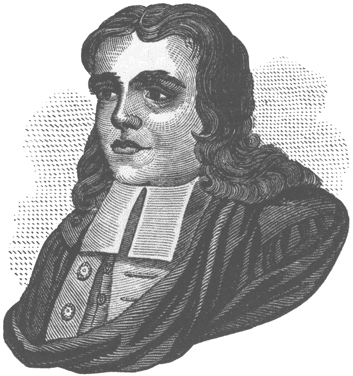
OBIIT MDCCXXXV: ÆTATIS SUÆ LVII.
Deut. xxxii: 7. Remember the days of old.
The library of Hearne was sold in February, 1736, by Osborne the book-seller; "the lowest price being marked in each book." The title-page informs us of what all bibliomaniacs will be disposed to admit the truth, that the collection contained "a very great variety of uncommon books, and scarce ever to be met withal," &c. There is, at bottom, a small wretched portrait of Hearne, with this well known couplet subjoined:
Pox on't quoth Time to Thomas Hearne, Whatever I forget you learn.
Let the modern collector of Chronicles turn his eye towards the 15th page of this catalogue—nos. 384, 390—and see what "compleat and very fair" copies of these treasures were incorporated in Hearne's extensive library!
A little volume of book chit-chat might be written upon the marvellous discovesies and voluminous compilations of Bagford and Hearne: and to these, we may add another unique bibliomaniac, who will go down to posterity under the distinguished, and truly enviable, title of "The Musical Small-Coal Man;" I mean, master Thomas Britton. Yes, Lisardo; while we give to the foregoing characters their full share of merit and praise; we admit that Bagford's personal activity and manual labour have hardly been equalled—while we allow John Murray to have looked with sharper eyes after black-letter volumes than almost any of his predecessors or successors—while we grant Thomas Hearne a considerable portion of scholarship, an inflexible integrity, as well as indefatigable industry, and that his works are generally interesting, both from the artless style in which they are composed, and the intrinstic utility of the greater part of them, yet let our admiration be "be screwed to its sticking place," when we think upon the wonderous genius of the aforesaid Thomas Britton; who, in the midst of his coal cellars, could practise upon "fiddle and flute," or collate his curious volumes; and throwing away, with the agility of a harlequin, his sombre suit of business-cloths, could put on his velvet coat and bag-wig, and receive his concert visitors, at the stair-head, with the politeness of a Lord of the Bedchamber!
Loren. In truth, a marvellous hero was this Small-Coal Man! Have you many such characters to notice?
Lysand. Not many of exactly the same stamp. Indeed, I suspect that Hearne, from his love of magnifying the simple into the marvellous, has a little caricatured the picture. But Murray seems to have been a quiet unaffected character; passionately addicted to old books of whatever kind they chanced to be; and, in particular, most enthusiastically devoted to a certain old English Chronicle, entitled Rastell's Pastime of (the) People.
Phil. I observed a notification of the re-appearance of this Chronicle in some of the Magazines or Reviews: but I hope, for the benefit of general readers, the orthography will be modernized.
Loren. I hope, for the sake of consistency with former similar publications,[369] the ancient garb will not be thrown aside. It would be like—what Dr. Johnson accuses Pope of having committed—"clothing Homer with Ovidian graces."
Lysand. Much may be said on both sides of the question. But why are we about to make learned dissertations upon the old English Chronicles?
Lis. Proceed, and leave the old chroniclers to settle the matter themselves. Who is the next bibliomaniac deserving of particular commendation?
Lysand. As we have sometimes classed our bibliomaniacs in tribes, let me now make you acquainted with another Trio, of like renown in the book-way: I mean Anstis, Lewis, and Ames. Of these in their turn.
Anstis[370] stands deservedly the first in the list; for he was, in every respect, a man of thorough benevolent character, as well as a writer of taste and research. I do not know of any particulars connected with his library that merit a distinct recital; but he is introduced here from his connection with the two latter bibliographers. Lewis[371] is known to us, both as a topographer and bibliographical antiquary. His Life of Caxton has been reprinted with additions and corrections; and, in particular, his edition of Wicliffe's New Testament has been recently put forth by the Rev. Mr. Baber, in a handsome quarto volume, with valuable emendations. Lewis was a sharp censurer of Hearne, and was somewhat jealous of the typographical reputation of Ames. But his integrity and moral character, as well as his love of rare and curious books, has secured for him a durable reputation. Of Ames, and here—though a little out of order—I may add Herbert—the public has already heard probably "more than enough." They were both, undoubtedly, men of extraordinary mental vigour and bodily activity in the darling pursuit which they cultivated.[372] Indeed, Herbert deserves high commendation; for while he was rearing, with his own hands, a lofty pyramid of typographical fame, he seems to have been unconscious of his merits; and, possessing the most natural and diffident character imaginable, he was always conjuring up supposed cases of vanity and arrogance, which had no foundation whatever but in the reveries of a timid imagination. His Typographical Antiquities are a mass of useful, but occasionally uninteresting, information. They are as a vast plain, wherein the traveller sees nothing, immediately, which is beautiful or inviting; few roses, or cowslips, or daisies; but let him persevere, and walk only a little way onward, and he will find, in many a shelter'd recess, "flowers of all hue," and herbs of all qualities: so that fragrance and salubrity are not wanting in this said plain, which has been thus depicted in a style so marvellously metaphorical!