Note 458 — The Alcove. (continued 2)
Reading edition
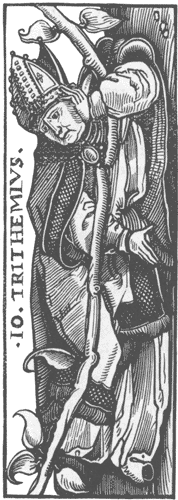
We are indebted to the Abbé Trithemius, who was a diligent chronicler and indefatigable visitor of old Libraries, for a good deal of curious and interesting intelligence; and however Scioppius (De Orig. Domûs Austriac.), Brower (Vit. Fortunat. Pictav., p. 18.), and Possevinus (Apparant sacr. p. 945), may carp at his simplicity and want of judgment, yet, as Baillet (from whom I have borrowed the foregoing authorities) has justly remarked—"since the time of Trithemius there have been many libraries, particularly in Germany, which have been pillaged or burnt in the destruction of monasteries; so that the books which he describes as having seen in many places, purposely visited by him for inspection, may have been destroyed in the conflagration of religious houses." Jugemens des Savans; vol. ii., pt. i., p. 71, edit. 12mo. It is from Trithemius, after all, that we have the only direct evidence concerning the origin of printing with metal types: and the bibliographical world is much indebted to Chevelier (L'Origine de l'Imprimerie de Paris, 1691, 4to., pp. 3-6.) for having been the first to adduce the positive evidence of this writer; who tells us, in his valuable Chronicon Hirsaugiens (1690, 2 vols. folio), that he received his testimony from the mouth of Fust's son-in-law—"ex ore Petri Opilionis audivi,"—that Guttenburg was the author of the invention. The historical works of Trithemius were collected and published in 1601, in folio, two parts, and his other works are minutely detailed in the 9th volume of the Dictionnarie Historique, published at Caen, in 1789. Of these, one of the most curious is his Polygraphia: being first printed at Paris, in 1518, in a beautiful folio volume; and presenting us, in the frontispiece, with a portrait of the abbé; which is probably the first, if not the only legitimate, print of him extant. Whether it be copied from a figure on his tomb—as it has a good deal of the monumental character—I have no means of ascertaining. For the gratification of all tasteful bibliomaniacs, an admirable facsimile is here annexed. The Polygraphia of Trithemius was translated into French, and published in 1601, folio. His work De Scriptoribus Ecclesiasticis, Colon, 1546, 4to., with two appendices, contains much valuable matter. The author died in his 55th year, A.D. 1516: according to the inscription upon his tomb in the monastery of the Benedictines at Wirtzburg. His life has been written by Busæus, a Jesuit. See La Monnoye's note in the Jugemens des Savans; ibid.