BAILY’S MAGAZINE OF SPORTS AND PASTIMES No. 551. JANUARY, 1906. Vol. LXXXV.
Reading edition
CONTENTS.
PAGE
Sporting Diary for the Month v.
The Earl of Huntingdon, M.F.H. 1
A Christmas Dream on Sport 3
Foxhounds—Their Ancestry (Illustrated) 7
The Development of the Modern Motor 13
Becking—The Last Shot at the Grouse 15
Hunt “Runners”—II. (Illustrated) 19
Sport in the City—The Old Year and the New 26
Half a Century’s Hunting Recollections—IV. 31
A Hundred Years Ago 36
Cricket Topics 37
Is Foxhunting Doomed? 40
The Sportsman’s Library (Illustrated) 45
In Pursuit of the Pike 47
A Gossip on Hunting Men 56
Pheasant Shooting in the Himalayas (Illustrated) 65
“Our Van”:—
Racing 67
Staghounds 71
Hunting in Yorkshire—a Capital Suggestion 75
Spaniel Trials in the Vale of Neath 76
The Christmas Shows 77
Sport at the Universities 80
Golf 82
The London Playing Fields’ Society 83
“The Mountain Climber” at the Comedy Theatre 83
“Mr. Popple (of Ippleton)” at the Apollo Theatre 84
Sporting Intelligence 85
With Engraved Portrait of The Earl of Huntingdon, M.F.H.
The Earl of Huntingdon, M.F.H.
Warner Francis John Plantagenet Hastings, fourteenth Earl of Huntingdon, was born in the year 1868. His career as a sportsman dawned three years later, for at that, we trust appreciative, age he was blooded with the old “H. H.” in the County Waterford, where his father, then Lord Hastings, hunted a part of the old Curraghmore country, and what is now the territory of the Coshmore and Coshbride Hunt. The late Earl, it may be observed, in 1872 became Master of the Ormond and King’s County, and held office until 1882.
The subject of our portrait was reared in the atmosphere of sport which is so peculiarly strong in Ireland; indeed, so intimate have been his relations with hounds and hunting from his earliest days, that he says he was “reared in the kennels.” He lost no time in mastering the art of handling a pack, having owned and hunted beagles at the age of fourteen. He kept a regular pack of harriers in 1886, and showed good sport with them. In 1897, being then twenty-nine years old, he was asked to accept the mastership of the Ormond, in succession to Mr. Asheton Biddulph, which he did, carrying the horn himself, and hunting the country to the great satisfaction of field and farmers alike until 1904. During the season 1900–1901 the Earl hunted the East Galway twice a week in addition to the Ormond, bringing his hounds over from Sharavogue by van. Though a veritable “glutton for work” where hunting is concerned, he confesses that this was a very arduous season. On one occasion he had to get home forty Irish miles (which is about fifty Statute miles) after hunting: this, we imagine, must be the record back home. He was frequently out from 7 a.m. till ten at night; and when it is remembered that he was hunting hounds five days a week, we think it will be admitted that to continue such work long would have killed Squire Osbaldeston himself.
During his first (1897–98) season of mastership in the Ormond country he also kept (and of course hunted) a pack of harriers. These, with the foxhounds, gave him enough to do. One day he had the bitch pack out cubbing in the early morning; came home to breakfast; took the dog pack out cubbing till lunch time; came home to lunch; had out the harriers in the afternoon, and enjoyed sport with all three. Had there been light and another pack of hounds convenient, we make no doubt the indefatigable master would have gone out again after dinner; but the day’s work as it stands probably occupies a unique position in the annals of hunting.
In 1903, Lieut.-Colonel Harrison acting deputy master for him in the Ormond country, he came over to England and acted as huntsman of the North Staffordshire, Messrs. Phillips and Dobson being masters; and in 1904 he assumed the mastership of the Hunt. We may here remark that this is the twentieth season he has carried the horn with beagles, harriers, and foxhounds, having hunted as well deer and otter. As he has hunted with no fewer than fifty-eight different packs of all sorts in his time, Lord Huntingdon’s experience is probably about as varied as that of any man now living. He hunted much in Leicestershire while still keeping his harriers, Somerby being his centre. Of good runs he has borne part in many; he thinks one of the best he ever saw was that with the Belvoir from Harley to Staunton on December 14th, 1892, one hour and thirty minutes.
Lord Huntingdon has played polo for many years. He is President of the King’s County Club, also the Crystal Palace Polo Club, and is a member of the Roehampton, Ranelagh, and other clubs; for many seasons he played back in the King’s County Irish team for the County Cup.
A first-class rabbit and rifle shot, he is fond of the gun, and since he took Madeley Manor from Lord Crewe has begun preserving there; this, however, is his first season at Madeley, and a few years later will no doubt see a much larger head of game there than now exists. He used to do a little racing and also a little race-riding; in 1898 he won the private sweepstakes at Croxton Park, on Captain Herbert Wilson’s Sailor, in a good field of sixteen starters.
He has twice visited the United States, and has been in Canada, Japan, and China, but has not done much big game shooting. Interested in yachting, he is Commodore of the Lough Dearg Corinthian Club. He fishes when he has nothing else to do, principally in the Shannon and Lough Dearg; but with his numerous occupations we gather that the occasions when he has leisure to use the salmon rod are somewhat rare. He is a keen motorist, and drives a great deal; the machine he now uses is a 24–40 h.p. Fiat.
For some years he kept a stud in Ireland and bred horses of various breeds; he has now given this up, but still breeds a few half-breds at Sharavogue.
Lord Huntingdon, who is a Deputy-Lieutenant of the King’s County, retired last year as Lieut.-Colonel of the 3rd Batt. Prince of Wales’ Leinster Regiment. He was unable to go to South Africa, owing to an accident. He succeeded his father in the earldom in 1885. In 1892 he married Maud Margaret, second daughter of Sir Samuel Wilson, late M.P. for Portsmouth, by whom he has a son, Francis, born 1901, and three daughters, who are very keen sportswomen, and never so happy as when riding to hounds. Lord Huntingdon is also very fond of driving four horses, and until motoring started made many driving tours with his yellow coach and team of greys. Lady Huntingdon is also very fond of hunting, and is out regularly with the North Staffordshire. One of Lord Huntingdon’s brothers is the well-known gentleman rider, the Hon. A. Hastings.
The family of Hastings is a very old one. John of Hastings was Seneschal of Aquitaine, and a claimant to the throne of Scotland. Sir William, who became first Baron Hastings, was Master of the Mint under King Edward IV., and first coined the piece known as a “noble.” The first Baron became very powerful, and was eventually beheaded by Richard Duke of Gloucester. The third Baron attended Henry VIII. in his French wars, and was present at the capture of Tournay in 1513; it was this ancestor who became the first Earl.
A Christmas Dream on Sport.
In our school-boy days there were very few of us who could resist the opportunity of having a good stuffing, especially at Christmas, when the mince pies and plum puddings were an extra attraction, and when even the most austere of mothers did not gainsay our desires, although knowing full well that our penalty would follow in the shape of a black dose, or something worse.
It is not, however, to boyhood alone that Christmas has its temptations, and its feasts have their unpleasant accompaniments of dyspepsia and derangement, and we as in our boyhood lie down only to indulge in dreams and nightmares. The remembrance of these phantasies of a disordered stomach have a knack of being difficult to shake off, so much so, that I have determined for this once to chalk down some of the ideas that seem this Christmas indelibly written on my brain, and thus to rid myself of them.
I was carried sometimes into the near future, and then again into remoter times, yet ever onwards, wondering that there was no finality, no halting place, no respite from the excitement which relentless time casts upon our little world of sport.
I was bent on hunting, but I looked in vain at my front door for my hunter or hack. Instead, I found a horseless machine, which whirled me dizzily away against my will, and landed me amongst a throng of people with like machines, and clad like Laplanders, so much so that I turned over in bed, and shouted vainly for the sight of a horse and hound. The scene changed, and I was in a throng of gay horsemen and women at the covert side, and the odour of violets and nosegays was not wanting. Positions were continually shifting, chiefly through the threatening heels of ill-tempered horses, when on a sudden a whistle sounded, followed by one shrill blast of a horn, and away went the throng, blindly as it seemed, jostling and pushing, each one thinking only of himself or herself. Carried away as I was, only a unit in this surging crowd, I had little time to collect my thoughts—all I know was that I saw no hounds, only just indistinctly heard them at starting. Yes, before us were white flags at regular intervals, and here and there a red one, from which the ever lengthening cavalcade in their gallop turned aside, and I heard the words “wheat,” “beans,” or “seeds” growled out by our leaders. Where the white flags predominated in front of us the hedges had been cut down and levelled, as if for a steeplechase. There were visions of that demon barbed wire on either hand, but I learnt that those white flags meant safety. The jostling soon ceased, but loose horses came as a fresh trial to my troubled brain, and, oh, the shaves I experienced to keep clear of them. Then we crossed a road, where a liveried hunt servant stood sentinel over the motor brigade, that but for him would have barred our way. After this all was confused galloping and jumping, until the horn sounded in a wooded hollow, and there was a baying of hounds at a hole, which betokened the end of a twenty-five minutes’ gallop after this supposed fox (if, indeed, it was one), but it was several more minutes before that strung-out array of riders drew together again, mopping and mud-stained, yet masterful in their happiness. They had had their gallop, the motors were near at hand, grooms were requisitioned from them, and thus away went the majority of that gay throng, back to their cities and suburbs, leaving but a few to work out the rest of the day in the woodlands, when I can distinctly swear that they found a fox, for I saw him cross a ride—a mangy little beggar was he—and we revelled in no more green fields that day. But, ah, I forgot to say that before starting a hat was thrust in front of me, whose owner whispered, “For the farmers’ field fund, please sir.” Only gold was taken!
And I awoke finding myself in a train, whose engine neither puffed nor smoked—all went by electricity.
And soliloquising, as I rubbed my eyes, the interpretation meant hunting in A.D. 1925. Again I dreamt. I was on a racecourse on a June day, when all was bright and beautiful. Such gorgeous stands, such crowds of fashionable and unfashionable people, such an array of motoring machines lining the course opposite the stands, such order and regularity, no hoarsely-shouting crowd of betting men, no Tattersall’s Enclosure. What did it all mean? The numbers were up in blazing letters of the runners for the first race. Was racing to be carried on in dumb show? I looked again, and beheld people like bees clustering round some low buildings, pigeonholed like enlarged telegraph offices, and numbers and names of horses figured here. There the money flowed in with startling rapidity. In some places only cheques and notes were received, in others gold, in others silver, and all payers had a diminutive numbered receipt. Then came the race. Each horse accurately numbered, and silence no longer reigned. An electric gong proclaimed the start, and thousands of eyes and thousands of voices bore witness to their excitement as the horses swept towards the winning post. What has won? The judge has touched one of a set of electric buttons that are in his box, and the winner’s number is simultaneously shown in half-a-dozen conspicuous places. Soon tinkles a bell on the top of the low building, and thither fly the bees to gather the honey that they have won. But this time they find their gains on the opposite side of the building from which their money was deposited. All the takings have been counted like magic, the winning number sweeps the pool, after due deduction made by way of percentage for much that the country stands in need of.
I noticed, too, that bright liveried messengers plied amongst the stalls and boxes of the stands, doing the work of payment and receipt for the brilliant company sitting there. All this was repeated again and again, until my brain became accustomed to it. Presently, as if to cast a shadow on the gay scene, a red disc appeared on the number-board. “Objection.” The paying-out pigeonholes were closed for that race, and we held our breath; but not for long, since the tribunal of stewards had been chosen beforehand, and unless the subject of the objection had to be adjourned unavoidably, the disc soon proclaimed “Over-ruled” or “Sustained,” and the pay-boxes for that race were opened after the last race of the day.
Here ready money ruled the day. The welsher had been forgotten; the bookmaker had turned backer; the plunger could not find himself below the bottom of his purse; and roguery was worsted.
The Jockey Club at that time was no longer wholly self elective. There was a certain proportion of its members affiliated by election to it, as representing the racecourse interests and owners, outside mere aristocratic connections. It was to them that the reforms in turf management were mainly due. Can all this really come to pass? It is but a dream, and I am awake. Nevertheless, that the totalizer or tote, as it is called in Australia, or the pari mutuel, as it is termed in France, or the pool, as it is more likely to find its name in this country, is destined ere long to become here also the rule of betting is my firm conviction, and with it will come aids to agriculture and assistance to poverty, as well as in alleviation of bodily suffering, such as will recommend it to peer and peasant alike.
Once again I dreamt, and my dream was of the future. It was shooting that filled my troubled brain. A letter was before me inviting me to a great battue, and yet it could not be intended for me, as a high rocketting pheasant requires to be of haystack proportions in order to suffer death at my hands. Nevertheless, it ran thus: “Dear ——, Will you do me the honour of joining our party for shooting my coverts during the week beginning the —— day of November? We hope to kill at least 3,000 pheasants. My land steward will send you full particulars of the rules which regulate my sport, to which I hope you will find no objection.” And this was what the steward said: “Dear Sir,—I am directed by Mr. —— to inform you that the following are the regulations which dominate his shooting, and which it is my duty to see carried out. No tips are allowed.
“Shooting will commence at 10.30 each day.
“A map will be furnished each day to you showing the beats and stands for the guns numbered in the usual way. Everything will be supplied you, except a loader, and any excess above 1,000 cartridges. Low flying birds may be passed by. A whistle will sound at the commencement of each beat.
“Lunch will be at 1 p.m., and will be announced by a gong. In case of rain, canvas covering will be provided over the shooting stands. A motor-car will meet you on Monday on the arrival of the train, and convey you to the Hall, and a like conveyance on Saturday will convey you back to the station.
“Enclosed is a banker’s order, which you will kindly fill up for the sum of £5, and return same, which goes to form the keepers’ fund.”
He might have added, but it was not on the circular, that a light dose of sal volatile will be provided to allay the headache which each day’s battue was likely to cause. Yet the method and completeness of arrangement impressed me.
I turned in my bed thinking of my spaniels and retrievers, and the many enjoyable raids I had had with them, when there appeared before me an autograph circular from a well-known London sporting agent, and thus it ran. “The Earl of ——— has arranged for the coming season to invite five approved guns to shoot over his extensive Norfolk estate in company with three guns of his own choice. The sport will extend over eleven days, six of which will be partridge drives, and five pheasant shoots. The bag should amount to at least 3,000 partridges and 4,000 pheasants. The appointed days for shooting will be fixed by the Earl. Terms, 300 guineas for each gun, to include all expenses, to be paid me in advance. All applications for this exceptional offer must be made to me on or before the —— day of ——— next, and guns will be accepted in their order of merit.”
I awoke. And so this was the shooting sport of A.D. 1925! Well, perhaps by that time the people of this country will for the most part have become Daniel Lamberts, and sitting or standing behind butts, and having all the more or less tame creatures for their slaughter brought to them, will be their only means of enjoyment. Thank heaven that your scribe will not survive to see these days, although we are already becoming very luxurious in our pursuit of shooting. Perhaps our middle-aged and older men will tell you that they are able to get this exercise in the enjoyment of golf, and that this is a set-off against the limited exercise that shooting now exhibits, and this may save them from falling a prey to fatty degeneration of the heart.
These dreams are horrible phantasies that we have to indulge in whether we like them or not, and seldom are they pleasant, nor will they come at call. I tried to dream into the future of fishing, a sport I love so well. But, alas! the spirit moved me not. Those lusty trout and grayling, and those sportive salmon, refused to be allured by any new means; their ways were just the same, and no newly-defined artifices sufficed to bring them to hand more easily or with less practical skill. Only the ranks of their enemies seemed to have increased. More and more fishermen came on the scene, who sought them out farther and wider throughout remote countries, and more money and greater artifice was employed to effect their capture, so that their preservation became a question of the day, as it has, indeed, become so to-day.
Your younger readers will perhaps hail with delight these halcyon days of sport, which, if my dreams have any portent, are destined to come upon us all the more swiftly, seeing that riches as they accumulate bring in their train luxury and indulgence, and that it is to wealth that our landed estates must come, unless they are destined to be swept away by the flood of social democracy, which, thank God, does not come within the scope of my dreams, for if so, “I had,” as Shakespeare says, “passed a miserable night, so full of ghastly dreams.”
If perchance, however, my dreams should prove ominous, let me implore you who in the radiance of youth have the opportunity of guiding and shaping the destiny of sport, to hold fast by the truer principles which have hitherto held sport so high in this country, casting aside its meretricious aids and surroundings, which only sap its true vitality, and would fain emasculate its worth to us as a nation. Stand fast by “the horse and hound,” and maintain a deaf ear to the tempter that whispers of the gorgeous trappings and luxurious surroundings, which are the death role of genuine sport.
Shakespeare once more comes to my mind when in “Troilus and Cressida” he exclaims, “My dreams will sure prove ominous to-day.”
Borderer.
P.S.—Since writing the above article, I read with pleasure that the first blow has been struck at the Gimcrack Dinner by Mr. Hall Walker in favour of the Totalisator. He is not only an extensive owner of racehorses and a successful breeder, but also a man who has had ample opportunity of thinking out this subject from a national standpoint. This freely expressed opinion of Mr. Hall Walker’s on betting reform will, let us hope, bear fruit, even if it is after many days.
Foxhounds.
THEIR ANCESTRY.
It might raise a considerable amount of discussion to assert that the foxhound had a longer line of ancestry than other breeds brought under the fostering care of Englishmen, but this much can be said, that when public opinion was turning towards the correct methods for the attainment of animal perfection, interest was taken in foxhounds similar to that taken in the racehorse, the shorthorn, or the red Devon. Could such a date be accepted at about 1730?—which was nearly a quarter of a century before Eclipse was foaled. The newly formed Ormesby stock of shorthorns was then about to be removed to Ketton, near Darlington, and the Davys and Quartlys had not commenced their improvements on the Devons. But there is evidence that foxhounds were beginning to be thought of at the time, and by 1750 a great many noblemen and gentlemen were very intent on hound breeding.
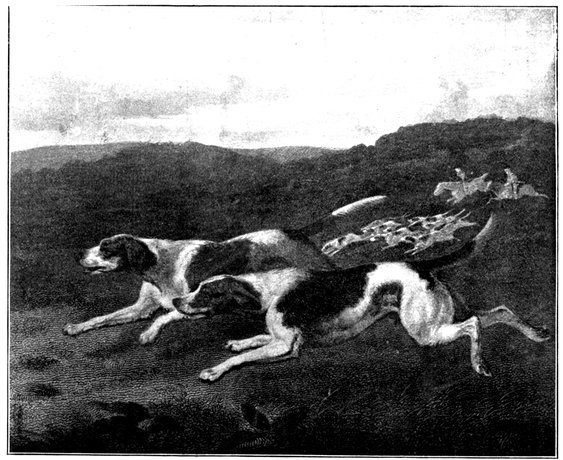
FOXHOUNDS From the Painting by P. Reinagle.]
The Dukes of Beaufort had hounds, bred and walked at Badminton; the Pelhams had already formed the Brocklesby; Mr. Hugo Meynell had friends enough to apply to for hounds to hunt Leicestershire three or four days a week; and there were North country packs of fairly large dimensions. It was, indeed, a very interesting subject, and it is not a little singular that the idea of breeding hounds on scientific principles commenced at almost the same time as a change was taking place in regard to the animal to be hunted. Nearly half the eighteenth century had passed away before our forefathers had given up the custom of hunting the wild stag and the hare as almost the only quarries to be hunted on a line of scent. Just as the story of the Silk Wood run relates that the fifth Duke of Beaufort changed from stag to fox, because the latter gave the better burst, and laid himself out for a more open country, there was a general consensus of opinion that the time had come for a great breed of hounds to be carefully bred and trained for this special running. The bold onward style and cunning of the fox wanted something with more dash than was required for the short-running deer, or the hare always wanting to retrace her own foil. The fox taught that exquisite forward cast that almost sums up the pleasure of hunting; and the faster hounds will throw themselves on a line that is always well ahead of them, the more exhilarating is the sport. That is what the old pioneers of foxhunting lived for, and one may suppose it was brought about by selecting the hounds of the day that possessed the particular dash required. At any rate, old letters and manuscripts show that a vast number of sportsmen became very keen in regard to breeding such hounds. Long journeys were taken to secure their blood, and as one of the pleasantest of sporting writers has curtly put it, “the love of foxhunting was well in the air.”
It is almost incredible what the sportsmen of 1750 did do. As Mr. Pelham, the ancestor of the Earls of Yarborough lent a hound called Jimper to Lord Percival in 1760, and as he was stated to be by one called Rockwood, there is a suggestion of a back pedigree at that time. In fact, there was another of Mr. Pelham’s of 1760 called Marquis, by Rockwood a son of Rattler, by Lord Monson’s Mischief. Again, there is another of Mr. Pelham’s in 1766, by Tickler son of Ferrymann by Twister out of Careful, a daughter of Lord Granby’s Danger. Sir Walter Vavasour appears to have been in the thick of the hound furore of the time, and so does Sir Roland Winnes, Mr. Hassell, Mr. Watson of Old Malton, Mr. Lane Fox, Lord Middleton, and the then Duke of Devonshire.
But for the fact that lists were not generally kept in these early days, there is every reason to think that present hound pedigrees could be traced from the hounds of 1730 or 1740, but the registration departments of many of the great kennels could not have been very perfect as although Brocklesby can boast of records to 1713, there must have been some breaks up to 1745, when Mr. Pelham—afterwards the first Lord Yarborough—saw the necessity of keeping such accounts of breeding clearly and regularly, and so kept his stud books in his own handwriting. Whether this practice lapsed or not is not recorded, but when Mr. Tongue (Cecil) formulated his stud book, he could not go much further back than 1787; or at least that was the last date he gave to a hound called Dover, by Lord Monson’s Driver out of Whimsey. Cecil was a most industrious investigator, and he would have gone back to the Ark with sufficient evidence for the undertaking. As a matter of fact, my old friend, who gave me most of his hound lists, pulled up at something like the years referred to, his very latest date being 1779, when mentioning a bitch called Rosamond, by Mr. Meynell’s Roister out of Lord Ludlow’s Tasty. Of course, in making such researches, the difficulties to overcome are that many packs have been dispersed, and so records have ended. That really happened to Mr. Meynell’s, Lord Ludlow’s, Mr. John Muster’s, and Lord Monson’s, to the detriment of perhaps the hereditary packs that had been indebted to them for blood.
Considering that several changes have taken place in its history during the past hundred and fifty years, it is remarkable that so much hereditary material is forthcoming from Lord Middleton’s pack, but this is partially due to the fact that one man and his son after him were the huntsmen to it for nearly eighty years. These were William Carter and Tom Carter, the former being in office when Sir Tatton Sykes took on the country (with his brother, Sir Mark Masterman Sykes), that is now occupied by Lord Middleton. That was in 1804, but William Carter, who must have been an intelligent fellow, and particularly fond of dates and pedigrees, knew all the hounds from 1764. The book he compiled—and which is at the present time in the possession of Lord Middleton—was really perfectly kept, and through its pages some of the entries can be most certainly traced up to Cecil’s Stud Book, published in 1864, and so on to occupants of the kennel benches to-day.
I have no doubt that several lines can be taken, but I turn, for example, to a bitch called Jointress, who had quite a large family, in different litters, numbering about sixteen couples. She was out of Rosamond, 1775, by Sir William Vavasour’s Twister, out of Doxey, and the line had still greater extent, as Jointress had a sister called Jessamy, who was almost as prolific in producing good ones. Amongst the daughters of Jointress was Magic, and the latter had a daughter called Prudence, whose descendants came into the pack that was transferred by Mr. C. Duncombe to Sir Masterman Sykes; but William Carter, in his note to that effect, declares that most of these hounds were drafted. There is, however, the strongest evidence that Prudence produced a son called Pillager, and he was the sire of another Prudence, and in like manner a dog called Fairplay—from Famous, a daughter of Jointress—was a notable sire, and a son of his called Fairplay came into the Sykes’ pack at the above-mentioned date; he was the sire of Brilliant and Blossom, entered in 1805, and Brilliant was the sire of Boaster and Blue-Cap, and also of Blossom, Barrister, and Barmaid. Blossom subsequently produced in 1814 three couples, named Bounty, Blue-Cap, Beauty, Barmaid, Boundless and Bloomy; and Blossom likewise produced in another litter Bachelor, Barrister, and Blameless. Of these Blue-Cap certainly became a sire of note, and two and a half couples in two litters were put on by him in 1823, and one couple the year before. Sir Tatton Sykes appears to have stuck to this line, as Barrister, son of Blue-Cap, was also bred from, and was the sire of Brusher, Topper, Blue-Cap, Bachelor, and Blossom, and this last-named Blue-Cap was the sire of Bellman and Barrister of 1834. Then Bonny Lass was by Brusher, and she was the dam of Bellmaid. However, the very best branch of this family tree became noticeable in 1832, when Blossom, the sister to Blue-Cap, was mated to the Osbaldeston Flagrant, and the result was three couples of puppies all put on in 1833; they were Furrier, Ferryman, Finder, Famous, Flagrant and Favorite. Flagrant was possibly the best, as he was bred from in his second season, and produced Dreadnought, Domo and Desperate for the 1835 entry; but Famous in 1838 had a couple and a half in the entry, and Desperate had a daughter called Dainty entered in 1841. Primrose, a daughter of Famous, was by Bondsman, one of the family, and so Primrose was inbred to it. It may be thought that Bondsman was the sheet anchor really of the sort, as he must have lived to be a nine-season hunter, and one of his daughters, Music, and two of her sons, Denmark and Vulcan, were in the pack that the eighth Lord Middleton took over from Sir Tatton Sykes in 1853. There is more of the blood besides in the Birdsall Kennel at the present time, and so with a clear pedigree of a hundred and thirty years, to the good bitch Jointress of 1778, and her descent is easily traceable to 1764.
Lord Middleton has another line, though that is quite as certain in straining through the sixth Lord Middleton’s Vanguard and Darling to the famous Corbet Trojan; and let it be known that all the Oakley Driver sort—and there are none better at the present moment—trace to it through the late Mr. Arkwright’s Cromy by Lord Middleton’s Chanticleer, and so on to Vanguard, and his dam, Traffic, a great-granddaughter of Trojan’s. There has been a fortunate dependence on the fame of many noted hounds, such as Trojan, Vanguard, and, a little later still, to the Osbaldeston Furrier. The great Squire was so celebrated for everything that pertained to sport, that his declaration of Furrier being the very best hound he had ever hunted in his life told immensely with the great judges who became his successors, Mr. G. S. Foljambe, Sir Richard Sutton, Lord Henry Bentinck, and Mr. Nicholas Parry. They made Furrier the corner-stone of all their kennel-breeding operations, and so it is not difficult to-day to trace the excellence of Lord Galway’s Barrister blood, the Dorimont blood of the Blankney, all that remains of the Puckeridge, and the old Quorn Dryden family to Furrier. The most popular sire of to-day, the Belvoir Stormer, hits, according to my making out, thirteen times to Furrier, and in Weathergage it was certainly noticeable eight times. In all the great hounds talked of in the last quarter of a century, such as the Fitzhardinge Cromwell, the Belvoir Weathergage, the Croome Rambler, the Grafton Woodman, the Southwold Freeman, or the Quorn Alfred, there is the line to the little black and white—some have said shabby-looking hound—Furrier, who was got by the Belvoir Saladin in 1820, Saladin being by Sultan, by Lord Sefton’s Sultan by Mr. Hugo Meynell’s Guzman, of 1794, and Guzman was by German, also belonging to Mr. Meynell. On the female line Furrier was related to the Badminton Topper, and Sir William Lowther’s Dashwood to a bitch called Amorous, of 1791. This is as far as “Cecil” thought it advisable to go.
Mr. G. S. Foljambe, in the year 1835, had got some double hitting to the Furrier family, as he bred the brothers Herald and Harbinger, by the Osbaldeston Ranter, son of Furrier, out of Harpy by Herald son of Hermit, son of Saladin, the sire of Furrier. From the brothers in question Mr. Foljambe bred almost a pack. His Layman of 1861 was by Nectar, son of Nectar of 1849, and the latter’s dam was Princess by Harbinger, whilst the dam of the first-mentioned Nectar was Conquest, her dam Captive by Herald. Barrister of 1860 hit twice to Layman, and so again to the memorable brothers, and their blood was also in Sportsman and Forester, and very much again in Lord Henry Bentinck’s Contest, who was by Comus, son of Mr. Foljambe’s Herald, out of Sanguine, by the same gentleman’s Sparkler, by Singer, son of Streamer, by the Vine Pilgrim out of Sybil, by the Osbaldeston Ranter, son of Furrier. This is all combined in modern day pedigrees, and especially through Sir Richard Sutton’s Dryden, son of the Burton Contest, as he was the sire of Destitute the dam of the famous Belvoir Senator, again through the Croome Rambler, a descendant of the above Contest on his sire’s side, and through the Grove Barrister’s on his dam’s. Also to the Belvoir Weathergage, who was by Warrior, son of Wonder, son of Chanticleer, son of Chaser, son of Brocklesby Rallywood, who traced three times to Furrier, and then there was Royalty, the dam of Weathergage, got by Rambler, brother to the third Rallywood. It may well appear that the perfection of hound breeding was gained through their ancestry to the Osbaldeston Furrier, and principally by the means of four hounds selected to perpetuate the sort by probably two of the greatest masters of hound breeding ever heard of—Mr. G. S. Foljambe, who relied on Harbinger and Herald, and Mr. Nicholas Parry, who chose Pilgrim and Rummager. The last line to old Furrier might have been lost in the changes of time, but it looks now as if it will be stronger than ever through the policy that has been pursued of late by the Marquis of Zetland, Mr. Edward Barclay, the present Master of the Puckeridge, and Captain Standish, the Master of the Hambledon, through four and a half couples of whelps purchased in 1894 by the Hon. L. Baring at the Puckeridge break-up sales. Captain Standish is also breeding from the present Puckeridge Cardinal, who inherits the old strain from Gulliver. High breeding and to follow in the steps of the old master’s must do a great deal, as after all is said and done they must have known much about it a hundred years ago. The picture which accompanies this paper is dated 1804, and called “Foxhounds,” by Philip Reinagle, R. A.; Sir Walter Gilbey in his interesting work on animal painters tells us that Reinagle was born in 1749, and that he commenced to paint hunting scenes when about thirty-four years old, in consequence of his intense love of sport. He must have known all about it by the running of the pack in the distance, and by the two hounds with their heads at just the right level for that exquisite pose known as heads up, sterns down, and racing.
G. S. Lowe.
The Development of the Modern Motor.
When the difficulties confronting the introduction and development of the modern motor-car are taken into consideration, the progress made may be regarded as remarkable. Although, as usual in mechanical matters, this country originated the idea, and had steam road carriages in use nearly a century ago, they succumbed to popular prejudices, were virtually interdicted, and the act of liberation came only in 1896, when the success of the internal combustion engine had revived them in a different form. Before they were again permitted to be used in England, France and other countries had obtained a decided lead in their design and construction, and for the last nine years British makers have been engaged in a keen struggle to regain what they lost by the tardy removal of their prohibition. That we have at last succeeded in holding our own in the competition was amply demonstrated by the exhibition held at Olympia in November last. Here the home productions compared favourably in every respect with the finest specimens from abroad; indeed, the show in Paris last month, though its artistic setting was superior, hardly afforded a better display, and was less international in character.
Automobilism may be regarded as still in its infancy, and although the late show introduced no revolutionary methods in principle or construction, it is impossible to foretell what radical changes may be brought about in course of time. At present the explosion engine carries all before it, but the use of steam has by no means been abandoned. Its advantages in flexibility and facility of control stand it in good stead, and although it costs more in fuel, this has become a matter of minor importance. The steam car is still engaging the attention of a few firms, and it may yet become a useful and acceptable type of vehicle. During the past year there has been a marked advance in every detail of construction, whilst the upholstering and appointments of the more pretentious cars have made them most luxurious equipages, the coachbuilder’s art being combined with the highest mechanical skill.
In the electric car, it is possible that those driven by petrol may, at some future time, find a serious competitor. The electric broughams used in towns exhibit the high state-of efficiency obtained by the employment of this propulsive agent, and the absence of noise and smell. Their future, however, depends upon the discovery of much more efficient accumulators or upon the establishment throughout the country of electrical charging stations, and until such time as one or other of these conditions is fulfilled their use must be limited to towns or the neighbourhood of works where their supply of electricity can alone be replenished.
The most important improvement introduced of late in connection with the motor is that of the six-cylinder engine. This stands to the credit of an English firm, and although when it was first brought out little was thought of it, experience has proved it to be of the greatest value, and it is being adopted by some of the best firms on the Continent. With fewer cylinders there are longer intervals between each recurring explosion, and the severity of each impulse has to be softened by the use of a heavy fly-wheel, which takes the jar off the driving gear, to which it communicates the power in a less violent and more protracted form. By the use of six cylinders a much greater continuity of propulsive effort is obtained, and to develop the same amount of power the violence of each explosion is diminished, with the result that there is greater smoothness in the running and less strain on the mechanism. Eight cylinders have been used by another firm, but it remains to be seen whether any advantage will be gained commensurate with the increased complication involved.
It is satisfactory to note that serious attention is now being given to the closing in of automobiles, and the latest car built for His Majesty the King is an instance of the advance made in this direction. No one would voluntarily ride in an ordinary open carriage in cold and wintry weather, yet people become so easily wedded to custom that they will travel long distances in open motor cars and expose themselves to the rigours of the blast of air that visits them with three times the severity, by reason of the speed at which they travel, that it would in a horse-drawn carriage. In the more commodious cars there is no difficulty in complying with a condition so essential to the comfort of the occupants; for, as it is, motoring in winter is a trying ordeal to all but the most robust. The motor car has assumed the form of an open conveyance owing to the fact that it has been developed on racing rather than utilitarian lines, and to the diminution of wind resistance being necessary to the attainment of high speeds. This is a factor of small account, however, when the pace is kept within legal or reasonable limits.
The dress of the motorist is fashioned and designed with a view to protect him from the effects of exposure to the weather, and in the more or less futile attempt to keep him warm when his journey is a long one and the day chilly. With the covered-in car the unsightly garments, masks, and goggles with which he has had perforce to bedeck himself, and which have brought much ridicule upon him, will be rendered unnecessary, and ladies and gentlemen when driving will be able to adopt more rational costumes than those which have distinguished them in the past.
Pneumatic tyres, which constitute the most costly item in the upkeep of a car, have been greatly improved, and retain their supremacy; for it is only by their use that high speeds are attainable and endurable. Not only do they conduce to comfort by their elasticity, but they save the mechanism from the severe shocks it would otherwise sustain in passing over rough roads. Metal-studded bands are coming largely into use for the double purpose of obtaining a better grip on slippery surfaces and preventing punctures, while at the same time they save the tyres from much wear and tear. Solid rubber tyres are offered as substitutes for pneumatics on slower and cheaper cars, and for various commercial vehicles, and sundry attempts are being made by the provision of springs to compensate for the elasticity they lack.
Up to the present time there are few signs of any appreciable reduction in the prices of cars, for, so far, improvements in details and the additions to their equipment have absorbed whatever may otherwise have been saved by economies in construction. Some unpretentious but serviceable little cars of limited capacity may, however, be now obtained at something over £100, whilst those who are prepared to spend double this amount will have a wide choice. Not until types become fixed and standardisation of component parts becomes possible can prices be materially reduced.
E. T.
Becking.
THE LAST SHOT AT THE GROUSE.
It has been the fashion to say that since grouse driving became a science the proportion of birds killed and left upon the moors is only a question of the will of the occupier. This season, in Scotland at any rate, has proved that this is not the case. Although there were not many moors perhaps where more grouse ought to have been killed, there were a good many where it was attempted to slay more than proved to be possible. The fact is, when the grouse take to the tops they are practically safe; especially is this the case when these tops are the “march” between two shootings. Then the grouse see the flankers as King Louis of France saw the figures of men in Tenier’s pictures. They look “like maggots,” and grouse are not afraid of those immature insects, although they do not eat them. It is the height and the angle that make all the difference in driving grouse that have become wild enough to take to the “tops,” for the very object of resorting to these altitudes seems to be the better to keep watch and ward against the arrival of the enemy.
As the season advances in the Highlands, bags quickly sink from hundreds of brace per day to tens, and very soon after this they would sink to units were it thought worth while to organise driving parties for the units; but it is not, and consequently the Highland grouse are growing to be almost as difficult to regulate in point of numbers, and more difficult in point of sex, than they were before driving came in. For the latter practice has everywhere increased the wild habit; it has not merely taught existing birds wildness for the time being, but the habit of standing up to look for danger instead of crouching in the heather to hide from it, has become hereditary and instinctive where driving has been the longest practised. Unless moors are very hilly this habit does not much matter, because, provided grouse can be properly flanked and flagged, they can also be driven, but on the tops in Scotland this is not possible, and the outcome is unfortunately that too many of the hens and the young males get killed on the flat ground. The old cocks are the first to take possession of their fastnesses, the tops, and there they remain until, in the breeding season, they take possession of the best breeding sites and drive away all the younger and more healthy birds. The worst feature of this is that these old cocks are like master swans, and think they require a kingdom for themselves, a kingdom without subjects, for none of their kind are permitted to live near them. Consequently the birds left to breed may be numerous, and yet be of no use. They have to move off at breeding time because of the persecution of the old birds. There is no much employed method of getting rid of these old cocks when driving them fails in the hills. There was one before the days of driving, but it is almost a lost art. This was called “becking.”
The practice of becking was very simple and easy to learn, indeed the grouse themselves teach it better than any schoolmaster. Any time in August, when the shooting lodge is really on the moor and not under it, one has but to sleep with an open window, and the first sound of the coming day to greet the awakening sleeper will be object lessons in becking. It is a habit of the proud old cock grouse to challenge each other in the morning. This they do by fluttering up into the air vertically some ten or a dozen feet and crowing. Rarely is the challenge accepted in the autumn, probably because these old grouse have long ago settled their differences, and one no longer trespasses on the ground of the other. Each is king of his brood and ready to defend his castle, but neither will enter willingly into the domain of another bird. Nature is at peace with herself. But when the moorland keeper arises before light and gets upon the moor before the grouse are awake, when he hides in some peat hag, or other shelter, and starts to crow, every old cock grouse within earshot becomes angry at the unknown voice of an intruder, and instantly the challenge is accepted. The intruder not being in a position to go out in search of mortal combat the oldest inhabitant comes to seek him, but instead meets a charge of shot, which unceremoniously, and in revolt of sporting feeling, knocks him over on the ground without giving him the proverbial chance for his life.
Before driving game came in, this was the only way to find grouse for the table, after the spirit of winter wildness had entered into the birds. Nobody thought of it as sport, but the keepers knew of it as a necessity in preserving, for the reason that it killed off the old cocks and none besides. It was an automatic selection of the most unfit, and had it been practised beyond the necessity of the table of the owner, would have done much more for the stock than any other thing could. But it was confined and limited by the state of the larder. Now even this demand has stopped, because cold storage supplies the table with better birds, that is young ones, killed perhaps on August 12th in one year, and eaten on August 11th upon the next, and admirable birds they are, too.
But not only has the necessity of the table ceased to operate for the good of the grouse stock, but driving the birds has rendered “becking” a lost labour in many places.
It is no good going out to beck on ground where the broods once were, after they have all united as one vast pack and gone somewhere else. That is too obvious almost to name, but suppose the neighbourhood of a big pack is found, and the “becking” keeper attempts to call up the old grouse, he soon finds out that the voice of the charmer has ceased to charm. What is the reason? Well, when there are practically one hundred challenges issued at the same time from every direction, and in voices unfamiliar to the hearers, the grouse become so used to the call to battle, that they take no notice of the battle-cry. If they did the attempt to find the offender by his challenge, would be like the attempt to flush a land-rail by following his “croak.” Voices resound on every side, and an angry bird soon finds that the only outlet to pent-up wrath is to challenge too, but not to search for challengers that are in as many directions as echo itself.
Once I read somewhere how a keeper had surprised himself in a morning’s “becking.” Soon after taking up position he was greeted by a return challenge, and the proud old cock soon appeared on a little “knowie” not far off. The keeper shot, but when the smoke had cleared there stood the bird as proud as ever, he shot again, and the black powder smoke hung in the still morning air, but it cleared at last, and still the bird was there to challenge. He shot again, again, and yet again, and at last, when the smoke cleared, the bird had evidently been killed. So he crept forth from his hiding place to gather this very refractory old cock. But instead of finding him, he found five fathers of broods which had each heard the stranger, and wanted to give him battle. Each in turn had seen his predecessor strutting on the “knowie,” and thinking the strange voice belonged to it, had arrived to do battle exactly at the instant his wished-for antagonist had “bitten the peat.” But, as the keeper probably knew very well, it would have been quite natural had he missed each of five birds in turn, for grouse, standing in the heather, require to be at least ten or fifteen yards nearer the gunner than when they are flying, and if they are not that much nearer it is just a little more easy to miss than to kill. Probably the reason is that the heather turns a good many pellets that might have hit, and also that when wings are closed, and the birds are facing the gunner, the only vitals are the head and neck. The wings glance a great many of the pellets.
I do not profess to be able to call grouse, but I have done the shooting while a keeper has successfully called up grouse after grouse. The puzzle is, why they do not mind the shooting. Obviously they are not troubled with “nerves,” and are so much preoccupied in their wish to make the stranger “leave that,” that they forget to enquire what made the thunder.
On the occasion referred to, I was provided with a very full choke twelve bore, which killed at least fifteen yards further away than an ordinary game gun, so that when a grouse appeared on a little “knowie,” I was prompt to align him and to pay no attention to the keeper’s advice that it was “beyont range.” I knew that keepers usually took only very certain chances, and that the cult of the choke bore was not within my companion, so I let off and my grouse disappeared. I, too, was evidently in for great good luck, like the keeper quoted above, for no sooner had one been knocked over than another was up and seeking for war; but not for five times, only four. After this there was a pause too long for patience, and I went forward to gather my game, and end the morning’s sport. The first grouse I came to was only wounded, he had an injured eye or head, and sat bunched up with the bad eye towards me. It ought to have been an easy bird to gather, but over confidence, or want of care, made him suspicious, and he flew away, and when I pulled trigger at him I found that I had not cocked my gun. There was no other grouse to be found, and it became obvious that I had only had one quick change artist to deal with all the time; he had evidently been knocked off his perch by shot that had not penetrated, or had made him uncomfortable enough for him to move at each shot.
I am told that the principal difference between a good shot and a bad one at driven grouse is, that the former knows how to select the easy birds. Without going as far as that I can say with certainty that a grouse, five yards too far off, becomes about twenty times as difficult as he is five yards nearer.
But although this experience of mine was as far from a brilliant success as could be thought of, yet I believe that “becking” is absolutely necessary to the highest possible preservation wherever the grouse do not pack. I should say it was just as useful where they do pack if it could be carried out, but it cannot. When hunger begins to harass the birds in the winter months, they often divide the sexes, like the high churches, as Sir Fred Millbank observed thirty years ago, and obviously when the cocks are all in the fellowship of the unemployed they are not looking out for somebody to have a row with. Nevertheless, there is often much open weather between the end of grouse driving and the end of the season, on December 10th, and where it can be practised successfully, it is well to remember, in the interests of the breeding stock, that “becking” is the only automatic selection of old cocks that has ever been practised, and had probably something to do with the fact that there were more grouse in Scotland in 1872, and before, than there are in these days of scientific heather management and artistic killing of grouse. On dog moors it is particularly necessary, and on them can be easily made successful.
One excellent sportsman of Shropshire, who was not unknown on the Chirk Castle moors, used to tell me that it was quite wonderful how well grouse kept, as he often had them in March. He explained that it was only the cocks that kept so long; and this was before cold storage was thought of.
B.
Hunt “Runners.” II. David Swinton and Dick Baker.
Successive generations of Belvoir Hunt followers will remember the beaming countenance of old David Swinton, the enthusiastic foot-hunter. He always dressed in black, with a clerical-looking wideawake, and carried a stout oak staff. Swinton takes us a long way back into hunting history, for his first day’s sport with the Duke of Rutland’s hounds was in the middle ’thirties, when he was a lad at school. To-day, as he sits by the fireside, approaching his eightieth birthday, he is still hale and hearty, though not an active pedestrian, and is in the unique position of one who has enjoyed sport with the Belvoir hounds under the mastership of two Dukes of Rutland, Lord Forester, and Sir Gilbert Greenall. Though the classic pack can boast of huntsmen who served long tenures of office, Swinton has reminiscences of five since 1836, namely, Thomas Goosey, Will Goodall, James Cooper, Frank Gillard, and Ben Capell. Generations of sportsmen have come and gone in that time, and there are not many of Swinton’s early contemporaries left, though foxhunters are a long-lived race.
Until a season or two ago we still had with us Mr. John Welby, the Squire of Allington, one of the best that ever crossed a country, Lord Wilton, and Sir Thomas Whichcote, who were undefeated horsemen in their day. Another hardy old sportsman who rode up to the last, and only joined the great majority a few years ago, was Mr. John Nichols, of Sleaford, who, like Swinton, was entered to sport by Thomas Goosey, and would hunt with no hounds other than the Duke’s. The old runner had just the same sentiment, and although he has had a look at other hunts, he was always loyal in his allegiance to the ducal pack.
The Belvoir, so far as we know, have never had a paid runner, but Swinton became an institution, and certainly during Frank Gillard’s term of office was most useful in performing many little duties which help to keep the internal machinery of a hunt in smooth working order. Though scarlet-coated runners are to be seen with the Belvoir on the Leicestershire side, dividing their attentions between the packs that hunt within distance of Melton, they are never seen so far afield as Lincolnshire. The reason for this is that the area traversed is very wide, and the going is so much heavier that a man on foot would have little chance of keeping in touch with the hunt.
David Swinton dates back to the days when there were active pedestrians in the land, his keenness to see a hunt carrying him through a day’s fatigue such as the rising generation would never dream of. He thought nothing of going on foot ten or twelve miles to a fixture, and would “shog” home at hound pace with the pack at dusk, cutting corners when possible, but often arriving at his destination as soon as they did. Until three seasons ago, when in his seventy-sixth year, he often came out to get a sight of the sport he loved so well. His last appearance was at a Caythorpe fixture, where, he relates, our present field master, Mr. E. W. Griffith, found him out, and noting that he looked tired after walking, presented him with some money, that he might drive on the next occasion, and save his energies.
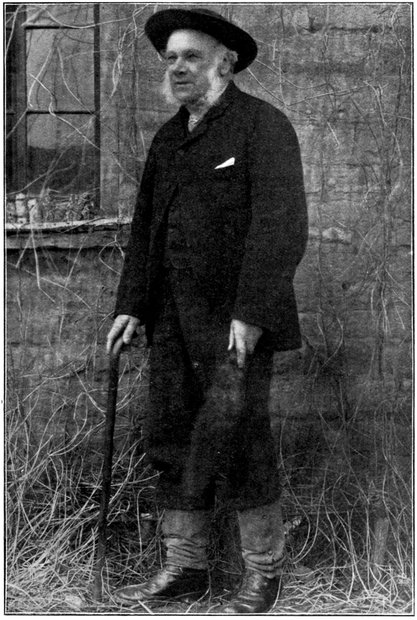
DAVID SWINTON. (Fifty Years Runner with the Belvoir.) Photo by H. L. Morel.
The other day we found old David in his cottage at Ancaster, the unquenchable fires of the chase burning brightly within him as he revived memories of many a happy day. “I enjoy hunting as much as ever, though now I can only read Mr. Tally-ho’s letters in the Grantham Journal; but I follow hounds, for I know every yard of the country,” said the old man, as he leaned on his famous oak staff. “My first sight of the Belvoir hounds I remember as well as if it were yesterday. I was a small boy, standing by Fulbeck Gorse, which was a very thick covert, and old Thomas Goosey, the huntsman, told one of his whips to go in on foot and see to the earth. The sharp gorse was not to his liking, and laughing, I said, ‘Why, he can’t half go through it!’ To which old Goosey replied, ‘It would fetch the bread and butter out of your fat legs, you young rascal!’ That was in 1836. After that I never missed a chance to run with hounds. I was a tailor, and had lots of work to do, but I planned it to see as much hunting as possible, my wife and I often being up nearly all night stitching, to get clothes finished off.”
Lord Forester held the mastership of the Belvoir from 1831 to 1857, and Swinton reminds us that he was “a tall, fine gentleman, and a splendid horseman, who rode right up to the pack.” He used to stutter when giving his huntsman orders. Will Goodall carried the horn in those days; he had been second whip to Goosey, and was promoted over Tom Flint, who had “developed a thirst.” Those were long days for hunt servants at Belvoir, for the rule was to draw covert while daylight lasted, no matter what might be the distance back to kennels.
Swinton in those days had a tailor’s shop at Ropsley, where they had a half-way kennel for hounds when hunting the wide fixtures on the Lincolnshire side of the country between twenty and thirty miles distant from Belvoir. Thus he saw a good deal of Goodall and his whips, for after making the hounds comfortable for the night, they used to refresh at the Fox Brush Inn. About eight o’clock at night Goodall used to mount an old brown hack mare, and gallop the fourteen miles back to Belvoir in the hour, to be ready to hunt a fresh pack on the Leicestershire side next morning. He always took a whipper-in with him. Goodall was a very daring horseman, and he took his fatal fall when only forty-one years of age off a horse called Rollison; it happened on the first of April, and he died on the first of May. “I made his last pair of breeches, poor chap!” says David.
The next huntsman, James Cooper, was a little fellow, sharp as a needle, and a very fine horseman who loved a good horse, having one of his own called Turpin. In those days David used to work very hard making liveries; this gave him the chance to stay at villages on the far side of the country for a week together, and he managed to see much hunting. He has been out on foot four days in succession, doing sometimes thirty miles in the day; but of course that made a hard week’s work. He did not care how he got out so long as he could go. For a time he had a little white pony which could go any distance, and he used to lead through gaps and keep going on the road to make his point, not being very far behind at the finish.
The most memorable day’s sport he ever had was March 6th, 1871, when the Prince of Wales, now King Edward VII., hunted with Squire Henry Chaplin and the Blankney hounds. It was a very rough morning, and David, though doubtful if they would hunt, walked from Ropsley to Navenby, fifteen miles, on the chance. He made for Wellingore Gorse, where he met the Rev. —— Peacock, rector of Caythorpe. A few minutes later a fine old fox came into the gorse with his tongue hanging out, as if he had been a bit dusted. So David walked about, wide of the covert to keep him there, and be sure to see if he left. Not long afterwards Charley Hawtin, the Blankney huntsman, came up with hounds hunting the line into the gorse.
Well, they got him away, and ran for the best part of three hours, although he returned to the gorse twice. At last he got to the end of his tether, and David viewed him crawling into the gorse dead beat. As Mr. Henry Chaplin rode up with the Prince of Wales and Lord Brownlow, the smothered worry could be heard going on. The gorse was very thick, but David crawled in on hands and knees and got the dead fox away from the hounds, bringing him outside. “You are a rum fellow,” said the huntsman, “not one in fifty dare do a thing like that, you might have got killed yourself.” “Its all right,” said David, “naught never in danger, but I should like one end of the fox now I have rescued him!” They gave him the mask, which he had set up in memory of the Royal day. Mr. Chaplin asked him if he intended to eat it.
It was a long spell of fine sport they had during the twenty-six seasons Frank Gillard was huntsman, 1870 to 1896; he was in touch with all the country side, and people did all they could to further a day’s sport. Many is the half sovereign David had from Gillard to see that earths were stopped or gates shut after hunting. When it came to digging out a fox it always meant five shillings to distribute amongst those who worked at the job. “Frank Gillard could always trust me,” said David; “he used to say when he heard my halloa, ‘There’s old Dave’s voice, true as a clock!’ You know I never barked false! What long days Gillard did make to be sure, he was never tired of hunting! I have often spoken to him in Ancaster Street, as he rode through with his hounds at eight o’clock at night, and often it was raining hard. He had to get on to Grantham where the three-horse van was in waiting for the hounds, and that meant reaching Belvoir kennels at nine o’clock or after.”
After hunting three years on foot without a ride, David was given a mount by a friend on a nice little horse, and as he rode up to the meet, old Tom Chambers and the whips shouted: “Hurray, we’ve got old Dave mounted at last! What are you doing up there old friend, are you purchasing?” “How the swells did laugh to be sure!” adds David.
One of the hardest days he ever did on foot was a hunt from Barkstone Gorse. They found at twelve o’clock, and never stopped going until three o’clock. David thinks he did not stand still five minutes, and for an hour and a half he had the Rev. —— Andrews, of Carlton, running with him, till he said, “I can’t stand it any longer. Swinton, you’re killing me!” Hounds kept running in big circles out to Sparrow Gorse, and David viewed the fox several times, and never really lost sight of the hunt for more than ten minutes at a time, as he managed to keep inside the circle. Well, hounds hunted him right well, getting him very tired, so that he returned to Barkstone Gorse. He viewed him again coming away, but before hounds had run two fields they threw up, and David could not make head or tail of it, no more could the huntsman, though he did all he knew to help hounds to recover the line. “Well,” I said, “Gillard, he’s done you!” To which he rejoined, “I think by the looks of you he’s done you twice over!” “No mistake, I did have a doing that day.”
Times have altered since those days, and since Sir Gilbert Greenall became master nine years ago. With Ben Capell huntsman, a day’s sport is very much faster, and David has got very much older. He tells the whips to-day that they live like gentlemen, compared with what the Belvoir hunt servants had to do in the past, for everything now is planned to save wear and tear to horses and men.
The old runner’s experiences give us an outline of two different phases in the history of foxhunting, which might be termed the ancient and modern systems of conducting a day’s sport. Though there are some left to tell us of the great changes that have come over our sport, still Swinton’s story goes to prove that hunting people are as kind and generous to-day as they were seventy years ago, for the old runner has many good friends to help him in his declining days.
Dick Baker.
A man of cheerful, if somewhat rubicund, countenance is Dick Baker. His outlook upon life is that of one who takes no thought for the morrow, and can justify this light-hearted attitude of mind by the circumstance that the world has always treated him well in every sense of the word “treat”; for Dick acknowledges that he is “very fond of his refreshment.” There are many people who welcome their acquaintances with a smile; Dick goes one better, for he generally starts laughing when any one speaks to him; his risible faculty is so delicately poised, that “good morning” has been known to provoke a jovial roar. He may be said to have solved the great problem set by some novelist-philosopher a generation ago, “How to be Happy on Nothing a Year.”
Dick Baker was born sixty-six years ago. How he came to adopt the career he has followed since he was twenty-one years of age, he can hardly explain. He was always fond of horse and hound, and he never took kindly to discipline; running with hounds therefore appealed to him as the ideal occupation for an active and hardy young man who liked to be his own master. Fondness for refreshment, notwithstanding, Dick has reached a hale and happy old age. He can still “keep going” throughout the longest day, and thanks to an outdoor life and a sound constitution, suffers from neither cold nor rain. He dates his career as a runner from about the year 1860, and probably knows more about the Essex, Hertfordshire, and Puckeridge countries than any man living, having spent forty-five seasons running with those packs.
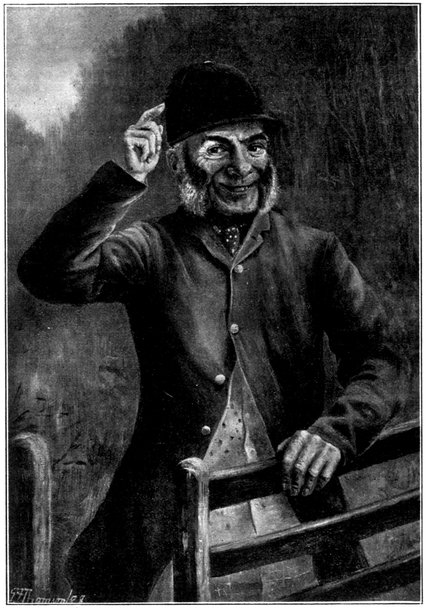
“DICK.” From a Painting by G. F. Thompson.]
He was for several years under Mr. Parry, when that gentleman was master of the Puckeridge, and he tells many anecdotes of the various huntsmen he has known, Dick Simpson, Hedges, Allen, and Will Wells among the number. Dick’s early ambition was to be a hunt servant, but the Fates denied him; he is, he now admits, safer on his own legs than in the saddle. Upon a day it fell that Mr. Rowland Bevan gave Dick his horse to lead home after a hard gallop. Dick thought it a pity not to try what he could do as a horseman, and reflecting that, inasmuch as the horse had had a long day, it would at least be quiet on this occasion, he mounted. Before he got the horse home he had taken three heavy falls on the macadam; but seemingly he was born a master of what some one has called the “inexact science of falling,” for he boasts that he was none the worse. He has confidence in his lucky star, and expresses it in a fashion that has the merit of originality.
“Why, Dick, I thought you were dead,” said a member of the Puckeridge on one occasion.
“No,” replied Dick, calmly; “God never kills good-looking people.”
How far Dick’s appearance justifies his opinion of his personal attractions our readers are able to judge for themselves.
His master passion is anxiety to be identified with the hunt; to be recognised as a member of the staff. To this end Dick, through the good offices of an indulgent member who at the time held office as hon. secretary, took advantage of the visit of a photographer to the Puckeridge kennels to get his portrait taken with a couple of hounds; in character, as it were. It is probable that this was the proudest moment of his life. That he possesses some business capacity which might have been profitably directed into other channels, is proved by the way he turned this opportunity to account. He ordered a dozen copies of the photograph at the aforesaid member’s expense, and retailed them to members of the Hunt at two shillings apiece.
Dick acknowledges but one enemy in this world, and for that enemy he cherishes hate, the deeper because he cannot be avenged of the outrage it committed upon him. This enemy is the Great Eastern Railway Company, which, with the heartlessness peculiar to railway companies, once “ran him in” for travelling without a ticket. It was really not his fault, he explains; he finished a long day with hounds many miles from home, and thinking he had a shilling in his pocket jumped into the train intending to pay at the other end. The fact that he was mistaken as to the contents of his pocket does not, in his well-considered opinion, justify the Company in haling him before the Bench, and getting him fined ten and sixpence and costs. It was the most costly journey he ever made, and he is unlikely to forget either it or the sequel.
Entertaining, as already mentioned, strong objections to anything like discipline, a master of hounds being, in his judgment, the one mortal being who is entitled to command his fellow-creatures, Dick has rarely attempted permanent work: and when he has done so it has always proved temporary after all; for what reason it seems unnecessary to enquire. In summer he is usually to be found in attendance at cricket matches, and in less exalted cricket spheres rather fancies himself as a bowler. He possesses quite a remarkable instinct for discovering occasions, show, celebration, athletic meeting, or what not, which will yield an odd shilling; and will put in much more and harder work to earn the odd shilling than he could ever be persuaded to do to earn the certain half-crown. He has a family; and it is in no spirit of reflection upon a hard-working spouse that he responds to enquiries with the cheerful—always cheerful—assurance that “the cubs are all right.”
Sport in the City. THE OLD YEAR AND THE NEW.
There are times when the tented field is as still as death, times when even the hub of the universe is as dull as any Little Pedlington in the Kingdom. We usually make up for it, however, by a great bustle of company meetings in the concluding month of the year, and these functions have been characterised during the past few weeks by a quite unwonted show of animation. The shareholder, as a rule, is a very patient and long-suffering kind of animal. He pockets his grievances, passes the resolutions submitted for his acceptance, and goes away thankful, in most cases, for very small mercies indeed. When he does break out, however, he is apt to be a very ugly customer, and the lot of the proverbial policeman is quite a happy one in comparison with that of the luckless wight whom duty compels to face the music in his capacity as a director. I do not know whether it is the contagion of heated political assemblies that is spreading its virus in the City, or whether we have come under some malign planetary influence; but certain it is that there is a nasty spirit abroad, and the shareholder goes to his meeting prepossessed with the idea that it is enough to be a director to be either a fool or a knave. For several years in succession it was the fate of the Westralian companies to furnish occasion for these angry gatherings. They, however, are at length vouchsafed a well-earned rest, and the miserable wretches who pull the labouring oar in South African ventures are being given their turn.
That, perhaps, is not altogether surprising. Eldorado has become, in the popular imagination, a veritable Nazareth, out of which no good can come, and since shareholders cannot get out to Johannesburg to vent their wrath upon the heads on which it might with some propriety descend, they are with one accord taking it out of the English companies operating in South Africa which lie within their reach. This is not in consonance with strict justice, no doubt; but it will serve its purpose all the same, for it can hardly fail to convey a hint to quarters in which hints are greatly needed that the time has come for setting their houses in order, lest a worse thing befal. It is probably the case, as I have seen it stated, that the noise is made in inverse proportion to the stake. The big shareholder is intelligent enough to know something of the difficulties which follow upon the heels of a war and broad-minded enough to make allowances. The man with ten shares or twenty, who gets no dividend, and sees the market go steadily or unsteadily against him, loses all patience, and is fired with an ardent longing to break somebody’s head. What the small man voices, however, the big man feels, and the moral which these merry meetings should convey to Johannesburg is that shareholders have not put their money into South African ventures as an erratic form of recreation, but with the reasonable expectation of getting in their own lifetime a reasonable return. It is too much the fashion out there to regard the shareholder as a negligible quantity. Everybody seems to be bitten with the idea that the thing to aim at is bigness of aggregate return, bigness of mills, bigness of expenditure, bigness of everything except of the dividend declared. Megalomania of this description spells ruin to the proprietorial interest, and it is not compensated for by all the booby-talk about prolonging the lives of the mines. It is easy to understand the advantage of this prolongation to directors and managers and secretaries and engineers, and all the other hangers-on of the industry; but where the shareholder benefits from a division of his dividend by two and doubling the terms of years in which it is paid, is more than the average arithmetician can understand. The wrong turn was given to everything by Lord Milner, who saw with his mind’s eye a population of several millions on the Rand, and laid his lines accordingly. Lord Selborne, who is apparently a man of sense and moderation, is doing his best to curb and correct the extravagant ideas that had their genesis in the time of his predecessor, and there is much reliable information to warrant the belief that 1906 will be attended with very different results from 1905. It need be, for only another such year as the last is required, and South Africa will be for ever and a day undone so far as the British public is concerned.
The change of Government made no more difference in the markets than if it had been a change of footmen. The event had, in City parlance, been already discounted. To men who had imagined to themselves the vain thing that their exit would shake the financial spheres, as some of them doubtless did, it must have been gall and wormwood to see quotations actually rise on the day when their resignation became an accomplished fact. This could only be due to a sense of general relief, and to the feeling that the Liberal bark would prove far worse than its bite, so far as the interests dear to the City are concerned. It certainly was not owing to the new team being conspicuously strong either in business or finance. It is an anomaly, to say the least, that the transformation should result in a barrister being enthroned as the Chancellor of the Exchequer and a solicitor installed as the President of the Board of Trade; but Mr. Asquith has shown himself quite at home with figures and fiscal questions during the past two years, and Mr. Lloyd-George has the reputation in the House of knowing a thing or two besides the wickedness of Mr. Chamberlain and the clauses of the Education Act.
Until the elections are over and done with, it is not probable that we shall witness anything very theatrical in Throgmorton Street; but the knowing ones are counting upon a marked improvement of gilt-edged securities when things have settled down. Just as Nature abhors a vacuum, so does the Stock Exchange abhor stagnation, and the one question on everybody’s lips is what to go for in the New Year. Yankees, too dangerous; Home Rails, not to be touched with a barge-pole; Foreign Rails, quite high enough already; Foreigners, not another eighth to be squeezed out of them; Breweries, wait a bit; Copper stocks, a gamble for lunatics. Such is the rough-and-ready pronouncement of three out of four of the old hands one meets. What all are agreed upon is that gilt-edged descriptions must advance and that Kaffirs cannot, the one owing to the plethora of money they see looming in the near distance, the other to the alleged but scarcely demonstrated fact that the public have spewed out their mining stocks and will not have them back at any price. I always like to note these confident predictions. They are so often made and so seldom borne out by the event. How easy it would be to make fortunes if they were! Except for the puff palpable—the price of which is as well known as that of a postage stamp—the financial press is shrewd enough for the most part to refrain from prognostications after the manner of the vaticinators in the sporting journals; but how much it would add to the gaiety of nations if they made selections for the rise and fall after the fashion of their compeers in Fleet Street! The only thing that may always be predicted with certainty of markets is that what will happen will be the unforeseen, and this is intelligible enough. The calculable influences are few in comparison with the incalculable—something occurs to upset the best-laid schemes of mice and men—and you will meet a dozen men who have made their little pile out of the short view for one who has staked his fortune without regret upon the long one.
I will not emulate, therefore, the fame of Zadkiel. I shall not prophesy because I do not know; but it scarcely needs a prophet to perceive that much in the coming year, if not everything, turns upon the course of events in the Empire of the Czar. It is easy to see how pregnant with possibilities is the situation if one takes into account that big dominating factor, and rules out all the rest as of minor account or of no account at all; and it is equally easy to perceive that we are at the mercy of a chapter of accidents. None will undertake to say what the outcome will be, least of all a Russian himself who knows his people and the subtle influences by which they are or may be moved. I have had the advantage during the past few weeks of coming into contact with several recent arrivals from that unhappy country, and the accounts they give are so confused and so contradictory as to leave one in a more impenetrable fog than if one had never taken any pains to learn the truth at all. On some things, however, they are all agreed. Russian news in the newspapers, so they say, must be taken with a liberal quantum of salt. The Jews, not without reason, hate Russia, or rather the established order in Russia; they control, directly or indirectly, the bulk of the leading journals of all countries, and the news agencies as well; their mission is to set down things in malice, to paint everything in the blackest colours, to ruin Russian credit abroad, and to bring down upon the Russian people the execration of the civilised world. The fires of revolution are alight, it is true, but the conflagration is not so widespread nor so all-consuming as the enemies of Russia would have the world believe, and a free and purified Russia will emerge. What will happen then is the problem; and all my Russian friends are at one in saying that any representative Government that may be established will set before itself two objects of policy—a better understanding with England, based upon a solemn renunciation of any designs against India, and development of the resources of the Empire by the aid of foreign capital.
So far as the former of these objects is concerned, it goes almost without saying that any English Government in power would go more than half-way to meet amicable and sincere advances; and as to the latter—with another entente cordiale once established—the chances are that British capital will flow into Russia as it has flowed in turn into America, North and South, into Africa, into Australasia, into India, and into every quarter of the globe in which capital can be freely and safely employed. It is premature, perhaps, to say that Russian ventures will be the outstanding feature of 1906; but the event is on the cards, and the pioneer enterprises are already on the stocks. The world has not been standing still while the nations have been at war and the heathen have been raging furiously. During the past year or two, no end of little expeditions have been poking their noses into the recesses of the Ural region and the vast areas of the Siberian provinces, sending back reports of riches, mineral and agricultural, beyond the dreams of avarice. It is difficult to believe that resources of this description still exist in their virgin state so near comparatively to the Western capitals; but the evidence, coming as it does from so many capable and unimpeachable sources, is quite irresistible, and the inference appears to be inevitable that the exploitation of Russia is the next big task to which the world of finance and industry will direct its attention. The exploitation of China may wait, or be relegated to our friends and allies, the Japanese.
It must not be presumed from our readiness to settle the affairs of the nations that we have lapsed into indifference in the City as regards various little matters of domestic concern with respect to which agitation has been simmering for some time past. The relations of the House and the public are being canvassed more freely now than I have ever known, from within as well as from without. There is a consensus of opinion that things are not quite what they ought to be, as indeed they never have been and never will be even in this best of all possible worlds; but the insiders are afraid of pulling bricks about lest they should bring the entire edifice about their ears, while the outsiders are wanting in the organisation to give the old walls such a shove as would be felt by those within. It will not be long, however, before events compel the general overhaul which is recognised as a prime essential to the revival of business on such a scale as will enable the Stock Exchange man to live without sapping the very vitals of his clients. The complaints of the latter go to the very foundations of business as it is carried on to-day. Why should one pay brokerage when he buys? In every other business, it is the seller alone who pays. The answer is that the buyer must pay, or the broker, who deals with a jobber, would get no benefit from the transaction; to which comes the rejoinder that the jobber is the fifth wheel on the coach, and should not be privileged if he wishes to dispose of his wares. The force of the argument for dispensing with the middleman is perceived by all who are not hide-bound by tradition, use and custom, while practical recognition is being given to it in much of the business that is being transacted outside.
Then it is perceived that no sort of logical justification exists for the enormous difference made in brokerage between one class of goods and another, and between one client and another. For example, bonds are bought and sold on a commission of 1 16 per cent., mining shares on varying scales which work out at an average of ¾ per cent., which is enough to kill the finest business in the world. This excessive charge is not defended; but it is explained. When mining shares were first introduced, the public were very shy of them—and the House, too, for that matter—and promoting firms were ready to pay liberal commissions in order to get them placed, an operation often attended with difficulty and risk. Thus there came to be established a standard of expectation, the public paying whatever charge the broker chose to exact, and the mining market became the happy hunting-ground of new recruits by the thousand, who perceived in it the opportunity of quickly getting rich. Short cuts of this kind, however, generally prove the long way round in the end. Brokers as a class cannot thrive by bleeding their clients white by excessive commissions and contangoes. Either they make losses, which wipe out their gains, and more, or they kill the goose that lays the golden eggs. They cannot acquit themselves altogether of some share in the collapse by which speculation of this character has been overtaken. Commonsense and competition point with unerring finger the direction of amendment and reform, and I expect to see established at no distant date an almost universal charge of ¼ per cent. upon the money, whether shares are bought or sold, or ½ per cent. if commission be charged on sales alone. Pending this concession, it is not probable that speculation will revive upon any considerable scale in the market which has been in the past the most attractive of all markets, and may be again if things are well and wisely handled. The loss of it would not be compensated for by rubber trash and cab companies, over which there will be some burning of fingers before long. “Trash,” did I say? Well, of course, that is much too sweeping a generalisation. As a fact, the great majority of the rubber concerns are moderately capitalised, and the demand for their product is going up with such leaps and bounds that they can only be regarded as sound and stable concerns. That, however, is where the trouble comes in. On the back of every successful form of enterprise kindred ventures are too often floated without much regard to the question whether they contain the elements of success or not. Like the razors that were made to sell, and not to shave, these undertakings are launched for the sake of the promotion, and for no other reason apparent to the wit of man. Promotion in the miscellaneous market has seldom much behind it. The shares once placed, those who are in may whistle for the day they will get out. There is but one fitting inscription for that section, regarded as a whole—“Abandon hope all ye who enter here.” Mining descriptions, with all their drawbacks and all their dangers, have as a rule at least the inestimable advantage of a “shop.” Mining promotions, I am given to understand, are likely to be almost nominal in the coming year; but there are miscellaneous things enough to stagger humanity awaiting a favourable moment to be launched.
G. P. F.
Half a Century’s Hunting Recollections. IV.
The mention of red deer reminds me of roe. As all the sporting world knows, Mr. Seymour Dubourg, before he took the South Berks country, was master of the Ripley and Knaphill Harriers. With these, at the end of the season, he used to hunt an occasional carted stag, but more frequently the wild roe deer, which were at that time to be found (they were never plentiful) between Windlesham, Bagshot, and Easthampstead, also in the heath and pinewood country south-west of the River Blackwater. It was a most interesting sport, and none the less attractive as coming at a time when foxhunting is practically over. The hounds were small foxhound bitches, I should say rather under than over twenty inches. With so accomplished a huntsman as Mr. Dubourg, I make no doubt that they did their work, as harriers, as it ought to the done. However that may be, they were the best pack of staghounds I ever saw. They went the pace, and were not big enough to kill a deer, bar accidents. With roe they drove like furies, but, I suppose from their harrier training, hardly ever over-ran it.
It is the manner of a roe, when first found, to make a point of 2 or 3 miles; then he returns almost to the starting place, or anyhow to its neighbourhood, and begins “making work.” In the straight part of his flight he is seldom far in front of hounds. But having begun his dodges, if he gets half a chance he will steal away, and, as likely at not, run the pack out of scent. His resources are legion. He can squat like a hare, swim like a fish, meuse through a fence like a rabbit, and jump over any ordinary park palings. He is most difficult to view, as he will crawl up a ditch or drain, and utilises every depression in the ground, and of course every bit of covert. He has the cunning of fox and hare combined, but not very much more stoutness than the last named. In France, roe-hunting packs are not uncommon, and a friend of my own has one in Belgium, which, however, hunts hare as well. And a French friend of mine once asked me to stay with him for roe-hunting, promising to mount me, and doubtless I should have had a most enjoyable visit, but I preferred to stay at Melton. By the way, this gentleman valued Belvoir blood above all else.
The objections to the roe as a beast of chase may be gathered from the above. It is pretty hunting, but almost all in covert. The advantages are that you can hunt him all through the winter as you do the fox, and also that you can draw for him without any bother of “tufting,” as you never find more than a brace, or at most three together. When the latter is the case, it is a family party—buck, doe, and kid. The latter would stand but a poor chance were it not for its squatting, when the hounds dash away and settle to the moving scent. When roe are carefully preserved the woods will be full of them, as the young trees will soon tell you. I know nowhere at present, even in Scotland, where they are too numerous, and in the country I have described I should say that they are all but extinct, although some three years ago I saw a brace when Mr. Garth was drawing St. Leonard’s Forest.
With Mr. Dubourg’s hounds one had to ride up to them, if one wanted the venison. If he happens to read this, he will doubtless remember what happened once near Black Bushes Farm. Hounds had been running some time, and we thought “catching time” could not be far off. They came to (for that country at least) a very small wood. We each took one side of the covert (only the master and writer being there), but to our surprise saw no hounds away. To dive into the wood was, for Mr. Dubourg, “the work of an instant.” Arrived at his pack, he found that in those very few minutes they had not only killed the buck but (not bad judges!) had eaten the haunches, &c., and left only the head, neck, and forequarters. Unlike our other deer, the roe is at his best as venison, from the middle or end of October to the end of the hunting season. He sheds his horns late in the autumn. Roe venison has an undeservedly bad name, as lessees of Highland shootings often kill them in the grouse season.