Volume 85 — BAILY’S MAGAZINE OF SPORTS AND PASTIMES No. 554. APRIL, 1906. Vol. LXXXV.
Reading edition
CONTENTS.
PAGE
Sporting Diary for the Month v.
Mr. Henry Hawkins 259
Recollections of Seventy-five Years’ Sport—II 260
In Memoriam—The late Captain J. T. R. Lane Fox 265
Spring Trout and Spring Weather 266
The Towered Bird 268
Hunt “Runners”—IV. (Illustrated) 272
“The Old Horse” 276
Some Novelties in the Laws of Croquet 279
True Fishing Stories 283
A Hundred Years Ago 287
The Borzoi (Illustrated) 289
Some Sport in the Transvaal in 1878 292
A Song of Homage (Verses) 299
Herod Blood 300
The Last of the Bitterns 303
The Spring Horse Shows (Illustrated) 305
The Sportsman’s Library (Illustrated) 317
“Our Van”:—
Racing 320
Hunting 323
Hunting in Yorkshire 327
American v. English Foxhound Match 329
Breeding of Thoroughbreds 329
Polo in the United States 330
The M.C.C. Cricketers in South Africa 330
Death of Richard Humphrey 332
Death of Mr. E. H. Buckland 333
Oxford and Cambridge Boat Race 334
Cross-country Racing 336
Golf 337
“The Voysey Inheritance” at the Court Theatre 338
Sporting Intelligence 339
With Engraved Portrait of Mr. Henry Hawkins.
Mr. Henry Hawkins.
The subject of our portrait, Mr. Henry Hawkins, of Everdon Hall, near Daventry, was born at Kegworth, Leicestershire, in the year 1876. All his life he has been devoted to field sports of every description, and has played cricket seriously since he first captained the eleven of his preparatory school at the age of ten years. Since 1901 he has played for the county of Northamptonshire, and was one of those selected to play against the Australians in August last; he also plays for M.C.C., Warwickshire Gentlemen, and other clubs.
For some years he went in for racing with no small amount of success, owning Alpha, Hottentot, Bellamina, Stella III., and other well-known steeplechase horses, but he has nothing in training at the present time.
It was in the year 1901 that Mr. Hawkins purchased his pack of harriers from Mr. Horsey, and he has now hunted them at his own expense for more than five seasons over the beautiful vale which surrounds Everdon. In the Pytchley, as in every other country, much depends on the good-will of the farmers, and with the farmers Mr. Hawkins is a great favourite. He is a thorough good all-round sportsman, and is, in fact, immensely popular with every one with whom hunting brings him into contact. He has brought his pack, which consists of thirty couple of hounds, all in the Stud Book, to a fine state of perfection, and has taken the highest honours at Peterborough. Last season they accounted for more than twenty couple of hares, and this year bid fair to exceed the average, for they have been showing most continuous and wonderful sport.
Recollections of Seventy-five Years’ Sport. II.
I seldom brought home a tired horse or had a fall. My good fortune in the latter respect I attribute much to the practice adopted early in life of riding steadily at fences other than water. Only men without nerve go fast at their fences. One day with the Pytchley, jumping a fence uphill, the ground broke away on the take-off, and my horse fell back on me in the ditch. We had to be dug out. I had the misfortune to lose a very fine horse close to Thorpe Trussels. Jumping quite a small fence, he dropped his hind-legs in a grip on landing and broke his back. I lost another good one (a mare) by a somewhat unusual accident. Alighting on rotten ground over a very ordinary fence, she snapped a fore-leg, and of course had to be destroyed.
One can take liberties with a sensible horse. In a run with the Pytchley one day hounds crossed the Welland, and a man tried to ride over a board footbridge. When he got to the middle one of the planks broke and he and his horse fell into the river. Riding a horse of the sensible sort, I gave him his head to follow; he stepped nicely across the open space, and we had the rest of the run up to Loatland Wood to ourselves.
The Leicestershire farmers were rare good sportsmen. Once during a gallop with Mr. Tailby’s across the oxers near Market Harborough my horse, a young one, fell and broke the curb bit. While I was putting matters to rights a yeoman came up, slipped off his horse, and seizing mine by the head put his own double bridle on it, saying, “Look at my horse, he don’t want a bridle!” Certainly the horse had had enough for one day, but the fact does nothing to qualify the kindly thought that prompted his owner. The man was a tenant of Lord Willoughby de Broke’s; few but a Leicestershire yeoman would have done such a thing. Another anecdote to illustrate the same spirit:—
Riding along the Leicester and Uppingham road to draw the Billesdon Coplow one morning, “Cap.” Tomlin, the rough rider, pulled up and exclaimed, “Look here, gentlemen, you talk about riding; this fence (an ox fence) has been jumped into the road.” “Yes,” said Sir Walter Carew, “it has; and the man who jumped it is close to you.” The yeoman who owned the land, a good friend enough to hunting, made his fences very strong. On hearing who had jumped his ox fence he sent me a message, saying he hoped I would never come within the parish without coming to lunch with him. Most of the Leicestershire farmers gloried in the chase in those days. The enthusiasm of the people for a good horse was shown in a rather unusual way on one occasion. In a gallop up to Gumley Gorse the fox was headed by the foot people. I happened to arrive alone, and they seized my horse and kissed his face!
It is many years ago that our King, then Prince of Wales, while staying at Althorp, came to the meet of the Pytchley at Holmby House. Lord Spencer, thinking the horse His Royal Highness rode was rather too small for the big fences, offered him a nice one of his own, which was graciously accepted. In the course of the run the horse, to Lord Spencer’s horror, came down. The Prince, however, was up in a twinkling, and regaining his saddle was going again well in front, to the great delight of the Northamptonshire farmers.
Lord Cardigan was a very bold rider, and got some heavy falls. In a gallop with Sir Richard Sutton from Walton Holt, I jumped the white locked gate on Gumley Hill, and had the run to myself. Lord Cardigan and Colonel Steel, of the Guards, had very bad falls. Lord Cardigan told me afterwards that the whole front of his body was as black as coal. On another day, near the same place, he had a nasty fall in a ditch, his horse lying on him. Lord William Beresford, seeing his plight, stopped, and called on the Hon. and Rev. Robert Wilson to come and help, shouting, “He is not half a bad fellow, and it would be a pity if he died in a ditch.” They got to work, but Beresford found he could not get hold of Cardigan, and said so. “Pull me out by the nose if you like,” said the victim. The water was trickling over him, and without help it is very probable that he would have been drowned in the ditch.
Apropos of falls, there was a little man with a very wry neck who used to bring some nice horses to hunt in Leicestershire. One day he had a fall, and was stunned. There were plenty of people at hand to help, and one man, who did not know him, took him by the head and began to pull at it in the kindly but mistaken endeavour to straighten his neck. This usage brought the poor man to his senses just in time. “Born so! Born so!” he exclaimed, feebly. Another pull would have broken his neck.
Among the good runs I call to mind are two in which, thanks to my horse, I had the fun all to myself. One was a splendid gallop across the Vale of Dunchurch without a check to ground on Barley Hill in the Pytchley country. I was entirely alone with the pack; and the field were so long coming up that I went home before any one arrived. It was several days before they discovered who it was had been with the hounds.
Another fine run was with the Cottesmore, when the hounds ran their fox without a check to mark him to ground in Horninghold Lordship, quite out of sight of the field. The earth being in the Quorn country, the fox had to be left.
When I lived in the Atherstone country I had a small stick covert at Bitteswell, a very sure find. Anstruther Thomson said I had made it too strong, but I told him it was my business to have a fox and his to get him out. As a matter of fact, foxes never hung there, though they seldom afforded good runs; the old foxes used to lie out in the hedgerows.
I told Jack that he would have better sport if he hunted the country thoroughly. He enquired what I considered would be “hunting it thoroughly,” and on my saying, “Drawing it blank,” he replied that he would draw me blank next season. I said I should be ready for him.
He came once a fortnight—no blanks.
The truth was, I had three earths, one natural and two artificial, and Jack never found out the latter. I always stopped the one most used, and put the others to in the morning. The last day of that season I stopped all three, which rather confused him and his hounds. This covert was very full of rabbits, which were caught in a pitfall, one side of it being wired in. I have known a fox to be caught in it.
One day, when hounds drew my stick covert, I lost my usual good start, as I was looking after the foot people. There was a good scent over the grass, and hounds ran hard, but being on a very fast horse I soon got up to them. Just in front of me a youth was going well till he came to a rough fence with daylight in only one place, where an ash tree had been cut down. His horse slipped on the roots and turned over into the ditch on the other side, heels uppermost. “For goodness sake,” he cried, when I asked him to let me come, “don’t ride over my horse.” There was no help for it; my horse cleared the inverted animal nicely, and I went on with hounds.
The young gentleman, however, thought he had a grievance, and, when the fox was killed, reported me to his uncle.
The uncle was a near neighbour of mine, and a good sportsman. He told me that his nephew over night had been “crabbing” the Atherstone men as the slowest set in all England, and thanked me for what I had done. “He will have a different tale to tell to-night,” he concluded.
In a run with the Pytchley a lady following me had a fall; hounds were running hard, but as she did not get out of the ditch I felt bound to go and help her. As I got near she jumped on to her horse, and I asked what she had been about. She said, “I don’t mind telling you, my hair came off.” She had beautiful hair of her own, and added the plaits which were commonly worn in those days.
In the Northampton race week there was a very early meet with the Pytchley at Cottesbrooke. The same lady came up to me and said, “I reckon you will get a good start this morning.” I said, “Yes, certainly,” and that with the wind where it was we should have to cross the stream, which was unjumpable. There was a bridle-gate in the middle of the ford, and I told her I meant to be in first, and if she was close up would hold the gate open for her. When we reached the gate I looked round; she was there, but without her hat. “Dear me, Mrs. A.,” I said, “What have you done with your hat?” “Lost it following you under that tree; and if this sort of thing goes on I shall soon lose my head,” she responded. The acting master, the Hon. C. Cust, made a turban for her out of his neck wrapper, and she hunted in it the rest of the day. The gate in the ford became blocked, and we had an enjoyable gallop.
If there was nice hunting weather at Assize time there was often difficulty in collecting a grand jury, and the judges threatened to fine us. Going to the meet one morning I fell in with a pompous old neighbour who was on his way to Assizes, and asked him, if my name should be called, to respectfully address the judge, and say that I regretted my non-attendance. “Some domestic affliction, no doubt,” said his lordship, and he passed me over, and fined several others.
One London season I took up a pretty young horse; he was always full of vitality and a pleasant mount in the country, but not suited to Rotten Row, as he used to strike with his fore-feet at other horses cantering towards him and frightened several young ladies. He seemed just the horse for a charger. I offered him to a vet, who had a commission to buy a chestnut horse for an officer, telling him he was more suited to a younger man than myself. He went on nicely for a while, and became the crack horse of the regiment. The day of inspection arrived. As he was passing the general at the head of his troop, with the view of making a proper display on the solemn occasion his rider touched him with the spur. He plunged violently, and hoisting his heels exuberantly, cast his rider at the feet of the general, amid the applause of the assembled multitude.
It was in 1831 that I bought the small pack of pure harriers kept at Shotesham. I hunted them for about twenty-five years at my own expense, and then sold them to the Earl of Albemarle and Colonel Unthank. The latter crossed the lot he purchased with the foxhound, and in my opinion spoilt them. I kept as clear of foxhound blood as I could, having only one or two old bitches from Sir Thomas Boughey all the time I hunted them. They were fast, but close hunters; mine was the silent system, rarely going to halloas, and the hounds were not too closely whipped in; extra work was the cure for unruly ones instead of whipcord. They were a capital working lot, and a good hare had not much chance if I wanted to kill her. The country is flat, consequently the hares made better points than they do where there are hills. They were scarce but stout, as only those that outstripped the greyhounds and lurchers were left alive in the greater part of my country.
At Sexton Wood, a fine covert hired by some farmers for shooting, a fox was constantly seen. One February, when the shooting season was over, I went to look for him. A large field was out, some in scarlet from Suffolk. I was a little chaffed, the men asking what I was going to do with the fox. I said I would make him ask for mercy before sunset, or, if the wind had anything to do with it, perhaps hunt him on to the top of one of their houses. As the wood was full of hares I had the fox driven out by men. He went away directly, but was headed back into the wood. I trotted to the other end at about the pace I thought he would travel, and he broke again near me. I got a good start with him up wind, and ran hard for a mile and a half, when he turned down wind; first check, thirty-five minutes. He ran down the middle ride of Earsham Wood with hares constantly crossing, but not a hound left the line. He crossed the river Waveney into Suffolk, was headed in Flixton Park, and turned back up wind over grass to the Waveney, fox and hounds all swimming the river together, and got into a boathouse. I waited till the field arrived, and they asked me if I had done with their fox. I told them to look in the boathouse, where the fox was hiding in the boat. They wanted me to kill him, but I refused, and had him turned into a coppice close by. After releasing the fox I asked the field to come and see hounds run a hare, as I must kill one to steady them for another day. They told me there was a splendid hare close by, often hunted by Mr. Chaston. As I was some miles out of my own country, I felt a difficulty about hunting her; but as they promised no harm should come of it, I gave way. As we entered the field she ran out at the far end; the hounds settled at once, and killed and ate her in twenty-one minutes. The field were well satisfied. They wanted me to keep some foxhounds, and I said I would if they would promise me foxes, which they failed to do.
I had several first-class gallops after outlying stags, almost always running up to them, but not trying to take them.
You ask about my shooting recollections. I have repeatedly killed 40, 50, and once over 60 couples of snipe on the Langley Marshes, by the side of the River Yare. In August, 1846, with Mr. Everard, of Gosberton, I killed 164 brace of grouse, and on the 27th of that month 103 brace by myself. As regards the match between Mr. Stirling Crawfurd and Mr. Osbaldeston, I “managed” for the former, Sir Richard Sutton performed the same office for the “Squire,” as he was called.
The match came off at Rufford Abbey, between the two Newmarket October meetings. Stirling Crawfurd gave him ten brace of partridges each day, on account of his being somewhat older. They shot two days, changing beats the second day. They tossed for choice of beats, both of which were good, but one not so good as the other. I won the toss and took the worst beat for the first day. Shooting began at eight o’clock, and the men shot till dark. We were beaten by a few brace on the first day, but on the second Crawfurd won the match by several brace to spare. Osbaldeston wanted to shoot it over again for a larger sum, on the condition they changed managers. Crawfurd was to walk all day, and Osbaldeston, if he liked, to ride; no driving. Sir Richard had some of the Duke of Rutland’s keepers, from Derbyshire, and some of his own keepers from Lynford, and his whippers-in from Quorn. He overdid it. I had only the head keeper’s son and walkers off the Rufford estate. Mr. Crawfurd gave the value of the stakes among them.
My pointers were bred from two animals given me when I was at college, by the then Lord Lonsdale, from his and another kennel, crossed with Mr. Moore’s, of Appleby. When I gave them up I sold every dog I had to the late Lord Wilton for £25 apiece.
Harking back to my athletic days when at college, I once jumped Mr. Rhodes, of Trinity, a match over water by the side of Trumpington Road and beat him. I believe, but am not quite sure, that my opponent was the father of the famous Cecil Rhodes.
When at Melton, years ago, Count Hugo Nostitz asked me to jump a match. Six jumps, each to choose three, and go first. If he did not clear it the other not to follow on. First jump both got over. I cleared all of Nostitz’s choosing. My second was the Melton Brook, with mud thrown out on the far side; I cleared brook and mud. Nostitz cleared the brook, but, to save falling back, had to put his arms up to his elbows in the black mud. My third pick was the brook again with a rail in front of it. The late Lord Lonsdale, mischievously inclined, told Nostitz to jump high enough (the worst advice he could give). He cleared the rail well, but alighted up to his armpits in the water.
Once he had rather a bad fall with hounds. We went to help him, as he did not get up, and asked him if he was much hurt. He said, “No, only a little more than usual.” He tried to get up, but could not for a while. He was as charming a young fellow as ever entered the town.
Robert Fellowes.
In Memoriam. THE LATE CAPTAIN J. T. R. LANE FOX.
A sportsman has been taken from amongst us last month in the person of Captain J. T. R. Lane Fox, the Master of the Bramham Moor Hounds, who could ill be spared; and in whose memory it is fitting that a few words should be said in your pages.
Captain Lane Fox was the second son of the late Mr. George Lane Fox, for many years master of the Bramham Moor pack, whose strong personality gave him a foremost place in Yorkshire and throughout the world of sport, as well as among English country gentlemen. Captain Lane Fox had therefore handed down to him a heritage of no mean character, when he succeeded his father ten years ago.
Having acted as his father’s deputy in the hunting field for the last few seasons of the old Squire’s life, his transition to the mastership came almost as a matter of course, and was universally welcomed by the most loyal set of sportsmen that we are acquainted with. Few such elegant yet determined horsemen are to be found nowadays as was the late Dick Lane Fox (as his familiars delighted to call him). From the day he left Eton and joined the Grenadier Guards, serving in Canada and riding many races and steeplechases there, until, on his retirement from the army, he settled down, on his marriage, in the confines of Bramham Park as his father’s right-hand man, he was the idol of all his friends and neighbours.
Unfortunately, he had experienced a bad fall whilst in Canada, which told upon his health and constitution ever afterwards. Indeed, this would have been the cause of banishing many less ardent sportsmen altogether from the hunting field, yet with the subject of our memoir it was not so. There were times when I have witnessed with admiration the pluck with which he seemed to triumph over his constitutional weakness. It was then a treat to see him go to hounds; such a superb seat, hands, and judgment as his made him conspicuous even in a large hard-riding field like the Bramham, and demonstrated his superb talents as a sportsman. It may well be said of Dick Lane Fox that from old Eton days, when I first enjoyed his friendship, down to the sad event of last month, that he never made an enemy but cemented many a friendship. He had above all a natural aversion to obtrusiveness, which prevented him often from doing himself justice; yet the shrewd, true-hearted Yorkshiremen knew him too well not to appreciate him as a country gentleman as well as a sportsman. He lived to see his eldest son George take his place in the hunting field in a way that he could not fail to be proud of; the veritable likeness of his grandfather; and beyond this, in spite of one defeat, he rejoiced to see him elected as M.P. for the Barkston Division of Yorkshire, after as big a fight as ever aroused the political feelings of that district.
Mrs. Lane Fox was a Milmay, of excellent sporting blood, and a devoted wife, who survives him, so that on both sides of the family the present inheritor of Bramham (one of the finest estates in broad Yorkshire) combines the makings of all that is best in the life of a country gentleman and a sportsman.
Personally I mourn, in conjunction with innumerable others, over the loss of a life-long friend, yet our sadness is tempered by the glad reflection that such an unsullied name, such a bright example, and such an ennobling compeer, should have gone to his rest so peaceably, and have left behind him a splendid well cared-for estate, and a descendant in every way worthy of upholding the fame of Bramham and its famous “25 couple,” and likely to fill yet another niche in the temple of fame amongst Yorkshire worthies.
Borderer.
Spring Trout and Spring Weather.
Surely the spring trout-fisher is the most hopeful of all the sanguine and long-suffering brotherhood! How many bitter disappointments and how much bitter weather is required to convince one spring fly-fisher that he had better defer his attempts at sport till the blizzards are over?
Last spring was no worse than usual, but the feel of that cutting east wind still haunts my dreams, and, worse than all, the trout taken were both fewer and smaller than in the previous July on the same water.
Two days only out of six were really good, and even then the trout, though numerous and lively, averaged but little over the quarter of a pound. Certainly they took the blue upright with a will, and did not require much stalking, and now and then a nice half-pounder gave a really satisfactory bit of sport.
I see by my diary that the “coch y bondu” was almost as successful as the “blue upright,” and that dry-fly fishing was nearly useless so early in the season, though fish could often be seen rising on the smooth glides. Sometimes not a fin could be stirred for hours, so that one had plenty of leisure to note the exceptional beauty of the budding woods, and to listen to all the love-notes of the birds. When sport is lively all these things are only dimly felt, as heightening enjoyment. When trout are sulky, then we feel the difference between the silence and comparative gloom of late summer woods, and the joyous choruses of early spring; and nowhere is this more marked than among the lovely sylvan scenes on the banks of Somerset streams.
Among other advantages, water is generally plentiful and not too clear. In the wild uplands on the borders of the moor the bushes and brambles which line the streams are not yet developed into the impenetrable thickets that bar one’s progress in the summer, and many a spot then unfishable, even with the aid of waders, can now be reached at small cost of scratches.
I must confess that these inner sanctuaries did not yield me many victims, my basket on the day I went up the hills being the lightest of the week, and the fish the smallest.
Nevertheless, I think the Horner Woods stream, near Porlock, a charming spot, and worth another trial; for adverse winds may have been responsible for the poor sport. It is easy, I believe, for the fly-fisher to get leave on this water, and it is within a mile or two of Porlock. I cycled from Washford, the other side of Minehead, and found it a delightful ride. I think all anglers will find a cycle convenient in this district, as roads are fairly good, and distances from stream to stream often considerable. It is rather monotonous to fish one stream continually, and the change of scene and novel exercise heighten one’s pleasure. It also enables the angler to choose more comfortable quarters than might always be obtainable close to the fishing; for a run of a mile or two is of hardly any consequence, and it is not always that such rooms as were secured for us (within the precincts of Cleve Abbey) can be had.
This old ruin is close to the stream, and can be examined by the wandering angler at very little cost either of time or money. It is well worth a visit. Washford is the station, but it is within an easy ride of Minehead, where comfortable rooms and good attendance can always be had, and from whence excursions, by coach and boat, are continually going on to many of the loveliest parts of Somerset and Devon.
One disappointment experienced during this spring visit was perhaps not due to the time of year. A large and deep pool, formed by the stream right down on the seashore, had sometimes yielded capital sport in July, fish being large and plentiful, though very shy. Some shifting of the sands had now greatly reduced its depth, and the trout had almost deserted it, only two half-pounders falling to my flies. Last year several of the fish taken here were ¾ lb. or more, and the novelty of landing good trout (and not sea-trout) on the sands added to the charm. I have only done so once before, and that was hundreds of miles away, at the mouth of Crocket’s celebrated “Skyreburn,” in the north.
As it is possible that this sea-pool may have improved again this spring, I advise any angler who finds himself near to give it a careful trial, especially if there is a strong wind blowing; for this greatly increases one’s chances. Curiously enough, a little black gnat is the best fly here, but it is worth while to try larger flies if weather is rough. I think that many of the mouths of trout-streams might be fished carefully with good effect, the trout being often larger and better fed than those in the stream itself. Probably they often go a little way out to sea, and get shrimps, &c., in certain states of the tide. At the worst it is a pleasant change to cast a long line over broad water, after being somewhat cramped and hampered in a narrow and much bushed stream. It must be remembered that permission is required from the local landowners for these parts of the streams, as well as for the upper waters.
J. Paul Taylor.
The Towered Bird.
For upwards of twenty years it has been asserted that no towered bird has been hit only in the head. It has become quite an article of faith with some people that every towered bird is stifled by wounds or blood in the organs of respiration. Quite lately it has been stated that it has often been said that towering has been caused by a shot on the head, but that this is never the case.
The writer has often fallen into this supposed error himself, and has gone very fully into the subject. It is not only a very interesting question in itself, but one that sportsmen should not be misled about. At the last retriever trials there was reported to be a “towered bird,” and upon the dog being sent for it a field away he found it quickly, but the towered bird rose again and flew away, followed by the keeper’s remark, that it was “a very lively dead bird.”
This shows that not all keepers are aware that towerers are not always dead birds when they fall; for this keeper was surprised when the towerer rose again; but I noticed that the judges were quite satisfied that the escaped partridge was identical with “the towerer.” They did not set the dog to hunt again, but turned their backs on the scene of action, and credited the dog (which happened to win the stake) with the find.
That bird had been hit in the head, not in the lungs, and he towered in consequence. If he had been also wounded in the lungs he would have died at the apex of his flight—they always do. It may be asked how I know this, and my reply must be that I know it from the examination of many towered birds of different kinds. Of course, I make no claim to be telling experienced sportsmen anything they do not know already. I am well aware that very many do know it, because I have gone out of my way to ask them; but I think there is occasion for dealing fully with a subject that has been misunderstood for twenty years.
This being so, I propose to glance, briefly, at the varying behaviour of game when struck in different parts of the body; and this seems to be all the more necessary, as wrong information is sure to cause many a fruitless search, much loss of time, and perhaps some muttered thunder directed against the supposed Ananias who saw the bird tower.
Young shooters are often confident that a towered bird is dead, and can be picked up if looked for long enough. Probably they have read it, and have confirmed the statement with a few observations of their own. The partridge that is struck in the head usually falls at once, whether the shot has actually pierced the brain or not, but this is by no means invariable, as I have suggested above.
The several kinds of towerers behave as follows: A rap on the head from a glancing shot may or may not damage the sight, but if it does not completely stun the bird he will rise up and tower from the place where the shot struck him; his is usually a very strong flight, and he is likely to fly a good way, towering all the time, until the loss of strength forces him to come down; he will not collapse at the apex of his flight, but as he falls continue to beat his wings, more or less slowly, nearly or quite to the ground. When he reaches the earth he may die, or he may sit muffled up in a dazed condition. Generally he can be approached and killed with a stick, but sometimes he will have a blind side and a wideawake one; and it is not difficult to approach him by selecting his dark side. In no case is such a bird likely to fly until his enemy is within a yard or two of him. Often he makes no attempt to save his own life, and many times I have allowed a retriever to pick up such a bird, having the gun ready in case of his blunder. On several occasions, probably not more than three, the towered bird on being disturbed has towered again; but generally if he is able to fly at all he is able to see where he is going to and to get away. Many birds of this kind have no shot in them whatever, as I have proved by post-mortem examination; others have proved the same thing by being as lively as ever upon being approached. Once, a few years ago, when a controversy on this subject raged, X-ray photographs of three towerers were published, but shot pellets could only be traced in two of them, and consequently both sides claimed the victory. It is very likely that laboratory examination never will find a shot pellet in the head of a towerer, but that only proves that when a shot enters the head it is generally enough to bring the bird down at once. It is quite another matter when a shot pellet strikes the head and does not enter. Then the state of towering is frequently instantly produced.
This kind of wound, then, may be recognised by the towering of the bird from the instant it was struck, also by some movement in its wings in descent, and lastly, by its attitude of squatting when found upon the ground.
A bird struck in the lungs or stifled by blood in the windpipe behaves very differently. On receiving the shot it generally, but not always, drops its legs as if they were broken; that will generally prove not to have been the case. Then it flies on, from fifty to five hundred yards, with nothing apparently the matter, except the dropped legs, then it suddenly begins to rise or tower. This towering appears from the shooter’s position in the rear, and far behind, to be straight up, but that is optical deception, caused by the position of the shooter directly in the rear. The angle of elevation is really about the same as that of the head-struck bird, although, as the latter rises from only forty or fifty yards away, his angle of elevation looks more oblique than that of the bird a quarter of a mile away.
The stifled bird rises in spite of the fact that his head does not point upwards like that of a pheasant rising to top the trees. The partridge rises without any appearance of change of angle in his body, and when he reaches the apex he does not turn over backwards, as has been said of him, but starts to fall from the position of ordinary horizontal flight. You will generally find him dead upon his back, but the reason of this is that the resistance of his outstretched wings in falling turns him over, and they cease to resist the air when he is on his back. It is a case of movement in the direction of least resistance.
A bird which is brought down instantly by a shot in the head generally jumps about or flaps his wings when on the ground; one would think that he could not do this if he was entirely unconscious, but if he has any degree of consciousness the head-struck towerer must have very much more, just as the stifling bird has, so there must be many degrees of semiconsciousness in wounded partridges.
It very often happens that the most experienced will mistake the dead bird’s fall for that of a runner, and a runner’s for that of a dead bird, but the latter is less frequent. The runner generally flaps a wing as he falls, shows the white of the other one and holds his head up; but all these signs taken together do not prove him to be a runner, because he may have had a lung shot as well, and then he will die upon the ground. Again, a runner may deceive in the other way, he will sometimes fall as if unconscious and then recover and run away. The runner which is just wing-tipped and can fly a long way, sinking slightly until he touches the ground, will not fly again, but generally proves to be a very strong pedestrian indeed.
Several different kinds of hits cause birds to drop their legs instantly, and I fancy that when this happens they are always found where they fall, near or far. The most common of these is the lung-shot bird, then there is the back-broken bird, which does the same, and may also be known by the wobble of his flight—an up-and-down movement, like a boat in a heavy sea. Then there is the leg-broken bird which is likely enough to fly again, but not to run, that day at least. A broken-legged bird generally only has one leg down, whereas a dead bird generally drops both, no matter how far he is to fly before he dies. I think a bird very seldom bleeds to death from a shot wound in the neck vein, but probably this must happen sometimes. I am inclined to think that when the only wound is in the blood-vessels of the neck the bird would fly so far, losing blood all the way; that when he was picked up the cause of death would not be recognised, and I think this is the reason why this kind of wound is so seldom seen. It does not follow that it infrequently occurs.
A shot which breaks the spinal cord is as instantaneous in effect as one which enters the brain, and brings the bird down at once, but not with what is called a broken neck, for I never saw a broken neck in grouse, partridge, or pheasant, unless the keepers had wilfully done it in order to kill a wounded bird. It is a very bad plan to kill any game this way, and especially grouse, for without the bone of the neck to suspend them on the stick the weight often causes the body to drop and be lost in the heather. The skin alone is not strong enough to carry, at any rate, the young birds, especially when boys drag their feet and bodies through the tall heather.
It has been said that the reason partridges “tower” is that they are obliged to lift their heads upwards in order to get their breath, and that their bodies follow where their heads point. This can hardly be the reason, because we have two kinds of “towerers” to deal with, and besides, many a blackcock on taking wing and going away horizontally, nevertheless holds up his head and looks at his disturber over his back, but he does not go upwards in consequence. I do not believe that the upward flight is caused either by any rudder-like action of the tail, although that is, perhaps, possible.
Probably the wings are so set by Nature that their beats not only counteract gravity, but something more than this, and it possibly requires the will of the bird in steering to make him keep a horizontal course. The concave undersurface offers more resistance to the air than the upper convex surface. Hitherto I have considered that this arrangement was meant to negative gravity when the bird was urging its forward course, but when one remembers that young birds with half the power of flight of the old ones nevertheless can rise quite easily, and seem to maintain a horizontal course quite comfortably—that is, their inferior wings in ordinary up-and-down beats are equal to the resistance of gravity—consequently, it appears almost certain that the ordinary beats of better wings are much more than equal to the resisting of gravity. Or, in other words, if partridges in a state of health did not wilfully hug the ground they would rise up like “towered” birds.
I wonder whether this is the reason that day birds (which appear to migrate in their sleep, and certainly cannot travel by night at any other time than when the instinct is upon them) migrate at great altitudes. That is to say, whether they go up because they cannot help it. If so, there would be a certain altitude for each kind of bird where the wing beats influence, on the more rarified air, in sending the bird up, and the lessened power of gravity, would become equal, and at that altitude the bird would travel forward without the will being called into request to keep a horizontal course. Balloonists tell us that at great heights birds thrown out fall like stones, so that there must be an altitude where ordinary wing action ceases to overcome gravity. In any case the partridge goes upward, whether either head or lungs deprive him of part of his senses, probably of all the sense of direction except that one of keel downwards, that no bird ever seems to lose as long as he is alive.
Another reason for believing that the natural up-and-down wing beats would take any healthy bird upwards as well as forwards is to be found in the necessity of the moult. If the full wing beats only kept the horizontal course then it would probably happen that the loss of a single flight feather would have the effect that gravity would gradually overcome the horizontal tendency and pull the bird downwards; but that does not appear to be true, and this is additional reason for believing that the up-and-down wing beats with a horizontal keel much more than overcome gravity, and that consequently when a bird cannot direct its own course it goes upwards, because it is built to do so, and to overcome the downward drag of gravity by the mere up-and-down wing action and a level “keel.”
G. T. Teasdale Buckell.
Hunt “Runners.” IV. Butler of the North Cotswold.
There are few more picturesque hunting scenes than the country around the Cotswold Hills in the fair county of Worcestershire, which is hunted by Mr. Charles McNeill and his famous pack of Belvoir-bred bitches. This Eden of foxhunting is a much sought after possession, wild and rugged with variety of scene on hill and dale, pasture and woodland. It has often been said that farmers are the backbone of foxhunting, and these Worcestershire sportsmen, bred and born to it, are a community whose fame for staunchness to sport is known far and wide. The majority of them, or their sons, ride to hounds, and wire is practically unknown in their country, whilst foxes are preserved as they ought to be, the best of good feeling prevailing between sport and agriculture. All the same, we did not expect to find a farmer in the capacity of runner to the hunt.
Many countries are going begging for a master, but not so the North Cotswold, which has been so successfully presided over by Mr. Charles McNeill for the past five seasons, the announcement of whose retirement was received with universal regret. When it became known there was a vacancy for next season, twenty-two applicants for the mastership came before the Hunt Committee; showing how hunting men appreciated a community of farmers who plump solid for sport. Sir John Hume Campbell is to be congratulated that he has been chosen to succeed Mr. McNeill.
Butler, the runner to the Hunt, wearing the cap and scarlet coat of office, is a typical Worcestershire dairy farmer. Born in the Heythrop country close by, he has followed the hounds on foot for the past twenty years, which occupies the reign of three masterships—Mr. Algernon Rushout, Captain Cyril Stacey and Mr. Charles McNeill. Before that time he had five years in the saddle making young horses, “hunting oftener than his master did,” as he put it, and a coachman’s place for six months in the heart of Birmingham was the last straw that compelled him to give up domestic service, and take to the wild, free life of a runner, with farming as a mainstay. On a hunting morning Butler is up before daybreak to get his cows milked, pigs and poultry attended to, so that the institution of a bicycle to ride the long distances to and from covert has been a great saving of time and exertion.
Our first sight of the North Cotswold Hunt in the field was at a picturesque fixture, Cheevering Green, in the hill district, and there we made Butler’s acquaintance when he stood holding open the gate as horsemen drew up from far and near. A middle-aged man, with a dash of grey in his side whiskers, and keen, penetrating brown eyes, foxhunting is written in every line of a face evidently intended by Nature for a hunting cap. Sporting the primrose collar of the Hunt, and the coronet on his button dating back to Lord Coventry’s mastership, Butler, with his sturdy black and white terrier, makes a pleasing adjunct to a Hunt which is appointed in Leicestershire style. There is no gainsaying the fact that the countryside appreciates a Hunt that is well found in all departments, and a scarlet coat is still a passport which will admit its wearer where others would be less welcome. It was the late Duke of Beaufort who used to say that every man who goes hunting ought to pay the chase the compliment by putting on his best clothes, even if it be his Sunday suit. Though the North Cotswold is a Hunt far distant from Leicestershire, yet Mr. McNeill has aimed at perfection in every department, and by doing so won everybody’s gratitude; for, after all, the pomp and pageantry of the chase tends to its popularity in a marked degree, which more sterling qualities can hardly boast. When the Master-huntsman rode up in the middle of his pack of seventeen and a half couple of bitches there was a cheery word all round, and expectancy which preludes a good day’s sport. As usual, the Hunt runner had a quiet word for the ear of the Master, news of an outlying fox which a neighbouring farmer had viewed every morning for the last week. These North Cotswold bitches, for Mr. McNeill has no doghounds in his pack, have done well this season, killing seventy-two foxes up to the middle of January, in a country that is fourteen miles long and eight miles wide in the middle, being a good deal less top and bottom. All Belvoir in colour and type, they are triumphs of breeding, proving their worth by winning prizes on the flags at Peterborough, and golden opinions in the field, where they are remarkable for tongue and drive, a pack that mean catching their fox at the end of a gallop. Mr. McNeill is a Leicestershire man, who acquired the greater part of his skill as a huntsman studying the methods of Tom Firr, and he is as quick as lightning, inspiring hounds and followers with confidence.
For the first draw we commenced hill-climbing to the larch plantations up above, an experience that made one appreciate the sagacity of a well-trained hunter.
These hill districts must require a considerable amount of stopping before a day’s hunting, but it is not a duty now performed by the runner. Butler’s mission is to bolt the foxes when they get to ground, and for this he receives half-a-crown on every successful occasion. Years ago he carried a big, white buck-ferret, and worked him on a line when foxes sought the shelter of stone drains. Unfortunately, the ferret came to an untimely end; making a hole in the bag in which he was being conveyed home one wet night, he escaped and, perishing of cold, was found dead next morning.
From the hill-top we were rewarded with a beautiful view of a far-stretching panorama of country in the vale beneath, and quickly the sonorous music of the big-framed bitches lent enchantment to the scene. A second or two later the whipper-in’s silver whistle was ringing out the glad “Gone away,” and Butler, with a smile of satisfaction on his face, was holding up his cap; there were no confusing halloas. Though the North Cotswold country is anything but a good scenting one, except when there is a bite of east in the wind, the bitches rattled their fox out of covert, and keeping his head up wind as they slipped down into the vale, spread-eagled their field in a hunt of thirty minutes to the Croome country on the opposite hillside. It was a ride full of new experiences, giving us, alas, but a distant view of the Master and hounds as they skimmed over the stone walls that divide the seventy-acre pastures. A rain-cloud blotted us out at the finish, enveloping the hillside in a dense wall of fog, robbing the pack at a critical moment of well-earned blood.
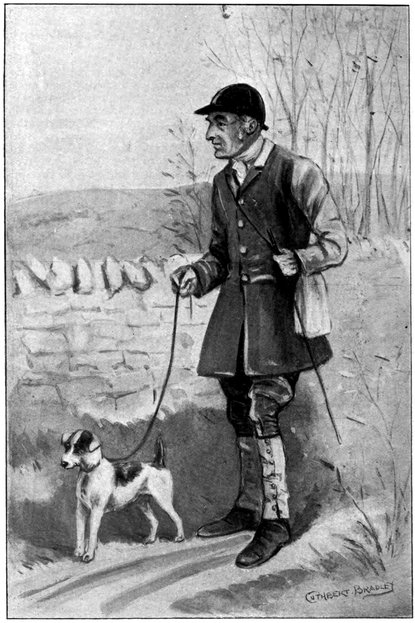
WITH THE NORTH COTSWOLD.
Stone-wall jumping is a characteristic of the North Cotswold country, and it is surprising how well hounds’ legs and feet stand the trial, proving the worth of good bone and breeding, which, like first-class machinery, can go at the highest pressure and last. In the vale there is a beautiful line of grass with upstanding fences, equal to anything to be found in Leicestershire, so that a hunt is seen under all sorts of conditions, and a pack that can do well here is fit for any country.
Talking of runs brings up a wealth of reminiscences, for it is a district in which the keenest interest is taken in the doings of hounds by the non-hunting fraternity, who are sportsmen to the very core. To set the runner and his friends talking hunting is like putting a match to gunpowder, and two brilliant bursts we noted down would make the fortune of a season’s sport. Finding a fox near Hyatt’s Spinney, the bitches, with tuneful chorus, drove him along into the open country of large acred fields surrounded by stone walls. There was a burning scent, and so good was the pace that hounds could keep their fox travelling up wind, whilst Mr. McNeill was viewing nearly the whole of the journey in a hunt of twenty minutes.
It was a regular Belvoir burst, and the pilot had to go straight in the race for his life, losing no time over the walls, he ran up the middle of each field in a desperate effort to gain on his pursuers. Such a high state of tension could not last for long, and the huntsman at last saw the fox miss his footing at a stone wall and fall back from distress. Though the mistake only made a matter of a few seconds, it cost a gallant fox his life, for before he could clear in a second attempt, a bitch called Housemaid dashed up, and seizing hold of his brush, pulled him back, but herself went over the wall, where she lay, knocked out. An electrifying cheer from the master put a finish to the fastest burst of this season, under the wall near Springhill.
Another good gallop this season, both from a thruster’s point of view as well as the huntsman’s, was from Gallipot Gorse in the Vale. An old customer, who had on several occasions led the pack a dance, always to save his brush by getting to ground, was not so fortunate on this day.
Getting away close at him, they drove along to Toddington without touching a cover, and running by Worrington Village they crossed the new railway below Laverton. It was evident to those with hounds that the pilot meant the earths on the hillside in Burrill Wood, but two fields from that point the pack suddenly viewed their fox. Up went their hackles, and giving utterance to that cry of delight which proclaims the death-knell, their language seemed to convey its meaning to the hunted one. A curious incident occurred at the finish, which was witnessed by several members of the Hunt. In the last field, a grass one, when this gallant fox knew the end had come, he turned round and met the pack with his hackles up, and made the best fight he could, a game old warrior, indeed. With gleaming ivories shining defiantly, he died facing the foe, his teeth meeting in a death-grip directly the leading hound seized him. So good a fox was honoured with full funeral rites, all wanting a bit of him, and the Master would not have been half sorry if he had just managed to beat them at the finish.
When it comes to dislodging a fox, Butler is not the first man with the spade, for the staff has one better in Padison, the first whip, who is determined, in the saddle or out of it. Where there is any chance of handling a fox he goes to work with the fire and dash of a fox terrier, stripping to his shirt in the effort to get under ground. The kennel huntsman is old Dan Reid, who looks quite classic in appearance, riding a long-tailed black thoroughbred; and being of Irish extraction, he has the dry humour of that race. On one occasion when they were out a badger, some one remarked that Mr. Brock was scratching in faster than they were digging him out. Dan replied: “No, but he’s not, for I’ve put a tarrier dog in to keep him amused.”
One story more about the runner and we have done, for there is always chaff flying about with the wheat, and this belongs to the lighter quality. After a mark to ground in a drain, the runner was left with instructions to get the fox out, whilst hounds went on to draw elsewhere. Unfortunately, it occurred to him to give the neighbouring villagers a little entertainment on his own, and soon tremendous holloaing was heard in the distance. To the master’s horror he saw a crowd of village women round a red-coated figure who was wheeling a barrow, in which was a cider barrel containing the unfortunate fox in a bag. All the party were halloaing, delighted at the prospect of making a Roman holiday of the arch enemy. It was a moment when the Master showed his royal displeasure, and the fox was at once enlarged, such a mistake never happening again.
“The Old Horse.”
Yes, taken all round, he was, without doubt, the best horse I ever owned. Good at every kind of fence; bold, yet clever as a cat; never sick or sorry after the hardest day; and nothing too big for him. Oh, yes, I had a few falls off him. For myself, I have always thought the horses that never fall rather mythical animals. It has always seemed to me that the hunter of whom the fond owner proudly says: “He doesn’t know how to fall,” can scarcely know how to jump. For a horse that can cross a difficult country without sometimes making a mistake must really be somewhat uninteresting, like the good people who always do and say the absolutely correct thing.
That is his picture just above the mantel-piece. Made all over like a hunter; blood, bone—and look at his girth. Ewe-necked? Just a trifle; but he put on a lot of muscle there after the picture was done, and I have noticed that a horse with that formation, or fault, is often a real stayer.
Perhaps so; those good bits of the past always look a good deal brighter than when they made our present; but still, I will insist that the old horse—he will always be “the old horse” to me—was the very best I ever rode. He had a little temper; but, then, the best horses and men have that—and women? rather!—and when they are, all through, the right sort, and generous, it improves them. And the old horse was generous! Why, if he had been a man, I always thought he would have made an ideal one. It is just ten years ago to-night since I lost him. Bless me! how time does go. I had returned, well pleased, after a good day’s hunting. We had had one of those real old-fashioned sporting runs in which hounds hunt steadily on, though nothing very brilliant in the way of pace occurs. I had dined, my coffee had been slowly sipped, my cigar had been under way some fifteen minutes, and was being enjoyed with that feeling of extraordinary contentment which a long day in the open air gives to the sportsman. I had tried several favourite books, and found all impossible, as usual after a hard day’s hunting; Baily’s had just dropped from my hand, and I had given way to a reverie on the performances of my friends and myself during the day. The wind had been rising gradually, and now blew in strong and fitful gusts, and again, with faint moaning “sough” through the trees. I must have been dozing; but a tap at the door suddenly roused me, and Stablem entered the room and said: “Please sir, the old ’oss ain’t nearly so well to-night.” I was alert then. The old horse! He had not been well for some time; indeed, latterly, he had been failing fast. I had bought him as a four-year-old, and had ridden him for twelve seasons, but only two or three days at the beginning of this. He had suddenly seemed to lose all his form, and got listless, and then he became, all at once—old. He had since been given only gentle exercise, and passed his time in his box; and the “vet.” said he could not do very much for him. So, very sadly, I rose and followed my man to the stables. The old horse was lying curled up in a corner, more in the way one sees a dog lie. He was moaning, in a low, crooning key, which to me seemed terribly human. When I spoke to him he raised his head and tried to prick his ears. I stroked his muzzle and looked into his eye, once so prominent and bright, now so sunk and dull. Yet I felt he was glad to see me. Ah, he and I had ever been on the best of terms. Other friends had sometimes been far from true. We had found them—those whom we had trusted—mean, and not running straight; but the old horse, he had ever been the same—brave, generous, and cheery. He stretched himself out, and lay stiff and flat. Poor fellow! He looked so small and “gone”; his once rich coat, a mahogany chestnut, was dry and colourless. He was the mere shadow of his former self—the slashing, sixteen-hand hunter had shrunk to this.
A hundred memories rushed through my brain of the halcyon days he and I had spent together. The best runs I had ever ridden had been on his back. The longest day had never been too long for him. Of course, you know he was thoroughbred, and up to fourteen stone, and I ride only a little over twelve, and how game he was! He only refused once, and we found there was a great quarry hole behind that fence! He was always so flippant and free, and now—and the thought struck me like a knife—he would never hunt again.
In perfect health the thought seldom occurs to us that we may never do this or that thing again; never again see some loved face, nor hear our friends’ cheery chaff, nor again gaze on some familiar scene. If we could know, how miserable we should be long before our misery comes. So it was with the old horse and me, I had ridden him so long that I somehow seemed to think I should go on riding him. Nothing much had ever happened him; a few slight cuts, but nothing serious, in all the years we had been together. A fine feeder, he had gone on like clockwork; but, at last, the wheels had run down; and I realised, with a grief that some may consider out of place when only a horse is the object, that our friendship was being severed. It seemed so strange that we should part; we who had only parted in our falls; we who had galloped through so many brilliant bursts and struggled on to the end of so many long runs. It was hard indeed; but the very strangeness of it seemed greater than my grief. I had never known how fond I was of the old horse.
To watch a dumb animal die is, in one sense at least, more pathetic than in the case of a human being. In a way it seemed harder, more cruel, than if a man lay dying, for then there would be some consciousness of the coming change or end of things; and, if not, humanity has all along been educated for this inevitable termination. This is the looked-for goal, which lies—always far off, of course, but still ever there—at the further side of life; a something to be seldom thought or spoken of. But the old horse did not know these things. He did not know that life was slipping from him. The future, at any rate, had no terrors for him, and the past brought no remorse. He was even hardly unhappy in the present; and of pain he had little or none. With him it was almost an euthanasia. If he thought at all, it was probably of finer and happier hunting grounds than any he had ever seen; fields that he would cross without tiring, and where “the going” was all grass and no plough. Perhaps he dreamt of this as he feebly neighed. I hoped he did. I hoped that, in some vague, mysterious fashion, the old horse felt that he was going to be at rest. For surely one who had been so dear to me could never be allowed to die—to go out—unaware like that he was going to something better? And, as I watched him, I thought that he was one of the few hunters who never seemed to have “bad days.” Poor fellow! What pleasure I owed him! For what pleasure in life is there to be compared to that which we owe to our hunters? And this union, wherein lay so many exquisite memories, was to be dissolved. I would still have the memories, but the old horse was going. He even now seemed suddenly to get further away from me. A stupor had fallen on him, and, once or twice, I fancied that he thought he was galloping hard in the same field as the flying pack. I hoped he did, for it seemed good and right that he should be there in spirit, as he passed away from me. A few minutes more and I was alone, for the old horse had gone.
Hugh Henry.
Some Novelties in the Laws of Croquet.
The Committee of the Croquet Association metaphorically, at any rate, do not let the grass grow under their feet, and the new edition of the “Laws of Croquet,” recently issued by the governing body of the game, will be studied with interest by the ever-increasing army of croquet players.
It was certainly a good move on the part of the members of the Croquet Association in January, 1905, when the Associates vested the authority to alter and add to the laws of the game in the hands of the Committee of the Association, instead of leaving reform, as before, to the hurry and disorder of a general meeting of the Association.
On January 26th and February 8th last, the Committee for the first time exercised their legislative authority, and in accordance with Rule xxi. several alterations in and additions to the laws of croquet were passed by a two-thirds majority of those present and voting, the necessary quorum of sixteen being present.
Perhaps one of the most important matters is the alteration to Law 8, which now reads: “In commencing, each ball shall in turn be placed on the central line of the ground within three feet of the spot marked A in the diagram of the setting.”
The central line of the ground is, of course, an imaginary straight line passing through both pegs and extending to the boundary, and the spot marked A is on the boundary immediately behind the winning peg.
Now this appears to be a great improvement, for the old method of starting the game with the balls a foot in front of the first hoop was not satisfactory. It required a great effort of clumsiness for a player not to run his first hoop to start with, although many a good player has been “had” once at least over the tricky opening credited to the fertile mind of Mr. Eveleigh, which consisted in playing one’s ball back into the first hoop, so that the following player was compelled to take croquet before running the hoop.
A great merit of the new starting point is that it will do away with the wear and tear of the ground in front of the first hoop, and the holes and “rabbit-scrapes” which have disfigured the ground in front of the first hoop should be things of the past. Moreover, the hoop itself used to suffer damage from the attacks made upon it at the point-blank range of a foot (and frequently less) not only by the ball, but too often by the mallet of an impetuous player.
It will be very interesting to see what openings will be adopted by the experts under the altered conditions, and at all events the start of the game is likely to be more interesting than before, and for the makers of breaks there is the likelihood of occasionally including another point. But obviously in the case of very moderate players, the game might be considerably prolonged by this method of beginning the game.
According to the laws for 1906, however, there is no need for moderate players to play the full and most arduous setting, for Law 6 authorises two shorter settings, which may be used at discretion; and these should be most welcome to mediocre players, and in fact to all who would like to shorten the game. With the standard setting, the game of course consists of fourteen points for each ball.
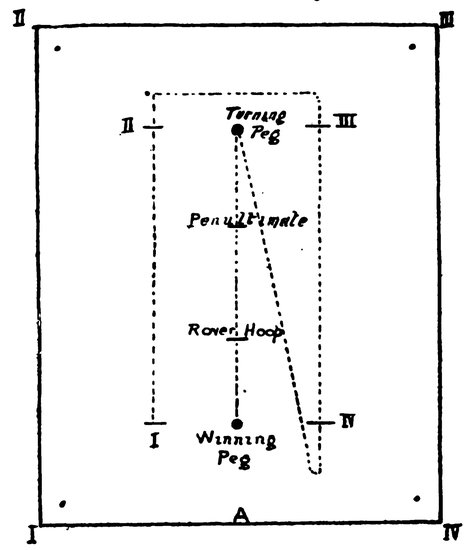
DIAGRAM No. 3.
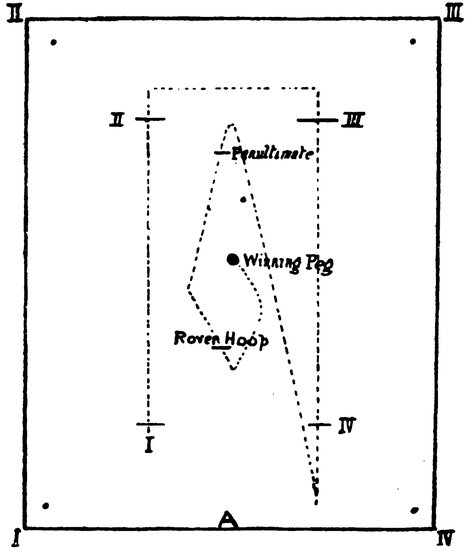
DIAGRAM No. 4. (From the “Laws of Croquet.”)
A modification which has now been made optional is to play with this same setting, but after the fourth hoop has been made, instead of going down “the ladies’ mile,” through the two hoops in the middle, the new plan is to take the turning peg next, and then take the penultimate and rover hoops up to the winning peg as usual. Now here is a pretty little game of just eight points per ball, every hoop once and each peg once. The rough diagram, No. 3, will explain itself.
But the most interesting short setting is, to our mind, the one with no turning peg, and the winning peg in the middle of the ground.
As will be seen from diagram No. 4, on the opposite page, this setting entails the shifting of the penultimate and rover hoops farther apart from one another, each of them being about three and a half yards distant from the spots which under the standard setting would be occupied by the two pegs. The game here is as usual until after the fourth hoop has been run, and then the player has to come up through the penultimate and rover hoops, and afterwards back to the winning peg in the middle of the ground. Here there are only seven points to be made by each ball, and the presence of the winning peg in the middle of the ground seems to us an excellent idea, because not only will it require some skill on the part of the players to avoid embarrassment from this in the course of a break, since the peg will be exactly where the middle ball should be found in the academic four-ball break, but also the finish of the game has to take place in the middle of the ground. Now this is likely to make a great difference to the game.
To the ordinary player the end of the game is about the most difficult part of it. Obviously no one has had so much practice in finishing a game of croquet as he has in beginning it, for although two people begin a game, only one finishes it, and it is by no means easy to win the game even when you have got both balls at the rover stage or hoop, with the winning peg at the end of the ground. With the winning peg in the middle of the ground, it will be more important than ever that a player should win the game as soon as ever he can, without any delay in the centre of the ground in the middle of his adversary’s game.
The Croquet Association Gazette draws attention to three great advantages offered by these short settings:—
(1) They will enable managers of tournaments to arrange for the “best of three” games to be played in cases where, with a longer setting, there would be time for single games only. The final could be either the best of five (short setting) or best of three (long setting.)
(2) The monotony of long breaks will be abolished.
(3) The shorter the game the larger the proportion of start to finish—the two most interesting periods of the game.
One of the worst features of the game of croquet as practised at tournaments of late years has been the practice of close wiring, by leaving the next player stuck in the middle of a hoop or up against the wire. A usual finish up to a break was to leave the next player tight in the blue hoop after the player had himself run it, and many a first-rate player has been beaten by 26 points without ever getting an open shot throughout the game. Last season some of the leading players, notably Mr. Arthur Gilbey, at Swakeleys, adopted a system which should defeat the methods of the close wirer, and this system has now been incorporated in the laws of the game. The new law reads as follows:—
“If at the commencement of a turn the striker’s ball is “wired” from all the other balls, either through the interposition or interference of any hoop or peg, such ball being distant less than one yard from that hoop or peg and having been placed there by the stroke of an adversary, the striker may at his option lift his ball and play it from any spot within a yard of where it lies. A ball is “wired” when (1) any part of it cannot be driven in a straight line towards every part of the ball aimed at; or (2) a wire or peg so interferes with the backward swing of the mallet that the striker cannot freely aim at every part of the ball.”
The Croquet Association Gazette points out four drawbacks to this law, viz., two measurements, lifting the ball, and the problem of deciding whether a ball be wired or not.
Also the definition of wiring demands careful attention. The whole target presented by the ball must be open; if the left-hand edge of the striker’s ball cannot be driven in a straight line so as to hit the right-hand edge of the object ball then the balls are wired. So this law gives the open shot to everyone who is not wired by his own mallet or that of his partner, should his ball be placed within three feet of a hoop or peg by an adversary. There still remains the chance of safely “masking” the balls from the shot of an opponent who is left in the open, and the leading players were quite equal to doing this last season. But “masking” the balls requires considerable ability, whilst any fool could jam an adversary’s ball in a hoop.
The law with regard to “taking off” without moving both balls has now been remodelled, and now that part of Law 17 reads: “In so doing (i.e., taking off) he must move or shake each ball perceptibly, should he fail to do so the balls are to remain where they lie or be replaced at the option of the striker, and the turn ceases. The striker, if challenged, must be prepared to assert definitely that he saw both balls move or shake, and in default of such assertion the balls shall not be considered to have been perceptibly moved or shaken. If the two balls do not touch before and in the act of taking croquet the adversary may require the stroke to be played again. In taking croquet the striker’s ball shall not be in contact with more than one ball.”
The result of this law is that this offence is no longer regarded as a foul stroke, but is treated much the same as the offence of driving one of the balls over the boundary in a croquet stroke; except that in the case of not moving the balls the offender can elect whether he will replace the balls as they were before the stroke was made, or whether he will leave them where they are at the end of the stroke.
It is quite right to make the penalty for non-moving or shaking less severe than formerly, for since it must generally be a matter of rather close observation to determine whether a ball has moved or no, and since the striker is obviously in the best position to observe this, it was difficult enough for some strikers to confess that they had not moved the ball, and it is to be hoped that the lightening of the punishment may lead to more pleas of guilty.
Of a verity there seems to be no end to the laws of croquet, and it requires quite a gifted head to carry them all, with their various alterations and additions; and the edition of the “Laws of Croquet” for 1906 is likely to revive the industry of the painstaking man who learns up the laws by heart as well as he can, and always carries a copy of the book in his pocket with a view to winning an occasional bet over some well-engineered discussion about the laws of croquet.
An interesting feature of the plans of the Croquet Association for next season is that the Committee have decided to use composition balls in all Association tournaments instead of wood, which up to this year has been the standard ball for tournaments.
Certainly the composition balls are in every way more satisfactory than wood: they are absolutely accurate as to shape, weight and size, the colour does not come off, and they are impervious to wet, whilst they are more durable and cleaner in all weathers than the wooden balls. Composition balls are, moreover, easier for running hoops than are those made of wood, they have greater resiliency and more drive about them; on the other hand, their resiliency is so great that it is very difficult to “roll up” two balls together across the ground. But since this rolling-up is nine times out of ten a foul stroke, to the extent that the mallet has more than one contact with the ball during the stroke, the more the roll-up is discouraged the better for the game. It is a counsel of perfection, but we know some players who go so far as to say that under favourable conditions the composition balls make the game of croquet too easy.
Quid.
True Fishing Stories.
Some years ago an acquaintance of mine solemnly assured me that he had once, when fly-fishing for trout, hooked a rabbit on the bank behind him, and with his forward stroke brought it over his head and dumped it down among the trout he was seeking to capture. Possibly he was using a “hare’s lug,” and let his imagination do the rest. Of course, I was too polite to question the performance. It is surprising what a good fly-rod will stand in this way. Fishing in wooded streams you now and then get very fast in a branch behind, and you do not find it out till the full force of your cast comes into action, and then the tree seems to be almost coming up by the roots, while rod and tackle do not give way, and are not a bit the worse. This reminds me that one day a few years ago I lent my rod for the afternoon to a man, a more or less distant cousin, who had come without one. He was a fisherman of long experience, so I had no misgivings about it. When I came in towards evening I found that he had been unfortunate enough to catch up in a tree and break the top just at the ferrule, and had had it mended by the village joiner. Accidents will happen in the best regulated families, but I did wish he had let the joiner alone. He then proceeded to add insult to injury by telling me that it was my fault for having such a “rotten” rod, and a good deal more in the same strain. I have had worse rods and I have had better ones in my possession, but I had caught a great many trout with it at one time or another, and it was the only one I had with me. No doubt it is a good thing we are not all turned out of the same mould, but had the positions been reversed I am certain that I should have absolutely grovelled abjectly in my desire to avert his wrath and obtain his forgiveness.
But to go back to the rabbit. The nearest approach I ever made to this feat was when on a certain occasion I was fishing just above the town bridge at Marlborough, and my pal was standing on the bridge looking on. I suddenly heard a yell from him, and—well I did not throw him over my head impaled on the hook of a “red quill,” but only a piece of his nose! It was at this very same place, possibly the same day, that I was drawing in a fish of quite a respectable size, when a small boy in the gallery sung out “Whoi don’t cher chuck down the rod and ketch ’old o’ the string?” I daresay the method might have been quite as successful. I know it is not, or was not then, a very attractive spot to be fishing. It is an unsavoury place, but I was there all the same, and some one ate the trout: I did not. Then here is another incident bearing on the subject. When I was at Winchester, alas! many years ago, I was down “Water meads,” and saw a cow tearing along at full tilt, pursued at a distance of about thirty yards by a youth with outstretched arm, and a rod presented horizontally in the direction of the animal, also going for all he was worth, and he looked as if he soon would be worth very little. He had hooked “the coo,” which not unnaturally took to its heels, and he was no doubt anxious to save some of his cast, or haply his fly, or even land the coo. I do not remember how it ended, but possibly in after years he may have related to his sons, who I hope are also Wykehamists, how he once threw a coo over his head with a “Hammond’s guinea rod” into the Itchen!
Many of your readers have probably occasionally hooked a swallow or martin; on the two or three occasions on which this has happened to me the bird has not been hooked in the mouth, but round the neck, the fly forming a running noose on the gut. But I do not think many will have bagged a duck with a fly. It was a large bushy fly, and the wind caught it as I cast, and instead of its falling under the opposite bank, about two yards of gut stood straight up out of the water, and then fell over up stream just in time to meet an old Aylesbury duck with a brood of ducklings paddling down stream. It fell by the side of her, and though 1 tried to pick it up before she got it, she was too quick for me and snapped it up. There was “such a row as never was.” She quacked and splashed, and beat with her wings, and dived and did all she knew. This time I did “chuck down the rod and ketch ’old o’ the string” for fear of breaking my top joint. I hand-played her and landed her, and she was no worse for her adventure, being only just held by the skin of the mouth.
I lately saw a note in the Field about a trout which had been hooked twice in the same day, having got the fly the first time, both flies being found in its mouth. I once came across a good trout rising in a still mill-tail; the wheel was at rest and all the water going round the other way; I rose him and left my fly in his mouth. As I observed that he did not seem to have taken much interest in the proceeding I put another fly on as quickly as I could, cast over him, hooked and landed him, and took both flies out of his mouth. His size, so far as I can remember, would have been somewhere about 1½ lb. Evidently he could have suffered no pain, and there can be little doubt that when the hook gets hold of just the skin of the mouth, which happens the most frequently in fly-fishing, though sometimes painful places are pierced, the fish feels only the resistance and the pull which tells him he has to fight for his life. One would think that a trout of about ¾ lb. could hardly swallow a pebble 2 inches across without, if not pain, at least some inconvenience. Yet it took my fly and appeared fairly healthy. One wonders why or how it came to get such a thing inside it. Last spring I twice caught in a north country river, in the same pool but not on the same day, a trout weighing 6 oz. or 7 oz., with a big stone loach jammed tight down its throat, and the tail sticking out of its mouth. It was quite a question whether the loach could be pulled out without breaking. Yet both of these trout took the fly with a dash, and made a gallant fight in the rather swollen stream, considering their inches. Those who know the Broad Water at Wansford in the East Riding are aware that the field on the west side slopes abruptly down considerably below the level of the water. I was once casting over a rising fish some distance out, and in drawing in for a fresh cast my line had to travel back over the edge of the bank itself, so that the fly might very easily get hung up tight on a snag or plant: this was what I supposed had happened, so I began pulling to see if it would come away without my having to go and release it and so scare the fish, when to my astonishment the line flew off in the direction of the opposite bank. I had actually hooked in the belly a fish lying under the bank, which was played and duly brought into the net.
I one day hooked a fish in Foston Beck, which dived straight into a bed of weeds from which no persuasion could move it. I tried hand-lining, but could do nothing; then an idea occurred to me: I spiked the rod in the ground, reeling up the line till it was just taut without any strain on, and strolled a couple of hundred yards down the bank to where my friend was fishing. I told him what had happened and stayed with him a bit, and then by-and-by returned to my place. Nothing was changed; the line stretched straight from the top ring to the weed as if purposely fastened there. I picked the rod up very carefully, and putting on a sudden strain hauled down stream, when out came the trout before he knew what was up, to be towed over the weeds into the net, and finally the basket.
Foston Beck reminds me of an incident which I would have gone a long way to see, but which I had the good fortune to witness while I was sitting on the bank under a thorn-bush eating sandwiches. I suppose I must have been very quiet, for a kingfisher came and pitched on a twig of the thorn, and remaining there a short time presently quitted it, hovered a moment over the water, pounced down, and came up with a little fish in his bill, just steadied himself on the twig, and then flew off. It was a pretty sight, and one that it is not often given to an angler to see, although he sees many pleasing things which no one else does. And now I must bring my rambling paper to an end; but just one more story first.
Every one knows what a bore it is to have to seem amused at sallies of wit which do not appeal to one, but a bit of unconscious humour from one who would be astonished to be thought funny makes one sometimes want to shout with laughter. On a certain day I was counting the spoil preparatory to going home. I do not think the bag was anything very striking, but there was a long, black, unwholesome fish among the others, which I suggested to the keeper had better be thrown away. “Oh,” said he, “there’s a gentleman there who has come a long way and has not got anything; I think he would be rather glad to have it to take home.” So he took it off and entered into negotiations with the said angler who was taking down his rod close by. I did not hear what went on, but just caught one sentence, viz., “H’m, the gentleman must be an ‘eepi-kewer,’” and he put it in the bag.
Gammel Man.
P.S.—Since writing the foregoing notes there has recurred to my mind another amusing fish story. A friend of mine, he, forsooth, whose nasal organ I hooked on Marlborough Town Bridge, having had a day given him on a very fine stretch of preserved water, killed with dry fly a nice basket of trout from about 1¼ lb. up to 2 lb., which I saw and much admired. The best of these fish he sent to his old father by the hands of a man who had just come home from India, and who, to distinguish him from his brother, was spoken of as Mr. —— from India. They were duly delivered, but with the message that a gentleman had brought some fish from India! Whereupon my friend’s father, who would have greatly appreciated such trout, promptly ordered them to be thrown away. And thrown away they were, to the sore vexation of the successful and dutiful fisherman when he heard thereof.
A Hundred Years Ago.
(FROM THE SPORTING MAGAZINE OF 1806.) BOXING. D. Mendoza and H. Lee.
Friday, March 21st, 1806, being appointed for the above pugilists to exhibit themselves in a pitched battle for 50 guineas, the same took place at Grinstead Green, three miles and a half through the town of Bromley in Kent. The combatants met in a 25-feet roped ring, formed on the Green soon after one o’clock, attended by their seconds, Bill Ward and Bill Gibbons for Mendoza, and the Game Chicken and Gulley for Lee.... Current betting in the ring was 3 to 1 on Mendoza....
The battle was continued until the fifty-second round, very much to the disadvantage of Lee, who, however, showed himself game by the very severe beating he had received. In the fifty-third round, which ended the fight, he fell without a blow, and Mendoza’s seconds did not choose to give away a chance as they had done several times in the course of the battle; and the matter being referred to two gentlemen who acted as umpires, they declared Mendoza the winner, after a sharp contest of one hour and ten minutes.
Observations.—In this contest, which it was supposed would be the most hollow thing ever attempted, the spectators were very agreeably surprised. Lee, although he did not act the part of a game man in the strict sense of the word in falling without a blow, yet he was not deficient in skill and resolution so as to disenable him to rouse the admiration of the amateurs. He never had a chance of winning, although he made a very good fight; for the odds, to nearly the end of the contest, were treble against him to what they were at the commencement, and at the end, when Mendoza became weak, they were never less than four to one. He got himself miserably beaten in the former part of the fight by making play, but his seconds did not suffer him so to act at the latter part. He had the advantage in stature and length of arm, and he fought with his left hand extended, constantly sawing. Mendoza had a decided advantage over his opponent in the knowledge of bruising, which the beating Lee received will most fully demonstrate. Dan stopped most admirably, and he seldom hit with his right hand without the desired effect. With his left he sometimes led himself into an error, for he generally hit over his man and left his right side exposed. He showed himself a pleasing fighter, as he always has done, and his fatigue at the end of the fight was no more than momentary, for he was quite fresh after the contest was over, and his only suffering was a blow he had on the left eye and another on the nose, which was broken in a fight many years since.
Another account says the contest between Mendoza and Harry Lee was much more serious to the former than has been generally described. About the thirtieth round the odds changed from five to even betting; and though Lee declared himself compelled at last to give in, on which his seconds advised him to drop without receiving a blow, which decided the battle, Mendoza was so severely beaten that he was immediately put to bed with both eyes closed and his face mangled in a shocking manner.
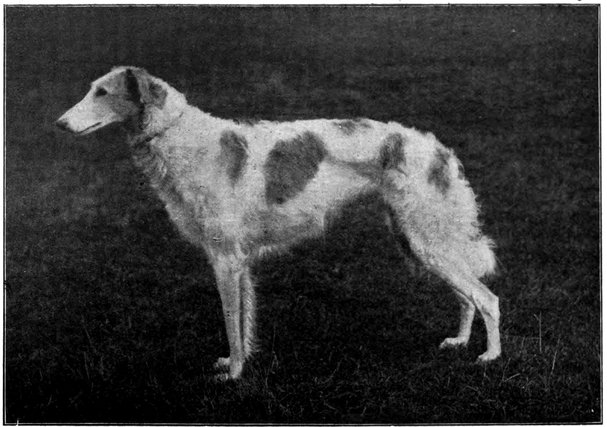
BORZOI SANDRINGHAM MOSCOW. Winner of First Prize. Property of Her Majesty Queen Alexandra. Photo by Dexter & Son.]
It is almost incredible the number of spectators that were present.... The following were the leading amateurs: Lord Albemarle, Lord Sefton, Count Beaujolaise, Sir Watkin W. Wynn, Sir John Shelley, Sir Edm Nagle, Captain Halliday, Mr. Thornhill, General Keppel, Mr. Buxton, Mr. Fletcher Reid.
The Borzoi.
Of the several breeds of foreign dogs that have been introduced into England, the Borzoi has obtained a considerable amount of popularity. It is, however, not more than fifteen years ago that the breed was first seen in any numbers, and was accorded a separate classification in the Stud Book. He is the most aristocratic in appearance of all the canine race, but, although so gracefully and slenderly built, has a most powerful jaw, and is very muscular, as he needs to be, when he is required on occasions to tackle a wolf single-handed.
The Borzoi is the favourite of Royalty. He is to be found in the Imperial kennels of Russia, and also in those of the Grand Dukes and others of high degree, and among the first seen in this country were a brace that were presented, upwards of thirty years ago, to the Prince of Wales (now King Edward VII.), which hounds were occasionally exhibited on the show bench, and were bred from; but as there is no record of their names appearing in the pedigrees of the present generation of Borzois, they and their produce seem to have been lost sight of. Still, now and again in the years which intervened between that period and the time when the breed became firmly established here, a specimen or two then known as the Siberian or Russian wolfhound appeared in the classes confined to foreign dogs, but these were very indifferent representatives of the breed when compared with the beautiful animals that were afterwards imported by her Grace the Duchess of Newcastle, who at the present time owns the largest and most successful kennel that has probably ever been seen out of Russia, or with Alex, who was presented in 1895 to the Princess of Wales (now Queen Alexandra). A more magnificent animal than the Borzoi Alex has scarcely ever been seen.