Volume 85 — BAILY’S MAGAZINE OF SPORTS AND PASTIMES No. 554. APRIL, 1906. Vol. LXXXV. (continued 2)
Reading edition
With the advent of Alex the breed, which has already been recognised by the Kennel Club, and for which a specialist club had been formed to look after its interests some three years before, quickly took a prominent position amongst our show dogs, and now large classes of Borzois are to be seen at all the principal shows; and Her Majesty was successful in winning a first prize in a group of thirty-two at the Crystal Palace, and also at Birmingham, with a young dog bred at the Royal kennels at Sandringham. That the Borzoi has now become thoroughly nationalised in England is proved by the fact that the whole of the animals shown on these occasions were home-bred. In addition to Her Majesty and her Grace the Duchess of Newcastle, Mrs. Borman, of Billericay, has a large kennel of these dogs, and other prominent breeders of them are Princess Sophia Duleep Singh, Mrs. Kilvert, Mrs. E. A. Huth, of Wadhurst, and Miss Robinson, of Tewkesbury. Mr. H. Murphy, of Padiham, also has a few valuable specimens, and so has Mrs. Aitchison, whose kennels are at Wallsend-on-Tyne.
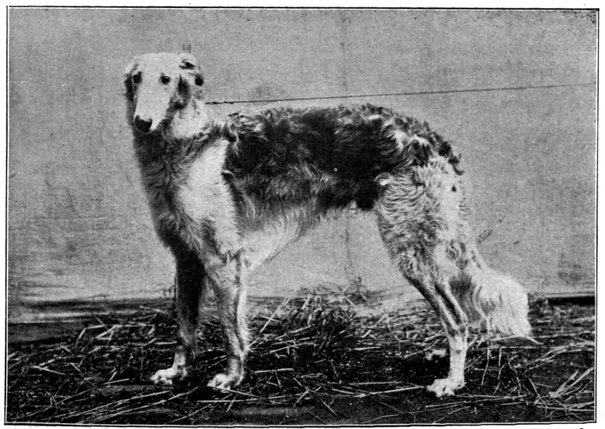
BORZOI PUILAI. Winner of First and Champion Prizes. The Property of Mrs. Ebsworth. Photo by Bowden Brothers.]
Although largely used for coursing the wolf in his native land, the Borzoi is only kept as a companion in England. He is useless for coursing the hare, as he is not so fast, nor can he turn so quickly as the greyhound. At work with the wolf, however, the Borzoi has no equal, as he holds on much more tenaciously when he has seized his prey than either greyhound or Scottish deerhound, both of which have been tried in Russia. When wolves are to be coursed, the dogs (generally two or three) are held in slips by a keeper on horseback at the corner of a covert whilst the latter is being drawn by foxhounds. On the wolf breaking covert he is given a start of two hundred yards, when the hounds are slipped, who before they have gone a mile, and sometimes considerably less, are up with their quarry, which they seize on either side by the neck. The wolf is then powerless, and the rider, after dismounting, either muzzles the animal, if it is a large one, or dispatches it with a knife, if it is small and not of any use to be kept for the purpose of practising the young dogs. During the muzzling operation the seasoned dogs keep fast hold of the wolf, but young hounds, when first entered, will sometimes seize the wolf by the back or leg, when they run the chance of being terribly mauled. They, however, soon learn the fact that the only safe place to get hold of is the neck, and that they must not let go their grip till the wolf is muzzled.
An occasional hound can take a wolf single-handed, but it is only the most practised hunters that are allowed to do so. When one dog only is sent in pursuit of the foe, on the latter being caught the two roll over together, but the dog always comes up at the top, and it is quite the exception for the latter to receive any injury. Sometimes, in places where difficulty is expected in finding, bagged wolves are brought into requisition, but the quarry that is disturbed from his native haunts generally shows the best sport. Under any circumstances the pastime is most exhilarating, travelling to the scene of action on the snow at break-neck speed, over hill and dale, and sliding down the sides of miniature mountains on the sledges, the atmosphere so cold that unless the sportsmen are well wrapped up in furs there is a considerable chance of their getting frostbitten.
There are two varieties of the Borzoi, one with flat, the other with rougher coat; but the latter is the favourite, and is certainly the more handsome. Those in the Imperial kennels being chiefly of the rough-coated variety, they are exactly the same in general contour, the only difference being in the texture of coat. A representative of the greyhound tribe, the formation of the Borzoi is characteristic of great speed, endurance, and strength. As already stated, associated with the snake-like head is a most powerful jaw; a perfect specimen has immense depth of chest, but perhaps the most noticeable feature is the power that is to be observed in his loins and quarters. He is a much bigger dog than the greyhound or deerhound. In height he will sometimes measure as much as 31 inches, and Korotai, a well-known winner in the last decade, drew the scale at 110 lbs. The largest dogs are not, however, always the best workers, as those that are an inch or two less in stature are generally more sturdily built.
Colour in the Borzoi is an important item, as it naturally would be in an animal that is made on such graceful lines. On the body white predominates, with patches of orange, fawn, or blue, sparsely distributed, and the hair is soft and silky to the touch. Black-and-tan is an objectionable colour. Others that are self-coloured are also equally objectionable, as also are black markings of any sort. Patches of brindle with white ground, on the other hand, are admissable. The winner at the show of the Imperial Gun Club at Moscow was so marked.
As regards the foot of the Borzoi, opinions appear to differ. We in England prefer the cat foot, the same as that of the greyhound and other sporting dogs, but in Russia many of the chief winners have the hare foot, which is considered in that country to be better adapted for galloping on the snow. The following are some of the other points that are characteristic of the breed: In general appearance he should show a combination of nobility and elegance, and his every movement should be graceful. The head should be very long and snake-like, the skull narrow and flat, but not receding; the muzzle tapering from the eye to the nose, and slightly arched when viewed in profile; the eyes dark hazel in colour, and almond shaped; the ears thin and small, and carried like those of the greyhound; the teeth level (an overshot mouth is a great defect). The neck is somewhat short for a dog of his size, and the chest narrow; but there should be plenty of heart room, as seen by his great depth of brisket; the forelegs straight and rather fine in bone; the back arched, with flanks cut up; the loins muscular, with broad quarters and strong hind-legs; the hocks not quite so much bent nor close to the ground as those of the greyhound; and he has the peculiarity of appearing to be rather higher behind than in front, but this is probably caused by his arched loins.
Fredk. Gresham.
Some Sport in the Transvaal in 1878.
By Lieut.-Colonel Alsager Pollock.
Before proceeding to describe the pleasant little trip which will furnish the principal subject of the narrative that follows, it may be as well to explain, briefly, the conditions under which I had found my way into the Transvaal and what I was doing there. During 1876 and 1877 the Transvaal Republic had been at war with Sekukuni, and by the close of the former year had become hopelessly bankrupt. The operations against Sekukuni had been the reverse of successful; the Zulus were said to be restless, and a large proportion of the Transvaal Boers declared themselves in favour of annexation by Great Britain. Sir Theophilus Shepstone—“Somsteu” as the Kaffirs named him—went up to Pretoria, as Special Commissioner, in January, 1877; and in March my regiment (the 1st Battalion 13th Light Infantry), with two guns and a small detachment of Royal Engineers, marched up country. A halt was made at Newcastle, pending the result of the negotiations at Pretoria; but eventually we reached the latter place, where the British flag was hoisted on the Queen’s birthday. The march, as a military movement, was uneventful, and the opportunities for sport as a rule scanty. We had some excellent duck shooting near Newcastle, and just beyond Standerton we saw what can no longer be seen, but what those who have seen it can never forget, the annual migration of all kinds of game from the “High Veldt” to the “Bush Veldt.” From as far westward as the eye could reach the great procession kept coming, whilst its head was beyond the horizon in the east. All kinds of antelopes, quaggas, &c., were to be measured not by hundreds or thousands, but by miles. It may here be mentioned that the animal which the Boers call a “quagga”—pronounced “quaaha”—is really Burchell’s zebra. To me it has always seemed a shame to shoot these beautiful creatures, except when scarcity of meat demands the sacrifice.
At first, after our arrival at Pretoria everything was quiet, but very soon it became necessary to send four companies to Utrecht, on the Zulu border, and in the absence of this detachment a party of some 1,500 Boer malcontents assembled, armed, at Pretoria, where they held an indignation meeting under our noses. Our strength was limited to about 350 men, lusty old soldiers indeed, yet a mere handful. Luckily, however, the local military authorities were neither clever enough to understand the danger nor foolish enough to provoke a contest. We had no entrenchments of any sort; our camp was within 300 yards of the town, and probably about ten minutes’ fighting would have sufficed for our extinction. Perhaps the Boers assumed from our attitude of calm indifference that a trap had been set? At all events no trouble ensued, and the assembly dispersed.
Round Pretoria there was very little shooting to be had, but by trekking northwards, to Warm Baths and Nylstroom, in the Waterberg district, some fair sport was met with; and there a party of four of us spent a most enjoyable month.
Meanwhile the 80th Regiment arrived in Natal, and a detachment having been sent up to Utrecht relieved our four companies, which rejoined headquarters at Pretoria, March 28th, 1877. On April 16th, three companies, of which my own was one, marched off to Middelberg and Lydenberg. Sekukuni had broken out once more, and it had been decided to send up an expedition to suppress him. Our three companies were not to go at once to the front, but to afford some protection until an expeditionary force could be assembled. Thus it was that on July 16th, T., W. and myself had the good fortune to start on a trip to the district about the Sabie River, some sixty miles distant from Lydenberg. Operations against Sekukuni were already imminent, and we were lucky in obtaining even a fortnight’s leave under the circumstances. Indeed, it was only three weeks after our return, namely, on August 22nd, that we actually entered upon the campaign.
During our stay at Lydenberg we had been lucky enough to make friends with a Mr. G., of Krugerspost, a British settler, a great sportsman, and a right good fellow. Mr. G. had been in the habit of shooting on the Sabie every season for many years, and upon this occasion very kindly permitted us to join him, he providing everything—waggons, Kaffirs, &c., whilst we merely paid our share of the expenses. Our party consisted of T. and myself, who were already at Lydenberg, and W., who arrived by post-cart from Pretoria the day before we started. In order to economise time the waggons had been sent on three days in advance, but in consequence of a breakdown they had failed to reach their destination, with the result that we caught them up about five miles east of the Spitzkop Goldfields, and about thirty-five from Lydenberg. The waggons were still trekking when we reached them and we continued with them to the outspan about six miles further on. During this last part of the day’s trek W. achieved a reputation as a shot by killing a paauw as it flew overhead about one hundred yards up. W. fired from his horse’s back with an ordinary service Martini-Henry rifle, and the feat was therefore a notable one.
During the next two days we found ourselves rather unprofitably employed in crossing a wide belt of country that had been burned by a party of Boers just before our arrival. We met with lots of spoor of rhino, giraffe, buffalo, &c., but saw nothing except small buck and quaggas, and one troop of hartebeeste. Of these we shot a few, as we wanted meat. During the time we were out on Friday 19th, an old Boer who had attached himself to our party, whilst walking along about a mile from camp, suddenly came upon the fresh spoor of a buffalo, which he proceeded to follow in hopes of a shot. All at once, however, he heard “pooph, pooph” behind him, and in a moment the buffalo had tossed him clean over a small mimosa bush on to another beyond. In the confusion the old man’s rifle went off, and the buffalo, tail on end, sailed away without taking any further notice. The Boer got off without any broken bones; but, as may easily be imagined, not with a whole skin. Mimosa thorns are somewhat retentive, and the descent from that tree, which took some considerable time, was a painful process. Next morning, whilst searching for buffalo, we passed over some of the ground that had been visited the day before in pursuit of the quagga, and found that two carcases had been appropriated by lions, but of the lions themselves we saw nothing, nor did we meet any buffaloes; later, to our great satisfaction, we came upon the fresh spoor of a considerable troop—too late in the day, however, to follow it up.
Starting from camp at daybreak on Sunday, with niggers and dogs, we took up the spoor, and after about two hours reached the spot where a lion had killed a cow buffalo during the night. Jackals or hyenas had had the leavings, and the horns, bones and skin were all that remained. At last, about 10 a.m., the herd was sighted on the other side of a big donga, into which any number of smaller ones ran from both sides. It was a very bad bit of country from every point of view, and the bush in parts was inconveniently thick. However, after a good deal of riding about we got the herd on the move towards the more open veldt—not, indeed until after they had given us a good deal of excitement, sometimes running in view, but more often lost in the bush. Once they had their opportunity, and had they taken advantage of it they might have bagged the whole lot of us, as we crossed a donga in single file not more than a dozen yards from where they were all standing. Having allowed us to cross in safety, the buffalo made off in the opposite direction.
During this time some three or four of the buffalo had fallen before our rifles, and at last out they came across a fine stretch of decently good ground, beyond which was a wet donga with thick bush on the other side. Midway was a small “pan.” I happened to be on the left, and in the best place, with the result that I arrived first over a swell of the ground and saw below me the buffalo in the act of lying down in the pan to cool themselves. My appearance caused a wild commotion, during which, however, I fired one shot off my horse into the back of a big bull just as he was rising, and down he went to my great delight. But I had been very foolish not to dismount: my horse was excited and so was I, with the result that I missed my second barrel. The bull I had hit was struggling below, and just as I was about to get off my horse and give him the coup de grace G. came galloping up. He cried, “don’t finish him, he is quite safe, his back is broken, come on after the others.” I complied, but looking round after I had gone about half a mile I saw my bull on his legs and commencing to make tracks. The donga was only a couple of hundred yards from him, and slowly as he went he was right on the top of it before I came up with him, when he promptly turned to bay. Thirty yards from a wounded buffalo I was discreet enough to take my chance of a shot from the horse’s back. Just as I raised my rifle the bull gave a “pooph, pooph,” and came at me. My horse shook his head and I missed clean. The reins were on the animal’s neck, and before I could gather them he had gone a couple of hundred yards. The bull charged only a very short distance, turned and made for the donga. I returned quickly and jumped off on the bank. I could just see the bull going through the reeds and bush, and whether I hit him or not I cannot say. At all events, I never saw him again. I got another soon afterwards, but this did not comfort me for the loss of a far finer pair of horns. We bagged nine bulls altogether, but none of them so good as the one I had failed to secure. The Kaffirs afterwards tracked that bull for a long way, but eventually lost his spoor in that of the rest of the herd.
Probably the poor brute died later on. My shot must have been close to the spine, since it crippled him for the moment, and may or may not have penetrated his body. Possibly it glanced off his ribs, but at a distance of only about twenty yards this does not seem likely. At all events, he was not brought to bag, and except to the poor bull himself the nature of his wound was therefore of very little consequence.
Meanwhile we had killed a lot of meat, and it took us some time to go round and make all the carcases safe against jackals, vultures, &c. Mr. G. wanted to make biltong, for which purpose he left the Kaffirs on the ground whilst we all rode slowly home to camp.
Next morning we found that both of Mr. G.’s horses had got loose during the night, so that in addition to sending a waggon for the meat, the recovery of the horses—assuming neither to have been eaten by lions—had to be attended to. Mr. G. borrowed one of our horses, and with all remaining Kaffirs, except one, started off; we three staying to guard the camp. It was well that we had not persisted in setting forth ourselves; for had we done so the whole camp would have been burned by a veldt fire. Working frantically, it was all that we could do, after burning the grass behind us, to carry or drag the whole of our belongings to a place of safety. Scarcely had we finished, when the fire came up and went past like an express train. Fortunately the grass in the donga close at hand was green, and therefore escaped, but we had much difficulty in keeping the horses and oxen in it; had they broken away they would of course have galloped for miles before the fire, and some not impossibly have been caught by it.
In the evening Mr. G. returned with his horses, and the waggon also came in laden with meat; the greater part of the latter, however, was useless, owing to the intense heat of the sun and the distance that had been covered in bringing it to camp. Mr. G. regretted much that instead of sending for the meat we had not shifted camp to where the buffalo had been killed.
The following day we had some excellent sport with a troop of wildebeeste which gave us a rare gallop. One of my horses was a grey half-bred Arab and rather fast; the ground was fairly good going, and I made up my mind to try whether I could get alongside for a shot off the horse’s back. To my great delight, after about three miles as hard as we could go, I raced up alongside the bull I had selected, and, firing from the hip, bowled him over like a rabbit, shot through the heart. All things considered, I am certain that next after a fast forty minutes with hounds at home there is nothing to touch a gallop after antelopes in South Africa. With a reasonably good horse it is fairly easy to get within fifty yards, and then jump off and shoot, but only a very smart horse can actually bring you alongside anything except a fat bull eland. The last I believe is easy to catch up with, but I cannot speak of this from personal experience. Riding homewards on the evening of the day I have just mentioned I met T. As a rule, from the moment we started galloping after the first troop of buck we met with, we seldom saw anything more of each other until we had reached the camp. Every man rode his own line towards any point of the compass, and it was long odds against any two of the party afterwards falling in with each other. Well, as we were riding slowly along, T. suddenly exclaimed, “Lions!” and scrambled off his horse. In a moment I was off too, but being a second behind was just late. What I saw as I was about to dismount was a magnificent great lion, accompanied by two lionesses, on the edge of a donga about 120 yards to our left. As I hastily put up my rifle they had turned round and were just disappearing. I pulled the trigger at the lion, and I always think that I was dead on him and must have got him. But, horrible to relate, the rifle was on half-cock! The chance was gone! T. meanwhile had missed. We jumped on to our horses and galloped hard to the donga, but not a sign was to be seen. The lions were no doubt lying down. T. had but one cartridge left, and I had only three; otherwise by shooting at random here and there amongst the tall reeds we might have moved the game. We were only about a mile from camp, and the wind was blowing in that direction, so we were afraid to set fire to the grass. There was, therefore, only one thing to be done, and this we promptly did. We galloped home as fast as we could to fetch Kaffirs and dogs, and get more cartridges. The dogs picked up the line at once, but after following it for about a couple of miles we were obliged to whip off, as it was nearly dark. These were the only lions we saw during the trip. Spoor of them was plentiful and their voices could be heard in the night, but that was all. Lions are very shy and very clever. To get a lion one must, as a rule, trust to the chapter of accidents; looking for them, as we often did upon this and other occasions, a chance seldom comes. Upon the other hand, when game is not plentiful, it is well known that lions make themselves a great nuisance prowling round the camp at night looking for a chance to bag man, horse, or ox, and to keep them off a good fire is very necessary.
A few days afterwards we made an excursion to the border of the “fly” country. Several specimens of the murderous insect settled on various horses, but as we took care to sheer off whenever a fly was seen, no harm was done. A few bites are of no consequence. Here we stumbled upon the camp of a Mr. S. whom we had seen at Pretoria months before, but not since. He had been trekking all over the place, and it was rather remarkable our meeting with him. He had had good sport in the “fly” country, into which he had gone with a light kit and a few Kaffirs to carry it. Finally, after a number of quite enjoyable days’ sport, during which, however, nothing really remarkable took place, the time came for us to return to Lydenburg. We had for the last three days been working towards home, and in the end had only some sixty miles to ride. Leaving the waggons to follow, we started at daybreak, and reached Lydenburg in good time for dinner.
There is one matter to which it is worth while to call attention, in reference to life on the veldt. It is wonderful how quickly and accurately the “homing instinct” becomes developed. Every morning Mr. G. would explain to us that the waggons would trek during the course of the day to the banks of a certain river, or to a pool of water, say twenty miles distant, in a direction that he pointed out. There might or might not be some guiding landmark. Within a couple of hours it would certainly have happened that no two of the party were together. All would have ridden in various directions, wherever the game led them. Yet throughout the trip not one of us ever failed to find the waggon in the evening! The nearest approach to any one being lost was when W., actually heading straight for camp, was overtaken by the darkness when still about a mile distant. He was just about to light a fire when, becoming anxious about him, we began to fire shots to attract his attention; he replied, and twenty minutes later walked in. Of course, I must admit that this was not our first trip, and that we had all of us ridden about the veldt a good deal during the previous two years. Yet this power of finding the way from a place that one had necessarily but slight knowledge of to another, fifteen or twenty miles distant, that one had never seen at all, and there find, in the bush, a waggon, is sufficiently remarkable. Clearly the result was not dependent upon reasoning, not upon ordinary “lump of locality,” but simply upon instinct. It should be remembered that this was not a case of riding straight for a point; upon the contrary, one had been galloping hither and thither, and not until the afternoon was the horse’s head directed homewards, where, as a rule, all arrived before dark.
At the risk of being tedious I will quote an example of “homing instinct” that in my opinion is rather curious. A year before the trip which I have been writing about, I was one of a party of four shooting in the Waterberg district. The ponies belonging to F. and myself were both in need of a day’s rest, and F. and I walked with the others to a place where some game had been killed the day before, in order to get the horns and send them to camp, carried by Kaffirs. This done, F. and I took a line through the bush with the idea of looking for guinea-fowls, and after shooting a few to walk home. We had been about two hours on our way when I was seized with a conviction that we had arrived close home, and I said so. F. instantly replied that he had been just about to make the same remark. The bush was very thick, and it was impossible to see more than fifty yards. We agreed that F. should stand where he was whilst I made a cast to the right. Two hundred yards brought me to the open ground, and there by the waterhole, a hundred and fifty yards away, was the waggon! This find was clearly due to instinct and nothing else; we were neither of us prompted in the very least by any familiar feature. All around us was bush of precisely the same character.
Perhaps even more remarkable was the power of finding next day the carcase of a buck killed during the course of the previous day, perhaps ten miles from camp, and covered where it lay with a few branches to keep off the vultures and jackals. We ourselves, I admit, sometimes failed in this, but G. never; nor did a Boer called B. who guided our party to the Waterberg. Yet how strange it is that men who have been on the veldt more years than we spent months, and who year after year have been doing as I have described, have yet been lost hopelessly and died miserably of thirst! In a word, however practised the instinct, it must not be trusted always. The golden rule, I have been told, to follow when lost is to sit down, light a fire, discharge your rifle from time to time, if you can spare the cartridges, and there wait until some of your party find you. To advance, once you have ceased to feel certain that you are going the right way, is fatal. To attempt walking in the dark when not absolutely sure of the direction almost always ends in wandering in a circle.
South Africa in the seventies was not a bad place for sport, but what must it have been in the fifties! A certain Colonel B., late of the 45th Regiment, told us, in Maritzburg in 1876, that twenty years before he had shot elephants within a day’s ride of Durban. In our day there was just one elephant south of the Zambesi; it was in Zululand, and poor Guy Dawnay, one of the best fellows and one of the best sportsmen that ever lived, killed it in 1875 or 1876—I cannot remember which. Ten years later poor Dawnay was himself killed by a wounded buffalo. This rather disjointed yarn has now reached the useful limit, and must therefore end.
A Song of Homage.
Along the country lanes I bear her gaily,
Between deep hedgerows where the wild flowers spring,
Where hawthorn blooms, where trees grow greener daily,
And mounting skylarks sing.
Nature thus decked in glorious robes, forgetting
The sombre weeds of winter laid aside,
Makes for my mistress but a proper setting
When she goes forth to ride.
For she so young and fair, yet never thinking
How fair, gives promise of more wondrous grace,
With kind grey eyes from wells of sunshine drinking,
Set in a perfect face.
I, Blacky, am her slave, well-groomed and sightly,
Who loves—nay life without it were a blank—
The feeling of her habit flapping lightly
Against my shining flank.
I am her willing slave; in doing blindly
Her smallest pleasure lies my pleasure too,
Content because she ever treats me kindly
As friend and comrade true.
How could I be a rogue with her or idle?
Nay, how could horse do aught except rejoice
To feel a hand so gentle on the bridle,
To hear so sweet a voice?
And often when I stand at leisure feeding,
Shut in my box, from all excitement barred,
I catch the sound of welcome footsteps speeding
Across the stable-yard.
“Blacky,” she calls; I whinny as she presses
Her face to mine with words I understand,
While, mingling with the sweets of her caresses,
Comes sugar from her hand.
Blacky.
Herod Blood.
During the last few years there has been a great deal written on this subject. It has been put forward that the necessity exists in England for the resuscitation of the male line of Herod; that this blood is gradually declining in prominence not only in England but in all other countries where thoroughbreds exist; and that, if breeders do not tackle the question seriously, the probability will be that Herod in the male line will become extinct.
Now, although it is an undoubted fact that the male line of Herod is gradually being pushed on one side by the descendants of Eclipse, it does not seem that that fact alone is a sufficient argument in favour of an attempt to reinstate the blood in the position which it once held. It is a curious fact that although the male line of Herod is slowly dying out, while the male line of Eclipse is becoming so prominent, yet that if the pedigree of any horse of the present day be carefully examined it will be found that the blood of Herod predominates in the most marked degree. For instance, the pedigree of St. Simon contains ninety-one crosses of Eclipse, and no less than one hundred and forty-six of Herod, and there is not a single thoroughbred horse living to-day which does not possess a greater number of Herod crosses than of Eclipse. And this is true not only of the horses of to-day but of the horses of one hundred years ago.
Yet, in spite of this, the male line of Eclipse since the year 1800 has been successful in seventy Derbies as compared with twenty-five won by representatives of the Herod male line. In the Oaks sixty-two winners are sired by direct male descendants of Eclipse, while only twenty-eight can be claimed by Herod during the same period. Nor is the superiority confined to the winners of these races themselves. If we take the pedigree of the dams of Derby winners we find that the dams in fifty-five instances are got by Eclipse horses, and in only thirty-six cases by Herod horses. Putting the same test to Oaks winners, we find fifty-nine of them got by Eclipse horses and thirty-five by Herod horses.
Derbies Oaks St. Legers Total
St. Simon (E) 2 5 4 11
Sir Peter (H), 1784 4 2 4 10
Stockwell (E), 1849 3 1 6 10
Highflyer (H), 1774 3 1 4 8
Melbourne (M), 1834 2 3 2 7
Waxy (E), 1790 4 3 – 7
Touchstone (E), 1831 3 1 3 7
Isonomy (E), 1875 2 1 3 6
Pot-8-os (E), 1773 3 1 1 5
Sorcerer (M), 1796 1 3 1 5
Birdcatcher (E), 1836 1 1 3 5
King Tom (E), 1851 1 3 1 5
Lord Clifden (E), 1860 – 1 4 5
Eclipse, 1764 3 1 – 4
Herod, 1758 – 3 1 4
Florizel (H) 2 – 2 4
Whalebone (E), 1807 3 1 – 4
Adventurer (E), 1869 1 2 1 4
Buccaneer (H), 1859 1 2 1 4
Emilius (E), 1820 2 1 1 4
Hermit (E), 1864 2 2 – 4
Hampton (E), 1872 3 1 – 4
Scud (E), 1804 2 1 – 3
Bay Middleton (H), 1833 2 – 1 3
Justice (H), 1774 2 1 – 3
Tramp (E), 1810 2 – 1 3
Phantom (H), 1808 2 1 1 3
Orville (E), 1799 2 – 1 3
Newminster (E), 1848 2 1 – 3
Whiskey (E), 1789 1 2 – 3
Selim (H), 1802 1 2 – 3
Velocipede (E), 1825 1 1 1 3
Muley (E), 1810 1 1 1 3
Sultan (H), 1816 1 2 – 3
Volunteer (E), 1780 1 2 – 3
Blair Athol (E), 1861 1 – 2 3
Voltaire (E), 1826 1 – 2 3
Sweetmeat (H), 1842 1 2 – 3
Barcaldine (M), 1878 1 1 1 3
Woful (E), 1809 – 2 1 3
King Fergus (E), 1775 – – 3 3
Priam (E), 1827 – 3 – 3
Beninghough (E), 1791 – 2 1 3
Petrarch (E), 1873 – 2 1 3
Macaroni (H), 1860 – 3 – 3
Gallinule (E), 1884 – 1 2 3
The above table shows a list of the horses that have sired three or more classic winners, i.e., Derby, Oaks, and St. Leger. The letters E, H, and M after a horse’s name denotes whether it is of (E) Eclipse, (H) Herod, or (M) Matchem descent in the male line.
This list, which covers a period from the birth of Herod to the present day, contains forty-six names, of which thirty-one are male descendants of Eclipse, and only twelve of Herod.
The following horses have headed the list of winning stallions since 1850:—
Epirus (H), Orlando (E), Birdcatcher (E), Melbourne (M), Touchstone (E), Newminster (E), Stockwell (E), Buccaneer (H), Thormanby (H), King Tom (E), Blair Athol (E), Adventurer (E), Lord Clifden (E), Speculum (E), Flageolet (E), Hermit (E), Hampton (E), Galopin (E), St. Simon (E), Kendal (E), Orme (E), Persimmon (E), St. Frusquin (E), Gallinule (E).
From this it will be gathered that Herod horses have headed the list in three years, Matchem one year, while Eclipse horses monopolise all the other years.
So we now have the following facts, that although Eclipse horses have won the Derby, Leger, and Oaks nearly twice as often as Herod horses, and have sired the dams of the winners of these races in about the same proportion, and have further headed the list of winning sires almost without break for the last fifty years, yet in the pedigree of every one of these Eclipse horses mentioned above the name of Herod occurs oftener than that of Eclipse.
Now, surely it is very significant that although all our thoroughbred horses of the present day possess more crosses of Herod blood than Eclipse blood, yet the Herod male line is being slowly and surely pushed out by the Eclipse male line. One might almost regard it as a logical consequence that the extra crosses of Herod should give the Herod male line an increased strength and prepotency, but, as a fact, we find the exact opposite to this is the case.
A few illustrations taken from contemporaneous sires will best explain the force of this. For instance, let us take Whalebone and Phantom, winners of the Derby in consecutive years, 1807 and 1808. Whalebone, a direct descendant of Eclipse in tail male, contained one cross only of Eclipse and two crosses of Herod. Phantom, a descendant of Herod in the male line, contained four crosses of Herod and two of Eclipse. Phantom to-day has very few tail male representatives at the stud, while Whalebone is represented by the whole of the Newminster and Stockwell line, backed up by the Isonomy line in later days. A comparison between Birdcatcher and his nearest Herod contemporary, Bay Middleton, works out with much the same result. Birdcatcher’s pedigree contains four crosses of Eclipse and nine crosses of Herod; Bay Middleton six of Eclipse and thirteen of Herod. Yet we have to go to France to find any prominent representatives of the Bay Middleton male line; while two Birdcatcher horses (Isinglass and Gallinule) are top of the list of winning sires to-day.
All these facts would seem to go to prove that in spite of the preponderance of Herod blood in our horses, in spite of the occasional prominence of individual members of the Herod male line, there is some natural force which is always working to place the Eclipse male line on top. It is quite evident that the male line of Eclipse cannot be “swamped,” and that the blood gets stronger and stronger the older it grows.
Many contemporary writers on the history of thoroughbred horses have commented on this ascendancy of the Eclipse male line, and some have attempted to account for it by ascribing it to chance and fashion. Mr. W. Allison, in his interesting book, “The British Thoroughbred,” devotes a whole chapter to the subject, and is quite satisfied that the “great success of Eclipse is due to Sir Hercules, Camel, and fashion.” He also points out the necessity which seems to exist of reviving the blood. But just how this revival is to be effected is what is puzzling, and always will puzzle, breeders.
Perhaps the most feasible explanation of why the Herod blood in the male line is dying out, and why the Eclipse male line is so preponderant, can be found in a close analysis of the pedigrees of the two horses, and by comparing the results with the conditions which prevail among horses in their natural state. It will then be found that the dying-out of the Herod line is more a working out of the laws of Nature than anything else, and is probably beyond human control.
Let us first take the pedigree of a wild horse, and see how he is made up. It may seem an anomaly to talk of the pedigree of a wild horse, but every animal has a pedigree if we could but trace it. The horse in a state of Nature is a gregarious animal, living in herds or groups, each group having its premier stallion, who is literally “lord of the harem.” A stallion remains at the head of his group until he gets too old to be effective, and he is then driven away by one of the younger stallions, probably one of his own sons. In a wild state the mare breeds young, dropping her foal when about three years old. A wild stallion will probably remain vigorous and capable of holding his own until ten or twelve years old. He will then probably be breeding with his own daughters and possibly granddaughters. When he is ousted and his son reigns in his stead, he in his turn will be cohabiting with his sisters, aunts, and cousins, until eventually you have the whole herd very much in-bred. In fact, the wild horse is a very much more in-bred animal than the tame horse, and Nature evidently intends the horse to be an in-bred animal.
Now let us take the pedigrees of Herod and Eclipse, and analyse them. Without going too deeply into detail, which might be bewildering to those unskilled in pedigree lore, it will be sufficient to state broadly that Herod is a cross-bred or out-bred horse; while Eclipse is an in-bred one. We have to go back six generations in Herod’s pedigree before we get the same name occurring twice, as that of Spanker, and the same name occurs in the seventh and eighth generations. Herod, therefore, has four crosses of Spanker, and no other instances of in-breeding. Eclipse, on the other hand, has crosses of Hautboy at his fifth, sixth, seventh, eighth, ninth, and tenth removes—nine of them in all—while he also possesses seven crosses of Spanker.
A curious point about the pedigrees of both Herod and Eclipse is that this same Spanker blood has been handed down to us through only one channel, and that by the incestuous mating of Spanker and his dam. The produce of this mare was the grand-dam of Betty Leedes, who in her turn was the dam of the two Childers. This piece of incestuous breeding seems to have been the rock on which the British thoroughbred was built, for it will be found, on examining all the old pedigrees, that their strength lies in their in-breeding to the two Childers (the No. 6 family).
We have already seen that the wild horse is incestuously in-bred, and we know that, of Herod and Eclipse, the latter was the more incestuously in-bred of the two. Does it not seem, then, a simple working out of the laws of Nature that the Eclipse male line should be more prepotent than the Herod male line, bearing as it does, though artificially produced, a closer resemblance to the breeding of the horse in a state of Nature?
The fact that Herod’s name occurs more often than that of Eclipse in modern pedigrees would seem to go to strengthen this theory, for the Herod blood is more diluted, so to speak, than that of Eclipse, and seems unable to resist the concentrated force of the more incestuously in-bred Eclipse line.
S. C. Burke.
The Last of the Bitterns.
Although the hawthorn in the valley was opening its leaves and disclosing the rosy-tipped buds of May, there were but few signs of returning spring on the marshlands of the mountain slope. The scanty grass was withered with the searching winds of winter, and the wild thyme had scarcely yet begun to creep over the lichened stones; but through the entanglement of beaten-down reeds and rushes by the waterside fresh green spikes were pushing their way up to the light. Here and there some flecks of gold enlivened the whin bushes, and, far away in the distant valley, a thrush was singing. The song floated up the still air of the valley as the blue mists of the late afternoon paled into the evening grey; the last flush of sunset faded over the rugged mountains of the west, and the melancholy marshland sank into the shadows of the coming night. Then the thrush’s song died in the gathering darkness, and all was still, save for the bark of some shepherd’s dog in the distance and the faint murmur of a trout stream—sounds that only seemed to intensify the quietude.
Suddenly the desolate marsh was awakened by a ringing, booming voice that pierced the misty darkness and vibrated in the still air. No echo followed that weird, mysterious call, that deep metallic ring, “as when a bell no longer swings,” but the desolation of the moors seemed the more desolate as I listened and wondered what the sound might be. The night hugged the silence, Nature held her breath, until again that lonely booming voice broke the stillness and died in a tone of despairing lament. Passion was in the voice, and love; a challenge was there, yet a sublimity and a loneliness that haunted the very breath of spring. Once more the vibrating tones were swallowed up by the darkness, but once again they pierced the night air and rang in a cadence of passionate, deep-toned booms that shook “the sounding marsh” and awakened the desolate places of the sleeping earth. Even as the lightning smites the heavy laden cloud and disperses it in drops of rain, so that penetrating voice struck the brooding darkness of the moor, and the abiding peace, in little fragments, was shattered and forgotten in a multitude of thoughts.
Those who are acquainted with the bird-life of our islands need not be told that the deep-toned, booming cry of the last of the bitterns was heard a very long while ago. Marshes have been drained and rough lands cleared, cornfields and rich pastures cover the earth which once swayed and rustled with bulrushes and tasselled reeds, and the birds and flowers—the aborigines of the marshlands—have been driven away from their old haunts. Yet one would not stay the cultivator’s hand that the secluded retreat of the bittern might be left undisturbed. Time brings many changes, and the well-cleared dyke, the uprooted reeds and willows, the burning of scrubby wastes, were inevitable, and once the nesting place—the home of a species—is taken away extinction becomes a matter of years. So the noble bittern that stalked heron-like in the shallow pools and streams of the fens and marshes, whose pencilled plumage of rich browns of varying shades blended so beautifully with the surroundings, and whose weird notes resounded in the spring nights of long ago, year after year, became a less frequent visitor. It is probably twenty-five years or more since the last love-song of the bittern was answered, and some eggs were laid, in the land that it had inhabited for so long. Now some few stragglers drift into our shores, but the booming note—the love-song only uttered at nesting time—is no longer heard, and those lonely migrants that casually seek refuge here only too quickly fall a prey to the loafer’s gun.
But there is no reason to suppose why, if suitable places—
Not where along unlovely ways
The roaring tide of trouble flows—
but secluded tracts of land, such as still exist in many counties of Wales particularly, were protected, many of our partially extinct birds would avail themselves of the opportunity of breeding again in the old home of their ancestors. In these days of cheap cartridges, few birds that are not catalogued as common, are suffered to exist, and the rarer the species so much the less chance has it of surviving. Speaking generally, the sportsman—I mean the man who is fond of a gun and who protects rather than exterminates those birds and animals not really destructive—is the friend rather than the foe of our wild life, but the class of gamekeeper who, often against his employer’s instructions, kills anything that his imagination can conceive to be harmful or uncommon is responsible for much of the extinction now going on. The loafer who “pots” seals and swallows on Sundays, and earns his beer by selling skins of kingfishers (for the kingfisher is yet another that must now be considered rare) and other rarities to local “naturalists” is a tyrant of the meanest order, a parasite upon his own kind and a terror to all things beautiful and rare. In speaking upon this subject one wishes to refrain from any sickly sentiment, of which there has already been a super-abundance. The effect of much that has been written and spoken on the extinction of our wild birds has been neutralised on account of the rabid and ultra-sentimental way in which enthusiasts have expressed their views and feelings, and, as in the case of “vivisection,” many people who might have been workers for good have been reluctant to join forces with those who have clamoured and preached so extravagantly. Owing to the efforts of private individuals and the various societies, a great deal has been done to protect the wild life that is annually becoming scarcer; but much remains to be done, and most particularly in the case of those few straggling remnants of our avifauna, viz., the bitterns and bustards, hen-harriers and marsh-harriers, eagles and kites, hoopoes and ravens, and others of that sad, long list of birds, the most beautiful and noblest that ever gave lustre to our avian population.
It is strange, too, that all, or nearly all, these declining races were denizens of the marshlands or the mountain where the voice of a bird is ever such a welcome sound, and to-day when the chilly winds of a March evening drive through the lank, dry grass with a whistling sound, or surge and whisper in the heather, to which still cling last year’s faded flowers, when the curlew and the plover break the solitude with their wild, yet plaintive cries, when the last dipper has shot like a black dart round the bend of the stream, and the skylarks, that have been joyously singing far up in the sky the day long, have sank silently into the beds of rushes, then, when the wind sinks away into the still dark valley below, one feels that Nature is still waiting and listening for the ringing boom of the bittern to herald the birth of the marshland spring. But only the shepherd’s dog barks intermittently in the darkness, and a voice like that of some belated sheep falls dreamily upon the air of night. Up there, where the club moss stands sturdily in the crisp snow, the grim old rocks that have witnessed man’s coming, and will, perchance, witness his passing, look down upon these “haunts of ancient peace,” and we ponder over the changes that time has wrought in the solitary spot.
A. T. Johnson.
The Spring Horse Shows.
At no other times, perhaps, have there been such opportunities to obtain lessons in almost everything that concerns horses than at the three shows, for the Shires, the Hackneys, and the hunters. For the last quarter of a century the right roads have been taken to develop and improve the English breeds, and in that comparatively short space of time the effects of sensible and scientific breeding have been quite wonderful on materials existing years, almost centuries, ago, but neglected by past generations, and often enough nearly lost. Now it happens again that everything is in its pristine excellence, but even better, and presenting really a great British industry in which no rivals can be feared, and one that might help the ever difficult problem of what to do with young England, the over-population that want new lands for farming, and more especially for breeding and rearing horses. Englishmen can do it better than others, as has been seen at these shows, but they want lands that are not over-rented, rated and taxed, and under such conditions thousands might leave these shores with altogether unsurpassed stock to breed horses for the mart of the world. Will South Africa, Canada, or other territories at present belonging to the Empire, be made available? But that is a political question; governments must see to it. All the public has to think about is that the English breeds are now perfection; and, to begin with, there is nothing greater than those known far and wide as
The Shires.
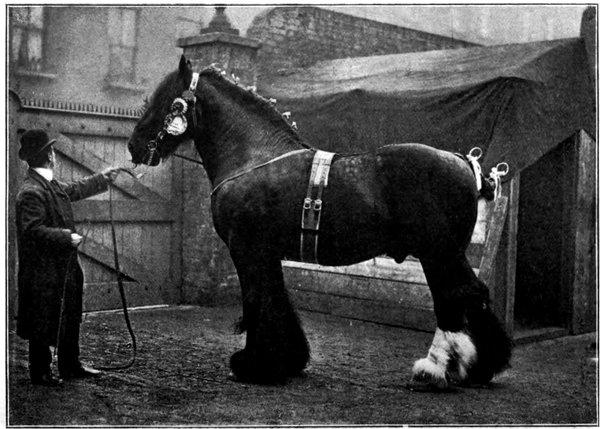
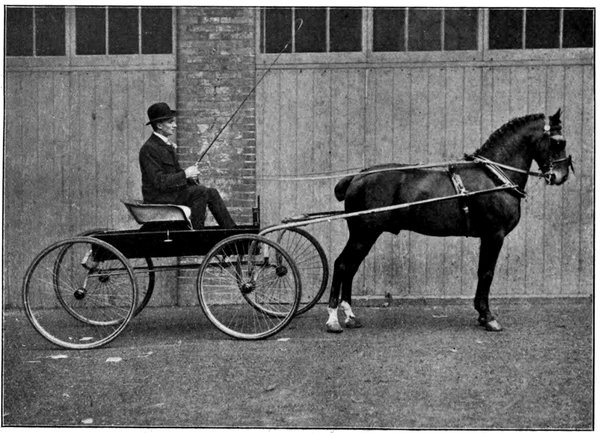
MESSRS. FORSHAW’S PRESENT KING II. 19948. Champion Stallion at the London Shire Horse Show. Photo by F. Babbage.]
It was not so much in regard to the numbers as the quality that made the show of these farmers’ friends so great, and it may be that the development of this element is so noticeable in the Shire as to make it a very satisfactory occupation to breed him; it has specially fascinated many great personages and sportsmen, from His Majesty the King downwards, the exhibitors now including the Duke of Westminster, the Duke of Marlborough, Marquis Campden, Earls Ellesmere, Egerton of Tatton, Bathurst, M.F.H., Spencer, M.F.H., Beauchamp, Lords Middleton, M.F.H., Southampton, M.F.H., Rothschild, M.S.H., Iveagh, Winterstoke, Hothfield, Sir Berkeley Sheffield, Bart., Sir Walter Gilbey, Bart., Sir William Cooke, Bart., M.F.H., Sir Edward Stern, Sir Albert Muntz, Bart., the great welter of the Midlands, the Hon. R. P. Nevill, M.F.H., and others of rank and wealth. The extension of the movement in regard to improvement is indeed very marked. That the patrons of foxhunting should ally themselves so closely with the Shire interest is possibly owing to the desire to see the noble pastime identified with agriculture. It is doing good to promote such a breed, both for the cause of the landlord and the tenant.
From the yearling colts to the oldest of the stallions it was all quality, and although the examples are bigger to-day than they have ever been, they have more agility in their movements, are cleaner cut about their heads and jowls, and more majestic in carriage. For the enormous class of sixty yearling colts it was an honour indeed to take the first, which fell to Mr. Frank Farnsworth from a great hunting district for the promising young son of Lockinge Forest King hailed from Tooley Park, Hinckley, within easy access of the Quorn and Atherstone. Leicestershire appears to be the land for Shires, as besides Mr. Farnsworth’s stud, which must be of great fame to include such colts as Ratcliffe Conquering King and Ratcliffe Forest King (the latter very nearly the winner of the two-year-olds, as he was second in a class of seventy), there were several others from the hunting county. In Warwickshire also they seem to thrive, as few more beautiful exhibits were seen at the show than those of Sir Albert Muntz from Dunsmore, his three-year-old mare winner, Dunsmore Fuchsia, being quite a model of her sort; all Sir Albert’s ten exhibits were in the money or amongst the commendations.
Lord Egerton of Tatton sent up some very notable entries from the old Cheshire cheese country; the defeat of the grand six-year-old stallion, Tatton Friar, was much regretted by many onlookers: but it followed a very notable victory in the two-year-old class of 70, in which Tatton Dray King was the winner: it is something for one stud to take the two-year-old colt and the two-year-old filly class, for the latter fell to Lord Egerton with Tatton May Queen, a great beauty.
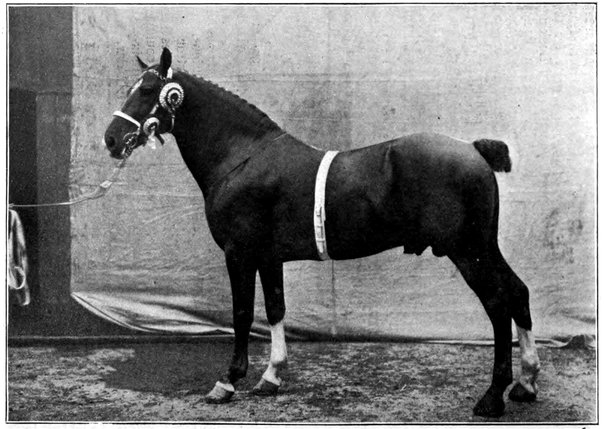
MR. RAMSAY’S DIPLOMATIST, 7043. Champion at London Hackney Show. Photo by F. Babbage.]
His Majesty, who goes in for everything useful on his Sandringham estate, was an exhibitor of five, and a popular success was that of Ravenspur, the thickest of horses on the shortest of legs; and here again it was Leicestershire soil that claims credit for this success, as the winner was bred by Sir Humphrey de Trafford at Hill Crest, Market Harborough, making good the saying that where bullocks can fatten and hounds can run, is the ground for the Shire. Lincolnshire, though, is always a likely quarter, and the champion of the show hailed from this county in the shape of Present King II., a very remarkable horse; although eight years old this grass, he has been unknown to the general public until now, and it says something for Mr. James Forshaw’s judgment to have found him. He was bred by Mr. Joseph Phillipson, of Hainton, Lincoln, and as he is a coal-black horse, with very little white about him, and his dam is by Black Prince, he is living evidence of the old Black horse reported to have been almost lost in its purity. Anyway, he is a very bold, fine horse of quite the biggest size.
Lord Rothschild was not in the same lucky vein as he was last year, in that the defeat of his champion, Girton Charmer, by an unknown quantity like Present King II., was irritating; that the hitherto unbeaten Childwick Champion should be beaten for the Special Cup by the two-year-old winner, Tatton Dray King, was hardly expected. The great Tring Park stud, though, won in other classes amongst the mares. It was, in all, a very great show, though not without its disappointments, as horses previously undefeated went down before new-comers. Among the mares, as among the others, Mr. James Forshaw had found another in the grey, Sussex Blue Gown, to win in her class, and she beat Lord Rothschild’s Princess Beryl for the Champion Cup, the famous Nottinghamshire stallion owner thus taking both cups for the horses and the mares. The sales were good but not sensational, the only exception being when Lord Beauchamp gave 510 guineas for the champion mare alluded to.
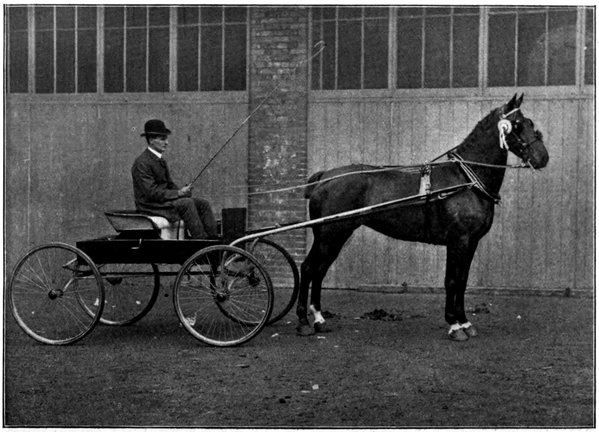
MR. W. SCOTT’S MENELLA 16799. First and Champion in Harness at the London Hackney Show. Photo by F. Babbage.]
The Hackney Show.
The same view must be taken in regard to success of the Hackneys. The progress made with this breed is perhaps more noteworthy than that made with the Shires, as in the absence of so much patronage from the greatest people in the country, the breed has been brought to a wonderful state of perfection, and evidence of the same sensible and scientific breeding can be easily traced. Moreover, signs were not wanting to show that the foreigners are keener in their endeavours to get possession of our Hackneys than they are at present to purchase our Shires. Two large Government commissions were noticeable, at any rate, namely from France and Germany, for the purchase of a goodly number of stallions, and Holland took the champion of the Show for 1,000 guineas. This desire to get the best of English sorts is not due entirely to the demands for cavalry breeding, but the wise councils of other European countries consider that an industry to give the means of prosperity to thousands of subjects is well worth cultivating. This, too, on circumscribed lands with little or no colonial extension; but England, with her millions of acres in all parts of the globe, possessing better animal stocks than all the rest of the world put together, is neglectful of her opportunities. Why cannot her sons be set up in far-off lands to breed horses for the world? But to these magnificent Hackneys: It cannot be denied that the Dutch have got possession of a very grand specimen in Diplomatist, whose lot it must have been to do good in a variety of countries. He was first of all shown at the Hackney Society’s Show as a yearling; then, after doing some service in England, he was sold to America, where he got some stock of note before Mr. Heaton brought him back to England and sold him to Mr. Ramsey, of Kildalton, Port Ellen, Islay, N.B. And here let it be said that Scotch breeders have done uncommonly well at this Show. Mr. Ramsey, a prominent breeder in the northern country, won the Champion Cup last year at the London Show with Diplomatist, and now repeated the victory before selling the dual champion to Holland. Diplomatist is a very beautiful horse of about 15.2, with extraordinary action; his pedigree contains some of the best blood in the Hackney Stud Book, for he is by His Majesty out of Garton Birthday, by Garton Duke of Connaught. There were several fights in the Show between the North and the South. Sir Walter Gilbey equalised the pretensions of Yorkshire and Norfolk, when he brought Danegelt down South, at a cost of 5,000 guineas. Since then the champions of Essex and Norfolk have held their own with those of the many-acred county. Sir Walter has won the championship twice with Royal Danegelt, a son of Danegelt, and it looked as if the Essex baronet might score again in another generation, as Bonny Danegelt stood in a long time with Langton, a grand twelve-year-old horse by Garton Duke of Connaught, and many thought should have won. It was not to be though, and this particular prize went to the north, Langton being the property of Mr. E. C. McKibbin, of the Heaning, Windermere, though bred by Mr. Thomas Hall, of Copmanthorpe, the owner of the great Garton Duke of Connaught, who was summed up to me last year at the Yorkshire show as the greatest hackney sire in the world. He was certainly in the full order of success now, as the Messrs. Hall, father and sons, showed some beautiful stock by the veteran, including the two-year-old colt winner, Copmanthorpe Performer, a truly symmetrical animal with singularly beautiful action. There was also Administrator, owned and exhibited by Mr. Walter Burnell Tubbs, another son of this Duke of Connaught, a wonderfully handsome horse who showed grandly in harness. Last year and the year before he won the Champion Cup for his then owner, Mr. Galbraith. He is nearly, if not quite, as good as Diplomatist.
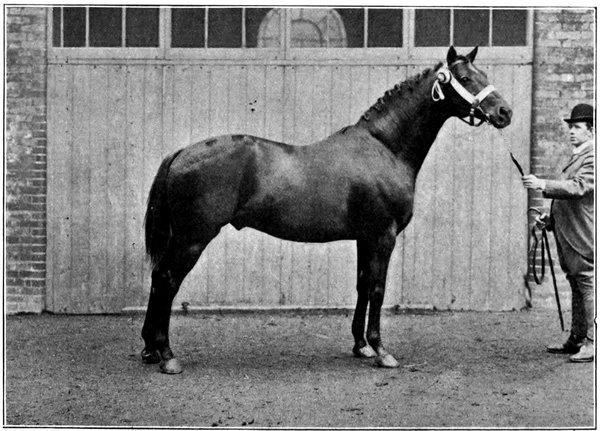
MR. T. SMITH’S PINDERFIELDS HORACE. Champion Hackney Pony Stallion at the London Show. Photo by F. Babbage.]
The points that struck one throughout the whole show was, that breeders have got to a type that comes down quite as regularly as in the thoroughbred horses of the General Stud Book. Royal Danegelt was the copy of his sire, Danegelt, and the former at this Show had a number in precisely the same form in shape and action. They are getting a bit bigger, as in Class 8, for horses over 15.2, there were sixteen in the ring, and several must have been very close on 16 hands. It is notable that the foreign buyers were very interested in this class, and made two important purchases from it in Forest Star, who was placed third, and the above-named Diplomatist. A suggestion is given here that the size attained in the Hackney is a useful element in regard to success. It was generally thought that the horses made a better show than the mares; and, in truth, there were fewer mares than usual, but whether from the fact that a great many were sold last year, or that breeders are chary about sending their valuable breeding stock to shows in the spring, it is difficult to say. Many of those that were seen though, were beautiful animals. Sir Gilbert Greenall’s Colleen Rose, by Garton Duke of Connaught, could scarcely be excelled as a fine carriage mare of quality, and Menella, the champion harness mare, was a great beauty with action of a most superb order. An extraordinary horse must be her sire, Mathias, as, to judge him from a photograph he gets all his stock exactly like himself, and with the same wonderful movement. Another as remarkable in this respect is Sir Gilbert Greenall’s Sir Horace, under 14 hands, as he had nine winners at the Show all looking the exact types of perfection—bloodlike heads, beautifully laid shoulders, round barrels, moulded quarters, and limbs set under them in the same stamp. What has the breed come to from the shapely Diplomatist and Bonny Danegelt, to the ponies, Pinderfields Horace and Little Woman, for all these and many more the word beautiful cannot be misapplied—and the Show might well have been watched for the full four days to see by the pedigrees, the make and shape and the action more real now than artificial, and to wonder whether the present conditions of the so-called Hackney can ever be surpassed.
The Royal Commissions—Thoroughbred Stallions.
The progress so noticeable in regard to the thoroughbred stallions forms an important feature of the great spring shows. There was first of all a better entry than those of the past three years, and it would appear that the owners of horses have been educated into the exact ideas in respect to the requirement. It was a movement in the right direction certainly to give some evidence in the catalogue as to what horses had done on the turf, and still more to empower the judges to act upon the information provided. The net result of all being, that there was hardly a stallion exhibited that was not perfectly suitable for the purposes of the Commission. With but the fewest exceptions the horses had all been winners; some that had been known on the racecourse for over seven years, and others that had won very important events. There were 107 in all, and as this did not include any from Ireland, we have the satisfaction of knowing that we are very well off for useful sires at the present time.
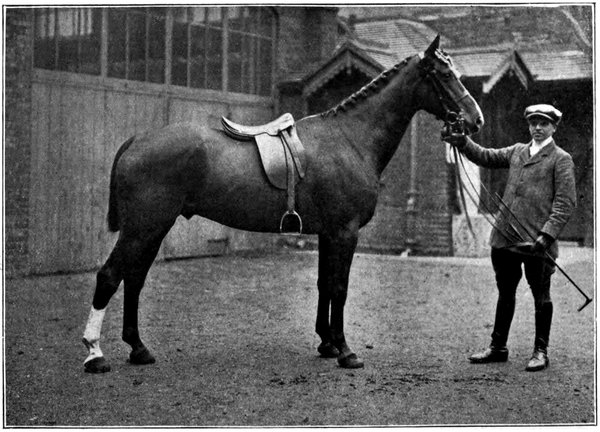
LORD MIDDLETON’S STALLION WALES. Winner of a King’s Premium in District Class E (Yorkshire). Photo by F. Babbage.
There were some splendid classes brought into competition on March 13th, the one scheduled D perhaps being the best, as here was the beautiful horse Battlement by Enterprise, out of Ivy Mantle by Mask. He is the winner now of four premiums, and has done a great deal of good. When the property of Mr. A. O. Haslewood, of Buxton, he travelled in Derbyshire and Staffordshire, and since his owner has been Colonel Jago Trelawny he has done service in Cornwall and the South of Devon. The farmers of these western counties swear by him already, and there will be great rejoicing round Plymouth, as, besides Battlement, there was a very good four-year-old called Rockaway, by the good Australian Trenton, son of Musket, belonging to Mr. Bickell, of Tavistock. So clever did the judges think Rockaway that they gave him one of the four premiums. Mr. Bickell also showed the well-bred Mon-Roy, by Orme, out of Mon Droit by Isonomy. And another Devonshire candidate was Flaxby, quite a hunter-getting sort by Barcaldine, out of a Palmer mare. So Devonshire is evidently well off in hunting stallions. Then, still in this D class, too much cannot be said of Rightful, improved into quite a charming horse. Rightful comes from such a handsome family by Rightaway, out of Repletion by Satiety. He is one, too, for whom racing merit can be claimed. Kano, another Trenton, and a good winner, had also much to admire about him, and as one of the reserved, he became available for one of the classes not so overstocked with merit. It is always well to see Yorkshire to the front, and really there was little to surpass the magnificence of Wales in the whole show. Big and powerful, with plenty of timber, and blood-like withal, besides the knowledge that he was a right-down good horse on the flat and over a country. To show what he can get, too, Lord Middleton made a great hit in the group of young hunters by Wales; they were quite away from the stock of other stallions, albeit very good ones by Red Prince II. and Pantomine were shown. But to the Yorkshire class: There was also Frobisher, a very nice horse by Mr. H. Waring’s Buccaneer, made a premium winner: and although he did not quite get into honours, save a reserve, I thought there were few better than the Manchester Cup dead-heater, Roe O’Neil, by Sweetheart, who used to get almost as many jumpers as Victor, out of a Ben Battle mare. The Yorkshiremen are sure to take to Roe O’Neil. Garb d’Or was also unlucky to get a reserve only, as he is a very handsome son of Bend Or, and quite in the family type, Birdcatcher spots and all. In the Gloucestershire, Herefordshire, Warwickshire, Worcestershire, &c., Class it was a treat to see the long, low level Curio win again, after knowing full well the good he has done in Warwickshire; and a charming young horse was shown here by Mr. Haslewood, of Buxton, and that gentleman invariably picks up the best, as Red Eagle once belonged to him, then Battlement, and now Landsman, a son of Ladas, and a Gallinule mare; and so what blood for a hunter! Another that kept haunting me with his blood-like outline and quick, sharp action, was Mr. C. M. Prior’s Rathburne, a winner of the Brighton Stakes in his time, and the judges rightly took to him. The executive was very wise to get Sir Charles Nugent and Mr. J. M. Richardson on their bench of enquiry, as they were not likely to make any mistakes.
MR. DRAGE’S KING EDWARD. First and Champion at the Hunters’ Improvement Society’s Show. Photo by F. Babbage.]
After much had been seen in regard to the hunting sires themselves, it was all the more interesting to follow in the steps of the Hunters’ Improvement Society, and at no show has the results, in the shape of produce, come out so satisfactorily. The four-year-old winner, Splasher, bred and shown by a tenant farmer, was by Burnock-Water, four times a King’s Premium taker, and the three-year-old filly, and champion of all the young hunters, namely, Watercress, belonged to the same owner, and was by the same sire. This was precisely what the Royal Commission has aimed at, to enrich the tenant farmer. There were many other results to observe in the same direction, notably in the case of Battlement, presented with two Premiums in the past career for Staffordshire, Shropshire, Warwickshire, South Wales, &c., and from Shropshire came the beautiful Bandetta, by Battlement, who was unlucky not to have won in her class. Then there was Havoc, well known at the Royal Commission Shows, and the sire of Destruction, a winner in this; and the second to the champion filly, Watercress, was Paleface, by Ringoal, who was introduced into Huntingdonshire by the Royal Commission. Added to this also, there was stock of great value seen by Wales, including four in the group, and the second and third in the three-year-old class, won by Destruction. The champion of the show, Mr. Drage’s (now Mr. Cory Wright’s) King Edward, had unfortunately no pedigree given, though doubtless extremely well bred, and the question arises as to whether all the societies now are not strong enough to insist on pedigrees at entry pro bono publico.
One might go on writing in Baily for ever about these shows, as they have taught us a great deal in the last few weeks; and something might be said to the Government about the horse-breeding industry, and of its vast importance to the British empire.
G. S. Lowe.
The Sportsman’s Library.
Mr. Rawdon Lee’s work established its claim to place as the best and most comprehensive book published on dogs when it first appeared. The third edition of “Modern Dogs (Sporting Division)”[8] is now before us, and the contents bear evidence of exercise of all those qualities which stamped the earlier issues: wide and intimate knowledge, patient and exhaustive enquiry.
The title may be said to fall short of the scope of the work; for the author’s pages contain much relating to the history of the older breeds which lends additional interest to his remarks on their modern descendants, and additional value to the work as one of record.
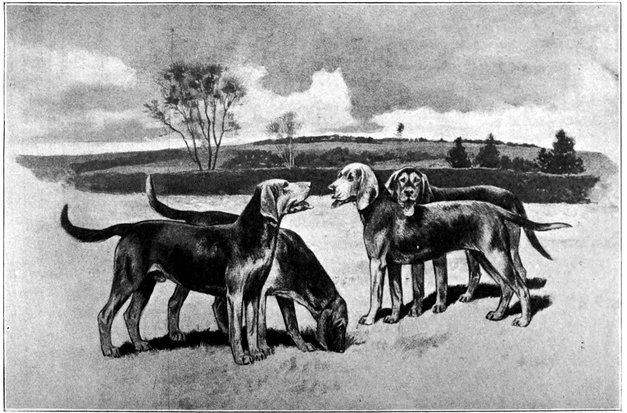
KERRY BEAGLES. From the drawing in “Modern Dogs (Sporting Division).” (Reproduced by permission of the Publisher, Mr. Horace Cox.)
Certain new features are noticeable in the third edition. The portraits of those famous greyhounds Master M’Grath and Fullerton were well worth inclusion, the more so as given on one plate which, as Mr. Lee observes, affords opportunity to compare the remarkable dissimilarity in build and conformation between the two most celebrated dogs of their respective periods, the seventies and the nineties. Admirers of the Welsh foxhound will appreciate the inclusion of Mr. Wardle’s clever drawing of two couples of representatives of this breed, famed as far back as the tenth century, if the hounds appraised in the Laws of Howel Dha were the ancestors of the modern animal. The author believes that the Ynysfor pack, owned by Mr. Jones, of Penrhyn Deudraeth, is the one which boasts the greatest purity of Welsh blood, but he does not think there exists in Wales or elsewhere “an entire pack of the pure Welsh hound, either of harrier or of foxhound stamp (for there are two varieties) with the wire-haired crisp coat.” The hounds which furnished Mr. Wardle for his portraits were from the otterhunting establishments of Mr. Wynn, of Rug, now given up, and from that of Mr. E. Buckley. The value of the Welsh hound for otterhunting has long been appreciated in the Principality. Mr. Buckley considers those he possesses better than the otterhound, as they feel the cold less, and their shorter coats dry more quickly. Summing up all the evidence for and against the Welsh hound, Mr. Lee holds that a capital case in his favour has been made out. Another new illustration is that of examples of the Kerry beagle; this breed survives, so far as is known, only in the kennels of Mr. Clement Ryan (the Scarteen). In that of Mr. Aubrey Wallis, Master of the recently established Millstreet Harriers, the blood of the Scarteen black and tans has been used. The Kerry beagle’s origin has been traced to the south of France, whence Mr. John Ryan brought them some time during the latter half of the eighteenth century. Among the new matters which has been added to the gun-dog section we must notice the Welsh springer, which in 1902 was accepted as a distinct variety, and allotted separate classes by the Kennel Club.
The author reviews the evidence advanced by the advocates for this step, and the Welsh spaniel takes his place among modern dogs; deservedly, for this is a hardy, courageous, docile dog, and possesses excellent nose. The Welsh variety stands out much higher on the leg than other spaniels, and Mr. Wardle’s picture gives the idea of a dog at once sporting and handsome. The third edition of Modern (Sporting) Dogs is in every way a worthy successor to its forerunners. Higher praise could not be given.
The building of cottages in the country is a matter that has attracted much attention latterly, and this little work,[9] though it embraces the erection of buildings other than the labourer’s cottage, will be found of practical assistance to all who may contemplate building as a business. The authors display practical knowledge of their subject, from foundation to roof, if we may use the expression, and they show up in a lurid light the wanton absurdity of the building laws now in force in some localities. This is a subject to which public attention was drawn by the public-spirited action of Sir William Grantham not very long ago; and in the interests of the poorer classes it is much to be hoped that the more unreasonable clauses of these bye-laws will be revised to make cottage building possible. All classes of small dwellings, from that which costs £1,000 downwards to erect, are considered; and most of the materials in general use are dealt with. An exception occurs in the clay blocks, which, protected by weather boarding, Sir Walter Gilbey has so successfully employed on his Essex property. This method of construction, cheap, efficient, and picturesque as it has proved, deserves to be more widely known. The pictures, drawings, and photographs are admirable, and the plans are clearly and well drawn.
Bridge is said to be losing some of its vogue, but the appearance of a fifth edition of the work[10] by “Cut Cavendish” seems to contradict the assertion. As the author observes, “unfortunately, with many people it has developed into a form of disease.” This is true, but the regrettable fact that bridge takes the shape of monomania with some enthusiasts does not affect the merit of the game, which, pursued in moderation, deserves all the praise bestowed upon it. The author has, as in previous editions, made a point of giving counsel and explanation in the most lucid form, and his book may be cordially recommended to all who wish to improve their play. We had been about to say “who are learning the game,” but hesitate to use a phrase which should imply the existence of any one who has failed to master it! A welcome addition to the work is an exposition of “Misery bridge.”
Not only is this form of the game an excellent one for two players, infinitely superior, in our judgment, to double dummy bridge, it is a capital education for the four-handed game. It may safely be said that any player who has attained to proficiency in misery bridge may take a hand in the parent game without fear of incurring those silent anathemas which befall the incompetent player who ventures into skilled company.
Half-a-dozen short stories are included in this little book,[11] the title of which promises a Turf atmosphere. Two of the collection, however, deal with racing, the others having scarcely a bowing acquaintance with the course. All are readable, nevertheless, and may be recommended as suitable to while away the tedium of a railway journey.
“Our Van.”
RACING.
It was with a certain zest that we turned to the Sandown Park meeting that occupied the first three days of March, for the racing of the preceding fortnight or more had been sadly lacking in interest. The first of the three days was denominated the Sandown Park March Meeting, the Grand Military occupying the next two days, and the sport, on the whole, was of an interesting character. On the Club day the appearance of John M.P. in the Liverpool Trial Steeplechase was an event in itself sufficient to account for the distinctly large attendance. It was a weight-for-age race, and the winning of it did not entail any penalty for the Grand National, save in the case of a horse that had already won a steeplechase of three miles or over since the date of closing. John M.P. had already won such a race when he beat pointless Desert Chief and the untrained Kirkland, at Hurst Park; but the penalty entailed would not signify very much, the weight assigned to John M.P. in the Grand National entitling him to a deduction of half the penalty, in his case 4 lb., so that only 2 lb. extra would have to be carried. A strong impression was also abroad that John M.P would not start for the Liverpool race, but be reserved for the valuable steeplechase at Auteuil in June. That he would win this race seemed to be taken for granted, since 3 to 1 had to be laid on, which was holding the other Grand National horses in the race somewhat cheap; but of course the weight-for-age conditions made all the difference. The three and a half miles did not worry John M.P. in the least. Nothing else could go fast enough to make him really gallop, and a loud exclamation of admiration from the stands burst forth spontaneously when at the water the second time he gained a matter of three lengths from the then leader, Wolfs Folly, in front of whom he cantered home. What he had in hand it was impossible to say.
That any one of the old-time functions is a patch upon what it was formerly is naturally not admitted by the old brigade, whose opinions are, of course, expressed in the usual manner upon the Grand Military. That gentlemen riders of forefront ability are scarce is not to be disputed, and possibly the winner of the Grand Military Gold Cup of the day could not compare in class with many of his predecessors; but the old sporting spirit is still there, and the Gold Cup is coveted as much as ever. Two or three months previous to the meeting a vigorous quest was in progress with a view to securing a potential winner of this race, and in this way Royal Blaze was purchased for, it is said, £500. The purchase proved to be a happy one, for Royal Blaze won the cup for Mr. R. F. Eyre. It was a lucky win, perhaps, but one that was well deserved, Royal Blaze being sent to make the best of his way home from the mile post, whereas Prizeman, whose rider lacked experience between the flags, left matters so late that, although he was going two yards to the one of Royal Blaze and Prince Tallyrand in the last hundred and fifty yards, he had to put up with third place, two heads behind the winner. It was a desperately exciting finish, and when the post was passed the race was not over, for Mr. R. C. de Crespigny, the owner of Prince Tallyrand, laid an objection to the winner on the technical ground that a contingency had not been properly registered. Such an objection had been forestalled by an application at Weatherby’s, where everything was declared to be in order. The stewards, on the second day, over-ruled the objection, but Mr. de Crespigny did not let the matter drop, pressing for an appeal. The laying of technical objections in such races was formerly not thought of, and possibly the breaking of this chivalrous custom gives the old brigade a genuine opportunity for pointing their moral.
On the second day we saw a remarkable performance over hurdles on the part of Rassendyl, the hurdle-racer who has so rapidly made a name for himself this season. He was carrying the nice little steadier of 13 st. 3 lb. and, what was so astonishing, all but carried it home. Such was the confidence in him that his jockey did not hesitate to make running. When half the distance of two and a half miles had been covered, Rassendyl was dispossessed of the lead, but lay by handy, and took command again at the first of the two flights in the straight, in spite of having been carried out wide at the bend. He led to the run-in, where, however, Bellivor Tor challenged and won by a neck. We English are hoping that Rassendyl will be sent to Auteuil and further the entente by winning the big hurdle-race there. The success of an English horse in France is by no means necessarily unpopular with the French betting public, which means a few tens of thousands, for, if he be a good one, national pride goes into the pocket, and they are on him to a man, to say nothing of the women. The numbers of frugal Frenchwomen who slave all the week, but have five or ten francs on every race on Sundays, is astonishing to the stranger from this side of the Channel. But on the Continent there is less fear of Mrs. Grundy than here.
The racegoer, as manufactured by the modern “park” meeting, is unable to understand the interest that is taken in the annual National Hunt Steeplechase. Here we have £1,000 given for a race for five-year-olds and over, the primary condition of which is that no runner shall have previously won a steeplechase or hurdle-race, or a flat race of any description; point-to-point races not counting as steeplechases. This, at one fell swoop, abolishes all notions of “class,” a feature which we find emphasised by last year’s winner, Miss Clifton II., who for years had tried to win this race and several others, without, of course, succeeding. When, during a dark period of mistaken policy, the National Hunt Committee apportioned the race to Metropolitan enclosed courses, bearing no sort of resemblance to the real thing, the Londoner had perforce tried to grasp the inwardness of the race, but failed. Such form as there was puzzled him, which means that the betting was not to his liking; and that is the only side of racing which interests him. How so many people could take the interest they did—and as just as many still do—in the doings of such mediocre public performers was always beyond him, as it always will be. To enjoy the National Hunt Steeplechase in the way it has been presented in more recent times at Warwick and Cheltenham, one must have been educated amongst hunting surroundings. To such this class of racing talks a language utterly incomprehensible to the others referred to, who, understanding nothing of the niceties of cross-country riding and unable to appreciate the qualities of a cross-country horse, have no interest whatever in a race beyond the position occupied at the finish by the animals they have backed.
If one were called upon to decide between the Cheltenham and Warwick courses, one might be inclined to vote for Warwick, although there is not so much in it so far as the actual course is concerned, each presenting a neat assortment of grass-land and plough. But at Warwick we possess the not insignificant advantage of being able to see nearly every yard of the four miles, the hill, from which outsiders obtain such an excellent view, being all there is in the way of those in the stands, where the accommodation, although not precisely up to date, is much better than that at Cheltenham. The meeting at which the race takes place is one concerning the success of which no doubt has to be entertained. The county people could not be made to stay away by any sort of weather, so, although rain was threatening on Thursday, the 8th ult., the county stand, from the condition of which I should judge of the success of this particular meeting, was crowded with the right sort. So far as owners were concerned there was every evidence of the popularity of the race in the large field of twenty-eight that ran. This number has rarely been exceeded, a notable occasion being the race of 1860, in which year, I fancy, the event was inaugurated, and when thirty-one ran. One can have but little sympathy with those who suggest that two-thirds of the number might as well have stayed at home, for all the chance they had of winning. If sport were always looked at thus there would soon be very little of any kind to look at all, and what was left would scarcely be deserving of the name of sport. Of the twenty-eight, Glenrex and Portlight II. had filled places in previous contests, Glenrex having run second last year, and, being also mentioned in the Grand National betting, started favourite. Glenrex came down in the plough a mile or more from the finish, the running having been made from about half-way by Count Rufus, by Wise Count out of an Arraby dam. The same plough which proved fatal to Glenrex seemed likely to also settle the chance of Count Rufus, for he was passed by Portlight II., but on the good going on the racecourse Count Rufus quickly asserted himself and won very easily in the end. In finishing second Portlight II. is possibly merely following the lead of Miss Clifton II., to eventually win outright. Count Rufus had cost £300, and had won some point-to-point races, which made his starting price of 25 to 1 so surprising.
Comfort, who won the National Hunt Steeplechase in 1903, the year the race was last run at Warwick previous to Cheltenham getting it for two years, did something towards bettering the none too good reputation of winners, who seldom do much afterwards, by winning the Warwick Handicap Steeplechase, after a good tussle with Royal Drake, who broke down rather badly, although finishing second. On another occasion something should be done to prevent the landing side of the water from becoming a quagmire. More than one horse failed to keep its footing in consequence of this, the fault being, apparently, an overflow from the water.
John M.P. made another taking appearance at Hurst Park on the Saturday in this week in the Open Steeplechase, which proved in practice to be the gift it seemed on paper. The odds on were of course practically prohibitive.
HUNTING.
It is by no means certain that foxhunting has any more enemies now than in earlier times. The great danger seems to be from the lukewarmness or injudicious action of its friends. Probably Mr. Charles Brook, of the Holderness, pointed to the real danger when he complained of the want of knowledge of hunting in those who follow the sport. For this there is a real reason, in that hunting people nowadays have so many other occupations and amusements. Hunting is only one of them. People hunt in greater numbers, but they do not see so much of the sport itself as we did in the days when we lived more in the country, hunted from home, and took the good and the bad days as they came. In very popular hunts there are fewer good days, for the simple reason that unless hounds can go fast enough to keep out of the way of the field, it is not easy to see a hunt when there is a crowd.
Second horses, though, a great addition to one’s pleasure, have this disadvantage, that if we have to make one horse go through the day we shall be more likely to succeed if we know what hounds are doing, so as to gain all we can by the turns in our favour. Thus it is obvious that a knowledge of hunting keeps us out of mischief and enables us to do less damage. But every now and then we read attacks on hunting which are obviously based on sentimental ignorance.
The latest subject is the treatment of hounds by the hunt servants. Now I have had, and have still, a great many friends among a class of men who are notable for their good qualities, their ability, and their integrity. Of course, young men are sometimes a little too rough with hounds, but the most successful huntsmen, and whippers-in, too, are those who have the gift of attaching hounds to them. I think we may take it as an established fact that hounds never do their best for a man who cannot win their affections. It is too funny to read of hounds escaping from kennel and dying miserably in a ditch because they were afraid to return. 1 wonder if people have any idea of the value of a well-bred foxhound. Perhaps they think because they are numerous, therefore they are cheap, and, like Beckford’s auctioneer, think a pack would be dear at a shilling a head. Some kind friend has been sending me curiosities of literature in the way of hunting correspondence; two I think are worthy of being remembered. One of the writers, wishing to say that at a particular juncture of a hunt the field refreshed themselves, wrote that a considerable number took St. Paul’s advice to Timothy, evidently not holding with the temperance lecturer who accounted for this by saying he supposed it was meant for outward application only. The other reported that a well-known pack ran a stag to earth.
When sport has been so good and the weather so bad, if we say that a particular pack has had sport, we do not mean to suggest that others have not, but only that it has come under our notice. Yet, when the weather is such that frosts make hunting uncertain, I do think the Belvoir have a little the best of it, so few are the days in the season when they cannot hunt in some part or other of their wide territory.
On a cold morning they met at Landyke Lane, on Friday, February 23rd. Scent was at first only moderate, but as the hours went on matters improved, and the day ended with a brilliant Belvoir burst from Hose Thorns. Hounds seemed to be catching their fox all the way to Clawson Thorns, the pace and drive growing greater as the field bustled along on the track of the flying hounds. It was almost twenty minutes from the start to the time when the fox escaped, owing to the number of fresh lines in the covert. Mrs. Clayton Swan’s horse slipped on the greasy turf and she had a nasty fall. Ash Wednesday is no longer a hunting day with the Belvoir, but in any case the ground was impossible for riding in the Midlands. Thursday was possible enough, but a most unpleasant day, and the pack I hunted with did little, and I confess to coming home early, fairly driven off by weather. In the Belvoir country things improved as the day wore on. The smallest field of the season, and a riding one, found themselves with a stout fox and a racing pack in front of them. It is a hilly country, and the fences held the field in check so that hounds could run without interference. The fox went straight into Freeby Wood. Ben Capell, taking a leaf out of the late Sir Charles Slingsby’s book, held the pack right round the wood. Then an advantage was gained and the pace became hotter than ever as the end drew near.
Not so fast, but even better as a hunt, was the run of Wednesday, March 7th! The Belvoir met at Sproxton, and went on to draw Lord Dysart’s coverts at Buckminster. These proved to be blank, but—Coston covert is only just outside—a fine clean fox, springing up, was driven across to Buckminster. With their fox running up wind, hounds drove right on to Gunby Gorse, which, it is needless to say, is in the Cottesmore.
When they came away it was clear that they had changed, for whereas the original fox had a full brush, the new quarry was a bobtailed one, but in time this one was changed for a well-known out-lier that has hitherto defied Thatcher, and which, by accident or design, choosing a line over some plough, defeated Capell also.
A curious day was March 3rd, when the Cottesmore met at Somerby Hall. The events threw some light on the habits of foxes in a much-hunted country. The hounds spoke in the first covert, but it was clear the fox had taken the hint and left some time before. A second fox from another covert slipped away unseen as hounds were thrown in, and his line, too, failed; lastly, a third fox was discovered in the tree in Stapleford Park; which has become quite a sure find. This causes one’s interest in the curious limitations of a fox’s mind. The two mentioned first were perhaps scared by the clatter of horses’ hoofs, and, it may be, the hoots of a motor-car, which must, one would suppose, in the Shires be quite a familiar sign of a coming meet. At all events, they were sharp enough to take a hint and make themselves scarce, but the tree-haunting fox or foxes of Stapleford have not yet found out that their enemies know of their hiding-place, and come straight for it.