Volume 85 — BAILY’S MAGAZINE OF SPORTS AND PASTIMES No. 555. MAY, 1906. Vol. LXXXV. (continued 2)
Reading edition
There can be no doubt that the oak takes precedence of all our forest trees, both on account of its place in English hearts, and its visible expression of strength and durability. The lover of Nature, too, sees in it the emblem of all that is grand and beautiful, its mighty trunk, great spread of branches, and dignity of age. Nevertheless, the beech takes a firm hold of our sympathies, and, as an ancient writer has observed, it may be looked upon as the Venus among trees. There are in the tree a few characteristics which belong to no other, and which lend a charm all its own; the lovely canopy of green, the high columnar trunk, standing grey among the greenery, and the great open space beneath, broken only by the lovely green of the holly bushes which almost invariably attend it. The view through the forest glade is unobstructed by coppice growth, for no bushes but the holly will grow beneath its spread of branch.
What can be more beautiful than the open glade, carpeted with the brown leaves of the late autumn, the dark glossy holly leaves and the tall grey columns?
Commercially, too, when in quantity and well grown, it is universally valuable; and the quantity which an acre, well stocked, will produce is very great.
The tree, though the fact is questioned by many old writers, is doubtless indigenous, though not confined to these small islands; for it is found throughout Middle and Southern Europe, Western Asia, and elsewhere.
The beech belongs to the natural order Amentaceæ, or Cupuliferæ, as some prefer to call it, and to the genus Fagus. It is monœcious, leaves simple and deciduous, and its fruit is known as mast. From the mast, or nut, may be extracted a valuable oil, used for culinary purposes, and also a flour or meal, used in some countries as food for man. In this country it is used only as pig food, and it is from this that the term “masting” is derived.
The leaves, enormous in quantity, decay rapidly, and soon become incorporated in the soil, thus providing the food which the tree requires. Beneath this natural carpet the seeds lie, and with the admission of light and air, soon grow and develop. There is no British tree which lends itself so completely to natural reproduction; neither can any artificially planted beech compare with these natural offspring for rapid growth and quality of timber.
It is not necessary to point out to the owners of beech estates the importance of managing the natural thicket from infancy to maturity, because such is known already and recognised; and if an example of sound British forestry be wanted, it is to these areas we should turn. Nevertheless, there are many estates with few or no beeches growing upon them which are naturally suitable to their full development.
Under these conditions it is necessary to resort to artificial stocking, and here lies the difficulty, for the beech is by no means a tree which lends itself to rapid establishment. Whether such is best performed by the sowing of seed, planting of seedlings, or of nursery trees of more advanced age, is a question for foresters. Again, is it well to plant pure and close together, or to plant with Scots pine, larch, or other trees? Opinions vary, and no decisive advice seems requisite.
As a natural seedling the beech will find its way through almost any tangle and force its way to the light, hindered only by the thick canopy of the parent, but as a transplant its vigour is defective.
The beech may be divided into two classes—the beautiful wide-spreading tree of the park, with its branches sweeping the sward; and the tall, straight column, topped with a canopy of lovely green—branchless for, perhaps, fifty feet and more.
It is to the latter that the merchant looks for his supply of timber, and to which the owner looks for his revenue. The former, through its charm, lends to the estate a value by no means inconsiderable; but the latter, under favourable conditions, yields so regular a return that it may be reduced to a yearly revenue. Under proper management there should be a continual cutting and a continuous and progressive growth: there should be no periods of vacancy.
If some of the schemes for the planting of waste lands—many of them wild and impractical—should reach ripeness, it is to be hoped the beech will be planted on soils suitable to its development—and these are calcareous loams resting on a rocky bottom—because there is likely to be a demand at a fair price, this class of timber not being much affected by foreign imports.
Beech reaches a useful and commercial value in from forty to sixty years when growing naturally close together, and under proper and judicious thinning; but if such be left until decay sets in, the value per cubic foot is greatly diminished. Trees will, of course, live and grow for a much longer period; but after, say, eighty years, it is doubtful economy to let them stand.
Another feature in the beech is that when decay once sets in it is rapid in its progress, and the tree dies as a whole. The oak will live for centuries in a decayed and dying condition, but not so the beech; and it is only when the timber is sound that the best price can be obtained. It is, too, a timber which soon stains if exposed, so that conversion should follow cutting.
What is necessary for the successful growing of beech may be summed up in a few words: A suitable soil, close contact, felling when commercially ripe, and speedy conversion.
C. E. Curtis.
The Hermit Family
Greater excitement was never noticeable on Epsom Downs than on May 22nd, 1867. The public had gone dead for the Two Thousand winner, Vauban. He had won the Newmarket race in great style by two lengths, and he belonged to the popular Duke of Beaufort. Every third man you met declared for Vauban, and in the enormous field of thirty the son of Muscovite was backed down to 6 to 4. The ring naturally fielded heavily, and there were stout partisans of Sir Joseph Hawley’s stable, as the Kentish baronet was known to be exceedingly fond of The Palmer. There was also a strong party behind Van Amburgh, and those who invariably followed the boy in yellow stood Marksman. If he could quite stay home was the question about The Rake, who had broken a blood-vessel, as also had Hermit. But it was altogether a magnificent collection of horses on the Derby day, and amongst others there was the handsome d’Estoarnel, the shapely Julius, the useful Uncas, and the light-coloured bay from France, Dragon.
It was a tremendous race as they swept round Tattenham Corner; Vauban, Van Amburgh, Marksman, The Palmer, and Hermit were all in it, and shouts in turn proclaimed Van Amburgh and Vauban as the winner by the time they had reached the Bell, when Grimshaw brought out Marksman with a rush. He would win, or he would not; a pink jacket was creeping on him; it was Hermit. The race was a terrible one, but Johnny Daley had timed his effort to a hair’s breadth, and the verdict was by a neck. Owing to the breaking of a blood-vessel ten days before, Hermit’s starting price was 1,000 to 15; Mr. H. Chaplin, it was said, taking £100,000 out of the ring, and that the Marquis of Hastings had lost as much; but figures may have been exaggerated in the excitement of the time, and, at any rate, it was a most popular victory. The great Middle Park Stud was a gainer by it, as it had bred both Hermit and Marksman, the Squire of Blankney expending 1,000 gs. for the possession of the former in his yearling days. Mr. Chaplin has been heard to say that Hermit was his best friend, as, besides the Derby coup, he bred him some great winners, made the Blankney Stud, and became the greatest sire of his day.
The writer had a close inspection of Hermit in the winter of 1873, when he had been at the stud some three or four years, and a good two-year-old was much talked of by him in the Rev. Mr. King’s Holy Friar, only beaten once in his seven attempts, and thought to be about the smartest of the season. There was also the speedy Trappist, Per-se, Brenda, St. Agatha and Maravella to give early promise of his stock, and from that time he never looked back. A very impressive horse was Hermit. Perhaps I was rather more taken with Rosicrucian the year before, but that was in June, and the glorious little brown had his summer coat on. When I looked over Hermit it was the end of December, and so there was scarcely the same brightness apparent. He looked then a ruddy chesnut, with no white bar or small streak down his face. A model in head, shoulders, back and loins, and his quarters were very remarkable, so full and thick, and coming down to a noticeable second thigh. This gave him, perhaps, the cobby appearance he had, and made him look smaller than he really was. One would not have thought him more than 15.2, but I believe he was always reckoned to be 15.3. Very beautiful he was, his outline quite perfect, and so blood-like.
His advancement in fame was very rapid, as by the time he was eleven years old he stood very high indeed in the list of winning stallions, and he became absolutely at the head a few years later, and then for several seasons in succession. His son Trappist was considered the speediest of his day until “aged” was appended to his name; and then there was Peter, Devotee, Hermia, Out of Bounds, Trapper, Remorse, and St. Hilda, all of one year, with Charon running as a four-year-old, when he won the Brighton Cup as if he was one of the stoutest horses in England.
That classic races would quickly follow the Blankney champion’s other stud successes was certain enough, and his batch of 1878, when he was just fifteen, brought him into this distinguished order, as the Duchess of Montrose’s Devotion, a daughter of Stockwell’s, seemed to hit exactly with Hermit. Her third produce was by him, foaled in 1878, and as Thebais was destined to win the One Thousand and Oaks of 1881, being unquestionably the best filly of her year. There was then quite a spell of great doings to the credit of the Hermit family, as in 1879 were foaled his daughters Shotover and St. Marguerite, who between them took the Two Thousand, One Thousand and the Derby. A singularly fine mare was Shotover, bred by Mr. Chaplin, and the style in which she won the Derby under Tom Cannon made her a worthy successor in honours to Eleanor and Blink Bonny. St. Marguerite, who beat Shotover in the One Thousand, was still more beautiful. In the Plantation at Newmarket, when saddling for her first race, someone said, “What a beautiful filly!” and Mr. Chaplin replied, “That does not describe her. Has anyone ever seen anything more perfect?”
To follow up the series of great successes, there was dropped, in 1880, a colt afterwards known as St. Blaise, and he was the winner of the Derby in 1883. Another Oaks winner was seen two years afterwards in Lonely, and soon afterwards granddaughters of Hermit swelled the classic rank, as, in 1888, Seabreeze, daughter of St. Marguerite, won the Oaks and St. Leger, and the following season L’Abbesse de Jouarre, a daughter of Trappist, was the heroine of the ladies’ race. Other great winners by Hermit, and their descendants again, have been almost legion. There was Timothy, winner of the Ascot Cup and Alexandra Plate in 1888; Gay Hermit the Royal Hunt Cup in 1887; and Peter ditto seven years before; St. Helena, second in the Oaks to Lonely, and winner of the Coronation Stakes at Ascot; Philosophy, winner of the Great Whitsuntide Plate at Manchester, and many other valuable races; Friar’s Balsam, probably the best of his day; with Marden, Nautilus, Gordon, Raffaello, Ste-Alvere, Grey Friars, Tristan, Queen Adelaide, Melanion, Whisperer, and really a host of others too numerous to mention.
It is in subsequent generations, though, that the greatness of Hermit has been so solid and remarkable. There is all the Devotion family, the Sailor Prince family, through the mare Hermita by Hermit. This is largely distributed through America, and there has been a return of it into this country—the Amphion family, through Suicide by Hermit; the Gallinules, including Pretty Polly, through Moorhen by Hermit; the Marco line through Novitiate, the Orion branch through Shotover, the Solimans through Albeche, the Father Confessors through the Abbot, the coming produce of Black Sand, the Cesarewitch winner of 1902, and a very likely sire, by Melanion, son of Hermit; the very numerous descents through the daughters of Peter; and then there has been Mark, Torpedo, Retreat, Whitehall, Zealot, Swillington, Southampton and Exile II. In sons there is now, naturally, a dearth, as the old horse has been dead seventeen years, and I have regretted that one of his youngest, Baron Rothschild’s Heaume, died much too early, as he was a beautiful horse, a shade bigger than his sire, but made like him, and in his action the same. It was a pity also that Melanion left these shores when quite in his prime, but still there was much usefulness in many that escaped the foreign buyer. His son Exile II., for instance, got a better horse than himself in Aborigine, the winner of the Ascot Stakes and the Alexandra Plate at the same meeting. The Turf has shown, in fact, that the next generation in male tail has possessed, if anything, more stamina than the immediate sons of Hermit, as, besides Aborigine being stouter than his sire Exile II., there has been Black Sand stouter than Melanion, and Whitefeather a better stayer than Retreat; whilst in the case of Piety, who was out of a Hermit mare, there was possibly nearly the greatest glutton over a distance of all times.
So much, though, for the Turf proper, but there is another arena in which Hermit’s name will be honoured for ever. Many by the Blankney chesnut were very good jumpers and cross-country performers of considerable ability, but with his fee at 250 guineas for many years his offspring were rather too expensive for the jumping game generally. However, such names as Bridget, second in the great hurdle race at Kempton, Anchorite, Stylites, Spinster and Xavier recur to one’s memory, and Mr. J. C. Hill and Mr. Brockton will still declare that there was no safer conveyance over a country than Moorhen. It was through his sons in the next generation, though, that this particular excellence came out, as the best part of Retreat’s stock were his jumpers, if one excepts Alice, a great mare over a distance of ground, and perhaps Whitefeather. There was no greater honour taker though than Father O’Flynn, the gallant winner of the Grand National in 1892, under the popular Captain “Roddy” Owen. At that time also there were four or five first-class steeplechasers by Retreat. One of Hermit’s first sons must have been Ascetic, as he was foaled in 1871, and was out of Lady Alicia, a Melbourne mare, at the time nineteen years old. She had produced a few to run, such as Rapparee, winner of an Ascot Stakes, Ratcatcher, Ribbon, and Ratcatcher’s Daughter. She could run a bit herself, too, among other performances winning the Champagne Stakes at Stockbridge (Bibury Club) as a two-year-old, it being a notable race, as she won by a short head from Saucebox, the winner of the St. Leger in the following year, and Lambs wool, who ran a dead-heat with Saucebox, whilst the fourth, Redemption, was not beaten more than a neck. Lady Alicia also won a race at Egham as a three-year-old. She was a very fine bred mare by Melbourne out of Testy by Venison, her dam Temper by defence, and dropped at the Causton Paddocks; she first of all belonged to Lord John Scott. When turned out of training Mr. W. H. Brook had her for four or five years, and sold her to the Rev. Mr. King (or Mr. Launde, to speak of him in his racing name). This accounts for her being allied to Hermit in her old age, as Mr. King’s well-known establishment was not far from Blankney. The owner of Apology had, therefore, the honour of breeding Ascetic, but he does not appear to have kept him very long, as he was brought out as a two-year-old at Newmarket by a Mr. T. Smith, running but moderately in the Exning Plate at the second spring meeting. This was his only performance in public as a two-year-old, and he was brought out three times the year following, but without gaining any success. He was regarded, however, with a certain amount of respect, as his weight in the Lincolnshire Handicap was 6 st. 12 lb., the winner, The Gunner, also four years old, carrying 6 st. Then he ran in the Stewards’ Cup at Goodwood at 7 st. 4 lb., and also in the Chesterfield Cup at 7 st. 1 lb. He was second in the Champagne Stakes at Brighton, six furlongs, beaten by the Master Fenton filly; with eight others behind him. He ran third also in the Newal Stakes at Lewes, but in all, his performances were nothing remarkable, excepting to show that he was the sort of racehorse that so frequently develops into the high-class sire to get the best of steeplechasers and hunters. Victor’s best distance was thought to be a mile, and under a very light weight, 5 st. 13 lb., as a four-year-old, he spread-eagled a large field for the Royal Hunt Cup at Ascot. Ascetic was thought best of for the six furlongs in the Stewards Cup at Goodwood and about his best race was over the easy six furlongs at Brighton. The sharp quick horse to be into his bridle in a moment, as the saying goes, seems to be the most likely horse to get jumpers.
In due course the clever Irish breeders secured Ascetic, and for a great number of years his home was at Mr. John M. Purdon’s, Cloneymore, Athboy, co. Meath. From this quarter he proved himself to be a second Victor, or even more, as the latter never got a Grand National winner, and four of these events have been credited to sons of Ascetic. Those who have looked over Cloister will have retained the impression, as I have done, that he was one of the grandest hunters ever seen. I saw him take one of his victories at Aintree, but it was not the most important, as he won, or was placed eight times over the course, and it was in the autumn, when he won the Sefton, that I saw him. Standing over 16 hands, with tremendous power everywhere, wonderful in front of the saddle, with quite Leicestershire shoulders, and immense depth through the girth. Had he a lean loin, or was it that his back ribs and big quarters made it look light? I thought him one of the best-looking horses I had ever seen, and what a performer! His second victory in the Grand National was certainly the greatest performance ever heard of, as, against a good field he galloped everything down when carrying 12 st. 7 lb., giving the second horse, who finished forty lengths off, 31 lbs. To have got a dual winner of the Grand National is a great boast, but Ascetic has done a deal more. In 1903 there was another Grand National hero to take the posthumous honour for Ascetic, and a very great horse, no doubt, is Mr. John Morrison’s Drumcree; there being this to note also in his victory, that he beat, amongst others, a grandson of Ascetic’s in Drumcree by Royal Meath, one of the most beautiful of Ascetic’s sons, and a brilliant performer over a country. This year comes more honour to the memory of Ascetic (the old horse died in August, 1897), as Ascetic’s Silver won his Grand National in quite the Cloister style, and the third Aunt May was a daughter. Then there has been Roman Oak who did about everything but win a Grand National, Royal Meath, West Meath, Breemont Oak, Æsthetic, Hermit, Midnight, Noiseless, Leinster, Fairland, winner of the Great Lancashire Steeplechase, Hidden Mystery, Aunt May, Nickel Jack, and a host of others to make up over a hundred steeplechase winners, so it is said.
There are other Hermit sires that have had this extraordinary gift of getting jumpers, though perhaps in less degrees. Cassock got some very good ones, and so has St. Honorat, Nautilus, Bookworm, Bold Marshall, Edward the Confessor, The Abbot, Hawkstone, and Peter, but Ascetic and Retreat brought in the Grand National records. It must not be forgotten, also, that the hunters by the sons of Hermit have been quite unique. If any one enquires about Birdsall or Malton, as to how the best hunters have been bred of late in Yorkshire, they will hear nothing but praise of the Gordons, and the Whisperers, Marks and Homilies have all done their meed of good in hunting quarters. It would seem that Hermit’s mission in life was to create an extraordinary family to be the very mainstay of sport in every branch that has anything at all to do with horses. It is estimated that three millions have been won by Hermit and his descendants, and yet it is barely forty years since the scene at Epsom was enacted. One recalls the suspense and excitement of the crowd, the yellow in apparent command; then like a flash there is a pink streak, as it were, closing, and the little interval, scarcely perceptible to any but the judge, has made all the difference. Other Derbies have followed in its wake—Ascot Cups, Goodwood Cups, many Oaks, St. Legers, Alexandra Plates and Grand Nationals, have shaken the very sporting world in widespread interest, and the thread of it all is from Hermit.
G. S. Lowe.
Sport at the Universities.
So far Cambridge leads in the great fight for all-round sporting supremacy this year. Twelve Inter-’Varsity competitions have been already decided, Cambridge boasting seven victories, and Oxford five. Ten contests were brought off during Lent Term, just past, and during that period honours were “easy.” Both Universities won five events. The Light Blues started well by winning the Association football and hockey matches during February. Oxford, however, were unfortunate in losing several of their best men either at the eleventh hour or during the actual fray. But for bad mishaps to O. T. Norris (the Oxford captain) and other Dark Blues, Cambridge would hardly have won the “Soccer” match by 3 goals to 1. They would probably have won the hockey match in any case, yet the enforced absence of Messrs. Round and Butterworth made all the difference to Oxford’s play. At boxing and fencing and billiards Oxford asserted superiority early in March. In the first-named competition their victory was most pronounced (7 events to 1), and some really fine science was shown both with the gloves and the foils. Although played at Cambridge, the Dark Blues repeated their 1905 billiards triumph by 2 games to 1, but shortly afterwards Cambridge beat their rivals somewhat easily at lacrosse by 10 goals to 3.
The Inter-’Varsity “Grind” was again won by Oxford (56 points to 45), Mr. H. W. Aston’s Aughamore (owner up) beating Mr. Fred Cripp’s Ballycraigy by a neck for first place. Mr. Atkinson’s Dandy Dan (the Hon. B. B. Ponsonby up) finished third for Cambridge. A course between Aylesbury and Leighton Buzzard was utilised this year, and a very large and fashionable crowd was en evidence. Lord Orkney was judge, and Mr. Leopold de Rothschild and Mr. W. Selby Lowndes, M.F.H. Stewards. Oxford also retained the Chambers Shield by winning the Inter-’Varsity sports by the big margin of 7 events to 3. The Cantabs only accounted for the 100 yards, one mile, and weight items. The salient features of the meeting were the running of President Cornwallis (Oxford), who won the “Quarter” in 51 secs., and the “Half” in 1 min. 56⅖ secs., and the mile running of Mr. A. R. Welsh (Cambridge), who completed the distance in 4 min. 21⅕ secs. On the sodden track and under most wretched conditions all these performances were remarkable. Other notable feats were the hammer-throwing of Mr. A. H. Fyffe (Oxford), who created a fresh Inter-’Varsity record by hurling 136 ft. 3 ins., the jumping of Mr. P. M. Young (Oxford), who won the long jump at 22 ft. 3 ins., and the high jump at 5 ft. 7¼ ins., the weight-putting of President G. W. Lyttelton (Cambridge), 38 ft. 3¾ ins., and the hurdling of Mr. E. R. J. Hussey (Oxford), who beat Mr. F. H. Teall (Cambridge), the 1904–05 winner, in the fine time of 16½ secs.
Cambridge again won the golf competition at Hoylake by the excellent margin of 30 holes to 7. The play on the whole was somewhat disappointing, nor did Mr. A. G. Barry (amateur champion) do all that was expected for the Light Blues. “As a team,” however, the Cantabs were overwhelmingly superior, the best form for Oxford being shown by the captain (Mr. Grundy) and Mr. H. J. Ross. The annual chess match produced some sound all-round play, and, in the result, Oxford repeated their last year’s victory by exactly the same margin (4½ games to 2½). Shortly before this, the combined Oxford and Cambridge teams had drawn with the American Universities in their periodical contests for the Rice trophy. The play was per cable telegraph, and, in the main, was worthy the occasion. The trophy still remains on this side of the Atlantic. So far Oxford had drawn nearly level with Cambridge, and the Boat Race excited exceptional interest. How Cambridge won a very one-sided race, leading from start to finish, in the fine time of 19 min. 26 secs., is now a matter of history. They finished comparatively fresh, while four, at least, of the Oxonians were much distressed.
I quite agree with a distinguished Old Blue that the history of the 1906 practice, culminating in the race of April 7th, will ever stand as the most paradoxical on record. Before the crews left home waters Oxford were vastly superior “as a crew.” They could have given the Cantabs a dozen lengths over the championship course. Upon the crews’ arrival at Henley and Bourne End respectively, Cambridge improved out of all knowledge. In a flash, as it were, they became a crew, and subsequently beat all records over the Cookham course and every part of it. Nor were the Oxonians idle. They, too, advanced in appreciable fashion, greatly pleasing such sound judges as Sir John Edwards-Moss, Messrs. Fletcher, Harcourt Gold, Dr. Bourne, &c. Then followed the crews’ advent at Putney. Cambridge went on improving, and were visibly fit enough to row the race a week before the eventful day. Oxford were clearly in the rough, yet showed the longest and steadiest swing of any Oxford eight since 1897. Most experts expected a repetition of last year’s procedure, when the Dark Blues trained on and were fit to row for their lives on the morning of battle. But something was lacking during the last week. And that something never came. The spectacle was afforded on April 7th of this fine crew being outpaced and out-rowed from pillar to post. To most it was a perfect enigma. Some blame the boat, others their lack of fitness, and others again their over-doing matters. In any case the fact remains that one of the most powerful crews of modern years were pulverised by a Cambridge eight, whose great merit was uniformity and speed. Theirs was a sculling style pure and simple, while that of Oxford at their best was that of a first-rate oarsmanship. Does this mean a new theory in the matter of future make-up, training, and coaching?
Several other Inter-’Varsity contests have to be decided during the Summer Term, now in full swing. These include the polo match (June 25th) and the cricket match (July 5th, 6th, and 7th). Cricket prospects are rosy enough both ways. Mr. W. S. Bird (Malvern and New College) is the new Oxford captain, and Mr. E. L. Wright (Winchester and New College) hon. sec. Other old blues available are Messrs. G. N. Foster, E. G. Martin, N. R. Udal, G. T. Branston, and O. T. Norris, while many well-known senior men will be again in residence. These include Messrs. A. O. Snowden, P. T. Lewis, H. H. Worsley, H. M. Butterworth, B. Cozens-Hardy, E. Cripps, C. A. L. Payne, and the Hon. C. N. Bruce. Mr. C. H. Eyre (Harrow and Pembroke) is the Cambridge captain, and Mr. M. W. Payne (Wellington and Trinity) hon. sec. No fewer than eight old blues are available, viz.: Messrs. R. A. Young, C. C. Page, F. J. V. Hopley, K. P. Keigwin, L. G. Colbeck, G. C. Napier, P. R. May, and A. F. Morcom. With only one vacancy to fill up, competition for places will be exceptionally severe this year. The best known senior men available include Messrs. W. P. Harrison, C. Palmer, R. E. H. Baily (all county players), C. B. W. Magnay, R. S. Preeston, A. P. Scott, E. A. Smythies, G. C. Humphreys, C. S. Rattigan, and G. Belcher.
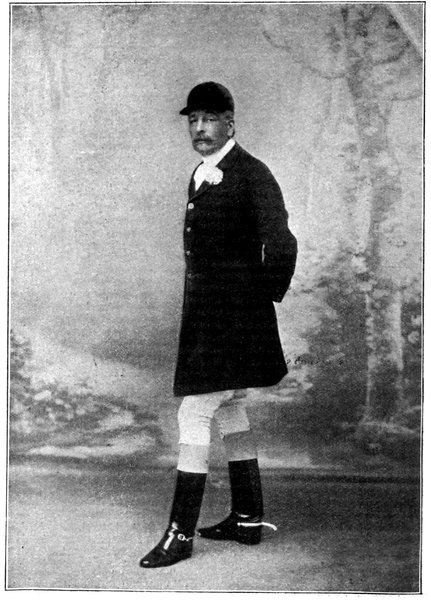
MR. C. HENRY RIDGWAY, Master of the Pau Hunt. Photo by F. P. Subercaze.]
The best of the Oxford freshmen appear to be Messrs. J. H. Gordon and A. C. L. Clarke (Winchester), Lord Somers and H. E. L. Porter (Charterhouse), H. K. Gould and V. Eberle (Clifton), C. Hurst (Uppingham), G. C. Barnardo (Repton), O. H. C. Dunell (Eton), R. O. Morris (Harrow), E. B. Carpenter (Winchester), and H. A. Gilbert (Charterhouse). One or two above-average bowlers are included. Of the Cambridge “freshers,” Messrs. J. N. Buchanan (Charterhouse), K. G. Macleod (Fettes), N. S. Cornelius (Malvern), H. Hosken (Leys), and J. Reunert (Harrow), boast splendid public school credentials. For the rest, about the best appear to be Messrs. J. H. Wakefield (Repton), E. Hoffmeister (Brighton), H. W. Priestley (Uppingham), and H. P. Webb (of the same school). The trial matches commence simultaneously with this month’s issue of Baily, and the outcome means a good deal to Oxford. On paper form at least the Light Blues have a decided pull this year. Capital fixture lists have been arranged both ways. Oxford play home matches against the Gentlemen of England, Lancashire, Yorkshire, the M.C.C., and the Free Foresters, and foreign matches against Sussex, the M.C.C., Worcestershire, and Surrey. The Cantab’s home fixtures are v. Yorkshire, Northamptonshire, Surrey, the Gentlemen of England, Middlesex, Gloucestershire, and their foreign fixtures v. the Gentlemen of England, Sussex, Surrey, the M.C.C., and Liverpool and District (after the Inter-’Varsity match). Another period of all-round, fast and furious, is thus assured at the Sister Universities. Later on I shall have something to say of the results.
W. C. P. F.
Foxhunting in France.
Mr. C. HENRY RIDGWAY, MASTER OF THE PAU HUNT.
One is apt to associate the noble science of foxhunting with the United Kingdom alone, and certainly to partake of this most fascinating sport in its perfection the United Kingdom must be visited. But foxhunting, good, bad, and indifferent, is to be found in many quarters of the wide world. A “Gib.” reynard is pursued amongst the rocks and cork trees; in Belgium there is more than one “equipage au reynard”; and in Virginia, Maryland, and other states of the Union foxhunting has flourished for centuries.
In France there are “equipages” innumerable, but the object of their pursuit is the stag, the roedeer, the wild boar, or the hare; and reynard is looked upon as vermin, except in the little far-off corner of the Republic which, till the days of Henri IV., although its sovereign bore the more ambitious (if empty) title of King of Navarre, composed the tiny kingdom of Bearn. Here, with its headquarters at the ancient capital, “La bonne ville de Pau,” foxhunting has flourished for over fifty years, and at the present time is pursued with the greatest vigour and success.
The earliest record of hunting around Pau dates from 1840, when Sir Henry Oxenden brought a pack of foxhounds, and a numerous stud, to the Chateau of Aureilham, near Tarbes, and found active employment in hunting the wild fox for four days a week. Three years after, on Sir Henry’s resignation, Messrs. Cornwall and Standish, then residents at Pau, established kennels at Bordes, not quite half way between Pau and Tarbes, and carried on the sport.
The mastership has, in the course of the long period that has elapsed since the hunt was started by Sir H. Oxenden, passed through many hands, Mr. J. Alcock, Mr. W. G. Tiffany, Mr. J. Stewart, Major Cairns, Mr. T. Burgess, the Earl of Howth, Mr. J. Gordon Bennett, Mr. Frederick Maude, Sir Victor Brook, Baron Le Jeune, Baron D’Este, being amongst those who have presided over affairs. The Mastership is now held by Mr. C. Henry Ridgway, who is in his sixth season, and the unvarying good sport he has shown has seldom been equalled and never surpassed.
Mr. Ridgway, although born in France, is of American parentage. He was educated at Oxford, and for several seasons hunted from Market Harboro. His sixty couple of hounds are all drafts from the best English packs, and his hunters all come from the shires. The whole equipment would do credit to any country, and the sport he has shown has never been equalled. An all-round sportsman, his racing colours have often been to the front on French turf, whilst he is a finished whip, a capital shot, and the captain of the golf club.
The hounds are divided into three packs—the “ladies,” the dog pack, and a mixed pack. All three packs have shown great sport; but for drive, quickness and looks the bitches are unsurpassed. Mr. Ridgway has a guaranteed subscription of 50,000 francs, and hunts always four days a week, and sometimes five days.
In January of this year, at a large complimentary dinner held at the English Club, he was presented by Mr. W. Forbes Morgan, on behalf of the members and subscribers of the Pau Hunt, with a beautiful two-handled Queen Anne Cup, and an address of thanks for the rare sport shown during his Mastership. Pau is fortunate in possessing, in addition to the foxhounds, a good pack of drag hounds, which meets once or twice a week, and which provides a fast gallop for those who prefer this kind of sport. In former years the drag was by far the more popular branch of the sport, but foxhunting has become more and more popular, and the drag has suffered in consequence.
The horn is carried by Walter Smethurst, who has been over ten years as huntsman with the Pau hounds. The fields, after the new year, number fifty and upwards, consisting principally of American and French sportsmen, and there are at least half a dozen ladies who hunt and go well. The number of English who hunt is very limited, although in former years there were a good many members of this nationality.
The Pau country may be said to resemble parts of Ireland, consisting of wide tracts of moorland, and small enclosures, fenced with bank and ditch, the former bearing very often a thick hedgerow, and the latter being very blind, with gorse and briar. In the Oloron Valley, to which the drag goes once or twice a season, stone walls and hedges are met with, and the going is all grass. The Garderes district—about ten or twelve miles from Pau—is a fine open country with clean fences and sound going; and the Auriac, in the other direction—to the east of the Bordeaux high road—is a grand country with high banks that take a deal of doing.
Good hunters can be hired at Pau, and stabling can be easily procured in the town. The Hon. Secretary to the Hunt, Mr. J. Barron, will always supply any information that may be required with regard to hunting in the neighbourhood.
South African Policy of the Marylebone Cricket Ministry.
“England v. South Africa,”
“The Fifth Test Match,”
“An Innings Defeat for England.”
“Mr. Warner, interviewed, said South Africans were undoubtedly the superior side, especially on their own wickets. It was a good thing that they had won the Test matches, as it had given a fillip to the game in South Africa.”—Reuter’s Special Service, April 2nd, 1906.
Mr. Lacey’s Opinion.
In the course of an interview at Lord’s yesterday afternoon (April 2nd) Mr. F. E. Lacey, the M.C.C. Secretary, said (the Star states) in response to an inquiry regarding the reason that the M.C.C. eleven should have been so unaccountably beaten in four of the five Test matches: “Not unaccountable at all. It is a case in which the better side has won.
“There is little doubt that the South Africans have improved wonderfully, but certainly M.C.C. should have done better.
“I believe the chief cause of our defeat has been poor fielding. Then again, such really great batsmen as P. F. Warner and Hayes have not done themselves justice.
“A great many judges of the game attribute the apparent failure of our team to the fact that our men are playing on matting, but I can scarcely agree with them. I have practised a lot on matting wickets, and, judging from my own experience, it should hold no terrors for a really good batsman.
“I can only attribute the defeat of our eleven to inferior play. The fielding has been poor, the bowling only moderate, and the batting, with one or two exceptions, second-rate.
“Of course, it is very difficult to judge when one is sitting in the pavilion at Lord’s and the games are being played in South Africa, so perhaps I may be wrong.
“I am very pleased with the success of Crawford, who is, in my opinion, the finest all-round man on the side.
“It was never intended to send a representative eleven of England, but I thought we had chosen a side quite worthy of upholding the cricket honour of the country. Apparently we were wrong.
“Our defeat cannot do any harm; in fact, it may lead to a lot of good, and if the South Africans visit us in 1907 they should command a great amount of respect from all the first-class counties, as, judging by the improvement in their play, they will give us some good games, and may even be a hard nut to crack for a representative English team.”
These quotations are taken from the columns of the Sportsman, April 3rd, 1906, and to them it is desired most earnestly to invite the attention of those patriots who wish to see English cricket maintain its supremacy. Let one regard for the moment these two gentlemen individually as Mr. F. E. Lacey, Secretary of the Marylebone Club, Prime Minister of Cricket, and Mr. P. F. Warner, captain of English teams sent to play against the Colonies, Colonial Secretary of the Marylebone Club, which up to the present time has, without any Opposition, assumed and carried on the Government of Cricket.
The position in which they find themselves at the time of making these disclosures to the Press is as follows:—
For some years past, since 1888, the cricket associations of South Africa have from time to time invited English cricketers to visit South Africa in order to assist in the development of the game in that country. The team under Mr. Warner’s captaincy is the fifth that has visited South Africa, the preceding ones having been under the private management of, 1888–9, Major Wharton; 1891–2, Mr. W. W. Read; 1895–6, and again in 1898–9, Lord Hawke; and now, 1905–6, under the management of the Marylebone Club, with Mr. P. F. Warner as captain.
Major Wharton’s team was in no sense a powerful one, and included some amateurs of obscure cricket origin; and they lost four matches in the course of their travels. Mr. Read’s team was a strong one, and lost no matches. Lord Hawke lost two matches on his first visit to Africa, but, profiting by this experience, returned in 1899 with an unbeaten record.
An opportunity was afforded to South African cricketers of trying their skill against English cricketers in the summer of 1904, when a team of South Africans came to England to play a comprehensive programme, which included twenty-two first-class matches, against the Counties, ’Varsities, M.C.C., and so on, with a special match, by request, against England at Lord’s. Our visitors were modest, and without suggesting a series of so-called Test matches, asked as a favour that upon one occasion, and that at Lord’s, the headquarters of cricket, they might be allowed to meet the full strength of England in order that they might learn an important lesson in the game of cricket. This match was played in the middle of July, and the Africans brought their best eleven to Lord’s, and gained a decisive victory by 189 runs. But they were unable to exult in their triumph, for the management of the Marylebone Club took so little pride in the team they had selected to represent England that the match was chronicled as “South Africans v. an English Eleven,” and all cricketers know that the words, “An English Eleven,” applied to a team condemn the team in one’s mind before one has read the names. So little enough credit was given to the Africans for winning the one match they had arranged against England at Lord’s; although anyone who, in common with the writer, watched carefully the whole course of the match from start to finish, must have realised that as they played then our visitors might on their day have beaten the pick of England.
The result of that tour worked out: matches played 22, won 10, lost 2, drawn 9, tied 1. The first match they lost was the second of their tour, at Worcester, and of this game “Wisden’s Almanack” says: “The South Africans had all the worst of the luck, as, after holding their own on the first day, they had on the second to bat on a ruined pitch.”
So there was not much disgrace about this defeat. The other match lost was against Kent at Canterbury, where the home team, for some reason or another, always show to advantage. Kent batted first, and we read that: “Helped by the condition of the wicket, which had never been perfect, Blythe was very difficult at the finish.” And so the Africans lost by 104 runs. To an unbiassed observer it would seem that if upon the two occasions when they suffered defeat the Africans had happened to have won the toss, they might well have added a couple of wins to their record instead of losses.
These three matches—namely, the two first-class games lost by the Africans in 1904 and the Test match won by them at Lord’s—have been dwelt upon at some length in order to remind readers that the performances of that team were the performances of fine cricketers, and any intelligent student of the game who saw Mr. Mitchell’s men in the field must have realised that it was no fool’s job to find a team to beat them.
Now let us see what happens afterwards. Affairs settle down after the war in South Africa, and the time arrives when the Colonies are prepared to try their strength against the mother country.
South African cricketers are anxious to receive a visit from an English team, to treat all the members as their guests, and to pay the salaries of the professionals. In a spirit of the most confident loyalty, African cricket places herself in the hands of the Marylebone Club.
Africa is to pay the piper, the Marylebone Club is to call the tune. The tune has been played to its dismal end, and of the five Test matches four have resulted disastrously for soi-disant England, the one win for the M.C.C. team being by a narrow enough margin.
Without committing oneself to any criticism of the composition of the team which was sent under the auspices of the Marylebone Club to Africa to render an account of English cricket, it may be sufficient for present purposes to suggest that if that team had been advertised to play at one of the gate-money carnivals of cricket at Blackpool or Bournemouth, and labelled according to custom “An Eleven of England,” there would probably have been no unseemly rush of trippers hustling for a shilling seat to watch their performances. Yet, according to this contention, what Blackpool would not afford in the way of extravagance, South Africa had to endure to the end.
An endeavour has been made to be very moderate in the premises, and now it is time to turn to the remarks made respectively by Mr. Warner, whom we have styled Chief Secretary for the Colonies, and Mr. Lacey, the Prime Minister of Cricket.
In the hour of disastrous rout and defeat they have been interviewed each “on his own,” separated from one another by thousands of miles. Let us see what they say.
Mr. Warner says “the Africans were undoubtedly the superior side, especially on their own wickets. It was a good thing they had won the Test matches, as it had given a fillip to the game in South Africa.”
So Mr. Warner says it is a good thing that the side styled “England” has lost the matches styled Test matches, for that will give a fillip to cricket in South Africa. One wonders if it will!
It might have seemed obvious that South African cricket “filliped” itself when its representatives swept the field in 1904, and one must bear in mind that the Australians—who, at all events, can always be depended upon to send their best—have met with more than one reverse when they have taken on a South African team. One might ask a good sportsman like Mr. Warner whether it is likely to give a fillip to a good shot to have to give the coup de grace to a wounded hare or to go through the dull routine of killing a low-flying pheasant? Or, perhaps, to get back to his freehold, the popping-crease, to ask him would he prefer to score 128 runs against Africa or against XVIII. of Middleburg.
Mr. Warner is the most courteous of guests and opponents, and can be depended upon to say the right thing upon all occasions, but somewhere at the back of his head one suspects that there lurks the polished idea that it would have been better for African cricket, better for English cricket, and especially better for himself, if he had been enabled to be in the company of the best of English cricketers in this African campaign, and to have firmly asserted the supremacy of the Old Country at our national game.
One or two of our general officers suffered defeat in South Africa a few years ago, but we never heard of any of them exulting in the idea that it was a “good thing, as it had given a fillip to fighting in South Africa.” And we may be sure that Mr. Warner, over this unfortunate tour in Africa, has been throughout as keen as any general officer. But he had not got the men!
Now, what is to be said of “Mr. Lacey’s opinion,” as reported in the Star newspaper, when he consented to be interviewed upon the “unaccountable defeat of the M.C.C. team in four Test matches out of five.” The Secretary of the Marylebone Club is stated to have said, “Not unaccountable at all. It is a case in which the better side has won.”
Later on Mr. Lacey is reported as saying: “It was never intended to send a representative eleven of England, but I thought we had chosen a side quite worthy of upholding the cricket honour of the country. Apparently we were wrong.”
Now here is an important statement. Mr. Lacey seems to imply that he could have sent a more powerful team to South Africa if he or the management of the Club had been able to realise that the Africans, whom they had seen winning at Lord’s in 1904 against their own Eleven of England, were an extremely good side of cricketers.
According to the Star, Mr. Lacey has now no good word for the side of which he says, “I thought we had chosen a side quite worthy of upholding the cricket honour of the country.” He says: “I can only attribute the defeat of our eleven to inferior play. The fielding has been poor, the bowling only moderate, and the batting, with one or two exceptions, second-rate.”
“I believe the chief cause of our defeat has been poor fielding. Then again, such really great batsmen as P. F. Warner and Hayes have not done themselves justice.” Further, he says, “A great many judges of the game attribute the apparent failure of our team to the fact that our men are playing on matting, but I can scarcely agree with them. I have practised a lot on matting wickets, and judging from my own experience, it should hold no terrors for a really good batsman.”
The great want of the team appears to have been a really good batsman, and it seems a thousand pities from the point of view of the cricketing public that Mr. Lacey did not personally conduct this team.
But “All’s well that ends well,” and the final paragraph of the opinion of Mr. Lacey upon South African cricket states that:—
“Our defeat cannot do any harm; in fact, it may lead to a lot of good, and if the South Africans visit us in 1907, they should command a great amount of respect from all the first-class counties” (not yet, even, is the Marylebone Club pledged to extend any more respect to South Africa than was the case in 1904), “as judging by the improvement in their play, the South Africans will give us some good games, and may even be a hard nut to crack for a representative English team.”
Yes! they probably will be all that Mr. Lacey predicts, because, unless we are mistaken, the South African team so long ago as 1904 came up to that form, and it would have been as well if Mr. Lacey and those who assist him in the management of the Marylebone Club had realised this obvious fact a few months ago, before they organised this Majuba of cricket which has caused so much disappointment to cricketers in the two hemispheres.
Mr. Lacey and Mr. Warner are agreed that “the better side has won.”
Cricketers are almost entitled, respectfully, to ask upon this point whether a better team could have been sent by the M.C.C. than this team which Mr. Lacey now runs down. And if the answer to this be in the affirmative, then the next question is, why was not a better team sent to represent England?
The Africans asked to meet the strength of England, and they have handsomely beaten the team put into the field against them. They have performed their part of the bargain, and it seems almost ungenerous of the Secretary of the Marylebone Club to assume this air of patronage and to talk of the South African team as if they were a lot of schoolboys undergoing an Easter course of coaching on the matting practice wickets at Lord’s.
A result of this unfortunate business is that the Africans are already knocking at the gate again, and we are informed that immediately at the conclusion of the tour a cable was despatched asking that a South African team should be received in England in 1907 on the same lines as an Australian team, which appears to signify a programme including five test matches, which may mean, according to Mr. Lacey, five hard nuts “to crack for a representative English team.” But why not have sent the nut-crackers to South Africa first?
Cricketer.
Some Fables on Horses.
Probably, for research and widely diffused knowledge, spread over a long and laborious life, the work of that celebrated octogenarian, Dr. Cobham Brewer, who, at the age of eighty-five, brought out his new edition of “Phrase and Fable,” is, to my thinking, unique in its way, teeming as it does with interest to every class of both reader and writer.
As a sportsman, it appeals to me in many a page, and in culling a few tit-bits from it I may help to enlighten and enliven your readers on things not generally known.
Longchamps is, as we know, to-day, the scene of one of the most fashionable French racecourses, yet history tells us that every Wednesday, Thursday and Friday in Passion week, the Parisians went there in procession in private carriages and hired cabs, all the smartly dressed men and women who wished to display their spring fashions. The origin of the custom being that there was once a famous nunnery there, noted for its singing. In Passion week all who could went to hear these religious women sing the Psalms. This custom grew into a fashion, although the nunnery no longer exists, the procession is as fashionable as ever, and so is the racecourse.
Lose the horse and win the saddle. A man made a bet of a horse that another could not say the Lord’s Prayer without a wandering thought. The bet was accepted, but before half-way through, the person accepting the bet looked up and said, “By the bye, do you mean the saddle also?”
A horse is worthy of especial notice here. A good horse is said to have fifteen points. He should have three properties of a man, three of a woman, three of a fox, three of a hare, and three of an ass—of a man, bold, proud, and hardy—of a woman, fair-breasted, fair-haired, and easy of movement—of a fox, a good tail, short ears, with a good trot—of a hare, large eyes, a dry head, and good running—of an ass, a big chin, flat legs, and a good hoof.
Neptune is supposed to have created the horse. When Athene, the goddess of wisdom, contended with Neptune as to which should give the name to Athens, the gods decided that it should be called by the name of that deity which bestowed on men the most useful boon. Athene created the olive tree, and Neptune created the horse. The vote was given in favour of the olive tree, and the city was called Athens.
The first person that drove a four-in-hand was, Virgil tells us, Ericthonius.
On the death of Smerdis, King of Persia, the competitors for the throne agreed that he should be king whose horse neighed first when they met the day following. The groom of Darius showed his horse a mare on the day appointed, and immediately it arrived at the spot on the following day the horse began to neigh, and won the crown for its master.
A horse in the catacombs was an emblem of the swiftness of life.
In Christian life the horse is the emblem of courage and generosity.
The horses of Diomed, Tyrant of Thrace, were flesh-eaters, and were fed on the strangers who visited his kingdom. Hercules vanquished the tyrant, and gave his carcase to the horses to eat.
In the British Army we have Elliot’s Light Horse, Paget’s Irregular Horse, The Black Horse, The Blue Horse, The Green Horse, The Royal Horse Guards, and The White Horse, as applied to particular regiments.
Both in mythology and history we have a multitude of celebrated steeds. Thus:—
Akabar.—A hot one. Was one of the horses of Sunna.
Abaster.—Away from the stars—belonged to Pluto.
Abraxus.—Was one of the horses of Aurora.
Actæon.—Effulgent, was one of the horses of the sun.
Æthon.—Fiery red. Was another horse of the sun.
Acton.—Swift as an eagle. Was a horse of Pluto’s.
Aligero Clavileno.—The wooden pin-winged horse on which Don Quixote mounted to effect the deliverance of Trifaldi and her companions.
Amathea.—No loiterer. Was one of the horses of the sun.
Aquiline.—Like an eagle. Raymond’s steed, bred on the banks of the Tagus.
Arion.—War horse. Hercules’ horse, given to Adrastos. Brought out of the earth by Neptune with his tridents. Its right feet were those of a human being; it spoke with a human voice, and ran with incredible swiftness.
Arundal.—Swift as a swallow. The horse of Bevis of Southampton.
Babicca.—The simpleton. The Cids’ horse. He survived his master two and half years, during which time nobody was allowed to mount him, and he was buried before the gates of the Monastery of Valencia, and two elm trees were planted to mark the spot. This horse’s name arose because Roderigo in his youth was given the choice of a horse by his god-father, and chose a rough colt, and his donor called him Babicca, a fool, for doing so, but Roderigo transferred the name to his gift horse.
Barjado was Ronaldo’s horse, of bay colour, once the property of Amadis of Gaul. He was found in a cave guarded by a dragon, which the wizard slew. He is said to be still alive, but flies at the approach of man, and no one can hope to catch him.
Babico.—Swift, like Zanthos, his sire was the West Wind, and his dam Swiftfoot the harpy, and was given by Neptune to Peleus.
Bayard.—A bright bay. He belonged to the four sons of Aymon, and grew larger or smaller as one of these four mounted him.
Bevis.—The swift. The horse of Lord Marmion.
Black Agnes.—Belonging to Mary Queen of Scots, given her by her brother Moray, and named after Agnes of Dunbar.
Black Saladin.—Warwick’s famous horse. Coal black. His sire was Malek, and it was said of him that when the race of Malek failed the race of Warwick would fail also, and so it came to pass.
Borak.—The lightning. The horse that conveyed Mahomet from earth to the seventh heaven. He was milk white, had the wings of an eagle, and a human face with a horse’s cheeks. Every pace he took was equal to the furthest range of human sight.
Brigliadoro.—Golden bridle. Orlando’s famous charger, second only in swiftness and wonderful powers to Bayardo.
Bronte.—Thunder. A horse of the sun.
Brown Hal.—A model pacing stallion.
Bucephalus.—Ox-head. The celebrated charger of Alexander the Great, who was the only person that could mount him, and he always knelt down to receive his master. He was thirty years old when he died, and Alexander built a city as a mausoleum, which he called Bucephala.
Capilet.—A grey horse of Sir Andrew Aguecheek, spoken of in Shakespeare’s “Twelfth Night.” A capilet signifies a small wen on a horse’s neck.
Celer.—Swift. The horse of the Roman Emperor Verus, that was fed on almonds and raisins, covered with purple, and stalled in the Imperial palace.
Cæsar.—A model Percheron stallion.
Copenhagen.—The Duke of Wellington’s charger that he rode at Waterloo. Napoleon’s favourite charger was called Marengo, and was represented in the famous picture by Vernet of Napoleon crossing the Alps. His remains are now in the United Service Museum in London.
Cyllaros.—Named from Cylla in Troas, a celebrated horse of Castor and Pollux.
Dinos.—The Marvel. Was Diomed’s horse.
Doomstead.—Was the horse of the Fates.
Ethon.—Fiery. Was one of the horses of Hestor.
Fadda.—Was Mahomet’s white mule.
Fiddleback.—Was Oliver Goldsmith’s unfortunate pony.
Galathé.—Cream coloured. Was a horse of Hector’s.
Grané.—Grey coloured. Was Seigfried’s horse of marvellous swiftness.
Grizzle.—Grey coloured. Was the skin-and-bone animal that carried Dr. Syntax.
Haizum.—Was the horse of the Archangel Gabriel.
Harpagos.—A rapid carrier. One of the horses of Castor and Pollux.
Hippocompés.—A horse of Neptune that had only two legs, his hindquarters being a dragon’s tail.
Incitatus.—The Roman Emperor Caligula’s horse, which he made a priest and a consul. Its manger was of ivory, and it drank out of a golden pail.
Jenny Geddes.—Was Robert Burn’s mare.
Kantaka.—The white horse of Science.
Ganhama of India.—Mentioned by Budda.
Kelpie.—The colour of seaweed. The water horse of fairy mythology.
Lampos.—Shining like a lamp. One of the horses of the Sun.
Lamri.—The curvetter. King Arthur’s mare.
Morocco.—Bank’s famous horse. Its shoes were of silver, and one of its exploits was to mount the steeple of St. Paul’s.
Molly.—Sir Charles Napier’s mare that died at the age of 35 years.
Orelia.—The charger of Roderick, the last of the Goths. Noted for its speed and symmetry.
Pale Horse.—On which Death rides.
Pegasos.—Born near the source of the ocean. The winged horse of Apollo that Perseus rode when he rescued Andromeda.
Phæton.—The shining one. A steed of Aurora.
Phlegon.—The blazing one. One of the horses of the mid-day sun.
Phrenicos.—Intelligent. The horse of Hiero of Syracuse that was the winner of the Olympic prize for single horses in the seventy-third olympiad.
Rubicon.—With a dark tail and some white hairs. Astolpho’s horse in Orlando Furioso. Its dam was Fire, and its sire Wind, and it fed on unearthly food.
Ronald.—Was Lord Cardigan’s thoroughbred chestnut horse, with white stockings on the near fore and hind feet, that carried him through the charge at Balaclava.
Rosabelle.—Mary Queen of Scots’ favourite palfrey.
Rosignol.—Was the palfrey of Madame Ghatalet, of Crecy, the lady with whom Voltaire resided for ten years.
Shinfaxe.—Shining mane. The steed which draws the car of day.
Sleipnor.—Odin’s grey horse, that had eight legs, and could traverse either land or sea. He typifies the wind, which blows over land and water from eight principal points.
Sorrel.—The horse of William the Third, that used to catch his foot in a mole-trap, and ultimately caused his death. He was blind of one eye and mean of stature. Is ill-fitted to carry a king.
Strymon.—Named from the River Strymon in Thrace, and immolated by Zerxes before he invaded Greece.
Vegliantino.—The famous steed of Orlando, meaning “the little vigilant one.”
Zanthos.—The chestnut coloured. One of the horses of Achilles that announced his approaching death when unjustly chidden by him.
O’Donoghue’s White Horse.—Denotes the waves, which come on a windy day, crested with foam. The spirit of the hero appears every May-day, and glides to sweet yet unearthly music over the lakes of Killarney on his white horse, preceded by groups of young men and maidens, flinging spring flowers in his path.
We have the phrases: “A dark horse”—one whose merits are unknown. “Flogging a dead horse.” “Riding the wooden horse”—a military punishment, a sort of flogging stool, now abolished. “I will win the horse or lose the saddle”—neck or nothing.
“They cannot set horses together.” That is, they cannot agree.
“The Trojan horse” is a deception, a hidden danger.
“It is a good horse that never stumbles.” Every one has his faults.
“To get upon his high horse.” To give one’s self airs.
“To set the cart before the horse.” To reverse the right order of things.
“When the horse is stolen lock the stable door.”
“Working on a dead horse.” Doing work which has already been paid for.
I could continue to play on this horsey fiddle almost ad infinitum, thanks to old Dr. Brewer, who very clearly illustrates how from the most ancient days the horse came to the forefront in mythology, history, poetry, and romance. The one quadruped created for the benefit of man, and honoured with the first place from the earliest ages in man’s affections. Notwithstanding the fact that in these last days man has devised sundry inventions aimed at his dethronement, such as steam and motor power, let us hope that he may long survive those machinations.
In the illustrious days of Roman greatness it is worthy of note that the horse was promoted almost to divine worship, as, indeed, he had been in Grecian mythology. The Emperor Caligula made him a priest and a consul. We have come to regard horses as of some value, when we are not afraid of appraising one of them at nearly £40,000, and selling our casts off at £20,000 and upwards.
The fables which I have ventured to string together here may have their transient interest, and help owners of racehorses with a few appropriate names for their best. This will aid to prove the truth of their worth, and show that although the world has grown older, and the age of romance and love of mythology has passed away, the horse in all his beauty and perfection is with us still, and we trust that he ever will be so.
Borderer.
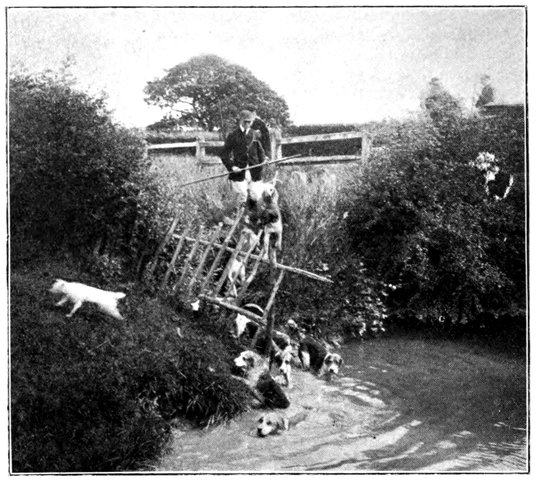
HOT ON THE TRAIL.
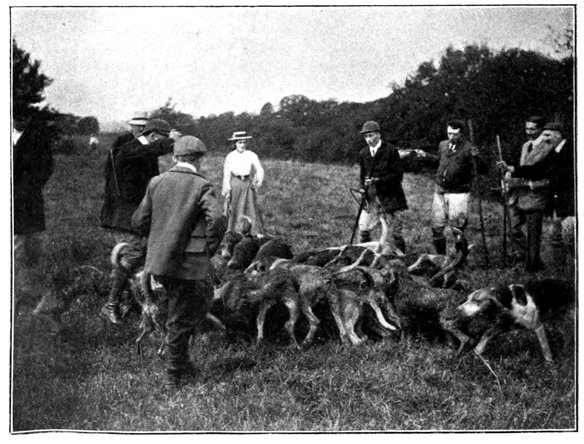
THE WORRY. Photos by T. C. Bristow Noble.]
The Advent of the Otter-hunting Season.
Never, perhaps, was otter-hunting more popular than it is to-day, though it is one of the oldest sports in existence. Even as far back as the reign of King John otters were hunted with hounds throughout the summer months. But until comparatively late years the sport seems to have always been that of the few rather than, as now, that of the many. In a great measure it owes its increasing popularity to the more generous spirit that happily now prevails among sportsmen.
The member of the angling society and the owner of the private fishery are no longer at war with the interesting little quarry, that is, on those rivers which are visited by otterhounds, and on many that are not. Indeed, it is more than probable that in a few years’ time it will be considered as discreditable an action for a private person to shoot or otherwise destroy an otter, as it is to secretly kill a fox in the Midlands. During the season that is slowly commencing there will be twenty-four packs of otterhounds hunting in the United Kingdom, as was the case last year. The first meet took place on April 6th, when the Essex Otterhounds, which Mr. L. Rose still continues to hunt, met at Witham Station.
This was an early start indeed. The water must have been very cold, and the hounds in consequence could have shown no great keenness. The truth is, April is too early a month in which to make a commencement. It is wiser by far to wait till about the middle of May before bringing the hounds from their kennels. By this time the countryside is putting on her most resplendent mantle, the water is growing warm at last, and followers and hounds alike can thoroughly enjoy the sport.
It is not a sport that only the rich can indulge in. Almost any and everybody can afford to follow it, whilst rarely has the agriculturist occasion to complain of damage being done to either his crops or fences by the followers. It is gratifying to notice that masters are determined to put a stop to the increasing practice of riding to otterhounds. Apart from it being quite unnecessary to be mounted, horse people are often a danger and always a nuisance among the legitimate following.
There is, moreover, a growing inclination to utilise the rough-coated hound to a greater extent than hitherto. But one of the most pleasant features of modern otter-hunting is the large number of ladies that follow and subscribe to the various packs, coupled with which must be the fact that there are now two lady “masters”—Mrs. Walter Cheesman, the Master of Crowhurst Otterhounds, and Lady Mary Hamilton, who owns the Hamilton pack, which, as we write, was given to her a few days ago by Mr. R. Carnaby Forster.
The two photographs that we reproduce herewith were taken during a recent run and kill with Mrs. Cheesman’s hounds.
A Hundred Years Ago.
(FROM THE SPORTING MAGAZINE OF 1806.)
Cockings. Royal Pit, Westminster. Monday, April 15th.—The grand main of cocks, between the Hon. George Germaine (Potter, feeder) and Mr. Wilson (Lester, feeder), consisting of twenty-seven main and twenty byes, commenced fighting. The following is a statement:—
Lester M. B. Potter M. B.
Monday 3 3 1 0
Tuesday 2 4 2 0
Wednesday 1 0 3 4
Thursday 3 0 2 3
Friday 2 1 3 1
Saturday 4 1 1 1
15 9 12 9
Setters.—Walters for Mr. Wilson and young Potter for Mr. Germaine.
Before fighting, 11 to 8 on Potter; after Monday’s fight, 6 to 4 on Lester; after Tuesday’s fight 7 to 4 on Lester; after Wednesday’s fight, 11 to 8 on Potter; after Thursday’s fight, 12 to 10 on Lester; after Friday’s fight, even betting.
The whole of the fighting was remarkably good, and did much credit to both the feeders and setters.
In the short space of two hours in the afternoon of the 19th ult. [March] Mr. Isaac Pearson, of Poolbank, near Kendal, killed ten woodcocks at eleven shots on the woody grounds at Whitbarrow.
The following curious circumstance happened on Monday, the 17th ult. The Allendale Foxhounds pursued a fox for some time on Staward banks and the grounds adjacent, until at last poor reynard was under the necessity of taking shelter in the crags; and the sportsmen, with greatest difficulty, opened the hole and secured their prey, which, upon examination, was found to be a large bitch-fox. She was taken to Bishopfield, where, to the great surprise of the keeper, on the Thursday following, she brought forth six fine young cubs, which are at this time with the mother, and are all likely to live.
Home Circuit.—Brown v. Boxall. At Kingston, March 27th, this action was brought against the defendant for having in his possession a tunnel net for catching partridges, contrary to the statute of Queen Anne. The fact of finding the net at the defendant’s house was proved by one of the Duke of York’s gamekeepers. The net was produced, and it appeared to have been recently used, as a great many partridges’ feathers were sticking to it. No defence was made, and the plaintiff had a verdict for the penalty of five pounds.
Otter-hunting.—On Thursday, April 24th, the hounds of Andrew Corbet, Esq., of Acton Reynald, in the county of Salop, threw off at Ternhill, and, opposite Fordall, hit on a drag which led them to a covered drain between the two pools at Buntings-dale, from which an otter was immediately bolted into the lower pool, where he showed excellent sport for forty minutes, and was killed in high style. On Friday, the same hounds resumed the sport, throwing off at Brook’s Mill, near Combermere, in Cheshire, where they were again successful in finding and killing a large dog otter. On Saturday, this famous pack threw off at Norton, above Drayton, and came down water to Peetswood pools, where they found a remarkable large otter, weighing 23 lbs., which was speared by Mr. Davies, after a chase of two hours.
The Sportsman’s Library.
The latest addition to the popular “Fur, Feather and Fin Series” of monographs is Mr. T. F. Dale’s contribution on the fox.[14] A most entertaining volume he has put together, for he combines practical knowledge with much reading; and the preparation of the work has evidently been a labour of love. There is not a phase of interest relating to the fox upon which the author has not touched, from the secrets of the animal’s normal life to the part he plays in fable and legend. He opens his first chapter with the apt remark that “the survival of the fox is the most notable fact in his natural history”; and of the British fox this is especially true: it was Ralph Holinshed, if we mistake not, who in Queen Elizabeth’s time offered the explanation of the fox’s survival in the suggestion that he must long ere then have been exterminated but for the indulgence shown him by the farming classes out of goodwill to the sporting tastes of their landlords. In course of his remarks on the species and varieties of foxes the author touches upon the disputed question of fox-dog hybrids, and clearly leans to the belief that such crosses do occur under favourable circumstances. He will have the weight of expert opinion with him in his observations on scent. It is, we think, generally accepted as a fact that the scent of individual foxes differs, at least in degree; but is it certain that Asiatic foxes leave no scent? We may grant that absence of this quality would be of distinct advantage to a weak animal in countries where beasts of prey occur; but does not scent confer an advantage on the owner as well as a disadvantage? We should be inclined to think that the heat of the sun was largely accountable for the lack of scent noticeable in Indian foxes.
Mr. Dale puts forward a theory to account for the preference often shown by the breeding vixen for a badger’s cete which commends itself; he suggests that the presence of the badger offers a measure of protection against the invasion of terriers—an advantage which perhaps would be fully appreciated by an animal so intelligent as the fox. True, not every badger has a welcome for the fox which takes up its quarters in the cete, as witness the cubs killed by badgers, after the method which makes the cause of death unmistakable; but we must allow for the varying temperament and disposition of individual members of any given species.
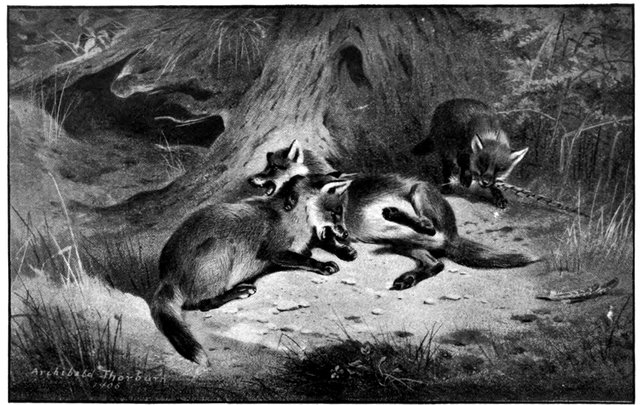
“WHEN ALL IS QUIET.” From “The Fox”: “Fur, Feather and Fin” Series. (By permission of the Publishers.)
An excellent and suggestive chapter is that on the “Education of the Fox,” and one that greatly tempts us to quotation; one remark only we reproduce, however, for the benefit of the soft-hearted people who see nothing but “cruelty” in foxhunting: “Hunting is his life: being hunted, but an episode.” There is the whole history of fox-life in a sentence. Early in the next chapter, on “The Mind of the Fox,” however, Mr. Dale hazards the conjecture that “it is not certain that he (the fox) is in reality more intelligent than other wild animals.” Flat treason this, Mr. Dale! Does not nearly every page of this most readable and thoughtful book of yours plead for a verdict in the contrary sense? We grant the cunning of hunted deer and hare, we accept their wiles as proof of high intelligence; but we cannot have it that the fox, the most assiduous of hunters and the most assiduously hunted, does not excel these in sagacity and resource. We would base our contention on the principle that a beast of prey which owes his existence to his skill and talent for circumventing other wild creatures, must of necessity develop higher mental faculties, more acute reasoning powers, if you will, than one which finds food ever ready to his mouth; and we would urge that your own wide knowledge of fox habit and wile fully justify your subsequent observation that the “intelligence which is necessary for the survival of the race is very marked.”
When he comes to such matters as fox preservation and the home and haunts of the fox, the author of necessity is on much trodden ground, but nevertheless he has the art of putting familiar facts in a new and entertaining form. Incidentally it may be noted that the old-time method of dragging up to the fox’s kennel is still followed by the Fell packs as well as on Exmoor. Those who know not the coastline of Somerset and Devon will find much to interest them in the author’s remarks on the cliff-haunting foxes and the difficulties of killing them; but Mr. Dale does not believe that foxes which settle in a covert inland ever, of their own will, return to the cliffs. This, we imagine, is highly probable; the advantages of covert life appear to compare more than favourably with those of a cliff existence.
In the chapter on “The Hunted Fox” we again naturally encounter the question of fox intelligence, and here we find ourselves in complete accord with our author. “If there were none but clever foxes we should soon give up hunting; if there were none but simple ones we should soon have no more foxes to hunt. The variability of the fox (as regards his intelligence) is an advantage to the race and to the sport.”
The suggestion that one cause of the degeneracy of foxes is that more of the straight-running (i.e., simple-minded) are killed than of the cunning foxes which use their wits to beat hounds, deserves notice. The dodging fox lives longer to reproduce his kind, endued with his qualities of cunning and wile.
When considering the “Fox as Outlaw,” Mr. Dale gives some very interesting figures relating to expenditure on hunting. He calculates that in a certain country the money spent by the master and members of the hunt on horses, hounds, food, and wages, represents £36 per head spent on each fox killed. It would not be difficult to prove the expenditure much larger, but the argument will serve as it stands. Passing over the “Fox in Fable”—proof, surely, of the superiority of wisdom attributed to the fox from very early times—and a very interesting chapter on jackal-hunting in India, we have a few pages on what we may call the economic aspects of the fox, as represented by the pelts of his foreign relatives. The work concludes with a chapter on the congenial topic of hunting. The ethical view of the matter is boldly faced, and the gist of the case is simply that foxes must be killed, and if not fairly killed by hounds, would meet their fate in some other way, probably more painful. The fox fulfils his mission in this country as a medium for the distribution of cash where it is most wanted, and as a source of pleasure; and all hunting men will heartily agree with the writer of this charming book when he says that “hardly any animal has, in the long history of its race, been of more importance in the literature and life of man, or is more interesting as a study of animal life and mind.” Mr. Archibald Thorburn’s drawings are most admirable.
Polo in 1906.
The polo season of 1906 commenced at Rugby and Leamington early in April, and has been continued up to the time of writing in the most glorious weather, which reminds one more of the middle of June than the beginning of April; it is only to be hoped that we shall not have to pay for it later on. Warwickshire seems to start polo before the other clubs, and in greater numbers than any other county; on April 9, there were 17 players at Rugby and 16 at Leamington.
The prospects of the London season never were brighter, and the only difficulty for polo managers will be to satisfy their clients with the number of matches that they are able to allot them, provided only the weather is favourable.
The great difficulty for polo players, who have not already mounted themselves for the season, will be to supply themselves with handy, easy ponies that they can play on; for I think it will be found more than ever this year that the supply is not equal to the demand.
The great increase in the all-round demand for good ponies and the improvement of polo in England is, I think, due in a large measure to the number of civilian teams that have been started in London during the last few years; it is not only due to the fact that the players in these teams improve their own play through playing constantly with the same men against other good teams, but after playing in a team they are never again satisfied with members’ game polo, and they go away to their county clubs and teach these what they have themselves learnt in London, to the all-round betterment and benefit of the game.
I append a list of the probable civilian combinations this season, in addition to which there will be teams representing Worcester Park, the Crystal Palace, and Kingsbury, and probably Hatfield and Essex.
American Freebooters.
I. Bell, J. I. Blair, R. J. Collier, F. J. Mackey.
Beavers.
W. Roylance Court, Capt. Phipps Hornby, A. M. Tree, F. Barbour.
Eden Park.
H. Bucknall, F. Rich, P. Bucknall, P. Bullivant (F. C. Nash, Secretary).
Ireland.
A. Rotherham, S. Watt, P. O’Reilly, C. O’Hara.
Magpies.
C. Grenfell, R. Grenfell, Capt. Gosling, Duke of Roxburgbe, Duke of Westminster, Capt. Long, F. Bellville.
Moonlighters.
J. Pearce, N. Baring, J. B. Dale, J. Lawson.
Moreton Morrell.
C. Garland, Lord Wodehouse, I. Bell, W. S. Buckmaster, C. P. Nickalls.
Parthians.
Capt. F. W. Barrett, Lord Kensington, Capt. Mathew Lassowe, Capt. C. Hunter, W. B. Burdon, G. R. Powell.
Roehampton.
M. Nickalls, C. P. Nickalls, Capt. H. Wilson, Capt. H. Lloyd, P. W. Nickalls.
Rugby.
Lord Shrewsbury, Walter Jones, G. A. Miller, C. D. Miller, Capt. E. D. Miller.
Tiverton.
M. de Las Casas, J. C. de Las Casas, L. de Las Casas, A. de Las Casas.
Ranelagh.
Capt. H. Jenner, Hon. A. Hastings, Capt. de Crespigny, Capt. Hon. F. Guest, F. A. Gill.
Rokeby.
Capt. Dunbar, Capt. A. Harman, Capt. Lee, Comte J. de Madre.
Three of the best of the London players will be much missed this season. Mr. F. M. Freake has temporarily retired from the game, and Captain Heseltine has joined his regiment in India, which has caused Mr. Buckmaster to abandon the attempt to produce an old Cantab team. They will be much missed in London, as they were a very fine team, and for the last eight years have always been either runners up or winners of the Champion Cup.
Another great loss to London polo will be Mr. U. O. Thynne, who has decided to give up the game for a time. He has run the Magpie team for a number of years, and his place will be hard to fill.
The great attraction of the London season will be the visit of the Irish team, who distinguished themselves so much last autumn by winning the Irish Open Cup and the International match in Dublin. They are engaged to play exhibition matches at Roehampton, on June 9th and 13th, against Rugby and Roehampton, and on June 6th at Hurlingham. The International match, England v. Ireland, will take place at Hurlington on June 16th, and the team is also expected to play in the Champion Cup.
As regards regimental polo prospects are fairly bright, but some of the regiments labour under great disadvantages.
The 7th Hussars are at Ipswich, and find themselves without a ground to play on; they have, however, one squadron at Weedon, where they can get plenty of play, and though they have only just come home they have every intention of producing a useful team at the Tournament. The 7th Hussars, like the 9th Lancers, no matter how the regiment changes, are always formidable. The 9th has just proved the truth of this in India, by defeating the hitherto (for four years) invincible 15th. Indeed, their most formidable opponents turned out to be the 17th, of whom the same may be said as of the 7th and 9th.
The Inniskillings will probably be without the invaluable services of Major Haig, who has had a serious illness, but is, I am glad to say, on the high road to recovery.
The 20th Hussars will probably lose Captain Lee, whose broken leg has taken a very long time to mend, and he is not in the saddle yet.
The 8th Hussars had some very good players last year, and the transfer of Major Wormald from the 7th should strengthen them and enable them to produce a really good team.
The 11th Hussars were so near the Inniskillings last year that with very slight improvement they should prove themselves dangerous competitors for any regiment.
The Household regiments will be represented probably by much the same teams, except that the Blues may find themselves stronger by the inclusion of Lord A. Innes Kerr, who has joined them from the Royals. In fact, the prospects of a most interesting Regimental Tournament are of the best.
The Champion Cup is sure to produce a good contest with such teams as Roehampton, Ireland, Rugby, Ranelagh, and Moreton Morrell competing for it, and the County Cup should be very even between Rugby (last year’s winners), Cirencester, Eden Park, and the best of the Yorkshire clubs.
I append a list of the tournaments that will probably take place, with the dates.
TOURNAMENTS, 1906.
April 16–21 Warwickshire (Leamington) Spring Tournament.
April 23–28 Eden Park Members’ Tournament.
May 2–5 Ranelagh Handicap Tournament.
May 7–11 Roehampton Handicap Tournament.
May 7-11 Eden Park Open Tournament (Tues. to Sat.).
May 14–19 Ranelagh Hunt Cup.
May 21–26 Roehampton Public Schools’ Cup.
May 28–June 2 Hurlingham Social Clubs’ Tournament.
May 28–June 2 Middlewood County Cup Northern Ties (Tues. to Sat.), and Handicap Tournament.
June 4–9 Ranelagh Army Cup.
June 4–9 Paris International Tournament.
June 18–23 Hurlingham Champion Cup.
June 18–23 Ranelagh Novices’ Cup.
June 25–30 Ranelagh Open Cup.
June 25–30 Roehampton Junior Championship.
June 25–30 Hurlingham University Match (Mon.).
July 2–7 Hurlingham Inter-Regimental Tournament (semi-finals, Wed. and Thurs.; Final, Sat.).
July 2–7 Roehampton Cup.
July 9–14 Hurlingham County Cup (semi-finals, Wed. and Thurs.; final, Sat.).
July 9–14 Ranelagh Subalterns’ Cup.
July 9–14 Roehampton Ladies’ Nomination Tournament.
July 9–14 Otter Vale North Devon Tournament.
July 9–14 Ostend Tournaments commence.
July 16–21 Hurlingham Handicap Tournament.
July 16–21 Ranelagh Hunt Tournament.
July 16–21 Blackmore Vale Junior Championship.
July 16–21 Ostend Tournaments continued.
July 24–29 Stratford-on-Avon Tournament.
July 24–29 Blackmore Vale Country Clubs’ Junior Championship.
July 24–29 Co. Westmeath Tournament.
July 24–29 Ostend Prix des Dames.
July 30–Aug. 4 Warwickshire Tournament.
July 30–Aug. 4 Eden Park Invitation Tournament.
Aug. 6–11 Rugby Tournament.
Aug. 6–11 York Hunt Tournament.
Aug. 6–11 Co. Wexford American Tournament (probably Thurs. to Sat.).
Aug. 13–18 Cirencester Tournament.
Aug. 13–18 Eaton, Chester Tournament.
Aug. 13–18 All Ireland County Cup.
Aug. 13–18 Deauville International Tournament (probably).
Aug. 20–25 Blackmore Vale Tournament.
Aug. 20–25 Catterick Bridge Open Handicap Tournament.
Aug. 20–25 All Ireland County Cup.
Aug. 27–Sept. 1 North Wilts Tournament
Aug. 27–Sept. 1 All Ireland Open Tournament.
Sept. 4–9 All Ireland Regimental Tournament.
Sept. 17–22 Rugby Autumn Tournament.
Oct. 1–6 Rugby October Handicap Tournament.
E. D. Miller.
“Our Van.”
RACING.
With quite a flourish of trumpets the flat-racing season began simultaneously with the going out of steeplechasing. I do not hesitate to attribute this to the weather, which was exceptionally fine for the first week of flat racing. It can be, and usually is, exceedingly bitter at Lincoln; and those who grumbled at the wind either had no previous experiences to fall back upon, or were troubled with poor memories. The Carholme has so bleak a situation that we are bound to catch any wind there is, and, unfortunately, at this season of the year it blows either into or along the enclosures. There is a meeting between North and South owners and trainers, and the special train from London on the first day bore with it quite as many well-known figures on the Turf as one expects. Amongst them was our amateur owner-jockey—a description which differentiates decidedly from jockey-owner—Mr. George Thursby, not long returned from a winter sojourn in Jamaica. The climate there is so conducive to indolence that Mr. Thursby found himself 19 lb. over weight, 10 lb. of which was got rid of on the way home by the drastic method of assisting the stokers. The keen racing brigade was well represented, and it is as well that the persevering army of backers should be so, for we cannot too soon begin taking notes for future use against the bookmakers. The greatest enthusiasm was aroused by the Batthyany Stakes, in which Rising Falcon, last year’s winner under 9 st., was trying again with 9 lb. more. Even under this burden he started joint favourite with Canty Bay, the fact that he was ridden as usual by Madden, thus making a pair that well understood one another, not being without influence. As matters turned out Madden was wanted. He did not hesitate to push Rising Falcon for all he was worth, and his winning was not in doubt until he was within a hundred yards of the post. There Golden Gleam and Early Bird drew upon him so rapidly that he was all but caught, for he had a short head only to spare from Golden Gleam when he passed the post. The next two, Early Bird and Golden Coin, were also separated by short heads, so the finish may be imagined. Madden came in for quite an ovation, and was actually seen to smile.
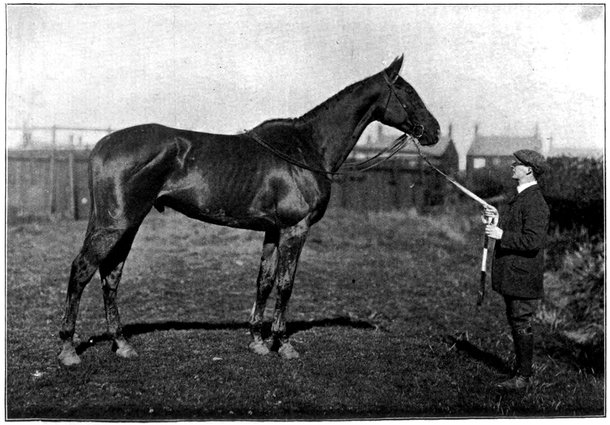
ASCETIC’S SILVER. Photo by W. A. Kouch and Co.]
The Lincolnshire Handicap day, upon which the pecuniary success of the meeting mainly depends, was very disappointing to the executive, the attendance being quite poor for the occasion. The field, which consisted of twenty-four, has been described as a poor one for quality, but it seemed to me to strike the average. We cannot have a Bendigo or a Clorane every year; as a matter of detail, a horse of this class appears about once every ten years. According to the papers, certain horses were at the top of the betting quotations, but as a visit to the leading club five days previous to the race revealed precisely three bookmakers, representing only two firms, seated at the fire, it is probable that the volume of betting was not great. There was some on the day of the race, however; and in these days of degenerate wagering it was interesting to learn that one layer stood £30,000 against M. Ephrussi’s Ob. It was not difficult to lay that amount, for the lowest price at which the French horse was quoted was 20 to 1, plenty of smaller money being got on at 25 to 1. Ob had won three races in France under good weights as a four-year-old; but probably his failure to make any show in last year’s City and Suburban made the greater impression. The English money was chiefly for Roseate Dawn, upon whom Newmarket pinned its faith, and Dean Swift, the last-named coming with such a rush in the betting as to oust Roseate Dawn from favouritism. The public were not far out, for if the race had been run over again Dean Swift would probably, and Roseate Dawn possibly, have been returned the winner. The delay at the start was something terrible, but a very good one took place. Dean Swift and Roseate Dawn, however, began so badly as to look quite out of it in the earlier stages of the race, whereas Ob was amongst the leading lot; the actual first being the last Cambridgeshire winner, Velocity, and Catty Crag. Each in turn fell away, and Ob was left in command. Dean Swift bore down upon him, with great effect, a very exciting finish resulting. Dean Swift actually got his head in front, but Ob finished the straighter and won by a head, Roseate Dawn making up some lengths from the distance, and finishing a length behind Dean Swift.
For the Brocklesby it was elected to plump for the St. Simon—Satirical filly, chiefly on the strength of a trial at home with a stable companion that won the day before. In appearance she justified the comparisons that were made to a hare and a whippet respectively, but she was all the more thought likely to win over the four-furlong scramble so early in the year, better furnished ones in Luisis, a bay filly by Orvieto—Filipena, and a colt by Galashiels—Brenda, being looked upon as likely to be seen to advantage later on. No doubt they will be, but as they were they were more than equal to the Satirical filly, who had every chance to win, for she was once in front, but was beaten fair and square.
Lincoln itself has not gone with the times in keeping the town clear of thieves and similar undesirables. One of the hotels greatly frequented by racing people was “gone over” to some purpose. Until recently “till frisking” was a favourite pastime of these gentry at Lincoln, but hotel-keepers have learned to protect themselves by means of pugilistic looking barmen more at home at the East End of London, probably. In the meantime the need of the town is a chief constable such as we have at Chester and Brighton. Brighton, at race times, is a place completely changed from what it was a few years since, when it was not safe to walk the streets in the evening.
“Of course there will not be so many present this year, because the King is not coming.” This, with variants, was a frequent remark made anticipatory of the Liverpool Spring Meeting. But the prophets were wrong, for the crowd on the Grand National day was greater than ever. On each of the three days the paddock was a sight, and it is palpable that with the better classes of Liverpool the races have become more popular than ever. The weather that prevailed on all three days left no excuse for non-attendance, there being plenty of sunshine and a splendid light for seeing the racing, this being no small matter on a course measuring two miles and a quarter in circuit. On the first day the Union Jack Stakes for three-year-olds and the Liverpool Spring Cup were the chief events of a card containing eight races, the unusual number being necessitated in order to bring the programme within the conditions. The Union Jack Stakes might, on occasion, serve as an early public trial for the Derby, and, as a matter of fact, Mr. L. de Rothschild’s Radium had actually been nibbled at for the Epsom race, although his connections were under no illusions as to his lack of quality. But the public thought they knew better and took even money about Radium, whereas another de Rothschild, Mr. J. A., from the Continent, really owned the pea in Beppo, who won in nice style from Bridge of Canny, Radium third, well beaten. In the Spring Cup, Ypsilanti was expected to carry his 9 st 2 lb. first past the post. But there were others too much for him; Flax Park, who is one of those that dislike the look of the starting-gate, leading from end to end. A bay colt by Isinglass—Queen Fairy, named Gnome, showed good form in the Molyneux Stakes, getting away so badly as to appear out of it, but mowing down the others in fine style in the end.
It has been the fate of thousands to attend Aintree for the purpose of witnessing the Grand National and see little or nothing of it, but snow has been the cause. This year, however, in the finest weather there were several who saw nothing of the race, the reason being the simple one that the stands were overcrowded with those that came. An hour before the race was due prudent spectators took their seats on the roof, and those who dallied over the horses in the paddock arrived aloft to find the passage to the top choked with waiting people. For some time previously the racing world had been divided into two sections, one section declaring that John M.P. would not get the course—not half of it, said a subdivision of this section—the other section believing that he would make light of the jumps and win with ease. But the unexpected is always lying in wait upon competitors in the Grand National.