Volume 85 — BAILY’S MAGAZINE OF SPORTS AND PASTIMES No. 556. JUNE, 1906. Vol. LXXXV.
Reading edition
CONTENTS.
PAGE
Sporting Diary for the Month v.
Viscount Helmsley, M.F.H. 427
Sport at Westminster 429
Education at the Public Schools 433
Successful Steeplechase Sires (Illustrated) 437
The Billiard-Cue (Illustrated) 442
A Country Fair (Illustrated) 443
The Judging of Polo Ponies 447
Sport and Animal Life at the Royal Academy 449
Notes and Sport of a Dry-fly Purist 452
Hound Sales, Past and Present 456
The Olympic Games 462
A Clever Shot (Illustrated) 465
Cricket Notions 467
The Salmon’s Visual Apparatus (Illustrated) 469
A Hundred Years Ago 477
The Sportsman’s Library (Illustrated) 478
George H. Hirst 485
“Our Van”:—
Racing (Illustrated) 487
Polo 493
Golf 495
The Hunt Secretaries Association 496
Ascetic 496
Field Trials of Pointers and Setters in Shropshire 496
Theatrical Notes 497
Sporting Intelligence 500
With Engraved Portrait of Viscount Helmsley, M.F.H.
Viscount Helmsley, M.F.H.
Charles William Reginald Duncombe, Viscount Helmsley, was born on May 8th, 1879, in London. In due course he went to Eton, where he found his most congenial occupation on the river; he was one of the crew of the “Dreadnought,” a “lower” boat, and would probably have made his mark as an oarsman had health permitted; but, under medical advice, he was obliged to give up rowing. From Eton he went to Christ Church, Oxford, where he found time to officiate as whipper-in to the draghounds one season, and where he played a good deal of polo; he was a member of the University team for the two seasons 1900 and 1901. Indulgence in sport did not prevent his distinguishing himself in the schools, as witness his Honours degree in History before leaving.
After leaving Oxford he made a tour round the world, visiting India, Burmah, Ceylon, China, and Japan, and returning home through Canada. While in India he was fortunate enough to enjoy some tiger-shooting as the guest of the Maharajah of Kuch Behar, the keenest among native princes where big game is concerned.
On his return home Lord Helmsley made his entry into public life as Assistant Private Secretary to Lord Selborne, acting in that capacity from 1902 to 1904. He found time to hunt a good deal during this period, running down for week ends from London to Melton, whence he hunted about two days a week. He had been entered to hounds, when only six years old, with the Sinnington, and remembers being “blooded” by old Jack Parker, who for many years carried the horn, and was a famous character in Yorkshire. He was always devoted to hunting and had his full share of “spills” when, as a boy, he went out with hounds in the holidays; but tosses notwithstanding, he saw some great sport with the South Durham from Wynyard, and the Sinnington.
On Mr. Penn Sherbrooke’s resignation of the mastership of the Sinnington in 1904, Lord Helmsley was asked to succeed that gentleman. There were obvious and excellent reasons for his appointment; not only was the Viscount known as a keen sportsman, with a sound knowledge of foxhunting, but the Sinnington country includes the greater part of the large estates of the Earl of Feversham, whose grandson and heir Lord Helmsley is. Practically all the family property is hunted by the Sinnington, with the exception of part of the woodland districts which are within the borders of two neighbouring hunts—the Bilsdale and the Farndale. His family connection with the country, therefore, with his sporting qualifications, clearly indicated Lord Helmsley as the right man for the office; and the two seasons of his mastership have been conspicuously successful. The farmers in the Sinnington country are very keen about hunting, and they, the majority of them tenants of the Earl of Feversham, compose the field to a great extent. A good many of the Sinnington farmers are horse breeders; and still more of them make a business of buying young ones and making them for sale. Thus possessing a practical interest in sport to add to their natural appreciation of it they are to a man good fox-preservers and warm supporters of the Hunt.
The Sinnington consists of hill and vale country, and the former, locally called the “high” country, has been the scene of some very good runs during the past season. During the last fortnight they had an excellent day; two runs each of an hour, finishing with a kill in the open. Another run from Muscoates up to Rievaulx earlier in the season is also to be remembered. The Master was not out on the former day, being, unfortunately, detained by his recently adopted Parliamentary duties.
Lord Helmsley is very fond of shooting; he prefers grouse-driving to any other form of sport with the gun, and after that, walking up partridges. He is also a stalker.
He is not a great fisherman, but sometimes throws a fly on the Rye, which trout-stream runs through Duncombe Park. He has not played much polo since he left Oxford, having had many demands upon his time; and an occasional game is all he has been able to play during the last three seasons.
Lord Helmsley takes a great interest in every department of horse breeding, more especially in the breeding of hunters and polo ponies; he is greatly interested in the work of the Polo and Riding Pony Society. He represents the Thirsk and Malton Division of Yorkshire in the Conservative interest, having been elected at the General Election of 1906.
Sport at Westminster.
“When George the Third was King” used to be a favourite expression amongst my elders when I was a boy, as denoting the many wonderful events which occurred during the first twenty years of the last century, and which terminated that long and glorious reign. Since then the Victorian Era has come and gone, eclipsing in every way the glories of its longest predecessor, and handing down to this twentieth century a record which, as regards sport alone, is vastly in advance of all others, so much so that although we of the elder generation naturally are wont to enlarge occasionally on the greatness of the past, it has to be admitted in our candid moments that our ideas and ideals have been swept away, and can never again be used, except as ancient milestones on the road to Parnassus.
It would seem, however, that thus early in our twentieth century it is destined that a halt should be cried. The why and the wherefore of which it is not befitting that your pages should discuss, except in its one aspect, that of sport, yet, in truth, even sport cannot wholly be dissevered from the growth of democracy, which, for good or evil, has come like a March wind, untempered by sunshine, obliterating bright prospects of spring and summer happiness, foreboding a season of disappointment.
We many of us remember when on the last Tuesday in May, the Prime Minister rising in his place in Parliament moved the adjournment of the House of Commons over the Derby day, and the motion was agreed to nem. con. Our annual classic race at Epsom was a recognised holiday for our legislators. Lord Palmerston was never happier than when, as Premier, he was shaking off the cobwebs of office on this occasion; his horses more than once being competitors in the great race, and once he was second for it. Lord Derby also led his faithful Commons to Epsom, and almost carried off the Blue Ribband. Lord Beaconsfield, when Mr. Disraeli, followed the same practice, and I think it was Mr. Gladstone who first encountered dissentients to this motion. At first the minority of “noes” was an insignificant one, yet it grew, and Gladstone himself not being a sportsman, he soon gave way, and joined the “noes.” Thus the House of Commons has long come to disregard the call of “off to the Derby!” and who in the present Parliament would be bold enough to even raise the question?
In France the President of the Republic leads the way in pompous style to see the great Prix de Paris contested, and most popularly is he welcomed there by citizens of all classes. Why have we as a national community fallen away from a traditional custom?
More Parliamentary days are wasted in almost useless discussion than were wont to be claimed and given to this one day of distinguished sport. Our Gracious King is always present, the noblest patron of all. He must feel the enforced absence of his elected legislators. Painful as it is to admit the fact, we are now, nationally, handed over to people who not only decry sport, but rejoice in its possible overthrow. Some call them “faddists,” but they are worse, they are, many of them, at heart socialists—social democrats, whose aim and object it is to crush or set at naught the pleasures of those whom they are pleased to think are the class that stand between them and the enjoyment of advantages which all should enjoy alike, whether they have legitimately become entitled to them or not.
I am not going to dissect this problem any deeper. It is far too nasty a job for any one except a professional politician to attempt, but in order to prove our case let us see what are the component parts of the present House of Commons as regards sport.
There is only one member of the Cabinet who is a member of the Jockey Club—the Earl of Crewe—as against four in the last ministry.
There is only one Member of Parliament who is also a member of the Jockey Club, and he is Mr. C. D. Rose, representing the Newmarket Division.
There are only eleven Members of Parliament, as far as I can ascertain, who are owners of racehorses, and they are Colonel Hall Walker, Lord Dalmeny, Sir S. Scott, Mr. F. Lambton, Sir J. Jardine, Mr. G. H. Faber, Mr. C. D. Rose, Mr. Bottomley, Mr. E. Lamb, Mr. J. W. Phillips and Mr. John Barker. Hunting testifies to its popularity in spite of the change of opinions which have come over us. There are four M.F.H., in the assembly—Mr. Lane Fox, Lord Helmsley, Mr. Pike Pease and Mr. D. Davies—and four ex-M.F.H., in Lord Valentia, Colonel Legge, Mr. Rowland Hunt, and Mr. Vaughan Davies, backed up by at least a dozen well-known hunting men, such as Lord Castlereagh, Sir P. Muntz, Messrs. Mildmay, Tomkinson, Brocklehurst and Butcher, Sir Clement Hill, Mr. Long and Mr. Meysey Thompson; and, en passant, we can congratulate ourselves on the fact that in the hunting field all political opinions are forgotten, and that, although hunting M.P.’s so often vote in opposite lobbies they are none the less of one opinion as regards hunting.
Cricket seems poorly represented, although we find a Hornby or a Cobbold on the roll. For fishermen we will not answer, and of golfers there are galore—every man that has arms and legs in these days essays golf. It is alluring and easy until you try to excel in it—then follows disappointment. Probably I am old-fashioned, but I hang lovingly to the test of a public school education when seeking for reliable men, whatever be their walk in life. In classing them, this standard, to my thinking, comes before that of the Universities. Taking this test, I find Eton men in the House number 73, Harrow 21, Rugby 18, Cheltenham 9, Marlborough 7, Winchester 6, Charterhouse 4, Shrewsbury, Wellington and Repton, 2 each. Allowing for a few more men that claim their place as public school men at the smaller schools, we may take it that less than 200 of the total 670 members are public school men. This is not the worst point of our analysis in seeking for the germs of sport in our present House of Commons, for there are sixteen members who claim to be self-taught. In their case they must have either been beyond the age of boyhood before compulsory school education became law, or the school attendance officers must have, in their cases, neglected their duties—and yet these men, whose names it will serve no good purpose to give in these pages, have no mean influence in the Council of the Empire to-day.
If we made a comparison on the same lines between the Parliament of 1900 and the present one of 1906, I fear that our figures would tell of a disastrous change in the whilom aristocracy of the House of Commons. It has been called a billycock House, but, forsooth, it is only by its actions that we must judge it; and let us hope that its bark will be worse than its bite when the realm of sport is on the tapis. If only the present Parliament would approach legislation on sport without malice, we are far from thinking that they may not be benefactors to its true interests, and they may dare to attack abuses which our friends would let severely alone. For instance, why should they not put down their foot on spurious sports, if it so pleases them? So many self-styled sportsmen are trying to spoil sport by artificial means—hunting, shooting and coursing semi-tame animals, and calling it sport. We, in my humble judgment, have the greatest need to uphold true, honest, genuine sport rather than its counterfeits, which only go to make our enemies blaspheme at us with some cause. Perhaps I shall be electrocuted for saying that the days of the carted deer are numbered, and that the trapped pigeon and bagged rabbit should be done away with.
Probably still more dreadful things will happen to me if I say that Dives, who turns his farms into pheasantries and his uplands into hare or rabbit warrens, should be liable for the waste thus created of what would otherwise be profitable to mankind; and should pay rates accordingly, and damage to tenants who took their holdings without the knowledge of the use to which their land, or that adjoining them, would be put.
It may also strike them that the gambling laws may be reasonably amended in such a way as to make betting profitable to the State, as it is now in almost every other country in Europe, as well as in the Colonies, and at the same time to do away with the evil and temptation which besets the working man in what is termed street betting.
To abolish betting altogether, as some faddists would have you attempt, is known by all practical people to be impossible. You may just as well pass a law to close the Stock Exchange, and all the other Exchanges, and make contracts in “futures” illegal. To abolish bookmakers or betting on the “nod,” as it is termed, or not permit it anywhere except on a racecourse under certain conditions, would be a reformation of which even the most Radical Government might be proud, and at the same time add to the prosperity of the country by compelling a percentage on all betting transactions to be paid over to the Board of Agriculture and the Local Government Board in equal proportions, for the benefit of the stock breeders and the poor of the country. This sum would amount to at least a million in the year, and would come out of the pockets of the wealthy and the unthrifty, without any injury to the State—as has been proved in the practice of the system of the Totaliser or Pari mutuel in other countries. I have more than once ventilated this subject in your pages, and it has been discussed and advocated in the Press, although, as yet, the country at large does not appear to appreciate its importance, and very few Members of Parliament have given it a serious thought. There seems to be a holy horror of legalising betting, of which this savours, and this seems to make it impracticable; yet many good and wise people seem to forget that betting is not in itself illegal, and never has been so. The system which we advocate would make no difference in the law. It would only regulate it, with immense advantage to the State and the community.
Parliament very strictly regulates the drink traffic, and I have never, for the life of me, understood why it should not in a similar way regulate the betting business, because it appears to me that they stand on the same footing from a moral and legal standpoint.
However, I fear this subject will descend on deaf ears at Westminster at the present crisis, where anything in the nature of sport is likely to be tabooed, if possible, unless the independent party choose to take it up, in defiance of the somewhat elastic consciences of many of their confrères.
It is, nevertheless, a fact which no Government or Parliament can lose sight of, that sport plays an important part in Great Britain’s life as a nation; and that any serious interference with its material interests will be detrimental to the country, and if attempted will be seriously resented by the people in the future. Let us trust, therefore, that although we now deplore the absence from the House of Commons of so many men whose friendship to sport could be reckoned upon, yet that there are sufficient left to ensure an absence of legislation which will be inimical to the true sporting instincts of the people.
Borderer.
Education at the Public Schools.
Perhaps the moment is hardly auspicious for dealing with the present subject, when the very word “education” has the ring of a challenge, but happily the Public Schools remain in a kind of secluded backwater, sheltered from the whirling eddies of political strife. Rightly or wrongly, they hold a sort of privileged position which no Government is likely to assail. In speaking of “education” at the Public Schools we employ the word in its widest significance, being not merely the assimilation by the boy of so many facts and figures, but his mental, moral and physical training. These three branches of a boy’s education are so closely connected together, acting and reacting on each other so continually that it is difficult to deal with them separately.
The first and foremost care of the school—the one in which it takes most pride—is the “tone” of its members. This word serves to describe the general behaviour and opinions of the boys, their religious beliefs, relations to their masters and to one another, the ideals, aspirations and traditions which every school holds dear.
When a boy goes to his Public School for the first time, he is overawed by the mass of customs and unwritten laws which insist upon his doing one thing and forbid him to do another. Although some of them may strike him as absurd, being merely survivals of a practice of which the use no longer exists, he will come to learn that the life of a school is bound up in its traditions, and will cherish them accordingly. He will first discover that the home estimate and school estimate of his capacities are very different, that he is, in fact, a nonentity. When he has recovered from the shock of this discovery, he will set himself to find out—or more probably he will learn instinctively—what is or is not sanctioned by the public opinion of the school, what he may do or say. As the “tone” of the place largely depends upon the discipline, which is shared by the masters with the bigger boys, who—from their position in the school or from their athletic and other qualifications—are chosen as præfects, monitors or præpostere, it is easy to perceive how essentially bound up together are these various branches of school training.
As regards education in its more restricted sense, many would have us believe that too great prominence is given to games, and that the school-boy’s great ambition is to get into the Eleven or Fifteen, whilst success at work is, in his opinion, of very secondary importance. It is argued—with some justification—that it is of no use in the battle of life to be a good cricketer or a good footballer; that education needs to be more practical and scientific; that it must, in fact, move with the times; and although it may be highly edifying to be able to write good Latin verses, or to read Greek plays at sight, such things have little real value in the twentieth century. Shakespeare, indeed, tells us that he had “small Latin and no Greek,” yet his education does not seem to have materially suffered. It may be of more practical use to a boy to have a thorough knowledge of French and German, for example—a knowledge which may be more easily acquired by a sojourn of two or three years in France or Germany—than the somewhat elementary acquaintance with the Classics which frequently represents the sum total of school education; but to say that the British boy—as boy—would be improved by spending the last two or three years of his school-life abroad is something amounting to sacrilege. It must not be forgotten that at all the big Public Schools there is an adequate “Army Side,” where boys are coached for Woolwich or Sandhurst; here, at least, the teaching is eminently practical for the end in view. There is, moreover, a “Modern” or “Civil Side,” where the theoretical work is often supplemented by practical work in the laboratories and workshops. Those parents, therefore, who cavil at the classical education, have only to put their boys on the Modern side, where the time devoted to Classics is more in proportion to the other subjects.
In the matter of education, the Public Schools labour under this disadvantage, that the parents have frequently not decided what their boy is to be, or what particular line his studies are to follow. Most parents are naturally anxious that the boy should choose his own career for himself, whilst the majority of boys are quite unable to do any such thing, never quite knowing their own mind for more than two days together. But in these days of competition it is essential that a boy should specialise, almost from the beginning; and the sooner his mind is made up, either by himself or by those responsible for him, the better it will be for his studies. It is no uncommon thing for a boy to learn Greek for a few terms, then drop it and go on the Modern side, and subsequently take it up again in order to pass Responsions or Little Go, after which he frequently drops it again. The human faculty of forgetting being far more highly developed than the power of remembering, it is obvious that this sort of “see-saw” learning can have little educational value, but it is through no fault of the Public Schools that such things occur. Most parents are convinced that their boy or boys must have a deal of latent talent, which they consider it the duty of the master to discover; hence, the latter are often faced with the problem of making bricks without straw, and the result is that the boy acquires a smattering of endless subjects without attaining a thorough knowledge of anything. If, on the other hand, the course of a boy’s studies has been decided upon, his mind need not be hampered with useless and imperfectly acquired information, and much valuable time can thus be devoted to the subjects which are necessary for his purpose. There are subjects, it is true, which do not seem to be of any practical value, yet which cannot well be dispensed with. Many boys cry out about geometry, for example, forgetful of the fact that this is a form of mental exercise which, in the majority of cases, must have the most beneficial effect, although they are glad enough to waste hours in the laboratories, doing what is euphemistically called “Practical Chemistry,” a branch of study to which the old adage about “a little knowledge” most emphatically applies. If it is intended that a boy shall follow a scientific career, let him, by all means, make a good use of the excellent laboratories which all the big schools possess; but for the ordinary boy it is advisable to limit his subjects as much as possible. There are subjects with which some boys can never grapple. It is useless, for example, for a boy who has no mathematical capacity to struggle with the difficulties of higher mathematics; and whereas one boy may have the “ear” for foreign languages, another is probably wasting his time in attempting to learn them. It is, therefore, advisable that as few subjects as possible should be made compulsory, and that a boy’s whole energy should be concentrated on those subjects for which he shows some aptitude or which are essential to the end he has in view; and that the system of general education—which theoretically develops the mind by a diversity of study, but which practically leaves the boy a “Jack of all trades, master of none”—should, in certain cases, give way to a more special treatment. This is not meant to advocate a system of cramming, which is foreign to the principles of the Public Schools, but is rather a suggestion that the system of education should be adapted to the somewhat limited capabilities of the average school-boy.
At most Public Schools a full day’s work is about six and a half or seven hours in school, with an hour or an hour and a half for preparation. At some schools, Harrow and Rugby, for example, all the boys are provided with studies, but at the majority of schools these are reserved for the privileged few. At Eton it has been the custom to divide the day’s work up into a variety of short periods, in order that boys may not be compelled to sit at their books for too long a time. This enables boys, for example, to play football in the morning, which is quite a common practice at some of the schools in Scotland, whilst at Winchester and Clifton football is played in the morning on whole school days; but the majority of schools prefer to break the back of the work before dinner. Wednesdays and Saturdays are usually half holidays, though Tuesday and Thursday are “half remedies” at Winchester, whilst Thursday is frequently a whole holiday at Harrow. At a few schools, red-letter Saints’ Days are observed as whole holidays. Sunday at the Public School is not a day of rest. Perhaps with the idea that the only way to keep boys out of mischief is to keep them employed, they do not have a great deal of time to themselves. It is no uncommon thing for boys to have Chapel three and, occasionally, four times on the Sunday, with a scripture lesson in the course of the day, whilst at some schools, where walks are permitted, the boys have frequently to return for “call-over” in the middle of the afternoon. The late headmaster of one of our greatest Public Schools stated that, although he had received many letters referring to the boys’ work and games, he had never had any with reference to religious training. This may have been due to indifference on the part of the parents, but more probably to the certain knowledge that there was no danger of this side of the boy’s education being neglected. Nearly every big school has its chapel. Rugby Chapel has been immortalised by Matthew Arnold, whilst many persons are familiar with the Chapel at Eton. Winchester Chapel, once a gem of Gothic architecture, has been deprived of almost every claim to beauty by the hand of the restorer. In the choir are the eighteen old “Miserere” seats, so contrived that, if the occupant went to sleep, they tilted over and deposited him on the ground. At Charterhouse the Chapel is built of white stone, like the rest of the school. The seats face north and south, and the choir seats are in the centre of the building, which is peculiar. Clifton College is very proud of the reredos in its chapel, which is a very fine mosaic. The first of the “School Laws” at Winchester refers to behaviour in Chapel:—
Deus colitor.—Worship God.
Preces cum pio animi affectu peraguntor.—Say your prayers in a pious frame of mind.
Oculi ne vagantor.—Let not your eyes wander about.
Silentium esto.—Keep silence.
Nihil profanum legitor.—Read nothing profane.
We thus see that the moral training of the boy is the first consideration at the Public School. Carlyle would have us believe that work is the only guarantee of happiness for a man, but for a boy it is different. He must have so many hours enjoyment every day to keep his mind and body in a healthy condition; and so it is that every Public School encourages and fosters those games and pastimes which take such a prominent place in our national life, and which contribute so enormously to the physique of our boys. Space, forbids anything but a passing mention of these games and customs, which play such an important part in the life of the English school-boy. Suffice it to notice that with the increased interest which has been taken in athletics and in the physical development of the boys, more attention has been bestowed upon their feeding and general health, and thus one of the greatest reproaches has been removed from the Public Schools. Nevertheless, the “tuck-shop” still figures large at most big schools, and the average boy prefers the dainties there supplied, however unwholesome, to the simple but wholesome food with which he is now provided. It is, however, worthy of notice that the “tuck-shop” has advanced with the times. At Harrow, hot sausages and boiled eggs are supplied, whilst at Haileybury loaves of bread, with the most delicious fresh butter, were obtainable. Except from the smaller boys, there is less demand for sweets and confections than there used to be. The old idea of large dormitories, with twenty or thirty boys in them, though it has much to recommend it from a disciplinary point of view, has generally given way to smaller rooms with three or four beds in them. Thus if any epidemic arises there is less fear of infection. At Harrow the boys sleep in their studies, the beds and bedsteads being folded back into a kind of cupboard during the day. At some schools boys are allowed to “brew” in their studies, which therefore may be differently regarded as workroom, bedroom, or kitchen, according to the hour of the day or the occupation of the owner.
In conclusion, it may be said that the average parent does not send his or her boy to school simply and solely to learn his books, but to make a man of him. It is this side of Public School education which calls forth our greatest admiration. The constant companionship of other boys, the hardening effect of games and sports, the observance of custom and the discipline of the school, these and other things help to rub the corners off a boy, to “lick him into shape,” and—if he has anything in him—to make a Briton of him. The Public Schools have justified their system of education in the past by the men whom they have educated and sent out into the world; and although they are, for the most part, very conservative bodies, they are doubtless fully alive to the needs of the moment, and will continue to perform their indispensable service to society by producing a class of men of which any nation might well be proud, with possibly, in the future, a little more practical knowledge than the majority of Public School boys have hitherto possessed.
Magister.
Successful Steeplechase Sires.
A steeplechasing season somewhat lacking in interesting features has just about concluded at the time of writing. After the Liverpool Grand National the average racegoer says farewell to National Hunt racing with no poignant feelings of regret; but the season is by no means ended at that point for owners and others immediately concerned in steeplechase horses. The multitudinous Easter gatherings keep them tolerably busy, and jumpers which have gone the dreary round of the small winter meetings are brought out again in April and May in the hope of adding another race or two to the winning record. For the better-class horses there is the Manchester Meeting, with a stake second only in importance to the Grand National, while in Ireland steeplechasing cannot be counted as finished until the Punchestown Races have been run.
This season there was a fairly satisfactory influx of good-class flat-racers to the National Hunt arena, among them being Sandboy, Rydal Head, Amersham, Prince Royal, Vril, Lancashire, Therapia, and Crepuscule. In the long run, the action of the National Hunt Committee rather more than a year ago in raising the value of stakes at meetings claiming several dates on the fixture list, is bound to assist the progress of winter racing. Those who have read previous articles in these pages by the present writer will remember that he has invariably joined sides with those who advocate that no event under National Hunt Rules—with the exception of races at the genuine hunt meetings, claiming only a single day each season—should be of smaller value than £100. The suggestion has invariably encountered a great deal of opposition, the chief objection usually being that only the best enclosure meetings could afford to frame their programmes on these lines, and, consequently, sundry country gatherings that provide sport for many people would be obliged, figuratively speaking, to put up their shutters owing to lack of funds.
In reply to this argument, one can only urge that the steeplechase fixture list is greatly overcrowded, and if some of the less substantial meetings did go to the wall, so much the better for sport. This, I must grant, is a ruthless line of reasoning, but I hold that, if steeplechasing is to prosper, it is necessary to maintain the public interest, and that can never be done by a lot of twopenny-halfpenny meetings, whose importance—such as it is—is purely local. More quality, and fewer leather-flapping meetings, should be the object of all interested in the future of steeplechasing. It is only reasonable to assume that the more races there were worth running for, the more would high-class horses be put to jumping. New owners would take up winter racing with the knowledge that there were plenty of good stakes to be won, and the public would be attracted, in far greater numbers than at present, to see an improved type of steeplechaser and hurdle-racer. The National Hunt Committee have gone some way towards bringing about this improvement by the introduction of the rule regulating the amount of stake-money at certain meetings, and I hope for further legislation in the same direction within the next few years.
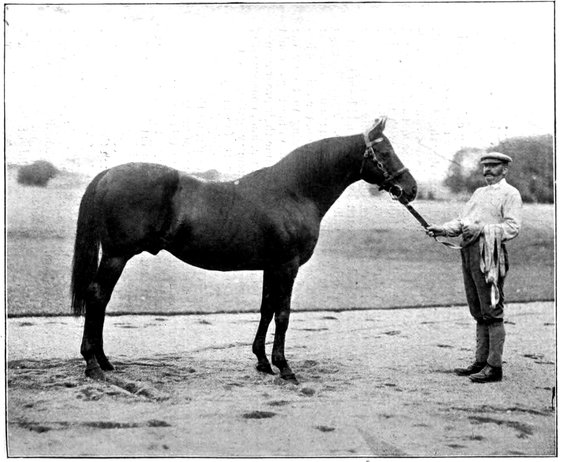
RED PRINCE II. Photo by W. A. Rouch and Co.]
The day may dawn, as I have suggested before, when breeders of blood-stock may consider it worth their while to breed specially for National Hunt racing, but at present there is not a great deal of encouragement to do so. It is interesting, nevertheless, to see how the best steeplechase winners each season are bred, and breeders of hunter stock can always learn something from a study of the pedigrees of prominent performers under National Hunt Rules. They know by this time, for example, that if you want to breed a jumper you are tolerably safe in using a suitable stallion with plenty of Newminster blood in his veins. They know, too, that the descendants of Birdcatcher, particularly through the Stockwell and Sterling channels, can get valuable steeplechasing stock; while the Blacklock blood, so powerful nowadays on the flat, has also claimed its share of cross-country successes, though we have yet to see a stallion of the Galopin tribe sire a Grand National winner. In this connection, it is worthy of note, the Birdcatcher line has claimed a Grand National winner four times during the last decade, namely, Manifesto (twice), Drogheda, and Ambush II., while the Touchstone line has had only two successes, Drumcree and Ascetic’s Silver. But while the Ascetics continue to show such remarkable form in the steeplechases calling for the best qualities of stamina and courage, and the Hacklers keep on winning many races every season, the Newminster line or Touchstone must still be regarded as the best for producing jumping stock.
On May 11th I drew out a list of the first twenty-four winning steeplechase stallions as they stood at that date, the lead being taken by Ascetic and Hackler, and this is how they came out in the male line:—
Touchstone.—Hackler, Ascetic, Marciòn, Bushey Park, Royal Meath, and Speed (through Newminster); Noble Chieftain (through Scottish Chief); and Victor Wild (through Marsyas); total, 8.
Birdcatcher.—Red Prince II., Juggler, and Laveno (through Stockwell); Isinglass, Enthusiast, Ravensbury, and Common (through Sterling); total, 7.
Blacklock.—St. Frusquin, Buckingham, Florizel II., St. Simonmimi, St. Serf, Childwick, and Donovan (all through Galopin); total, 7.
Melbourne.—Marco and Wolfs Crag (through Barcaldine); total, 2.
Tracing these two dozen stallions still further back in male line, one perceives that the descendants of Eclipse are no less successful in steeplechasing than in flat-racing. There is not a single Herod among the twenty-four, Eclipse claiming all save two, these exceptions belonging to the Matchem tribe, through Melbourne. The cry for Herod blood is often repeated nowadays, but the majority of our breeders of blood-stock are scarcely likely to desert the Eclipse line in the face of this and much other evidence of its pre-eminence.
When is the last word on Ascetic as a sire of jumpers to be written? For years the praises of the old horse have been sounded in regard to new and repeated triumphs. As far back as August, 1897, the son of Hermit died at the advanced age of twenty-six, yet nine years later we find him still among the most successful steeplechase sires, and represented, moreover, in the Grand National by the first and third horses, with still another of his progeny among the select few who completed the course.
The majority of the Ascetics now in training have won races, all adding their quota in testimony to the marvellous capacity of the horse. During the past season Ascetic claimed ten winners of sixteen races, value £3,253, the chief contributors having been Ascetic’s Silver, Aunt May, Hill of Bree, and Æsthetic Anne. The winner of the Grand National is thoroughbred, and how the statement came to be made a few days ago that he is not so is surprising, seeing that the horse is registered all right in the “General Stud Book.” He has good jumping blood on both sides of the house, being out of Silver Lady by Ben Battle (sire of Ambush II., and grandsire of Manifesto), out of Lady Pitt by Plum Pudding. The combination of Ascetic and Ben Battle is enormously strong, and Mr. P. J. Dunne surely had his eyes on the highest honours of steeplechasing when he put Silver Lady to Ascetic in three successive years.
Unfortunately, Mr. Dunne did not live long enough to see his judicious methods of breeding crowned with the best possible success, but it was in his colours that Ascetic’s Silver won the Irish Grand National in 1904, thus foreshadowing his greater victory at Liverpool.
In the light of subsequent events, Prince Hatzfeldt got an extremely cheap horse in Ascetic’s Silver at 850 guineas at the sale of Mr. Dunne’s stud in October last. He was lucky, indeed, to secure him at that price. I know one sportsman who went from England to the sale with the fixed intention of buying the horse. He was prepared to go to 1,200 guineas for the son of Ascetic, and was so confident of getting him that he took his groom with him to Ireland to bring the horse back. Alas! on the morning of the sale my friend was unfortunate enough to listen to the counsel of one who should have been in a position to know all about the animal in question. “Don’t touch Ascetic’s Silver,” implored this adviser, for reasons he gave. And so the would-be buyer, having got the “straight tip,” would make no higher bid than 500 guineas. It is not difficult to imagine his chagrin when Ascetic’s Silver cantered away with the National; though it is only fair to mention that he had experienced a corresponding feeling of delight on his “escape” when the horse went somewhat amiss at Sandown Park early in February. It is certain that Ascetic’s Silver would have started at a much shorter price than 20 to 1 had it not been for this incident. But it is possible that the mishap at Sandown Park was mainly due to lack of condition, because when he was properly wound up the horse had no trouble in accomplishing the immeasurably more difficult task.
I am not in possession of the complete figures relating to Ascetic’s career at the stud, but the following table should prove interesting, being a record of the doings of his progeny under National Hunt Rules for ten seasons past:—
Season. No. of Winners. No. of Races Won. Value. £
1896–7 6 12 966
1897–8 10 12 1,094
1896–9 12 25 2,381
1899–1900 18 33 6,099
1900–1 18 29 3,246
1901–2 13 26 4,686
1902–3 19 45 6,985
1903–4 21 45 4,894
1904–5 10 15 1,421
1905–6 10 16 3,253
Total 276 £35,025
Last year a photograph of Hackler was reproduced in these pages, and this time Red Prince II. is presented as being one of the best sires of steeplechase and hunter stock now standing in Ireland. This son of Kendal is out of Empress, who won the Grand National in the hands of Mr. T. Beasley twenty-six years ago, and that he is able to transmit to his progeny much of his mother’s excellence across country is beyond question. Red Prince II., a grand-looking horse himself, gets some handsome stock, and his own important successes in the show-ring have been frequently repeated by his youngsters. A stallion who can win the Croker Challenge Cup at Dublin and sire the winner of the Irish Grand National is one of whom his owner may justifiably be proud, and that Mr. Pallin is proud of Red Prince II. goes without saying. Red Lad has brought him into prominence on this side of the St. George’s Channel by finishing second in the Grand National, and it is not a little curious that the first and second horses for that race this season were both former winners of the Irish Grand National.
Hackler, champion steeplechase stallion in several seasons, was at the head of the list this year until Ascetic’s Silver’s success in the Grand National, value £2,175, gave his sire the advantage. But Hackler has many more of his stock now running than Ascetic, and was not long before he regained the position of supremacy. Hackler claims nearly twice as many winners as any other stallion, and during the past season fifty races have been won by his get, which include Hack Watch, the promising Old Fairyhouse, Wild Fox, Crautacaun (fourth in the Grand National), Conari, Hackett, Armature, Loughmoe and Clonard. I have given some figures showing Ascetic’s work as a successful steeplechase sire, and it is entertaining to compare them with the following table of Hackler’s winnings under National Hunt Rules. The son of Petrarch had his first steeplechase winner in 1897–8, so that the list is shorter by one year than that given of Ascetic:—
Season. No. of Winners. No. of Races Won. Value. £
1897–8 5 7 900
1898–9 7 12 1,996
1899–1900 17 26 2,843
1900–1 10 24 3,587
1901–2 6 14½ 1,028
1902–3 16 29 2,436
1903–4 21 32 2,332
1904–5 23 45½ 2,863
1905–6 19 50 3,427
Total 240 £21,412
Isinglass, who was at the head of the stallions on the flat last year, takes a leading place among the steeplechase sires, Leviathan having been by a long way the best winner for this magnificent thoroughbred. Marciòn, too, ranks high on the list by virtue of Theodocion’s success in the valuable Lancashire Handicap Steeplechase. Enthusiast, for many seasons well represented on the steeplechase list, comes close behind Isinglass. Sleep, Dermot Asthore, Dathi, Agony, and Dependence have been the Irish horse’s best representatives. Noble Chieftain, who stands now in the south of Ireland, has been brought to the front by the smart work of his son Sachem; whilst Marco, although lacking the assistance of Mark Time, has done well with Amersham, Marcova and Black Mark.
Arthur W. Coaten.
The Billiard-Cue.
The cue plays such an important part in the game of billiards that no excuse need be made for discussing briefly, but fully, its essential points. Every amateur who takes more than a passing interest in the game should possess a cue, or cues, of his own, since the habitual use of a well-made, well-balanced cue goes far to engender the confidence which is so desirable an attribute of the billiard player.
First of all, the player should select an English hand-made cue. In a long article which appeared in the World of Billiards, February 7th, 1906, to which readers may be referred, the details of cue manufacture were fully explained by the present writer. Here it will suffice to point out a simple, yet infallible, method of distinguishing at a glance an English hand-made cue from the foreign machine-made article. In the English cue the ebony “points,” where they dovetail into the ash shaft, are slightly rounded, whilst in the French machine-made cue they run to a fine, sharp point (fig. 1).
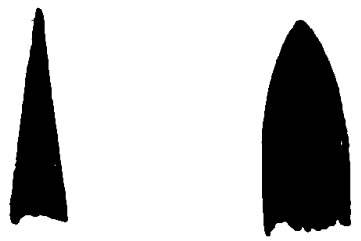
Fig. 1.
For the shaft of the cue no wood is better than good English ash, which must be naturally, not artificially, seasoned. This shaft, which should be stiff, yet full of vibration, should be as “true” and straight as possible, and straight in the grain.
The length of the cue, including the tip, should not be less than 4 ft. 8 in., nor need it, even for very tall men, exceed 4 ft. 10 in. Nineteen men out of twenty will be best suited by a cue of from 4 ft. 8½ in. to 4 ft. 9½ in. in length, 4 ft. 9 in., as given by so many writers on billiards, being the best average length for the cue. When wear and tear has made the cue too short, it should be sent to a good firm of billiard-table makers to be “spliced,” particulars of the length and size of tip required being given.
The size of the cue-tip is another nice point. Cue-tips (fig. 2) are made in five sizes, measuring respectively 9, 10, 11, 12, and 13 millimetres in diameter.[15] A very fine tip is altogether a mistake, and one of from 10 to 12 mm. is recommended, 11 mm. (about 7 16 in.) giving an ideal tip. To affix the cue-tip, a process fully described in the writer’s book, “Hints on Billiards,” and other works, cue cement, liquid glue, or wafers, which last are handy and easily used, may be employed. Glass-paper, it may be added, should never be used to clean the cue, or to “rough up” the surface of the cue-tip, whilst coarse sand-paper should never be seen in a billiard-room. The cue, when it needs cleaning, should be well rubbed, first with a damp cloth, and then, to polish it, with a dry one. The best way, again, of preparing a new tip for play, or of renovating an old smooth one, is to tap it well with a fine, heavy file; a rough file would tear the upper leather all to pieces.
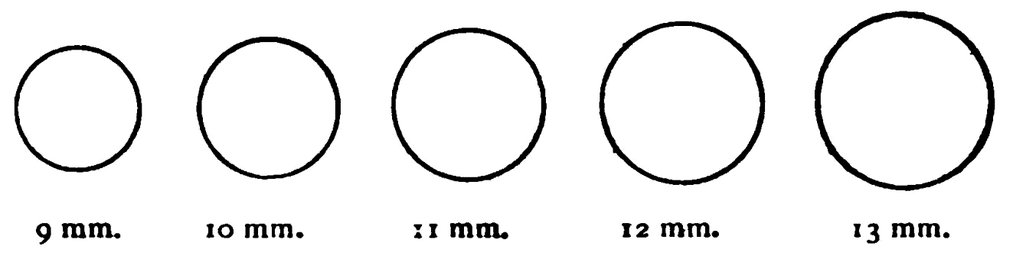
Fig. 2.
The ideal weight for a cue is 15½ oz., but a player may suit his own fancy in the matter within an ounce or so, either way, of this weight, whilst a cue of 14 oz. or 14½ oz. is heavy enough for a lady.
In connection with cues chalk may find appropriate mention, and no better chalk can be obtained than Spinks’ green chalk, sold by Messrs. Burroughes and Watts. This firm may, in particular, be mentioned as turning out a first-rate billiard cue, and they put plenty of wood into their cues in just the right place, viz., just above the butt.
Finally, mention may be made of travelling cues, made in two joints, which, packed in a handy leather case, are extremely convenient. They may, it is true, possess a slight tendency to warp out of perfect truth, whilst, too, the connecting screw must, however slightly, affect the balance, but these are almost infinitesimal drawbacks. With one of these cues a spare top joint, already tipped, will be found a friend in need on occasion.
J. P. Buchanan.
A Country Fair.
The picture by Jacques Laurent Agasse, from which the illustration has been taken, affords us a glimpse of an ancient English institution which is fast passing away. The work was painted in the year 1819, when the country fair or market held a very important place in the economy of rural England, and this picture has special interest for stock breeders, since its most conspicuous figure is a grand example of the old English breed of Black Shire horses.
In Sir Walter Gilbey’s work on “The Great Horse,” a letter is quoted from Oliver Cromwell offering “sixty pieces for that Black you won (in battle) at Horncastle, for my son has a mind to him.” In those days the “Black” was before all things a war horse, and there is ample evidence to prove that it was regarded as the best strain among the heavy breeds. Agasse’s picture refers to a more peaceful era; but the Black Shire horse was still the breed most prized in England. William Marshall, writing in 1790, tells us that the Black Carthorse in his day was extensively bred in the Midlands; and though he personally preferred a smaller and more compact horse, on short, clean legs, and was, moreover, a convinced advocate of the ox-team for the plough and draught work, he could not deny that the breeding of Black Shires was profitable. As showing how the best authorities differ, it is worth noticing that Arthur Young, at about the same period, mentions the “large Black old English horse” as one of the only two varieties of carthorse deserving of mention. The other was the sorrel-coloured Suffolk Punch.
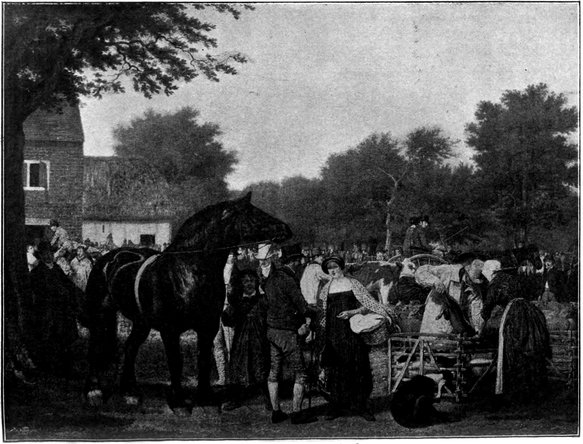
A COUNTRY FAIR IN 1819. J. L. Agasse
The Black Shire, according to Wm. Marshall, had a somewhat chequered working career. The breeders brought their yearlings to certain markets or fairs—Ashby, Loughborough, Burton-on-Trent, Rugby, and Ashbourne—where they were sold to graziers, the prices ranging from £10 to £20. The graziers kept them until they were about two years and a half, and then brought them to the fairs to sell to the farmers and dealers; the markets at Rugby and Stafford being noted for this business. Their purchasers now were farmers. At two years old or two off heavy horses are capable of doing gentle work, and the object of the buyer being to prepare them for the London market, he took good care not to overtax the youngsters. They were not expected to do more than earn their keep, and it was very usual in the home counties to see a team of four drawing a plough which was easily within the strength of two much lighter animals; but the object of the farmer was thus accomplished. The young horses learned to pull steadily, and the light plough work was, in point of fact, their education for the career before them. At four, or four off, they were sent to London, fully developed, conditioned, and ready for the brewer’s dray or the heavy waggon. The brewers of those days took peculiar pride in their dray horses, and spared neither pains nor money to procure the largest and finest Shires for the purposes of their trade.
The Ashby Black Stallion Show, which enjoyed the distinction of being the only event of its kind in England, still flourished in George III.’s time. It took place at Eastertide, and was the occasion for selling and letting stallions of this breed. The word “show,” it should be added, is a complete misnomer; there was no show or anything remotely resembling one. The breeders brought in their stallions and stabled them at the inns, and when a possible purchaser or hirer appeared a horse was pulled out and shown off in some convenient back street or open space. Such an incident we need not doubt afforded Agasse the idea for his picture; the lad in the smock frock has been running the great stallion up and down to show off his paces and carriage before the well-to-do farmer who stands under the tree on the left, and the other critics who stand on the near side of the horse. Marshall was present at the Ashby Black Stallion Show of 1785, when some thirty horses—two, three, and four-year-olds, for the most part—were offered for sale or hire. The prices paid for Black Shire stallions at this so-called “show” ranged from fifty to two hundred guineas; the hire for a season ranged from forty to eighty guineas. Breeders sometimes held private shows of stallions where similar business was transacted.
These horses were largely bred in Lincolnshire: they were, indeed, so closely identified with the county that they were locally known as “Black Lincolnshires.” In the fens they grew to their greatest size; few of them at two and a half, says Youatt, were under seventeen hands. Neither the soil nor the pasture of these districts is better calculated to meet the horse-breeder’s needs than the soil and pasture of other regions of England; but the situation, climate, and conditions of life were in some way peculiarly favourable to the growth of horses, and the Blacks grew bigger there than they did anywhere else. Marshall refers to them disparagingly as the “elephants of Lincolnshire.” All the brood mares seen by Arthur Young on his tour in this county (“General View of the Agriculture of Lincolnshire, 1799”) were Blacks. They were regularly worked in the farm teams by the “arable yeoman,” who kept them for stud purposes.
It was popularly believed in the Midlands that the Black horse originated from half a dozen Zealand mares, which Lord Chesterfield, when ambassador at the Hague, sent over to England. These mares were stabled at Bretby, in Derbyshire, about 1755 or 1760, and no doubt were instrumental in improving the breed. It is stated that for some time after Lord Chesterfield imported these mares Derbyshire “took the lead” among the counties in which Blacks were bred. But while we need not doubt that these mares were the best of their kind, and as such did much in the way of improvement, it is impossible, by the light of the historical evidence, to which reference has been made, to regard them as the foundation stock.
Whatever Marshall’s opinion of the Black, it certainly found great favour all over England, even in Norfolk, a county famous for the small, active carthorses, with which the farmers, as the author points out in “The Harness Horse,” used to run their curious “team races.” The greater popularity which the Black enjoyed a century ago seems to have contributed to the disappearance of the brown-muzzled Norfolk horses. Farmers in those days were not more governed by sentiment in the management of their business than they are now, and we may rest assured that if they turned their attention to the breeding of Blacks, it was because they proved the more profitable stock. Their great weight would suffice to recommend them for heavy draught work on the deep and miry country roads of a past generation. A writer in the Sporting Magazine of 1796, says that “there are instances of single horses that are able to draw a weight of three tons.”
Not the least interesting fact concerning the picture which furnishes occasion for these remarks is the fact that the painter of a scene so typically English in subject, so purely English in spirit and in mode of treatment, should have been a foreigner. Jacques Laurent Agasse was a Swiss by birth; he came to this country when about twenty years of age, and his works show how completely he became imbued with a love of the land of his adoption.
The Judging of Polo Ponies.
By Walter Buckmaster.
The above subject, in my opinion, is a very difficult one to write on, for the simple reason that there are so few men who are capable of occupying the position of a judge of polo ponies. A man must be blessed with a large number of capabilities to act in this position. He must be, firstly, a judge of the horse in the abstract, of its formation, building, &c., he must be a hunting man and a judge of hunters; he must be, in a minor degree, a judge of a racehorse; he must be a fine horseman in himself, and he must be a polo player, and an active one, at the time he is occupying the position of judge.
In these days when the game of polo is taking such a strong hold of the world at large, when county shows all over England and elsewhere reserve classes for polo ponies, polo pony mares, polo pony stallions, young stock, or ponies likely to make polo ponies, the office of judge of these classes is a very important one.
Often one sees that a judge who is officiating in that position in the hunter classes is deputed to judge polo ponies also, and I have even known the hackney or carthorse judge put into this position. Probably the official in question is a fine judge of a hunter and of a horse in all respects, and yet he may be quite the worst judge one can have of made polo ponies. He does not know what is expected of them, how he is to test them, or what they are expected to do. Of their make and shape he is probably quite capable of judging the class; he will know a good-shaped pony from a bad one. Naturally, as a judge of a horse, he will know a good “ride” from a bad one; he will know true action from cramped action, but I very much doubt whether he knows a good polo pony from a bad one. There may be a large number of ponies in the class, he will only be able to spare a minute or so to sit on each pony. During the short space of time he has to make up his mind very quickly as to whether the pony is a good ride to start with; whether it has a good and natural mouth; whether it is tractable or otherwise; whether it turns easily or otherwise; whether when turning it does so on its hind quarters or its forehand, and whether when turning it does so on the proper leg both behind and in front. The majority of ponies, however partially they may be schooled, usually change their legs in front, viz., when turning to the right have their right leg in front, and vice versâ, but how many men can tell in a second when the pony has changed its leg in front, whether it has, at the same time, changed its hind legs similarly? To do this a judge must have great and constant experience.
When writing on this all-important subject I propose stating my opinion and ideas on the made polo pony, or pony likely to make a polo pony, as the judging of young stock, mares likely to breed polo ponies, stallions, &c., comes rather under a different category than the actual judging of the article that is to be ridden and so judged by the official.
Allow me to give a few hints to judges who are setting out for the first few times in this important position. They must remember that the time for them to make up their minds is limited, therefore they must come to their decision quickly, and having made it must abide by it. They will probably have to judge two riding classes: (1) polo ponies; and (2) ponies likely to make polo ponies. Let us consider these two classes separately. When made polo ponies come into the ring let the judge carefully watch them walking round; he must then make up his mind as to what is a good made pony, a pony, pure and simple, and what is not; he will see how they walk and how they carry themselves, and here he will make his first impressions, and these first impressions are, in my opinion, the best. Then they will trot round the ring. This will show him little except that, as a rule, a good walker is usually a good trotter; however, many of the best polo ponies are poor trotters, and often will not trot at all. In my opinion, little is learnt from a polo pony trotting except the fact as to whether it is sound or not. Next the ponies will canter round. Then the judge will see a free goer from a short, stilty-actioned one. He should then proceed to draw the ponies into the centre of the ring, placing the good ones, or what he imagines are the good ones, on the one side and the rubbish on the other. He should then proceed to look the animals over quickly when standing still; whether they stand straight on their legs, whether their joints are true, and so forth.
He should then ride each pony himself, bending and twisting them himself as much as the show-ring will allow him, letting them go top pace as far as is possible. As soon as the judge is on the ponies’ backs he will quickly alter his ideas formed when watching the ponies on foot. He will find that what he fancied as being a good-looking pony rides all wrong when he is on its back; probably bad mouths, or badly trained, change their legs in front but not behind, a most common fault in polo ponies, and a very bad one, as no pony can turn with the safety and speed that he should do unless he changes his legs behind as quickly as in front. Again, as soon as a judge gets on a pony, I advise him to back the pony, just for three or four yards, quickly; all good polo ponies rein back almost as quickly as walking forwards, and if they do not do so they are not high-class polo ponies.
I also advise a judge to ride every pony in the class, whether his first impression of it be good or otherwise; many a pony is missed over that may not favourably impress the judge at first sight, but be a remarkably fine ride.
By this time the judge must have made up his mind; he may have to forgive a fault here and one there, in order to arrive at a proper order of placing the ponies in their class, as no pony is perfect in every respect.
When judging “ponies likely to make polo ponies,” the judge must not be quite so exacting. He must lay greater stress on the good made pony when standing still and the true-actioned and balanced one. He will probably have to judge ponies at very different states of their education, and will find it hard to bring a good young green pony with very little education into competition with a pony that has been well and carefully trained. In this class he must carry in his mind which pony is going to be the most valuable in a year’s time.
There are certain faculties a pony must have, whether he be a made polo pony or a young green pony; he must be built on true hunter lines, short legs, short back, compact, good sloping shoulders and a well set on neck (a pony with a bad neck seldom has a good mouth), his hind-legs and hocks must be well underneath him, and straight. Hind-legs standing away from a pony are a great fault, and generally denote a pony slow at jumping off the mark. He must have essentially a perfect temper, and also a good mouth by nature; this latter is to a large extent a matter of breaking, and a pony badly broken, in my opinion, never gets over it.
Above all, let a judge go for quality; a square underbred pony well trained may ride really well in a show-ring, but how will he manœuvre and ride after playing ten minutes in a fast game of polo; he becomes tired and beat; then his action, mouth, and training all go to the wall, and he is as a sailing ship amongst torpedo boats.
Sport and Animal Life at the Royal Academy.
Works of the character that appeal more directly to us are more remarkable for quality than for number this year; if shooting, yachting and angling pictures are conspicuous by their absence, hunting and hound works are, by comparison with previous exhibitions, numerous and generally excellent. As regards angling, Mr. Frederick Yates’ picture, “A Bite” (32), a boy stretched on the bank of a woodland beck, fishing with a wand cut from the hedge, can hardly be regarded as an angling work, though admirable in composition and drawing; the fox terrier who sits by his master is taking quite a human interest in the proceedings. In the same room hangs Mr. Peter Graham’s “Morning” (40), one of this Academician’s familiar studies of sea-girt rocks with gulls; the sky on the horizon is dark and forbidding, suggestive of a stormy night passed. Mr. C. E. Swan’s “The Day of Reckoning” (59) gives us pause. His tiger drinking in the foreground is excellently well drawn; but would a tiger stop to drink when the elephant in the background is so near at hand? And what are the two gesticulating coolies doing well in advance of the sportsman’s elephant, among the tall grass? They are, moreover almost in the line of fire from the howdah; we doubt much if the “day of reckoning” has come! “Elizabeth at Wemmergill” (78), by Miss Annie L. Swynnerton is a charming picture of a little girl in blue, astride a rough pony, both well painted. In this room we find Mr. John M. Swan’s diploma work (129) “Tigers Drinking,” boldly painted, with less finish than usual; we like it much.
The place of honour in the Academy is occupied by Mr. Abbey’s remarkable work, “Columbus in the New World” (143). Columbus, in armour, kneels on the seashore, priests in their robes kneeling a few paces in rear. The air is thick with scarlet flamingoes—the brilliant Florida species—in flight. The blaze of vermilion dazzles and bewilders the eye, and the indifference of the Discoverer, and his followers to the marvel of bird-life strikes one as unnatural. A very fine piece of work is Mr. James Beadle’s “Les Braves Gens” (150), a scene of the Franco-Prussian War; the horses of the cavalry are cleverly modelled, and the grouping, bound by military conditions, is very artistic. Mr. S. J. Solomon (R.A.-elect) has a pleasing picture (151) of a little girl in pink with a horn, astride a pony, with a couple of frisking terriers, which he entitles “The Field.” Mr. Arthur Wardle takes us to different scenes in “A Sylvan God” (157); the lithe suppleness of the leopard in the foreground is beautifully rendered. Mr. Briton Riviere’s portrait of Professor Frank Clowes (161) comes within our purview, inasmuch as the artist has represented the Professor with his golf clubs. “Winter’s Victim” (189) is the title of Mr. Edwin Alexander’s picture of a dead stag stretched on the snow, with a carrion crow about to begin its meal. The stag is in rather better condition than might be expected of one that has been starved to death, but this, perhaps, is a concession to artistic requirements. Mr. Max Bohm’s “Nearing the Bar” (226) is skied, but its merits are too striking to be overlooked; in the stern of a fishing boat rushing before the wind an old man sits, tiller in hand, his gaze fixed on the unseen “bar.” The intentness of the man’s visage compels admiration, and not less the mingling of excitement and apprehension on that of the boy by his side; a very clever picture. Mr. Edmund Brock in “The Spring-time of Life” (245) has a portrait group, a young man pulling two girls in a skiff, restful and pleasing. In the same room Mr. H. W. B. Davis, R.A., has one of his pictures of Highland Cattle in “Ben Eay, Ross-shire” (279). Mr. Charles E. Stewart’s “Fire!” (285) is a powerful piece of horse painting; the pair of greys harnessed to the engine, approaching the foreground at the gallop, are beautifully modelled; the action is at once vigorous and correct. Good, too, are the horses in Mr. W. B. Wollen’s “The Sun of Austerlitz” (321). Mr. Edgar Fischer has two tigers in “Dawn” (331), one drinking (why is the tiger drinking so popular with the brethren of the brush?), the other growling at some invisible foe across the pool. We might find some minor defects in the equine anatomy in Miss Eleanor Wigram’s “Water Jump at Sandown” (349), but regarded as a whole it is a very successful attempt to represent horses in attitudes difficult to catch, save by instantaneous photography; one horse has landed over the water, the rest are in air or rising to the fence. There is a freedom of handling in the composition which entirely satisfies.
In this gallery we find the most striking and successful horse picture of the year in Miss Lucy Kemp-Welch’s great canvas, “The Joy of Life” (356), a small mob of horses careering about the open fields in the utter abandonment of vitality. They are splendidly modelled, and the work is instinct with vigorous movement. Mr. Simon Vedder’s “King of the Desert” (369) is not very easy to see, being skied. The lion is roaring, with his head up, and the crouching lioness has apparently paused in drinking to cast an enquiring look at him from her baleful green eyes. Mr. Ernest Spence has a good portrait of “Sir John Wallington, K.C.B.” (385), in the uniform of the Badminton Hunt, and hard by is Mr. Alfred Munning’s “Ponies at a Horse Fair” (416), half a dozen cheap animals tied to a low hedge; the blemished piebald on the right is not the class of nag that satisfies the artistic eye, and the painter deserves much credit for the unflinching accuracy with which he has treated a rather sordid equine subject. “Newcastle Fair” (410), by Mr. John Atkinson, a group of gipsy vans with their worn-out horses, is treated in much the same spirit. Miss Mabel Hollams has chosen a rather depressing subject in “His Last Fence” (468); the horse has evidently broken his back over the rather insignificant hedge and lies prone, with his owner kneeling at his head. The coats of the hunting men are rather too bright, but otherwise the picture is a good one. Miss Maud Earl’s “End of the Trail” (477) is a study of wolf-like sledge dogs on a desert of snow; the texture of the coat of the principal figure is equal to anything Miss Earl has ever given us. Mr. William Wall’s “Death of the Roebuck” (504) satisfies as far as the greyhound is concerned; the dog, panting from his exertions, has evidently pulled down the roe single-handed; it is, perhaps, an open question whether a greyhound could do this in the woodlands affected by these deer. Mr. John Charlton has a large and admirably composed picture in (520) “Gone to Ground”; the earth is under a sandy bank among tree roots, and the hounds are grouped round it, their interest in the fox having, it would seem, evaporated. The grouping of the hounds is excellent and the whole work satisfies the eye. “Recuperation” (531) is a clever study of hounds in kennel by Mr. J. Walter Hadland; the grouping here is also good and the artist has been particularly successful with the heads of his hounds. Mr. Munning’s “Meet at the Bell” (540) has merit, but is too crowded; or perhaps it were more accurate to say the figures are too large for the canvas; a pity, as the horse ridden by the master is the true hunter stamp and is admirably painted, while the artist knows how to put a man in the saddle. Mr. Charlton’s other work in the same room, a lady reining in a good-looking chestnut in a woodland glade, “Hark! Back!” (557) shows the artist at his best as a painter of horse-flesh. Miss Margaret Collyer calls her clever and vigorous little picture (594) of two Irish terriers fighting, “Home Rule”; the prophecy political may be overlooked in appreciation of the merit of the drawing. Miss Florence Jay’s “Run to Earth” (637) shows once again that she has studied foxhounds closely and can paint them with fidelity. Mr. Harold Pearson, M.P., was formerly Master of the Oxford Drag, and it is hunting dress that Mr. Glazebrook has elected to portray him in No. 695. Mr. Sanderson Wells’ coaching picture “Rushing the Hill, Derby Day” (714), is a strong and vigorous piece of work; the whip is springing his cattle up the slope almost directly at the spectator; it was no means an easy point of view from which to paint a team, but the action of Mr. Sanderson Wells’ browns is most lifelike. Mr. Charles Ward’s “A Coombe in the Quantocks” (821) will appeal to followers of the staghounds on Exmoor.
There are in the Water-colour Room some pictures which should not be missed; notably Miss Lucy Kemp Welch’s “Horse Drovers” (925); the scene a country lane, with half a dozen carthorses in varying attitudes. The horses in Mr. Sheldon Williams’ “Labourers” (951) are well done. In the Black and White room we find Mr. John Emm’s clever hound study, “The Pride of Belvoir” (1284), and Mr. Victor Focillon’s very successful engraving of Mr. Napier Henry’s yachting picture of a year or two ago, “Youth.” Mr. A. D. Greenhill Gardyne’s “Captain S. C. Crawfurd and a Giraffe” (1356) shows the sportsman resting against the body of the great beast which has fallen to his rifle. “Coaches at Ascot leaving the Course,” by Mr. Arthur J. Gough, also deserves praiseworthy mention. There is little in the sculpture room that calls for notice from us. Miss Geraldine Blake’s statuette “The Stock Rider” (1706) is a good piece of modelling, and Miss Katherine Wallis has been successful with her bronze statuette of a dachshund (1753). So animated and clever is the figure of a little girl delightedly but fearfully holding out a frog by the hind-leg (La petite grenouillière), we cannot forbear to draw attention to it. Herr Paul Hüsgen must be congratulated on the success with which he has caught the likeness in his bronze medallion of Sir Walter Gilbey.
Notes and Sport of a Dry-fly Purist.
THE GRAYLING SEASON, 1905.
During the past season I enjoyed the privilege of fishing for grayling in the very best stocked portions of the Itchen at Twyford and Shawford.
On August 11th, 5 brace were killed; on the 12th, 3½ brace; on the 19th, 4 brace; on the 23rd, 4 brace; on the 26th, 1 brace—their weights varying from 14 oz. to 1¼ lb. On August 28th the evening was stormy, and until seven o’clock no signs of flies or of fish breaking the surface of the swollen, breeze-rippled, and strongly running stream could be noticed. I was standing near the swampy margin of the west bank above Shawford Bridge, and with little hope of the prospect for sport improving, when a single dark olive dun floated down, and just as its struggles to dry its wings seemed effectual it rose, but fell on the water again, and instantly a grayling flashed up and took it. Well hooked and played from the bended rod, it was felt to be a heavy one; nor could it be much restrained without risk until it had drifted to the ford, where I was in the act of trying to draw it over the shallow side to dry land, not intending to use the net, when a man watching from the bridge, a black retriever at his side, called out, “Shall I come and land him for you, sir?” At that instant his dog rushed round to the shallows, and wildly jumping about, repeatedly tried to seize the fish—in fact, to retrieve it as he would a moorhen. The chance of hooking the dog was so likely, and the consequent breakage of my tackle, perhaps losing the fish also, that I promptly used the net handle to beat him off, and as I landed and unhooked the grayling (afterwards found to weigh 1 lb. 7 oz.), the dog looked on, wagging his tail and barking excitedly—possibly he expected praise rather than a beating.
For the next half hour, at intervals, a few dark-winged Ephemeræ were seen to emerge on the surface. I knotted on to the fine-drawn gut point of my cast a red quill dressed on a cipher hook, and after many attempts, baffled by the wind, to present it just right, a grayling that could plainly be seen in a clear run close under my bank rose to it and was hooked and brought to net, weighing 15 oz. Another an ounce heavier soon followed. Afterwards, about 8 p.m., when the wind had lulled, some sedgeflies hovered over the surface in mid-channel, occasionally dipping on to it as they dropped their eggs. A larger red quill on a No. 2 hook was therefore tried, as it was similar in size to the natural sedges, and, presented by the horizontal back-handed casting method, it sailed lightly down over the ring of a feeding fish, and when he rose again and snatched at it he hooked himself, giving three minutes of exciting sport ere the landing-net secured him, a grayling of 14 oz., making up two brace weighing 4½lb.
On the 30th, after the total eclipse of the sun in the afternoon, the evening was dull, and low clouds threatened rain. I fished in the same place as last. The river was clear but brimful; indeed, here and away overflowing its banks, and running so wildly that a dry fly cast up stream in the usual manner immediately dragged, and if thrown across, the line sagged or bellied, and consequently, whenever a fish took my fly, it was most difficult, on the slack line, to strike and hook him. To let the fly drift was easier and the only alternative, and in this way 2½ brace of grayling, from 10 to 13 inches in length, were creeled by 8.10 p.m. At which time, having lost my fly in an overhanging branch, it was too dark to see to tie on another, and I reluctantly had to leave off. It was particularly provoking, for the fish were then rising in that reckless way they often do for a brief time at dusk.
Next evening my practice was between the bridge and the lower boundary of the Twyford fishery on the west side, and for once in a way all the conditions an angler wishes for were favourable: the smooth, clear, and sun-lighted stream reflected white cumuli clouds and the azure sky; flies were in the air, which the Hirundinidæ in graceful curves of flight and with unerring sight were intercepting, while olive duns, in straggling, intermittent groups, were floating down, and fish taking them eagerly. And to complete one’s satisfaction, a gentle breeze from the west made casting easy. The successful fly of yestereve, a red quill on a 000 hook, was again used, and from 6.30 to a little after 8 p.m. four brace of grayling, scaling from 12 oz. to 1 lb. 5 oz., were hooked, played, and brought to grass, besides several returned. And a larger grayling escaped by the small hook working out just as the net was nearly in position to thrust under him. There is no necessity to further describe this evening’s very good sport than to say that for the one and a half hours I was almost constantly at work, and that the fish rose and fastened to my artificial fly as readily as they did to the naturals; but with so good a rise of duns there were, of course, ten chances to one against the red quill. Bearing this in mind, the sport could scarcely have been better.
On September 2nd sport was greatly interfered with by horses drawing carts, vans, &c., passing through the ford, and as it was Saturday night, the drivers sometimes stopped midway to refresh their horses, wash wheels, &c. At another time a boy on the back of a tired horse that had done his week’s work was made to stand awhile in the ford for the benefit of his legs, and now and again the boy, evidently delighted to be riding, would take a turn from shore to shore, and once he began to splash up stream until I remonstrated. And twice a lumbering watering-cart was slowly filled from a bucket dipped into the river. With all these interruptions one’s patience was much tried, as I had no chance of fishing until about 7.30 p.m. I should have gone elsewhere had I not noticed that within a few minutes after each disturbance had temporarily ceased a shoal of about a dozen grayling came on to the churned-up gravelly bottom to feed, probably on crushed or crawling larvæ, snails, &c. I resolved, therefore, to bide my time, and when all was quiet again fish began to rise, freely taking Trichoptera as they touched or floated on the surface of the smooth stream, and at intervals my counterfeit fly, each time with fatal effect, for when I left off a leash of beautiful 11 to 13-inch grayling, as bright as silver, lay on the grass at my feet. And while they were being arranged in the creel for presentation to a friend, embellished with the wild flowers, mimulus and willow-herb, the clock of Twyford church slowly tolled out the hour of eight. Twilight was passing into darkness; Mars, the evening star, low down in the south-western sky, showed large and luminous; birds were mute—the silence was oppressive.
The evening of September 12th was bright, rather cool and windy, but at 6.40 black gnats were dancing in mazy groups under the boughs of trees and pale midges around my cap as I stood near the poplar-tree above Shawford Bridge. The river was very full and flowing swiftly, but smooth and favourable for dry-fly practice. Many small trout were unavoidably hooked and time was lost in putting them back, but one weighing 1½ lb. was kept, because an invalid friend wanted it, and I was not likely to fish in this part of the river again until the trout season would be over. Half an hour afterwards grayling were rising to dark-winged olive duns; I changed my fly for the Englefield quill pattern with silver tag, dressed on 0 hooks, and by a little after eight o’clock it had tempted to their fate three brace, measuring 10 to 11½ inches, when I had to hurry away to catch my train. It was very pretty sport, and a good wind-up of the foregoing ten evenings’ sport and pastime, on each occasion obtained within two hours, and aggregating 30½ brace.
On October 3rd, at noon, many large grayling had worked up to the shallows under the pretty little weir over which the water from the Shawford House garden reach was falling in a glassy cascade. The overhanging trees prevented overhand casting, but, by kneeling and crouching low, my fly could be sent forward over them. It was not noticed at first, but at the third essay it was snatched at, and the grayling hooked: fortunately he turned, and rushing zigzag down stream without disturbing the others, was followed and netted out. After prudently waiting a time, the weir was again quietly approached, and still the grayling were seen there, but now, more on the alert, rising to olive duns. My very poor imitation was nevertheless taken at the first throw as it lightly dropped in the white froth and among the air-bubbles under the waterfall, and a grayling well hooked and landed—his desperate struggling causing the other fish to scurry away out of the pool. It was satisfactory to know, while consuming an al fresco luncheon which followed, that a handsome brace was already in the creel—indeed, it gave a zest to appetite.
Lower down, where the broad water is divided by the first islet, the narrowed channel is a favoured feeding place for grayling. They were now darting up to the surface, taking floating flies—iron blues they looked like—but to pass along the bank would disturb them. I therefore several times let my dry fly drift down, and at last it was effective in bringing another fish to hand. About 4 p.m. the sparse rise of Ephemeræ was over, nor did they come on again until an hour after sunset, when dark-winged olives in considerable numbers were on the wind-rippled stream under the low-branching trees at the upper end of the mill race, where casting was almost impossible, but in an eddy one grayling could be tried over, and he came to grief, the two brace for the day scaling 4 lb. 2 oz.
The morning rise on November 3rd did not begin until about 11.30, and only lasted for two and a half hours. On the lower reach of the main stream in the park several small rings and splashes were seen on the glide above the second island, such as denote grayling busily taking surface food, but they were many times cast over before my 00 red quill was taken and a fish hooked, who instantly furrowed along the top of the water to the opposite side, and made vain attempts to rub the hook out in a shallow weed-bed; then when held firmly from the rod and played he repeatedly, as if in wrath, turned wildly over and over on the surface (grayling seldom or never spring out of water as trout do), and being thus exhausted and before he could take another turn, as they sometimes do when apparently dead beaten, was drawn near enough to be netted out. Almost under similar conditions another grayling was shortly after lured by the same fly and killed—the brace weighing 2¼ lb.
Higher up, twenty yards in the rear of the first islet, a large grayling was observed in a clear bay behind weeds, and, save for the gently waving movement of his tail to maintain his equipoise, showing no signs of life—“Glued to the bottom and very little use to cast over him,” an angler would say. Nevertheless, in a desultory sort of way I did send my red quill over him, and his head slightly moved up. Again my fly was floated over, and this time he came to inspect it, paused, and retired. I also retired some thirty or forty yards lower down, and under the dry sedge bordering my bank managed to hook and land an 11-inch grayling. Then I quietly worked up again to the beforementioned big one, and by a long throw deftly placed my fly a yard in front of him. Like a shadowy flash he boldly rose, touched the fly, and drowned it, no doubt seizing it submerged unknown to me, for in the act of recovering my fly it firmly hooked him, and after a well-fought battle he was safely landed, and, held on a steelyard, weighed 1 lb. 5 oz. Then at the extremity of the park where the two streams meet a grayling could be seen quiescent under the opposite branches, but, as before, an experimental cast tempted him to rise from his lethargy and snap at my fly, when, well hooked, and after giving exciting sport, he was brought to bank, under 1 lb. in weight.
On four other days in November my sport aggregated 15½ brace, and on seven days in December to finish the season, 19½ brace.
Red Quill.
Hound Sales, Past and Present.
The more closely hounds are studied the stronger must grow the conviction that no animal can excel the well-bred foxhound as an example of perfect conformation. It is permissible to think also that the man whose eye is accustomed to the points of the foxhound is pretty certain to be a judge of horses, the “points” of either being in a sense nearly identical. To take the high-bred foxhound, the lay of his shoulders are perfect for movement, the blades meeting well into the back, the fore ribs very far down or deep in proportion to the frame, the brisket below the elbow, the back also level shaped, muscles united to a loin wide for the size of the hound, the quarter very full, and the hock straight. Then we have the make-up of the beautiful neck that must mean ease in stooping for a line, and the legs and feet, over which some people differ, the majority of good judges wanting a big bone down to the toes, and others being content with less bone, and less inclined to be critical about the straightness of the fore limb. The late Lord Macclesfield and Mr. G. Lane Fox, both excellent judges, thought more of necks and shoulders than legs and feet, and Mr. H. Chaplin, great on both horses and hounds, thinks more of the quality of bone than the quantity. But, allowing for these slight divergencies of opinion, it must be acknowledged that the judgment of many has brought the foxhound to an extraordinary standard of perfection. His pace is very wonderful, and, unlike that of the greyhound, it is lasting. In the Great Wood run of the Badminton Hunt of three hours and forty minutes’ duration, all but three hounds out of seventeen and a half couples were up at the finish when the horses were all settled, most of them an hour before, and yet the hounds were comparatively fresh. They all fed well the same night, so Charles Hamblin told the writer, and were right enough the next day. There have been many other examples in which longer runs have been quoted, but the Great Wood was perhaps the greatest in regard to pace.
Three hours and three quarters’ hard galloping in a twenty-seven mile point is like seven Grand Nationals thrown into one. The development of such powers in the foxhound must be regarded as the work of past masters in the selection always of the fittest, and the great sales of the last century have proved most conclusively the individuality of those masters. To take Mr. John Corbet, of Sundorne, in the very earliest days of the century. He had seen all the qualities above alluded to compressed, as it were, in Trojan, who could race to the front of the pack, stay the longest runs, hunt a colder scent than others, jump higher and cleaner than any hound ever seen, and was able to run in his eighth and ninth seasons. His fitness was so great for the hunting field that Mr. Corbet absolutely bred a pack of hounds from him, and when he sold that pack to the sixth Lord Middleton for £1,500 the latter wrote, when enclosing his cheque, that he thought them remarkably cheap. This they turned out to be, as they gave Lord Middleton a vast amount of pleasure in hunting and hound-breeding for many years. It enabled him to breed a second Trojan in Vanguard, and such Masters, as Mr. Foljambe, Lord Henry Bentinck and Mr. Arkwright, of the Oakley, in a measure continued the line to the days of present hound-lovers. There was, again, Osbaldeston with his Furrier. The Squire would believe in nothing else, and consider what tremendous sales he had from the progeny of the old hound, to count those he sold, which some say he lent, to the late Mr. Harvey Combe; and the ten couples of bitches he sold for £1,000 to the Master of the Pytchley.
Other sales by auction, though, have perhaps been more famous in illustrating the judgment of both buyers and sellers, as, for instance, the great sale at the Bicester kennels in 1851, through the retirement of Mr. Tom Drake. The latter had been a very noted master of hounds for twenty-one years, and possibly long before that, in a less ostensible way, than in governing the Bicester. At any rate, he had taken a lot of trouble in his search for hound blood, and every hound in the sale catalogue had been bred by himself. He had bred from the Brocklesby Herald, and a great deal from Mr. Foljambe’s Stormer, so full of the Osbaldeston Furrier blood. His Duster had been used at Belvoir, but the latter celebrity was not in evidence on the sale day, although he might have been as he was then only seven years old. Lord Henry Bentinck was the most notable buyer on that May afternoon; he bought lot 2 of four couples for 200 gs., lots 5 and 6 for respectively 91 and 135 gs., and lot 10 for 165 gs. In all he bought twenty couples, and that must have helped to make his Burton pack, as, although he had been building it up for eight years from hounds he got from Lord Ducie, the latter were not so good as Mr. Drake’s. The first Drake sale, though, led up to another of still greater importance, as Mr. Tom Tyrwhitt Drake, better known to a later generation of sportsmen, took on his father’s old country, the Bicester, in the year of the sale, 1851, and he bought a few lots of the old pack, eight couples of entered hounds in all, and three brood bitches in whelp.
Here was the nucleus of another pack, but Tom Drake, as he was familiarly called by his friends, must have been an extraordinary good judge, as he bred from such bitches as Melody one of the hereditary stock for whom he gave 18 gs. in whelp to Duster; and Skilful, by Mr. Foljambe’s Stormer. He bought a lot of drafts also from Belvoir, Lord Henry Bentinck’s and Badminton, and before the sixties his hounds were very much talked of. He had, in fact, formed a beautiful pack in eleven years, as it was in 1862 that he decided to sell it, and once more the Messrs. Tattersall journeyed to the Bicester kennels, by this time at Stratton Audley, to dispose of another Drake pack. Albeit a large proportion of the hounds were not home-bred, I have always put this sale down as the most important on record, as such famous results can be traced from it and the hunting public expressed such confidence in Mr. Drake, as shown by the capital prices made. Moreover, some of the best hound judges living were amongst the buyers and bidders, including Mr. Tailby, Mr. John Chaworth Musters, Lord Middleton, Mr. Villebois, the Hon. E. Duncombe, afterwards Lord Feversham, and Sir John Trollope. The largest buyer was the late Lord Eglinton, then just commencing his career as a master of hounds—his lordship, taking three lots, twelve couples in all, for 420 gs., and they furnished foundation stock for the splendid pack now at Eglinton Castle. Mr. Tailby got two high-priced lots for 230 and 185 gs., but there were four in them by grandsons of Duster, and a five-year-old dog by old Lucifer, bought at the first Drake sale and almost as famous as Duster himself. Mr. John Chaworth Musters, with much discrimination, took lot 13, as, although there were in it some that were ostensibly drafts from Belvoir, they were pretty good ones. Good they turned out to be, as the four couples included Sportly, almost the ancestress of the future South Notts pack, and some say, of the Warwickshire as well. This famous daughter of Mr. Foljambe’s Sportsman and the Duke of Rutland’s Rampish made the lot of four couples exceedingly cheap at 225 gs. It has been well said, too, that the Bedale pack was made by the purchases here of the Hon. E. Duncombe; and Lord Middleton’s two lots that cost 310 gs. must have done the Birdsall pack some good, as there was much Belvoir, Stormer, Singer and Comus blood included in them, all, in fact, Drake classic blood so to speak, as Singer, the sire of Senator, was by Comus out of Syren, by the Drake Duster. In all, and perhaps before the most distinguished audience ever brought together by a hound sale, Mr. T. T. Drake’s hounds realised 2,911 gs., whereas the senior Mr. Drake’s pack eleven years before had only made 1,728 gs.